

Braided half up half down wedding hair has one rare advantage: it can look polished at the altar and still move when the dancing starts. That balance is harder to get than it sounds. Too much structure and the style turns stiff. Too much softness and the braid disappears in photos.
The best versions do a little of both. They keep the front of the hair controlled, build shape around the crown, and leave enough length to show off curls, waves, shine, or a clean straight finish. The braid itself can be tiny, rope-like, wide and romantic, or tucked into a crown, but the job is the same: hold the shape without swallowing the rest of the hair.
That’s why this style works across so many wedding settings. It sits nicely with veils, clips, pearls, and flowers. It also gives a bride some breathing room if the gown has a busy neckline or if the weather is doing what weather loves to do.
What matters most is balance. A braid that is too tight reads hard. A braid that is too loose can sag before the cake is cut. The looks below cover the range, from clean and classic to soft and boho, so you can match the braid to the dress, the hair type, and the kind of day you actually want to have.
1. Classic Crown Braid With Soft Waves
A classic crown braid is the safe choice in the best way. It wraps shape around the head, keeps the front neat, and leaves the length free enough to feel romantic instead of formal in a stiff, helmet-like way.
Why it works so well
The braid acts like a frame. It pulls the eye up toward the face and keeps the hairline tidy, which matters more than people think in ceremony photos. Soft waves through the bottom half stop the style from looking too rigid.
This look is especially kind to strapless gowns and dresses with open backs. The braid gives the top half enough detail that you do not need a huge accessory to make it feel finished.
- Best on medium to long hair
- Works with loose curls or brushed-out waves
- Holds a veil under the braid line
- Looks clean with pearl pins or tiny crystals
Tip: Keep the braid snug at the crown, then loosen the outer edges by a few millimeters for a softer finish.
2. Fishtail Half-Up With Loose Curls
Want something that looks detailed without feeling fussy? A fishtail braid does that job beautifully. The weave is tight and delicate at the same time, so the style reads as careful from a distance and interesting up close.
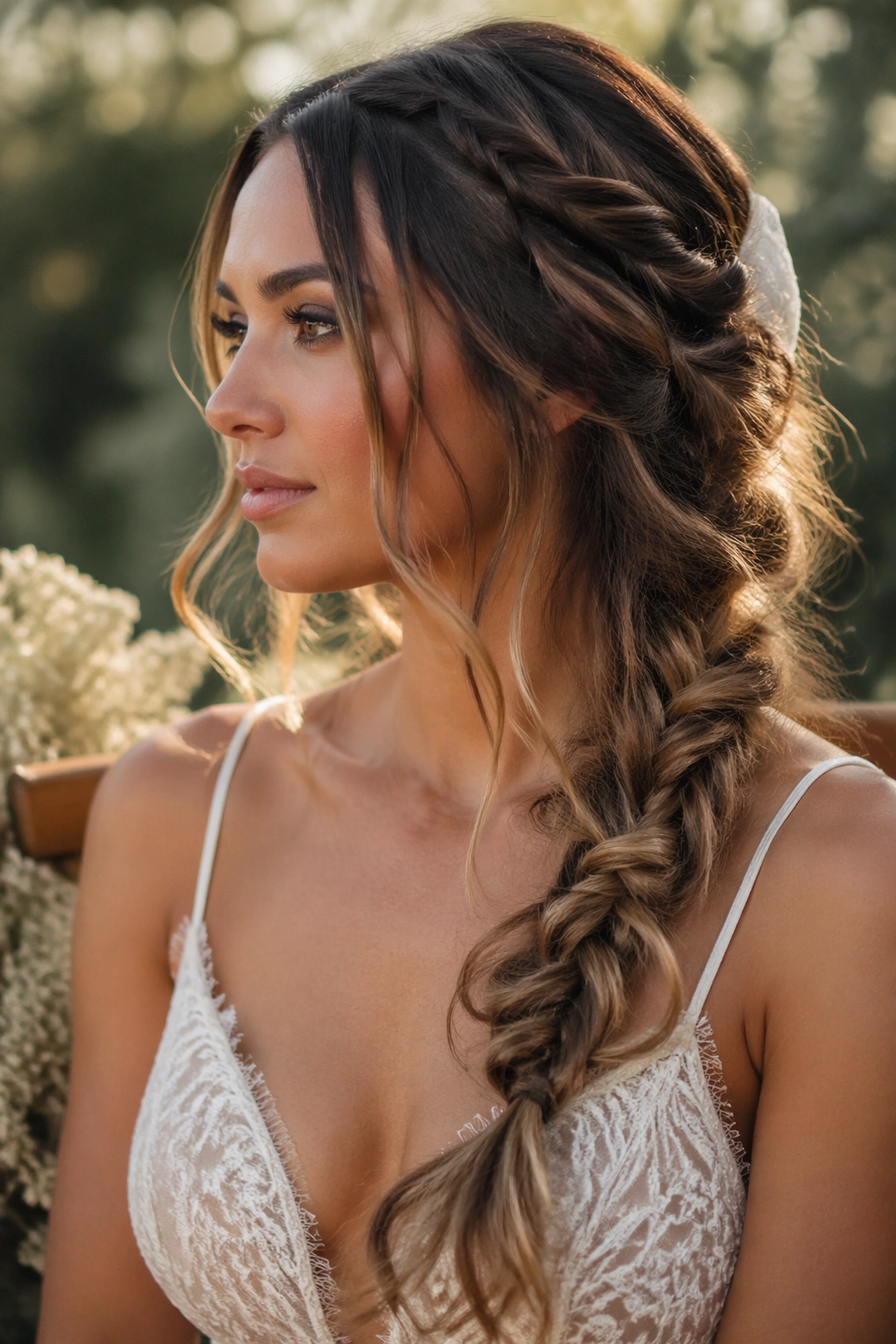
Loose curls through the back half make this look feel bridal instead of overly styled. If the hair is long, the fishtail can start high at the temples and taper into the gathered section so the braid becomes part of the shape, not a separate object sitting on top.
This one is good for brides who want texture in their photos. A fishtail catches light in a different way than a standard three-strand braid, which means the detail shows even when the hair is a little dim indoors.
A center part looks clean here. A soft side part works too, but keep the braid balanced so one side does not swallow the whole shape.
3. Double Dutch Braids Into a Half Pony
Two Dutch braids feeding into a half pony give the style a little more edge. It sounds sporty at first, and honestly, that is part of the charm. The braid sits proud of the scalp, so the detail is visible from the front, the side, and the back.
This works especially well when the dress is sleek or modern. Clean satin, sharp tailoring, and a simple neckline all play nicely with the braided structure. The lower half can stay straight, curled, or softly waved depending on how polished you want the finish to feel.
Best use case
If you need the top section to stay put for hours, this is a smart pick. Dutch braids have grip. They hold shape well, and they keep hair from slipping around during a long ceremony, a windy outdoor photo session, or a reception with too much movement.
A small wrapped section of hair around the elastic makes the half pony look intentional. Otherwise it can read a little too casual. Tiny detail, big difference.
4. Waterfall Braid With Airy Ends
Waterfall braids are for brides who want motion. The braid drops strands through the weave, so the style has little openings that feel light instead of dense. It’s one of the prettiest choices for layered hair, especially when the bottom section is curled with a 1 to 1.25 inch iron.
A waterfall braid can look delicate from far away and more technical up close. That is part of its appeal. It doesn’t try to dominate the whole hairstyle. It simply gives the top section a little architecture and lets the length do the rest.
This one can be a little tricky if the hair is very silky. A touch of texture spray before braiding helps the sections stay where they belong. Without it, the braid can slide and lose its shape fast.
Keep the ends soft. Over-brushing the loose hair takes away the floating feel that makes this style work.
5. Rope Braid Half-Up With Low Movement
The rope braid is underrated. It looks simple, but the twist pattern gives the half-up section a neat, polished line that does not fight with the rest of the hair. It also takes less time to build than a complicated multi-strand braid, which is worth something on a wedding morning.
The best version starts near the temples and twists back toward the crown before meeting in the center. From there, the loose hair can be left in smooth waves or brushed into a soft bend with the ends tucked under slightly.
Quick details that help
- Use a light mousse on damp hair for grip
- Twist each section in the same direction before wrapping
- Secure with two crossed bobby pins for extra hold
- Finish with a flexible hairspray, not a crunchy one
Small warning: Rope braids can unravel if the sections are uneven. Keep both sides balanced from the start.
6. Boho Side Braid With Face-Framing Pieces
A side braid gives the style a little tilt, and that tilt changes the whole mood. Instead of sitting neatly down the middle, the braid slides over one shoulder line and makes the half-up shape feel more relaxed, more lived in, and a little less formal.
Why the angle matters
The side placement lets the braid work with the dress instead of competing with it. It is especially nice with one-shoulder gowns, off-the-shoulder necklines, or dresses with draped fabric that already do a lot visually.
Face-framing pieces matter here. Leave a few slender strands around the cheekbones, then curl them lightly so they don’t look accidental. Too many loose pieces and the style starts to look unfinished. Too few and you lose the softness.
This is the version I’d pick for an outdoor ceremony with a natural setting. It feels easy, but not careless. That distinction matters.
7. Halo Braid Crown With Sleek Lengths
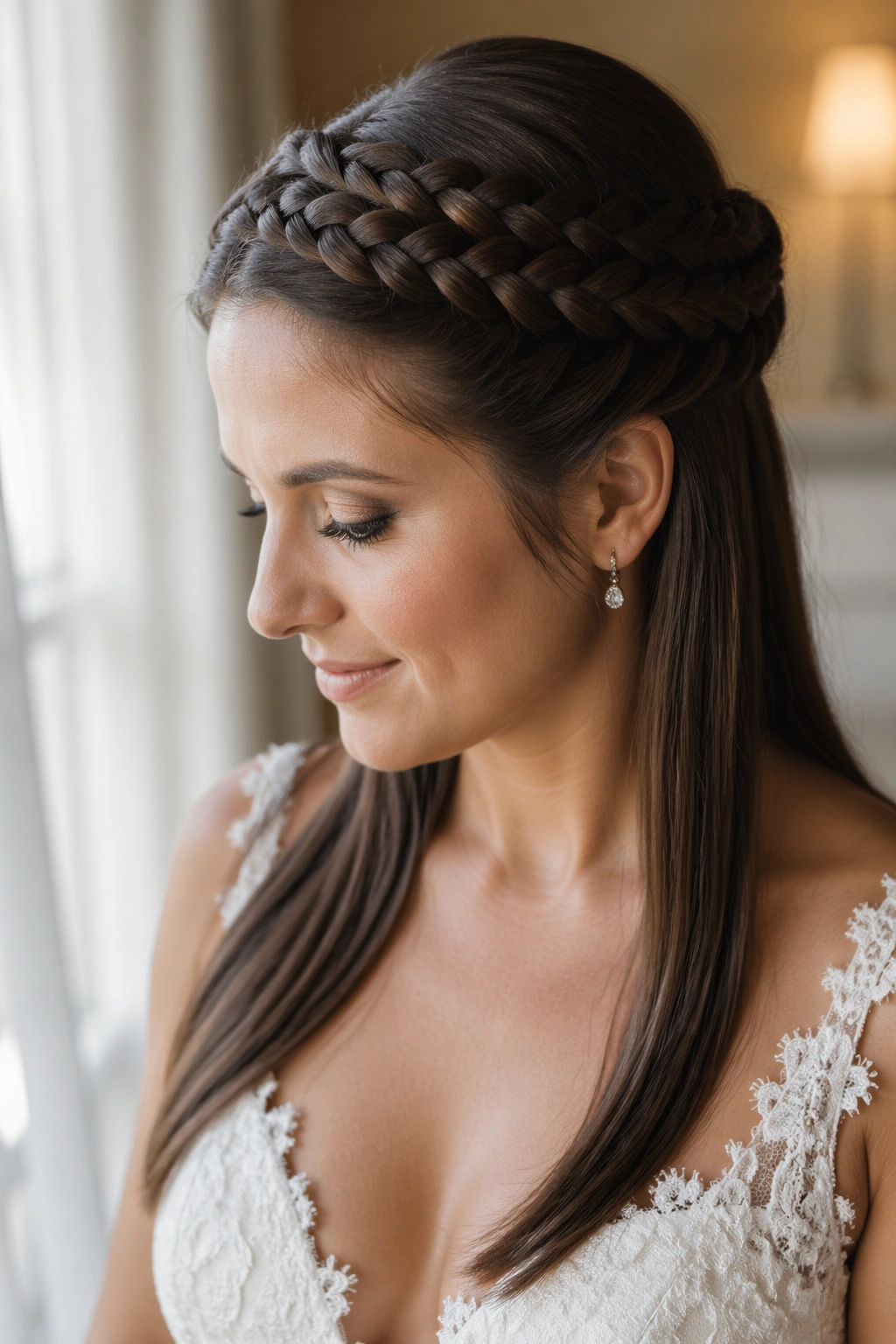
A halo braid makes a strong case for restraint. The braid circles the head or passes around it like a crown, while the lower half stays smooth and polished. That mix gives the hair a clean shape without making the bride look overdone.
Unlike looser boho braids, this one has a more controlled edge. The sleek lengths underneath give the braid room to shine, and they make the silhouette read as deliberate from every angle.
It works best when the hair has been smoothed first with a paddle brush and a small amount of shine cream. Flyaways are the enemy here. So is a heavy curl pattern that fights the sleekness at the bottom.
This is one of the nicest pairings for a minimal gown. No fuss. No extra noise. Just a braid doing quiet, efficient work.
8. Milkmaid-Inspired Half-Up Twist Braid
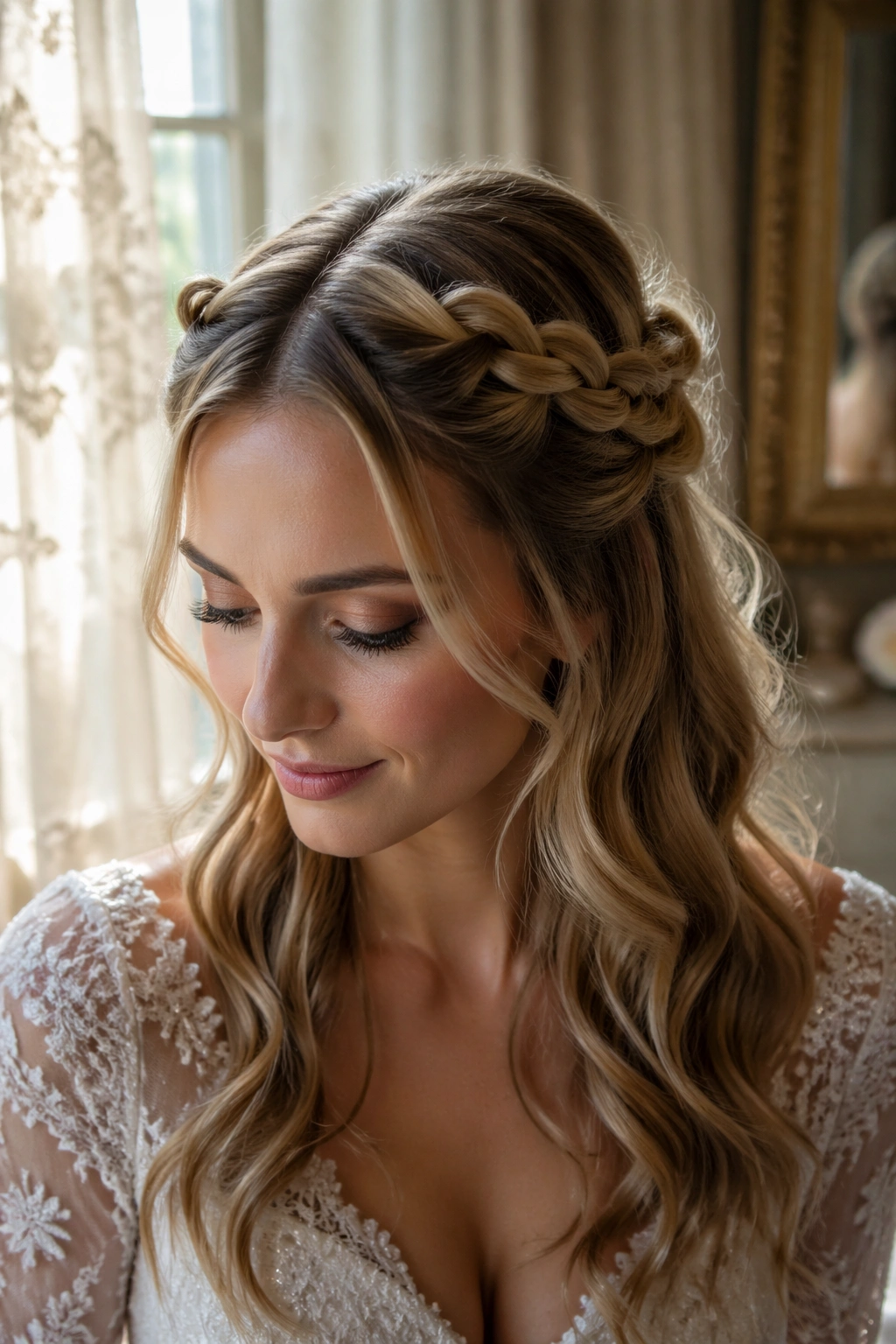
There’s something old-world about this style, and I mean that in a good way. The braid or twist sits high enough to feel decorative, while the lengths beneath it soften the look so it doesn’t turn into costume territory.
This version is lovely with lace sleeves, satin ribbons, or a gown that already hints at vintage shape. A bride who wants some neck definition without giving up length usually lands here after a bit of trial and error.
The trick is keeping the top section full enough to show the braid, but not so bulky that it starts to feel heavy. A little lift at the crown helps. So does a careful mist of texture spray before the sections are pinned back.
A center part makes the look feel balanced. A deep side part pushes it into more dramatic territory.
9. Braided Bow Half-Up For Whimsical Brides
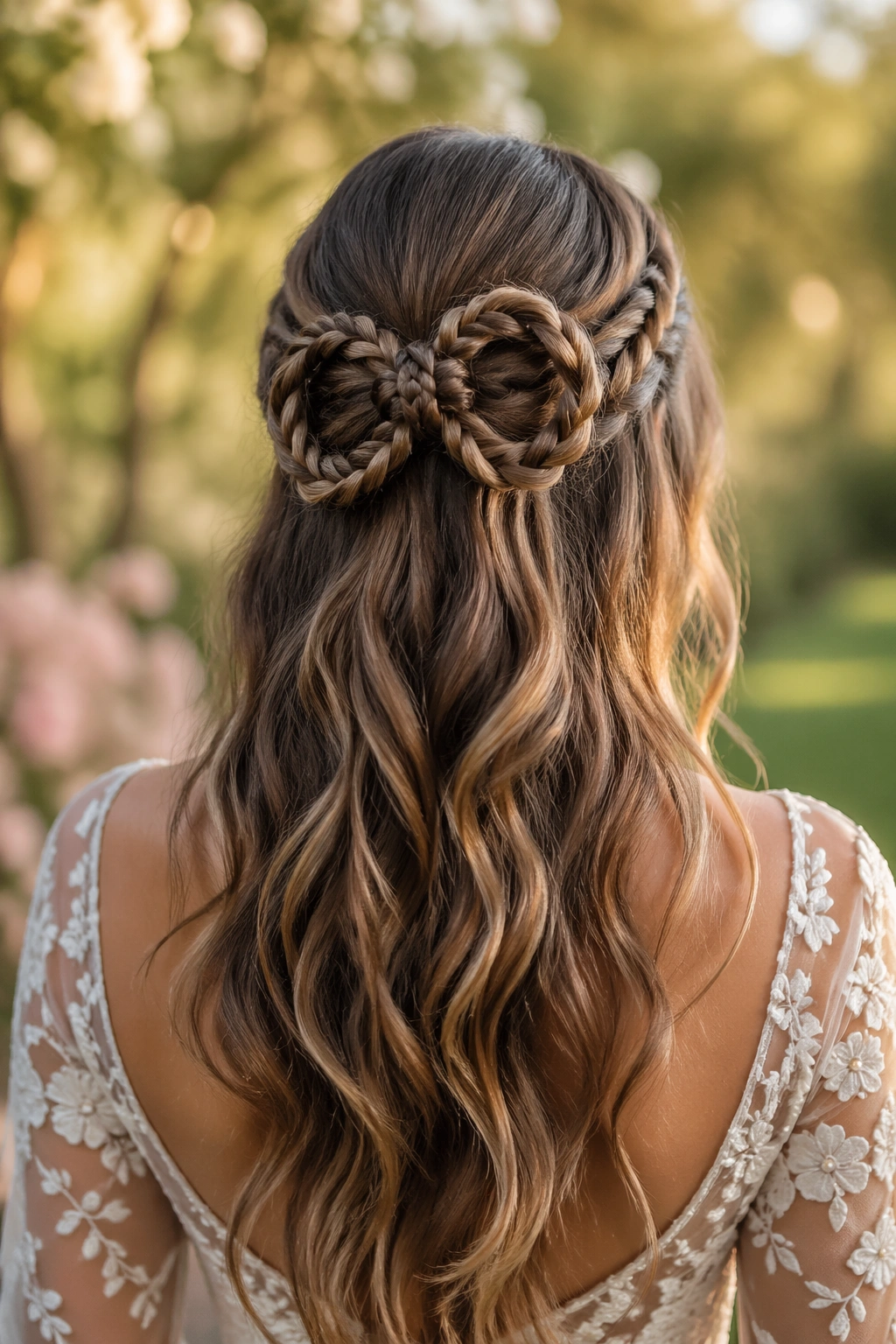
A braided bow is not for everyone. Good. It should feel a little special. The shape gives the half-up section a playful, almost storybook look without needing a pile of accessories.
The bow can be built from a braid looped and pinned into two soft circles, or it can be formed with ribbon-like braid tails that mimic the shape. Either way, the lower half should stay calm. Loose curls or loose S-waves work best because they keep the style from becoming too busy.
This is the kind of look that photographs well from the back, which matters when the ceremony setup has a lot of seated guests and a long aisle. The bow catches the eye, then the length below keeps the style grounded.
One thing. This takes a hand that knows how to pin. Too tight, and the bow looks pinched. Too loose, and it collapses. There’s no mystery there.
10. Knotted Braid Half-Up With Straight Lengths
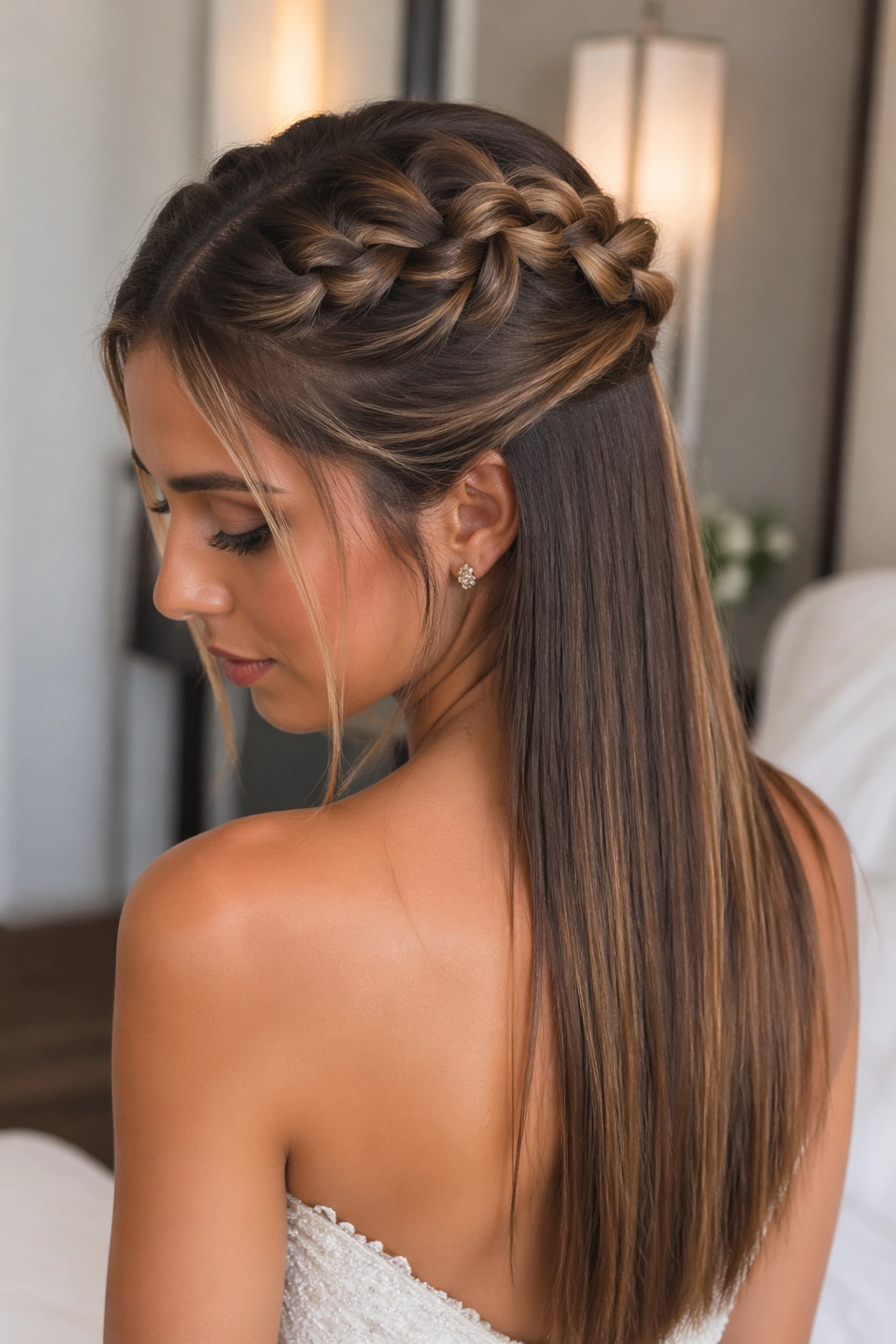
Can a braid still feel bridal if the hair stays straight? Absolutely. In fact, the contrast can look sharper than curls in the right dress and the right room.
The knotted braid half-up keeps the top section interesting while the lower hair stays sleek. That’s a clean move for modern brides who want detail without softness overload. It also works well with hair that has natural shine, because the straight finish makes the braid lines stand out.
Where this style shines
The knot shape looks especially good with square necklines, clean crepe fabrics, and earrings that deserve a little space. It also avoids the common problem of overly curled bridal hair swallowing the dress details.
A smoothing cream on the mids and ends helps keep the bottom half flat and glossy. Avoid too much oil near the crown, though. That can make the braid slip.
A small middle section wrapped around the center knot gives the whole look a tidier finish.
11. Pull-Through Braid Half-Up With Volume
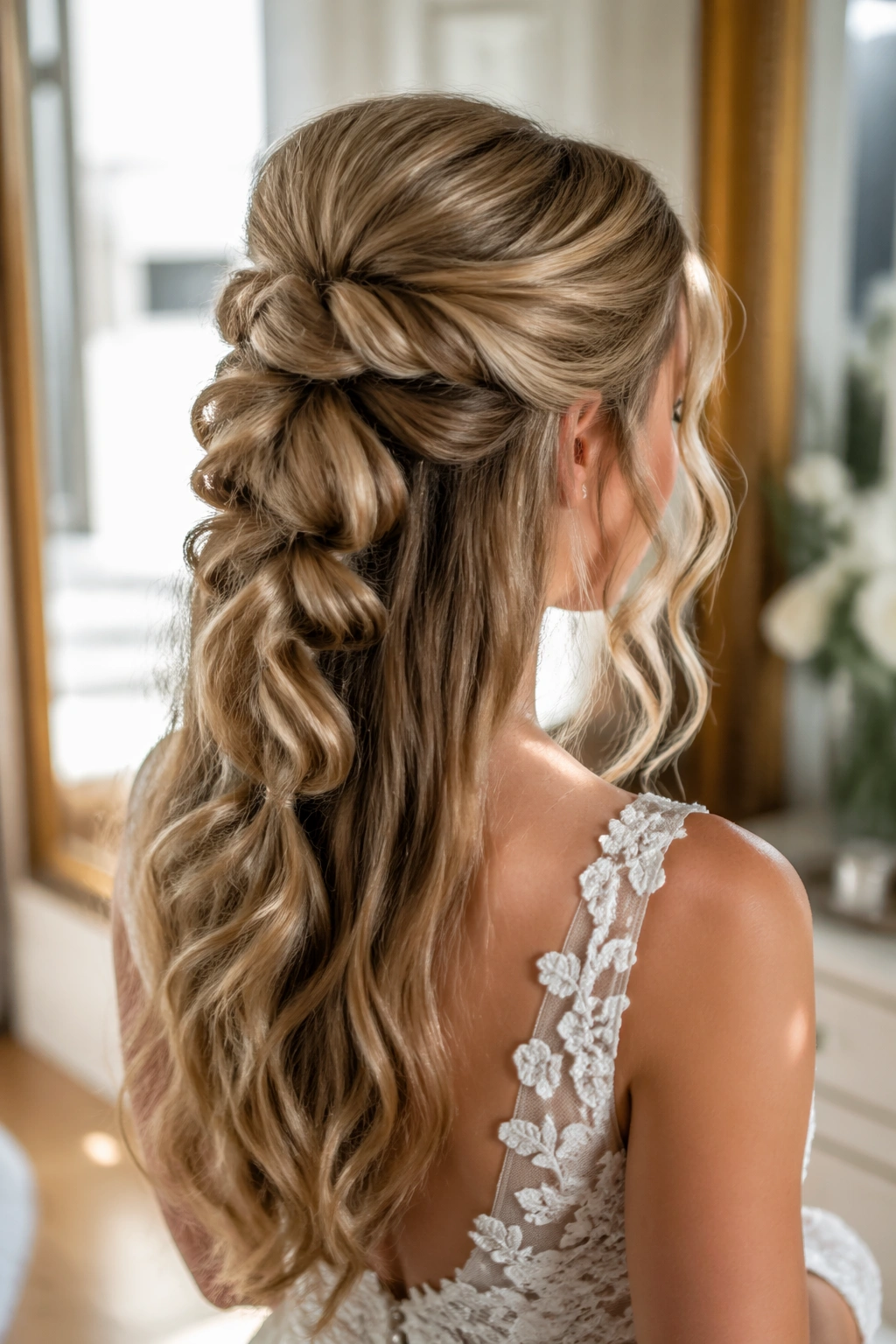
A pull-through braid is one of the easiest ways to fake fullness. It creates a chunky braided look without needing three thick sections of hair, which makes it a strong choice for finer hair or anyone who wants the braid to read boldly in photos.
The braid has a stacked, bubble-like structure, so it naturally adds shape at the back of the head. That means the style feels bigger even if the hair itself isn’t especially dense. It also stays visually interesting from a distance, which not every braid can claim.
- Great for fine to medium hair
- Can be built with small clear elastics
- Works with waves, curls, or brushed-out texture
- Looks best when the pulled sections are gently widened by hand
Tip: After tying each section, tug the outer edges just a bit. That soft stretch is what gives the braid its body.
12. Mini Accent Braids With Glam Waves
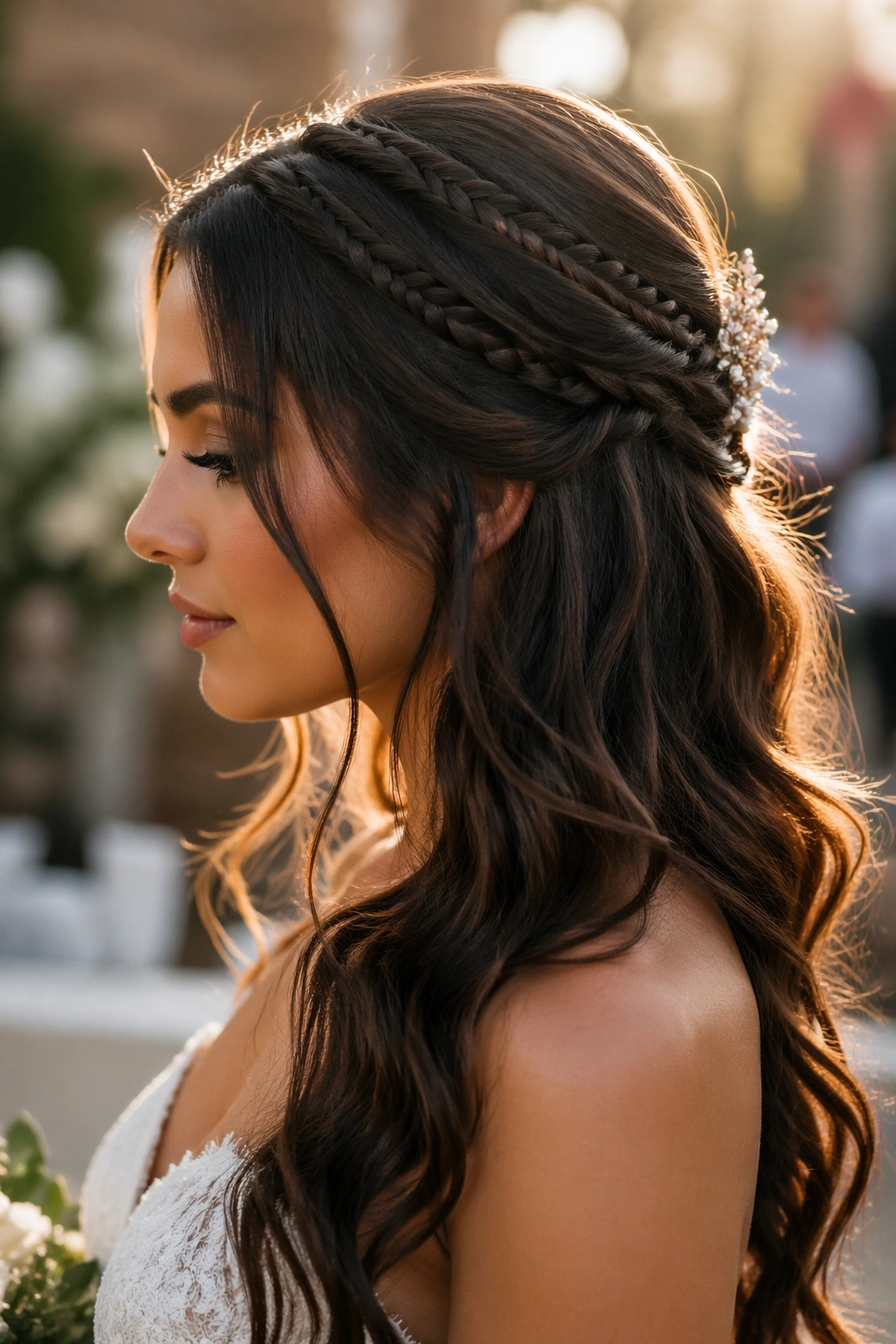
Small braids can do more than big ones. That sounds backwards, but it’s true. A few narrow accent braids tucked into soft waves can make the style feel richer without taking over the whole head.
This is a smart move if the dress already has lace, beading, or a strong neckline. You get texture without visual clutter. The eye moves through the hairstyle instead of landing on one giant braid and stopping there.
The trick is placement. Put the accent braids where they can be seen in profile or from the front three-quarter angle, not buried under too much hair. A tiny braid near the temple or just behind the ear can make a huge difference.
Keep the waves glossy and loose. If the curls are too tight, the small braids vanish. If the texture is too flat, the whole thing loses its charm.
13. French Braid Crown With Veil Placement
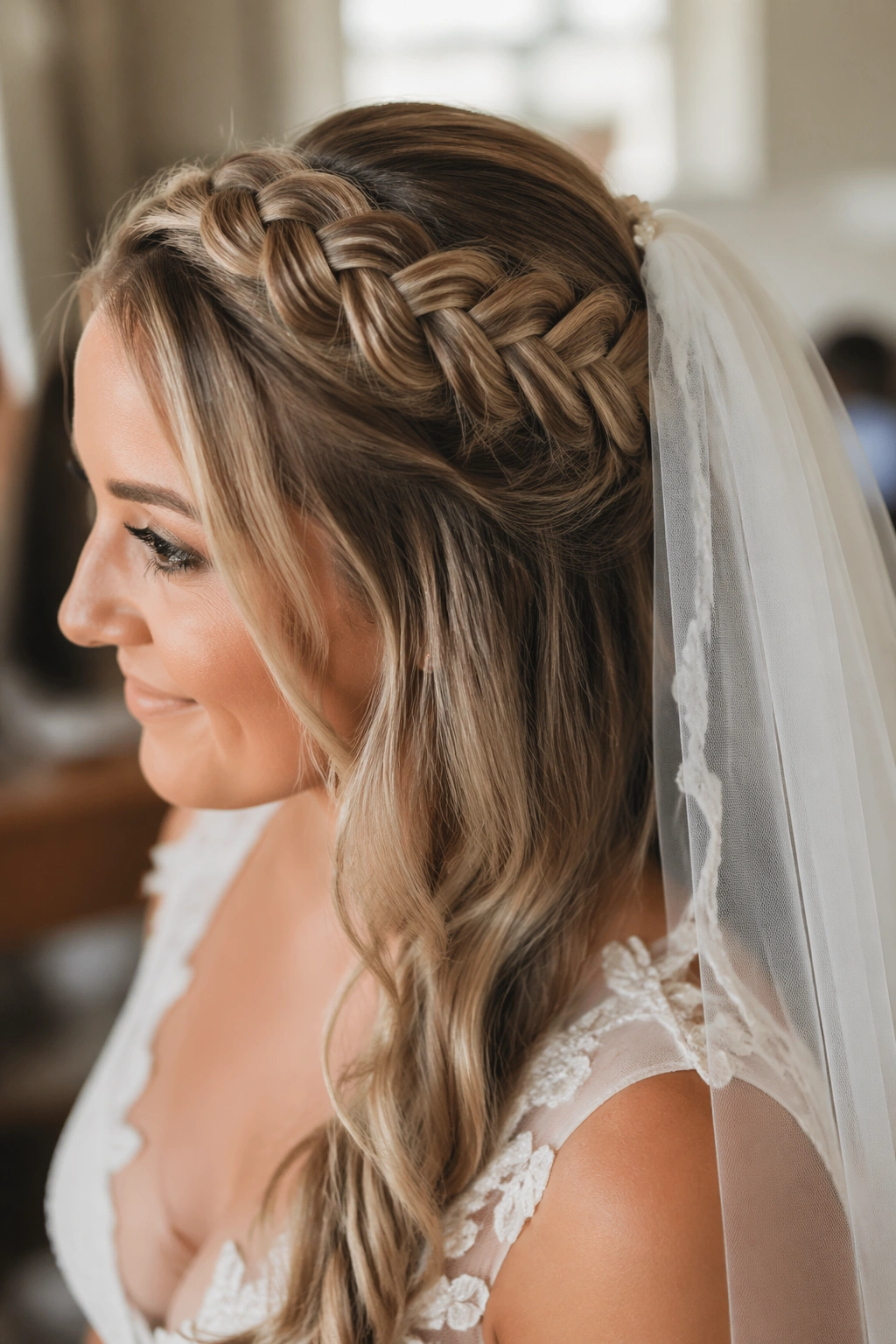
The French braid crown is one of those styles that looks calm but is secretly doing a lot. It pulls hair back from the face, adds structure around the crown, and gives a veil a stable place to sit without overwhelming the rest of the style.
Where the veil should go
The veil comb usually sits just below or just inside the braid line, depending on how much of the braid you want visible. If the comb is placed too high, it can hide the whole crown. Too low, and the veil may drag the hairstyle down.
The braid itself should be snug enough to hold shape but not so tight that it flattens the scalp. A little lift at the crown keeps the silhouette from looking compressed.
This style suits brides who want tradition without a full updo. It keeps the look formal for the ceremony, then soft enough for the reception once the veil comes off. That shift matters more than people admit.
A polished surface on the loose hair keeps the braid from feeling too rustic.
14. Mermaid Braid Half-Up For Long Hair
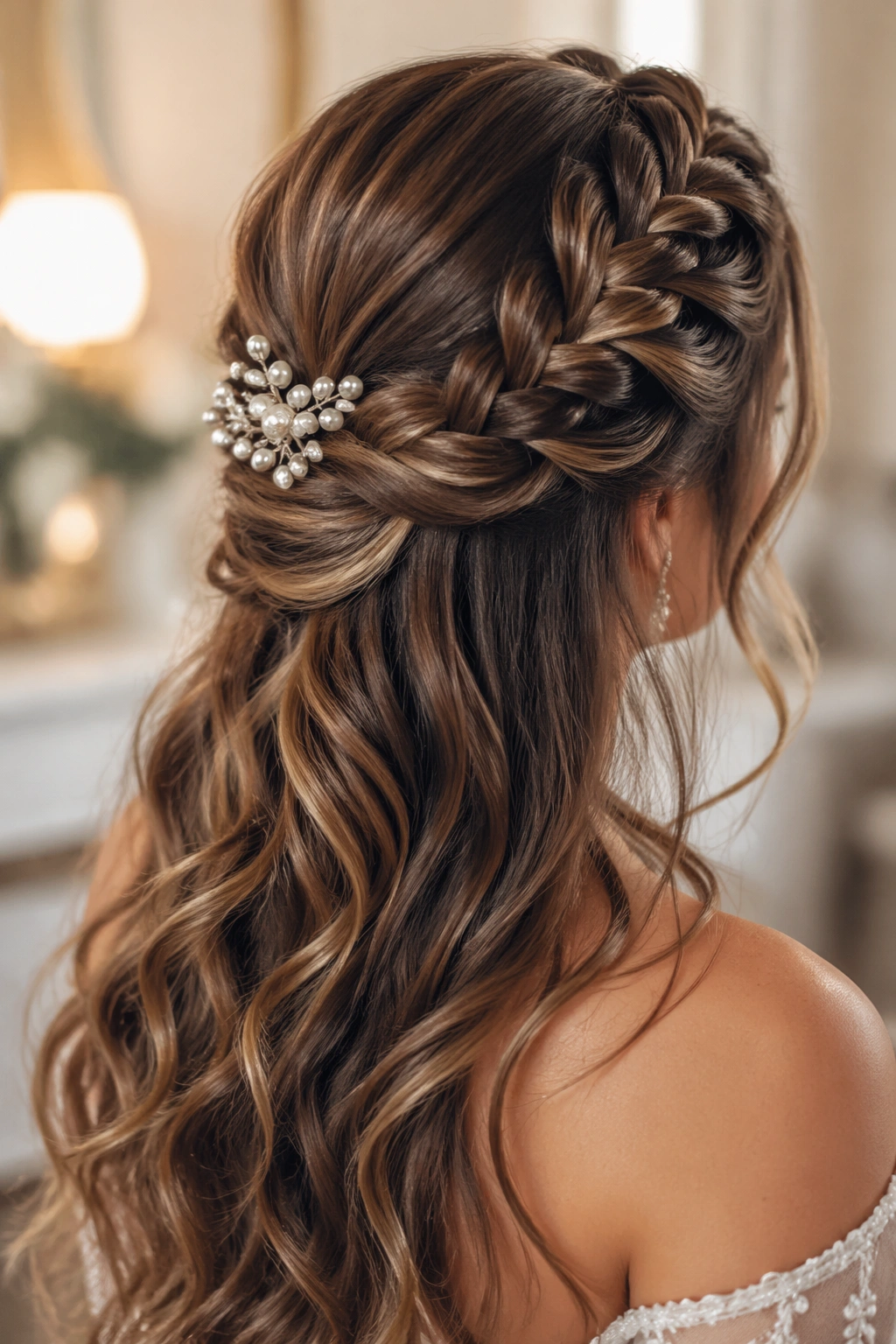
Long hair and a mermaid braid make a good pair. The braid can stretch farther down the head, which gives it more detail and makes the shape feel lush instead of small. Shorter lengths can mimic the idea, but long hair gives the braid room to breathe.
What makes this style different from a standard fishtail or loose braid is the way the sections are softened. Pulling the braid gently outward after it’s secured creates a fuller, more romantic line that looks intentional in photos.
This is a useful choice for brides who like the idea of volume but don’t want curls taking over the whole back view. The braid creates enough structure on its own.
A pearl pin or a slim barrette near the top can help anchor the half-up section. Keep the decoration light. The braid already has presence.
15. Twisted Braid Half-Up With Low Bun Detail
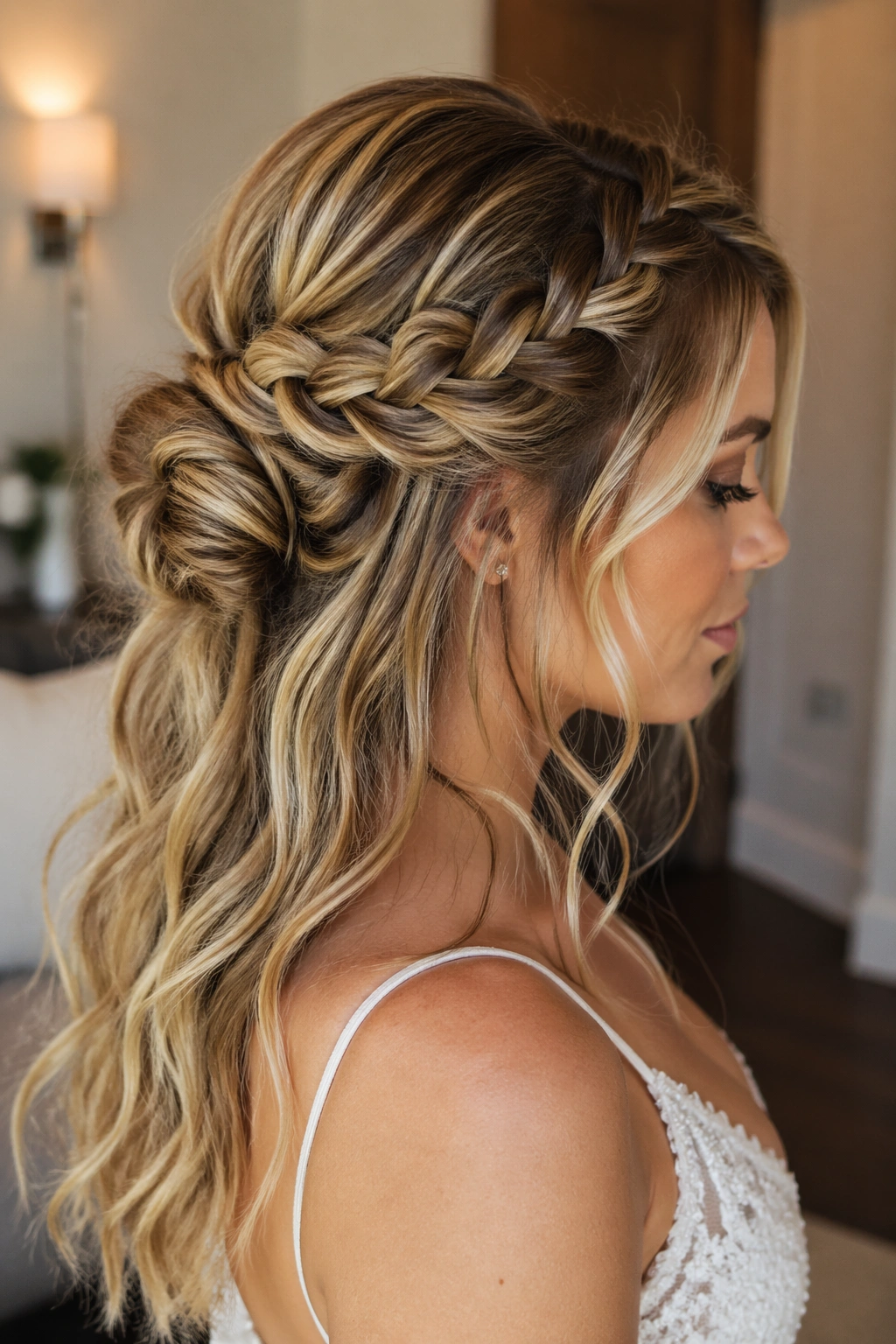
A small bun tucked into the half-up section changes the whole feel. Instead of a braid that simply pins the top back, you get a little center point where the twists meet, and that makes the hairstyle feel architectural.
This works nicely when the lower hair is left in brushed-out waves. The contrast between the compact bun detail and the open length below gives the style some depth without adding a lot of steps. It also keeps the nape area cleaner, which can matter if the dress has a low back or a tied closure.
I like this one for brides who want the security of an updo but don’t want to lose the softness of wearing hair down. It gives you both, which is rare enough to be worth noticing.
A tiny braided bun looks best when the pins are hidden well. If you can see the hardware, the illusion is gone.
16. Dutch Lace Braid With Polished Ends
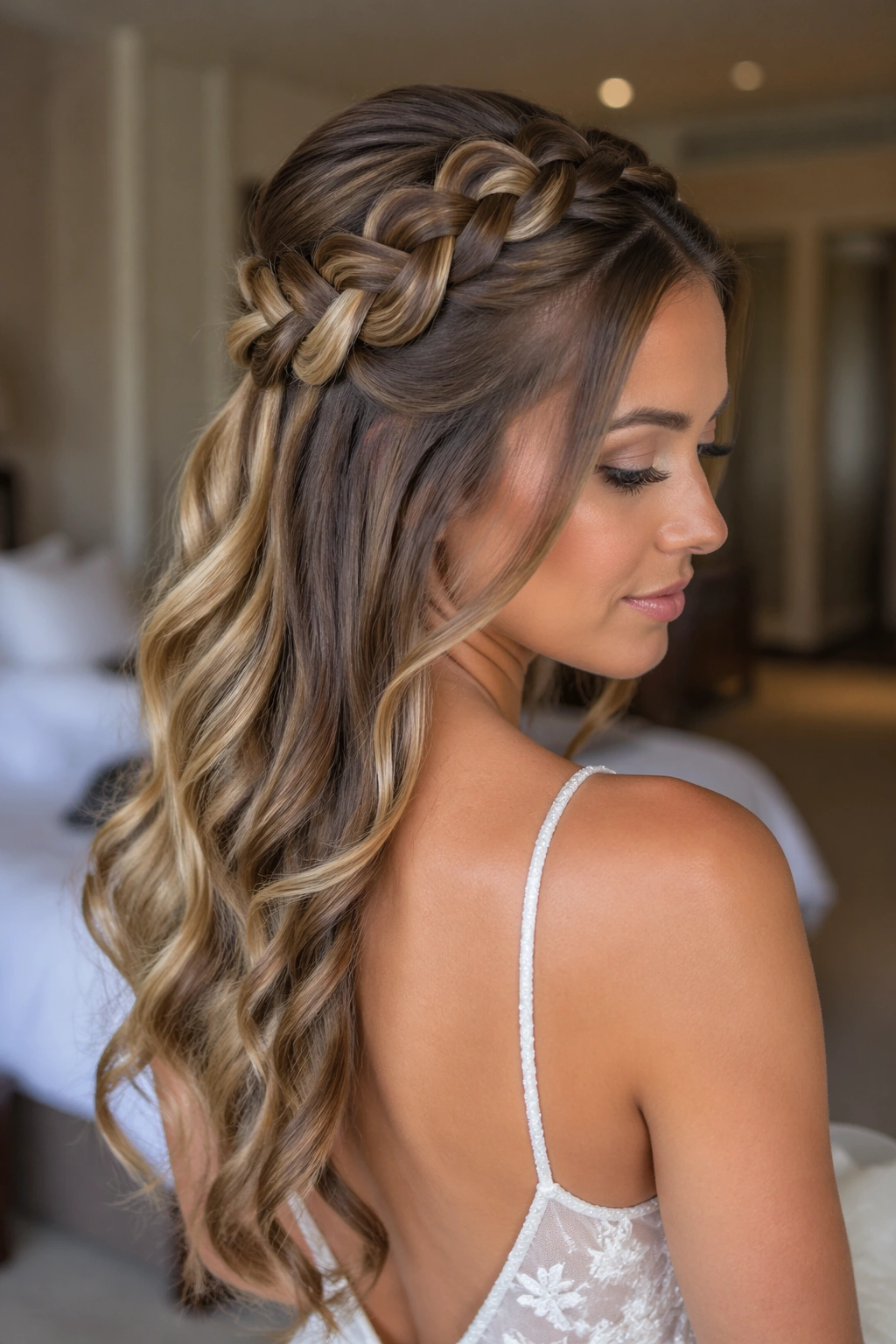
A Dutch lace braid is a cousin of the French braid, but it sits more boldly on the surface because the sections cross under instead of over. That gives the braid a lifted look that photographs with more texture.
The lace version lets one side drop strands while the other side keeps feeding in hair, so the braid curves neatly toward the center. It’s a pretty choice for brides who want the braid to feel almost sculpted. The polished ends keep the lower half from turning too soft or casual.
This style does ask for neat sectioning. Sloppy part lines will show. So will uneven tension. If you’re doing it yourself, a tail comb is not optional. It’s the difference between a clean line and a braid that looks hurried.
A light gloss spray at the end can make the braid surface read richer under indoor lighting.
17. Braided Half-Up For Curly Hair
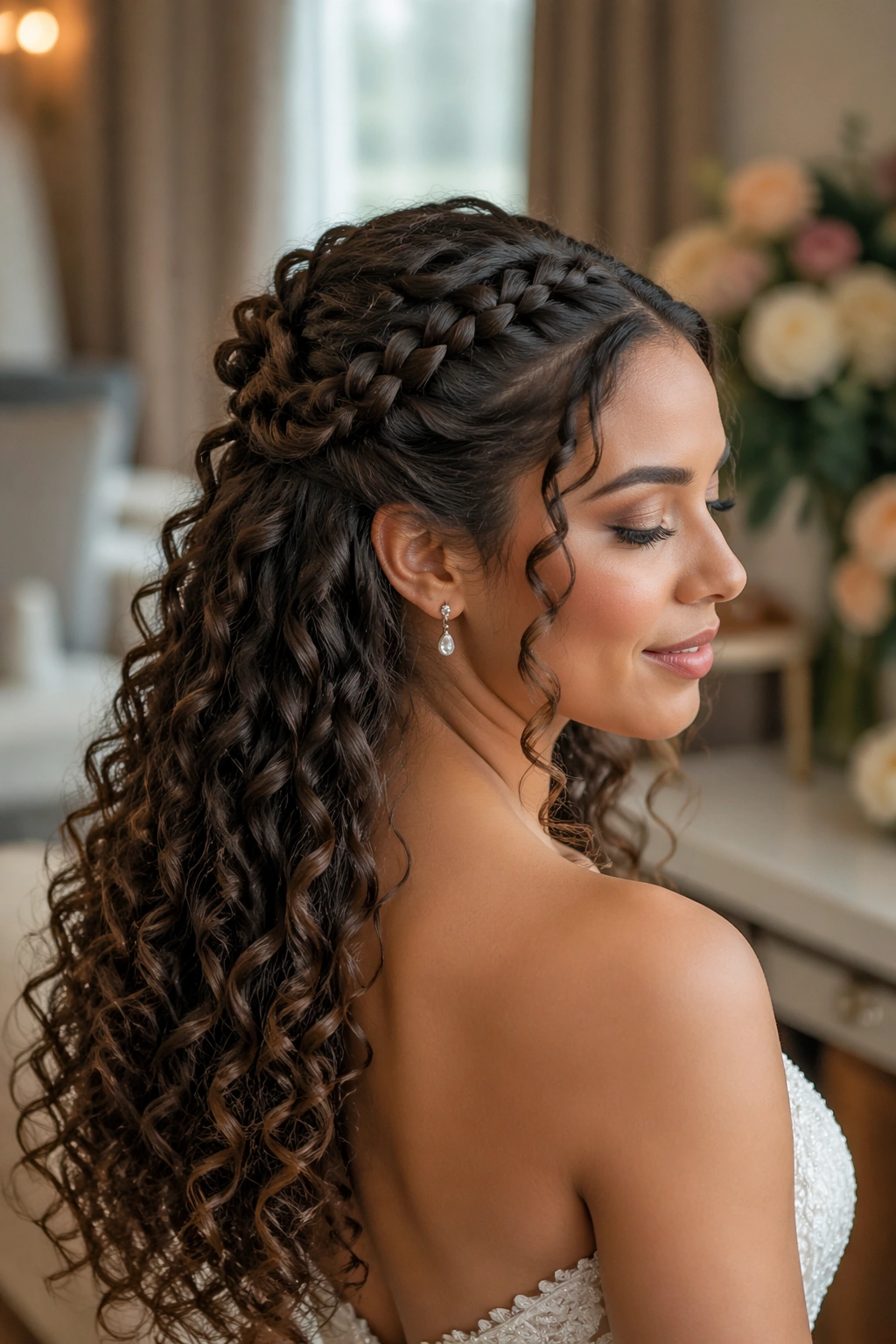
Curly hair gives this style something extra from the start. The braid doesn’t have to carry all the visual interest because the curl pattern already does part of the work. The goal is to preserve that shape, not fight it.
How to keep the curl pattern intact
Start with defined curls, not brushed-out frizz. A curl cream or leave-in plus a diffuser can help the hair hold its shape before braiding. Once the top section is secured, leave the lower curls alone as much as possible.
- Use wide-tooth combs instead of fine brushes
- Match bobby pins to the hair color
- Pin the braid where it won’t snag the curl line
- Keep the front pieces soft around the temples
The best curly half-up styles look controlled at the crown and free below. That contrast is what makes them pretty. If you flatten the curls too much, you lose the whole point.
18. Braided Half-Up For Fine Hair With Teasing
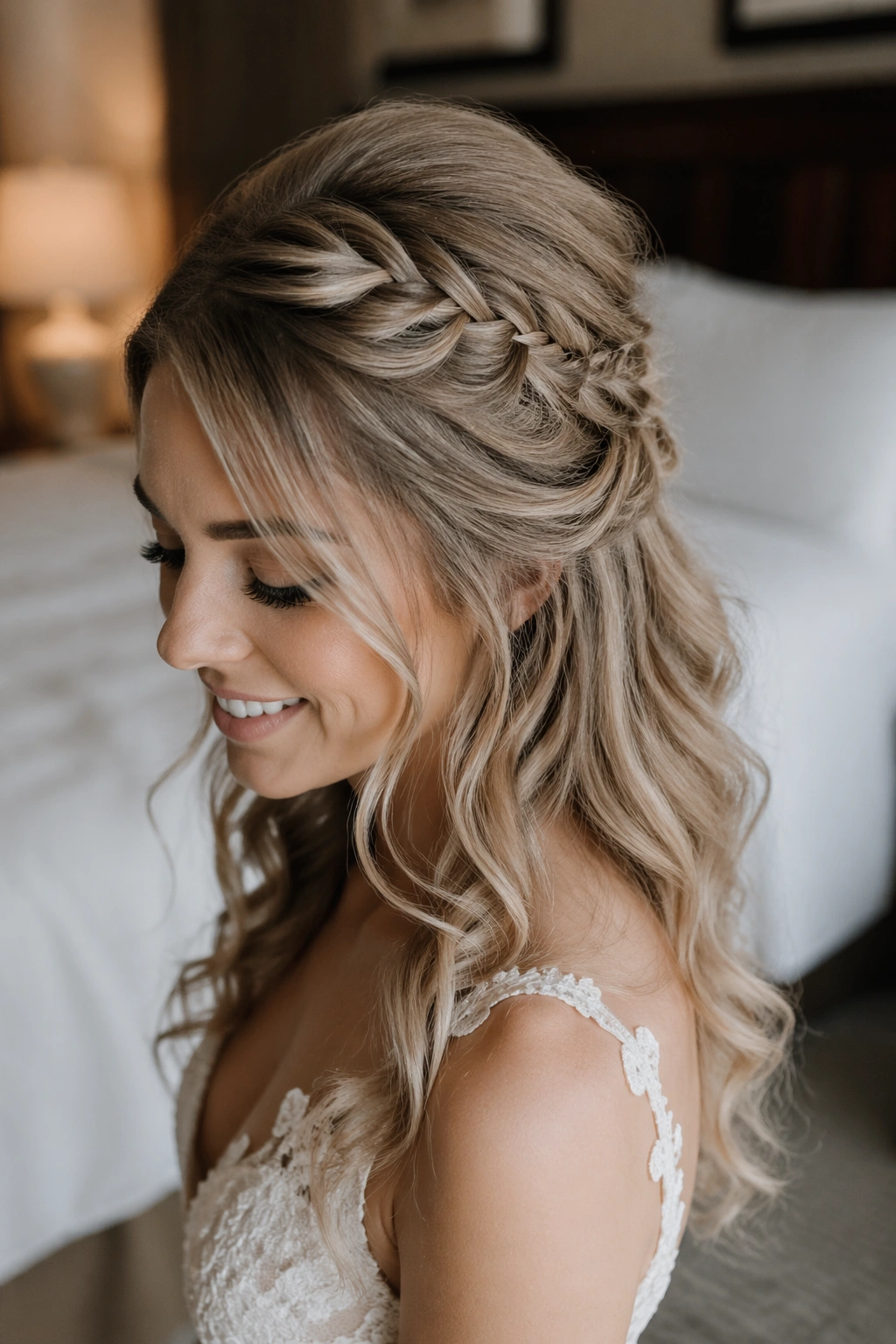
Fine hair needs a little strategy. Not a lot. Just enough to stop the top section from collapsing after the first few hugs. A small tease at the crown and a braid with slightly loosened edges can make the style hold its shape much better.
Would a thick braid look nice? Sure. But on fine hair, a braid that’s too heavy can drag the top down. A lighter braid, built with a bit of texture spray and gentle backcombing, often looks fuller in real life and in photos.
The lower half can be curled loosely or kept in a soft bend. Tight curls sometimes separate too much on finer strands, which makes the ends look thinner than they are. A brush-through wave gives more body.
A root-lifting powder near the crown can help if the hair tends to fall flat by lunch. Use a small amount. Too much and the hair feels gritty.
19. Braided Half-Up For Short Lob Lengths
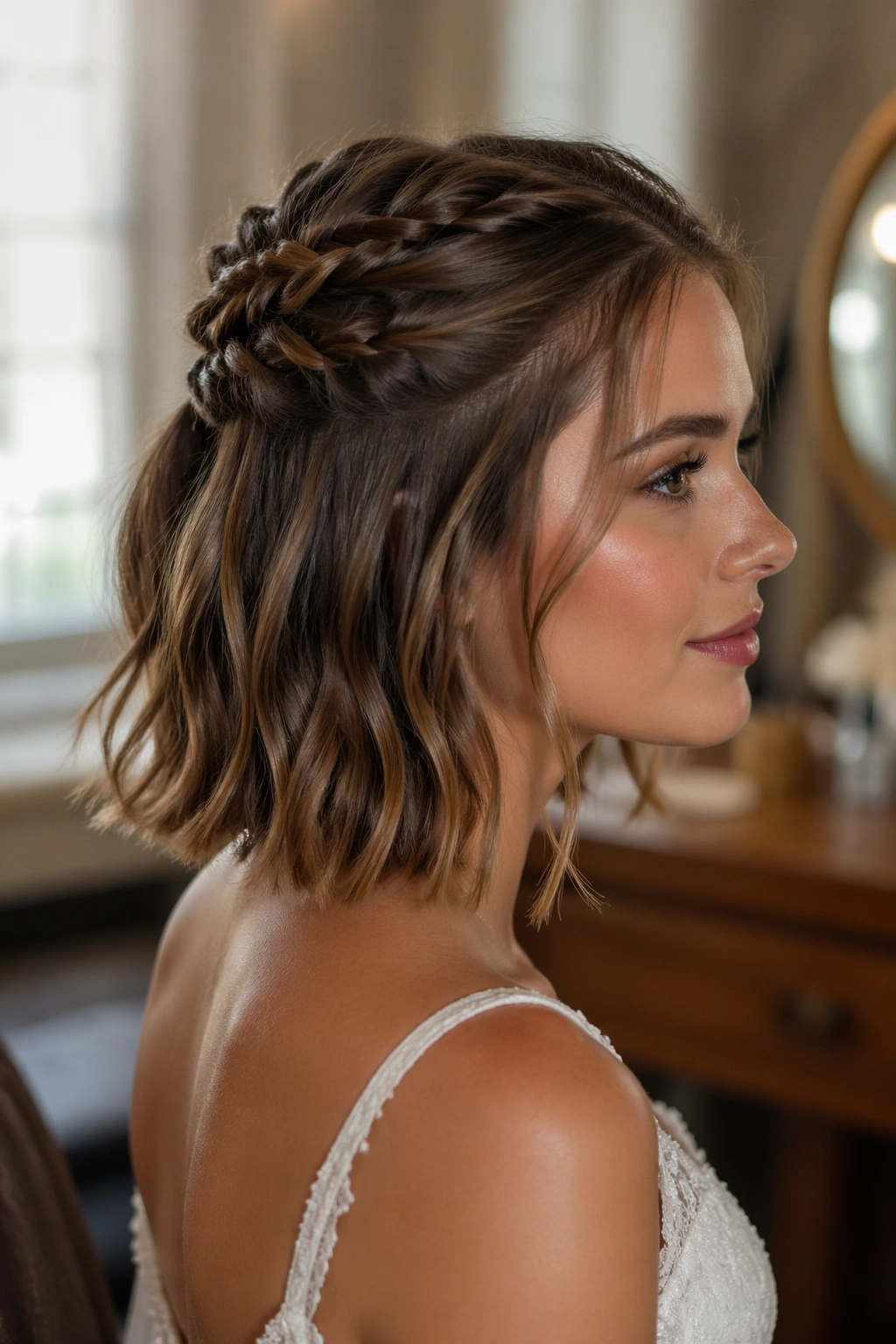
A lob doesn’t get left out. It just needs a different plan. Instead of building a huge braid that competes with the length, use smaller braided sections and let the cut itself do some of the visual work.
This style usually sits higher on the head so the braid has room to show before it meets the shorter loose ends. Soft bends through the bottom half keep the haircut looking intentional instead of like a compromise.
The nicest part is how modern it feels. A lob with a half-up braid can look light, fresh, and a little sharp all at once. It works especially well with simple earrings and dresses that have cleaner lines.
Don’t overcurl the ends. With shorter hair, too much curl can make the style puff out in odd places. A soft wave is usually enough.
20. Minimalist Thin Braids With Glossy Finish
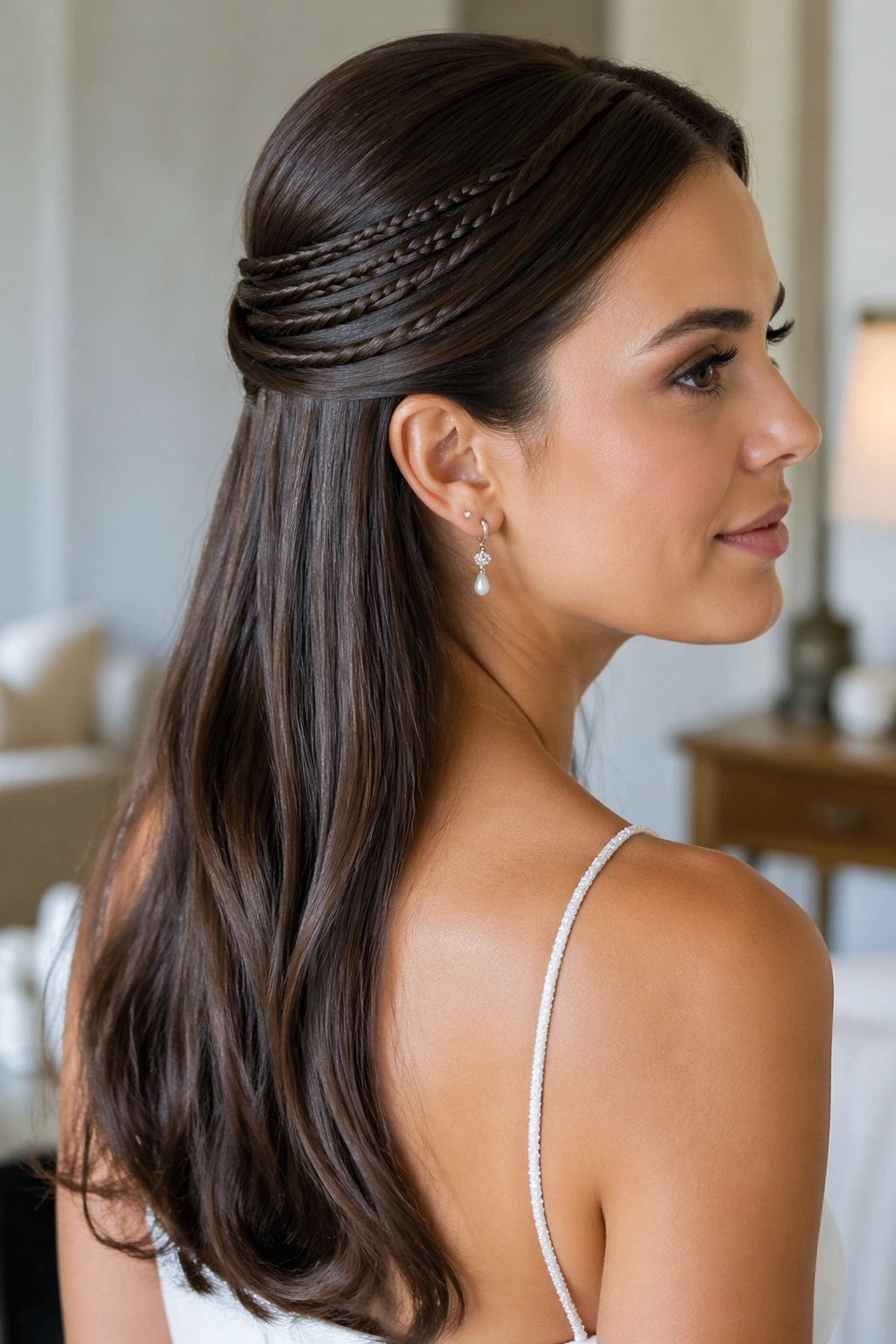
Some brides want detail that whispers instead of shouts. Thin braids tucked into a smooth half-up style do exactly that. The effect is subtle, but it gives the hair enough structure that it doesn’t disappear in a sea of softness.
The glossy finish matters here. Thin braids look best against hair that’s been smoothed and polished, whether that’s with a flat iron, a blowout brush, or a little shine serum on the mids and ends. Without that finish, the braids can get lost.
This is a good match for minimalist dresses, city ceremonies, and brides who wear strong makeup or statement earrings. The hair should support the look, not compete with it.
A very small braid placed at the temple or just behind the ear can be enough. That’s the nice thing about this style. It’s quiet, but it’s not empty.
21. Side-Swept Braid Half-Up For Asymmetry
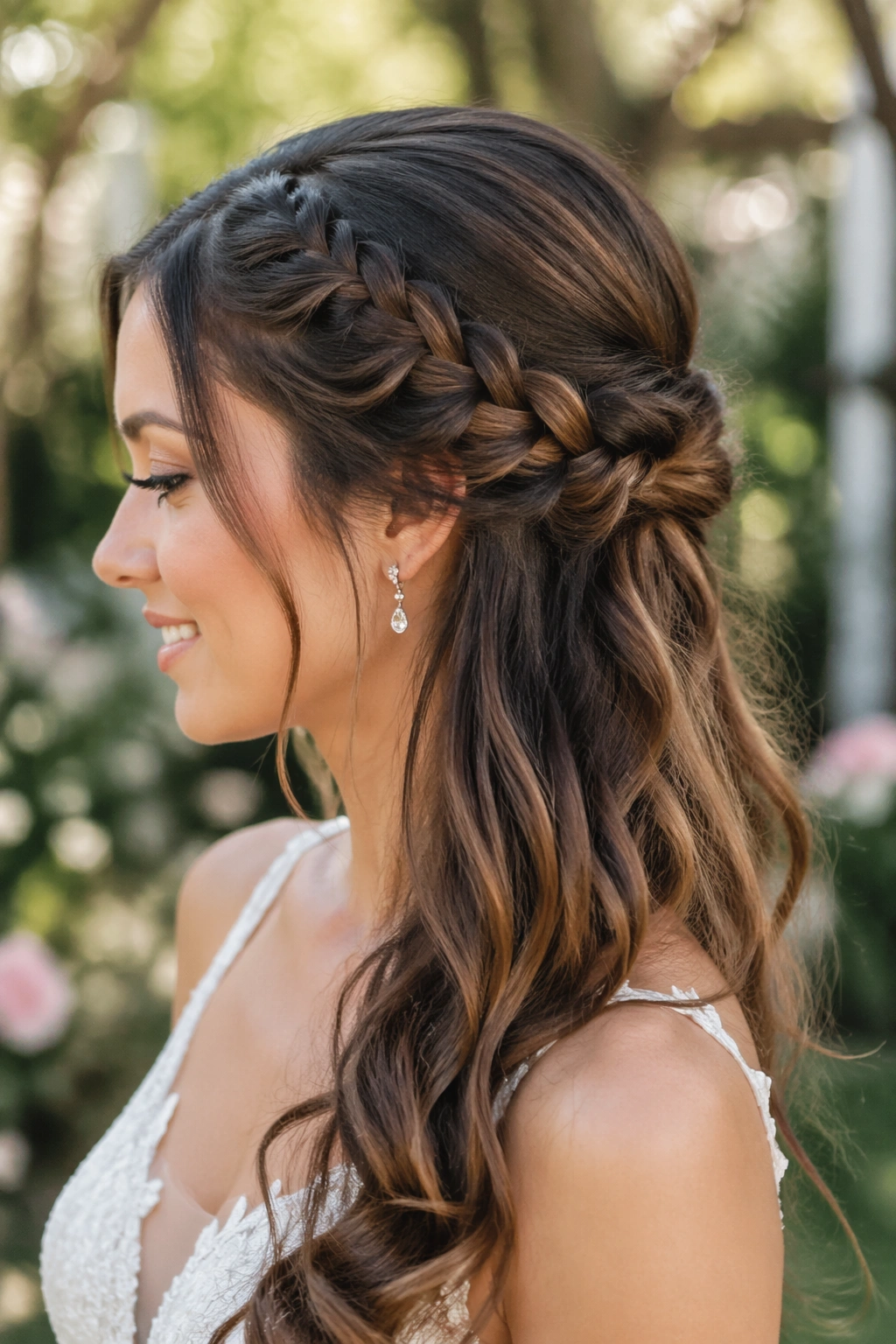
A side-swept braid changes the balance of the whole hairstyle. Instead of aiming for perfect symmetry, it lets one side take the lead. That makes the look feel a little more editorial and a little less expected.
The braid usually starts near one temple and travels diagonally back into the half-up section. The rest of the hair can fall over the opposite shoulder or stay centered, depending on the dress. One-shoulder gowns, in particular, love this shape.
Who should pick it
Brides who like movement in a hairstyle but don’t want messy texture tend to land here. The asymmetry gives personality without turning the style into a full side sweep.
A side-swept braid also helps if one side of the face is a favorite in photos. People rarely say that out loud, but stylists notice it right away. The angle gives you room to flatter the face without looking forced.
Keep the braid soft along the top line so it doesn’t feel too harsh.
22. Braided Half-Up With Pearl Pins
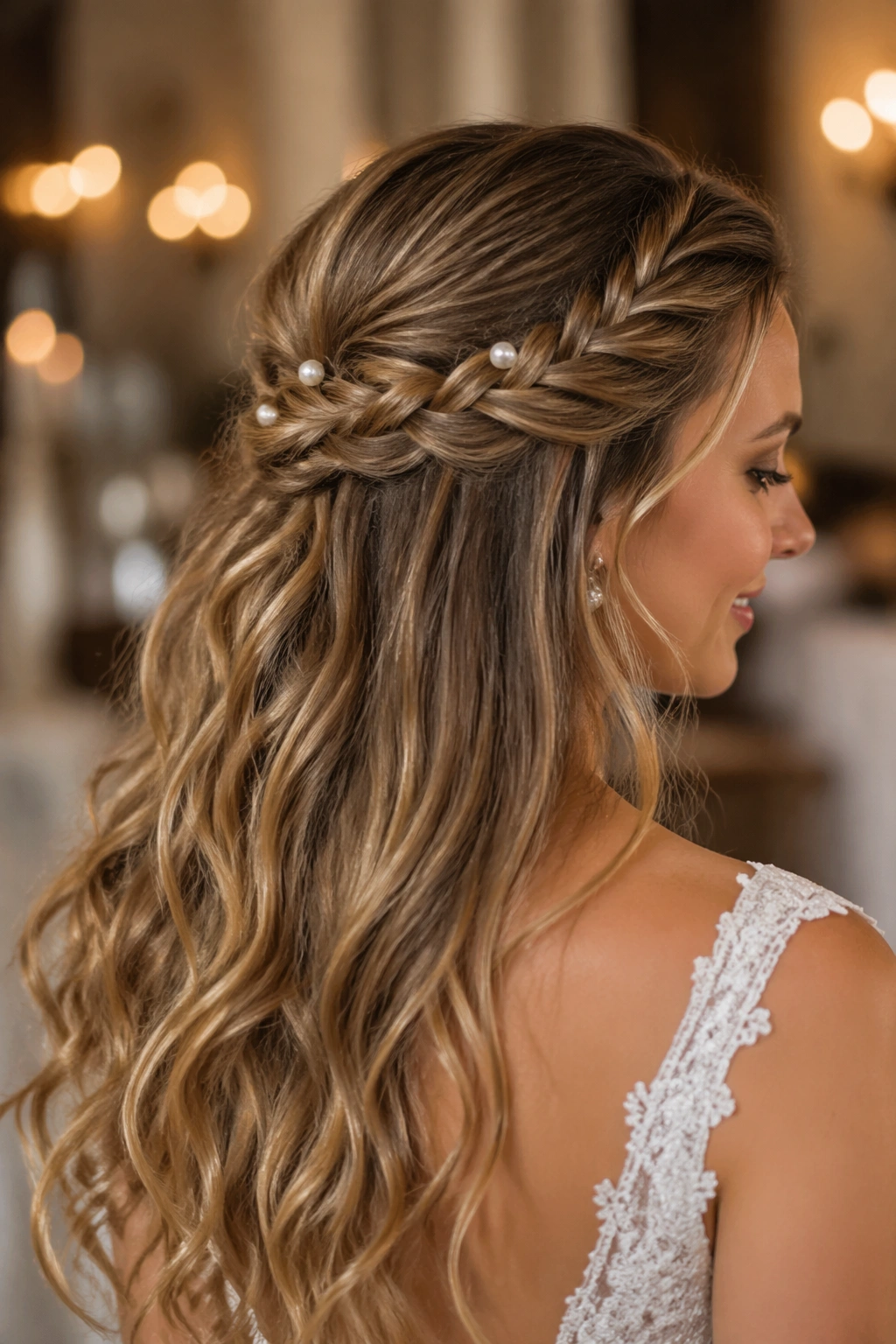
Pearl pins can save a hairstyle from feeling plain. They work especially well when they’re placed near the braid’s turning points or tucked into the gathered section where the braid meets the loose hair. A few pins go a long way.
The braid gives the pearls a place to belong. Without that structure, pearls can look random. With it, they feel attached to the shape of the hairstyle, almost like part of the weave.
The safest move is to keep the rest of the style clean. Loose curls or soft waves are fine, but skip accessories that compete with the pearls. The beauty of this look is in the contrast between the hair texture and the smooth little beads.
If the pearls are on wire, hide the ends carefully. A shiny pin stem sticking out ruins the effect faster than anything else.
23. Braided Half-Up With Floral Sprigs
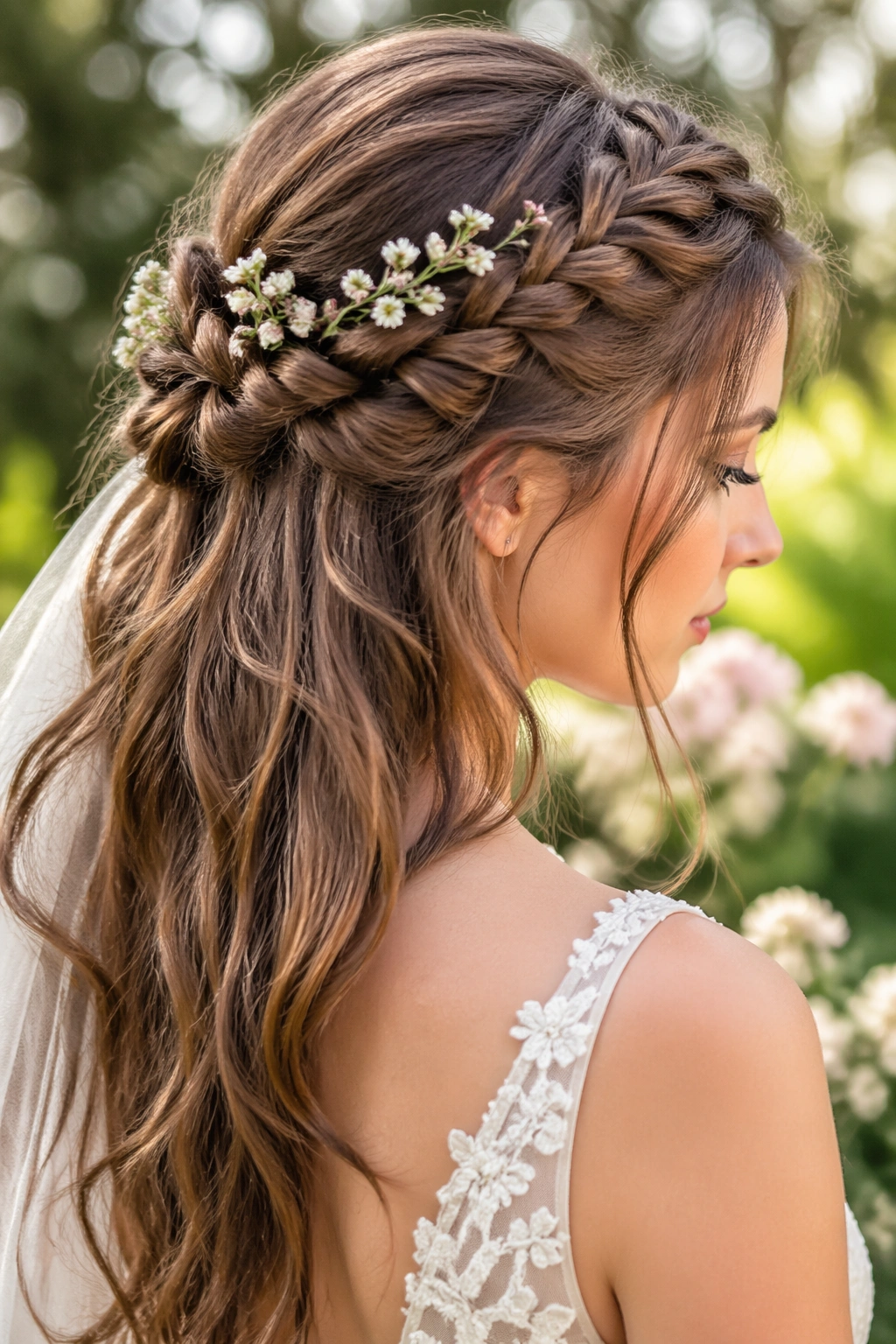
Fresh flowers change the mood instantly. A braided half-up style with small floral sprigs feels softer, more garden-like, and a little less rigid than one packed with metal pins. That can be exactly the right answer for an outdoor ceremony.
The braid holds the flowers in place and gives them structure so they don’t flop around in the hair. Small blooms, baby’s breath, rosemary, waxflower, and tiny roses all work if they are secured well. Bigger flowers need more support than people expect.
This look feels best when the flowers echo the bouquet without matching it too literally. A hairstyle that looks like a copy of the bouquet can become too sweet. A few well-placed sprigs are cleaner.
Fresh flowers need to be pinned close to the braid. If they sit too far out on the loose hair, they’ll slide.
24. Ribbon-Woven Braid Half-Up
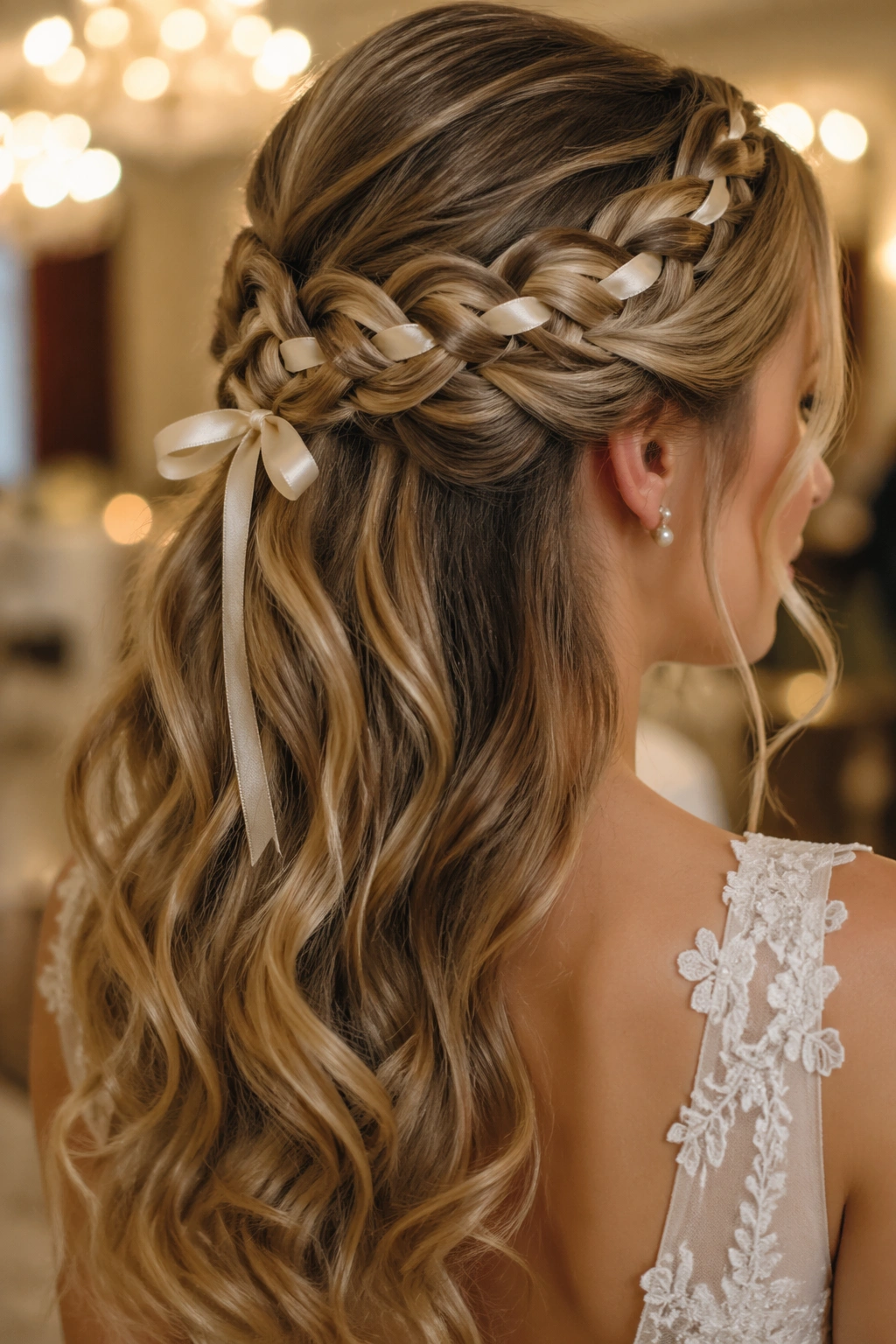
A ribbon woven into the braid gives the whole hairstyle a softer line and a touch of color. It can match the dress, the bouquet, the shoes, or nothing at all if you want the ribbon to be the surprise detail.
The nicest part is how easily the ribbon changes the tone. Satin ribbon feels more formal. Velvet adds depth and a slightly cooler finish. Narrow grosgrain reads cleaner and holds its shape better if the wedding is outdoors or the hair needs extra grip.
Simple way to think about it
The ribbon should travel with the braid, not fight against it. If it’s too wide, the braid disappears. If it’s too thin, it can vanish into the hair and lose the point.
This style works especially well on brides who want one color note carried through the look without making the hairstyle loud. A ribbon in a dusty shade can be enough.
25. Braided Half-Up With Cathedral Veil
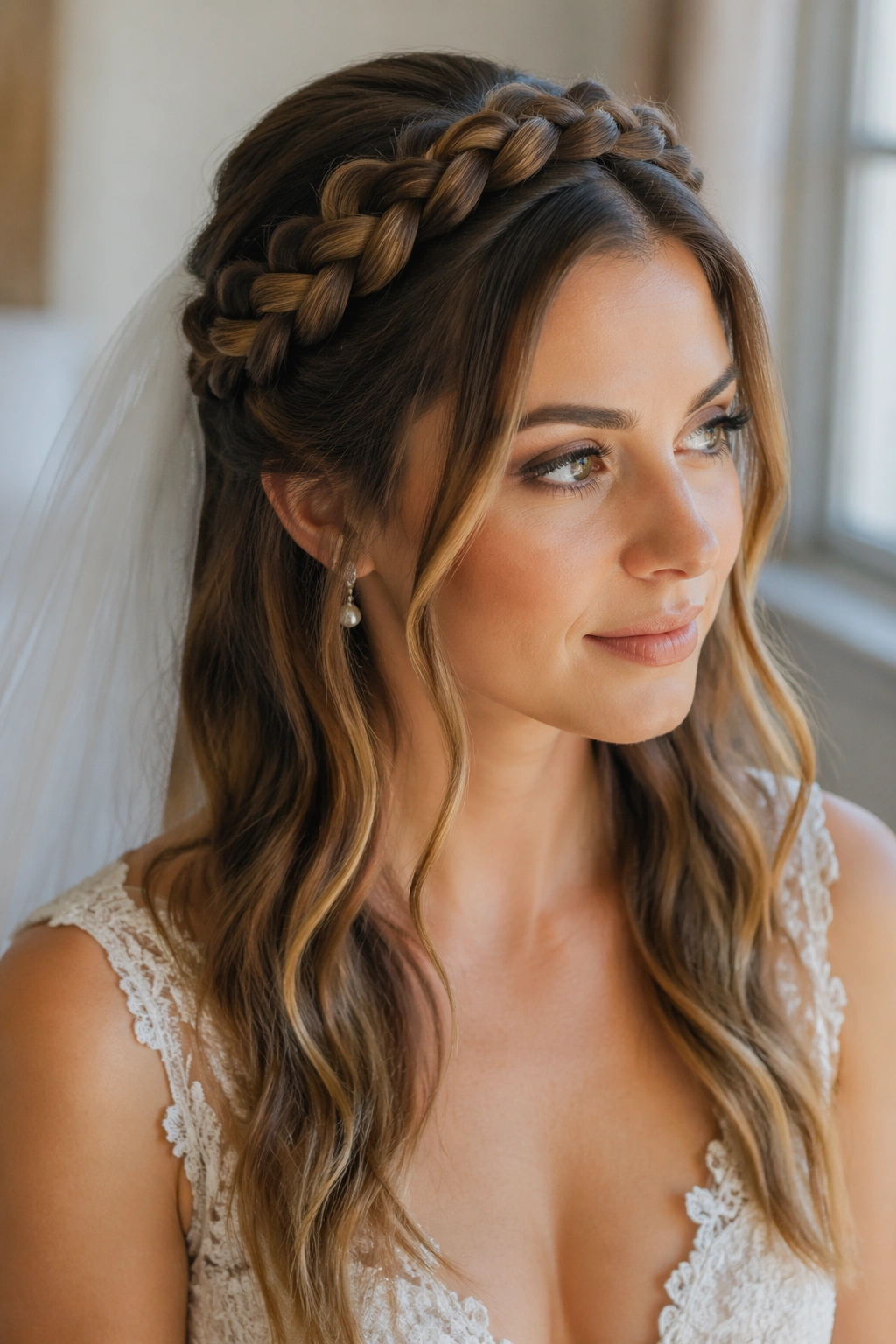
A cathedral veil asks the hairstyle to do some practical work. It has weight. It has length. It can tug if the base isn’t placed well. A braided half-up style gives it a stable anchor without forcing the rest of the hair into a full updo.
The braid should sit where the veil comb can nestle without covering the whole pattern. Usually that means the veil rides slightly below the braid crown, leaving the texture visible at the top. The loose hair beneath then balances the grandeur of the veil with something softer.
A smooth root area helps here. If there’s too much volume under the veil comb, the whole thing can sit awkwardly. A firm pinning point solves most of that.
This is the sort of style that benefits from a trial run. Not because it’s fragile, but because the veil placement needs to be right. A half inch can change everything.
26. Braided Half-Up For Beach Weddings
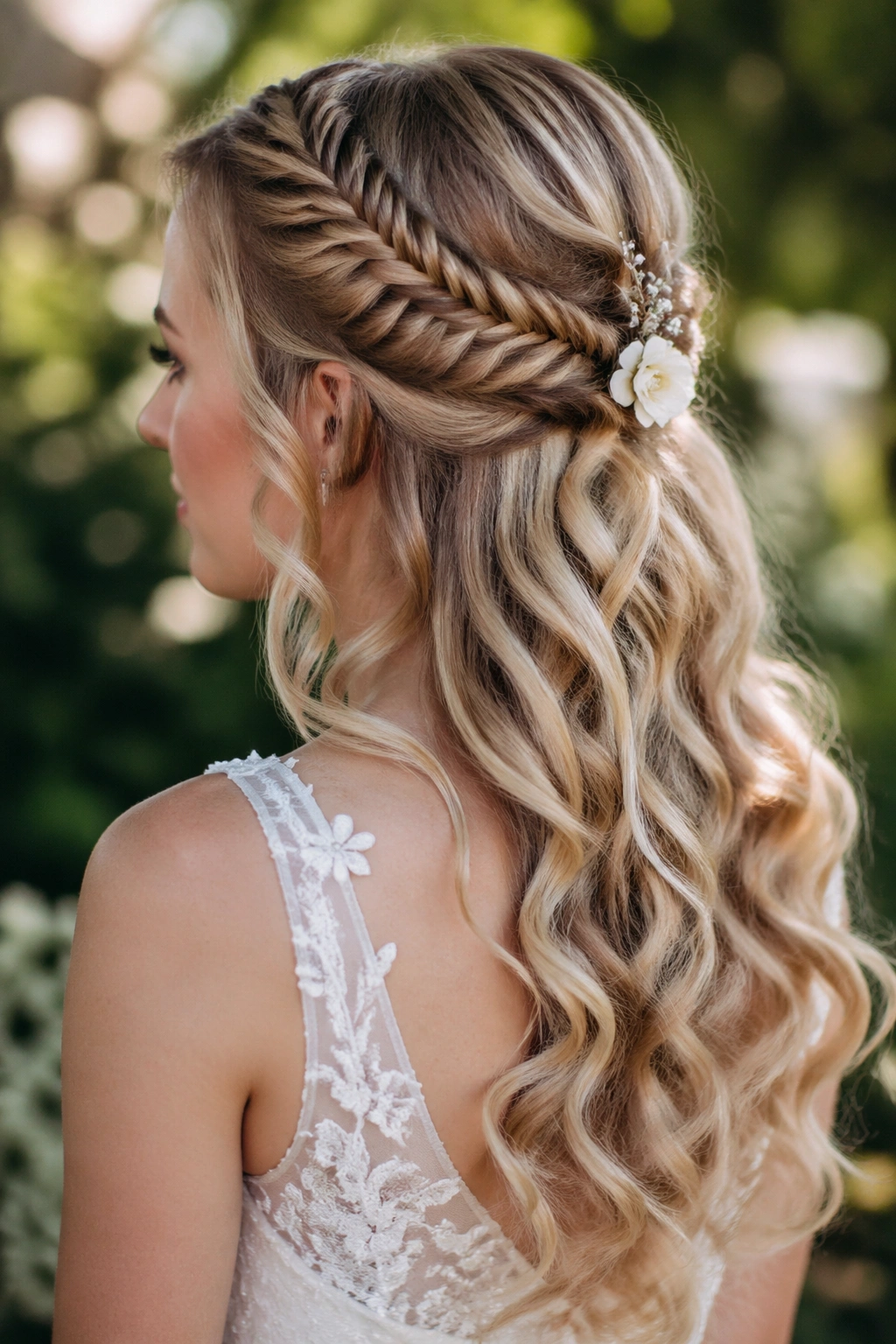
Wind is the enemy and the friend. It makes soft hair look alive, but it also tries to undo every careful section you put in place. Beach weddings need braid patterns that have enough grip to survive a breeze and enough texture to look good when a few strands move.
What holds up best
Dutch braids, rope twists, and pull-through sections usually last better than very loose braids because they have more built-in structure. A little salt spray or texture spray before styling helps the hair hold on to itself.
- Skip overly slick oils near the roots
- Pin the braid with crossed bobby pins
- Keep face-framing pieces light, not long
- Use a stronger finishing spray than you would indoors
The lower half can stay in soft waves or a brushed-out bend. Just don’t make it too perfect. The setting will rough it up a bit anyway.
27. Vintage-Glam Waves With Braided Detail
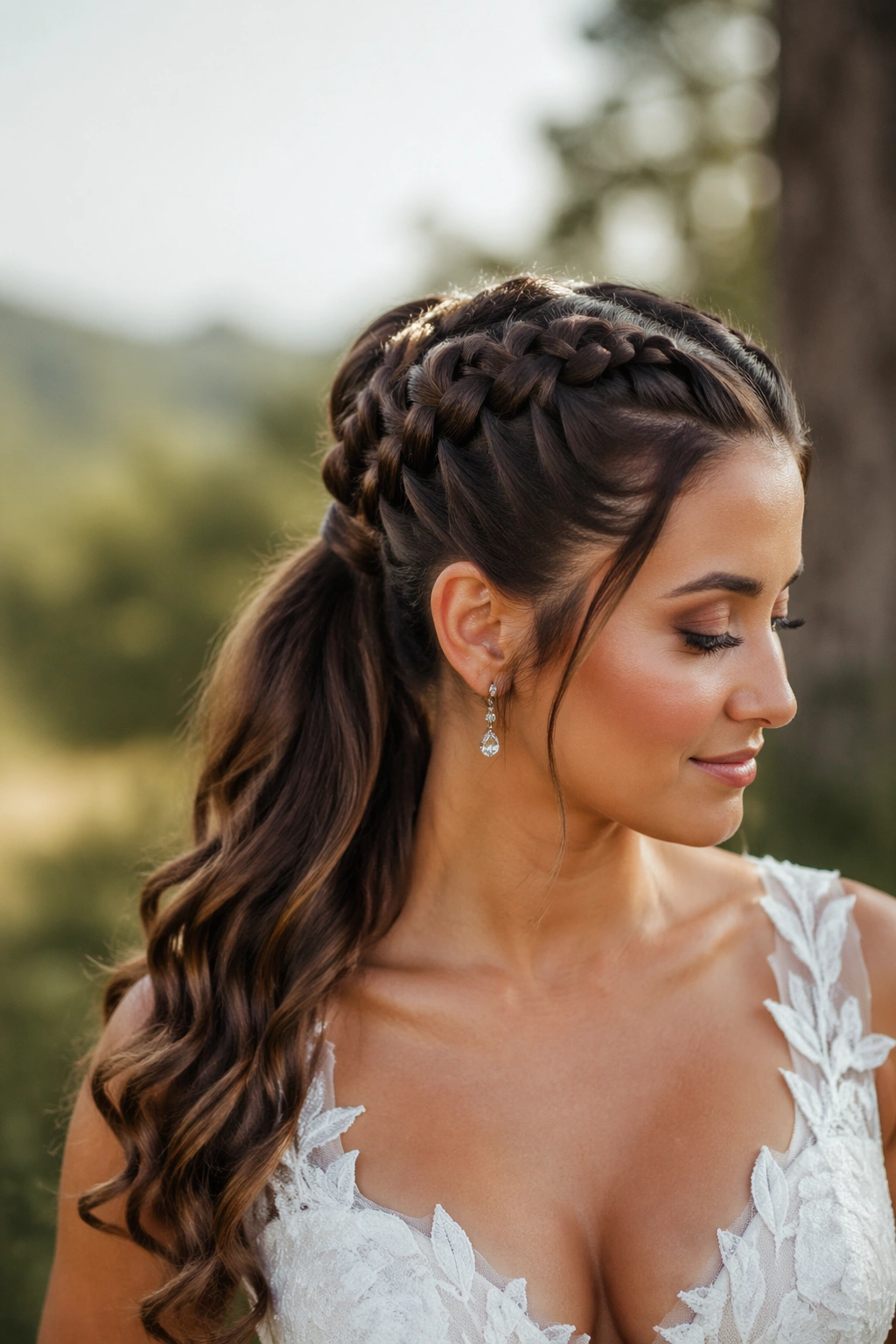
Vintage glam needs a braid that knows its place. That sounds harsh, but it’s true. The braid should support the wave pattern, not interrupt it. A narrow braided half-up section tucked into glossy, brushed waves keeps the look polished and a little old Hollywood.
This works beautifully with side parts, red lips, pearl earrings, and gowns that have a bit of sheen. The braid is there to guide the eye up toward the face while the waves do the heavy lifting through the length.
The finish matters more than the braid size. If the waves are too matte, the whole style loses its retro edge. A light gloss spray across the surface keeps the shape rich without making the hair look wet.
This is a good pick for evening ceremonies, especially indoors, where the shine can do its job under softer lighting.
28. Braided Half-Up With Messy Texture
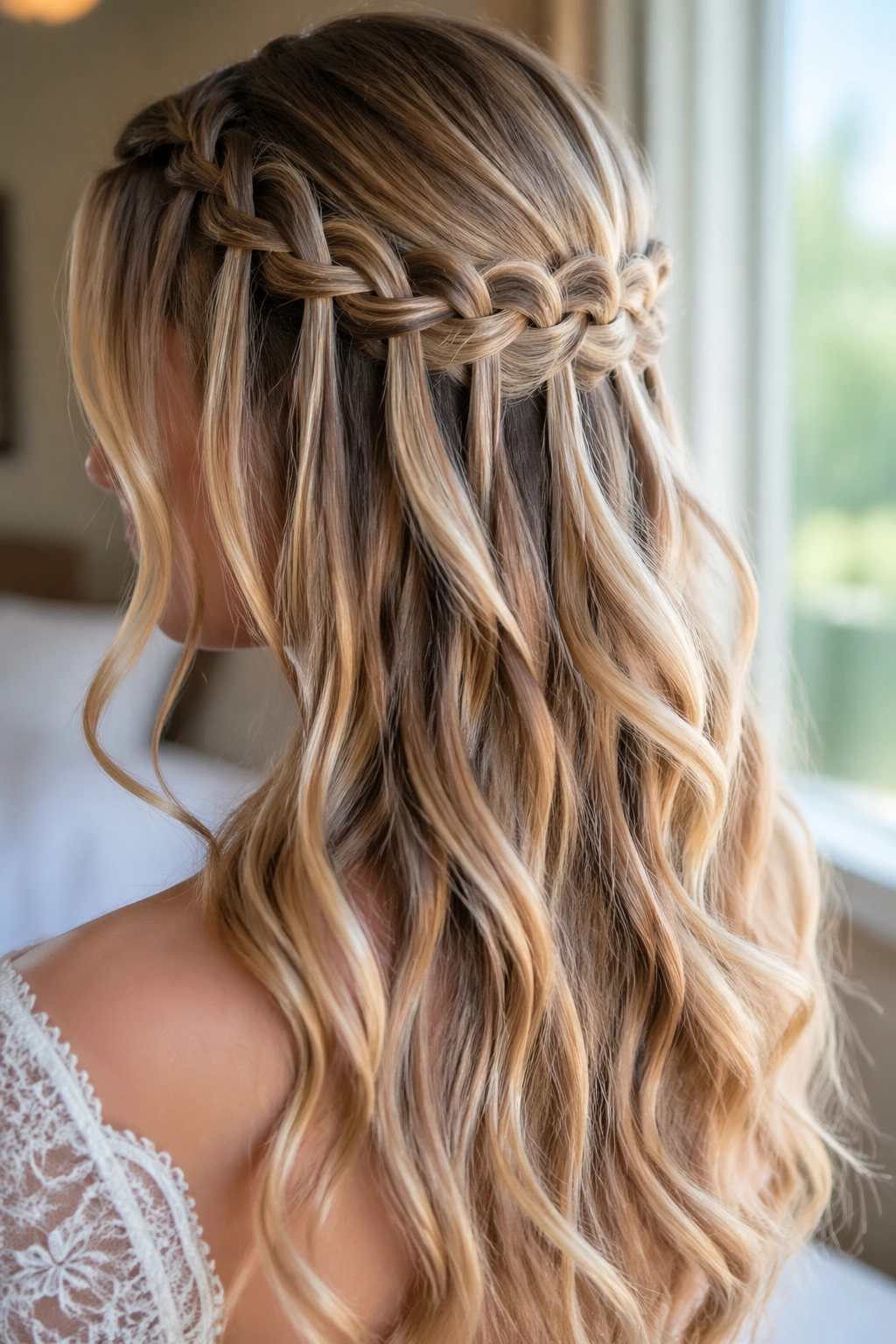
Messy texture is only pretty when it looks deliberate. That’s the line. A good undone braid has loosened edges, piecey waves, and a little softness around the face. A bad one just looks like it survived a strong wind and lost.
The best messy half-up styles start with a braid that is secure first, then gently pulled apart after it’s pinned. The loosened pieces should create shape, not holes. If the braid starts collapsing, stop tugging.
This style suits rustic venues, garden settings, and dresses that lean relaxed rather than formal. It also hides small imperfections well, which is nice on a long wedding day when you’re not checking a mirror every ten minutes.
A little dry texture spray at the end can help the hairstyle stay piecey instead of flat.
29. Braided Half-Up For Black Hair and Curls
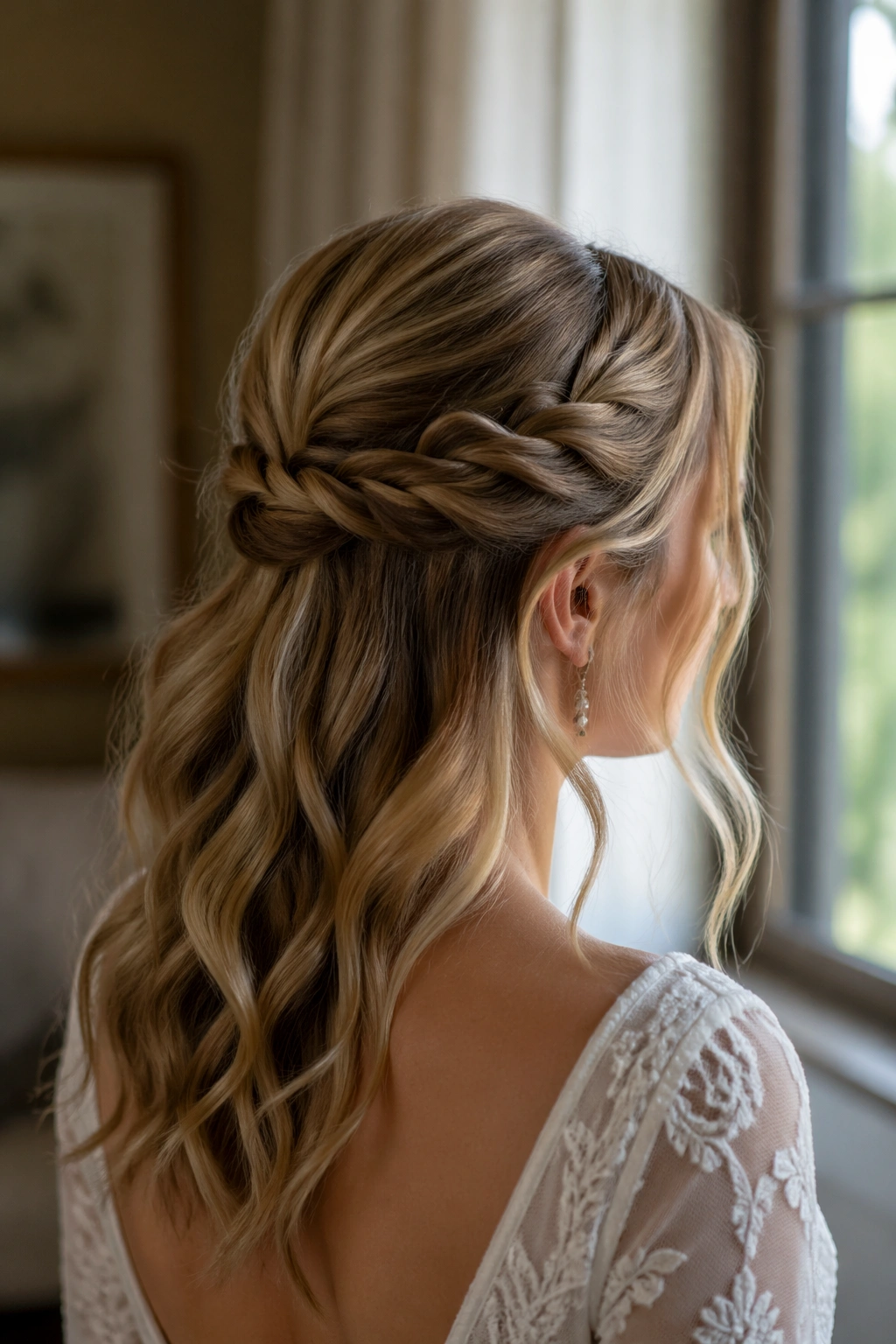
This kind of style should work with the hair texture in front of it, not against it. On Black hair, braided half-up half-down looks can be gorgeous when they respect the coil pattern, the density, and the need for a secure, comfortable hold at the hairline.
What to ask for in the chair
Flat twists, cornrow accents, feed-in sections, or a braided crown leading into defined curls all work well when the tension stays gentle. The front should not feel tight or itchy. Ever. If the scalp hurts during the trial, it will hurt more later.
- Keep the hairline edges soft and protected
- Use pins that grip without tearing
- Add cuffs, beads, or pearls only where they do not pull
- Leave the back in defined curls, twist-outs, or a pressed finish depending on the desired look
The best result is one that feels secure and still lets the natural texture breathe. That combination is the whole point.
30. Braided Half-Up With Secure, Dance-Proof Finish
A wedding hairstyle has to survive more than photos. It has to make it through hugs, heat, happy tears, the first dance, and usually at least one person who pulls you into a tighter embrace than expected. A braided half-up style can do that job if the base is pinned properly and the braid is built with enough support from the start.
The strongest versions use hidden elastics, crossed bobby pins, and a bit of texturizing spray before the braid even begins. That prep is boring. It also matters more than the shiny finish people obsess over later. If the foundation is solid, the style lasts longer and falls out more gracefully instead of collapsing in ugly chunks.
I’d always test movement before leaving the chair. Tilt your head back. Turn side to side. Shake your hair gently. If the braid shifts more than a finger’s width, it needs another pin.
A good bridal braid should feel secure, not stiff. That’s the sweet spot worth chasing.