



Braided wedding styles for curly hair work best when they don’t fight the curl pattern. That sounds obvious until you watch a style get flattened, pinned too tight, or loaded with product until the hair looks stiff instead of alive.
Curly hair has its own logic. It wants movement, room, and a little restraint—not a tug-of-war. A braid can do that beautifully when it’s placed where the hair already wants to bend, because the texture gives the braid more body and the curls keep the whole thing from looking severe.
I like wedding hair that still looks like hair. Not a helmet. Not a crusty shell. The prettiest curly bridal braids usually leave a few spirals free near the face, keep the crown secure, and make the back feel full even when the veil comes off after the ceremony. That balance is the whole trick, and it’s why the right style matters so much when the dress, the earrings, and the weather all want a say.
1. Halo Crown Braid with Free Spiral Ends
A halo braid is one of those rare styles that can make curly hair look even fuller than it already is. The braid traces the hairline or sits just behind it, which means the eye goes straight to the face and the texture around it. The loose ends can stay soft at the back, so you get structure up top and movement everywhere else.
Why It Flatters Curly Hair
Curly hair gives a halo braid a thickness that straight hair has to fake with extensions or heavy teasing. The braid itself reads as clean and formal, but the curls soften the outline so it never feels hard. That matters on a wedding day, because you want the style to survive hugs, heat, and a few emotional moments without looking overworked.
A side part helps this style settle nicely, especially if your curl pattern is looser near the front. If your hair is very dense, keep the braid a little wider rather than trying to make tiny, tight sections. Tiny sections can disappear into the texture.
- Best for: medium to long curls, oval or heart-shaped faces, gowns with open necklines
- Works well with: pearl pins, small fresh flowers, a short veil, or a comb placed behind the crown
- Pinning tip: place two crossed bobby pins every 1 to 2 inches so the braid stays anchored without squeezing the curl pattern flat
My favorite detail: leave a few ends at the back undefined on purpose. That softness keeps the style from looking too formal and gives the whole thing some air.
2. Side-Swept French Braid with Curly Curtain Bangs
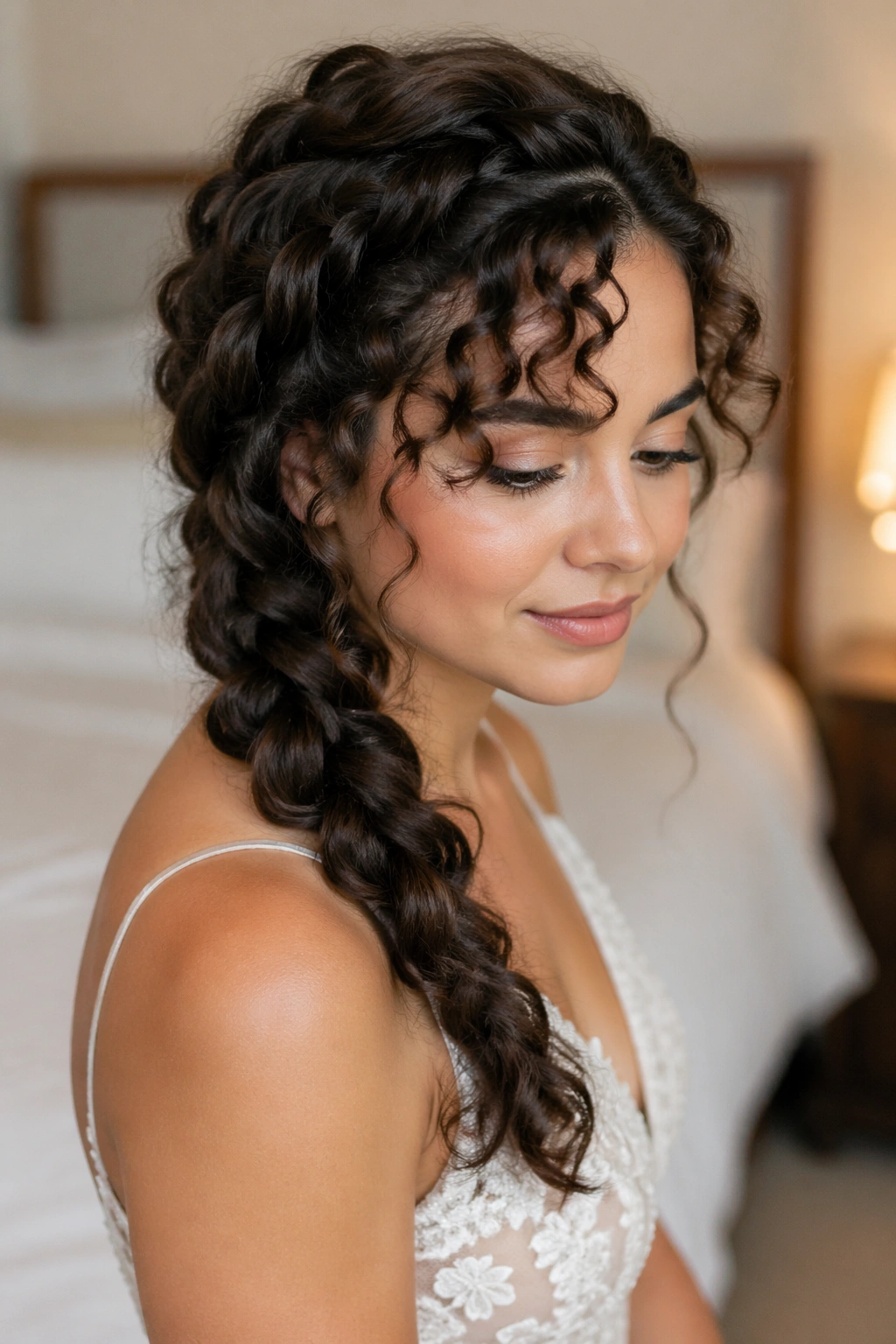
Want something polished that still feels gentle around the face? This is the one I keep coming back to. A side-swept French braid starts at the heavier side of the part and moves low across the head, letting the rest of the curls fall toward one shoulder.
The trick is not to over-smooth the front. Curly curtain bangs, or even a few short front pieces, make the braid feel bridal instead of school-girl neat. They also keep the style from hardening around the forehead, which is a common mistake when people pull curly hair too tightly at the roots.
This style sits nicely with one-shoulder dresses, scoop necks, and gowns that already have a lot going on near the bodice. It doesn’t compete. It just frames. If the braid is too tight, though, it starts to look smaller than it should. Leave a little loft at the crown, then gently widen the braid with your fingers once it’s secured. Not a lot. Just enough to give it that thicker, softer profile curly hair does so well.
If you want a little extra security, wrap a thin curl around the elastic at the end and pin it underneath. That tiny move hides the tie and makes the finish look much more intentional.
3. Low Braided Bun with a Soft Curly Wrap
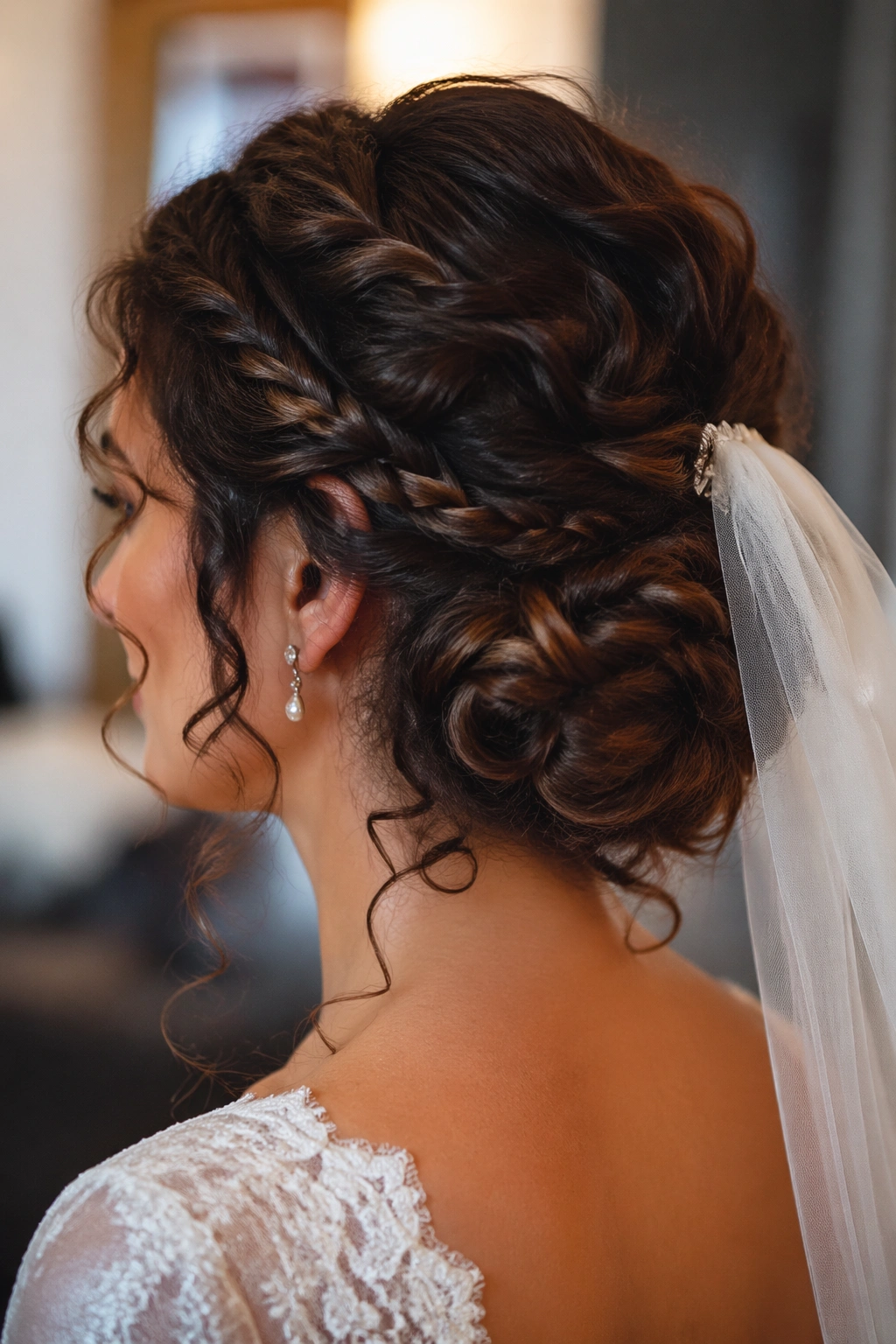
Picture a low chignon with a braided base and a few curls wrapped around it like ribbon. That’s the energy here. It’s formal, yes, but not stiff. The braid gives the bun shape, and the curls stop it from looking too polished for a wedding with real movement in it.
How to Keep It Balanced
Start the braid a little lower than you think you should. Most curly styles look better when they sit close to the nape, where the head naturally curves. If you build the bun too high, the shape can get boxy. Too low, and it can slump by the last dance.
A good version of this style usually has:
- a braid feeding into the bun from one side or straight down the back
- a softly pinned bun that still shows some curl pattern
- two or three face-framing pieces left out near the temples
- a veil comb placed above the bun, not inside the thickest part of it
This is one of those styles that holds up well if your hair is layered, because the braid controls the shorter pieces and the bun swallows the ends. The downside? It can look overdone if every strand is slicked back. Keep a bit of texture at the hairline. That texture is the whole reason curly hair makes this look so good.
4. Fishtail Half-Up with Defined Ringlets
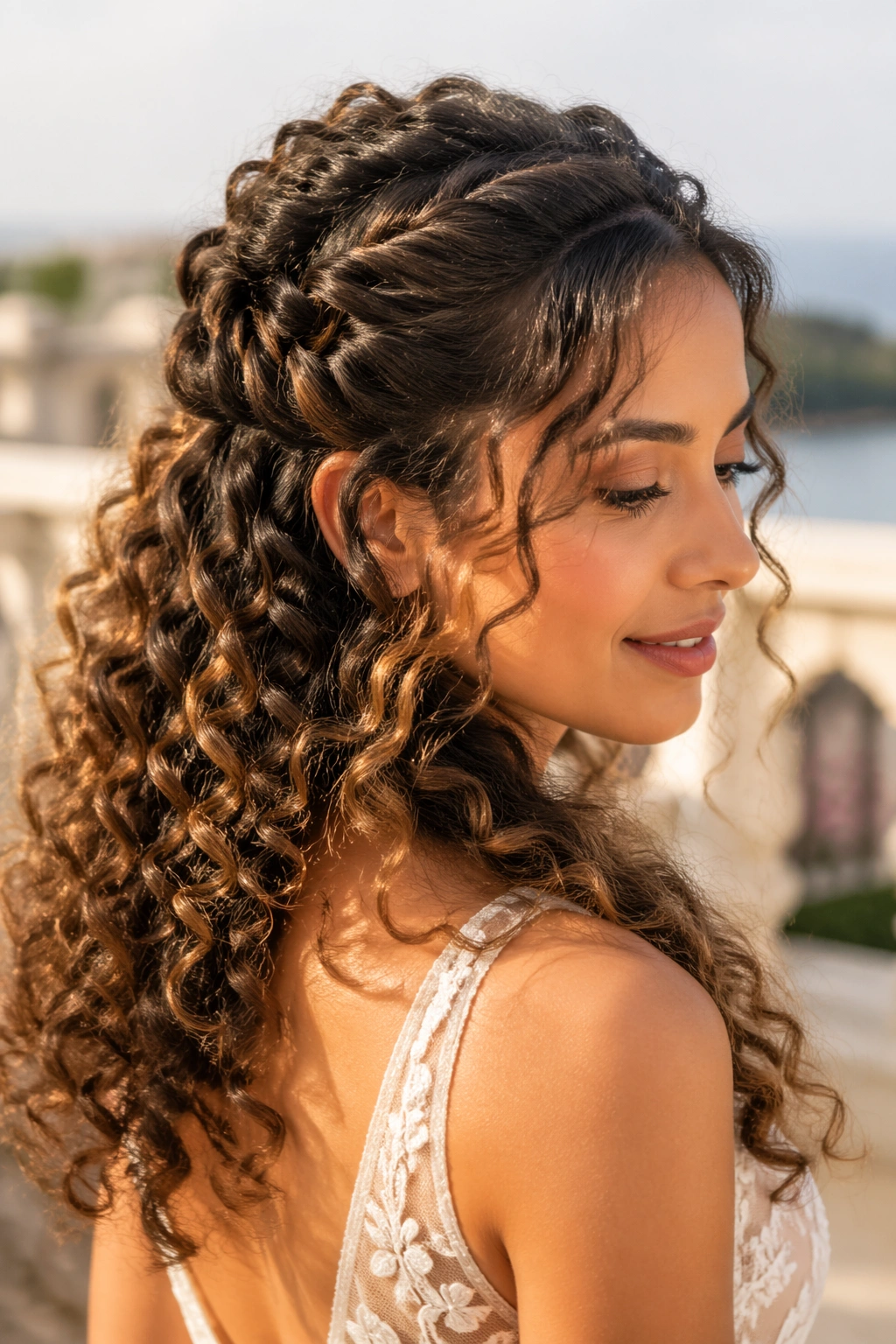
A half-up fishtail braid gives you detail without locking the whole head down. That matters if you want your curls to stay visible from the front, especially with a dress that already has some romance built into it. The fishtail weave also creates a tighter, more intricate look than a regular three-strand braid, which is handy when the rest of the hair is loose.
The best version starts at the temples and moves back across the crown, then stops before it gets too heavy. After that, the remaining curls fall in defined ringlets over the shoulders. The braid becomes a frame, not the whole story.
This style can get messy in a good way if the curl clumps are well defined. If the ringlets are fuzzy, though, the braid and the hair underneath can blur together. I’d set the curls first, let them cool completely, then braid. That order makes a big difference. And yes, a little shine cream on the ends helps, but keep it off the roots or the braid can slip.
If you want a veil, place it under the braid rather than over it. That keeps the braid visible and stops the comb from crushing the top section.
5. Rope-Twist Crown with Loose Length
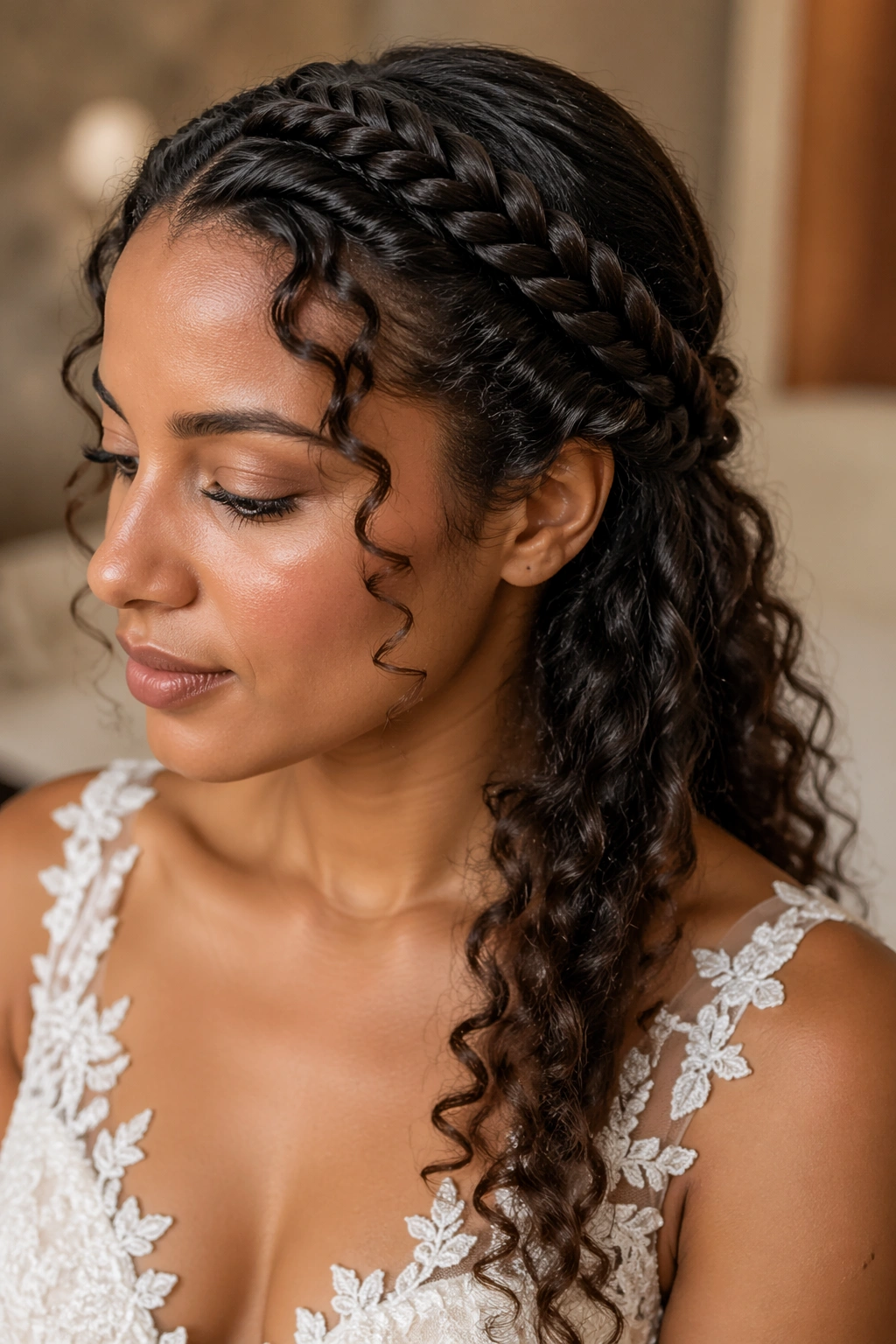
The rope twist has a clean line that curly hair wears well. It feels slightly sleeker than a traditional braid, which makes it useful if you want a bride look that leans refined rather than bohemian. The twist also moves fast, which is a blessing when the hair is thick and the clock is unkind.
What Makes It Work
A rope twist is basically two sections wrapped around each other, and that shape sits nicely on curls because the texture gives it grip. You do not need every curl to be perfectly uniform. In fact, a little variation makes the twist look more natural and less stiff.
This style works especially well when the crown is smooth and the lengths stay loose. The contrast is the point. A neat top with curly ends gives you structure at the scalp and motion through the rest of the hair. That’s a lovely combination with dresses that have lace, embroidery, or a high neckline.
A few practical notes:
- start with hair that has a little grip, not freshly washed silkiness
- keep the twist broad near the front so it reads well in photos
- pin the twist at each turn, not only at the end
- let the back stay soft and touched by your natural curl pattern
One more thing. Rope twists can look small on very dense hair if you try to pull them too tight. Give the sections space. Let them breathe.
6. Double Braids into a Curly Ponytail
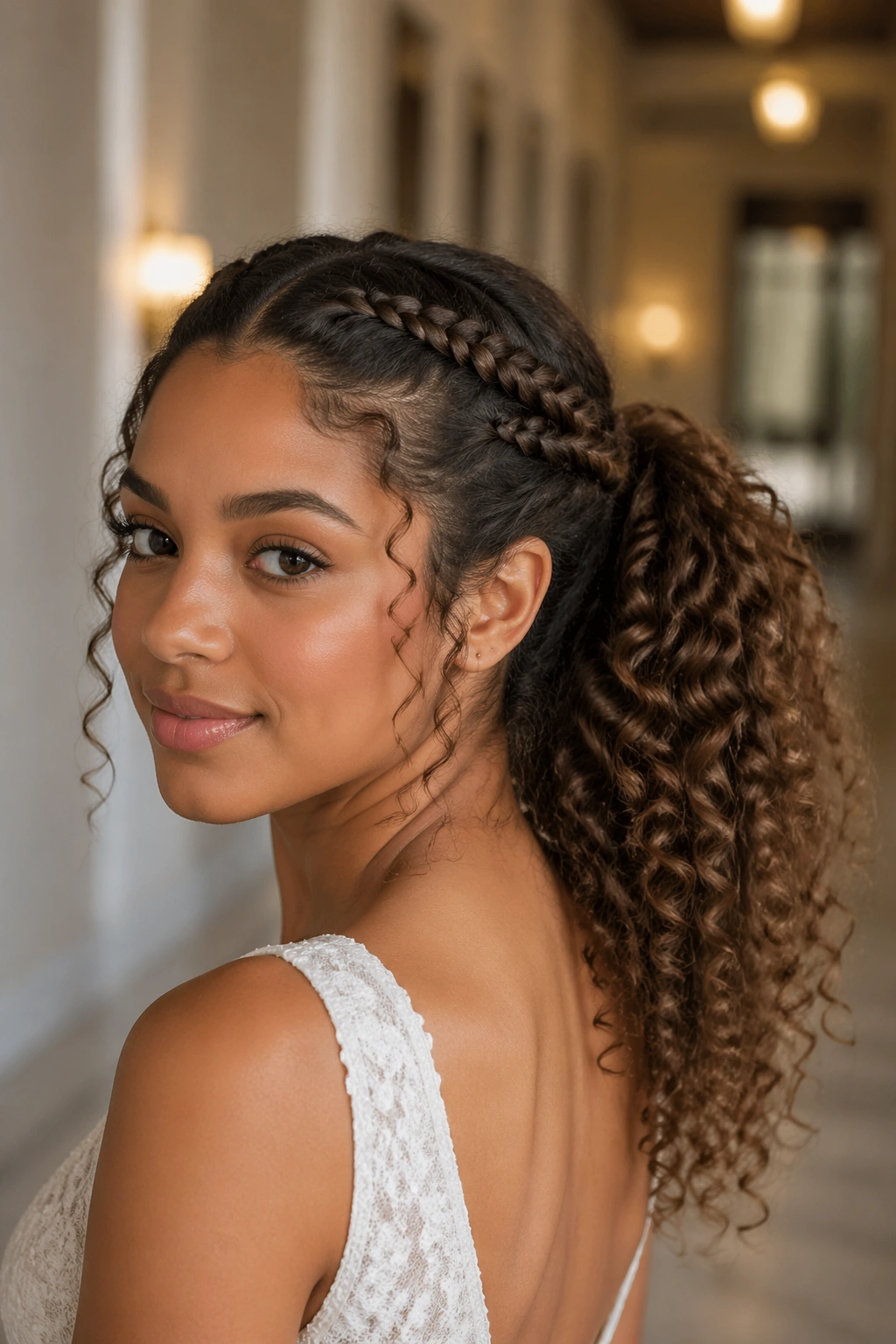
Two slim braids feeding into a ponytail look deliberate, not casual. That’s the charm. You get a little symmetry at the front, then a big burst of curls at the back or one shoulder, depending on where you set the ponytail.
This is a strong choice for brides who want their face open but don’t want a severe updo. The braids can start at the temples and travel just a few inches back, or they can sit lower and hug the sides of the head. Either way, they act like rails that guide the eye toward the ponytail itself.
The ponytail should sit where your head feels balanced—usually mid-back of the head, not too high unless the dress is very minimal. Curl the ponytail in sections if needed and leave the ends soft. A wedding ponytail with curls needs some looseness or it starts to look athletic.
A little hair jewelry can help here, but keep it sparse. Two pearl pins near the braid ends are enough. More than that can get fussy fast.
Best move: wrap a thin strand around the elastic and secure it with a hidden pin. That tiny cover-up makes the whole style look cleaner in person and on camera.
7. Waterfall Braid Across Long Curls
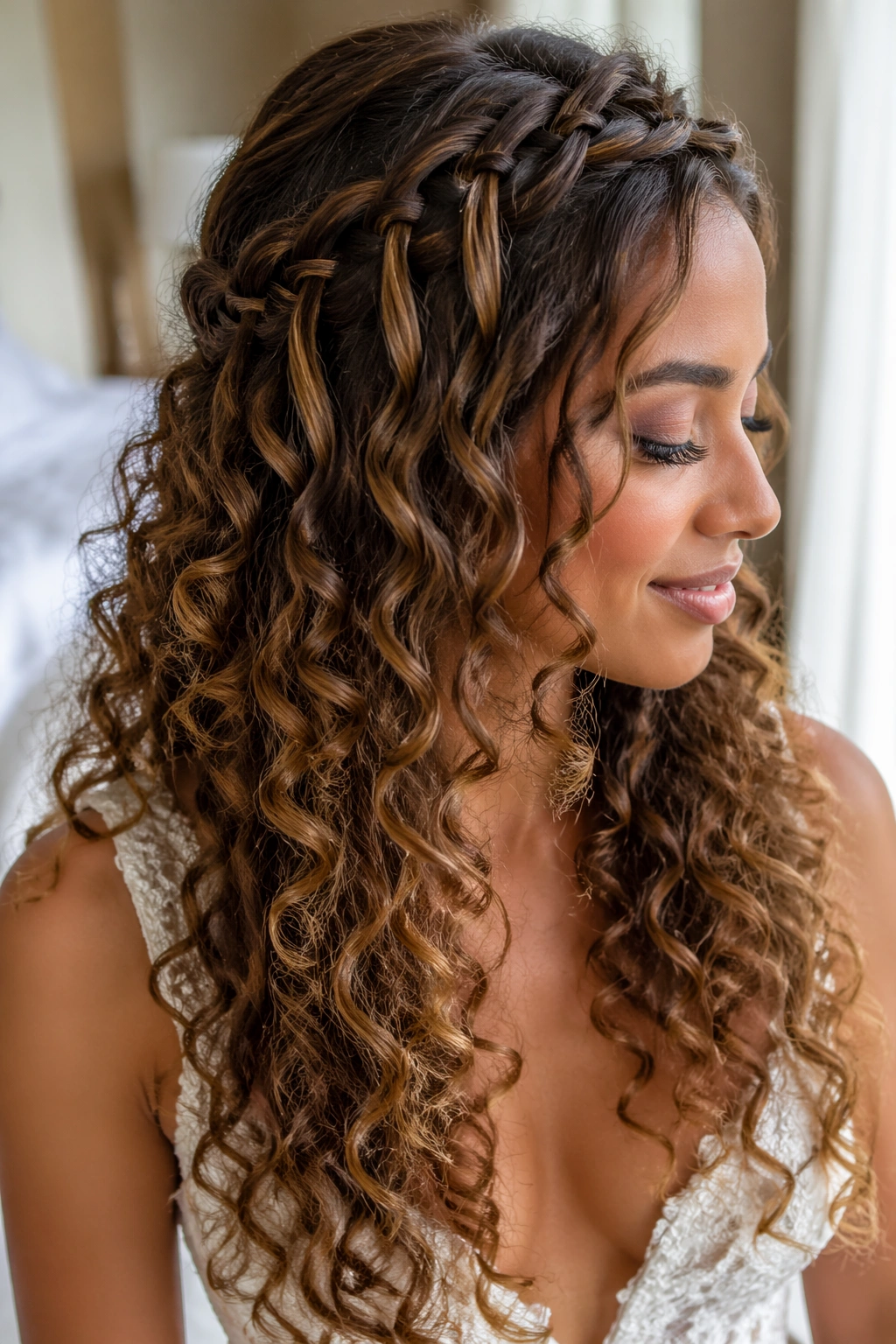
If your curls fall past the shoulders, a waterfall braid gives you the prettiest kind of movement. It lets sections drop through the braid instead of pulling everything back, so the style feels light even when it has real detail at the top.
The visual is gorgeous, but it needs a steady hand. A waterfall braid on curly hair works best when the curl pattern is defined first and the top sections are not too bulky. Otherwise the braid starts to disappear into the texture. I’d keep the braid confined to the upper third of the head and let the rest do its own thing. That way the style doesn’t get crowded.
How to Keep It From Sagging
Use small, even sections. Bigger sections make the braid loose and sloppy. Pin each crossover as you go if the hair is especially slippery, because curls can shift more than straight hair once the style gets moving.
- Use a lightweight mousse or curl foam before drying so the lengths hold shape
- Keep the braid close to the head if you plan to wear a veil
- Stop the braid before it reaches the ear if you want the style to stay airy
- Finish with defined ends, not brushed-out volume, or the braid loses its line
This style suits brides who want romance without a heavy updo. It has a soft, moving feel that works beautifully with gardens, outdoor vows, and dresses that don’t need much competition from the hair.
8. Braided Mohawk with a Curly Ponytail
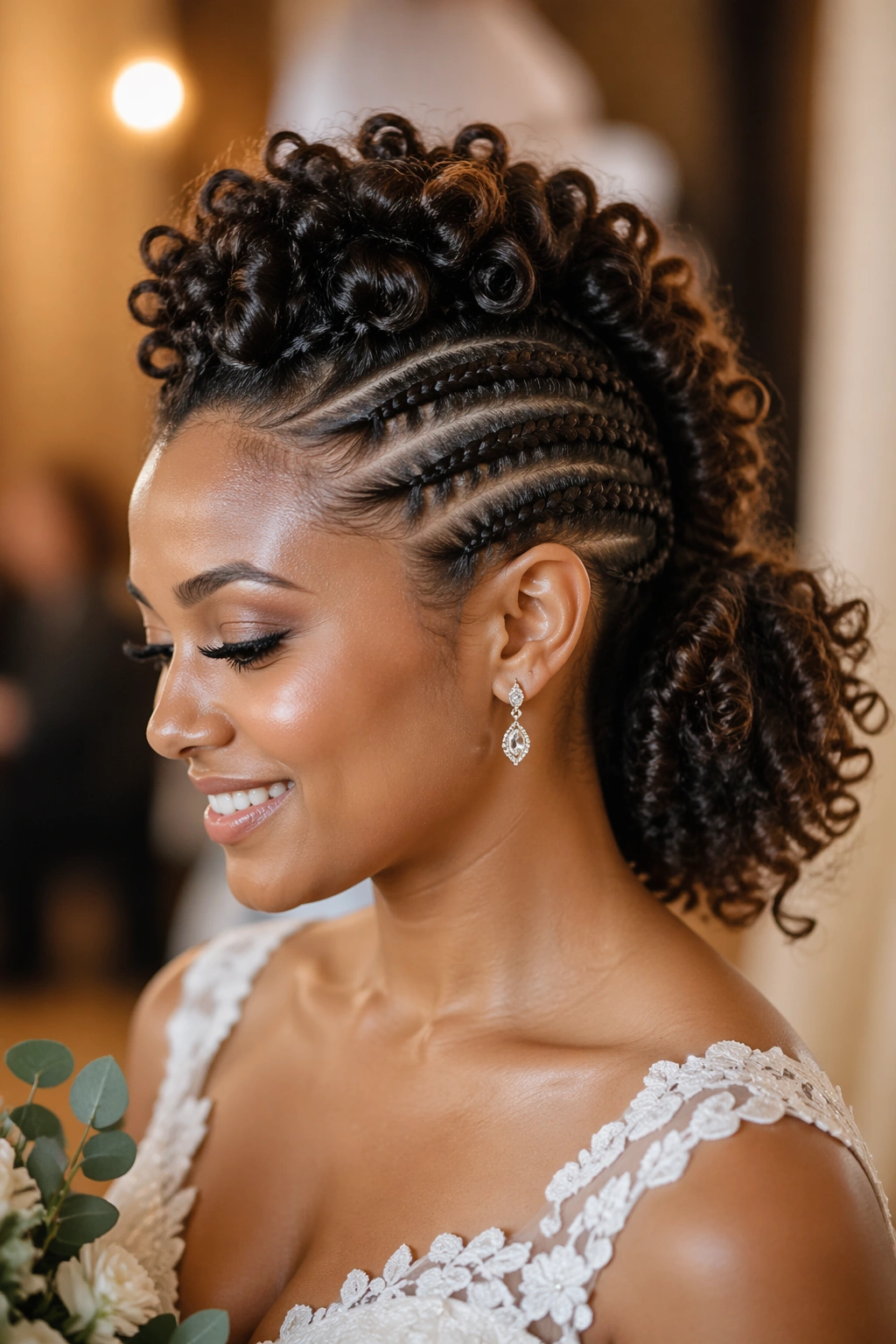
A braided mohawk sounds bold because it is. But on curly hair, it can look surprisingly elegant, especially when the sides are pinned smooth and the center section stays full. The contrast between the sleek edges and the lifted top ridge gives the style real shape.
Who should try it? Brides who like a little edge in their look, or anyone wearing a dress with strong lines through the shoulders. It also works well when you want the face open and the profile strong. The braid can run from the forehead to the crown, or from a few small braids joined together into one larger center shape.
The ponytail at the back can stay curly and soft. That’s where the romance comes in. If the crown is too flat, the style loses its energy. If the center gets too wide, it can start to feel costume-like. So keep the lift controlled. Just enough to show the shape. Not more.
A few loose coils at the temples help a lot here. They soften the edges and keep the look from turning severe. And if you’re wearing statement earrings, this is one of the better styles for showing them off.
9. Side Braid Chignon with Face-Framing Tendrils
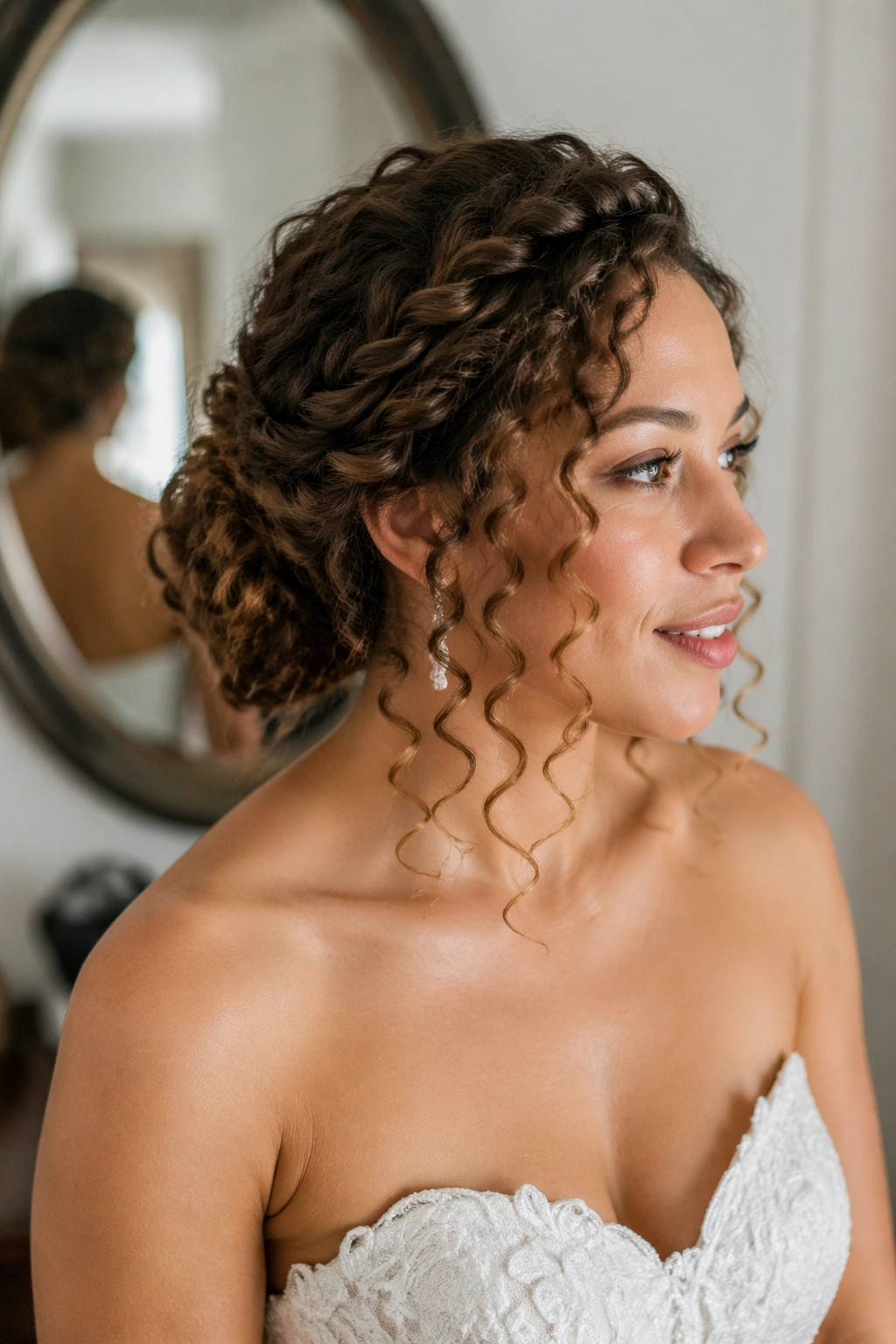
A side braid feeding into a low chignon has a quiet kind of elegance that curly hair wears especially well. The braid creates direction, the bun gives the style a finished shape, and the tendrils keep the face from looking boxed in.
I like this one for gowns with detailed necklines because it moves the hair away without making the back feel empty. The braid can begin near the temple and travel diagonally toward the nape, where it melts into the chignon. That diagonal line is flattering on almost everyone. It pulls the eye upward and across the face.
The tendrils matter more than people think. Keep them soft, not stringy. A finger coil at each side can be enough, especially if the curls naturally spring back once they’re pinned. You want a few pieces that move when you walk, not wispy threads that disappear under the veil.
This style also hides layered hair well. Shorter pieces disappear into the braid, and the chignon traps the ends. If you need the hair to last for a long day, that hidden structure is gold.
10. Micro Accent Braids Woven Through Natural Curls
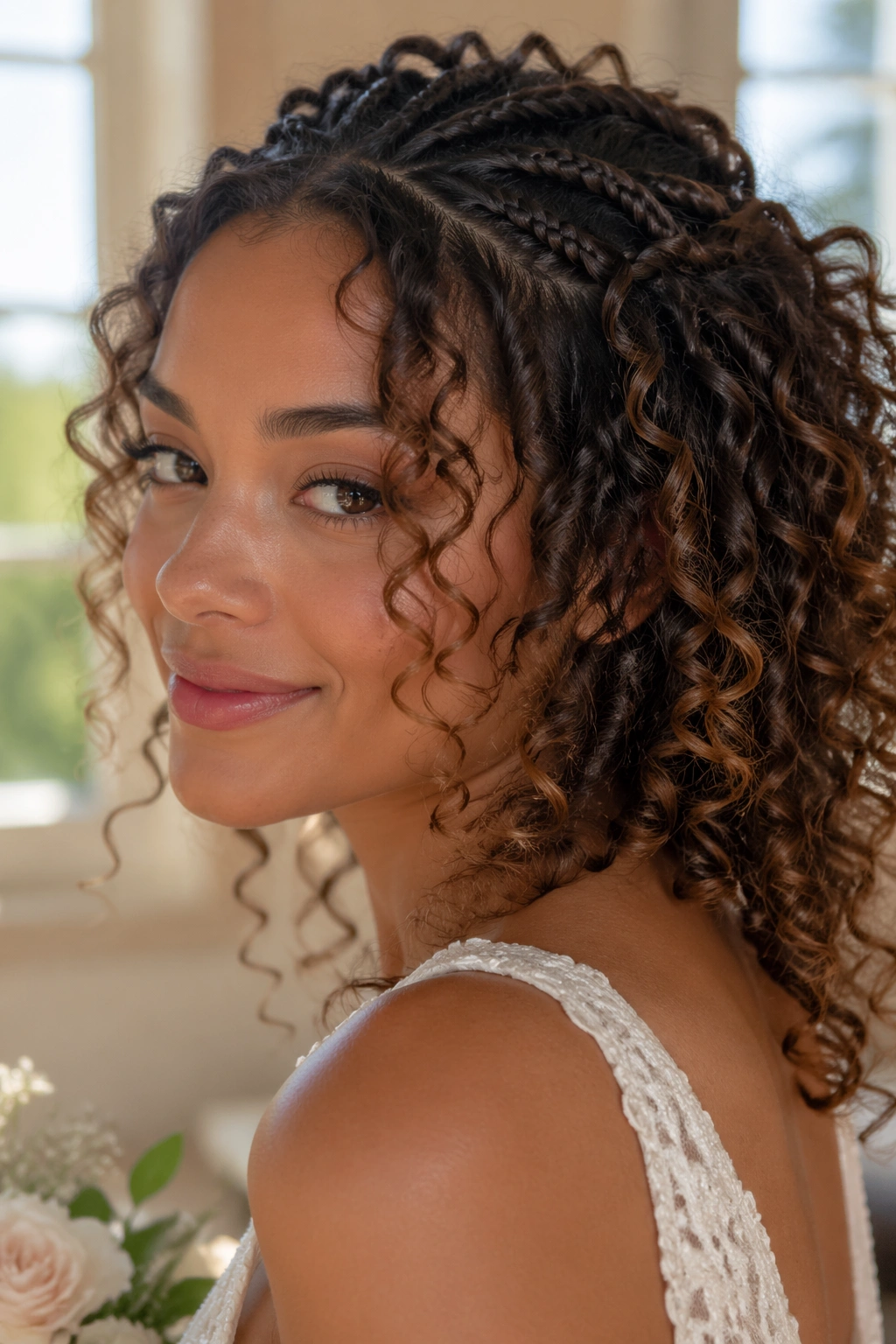
Small detail. Big payoff.
Micro braids aren’t the main event here. They’re the accent that makes the whole hairstyle feel personal. A few thin braids tucked through the crown, along one side, or near the back can turn a simple curl pattern into something that feels thoughtful and finished.
Where to Place Them
The placement matters more than the number. Too many tiny braids and the style starts to look busy. Two or three placed with intent is usually enough. I like them best tucked near a side part or woven into the outer layers so they show when the hair moves, not only when you’re standing still.
These braids are a smart choice if you want a bohemian wedding look with flowers or if you’re wearing your curls down but still want a little structure. They also work well with thicker textures because the braids break up the mass in a good way.
- place one braid just above the temple for a face-framing effect
- tuck one braid into the back layers if you want movement only from certain angles
- finish the ends with a tiny clear elastic or wrap them into the curl pattern
- keep the braids slim so they don’t compete with the natural texture
The nicest thing about this style is that it doesn’t ask your curls to become something else. It just gives them a little extra language.
11. Braided Veil-Crown Updo
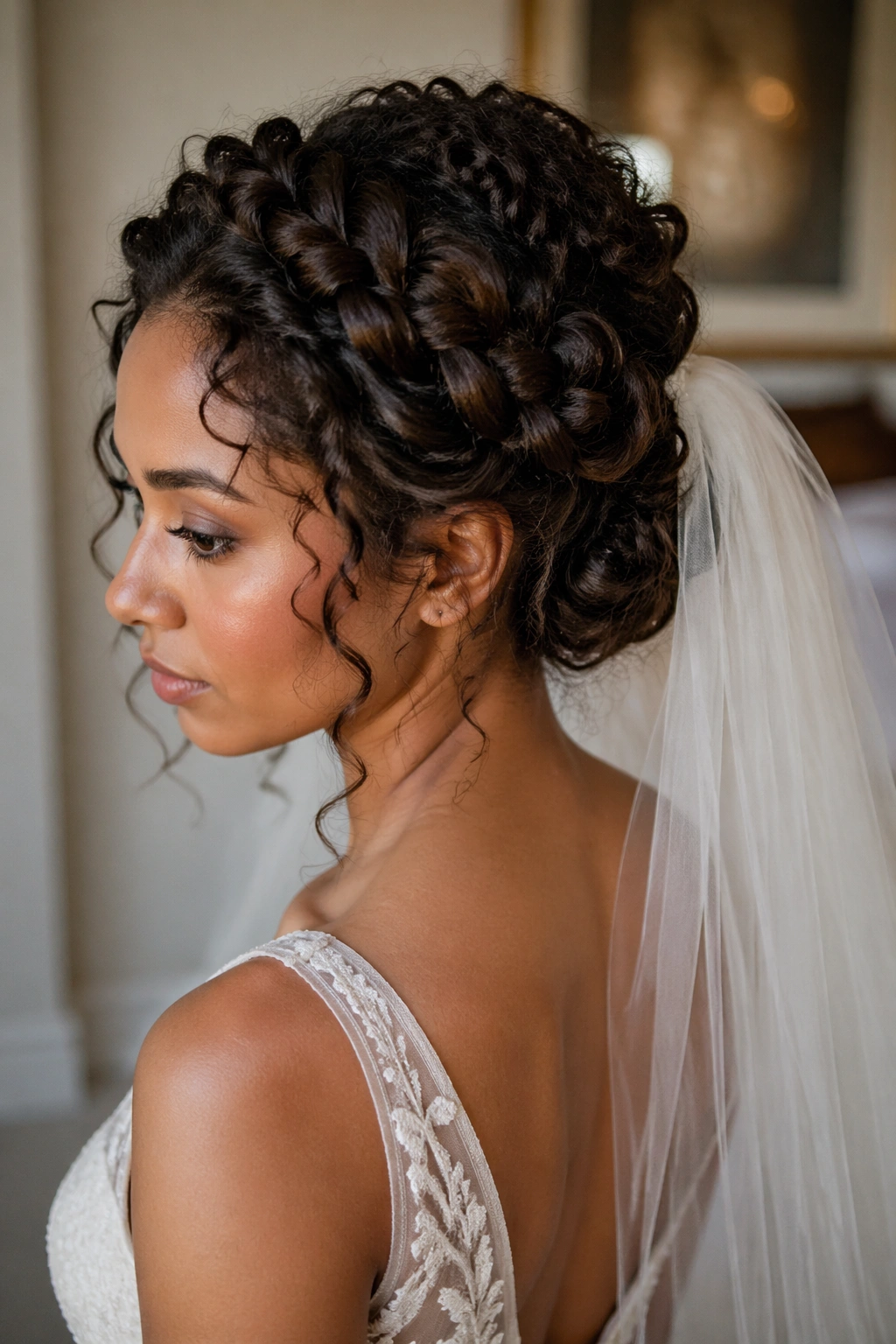
If the veil is heavy, the braid has to do more than look pretty. It has to hold. A braided veil-crown updo gives the comb or clip a solid base, which matters far more than people think when the ceremony runs long and the veil is on for hours.
The braid usually wraps around the crown or sits just behind the hairline, then feeds into a tucked updo at the back. That creates a stable ridge for the veil to sit on. The hidden pins go into the braid itself, not only into the loose hair underneath. That’s the detail that keeps everything from sliding.
This style is especially good for curly hair because the texture gives the braid grip. Still, the top section should be pinned with care. Too much tension at the front can flatten the silhouette and make the face look sharper than you want on a wedding day. Leave a little softness at the temples. It helps.
A veil crown can also handle pearl pins, a comb with tiny crystals, or a floral piece tucked slightly off-center. Just don’t overload it. The braid is already doing the work. Let it.
12. Reverse Dutch Braid into a Low Knot
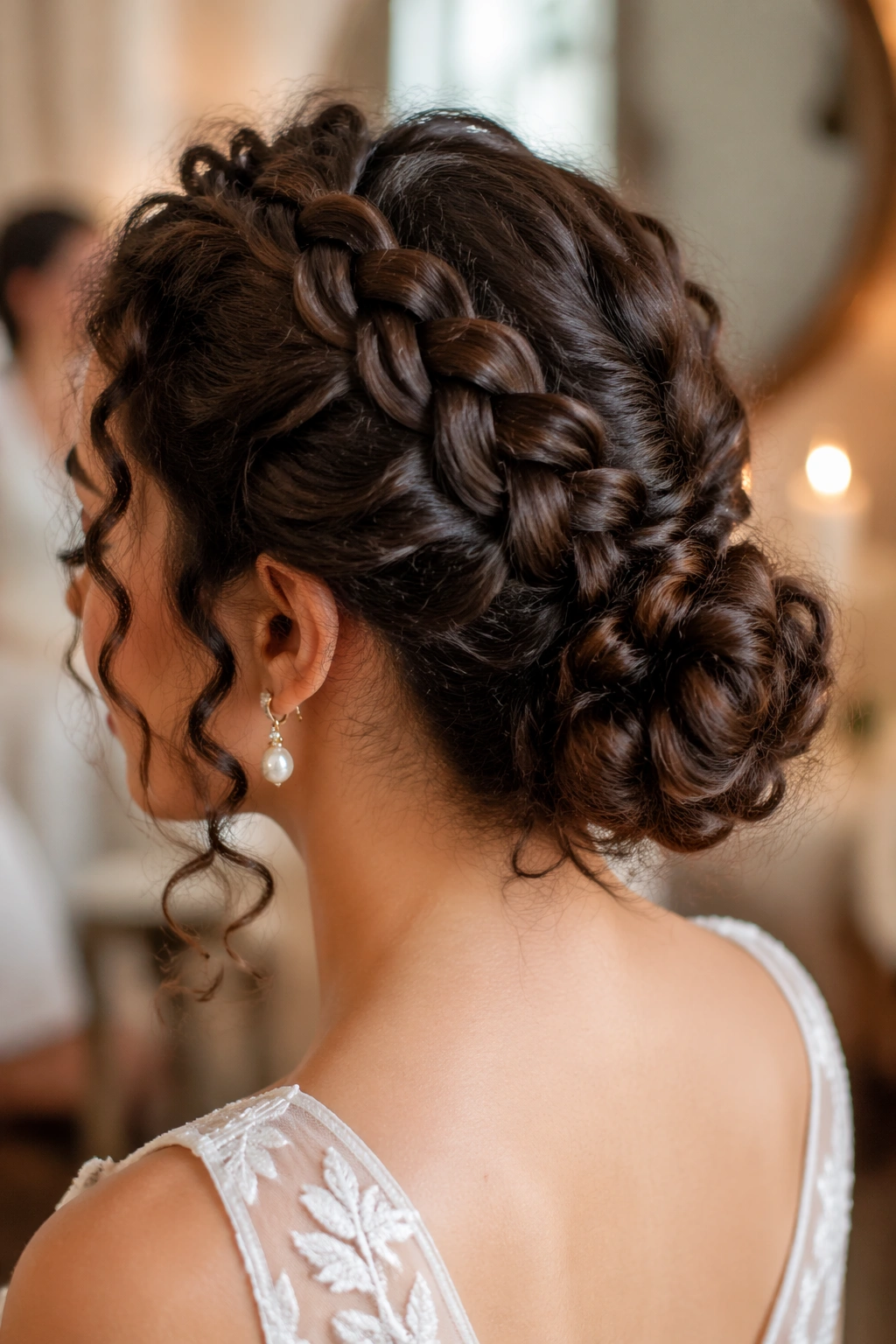
Do you want lift at the root without teasing the life out of your curls? A reverse Dutch braid is one of the smartest ways to get it. Because the braid sits on top of the hair instead of disappearing into it, the pattern reads clearly and the crown gets a little height.
That lift is useful if your curls are fine, if your hair is dense but soft at the roots, or if you simply want the front of the style to stay visible from across the room. The braid can start at the hairline and travel back toward the nape, where it feeds into a low knot. The knot itself can be tucked neatly or left with a small curl tail peeking out.
Why It Gives Lift
The braid creates a ridge. That ridge changes the shape of the head in a subtle way, which is exactly what a wedding style often needs. It is not about making the hair look bigger everywhere. It’s about giving the top line some architecture.
- Good for: fine curls, medium density, and dresses with a clean neckline
- Use: small sections at the start for a neat scalp line, then slightly wider sections through the crown
- Avoid: pulling the braid so tight that the roots look shiny and flat
- Finish with: a low knot secured with pins crossed in an X for better hold
I’d pick this style for brides who want polish without a rigid updo. It has shape, but it still feels like hair.
13. One-Shoulder Side Braid for Statement Dresses
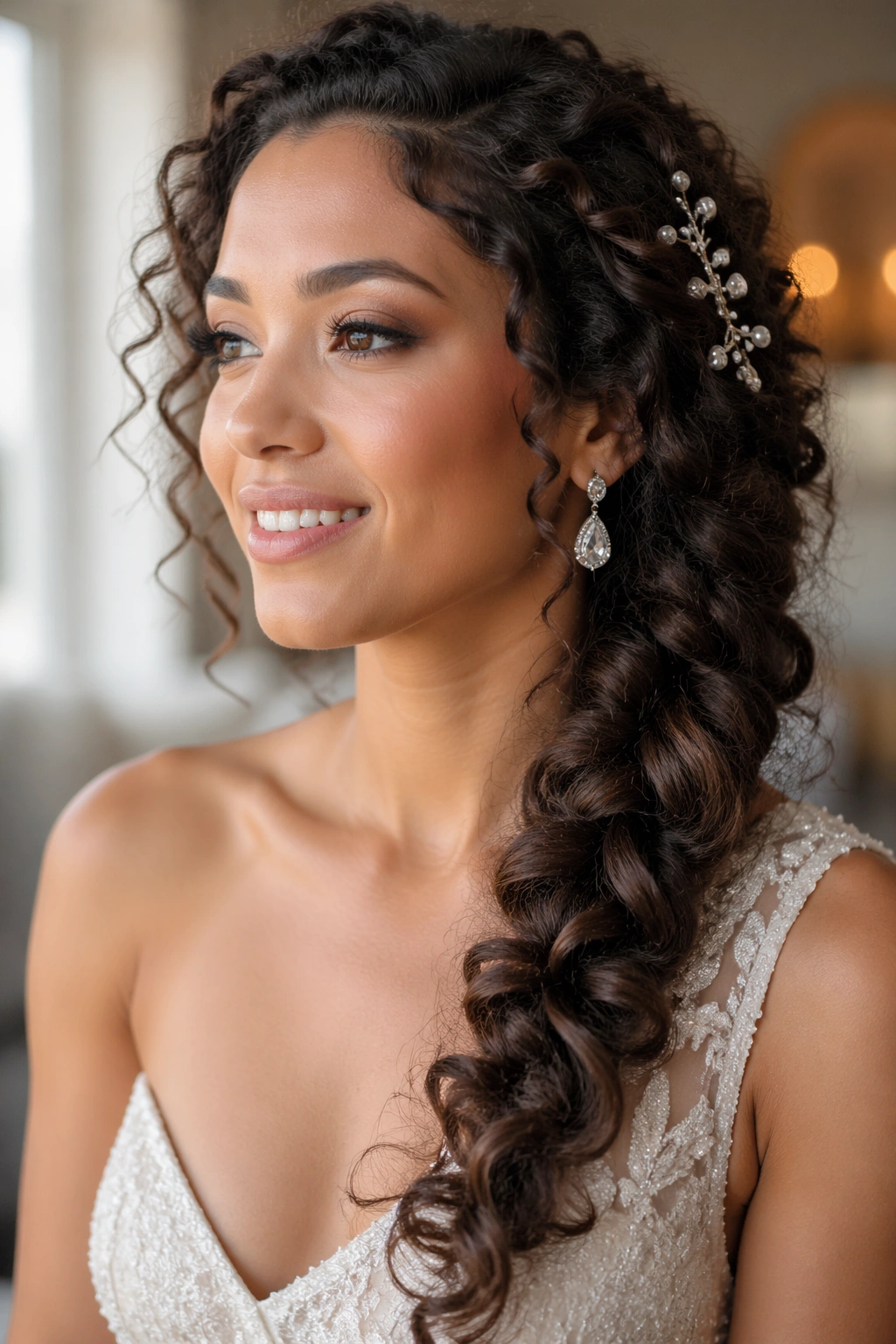
Sometimes the simplest braid is the one that looks the most dressed up. A one-shoulder side braid clears the neckline, follows the line of the dress, and lets curly texture do the rest. There’s no need to overcomplicate it.
The style works best when all the hair is swept to one side and gathered low over the shoulder, then braided in a way that keeps the volume visible. A loose French braid, a three-strand braid, or even a rope braid can work here. The exact braid type matters less than the placement. The sweep is the feature.
This is a smart choice with asymmetrical dresses, single-strap gowns, and bold earrings. It also looks good when the braid is finished with a wrapped strand or a narrow ribbon tucked close to the end. Keep the ornament simple, though. The dress is already speaking. The braid should answer, not shout.
If your curls are very long, let the tail fall below the braid in a soft wave. If they’re shorter, stop the braid a few inches above the ends and let the texture bloom out there. Both versions work. The best one is the one that keeps the silhouette clean from the front.
14. Braided Half-Up Top Knot for Tight Coils
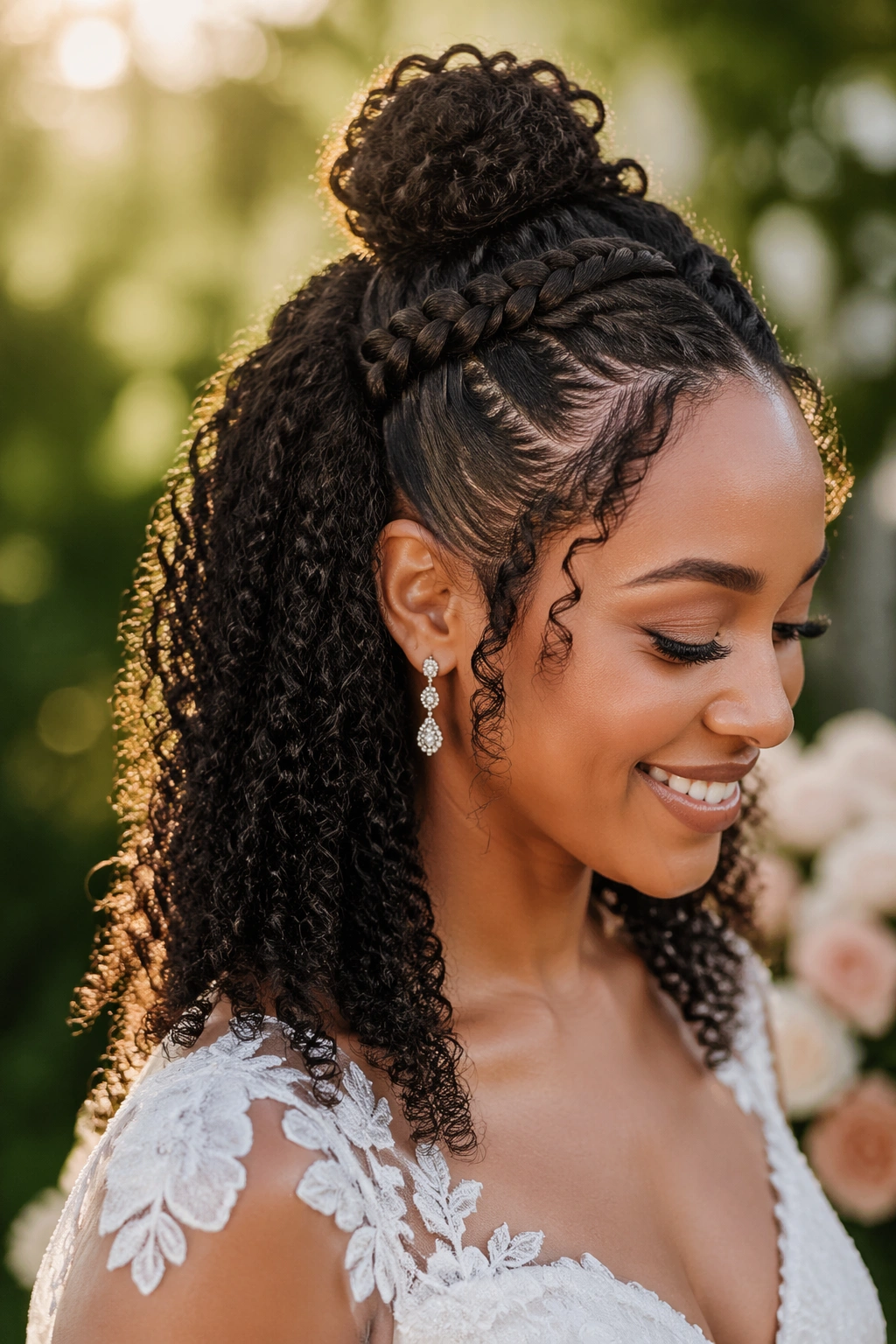
The top knot can feel playful, but on tight curls and coils it can also look sharply tailored. A braided half-up version gives you the lift of a knot, the detail of a braid, and enough length left down to keep the style soft.
Keep the Coil Pattern Visible
That part matters. If the hair is stretched too much before styling, the knot can lose the beauty of the natural pattern. I’d start by defining the top section with a little curl cream or styling foam, then braid or twist it back into the knot without pulling every coil straight.
This style is strong on brides who want movement in the back and lift at the crown. It also handles humidity better than you might expect, because the knot gives the top section a secure anchor. The lower half can stay free, which keeps the whole style from feeling too packed.
- use a braid at the crown that stops before the knot so the detail is visible
- secure the knot with pins hidden inside the base, not on top of it
- leave the lower curls separated into soft clumps rather than brushing them out
- add a small comb or a few pins if you want the knot to feel more formal
There’s a nice tension here: neat on top, alive underneath. That’s the bit that makes it feel bridal.
15. Low Gibson Tuck with Braided Detail
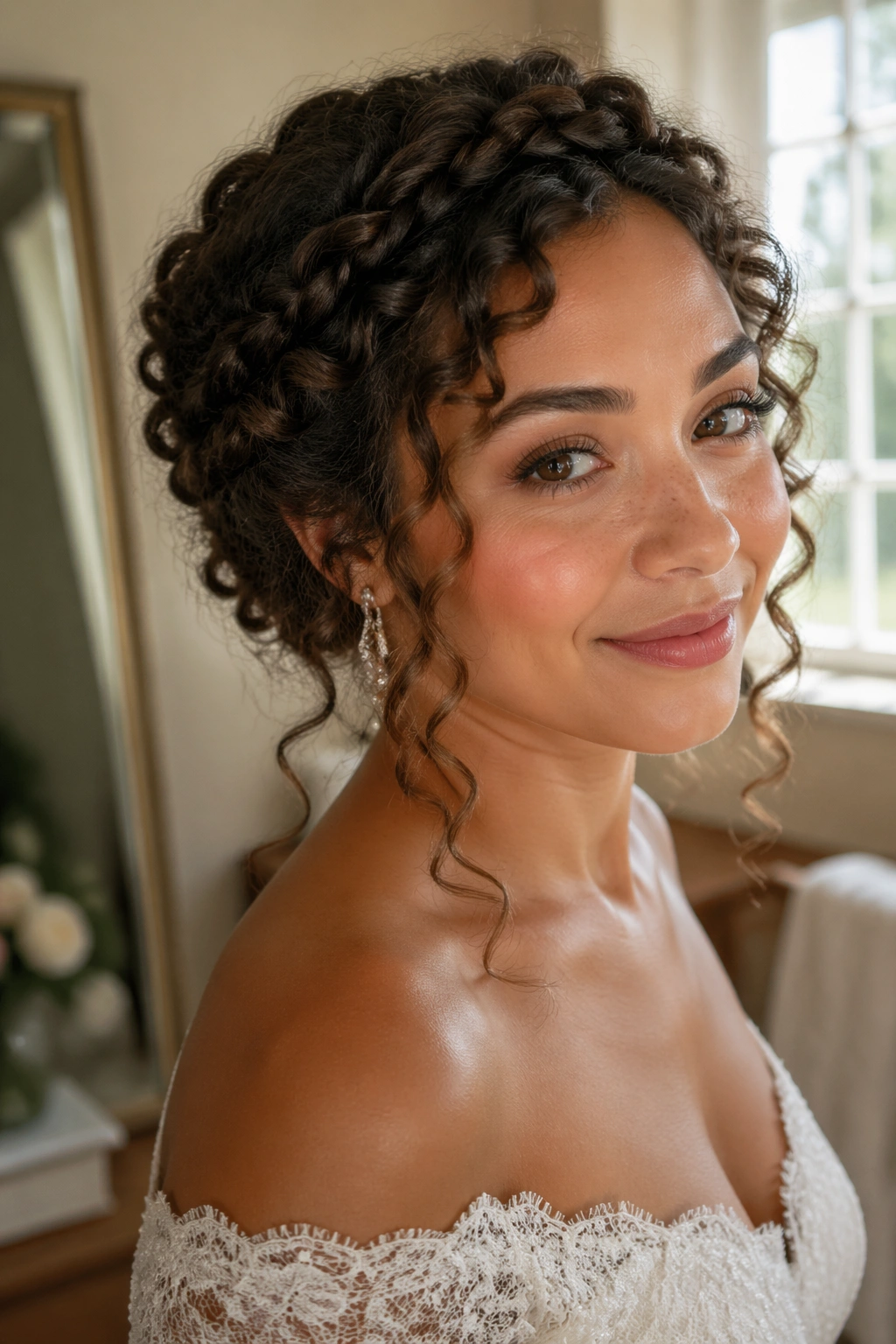
A low Gibson tuck with braided detail is one of the most useful wedding styles for curly hair because it feels calm, secure, and still textured. The shape sits at the nape, which is where curly hair tends to look most elegant when it’s gathered with care. The braid gives the tuck a visual edge, and the curl pattern keeps it from looking too tidy.
This style is a strong pick if you want the hair off your neck, if the veil needs a stable base, or if the dress has a back worth showing off. A braid can travel along one side first, then feed into the tuck. Or the braid can frame the tuck from both sides, which gives the style a more finished look. Either way, the tucked section should stay soft enough to show some texture when you turn your head.
The little things matter here. Pins need to disappear into the fold. The braid should be wide enough to read in profile. And the curls at the ends should not be crushed into nothing, because that’s what makes the style feel flat.
If you want one curly bridal braid that sits between romantic and practical, this is the one I’d keep at the top of the list. It handles movement well. It looks composed from every angle. And when the ceremony is over, it still feels like your hair—not a costume wearing your face.
A good wedding braid on curly hair doesn’t try to erase the curls. It uses them. That’s the part that ages well in photos, and the part that still feels right when the music starts and the hairpin count is the last thing on your mind.
