



Poofy curly hair has a personality. Some mornings it looks soft and round, and other mornings it looks like it expanded half an inch in every direction while you slept.
That’s not a problem. It’s a clue.
The best hairstyles for poofy curly hair do not try to erase volume. They work with shrinkage, density, and the natural lift that curls get at the roots and around the crown. If you force curls into a style that wants straight, slippery hair, the shape usually falls apart fast. If you pick a style that respects curl memory and lets the texture sit where it wants to sit, the result feels easier, cleaner, and a lot more intentional.
There’s also a practical side that gets ignored too often. Thick curls hold pins differently than loose curls. High humidity changes the shape. Dry ends make the halo bigger. A style that looks neat on damp hair can puff out beautifully by lunchtime, and sometimes that’s the whole point. The trick is learning which styles tame the edges, which styles celebrate the fluff, and which ones do both at once.
So let’s keep it honest and useful. Some of these looks are polished. Some are playful. A few are the kind of styles you reach for when you’ve got exactly eight minutes and no interest in fighting your own hair.
1. High Puff
The high puff is the first style I’d hand to anyone with poofy curly hair who wants something fast, flattering, and low-drama. It takes the volume that might feel unruly when it’s loose and turns it into a shape that looks deliberate from every angle.
The reason it works is simple: curls already want to lift. A puff just gathers that lift instead of flattening it. On thick hair, the silhouette can look almost sculptural. On medium-density hair, it gives the crown a nice rounded shape without making the rest of the head feel bulky.
Why the High Puff Works So Well
A high puff keeps the sides neat while letting the top stay full. That balance matters.
- Use a soft stretchy headband or a wide scrunchie so you do not crush the curl pattern at the base.
- Smooth the perimeter with a pea-sized amount of gel or edge control if you like a cleaner outline.
- Fluff the puff with your fingers after it’s secured. A brush can make it look too tight.
- Pull a few curls out near the hairline if you want a softer face frame.
The biggest mistake is making the band too tight. You end up with a headache and a dent that takes hours to disappear. Keep the base secure, sure, but not strangled. That’s the whole game.
2. Pineapple Ponytail
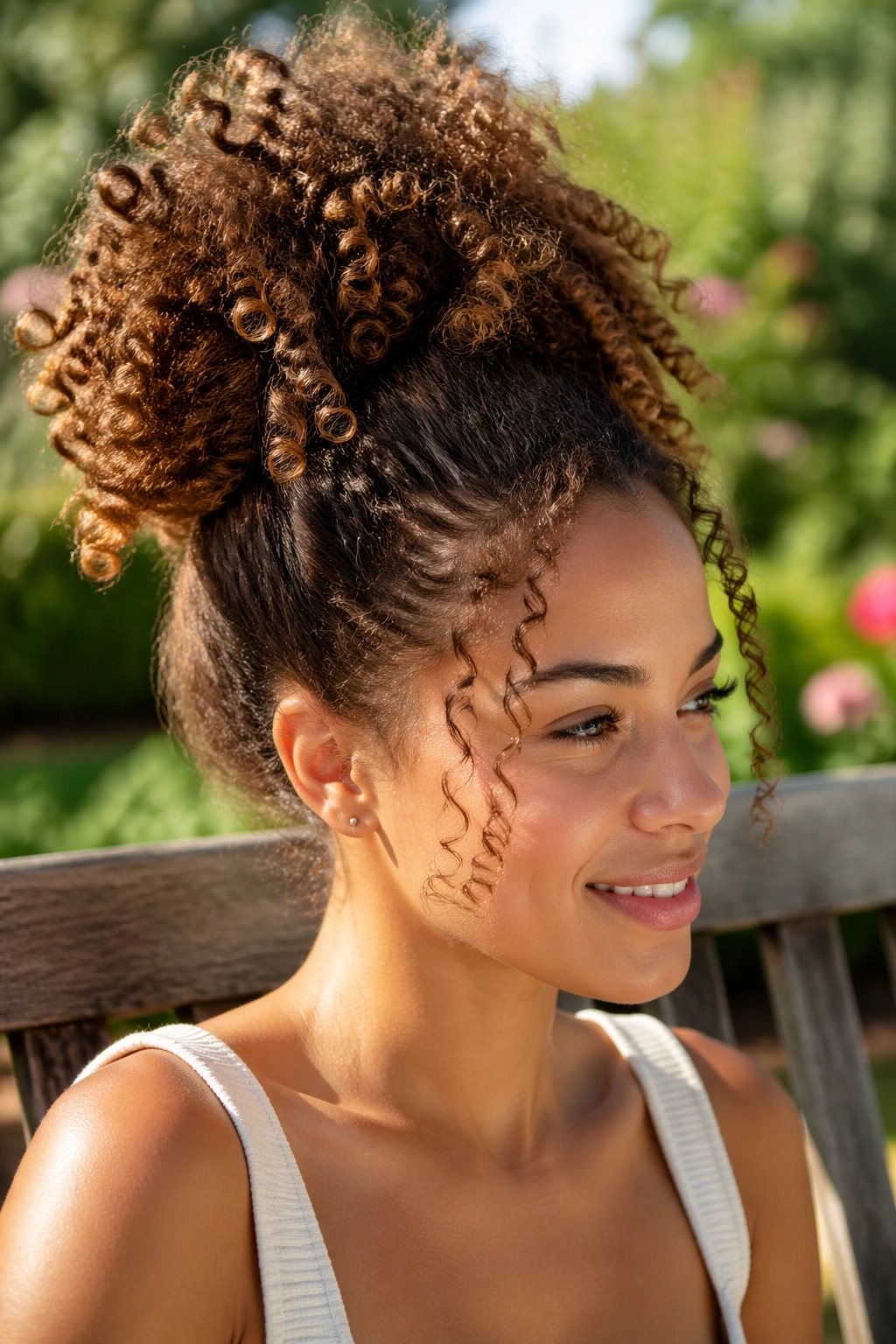
What do you do when your curls are too pretty to hide, but you still want the hair off your neck? A pineapple ponytail.
It’s basically a very high, loose ponytail that lets the curls spill upward and outward instead of hanging flat. The shape is especially good for poofy curly hair because it keeps the top full and the ends springy. It also works on second- or third-day curls when the crown needs a little help and the ends still have life left in them.
How to Keep the Crown Loose
A pineapple should look airy, not scraped back. That means the elastic sits high, and the hair near the scalp stays a little lifted.
- Flip your head forward before you gather the hair.
- Use a satin scrunchie or a coil tie to avoid a hard crease.
- Stop tightening once the crown feels secure.
- Let the ends fan out on top rather than forcing them flat.
I like this style because it does double duty. It can be a sleep style, and it can also be a daytime look if you smooth the front and leave the ends fluffy. If you have shorter curls, the pineapple becomes more of a mini top pony, and that works too.
3. Half-Up, Half-Down
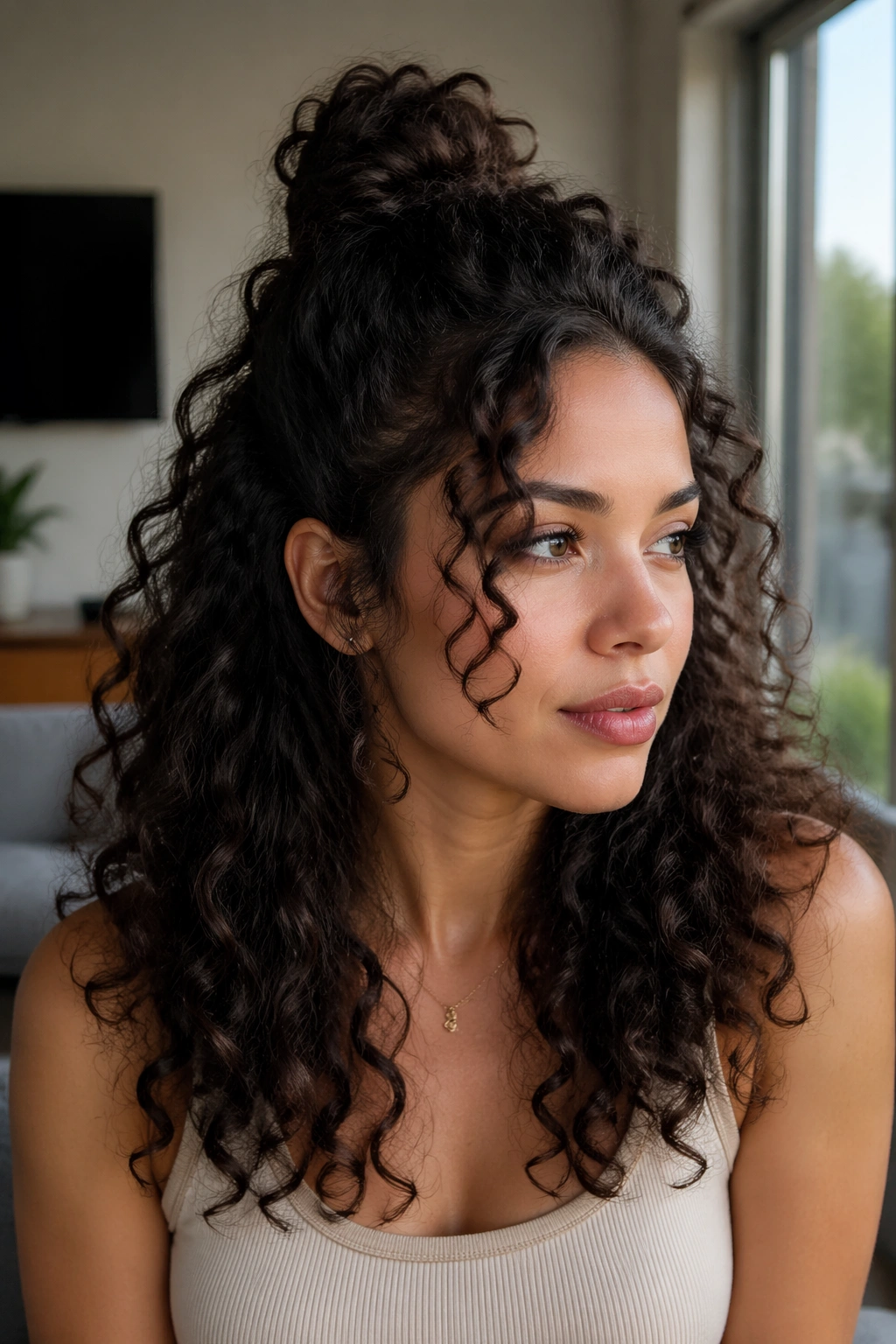
There’s a reason the half-up, half-down style keeps coming back: it gives you the face-framing control of an updo and the movement of loose curls at the same time.
For poofy curly hair, that split is especially useful. You can tame the front and crown just enough to keep the shape tidy, while the lower section still does its big, springy thing. The result usually feels less heavy than wearing all the hair down, but less severe than putting everything away.
A small claw clip, a barrette, or a few bobby pins can change the mood fast. Twist the top section into a tiny bun for a casual look. Braid it if you want more texture. Or keep it simple and let the curls sit in a soft arc across the back of the head.
The best part? This style forgives imperfect curl days. If the top layer is frizzier than the bottom, nobody cares. The contrast can look good. Actually, it often does.
4. Low Curly Bun
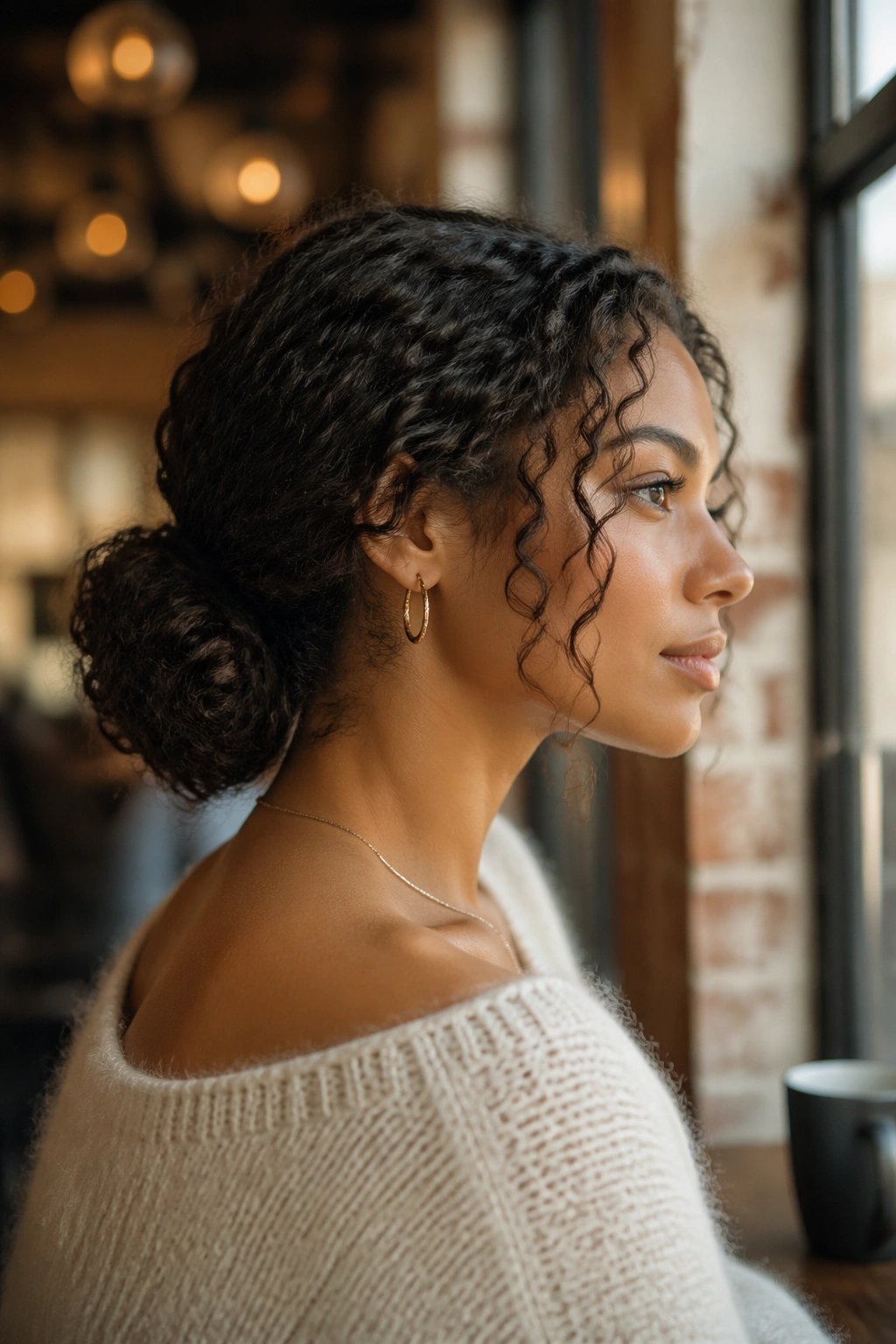
The low curly bun is the quiet workhorse of curly hairstyles. It does not shout. It just gets the job done, which is often more useful than anything fancier.
I like it for poofy curly hair because the bun gathers the bulk at the nape of the neck, where the head naturally narrows. That makes the style feel balanced instead of bottom-heavy. It’s also one of the better options when your curls are stretched, slightly dry, or past their best wash-day shape.
A good low bun does not need to be slicked into submission. In fact, the softest versions usually look the nicest. Gather the hair low, twist it once or twice, then pin or coil it into a loose knot. Leave a few curls out near the ears if the style feels too tight around the face.
If you want the bun to last, smooth the front with a light gel first and use two pins crossing in an X to anchor the base. That little trick keeps the bun from sliding without crushing the curl pattern. Simple. Very useful.
5. Side Part With Pinned-Back Front Pieces
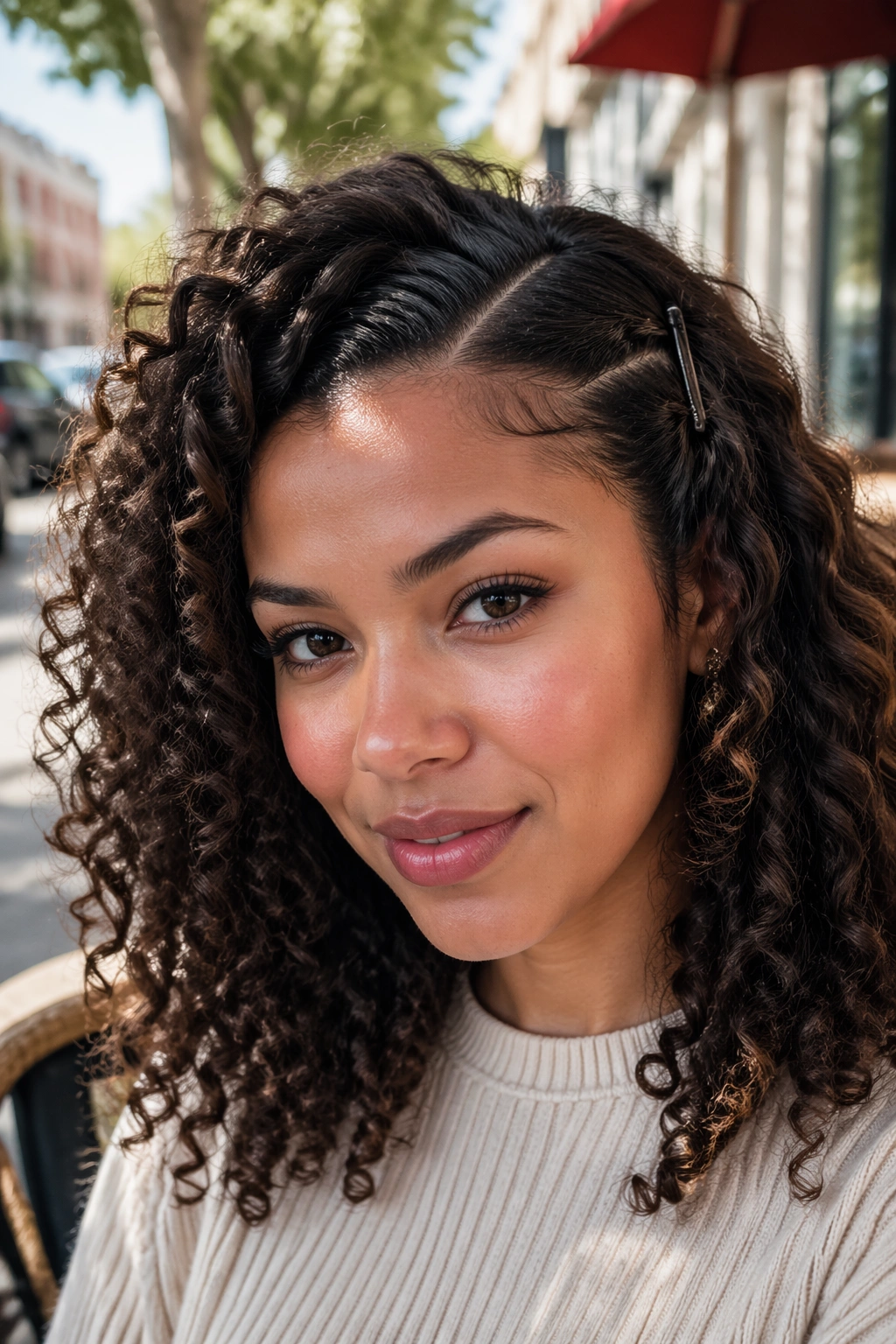
A side part changes the whole mood of poofy curly hair. It pulls the weight to one side, which makes the shape feel more controlled without taking away the volume that makes curls interesting in the first place.
This style is especially good if your hair tends to puff widest at the temples. By shifting the part, you move attention away from the middle and create a line that the eye can follow. The pinned-back front pieces help even more. They keep the curls out of your eyes, but they still let the texture show.
I prefer this look over a hard middle part when the hair is thick and wide at the crown. A side part softens the outline right away. If you want extra lift, use a rat-tail comb to create a clean part, then tuck one side behind the ear and secure a small front section with a decorative pin.
It’s a small adjustment, but small adjustments matter with curly hair. They change the shape without making the style feel overworked.
6. Braided Crown
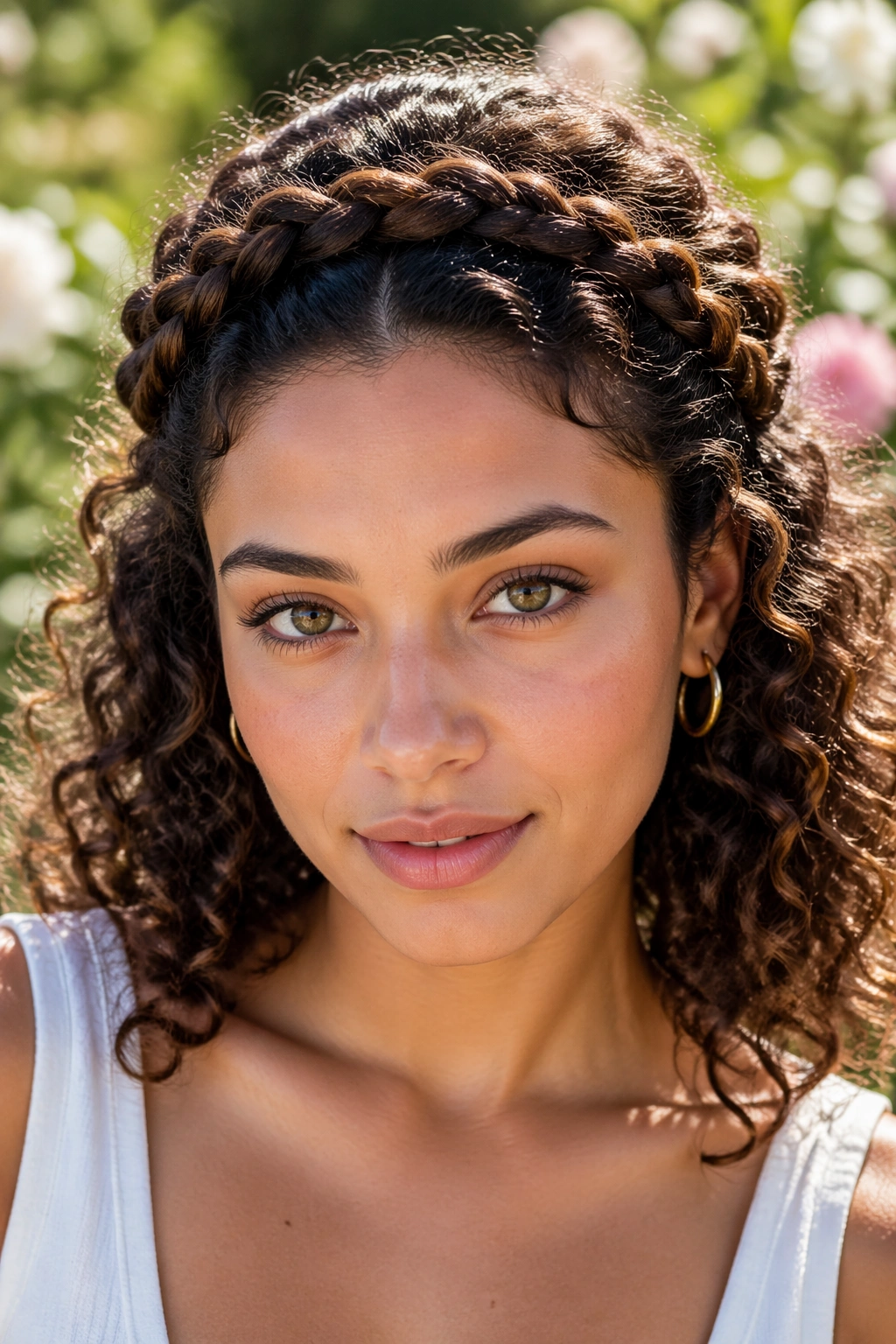
A braided crown is one of those styles that looks more complicated than it is. That’s a good thing.
For poofy curly hair, the crown braid works because it controls the perimeter. The braid sits along the hairline or across the top of the head, which keeps the wildest part of the curl pattern in check while the rest of the hair can stay loose, tucked, or gathered underneath. It’s neat without feeling stiff.
Where to Stop the Braid
Do not braid too far back unless you want to flatten the whole head. That’s the mistake people make.
- Start the braid near the temple or above the ear.
- Keep each section roughly the same size so the braid looks even.
- Braid snugly enough to hold, but not so tight that the scalp pulls.
- Tuck the ends under and pin them flat with two or three bobby pins.
If your curls are very dense, a twisted crown can be easier than a full braid. Same visual effect. Less fuss. Either way, the style does a nice job of framing the face and giving the hair a finished look, especially on days when the frizz halo is doing its own thing.
7. Twist-Out With Defined Volume
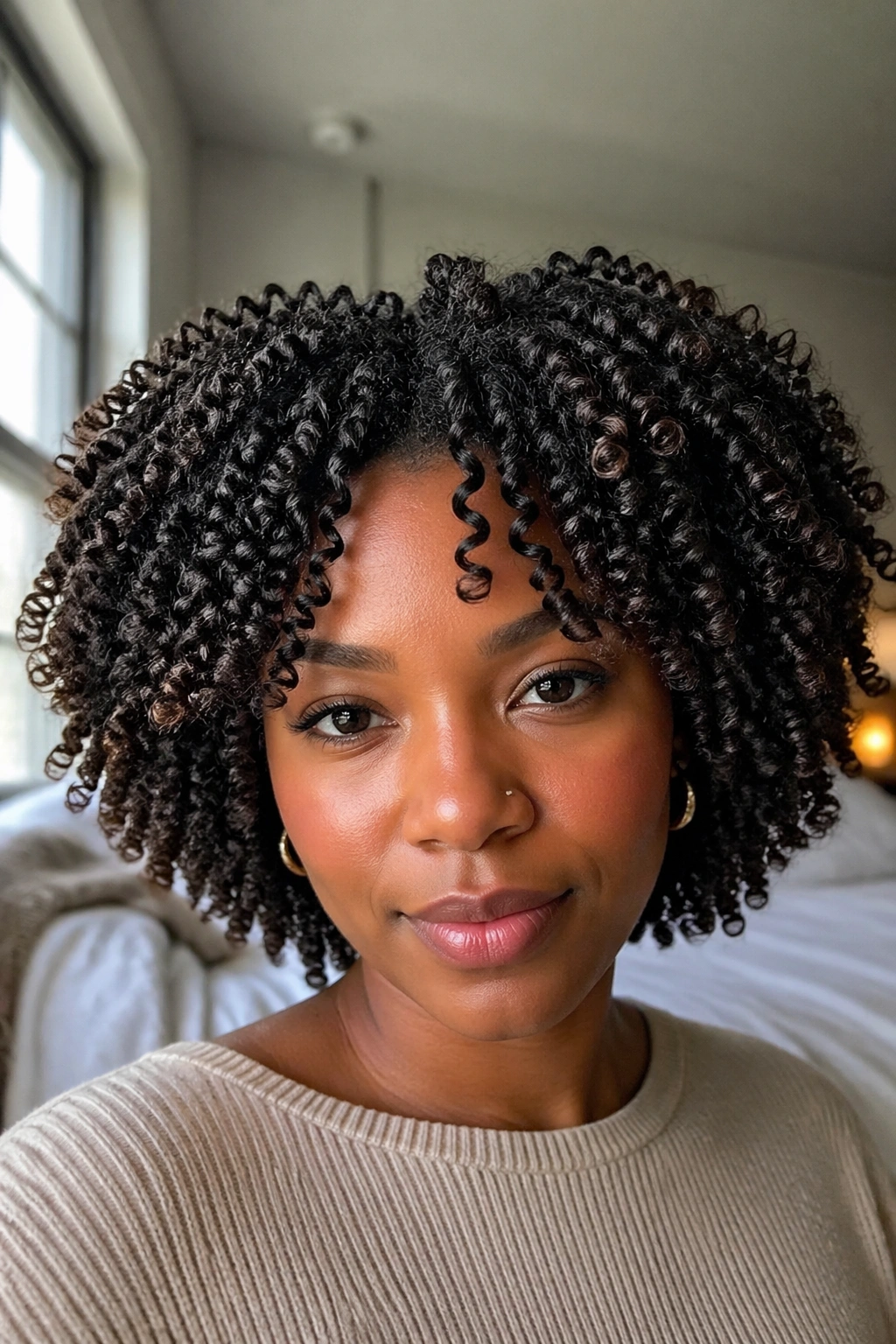
A twist-out is not just a hairstyle. It’s a shape strategy.
For poofy curly hair, it gives you controlled volume instead of random volume. You set the curls in twists, let them dry fully, then separate them into soft coils that hold their form while still looking full. It’s one of the best styles if you want body without the loose, fuzzy outline that comes from rough handling.
The secret is in the size of the twists. Smaller twists create more definition and more frizz resistance. Larger twists give you a bigger, puffier result. Neither is wrong. Pick the one that matches the mood you want. If you go too heavy on product, the twist-out can feel coated and stiff, so use enough leave-in and cream to hydrate the hair, then stop.
What Helps the Shape Last
- Twist on damp hair, not soaking hair.
- Part each section cleanly so the twist pattern stays visible.
- Dry completely before taking the twists down. Half-dry hair leads to puff in the wrong places.
- Separate with a little oil on your fingertips to reduce snagging.
A good twist-out has movement at the ends and structure near the roots. That balance is the whole appeal.
8. Space Buns
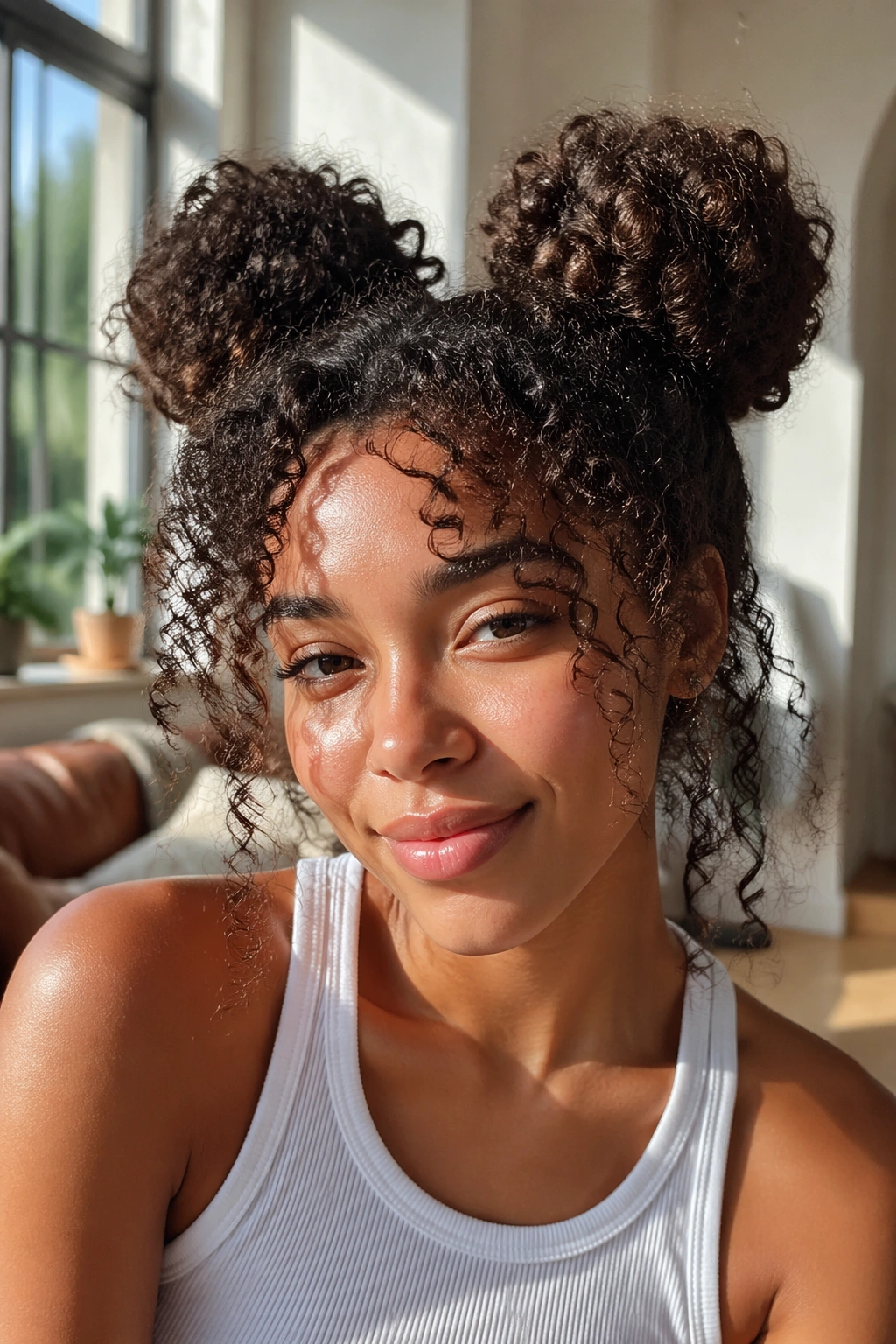
Space buns are what I recommend when somebody wants to keep the puff and make it fun on purpose. They’re playful, sure, but they also solve a real curly-hair problem: too much bulk in one place.
The trick is to divide the hair cleanly down the middle, then gather each half into a high bun or puff. On poofy curly hair, you get two rounded shapes instead of one giant cloud, which can feel easier to wear and more balanced on the head. Leave a few curls loose at the front if you want the style to feel less stiff.
This is one of those styles that works especially well when the hair has a little texture and not every curl is behaving. Good. That slightly imperfect finish makes the buns look more natural. If you want them neater, smooth the part with a comb and use small elastics to anchor each side before you twist the buns into place.
Best Ways to Wear Them
- Full buns for a sharper, more styled look.
- Messier buns when the curls are already big and fluffy.
- Mini buns if your hair is shorter or layered.
- Offset buns if a dead-center part feels too severe.
Some styles are about control. This one is about shape and attitude.
9. Claw Clip Twist
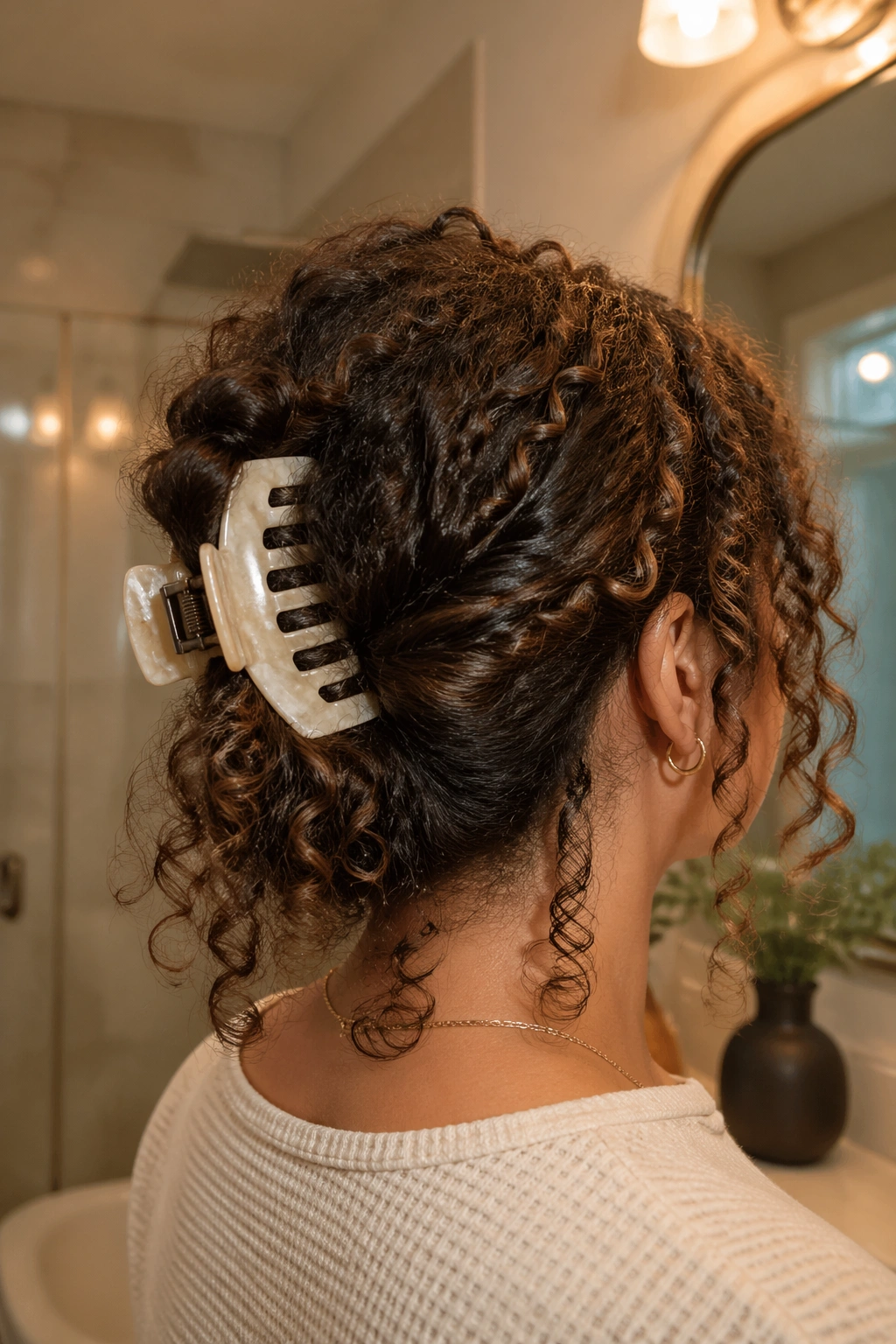
The claw clip twist is one of the easiest ways to make poofy curly hair look put together without making it feel trapped. And that matters. A lot.
Unlike a tight bun, the claw clip twist keeps the center of the hair lifted while leaving the curl pattern visible at the ends. It works especially well on medium-length and long curls, where there’s enough mass to create a chunky twist that holds inside the clip. If your hair is very thick, use a larger clip with strong teeth. Small clips slip. Annoying, but true.
The style is simple: gather the hair low or mid-back, twist it upward, fold the length over itself, then clamp the clip over the twist. Let a few curls fall out if needed. A perfect shell is not the goal here. A little looseness makes the whole thing look better.
This is also a smart style for days when your curls feel dry but not fully dirty. You get the shape without having to restyle everything from scratch. Which, honestly, is half the reason people keep reaching for clips in the first place.
10. Curly Bob With Layers
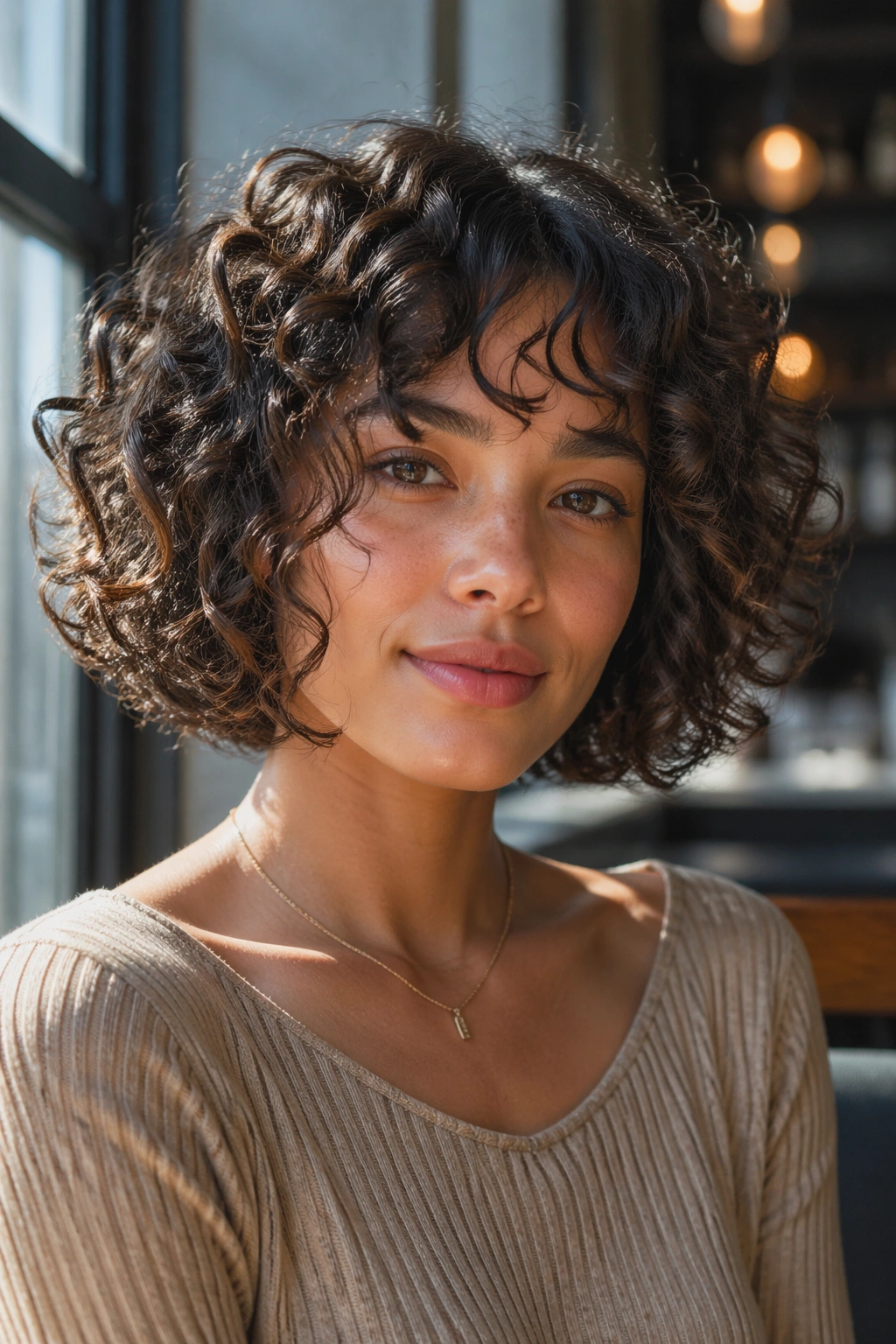
A curly bob can be a dream for poofy hair, provided the cut is shaped with some thought. A blunt bob on dense curls can turn into a triangle faster than people expect. Layers change that. They let the hair stack and move instead of spreading out like a pyramid.
The best curly bobs tend to sit somewhere around the chin, jaw, or just below it, depending on curl tightness and shrinkage. That length gives the curls room to spring without dragging the face down. A few face-framing pieces around the front help too. They soften the shape and keep the bob from feeling boxy.
I’m picky about this style because it can go wrong if the cut ignores curl pattern. Ask for a dry cut or a cut done in a way that respects how the hair shrinks. If the stylist cuts curly hair while it’s stretched flat, the final shape may not land where you want it.
Done well, though, a layered curly bob is one of the easiest styles to wear. It frames the face, keeps the shape compact, and still leaves enough fluff to feel like curly hair, not a compromise.
11. Braided Front With Loose Lengths
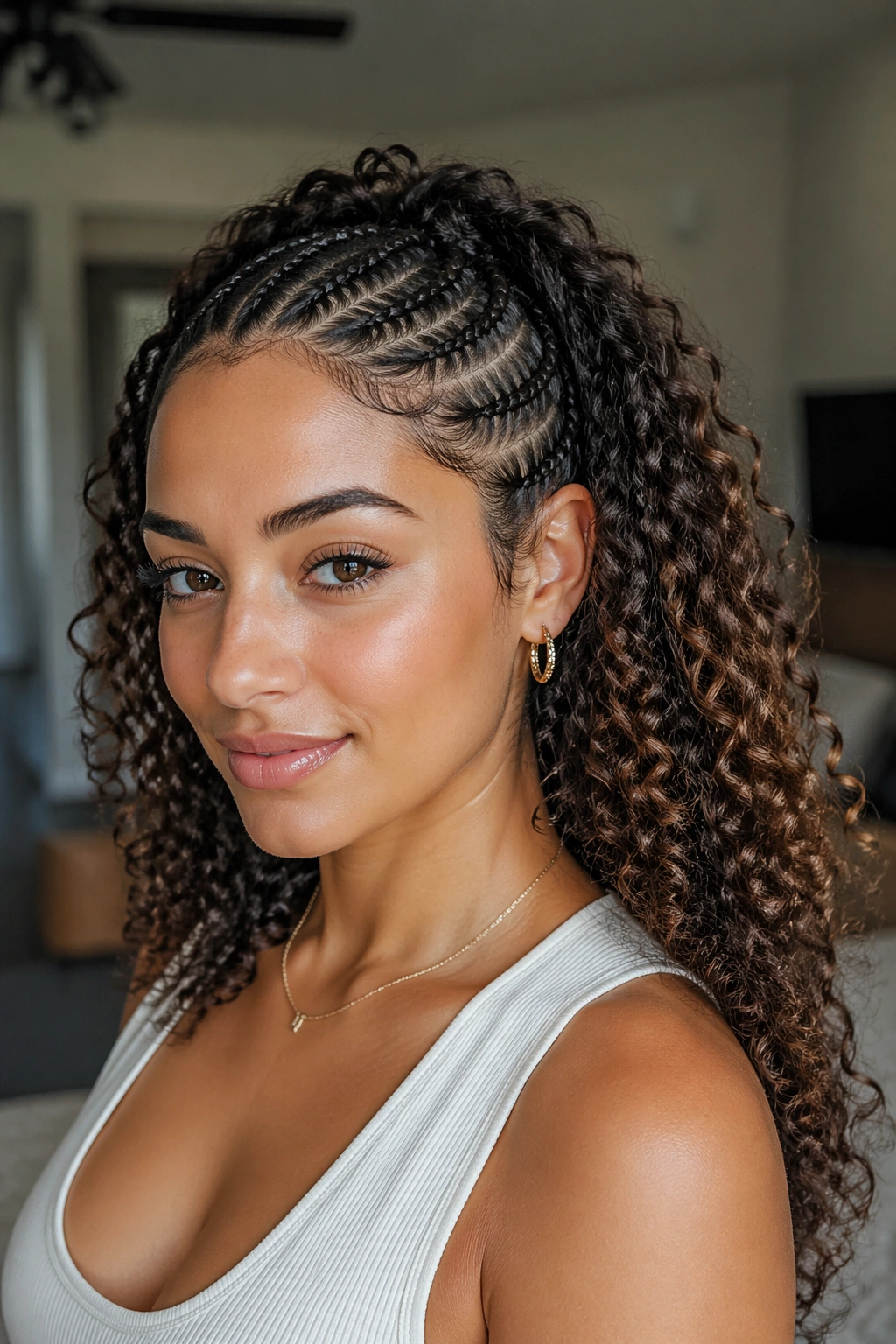
What if you want the front of your hair calm, but you do not want to hide the rest? Braided front sections solve that nicely.
This look usually starts with one or two braids, cornrows, or flat twists across the hairline and temples, while the back and sides stay loose. It’s a smart option for poofy curly hair because that front zone is often where frizz and halo volume show up first. Taming that area can make the whole style look cleaner without flattening the rest.
How to Part It Cleanly
A neat part makes a huge difference here.
- Use a rat-tail comb and part while the hair is lightly damp.
- Keep the braid close to the scalp so it hugs the head.
- Stop the braid where the shape starts to feel too tight or too busy.
- Blend the loose curls with a little cream so the contrast feels intentional.
This style also gives you a nice little styling cheat. If the back is a mess, nobody notices as much because the front looks finished. That sounds blunt. It is. Still true.
12. Bubble Ponytail
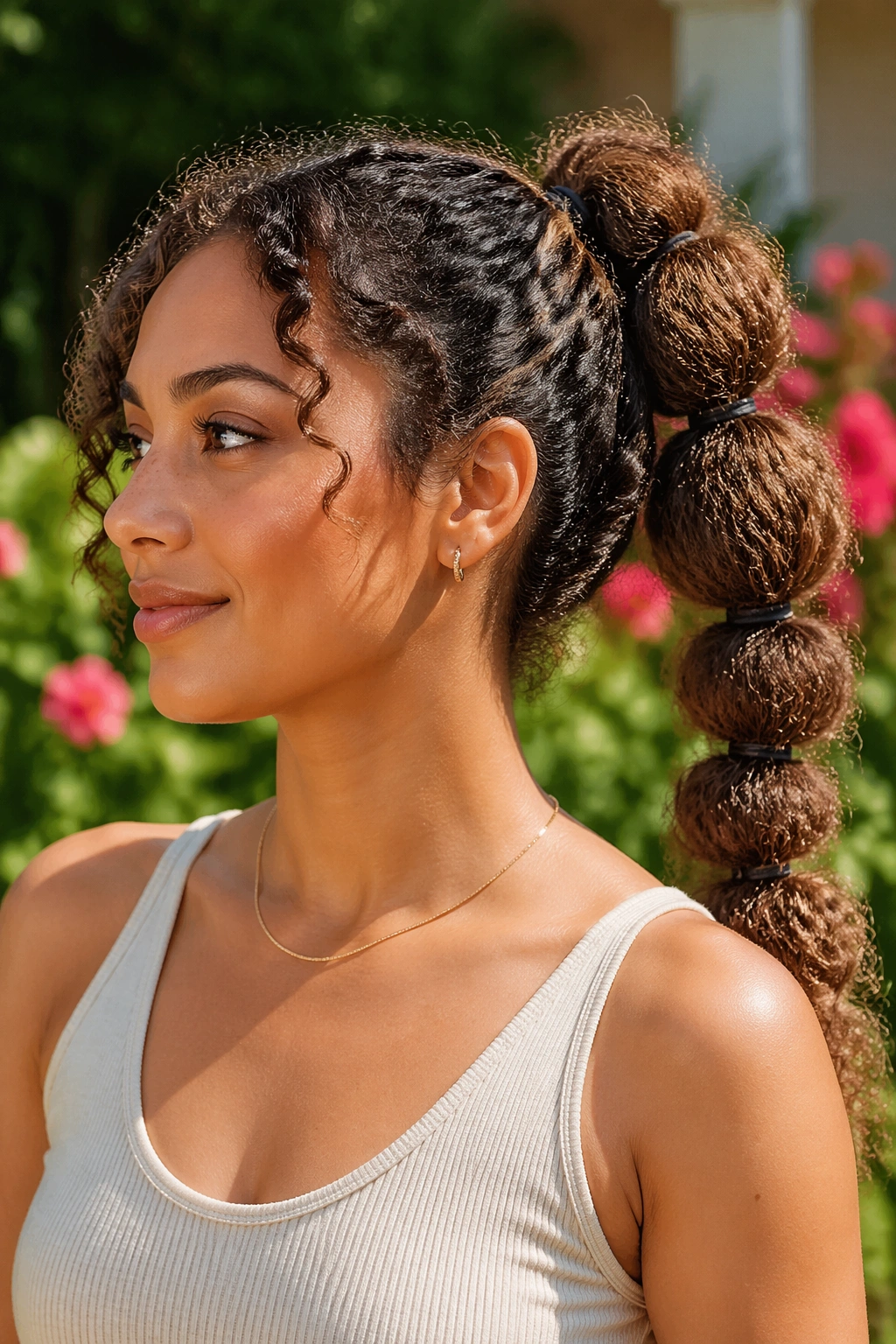
The bubble ponytail turns bulk into a feature, which is exactly why it works so well on poofy curly hair.
Instead of trying to make the ponytail sleek, you build little sections along the length with elastics every few inches. Each section puffs out between the ties and makes a rounded “bubble.” On curly hair, those bubbles look fuller and more textured than they do on straighter hair, which is part of the charm.
The spacing matters. If the ties are too close together, the bubbles look cramped. If they’re too far apart, the shape gets floppy. About 3 to 4 inches between elastics usually works for medium to long curls, though shorter hair may need tighter spacing.
Quick Shape Notes
- Start with a regular ponytail at the crown, middle, or nape.
- Add small elastics down the length, one section at a time.
- Gently tug each bubble outward after securing it.
- Hide the elastics with a thin curl or a wrapped strand if you want a cleaner finish.
This is one of the few styles where a little extra volume is a gift. The more density you have, the better the bubbles read.
13. Headband Tuck
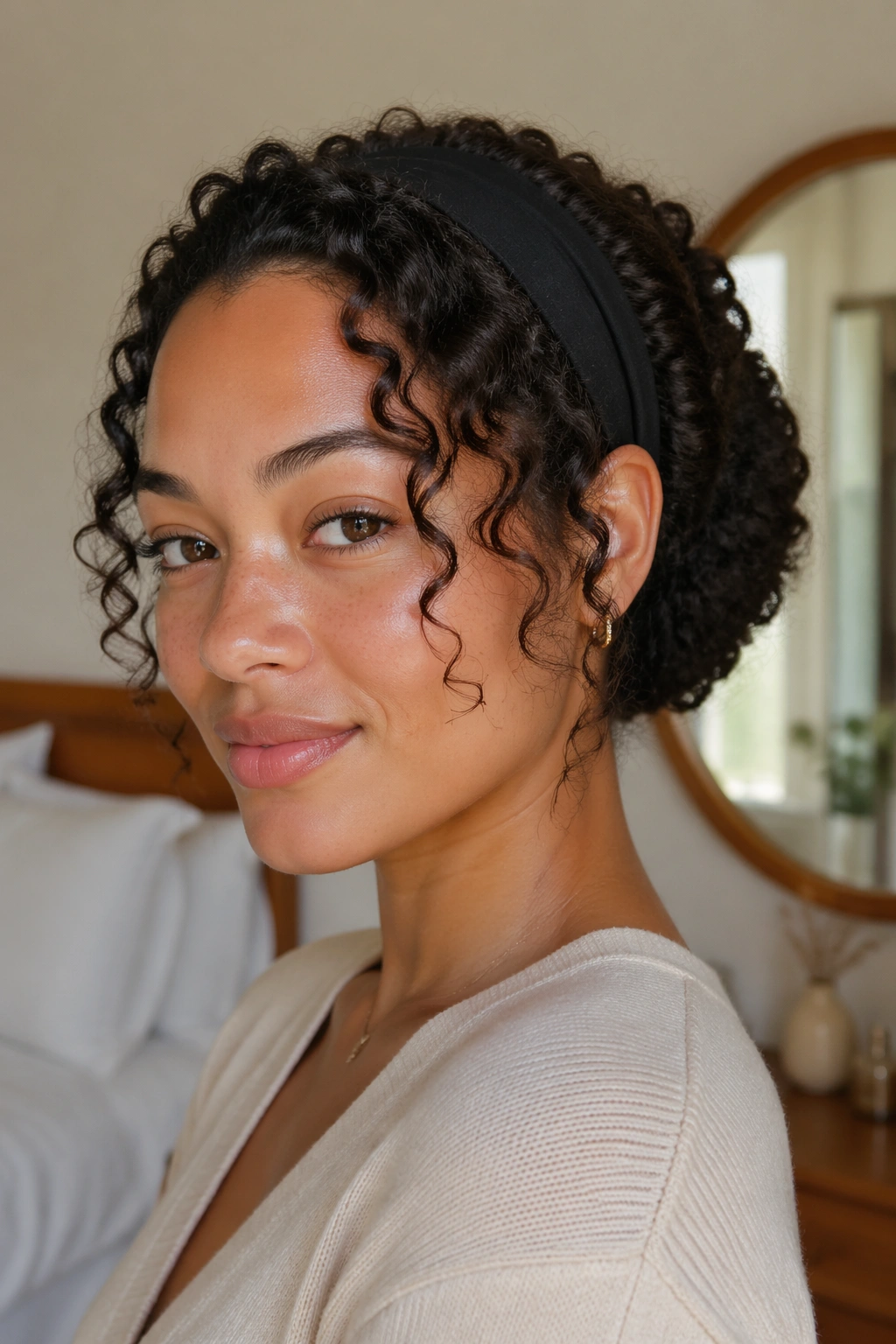
A headband tuck is what I reach for when the hair needs to be contained, but not erased. It’s soft, quick, and far nicer than the old school “make it lie flat and suffer” approach.
You start with a stretchy headband, ideally one that has a smooth inside so it doesn’t snag. Place it over the hair, then tuck the lengths upward and inward at the back until they sit into the band. On poofy curly hair, the result is a soft roll or tucked halo that keeps the volume tucked close to the head while still showing texture around the edges.
This style is especially good for curls that are stretched out or slightly frizzy. It gives the hair a shape without requiring fresh wash-day curls. If you want a looser finish, pull a few tendrils out around the face and let them sit free. If you want it neater, smooth the front with a bit of leave-in before tucking.
I also like this style because it works on a bad hair day without looking like surrender. That’s a rare and useful quality.
14. Faux Hawk
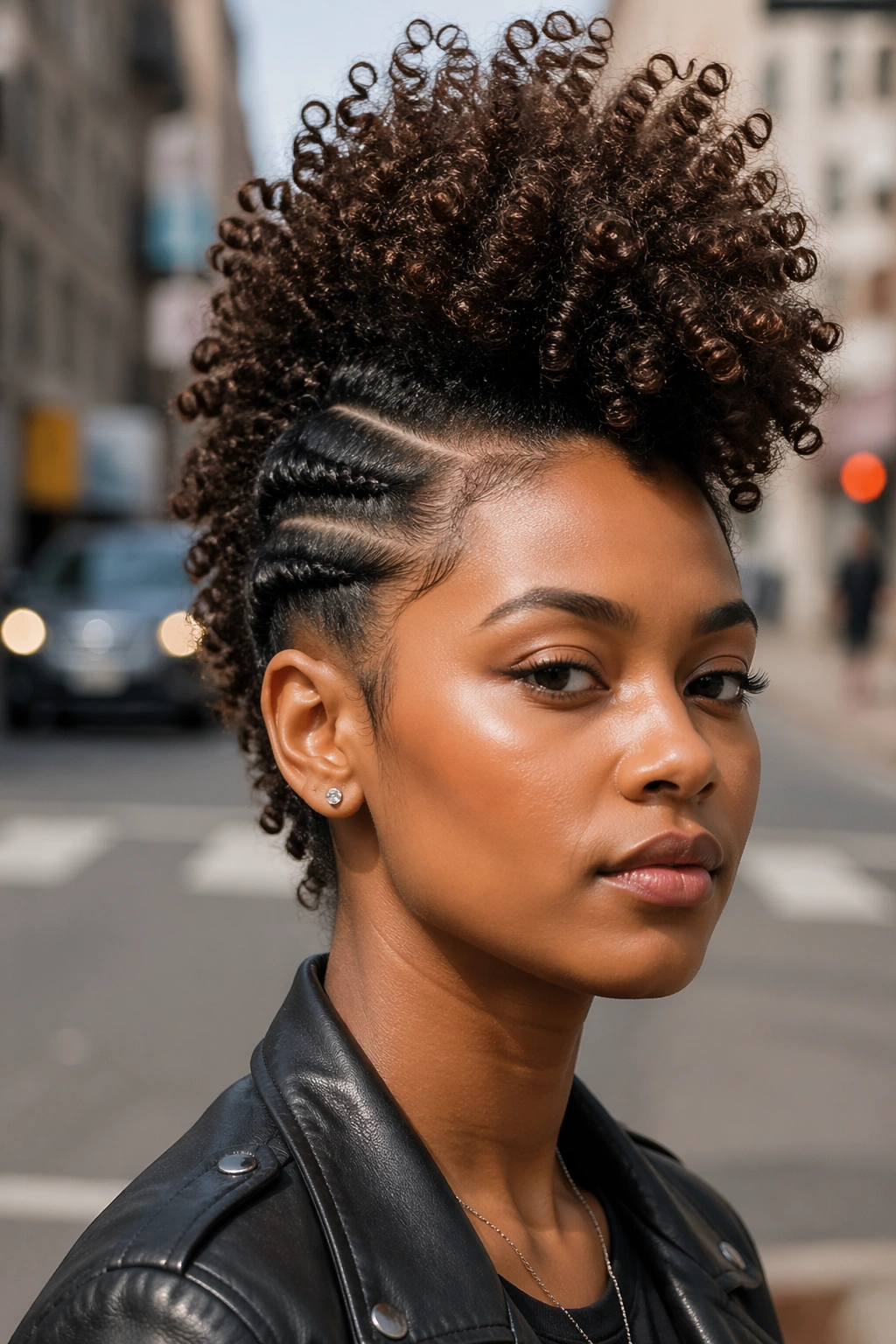
A faux hawk is for the days when poofy curly hair feels too big to contain and too good to hide. So why hide it?
The style creates a lifted ridge down the center of the head while pinning or smoothing the sides upward. It has shape, height, and a bit of edge, but it doesn’t require shaving anything or committing to a permanent cut. That makes it a nice middle ground for people who want drama without a haircut they’ll regret later.
What makes it work on curly hair is the volume itself. The center section naturally stacks, so you get height without much effort. The sides can be twisted and pinned, braided back, or simply slicked toward the crown with gel and bobby pins. If your curls are dense, the faux hawk can look almost architectural. If they’re looser, it reads more soft and airy.
Best Uses for This Style
- Parties or nights out.
- Thick hair that needs the sides controlled.
- Second-day curls with a little extra texture.
- Short-to-medium lengths that can still gather into a center line.
It’s a bold style, but not a fussy one. I appreciate that.
15. Wash-and-Go Curls That Keep Their Shape
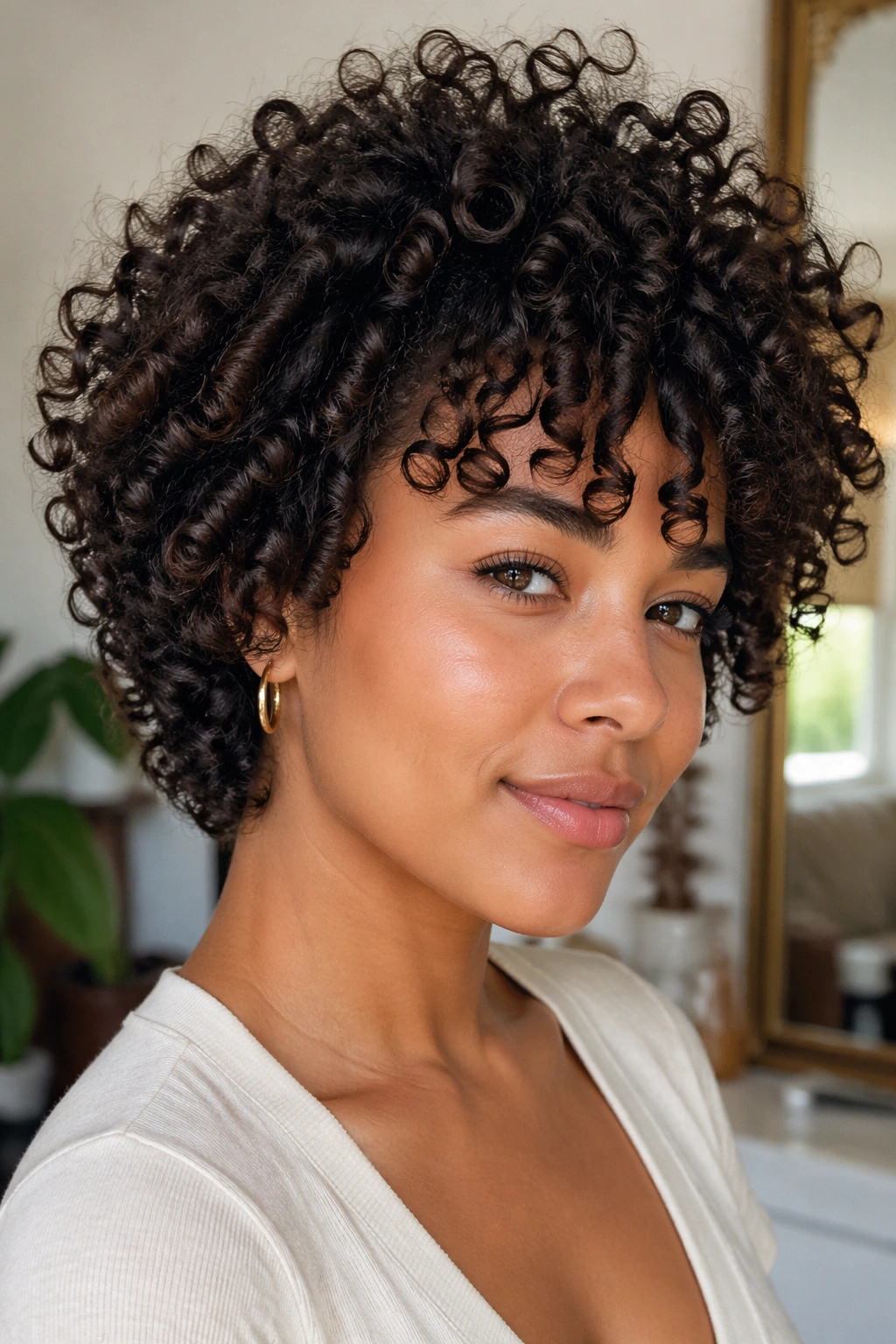
The wash-and-go is the most basic answer here, but that does not make it boring. When it’s done well, it’s one of the best hairstyles for poofy curly hair because it lets the curl pattern be the style, not the side effect.
The key is definition with enough softness left in the hair to avoid helmet hair. Start with a leave-in conditioner on soaking-wet or very damp hair, then add a curl cream or gel in sections. Rake it through with your fingers or smooth it with praying hands, then scrunch upward to encourage clumps. If you diffuse, keep the dryer low and stop before the hair gets crunchy all the way through. You want a cast that can be broken later, not a stiff shell.
Poofy hair often looks best when it’s not overhandled. That’s the part people miss. The more you touch curls while they dry, the more the clumps separate, and the bigger the halo gets. Sometimes that halo is lovely. Sometimes it’s just a lot. The wash-and-go gives you a choice.
If your curls shrink a lot, stretch the roots gently while diffusing or pinning a few sections at the crown. That little bit of shape control can keep the style from turning into a round cloud by midday.
Final Thoughts
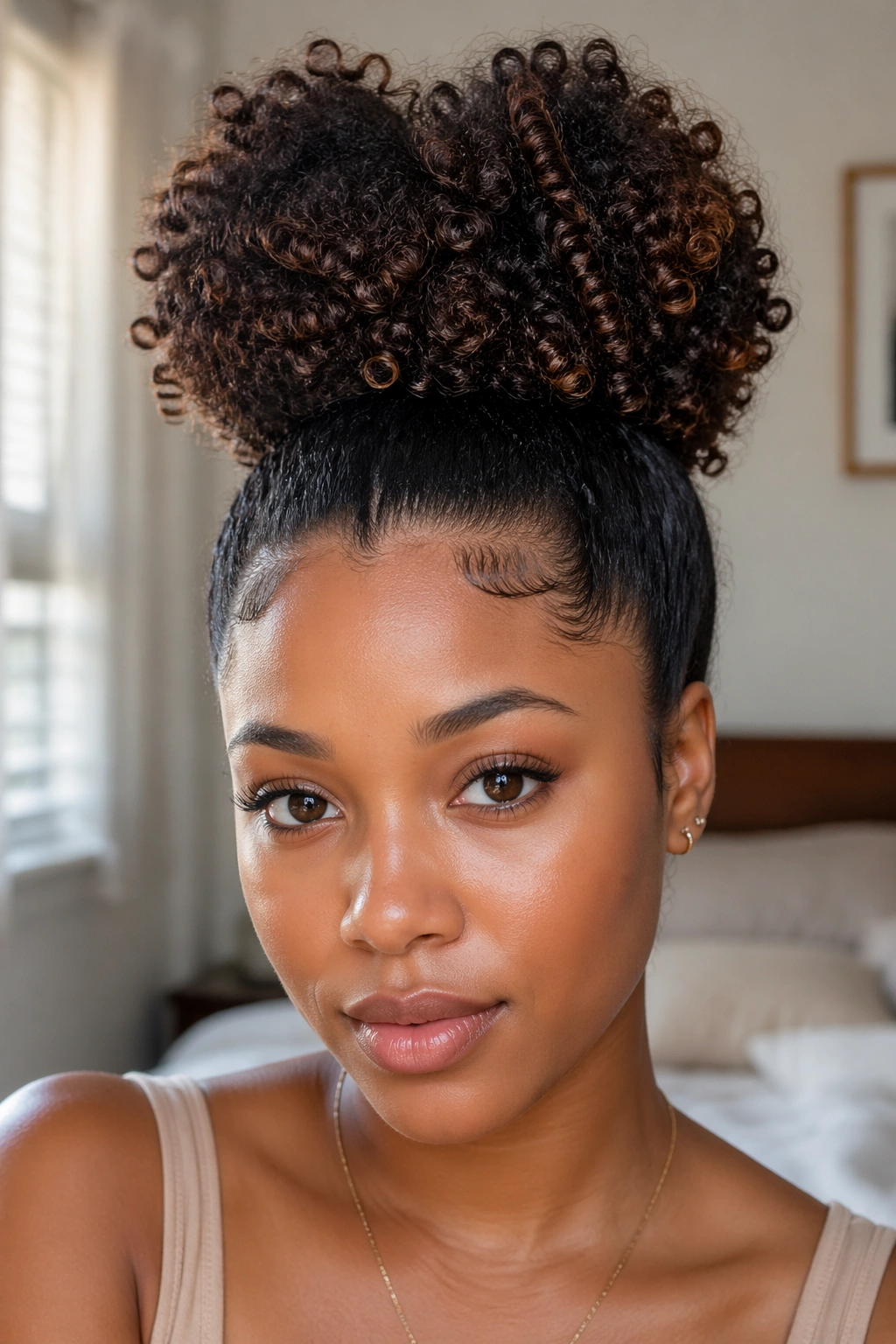
Poofy curly hair is not hard to style once you stop treating volume like a mistake. The better looks are the ones that shape it, lift it, braid it, or pin it in ways that match the way curls actually behave.
Some days call for a high puff. Some call for a bob, a braid, or a clipped-up twist that takes ten seconds and looks like it took longer. The best part is that you do not need to flatten anything to make it look polished.
Pick the style that fits your curl pattern, your length, and how much effort you want to spend that morning. Then leave a little room for the hair to do what it wants. That’s usually where the good stuff happens.
