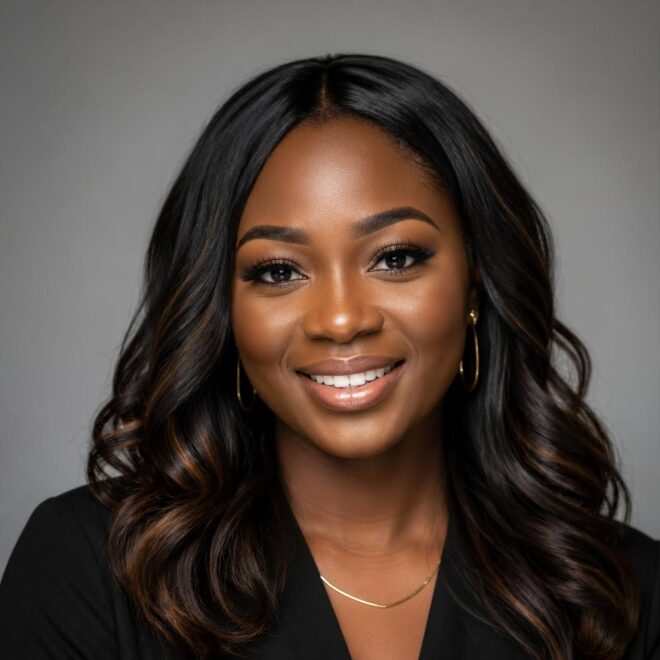


Blonde and grey box braids have a sharper edge than most people expect. Put a honey-blonde strand beside a smoky grey one, and the whole style stops reading soft and starts reading cool, metallic, and deliberate.
That is the part people miss. The color pairing is only half the story. Braid size, part shape, and where the lighter pieces sit around the face change the mood almost more than the shades themselves. A 1/4-inch part on small knotless braids looks clean and close to the scalp; a chunky waist-length set with thick panels feels bolder and more graphic, even if the same two colors are doing the work.
I like this color mix because it has range. Honey blonde, ash blonde, dove grey, charcoal, silver—each one changes the tone in a real way. Some versions feel airy and bright. Some feel moody. A few land right in the middle, which is where this pairing gets most interesting.
The styles below move through soft ombré, sharp contrast, chunky braids, tiny knotless sets, curls, beads, and a few parting tricks that make the whole look feel more expensive than it should. If you want blonde and grey box braids that actually suit your face, your wardrobe, and the amount of weight you want on your head, there’s room to get picky here.
1. Honey Blonde Box Braids with Smoky Grey Ends
This is the easiest blonde-and-grey mix to wear if you want warmth near the face and a cooler finish at the length. Honey blonde keeps the style friendly and bright; smoky grey at the ends adds just enough edge to keep it from looking flat. The result feels softer than platinum and less severe than all-grey braids.
Why the gradient works
The eye starts at the lighter blonde around the scalp and face, then drops into grey as the braid length settles downward. That shift matters. It pulls attention upward first, which is usually what you want if the goal is to brighten the face without making the whole head look washed out.
A smooth transition works best on medium-to-long box braids. Think shoulder length and beyond. If the grey starts too high, the style can look striped. If it starts around chin level or lower, the fade reads more natural and gives you that smoky finish people always try to explain and never quite do.
- Best braid sizes: medium or medium-small
- Best length: past the shoulders, ideally mid-back
- Hair colors that blend well: honey blonde, 27/30, soft silver-grey
- Best parting: clean squares or slightly staggered parts
Keep the grey concentrated in the last 6 to 8 inches if you want the blonde to stay dominant. That one choice changes the whole mood.
2. Silver-Root Ombre Box Braids
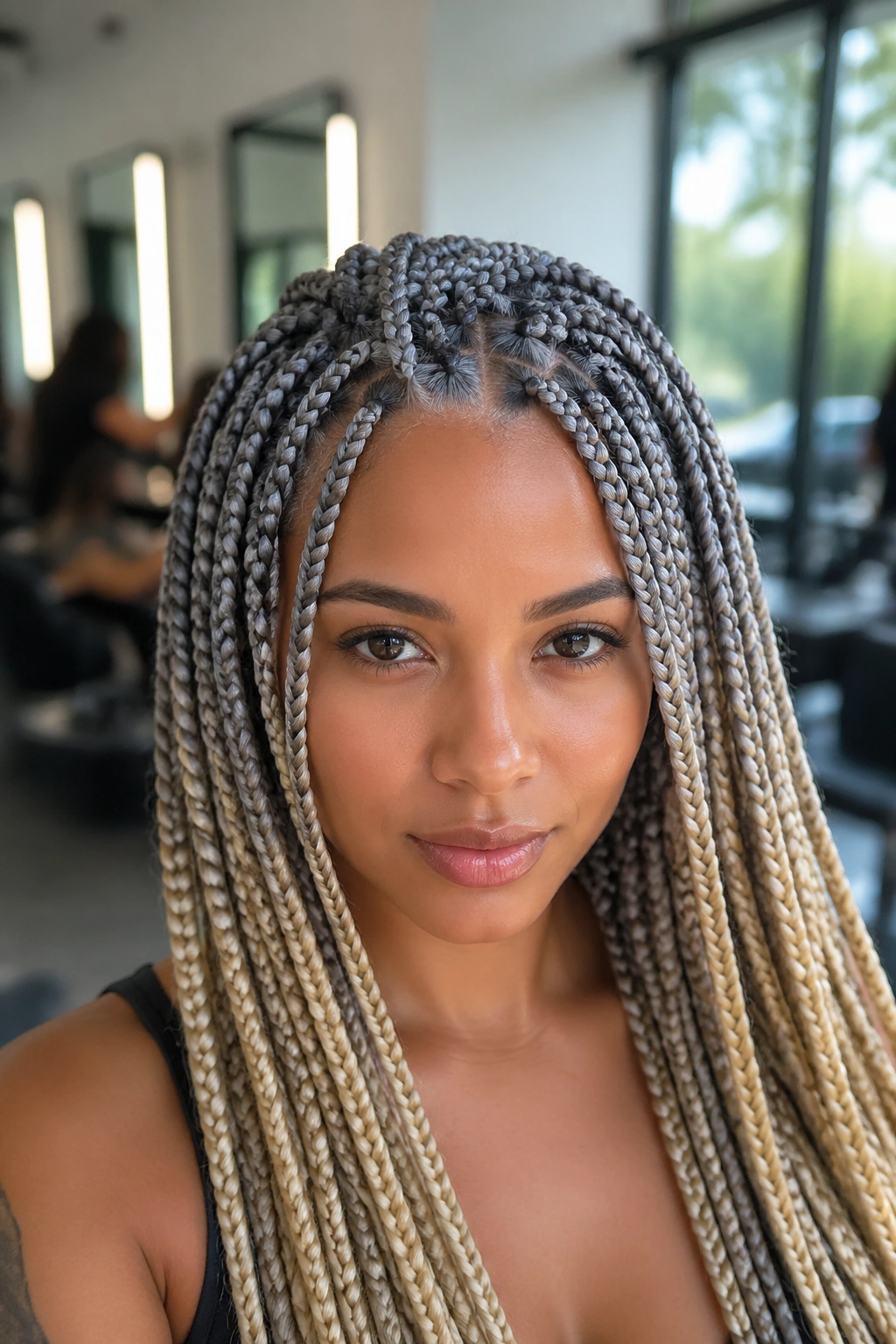
Why should grey always sit at the ends? It does not have to. Silver-root ombre box braids flip the usual formula and put the cool tone right at the scalp before the blonde takes over down the length. The effect is colder, sharper, and a little more editorial.
That root area does a lot of visual work. Because the parting sits close to the silver, the scalp line looks crisp and intentional, almost like a silver halo under the braids. If the parts are sloppy, though, this style will show it fast. Light roots are unforgiving. Every zigzag and every uneven square becomes obvious, so neat parting matters more here than on a darker set.
Best when the parting is tidy
Ask for the silver to start in the first inch or two near the root, then shift into blonde through the mid-lengths. A deep side part can make this even cleaner, since the eye follows the color change diagonally instead of staring straight at the roots.
This is also a good choice if you like your braids to look polished on day one and slightly softer a week later. The silver root gives the style structure even after a little frizz shows up. Not bad for a protective style. Not bad at all.
3. Jumbo Box Braids in Blonde and Grey Panels
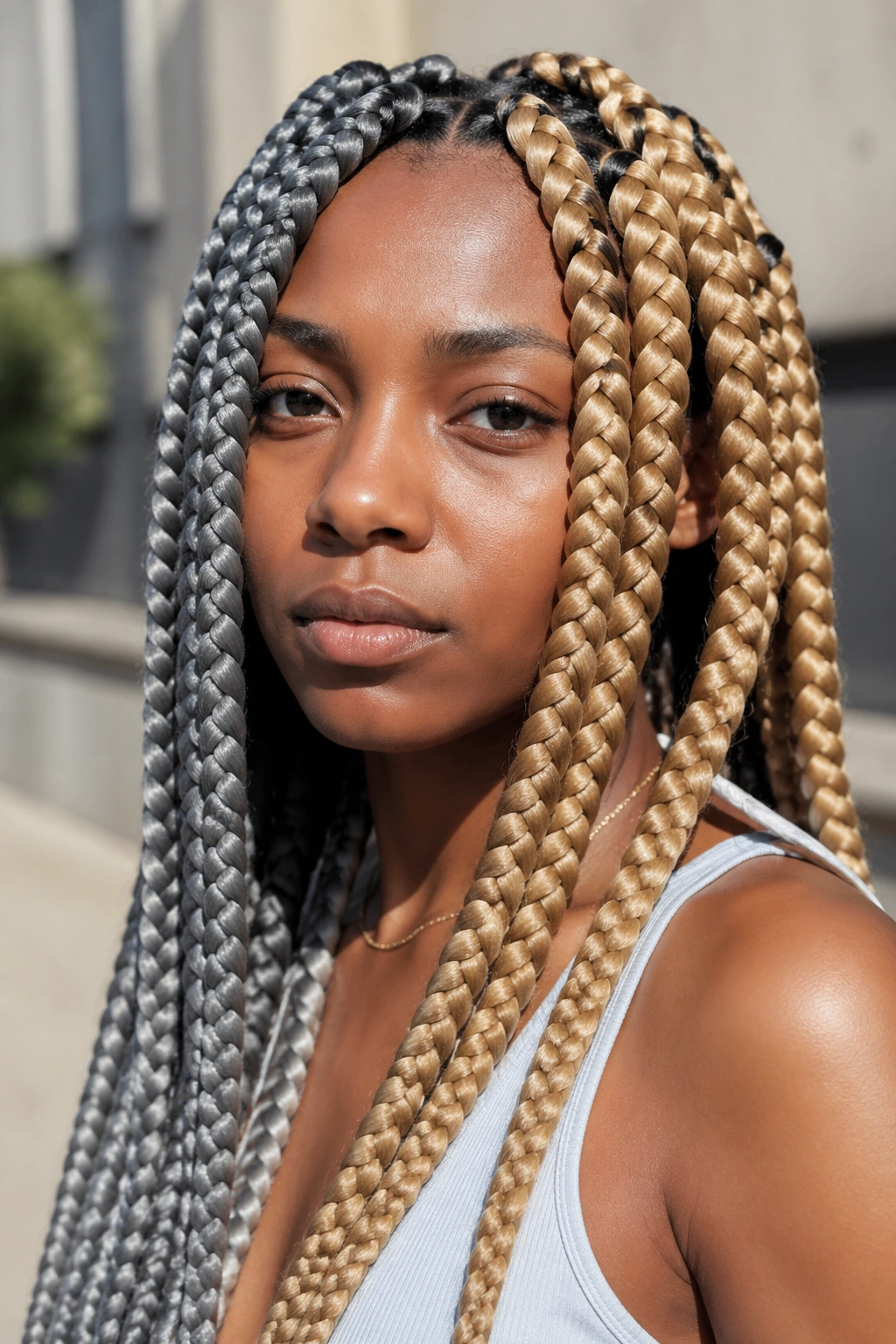
If you want the color to read from across a room, jumbo braids do the heavy lifting. Each braid gets enough width for the blonde and grey to show as actual blocks instead of tiny streaks. That makes the style feel graphic, strong, and a little louder than a mixed micro braid set.
The simplest way to wear this is with alternating panels: one braid blonde, the next grey, then back again. You can also switch by row, with the front row blonde and the next grey. Either version makes the contrast obvious without needing extra accessories. The braid itself becomes the pattern.
A good fit for less chair time
Jumbo braids also save time. Fewer sections mean a faster install, which matters if you do not want to sit for ages. The trade-off is weight. Too-long jumbo braids can pull on the scalp, especially when the hair is thick and the extensions are dense.
A medium waist or mid-back length usually feels more balanced than full hip-length jumbo braids. The color blocks stay bold, but the style still moves. That movement matters. Chunky blonde and grey braids can look stiff if they are too long and too packed, and nobody needs that.
4. Ash Blonde Box Braids with Grey Money Pieces
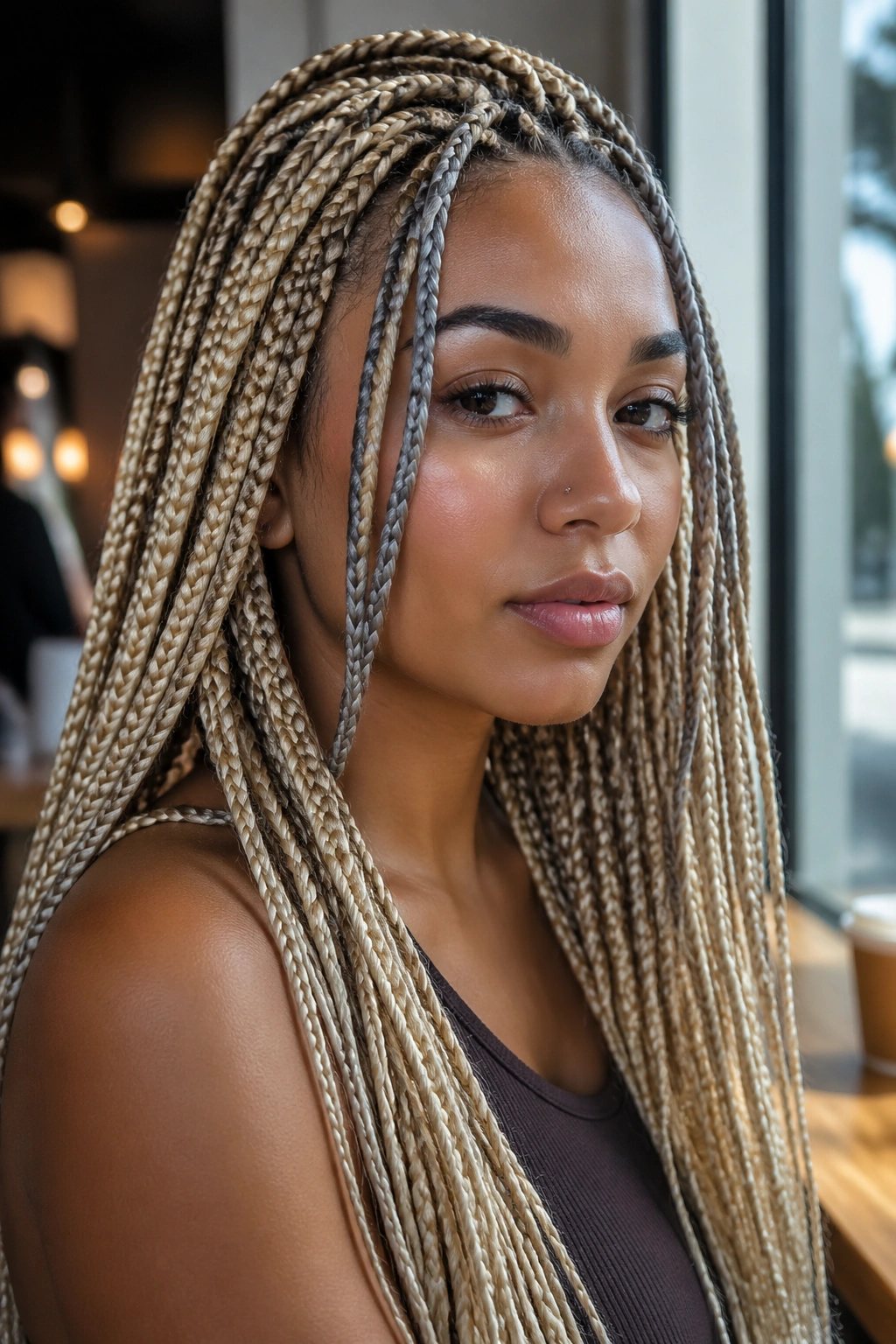
Grey does not have to be severe. Ash blonde box braids with grey money pieces are proof of that. The base stays soft and neutral, while the grey appears only at the front, usually around the temples and the first few braids on either side of the part.
The beauty of this approach is restraint. You get the drama of grey without turning the whole head into a cool-toned block. The blonde carries most of the style, so the grey reads like a frame instead of the main event. That is a useful trick if you want the color to feel flattering rather than costume-y.
Two or three grey braids on each side is enough for most heads. Any more and the front can get crowded. Any less and the contrast disappears when the braids are pulled behind the ear. If you wear glasses, this placement is especially smart because the grey sits right where the frame meets the face.
This is one of those styles that looks expensive when the parts are neat and the front sections are symmetrical. Messy version? Not so much. The line between intentional and random is thin here.
5. Platinum Blonde Braids with Dove Grey Underlayers
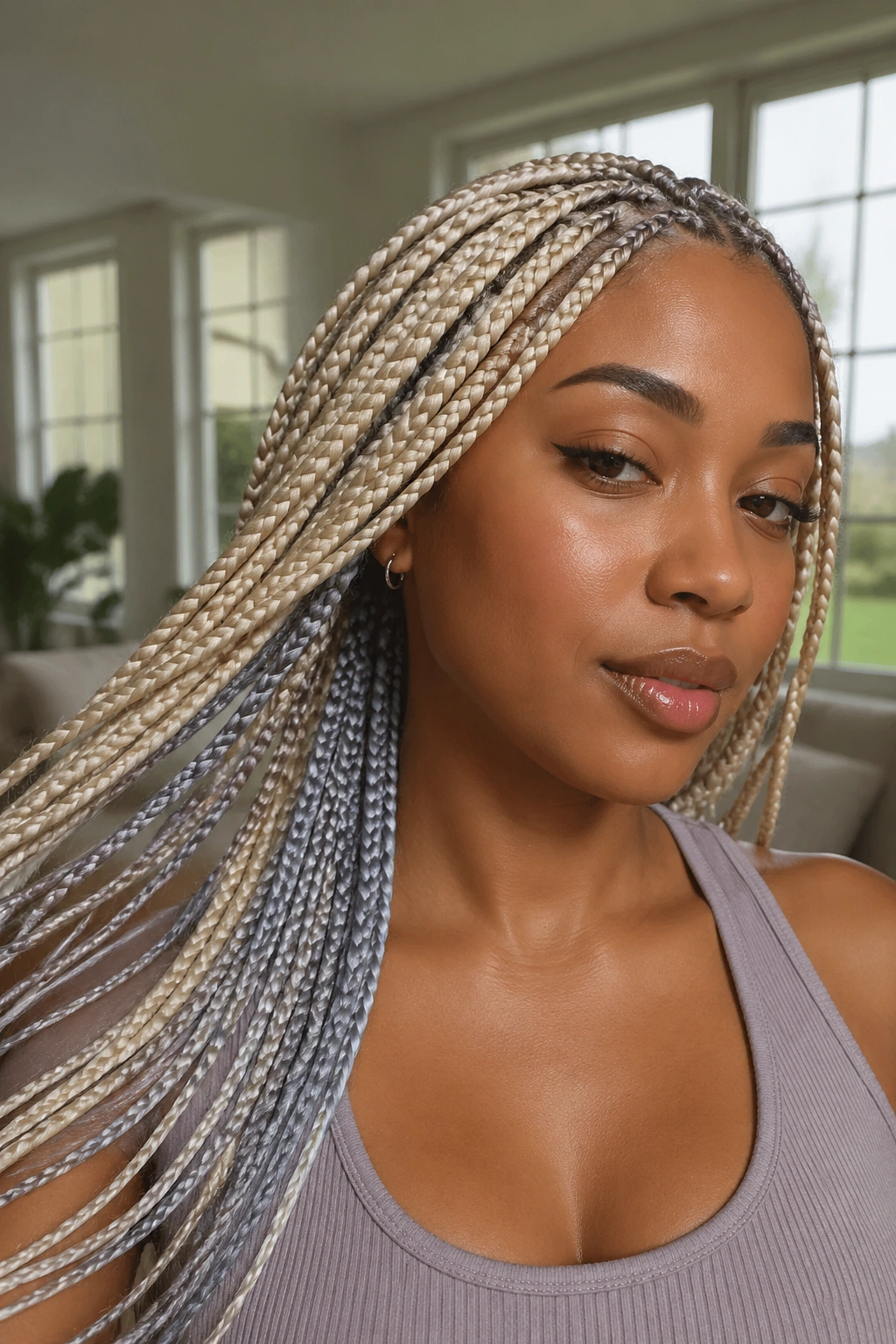
Unlike all-over platinum, this version hides the grey where it counts. Platinum blonde sits on top, bright and high-impact. Dove grey stays underneath, waiting for a half-up style, a breeze, or a tucked-behind-the-ear moment to show itself.
That little bit of hidden color gives the braids depth. On the surface, the set looks clean and bright. Underneath, there is a cooler layer that changes the braid every time it moves. It is one of the few styles that feels dramatic without needing a dramatic shape.
What makes it different
A blonde-dominant set like this works well when you want something light but not flat. The underlayer prevents the style from looking one-note, which can happen with a full platinum install. It also means the grey does not have to fight for attention. It just appears when the hair shifts.
I would keep the underlayer to roughly one third of the total braid count. More than that and the grey stops feeling hidden. Less than that and the contrast is too small to notice unless someone is standing close. The sweet spot is a layer that peeks out only when the style moves.
6. Tribal-Part Box Braids in Blonde and Grey
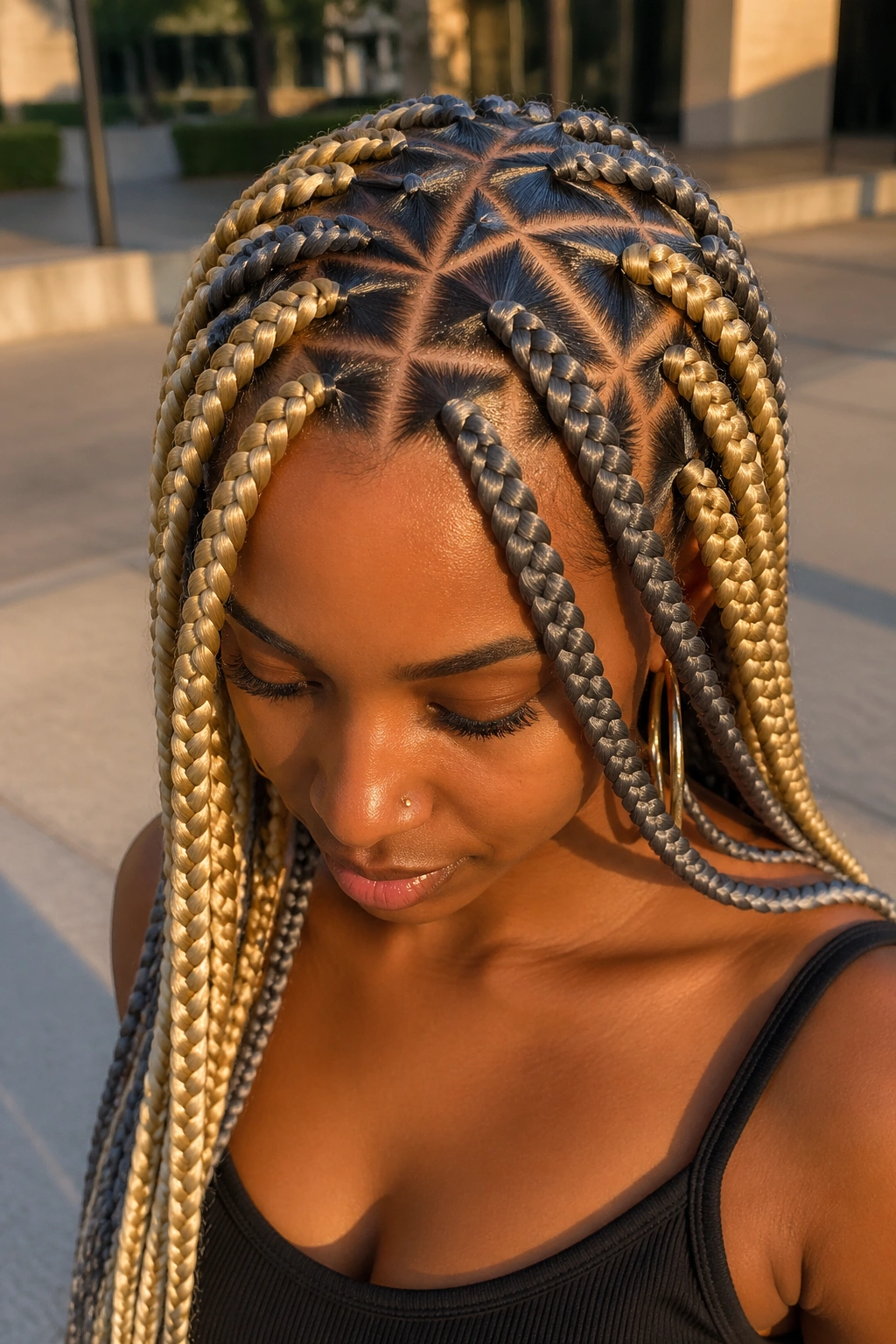
The color is only half the story here. The parting does a lot of the talking. Tribal-part box braids use sharp lines, triangles, and forward-running sections to break up the scalp in a way that feels geometric and clean. Add blonde and grey into that structure, and the whole style looks more intentional immediately.
I like this version because it gives the eye something to follow before it even reaches the braid length. The scalp pattern catches the light, then the blonde and grey take over. When those parts are crisp, the color reads like a graphic design rather than a random mix of shades.
A center braid line with angled front sections works well if you want balance. A slightly off-center part can feel softer. Either way, keep the front rows neat, because the hairline is where the style gets judged first. Harsh? Maybe. True? Absolutely.
One thing I would not do is crowd the look with too many extra colors. Let the blonde and grey do the work. The parting is already busy enough.
7. Small Knotless Box Braids in Mixed Blonde and Grey
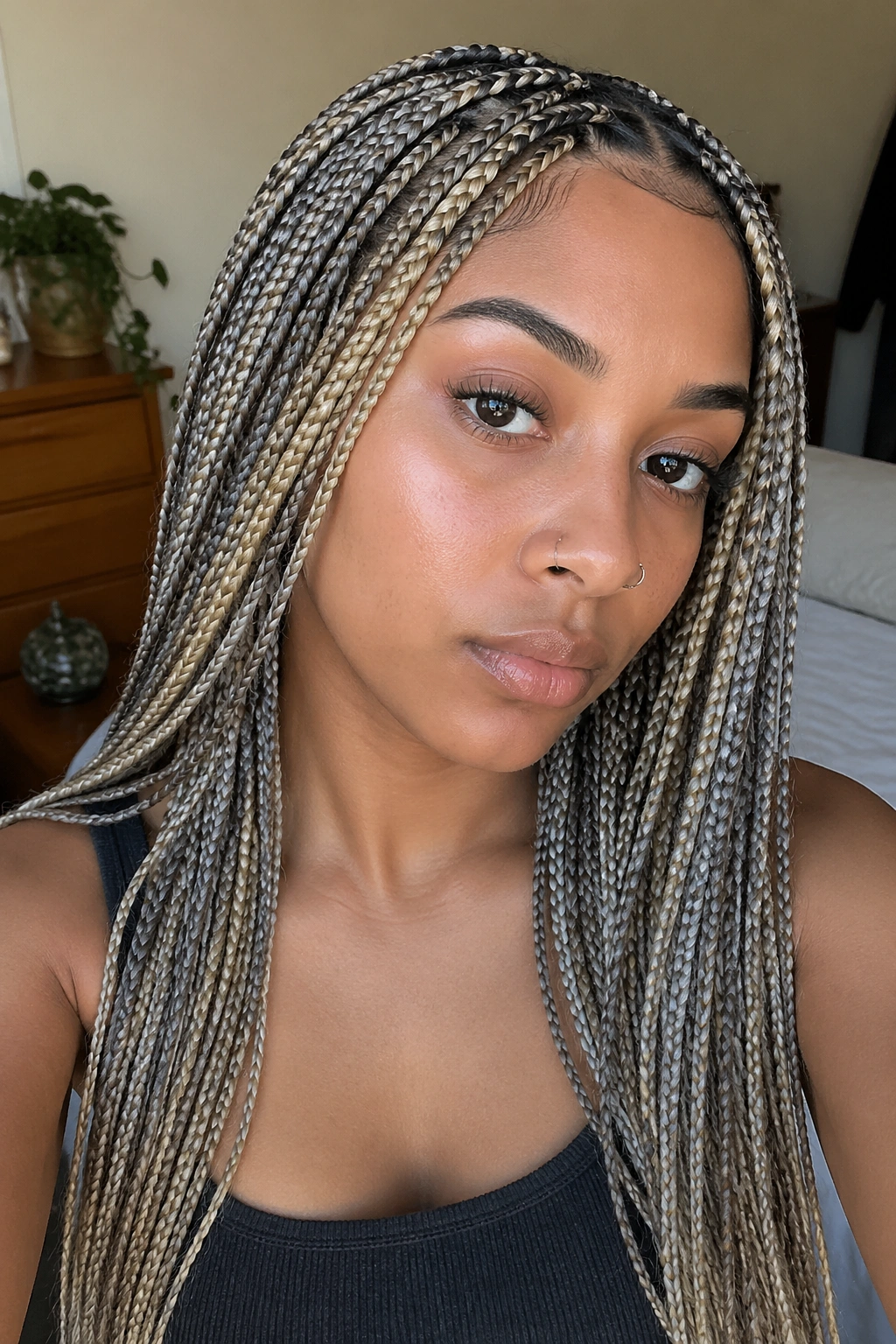
Small knotless braids are the calm version of this color story. They sit flatter, move more freely, and put less pressure on the scalp than knot-heavy braids. With blonde and grey mixed through the length, the result feels detailed without looking bulky.
What knotless changes
The braid starts with your own hair and then feeds in the extension hair gradually, which keeps the root softer. That matters when you are wearing lighter shades, because the eye lands on the hairline first. A knotless start keeps the front clean and stops the style from looking too bulky at the base.
How to ask for the blend
- Keep the parts around 1/4 inch if you want a dense, neat finish.
- Ask for blonde and grey to be mixed through the mid-lengths instead of stacked in one section.
- Leave the first inch at the root a touch darker if you want the scalp line to read softer.
- Use pre-stretched braiding hair so the braid lengths taper well.
This is the style I would choose if comfort matters as much as color. It takes longer than jumbo braids, sure. But it lays flatter around the edges, and that makes a difference after a long day.
8. Alternating Blonde and Charcoal Jumbo Braids
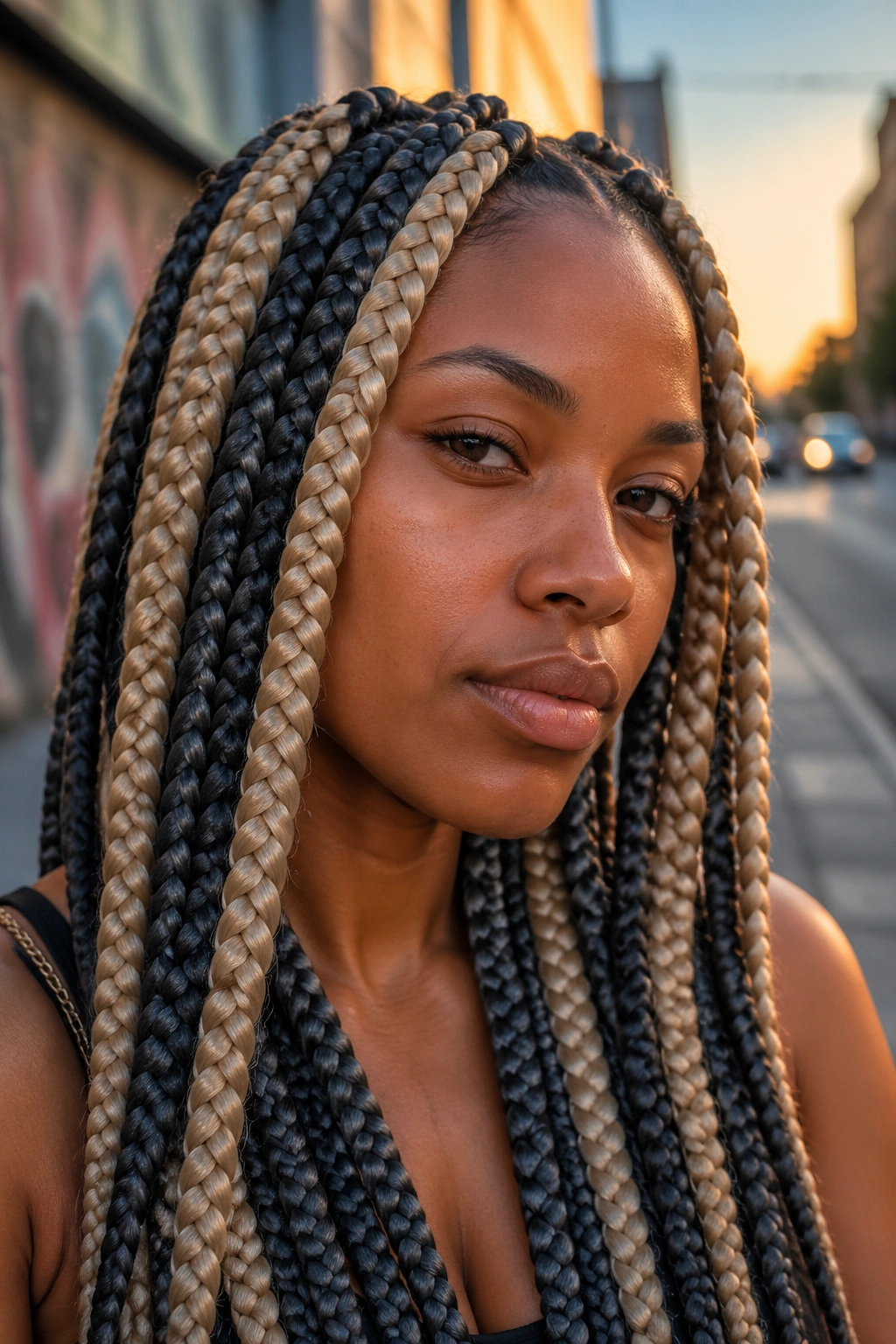
High contrast is the point here. Blonde and charcoal placed braid by braid create a bolder look than a fade ever could. It is cleaner, sharper, and easier to spot from a distance. The whole style reads almost like a pattern you could count.
That kind of contrast works best when the braids are thick enough for each color to hold its own. If the sections are too small, the blonde and charcoal blur together and you lose the punch. With jumbo braids, each strand stays distinct, which is exactly why the style feels so strong.
You can alternate every braid, every pair of braids, or every row. I prefer every braid for the most graphic finish. Pairing the colors in rows looks a little calmer. Either one works, but the first option has more bite.
This is a good choice if you wear black, white, denim, leather jackets, or anything else with hard edges. Soft clothes can still work, but the braids will be doing most of the visual heavy lifting.
9. Grey-Dominant Braids with Blonde Money Pieces
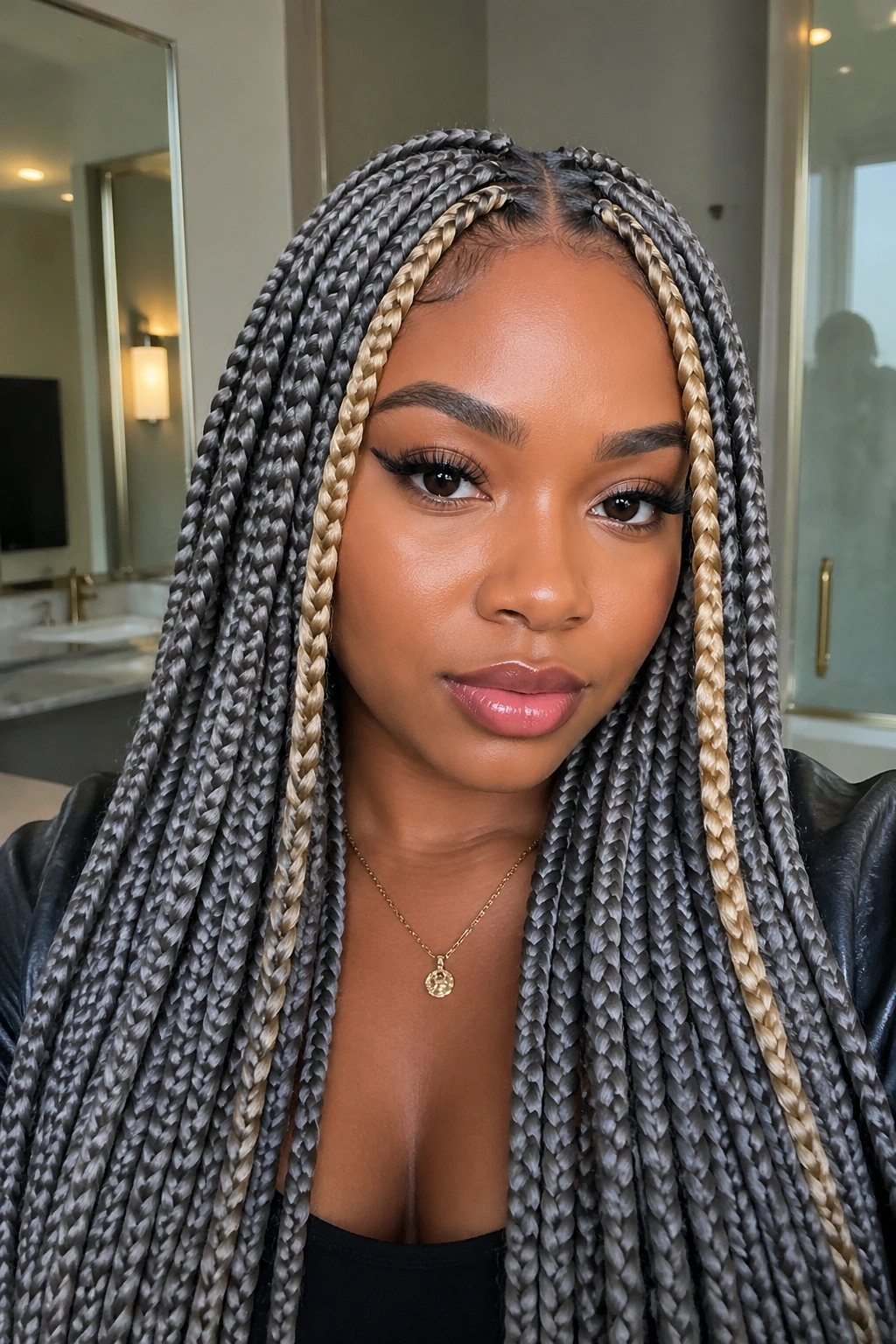
If you have ever wanted grey without looking washed out, this is the safer route. Grey-dominant box braids keep the cool tone in charge, while blonde money pieces sit at the front to lift the face and keep the whole style from going flat.
The front placement matters here. Two blonde braids on each side can be enough. Three if your braids are thin. The goal is not to scatter blonde everywhere. It is to make the face glow while the rest of the braids stay smoky and cool.
This style has a nice balance for people who already wear a lot of silver jewelry or cool-toned makeup. The blonde cuts through the grey and gives the look a bit of warmth, which stops the finish from feeling too icy. That small dose of warmth makes a bigger difference than people expect.
I would keep the blonde pieces closest to the hairline and temples, not buried halfway back. That placement is what turns them into money pieces instead of random highlights.
10. Blonde and Grey Box Braids with Curled Ends
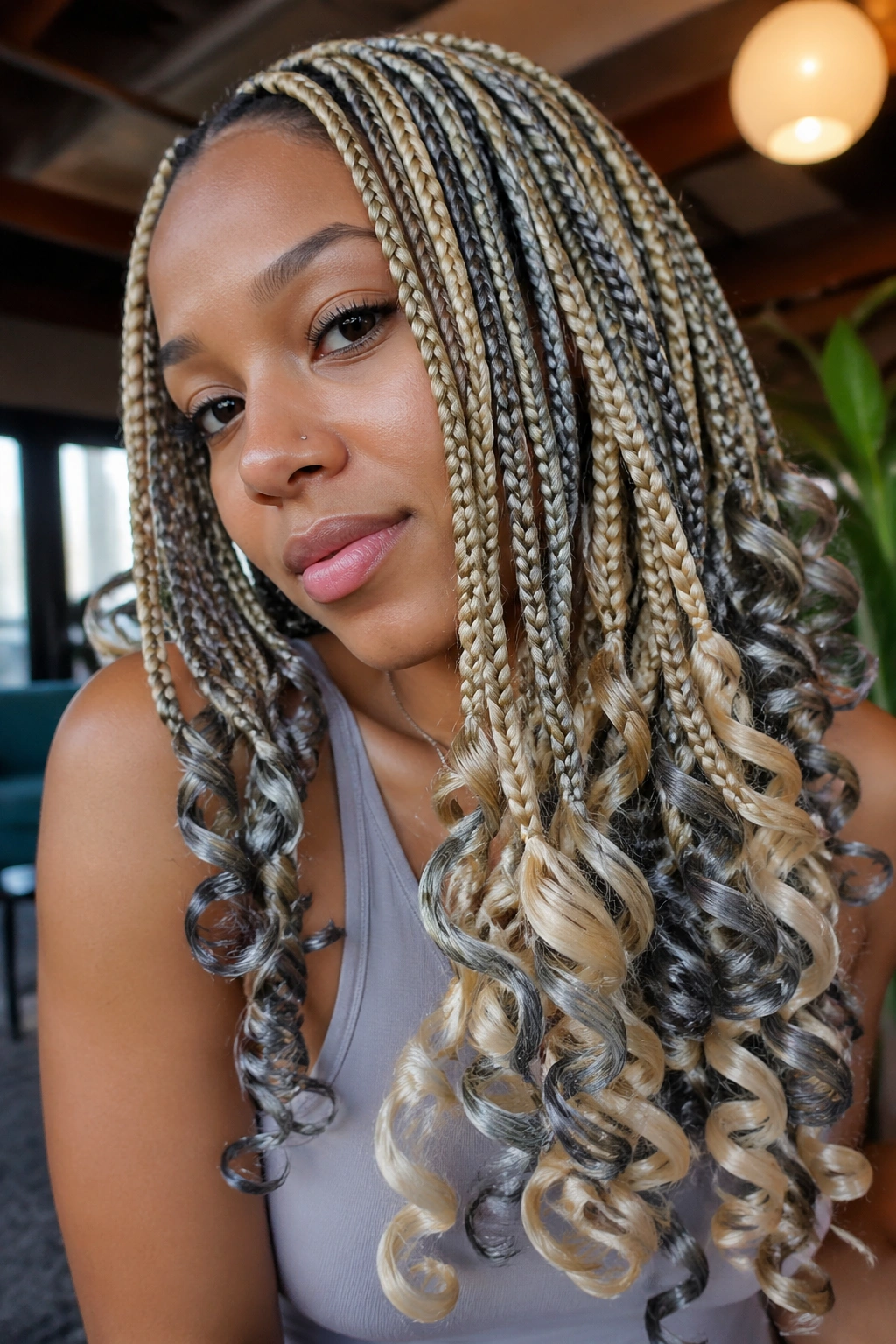
Do curled ends make box braids too busy? Not when the color mix is this controlled. The curls soften the hard edge between blonde and grey, and they make the whole style move in a way straight ends never do.
Setting the curl
Wrap the last 2 to 3 inches of each braid around a perm rod, then dip the ends in hot water if the hair is synthetic and heat-safe. Let the braids cool for at least 10 minutes before taking the rods out. Pull them off too soon and the curl drops faster than you want.
Keeping the ends springy
The braid itself should stay clean and firm while the ends do the softer work. A small amount of mousse on the curls helps them hold shape without getting crunchy. Skip heavy oils on the curled section. They weigh the curl down and turn springy ends into limp ones.
This style is a nice middle ground if you want movement without full goddess braids. The curls also make the blonde and grey seem less harsh against each other. That matters. Hard color contrast plus hard braid ends can look rigid. Curled ends fix that fast.
11. Chin-Length Blonde and Grey Box Braids
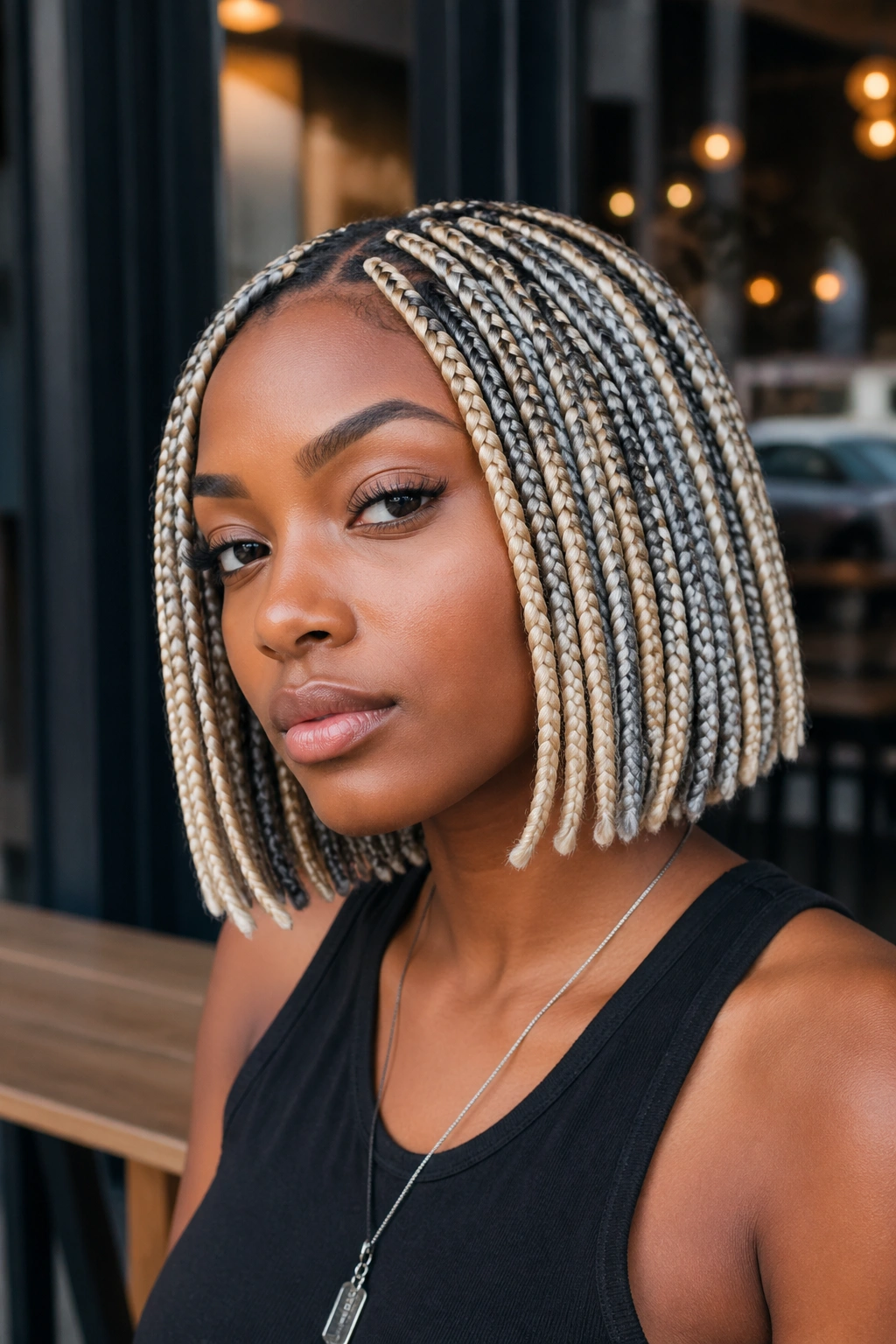
Short braids change the whole mood of blonde and grey. At chin length, the color reads crisp and tailored instead of flowing. You get all the contrast, but none of the extra weight that comes with long box braids brushing your shoulders all day.
I like this cut because it makes grey feel modern without trying too hard. The shorter length gives the style shape. It also keeps the braid ends from getting messy, which is useful if you hate seeing frayed tips after the second week. The braids stay tidy longer because there is less length to tangle.
The best version usually sits somewhere between the jaw and the collarbone. Too short, and the braids can turn boxy. Too long, and you lose the clean bob effect that makes the color pairing pop in the first place.
This is a smart pick if you want something lighter around the neck and easier to sleep on. Simple. Still sharp.
12. Goddess Box Braids with Loose Grey Curls
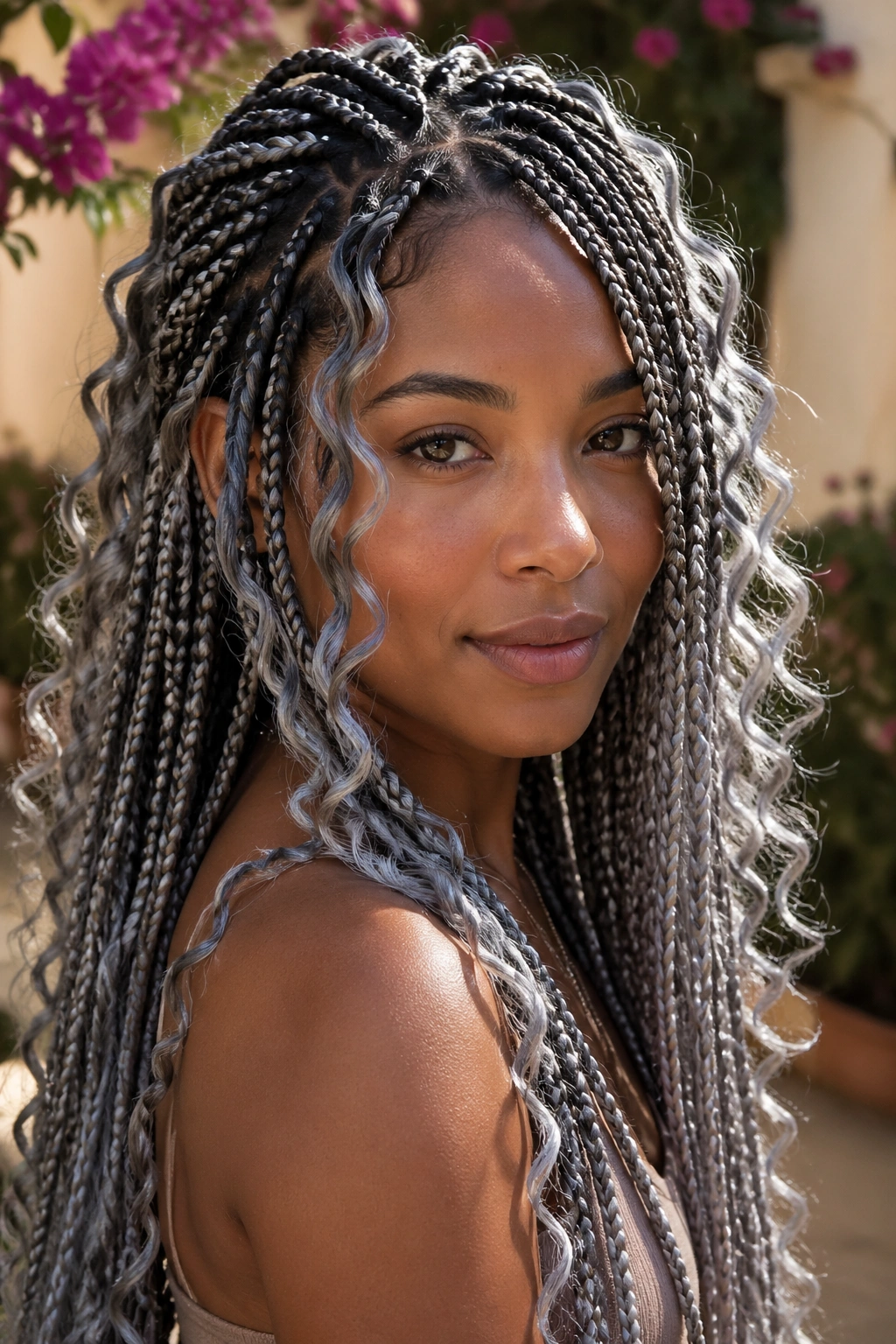
Compared with fully braided ends, goddess braids bring in a softer, more undone feel. The loose grey curls thread through the blonde and grey base and keep the style from looking too rigid. It is a good option when you want the protective style to lean a little romantic.
Where the curls go
Leave the curls concentrated near the face, crown, and a few lower sections around the shoulders. You do not need every braid to have loose hair. In fact, that can look busy fast. Three to five curly strands on each side is usually enough to change the whole shape.
How to keep them from frizzing
- Lightly mist the curls with water and foam mousse, not the braids.
- Sleep with a silk scarf or bonnet so the loose pieces do not snag.
- Refresh the curls by twirling them around your fingers after they dry.
- Keep heavy oils away from the loose hair unless you want it to drop.
The grey curls are the detail that makes this version work. They catch the eye and break up the color blocks, which keeps the blonde from feeling too bright and the grey from feeling too heavy.
13. Triangle-Part Box Braids in Blonde and Grey
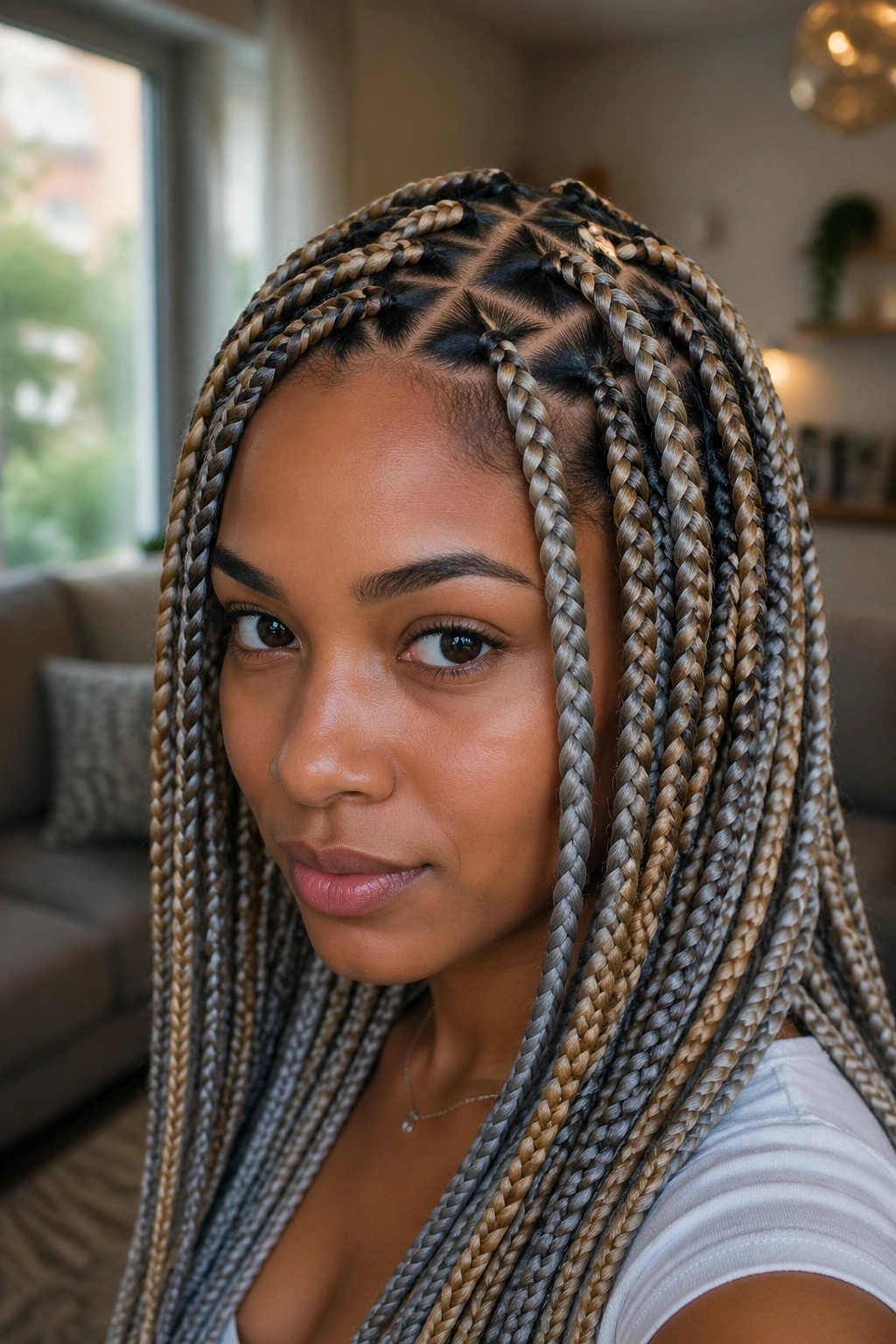
Triangle parts make even simple colors look intentional. That is the whole reason they work so well with blonde and grey. Instead of a square grid across the scalp, you get angles that shift the light and make the braid rows feel more dynamic.
The parts themselves do half the styling. When the triangles are sharp, the braid set looks crisp and current without needing extra color tricks. Add blonde and grey into those sections, and the shapes become even more noticeable because the eye starts to follow the color around the angles.
Why triangle parts change the look
A triangle at the front hairline can soften into bigger triangles toward the crown, which gives the style a little movement without making the whole head too busy. If your braider has a steady hand, this is one of the cleanest ways to make a mixed-color set stand out.
A small note: the color should stay the star. Triangle parts already add visual rhythm, so there is no need to pile on beads, cuffs, and extra curls unless you want a louder finish. Keep the braid size moderate and the color mix clean. That is enough.
14. Side-Swept Blonde and Grey Box Braids
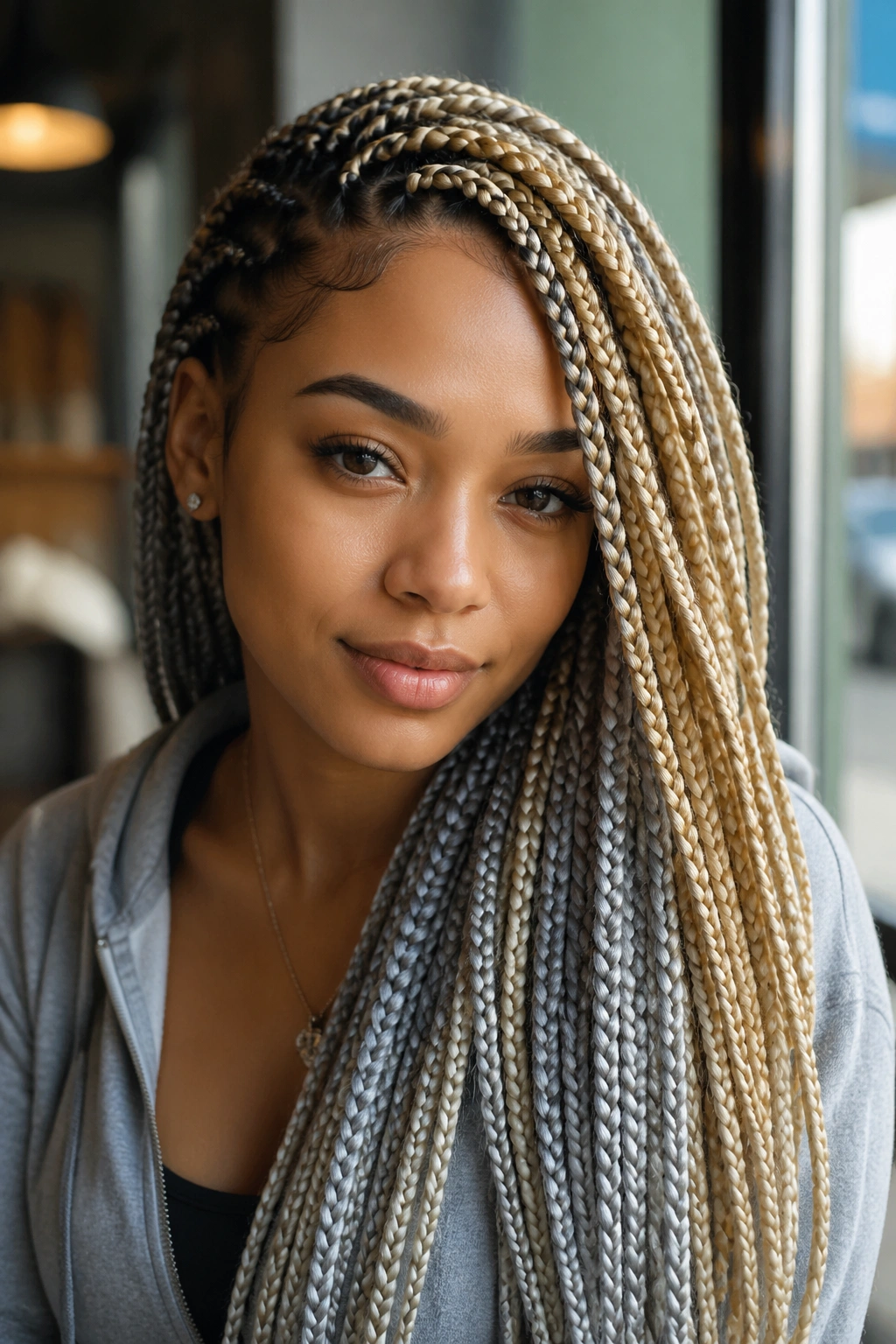
Center parts get all the praise. Side sweeps win when the braid set is dense and the length is past the chest. A deep side part lets the blonde fall across the front while the grey sits slightly behind it, which creates a soft shadow effect instead of a flat two-color split.
This style also flatters earrings better than people expect. The side with less hair opens up the face, and the longer side gives you a curtain of color. It feels a little more styled, a little less standard. Not fussy. Just deliberate.
If your braids are long enough to sit over one shoulder, even better. The blonde catches the front light first, then the grey shows up in the lower layers when you turn your head. That movement is what gives the style its depth.
I would choose this version for nights out, photos, or any time you want the braids to frame the face instead of sitting evenly on both sides. It changes posture, too. That’s not a small thing.
15. Deep-Root Blonde-to-Grey Ombre Box Braids
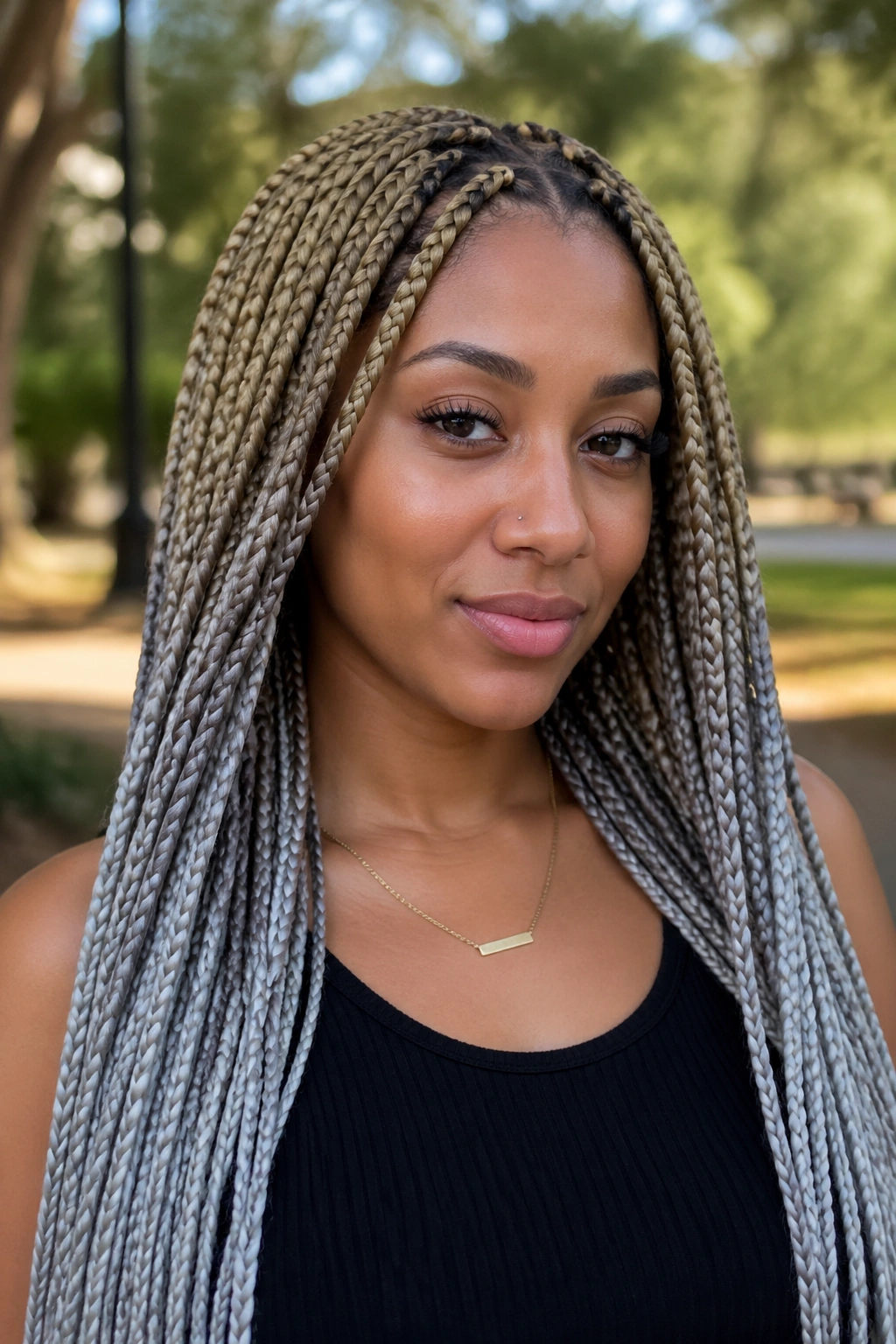
What happens when the gradient starts lower instead of higher? You get a darker, more grounded look. Deep-root blonde-to-grey ombre box braids keep the base warm enough to anchor the style, then slide into grey through the lower half where the color can stretch out.
This version feels easier to wear day to day than a full silver-root style. The deeper root gives you a little visual buffer near the scalp, so the braid line does not scream for attention. The grey still shows up, though. It just arrives later, like it is easing into the room instead of kicking the door open.
A style like this works especially well with medium-long braids because the fade has room to breathe. If the braid is too short, the grey lands too quickly and the ombre loses its purpose. Give it length, and the transition starts to look smooth instead of abrupt.
This is the version I would pick if you want blonde and grey in the same set but do not want the contrast to feel harsh. It is softer, and that softness counts.
16. Beaded Blonde and Grey Box Braids
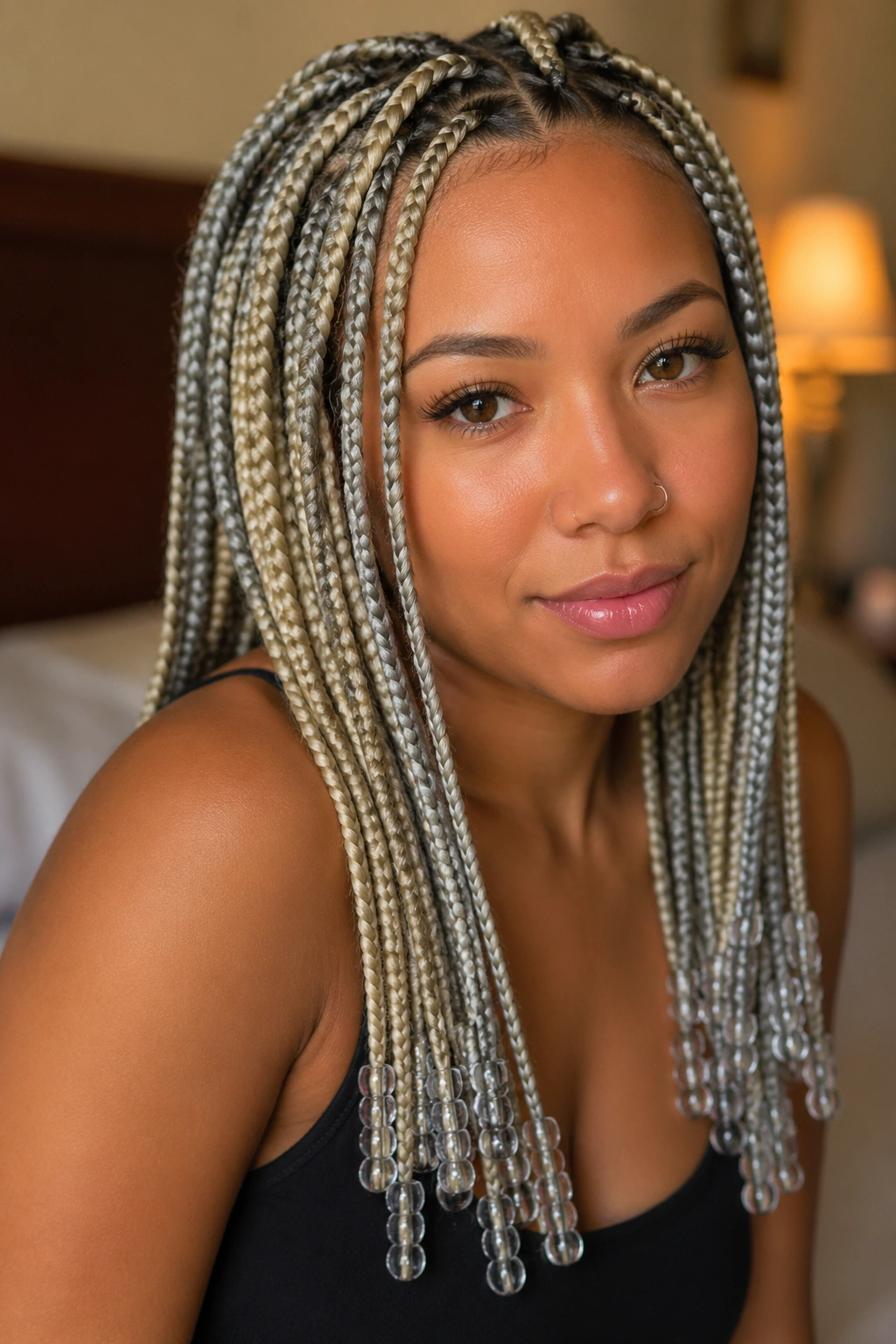
Beads change the sound of the style as much as the look. A few clear or silver beads at the ends of blonde and grey box braids give the whole set a little movement when you walk. You hear it. You feel it. The braids stop sitting still.
The trick is not to overload the front. Heavy beads near the hairline pull, and they also make the style look crowded fast. I prefer to keep the first inch or so of each braid bare, then place beads lower down where they can swing without stressing the root.
A few bead choices that make sense
- Clear beads show the braid colors through them and keep the look light.
- Silver cuffs echo the grey without hiding the blonde.
- Matte black beads sharpen the contrast if you want a tougher finish.
- Mixed bead sizes work best when used sparingly, not everywhere.
The best thing about beads is how they let you direct the eye. Put them on a few front braids and maybe the outer row, and the rest of the style can stay simple. That restraint is what keeps the look from turning childish.
17. Half-Up Top Knot Blonde and Grey Box Braids
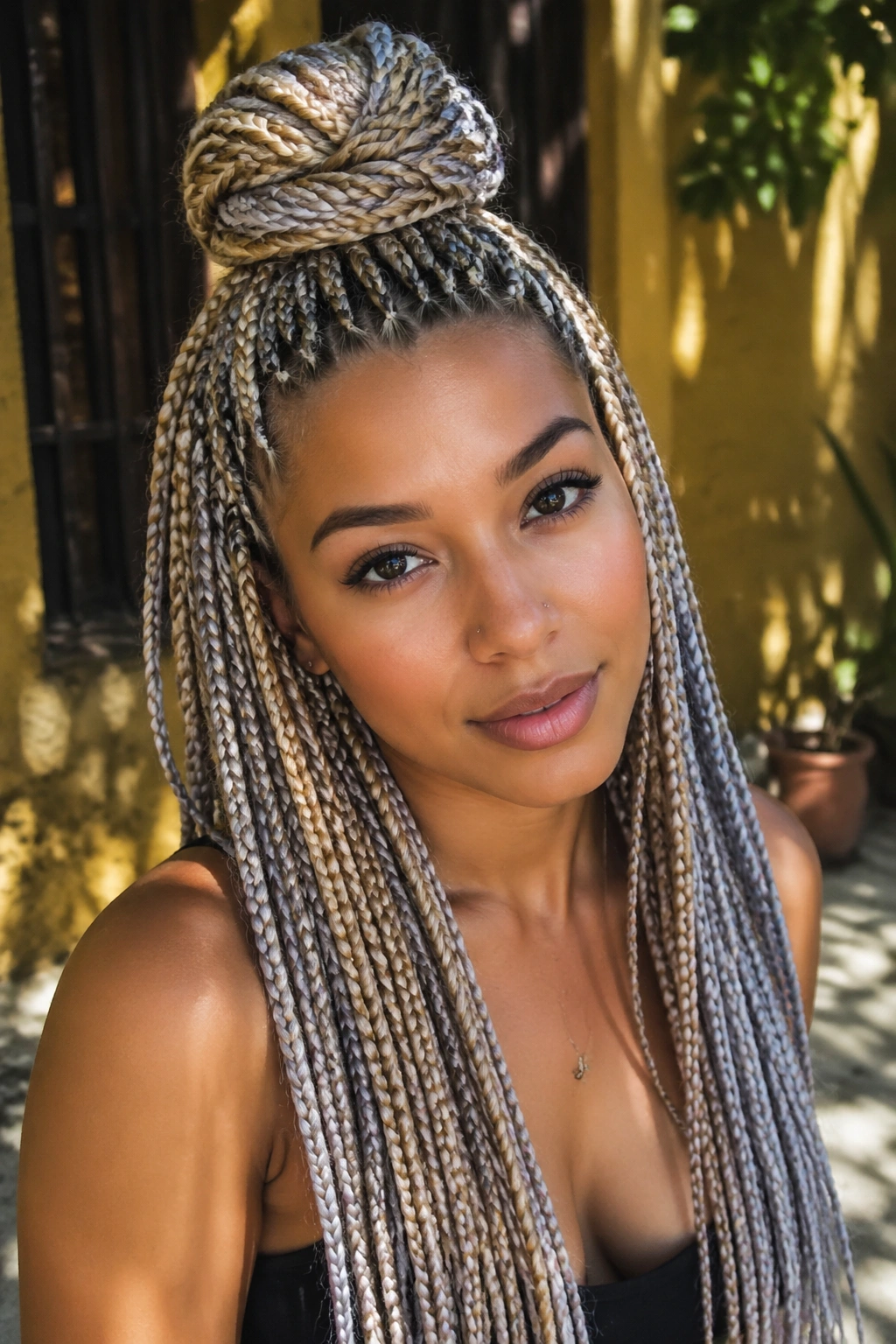
This is the easiest way to show both colors at once. Pull the top half into a knot at the crown, and suddenly the blonde and grey are visible from almost every angle. The style gets height, the face gets opened up, and the braid length still hangs down to do its job.
A knot at the crown works better than one pushed too far forward. If it sits on the hairline, the style can feel tight and awkward. At the crown, it looks clean and gives the rest of the braids room to fall. That little shift matters more than people think.
You do not need a giant knot here. A loose wrap once or twice around the base is enough. If the knot is too packed, it starts pulling on the top rows, and the whole thing loses that easy shape. Keep it soft. Keep it high enough to show the color mix. That’s the point.
This is a useful style for long braids, especially when you want the length out of your face but do not want to hide the work that went into the color. It is practical, but it still looks styled.
18. Layered Waist-Length Blonde and Grey Box Braids
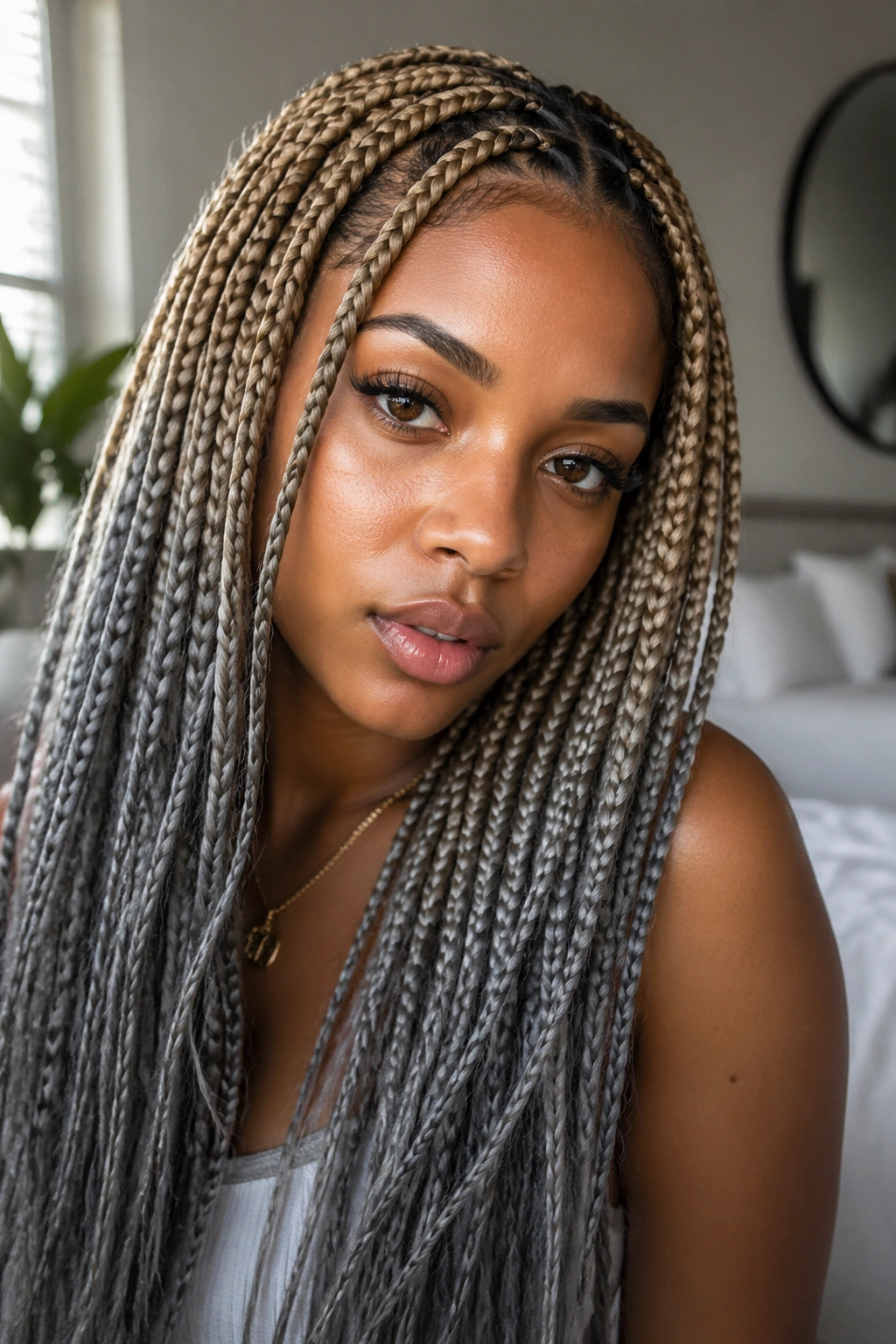
Layered waist-length braids solve a problem most long sets run into: they can look like one flat curtain. Layer the lengths, and the style gets movement. Blonde and grey stop sitting in a single block and start shifting as you walk, turn, or toss them over one shoulder.
The layering does not have to be dramatic. A few braids cut 2 to 4 inches shorter around the outer edges are enough to change the silhouette. That small change makes the face frame lighter and keeps the lower half from feeling heavy. On a long braid set, heavy is the enemy.
This is the most flexible version in the bunch. You can wear it down, half-up, tucked back, or piled into a loose knot without losing the color story. The blonde stays bright, the grey stays smoky, and the layers keep both shades from flattening out.
If you want one version that feels balanced rather than extreme, start here. Pick a medium braid size, keep the blonde dominant, let the grey move through the lengths, and ask for a layered finish. Clean parts help. So does restraint. The braid set does not need to shout when the color already has this much presence.