



Grey curly hair styles with bangs are one of the most dramatically underexplored combinations in natural hair styling — and once you see them done well, it’s hard to understand why they aren’t everywhere. Bangs on grey curly hair create an immediate face-frame that changes the energy of any style, drawing attention directly to the eyes and cheekbones while the grey tones and curly texture do the rest of the work. The result is striking, specific, and deeply personal.
Why Bangs Work on Grey Curly Hair
The argument for bangs on grey curly hair is actually simple: contrast and frame. Bangs create a defined front edge to your hairstyle — a deliberate starting point for the eye — which means everything behind them has more visual weight and intention. On grey curly hair, that intentionality amplifies the beauty of the grey tones rather than letting them blend into the background of an unframed style.
Bangs also draw the eye away from hair color entirely and toward the face. This can be liberating for women who feel self-conscious during the transition to grey — the bangs redirect attention to their strongest features, and the grey becomes a supporting player rather than the first thing someone notices.
There’s also a practical dimension. Grey curly hair around the face — particularly at the temples and hairline — is often the section that goes grey first and most completely. These are exactly the sections that would make up your bangs. So in many cases, fully grey bangs aren’t something you have to create — they already exist. You’re just styling them intentionally.
What “Bangs” Means for Curly Natural Hair
Bangs on straight hair have a very specific meaning: horizontal sections of hair cut across the forehead. On curly hair, bangs are more complex. Because curls spring upward and contract, a cut at eyebrow level might sit at the hairline once shrinkage kicks in. Bangs on curly hair require understanding how your specific curl pattern will affect the final length.
There are several kinds of curly bangs that work on natural grey hair:
Curly fringe bangs — cut to approximately forehead level in the curly state, creating a full, rounded fringe of curls that sits against and above the forehead. This is the closest equivalent to straight-hair bangs on curly natural hair.
Side-swept curly bangs — longer bangs that are swept to one side, creating an asymmetrical frame that shows the curl’s movement.
Pinned-back or styled bangs — a section of curls at the crown or front that is pinned, puffed, or otherwise styled away from the face in a way that functions like bangs visually.
Crown puff as “bangs” — gathering the front section of curly hair into a small puff at the crown that falls forward, framing the face from above.
Understanding these distinctions helps you communicate with your stylist about what you actually want.
The Cut — Working With a Stylist on Grey Curly Bangs
Getting bangs on grey curly hair requires a stylist who understands how shrinkage will affect the final length. This is critical. A stylist who cuts bangs on grey curly hair the same way they’d cut bangs on straight hair — at the desired finished length — will almost certainly leave you with bangs that are much shorter than you wanted once the curls spring up.
The cut should always be done in the curly state, not on stretched or blow-dried hair. And your stylist should cut conservatively — slightly longer than your target length — to allow for shrinkage. You can always go shorter; you can’t add length back.
Bring photos of curly bangs on actual curly natural hair (not photos of straight bangs) so your stylist understands the specific aesthetic you’re working toward.
Maintaining Grey Curly Bangs
Bangs require more maintenance than the rest of your natural hair because they’re the most visible section of your style. A few things that make grey curly bangs easier to maintain:
Moisture is especially important for bang sections because they’re the part of your hair most frequently touched, rubbed against pillowcases, and exposed to environmental factors. Keep the bang section well-moisturized.
Curl definition for bangs should be done separately from the rest of your hair — the front section needs specific attention to ensure the curls are defined and the grey tones look vibrant rather than frizzy.
Refreshing the bang section on non-wash days is usually quicker than refreshing the whole head. A small spritz of water and a tiny amount of gel or cream, scrunched gently, re-activates the curl and the grey sheen.
Trimming frequency for curly bangs is higher than for the rest of the hair — plan on addressing the bang section every 4-6 weeks to maintain the shape.
Grey Curly Bangs and Face Shape
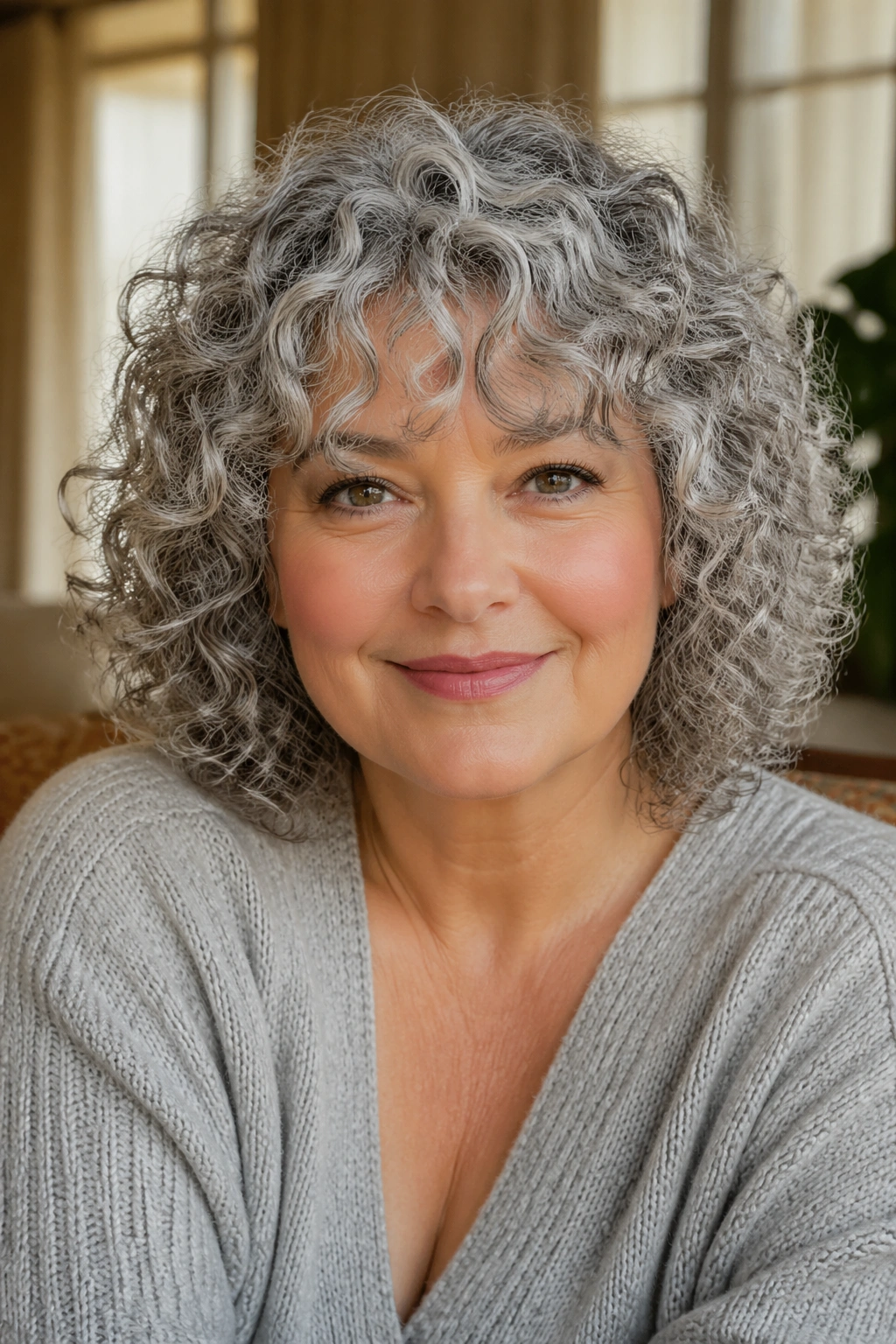
Bangs are one of the most effective face-shaping tools in hairstyling. On grey curly hair, the rule of thumb applies:
- Round faces benefit from bangs that are longer at the sides and shorter in the center — this creates the illusion of vertical length.
- Square faces benefit from soft, rounded curly bangs that soften the angular jawline.
- Oval faces can carry almost any bang style — this is the most versatile face shape for bangs.
- Heart-shaped faces benefit from side-swept or asymmetrical bangs that add width at the temples and cheekbones.
- Long faces benefit from full, across-the-forehead curly bangs that add visual width and interrupt the vertical line of a long face.
Always communicate your face shape concerns to your stylist before they cut — it helps them make decisions about where to take the length and how wide to make the bang section.
1. The Full Curly Fringe on Grey Hair
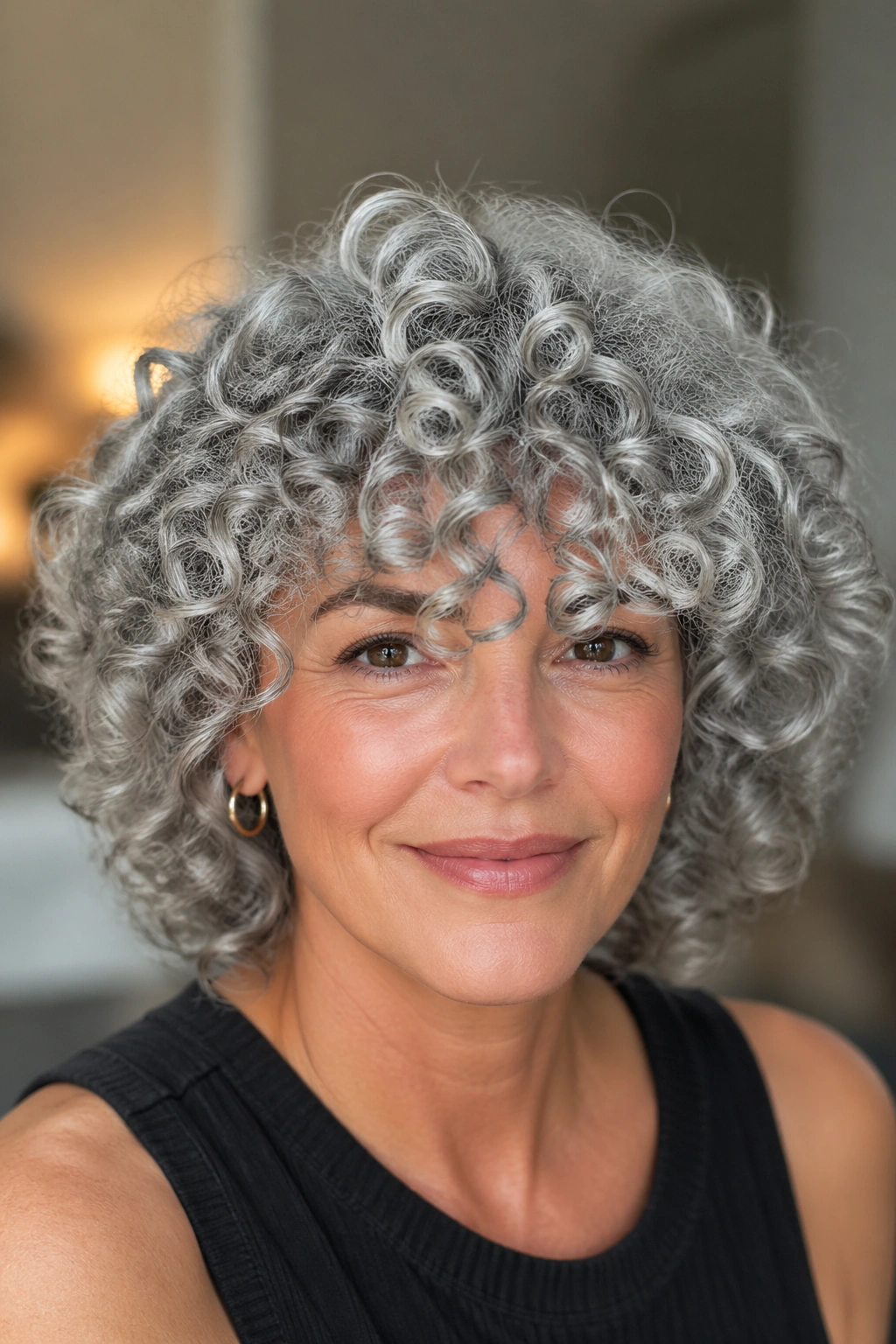
The full curly fringe is the most classic bang style translated into natural curly hair. A section of grey curls is cut to fall across the forehead in a full, rounded fringe — not flat and straight, but curly and full, creating a cloud of grey curls that frames the upper face.
On fully grey curly hair, this style is immediately striking — the silver fringe against the forehead, combined with grey curls framing the rest of the face, creates a cohesive look where the grey color is visually dominant and beautiful rather than incidental.
How to Get It
Ask your stylist to cut a full, wide front section of your hair — from temple to temple — and leave it slightly longer than your target length. The curls should hit approximately mid-forehead in the curly state. Let the bang section curl naturally rather than trying to define it differently from the rest of your hair.
2. The Side-Swept Grey Curly Bang
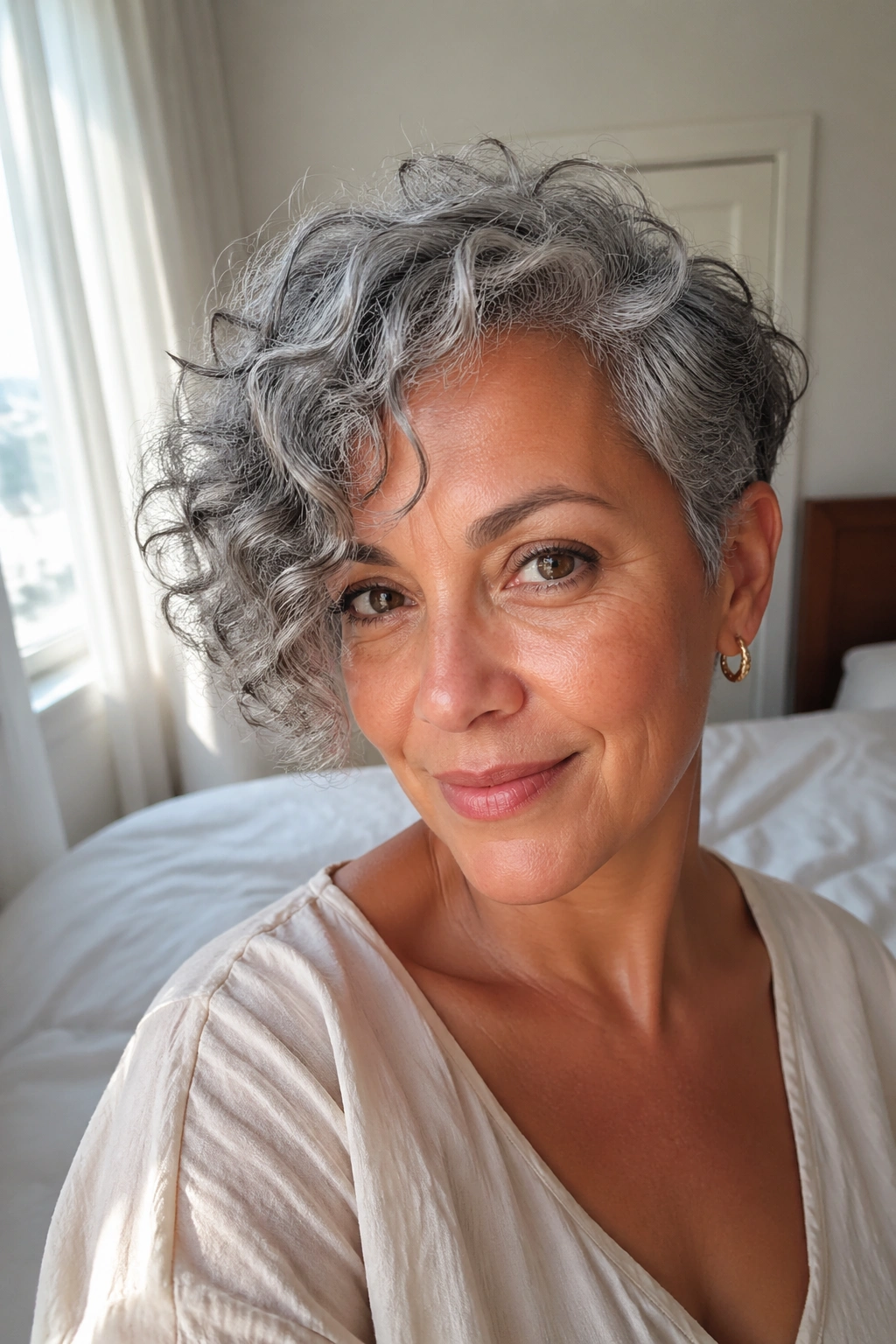
Instead of falling straight across the forehead, a side-swept grey curly bang is longer and falls to one side, creating an asymmetrical frame. On grey curly hair, a side-swept bang has a particularly romantic quality — the curls swing to one side with movement, showing off their silver tones as they catch the light.
This style is also more forgiving of shrinkage than a full fringe, because the length of the sweep compensates for how much the curls contract.
3. The Grey Puff-Bang Hybrid
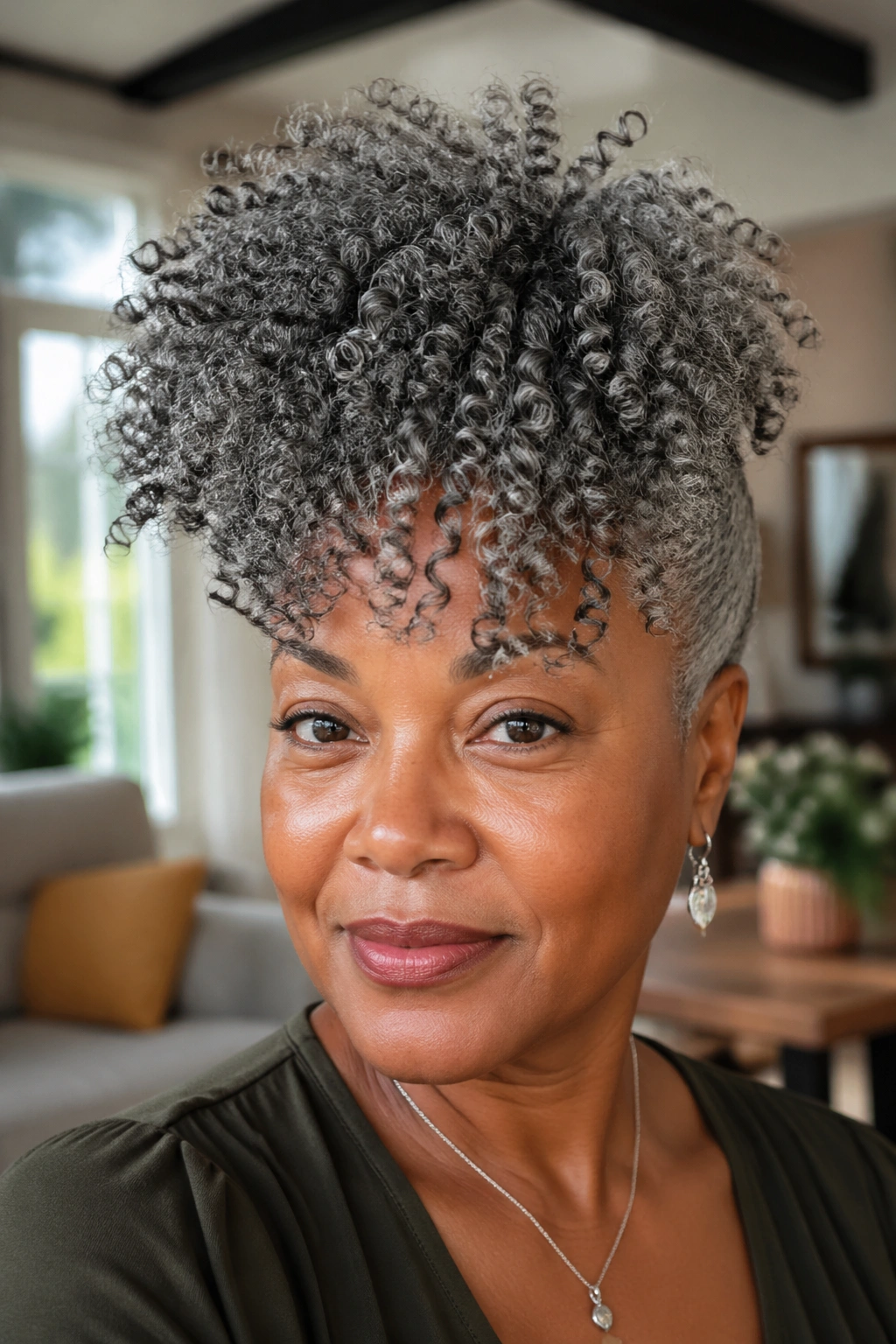
The front section of grey curly hair is gathered into a small puff at the crown that falls forward, creating a rounded, voluminous “bang” of grey curls that frames the face from above. The rest of the hair hangs down or is gathered separately.
This is one of the most popular curly “bang” styles because it doesn’t require cutting — you achieve the bang effect through styling. For women nervous about committing to a cut, this is a great place to start.
4. The Short Grey Bob With Curly Bangs
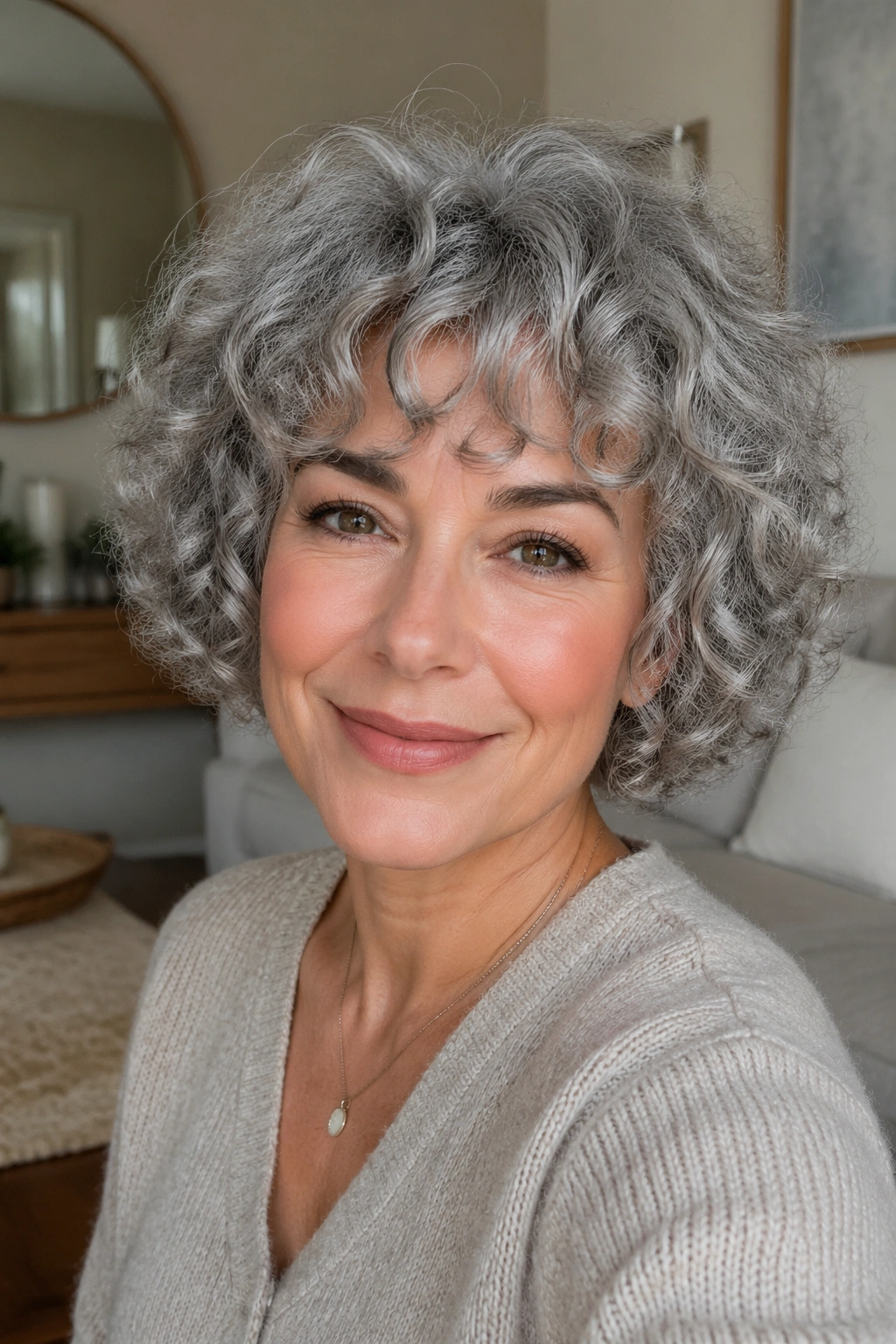
A short curly bob on grey hair, paired with a curly fringe bang, creates a fully framed face — bangs in front, bob curls on the sides and back. The combination is graphic and deliberate, and on grey curly hair, every element of the silhouette catches light differently.
The bob frames the face horizontally at the jaw; the bangs frame it horizontally at the forehead. Together, they create a complete facial frame of grey curls.
5. The Grey Wash-and-Go With Defined Bangs
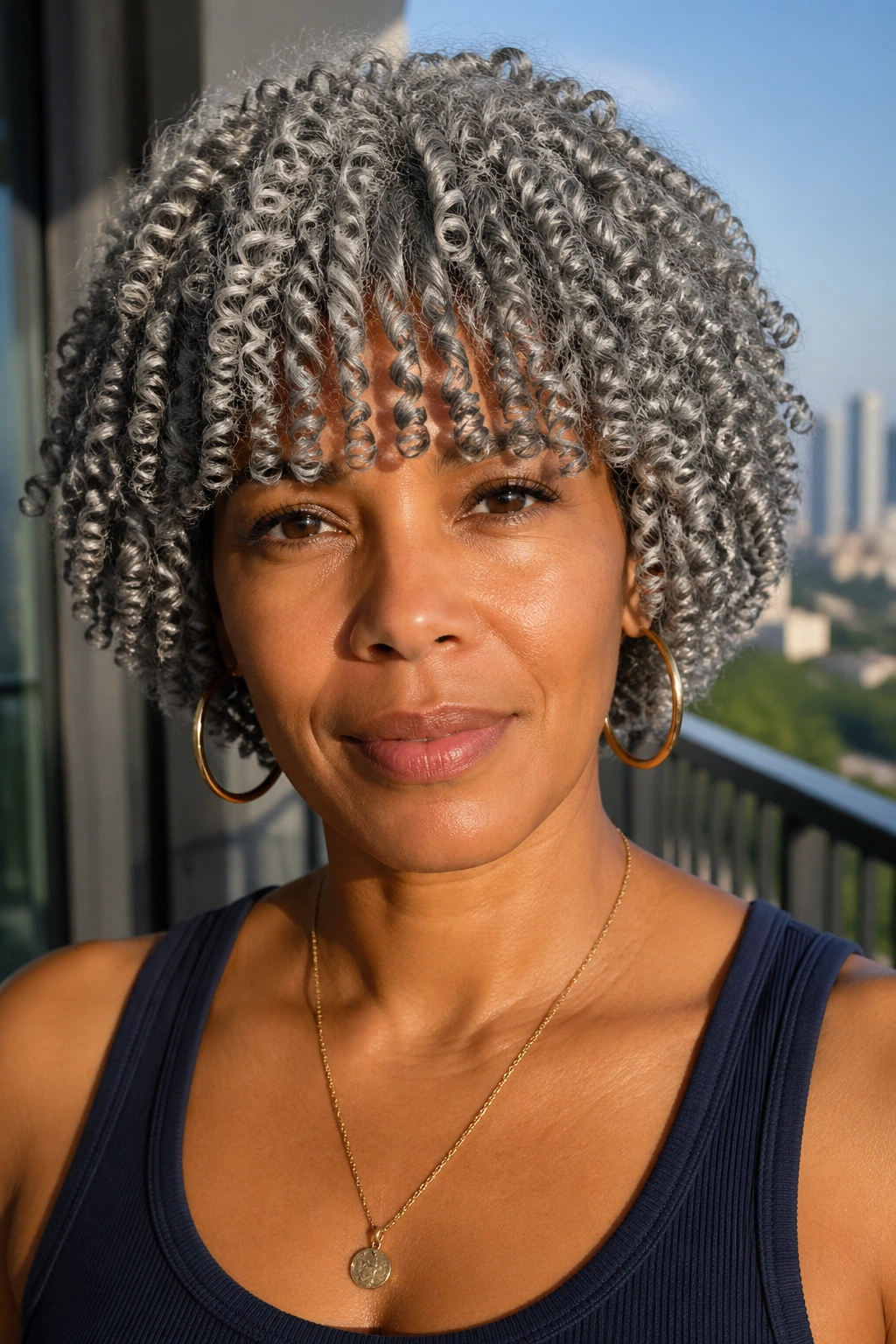
A standard grey wash-and-go — all curls defined and worn out — with extra attention given to the bang section to ensure maximum curl definition and grey sheen. Apply product to the bang section specifically using a smoothing technique (smooth from root to tip rather than scrunching) to encourage the bang curls to fall forward consistently.
6. The Finger-Coiled Grey Bang
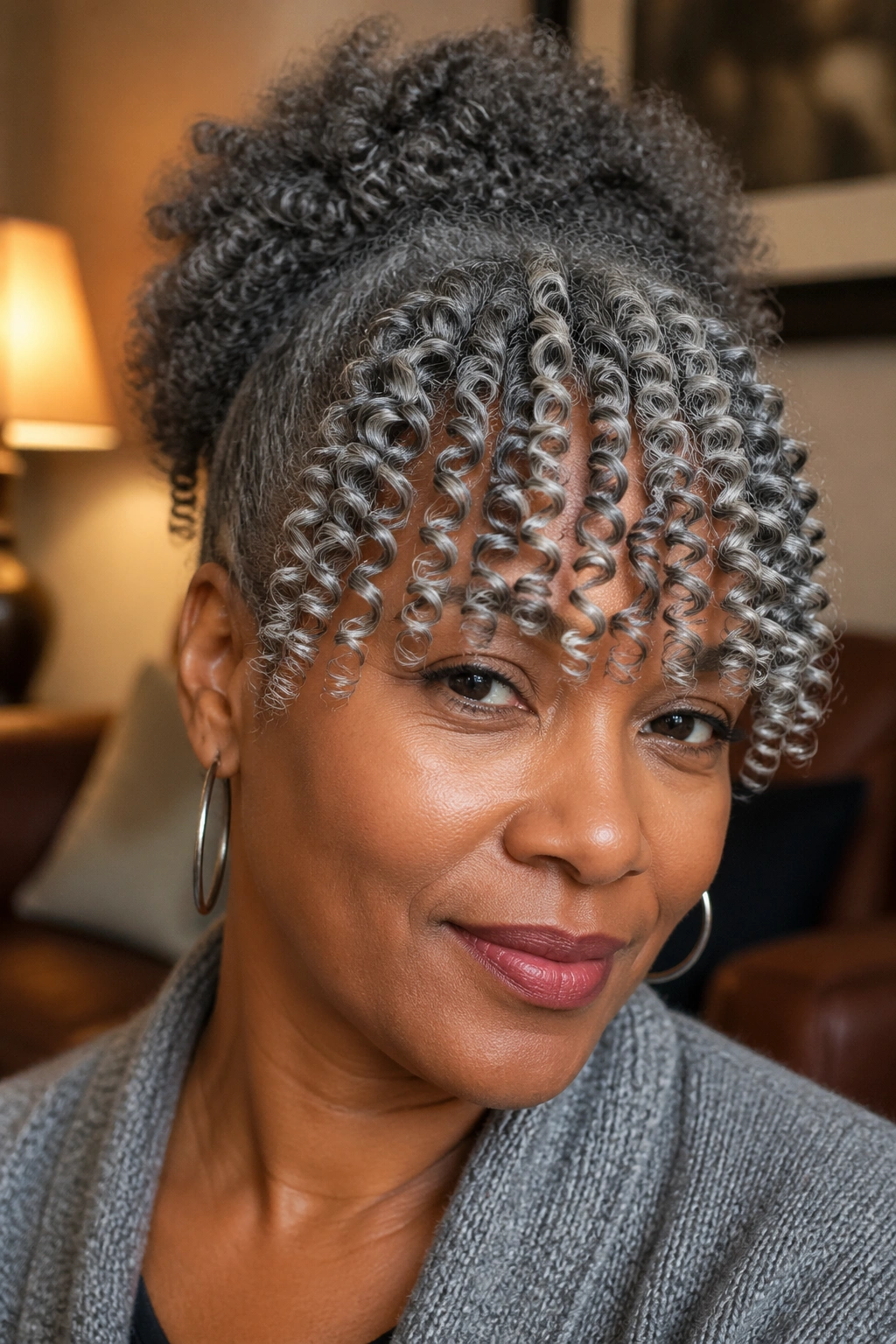
The front section of grey curly hair is finger-coiled — each small section wrapped around a finger to create a defined, precise coil — while the rest of the hair is worn in a puff, bun, or another style. The coiled bang section creates a graphic, intentional frame of defined grey spirals that contrasts beautifully with a more voluminous style behind.
7. The Grey Twist-Out With Bang Section
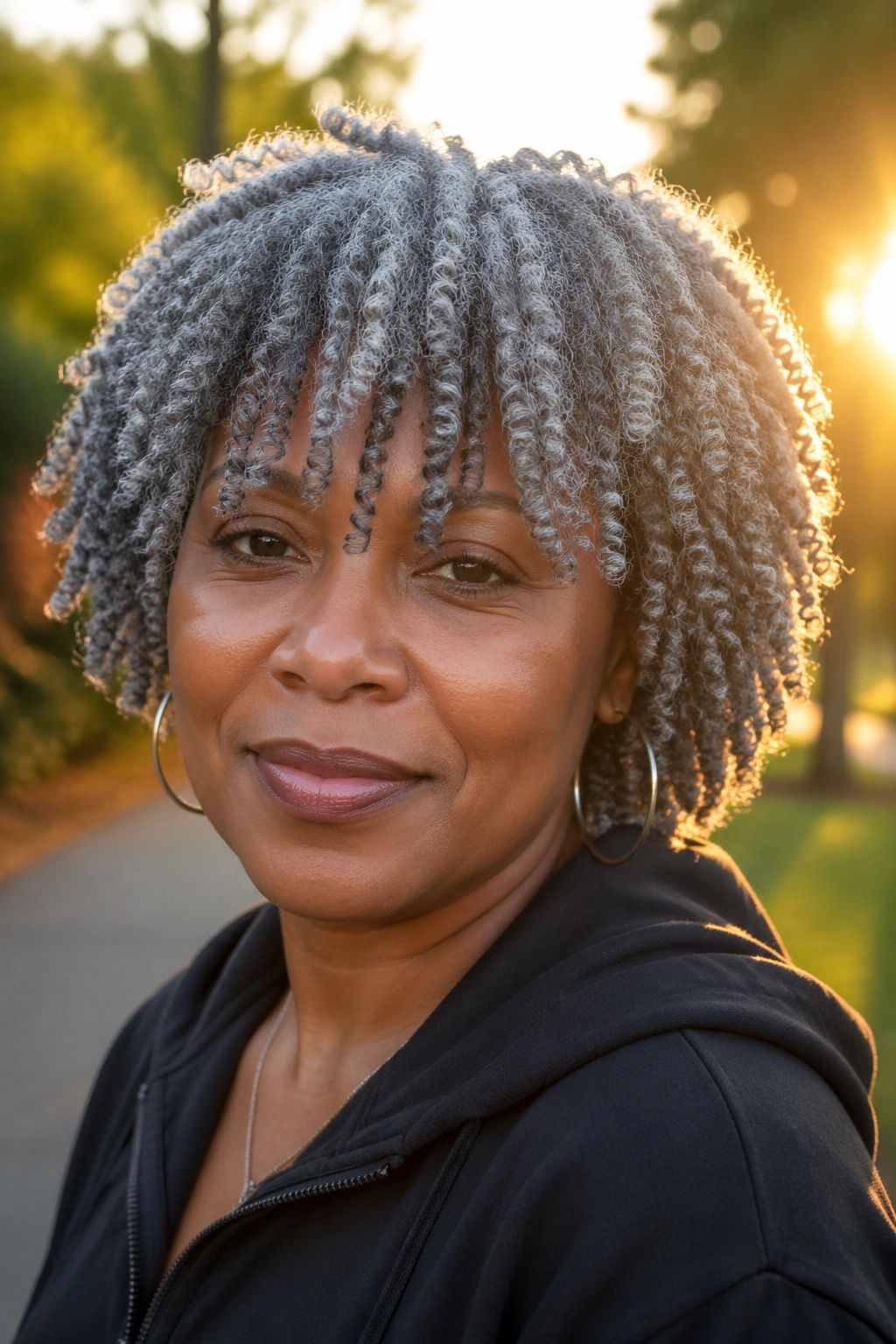
A full grey twist-out style — all hair twisted, dried, and unraveled — with the front bang section left slightly longer or cut differently to fall forward across the forehead. The twist-out texture throughout the hair is consistent, but the bang section frames the face in a way the rest of the style doesn’t.
8. The Grey Afro With Front Bang Curls
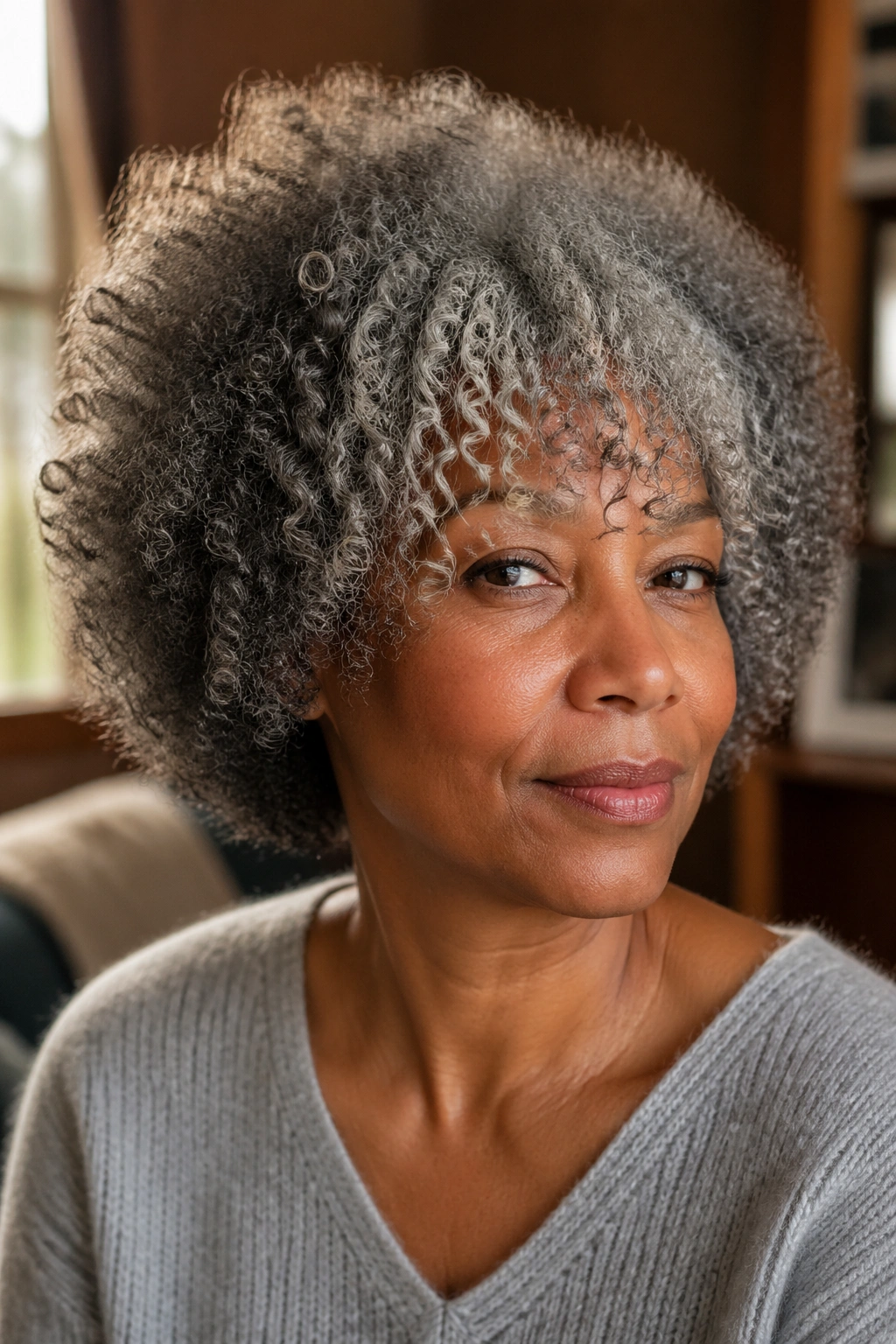
A full, picked-out grey afro with the front section left slightly longer and defined rather than picked out — creating a curl section at the forehead that functions as a bang within the broader afro silhouette. The front section frames the face while the rest of the hair is volume and texture.
This style requires some styling technique — the bang section needs to be defined separately from the afro — but the result looks distinctive and beautiful.
9. The Cornrow Updo With Grey Bang Section
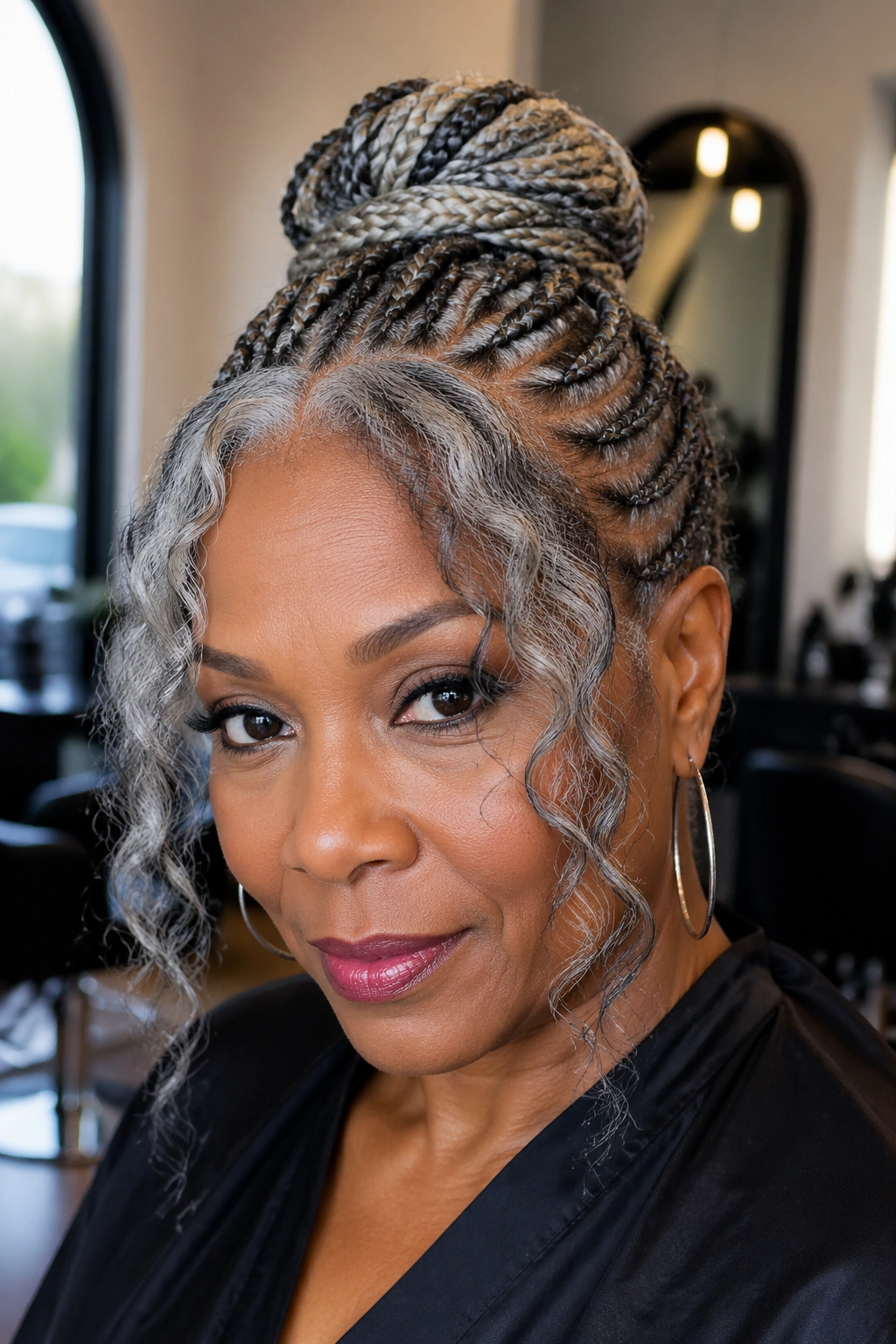
All grey curly hair is cornrowed back into an updo — except for the front bang section, which is left loose and curly, framing the face. The contrast between the sleek, structured cornrows and the free, curly grey bangs creates a striking half-structured, half-natural look.
10. The Grey Lob With Curly Side Bangs
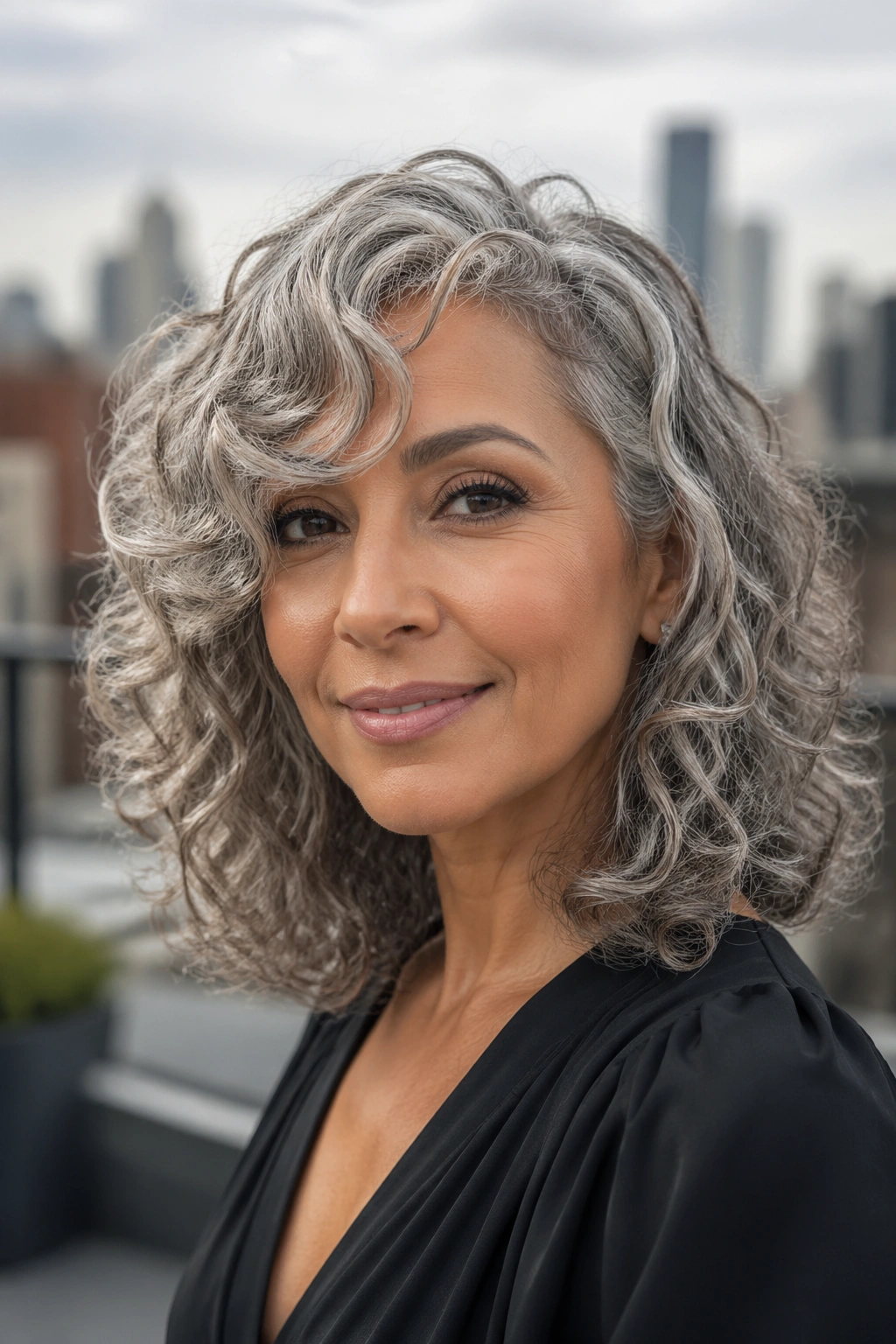
A longer grey curly lob, combined with longer side-swept bangs that blend into the overall length, creates a style where the bang and the style are integrated rather than separate. The side bangs frame the face while the length continues around to the back and sides.
On grey curly hair, the integrated lob-and-bang look is particularly polished because every section of grey hair — from the bang to the body — moves consistently as a unit.
11. The Grey Puff With Loose Bang Curls
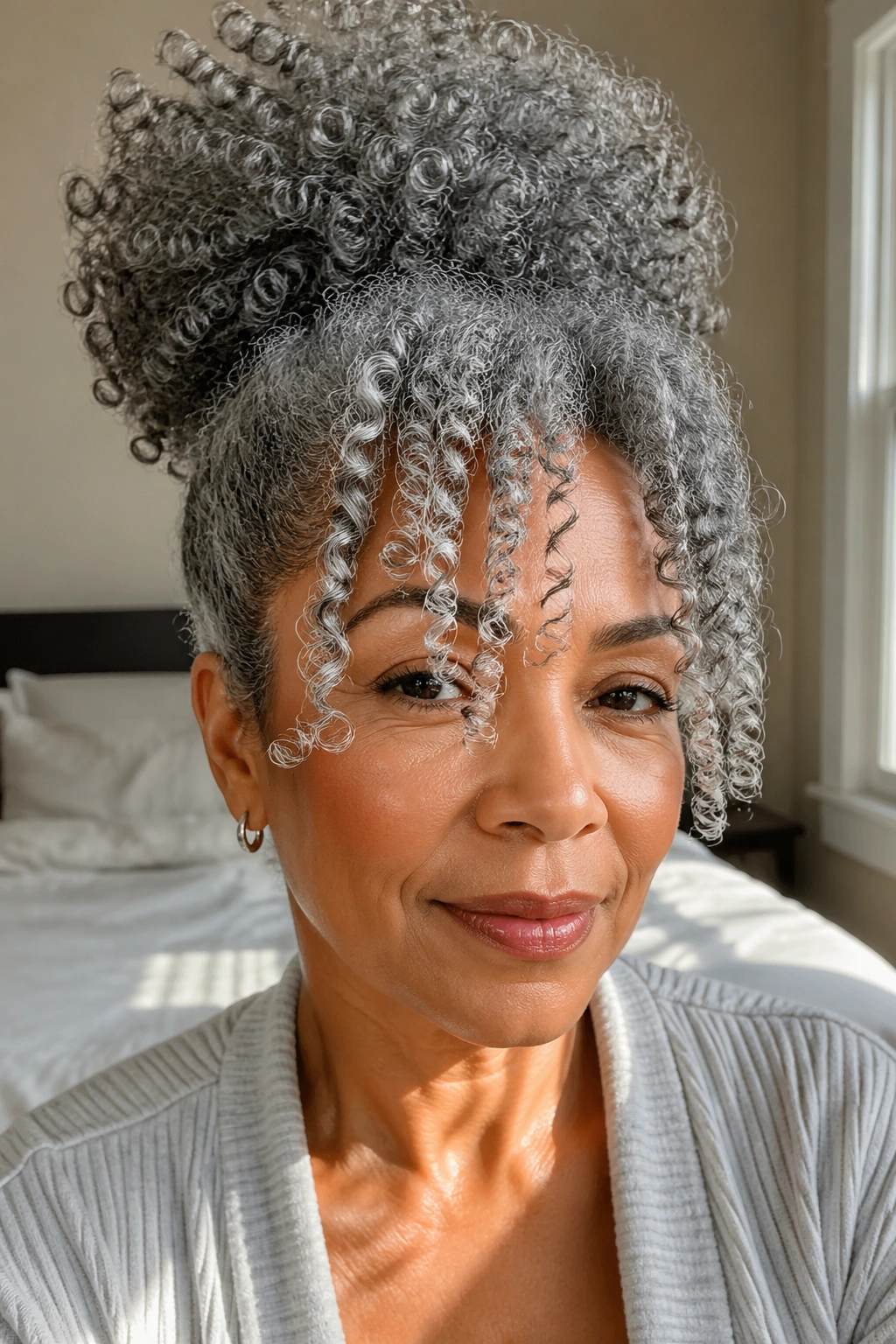
A high grey puff with a few loose curly tendrils specifically pulled down at the front to frame the face functions as a softer, more romantic version of a bang. Instead of a cut fringe, you’re creating the bang effect by letting strategic pieces fall forward from the puff.
This approach is entirely about styling, not cutting, which makes it adjustable and reversible.
12. The Short Grey Natural Cut With Fringe
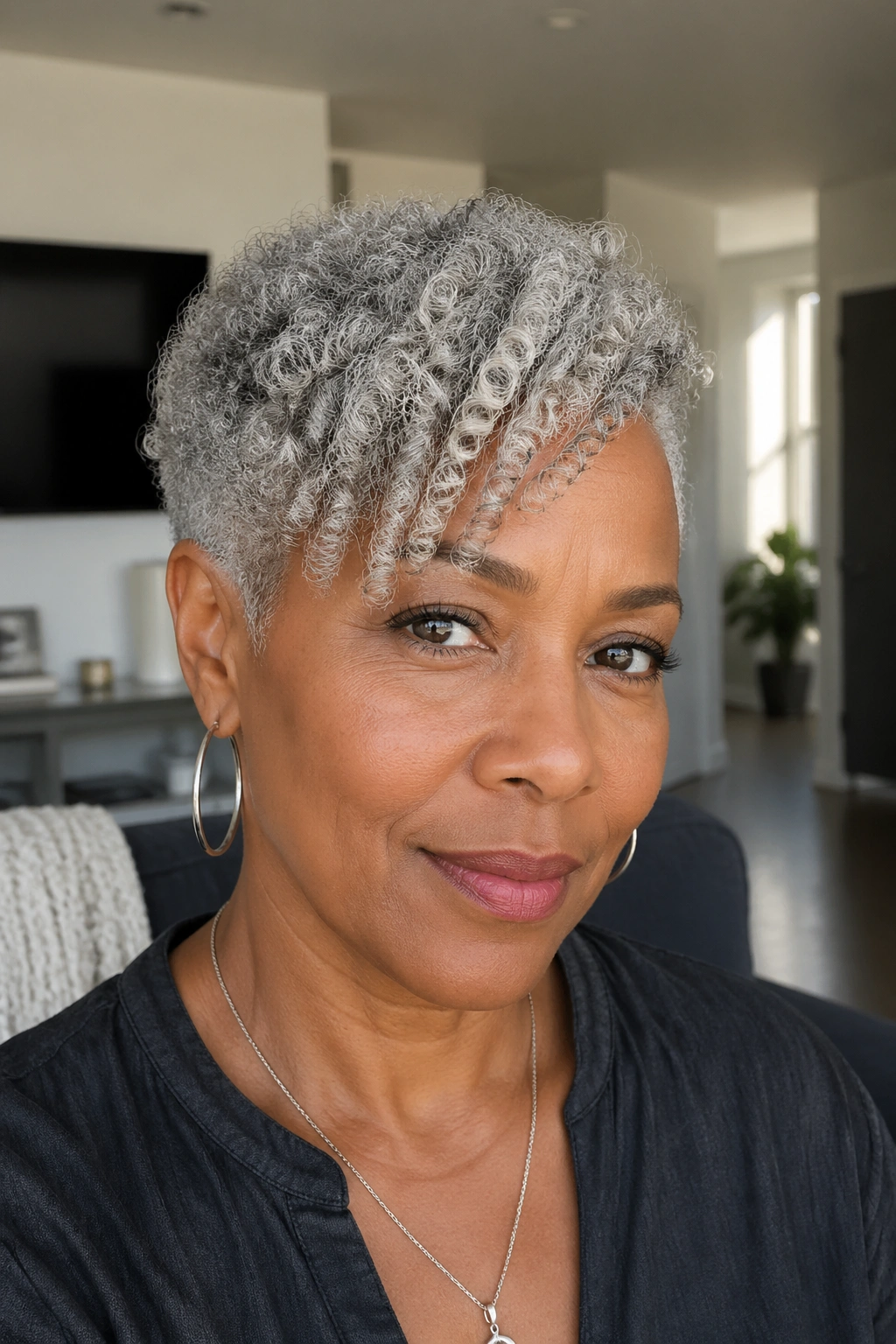
On a short grey natural cut — TWA or pixie-adjacent — a fringe section can be left slightly longer than the rest to create the effect of bangs on an otherwise very short style. The longer front curls fall forward against the forehead, creating a face-frame on a cut that otherwise wouldn’t have one.
13. The Braid-Out With Grey Fringe Defined
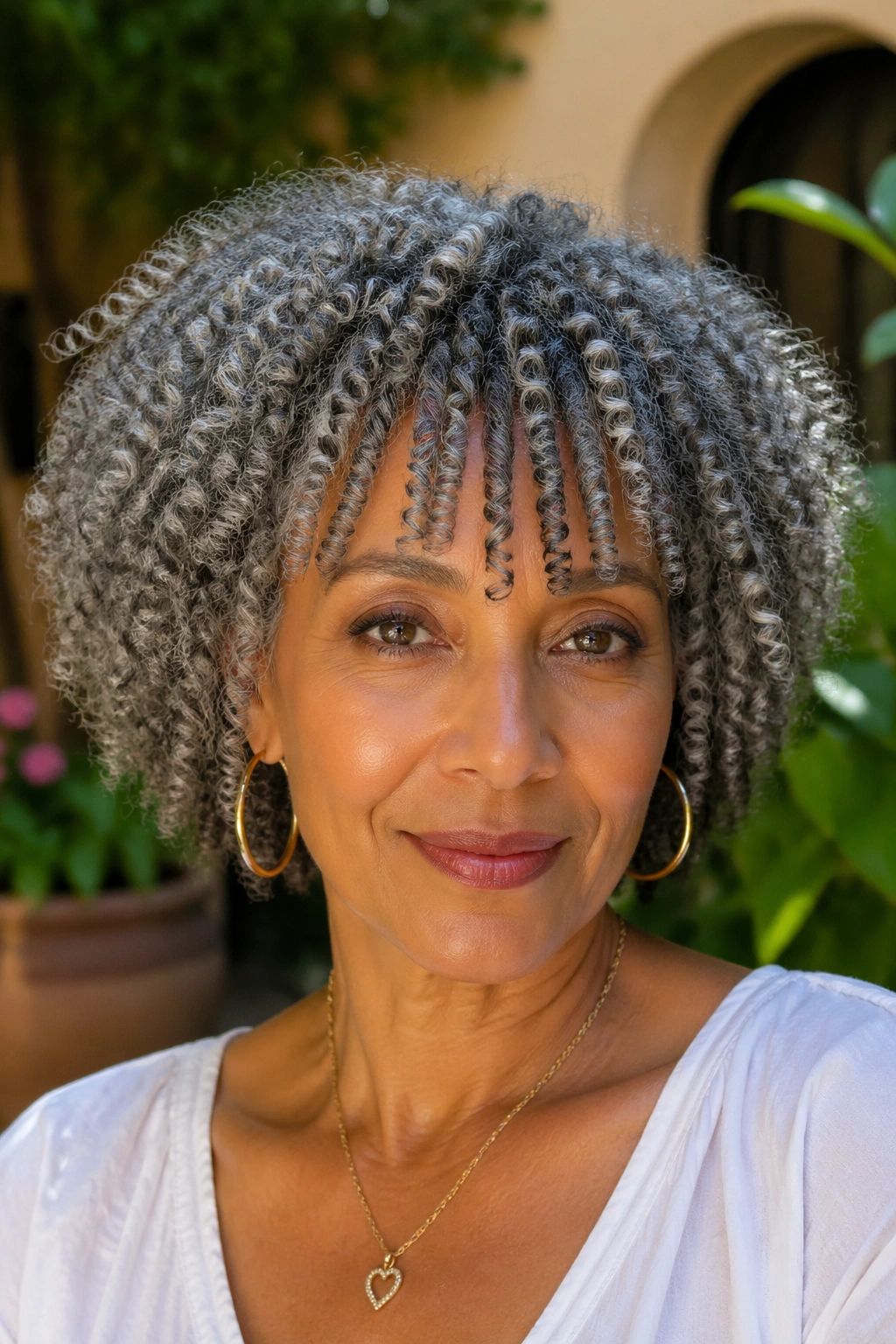
A full braid-out on grey curly hair, with the bang section done separately using a different technique (or a tighter braid for more definition) so the front section falls consistently forward as a defined fringe. The rest of the hair has the textured, wavy braid-out pattern; the bang section has a more defined, controlled curl.
14. The Grey Half-Up With Bang Cascade
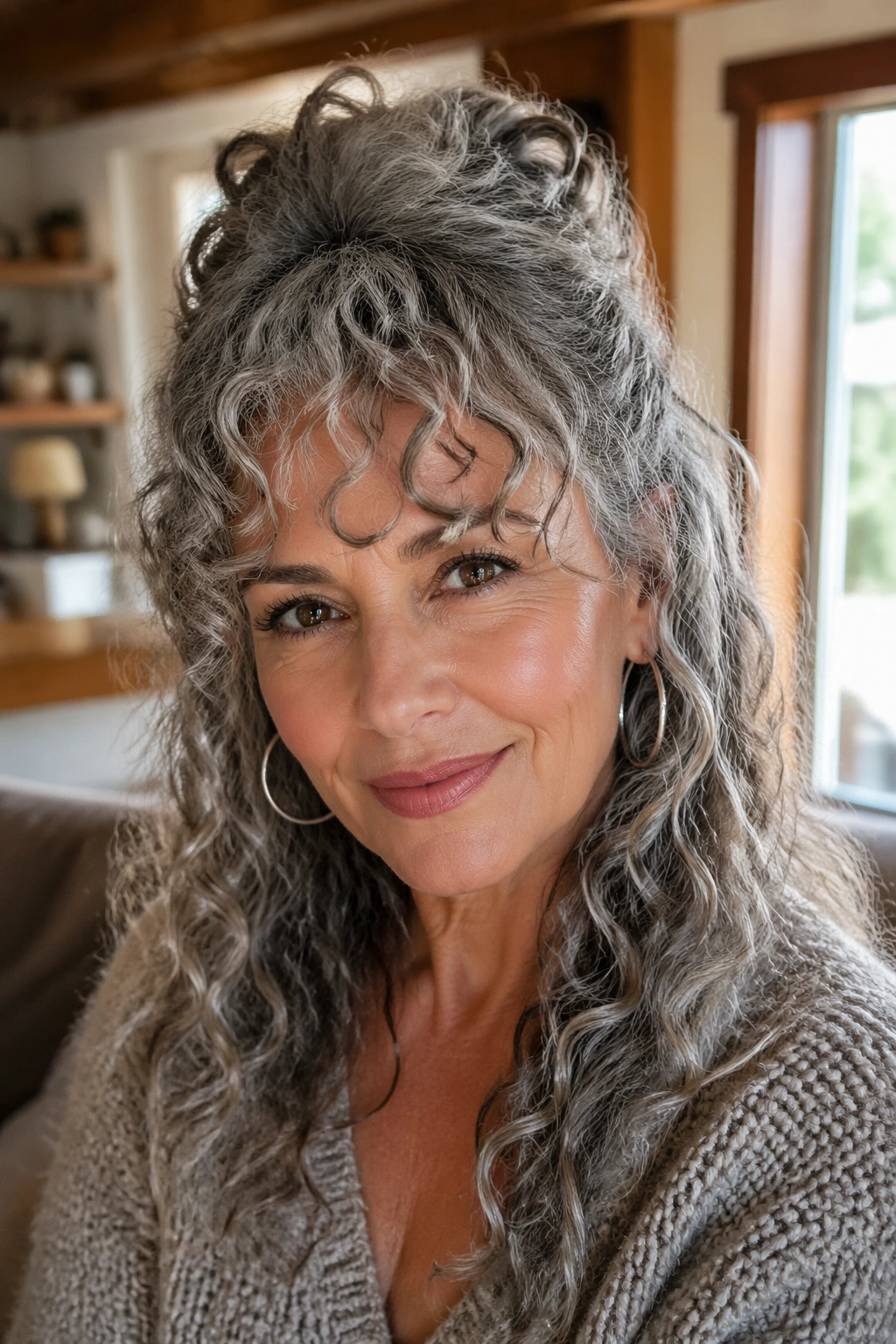
A half-up style on grey curly hair where the top section is gathered and secured, but the bang section is deliberately excluded and left hanging forward as a curly fringe. The contrast between the gathered top section and the forward-falling bangs creates dimension and movement in the style.
15. The Grey Flexi-Rod Set With Fringe
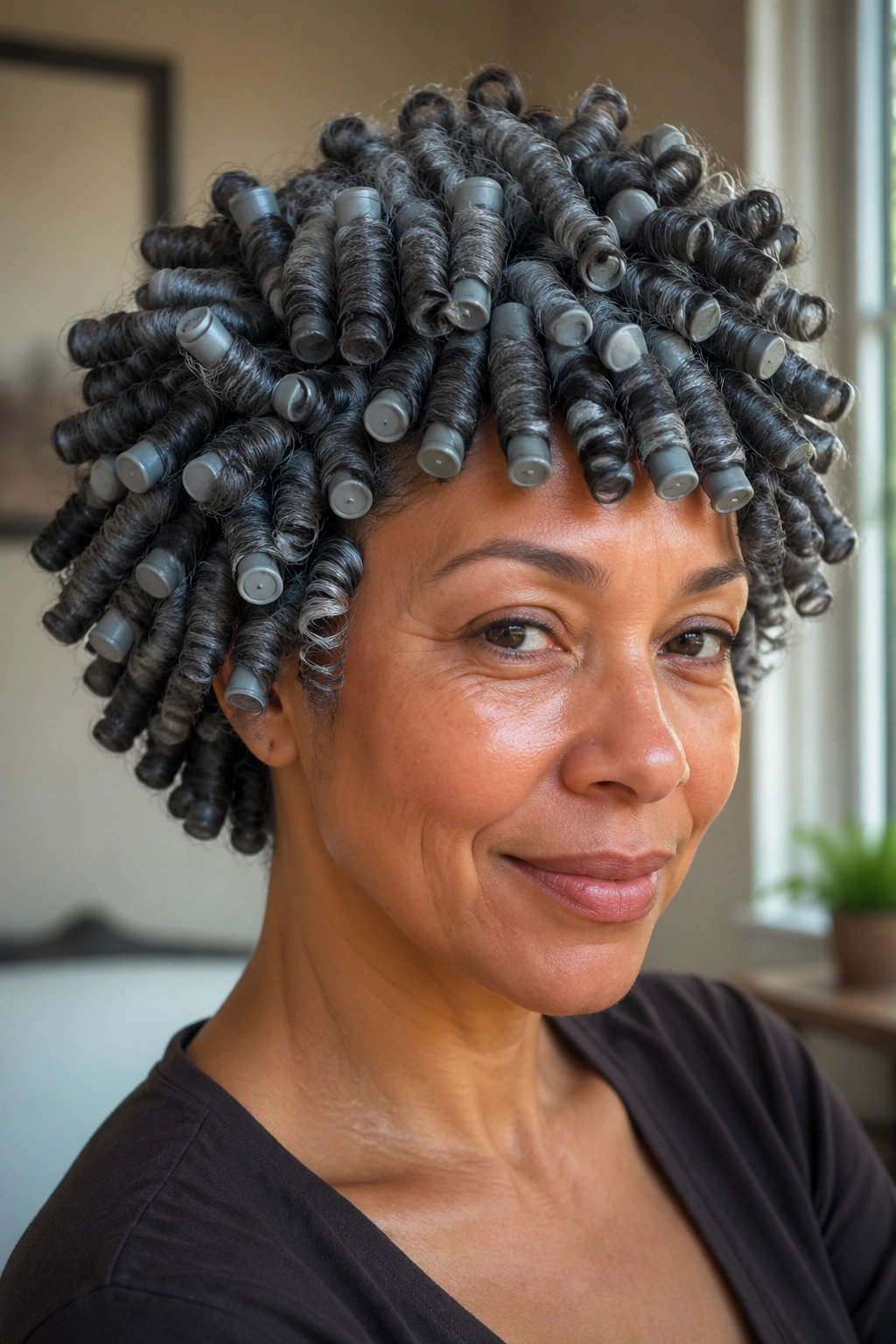
A full flexi-rod set on grey curly hair, with the bang section set on smaller rods for tighter, more defined curls that fall forward across the forehead. The uniform spirals throughout the style provide a polished backdrop for the more defined, fringe-like bang section.
16. The Two-Puff Style With Forward Bangs
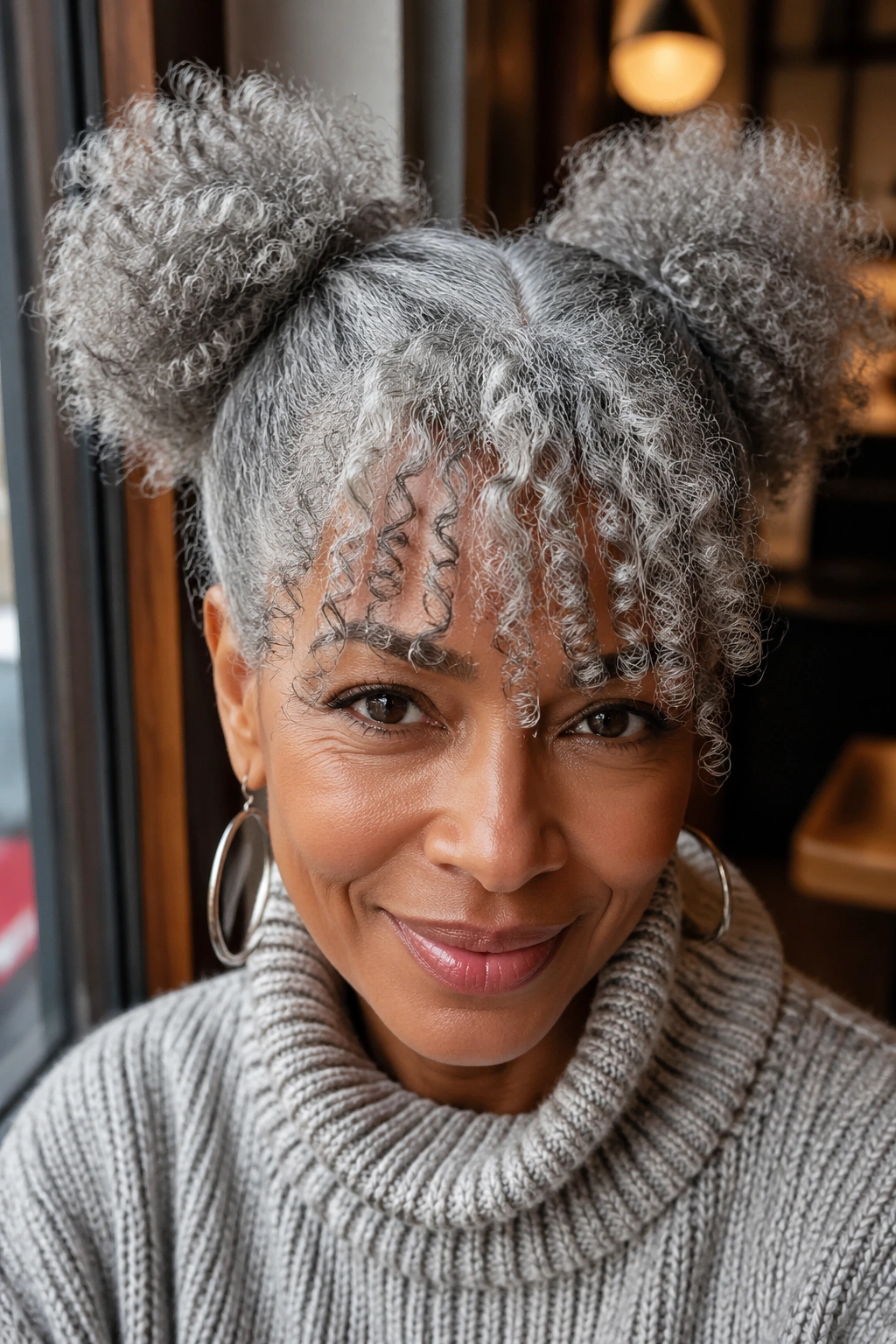
Two puffs gathered on either side of a center part — with a front section of grey curls left loose and falling forward between the puffs as a central bang. The geometry of the two puffs and the center bang creates a playful, intentional style with strong visual structure.
17. The Grey Protective Updo With Curly Bang Pieces
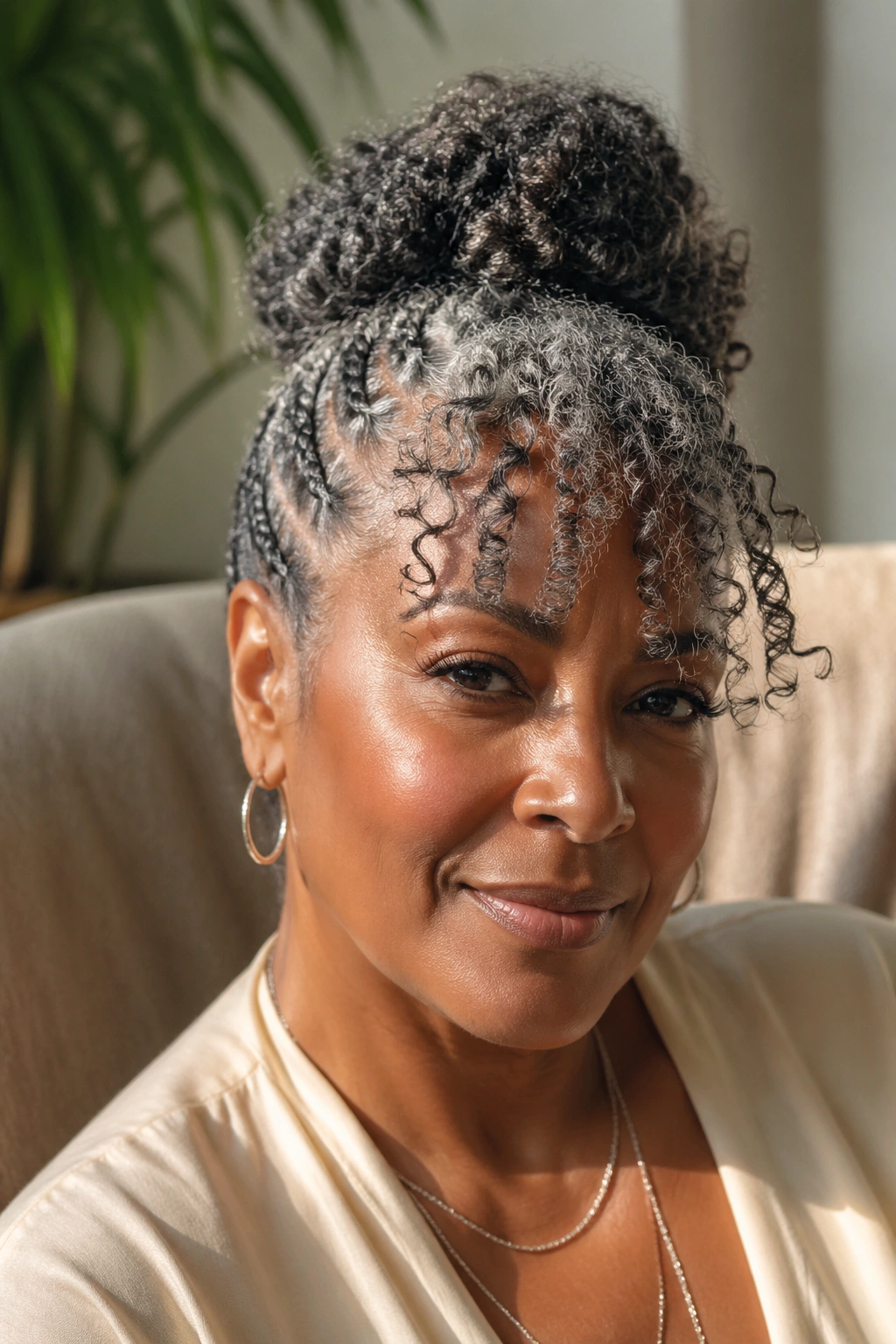
A protective style — cornrows, flat twists, or braids — done on most of the grey hair, with the bang section left unprotected and styled loosely forward. The curly grey bang pieces contrast with the structured, sleek protective style, creating a style that’s part structured, part free.
18. The Grey Wash-and-Go Bob With Fringe
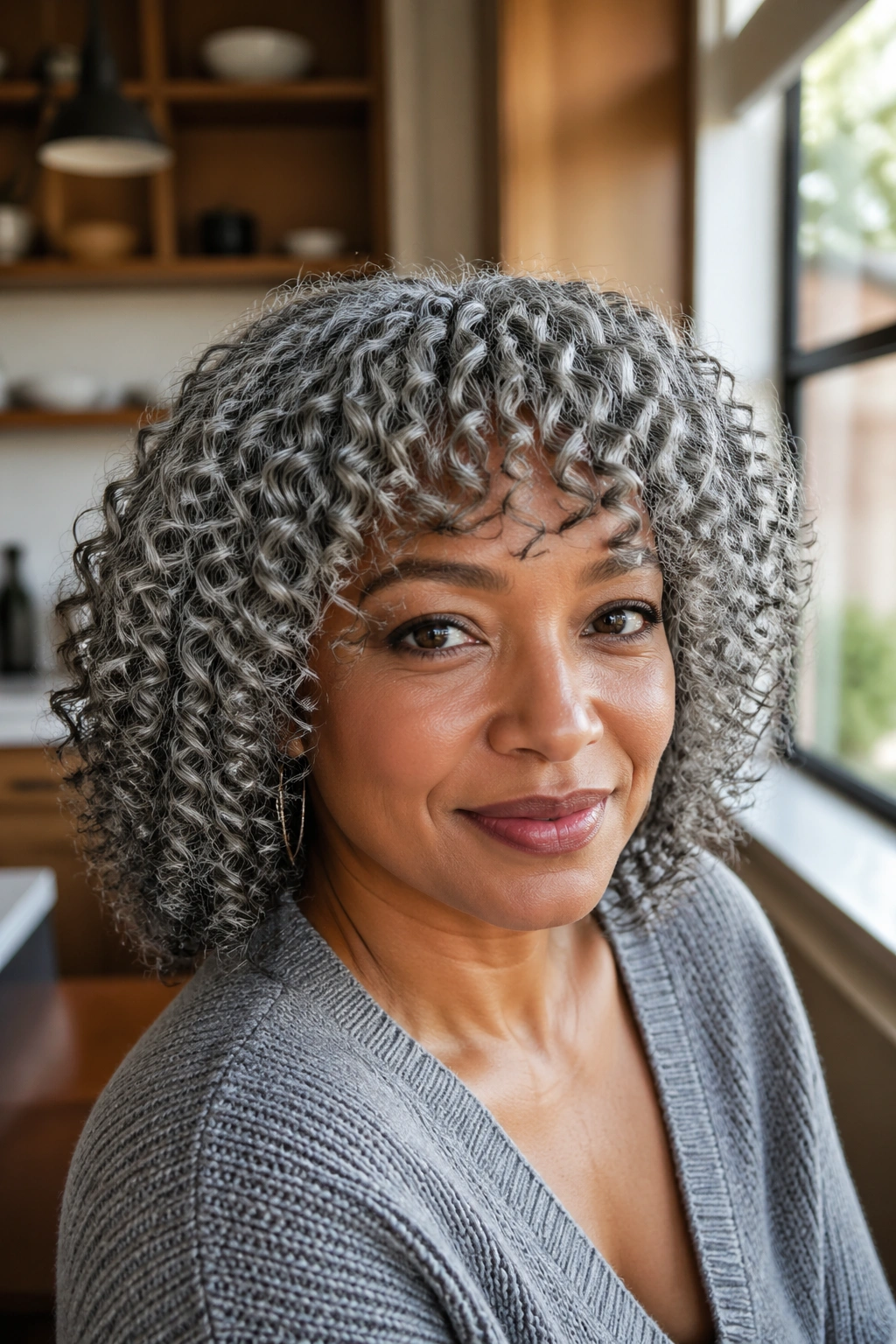
A grey curly bob styled as a wash-and-go — all curls defined and worn freely — with the bang section slightly shorter and more defined than the rest of the bob, creating a distinct front section that frames the face. On grey curly hair, the bob-plus-fringe combination is immediately striking because every element of the silhouette is made of grey curls.
19. The Asymmetrical Bang on Grey Curls
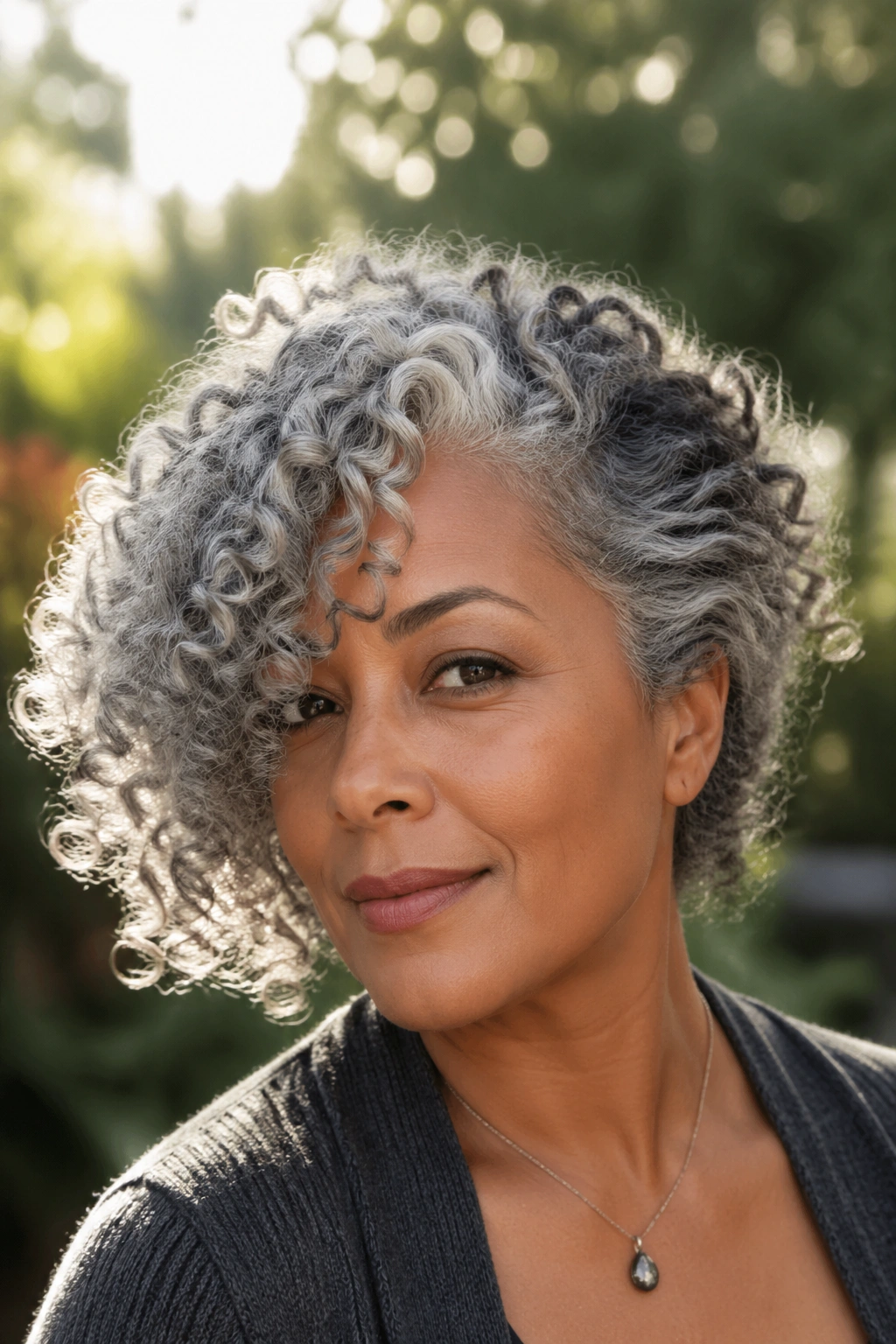
One side of the grey curly hair has a defined, forward-falling bang section; the other side is swept back or tucked. The asymmetry creates a dramatic, editorial quality that reads as bold and intentional. On grey curly hair, this asymmetry also reveals the tonal variation of the grey — the bang side shows the color one way, the swept-back side shows it another.
20. The Grey Locs With Loc Bangs
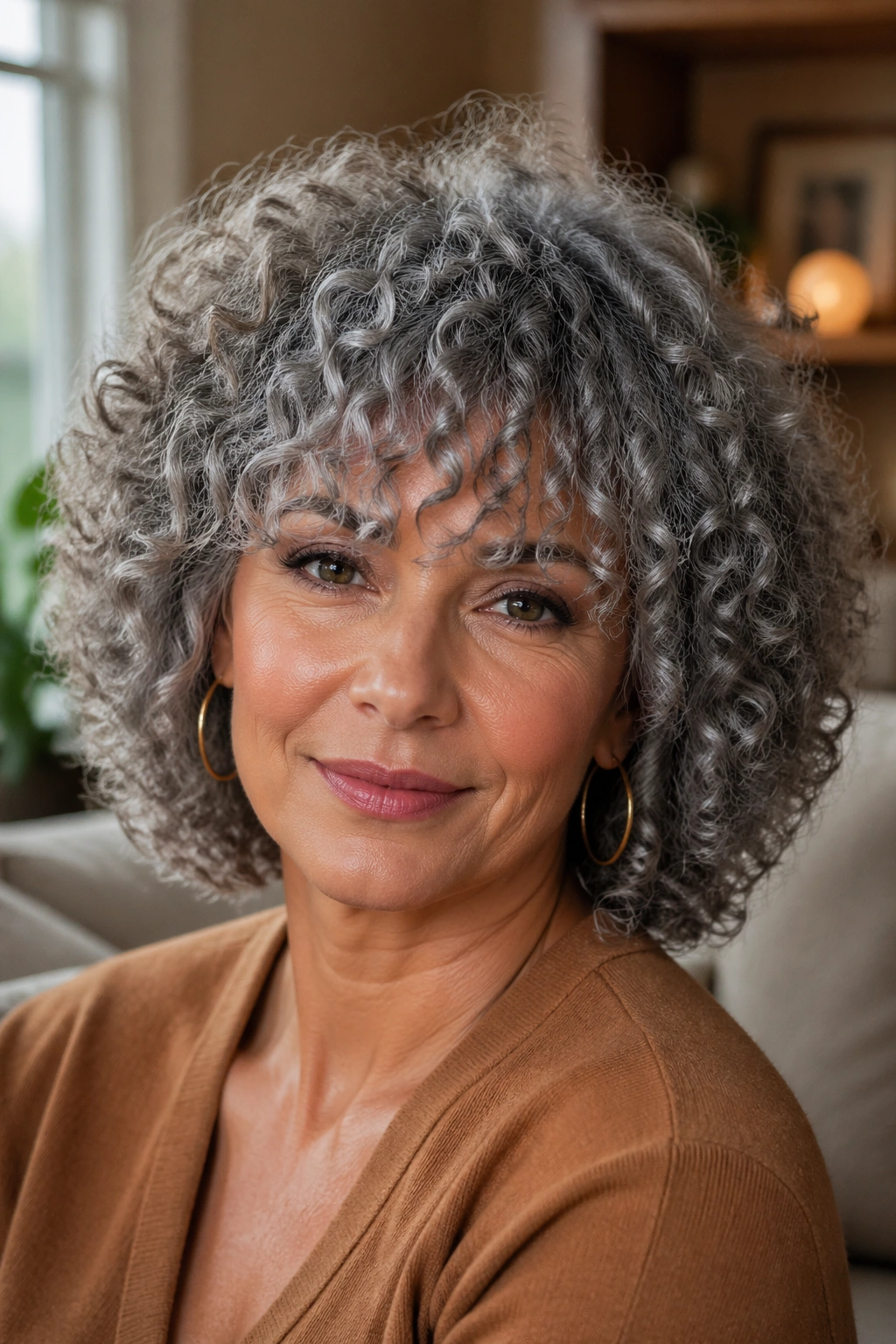
For grey curly hair that’s in locs, a front section of shorter locs can be worn forward across the forehead as a loc fringe. Locs cut to bang length on grey hair have a distinctive, sculptural quality — each loc is a defined strand of grey, and together they create a very precise, deliberate bang effect.
21. The Twist-Out Puff With Defined Grey Bangs
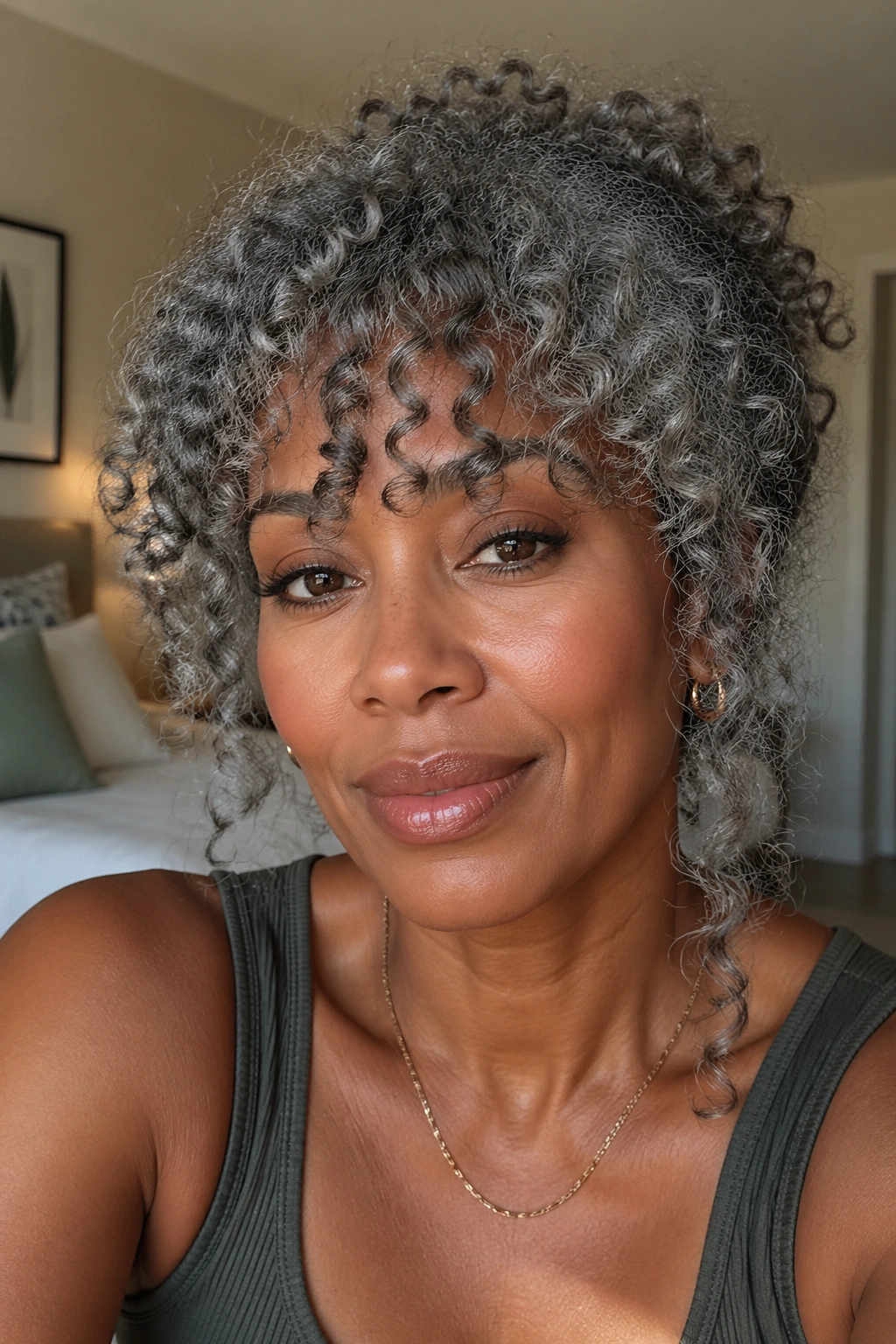
A twist-out puff — where the hair is twisted, dried, and then gathered into a puff with the twist-out texture visible — with a separate, defined bang section of grey curls falling forward at the forehead. The puff creates height and volume; the bang section creates face-framing and intimacy.
Getting Bangs on Grey Curly Hair Right the First Time
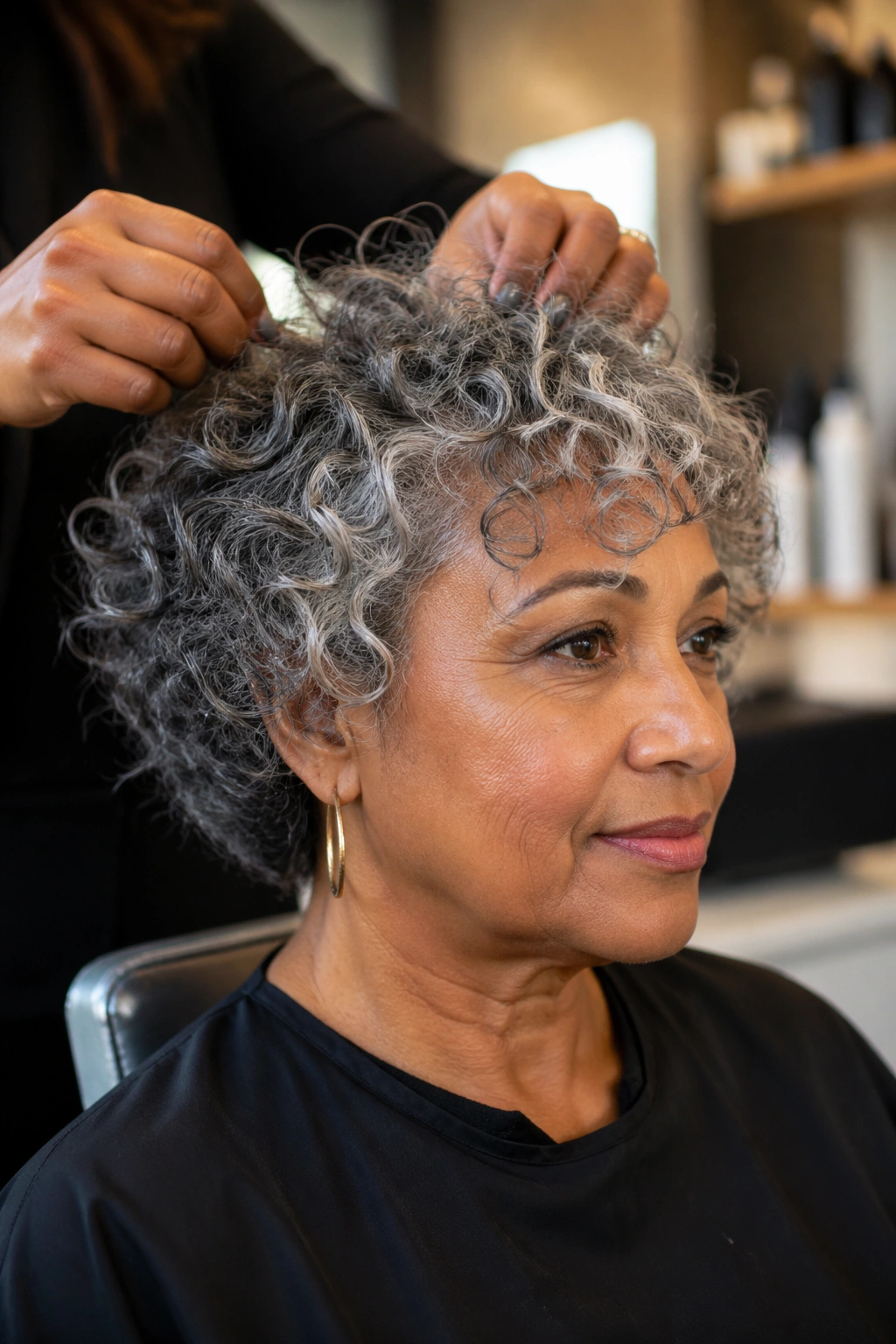
The number one mistake with curly bangs on grey natural hair is cutting them too short before accounting for shrinkage. Once cut, there’s no going back — you wait for them to grow. So always communicate your shrinkage level to your stylist, always cut conservatively, and always cut in the natural curly state rather than stretched.
The second most common mistake is using too much product on the bang section, which weighs down the curls and makes the bangs look flat and limp rather than bouncy and defined. Use lighter products on the bang section than on the rest of your hair — the bang is a small area and doesn’t need much.
Bangs Are Reversible — Sort of
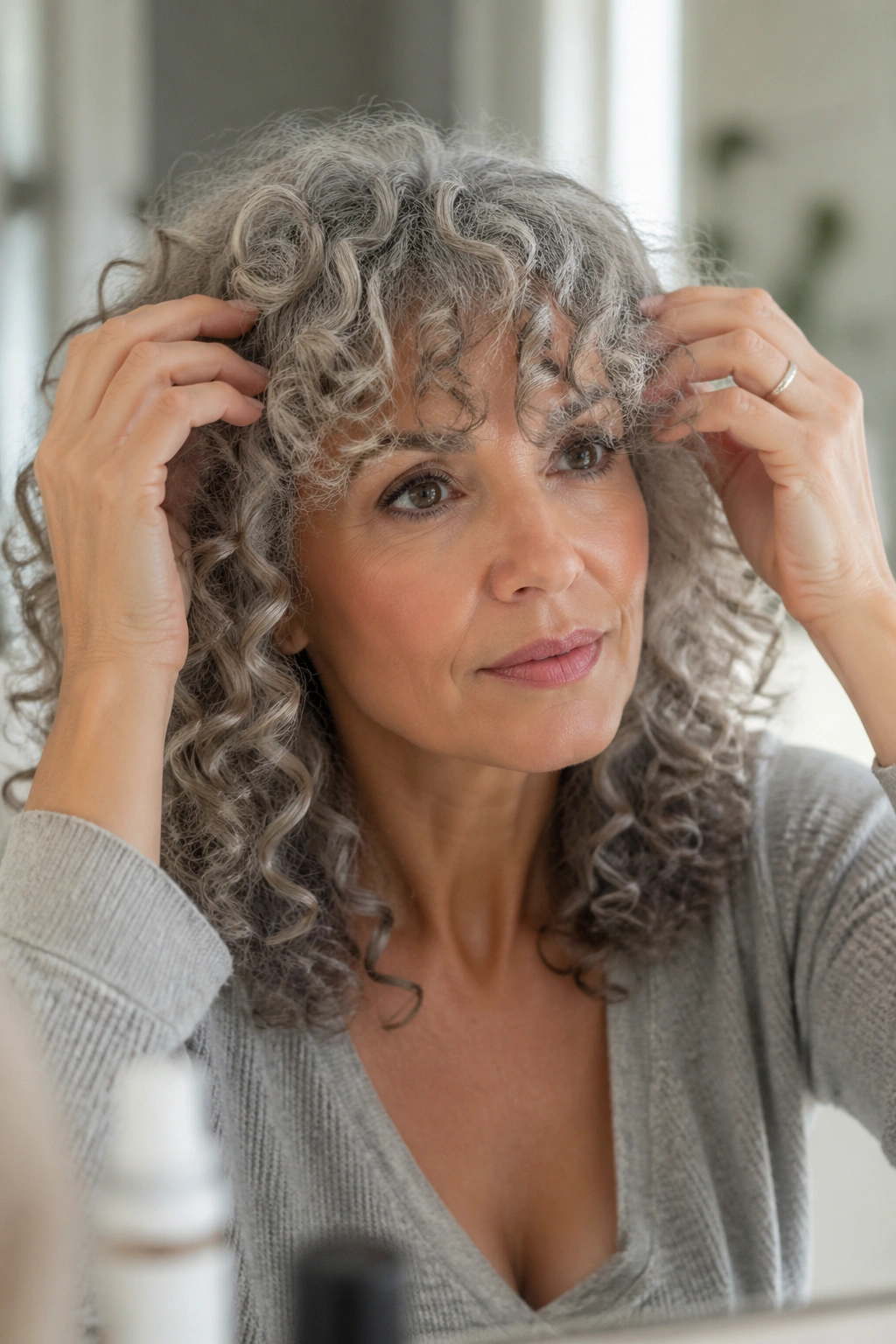
If you decide you don’t want curly bangs after all, the good news is that growing them out is simply a matter of time. The less-good news is that the grow-out phase on grey curly bangs can be awkward — the bang section sits at an in-between length that doesn’t behave like bangs or like the rest of the hair.
During the grow-out, use pins, clips, headbands, and accessories to keep the growing bangs out of your face and integrated into your overall style. Pinning the bang section back into the body of the style is the easiest approach. It looks intentional and keeps the awkward length contained while you wait for it to blend in with everything else.
