



High bun styles for curly natural hair have a way of instantly transforming a look — lifting your entire silhouette, exposing your neck and jawline, and drawing attention directly to your face in the most flattering way. For Black women with natural curls, the high bun does something extra: it showcases the volume and texture of natural hair in a way that lower styles simply don’t. When your coils, coils, and curls are gathered up at the crown and above, they catch light, create dimension, and produce a style that communicates confidence without a single word. The high bun is protective, practical, beautiful, and deeply versatile — and on curly natural hair, it’s never boring.
Why High Buns Are Particularly Flattering on Natural Curly Hair
The physics of a high bun work especially well with curly natural hair for a few reasons that are worth understanding before you start styling.
First, natural curls have volume built in. A high bun on straight hair sits relatively flat and uniform. A high bun on curly natural hair expands outward from the gathering point because the coils spring and separate rather than hanging smoothly. This means your high bun on natural hair will have a roundness and fullness that looks genuinely abundant — not like a small knot on top of the head but like a genuine statement.
Second, the gathering motion itself is flattering. Pulling hair upward from all directions toward the crown stretches the face slightly — lifting the skin at the temples, the cheeks, the sides of the brows. It’s a physical effect that most women find genuinely attractive. On natural hair, this is amplified because you’re gathering more hair volume upward, which creates more of the lifting effect.
Third, the curls that escape around the base of a high natural bun — falling at the temples, the nape, the ears — are not mistakes. They’re the most romantic part of the style. These escaped natural curls soften the severity of a high updo and create a frame around the face that genuinely flatters.
Curl Pattern Considerations for High Buns
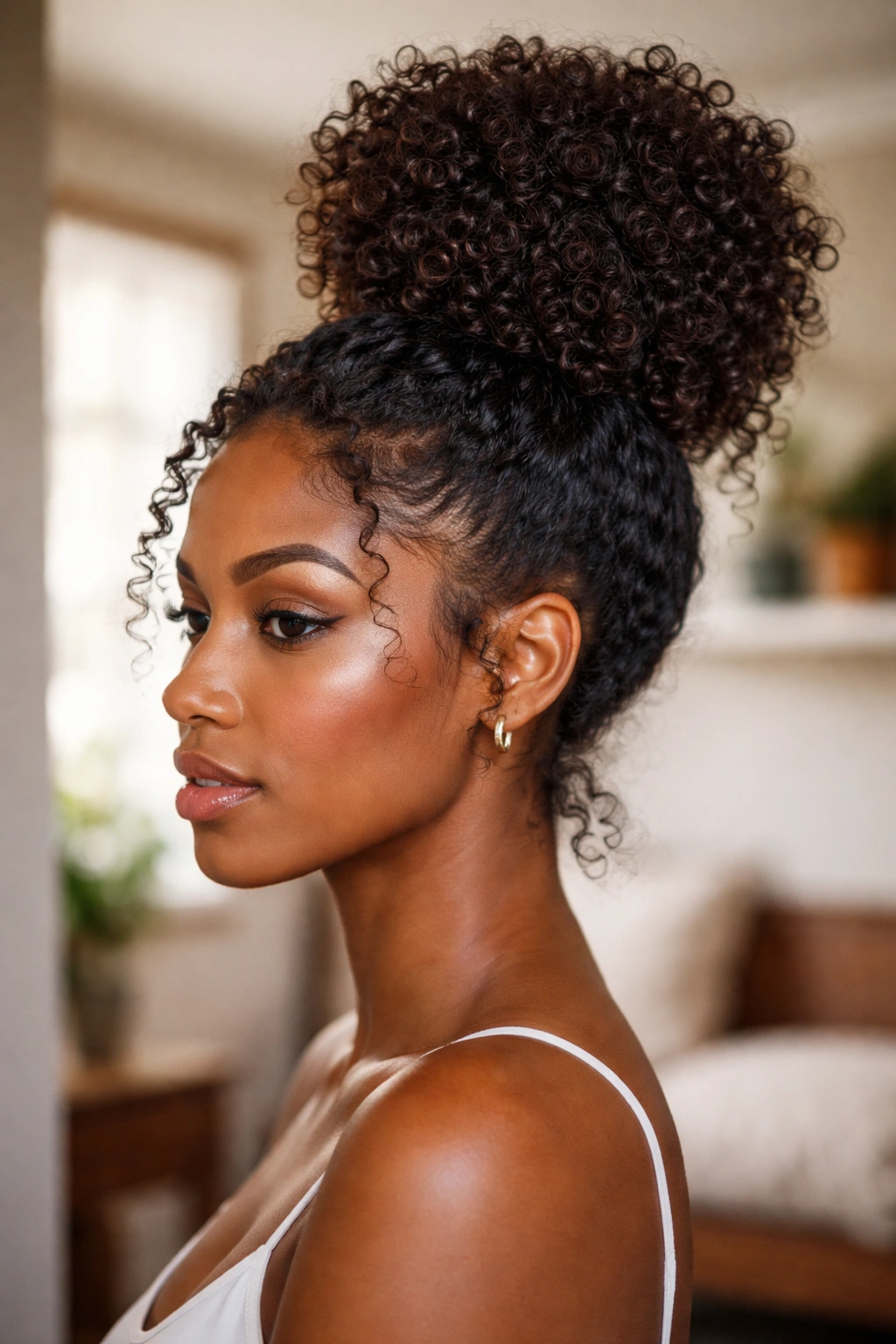
Your specific curl pattern significantly affects what your high bun will look like and what techniques serve it best.
4c hair gathers into a dense, rounded high bun with significant shrinkage at the gathering point. The bun will look smaller than the actual hair length suggests — all those tight coils compress as they gather. But the texture of the bun itself is gloriously full, and the density means the bun holds in place extremely well without much product or pinning. Stretching the hair slightly before gathering (using African threading or banding overnight) gives a larger high bun.
4a and 4b hair sits between extremes. Moderate shrinkage, visible coil definition at the bun and at the escaped sections around the base. The bun has good structure and holds well. Curl cream or a light gel applied before gathering enhances the definition of any curls that escape the bun.
3c hair shrinks less and has more defined, visible spiral coils. A high bun on 3c hair will be larger in relation to hair length than the same length of 4c would produce. The escaped curls around the base will have visible spiral definition that frames the face beautifully.
Mixed curl patterns (most natural hair women have more than one pattern throughout their head) create interesting high buns where different sections have different coil patterns. This variation adds visual depth rather than looking inconsistent.
Getting the Right Height for Your Face Shape
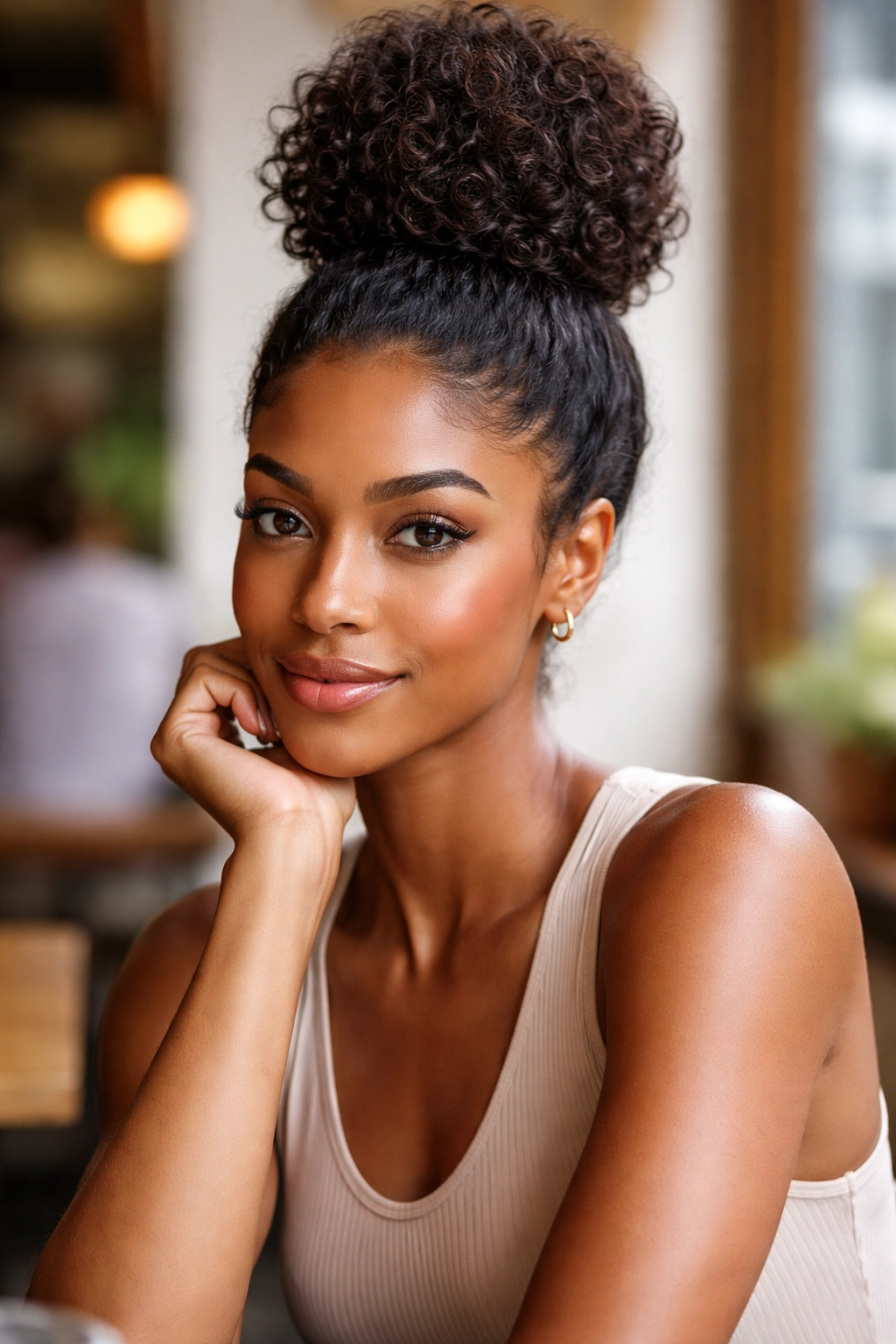
Not every high bun sits at the same position, and the height affects how the style interacts with your facial structure.
Very high buns (positioned at the very top of the head, or even slightly forward toward the crown) add the most vertical height and create the most dramatic lifting effect. They work best for women with round or square face shapes where added vertical length creates a more elongated, balanced silhouette.
High but not extreme buns (at the crown or just above, not extending toward the forehead) are the most universally flattering position. They lift the features without dramatically changing the face’s proportions.
Slightly forward-positioned high buns (leaning toward the front of the head rather than straight up) read as more casual and playful — a high puff quality rather than a formal updo quality. These are the go-to for everyday wear.
The exact right position for your bun is the one where you gather everything upward, let it settle naturally, and your face looks the way you want it to look. Pay attention to where your gathered hair wants to sit naturally before you secure it — your hair often finds its own best position.
Essential Techniques for a High Bun That Holds
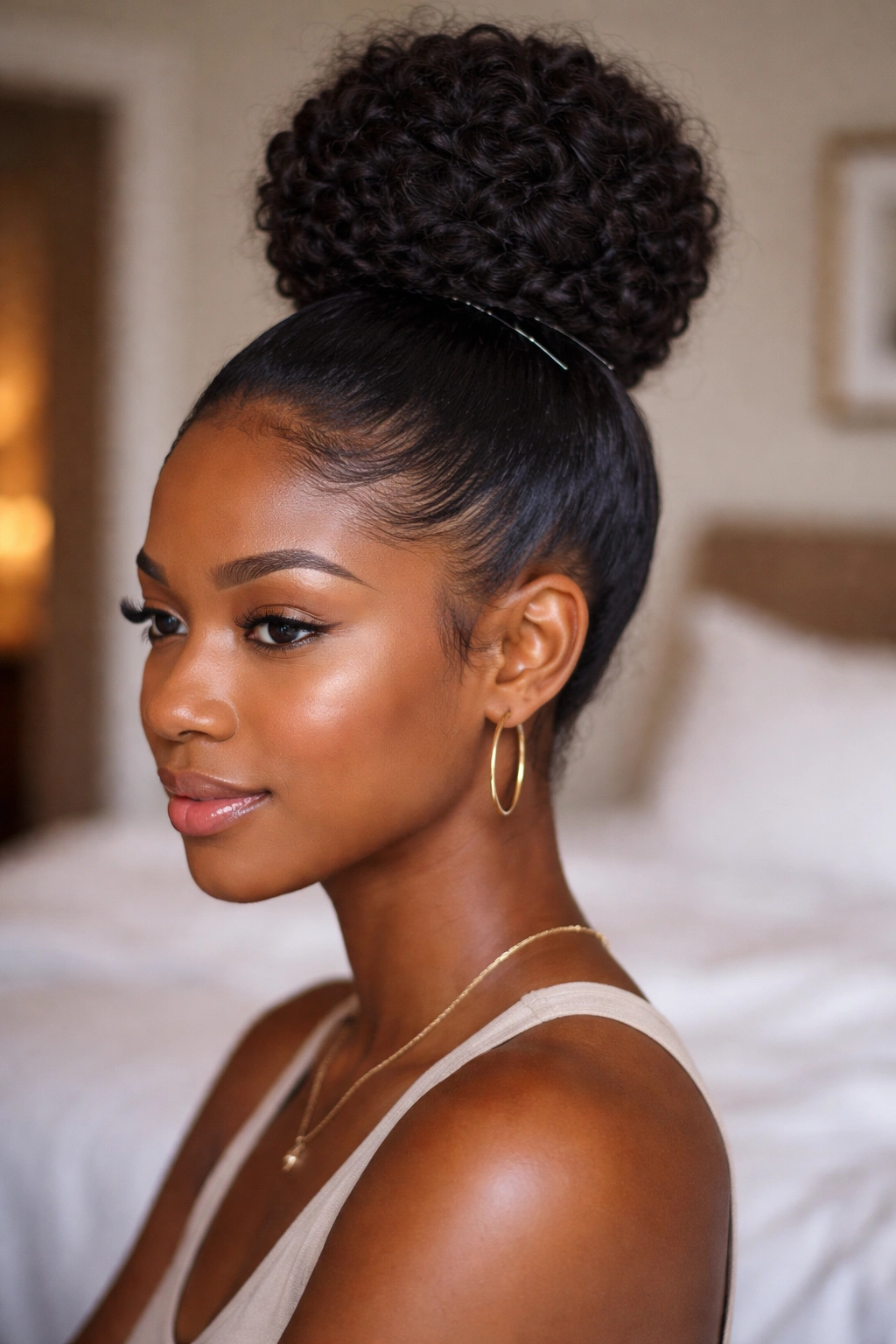
A high bun on natural curly hair that falls down by noon isn’t serving anyone. The goal is a bun that holds its position throughout whatever the day brings.
The gathering technique matters: scoop hair from all directions — from the nape, from both sides, from the crown — upward toward your intended bun position. Hair gathered in this way has support from multiple directions rather than just being pulled from the back.
One hair tie, not multiple wraps: over-wrapping a hair tie creates tension at the hairline. One firm wrap with a satin-lined or fabric hair tie is sufficient and kinder to your edges.
Bobby pins for security: on natural curly hair, bobby pins placed at the base of the bun — going through the bun and catching the hair beneath — secure the bun without pulling at the roots.
Edge control at the hairline: applying edge control before gathering allows you to smooth the hairline first, then gather into the high position. This is easier than trying to lay edges after the bun is in place.
1. Classic High Natural Puff Bun
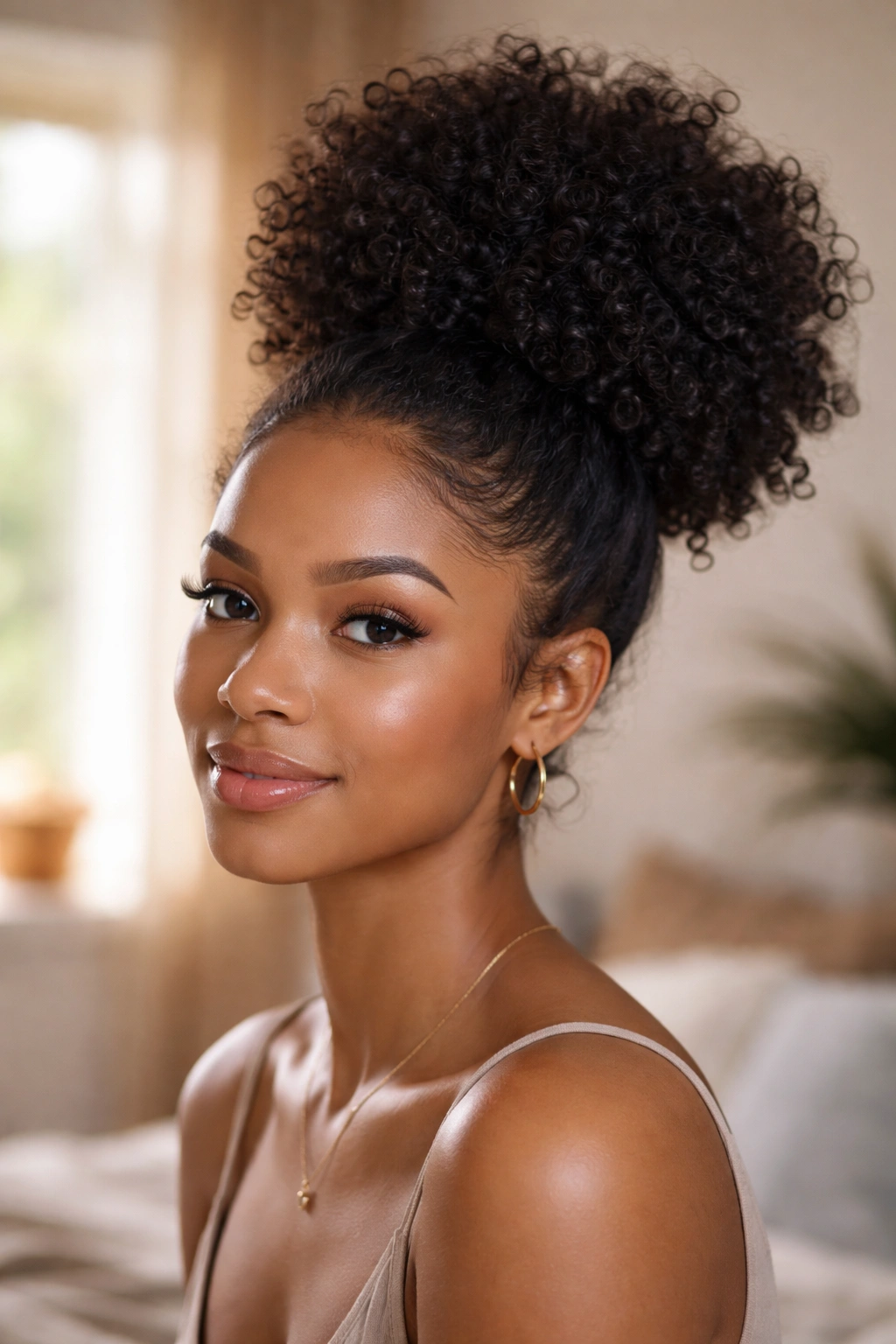
The most direct expression of the high bun concept on natural hair — gathering everything upward and letting the curls spring into a full, rounded puff above the hair tie. No smoothing, no containing, just gathering.
The classic high puff is the style that made the high natural hair bun iconic. Its popularity over many years is completely earned — it’s beautiful, it takes minutes to achieve, and it looks genuinely good from every angle.
The key is not over-managing after the gather. Gather, secure, gently separate the puff for volume if needed, and stop. Every additional touch beyond that risks moving toward a tight bun and away from the full puff quality.
How to Get This Look
- Gather all hair upward with your hands (don’t comb or brush for this style — use your hands to preserve the natural curl groupings)
- Position the gather at or above the crown
- Secure with a satin-lined hair tie in one motion
- Gently pull the puff upward and outward with your fingers to expand it
- Lay edges with edge control and a soft brush
- Done — don’t touch the puff again
2. Sleek High Bun With Gel
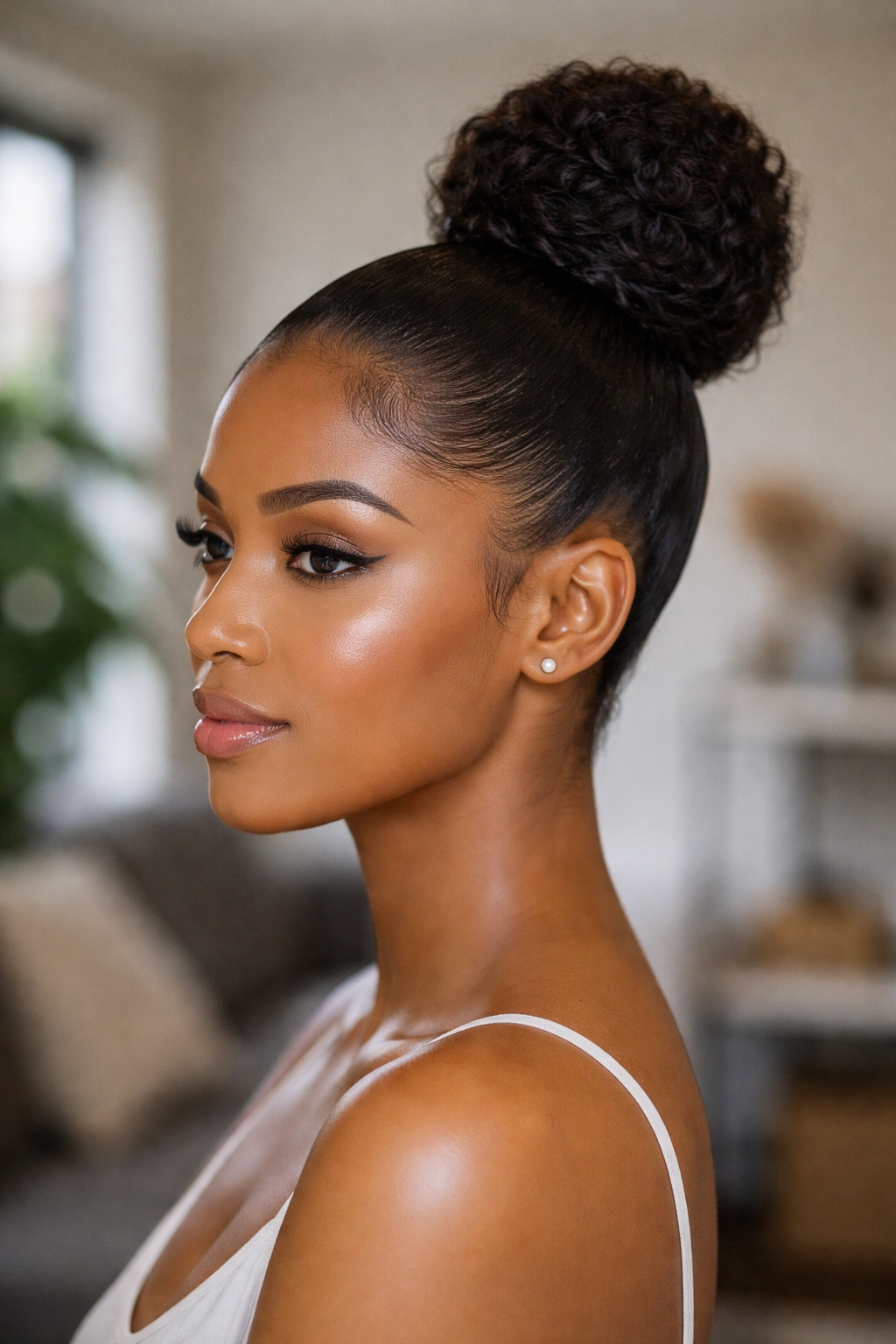
The opposite of the puff: a sleek high bun uses strong-hold gel to smooth the natural hair backward from the hairline all the way to the bun gathering point, creating a high bun where the sides and back are smooth and flat while the bun itself is fully gathered at the top.
The sleek high bun is a statement of a different kind from the puff. Where the puff celebrates natural volume and texture, the sleek high bun is about the contrast between controlled, smoothed sides and the full curl gathering at the top. Both are beautiful — they’re just making different statements.
Apply the gel generously through sections before gathering. Use a wide-tooth comb or brush to smooth the gel through and pull all sections upward. Secure, then smooth any remaining flyaways with your fingers or a brush while the gel is still wet.
3. High Bun With a Braid Wrap
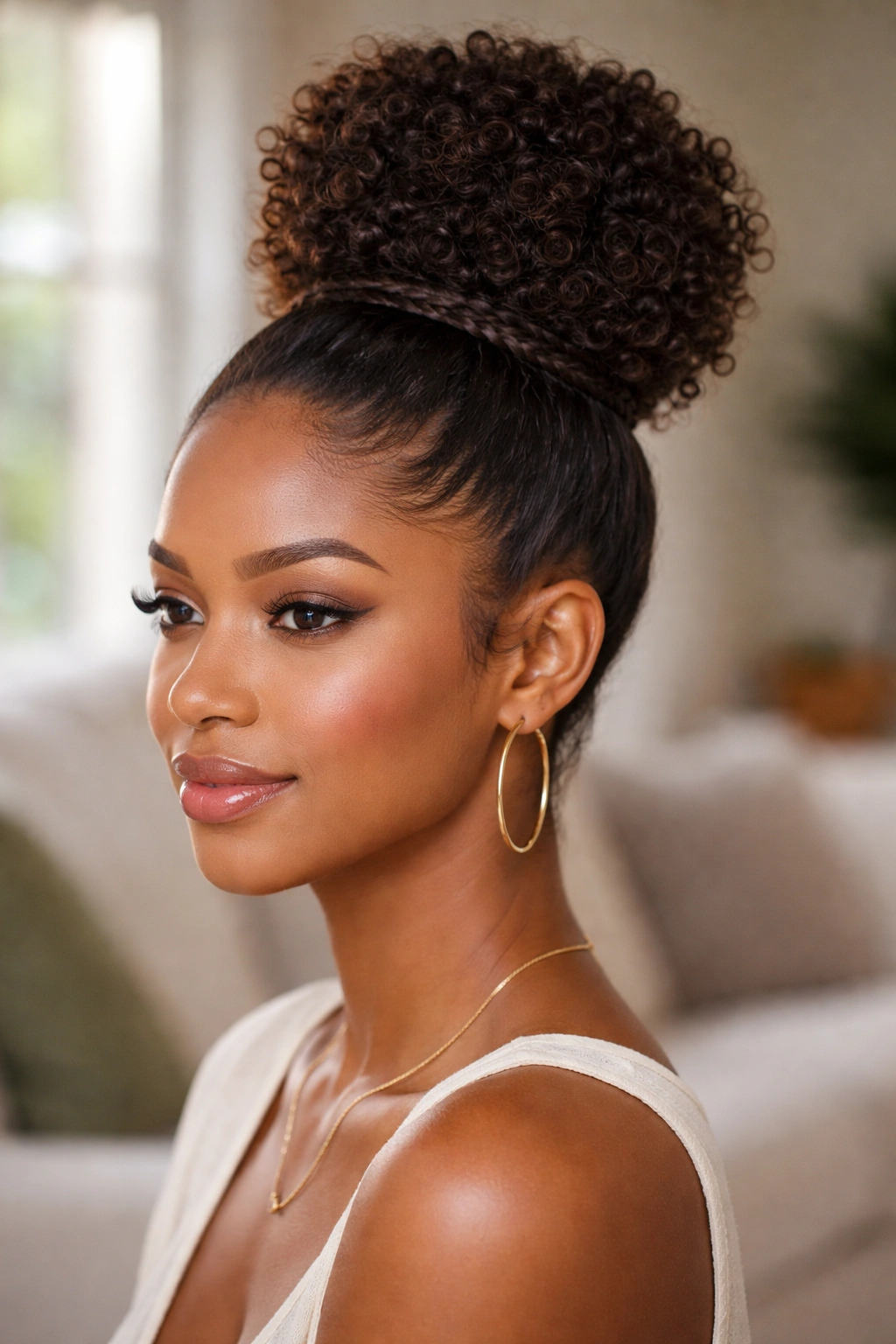
Wrapping one thin braid around the base of the high bun — covering the hair tie entirely — adds an artisanal, intentional detail that transforms a simple high bun into something more deliberate.
Take a thin section of hair from underneath the gathered ponytail before securing it. Gather and secure everything else. Then braid the held-out section into a three-strand braid, wrap it around the hair tie at the base, and tuck the end underneath, securing with a bobby pin.
The braid wrap is the kind of detail that people notice and compliment specifically. It takes less than two minutes and creates a meaningfully different impression.
4. Two-Strand Twisted High Bun
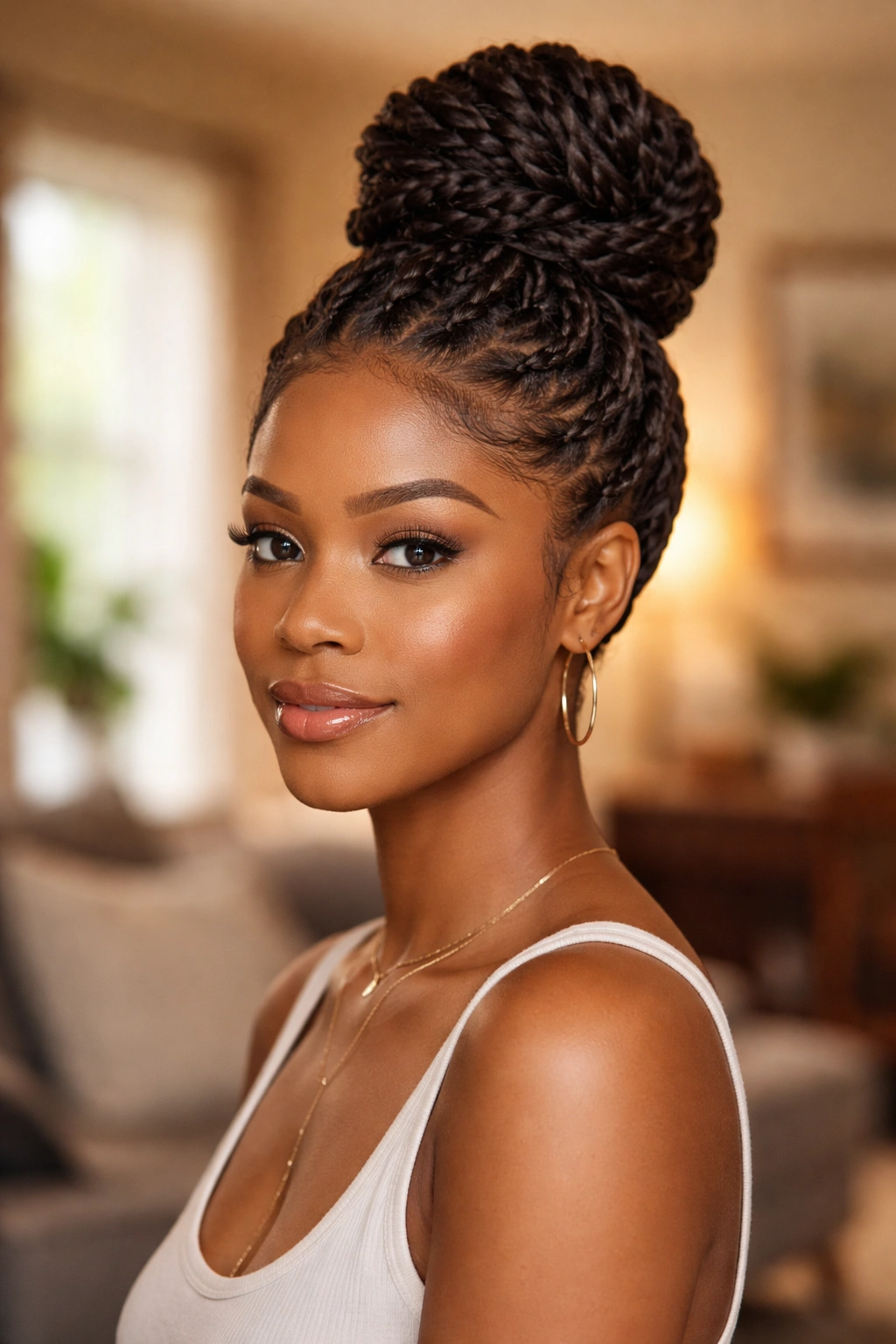
Twisting all your natural hair into two-strand twists before gathering them into a high bun creates a bun with significantly more texture and structure than gathering loose natural hair. The twists grip each other within the bun, creating a more stable gathering that holds throughout the day.
The twisted high bun also looks beautiful in a different way from a loose curl bun. The visible twist patterns in the gathered section add geometric detail; the twists that escape around the base have a more defined spiral quality than loose escaped curls.
This is a great choice for women whose natural hair tends to slip out of hair ties because the twist structure provides more grip at the gathering point.
5. High Puff With Flat-Twisted Sides
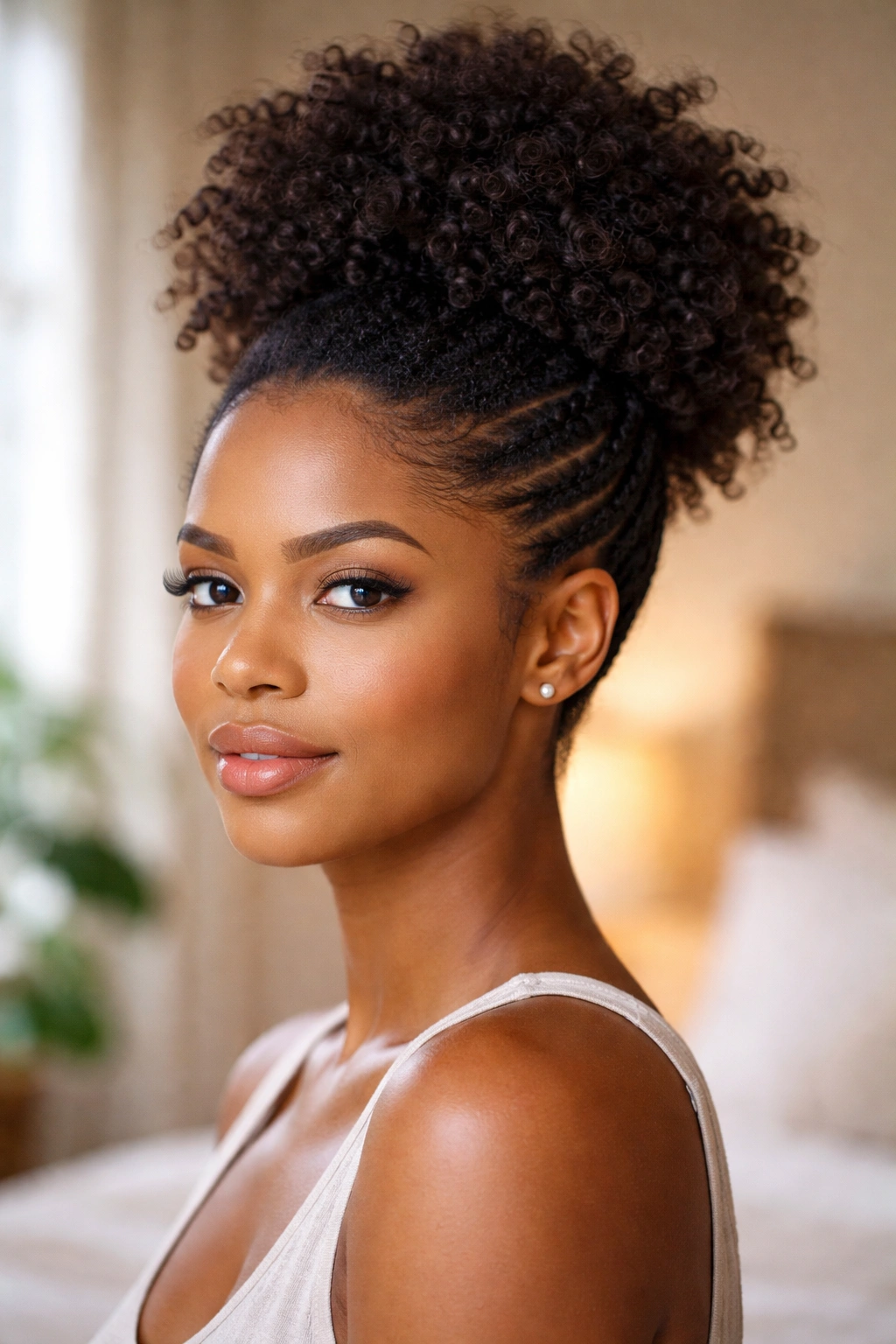
Flat twisting the sides and back of the hair upward toward the gathering point — so the flat twist lines run vertically up the sides of the head — before incorporating everything into the high puff creates a style that’s intricate at the scalp but casual at the bun.
The flat-twisted sides show deliberate work — clean parts, even twist patterns. The puff at the top shows your natural texture. The combination reads as genuinely skilled natural hair styling that celebrates both structure and texture.
6. High Bun With Loc Rings and Accessories
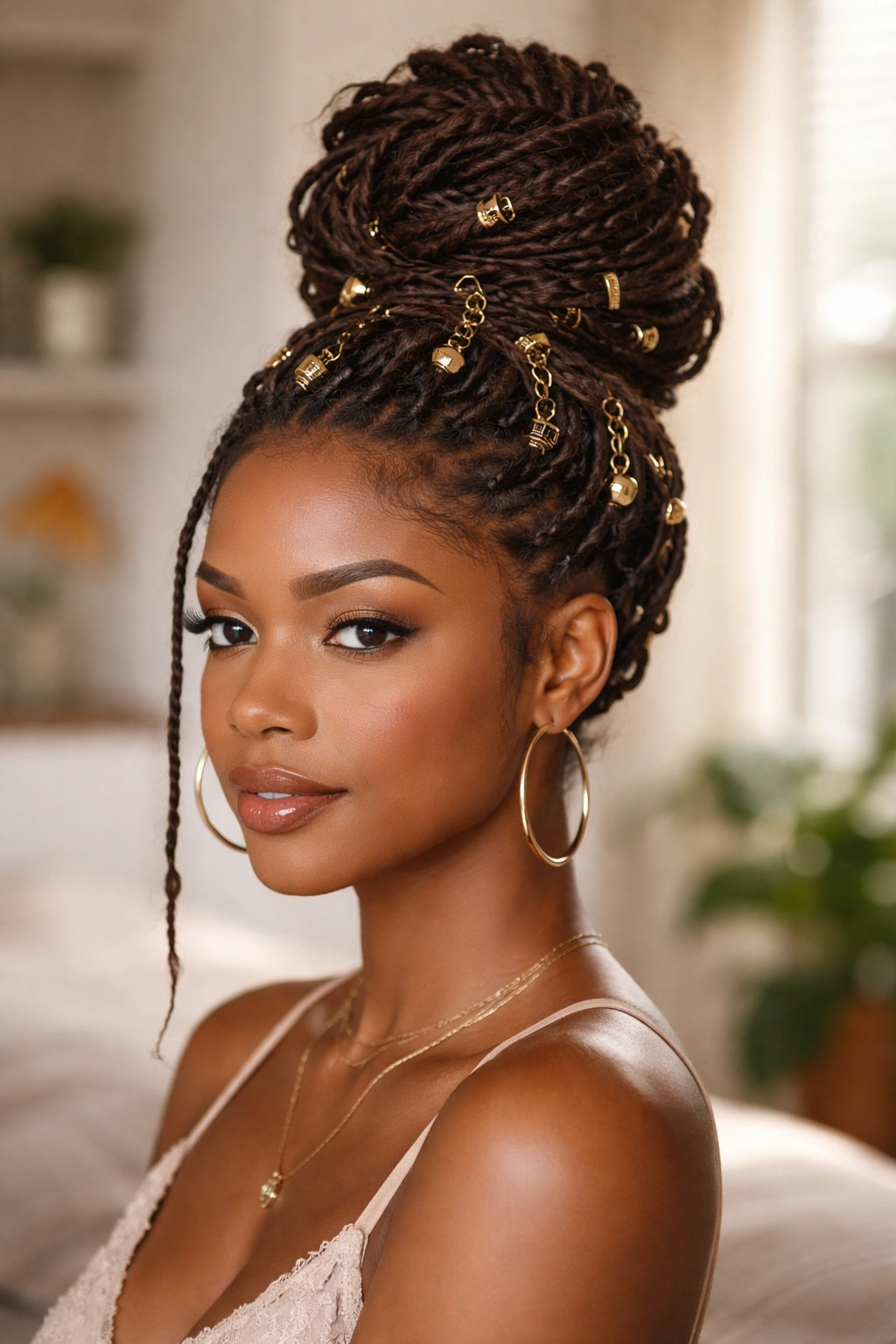
Even a simple high bun becomes something more with the right accessories. Loc rings slid onto individual sections before gathering them into the bun sit at various points in the gathered bun, catching light as the bun moves.
For a high bun: position accessories strategically before gathering. Decide which sections should have rings, add them at the desired points along those sections, then gather everything upward. The rings will sit distributed throughout the bun, creating a scattered jewelry effect that’s genuinely beautiful.
7. The Exploded High Puff
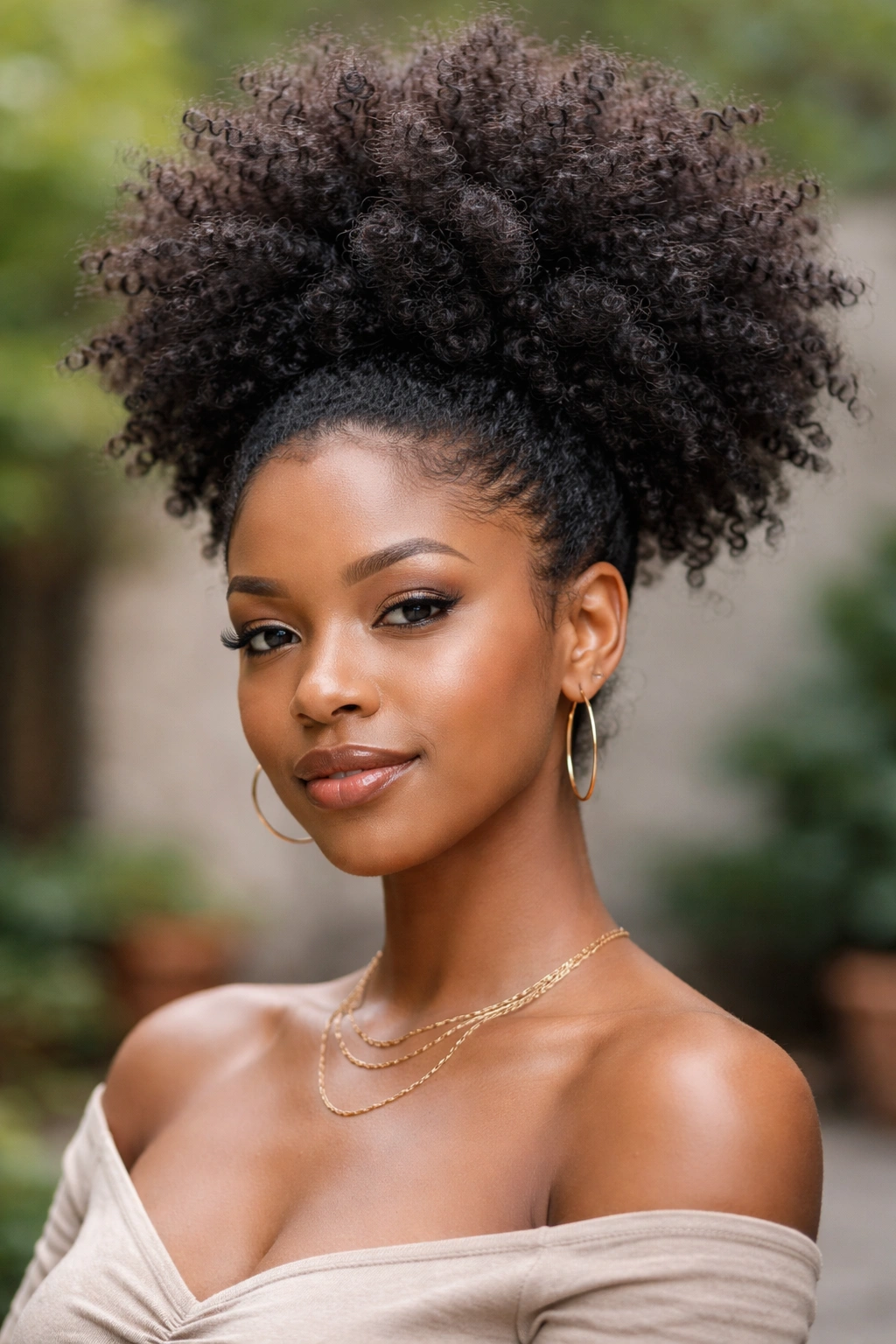
An “exploded” high puff is exactly what it sounds like — a high puff that’s been maximized in size, with sections pulled outward and upward as far as they’ll go, creating the fullest, most dramatic version of the style possible.
On 4c hair, an exploded high puff can be genuinely extraordinary — the tight coils, when allowed to expand in all directions from the hair tie, create a sphere of hair that has real visual power. This is natural hair at its most expressive, most confident, most unapologetically full.
No products other than a light moisturizer before gathering. Heavy products prevent this expansion. Let the hair’s natural volume do the work.
8. High Bun With Curly Tendrils Left Free
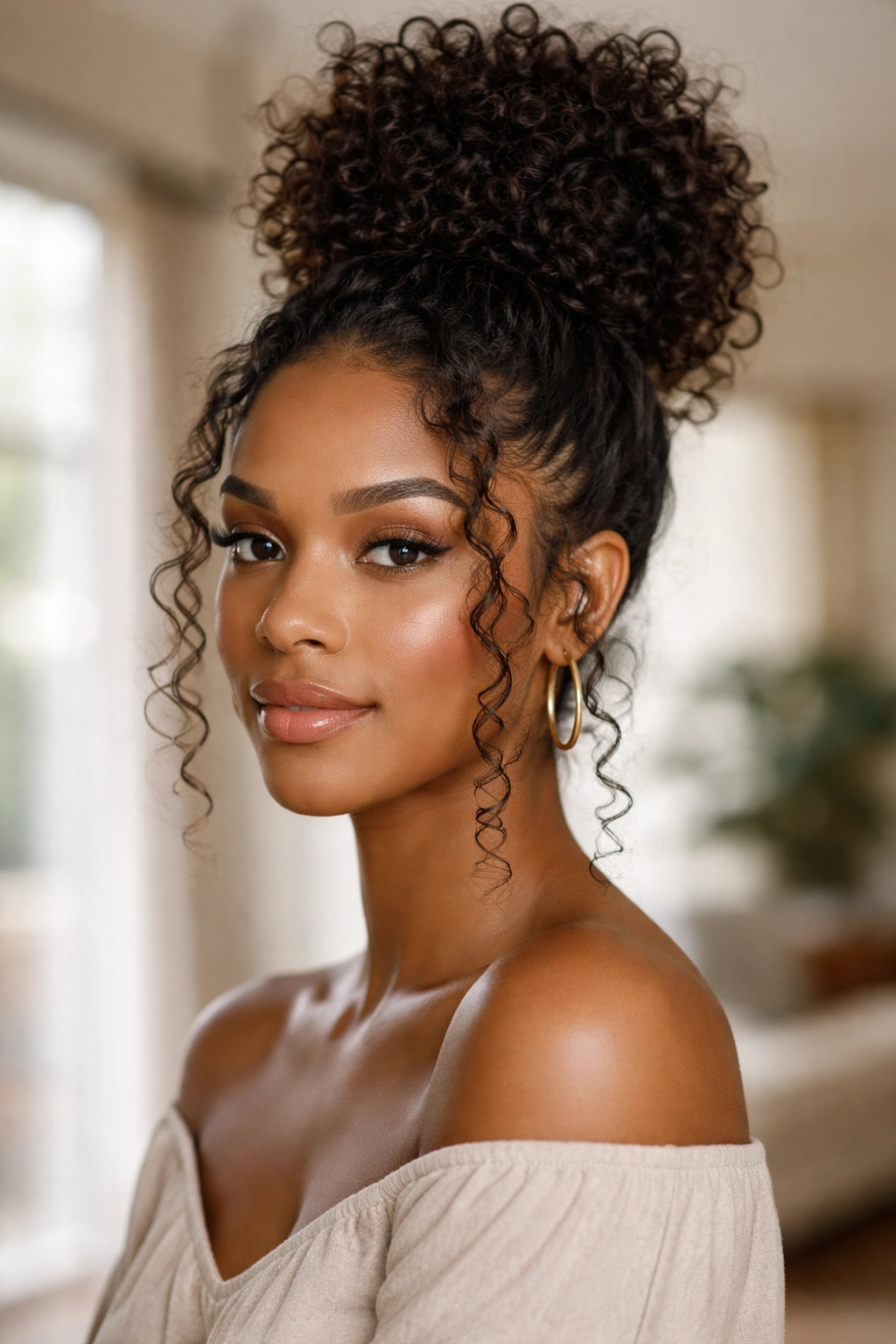
Leaving deliberate sections free at the temples and in front of the ears before gathering everything else into the high bun creates a romantic, soft look around the face. These freed sections — moisturized and allowed to coil naturally — frame the face from below the ear upward while the bun provides height above.
The tendrils work best when they’re defined — either naturally coiled (apply a small amount of curl cream to the section before leaving it free) or finger-coiled deliberately before the bun is gathered. Loose, frizzy tendrils don’t have the same effect as defined ones.
This is the high bun for occasions that call for something pretty: date nights, family gatherings, celebrations where you want your hair to feel special.
9. High Bun With Bold Satin Headband
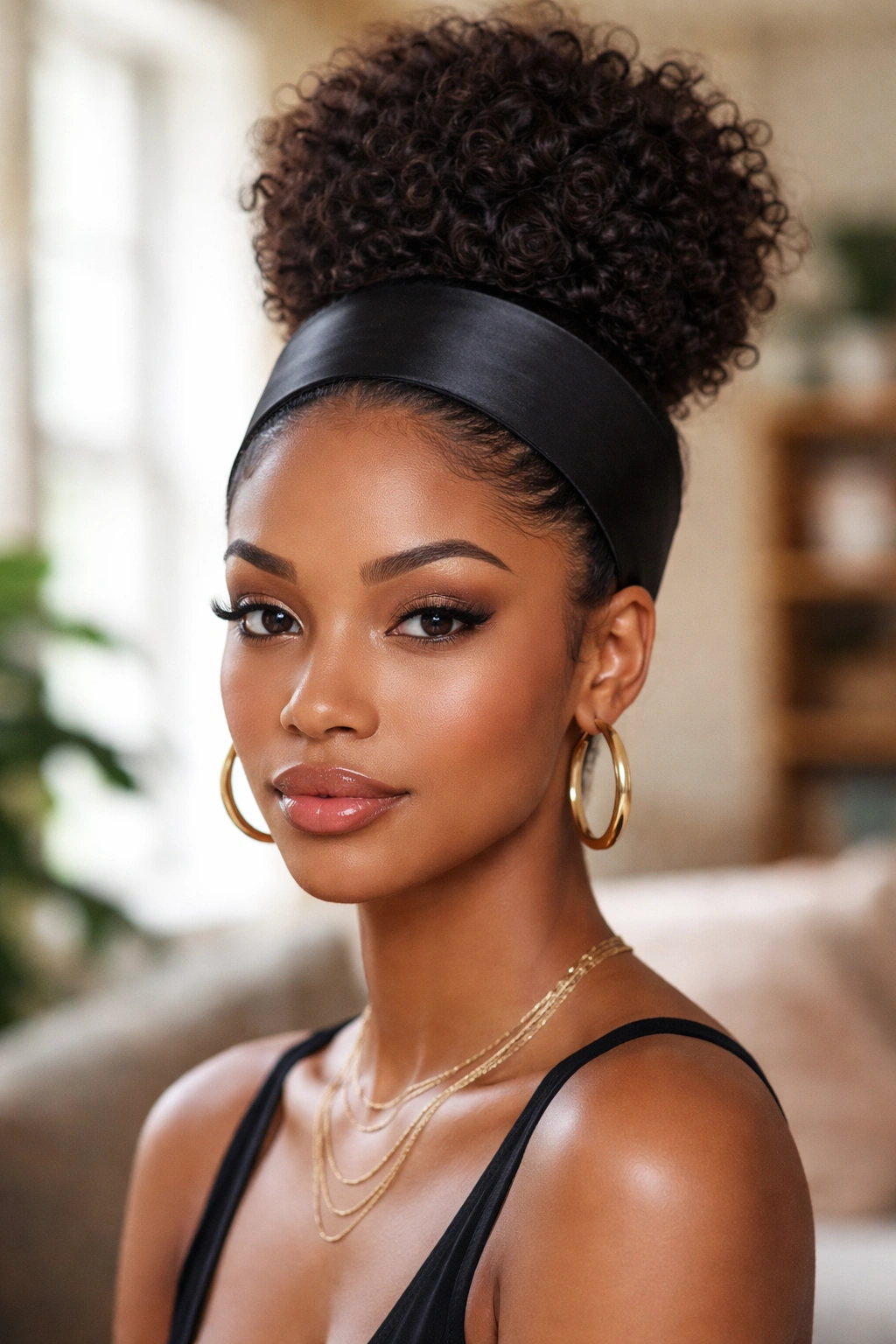
A bold, wide satin or velvet headband worn across the front of the head — positioned at the hairline — gives the high bun a very specific editorial quality. The headband frames the face and the hairline, and the bun sits dramatically above it.
The scale of the headband matters: wide bands (2 inches or more) make a stronger statement and look more intentional against the visual drama of a high natural bun. Narrow headbands can look proportionally thin against the fullness of the bun above them.
10. High Bun on Stretched Natural Hair
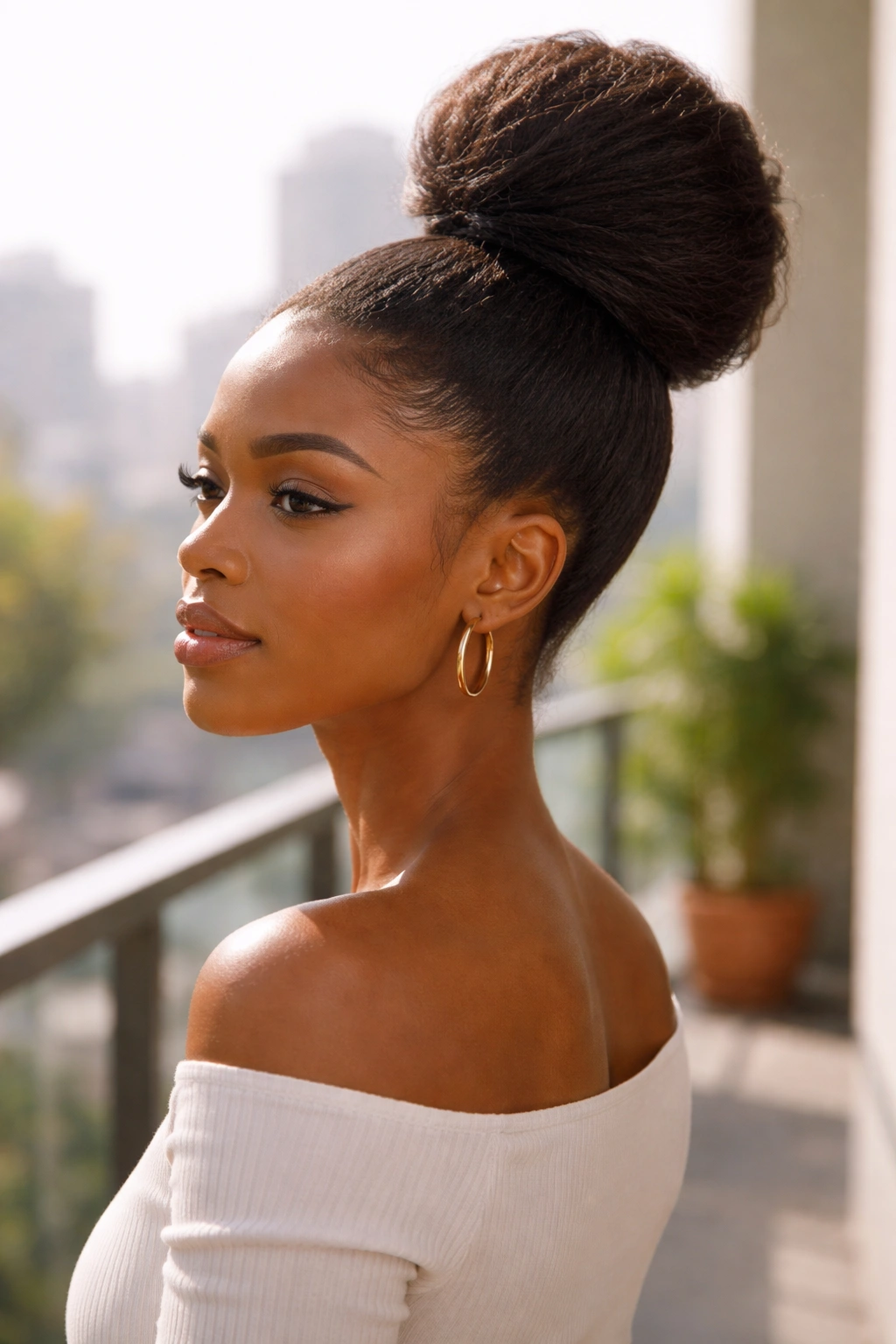
Stretching natural hair before gathering it into a high bun changes everything about the bun’s size and shape. Stretched natural hair — longer, less shrinkage-affected — produces a higher, more elongated bun rather than a compact, rounded one. The bun stands taller and the gathering point is cleaner.
Methods for stretching: African threading overnight (insert thread through sections and wrap, remove in the morning), banding (elastic bands placed at intervals along sections), or a light blow-dry on the lowest heat setting with a diffuser attachment.
Stretched high buns are the right choice when you want the style to look deliberately managed rather than naturally settled.
11. High Bun for Heat-Free Styling
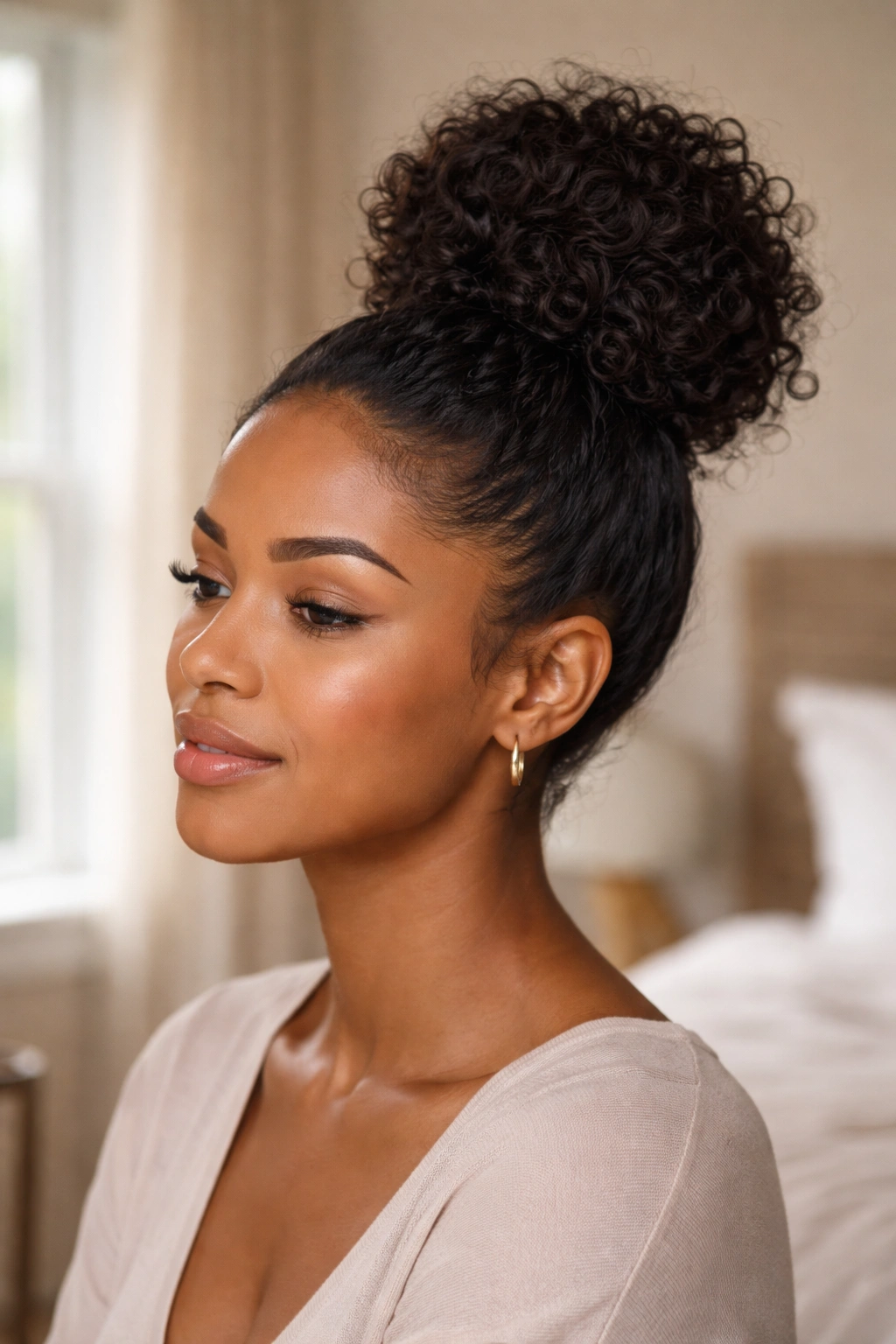
The high bun is one of the best heat-free styling options for natural hair because it doesn’t require blow-drying, flat-ironing, or any thermal processing. The style works entirely with the natural texture.
For women who are deliberately avoiding heat to restore or maintain their curl pattern, the high bun is the perfect everyday style. The curls are protected in the bun during the day, and when released in the evening, they’re still intact and defined.
How to Get This Look Without Heat
- Detangle gently with a wide-tooth comb or fingers on damp hair
- Apply leave-in conditioner and a lightweight styler throughout
- Gather into the high bun while damp
- Allow to air dry in the bun position
- Wear as a bun during drying, then either continue to wear as a bun or release for a defined stretched curl style
12. Two Stacked High Buns
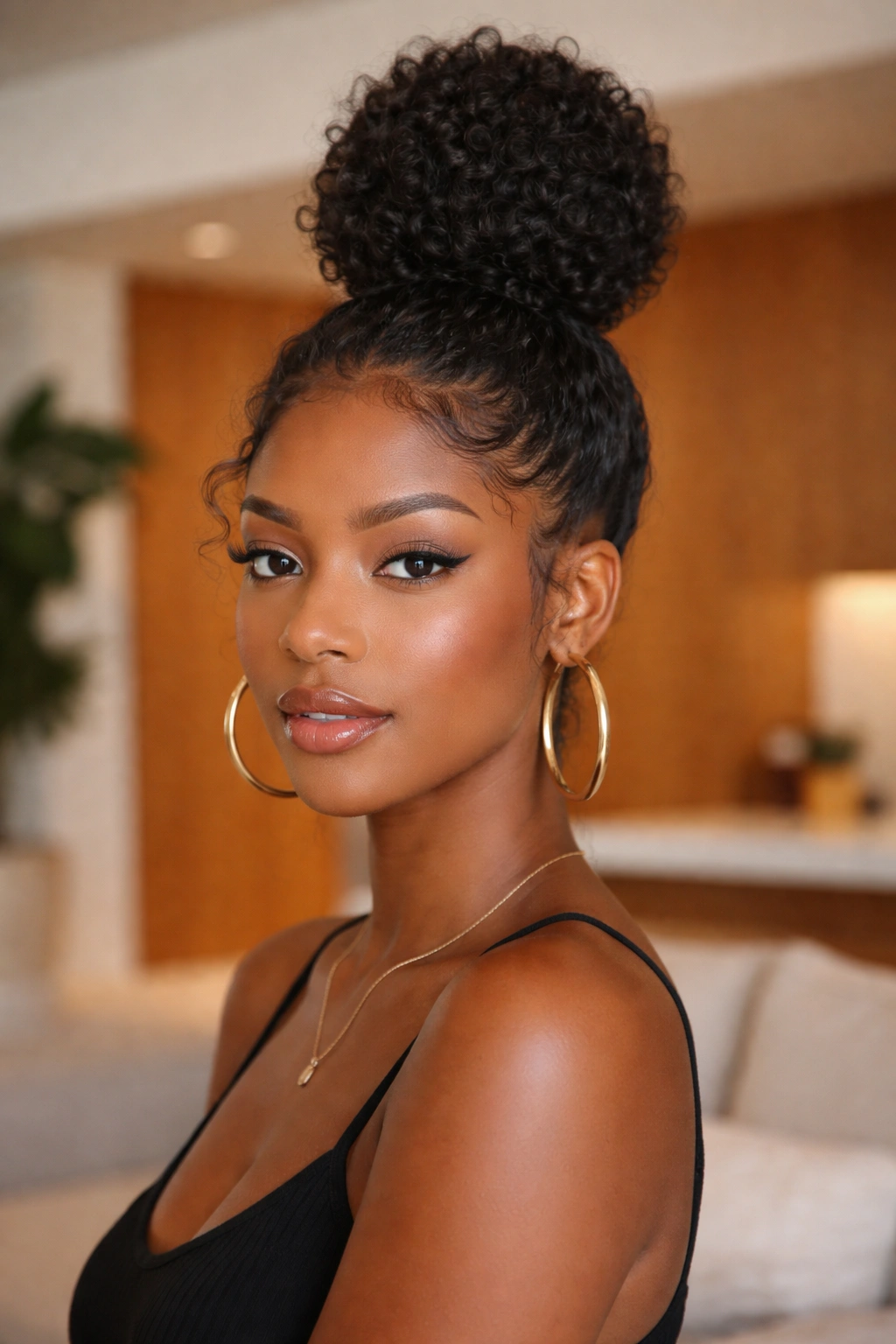
Two buns positioned at different heights on top of the head — both above the crown — create a dramatic, almost sculptural style. The lower bun provides a base; the upper bun extends the height further. Together they create a stacked arrangement that reads as artistic and deliberate.
This is not a common style, which is part of its appeal. When natural hair is gathered into two stacked buns, the effect reads as creative and intentional in a way that single buns don’t always achieve.
The hair needs to be long enough to create two meaningful bun sizes — very short natural hair will struggle to create two distinct buns. But with 6 or more inches of stretched length, it becomes achievable.
13. High Bun With Bantu Knot Accent
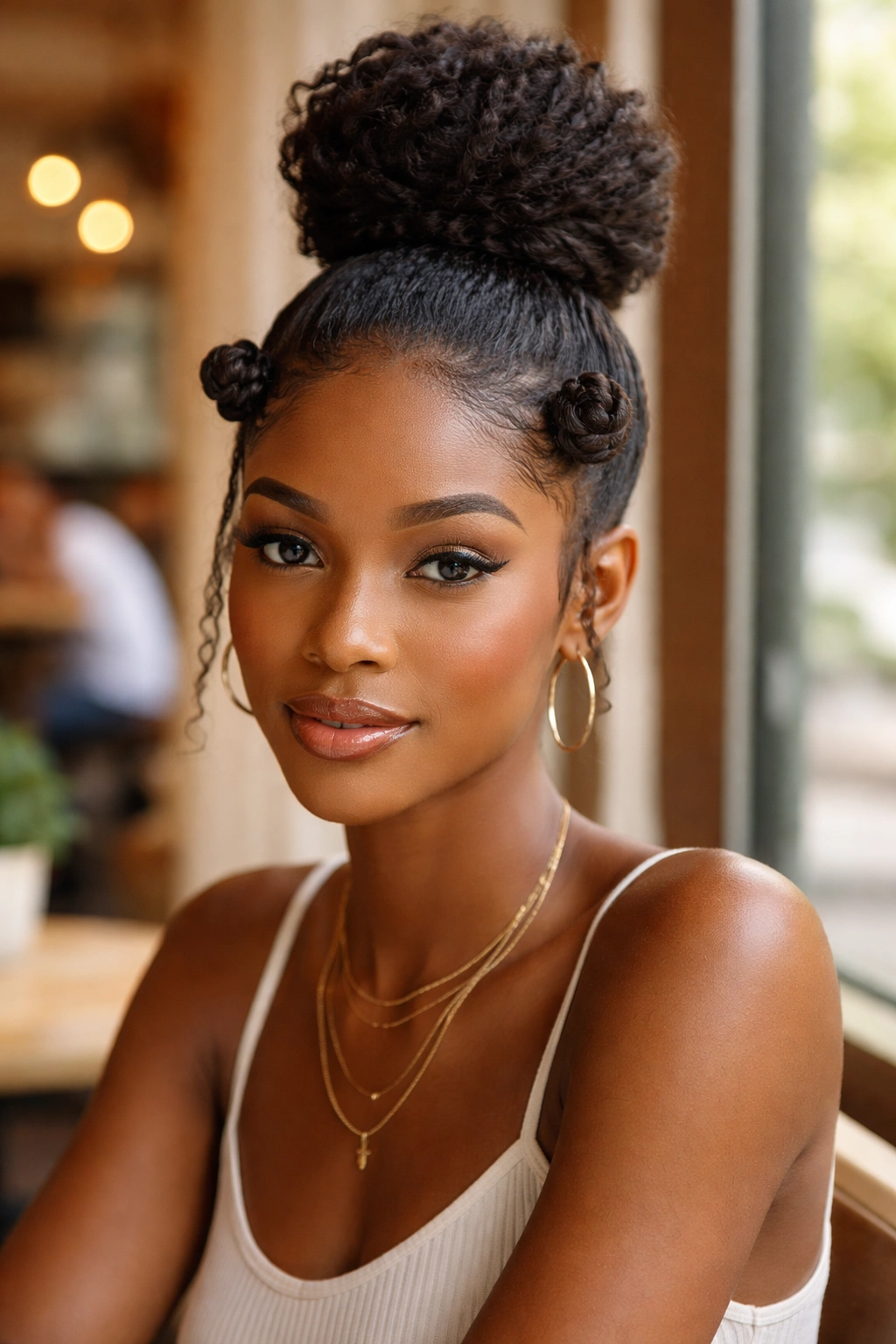
Creating one or two small Bantu knots at the front sections of the head — at the temples or along the front hairline — before gathering the majority of the hair into a high bun creates a style that mixes two iconic natural hair techniques.
The Bantu knots sit like sculptural accents at the front and sides while the high bun provides the volume and height at the top. The combination is culturally resonant and visually interesting.
Position the Bantu knots so they frame the face without covering too much of the hairline. One at each temple, with the knots sitting at approximately ear level, is the most flattering placement.
14. High Bun for the Workplace
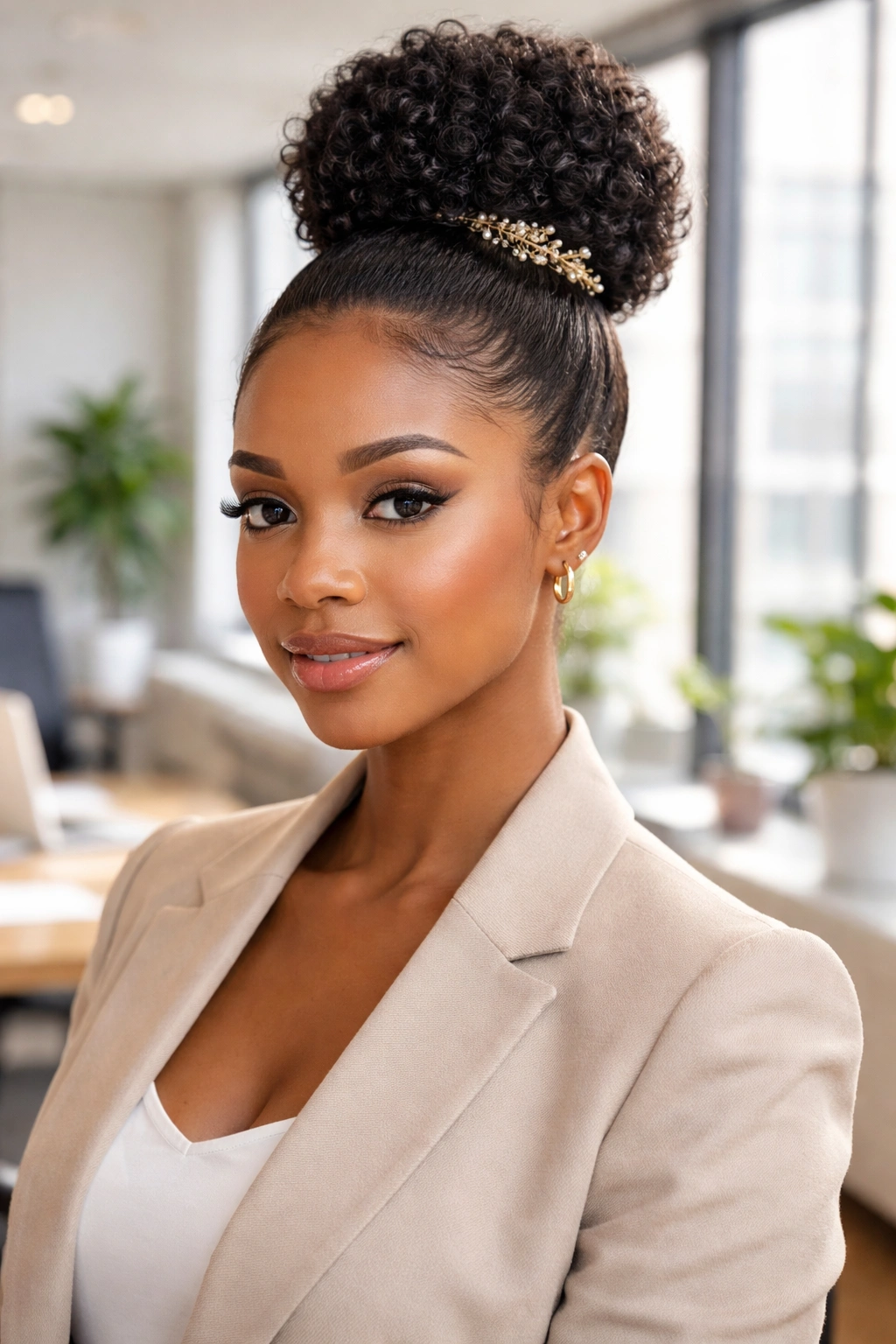
The workplace high bun on natural hair needs one thing above everything else: to look chosen. When a natural hair high bun looks chosen — when it’s clearly a style decision rather than a quick fix — it reads as professional in any setting.
Two elements make it look chosen: defined edges and one deliberate grooming touch. Laid edges signal care and intention. A wrapped base strand, a decorative pin, or a carefully tied scarf are each sufficient as the second deliberate touch.
Natural high buns are professional. They’re also beautiful. Wear yours with that confidence.
15. High Bun Protective Style Throughout the Week
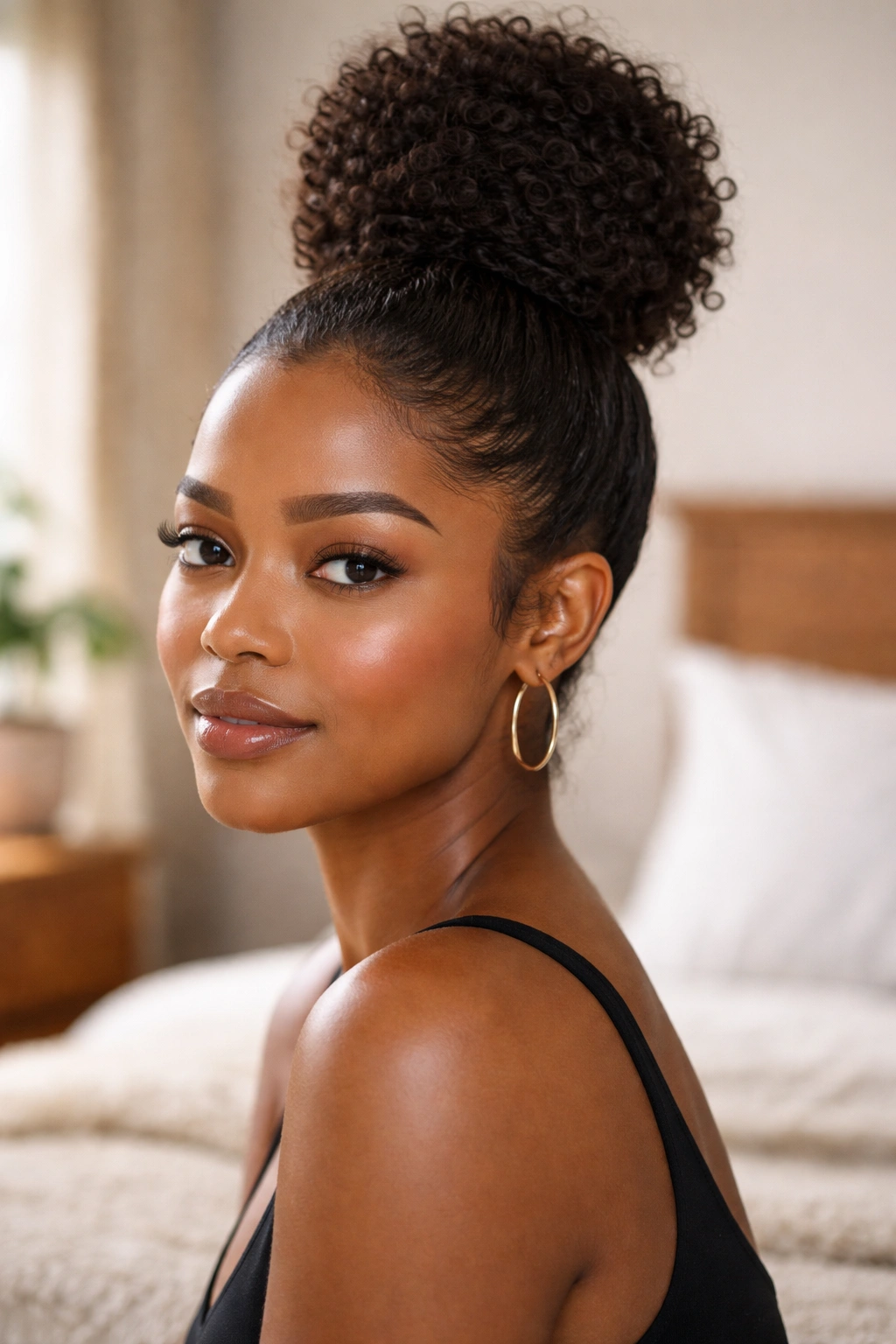
Wearing your natural hair in a high bun consistently throughout the week — daily or as the primary weekday style — is a legitimate and effective protective styling strategy. The ends are protected from friction and environmental damage. Manipulation is reduced to the daily gathering and releasing. Growth is retained because breakage is minimized.
The key to making this sustainable: vary the exact gathering point slightly each day. Gathering at the exact same position every single day concentrates tension at one spot on the hairline. Shifting the position slightly — a little higher one day, slightly to the side the next — distributes that tension across a broader area.
16. High Bun With Headwrap
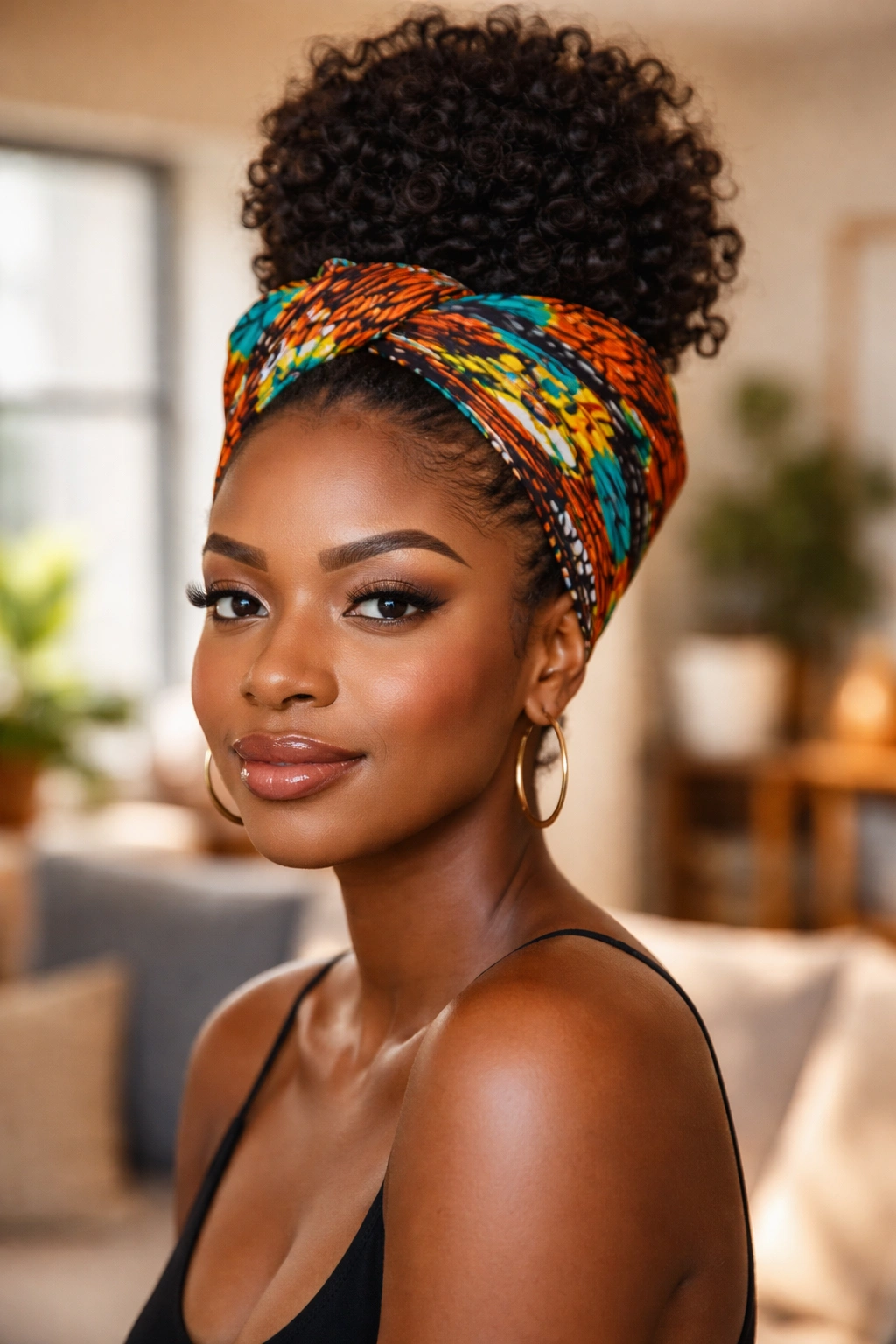
A high bun with a headwrap — scarf wrapped around the head and base of the bun, with the bun protruding above the wrapping — is one of the most culturally rich and beautiful natural hair styles. The headwrap is simultaneously functional (keeping edges smooth, providing protection) and aesthetic (adding color, pattern, heritage).
The style of wrapping determines the final look. A turban-style wrap that encircles the base of the bun and ties at the front reads as bold and editorial. A simpler wrap that lies flat across the hairline and ties at the nape reads as classic and elegant.
African and South Asian scarf traditions both contribute to headwrap styling — the range of wrapping techniques available creates genuinely different aesthetic outcomes.
17. High Bun Refresh on Day Three or Four
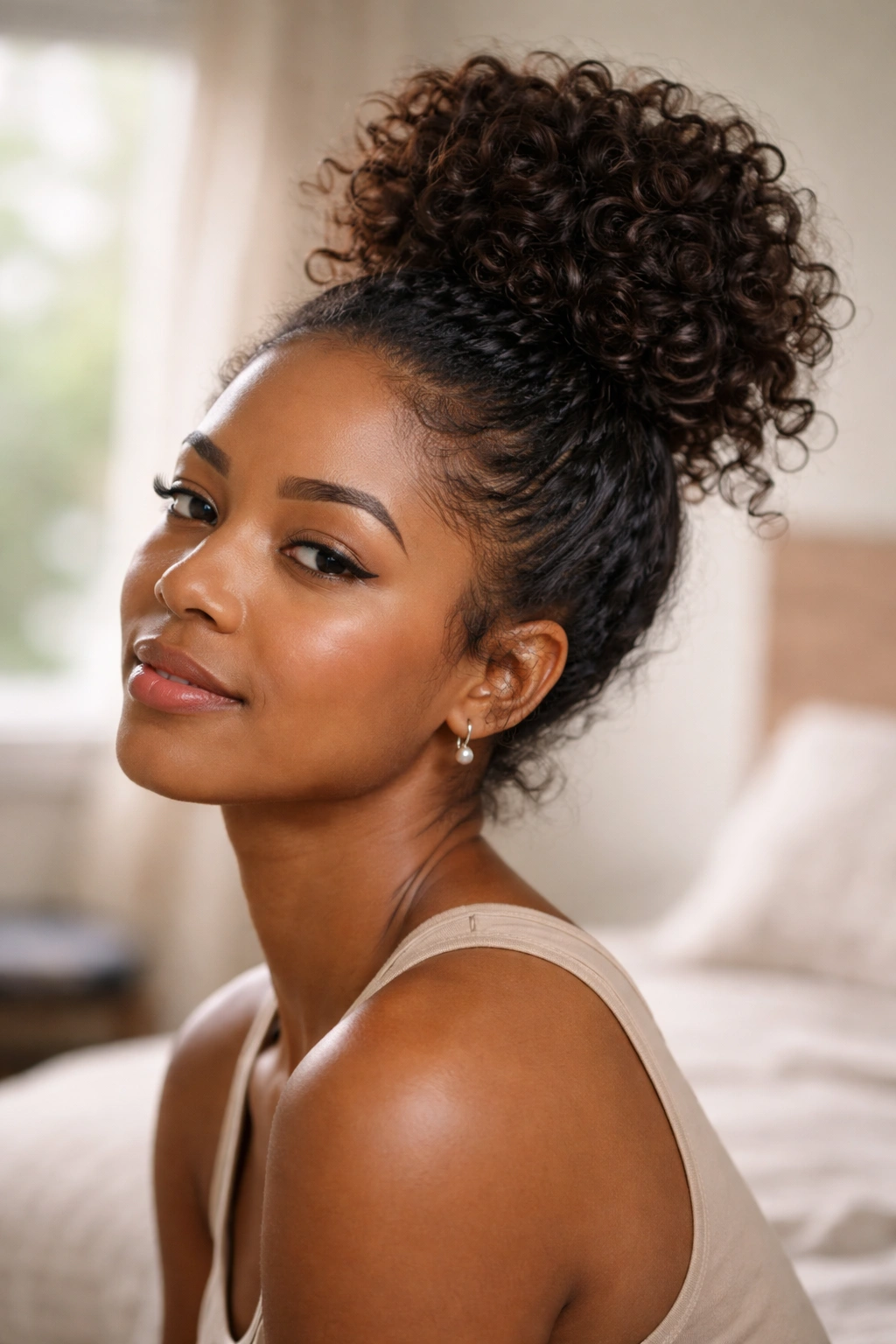
By day three or four after wash day, the natural high bun looks different from day one — but that doesn’t mean it needs to come down. A five-minute refresh extends the bun significantly.
The refresh process: release the bun. Apply a light mist of water or diluted leave-in conditioner throughout. Work your fingers through the curls to re-separate and define. Apply a small amount of curl cream to any particularly frizzy sections. Regather into the high bun position with a fresh hair tie.
The refreshed bun won’t be identical to the day-one version, but it’ll look genuinely good — and the time investment is minimal.
18. High Bun With Natural Color Dimension
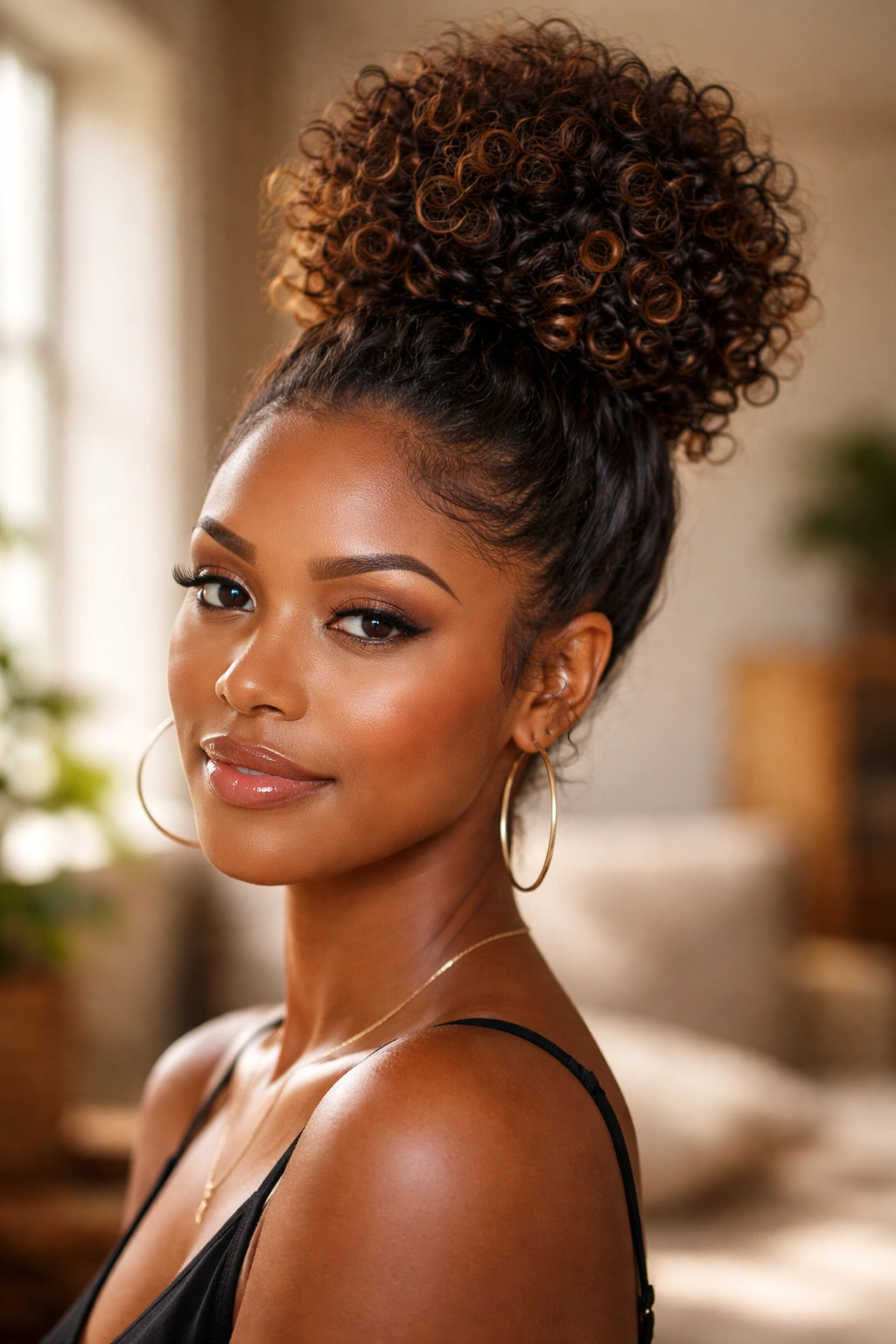
Natural hair that has color variation — whether from sun lightening, previous color treatments growing out, or natural variation in your own hair color across different sections — shows that color dimension in interesting ways when gathered into a high bun.
The gathered sections at the top of the high bun might have a different color profile than the sections at the base. As the bun moves, different colors catch the light at different moments. The overall effect is dimensional and rich in a way that uniform color isn’t.
If you have highlights or previously colored ends: gather the high bun so the lighter or colored sections are visible on the outer surface of the bun rather than hidden underneath. This showcases the color dimension rather than burying it.
19. High Bun After a Twist Out
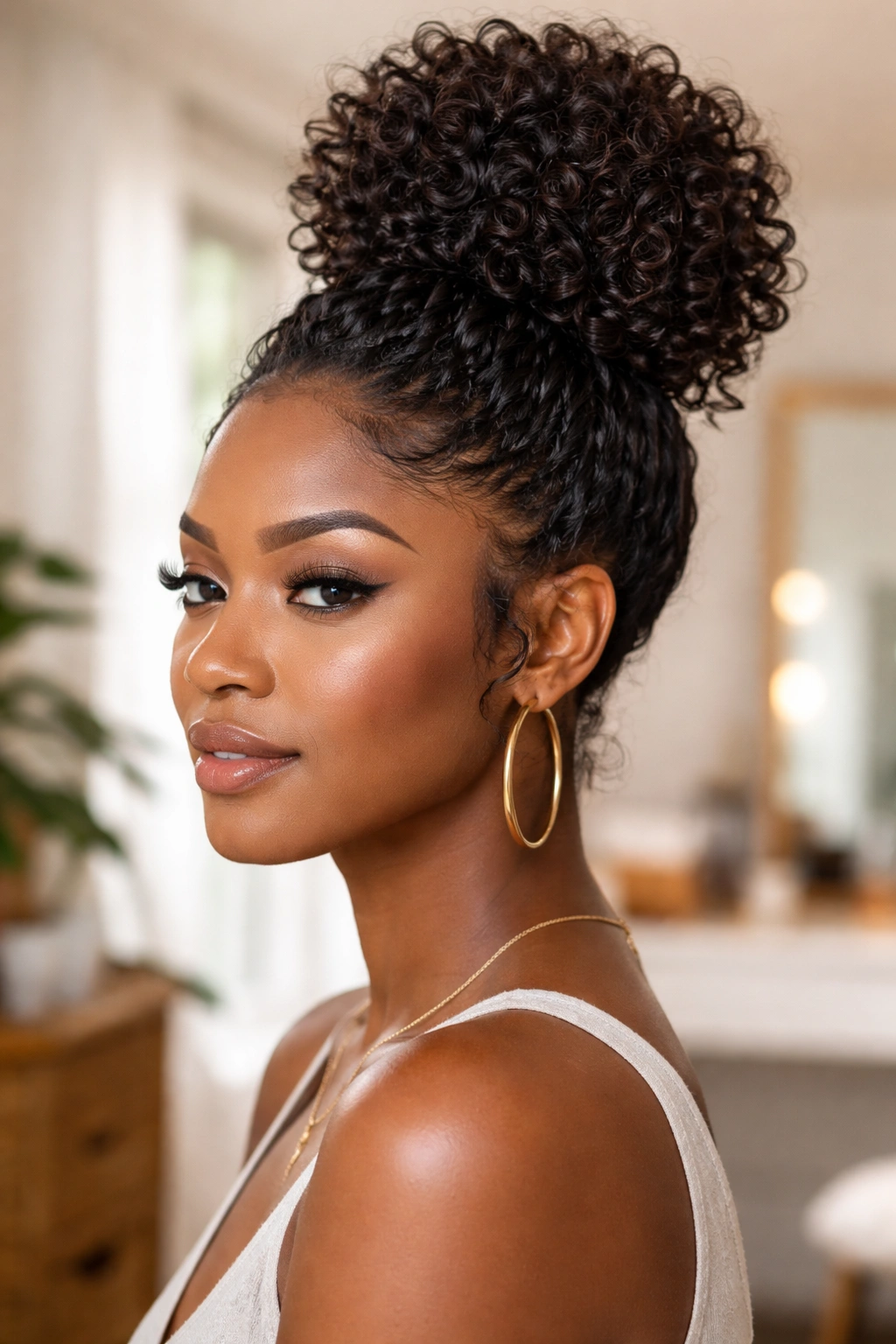
A twist-out high bun is one of the most beautiful versions of this style. A twist out — releasing defined two-strand twists to reveal a crimped, wave-like curl pattern — produces hair that’s already at its most defined and cooperative. Gathering that definition into a high bun creates a bun where every curl in the gathered section is visibly defined rather than randomly coiled.
The escaped sections around the base of a twist-out high bun have the most beautiful, defined spiral shape because the twist pattern has trained the curl to hold a specific form. These escaped coils frame the face with a definition that loose wash-and-go curls don’t achieve.
20. Faux High Bun for Shorter Hair
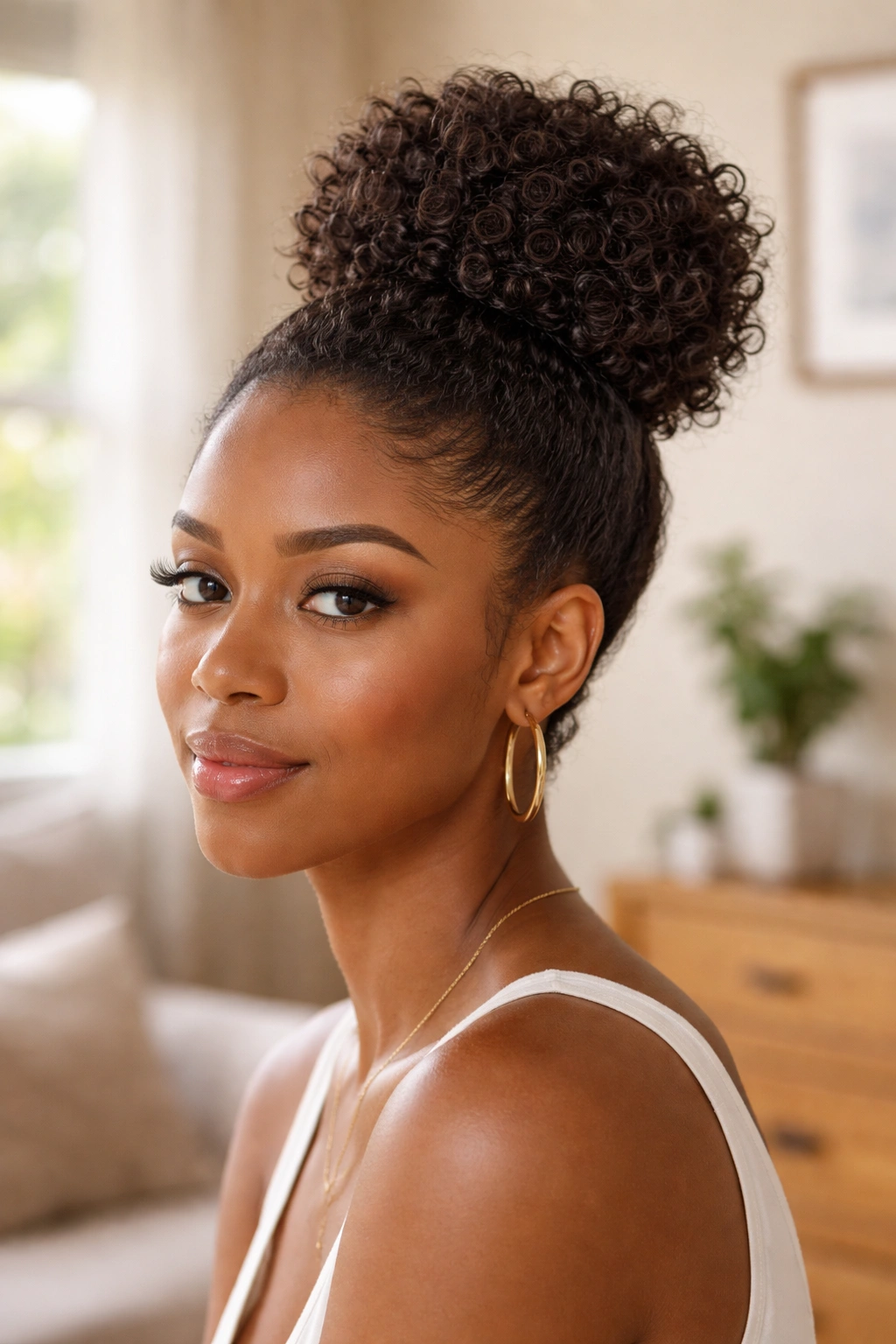
Short natural hair — 3-5 inches in stretched length — might not produce a full high bun without assistance. The faux high bun uses an extension tool to add the appearance of a larger bun than the natural hair length would create.
The most natural-looking method: use a donut bun shaper (a foam ring) covered by the gathered natural hair. The ring creates the shape and size; the natural hair covers it. Because the natural hair texture is visible on the outside of the bun shape, it reads as your own hair.
Alternatively, a small curly bun extension piece — available in textures matching natural 4c or 4a hair — can be clipped over the gathered natural hair to add volume.
21. Mohawk High Bun on Natural Hair
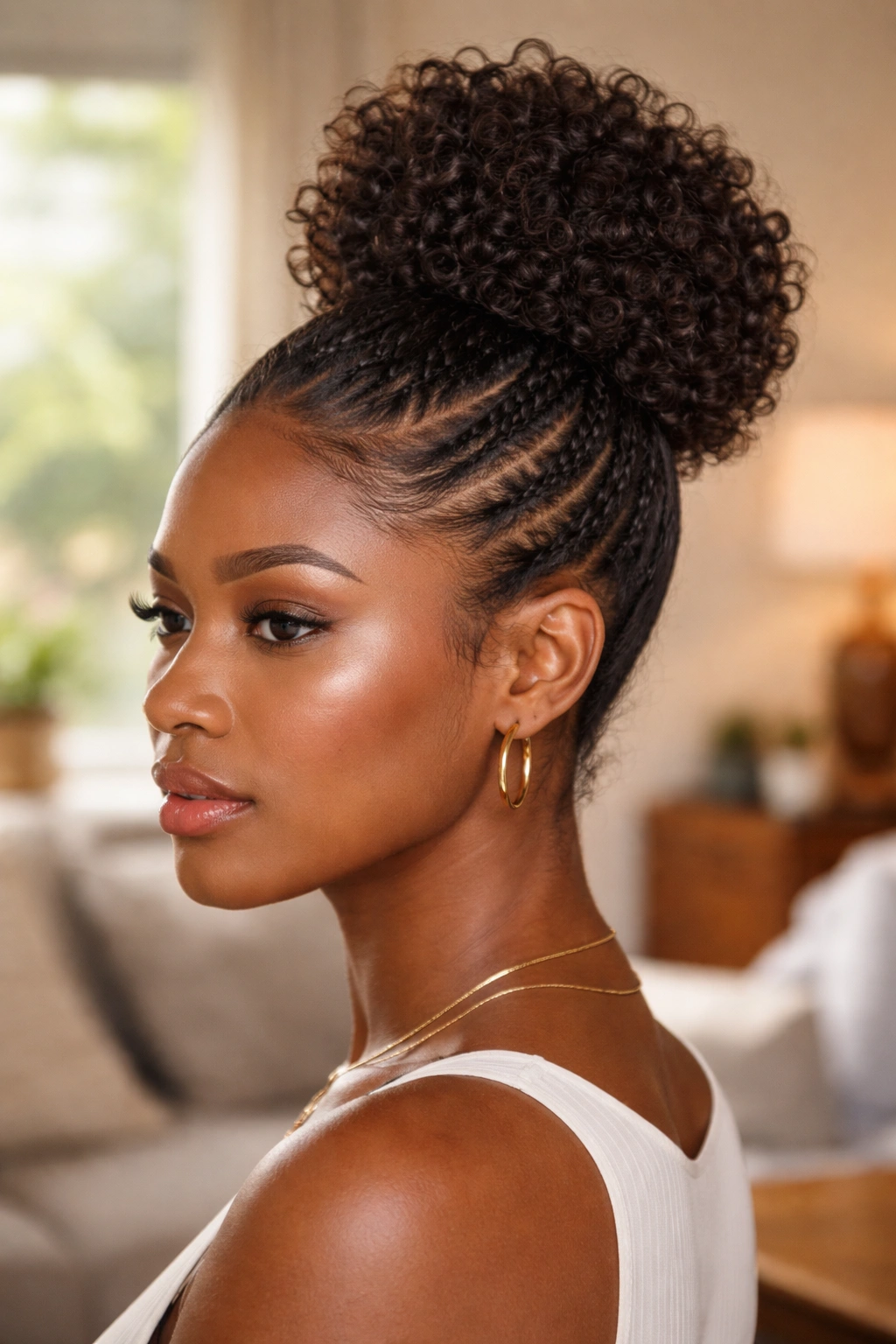
A mohawk-inspired high bun keeps hair gathered in a ridge running from the front to the back of the crown, while the sides are braided flat or smoothed down. The high bun sits at the back of the ridge, giving the style a dramatic, elevated focal point.
The mohawk high bun has genuine edge — it’s bold, structured at the sides, and expressive at the top. The natural curls gathered into the bun at the back create a soft contrast against the angular, structured sides.
Cornrowing the sides flat before gathering the top ridge into the bun creates the cleanest version of this style. The cornrow work shows care and technical skill; the high bun at the top shows natural hair personality.
22. High Bun for Special Occasions
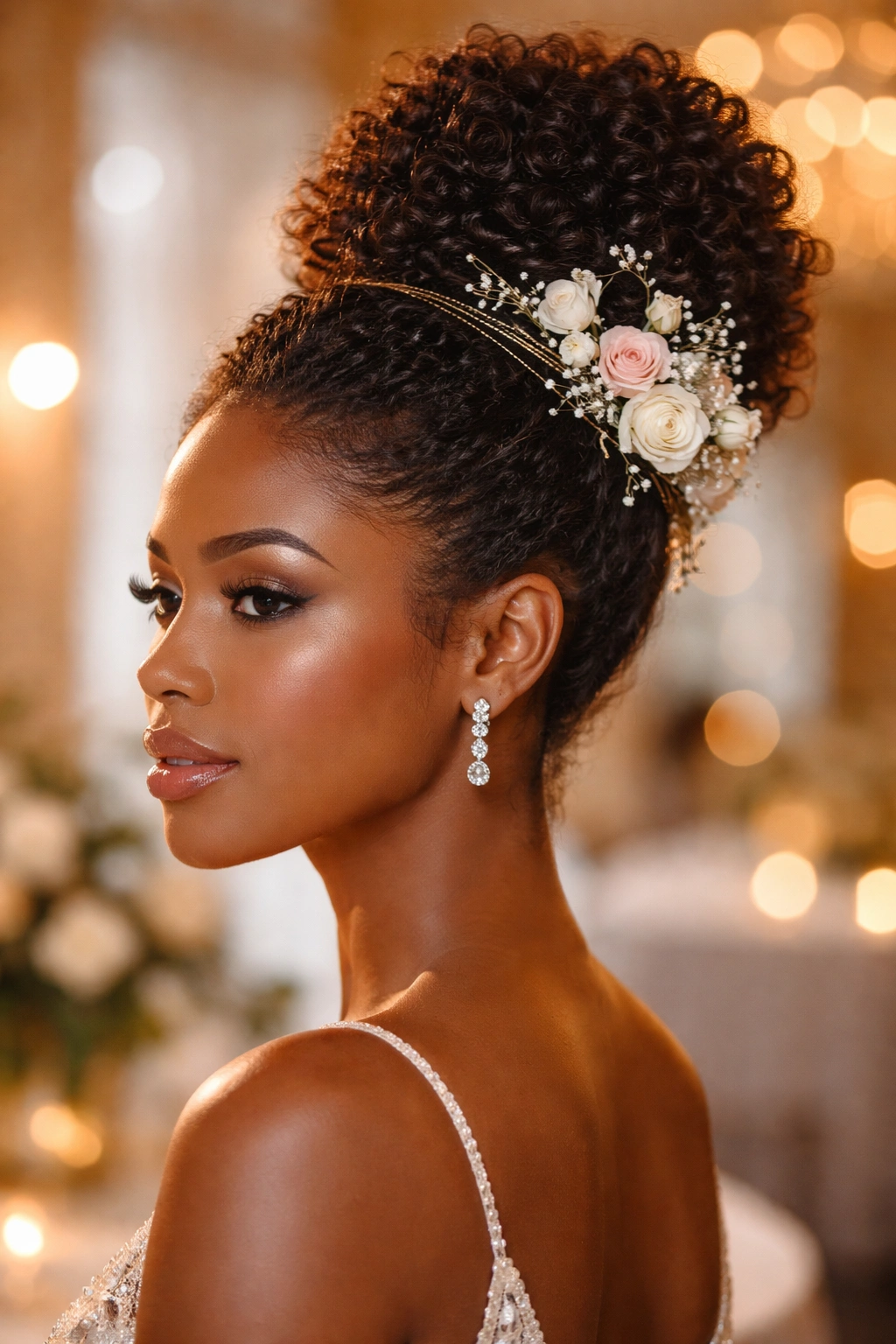
Special occasions call for high buns that go slightly further than the everyday version. Flowers tucked into the bun for a wedding or garden party. Gold thread wrapped around the gathered base for a formal dinner. Crystal pins scattered through the bun for a gala. These details take a familiar style and make it event-appropriate.
Fresh flowers are the most dramatic high bun accessory — they transform the style from hair into art. Choose flowers in colors that complement your skin tone and whatever you’re wearing. Secure them with thin floral wire or small bobby pins tucked behind the bun to keep them stable throughout the event.
23. High Bun as a Daily Confidence Practice
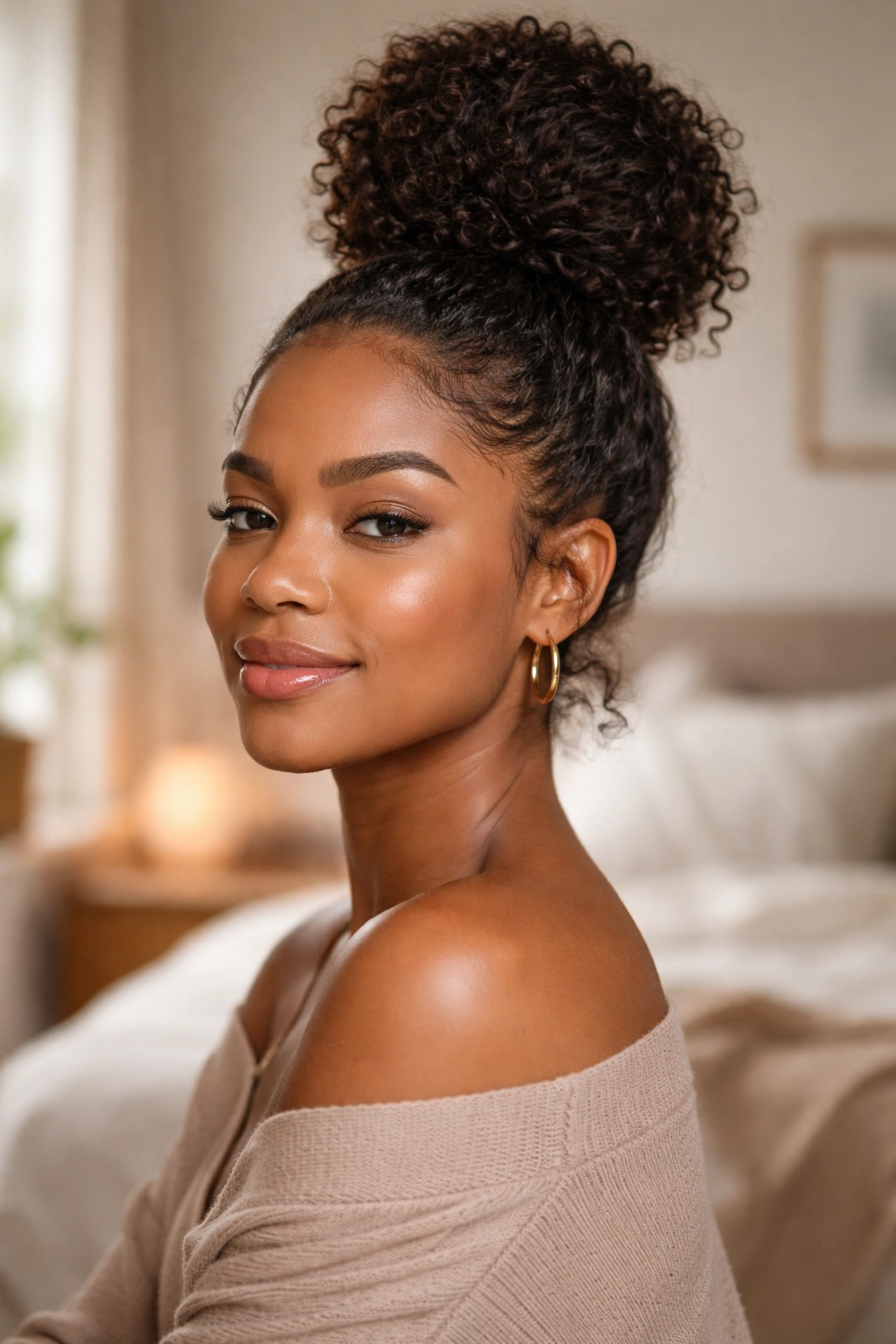
There’s something about wearing your natural hair in a high bun — gathered up, visible from all angles, not hidden or minimized — that becomes a daily practice of self-acceptance. The high bun says: this is my hair, I’m gathering it up so everyone can see it, and I think it’s beautiful.
That’s not a small thing. Black women have spent generations being told that natural hair needs to be controlled, minimized, or altered. The high natural bun is the opposite of all of that. It’s expansive, visible, and unashamedly itself.
Make the high bun yours. Your specific edge pattern. Your chosen accessory. Your preferred height and fullness. The details that make your high bun recognizably, specifically yours are the details that make it a real style — one that you own — rather than just hair that’s out of your face.
Protecting Your Hair and Edges With Daily High Buns
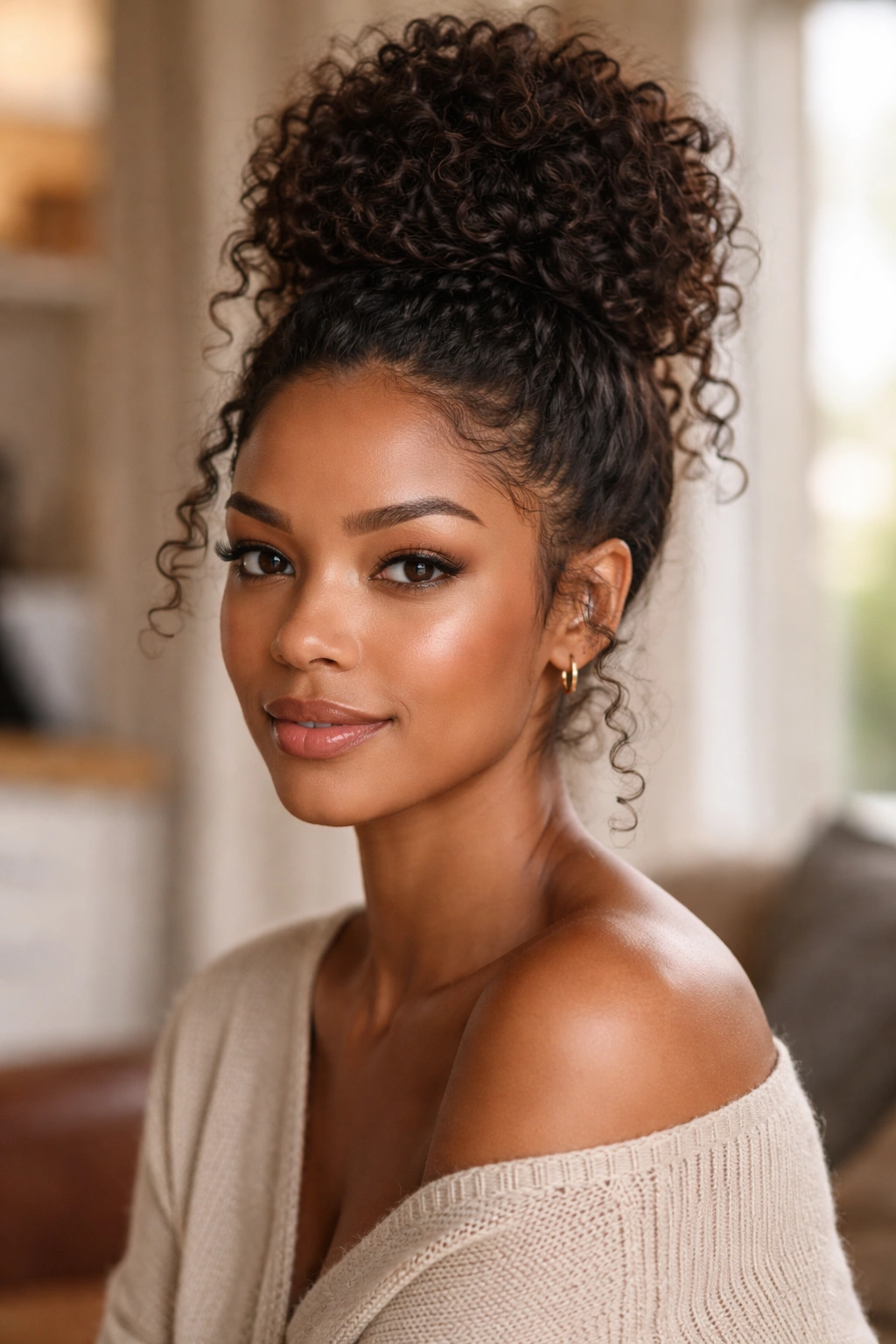
The one real risk of daily high bun styling is tension at the hairline and gathering point. Tight, repeated gathering in the same location can cause traction alopecia — hair loss at the points of consistent tension — over time. This is a real concern, and it’s worth taking seriously.
Mitigation strategies: use only satin-lined hair ties (never bare elastics), vary the gathering position slightly each day, never sleep with the bun fully secured (loosen or release overnight), and take bun-free days regularly. On rest days, let your natural hair air or use a loose style that doesn’t put any tension on the hairline at all.
Edges that are thinning or showing stress signs need a break from high bun styling. The style can always come back once the hair has recovered — but it can’t come back if the follicles are permanently damaged.
Listen to your hairline. It communicates clearly: tenderness, thinning at the temples, and visible stress at the gathering point are signals to ease up. Healthy high bun styling respects those signals and adjusts accordingly.
