



Blue box braids don’t whisper. They walk into a room first.
Blue and ombré box braids have a funny habit of looking polished even when the rest of the outfit is doing the least. Deep navy can pass for almost-black indoors, cobalt wakes up the second daylight hits it, and an ombré fade can make the whole install feel softer or sharper depending on where the color starts. That is the part people miss: shade choice matters, but placement matters just as much.
I’ve seen beautiful braid sets lose steam because the color shift started too high, the braids were too thick for the shade, or the ends were cut in a blunt line that made the whole thing feel heavy. A blue braid install needs shape. It needs a part pattern that makes sense, a length that gives the color room, and enough contrast at the root so the blue reads as intentional, not accidental.
The styles below lean in different directions—some are quiet, some are loud, some are all about the gradient, and a few are really about the way the braids move when you pull them back. If you’ve been circling around blue braids but not quite settling on a version, the details here are what separate a set you like from one you keep reaching for.
1. Midnight Blue Waist-Length Box Braids
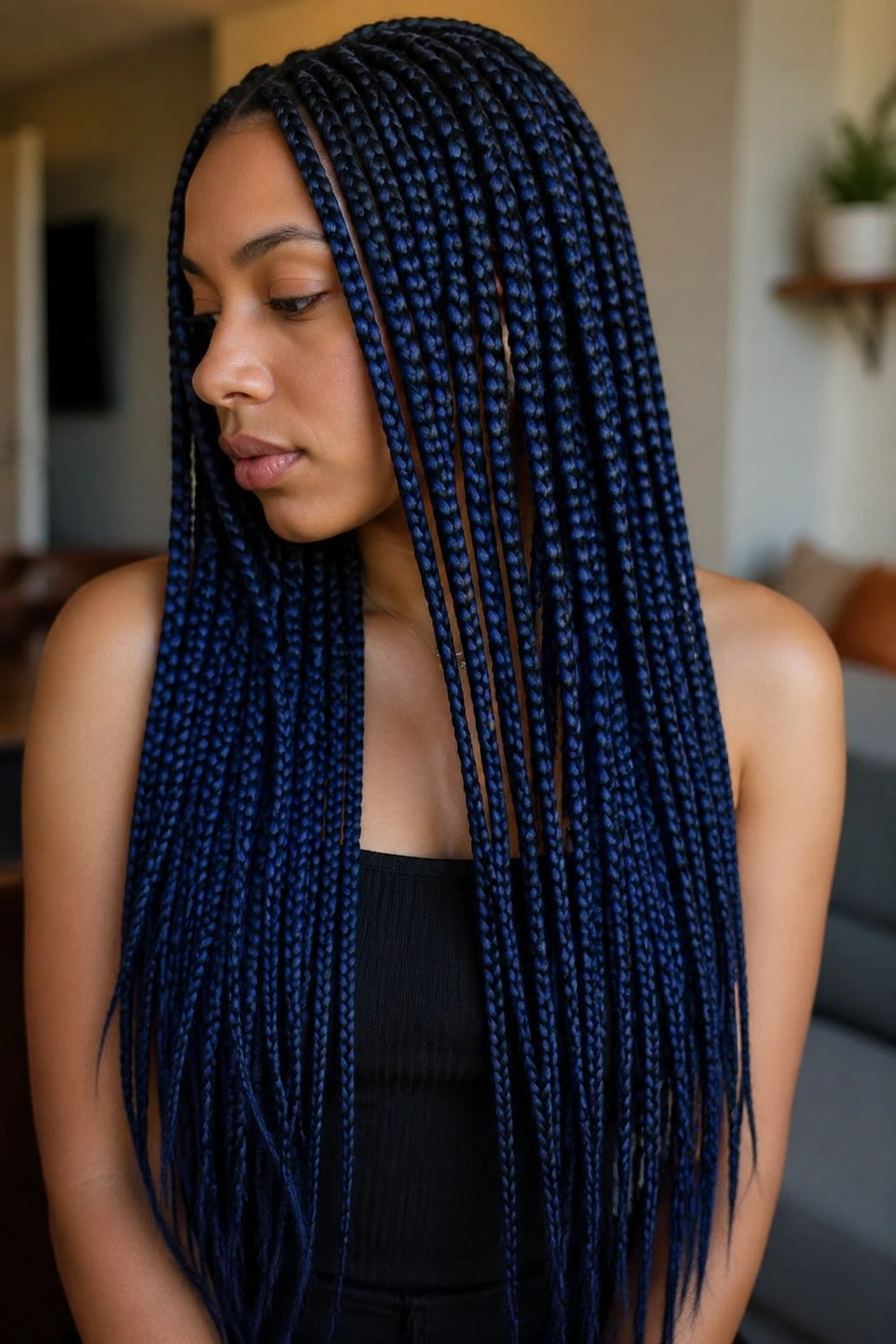
Midnight blue is the braid color I recommend to people who want drama without neon energy. It sits close to black at first glance, then gives you that cool blue edge when light catches the braid’s curve. Waist length helps because the color has room to show up in motion instead of disappearing into a short, flat shape.
This version looks best when the root stays deep—1B, soft black, or dark brown—and the blue starts a few inches down. That little gap keeps the color from looking painted on. A set like this also works well with medium-size braids, because the shade has enough surface area to read as blue without turning into a solid block.
I like this style on people who wear their hair down most of the time. Pull it into a low ponytail or a loose bun, and the darker roots keep it from feeling too loud. There’s a quiet sharpness to it, and that’s the whole point.
If you want blue braids that age well over the life of the install, start here. They don’t rely on a single “wow” moment. They hold up.
2. Cobalt Ombré Box Braids With Dark Roots
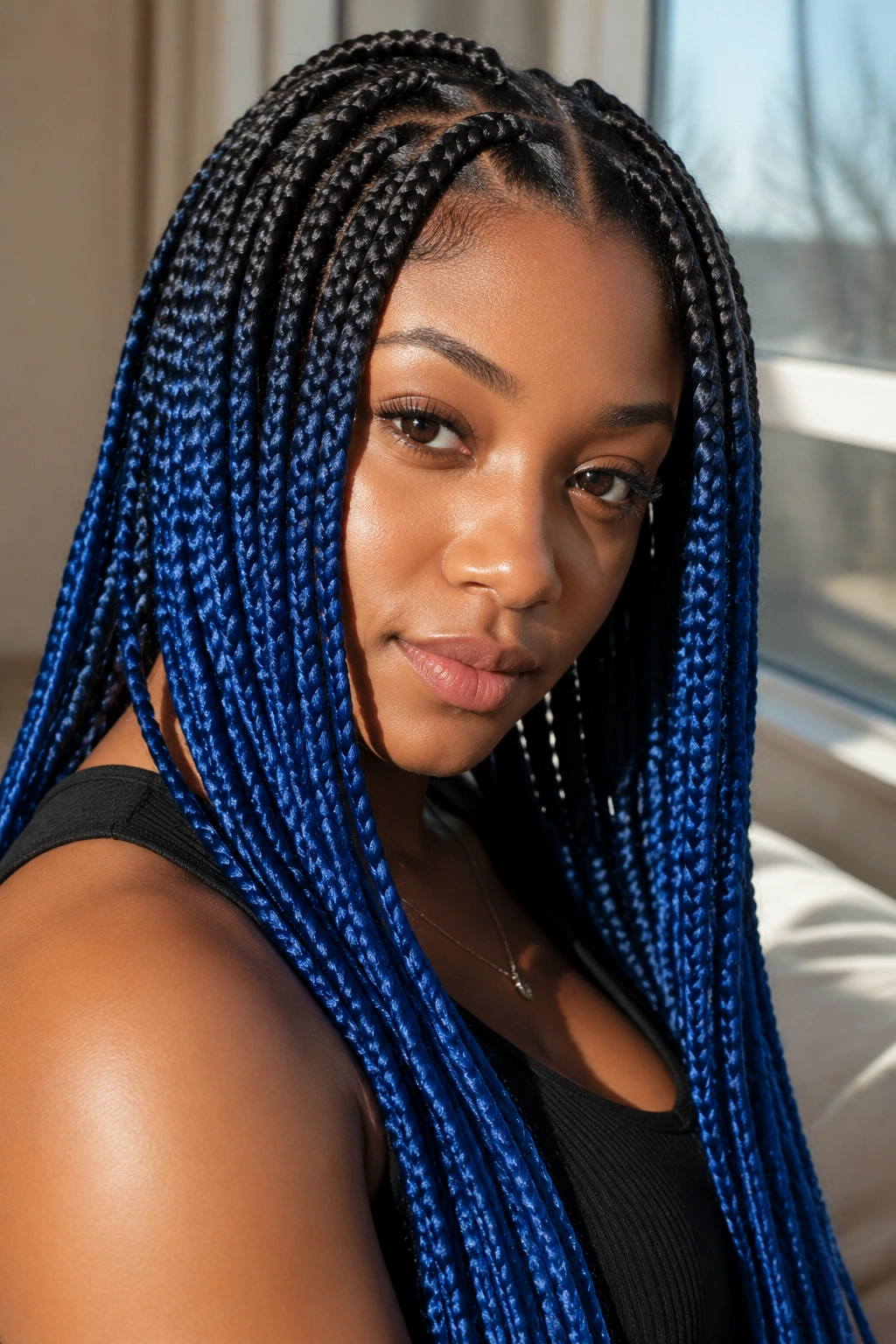
Cobalt is the version that announces itself fast. The color has enough punch to look electric, but the dark root keeps it grounded so the style does not tip into costume territory. The strongest cobalt ombré starts around mid-shaft, not at the scalp, which gives the braid a clear base before the color kicks in.
Why the Gradient Works
The root acts like a frame. Without it, bright blue can blur into one flat tone, and that usually looks less expensive than people expect. A dark base gives the eye a resting point, then the cobalt fade becomes the feature instead of the whole story.
Quick Styling Notes
- Best braid size: medium or small-medium, since cobalt reads cleaner on a tighter braid pattern.
- Best hair match: pre-stretched synthetic braiding hair in black plus cobalt ends.
- Where to start the fade: about 2 to 4 inches from the scalp if you want the color shift to look smooth.
- Finish tip: keep edge control light; thick product around the hairline can muddy the color contrast.
My favorite move: wear these with a center part the first few days, then switch to a high bun when you want the ends to do more of the talking.
3. Why do peekaboo blue box braids work so well?
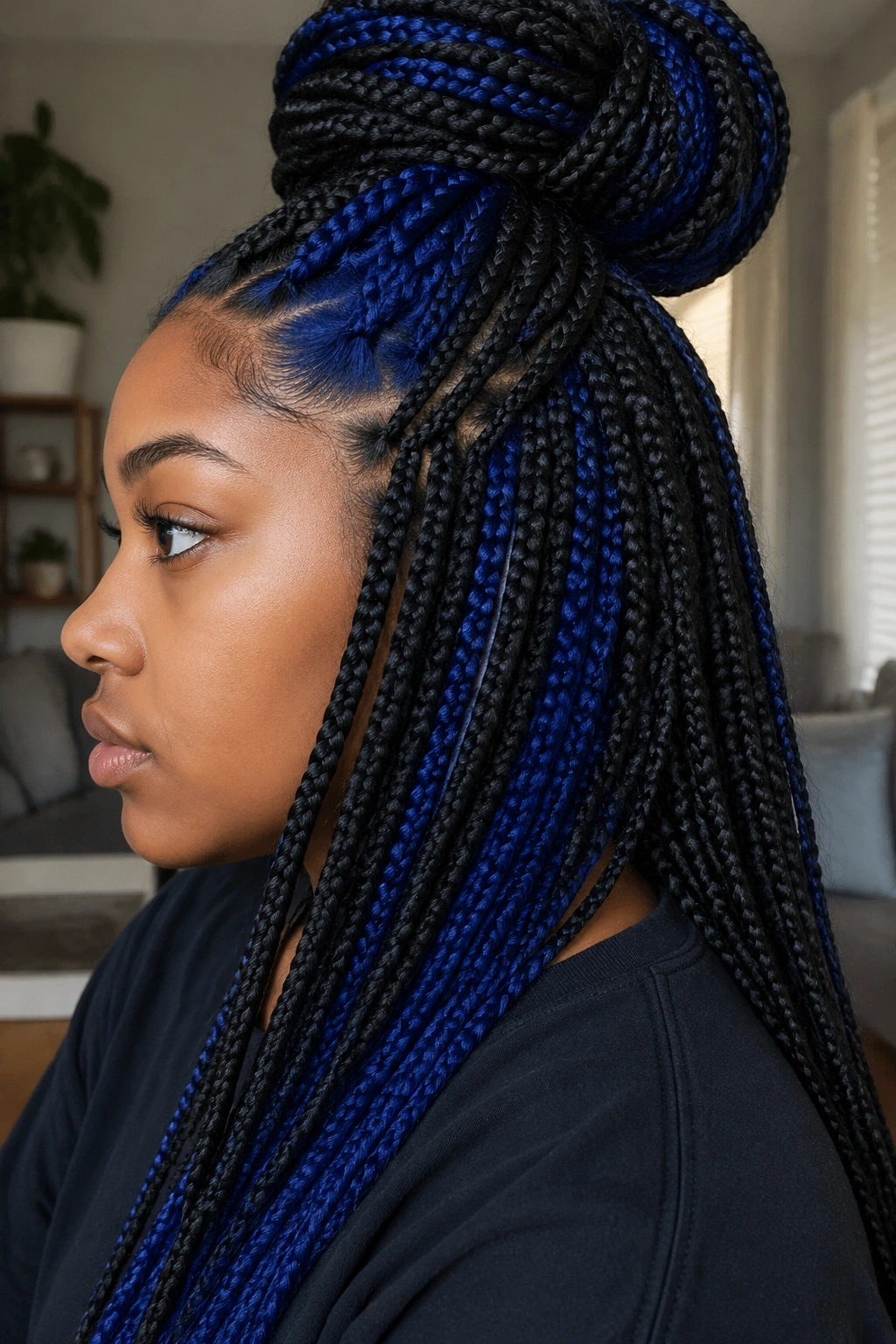
Because they give you color without forcing it into every inch of the style. Peekaboo blue means the outer layer stays black, brown, or deep burgundy, while the underneath sections flash blue when the hair moves or gets pinned up. It is a smart choice if you want a blue braid look that still plays nicely with a conservative dress code.
The charm is in the reveal. When the braids are loose, the blue stays tucked away. Pull them into a half-up style, and you get flashes of color near the crown and along the lower layers. That kind of hidden contrast feels more personal than a full-head bright set, and it’s easier to wear day to day.
How to Wear It
A side sweep shows off the blue faster than a center part. A top knot does the same thing, especially if the stylist places the brightest braids in the middle back section. If you want the look to land, keep the outer layer about 70% of the head and the blue layer in the remaining 30%.
This is also the style I’d point to if you’re testing blue for the first time. You get the fun part without having to commit the whole install to it.
4. Navy-to-Icy Blue Ombré Box Braids
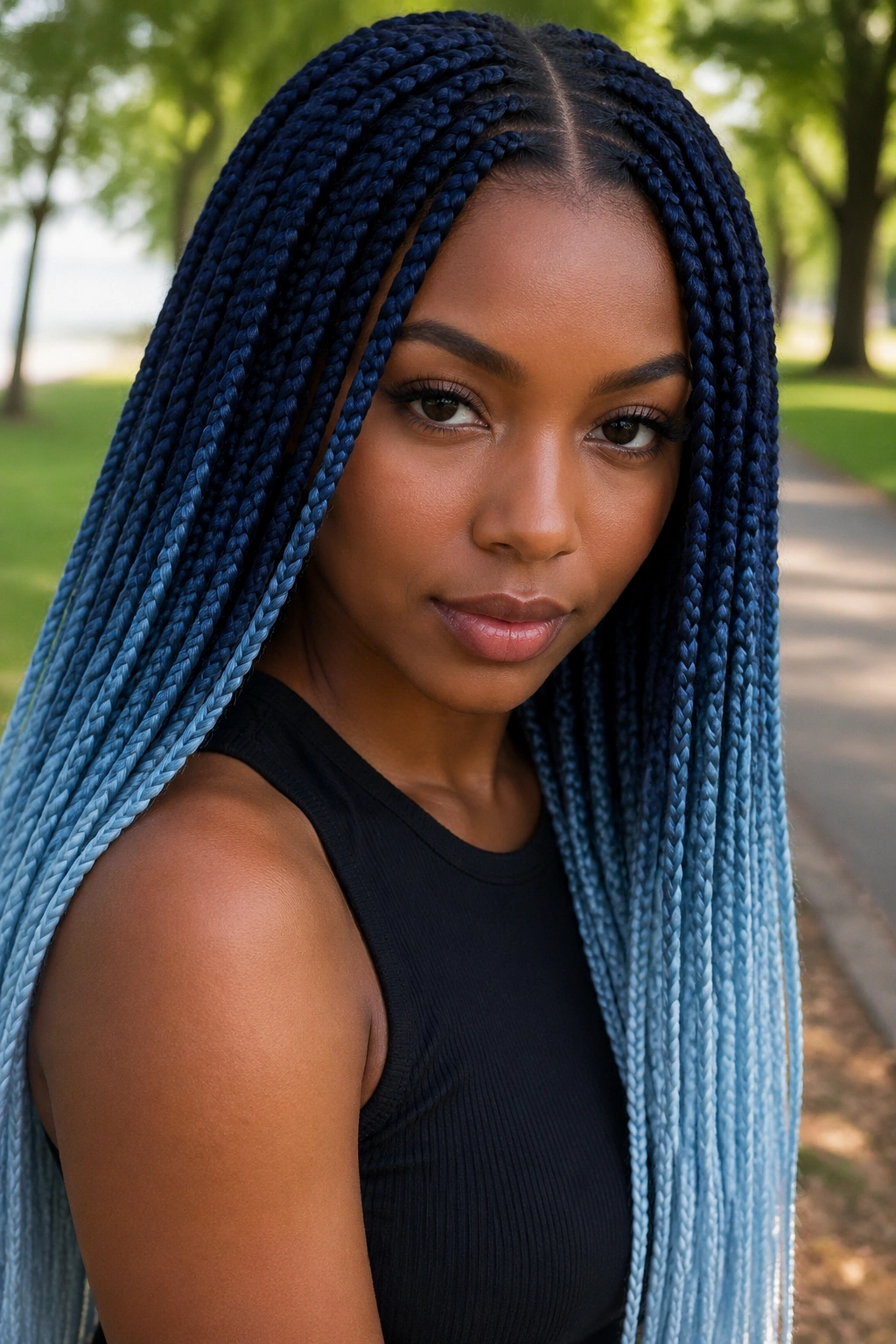
Picture leaving the chair with braids that look nearly black at the crown and cool all the way down into pale blue at the ends. That sharp fade is the whole point here. It gives the style depth first, then brightness.
I’m a fan of this on medium-to-long braids because the gradient needs length to look smooth. On very short braids, the color jump can feel abrupt. Long braids let navy, steel blue, and icy blue sit in bands that make sense together.
The Texture That Makes It Pop
The braid itself should be neat, not bulky. A tight, even part pattern helps the colors read as a single flow instead of separate stripes. If the roots are too fuzzy, the eye gets stuck there and misses the fade.
- Keep the darkest shade at the scalp.
- Let the pale blue live on the last third.
- Add a clean center part if you want the fade to look even.
- Use a light mousse on the finished braids so the synthetic fiber stays smooth.
The final detail matters more than people think. When the ends are soft and the base is clean, the whole style feels deliberate instead of busy.
5. Jumbo Blue Box Braids
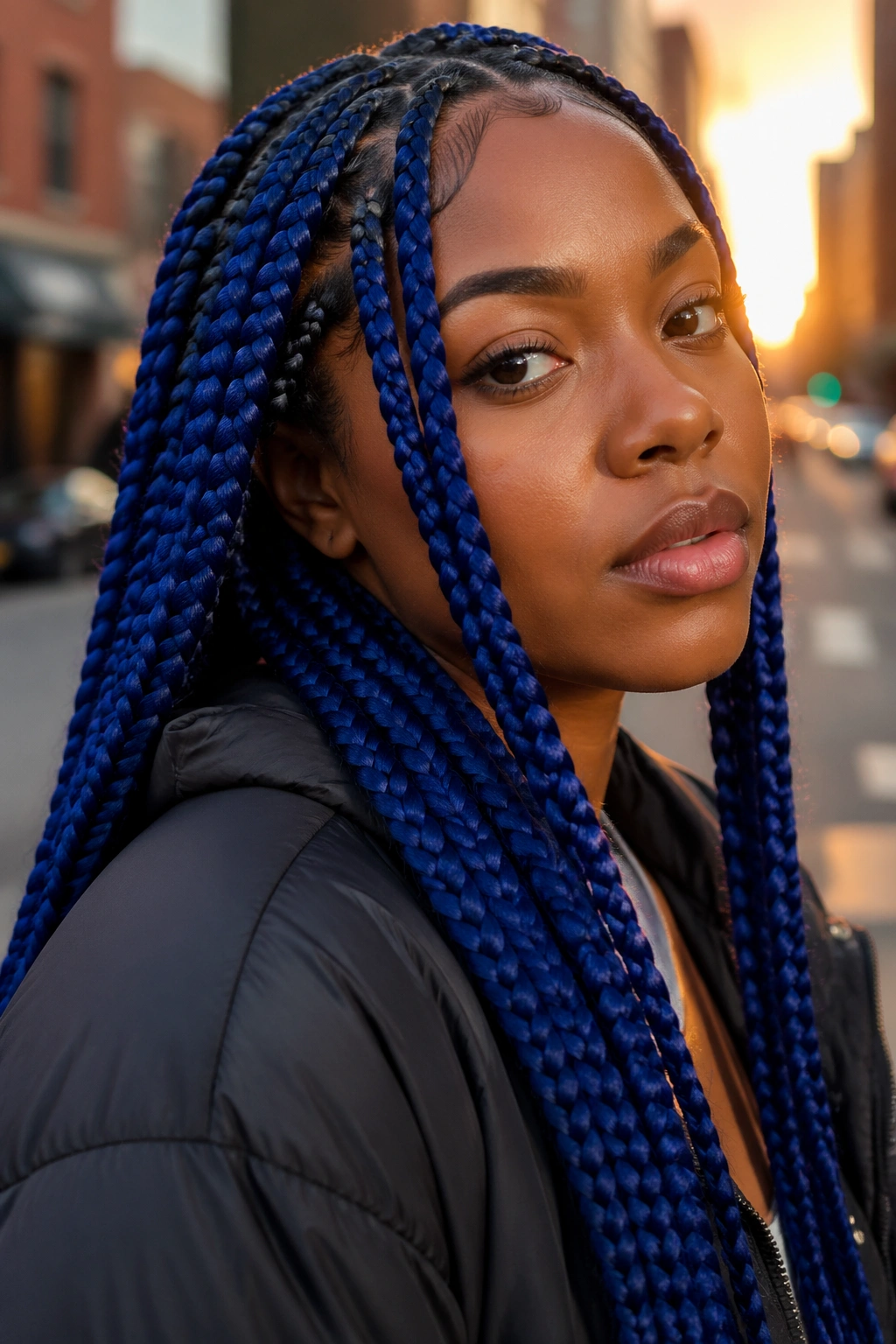
Big braids have heft. They move like a statement, and blue only makes that statement louder. Jumbo blue box braids work because each braid carries enough color to be seen from across a room, but the larger sections also make the install faster than a tiny, ultra-detailed set.
This style loves a strong single shade, especially cobalt or deep electric blue. Ombré can work too, but it should be broad and easy to read. If the fade is too delicate, the extra width of the braid swallows it. A cleaner color block usually looks stronger here.
I’d keep the count around 12 to 18 braids, depending on head size and desired fullness. That number gives you the chunky look without making the scalp feel crowded. The tradeoff is weight. Fewer braids help, but long jumbo braids can still tug at the neck, so a collarbone-length version is easier to wear if you plan to put your hair up a lot.
This is not the set for someone who wants subtle. It is for someone who likes the braid itself to be the feature, and the blue to do the rest.
6. Thin Feed-In Ombré Box Braids
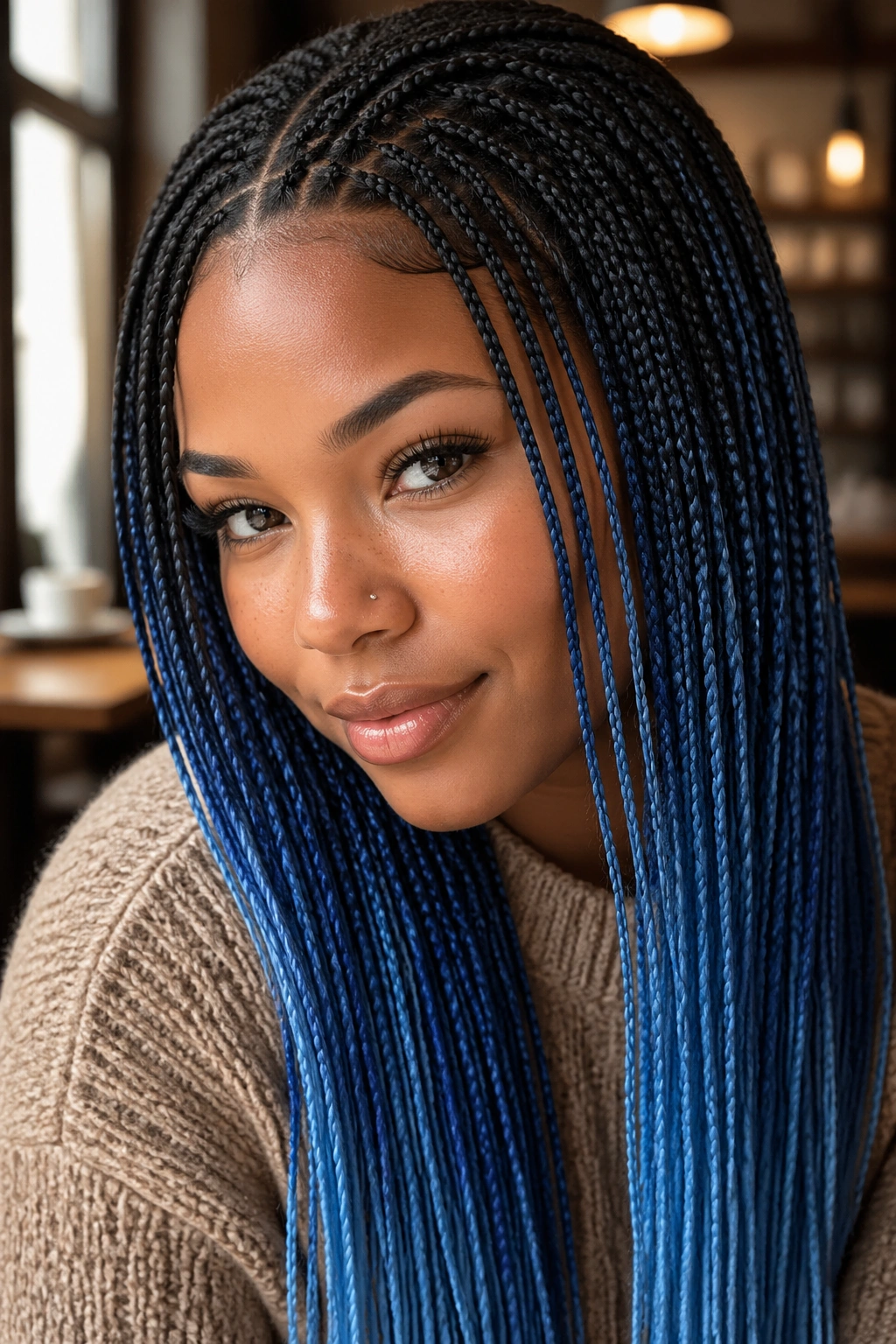
Unlike jumbo braids, thin feed-in braids let the blue change feel gradual instead of blunt. The section starts small at the scalp, then gains size as more hair is added. That little shift matters because the eye reads the fade as soft, not choppy.
This style is best when you like the braid itself to be the feature, not just the color. Thin rows lay flatter against the head, so the ombré can start higher without shouting. They also give you more movement around the face, which helps blue shades look less blocky.
Best Way to Ask for It
Tell your stylist you want knotless feed-in braids with blue added after the first inch or two. Ask for a color sample in daylight if possible, because blue synthetic hair can look different under salon lighting. If you want the cleanest finish, keep the roots black or dark brown and let the blue take over slowly.
I like this version on people who wear glasses, hoops, or a strong lip color. The braids sit close to the head and leave room for everything else to work. There’s a neatness to it that heavier braid styles do not always give you.
7. Chin-Length Blue Ombré Box Braids
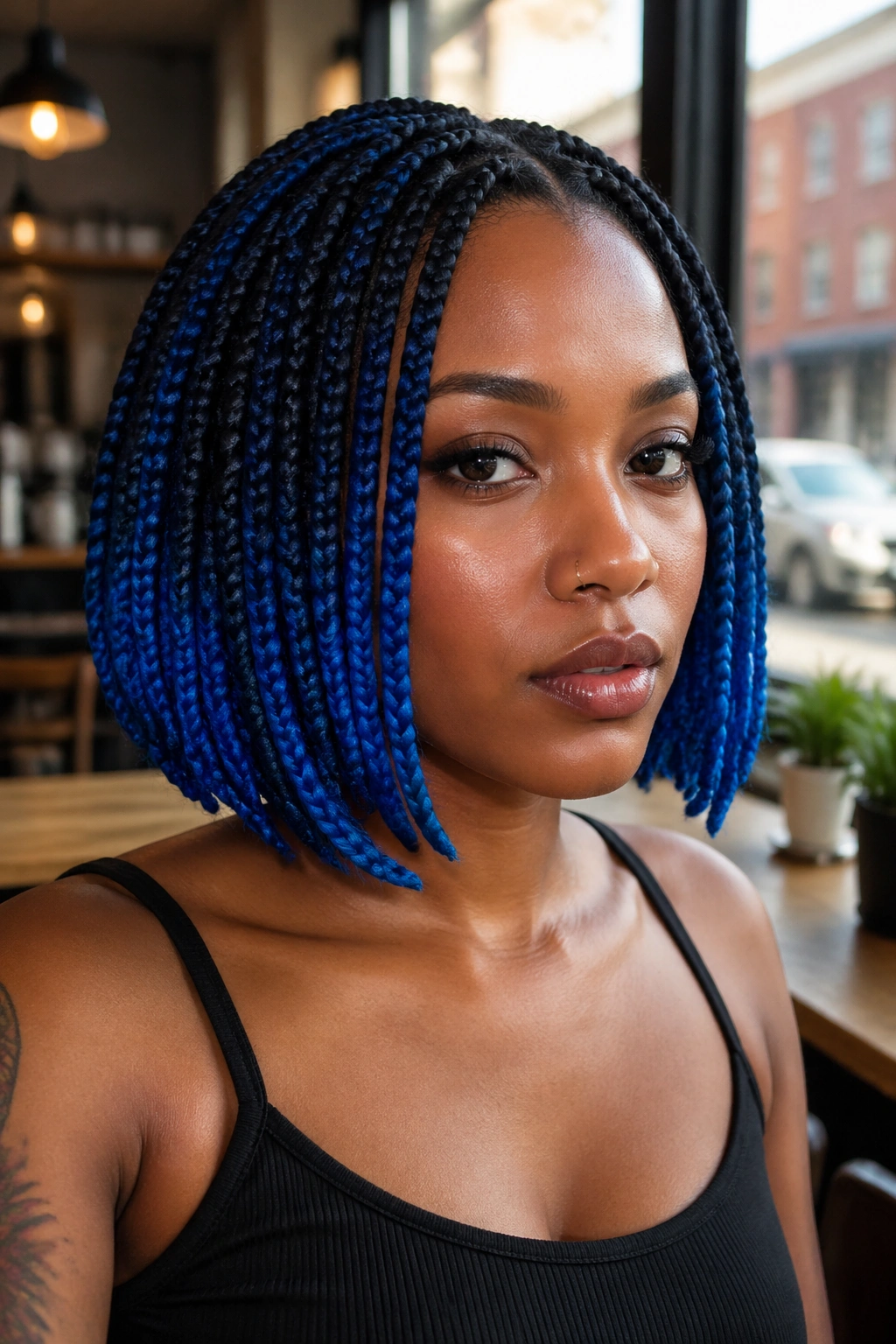
Short braids can be a relief. They sit at the jawline, skim the collar, and keep the color right where people notice it first. If long blue braids feel like a commitment, a chin-length bob gives you the same punch with less swing and less weight.
What makes this cut work is the shape. A blunt bob feels crisp, but a lightly layered bob with blue ends is easier to move in and a little kinder around the face. I’d keep the ombré concentrated at the lower half so the top still feels grounded.
Why the Cut Matters
- A straight chin line makes cobalt and navy look sharper.
- Slightly staggered ends soften the outline.
- A side part gives more face framing.
- A middle part makes the color read more evenly on both sides.
My preference: ask for the bob to hit just below the chin if your braids are thick; anything shorter can flip outward in a way that looks accidental, not styled. That extra inch makes a difference, especially when the ends are bright blue.
8. Blue-to-Purple Gradient Box Braids
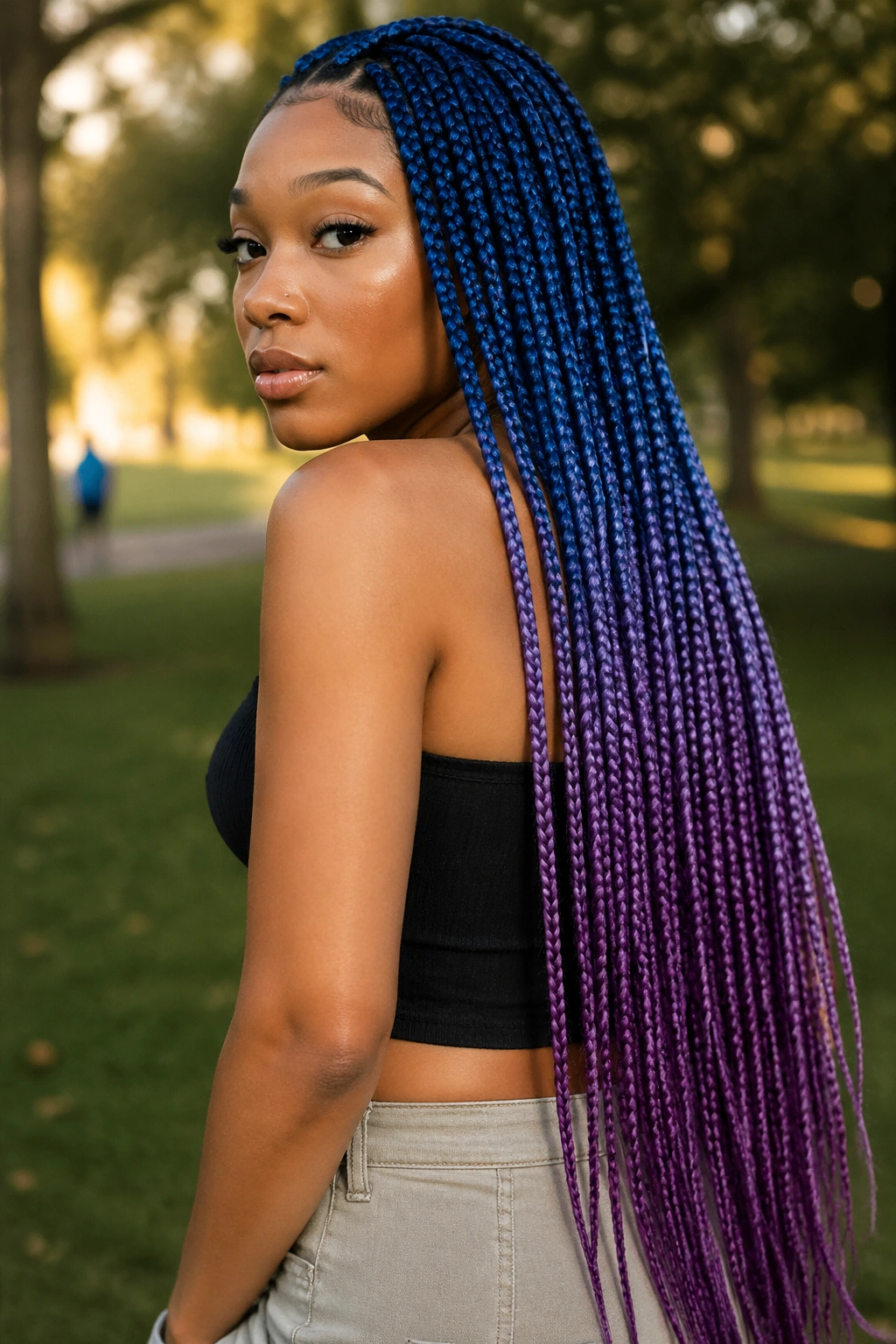
Blue and purple together are not shy. They give you two cool tones that can either blend into a deep indigo middle or stand apart in clean bands if you want the contrast to be obvious. The best sets use a dark base and a slow hand at the transition, because the shift between colors can get muddy if it happens too fast.
What Makes the Two Colors Work Together
Blue and purple sit close enough to feel related, but different enough to keep the braid set lively. A cobalt-to-violet fade can feel rich. A navy-to-lilac fade feels softer. Either way, the trick is to leave a small blending zone between the two shades so the eye sees a fade, not a hard line.
The style works especially well on long braids, where the two colors have room to separate. If the braids are short, the purple can dominate too quickly and the blue loses its edge. With waist-length or longer braids, you get a clearer read on both tones.
I’d wear this with plain clothes, honestly. Let the hair be the loud piece. Anything too busy nearby can make the color story feel crowded, and this combination deserves room.
9. Do triangle-part blue box braids change the whole look?
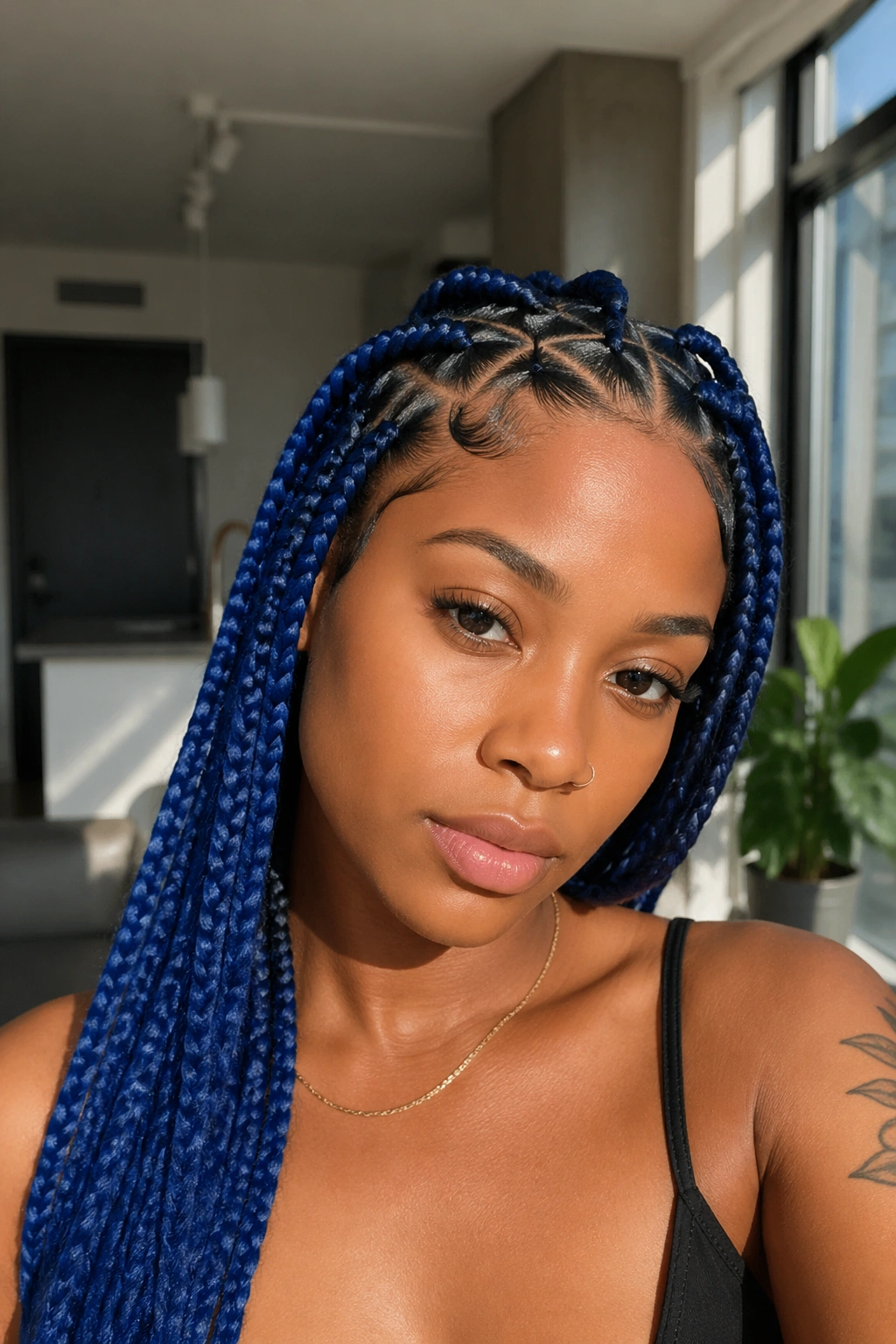
Absolutely. The parting pattern changes the braid set almost as much as the color itself. Triangle parts break up the grid-like look of traditional square sections, so blue braids feel a little more graphic and a little less expected.
That shape matters when the color is already strong. If you use cobalt, teal, or electric blue, the triangle pattern gives the eye another detail to look at, which keeps the style from feeling flat. It also works nicely with ombré, because the angled parts create movement before the braids even start.
Parting That Changes the Whole Mood
Ask for medium triangle parts if you want the style to hold its shape without turning the scalp into a checkerboard. Tiny triangles can look fussy. Oversized ones can make the braids feel too sparse. The middle ground is the sweet spot.
A center part or a deep side part will change the mood again. Center parts make the geometry symmetrical. Side parts make the triangles look more relaxed. I prefer side parts for everyday wear, mostly because the braid pattern feels less formal and the blue can soften around the face.
This is one of those details that sounds small until you see it done well. Then it’s hard to unsee.
10. Half-Up Half-Down Blue Ombré Box Braids
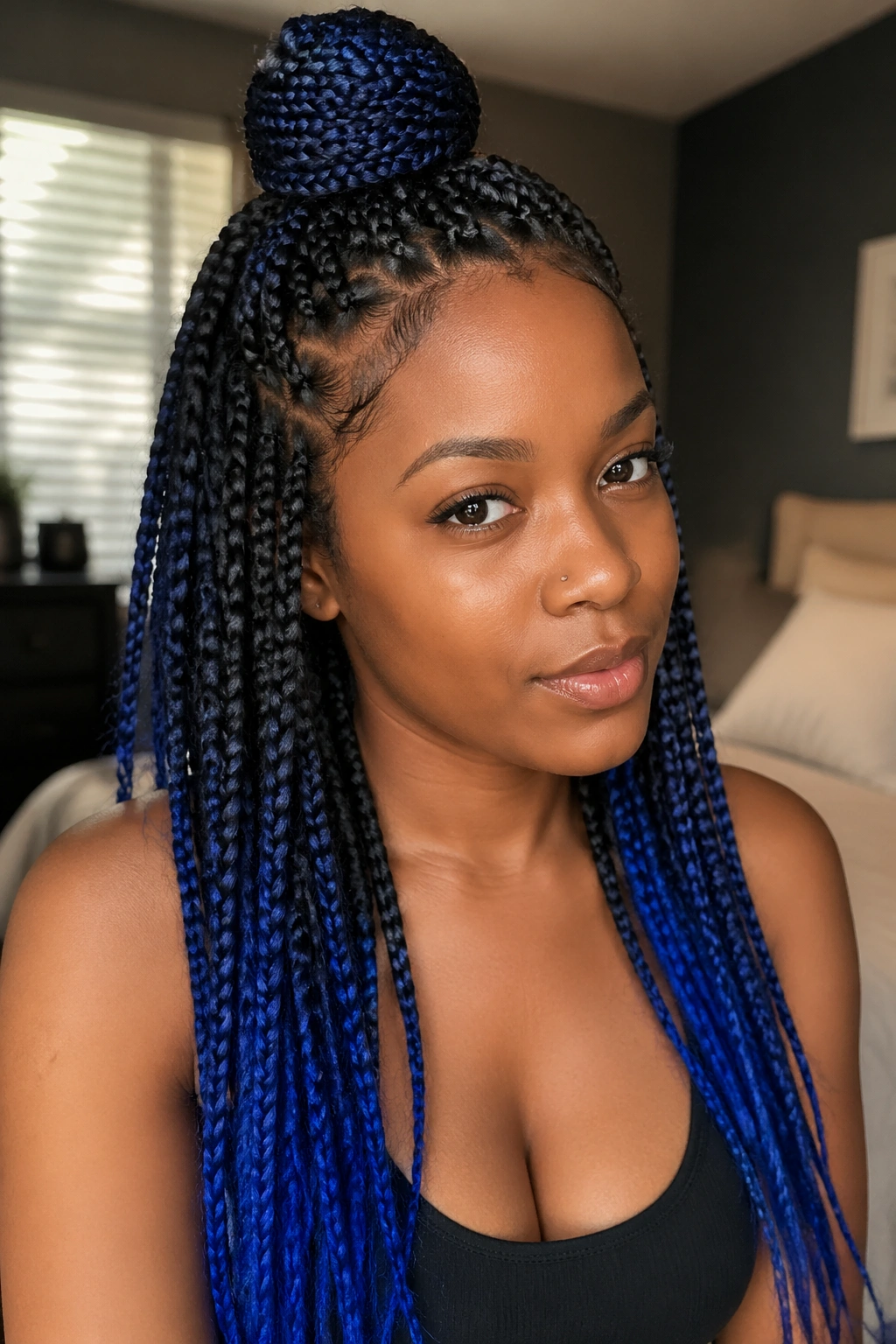
Some braid styles are all about the finish, and this is one of them. Pull the top half into a knot or ponytail, leave the rest hanging, and the blue ombré starts working twice as hard. The color shows from the crown and from the loose lengths, so you get movement without losing shape.
It helps to keep the crown section tidy. If the top half is sloppy, the eye goes there first and the gradient gets ignored. A clean wrap around the base—using a braid, a strip of braid jewelry, or even a matching scarf—makes the whole thing feel intentional.
How to Style the Crown
- Leave 6 to 8 braids loose around the face for softness.
- Use a satin scrunchie or a wrapped braid as the tie point.
- Keep the top knot slightly off-center if you want more dimension.
- Let the blue ends hang free; that’s where the style earns its keep.
This is a strong choice for long braids because it takes some weight off the shoulders. It also keeps the ombré visible even when you need your hair out of the way, which is one reason people keep coming back to it.
11. Blue Box Braids with Beads and Gold Cuffs
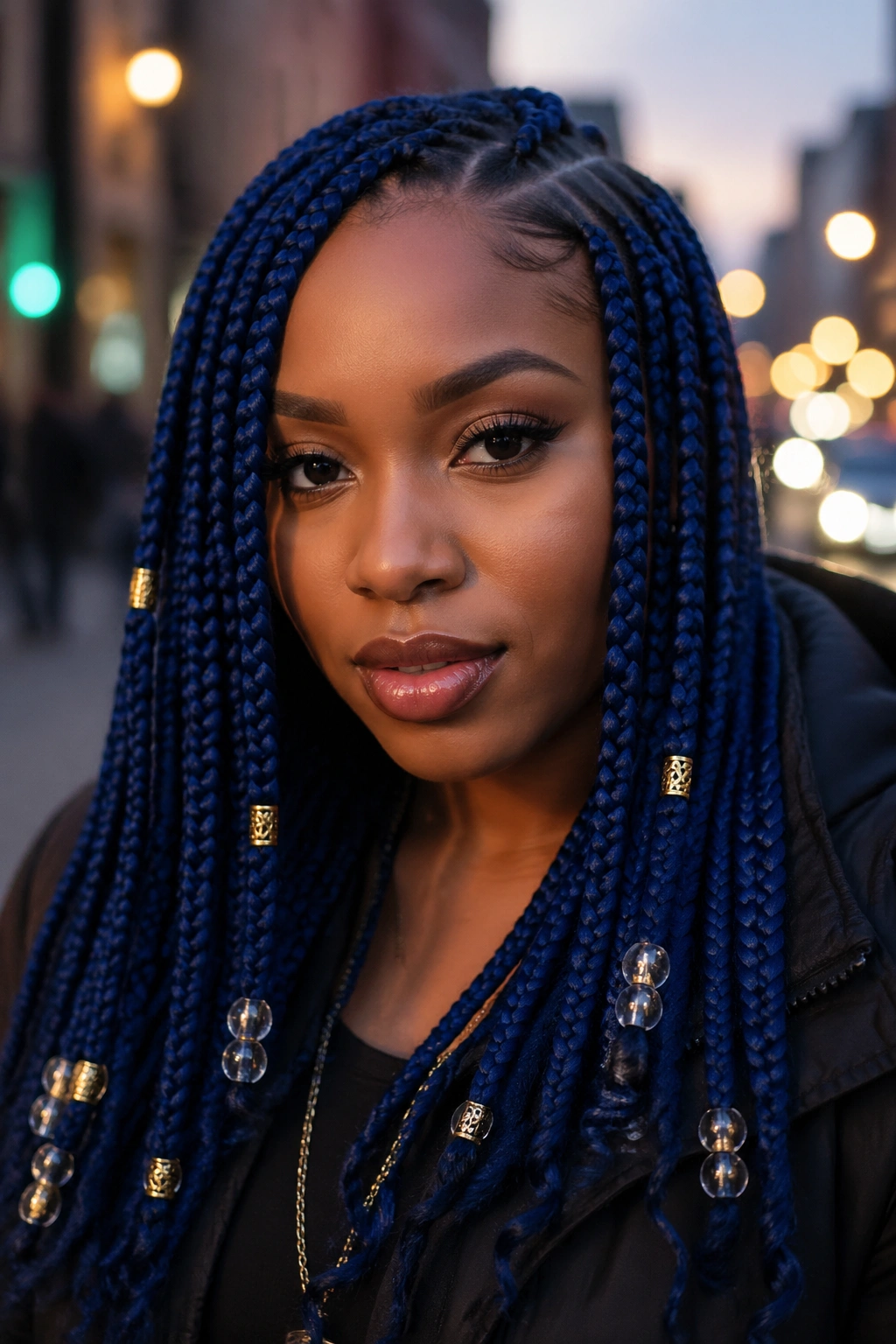
Accessories can make blue braids look richer, but they can also drown them if you go too hard. A few gold cuffs, a handful of clear beads, or small metal rings near the ends can sharpen the color without fighting it. The trick is restraint. Blue already carries enough personality.
I like metal accents most on dark-to-light ombré braids, where the hardware catches the eye before the ends do. If the blue is already bright, keep the accessories matte or sparse. Clear beads work well because they let the braid color show through instead of covering it up.
Where the Accessories Belong
Put the strongest pieces near the face or at the last third of the braids. That keeps the scalp area cleaner and avoids extra pull at the roots. I would skip heavy beads on every single braid unless you want a full ceremonial look, because the weight adds up fast.
- 6 to 10 cuffs across the front section is enough for most installs.
- Small beads work better on medium braids than on jumbo ones.
- Matte gold looks warmer against cobalt; silver tends to sharpen navy.
- End beads should be light, or they’ll swing too hard.
This style has a little edge, a little polish, and enough room for your own taste to show up.
12. Turquoise Ombré Box Braids
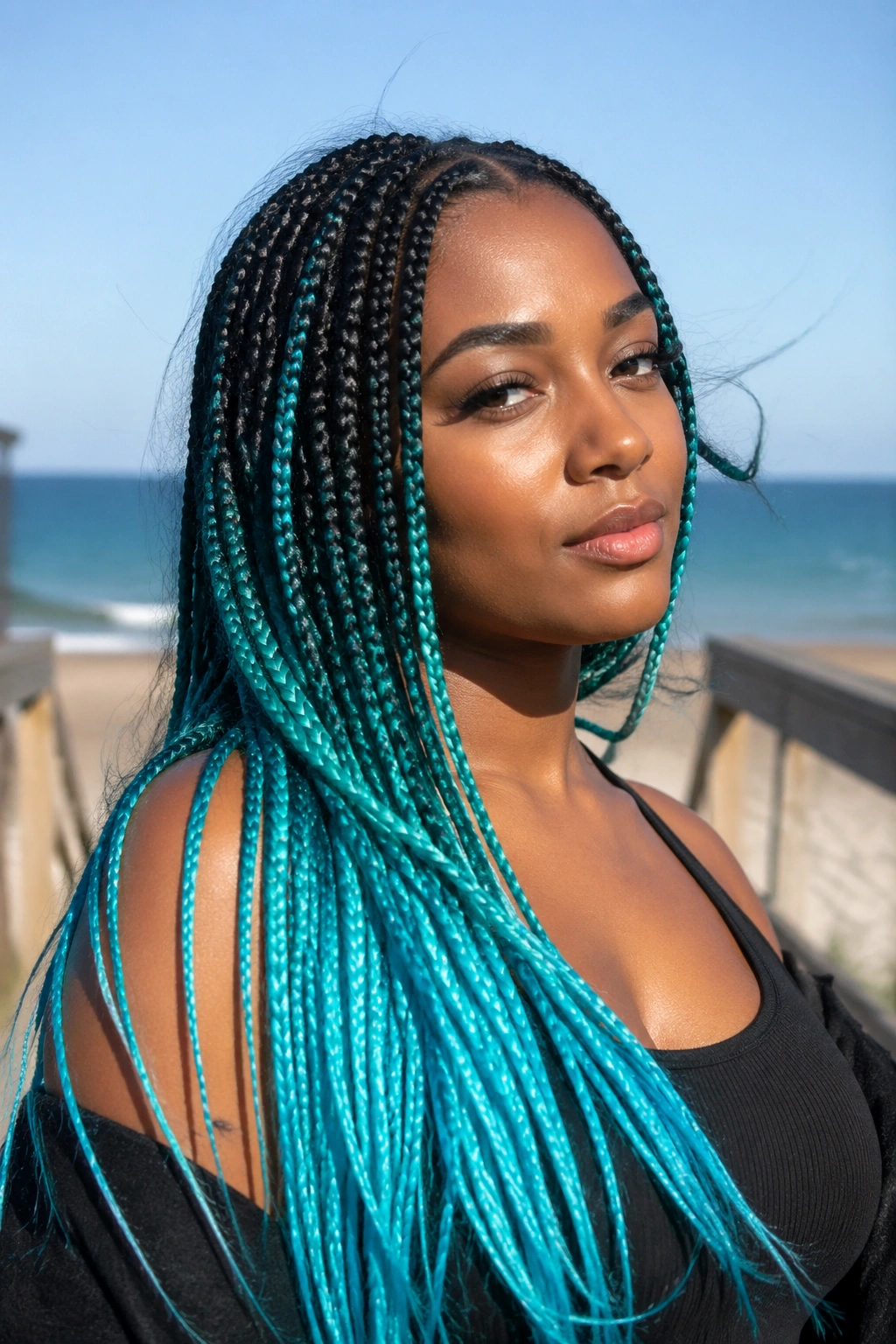
Turquoise is the brighter cousin in the blue family, and it asks for a cleaner base than people expect. On dark roots, it pops hard. On lighter roots, it can flatten or drift green if the blend is not handled carefully. That’s why I think turquoise works best as a true ombré rather than a full-head color.
Turquoise vs Cobalt
Cobalt reads deeper and more saturated. Turquoise feels airier, almost aquatic, but that lightness can get washed out if the braid hair is too thin or the finish is dull. Turquoise also loves a little contrast at the roots—black, espresso, even deep navy—because that keeps the color from losing shape.
This is the style I’d suggest if you like a brighter result without going all the way into electric blue. It still has energy. It just lands differently. The fade can start lower on the braid too, which makes the color read as a clean dip-dye rather than a full shift.
I’d pair turquoise braids with simple clothing and maybe one strong accessory, not a pile of them. The color does enough on its own. Let it.
13. Layered Blue Box Braids
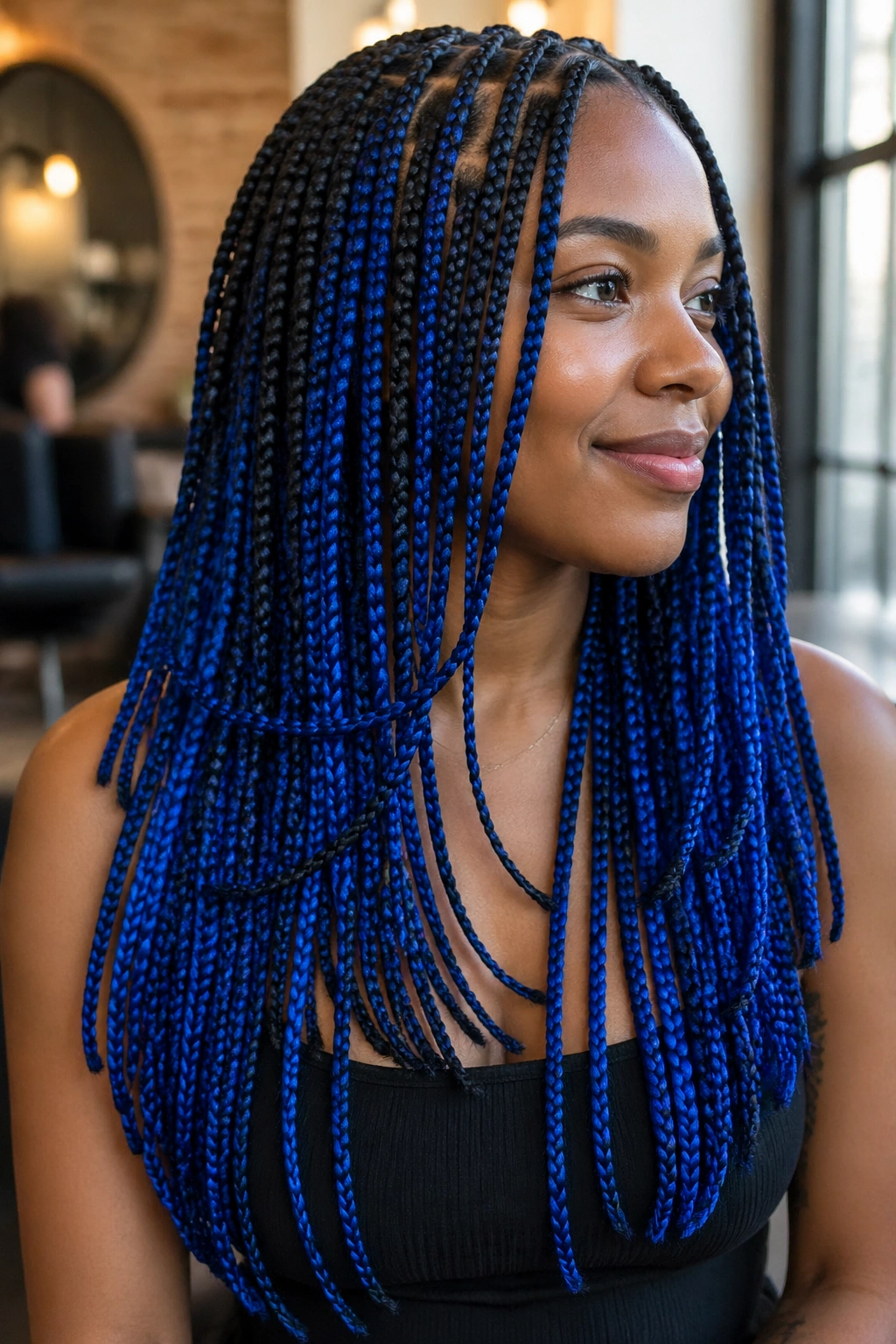
Layered braids are for people who want movement more than symmetry. Instead of one blunt length all the way around, the braids fall in staggered sections—some at the shoulders, some at the chest, some a bit longer in back. Blue looks especially good in layers because the different lengths let the shade shift at several points, not just the ends.
Why Layers Matter
A blunt hemline can make bold color feel heavy. Layers break that line and let the braids move in a softer way. They also stop the style from looking too dense around the bottom, which is helpful if the hair is thick or the braids are medium-to-large.
Ask for dry trimming after the install, not before. Braids settle differently once they’re in place, and the final shape should be cut while the hair is hanging naturally. If you want the blue to show on every level, ask the stylist to place some of the brighter strands in the upper layers instead of saving all the color for the ends.
This is one of my favorite options when someone wants blue braids that feel a little less uniform. Uniform can be clean. Uniform can also be boring. Layers fix that.
14. What makes micro blue box braids different?
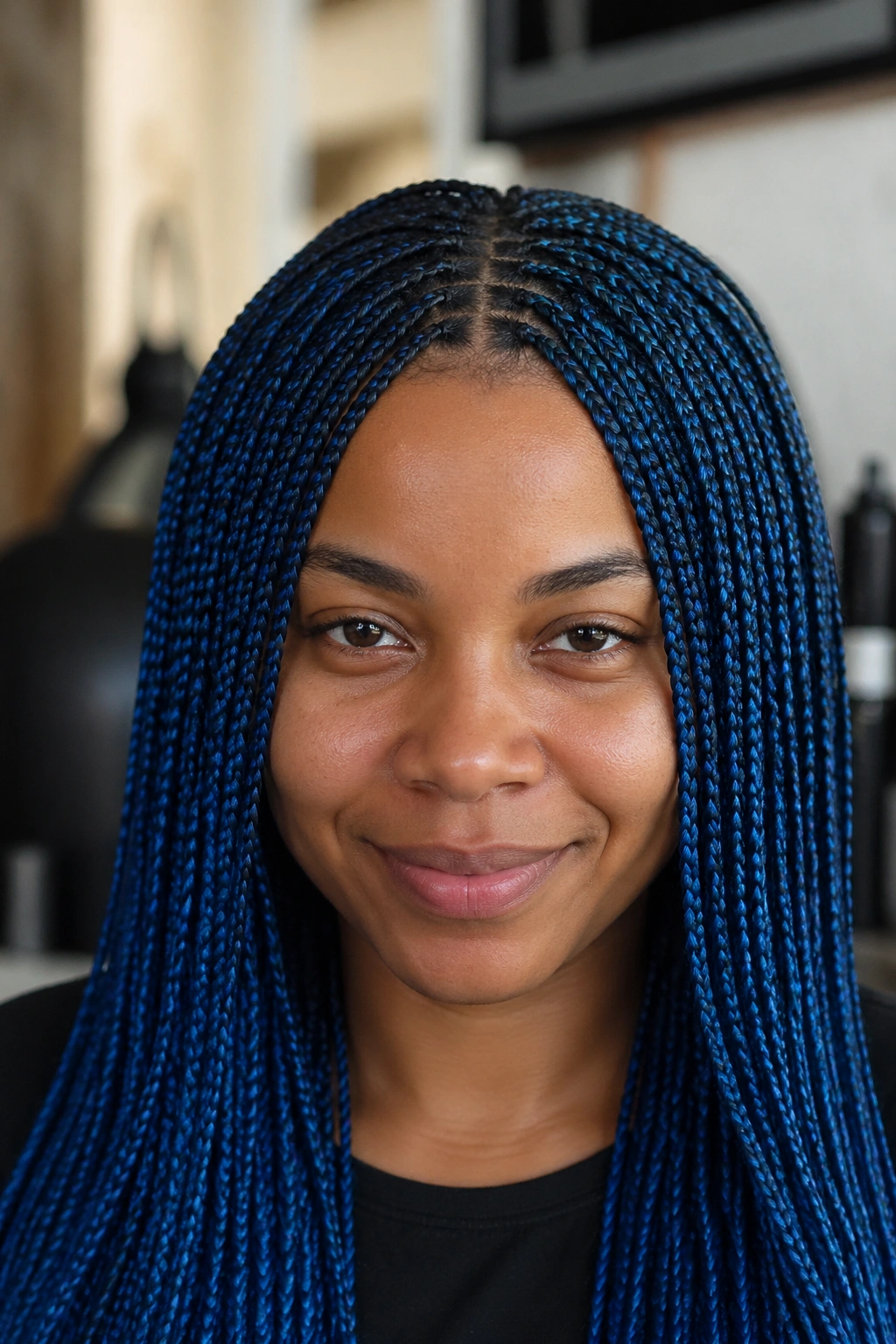
The scale. Tiny braids change the whole mood of the color because blue stops reading as a block and starts reading like shimmer. You notice movement first, then shade, then the fine texture of the plaits. It’s a softer effect than jumbo braids, and it takes patience from both the stylist and the wearer.
Micro braids are also the most demanding version on this list. The install takes time, the parting has to stay neat, and the roots can get stressed if the braids are too small at the hairline. I’d keep the front rows slightly larger than the rest if you want the style to last without tugging too hard.
What to Watch For
- Keep the size tiny through the lengths, not at the edges.
- Ask for lightweight synthetic hair so the set does not feel dense.
- Choose darker blue for a more subtle finish; bright blue can look busy on micros.
- Wear the style down at first so the parting can settle before you pull it up.
This is the braid style for someone who likes detail. Not the flashy kind. The kind that rewards a closer look.
15. Blue Ombré Box Braids with Curly Ends
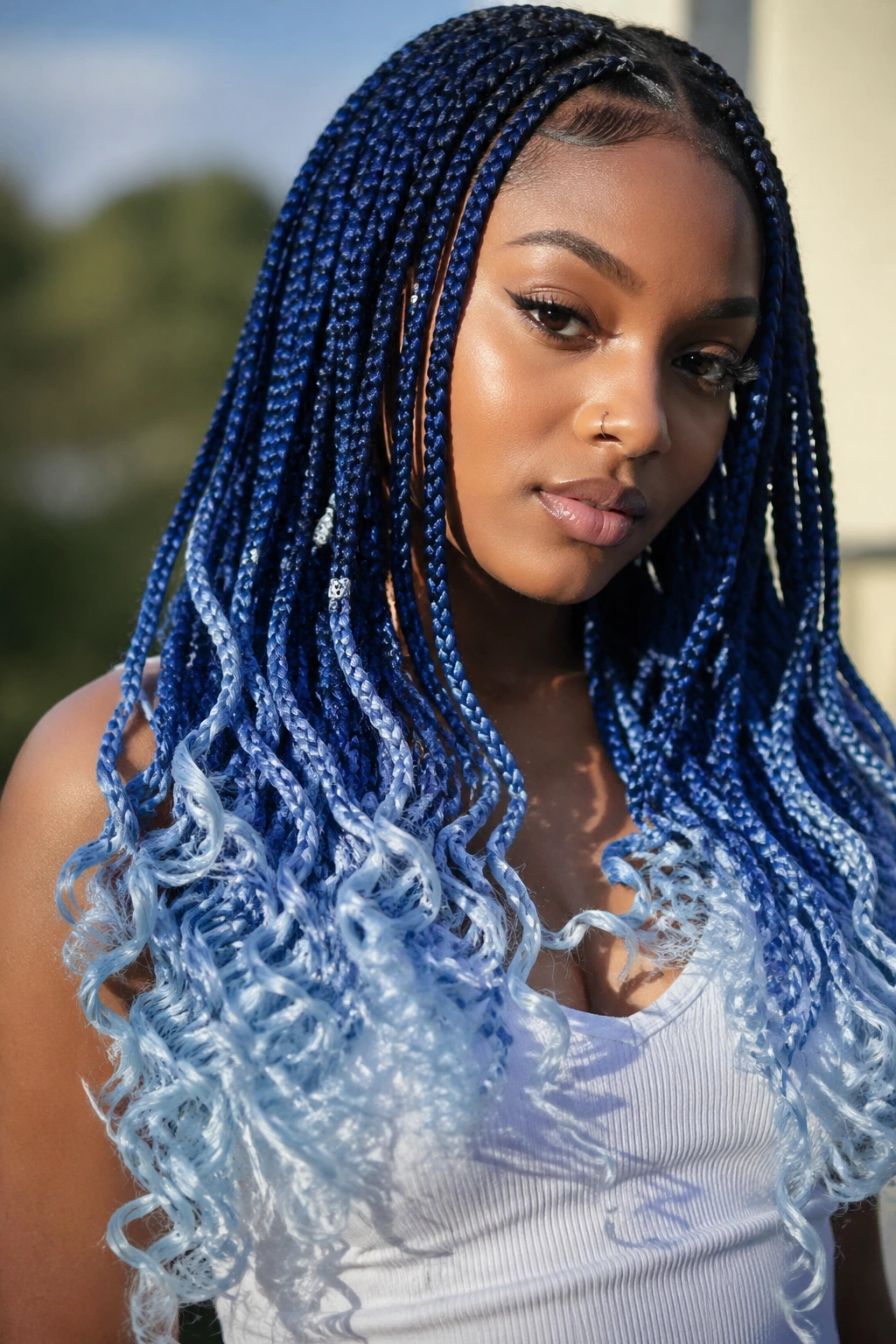
Curly ends soften everything. Straight blue braids can feel crisp and cool, but once the ends are curled, the whole style relaxes a little. The contrast between the tight braid and the loose spiral at the bottom gives the color more life, especially if the ombré ends in a lighter blue or icy tone.
I like this version when the goal is movement. The curls keep the ends from looking stiff, which is a common problem with long synthetic braids. You can use pre-curled hair, flexi rods on the finished ends, or hot-water setting if the extension fiber allows it. The key is to keep the curl shape loose enough that the blue still shows, not so tight that the braid disappears into frizz.
How to Keep the Ends Soft
A small bit of mousse on the curls helps them stay in shape, but don’t soak them. Too much product makes the ends heavy and dull. If you want extra definition, wrap the curled sections around 1-inch flexi rods overnight and release them in the morning once they’re fully dry.
This is the version I’d pick for someone who wants blue braids that feel a little romantic without losing their edge. The color still has bite. The curls just take the sharp corners off.
