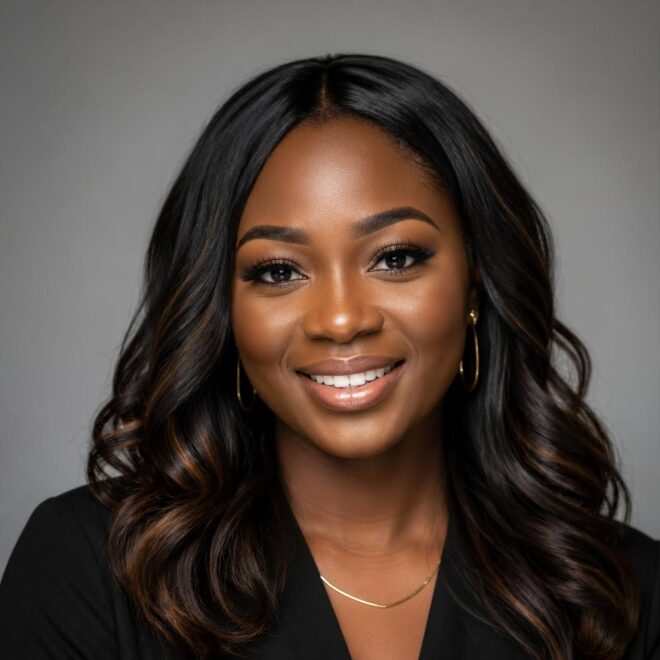


Goddess box braids sit in that sweet spot between polished and soft. You get the clean structure of box braids, then the loose curly pieces bring in movement, a little frizz on purpose, and that lived-in finish people keep trying to copy. Done well, the style has shape. Done badly, it can look bulky at the root and fuzzy at the ends, which is why braid size, curl placement, and parting matter more than people think.
The best versions never look random. The braids and the loose pieces should feel placed, not sprinkled on as an afterthought. That’s the difference between a style that looks rich and one that looks like it fought with a curling wand and lost. The braid pattern, the length, and the amount of curl you leave out all change the whole mood.
Some people want drama. Others want something they can wear to work, to brunch, to the airport, and still feel put together by the end of the day. Same family of style. Very different results. If you’re sorting through ideas, the smartest way to think about goddess box braids is by shape, weight, and how much movement you want around your face.
1. Classic Waist-Length Goddess Box Braids
This is the version most people picture first, and for good reason. Waist-length goddess box braids give you enough length for swing and drama, but they still keep the braided structure clear. The loose curly pieces usually sit through the mid-lengths and ends, so the style moves when you walk instead of hanging stiff.
Why It Works So Well
The length creates a strong vertical line, which makes the curls read as soft texture instead of extra bulk. That matters. If the curls are too dense on a long set, the style can start to look heavy near the bottom. Keep the curly pieces a little shorter than the braids themselves, and the finish stays cleaner.
- Best braid size: medium to medium-large
- Best curl placement: from cheek level down to the ends
- Best parting: clean squares, not tiny grids
- Best wearers: people who want a noticeable style without going full jumbo
Tip: Ask for a few curls to sit closer to the face and the rest to stay lower. That small placement change makes the style look intentional instead of crowded.
2. Knotless Goddess Box Braids With Soft Roots
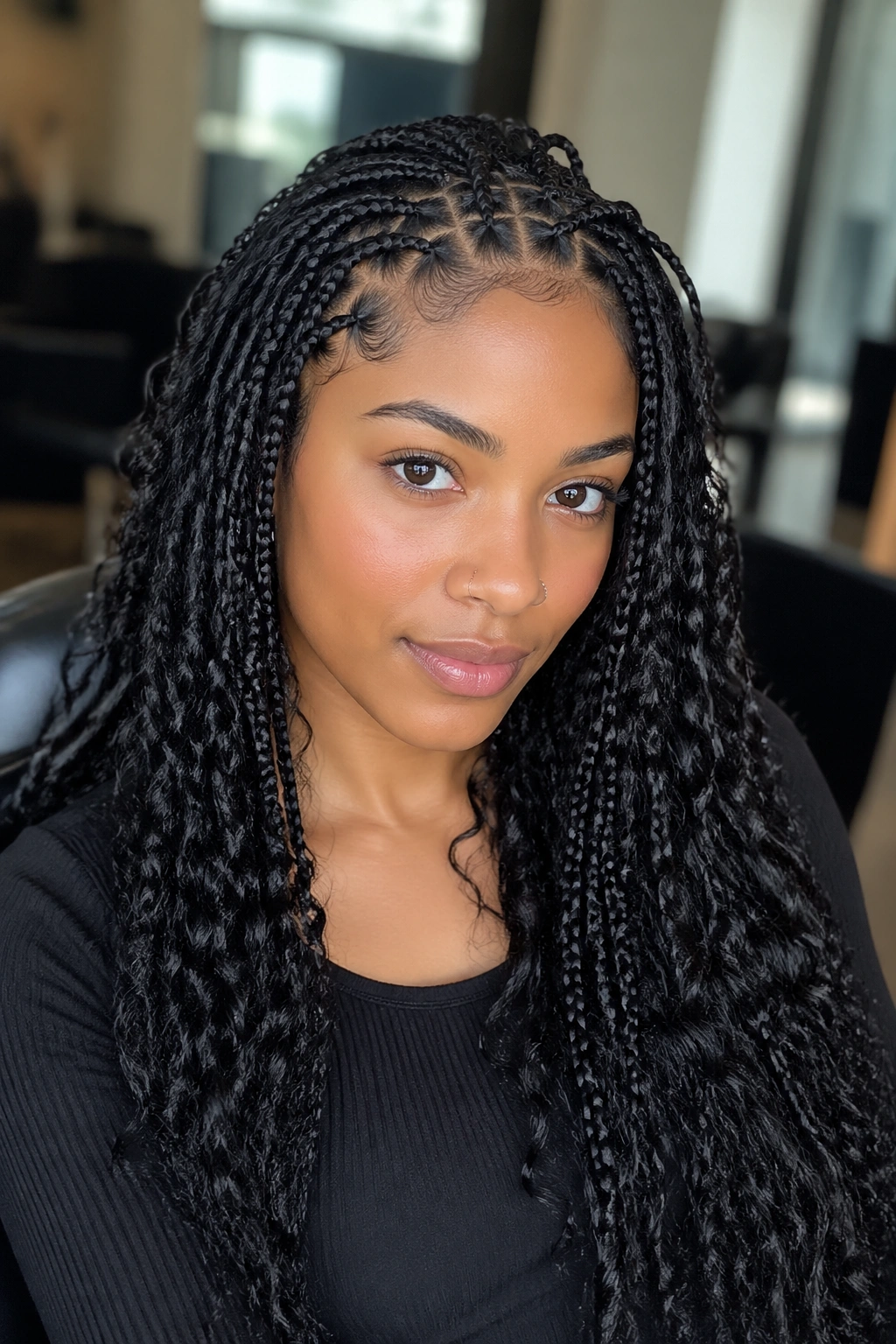
Do you want the look of goddess braids without that tight knot at the scalp? Knotless goddess box braids are the answer. They start with your own hair and build into the braid more gradually, so the root sits flatter and feels lighter.
That softer base matters more than people admit. A hard knot can make the front look bulky, especially if you wear your hair pulled back or tucked behind your ears a lot. Knotless braids also tend to look smoother when you part them from the side or wear them with glasses. The line at the hairline just reads cleaner.
They do take longer to install, and that’s the tradeoff. But if you care about comfort, especially around the temples, this is the version I’d point people toward first.
No hard ridge. No harsh start. Just a braid that settles into the scalp in a more natural way.
3. Boho Goddess Box Braids With Loose Curl Pieces
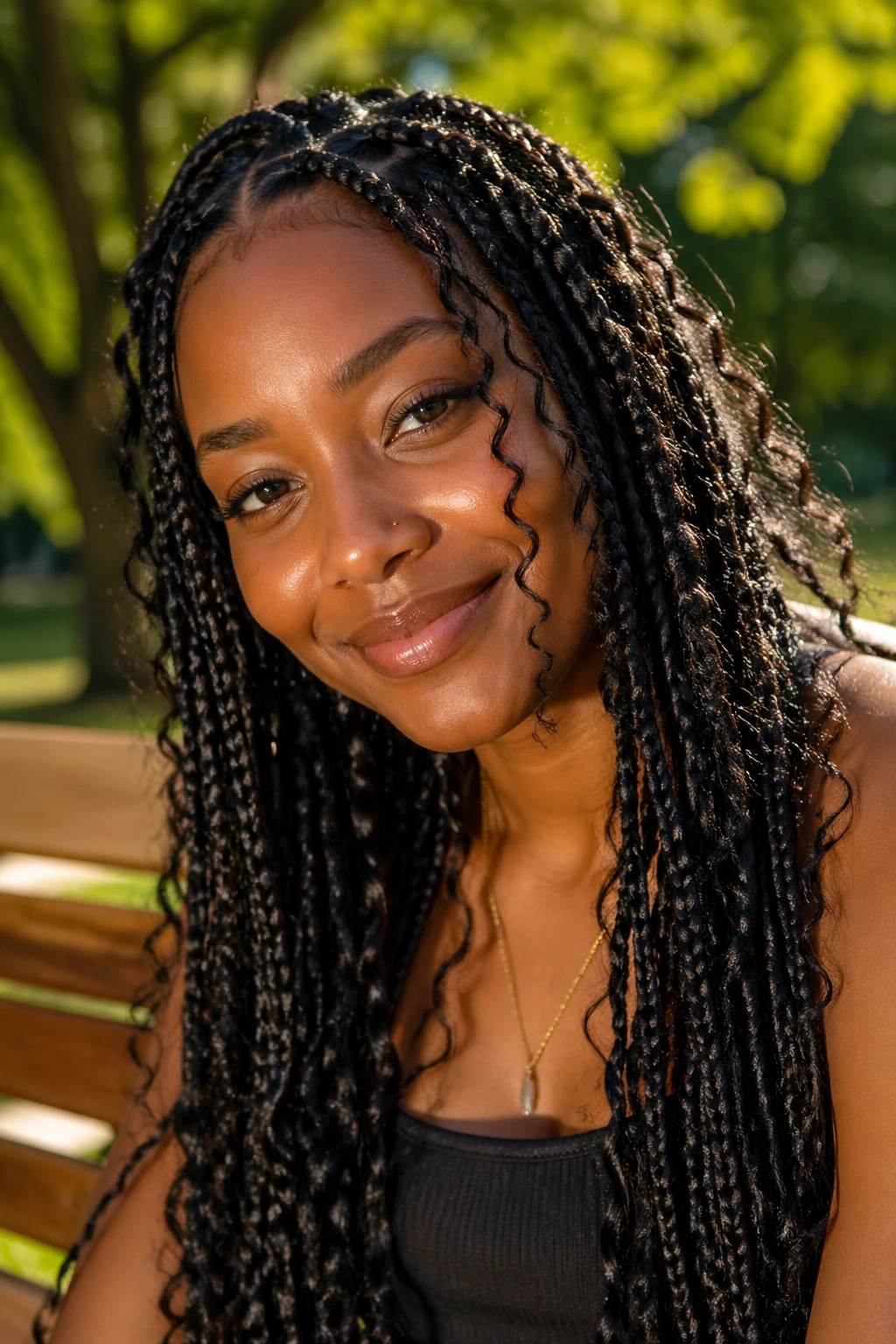
Picture this: you throw on a plain black T-shirt, and the hair does the work. That’s the whole charm of boho goddess box braids. They lean into messy-on-purpose texture, with loose curls dropped through the braids in a way that feels relaxed rather than neat.
Where the Curls Belong
The trick is spacing. If you leave curl pieces out of every braid, the style loses shape fast. If you barely leave any out, you miss the whole point. A good middle ground is to place the loose pieces every few braids, then let them cluster a little more around the face and ends.
- Use fewer loose pieces near the nape
- Put more texture around the temples
- Keep the curls longer than chin length if you want real movement
- Avoid cramming too many curl bundles into one section
What people get wrong: they make every piece equally curly. That turns the hair into a puffball. The better move is to let some braids stay cleaner so the texture has room to breathe.
4. Jumbo Goddess Box Braids
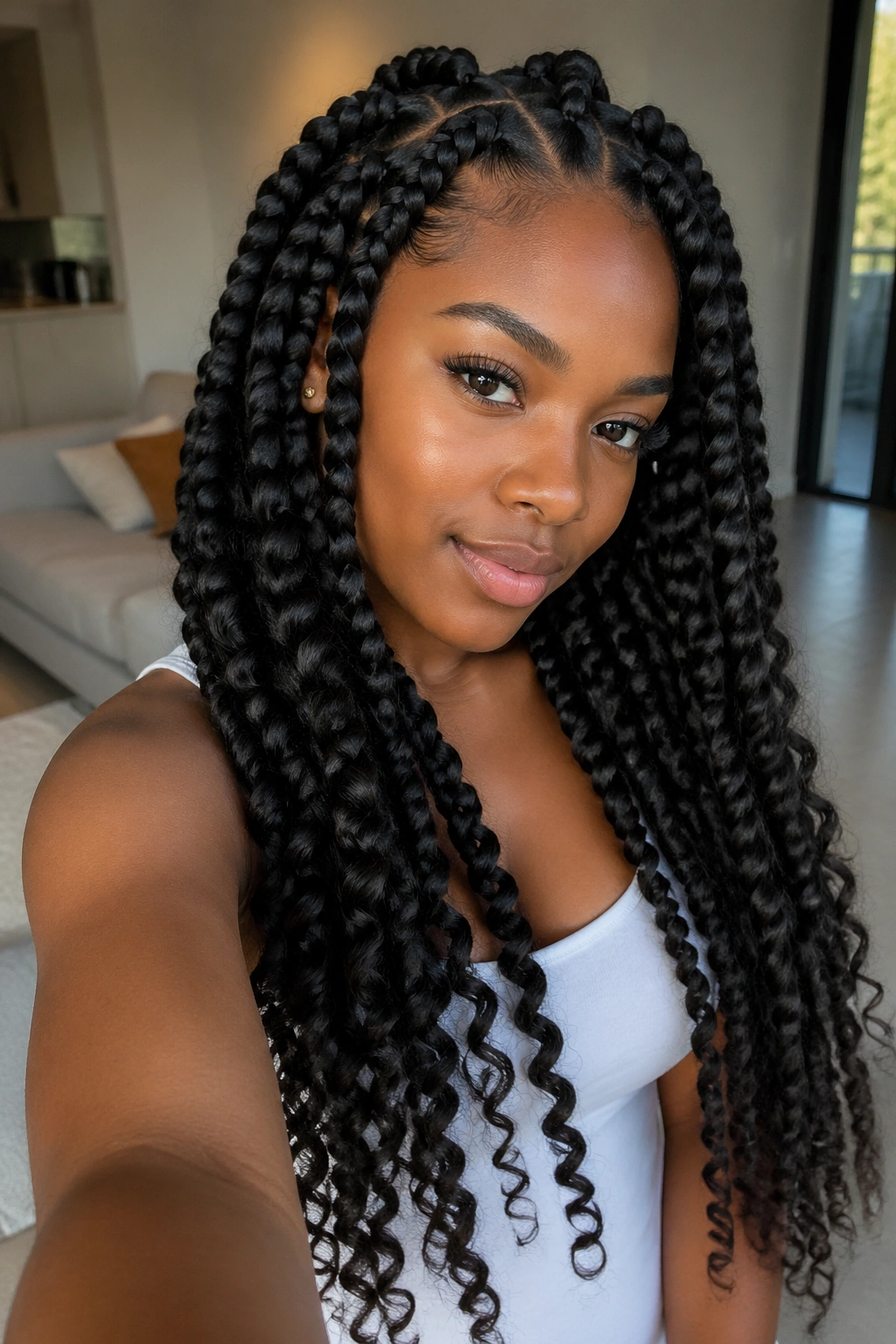
Here’s the unpopular truth: jumbo goddess box braids are not lazy hair. They’re a strong style choice. Big parts and thicker braids give you a bold outline, and the loose curly strands stand out more because there are fewer of them competing for attention.
That makes this version useful when you want impact without sitting in a chair forever. The install is usually faster than mini or micro versions, and the final look has more shape from across the room. Up close, the texture reads chunky in a good way — the curls sit like accents, not decorations.
The downside is weight. Bigger braids pull more, especially if they’re long. So the cleaner your parting and the lighter your extension hair, the better the result. Keep the curls concentrated near the ends, not all through the braid, or the whole style can sag.
Strong, graphic, and a little louder. That’s the point.
5. Medium Goddess Box Braids
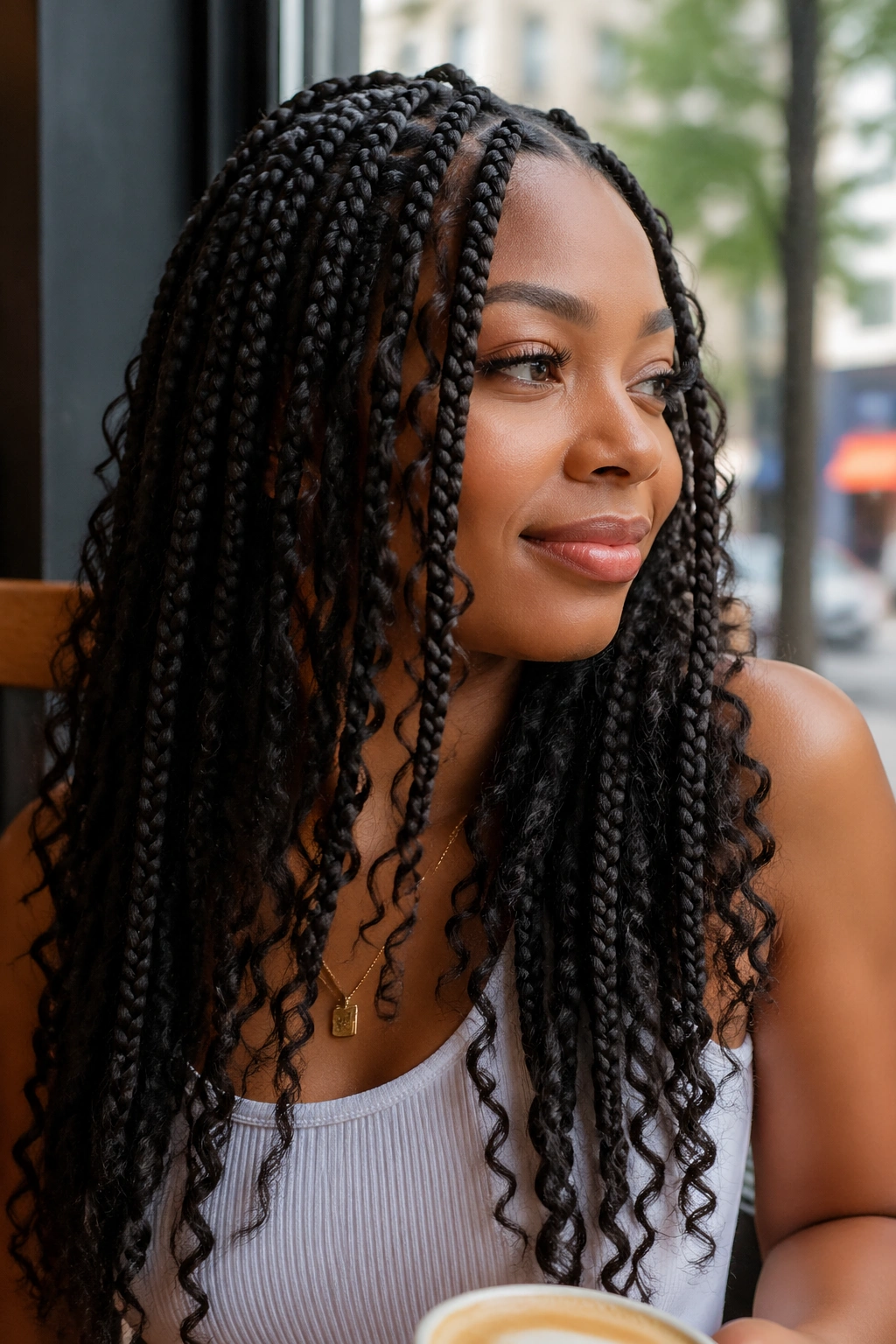
Medium goddess box braids are the set I’d recommend to someone who wants balance and hates extremes. Not too tiny. Not too bulky. The braids usually land around a quarter to half an inch wide, and that middle ground gives the loose curls room to show without making the scalp look crowded.
You get a nice rhythm when you wear them. The braids move enough to feel soft, but they still hold a neat shape on day one and day ten. That’s a real advantage if you want a style that works with a hoodie, a button-down, or a dress with a high neckline.
They also age well. Tiny braids can look a little wild as they loosen, and jumbo braids can start to feel heavy. Medium braids usually land in the sweet spot where the style softens over time instead of going off the rails.
Not flashy. Not boring. Just balanced.
6. Mini Goddess Box Braids
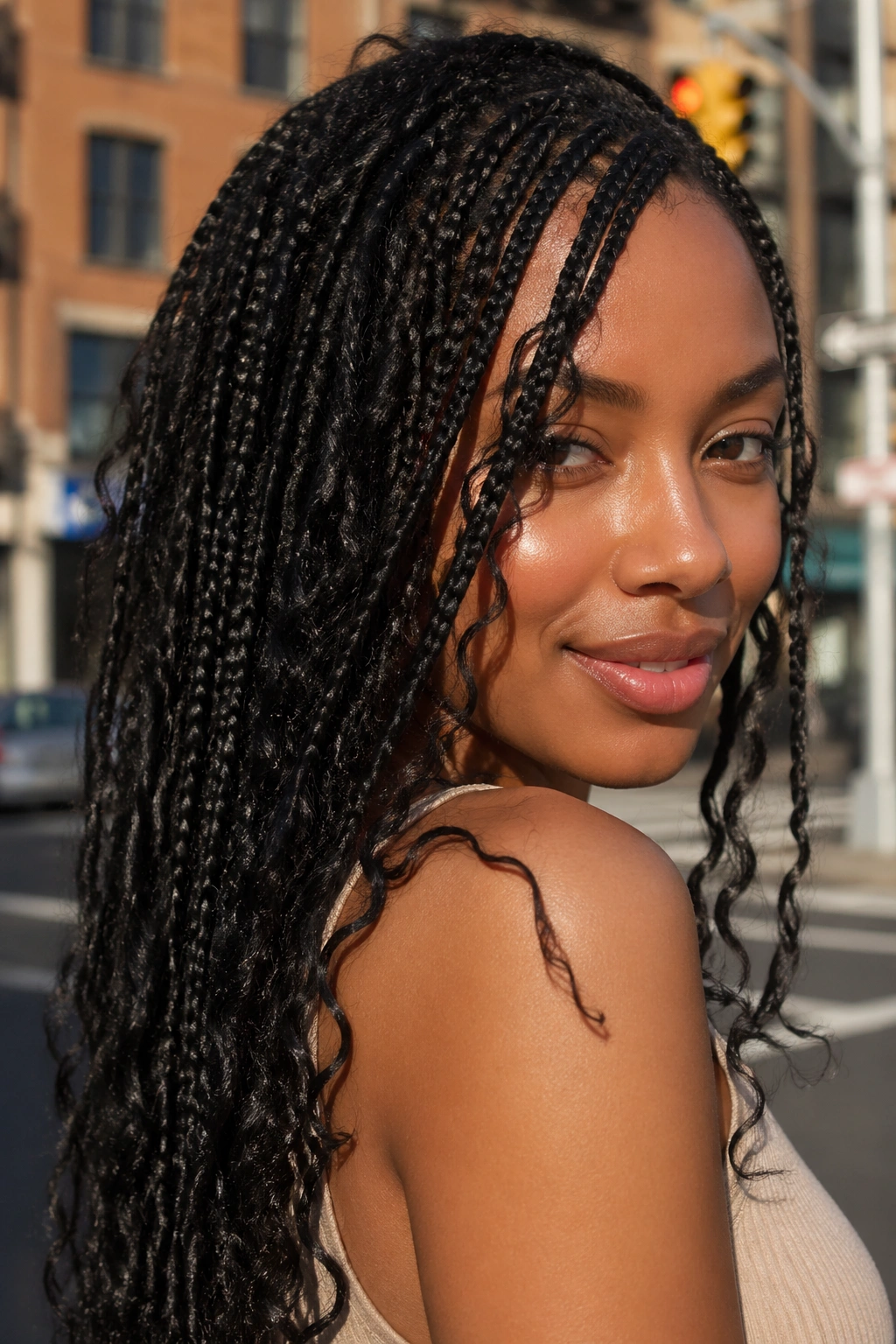
Tiny braids change the whole tone of the style. Mini goddess box braids give you more movement, more braid count, and a finer overall finish that looks delicate from a distance and intricate up close. If you like hair that looks almost woven, this is the lane.
What Mini Braids Do Better
They create a flatter silhouette at the scalp, which can be handy if you want the loose curls to show without adding bulk. The downside is time. Mini braids take longer to install, and the finish can get fuzzy faster if the loose pieces are too many or too long.
- Best for people who like lots of motion
- Best when the curls are sparse, not stuffed into every section
- Best with lighter extension hair
- Best if you do not mind a longer salon day
Mini braids also work well when you want to tuck them into buns or half-up styles later. There’s just less weight fighting you when you move them around. Small braid, big patience.
7. Bob-Length Goddess Box Braids
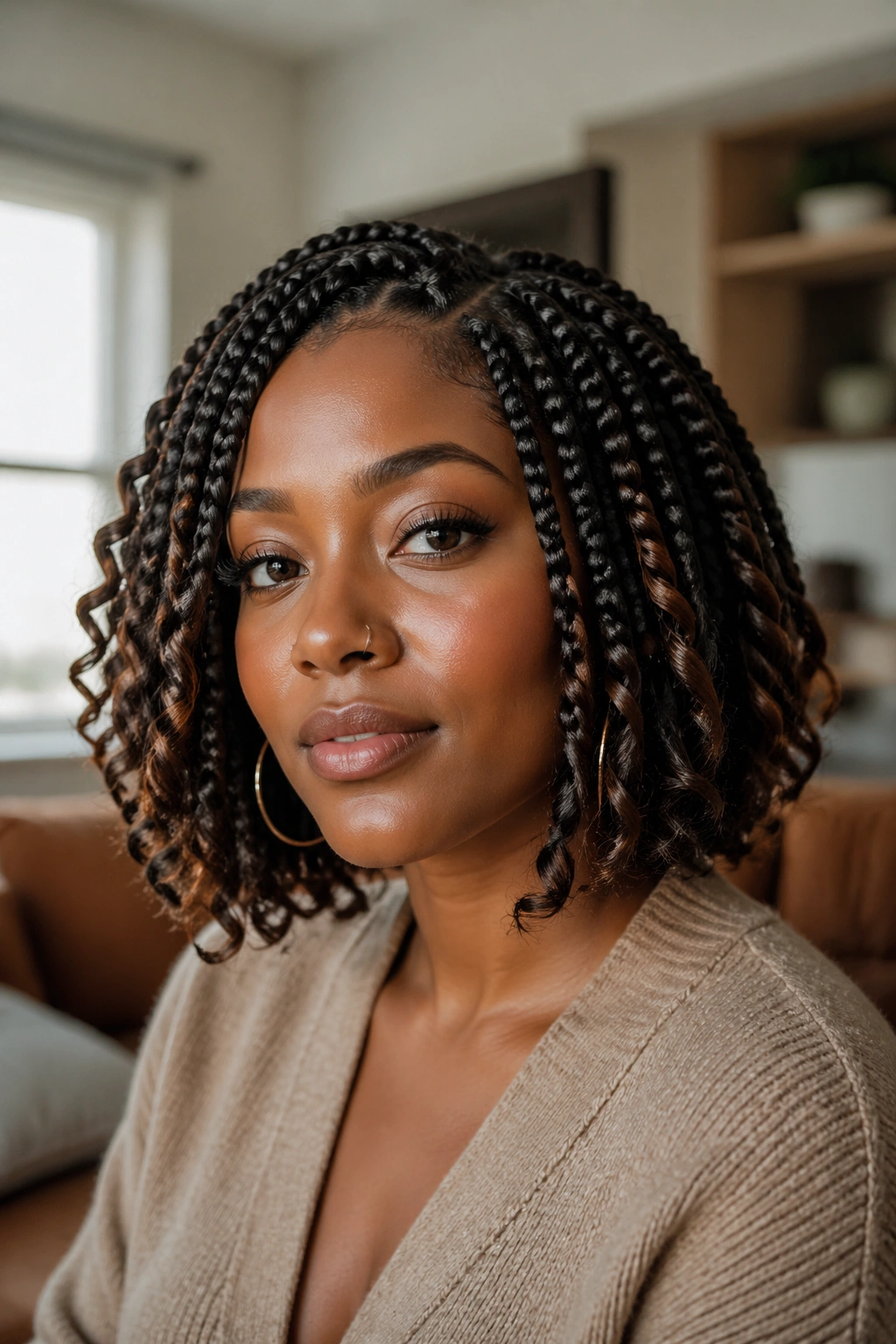
A bob-length set can feel almost refreshing after seeing every braid drag past the chest. Bob-length goddess box braids usually hit around the jawline or just below it, and that shorter cut makes the curls feel lively instead of heavy.
The style is especially good if you wear collared shirts, scarves, or big earrings. Nothing gets buried. Your neck stays free, the curls bounce near the face, and the whole look feels sharper. It’s also easier to sleep on, which matters more than people like to admit.
I like bob-length braids for anyone who wants a clean look without giving up texture. The loose pieces should sit mostly near the ends, not all through the braid, or the style can puff out too wide at the sides. Keep the edges neat and let the shape do the talking.
Shorter does not mean less interesting. Sometimes it means the braid pattern shows off more.
8. Side-Part Goddess Box Braids
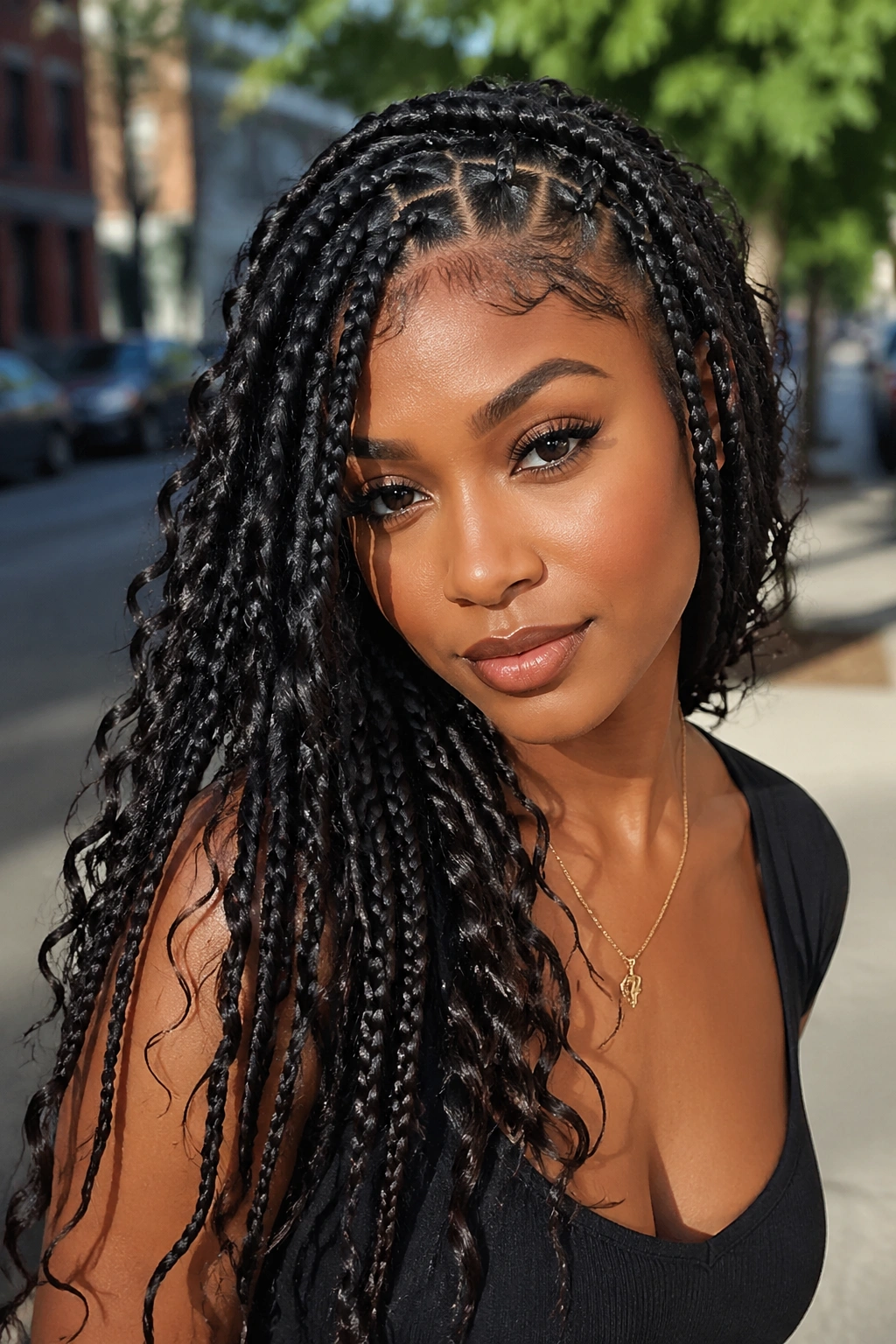
A side part changes everything. Side-part goddess box braids bring instant movement to the face because the eye follows the braid line before it even notices the curls. That slight asymmetry softens the whole style and makes it feel less rigid than a straight center line.
If you wear hoops, side parts look especially good. The open side gives the earrings room, and the heavier braid side frames the cheekbone instead of sitting evenly across the forehead. That little imbalance is flattering in a way people can’t always explain, but they feel it.
The part itself matters. A deep side part can look dramatic, but if it’s too deep for your density, the style can feel top-heavy. A moderate side part usually works better because it leaves enough hair on both sides to keep the shape grounded.
Clean, slanted, and a little bit glam. Easy choice.
9. Center-Part Goddess Box Braids
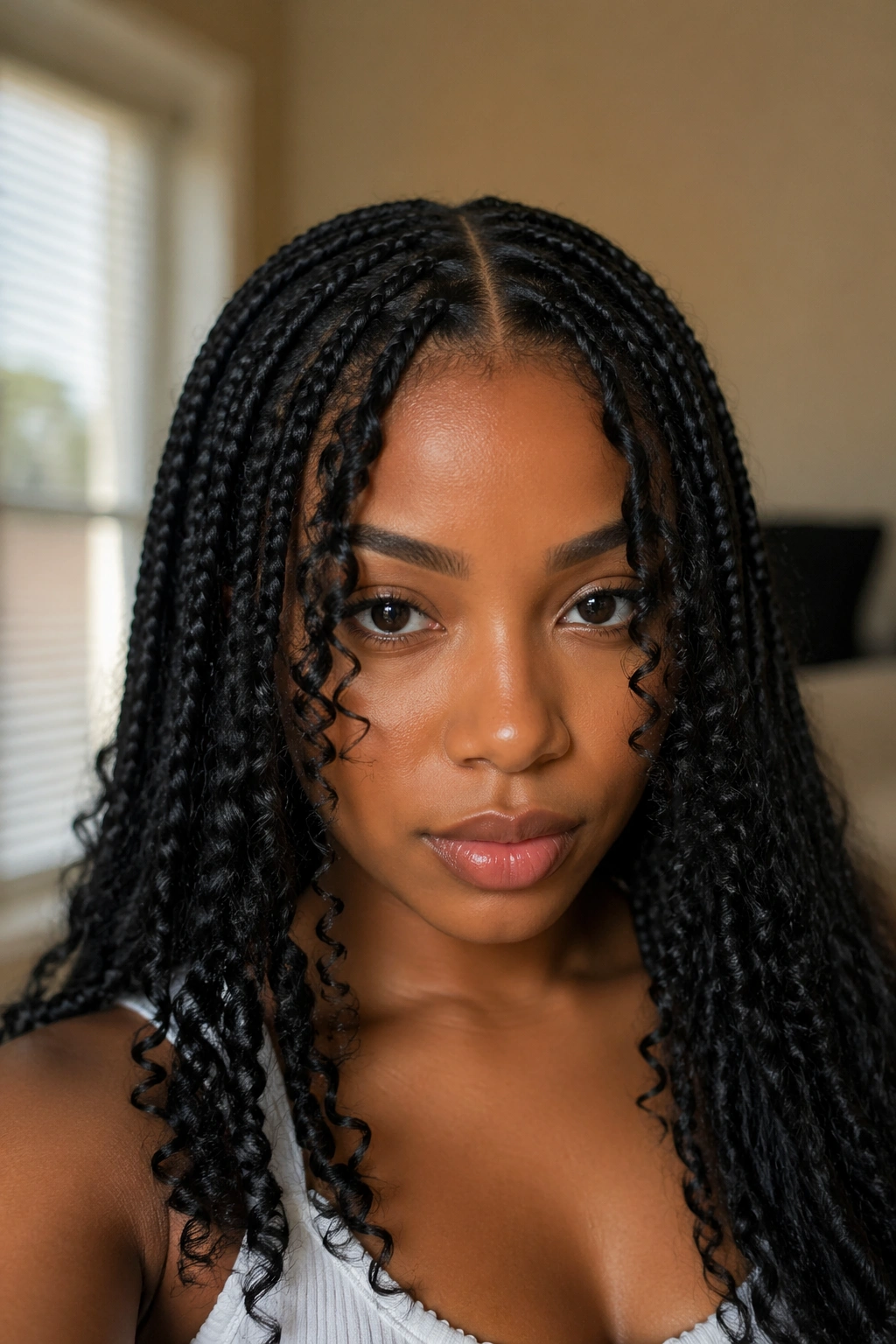
Want a style that looks orderly without feeling stiff? A center part does that job. Center-part goddess box braids split the face evenly, which makes the braid pattern and the loose curls feel symmetrical from the front.
That symmetry can be beautiful on its own, but it also gives you a very useful canvas. Sunglasses sit well on it. Bold brows stand out. So do face-framing curls, especially when they land around the cheekbones and not all the way at the jaw. The style reads clear and direct.
There is one catch: if your hairline is sparse near the temples, a hard center part can make that area more noticeable. Softening the front with a couple of thinner curls helps. So does avoiding a part that’s too wide at the scalp.
It’s a simple look, but not a plain one. That distinction matters.
10. Half-Up Half-Down Goddess Box Braids
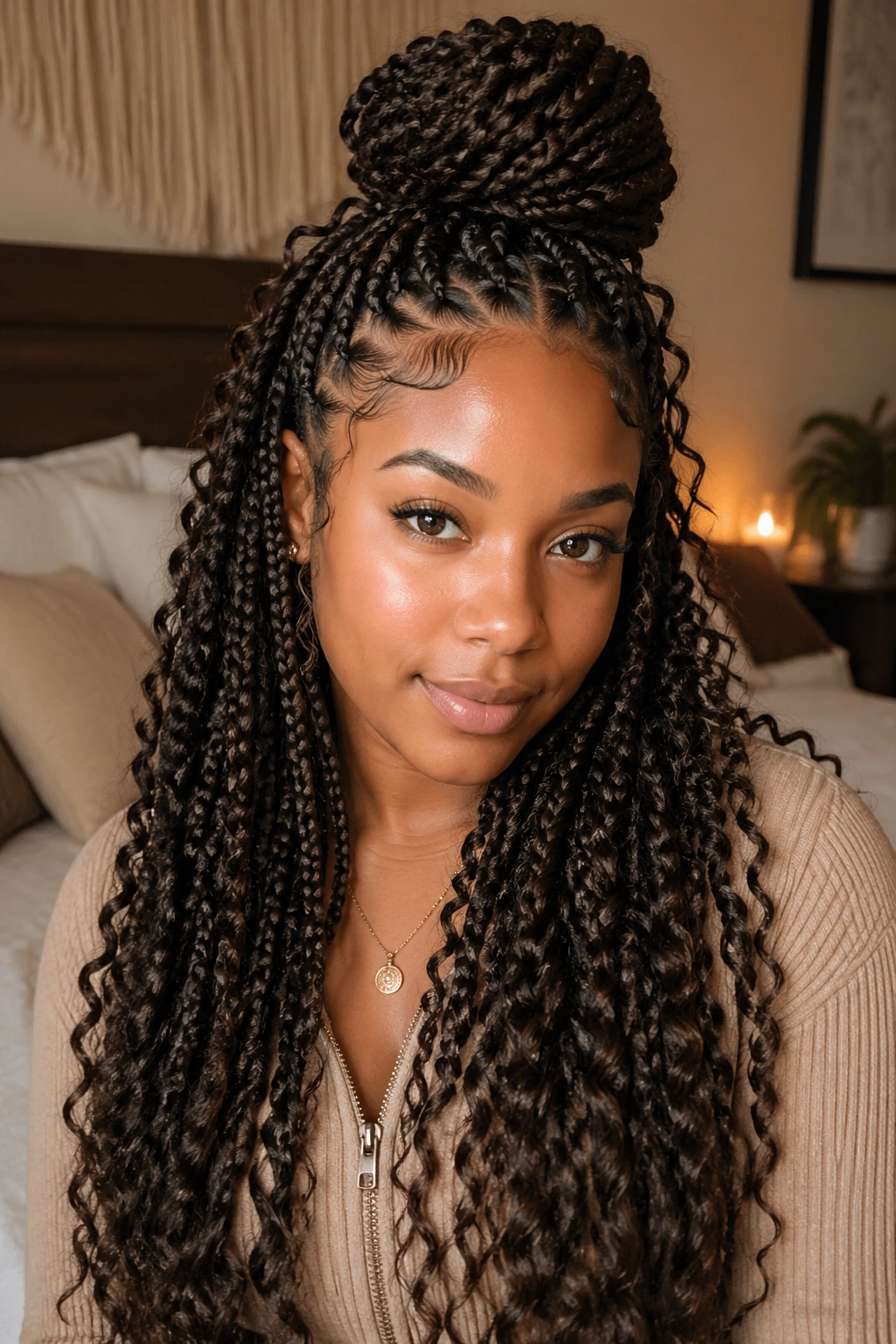
Half-up half-down goddess box braids are the style people reach for when they want their face clear but do not want to tie everything away. Pulling the top section into a bun, puff, or ponytail leaves the lower braids and curls hanging, which keeps the style soft.
The best part is the shape change. The top gets lifted, the lower half keeps swinging, and the curls around the face break up the braid wall. It’s practical too. You can take pressure off your forehead by shifting a few braids up, then let the rest do their thing.
A top section that’s too small looks accidental. A top section that’s too big can turn the whole look top-heavy. Usually, grabbing the braids from temple to crown gives you enough lift without swallowing the style.
A good elastic makes a difference here. So does not yanking the front too hard.
11. High Ponytail Goddess Box Braids
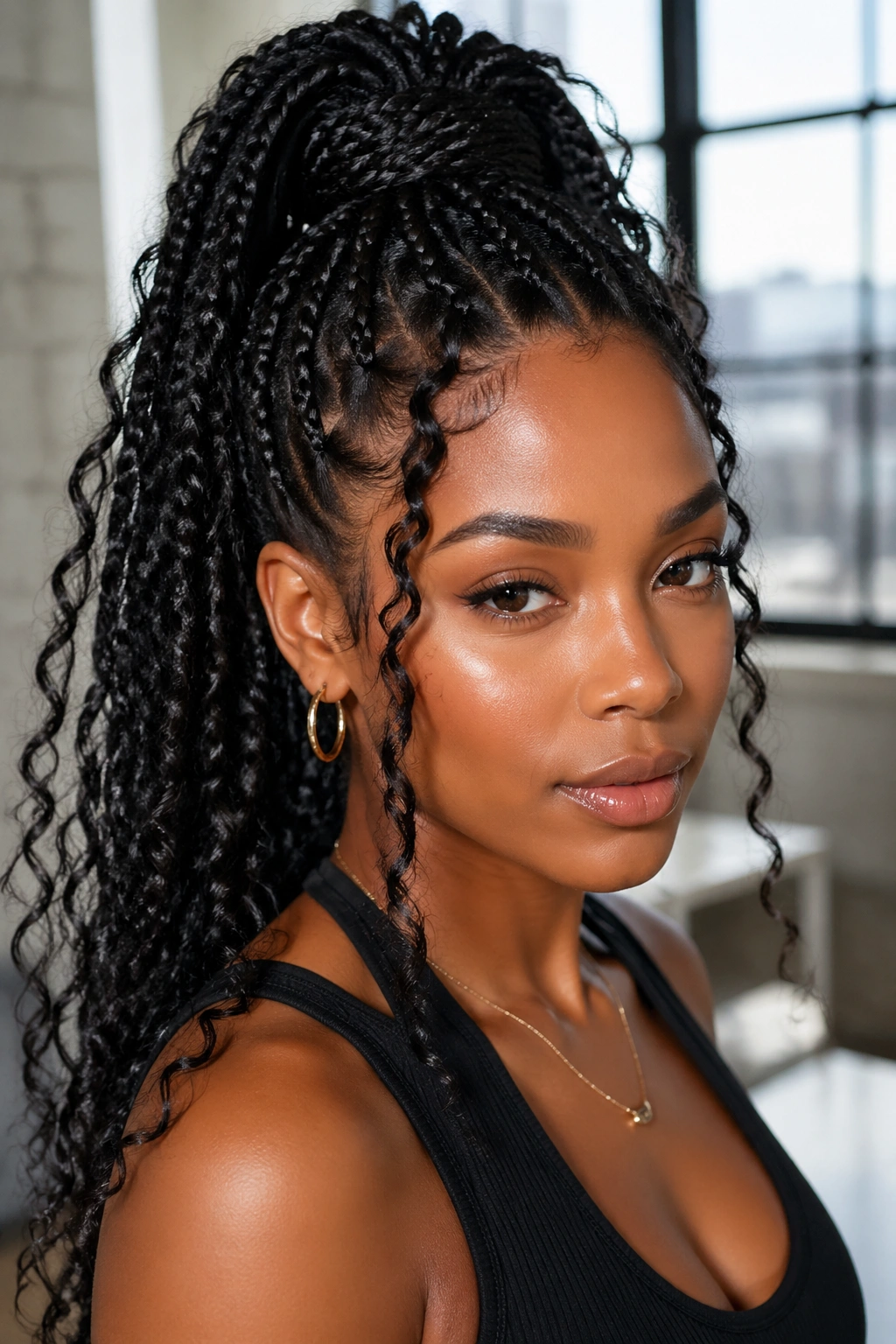
High ponytails usually get treated like a statement style for straight hair, but they work beautifully with braids when the weight is managed well. High ponytail goddess box braids look sharp because the hair is lifted away from the neck, and the loose curls can trail from the base or the length of the pony itself.
The key is density. Medium or smaller braids are easier to lift. Huge braids can feel too heavy at the crown and flatten the shape. I’d also keep the pony placement just above the top of the head, not pulled so high that the edges take all the tension.
This is a style that likes clean wrapping. A braid wrapped around the base of the pony gives the finish a neater edge than a plain elastic. Leave a few curls at the front or the tail, and the pony stops looking severe.
Strong lines. Good height. A little attitude.
12. Low Bun Goddess Box Braids
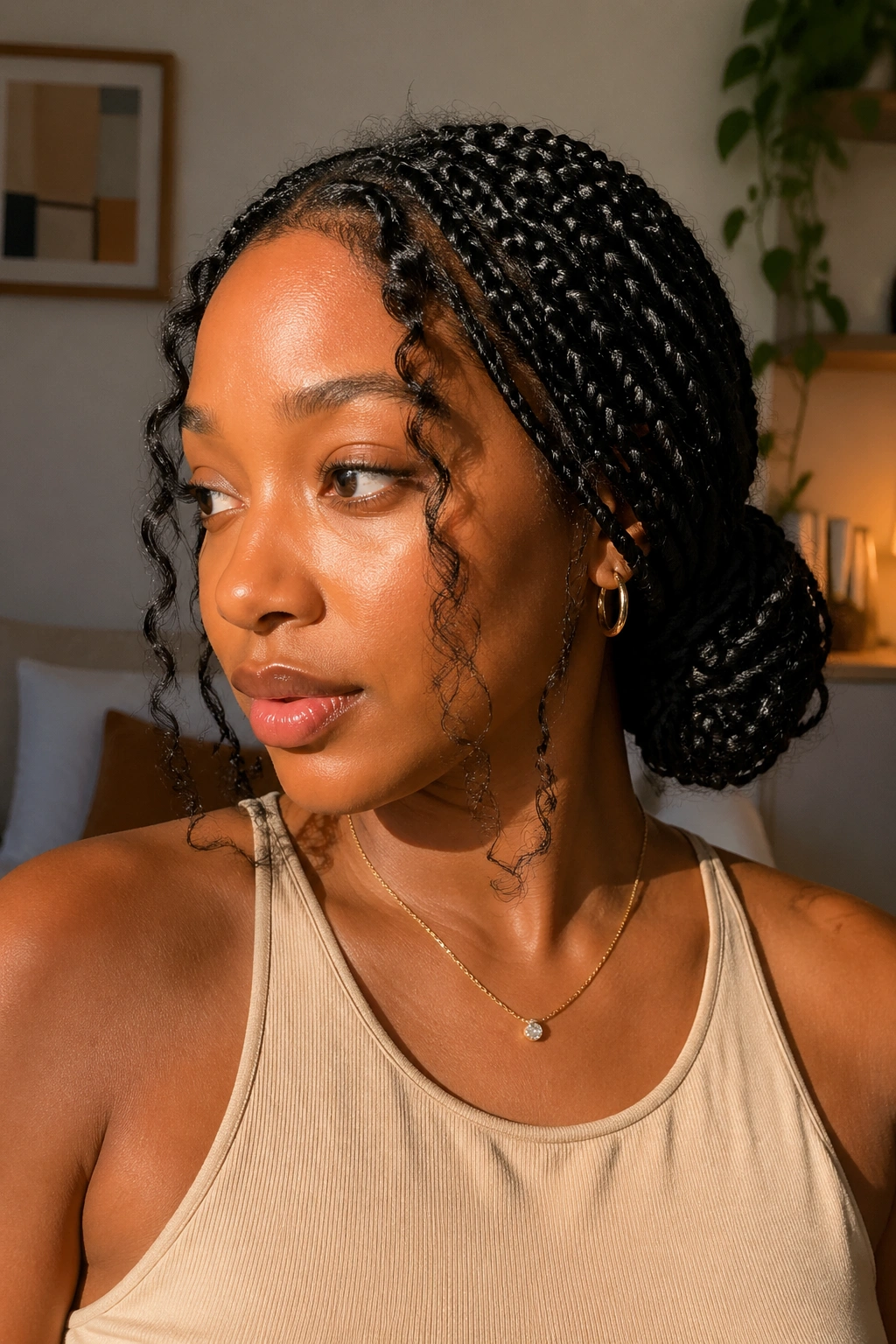
A low bun has a quieter mood, and that’s part of why it works. Low bun goddess box braids sit close to the nape, which makes the style feel controlled even when the loose curls soften the outline. It’s the kind of look that behaves well under coats, at dinners, or anywhere you do not want hair brushing your cheeks all night.
The Detail That Keeps It Neat
The bun should be shaped, not smashed. If you flatten it too hard, the curls lose their point and the braids can stick out in odd angles. A loose coil held with pins or a strong tie gives you more structure and keeps the braid ends from poking out.
- Keep the bun low and slightly off-center if you want a softer line
- Leave one or two curl pieces near the ears
- Tuck the ends under, but not so tightly that the bun looks hard
- Use pins instead of over-tightening a band
A low bun is one of those styles that looks better when it’s allowed to breathe a little.
13. Halo Crown Goddess Box Braids
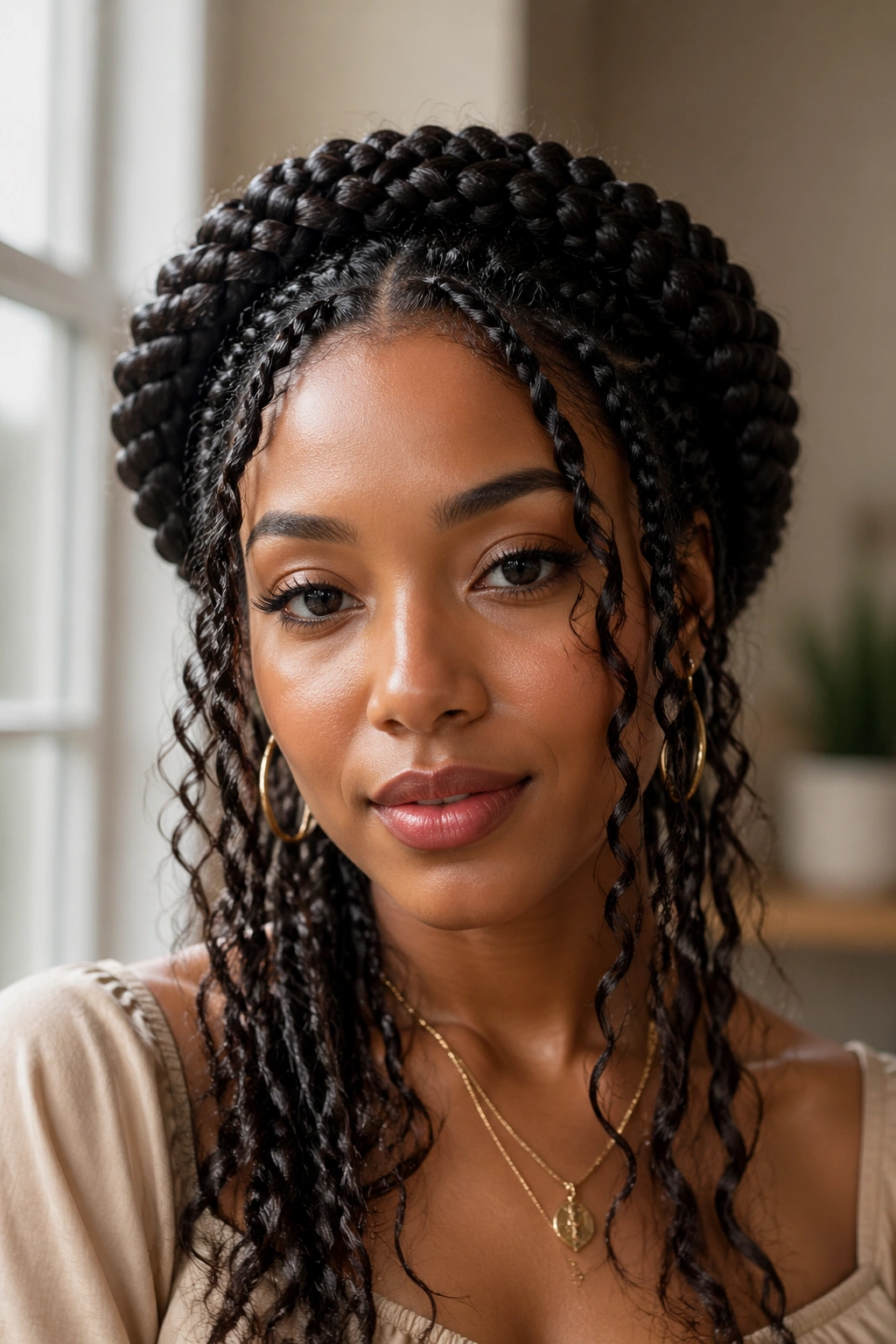
A halo crown changes the whole shape of the head. Instead of braids falling straight down, they wrap around the crown in a circle, then the loose curly pieces soften the front and sides. The result feels a little romantic without becoming fussy.
This style works best when you want the face open. The braids lift away from the forehead, and the curls around the temples keep the crown from looking severe. It also holds up nicely for events where you’ll be sitting, standing, and taking pictures in the same night. Nothing hangs in your face.
The trick is balance. If the braid wrap is too tight, the style can look stiff. If it’s too loose, the halo loses shape and starts slipping. You want enough tension to hold the circle, not enough to make your scalp complain by the third hour.
It has presence. Quiet, but still present.
14. Triangle-Part Goddess Box Braids
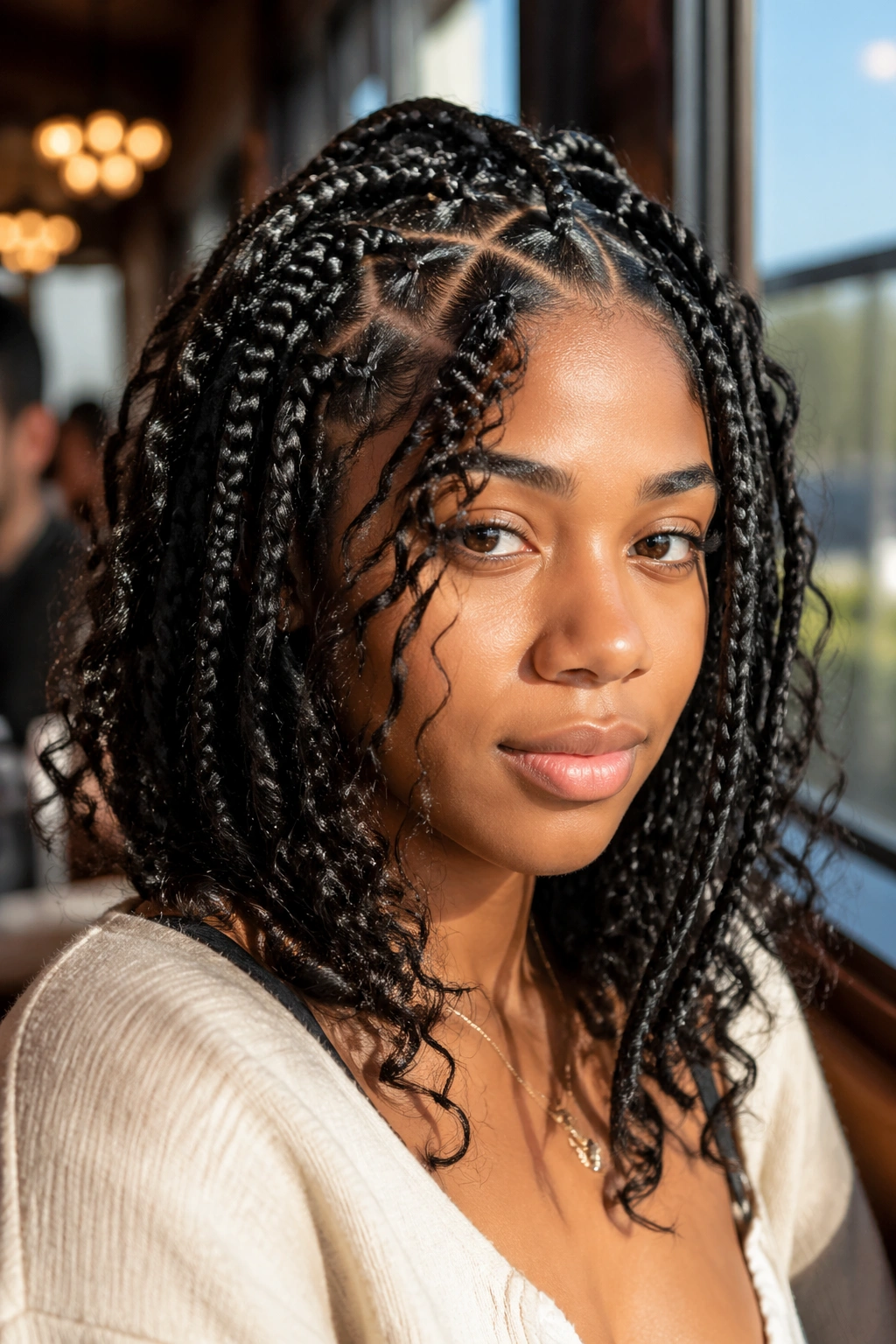
Triangle parts give the scalp a different rhythm. Triangle-part goddess box braids break away from the standard square grid and create angles that keep the style looking fresh even when the braid size stays the same. The parts are what people notice first.
That makes this a smart choice if you want something familiar but not flat. Triangle sections catch the eye as the braids move, and they work especially well on medium-length sets where the pattern can be seen without crowding the head. The loose curls then soften the geometry, which is a nice contrast.
When Triangle Parts Make Sense
- When you want parting to be part of the style
- When you like a more textured scalp pattern
- When you don’t want every row to look identical
- When you want the braids to feel a little more designed
Triangle parts need cleaner sectioning than people expect. If the shapes wander, the whole look loses that crisp edge.
15. Square-Part Goddess Box Braids
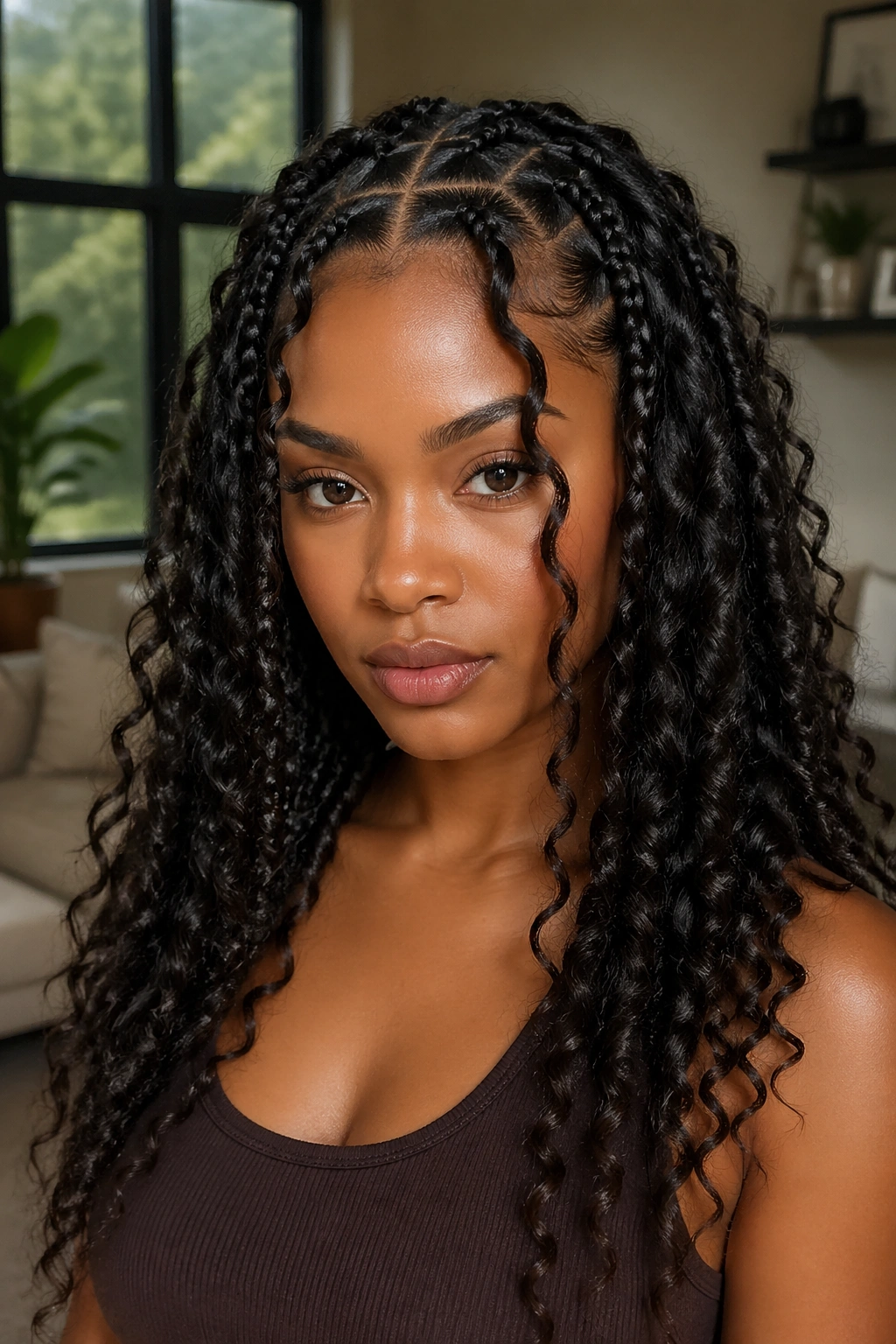
Square parts are the classic grid for a reason. Square-part goddess box braids give the style a neat, ordered base, and that order makes the loose curls feel like an accent instead of the main event.
The grid also makes the style easier to read from a distance. Each braid has its own lane. That sounds small, but it matters when you want the hairline to look tidy and the crown to sit flat. Square parts tend to work well on people who like a clean finish and do not want the eye drawn to unusual part shapes.
Compared with triangle parts, square sections feel more predictable. That is not a flaw. Sometimes predictable is exactly what you want. If you’re adding color, cuffs, or a lot of curl texture, the regular parting keeps the style from getting visually noisy.
Straight lines. Clean corners. No guesswork.
16. Colored-Ends Goddess Box Braids
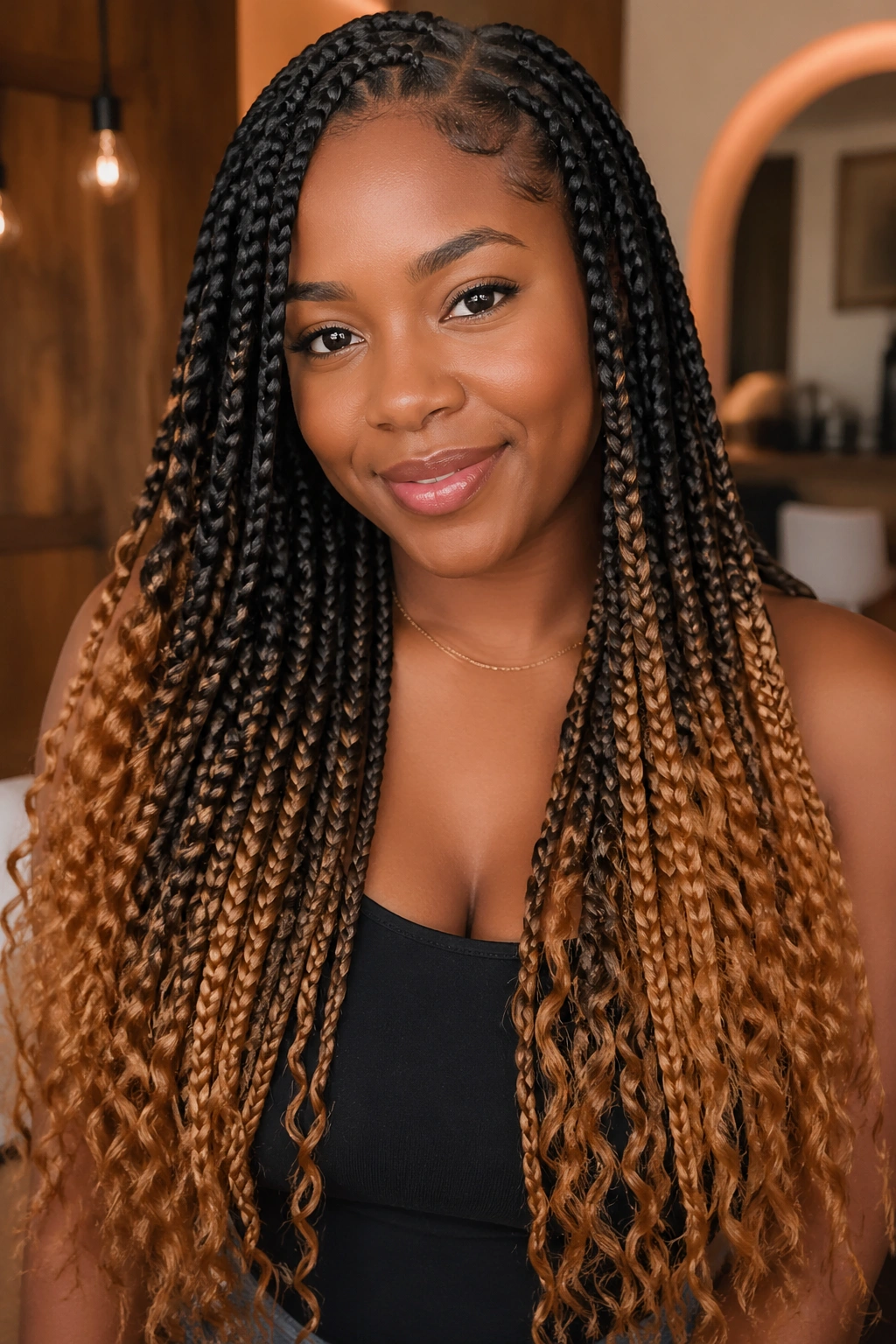
A little color at the ends can change the whole read of goddess box braids. You do not have to dye the entire head to get movement. Colored-ends goddess box braids let the loose curls and braid tails carry the extra shade, which keeps the roots grounded and the finish lively.
Best Ways to Wear the Color
The most flattering versions keep the color concentrated in the last few inches. Think honey, copper, burgundy, or blonde tips that show when the braids swing. That approach lets the braid pattern stay the star while the color shows up as a second note.
- Warm browns and coppers soften black braids
- Blonde tips make the curls pop more in daylight
- Burgundy adds depth without looking flat
- Shorter colored sections keep the style from feeling overdone
If the ends are the only part with color, the style can still look neat at the root. That’s a good compromise for people who want personality without a full-color commitment.
17. Soft Ombré Goddess Box Braids
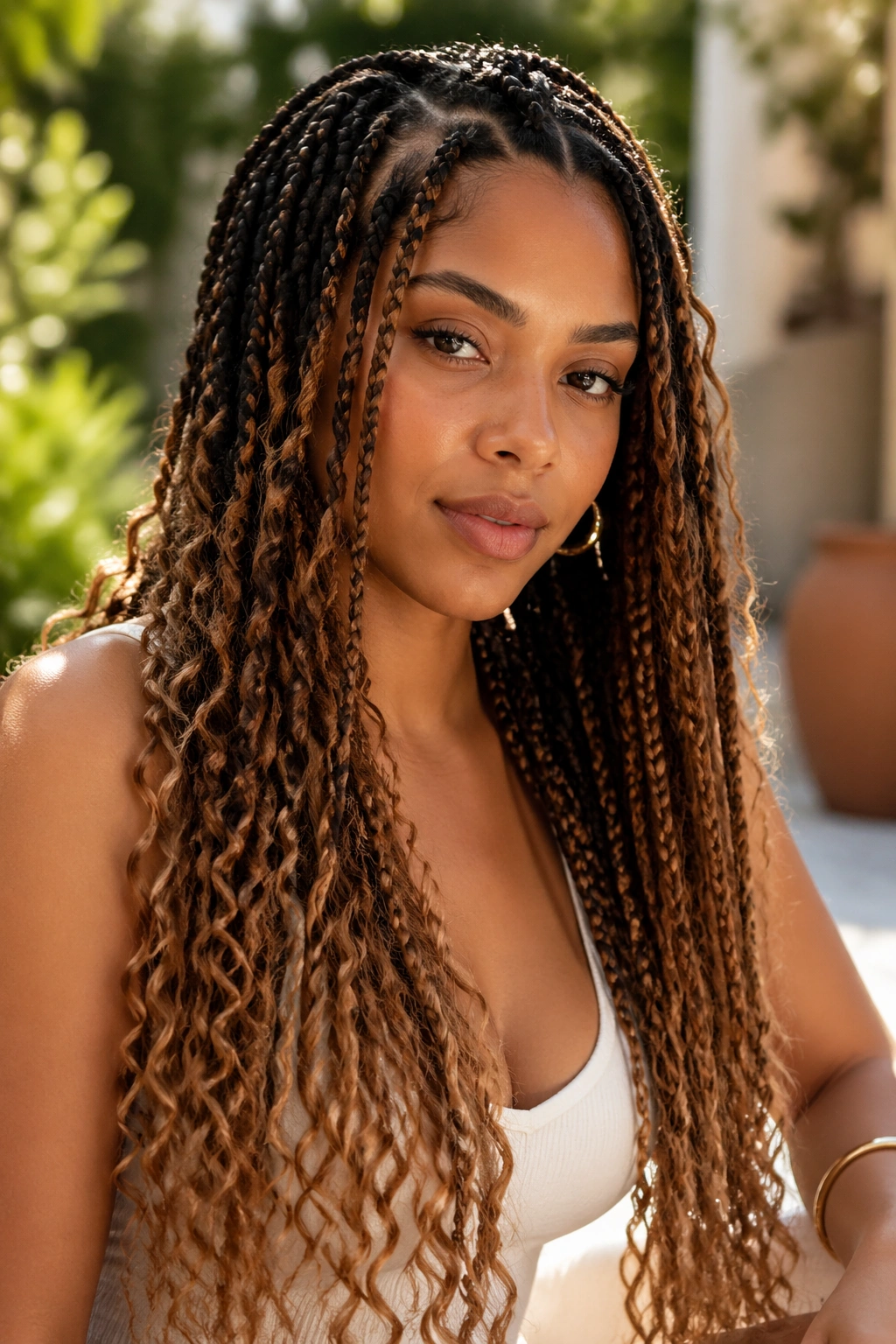
A soft ombré is not the same thing as painted ends. The transition matters. Soft ombré goddess box braids move from a darker root into a mid-tone and then a lighter finish, so the eye sees a fade instead of a hard stop.
That fade looks especially good on longer sets because the color has room to stretch. On short braids, the transition can look cramped. Keep the shift gradual and use no more than two or three shades unless you want the style to read more graphic than soft.
I prefer ombré when someone wants the braids to feel sun-touched rather than flashy. The curls at the ends pick up the lighter shade and look a little airier, which helps the whole style move. It is a quiet color move, but it changes the way light plays across the hair.
Soft edge. Slow fade. Cleaner than a sharp dip-dye.
18. Curly-Ends-Only Goddess Box Braids
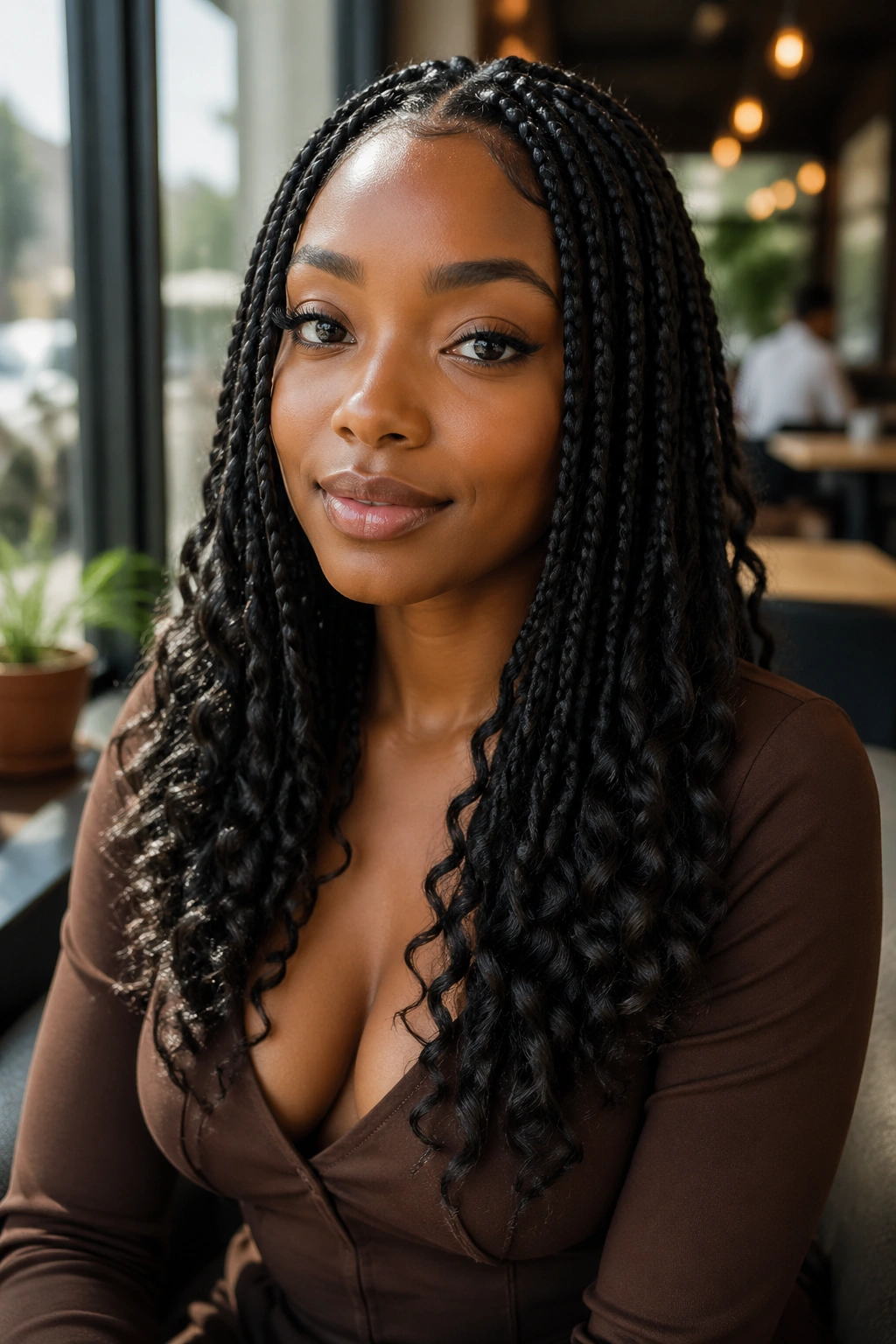
Not every goddess braid needs curls running from root to tip. Sometimes the smartest version is the one that keeps the crown neat and saves the texture for the ends. Curly-ends-only goddess box braids do exactly that, and the result feels polished without going flat.
The shape is tidy near the scalp, which helps the parting stay visible. Then the bottom section opens up into loose curls, giving the braids a softer finish at the hem. It’s a tidy-to-playful shift that looks good with straight necklines and structured clothes.
Why This Version Stays So Wearable
The curls are easier to maintain when they’re concentrated lower down. They snag less on collars, and they do not puff out around the face the way full boho lengths sometimes do. That makes the style a little easier to live in if you wear it often.
It’s a cleaner cousin of the full boho look. Same softness, less chaos.
19. Wavy-Hair Goddess Box Braids
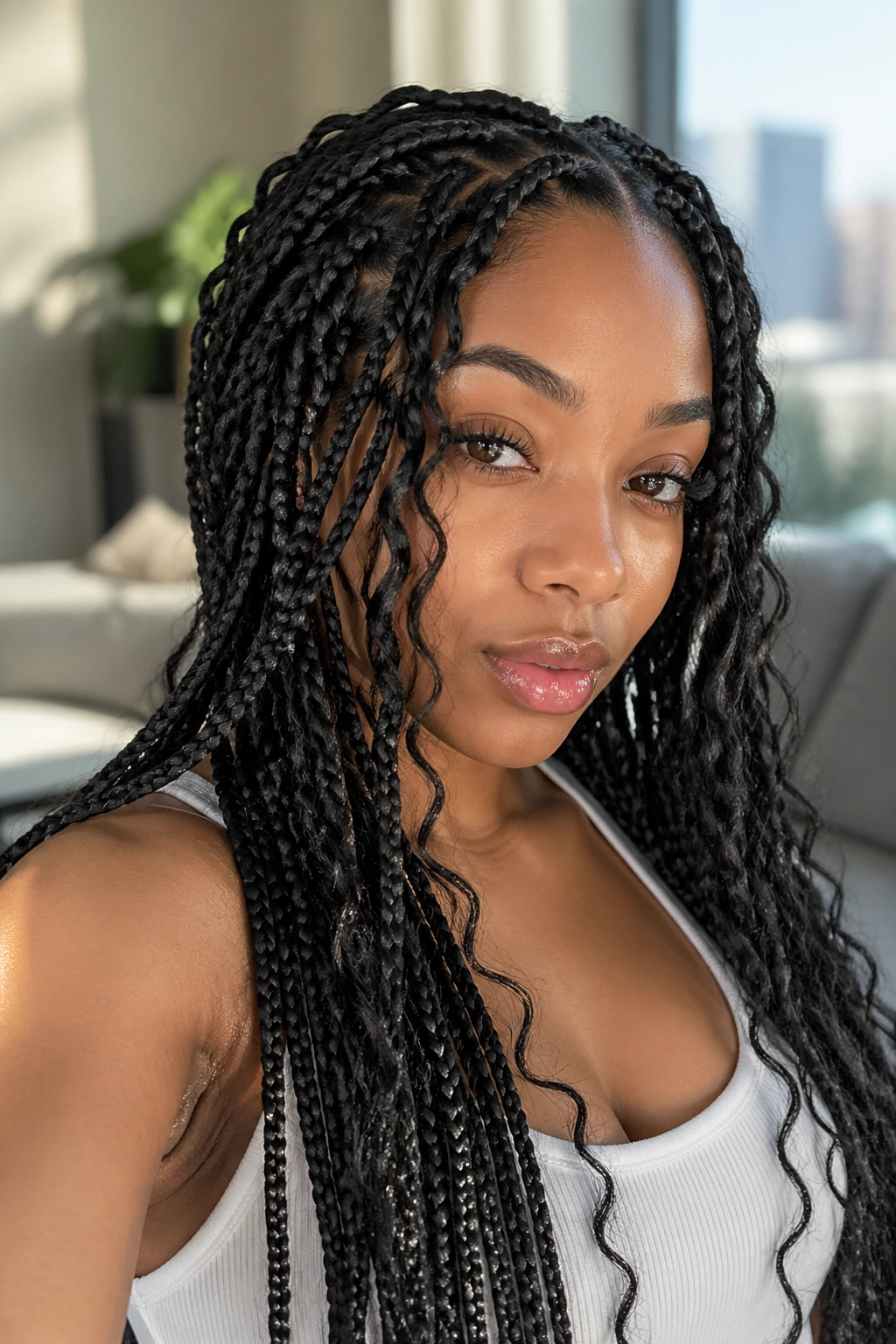
A lot of people jump straight to tight curls, but waves can be smarter. Wavy-hair goddess box braids have a looser finish, so the style reads softer and less fluffy. The waves sit flatter against the braids, which is useful if you do not want too much bulk around the shoulders.
Why the Wave Matters
Waves create motion without building a thick cloud of texture. That matters on longer braids, where spirals can start to fight with the braid length itself. A soft wave moves when you walk but still lets the braid shape stay visible.
- Better for people who want subtle texture
- Better under jackets and scarves
- Better when you want the curls to look smoother
- Better if you dislike tight ringlets
This version also tends to look calmer on day one and day twelve. It doesn’t scream for attention. It just settles in nicely.
20. Layered Goddess Box Braids
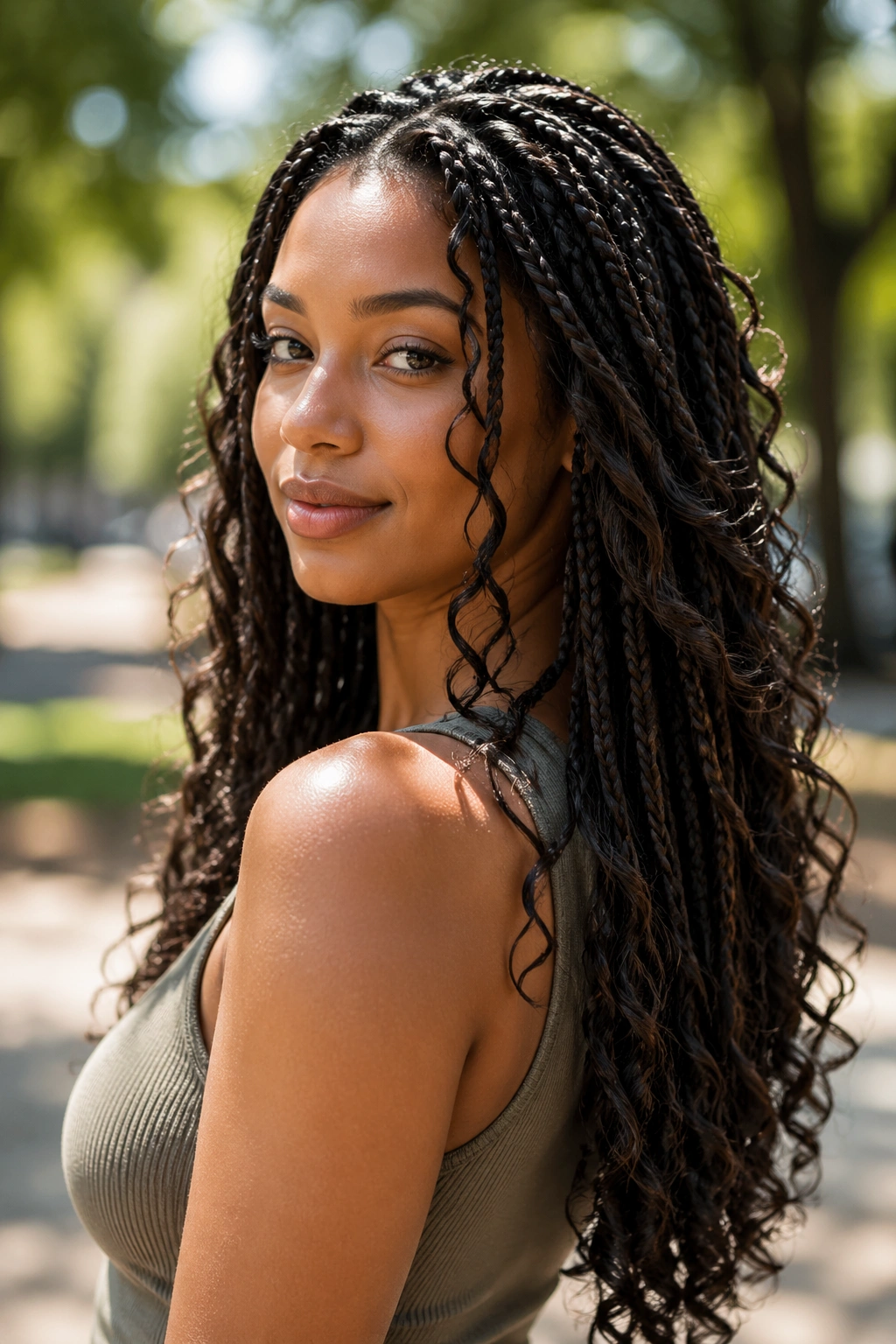
Layers give the whole style shape. Instead of every braid ending at the same point, layered goddess box braids fall at different lengths, which stops the hair from turning into one heavy block. The face-framing pieces land higher, the back pieces land lower, and the movement feels more natural.
This is one of those choices that matters more in motion than in photos. When you turn your head, the layers shift at different speeds. That little bit of stagger keeps the style from looking flat or too square at the bottom.
A good layered set needs discipline from the braider. If the layers are too short, you lose the length people wanted in the first place. If the layers are too subtle, they do nothing. The sweet spot is enough difference to break the line, not so much that the set feels chopped up.
The style has shape. Real shape. That’s the appeal.
21. Feed-In Front-Detail Goddess Box Braids
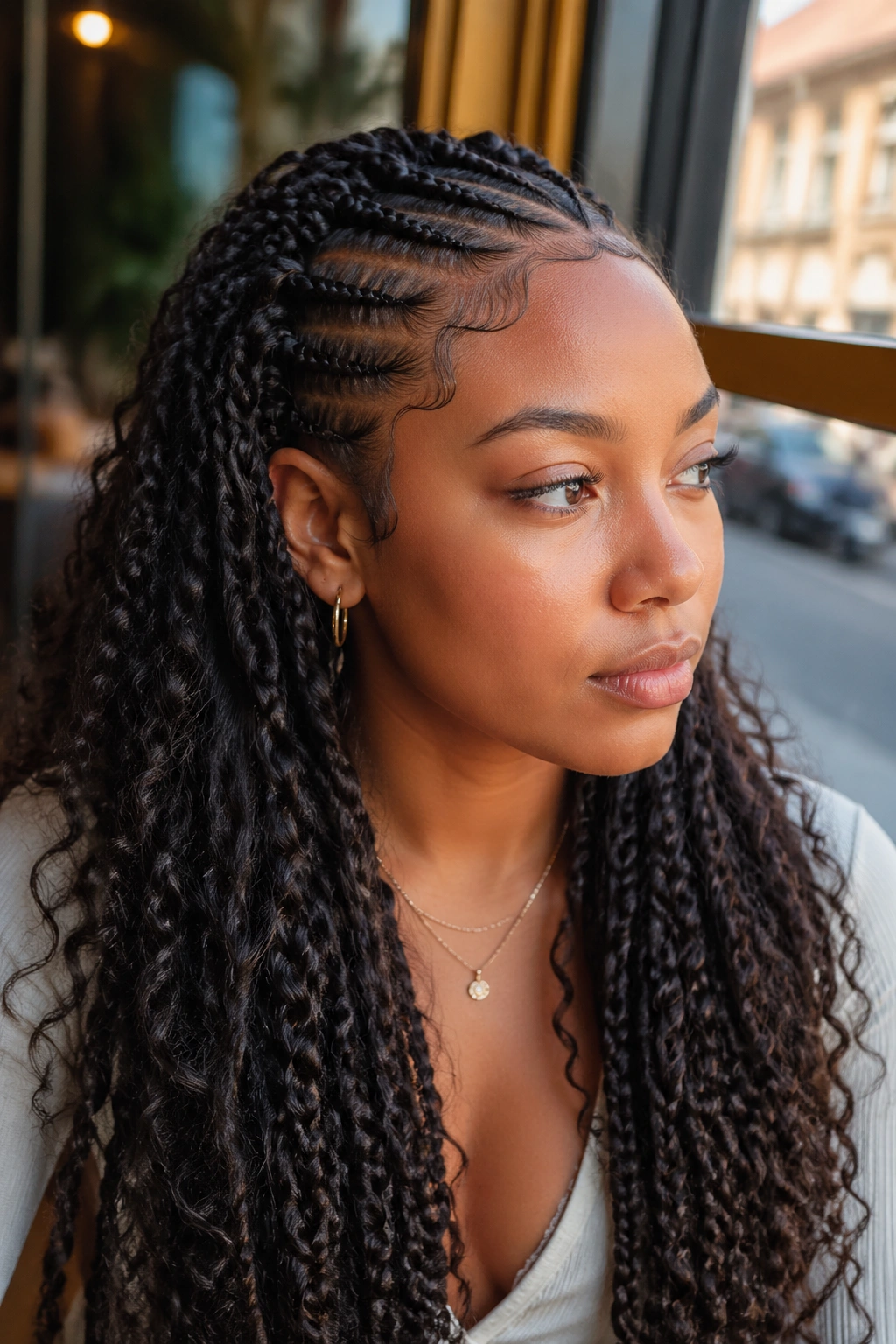
The front of a braid style is where the eye lands first, so it makes sense to treat it differently. Feed-in front-detail goddess box braids use thinner braids or more detailed sectioning near the hairline, then transition into fuller braids behind them. That shift creates a tidy front edge without making the whole head look stiff.
This works especially well if you like soft face-framing curls but want the front to stay neat. A few slender feed-in braids around the temples can calm the hairline and make the curls feel like an accent rather than a takeover. The back can stay fuller and more textured.
Good Front Placement
- Thin feed-in braids at the temples
- Slightly larger braids behind the front row
- Curl pieces concentrated near the face
- A clean line where the front meets the crown
Do not pull the front too tight. The point is detail, not tension.
22. Tapered-Front Goddess Box Braids
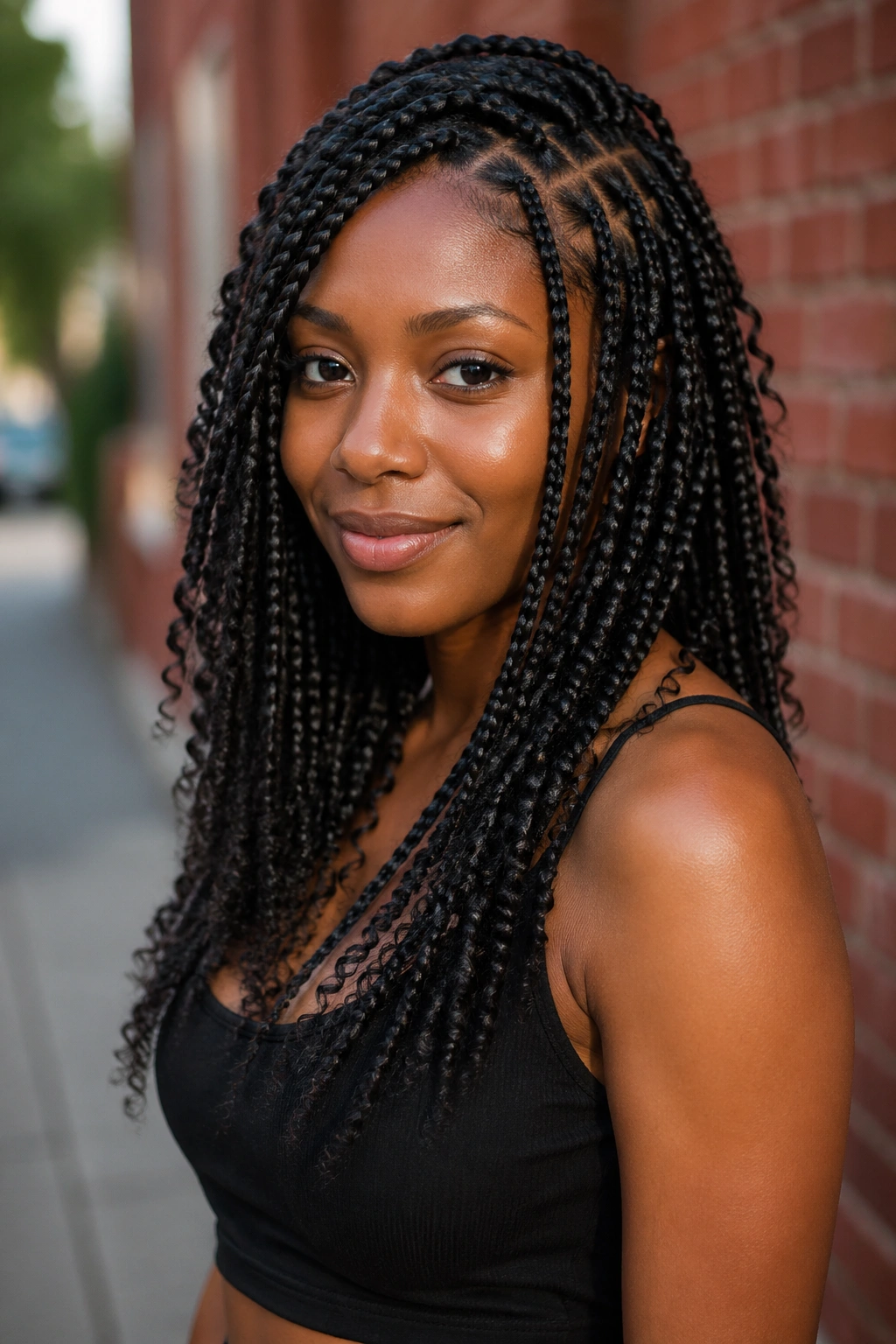
Tapered-front goddess box braids shift the weight away from the face by keeping the back shorter and letting the front pieces fall longer. That asymmetry makes the style feel modern without needing extra color or a complicated part pattern.
The front braids can land near the collarbone while the back sits higher, which gives the curls and braid ends a clear frame. If you wear glasses, this can be a smart move. The shorter back avoids crowding the frame arms, and the longer front pieces soften the cheeks.
What I like here is the built-in motion. The eye naturally follows the longer pieces forward, then lands on the shorter back and realizes the whole style is intentionally shaped. It reads designed, not random. That matters.
If you want a set that feels light around the neck but still has presence in front, this is a strong pick.
23. Accessorized Goddess Box Braids
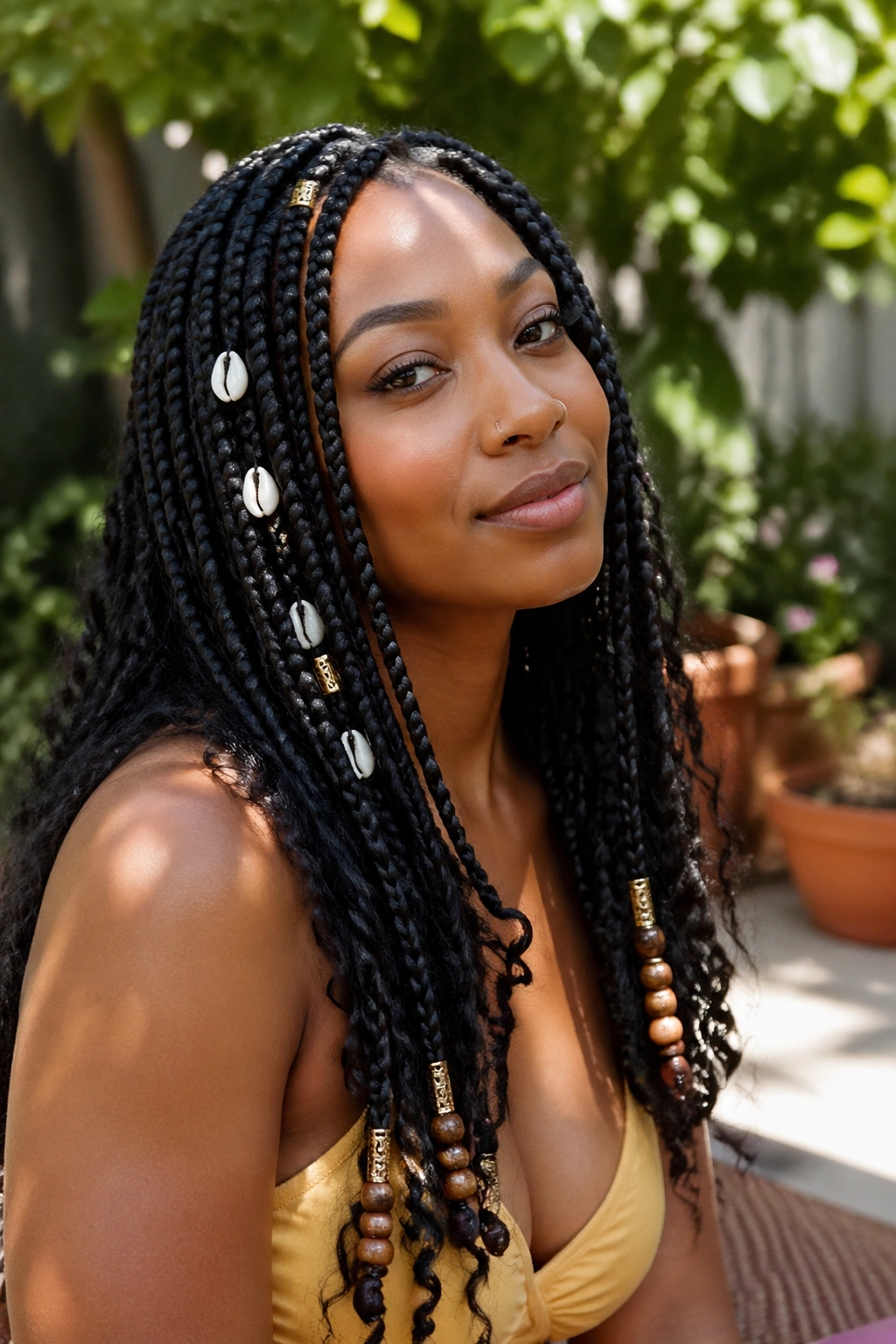
Accessories should never feel like rescue work. They should feel like punctuation. Accessorized goddess box braids use cuffs, shells, thread wraps, and beads in small doses so the braid pattern and loose curls still stay visible.
What to Add, and Where
A few cuffs near the ends can catch the eye without cluttering the whole head. Shells work well on one or two side braids. Thread wrapping near the temple gives the front a little extra detail, and clear or wooden beads can add weight at the bottom if you want the curls to swing with a little more pull.
- Keep the accessory count low on a full set
- Put the boldest pieces near the front or outer edges
- Use matching metal tones if you want a cleaner finish
- Let the curls stay visible; do not bury them
Too many decorations and the style starts arguing with itself.
24. Travel-Ready Shoulder-Length Goddess Box Braids
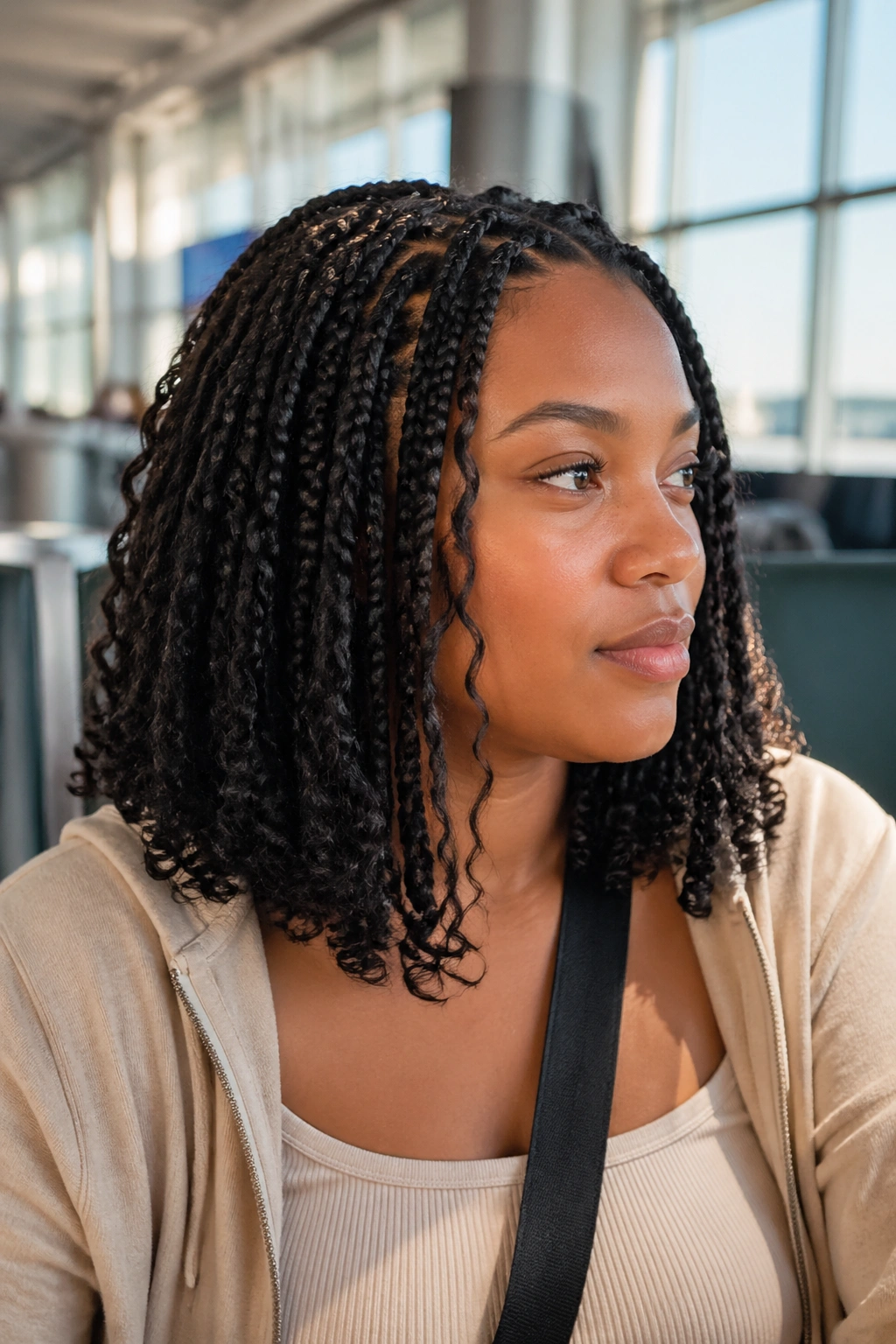
Shoulder-length braids are the practical choice that still looks like a style choice. Travel-ready shoulder-length goddess box braids stay off your lap, fit under most jackets, and do not drag as much when you’re moving through a busy day. The loose curls give the ends enough life that the length never feels plain.
This length is especially useful if you hate hair getting caught under tote bags, seat belts, or coat collars. It also dries faster after a wash than longer sets, which is one of those boring details that becomes a big deal once you live with braids for more than a week.
The shoulder cut gives the curls a chance to bounce without dragging the whole braid down. That keeps the look fresh. If you want a set you can wear without constantly flipping it back over your shoulder, this is one of the easiest picks.
Low fuss. Still plenty of personality.
25. Mixed-Size Goddess Box Braids
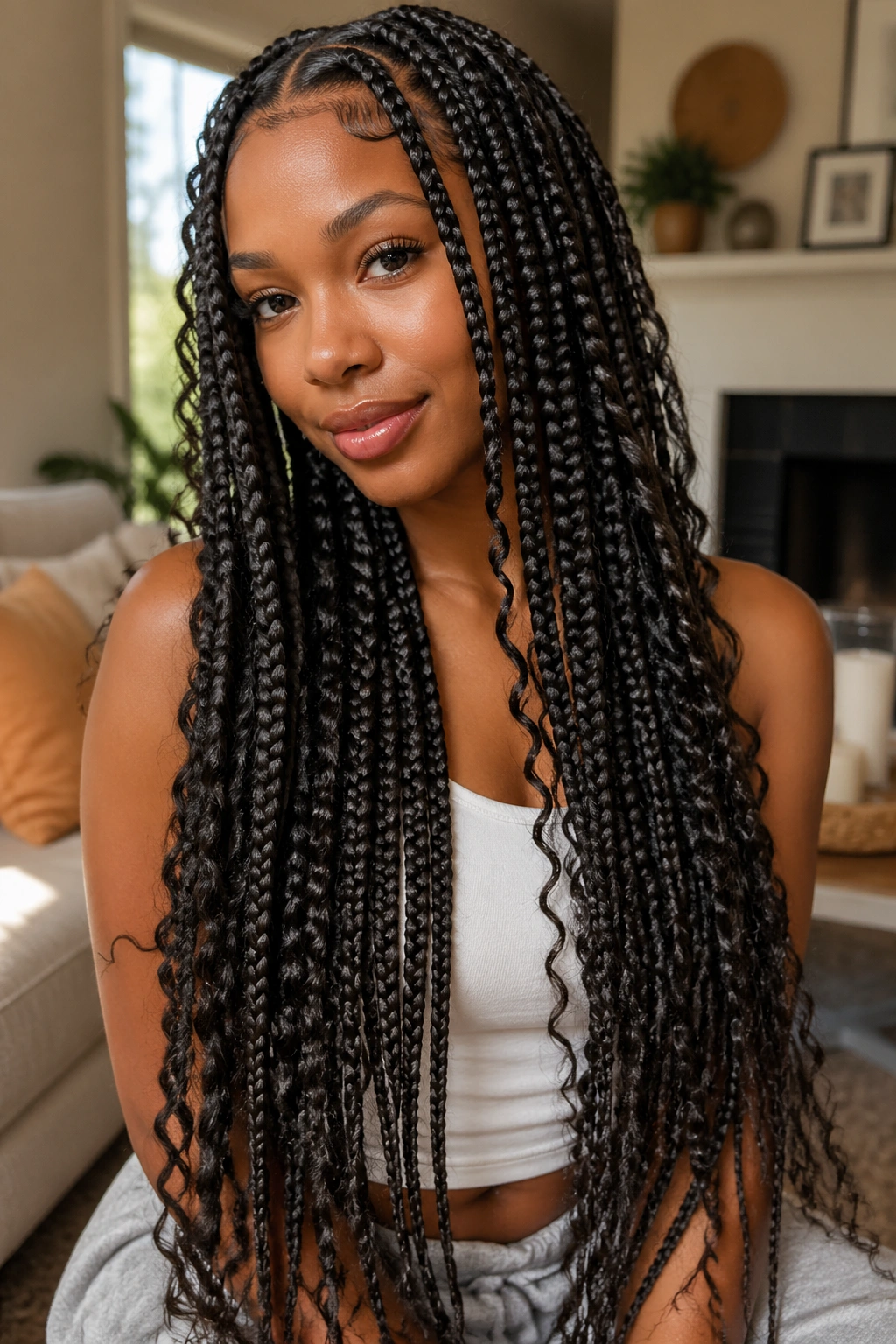
Mixed-size braids change the texture of the whole head in a way that plain uniform sections never quite do. Mixed-size goddess box braids alternate between slimmer and thicker braids, so the eye keeps moving instead of settling into one repetitive grid. The curls then tie the different widths together.
That mix works best when the sizes are clearly different, not just slightly off. A few thinner braids around the face and larger braids through the back can make the style feel layered without cutting anything. It also gives you a built-in rhythm: small, big, curl, small again. The whole set feels more alive.
If you only want to change one thing about a standard braid set, change the size pattern. It’s a stronger move than stacking on extra accessories, and it usually ages better too. The style keeps shape even after the curls soften a little, which is what you want when you’re wearing braids for real life, not just for the first mirror selfie.
A better braid pattern beats extra clutter. Every time.