



Curly hair and a saree can look like they were made for each other. They can also fight each other in the worst way if the curls are pinned flat, sprayed stiff, or forced into a shape that never wanted to exist.
The sweet spot is balance. A saree already brings texture through silk, zari, pleats, borders, and jewelry, so the hair should either soften that richness or echo it in a controlled way. If the hairstyle sits too hard against the face, the whole look feels heavy. If it is too loose, the pallu keeps tugging at it, and the style starts slipping before the event is halfway over.
I always think about three things before choosing a style: where the volume sits, how much of the face stays open, and whether the pallu will keep brushing the hair for hours. Curls need enough structure to stay neat, but they also need room to look like curls. That means the best options are rarely the most rigid ones.
If your curls are freshly washed, let them dry fully or diffuse until the roots are set. Damp curls collapse under pins, and half-dry curls puff in odd places. That small detail saves more hairstyles than fancy accessories do.
1. Side-Swept Loose Curls with a Deep Side Part
This is the style I reach for when the saree already has enough drama. A deep side part gives curly hair direction, then the loose lengths spill over one shoulder in a way that feels deliberate instead of accidental. It works especially well with chiffon, georgette, and any saree that moves a little when you walk.
Why It Flatters Sarees
The deep part opens one side of the face, which is handy when you want long earrings, a bold bindi, or a blouse with a detailed neckline to show up. The curls on the heavier side add softness near the shoulder, so the saree doesn’t look too formal or boxed in. It’s one of those styles that looks polished in person and still looks relaxed when you turn your head.
A side-swept look also helps if your curls have uneven density. The fuller side can do the visual heavy lifting, while the lighter side is pinned back neatly with two crossed bobby pins. Use a light curl cream or defining mousse before styling so the front pieces clump cleanly instead of frizzing apart.
Quick Details That Make It Work
- Part the hair above the arch of the eyebrow, not dead center.
- Pin the smaller side behind the ear with two pins in an “X.”
- Keep the front curl pattern soft, not shellacked.
- Let one or two face-framing pieces fall free near the cheekbone.
My favorite part: this is one of the easiest curly hairstyles for sarees to wear with statement earrings because the hair and jewelry do not compete.
2. Half-Up Twisted Crown with Soft Ringlets
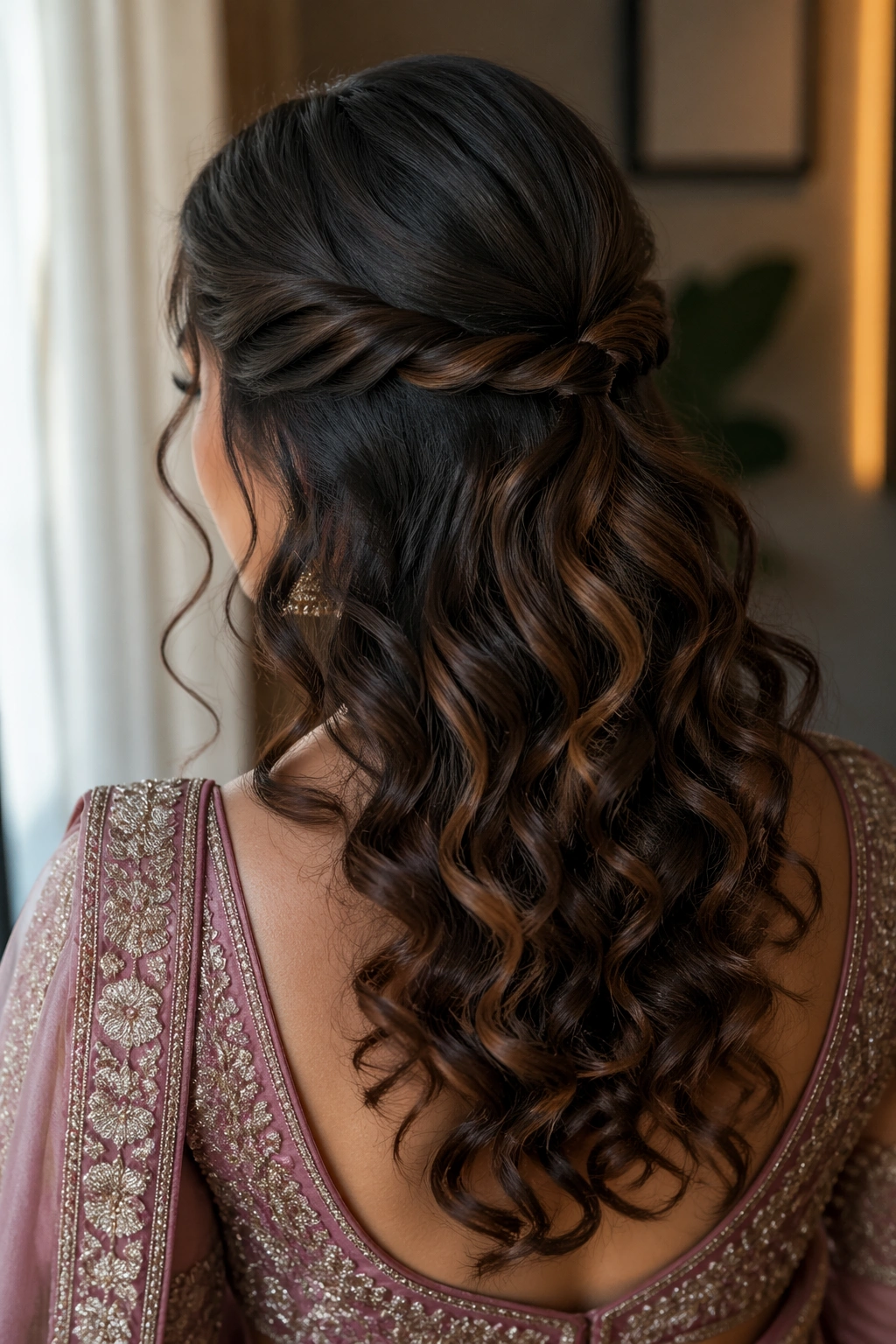
A half-up style is the safest middle ground when you want your curls visible but not unruly. The top section gets twisted back from both temples and pinned low at the back of the head, while the rest of the curls stay loose. It gives structure without flattening the natural bounce that makes curly hair so good with a saree.
The trick is keeping the twist close to the head. If it sits too high, the style turns into a little dome. If it sits too low, the crown loses shape and the back looks saggy. I prefer two narrow twists from each side, crossed softly at the back, then pinned just above the occipital bone so the style holds its shape through a long evening.
This one is especially useful when the blouse has a detailed back. The twist leaves enough of the upper back visible to show embroidery, tassels, or tie strings, and the ringlets below keep the overall look romantic. It also behaves nicely with medium-length curls, which can sometimes feel awkward in fully open styles.
And it behaves.
A tiny spritz of flexible-hold spray over the pinned section is enough. You do not need a helmet. The whole point is movement.
3. Low Curly Bun with Face-Framing Pieces
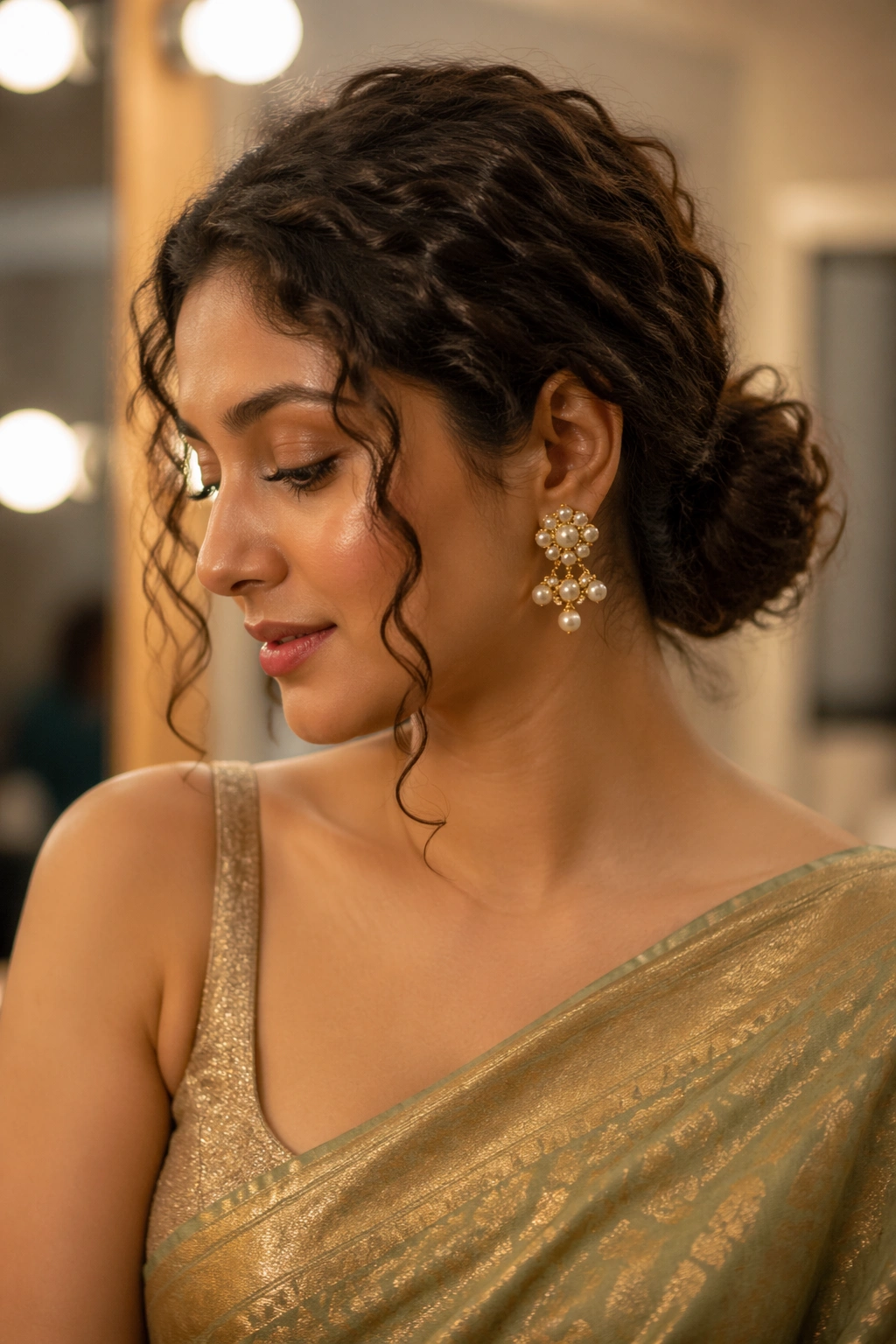
Need hair off the neck without losing softness? A low curly bun does that job better than almost anything else. It sits at the nape, which makes it practical for heavier sarees, long functions, and hot rooms where open hair starts to feel like too much by the second hour.
How to Keep the Bun Soft, Not Severe
The best low bun for curls is not smooth. It should look like the hair has been folded into itself with a little texture left on the surface. Gather the curls loosely, twist them into a compact bun at the nape, and secure them with U-pins rather than one giant clip. If your hair is thick, a small bun donut can help, but don’t overfill it. The bun should feel contained, not swollen.
Leave two slim curls at the temples and one soft strand near the jawline. That small bit of movement keeps the face from looking boxed in. It also works nicely with heavier necklaces because the neckline stays clean and the earrings get room to show.
A low bun is one of the few styles that can look equally good with a Kanjeevaram, a Banarasi, or a plain silk saree with good jewelry. It’s calm. It’s steady. And when it’s pinned well, it does not budge.
4. Braided Crown into Open Curls
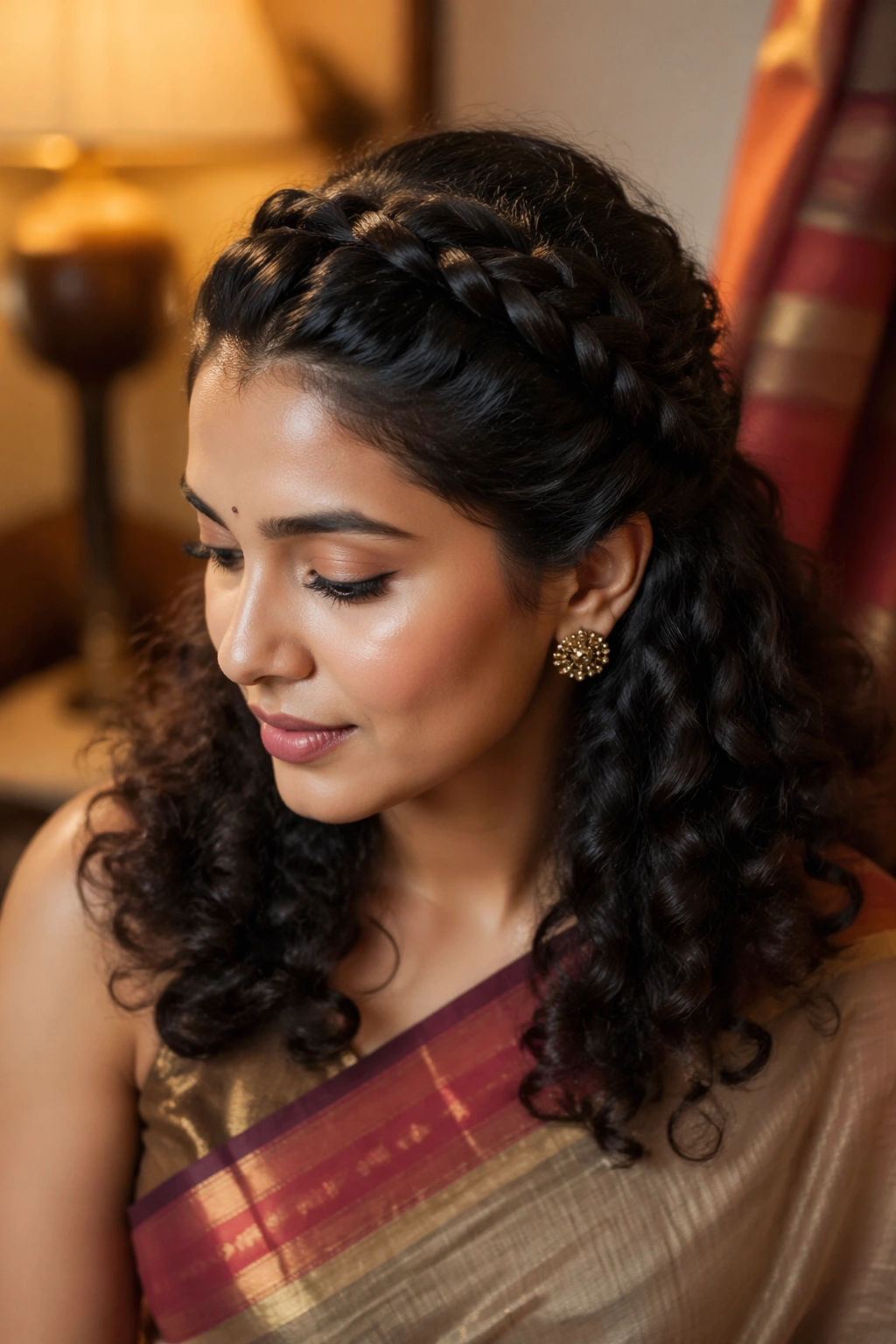
If your curls slip out of pins by the halfway mark, braid first and pin second. A braided crown gives the hair grip right where it usually needs it most, along the hairline and temples. From there, the rest of the curls can stay open, which keeps the style from feeling too stiff.
The braid does not need to be thick. In fact, a narrow braid often looks better because it blends into the curls instead of announcing itself. Start near one temple, curve the braid back across the crown, then pin it just behind the opposite ear or at the back of the head. Let the remaining curls fall freely, either down the back or over one shoulder, depending on where the pallu sits.
This style is especially good for handloom sarees, cotton-silk blends, and outfits with strong borders. The braid gives the hairstyle a little order, while the open curls soften the overall shape. If you want to add flowers, tuck in tiny buds along the braid instead of crowding the whole crown. Too many flowers can make curly hair look busy in a bad way.
- Start the braid slightly above the ear for better lift.
- Keep the braid loose enough to preserve curl volume.
- Pin the end under the top layer of curls.
- Place accessories where the braid curves, not where it begins.
The result feels grounded, which is exactly what a saree often needs.
5. Gajra-Wrapped Curly Bun
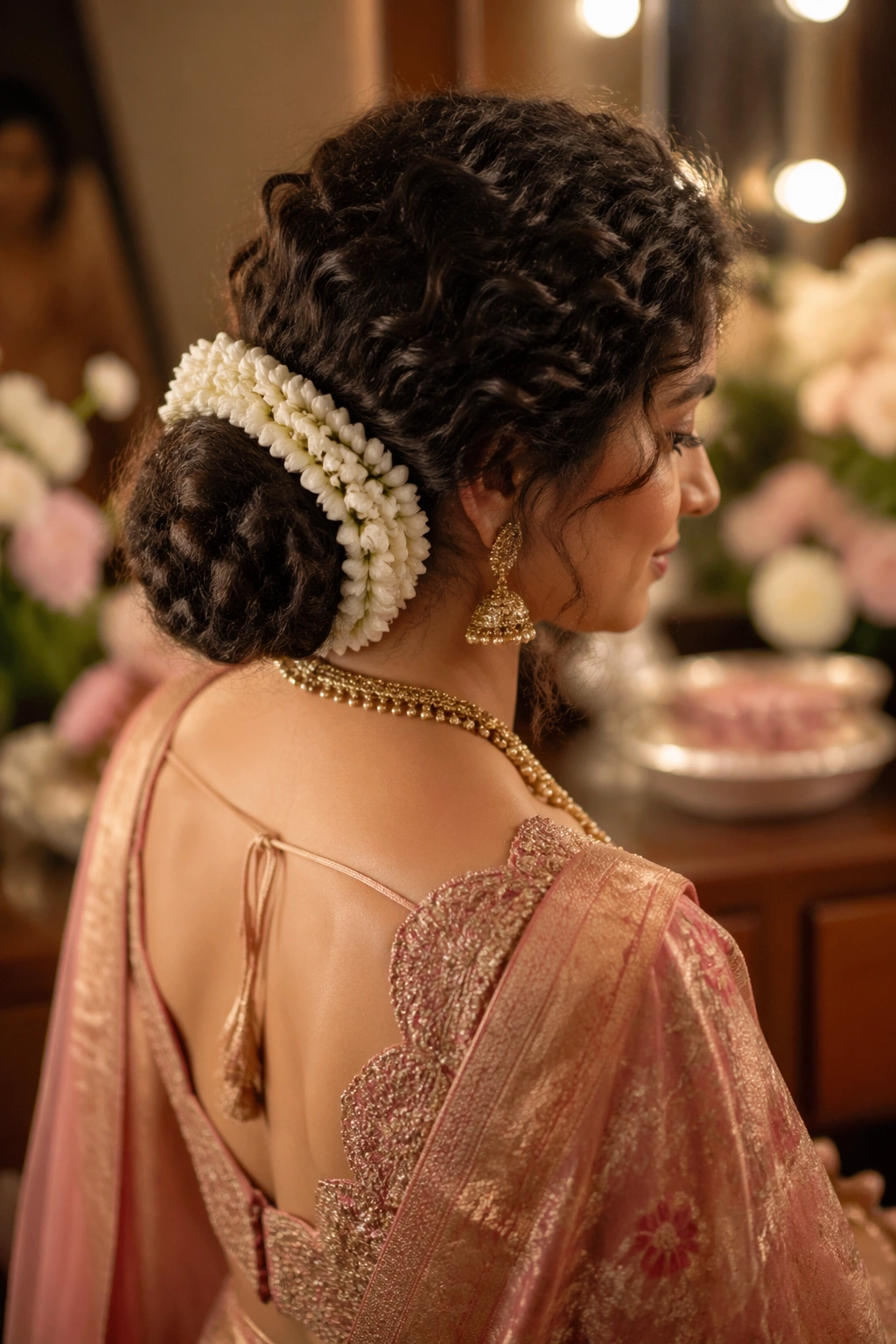
A gajra and curly bun are a classic pair for a reason. The flowers soften the shape of the bun, the curls add texture under the jasmine, and the whole style feels finished without trying too hard. It has that old-school richness people love for weddings, temple visits, and formal family events.
I prefer this style when the saree itself is heavy or ornate. A silk saree with a strong border can swallow a delicate hairstyle, but a curly bun wrapped in fresh gajra holds its own. The bun does not need to be perfectly smooth. In fact, a little visible curl texture around the edges makes the flowers look fuller and more natural. A flat bun wrapped in gajra can look stiff. A textured one feels alive.
Place the gajra after the bun is pinned. That part matters more than people think. If you try to drape flowers over a loose bun, the weight pulls the style downward, and you end up fixing it all evening. Secure the bun first with cross-pins, then wrap the flowers around the base or along one side of the bun, depending on whether you want a symmetrical or slightly angled look.
Fresh jasmine smells lovely, of course, but a string that has been packed too tightly can shed quickly. If you want the scent without the mess, a neatly coiled gajra pinned in sections usually behaves better.
This is one of the most graceful curly hairstyles for sarees when you want tradition without losing texture.
6. Curly High Ponytail with a Wrapped Base
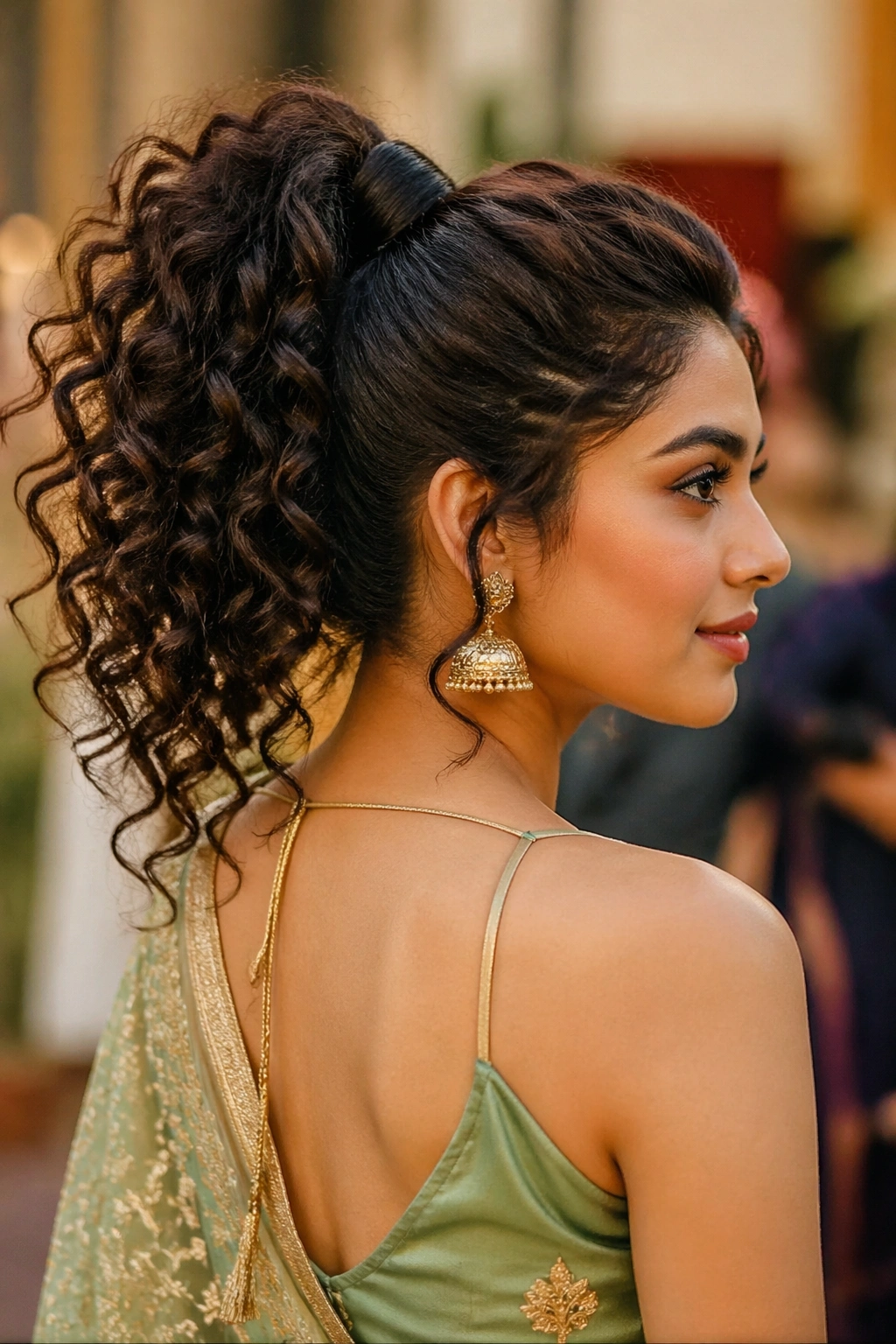
Unlike a bun, this keeps the bounce. A curly high ponytail gives the face a lifted look and leaves the shoulders clear, which is handy when the blouse has a dramatic back, cutwork, or a clean neckline that deserves attention. It feels younger and sharper than a low style, but it still works with a saree if the finish is neat.
The ponytail should not sit too high on the crown unless you want a deliberately bold look. A point just above the occipital bone is usually enough to lift the face without making the style feel costume-like. Wrap a small section of hair around the elastic so the base disappears, then let the curls fan out naturally. If the ponytail is dense, split it into two or three large curl clusters with your fingers so it does not become one heavy rope.
This is one of my favorite choices for fusion sarees, lighter drapes, and occasions where you expect to move a lot. Dance floor? Good. Outdoor function? Also good. The ponytail keeps the curls active instead of flattening them into place.
It works especially well when the rest of the styling is simple: bold earrings, a clean blouse, maybe a sleek bindi. The hair brings the motion, so the accessories do not need to shout.
7. Side Braid That Falls into Loose Curls
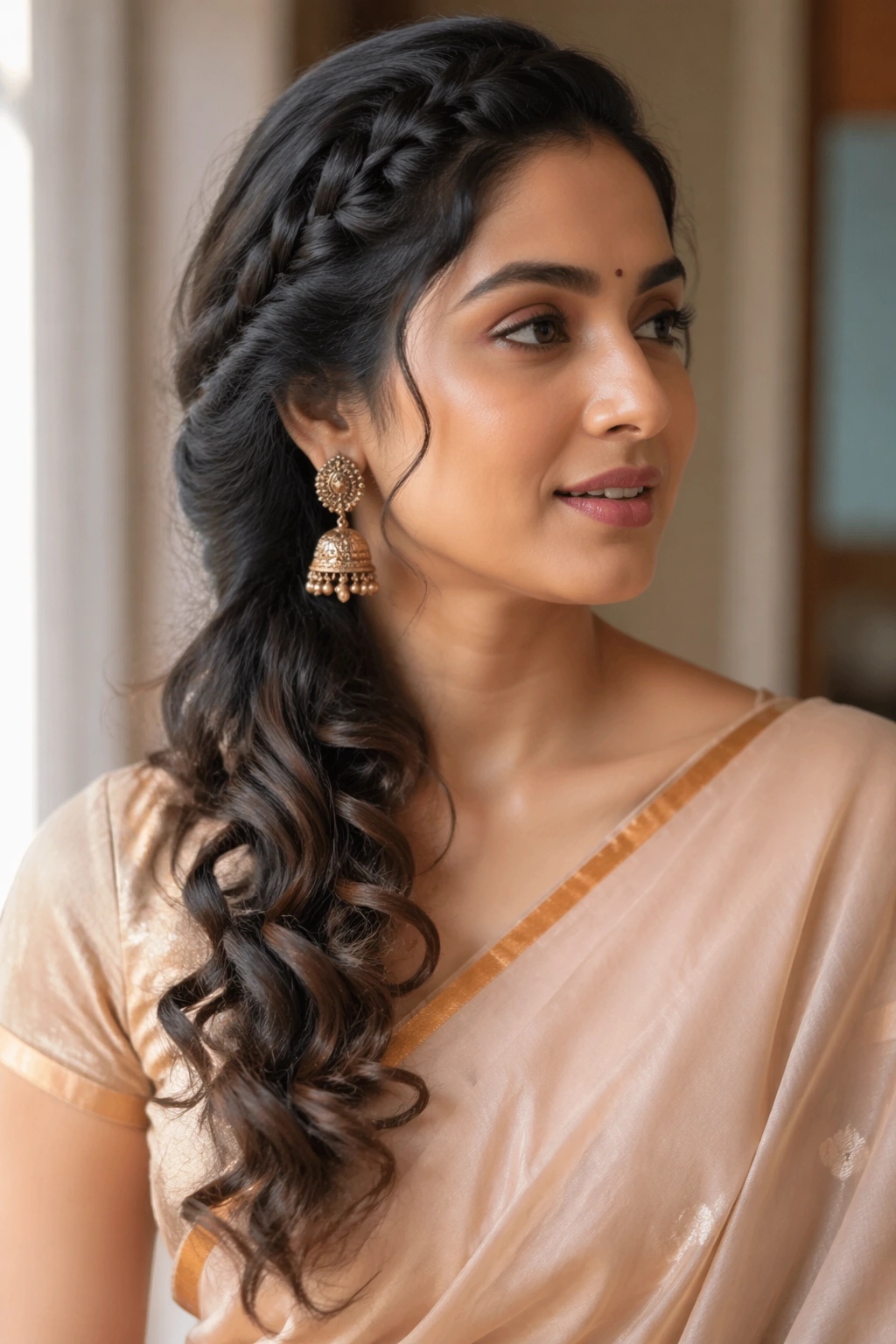
When one shoulder is carrying the pallu and the other is showing off your earrings, a side braid does a neat bit of work. It keeps the top of the head controlled, then lets the curl pattern come alive lower down where it won’t get crushed by pins or fabric.
The braid itself is only part of the story. Start it at the temple or just behind the ear, travel it diagonally down one side, and let it merge into the rest of the curls near the collarbone. That transition matters. If the braid ends too abruptly, the hairstyle looks chopped. If it blends into loose curls, the whole thing feels intentional.
This is a smart choice for long hair, especially when the saree is light and the event is active. A side braid can anchor curls that would otherwise puff apart at the roots. It also sits nicely against a shoulder drape because the braid acts like a quiet line leading the eye down the body.
- Start with defined, dry curls for the lower section.
- Keep the braid loose enough to avoid pulling at the scalp.
- Hide the tie with a small ribbon, pin, or hair cuff.
- Let the ends stay curly rather than brushing them out.
A side braid with curls gives you a bit of control without losing the softness people usually want from curly hair.
8. Center-Part Open Curls with a Maang Tikka
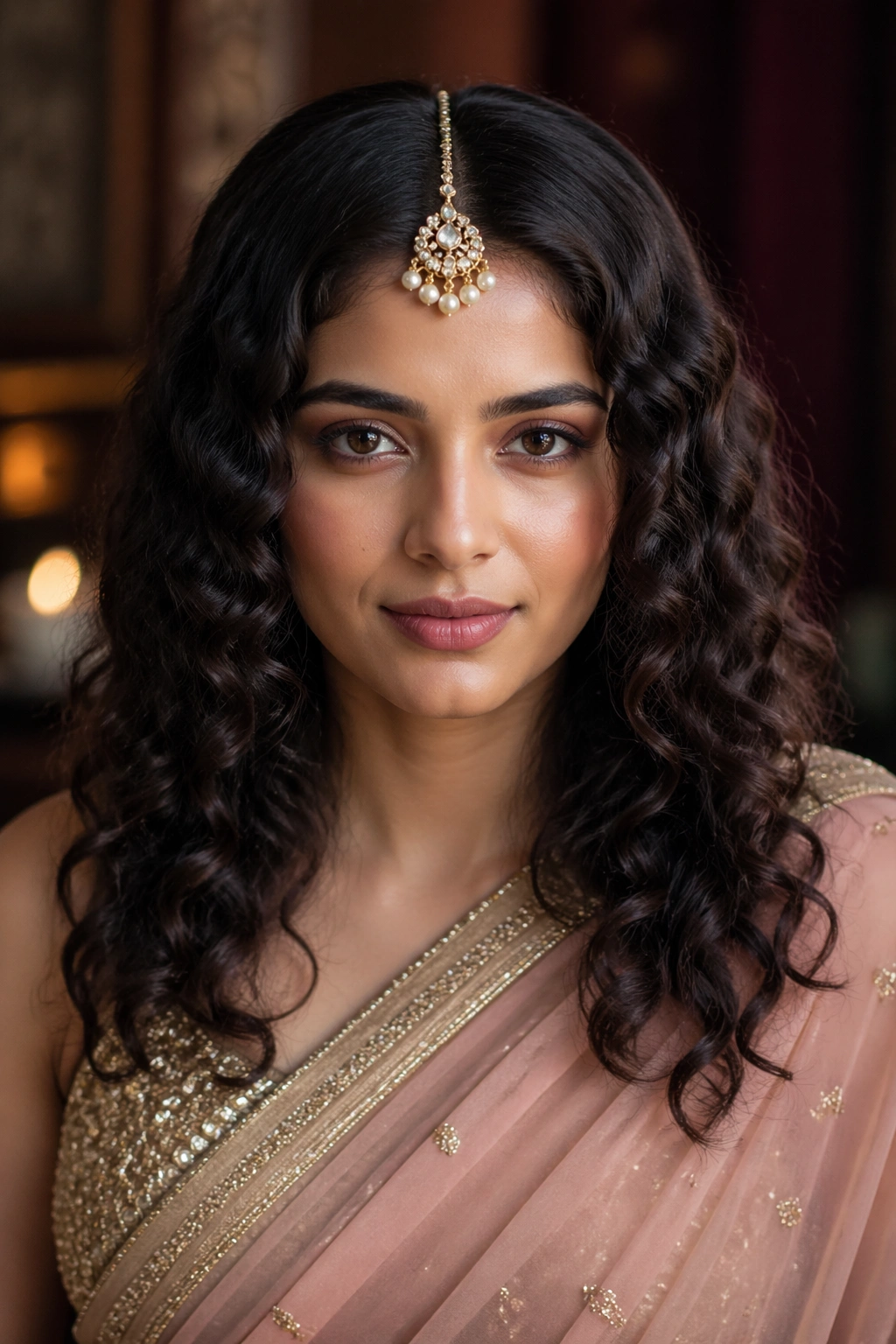
Can open curls work with a saree? Absolutely, if the center part is clean and the crown is handled with care. This is the style that lets the curls stay visible from the front, which matters when the hair texture is part of the look rather than something you want to hide.
What Makes It Look Intentional
The center part should be straight enough to frame the face, but not so sharp that it feels severe. Use a fine-tooth comb or rat-tail comb and trace the part while the hair is slightly damp or lightly misted. Then smooth a thin layer of gel or edge control along the front hairline only. You want hold, not helmet hair.
A maang tikka works beautifully here because the center part gives it a natural landing place. If the tikka is heavy, pin it from underneath at two points so it doesn’t slide. The curls then fall on both sides of the face, which makes the jewelry look anchored instead of perched on top of the hair.
How to Keep the Part Neat
- Dry the roots well before styling.
- Clip the part in place while the curls set.
- Use just enough product to tame flyaways at the front.
- Keep the crown lifted with a little diffused volume.
This style suits oval, heart-shaped, and longer faces especially well, but the real test is the saree. If the blouse and jewelry are ornate, the open curls keep the whole look from feeling boxed in. It’s clean, but not flat. That’s the balance.
9. Twisted Half-Up with a Floral Clip
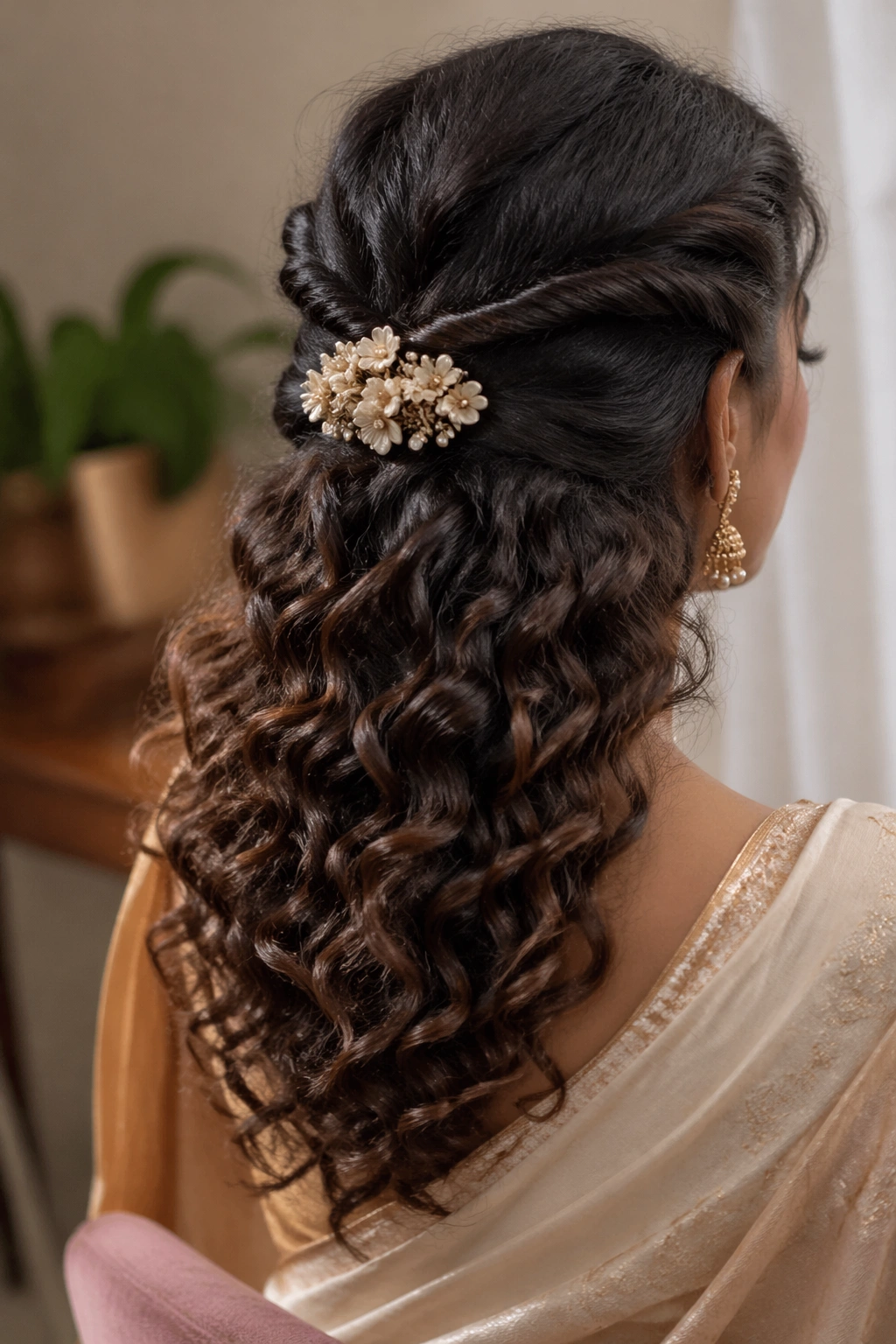
A small floral clip can rescue the back of a blouse that feels too plain. Two soft twists from the temples meet at the back, then a flower clip — fresh jasmine, roses, or a jewel-toned accessory — holds everything in place. The curls below stay open, so the hairstyle still has movement.
This style sits in a nice middle zone. It is easier than a full updo, but it looks more done than simple open hair. That makes it useful for receptions, festive dinners, and occasions where you want your hair off your face without giving up the curl pattern. The clip does the visual work, which means the twist itself can stay relaxed and not over-structured.
Placement matters here. Put the clip slightly lower if the blouse back is heavily embroidered so you do not hide the design. Put it a little higher if you want the braid or twist to show more shape. Tiny adjustments like that change the whole effect.
Do not choose a clip that fights the curls. A rigid, oversized clip can flatten the top section and create tension at the sides. A medium clip with enough grip is better, especially if the hair is fine at the roots and fuller at the ends. The style should feel like it was fastened, not clamped.
It’s a small detail, but it changes everything.
10. Textured Low Chignon for Heavy Sarees
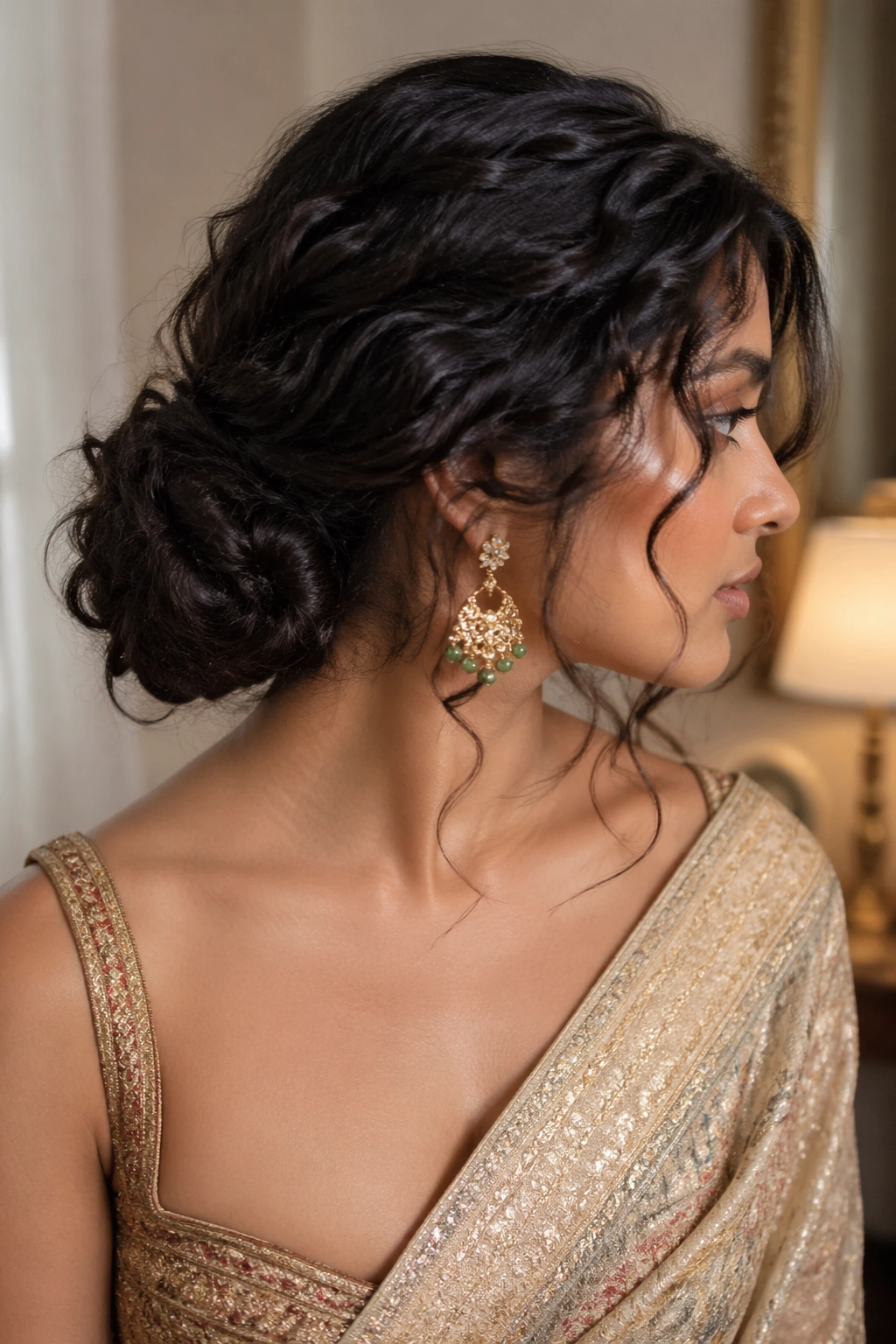
A heavy saree does not need a heavy hairstyle. That’s the mistake people make when the fabric is rich and the instinct is to match it with something equally grand on the head. A textured low chignon is quieter than that, and honestly, it often looks better.
The chignon sits at the nape and keeps the neck line clean, which is useful when the saree has a thick border, a strong necklace, or a blouse that already carries a lot of visual weight. Instead of ironing the curls flat, gather them loosely, twist the lengths into a compact knot, and let the natural texture sit on the surface. A few hidden pins underneath will hold the structure, while the visible layer keeps the softness.
Small Choices That Save the Style
- Place the chignon at the nape, not midway up the head.
- Leave the front smooth, but not stretched tight.
- Use a bun net if the hair is long and heavy.
- Keep one side slightly softer if the pallu crosses that shoulder.
I like this style for traditional sarees with dense weaving because it lets the fabric stay the star. The hair supports the outfit instead of wrestling with it. That’s a big difference, and you can see it immediately in the mirror.
If your curls are especially springy, set them first with a touch of mousse before pinning. Otherwise, the bun can start expanding by the middle of the event, and nobody wants to keep tucking at the same strand all night.
11. Waterfall Braid with Cascading Curls
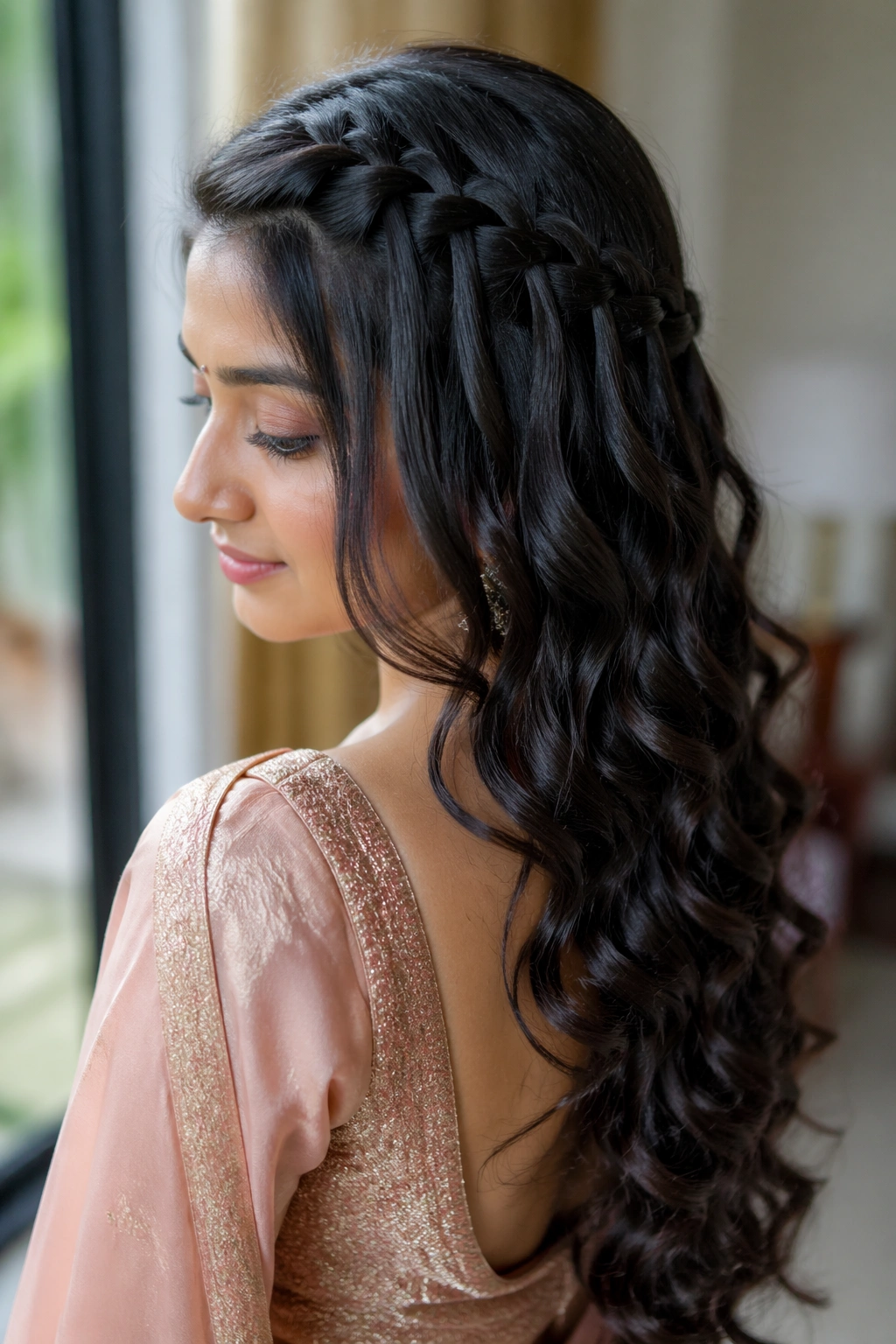
Want long curls to stay visible instead of disappearing into a bun? The waterfall braid is the answer. It gives you a braided front line with pieces dropping through it, then leaves the rest of the curls cascading down the back or over one shoulder. It is one of the prettiest ways to keep the curl texture on display while still giving the top some order.
This style works best on hair with enough length to show the braid path. The braid itself does not need to be wide; a narrow one reads cleaner and keeps the hair from looking crowded. Start near the front hairline, move the braid around the head or along one side, and let selected strands fall through the weave. The dropped strands become part of the visual rhythm, which is why the braid looks softer than a standard crown braid.
Waterfall braids are especially useful with sheer or lightly embroidered sarees. They add detail near the face without stealing attention from the fabric. If you like hair that feels a little romantic but not too formal, this sits in the sweet spot. It also photographs well from the back, which matters when the blouse has a nice cut or the saree drape sits neatly over the shoulder.
Keep the dropped strands defined, not brushed out. Loose waves look lazy here. Curl texture is what gives the braid its charm.
12. Sleek Crown and Voluminous Ends
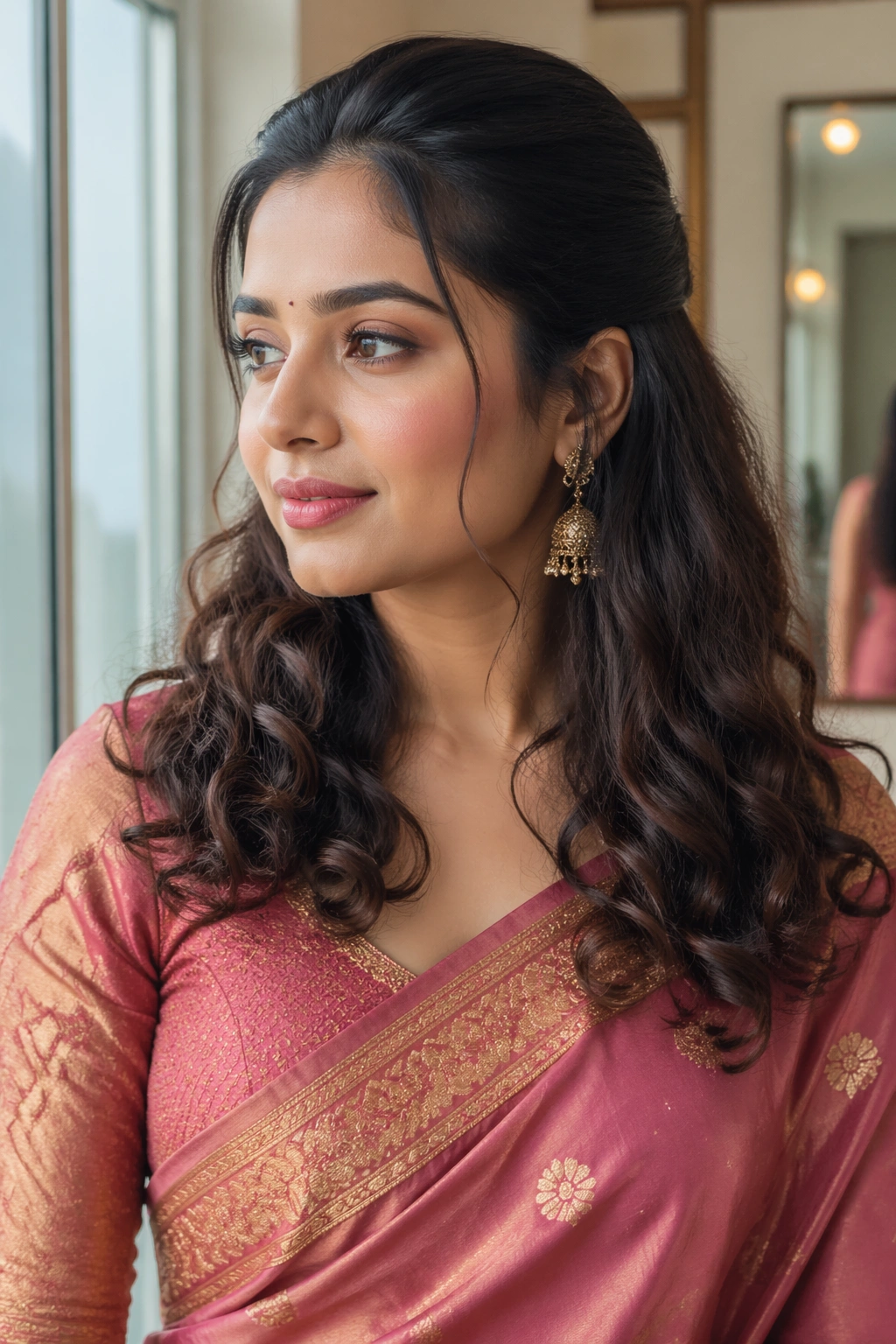
Curly hair does not have to be fluffy from roots to tips to look good with a saree. Sometimes the smartest move is to smooth the crown and let the ends do all the work. That contrast gives the hairstyle a cleaner shape and stops the top of the head from competing with earrings, makeup, or the saree border.
Where the Smoothness Matters
Focus on the front two inches of hair and the area around the part. Use a small amount of gel, cream, or serum to flatten flyaways and create a controlled surface. Don’t coat the whole head. If you do, the curls at the ends lose their lift and the style starts to look tired. The point is polish up top, movement below.
This works especially well with statement necklaces and bold blouses because the eye has a clear path from the face to the fabric. A sleek crown also helps if your curls are thick and tend to expand at the roots once you step into heat. The controlled top keeps the silhouette neat while the lengths stay free.
Why the Ends Still Matter
- They keep the hairstyle from looking too formal.
- They soften metallic sarees and sharp blouse lines.
- They give the style motion when you walk.
- They stop the hair from looking pressed into place.
I’d choose this for satin sarees, glossy silks, or any look where the outfit already has shine. It’s a quiet kind of contrast, and that is exactly why it works.
13. Bubble Curly Ponytail for a Modern Saree Look
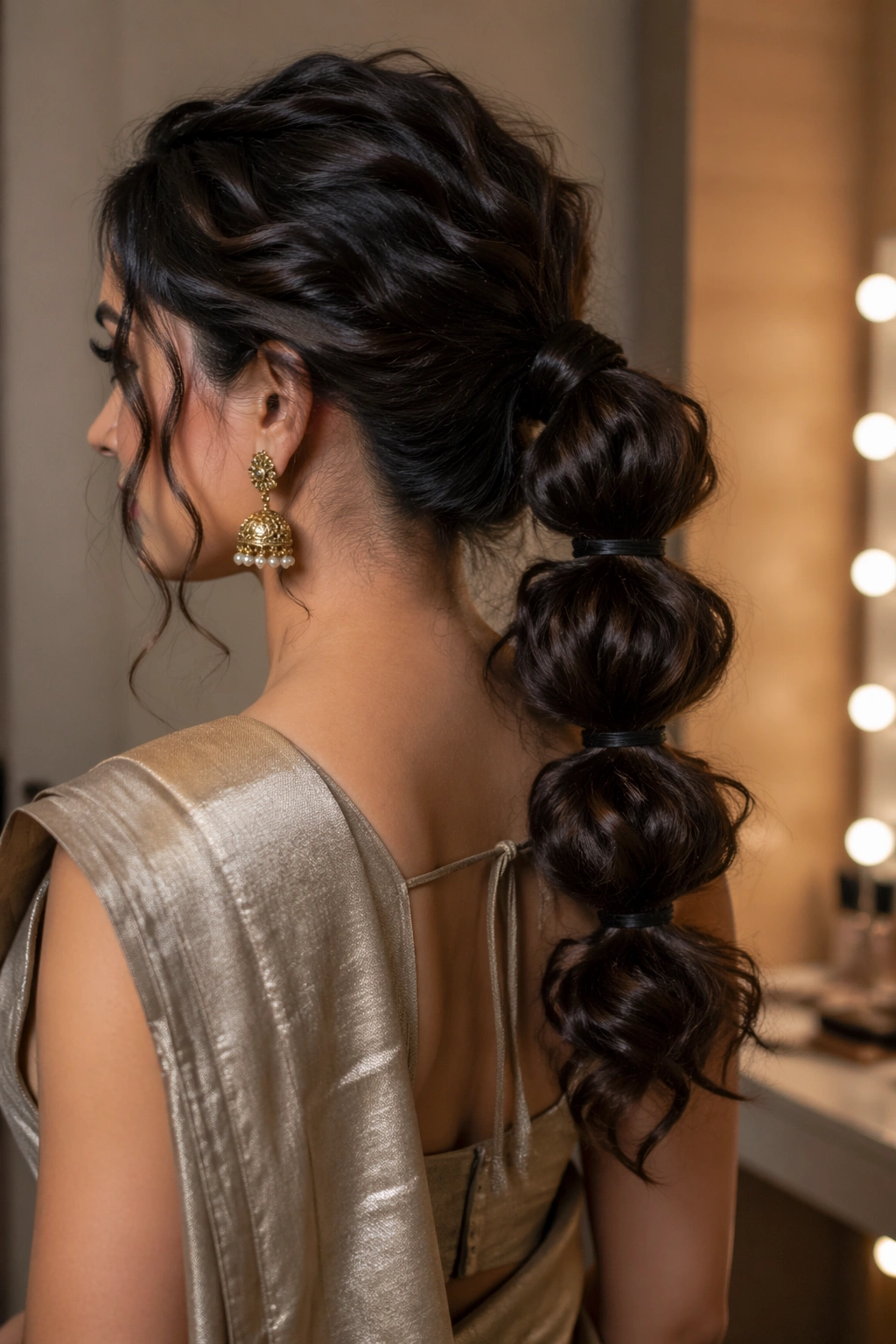
If you are wearing a metallic saree or a cleaner contemporary drape, the bubble ponytail brings a playful edge. The hair is pulled into a ponytail first, then divided into sections with small elastics every few inches so the lengths puff into rounded shapes. On curly hair, those bubbles look fuller and softer than they do on straight hair, which is part of the appeal.
This is not the style for a very formal temple-jewelry look. It wants a sharper blouse, a cleaner saree drape, or a setting where the whole outfit feels a little lighter and more current. The ponytail should sit firmly enough to survive movement, but not so tight that the crown looks stretched. If your hair is medium length, you may need to add a few curled extensions or let the last section stay loose rather than forcing a tiny end.
A neat center part works here, though a soft side part can also look good if you want less symmetry. Wrap one small curl around each elastic to hide the bands, and leave a few front pieces loose around the face. That keeps the style from looking too engineered. The curl texture does the softening, so the bubbles don’t need to be perfect.
This one is fun. Not childish — just lively.
14. Front Puff with Open Curls
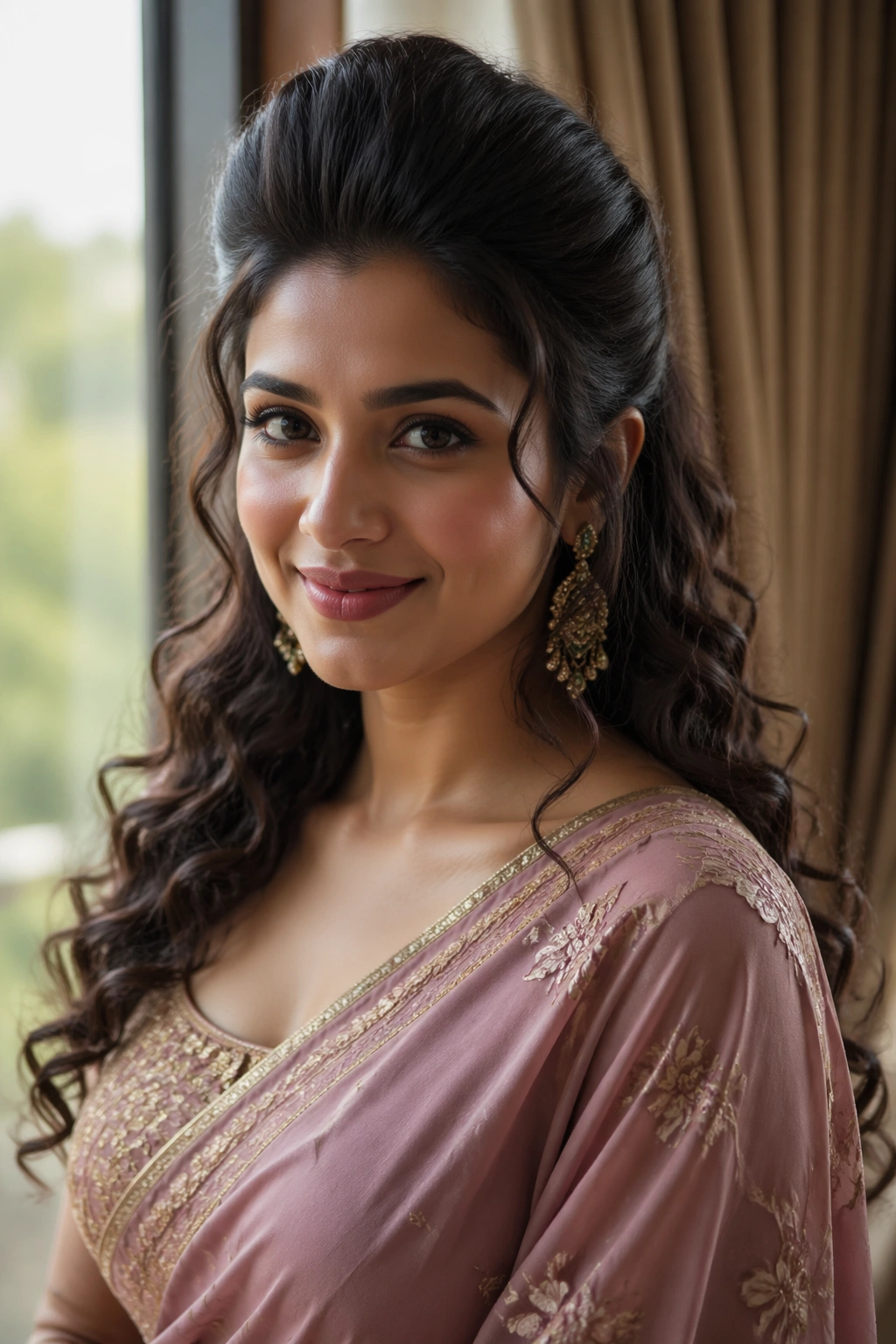
A little lift at the front can change the whole face line. The front puff, or subtle pouf, raises the crown just enough to give the hairstyle shape before the curls fall open behind it. For sarees, that matters more than people admit, because the extra height balances heavy earrings, broad neckpieces, and a pallu that sits close to the face.
How Much Height Is Enough
You do not need a huge bump. One to one-and-a-half inches of lift is usually plenty. More than that starts to look theatrical unless the rest of the styling is equally bold. Backcomb the root section lightly, smooth only the top layer, and pin the lift from underneath so it doesn’t collapse when the hair settles.
The puff works beautifully for round faces, softer jawlines, or anyone who wants a little more length in the face. It also plays nicely with open curls because the contrast between the controlled front and loose ends makes the hairstyle look intentional. A simple matha patti or a slim tikka can sit on the puff nicely, too.
What to Avoid
- Teasing the hair so much that it tangles.
- Making the lift too tall.
- Pulling the sides too tight.
- Leaving the front soft but unsupported.
This style has a bit of old-school charm, which I like. It feels familiar, flattering, and far more wearable than the giant puff people sometimes try to copy from photos.
15. Soft Bridal Cascade with Hidden Pins
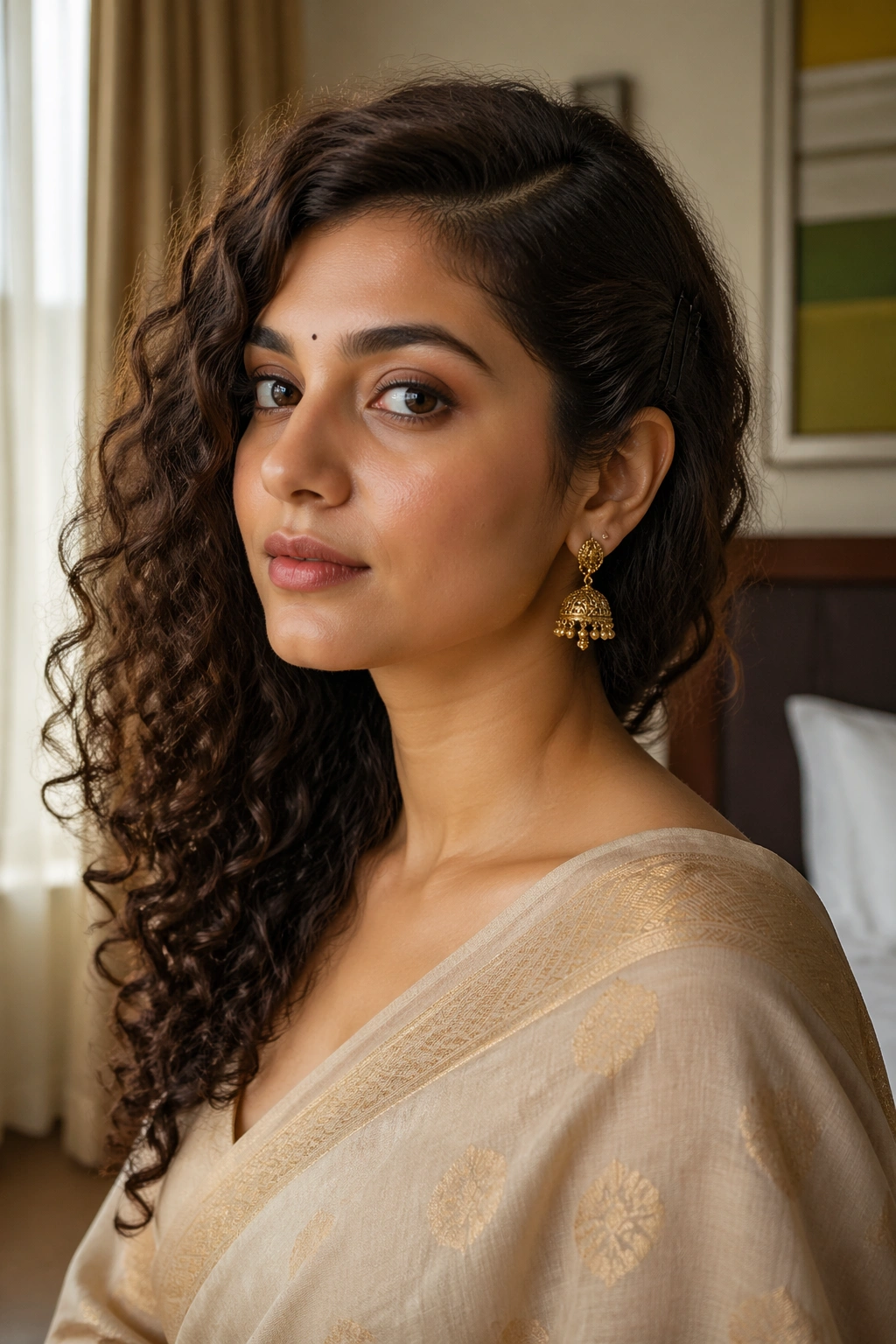
For the bride, or the guest who wants a polished finish without a hard bun, this is the one I trust most. A soft bridal cascade gathers the curls just enough to keep them neat, then lets them fall in a controlled sweep over one shoulder or down the back. The pins disappear underneath, so what you see is motion, not hardware.
This style works because it respects curl pattern instead of fighting it. The top section is usually secured with a few crossed pins or a small hidden braid, while the lengths remain free to show shape. If the saree is heavy, keep the cascade closer to the neck so it doesn’t compete with the embroidery. If the saree is lighter, let the curls fall farther down the shoulder for more drama. That small difference changes the whole silhouette.
Bridal jewelry sits well with this shape, especially a tikka, jhumkas, or a neckpiece that needs a little space around it. A side sweep can also help if the pallu is pinned on one shoulder and you want the hair to mirror that line rather than fight it. I like that the style still feels soft when the outfit is formal. It never turns brittle.
For longer events, tuck a few invisible pins near the ends of the top layer so the cascade does not slide out as the hair settles. Keep a tiny curl cream in reserve for the front pieces if the air is dry and the hair starts to fluff. Small fixes. Big difference.
If you only remember one thing, let it be this: the hairstyle should support the saree, not compete with it. The best curly looks leave enough structure to stay put and enough softness to keep the curls alive. That balance is what makes the whole outfit feel finished rather than forced.
