



Pink dyed curly hair is the kind of look that makes people stop, stare, and immediately ask who did your hair. There’s something about the combination of soft, feminine pink and the bold, unapologetic energy of natural curls that just works — it feels daring and playful at the same time. Whether you’re drawn to barely-there pastel tips or a full head of hot magenta coils, pink on natural curls delivers in ways straight hair simply can’t replicate. This guide covers 21 pink dyed curly hair ideas for women who are ready to make every wash-and-go a statement.
Why Pink and Natural Curls Are a Perfect Pair
Pink reads differently on curly hair than it does on any other texture. On straight hair, it lies flat and reads as a single dimension of color. On curls? Every twist, every coil, every ringlet catches pink differently — lighter on the high points of each curl, richer in the shadows between them.
The result is that pink on pink dyed curly hair always looks multidimensional, even when you’ve only used one shade. Add the movement that natural curls carry — the way a wash-and-go bounces and shifts as you walk — and pink becomes something almost animated. It’s not just color sitting on your hair. It’s color interacting with your texture in real time.
There’s also the matter of visibility. Curly hair has volume and density that straight hair often doesn’t, which means pink shows up from across a room in a way that’s hard to ignore. A Type 4 puff in hot pink is visible from a significant distance. That’s a feature, not a bug.
Understanding the Pink Spectrum Before You Commit
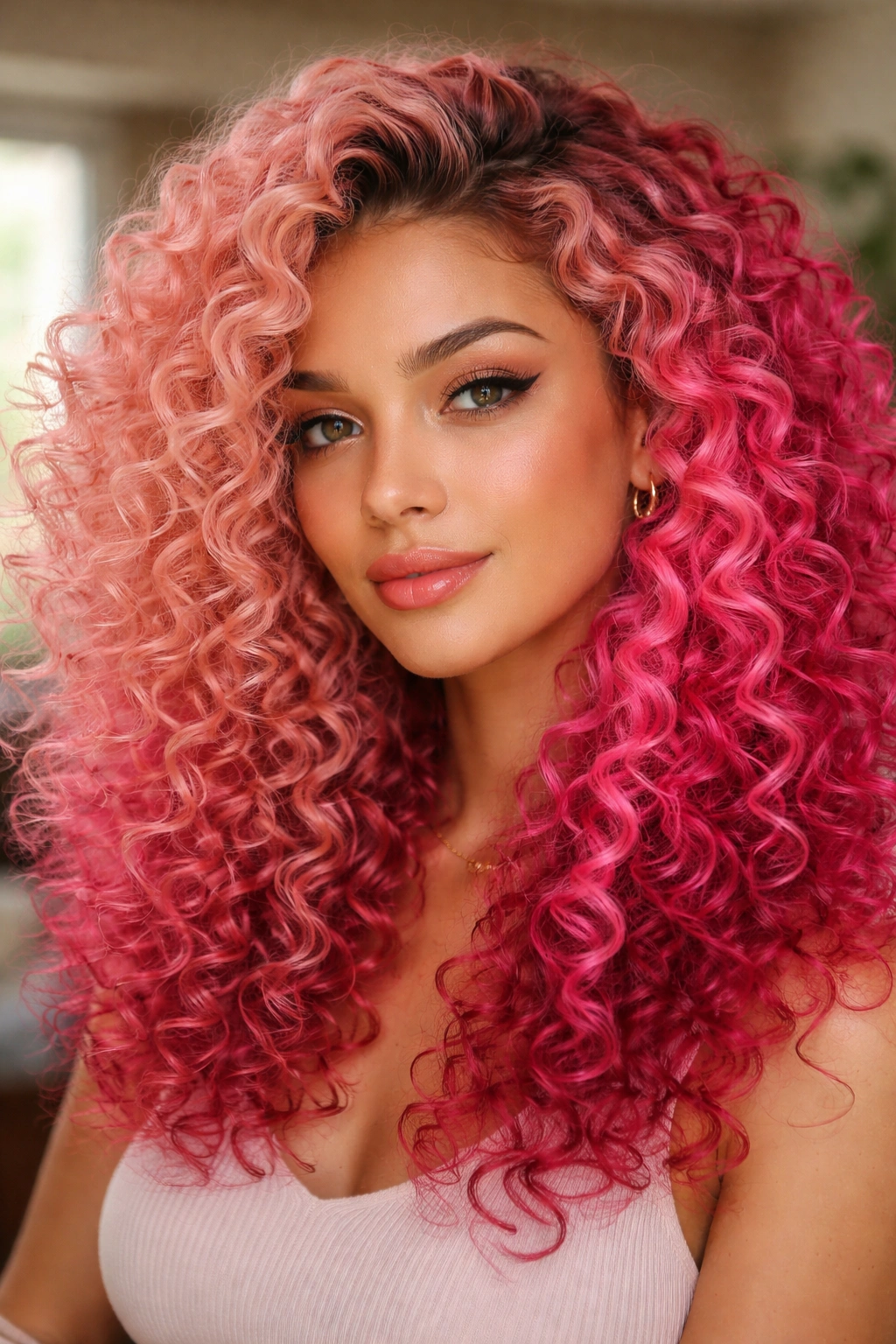
Pink is a broad category — from barely-there blush to vivid neon magenta, the range is enormous. Getting clear on which version of pink you’re after saves you a lot of disappointment later.
Blush and baby pink are the softest end of the spectrum. These require significant lightening on dark hair (usually to a pale yellow or level 10-11 before toning) because they’re so light that any underlying warmth pushes them toward peach or salmon rather than pink.
Rose gold sits at the warm intersection of pink and gold. More forgiving to achieve than pure blush, it reads as either gold or pink depending on the light — and it’s one of the most universally flattering shades in the entire hair color world.
Dusty rose and mauve are muted, desaturated pinks with gray or brown undertones. These have an editorial, cool-girl quality that feels sophisticated rather than sweet.
Hot pink and fuchsia are fully saturated, vivid pinks. They require pre-lightening and regular maintenance to stay vivid, but the payoff is color that absolutely commands attention.
Magenta and deep berry pink push toward the red-pink border. These are deep enough that they can sometimes be achieved on dark hair without full bleaching — a direct-dye magenta over a dark base reads as a rich, vivid tonal change rather than a flat black.
The Lightening Process: What Pink Really Requires
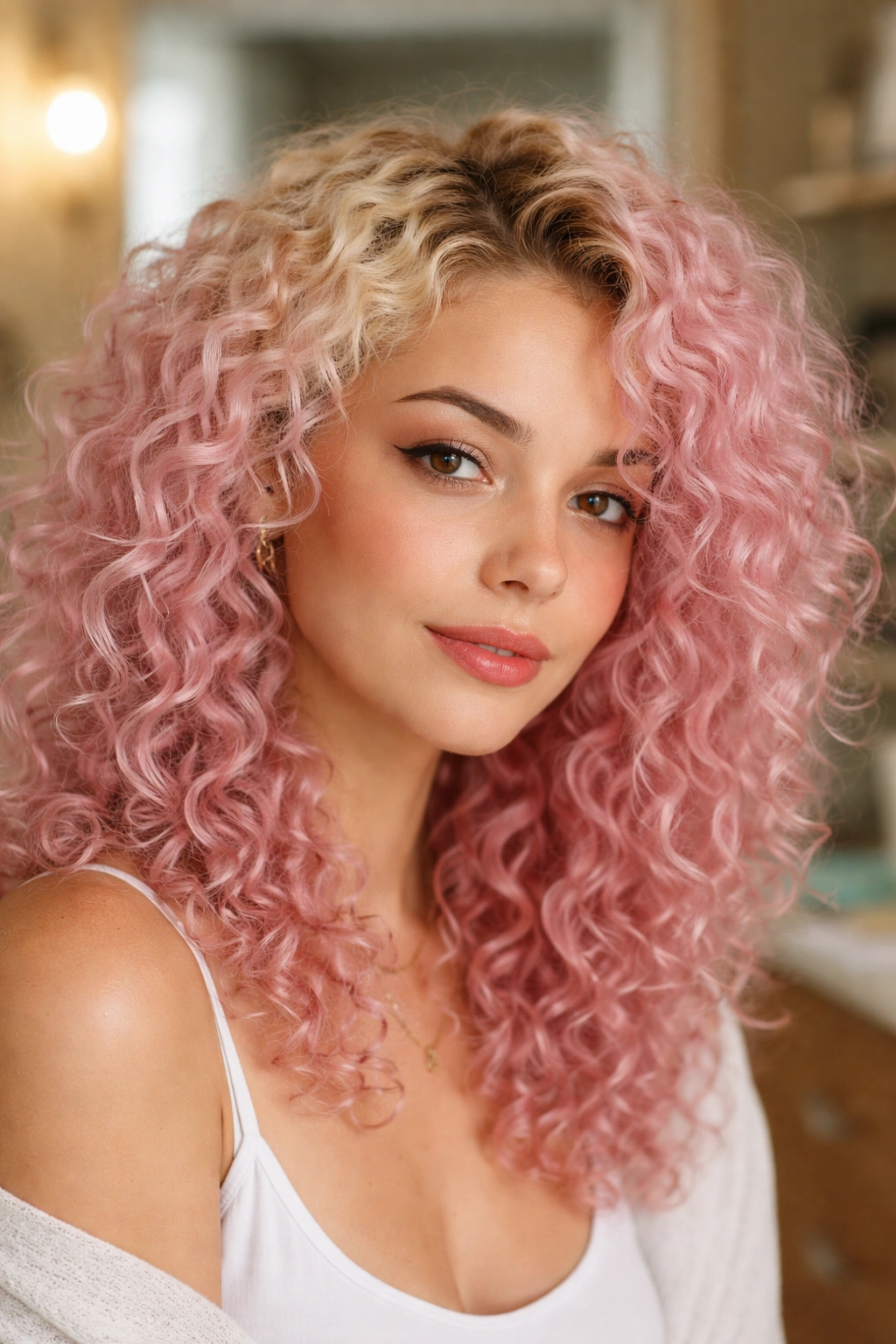
Let’s be straight about this: most true pink shades require lifting your natural hair significantly before the pink can show up properly. If you have dark brown or black natural hair and you want blush pink, you need to get to pale yellow before the tone goes on. That’s a serious lift.
This doesn’t mean it’s impossible or dangerous with the right professional. It does mean it’s a process that shouldn’t be rushed, and for Type 4 hair especially, it typically means multiple sessions spaced weeks apart to preserve hair integrity.
The good news: Darker pinks (magenta, hot pink, deep fuchsia) show up on less-lightened bases. You can often achieve a vivid hot pink or magenta on a level 7-8 (orange-gold) lift rather than going all the way to pale yellow. The result is a slightly muted or warmer pink that’s still unmistakably pink — and your hair stays significantly healthier for it.
Direct dye pink formulas applied to unbleached dark hair will deposit a slight rosy or pink-tinted sheen in certain lighting — especially in photos and bright sunlight. For some people, that subtle wash of color on their natural texture is exactly what they wanted.
Maintaining Pink on Natural Curls
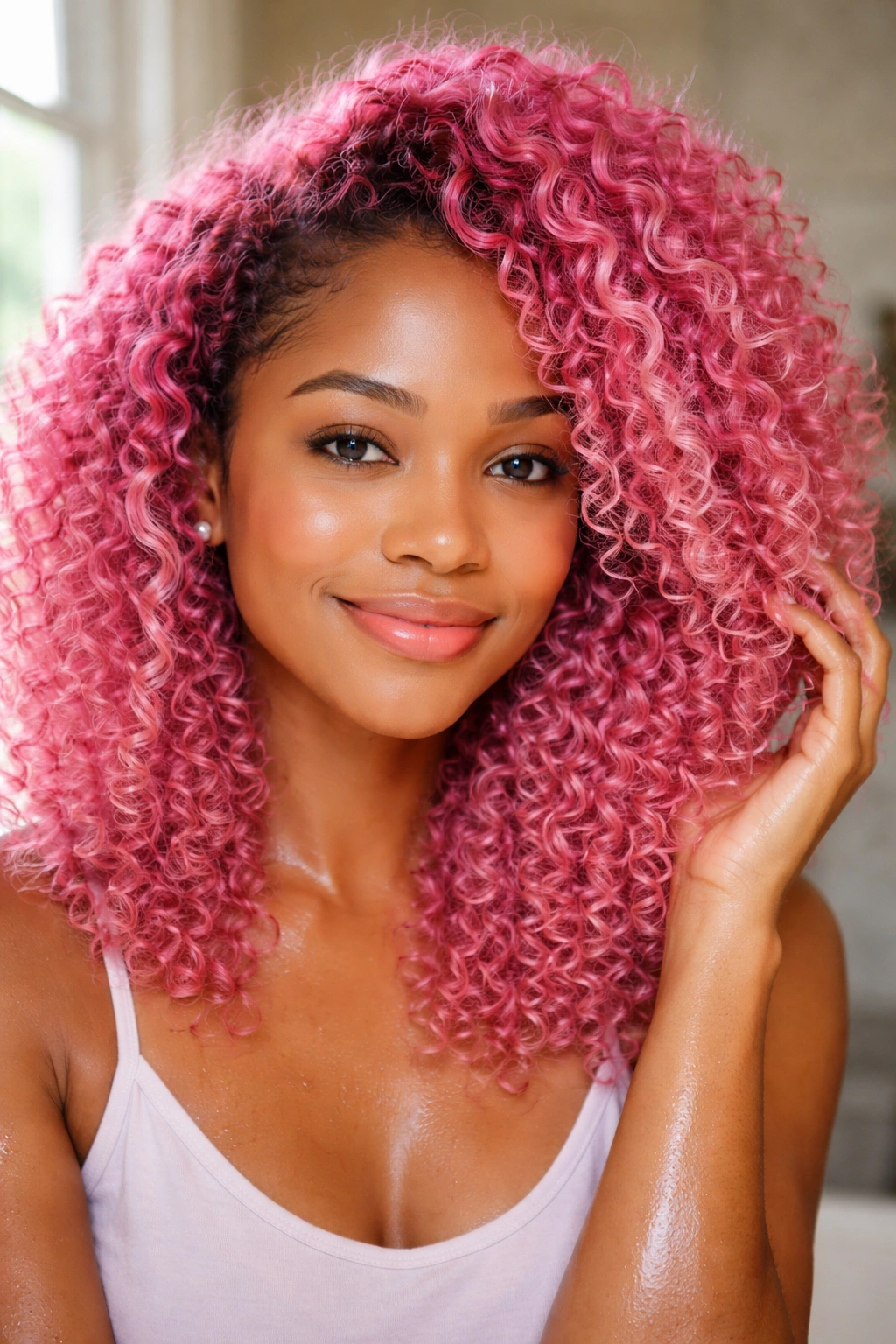
Pink is a high-maintenance color family — but “high-maintenance” doesn’t mean impossible with the right habits.
Wash less often. Every shampoo strips a little color. Stretch wash days to 10-14 days if you can, and co-wash in between to maintain moisture without stripping pigment.
Pink-pigmented conditioner is non-negotiable. A pink or red-tinted color-depositing conditioner used weekly replaces the pigment lost to washing and oxidation. It’s the single most effective tool for keeping pink vibrant between salon visits.
Cold rinses only. Hot water is the enemy of pink hair. Always, always rinse with cool or cold water.
Sun protection matters more than people realize. UV exposure breaks down the warm-spectrum pigments in pink faster than almost anything else. A UV-protective leave-in or styling product extends color life noticeably.
Deep condition weekly — color-treated curls need more moisture than undyed curls, and pink-treated hair tends to be more porous after lightening, which means it can dry out faster.
Choosing Pink Based on Skin Tone
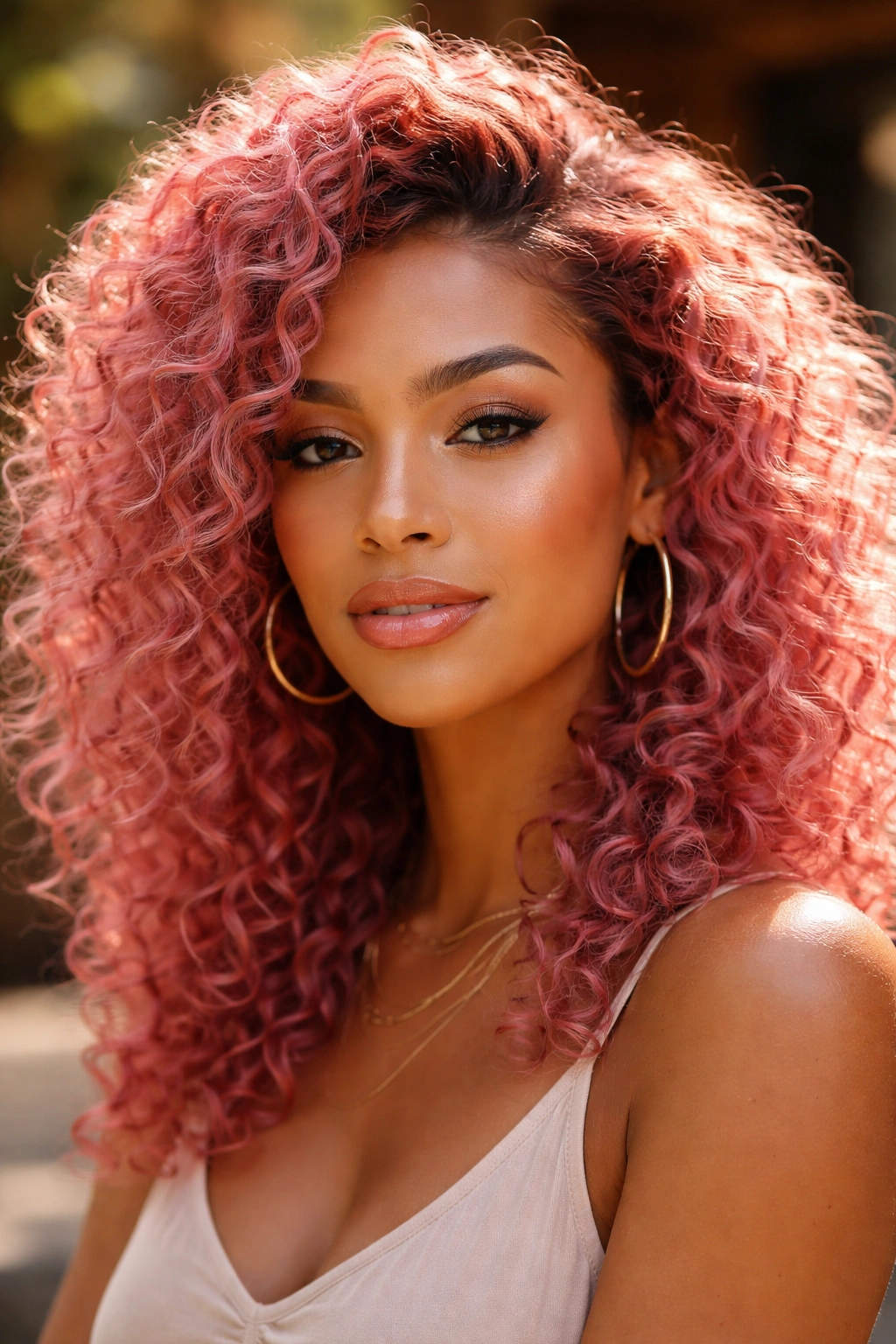
Pink works across the entire skin tone spectrum, but some shades are particularly flattering based on your undertones.
Warm undertones: Rose gold, peachy pink, coral-pink, and warm fuchsia are especially flattering. They complement rather than compete with warm skin.
Cool undertones: Icy pink, lavender-pink, deep magenta, and cool dusty rose work beautifully. The coolness of these shades harmonizes with the blue and pink tones in cool complexions.
Deep skin tones: Hot pink and vivid fuchsia are extraordinary against deep complexions — the contrast is stunning. Burgundy-pink and deep magenta are equally striking, with the bonus of not requiring as much lightening.
Fair to medium skin: Blush, baby pink, and rose gold are classic choices, but hot pink can be equally stunning. Don’t let anyone tell you a shade is “too much” for your skin tone — bold pink is bold regardless.
1. Blush Pink Wash-and-Go
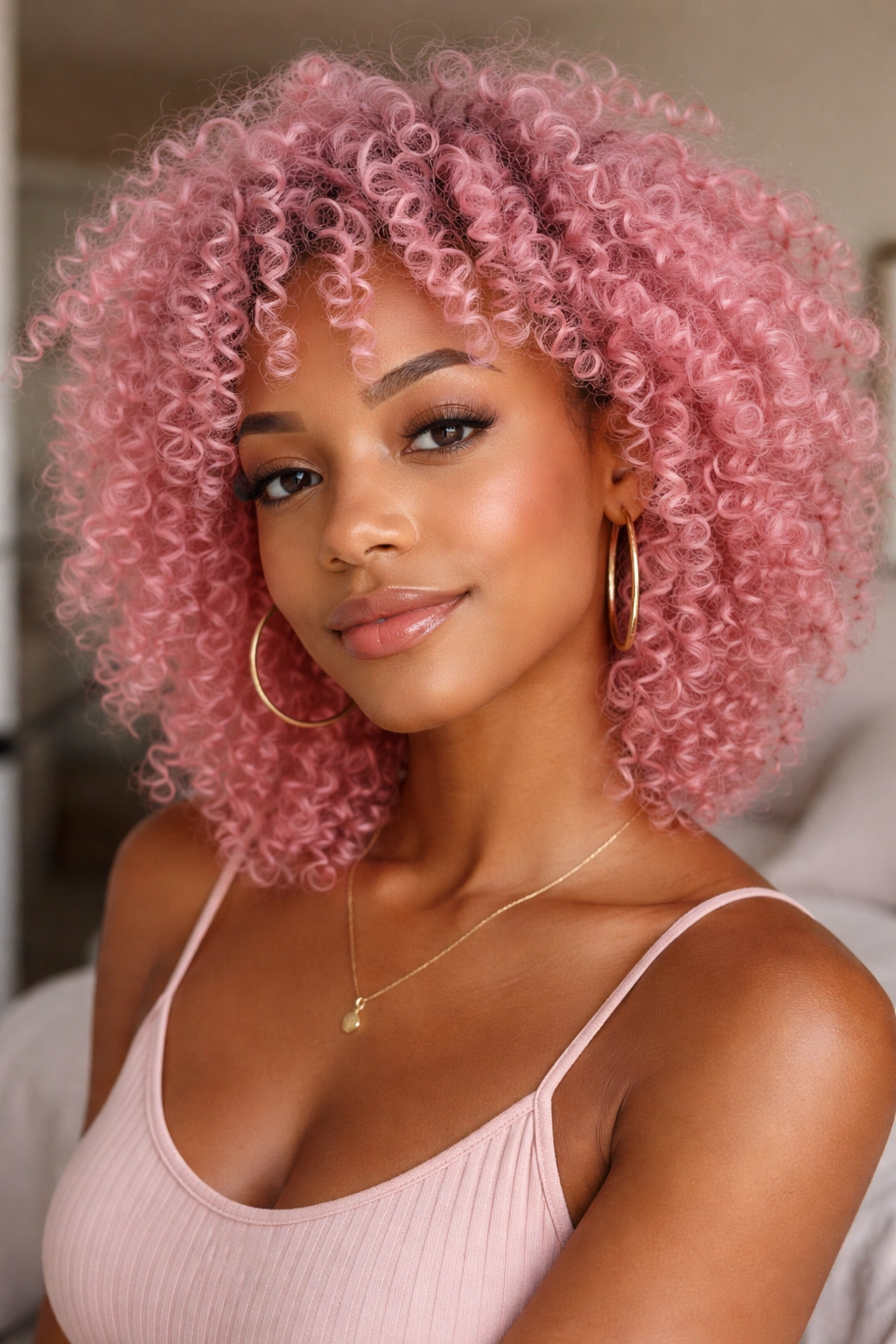
Blush pink all-over on a wash-and-go is a look of rare delicacy — every curl, every coil, every ringlet is suffused with a soft rosy glow that looks almost too beautiful to be real.
How to Achieve
- Lift to a very pale yellow (level 10-11) — this is non-negotiable for true blush
- Tone with a sheer blush-pink formula — start light, you can always go deeper
- Deep condition immediately after every step
- Use a pink-tinted leave-in to maintain the tone between appointments
Bold tip: Blush pink on 3B ringlets in good light looks like rose-gold ombre without the gradient work — the way light catches ringlet curves naturally creates dimension.
2. Hot Pink Curly Puff
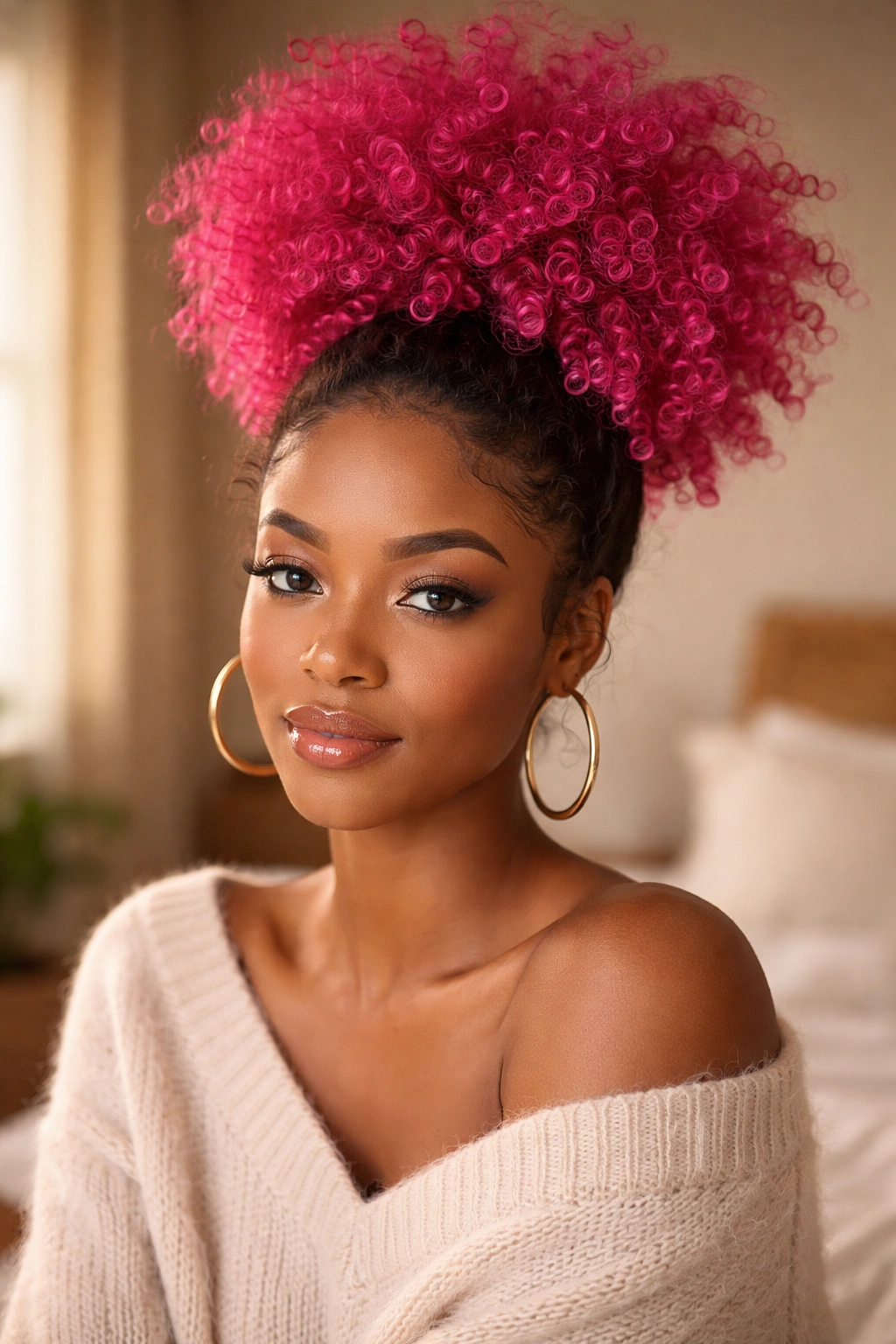
A high puff in vivid hot pink is one of the most commanding hair looks in existence. No elaborate styling required. Just gather your curls up, secure them at the crown, and let the color do everything else.
Hot pink requires pre-lightening to a level 8-9 before applying a direct dye vivid pink. The lift required is significant but less extreme than blush — a warm orange-gold base won’t kill a vivid hot pink the way it would kill a pastel.
This look is especially effective on dense 4C hair where the puff has volume that makes the color visible from every angle.
3. Rose Gold Balayage
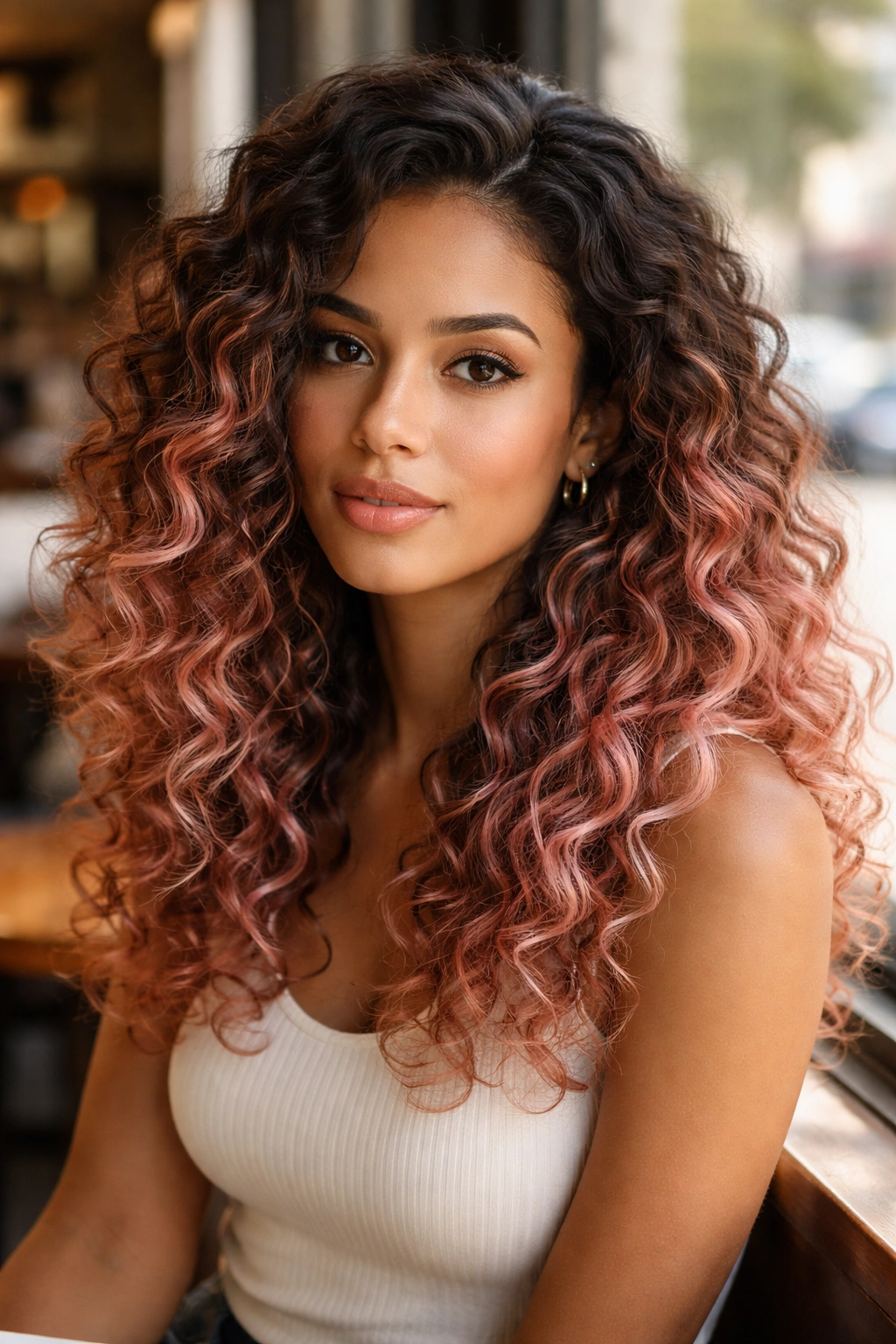
Rose gold painted through dark natural curls in a balayage pattern gives you warm pink tones concentrated on the mid-lengths and ends, with natural dark roots that require zero maintenance.
This is one of the more low-maintenance approaches to pink dyed curly hair because there’s no harsh root line to touch up and the balayage fades gracefully over time. As it fades, it moves from rose gold toward a warm peachy-gold — both beautiful stages.
Who it suits: Everyone. Rose gold adapts to warm and cool undertones, it works on every curl type, and the balayage technique means it grows out without looking neglected.
4. Magenta All-Over
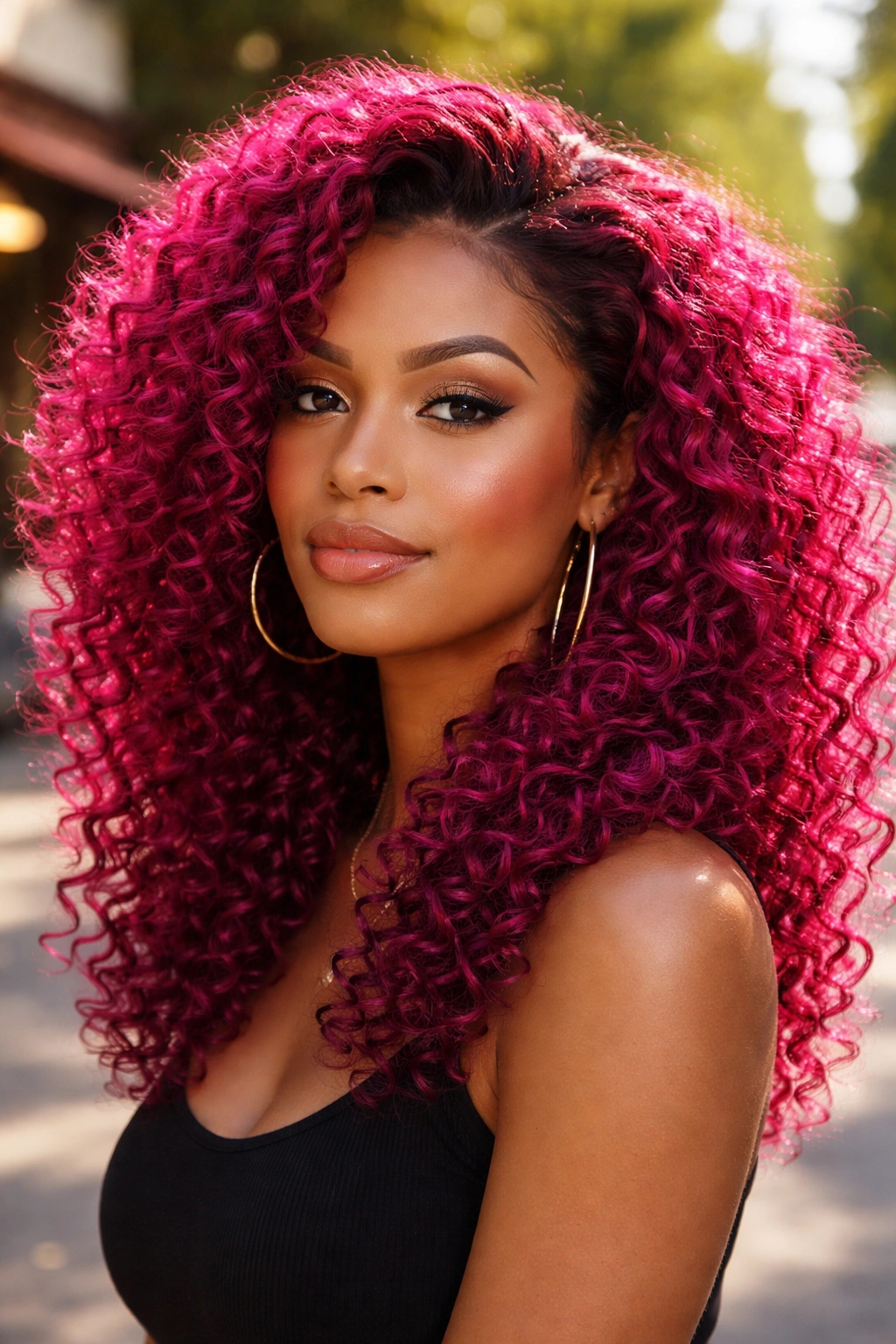
Magenta is where pink gets serious. It’s deep, it’s saturated, and it has enough red in it to show up meaningfully on dark natural hair without requiring full pre-lightening.
A direct-dye magenta over a dark brown or medium brown base creates a vivid, jewel-toned result that shifts between deep pink and red depending on the light. In direct sunlight, it’s unmistakably vivid. In indoor lighting, it reads richer and darker.
For maximum vibrancy, lift to a warm copper-gold before applying magenta — the result is a saturated, almost electric shade that maintains excellent vibrancy for 4-6 weeks.
5. Pink Ombre from Roots to Tips
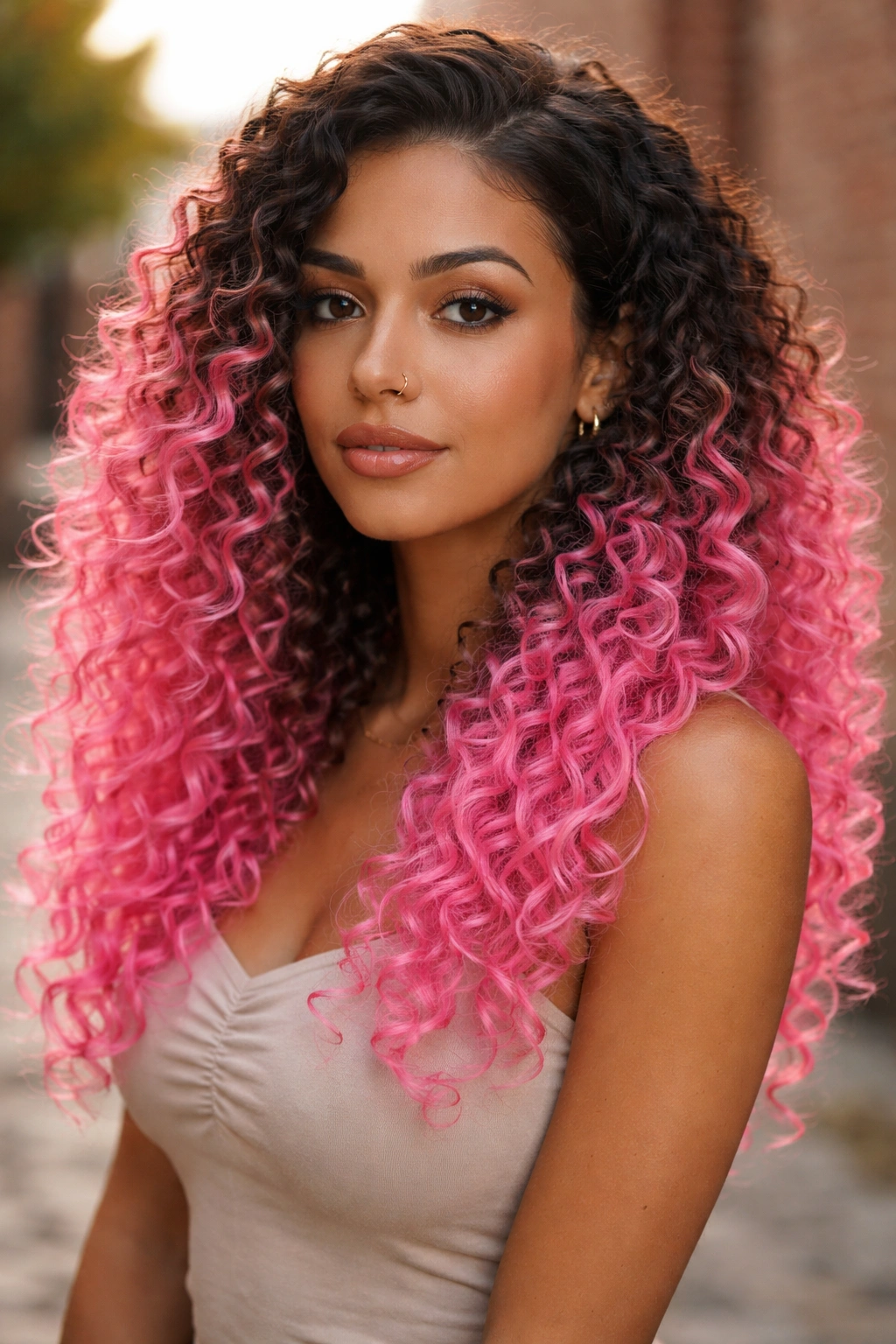
Dark roots fading to vivid pink or blush at the ends — the classic ombre applied to pink creates a look that’s both wearable and dramatic. Your natural root growth is part of the design, which means maintenance becomes significantly simpler.
On curly hair, the color transition in an ombre is softened by the curl pattern itself — tight curls mix and blend the transition zones in a way that straight hair requires deliberate blending to achieve.
Application
Apply bleach from mid-shaft to ends, feathering upward. After lifting to the desired level, rinse and condition. Apply pink toner or direct dye to the lightened sections. The transition area can be finger-blended with a tiny amount of the pink formula for a seamless fade.
6. Two-Tone Pink and Natural
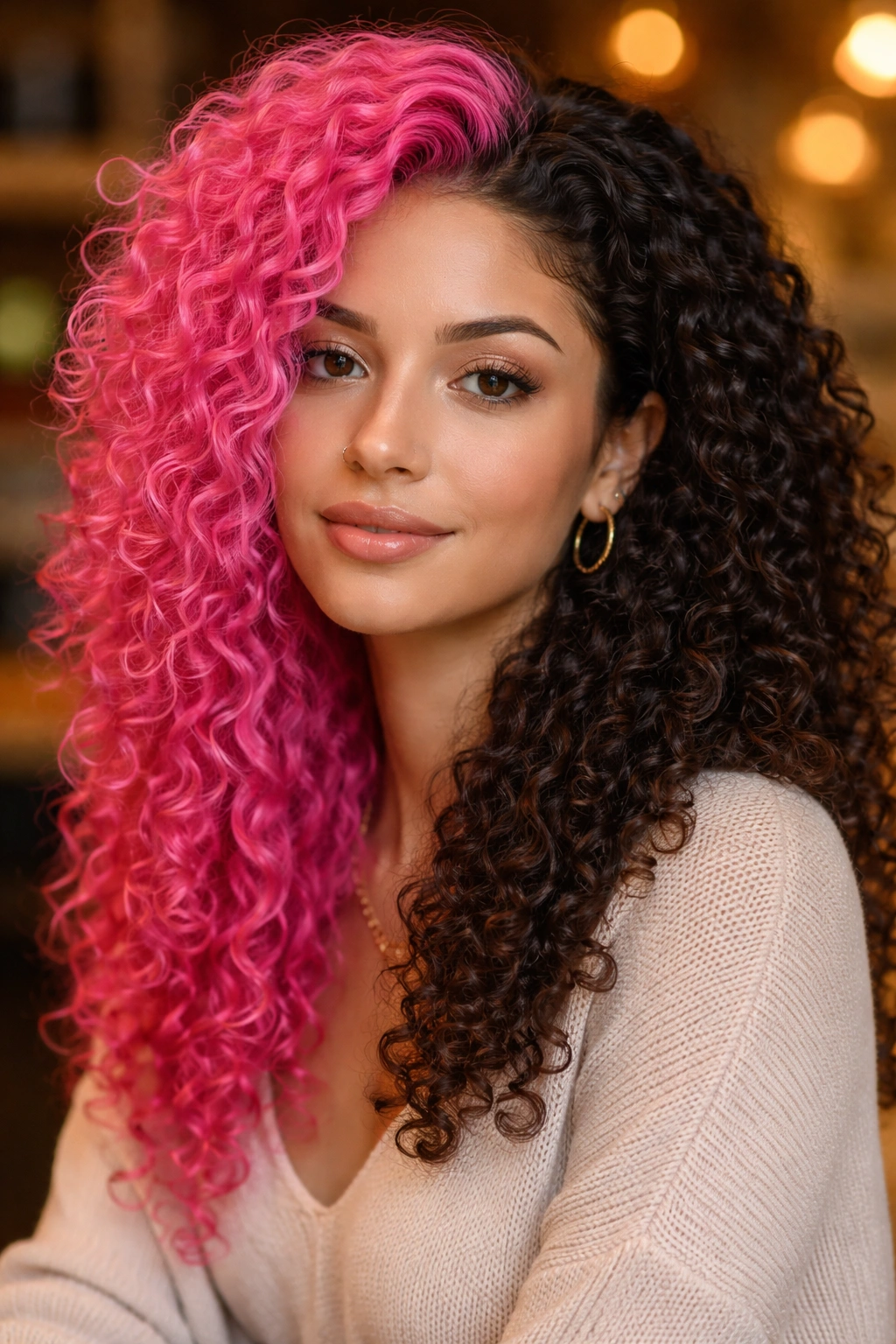
Half your hair in vivid pink, the other half in your natural color — either as a split (one side pink, one side natural) or as an underlayer (natural on top, pink underneath). This duality approach gives you pink’s full drama while keeping your natural color present.
On curly hair, the natural sections frame the pink beautifully — especially if the pink is concentrated underneath, so it appears as flashes of color when your curls move. It’s a genuinely wearable version of vivid pink that works in most professional settings when styled down.
7. Dusty Mauve on Type 4 Curls
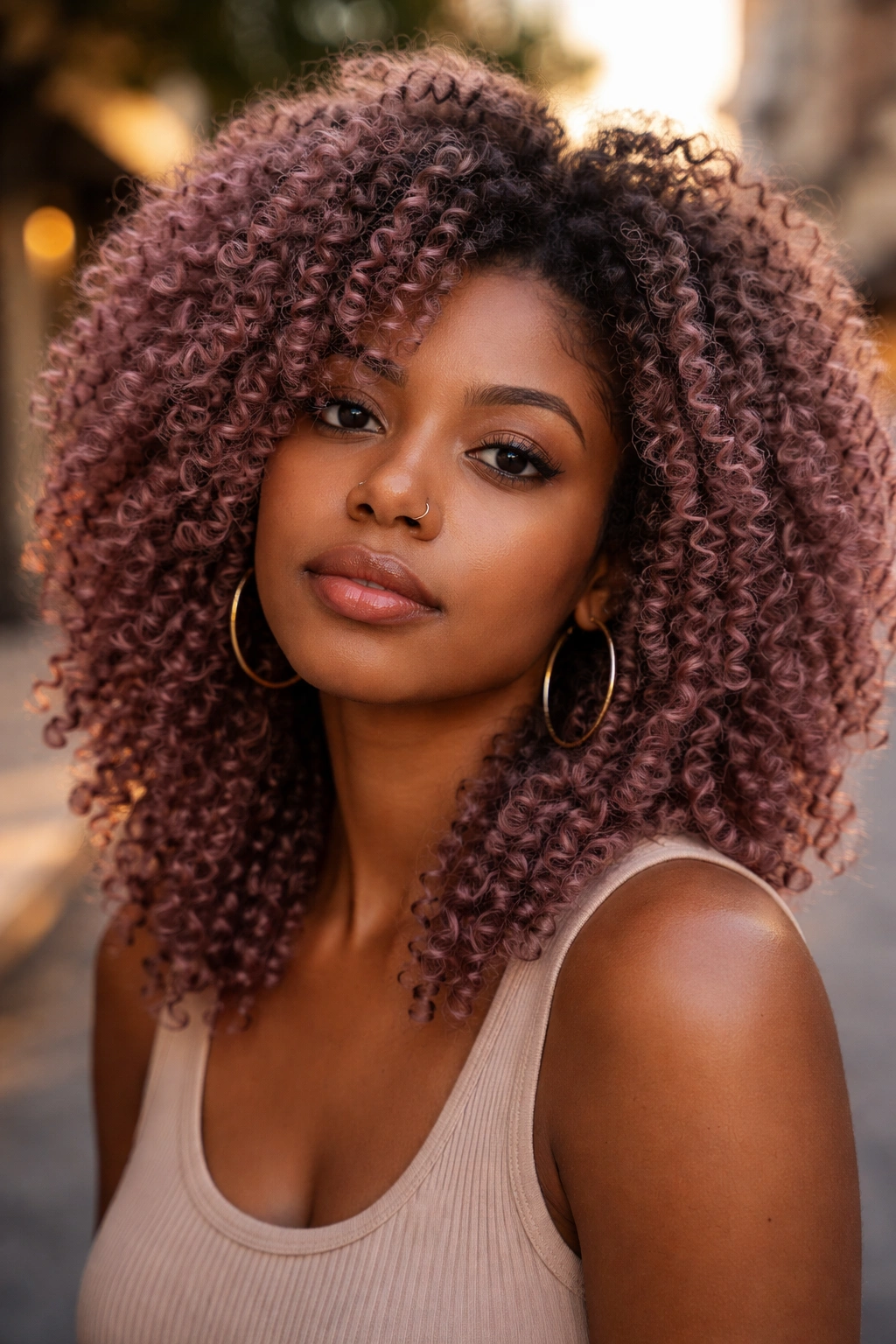
Dusty mauve — a desaturated, grayish pink with brown undertones — is one of the most sophisticated shades in the pink family. It doesn’t read as “pink” in the traditional sense; it’s more muted, more editorial, and almost indescribably beautiful on Type 4 textures.
This shade requires lightening to at least a level 8 before toning, and the muted nature of the color means it fades gracefully toward a warm neutral rather than an obvious fade. Low-maintenance by pink standards.
8. Bubblegum Pink Highlights
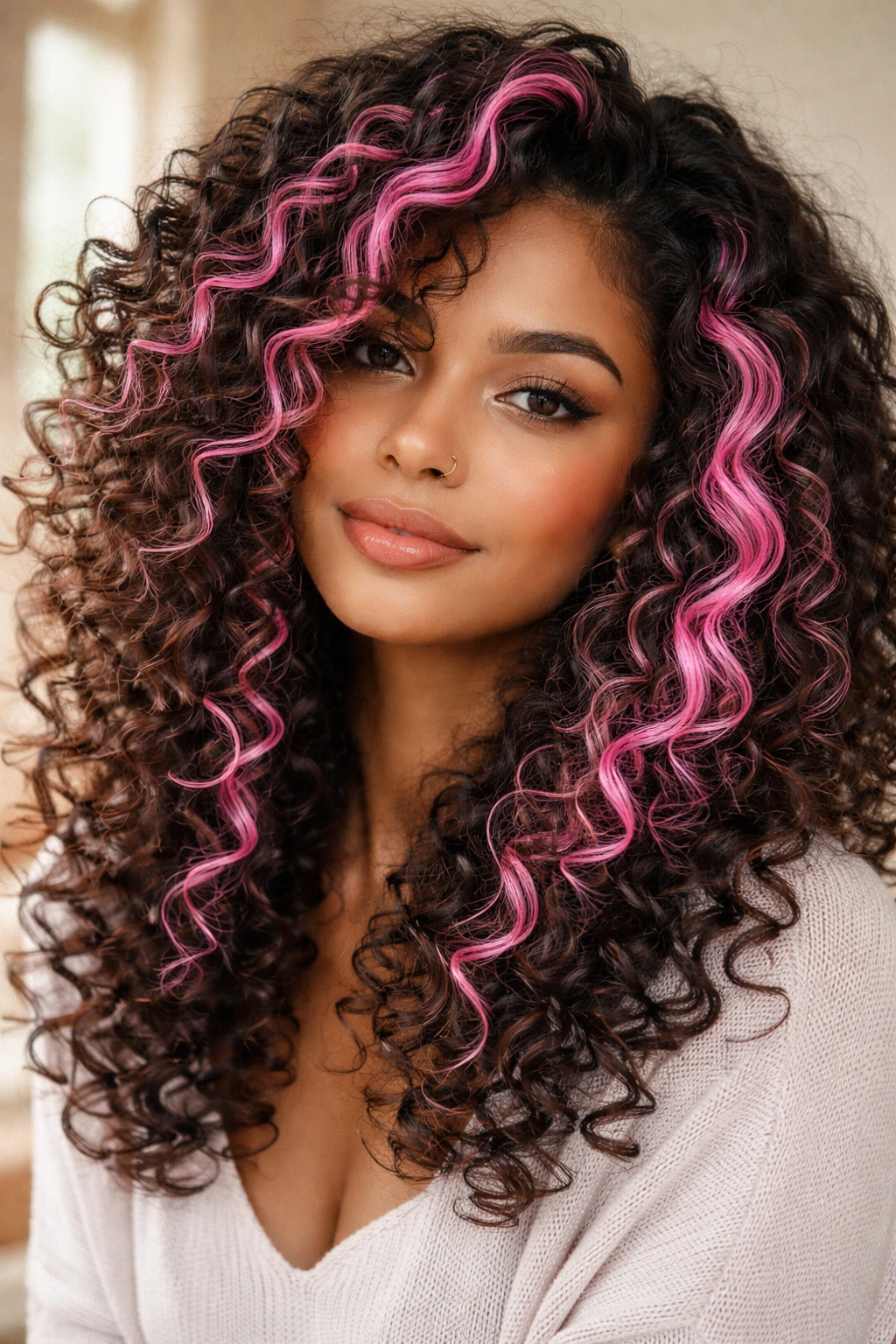
Bubblegum pink highlight sections through natural dark curls create a playful, graphic contrast — vivid pink strips against your natural color. You can go as subtle or as bold as you like, from a few delicate highlights to thick, chunky sections.
On curly hair, highlights often look more natural than on straight hair because the curl pattern breaks up any strict line of demarcation. The pink and natural sections blend together as your curls mix and move.
9. Flamingo Pink Locs
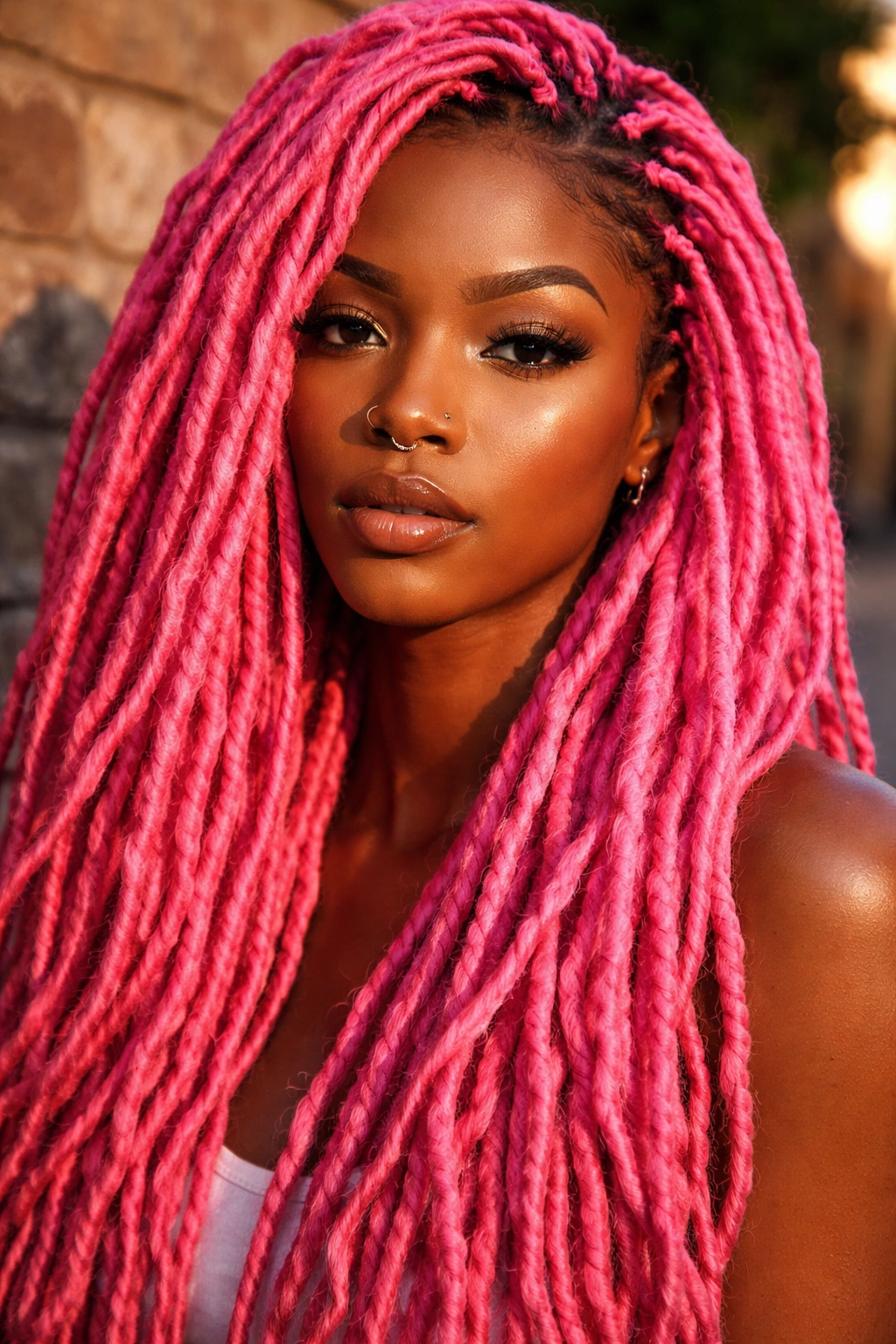
Faux locs or traditional locs in vivid flamingo pink are a stunning protective style combination. The structured, cylindrical shape of locs shows color in a uniquely graphic way — and flamingo pink against deep brown skin is a combination that photographers literally seek out.
If you don’t want to color your natural locs, flamingo pink hair extensions can be incorporated into the loc install for the same effect with zero chemical commitment.
10. Peachy Coral Pink
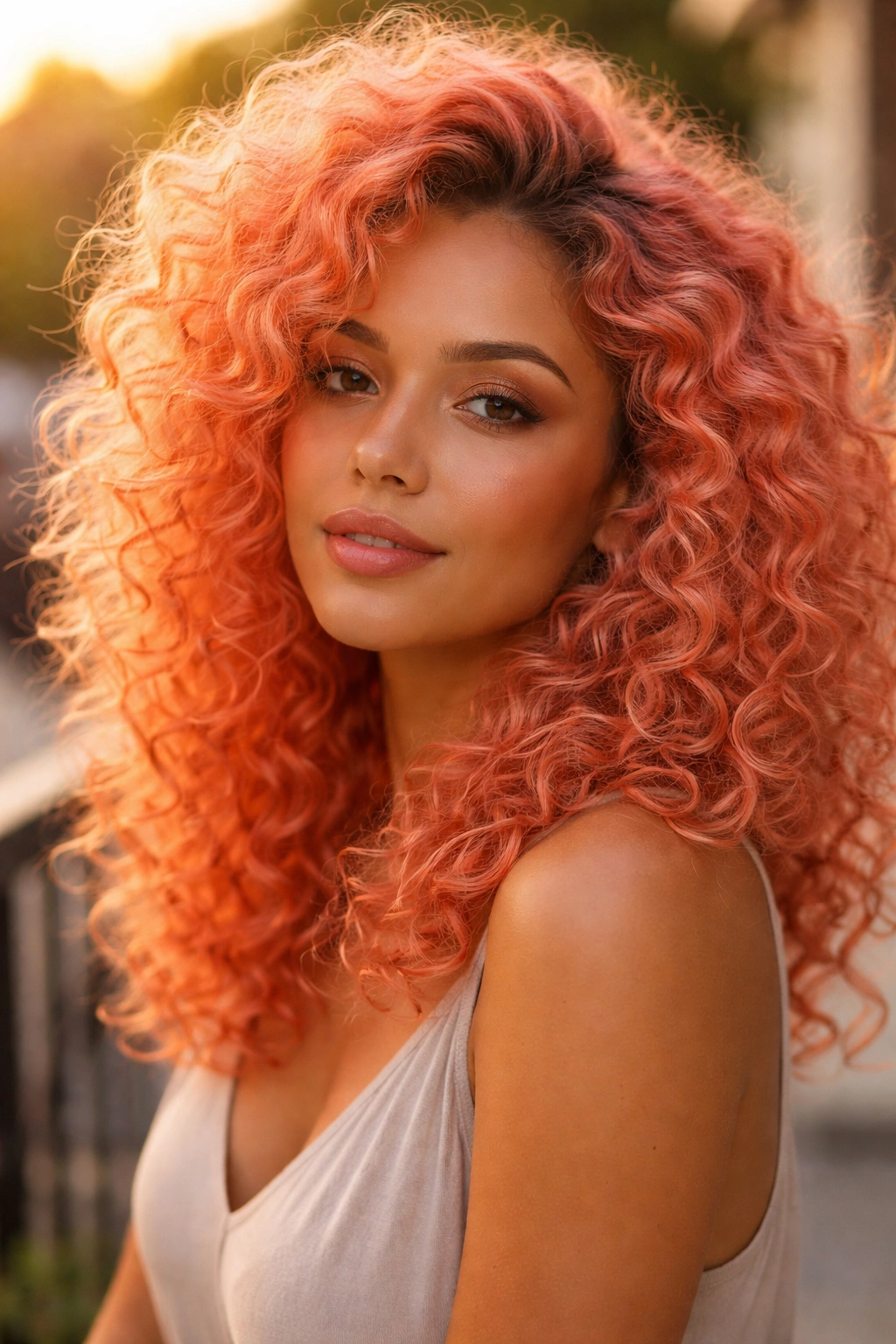
Peach-coral pink sits right at the warm border of orange and pink — it’s soft enough to be wearable daily but unusual enough to generate compliments constantly. On natural curls, the warm, sunset tones of peachy coral look especially beautiful in golden-hour light.
This shade requires lifting to a light orange-gold before toning with a coral-peach direct dye. The existing warmth of a partially lifted base actually enhances coral tones rather than fighting them.
Bold tip: This is one of the few pink-adjacent shades that works without lifting to pale blonde first — the warmth in the base helps rather than hurts.
11. Pastel Lavender-Pink
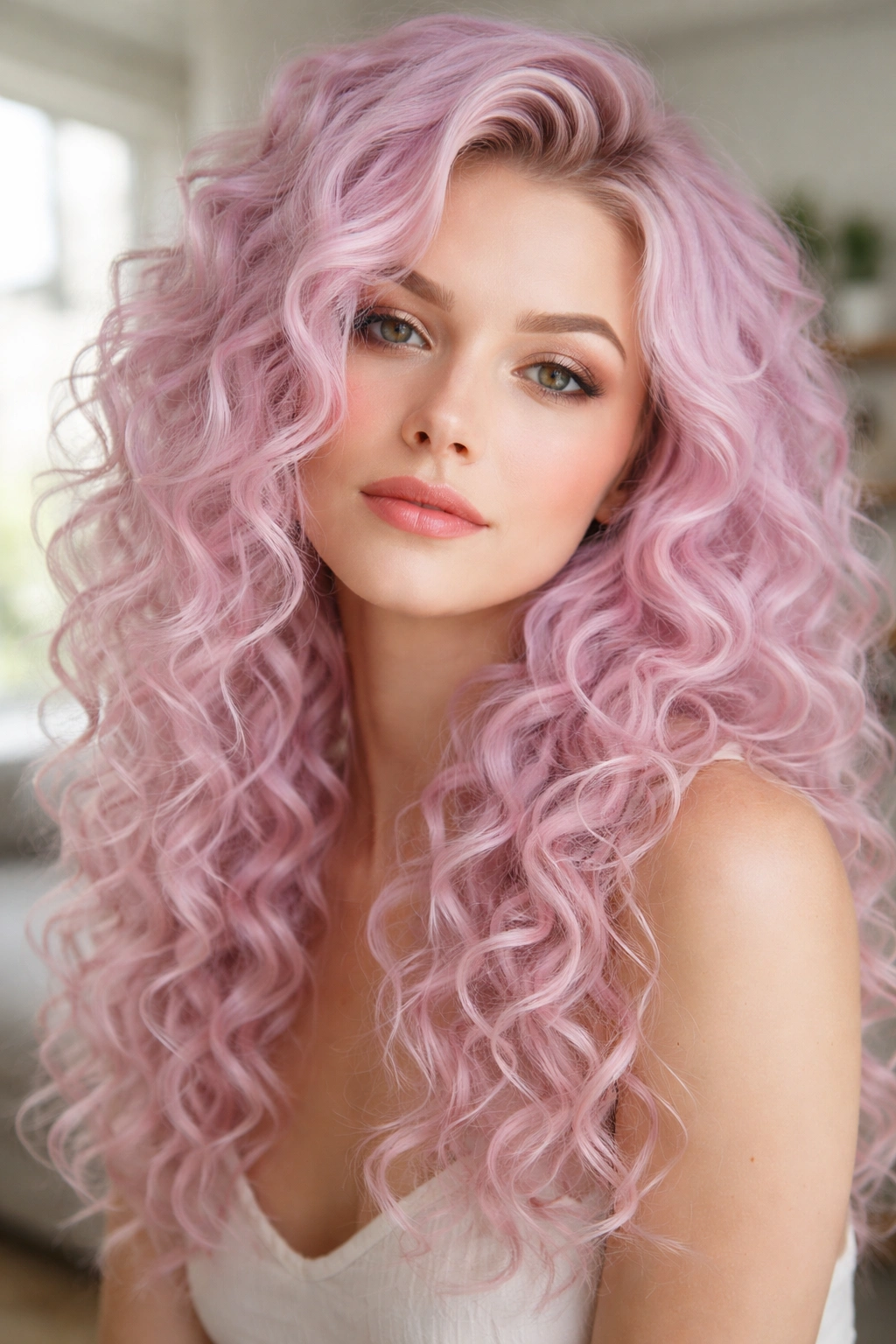
Where pink meets lavender — a barely-there, ethereal wash of pale pinkish-purple that looks like something from a fairy tale. On natural curls, especially 3A-3C ringlets that cluster and twist together, this shade looks impossibly pretty.
You’ll need a very pale blonde base (level 10-11) for true pastel lavender-pink. It’s the most high-maintenance and high-commitment option in this list, but there’s nothing quite like it when done well.
12. Pink and Blonde Swirl
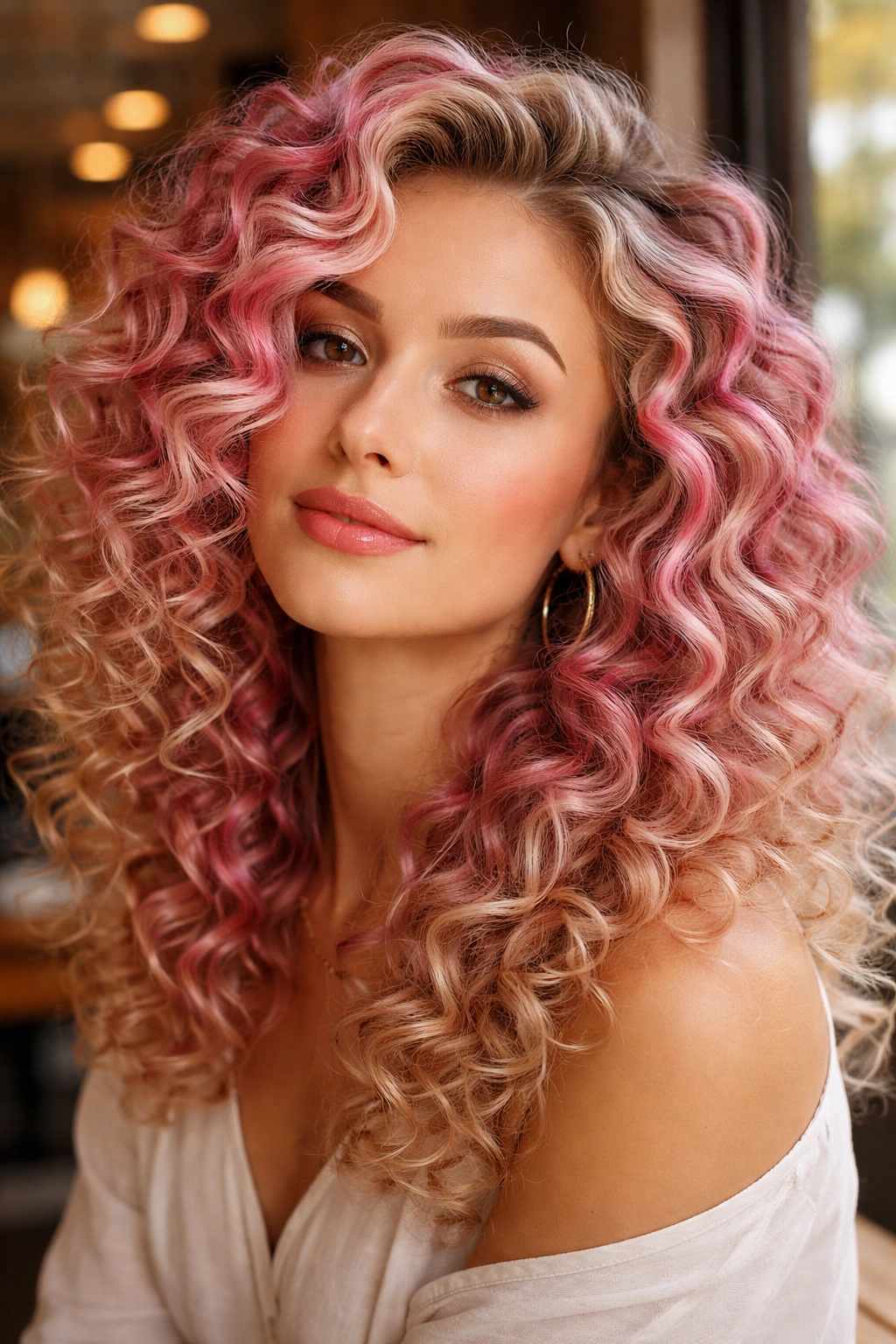
Pink and blonde together — whether as a balayage, as alternating highlights, or as a deliberately blended two-tone — create one of the warmest, most flattering color combinations possible. Both shades are warm, both catch light beautifully, and together they create a look that reads as summery, glowing, and intentional.
On curly hair, pink and blonde sections don’t stay neatly separated — they swirl together as the curls mix and twist, creating a natural blend that looks more complex than the individual colors suggest.
13. Deep Fuchsia on 3C Curls
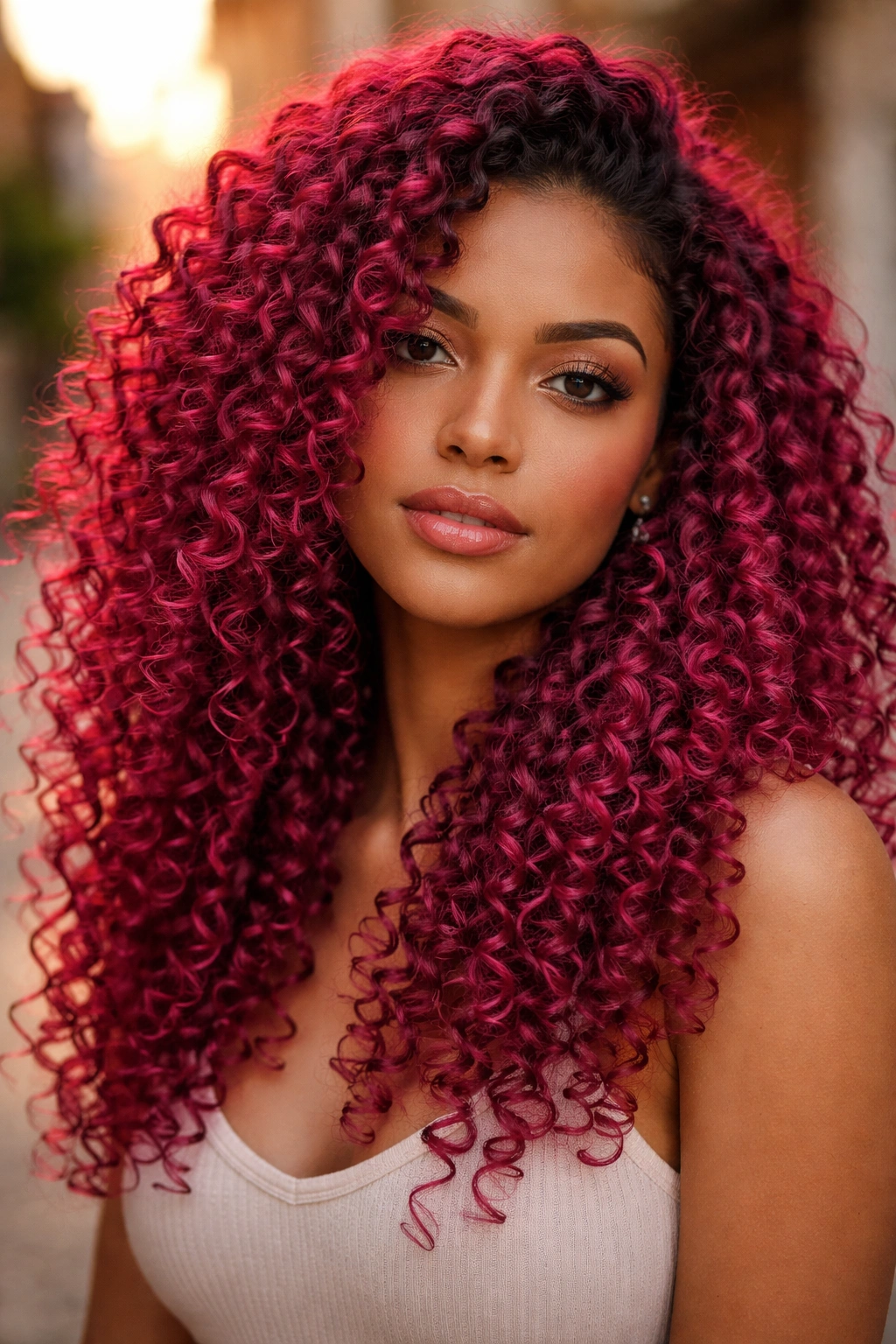
Fuchsia — vivid, saturated, slightly cooler than hot pink — on 3C spiral curls is an absolutely stunning combination. The tightness of 3C curl coils creates a texture that shows fuchsia in fine, repeating spirals, almost like a printed pattern.
Lift to level 8-9, then apply a direct-dye fuchsia formula for maximum vibrancy. This is a color that photographs beautifully and looks even better in person.
14. Subtle Pink Gloss
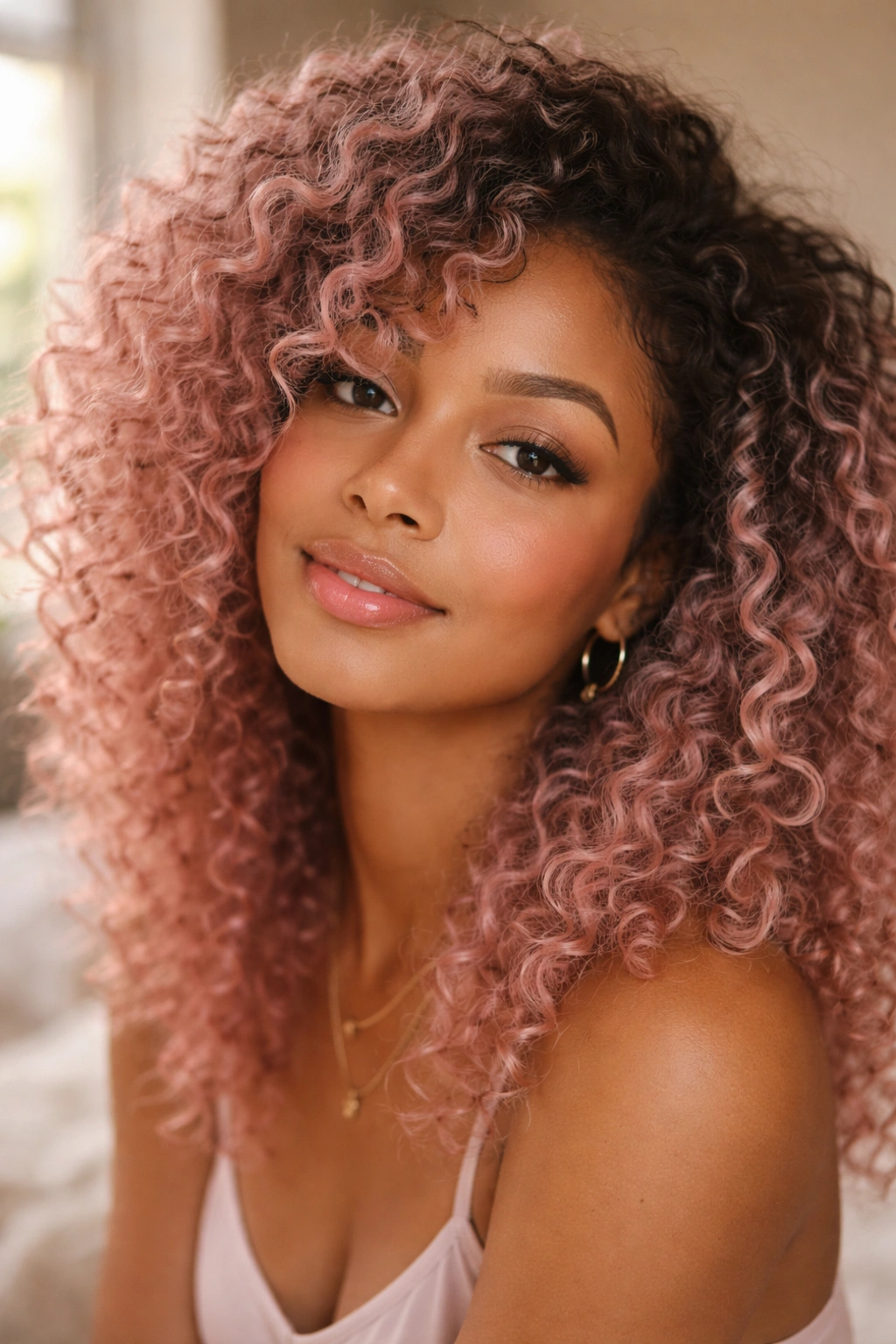
Not everyone wants to go vivid. A pink gloss — a semi-permanent, translucent pink toner applied over your natural hair — adds a warm rosy sheen that’s visible in certain lighting without changing your hair color dramatically.
No bleaching required. The gloss deposits a superficial layer of rosy-pink pigment that fades completely over 4-6 weeks. It’s commitment-free color — perfect for testing whether pink works for you before going full vivid.
15. Pink Braided Updo Extensions
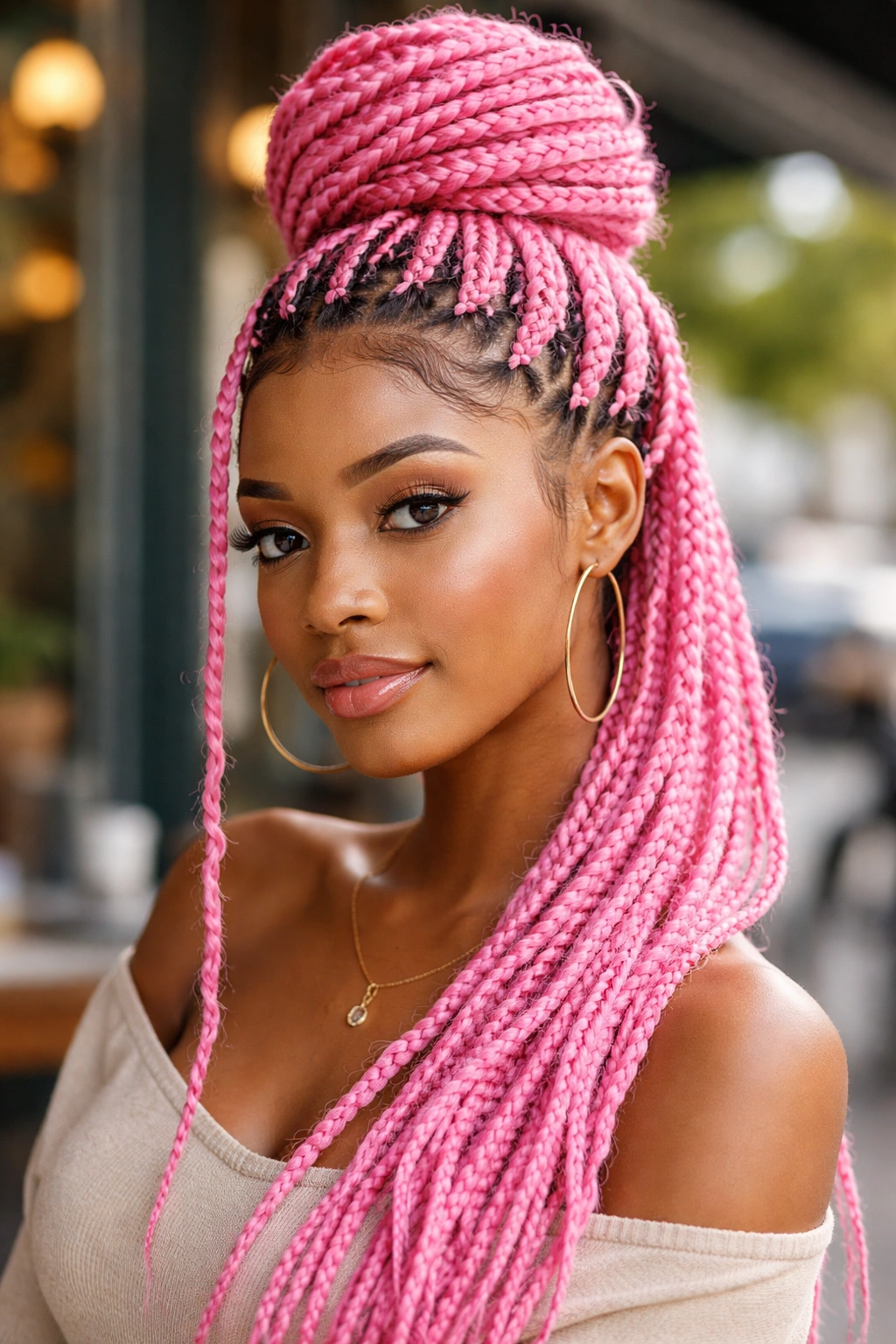
Pink box braids, feed-in braids, or knotless braids using pink hair extensions give you the full pink hair aesthetic without touching your natural strands with color. Styles like these last 6-8 weeks and can go from hot pink to rose gold to baby pink depending on the extension color you choose.
This is the ultimate low-commitment pink option — color when you want it, removed when you don’t. And protective styles give your natural curls a rest underneath.
16. Neon Pink Tips
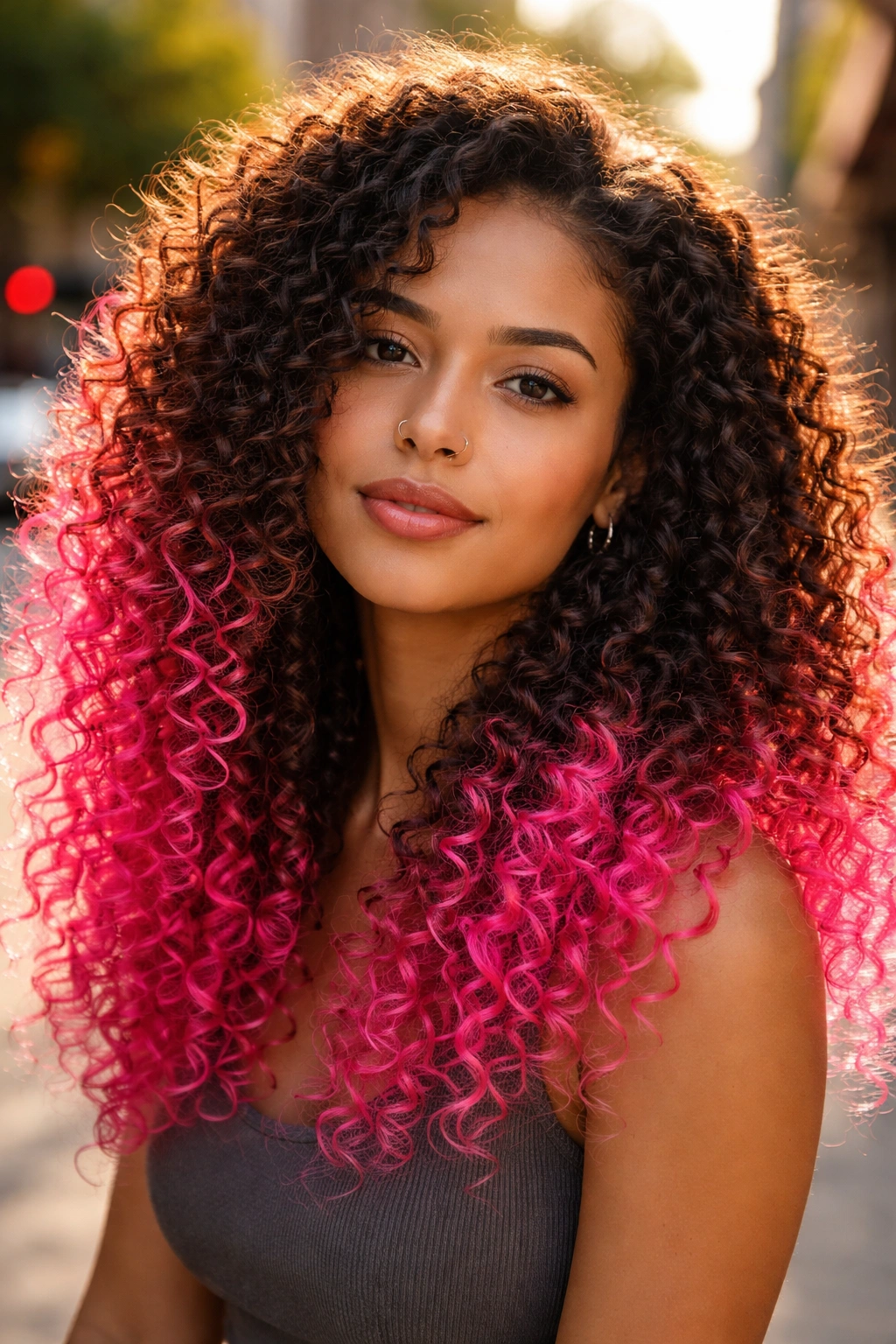
Neon pink — electric, almost fluorescent — applied to just the tips of your curls creates maximum impact with minimum commitment. Only the ends need to be lightened, which limits damage significantly.
The contrast between your natural root color and neon pink tips is graphic and intentional. When your curls are defined in a wash-and-go, the neon tips catch the eye at every coil tip — it looks like your hair is outlined in electric pink.
17. Watermelon Gradient
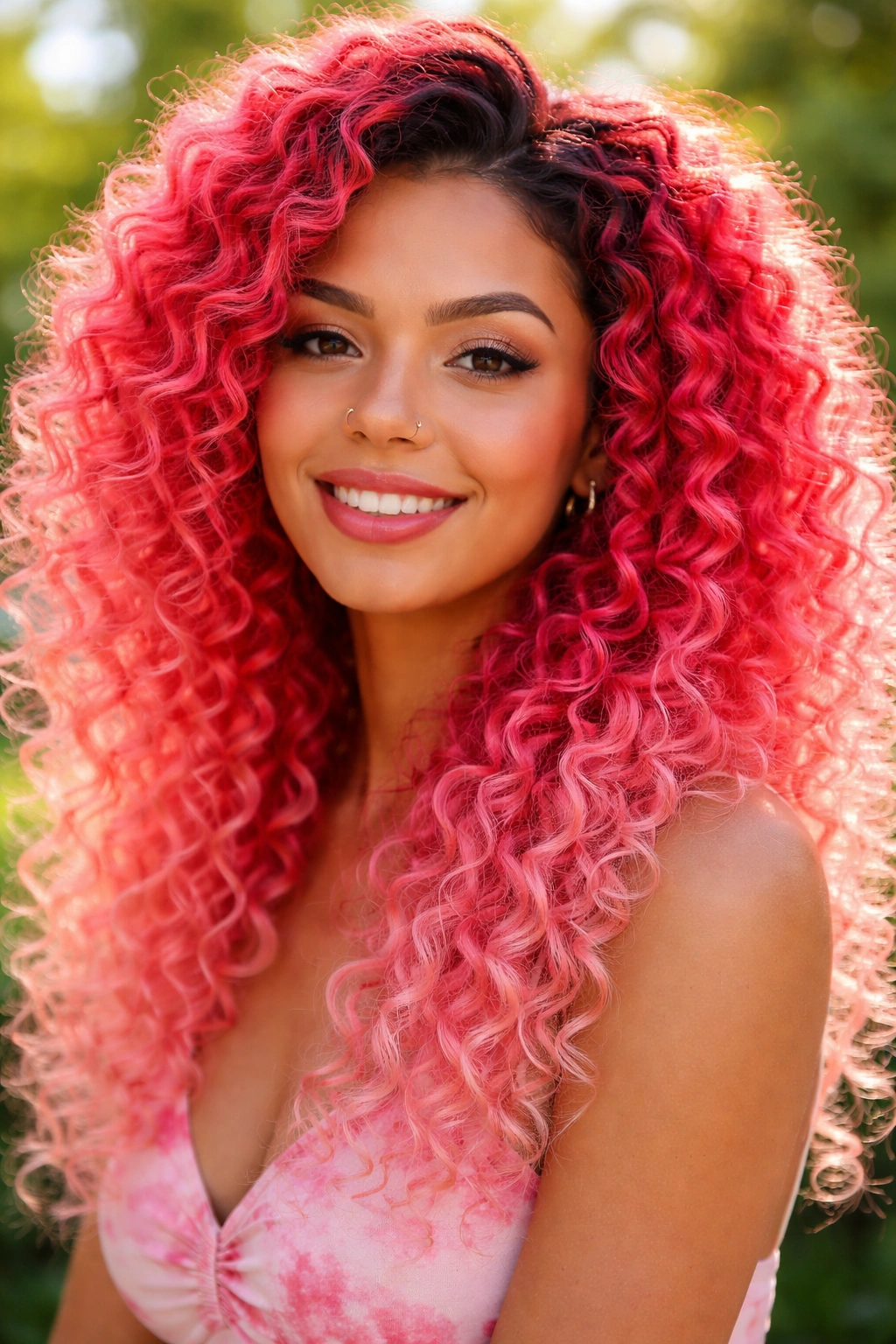
Watermelon pink — warm, slightly coral, vivid — fading from deeper at the roots to lighter or more vivid at the ends creates a gradient that’s both unexpected and strikingly beautiful. The name sells it: imagine the inside of a watermelon, rendered in hair.
The color combination often involves a darker magenta-red at the root and a bright warm pink or coral at the ends, or vice versa — lighter and more vivid at the crown, deeper at the ends.
18. Pink Chunky Highlights on Natural Hair
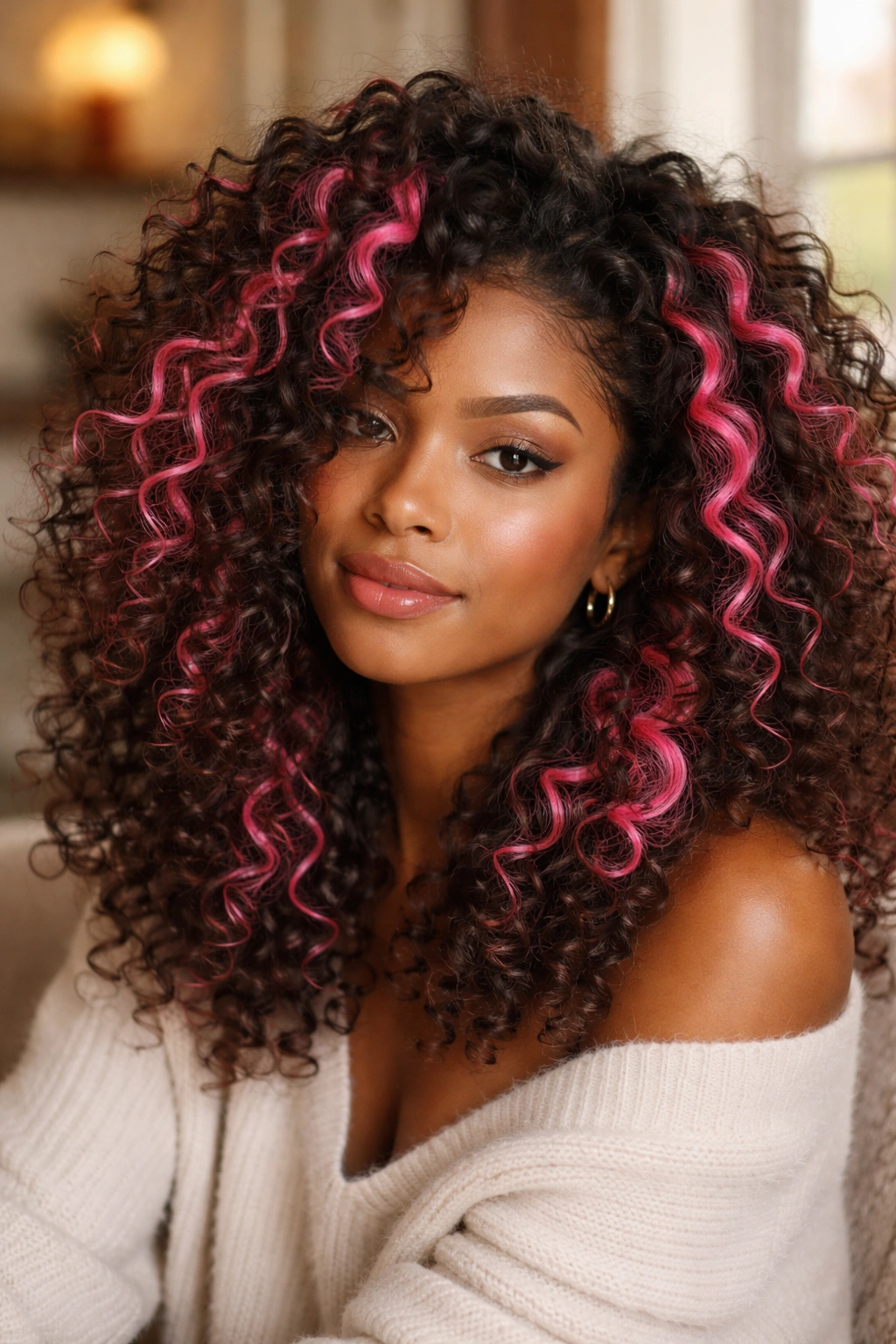
Wide, bold sections of hot pink or rose pink through your natural hair — not thin foil highlights, but chunky, deliberate ribbons of color — create a graphic look that’s been cycling back into style with real momentum.
On curly hair, chunky highlights look particularly striking because each highlighted curl section interacts with the surrounding natural-colored curls in a way that creates movement and dimension at every scale.
19. Rose Brown
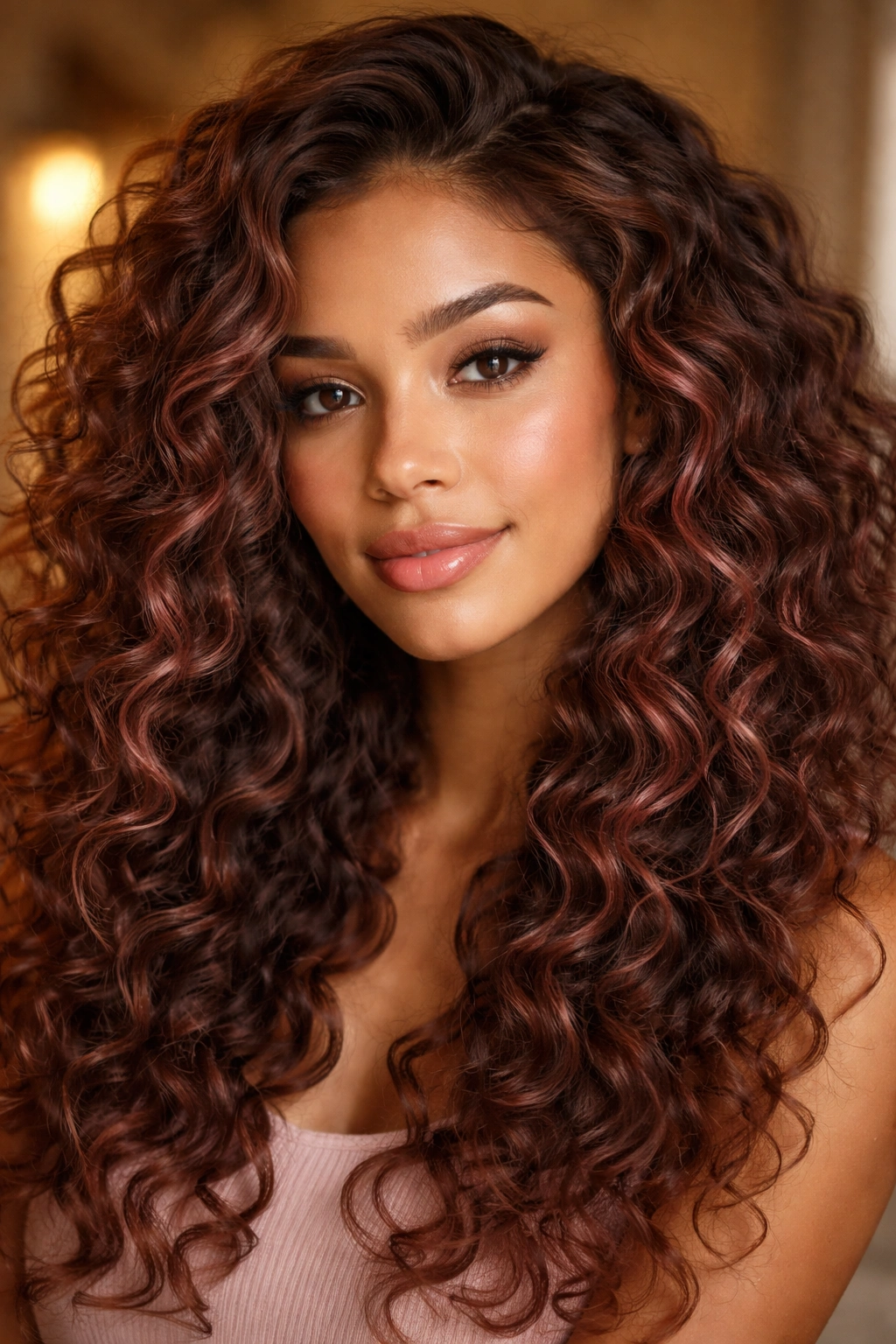
Rose brown is where pink becomes wearable for people who need hair color that doesn’t announce itself too loudly. It’s a warm, rose-tinted brown — barely pink in most indoor lighting, unmistakably rosy in sunlight and photographs.
No bleaching required for most dark naturals going to rose brown. A single-process formula with warm red-pink undertones deposits subtle rose tones that enhance rather than drastically alter your natural color. The result is warm, glowing, and quietly beautiful.
20. Platinum with Pink Toner
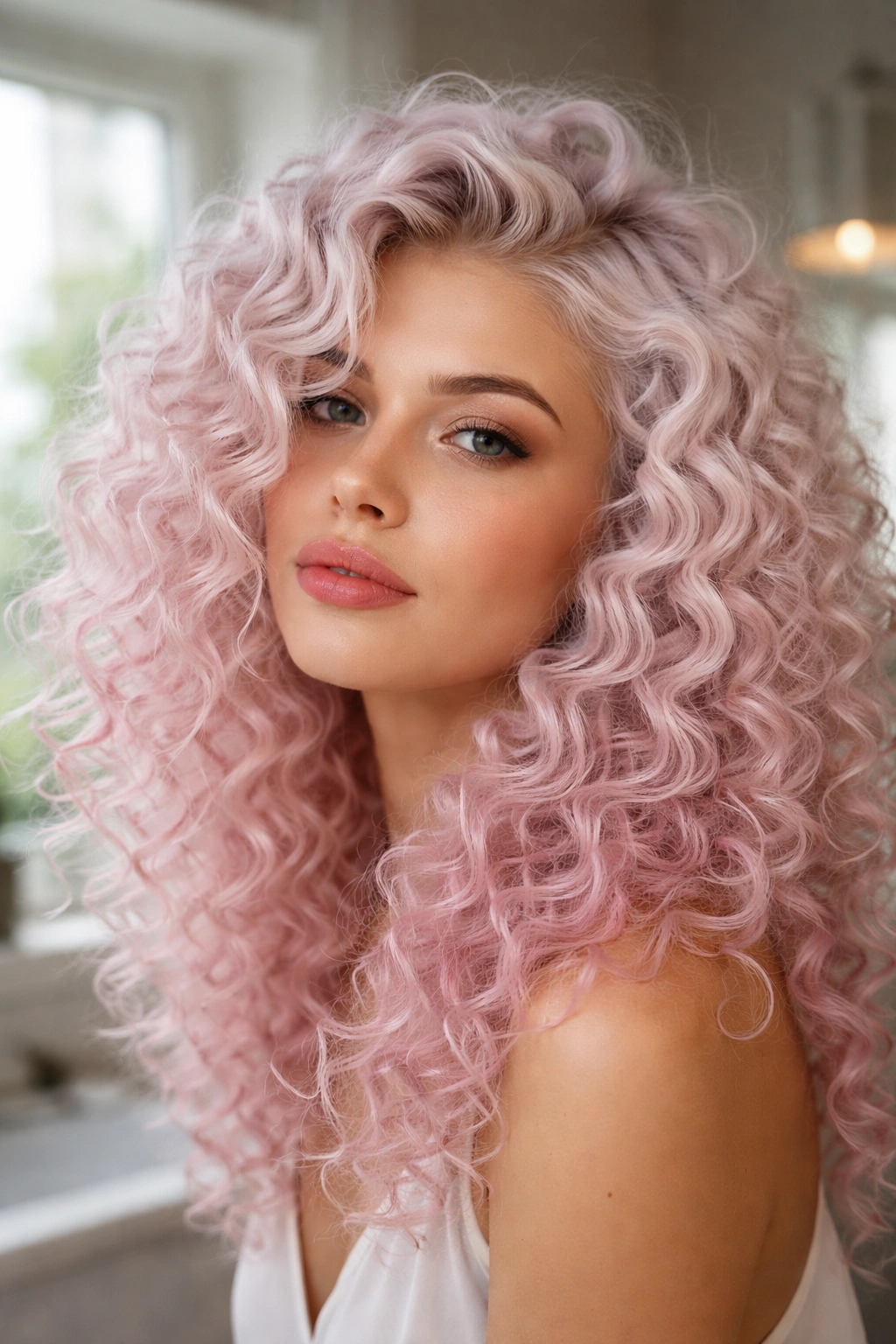
Full platinum on natural curls is a serious commitment — but once you’re there, the toner options are endless. A pink toner over platinum creates a pearl-pink or icy rose effect that’s completely different from vivid pink over dark hair.
Platinum with pink toner looks cool and editorial where vivid pink looks warm and expressive. Same color family, completely different energy — and on curly hair, the platinum base makes the texture look extraordinary. Every curl is defined against a light background that makes the entire hair structure visible.
21. Berry Pink Curly Bob
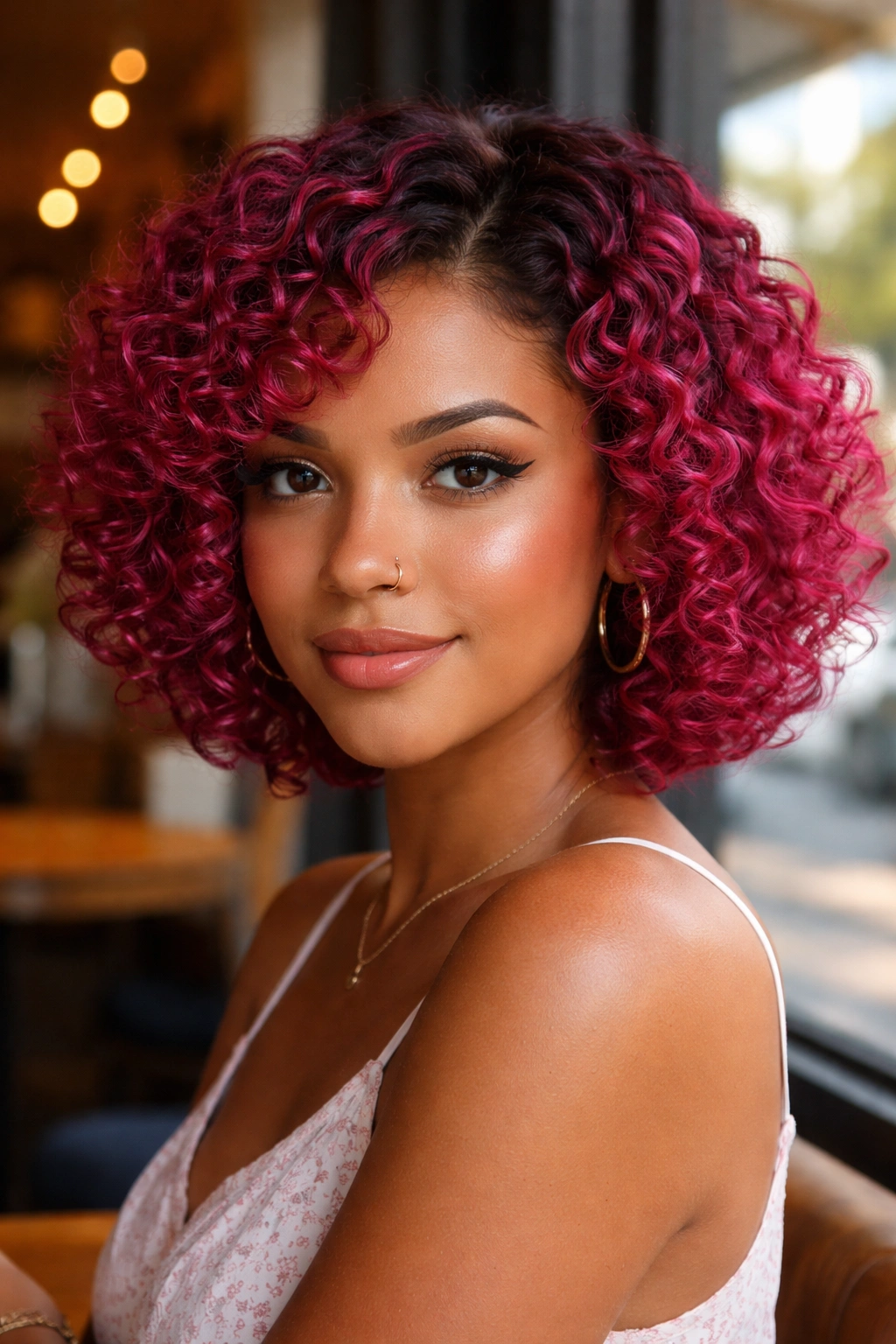
A curly bob in deep berry pink — somewhere between pink and red, deep but still vivid — is one of the most wearable and universally flattering short-hair color combinations. The bob length is short enough that color maintenance applies to a small amount of hair, and berry pink is deep enough to show up on dark bases with minimal lifting.
The combination of the bob’s structure and the vivid color creates a look that feels intentional and polished. It’s a great entry point for women who want to try pink without a full-length color transformation.
After the Pink: Transition and Care
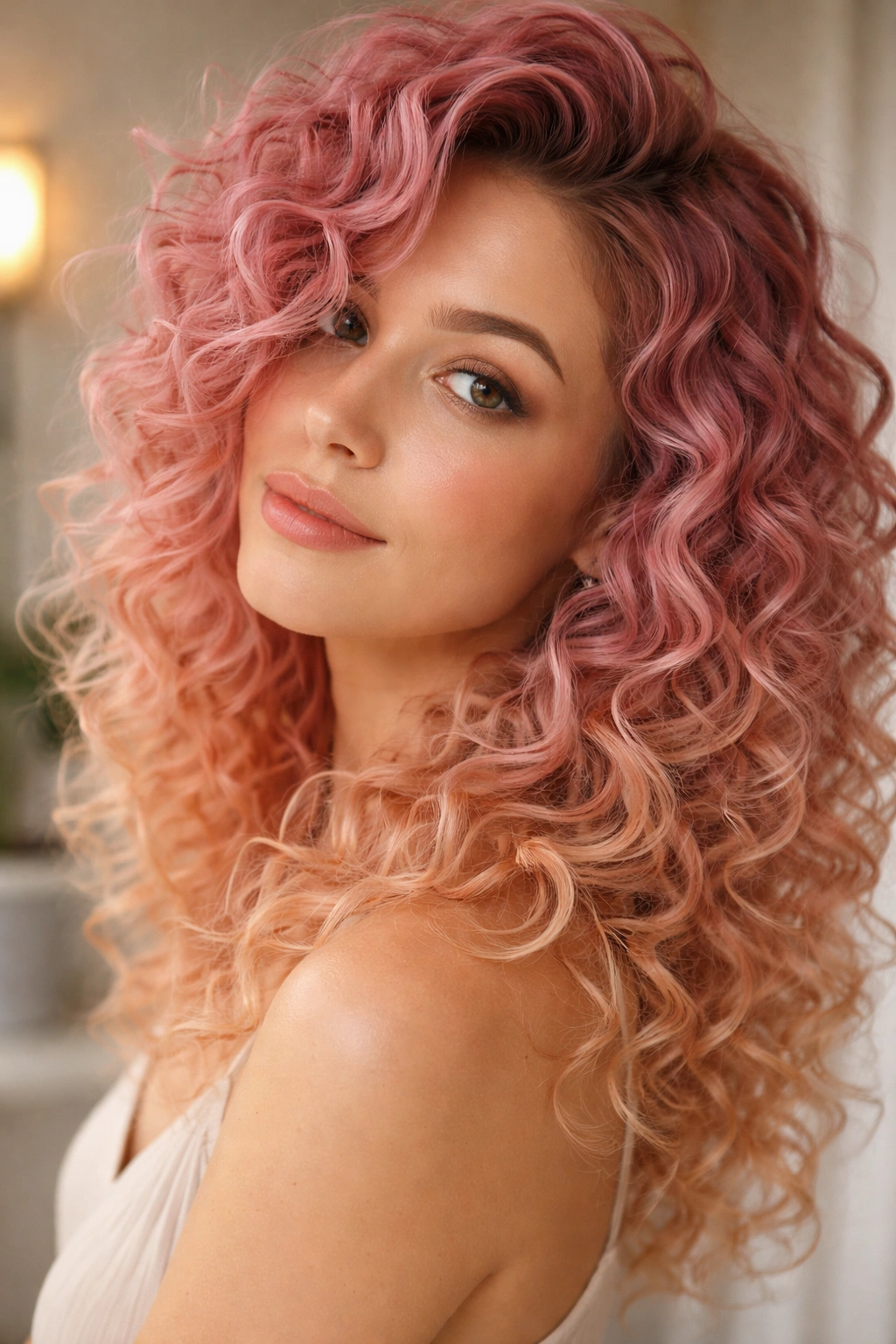
Pink fades through stages, and each stage can be beautiful in its own right. Vivid hot pink fades toward dusty rose, then toward a warm peachy-blonde. Magenta fades toward coral, then toward a warm salmon. Instead of fighting these fade stages, lean into them — a faded dusty rose is genuinely one of the prettiest shades in the hair world.
When you’re ready to move on from pink entirely, a purple-ash toner can neutralize remaining warmth and transition you toward a cool-neutral tone. Or you can embrace the fade all the way to blonde and choose your next color from there.
The Reality of Pink Commitment
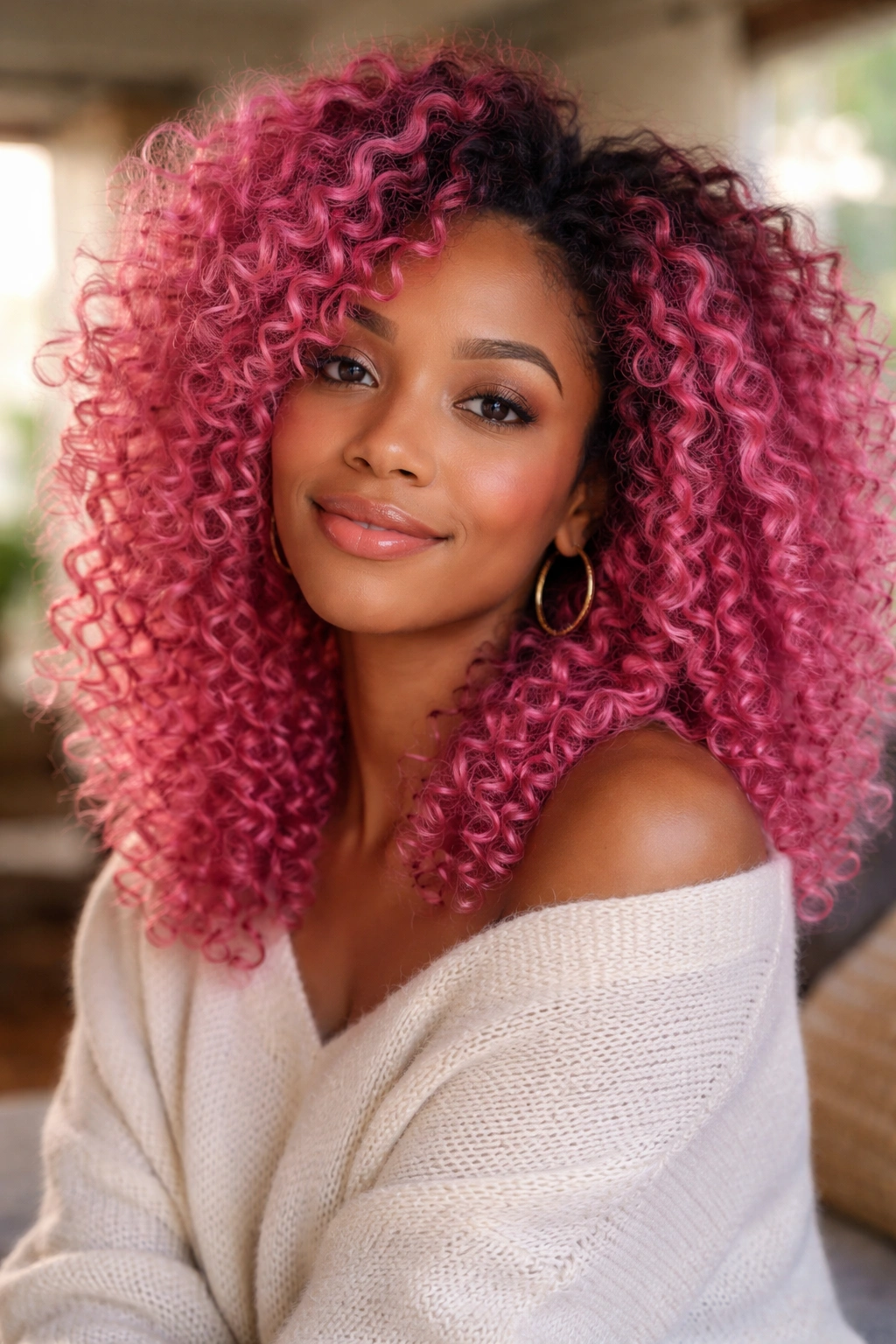
Pink is the most expressive, most playful, most “look at me” choice in the hair color spectrum. It requires more maintenance than most colors. It requires lightening most natural hair significantly. It requires adjustments to your wash routine, your product choices, and your heat habits.
And it’s worth every single bit of that effort.
Pink dyed curly hair turns heads. It photographs beautifully. It expresses personality in a way that’s hard to replicate with any other color choice. And on natural curls, it looks like it belongs in a way that feels specific to textured hair — like pink was always waiting for the right canvas, and your curls were always it.
