



Medium hair is a funny length for wedding styling. It’s long enough to braid, but not always long enough to hide clumsy pinning, and one bad curl pattern can throw the whole shape off.
That is why braided half up half down looks so good on bridesmaid medium hair. It gives you structure at the crown, keeps hair out of the face during vows and hugs, and still leaves enough movement through the ends so the style doesn’t feel stiff. On shoulder-length or collarbone-length hair, that middle ground matters.
I also like these styles because they can handle real life. A few shorter layers, a side part that refuses to sit flat, hair that slips when it’s too clean — none of that is a dealbreaker if the braid is placed well and pinned with some intention. The secret is not making everything perfect. It’s making the shape hold.
Loose does not mean sloppy. The braid should still have tension where it counts. Start there, and the rest becomes much easier.
1. Soft Side Braid for Bridesmaid Medium Hair
A soft side braid is one of the easiest ways to make medium hair look finished without pushing it into formal territory it doesn’t need. I reach for this style when I want something pretty, unfussy, and sturdy enough to survive a long day of standing, sitting, and getting pulled into group photos.
Why it flatters medium lengths
The side placement helps because it gives the braid a little more visual weight. On medium hair, a braid that starts too high can look tiny. One that begins just behind the temple and drifts toward the back of the head reads fuller and more deliberate.
Keep the braid loose through the tail and pull it apart gently with your fingers after securing it. A soft, slightly wider braid looks better than a tight one on this length. That tiny bit of looseness makes the hair look thicker, which is a nice trick if the hair is fine.
A few face-framing pieces near the cheekbones keep it from feeling severe. I like this one with V-neck dresses, square necklines, and any bridesmaid look that already has a lot going on at the shoulders.
2. Double Dutch Braids with a Soft Center Part
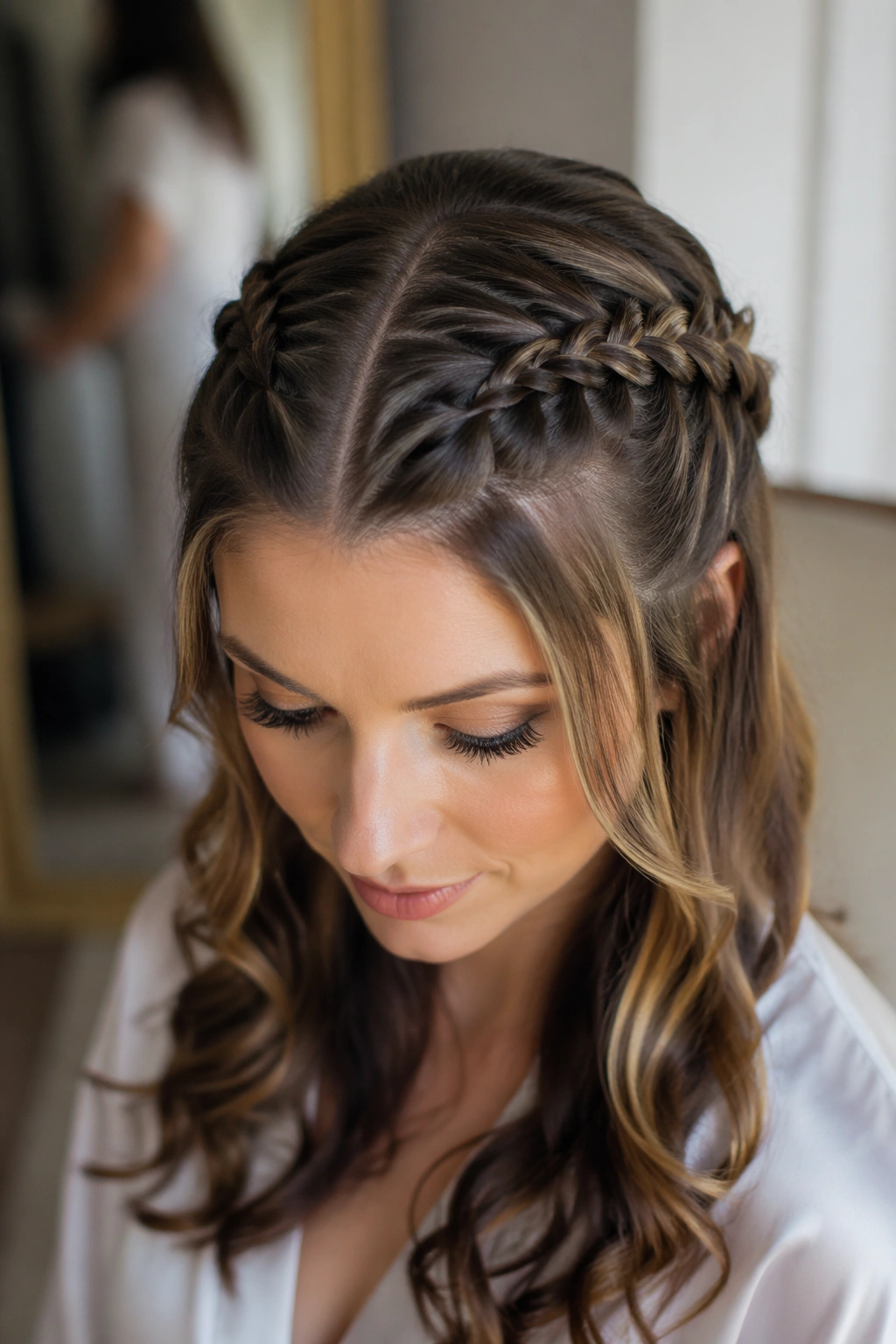
Why does a double Dutch braid look so different from a simple plait? Because the braid sits on top of the hair instead of sinking into it, which gives medium hair more shape and more control at the crown.
This version works well when the party wants a little consistency without looking identical. Two narrow Dutch braids start near the part, travel back along the head, then meet and tuck into the half-down section. That structure keeps the front neat while leaving the ends soft.
Styling notes
- Part the hair down the center with a rat-tail comb.
- Mist the roots with light texture spray before braiding.
- Keep each braid about 1 to 1½ inches wide.
- Pin the ends flat under the top section so they disappear.
A clean center part gives the style a formal edge, but you can loosen the braids a touch after securing them so they don’t read too hard. This is a good one for straight or slightly wavy medium hair, especially when the dress has a high neckline and you want the hair to feel calm, not busy.
3. Twisted Rope Braid Half-Up
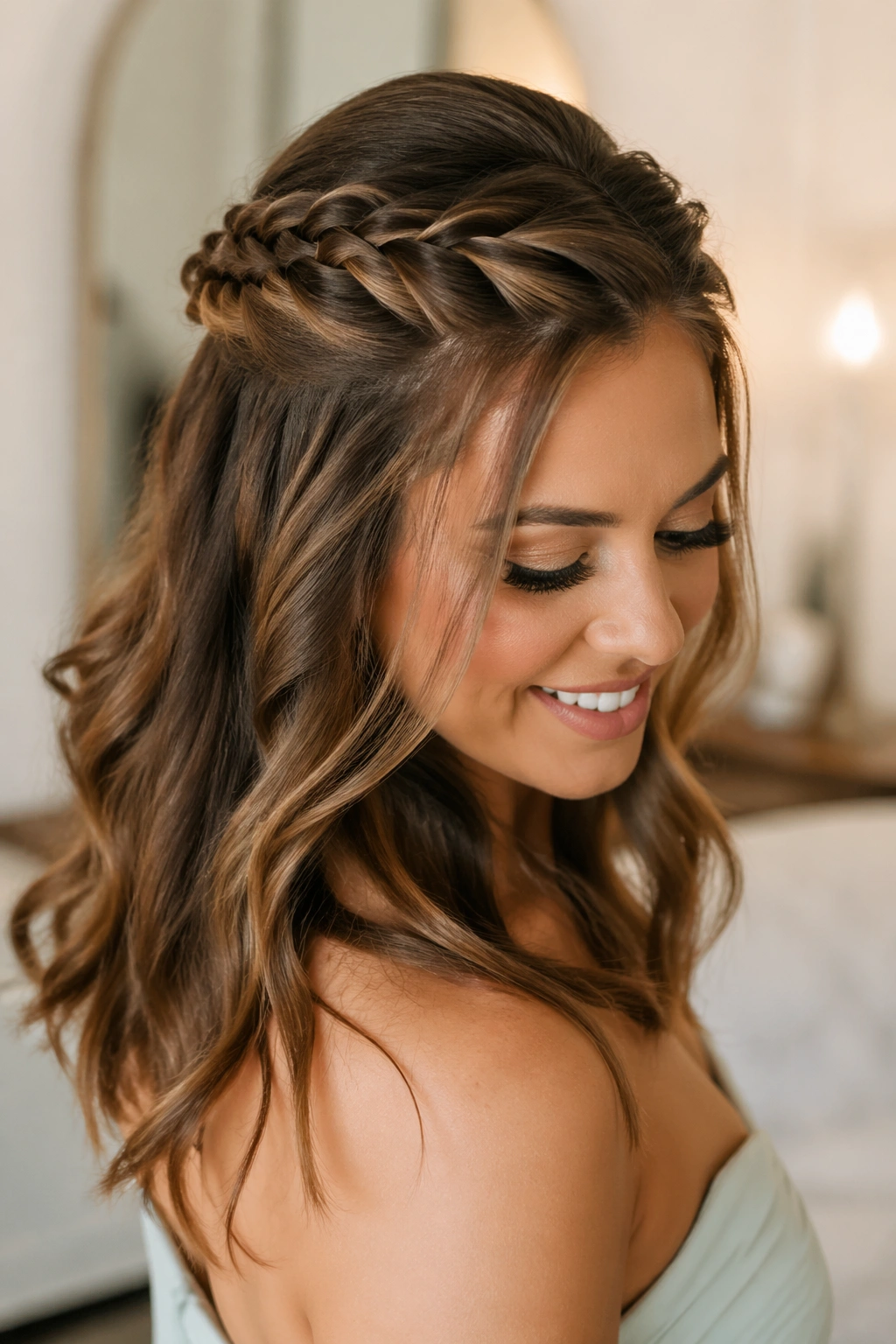
On shoulder-length hair, a rope braid holds better than most three-strand braids because the twist gives it grip. That’s the real reason this style works so well for bridesmaids with medium hair. It looks refined, but it does not need a ton of length to show off.
Start with two sections from each side of the head, twist them away from the face, then cross them behind the crown and secure them together. After that, wrap a tiny strand around the elastic if you want the finish to look cleaner. It takes about ten minutes once your hands stop overthinking it.
The best part is the texture. Rope braids pick up light and shadow differently than flat braids, so even simple medium hair gets a little more shape. Keep the loose hair below it in soft bends, not tight curls. A smooth top with relaxed ends keeps the whole look balanced.
4. Fishtail Crown Braid
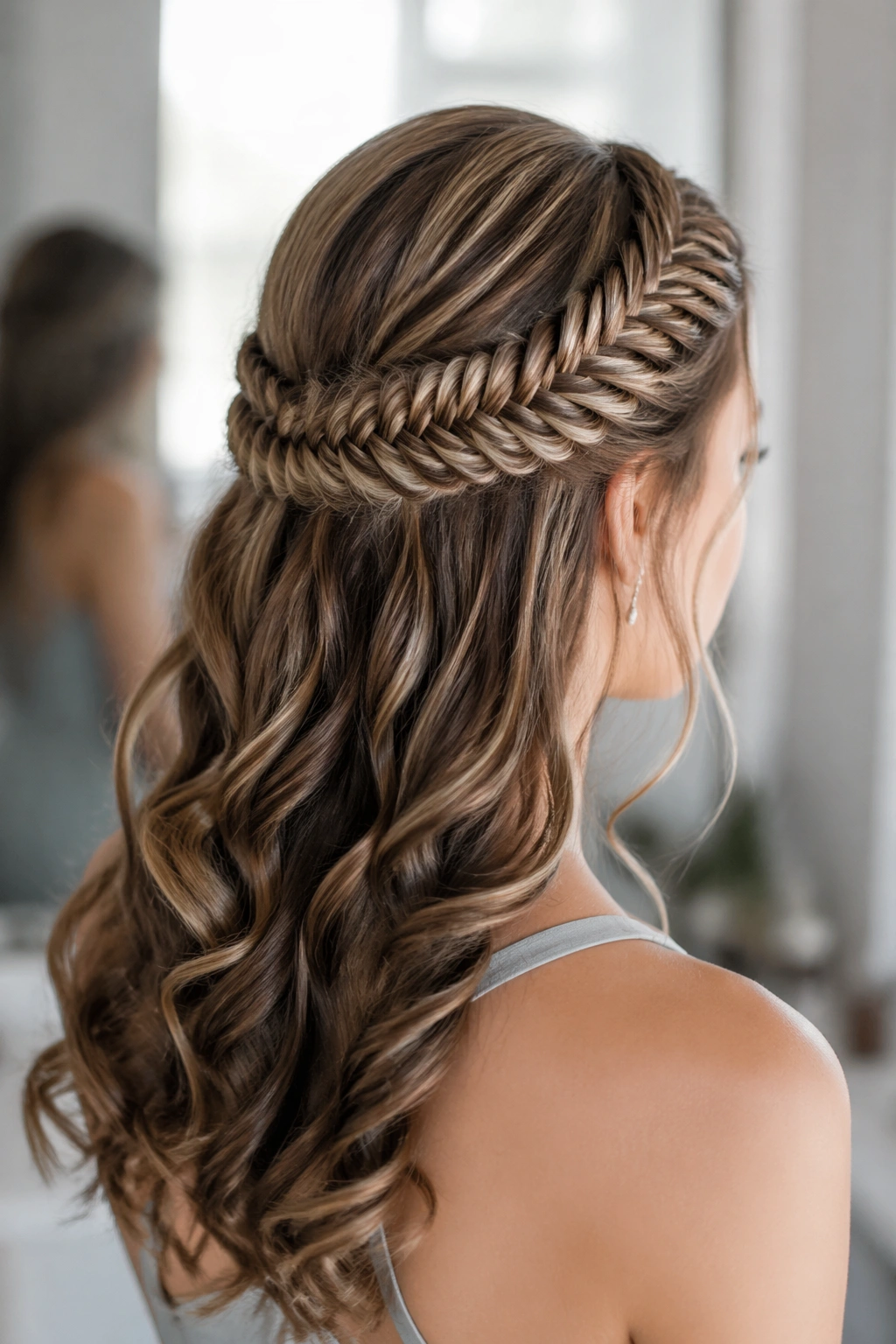
A fishtail does not have to be fussy. In fact, on medium hair it often looks better when it’s a little imperfect, because the smaller woven sections make the braid appear fuller without needing waist-length hair.
What makes it different
A crown braid built from a fishtail creates a broad, decorative band across the back of the head. That gives bridesmaid medium hair a polished frame while leaving the lower half free. It’s a smart option when you want the style to show from behind during ceremony seating and again when everyone turns for photos.
Use 1-inch sections at the beginning so the braid feels substantial near the temples. After you secure it, tug the edges very gently to widen the braid. Don’t pull too hard. You want soft width, not frizz.
This one pairs well with satin or crepe dresses because the braid has enough detail on its own. If the gown already has beading or lace at the shoulders, keep the fishtail smooth and skip extra accessories. The braid is the accessory.
5. Pull-Through Braid Half-Up
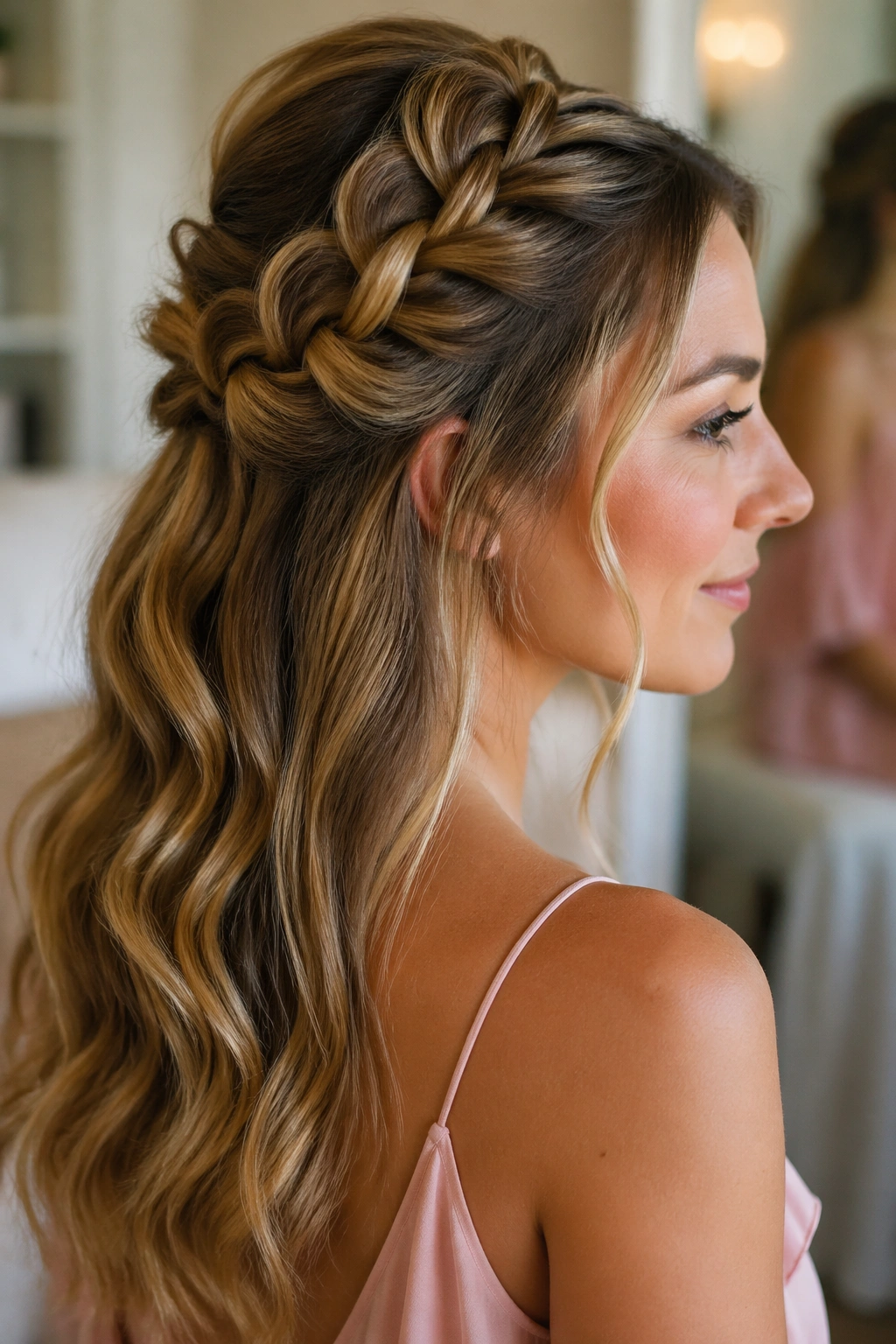
Clean hair is slippery. That’s why the pull-through braid has such a loyal following for weddings. It uses small elastics to build thickness, which makes it feel more stable on medium hair than a braid that relies on length alone.
The texture is the fun part. Each little section gets stacked and fanned out, so the braid looks fuller than a classic three-strand version. Medium hair usually needs that visual boost, especially if the ends fall somewhere around the shoulders and don’t have enough weight to create drama on their own.
Keep the elastic spacing even, about 1 to 1½ inches apart. If the gaps vary too much, the shape gets messy in a way that feels accidental instead of relaxed. A little shine spray on the finished braid helps too. The goal is plush, not crunchy.
6. Lace Braid with Curls
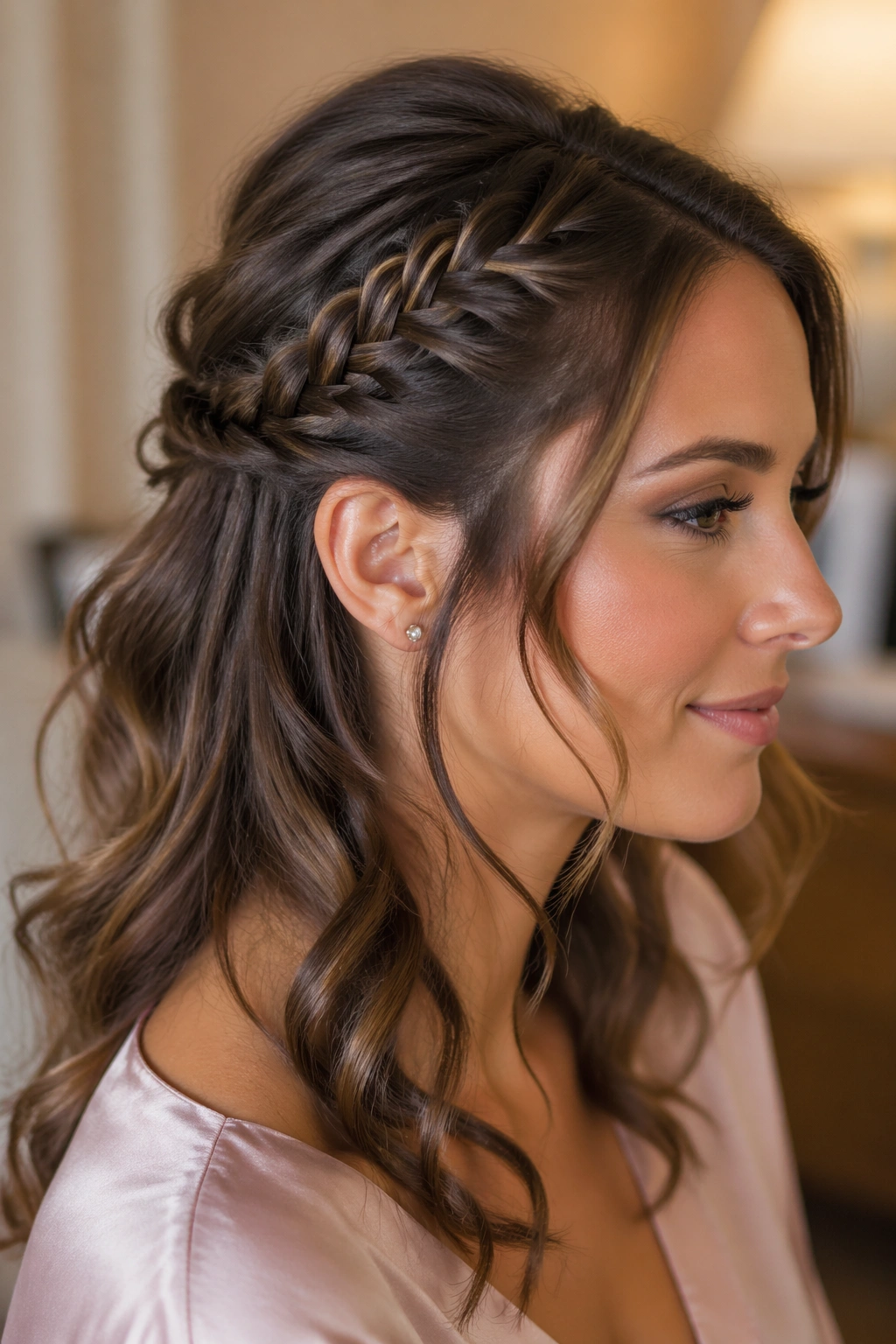
Barely there. That’s the appeal here. A lace braid slides along one side of the head, pulls in hair only from the top edge, and lets the rest stay loose, which gives bridesmaid medium hair a soft frame without swallowing it.
I like this style when the dress has interesting fabric or a strong neckline, because the braid adds detail without stealing the whole look. It also works nicely for hair with a few layers around the face. Those shorter pieces can live inside the braid instead of sticking out and causing trouble.
Best way to style it
Curl the loose section first, then braid. That order matters. If you braid first and curl later, the braid tends to puff up unevenly and lose its shape near the front.
Pin the braid behind the ear or just above it, then let the rest of the hair fall in loose bends. A lace braid can feel almost delicate, which is useful when the rest of the bridal party is wearing bold earrings or detailed dresses.
7. Waterfall Braid with Face-Framing Pieces
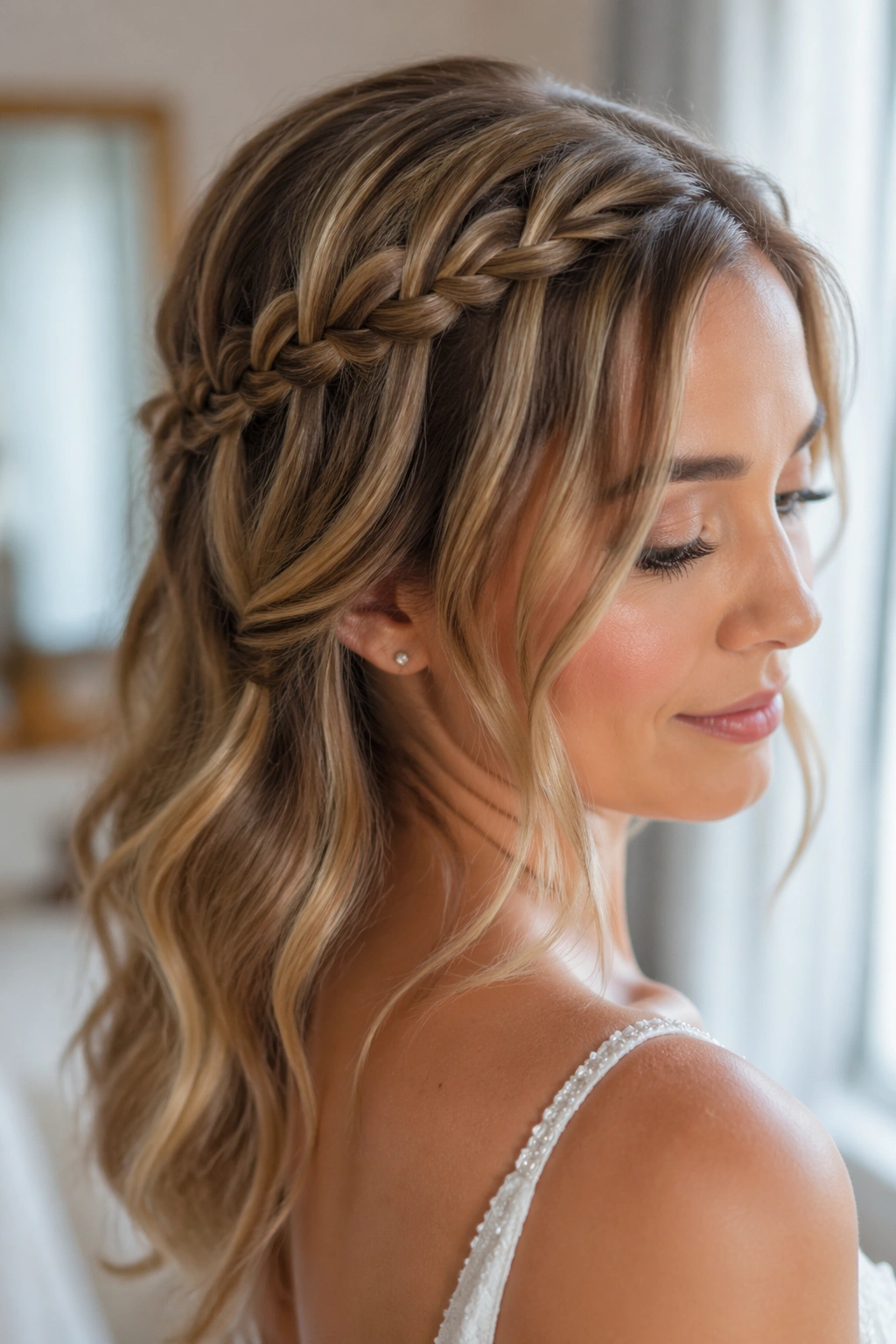
A waterfall braid sounds more complicated than it is. Once you understand that you’re dropping one section as you go and picking up a new one, the pattern becomes very manageable, even on medium hair.
The style gives movement. That’s the part I like most. Instead of pulling all the hair back, it leaves strands falling through the braid, so the look stays light and airy around the face and temples. Bridesmaid medium hair benefits from that kind of softness because the length can look a little blunt if everything is pinned too tightly.
How to keep it neat
Work with small, even sections. A waterfall braid loses its shape fast when the pieces are too thick. Keep the dropped strands the same width as the strands you pick up, and the whole thing reads much cleaner.
This style loves gentle waves underneath. Straight ends can make the braid look unfinished, while soft curls help the waterfall effect make sense. If you want something romantic without a heavy braid across the head, this is a strong pick.
8. Braided Top Knot Half-Up for Bridesmaid Medium Hair
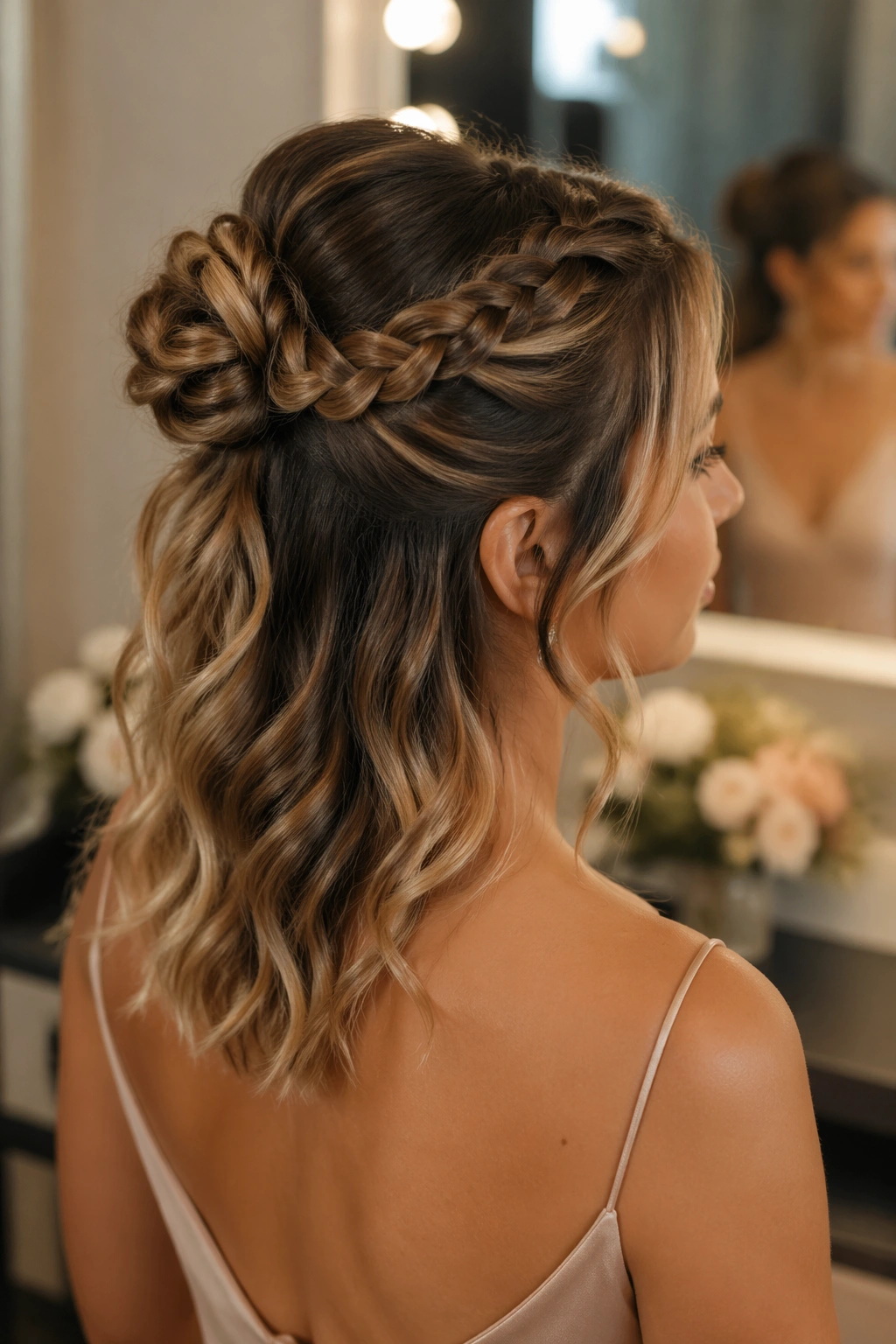
A braided top knot half-up is the style I’d choose when the dress has a low back and the group needs a little lift at the crown. It pulls the eye upward, keeps the top section tidy, and still lets the lower hair swing naturally.
The braid can be tiny and neat or wider and looser, depending on the mood. On medium hair, I prefer a braid that starts at the temples and feeds into a small knot at the back of the crown. That knot should sit flat, not puff out like a full bun. A three-quarter-inch elastic is usually enough to secure it before pinning.
Where it works best
- Halter necklines
- Open-back dresses
- Deeper V-necks
- Earrings with a little drop
Keep the ends below the knot in soft bends, not sharp curls. The contrast between the neat top and the loose bottom is what makes the style work. A few face-framing strands keep it from feeling too severe.
9. Micro-Braid Accents with Soft Waves
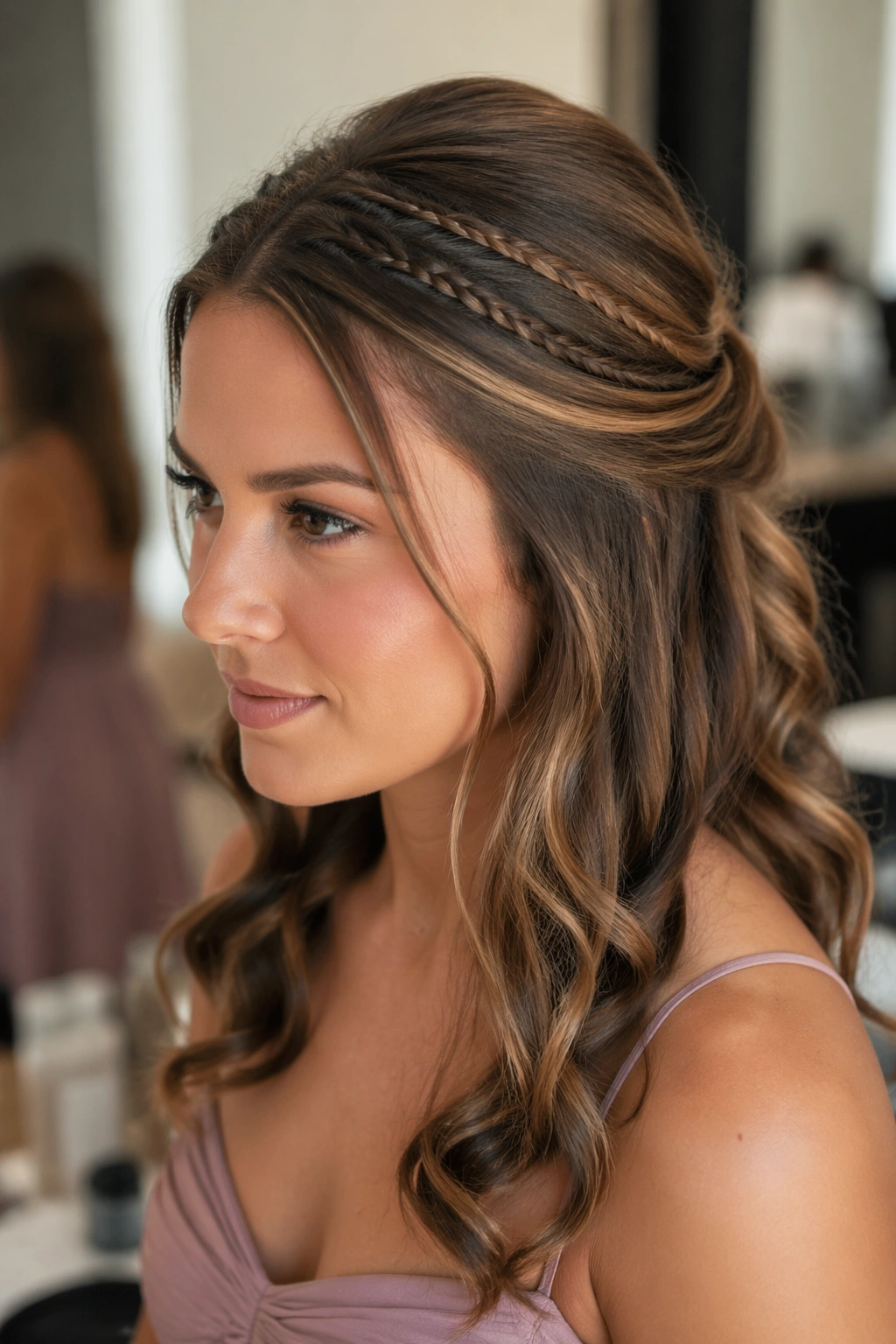
A tiny braid or two can change the whole mood of medium hair. Micro-braid accents are great when you want bridesmaid hair to feel playful but still polished enough for a formal setting.
Start with loose waves through the bottom half, then add one or two pencil-thin braids near the part or above one temple. Pin those small braids into the half-up section so they disappear into the main shape. That’s what makes the style read intentional instead of random.
This works especially well on finer hair because the tiny braids give the illusion of more texture without making the head look crowded. And if the hair is highlighted, those slim braids show off dimension in a way that’s hard to get from loose curls alone.
I’d keep the accents asymmetrical if the dress is simple. If the gown already has a lot of detail, place the micro-braids more neatly near the center so the style feels calm.
10. Side Braid into a Twisted Back Section
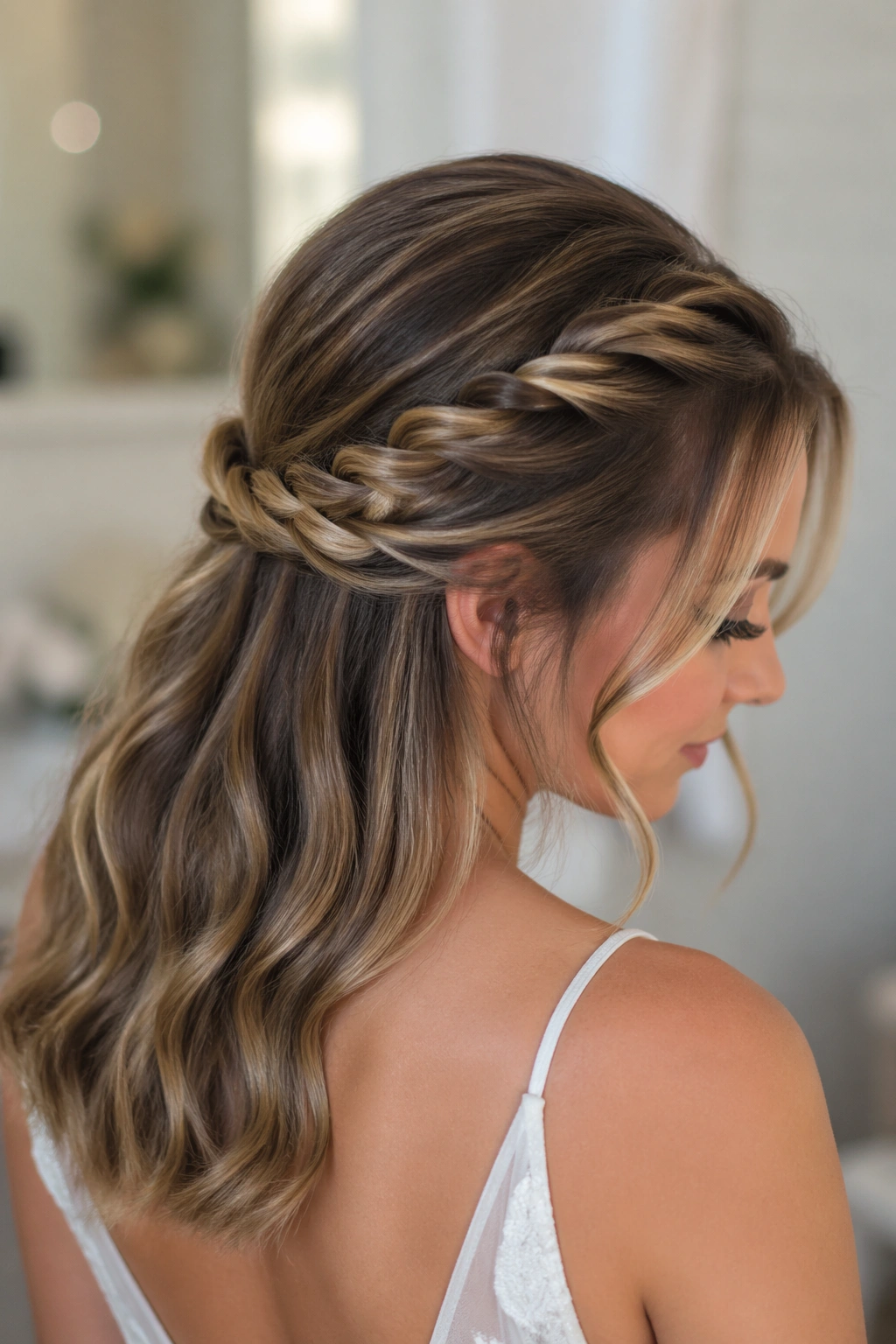
This one looks more complex than it is. A side braid feeds into a twisted back section, which means the braid starts at one side, then gets joined by the other half of the hair at the center back.
The result is nice on medium hair because it creates a diagonal line across the head, and diagonals are flattering. They draw the eye back and slightly upward, which helps the style feel fuller at the crown.
The structure that matters
Begin with a braid at the heavier side of the part. Once you reach the back of the head, stop braiding and switch to a two-strand twist. That little shift keeps the style from looking too rigid. Secure the twist with two crossed bobby pins, not one. The extra hold matters.
This is one of those styles that looks best when the braid is not perfect. A few loosened edges soften the transition from braid to twist and keep the final shape from feeling boxy. The diagonal line does the real work; the rest is just clean support.
11. Pearl-Pinned Braided Half-Up
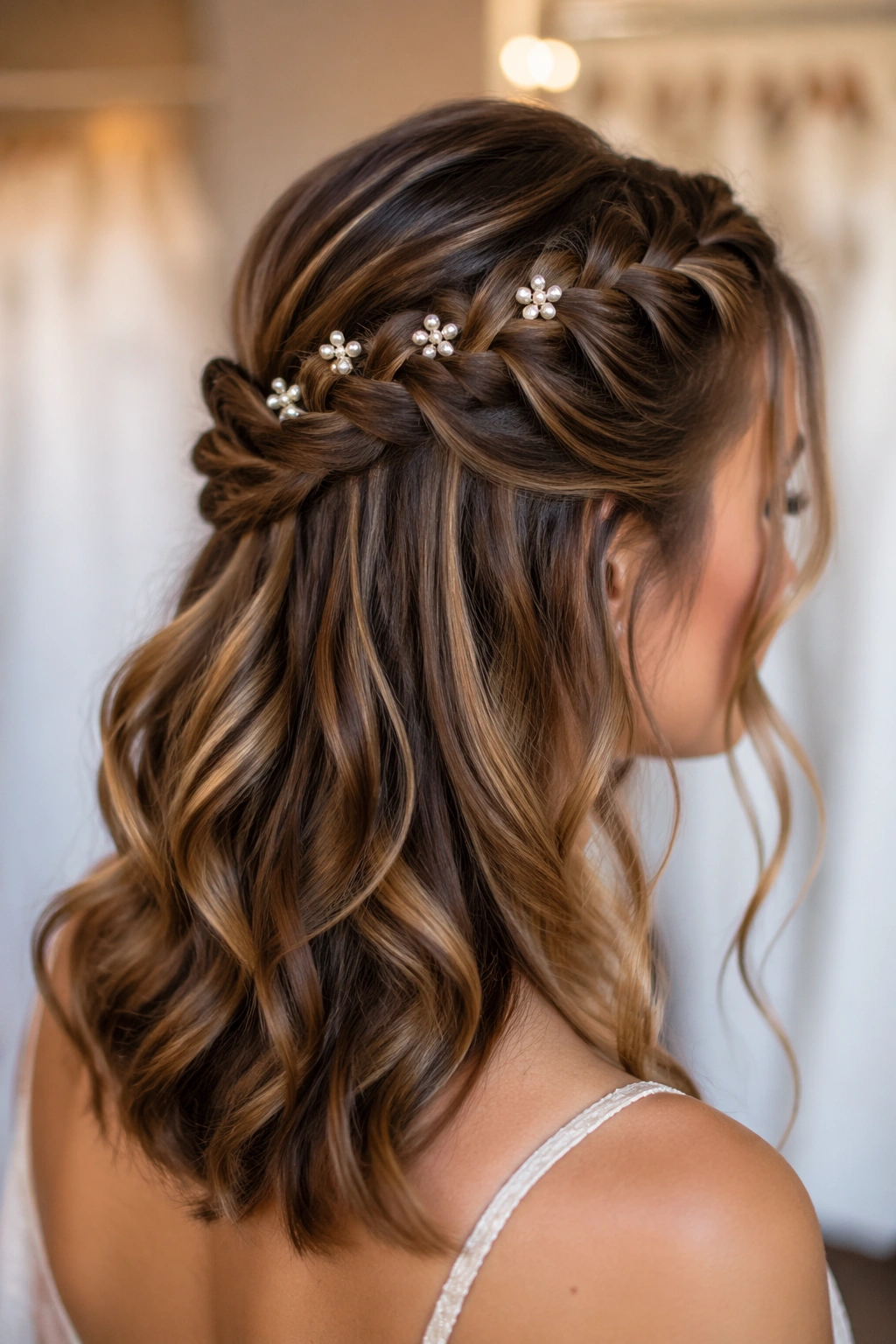
Pearl pins change everything. A plain braid can read casual fast, but add a few small pearl pins and it suddenly feels like it belongs at a wedding dinner, not just a backyard gathering.
The braid itself can be simple — a three-strand braid, a fishtail, even a rope braid — because the pins supply the dressy finish. On bridesmaid medium hair, I like placing the pins where the braid meets the back section, rather than scattering them everywhere. Too many and the look starts to wobble.
Quick placement guide
- Use 3 to 5 pins, not a full cluster.
- Set them on the outer edge of the braid for best visibility.
- Keep the pearls small if the dress already has beadwork.
- Place one pin slightly above the others for a cleaner line.
Pearl pins also help hide elastics and pin ends, which is practical and not just pretty. That little bit of cover keeps the back of the style tidy from every angle.
12. Ribbon-Woven Braid
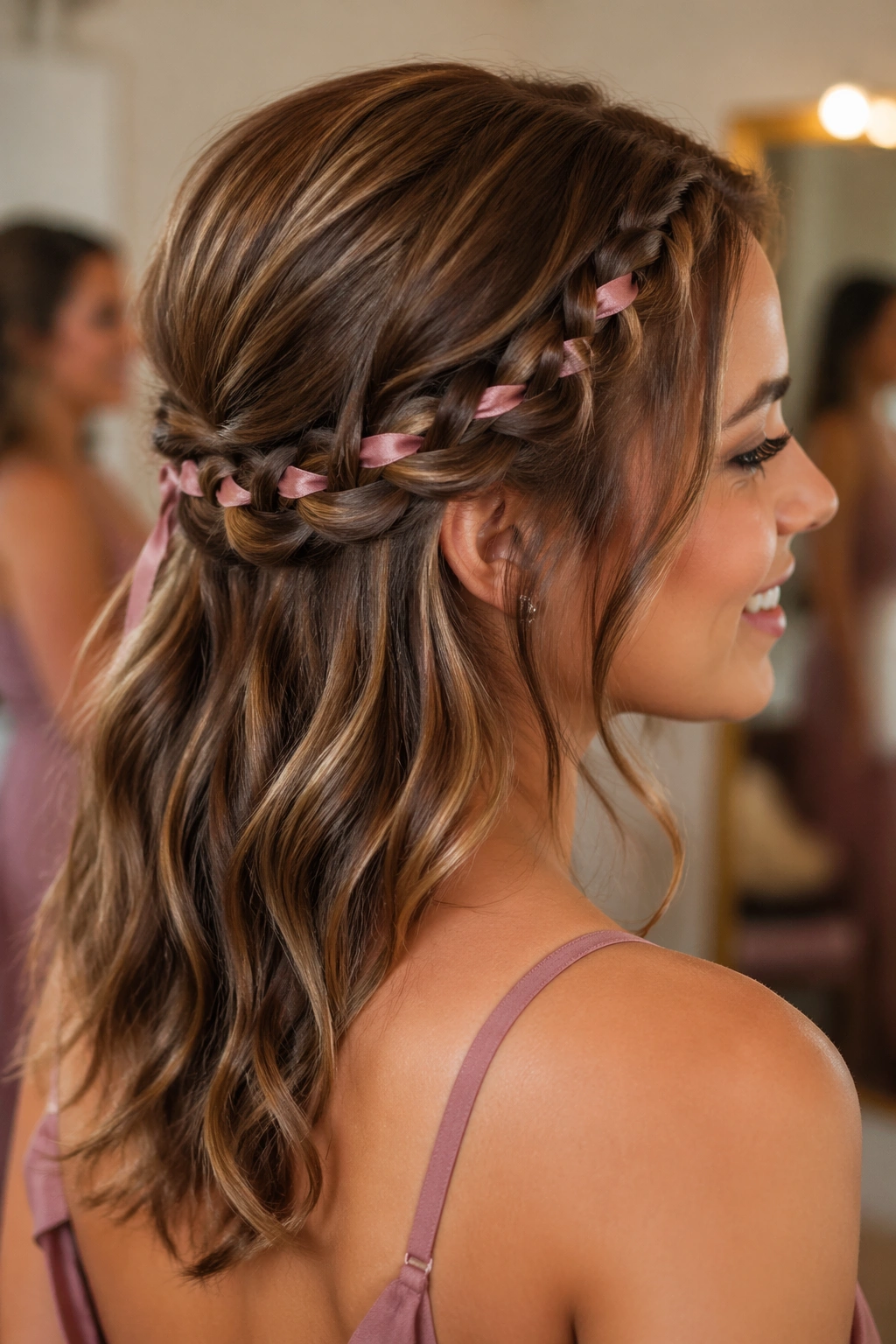
A ribbon-woven braid is one of the few styles that can make medium hair feel custom without needing a complicated shape. Feed a slim ribbon through one strand or weave it alongside a braid, and the whole look changes.
I like ribbon widths around 1/4 inch to 1/2 inch. Anything thicker can overpower medium hair and make the braid sag. Satin, velvet, or silk all work, but keep the finish in step with the dress fabric. A matte ribbon against a matte dress usually looks more coherent than mixing textures without a plan.
This style is especially good when the bridesmaid palette is soft and the hair needs one more visual detail. If the dress is blush, sage, or navy, a ribbon in a similar tone can feel quietly coordinated. If you want contrast, black ribbon on light hair can look sharp and modern.
The braid should still be the main structure. The ribbon is the accent, not the whole act.
13. Halo Braid with Loose Tendrils
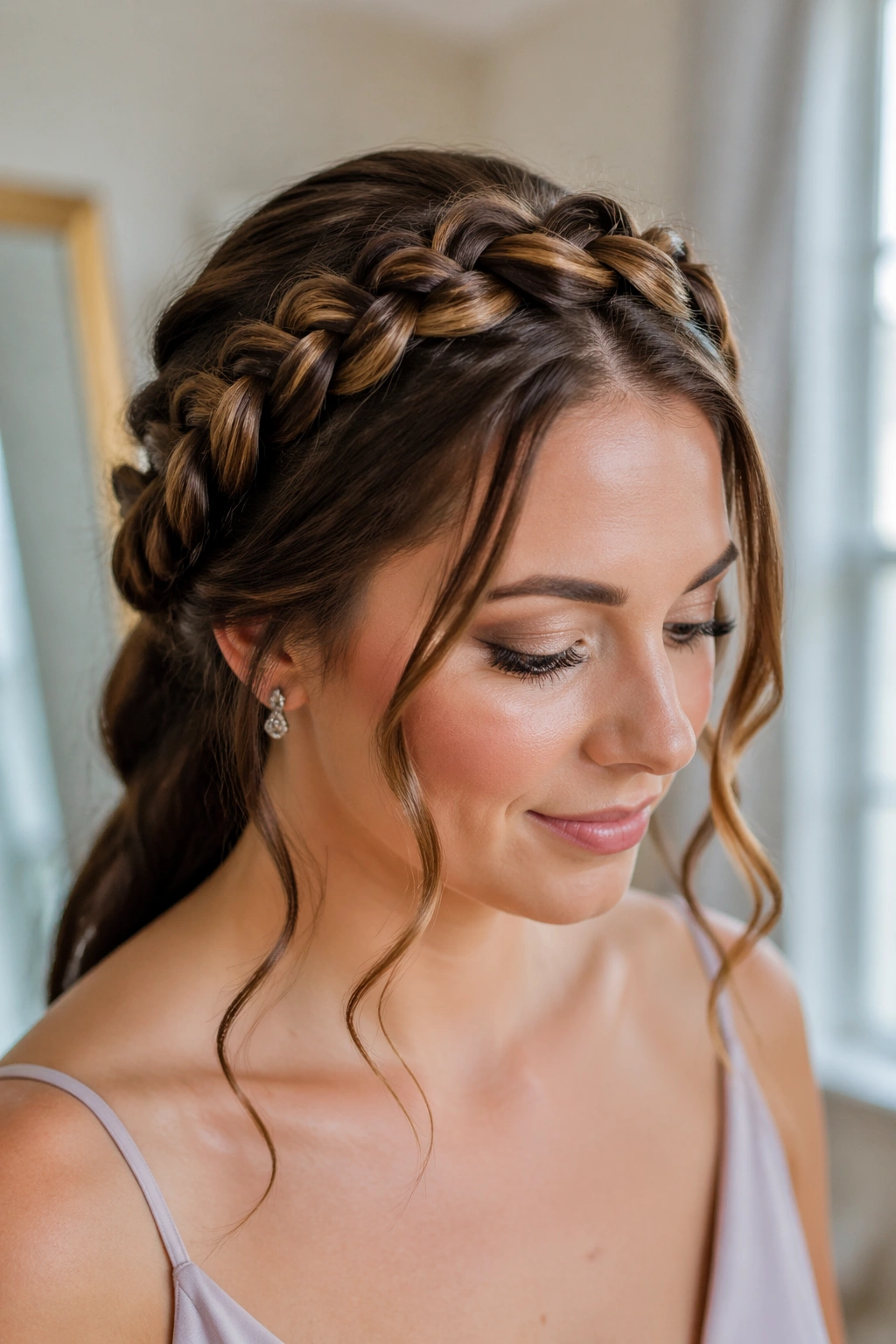
A halo braid is for the bridesmaid who wants to look put together from every side. It wraps the top of the head in a braided circle, which gives medium hair a clean outline and a little more height.
Why the shape matters
Medium hair can get swallowed by huge braided crowns, so keep the halo relatively narrow. A braid that sits about an inch above the hairline usually looks best. It frames the face without turning the style into a costume.
Leave a few soft tendrils out at the temples and just below the ears. Those pieces break up the braid and make the style feel less severe. If the hair is naturally wavy, let those pieces keep their shape. If it’s straight, give them a bend with a 1-inch iron and move on.
This one is especially good with gowns that have clean shoulders or simple straps. The braid creates the detail, so the rest of the look can stay calm. I like that trade.
14. Braided Bow Half-Up
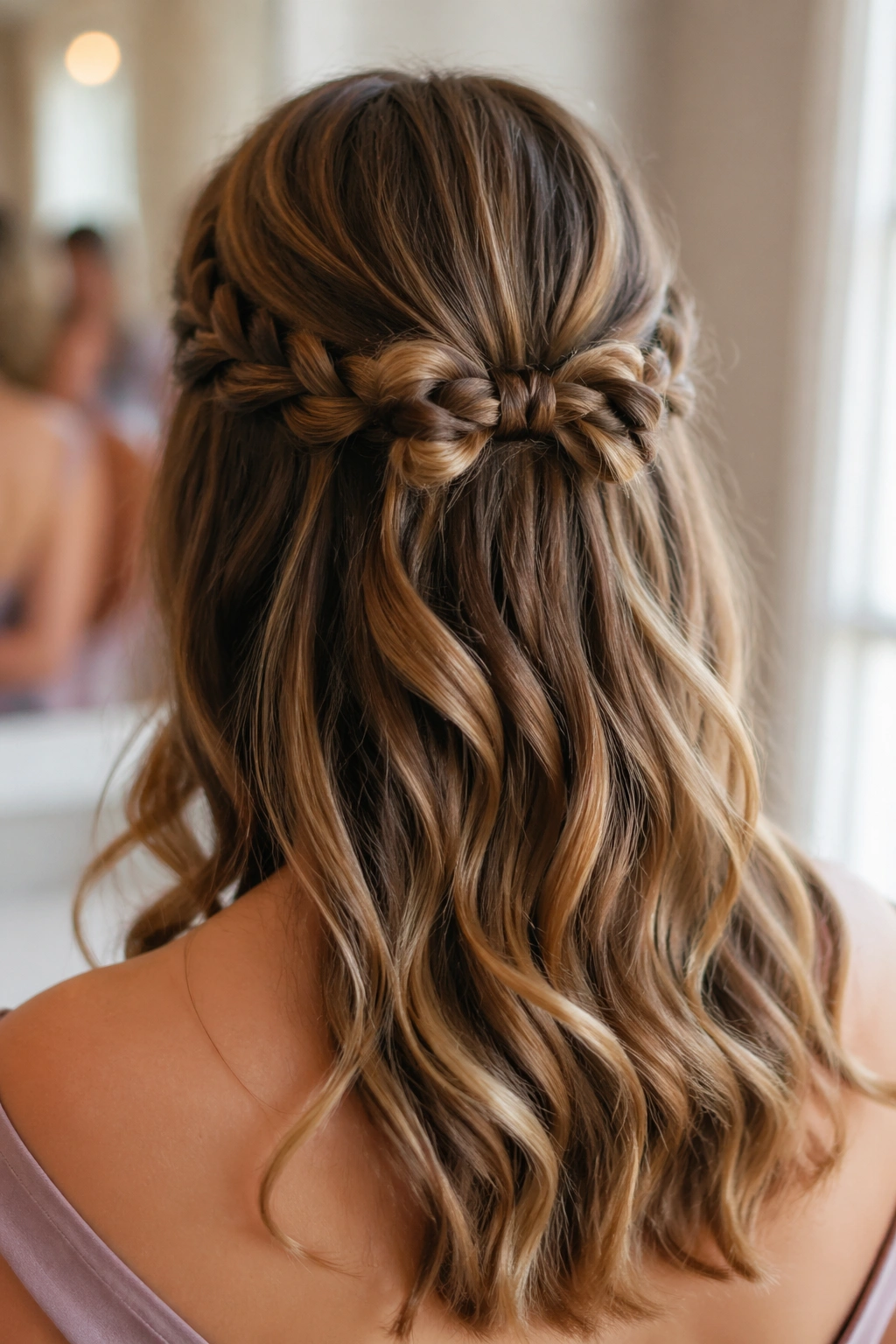
A braided bow sounds playful because it is, but it can still look polished on medium hair if you keep the size controlled. The trick is not trying to make the bow huge. On shoulder-length hair, a small, neat bow reads far better than a bulky one.
Start with a half-up braid, then loop the ends into bow shapes and pin them flat. The center knot should sit snug and tidy. If the loops get too loose, the shape starts to look like an accident instead of a choice. Use two or three strong pins hidden behind the center to lock it down.
This style is a good fit for a bridesmaid who wants something a little different without drifting into novelty territory. Small scale is the key. A restrained bow feels sweet. An oversized one feels costume-y, and nobody wants that at a formal event.
Let the lower hair stay softly waved so the whole style keeps some movement.
15. Infinity Braid Center Accent
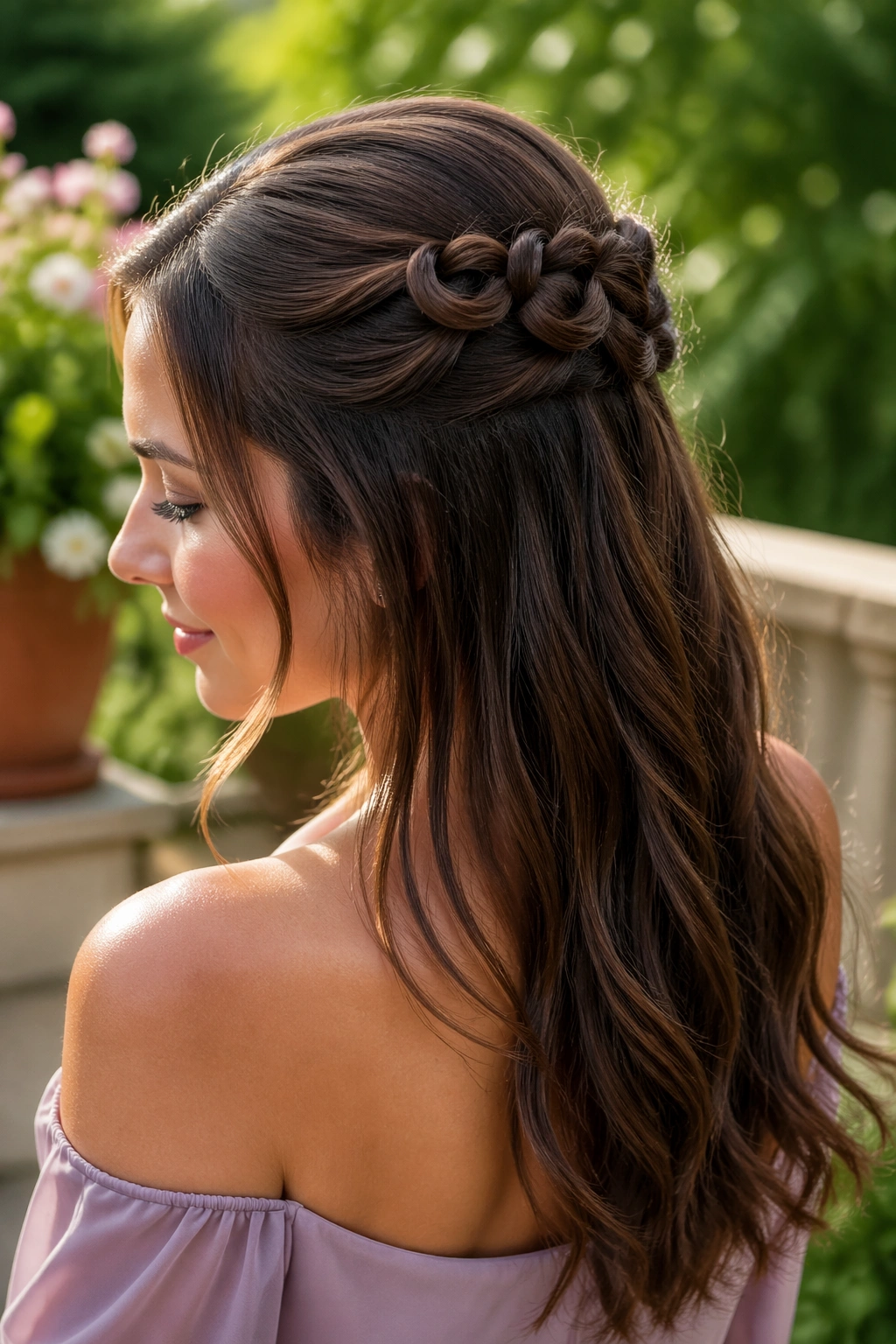
An infinity braid gives medium hair a focal point without taking over the whole head. It’s a smart move when you want one detail near the crown and the rest of the hair to stay soft and open.
The braid has a looped, woven look that catches the eye quickly. That makes it handy for bridesmaid styles, because the piece reads clearly even from a distance. If the wedding party is seated in rows or moving around a lot, that kind of visible shape matters more than people think.
I like this braid best when it sits centered just above the half-up section. Keep it relatively small so it doesn’t fight with the length below. The lower hair can be straight, waved, or curled, but avoid anything too tight. The braid already brings enough structure.
If your hair is a touch fine, tease the section lightly before starting. Not much. Just enough to give the infinity shape a base that won’t collapse.
16. Dutch Braid into a Half-Up Knot
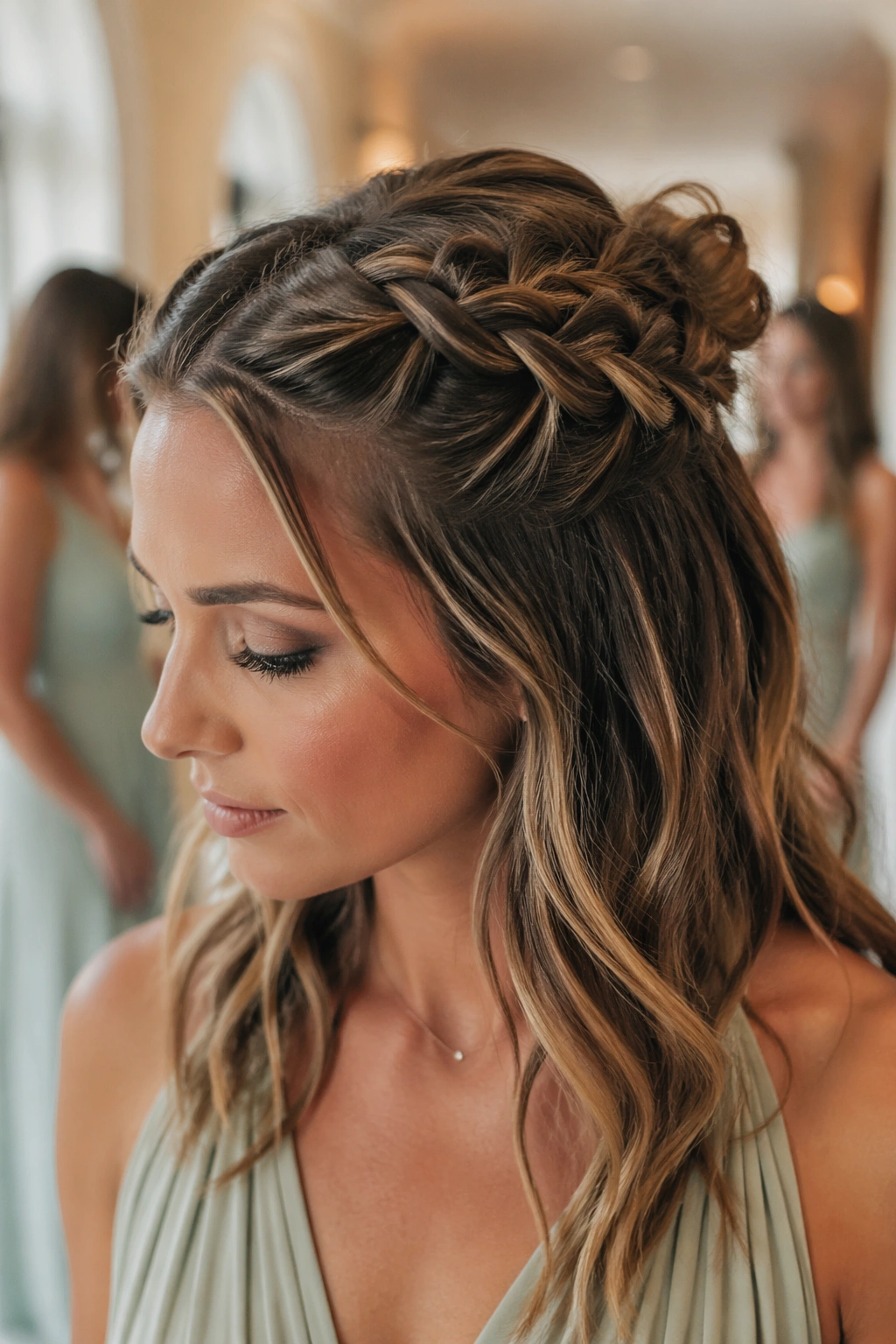
A Dutch braid into a half-up knot gives medium hair some backbone. The braid comes forward in a clear raised line, then stops short and turns into a knot or compact loop at the back of the crown.
That little knot is doing more than decoration. It creates a point of interest where a regular half-up style might otherwise fade into the rest of the hair. For bridesmaids, that’s useful. You want the style to register from the front and still hold up when people are seeing you in profile.
How to make it stay
- Braid the top section with steady tension.
- Secure the braid with a clear elastic first.
- Twist the tail into a small knot or coil.
- Pin through the base, not just the surface.
This works well on medium hair that has enough length to tuck but not enough to support a big bun. It also pairs nicely with dresses that have a little structure at the neckline. The braid gives line. The knot gives shape.
17. Messy Boho Braid with Texture Spray
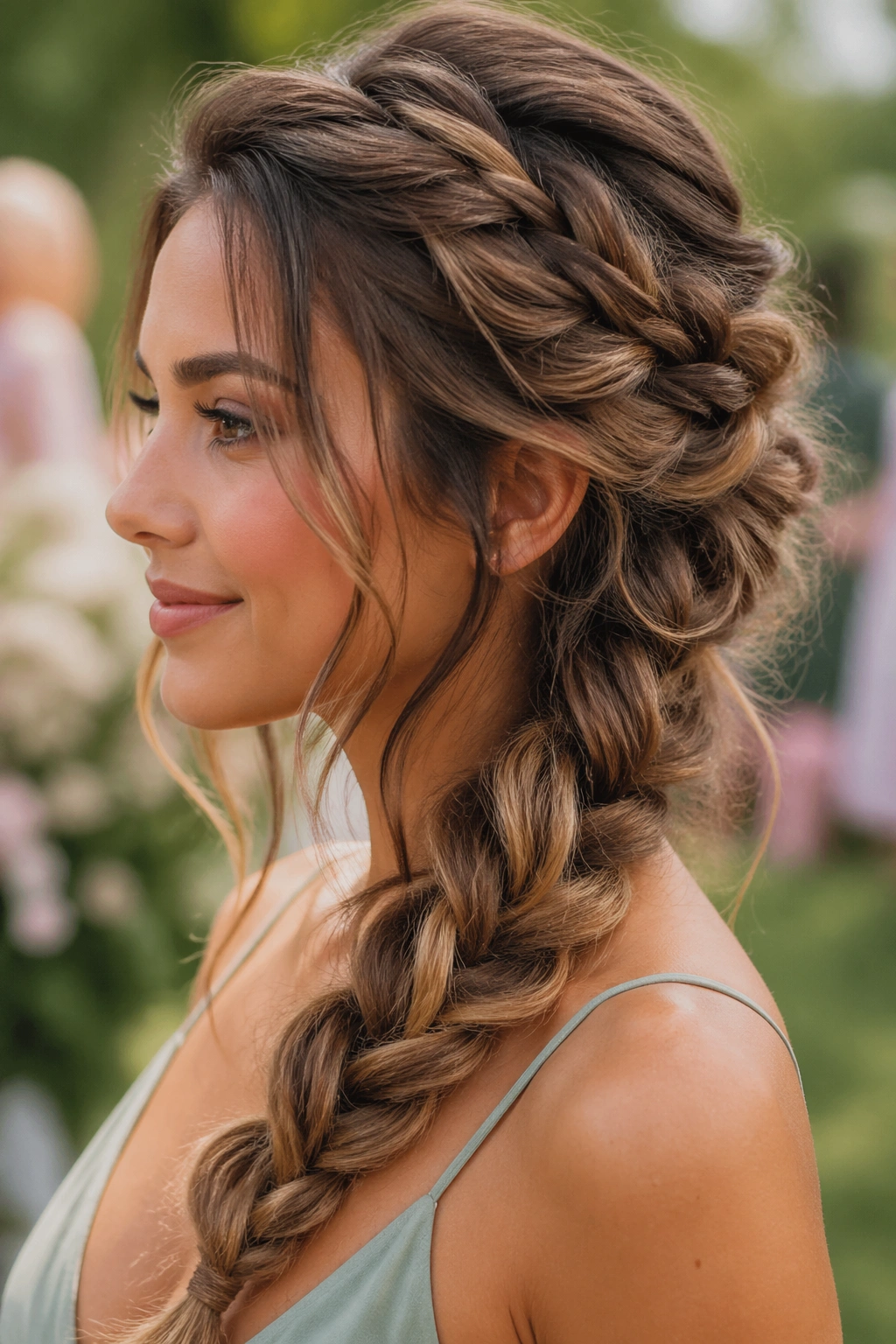
A messy boho braid is what I recommend when the bridal party wants soft and relaxed, but not so relaxed that it looks unfinished. Texture spray is the whole game here. Without it, medium hair can slip and collapse before the reception starts.
The braid itself should be loose, with a few strands left out around the face and the ears. Don’t fight every flyaway. A little lived-in texture is part of the point. What you do want to control is the anchor point at the back of the head. That needs to stay pinned solid so the style doesn’t sag by hour three.
This one is forgiving for growing-out bangs, layers, and hair that doesn’t like rigid styling. It also fits outdoor settings because the shape is soft enough to handle a bit of movement. If the dress is light, floaty, or lace-heavy, this braid tends to make sense fast.
Just keep the texture spray light. Too much and the hair starts to feel sticky, which ruins the softness.
18. Sleek Center Braid for Bridesmaid Medium Hair
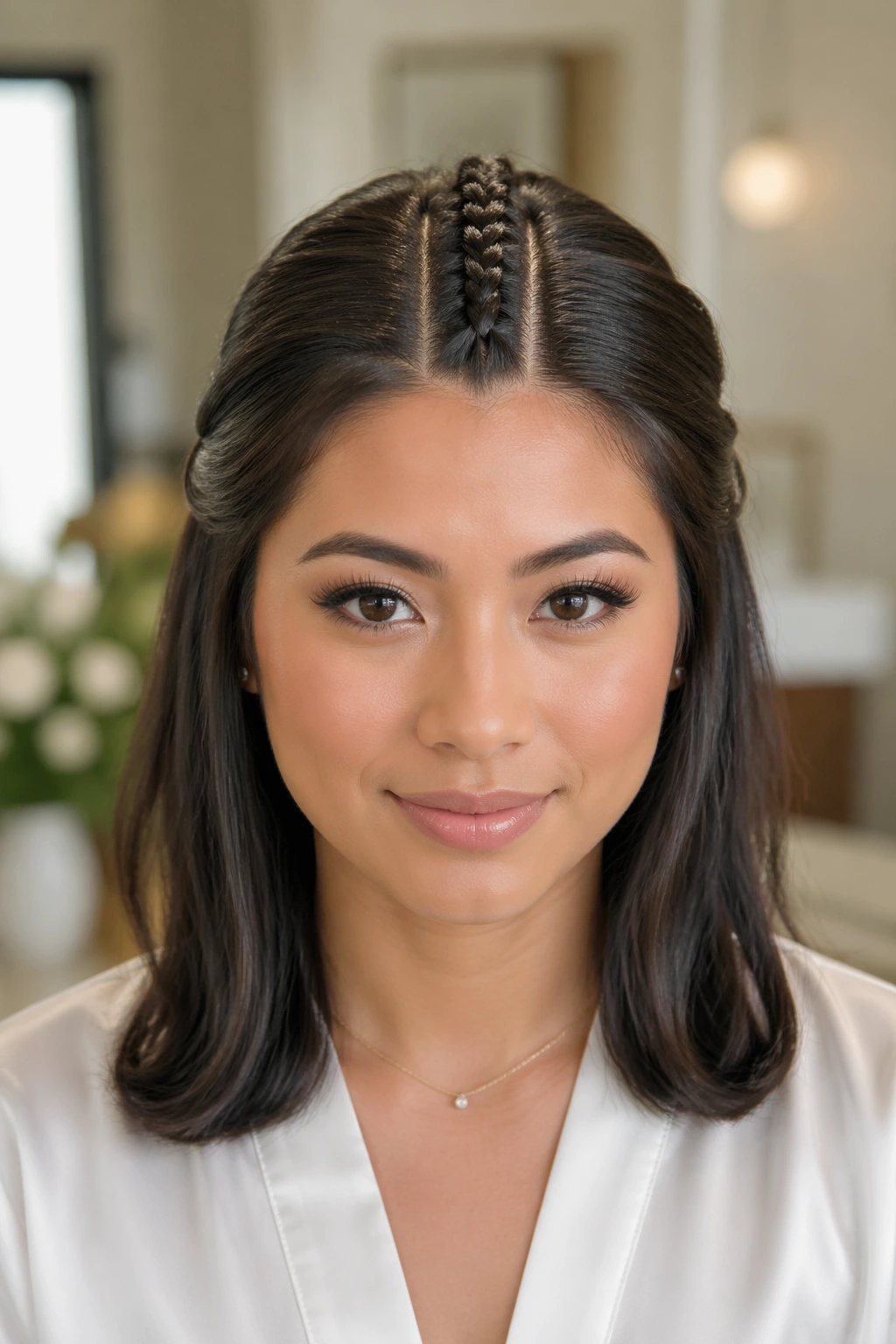
A sleek center braid is the opposite of messy boho, and that contrast is exactly why it works. On bridesmaid medium hair, a clean middle braid can make the whole style look expensive without needing extra volume or lots of accessories.
Start with a sharp center part and smooth the top section back with a light cream or a tiny bit of serum. Then braid just the center strip or the top half back into a narrow, controlled plait. The rest of the hair stays straight or softly bent, which keeps the look modern and neat.
Best pairings
- Satin dresses
- Minimal jewelry
- Clean, structured necklines
- Sharp makeup looks
The nice thing about this style is the clarity. You can see the braid immediately, and it doesn’t get lost in the hair. If the bridesmaid dresses are simple, this gives the group a polished line without needing identical updos.
Keep the braid tight at the root and smooth at the edges. Frizz shows fast in this style, so a fine-tooth comb and a little shine cream are worth using.
19. Braided Bubble Half-Up
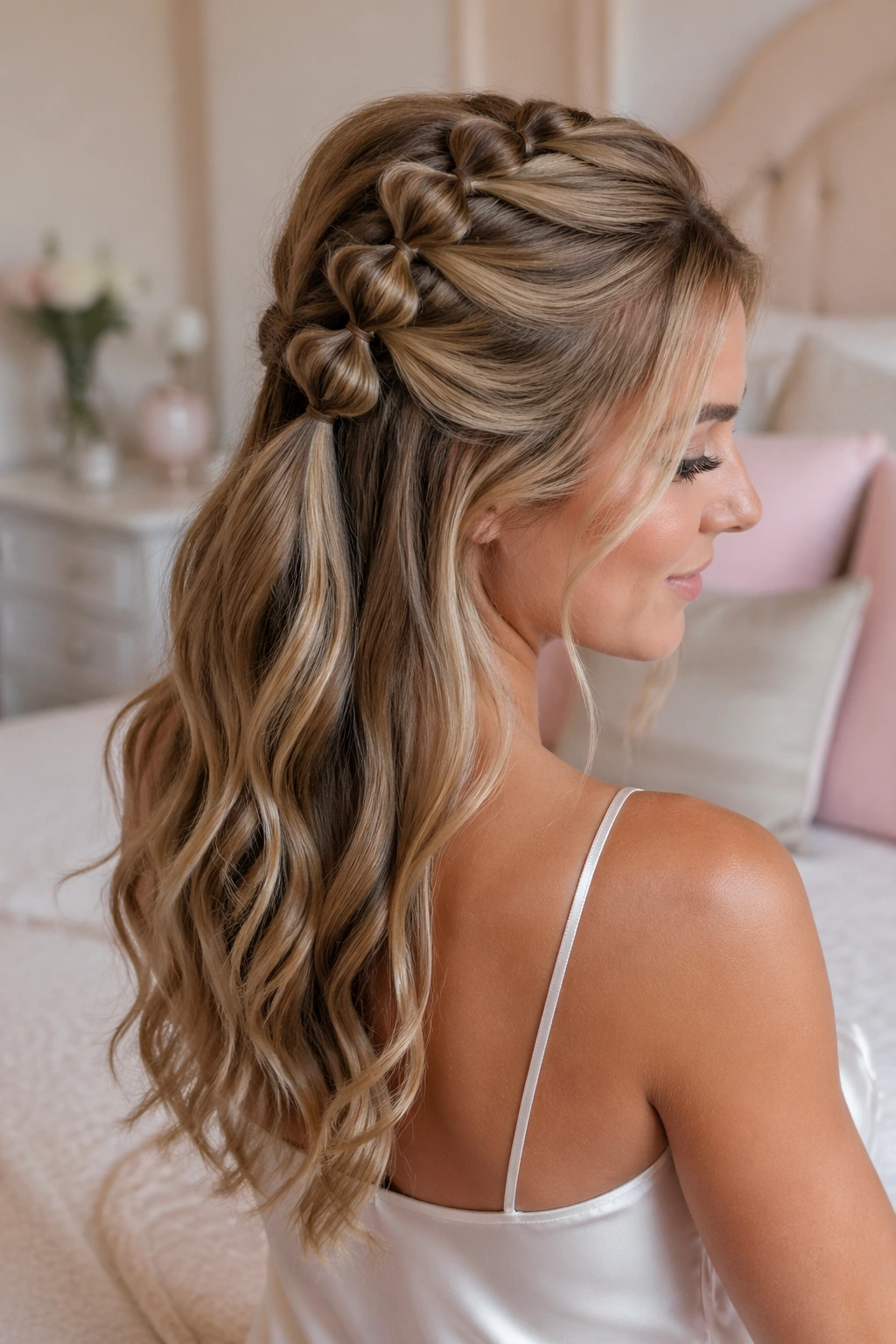
A braided bubble half-up has a little whimsy to it, but it stays wedding-friendly because the bubbles create shape instead of chaos. Think of it as a braid-adjacent style: the top section is broken into tied segments, then gently puffed between each tie.
On medium hair, that puffed texture adds volume fast. It also keeps the half-up section visible, which matters when the hair is not long enough to create a huge braided cascade on its own.
The bubbles should be even, about 1 to 2 inches apart depending on hair density. After tying each section with a small elastic, tug the sides of the bubble just enough to round it out. A few flattened sections can make the style look unfinished, so take a minute to shape each one.
This is a fun pick for a younger bridesmaid or a party that wants something a touch less formal. Keep the lower hair in loose waves so the bubbles feel connected to the rest of the style.
20. Side Fishtail with Loose Volume
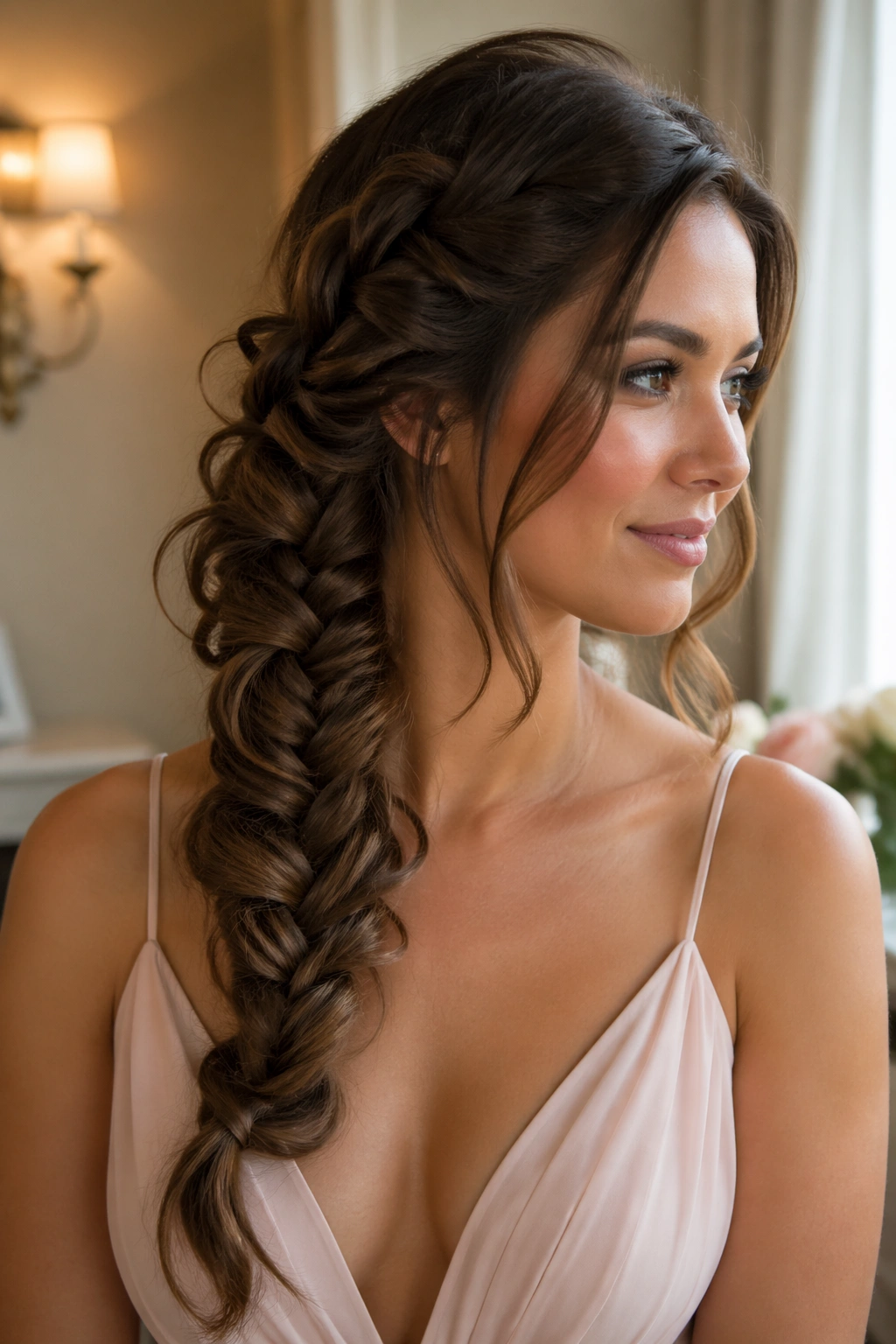
A side fishtail can look flat if you rush it. Give it a little volume first, and medium hair suddenly has a lot more presence.
The trick is simple: create soft bends through the loose hair before braiding, then start the fishtail off to one side and pull it apart after securing it. That wider shape makes the braid visible against the rest of the hair, which is important on medium lengths where a narrow fishtail can disappear.
What to watch for
- Don’t over-tighten the braid at the start.
- Keep the outer pieces slightly larger than the inner ones.
- Pull the braid open from the middle, not the ends.
- Secure the tail low so it drapes nicely over one shoulder.
I like this style when the neckline is open and the earrings need room to show. It gives enough detail to feel dressed up, but it still has movement. Side placement also helps medium hair look longer than it is, which never hurts.
21. Crisscross Braided Half-Up
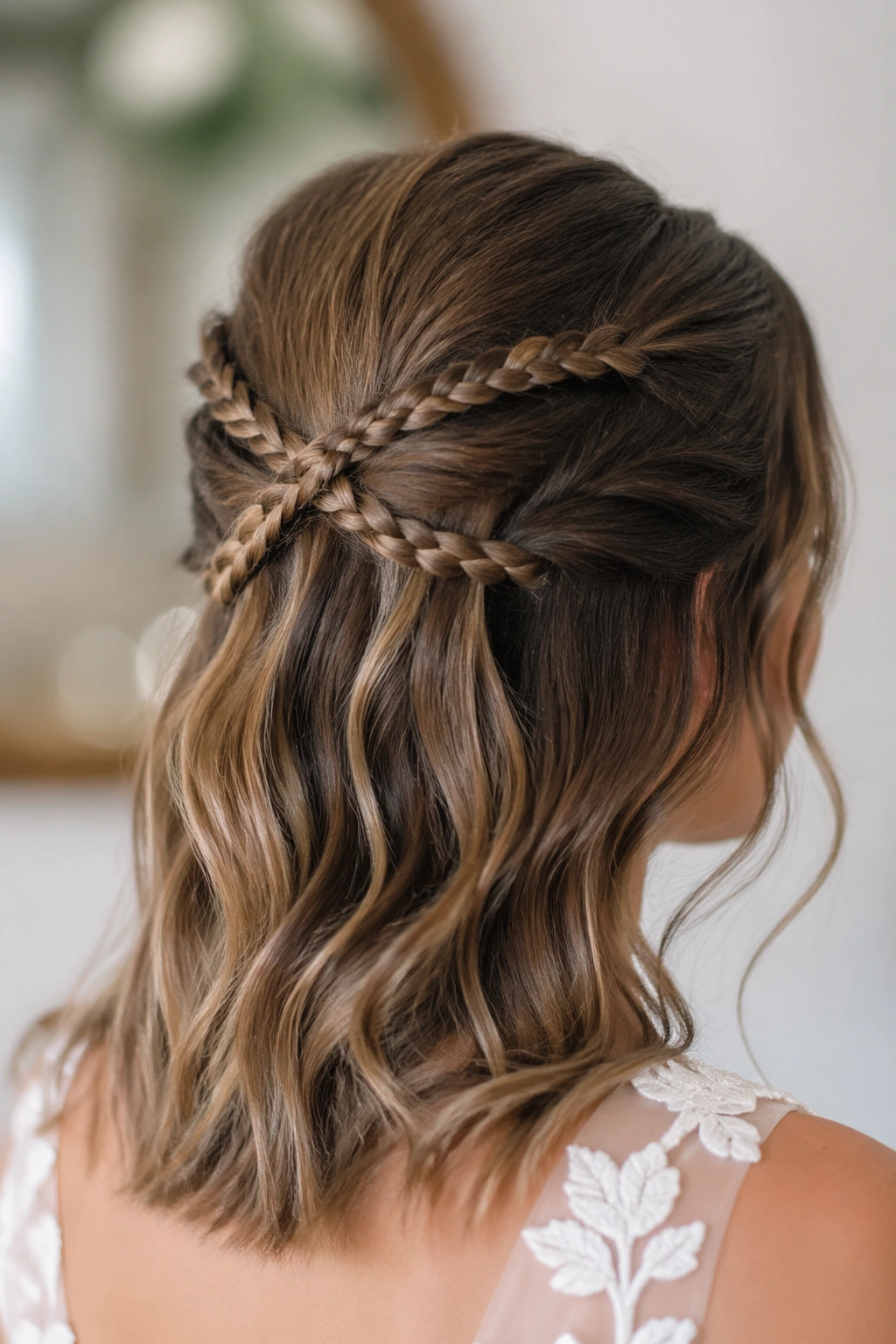
Two small braids crossing at the back can do more than one thick braid sometimes can. The crisscross shape gives the half-up section a neat architectural feel, and on medium hair that added line helps the style stand out.
Start with two thin braids from each side of the head, then bring them toward the center back and cross them over each other before pinning. The overlap should sit flat against the head. If the braids float too far off the crown, the shape loses that crisp crossing effect.
This style is a strong choice when the dress is simple and the hair needs a little visual interest. It works with straight, wavy, or softly curled ends because the top section is doing the work. You can keep the braids tight for a cleaner result or loosen them a touch for a softer mood.
A small crystal pin or two at the crossing point can finish it off without turning it into a full accessory moment.
22. Braided Half-Up Half-Down with Soft Chignon for Bridesmaid Medium Hair
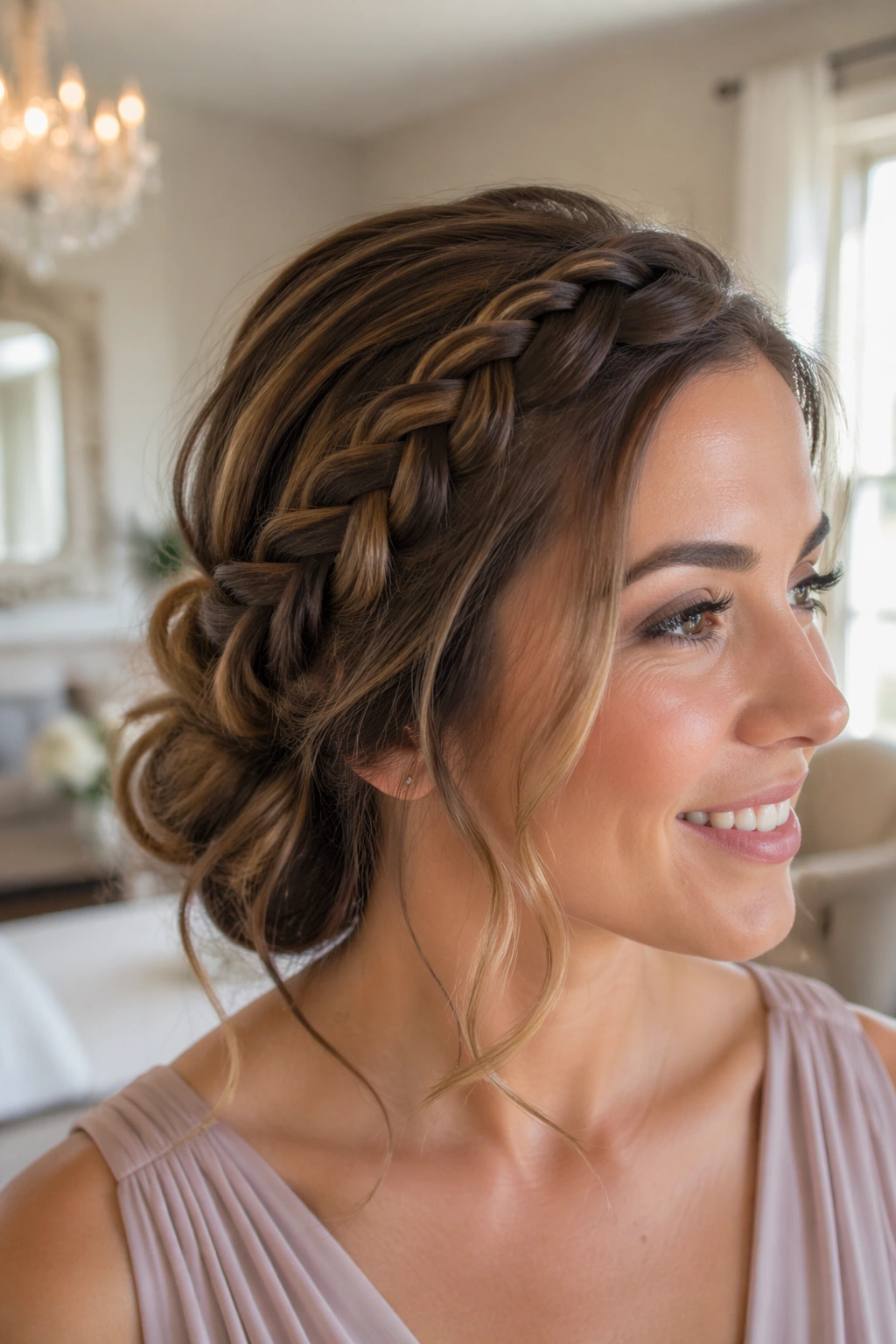
This is the one I’d pick when the bride wants the bridesmaids to look polished, but not overly done. A braided half-up half-down with a soft chignon gives medium hair a neat center point, then leaves enough length loose so the style still feels relaxed.
The chignon should be small and tucked, almost like a compact knot that sits low on the back of the crown. The braid feeds into it and keeps everything anchored. That matters on medium hair, because loose half-up styles can lose shape fast if the top section is not pinned with care.
A few face-framing pieces keep the whole thing from looking too set. I’d keep the ends below the chignon softly waved, not curled into tight ringlets. The contrast between the tidy top and the loose bottom is what makes the style feel balanced.
If you want one bridesmaid hairstyle that can move from ceremony to dinner without needing a redo, this is a strong one. It’s neat from the front, soft from the side, and steady from the back. That is not always easy to get with medium hair.
