



Half-up ponytails are the rare hairstyle that can look neat before breakfast and still feel easy enough for an ordinary Tuesday. They keep hair off your face, leave length on display, and give you a little lift at the crown without asking for a full styling session. That’s the appeal. Fast, but not sloppy.
The problem is that people treat half-up styles like one-size-fits-all hair math. They aren’t. A slick half-up ponytail on straight hair looks different from a curly one tied with a scrunchie, and a fine-haired version needs a different setup than a thick, heavy mane that wants to sink by lunch. The shape matters. So does the elastic, the anchor point, and how much tension you use at the sides.
I’ve always thought the best half-up ponytails are the ones that seem calm. Not stiff. Not overworked. Just tidy enough to feel intentional, with a little softness around the face and enough hold to survive commuting, errands, school pickup, or a long desk day. A rat-tail comb, a couple of bobby pins, and the right brush do more work than most people realize.
What follows is a mix of polished, playful, and low-effort half-up ponytails that actually make sense for everyday wear. Some lean sleek. Some are a little messy. A few borrow from braids or clips or scarves. The first ones are simple on purpose, because that’s usually where the most wearable hair lives.
1. Sleek Low Half-Up Ponytail with a Wrapped Base
This is the half-up ponytail I’d hand to anyone who wants clean lines without looking severe. The base sits low, just above the ears, so the top section feels secure but not shouty. It works especially well on straight or lightly waved hair, where a smooth surface makes the whole style look polished with very little effort.
Why the low placement works
A low half-up keeps the crown flat and leaves the top of the head from puffing out in odd places. That matters more than people think. If the elastic sits too high, the style can start to look like it’s trying too hard.
Use a small clear elastic or a narrow fabric tie, then wrap a thin strand of hair around it and pin the end underneath with one bobby pin. That single detail changes the whole look.
- Best for shoulder-length hair and longer
- Good when you want a neat office-friendly shape
- Works with both center and side parts
- Holds up better if you smooth the crown with a light cream or serum
Tiny tip: Keep the tension snug, not tight. If your temples start to pull, the style stops looking soft.
2. Soft High Half-Up Ponytail with Face-Framing Pieces
A high half-up ponytail gives you instant lift. That’s the blunt truth. Pull the top section up toward the crown, leave two slim pieces out near the cheeks, and the whole style wakes up fast, even if the rest of your hair is doing an ordinary day-of-week thing.
The trick is not making the base too perfect. A little looseness at the top keeps it from feeling like a mini cheer ponytail. If your hair is fine, a quick mist of texture spray at the roots helps the section stay where you put it. If it’s thick, finger-combing instead of brushing can keep the shape less rigid.
Those face-framing pieces matter because they soften the height. Straight down pieces can look sharp; pieces bent with a round brush or curling iron sit closer to the cheek and feel friendlier.
Use this one when you want energy without a full styling commitment. It’s a small lift, nothing dramatic. That’s the charm.
3. Bubble Half-Up Ponytail
Bubble hair can look fussy in photos and surprisingly easy in real life. The half-up version is the one I trust most for everyday wear because it stays playful without taking over the whole head. You start with a half-up ponytail, then add small elastics every 1 to 2 inches down the length of the upper section and gently tug each segment outward.
How to keep the bubbles even
Even spacing matters more than perfect symmetry. If one bubble is a little larger, nobody’s going to faint. But if the elastics crowd together near the top, the style loses its shape fast.
Use clear elastics for a lighter look, or tiny fabric ties if you want more color. On medium to thick hair, a light mist of hairspray before tugging helps the bubbles hold their round shape.
- Use 3 to 5 elastics for shoulder-length hair
- Keep the top bubble slightly smaller than the rest
- Leave the lower half of your hair straight or softly bent
- Smooth the roots first so the sections read clearly
Best part: It looks more styled than it is. That’s a rare little win.
4. Twisted Crown Half-Up Ponytail
Why does a twist often look softer than a braid? Because it leaves a little more hair texture visible. Two sections from each side of the head twist back toward the center, then gather into a half-up ponytail. The result feels tidy but not hard-edged.
This style is especially nice when your hair has a bit of wave or day-old bend. Freshly washed hair can slide, so a touch of dry shampoo or lightweight texturizer gives the twists something to grip. Pin them low and hidden before you secure the ponytail, or the whole thing can creep loose by midafternoon.
How to pin the twist
Take a 2-inch section from each temple, twist away from the face, and cross them at the back before tying them together. If your hair is layered, tuck any short ends under the elastic and pin them flat.
The style sits somewhere between polished and casual. That’s the sweet spot for errands, dinner, or a day when you want your hair controlled without looking strict.
5. Braided Half-Up Ponytail
A braid gives a half-up ponytail a little more structure, and structure helps on busy days. I like this version when the hair feels slippery, because a braid grips better than a twist and survives movement with less babysitting. A simple three-strand braid from the crown into a half pony is enough.
You do not need a perfect braid. Slightly uneven tension can actually make it prettier. Tight braids can look stern, especially if the rest of the hair is loose and soft. A looser braid reads more relaxed and sits better against the head.
If your hair is layered, braid only the top section and stop before the shorter pieces start escaping. Secure it with a tiny elastic, then join it into the ponytail. Wrap a strand around the base if you want the finish to look cleaner.
This is one of those styles that quietly does a lot. It keeps the front tidy, adds detail, and still feels wearable with jeans and a sweater. That’s why it keeps showing up in my rotation.
6. Mini Half-Up Ponytail for Fine Hair
Fine hair can look thin fast when too much of it gets pulled away from the face. That’s why a mini half-up ponytail often works better than a full, dramatic top section. You only gather the front crown area, leaving most of the density in the lower half where it can still look full.
The point is balance. A small pony on top gives lift without exposing the scalp too much. If you backcomb the crown lightly, use a soft brush afterward so it doesn’t look scratched up. A dusting of volumizing powder at the roots helps the base stay put.
This style also behaves well with a small claw clip if elastics tug too hard. On very fine hair, an elastic can make the section look smaller than it is. A tiny satin scrunchie can soften that problem.
Best move: keep the top section shallow and broad instead of narrow and tall. That shape gives the illusion of more hair. It’s one of those little styling choices that matters more than the photos suggest.
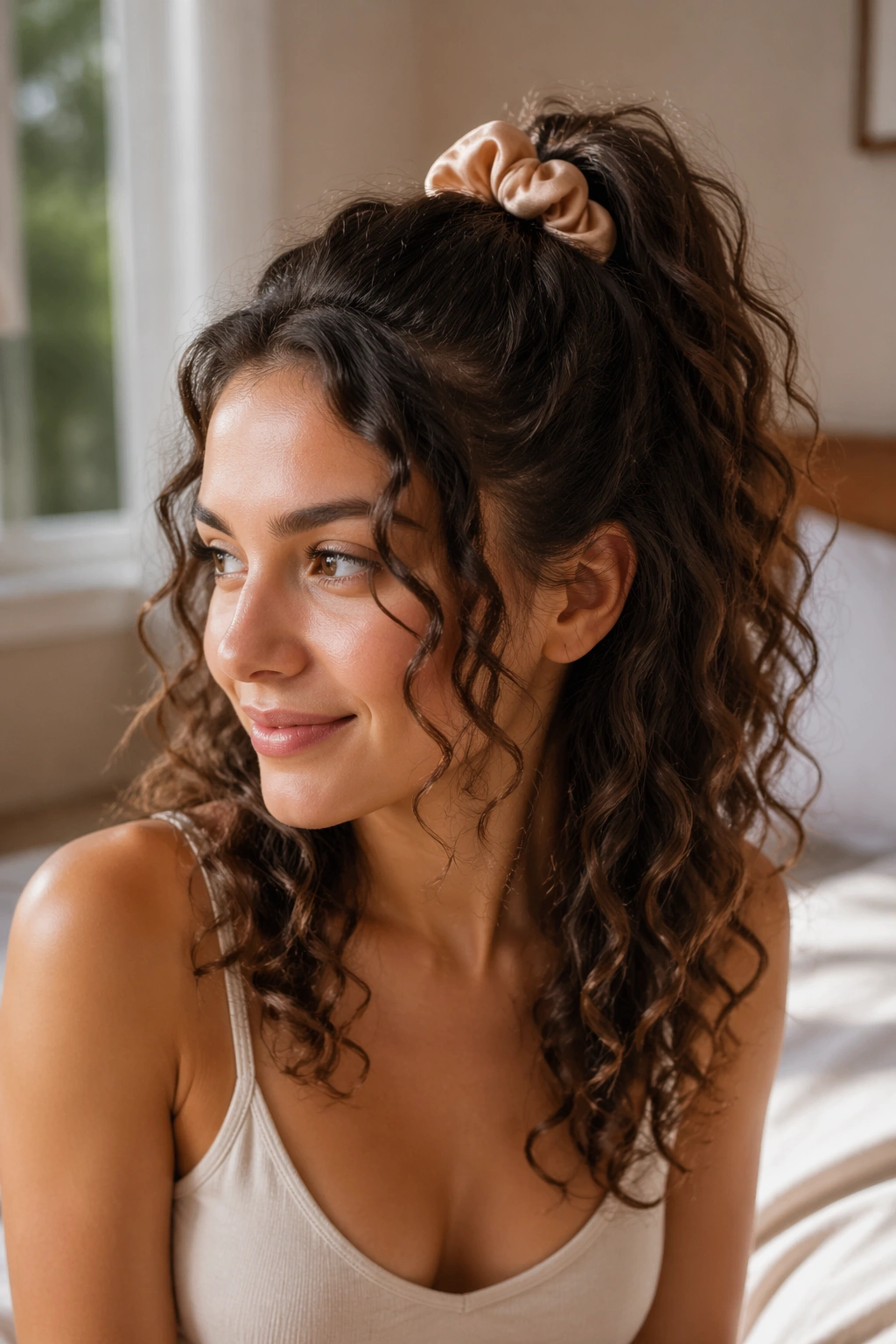
7. Curly Half-Up Ponytail with a Scrunchie
Curly hair looks happiest when it isn’t forced into a tight knot. A soft half-up ponytail tied with a scrunchie gives curls room to spring and keeps the top section from getting flattened. Use your fingers or a wide-tooth comb. Brush it too much and the curl pattern can get frizzy fast.
What helps this version hold its shape
A little leave-in conditioner on damp hair makes the curls feel smoother when they dry. Once dry, gather the top half loosely and secure it at the crown with a satin or velvet scrunchie. The fabric matters. Rough elastics can snag and leave dents that stay there all day.
- Best with shoulder-length curls and longer
- Good for wash day or day two
- Leave a few ringlets loose around the temples
- Scrunch the ends with a tiny bit of curl cream if needed
I like this one because it doesn’t fight the hair’s shape. It works with the curl, not against it. And yes, that sounds obvious, but a lot of styling mistakes start right there.
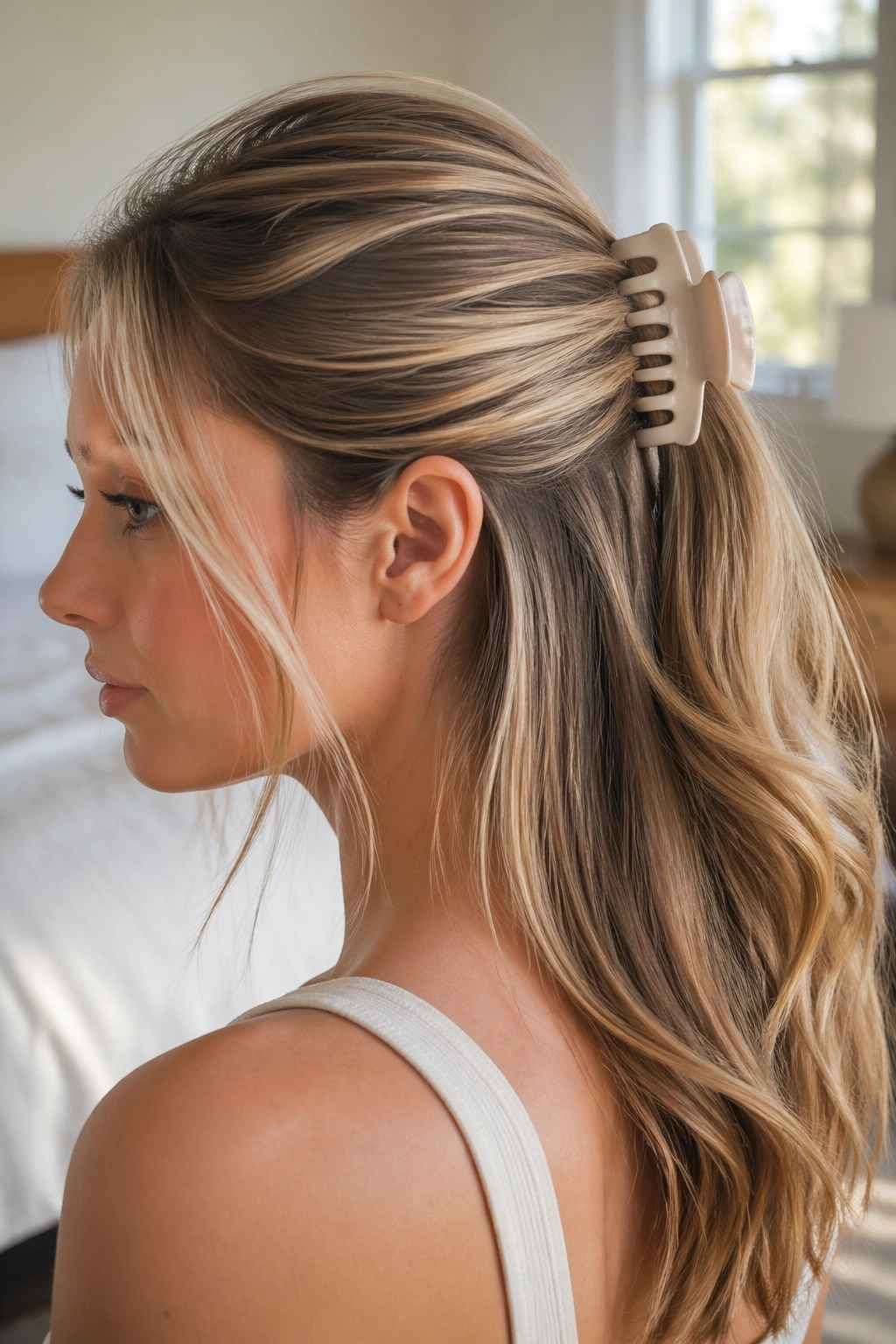
8. Claw-Clip Half-Up Ponytail
Some mornings, a hair tie feels like too much effort and a claw clip wins by a mile. A half-up ponytail held with a medium claw clip sits between a clip and a ponytail, which makes it perfect for hair that needs a quick lift but not a tight hold. The top section gets folded or twisted once, then clipped at the back.
The real benefit is comfort. No strong elastic line. No headache by noon. Just a neat little lift that still leaves the bottom half loose. It works especially well on medium to thick hair, because there’s enough volume for the clip to grip without slipping.
Use a clip with a curved spine and teeth that close evenly. Cheap clips with flimsy springs tend to slide. If your hair is silky, add a little dry texture spray at the crown before clipping. That gives the teeth something to catch.
This is the style I’d call lazy in the nicest possible way. It looks like a choice, which is all most everyday hair really needs.
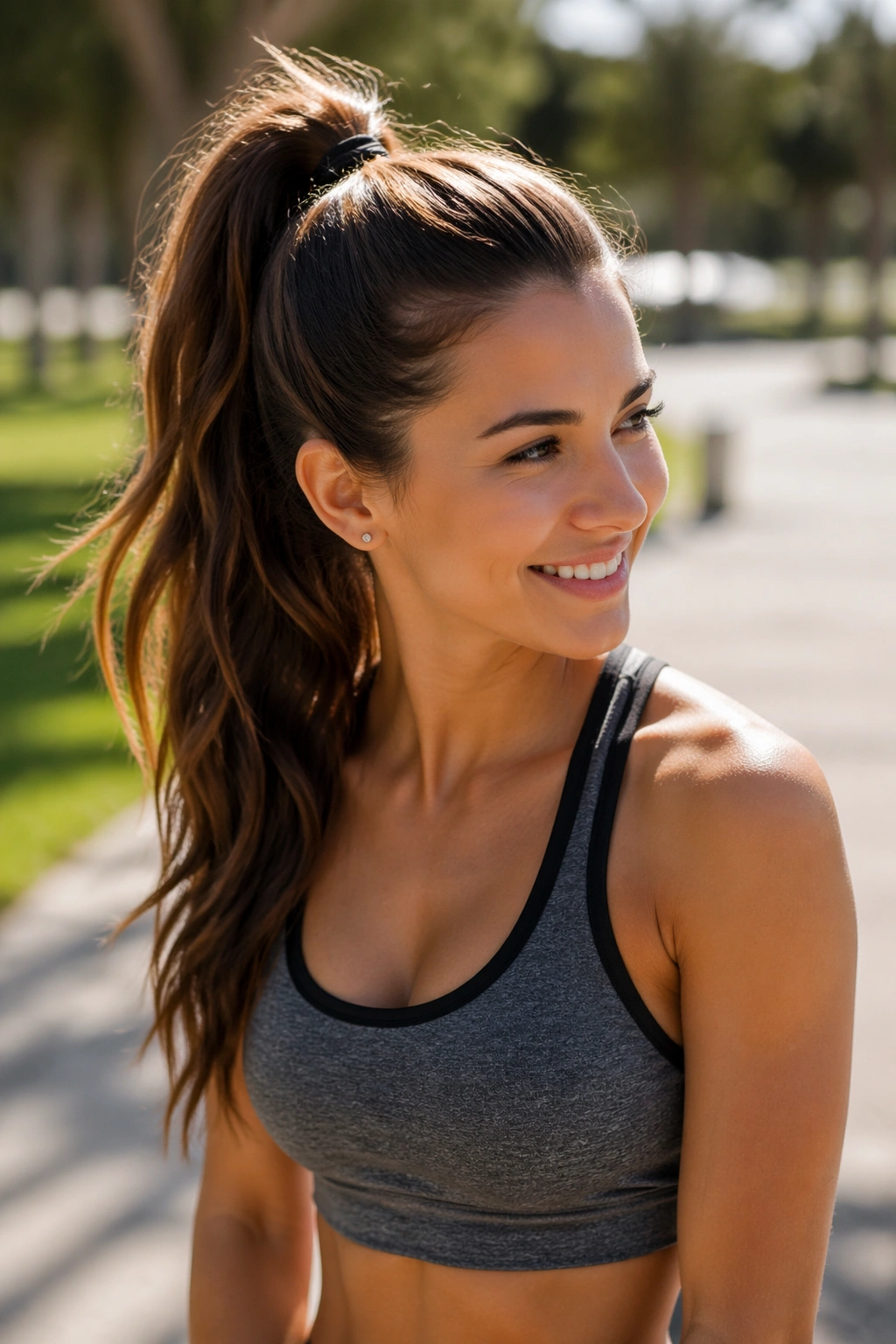
9. Sporty High Half-Up Ponytail
A sporty half-up ponytail sits high enough to feel energetic but not so high that it steals all your hair from the back. It’s the style I’d pick for a walk, a busy day out, or any time you want your hair out of your face and still want length swinging behind you.
The top section should start at the temples and rise toward the crown. Don’t overthink the part. A clean center part looks neat, but a slightly off-center part can make the style feel less rigid. If your roots are flat, a quick blast with a blow dryer while lifting the front section by hand helps.
Use a strong elastic. Sporty styles need grip. A weak one gives up too fast and slides down the back of the head.
- Keep the top section taut, but not pulled tight against the scalp
- Smooth flyaways with a tiny bit of cream on your fingertips
- Leave the bottom half straight for a clean finish
- Or bend the ends for a more relaxed look
Short sentence here: comfort matters.
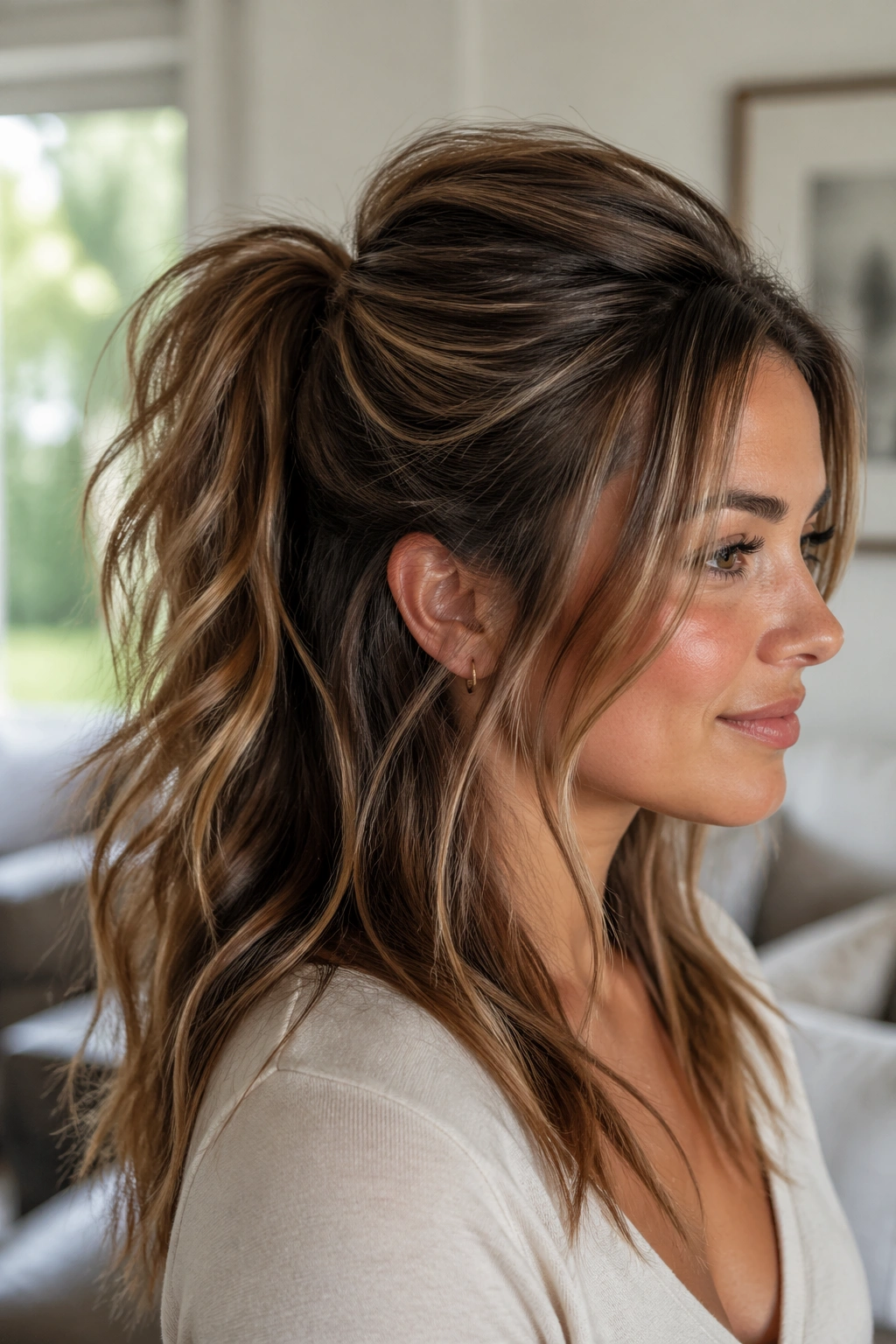
10. Textured Half-Up Ponytail with Volume
Textured hair loves a half-up ponytail that doesn’t pretend to be sleek. If your hair has natural waves, bends, or a little frizz, lean into it. A quick rough-dry, some dry shampoo at the roots, and a loose top section can give the style lift without making it look overstyled.
The crown is the part to watch. Too flat, and the hair looks sleepy. Too teased, and the shape starts to feel messy in a bad way. I usually lift the roots with my fingers, mist lightly with texturizer, then gather the top section without brushing it flat.
A small bend in the loose lengths helps a lot. Even one pass with a 1-inch curling iron through the front pieces changes the whole mood. The texture reads intentional instead of accidental.
This is one of the most forgiving everyday half-up ponytails. It survives humidity better than sleek styles and hides little bends from sleeping on your hair. Some days, that’s the version you want. No drama. Just hair that cooperates.
11. Side-Swept Half-Up Ponytail
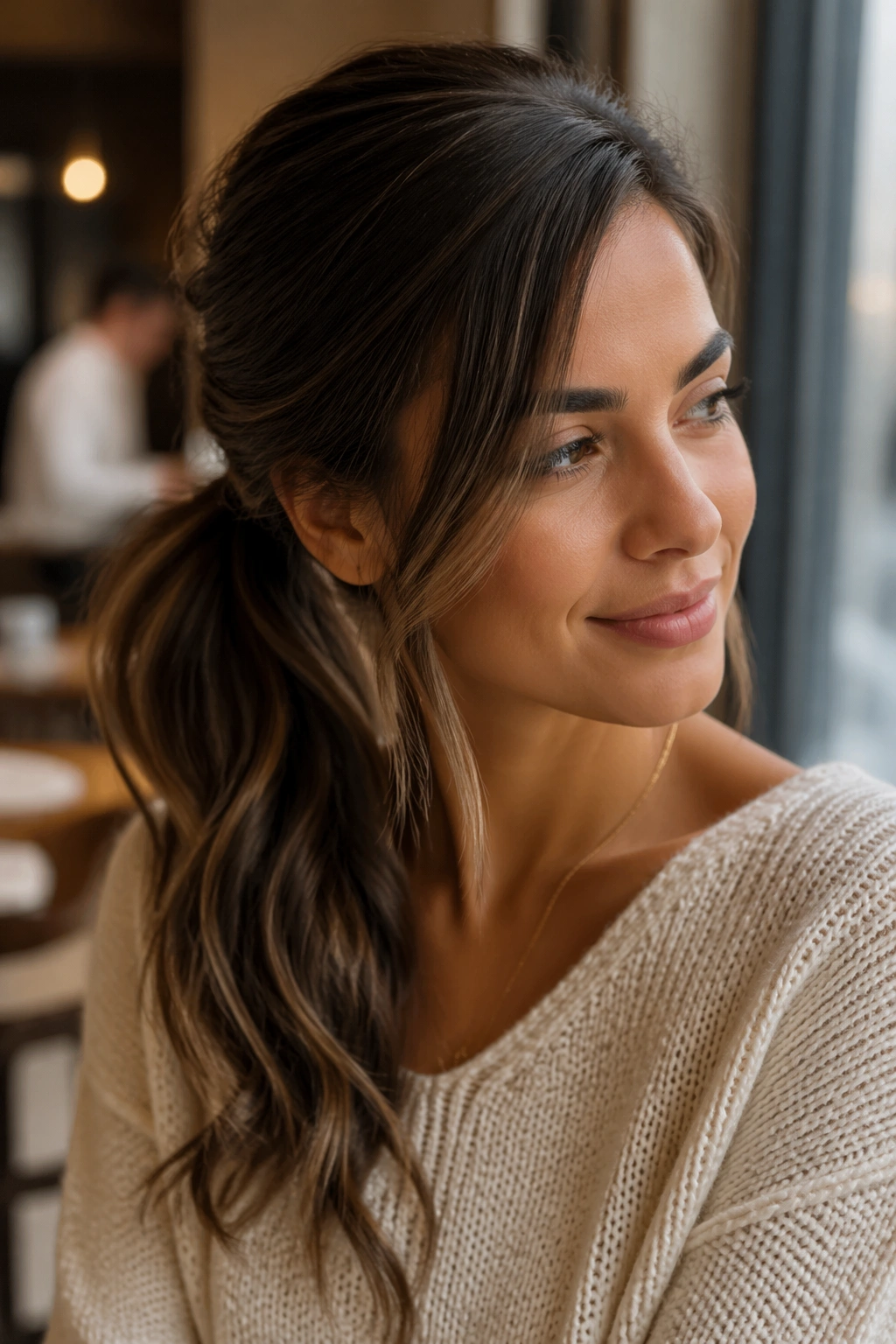
Does your hair ever fall forward on one side more than the other? A side-swept half-up ponytail turns that into the shape, which is smarter than fighting it. Pull the top section back from a deep side part, then gather it slightly off-center so the ponytail sits behind one ear instead of directly in the middle.
That off-balance placement softens the whole look. It also gives the style a little motion, which is useful if your face shape likes asymmetry. The front section on the heavier side can be tucked smoothly behind the clip or elastic, or left loose in a soft wave.
Where to anchor it
Place the elastic at the back of the head, just above the occipital bone, but slide it a touch toward the side with less hair. That small shift keeps the style from feeling lopsided.
The side-swept version feels easy, and that’s the point. It’s not trying to be formal. It just makes a part that might otherwise misbehave look deliberate.
12. Ribbon-Tied Half-Up Ponytail
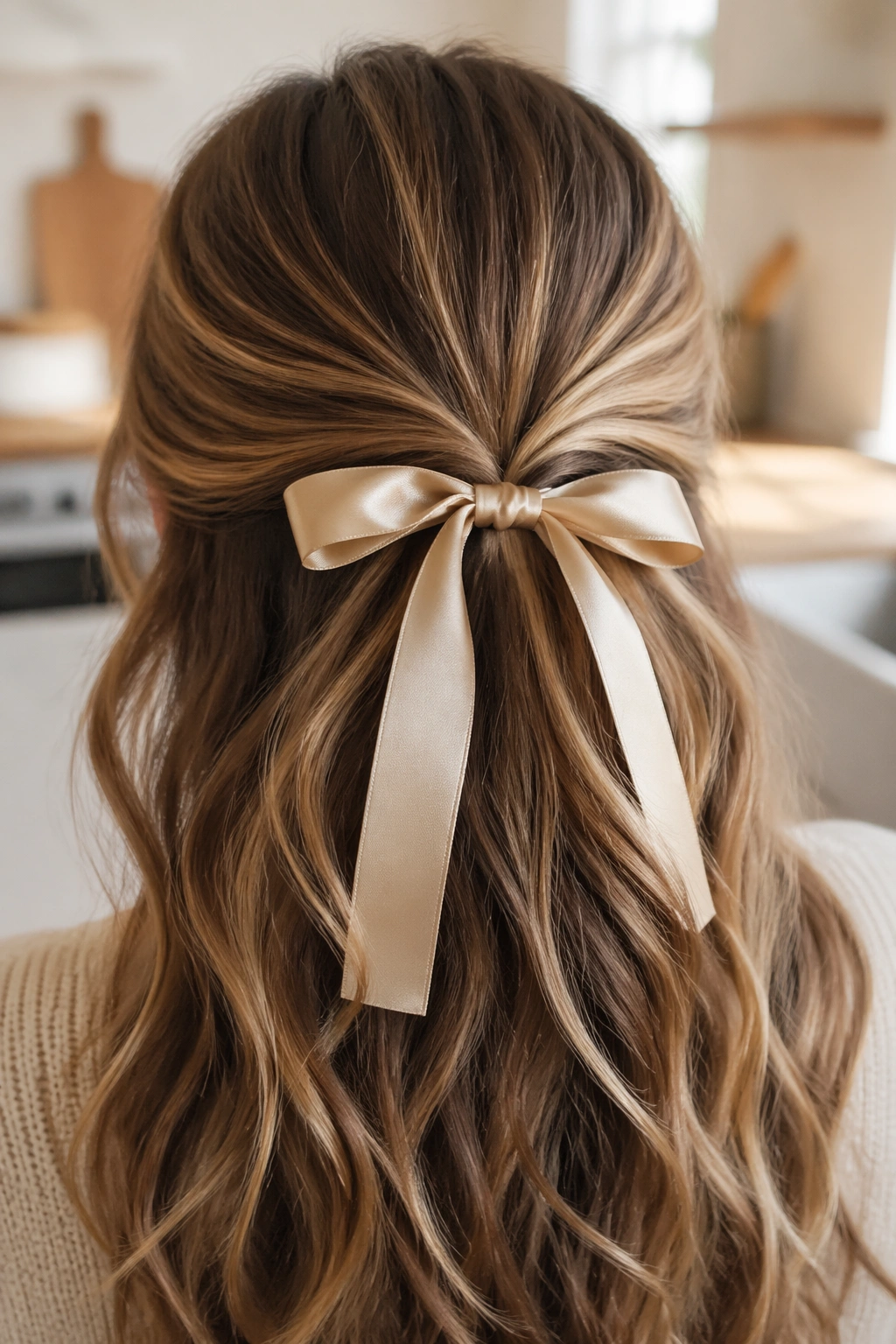
A ribbon changes the mood fast. A plain elastic can look utilitarian; a ribbon-tied half-up ponytail feels softer and a little more dressed up without moving into fussy territory. Satin ribbon works best because it lies flat and doesn’t snag the hair when you tie it.
Keep the section simple. Pull back the top half, secure it with a tiny elastic, then wrap the ribbon over the base and tie a neat bow or a loose knot underneath. If the ribbon is too wide, it can dominate the style. Half an inch to 1 inch is usually enough unless the hair is very thick.
I prefer this on straight or softly waved hair, where the ribbon sits cleanly. On curls, it can get lost unless the color contrasts well. A dark ribbon on blond hair, or a pale one on brunette hair, can make the detail pop.
This is one of those styles that looks like you planned ahead, even if you didn’t. Handy trick. Nice payoff.
13. Half-Up Ponytail with Accent Braid
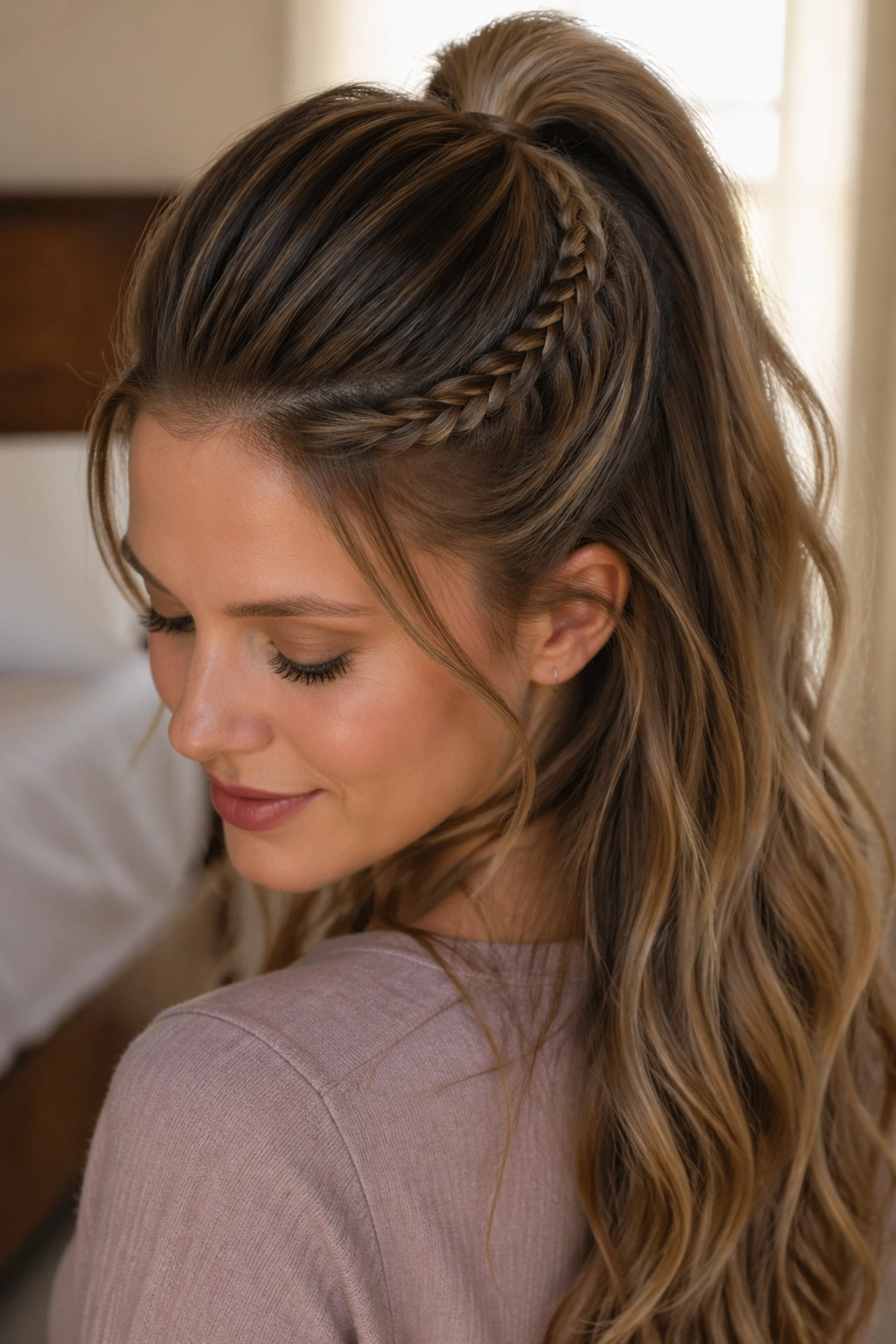
Sometimes one small braid does more than a whole complicated style. An accent braid along one side of the head feeds into the half-up ponytail and gives just enough detail to keep the look from feeling plain. It works best when the braid is narrow, almost whisper-thin, so it acts like an accent rather than the main event.
What makes it work
The braid should start near the temple or just behind the ear, then angle back into the ponytail base. Keep the braid loose enough to show the pattern. Tight braids can look stiff and pull at the hairline.
A neat center section can make the braid stand out. A messy part can hide it. I usually choose based on hair texture. Smooth hair likes a cleaner part. Wavier hair looks better with a softer one.
- One braid is enough
- Secure the braid before joining the ponytail
- Use a small elastic at the end, then tuck it under
- Leave the lower lengths plain so the braid stays the focus
It’s a small detail, but it changes the whole read of the style.
14. Messy Half-Up Knot-Pony Hybrid
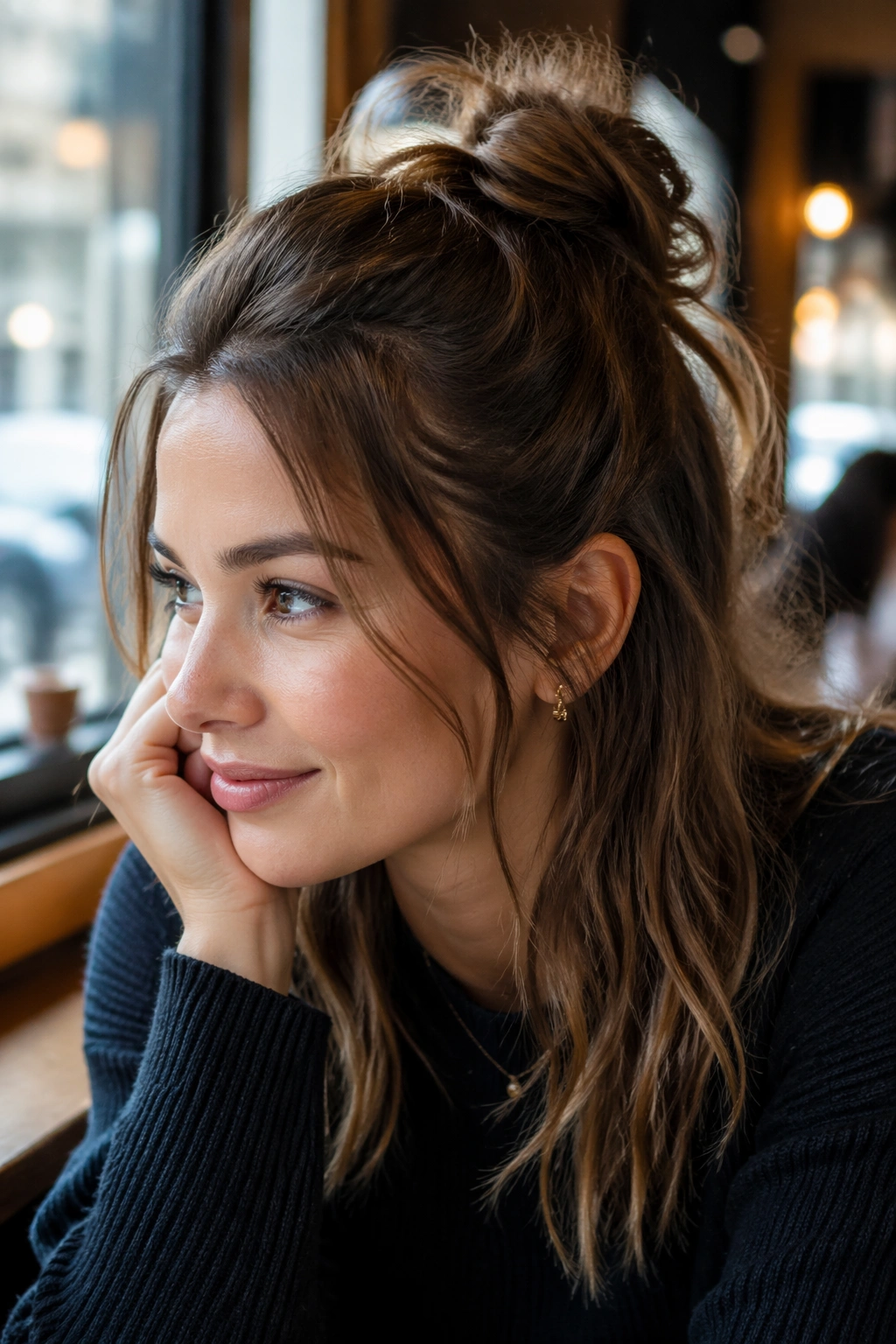
This one is for days when polished hair feels like too much work. You gather the top half into a loose ponytail, but instead of leaving it straight, you pull the tail halfway through on the last wrap so it forms a soft knot. Not a full bun. Not a full pony. Somewhere in the middle.
The shape is a little relaxed on purpose. If a few short layers slip out, leave them. That’s part of the charm. The style looks best when it feels lifted but not rigid, almost like a quick fix that turned into something useful.
It’s especially good for medium-length hair that doesn’t always want to sit neatly in a ponytail. The knot gives the top section enough body to stay visible, while the loose ends create movement.
Use your fingers, not a brush, for this one. A brush can make it too neat. And neat is not the goal here. Soft control is.
15. Sleek Straight Half-Up Ponytail with Center Part
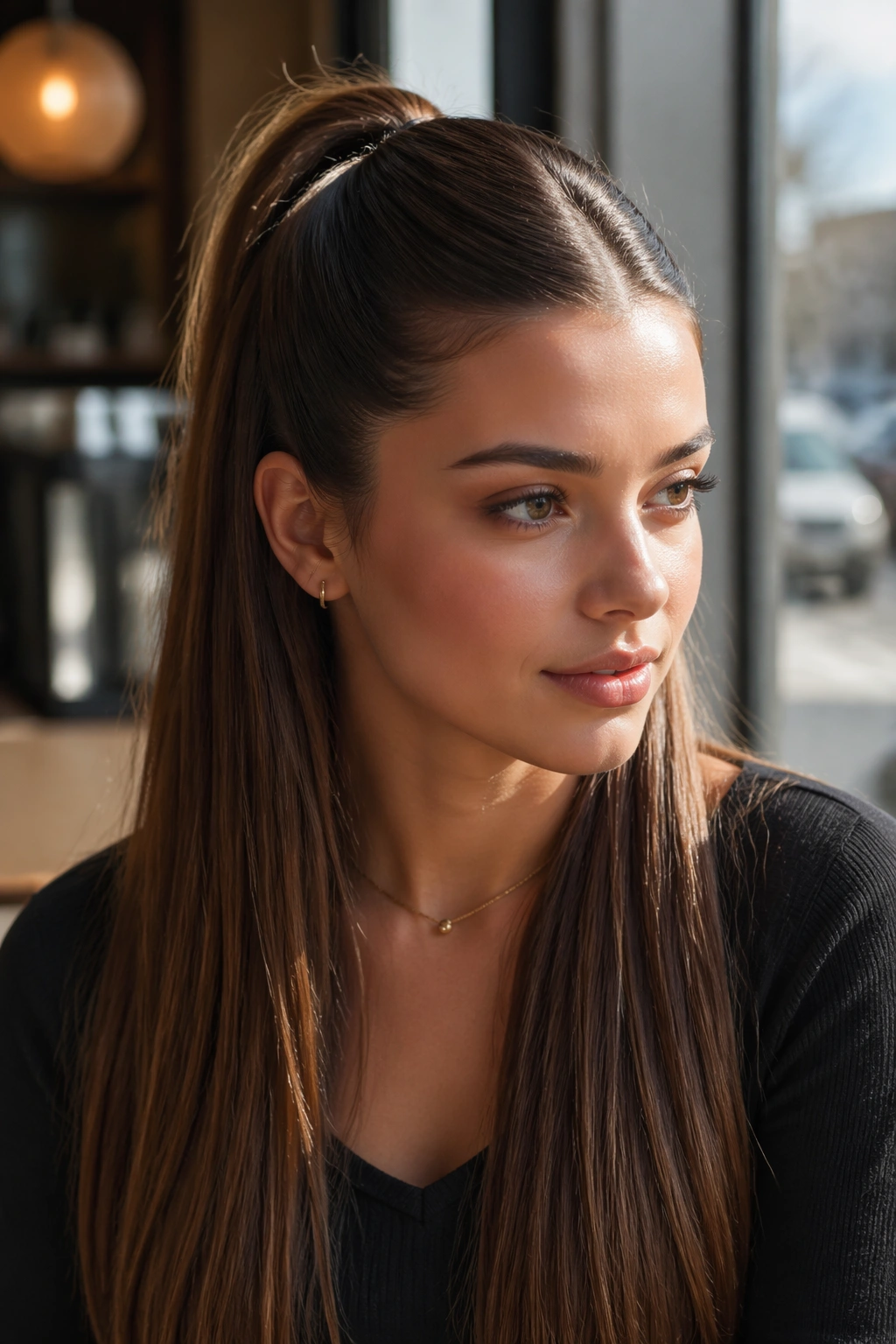
A center part can be unforgiving, which is exactly why a sleek straight half-up ponytail needs to be done carefully. If the part is clean and the crown is smooth, the whole style looks sharp in a good way. If it’s uneven, you see every mistake.
Start with straightened or naturally straight hair. A light serum on the mid-lengths and ends helps the hair lie flat without making the roots greasy. Gather the top half from temple to temple, secure it, and then smooth the front hairline with the flat side of a brush or a little edge control if your hair type likes it.
Tiny sentence. Big difference.
This version works especially well with glossy hair and minimal accessories. No ribbon needed. No extra braid required. The beauty is in the line itself. It’s a clean, crisp shape that still leaves your length visible, which is why it never feels too severe for everyday wear.
16. Half-Up Ponytail for Short Hair
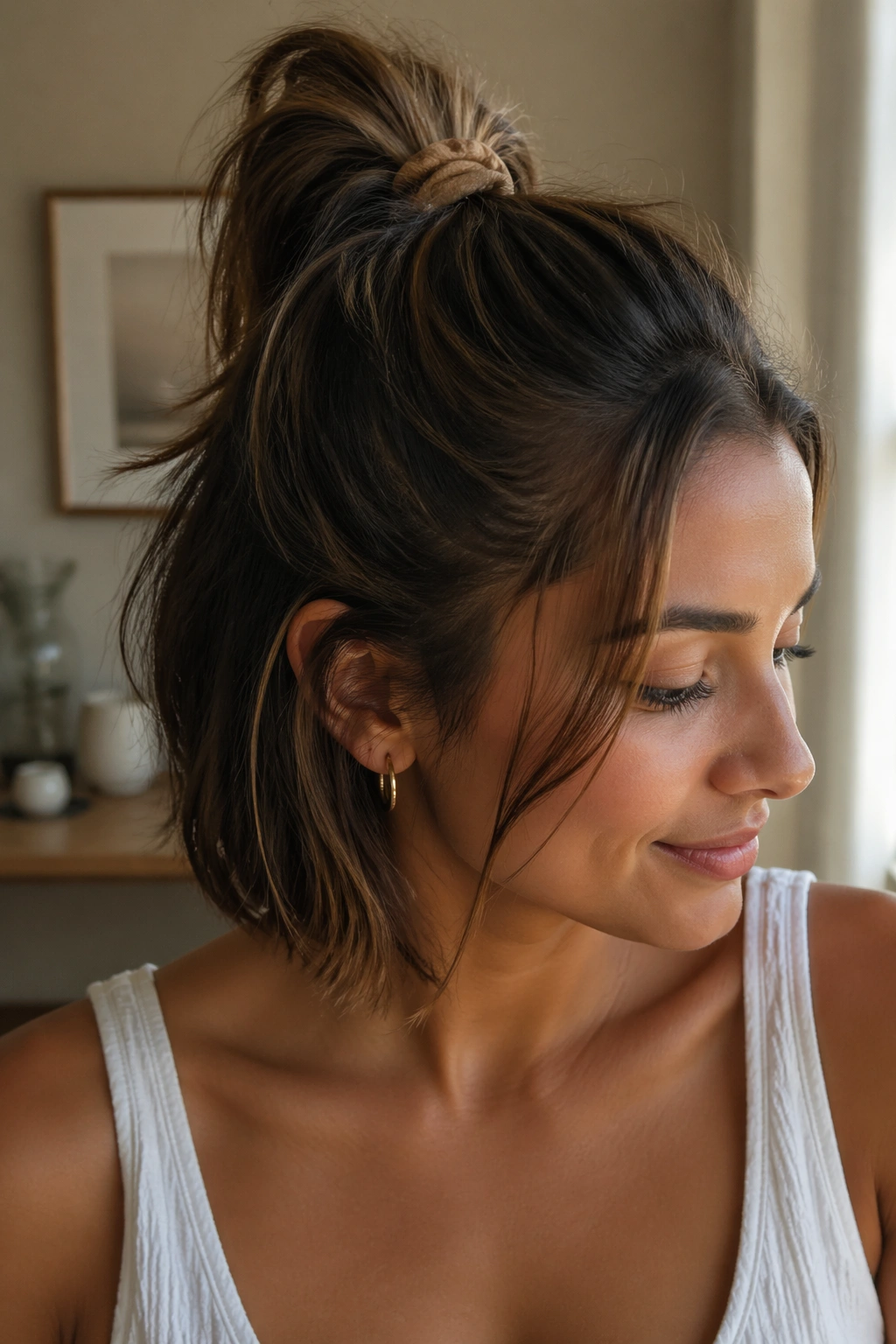
Short hair can absolutely handle a half-up ponytail, but the section has to be smaller and the placement more thoughtful. Shoulder-length hair or even a bit shorter can work if you keep the ponytail centered high enough to lift the crown but not so high that the bottom falls apart.
A small elastic is usually better than a thick one. The goal is hold, not bulk. If the top layer is too short to wrap, a decorative clip can hide the elastic and keep things tidy. Sometimes that’s the cleanest option.
What to watch for
Pieces near the nape may slip out faster, so pin them under the section if needed. A little spray on the underside helps more than people expect. The top should stay smooth while the bottom keeps its shape.
This is a good style when you want the feeling of tied-back hair without losing the swing and fullness of the shorter cut. It’s compact. It works. That’s enough.
17. Half-Up Ponytail for Thick Hair
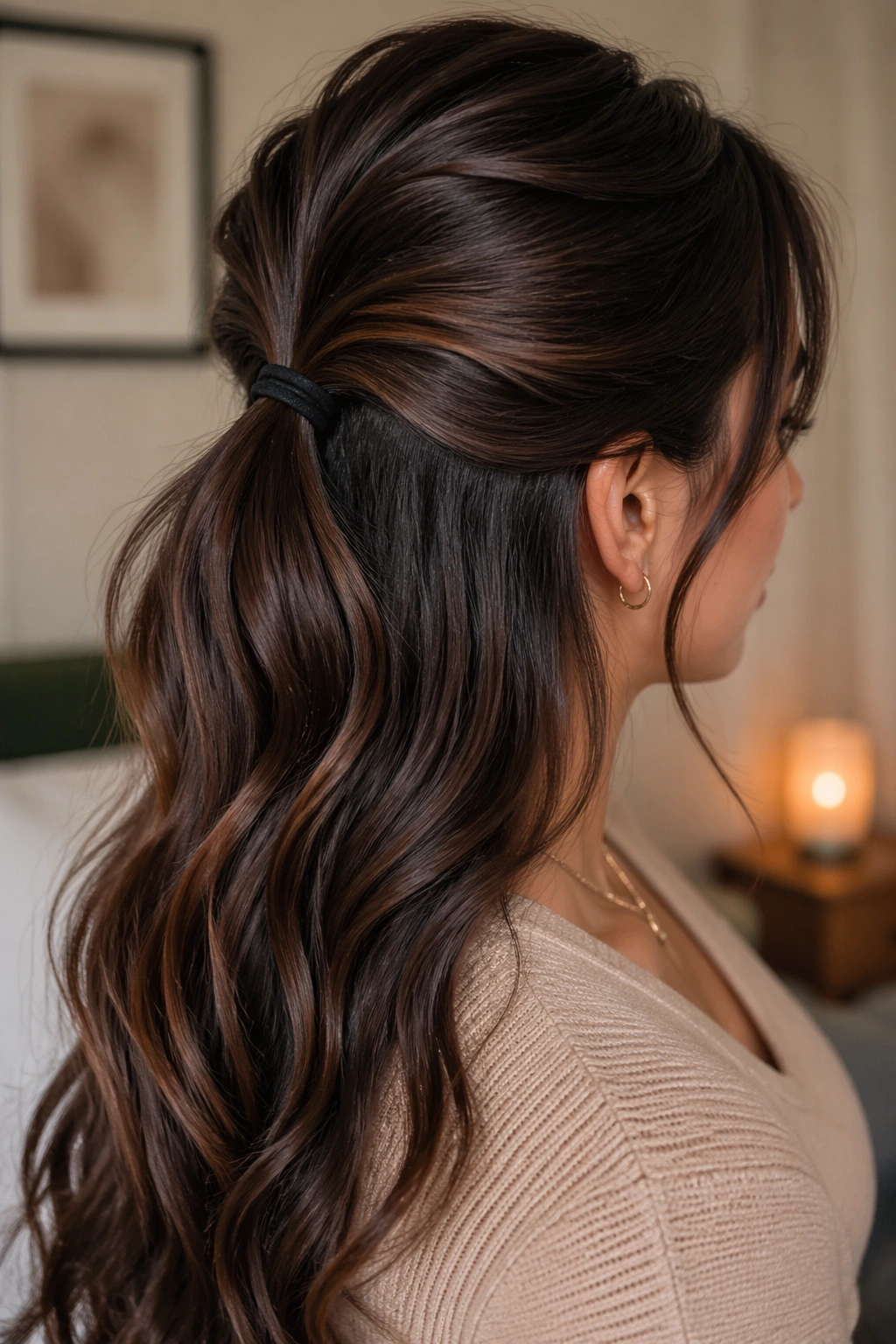
Thick hair looks gorgeous in a half-up ponytail, but it also has opinions. If you grab too much at once, the top section can get heavy and slide. If you grab too little, the style loses balance. I usually divide the top into two smaller sections first, then join them in the back so the weight spreads out more evenly.
Use a strong elastic. Thin little hair ties will fail. A fabric-covered band or a spiral tie usually holds better and leaves fewer dents. You may also need a second pin at the base if the hair is dense and wants to tip backward.
This style shines when you want the top controlled and the bottom full. Thick hair can look almost sculptural that way. A little wave in the lower half keeps it from feeling blocky.
And yes, it takes a few extra seconds. Worth it.
18. Half-Up Ponytail with Hidden Braid Base
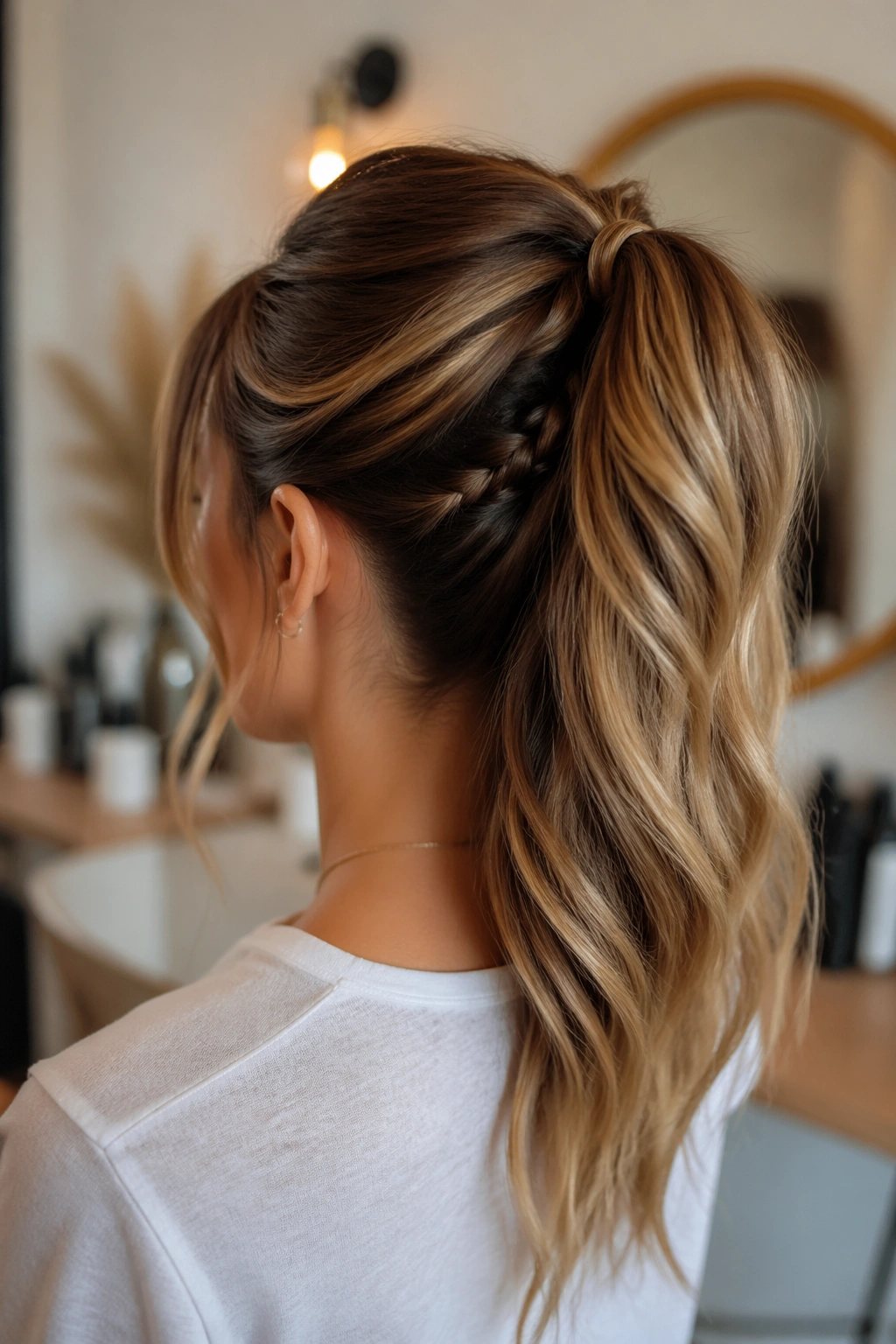
A hidden braid base is one of those details nobody notices at first and everyone feels. You braid a small strip under the top section, then cover it with the ponytail so the braid acts like a secure anchor. It gives the hairstyle grip, which is gold if your hair slips out of elastics by noon.
Start with a narrow braid at the back of the crown. Keep it flat against the head. Then gather the rest of the top hair over it and tie the ponytail directly on top. The braid stays concealed, but it gives the style a bit of structure underneath.
How to keep it invisible
Use a braid that’s thinner than a pencil. If it’s too thick, it will show through. A small bobby pin at the braid end helps keep it flat.
This version feels like a good secret. It looks simple from the outside, but it lasts longer than a plain half-up ponytail. That’s the real appeal.
19. Half-Up Ponytail with Flipped Ends
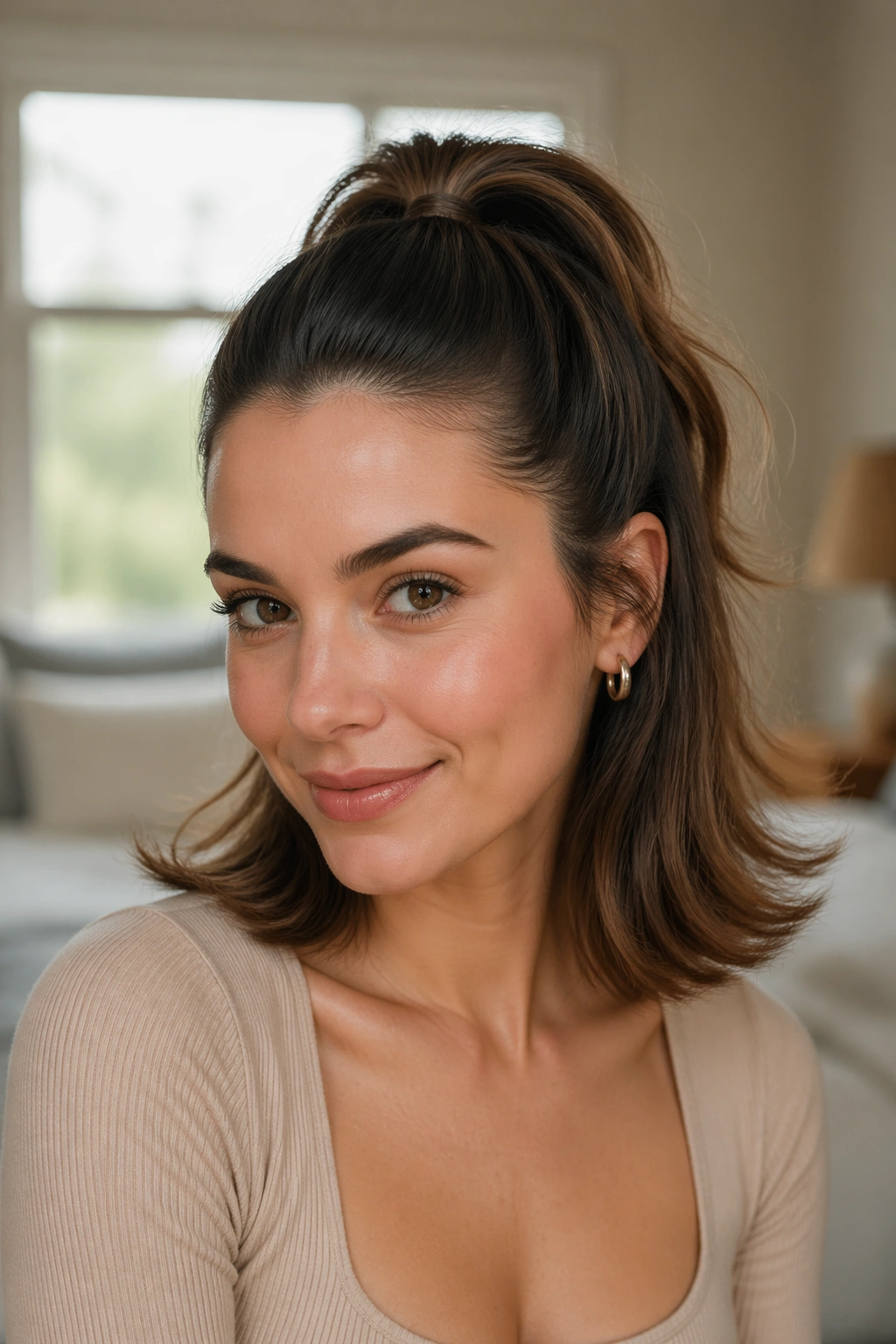
Flipped ends bring a little movement to a half-up ponytail, and movement keeps the style from looking flat. Straight ends can be fine, but a gentle flick at the bottom makes the whole shape feel more alive. A round brush and blow dryer will do it, or a flat iron if that’s what you have.
Keep the top section smooth and let the lower half turn outward at the last 2 to 3 inches. That little bend is enough. If you curl the ends too much, the style starts to read more formal than everyday. A soft flip feels friendlier.
This works especially well on medium-length hair because the ends are visible without overwhelming the face. Add a side part if the center feels too tidy. Or keep the center and let the flip do the work.
It’s a small thing, a flick at the ends. Still changes the whole mood.
20. Low Half-Up Ponytail with Soft Lift
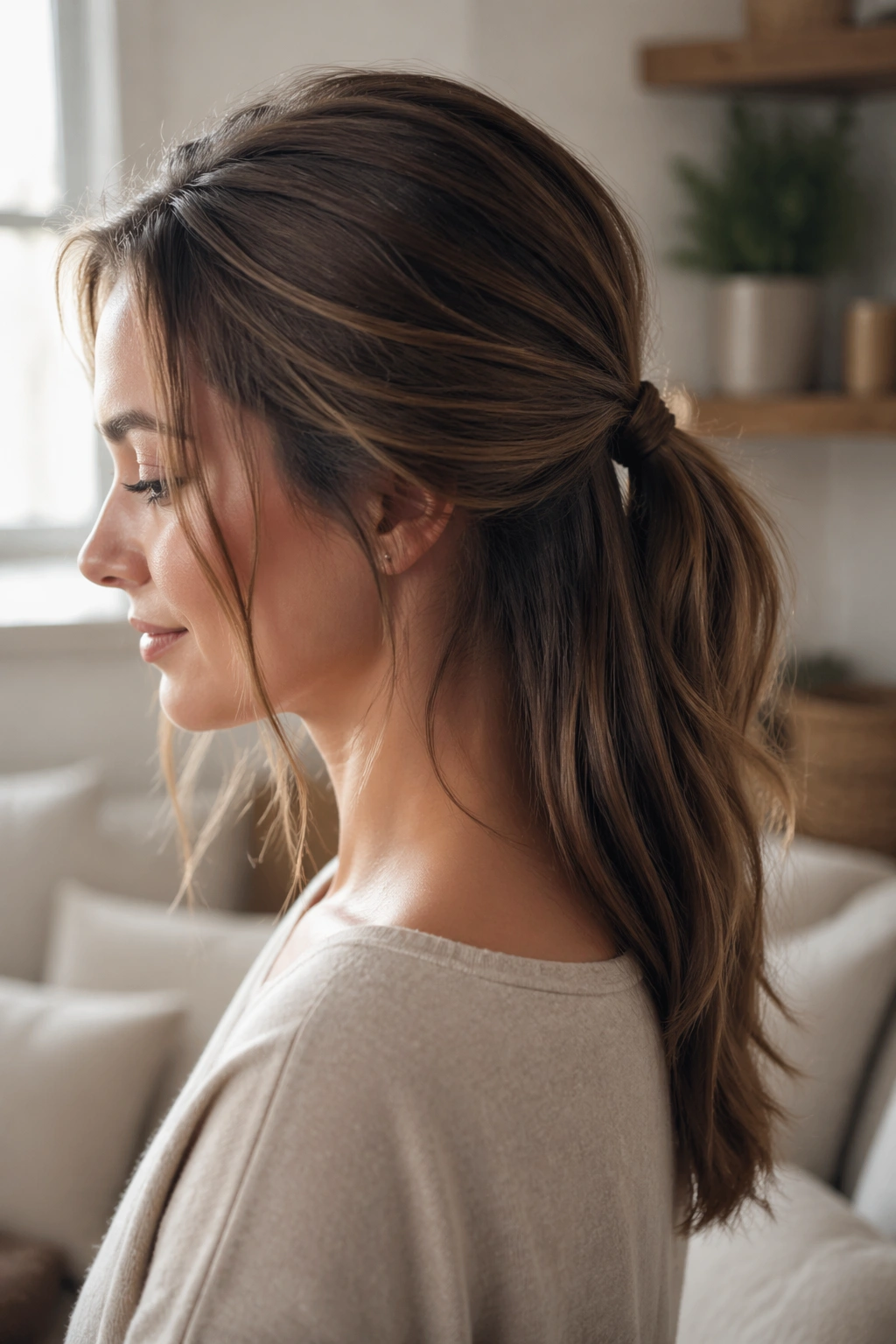
Not every half-up ponytail needs height. A low version with soft lift at the crown can be even more flattering because it keeps the hair close to the head without flattening it completely. Think gentle volume, not a teased mountain.
A fine-tooth comb can help you create a neat part, but use your fingers to lift the crown before securing it. That little bit of air under the top section makes the style feel less rigid. After tying it back, pull a few millimeters of hair loose at the crown so it sits softly.
- Best when you want a calm, low-maintenance look
- Works with straight, wavy, or slightly curly hair
- Pair with a small wrap-around strand for a cleaner finish
- A light mist of flexible hairspray keeps the lift from collapsing
This one is quietly useful. It behaves well under hats, sweaters, and scarves, which makes it more practical than it sounds.
21. Scarf-Wrapped Half-Up Ponytail
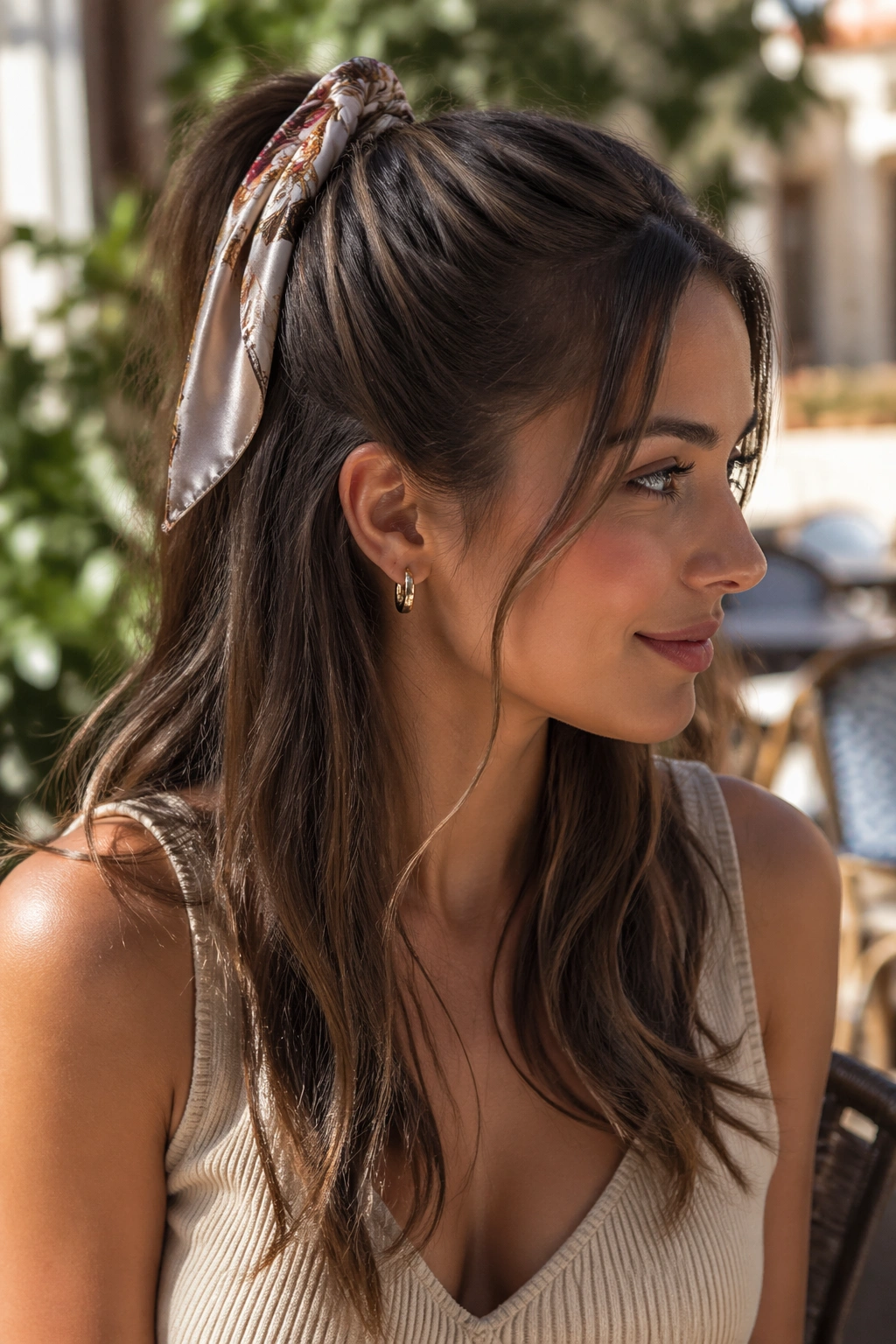
Can a scarf make a half-up ponytail feel like a complete outfit? Absolutely. A narrow scarf tied around the base adds color and movement, and it’s one of the fastest ways to make an ordinary style feel deliberate. Fold the scarf into a long strip, tie the ponytail first, then knot the scarf around it so the fabric sits flat.
Picking the right scarf
A silk or satin scarf slides less and looks cleaner at the base. Cotton works too, but it can feel bulkier. Keep the print simple if your outfit already has a lot going on. If the clothes are plain, a bolder pattern can carry the whole look.
The scarf should not smother the ponytail. Let the ends hang a little. That loose movement is what makes it feel easy instead of costume-like.
I like this version for brunch, errands, or any day that could use one small color choice. Not dramatic. Just enough.
22. Polished Office Half-Up Ponytail
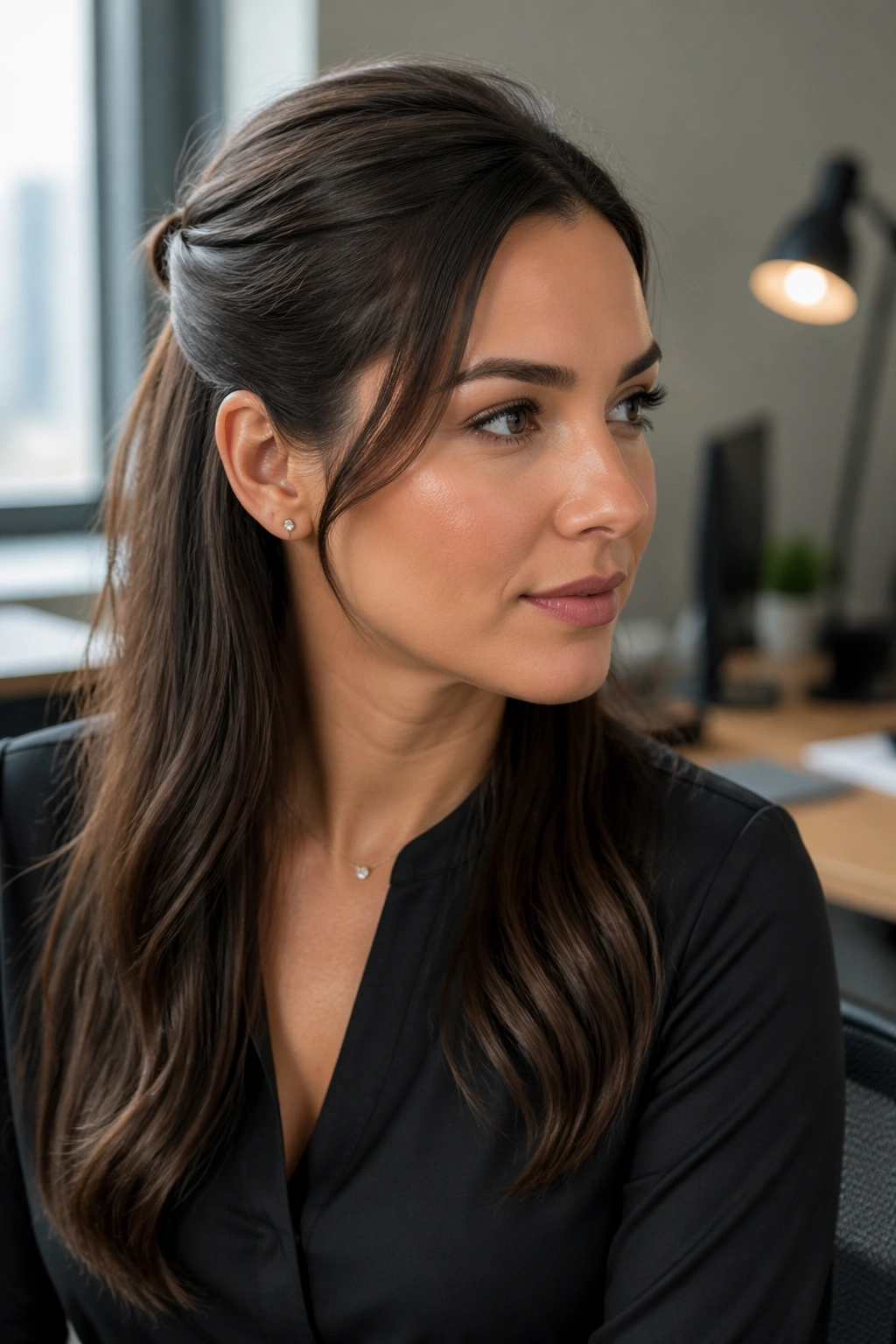
A half-up ponytail can be office-appropriate if the lines are clean and the crown is calm. No floppy bits. No giant volume at the top. Just a neat section tied low or mid-height, with the rest of the hair brushed smooth and tucked into place.
Use a paddle brush to flatten the surface and a small amount of serum on the ends. If flyaways around the hairline bother you, spray a little product onto a toothbrush and smooth them down. That tiny fix works better than blasting the whole head with hairspray.
This style is good when you want to look put together without wearing your hair fully down. It keeps your face open during work and still looks soft enough for after-hours plans.
One caveat. Keep it subtle. The more restrained the shape, the better it reads in a professional setting.
23. Boho Half-Up Ponytail with Micro Braids
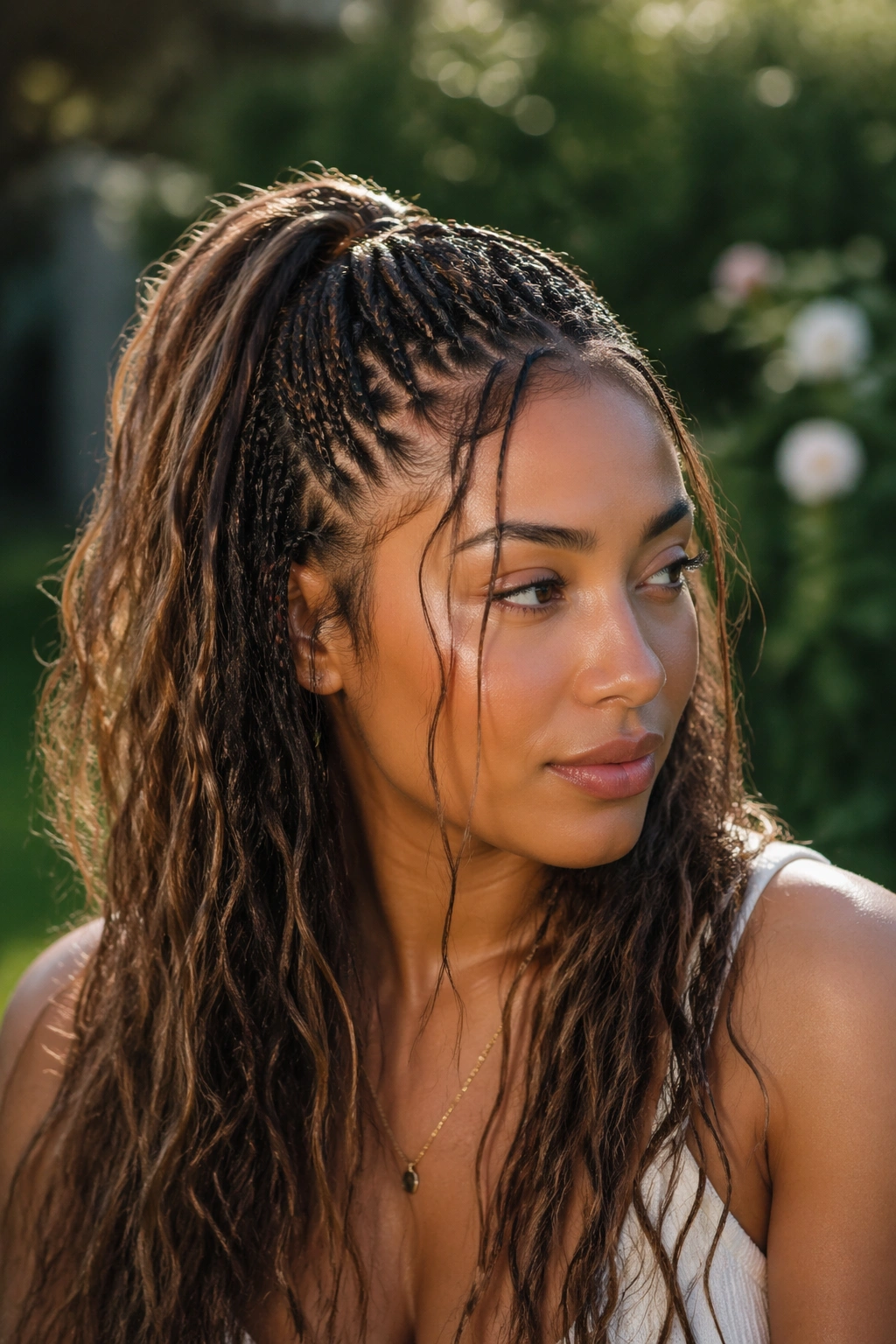
Micro braids are tiny enough to add texture without taking over the style. That’s what makes them useful in a boho half-up ponytail. Add two or three very slim braids through the top section, then tie the whole thing back loosely so the braids peek through the crown and side pieces.
The hair around them should stay relaxed. If you over-smooth everything else, the braids look pasted on. A little lived-in wave helps them blend. You can even leave the front pieces loosely bent to keep the look soft.
This style is best when you want detail but don’t want a heavy accessory. It gives the hair a handmade feel, which is harder to fake than it sounds. The braids don’t have to be perfect. They just need to be small and evenly placed.
There’s a reason this version keeps hanging around. It looks like effort, but not too much of it.
24. Bow-Clip Half-Up Ponytail
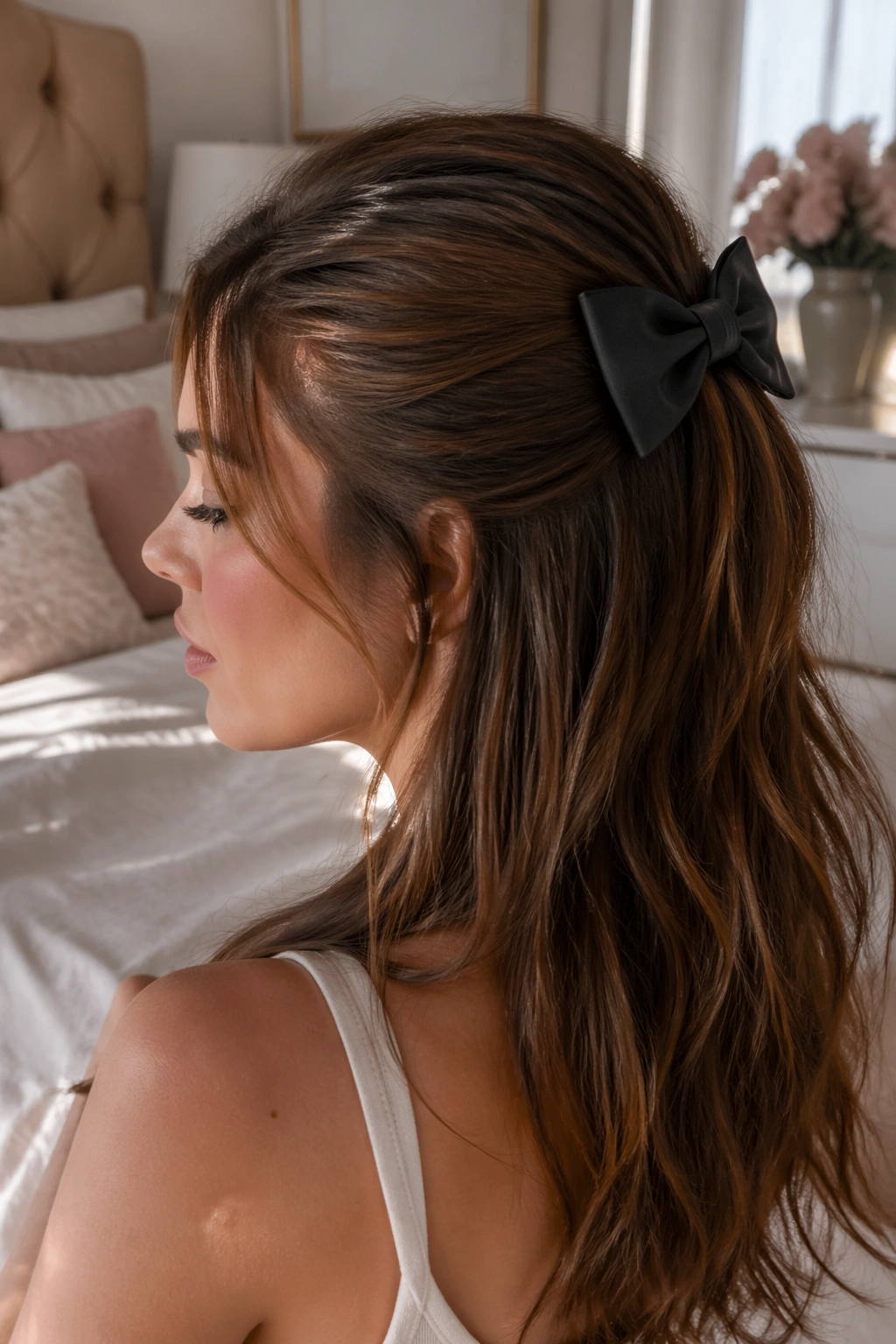
A bow clip is different from a tied ribbon. A clip has structure, and that structure gives the style a clean finish with almost no fuss. If the ribbon version feels too loose for your taste, the bow clip keeps the shape tidy and adds a single point of focus.
Place it right over a small elastic at the back of the head. That hides the mechanics and leaves the bow to do the decorative work. Smaller bows read more everyday; oversized ones can tilt the style toward playful or dressy depending on the fabric.
Good ways to wear it
- Use a matte fabric bow for casual outfits
- Choose satin if you want a softer, dressier feel
- Keep the ponytail section smooth so the clip stands out
- Let the lower hair stay straight or softly waved
This is one of the fastest ways to make a half-up ponytail feel finished. Not complicated. Just tidy with a little personality.
25. Crown-Twist Half-Up Ponytail
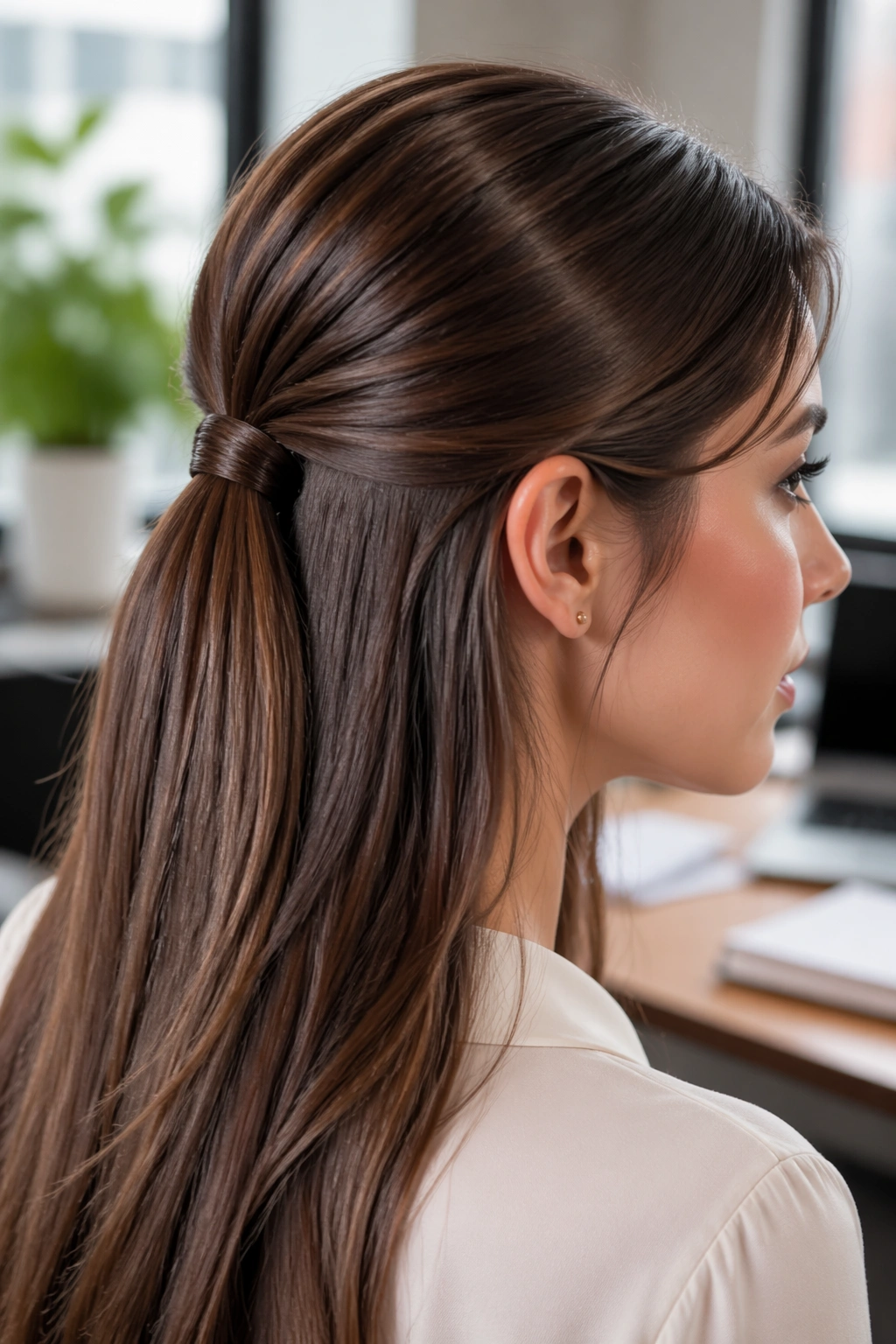
A crown twist looks more intricate than it is, which is nice when you want the appearance of effort without the headache of a full braided crown. Take a section from each side of the head near the temples, twist them back, and pin them where they meet before gathering the rest into a half-up ponytail.
The main difference between this and a standard twist is placement. Here, the twists sit a bit higher and closer to the hairline, almost like a soft frame around the top of the head. That makes the style feel more polished and a little more romantic.
Where it works best
It suits medium to long hair, especially if there’s some bend in the length. On very straight hair, the twist can look a touch plain unless you add texture first. On curly hair, it becomes softer and fuller.
Use two bobby pins per side if your hair is heavy. One pin is often not enough. That’s the practical part nobody likes hearing, but there it is.
26. Half-Up Ponytail on Second-Day Hair
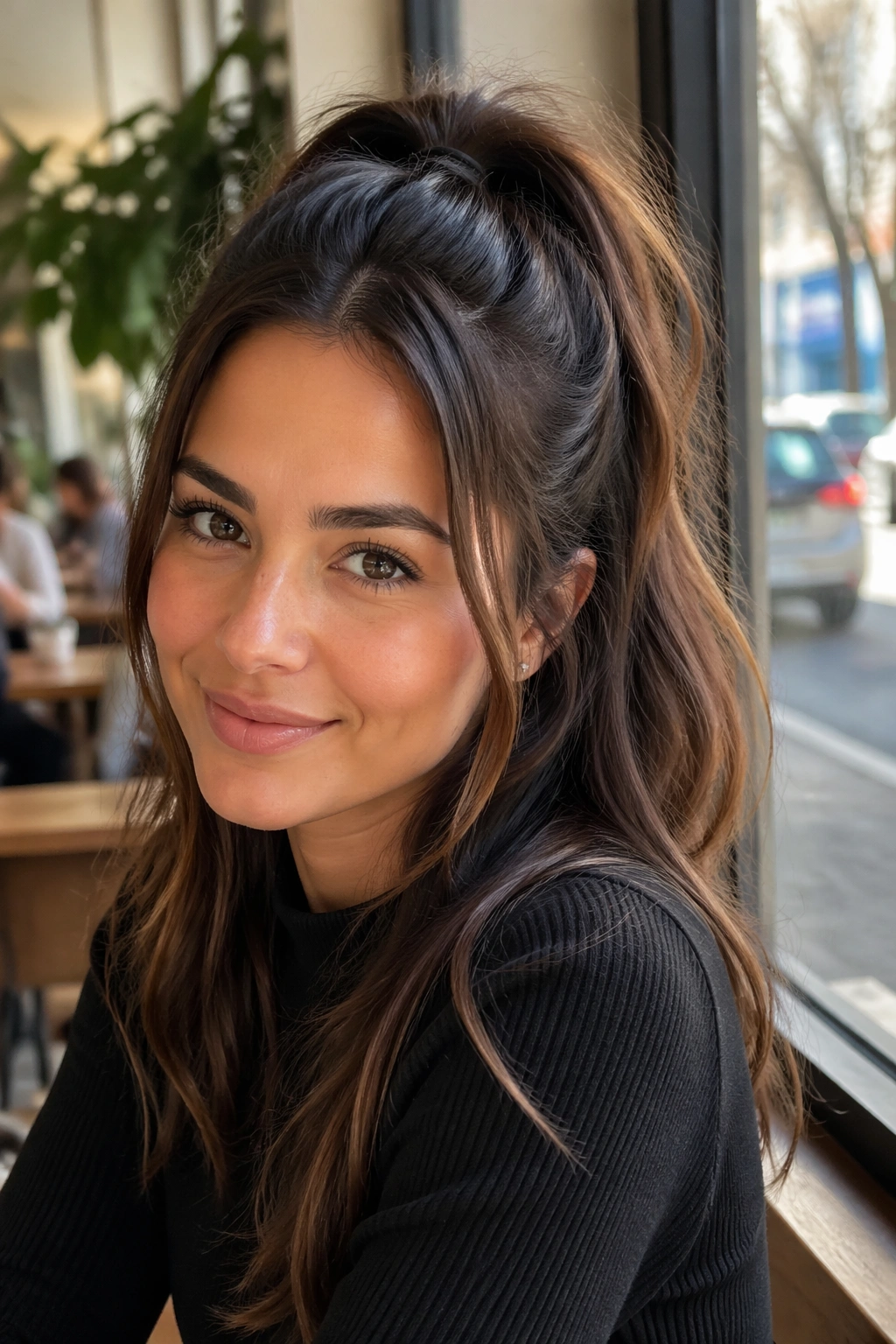
Second-day hair is often the best hair for a half-up ponytail. It has a little grip, a little texture, and a lot less attitude than freshly washed hair that slips around like it owns the place. The top section holds better, the ponytail sits with more body, and you usually need less product.
Start by refreshing the roots with dry shampoo or a tiny bit of texture spray. Then shake the hair loose with your fingers. A brush can make second-day hair look too flat or too puffy, depending on the texture. Fingers are safer.
A half-up ponytail on day two can lean polished or messy depending on how much you smooth the crown. That flexibility is why I like it. You don’t have to force the hair into one fixed mood.
- Great for busy mornings
- Easy to pair with clip-ins or accessories
- Better hold than freshly washed hair
- Less likely to collapse by lunch
Some styles are just made for hair that has lived a little.
27. Crimped Half-Up Ponytail
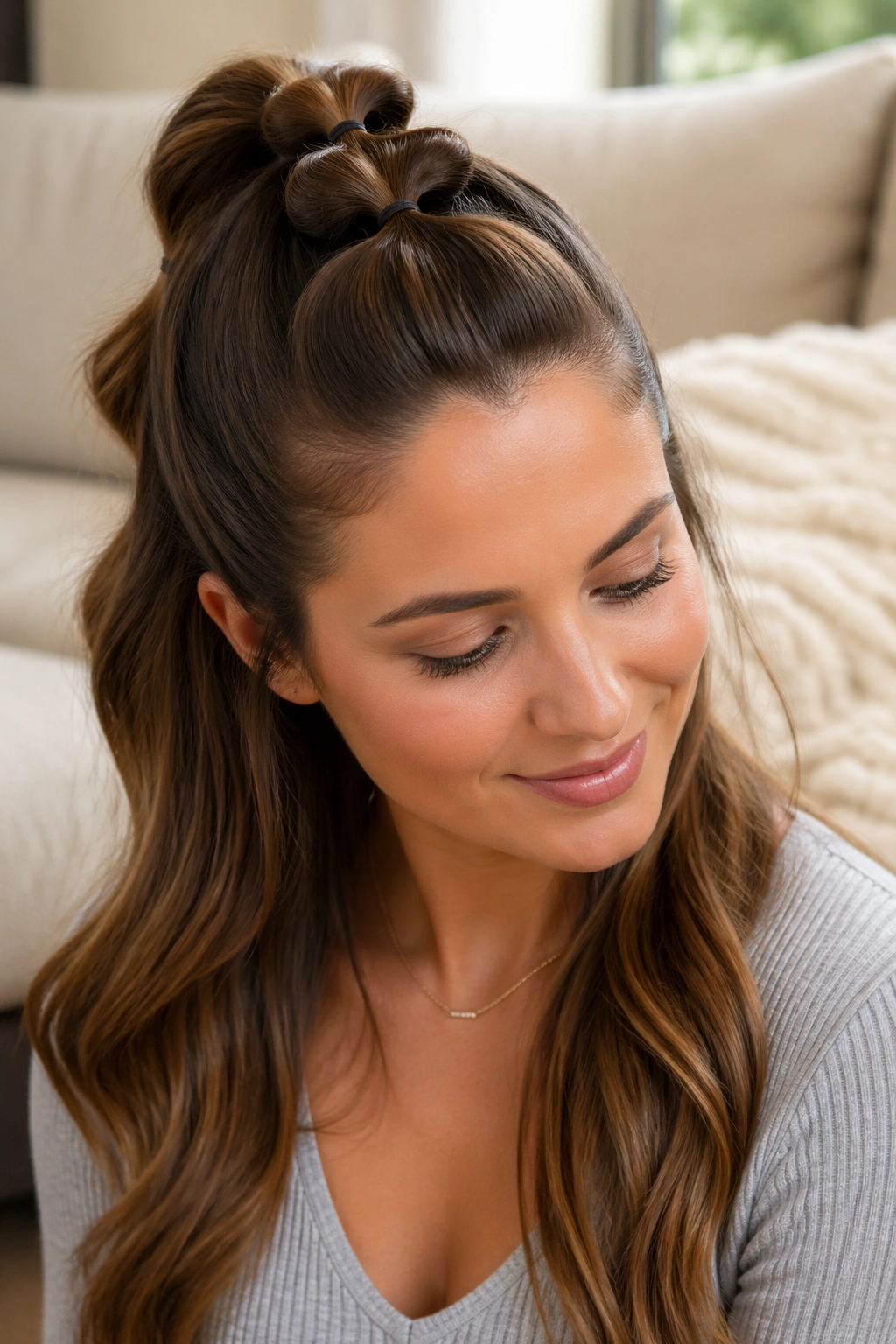
Crimped hair brings a sharp texture that works well in a half-up ponytail because the pattern adds thickness at a glance. It’s not the softest look in the bunch, and that’s the point. If you want something that feels a little playful and stays visible from across the room, crimping does the job.
You do not need to crimp every strand. Even crimping the top section only can change the shape enough. Tie the half-up ponytail after the texture is in place so the pattern reads clearly. If the roots are flat, the whole style can lose the effect.
This version is best when you want grip. Crimped hair tends to hold elastics better than silky straight hair. It also hides small section lines, which is useful if your parting skills are having an off day.
It’s a bold look, sure. Still wearable. Especially with plain clothes.
28. Blowout Half-Up Ponytail
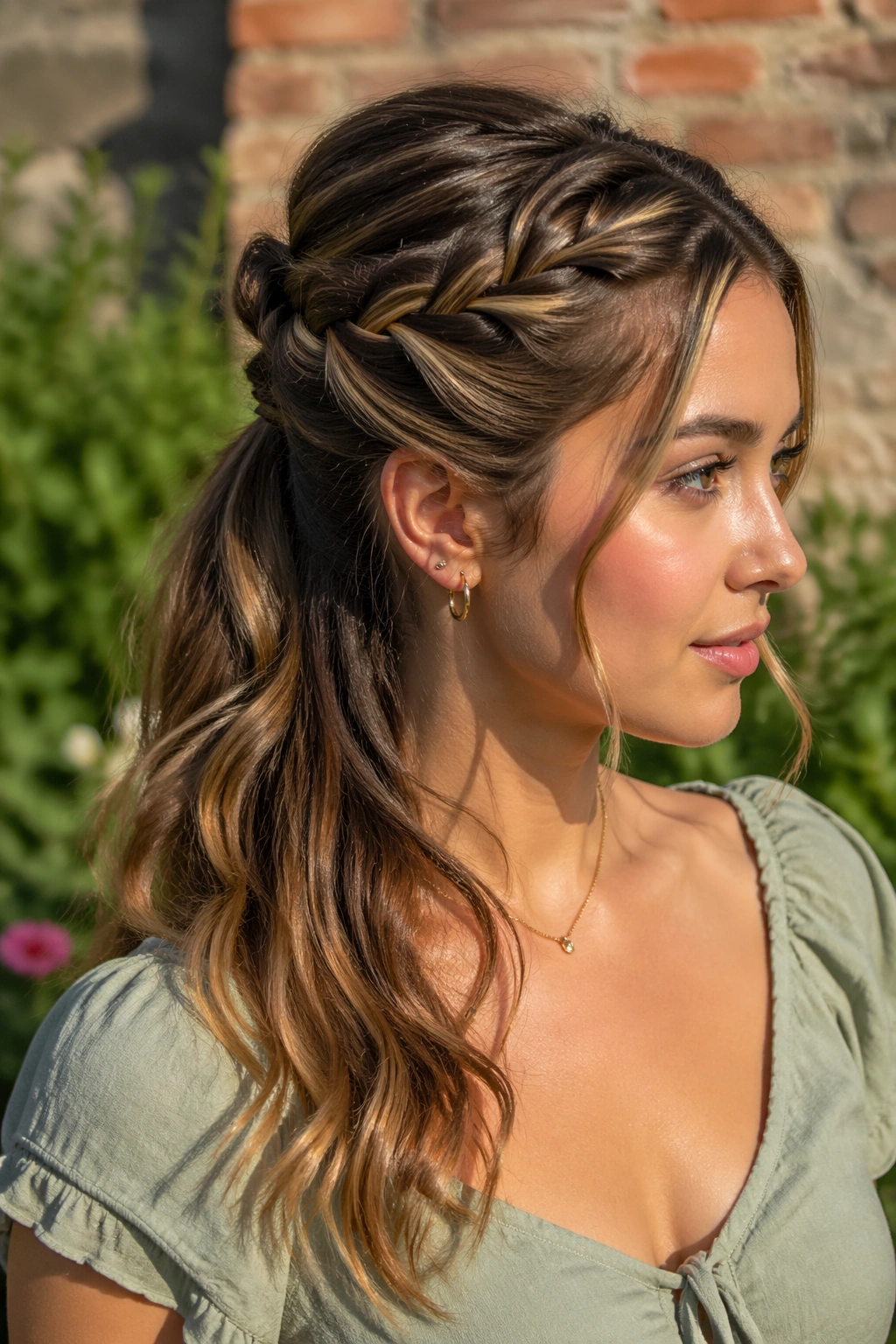
A blowout half-up ponytail is all about movement. The roots lift a little, the ends curve under or out, and the style looks like it remembers being in a salon, even if you did it in your bathroom. A round brush and a blow dryer help, but even a rough version can work if the ends are shaped nicely.
What makes it feel like a blowout
The crown should have soft volume, not stiffness. The loose lengths should bend in a smooth arc. A light shine spray on the ends can make the hair look finished without flattening it.
- Use a medium round brush for the front sections
- Roll the ends away from the face or under, depending on your shape
- Keep the half-up section lifted at the crown
- Pin any awkward layers underneath
This is the style for when you want hair that moves when you move. A lot of half-up ponytails are practical; this one is practical with a bit of swing.
29. Curled-End Half-Up Ponytail
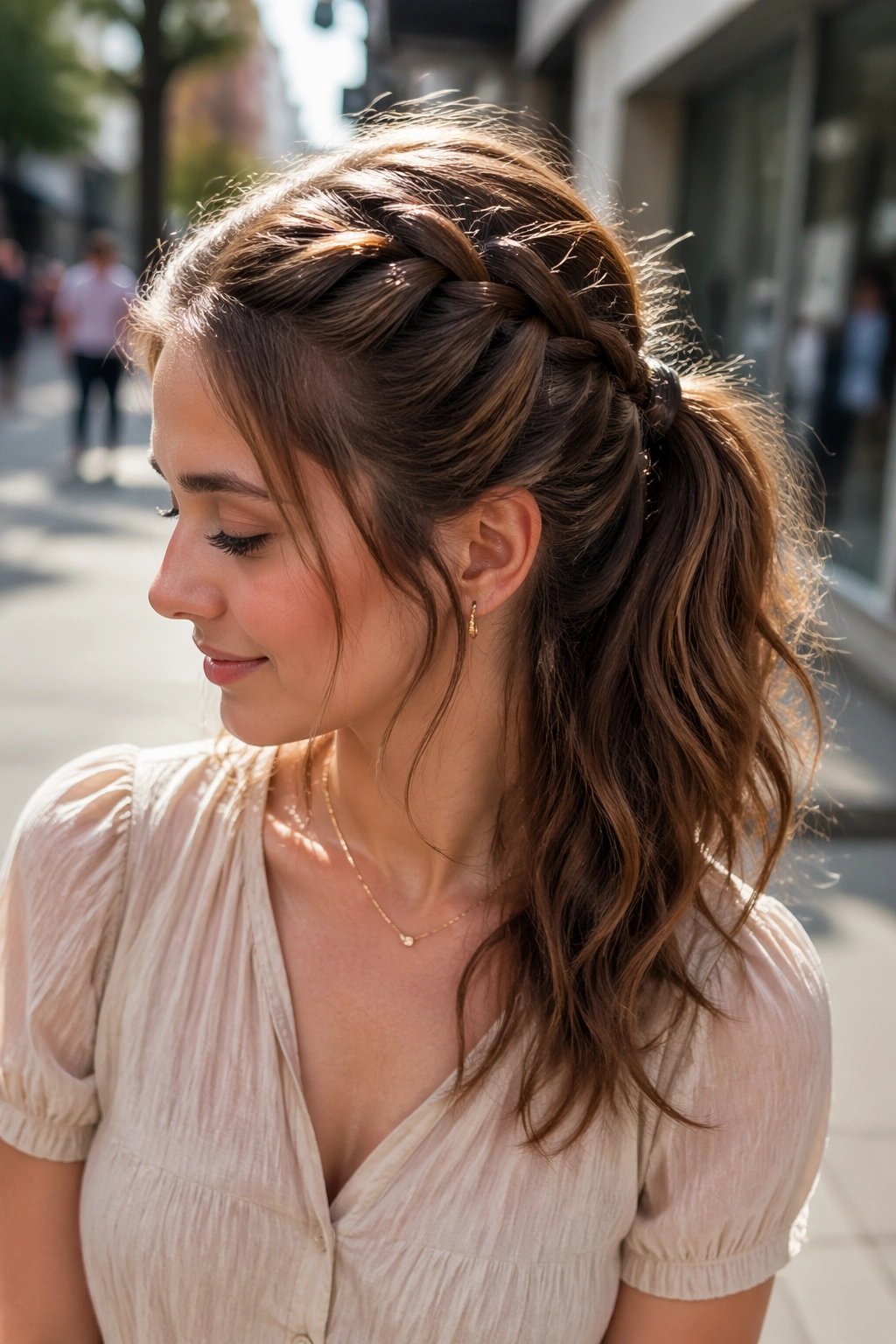
If you want the simplest possible way to soften a half-up ponytail, curl only the ends. Leave the crown smooth, tie the top section back, then add a loose bend to the bottom length with a curling iron or hot brush. That contrast keeps the style from getting too fluffy at the top.
The reason it works is contrast. Smooth roots keep the shape neat, and curled ends keep the hair from hanging straight like a curtain. The result feels softer and more finished without requiring a full head of curls.
This is a nice option for straight hair that needs a little shape but not a big styling project. It also works on layered cuts because the curls help the ends blend together instead of separating into sharp lines.
You’ll want to keep the curl loose. Tight spirals can fight the everyday feel. A soft turn is enough.
30. Pearl-Pin Half-Up Ponytail
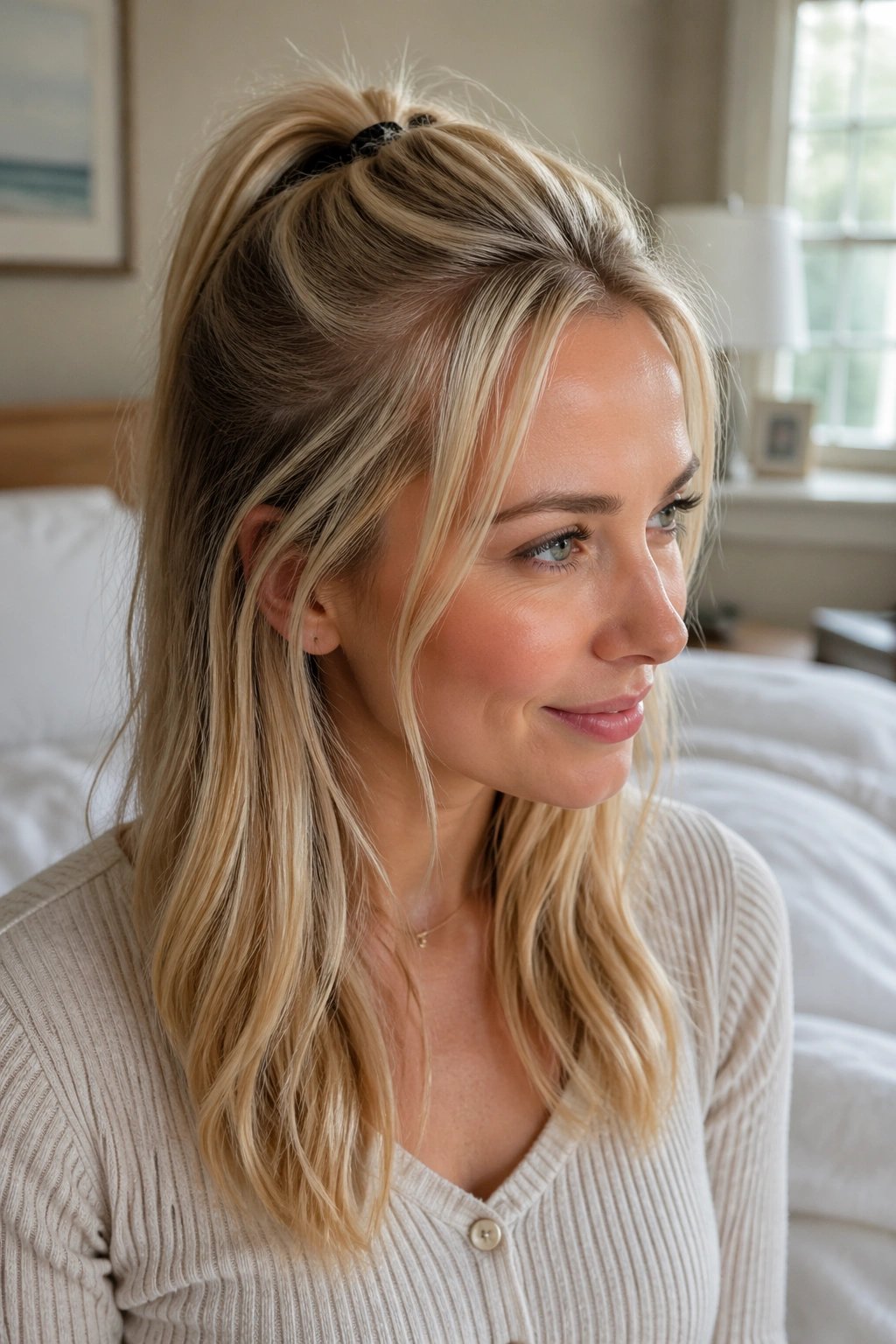
Pearl pins are one of those details that can look sweet or overdone depending on restraint. Keep them sparse, and they make a half-up ponytail feel polished in a quiet, pretty way. Use three to five pins at most, clustered near the base or tucked along one side.
The hairstyle itself should stay simple. A smooth half-up ponytail gives the pearls room to show. If the hair is too busy, the pins disappear into the mess. If the hair is too plain and too flat, the pearls can look stuck on instead of woven in.
Best way to place them
Run the pins in a loose curve, not a straight line. That shape feels softer and more natural. A side cluster usually looks better than scattering them evenly across the back.
This one is lovely for days when you want the hair to feel a little dressed up without changing the whole structure. Small detail. Big difference.
31. Minimal Half-Up Ponytail with a Hair Stick
A hair stick gives a half-up ponytail a cleaner, more minimal look than a scrunchie or bow. It works best when the top section is folded once and held in place with the stick crossing through the base. The shape stays simple, and the accessory becomes part of the line instead of sitting on top of it.
This style suits medium to thick hair best, since there needs to be enough body for the stick to grip. On fine hair, the base can slip unless you secure it with a tiny elastic first. That small backup makes a huge difference.
When to choose it
Pick a hair stick when you want something that feels neat but not decorated. It’s understated in the best sense. Good with linen, sweaters, button-downs, or anything that already has strong texture.
A plain wood stick feels calm. A polished metal one reads sharper. Either way, the style stays simple and fast, which is usually the whole point.
32. Romantic Half-Up Ponytail for Long Hair
Long hair gives a half-up ponytail more to work with, which means the style can lean romantic without getting heavy. A soft crown lift, two loose face-framing pieces, and longer lengths left to fall below the shoulders create that airy look people tend to want when they say they want “something pretty” but not too much.
A small twist or braid at the back can add shape, but the length is the real feature here. Don’t bury it. Let the ponytail sit high enough to show the contrast between the lifted top and the loose bottom. That’s what makes long hair feel interesting instead of simply worn down.
A light wave through the lower half helps the style move. Straight lengths can work too, but they can make the top section feel more severe than you want.
This version is gentle. A little soft. A little glossy. It’s the kind of style that looks best when it isn’t overthought.
33. Lazy-Day Half-Up Ponytail with a Claw Clip
Some styles are meant to survive real life, not a mirror test. The lazy-day half-up ponytail with a claw clip is one of them. You gather the top section loosely, twist it once, clip it, and move on. The hair stays out of your eyes, the crown gets a small lift, and you don’t spend ten minutes convincing it to behave.
The best version leaves a few pieces loose on purpose. A side piece tucked behind the ear, a bit of texture at the ends, maybe one shorter layer falling out near the temple. That looseness keeps it from looking accidental in a bad way. It just looks lived-in.
If your hair is slippery, rough up the crown with dry shampoo before clipping. If it’s thick, choose a medium-to-large clip with teeth that sit deep enough to hold the section. Too small, and the whole thing slides.
This is the style for grocery runs, school mornings, and those days when your hair needs to cooperate without a long conversation.
Final Thoughts
Half-up ponytails work because they sit in a useful middle ground. They’re not as committed as a full updo, and they’re not as plain as wearing your hair down. That middle space is where a lot of everyday hairstyles make sense.
The styles that last are the ones matched to the hair you actually have. Fine hair needs grip. Curly hair needs room. Thick hair needs a stronger hold. Straight hair often looks best with one small detail — a wrap, a ribbon, a flip, a braid, something that gives the shape a reason to exist.
Pick one that fits your morning, not just your mood board. That’s usually where the good hair days start.
