



Curly hair does not need to be ironed into obedience to look polished at a wedding. That is the part people keep getting wrong. A braided half up half down for bridesmaid curly hair works because it keeps the crown controlled while letting the curl pattern stay alive, so the style still moves when you walk, hug, and dance.
The best versions do not bury the texture under product. They respect the curl clump, use pins where the hair wants to hold, and leave enough softness around the face that the whole thing looks intentional without looking stiff. A braid that is too tight can flatten the root and make the ends puff out in a weird little triangle. Too loose, and it slides. Neither looks good in photos.
What matters is the shape of the dress, the density of the curls, and how much detail the bridesmaids want to share. One shoulder? That changes the balance. High neckline? That changes the weight of the braid. Soft ringlets, dense coils, waist-length waves — all of them can wear half-up braided styles, but they need different sectioning. Start with the looks that work with the curl pattern instead of trying to squash it.
1. High Crown Braid With Loose Curly Ends
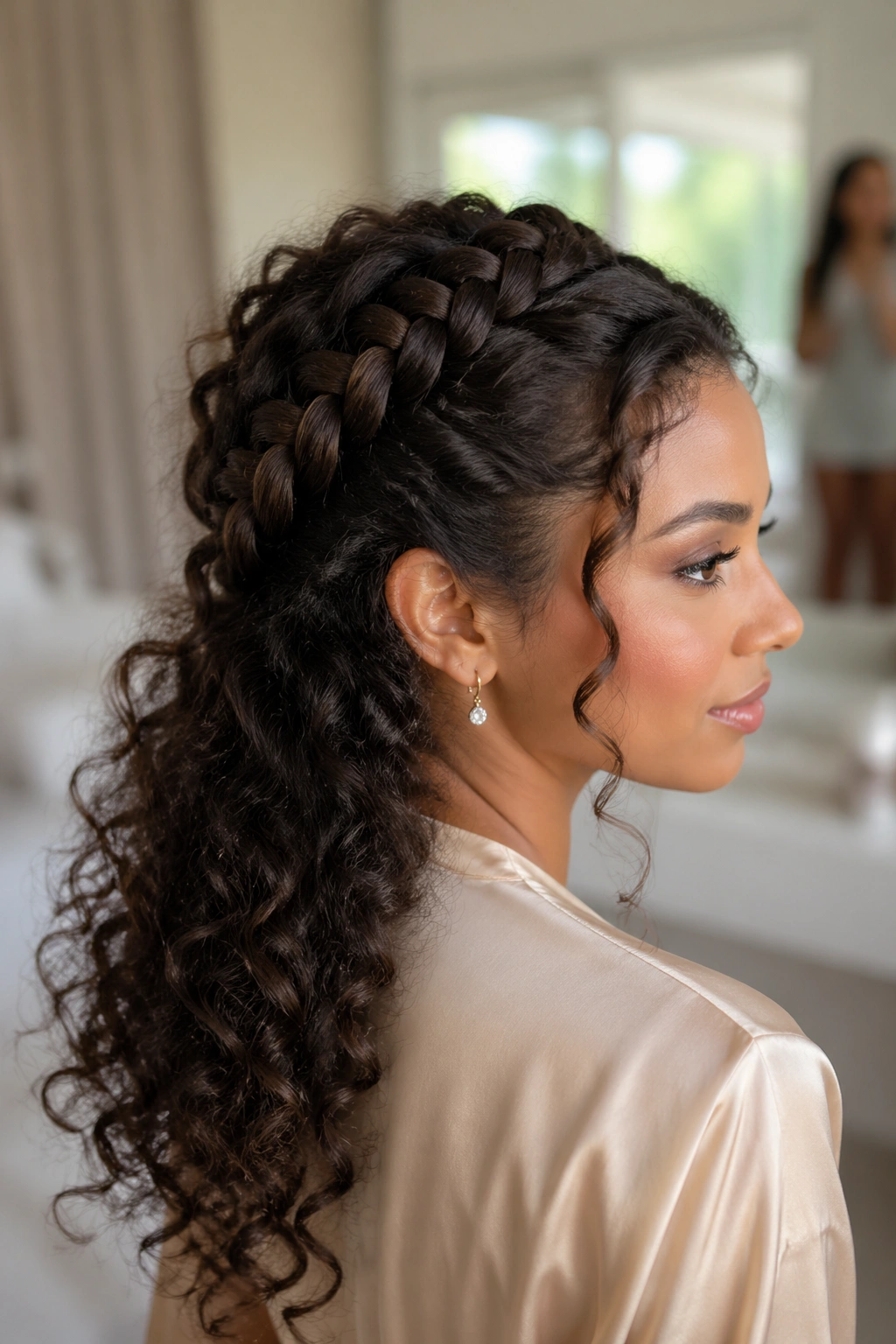
This is the cleanest version of the look. The braid sits high enough to keep the front tidy, but the lower half still reads like a cloud of curls, not a pressed-down afterthought. On curly bridesmaid hair, that balance matters.
Why it flatters curly bridesmaid hair
A high crown braid pulls attention to the eyes and cheekbones, which helps when the dress line is busy or the bouquet is full of color. It also keeps the front of the style from frizzing apart during a long ceremony. The curls stay free at the back, so the whole look keeps its shape instead of turning into a helmet.
- Works well on shoulder-length through long 2C to 3C curls.
- Sits nicely with a middle part or a soft off-center part.
- Takes pearl pins, a crystal comb, or a few tiny flowers without fighting them.
- Looks better when the braid starts a little behind the hairline, not right on it.
Tip: Leave the temple curls out until the end. Those few soft pieces keep the braid from looking stern.
2. Side Dutch Braid Into Shoulder-Skimming Curls
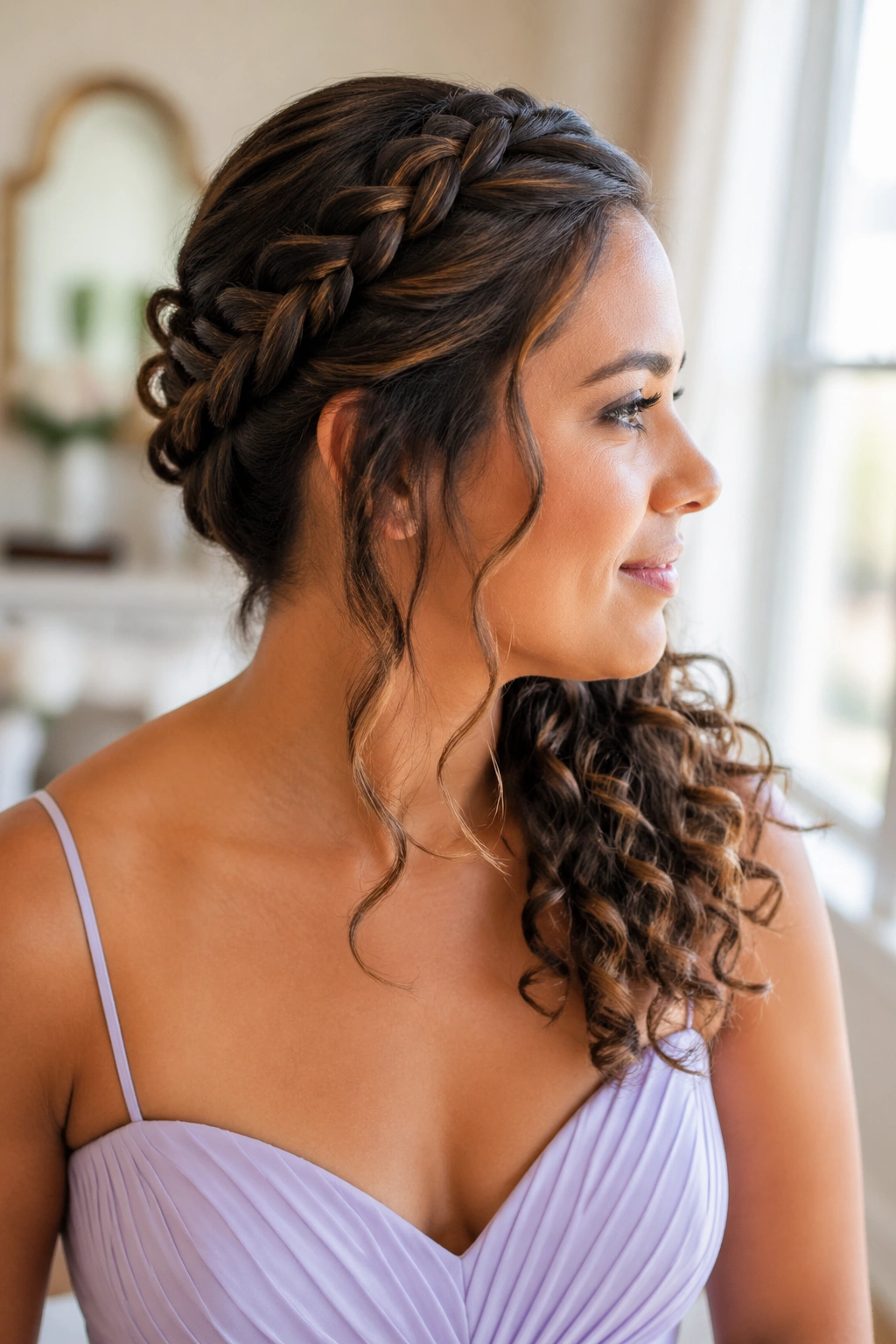
A side Dutch braid solves the “same dress, same hair” problem fast. The braid drops over one side of the head and lets the curls spill over the shoulder on the other side, which gives the style a little motion even when everyone in the bridal party is standing in a line.
This one works especially well with one-shoulder dresses or necklines that sit a little lower on one side. The braid can mirror the dress shape instead of fighting it. If the hair is thick, keep the braid section broad and loose. If the curls are finer, widen the braid gently with your fingers so it does not disappear into the texture.
No heavy teasing. No stiff spray. The braid should sit with enough lift to show the weave, then melt into the curls below.
3. Two Face-Framing Braids Joined at the Back
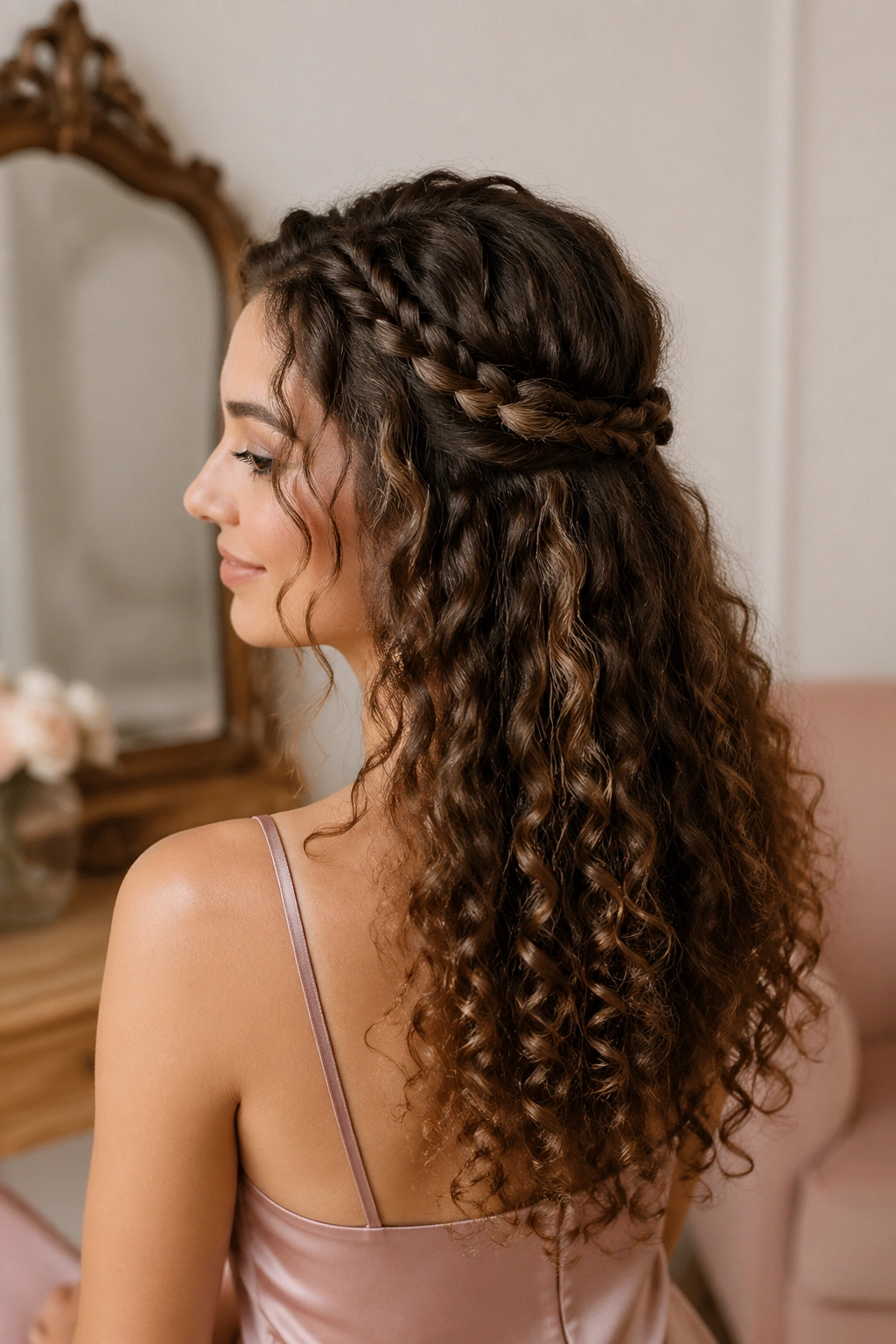
Why does this look so good on curly hair? Because it gives the front structure without stealing volume from the rest. Two slim braids start near the temples, travel back along the hairline, and meet at the center back. The curls below stay full and free.
How to keep it soft
Keep the braids narrow. That is the whole trick. If they get too chunky, they turn into the main event and the curls lose their job. A few soft pieces around the temples make the style feel less formal, which suits bridesmaid hair more than a severe, shiny finish.
This is a smart choice for people who want their hair off the face but do not want a strong side part. It also works well with glasses, drop earrings, or a neckline with small details that should stay visible.
The joined-back point can be hidden under a small clip, a pearl pin, or a wrapped strand of hair. Tiny finish, big payoff.
4. Waterfall Braid Over Defined Ringlets
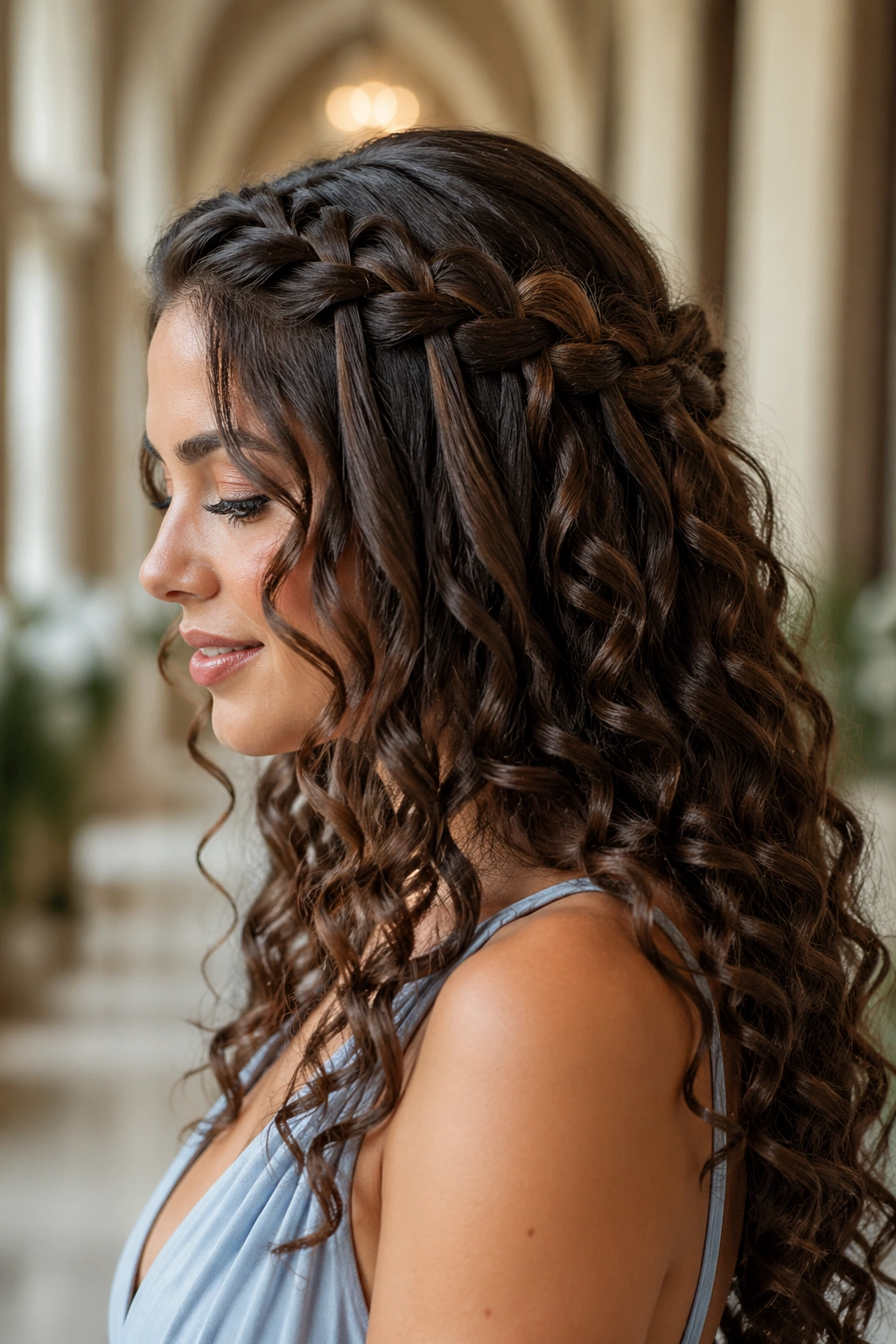
A waterfall braid is one of those styles that looks like it took forever, even when the actual braid is fairly modest. On curly hair, it works because the braid releases pieces as it moves, so the curl pattern keeps showing through instead of vanishing into the weave.
Picture a bridesmaid walking down an aisle with ringlets brushing her shoulders. The braid sits across the top half of the head, then drops strands back into the curl field below. That spacing matters. It keeps the style airy and stops the top from looking packed too tight.
- Best on medium to long curls with good definition.
- Looks strongest when the curl cream is light, not greasy.
- Works well with side parts and soft side sweeps.
- Needs a few hidden pins where the braid turns the corner.
Watch for this: if the hair is too slippery, the braid can slide. A little texture spray at the roots helps more than extra hairspray on the ends.
5. Fishtail Half Crown With Glossy Curls
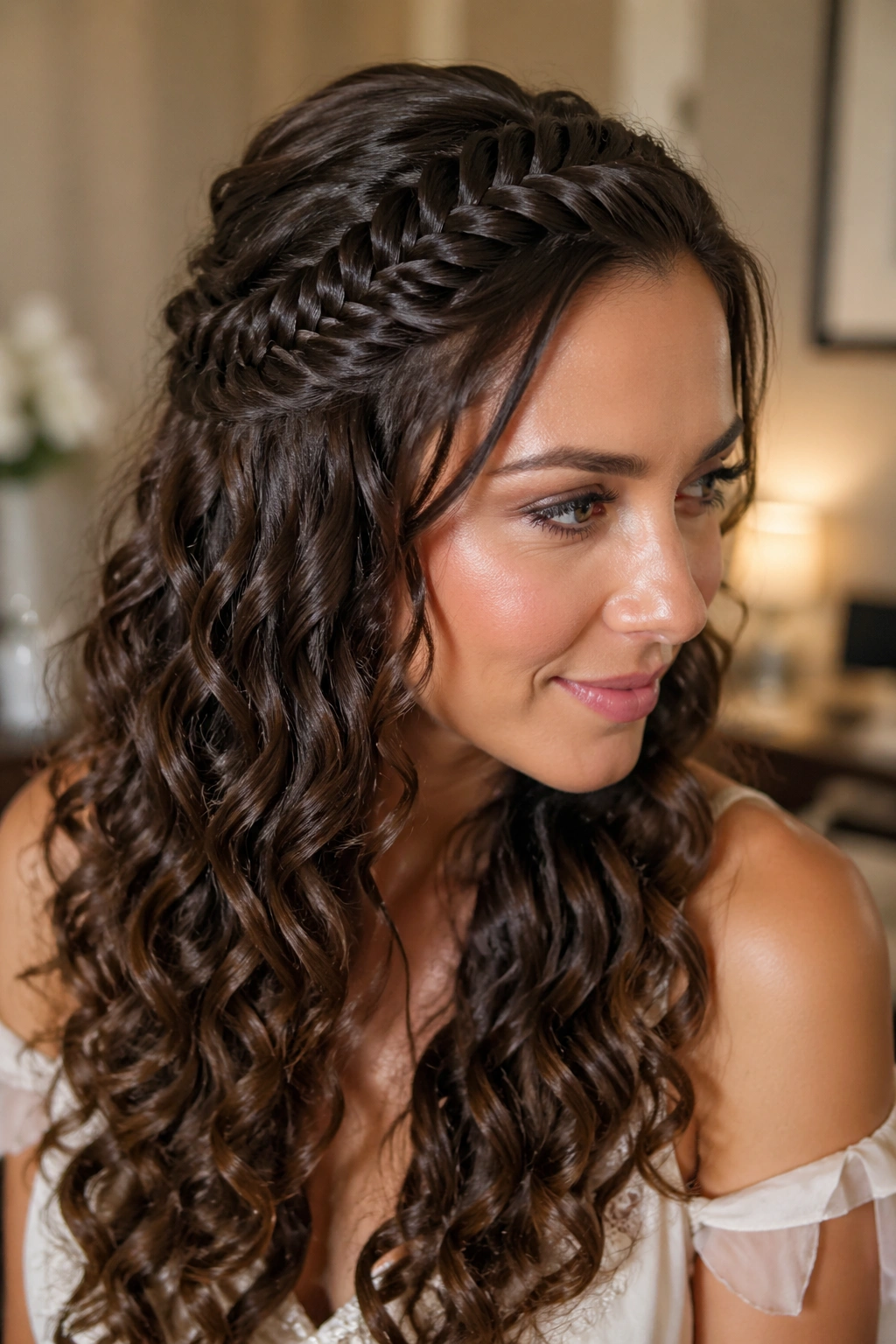
A fishtail braid has a finer weave than a standard three-strand braid, and that tiny pattern looks lovely against big curls. The contrast is the whole point. The braid feels detailed and close, while the curls underneath feel loose and generous.
This style is especially nice when the bridesmaid dress has lace, beadwork, or a neckline with fine lines. The braid echoes that detail without becoming fussy. Keep the fishtail a little loose so it does not shrink the head shape. Curly hair already brings texture; the braid only needs to frame it.
I like this one when the hair is healthy and shiny, because the braid catches the light in thin little ridges. A touch of smoothing cream on the fingers helps the weave stay neat without flattening the curls below. The finish should look touched, not shellacked. That part matters.
6. Rope Braid Half Up For Fine Curly Hair
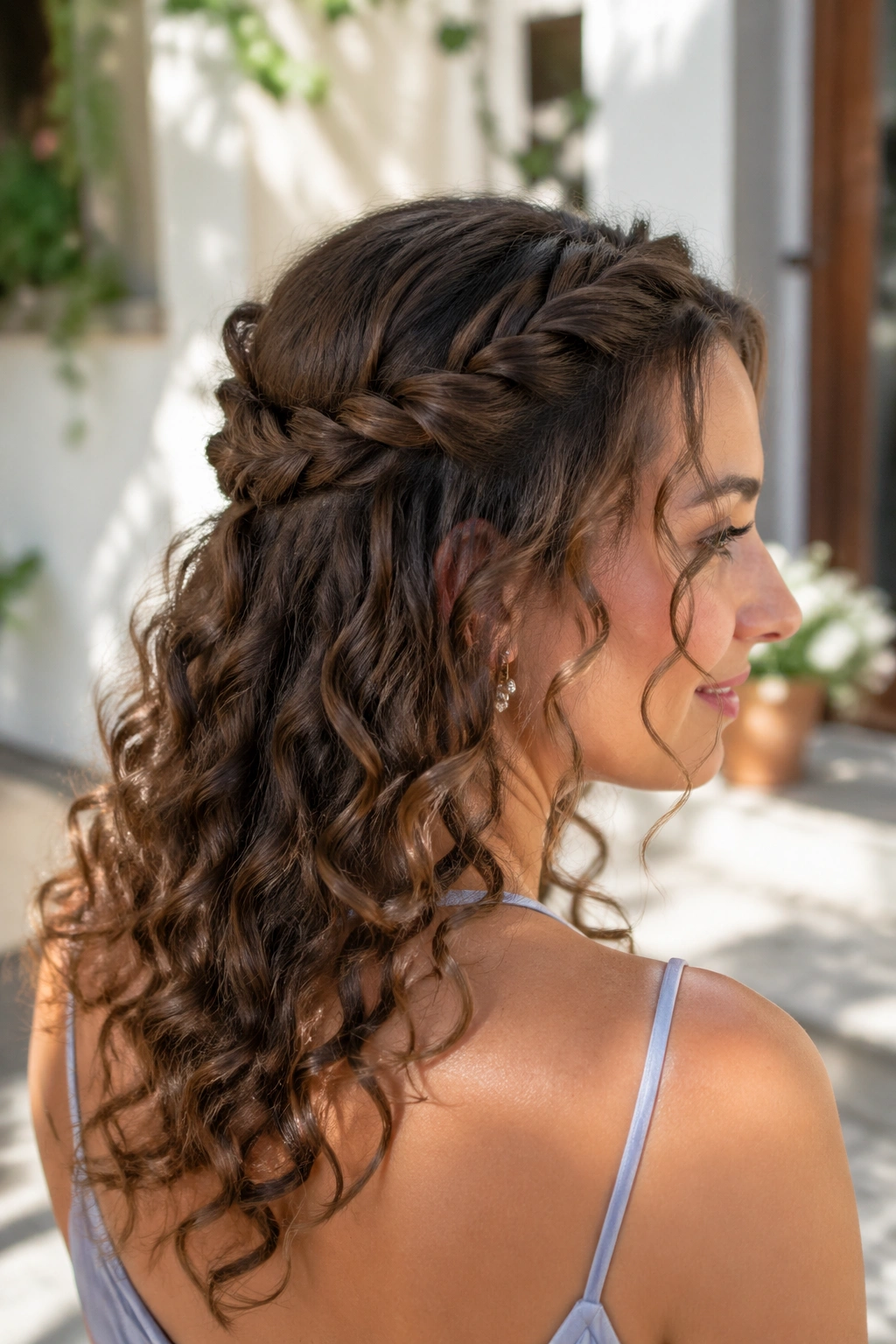
Unlike a French braid, a rope braid gives you the look of thickness without requiring a lot of hair. That makes it a good pick for finer curls or waves that collapse if you ask too much of them. Two twisted sections can read larger than they are, which is a small miracle when the hair is soft.
The style sits well on bridesmaids whose curls are more loose-wave than coil. Start with two sections at the temple, twist each one in the same direction, then wrap them around each other in the opposite direction. That opposite motion keeps the braid from unraveling. A couple of discreet pins at the back hold it in place.
This braid is also forgiving. If the curl pattern is uneven, the rope texture hides it better than a clean French braid would. It feels tidy without looking formal in a stiff way.
7. Braided Mohawk With Big Volume
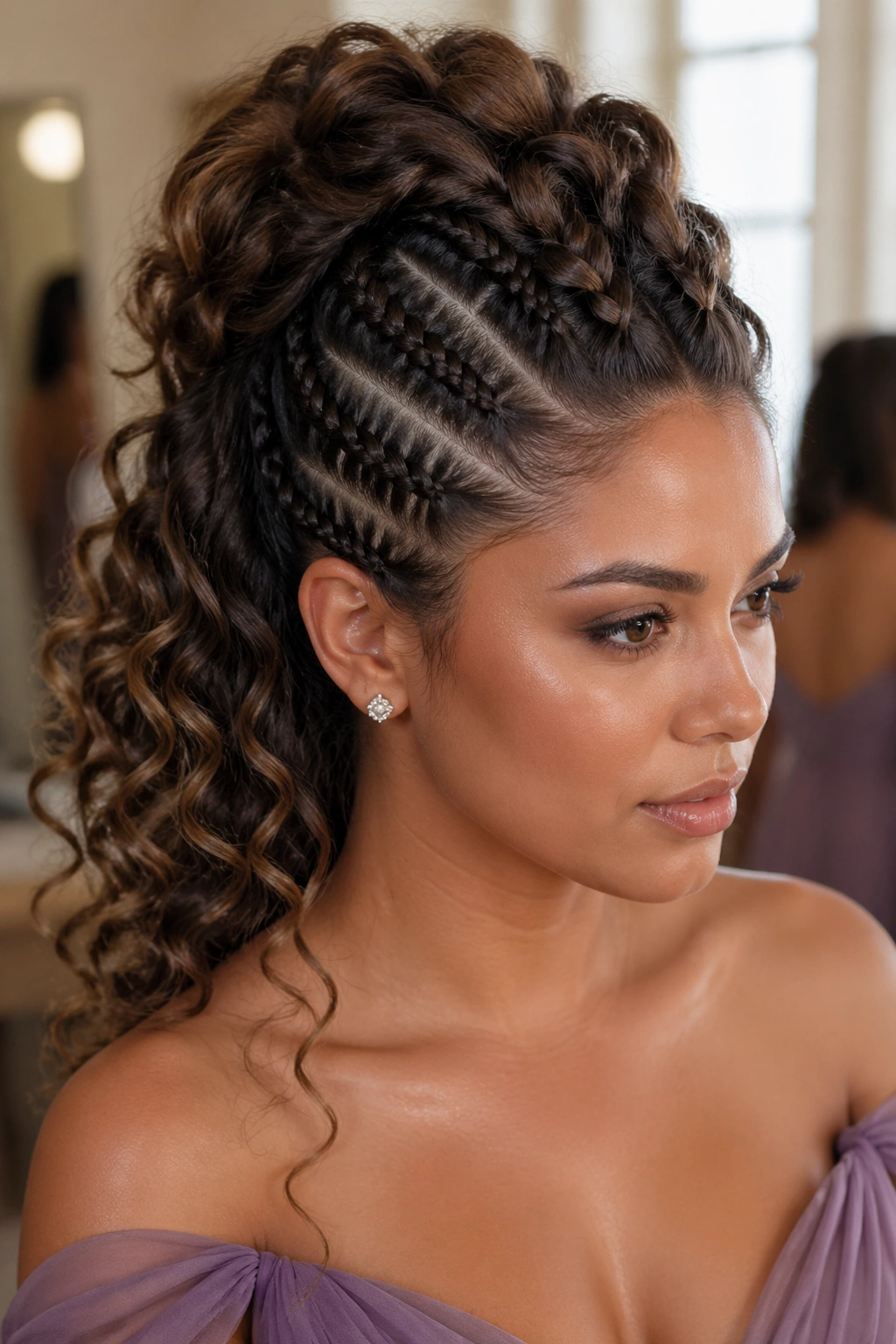
If someone says curly hair is “too much,” this style answers back. A braided mohawk half-up shape takes the center section and turns it into a strong line from the forehead to the crown, while the sides stay pinned back or smoothed away from the face. The result is bold, but not loud in a tacky way.
This is the one for bridesmaids wearing simple dresses, because the hair gets to do the talking. The braid should sit like a ridge, not a tight strip. Leave the curls at the back wide and airy. If the sides are very dense, pin them with crossed bobby pins instead of trying to slick them flat with half a jar of product.
It looks especially good on dense 3B and 3C curls. The height at the center gives the face lift, and the free curls below keep the whole thing from feeling too severe.
8. Mini Accent Braids With Fresh Flowers
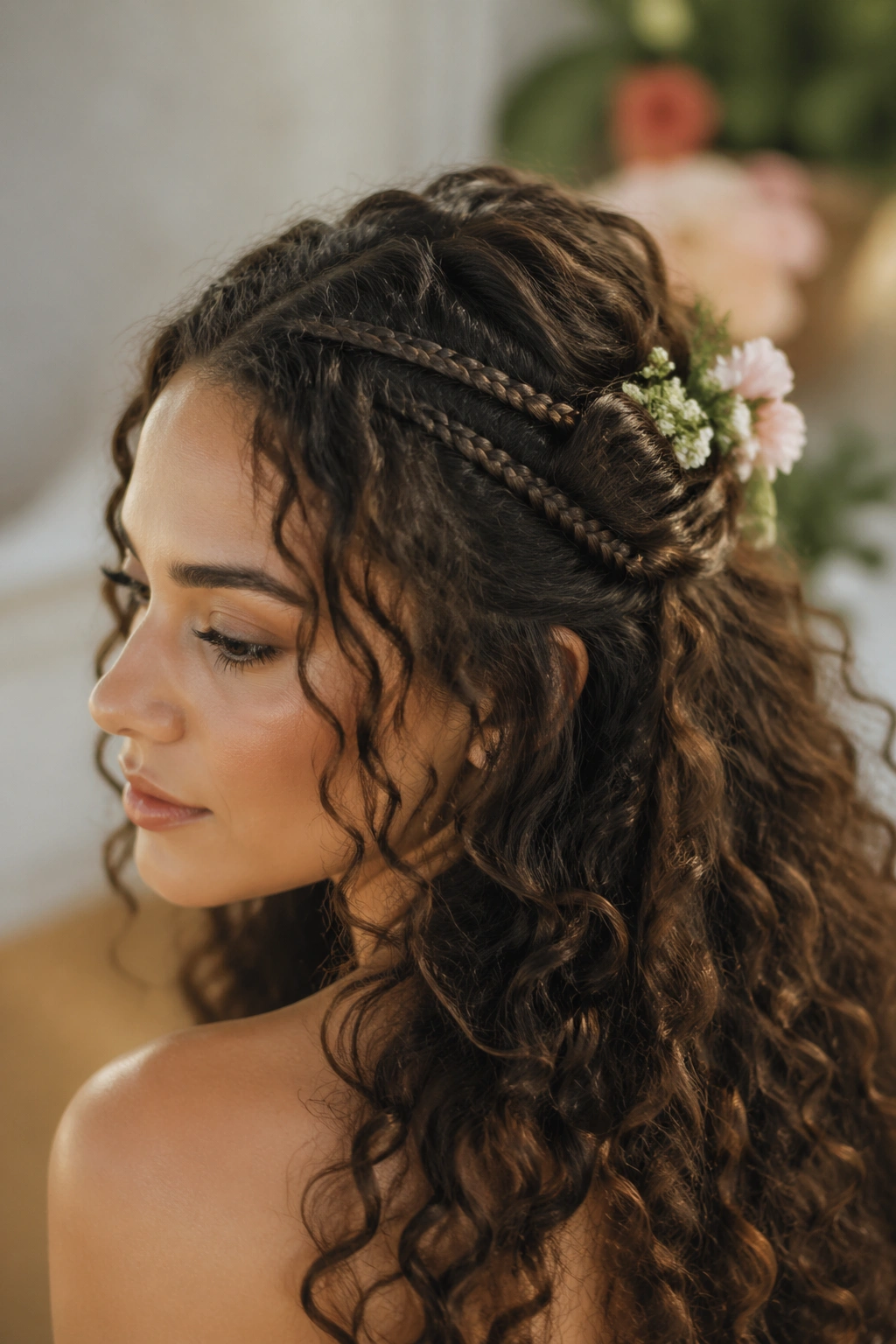
A few tiny braids can change the whole tone of curly hair. They do not need to be the star. They simply give the eye a place to land, especially when the rest of the style is soft and free. A bridesmaid with big curls and a half-up section gets a little structure without losing that pretty, loose finish.
Where the detail belongs
Put the braids near the temples, above one ear, or tucked into the half-up section where the hair naturally lifts. Then slide in one or two fresh flowers with covered pins. Baby’s breath is easy. Small spray roses work too. Bigger blooms start to look clumsy.
- Use 2 to 4 slim braids, not a whole tangle.
- Keep the flowers small and pinned low.
- Match the floral tone to the bouquet or dress accent.
- Leave the curls around the face soft so the style still feels like hair, not a corsage.
Best move: let the flowers sit in the braid, not on top of it. They should feel planted, not perched.
9. Lace Braid From Temple to Crown
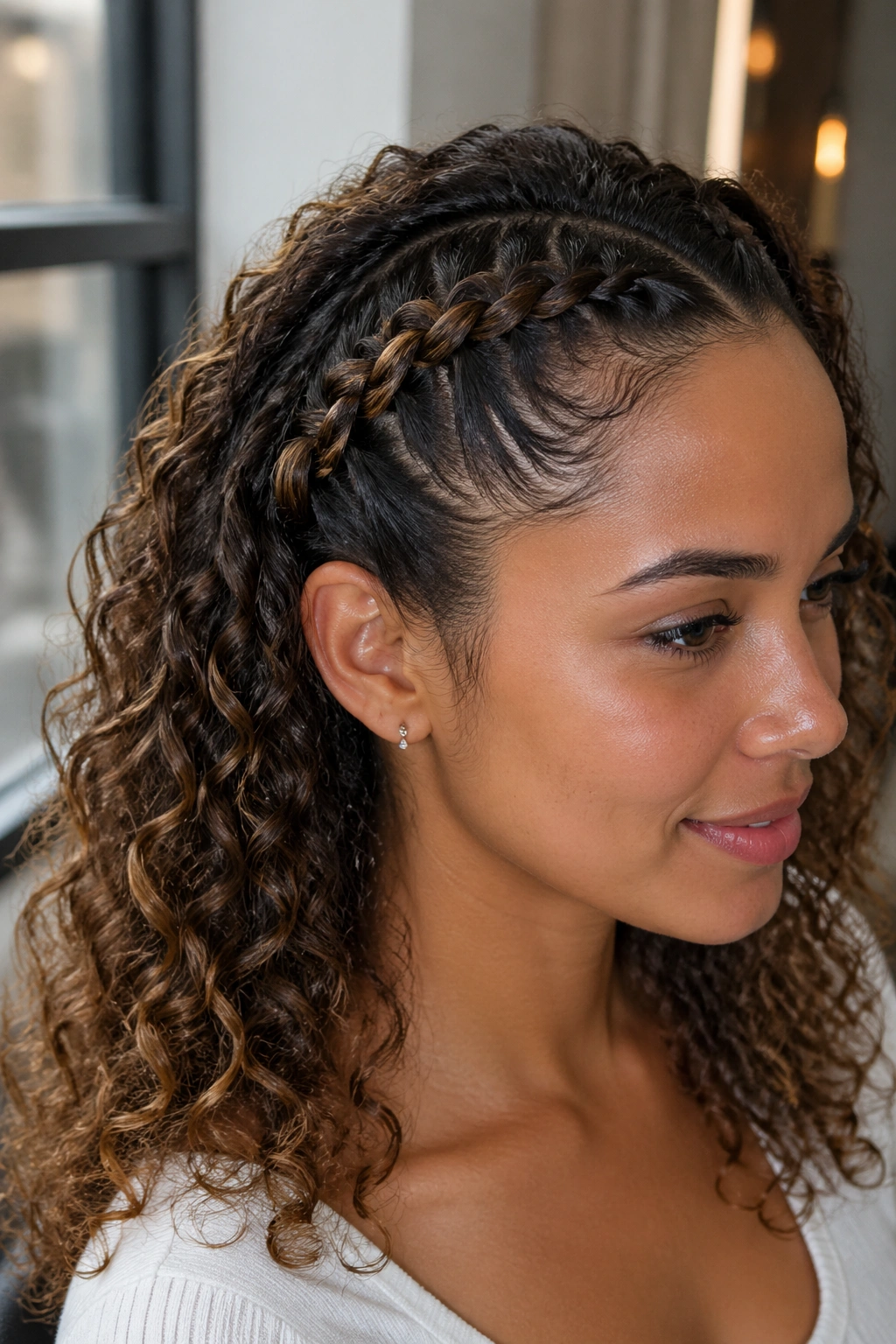
Can a lace braid look good on curly hair? Absolutely. In fact, the texture helps it. A lace braid only adds hair from one side as it moves, so the other side stays loose and the curl pattern keeps peeking through. That makes the style lighter than a full braid across the head.
How to keep the braid visible without flattening curls
Start near the temple and keep the braid close to the scalp for the first few inches. Once it reaches the crown, let it relax. That way the hair stays controlled at the front, but the back still feels soft. If the curls are dense, widen the braid a little with your fingertips after it is pinned. If they are fine, leave the weave tighter so it does not disappear.
This is a smart choice for side parts, especially when the bridal party wants a consistent style but not a copied-and-pasted look. The braid gives one clean line. The curls do the rest.
10. Braided Knot Half Up With Soft Ends
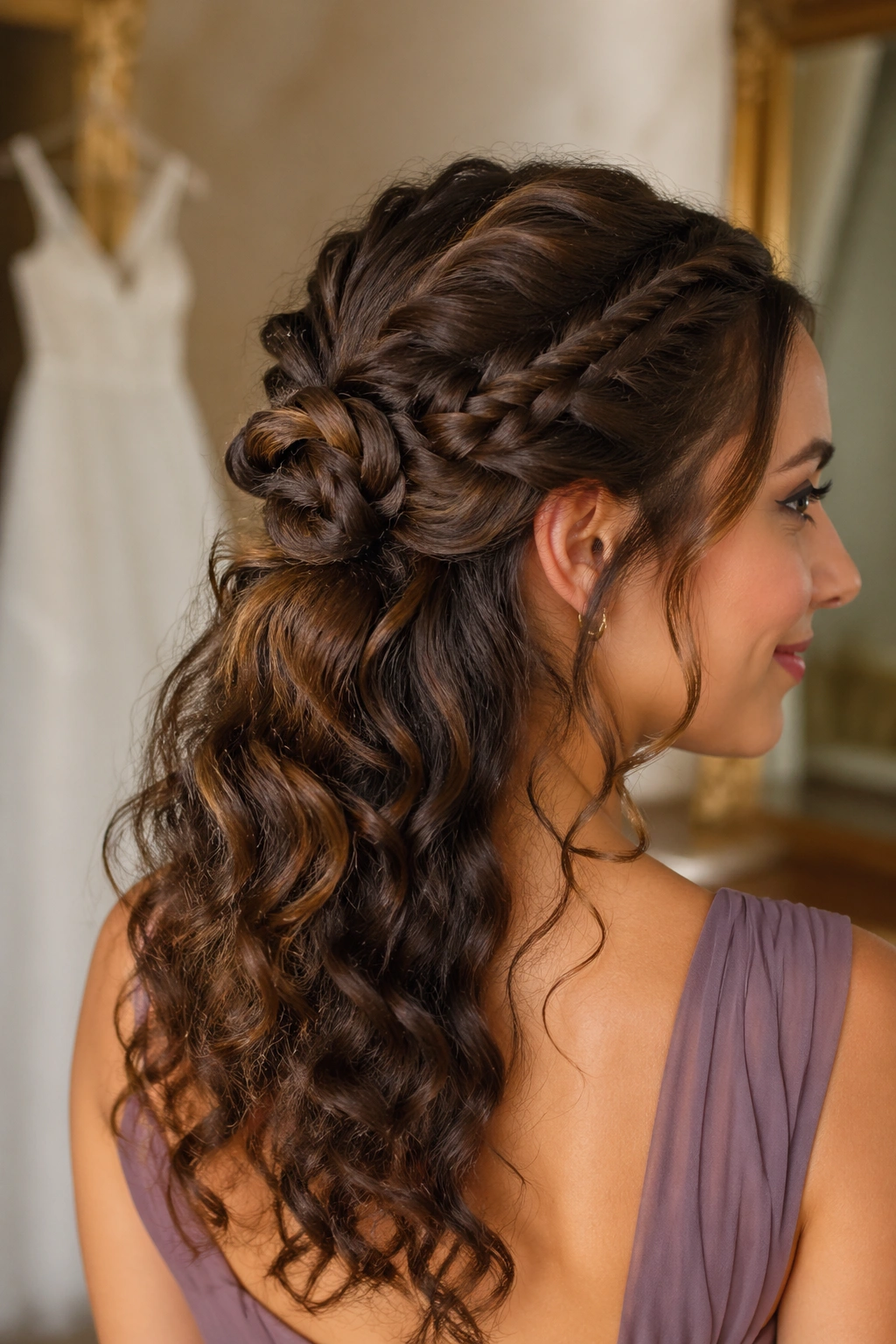
A braided knot has a tidy center without looking too polished for a wedding party. Two braided sections can meet in the back and fold into a soft knot, almost like a loose wrap. The curls below stay free, so the style still feels light.
It works well with higher necklines, satin dresses, and straps that already carry a lot of visual weight. The knot gives the top of the style enough shape to sit cleanly above the dress, which is handy when the fabric is structured. If the braid is too tight, the knot can look hard. Keep it relaxed. The curl texture will do some of the softening for you.
A few face-framing strands keep the whole thing from feeling too neat. This one is good when you want the bridal party to look coordinated without every head looking identical.
11. Pull-Through Braid For Thick Curly Hair
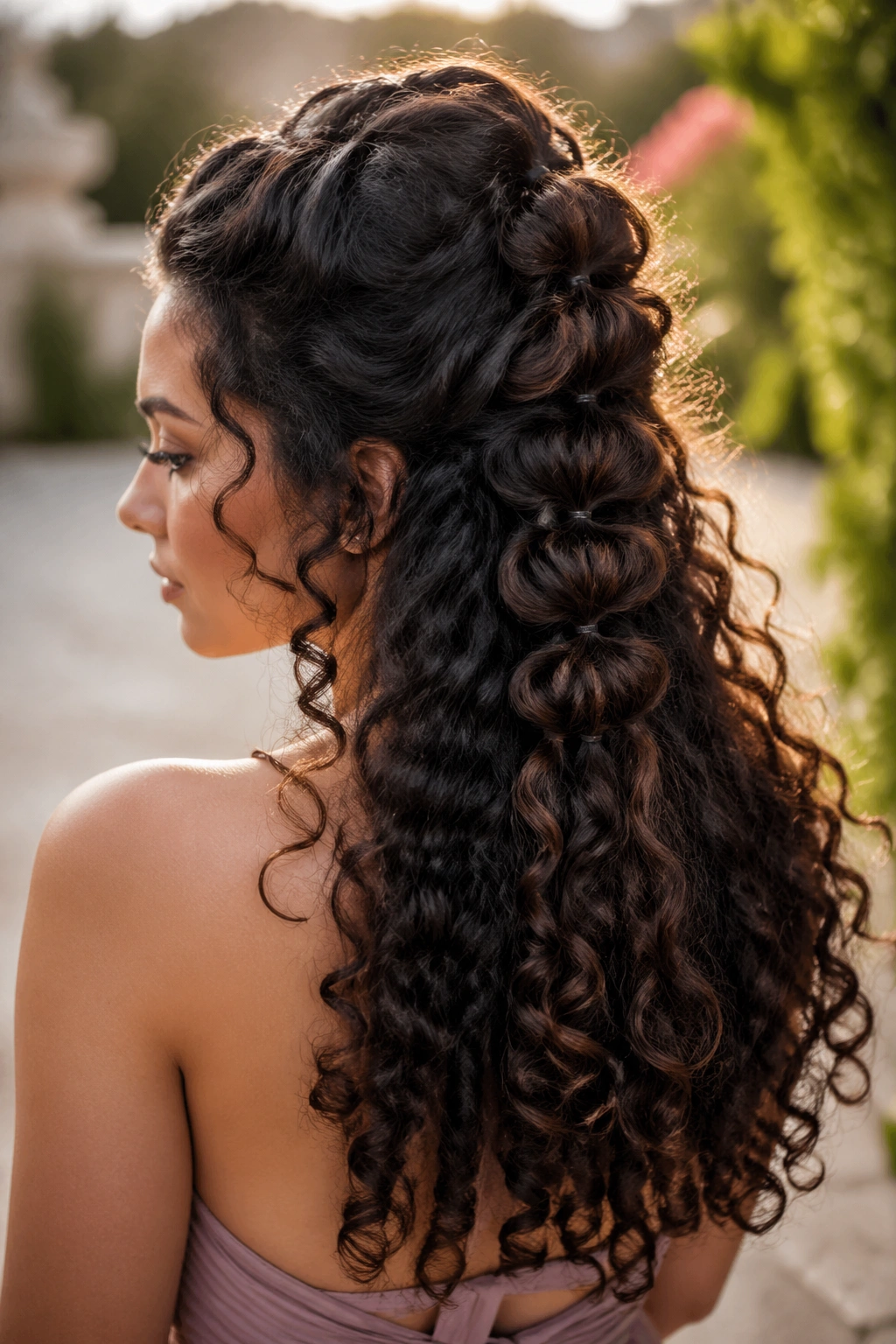
Unlike a regular braid, a pull-through braid gives thick curly hair more height and more visible texture. That is why it photographs so well on dense curls. Each section stacks on the one before it, so the braid looks full even before the curl volume below gets involved.
The style does take patience. Small clear elastics are the way to go, and they should sit about 1½ to 2 inches apart, depending on length. After each section is secured, gently tug the sides so the braid opens up. That little move is what gives it its plush look.
This is one of the better choices when the hair is heavy and tends to slip out of standard braids. It holds the shape without requiring a tight grip on the scalp. Good for long ceremonies. Good for a windy walk. Good for hair that refuses to be flattened.
12. Side-Swept Braid With Statement Clip
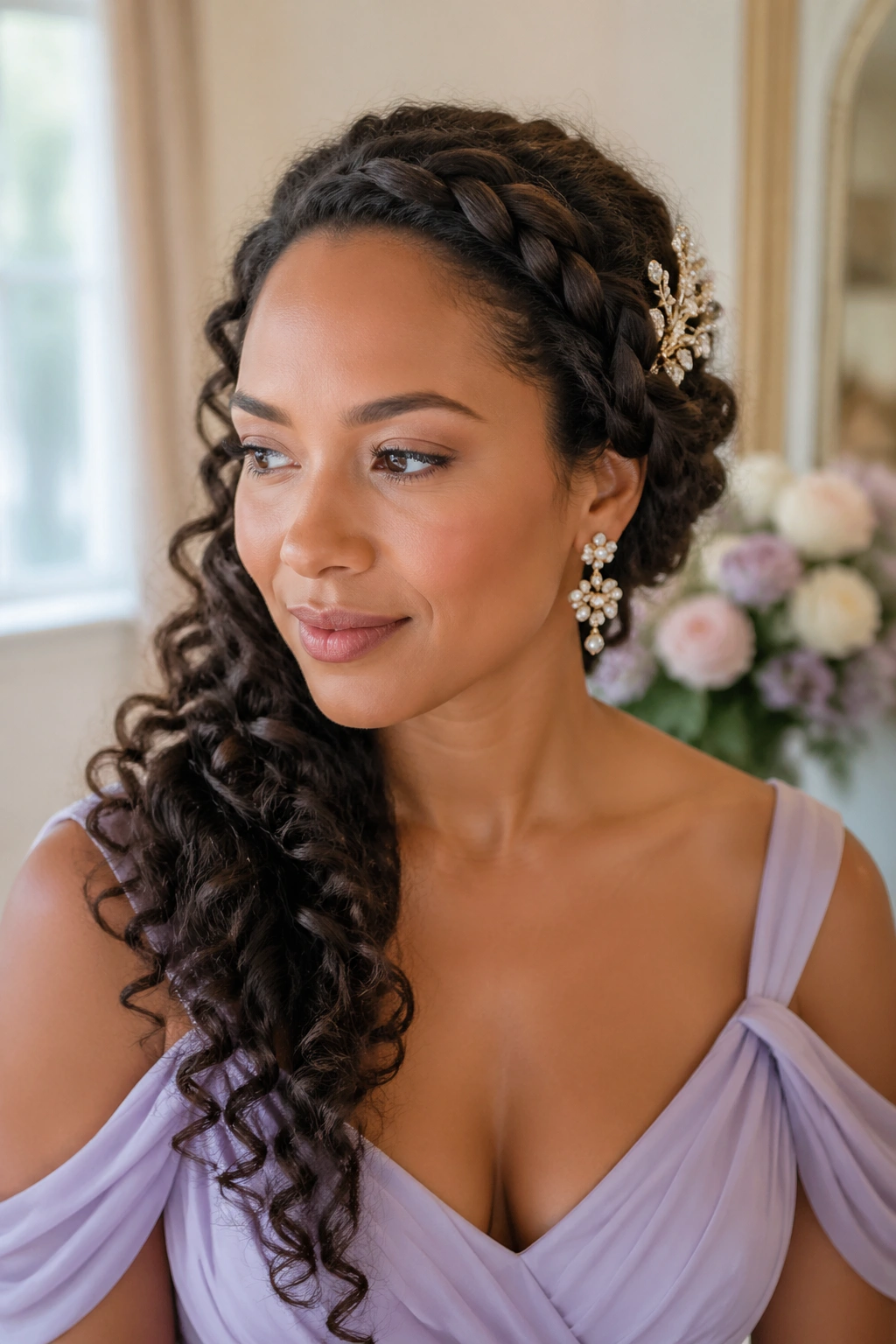
On a bridal party, this is the style that lets each person keep a little personality while still matching the group. The braid sweeps to one side, the curls cascade over the opposite shoulder, and a strong clip holds the finished shape in place. That clip can be pearl, crystal, leaf-shaped, or plain metal if the dresses are already doing a lot.
The side sweep opens the face and makes room for earrings. It also helps if one side of the head has more volume than the other. Rather than fight that, the braid can lean into it. That makes the style feel lived in, not forced.
I like this one for bridesmaids who hate hair falling into their lipstick or onto the neckline. It keeps things away from the face without stealing the natural curl pattern at the bottom.
13. Crown Twist and Braid Mix
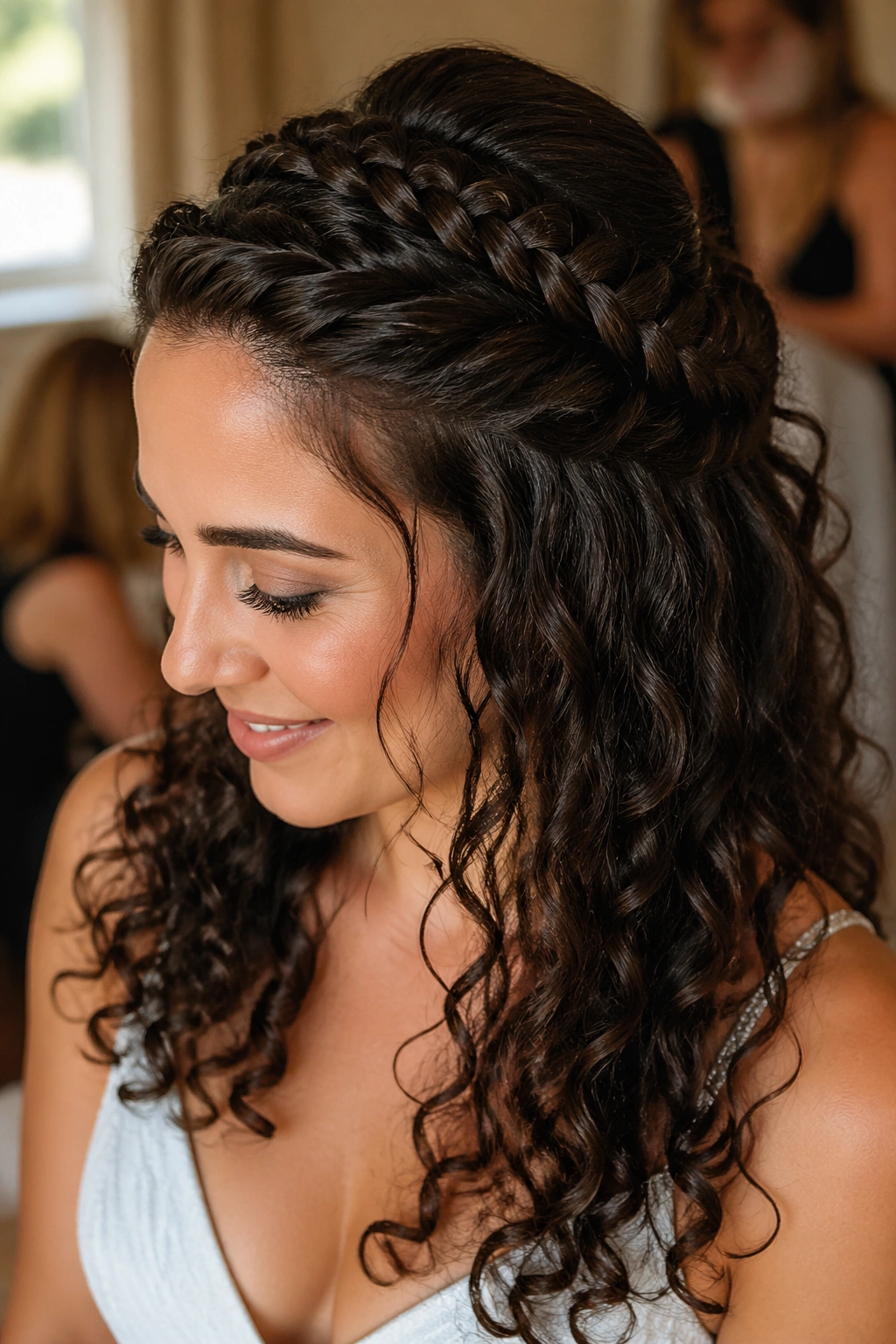
Can a twist and a braid sit together without looking fussy? Yes, if the twist does the quiet work and the braid handles the structure. That combination is one of my favorites for curly bridesmaid hair because it uses the texture already in the hair instead of trying to create a brand-new pattern.
Start with a soft twist near the front hairline where flyaways like to gather. Then tuck that into a loose braid that runs across the crown. The twist smooths the front, and the braid keeps the top section anchored. The curls below stay loose, which keeps the style from feeling stiff.
Where the twist should start
Not right at the ear. A little higher is better. That keeps the face open and stops the front from looking pinched. If the hair is highly textured, use two crossed pins where the twist ends so it does not spring loose halfway through the reception.
The mix of twist and braid reads romantic without becoming sugary.
14. Double Braids Into a Curly Half Pony
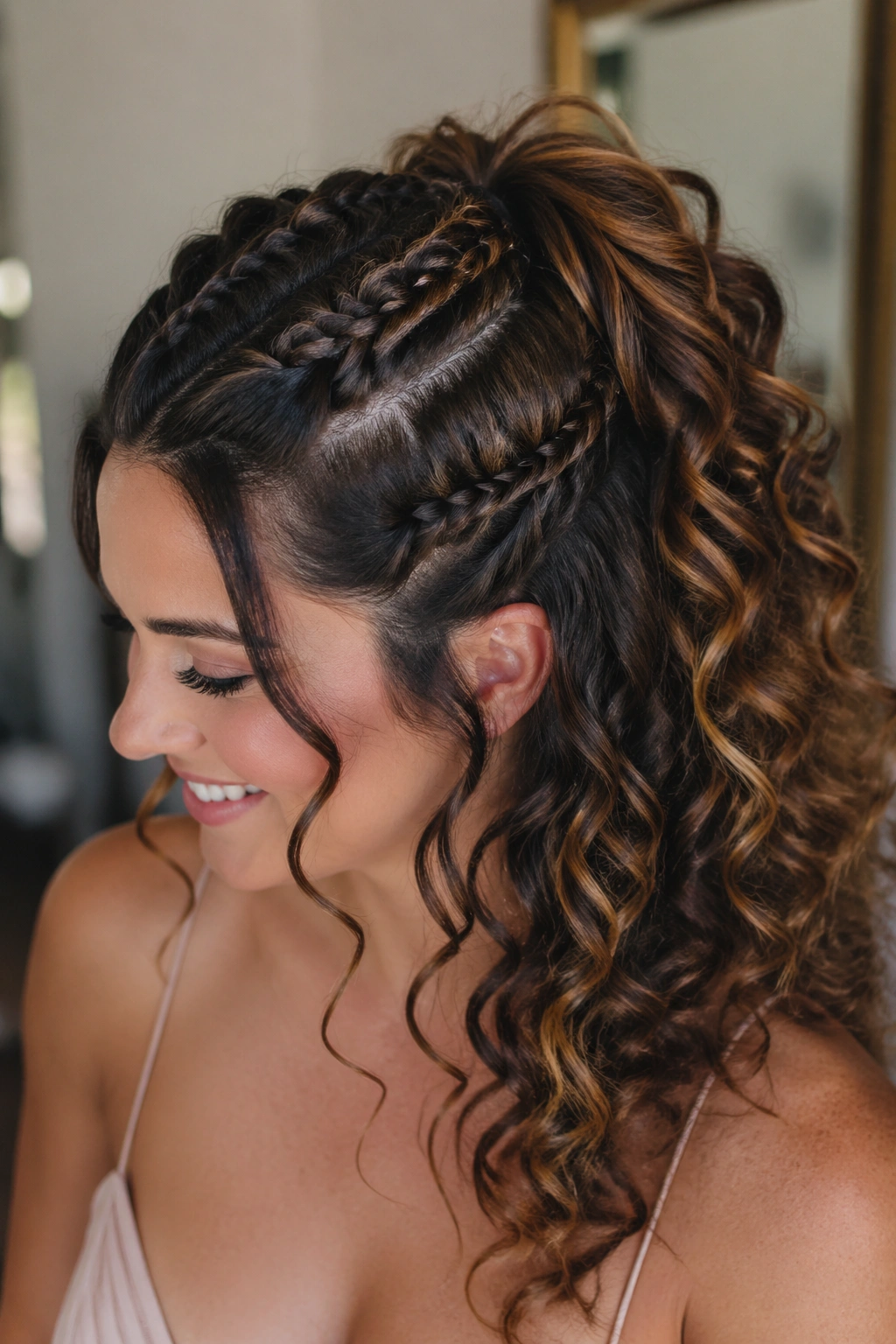
Two braids feeding into a half ponytail create a neat top and a lively bottom. It is a clean shape, and it holds up well when bridesmaids are moving around a lot. The braids can start at the temples or a little farther back, then join in the middle and tie into a half pony that sits above the crown of the curls.
Why it works in real life
Curly hair tends to need a structure that can handle volume. This one does. The braids control the sides, the pony keeps the center lifted, and the loose curls finish the look with movement. It is a practical style for long events because it does not collapse easily.
- Use a covered elastic at the join point.
- Leave 1 to 2 inches of curl around the face.
- Wrap a small curl around the elastic if you want the finish to look cleaner.
- Keep the pony a little high so the curls beneath still fall freely.
Best part: it stays comfortable. No heavy pulling, no tight scalp line.
15. Halo Braid With Loose Tendrils
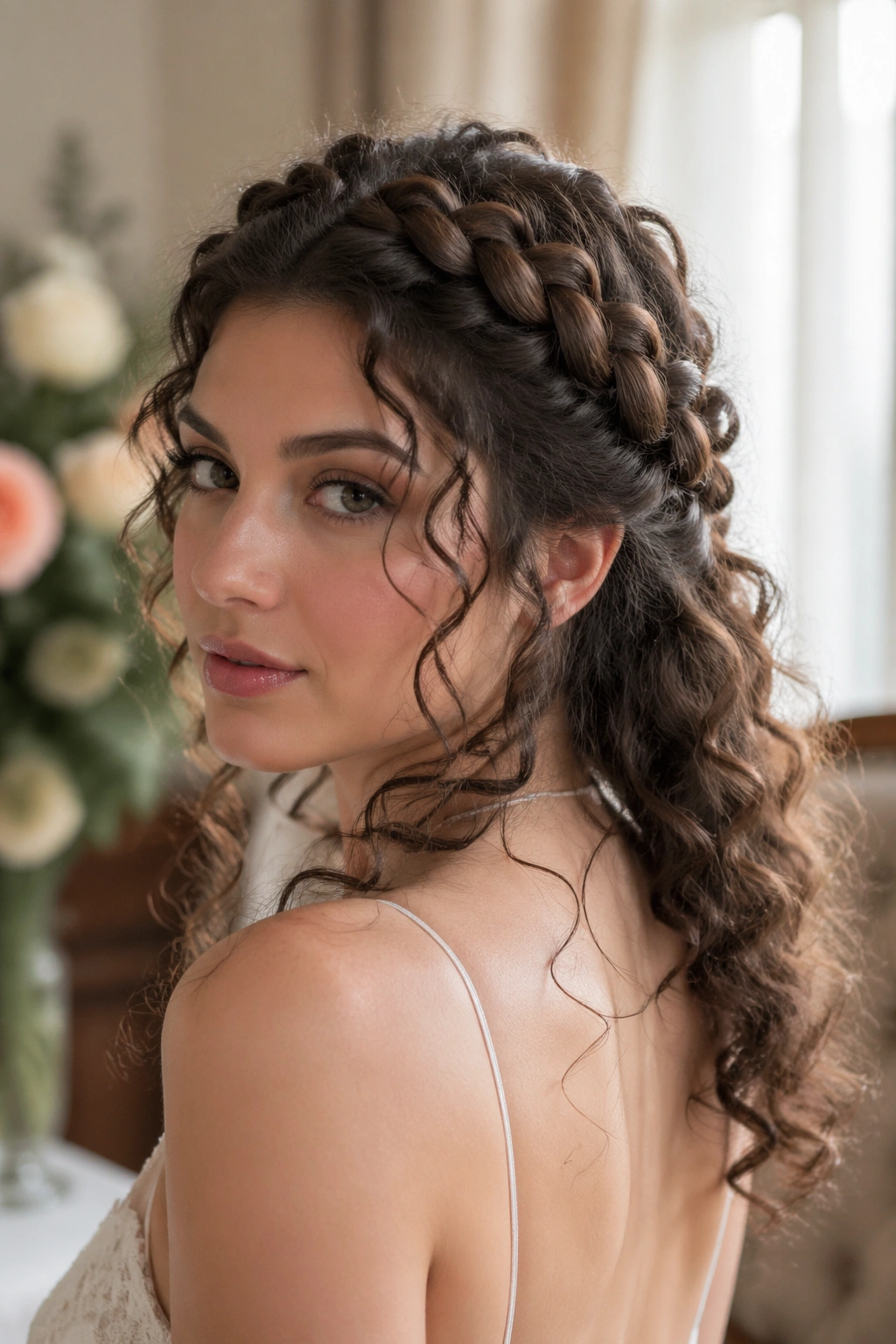
A halo braid circles the crown like a soft band, and on curly hair it has a gentler feel than the same style on straight hair. The texture keeps the braid from looking too crisp. That is a good thing here. Wedding hair should look finished, not carved out of plastic.
The trick is to leave a few tendrils around the cheeks and at the nape. Those pieces stop the braid from taking over the whole head. If every strand is pinned back, the face can look harder than the dress deserves. A halo braid should frame, not fence in.
This style sits nicely with lace details, vintage earrings, and dresses that have a slightly romantic shape. It also works for bridesmaids who want their hair secured without giving up much length. The curls below can be full and bouncy, or stretched and glossy.
16. Dutch Braid Accent On Shorter Curly Hair
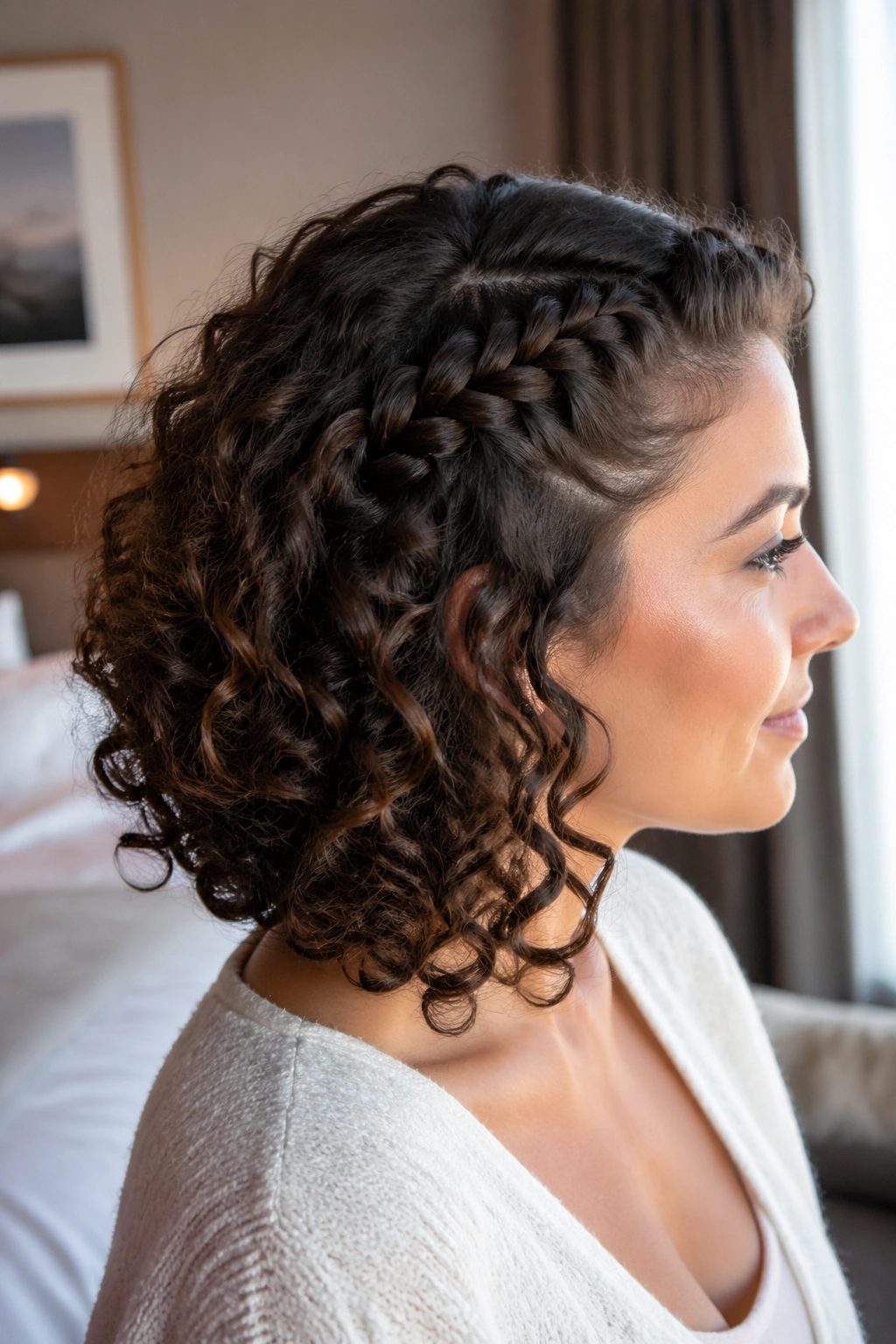
A full crown braid can swallow shorter curls. A Dutch accent braid does not need to. That is why this is one of the smarter bridesmaid curly hair options for bob-length, lob-length, or shoulder-skimming cuts.
Instead of trying to braid the whole head, focus on one strong section from the hairline to the temple or from the part into the side. The braid lifts the hair just enough to create shape, then the curls fill in the rest. The result feels intentional without pretending the hair is longer than it is.
This works especially well when the dress neckline is high or the earrings are the main accessory. You get structure without demanding extra length from the cut. If the curls are tight, keep the braid broader. If they are looser, a narrower braid keeps the style from looking sparse.
17. Bubble Braid Half Up With Texture
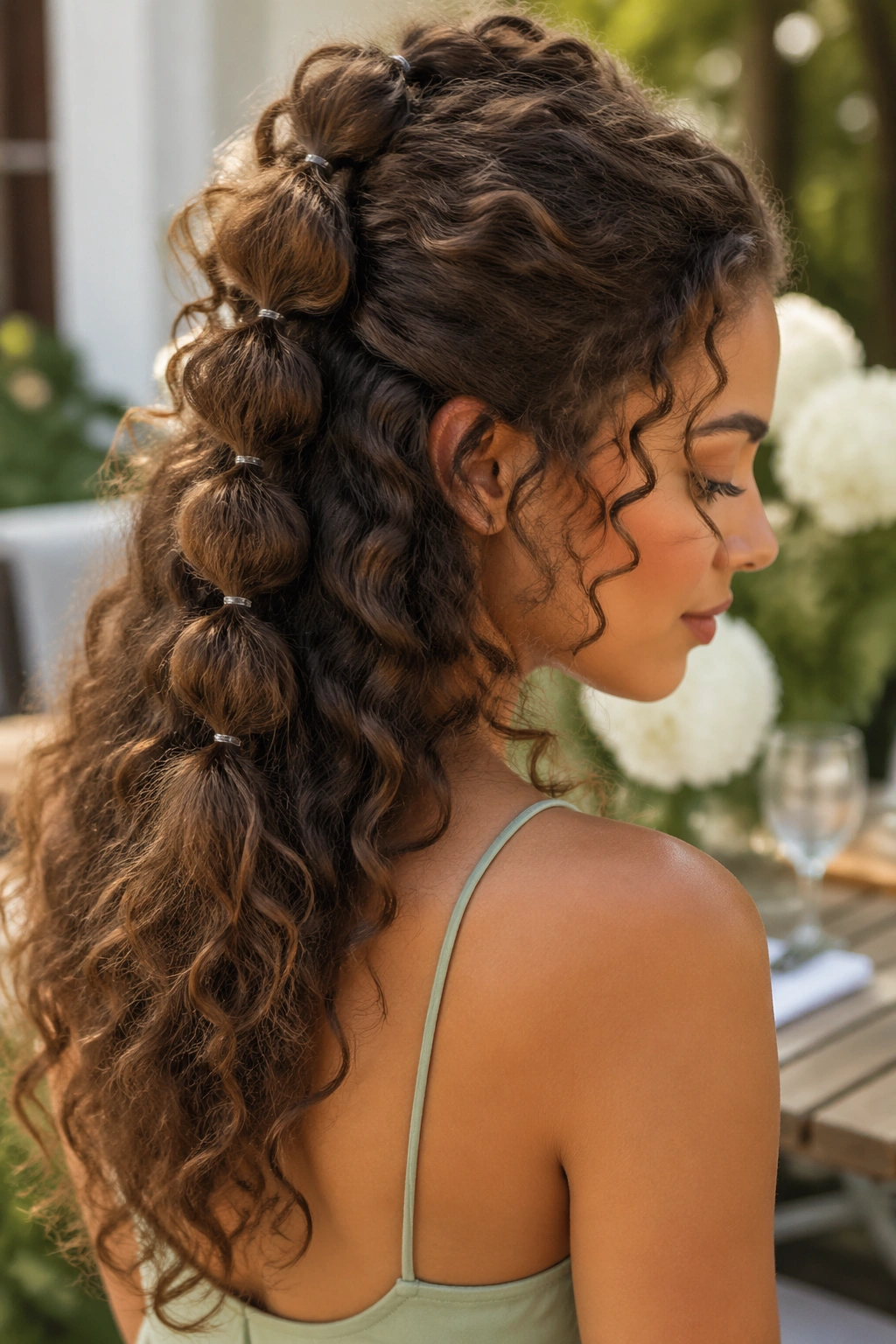
Can a bubble braid work on curly hair? Easily, if you stop fighting the texture. The curl pattern gives each “bubble” more body, so the braid can look fuller than it would on straight hair. The key is to use small elastics and let the sections puff on purpose.
How to keep the bubbles even
Start with a half-up section and secure the first tie at the crown. Add another elastic 2 inches down, then gently tug the section between the ties until it rounds out. Keep repeating that pattern until the braid reaches the point where the curls should fall loose. If one bubble gets too wide, pinch the section above it instead of spraying it into place.
This style suits bridesmaids who want something a little playful but still polished. It is especially friendly to thicker curls because the shape can hold itself. A ribbon or thin band can hide the elastics if the dress needs a softer finish.
18. Boho Side Braid With Ribbon
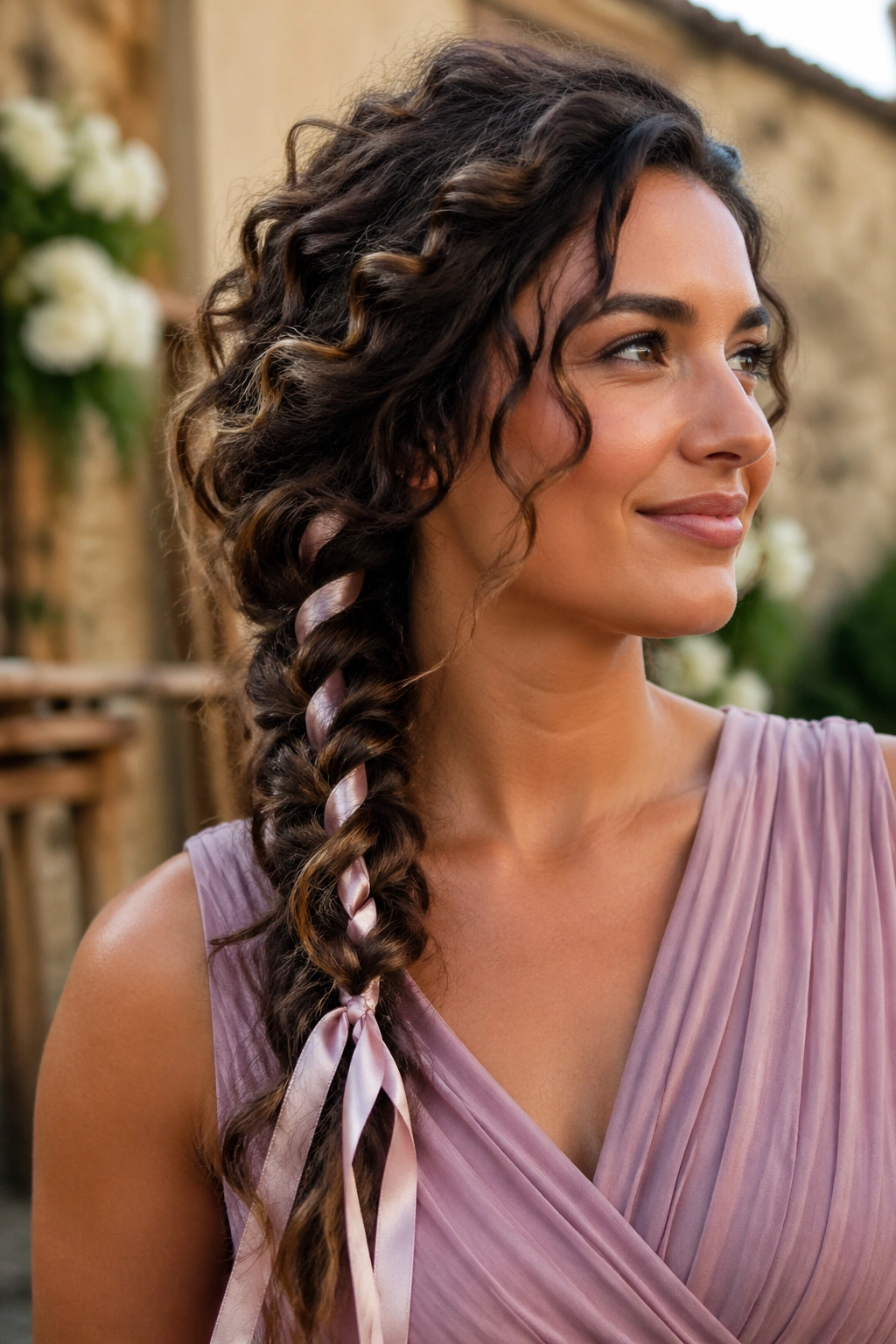
A thin ribbon does more than people expect. Woven into a side braid on curly hair, it gives the whole style a softer edge and a clear color link to the dress, bouquet, or wedding palette. The braid itself stays relaxed, while the ribbon gives it a little finish that does not rely on sparkle.
This is a good choice when the bridal party wants a looser, more natural look. Pick a ribbon that is narrow enough to sit in the braid without bulking it up. Satin has a smoother shine. Silk feels softer. Velvet can look rich, but it can also make fine curls look crowded, so use that one carefully.
- A 1/4-inch to 3/8-inch ribbon is usually enough.
- Keep the knot or tie hidden under the braid.
- Let the ribbon tails fall 2 to 3 inches for a softer finish.
- Match the ribbon to a single dress detail, not the whole outfit.
Small note: if the curls are very springy, pin the ribbon once near the end so it does not slide out.
19. Micro-Braids Woven Into Loose Curls
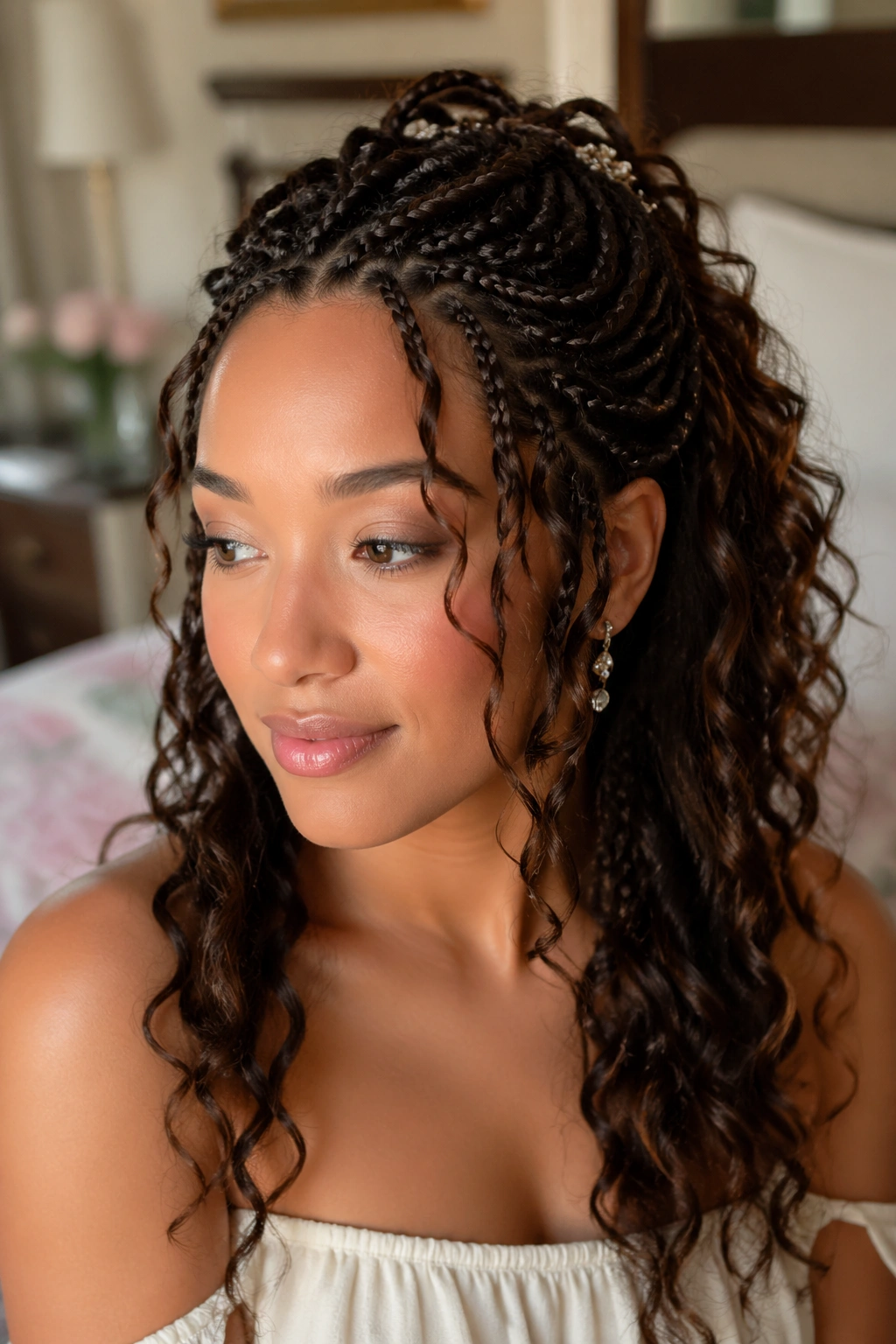
Micro-braids are for the bridesmaid who wants detail up close and softness from a distance. Tiny braids can be tucked along the hairline, hidden inside the half-up section, or threaded through the side to make the texture feel richer. They do not need to dominate the style.
The best part is that they work with almost any curl pattern. Tight curls can absorb them. Loose curls can show them off. A few well-placed micro-braids give the hair a handcrafted look that feels calm, not overworked.
Keep them uneven on purpose. A little irregularity is part of the charm. If every braid is the same width, the style can start to look too planned. One narrow braid near the part, one slightly thicker braid above the ear, and one tucked behind the crown is enough for a layered effect.
This is one of those styles that rewards a close-up photo and still reads as soft from across the room.
20. Braided Headband Across The Hairline
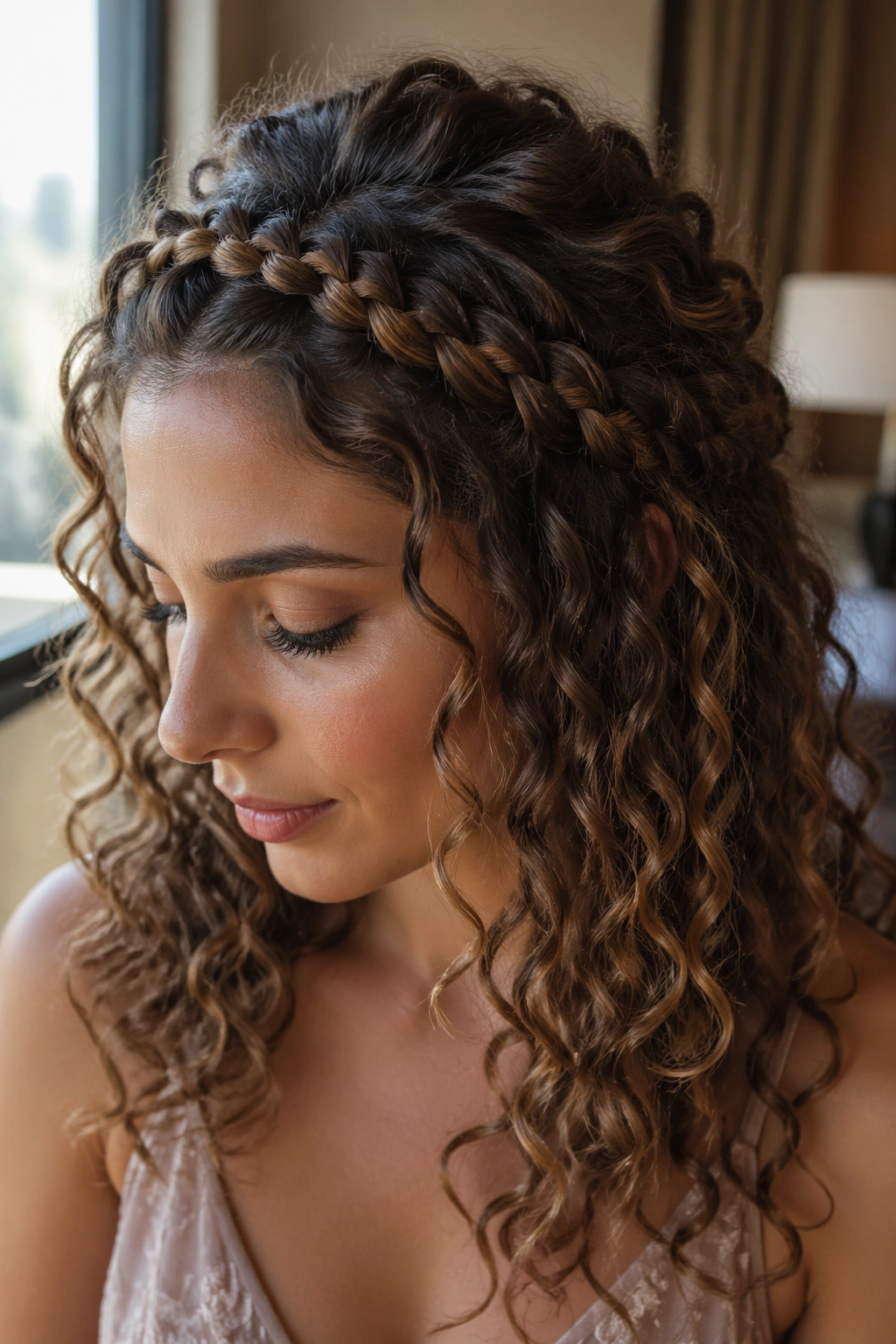
Unlike a full crown braid, a braided headband keeps the bulk lower and the top lighter. That makes it a smart pick for bridesmaid curly hair when the dress has a high neckline or when the goal is to keep a little more curl volume visible on top.
The braid starts at one side, runs across the hairline like a band, and tucks behind the opposite ear. The rest of the curls stay loose, so the style still moves. It also helps tame temple frizz, which is often where curly hair begins to rebel after a long day of being touched.
If the hair is dense, use a slightly wider braid so it does not disappear. If the hair is fine, keep the braid close to the scalp and pin it well behind the ear. A small comb or a pair of hidden pins does the job without adding bulk.
21. Loose French Braid Into a Half-Up Loop
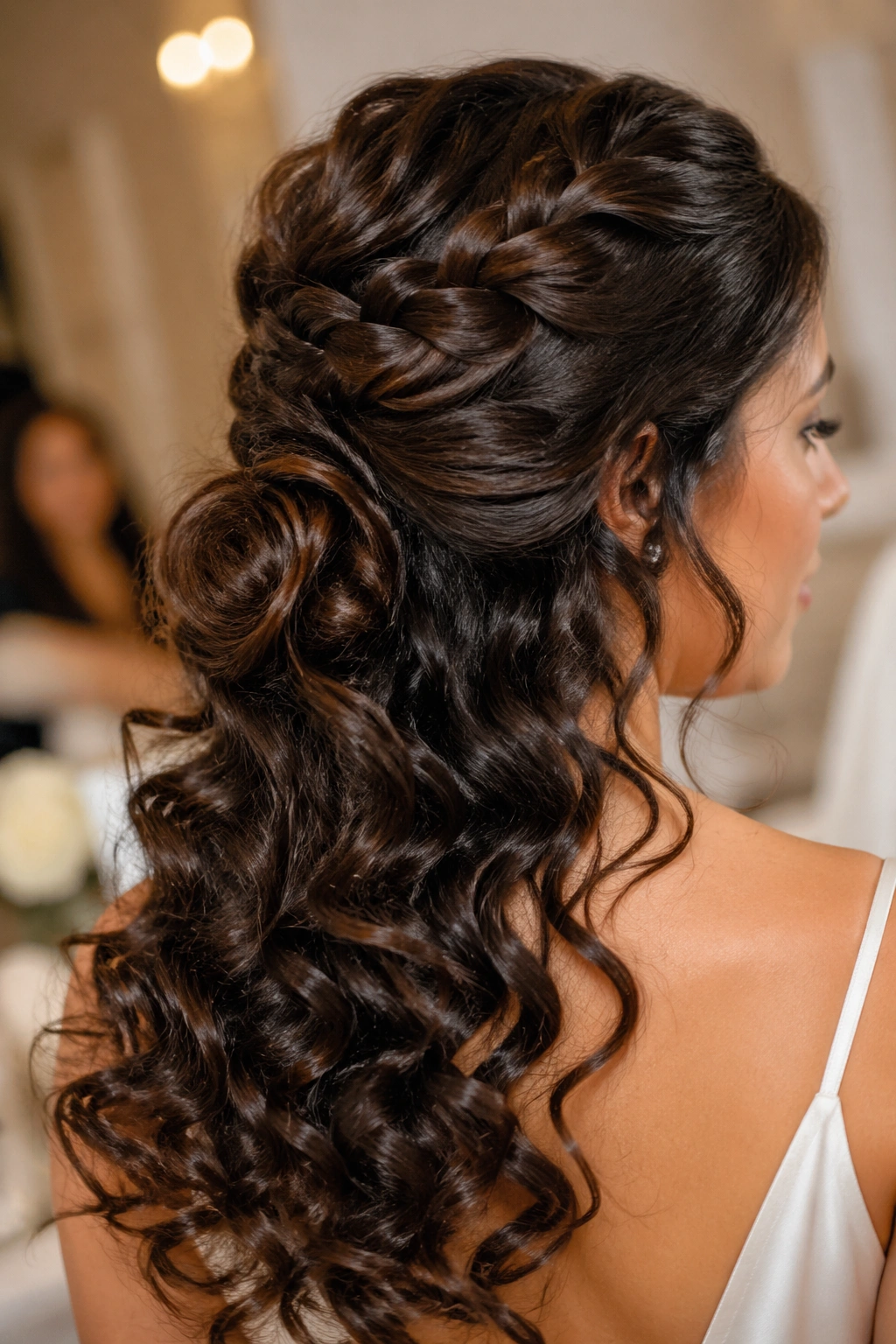
A French braid that stops at the crown gives you the neat front and the softer finish in one shot. That is why it works so well for curly hair at weddings. The braid keeps the top section under control, then the ends can be looped, pinned, or hidden so the back still looks airy.
The braid should be loose enough to show its shape, but not so loose that the weave vanishes into the curls. A gentle tug on the edges can widen it a little. That is enough. Too much pulling turns the braid sloppy, and the style loses the tidy lift it needs.
This is a good choice for long curls that need a defined top section but still deserve some movement below. It sits nicely with strapless dresses, sweetheart necklines, and gowns with open backs. The loop at the end can be hidden with a few pins or a small decorative barrette.
22. Veil-Friendly Braided Half Up With Polished Pins
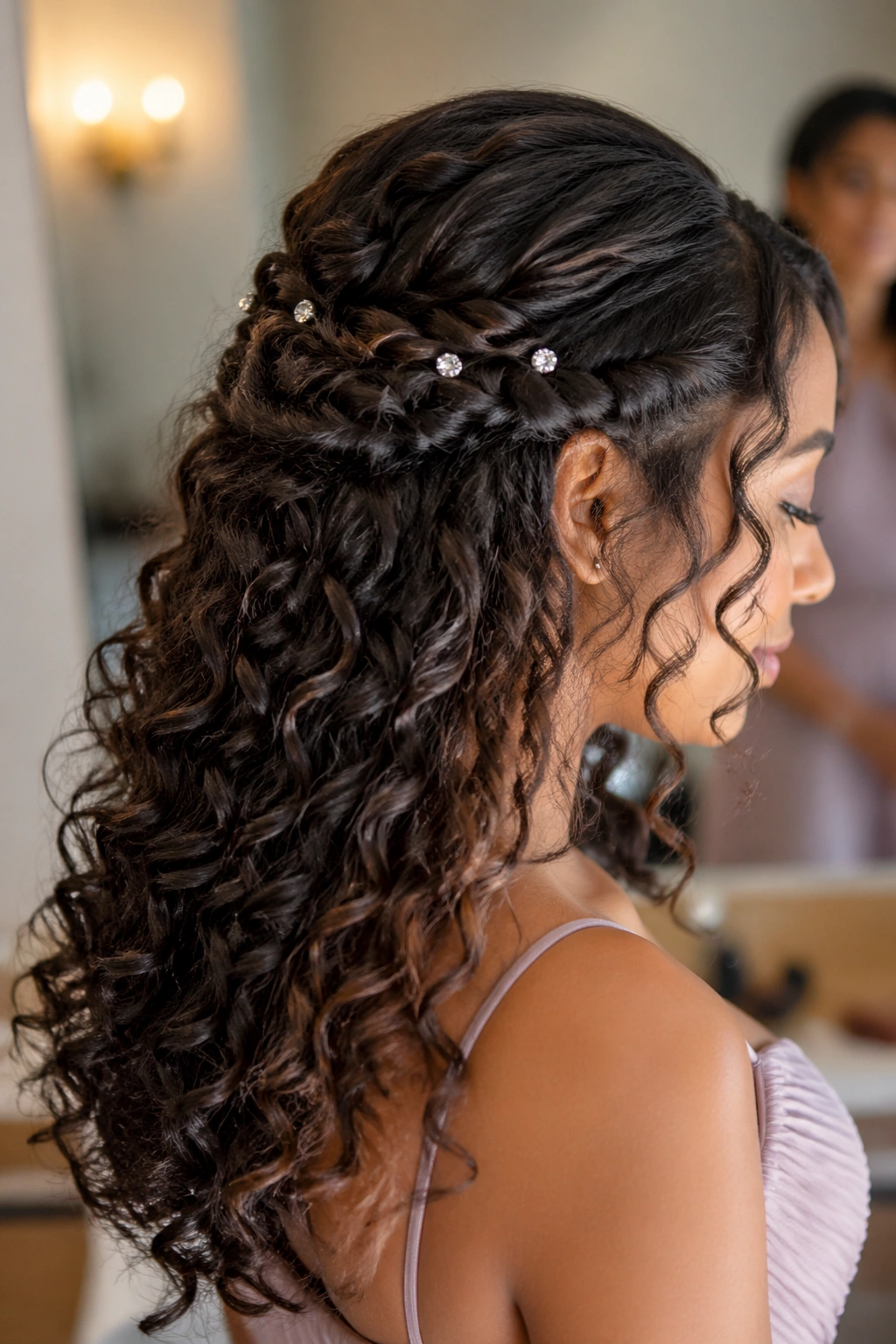
If the bridal party needs a style that can take a veil comb, a hug, and a little wind without falling apart, this is the safest structure. The braid stays low enough to leave room for the veil placement, and the half-up section gives the pins a strong base. Curly hair helps here because the texture holds better than slippery strands ever will.
The key is restraint. Keep the braid clean, pin it firmly, and leave the curls below soft and full. A few polished pins are enough; too many accessories start to compete with the veil hardware. If the bridesmaid is not wearing a veil, the same structure still works with a comb, a pearl barrette, or a narrow metallic clip.
Secure first. Pretty second. Then stop touching it.
That last part matters more than most people admit. Curly bridal-party hair tends to look best after it has been set, pinned, and left alone long enough to settle into itself.
