



Straight hair can be a dream on prom night, and a headache at the same time.
It gives you a clean canvas. Every braid line shows up clearly, every pin placement looks neat, and shine spray does half the work for you. Then the other half shows up too: slippery lengths, flat roots, and that annoying moment when a style looks done in the mirror and suddenly softer than you wanted once you move around.
That is why braided half up half down for prom straight hair keeps getting picked again and again. The braid gives the top section some shape and grip, while the rest of the hair stays long, polished, and easy to wear with earrings, a dramatic neckline, or a strapless dress. Straight hair does not need to be forced into curls to look formal. It needs structure.
The best prom styles for straight hair usually do one of two things: they build texture where the eye lands first, or they create a little lift at the crown so the whole style feels intentional. A braid does both without stealing the show from the dress. That is the sweet spot.
1. The Classic Crown Braid Half-Up
If you want one style that almost never feels out of place, start here. The classic crown braid half-up sits right at the top of the head, frames the face, and keeps the back length glossy and visible. On straight hair, the braid looks crisp instead of fuzzy, which is part of the appeal.
Why Straight Hair Likes This Shape
Straight strands show braid pattern cleanly. That matters more than people think.
- A crown braid gives instant structure without forcing the whole head into an updo.
- The braid sits close to the head, so it does not fight with long earrings or a strapless neckline.
- A small amount of dry texture spray at the roots makes the braid hold longer than fresh, silky hair alone.
My favorite version uses a deep side part and a braid that starts just above one temple. It feels a little softer than a braid that begins dead center. Pin the braid behind the opposite ear with two crossed bobby pins, then leave the rest of the hair flat and shiny. That contrast is what makes it look done, not busy.
2. Double Dutch Braids Into a Sleek Half Pony
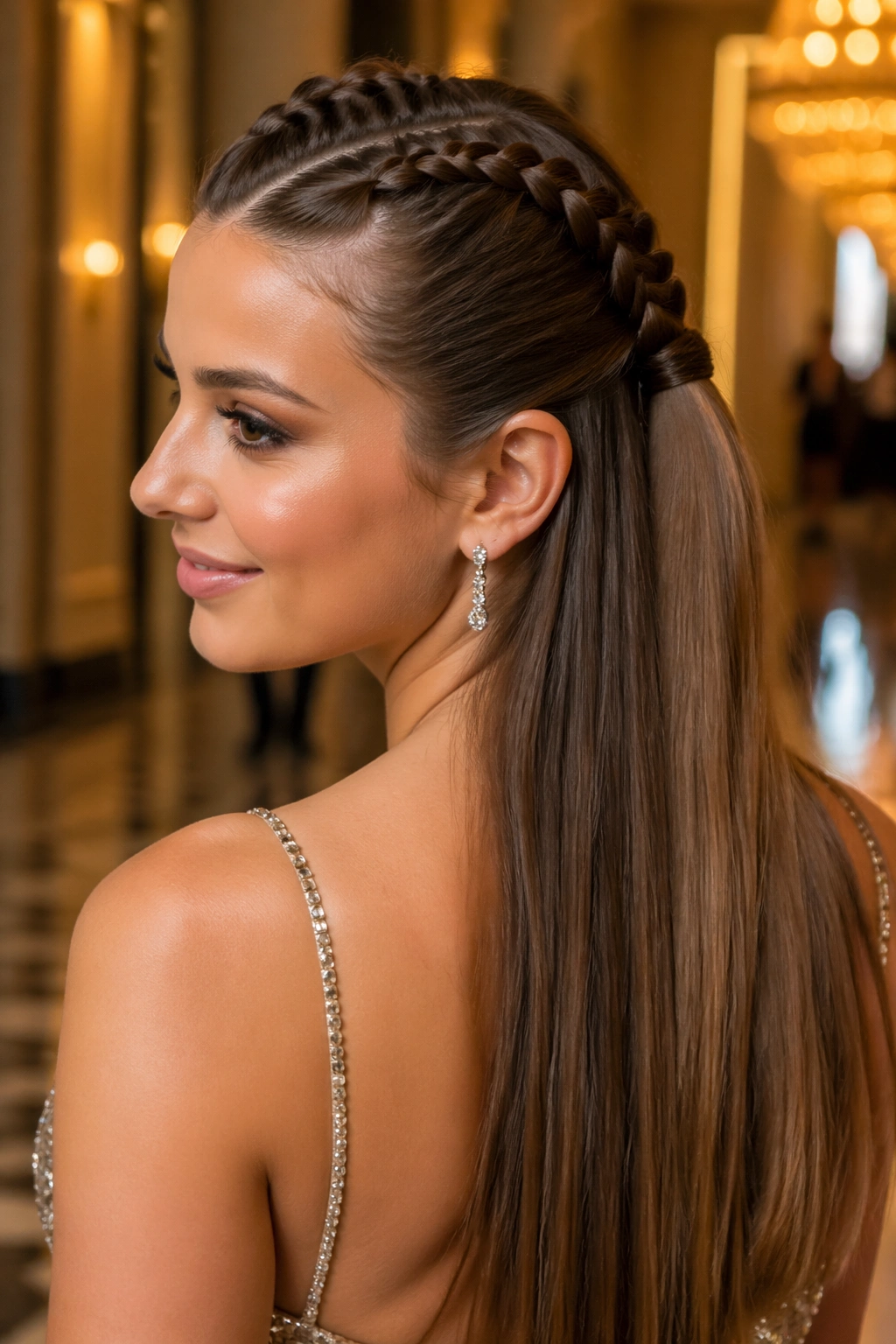
Picture a gown with a fitted bodice and a long, straight fall of hair down the back. Double Dutch braids make that combo work hard in the best way. The braids create enough grip to keep the top section under control, then they meet in a small half pony that looks firm and neat.
This style is a good choice when you want the front to stay put through dancing. It is also one of the few braided half up half down prom hairstyles for straight hair that still feels slightly sporty without looking casual. That sounds odd, but it matters. The braid pattern gives the style energy; the half pony keeps it prom-ready.
- Keep each Dutch braid about 1 to 1½ inches wide.
- Stop the braids at the crown, not too low, or the whole style can droop.
- Wrap a tiny strand around the elastic to hide it.
Honestly, this one is for the girl who wants her hair secure before she even thinks about posing.
3. Fishtail Sweep with Glossy Ends
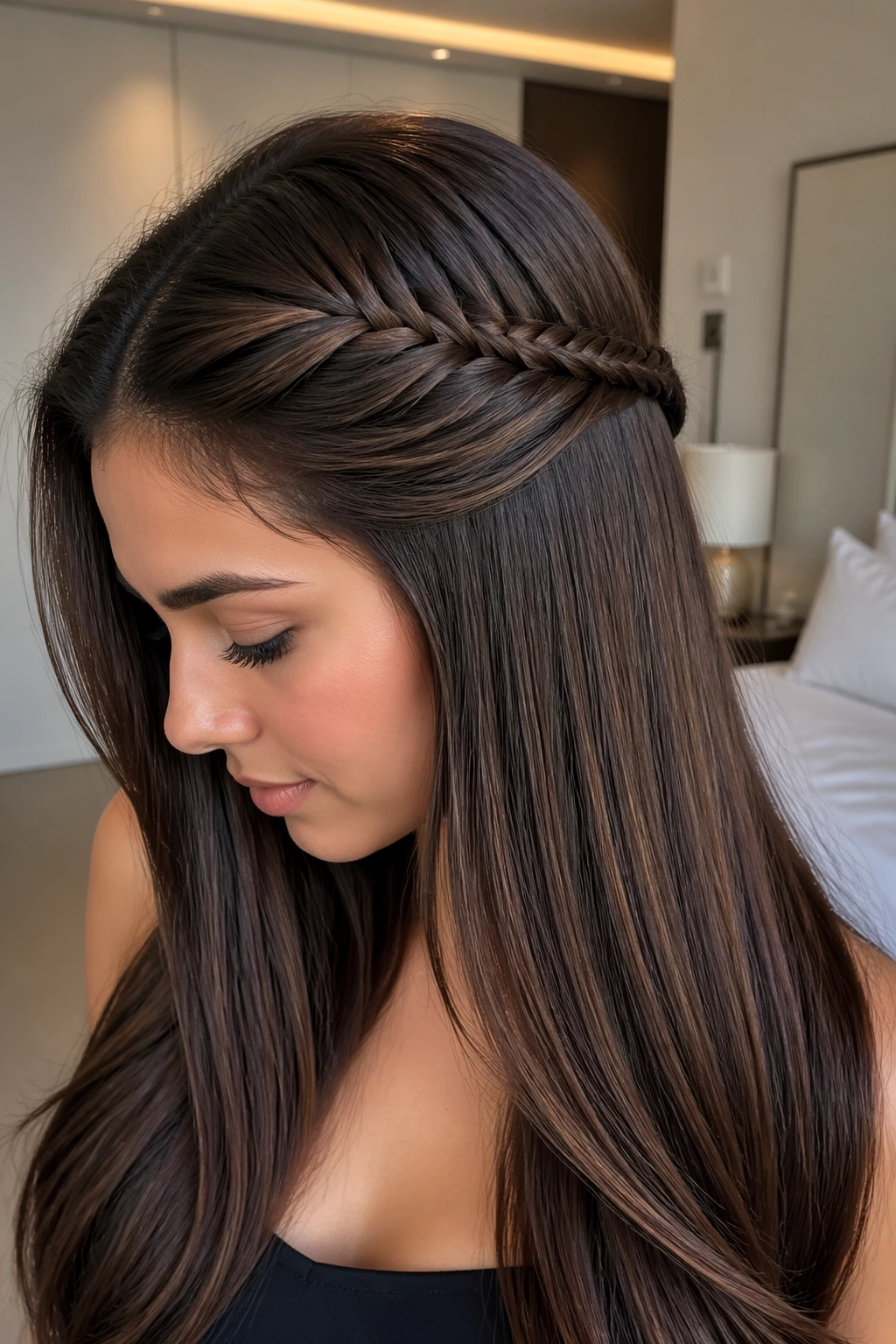
Why does a fishtail braid look so good on straight hair? Because the weave is narrow, detailed, and a little sharper than a standard braid. On smooth lengths, every tiny cross-over shows up, which makes the style look more deliberate.
The trick is not to over-fluff it. A fishtail that is pulled apart too aggressively can start to look messy in a hurry, and that is not the mood for prom unless the rest of the outfit is very soft and romantic. Keep the braid relaxed through the top section, then let the loose hair fall straight and sleek from the half-up anchor point.
How to Wear It
A center part gives the fishtail a cleaner line. A low side sweep gives it more movement.
Use this when the dress already has texture—lace, beading, a ruffled skirt, anything busy. The hair should stay controlled. If the gown is simple satin, a fishtail braid becomes the texture the whole look needs. Add a small crystal pin where the braid ends. Not a giant clip. Just one bright point.
4. Waterfall Braid with Mirror-Smooth Lengths
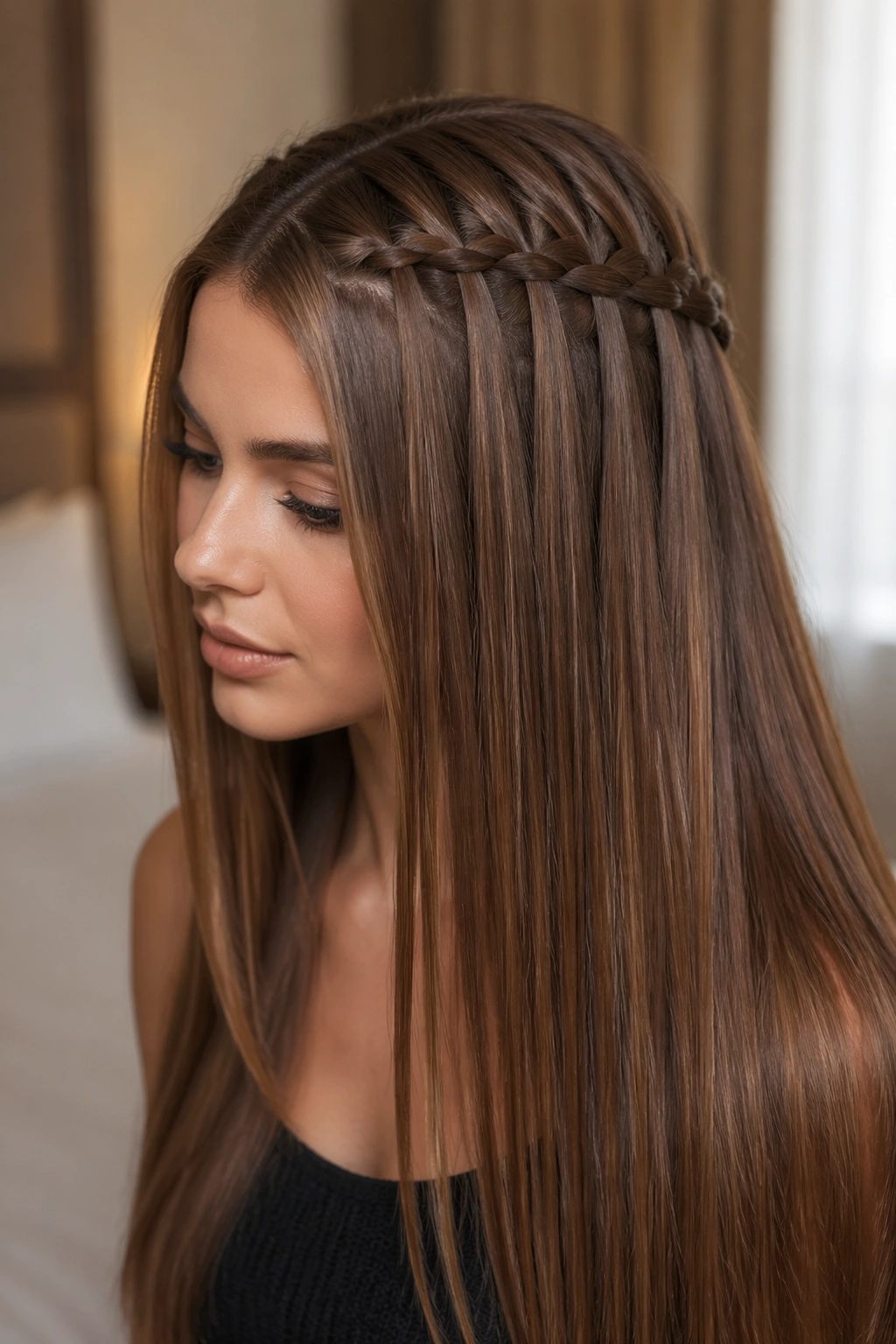
The waterfall braid is one of those styles that looks delicate from across the room and surprisingly clever up close. On straight hair, the dropped sections fall in clean ribbons, so the pattern reads clearly instead of getting lost in curl.
I like this style when the goal is movement. Not volume. Movement. The braid lays across the head like a soft frame, then the rest of the hair stays sleek and untouched. That contrast is the whole point. If you curl the ends too much, the style starts to drift away from its best quality, which is the long, glassy finish.
A thin shine serum on the last 6 to 8 inches of hair helps the loose lengths look polished in photos. Use a light hand. Too much product near the braid can make the top slip, and that is a frustrating way to spend an evening.
The best waterfall braid prom looks do not scream for attention. They just keep unfolding every time the hair moves.
5. Rope Twist Half-Up with Soft Volume
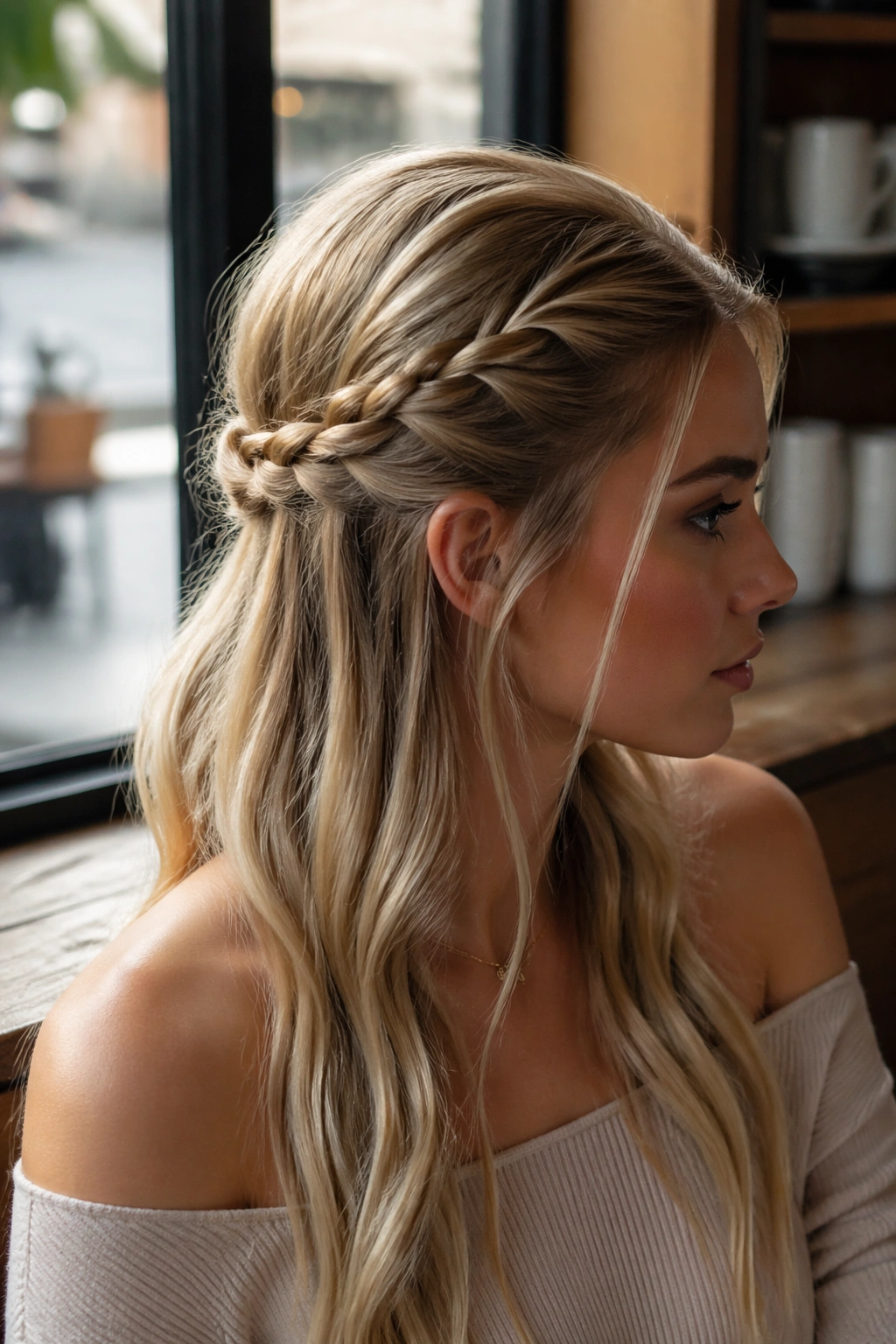
Unlike a classic three-strand braid, a rope twist looks smoother and slightly more modern. It is also easier to keep neat on straight hair, especially if your strands are fine and tend to slide apart the second you stop holding them.
This style works because two sections twisted around each other create a clean line without a lot of bulk. You can start one twist on each side of the head, pin them together at the back, and let the rest of the hair fall loose and straight. If the hair is very silky, mist the sections with texturizing spray first. That tiny bit of grip matters.
What Makes It Different
- The twist sits flatter against the head than a braid.
- It suits minimal dresses and modern gowns.
- It looks especially good with a middle part or a tucked-behind-the-ear front section.
This is the version I’d pick for someone who wants braid-inspired detail without the “I spent three hours on my hair” look. It is subtle. In a good way.
6. Side Braid into a Low Polished Knot
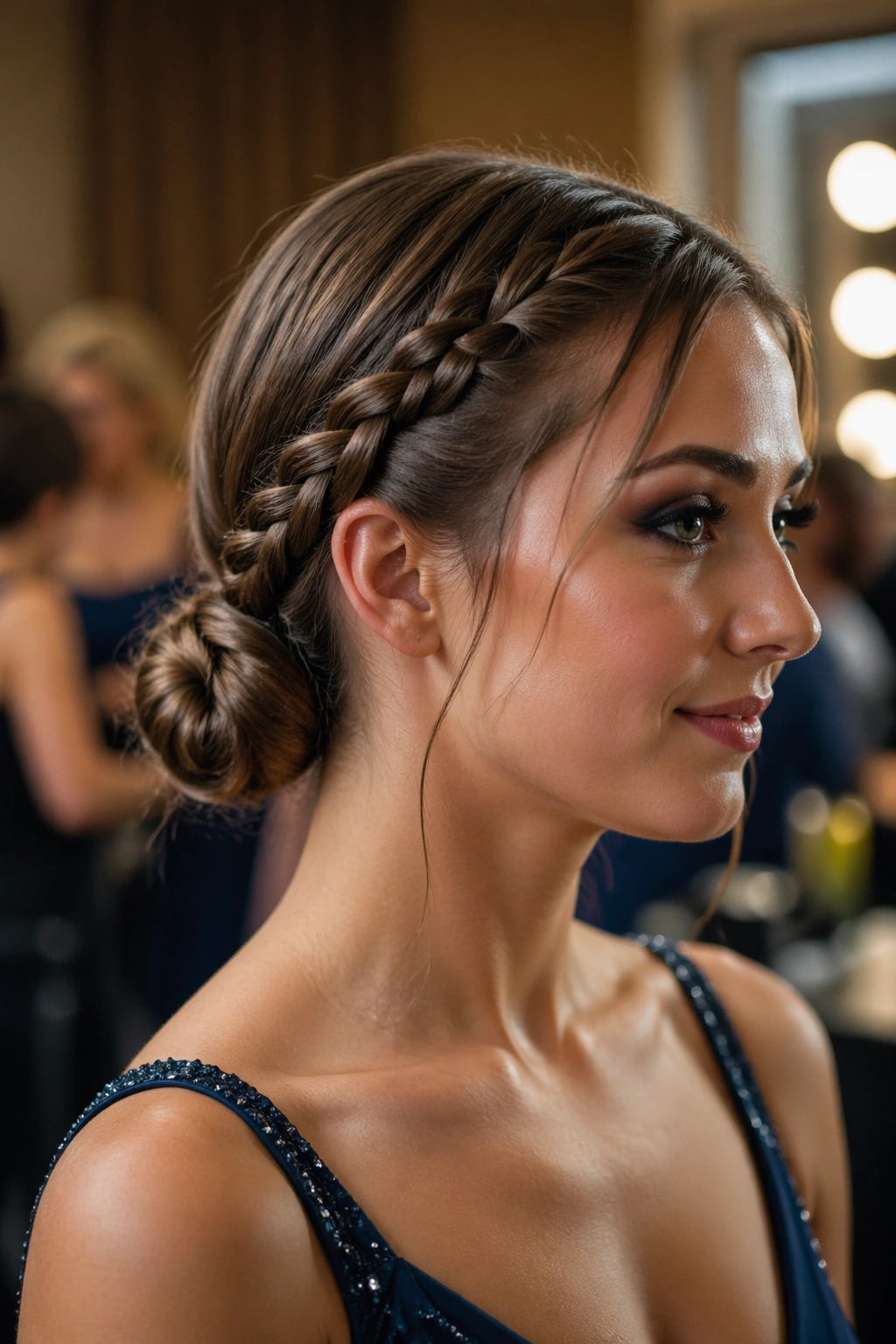
A one-sided braid can change the whole balance of straight hair. Pull everything over one shoulder in your mind first; that is the feeling this style gives, even when the length still hangs down the back.
The braid starts at one side of the part, travels low across the head, and ends in a small knot or twisted tuck near the back. The knot keeps the style from looking unfinished. Without it, the braid can feel like it just stopped. With it, the shape has a clear ending.
- Keep the braid 2 inches or less if you want it refined.
- Tuck the knot slightly below the crown for a softer outline.
- Use two pins in an X to lock the knot in place.
This one loves one-shoulder dresses. It also helps if the neckline has beading or a strong collar, because the hair stays out of the way while still looking styled. Little detail, big payoff.
7. Pull-Through Braid Half-Up for Extra Thickness
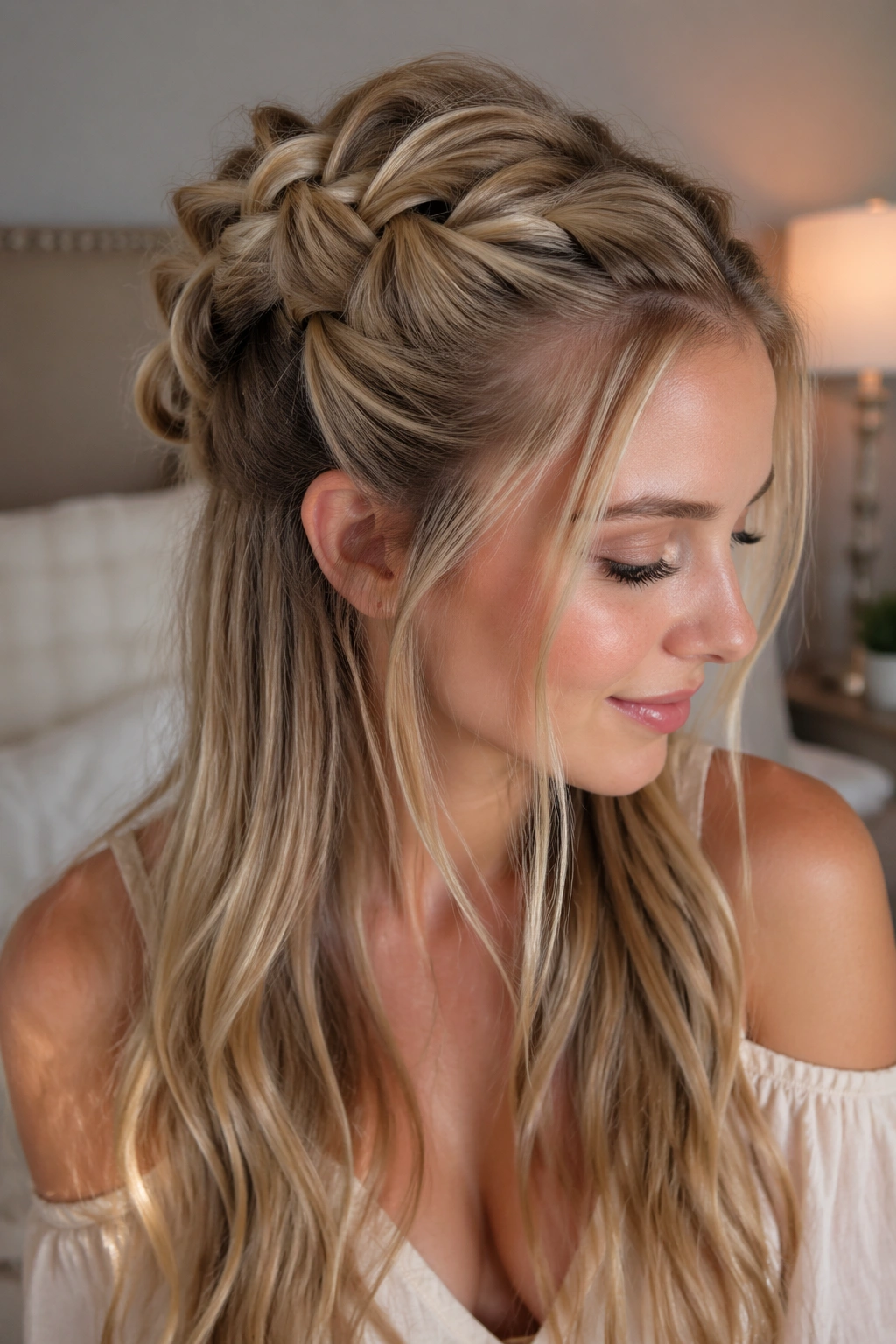
Thin hair does not need to look thin. Pull-through braids cheat that problem in a smart, wearable way because they build a bigger braid shape out of ponytail sections instead of relying on natural thickness alone.
The result is a half-up style that looks fuller than a standard braid, especially on straight hair where the strands can otherwise lie too flat. Each little elastic section creates a lifted, segmented shape. It sounds fussy. It isn’t, once you see it built.
What Gives It That Full Look
- Each section is secured before the next one is added.
- The braid can be pancaked gently after it’s done.
- A few face-framing pieces keep the crown from looking too severe.
Use small clear elastics, spaced about 1 inch apart, and don’t pull every loop apart equally. Some sections should stay tighter than others so the braid has shape. This is one of the strongest options if you want the top to look more substantial without teasing the whole head.
8. Lace Braid Over One Temple
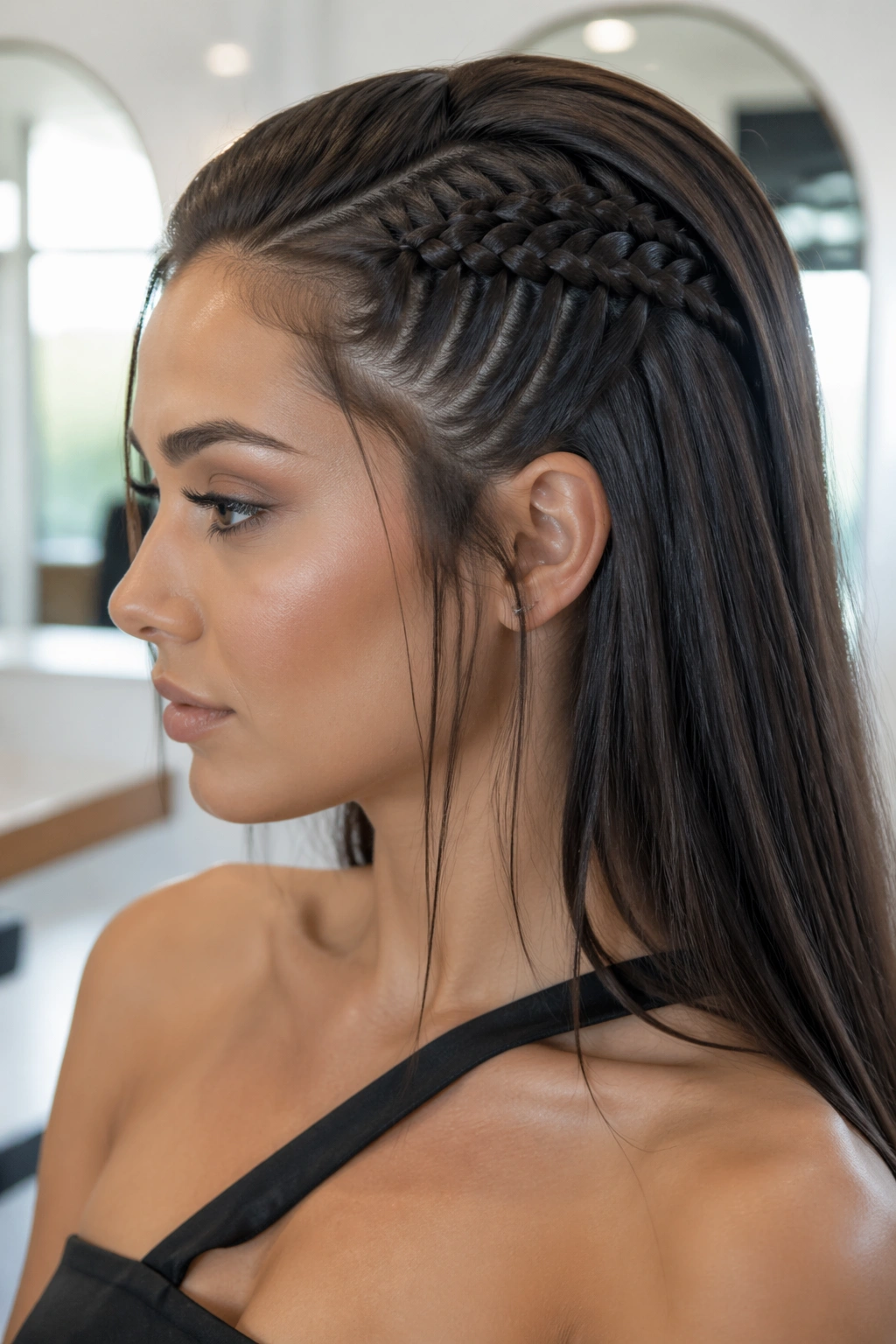
There is something quietly strong about a lace braid. It starts at the hairline and stays close to the head, almost like a decorative line drawn across one side before dropping into the rest of the hair.
On straight hair, the lace braid looks especially neat because every strand lies where you place it. The front edge stays smooth, the braid has a clean outline, and the loose hair behind it can remain poker-straight or sit in a shallow bend if you want a little movement. I like that it leaves one side of the face open. That matters with statement earrings.
The feel of this style is light. Not fragile. Light. The braid does not sit heavy on the head, and that makes it a smart choice for longer prom nights where you do not want a full crown feeling like a helmet by the end of the evening.
If the dress has a high neckline, a lace braid keeps the look from becoming too closed in. It gives the eye somewhere to go.
9. Braided Halo with a Clean Center Part
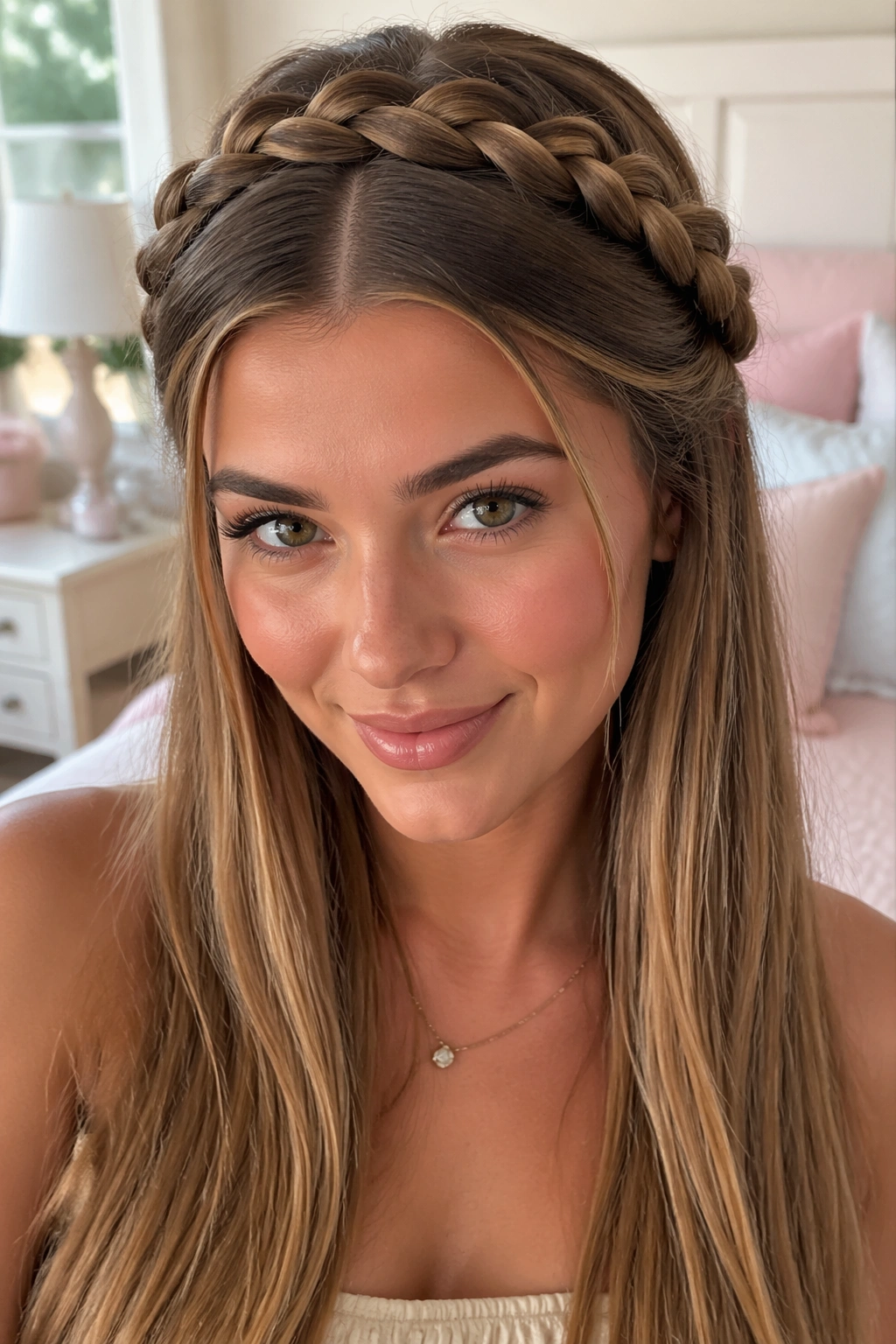
Can a braid feel formal without looking stiff? Absolutely, if it sits low enough and wraps the head with clean tension. That is what makes a braided halo so useful for straight hair.
This style uses a center part, then braids travel from one side toward the back and around to the other side, creating a ring shape that leaves the bottom half loose. The effect is polished, but not severe. Straight hair helps here because the halo line stays crisp instead of puffing out.
How to Wear It
A narrow halo works best if you want to keep the style airy. A wider halo gives more structure and looks stronger with a simple dress.
Use a fine-tooth comb to keep the part sharp. Then smooth the top with a tiny bit of styling cream before braiding. If you skip that step, flyaways can soften the line too much. That may sound minor, but on this style the part is half the look.
It pairs nicely with long earrings and shoulders that you want to keep visible. The braid does the framing so the rest of the outfit can breathe.
10. Tiny Accent Braids on Both Sides
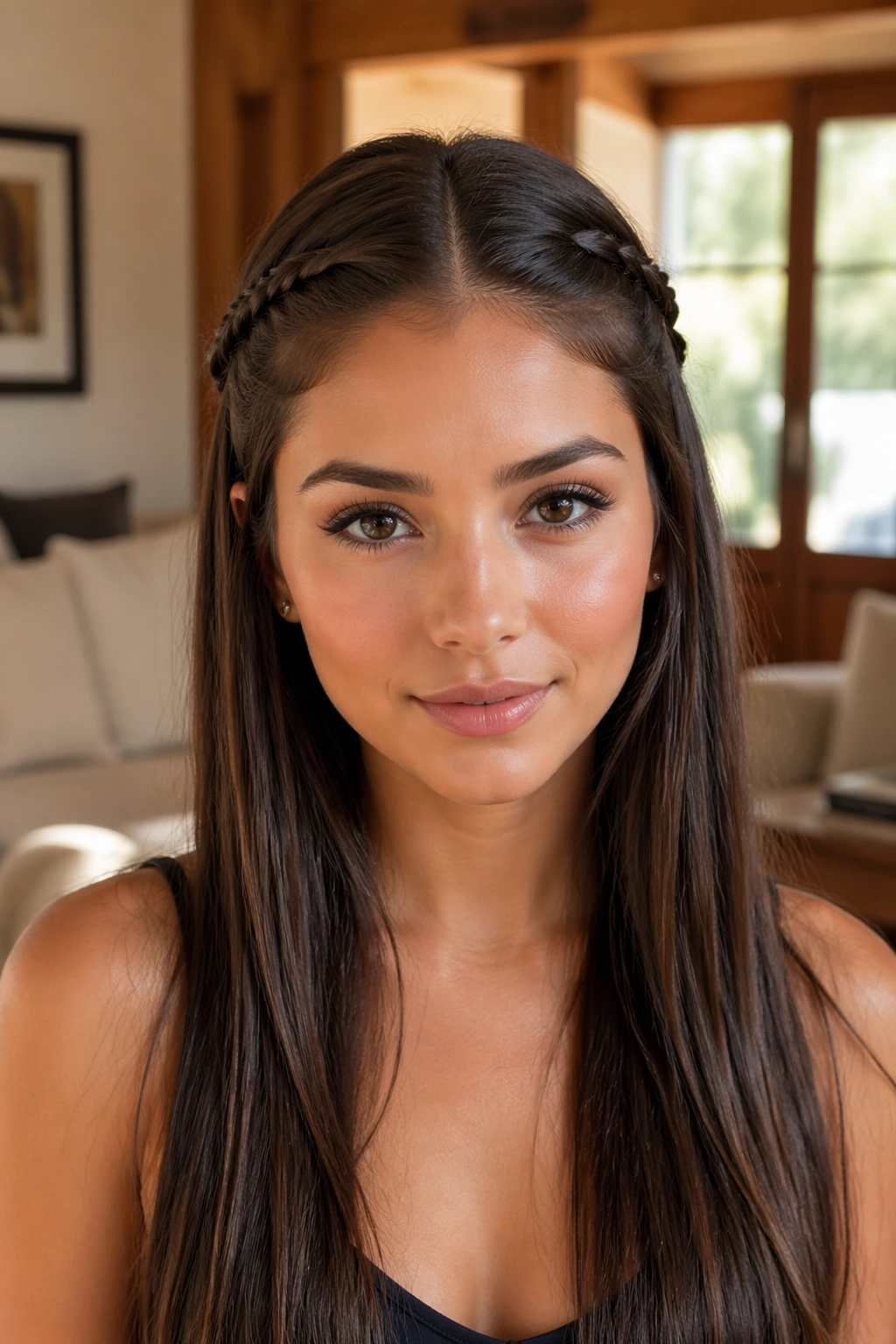
Small braids can do more than people give them credit for. Two skinny accent braids at the temples, pinned back into the half-up section, add detail without taking over the style.
This is a good fit if you want straight hair to stay mostly straight but not flat. The tiny braids break up the surface in a way that looks deliberate, almost like built-in accessories. They also work nicely with straight hair that refuses to hold larger braid shapes for long. Less pressure. Less slipping.
A lot of prom styles go too hard here and pile on too many pieces. Two accent braids are enough.
If you want them to feel a little dressier, add one tiny crystal pin where each braid meets the half-up anchor point. That is enough sparkle. Anything more and the whole head starts to look crowded, which is rarely a good trade when the dress already has its own personality.
11. Braided Topknot Sitting at the Crown
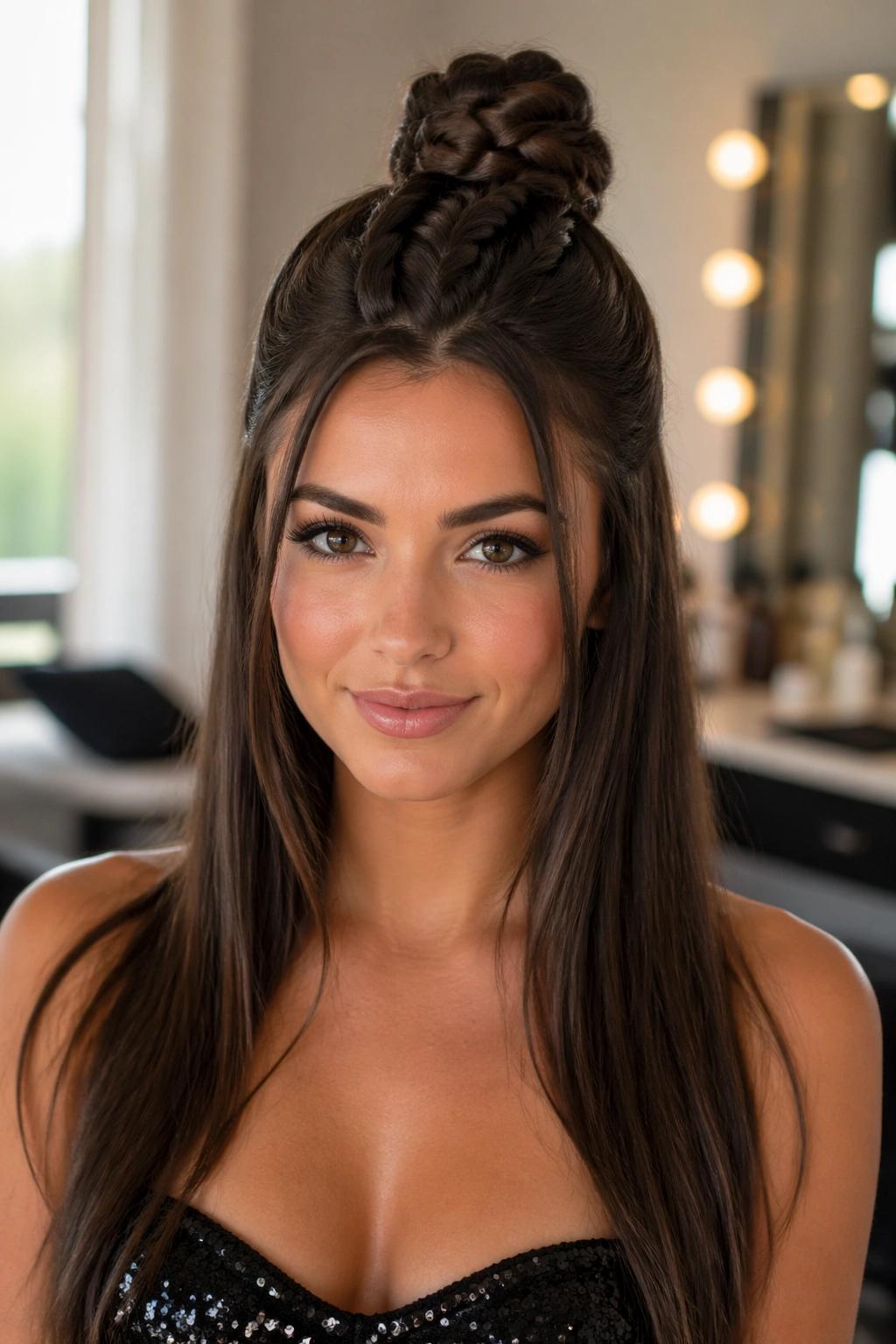
This is the style for the person who wants height. Not volume everywhere. Height.
A braided topknot half-up gives straight hair a lift at the crown, then leaves the rest of the length hanging smooth underneath. Compared with a full bun, it keeps the style lighter. Compared with a plain half-up knot, it looks more finished because the braid builds texture before the knot appears.
It suits dresses with a dramatic back or a neckline that needs clearing away from the shoulders. The topknot creates a focal point high on the head, which pulls the eye upward in a flattering way. I like that the loose hair underneath still does its own thing. It keeps the whole style from becoming too formal.
If your hair is very flat at the crown, backcomb a small section under the braid first. Just a little. Enough to give the knot something to sit on. Then smooth the outside layer so it still looks clean.
12. French Braid Half-Up with Lift at the Roots
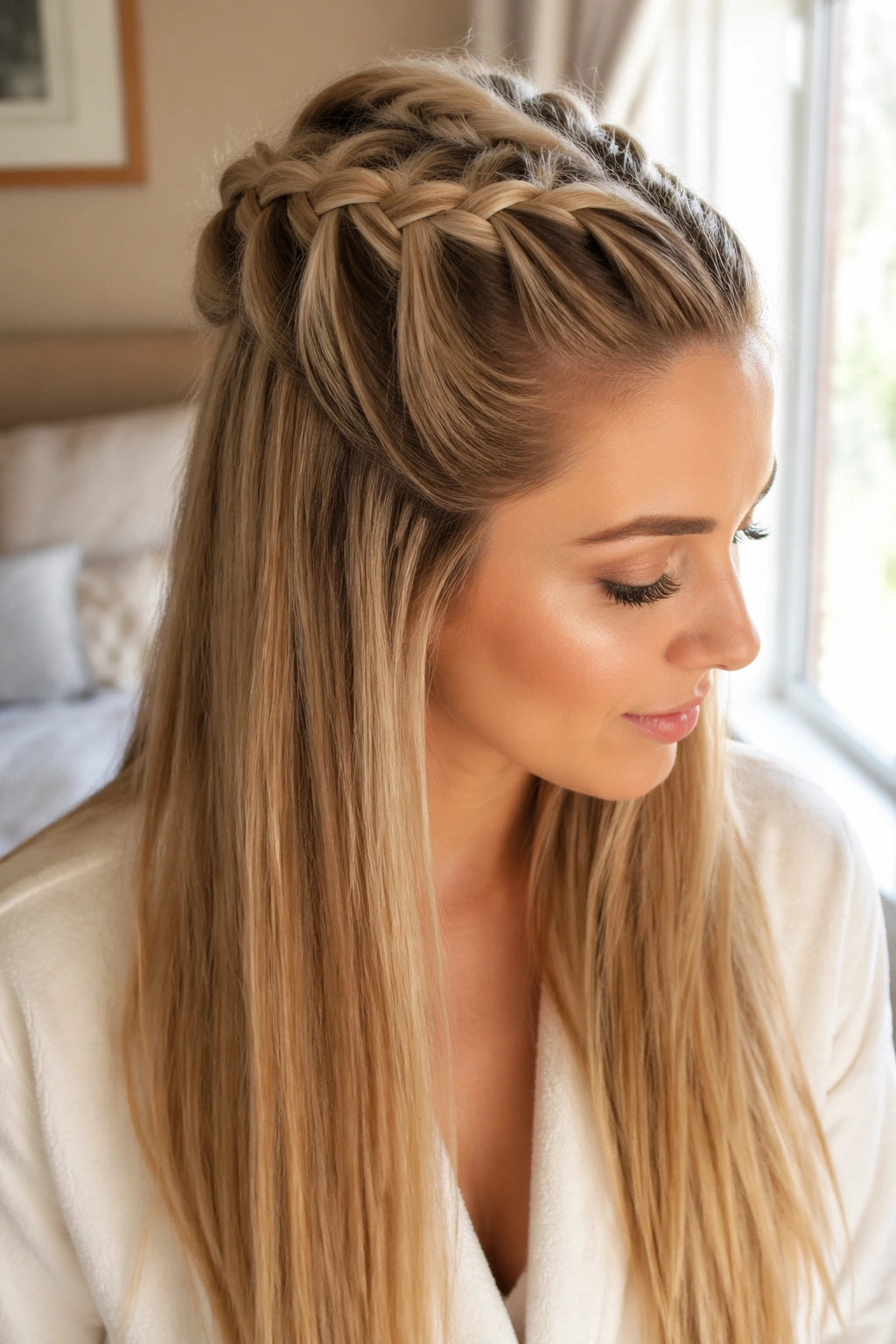
A French braid is one of the best ways to fix limp roots on straight hair without making the style look overworked. The braid starts with a little lift at the scalp, then gathers in more hair as it moves backward, which gives the half-up section a fuller shape than a simple plait.
That extra lift matters for prom because straight hair can collapse fast once you leave the house. A French braid holds the top section in place and gives the crown some presence. The length below stays straight, so the style never gets too busy.
- Start the braid about 1 inch behind the hairline.
- Keep the first three crosses snug so the braid has staying power.
- Stop when you reach the back of the crown, then pin the end flat.
A tiny mistake here is braiding too low. That drags the shape down and makes the hair feel heavy. Keep it higher, and the whole style looks more awake.
13. Snake Braid Detail for a Sleek Edge
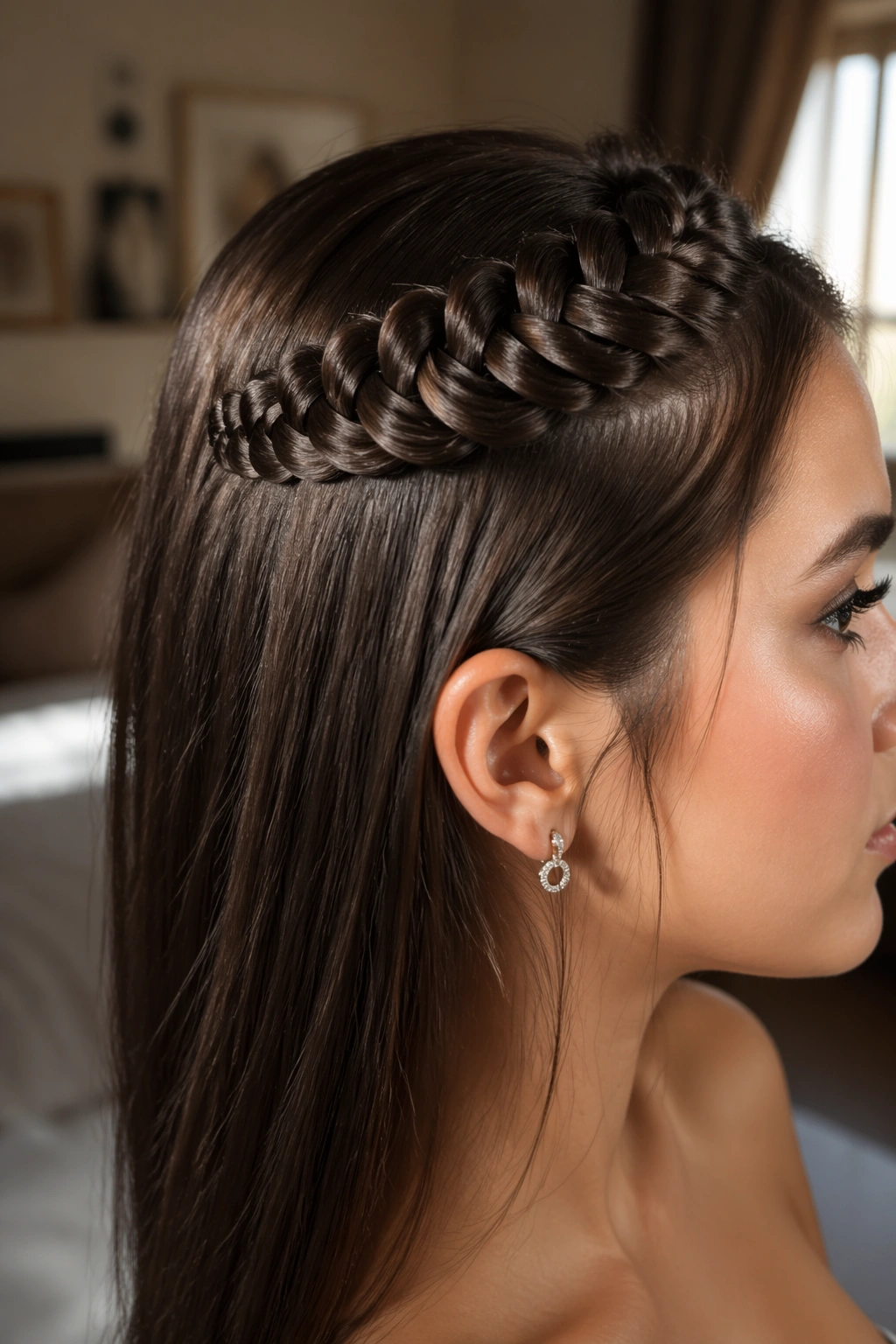
If you want something that looks a little sharper than a standard braid, the snake braid is the move. It has a coiled, sculpted shape that stands out on straight hair because the smooth strands make the pattern easy to see.
The best thing about a snake braid is that it does not need much else. One woven detail across the crown or one side can carry the whole half-up style. Then the rest of the hair stays long and straight underneath. I like that contrast. It feels strong without feeling heavy.
Keep the braid fairly tight at the start so the shape does not unravel. Then let the twist curve naturally as you pin it into the half-up section. This is not the braid for someone who wants soft and airy. It is for someone who likes a little edge, maybe with a structured dress or sharp jewelry.
A small glossy pin finishes it better than a big decorative clip. The braid already has the attitude.
14. Ribbon-Woven Braid with Prom Color
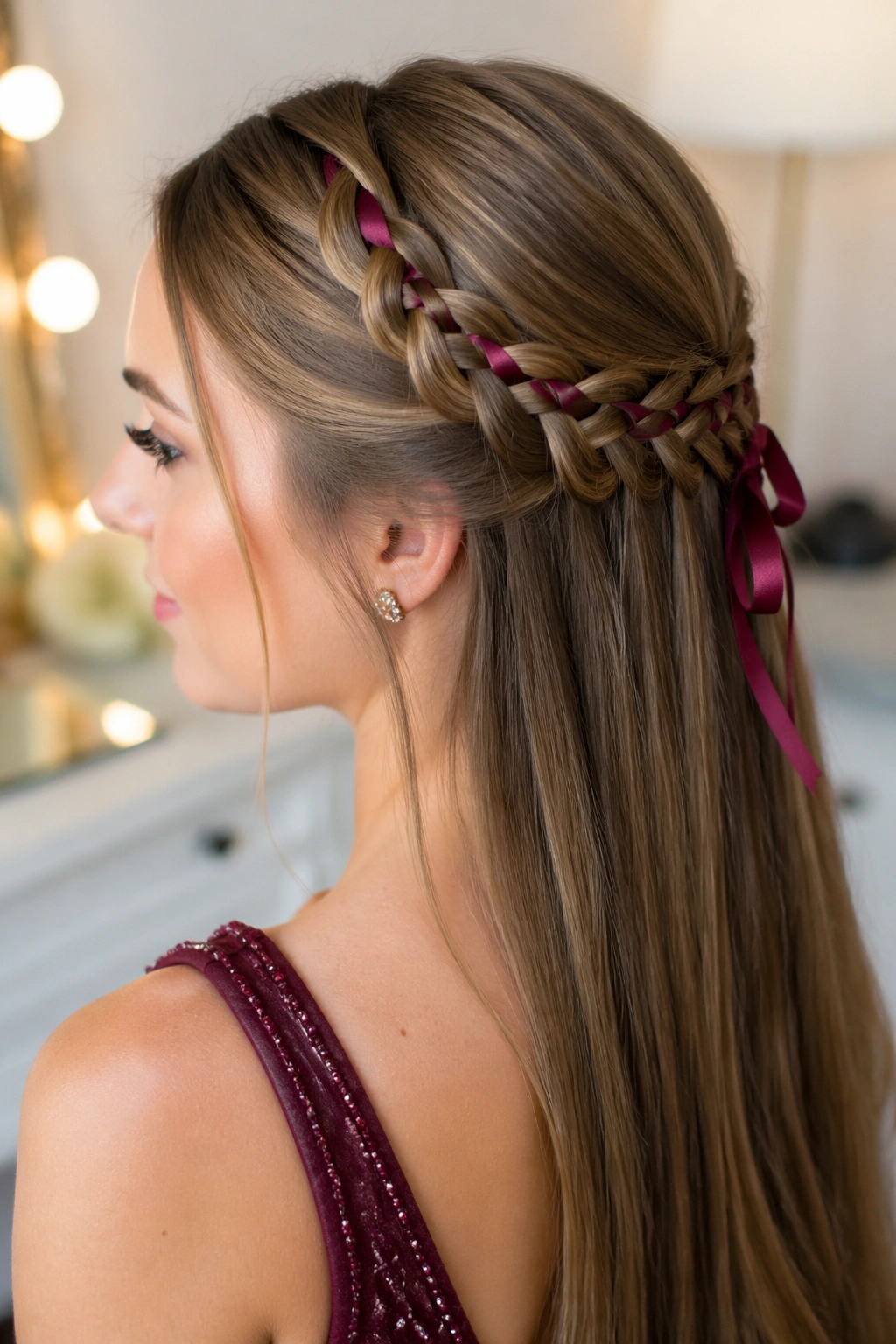
Can a ribbon make a braid look more special without making it childish? Yes, if you choose the right width and keep the color restrained.
A satin ribbon woven through a half-up braid adds a strip of color that shows up against straight hair beautifully. Because the strands are smooth, the ribbon sits cleanly instead of getting lost. A width between ¼ inch and ½ inch works best. Wider than that can make the braid feel bulky.
How to Use It
Match the ribbon to either the dress or a small detail on the gown. Not both. Matching everything too closely can look forced.
Use the ribbon in a simple three-strand braid or weave it through a fishtail for a softer effect. If the outfit is already busy, pick a ribbon in a shade close to the hair color or the dress lining. If the outfit is plain, a bold ribbon can carry the color story without needing more accessories.
This is one of the easiest ways to make prom hair feel personal. It reads as a choice, not an accident.
15. Pearl-Pinned Braid Stack
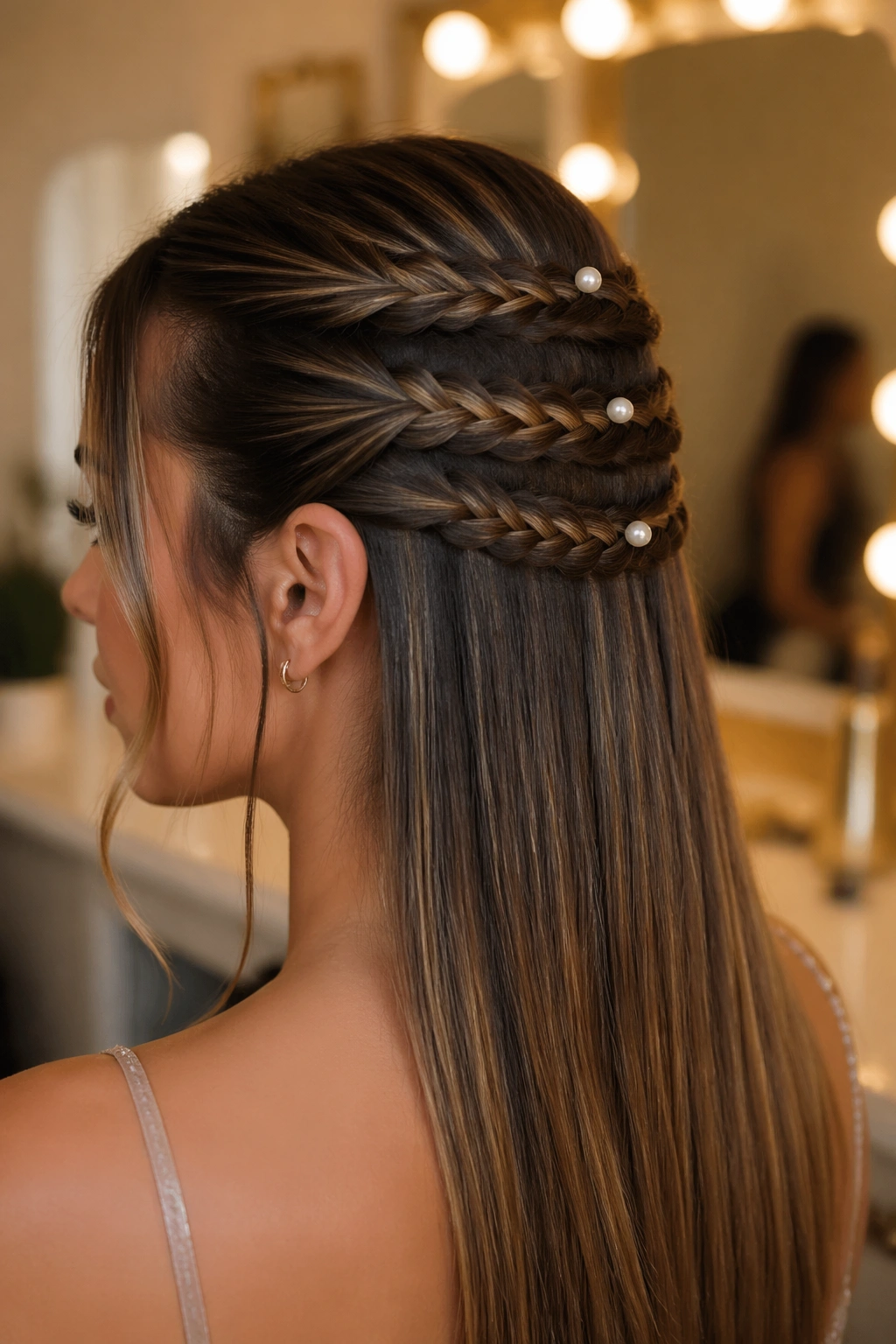
Pearls on straight hair can go one of two ways: elegant or overdressed. The difference is spacing. Keep them small and let the braid do the work.
A braid stack uses two or three slim braid sections pinned one above the other, then finished with tiny pearl pins or pearl-studded clips. On straight hair, the pins stand out cleanly because the surface is so smooth. That is the advantage. You are not hiding the ornament. You are letting it show.
The look works best when the braids are narrow and the rest of the hair stays polished. A little shine spray on the loose lengths helps the pearls feel intentional rather than floating on top of dry hair.
I would keep the pearl placement irregular. Not random, but not symmetrical to the millimeter either. Place one near the braid end, one just above it, and maybe one tucked slightly closer to the temple. That staggered arrangement keeps the eye moving and stops the style from feeling stiff.
If your dress already has pearl details, this is an easy way to echo them without repeating the exact same shape.
16. Crisscross Braided Crown Section
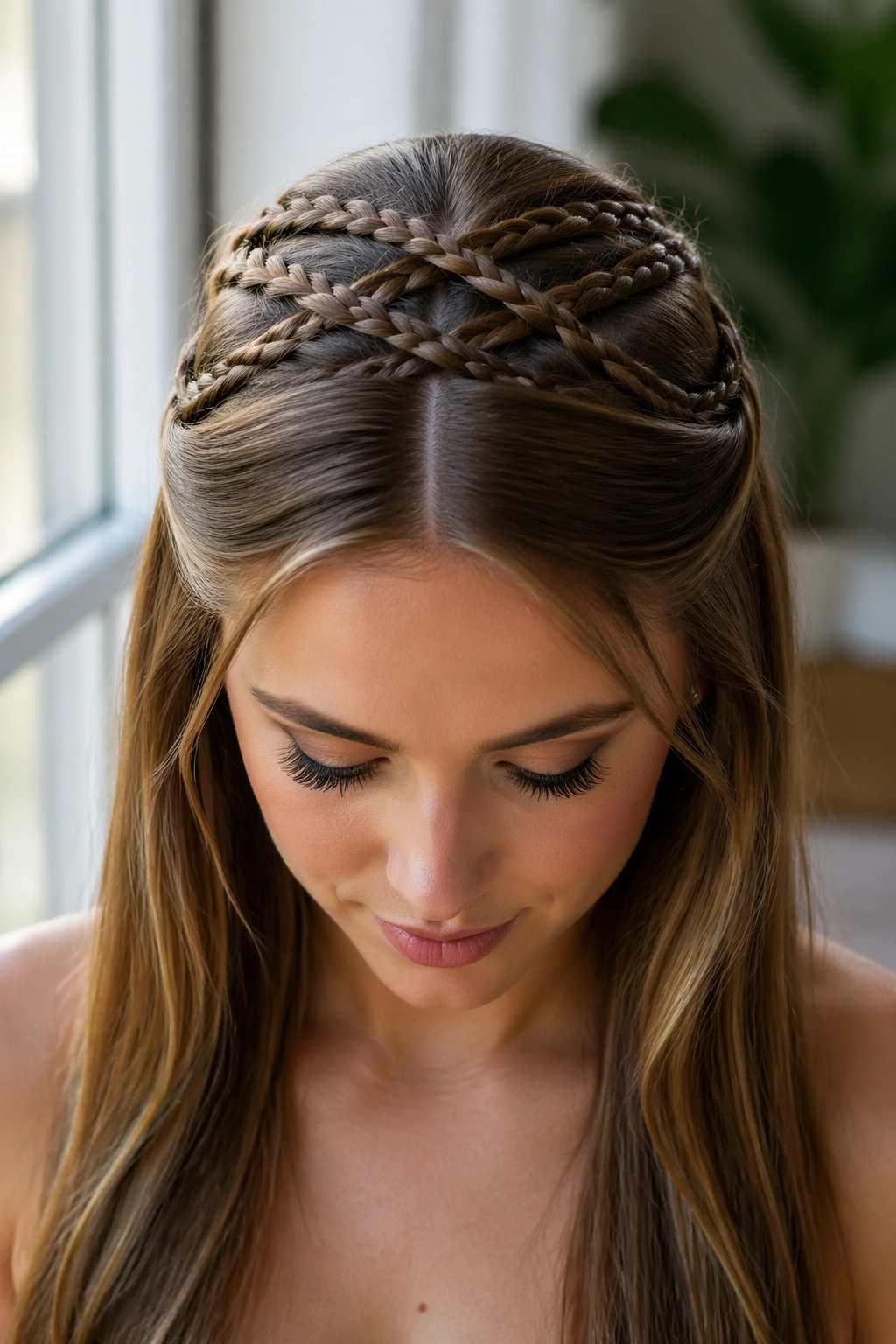
A single braid is clean. A crisscross braid crown is cleaner in a different way—more built, more architectural, and a little more dramatic from the front.
This style uses two or more narrow braid sections that cross over each other at the crown, then pin into the half-up section. It is a smart option for straighter hair with good density because the crossing pattern gives the top more substance. Fine hair can wear it too, but the sections should stay narrow so the look does not overwhelm the head.
Best For
- Dresses with plain necklines that need a stronger hair shape.
- Hair that lies very flat at the crown.
- People who want the braid to feel structured instead of soft.
Use four bobby pins in an X pattern if the braids feel slippery. That sounds tiny, but it helps more than a single pin placed randomly. The crisscross shape gives the style its visual punch. Keep the rest of the hair sleek and the whole thing feels intentional instead of complicated.
17. Two Micro Braids into a Center Knot
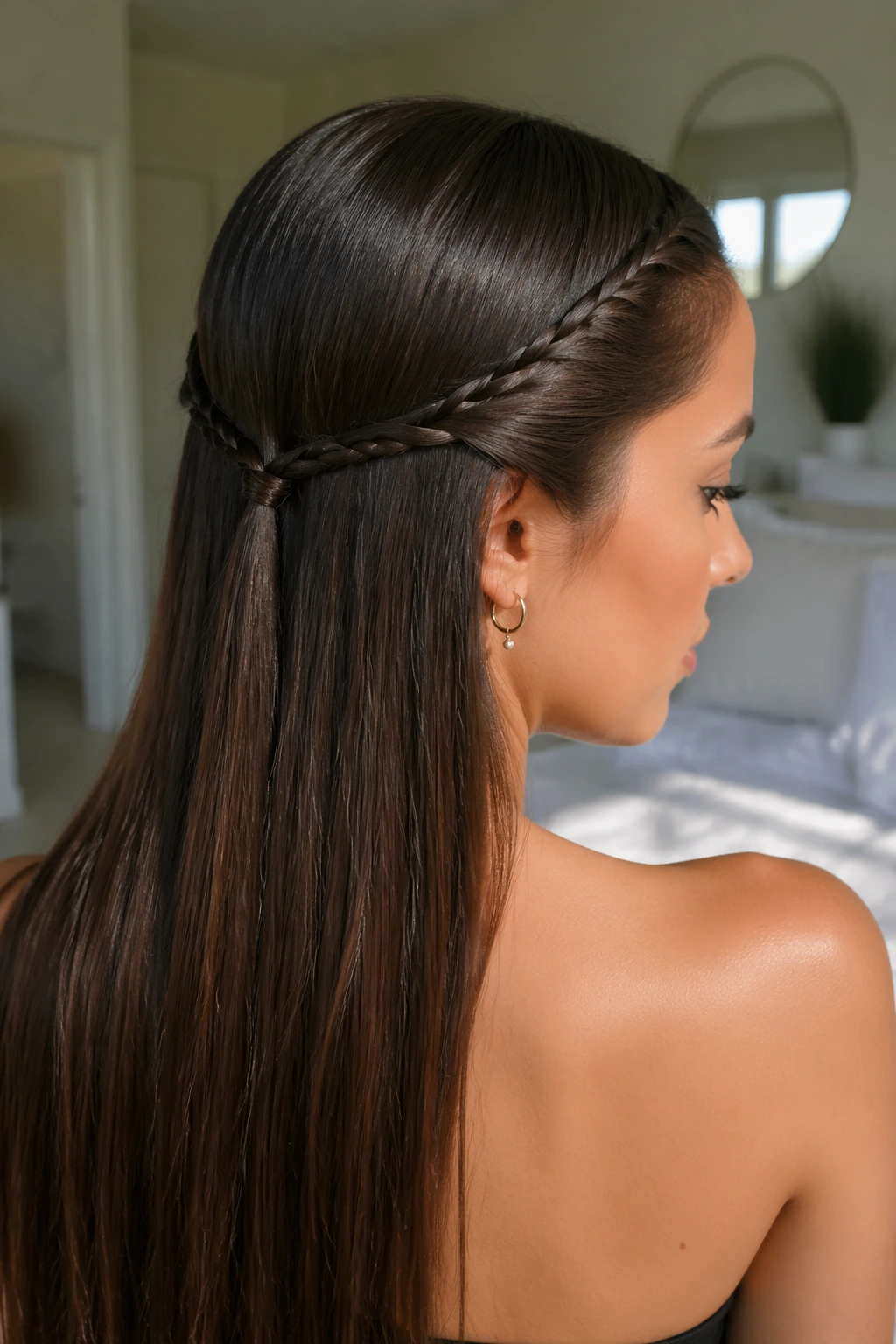
Tiny. Controlled. A little cool.
That is the whole mood of this style. Two micro braids start near the temples, travel backward, and meet in a small center knot at the back of the crown. Everything else stays long and straight. It is one of the easiest ways to make straight hair look styled without piling on texture.
The knot should stay small. If it grows too large, the look loses the delicate feel that makes it work. This is not the braid to turn into a bun. It should sit like a neat little anchor point, almost a punctuation mark in the middle of the hair.
A matte pin can help the knot stay put, but don’t hide it too much. The clean shape is part of the appeal. If your dress has clean lines or minimal fabric detail, this style keeps the hair in the same visual language.
Some prom hairstyles try to do too much. This one knows when to stop.
18. Soft Textured Half-Braid with Loose Face Pieces
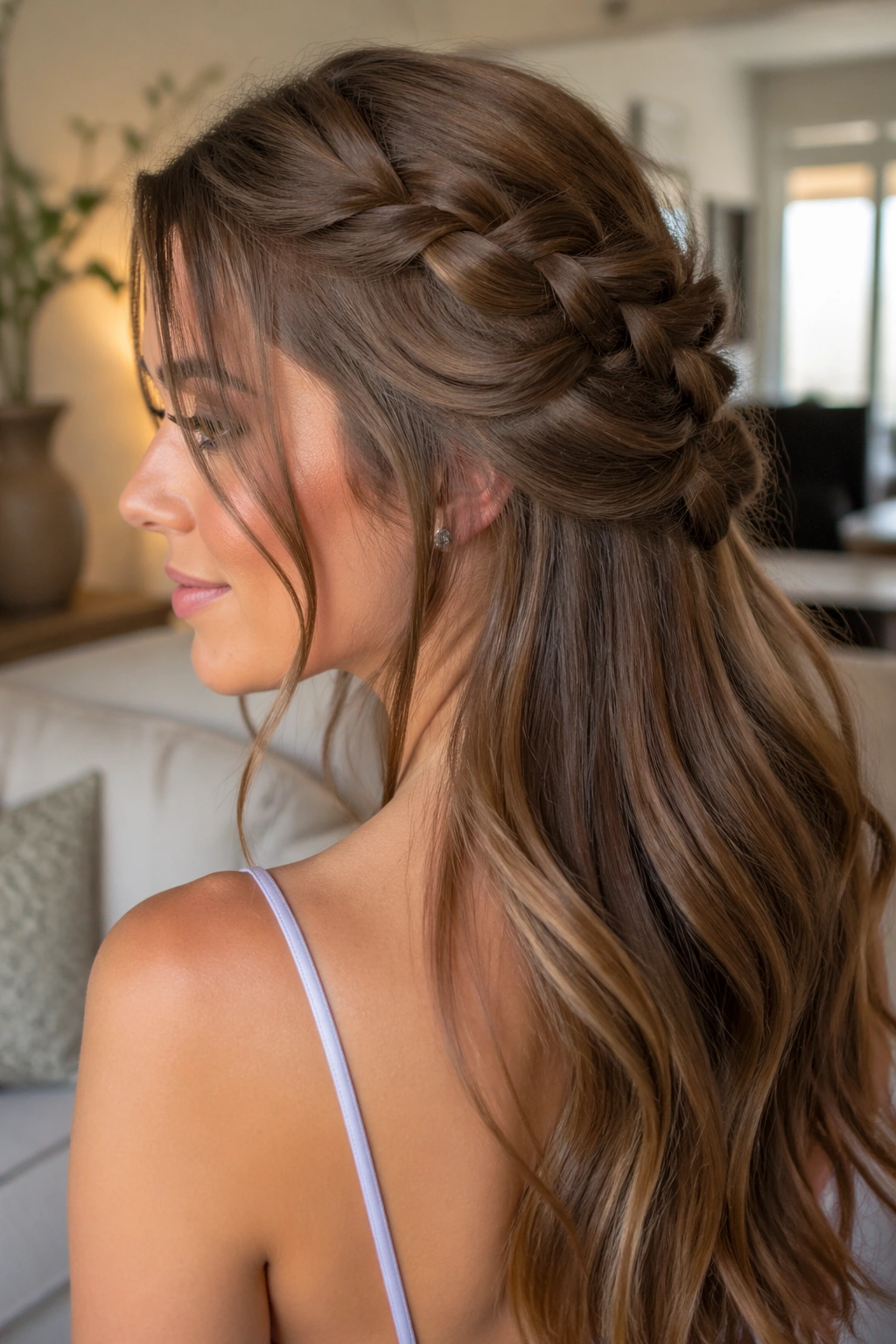
There is a particular softness that happens when a braid is not pulled too tight and a few face-framing pieces are left out on purpose. The whole style feels less rigid, more human, which is useful if the dress is very structured.
Straight hair can still wear this look without turning it into a curl story. Keep the braid in the back half loose enough to show shape, then let the front pieces sit around the cheekbones and jaw. They should move a little when you turn your head. If they are too thick, the style gets heavy fast.
- Ask for face pieces that are ½ inch to 1 inch wide.
- Keep the braid tension moderate, not tight.
- Use a light bend, not a full curl, on the loose front sections if you want softness.
This version works when you want the hair to feel romantic but not fussy. It is the kind of style that looks best when you stop trying to make every strand behave.
19. Reverse Braid with Straight Lengths Falling Free
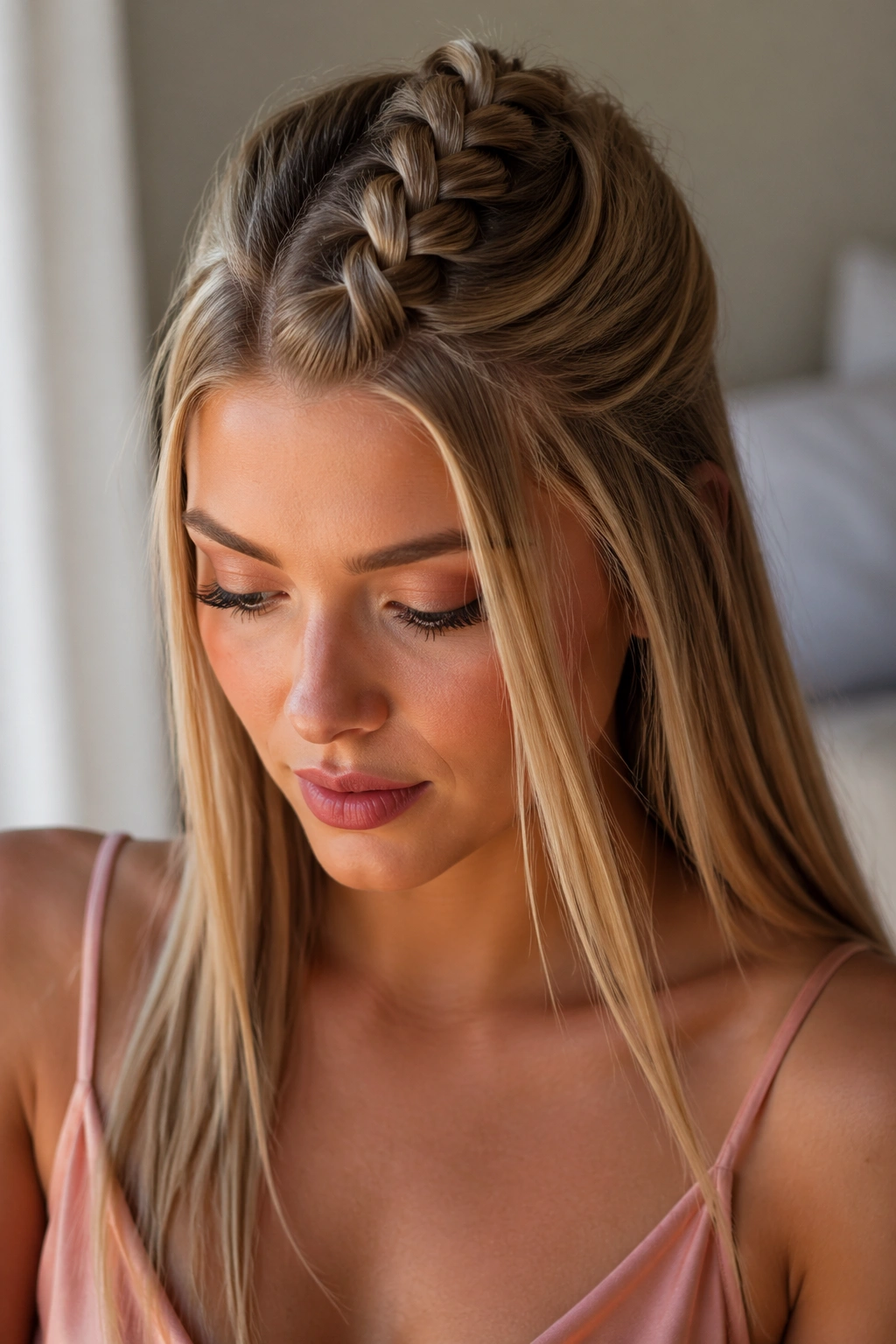
A reverse braid, usually worn as a Dutch-style braid, pops outward from the head instead of sinking inward. That little difference changes the whole look on straight hair. You get a braid with more shadow and more shape, which reads well in photos and from a distance.
This is a strong choice if your hair is flat and you want the half-up section to stand out. The braid sits up from the scalp, so it creates a fuller profile without needing extra teasing. Keep the rest of the hair very smooth and the contrast does the job for you.
The main trap is tension. Pull it too tight and the braid can look stretched. Leave it just relaxed enough to hold shape, then pin it where the crown starts to fall away toward the back. That keeps the top section visible without making it bulky.
I like this style with simple earrings and a clean dress neckline. It gives the hair enough structure to carry itself.
20. Braided Headband with Tucked Ends
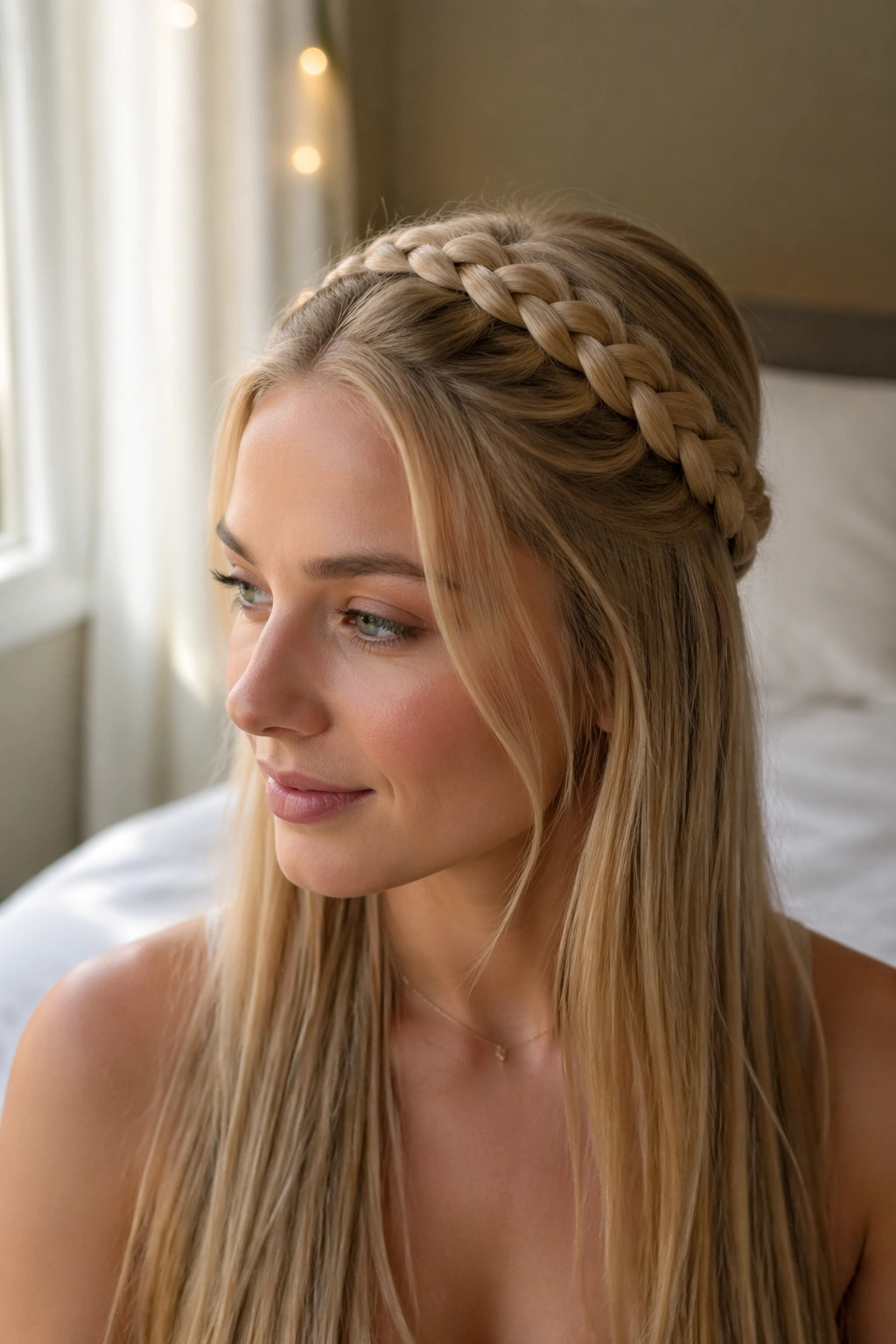
A braided headband is one of those styles that makes straight hair look instantly dressed up, even if the rest of the length stays almost untouched.
The braid travels from one side of the head to the other like an actual headband, then the ends disappear into the back section. That tucked finish matters. Without it, the braid can feel unfinished, almost as if it was meant to lead somewhere else. With it, the look feels complete and tidy.
What to Watch For
- Keep the braid low enough to frame the forehead, not sit high like a crown.
- Hide the end under a loose layer of hair so it disappears cleanly.
- Pin the tucked section in two places if your hair is very silky.
This style is smart for dresses with a lot going on in the torso or skirt because the hair stays calm. It also works well when you want to show off a strong lip color or a bold earring. The hair supports the look instead of competing with it.
21. Side Rope Braid with a Flipped Finish
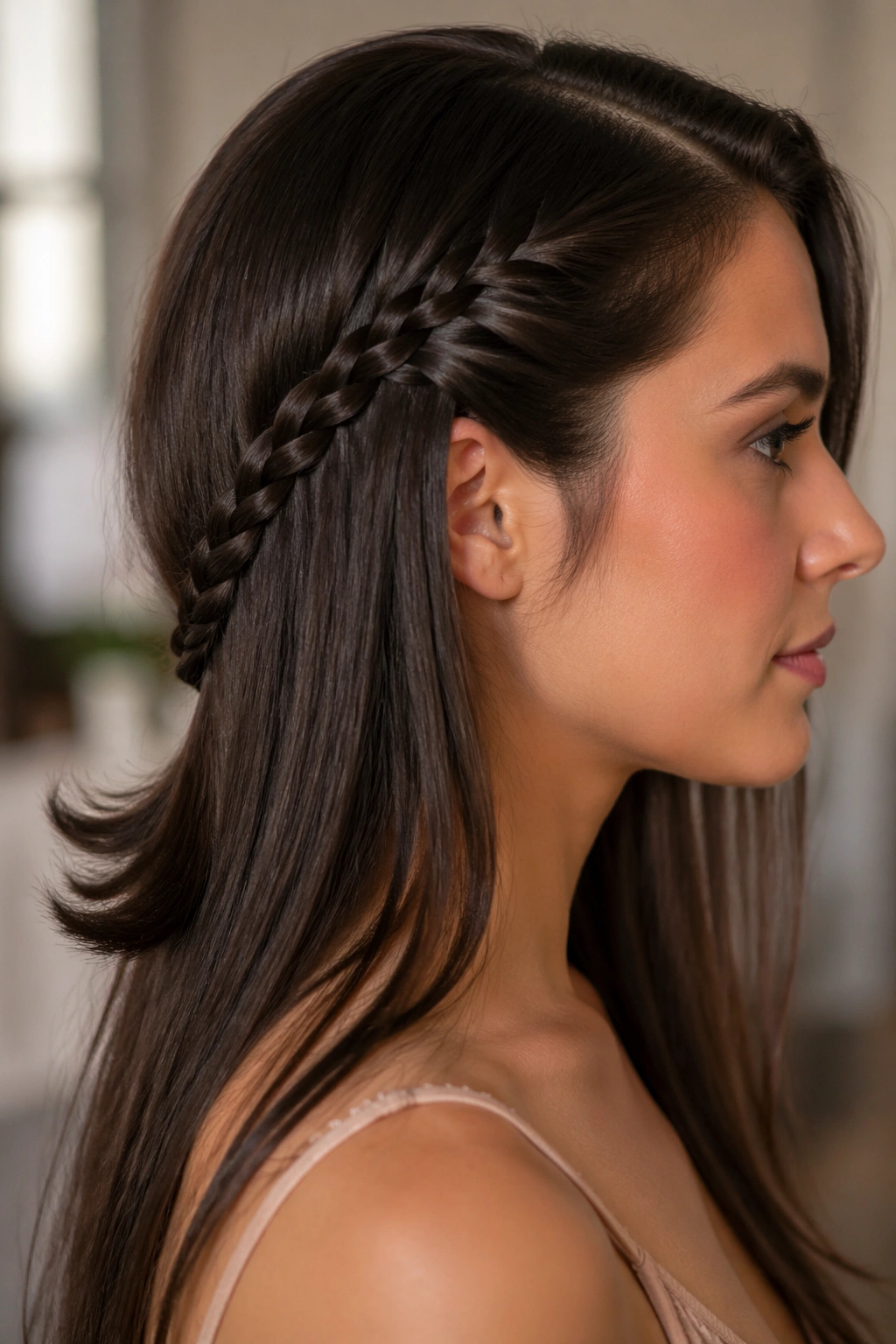
Why do I like a side rope braid so much on straight hair? Because it has that polished, sculpted feel without demanding a lot of length or thickness.
Start the braid from a side part, twist it downward along the side of the head, and let it meet the half-up section near the back. Then flip the loose ends under slightly with a round brush or the curve of a flat iron. That tiny bend gives the style a finished edge. Straight hair can look too severe if every line stays ruler-flat, and this solves that.
How to Get the Most From It
Use a lightweight spray on the rope sections so they hold their twist without getting crunchy. If the dress has a sharp neckline, keep the braid smooth. If the dress is softer, loosen the twist a touch and let one or two pieces fall around the face.
This is a smart pick for anyone who likes neat hair but does not want a stiff updo. It has shape. It has movement. And it stays calm.
22. Soft Twisted Crown with Face-Framing Pieces
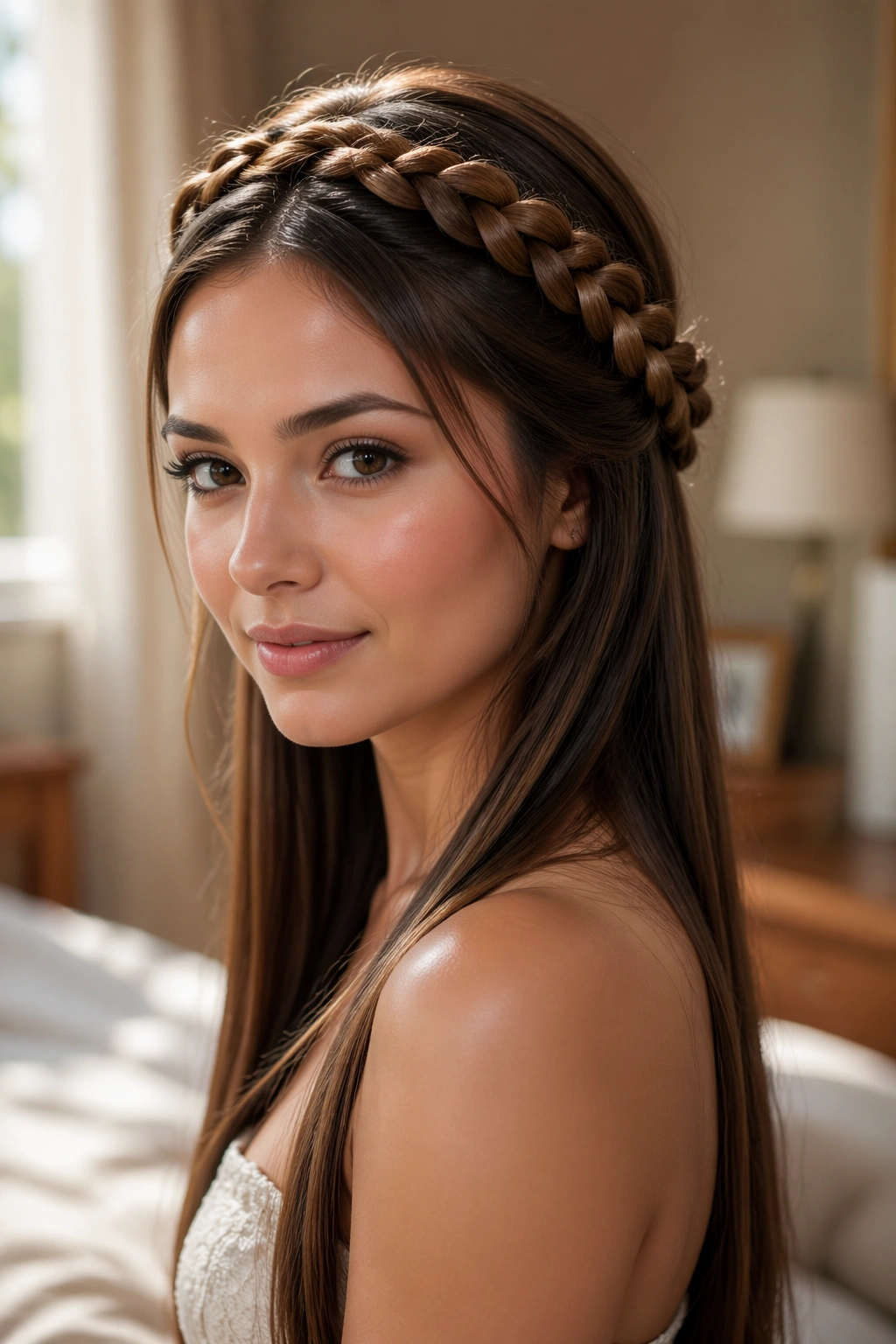
A soft twisted crown is the kind of prom style that never tries too hard, which is probably why it holds up so well. Two twisted sections move back from the temples, meet near the crown, and leave the rest of the straight hair to fall cleanly underneath.
This one works especially well when the dress has strong details already. Sequins, lace, a dramatic skirt—those pieces can carry the drama while the hair stays elegant and quiet. The twist gives the top section enough structure to feel styled, but the overall shape stays light. That balance matters more than people admit.
Use a little shine spray on the loose lengths and keep the twists close to the head. If they puff too much, the style loses its clean line. If they are too tight, the whole thing looks severe. Somewhere in the middle is where it lives best.
If you want a style that feels polished in photos and easy to wear in real life, this is the one I would keep on the short list. Straight hair can do formal without becoming stiff, and this style proves it.
