



Medium hair is the sweet spot for wedding braids. It’s long enough to twist, pin, and tuck, but not so heavy that the style drags itself flat before the cake is cut.
That matters more than people think. A braided half up half down on medium hair can look polished, move naturally, and survive a long day of hugs, photos, wind, dancing, and the occasional nervous hand running through it. Shorter hair can fight the braid. Very long hair can weigh it down. Medium length sits in the middle and, honestly, that’s where the interesting shapes live.
The trick is choosing a braid that supports the hair you already have instead of trying to fake a different texture. A little grit from texturizing spray, a few loose curls near the ends, and the right pin placement can change everything. The styles below lean into that balance.
1. Soft Crown Braid for Wedding Medium Hair
This is the style I reach for when someone wants bridal polish without the stiffness of a full updo. A soft crown braid sweeps across the top of the head and leaves the lower length loose, which gives medium hair enough structure to look intentional without feeling locked in place.
Why it flatters medium hair
Medium hair has enough length to make the braid visible, but it still keeps some lift at the crown. That means the braid reads as a detail, not a helmet. The loose ends stay light, and the whole shape moves when you turn your head. That’s a good thing.
Ask your stylist to start the braid around the temple, keep it slightly above the ear, and pin it about 3 inches behind the crown. That placement keeps the braid in view from the front and gives the back section room to fall cleanly. A 1-inch curling iron on the lower hair helps the style look finished without making it puffy.
- Best with: veils, pearl pins, or a simple comb
- Hold it together with: 6 to 8 bobby pins crossed in an X
- Works best on: hair with a little texture, not freshly washed silk
- Small but useful detail: tuck the braid loose enough that one fingertip can slide under it
My favorite part: this braid still looks good after the ceremony, when the style has relaxed a little and the curls have softened.
2. Side Dutch Braid into a Low Twist
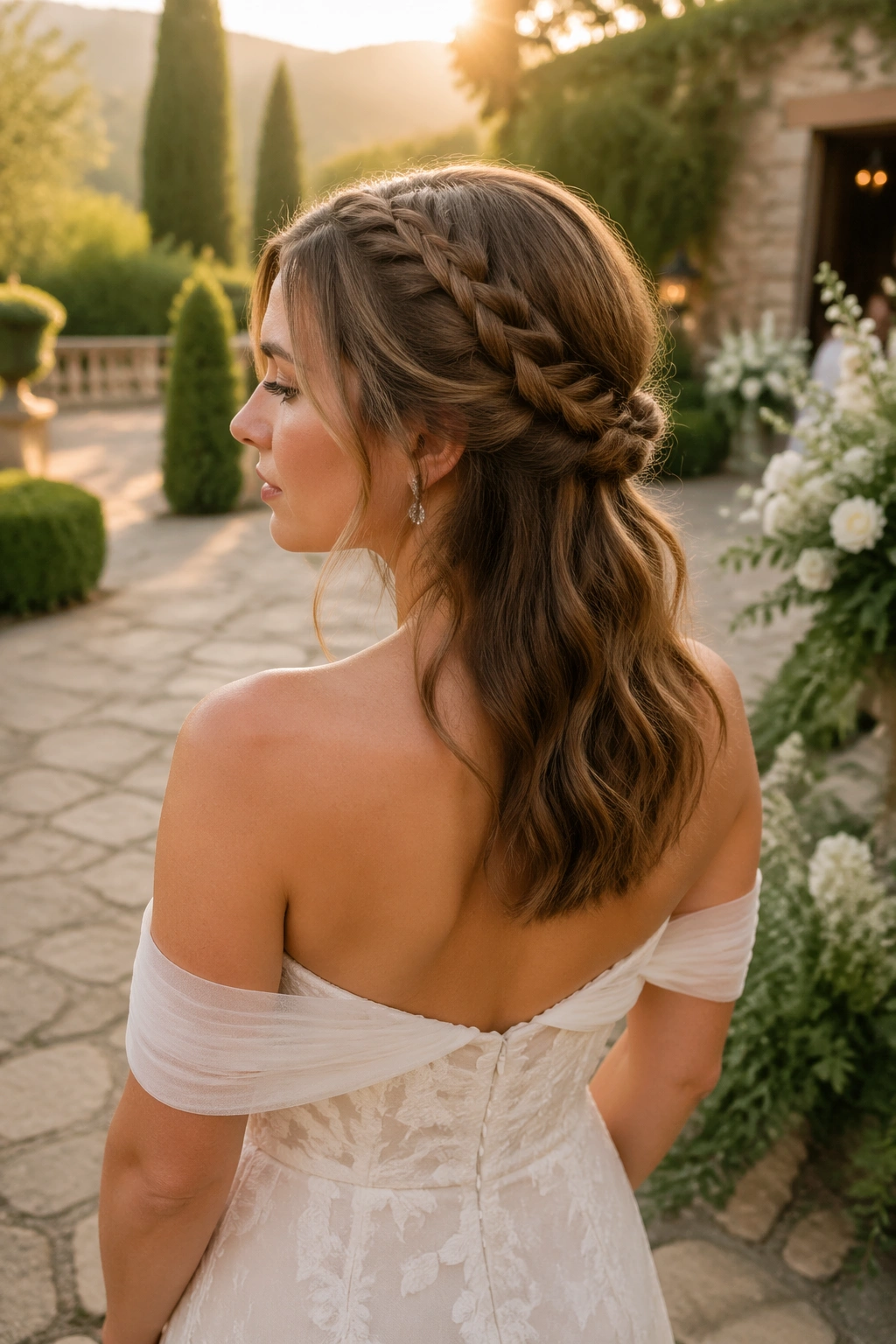
Want something tidier than loose waves but softer than a strict updo? A side Dutch braid flowing into a low twist does that job without looking fussy.
The braid starts near one side of the part and travels backward with a raised, three-dimensional look. That raised braid matters on medium hair because it gives the style shape from the front, where too many half-up styles go flat. Once the braid reaches the back, the remaining upper section can be gathered into a low twist and pinned just below the occipital bone.
It works especially well with one-shoulder or off-the-shoulder dresses. The side sweep creates a little asymmetry, which keeps the whole look from feeling too symmetrical or too school-dance. If your hair tends to slip, a matte pomade on the braid section helps more than extra hairspray ever will.
And no, it does not need to be tight. Tight braids read severe. A little breathing room makes the twist look softer and more expensive, which is a strange phrase to use for hair, but you know what I mean.
3. Double Mini Braids with Pearl Pins
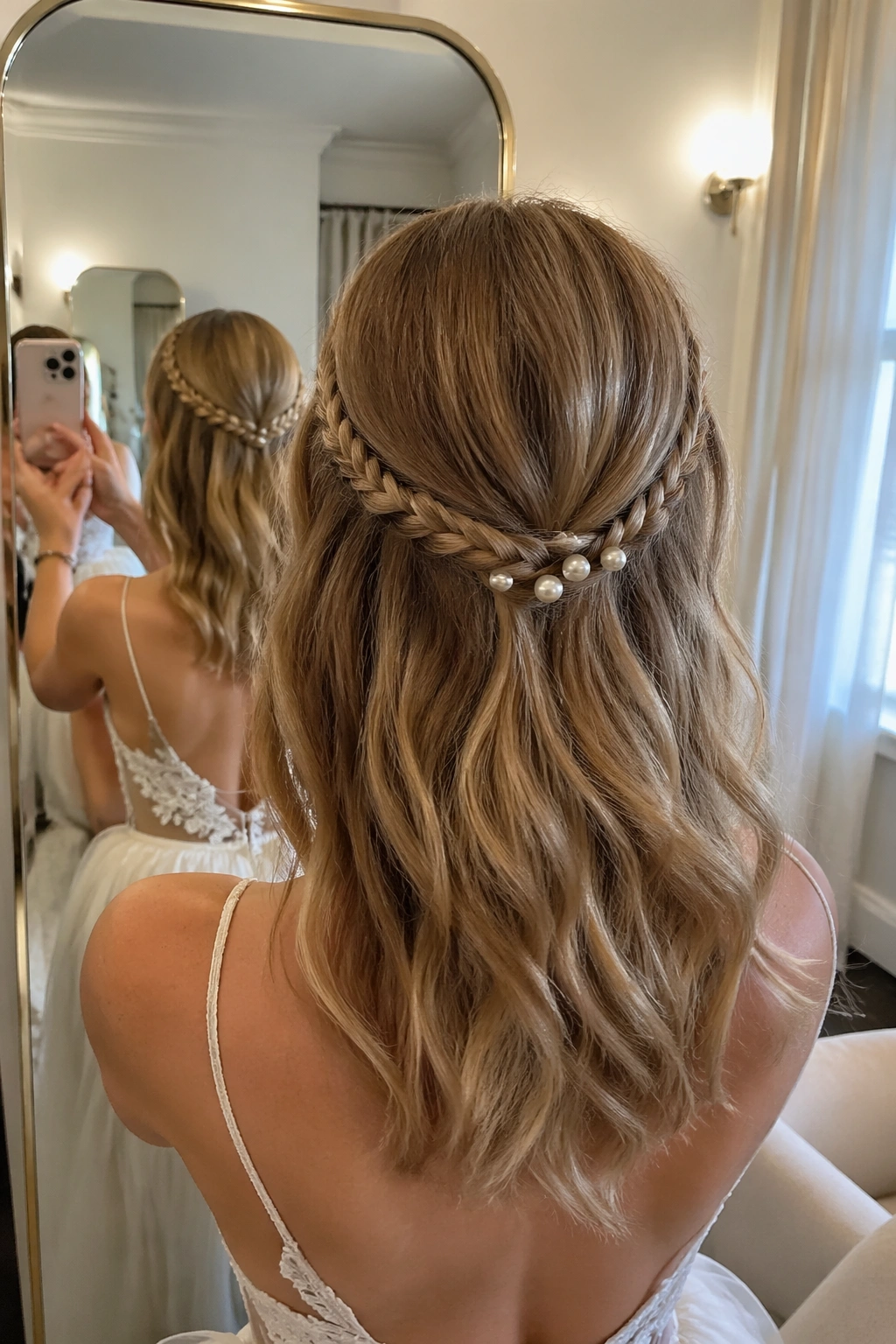
If your hair tends to fall flat by the second hour, two skinny braids can save the whole shape. They don’t have to be dramatic. In fact, keeping them narrow is the point.
Picture two fine braids coming from each temple and meeting at the back, where they’re tucked under a soft wave pattern. Then add pearl pins along the join. That tiny line of pearls does more than a big accessory ever would, because it gives the eye a place to land without stealing the braid’s shape.
- Section size: keep each braid about the width of a pencil
- Pin spacing: place pearl pins 1 inch apart, not clustered
- Finishing trick: curl only the middle and ends so the top stays neat
- Best hair type: medium hair with layers, since the mini braids help corral shorter pieces
This style feels especially good for brides who want detail up close and softness from a distance. It’s not loud. It just holds together well, which is what wedding hair should do.
4. Waterfall Braid over Soft Curls
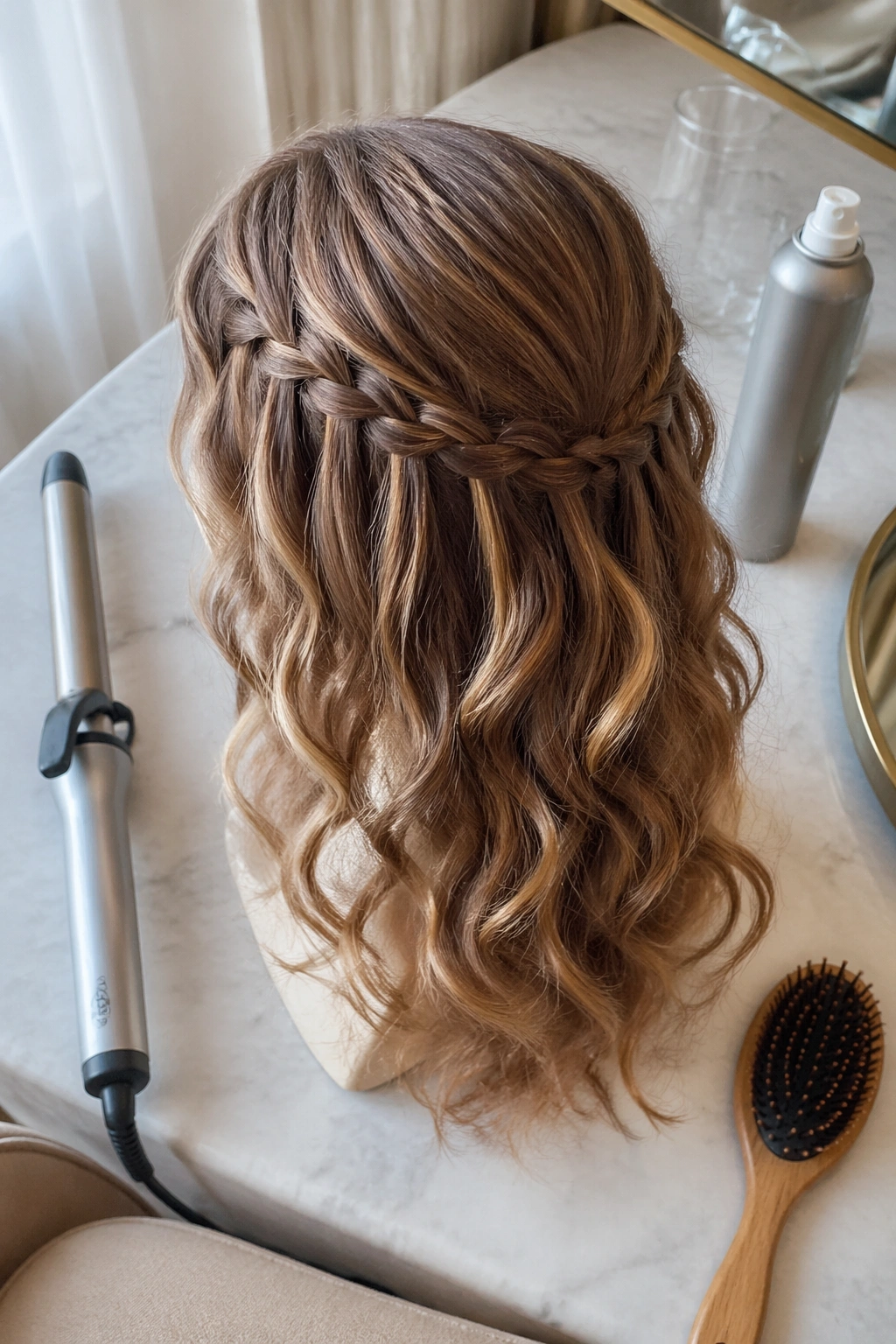
A waterfall braid has a built-in bit of romance, and on medium hair it gives you something many wedding styles forget: movement. One section drops through the braid while the rest stays loose, so the style looks lighter than a full braid and more interesting than a plain half-up twist.
The braid usually starts near the temple and runs along the side of the head, dropping one strand at each pass. That fallen strand becomes part of the curls below, which is why this style looks especially good with a 1-inch curling wand and a brush-through finish. The braid creates the line. The curls do the rest.
I like this one for daytime ceremonies, garden settings, and brides who want their hair to look soft rather than engineered. The only catch is layering. Very choppy layers can make the waterfall section uneven, so your stylist may need to take smaller sections and spray each one lightly as it’s woven.
It’s a pretty style, yes. But the real strength is that it doesn’t sit still. It shifts.
5. Fishtail Halo Half-Up
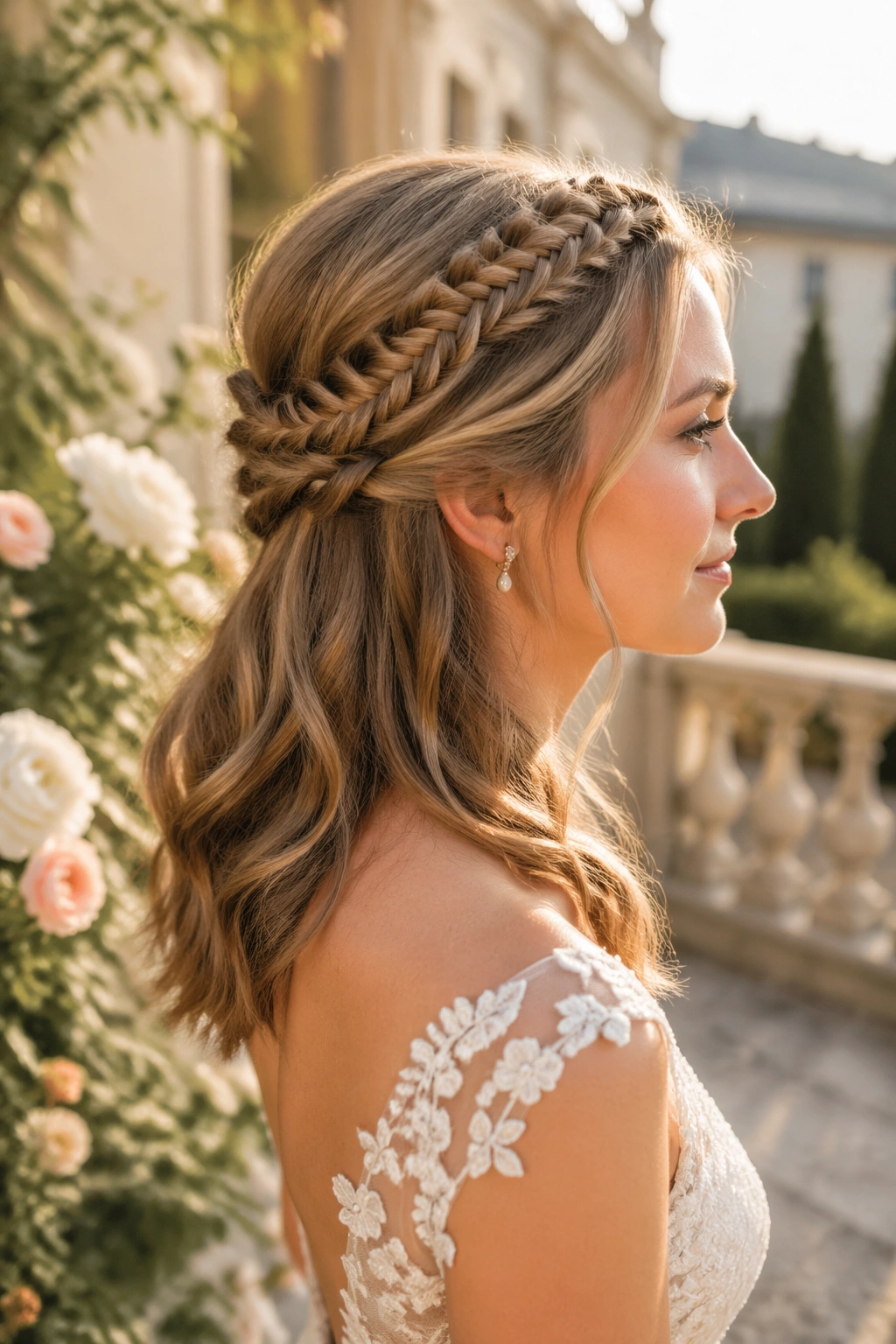
Unlike a full halo braid, this version keeps the lower hair open, which makes it easier to wear with a dress that already has a lot going on. You get the braided frame without losing the length around your shoulders.
A fishtail braid looks richer than a regular three-strand braid because of its tiny, crosswise weave. On medium hair, that detail matters. You can see the pattern even when the braid is not thick. The best version sits just above the ears, curves around the back of the head, and stops before it closes into a full circle.
That open back keeps the look airy. It also makes room for earrings, which is useful if you’re wearing anything with a bit of drop or movement. Pull the fishtail apart gently after it’s secured, but do not tug so hard that it turns fuzzy. A little widening goes a long way.
If your hair is fine, prep with dry texture spray first. If it’s thick, pin the braid close to the head so it doesn’t puff out and swallow the rest of the style.
6. Rope Braid Wrap with a Low Puff
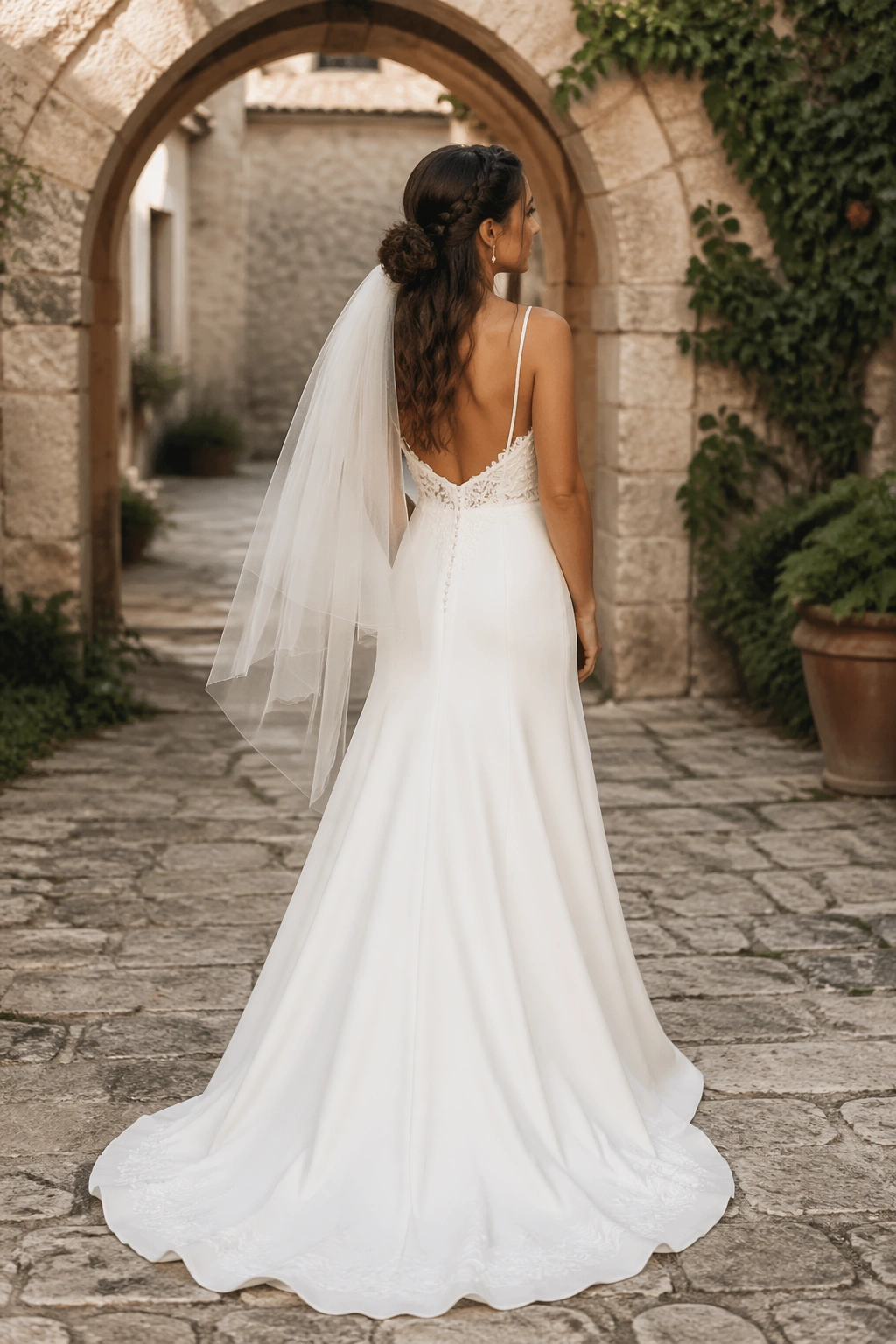
Rope braids are underrated, and on medium hair they hold cleaner than most people expect. The twist pattern stays neat, and that makes this style a smart choice for brides who want something structured without a lot of visible pinning.
Start with a small lift at the crown. Nothing dramatic. Just enough backcombing to give the top some height. Then twist two sections from each side into rope braids and bring them together into a low puff at the back. The puff can be soft and rounded, not a full bun, so the hair still falls down the back.
Use a light serum only on the ends. If you put it near the roots, the braid can slide. That is the part people miss. The root area needs grip; the ends need shine. Keep those jobs separate and the style behaves better.
This one suits brides who like clean lines and a little polish at the neckline. It also holds up well under a short veil because the braid structure gives the comb something solid to sit against.
7. Lace Braid with Face-Framing Tendrils
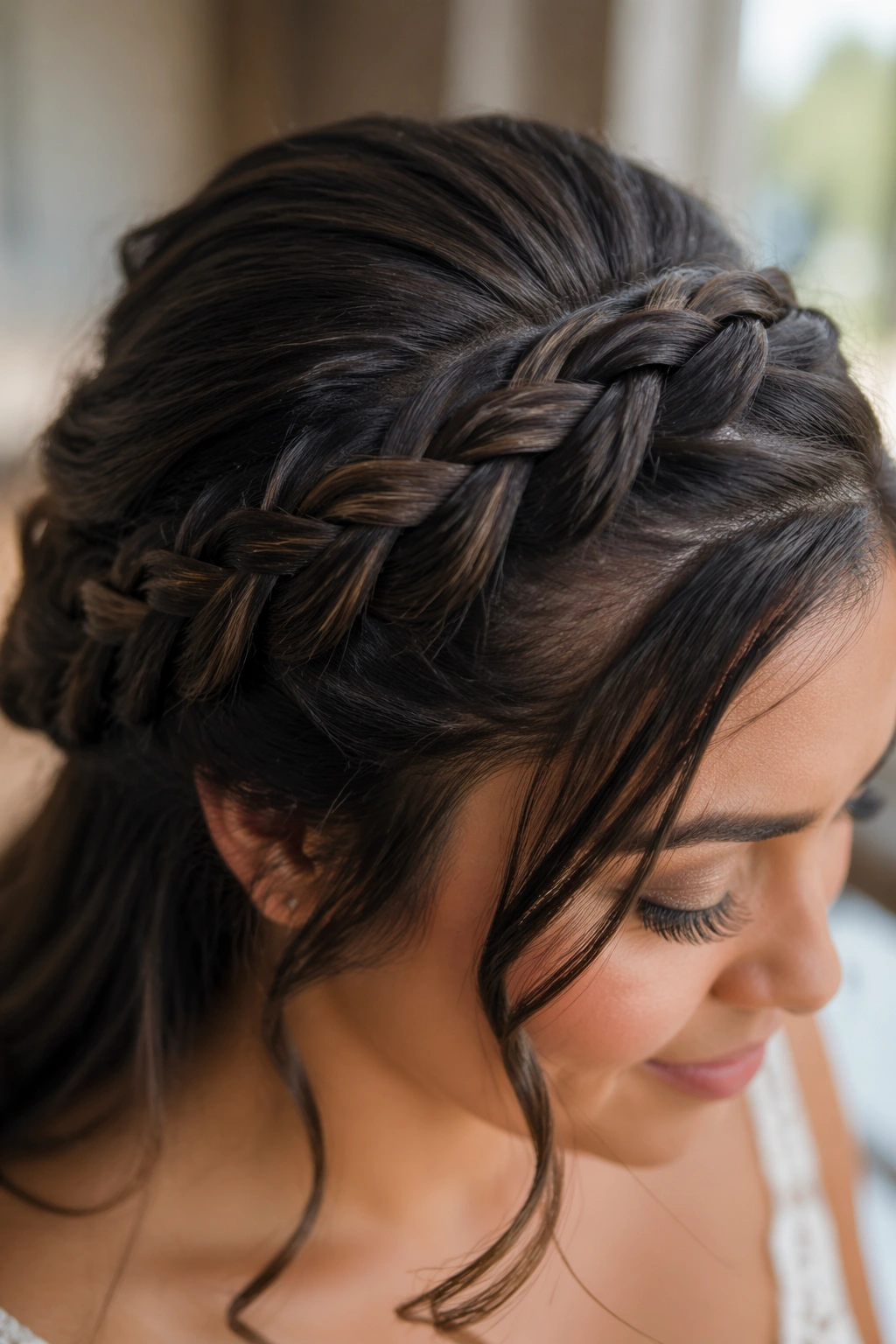
Can a lace braid stay soft and still look bridal? Yes, if you let it follow the hairline instead of forcing it into a hard curve.
A lace braid works like a French braid, except you only add hair from one side as you move along. That makes it ideal for medium hair because the braid can skim across the crown without stealing too much length from the rest of the style. The result is a half-up shape that still keeps the face open.
How to wear it with a veil
If you’re wearing a veil, place the comb just below the braid anchor so the braid stays visible. If the comb sits too high, it can split the shape and make the lace braid look clumsy. Keep the tendrils around the cheekbones soft, not curled into tight ringlets, or the whole thing starts to feel dated.
A lace braid is one of those styles that looks more detailed the closer you stand to it. From a few feet away, it just reads as soft and pretty. Up close, you can see all the little crossings.
8. Boho Pull-Through Braid Half-Up
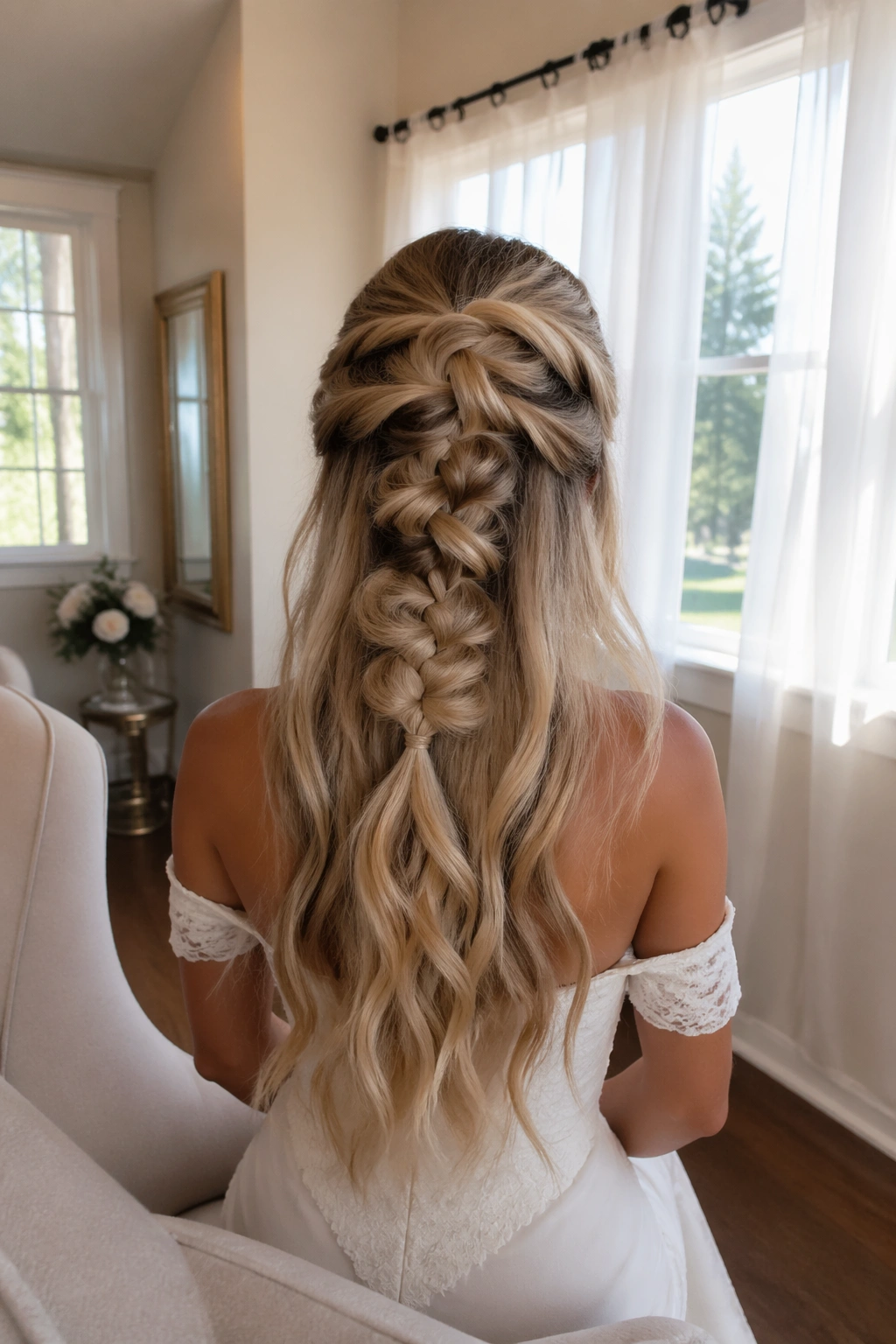
If your hair is layered or a little slippery, a pull-through braid is the practical choice that still looks romantic. It gives you that chunky woven shape without asking your hair to behave like it’s much longer than it is.
Start by tying small ponytails down the back of the crown, then split and pull sections through each one to build the braid effect. Once it’s secured, gently pancake each loop so the braid looks fuller. That widening step is the whole reason this style works on medium hair.
- Use 4 to 6 clear elastics
- Keep each loop about 1.5 to 2 inches wide
- Mist with lightweight hairspray before you loosen the braid
- Curl the lower half in alternating directions for a softer finish
This is a good choice if you like a slightly undone look but still want the top to stay controlled. It’s also forgiving. A pull-through braid can lose a little shape and still look intentional.
9. French Braid Crown with a Center Part
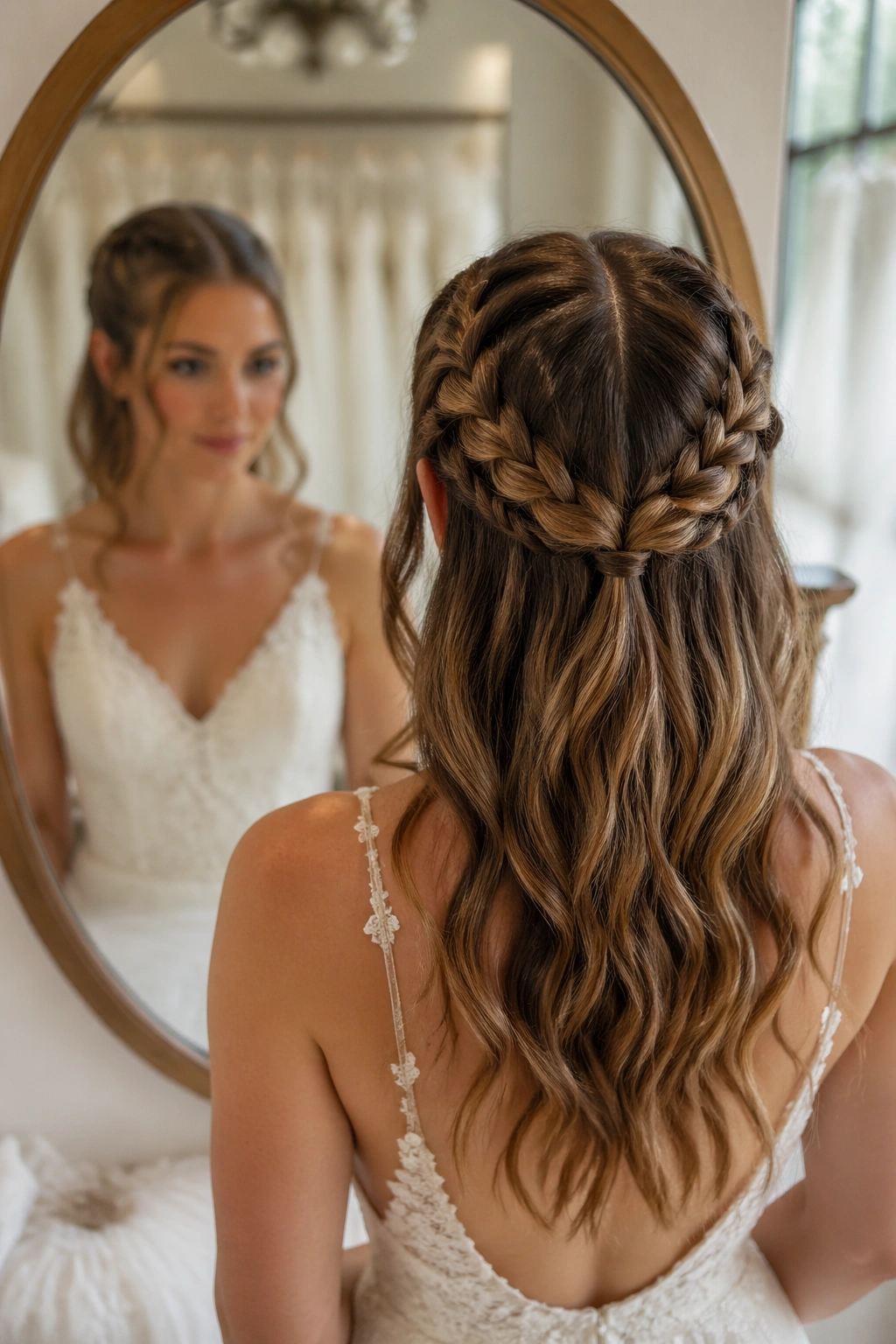
A center part changes the mood of a wedding braid fast. It makes the whole look feel more balanced, a little cleaner, and often a bit more formal.
With a French braid crown, the braid begins near the front hairline and travels back on each side, meeting in a soft half-up shape that frames the head without closing it in. On medium hair, that shape is useful because the braid has enough length to show, but the rest of the hair still falls in a smooth sheet or soft wave.
This style pairs well with classic dresses, satin fabrics, and simple jewelry. It does not need a heavy accessory. In fact, too much sparkle can pull attention away from the braid line, which is the part that makes the style work.
If your hair is very straight, rough-dry the roots first and mist the braid section with a texturizing spray. The braid needs something to hold onto, and clean hair can be a little too polite for this look.
10. Twisted Side Braids into a Hidden Clip
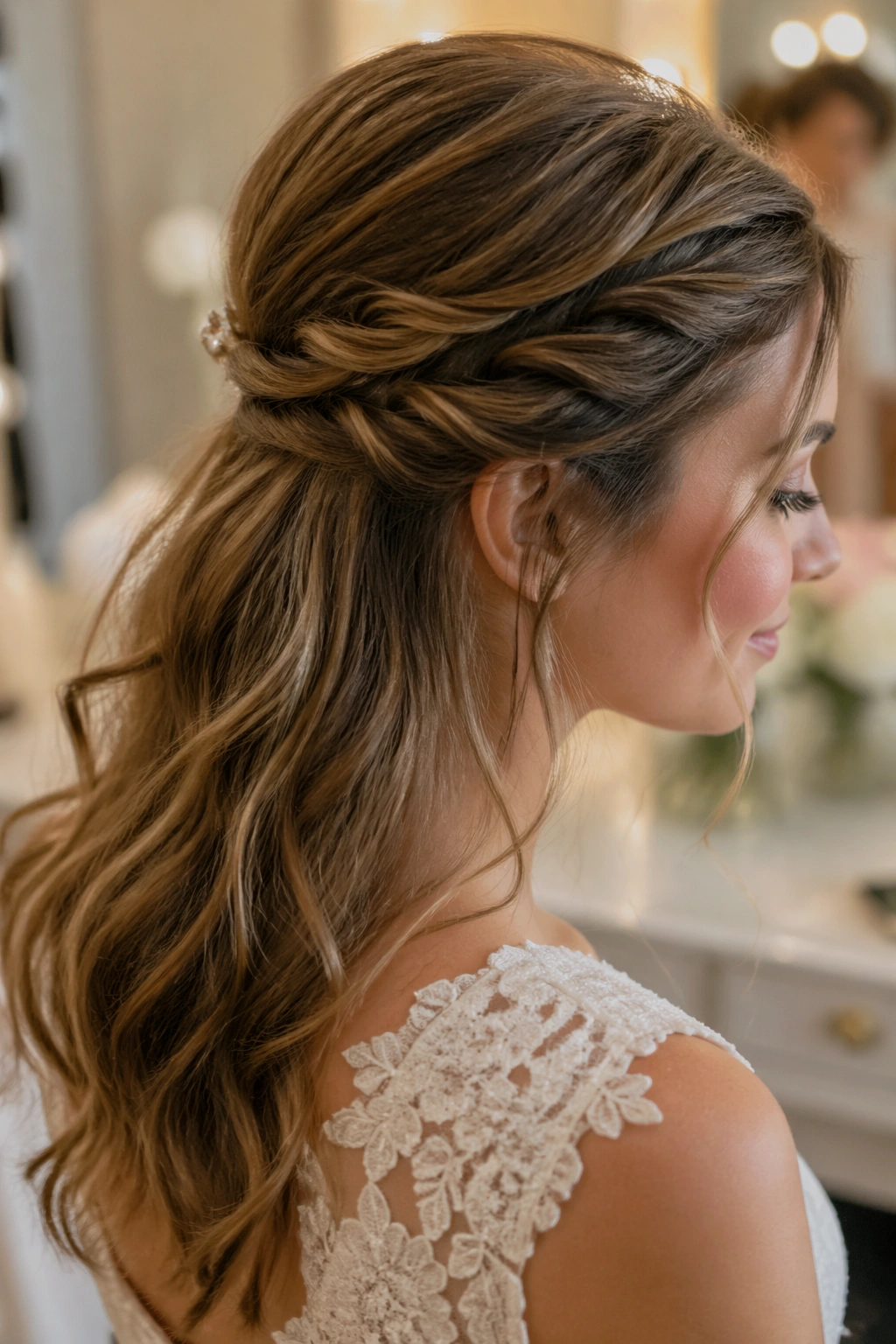
Braids are not the only way to get the look. Twists can do the same job with less fuss, especially if your hair has layers that pop loose whenever someone so much as looks at them.
Two side twists, one from each temple, can be brought to the back and held under a decorative clip. The clip is hidden by the overlap, so the style keeps its half-up shape without broadcasting every pin. That makes it a good pick for medium hair that is too short for a full braided wrap, but long enough to twist neatly.
Unlike a more detailed braid, twists are quick to refresh. If one side loosens before photos, you can roll it back into place without starting over. That’s a nice thing to know when the schedule gets crowded and there’s no spare time for a full redo.
Choose a clip with some grip. Flat-back clips are prettier than they are useful. A slightly curved comb or a wide barrette sits better and is less likely to slide.
11. Braided Top Knot in a Braided Half Up Half Down Wedding Style
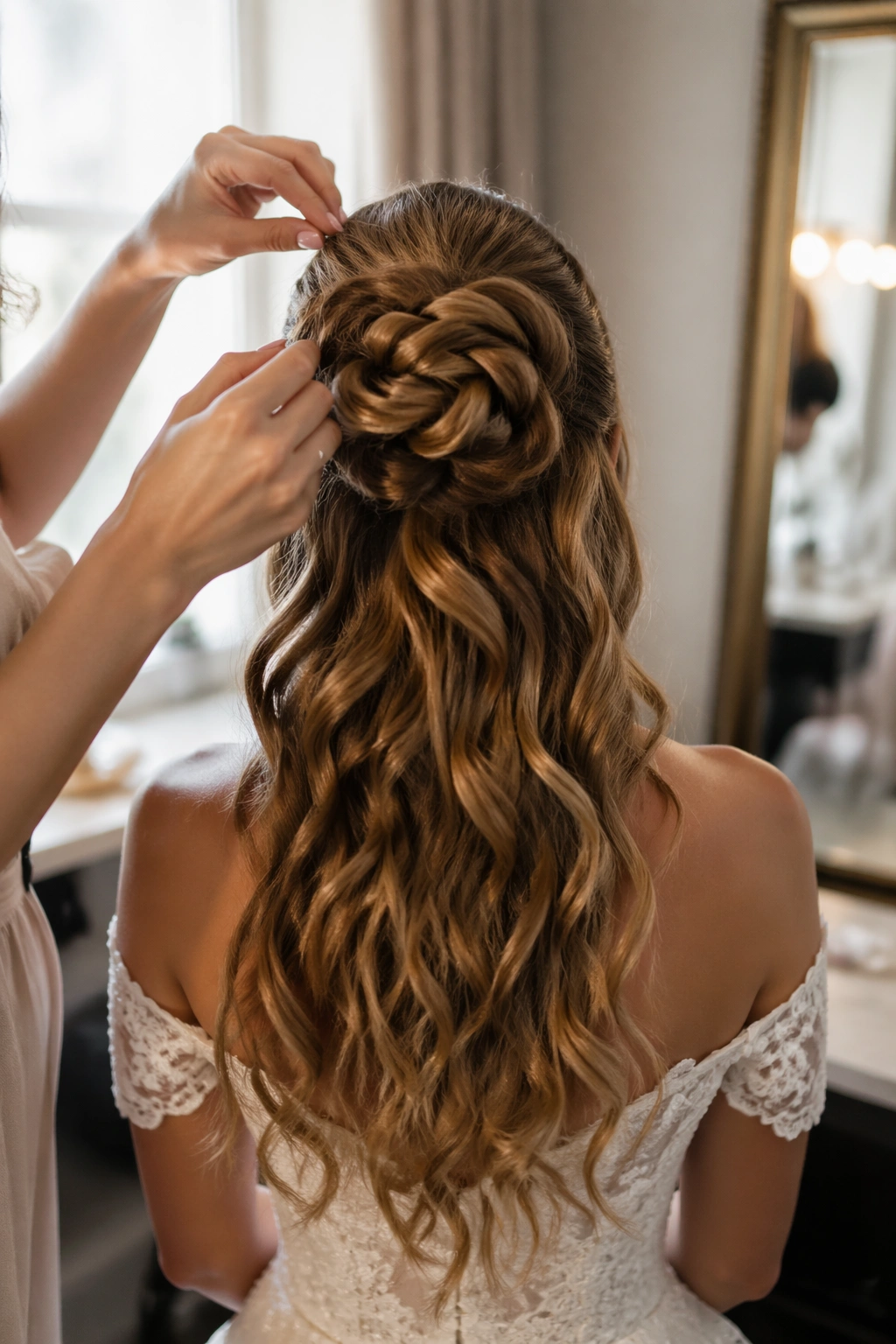
This is the one for brides who want the neckline open but still want something with shape at the back of the head. A braided top knot gives you height without building a full bun, which can look heavy on medium hair.
The top section gets braided first, then wrapped into a small knot at the crown or upper back of the head. The lower hair stays down, which keeps the style relaxed enough for medium lengths. It’s a smart compromise. The knot gives structure. The rest of the hair keeps the movement.
Keep the knot modest. If it gets too large, it starts competing with the dress, especially with high necklines or detailed backs. A couple of crossed pins under the knot are usually enough. If you use too many, the style can feel stiff and overworked.
This one works well with textured curls or soft blowout ends. Straight hair can make the top knot look too deliberate. A little bend in the lower hair keeps the whole thing from feeling sharp.
12. Knotted Braid Half-Up with Soft Volume
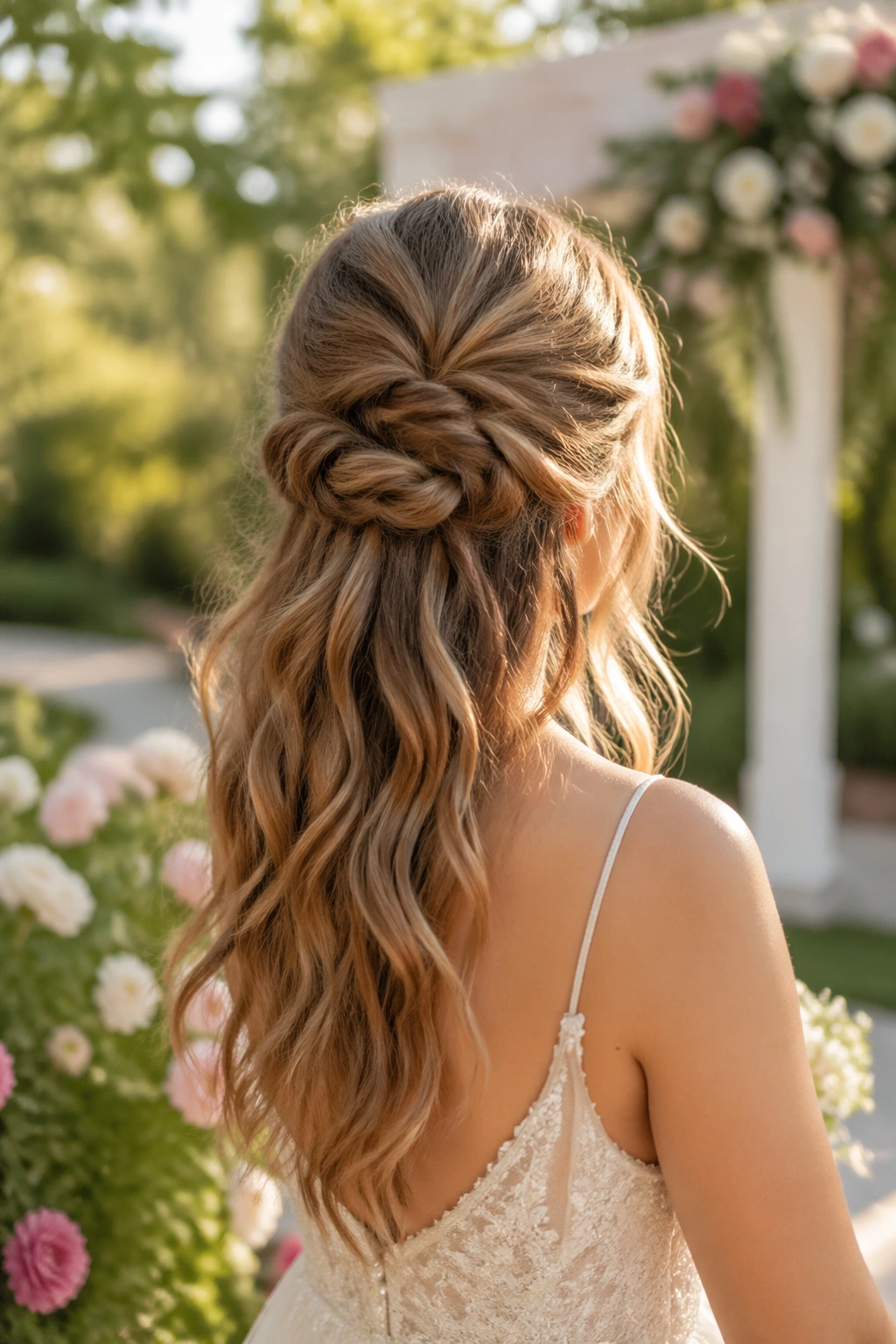
Why do knots work so well on medium hair? Because they create fullness without asking for extra length. That’s the whole answer, and it’s a good one.
A knotted braid half-up starts with two small sections that loop over each other, then continue into a loose braided join at the back. The shape is subtle, almost tucked-in, but it still shows off the texture of the hair. For brides who do not want an obvious braid, this is one of the gentler options.
A little crown volume helps. Not a bump. Just enough lift to keep the top from flattening once the pins go in. I’d keep the lower half brushed into soft waves rather than tight curls, because the knot already brings enough detail to the top half of the style.
This is a good choice for minimalist dresses, clean makeup, and brides who want the hair to support the outfit instead of chasing it. It feels quiet, but not plain.
13. Braided Bow Accent
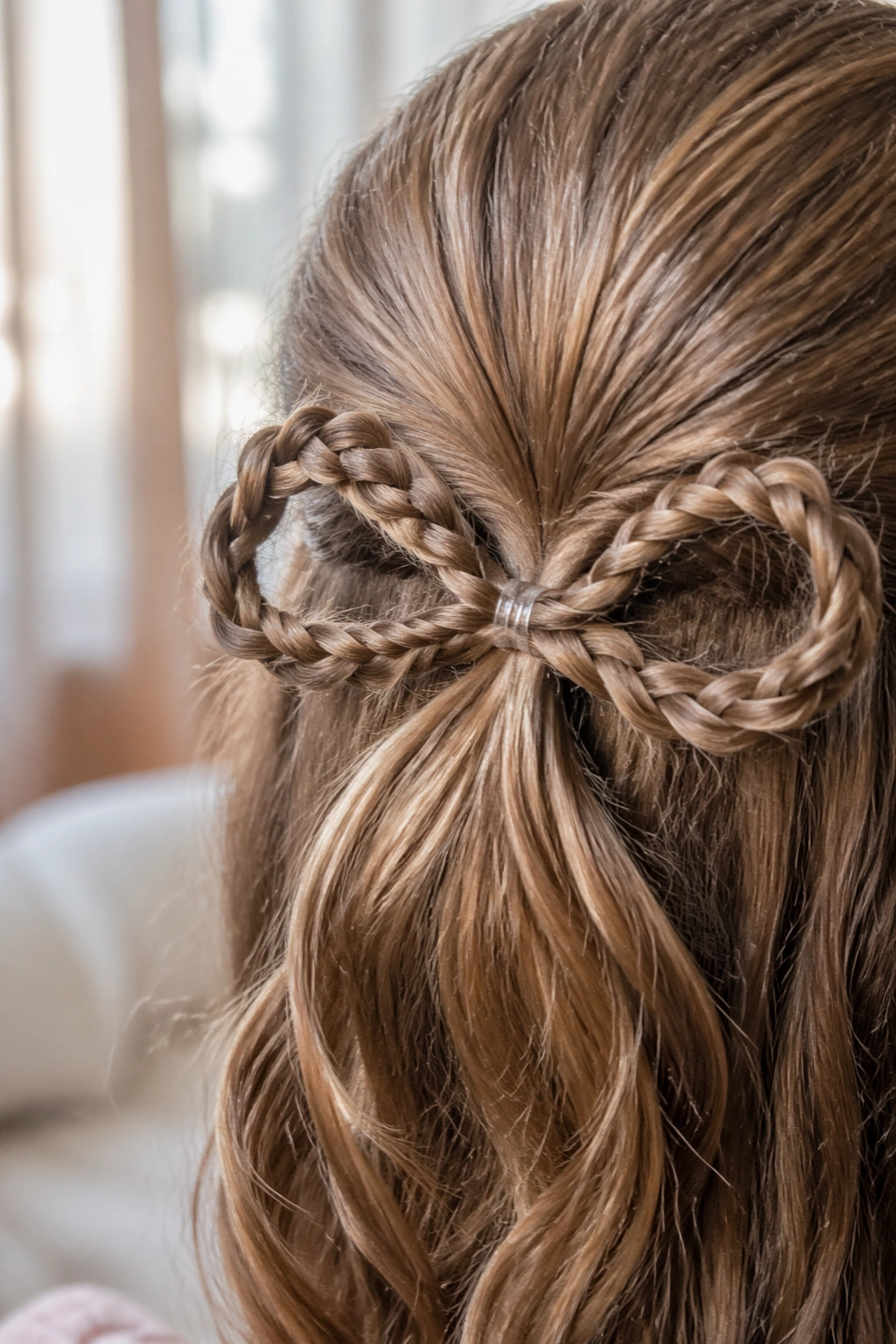
A braided bow can sound a little sweet, almost too sweet, until you see how neatly it sits on medium hair. Then it makes sense. The size stays manageable, and the shape holds better than it does on very long hair.
The bow usually sits where a half-up style would meet at the back. Two loops are shaped from braided sections, then pinned in the center so the middle reads like the knot of a ribbon. The rest of the hair falls beneath it, soft and loose. If the bow gets too wide, it starts looking cartoonish, so keep it around 2.5 to 3 inches across.
- Use a clear elastic to hold the bow center
- Pin the loops from underneath so the shape stays clean
- Keep the lower hair waved, not curled tight
- Choose a small bow if your dress already has a lot of detail
The whole point is charm without clutter. That’s what makes this style work for smaller, more intimate weddings or for brides who want one detail people remember.
14. Milkmaid-Inspired Half Crown
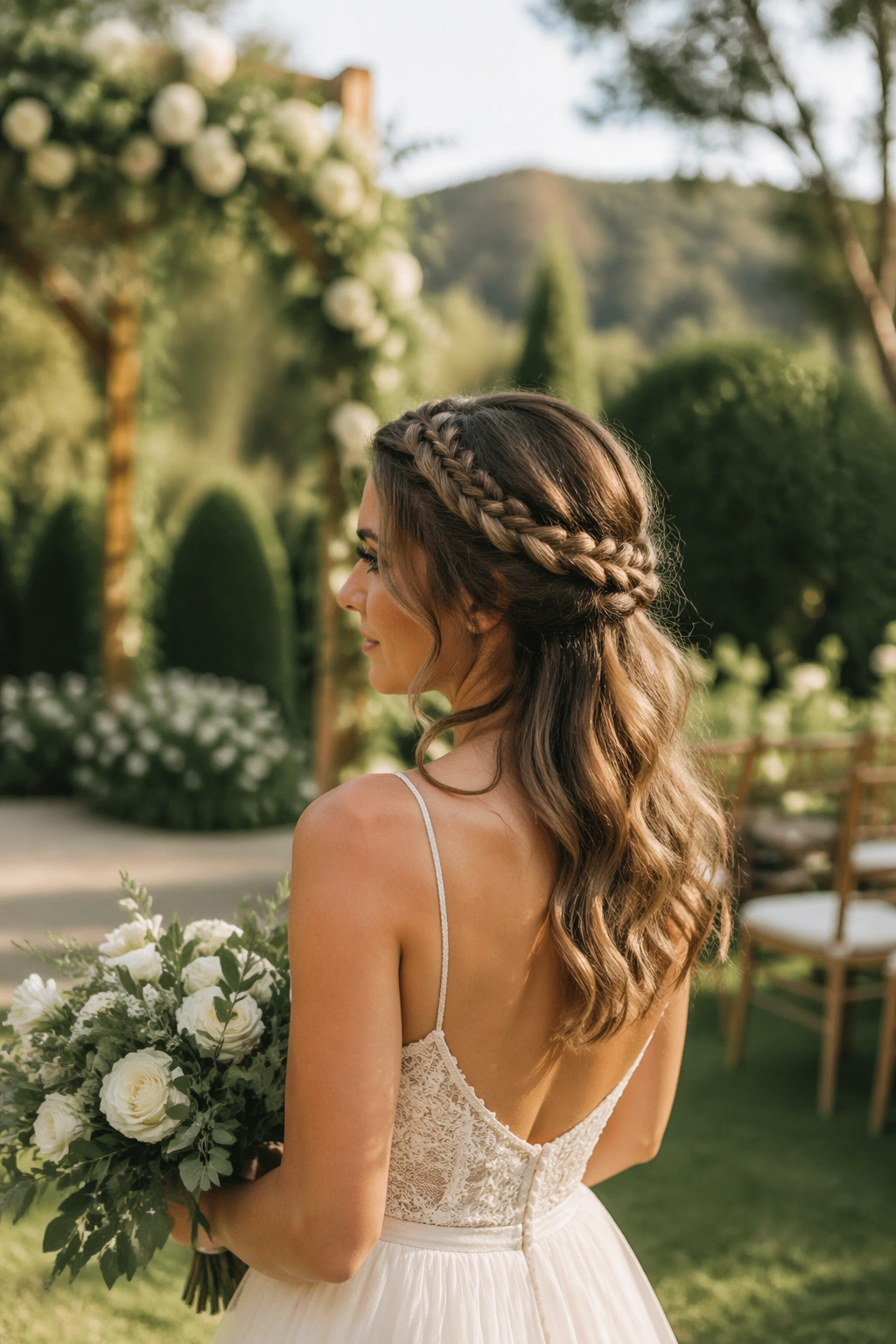
A milkmaid braid can feel too covered on medium hair, which is why the half-crown version is so much nicer. You get the romance of a wrapped braid, but the rest of the hair still falls freely.
The braid travels from one side of the head to the other and sits high enough to read as a crown, not low enough to swallow the length. The lower hair should stay loose and softly waved. If the back is too flat, the whole style loses its softness and starts looking like a costume piece.
This is a strong choice for lace dresses, garden ceremonies, and vintage jewelry. It has a little old-world charm without leaning into anything too literal. I’d keep the braid loose at the edges and tuck a few small pins along the back where they won’t show.
If your hair is very silky, rough it up first with dry texture spray. A milkmaid-inspired braid needs a little grip to stay where you put it.
15. V-Braid Half-Up for Layered Medium Hair
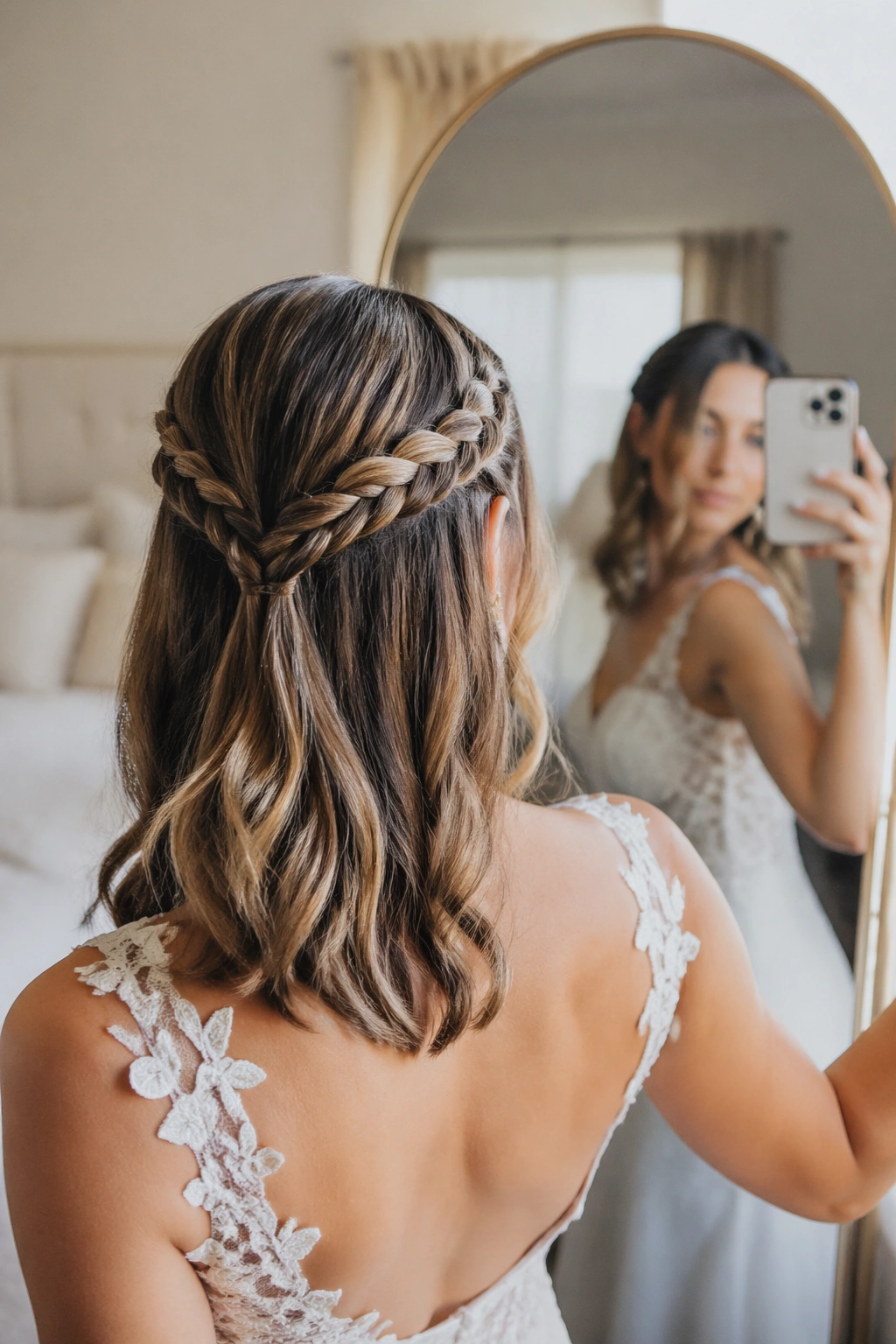
Layered hair can be tricky for wedding styling because it loves to shed short pieces at the exact moment you want it to behave. A V-braid solves that by directing the eye toward the center point instead of spreading attention sideways.
The braid begins from both sides and angles downward toward a central join, creating a clean V shape over the upper back of the head. On medium hair, the shape looks crisp without being severe. It also gives the stylist a clear line to work with, which helps if the cut has layers around the chin or collarbone.
This style is a good match for brides who want the braid to show, not hide in the background. It works especially well with long bob lengths or shoulder-length cuts that need a little extra structure around the crown.
A small clear elastic at the point where the two sides meet keeps the shape neat. Wrap a tiny strand of hair around the elastic if you want the finish to look cleaner.
16. Crisscross Braids with a Crystal Comb
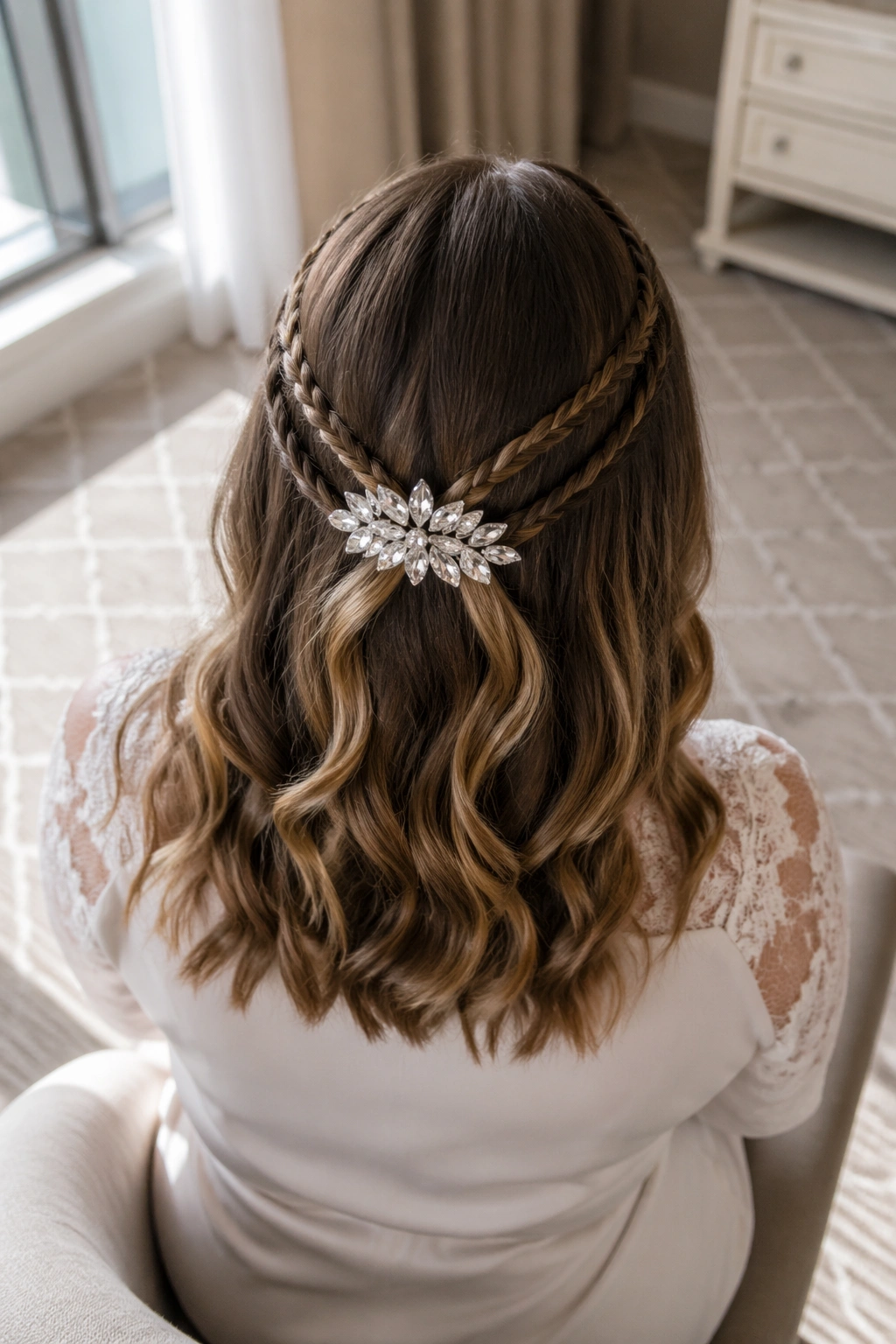
Some wedding styles need one strong detail and then enough quiet hair around it to let the detail breathe. Crisscross braids do that well.
Two narrow braids travel from opposite sides of the head and cross over one another before being pinned into place. The crossing creates a small X-shaped frame, and a crystal comb sits right at the center like a clasp. It’s tidy, it’s structured, and it gives medium hair a little architecture without building height all over the head.
Where the comb should sit
The comb works best at the crossing point, not above it. If it sits too high, the braids separate and the style loses its clean line. Keep the lower length loose and softly waved so the top section has something gentle to rest on.
- Comb width: 2 to 3 inches
- Braid width: about 1 inch each
- Pins: 2 hidden pins above and below the comb
- Finish: soft spray, then a fingertip smooth over the front
This is one of the more elegant choices in the group, and it suits brides who want sparkle in one place instead of scattered everywhere.
17. Pancaked Fishtail with Loose Texture
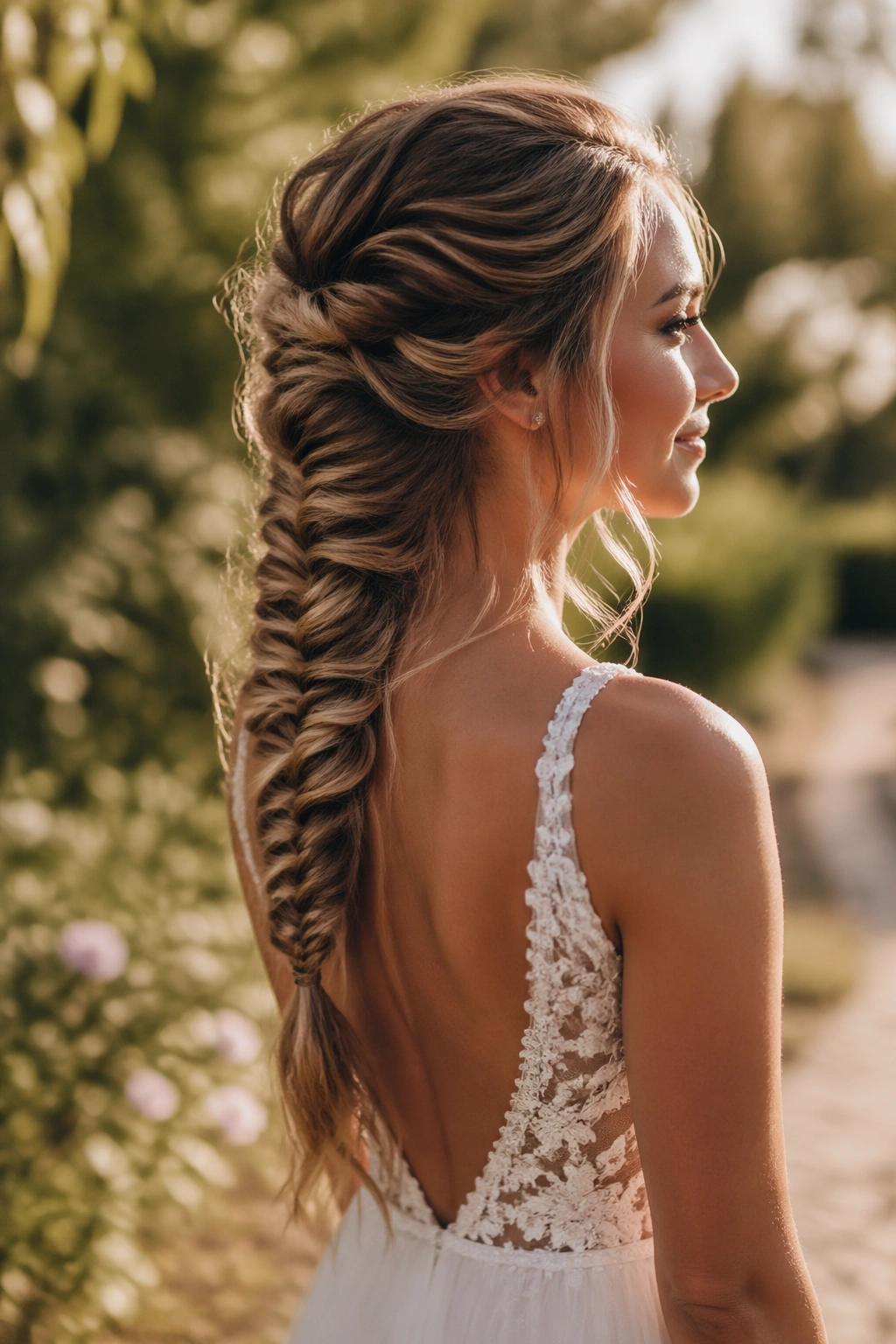
Why does a loosened fishtail read so well in wedding photos? Because the braid gets width without needing extra hair. That matters on medium lengths, where fullness is often the real challenge.
A fishtail braid can look narrow and fussy if it’s left tight. Pancaking fixes that. After the braid is secured, tug the outer edges gently with your fingertips until the braid spreads out and looks soft. The pattern stays visible, but the size grows. That spread is what gives it presence.
I like this style for brides who want something romantic but not delicate in a fragile way. It can handle a long day. It can handle wind. It still looks good after it loosens a little, which is more than I can say for some styles that depend on staying frozen.
Don’t overdo the pancaking. Pulling too far makes the braid lumpy and exposes the elastics. A slow, even tug is enough.
18. Floral Sprig Braid Half-Up
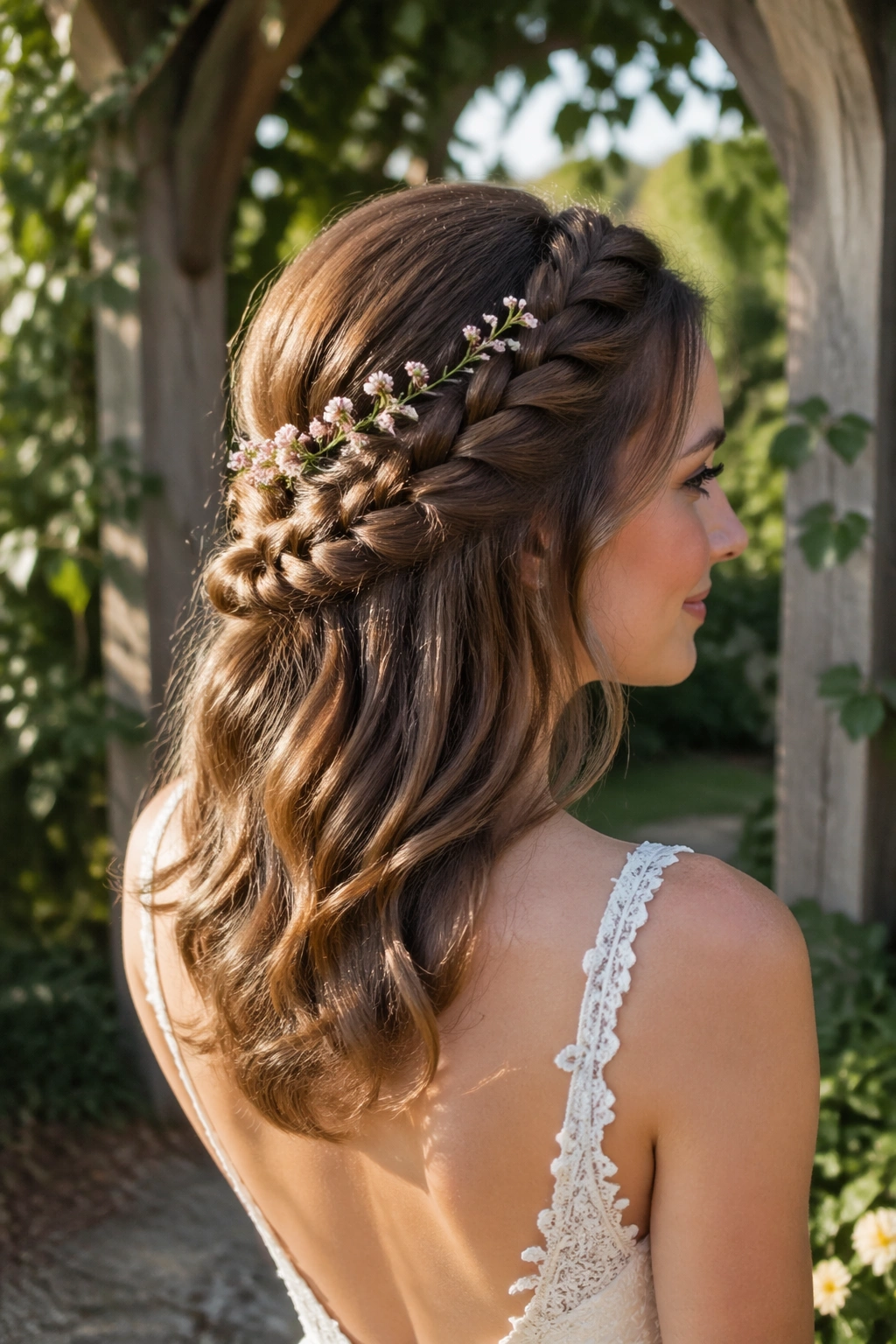
Fresh flowers in a braid can look lovely or chaotic, and the difference is usually scale. On medium hair, small sprigs win. Big blooms can swallow the style whole.
Start with a simple half-up braid across the back of the crown, then tuck in tiny floral sprigs where the braid bends or overlaps. Baby’s breath, mini roses, small waxflower, and dried stems all work if they’re wired well and trimmed short. Keep the flowers low enough that they sit in the braid instead of floating above it.
- Sprig length: 1 to 2 inches of usable stem
- Number of accents: 2 to 3 small groups usually look enough
- Placement: near the braid join or just off-center
- Best finish: loose waves so the flowers don’t compete with curls
This style suits outdoor ceremonies and softer dress fabrics. If the bouquet is already full of flowers, keep the hair accents modest so the whole look does not drift into overload.
19. Sleek Braided Half-Up with Straight Ends
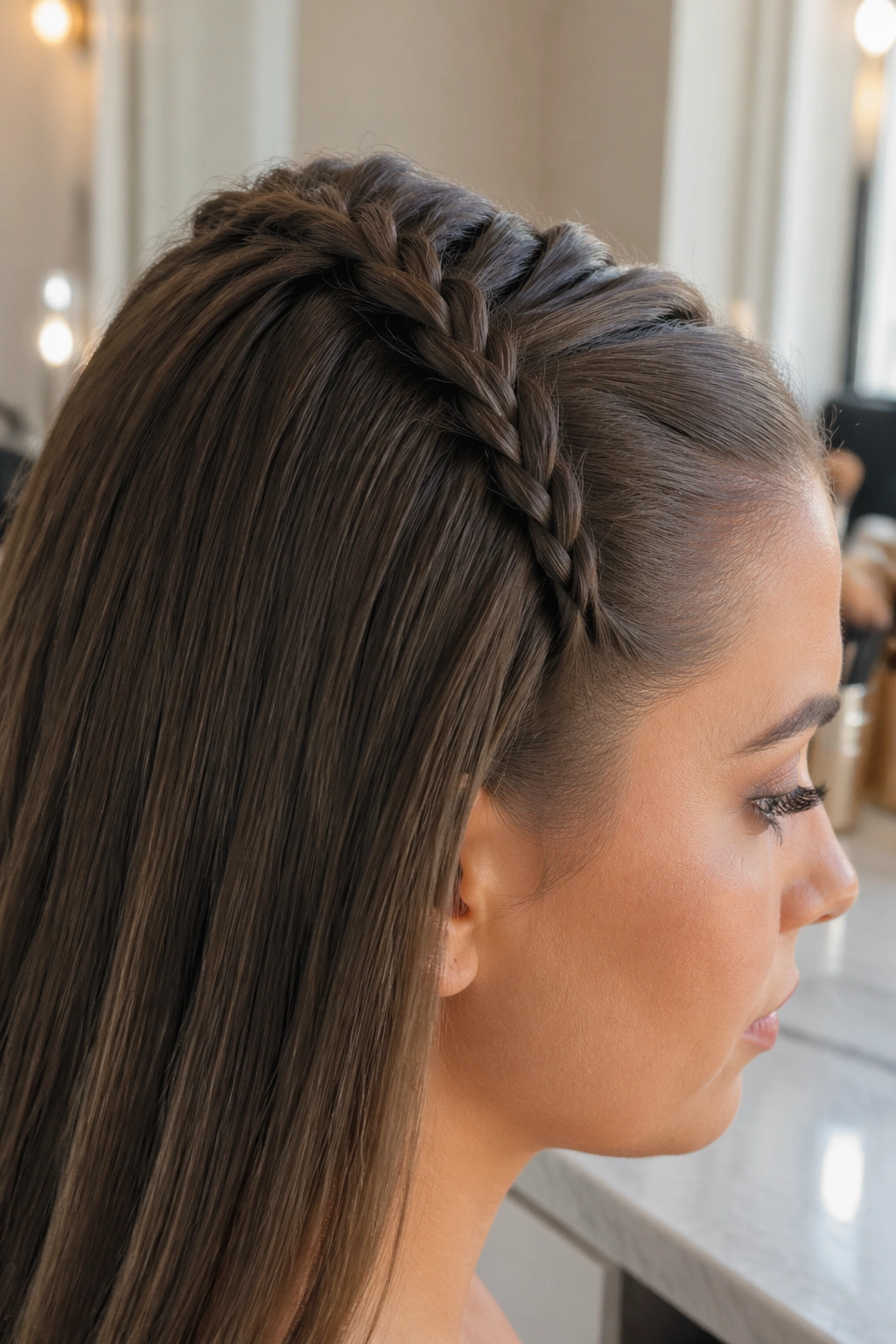
Not every bridal braid needs waves. Straight ends can make the braid itself stand out more sharply, and on medium hair that clarity looks clean in a way curls sometimes don’t.
A sleek braided half-up begins with smoothing cream at the roots and a flat iron through the lower length. The top braid can be a narrow French braid, a rope braid, or even a tight side braid. What matters is the contrast: detailed braid above, straight fall below. That contrast is what gives the style its edge.
This one suits modern dresses, crepe fabrics, sharp necklines, and brides who like hair that looks deliberate rather than airy. It also works well when the jewelry is doing a lot of the visual work. Straight ends keep the hair from competing with earrings or a strong neckline.
Do not skip flyaway control. A sleek style shows every little puff of frizz near the part. A light smoothing cream and a fine-tooth comb are worth their weight here.
20. Twist-and-Braid Crown with a Veil
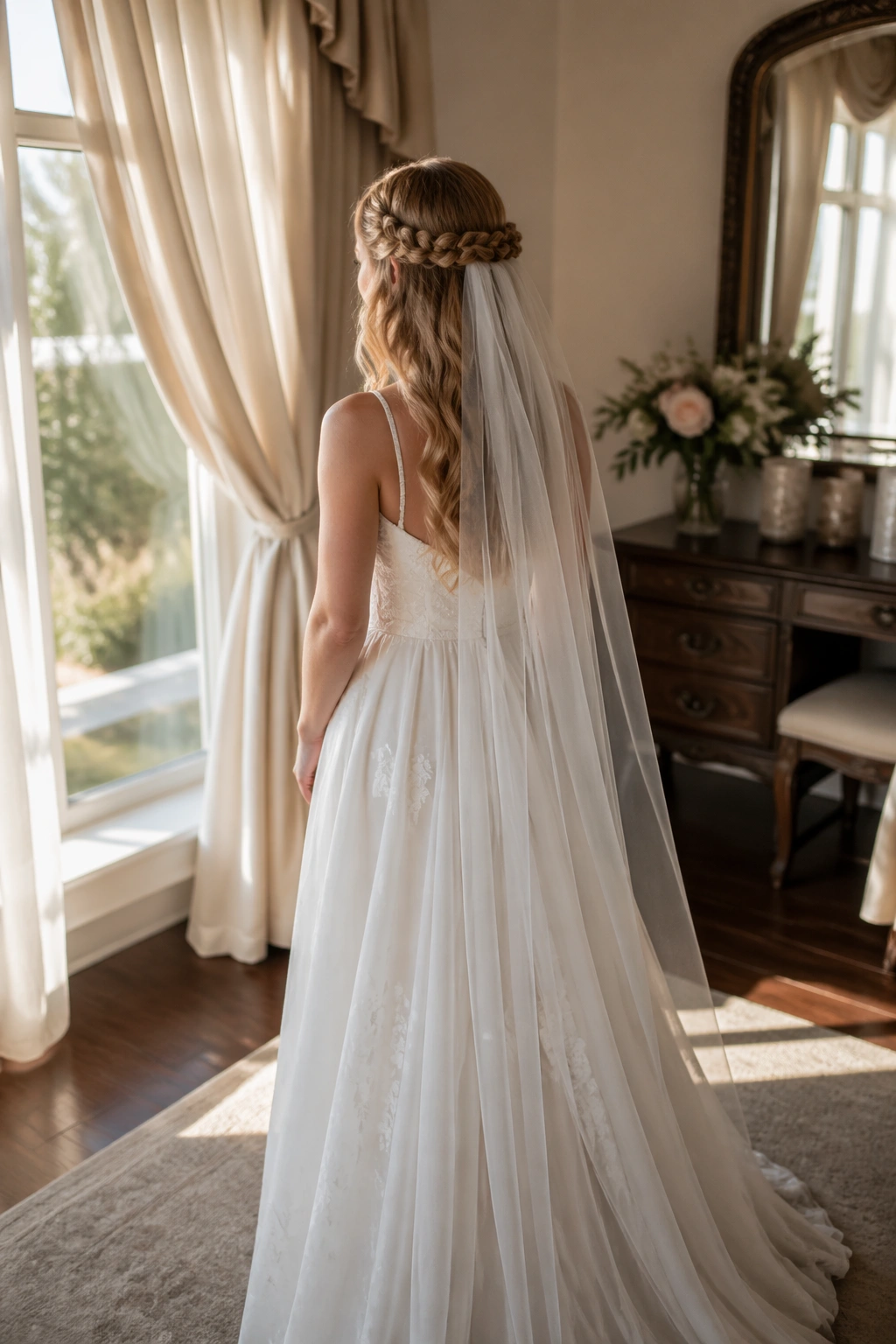
This is one of the easiest styles to work around a veil because the braid and twist create a natural anchor point. The hair is already giving you a shelf.
Two twisted sections come from the sides, then a small braid runs through the center or along the back of the crown to lock the shape in place. The lower hair stays down and can be curled or left smooth. What makes it useful is the structure on top. A veil comb can sit just below the braid junction without collapsing the style.
Veil placement matters
Place the veil comb about half an inch to 1 inch under the braid join. That keeps the veil secure without flattening the top. If the comb sits too high, the braid gets pushed apart and the whole shape loses its line.
- Use at least 4 hidden pins at the braid base
- Keep the top twist loose enough to hide the comb
- Leave the lower hair soft so the veil can fall cleanly
- Choose this when you want a classic bridal shape with minimal fuss
It’s a practical style. Sometimes that is exactly what the day calls for.
21. Double Rope Braids into Center-Length Waves
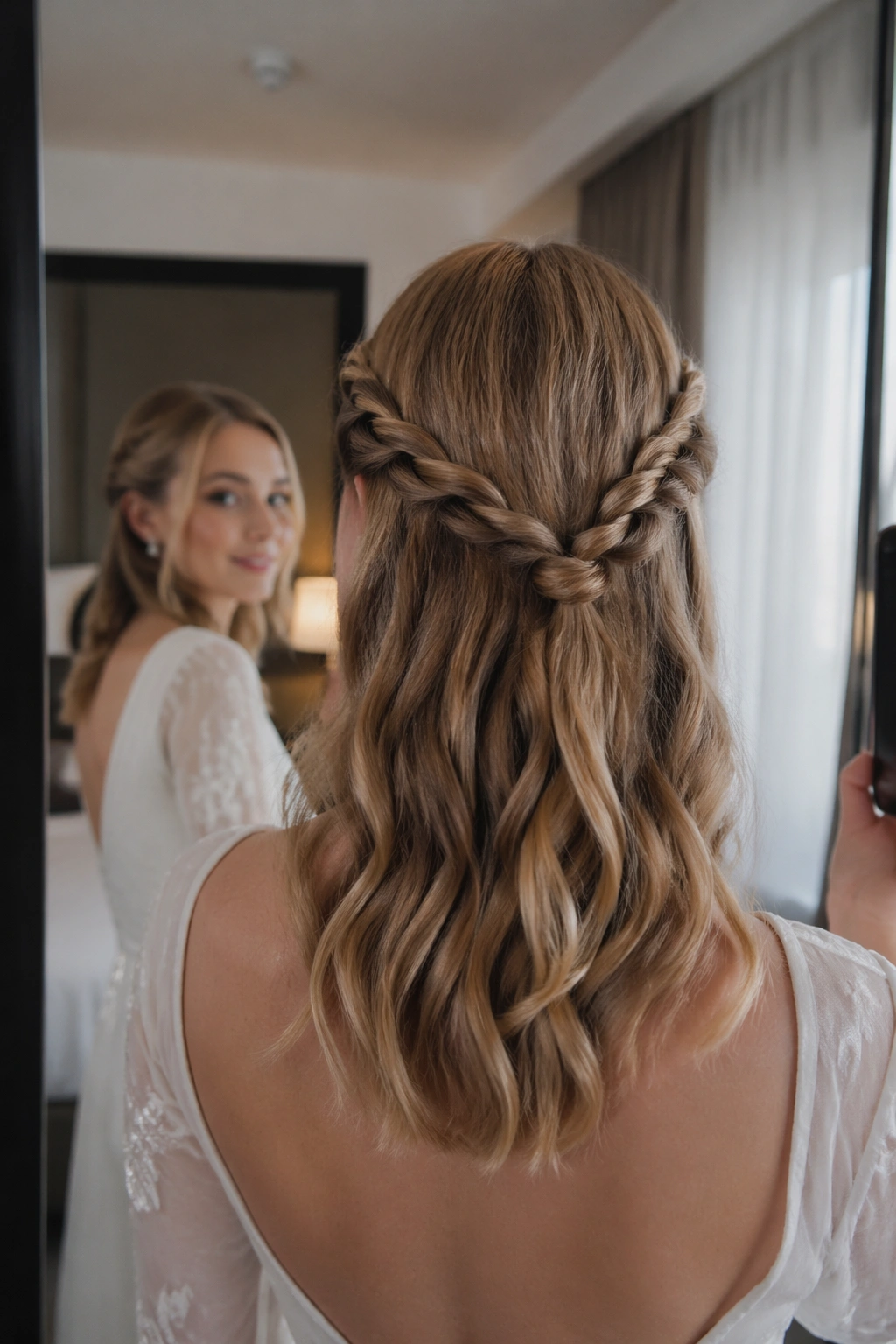
This style is for brides who want symmetry, but not too much of it. Two rope braids start near the temples and travel back toward the center, where they meet and disappear into soft waves.
Rope braids are useful on medium hair because they do not need a lot of length to read clearly. The twist pattern shows up fast, and the shape stays neat even if the hair is slightly layered. That makes the style sturdy, which is helpful when you want the top half controlled and the lower half relaxed.
The waves below should stay loose. Think brushed-out curls, not ringlets. If the lower section is too tight, the rope braids lose their quiet feel and the style starts to look too dressed up. The charm here is in the balance.
This also photographs well from the side because the braids meet in a line instead of vanishing behind the head. If your dress has a low back, that center join is a nice visual break.
22. Soft Braided Half Up Half Down Look for Wedding Medium Hair
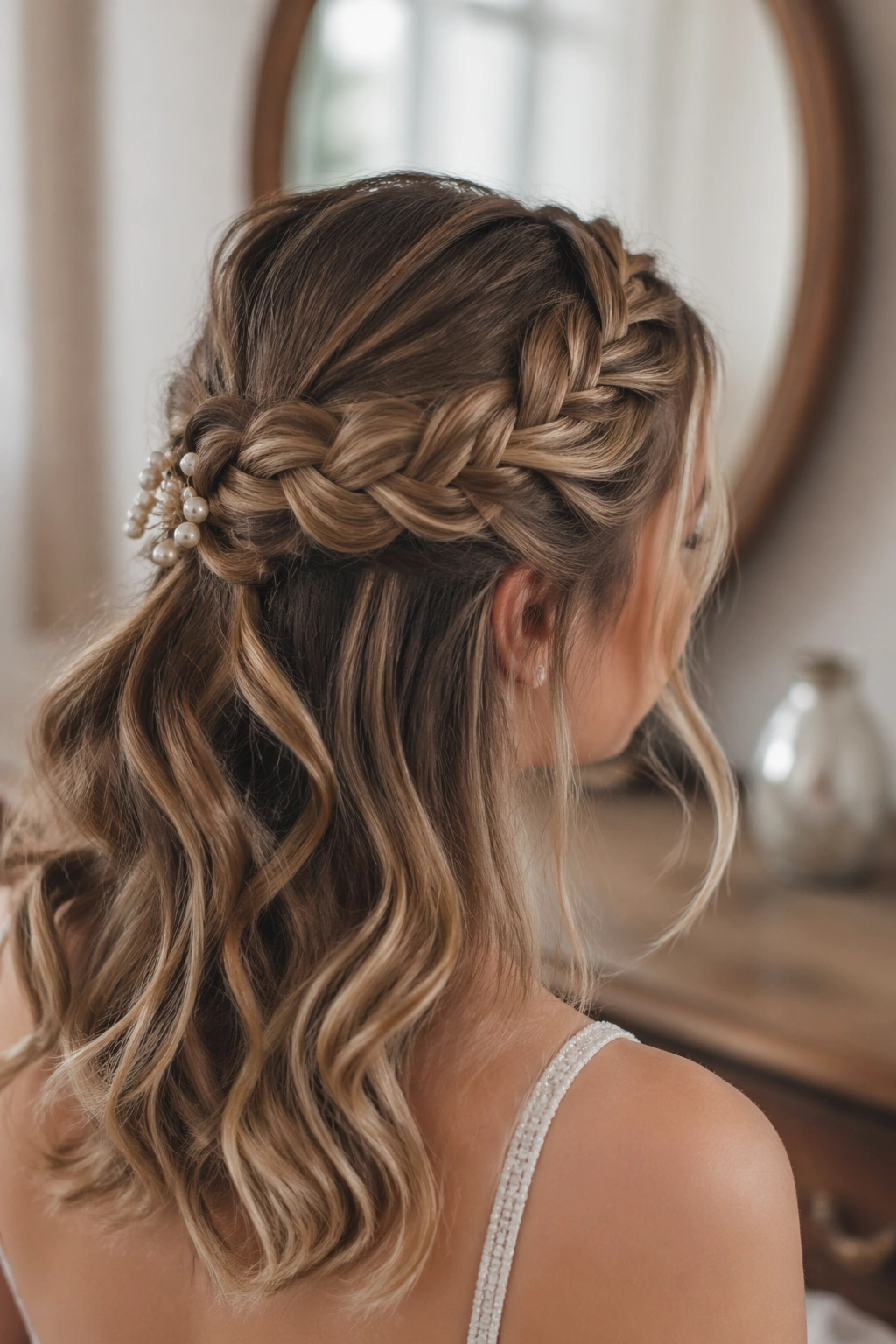
If you want one style that sits between romantic and reliable, this is it. A soft braided half up half down look for wedding medium hair gives you enough braid to feel bridal, enough loose hair to feel like yourself, and enough structure to survive a long event without needing a full redo.
Keep the braid loose at the start, then slightly tighter near the back so it holds shape. That small shift matters. Brides often ask for a braid that looks loose in the mirror, but hair always relaxes after pinning and movement. A half-inch of extra snugness at the trial usually pays off later.
The most useful question is not “Which braid is prettiest?” It’s “Which braid matches the neckline, veil, and texture of my hair?” A square neckline can handle a richer braid. A detailed back usually needs a softer one. Fine hair likes smaller braids with texture spray. Thick hair can carry wider sections and still look light.
Bring the hair accessories to the trial, even the ones you think you might not use. Pearl pins, a comb, a veil, a ribbon—each one changes the balance a little. And that balance is the whole point. When the braid holds, the curls move, and the front stays soft, the style does what it should do: it lets the day happen without fuss.
