

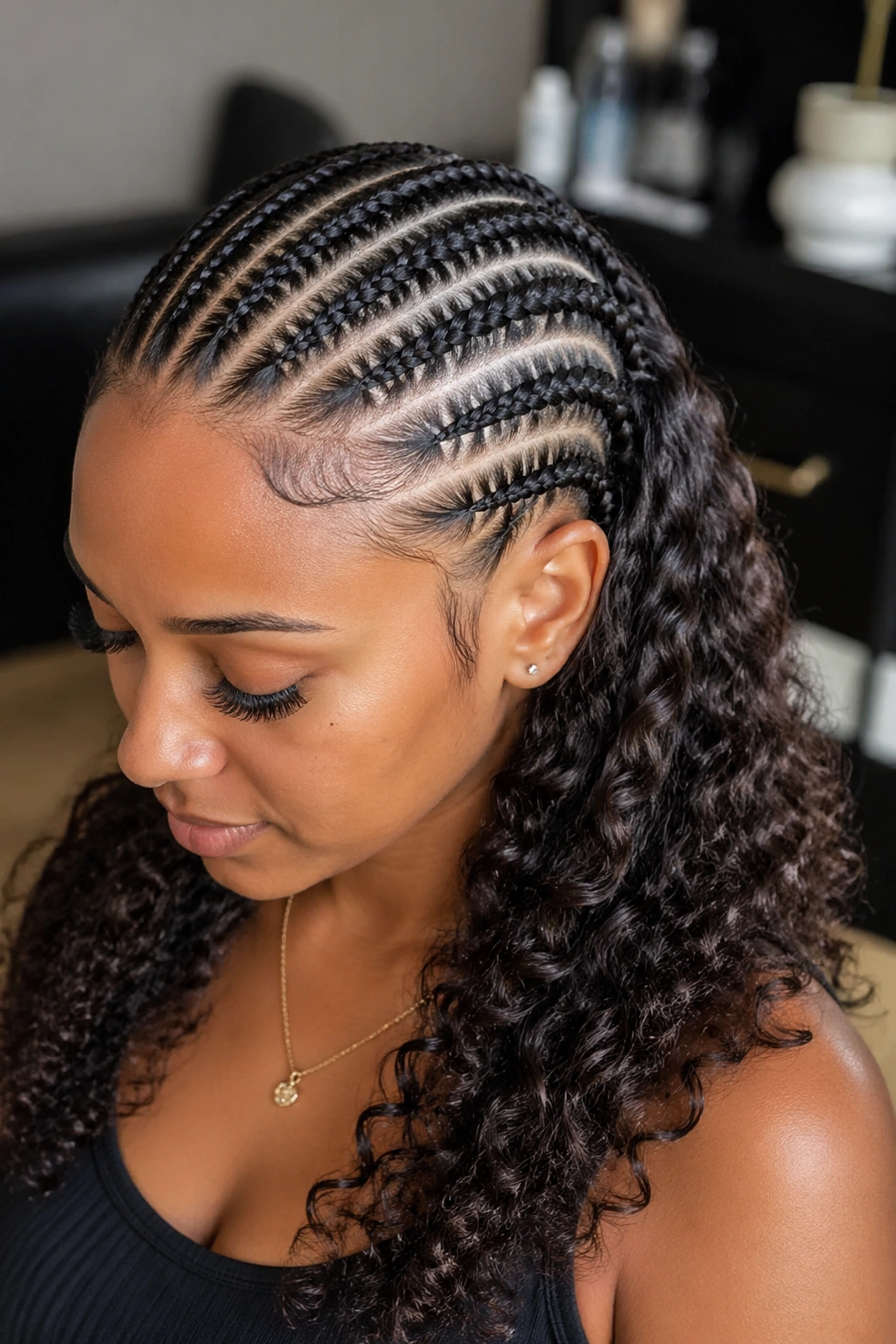
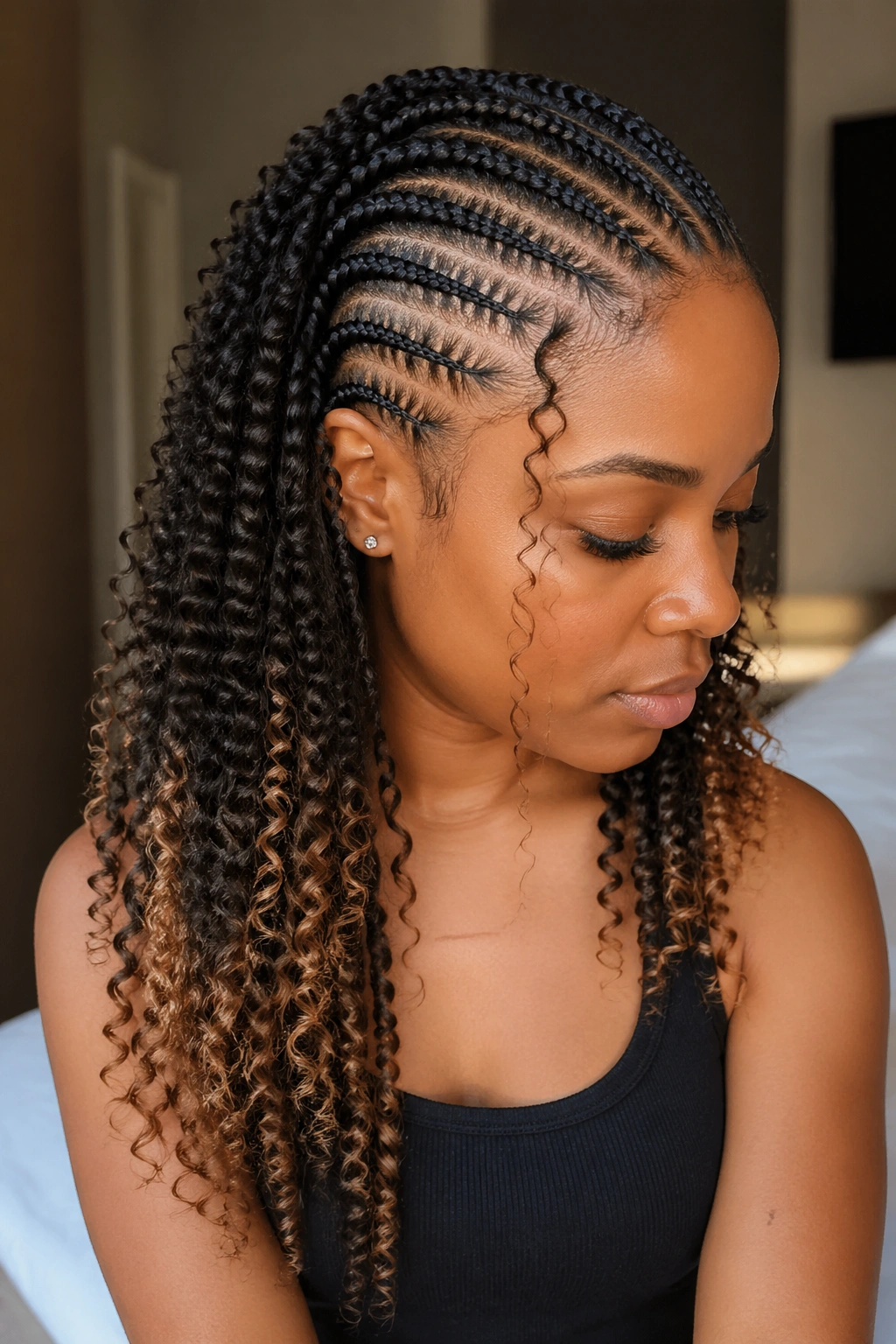
There’s a specific magic to straight back cornrows with curls. The top of your head reads sleek, tight, controlled — every braid laying flat against the scalp in crisp parallel lines. Then the ends spill into soft, bouncing curls that catch the shoulder or fall past the collarbone. Two textures. Two moods. One install.
It’s the kind of style that works for a job interview at 9am and drinks at 9pm without changing a thing.
The combination has held steady as a go-to for Black women who want protection without sacrificing movement. You get the scalp-cooling, low-manipulation benefits of cornrows on top — and the feminine softness of curls hanging loose below. If you’ve been bouncing between full cornrows (too severe some days) and full curly extensions (too much hair some days), this hybrid threads the needle.
What follows breaks down 22 different ways to wear straight back cornrows with curls, from small tight braids with tight spiral curls to chunky feed-ins with loose beachy waves.
The Core Structure of This Style
Every variation here shares the same bones. Cornrows running from the hairline straight toward the back of the head, stopping anywhere from mid-crown to the nape. From that stopping point down, the hair hangs in curls — either the natural texture of your own hair or curly extension hair braided in at the cornrow’s end.
The ratio matters. Cornrow length to curl length. Most styles here use a 50/50 split or a 40/60 split favoring the curls. When cornrows dominate (70/30), you read more protective. When curls dominate (30/70), you read more glam.
Why the Combination Holds Up So Well
Pure cornrows get boring for some people after a week. Pure curly extensions need constant attention — re-dipping, re-curling, picking them out daily. The hybrid solves both problems.
The cornrow portion protects the most fragile hair at the crown and temples. That’s also the hair that tends to break first from daily styling manipulation. Locking those strands down for 3-4 weeks gives them a real break.
The curly portion gives you styling options. Pull it up. Let it hang. Clip half back. Wrap it at night. The curls respond like regular hair because, functionally, they are regular hair — just tucked into a braid at the top.
Choosing Between Your Own Curls and Extensions
Two paths split here. Path one: your own hair. Path two: curly extensions braided in.
Path one works if your natural hair is already mid-length or longer and has enough density that the hanging curls won’t look thin. The curls will be whatever texture your hair naturally forms — 3A, 3B, 3C, 4A — after the cornrows are released at the stop point.
Path two works if you want more length, more volume, a different curl pattern than your own, or you have shorter hair. Extensions open up options: water wave, deep wave, Brazilian curly, loose curly, tight spiral. You pick the texture.
Neither path is better. Path one costs less and feels more like your own hair. Path two gives more styling flexibility and consistent curl definition regardless of your natural texture.
Prep Before Install Day
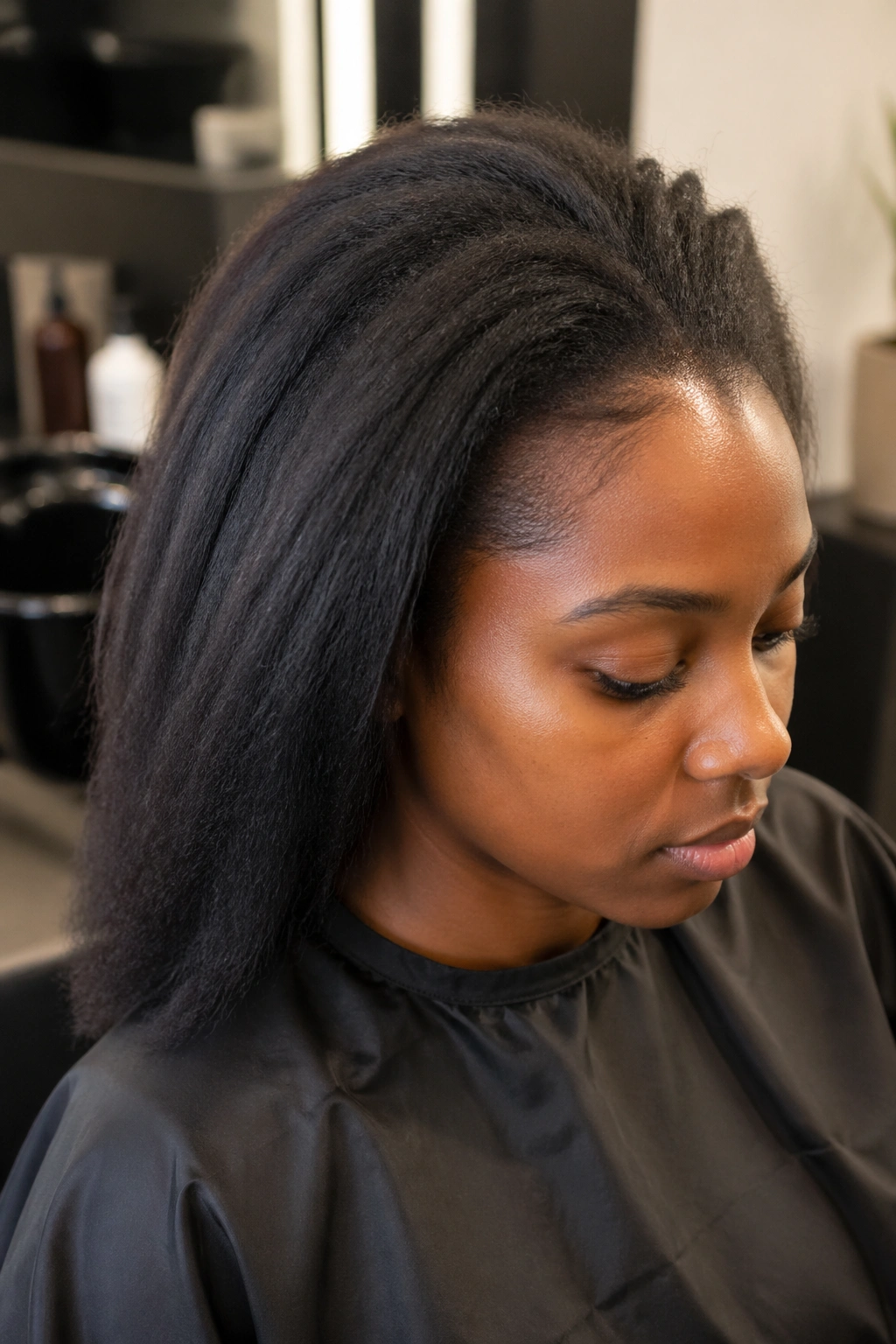
Wash with a clarifying shampoo, deep condition, and stretch the hair. Blow-dried or braid-stretched — both work. The hair needs to be dry, clean, and elongated so the cornrows go in flat.
Don’t oil the scalp the day of install. Oil makes the gel slip and the parts drift. Save oiling for after the braids are set.
If you’re adding extensions, pre-stretch curly bundles by dipping them in hot water, towel-drying, and hanging them to air dry while you cornrow. This tames any frizz in the packaging and gives you cleaner curls to work with.
Tools Worth Having On Hand
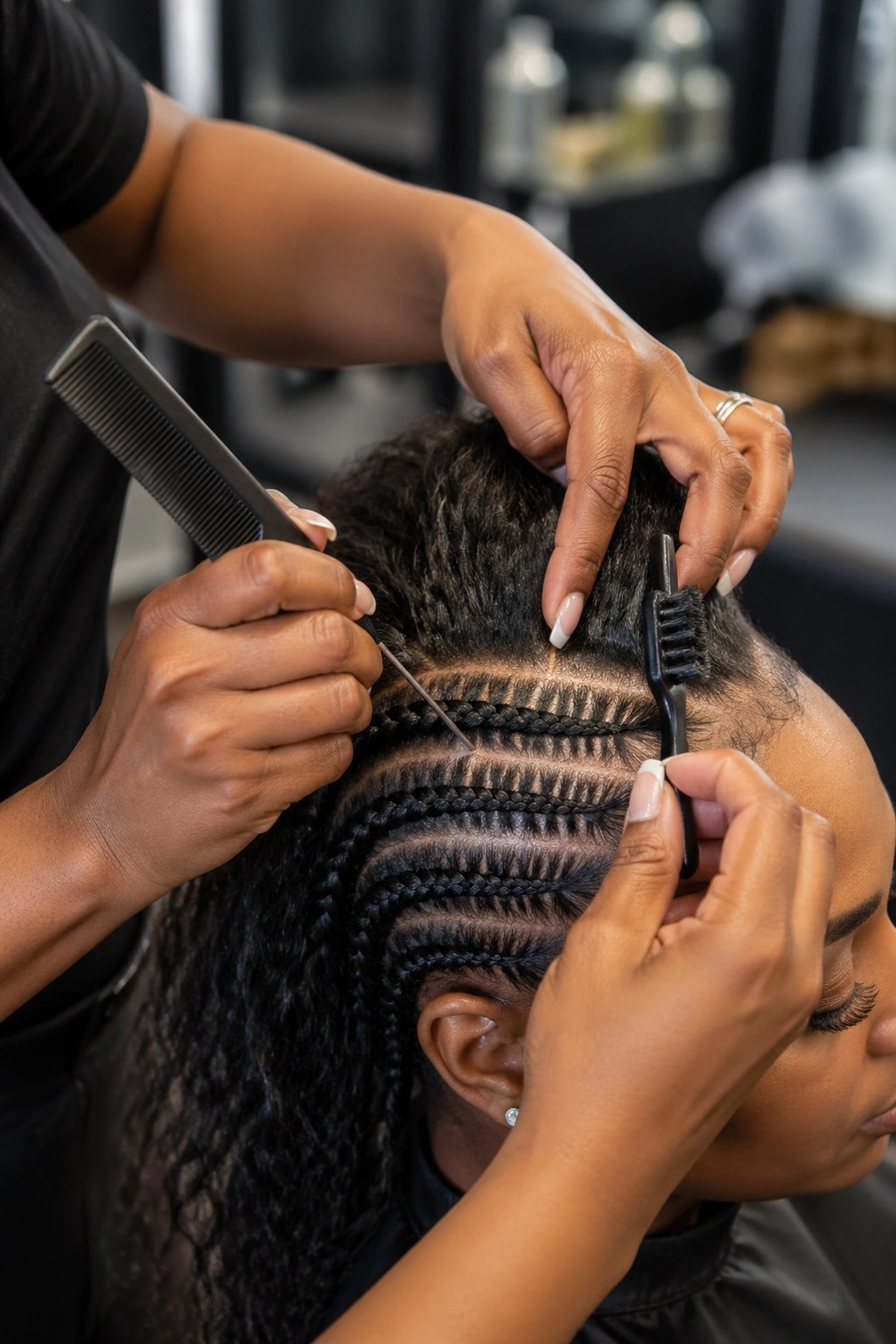
Rat-tail comb. Edge brush. Spray bottle with water and leave-in. Alcohol-free gel with strong hold. Small clear elastic bands. Hot water for sealing curly ends. A curling wand (optional) for refreshing curls between washes. Duck-bill clips to keep finished cornrows out of the way.
If using extensions: curly bundle hair or pre-packaged curly braiding hair in the desired texture. Kanekalon works for feed-in sections. Curly bundle hair for the hanging ends.
1. Small Straight-Backs With Tight Spiral Curls
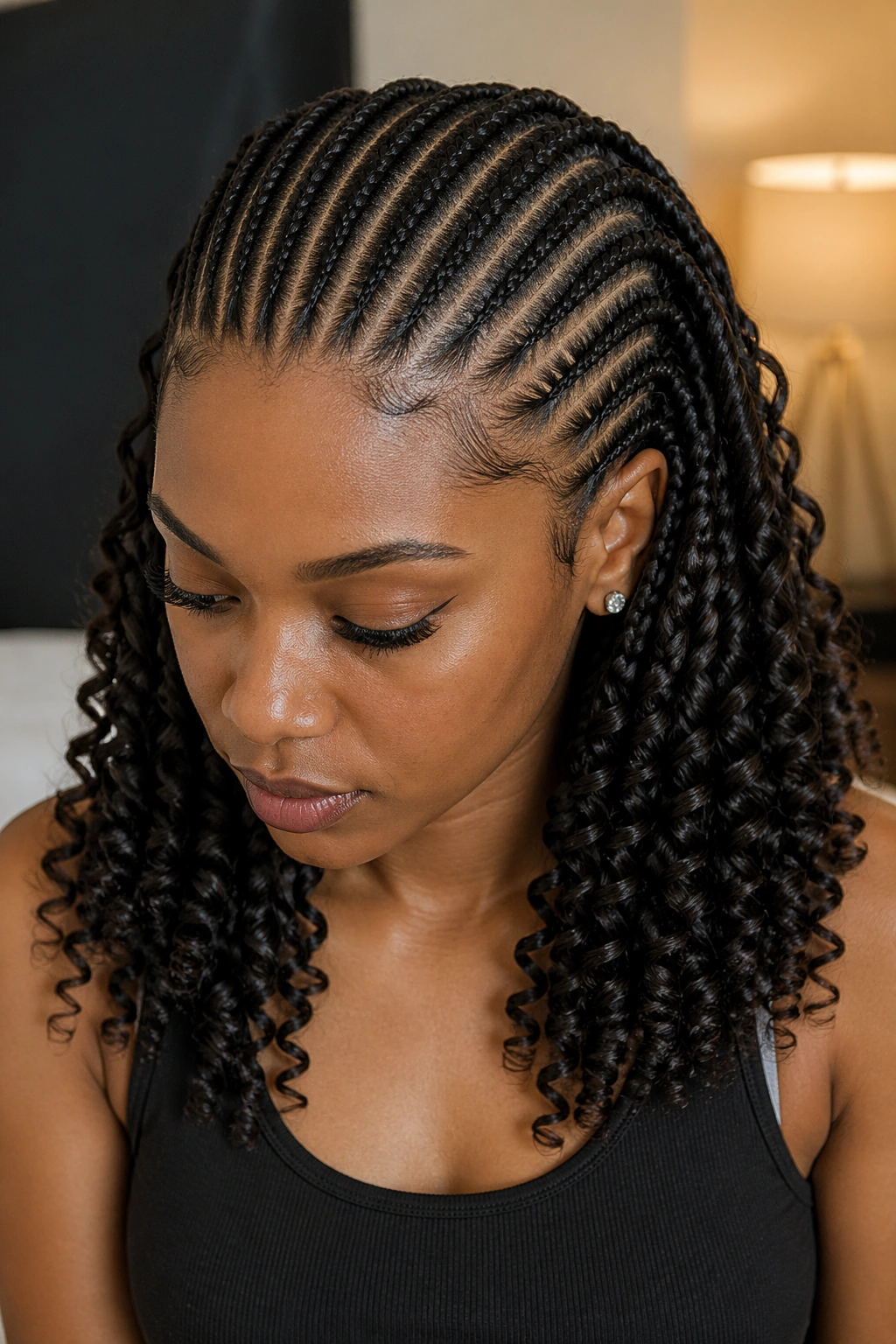
Tiny cornrows — eight to ten per head, each about the width of a chopstick — running straight back, stopping at the nape. From there, tight spiral curls hang loose to the shoulder blades. The contrast between the ultra-tight cornrows and the bouncy spirals reads both elegant and playful.
This is a dense style. Install time runs 3-4 hours. The payoff is a finished look that reads expensive and intentional from any angle.
Sleep with a silk scarf tied around the braided portion and the curls loose over the shoulders. A bonnet large enough to contain both sections also works.
2. Medium Cornrows With Loose Natural Curls
What Makes It Different
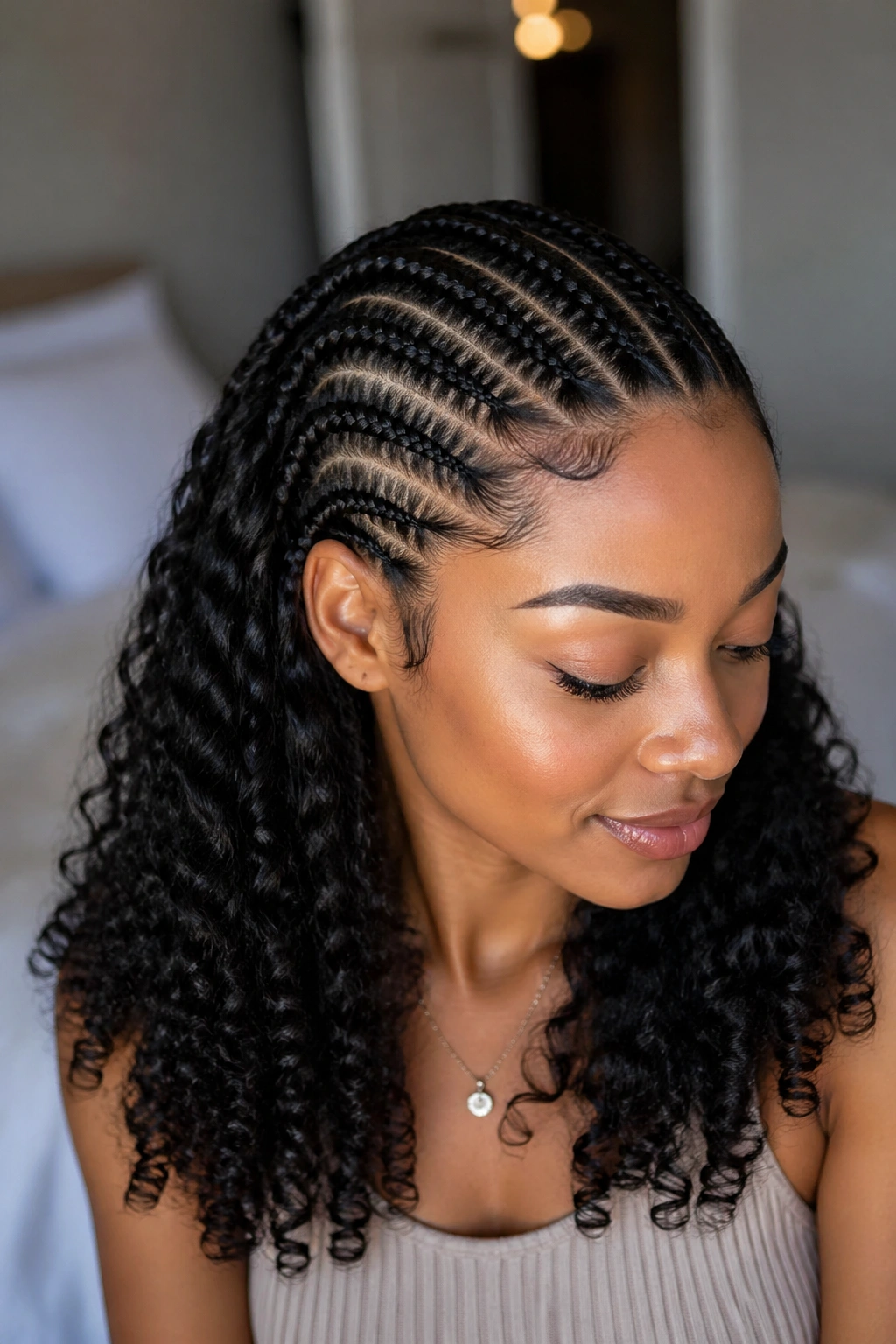
Six to seven medium-width cornrows running back, stopping around the mid-crown. From there, your natural hair hangs loose — assuming your natural texture falls in the 3A-4A curl range. No extensions. No added hair.
- Total install time: 90 minutes to 2 hours
- Best for: shoulder-length to mid-back natural hair
- Maintenance: re-twist the loose curls at night with a small amount of curl cream
Tip: If your natural curls tend to shrink tight and lose length overnight, finger-coil each curl with a bit of cream before bed and pin the whole loose section up into a pineapple on top of your head.
3. Cornrows With Deep Wave Bundles
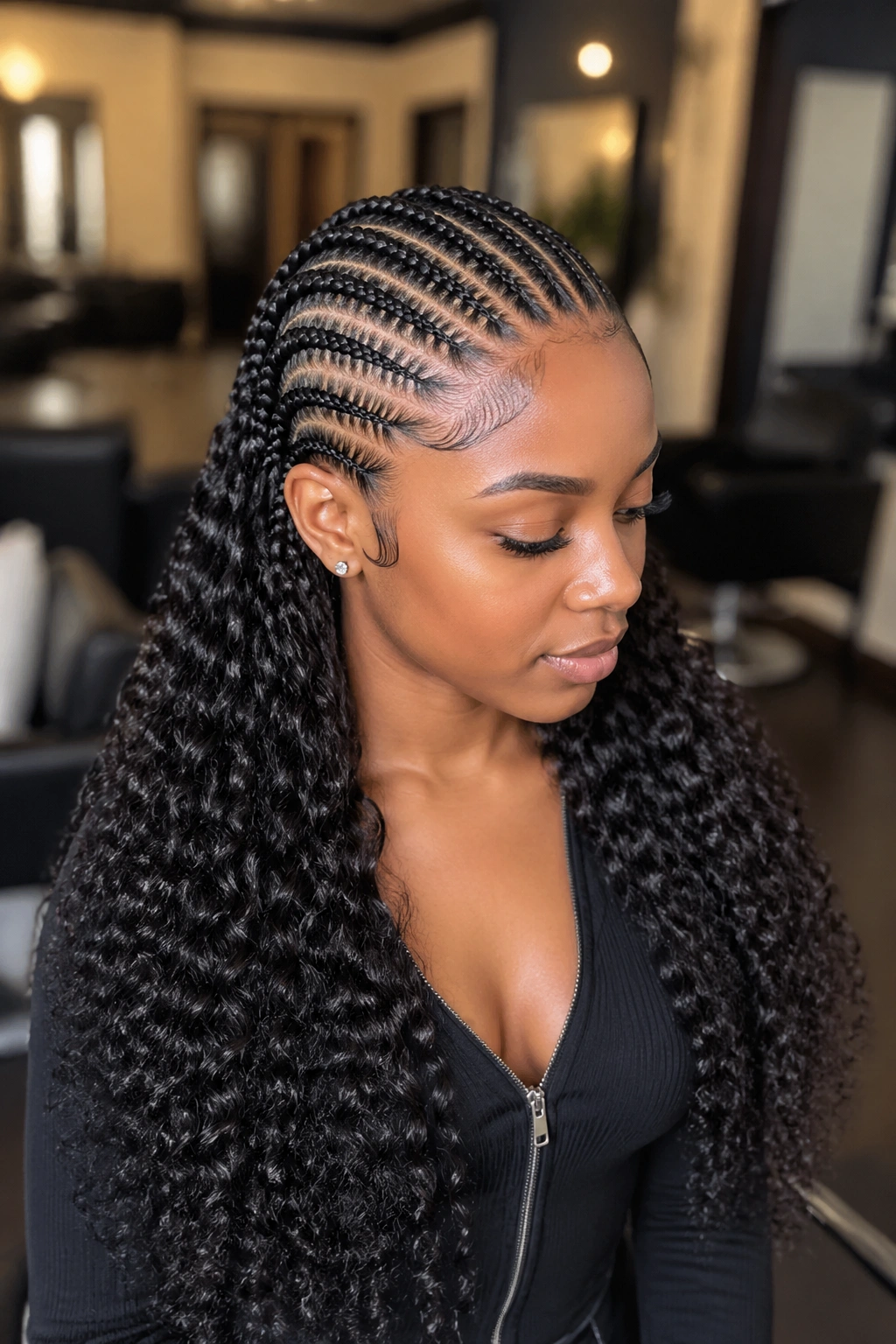
Deep wave extensions are the go-to curly texture for this style because they hang with visible pattern without frizzing easily. The wave is large enough to read clearly from across a room. The curl pattern stays defined for days between re-dips.
Cornrows across the top, deep wave bundles braided into the ends at the stopping point. The wave extends 16 to 22 inches depending on bundle length chosen, giving you dramatic length with moderate volume.
4. Feed-In Cornrows With Body Wave Ends
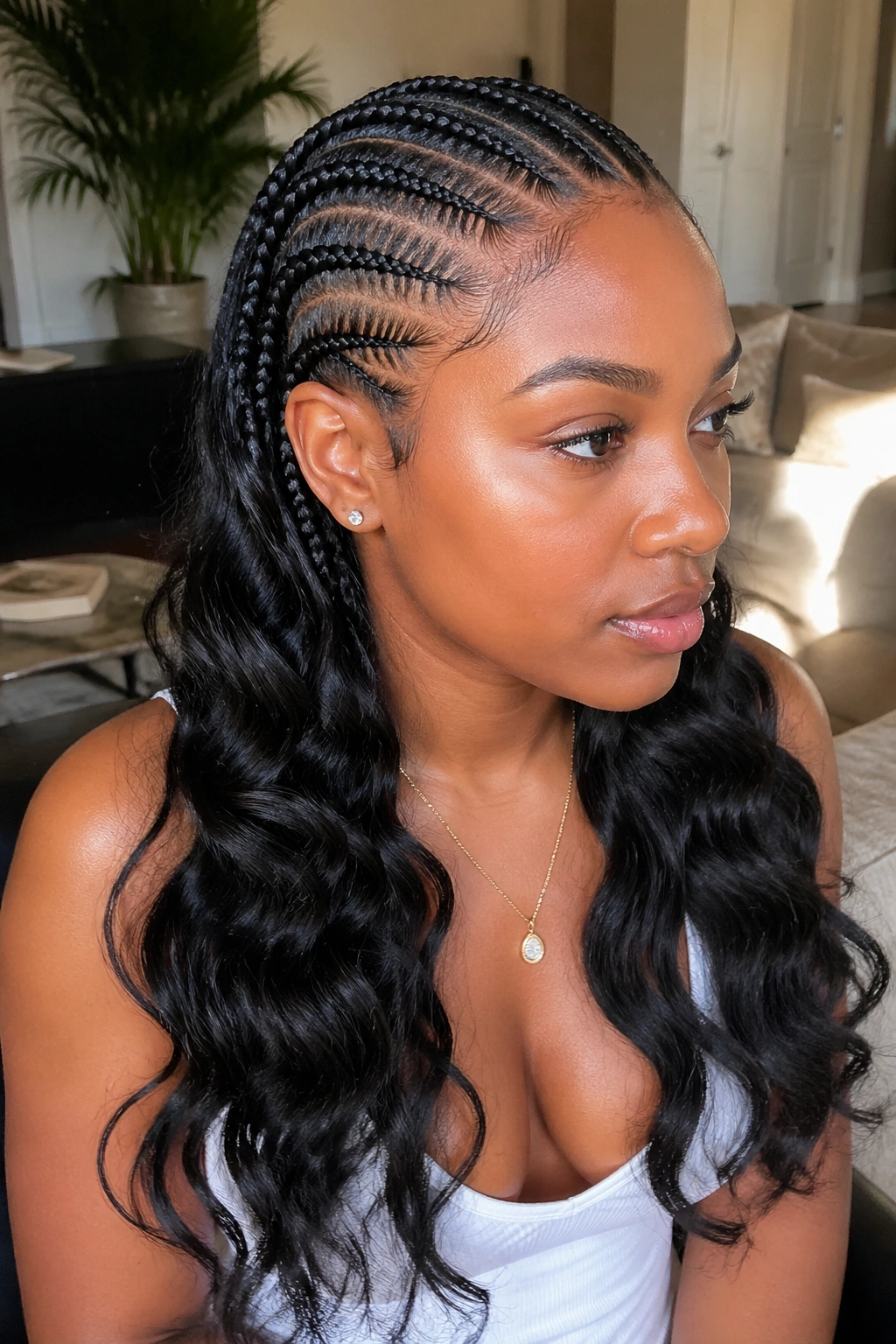
Bold claim: feed-in cornrows with body wave ends might be the most universally flattering version of this style. The feed-in technique starts thin at the hairline and gradually thickens, which means no visible chunk of extension hair bumping out from where the natural hair stops. The transition from braid to curl is seamless.
Body wave is looser than deep wave — a soft S-curve rather than a tight coil. The finish reads grown-up and polished. Think “red carpet” rather than “spring break”.
Install takes 3-4 hours. The bundle cost adds up but lasts through multiple reinstalls if cared for properly — rinse, condition, and air-dry the bundles after each takedown and they’ll hold their pattern for 4-6 installs.
5. Jumbo Cornrows With Beachy Waves
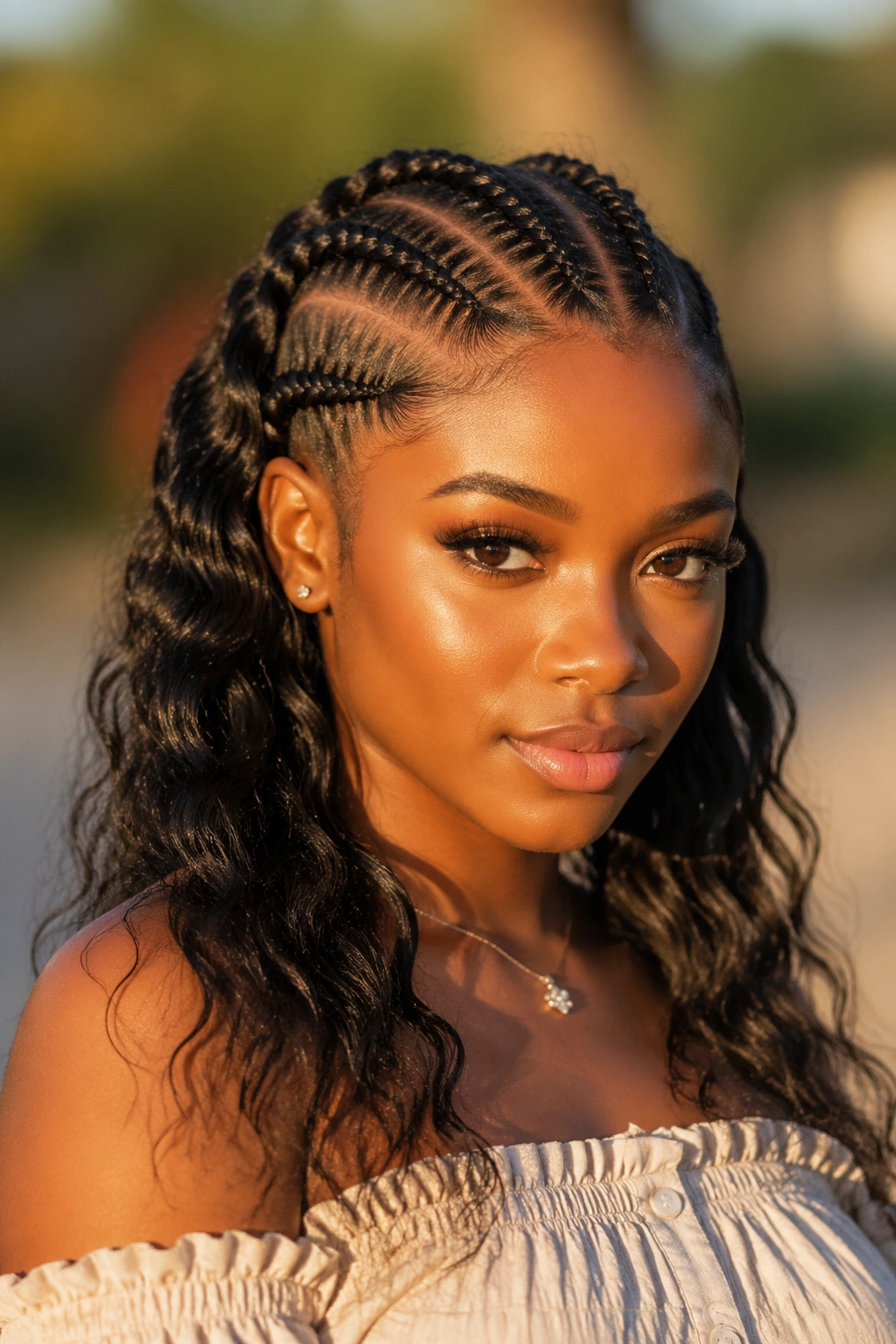
Question: can you get a style that reads effortless without actually being effortless?
Yes. Three or four jumbo cornrows running straight back with loose beachy waves hanging from the ends does exactly that. The jumbo cornrows install in under an hour. The beachy wave extensions read casual and tousled despite being deliberately styled.
How to Style It
Scrunch the wave ends with a lightweight curl mousse to enhance the natural wave pattern. Flip the hair forward and scrunch from the ends up. Let air dry or diffuse on low heat.
6. Half-Head Cornrows With Full Curls
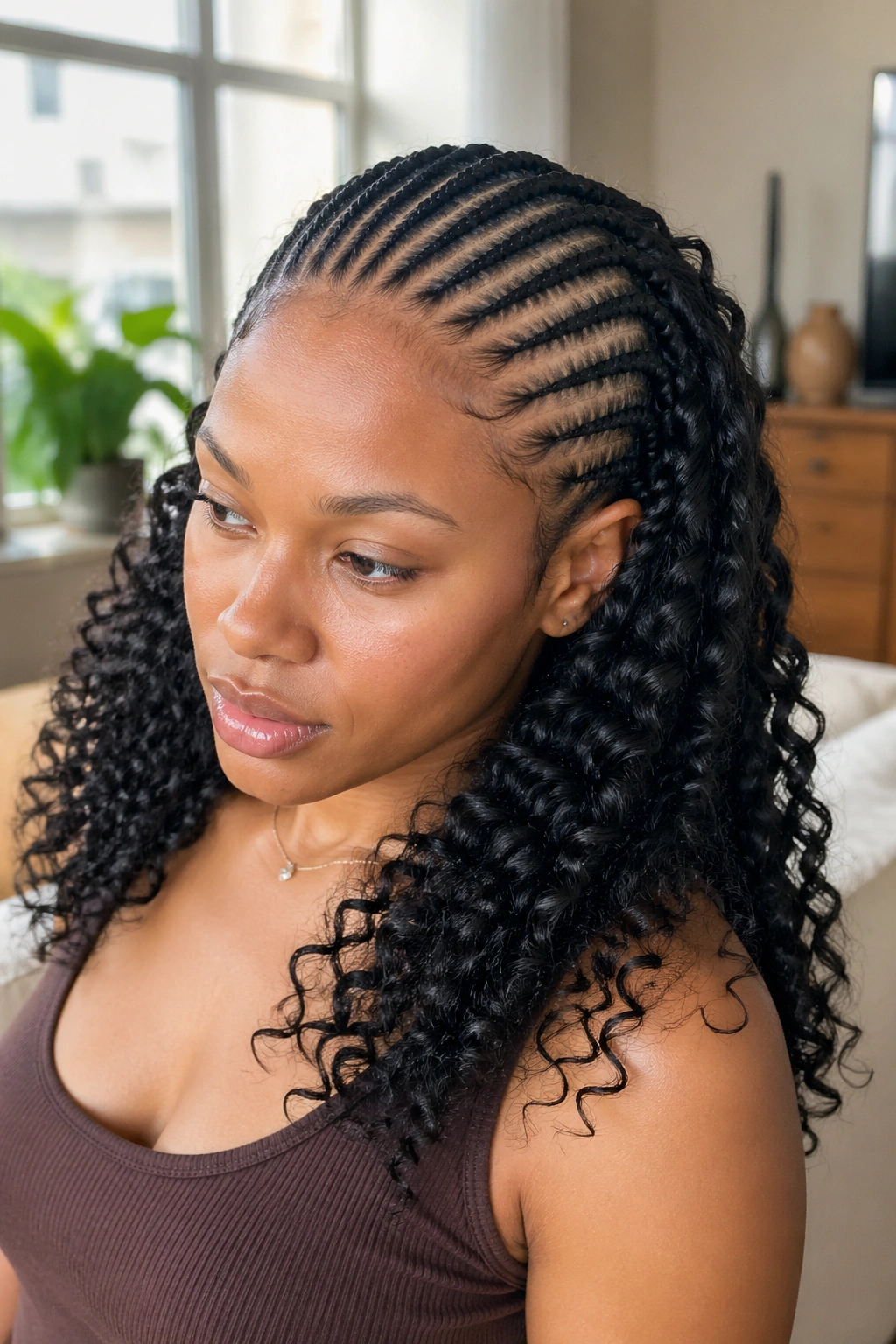
The front half of the head gets cornrowed — usually from the hairline back to the crown. The back half remains loose and styled into curls. Walking up behind you, it reads as a full head of curls. Walking up in front, it reads as sleek cornrows.
This variation works beautifully for photos because the angle completely changes what the viewer sees. It also transitions between formal and casual quickly — slick the cornrows with a bit of shine spray for polished, leave them matte for casual.
7. Cornrows With Water Wave Extensions
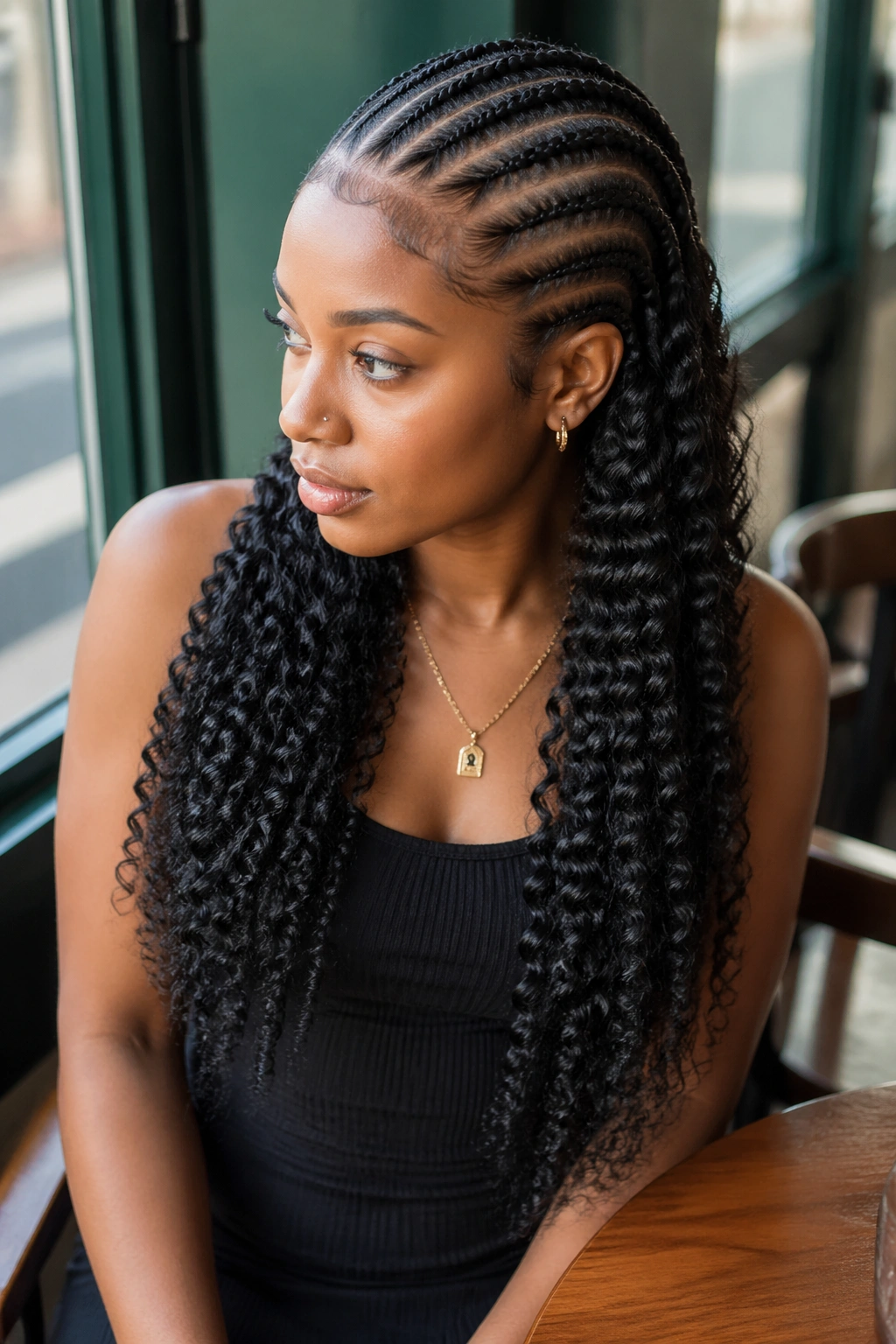
Water wave is tighter than body wave but looser than deep wave. It creates defined but not aggressive curls that move with every head turn. The visual effect is movement and bounce without the big-hair drama of full curly bundles.
Install is standard: cornrow base, then braid water wave bundle hair into the ends at the stop point. Seal the braid ends with hot water or hair glue to prevent unraveling.
8. Side-Parted Straight-Backs With Curls
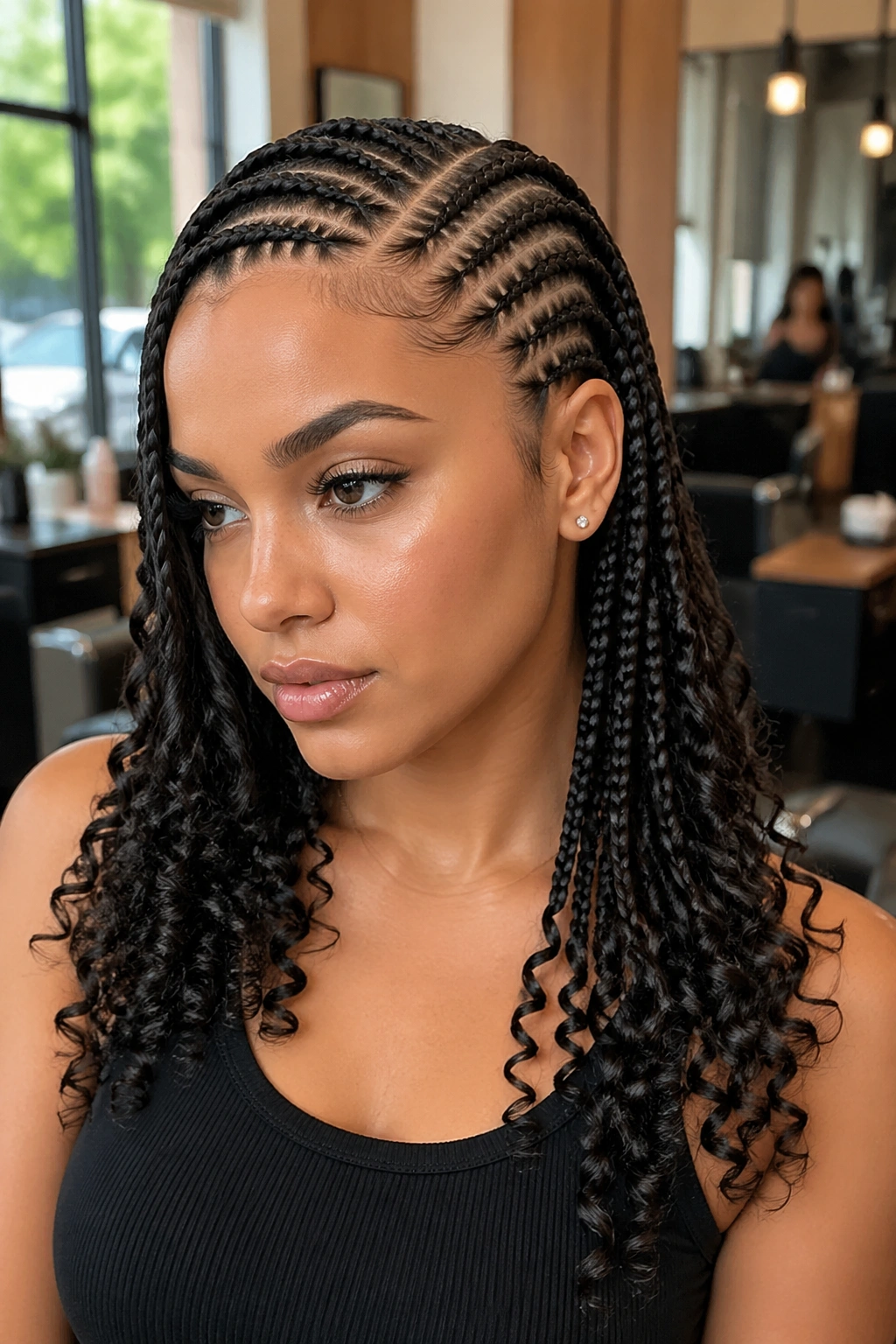
A deep side part changes everything. Cornrows flow asymmetrically across the head — three to four heavier cornrows on one side, five to six thinner ones on the opposite side. The stop point stays even across the back. Curls release from the ends uniformly.
The side part adds sophistication. A center part reads playful. A side part reads elegant. Small detail, big difference.
9. Cornrows With Pre-Curled Braiding Hair
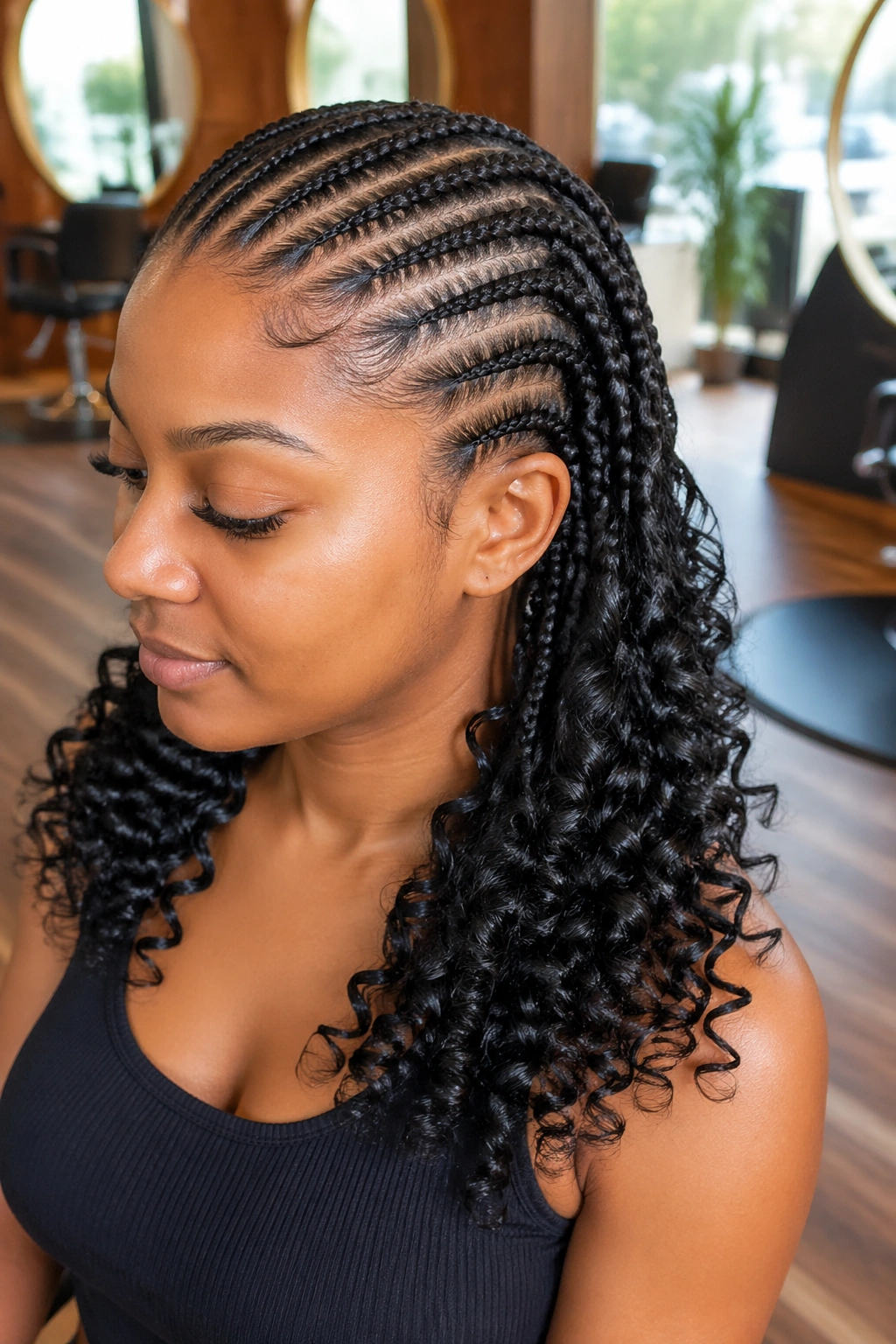
Unlike curly bundles that need to be rinsed and re-curled, pre-curled braiding hair comes packaged in spiral or wave shapes that stay for weeks without intervention. Kanekalon and synthetic blends with heat-set curls save hours of maintenance.
The trade-off: the curl pattern is less natural-looking than human hair bundles. Synthetic curls have a uniform shine that reads slightly doll-like up close. From a distance, they look real. Under direct camera flash, the difference shows.
Best for: short-term installs (2-3 weeks), vacations, events where low maintenance matters more than ultra-natural appearance.
10. Thin Cornrows With Voluminous Curls
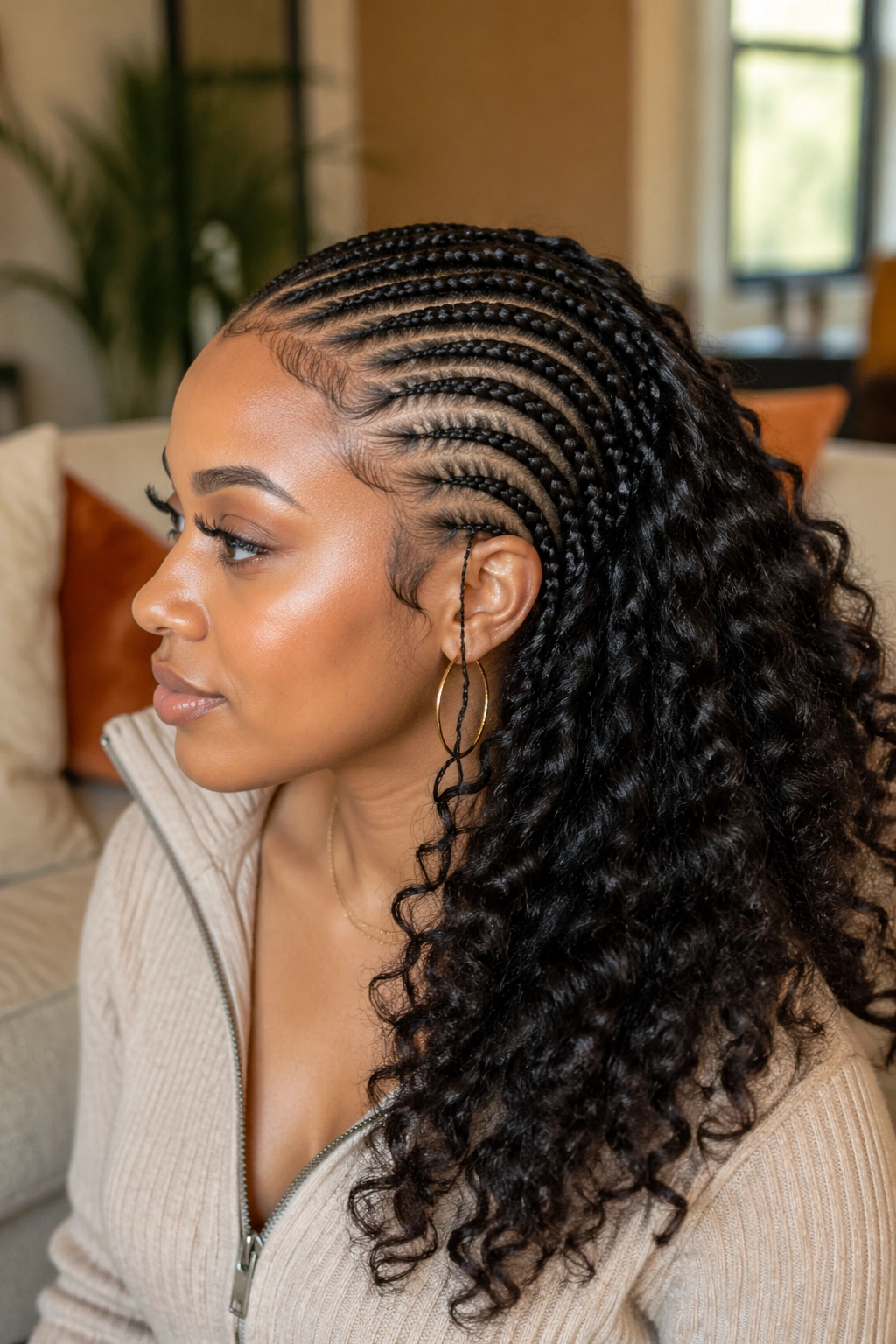
The contrast principle taken to its maximum. Twelve to fifteen thin cornrows packed densely across the scalp, then a massive volume of curls hanging loose from the ends. The tight restraint on top amplifies the wild volume on the bottom.
Who This Is For
Anyone who wants impact. This isn’t a subtle style. It reads dramatic in person and photographs with serious presence. Budget 4-5 hours for install and don’t skimp on the curl volume — thin cornrows with wimpy curls fall flat.
11. Cornrows With Colored Curl Ends
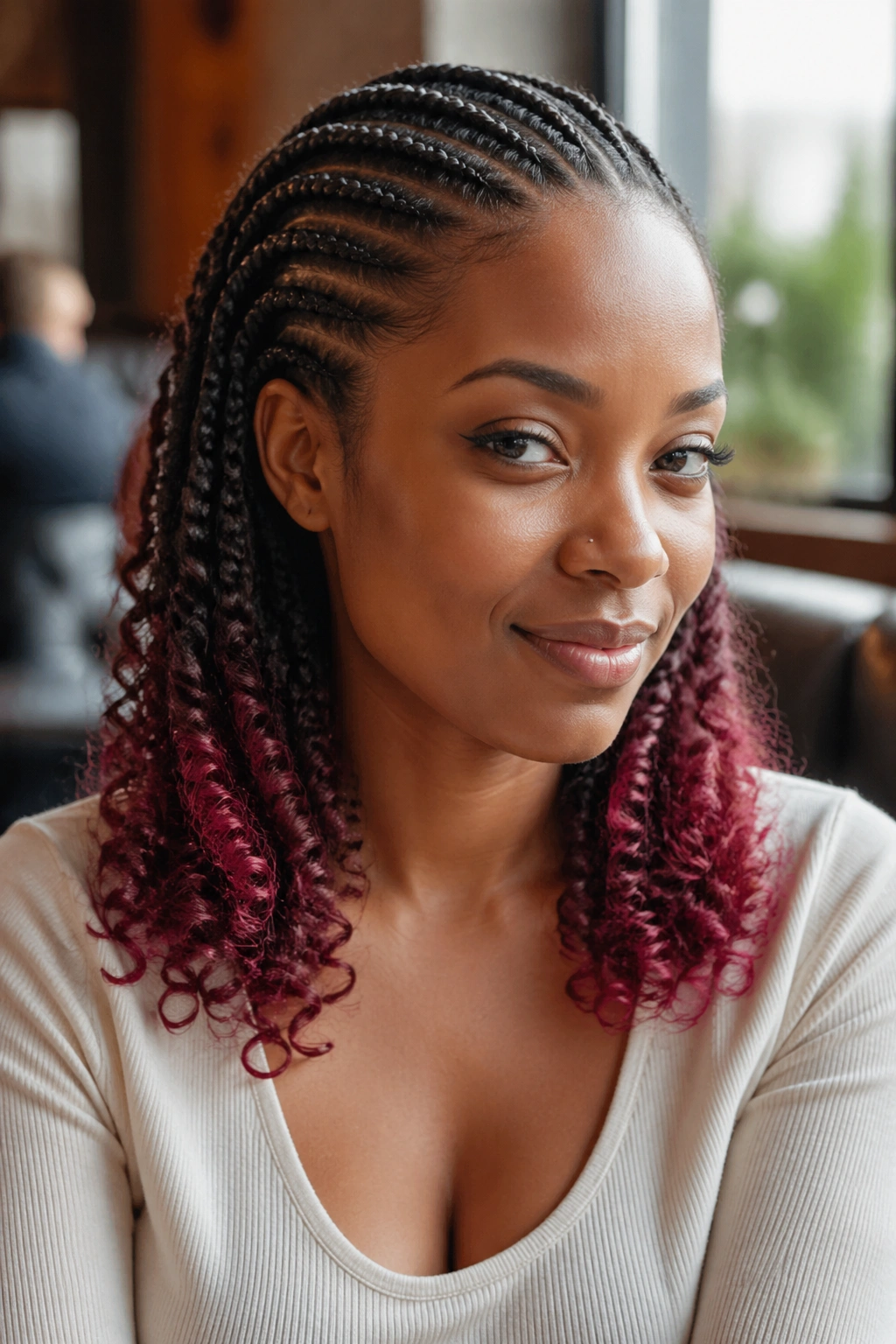
The braids match your natural color. The curly ends come in a different shade — burgundy, honey blonde, auburn, deep red. The color concentration at the bottom of the style keeps it low-risk while still reading bold.
Color placement options: all ends colored, half colored on one side, or a peekaboo where only the underneath curls carry the color and it peeks through when the hair moves.
12. Cornrows Into a Curly Ponytail
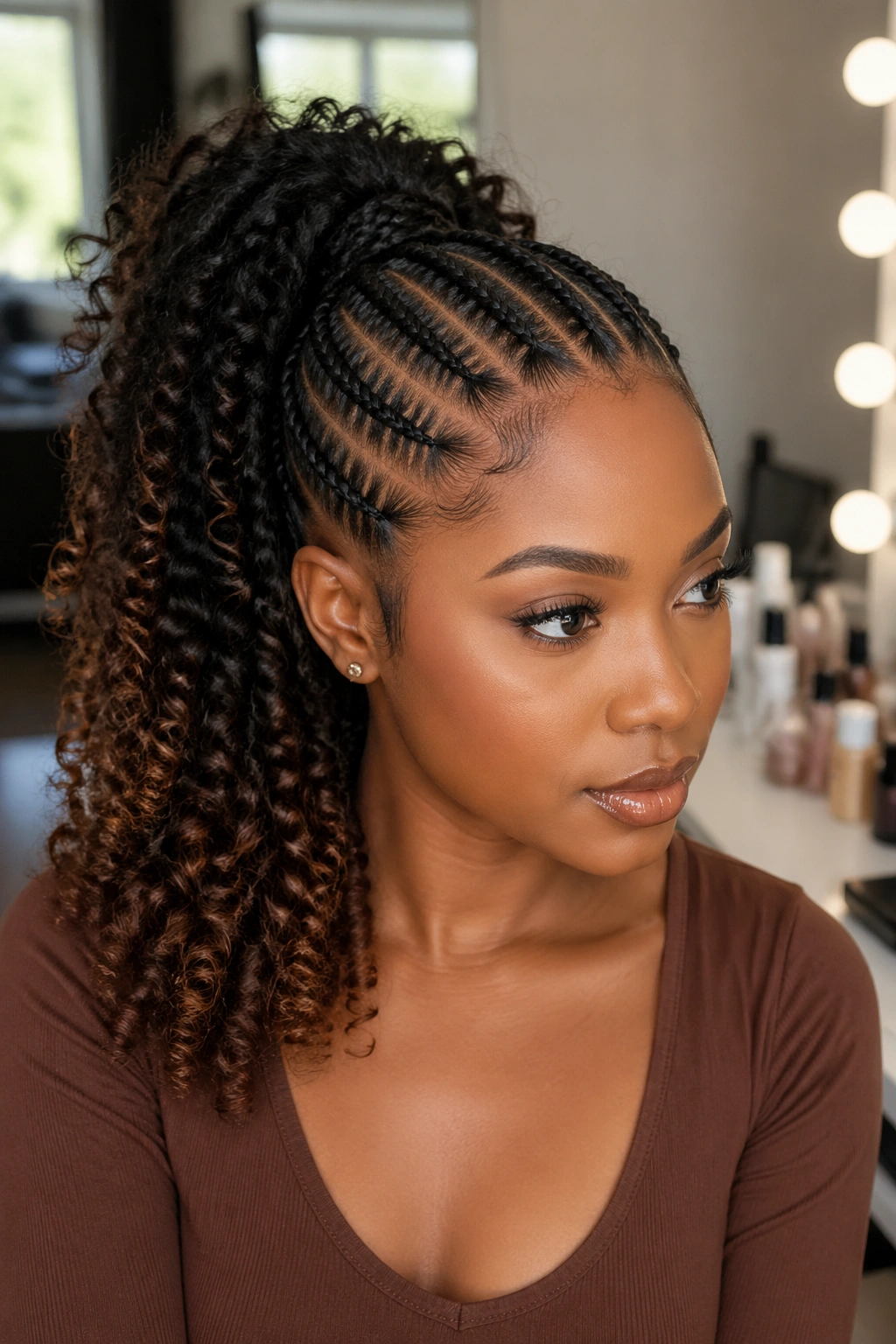
The cornrows flow into a single high or low ponytail base. From that ponytail, curly extensions hang as one flowing piece rather than individual braid ends. The finished look is smoother on top and unified at the bottom.
Secure the cornrows at the gathering point with a strong elastic, then braid or wrap a curly ponytail extension around the base to hide the elastic. Pin in place.
13. Curved Cornrows With Curly Ends
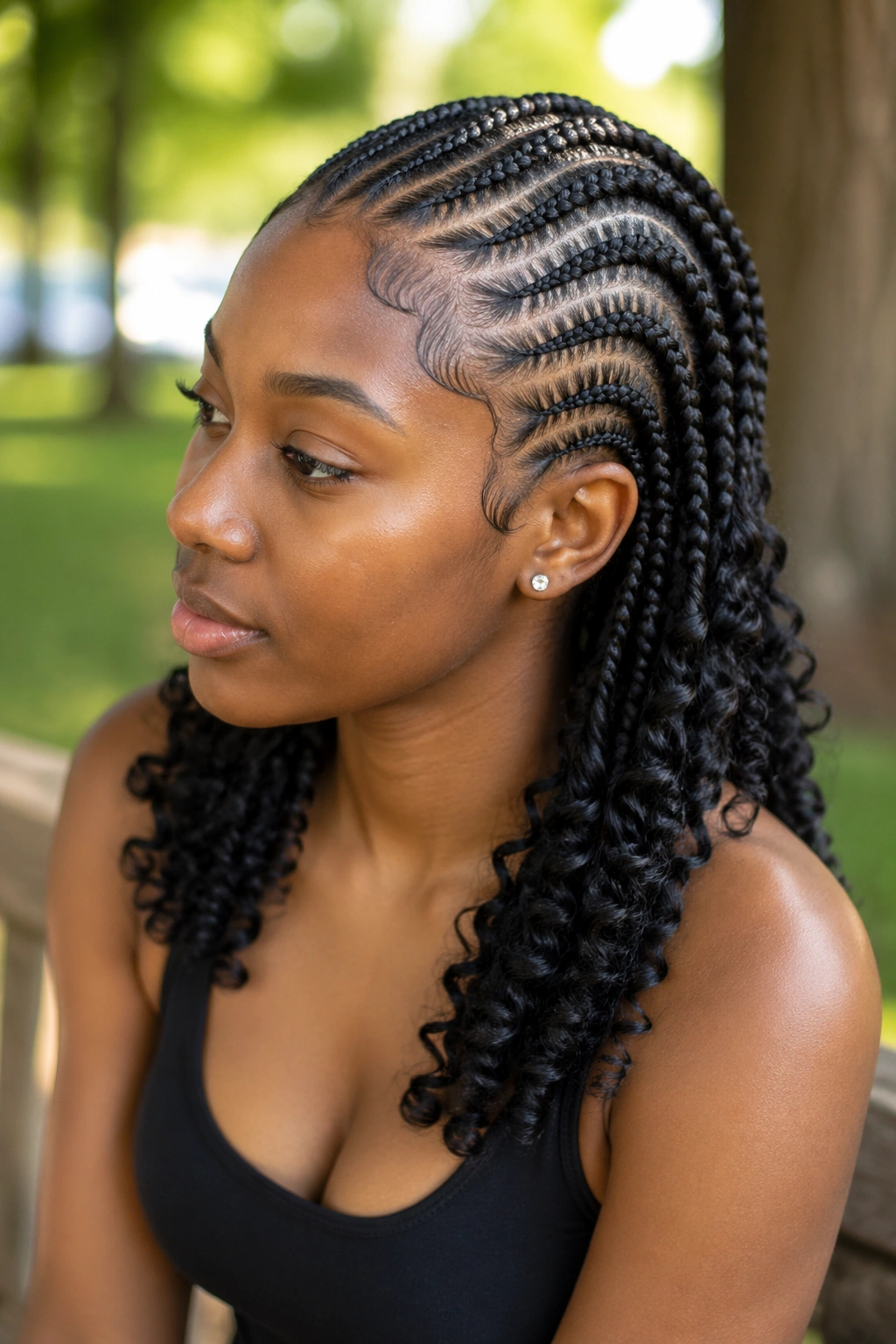
Unlike pure straight-backs, curved cornrows take a gentle S-shape across the head — following the contours of the skull. The curves meet at a lower stop point on one side, then release into curls.
The curve adds visual interest without major complexity. Straight back cornrows can read plain on smaller heads. Curved cornrows give the scalp design more to do.
14. Stitch Detail Cornrows With Curls
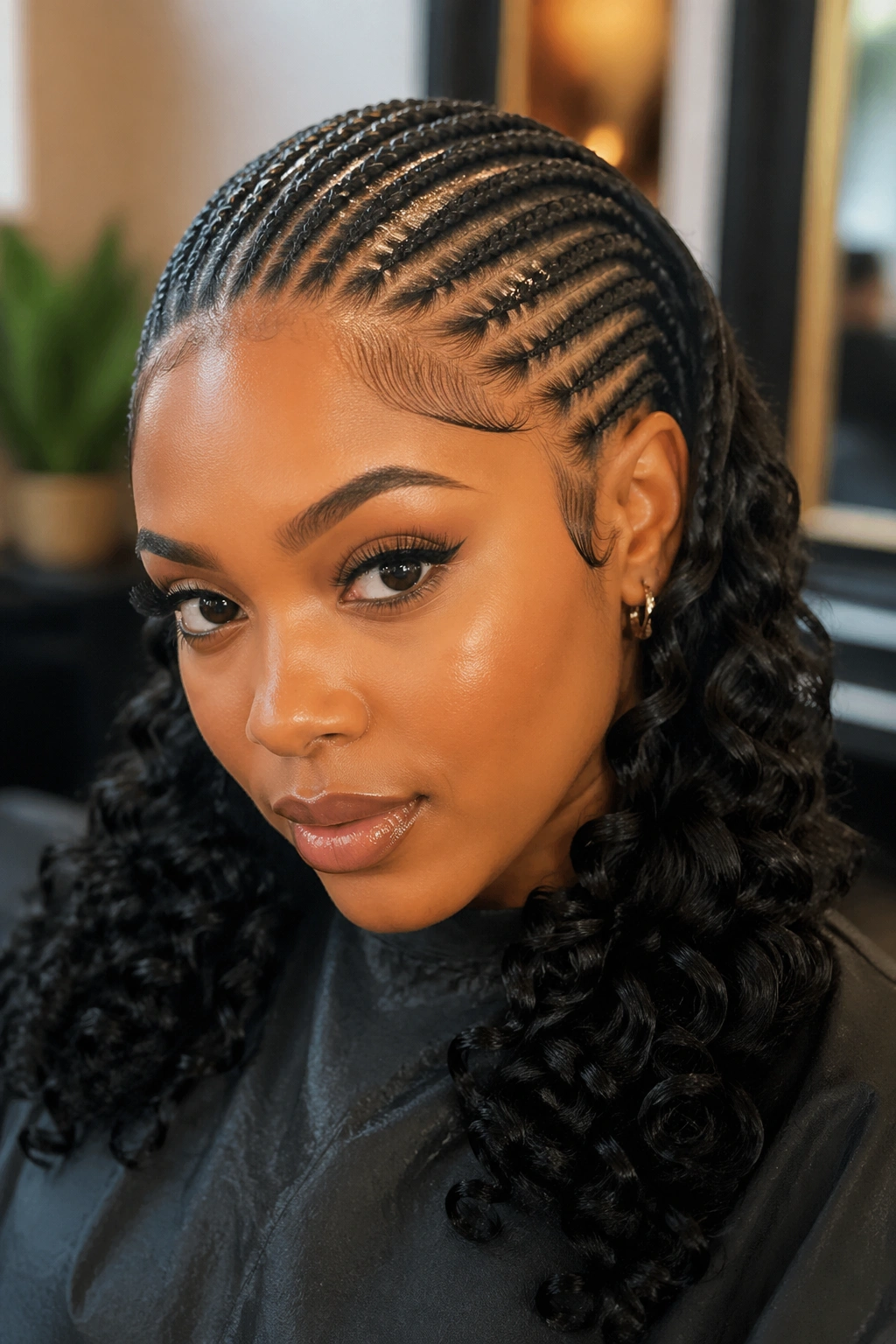
Stitch braiding adds those small horizontal ridges running down each cornrow. The technique takes longer but gives the braids a knitted appearance that stands out from basic straight-backs. Pair stitch braids with loose curls for maximum textural contrast.
Install time runs 5-6 hours for a full stitch install. This is a splurge style, not a weekly rotation option.
15. Cornrows With Silk Press Ends
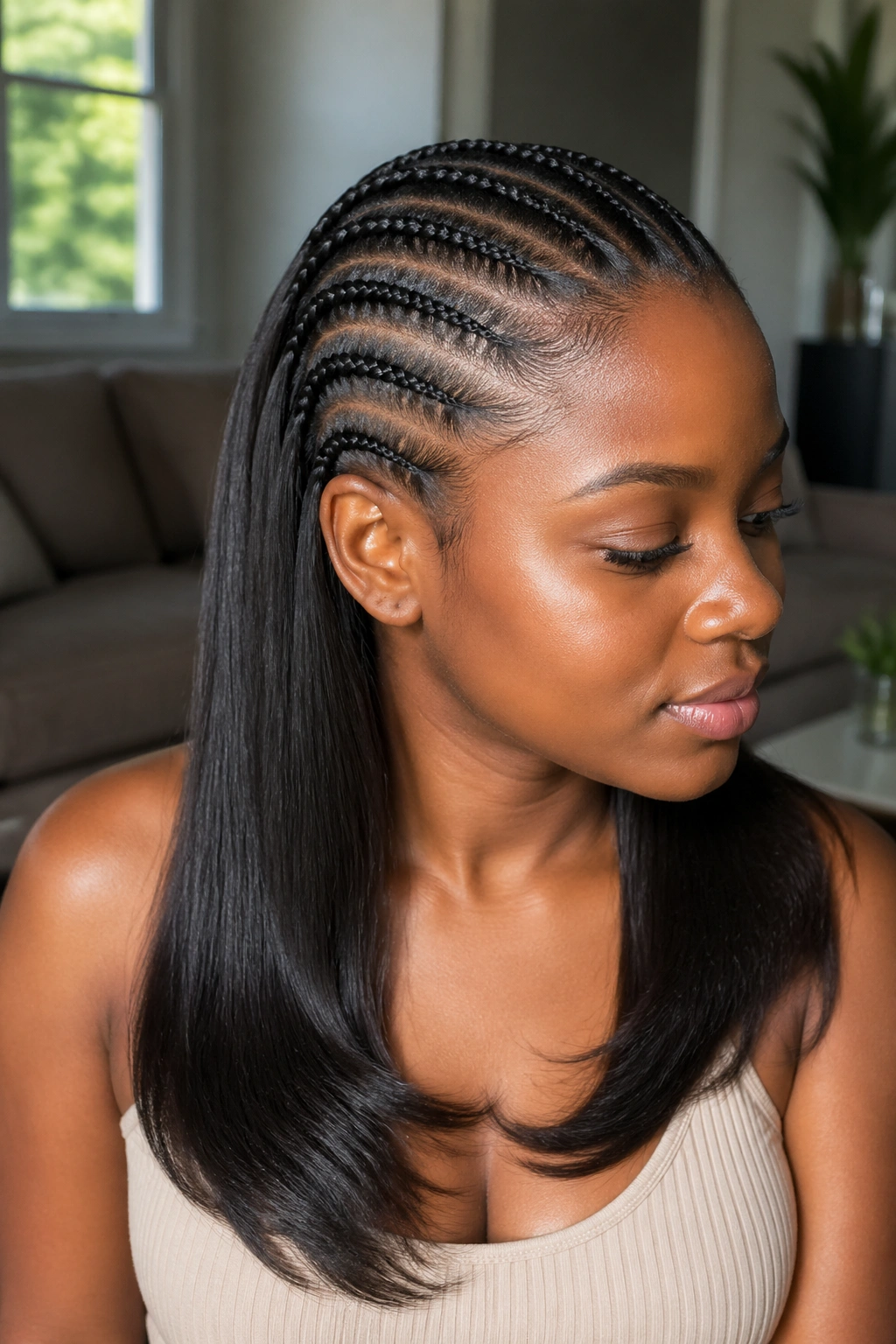
A different take on “straight back cornrows with curls” — the ends are silk-pressed rather than curled. You get the sleek scalp of cornrows with smooth, flowing straight hair below. Technically not curls, but often grouped in the same styling category because of how the look functions day-to-day.
The Catch
The silk press needs maintenance to stay smooth. Humidity reverts the hair. Sleep wraps become critical — silk scarf wrapped firmly around the pressed ends every night without exception.
16. Cornrows With Loose Barrel Curls
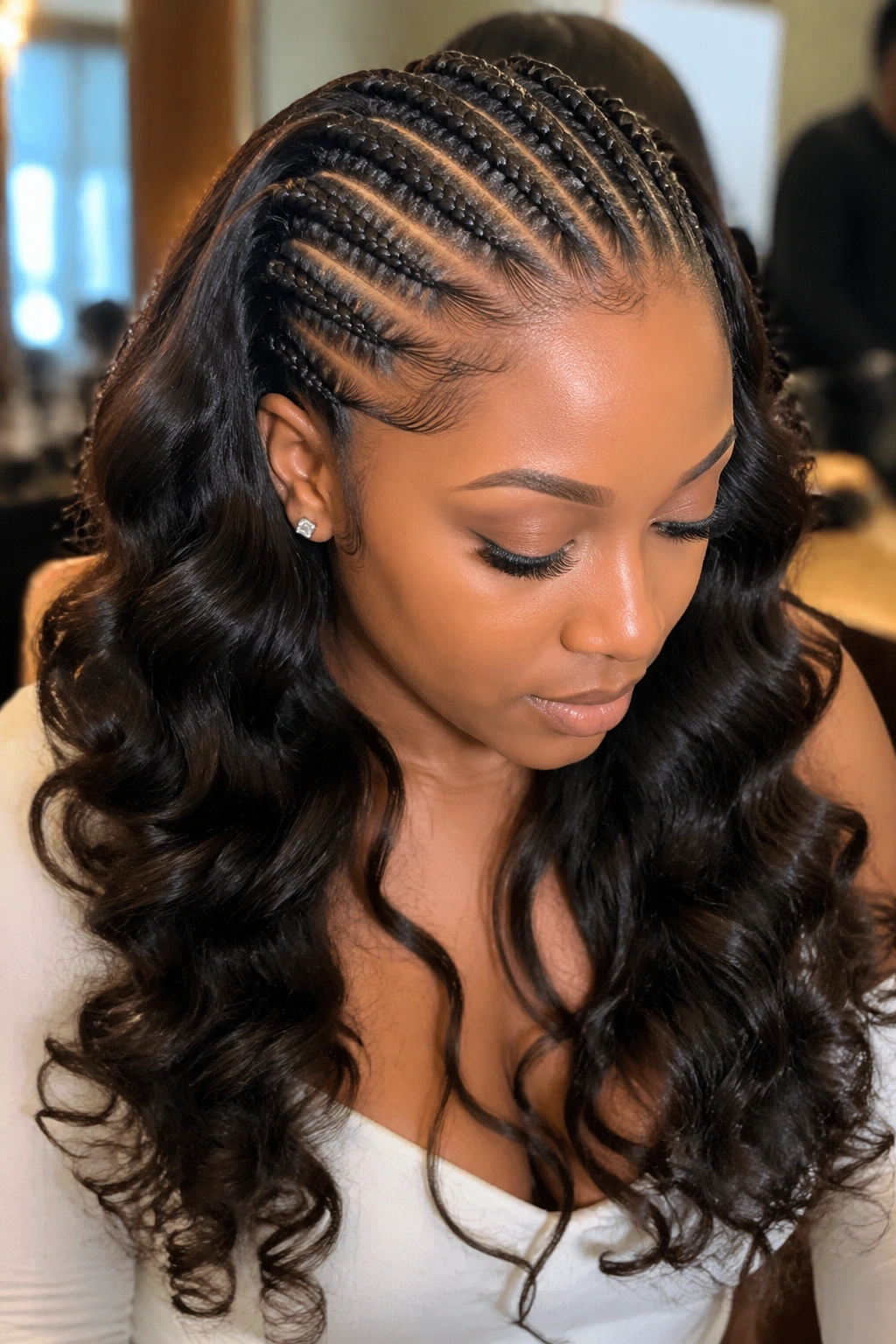
Large, soft barrel curls created by sections of hair rolled around a 1.5 to 2-inch curling iron. The curls fall in wide waves rather than tight spirals. Reads romantic and mature — fits formal events, weddings, and photography days.
Apply a heat protectant before curling. Let each curl cool fully before brushing out — brushing warm curls breaks the shape. A light-hold hairspray mists the curls to hold through a full day.
17. Cornrows With Natural Blow-Out Ends
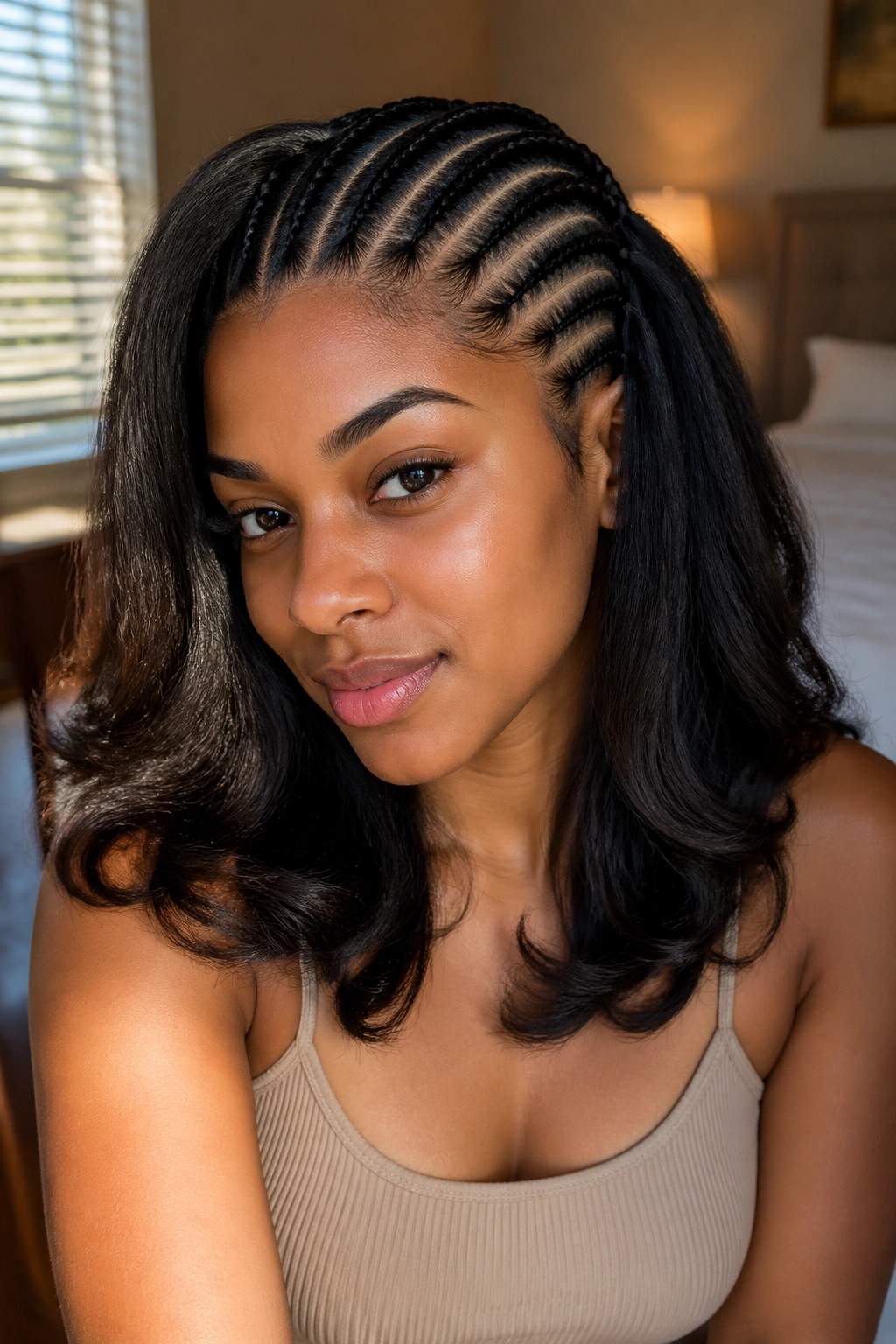
Your own stretched hair hangs loose from the cornrow stop point without additional curl defining — just a blow-out. The texture is soft, slightly fluffy, with natural body and movement. It’s the most low-commitment version of this style and works best on healthy hair that stretches well.
Medium hair handles this well. Short hair doesn’t have enough hanging length for the style to read as intentional. Very long hair ends up looking like a lion’s mane unless tamed with product.
18. Cornrows With Loc Extensions Ends
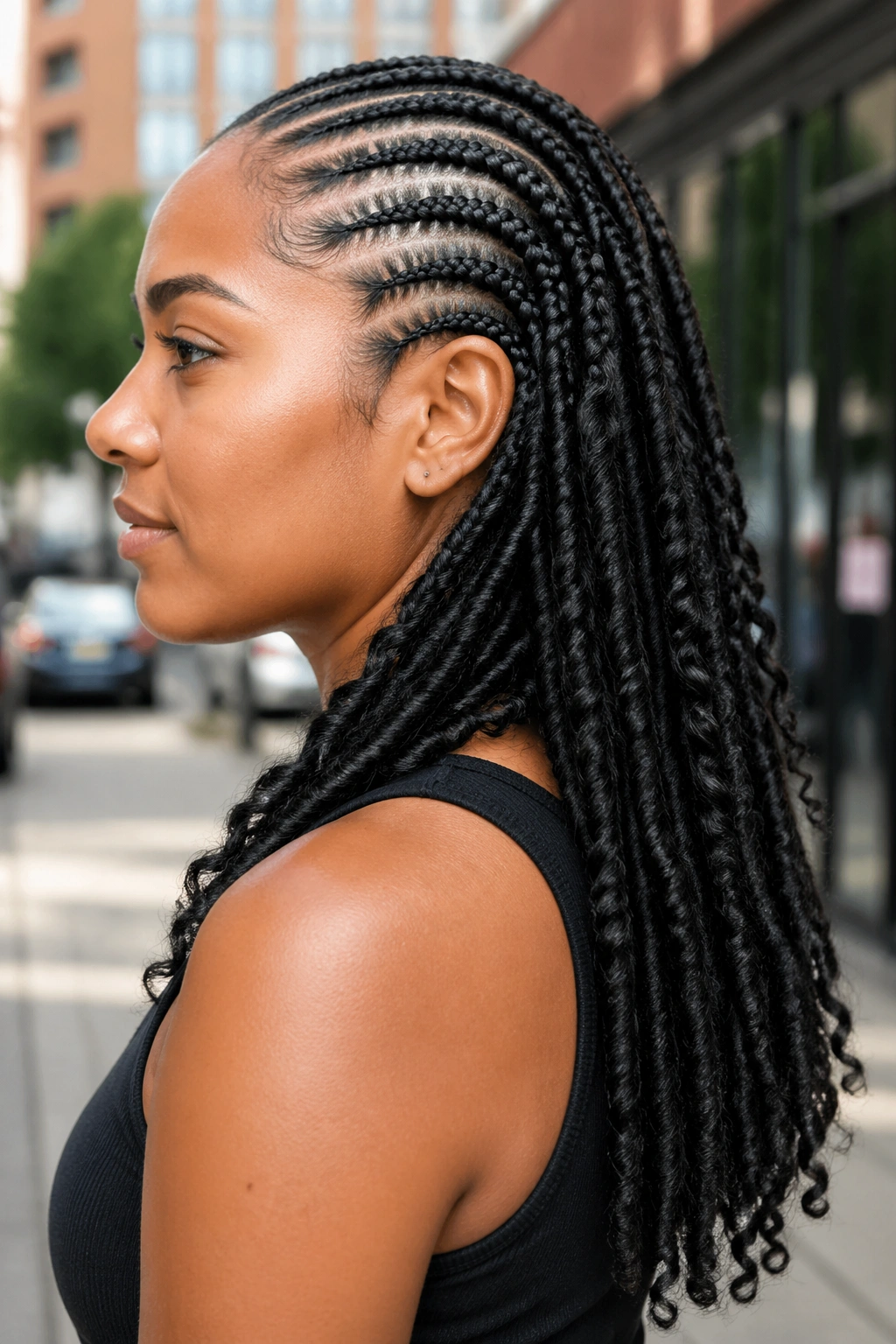
Hybrid style where the cornrows flow into faux locs rather than curly hair. Technically a curl-adjacent style — the locs have texture and movement even though they aren’t curls in the traditional sense. The end result is a unique look that sits between protective and edgy.
Faux loc ends hold up 6-8 weeks comfortably — longer than any traditional curly-end style on this list. Good for travel, extended protective styling periods, and anyone who wants set-it-and-forget-it.
19. Cornrows With Crimped Ends
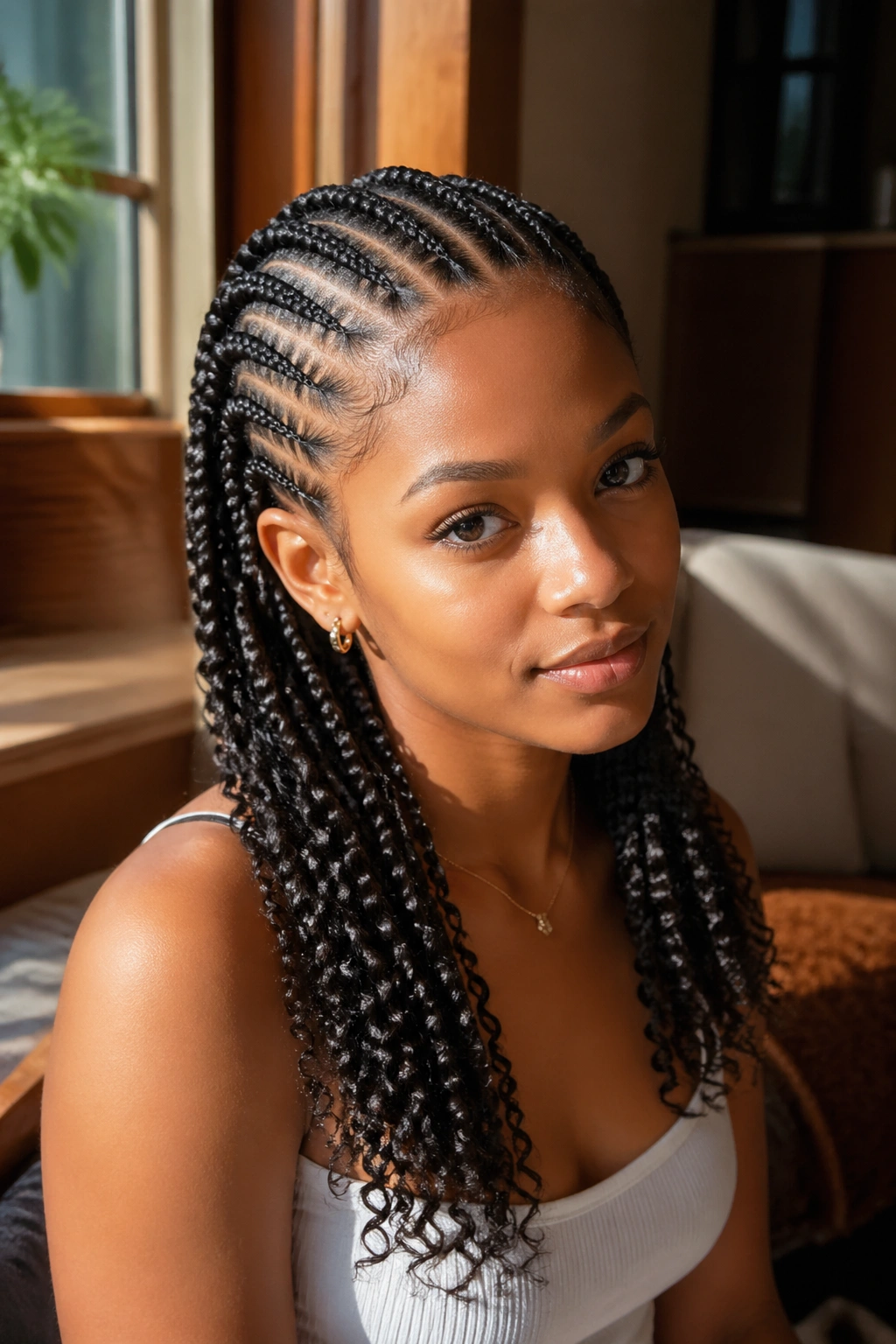
Crimping tools create a zig-zag texture that falls somewhere between curl and wave. Crimped ends under straight-back cornrows give a nostalgic, textured look that reads different from any standard curl pattern.
Crimping takes patience — small sections fed through the iron, held for 3-5 seconds each. Budget an extra hour for finishing the ends after cornrows are installed.
20. Cornrows With Side-Swept Curls
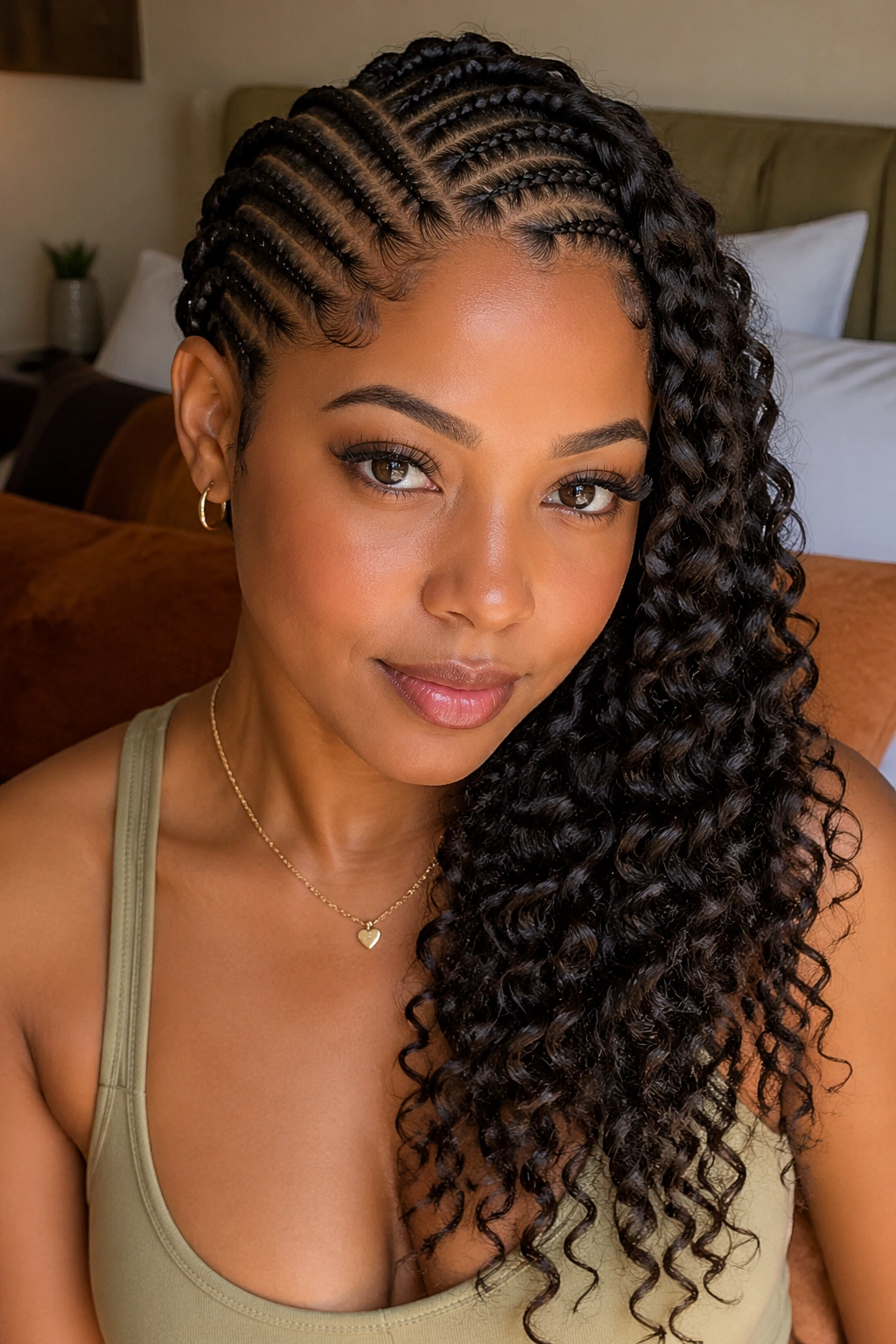
The curls don’t hang evenly. They’re deliberately swept to one side, pinned or gathered over one shoulder. The asymmetry adds movement and draws the eye to one side of the face — good for framing earrings or drawing attention away from anything you want to de-emphasize.
Secure the sweep with a small comb or bobby pins hidden at the cornrow stop point. Mist with light hairspray to lock the direction.
21. Cornrows With Wet-Look Curls
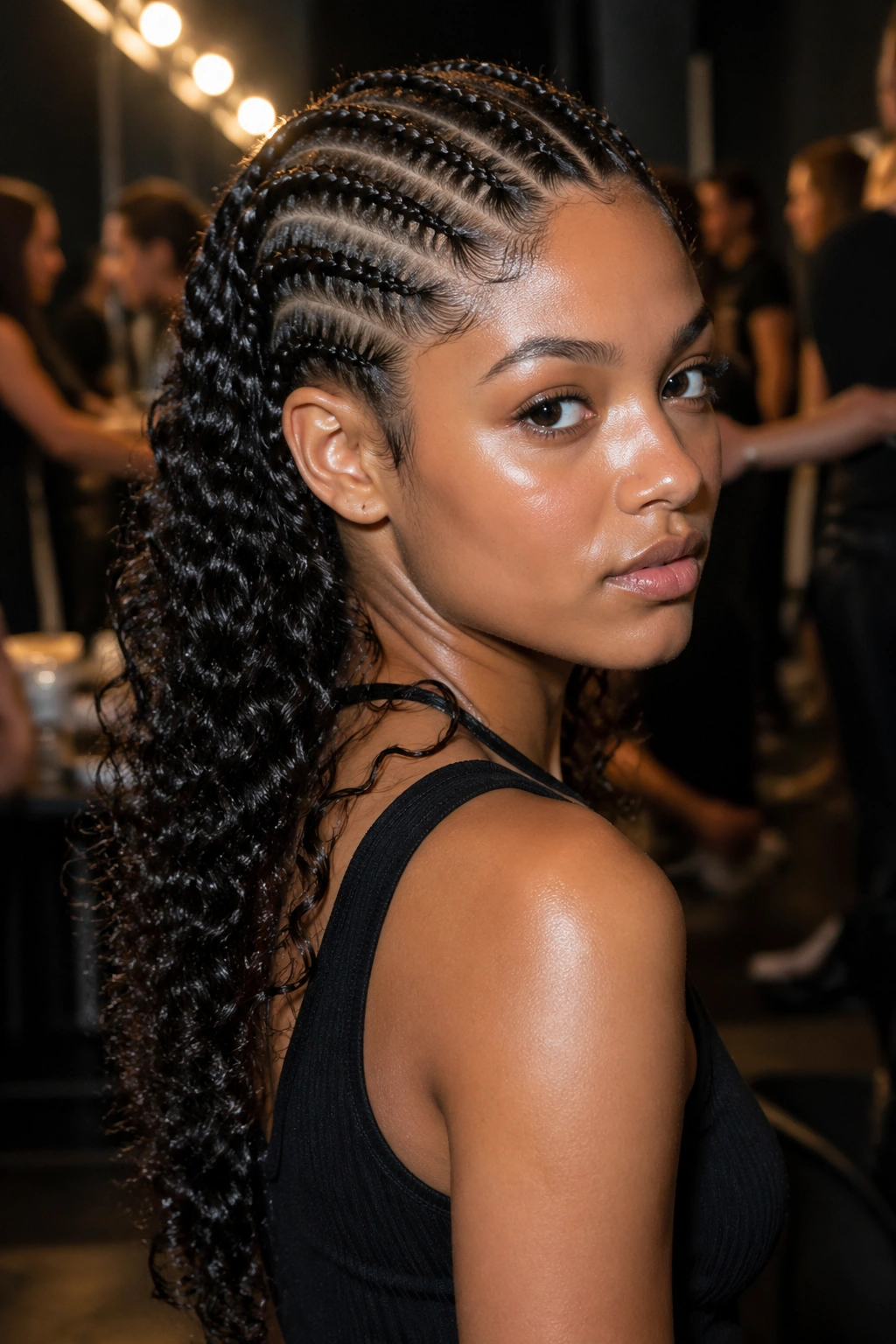
Styling Tips
Apply curl gel heavily to the curl section — more than you normally would for a defined curl. Let air dry fully without touching. The finish is shiny, sculpted, and reads high-fashion in a way that dry curls don’t.
Wet-look curls work better on human hair bundles than synthetic. Synthetic can look plasticky under heavy gel. Human hair takes the product and reads glossy rather than artificial.
This is a look for events and photos. Daily wear softens the wet look into regular defined curls within a day or two — which is also a nice natural progression if you want variety.
22. Cornrows With Clip-In Curly Extensions
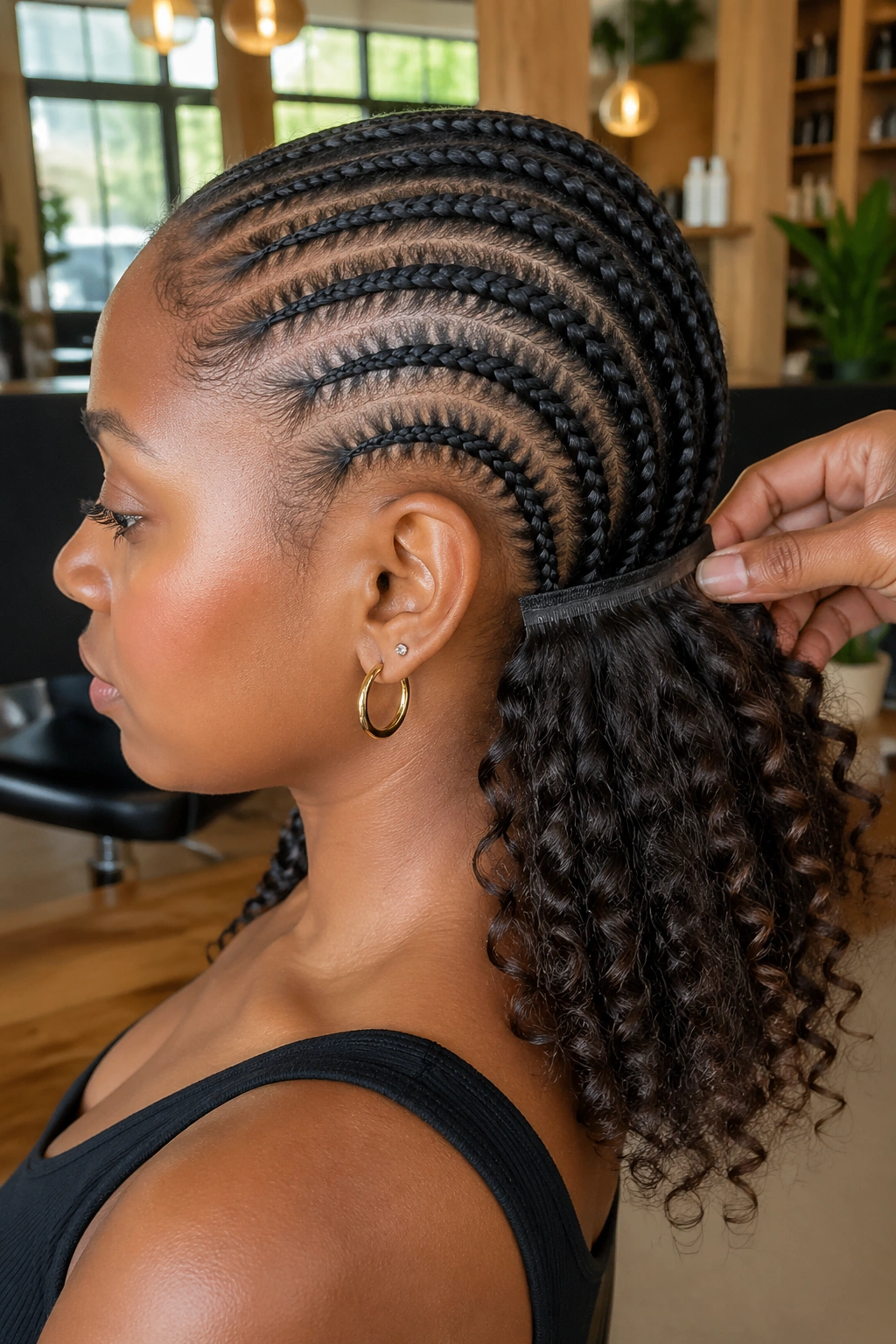
A no-commitment version of the style. Install basic cornrows with your own hair ends loose at the bottom. Clip curly extensions underneath at the nape for length and volume. Remove the clips at night or anytime you want to simplify.
This works for people who want the style for specific events but don’t want to commit to a full weekly install with bundle hair braided in permanently. The cornrows do the protective work; the clip-ins do the aesthetic work.
Maintenance Across the Full Install Period
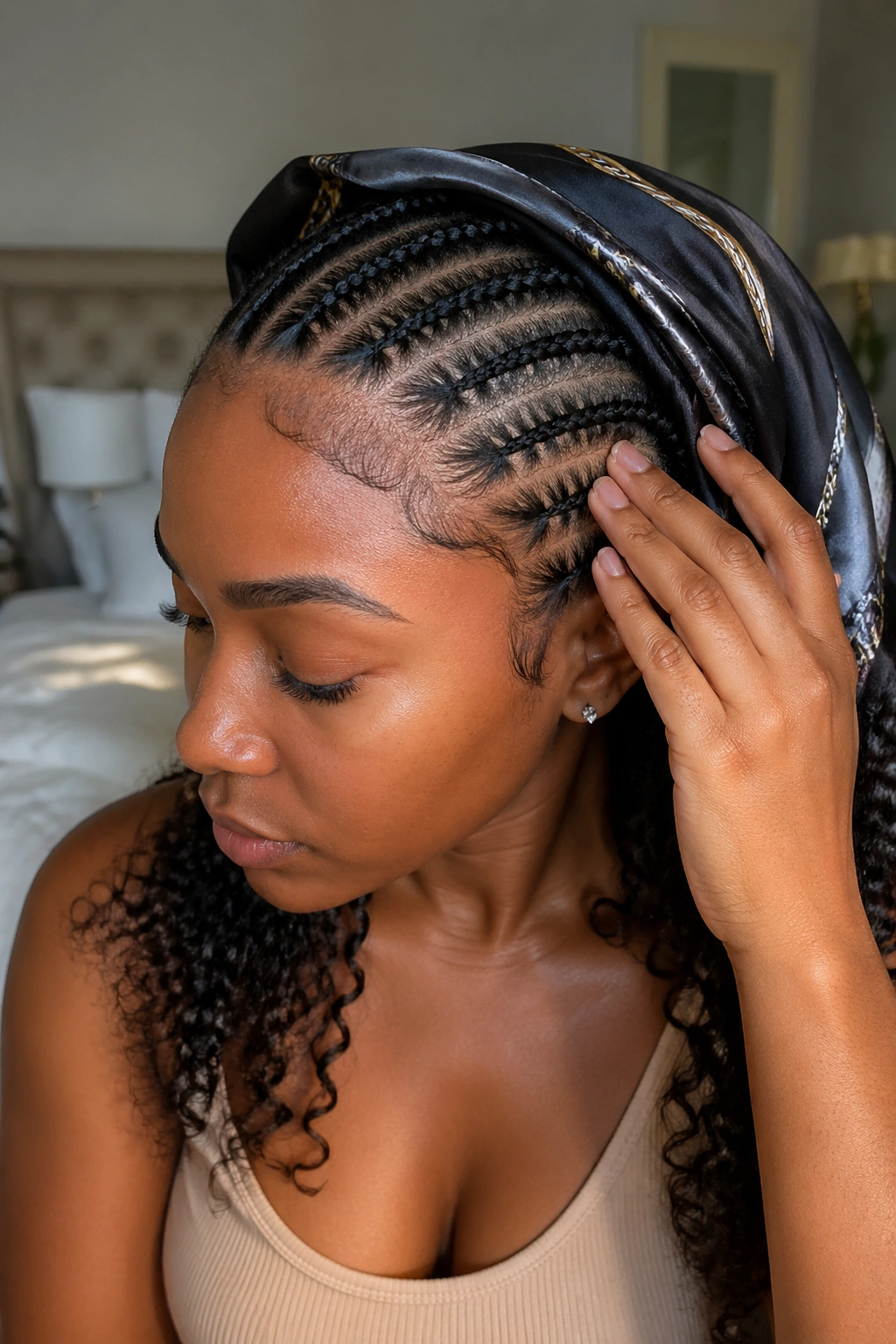
First week: focus on preserving the cornrow base. Avoid heavy manipulation of the curls. Sleep with both sections protected — scarf on the braids, bonnet large enough to cover the curls without crushing them.
Second week: the curls will start to look slightly less defined. Rinse them in the shower (avoiding the cornrow base as much as possible), squeeze in a small amount of leave-in conditioner, and re-define with your fingers or a curling wand.
Third week: the cornrow base may need refreshing. Light edge gel on the hairline. A mist of water and leave-in on the mid-scalp. Rebraid any very fuzzy braids near the hairline if needed.
Fourth week: start planning takedown. Most curly-end styles look their best for 3-4 weeks and start to look rough by week 5-6.
Refreshing the Curls Between Washes
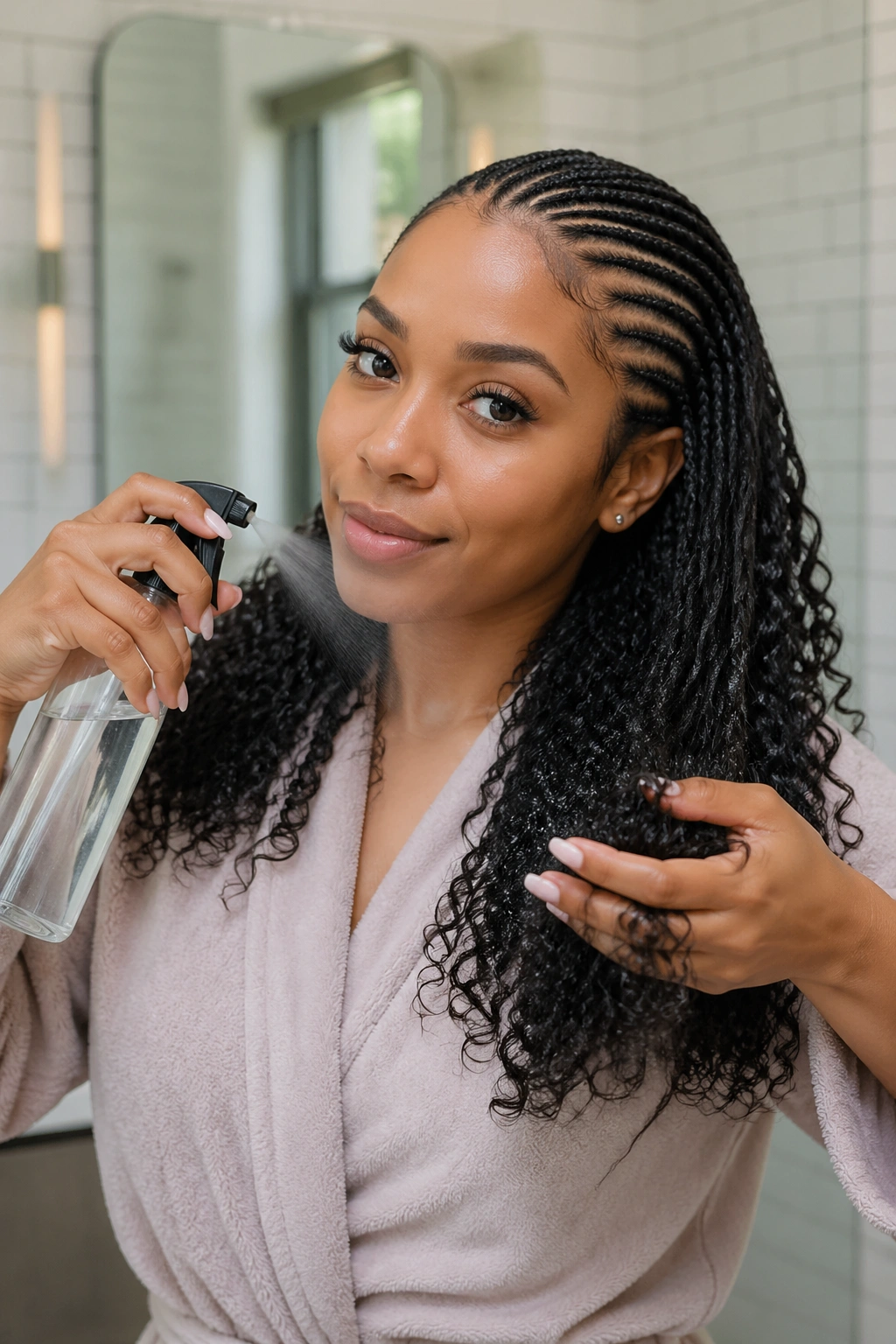
Curl refresh is everyday work for this style. A spray bottle with equal parts water and leave-in conditioner, misted on the curls in the morning, brings them back to life. Squeeze the curls — don’t brush — to reshape them.
For tighter curl patterns that shrink overnight, a curling wand on low heat with a heat protectant can re-define specific limp curls without doing the whole head. Work section by section.
Curly extensions benefit from a weekly co-wash treatment. Dilute a bit of cheap conditioner in a spray bottle and saturate the curls in the shower. Squeeze through, rinse lightly, and air dry. Skip shampoo on the ends — it strips moisture from the curls and leaves them dry.
Scalp Care When Half Your Head Is Braided
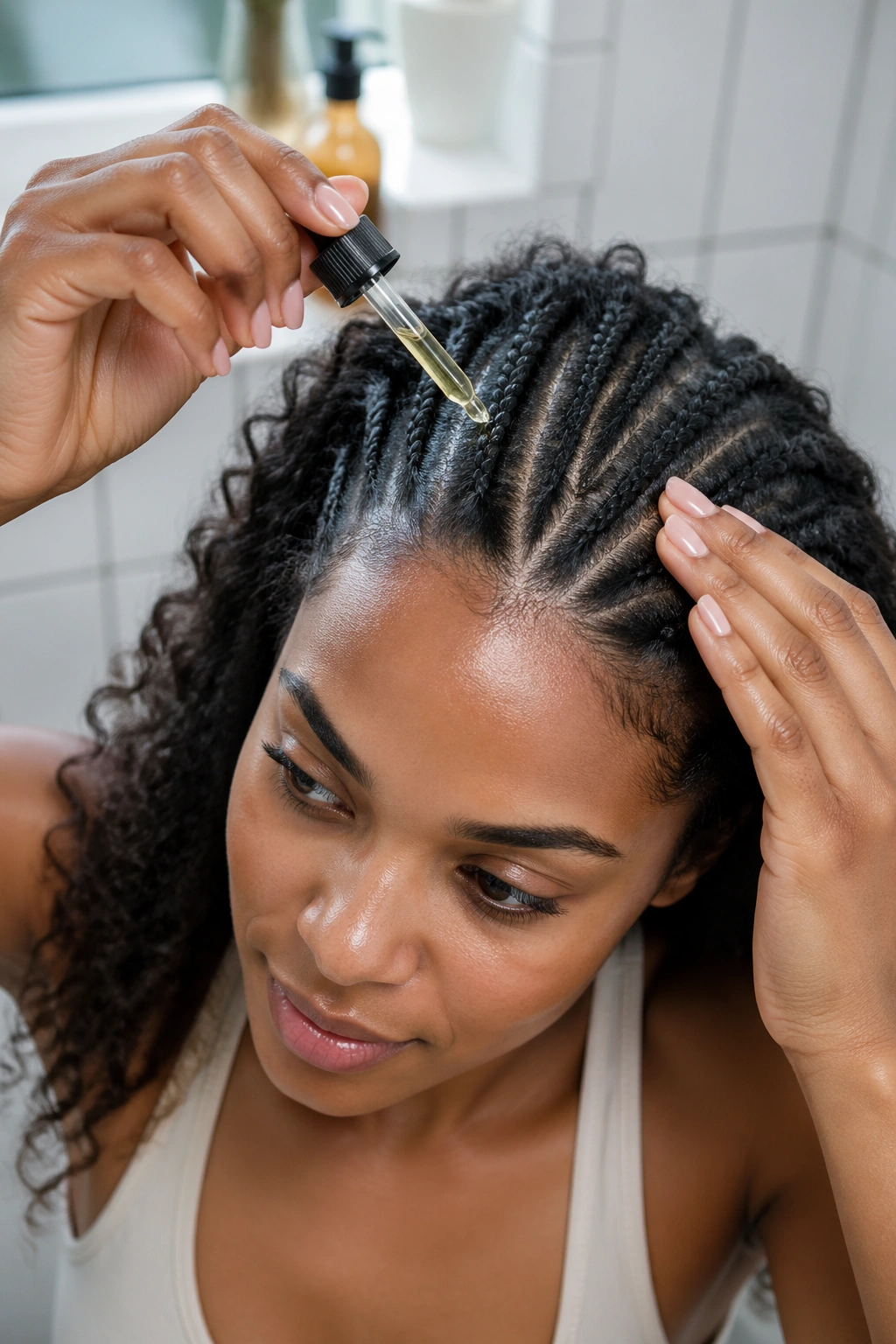
The cornrow base still needs scalp attention even if the curly ends are getting most of the styling work. Dry scalp under cornrows leads to itch, flakes, and buildup.
Apply a light scalp oil (jojoba, grapeseed, or a pre-made braid spray) directly to the parts once a week. Use the pointed tip of a bottle applicator to get between the cornrows without messing up the braid itself.
Massage gently with fingertips to distribute. Wipe away any excess that drips down onto the curl ends — oil saturates curly hair and weighs it down fast.
Transition to the Next Style When Takedown Happens
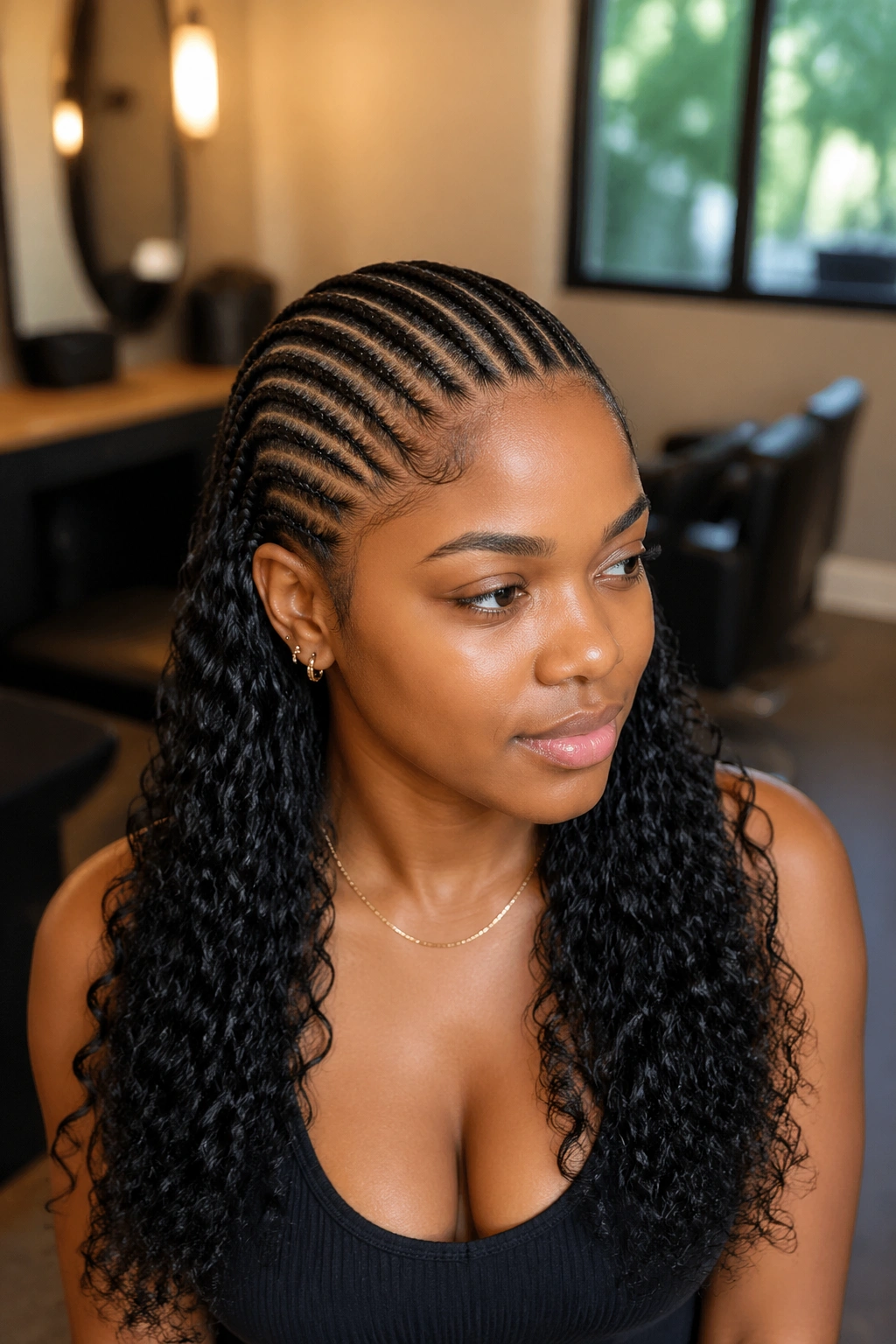
When you’re ready to take down, unbraid the curl ends from the cornrow stop point first. If they were braided in with kanekalon or bundle hair, separate those out and set aside (washable bundles can be reused).
Take down the cornrows slowly. Spritz with water and conditioner. Unbraid from the ends back toward the root. Use fingers first, comb only when needed.
Expect significant shed hair. A full 3-week install on medium-to-long hair releases a noticeable amount of shed strands during takedown. This is not breakage — it’s 3 weeks of normal shedding that had nowhere to go.
Straight back cornrows with curls give you range. You can lean into the braided half or lean into the curled half depending on your day, your mood, or your outfit. Few other styles offer that kind of flexibility in a single install, and few give the same balance of protection and softness. Once you find your favorite curl texture and cornrow scale, this becomes a rotation mainstay you’ll return to season after season.