



Purple balayage on curly natural hair is one of those color combinations that stops people mid-scroll. The way a hand-painted violet or plum melts into deep brown or black coils — catching the light at the tips, fading into the natural base — creates a dimension that flat color can’t touch. Purple balayage on curly natural hair works across skin tones, curl patterns, and lifestyle preferences, and the number of ways to do it means there’s a version for everyone.
What Purple Balayage Actually Means for Natural Hair
Balayage is a freehand coloring technique where color is swept or painted directly onto sections of hair rather than applied using foils or caps. The result is a soft, graduated effect where lighter or brighter color concentrates at the ends and mid-lengths, fading naturally toward the roots. It mimics the way hair naturally lightens — from sun exposure, from growth — which is why it always looks so effortless.
On curly natural hair, balayage behaves differently than it does on straight hair. Curls coil and spring back, so the color placement is three-dimensional. When a coil is pulled straight to apply color, then released, that color sits on the outside of the curl pattern — which means it catches light from different angles as the curl moves. That’s the magic. A purple balayage on straight hair looks like streaks. On curly hair, it looks like the color is built into the curl itself.
This technique also means the ends and mid-lengths absorb the most color, while the roots — where curly hair tends to be its darkest and most natural — stay close to the base shade. The transition between the two isn’t a hard line. It’s a fade, a melt, a gradient. And that gradient looks particularly stunning on coils and spirals where the depth and lightness shift with every bounce of the curl.
How Much Lift Do You Need for Purple Balayage?
This is the question that matters most before you commit. How vibrant and visible your purple will be depends almost entirely on how light the underlying hair is. On unlifted dark brown or black hair, some purples will show beautifully — especially deep jewel tones like violet, wine, and plum — while brighter or more pastel purples will be barely visible.
If you want a subtle, tonal purple that you notice mainly in sunlight or certain lighting, you can apply a semi-permanent purple toner directly over dark natural hair without any bleach. The result is that gorgeous oil-slick or duochrome effect where the purple appears when light hits from certain angles. It’s understated and absolutely beautiful on dark coils.
For a more visible, definite purple — especially lavender, true purple, or bright violet — you’ll need to lift the hair to at least a medium golden-brown or lighter before applying the color. That typically means lightening with bleach, which is a significant commitment for natural hair and should absolutely be done by a professional colorist who has experience with textured hair.
The decision isn’t just aesthetic. Bleach chemically alters the hair structure, and curly natural hair is already more prone to dryness and breakage than straight hair. Going too light too fast, or using a bleach formula that’s too strong, can compromise your curl pattern and cause significant damage. A good colorist will assess your hair’s current health, porosity, and history before recommending how much lift is realistic.
Skin Tone and Purple Shade Pairing
Purple is one of the most universally flattering hair colors — it works across a wider range of skin tones than almost any other bold choice. But certain shades of purple will complement your specific undertones better than others.
Deep berry and wine purples are stunning on deeper brown and ebony skin tones. The richness of the color has a depth that harmonizes with darker complexions and warm undertones. These shades look opulent and intentional — not trendy for the sake of it.
Violet and true purple sit in the middle of the spectrum and work beautifully on medium brown skin, particularly warm and neutral undertones. They’re bold but not jarring, and they create strong contrast with natural dark bases.
Lavender and lilac work best on lighter skin tones or as a tonal addition to highlighted hair — but they’re also having a real moment on medium-to-deeper skin tones when paired with a deeper purple root. The gradient from dark purple at the roots to soft lavender at the tips creates a look that’s almost otherworldly on deep brown coils.
Cool-toned mauve and blue-purple suit cooler skin undertones — think ashy brown skin, cool beige, or undertones with pink or blue tones. These shades can look muddy on warm complexions but spectacular on the right base.
Protecting Your Natural Hair Through the Color Process
Coloring curly natural hair — especially if any lightening is involved — requires a serious commitment to pre- and post-treatment care. The coloring process, even done carefully, alters your hair’s moisture balance and can affect porosity. Going in with already compromised, dry, or fragile hair makes any chemical service riskier.
Before your appointment, do two to three weeks of intensive deep conditioning. Use a protein treatment if your hair feels weak or stretchy when wet. Avoid heat styling in the weeks leading up to your appointment — you want your hair in the best possible condition. Don’t wash your hair the day before; a little natural oil on the scalp creates a protective barrier during the color process.
After your appointment, your color maintenance routine becomes the center of your haircare. Use a sulfate-free shampoo — sulfates strip color fast, and on curly hair that’s already prone to dryness, they’re particularly harsh. Deep condition every single wash. Use a color-safe leave-in and seal with a lightweight oil to lock in moisture and protect the color.
Purple, like most vivid colors, fades faster than natural shades. Especially if you had to lighten to achieve it. Expect to refresh the color every four to eight weeks depending on how frequently you wash and how vibrant you want to keep it.
1. Deep Plum Tips on Dark Natural Coils
This is the most entry-level purple balayage and it’s breathtaking for that reason. On black or very dark brown coils, a deep plum or burgundy-purple is applied from mid-length to the ends. There’s no lightening required — the dark purple sits on top of the natural color and creates a rich, dimensional look that’s subtle indoors but vivid in sunlight.
What Makes This Work
- No bleach means no compromise to curl integrity
- Plum complements dark skin tones especially well
- The coils make the color-to-dark transition look painterly
- It’s low-commitment — semi-permanent purple fades gradually rather than growing out harshly
Pro tip: Go over the ends with a deep conditioner that has a slight purple tint (there are color-depositing conditioners in violet) to keep the tone from going brassy as it fades.
2. Violet Balayage on 3C Ringlets
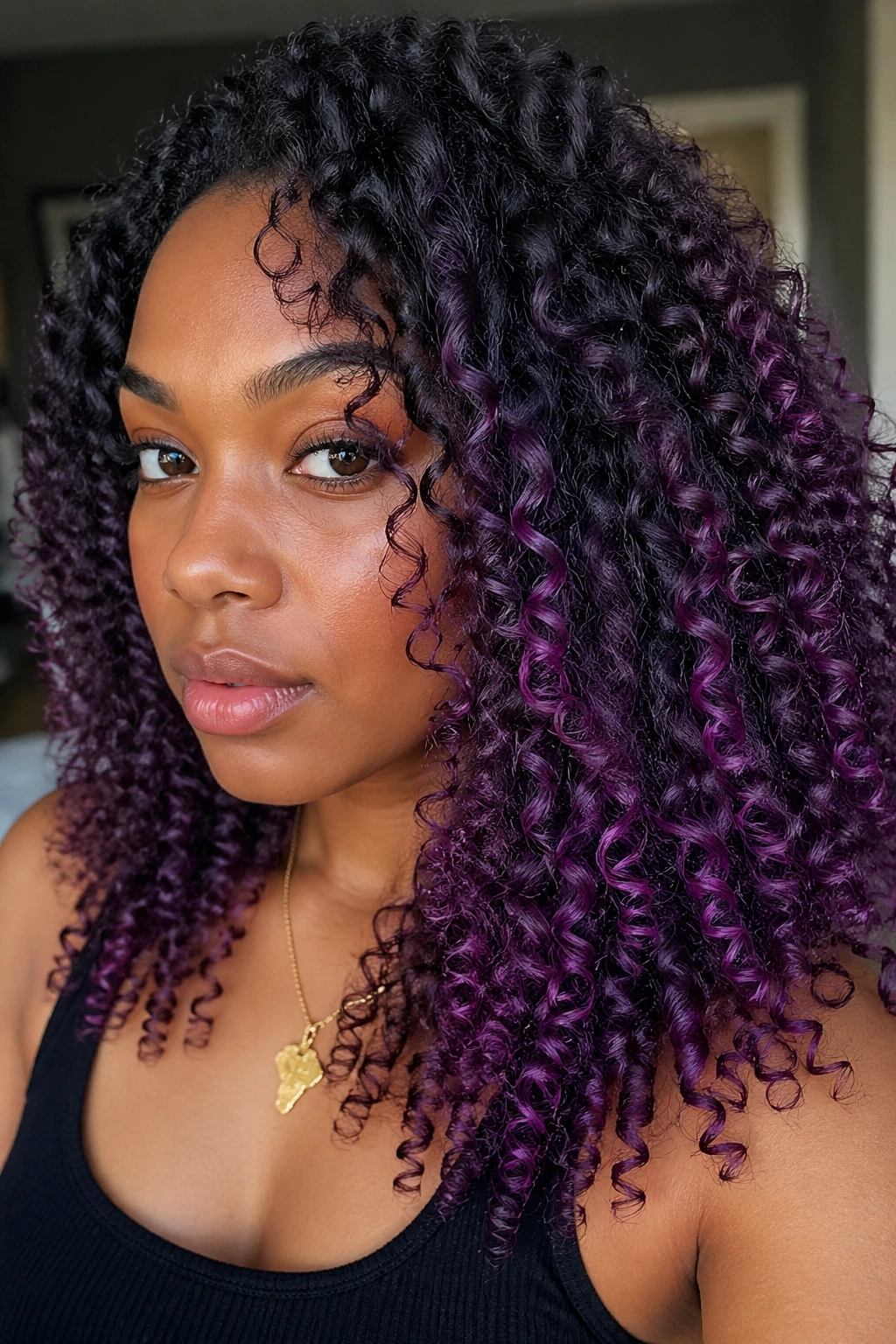
3C ringlets have a defined, springy coil pattern that shows color placement especially well. A bright violet applied from roots mid-way down — then concentrated at the tips — creates that gradient effect that makes balayage look so dynamic. The ringlets catch light along their spiral curves, so the color shifts from deep violet at the mid-length to near-true-purple at the tips.
Bold fact: 3C hair has enough texture and definition that even moderate color placement reads as bold. You don’t have to cover every section — strategic painting on the outermost curls creates a look that seems more comprehensive than the actual coverage.
3. Blue-Violet Ombre on Natural 4B Hair
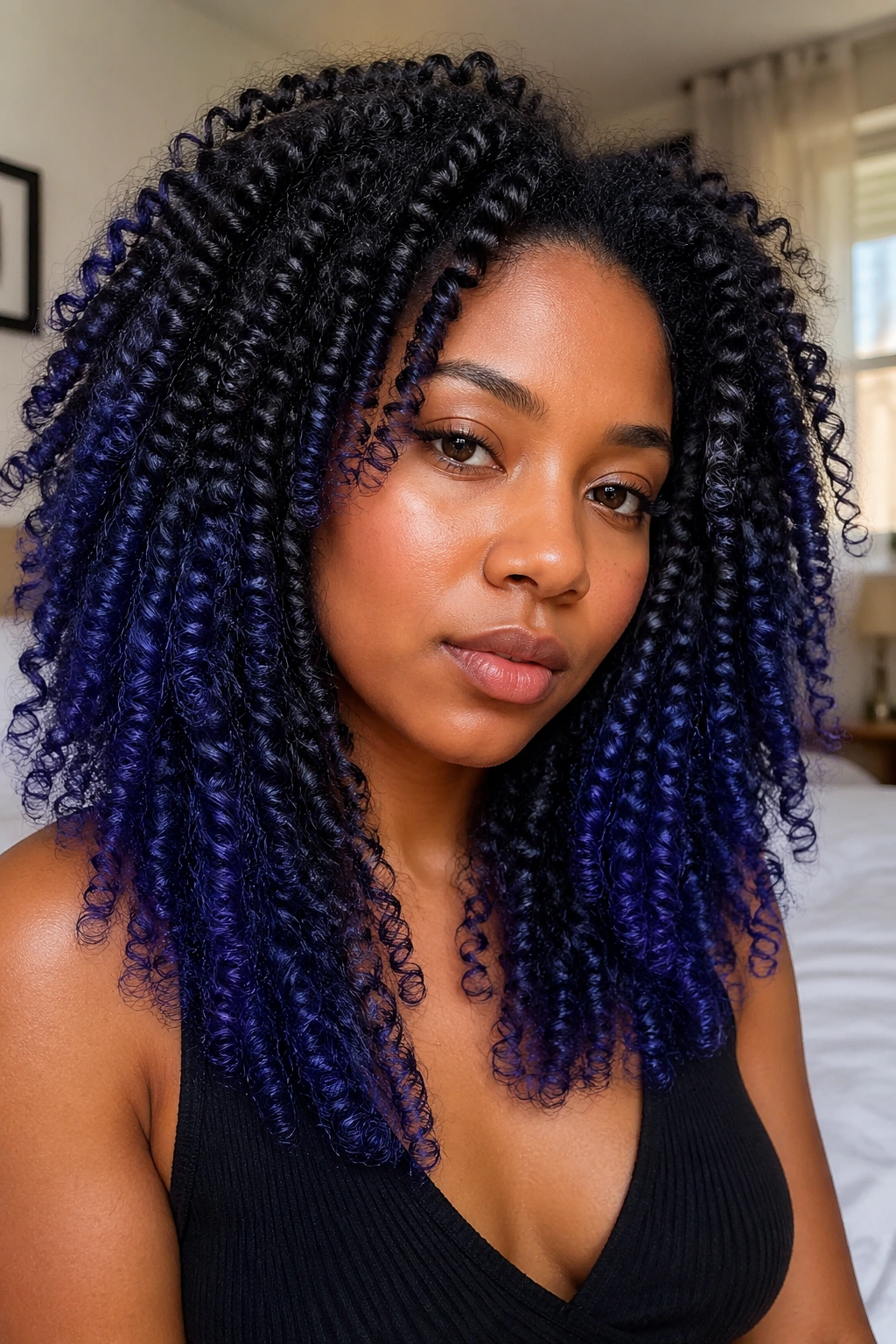
4B hair has a tighter, more angular coil pattern with less defined spirals. On this texture, a blue-violet shade creates an almost iridescent effect — the way the coils refract light means the purple sometimes reads as blue, sometimes as violet, depending on the angle. The ends get the most color, the mid-section gets a softer wash of the shade, and the roots stay natural and dark.
This is a dramatic look that doesn’t require extreme lightening. Blue-violet is visible on dark hair that’s been lifted just two to three levels — much less than you’d need for a pure lavender.
How to Achieve This
- Lift ends to a warm medium brown (roughly Level 5-6)
- Apply blue-violet semi-permanent color from mid to ends
- Use a gloss or toner with a slight violet cast over the mid-section for a softer transition
4. Lavender Balayage on Highlighted Natural Hair
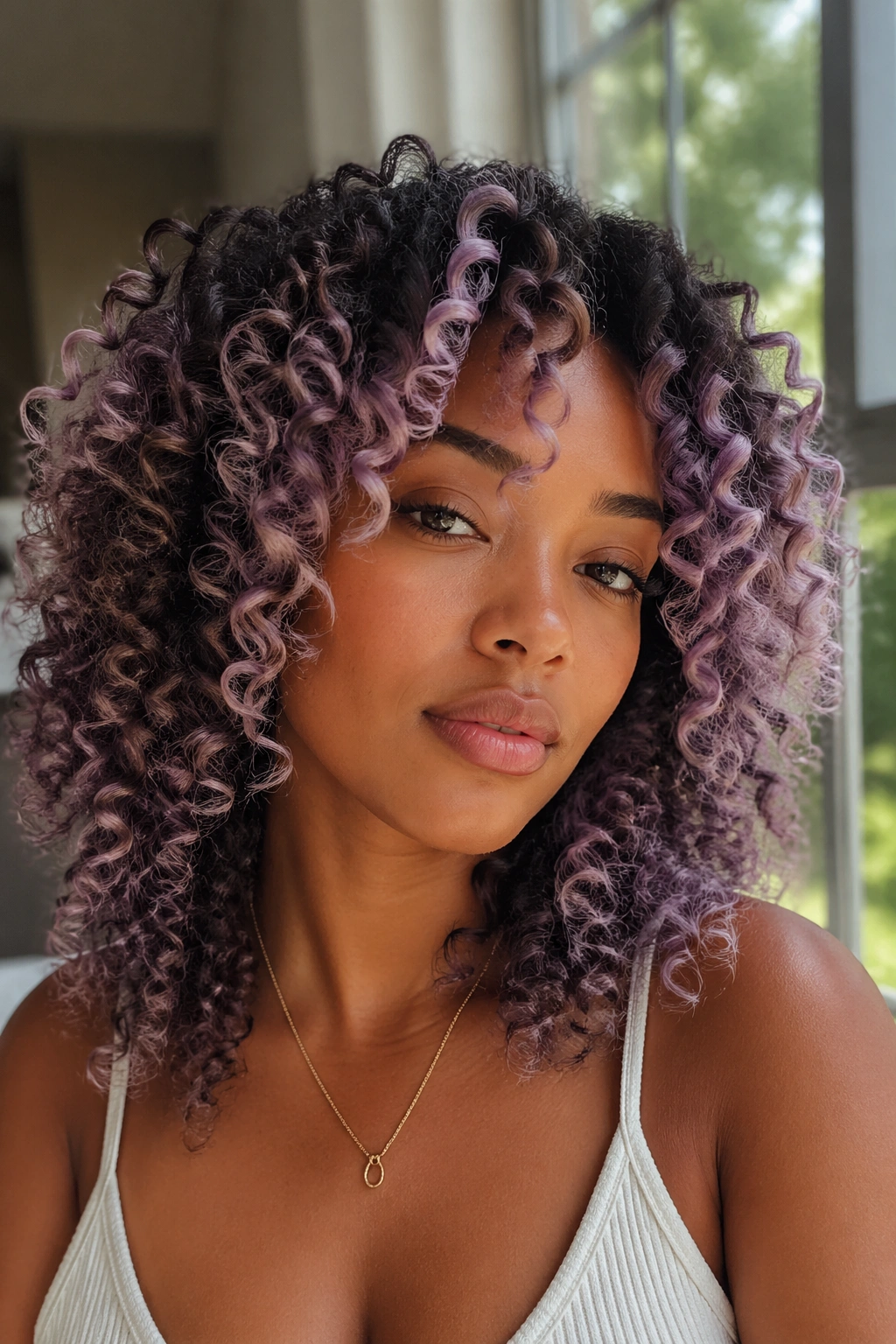
If you’ve already got highlights in your natural hair — whether from a previous color service or a sun-kissed look — lavender balayage is a logical next step. The highlighted sections absorb the lavender beautifully, while darker sections of the hair stay closer to the natural base, creating that built-in contrast.
Lavender on pre-highlighted coils has a softness to it that’s romantic and ethereal. It’s the kind of look that doesn’t feel aggressive — it feels dreamy. Pair it with a deep conditioning routine and color-depositing products to keep the lavender from fading to a pale, washed-out blond.
5. Purple Money Piece on Natural Hair
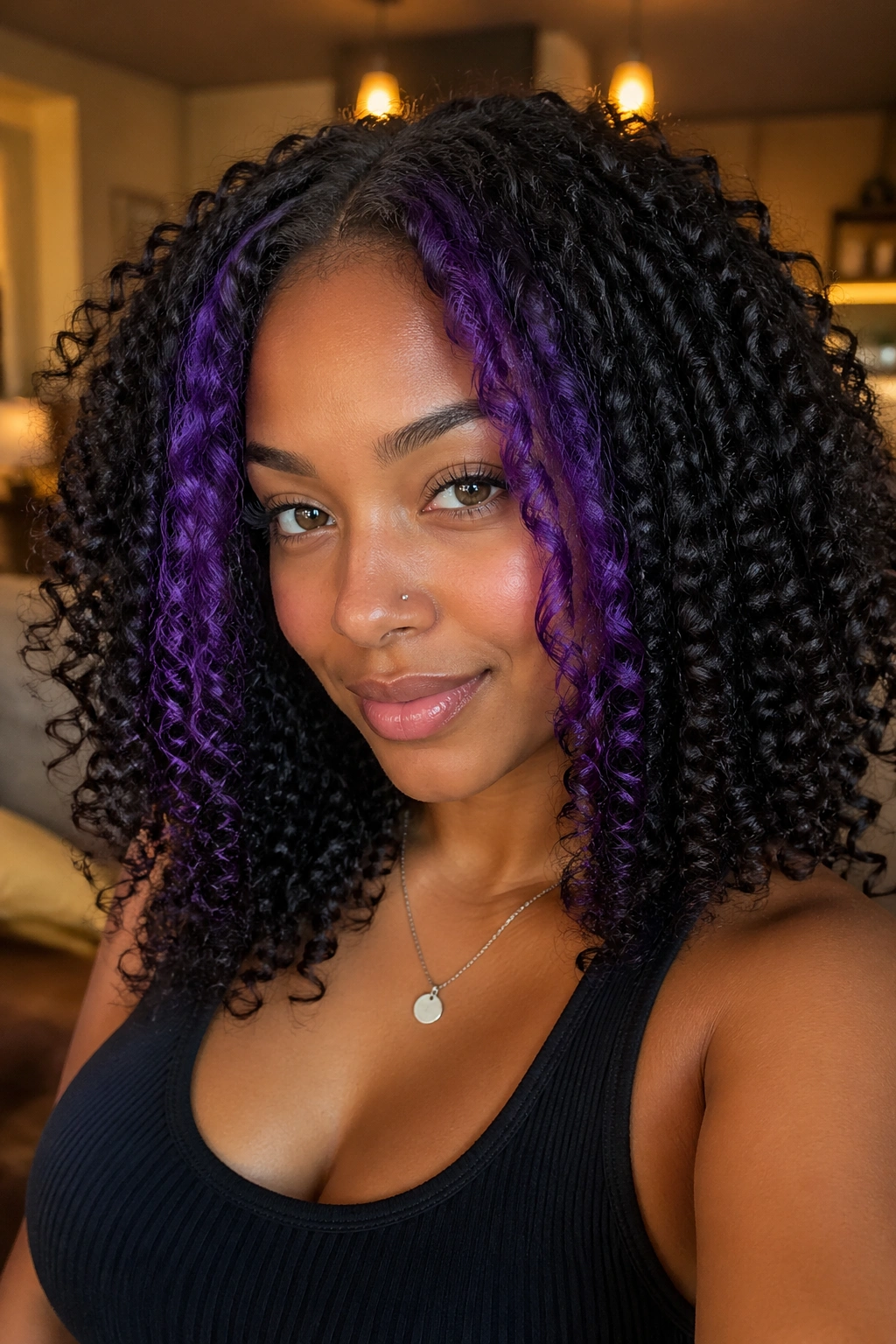
The money piece — those two bold sections framing the face — is one of the most impactful, low-coverage coloring techniques there is. For curly natural hair, a purple money piece means lightening and coloring just those front sections (usually two to four inches wide on each side of the part line) with a bright or deep purple.
The face-framing effect is immediate. Every time you look in the mirror, every photo, every time someone looks at you — those purple pieces draw the eye. You get maximum visual impact from minimum color coverage, which also means less overall processing on your hair.
6. Dusty Purple Balayage for Low-Maintenance Color
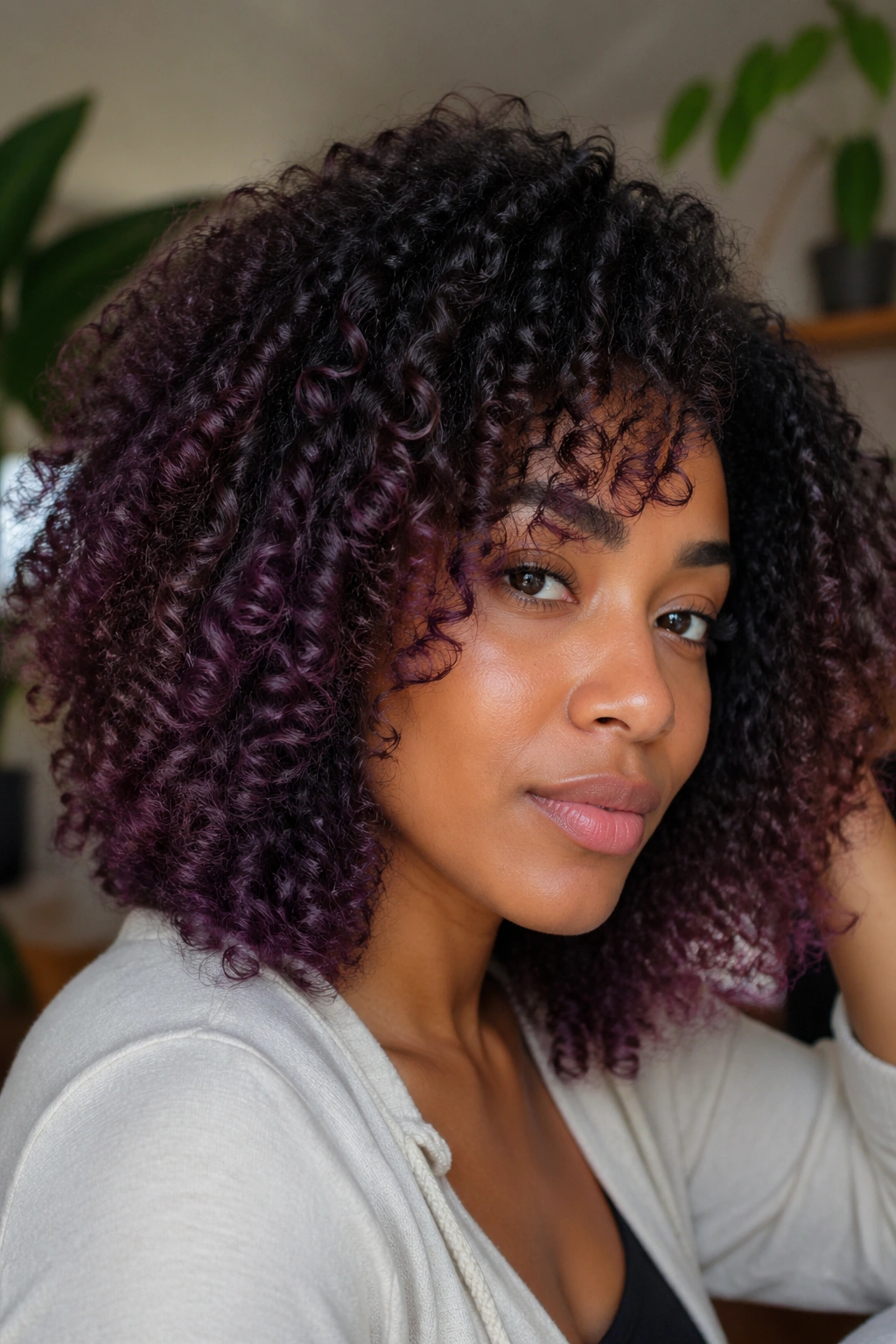
Not everyone wants to refresh their color every six weeks. Dusty purple — a desaturated, muted violet with grey undertones — is designed for the low-maintenance life. It fades gracefully. As it ages, it shifts from dusty purple to a soft mauve to a barely-there lavender-grey, and every stage of the fade looks intentional.
On natural hair, this muted tone adds depth without demanding constant maintenance. The curl pattern carries the color even as it softens, so you’re never stuck in an awkward in-between phase.
7. Wine and Purple Blend on Thick 4A Curls
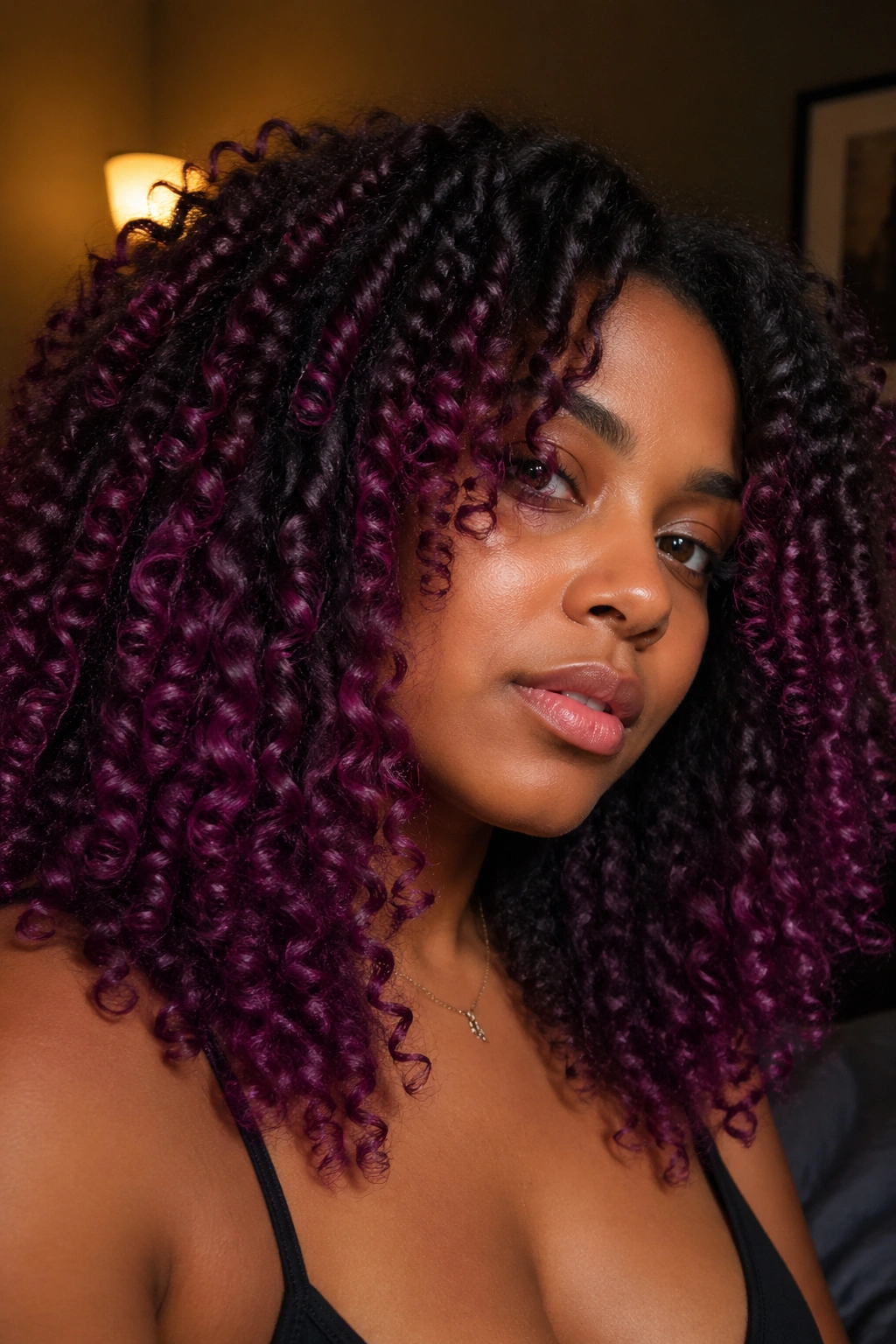
4A hair has a defined S-curve or coil pattern with medium density. Wine (a red-purple) blended with a deeper violet creates a rich, multi-tonal color story — especially on thick 4A hair where there’s enough volume for the blend to really show. In dim lighting, it reads as a very dark, reddish-brown. In direct light, the wine and purple separate and you see the full dimension.
Color Application Tips
- Apply wine to sections closer to the roots
- Blend into deeper violet through the mid-lengths
- Use pure violet at the tips for the brightest pop
- Avoid over-blending — let the colors stay distinct at their cores
8. Soft Violet Wash on Natural Hair
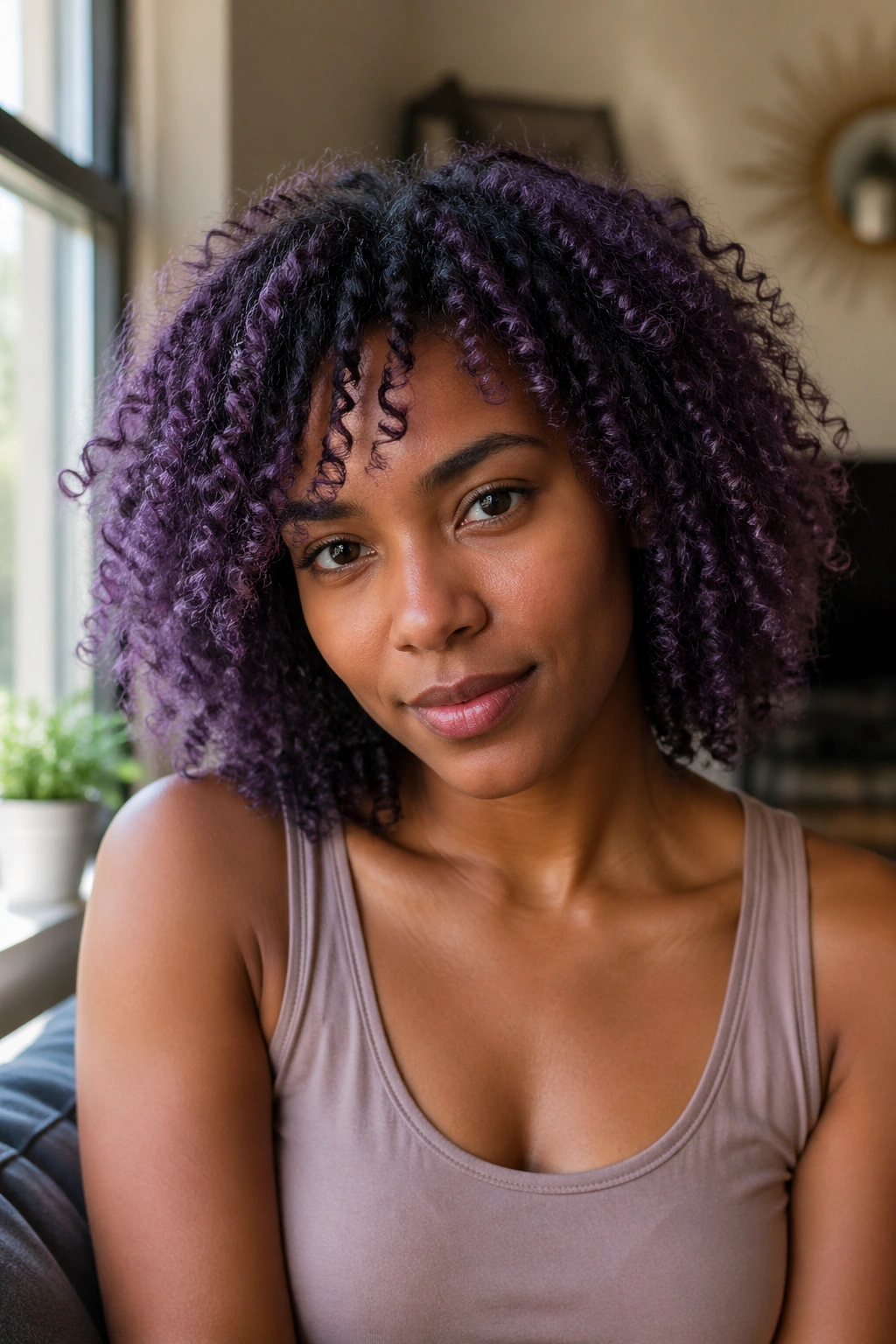
A violet wash is different from traditional balayage — it’s a semi-permanent color that’s diluted in conditioner and applied all over, rather than painted onto specific sections. The result on dark natural hair is a tonal shift rather than a contrast — like a filter applied to your hair color.
But here’s why it belongs in a balayage list: on curly hair, because of how the coils are structured, the wash doesn’t deposit evenly. It naturally concentrates more on the exposed outer sections of the curl — the parts that face outward — and less on the inner layers of the coil. The result looks like a very soft, all-over balayage without any actual painting technique. Your curl pattern does the work.
9. Bold Grape Purple With Dark Roots
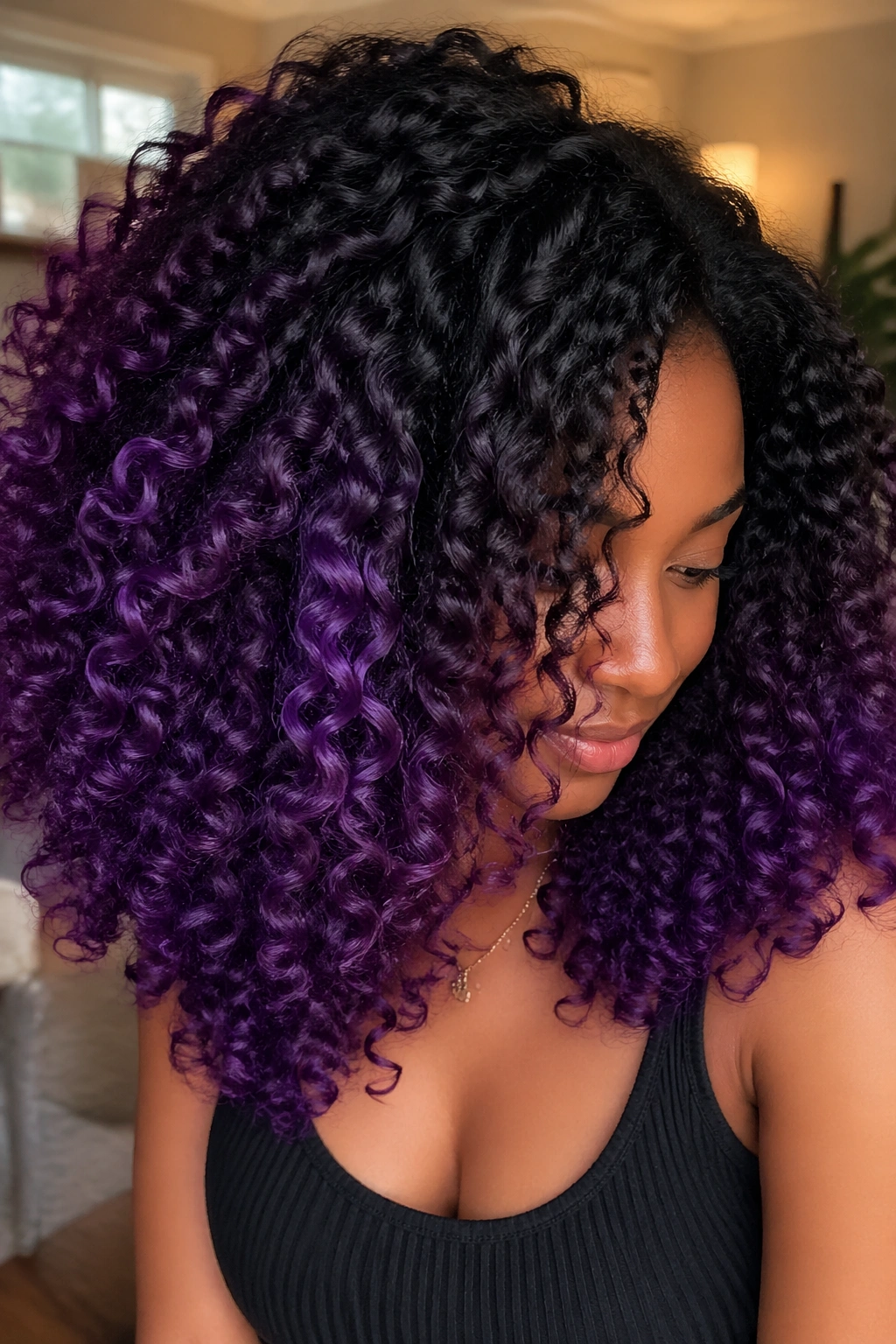
This look leans into the contrast between very dark roots and a vivid grape purple on the lengths and ends. The dark roots are intentional — they’re not grown-out neglect, they’re a design choice. The shift from black to grape purple happens at a defined line, usually around the top of the ear or at jaw-level for medium-length hair.
It’s a bolder interpretation of balayage that prioritizes contrast over gradation. On natural curly hair, the dark roots add grounding and authenticity to what could otherwise look like an aggressively colored look.
10. Purple Balayage on Natural Blonde or Red Hair
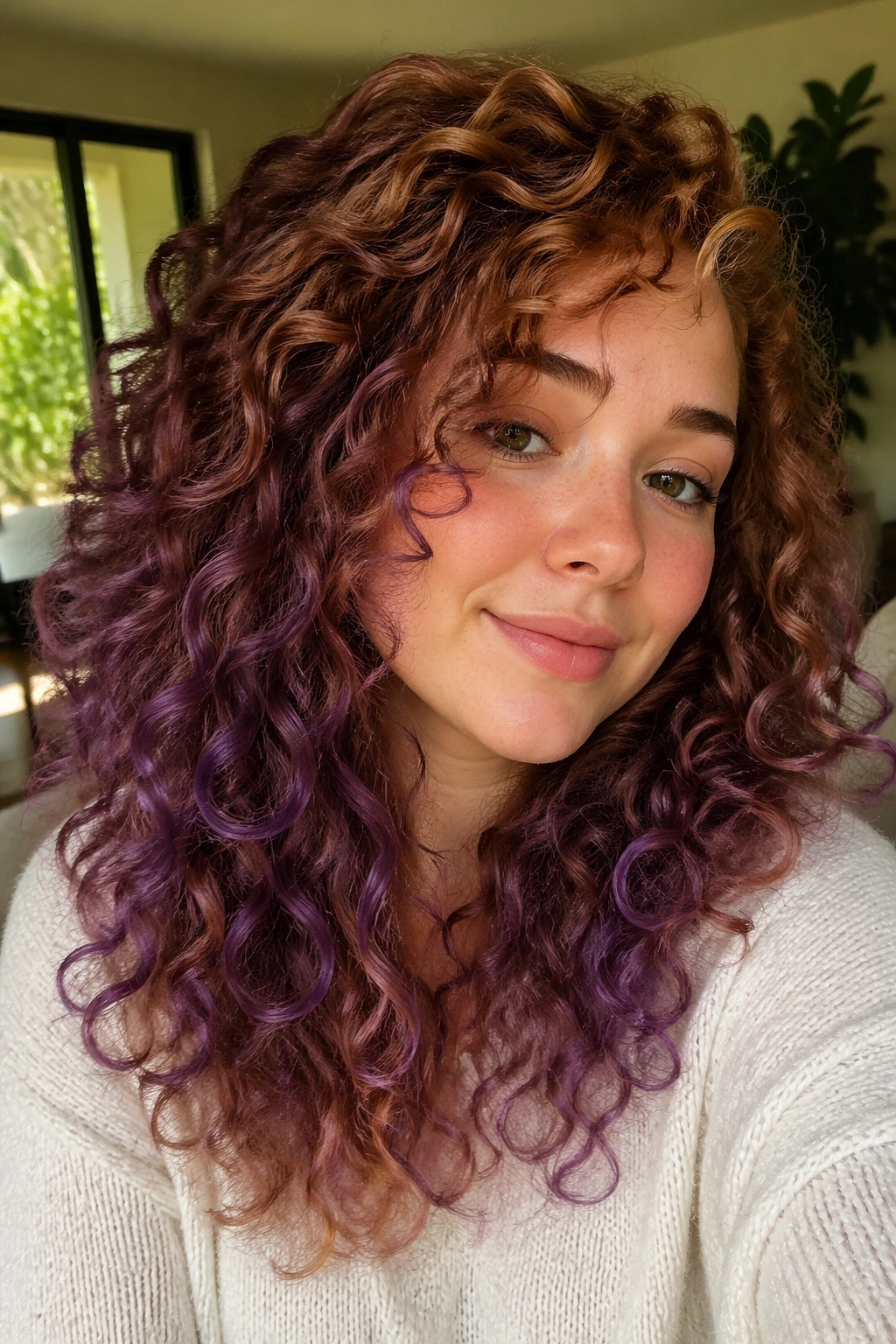
Black and brown women with naturally auburn, red, or lighter brown hair have a different starting point for purple balayage — and often need little to no lightening for the purple to show. On a warm auburn base, a purple or violet balayage creates a stunning jewel-toned effect. The warmth of the underlying red and the coolness of the purple create a tension that’s genuinely beautiful.
This is also a great option if you’re nervous about bleach. If your natural base is already lighter, you have more color options without the risk of chemical lightening. Start with where your hair is, not where you think it needs to be.
11. Pastel Lilac on Pre-Lightened Curls
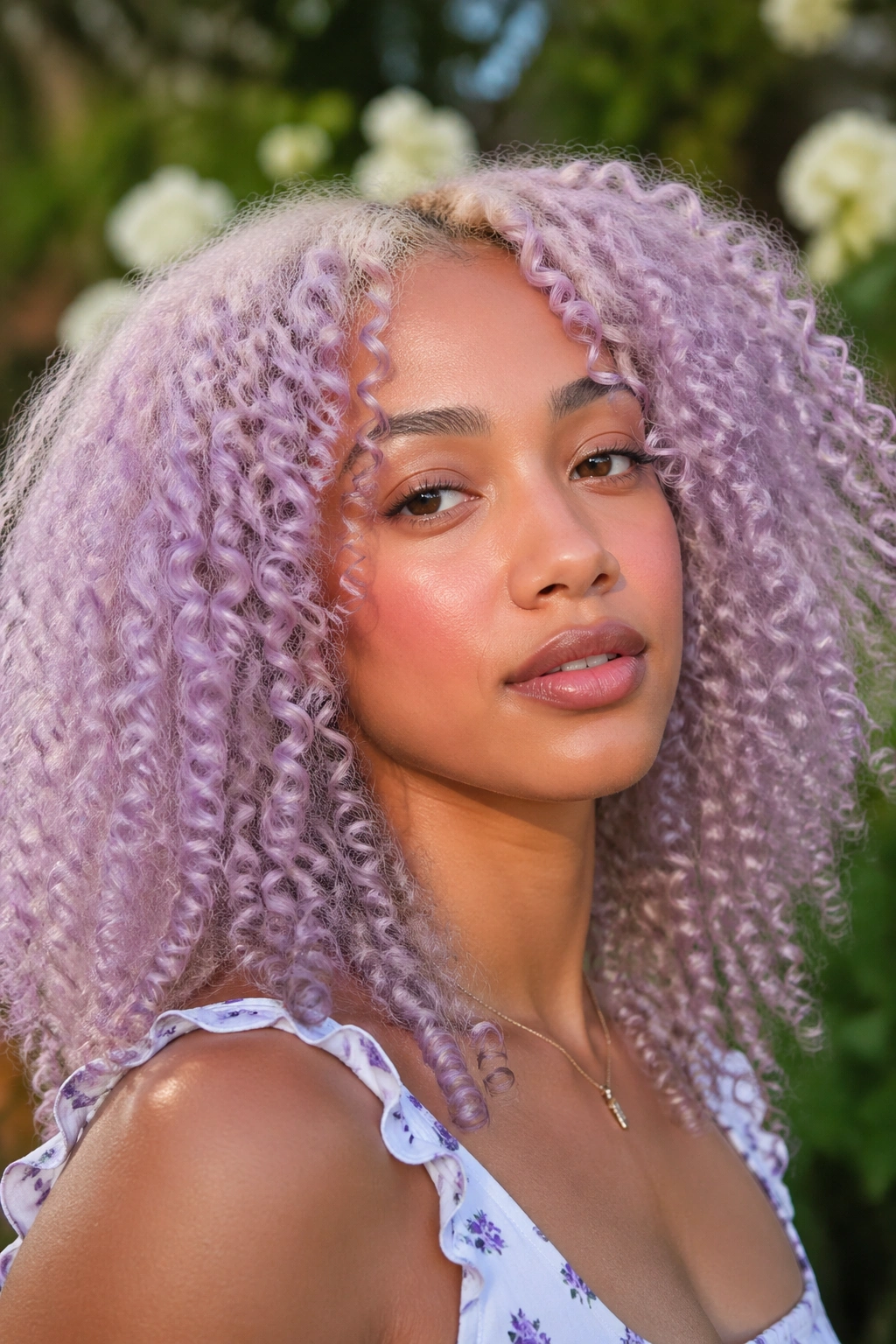
Lilac is the softest, most ethereal of the purple family — barely there, almost like a whisper of color. Getting there requires lightening the hair to a very pale yellow, almost platinum, which is significant for natural hair. But for those who do it — and do it carefully — the result is extraordinary.
Soft lilac on curly natural hair looks almost surreal. The coils in pastel lilac against brown skin create a contrast that’s striking in the most unexpected way. This is a high-commitment look that needs a skilled colorist, but it’s one of the most showstopping interpretations of purple balayage.
12. Purple Highlights on Twist-Out
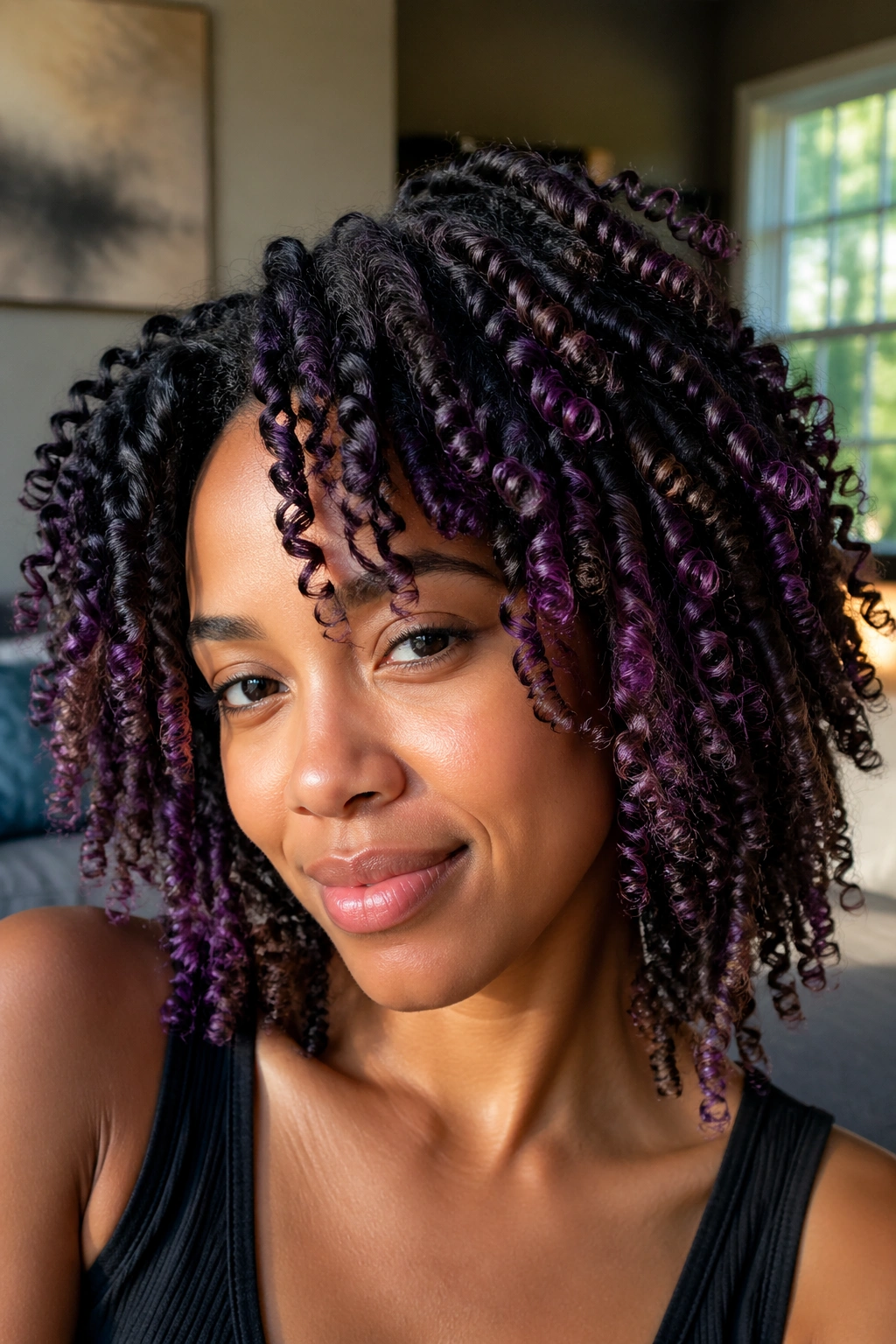
Do your two-strand twist-out first, then have color painted onto the revealed sections. Because a twist-out naturally separates your hair into distinct sections with clear outer surfaces, the colorist can paint precisely on those outer layers. The result is purple highlights that follow the natural pattern of your twist-out.
When you wear your hair in a twist-out after this color service, the purple highlights are exactly aligned with the twist pattern. When you wear it in a puff or another style, the purple shows up throughout as dimension. It adapts to however you wear it.
13. Two-Toned Purple: Dark Root, Bright Tip
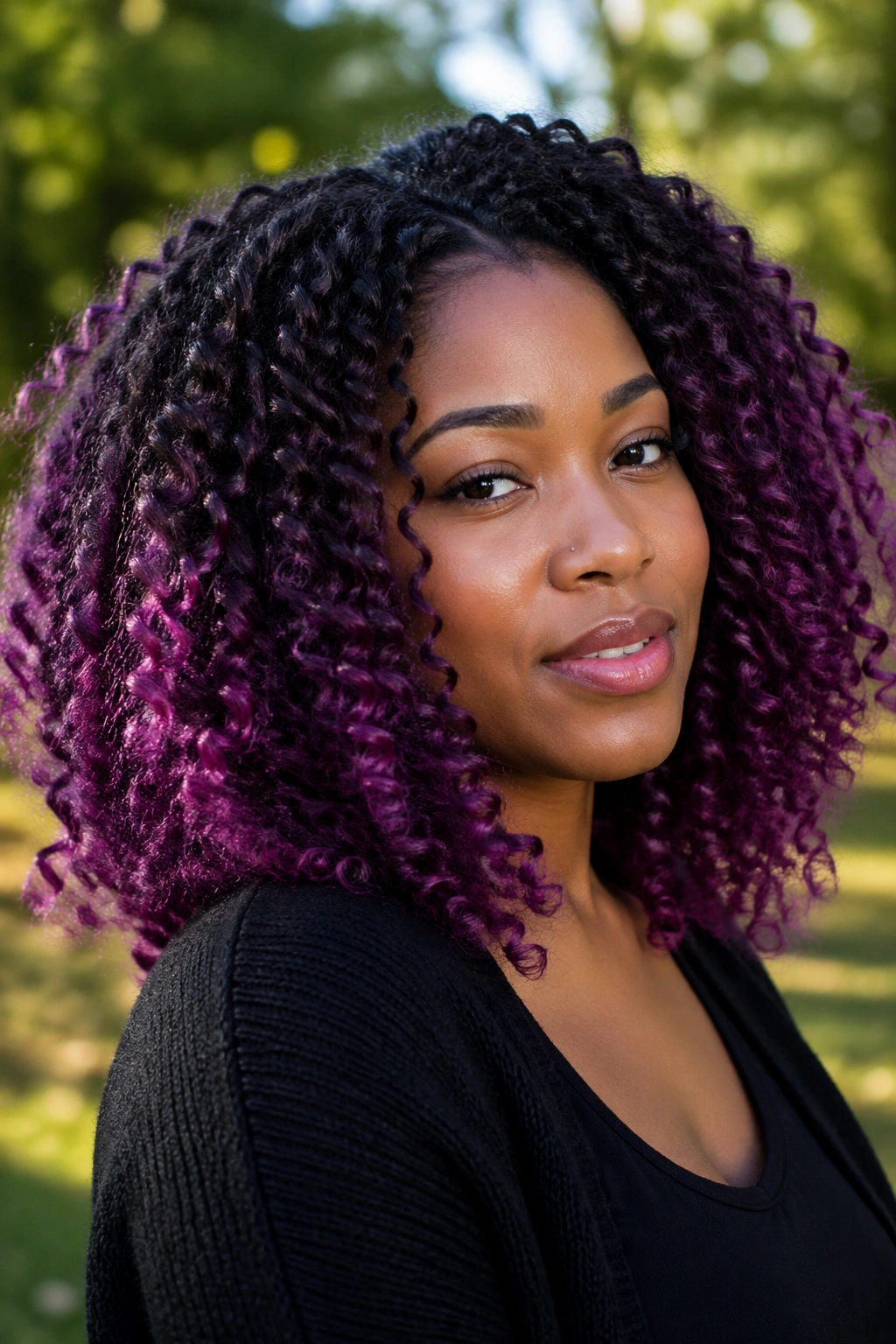
Dark, almost black at the roots. Bright, vivid purple at the tips. Very little transition in between. This two-toned approach skips the gradual fade of traditional balayage and goes straight for high contrast. On coily natural hair, that contrast means you see very distinct dark coils at the crown and very distinct purple coils at the ends — like two different hair looks layered on top of each other.
It’s graphic. It’s bold. And it photographs incredibly.
14. Sunset Purple: Burgundy to Violet to Lavender
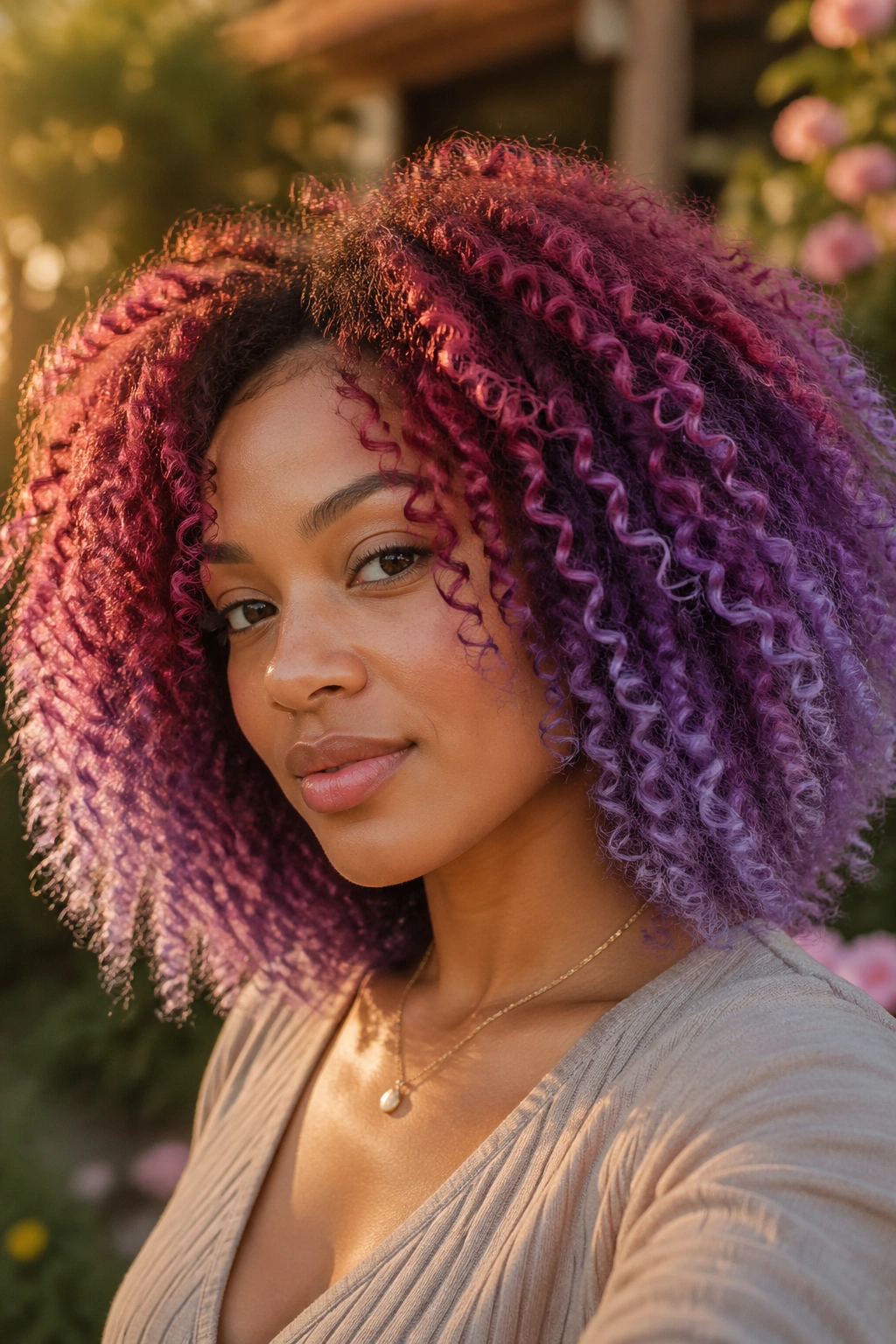
A sunset-inspired purple balayage moves through multiple shades from root to tip. Burgundy at the roots blending to violet through the mid-length, then lightening to lavender at the ends. This requires the most careful placement and the most lightening of any purple balayage option — but the reward is a look that feels almost painted by an artist.
On big, voluminous natural curls, this three-color gradient creates a look that changes with every movement. The color story shifts as the curls bounce and catch light.
15. Purple Balayage on Box Braids
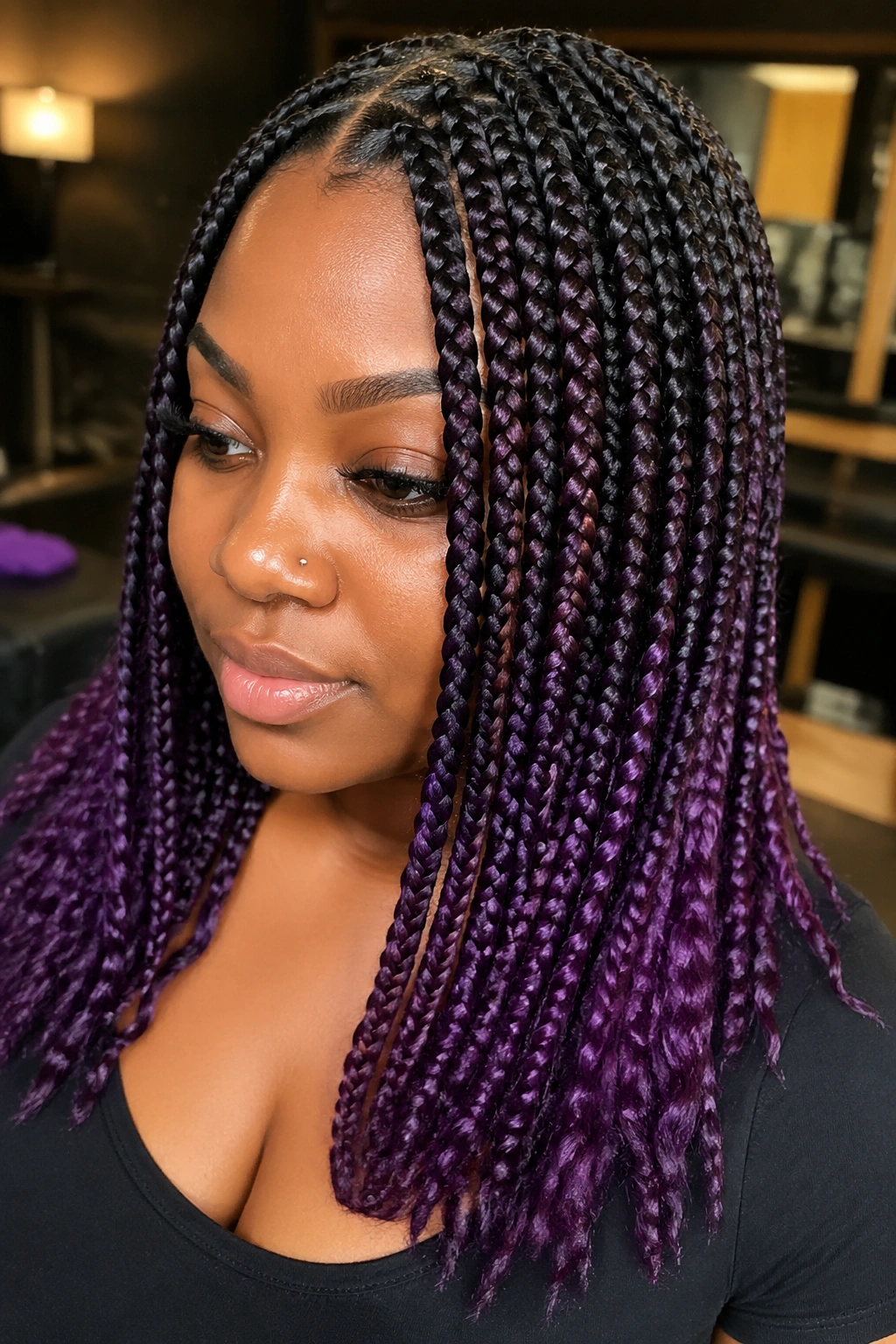
Wait — box braids? Yes. If you install box braids using hair that’s been colored with purple balayage, the color shows through the braids in a way that’s different from anything a single-shade braid gives you. The purple concentrates toward the ends of the braids (where the balayage was), and the braids themselves show the dimensional fade as they move.
Alternatively, some people add pre-colored or ombré braid extension hair in purple shades to achieve a similar effect without coloring their natural hair. Either way, it’s a valid creative direction.
16. Purple Balayage for Short Natural Hair
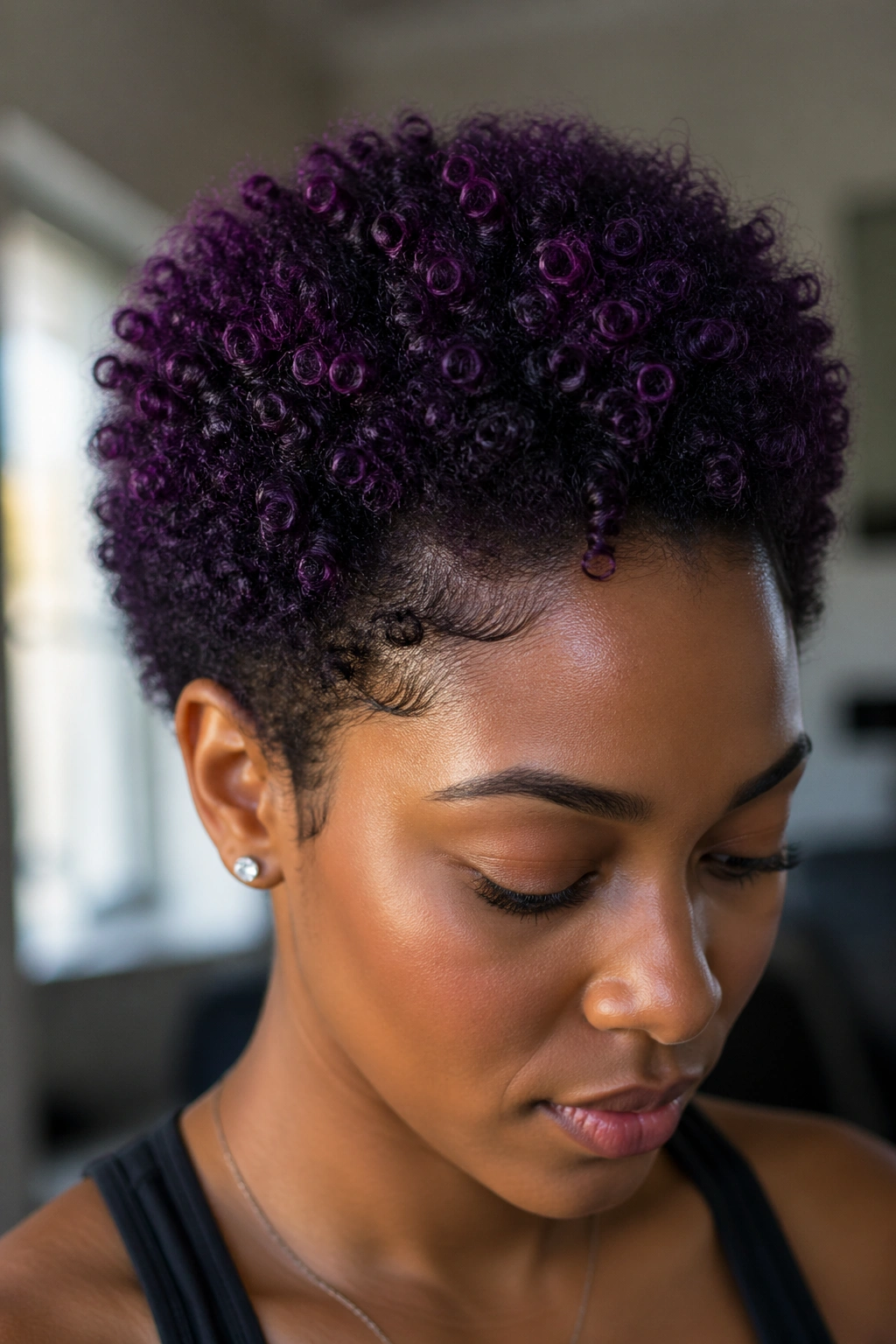
Short natural hair — a TWA (teeny weeny afro) or a short fro — can absolutely wear purple balayage. The technique adapts: instead of sweeping color from root to tip over long lengths, the colorist saturates the outer edges of the natural shape with purple. The result is a colored perimeter with a darker center.
On a short, rounded fro, this looks like a halo of color — particularly stunning when the purple is vivid and the center is kept dark. It emphasizes the shape of the natural, which is an added bonus.
17. Mauve Purple on Warm-Toned Skin
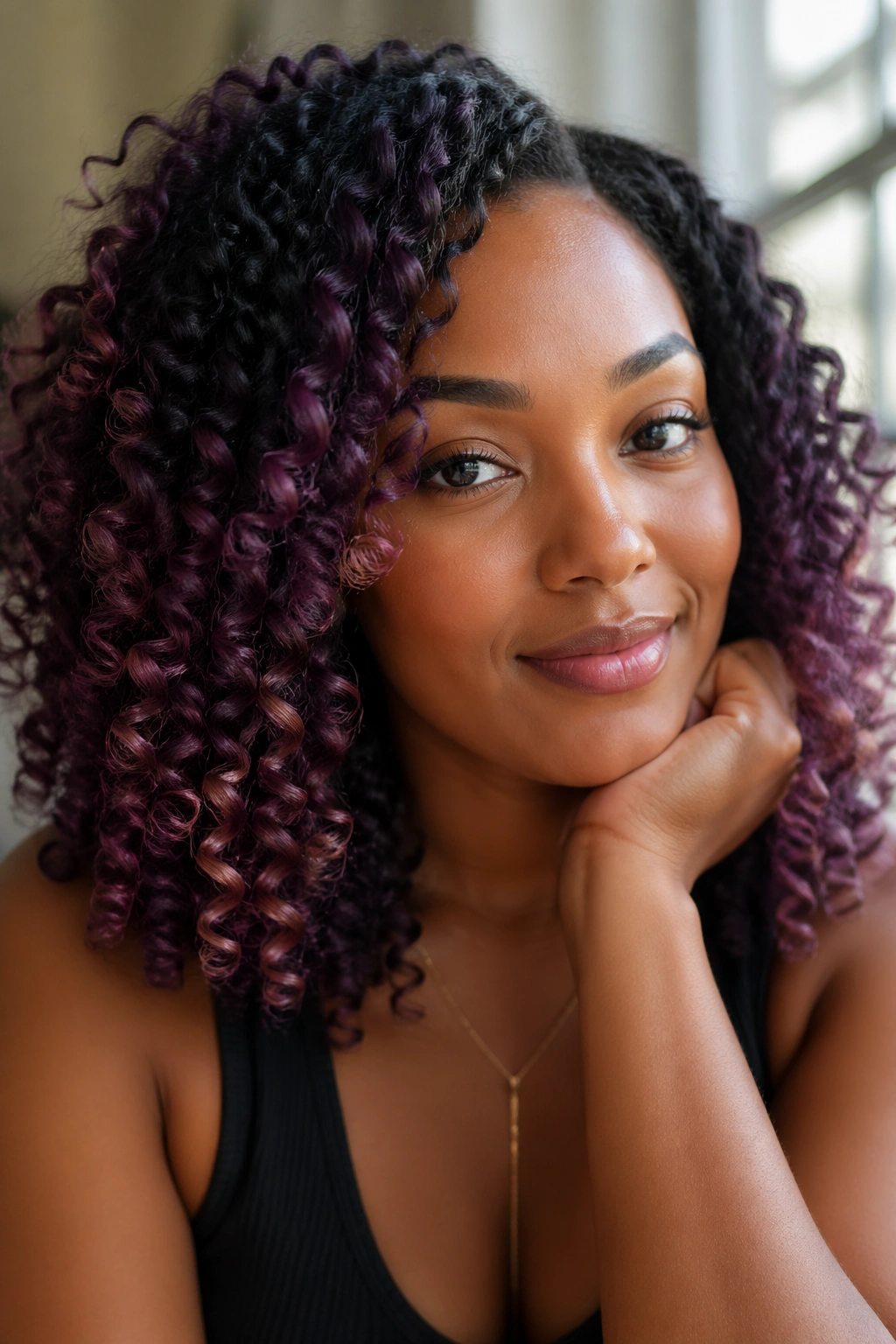
Mauve sits at the intersection of pink and purple, with rose and warm undertones. On warm-toned brown skin, mauve creates a harmonious look that feels soft and deliberately feminine. It’s less aggressive than a bright violet but more interesting than a neutral brown.
Mauve purple balayage on natural hair often reads as dimensional and complex — the pink undertones play off skin warmth while the purple depth adds intrigue. It’s a sophisticated color choice that wears well through different stages of fade.
18. Purple Balayage on Locs
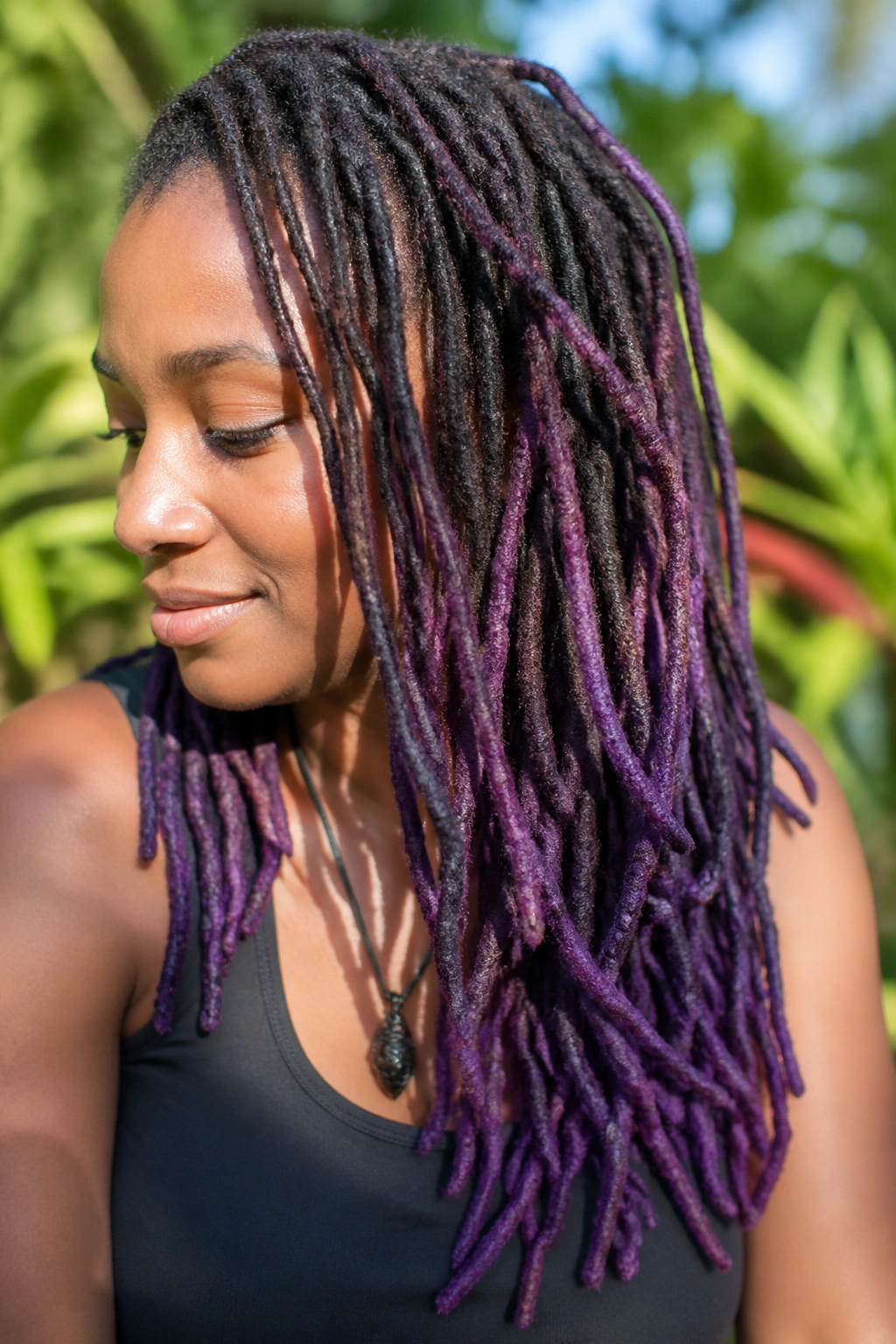
Locs offer a unique canvas for balayage because the texture absorbs color differently at the core versus the surface. On mature, well-sealed locs, purple color applied to the ends and mid-lengths sits primarily on the surface, creating a sheen of color that’s particularly vivid in sunlight.
On newer or looser locs, color can penetrate more deeply, which creates a richer, more lasting result. Purple on locs fades slowly — especially darker shades — which suits the lower-maintenance nature of loc care.
19. High-Contrast Purple on Natural Black Hair
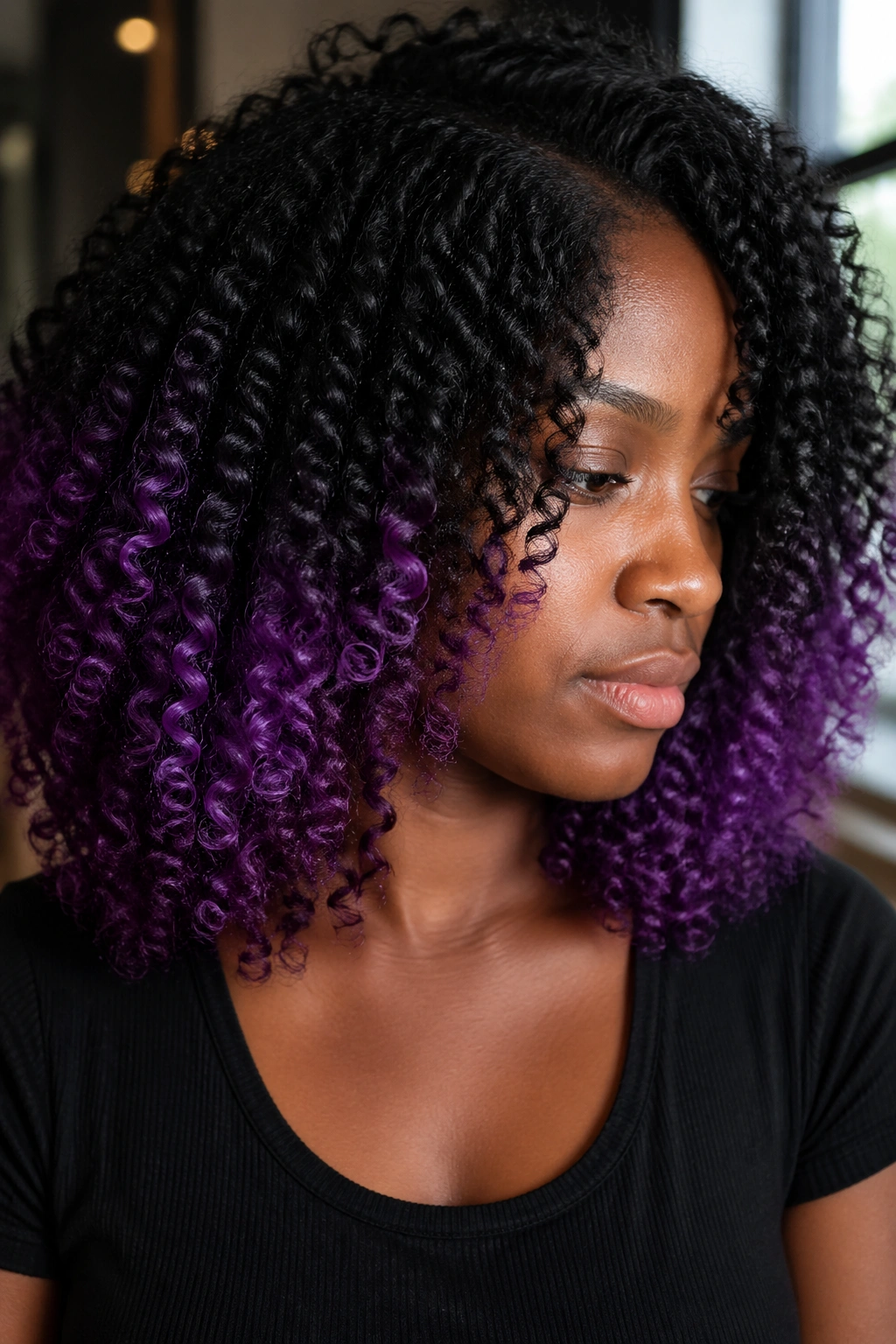
Sometimes the most impactful look is the simplest: pure black natural hair with bright, unmistakable purple balayage at the ends. No blending, no gradual transition, no multiple purple shades. Just the deep black base and the purple tips in direct conversation with each other.
This high-contrast approach works because curly natural hair does the softening for you. Even without a smooth gradient, the way the coils transition from dark to color as you move down the length creates enough visual interest. Let the hair do the work.
20. Purple Balayage With Copper Accent
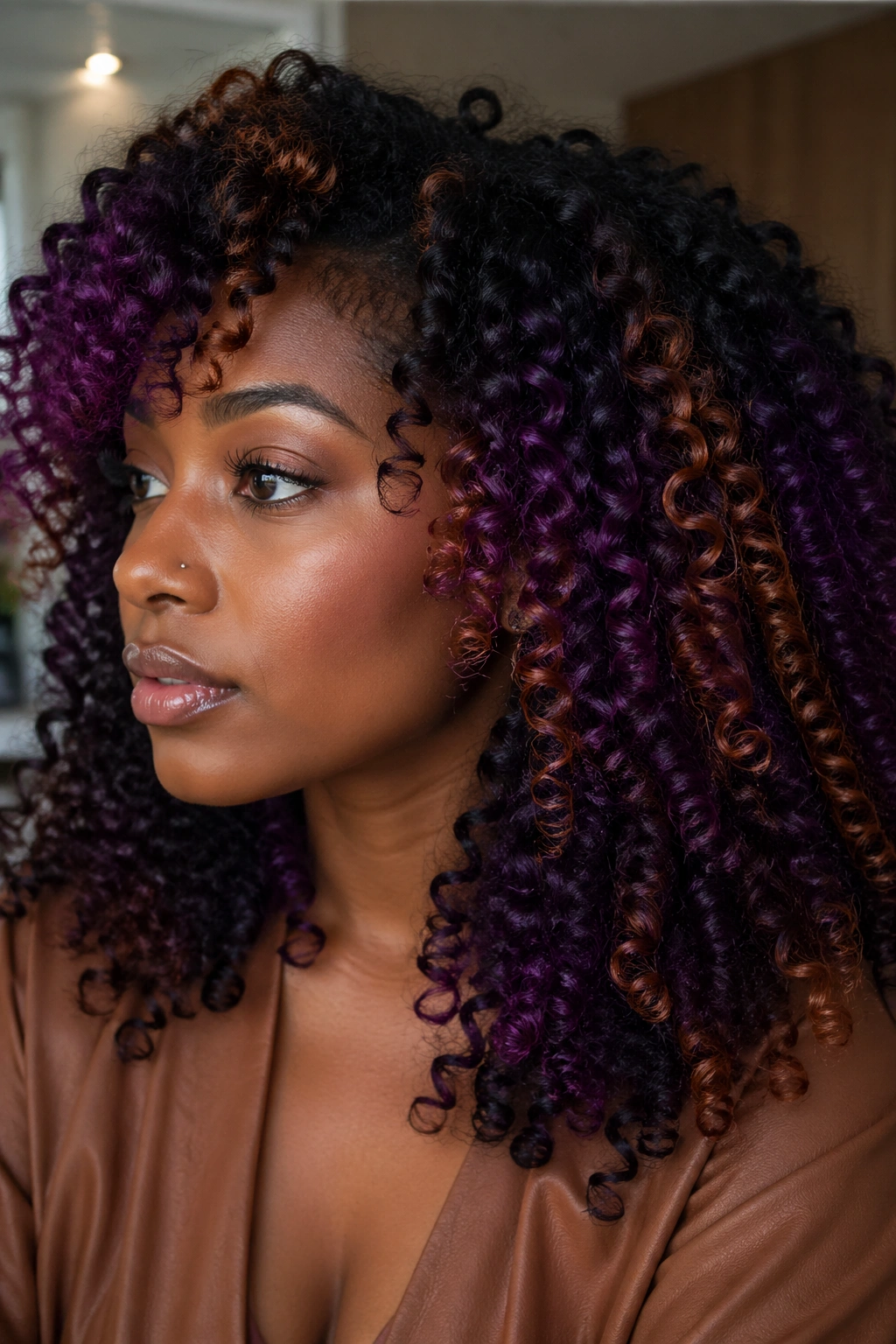
Mix purple and copper for a richer, more complex color story. Copper is an unexpected complement to purple — the warmth of the copper and the coolness of the purple create a contrast that prevents either color from feeling flat. Apply copper through some sections and purple through others, letting them blend at the meeting points.
On natural hair with warm undertones, copper-and-purple balayage is particularly striking. The copper harmonizes with skin warmth, while the purple adds the boldness and personality.
21. Cool-Toned Indigo Balayage
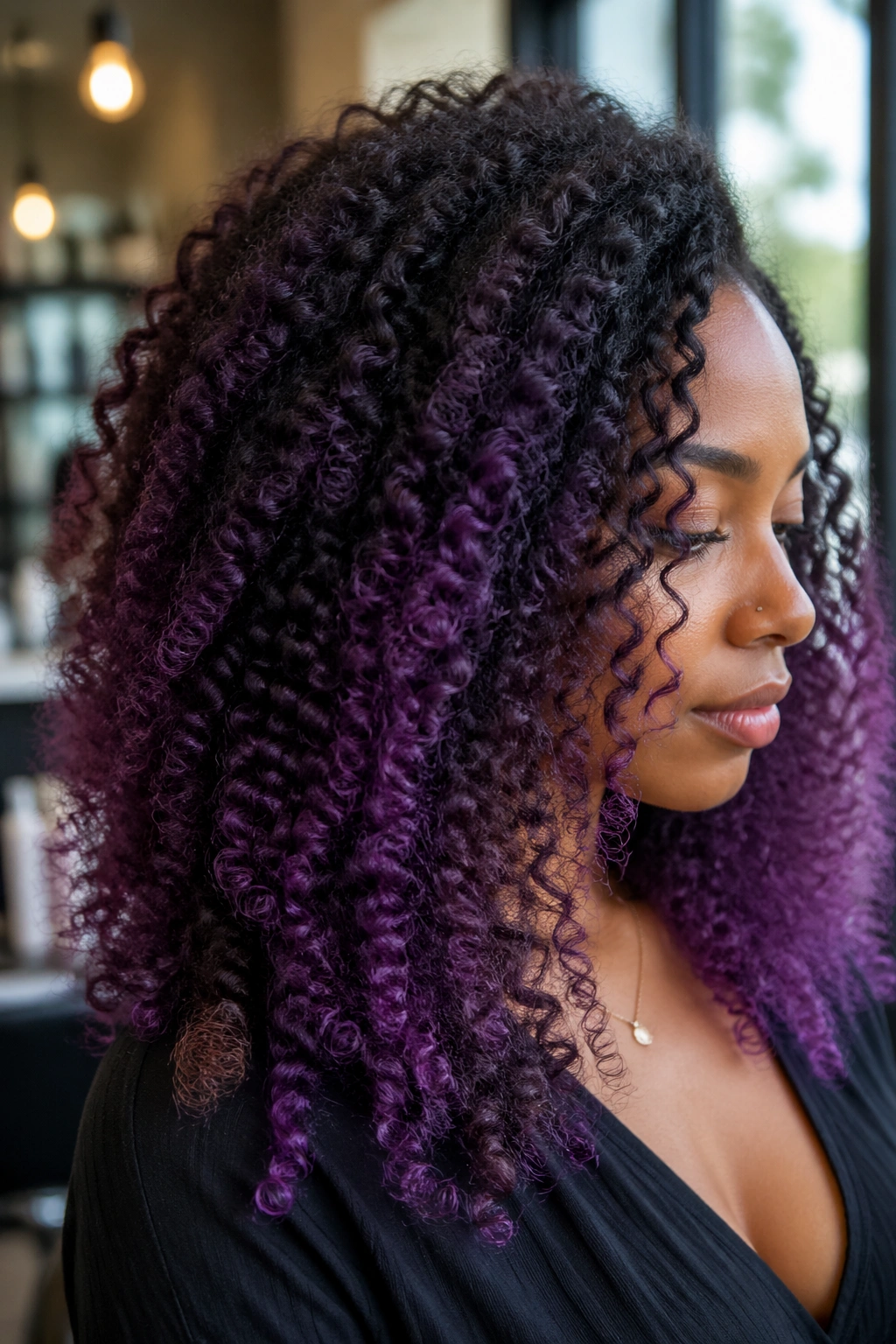
Indigo sits between blue and purple — darker than a true violet, with definite blue-blue undertones. On natural hair, indigo reads as a very deep, mysterious color. You won’t see it in dim light, but in direct sunlight or under certain indoor lights, the blue-purple depth reveals itself.
Indigo is one of the few purple shades that requires minimal or no lifting on dark natural hair. It deposits richly on the hair shaft without needing a light base — which makes it the ideal starting point for anyone who wants purple color without any chemical lightening.
22. Purple Balayage on Natural Gray Hair
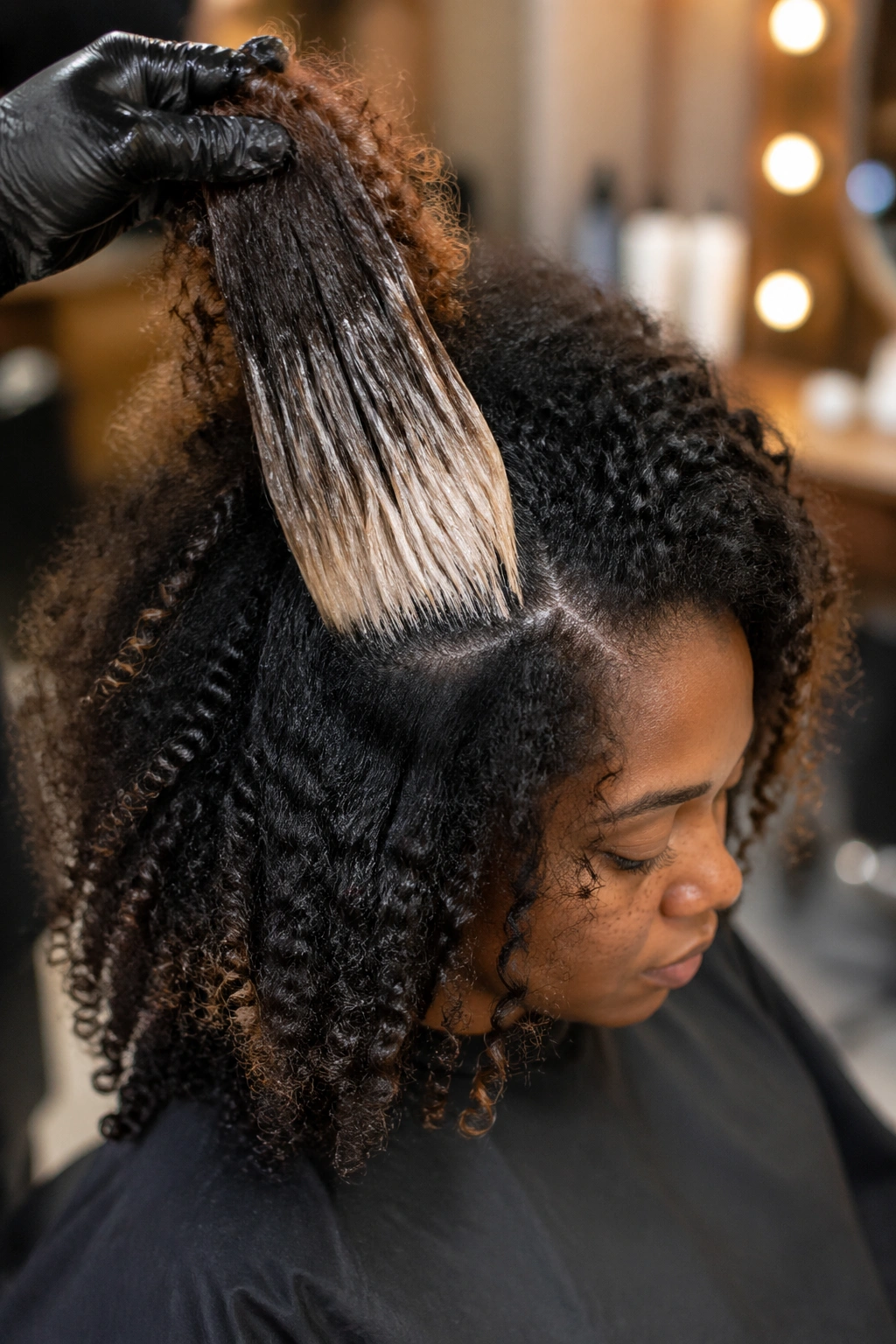
Natural gray in curly hair isn’t something to fight — it’s a foundation for incredible color. The gray sections of natural hair are often more porous, which means they absorb color more readily and hold it more vividly than pigmented hair. Purple balayage on hair that’s transitioning to gray, or fully gray, creates a look that’s sophisticated, intentional, and genuinely unique.
The purple on gray creates a silvery-purple combination that looks almost intentionally frosted. It’s a look that reads as both mature and bold — not in spite of the gray, but because of it.
23. Purple Balayage as a Refresh for Faded Color
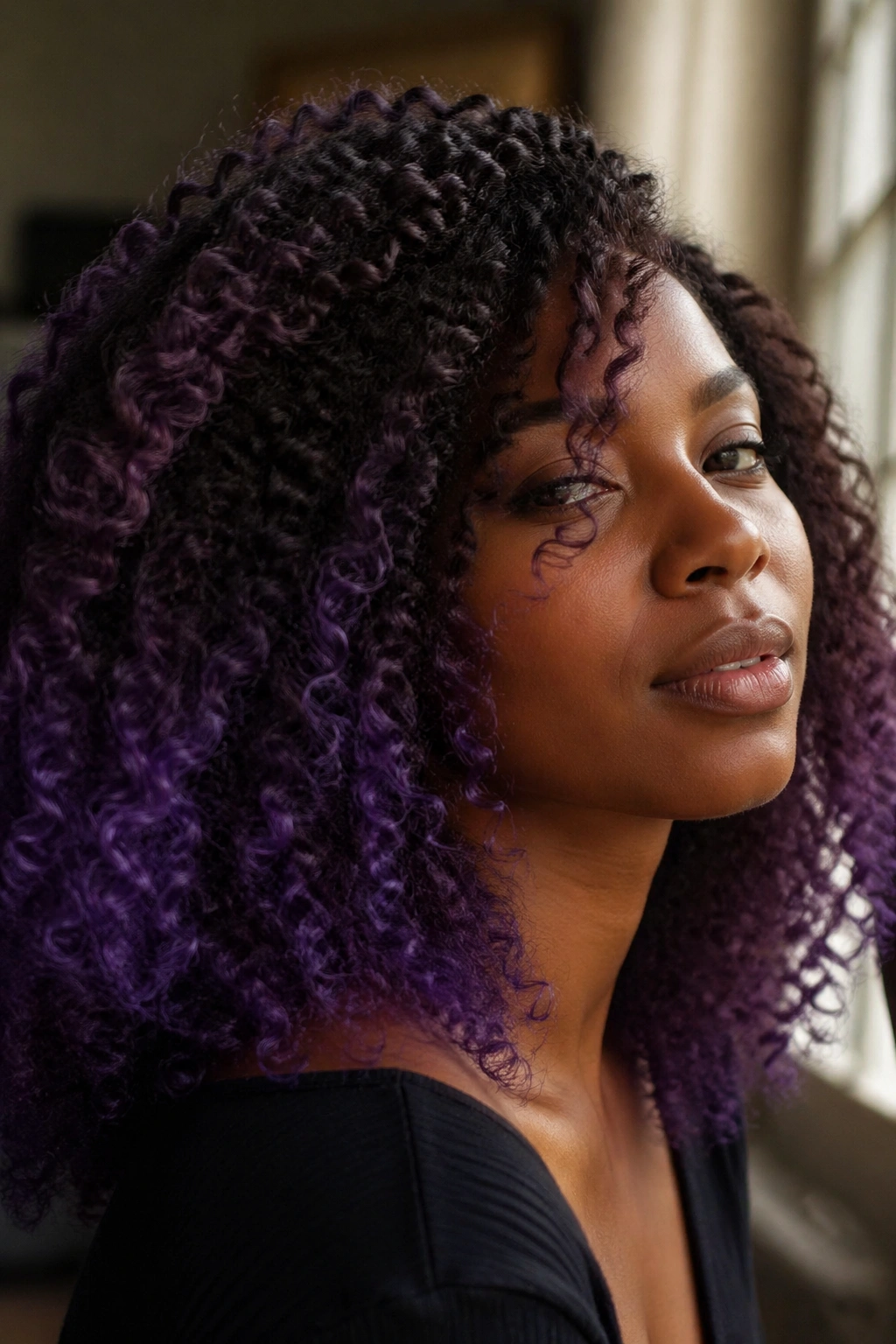
If you’ve had purple hair before and it’s faded to a dull, muted version of its former self — don’t rush to strip it. Faded purple on natural hair is often the perfect base for a fresh purple balayage. The colorist can work with the existing fade, deepening certain sections and brightening others, creating a multi-tonal purple that looks more complex than a fresh single application.
Faded hair is information. It tells the colorist where the hair absorbs color most readily, where it’s resistant, and what base shade exists underneath. Working with the fade rather than against it often produces more interesting results.
24. Purple Balayage Paired With a Natural Wash-and-Go
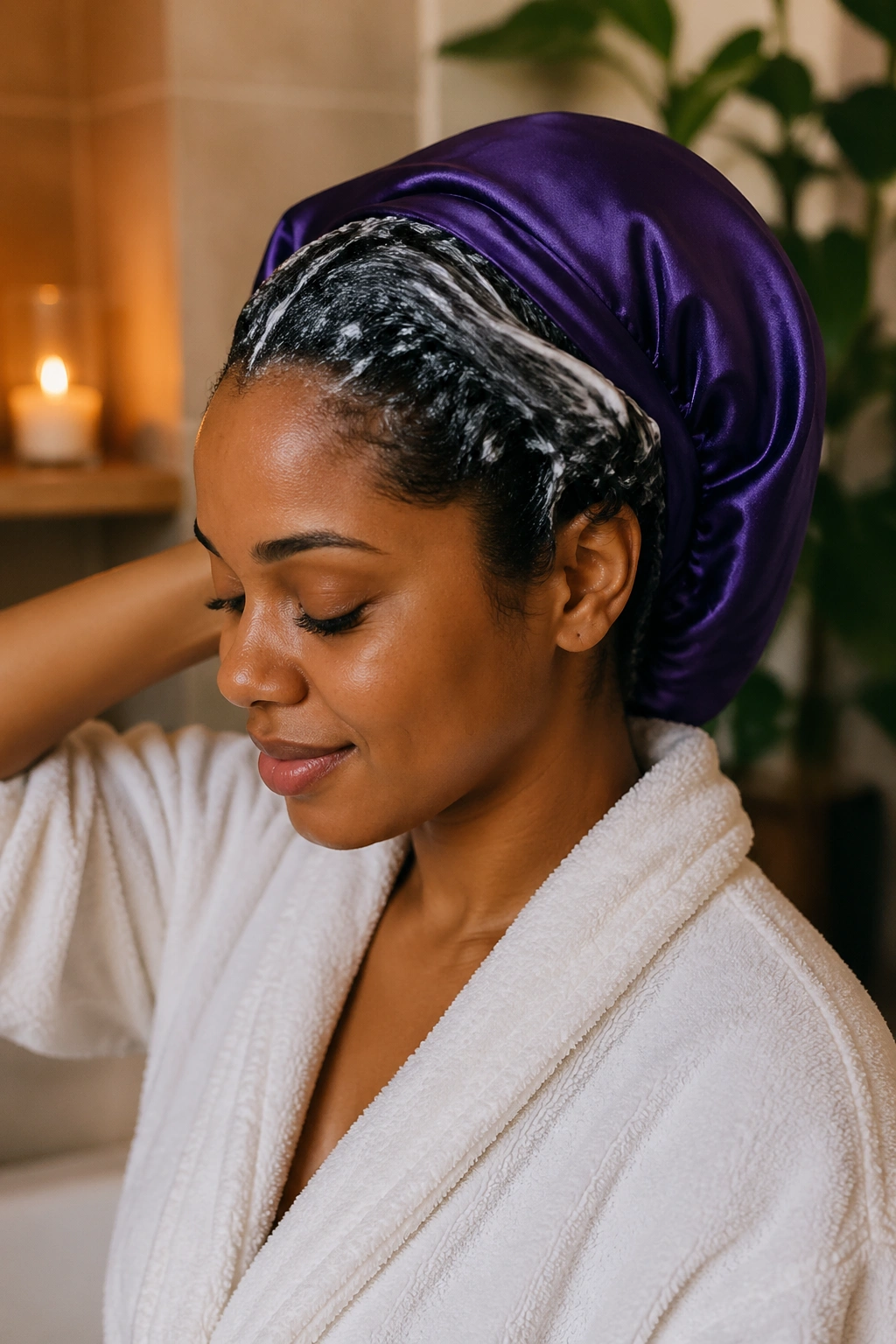
The ultimate test of any color technique on natural hair is how it looks on a simple wash-and-go. No heat, no manipulation — just your hair doing what it does naturally. Purple balayage on a wash-and-go is extraordinary because the coils arrange themselves randomly, and that random arrangement means the purple appears in unexpected places throughout the style.
You can’t fully predict where a balayaged coil will land in a wash-and-go — some days the purple concentrates at the perimeter, some days it peeks through the center, some days a few vivid purple coils fall in front of your face. That unpredictability is the whole point. It keeps the look fresh and interesting every single day, without any effort on your part.
Finding a Colorist for Natural Hair and Purple Balayage
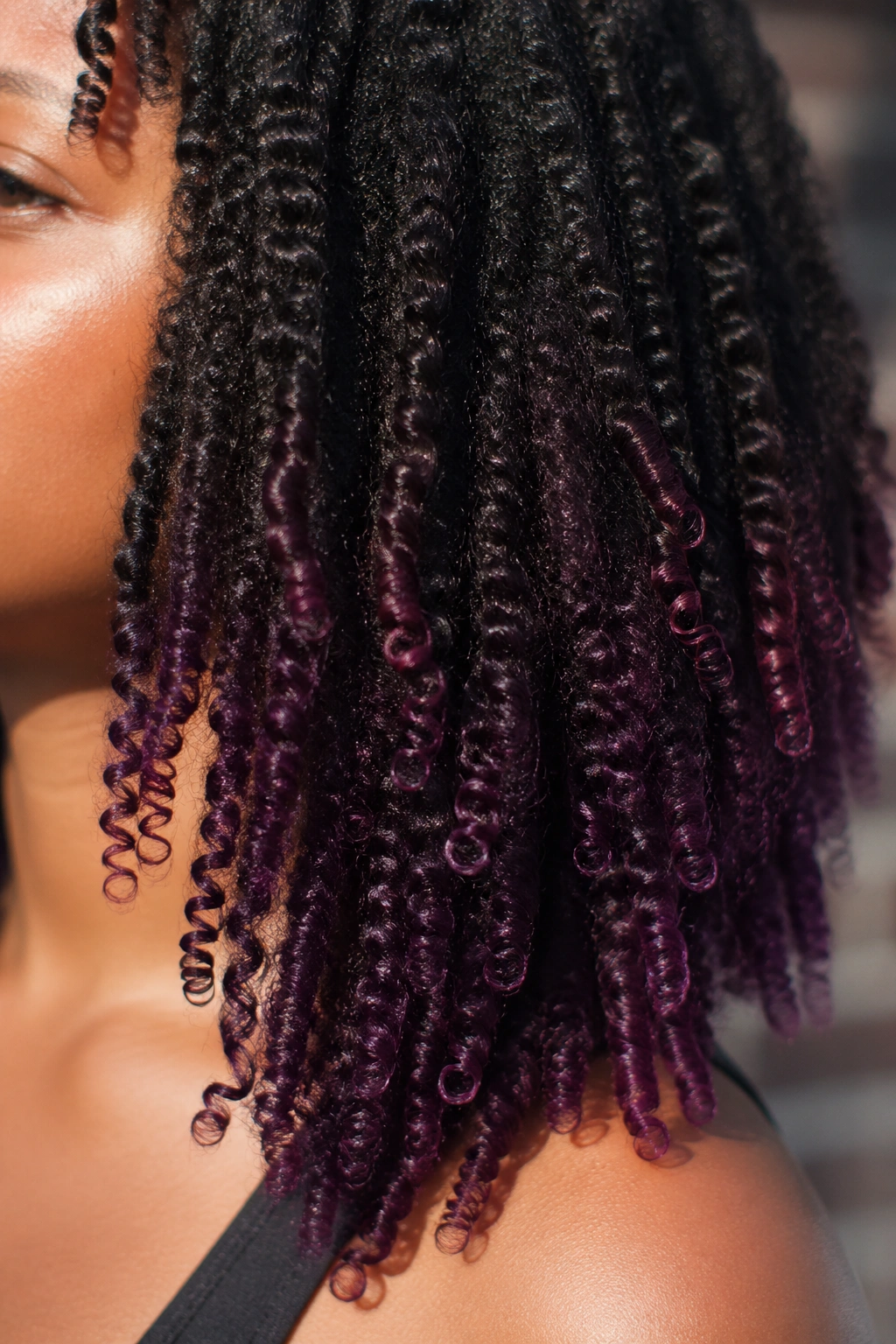
The single most important thing you can do before committing to purple balayage on natural hair is finding a colorist who actually has experience with textured hair. This is non-negotiable. Natural curly hair responds differently to color — differently to moisture, differently to processing time, differently to heat — and a colorist who only works with straight hair may not account for these differences.
Look for a colorist whose portfolio shows natural, curly, and coily hair in various color treatments. Look for before-and-after photos that show the hair texture after color — not just the color itself, but the curl definition, the condition, the integrity. Ask specifically how they approach balayage on natural hair. If their answer is generic or dismissive, keep looking.
The right colorist will assess your hair’s health and history before touching it with any chemical. They’ll discuss realistic expectations based on your starting color and texture. They’ll have a plan for after-care that’s specific to natural hair. And they’ll know how to create a purple balayage that looks intentional, dimensional, and absolutely stunning on your curls.
