

Braids with curls for natural hair is one of the most exciting styling categories in the natural hair community — and it has been for a long time. The combination of structured braided elements with the free, expressive texture of natural curls creates a visual dialogue that straight hair simply can’t replicate. Two textures, one style, and infinite variation in how they come together.
Why Braids and Curls Work Together So Beautifully
There’s a tension in the combination of braids and curls that makes the look so compelling. Braids are ordered, geometric, and deliberate. Natural curls are organic, dynamic, and spontaneous. When you put them together in the same style, each element makes the other look better by contrast. The braids look more precise next to the loose curls; the curls look more expressive next to the braids.
On Black women’s natural hair, this combination is particularly powerful because both elements are deeply rooted in the cultural history of African and African diaspora hair traditions. Braiding has been practiced across Africa for centuries as a form of artistry, communication, and identity. Natural curl texture — coily, kinky, springy — has always been part of that story, worn freely or incorporated into braided styles in ways that European hair traditions never developed. Wearing braids with curls on natural hair today is participation in a living, evolving tradition.
There’s also a practical dimension to the combination. Braids provide protection to the scalp and the braided sections of hair, reducing daily manipulation in those areas. The free curl sections remain expressive and natural. For women who are actively trying to grow their natural hair while still having a full, creative styling option, braids with curls is one of the most effective solutions available.
The Many Forms Braids With Curls Can Take
“Braids with curls” isn’t one style — it’s a category with dozens of specific interpretations. The variables are: what kind of braids, where the braids are positioned, what the curls are doing, and how the two elements relate to each other.
Braid type determines the texture, thickness, and visual weight of the braided element. Cornrows are flat and graphic. Box braids are thick and individual. Micro braids are thin and voluminous. Knotless braids have a natural, seamless root. Goddess braids are raised and wispy. Passion twists are curly and textured. Feed-in braids are tapered and precise. Each braid type creates an entirely different style when combined with natural curls.
Braid placement creates the overall composition. Braids at the top with curls at the bottom create a structured-meets-free contrast. Braids at the sides with curls at the center create a mohawk-inspired look. Braids scattered throughout with curls filling the spaces create a mosaic effect. Braids at the front with curls at the back is the classic Fulani-inspired configuration. Each placement choice tells a different visual story.
Curl styling completes the look. Wash-and-go curls alongside braids create the most natural, low-manipulation option. Twist-out or braid-out curls create more defined, uniform curl patterns. Wand-curled sections create elongated, glossy spirals. The choice of how to style the curl section changes the formality and character of the entire style.
Choosing Braids That Complement Natural Curl Texture
The best braids-with-curls looks are ones where the braided section and the curl section feel like they belong together. This means thinking about scale, weight, and visual balance.
Thick braids (box braids, goddess braids) pair best with high-volume, dense natural curl sections. If your curl section is thin or fine, thick braids will dominate the look and make the curls seem like an afterthought. For thin or low-density natural curl sections, use thinner braids that don’t overwhelm.
Thin braids (micro braids, thin cornrows) pair well with any curl density but look especially beautiful against type 3c and 4a curls, where the curl diameter is closest to the braid width. The similarity in scale between thin braids and medium-sized curl clusters creates a cohesive visual rhythm.
Raised braids (Dutch braids, goddess braids, knotless individual braids) create more visual contrast against natural curls because they project from the scalp rather than lying flat. This extra dimension adds depth to the overall style but also means the braided sections become the dominant visual element.
Flat braids (cornrows, flat twists) lie close to the scalp and create clean, graphic lines. Combined with free natural curls, flat braids create a lower-contrast combination where the curls can coexist with the braids more equally.
Integrating Curl Extensions With Braided Styles
Sometimes the natural curl section benefits from a small amount of curl extension to add length, volume, or a more defined curl pattern. Curl extensions can be crocheted into the free sections, blended with the natural hair, or added as individual sections that hang alongside the braids.
When choosing curl extensions to pair with braided styles, look for textures that complement your natural curl pattern. Tight, 4c-type curl extensions look natural alongside type 4 natural hair. Loose, 3a-type curl extensions work with looser natural curl patterns. Trying to pair very different textures creates a noticeable mismatch that draws attention to the fact that extensions were used.
Marley hair — a bulk braiding hair with a soft, crimped texture — is one of the best extension choices for adding natural-looking curl volume alongside braids. It closely mimics the texture of type 4 hair and blends seamlessly when moisturized and styled.
Length Considerations for Braids With Curls
The length of the braided sections versus the curl sections creates very different visual effects. These length relationships are worth thinking about before you begin styling.
Equal length braids and curls create the most unified look. The braided and curl sections appear to be part of the same hair story — different textures, same commitment. This length relationship works for most configurations.
Longer braids than curls creates a dramatic contrast where the braids frame and contain the curl section. This works especially well when the curls are a crown or top section and the braids extend down the sides or back past the curl section’s length.
Shorter braids than curls is less common but creates an interesting reversal — the curls spill past and below the braided section, suggesting the braids are a deliberate detail within an otherwise curly style rather than the dominant element.
1. Box Braids Top With Natural Curl Cascade
The top section of the hair — crown and front — is in individual box braids, while the sides and back flow in a natural curl cascade. The box braids at the top create a protective, structured crown; the natural curls below frame the neck and shoulders.
Box braids are one of the most protective styles available. They reduce daily manipulation of the braided sections, retain length, and maintain scalp health when properly installed. Paired with free natural curls, they allow the rest of the hair to remain accessible and expressive while the top section is protected.
Choose box braids in your natural hair color or a color that complements your natural color. Braids in dramatically contrasting colors can overpower the natural curl section.
2. Cornrow Sides With Natural Curl Mohawk
Cornrows sweep from the temple down along each side of the head toward the nape. The center strip — from the front hairline straight back to the nape — is left as free natural curls, creating a curly mohawk effect framed on each side by neat, flat cornrows.
The Visual Impact
The cornrow sides create a graphic, clean frame for the center curl section. The mohawk configuration draws the eye upward and creates height, especially when the curls in the center strip are allowed to expand outward in a wide, full afro-mohawk shape.
This configuration works especially beautifully on 4b and 4c hair, where the natural curl section expands dramatically into a full, cloud-like strip of texture between the neat cornrow sides.
3. Knotless Braids With Curly Ends
Individual knotless braids throughout the entire head, but instead of each braid extending all the way to a sealed tip, each one ends with a section of natural curls. The braids start at the scalp — seamlessly, with the knotless technique — and transition into free curls at roughly mid-length or at whatever point the natural hair ends.
This is the most organic-looking braids-with-curls style because the braid literally grows into the curl from within. The transition from braided to curly happens on each individual strand, creating a distributed, all-over effect rather than a sectioned one.
4. Micro Braids Mixed With Natural Curls
Very thin micro braids scattered throughout the natural curl section — some sections braided, most left as free curls — creating a mixed-texture look where the braids are thin enough to blend almost seamlessly with the curl pattern.
Micro braids are so thin that they can look almost like very defined individual curls from a distance. This is intentional — the visual effect is of natural hair with some sections slightly more defined and elongated than others.
5. Dutch Braid Crown With Full Natural Curls
Two Dutch braids run from the front temples to the crown, meeting in the center. The rest of the hair — everything below and behind the Dutch braid crown — is free natural curls in their fullest, most voluminous state.
Dutch braids sit raised from the scalp, creating a sculptural, three-dimensional crown element. The raised quality of the braids contrasts vividly with the soft, free curls below. This style looks especially beautiful from the back, where the Dutch braid crown sits like a tiara above the full curl volume.
6. Goddess Braids Throughout With Curly Wisps
Goddess braids — with their characteristic pulled-out, wispy strands along each braid’s length — throughout the hair. Some sections are braided; adjacent sections are left as free curls. The wispy strands pulled out of each goddess braid blend into the free curl sections, creating an almost seamless transition between braided and unbraided areas.
Goddess braids are uniquely well-suited to the braids-with-curls aesthetic because the pulled-out strands are themselves free and slightly curly, creating a built-in transition texture between the braid body and the free curl sections.
7. Feed-In Braids With Curly Twist-Out Sections
Precisely tapered feed-in braids in some sections, with twist-out curls in the remaining sections. The feed-in braids have a sleek, tapered start at the root and widen gracefully as they move toward the end. The twist-out sections have a defined, uniform curl pattern from the twist-out technique.
Both elements are deliberate and defined — this isn’t a contrast between structured and free, but between two different kinds of structure. The braids and the twist-out curls are both styled with intention, creating a very polished overall look.
8. Single Large Braid With Natural Curl Volume
One large, central braid — a single cornrow or Dutch braid running from the front of the head straight back to the nape — while all the hair on either side remains as full, free natural curls. The single braid creates a center point of structure around which the curls radiate freely.
This is perhaps the simplest version of braids with curls, and its simplicity is part of its charm. The single braid is a graphic detail, a spine of structure running through the middle of a cloud of natural texture.
9. Two-Strand Twists With Natural Curl Blend
Two-strand twists in some sections of the hair, natural curls in adjacent sections. Because two-strand twists closely mimic the visual pattern of natural curls, the transition between twisted and untwisted sections is subtle rather than dramatic.
This is a versatile option because two-strand twists double as a protective style. The twisted sections are protected from manipulation while the curl sections remain free. After a few days, you can untwist the two-strand sections for a twist-out effect, blending the twist-out curls with the natural curls for an entirely different look.
10. Braided Updo With Curly Front Frame
The back and top sections are gathered into a braided updo — cornrows or flat twists forming the structure of an updo at the nape or crown. The front sections on each side — from the hairline to just behind the ear — are left as free natural curls that frame the face.
The framing effect of the front curl sections is the defining feature of this style. The braided updo is the structure; the curls are the frame. The face is positioned within that frame, creating a composed, portrait-like quality that photographs beautifully.
11. Half and Half — Precise Center Division
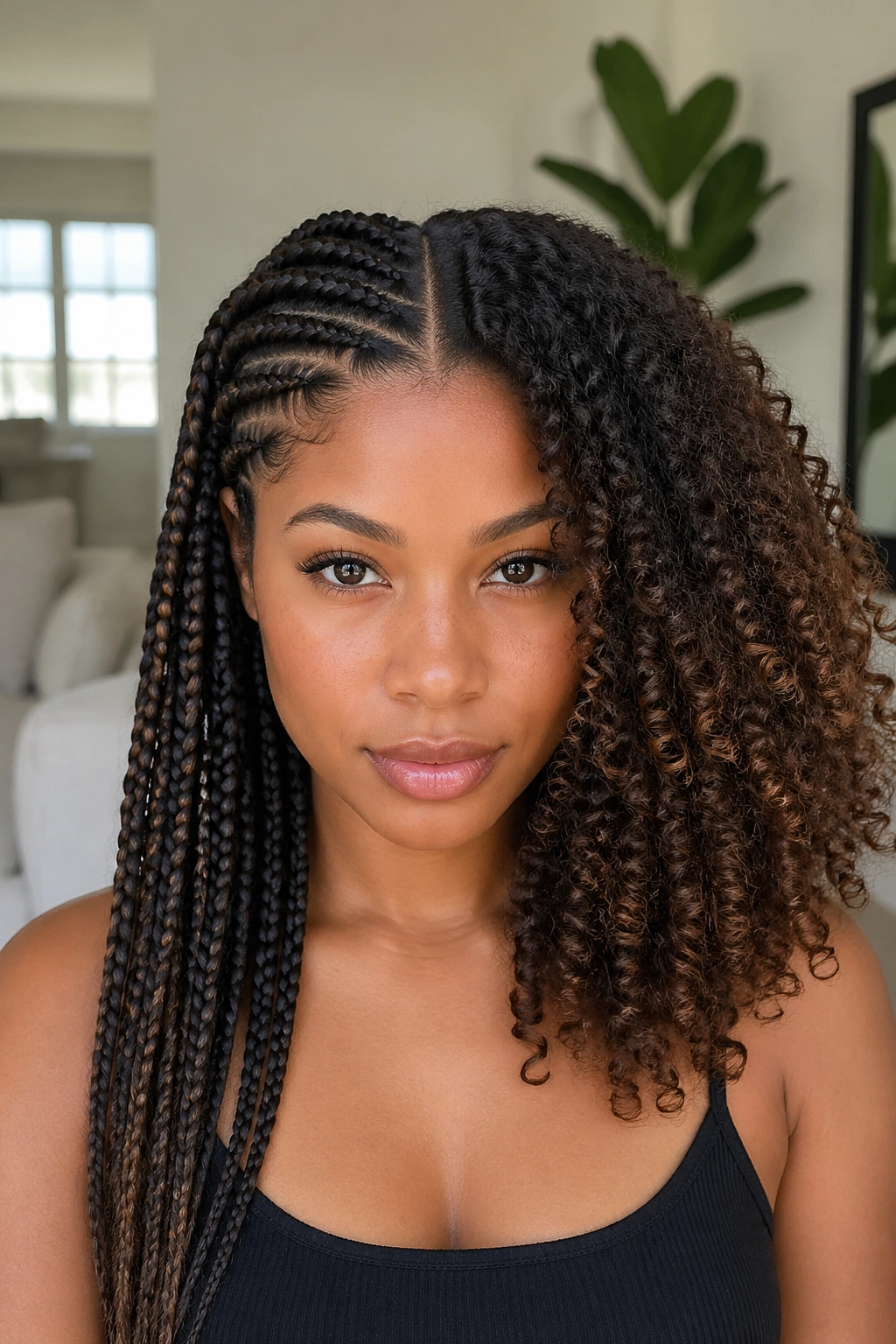
A perfectly straight center part from the forehead to the nape divides the head into two completely distinct halves. One half is braided — cornrows, box braids, or flat twists. The other half is free natural curls. The two halves sit side by side with a clear, precise boundary between them.
This is a bold, deliberate asymmetric style. It’s not subtle — the half-and-half division is immediately visible and clearly intentional. Wear this style when you want your hair to be the conversation starter.
12. Crochet Curl Extensions With Natural Section
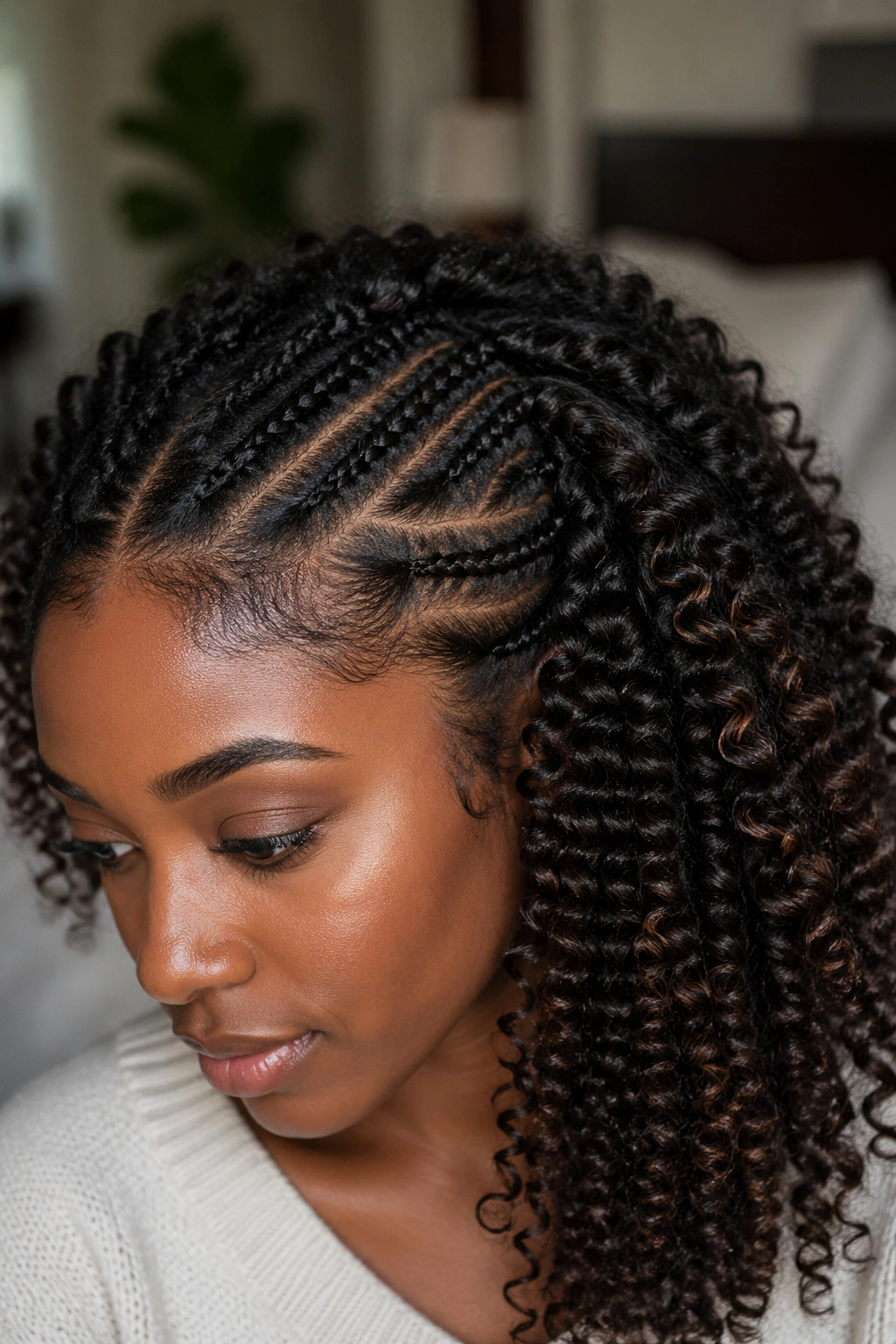
Crochet curl extensions are looped through cornrows in part of the hair — giving those sections more length, volume, or a specific curl type that matches or deliberately contrasts with the natural curl pattern. Adjacent sections are left as free natural hair.
The cornrowed base of the crochet sections lies flat against the scalp in those areas, making them protective. The crochet extension curls hang freely from the cornrow base, blending with or complementing the natural curl sections nearby.
13. Passion Twist Sections With Natural Curls
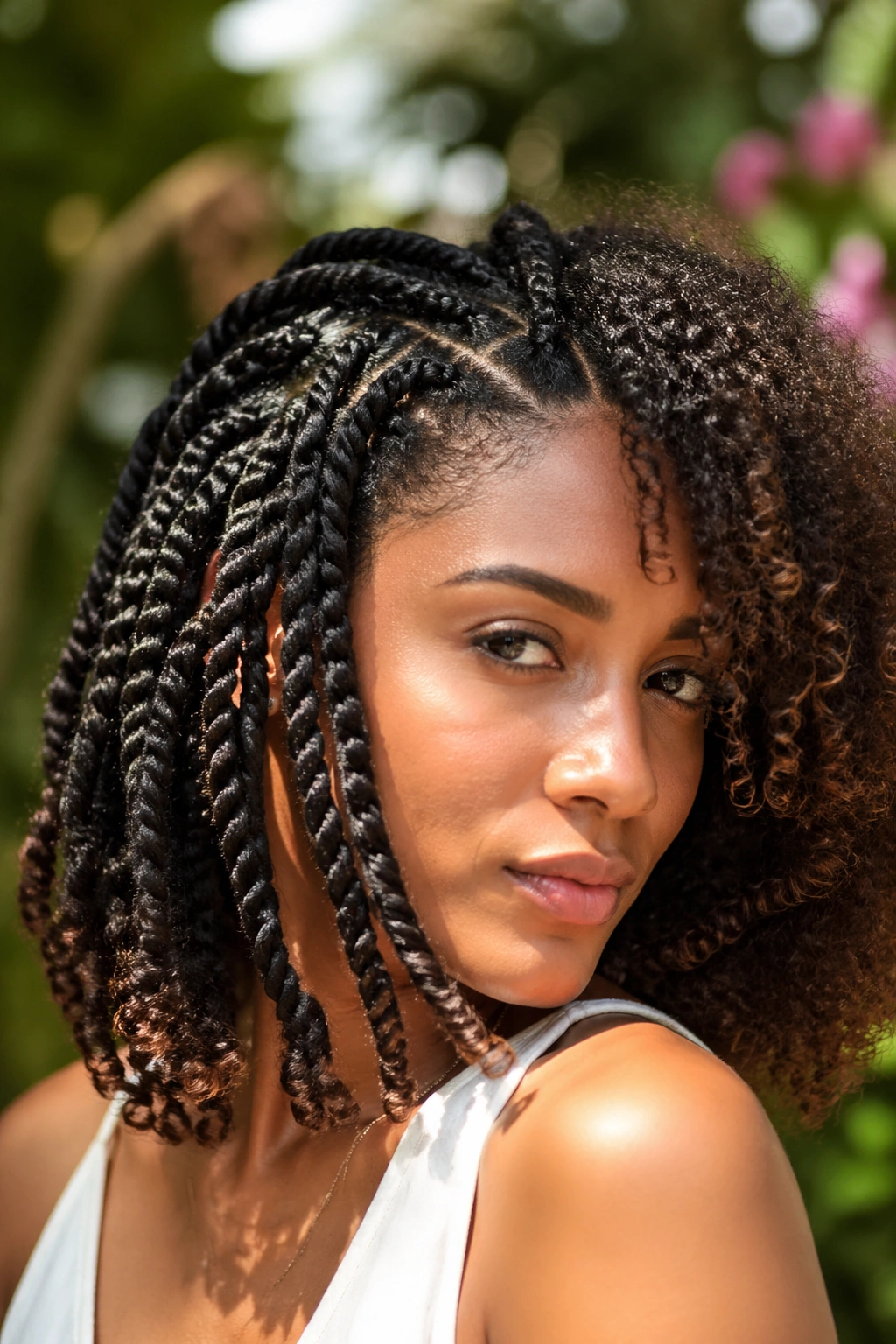
Passion twists — small, spiraling twists using a water wave or curly extension texture — in part of the hair, with natural curls in the remaining sections. Passion twists have a fuzzy, textured surface that blends naturally with type 3 and type 4 natural hair.
The combination of passion twists with natural curls creates an incredibly cohesive look because the extension texture is designed to mimic natural curl patterns. From a distance, it can be difficult to distinguish the passion twist sections from the natural curl sections.
14. Loc Extensions With Natural Curl Sections
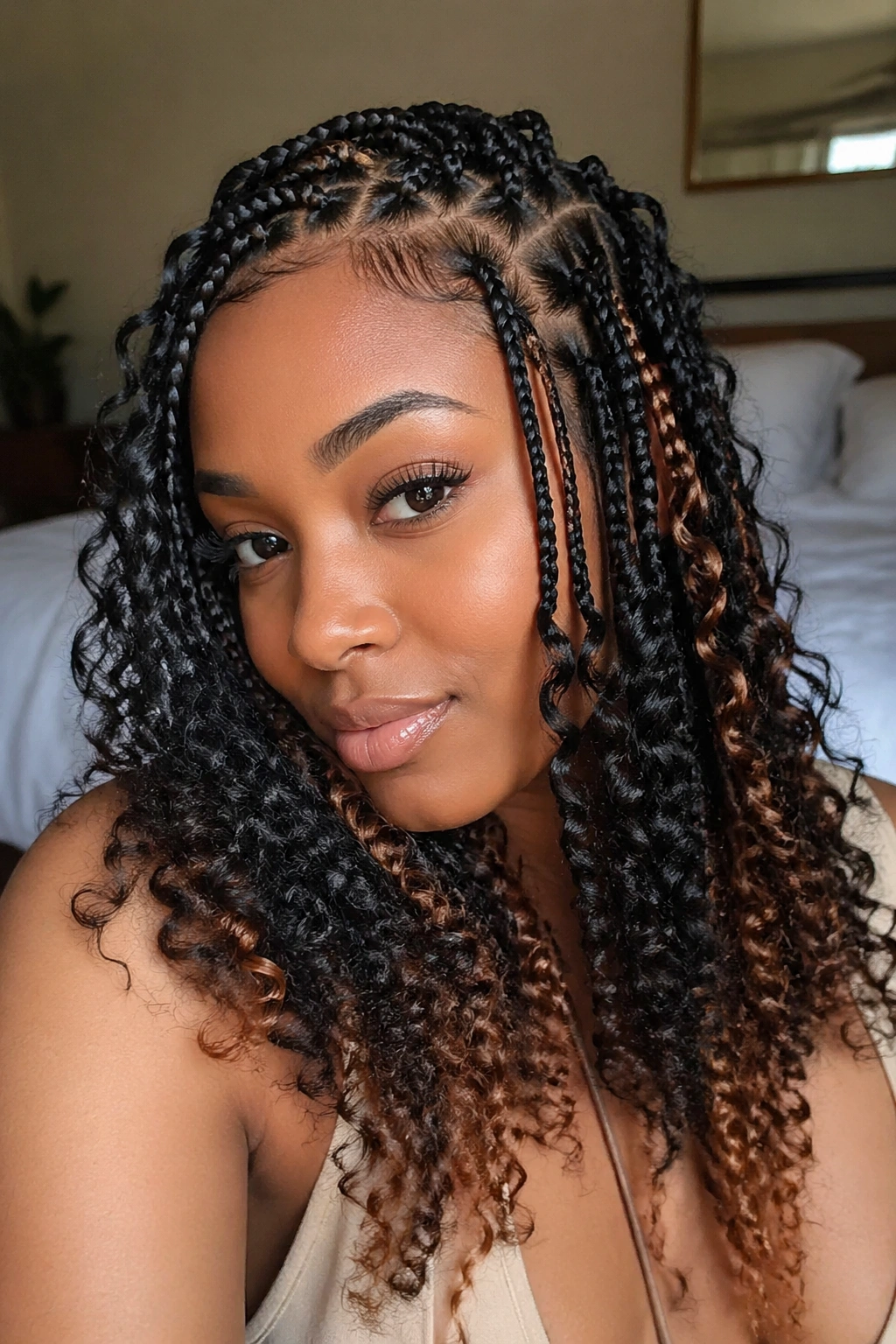
Loc extensions (partial locs, synthetic loc extensions) installed in some sections of the hair, with natural curls in the remaining sections. The contrast between the heavy, thick loc texture and the lighter, spring natural curl texture is dramatic and visually compelling.
This style works well as an introduction to locs — wearing partial loc extensions alongside natural curls allows you to experience the aesthetic of locs without committing to the full process. The natural curl sections can remain as long as you choose before eventually deciding to loc them or leave them natural.
15. Feed-In Ponytail With Curly Ends and Sides
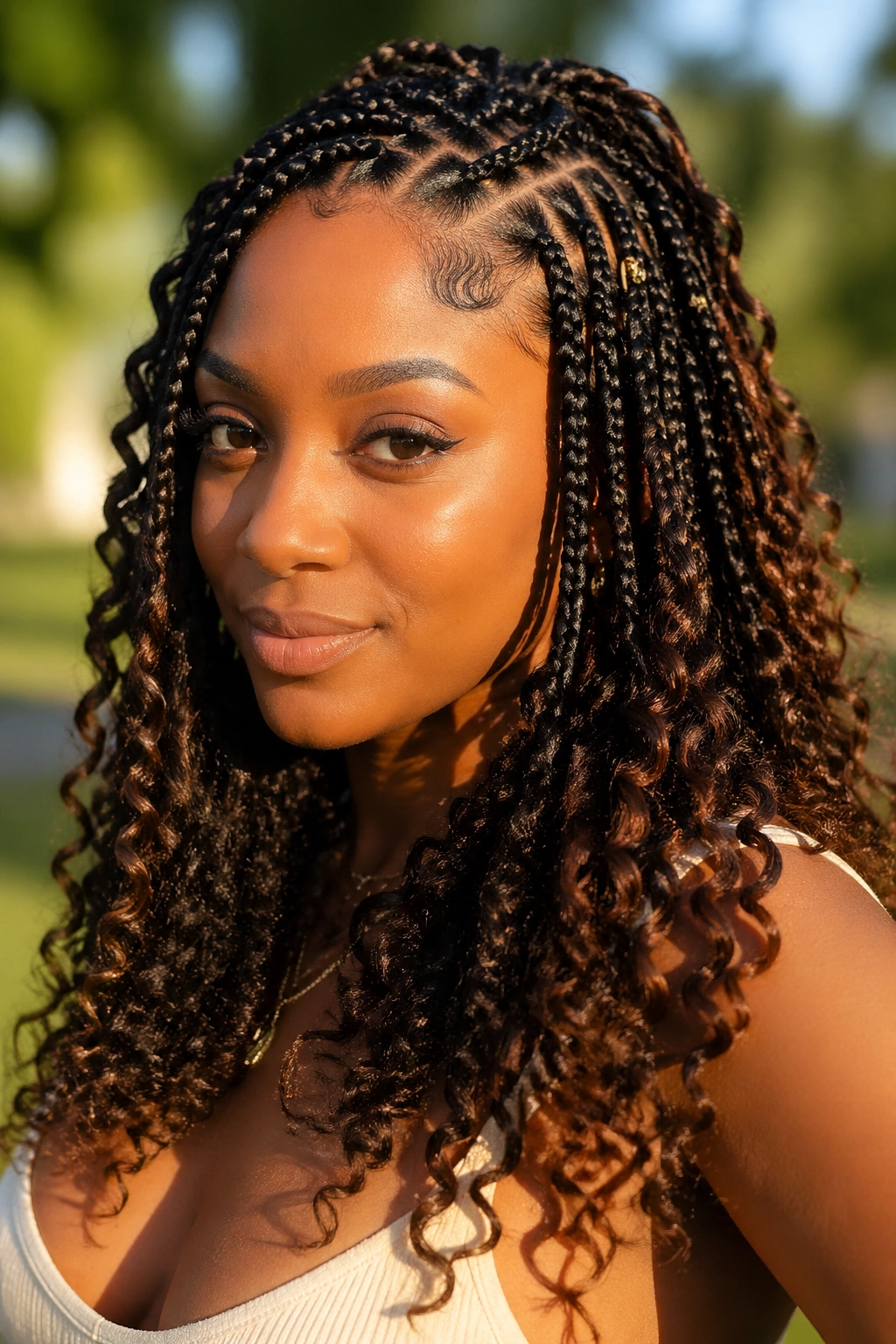
A feed-in ponytail — braids that build up to a gathered ponytail using extensions to add length and volume — sits at the crown, while the sides are left as free natural curls. The ponytail’s end features natural curl texture rather than fully braided extensions.
The result: a dramatic, gravity-defying ponytail of braids with a curly finish, framed by natural curls on both sides. Every element of this style is bold and intentional.
16. Braids in a Bun With Curly Perimeter
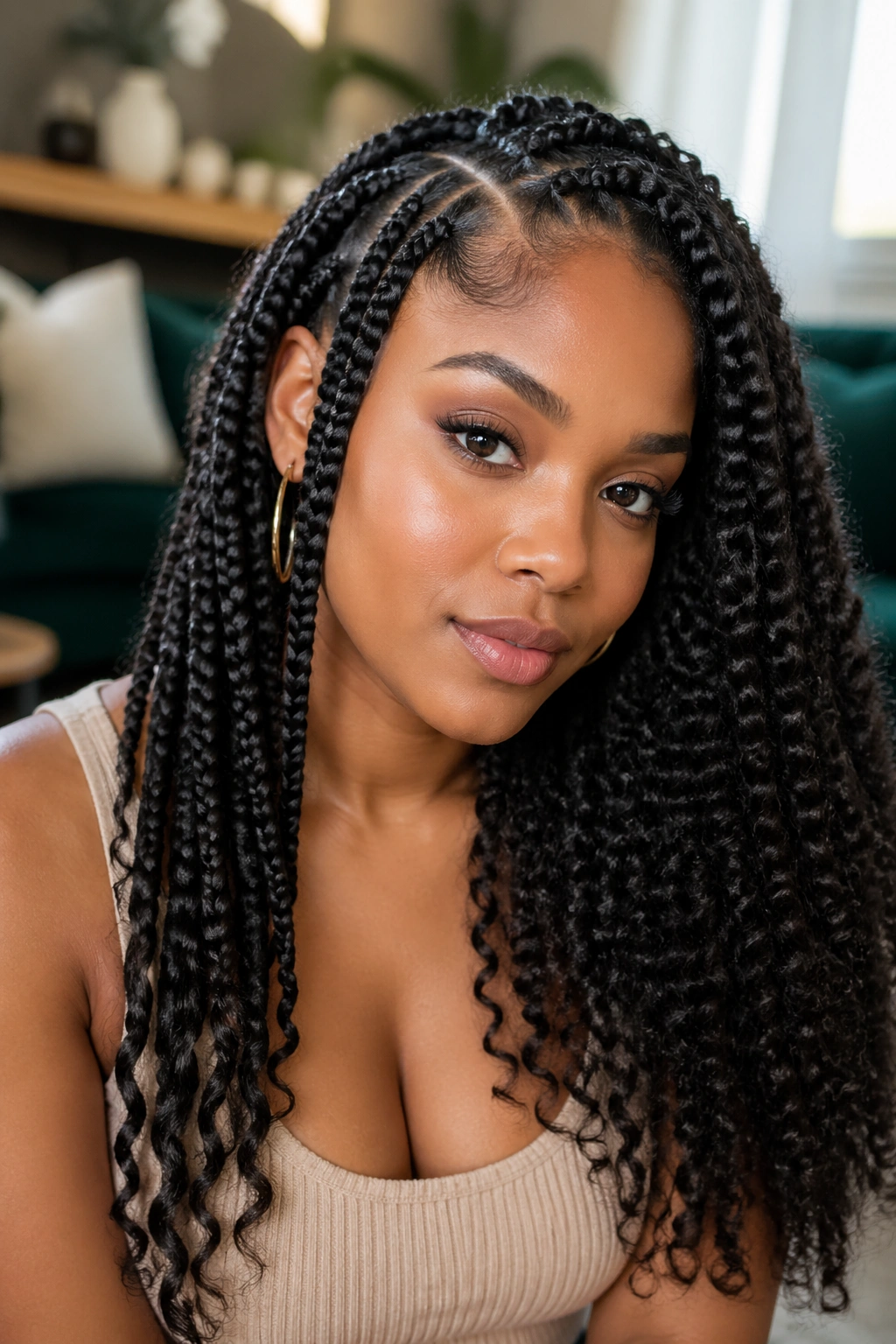
All or most of the hair is gathered into braids and twisted into a bun at the crown or nape. But the perimeter — the edges of the hair all around the hairline — is left as free natural curls. These perimeter curls frame the entire bun, creating a halo of curl texture around the structured braided bun.
The perimeter curls also prevent the style from looking too severe. A fully braided bun can feel stark; the curl perimeter softens it significantly.
17. Braided Sections With Natural Curl Puffs
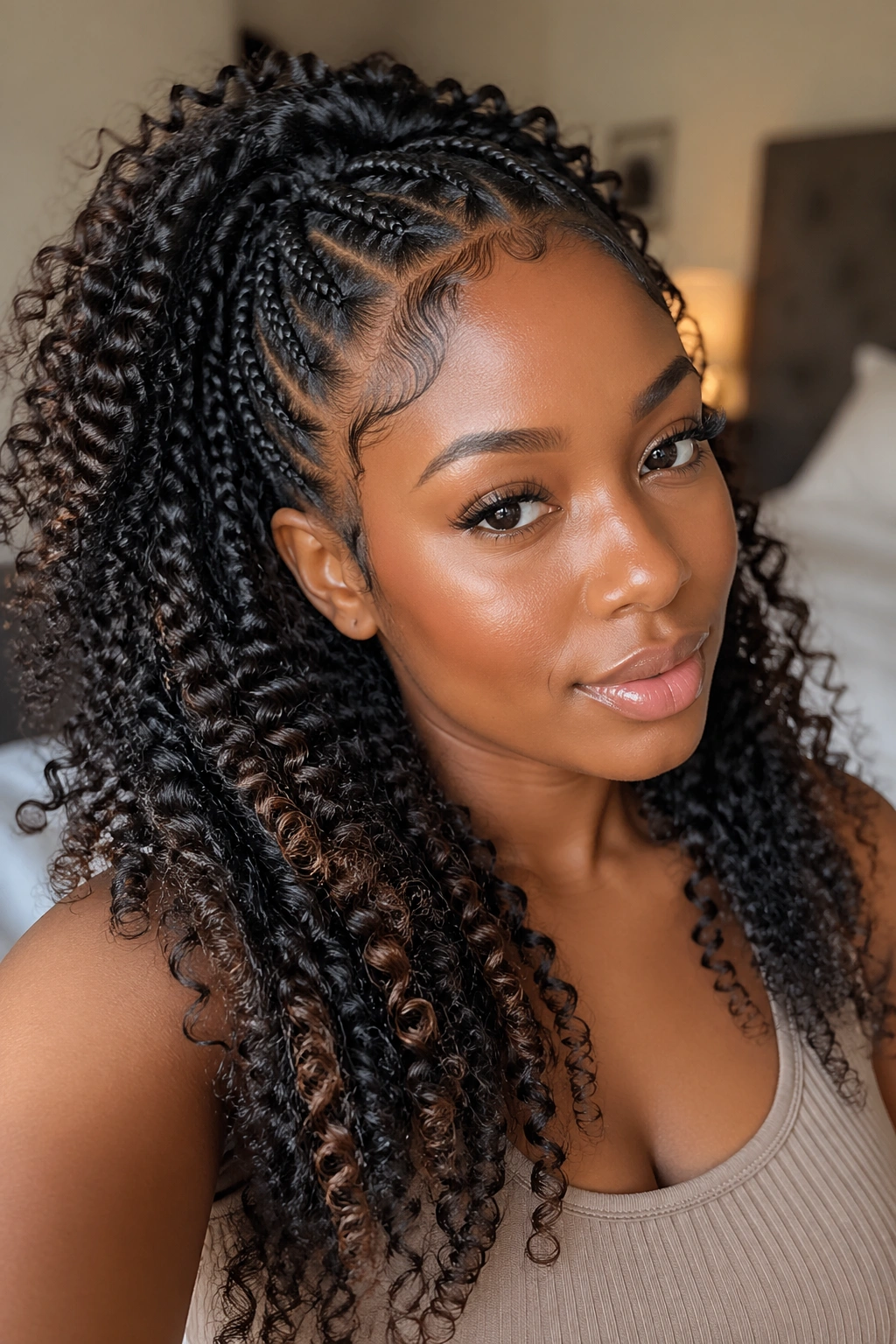
Instead of one continuous curl section, the free curl areas in this style are gathered into several small puffs — above each ear, at the nape, or at the crown — while the surrounding hair is braided. The multiple small puffs create a playful, structured rhythm within the overall style.
This configuration works especially well on shorter natural hair, where a single curl cascade might not have enough length for visual impact. Multiple small puffs solve that problem by creating deliberate gathered curl statements in multiple locations.
18. Braids With Wand Curled Ends
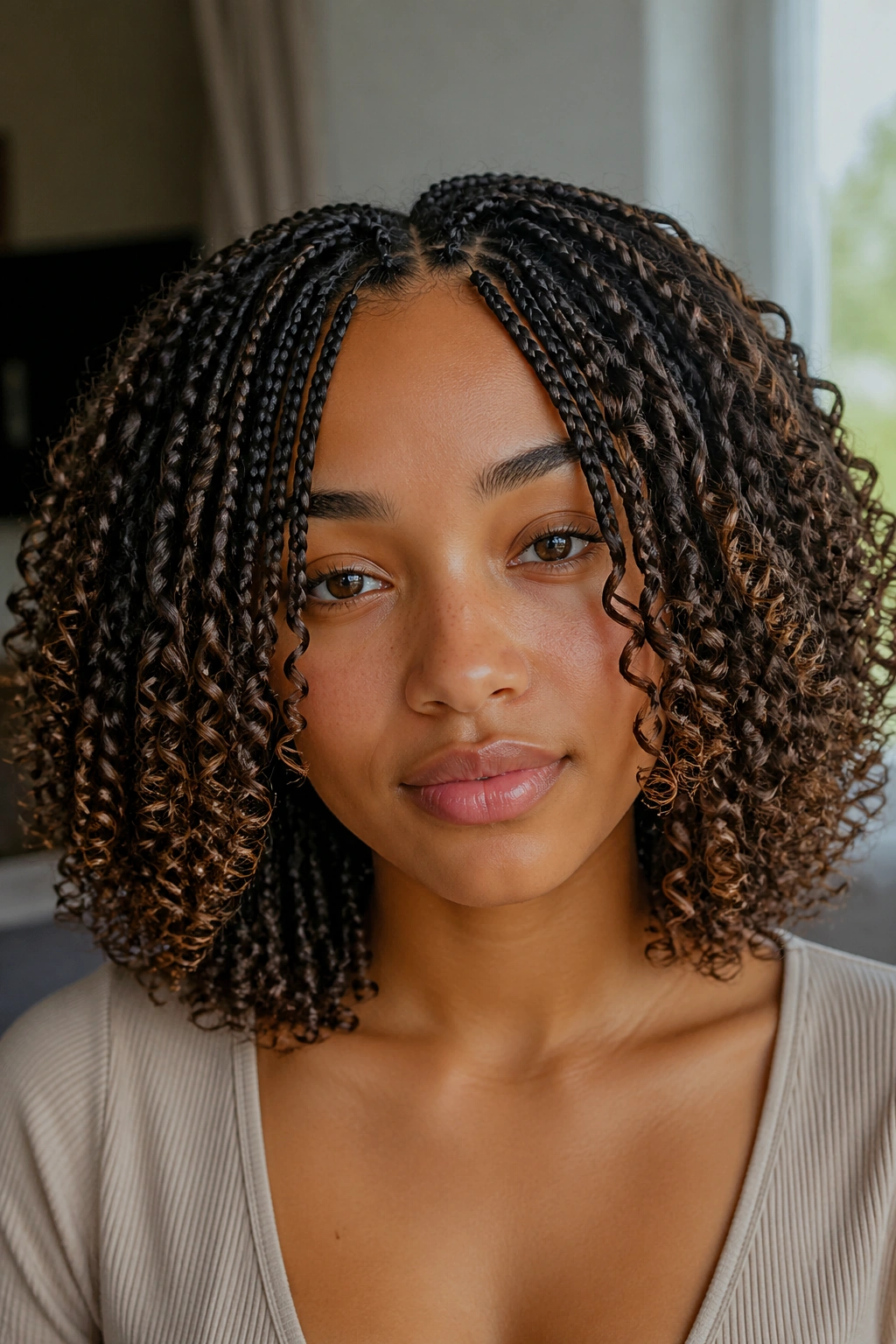
Cornrows or flat twists throughout the hair, but instead of the braids ending with sealed, tapered tips, each braid ends with natural hair that’s been wand-curled into a defined spiral. The braids at the root; the wand curls at the tip.
The wand-curled ends add a polished, intentional finish to the braided sections. This approach is particularly effective on feed-in cornrows, where the braids taper naturally before releasing into the wand-curled ends.
19. Diagonal Braids With Curly Opposition
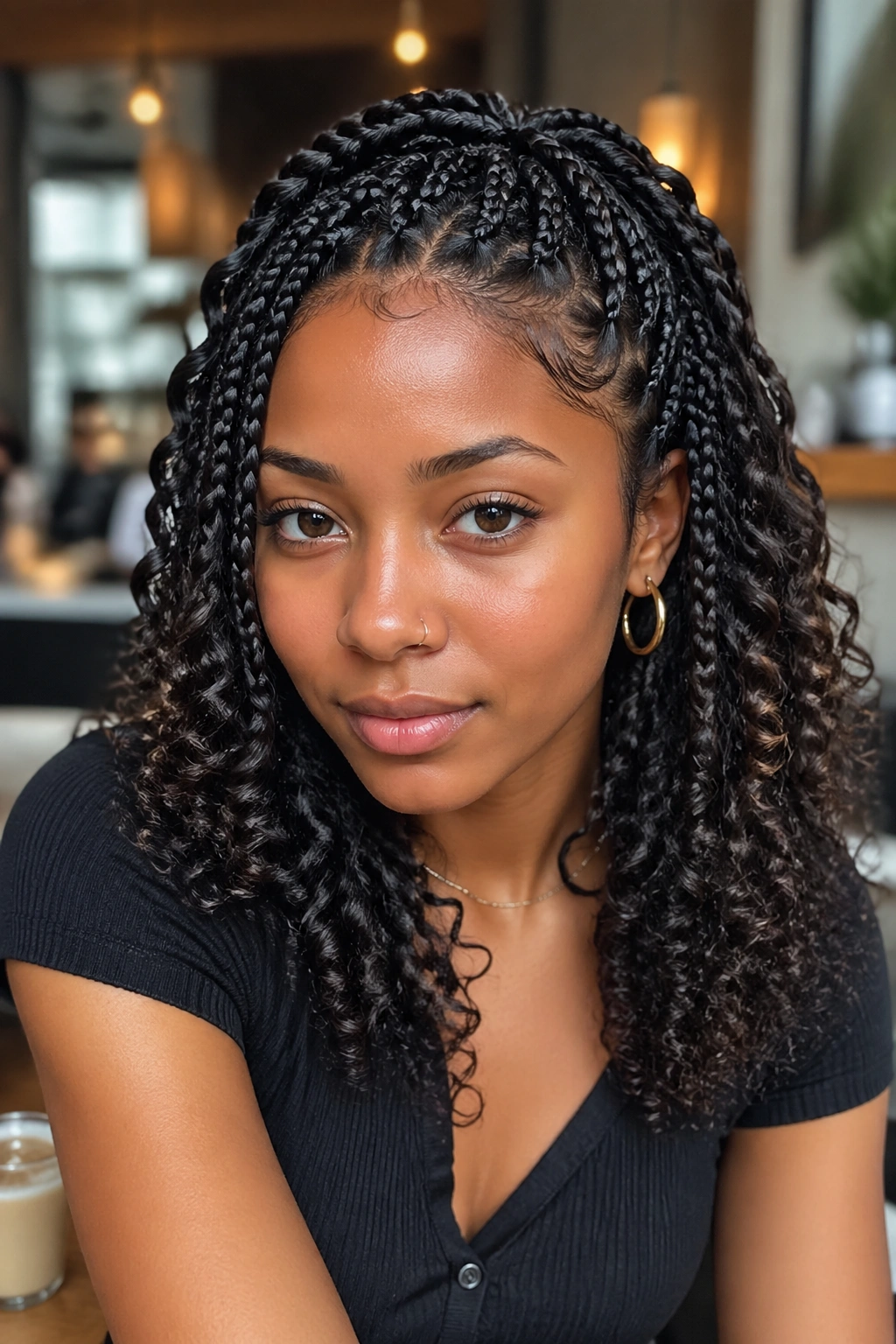
Braids that run at a diagonal angle across the head — sweeping from one corner to the opposite corner — with free natural curls filling the sections adjacent to and between the diagonal braids. The diagonal direction of the braids creates a dynamic sense of movement across the head.
Most braiding patterns run either front-to-back or side-to-side. Diagonal braids break that pattern deliberately, creating a more graphic, asymmetric composition that looks genuinely different from standard braided styles.
20. Triangle Box Braids With Curl Section
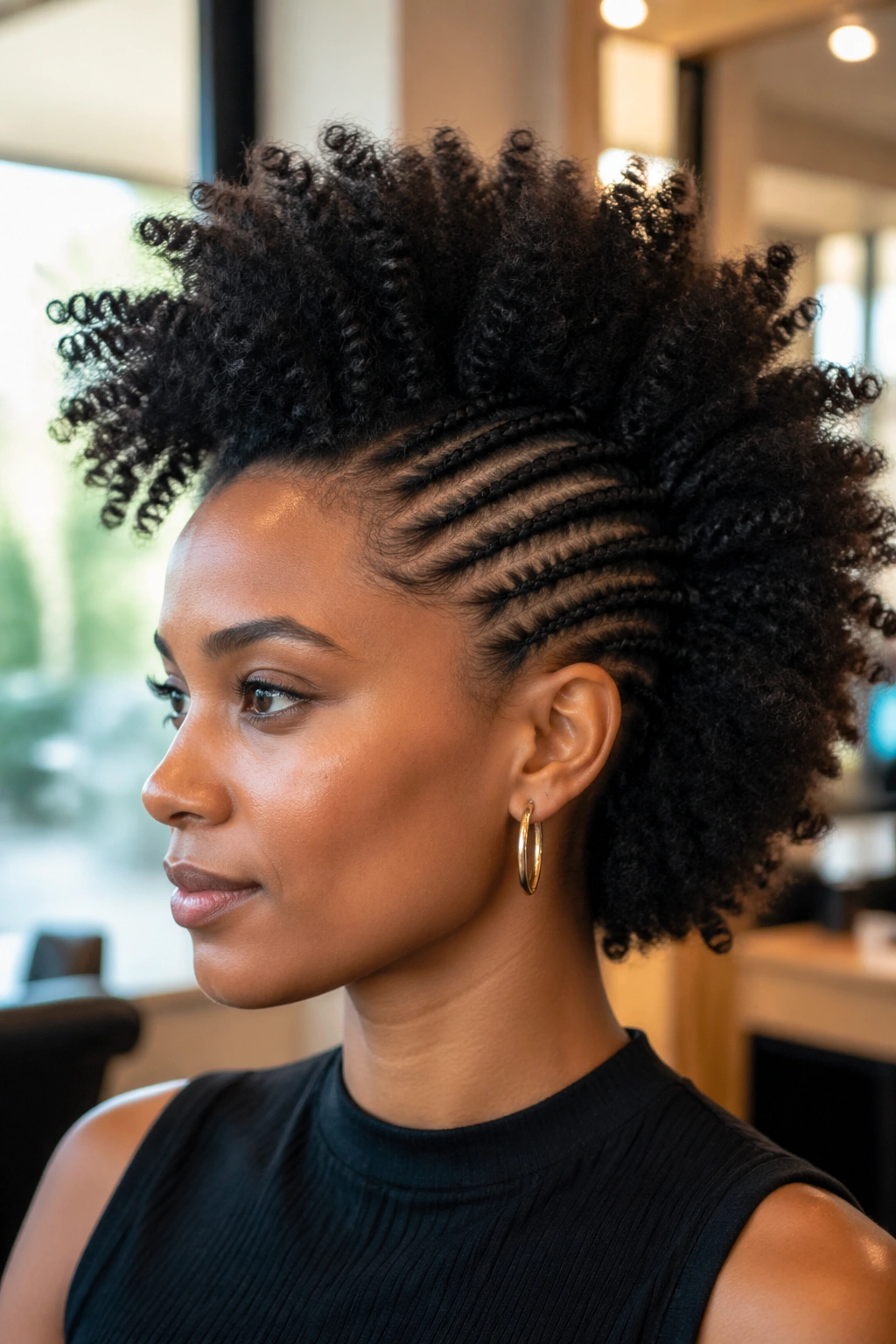
Box braids parted in triangular sections rather than the typical square sections. The triangular parting pattern creates a more intricate, geometric look at the scalp between the braids. A section of free natural curls sits alongside the triangle box braids, creating a textural contrast.
Triangle parts are more time-consuming than square parts, but the result is a style that looks more detailed and deliberate. Combined with a free curl section, the intricacy of the parting pattern is framed by the organic, unpatterned curl texture.
21. Rubberbanding With Natural Curl Sections
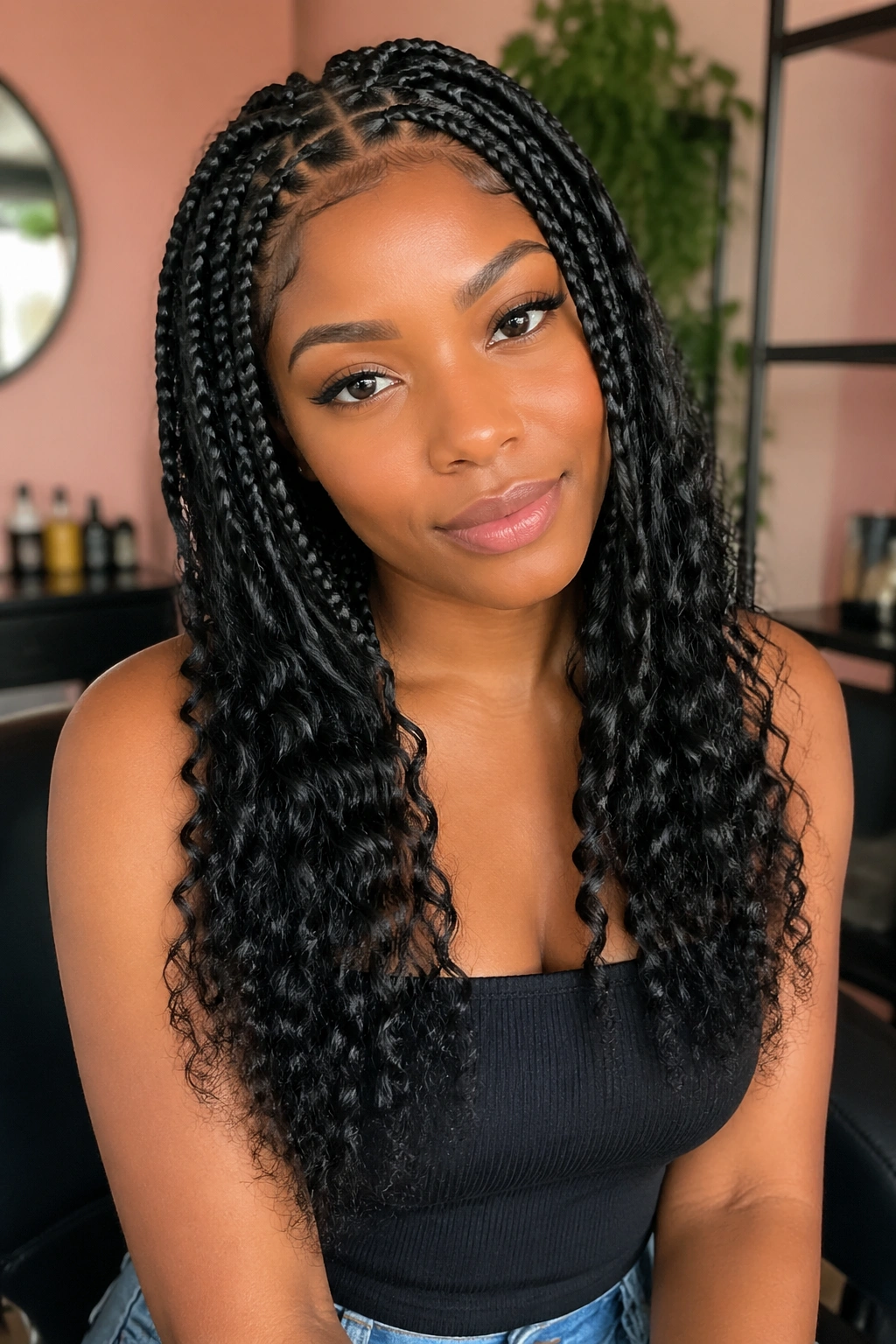
Rubberbanding — creating a series of tight, gathered sections along a ponytail using multiple small elastics placed along the hair’s length — in some sections, while adjacent sections remain as free natural curls. Each rubberbanded section has a distinctive segmented appearance, like a caterpillar of hair.
The rubberbanded sections create a graphic, repetitive pattern that contrasts with the freeform nature of the adjacent natural curl sections. This is a casual, fun style that requires no braiding skill.
22. Braids With Space Between for Curl Access
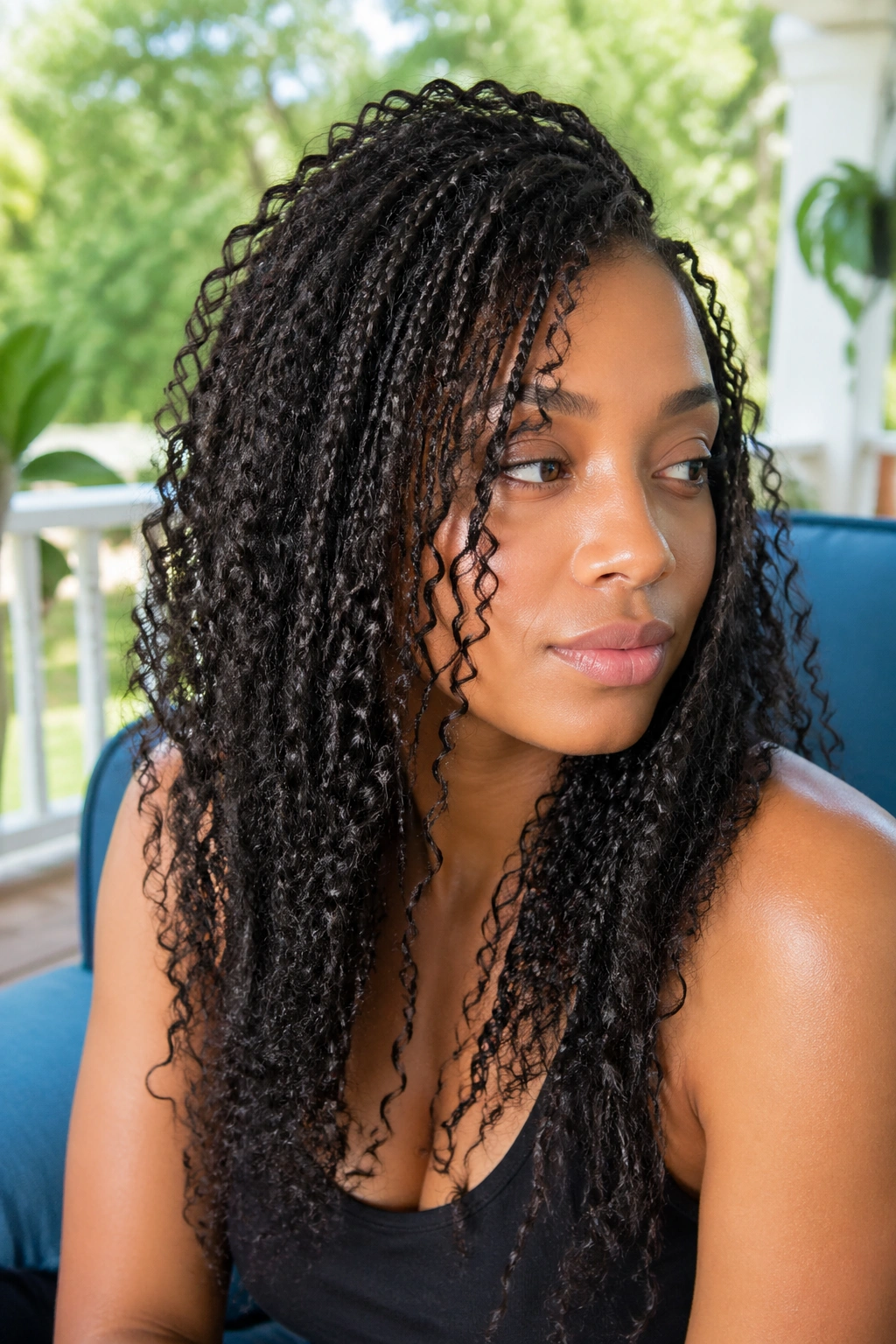
A braided style where the braids are spaced more widely than usual — leaving substantial, deliberate gaps between each braid. The natural hair in those gaps is free and styled as curls, visible and prominent between the braided sections.
Instead of the braids being close together and dominating the look, this configuration gives equal real estate to the curl sections. The result is a more even split between braided and curly — a genuine fifty-fifty composition.
23. Bantu Knot and Braid Combination
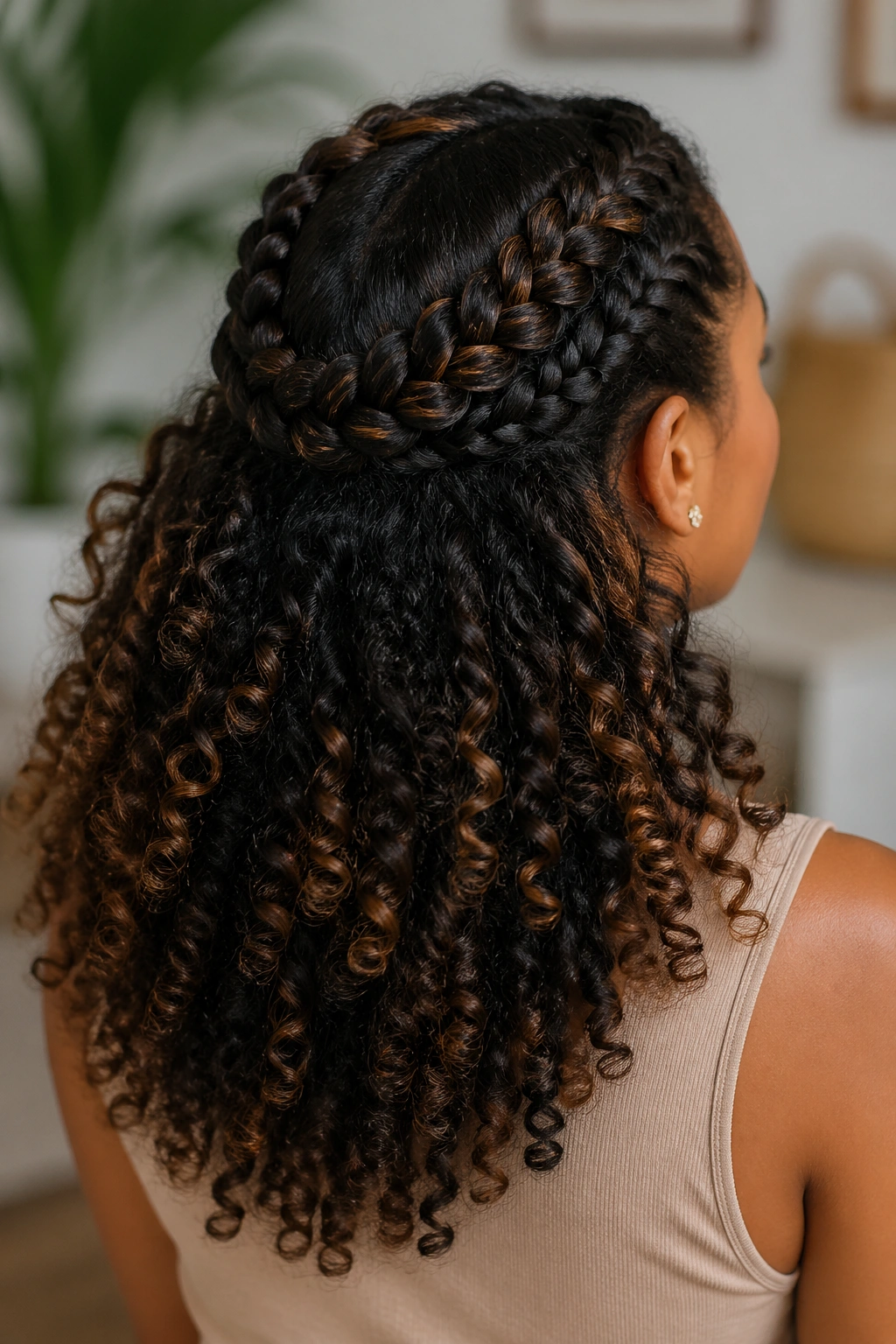
Bantu knots in some sections — the coiled, spiraled knots created by twisting and coiling sections of hair against the scalp — with braids in adjacent sections and free natural curls in other sections. Three distinct hair textures and styles in one composition.
This style is as ambitious as it sounds. It takes planning, time, and a clear vision. But the result is unlike anything else — a multi-element natural hair composition that uses Bantu knots, braids, and free curls to create something genuinely complex and personal.
24. Braids With Curl-Out Ends
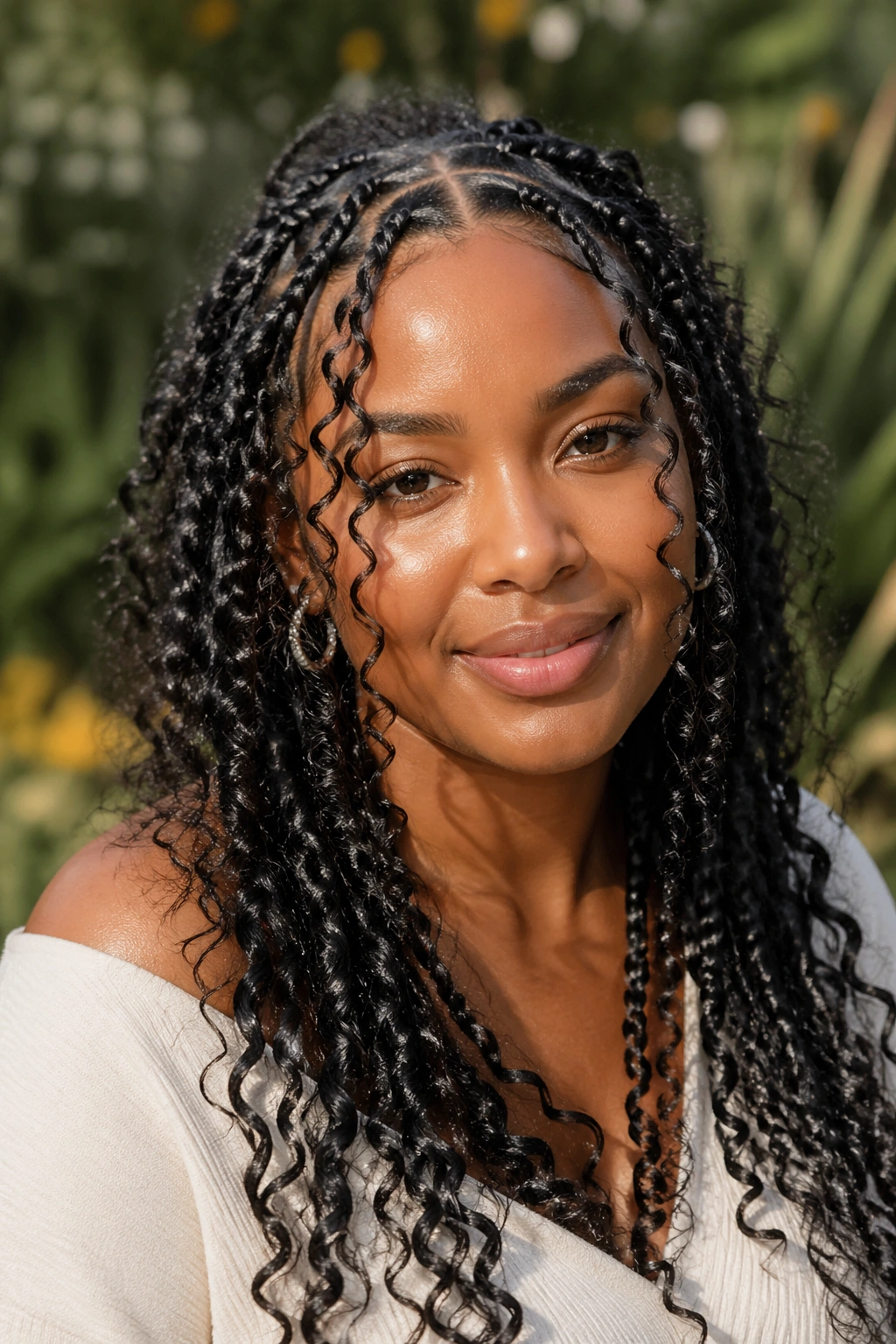
Braids throughout the hair, with the ends of each braid left loose and allowed to curl naturally. After braiding, the natural hair at each braid’s end is finger-coiled, scrunched, or wand-curled to create defined curl ends. The braided body; the curly finish.
This approach works best on natural hair that has enough length at the end of each braid for the curl section to be visible. At least two to three inches of free natural hair at the tip creates an effective curl-out end that doesn’t disappear into the braid.
25. Full Braids Pulled Into Curl Section Ponytail
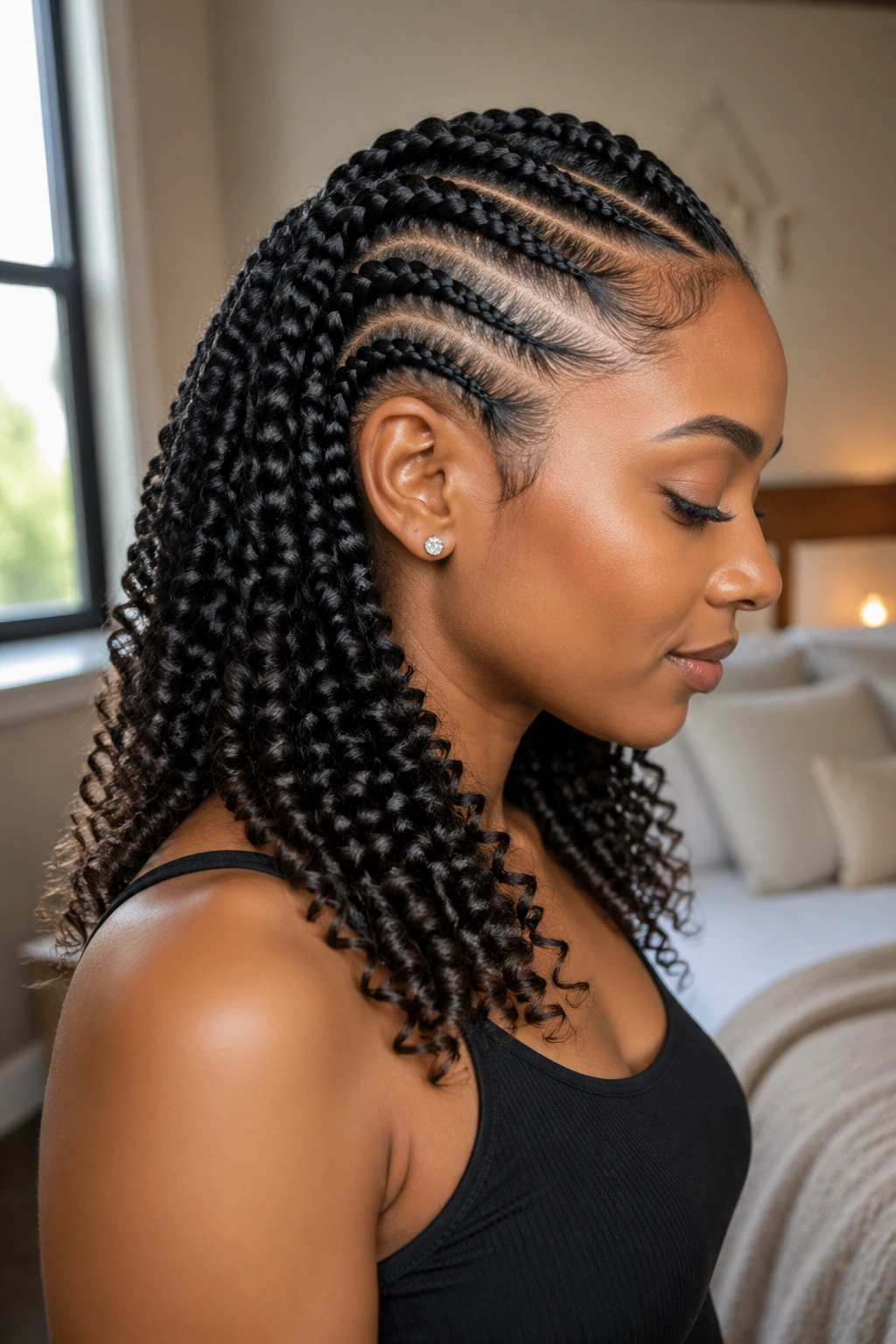
All or most of the hair is in individual braids. But the entire braided section is gathered into a ponytail, and at the ponytail’s end, the braids give way to a free curl section. The ponytail itself is braids; the end is curls.
The visual effect is of a sleek, structured ponytail that suddenly opens into a natural curl explosion at the end. It’s a style with a surprise reveal — from the front, it looks like a classic braided ponytail; the curly end isn’t visible until you see it from behind or as the hair moves.
Washing and Maintaining Braids With Curls
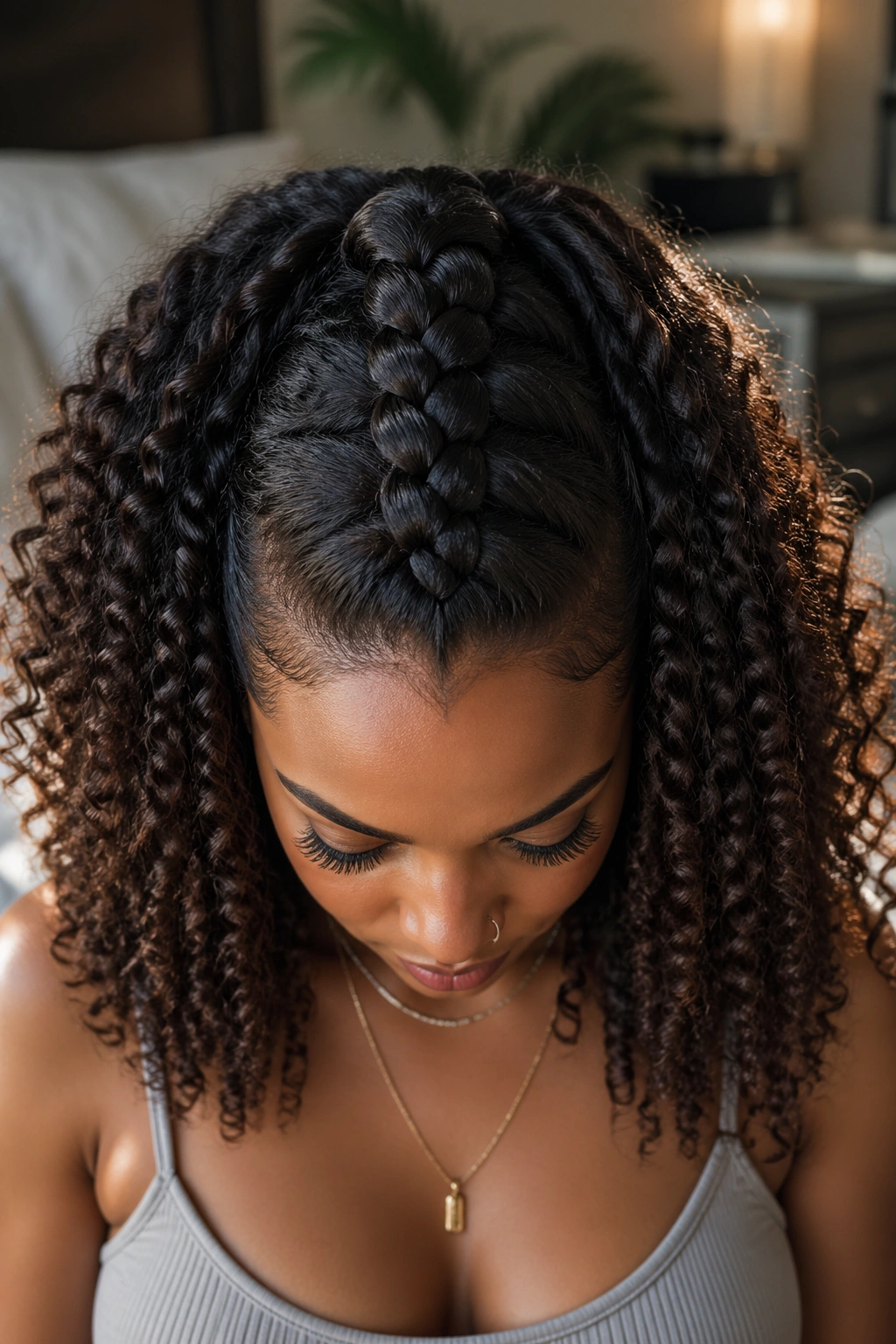
Washing a braids-with-curls style requires different approaches for the braided and curl sections.
For the braided sections: dilute shampoo in a spray or squeeze bottle and apply it directly to the scalp between the braids. Massage gently with your fingertips, working the product from root to mid-length without disturbing the braid pattern. Rinse thoroughly by directing water through the braids. Avoid rubbing the braids against each other — this causes frizzing and loosening.
For the curl sections: wash as you normally would — apply shampoo, massage gently, rinse, apply conditioner, detangle carefully with fingers or a wide-tooth comb, rinse, and apply leave-in conditioner and styling products while damp. Let the curl sections air dry or diffuse on low heat.
The biggest challenge is drying. Braided sections hold moisture much longer than free curl sections. Make sure the braided sections are fully dry before putting on any protective covering overnight — damp braids covered with a bonnet or scarf develop mildew and an unpleasant odor.
Product Recommendations for Braids-With-Curls Styles
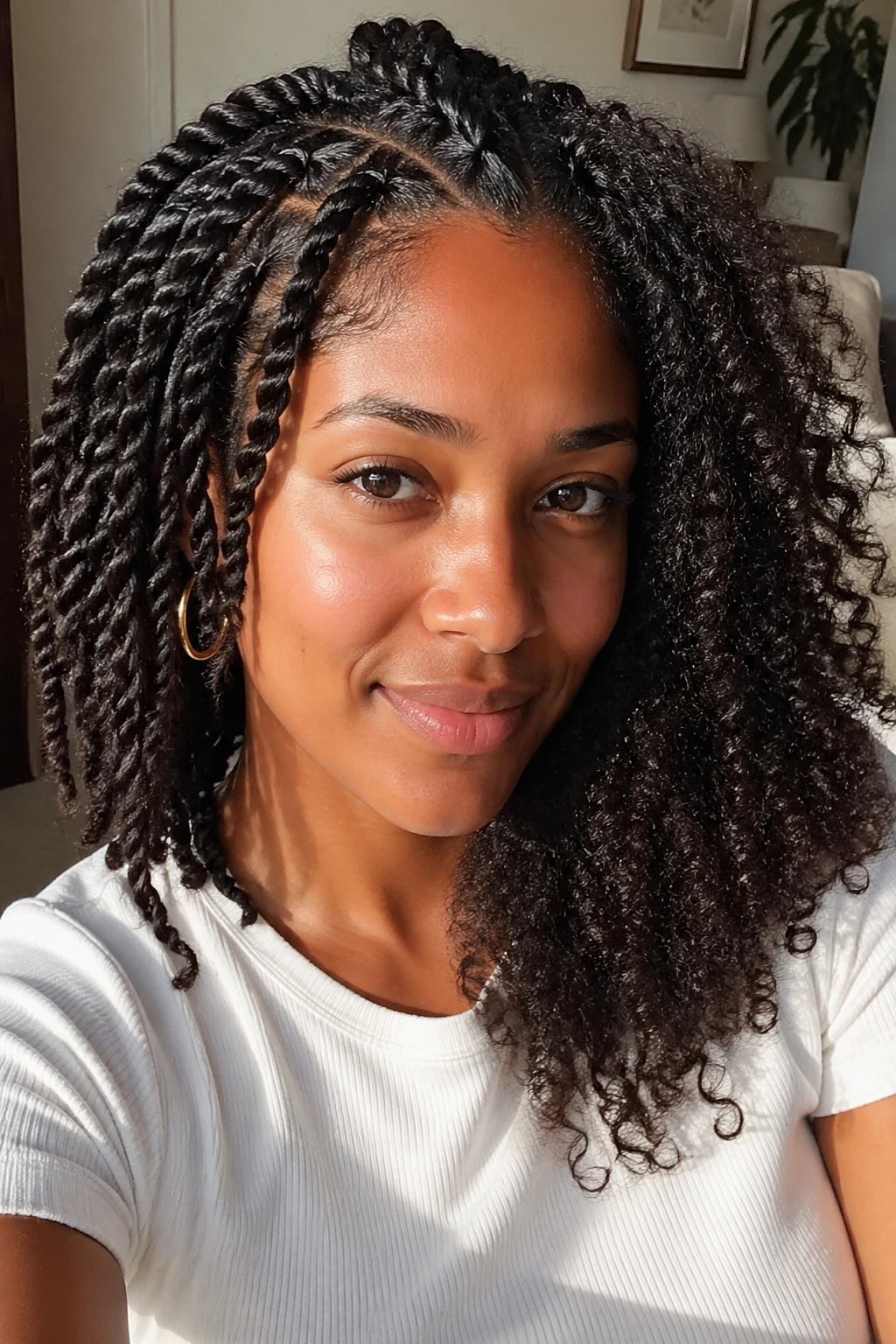
The braided sections need different products than the curl sections, and layering the wrong products in the wrong areas creates issues.
For the braided sections: a lightweight scalp oil applied with a dropper bottle keeps the scalp moisturized without making the braids look greasy. A braid spray — water-based, light — refreshes the braids if they’re looking dull. Avoid heavy creams or butters on the braided sections; they collect lint and cause buildup.
For the curl sections: your standard wash-and-go or twist-out products work as usual. A leave-in conditioner, followed by a curl cream or gel, followed by scrunching — the same routine you’d use for any curly style. A light oil applied over the top of the curl section once dry adds shine.
Edge control is important for the hairline, especially in styles where cornrows or flat twists run along the perimeter of the head. A small amount applied with an edge brush keeps the hairline looking smooth and polished throughout the style’s lifespan.
When to Transition or Take Down the Style
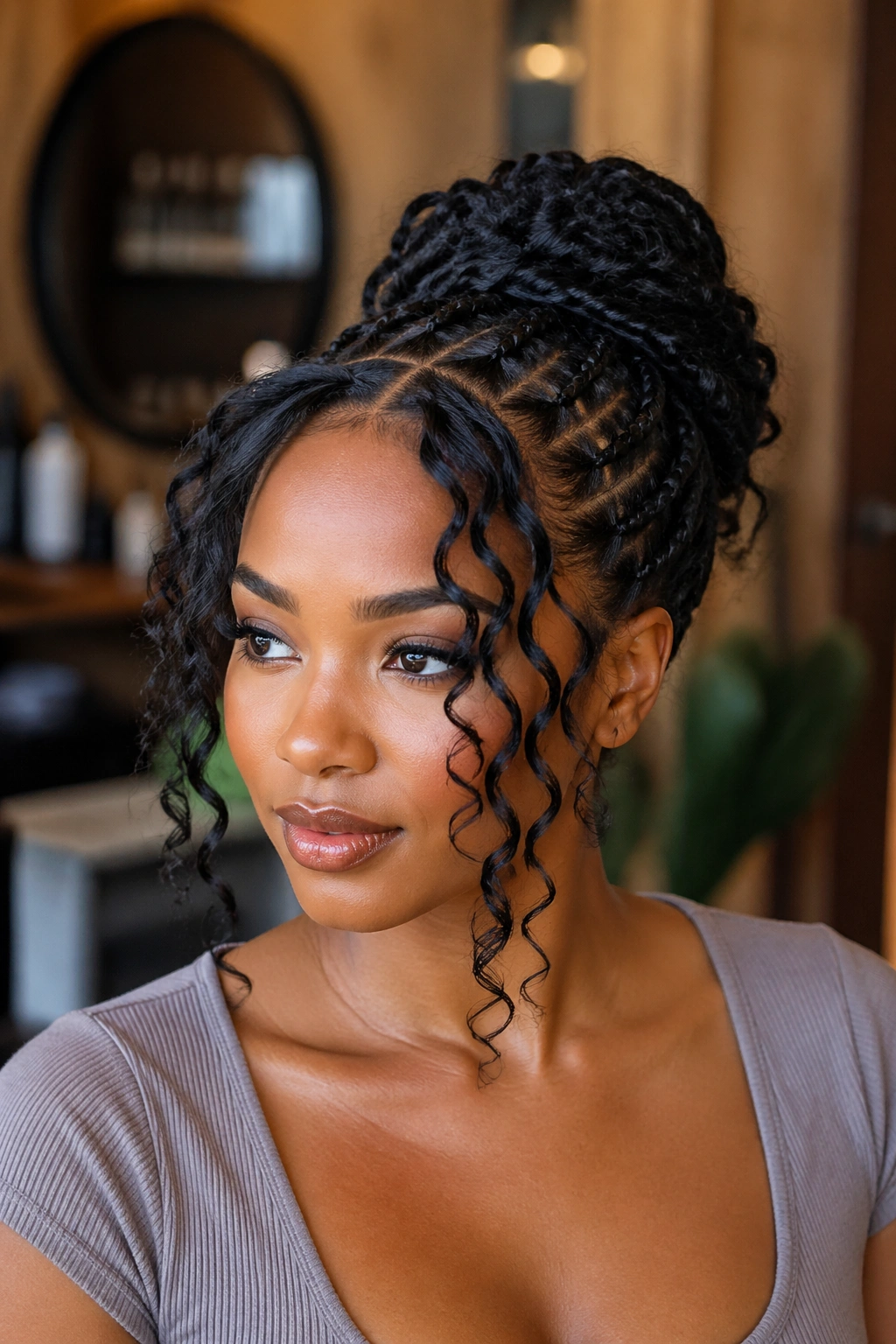
Braids-with-curls styles generally last two to six weeks depending on the type of braids and the maintenance routine. Cornrows and flat twists on the shorter end; individual box braids or knotless braids on the longer end.
Signs it’s time to take the style down: significant new growth causing the braids to lift from the scalp (creates tension and can cause traction alopecia); lint accumulation in the braids; mildew smell that doesn’t go away after washing; thinning or breakage visible at the edges of the braided sections.
Take down braids carefully and patiently. Cut any braiding hair extensions at the sealed tip before removing (don’t try to unravel the entire braid from the tip inward — this causes tangles and breakage). Work from the ends upward, removing each braid gently. Apply a small amount of detangling oil to each section as you remove the braid. Once all braids are removed, deep condition immediately and detangle thoroughly before washing.