



Braids in front curls in back is one of the most naturally flattering hair configurations for Black women with natural hair. The braids frame the face with structure and intention — drawing the eye to the forehead, cheekbones, and jawline — while the back section bursts free in a full, unrestrained display of natural curl texture. It’s the best of both worlds, and it’s a style category with far more variation than most people realize.
Why This Configuration Works So Well
The front-braids-back-curls configuration works on a simple visual principle: structure where it matters most, freedom where it can be most dramatic. The front of the hair is what people see first. It’s what appears in every photo taken from a conversational distance, what frames the face in the most intimate views, and what establishes the first impression of the overall style. Braids at the front provide a clean, organized frame — something polished and intentional that anchors the entire look.
The back of the hair, by contrast, is the section that creates the overall silhouette. It’s what you see from a distance, what catches light as you move, and what creates the sense of volume and presence that makes a natural hair style truly impressive. Free curls at the back create maximum visual volume and movement — qualities that braids alone can’t achieve.
Together, the front braids and back curls create a composition with a clear sense of structure and depth. The style has a front and a back that are genuinely different from each other, and that difference is part of what makes it so dynamic. Every angle offers something distinct.
The Fulani Connection and Cultural Context
The braids-in-front-curls-in-back configuration is most directly associated with Fulani braiding traditions from West Africa. Traditional Fulani styles feature cornrows at the crown and front with a gathered or free curl section at the back — a configuration that has existed in various forms across generations of West African hair culture.
The widespread adoption of this configuration in contemporary natural hair communities reflects a broader reconnection with African hair traditions that has grown significantly over the past two decades. Women who wear braids in front with curls in back aren’t just following a styling trend — they’re participating in a tradition with genuine cultural depth.
Honoring that heritage doesn’t require copying a specific historical style exactly. It means understanding where the aesthetic comes from, bringing intention to the styling choices you make, and incorporating traditional decorative elements — beads, cowrie shells, gold cuffs — if they feel meaningful to you.
Building the Braided Front Section
The front section of a braids-in-front-curls-in-back style runs from the hairline backward to approximately the top of the ear or the crown, depending on how much of the hair you want braided. The braided section needs to be defined precisely before you begin, because the quality of the braided section’s execution determines the overall success of the style.
Sectioning is critical. Create a clean horizontal part running from ear to ear across the crown to separate the front section from the back section. Use a rat-tail comb for precision. The line should be smooth and straight — a jagged or curved part line creates an unfinished appearance that undermines even the best braiding work in the front section.
Once the front section is clearly defined, decide what braiding approach you’ll use. Cornrows lying flat against the scalp are the most traditional choice and create the cleanest look. Flat twists offer a similar flat appearance with a slightly softer, more raised ridge. Individual box braids or knotless braids create a bolder, more voluminous front section. Feed-in braids create tapered, precise lines that look extremely polished.
Part the front section into the subsections your chosen braid configuration requires. For standard cornrows: create clean rows running from the front hairline backward. For a Fulani configuration: create a center part and angle side braids outward. For individual box braids: create square or triangular sections throughout the front section.
Preparing the Curl Section
The back section — the curl section — should be washed, deeply conditioned, and styled with your regular curl definition products before any braiding begins. The reason: you can’t easily get products to the roots of the back section once the front is braided, especially if the braided sections extend all the way to the top of the ear.
Wash and deep condition the back section thoroughly. Apply leave-in conditioner while still damp. Apply your curl defining product — cream, gel, or a combination — and scrunch upward. Let the back section begin to dry, or diffuse it, before you start working on the front braided section.
The back section should be at least partially dry when you start braiding the front. Wet curls next to fresh braids tend to disturb the braid tension as the hair dries and shrinks, and damp hair in contact with braids for long periods can cause mildew smell.
Decorating the Front Braids
The front section of a braids-in-front-curls-in-back style is visible every time someone looks at you face-on. The decorative choices you make for the front section set the tone for the entire look.
Beads are the most traditional and widely used decoration. Thread them onto the ends of cornrows or box braids before sealing the tip. Wooden beads in earth tones feel organic and bohemian. Gold metallic beads feel formal and elevated. Multicolored beads feel playful and youthful. The bead size should be proportional to the braid size — oversized beads on micro braids look clumsy; tiny beads on thick goddess braids can look sparse.
Gold cuffs placed along the length of the braids — not just at the ends — create a shimmer effect that’s visible from across the room. Cuffs at intervals of one to two inches along the front cornrows or box braids catch light as you move, animating the static braided section.
Cowrie shells carry cultural significance and look beautiful threaded onto braids. They can be placed at the tips, at intervals along the length, or at the very front where the braid meets the hairline — the most visible position.
For styles without traditional decorations, the quality of the braiding itself is the decoration. Clean parts, even tension, smooth surfaces — precise, well-executed braids need nothing else.
1. Center and Side Cornrows Into Natural Curl Back
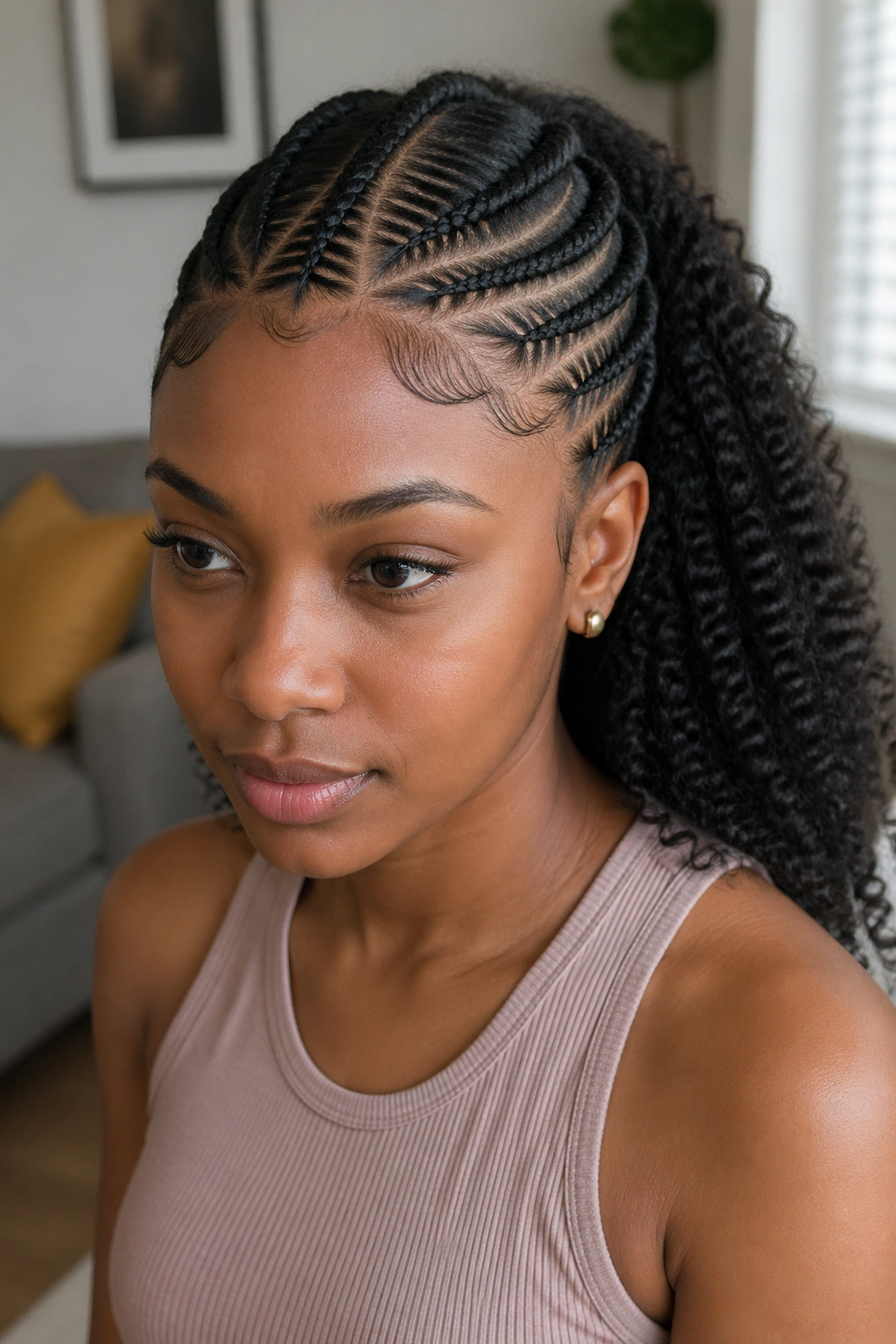
A center cornrow running from the front hairline straight to the crown, with two to four cornrows angling from each temple toward the back of the front section. The back section flows entirely as free natural curls.
The Classic Configuration
This is the most traditional version of braids in front curls in back, directly inspired by Fulani braiding traditions. The center braid establishes the style’s spine; the angled side braids create the characteristic Fulani geometry. Behind the ear and below, natural curls take over completely.
The beauty of this configuration is its balance. The braids are precise and graphic at the front; the curls are organic and free at the back. Neither element overwhelms the other.
Add gold cuffs along each braid every inch and a half for a metallic accent that bridges the gap between the structured front and the free curl back.
2. Full Front Box Braids With Curly Back
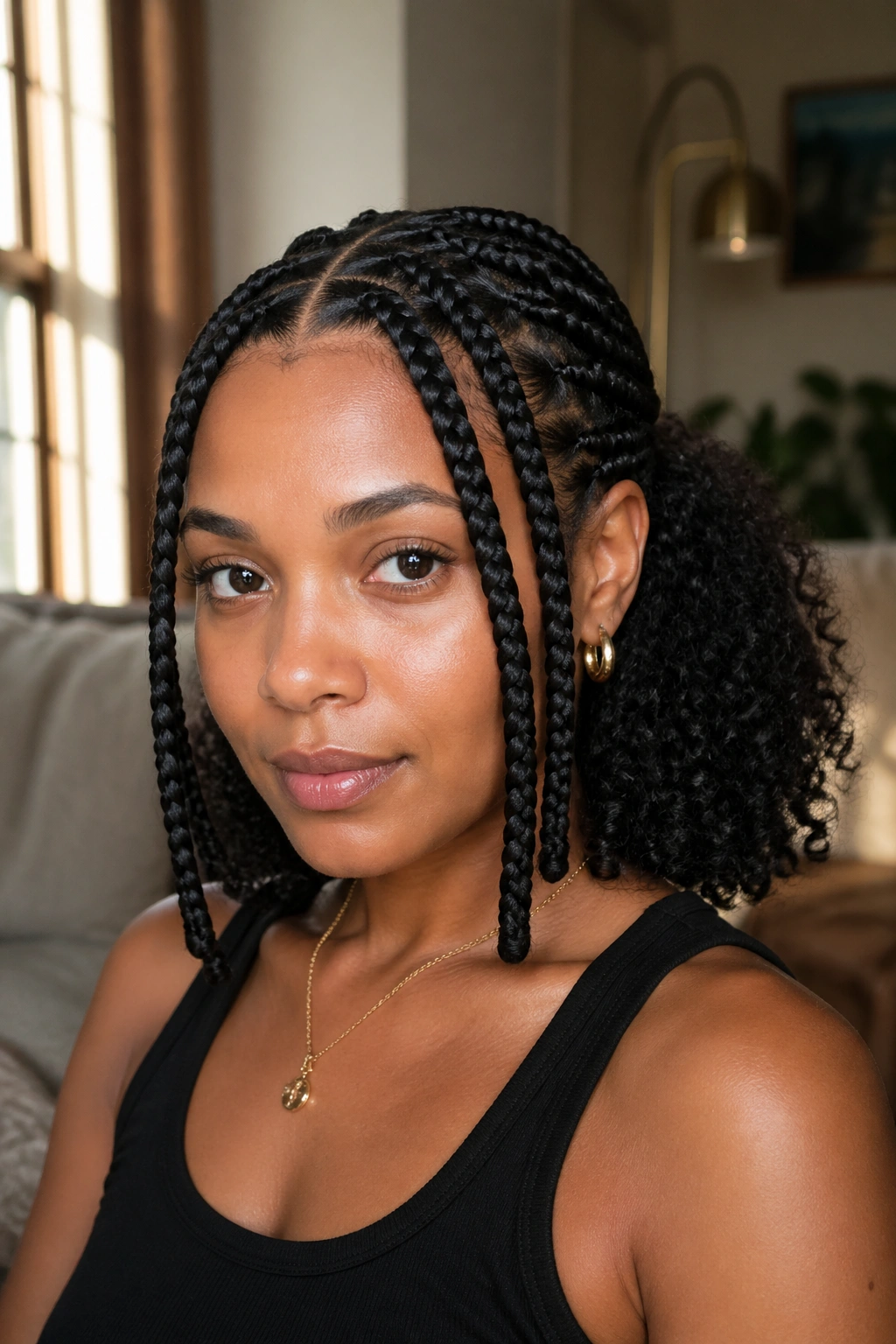
The entire front section — from the hairline to just above the ear — is covered in medium individual box braids. The back section, from the top of the ear down, is free natural curls.
Box braids in the front section are thicker and more voluminous than cornrows, creating a bold, full front that frames the face powerfully. The transition to natural curls at the back creates a dramatic textural shift.
The line where the box braids meet the natural curls is the style’s most critical moment. This transition should look clean and intentional, not like two different styles mashed together. Creating a clear, defined part at the boundary point and using edge control along that line helps.
3. Feed-In Cornrows Into Curly Puff
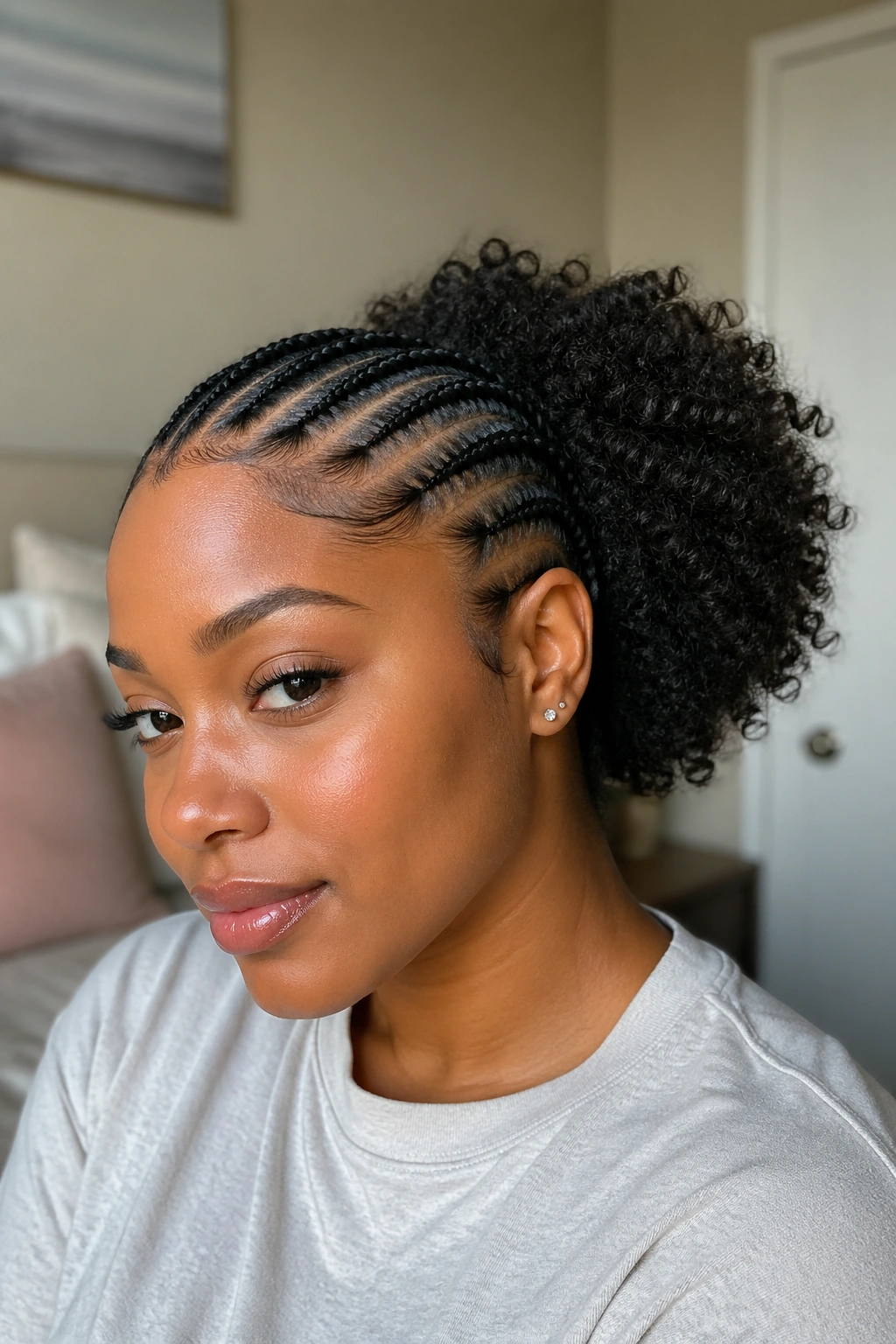
Precisely tapered feed-in cornrows in the front section, starting thin at the hairline and widening as extensions are added. The back section is gathered into a large, full natural curl puff at the nape or back of the crown.
Feed-in cornrows are among the most polished and professional-looking braiding techniques available. The gradual thickening of each braid from root to tip looks natural and deliberate. Combined with the full curl puff at the back, this creates a style that reads as simultaneously structured and celebratory.
The curl puff at the back should be as full and round as the hair allows. Don’t over-control it — the contrast between the precision of the feed-in cornrows and the free volume of the puff is the style’s defining tension.
4. Knotless Front Braids With Loose Curl Cascade
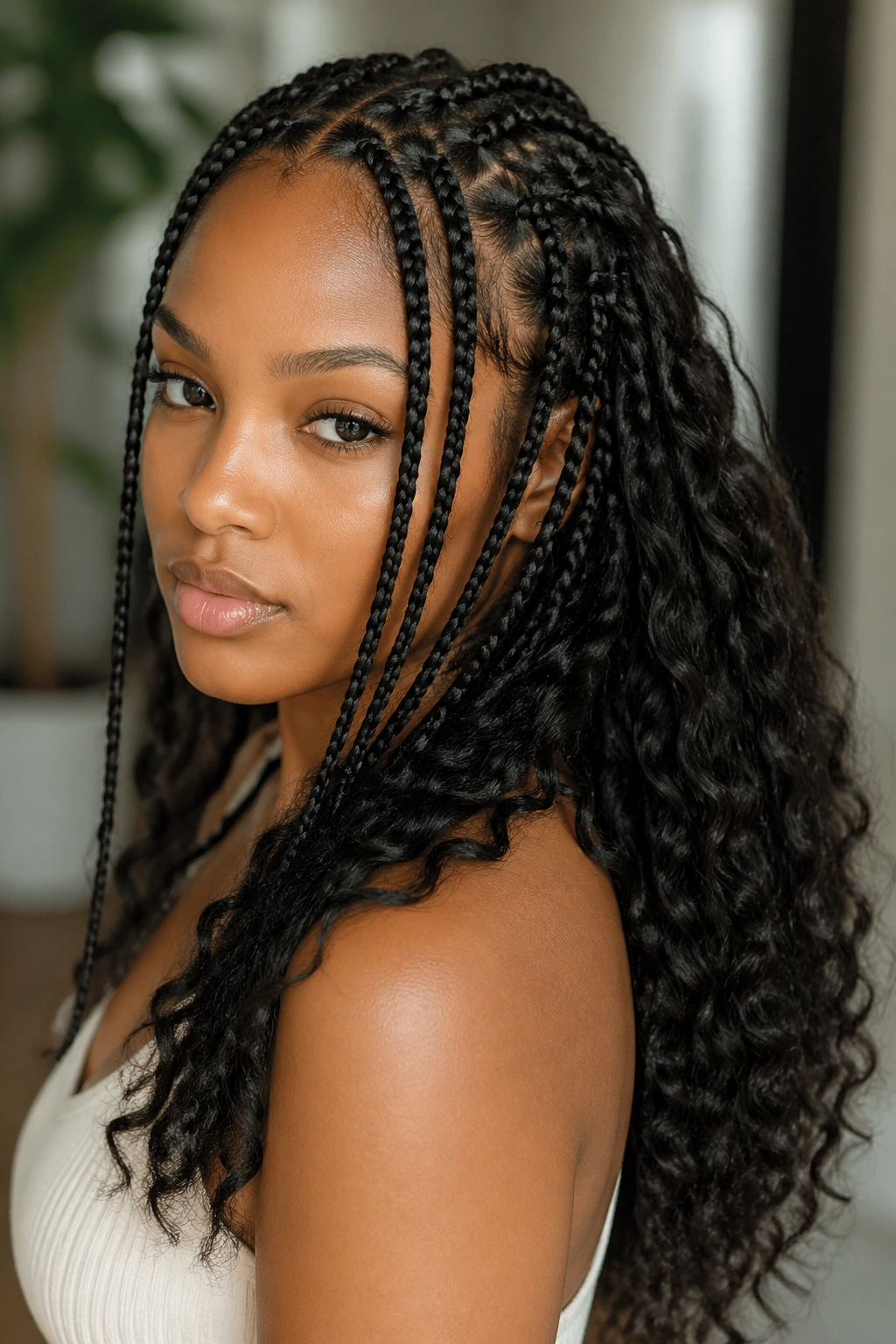
Knotless individual braids in the front section — with their seamlessly natural-looking starts at the root — with a full, loose natural curl cascade in the back. The knotless technique creates braids that look like they grew directly from the scalp, which creates the most organic transition to the natural curl section at the back.
The seamlessness of knotless braids makes this version feel especially cohesive. There’s no abrupt “braids start here” moment — the knotless braids ease into the style so naturally that the front and back sections feel like parts of one continuous hair story.
5. Cornrow Front With Twist-Out Curl Back
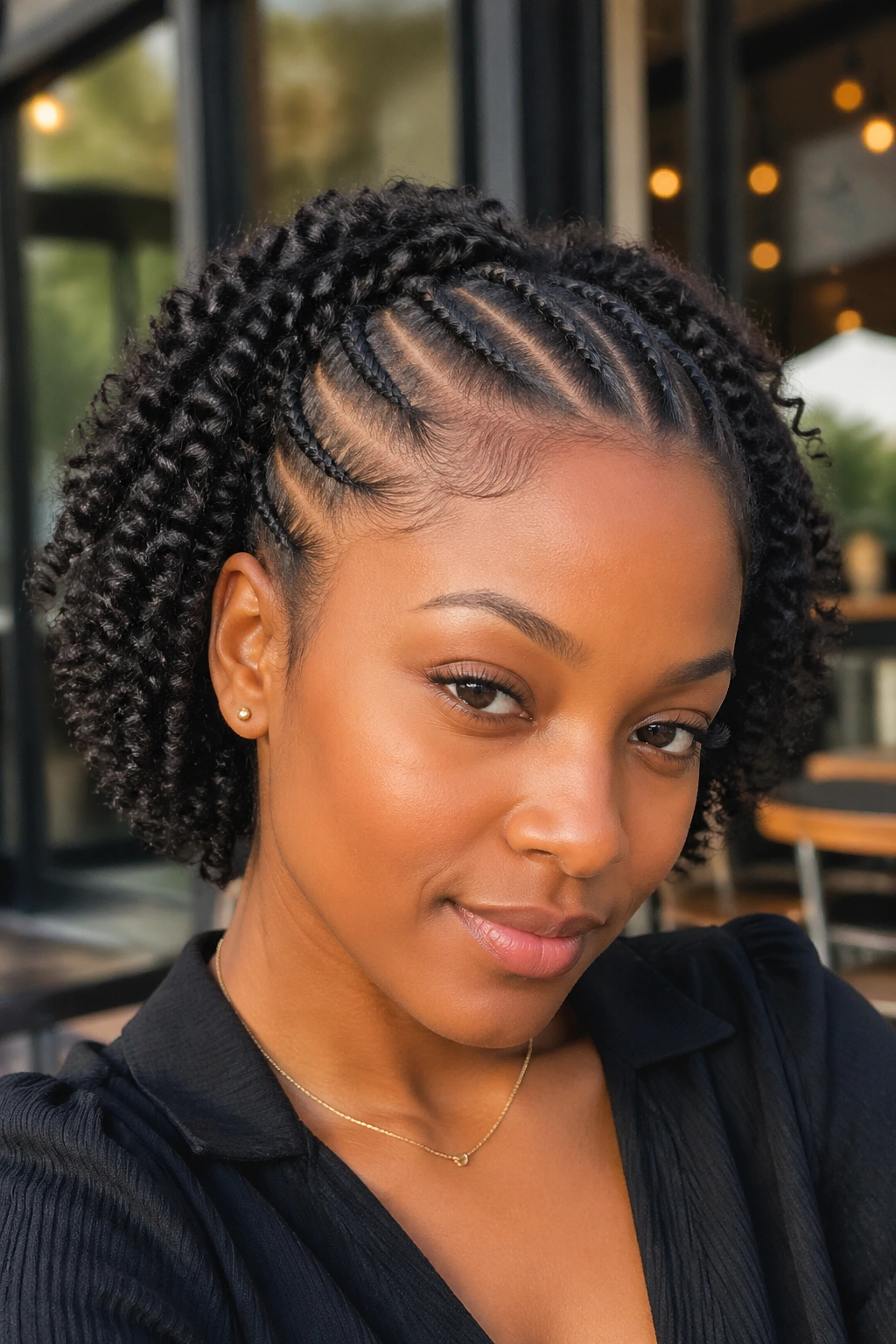
The front section features clean, flat cornrows. The back section is a twist-out — natural hair that’s been two-strand twisted, allowed to dry fully, then unraveled for a defined, uniform curl pattern. The twist-out curls are more defined and uniform than a wash-and-go, creating a slightly more polished back section.
The cornrow front and the twist-out back are both intentional and styled. This isn’t a contrast between structure and free texture — it’s a contrast between two different kinds of deliberate styling. The overall look is more formal and polished than a version with wash-and-go curls at the back.
6. Lemonade Braid Front With Natural Curl Back
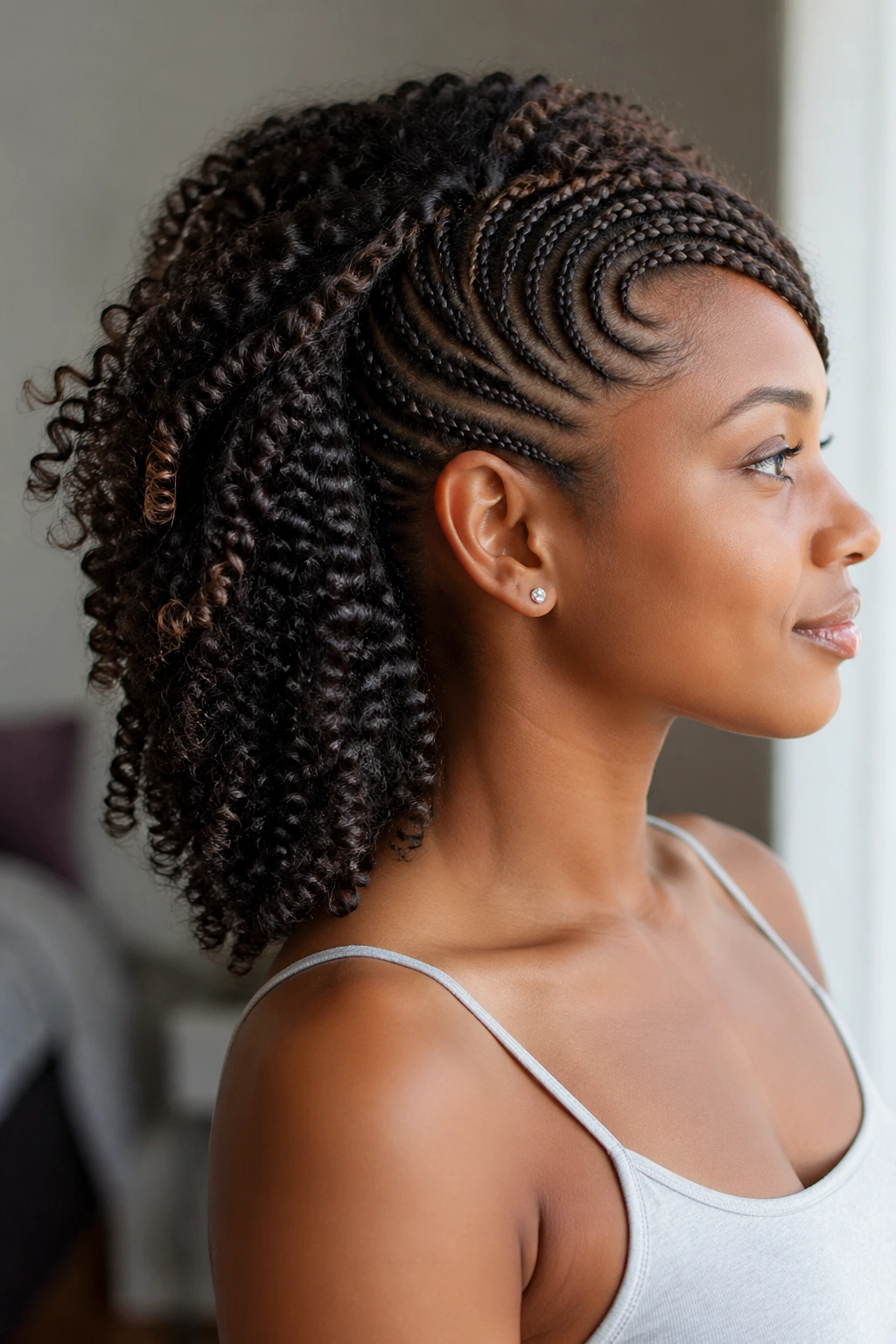
Lemonade braids — cornrows that sweep to one side of the head rather than going straight back — in the front section, with natural curls in the back. The side-sweeping direction of the lemonade braids at the front creates a dramatic, asymmetric element that’s immediately eye-catching.
The natural curls at the back provide the volume and softness that balance the graphic sweep of the lemonade braids. From the front, the style looks bold and directed. From behind, it looks free and full. The profile view is the best angle — the sweep of the front braids and the volume of the back curls in a single view.
7. Ghana Braid Front With Volume Curl Back
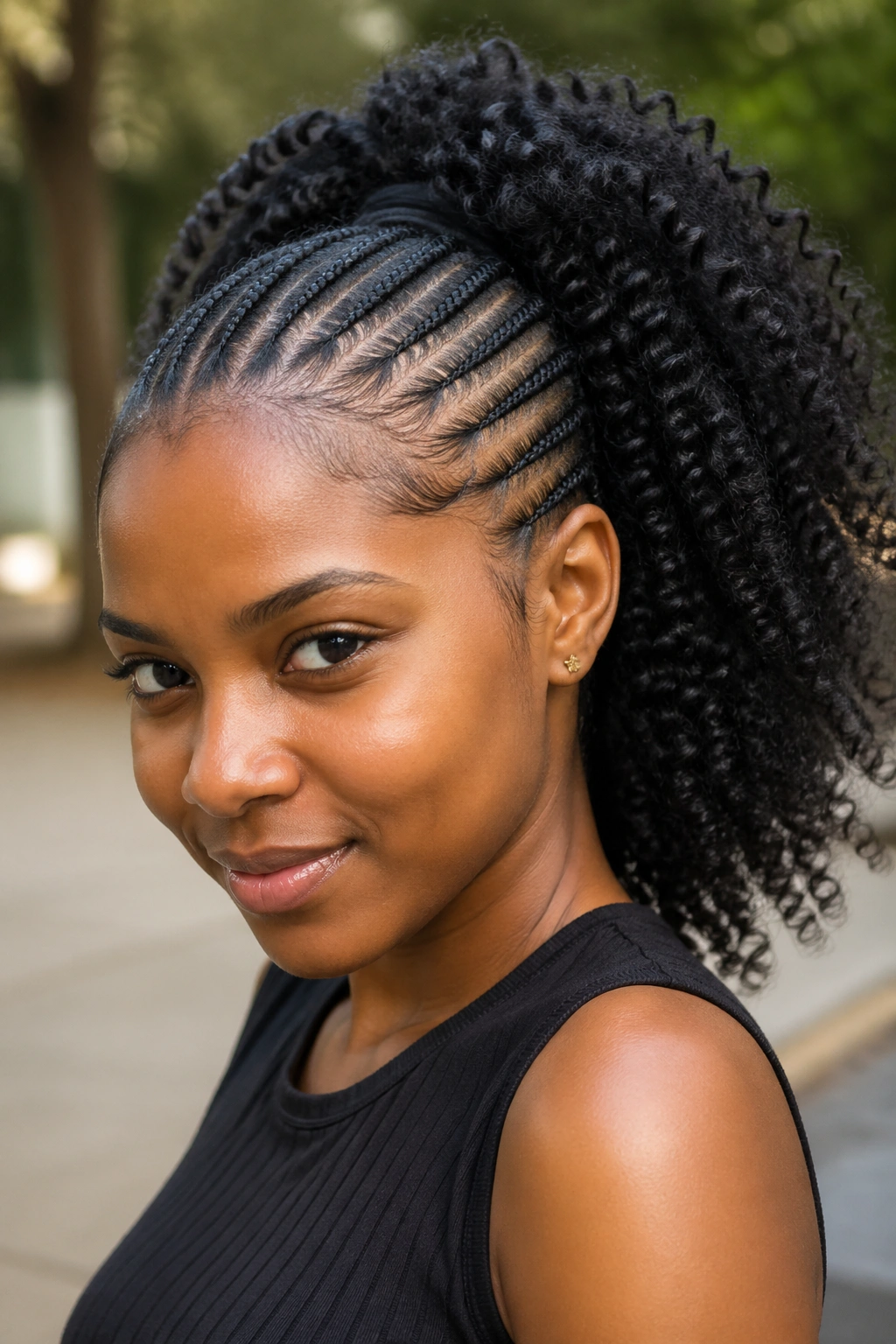
Ghana braids in the front — thick, tapered cornrows that start thin at the hairline and widen dramatically as they move backward — with a full, voluminous natural curl section in the back. Ghana braids have a dramatic visual weight; the curl section at the back needs to be substantial to hold its own against them.
This is a style for naturals with significant curl density and volume. Thin or low-density natural hair at the back can be overwhelmed by the heavy visual weight of Ghana braids in the front. For those with thinner natural curl sections at the back, adding curl extensions creates the needed volume balance.
8. Micro Braid Front With Natural Curl Back
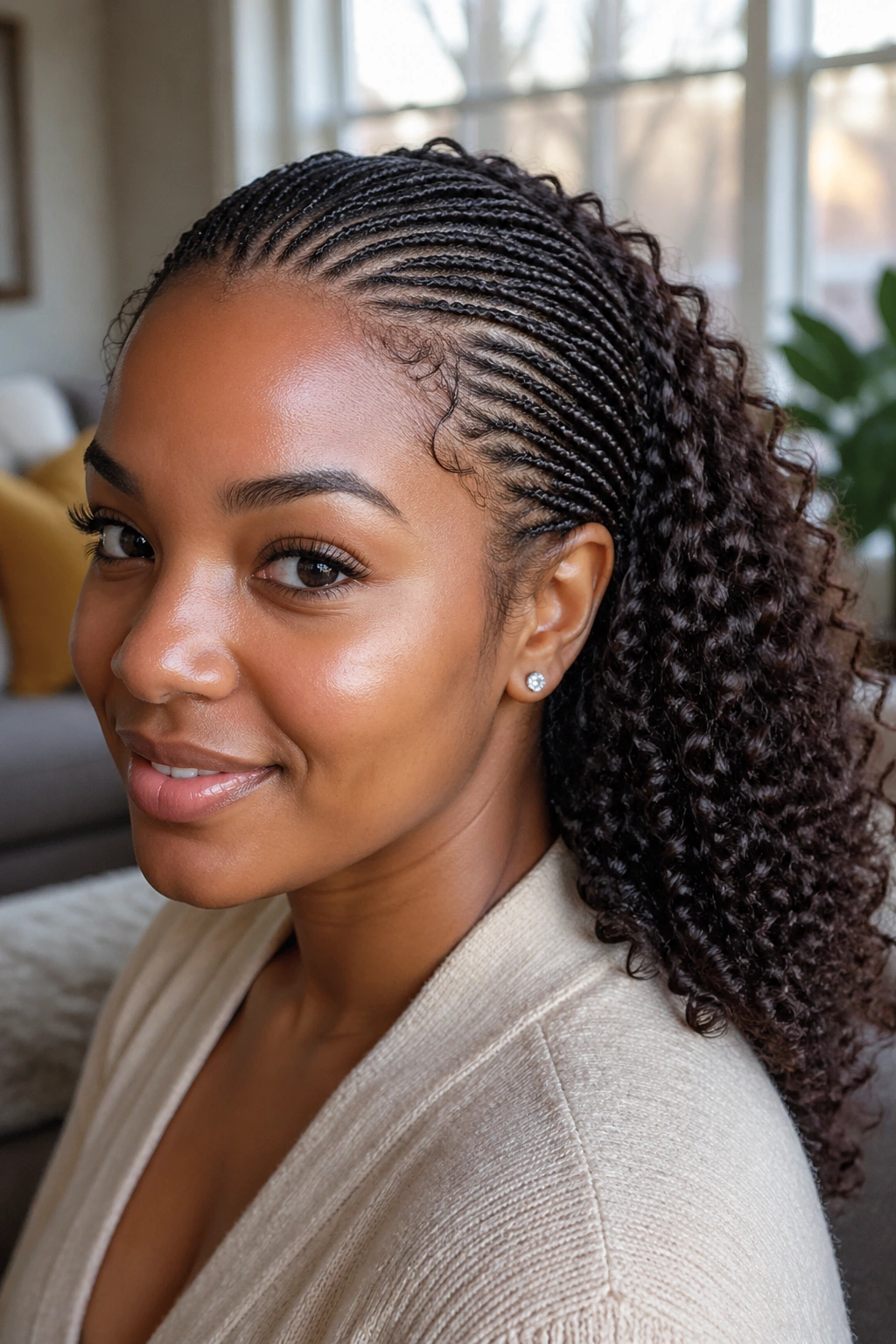
Very thin micro braids filling the entire front section, with natural curls in the back. Micro braids are so fine that they look almost like natural hair from a distance — creating a subtler front braided section than any of the thicker braid styles.
Combined with natural curls at the back, micro braids create a style where the distinction between braided and curly sections is visible up close but reads as a single natural hair look from a distance. This is one of the less dramatic interpretations but also one of the most natural-looking.
9. Goddess Braid Front With Curly Back and Wispy Pieces
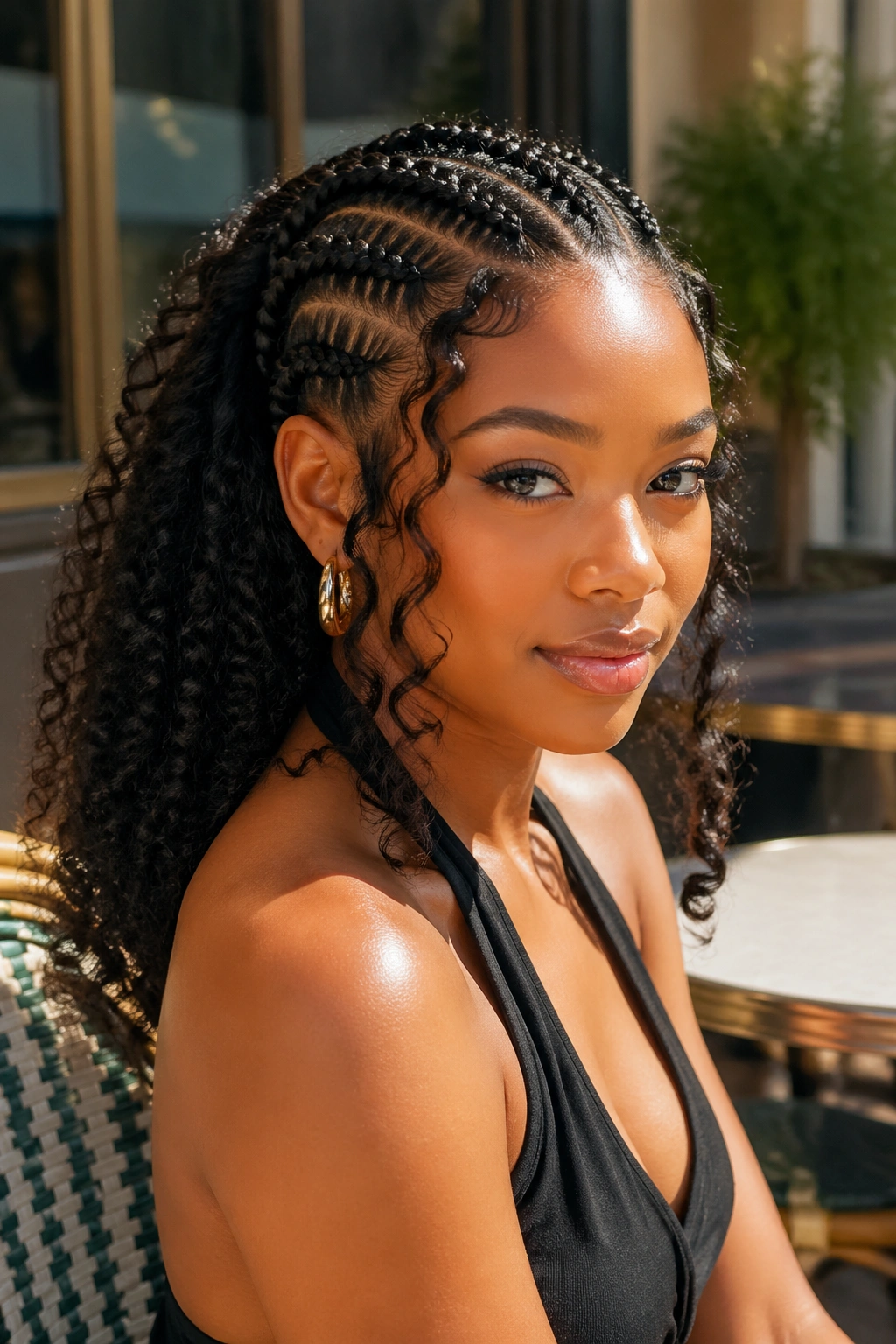
Goddess braids in the front section — thick, raised braids with deliberately pulled-out, wispy strands along their length — with natural curls in the back. The wispy strands pulled out of each goddess braid create a soft, textured perimeter around the braided front section.
Those wispy strands are the key to this style’s character. They blur the line between the braided section and the curl section at the back, creating a gradual transition rather than an abrupt boundary. The style feels organic and handcrafted rather than geometric and rigid.
10. Fulani Braids With Curly Side Sections and Curl Back
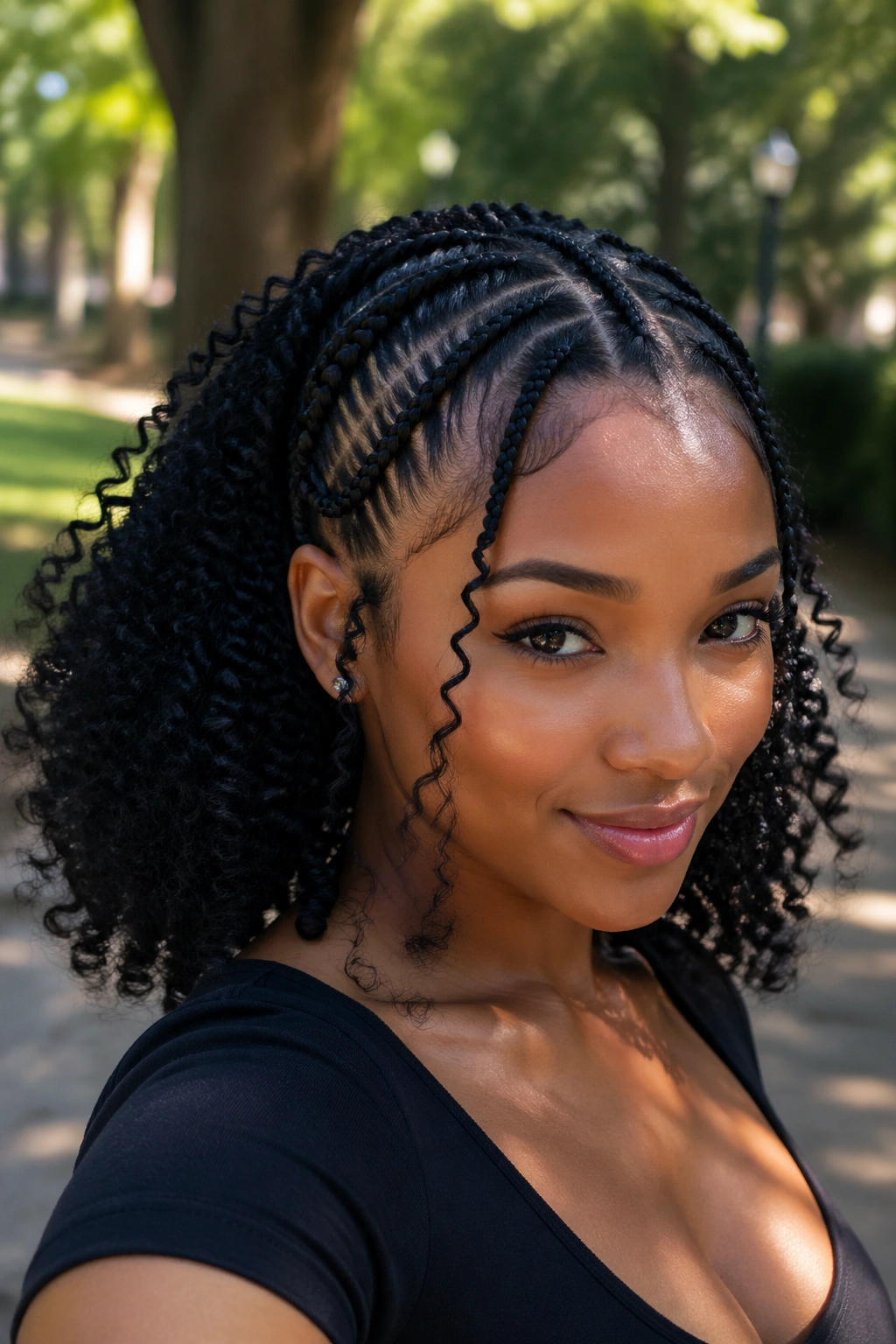
The Fulani configuration in the very front — center braid and angled side braids — but only covering the top and central front of the head. The sides, from the ears forward and down, are free natural curls. The back section is also free natural curls.
This gives the Fulani braiding tradition the most exposure in terms of face framing, while giving the natural curls the most freedom in terms of total volume and presence. The braids frame the very top of the face; the curls frame the sides and back.
11. Two Front Dutch Braids With Full Natural Curl Back
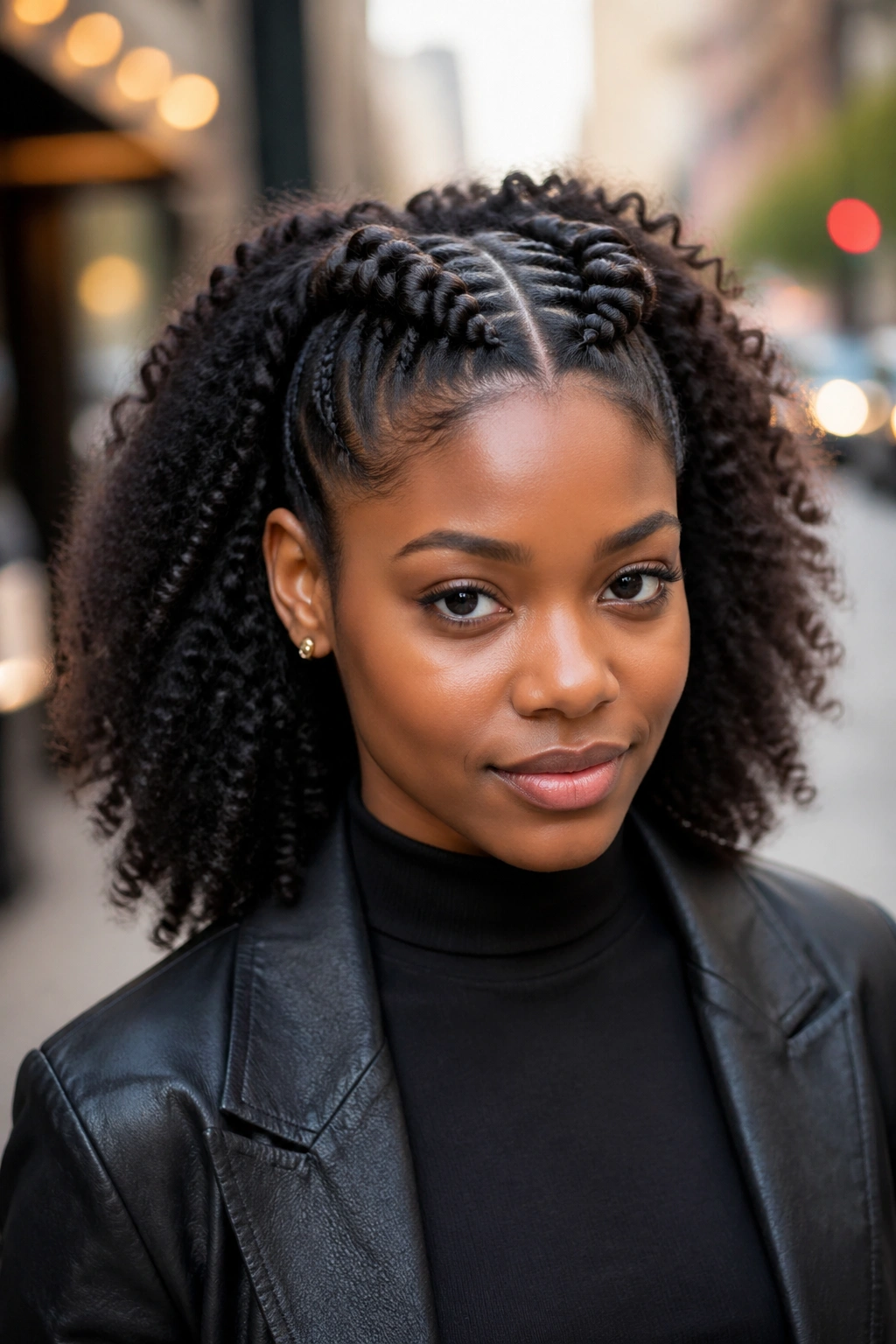
Two Dutch braids — raised, three-dimensional — running from the front temples backward, stopping at the crown. The back section, from the crown down, is entirely free natural curls. The Dutch braids create two dramatic, raised lines across the top front of the head.
Dutch braids project more strongly from the scalp than flat cornrows, creating more visual impact in the front section. On natural hair, the texture along each braid creates additional dimension that smooth hair Dutch braids don’t achieve. The full curl back section provides the volume that balances the bold raised braids.
12. Half-Crown Braid Front With Curl Cascade
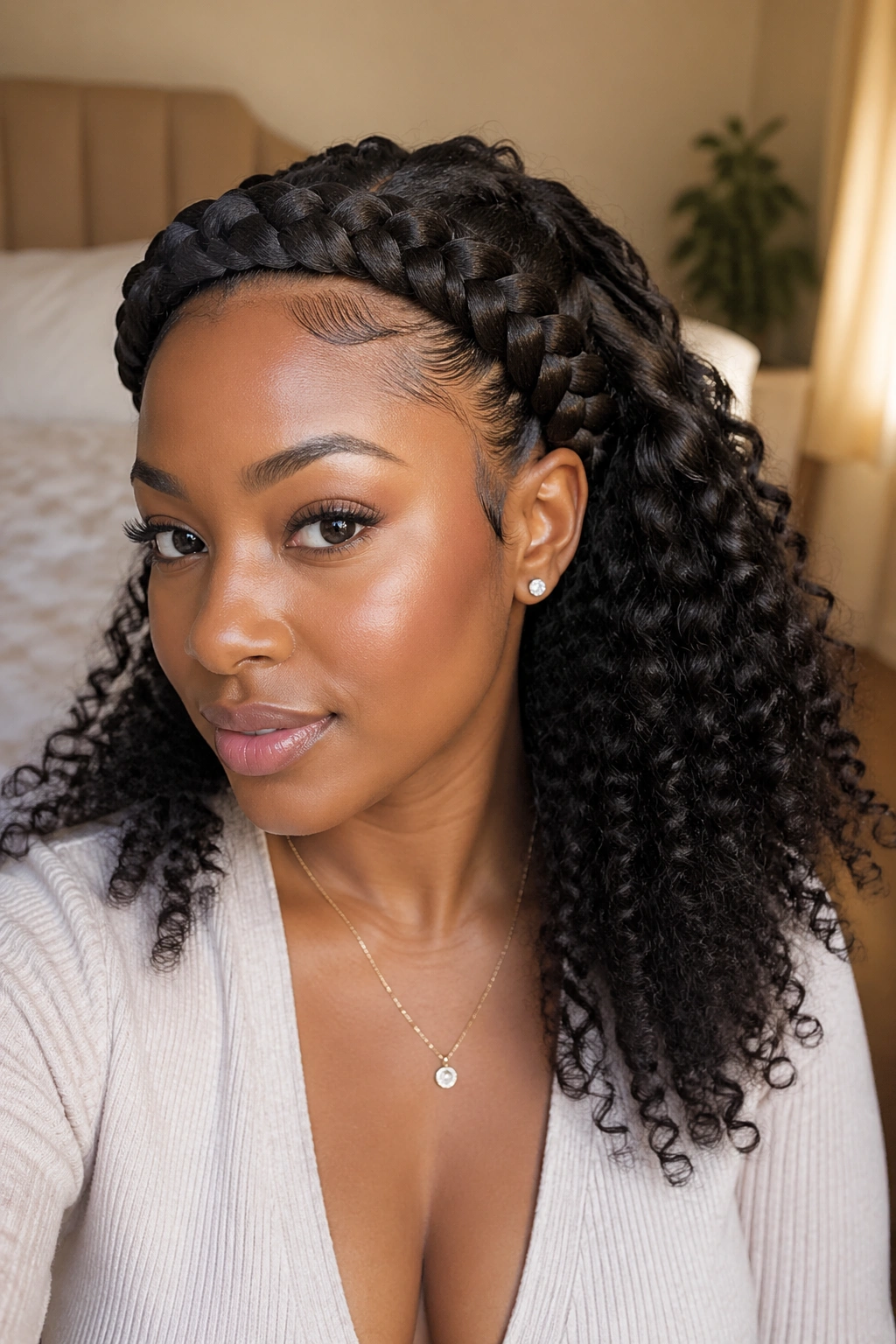
A single large braid runs from one temple across the front of the head — just along the hairline — to the other temple, like a headband made of braid. Below this headband braid at the front, the hair falls into free natural curls throughout the back and middle sections.
The headband braid at the front is the simplest possible version of braids in front curls in back, and its simplicity is its elegance. The single braid does everything it needs to do: keep the face clear, add a defined structural element, and frame the forehead. Everything behind it is free.
13. Four-Section Front Cornrows With Bun and Loose Curls
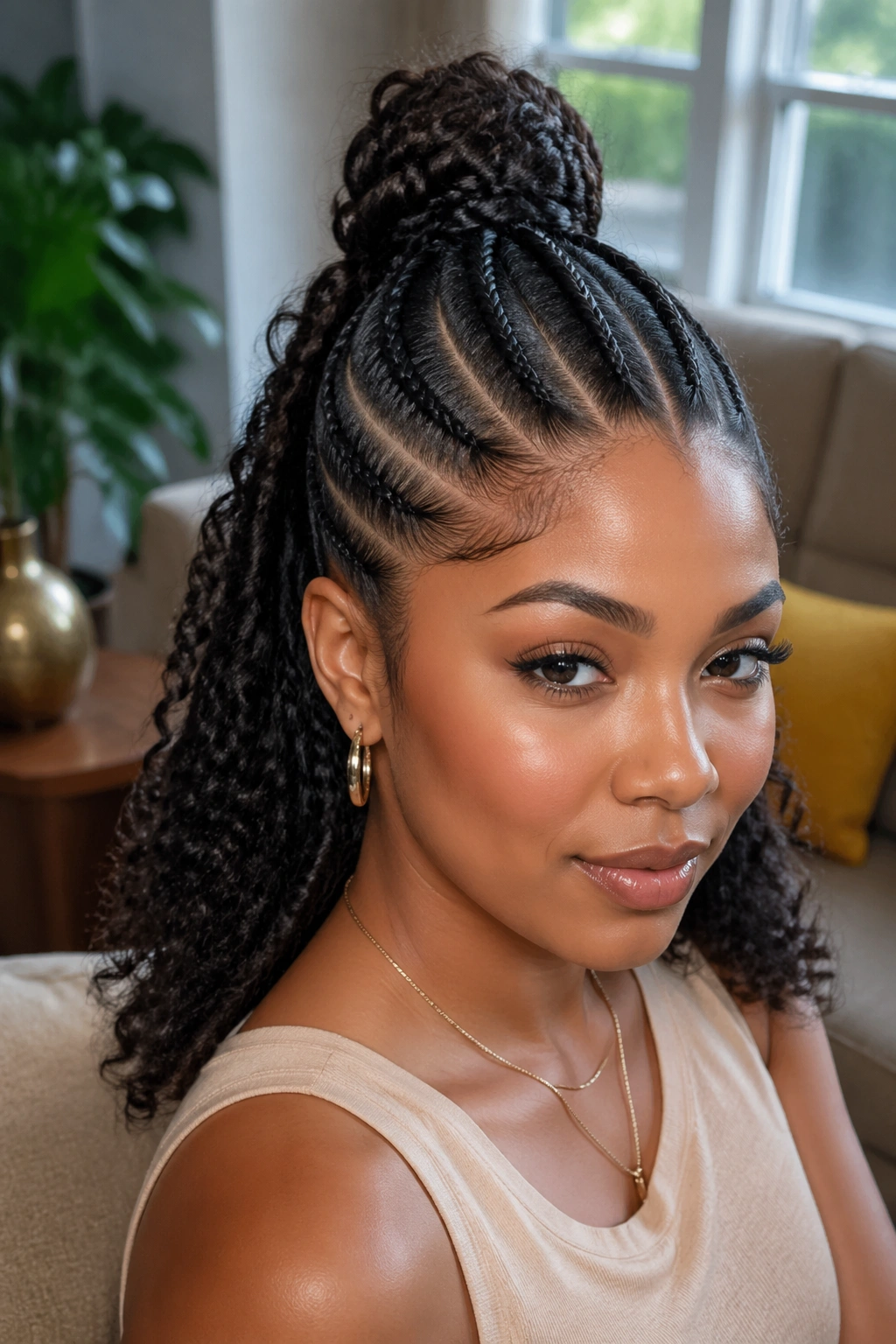
Four cornrows in the front section, swept back from the hairline to the crown. At the crown, two of the cornrows are looped into a small bun while the other two release into the natural curl section. The curl section at the back includes both the released braid ends and the free curl texture.
This hybrid configuration — some front braids ending in a bun, others releasing into curls — creates a more complex transition point at the crown than a simple boundary line. The bun element adds height; the released braid ends blend into the curl section naturally.
14. Front Section Senegalese Twists With Curl Back
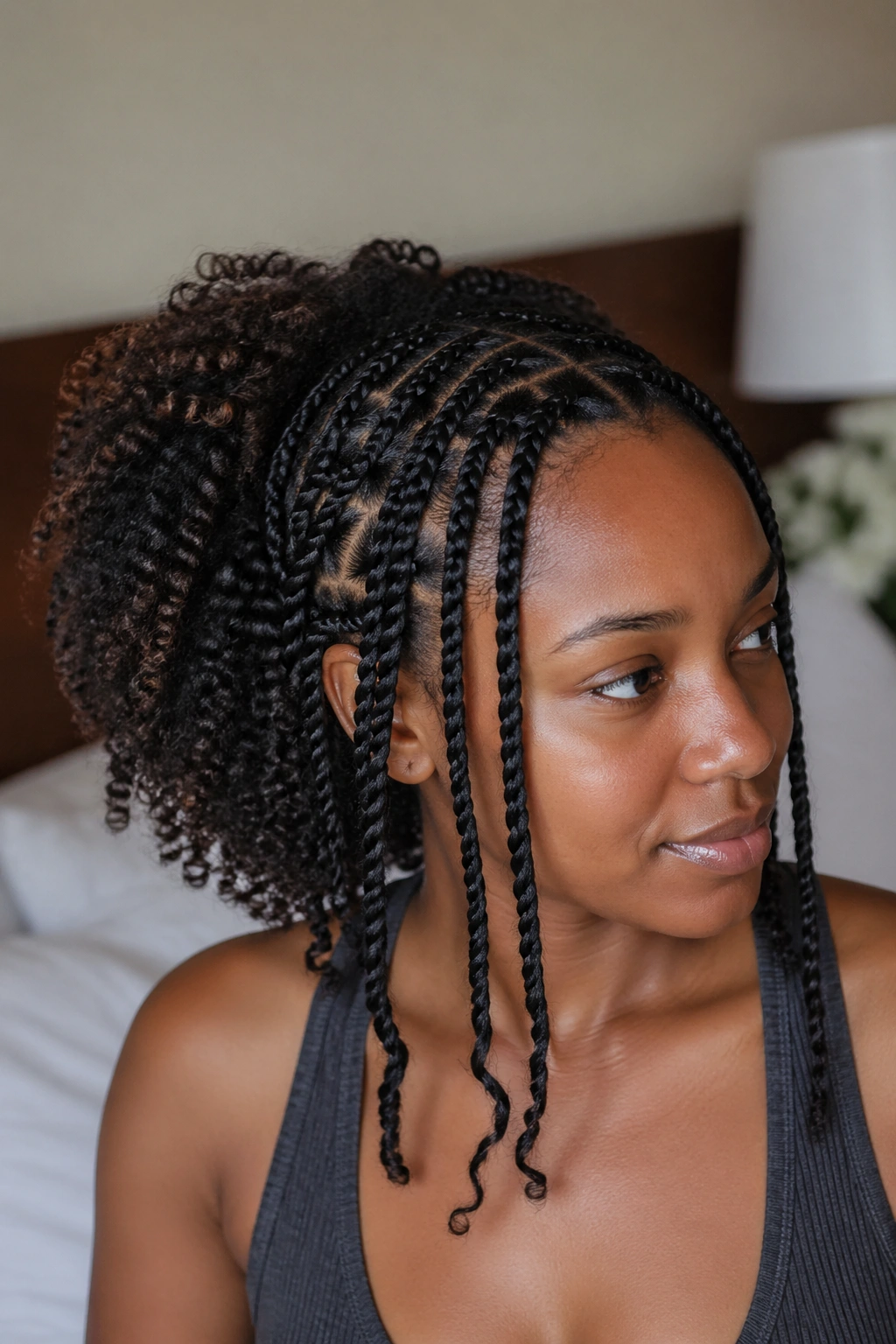
Senegalese twists — individual rope twists made with silky Kanekalon hair, creating a smooth, twisted surface — in the front section, with natural curls in the back. The smooth surface of Senegalese twists contrasts with the textured, coily quality of natural curls in a visually interesting way.
Senegalese twists in the front section create a different aesthetic from cornrows — they’re individual rather than flat against the scalp, and their surface texture is smoother and more uniform. The contrast with natural curls at the back highlights the different qualities of each.
15. Spring Twist Front With Natural Curl Integration
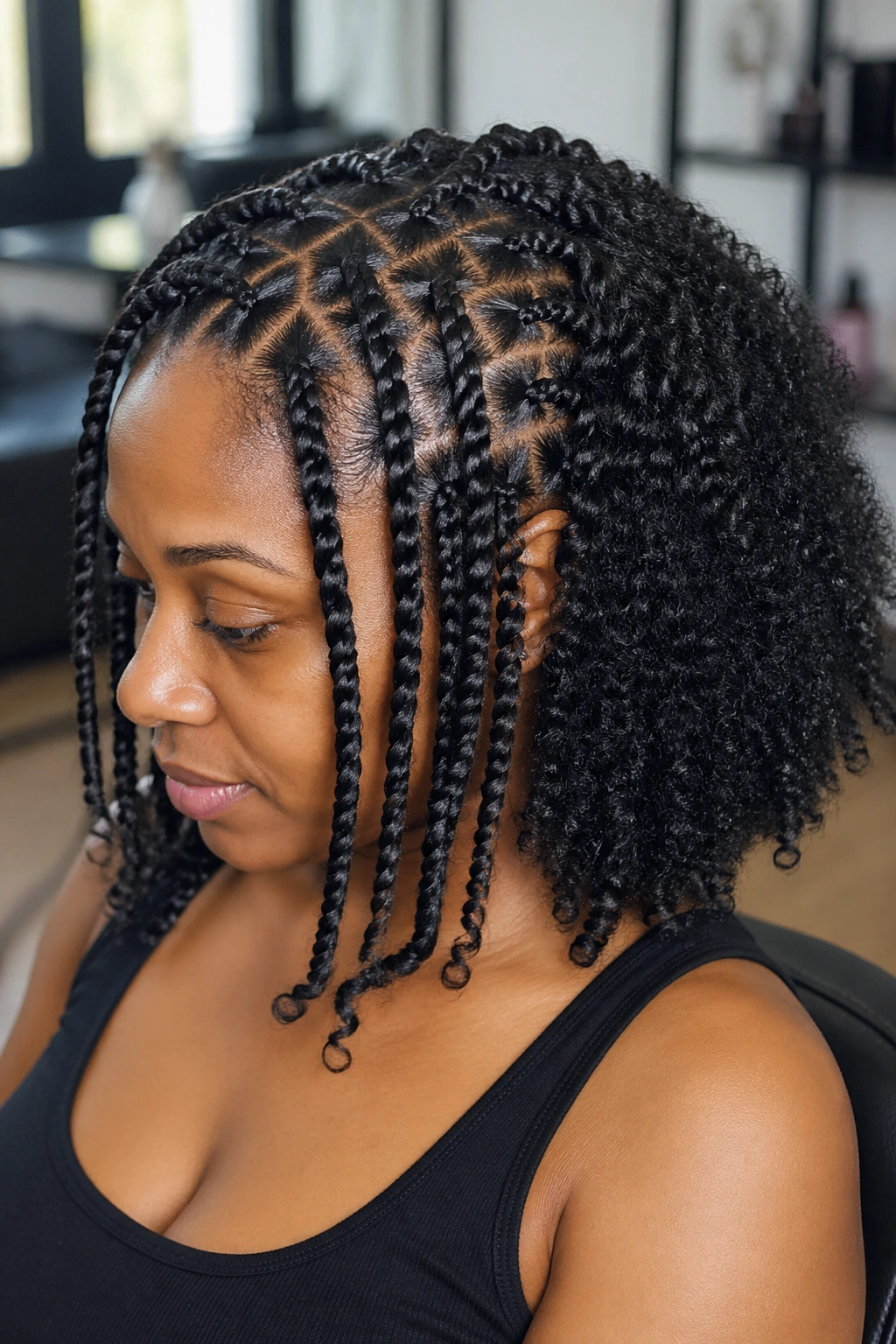
Spring twists — small, springy individual twists made with a textured braiding hair that mimics natural curl patterns — in the front section, with natural curls blending seamlessly into them at the back. Because spring twist texture is designed to mimic natural hair, the transition between the spring twist front and the natural curl back can be remarkably seamless.
Spring twists are one of the best extension styles for wearing alongside natural curls precisely because of this blending quality. The two textures can look almost identical from a distance, making this one of the most natural-looking braids-in-front-curls-in-back configurations.
16. Intricate Front Section Design With Simple Curl Back
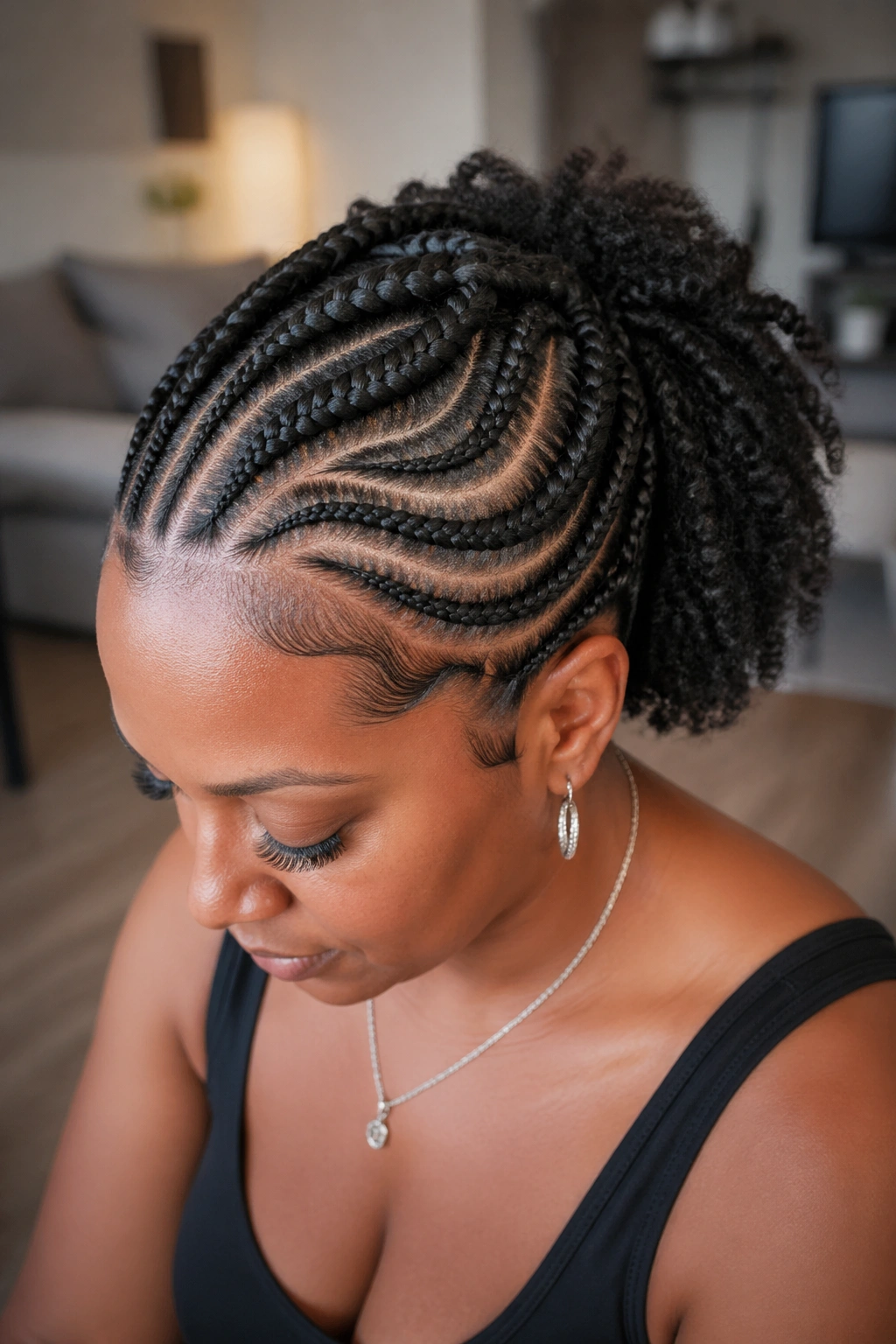
A more elaborate front braiding configuration — multiple cornrows with curved or angled sections, a specific parting design, or a complex braid pattern — while the back section is kept simple: clean, defined natural curls with no gathering or pinning.
The idea here is contrast between complexity and simplicity. The front is the detailed, artistic portion — the place where the braider’s skill is most visible. The back is where that artistry rests — a clean, natural backdrop that lets the front section shine.
This approach works best when the front braiding design is genuinely impressive and worth centering. A routine cornrow pattern doesn’t benefit from being contrasted with a simple curl back as much as an intricate, creative design does.
17. Large Two-Section Braids Front Into Curls
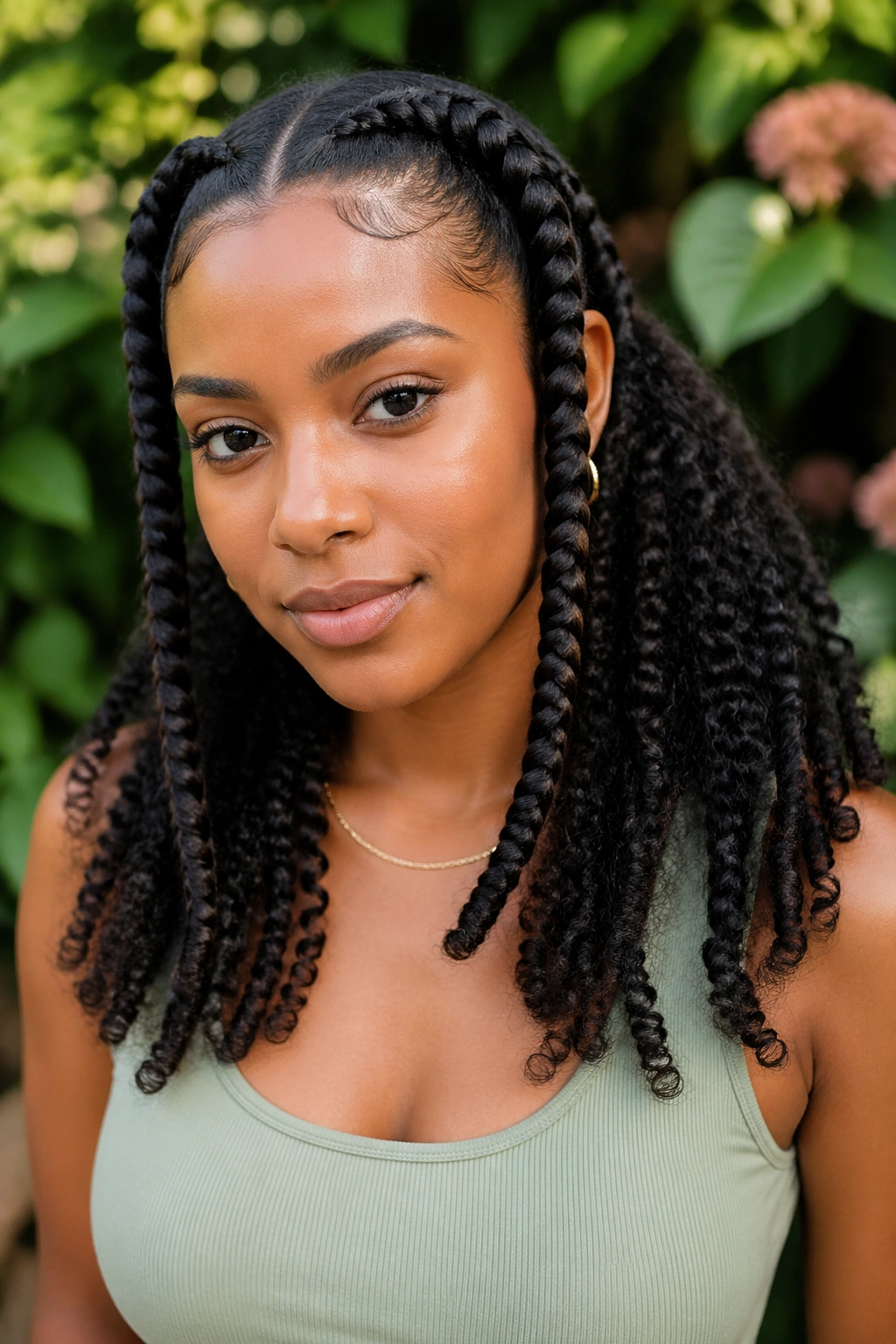
Just two large, wide cornrows in the front section — one on each side of a center part, running backward from the hairline to the crown. Behind these two wide braids, the natural curl section takes over completely.
Two wide cornrows create a bold, graphic visual. They’re not subtle — each braid is substantial enough to be immediately visible. Combined with a free natural curl section at the back, this creates a style that’s confident and uncomplicated in the best way.
18. Braided Front With Curly Tendril Detail
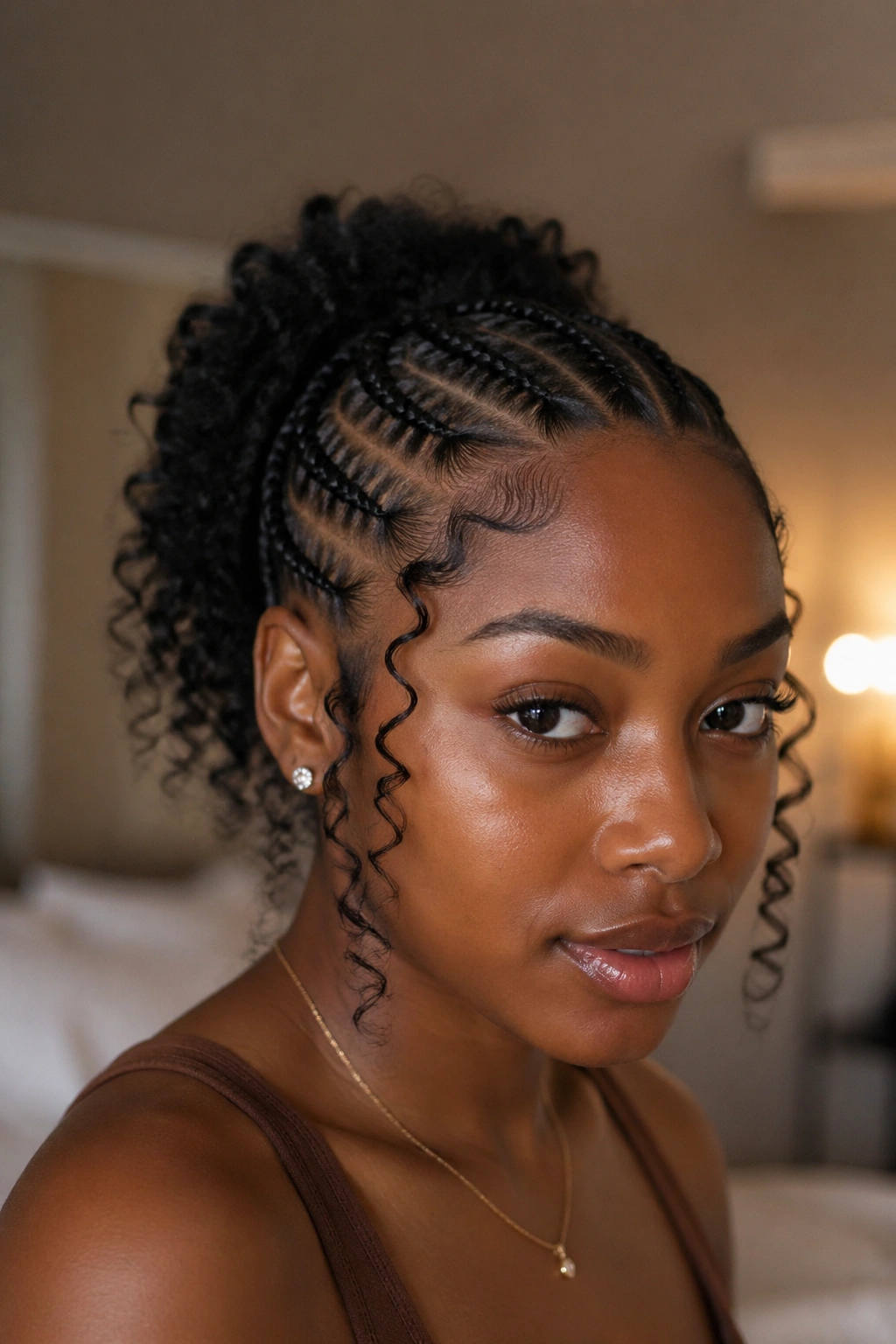
A standard front braiding configuration — cornrows, flat twists, or box braids — with one small detail: a single free, curly tendril deliberately left at each temple, hanging beside the face. These tendrils are not loose sections from a failed braid — they’re deliberate.
The tendril detail transforms any front-braids-back-curls style. It softens the line between the braided front and the free curl section, creating a visual bridge that makes the two sections feel more connected. Position each tendril just in front of the ear, letting it spiral down beside the cheekbone.
19. Braided Front Crown Updo With Curls Down Back
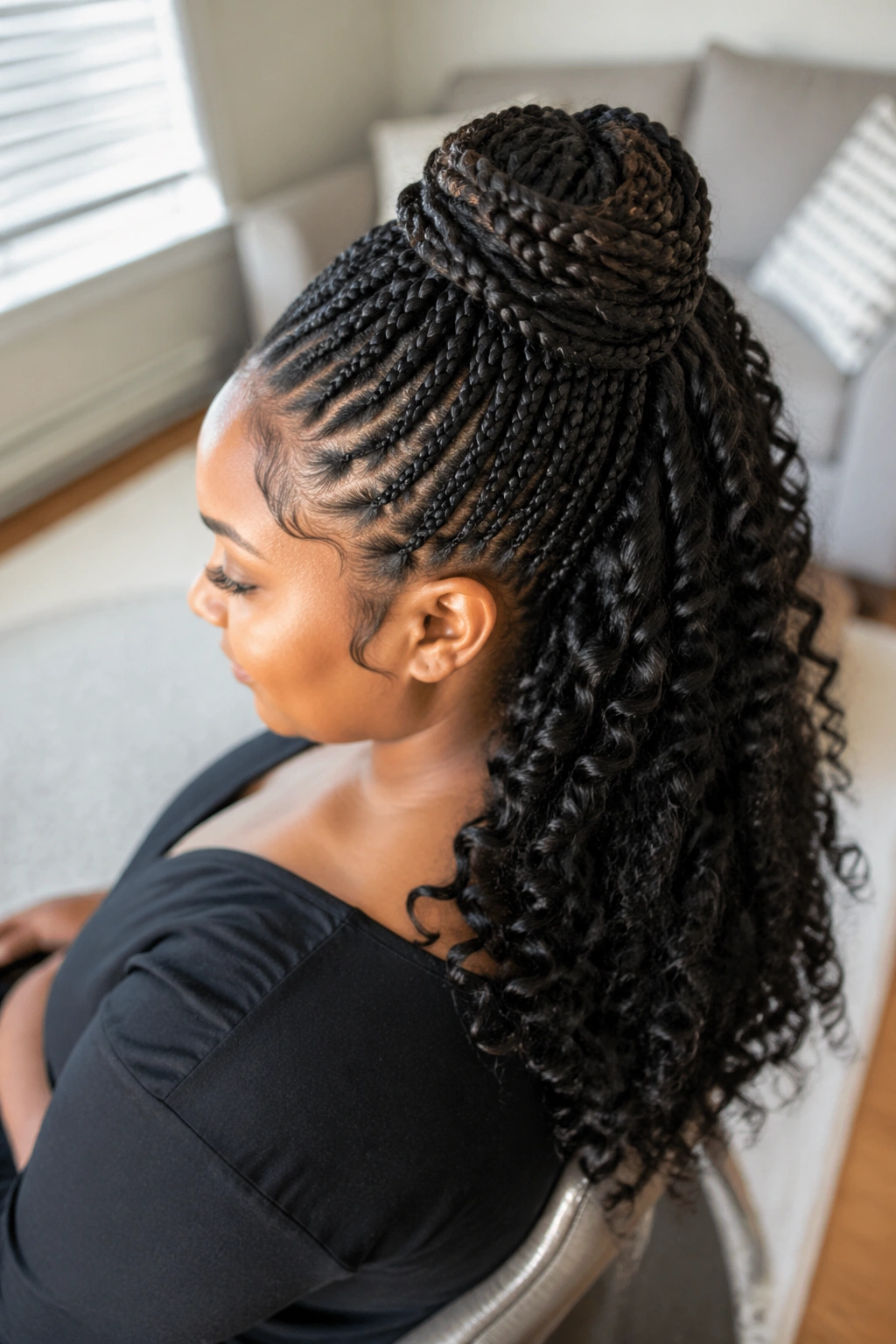
The front section is braided and then gathered into a structured updo at the crown — a bun, a twist, or a rolled style — while the back section falls in free natural curls. This creates a style with the braided front tucked up and out of the way, visible only at the crown, while the natural curls fill the rest of the silhouette.
From the front, you see the neatly gathered updo at the crown. From behind, you see a full cascade of natural curls. From the side, you see both simultaneously.
20. Fulani Braids Front With Curly Space Buns Back
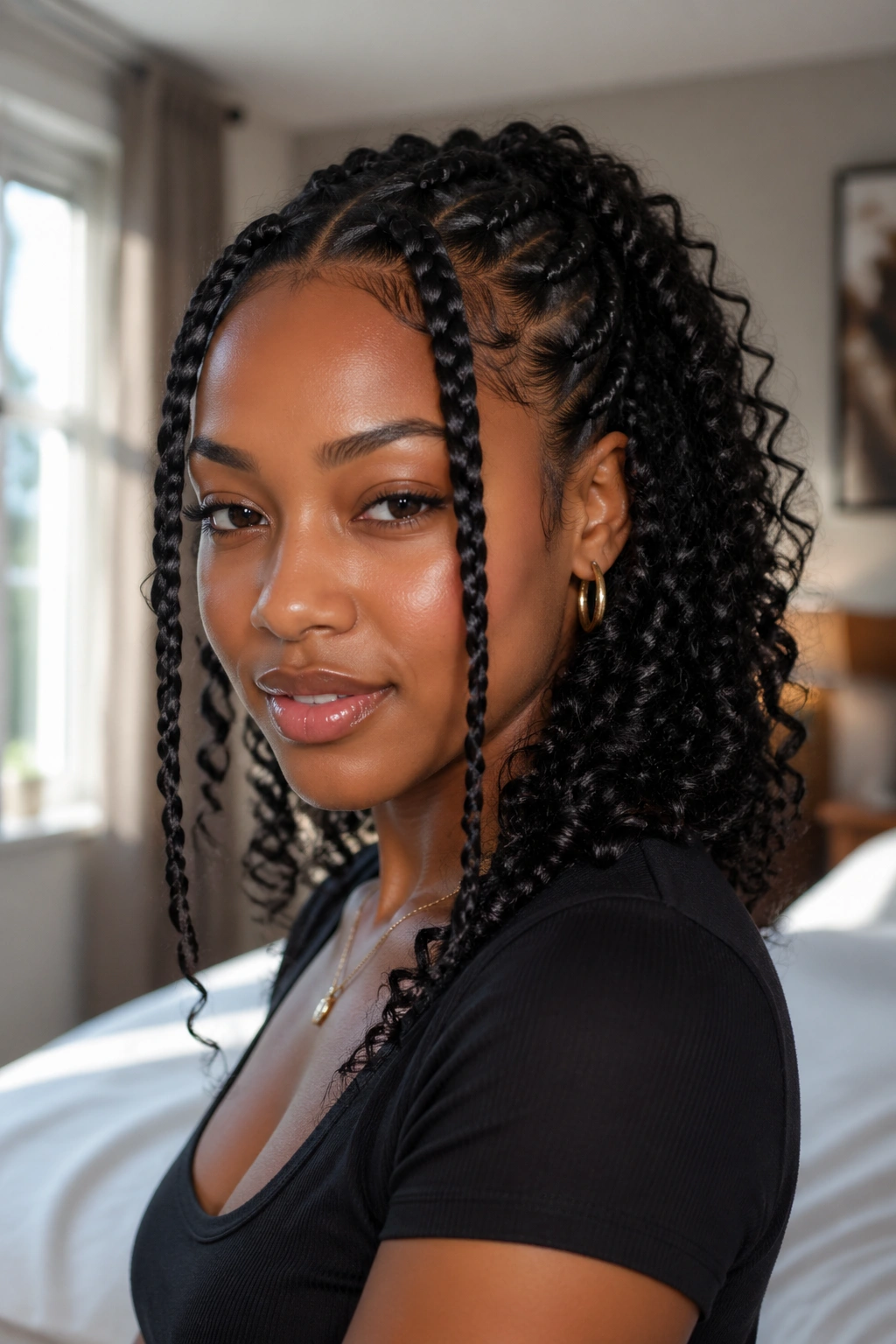
The Fulani braiding configuration in the front section, with the back section gathered into two large, round space buns rather than left as a loose cascade. The space buns — one on each side at the back of the crown — create a structured, playful back section that contrasts with the face-framing Fulani braids.
This combination is distinctly youthful and energetic. The Fulani braids at the front provide cultural grounding and structure; the space buns at the back add a playful, whimsical element. It’s a style that looks simultaneously traditional and creative.
21. Braids in Front, Loc-Twist Curls in Back
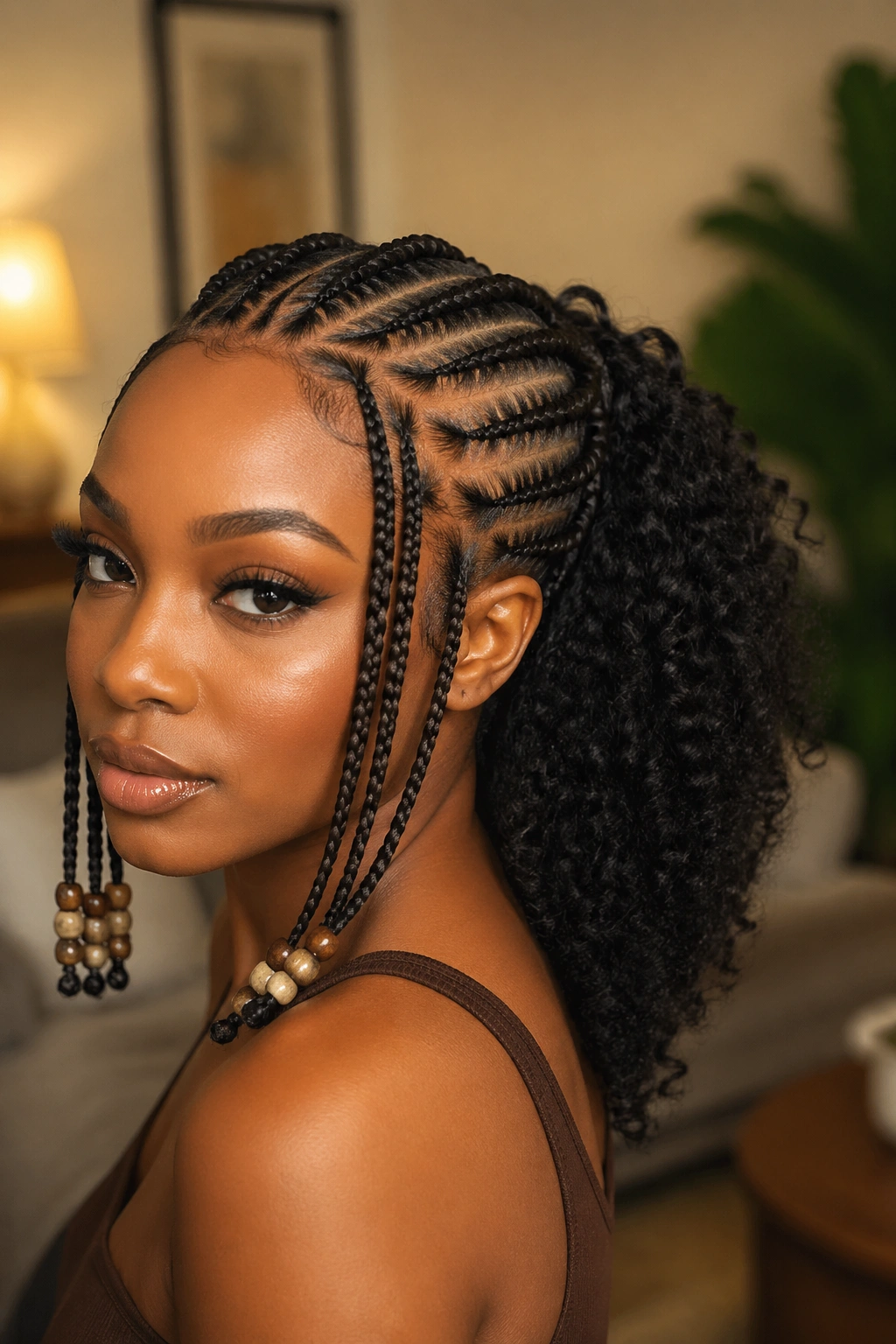
The front section features any form of braids — cornrows, box braids, flat twists. The back section features loc twists: two-strand twists using natural locs or loc extensions, creating a series of twisted sections that hang like heavy, voluminous curls but with the weight and texture of locs.
The contrast between the flat, sleek braided front section and the heavy, textured loc twist back section is dramatic and distinctive. This style bridges braiding tradition with the loc journey in a single composition.
Making the Front-Back Transition Look Seamless
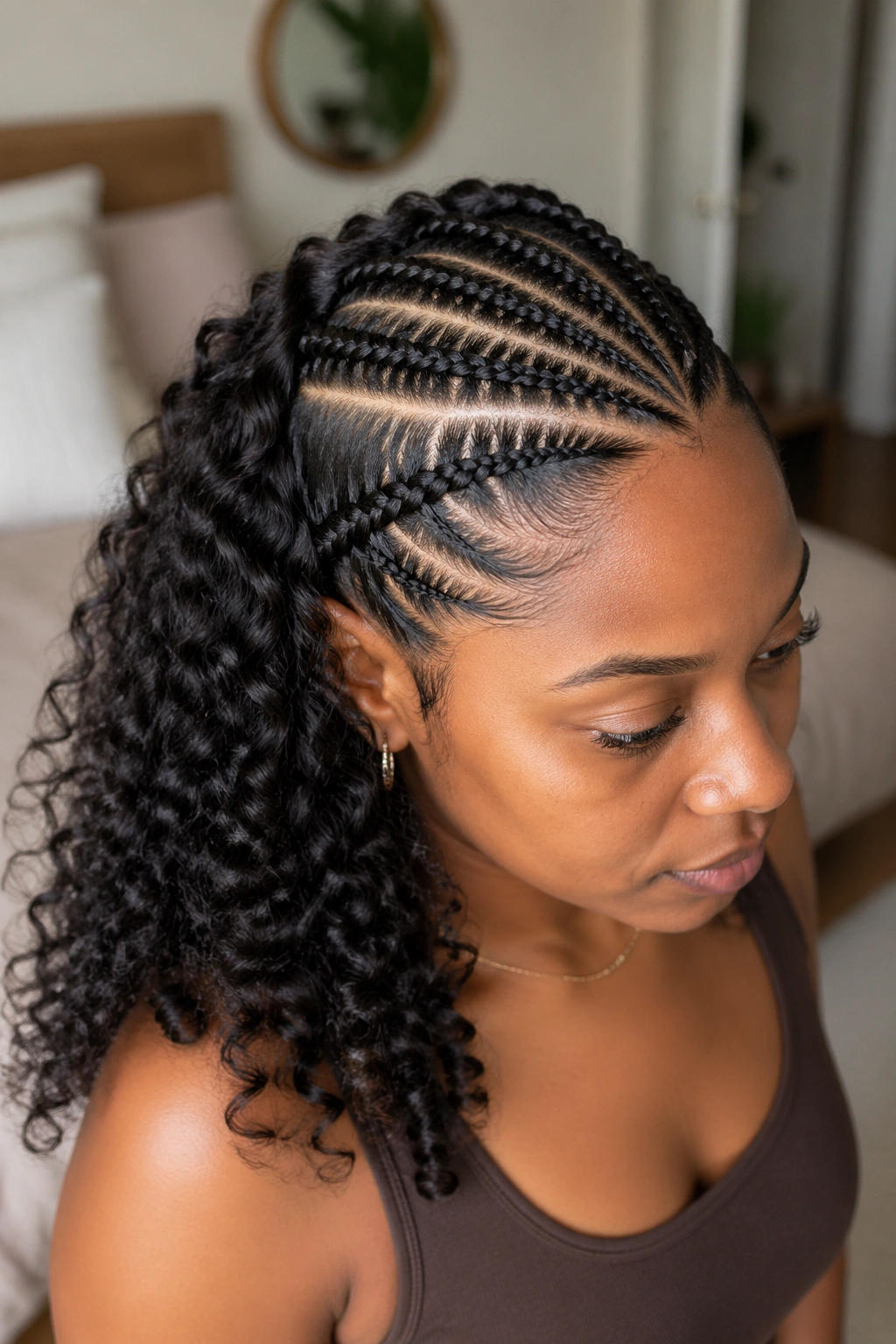
The quality of the transition between the braided front and the curly back determines whether the style looks cohesive or like two separate hairstyles on the same head. Getting this transition right is worth the extra time and attention.
The transition line — the boundary between the braided section and the curl section — should be clean and defined. A clear horizontal or curved part at this boundary, kept free of stray hairs and frizz with a small amount of edge control, creates a deliberate demarcation that reads as intentional.
Alternatively, some styles benefit from a gradual, blurred transition rather than a clean line. Styles with wispy or loose braids near the boundary (like goddess braids) naturally blend into the curl section without a hard line. Styles where the braid ends release into free curl texture also blur the boundary effectively.
Consider the accessories at the transition point. Beads or cuffs placed specifically at the end of the braids — right at the boundary with the curl section — draw attention to the transition and make it look considered rather than accidental.
Caring for Both Sections Simultaneously
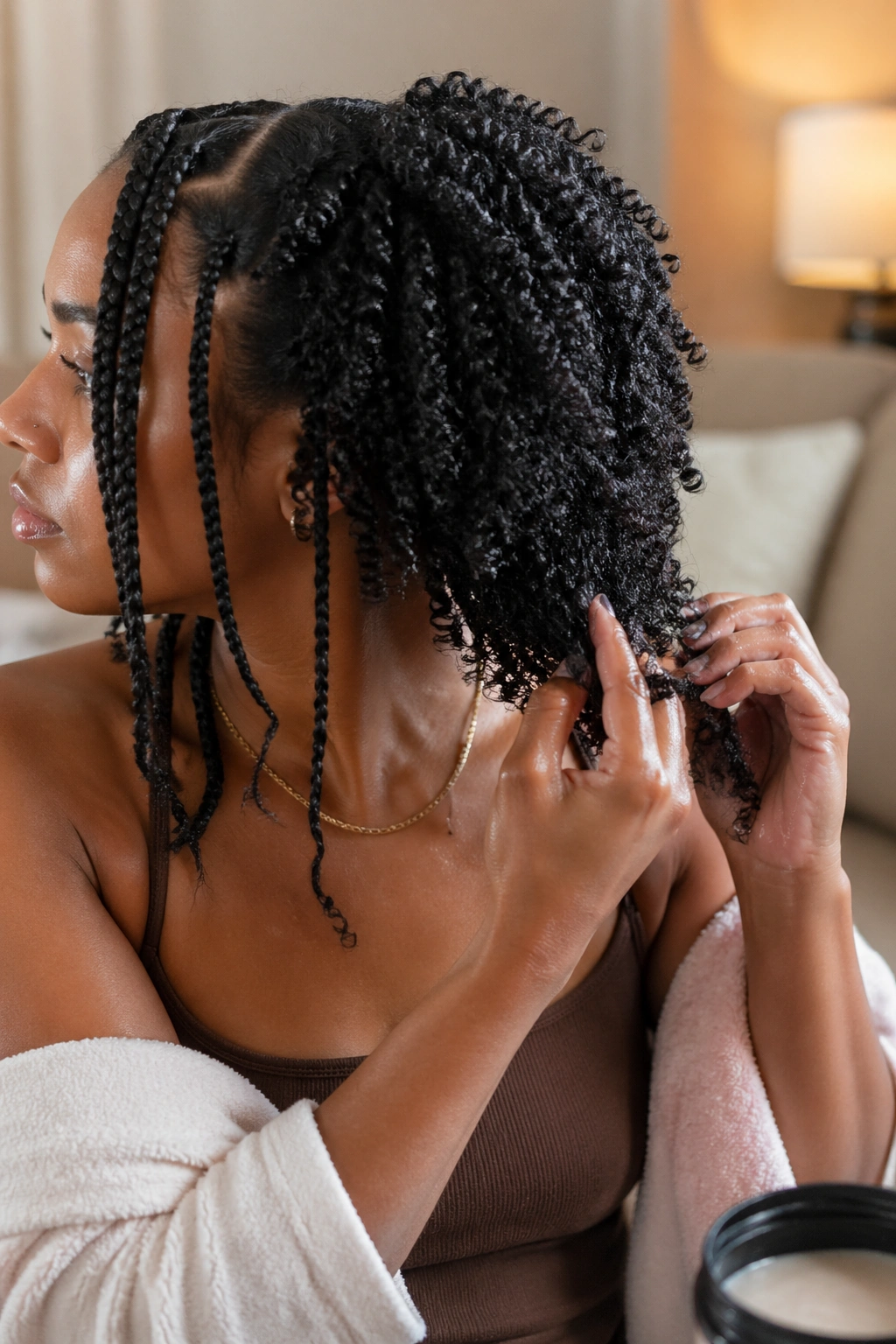
Maintaining a braids-in-front-curls-in-back style requires a split routine that addresses the different needs of each section without compromising either.
The braided front section needs scalp care and light hydration. Apply a lightweight scalp oil — peppermint, jojoba, or tea tree — to the scalp along each braid every three to four days. Use a diluted shampoo (shampoo mixed with water in a squeeze bottle) to clean the scalp between braids when needed. Avoid heavy products on the braided sections.
The natural curl back section needs regular moisture and curl definition maintenance. Spritz with water and a small amount of leave-in conditioner every two to three days. Scrunch upward to revive curl formation. Apply a light oil over the curl section once or twice a week for shine and moisture sealing. At night, pineapple the curl section or protect it with a satin bonnet to preserve the curl pattern.
The two routines can coexist without interfering with each other, as long as products applied to the curl section don’t migrate into the braided section. Be precise with your product application.
How Long the Style Will Last
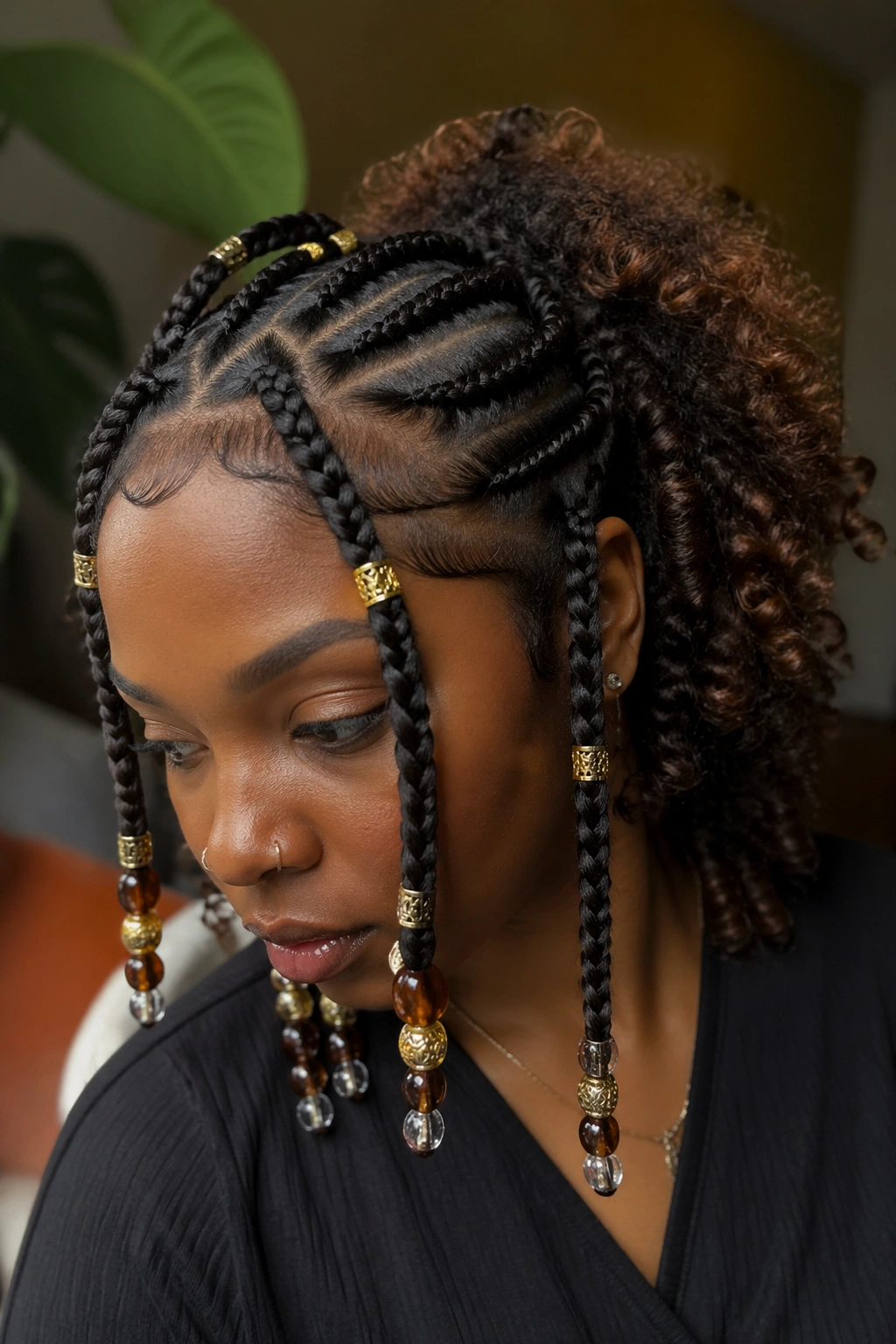
The braided front section typically lasts three to six weeks before looking fuzzy at the roots from new growth and lint accumulation. Flat cornrows tend to last slightly longer than individual box braids because they have less surface area to accumulate buildup.
The natural curl back section needs refreshing every two to three days for optimal appearance, but the style itself doesn’t need to be completely redone. The front braids are the longevity anchor — as long as they’re still looking neat, the back curls can be refreshed as many times as needed.
When you decide to take the style down, remove the front braids carefully before washing. The natural curl section can be washed while the front braids are still in place, but removing the braids first allows for a thorough scalp cleanse in the front section that’s difficult to achieve with braids in place.
After removing the braids, deep condition the entire head immediately. Pay extra attention to the front hairline and edges, which may have experienced some tension from the braids. A protein-moisture balanced treatment helps restore elasticity to sections that have been braided.
