
Rainbow box braids work best when the color has a plan. A row of random shades can look noisy; the same shades repeated with a little restraint look sharp, playful, and polished in a way that feels deliberate. The trick is not using every color at once. It’s deciding where the bright pieces should land.
I like rainbow box braids most when they play with contrast. Dark roots make the color pop, pastel blends read soft, and a few jewel tones can look richer than a whole head of neon. Three to five shades usually feels cleaner than seven, and braid size changes the whole mood faster than people expect.
Length changes everything.
Waist-length plaits turn color into a statement. Shoulder-grazing braids let the shades flash and disappear as you move. Add beads, cuffs, or curly ends and the whole style shifts again — same palette, different personality. That’s why rainbow braids are fun to wear and easy to get wrong if the parts, lengths, and color placement fight each other.
Some are loud. Some are sneaky. A few sit in that sweet spot where the color does the work without swallowing the whole style.
1. Full-Head Rainbow Box Braids
Full-head rainbow box braids are the most direct version of the look, and I mean that in a good way. You commit to the color story from root to tip, then repeat it across the whole head so the style feels intentional instead of scattered.
Why it works
The eye likes rhythm. When the same color order shows up again and again — say red, orange, yellow, green, blue, purple — the style stops looking random and starts looking designed. That rhythm matters more than people think.
A full-head version usually looks best when you keep the palette to four to six colors and repeat them in the same order. Too many shades, especially if they all fight for attention, can turn the braids into visual static. The cleaner versions use one bright anchor color and let the others support it.
- Best for: long braids, medium-thick parts, people who want the color to be obvious from across the room
- Good color families: classic ROYGBIV, warm sunset shades, cool-spectrum blends
- Style note: a black or dark brown base makes every color pop harder
- Maintenance mood: simple, because the color does the heavy lifting
My tip: if you want the look to stay sharp, repeat the same color order on both sides of the part. That small choice makes a big difference.
2. Hidden Peekaboo Rainbow Box Braids
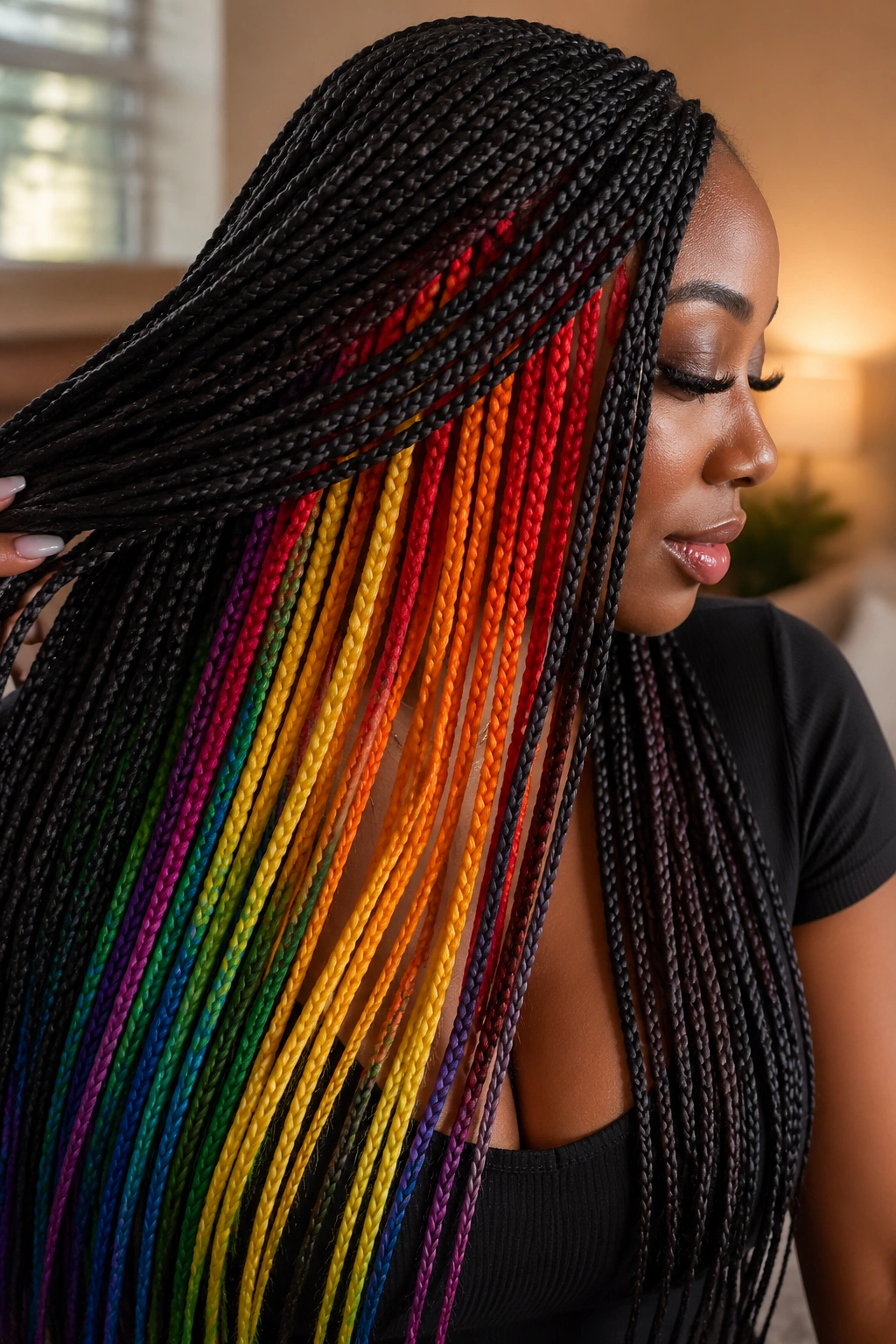
Hidden peekaboo rainbow box braids are the easiest way to wear color without broadcasting it every second of the day. The top layer stays darker or more neutral, while the bright braid sections hide underneath and show up when you move, flip your hair, or pull it into a half-up style.
That makes them a smart pick if you like surprise more than spectacle. The color feels playful when it appears, but it does not shout from every angle. Honestly, that’s the appeal. You get the fun part without the full-time attention.
If you work with braiding hair in two layers, ask for a muted top row and a brighter underlayer. The contrast should be strong enough to register when the braids shift, but not so strong that the style looks chopped up. A deep burgundy, brown, or black top layer usually makes the hidden rainbow look cleaner.
And yes, the half-up, half-down style is where these braids earn their keep. Pull the top half into a bun or ponytail, and the color underneath wakes up instantly.
3. Pastel Rainbow Box Braids
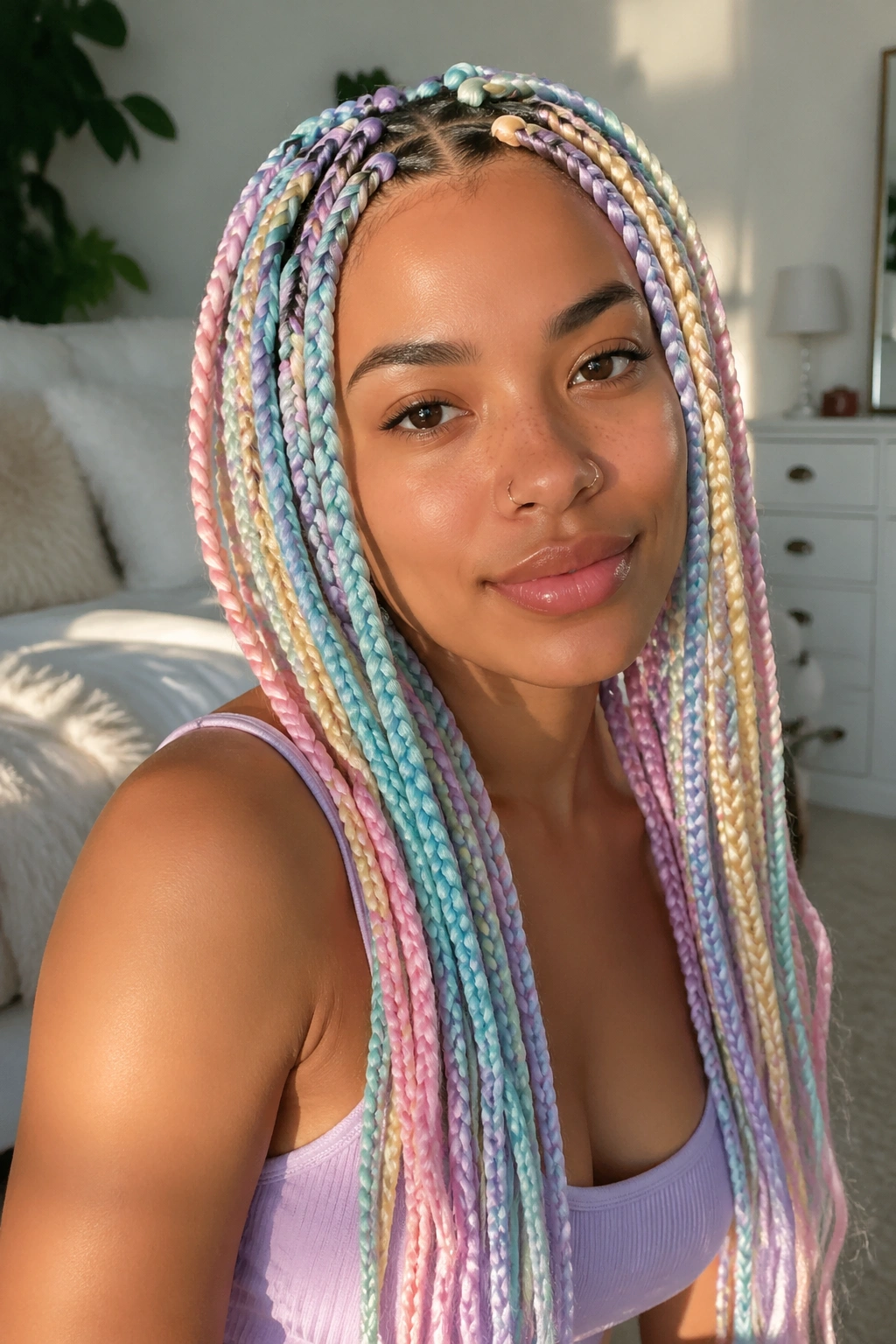
Why do pastel rainbow box braids feel softer than the bright versions? Because the colors sit closer together on the lightness scale, so the braid pattern reads as airy instead of loud. Mint, lavender, baby blue, blush pink, and soft lemon can all live in the same style without fighting each other.
That softness is useful if you want rainbow hair but don’t want the color to carry the entire outfit. Pastel braids tend to look especially nice when the parts are neat and the braid size stays medium, not jumbo. Tiny braids can make the palette look busy. Huge braids can make pastel shades look patchy. Medium size is the safe sweet spot.
How to wear it
- Pair pastel braids with clean, simple clothing if you want the hair to stay the main event.
- Keep makeup light and let one lip color repeat a braid shade.
- Use a satin scarf at night, because pale colors show frizz faster than dark ones.
- Add clear beads if you want sparkle without changing the palette.
Pastel rainbow box braids are the kind of style that looks gentle at first glance and smarter the longer you stare at it.
4. Neon Rainbow Box Braids
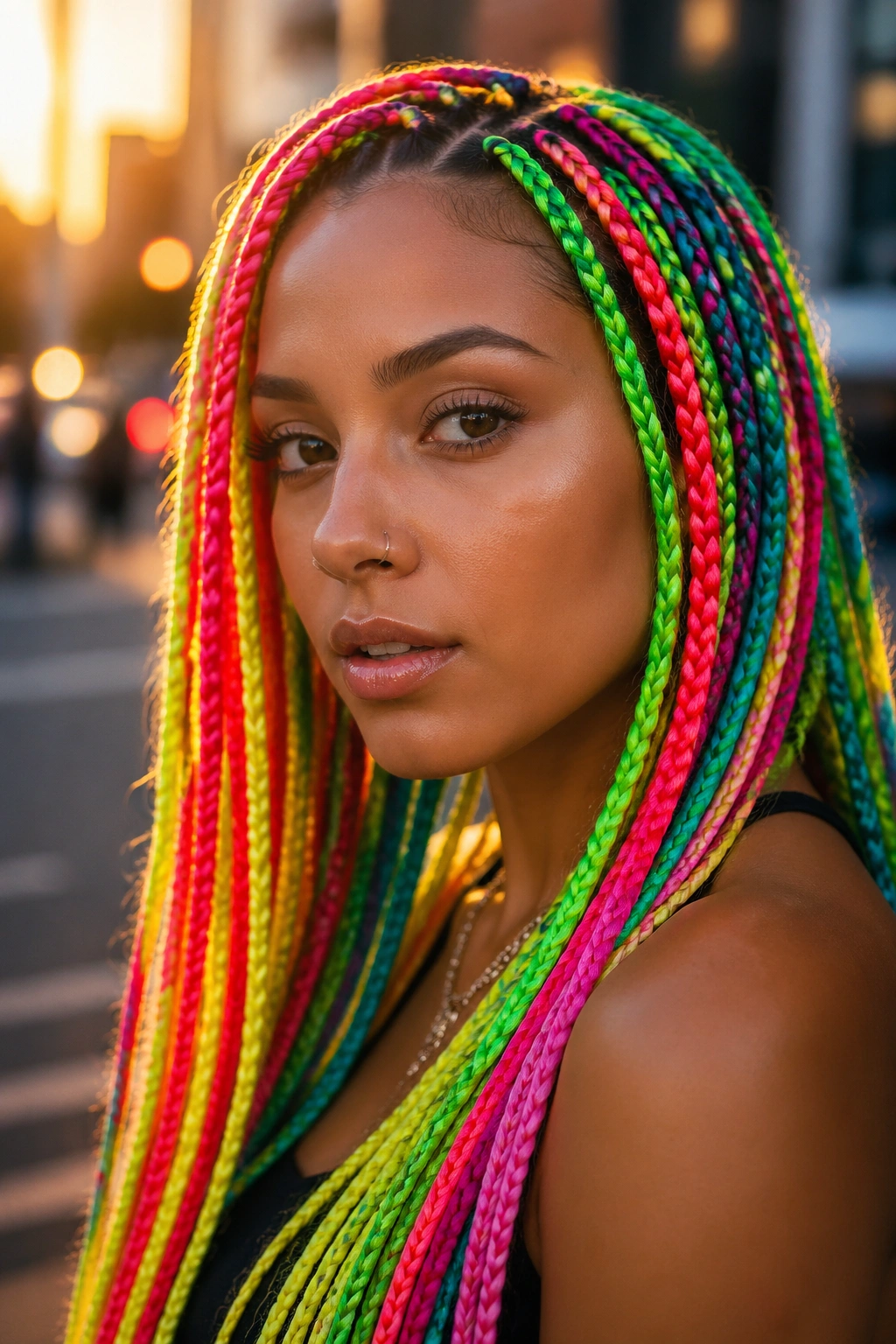
Neon rainbow box braids are not shy, and they should not be. The whole point is that the color hits hard — electric pink, acid green, highlighter yellow, turquoise that looks almost blue-black in dim light. On the right head of braids, that kind of color feels bold, not childish.
I’ve always thought neon works best when the braid pattern gives it a little breathing room. If every braid is packed with every shade, the look can get messy fast. But if you let each braid hold one or two bright tones, the color reads cleaner and the whole style looks more expensive. Strange word for braids, maybe, but it fits.
- Choose a dark base if you want the neon to glow harder
- Keep the parts crisp so the color blocks look deliberate
- Use fewer beads and cuffs if the palette is already loud
- Go shorter or medium-length if you want the style to feel punchy instead of heavy
Neon braids do one thing very well: they make even a plain outfit feel like it had a point.
5. Ombré Rainbow Box Braids
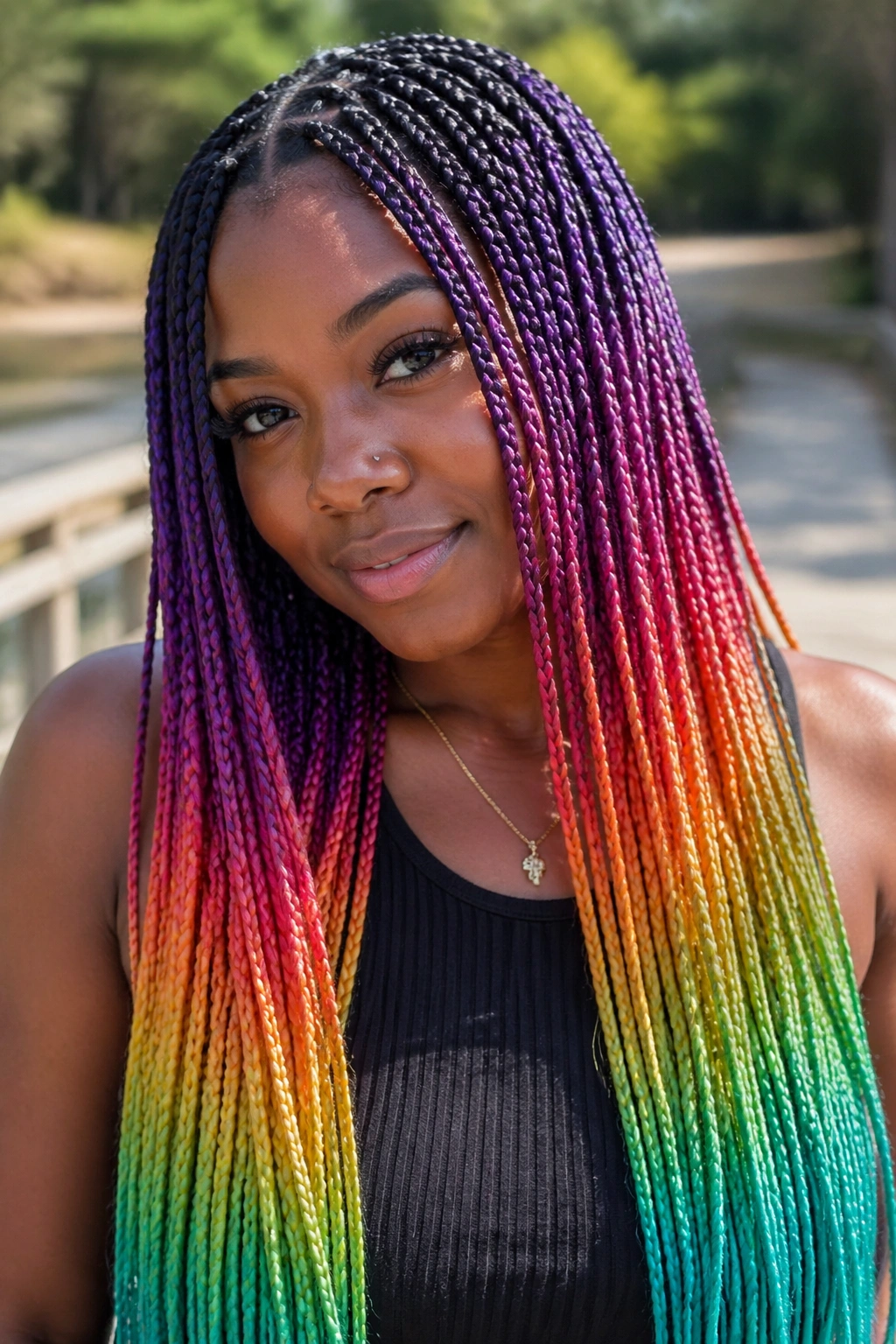
Ombré rainbow box braids are for anyone who likes color but doesn’t want each braid to feel like a flag pole. The shade shift starts darker or quieter at the roots and drifts into brighter color toward the ends, which gives the whole style a smoother, more grown-up feel.
The nicest thing about ombré braids is the movement. When you turn your head, the color seems to travel with the braid instead of sitting on top of it. That makes this version especially good for long braids, because the length gives the gradient room to show off. Short braids can still use the idea, but the transition has to be tight or it disappears.
I prefer ombré with two or three neighboring colors rather than a full rainbow in every strand. Red to orange to yellow. Blue to teal to green. Purple to pink to coral. Those combinations look softer because the eye can walk through them without tripping.
There’s a quiet confidence to this style. It doesn’t need to announce itself on the first glance.
6. Jewel-Tone Rainbow Box Braids
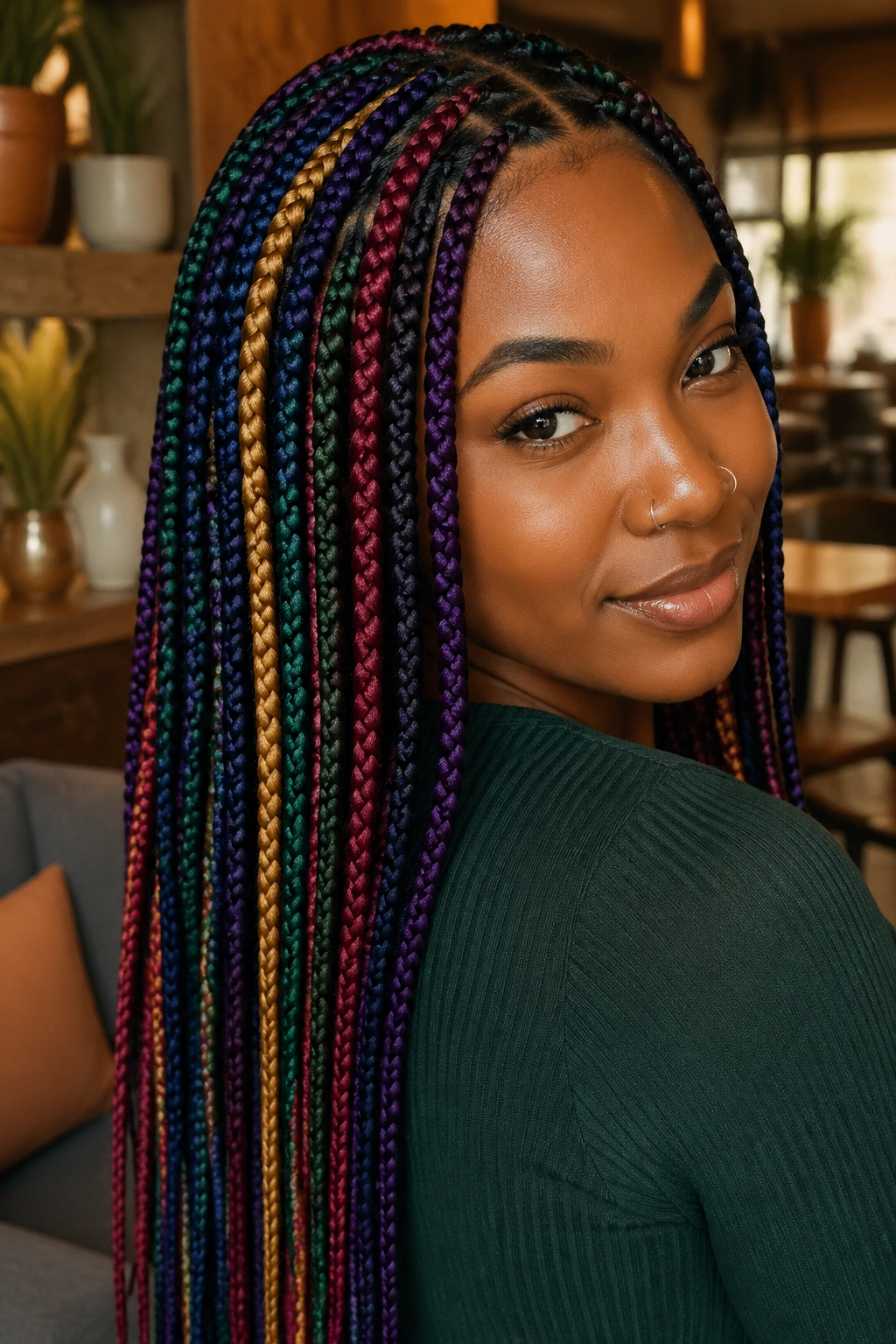
Jewel-tone rainbow box braids are what I suggest when someone says, “I want color, but I don’t want it to look sugary.” Emerald, sapphire, amethyst, ruby, and deep gold give the braid pattern a richer finish. The shades are saturated, but they carry more depth than pastels or neons.
Compared with bright rainbow braids, jewel tones look heavier in the best sense. They hold up beautifully against darker outfits and still show clearly in low light, which is something photos never really capture. The color reads like fabric — velvet, satin, glass — rather than candy.
This version is especially nice if your braid lengths are medium or long and you want the ends to have a little weight. Stronger colors at the tips can keep the whole style from looking flat. A dark root with jewel-tone lengths is a classic move for a reason.
If you’re choosing between pastel and jewel tones, pick jewel tones when you want your rainbow box braids to feel richer and more grounded. Pick pastel when you want them to feel airy. Different jobs.
7. Jumbo Rainbow Box Braids
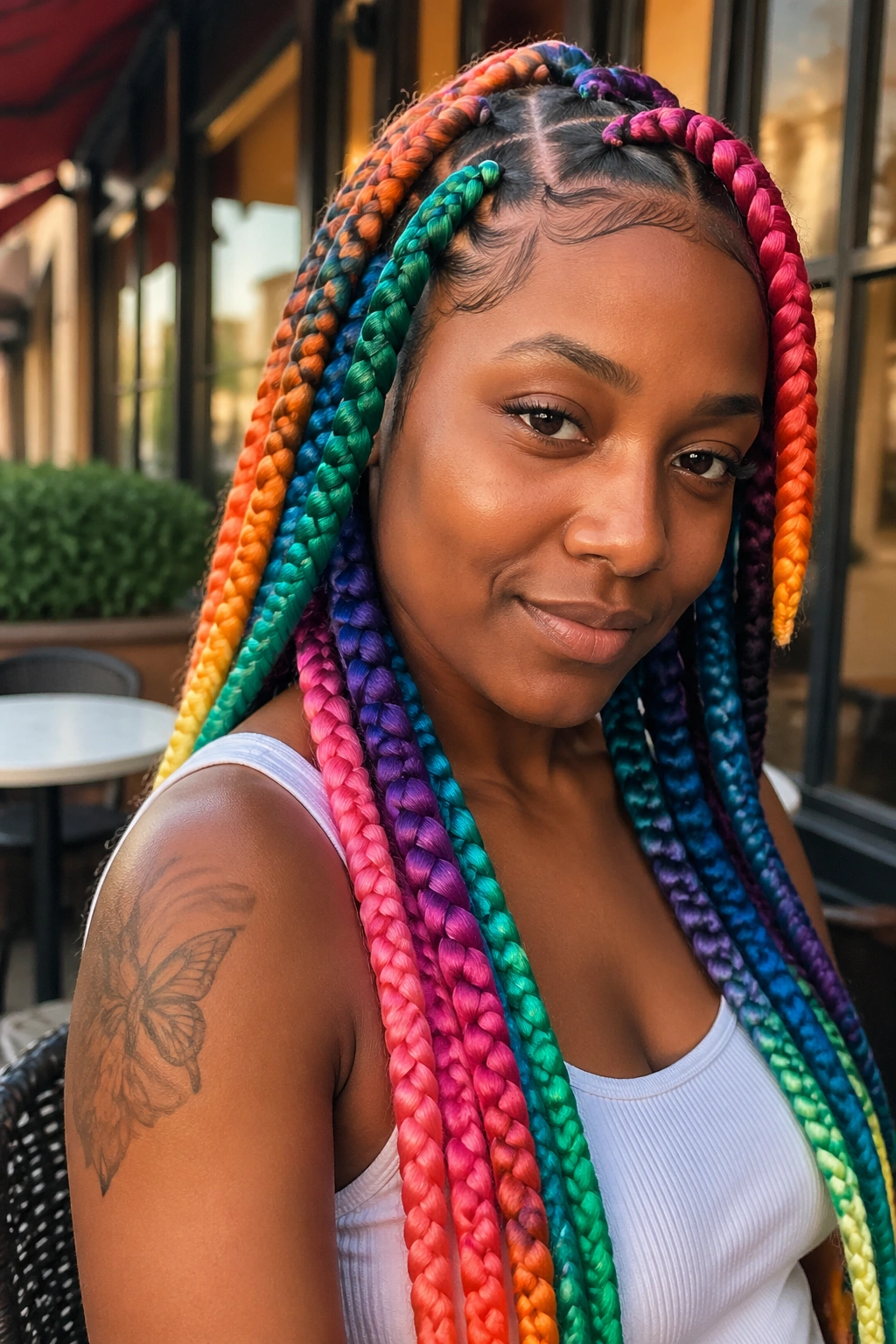
Jumbo rainbow box braids change the whole conversation because the braids themselves become part of the color design. Fewer braids mean each color panel is larger, so the shades show up in bold sections instead of tiny flashes. That can be a blessing or a curse, depending on how much color confidence you have.
What makes them different
Jumbo braids install faster than micro braids, and they put less tension across the scalp when they’re parted properly. They also make color easier to read from a distance, which is useful if you picked a strong palette and want people to actually see it. The downside is obvious: each braid weighs more, so the style can feel bulky if the hair is very long.
A good jumbo rainbow set usually uses two or three colors per braid, not six. You want the color block to feel clear, not cluttered. A thick braid with too many shades can start to look striped in a bad way.
- Best if you want: a faster install and bold color payoff
- Watch for: heaviness at the crown and edges
- Pair with: large hoops, simple makeup, or a plain outfit
- Avoid: too many tiny accessories
Quick take: if you want the color to hit fast, jumbo braids are the blunt instrument.
8. Micro Rainbow Box Braids
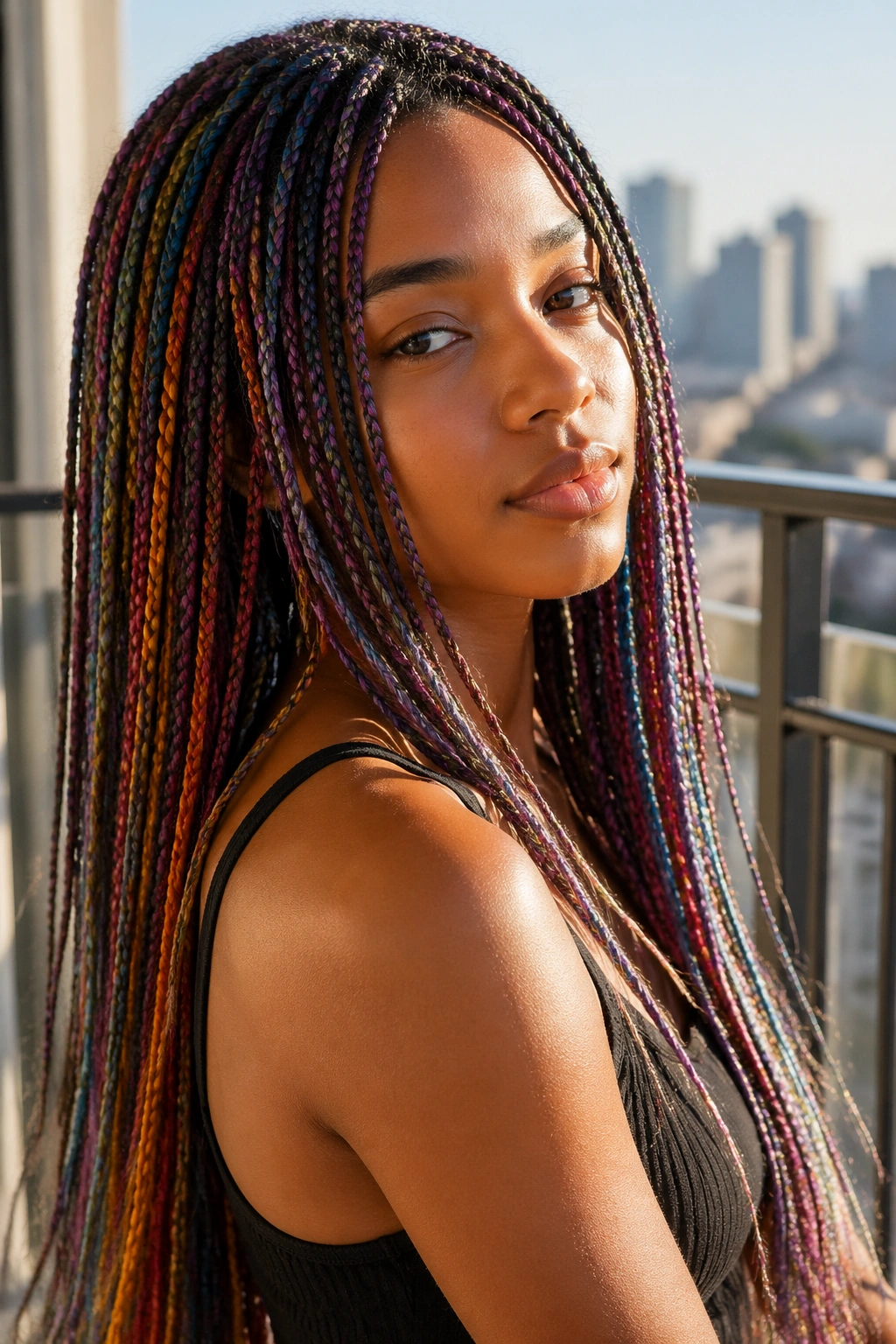
Micro rainbow box braids make the color feel finer, not louder. That sounds backwards until you see them move. Tiny braids let the shades shimmer together instead of sitting in big blocks, so the overall effect is almost woven.
The catch is time. Micro braids take patience, and rainbow hair in a micro size asks even more of both the stylist and the person wearing it. The payoff is detail. You can layer in several colors without the style looking heavy, and the smaller size makes the rainbow feel more like texture than costume.
What matters most here is contrast in value, not only contrast in color. If all the shades are equally bright, the pattern can blur. If you mix a dark tone, a midtone, and a couple of lighter accents, the braids keep their shape better.
Micro rainbow braids suit people who like subtle movement and don’t mind a longer install. They are not the quick, grab-and-go option. They are the patient option. And that’s why they look so good.
9. Knotless Rainbow Box Braids
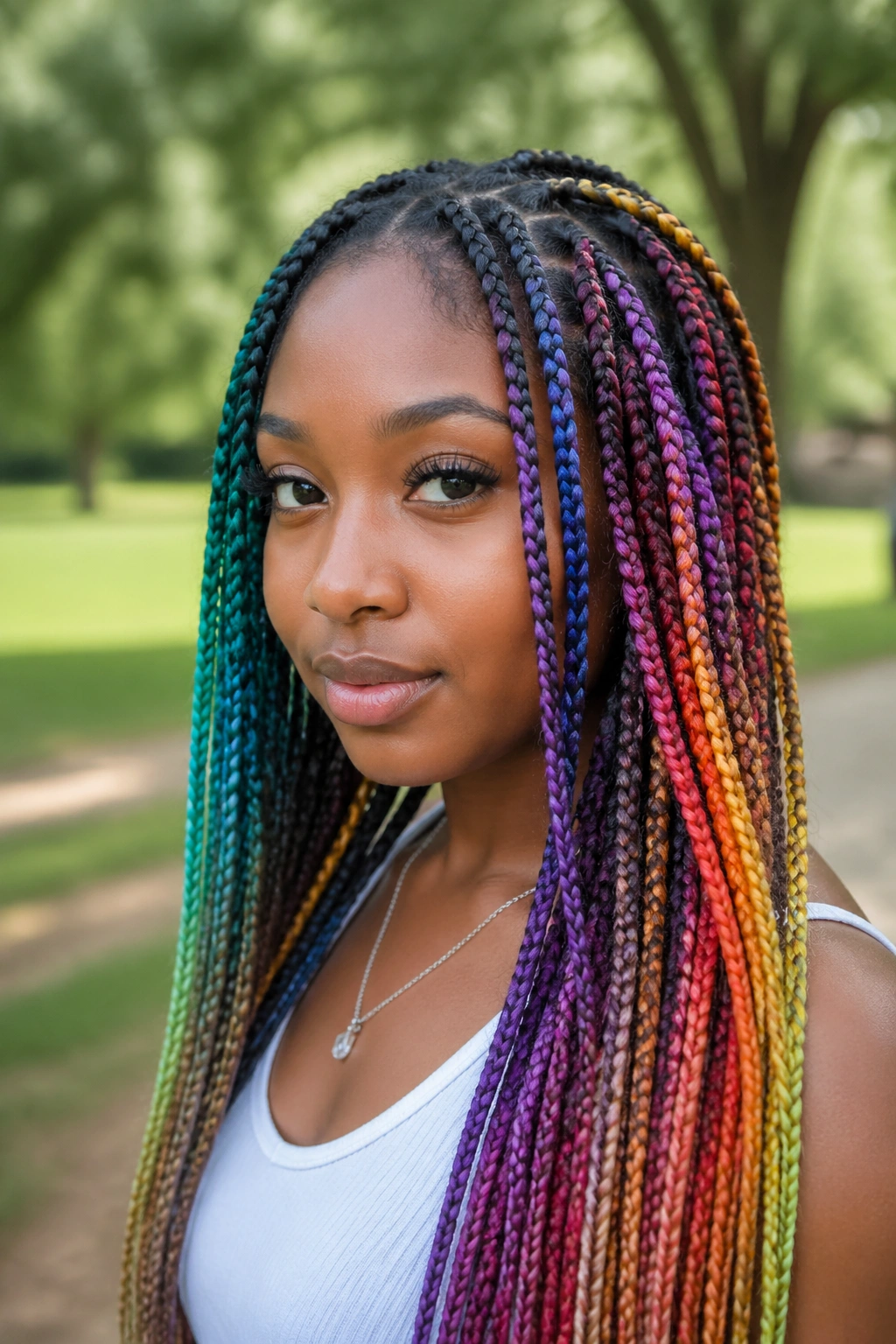
Why do knotless rainbow box braids look so smooth at the root? Because the braid starts with your natural hair and the added hair feeds in gradually, which removes that chunky knot at the base. On a rainbow style, that matters more than it sounds like it should.
The smooth root lets the color flow instead of landing all at once. If you’re mixing bright shades, knotless braids keep the transition cleaner and make the style sit flatter against the scalp. That flatter start also helps if you want to wear the braids in a high ponytail or bun without the root looking bulky.
Best place to use them
- Medium or long rainbow braids where the root transition can show
- Sensitive scalps that hate heavy tension
- Faces you want to frame softly without a hard knot line
- Color blends that need a gentler fade
Knotless rainbow box braids are one of those styles that looks more expensive than it should. Not flashy-expensive. Just neat. Controlled. Calm at the scalp, then loud everywhere else.
10. Triangle-Part Rainbow Box Braids
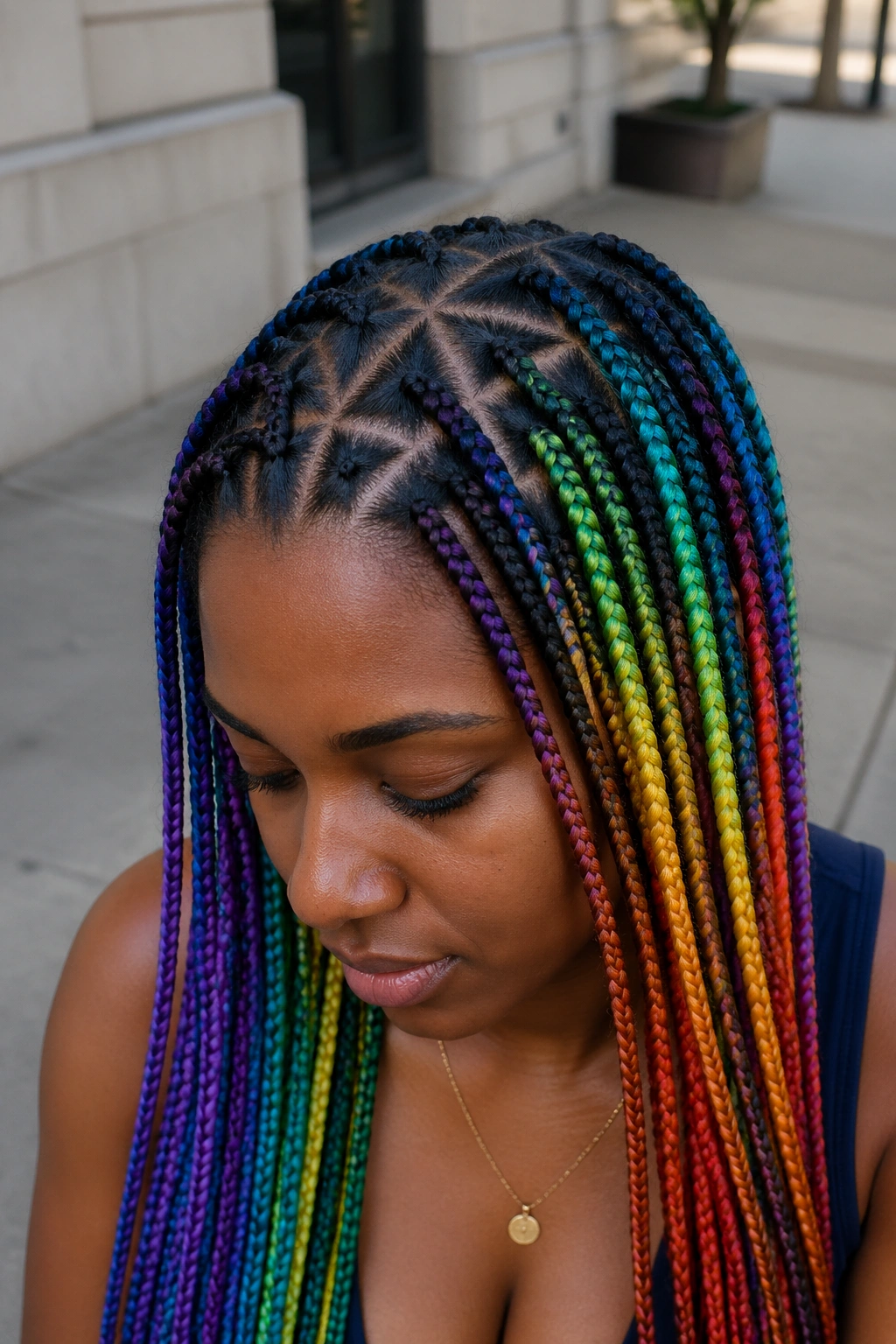
If square parts feel a little expected, triangle-part rainbow box braids give you a better edge before the color even starts. The parting pattern itself becomes part of the design, and that changes the whole mood. Triangles catch the eye in a way straight rows never quite do.
I like this version especially when the colors repeat in a loose order. Triangle parts already create visual movement, so the palette does not need to be chaotic too. Let the parting do one job and the color do another. That balance keeps the style from tipping into clutter.
- Use clean sectioning so the triangle points stay sharp
- Repeat one accent color at the crown for consistency
- Keep braid sizes medium so the parting is still visible
- Pair with a middle part or a curved front shape if you want more drama
Triangle parts are a small change that makes a real difference. People notice them even when they cannot name why the style feels fresher.
11. Waist-Length Rainbow Box Braids
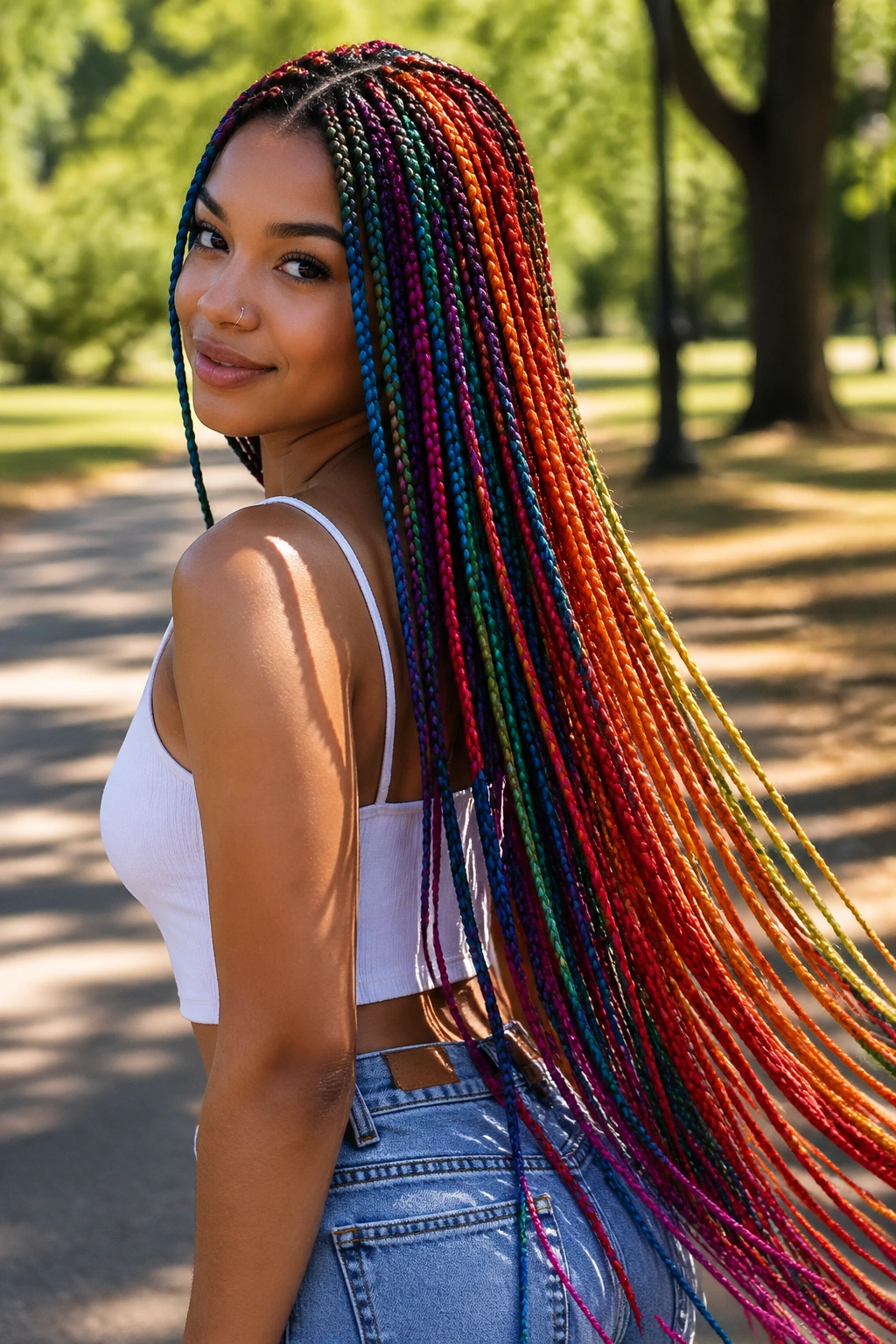
Waist-length rainbow box braids are not subtle, and that is part of the fun. The length gives every color more time to show up, so the style feels like a moving stripe of fabric when you walk. If you choose a strong rainbow palette, the extra inches let each shade breathe instead of crowding the others.
This is the length where braid weight starts to matter. Thick braids can tug at the scalp if they’re too heavy, especially when combined with dense synthetic hair. A medium size usually wears better here, because it gives you the length without making the style feel like a backpack. Slightly lighter extensions help too.
There’s also a proportion trick worth paying attention to. Bright colors look even louder when the length is dramatic. If you want the braids to stay wearable, mix in a few darker strands or choose a gradient instead of a hard rainbow stripe. That softens the effect without hiding the color.
Waist-length rainbow box braids are for the person who wants movement first and modesty never.
12. Bob-Length Rainbow Box Braids
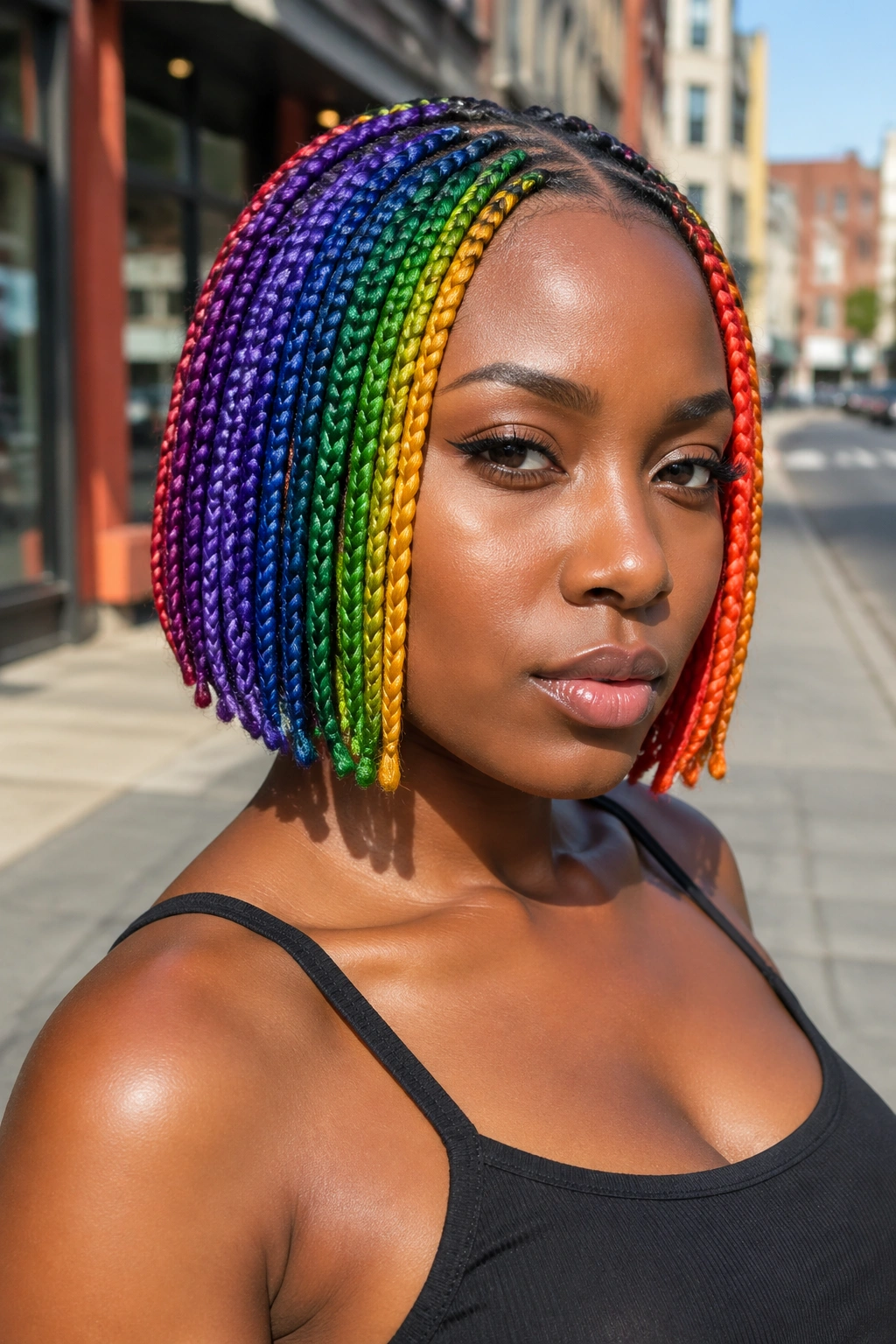
Bob-length rainbow box braids are a clean, sharp answer for anyone who wants color but not the weight of a long style. The shorter length makes every shade easy to see, and that means the palette has to be good. There is nowhere for a weak color choice to hide.
Compared with waist-length braids, a bob reads brighter and more graphic. The ends stop near the jaw or collarbone, which keeps the style from dragging downward. That makes face shape and parting matter a little more. A crisp side part or a soft middle part can change the whole look.
This is the version I’d suggest to someone who wants rainbow braids but has a busy routine. Shorter braids are easier to wash, easier to sleep on, and easier to swing into a ponytail without a battle. They also work well with stronger color blocking because the shorter length keeps the palette tidy.
If long braids feel like too much maintenance, the bob is the sane choice. And it still looks like you meant it.
13. Rainbow Box Braids with Beads
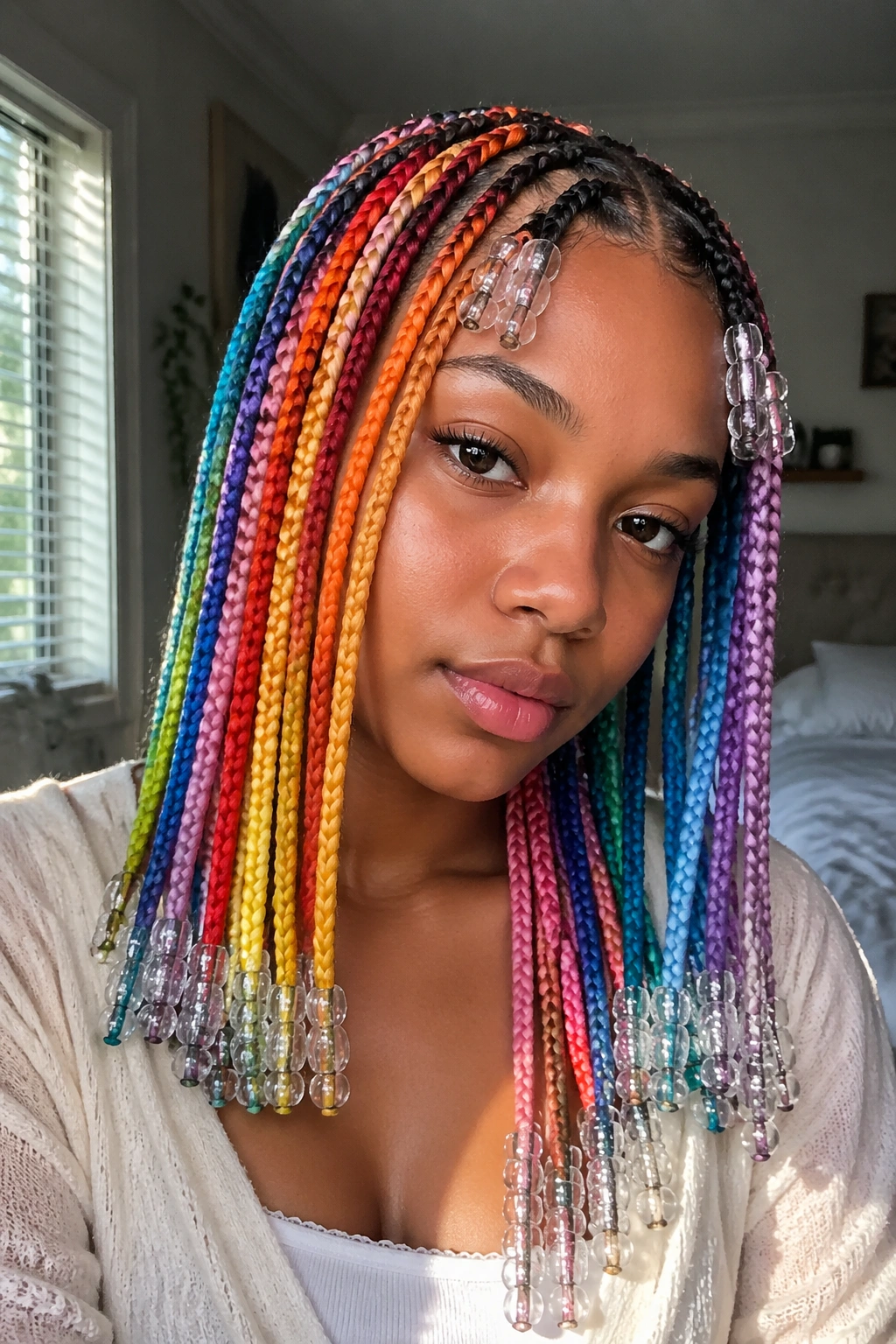
Beads make rainbow box braids feel finished. Not decorated. Finished. That tiny distinction matters, because the wrong beads can make a style look random, while the right ones give the ends a kind of rhythm that ties the colors together.
Clear beads are the easiest place to start if your rainbow palette is already busy. They let the braid color stay in charge. Colored beads can be fun too, but I’d use them with some restraint — one or two braid ends, not every end. Too many bead colors and the braids start arguing with the accessories.
- At the ends: beads add weight and a little sound, which some people love and some people hate
- Near the roots: small beads can frame the face without taking over
- Mixed with cuffs: the style gets more layered, but keep the metal simple
- On child-size braids: make sure the beads are not so heavy that they pull
Beads are one of those details that look tiny in a photo and obvious in motion. That’s the real appeal.
14. Rainbow Box Braids with Cuffs
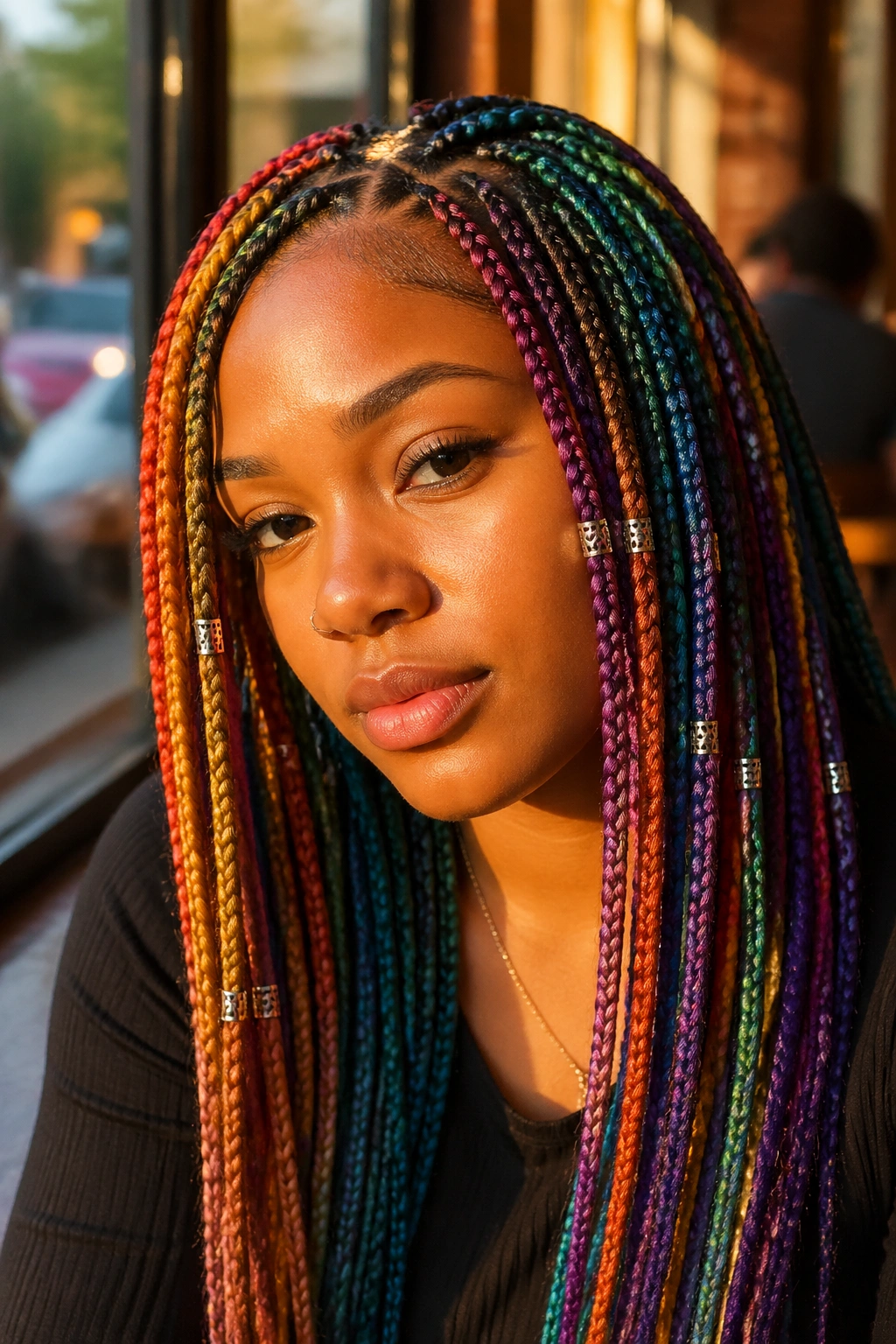
Can a few metal cuffs calm down a loud rainbow palette? Yes. Oddly enough, they can. Cuffs break up the color the same way punctuation breaks up a sentence, giving your eye a place to rest.
The best cuff placement is usually mid-length or near the ends, where they can catch the light without crowding the scalp. A cluster of small cuffs on a few front braids is enough for most people. You do not need to cover every strand. In fact, that usually looks heavier than you want.
Where to place them
- Front braids: frames the face and makes the color look intentional
- A few lower braids: keeps the style from feeling over-accessorized
- One side only: gives a slight asymmetry that feels modern without trying too hard
- Near the ends: good if the braid color itself is doing the talking
Cuffs work especially well on rainbow box braids when the palette has both warm and cool shades. The metal gives the eye a little pause between the color hits. Small detail. Big payoff.
15. Rainbow Box Braids with Curly Ends
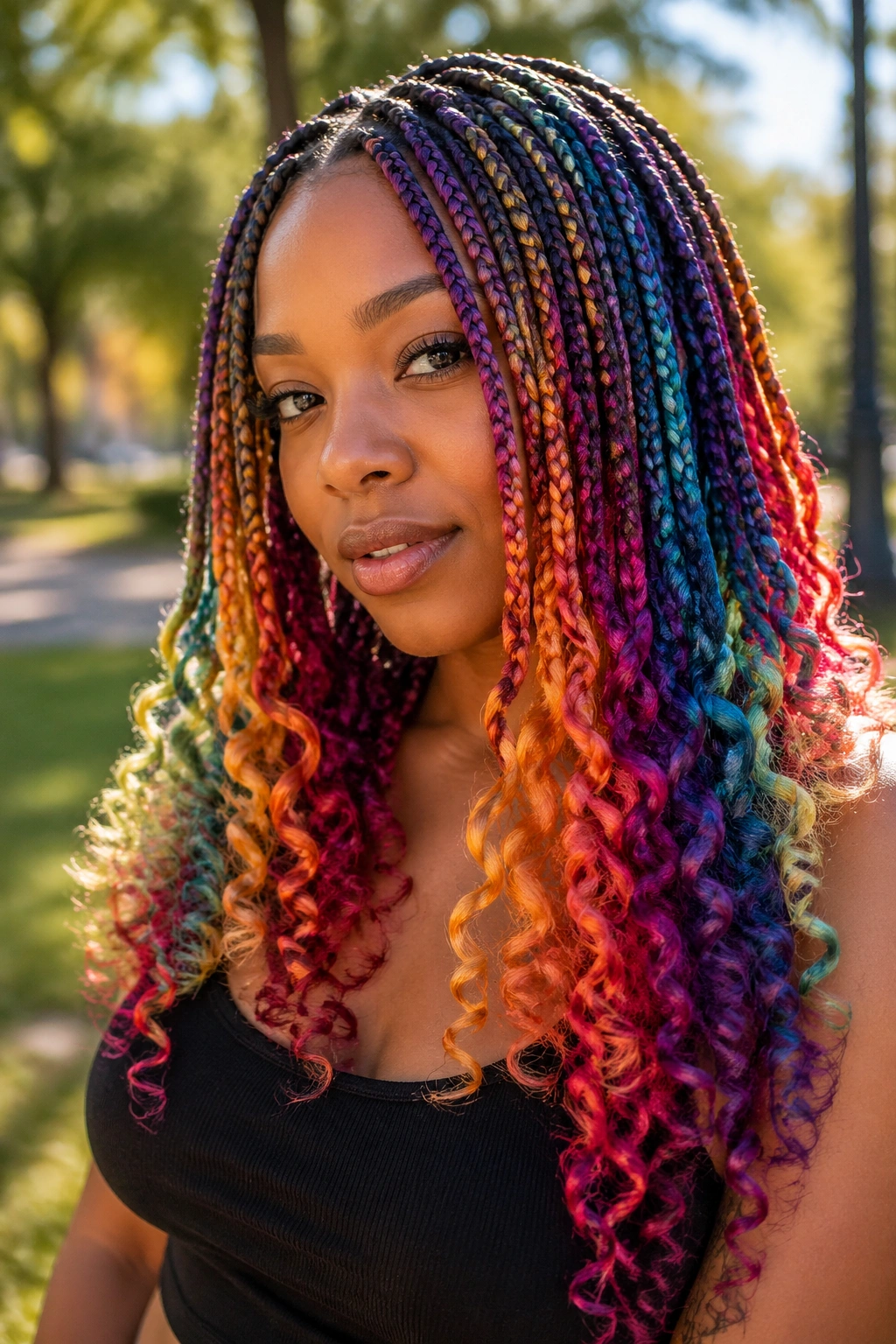
Rainbow box braids with curly ends soften the whole style in a way straight braids cannot. The curls break the hard line at the bottom, so the braids feel a little more fluid and a little less rigid. That matters when the color is already doing a lot of visual work.
I like this look because it adds motion without changing the braid structure. The color still lives in the box braid sections, but the curly ends give you a second texture to enjoy. If you choose a rainbow palette, the curls can also catch mixed tones from the ends of the hair, which gives the style extra depth.
A few practical details make a difference here. Use a mousse that does not leave the curls stiff or crunchy. Keep the ends trimmed evenly if you want the shape to stay neat. And if you’re working with synthetic hair, test the curl pattern before install so the ends don’t look mismatched halfway through the head.
Curly ends turn rainbow braids from hard-edged to soft-edged fast. Sometimes that’s exactly the point.
16. Rainbow Goddess Box Braids
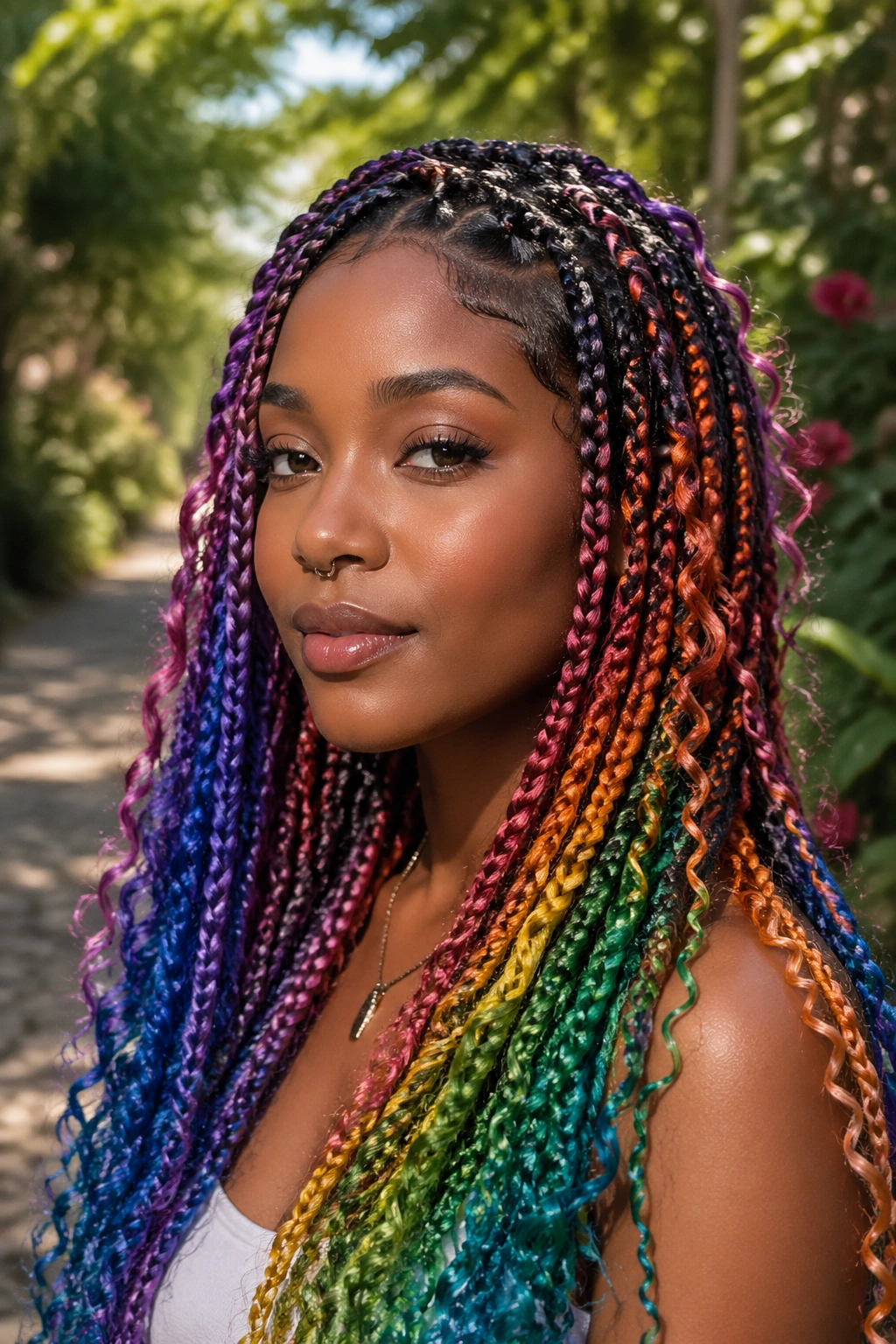
Rainbow goddess box braids are basically the softer cousin of the regular version. You still have the structure of the braid, but you leave loose curly pieces throughout the style, which makes the whole thing feel fuller and less strict. Color plus texture. That’s the game.
Unlike a clean, fully braided set, goddess braids move in two directions at once: the braid lays the base, and the curls keep the style from feeling too neat. If you use rainbow colors here, the loose pieces can pick up light in a way that makes the shades look more blended. A bright curl near a darker braid can change the whole line of the style.
This version is best for people who want their rainbow braids to feel soft around the face. The curly strands do some of that work for you. They also help if you like a slightly undone finish and do not mind a little upkeep to keep the curls looking fresh.
It’s a prettier, less rigid rainbow. That’s the easiest way to say it.
17. Half-and-Half Rainbow Box Braids
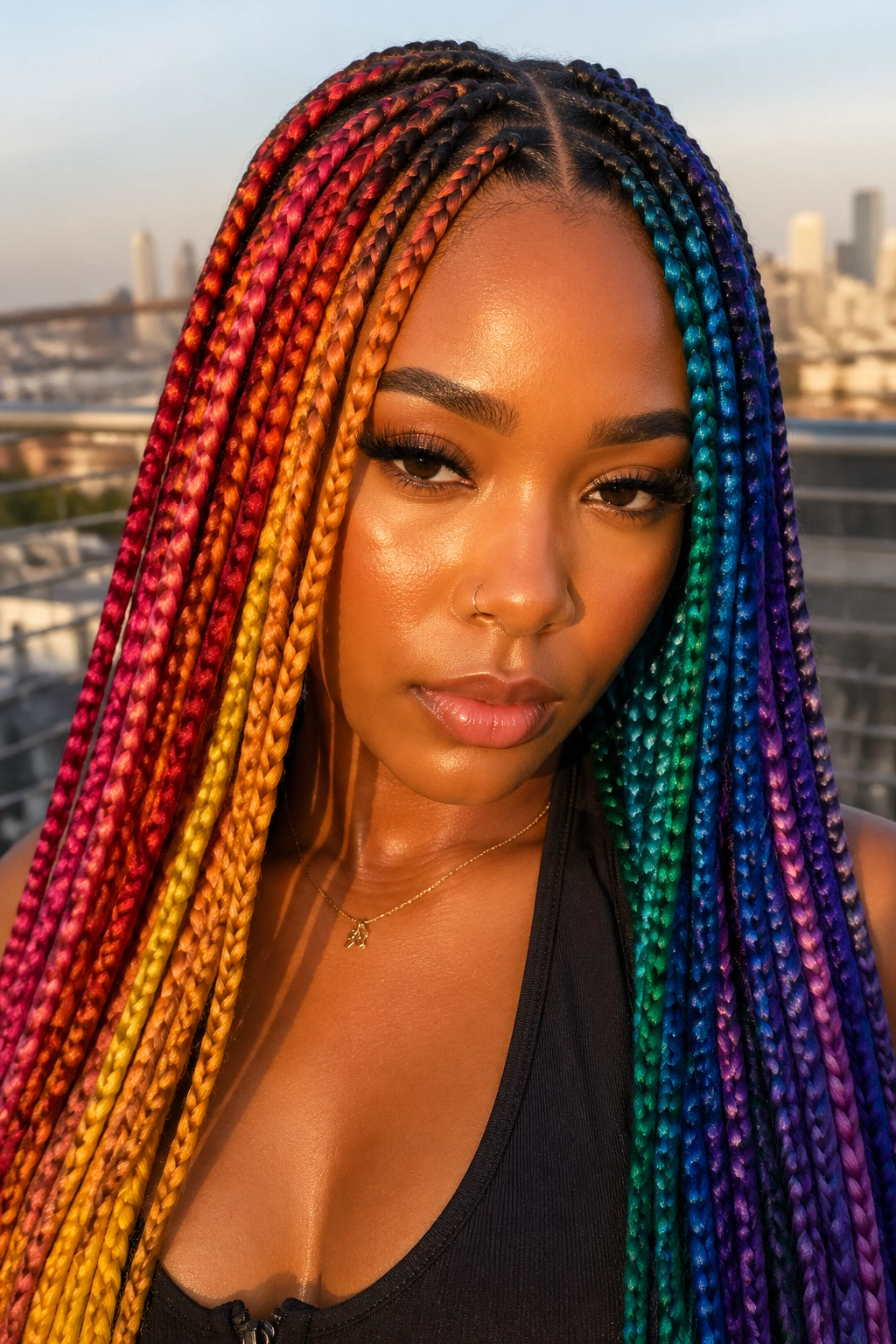
Half-and-half rainbow box braids split the head into two color moods, and that split gives the style a clean visual punch. One side can hold the warmer shades while the other side goes cool, or one side can stay bright while the other side leans pastel. The point is contrast with structure.
Why it works
The symmetry keeps the style from feeling messy, even when the colors are loud. Your eye knows where to start and stop, which matters more than people expect. A half-and-half layout also lets you wear color in a way that feels more editorial than chaotic.
You can make this style feel sharper by keeping the part line straight and the braid sizes even on both sides. Or go the opposite direction and make one side slightly fuller if you want a little imbalance. Both can work. The hairline and face shape decide a lot here.
My recommendation: use a darker anchor color on one side and a brighter rainbow blend on the other. That contrast keeps the style from looking split in a way that feels accidental.
18. Zig-Zag Part Rainbow Box Braids
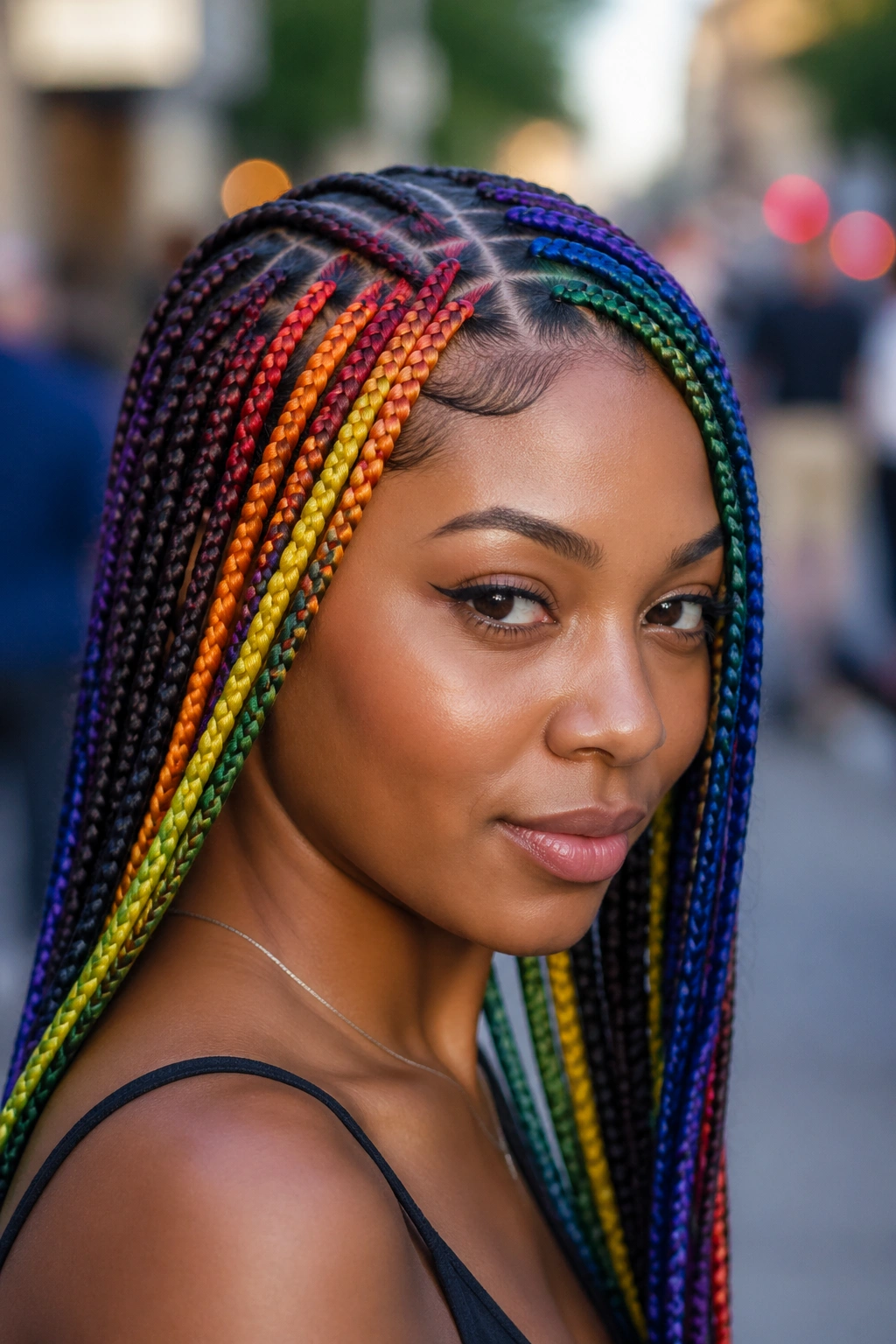
Straight parts are fine. Zig-zag parts give the color motion before the braids even start. That matters when you want the hairstyle to feel lively from the scalp outward, not just at the ends.
The zig-zag pattern works especially well with rainbow box braids because the parting adds another layer of design. The style looks busy in a good way. There’s something satisfying about that little flick of movement at the scalp, especially if the braid colors are bold and repeated in a clean order.
- Ask for sharp points rather than soft waves if you want the part to read clearly
- Keep the rows even so the zig-zag does not look accidental
- Use one strong front color to frame the part pattern
- Skip heavy accessories if the parting is already doing enough
This is one of my favorite choices for people who think box braids look too predictable. A zig-zag part fixes that fast. It changes the map.
19. Rainbow Box Braids with a Black Base
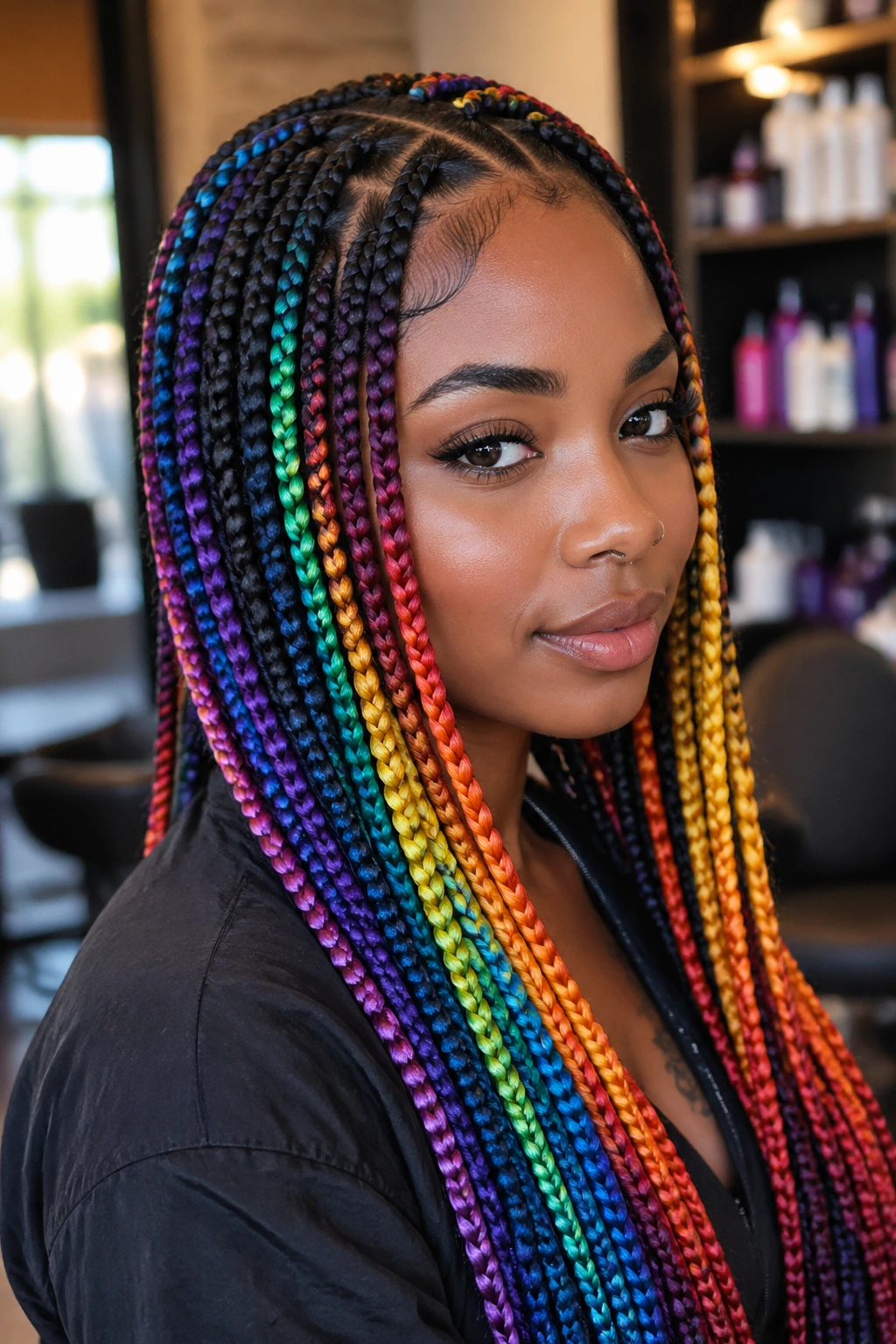
Rainbow box braids with a black base are the easiest way to make color look grounded. The black acts like a frame. Every bright shade sitting on top of it looks sharper because the eye gets a dark place to rest between the color hits.
This is the style I would point nervous color wearers toward first. You still get the rainbow effect, but the base keeps it from tipping into costume territory. It also hides grow-out better than a lighter base, which is useful if you want the style to last a bit longer before it starts looking fuzzy at the roots.
The best versions use black at the scalp and then place the brightest shades farther down the braid or around the front. That way the color has room to show without making the head look flat. A black base plus rainbow lengths can also make beads, cuffs, and curly ends look cleaner because the dark foundation is doing some quiet work underneath.
If you want one style that makes bright color easier to wear, this is the one I’d choose.
20. Rainbow Halo Box Braids
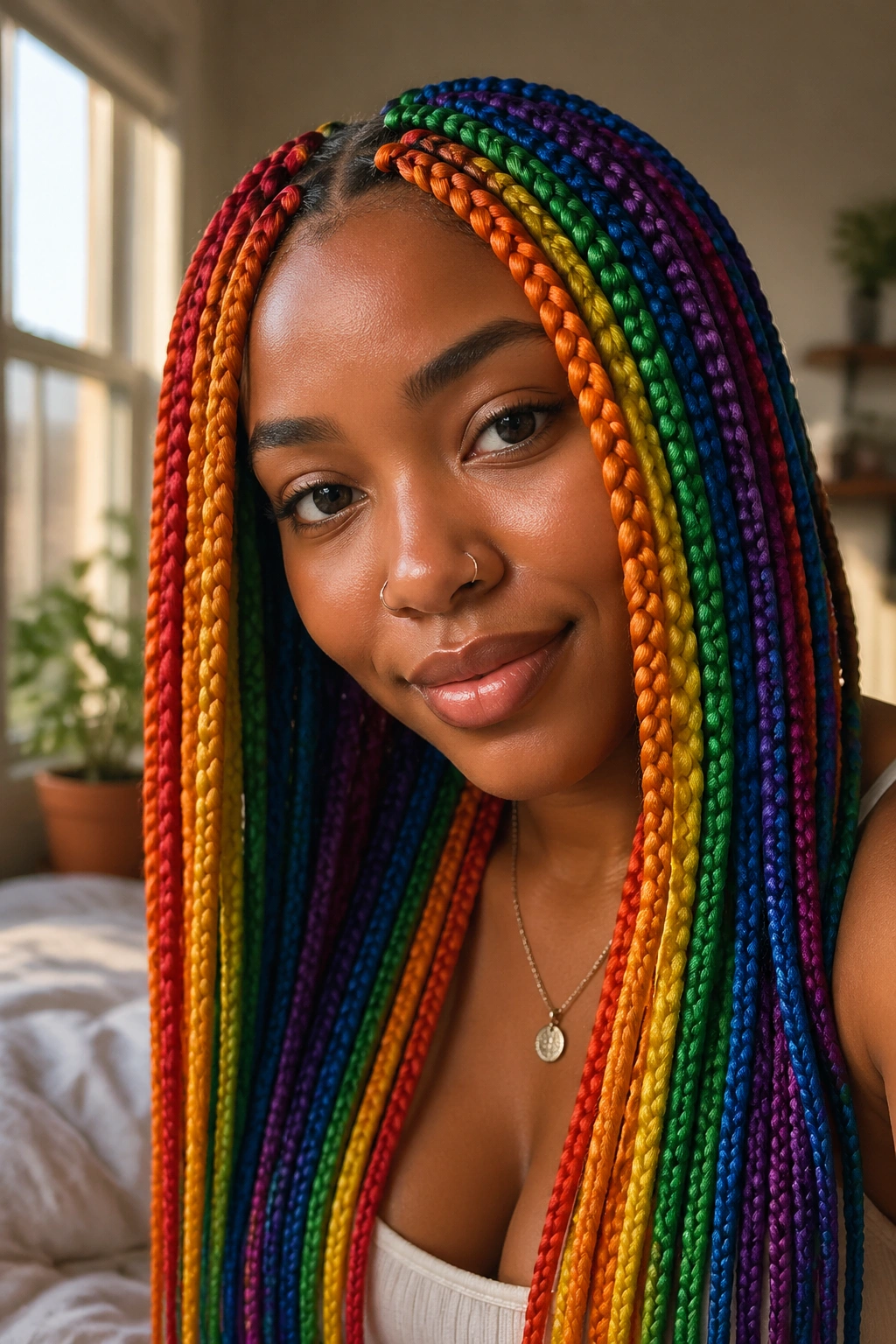
Rainbow halo box braids place the brightest color where the eye lands first — around the hairline, crown, or top layer — and let the rest of the head stay a little calmer. That halo effect is smart because it gives you the rainbow punch without demanding a full-head commitment.
I like this version for people who want color but need the style to feel wearable in everyday life. The front and top sections do the talking. The lower braids can stay darker, more muted, or more repetitive. That balance keeps the look from becoming too busy, which can happen fast when every braid is shouting at once.
A halo placement also frames the face in a natural way. Bright braids near the temples and crown can draw attention upward without needing extra accessories. If you want to make it even cleaner, keep the braid parts neat and let the color gradient soften toward the back.
This is the rainbow style I recommend when someone says, “I want the color, but I still want the braids to feel like braids.” That’s the point, really.