



Box braids for little girls on natural hair have one job most grown-up styles never have to think about: they need to survive school, snacks, naps, playground chaos, and a child who may decide halfway through that she is done sitting still.
That sounds obvious. It isn’t.
The styles that last are usually the ones with clean parting, light weight, and ends that do not pull the scalp down like a backpack strap. I’ve seen too many little heads turned into a tug-of-war by oversized braids, tight edges, or beads that were added because they looked cute in a photo and miserable by day three.
The good news is that little girls have room to have fun with box braids. Beads, ribbons, bob lengths, side parts, space buns, curly ends, heart-shaped parts — all of it can work when the braids are sized for the child, not for an adult’s idea of “extra.” The real trick is matching the style to her hair density, her age, and how much maintenance you can keep up with between wash days.
Some styles are school-proof. Some are picture-day good. The smart ones do both.
1. Classic Medium Box Braids for Little Girls on Natural Hair
Classic medium box braids are the style I reach for when the goal is neat, sweet, and not fussy. The parts are even, the braid size sits in that middle zone between tiny and bulky, and the whole look moves nicely without feeling heavy.
On natural hair, this size works well when the child has medium to dense hair and can sit long enough for clean sectioning. I like a soft center part or a gentle side part better than a hard, severe line on very young girls. It feels kinder around the face, and it gives the style a softer shape.
Best detail to ask for: keep the front pieces slightly smaller than the back so the hairline does not carry extra weight. That tiny tweak makes a bigger difference than most people think.
If you want one style that can handle school, church, and a family dinner without changing much, this is the safe bet. Not boring. Just dependable.
2. Small Knotless Box Braids
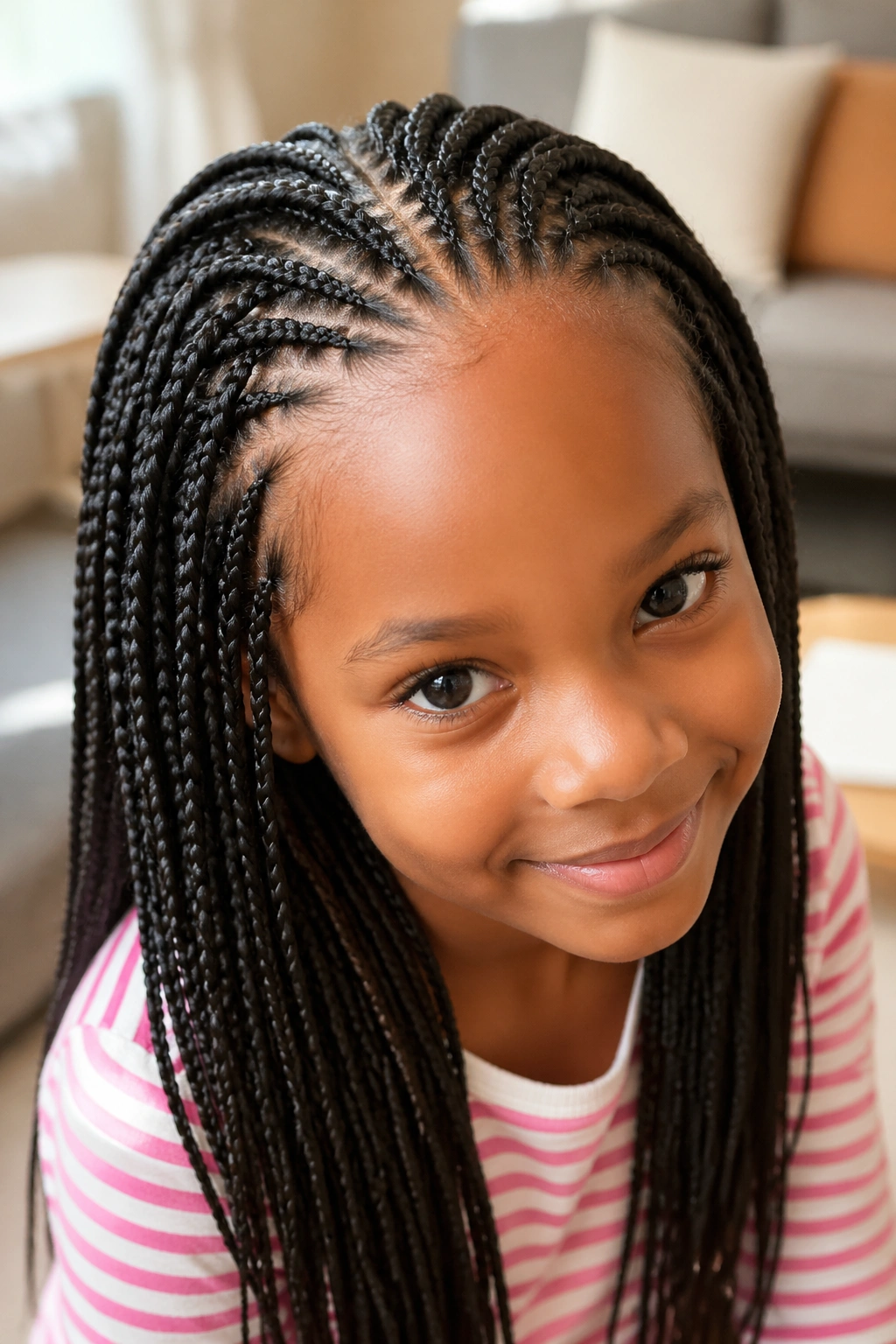
Why do knotless braids matter so much on kids? Because the braid does not start with a tight knot at the root, which usually means less pulling at the scalp and less pressure around the hairline. That matters on little heads. A lot.
The braid begins with the child’s own hair and then small amounts of extension hair are fed in as you braid down. The result lies flatter, looks lighter, and tends to feel easier to wear for a child who complains when styles feel “too tight” at the front.
Why it works so well
- The root sits flatter, so ponytails and buns are easier.
- The braids tend to feel lighter during the first few days.
- The style can be worn in school-friendly looks without a big bump at the base.
- It is a good choice for girls who are tender-headed or sensitive around the edges.
The one catch is time. Knotless braids take longer to install, and they need a braider who is patient with neat sectioning. If the feed-in pieces are too thick, the braid loses the whole point.
Ask for small, even feed-ins and a soft grip at the root. That is the difference between “gentle” and “looks gentle.”
3. Jumbo Box Braids with Clean Parts
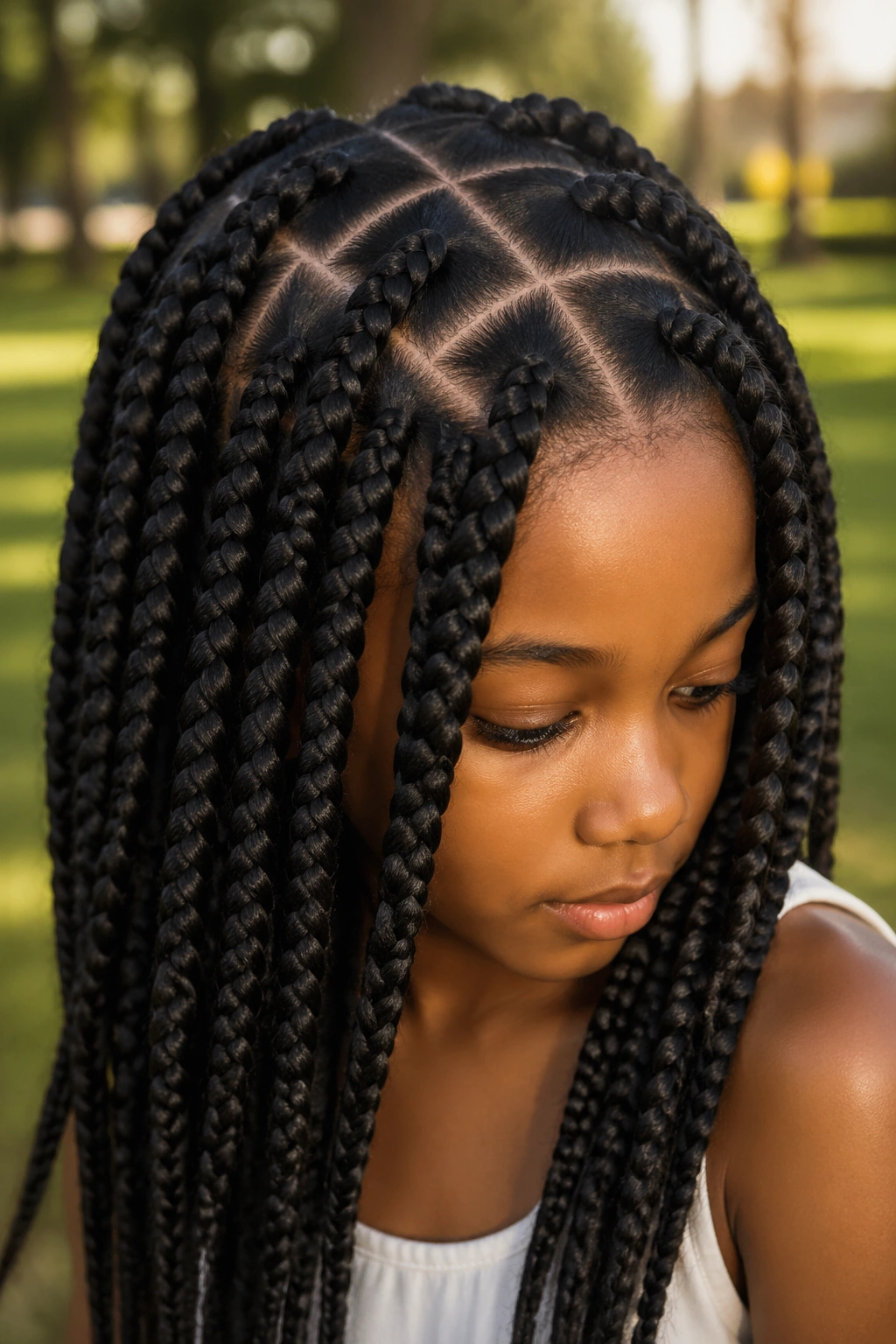
Jumbo braids are for the child who wants big style with less sitting time. Fewer parts mean fewer sections to braid, and that can make a long appointment much easier on everybody in the chair. If a girl has thicker natural hair, jumbo braids can also look full without needing a mountain of added hair.
The trick is weight. Big does not have to mean heavy, and heavy is where the trouble starts. Keep the braids chunky enough to look bold, but not so large that they pull on the roots after a few hours of play.
A style like this works best when the parts are neat and the ends are trimmed cleanly or lightly sealed. I like it on girls who wear their braids loose most of the time and only switch to a ponytail for school or dance class.
If you want a style that reads strong and polished in a photo, this is a good one. If the child hates long salon sessions, it may be one of the kinder options.
4. Shoulder-Length Bob Box Braids
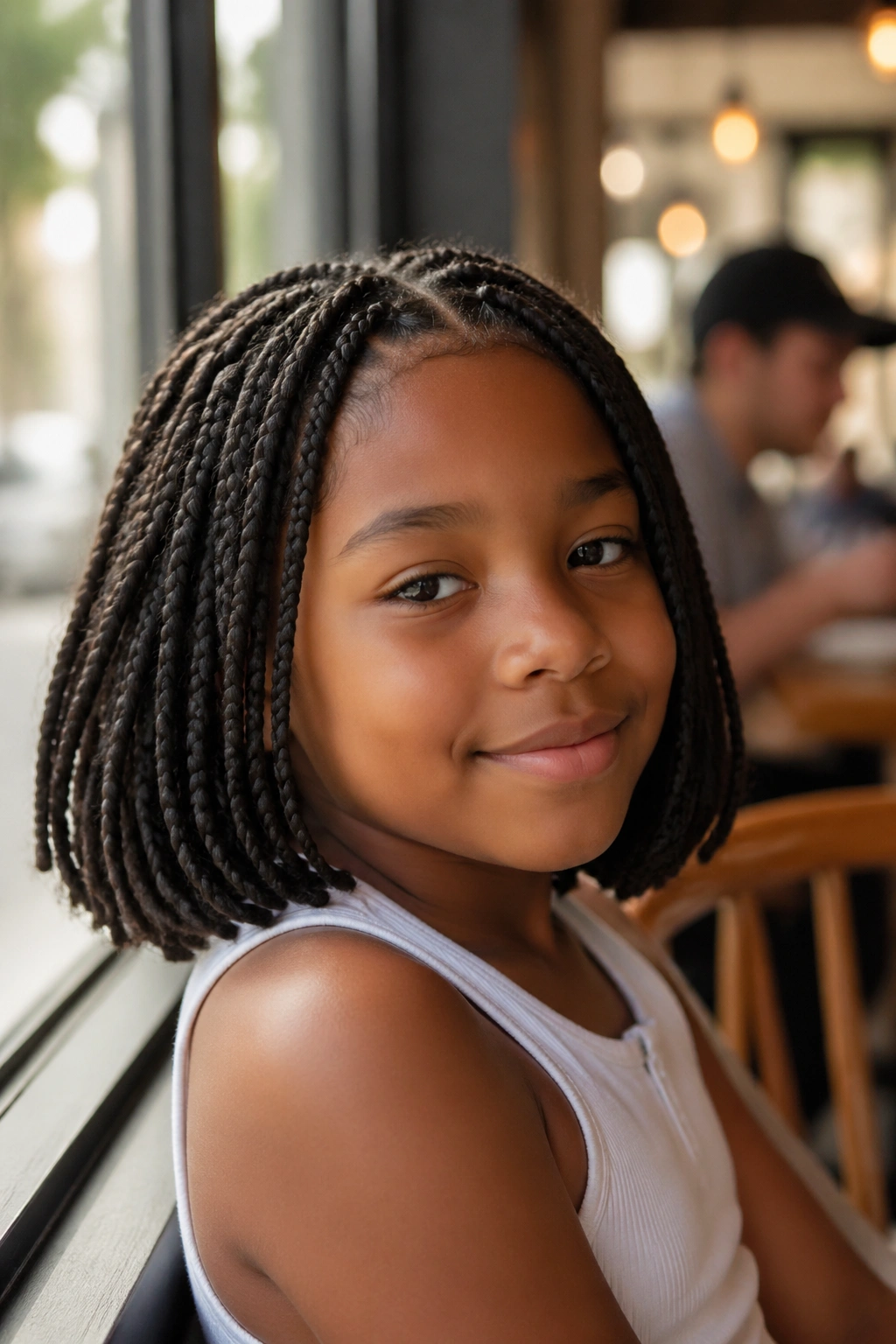
Shoulder-length bob braids are the style that looks neat even when a child leans into a car seat, a backpack, and a windy walk across the parking lot. The length stops around the jawline to collarbone area, which keeps the hair off the shoulders and out of the soup bowl.
For little girls, this shape is practical in a way long braids are not. It dries faster after a wash, stays tangle-free at the ends, and does not whip around the face every time she turns her head. That makes the style easier to live with, not just easier to admire.
Tight, blunt bobs can look sharp. Softly layered bobs look friendlier. I prefer the second one for younger kids because it keeps the hair from sitting like one solid block around the neck.
Shorter braids are not less cute. They’re often smarter.
5. Waist-Length Box Braids
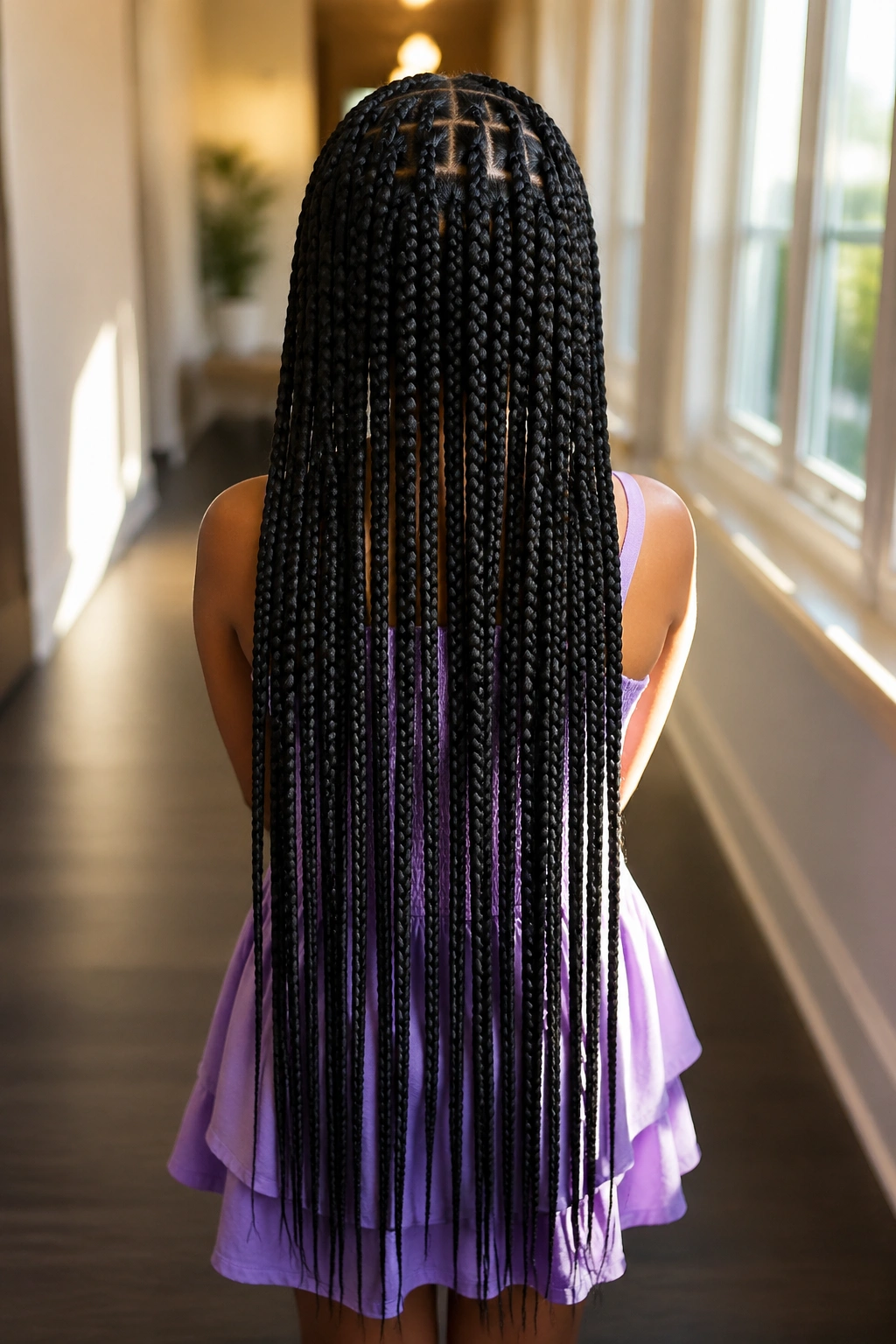
Waist-length box braids are the dramatic option, and there’s nothing wrong with wanting a little drama. The style gives a long, flowing finish that feels special for birthdays, family photos, and events where the child wants her hair to swing when she walks.
The catch is weight. Long braids need to be balanced carefully, especially on natural hair that is fine around the edges or a little fragile at the crown. Keep the sectioning neat, but do not pack the braids too full with extension hair. That is how a style goes from pretty to tiring.
Best for:
- Older little girls who can tolerate longer styles.
- Thicker natural hair that can support the parting.
- Special occasions where the braids will be worn down most of the day.
- Parents who are willing to keep the scalp moisturized and the ends wrapped at night.
I like waist-length braids best when they are part of a well-planned routine, not a spur-of-the-moment idea because the child saw them online. They need care. They also need honesty.
6. Triangle Part Box Braids
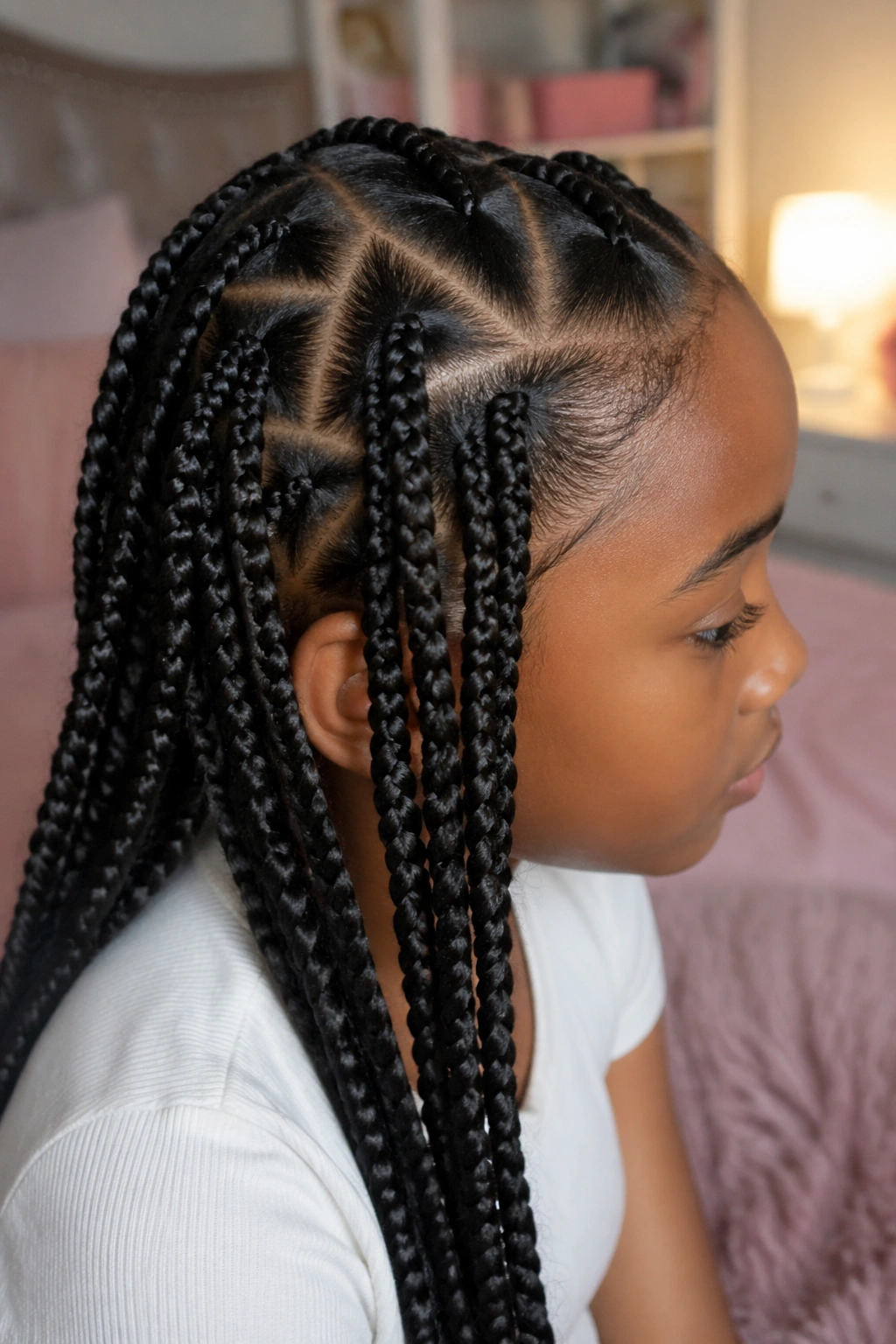
Triangle parts change the whole mood of box braids. The braid itself may be familiar, but the parting gives the style a fresh look before anyone even notices the length. Triangles also soften the grid pattern, which can feel a little less rigid on a small head.
This style works especially well when the braids are medium-sized. Too tiny, and the parting details disappear. Too large, and the triangle shape loses its clean lines. Somewhere around ¾ inch to 1 inch sections usually gives enough room for the pattern to show.
How to ask for the parting
- Keep the triangles even around the crown.
- Make the back sections a touch larger if the hair is denser there.
- Leave the hairline neat but not squeezed.
- Ask for clean scalp rows, not overpacked sections.
Triangle parts are a nice choice for a child who wants something different without needing bright color or extra hair accessories. The parting does the talking. Quietly. But it talks.
7. Heart-Part Box Braids
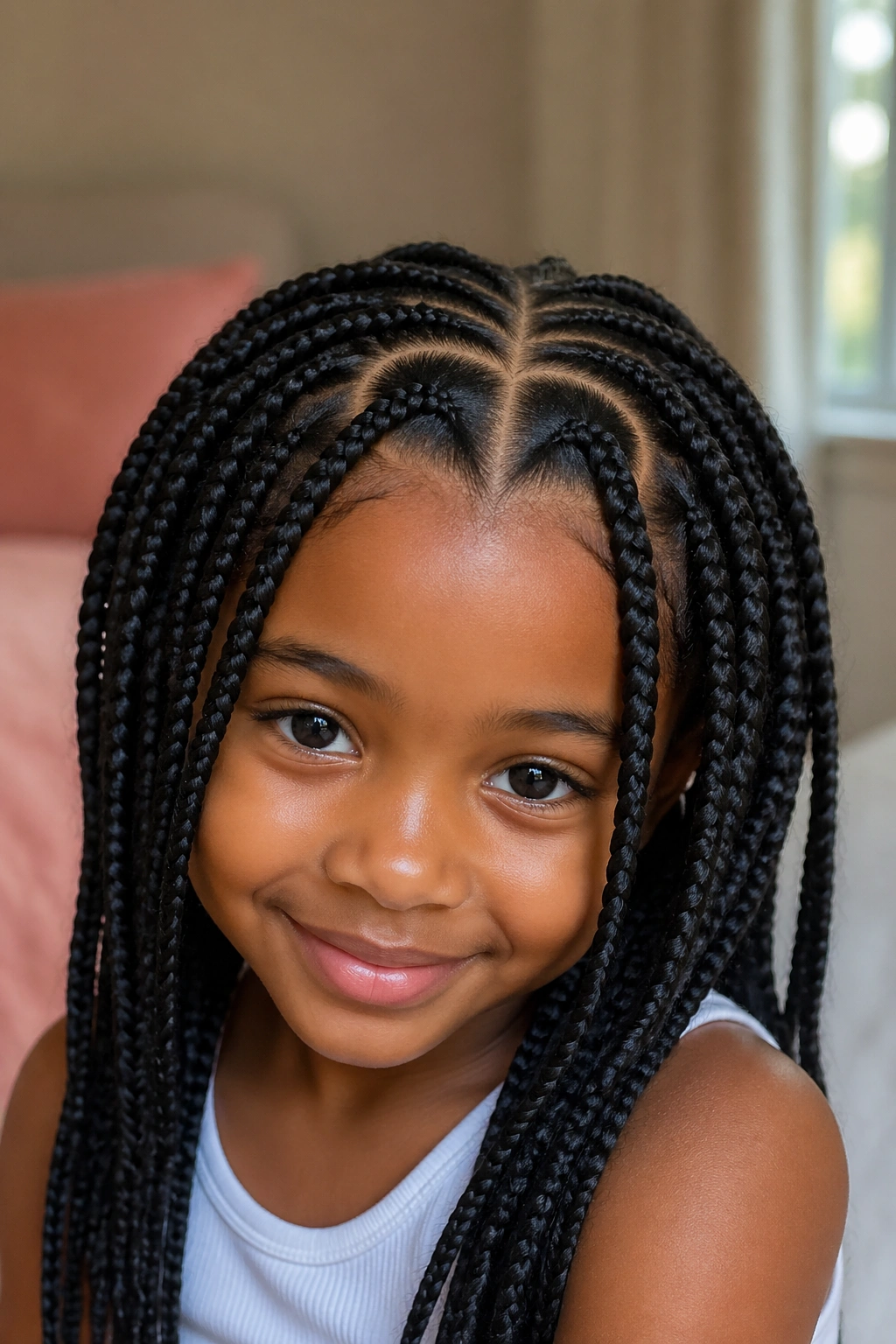
Heart-part box braids are the style you pick when the parting itself should be part of the fun. A heart shape near the front or crown turns a standard braid set into something that feels playful and special, which is a good fit for birthdays, school pictures, and any day a child wants to feel a little extra.
The reason this style stands out is that the part has to be clean for the heart to read properly. If the lines are shaky, the shape gets lost. That’s why a skilled braider matters here more than with a plain grid. The design lives or dies on the sectioning.
I like heart parts best when the rest of the braids stay medium-sized and low-tension. The shape itself is the main decoration. You do not need to pile on beads, cuffs, ribbons, and color unless the child wants a busier look.
A small heart near one temple can be enough. It is a sweet detail, not a billboard.
8. Side-Part Box Braids with Beads
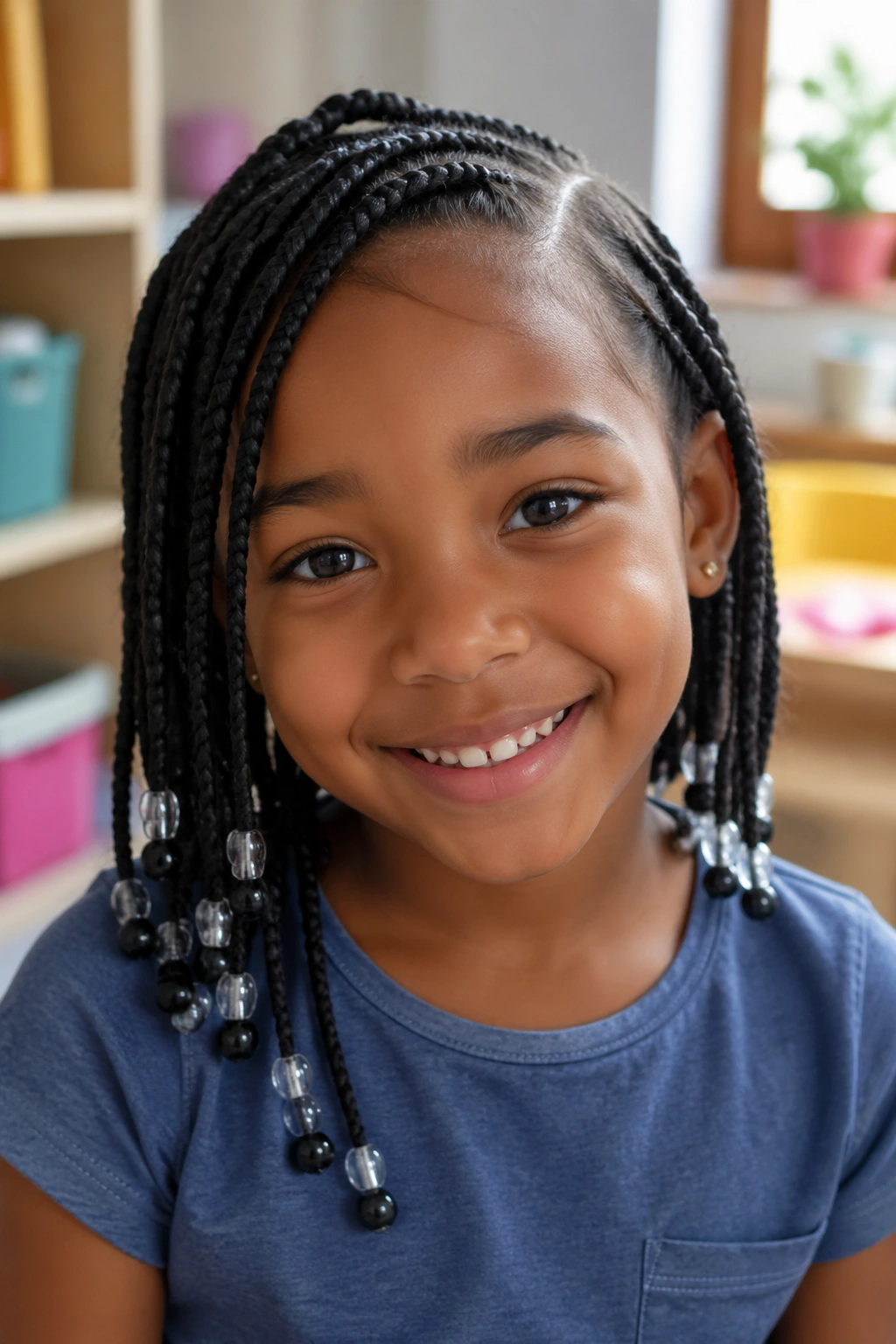
A side part changes the face-framing in a way a center part never quite does. It softens the forehead, makes the braids fall with a little more movement, and gives the whole style a relaxed tilt that works well on younger girls.
Add a few beads at the ends and the look becomes playful without turning noisy. I say “a few” on purpose. Too many beads near the temples can feel heavy, and heavy ends bounce against the shoulders all day. A small cluster at the tips is often enough.
This style is nice for kids who like to flip their braids to one side when they get tired of hair in their face. The side part gives them a built-in habit. It also works well if one side of the head tends to lay flatter than the other, because the parting can balance that out.
There’s a simple charm here. Nothing overworked. Just a braid style that moves.
9. Half-Up Half-Down Box Braids
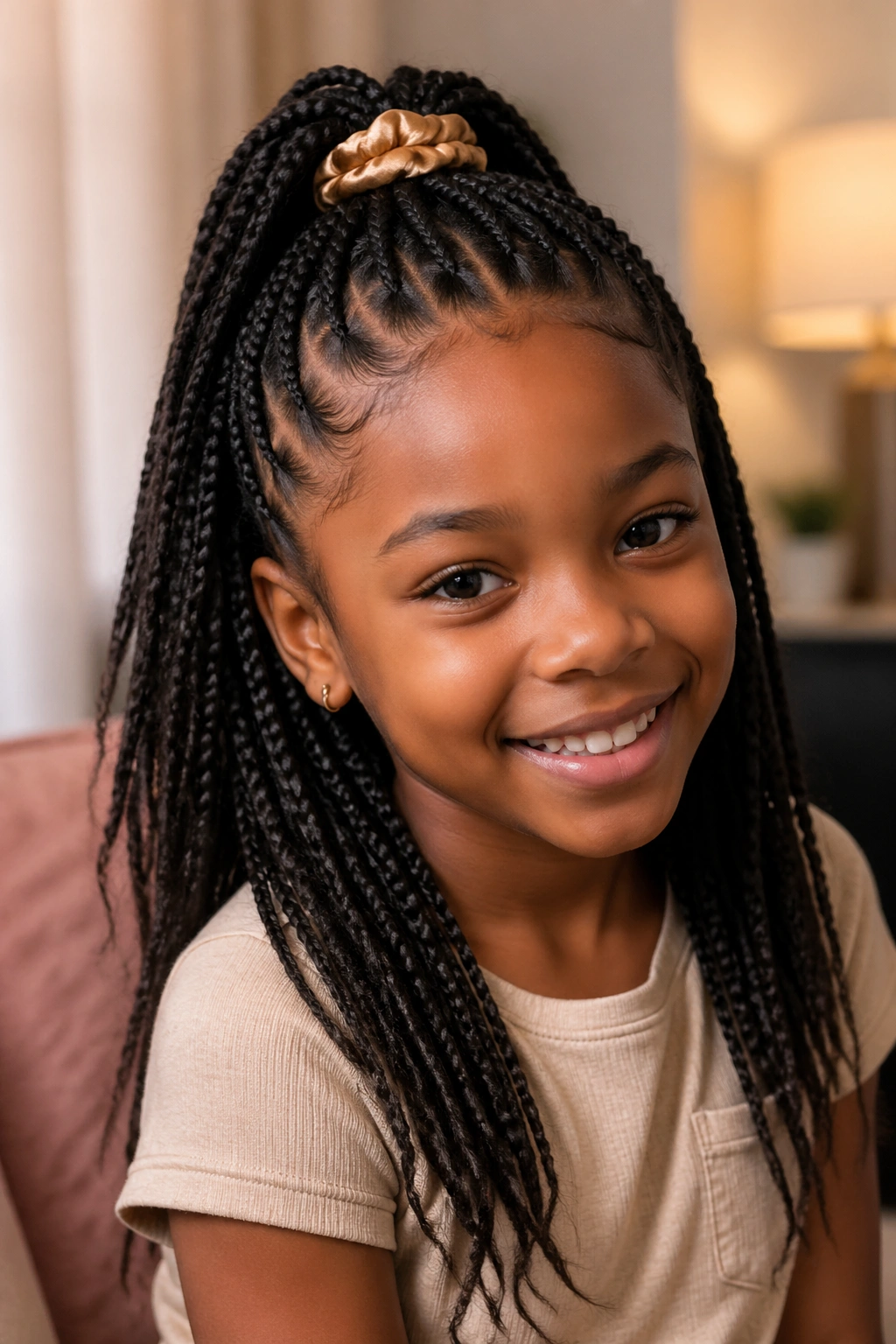
Half-up half-down braids are useful because they split the difference between “hair out of the way” and “still long enough to look fun.” The top section gets pulled back into a ponytail, puff, or little bun, while the rest hangs loose.
For little girls, this style can save a morning. The front stays off the face during school or play, and the loose back section still gives the child the feel of having long braids. If the ends are sealed neatly, the whole look stays tidy without much fuss.
I like this one best on medium-length braids. Very long braids can make the top section feel bulky, and very short braids may not give enough length to create a clean top half. A satin scrunchie or soft band helps too. Hard rubber bands are not the friend here.
If she likes to touch her hair, this style may be the sweet spot. There’s enough structure to keep things neat, but not so much that it feels stiff.
10. High Ponytail Box Braids
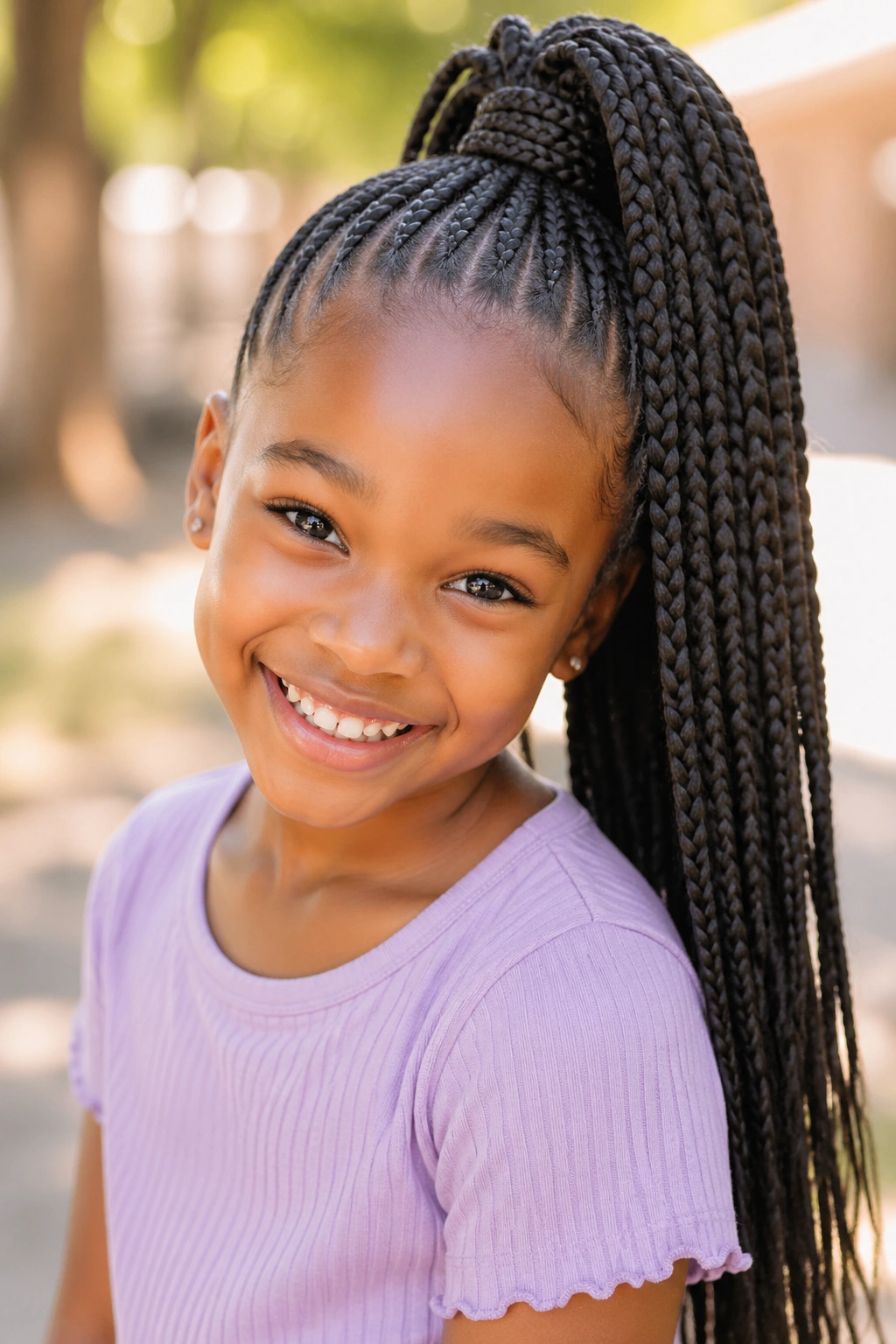
A high ponytail on box braids gives the whole style a quick lift. It is energetic, practical, and good for a child who spends a lot of time running, jumping, or just tossing her head around like she owns the place.
The lift has to come from the right tension, though. Pulling a ponytail too high and too tight can make the scalp feel sore by midday, especially if the braids are long. I prefer a secure base with a soft wrap around the hair tie, not a strained pull at the crown.
What makes it work
- Medium-length braids stay easier to manage in a ponytail.
- A wrapped braid or satin band helps hide the base.
- The style keeps the face clear for school and sports.
- It can be worn straight up or angled slightly back.
Compared with half-up styles, the high ponytail is a little more active and a little less soft. That’s the point. It has energy.
11. Space Bun Box Braids
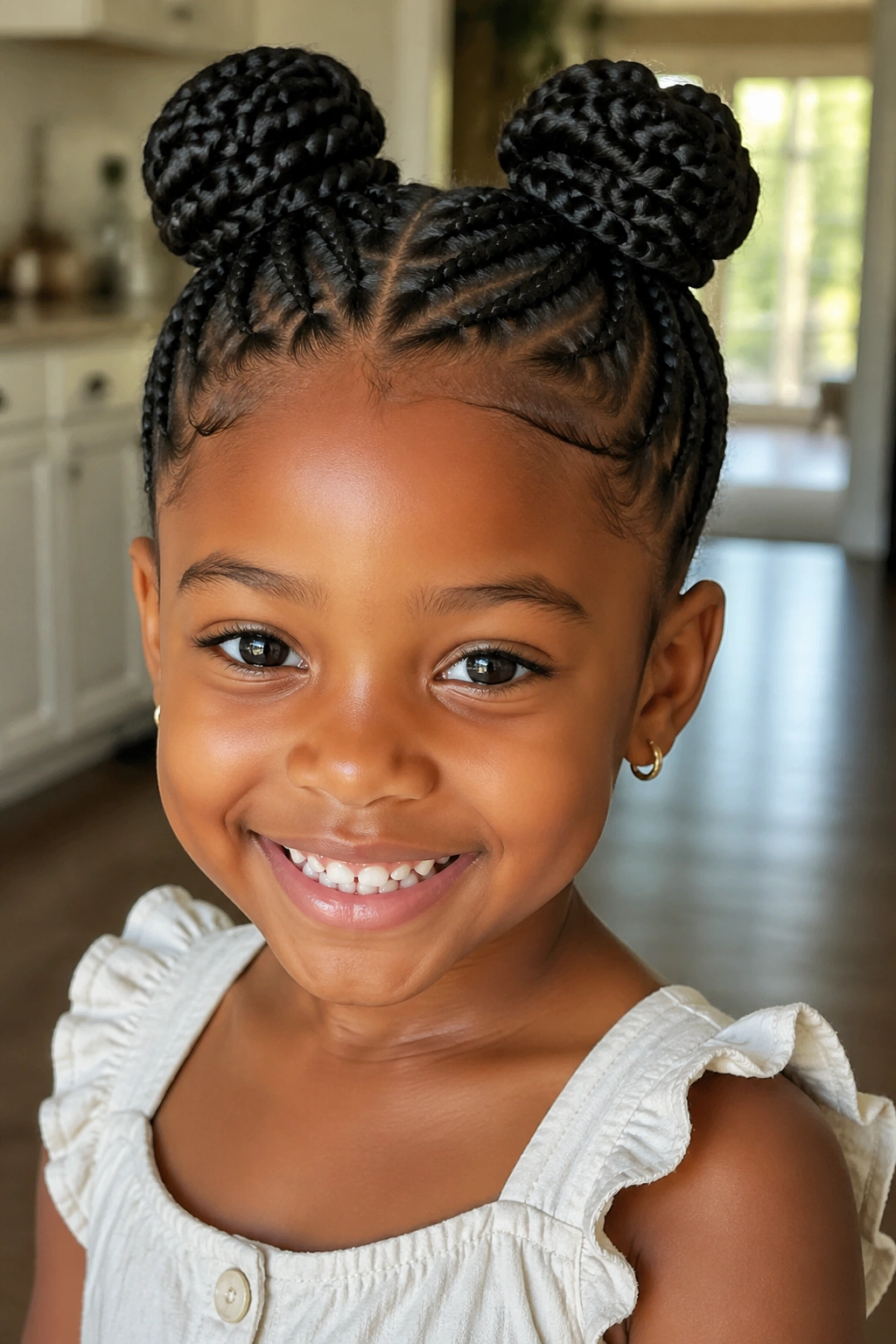
Space buns are one of those styles that makes a child look excited before she even leaves the house. Two buns on top or slightly to the side give the braids a round, playful shape, and they stay put well if the parts are neat.
This style works best when the braids are medium or small, because bulky braids can make the buns feel heavy and lopsided. If the child has a tender scalp, keep the buns a touch lower and use soft bands rather than yanking everything straight up.
When space buns work best
- On school spirit days.
- For dance class or active play.
- With medium-length braids that can tuck cleanly.
- When you want the hair off the neck entirely.
I like this style because it gives shape without needing extras. No beads required. No ribbon required. The buns themselves do the work. And when the child takes them down at night, the braids usually fall back into place with less trouble than a tightly pinned updo.
12. Pigtail Box Braids
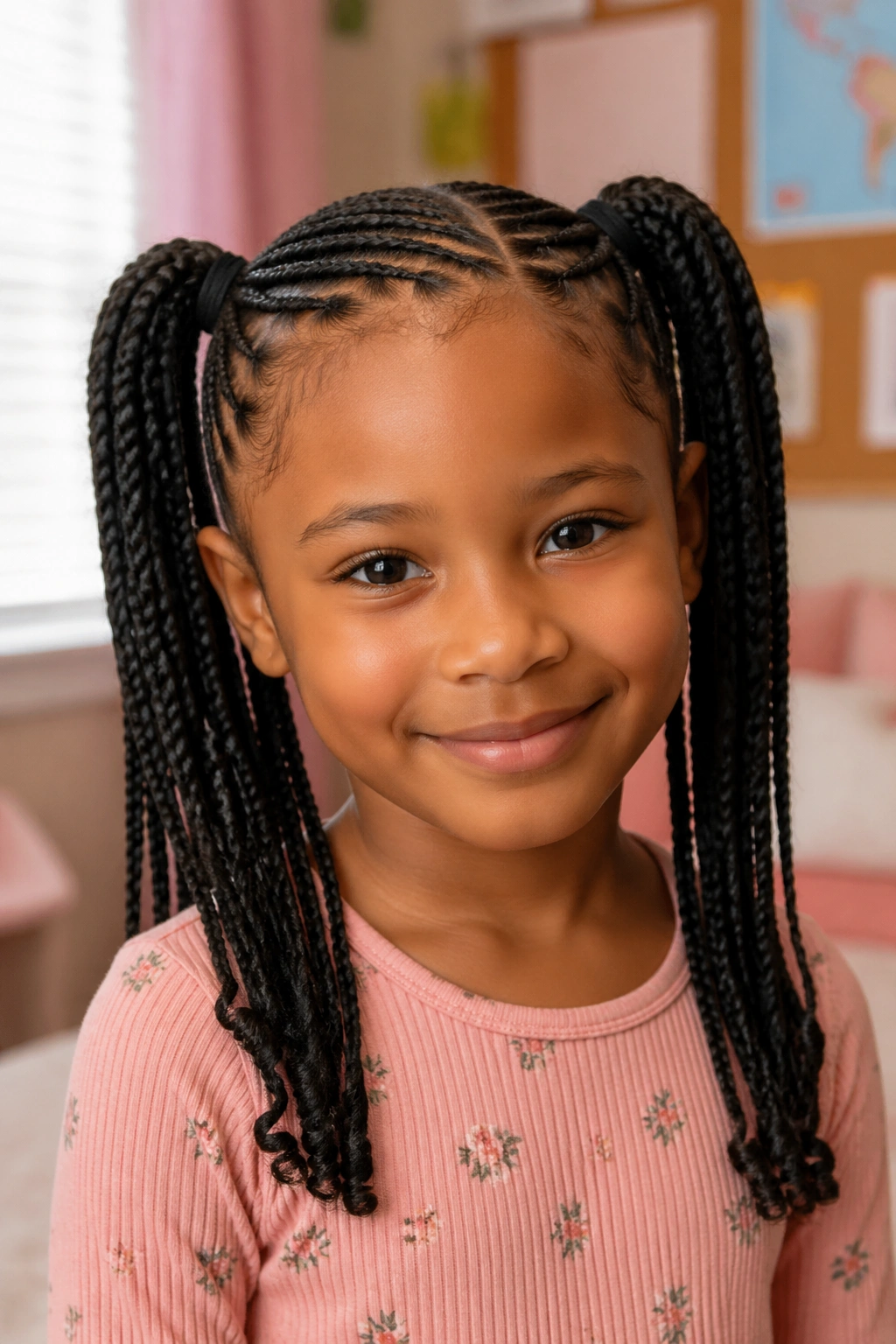
Pigtail braids bring a sweet, old-school feel that still works on little girls because it is easy to wear and easy to understand. The hair gets divided into two sections, then worn as low pigtails, side pigtails, or braided bunches tied off with soft bands.
This is one of the best choices for younger kids because the style keeps the weight evenly spread on both sides. That matters when the child is small and the braids need to stay balanced instead of tipping backward. It also makes bedtime a little easier, since the braids do not tangle into one long mass.
Simple wins here. Two parts. Two sections. Done.
If you want a tiny upgrade, braid a thin piece around each pigtail base to cover the elastic, or add one matching bead to each side. That little symmetry feels tidy without getting fussy.
13. Box Braids with Curly Ends
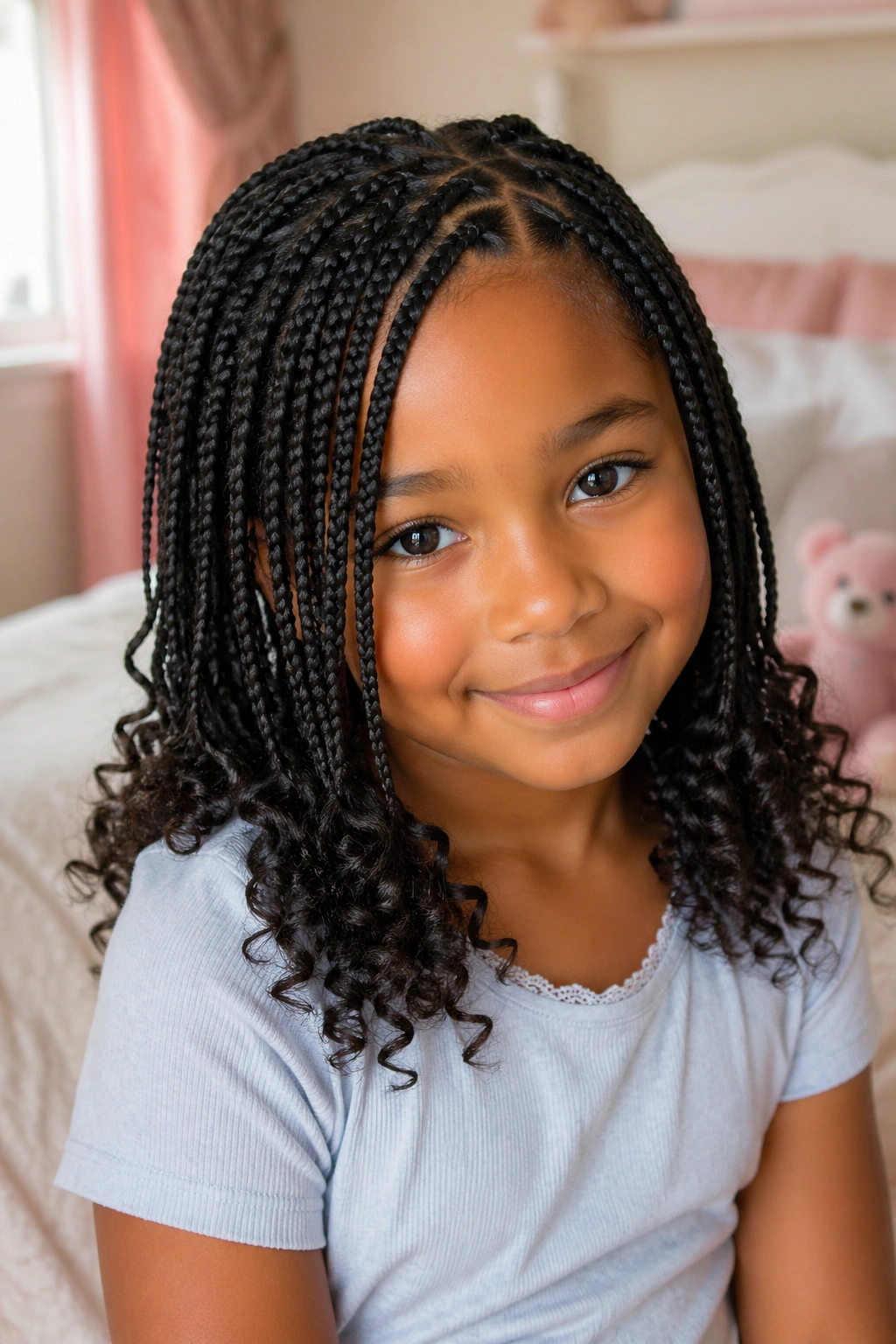
Curly ends soften the whole look of box braids. Instead of stopping in a straight line, the braids finish with loose curls that bounce a little and make the style feel lighter around the face and shoulders.
The nicest thing about this version is movement. Straight ends can feel firm and a bit formal. Curly ends feel friendlier, especially on little girls who like a softer shape. They also hide the line where the braids end, which can make the install look more natural.
A few things to keep in mind
- The curls need to be set gently, not fried into place.
- Mousse helps keep the ends smooth and fluffy.
- Too many curly pieces can tangle faster, so moderation matters.
- A satin bonnet keeps the curls from flattening overnight.
This style is a good choice if you want braid structure with a softer finish. It’s polished, but not stiff.
14. Colored-Extension Box Braids
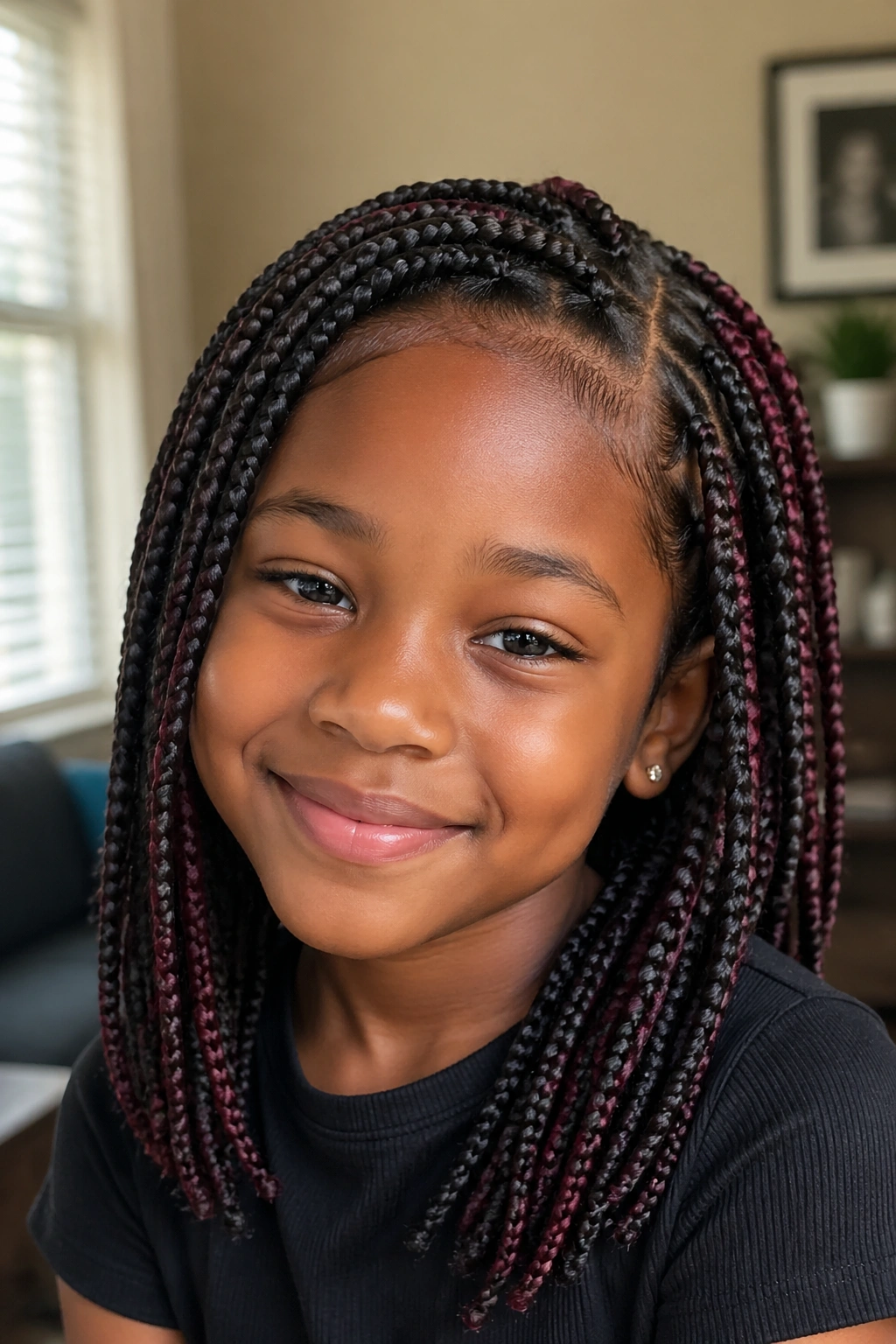
Color can be a fun tool when it is used with a light hand. A few burgundy braids, a soft honey tone, or one section of purple near the front can make box braids feel playful without turning the whole style into a costume.
For little girls, I like color best when it is placed in small pockets instead of every braid. Face-framing pieces work well, as do the braids at the back under a darker top layer. That keeps the style school-friendly and easy to wear even when the child is not dressed up.
The important part is balance. Bright color tends to show every part of the braid, so the sectioning needs to be clean. If the parts are sloppy, the color can make that more obvious. If the parts are neat, the color looks intentional.
A little color goes a long way. Especially on natural hair, where the contrast can already be rich on its own.
15. Ribbon-Threaded Box Braids
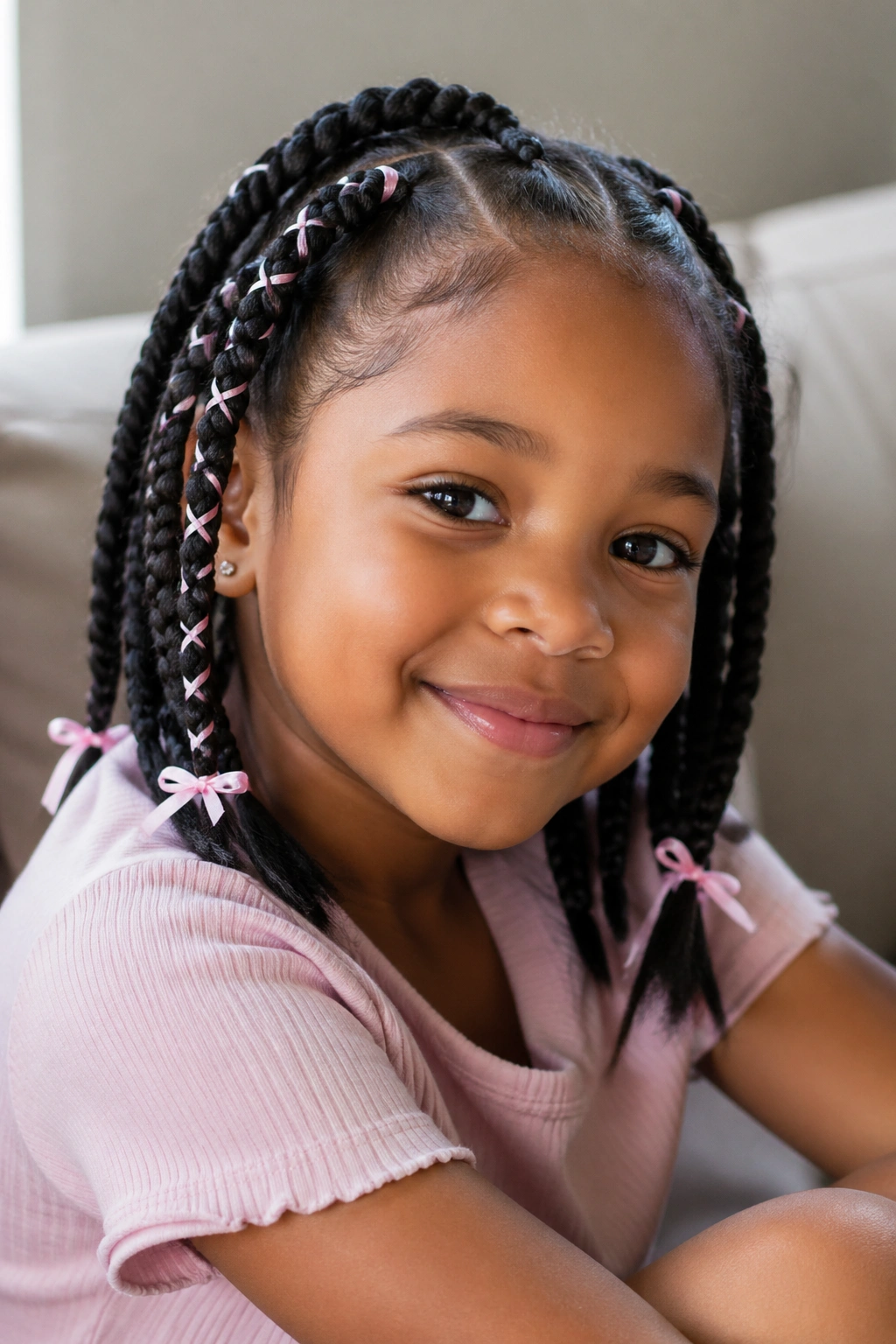
Ribbon-threaded braids feel festive in a way that beads sometimes do not. A thin satin ribbon can be woven through a few braids, tied around the base of a ponytail, or wrapped near the ends for a neat little detail that moves when the child walks.
This is one of my favorite options for events because the ribbon adds shape without adding much weight. That matters. Heavy accessories can pull on little heads fast, and ribbons give you the look without the strain. I’d rather see three clean ribbon accents than twenty tiny clips fighting for space.
Why ribbon is gentler than it looks
- It is light on the scalp.
- It can be changed out fast.
- It works with braids of many lengths.
- It gives a dressier finish without making the style stiff.
Keep the ribbon tied securely and not so long that it tangles around the ends. A short tail is cleaner. A messy tail looks messy.
16. Beaded Box Braids
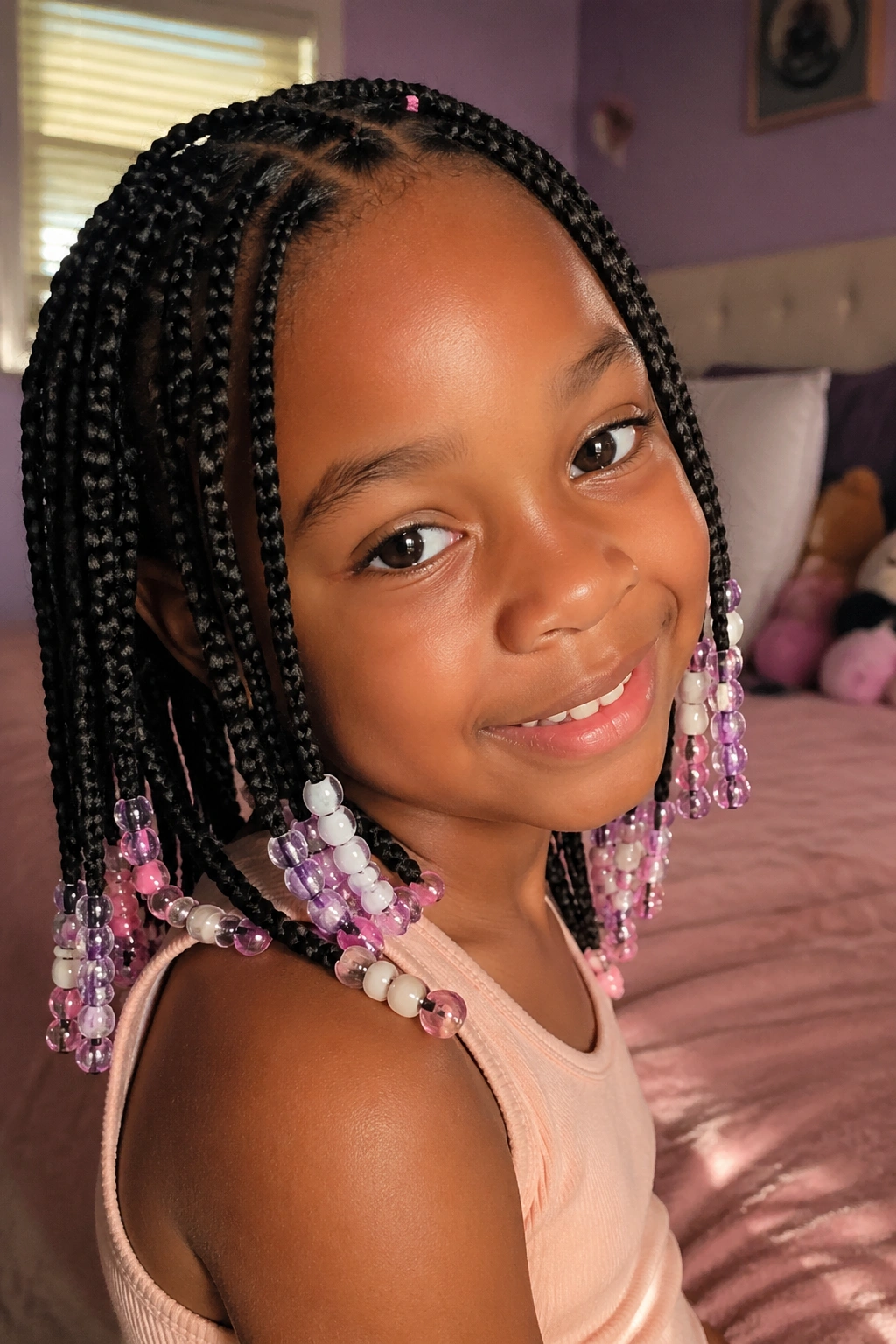
Beads are the sound of childhood to me. Soft tapping on the shoulders, a little click when the child turns her head, and that nice feeling that the style is finished all the way to the ends.
For little girls, beads work best when they are chosen with weight in mind. Light plastic beads are easier to wear than heavy glass or metal pieces, and fewer beads placed evenly across the braids usually look better than stuffing them into every single end. That is one of those cases where restraint makes the style stronger.
A straight middle part with beaded ends gives a classic look. A side part with beads feels softer. Either way, the braid size should be sturdy enough to support the bead without tugging the end too much.
If a child likes to shake her head, beads can become part of the fun. If she hates noise or movement, keep them minimal. That’s the whole game.
17. Criss-Cross Part Box Braids
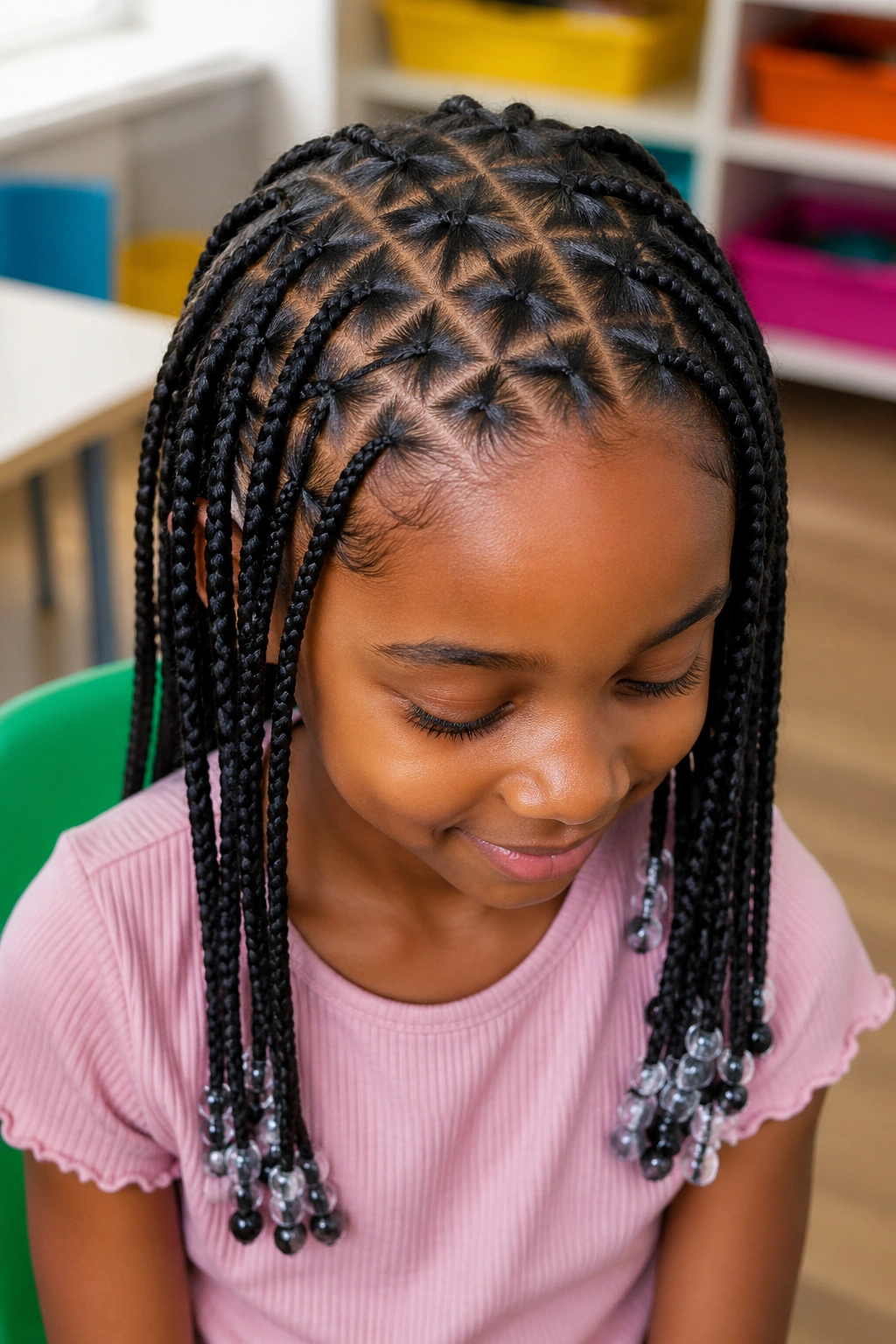
Criss-cross parts make the scalp pattern the main event. Instead of a plain grid, the braids begin with intersecting sections that create a lattice across the crown. The style looks detailed even before accessories are added.
This one takes a steady hand. The parting has to be sharp enough for the pattern to read, but not so tight that the scalp feels packed in. I like it on special-occasion styles where the child will not be wearing the braids in a high ponytail every day.
What to ask your braider for
- Clean intersections at the front and crown.
- Medium-sized braids so the pattern stays visible.
- Light tension around the edges.
- A finish that keeps the criss-cross section neat even after sleep.
The style is bold without being flashy. That is a nice middle ground for kids who want something more interesting than plain rows but are not ready for full-on decorations.
18. Zigzag Part Box Braids
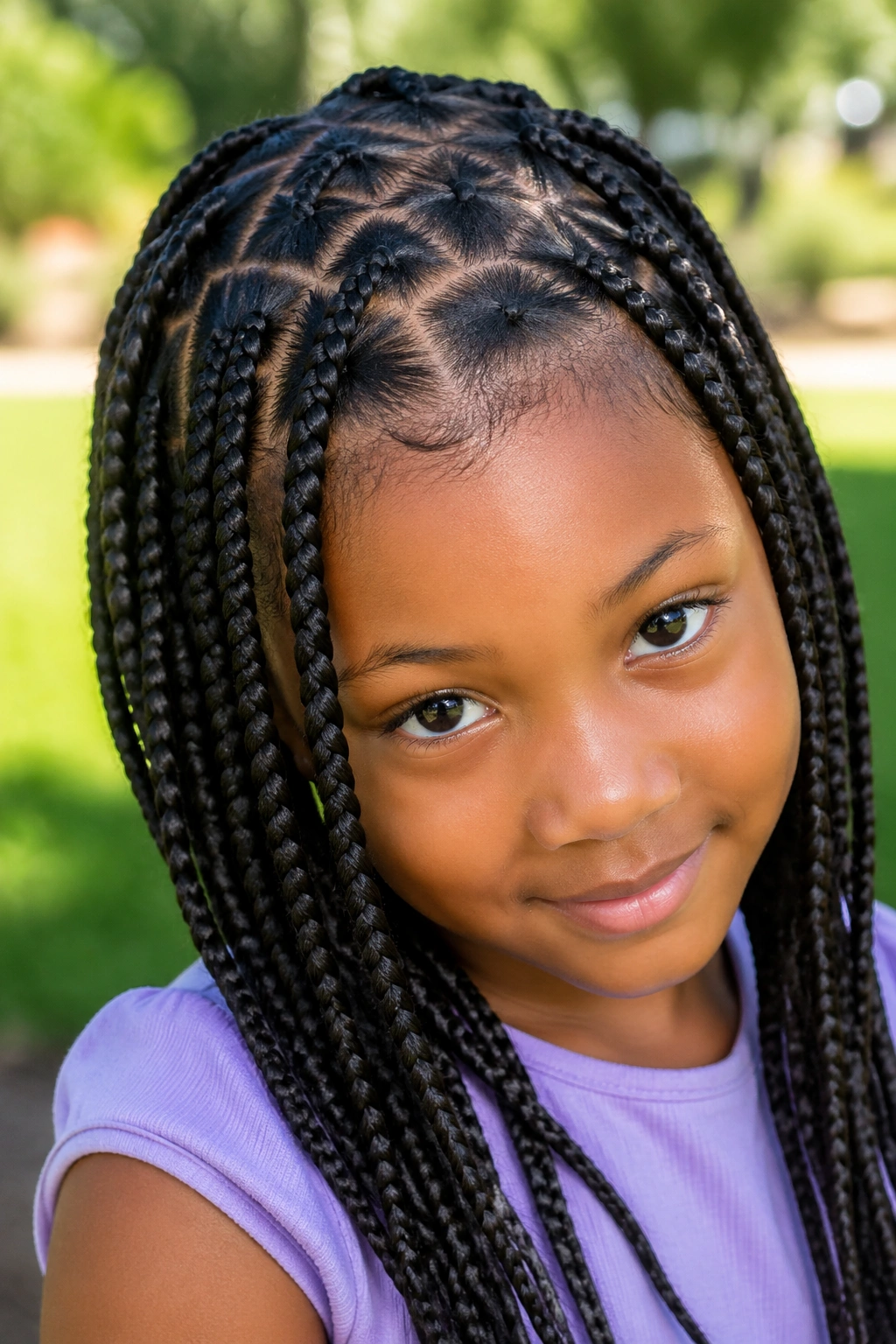
Zigzag parts are one of those details that make people look twice, then lean in closer. The braids themselves may be standard box braids, but the parting lines jump and turn instead of running straight, which gives the head a little motion before the braids even move.
This look is a smart choice for a child who wants a bit of fun without beads, color, or extra styling every morning. The pattern stays visible when the braids are worn down, and it still looks neat in a ponytail because the zigzag sections hold their shape near the scalp.
It helps to keep the zigzags consistent across the top and sides. If one side is busy and the other side is plain, the style can look uneven fast. A clean finish matters more here than with some of the simpler styles.
I like zigzag parts on medium-length braids. They show off the pattern without overwhelming a small head.
19. Layered Box Braids
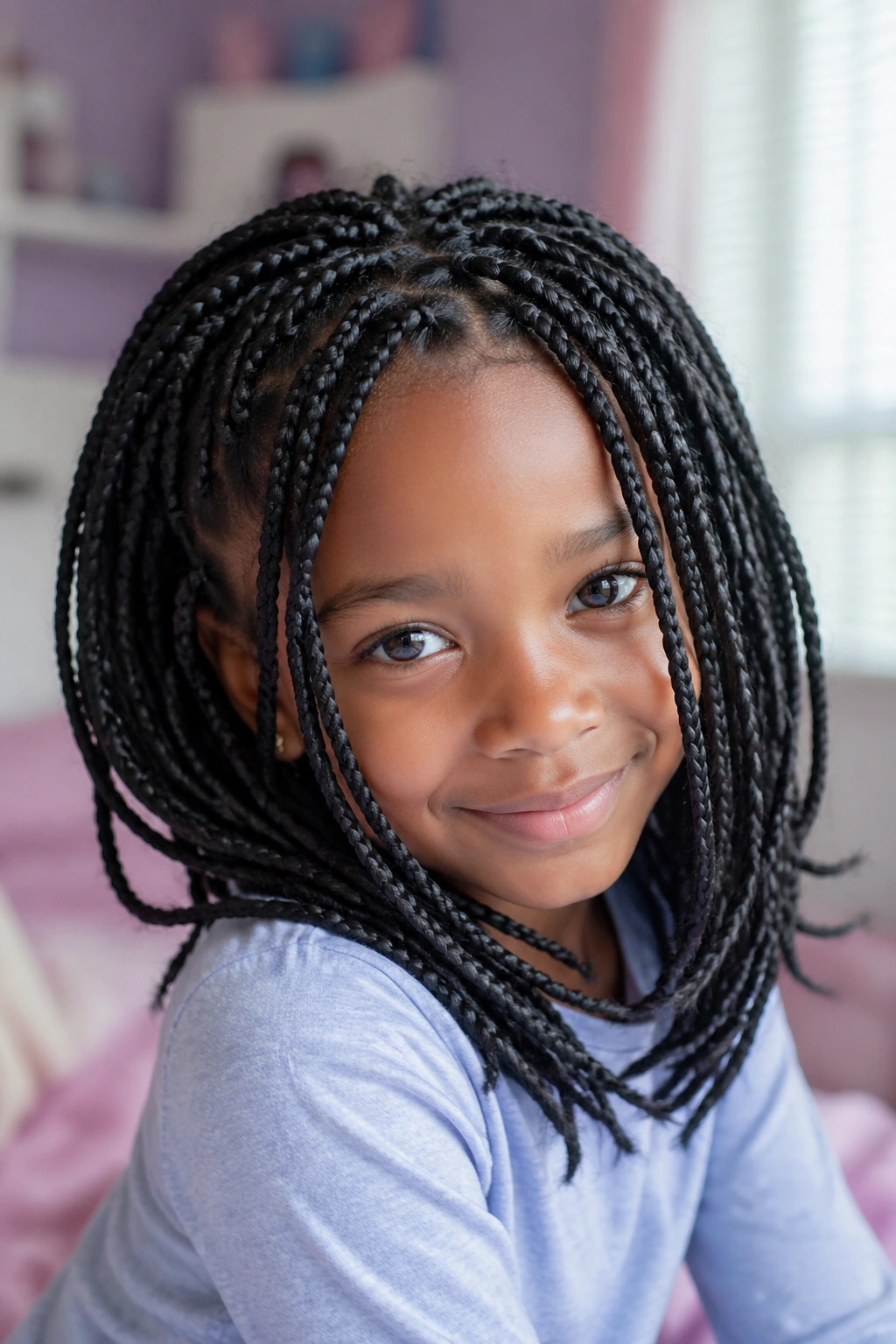
Layered box braids are one of the smartest choices for long braid sets because the shape keeps the style from hanging like one heavy block. Shorter pieces around the face and shoulders help the braids fall in stages, which looks softer and feels lighter.
This is especially helpful for little girls with denser natural hair. Layering gives the style breathing room. It can also keep the ends from sitting right on the same spot on the back and shoulders, which is where some children start fussing after a day or two.
A blunt, one-length braid set can look dramatic, but layered braids are easier to live with. That is the honest answer. They still look polished, just less stiff.
If you want the hair to move nicely in photos, around the playground, and at dinner, layering is worth asking about. It is one of the quiet details that changes the whole feel.
20. Fulani-Inspired Box Braids
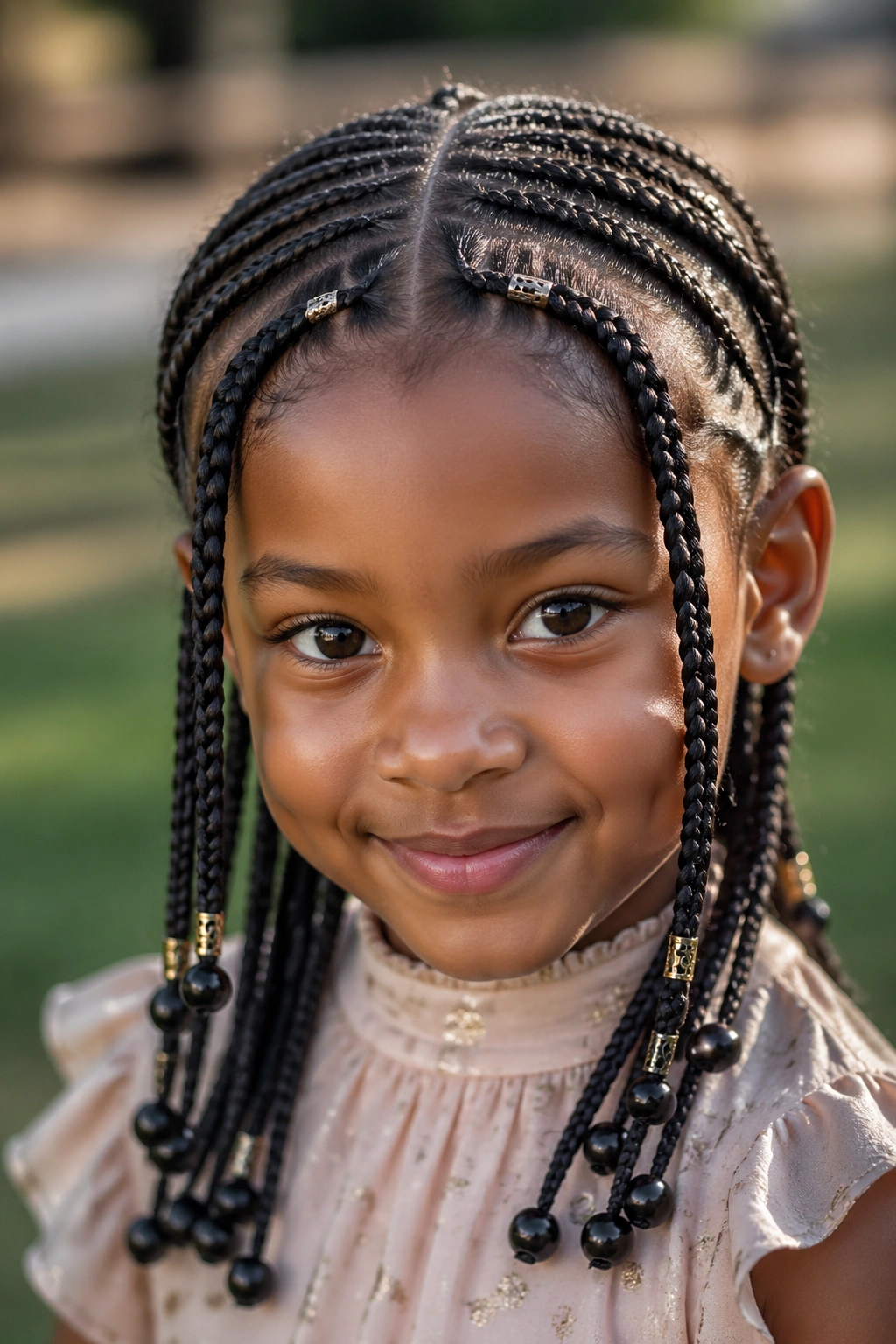
Fulani-inspired box braids bring a mix of central parting, side braids, and face-framing details that feel rich without needing a lot of extra pieces. On little girls, the look can be beautiful when it stays light and gentle around the crown.
The braids themselves can still be box braids, but the front or side sections may use cornrow accents, slim braids, or a central braid with decorative pieces. The design needs room to breathe. If the style gets overcrowded with beads, cuffs, and thick extensions, it loses the clean lines that make it work.
Keep the crown gentle
A child’s forehead and edges should not feel squeezed for the sake of a pretty pattern. Ask for soft tension, smaller accent pieces near the front, and a finish that does not rely on too much hardware.
This style is one of my favorites for special days because it feels rooted and thoughtful. It looks like somebody planned it.
21. Goddess Box Braids
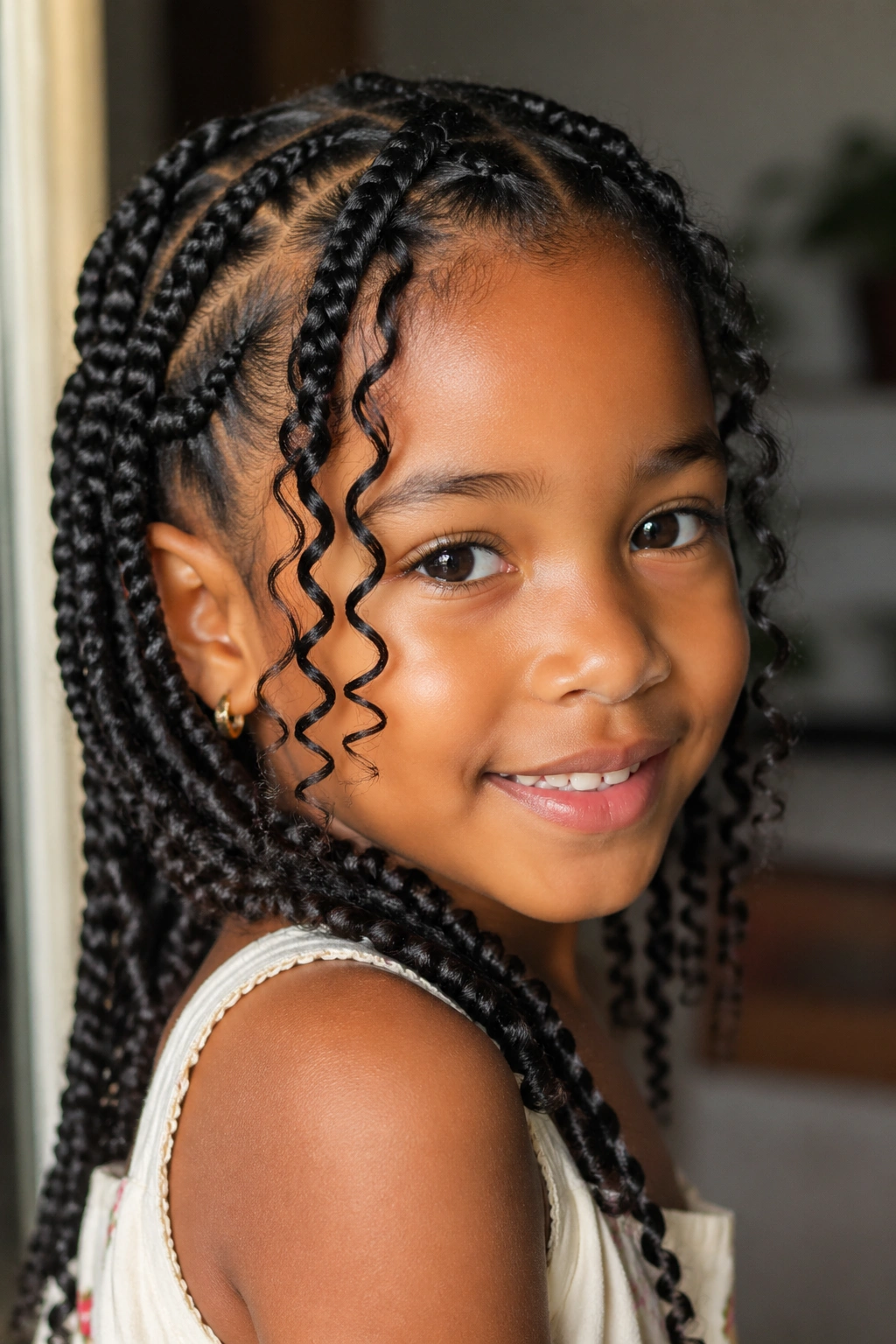
Goddess box braids mix standard braids with a few loose curly pieces, usually near the front or woven through the length. The result feels softer and a little more airy than a full set of straight-ended braids.
For little girls, I would keep the curly pieces limited. Too many loose strands can tangle fast, especially if she likes to swing her hair, run around, or nap with her braids half wrapped. A few face-framing curls often do the job better than a whole head of extra texture.
This style has a dress-up feel without needing a full updo. It works for photos, parties, and events where you want movement around the face. It also looks nice when the child wears simple clothes, because the hair does the decorating.
Compared with curly ends, goddess braids are a bit more styled and a little less casual. That distinction matters.
22. Braided Crown Box Braids
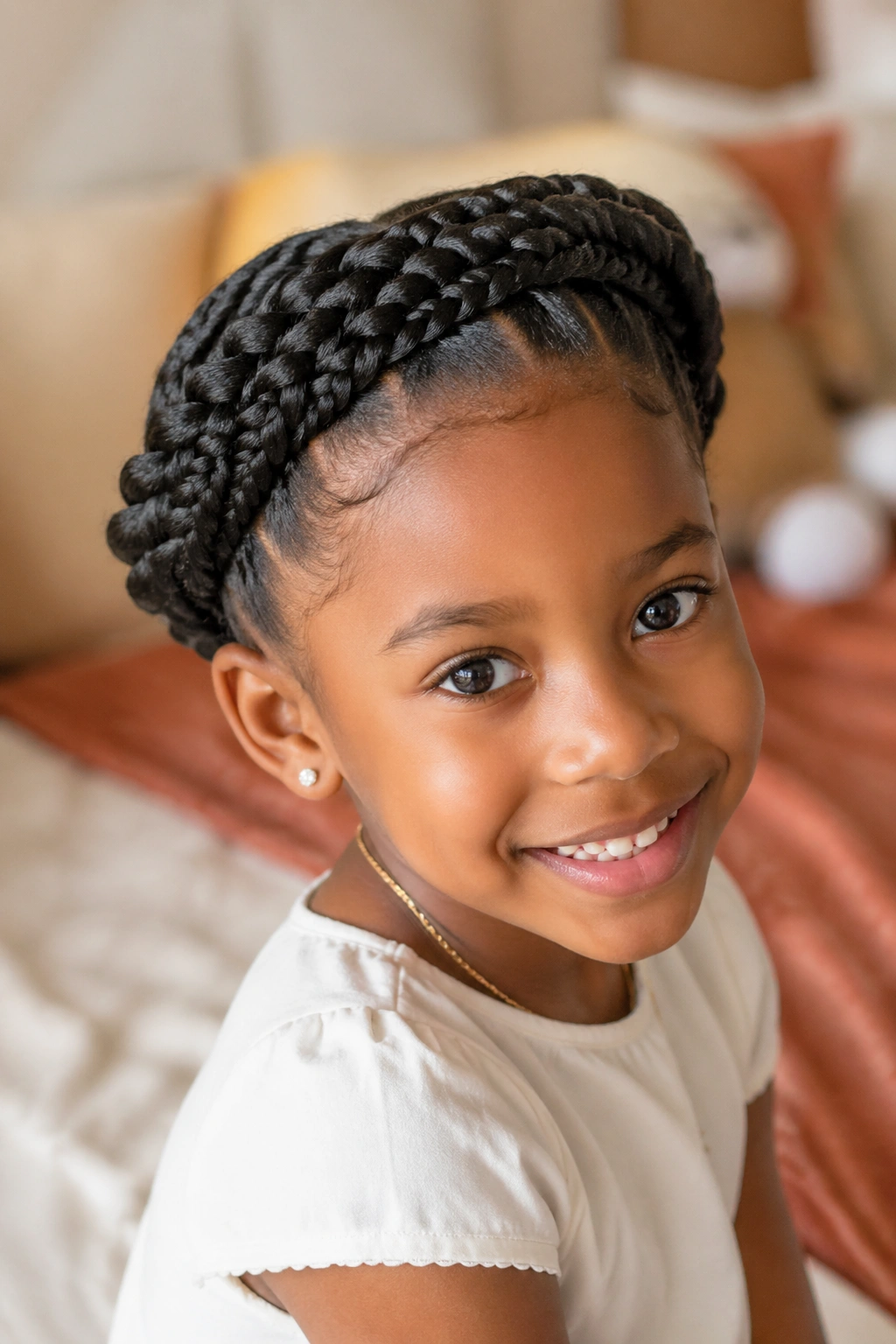
Braided crown box braids wrap the braids around the head in a halo or crown shape, which gives a formal, pretty finish that little girls tend to love when they want to feel dressed up. It’s the kind of style that looks finished from every angle.
This works best when the braids are medium length, because very short braids can be hard to pin into a stable crown. Very long braids can make the crown too heavy. Somewhere in the middle is usually the sweet spot.
The style can be done as a full crown or as a half crown with the rest of the braids left down. I prefer the half version for younger girls because it gives the shape without making the whole head feel pinned in place.
The secret is balance. The braid crown should sit flat enough to stay, but not so tight that the child can’t relax her head against a seat or pillow.
23. Side-Swept Asymmetrical Box Braids
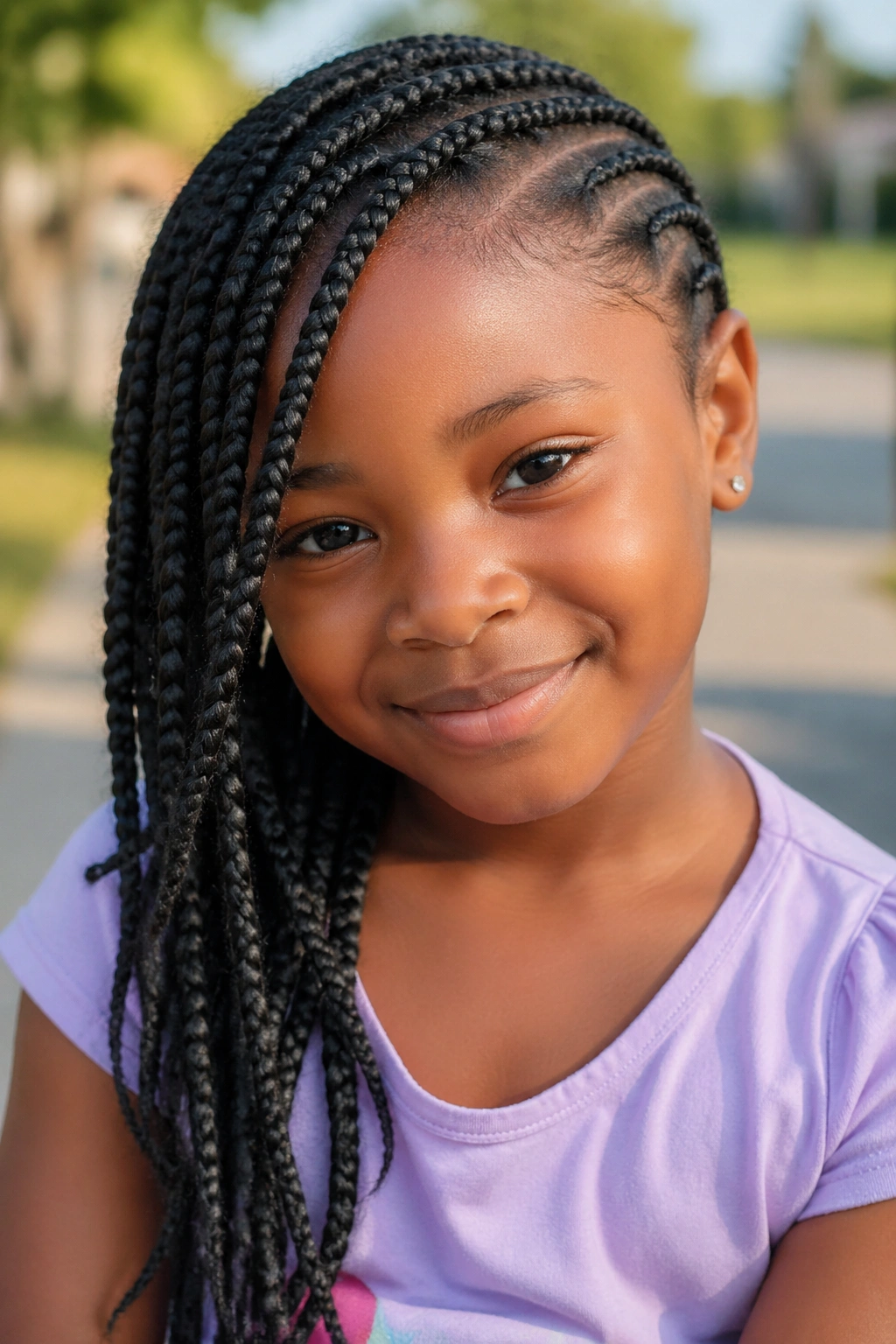
Side-swept braids have attitude. One side carries most of the length, and the other side gets tucked back or shaped more tightly toward the scalp. The asymmetry makes the whole style feel modern without needing a dramatic cut or color.
This is a nice choice for little girls who like hair over one shoulder. It keeps the braids out of the face on one side while still giving a full look on the other. If the child has one side of her hair that grows denser or lays flatter, the side-swept shape can also balance that out visually.
A clean side part helps here. The braids should fall in a way that looks intentional, not like they were accidentally pulled over after the fact. A satin wrap or soft pin near the nape can help hold the direction without creating a kink.
It is a little older-looking than pigtails, but still playful. That mix is hard to beat.
24. Rubber-Band Pattern Box Braids
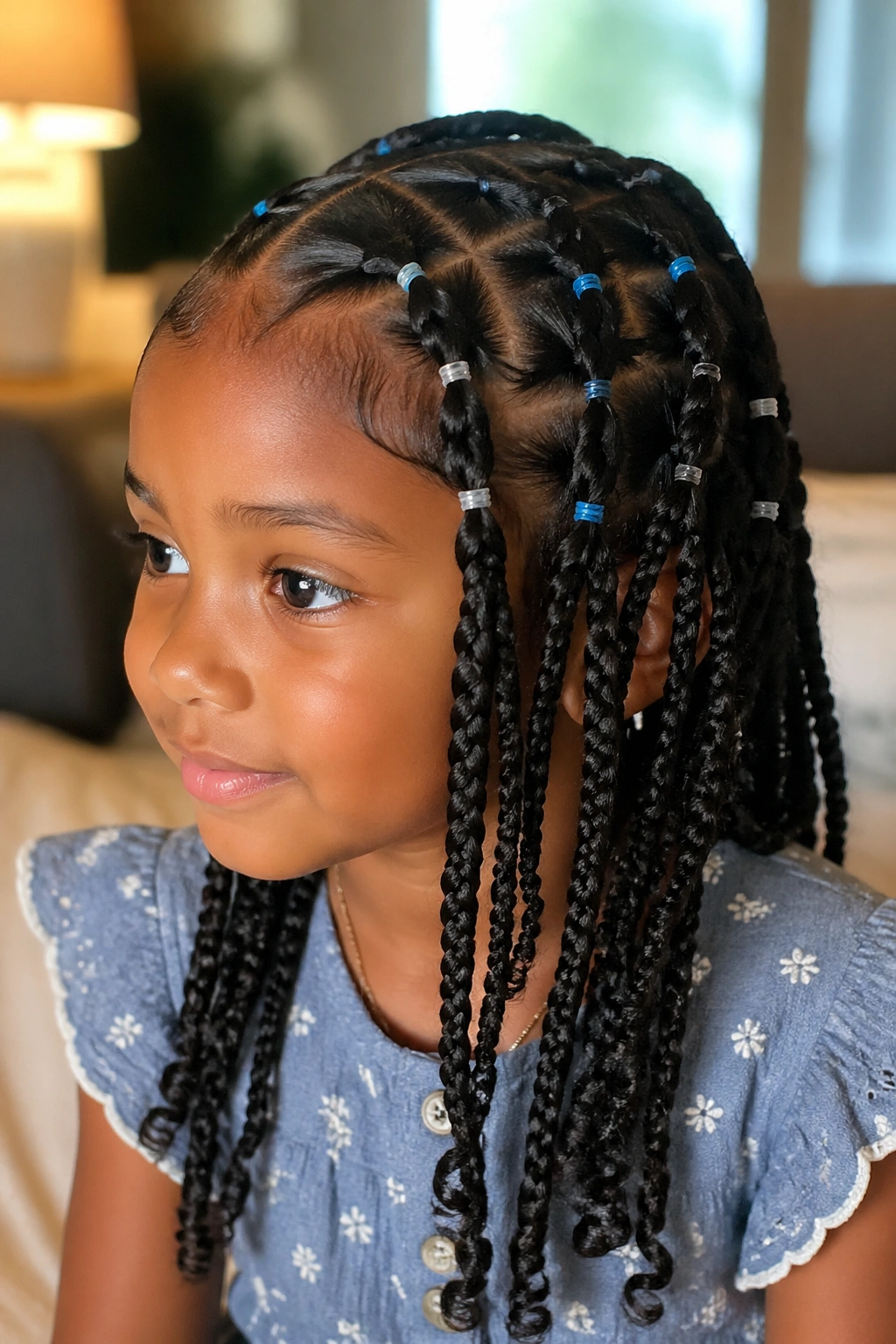
Rubber-band pattern braids are useful when the hair needs extra control before the braiding even starts. Small elastic bands hold the sections in place, which helps keep the parts neat and gives the style a graphic, kid-friendly feel.
This method can be especially helpful on natural hair that is soft or slippery at the root. The bands keep sections from sliding together while the braider works, and they can make the final look more uniform. Just keep the bands small, covered well by the braid, and easy to remove later.
What to watch for
- Bands should not be so tight that they snag the hair.
- They should come out cleanly at takedown.
- The style should not feel bumpy around the scalp.
- Too many bands near the edges can be irritating.
I like this style for kids who need structure and for parents who want the parts to last. It is practical, but it still looks fun.
25. Freestyle Mix-and-Match Box Braids
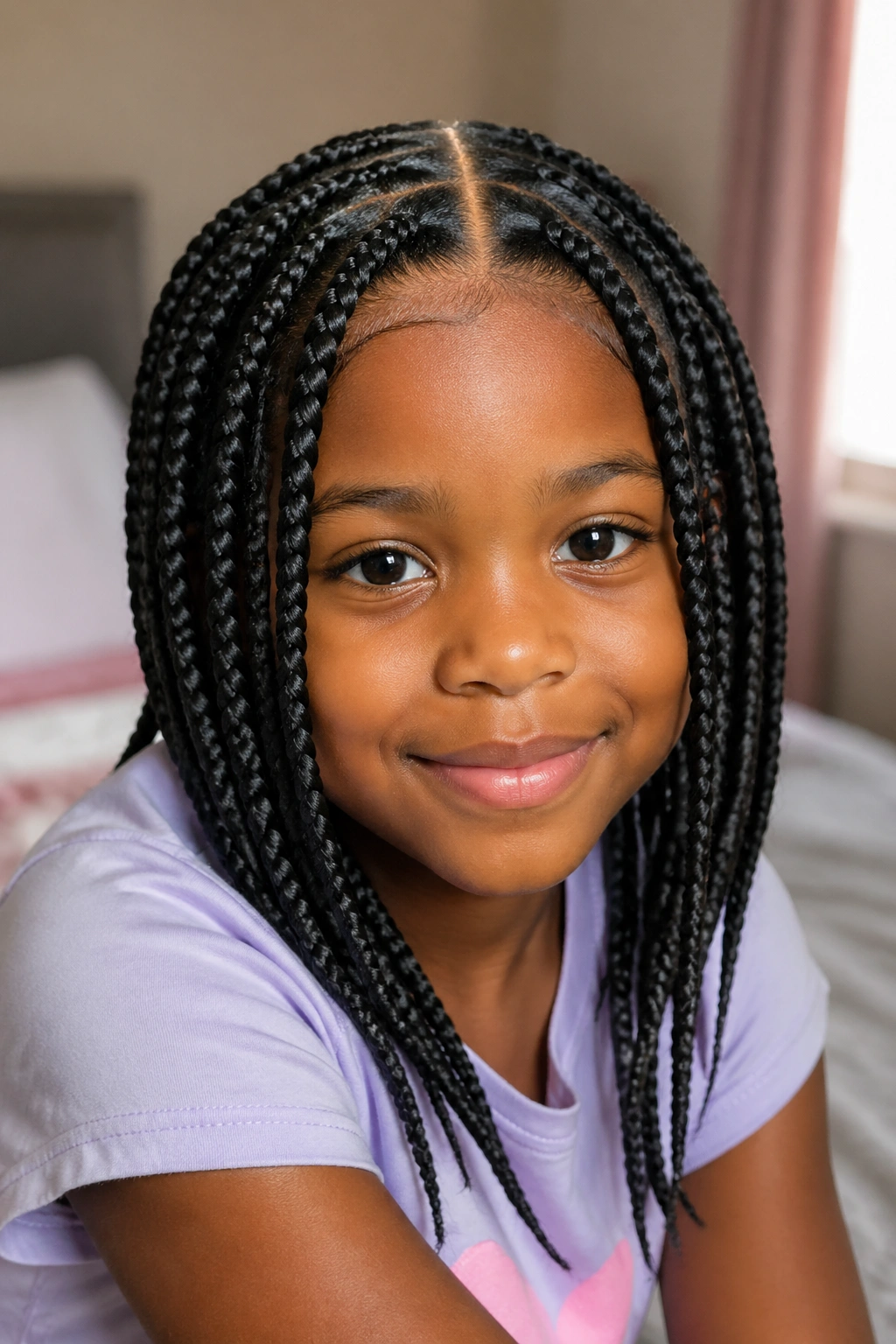
Freestyle mix-and-match box braids are for the child who wants a little of everything: a side part, a few beads, maybe two curly pieces near the front, and a top section pulled into a small bun. This is the style that lets you pick one or two favorite ideas without overloading the head.
The smartest version keeps one feature in charge. If the parting is dramatic, keep the accessories light. If the beads are the star, leave the parting simple. If the braids have curls, skip the heavy ribbon. Too many attention-grabbers fighting each other is how a style gets messy fast.
I like this one because it gives room for personality. Some girls want neat rows and one bright detail. Some want braids with movement and a little sparkle. This style lets you meet them in the middle without losing control of the final shape.
A child does not need adult-size braids to look polished. She needs a style that fits her head, her hair, and her day. This one does that, and then a little more.
