



Short box braids have a way of looking sharper than longer ones. The length lands close to the face, so the parting, braid size, and finish do more of the talking. There’s nowhere for sloppy sections to hide, which is part of why the style can look so clean even when the braid count stays modest.
I like short box braids because they sit lighter on the neck and shoulders, and they do not drag the scalp the way heavier installs can. The trade-off is plain: if the parts are crooked or the ends are bulky, you see it right away. That honesty is useful. It pushes the style toward crisp lines, neat bases, and a little personality.
The best part is how many directions the look can go. A jaw-grazing bob feels polished, triangle parts look sharper, beads make the braids move with more sound, and color changes the whole mood without changing the cut. Short hair does not mean limited hair. It usually means the styling has to work harder.
That’s where the fun starts.
1. Chin-Length Classic Short Box Braids
Chin-length braids are the cleanest starting point if you want short box braids that look put together without trying too hard. They sit right at that sweet spot where the hair frames the jaw and cheekbones, but still leaves the neck open.
I like this length when the sections are medium-sized and the ends are sealed neatly, not puffed out. A braid that stops around the chin has enough shape to feel intentional, yet it does not overwhelm the face. There’s a reason this version never looks dated.
The styling trick is restraint. Keep the braid count moderate, keep the parts crisp, and let the cut do the work. If the ends are blunt and tidy, the whole style reads sharper. If the braids flare out at the bottom, the look gets busy fast.
One nice thing about this length is how easy it is to tuck behind the ears. That tiny move changes the whole vibe.
2. Short Box Braids with a Deep Side Part
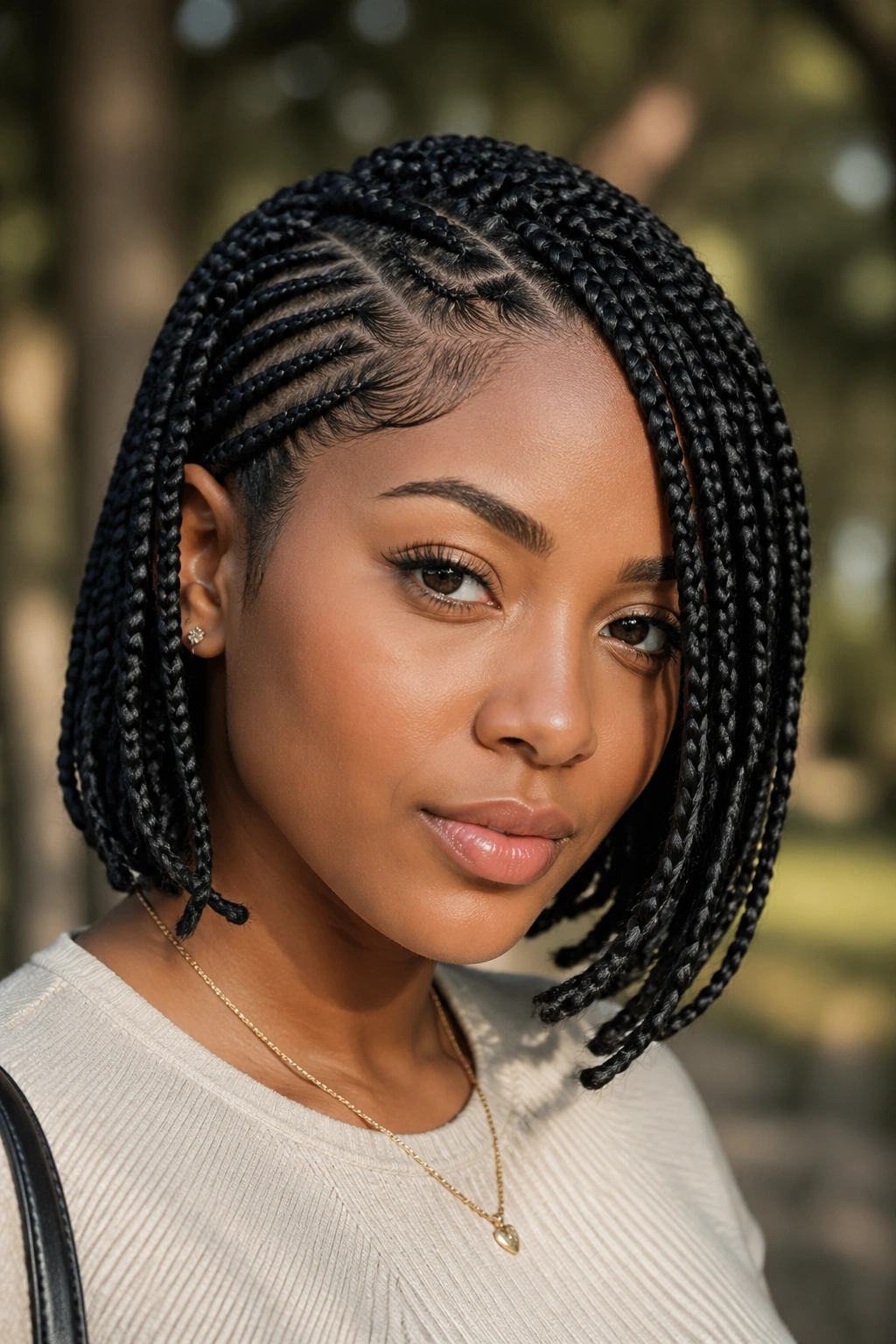
Want the length to feel softer without changing a single braid? Push the part over.
A deep side part shifts the eye line and gives short box braids movement right away. Even if the braid length stays at the chin or just below, the off-center part makes the style feel less rigid. It is one of those small changes that does more than people expect.
What to Ask For
- Ask for a part that begins cleanly above one brow and sweeps back in a single line.
- Keep the front row slightly smaller so the hair lays flatter near the temple.
- Leave enough space for the side with more hair to drape across the forehead without flipping up.
- Finish with a light mousse if you want the roots to stay smooth for a few days.
This works especially well when you want short box braids for everyday wear but still want a little drama. It is neat, but not stiff. That balance matters.
3. Triangle-Part Short Box Braids
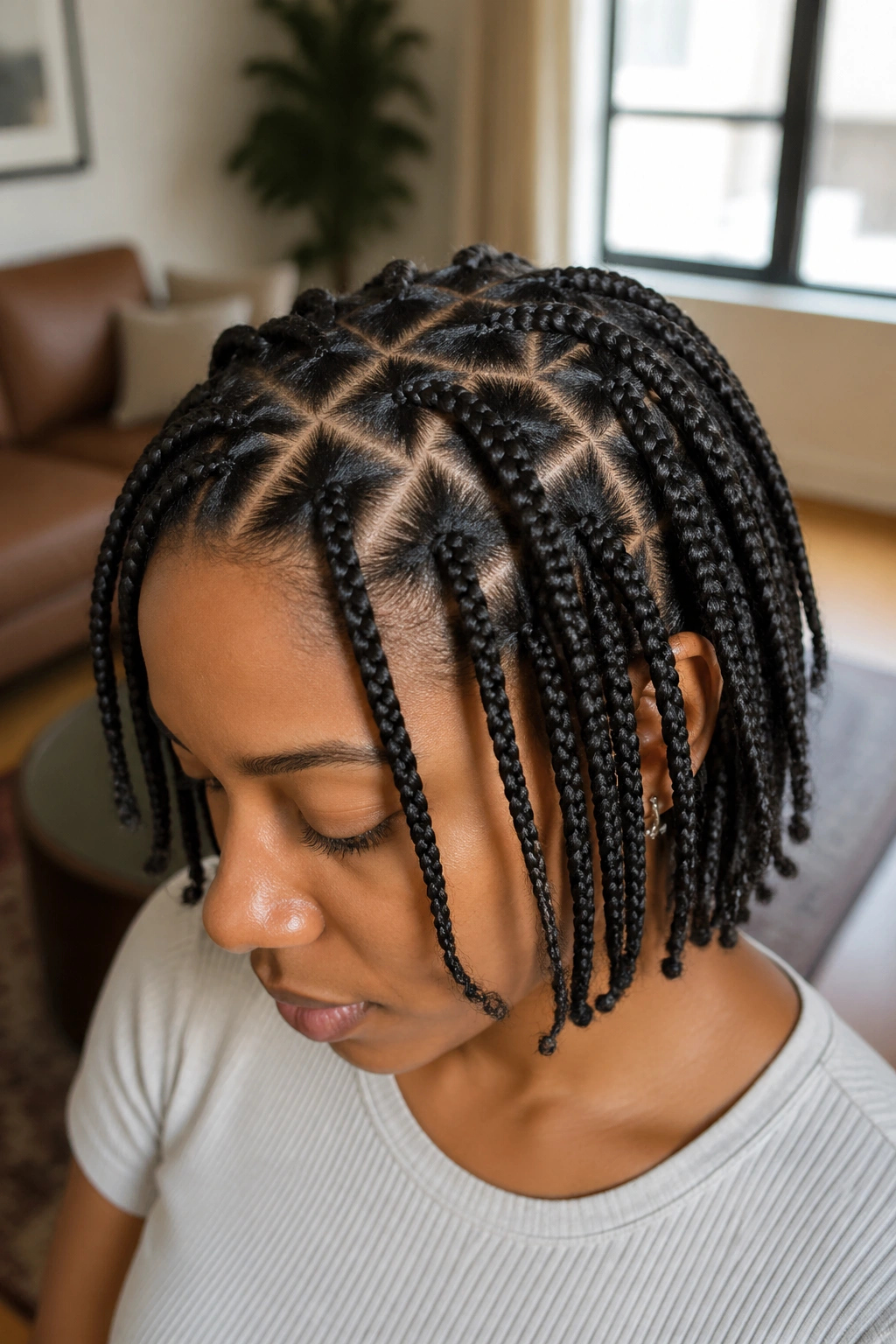
Square parts are classic. Triangle parts feel sharper.
If you have ever looked at a full head of braids and thought the grid felt a little too familiar, triangle parting changes that instantly. The shape shows up at the scalp, so even short braids gain a more graphic look before the first braid is fully finished. It is subtle from a distance and very obvious up close.
The braid itself does not need to be huge or long for this style to work. In fact, shorter braids make the triangles more visible because the eye stays near the scalp instead of chasing length. I think that is why the style works so well on bob-length installs.
Why It Stands Out
- The parts catch light and shadow in a cleaner way than plain boxes.
- The pattern looks more handmade, which is part of the charm.
- It works with both medium and small braids.
- It pairs well with simple outfits because the hair already carries the shape.
Triangle parts are not the fastest route, though. They take more care at the start. Worth it.
4. Bob-Length Short Box Braids with Curled Ends
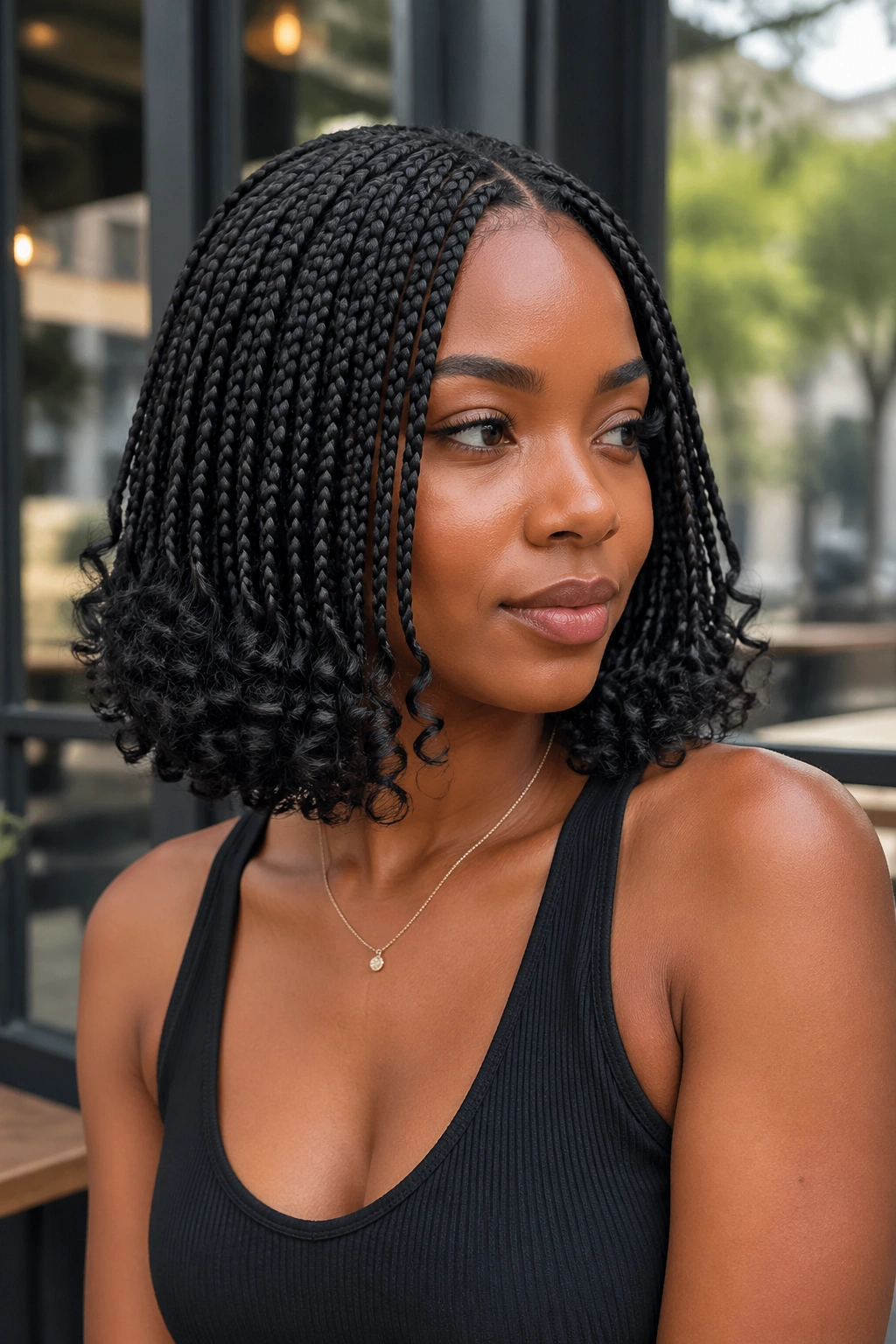
Curled ends soften the whole look, and on short braids that matters a lot.
A bob-length install can feel a little severe if every braid ends in a straight, blunt line. Add a gentle curl at the bottom, and the style relaxes. The ends move more, the silhouette feels lighter, and the braids stop looking like they were cut with a ruler. That little bit of bend changes everything.
How to Wear It
You can keep the curl tight and springy for a playful finish, or let the ends sit in loose loops for a softer shape. I prefer a curl that starts only at the last inch or so. Anything higher can make the braids look crowded at the bottom.
This version works best when the braid body is neat and the curl is the only soft part. That contrast is the point. If everything is fluffy, the style loses its edge. If only the ends move, the shape stays clean.
It also looks good with side-swept bangs made from a few front braids. Small detail, big payoff.
5. Jumbo Short Box Braids
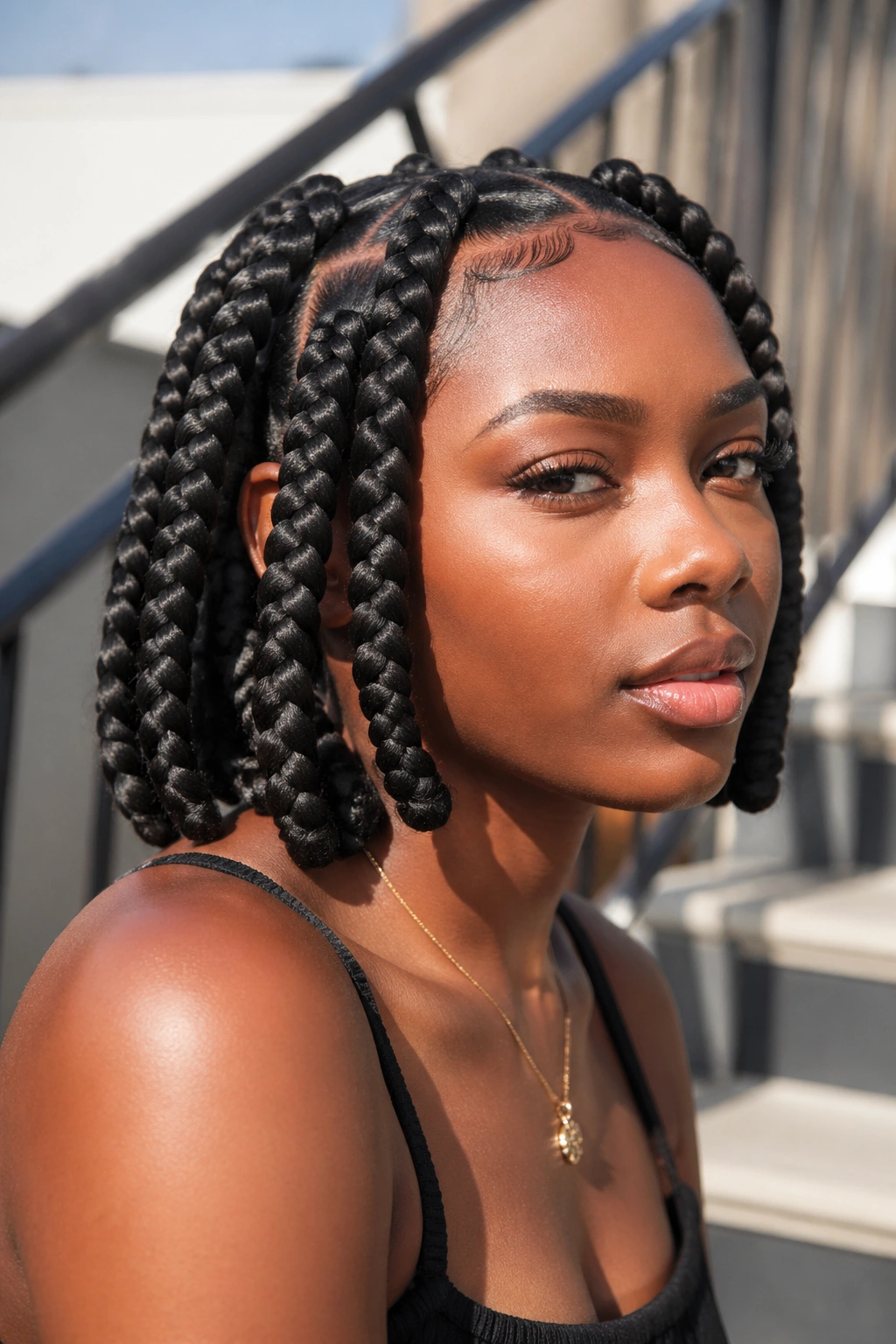
Jumbo braids are bold because they commit.
Unlike micro braids, which build density through sheer number, jumbo short box braids depend on shape. You are looking at fewer sections, wider parts, and thicker plaits that sit high on the head. On short hair, that can look sculpted rather than heavy if the base is tidy.
The size makes the install faster, which is part of the appeal. You are not sitting for tiny sections all day, and you get a style that reads clearly from across the room. That said, jumbo braids need balance. Too much extension hair at the root and they start to pull. Too little and they lose the strong shape that makes them worth doing.
I like this style for people who want a confident, low-fuss look with visible parting. It does not whisper.
A good version usually lands somewhere around 16 to 24 braids, depending on head size and the exact width of each part.
6. Micro Short Box Braids
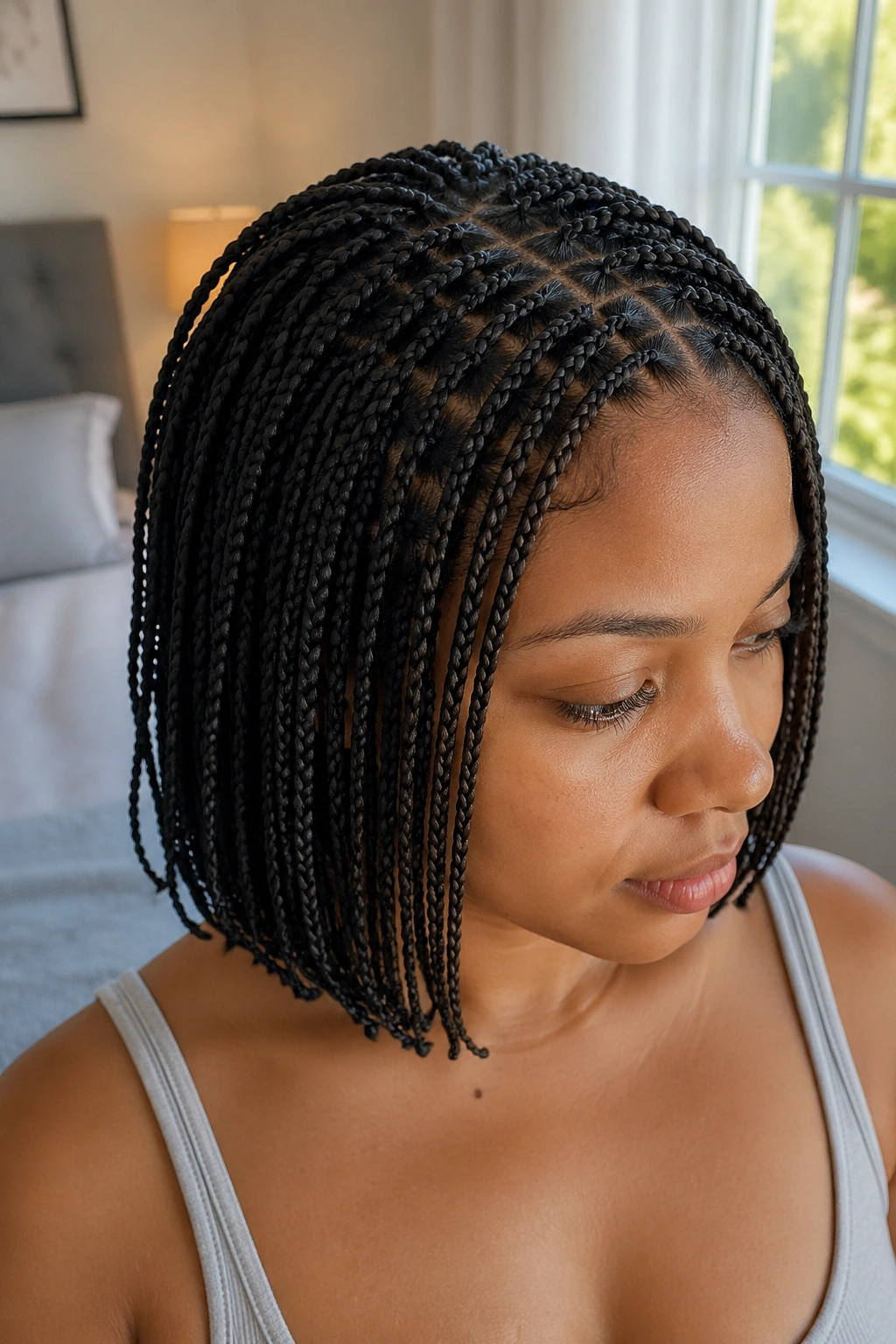
Micro short box braids give you the most movement, but they ask for patience.
These are the braids that look almost delicate at first glance. The parts are small, the plaits are thin, and the finished style tends to fall with a soft, almost fabric-like motion. On short hair, that movement matters because it keeps the style from feeling stiff or boxy.
The trade-off is install time. Micro braids take longer, and short versions are no exception. They also need a very clean base, because the smaller the braid, the easier it is to spot uneven parting. If you want this look, the sections have to be disciplined from the start.
They are a good choice when you want a fuller-looking finish without building a bulky shape around the face. The result can feel airy, even when the head is packed with braids.
And yes, they do need more scalp care. Thin braids show buildup faster if you overdo oil or edge control.
7. Half-Up Short Box Braids
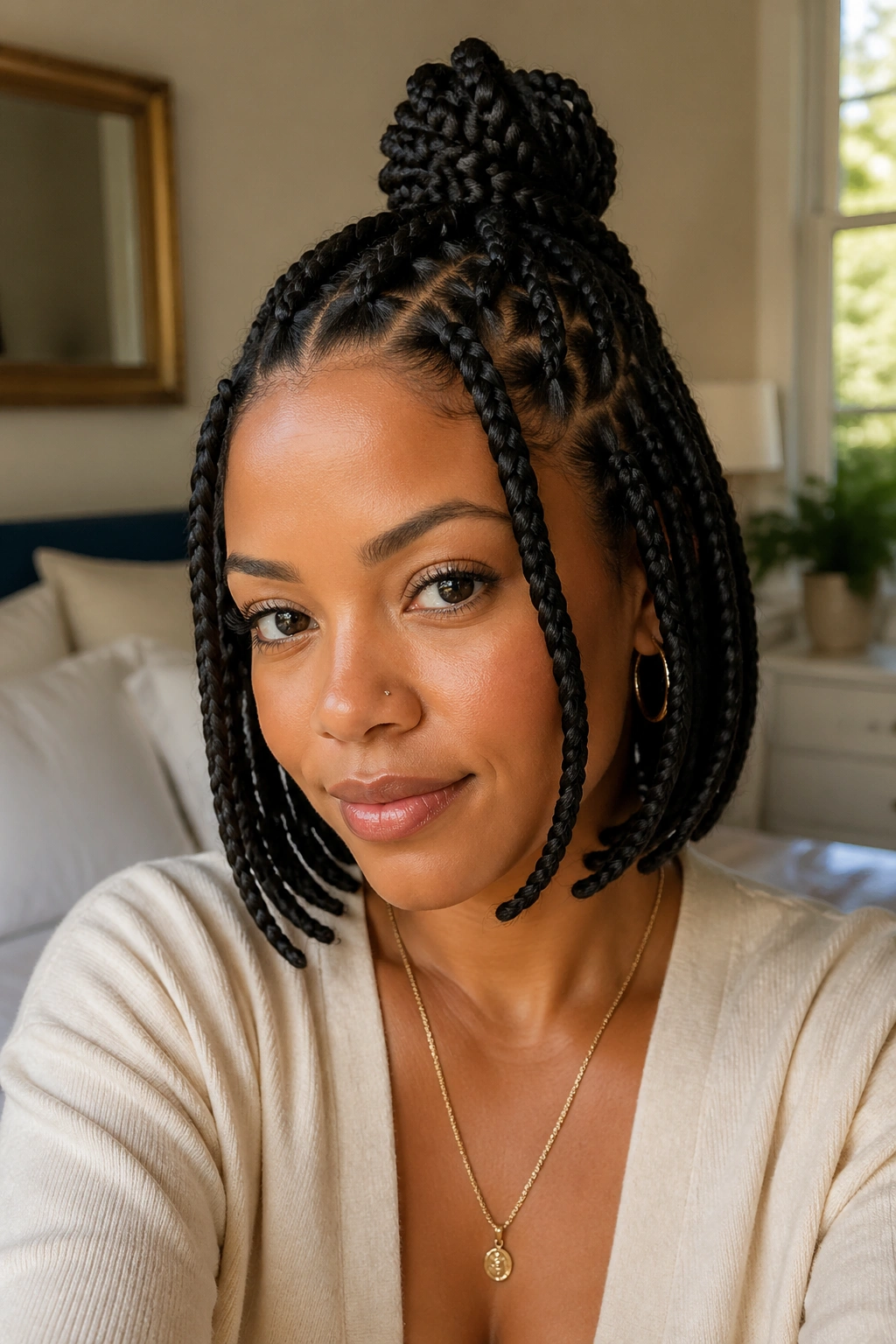
A half-up style gives short braids a little lift without fighting the length.
Pulling the top section into a small bun, puff, or knot changes the whole silhouette. The bottom half still frames the face, but the crown opens up, which keeps the style from sitting too flat. On short box braids, that bit of height makes a bigger difference than it does on longer hair.
Why It Works on Short Hair
Short braids are already close to the head, so the top half only needs a small amount of hair to create shape. A claw clip, a soft elastic, or a wrapped braid strand can hold the top section without making the style feel overdone. I prefer a smaller top knot rather than a huge one. It keeps the look balanced.
This is one of the easiest ways to move from casual to polished without redoing the whole head. A few braids pinned up, a few left down, and suddenly the style has range.
It also saves the edges from getting rubbed constantly when you’re moving around.
8. Short Box Braids with Beaded Ends
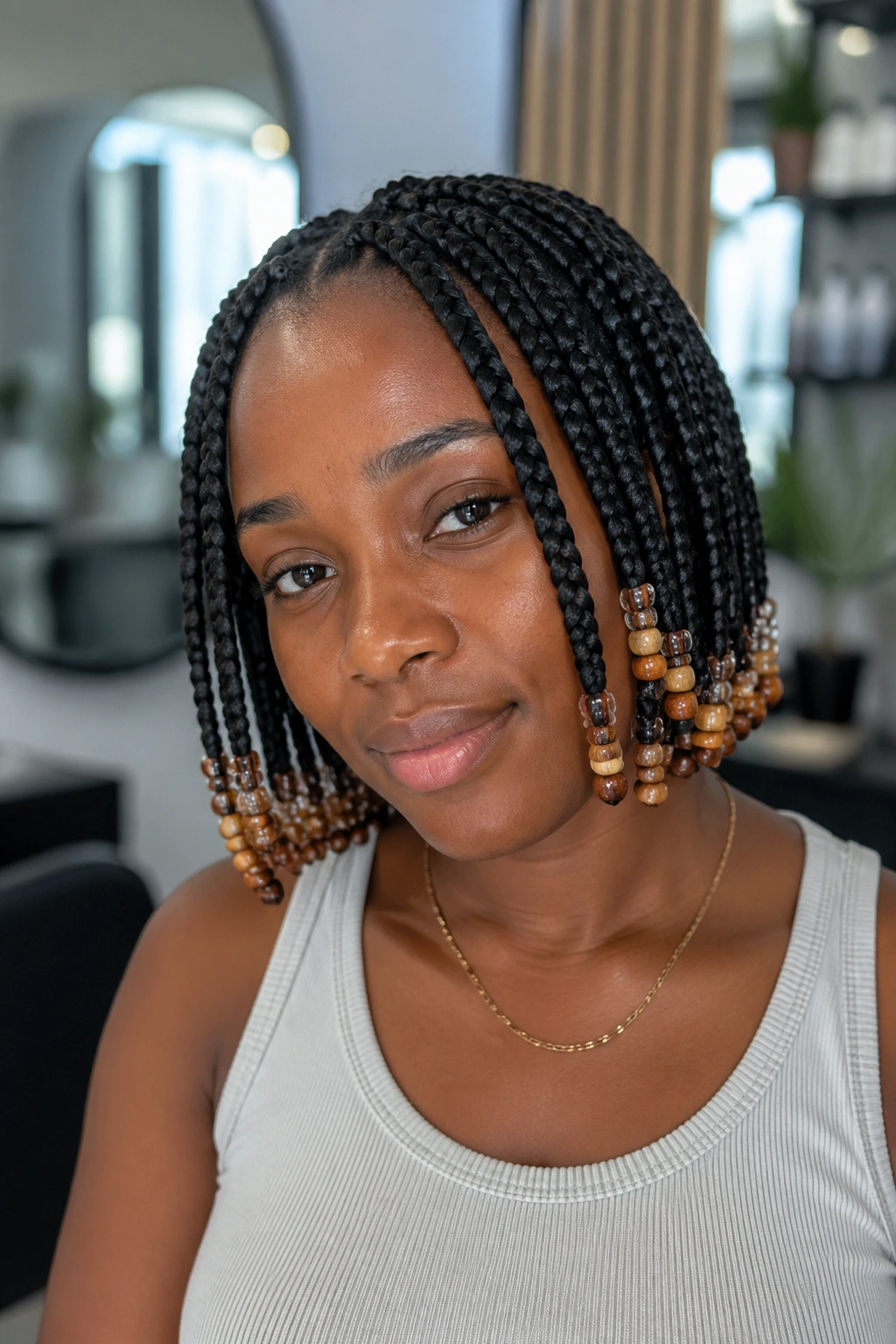
Beads bring sound, weight, and a little old-school charm.
I still think beads look best on short box braids because you notice every swing. The movement is closer to the face, so the beads do more than decorate. They shape the rhythm of the style. One or two on each braid is enough; pile on too many and the ends start to look crowded.
The easiest way to keep this look balanced is to place beads only on the front rows or only on the braids that fall around the jaw. That keeps the rest of the head lighter and lets the detail breathe. Mixed-size beads can work too, but they need some discipline. If every bead is different and placed randomly, the style turns messy fast.
A clean bead finish also depends on braid length. Chin-length or bob-length braids show the bead placement better than longer braids do.
Small note. If the beads clack loudly when you move, that is part of the charm.
9. Short Box Braids with Gold Cuffs
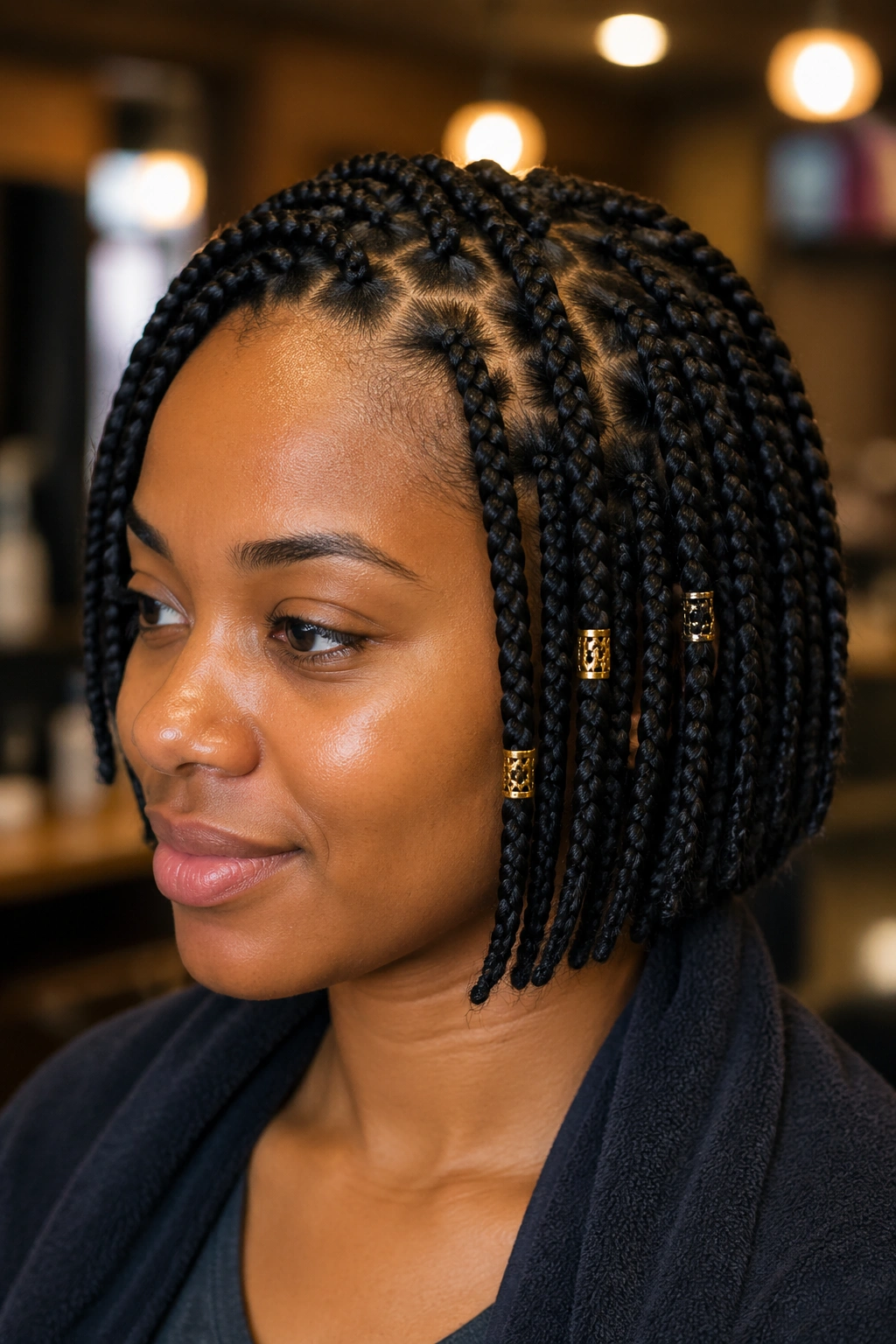
Gold cuffs are the cleaner cousin of beads.
They slide onto the braid body and catch the eye without adding much weight, which makes them useful on short braids. A few cuffs near the front can make a plain install feel more finished, especially when the parting is neat and the braid count is moderate. I like them more than people admit they do.
What Makes Them Different
- They sit flat, so they do not swing the way beads do.
- They look strongest when placed near the middle or lower third of the braid.
- They work with black hair, brown hair, and colored extensions without fighting the braid color.
- They can be removed or moved around without much trouble.
Keep the number low. Two to four cuffs can be enough for a whole head if the braids themselves are well done. Too many and the style starts to look like a craft project.
Gold cuffs are a good pick when you want a bit of shine but not the sound or movement that comes with beads.
10. Colored Short Box Braids
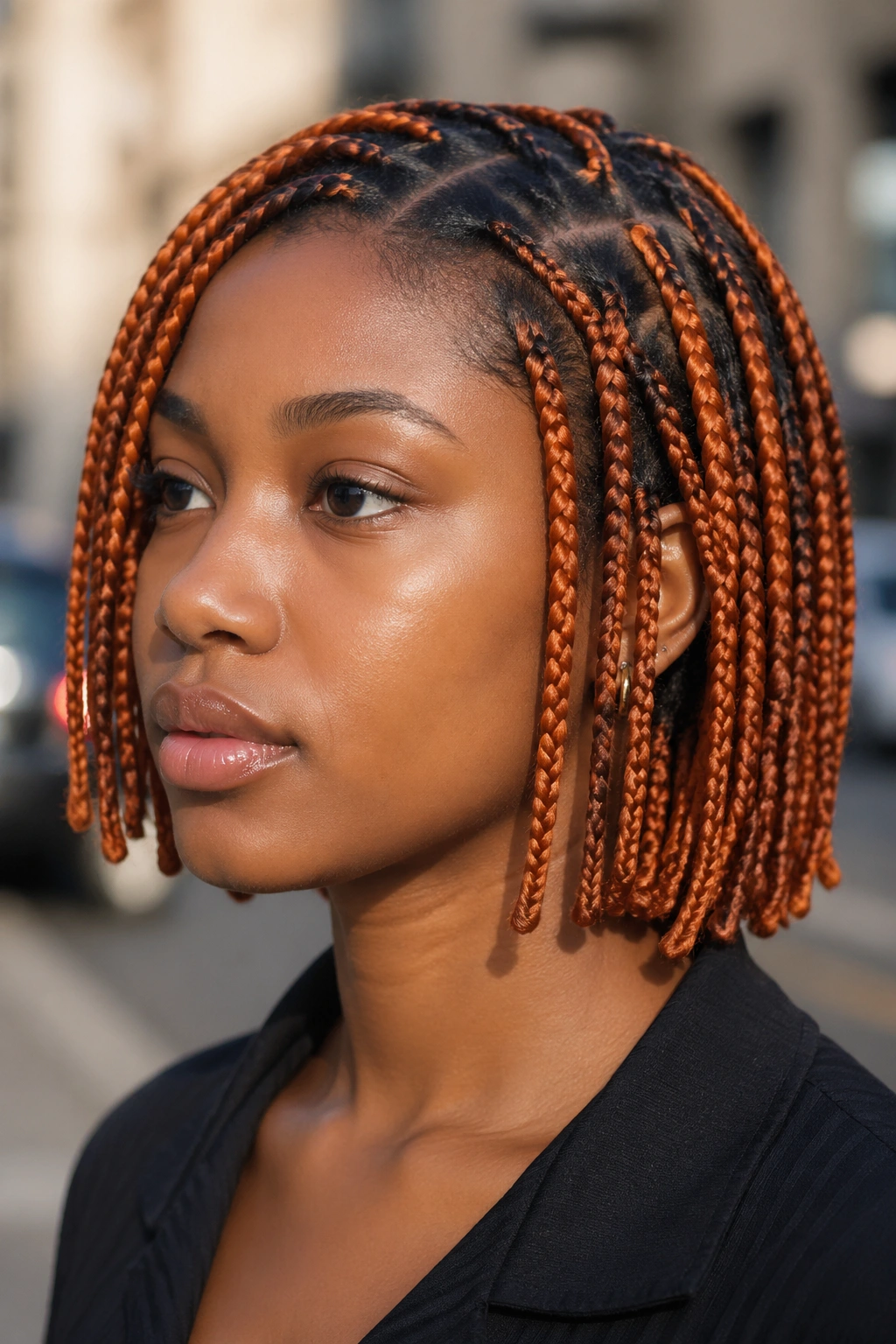
Color changes the mood faster than length ever will.
Warm browns, copper, burgundy, honey blonde, plum, and deep red all do different things on short box braids. Copper feels lively. Burgundy reads rich and a little moody. Honey brown warms up the face. The same cut can look softer or bolder depending on the shade alone.
The smartest way to use color is to think about contrast. A dark root with a lighter braid body gives more dimension than one flat shade from top to bottom. On short hair, that contrast shows fast because the eye is close to the scalp and the face. If you want a quieter look, pick a shade only one or two steps away from your natural hair color. If you want the braids to announce themselves, go wider with the color shift.
I also like color on short braids because it keeps the style from disappearing against the head. You see each braid more clearly.
And no, you do not need neon to make it interesting.
11. Boho Short Box Braids with Loose Curls
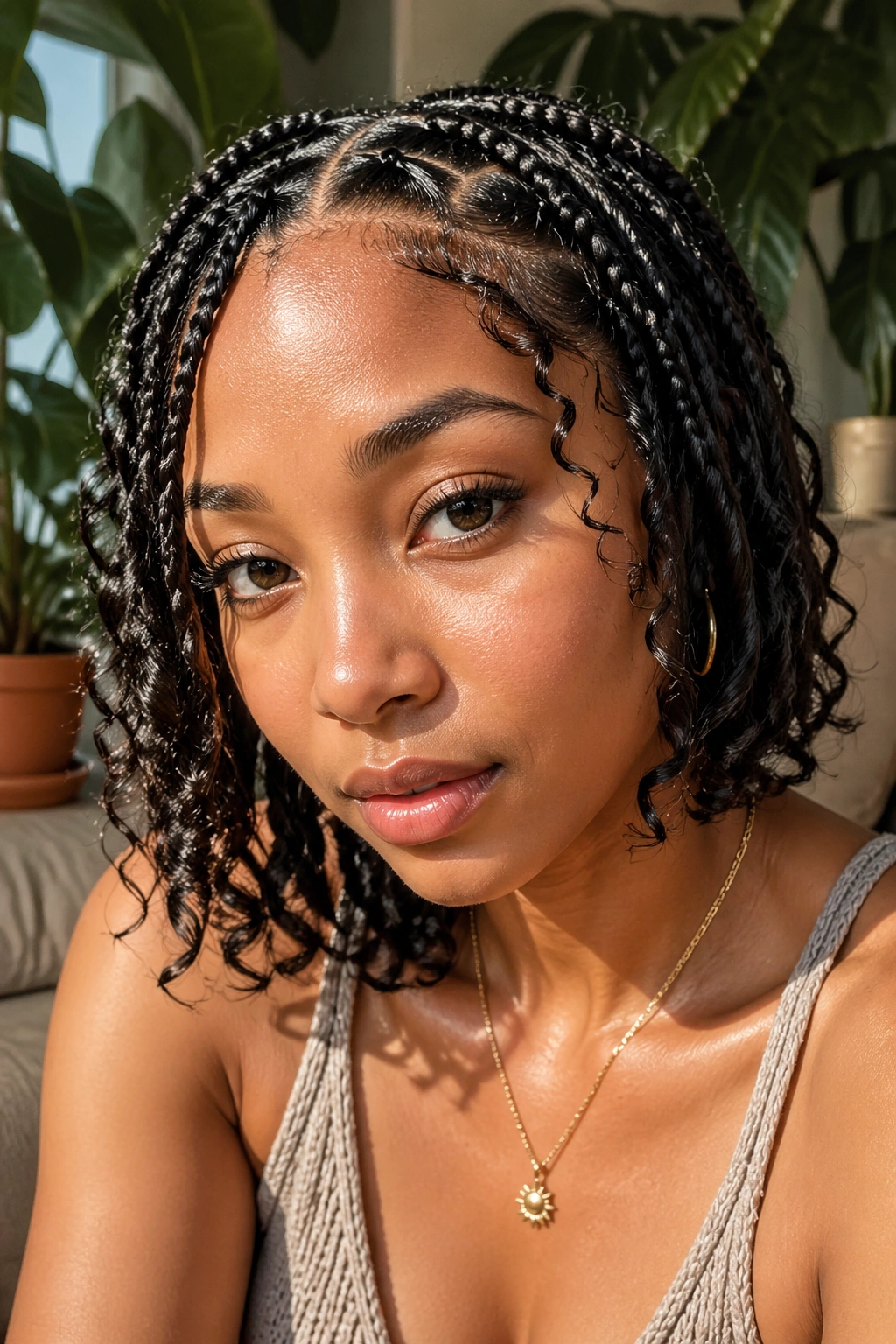
Loose curls change the whole mood from neat to lived-in.
A boho finish leaves a few curly pieces out between braids or along the front, so the style has texture that moves differently from the braid itself. On short box braids, that contrast feels especially good because the curl sits close to the face and breaks up the hard lines. It softens the look without making it messy.
The trick is not to overdo the loose pieces. A few well-placed curls around the hairline or along the sides are enough. If every braid has extra curl, the style starts to look heavy and can tangle faster than you want. I prefer a sparse approach, especially on shorter installs.
This style also works well when you want a little softness around the forehead or temples. The curls can hide a stronger part line, which is handy if you want the braids to feel less rigid.
It needs more refresh work than a plain install, though. A bit of mousse and finger separation keeps the curls from clumping.
12. Layered Short Box Braids
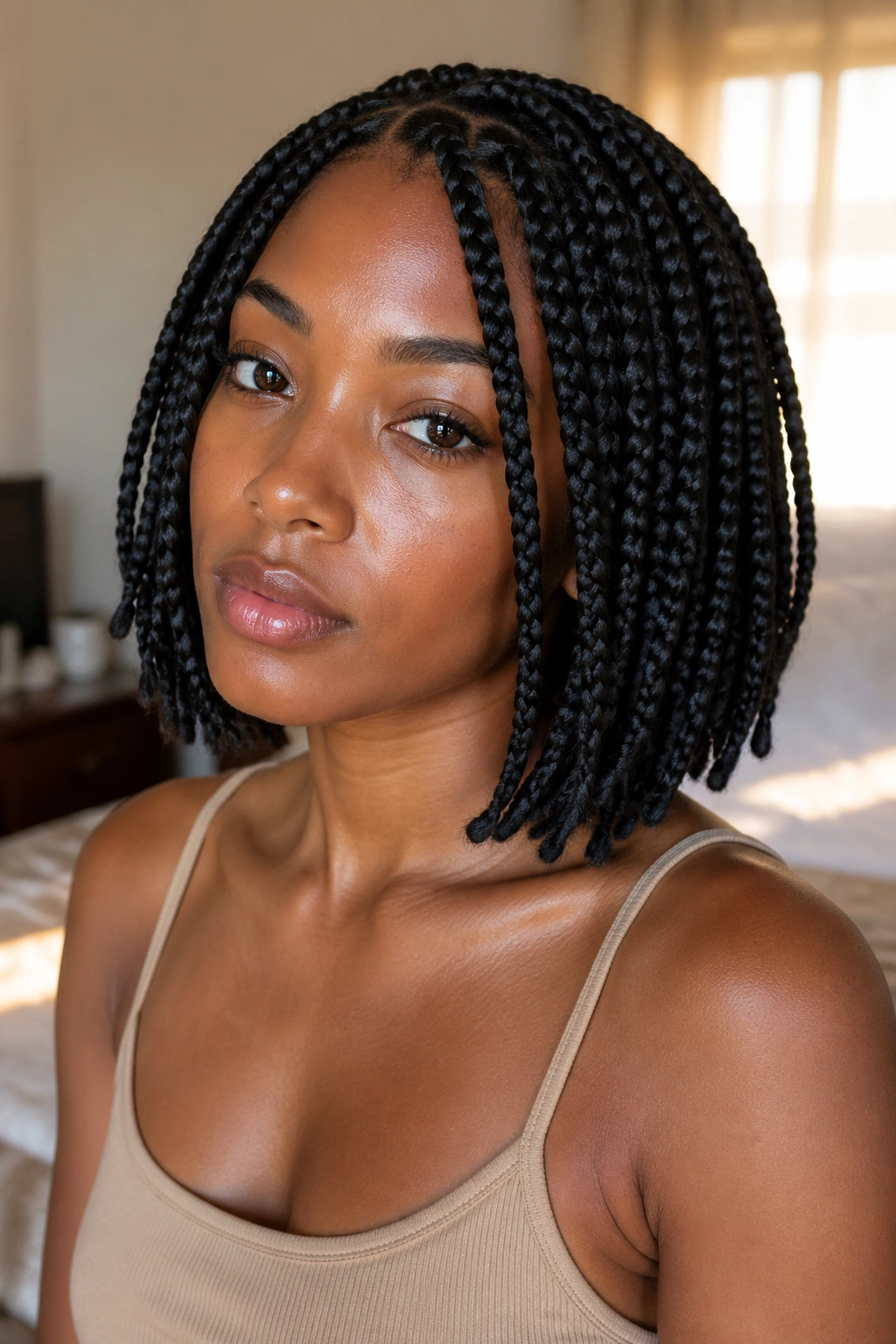
Layering fixes the flat, helmet-like look people complain about.
When the braids are cut in slightly different lengths, the whole shape breathes more. The top layer can sit a little shorter, the sides can fall around the jaw, and the back can keep a bit more length. That staggered finish gives short box braids motion even when you are standing still.
What I like most is how it changes the silhouette without changing the braid pattern itself. You can keep square parts, keep a medium braid size, and still end up with a style that feels more dimensional. The cut is doing the work here. Not the braid size.
Layering is especially useful if your face reads long or narrow and you want a little width near the cheek area. A few shorter pieces can soften that line without stealing the shape of the braid set.
It does need a braider who knows how to finish the cut cleanly. Rough layering looks choppy. Clean layering looks expensive, which is a word I do not use lightly.
13. Tapered Cut Short Box Braids
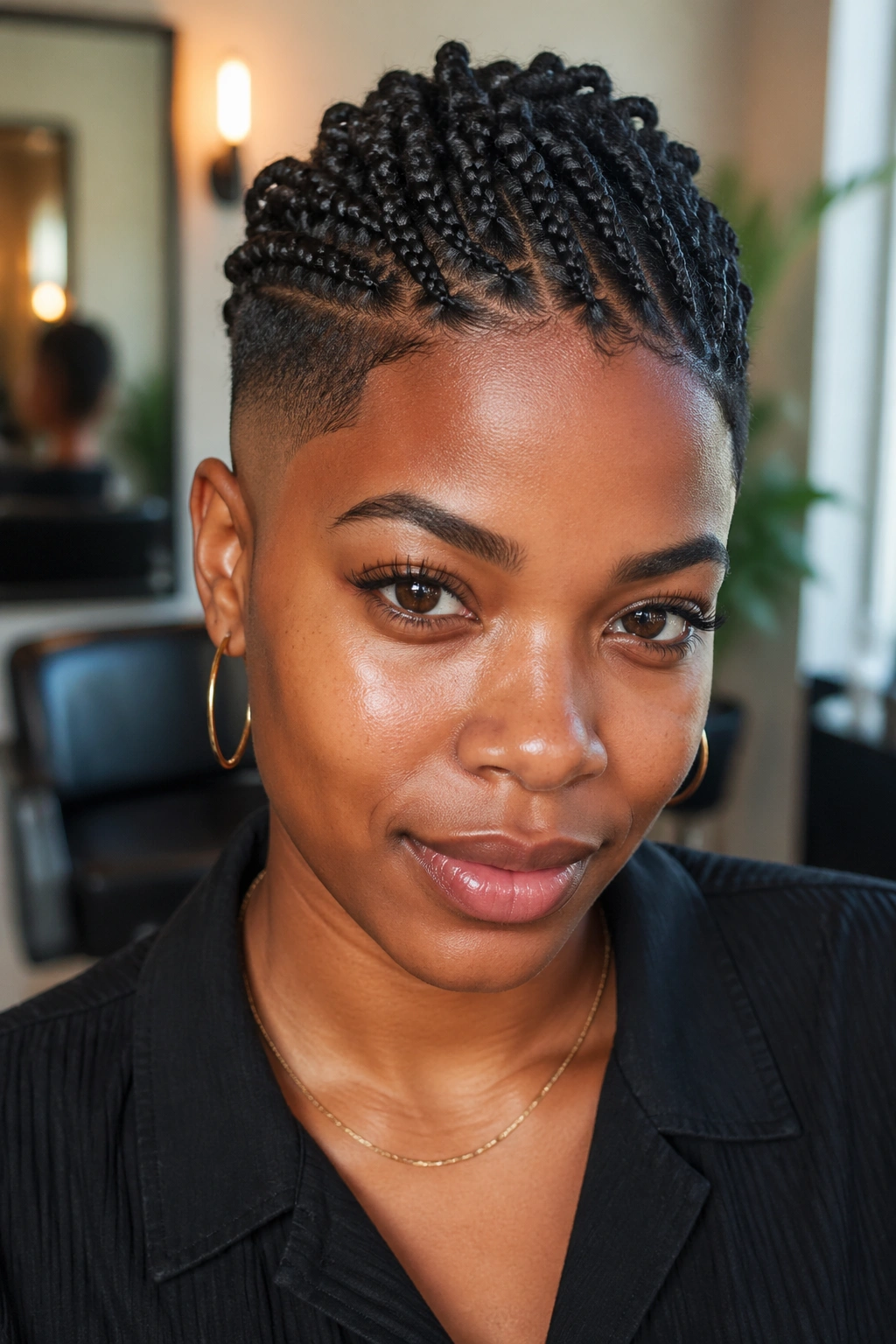
A tapered cut gives short braids an edge before you even style them.
On this version, the sides and back sit tighter, while the top carries more of the length. The contrast makes the braids feel more tailored and less blocky. If you already wear a taper, fade, or closely cropped cut, box braids can sit on top of that shape instead of hiding it.
What You Get
- More lift at the crown.
- Less bulk near the nape and ears.
- A shape that looks sharp even with fewer braids.
- Easier access to the scalp around the back and sides.
This is one of my favorite looks when the goal is structure. It has attitude, but not chaos. The taper gives the braids a built-in frame, so even a simple install feels intentional.
The only real caution is proportion. If the top is too heavy, it can swallow the taper. If the top is too sparse, the style loses the point. The balance has to be honest.
14. Short Box Braids with a Deep Side Sweep
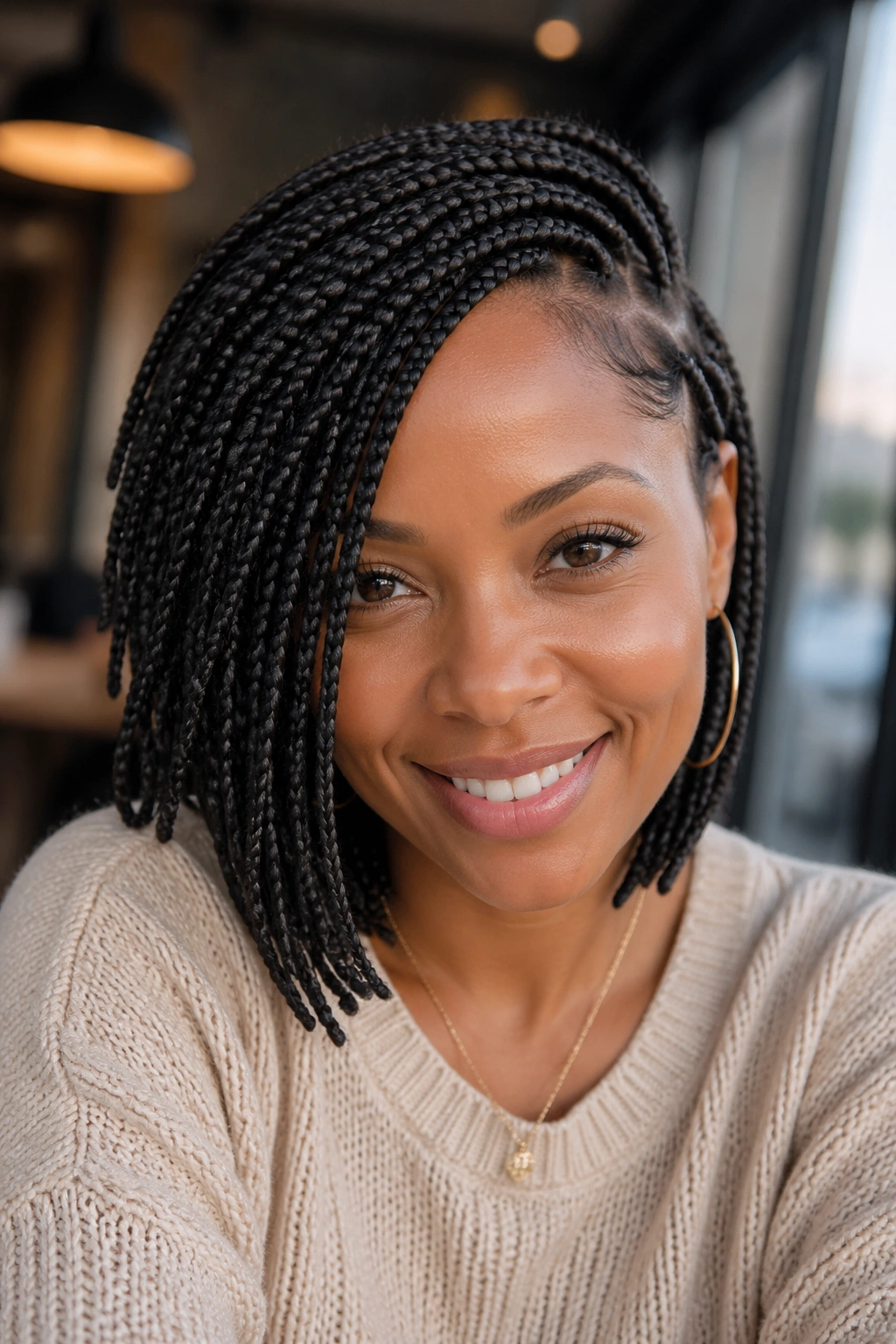
A deep side sweep turns a plain install into something more expressive.
Instead of wearing the braids straight down, you direct most of them across one side of the forehead and let them fall toward the opposite cheek. That creates movement even when the braids are short. It also gives the face a softer angle, which can be useful if you like a bit of drama without adding beads or color.
The style works best when the front row is laid flat and the rest of the braids follow the same direction. If the sweep is fighting the braid parts, it looks forced. If the whole front of the style bends the same way, it feels clean.
I prefer this look on braids that hit around the jaw or upper neck. Shorter than that and the sweep can feel cramped. Longer than that and it starts to behave more like a standard side part.
It is a good date-night option, if you care about such things. Also a good “I did not spend an hour on makeup but still want the hair to show up” option.
15. Middle-Part Short Box Braids
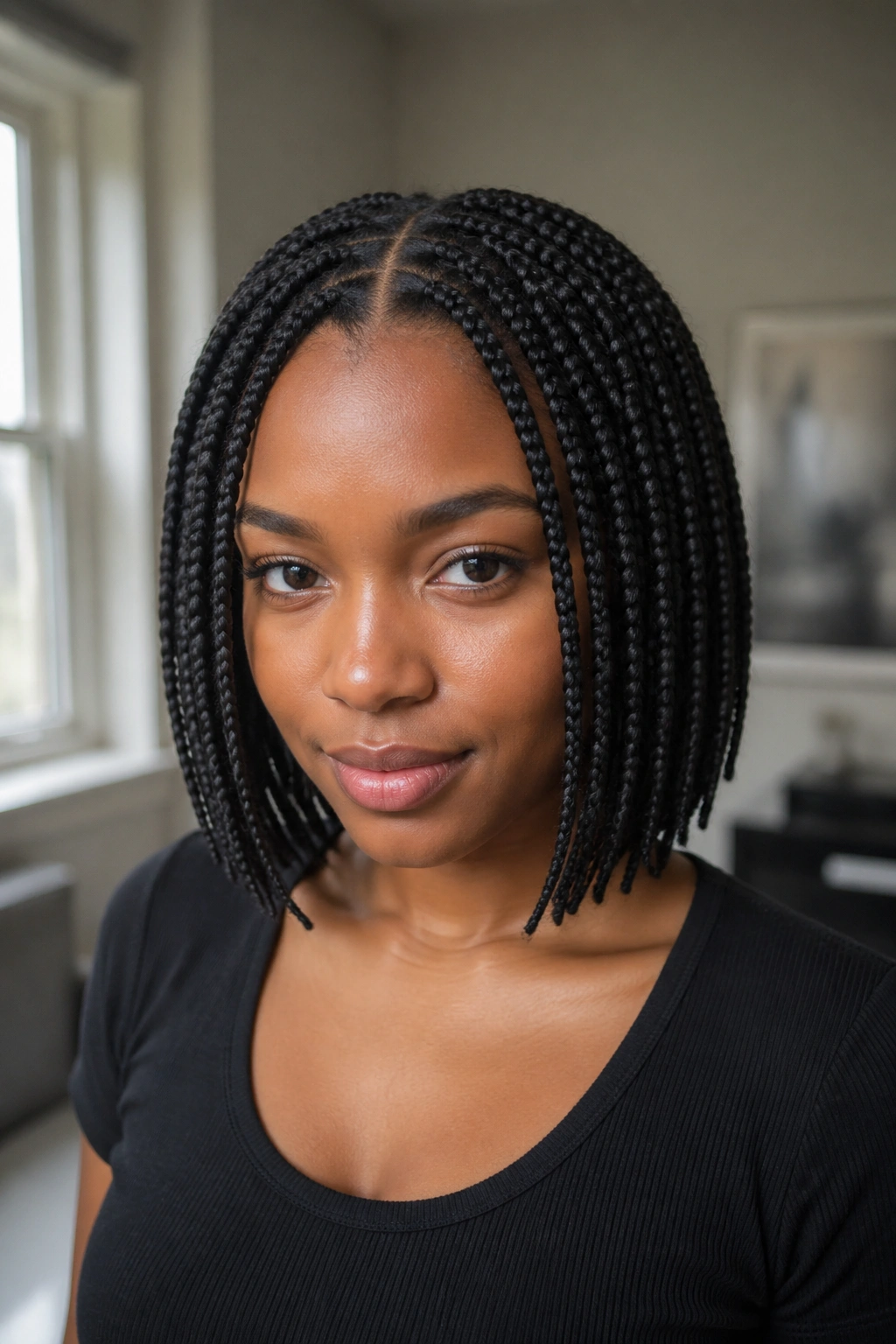
The middle part is the most honest parting, which is exactly why it works.
It splits the face evenly and lets short box braids hang in a calm, symmetrical frame. If you want a tidy, balanced look that does not rely on accessories or color, this is the one. The effect is crisp right away, especially when the center line is sharp all the way back.
A middle part also shows off good sectioning. There is nowhere to hide a crooked line. That sounds harsh, but it is the reason the style looks so clean when done well. Short braids already keep the eye close to the scalp, so the center part becomes part of the hairstyle, not just a setup step.
I like this version when the braid ends are blunt and uniform. The straight line at the center pairs well with the even finish. If the ends are curled or layered, the look softens a bit, which can be nice too.
It is probably the easiest short braid style to keep neat on a daily basis. Symmetry does a lot of the work for you.
16. Face-Framing Short Box Braids
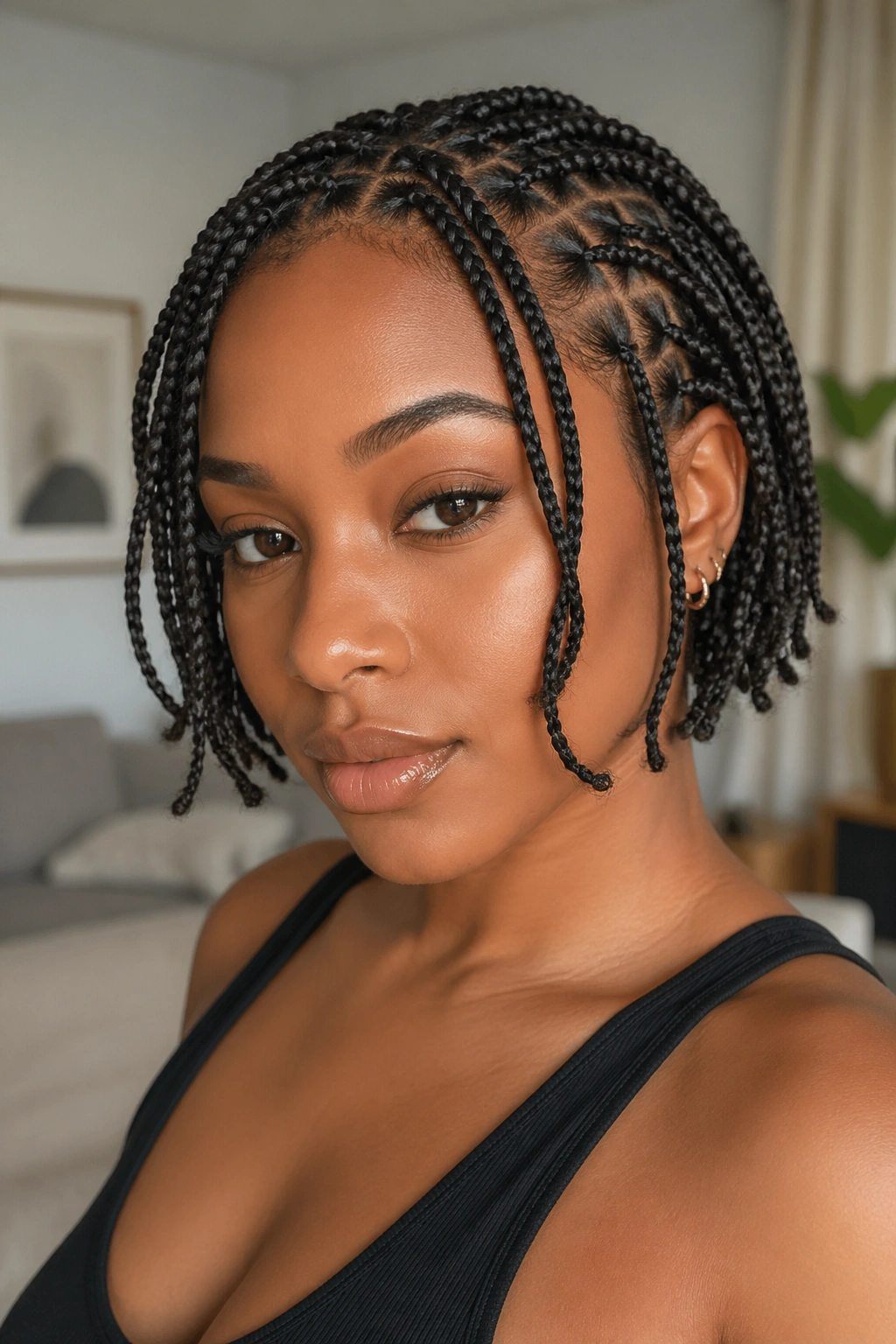
A few longer front pieces can change the whole mood of the head.
Face-framing short box braids leave a small cluster of braids slightly longer near the temples, cheeks, or chin. The rest of the head stays short, so the effect feels deliberate rather than accidental. I think this is one of the smartest ways to soften a box braid set without losing the shape.
Why It Feels Softer
The longer front pieces break up the line of the face and keep the style from looking too square. You get movement where people look first, and the shorter back and sides keep everything practical. If your usual braid set feels a little severe, this is the easiest fix.
You can lean subtle or obvious. Two longer front braids can be enough if you want a whisper of framing. Four or five can make the style feel more romantic. The point is not symmetry; it is balance.
This style also works well when you wear glasses. The front pieces can sit around the frames without fighting them.
17. Asymmetrical Short Box Braids
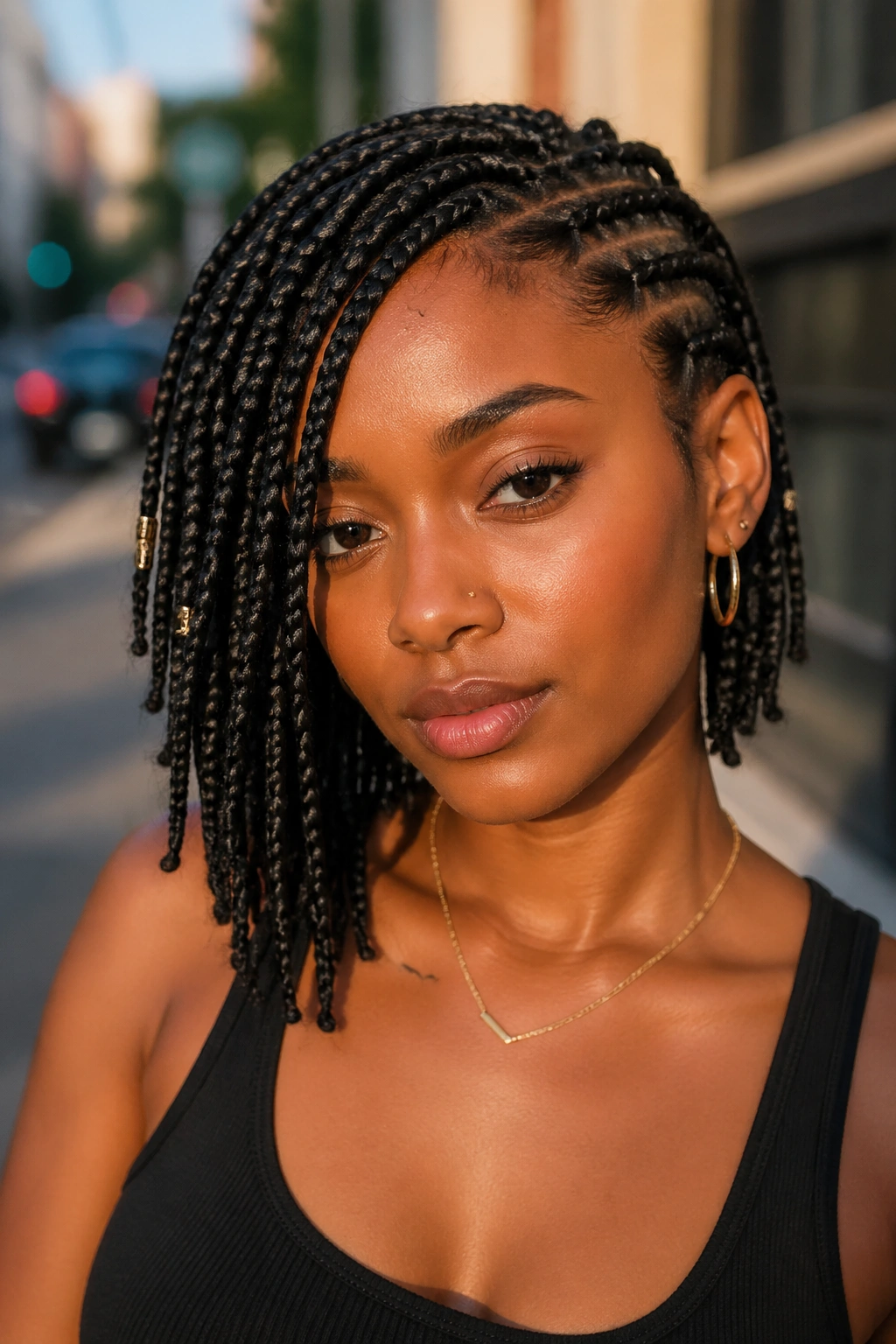
A slight imbalance can look more deliberate than perfect symmetry.
Asymmetrical short box braids place more length, more fullness, or more movement on one side of the head. The difference does not need to be dramatic. Even a small shift — one side tucked tighter, the other falling lower — changes the read. It gives the style a bit of tension, which makes the eye linger.
I like asymmetry when the braid parts are very clean. That contrast matters. If the base is sloppy, asymmetry just looks unfinished. If the base is crisp, the uneven shape feels styled on purpose.
It also lets you play with your profile. One side can skim the cheek, while the other stays closer to the ear. That small shift is enough to make the style feel more editorial without getting strange about it.
Use this version when you want short braids that feel less expected. It is a little bolder than a middle part, but less loud than full accessories or bright color.
18. Knotless Short Box Braids
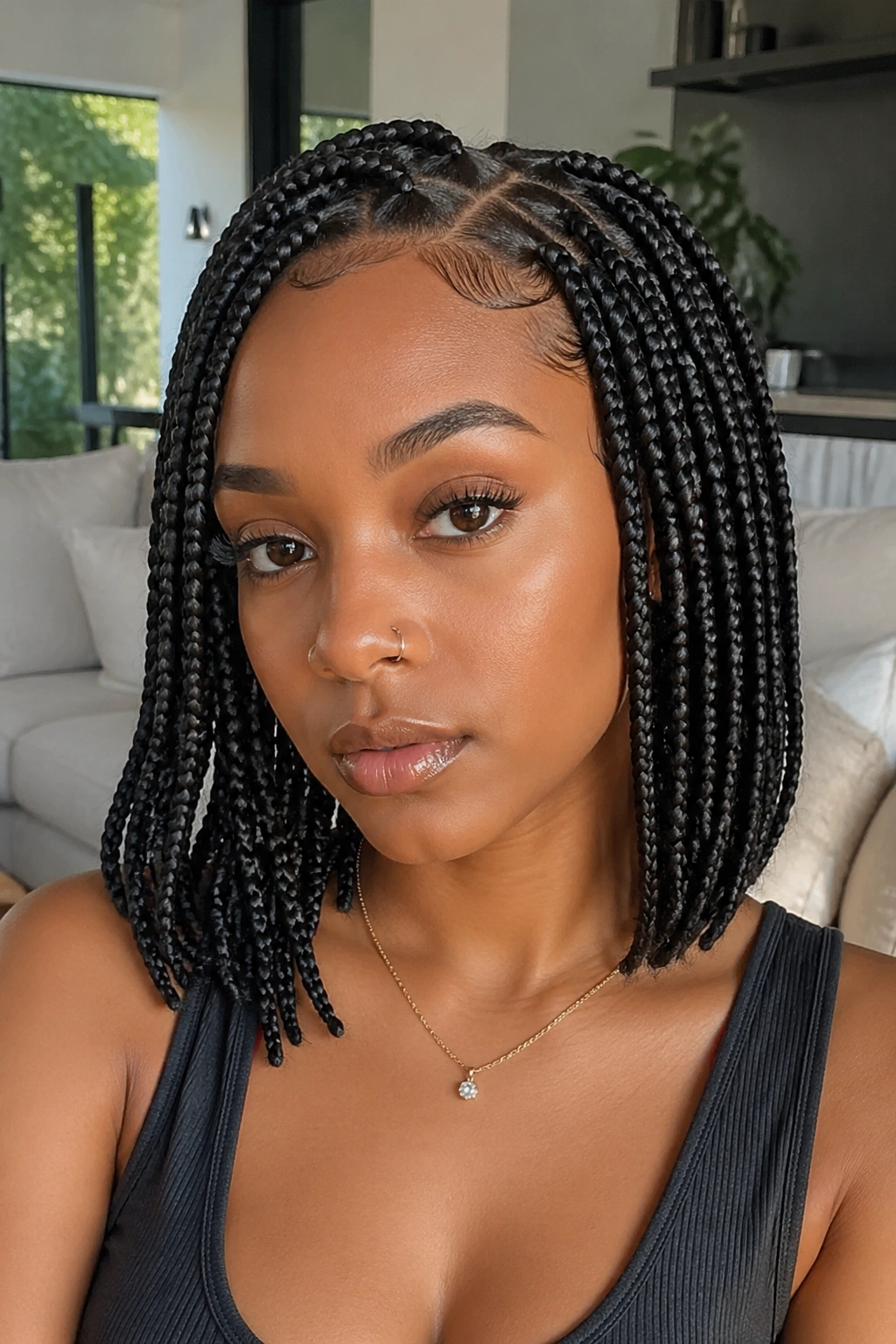
Knotless short box braids are the softer, flatter cousin of the traditional start.
Instead of beginning with a knot at the root, the braid feeds in hair gradually. That means less bulk at the scalp and usually less tugging at the hairline. On short installs, that matters because the roots sit right near the face and the neck, where bulky starts can show fast.
The finish feels smoother too. The braids lay closer to the head, which gives the whole style a more streamlined shape. If you want your short braids to sit flat under hats or scarves, knotless is a smart route.
A Few Practical Notes
- The install usually takes more patience.
- The base feels lighter on sensitive edges.
- The look reads cleaner when you want a polished finish.
- The style can still frizz; knotless does not make it magic.
I reach for this version when comfort matters as much as appearance. It is one of the few braid choices that looks tidy and feels easier to live with.
19. Short Box Braids with Twisted Ends
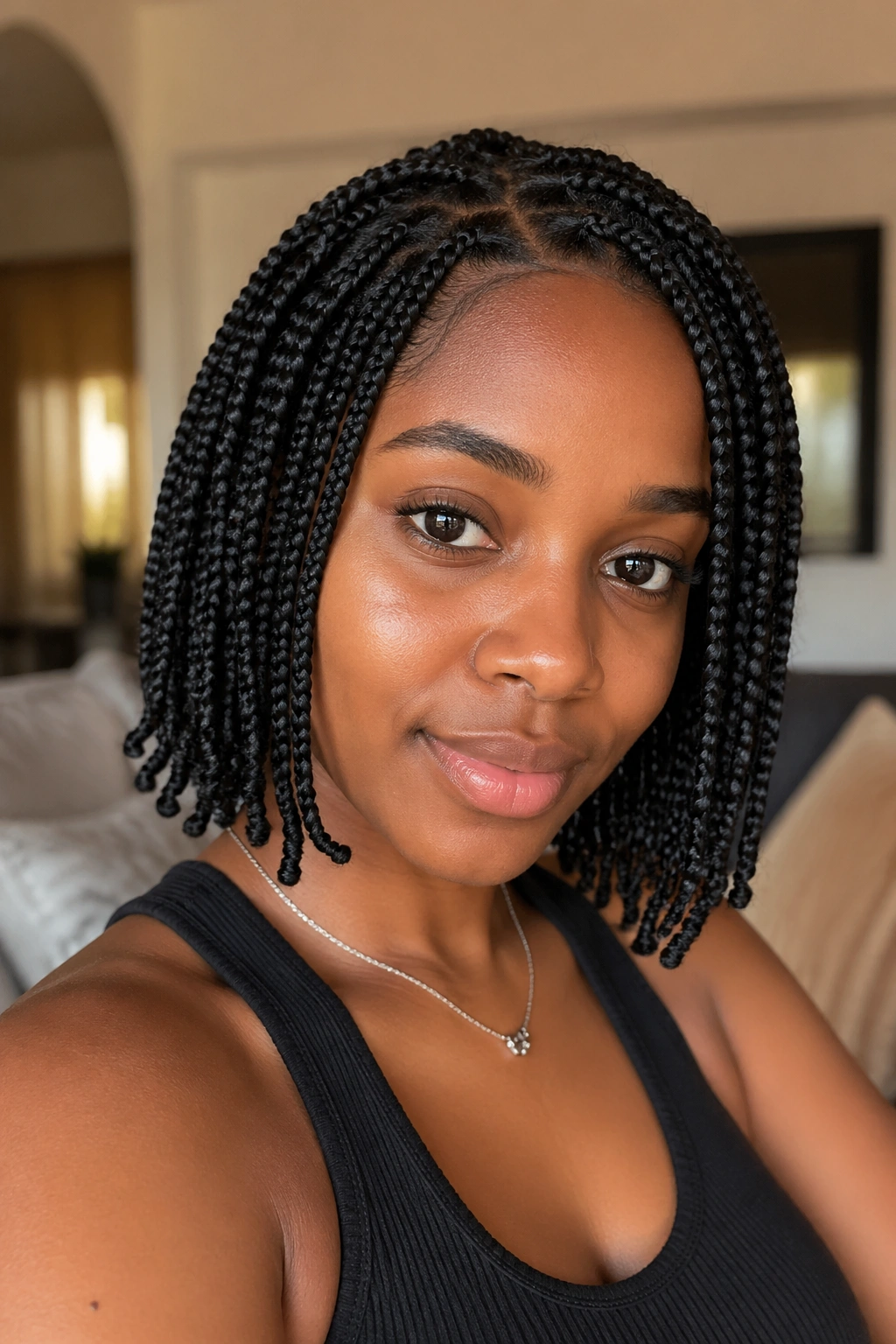
Twisted ends make short braids feel a little less formal.
Instead of sealing every braid into a blunt dipped finish, the last inch or so can be twisted softly, or left with a ropey bend that looks more relaxed. The result is a braid set that feels casual without losing structure. Short hair handles that kind of finish nicely because the ends stay close to the body of the style.
Unlike curled ends, which read softer and springier, twisted ends feel a bit more grounded. They have a rope texture that works well if you like your braids to look tidy but not stiff. I think they are especially good on bob-length installs where a blunt finish might feel too sharp.
This is a good compromise if you are torn between polished and undone. The twist gives you shape. The lack of a hard seal keeps the finish from feeling heavy.
It is a small detail, but small details are half the point with short braids.
20. Short Box Braids Pulled into a Low Bun
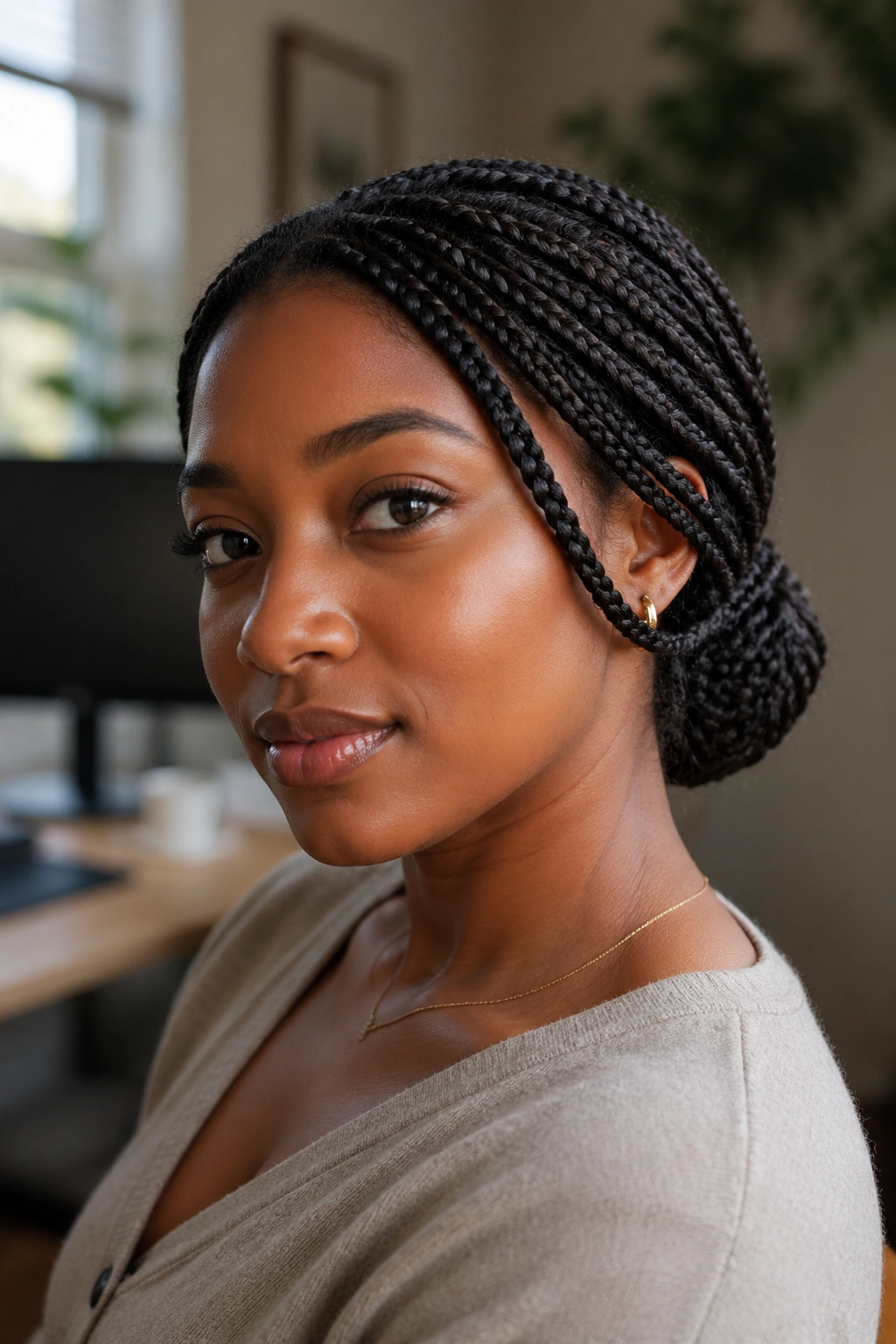
A low bun turns a short braid install into something dressier in seconds.
The braids may be short, but if they reach the nape or collar line, you can gather them into a small knot at the base of the head. The shape looks tidy and practical, and it keeps the hair off the neck when you want that. A low bun on short box braids is not about volume. It is about control.
I like this style for work days, dinners, or any moment when you want the braids to look more finished. It also keeps the ends safer when you are sleeping or moving around a lot. Just do not pull the bun too tight. Short braids need room to rest, and a clenched style around the nape can get uncomfortable quickly.
A wrapped braid strand or a satin tie can make the bun look cleaner. No need for a giant scrunchie unless you want one.
It is a humble style, which is part of its charm.
21. Short Box Braids with Shell Charms
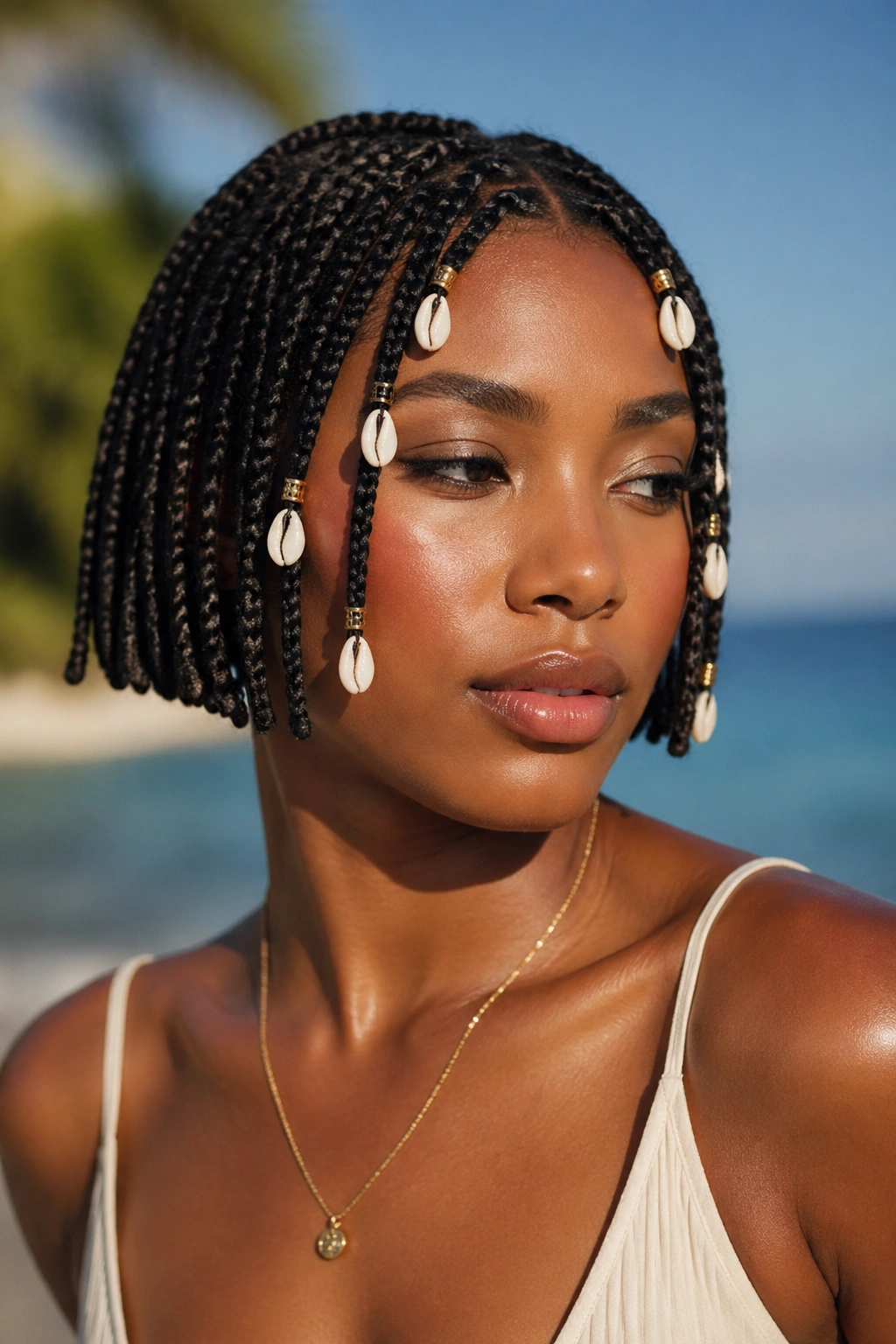
Shells bring a beachy feel, but they work best when they are used sparingly.
A few cowrie shells or small shell charms on short box braids can change the entire mood of the style. The look becomes a little louder, a little warmer, and a lot more textured. Because the braids are short, the charm placement is easy to see. One shell in the right spot can do more than five scattered ones.
How to Keep It Clean
- Place shells near the front rows or only on one side.
- Mix shells with plain braids so the head does not feel overloaded.
- Choose lightweight charms so the braid roots do not sag.
- Let the rest of the style stay simple.
Shell accents work especially well with neutral clothing and plain tops, because the hair already brings enough detail. I would not pile them onto beaded braids unless you really want a full accessory moment. That can get crowded fast.
Used with a light hand, shells feel personal. Used without restraint, they feel noisy.
22. Short Box Braids with Peekaboo Color
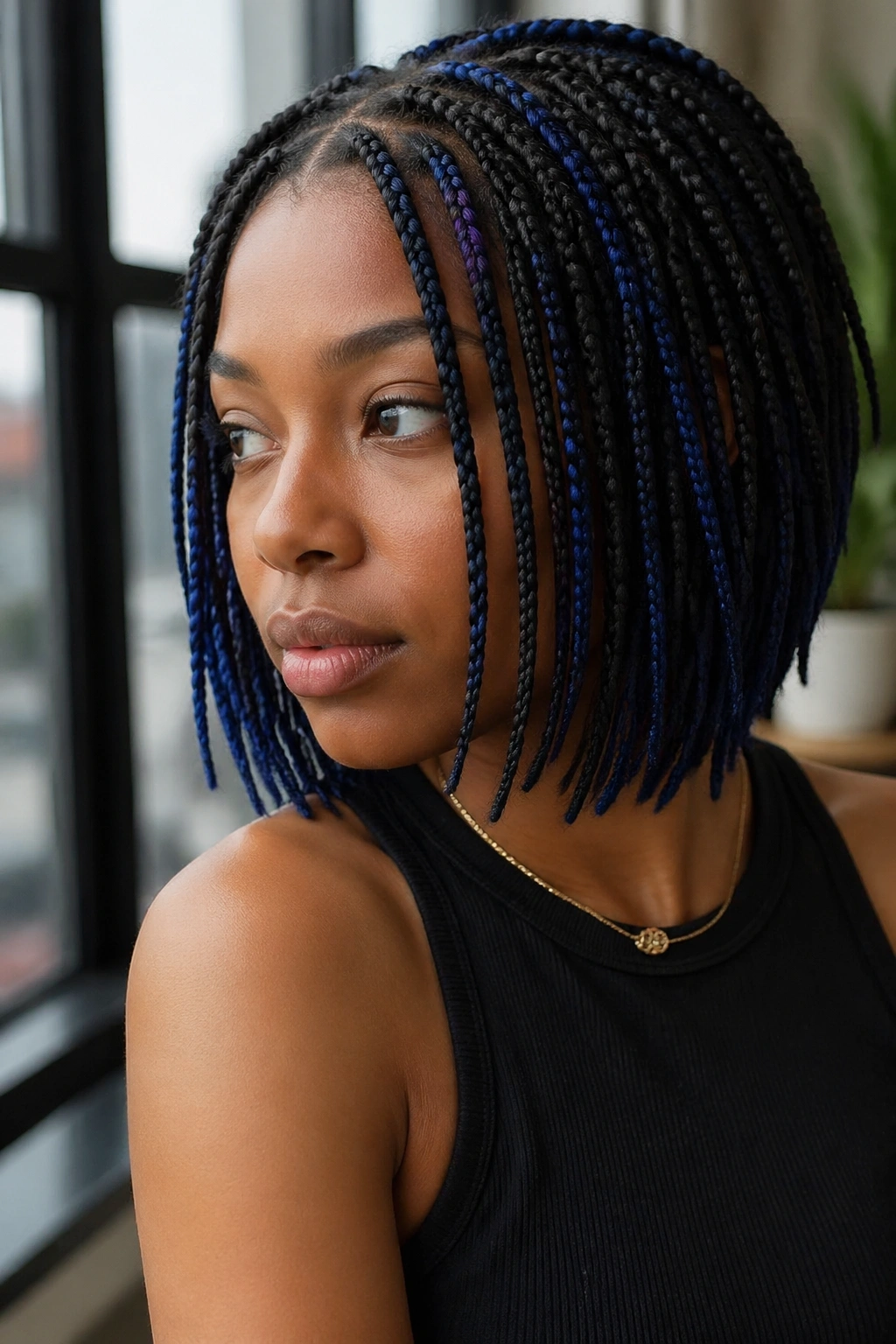
Hidden color is one of the smartest color choices if you want surprise instead of shout.
Peekaboo color places a brighter shade under the top layer of braids or around the back and sides where it shows only when the hair moves. On short box braids, that kind of placement works especially well because the layers are closer together. A flash of red, blonde, cobalt, or copper can appear when you turn your head, then disappear again.
The appeal is control. You get color without changing the whole surface of the style. If you work in a place that prefers something calmer, this can be a safer choice than full-head color. It also gives the braids more depth, especially when the top layer is a darker shade.
I like this look more than flat all-over color when the braid pattern itself is simple. The surprise carries the style.
It is one of those details that makes people look twice, then look again.
23. Short Box Braids with Curved Parts
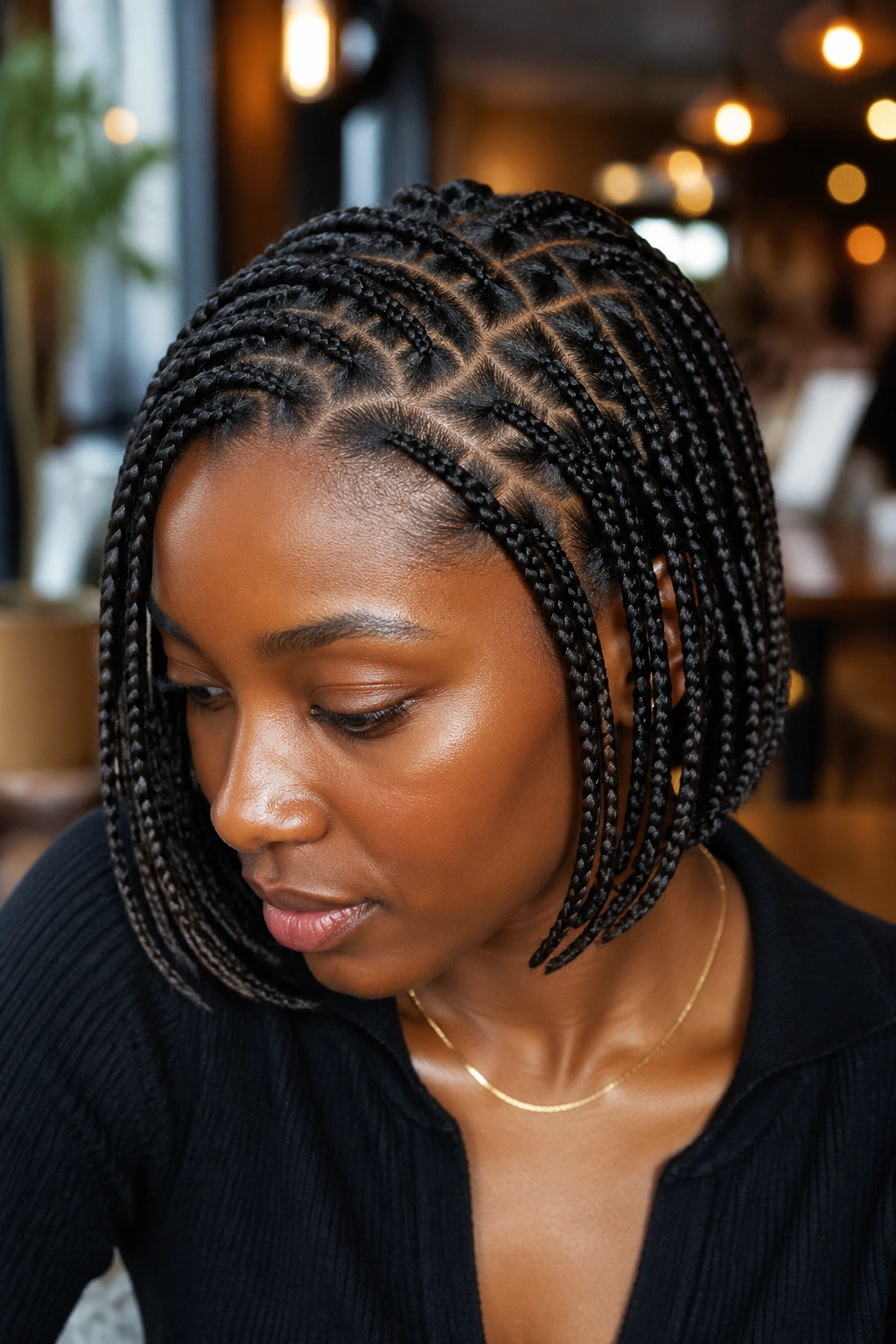
Curved parts are where the braider gets to show off.
Instead of straight boxes or clean triangles, the parting arcs around the scalp in soft loops and swoops. On short box braids, the curved line becomes part of the design because there is less length to distract from it. The result feels artistic, almost architectural.
This style needs a careful hand. A curved part that is uneven looks off fast. A curved part that flows smoothly looks expensive and deliberate. That is the whole game here. The braid size can stay medium or small; the parting does the heavy lifting.
I prefer curved parts when the rest of the styling stays simple. No heavy beads, no loud color, no bulky bun. Let the lines speak first. Short braids already sit close enough to the scalp that the parting becomes visible from the front, which is exactly where you want the design to show.
It is not the fastest install. It is one of the prettiest.
24. Short Box Braids in a Faux Hawk Shape
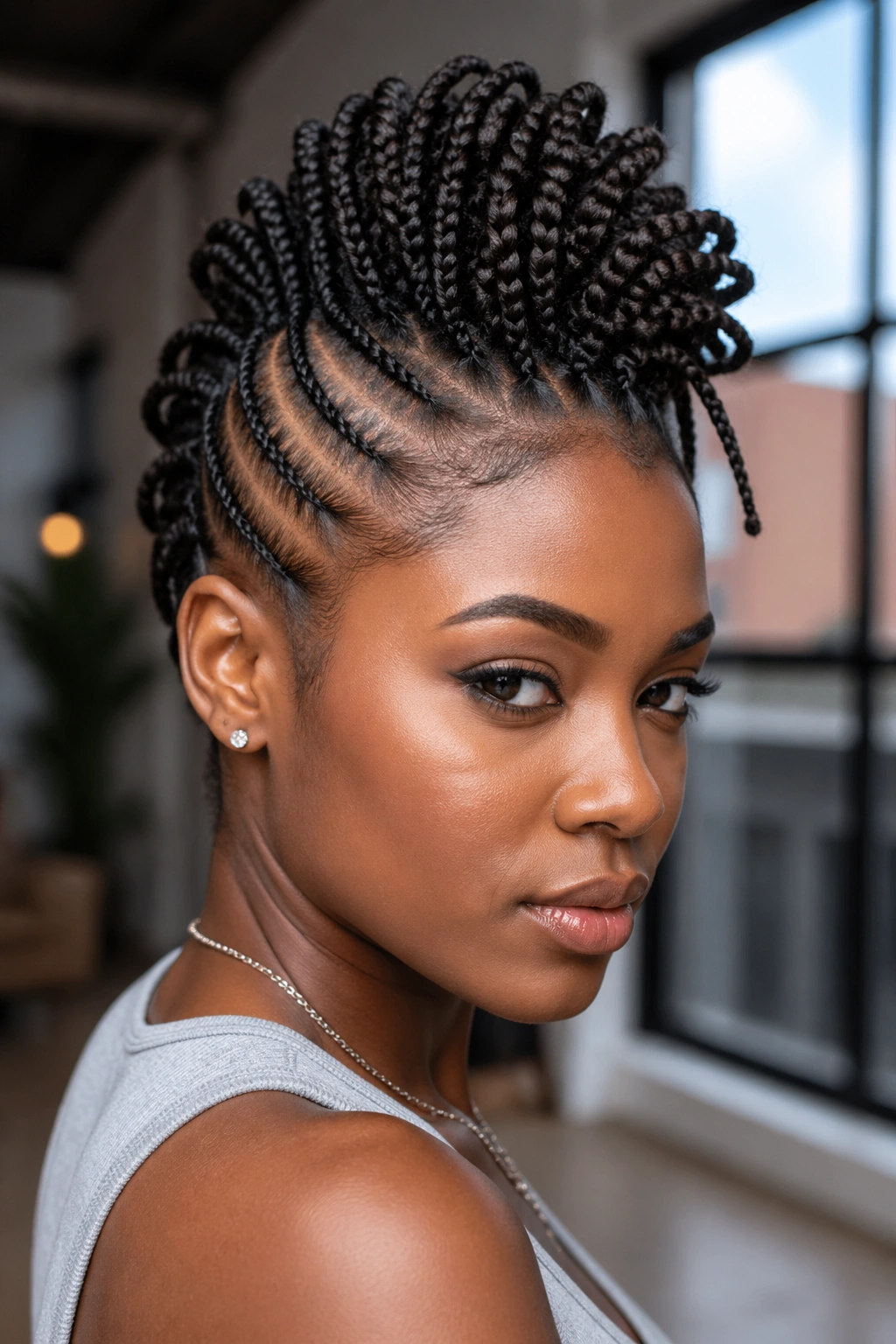
A faux hawk gives short braids real attitude without shaving anything.
The sides are pinned or tucked closer to the head, while the center row stays fuller and higher. That creates a narrow ridge of braids down the middle, with the rest of the hair pulled inward. On short lengths, the shape is strong because the braids do not have much extra length to collapse under their own weight.
What I like here is the contrast. The center looks lifted and intentional; the sides make the center look taller. The style has more edge than a standard bob, but it still feels wearable because the braids remain short and controlled.
A few pins can change the whole shape. So can a soft edge gel along the sides if you want the hairline to sit flat. Keep the center braids neat and let them rise a little.
This is the style for days when plain is not the mood.
25. Clean Edge-Up Short Box Braids
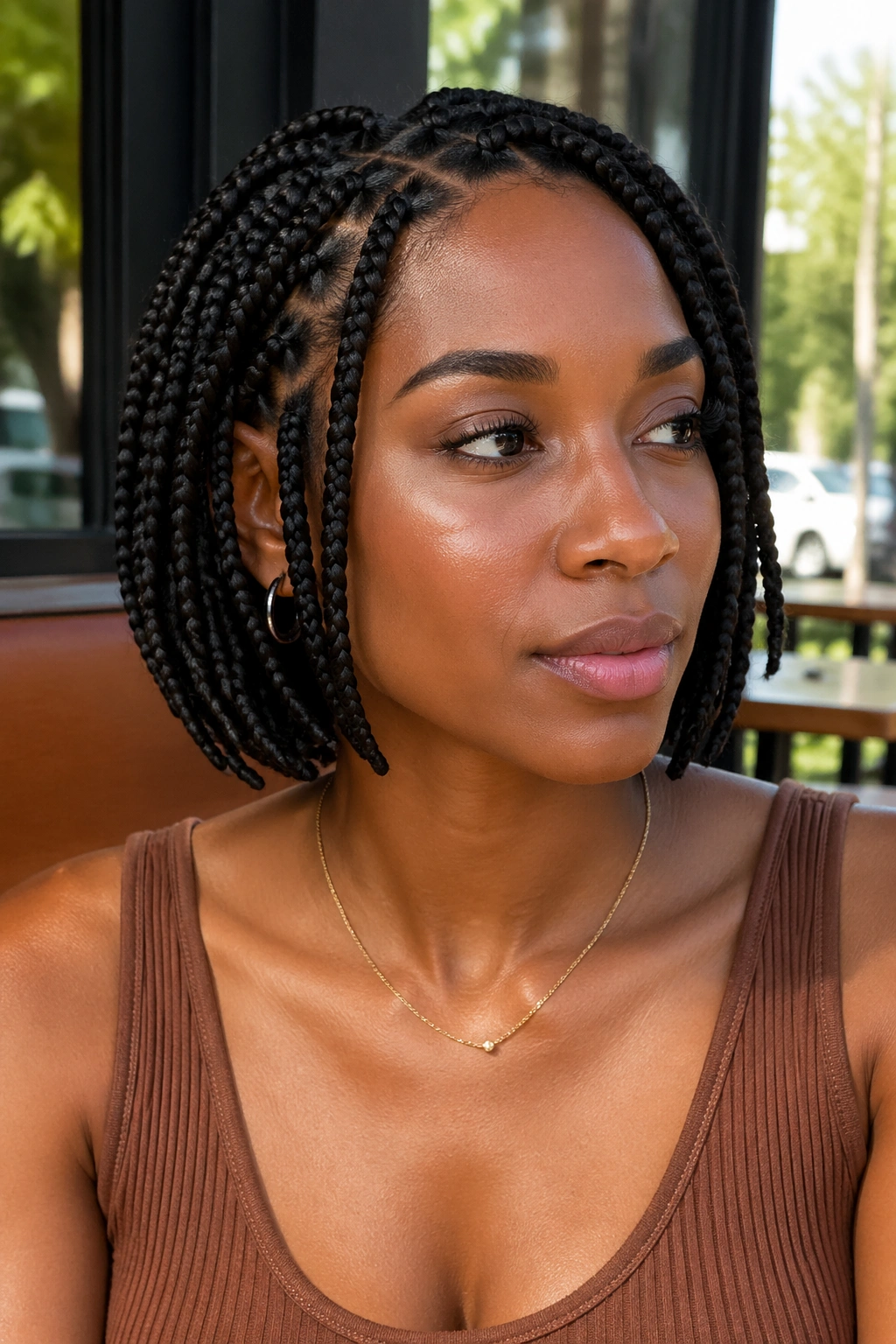
A sharp hairline can make short braids look finished before anyone notices the braid pattern.
This is the version I keep coming back to when I want the whole style to read clean. The braids themselves can be simple — chin-length, bob-length, or slightly layered — but the edge-up around the forehead, temples, and nape gives everything a frame. A tidy line does not need decoration to matter. It just changes how the braids sit in the space.
Short box braids work especially well with this kind of finish because the hair sits close enough to the face that the outline matters. If the edges are crisp and the parts are even, the style looks like it belongs there. If the line is fuzzy, the whole thing feels less settled, even when the braids themselves are well done.
A satin scarf at night helps keep that shape intact. So does not piling on too much product near the hairline. Short braids already carry enough structure. They do not need extra help from sticky buildup.
That is the real appeal of short box braids: once the shape is right, the style can do a lot with very little.
