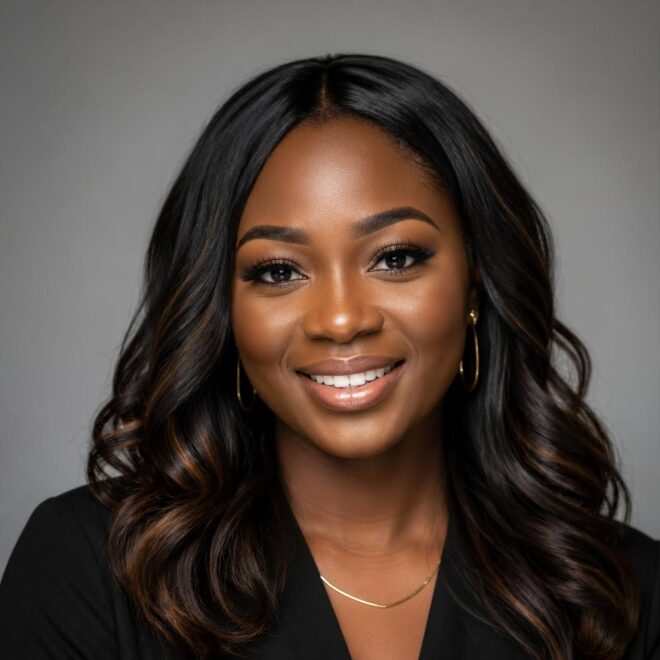


A clean middle part can make a ponytail look sharper, calmer, and more intentional in a way a side part never quite manages. On Black hair, that center line does a lot of heavy lifting: it can organize curls, braids, silk presses, locs, and extensions without stealing attention from the texture itself.
The nice part is that middle part ponytails for Black women do not have to live in one lane. They can be sleek and bossy, soft and romantic, protective and practical, or all three at once. The trick is not chasing the tightest pull or the glossiest finish. It’s getting the part, the base, and the tension right so the style looks polished without feeling mean to your scalp.
I’m partial to styles that hold their shape for a full day and still let your hair breathe. A ponytail that looks neat but leaves your temples sore by lunch is not a win. Neither is a style that starts out smooth and turns fuzzy the second you step outside.
So the good ones below do a few things well: they frame the face, they work with different textures, and they give you options depending on how much time you want to spend with a comb, gel, braiding hair, or a hot tool. Some are quick. Some take patience. All of them can look sharp when the middle part is clean and the base is secure.
1. Sleek Low Ponytail With a Sharp Center Part
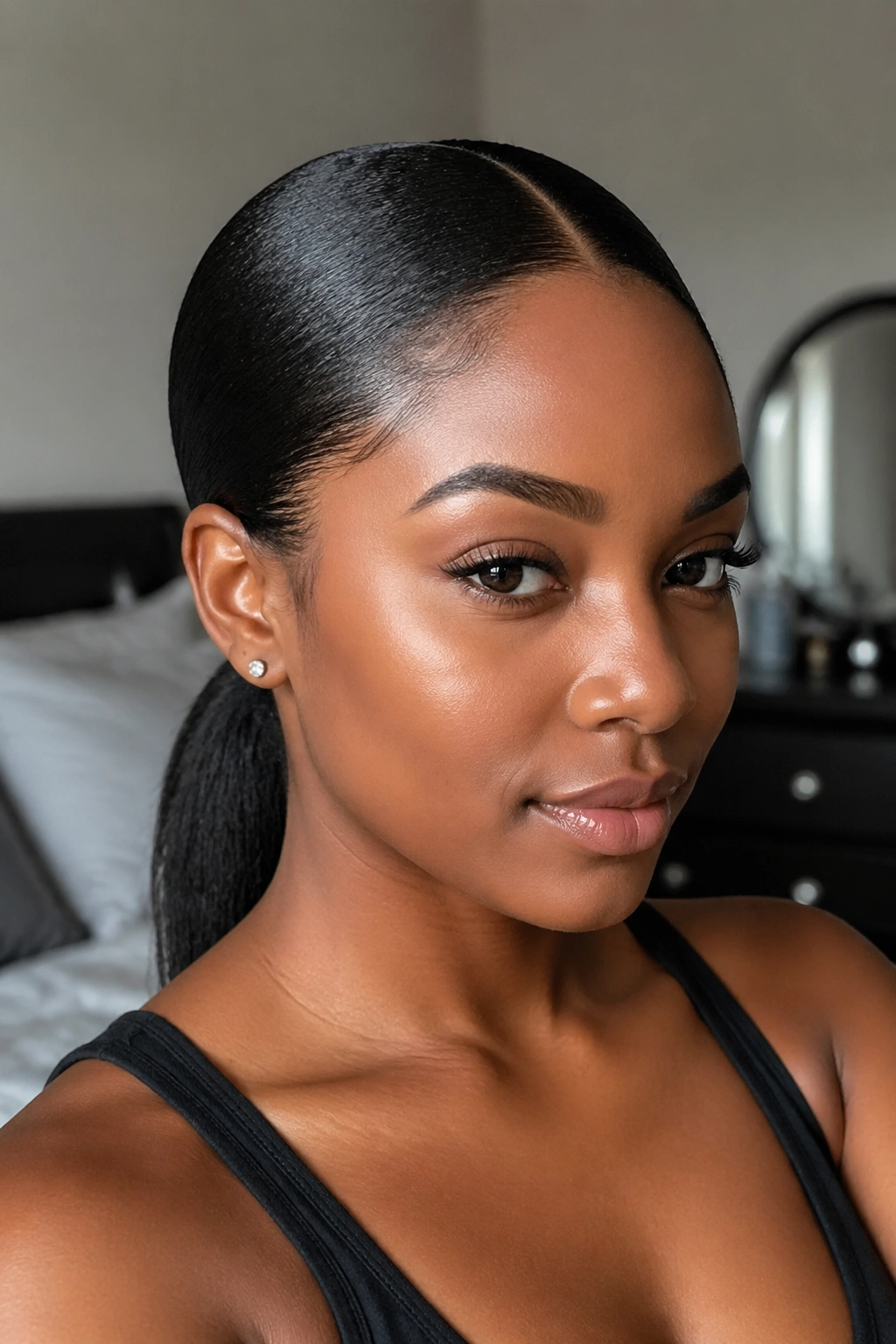
A sleek low ponytail is the style I’d hand to anyone who wants clean lines without drama. It sits low at the nape, keeps the middle part front and center, and makes natural texture or pressed hair look tidy fast.
Why this version keeps showing up
The shape is simple, but it works because the eye follows the center line straight down into the ponytail. That gives the face a long, neat frame without making the style feel stiff. If your hair is thick, this also helps keep the bulk controlled instead of puffing out on one side.
A soft brush, edge brush, and a little holding gel are enough for most versions. If your hair is natural, stretch the roots first with twists, braids, or a blow-dry so the base lies flatter. Skip the heavy hand on the gel. Too much product around the part can flake and make the style look dusty by the end of the day.
- Best on hair that has been blown out, silk-pressed, or lightly stretched
- Looks sharp with a 1/4-inch part and a low elastic placed about 1 inch above the nape
- Works with a wrapped ponytail base if you want a more finished look
- Easier to refresh than a high ponytail
Pro tip: lay the part first, then smooth the sides. If you do it in the other order, the line usually gets messy.
2. High Ponytail With a Wrapped Base
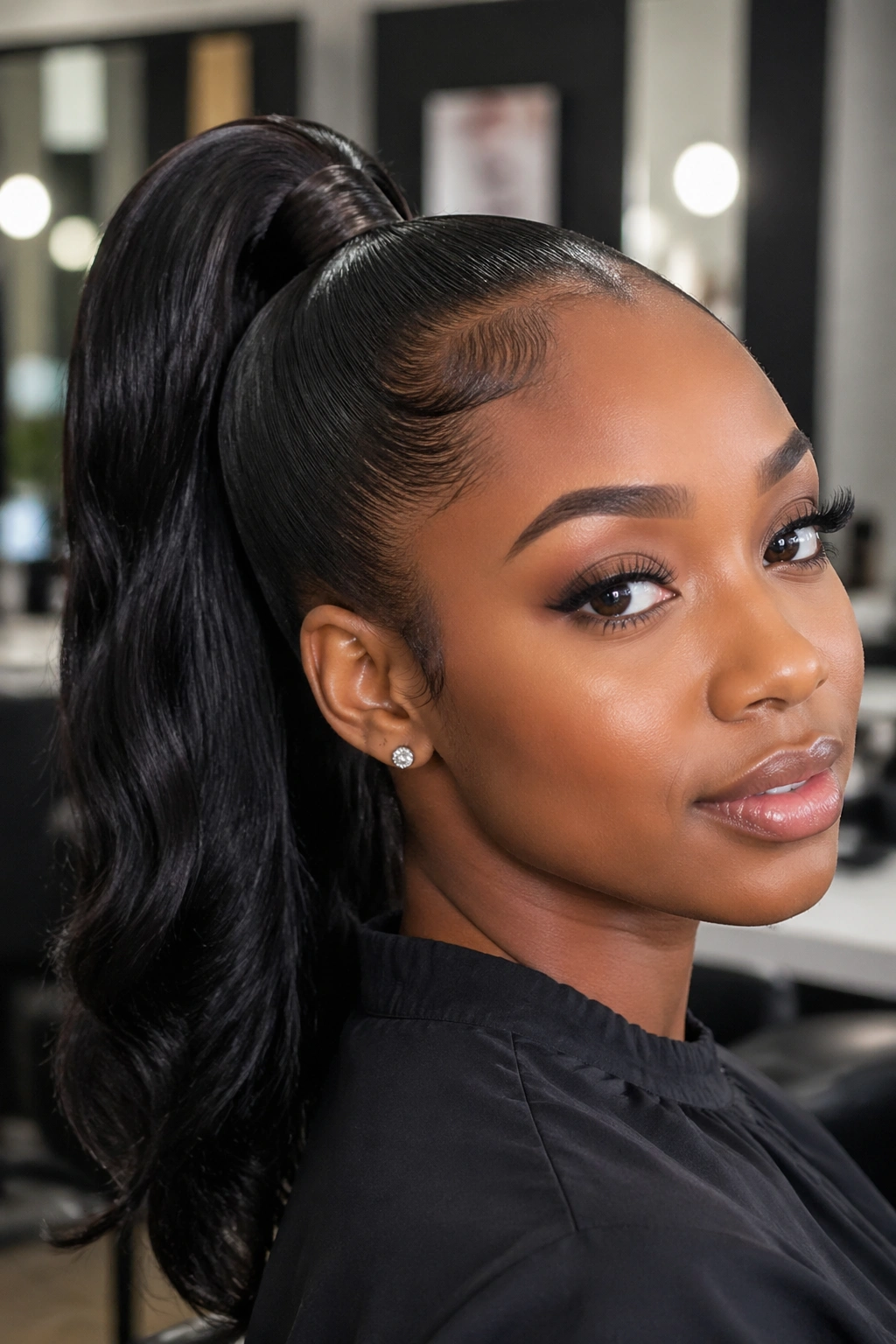
Height changes everything. A high ponytail lifts the face, shows off cheekbones, and gives a middle part a little drama without needing a lot of extra styling.
The version I like best sits high enough to feel lively but not so high that it pulls the crown too hard. That matters. When the ponytail lives at the top of the head, even a small amount of tension can turn into a headache if the base is too tight or the hairline is overstressed.
A wrapped base helps here. Take a small piece of hair from the ponytail and coil it around the elastic until the band disappears. It takes maybe 30 seconds, but it changes the whole look. The style goes from “pulled back” to “finished,” and that tiny shift is doing a lot.
If your hair is curly or coily, stretch the roots first so the ponytail sits smoother. If it’s relaxed or pressed, use a soft-bristle brush and a light mist of holding spray instead of drowning the whole head in product. Neat is good. Crunchy is not.
3. Feed-In Braids Into a Ponytail
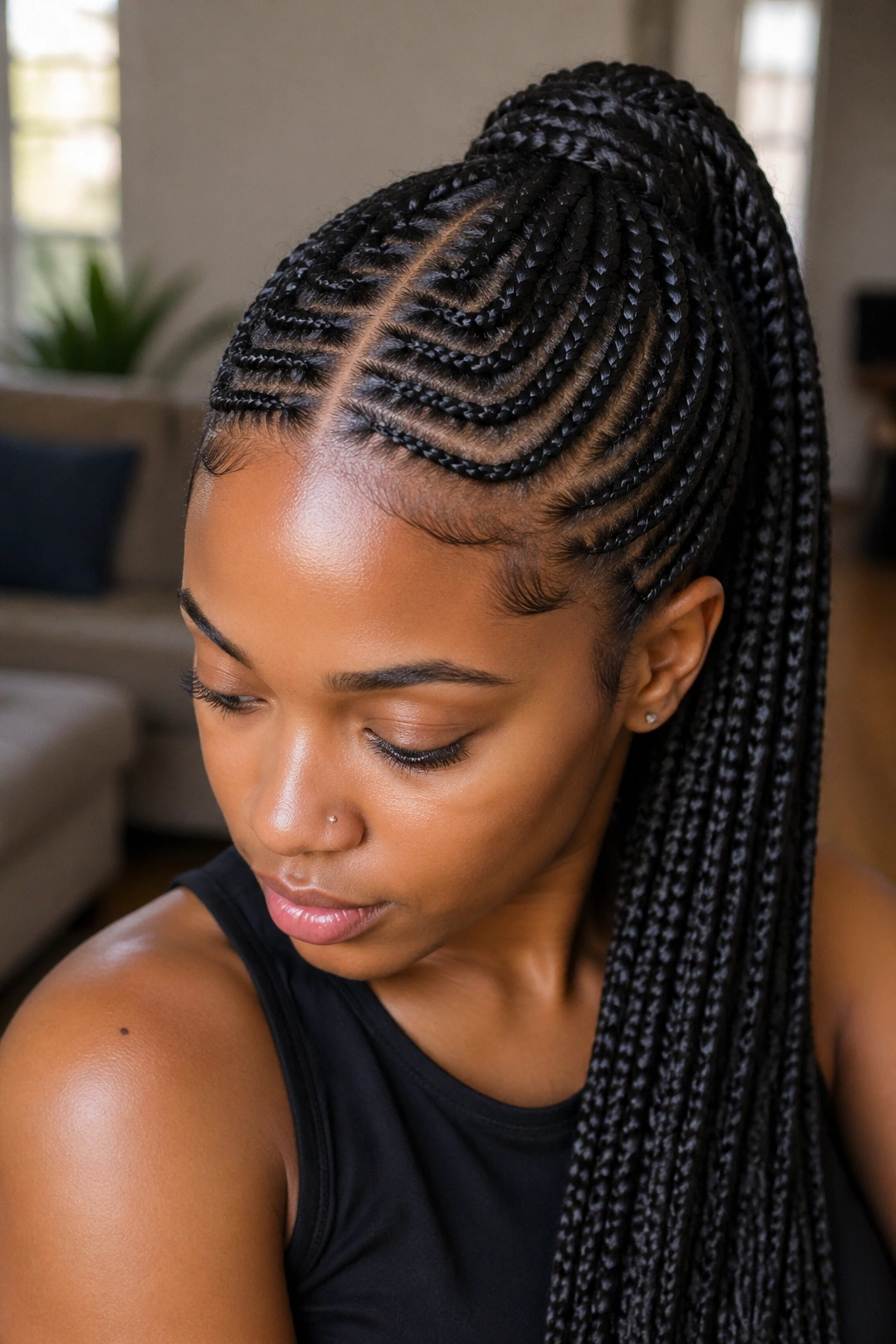
Want something that stays neat longer than a slick ponytail? Feed-in braids are one of the cleanest answers.
The middle part gives the style symmetry, and the braids do the practical work. They keep the top flat, direct the hair back, and create a ponytail base that looks intentional from every angle. This is the style I’d pick for a week with a busy schedule, a trip, or any stretch of days when you do not want to rebuild your hair every morning.
How to wear it
Ask for braids that start narrow at the hairline and get fuller as they move back toward the ponytail. That softer feed-in pattern looks cleaner than a sudden jump from tiny part to thick braid. The ponytail can be braided all the way down, or you can leave the tail loose if you want more movement.
The scalp work matters here. Parts that are too wide can look chunky, and parts that are too tight can itch before the day is over. A good feed-in braid sits close without yanking.
- Good for natural hair, stretched hair, or added braiding hair
- Easier to keep polished when the braids are even from left to right
- Great with a long braided tail, beads, or curled ends
- Needs a light scalp oil, not heavy grease
This is a style that rewards patience. Rushing it shows.
4. Curly Ponytail With Face-Framing Pieces
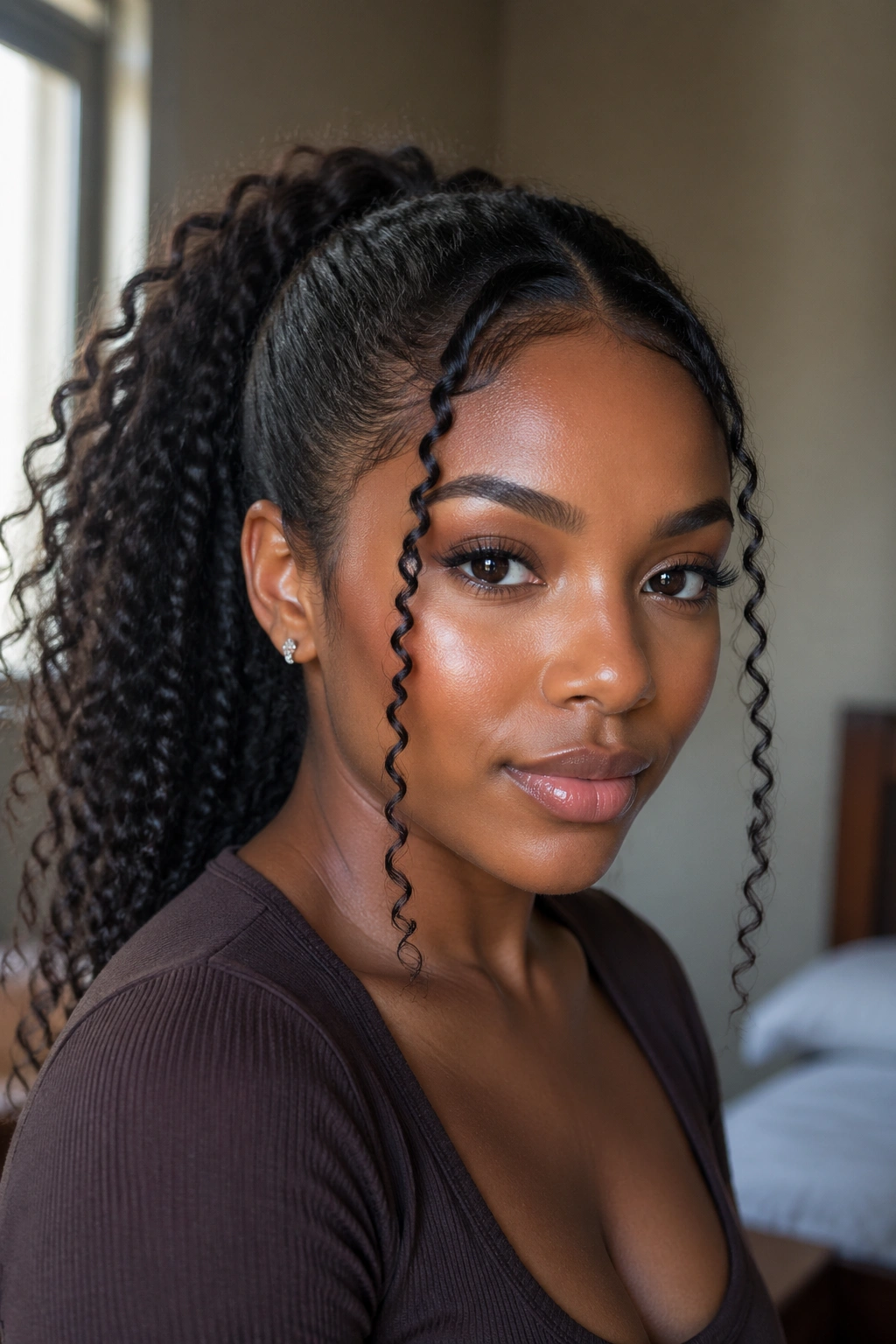
Picture this: your curls are behaving, the part is clean, and you pull the rest back just enough to show the cheekbones. That’s the whole game here.
A curly ponytail works because it keeps the texture visible. You’re not flattening your hair into submission; you’re letting it still look like hair. The center part gives the style shape, while a few face-framing pieces soften the line so it doesn’t feel too severe.
If your curls are loose, you can gather them into a mid or high ponytail and leave two slim front sections out. If they’re tighter, stretch the roots a little first so the base sits smoother. Either way, the key is balance. Too much gel at the front makes curls look sticky. Too little and the style loses its clean edge.
- Best with defined curls, twist-outs, rod sets, or curly extensions
- Face-framing pieces should be thin, not chunky
- A satin scrunchie protects curl shape better than a hard elastic
- Curl cream on the ends keeps the tail from looking frizzy
The nice thing about this one is that it feels soft without looking lazy. That’s harder to pull off than people think.
5. Bubble Ponytail Down the Back
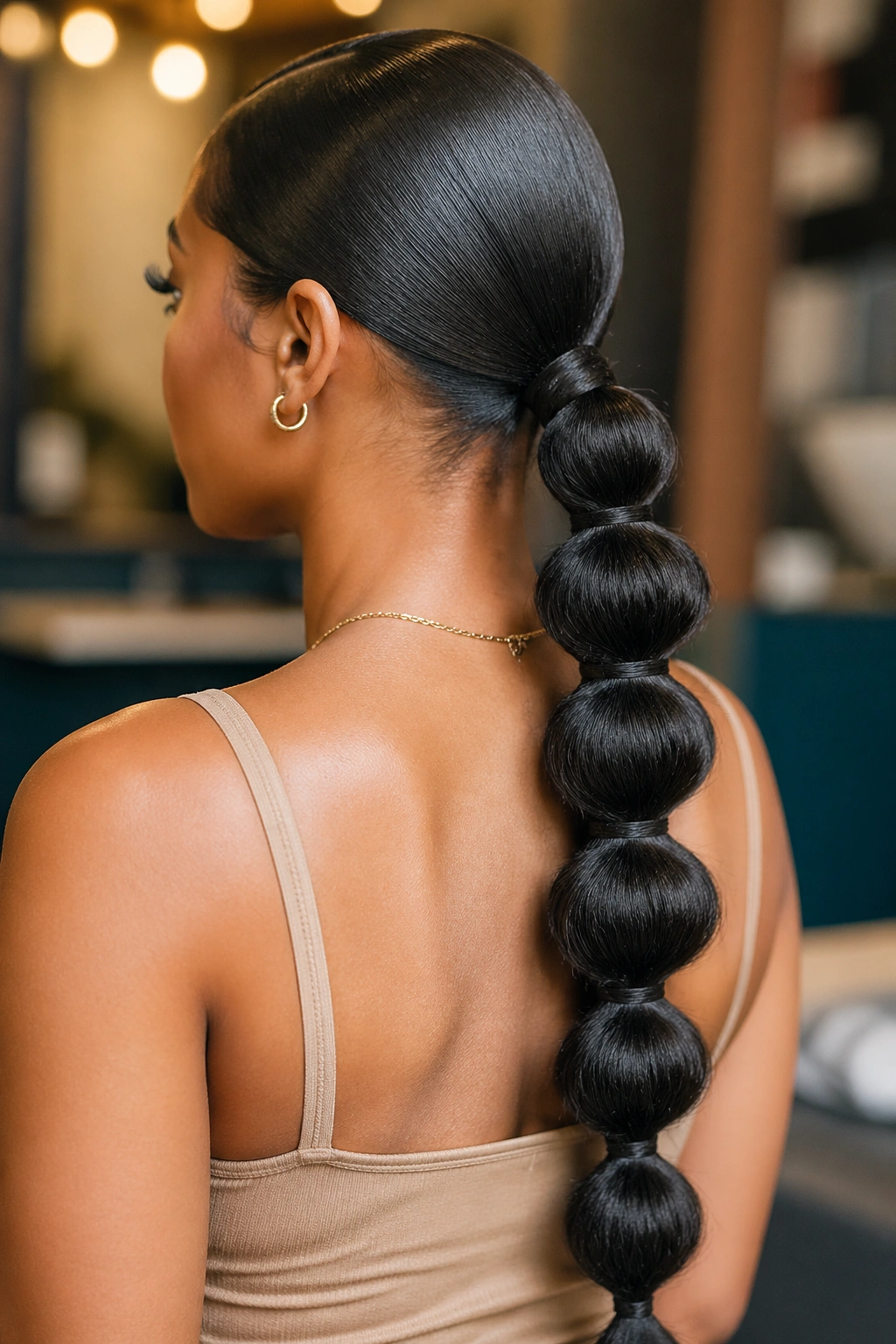
A bubble ponytail sounds playful, and it is, but it can also look polished when the sections are spaced evenly. The middle part keeps the front serious enough to balance the volume at the back.
Start with one smooth ponytail, then add clear elastics every 2 to 3 inches down the length. Gently tug each section so it rounds out into a bubble. The result is part sculptural, part easygoing. It works especially well with long extensions or stretched natural hair because the bubbles need some length to show up properly.
What I like here is the rhythm. The part at the top stays crisp, and then the eye moves down the back in these neat little bands. It feels deliberate. Not overworked.
Use a light shine spray on the tail if you want the bubbles to read clearly in photos. A touch is enough. If the hair gets slippery, the elastics slide and the whole shape droops faster than you want.
6. Rope-Twist Ponytail
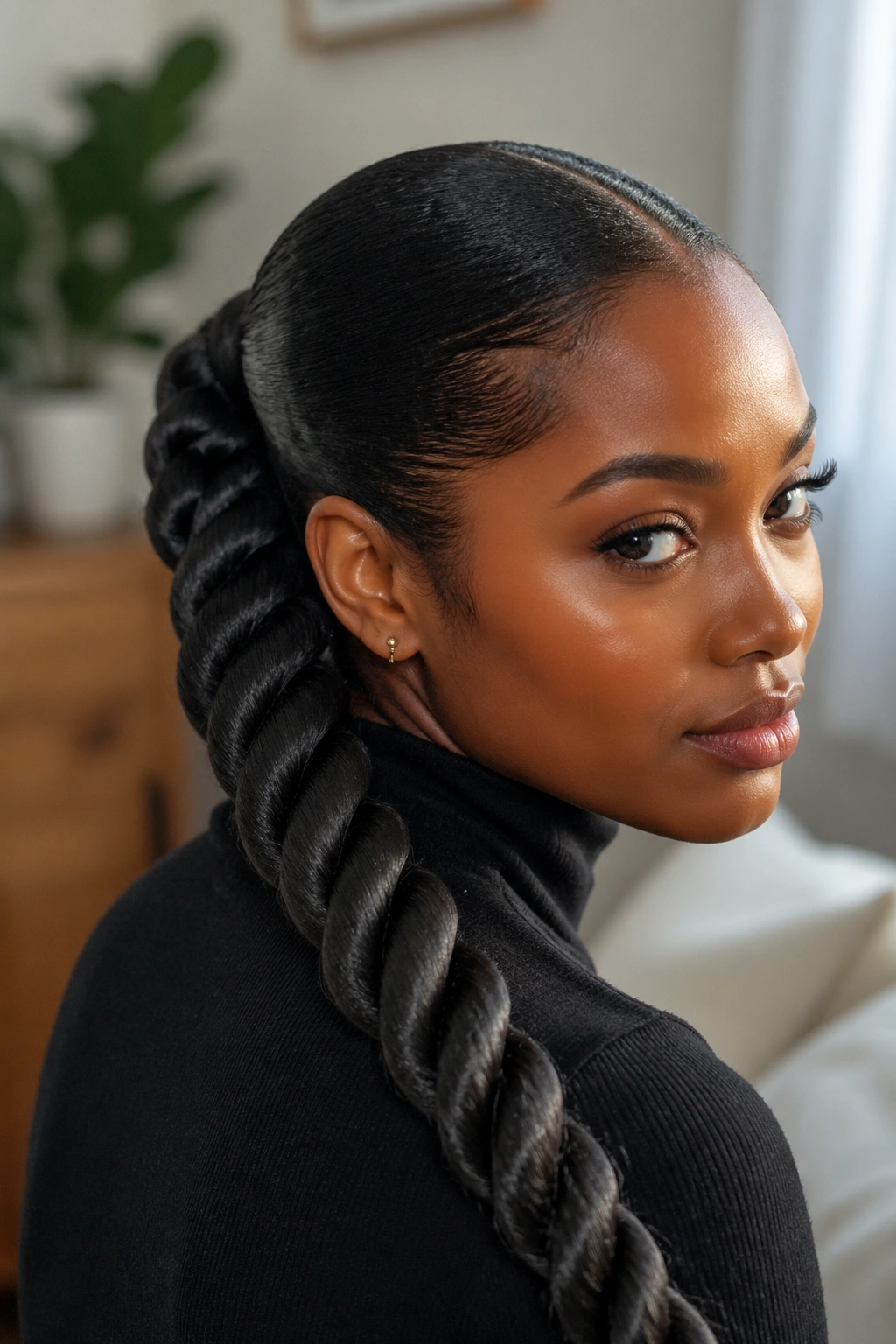
A rope-twist ponytail gives you texture without the time commitment of a full braid ponytail. Two sections twist around each other, and the finished tail has a tighter, cleaner pattern than loose hair.
That makes it a smart choice for Black women who want a middle part ponytail that feels structured but not fussy. The center part draws the eye in, and the rope twist keeps the length from looking flat. It’s also easier to do on medium-length hair than people expect, especially if you add a little extension hair for fullness.
Unlike a braid, a rope twist does not need three strands. That sounds minor. It isn’t. Fewer sections usually means less hand fatigue and a faster finish, which is exactly why this style stays in rotation.
I like this one on blown-out natural hair or kinky straight extensions because the texture blends instead of fighting the twist pattern. If you want polish with some movement, this is a strong pick.
7. Low Ponytail With Laid Sides
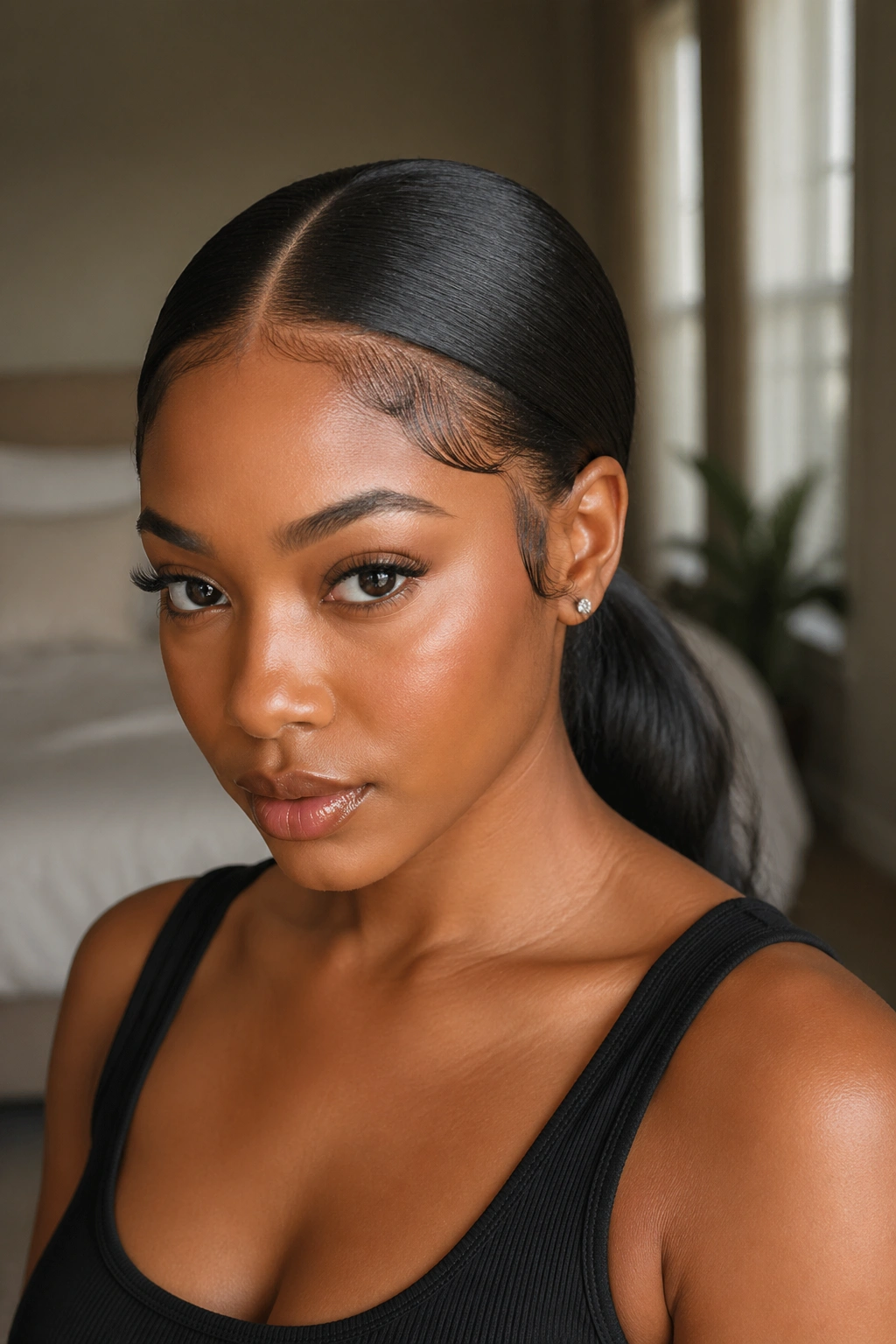
A low ponytail gets a little more attitude when the sides are laid close and the center part stays sharp. The silhouette is flatter near the temples, which makes the ponytail base look cleaner and more sculpted.
Getting the sides right
The sides do not need to be glued to the scalp. They just need to lie down without puffing. A soft brush, a little mousse, and a scarf held in place for 10 to 15 minutes usually do the job. If your hairline is sensitive, skip the heavy edge control and use a lighter gel at the root.
This style works well when your hair has a bit of length but not enough for a big dramatic ponytail. The low placement keeps the shape elegant, and the laid sides give the face a smoother frame. It’s a good choice for work, dinner, or any day when you want neat hair without extra volume sitting on top of your head.
The finish matters most here. A smooth base with a loose, healthy tail looks far better than a tight, over-gelled crown.
8. Braided Ponytail With Jumbo Cornrows
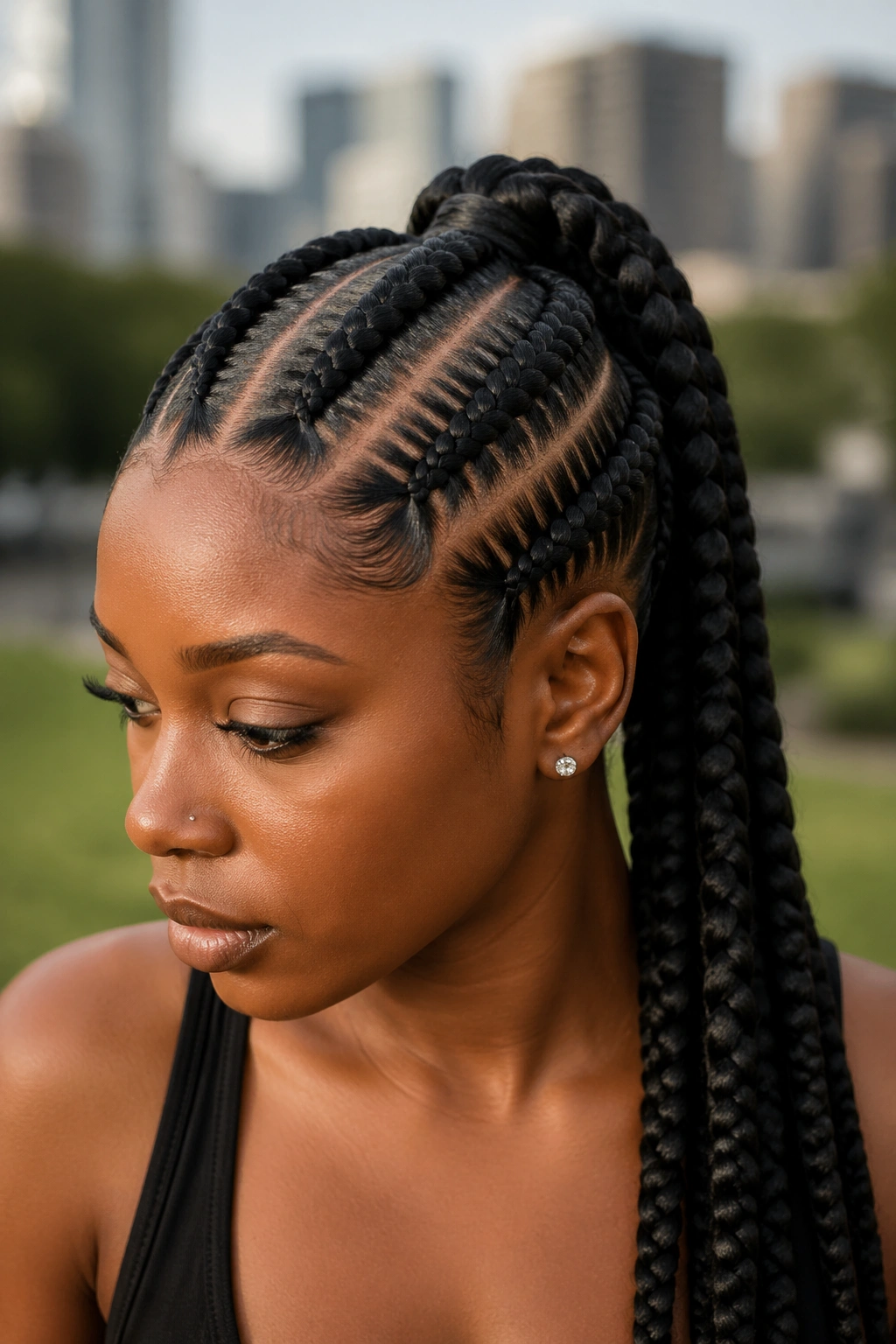
Jumbo cornrows feeding into a ponytail have a strong, graphic look. There’s no hiding the parting work, which is part of the appeal. Everything is visible, and everything should line up cleanly.
This style is one of my favorites for people who want structure without a lot of daily upkeep. The big braids keep the top flat, and the ponytail can be braided, curled, or left in a thick straight tail. If your scalp likes breathing room, ask for the cornrows to be firm but not tight. That makes a real difference by day two.
- Best when the parts are even and the braid size stays consistent
- Works with added braiding hair for length
- Can be worn high, mid, or low depending on the face shape
- Looks especially good with neat baby hairs kept simple, not overdrawn
This style has presence. It doesn’t need extra accessories to speak for itself, though gold cuffs or a wrapped ponytail base can add polish if you want them.
9. Silk-Pressed Ponytail With Flipped Ends
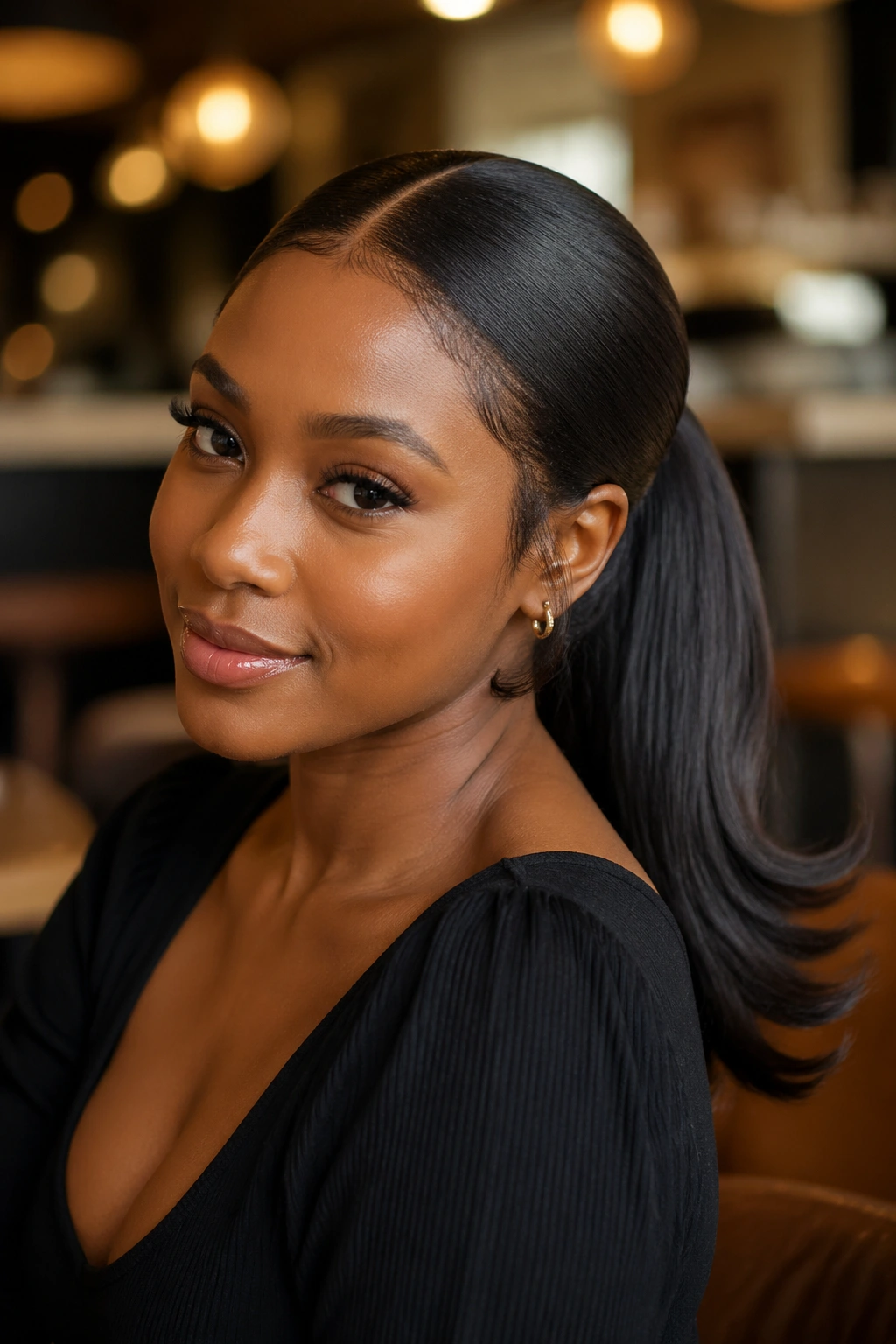
A silk-pressed ponytail is all about shine and swing. The middle part lays the foundation, and the flipped ends keep the tail from looking too severe.
If your hair takes heat well and you like a smoother finish, this is a clean option. The ponytail sits best when the roots are sleek and the ends are curled under or flicked outward with a flat iron. That little flip changes the mood. Without it, the style can read flat. With it, the ponytail gets movement.
The middle part should be straight enough to look neat but not so tight that it scars the hairline with repeated tension. A rat-tail comb and a good heat protectant do most of the work. After that, keep the brushing calm. Too much brushing on pressed hair breaks the smooth surface and creates flyaways faster than you expect.
This is a style with a dressier feel. It loves hoop earrings, a satin blouse, and a clean neckline.
10. Afro Puff Ponytail With a Center Part
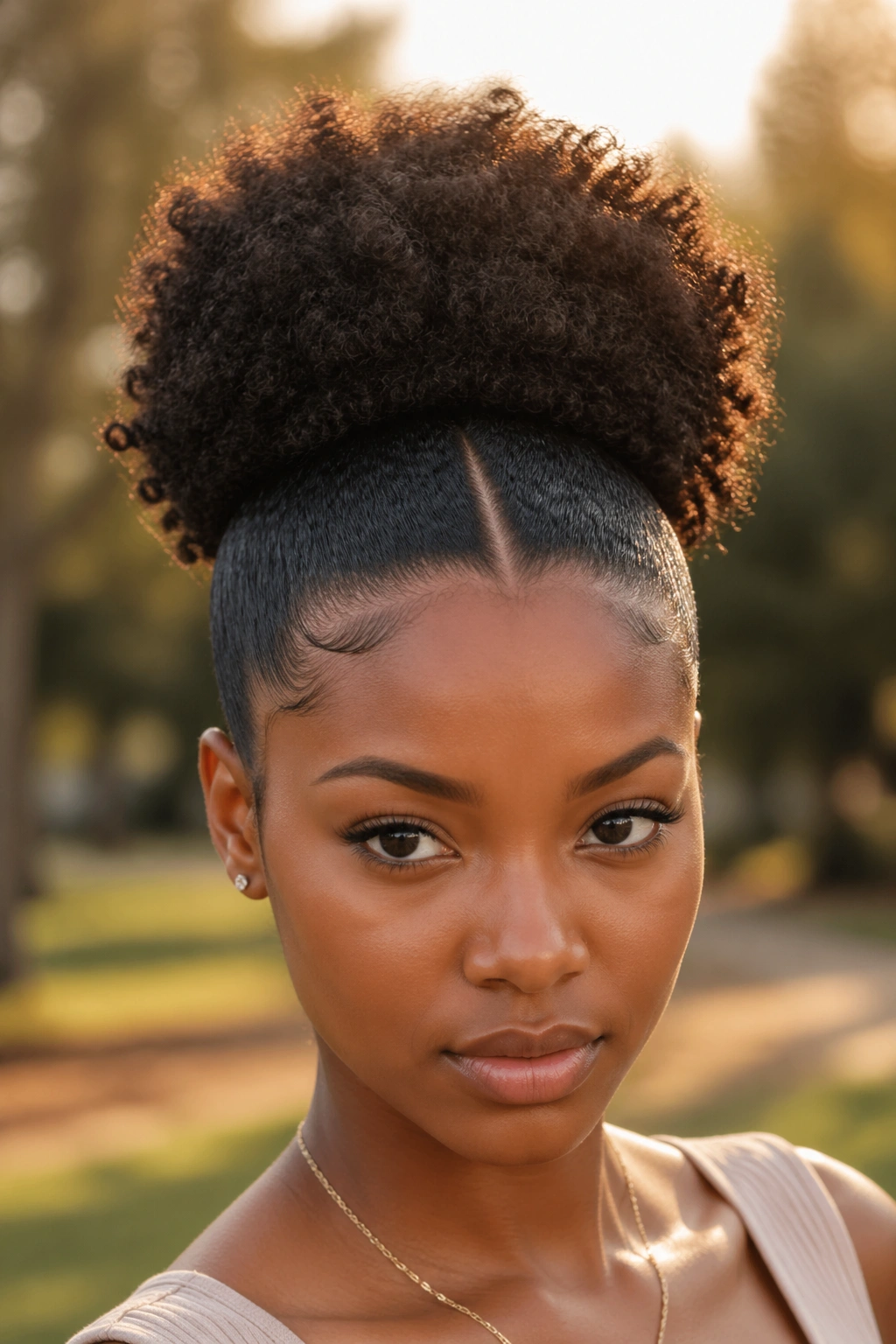
A middle part on an afro puff gives the style just enough structure to stop it from looking like a single ball of curls. That center line helps define the top before the puff starts.
The puff itself can sit high, mid, or slightly back depending on how much shrinkage your hair has. I like it when the crown is stretched first so the base lies flatter. That makes the puff look round and full instead of lumpy near the top. If your hair is 4b or 4c, the trick is gathering without crushing the texture.
A soft elastic or drawstring band is better than a hard rubber band here. You want hold, not breakage. And if the puff needs a little shape, fluff it with your fingers rather than a brush. Brushing too much can make the ends frizzy in a hurry.
This one feels casual, but it can still look polished. The center part gives it that edge.
11. Half-Braided, Half-Flowing Ponytail
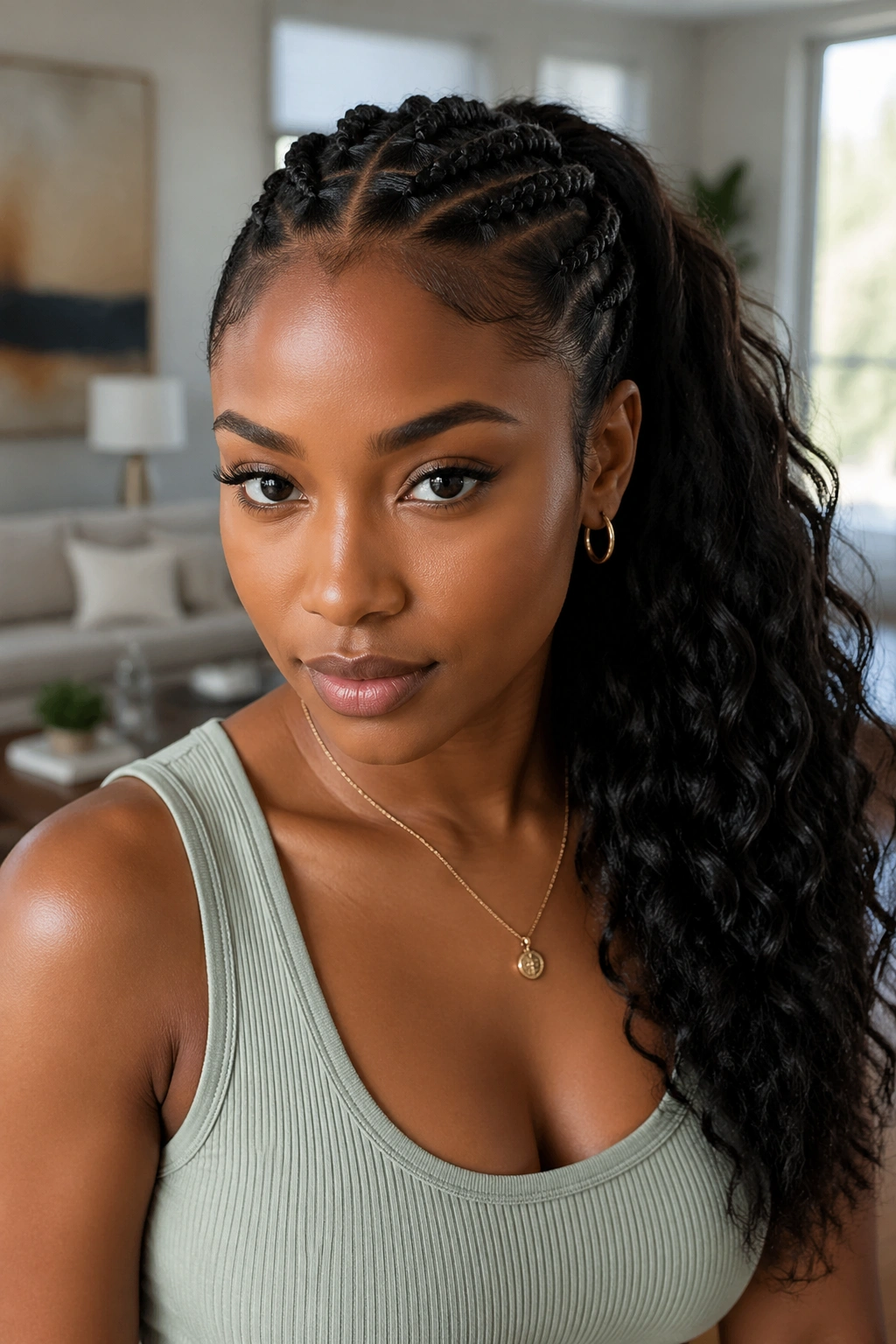
This style is for someone who wants structure at the top and movement at the end. The front and crown can be braided flat or twisted back from the middle part, while the ponytail itself stays loose, curly, or blown out.
That contrast is the whole reason it works. The braids control the front and keep the part clean. The loose tail keeps the style from feeling too strict. If you wear a lot of braids and want a break from a fully braided ponytail, this is a nice in-between.
It also photographs well from the side, because the braided detail gives the eye something to follow before it drops into the tail. That kind of shape keeps the style from looking one-note.
Use a light mousse on the loose end if it’s curly, and wrap the base neatly so the transition point doesn’t look messy. A sloppy join ruins the effect fast.
12. Loc Ponytail With a Center Part
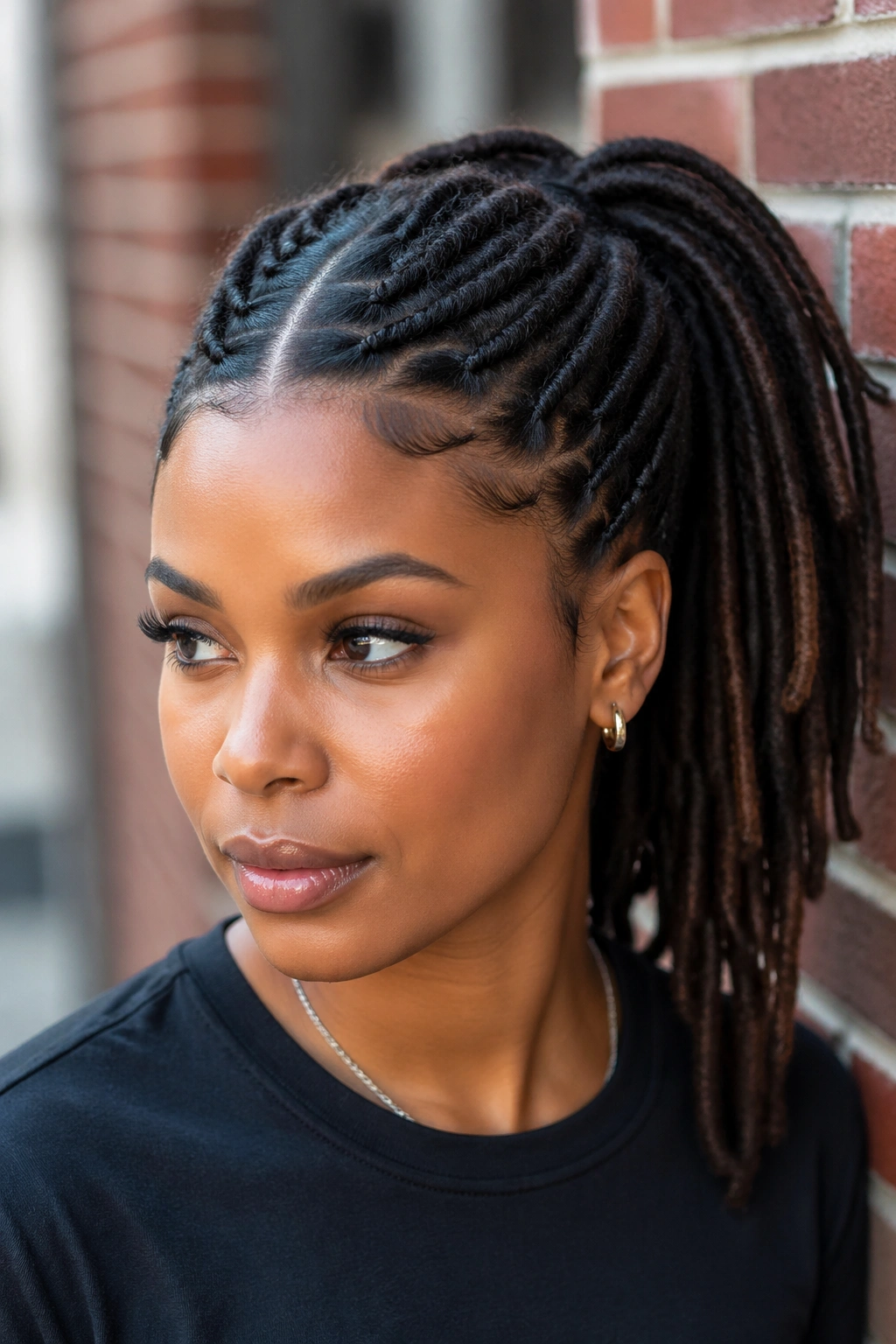
Locs and a middle part make a strong pair. The clean line at the crown balances the thickness and weight of the locs, so the whole style feels organized instead of heavy.
Low loc ponytails are the easiest to wear for long stretches, but high versions can look dramatic in a really good way. The key is the base. Tie locs with a strong but gentle band, then wrap the base with one loc or a small accent piece if you want a cleaner finish. That avoids the “just tied back” look.
Locs also hold accessories well. A few shells, cuffs, or wrapped threads can add interest without needing much extra styling. I’d keep the middle part clean and let the texture do the talking. Too many extra details crowd the look.
This is one of those styles that gets better when it’s not overhandled. Let the locs fall where they want after you secure them.
13. Faux Loc Ponytail With Gold Cuffs
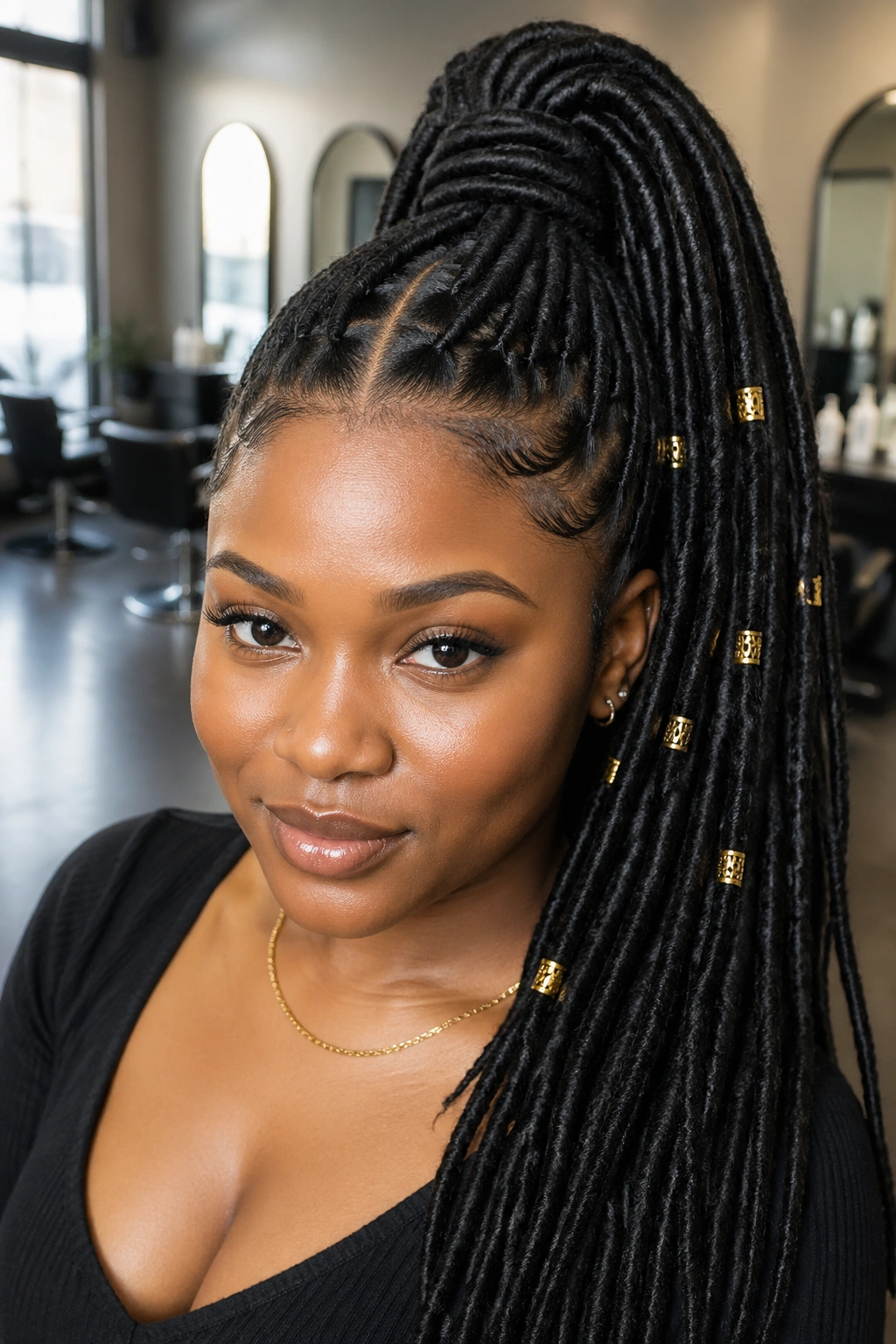
Faux locs change the shape of a middle part ponytail because they add both length and density at once. The result looks fuller than natural locs and a bit more dramatic right away.
A high faux loc ponytail has real presence. A low one feels more grounded. Either way, the part gives you the clean opening line the style needs, because faux locs can look busy if the front is too crowded. Gold cuffs work well here, but I’d use them with some restraint. Two or three accents placed evenly usually look richer than a whole handful.
Weight matters. Faux loc ponytails can pull hard if they’re too full, so the base should be secure without being over-tight. If the style starts to tug at your neck, it’s too much. A middle part should not cost you comfort.
This style suits people who like a little drama and do not mind a slightly heavier finish. It’s bold without needing bright color.
14. Double Braided Base Into a High Ponytail
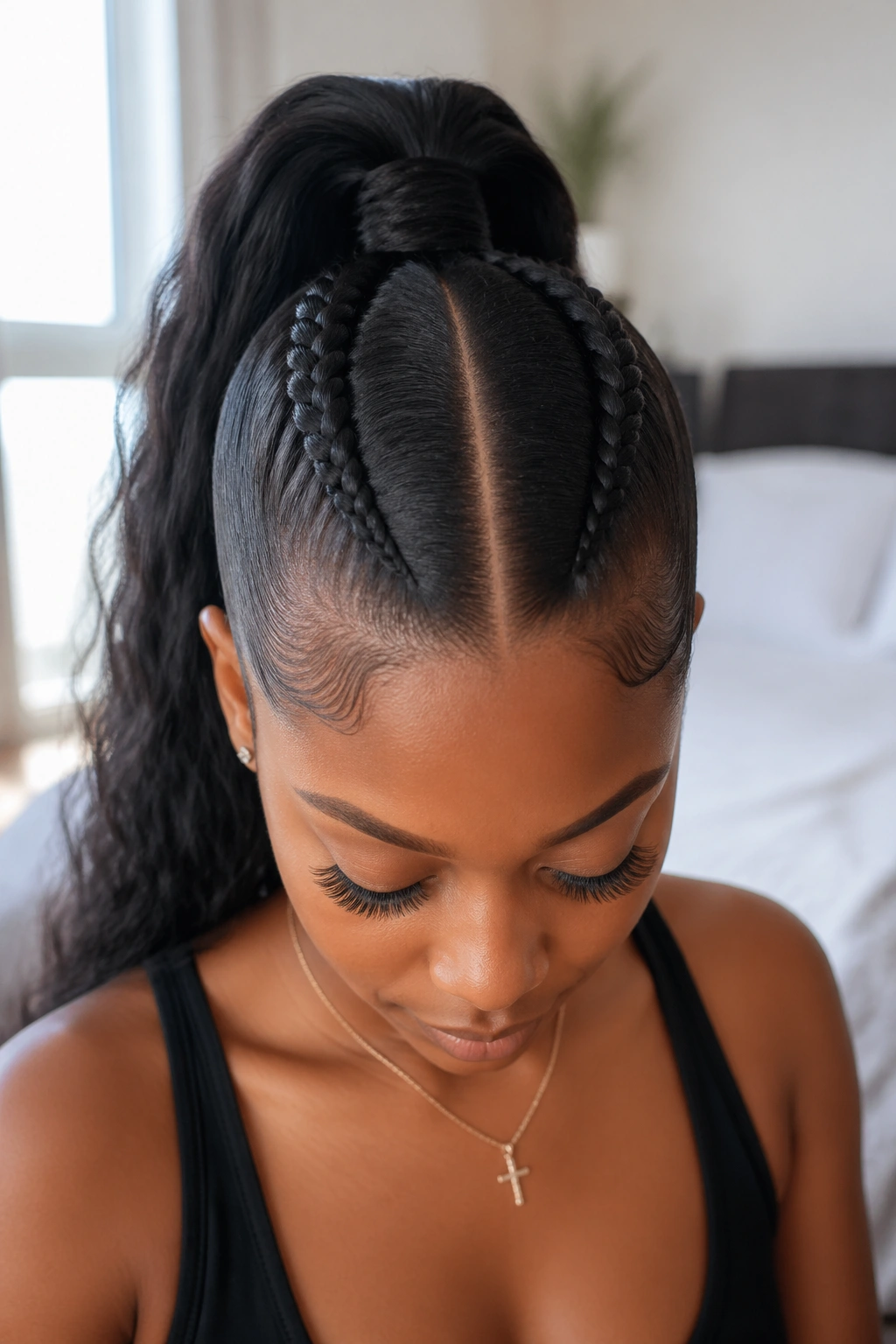
Two braids feeding into one ponytail create a nice visual split before everything joins in the center. It’s a clean, sporty look that still feels styled.
What to watch for
The parts need to mirror each other. If one side sits wider than the other, you’ll notice it right away because the middle part is acting like a ruler. That symmetry is what makes the style look sharp, especially from the front.
- Keep the braids close to the scalp but not painfully tight
- Match braid thickness on both sides
- Secure the ponytail where the two braids meet, usually just above the crown
- Wrap the elastic if you want a smoother finish
I like this version on medium to thick hair because it keeps the top controlled while giving the ponytail plenty of lift. It’s practical, but it doesn’t look plain. And that’s a nice combination.
15. Drawstring Puff Ponytail With Stretched Roots
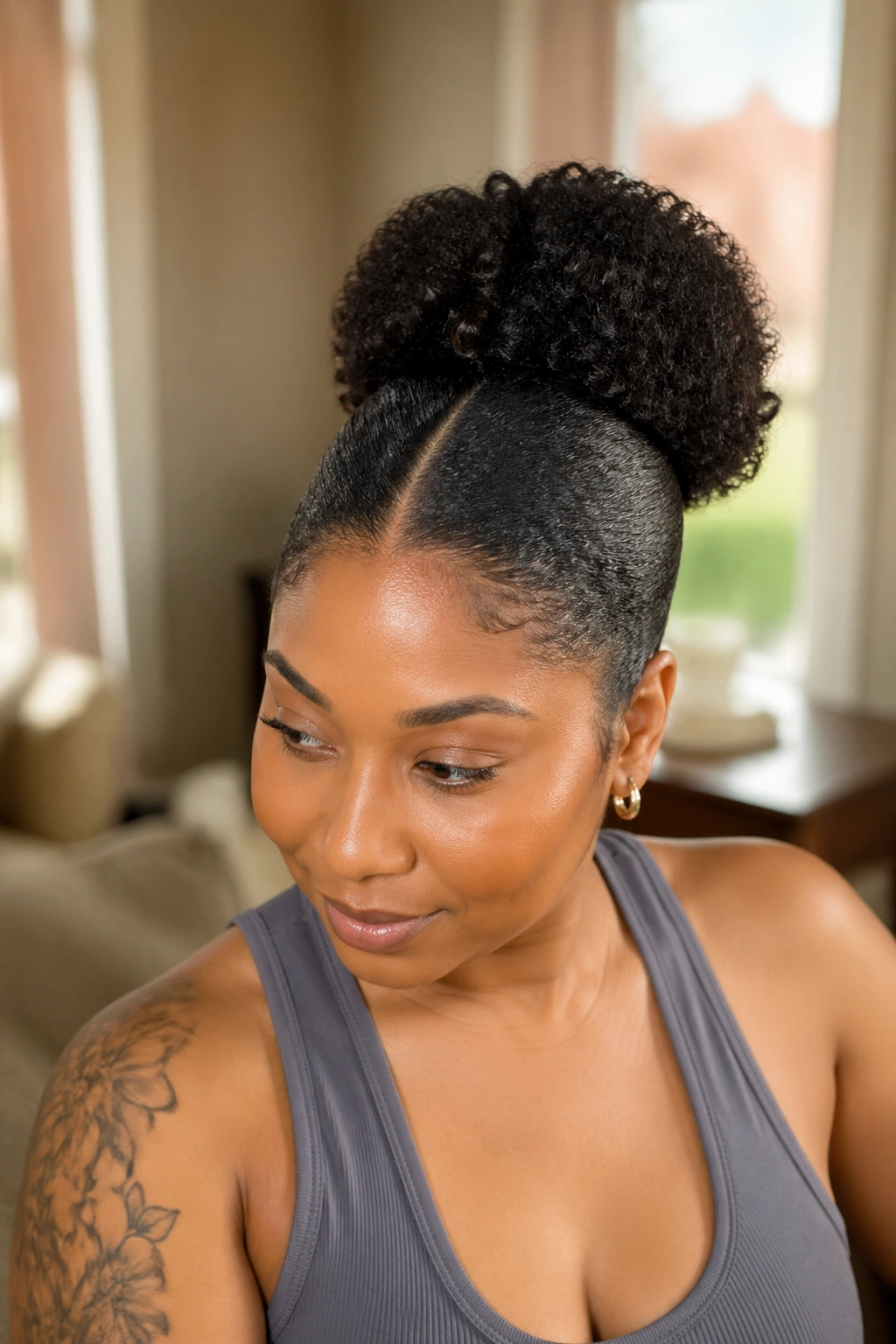
A drawstring puff is one of the easiest ways to fake a fuller ponytail without adding a lot of extra hair. The middle part shapes the front, and the puff gives you volume right where you want it.
This style works especially well when your roots are stretched but your ends still hold texture. That contrast makes the puff look rich instead of flat. A drawstring attachment also lets you adjust the size, which is handy if you want the puff to sit high one day and a little lower the next.
The center part keeps the top neat, so the puff can stay soft and round without looking messy at the crown. If you want it to last, anchor the front with a bit of gel and a satin scarf while the base sets. Then fluff the puff with your hands. Not a brush. A brush usually ruins the shape.
This is a strong everyday style for natural hair because it gives you height, shape, and comfort all at once.
16. Wrapped Ponytail With Kinky Straight Extensions
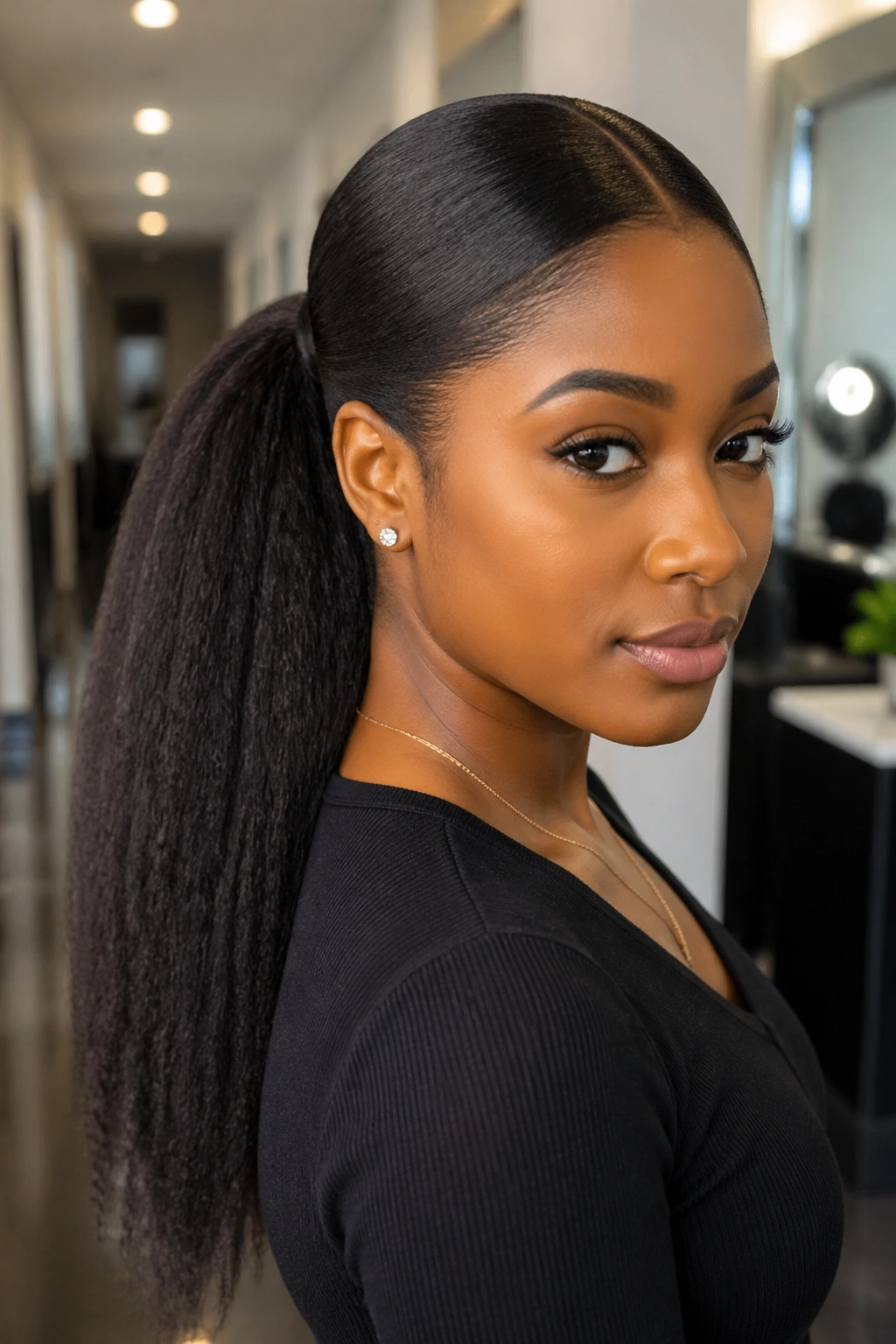
Kinky straight extensions are one of my favorite matches for a middle part ponytail because they blend with blown-out or lightly stretched natural hair without looking too silky. The texture difference is small enough to feel natural, but not so small that the style disappears.
A wrapped ponytail with this texture reads polished and grounded at the same time. The base stays neat, the tail has body, and the finish feels less glossy than straight synthetic hair. That matters if you want a style that looks like hair, not a costume.
The middle part is the anchor. Keep it narrow and clean, then smooth the sides back before securing the ponytail. If the roots are frizzy, a quick pass with a warm comb or blow-dryer on low heat can help, but don’t overdo it. Kinky straight looks best when it still has some softness.
This is one of the more believable extension looks on Black hair, and that’s why it gets worn so often.
17. Deep-Length Ponytail With Layered Curls
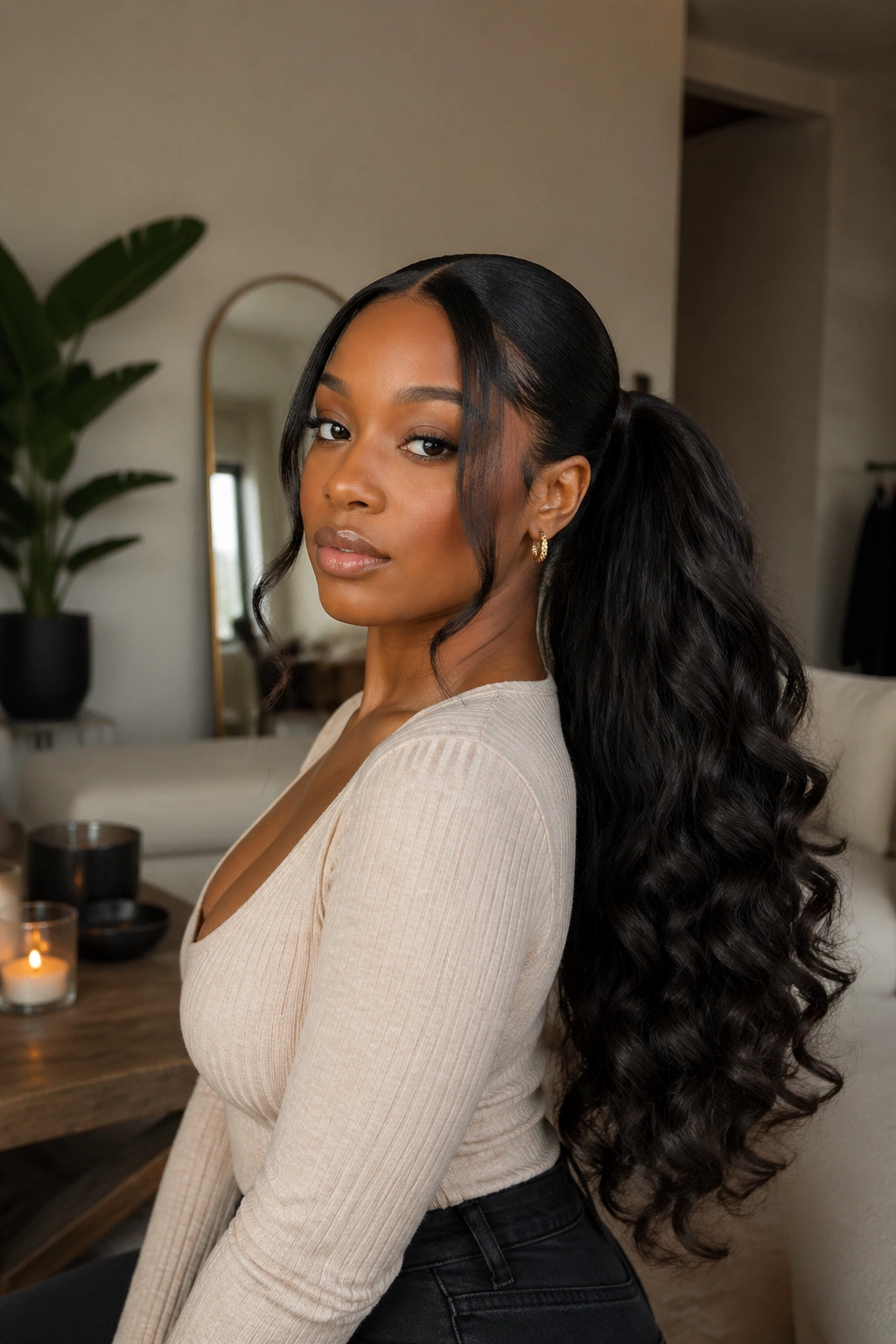
Long curls can go wrong fast if the tail is blunt. Layering fixes that. A middle part ponytail with layered curls moves better and avoids the heavy, blocky shape that can happen when everything hangs at one length.
The style works with curly extensions, wand-curled hair, or a mix of both. The middle part gives the front structure, while the layers stop the length from feeling too dense. If you want a soft glam look, this is the lane. If you want something stiff and perfectly arranged, this is not it.
A light mist of flexible-hold spray helps the curls keep their shape without turning crunchy. That matters once the tail gets long, because weight can drag the curl pattern down by the end of the day. Layering helps, but product choice matters too.
This is a good choice for events when you want your ponytail to move when you walk. A dead-straight tail can look flat. These curls don’t.
18. Mohawk-Inspired Ponytail With Flat Braids
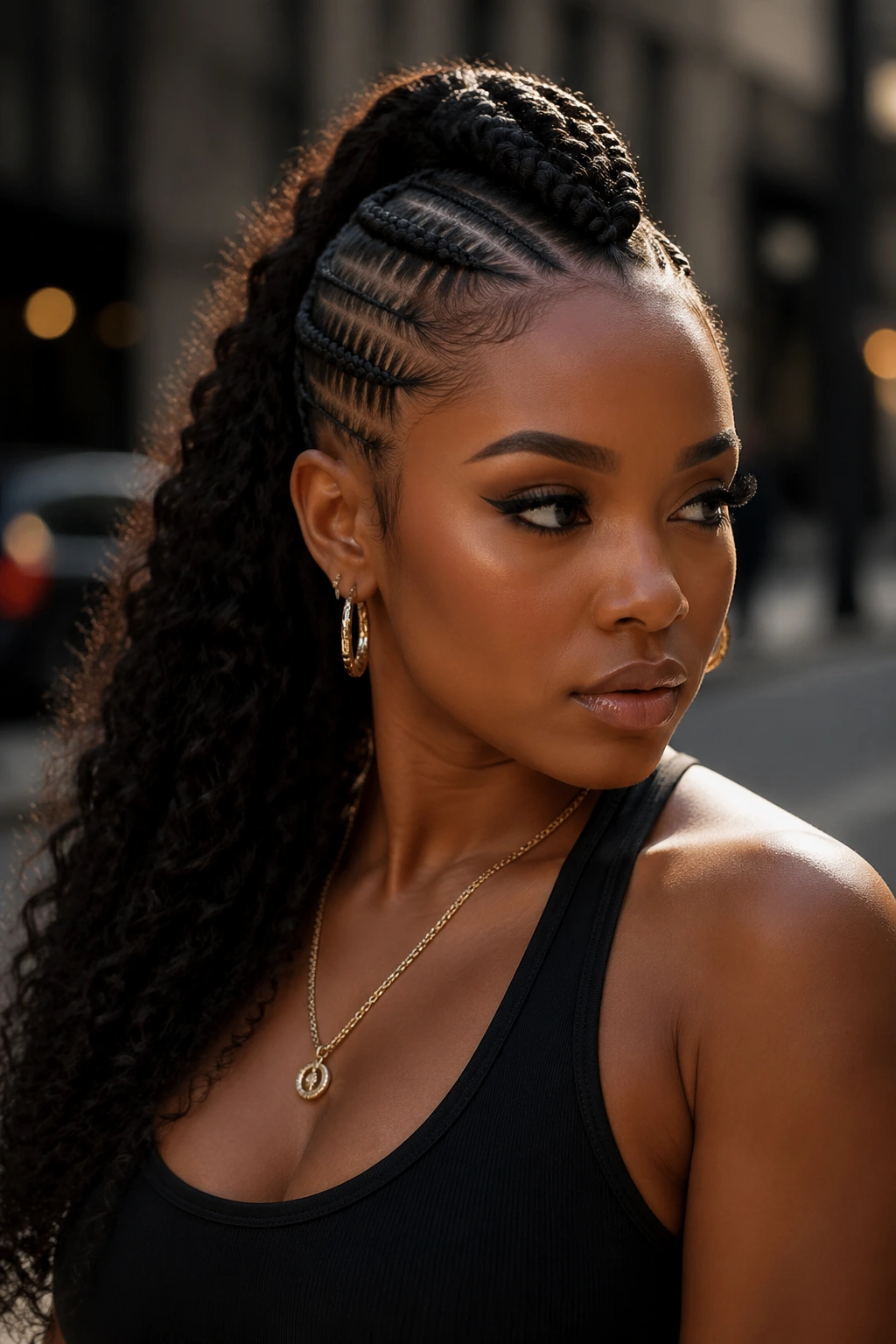
A mohawk-inspired ponytail makes the center part work harder. The sides lie flatter, the middle rises a little higher, and the whole style gets a more sculpted shape.
This is a good pick when you want something that feels bold but still stays within the ponytail family. The braids or sleek sections on the sides create a path toward the ponytail, almost like an arrow. That can be flattering on rounder face shapes because it draws the eye up.
The look can be built with flat braids, cornrows, or slicked sections, depending on the hair length and texture. What matters is keeping the ridge in the middle clean. If the side sections puff out too much, the style loses its shape.
It’s a little more effort than a basic ponytail. Worth it, though, if you like strong lines and a style that does not fade into the background.
19. Braided Crown Into a Ponytail
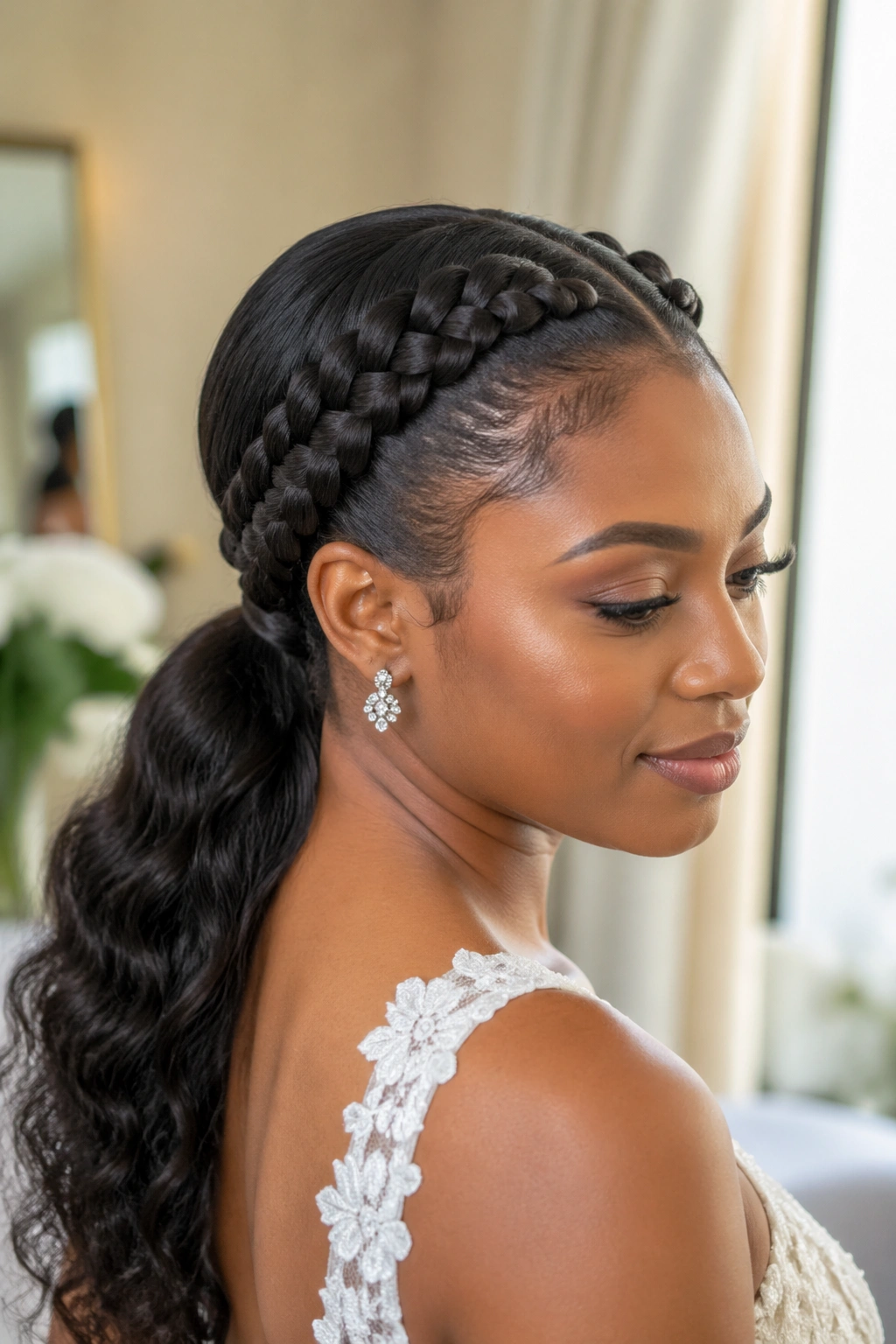
A braided crown gives the middle part ponytail a finished frame before the tail even starts. The braid can circle the head from each side and meet at the back, or it can simply guide the hair into a centered ponytail with a halo-like effect.
That framing is the reason this style feels dressier than a standard braid-and-tail combo. It makes the front look deliberate from every angle, which is useful when you know people will see the top of your head, not just the front. And they will.
A crown braid also helps control frizz around the hairline. If your edges puff up quickly, this style keeps the front contained longer than a loose ponytail would. Use a little gel on the parts, but keep the braid grip comfortable. Pain is not part of the design.
This one suits weddings, parties, or any occasion where you want a ponytail that feels a bit more finished than usual.
20. Claw-Clip Ponytail With Soft Texture
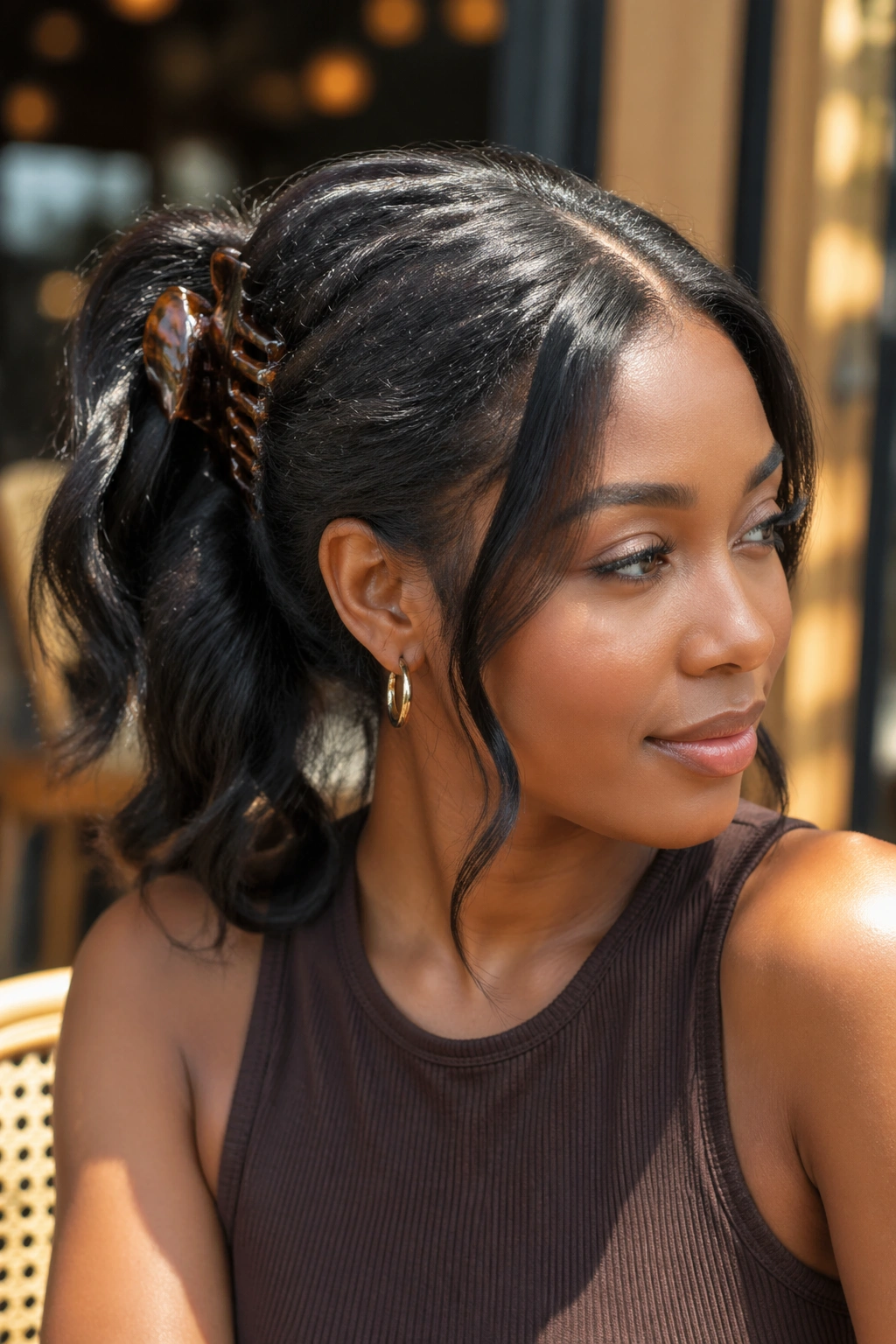
A claw clip changes the whole mood. Instead of a tight elastic pulling the hair back, the clip holds the ponytail with a looser grip, which can be kinder on the scalp and faster to do in a pinch.
The middle part keeps the front intentional, even when the back feels relaxed. That contrast is what makes the style work. It says “I cared,” but not “I wrestled with my hair for 45 minutes.”
This style is best on medium to long hair with some natural body. Stretched curls, twists-out texture, and blown-out hair all sit nicely in a clip. Very fine hair can slip out more easily, so a hidden elastic under the clip may help. If you need the style to survive a windy day, I would choose an elastic ponytail instead. A clip looks great, but it has limits.
Still, for errands, brunch, or a low-effort day with a neat part, it does the job with less fuss than a full slick-back.
21. Ribbon-Tied Ponytail With a Center Part
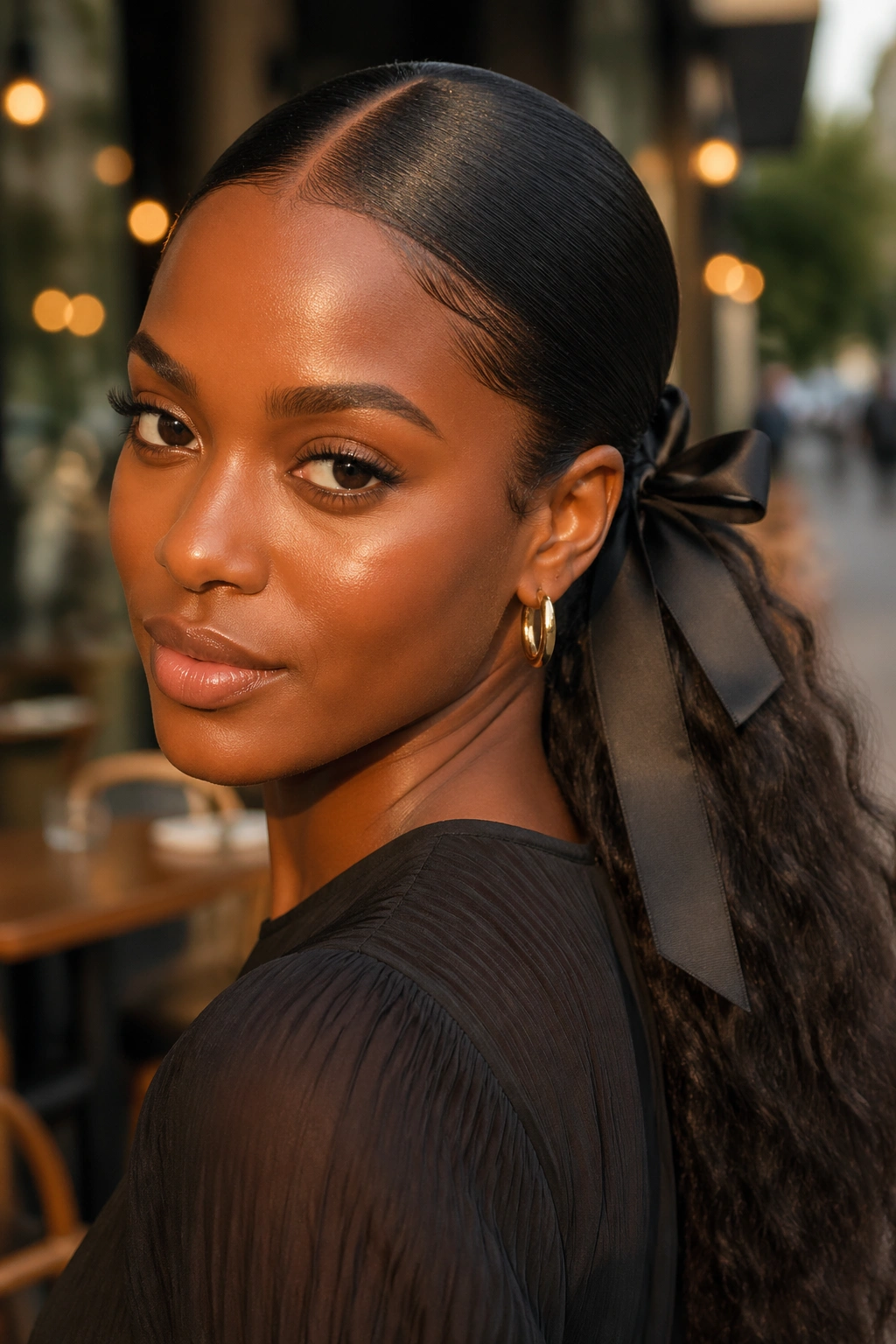
A ribbon sounds decorative, and it is, but it also helps finish the ponytail in a way that feels thoughtful. When the center part is clean and the ponytail base is wrapped neatly, a ribbon becomes the last small detail that ties it all together.
The best version keeps the ribbon simple. Satin works well because it doesn’t fight the texture. You can tie it around the base, let the ends hang, or wrap it over the elastic for a cleaner line. The trick is not making the ribbon louder than the hair. It should support the style, not steal it.
This works on straight, curly, and braided ponytails. A black ribbon gives a sharp, minimal look. A cream or jewel tone changes the mood fast. I’d avoid bulky bows unless the rest of the style is extremely simple, because too many shapes can clutter the top.
A ribbon-tied ponytail has a soft, almost old-school feel, and that can be a nice break from the usual gel-heavy finish.
22. Braided Ponytail With Beaded Ends
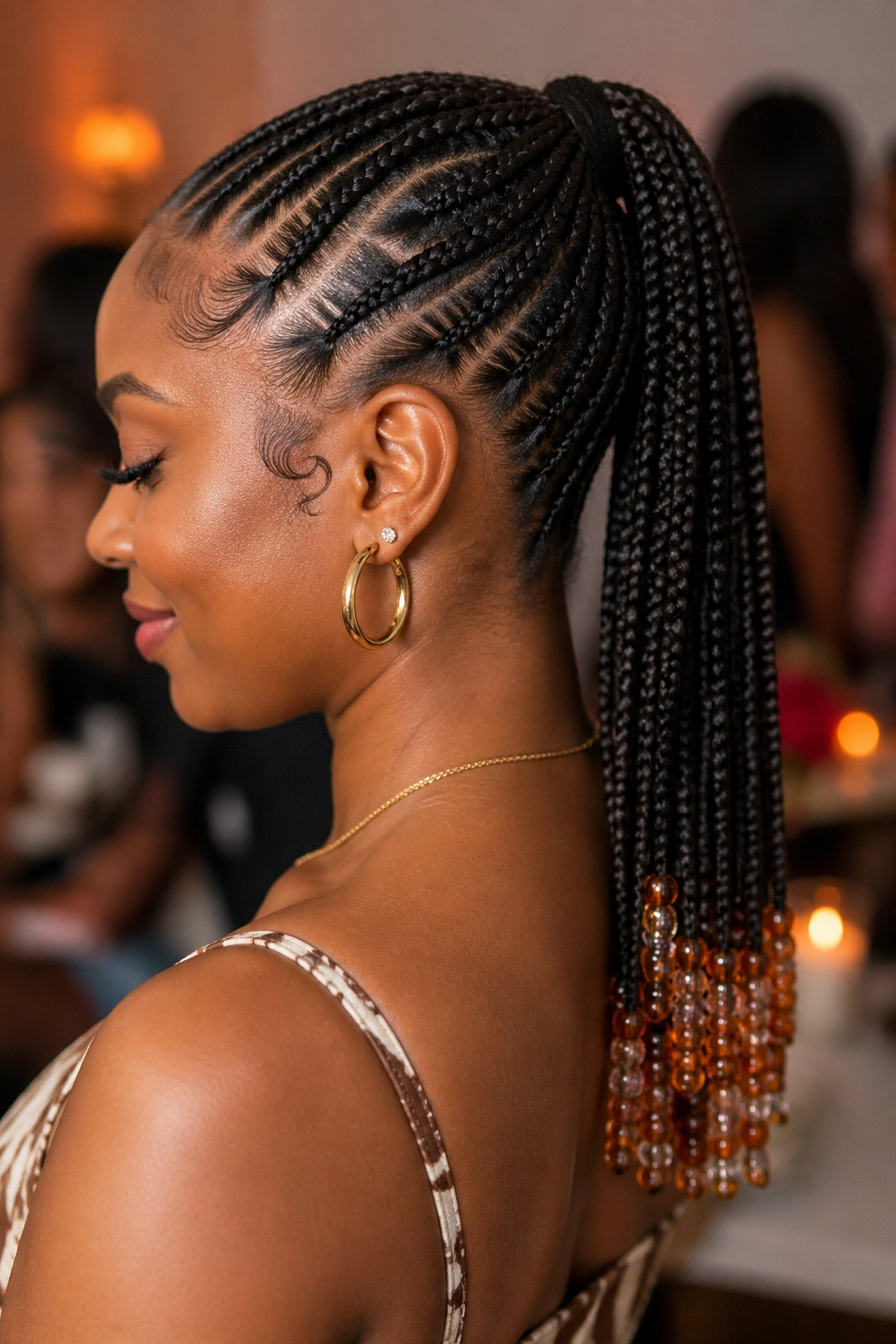
Beads make a braided ponytail feel finished in a very specific way. They add weight at the ends, a bit of sound when the ponytail moves, and just enough shine to keep the style from feeling plain.
The middle part keeps the front orderly, which matters when the ends are doing more visual work. If the base is sloppy, beads only draw attention to the mess. If the base is clean, they look intentional.
How to place the beads
- Put them where the braid has enough thickness to hold them securely
- Space them evenly instead of clustering them all at the bottom
- Match bead size to braid size so the tail doesn’t wobble
- Use plastic, wood, or metal based on the weight you want
Beaded ponytails work especially well on kids, teens, and adults who like a little movement in their style. They’re not subtle. That’s the point. A few well-placed beads can do more than a whole jar full shoved on at random.
23. Ponytail With Curled Baby Hairs and Soft Tendrils
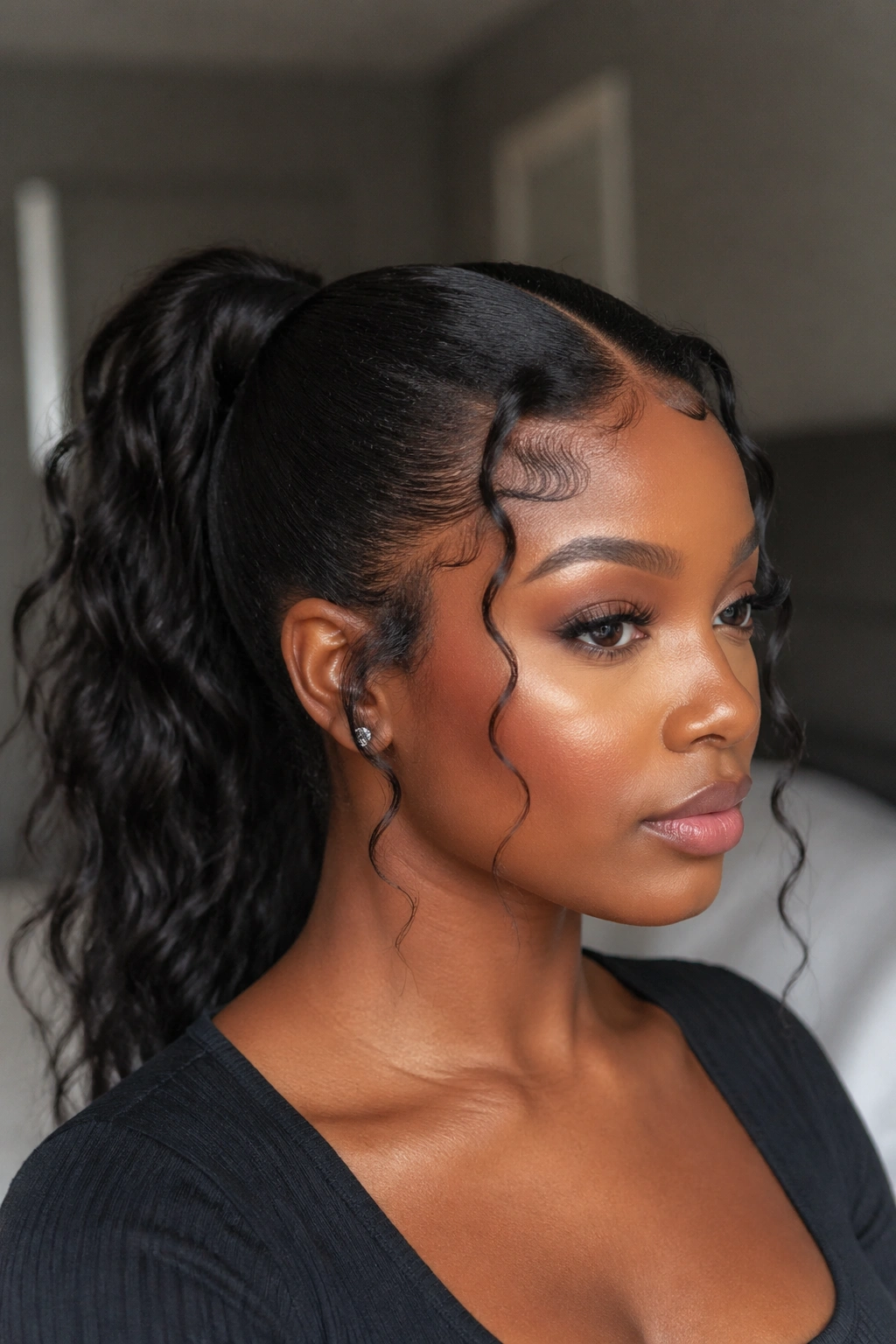
Soft tendrils around a ponytail can change the whole mood of the style. The center part still gives you the structure, but the loose pieces at the front make it feel less severe.
This is where a little restraint goes a long way. Baby hairs should be styled, not painted on. A small toothbrush, a light edge gel, and a careful hand are enough. If the swoops get too large or too shiny, they can start to look disconnected from the rest of the hair. A couple of soft curls near the temples usually looks better.
The tendrils can be curled with a small iron, flexi rods, or even a braid-out overnight if you want something gentler. I like this look on ponytails that sit mid-height, because the front detail and the tail balance each other nicely.
It’s a good option when you want the ponytail to feel soft around the face without losing its clean center part. The trick is not doing too much. That’s easier said than done.
24. Low Ponytail With Wavy Extensions
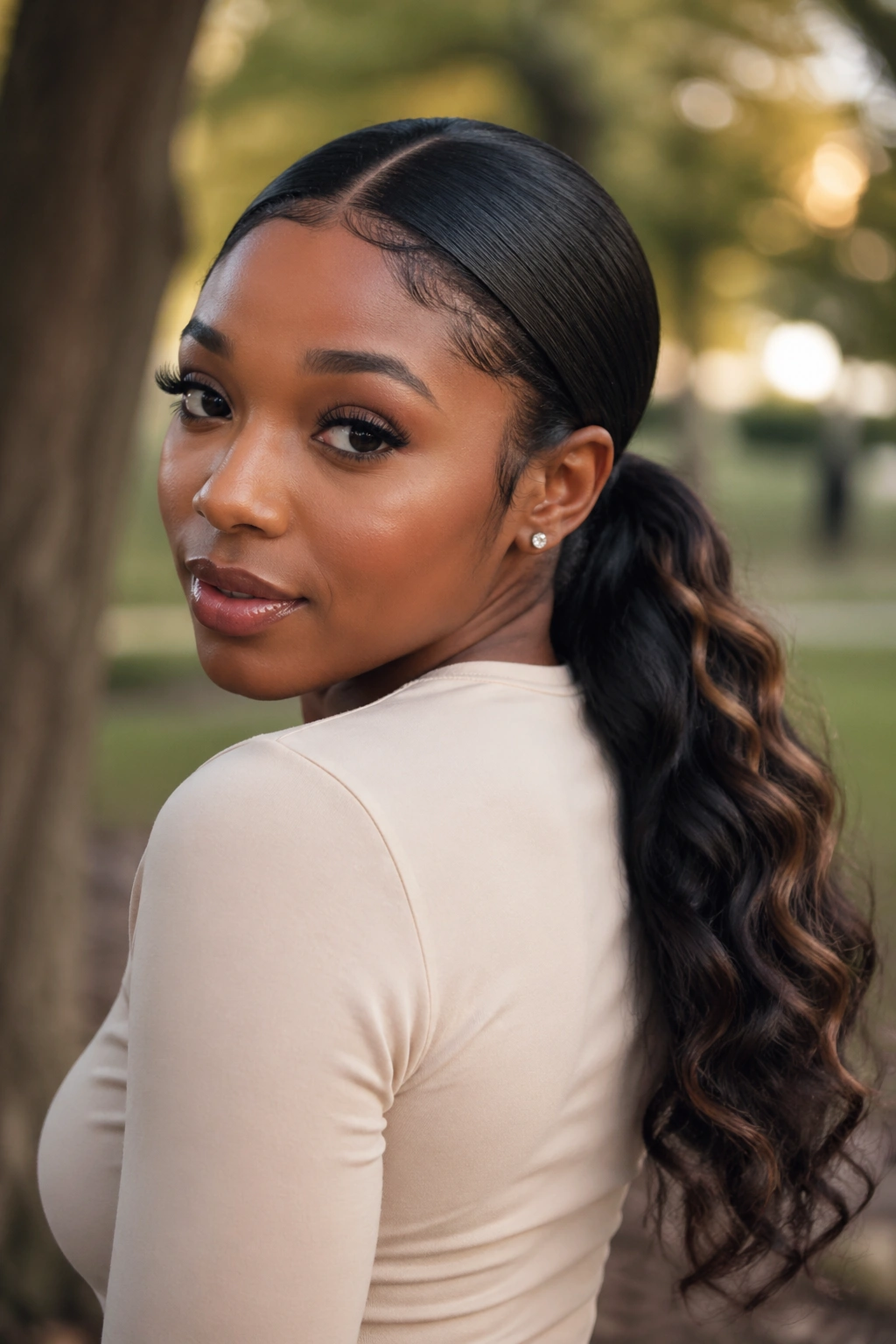
Wavy extensions are a middle ground between sleek and curly, which is why they work so well in a low ponytail. They add movement without turning the tail into a full curl set.
The middle part gives the style a crisp start, and the waves soften the rest. That combination is useful if you want a ponytail that feels wearable during the day and still looks dressed up at night. A low placement also keeps the waves from puffing upward too much near the crown.
This version looks good when the wave pattern is loose and consistent. Too much crimp or too much curl at the ends can make the ponytail feel busy. A 1.25-inch curling iron can help smooth the front pieces if your natural hair is straightened, but if the extensions already have a wave pattern, leave them alone. Over-styling usually makes the hair less believable.
I reach for this one when I want polish without stiffness. It’s relaxed, but not lazy.
25. Double Ponytail Illusion With a Seamless Center Part
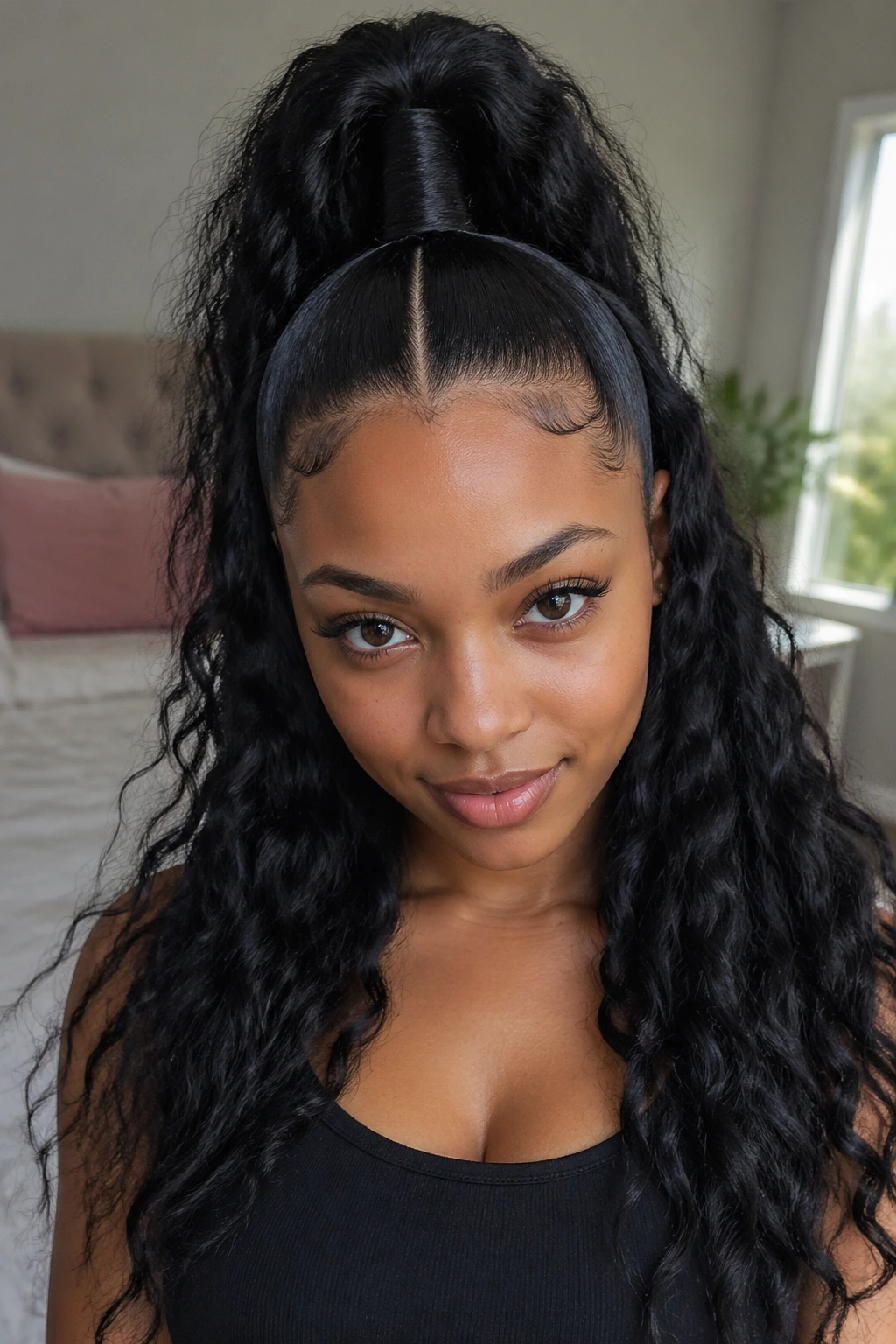
A double ponytail illusion is a clever way to get more length or fullness without making the hair look overloaded. You secure one ponytail, then a second one just below it, and arrange the hair so the join disappears into the overall shape.
That sounds technical because it is a little technical. Still, the payoff is worth it if your own hair is shorter or you want the tail to sit fuller without adding a huge bundle of extensions. The middle part keeps the front neat, and the doubled base makes the tail hang better.
The best versions are hidden well. If you can clearly see where one ponytail ends and the other begins, the illusion fails. A wrap around the base and a careful brush-through can soften the seam. That matters more than people think.
This is a smart trick for special occasions when you want extra body but don’t want the weight of a single giant ponytail pulling on the scalp all night.
26. Ponytail With Flipped, Curled Ends
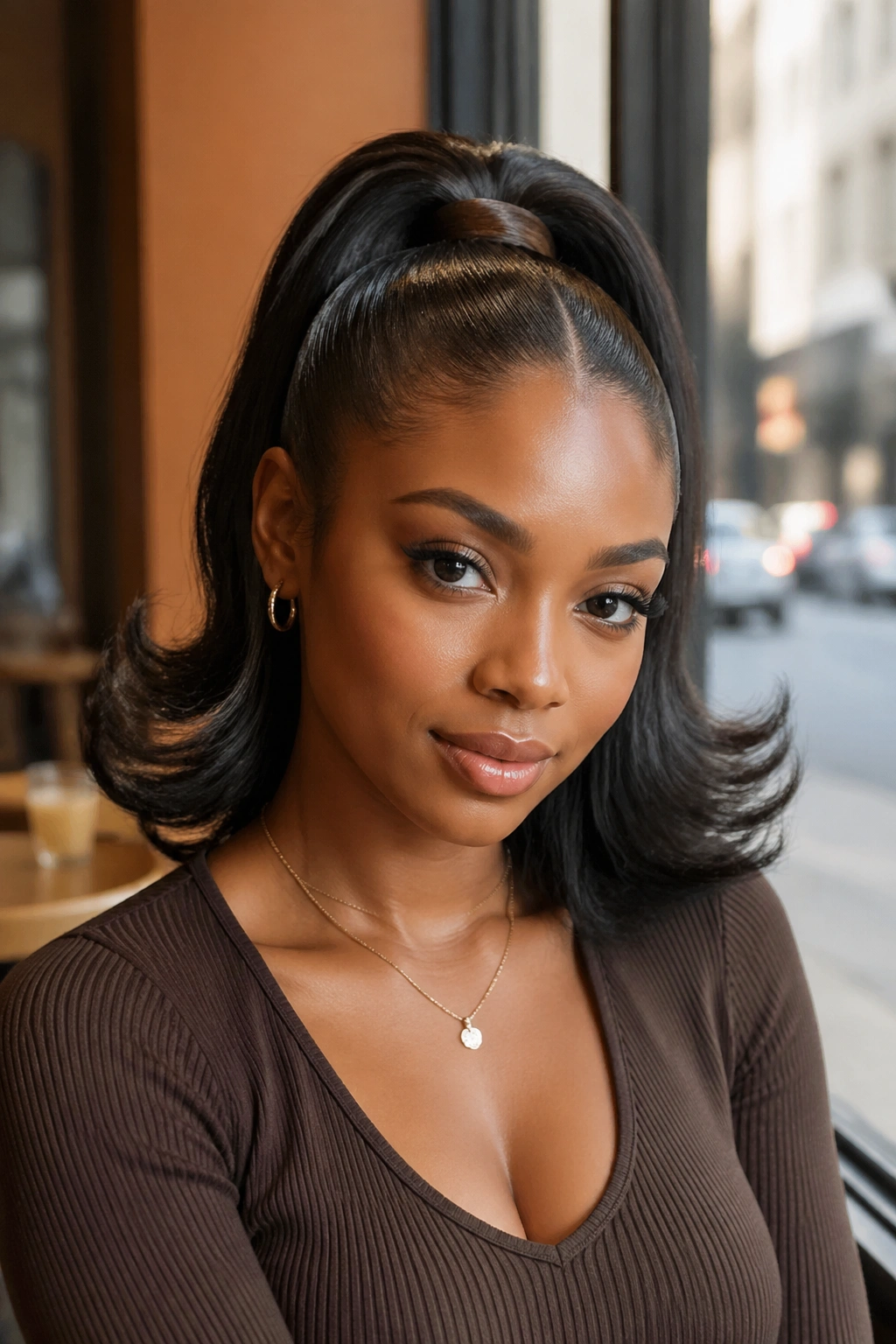
A flipped-end ponytail has a little personality without asking for a lot of extra work. The middle part keeps the top clean, while the ends curl outward or under so the tail feels lifted instead of heavy.
This style looks especially good on silk-pressed hair, straight extensions, or blowouts that hold shape well. A flat iron can create the flip, but a round brush blowout works too if you want less heat. The point is movement at the bottom. A ponytail with straight ends can sometimes look abrupt. A flip softens that edge.
The base should stay neat and close to the head, since the ends are doing the visual work. If the crown is puffy or the part is crooked, the whole style feels off. A sleek top and styled tail are doing two different jobs here, and both matter.
I like this look when the outfit is simple and the hair needs a little personality. It gives a polished ponytail some bounce without turning it into a full blowout.
27. The Cleanest Center-Part Finish
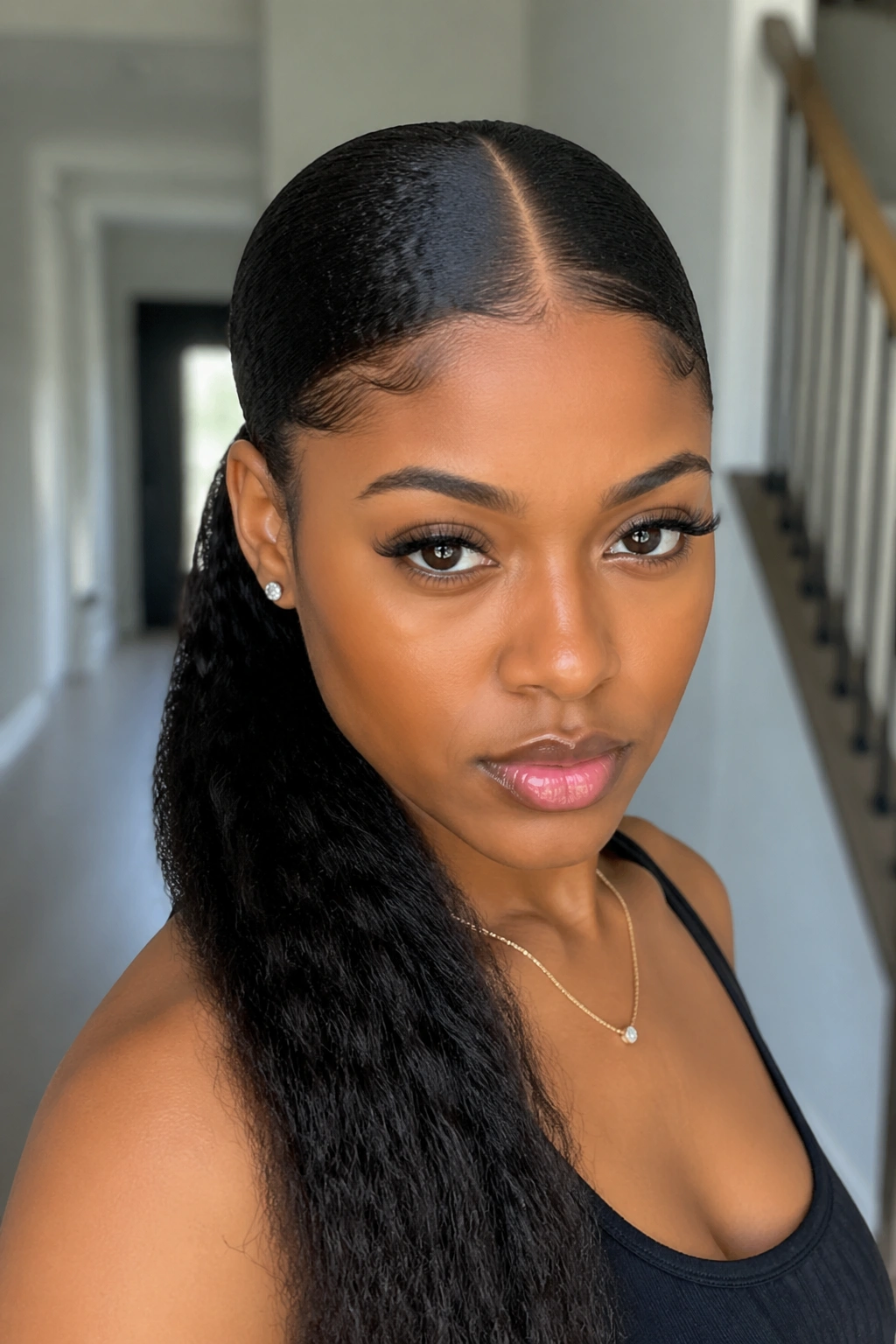
Sometimes the strongest ponytail is the one that doesn’t try to do too much. A clean middle part, smooth base, and one well-shaped ponytail can be better than a style loaded with extras.
That is the quiet power of this look. It works on natural hair, pressed hair, extensions, braids, and locs because the structure is so clear. The part stays centered, the base stays neat, and the rest of the hair can be whatever texture you want it to be. Straight. Curly. Thick. Light. The shape still holds.
If I had to give one piece of advice for any of these styles, it would be this: match the tension to the texture. Fine hair needs a softer grip. Dense hair needs better sectioning. Coily hair usually needs stretching at the roots before the ponytail sits cleanly. None of that is glamorous, but it’s what keeps the style from collapsing or hurting.
A good middle part ponytail should look crisp, not strained. When it does both, it earns its place in the regular rotation.