



Your wedding hair should feel like you — not a version of you that has been ironed flat or chemically altered for the comfort of a room. Afro wedding hairstyles for brides have been gaining long-overdue recognition because the truth is obvious once you see it: natural afro hair, styled with intention and care, produces some of the most breathtaking bridal looks imaginable. The volume, the texture, the sculptural possibilities — these are features, not obstacles.
There is a particular freedom in deciding from the beginning that your natural hair is your bridal hair. You skip the heat damage anxiety, the humidity panic, the weeks of heat stretching that can set back a year of healthy growth. What you get instead is a set of real options that suit your actual hair, your actual texture, and your actual beauty — not a performance of something your hair was never designed to do.
The twenty-eight styles here cover the full range of what afro wedding hair can be: grand and architectural, soft and romantic, bold and artistic, quietly elegant. What they share is the truth that natural hair on a bride is not a compromise. It is a choice — and a beautiful one.
What Makes a Bridal Hairstyle Different From an Event Style
The bar is higher. A style that can survive a four-hour cocktail party needs to survive a twelve-hour wedding day: pre-ceremony photos in morning light, outdoor ceremony possibly in heat, receptions, dancing, embraces, tears, and final exit photos. The pinning has to be more thorough, the product choices more strategic, and the final lacquering with flexible-hold spray more deliberate.
A bridal updo typically uses twenty to forty percent more pins than a regular event style. The access points for pinning are thought through in advance rather than improvised. And the style itself is tested before the wedding day — always, without exception.
Your trial run with your stylist — or your practice session if you’re doing your own hair — is as important as the actual wedding morning. Style it, wear it for six hours, evaluate what moved and what held, and adjust the technique for the real thing.
How to Choose a Style That Suits Your Dress
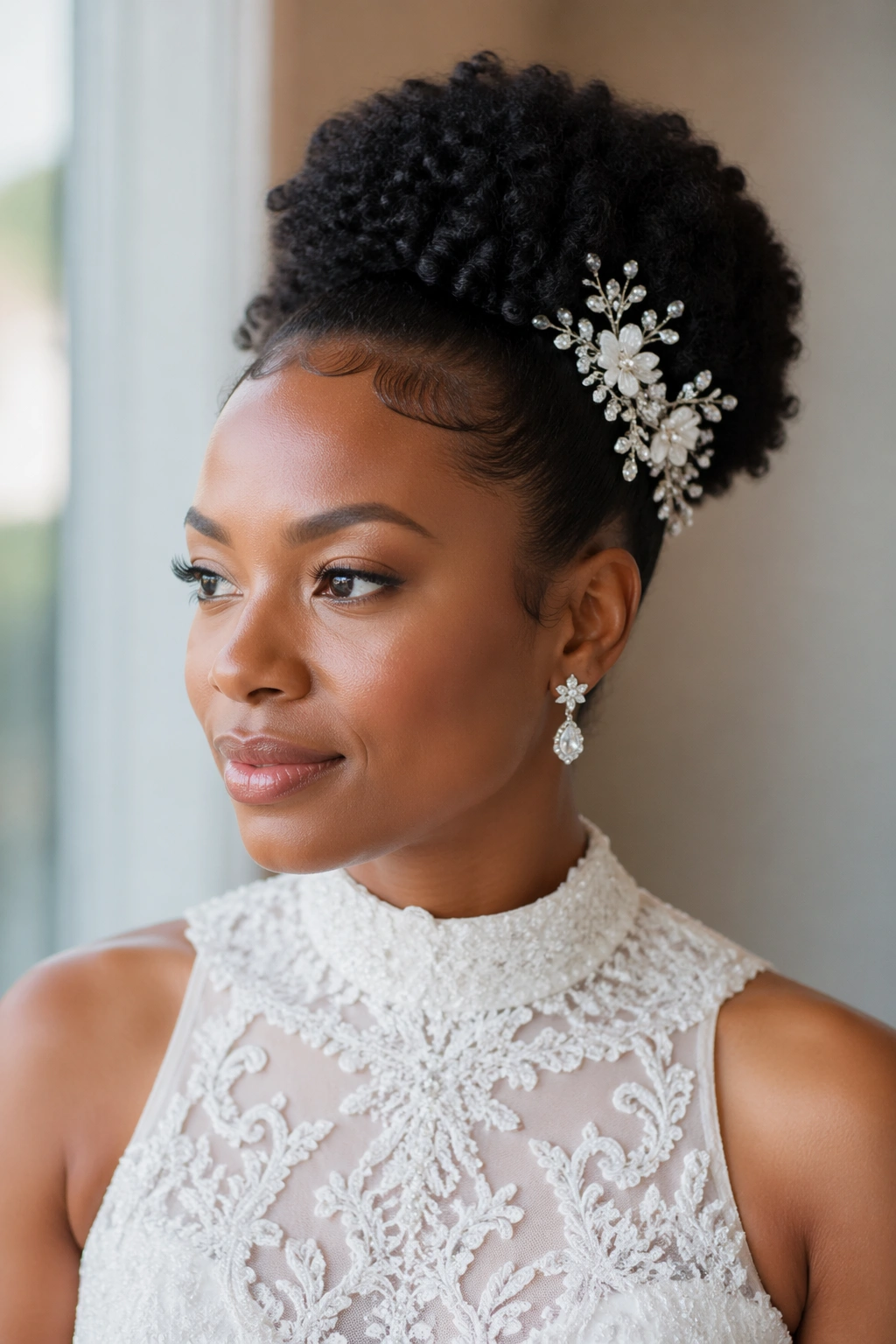
The relationship between hair and neckline is one of the most important styling considerations for a bride.
Strapless or sweetheart necklines open the shoulders and chest — they work best with updos that keep all the hair above the shoulder line, emphasizing the neck and décolletage. High-necked or sleeved dresses often look better with hair that’s down or half-up, because the area the dress is already framing doesn’t need additional architecture.
Backless or deep-V back dresses specifically benefit from low updos at the nape — a gathered bun or twisted chignon just above the neck draws the eye to the back of the dress rather than competing with it.
Simple dress, complex hair. Complex dress, simple hair. This is not an absolute rule, but it’s a reliable starting point.
The Trial Appointment and Why You Cannot Skip It
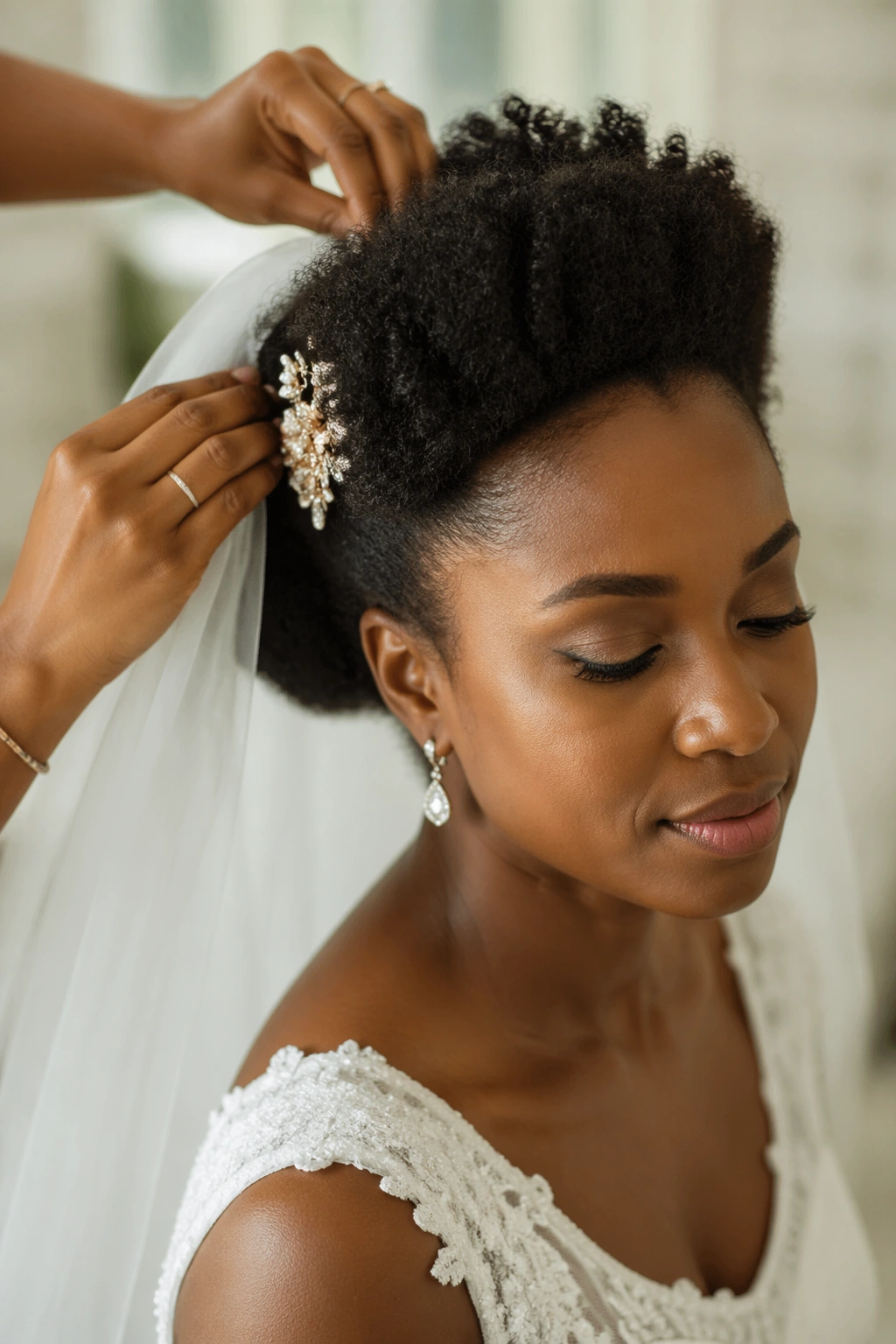
The trial appointment — three to eight weeks before the wedding — is where you discover what your hair is actually going to do under event conditions. Products behave differently in humidity. Styling takes longer than you expect. The look you loved in a photo may not translate to your specific texture or density.
Go to your trial appointment with your veil and any hair accessories you plan to wear. Test everything together. Photograph from multiple angles — not just the front, because most of the day’s photos will show your profile and the back of your head. Make sure the back looks as finished as the front.
Wear the style for a full day after the trial. Go outside. Move around. Note where it starts slipping or frizzing. That information tells your stylist exactly what to adjust.
Natural Hair Bridal Products Worth Knowing
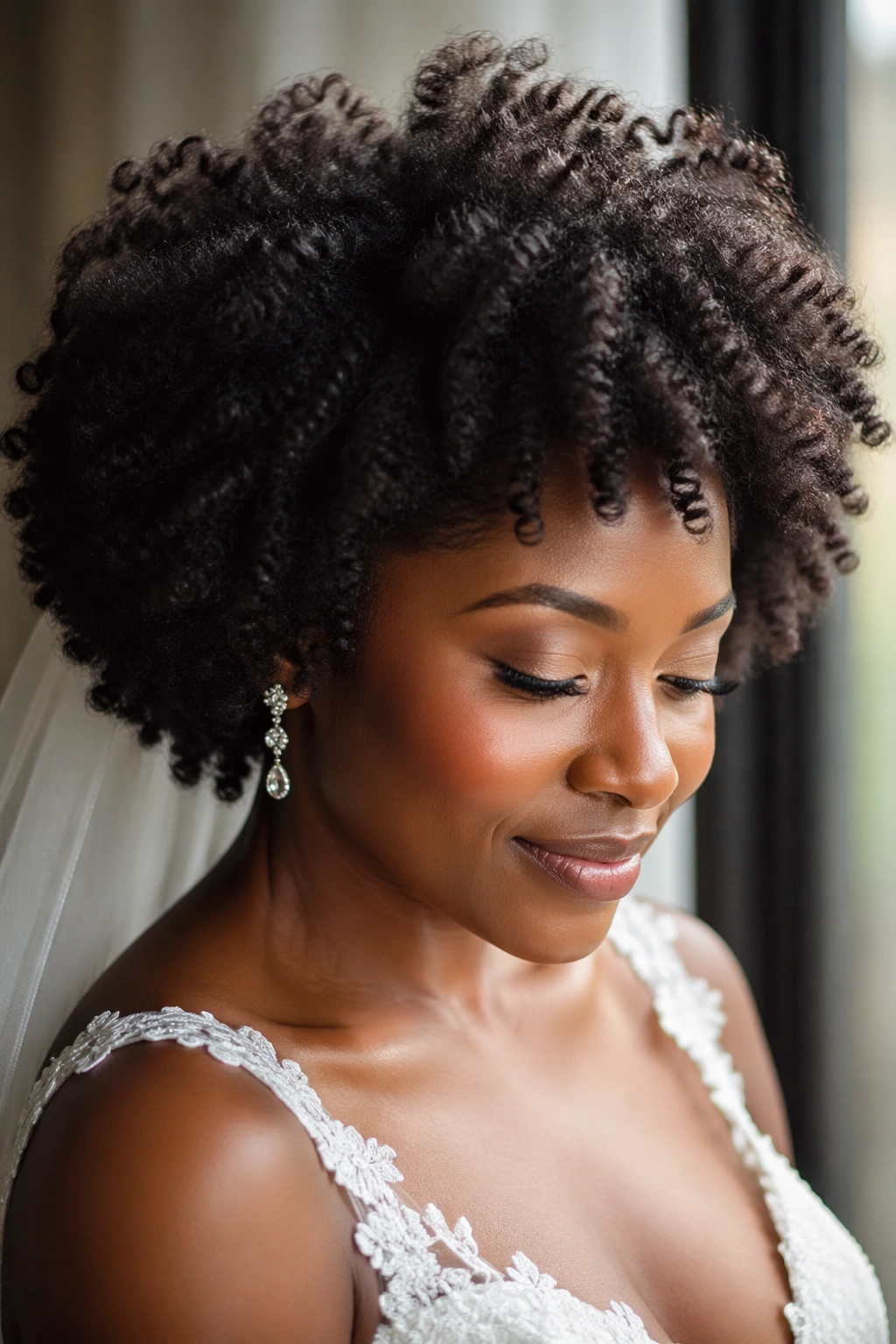
The products that give the cleanest, longest-lasting results for bridal natural hair styles:
A firm-hold edge gel — not a medium-hold one — for the hairline and visible part lines. Applied, shaped, and allowed to fully dry before any photography happens. Brands that are alcohol-free hold up better in warmth and humidity without cracking.
A styling cream rather than a butter for updos. Butters can melt slightly in heat, which causes pinned sections to slip. A cream-based styler gives hold with flexibility.
Flexible-hold finishing spray — not a hard lacquer, which stiffens natural afro texture unattractively — applied from about a foot away over the finished style to slow frizz and hold surface texture.
A small amount of hair oil — jojoba or argan — for sealing the ends of any exposed sections and giving a subtle healthy sheen under wedding lighting.
Accessories That Belong in Natural Afro Bridal Hair
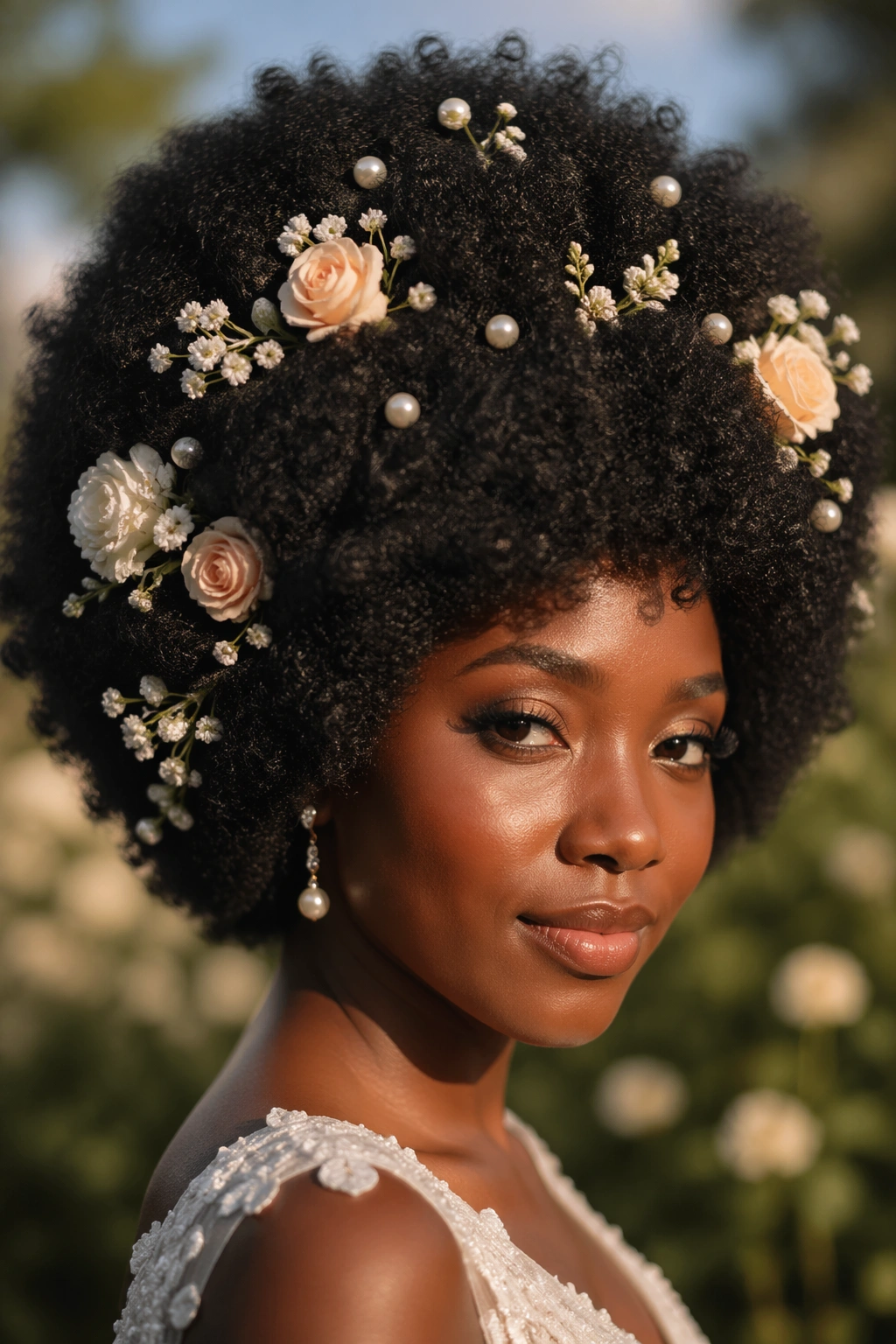
Accessories transform an already-beautiful natural style into something that reads unmistakably bridal.
Fresh flowers — singular or clustered — pinned into a natural afro or twisted updo give a romantic, organic quality that artificial flowers or other accessories rarely match. White flowers against dark natural hair is one of the most striking visual combinations in bridal styling.
Gold and pearl accessories suit most skin tones beautifully and have a warm formality that silver rarely achieves on natural afro hair. Pearl pins placed throughout a large afro puff or gathered updo look luxurious without looking heavy.
A bridal headband or headpiece — whether a delicate gold wire piece, an embellished cloth band, or a full tiara — sits at a height and visibility on natural afro volume that it simply cannot achieve on flat or straight hair. Natural afro hair is actually the ideal base for headpieces.
1. Grand Afro with Flower Crown
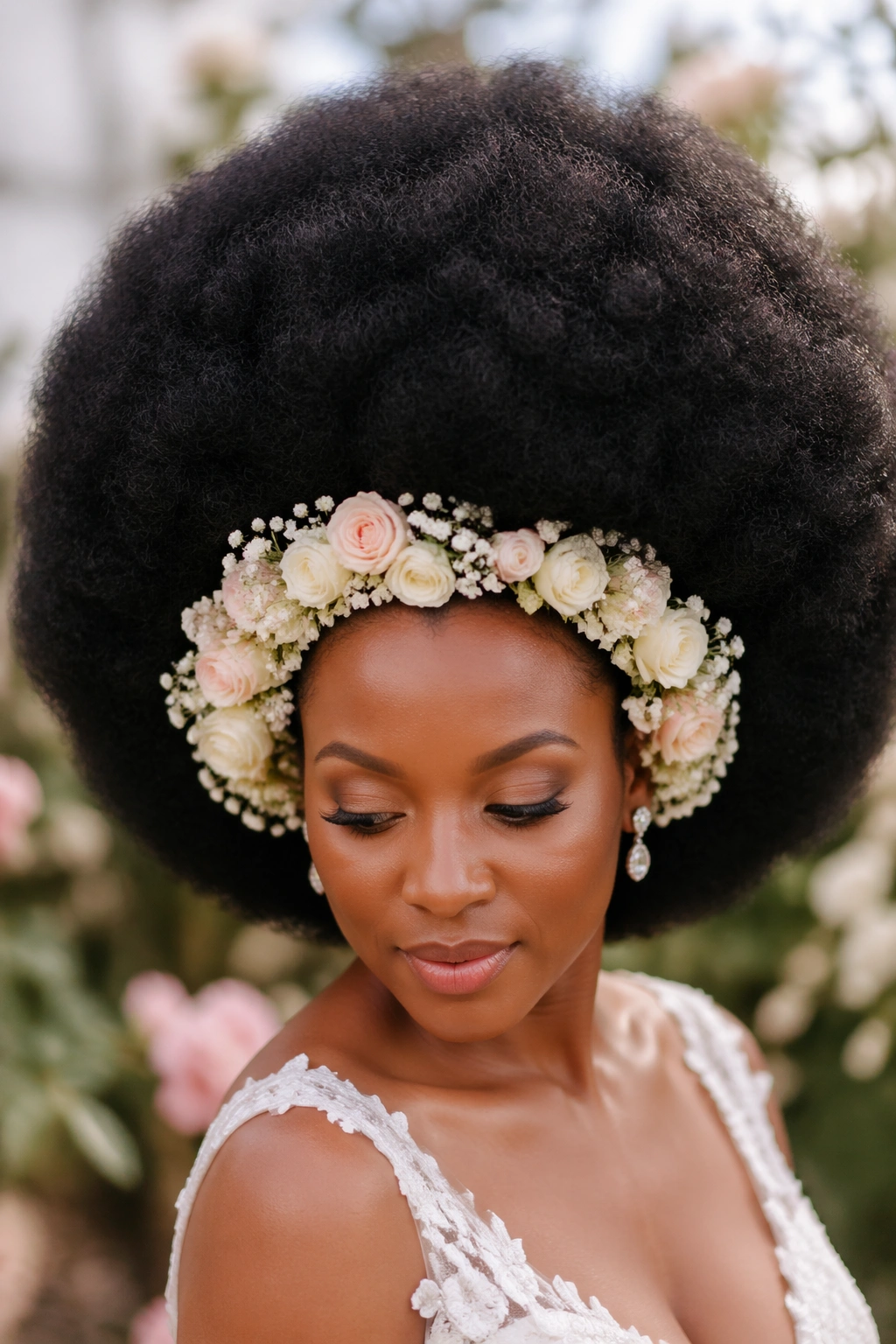
The pick-it-out, shaped, perfectly round afro at its largest and most magnificent — worn with a flower crown resting at the base of the afro. This is the most boldly natural bridal choice on this list and also one of the most striking.
The flower crown should sit at the perimeter of the afro, not on top of it, so the flowers frame the round silhouette rather than competing with it. Fresh or high-quality artificial blooms — white, ivory, cream, or any color that speaks to the wedding palette — work equally well.
Why It Works
The natural afro puff under a flower crown creates a proportion that no other hair texture produces. The crown rests on a platform of volume, which gives it a height and visibility that’s regal rather than delicate. The contrast between the soft flowers and the bold texture of the afro is intentional and beautiful.
Preparation requires a well-moisturized wash-and-go or freshly picked afro. Shape the perimeter symmetrically by hand. Define edges. Allow the edge gel to set completely before placing the crown.
2. Twisted Bridal Bun with Pearl Pins
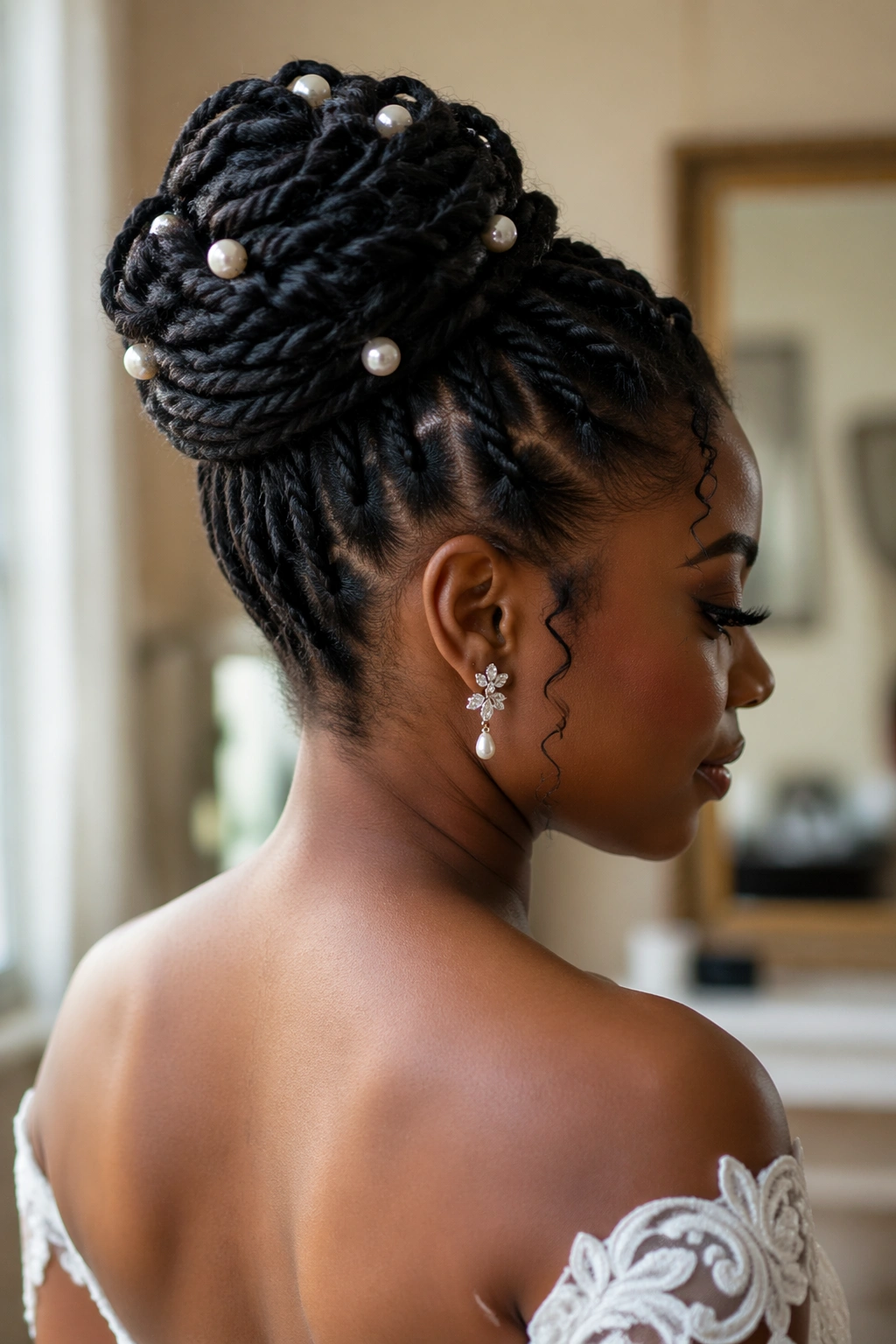
Multiple sections of hair twisted individually, then gathered and coiled at the crown into a large, textured bun. Once the bun is shaped and pinned, pearl-headed pins are placed throughout the coil — visible above the surface of the hair, distributed evenly like dots of light.
The twisted bun has visible texture from the individual twist patterns in each gathered section — it doesn’t look like a smooth conventional bun. The texture catches wedding lighting beautifully.
Use twenty to twenty-five bobby pins to anchor the bun. Crossed pairs of pins — two going in opposite directions over the same section — won’t pull out. Pearl pins added after the structure is secure should be long enough to reach the anchoring layer below.
This style photographs magnificently from every angle, but particularly from the three-quarter profile where both the pearl detail and the twisted texture are visible simultaneously.
3. Cornrow Crown with Natural Puff
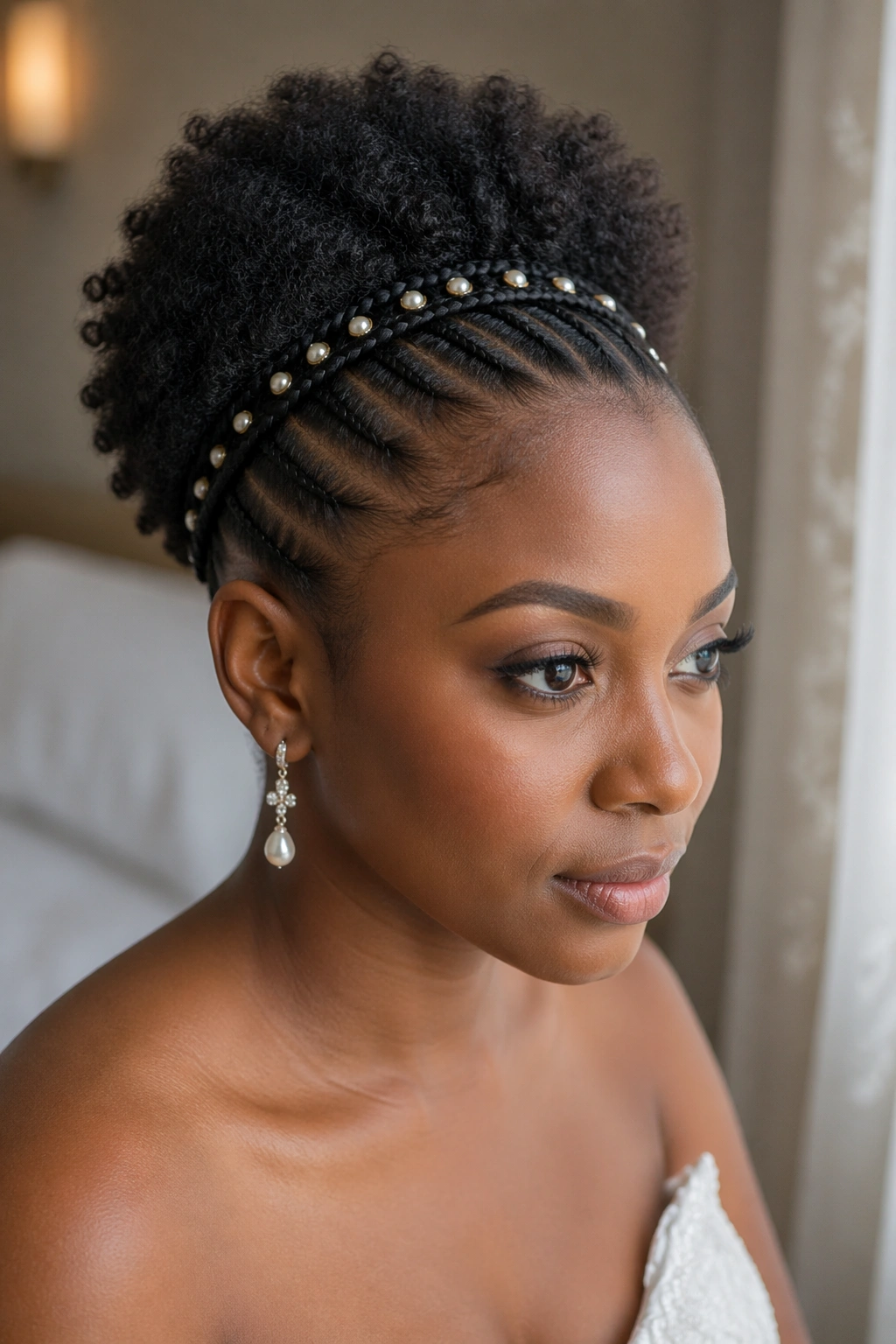
Cornrows braided all around the perimeter of the head — following the hairline from temple to temple around the back — with the center section left free as a natural puff. The braids form a crown of structured texture; the free center section sits above it in its natural state.
The juxtaposition of the precisely braided perimeter and the free, voluminous center reads architectural. This style makes the most of natural afro hair’s dual capacity: precise structural work at the edges, free texture at the crown.
The detail that makes it bridal: a string of small pearls or gold beads threaded through one or two of the perimeter cornrows. Single-strand threading through the braids requires a needle and patience, but the result — a braid with glinting accent running through it — is something that cannot be recreated with clip-on accessories.
4. Flat Twist Bridal Updo
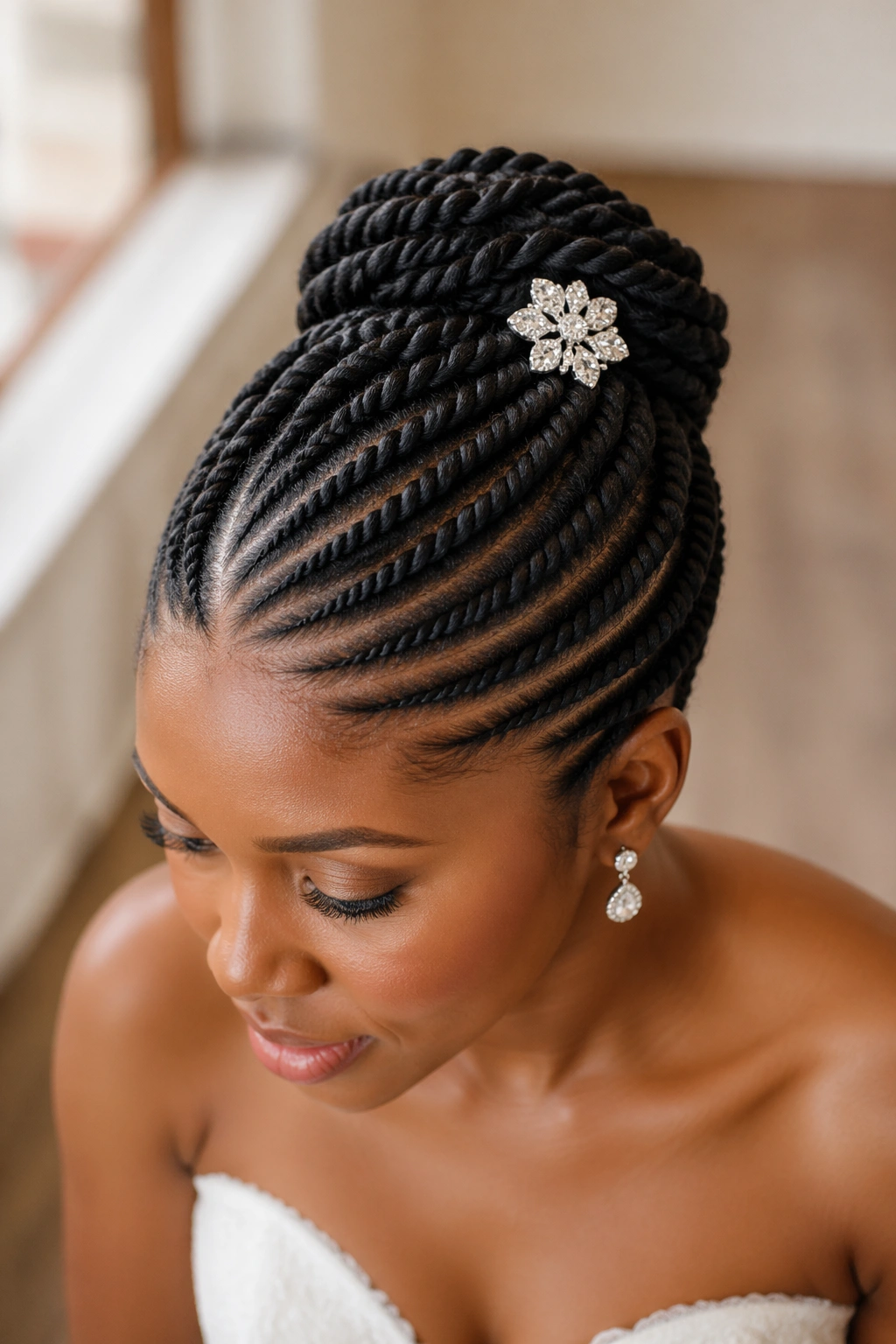
The full head of hair flat-twisted in a designed pattern — radiating from one side, sweeping across the top, gathered at the opposite side — creates a sculptural surface that looks handcrafted and deeply intentional.
For bridal settings, the pattern in the flat twists becomes more important than in everyday wear. The parting lines should be precise. The sections even. The surface smooth and consistent in tension.
The ends of all the twists gather at one point — usually above the nape or at the crown — and are tucked and pinned carefully. No visible ends, no flyaways at the gathering point. A single statement accessory at the gathered point completes the look.
This style requires significant skill to execute on oneself. A professional stylist experienced with natural hair is the right call here. Two to three hours of installation time for a full flat-twist updo is typical.
5. Bantu Knot Arrangement with Gold Accessories
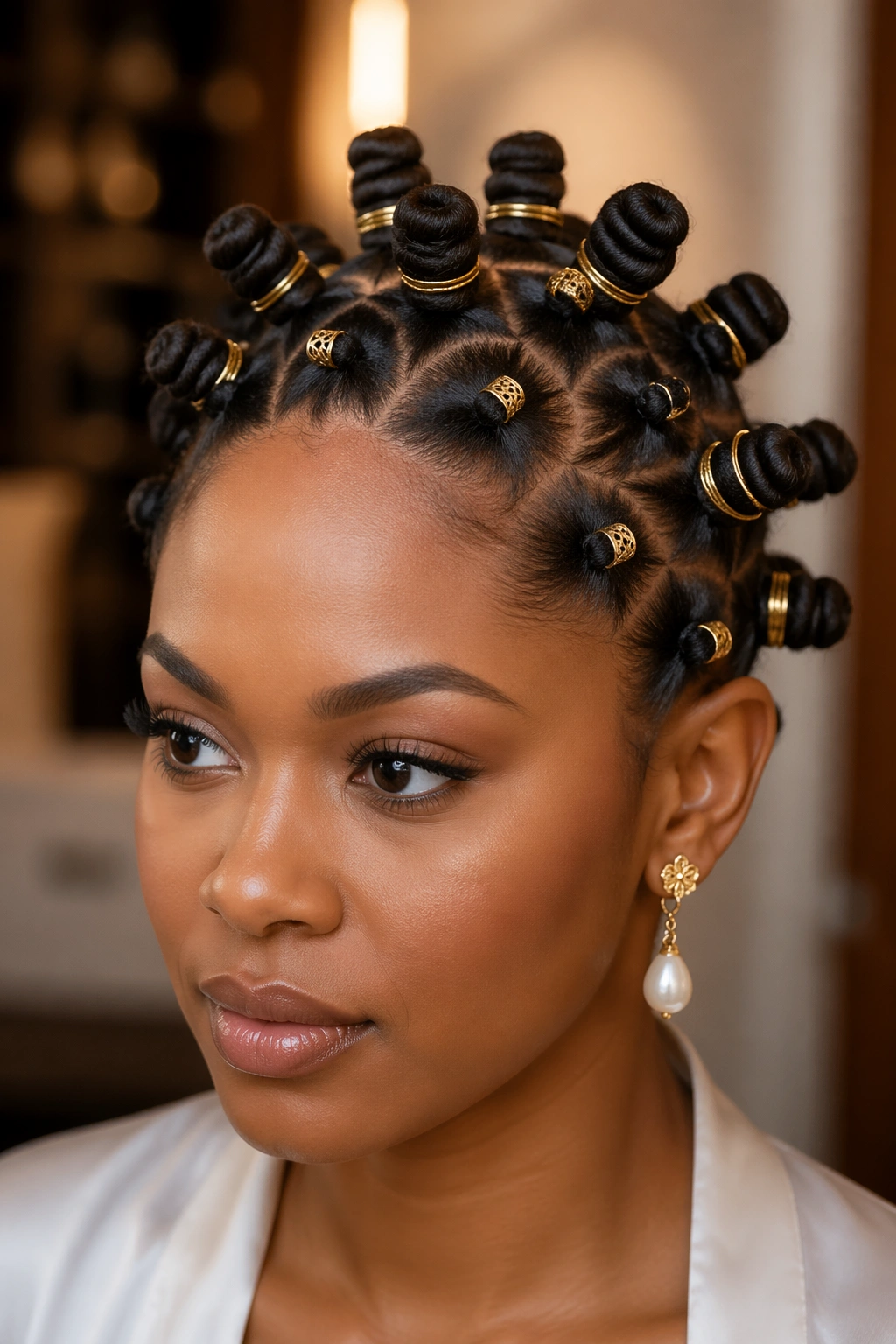
A full head of bantu knots — arranged in a deliberate pattern across the whole head — with small gold accessories: hair cuffs on select knots, pearl-headed pins at the center of each knot, or thin gold rings threaded onto the hair at the knot bases.
The symmetry and uniformity of the arrangement is everything here. Equally-sized knots, evenly-spaced, in a pattern that reads geometric and intentional. Randomly-sized or randomly-spaced knots look like a casual style. Uniform, precisely arranged knots with gold detail look formal.
Who This Is For
Best for brides who want a bold, artistic bridal statement that’s distinctly different from conventional bridal hair. This style reads contemporary and high-fashion rather than traditionally formal. For the right bride — self-assured, creative, definite in her aesthetic — it is spectacular.
6. Low Twisted Bun at the Nape
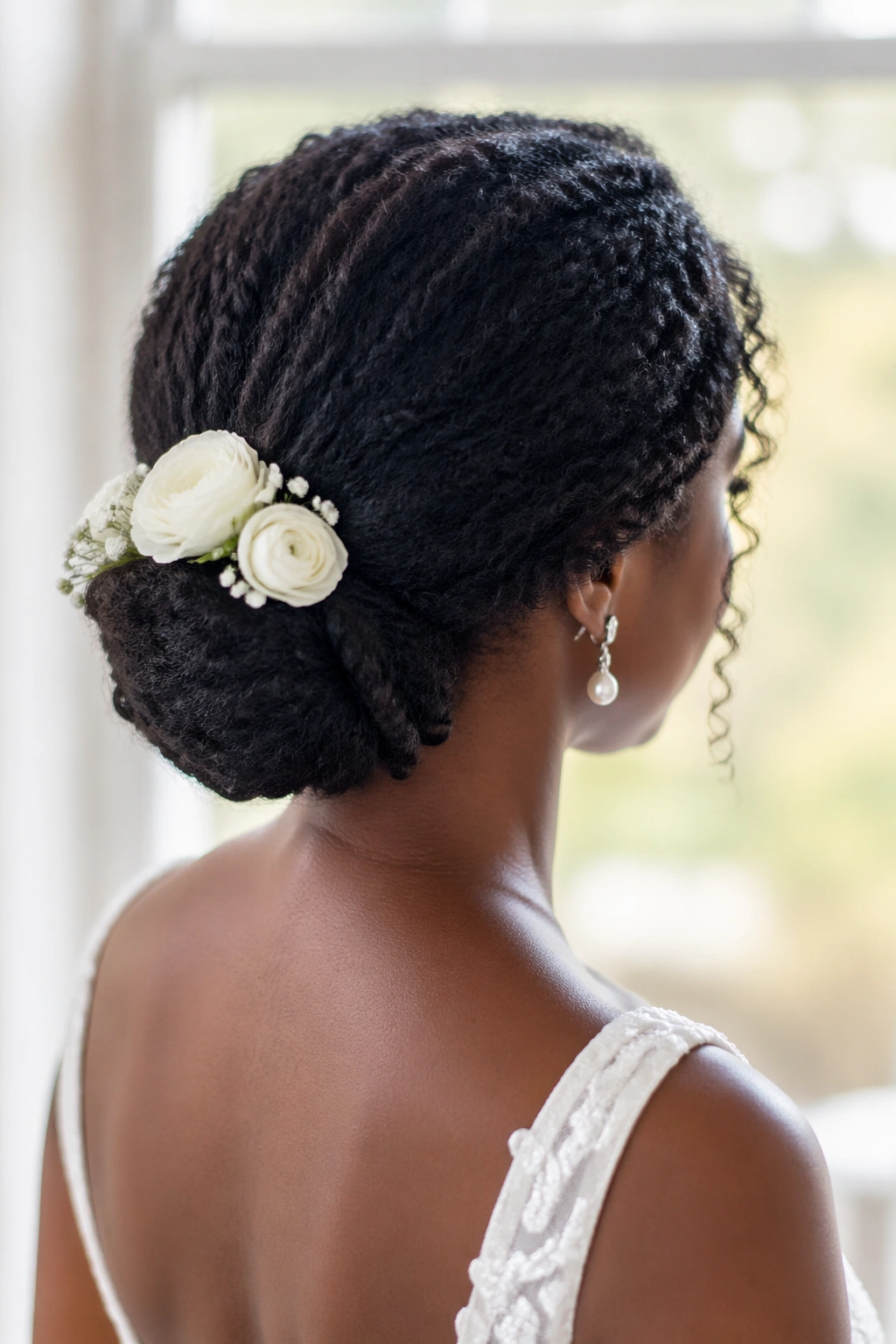
All the hair gathered low and twisted into a bun that sits just above the nape, close to the neck. This is the most understated style on this list — and sometimes, understated is exactly right.
A low nape bun on natural afro hair has a textural richness that a straight-hair chignon doesn’t produce. The coils and twists visible in the gathered section give it warmth and depth even at small scale. With a backless dress or a gown with an elaborate back detail, the low bun draws the eye downward and opens up the upper back.
Secure with a generous amount of pins. Add two or three fresh white flowers tucked into the bun on one side.
7. Faux Locs Bridal Updo
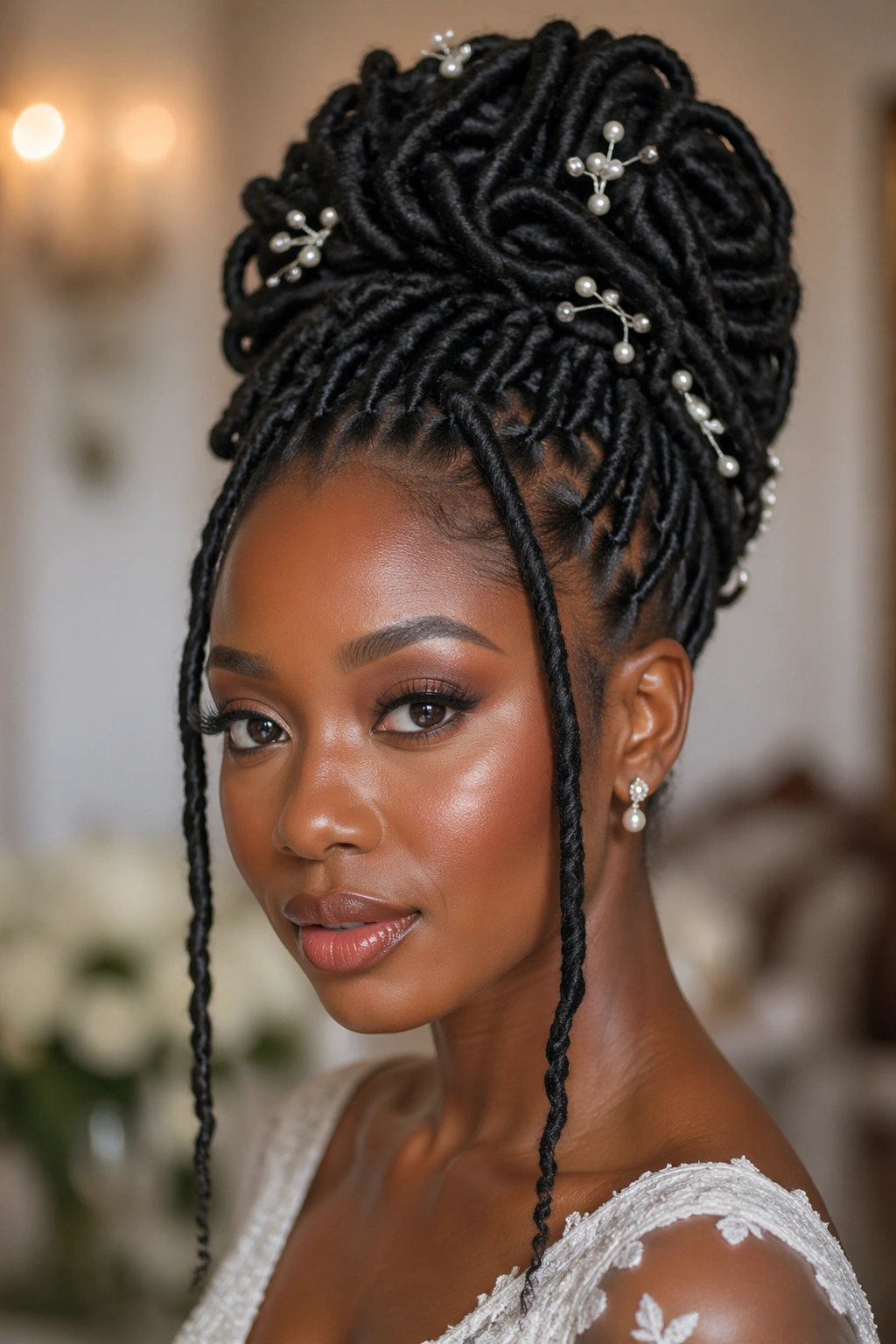
Long faux locs gathered dramatically at the crown — coiled, piled, and pinned into a sculptural tower of texture. The individual locs retain their shape even when gathered, which gives the resulting style a dimensional quality that smooth hair gathered the same way wouldn’t have.
The weight of faux locs means this requires real structural preparation. A foundation of cornrows under the installation, combined with long heavy-duty pins and a claw clip anchor at the base, creates a holding structure the faux loc pile can sit on safely.
One or two locs left free at the temples — curled slightly around a finger and released — frame the face and soften the drama of the full gathered look.
8. Afro Half-Up with Bridal Veil
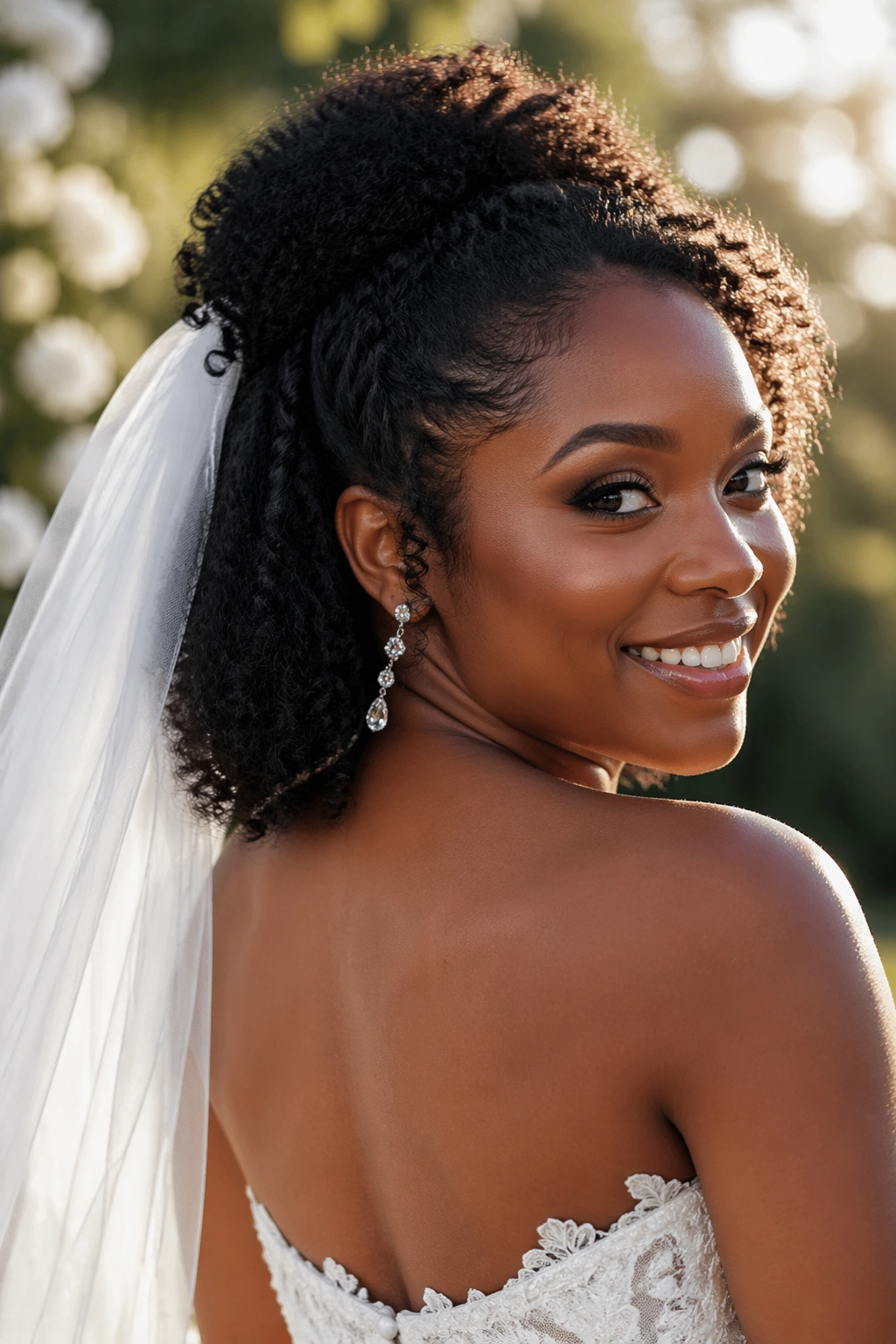
A half-up style — top section gathered and secured; bottom section left free — with the bridal veil attached at the gathering point. The veil flows behind the gathered top section; the natural hair below the veil frame falls freely in its natural texture.
This is one of the most beautiful relationships between natural afro hair and a veil. The veil drapes over natural curls and coils in a way that emphasizes the texture rather than hiding it. Backlit in outdoor ceremonies, the effect of a veil floating over natural afro texture is genuinely extraordinary.
Attach the veil comb to the hair before securing the top section. Build the gathered section around and over the comb. This is the most stable veil attachment for natural hair.
9. Sculpted Afro Puff with Bridal Crown
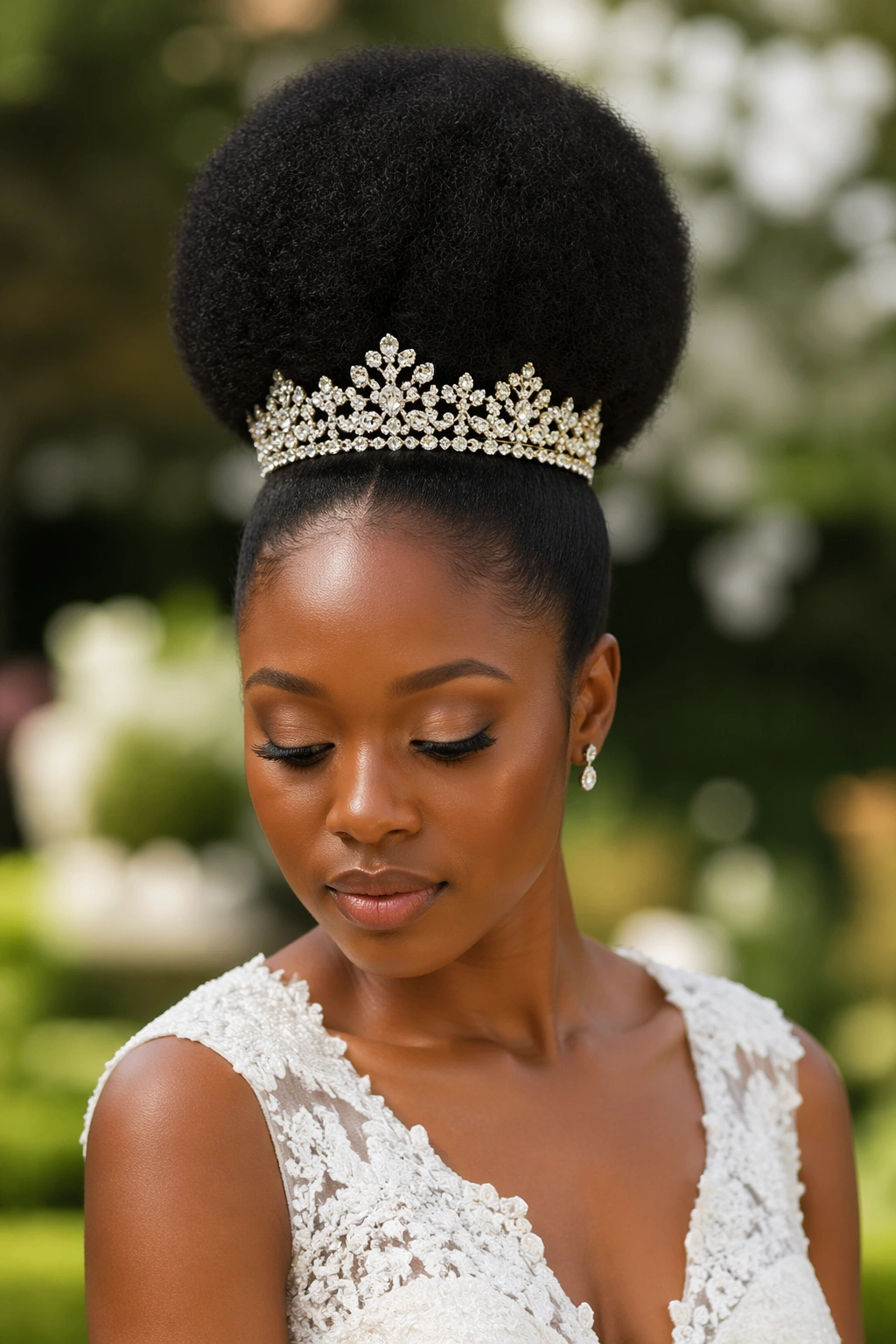
A high afro puff at its most intentionally shaped — perfectly round, precisely edged — wearing a bridal crown or tiara at the base of the puff. The crown sits on the natural hairline at the front and sides; the puff rises above it.
Natural afro volume gives the crown its ideal placement context. The crown sits elevated above a platform of texture and volume, which positions it at the center of the face in a way that works proportionally across most face shapes.
Choose a crown that’s proportional to your puff size. A narrow, delicate tiara for a medium puff. A wider, more substantial piece for a very large volume puff. The proportional relationship between crown width and puff width determines whether it looks balanced or overwhelmed.
10. Bridal Pineapple with Embellished Wrap
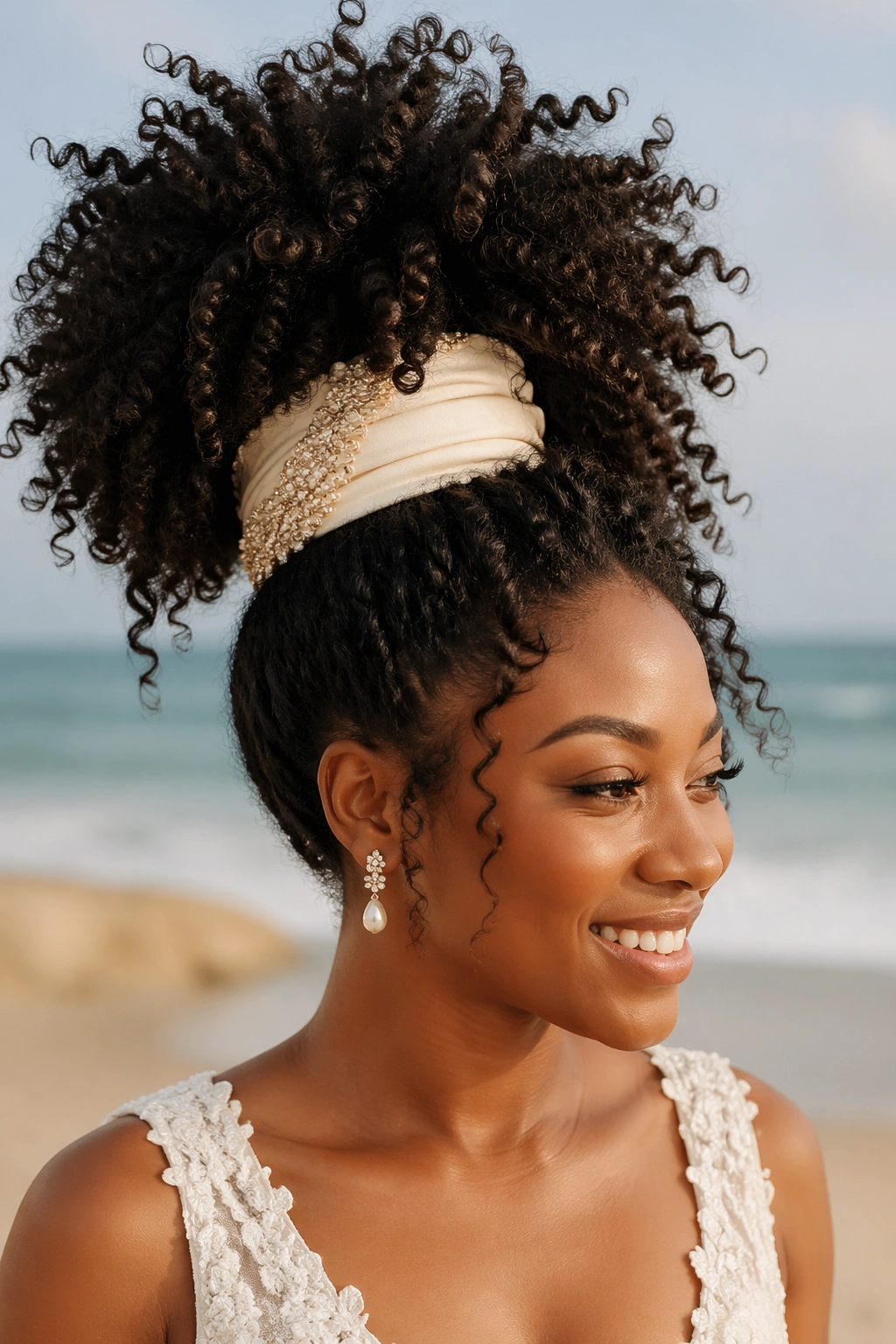
A very loose, high pineapple — all hair gathered softly at the crown, not tight — with a long satin or embroidered wrap tied around the base of the gathered hair. The wrap replaces the hair tie as the securing element and becomes the primary decorative detail.
The wrap can be the bridal white or ivory color of the dress; it can be a metallic gold for contrast; it can be a printed fabric chosen for cultural significance. The gathered hair above the wrap fans in all directions — not smoothed into a puff shape, just gathered and released.
This style works particularly well for outdoor or beach weddings where a stiff formal updo would feel out of place. It has movement. It breathes. It suits venues where the surrounding beauty is part of the aesthetic.
11. Cornrow Base with Afro Bun
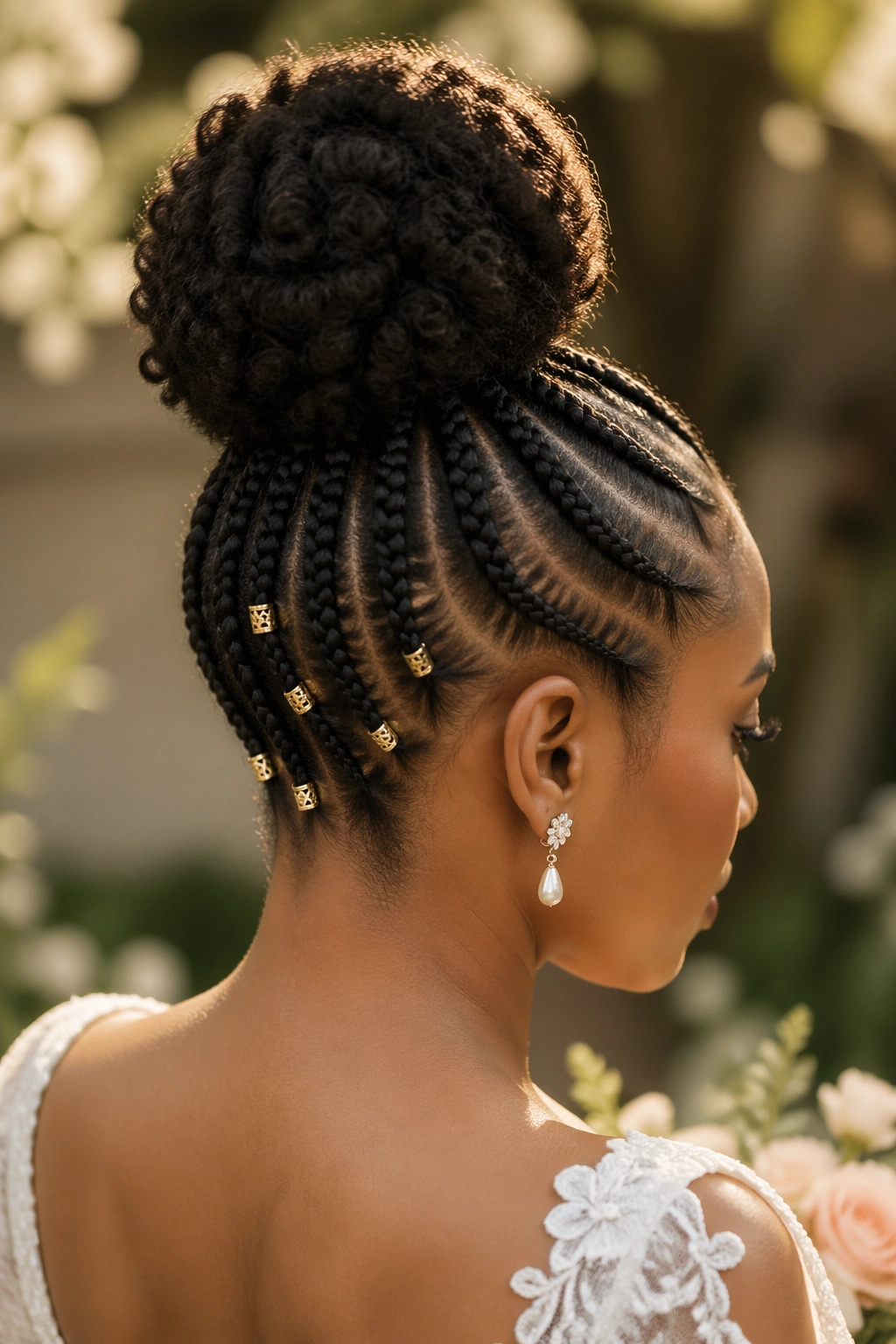
Full-head cornrows as a base, with all the braids gathered at the crown and coiled into a large bun above the cornrows. The bun sits high; the cornrow pattern is visible around the sides and back.
This style shows both the structural side of natural hair styling — the precise cornrow work — and the voluminous side — the bun. Both textures in one look.
For bridal settings: small gold beads threaded onto selected cornrows at the nape and sides before installation add a jewelry element that’s built into the hairstyle itself. Unlike accessories that clip or pin onto the outside, beaded braids carry their decoration permanently through the style.
12. Natural Hair Veil Alternative — Afro Halo
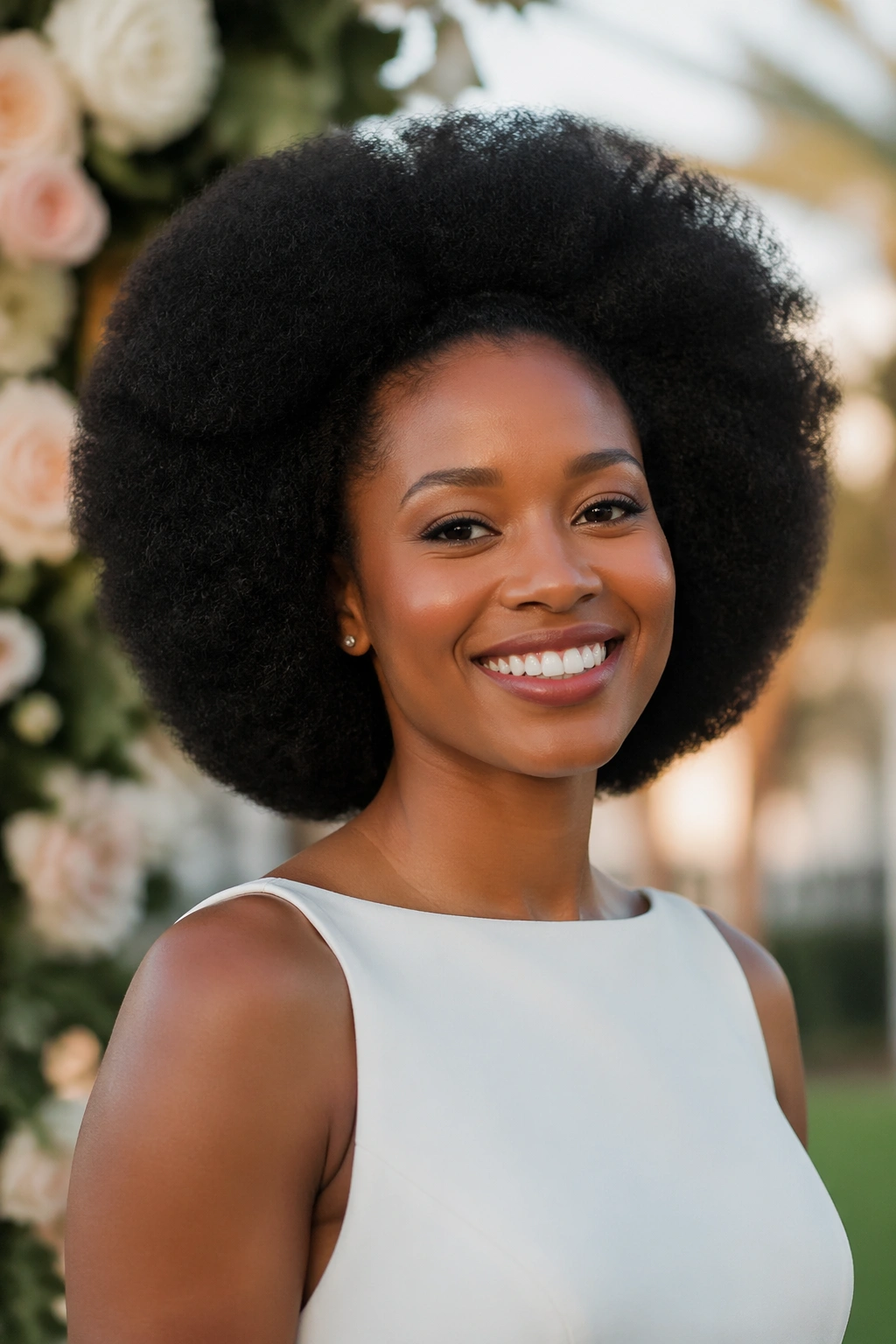
Some brides want the visual presence of a veil without the management of a real one. A large, perfectly rounded afro creates a halo effect around the face that is its own version of the veil’s encircling visual purpose.
Worn with a simple, unfussy dress — sheath or A-line — and clean, precise edges, a large natural afro is one of the most powerful bridal looks available. No accessories required. The hair itself is the declaration.
This is the choice for the bride who knows exactly who she is, doesn’t need to add anything, and walks into the room already complete.
13. Twist and Curl Half-Updo
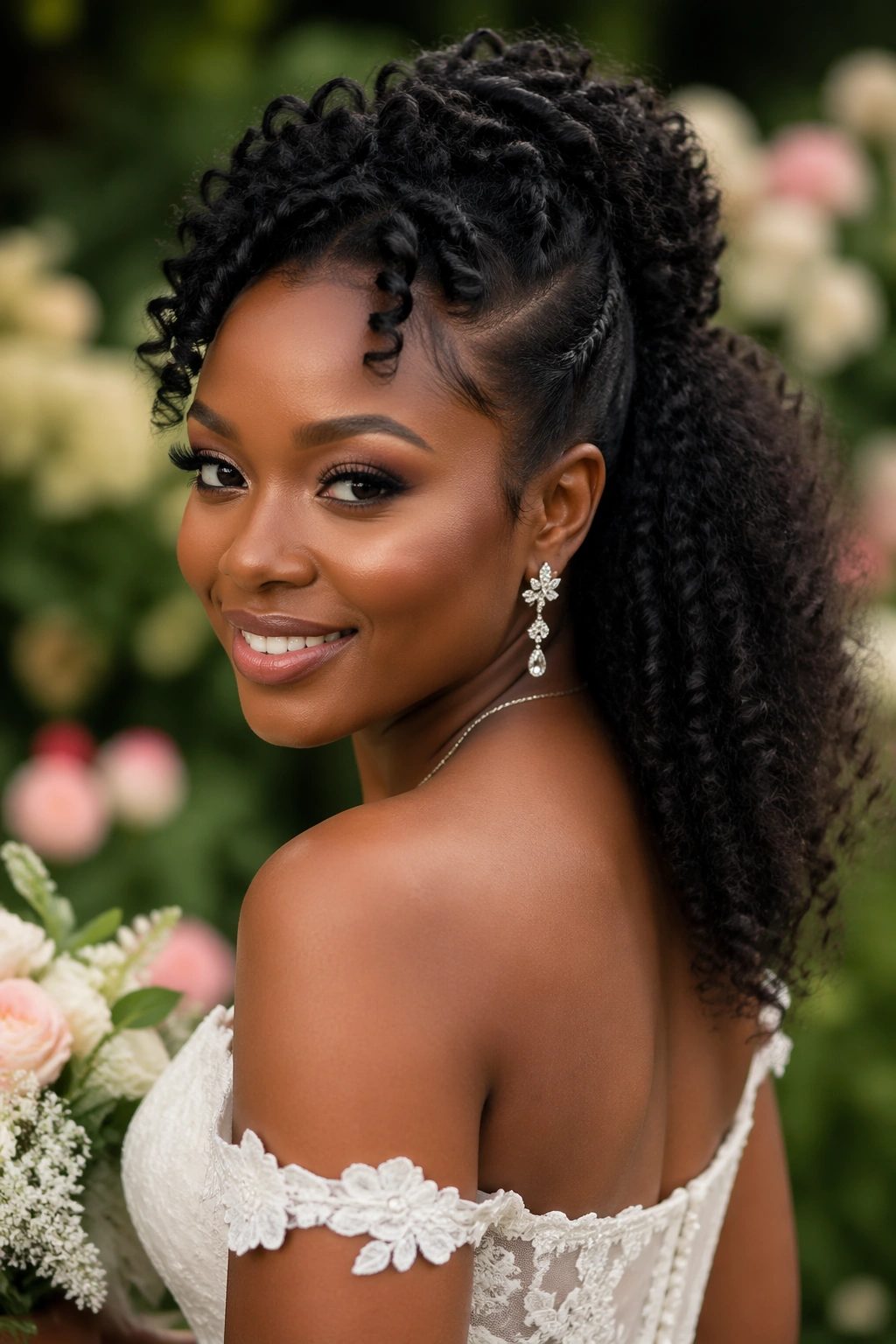
The top sections of the hair are individually finger-coiled or pin-curled into defined spiral curls; the remaining lower sections are left in their natural wash-and-go or twist-out state. The defined curls on top are gathered loosely and pinned at the crown, while the lower curls fall free.
The contrast between the intentionally defined upper curls and the naturally free lower section gives the style a romantic, cascading quality. It reads like the hair has been “done” at the top and naturally gorgeous at the bottom — which is exactly what’s happening.
This works particularly well for romantic or garden-wedding aesthetics, where a tightly structured updo would look too rigid for the setting.
14. Braided Side Style with Free Natural Flow
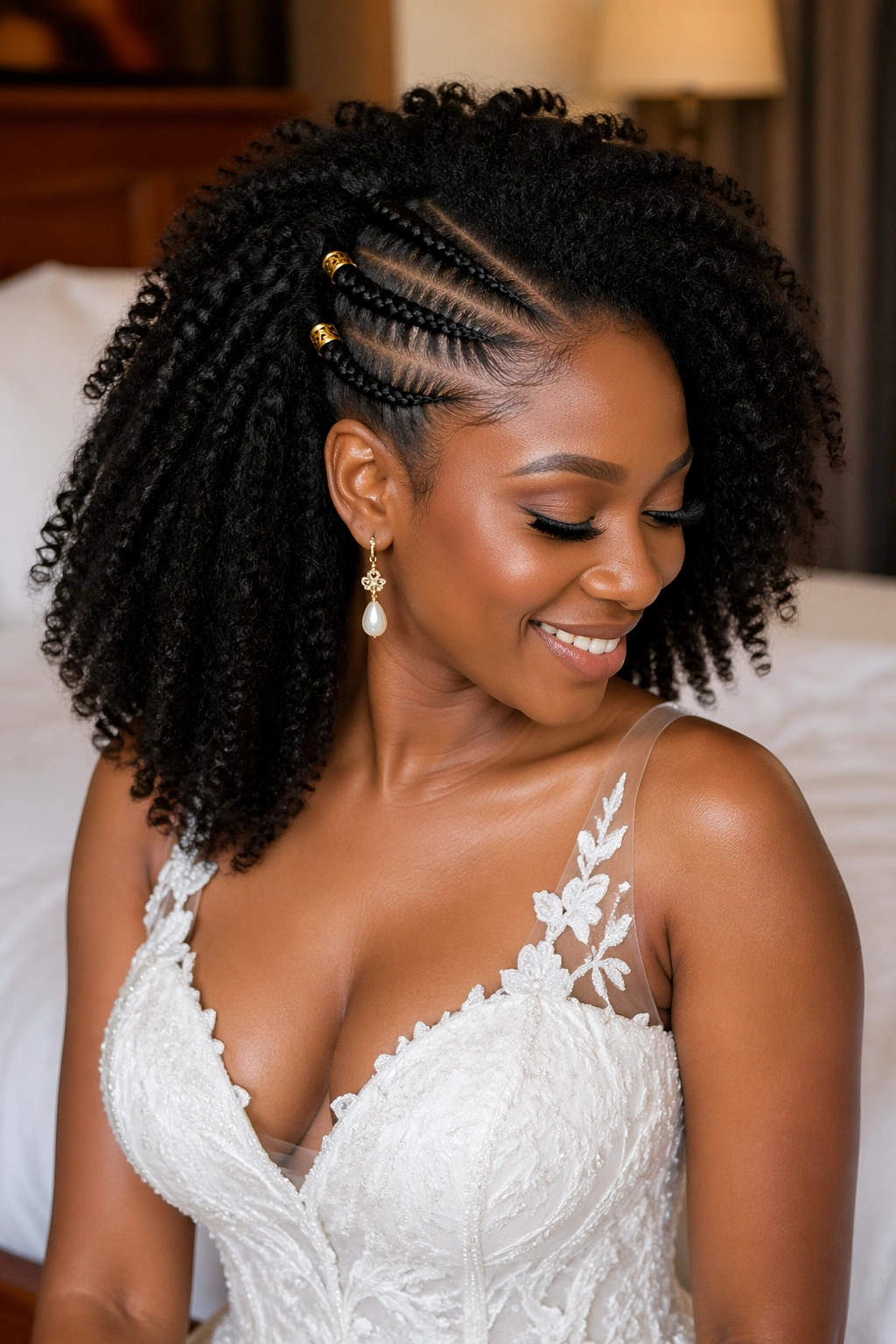
A series of braids beginning at the front temple — running diagonally from the hairline toward the back of one side — with the remaining hair left free in its natural state. The braids are a detail, not the whole story. They run like tributaries into the larger body of free natural hair.
Two or three braids, each one below the last, create a stacked pattern at the temple. Gold accessories — hair rings or thin cuffs — on the braids add the bridal detail.
This style requires minimal installation time — twenty to thirty minutes — and the result is a beautiful complement to natural texture rather than a replacement for it. For brides who want to wear their hair down and free, this adds enough structure to make the look feel intentional on a wedding day.
15. Afro with Draped Veil
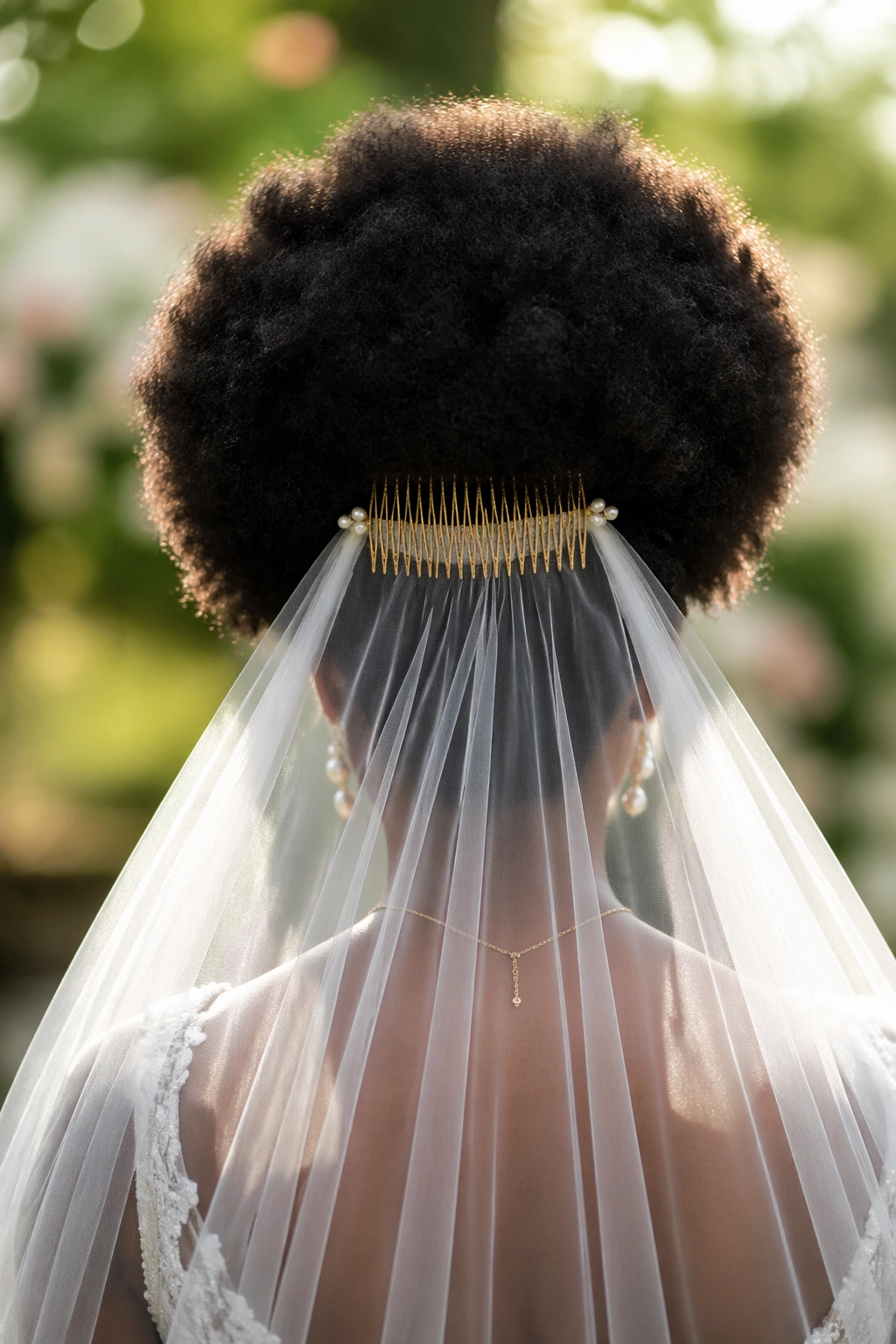
Rather than attaching the veil inside an updo, the veil drapes over the outside of a large natural afro puff — resting on top of the afro and cascading down the back. The afro becomes the veil’s support structure.
The effect is completely different from a veil attached to straight hair. The veil sits higher — elevated by the afro volume — and the edge of the veil at the front of the afro creates a soft, translucent frame around the natural hair. Photographed from the back, the veil emerging from a natural afro silhouette is stunning.
The veil comb must be long enough to anchor through the full volume of the puff into the hair at the scalp level. A standard veil comb may not reach. Use a longer comb or supplemental pins on either side.
16. Protective Style Bridal Look — Box Braids
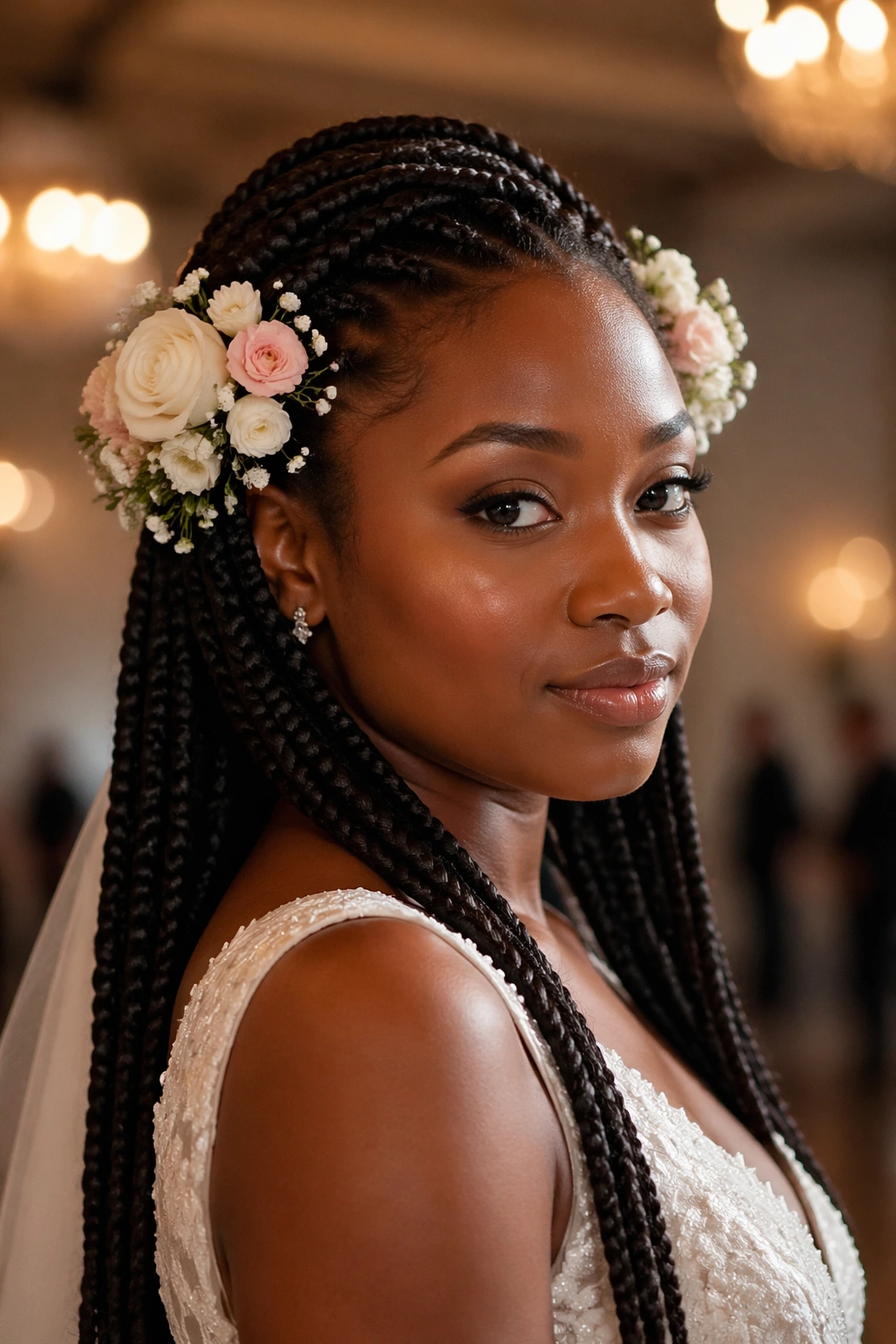
Marrying in your box braids — not as a placeholder until you could do something “better,” but as an intentional, beautiful bridal choice — is completely valid and genuinely lovely.
Box braids on a bride: dress them with a cluster of fresh flowers placed at the temples. Gather them half-up with a satin ribbon tie. Let them fall completely free. Any of these options produces a look that is distinctly yours.
The practical advantage: your hair is in a protective state on your wedding day. No heat damage. No styling anxiety. No midday frizz check. Your hair will look exactly the same at ten in the morning as it does at ten at night.
17. High Twisted Updo with Cascading Curls
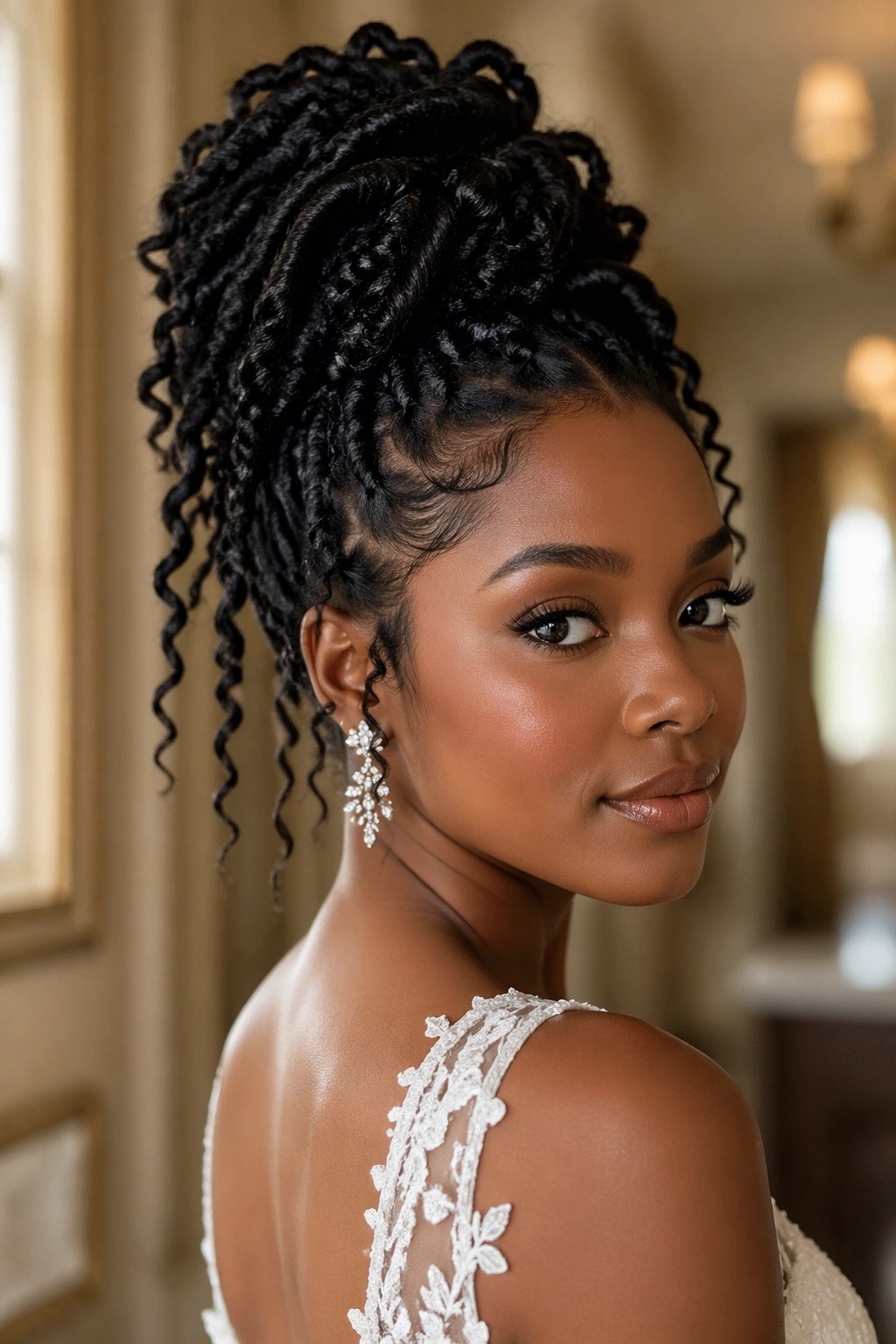
Gather the hair at the crown and twist the gathered section tightly upward. As you coil the twist into a bun shape, allow some sections to escape the coil intentionally — these become cascading individual curls that fall from the top of the bun.
The result is an updo that’s structured at the base but has free, falling curls at the top — a combination of contained and romantic. The cascading sections should be defined (use a cream or flexi rod the night before to pre-define them) so they fall as distinguishable spirals rather than general frizz.
How to Get the Most From It
Choose three to five sections to leave as cascading pieces. The number depends on your hair density. Too few looks sparse at the top; too many makes the updo look like it’s falling apart. Three or four well-defined cascading curls above a clean, pinned base is the right proportion.
18. Lemonade Braid Style for Weddings
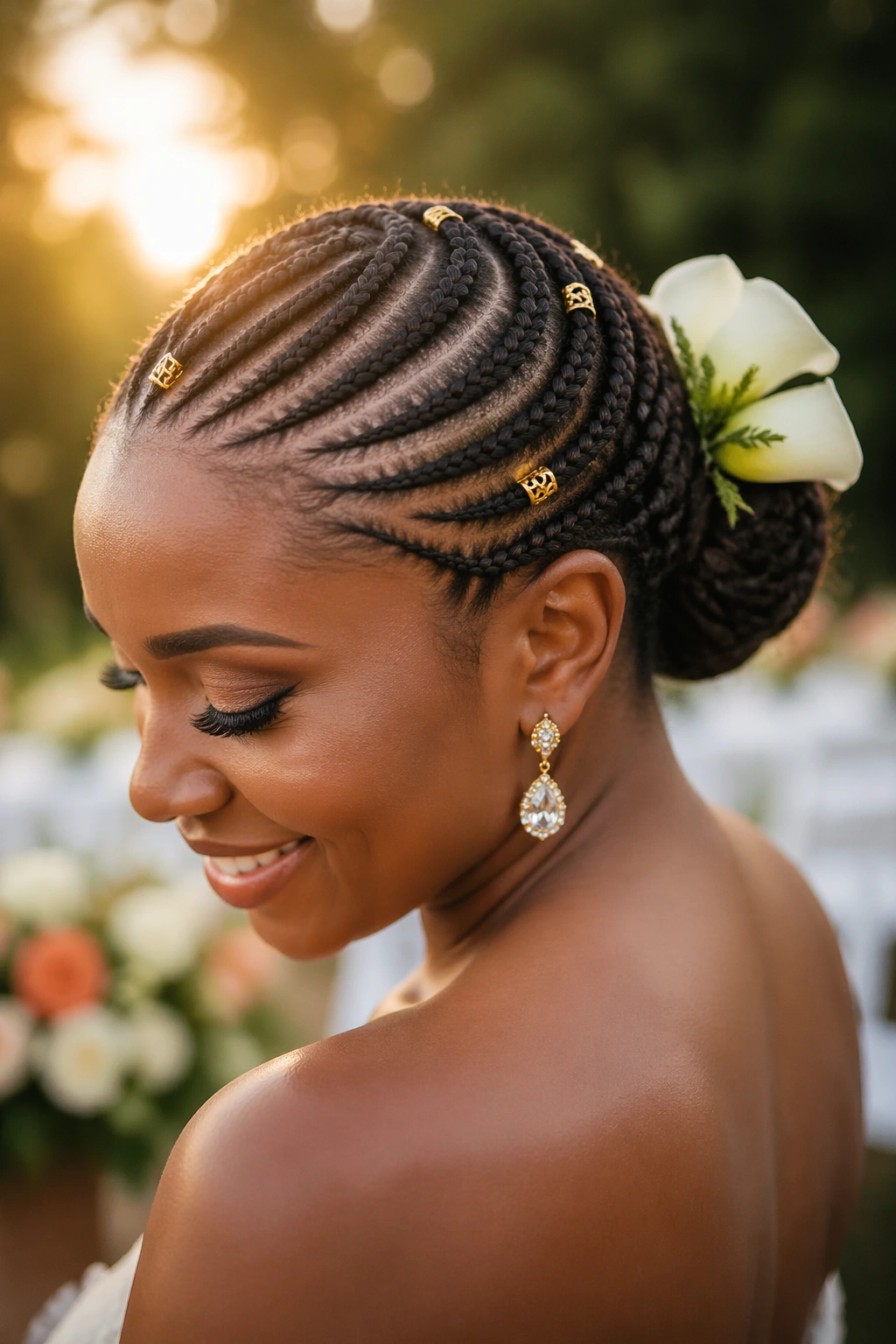
Side-swept cornrows — braided from the front hairline, angled across the head, and gathered at the nape — in the style made famous by a particular iconic album era. For a wedding, the braids are smaller and more precise than the fashion-forward large version, and the gathered ends are formed into a bun or coil at the nape.
Gold jewelry threaded into the visible braids. A fresh flower pinned at the bun gathering point. A clean, precise edge around the hairline. This reads formal and bridal on a natural hair level that many conventional styles don’t.
19. Natural Hair Mohawk Bun
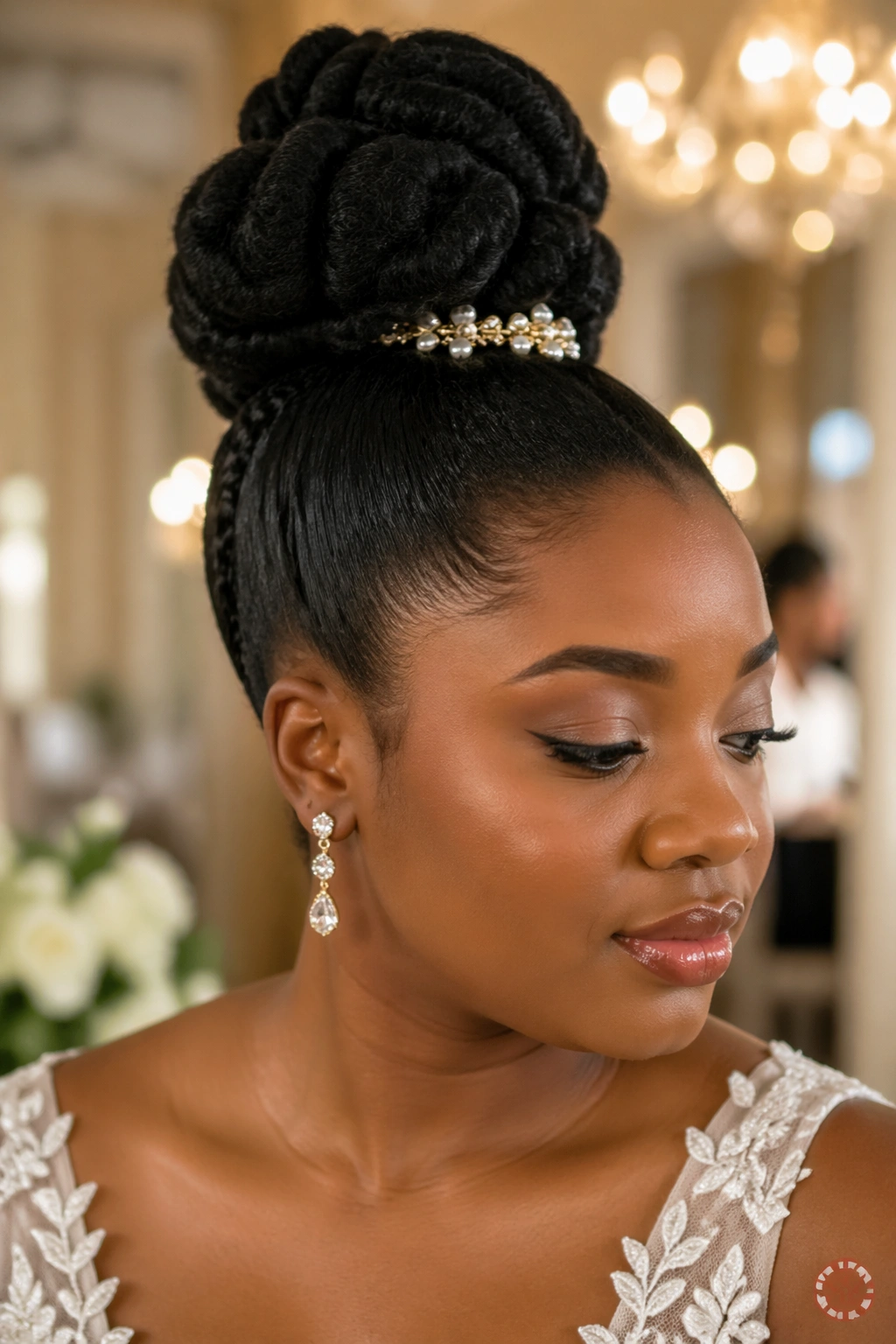
The sides of the hair gathered flat and pinned; the center section twisted upward into a high vertical bun rather than a fan shape. The mohawk shape comes from the silhouette — sides flat, center elevated — but the elevation is a bun rather than an open fan.
This creates a more compact, more contained version of the frohawk that’s better suited to formal settings. The bun at the crown reads bridal and polished. The flat sides read intentional and structured. Together, the combination is bold without being experimental.
Gold or pearl pins placed at the base of the bun where it meets the flat sections add the formal detail that finishes the look.
20. Bridal Goddess Locs Updo
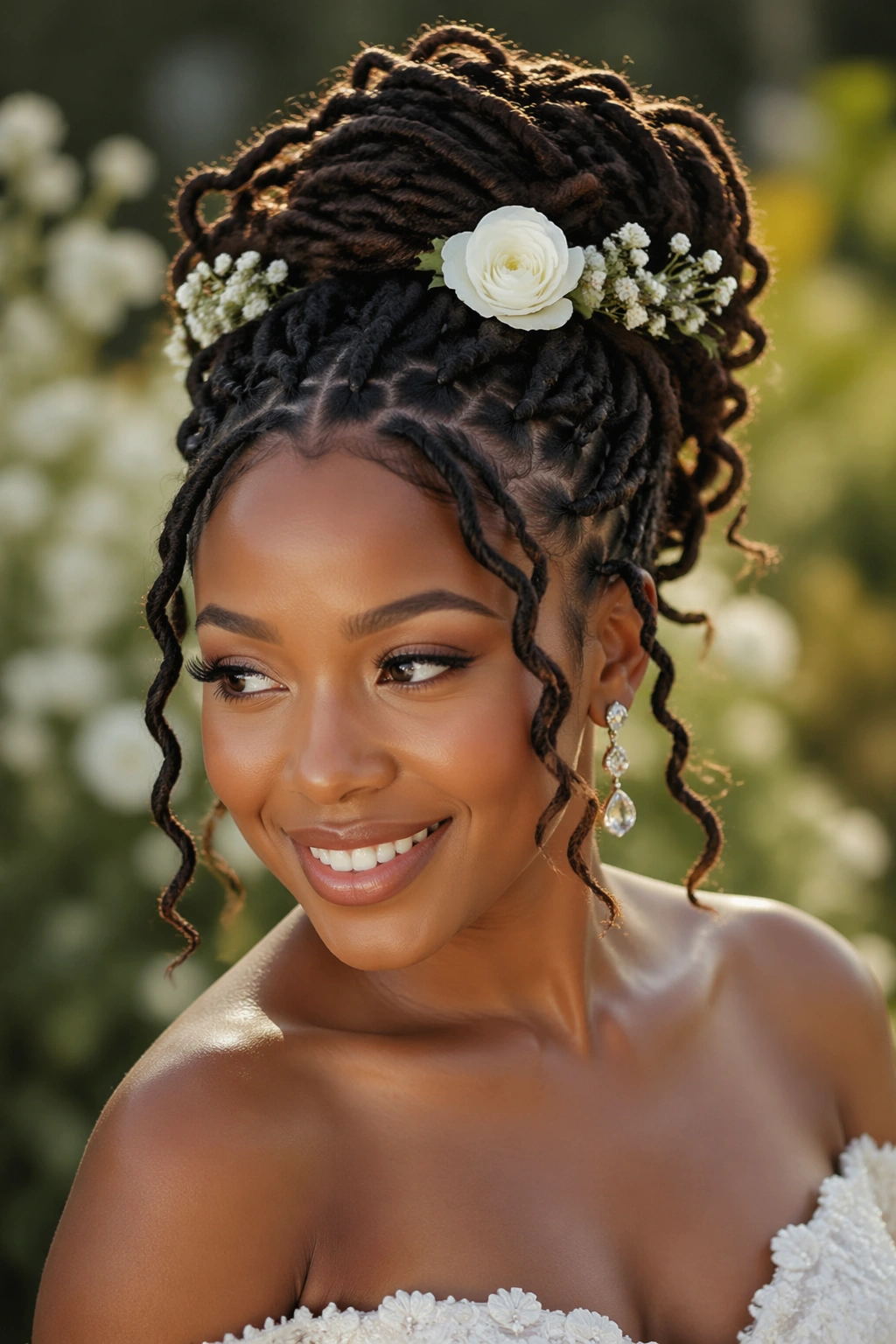
Goddess locs — the faux loc style with curly or wavy texture incorporated into the loc — gathered into a dramatic updo for a wedding. The curly texture in goddess locs gives the gathered updo a softer, more romantic quality than regular faux locs.
A loose, high pileup of goddess locs — not tightly wound, but loosely arranged and pinned — with a few individual locs falling at the face creates one of the most visually rich and romantic bridal styles available.
Fresh flowers placed directly into the gathered pile of locs — stems tucked deep enough to hold — complete this look beautifully. The flowers contrast with the earthy texture of the locs in a way that reads organic and intentional.
21. Side-Swept Twist-Out Bridal Style
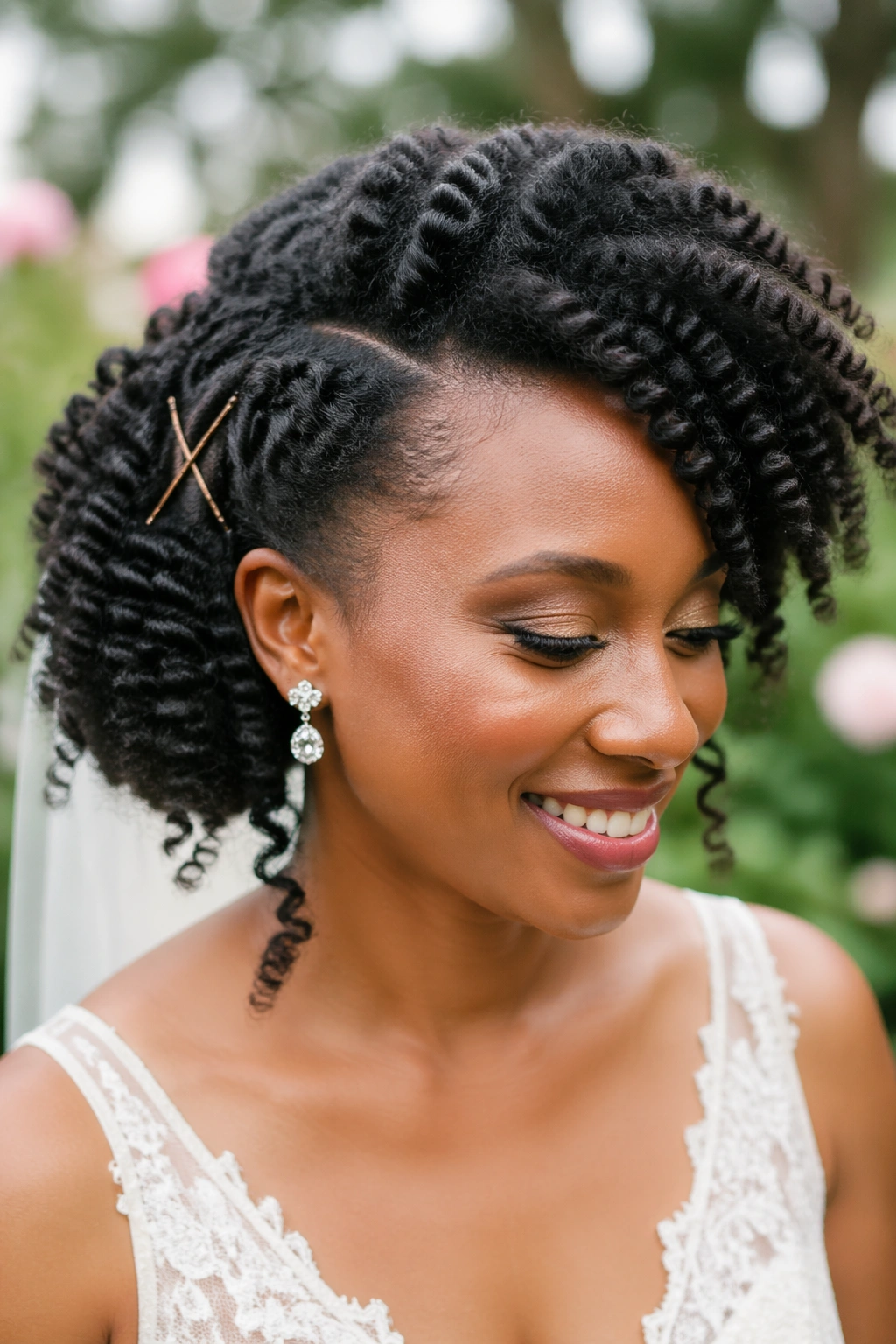
A fully set twist-out — done the night before — unraveled on the wedding morning and then gathered and swept dramatically to one side. The twist-out pattern is visible throughout the swept style, giving it wave and texture.
The sweep is secured with crossed bobby pins at the low temple on the side the hair sweeps toward. The hair piles on that side in a soft, imperfect gather rather than a tight structured bun. Leave a piece or two free at the opposite temple for face framing.
This is one of the more romantically undone bridal styles — it has the feeling of hair being swept by a breeze rather than locked in place. For outdoor weddings, ceremonies in garden settings, or brides whose overall aesthetic leans soft and romantic, it’s a natural fit.
22. Afro Brides with Kente or Ankara Hair Wrap
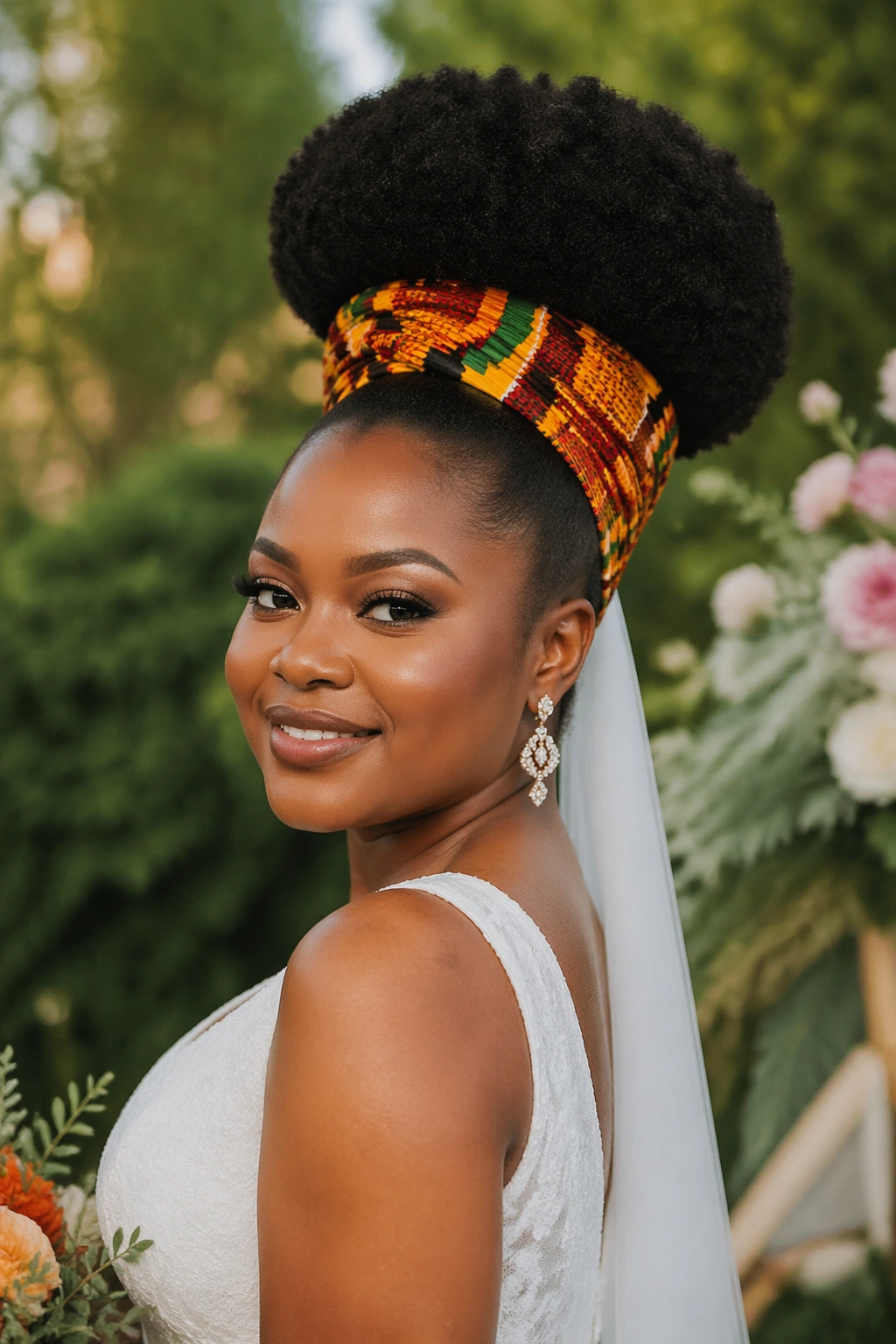
A section of kente cloth, ankara print, or similar culturally significant fabric wrapped around the base of an afro puff or incorporated into a twisted updo. The fabric serves simultaneously as an accessory and as a celebration of heritage.
The wrap can replace a conventional bridal headpiece, or sit alongside a veil as an additional element. Brides who are incorporating cultural elements throughout their wedding — in the ceremony, the dress, the décor — often find that an Ankara wrap in the hair ties together all of those choices in one visible, personal way.
Choose fabric that complements the dress in scale and color. A bold, large-print Ankara against a simple white dress is the classic combination. A smaller geometric pattern in a coordinating palette reads slightly more integrated.
23. Twisted Bridal Half-Updo with Jasmine or Baby’s Breath
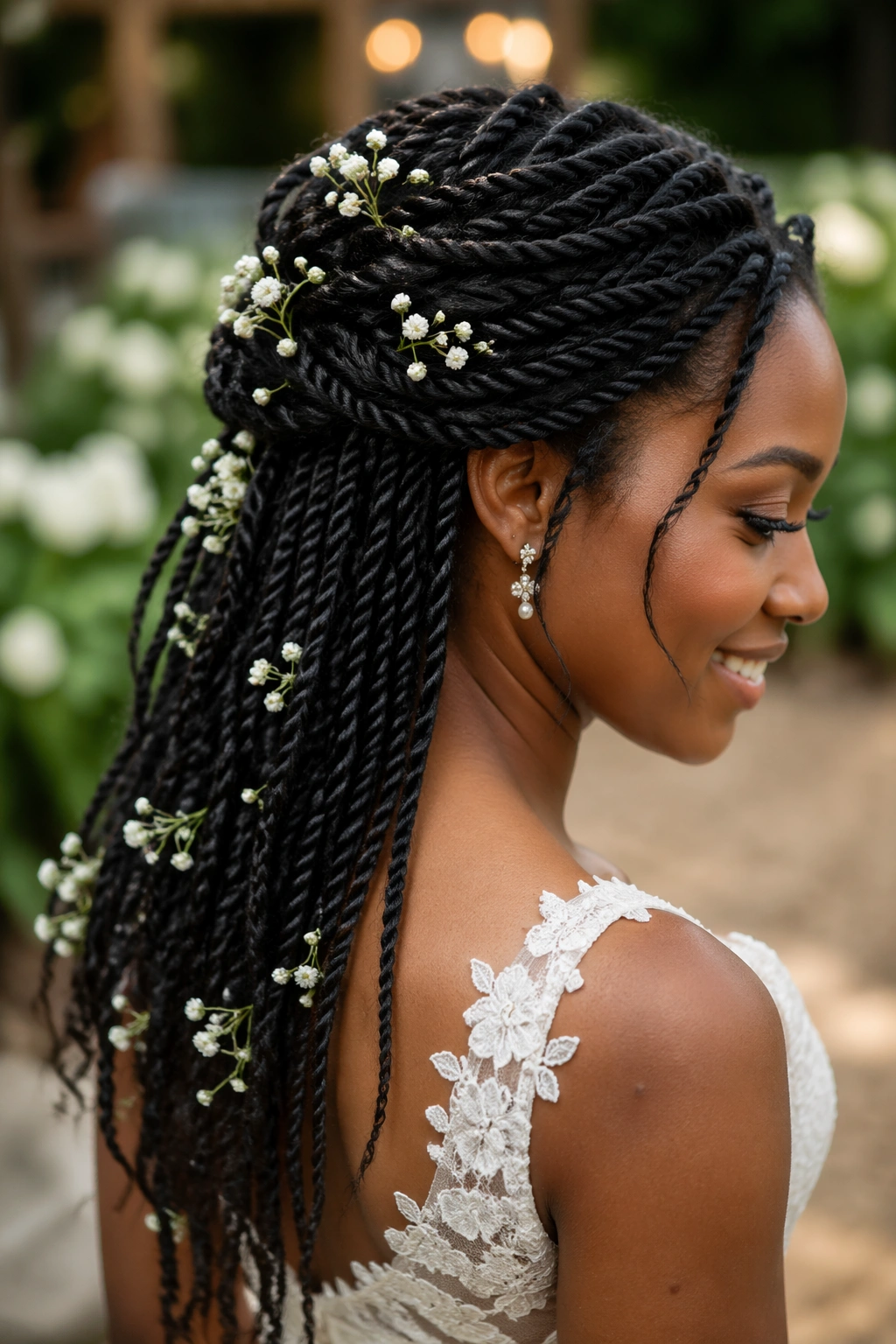
Similar to the half-updo from earlier in this list, but with specific flower choices: jasmine or baby’s breath, used in small clusters pinned throughout the twisted upper section.
Both jasmine and baby’s breath have a delicacy and lightness that suits natural afro hair without weighing it down visually. The small individual flowers can be distributed throughout the twists at the crown without looking heavy or overdone.
This is the most traditionally romantic natural bridal style on the list. The combination of twisted natural texture and small white flowers is simple, beautiful, and completely timeless.
24. Regal High Updo with Sculptural Volume
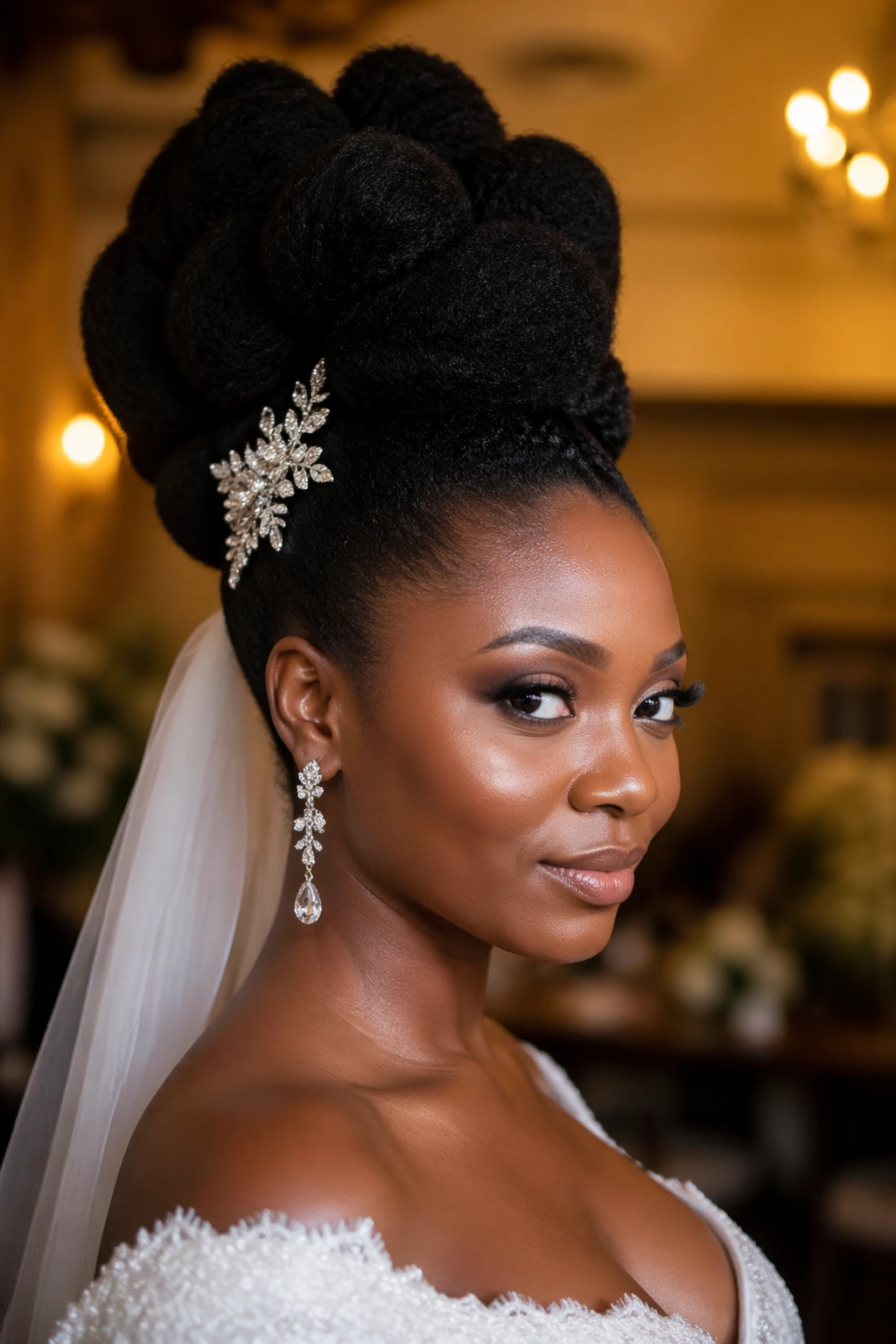
An updo that maximizes height — gathering the hair at the very top of the crown, building it upward rather than outward, creating a tall vertical silhouette rather than a wide horizontal one. This reads regal in the most literal sense.
The technique involves gathering the hair not just to the crown level but actively building height by folding gathered sections under themselves and anchoring them in place. Additional volume from a hair donut hidden inside the bun structure is helpful for lower-density hair.
A tall, structured updo reads more regal and less accessible than most other styles — it announces itself from across the room. For brides who want their entry to be a moment, this is it.
25. Minimalist Afro with Single Statement Accessory
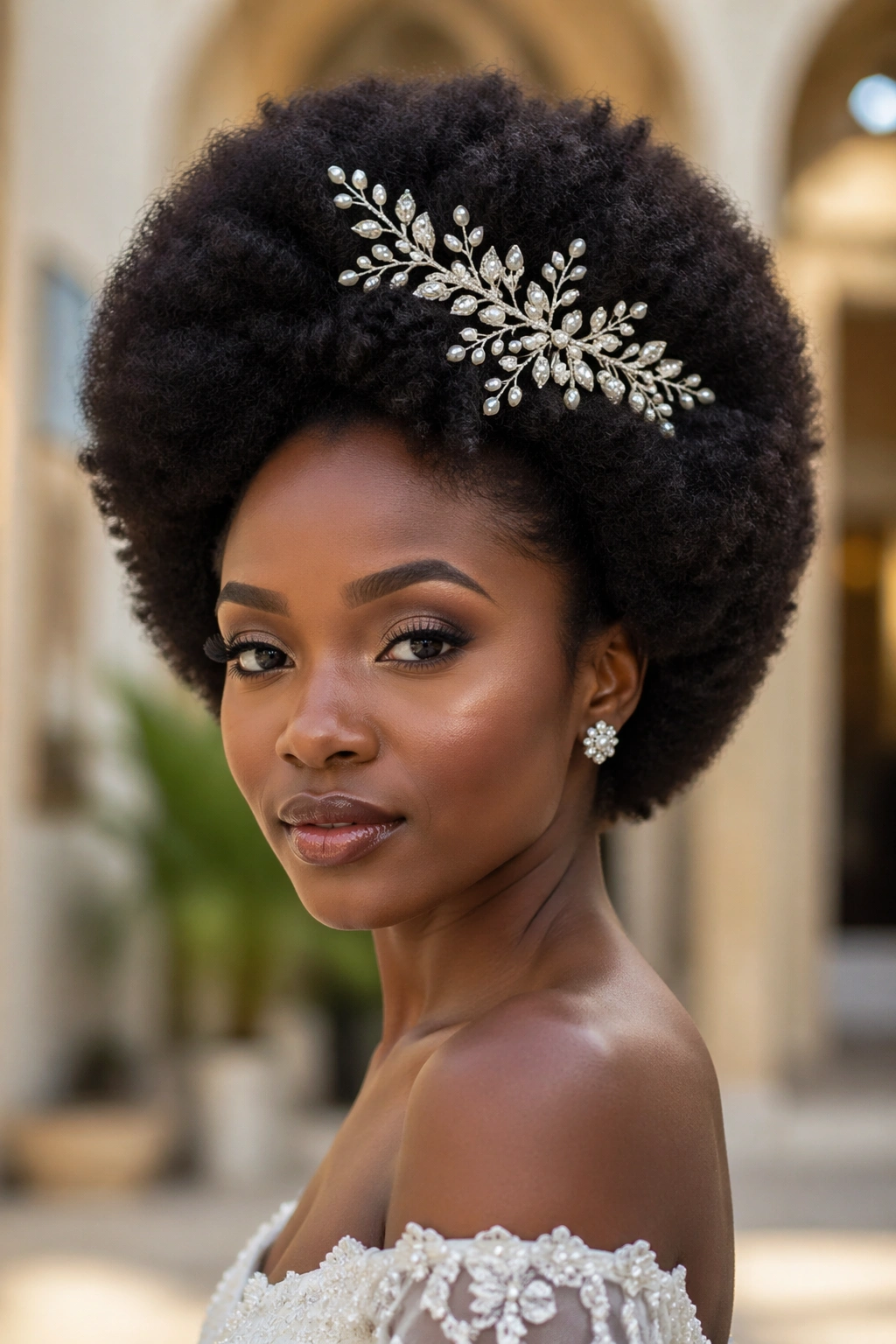
A single large bridal accessory — a sculptural gold headpiece, a wide jeweled band, or a large decorative comb — against a clean, simply-styled natural afro. Nothing else.
The restraint is the style. When natural afro hair is the feature — when the volume, the texture, the color are allowed to speak without competition — the right single accessory at the right placement elevates everything without cluttering it.
This requires confidence. No veil to soften it, no multiple accessories to fill the visual space. Just the hair and one choice. For the bride who is certain in her beauty, this is the most powerful option on this list.
26. Afro with Bridal Headband and Cascading Length
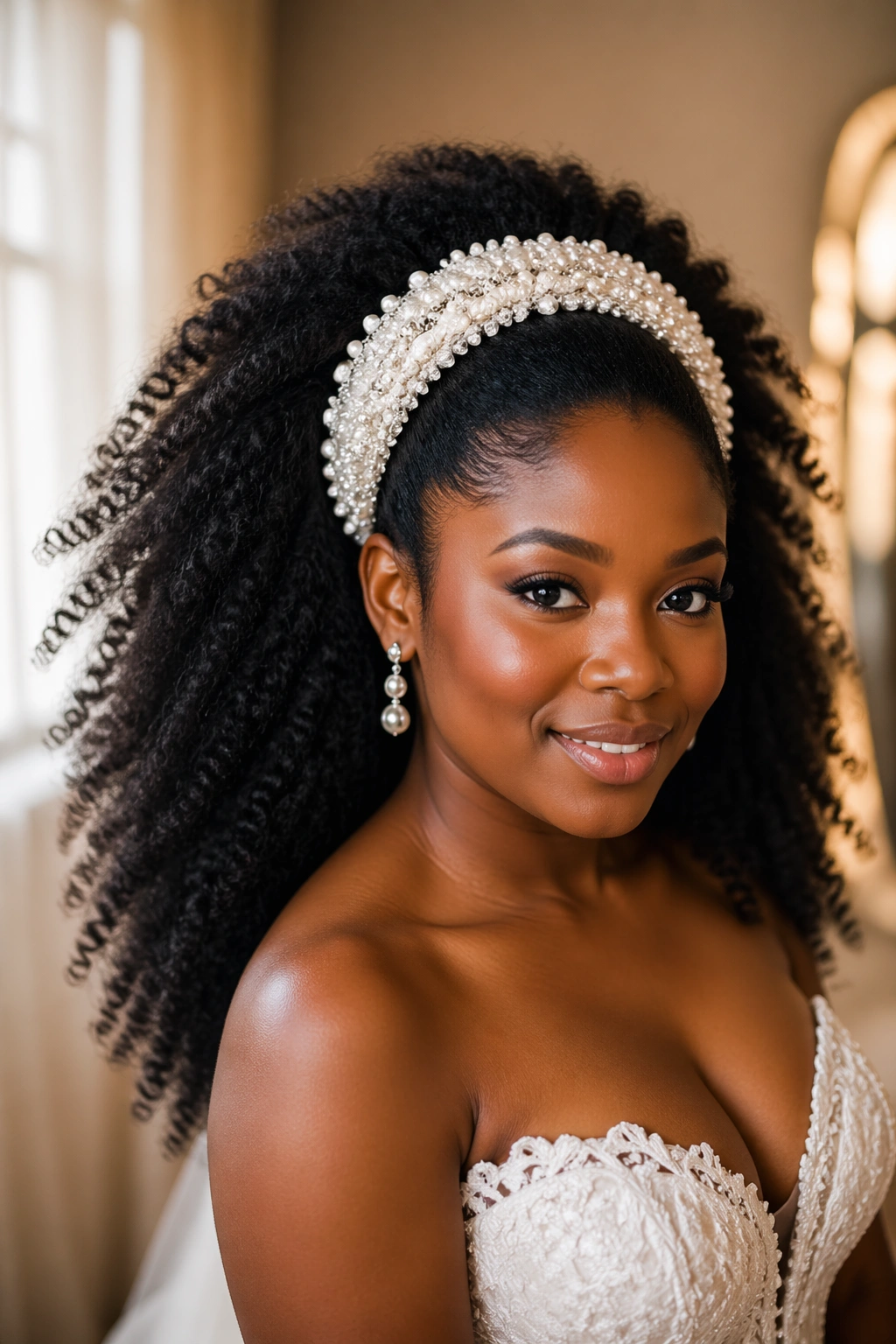
A wide bridal headband — fabric, embellished, or floral — placed across the top of a natural afro or half-up style, with the hair cascading behind and below it in its natural state.
The headband gives structure to the front of the look without requiring an updo. Everything behind the headband falls freely. The length and texture of the natural hair — particularly if it’s on the longer end of medium or genuinely long — creates a cascading effect behind the headband that’s visually dramatic.
The headband also provides practical benefits: it keeps the front sections smooth throughout the day without requiring edge touch-ups, and it gives a stable attachment point for a secondary accessory like a small veil comb.
27. Intricate Natural Updo with Multiple Techniques
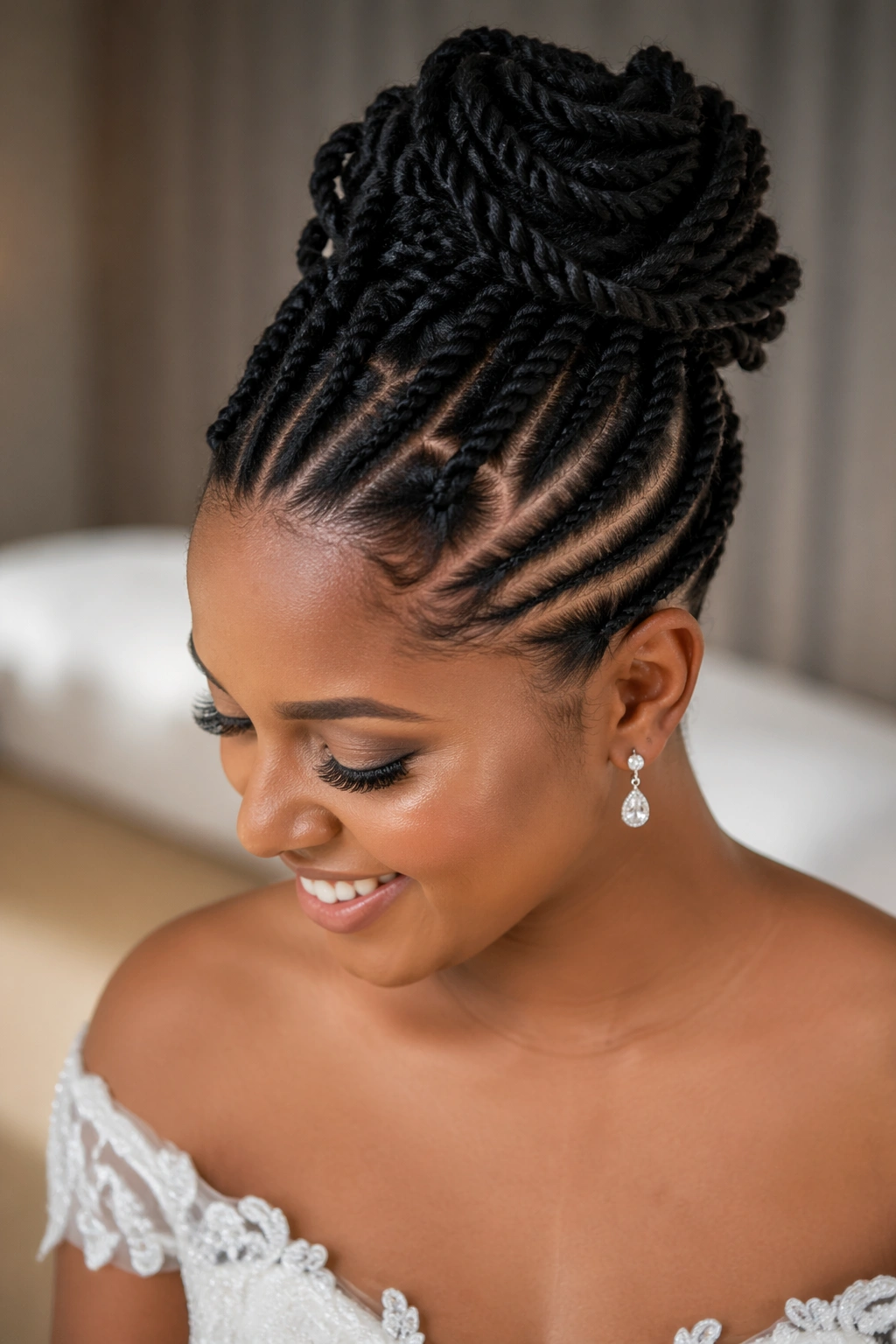
This is the style for the bride who wants the most technically ambitious natural bridal look possible. It combines flat twists at the front, cornrows at the sides, and a gathered twisted bun at the crown — three different techniques used in the same style, each visible in its own section.
The front flat twists create structured detail near the face. The cornrows at the sides provide a cleaner, flatter section above the ears. The bun at the crown draws the whole design together and provides the elevated finish point.
Installation time: three to four hours. This is a professional stylist appointment, not a DIY morning project. But the result is a wedding hair look that cannot be mistaken for anything other than exactly what it is — masterful natural hair styling at its highest level of intention.
28. Natural Braid Crown (Full Halo Braid)
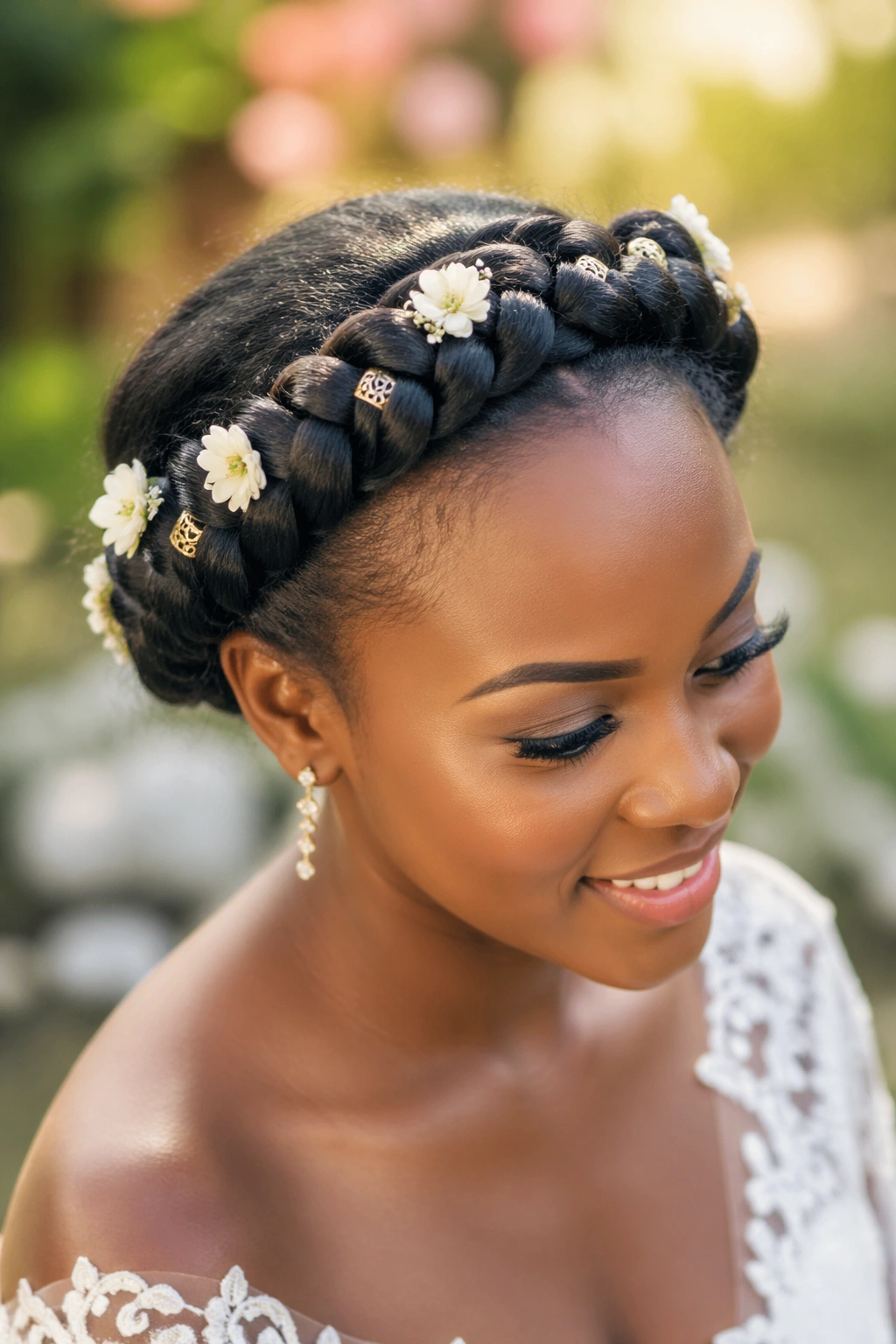
Braids — natural or extension-enhanced — braided around the full perimeter of the head in an unbroken circle, meeting at the top to create a true halo crown of braiding.
The halo braid has been worn in various forms across cultures for centuries. On natural afro hair, with the texture of African braiding and the occasional glint of gold or pearl accessories threaded through the braids, it carries a historical and cultural weight that most other bridal styles don’t.
No bun. No puff. No gathered section. Just the crown of braids, sitting on the head like a wreath, encircling the face in a frame that’s both structural and deeply beautiful. Soft flowers tucked into the braid at intervals, or gold cuffs placed at strategic points in the circle, complete the look.
This is the style that is genuinely unlike anything else in bridal hair styling. It does not look like a version of a straight-hair style. It is entirely its own thing.
Caring for Your Natural Hair in the Weeks Before the Wedding
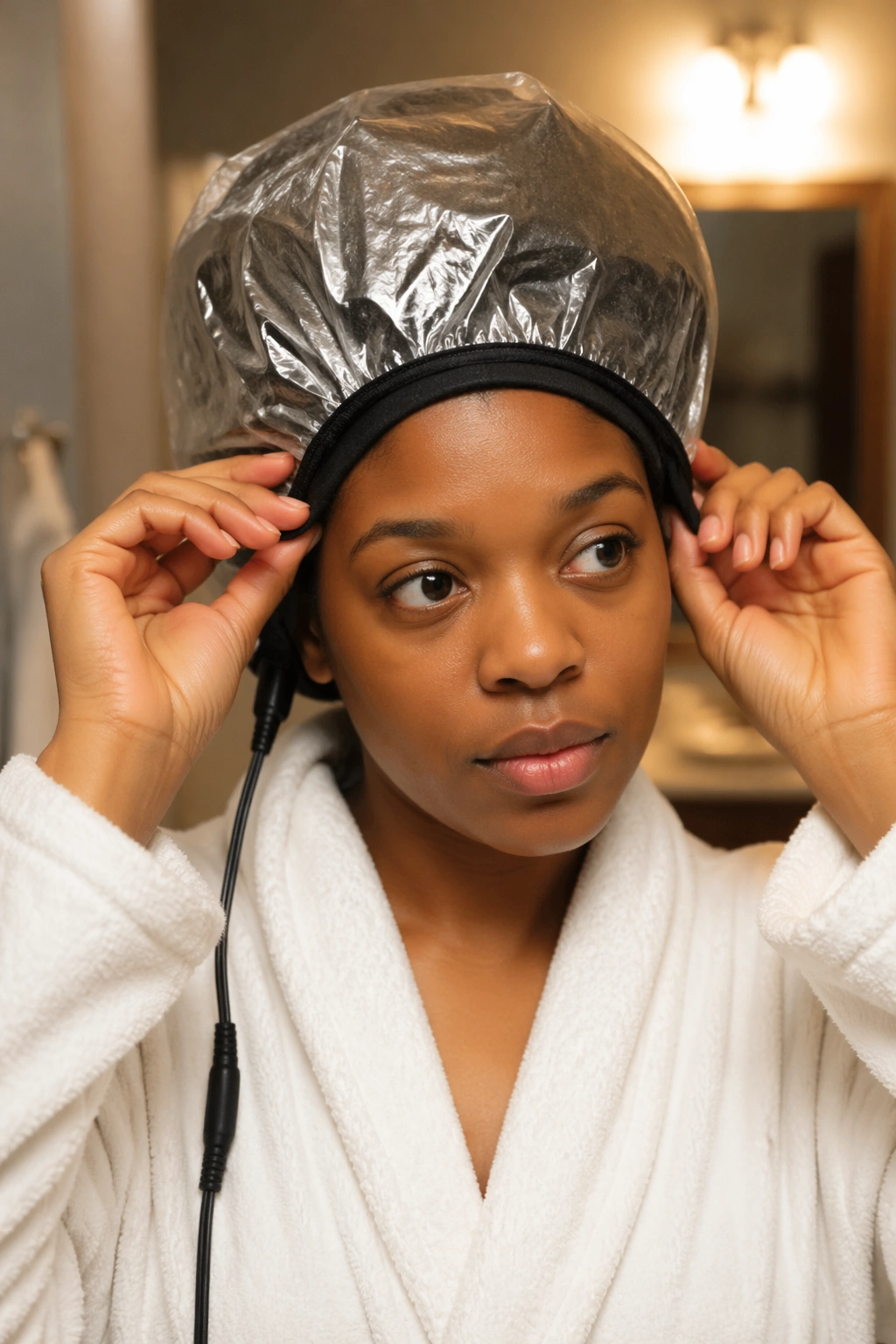
The eight to twelve weeks before your wedding are when your hair health decisions have the most impact on your wedding-day result.
Deep condition weekly, without exception. A hair mask that stays on for thirty minutes under heat — a hooded dryer, a heat cap, or even warm towels wrapped around a plastic cap — penetrates more deeply than a rinse-out conditioner. Do this every single week.
Protective style during this period. Every week your ends spend in a free, unprotected state is a week of potential split-end damage. Twist them up, braid them, tuck them away. Let them rest so they arrive at your wedding day in the best possible condition.
Avoid heat entirely for at least four to six weeks before the wedding. This preserves the curl pattern and prevents the heat damage that can take months to repair. Your bridal photos will show natural curl definition that flat-ironed hair simply cannot produce.
Trim any true split ends — not a major trim, just a clean-up of splits — about three weeks before the wedding. Freshly trimmed ends reflect more light and hold styles more cleanly than ragged ends do.
Communicating With Your Natural Hair Stylist
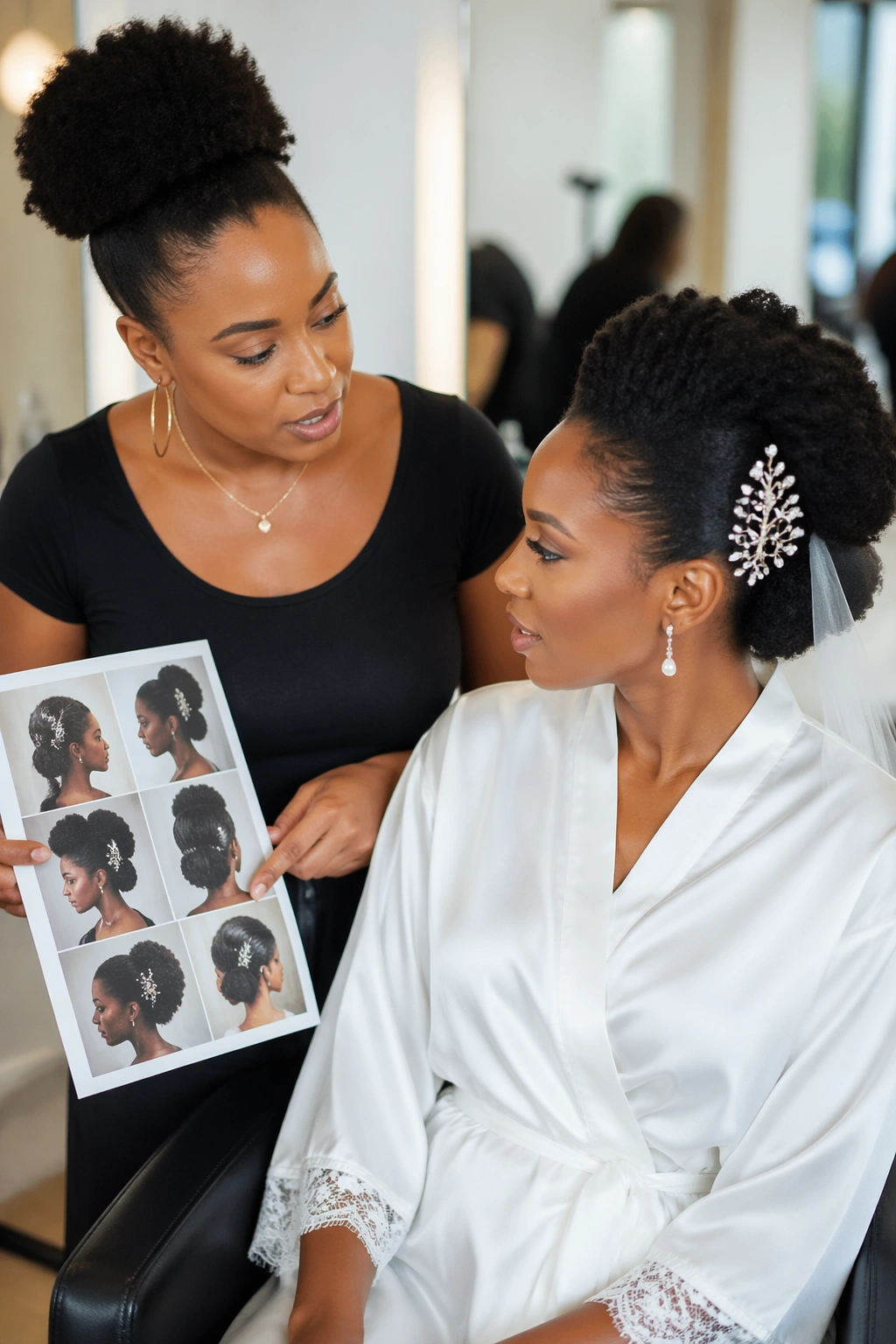
If you’re working with a professional for your wedding day hair, the communication you have before the appointment is as important as the appointment itself.
Come prepared with photos — not just the style you want, but your hair texture, your hair length, your density. Show examples of your own hair so the stylist can see what they’re working with before you arrive. Come with reference photos of what you like and what you don’t, and be specific about what elements appeal to you in each photo.
Ask directly: Has this stylist worked with 4C hair, or predominantly 3B? The two require different product choices and different timing. A stylist who is experienced across the full natural hair spectrum is a different resource than one who primarily works with a single texture.
Ask about product choices. If you have a product sensitivity or a reaction to specific ingredients, this is the conversation where it comes up — not on the wedding morning.
On the Wedding Morning
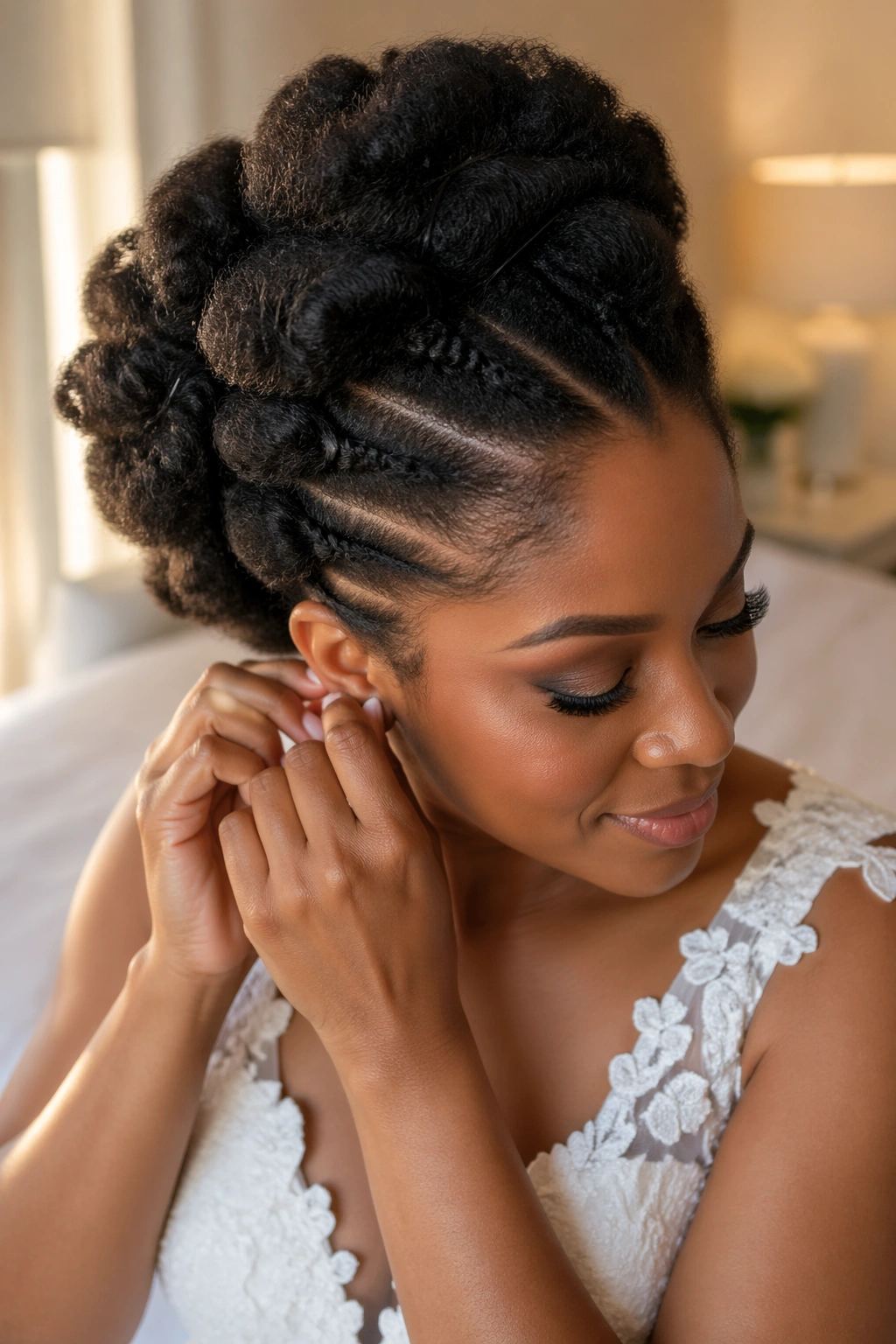
Wake up with enough time. Natural hair bridal styles take longer than their straight-hair equivalents, particularly if intricate braiding or flat twisting is involved. Build in an extra thirty minutes beyond the time your stylist quotes you.
Eat breakfast before the hair appointment. Low blood sugar makes you impatient and uncomfortable — both of which affect how well you tolerate sitting for a long styling session.
Have the accessories ready and organized before the stylist arrives. Pins should be counted and accessible. The veil should be in one place. Flowers, if fresh, should be in water until the moment they’re placed.
And when it’s done: stand in front of a full-length mirror before you put on the dress and look at your hair. Your natural afro hair, on your wedding day, however you chose to wear it — that is entirely, beautifully, powerfully yours.
