



Curly hair and wedding ponytails are a better match than most people think. Texture gives you movement for free, and movement is half the charm in a bridal look. A ponytail can feel crisp, romantic, modern, or softly undone depending on where it sits and how much you let the curls breathe.
The trick is not flattening curly hair into a shape it never wanted. A good wedding ponytail for curly hair keeps the crown controlled, protects the curl pattern, and still leaves enough bounce that the style looks alive after hours of photos, hugs, and one too many spins on the dance floor. That balance matters more than perfection ever will.
Most of the bad curly ponytail advice comes from treating curls like they need to be “fixed.” They don’t. They need direction. Brush a curl dry and you get puff. Pull the base too tight and the style looks severe. Put the ponytail in the wrong spot and the whole thing fights the neckline of the dress. None of that is hard to avoid, but it does take a sharper eye than a quick twist and a spray.
The best wedding ponytails for curly hair work with the curl, not against it — and the details decide whether the style looks casual or ceremony-ready.
1. Sleek Low Curly Ponytail with Face-Framing Pieces
A sleek low curly ponytail is one of those styles that looks understated until you see it in the right dress. The crown stays smooth, the ponytail sits at the nape, and the curls hang with just enough softness to keep the look from feeling stiff. It’s especially good if you want your earrings, neckline, or veil to do some of the talking.
Why It Works
The polished root gives the style structure. The curly length gives it life. That contrast is what makes it feel intentional instead of tossed together at the last minute.
Keep two face-framing pieces loose, not wispy. One on each side is enough. Any more and the style starts to drift toward messy, which is a different mood altogether.
- Best for square, scoop, or off-the-shoulder necklines.
- Works well with medium to thick curly hair.
- Looks strongest when the elastic is hidden with a small wrap of hair.
- A light shine cream on the crown helps stop flyaways without making the roots greasy.
Small tip: leave the front pieces a touch longer than you think you need. Curly hair shrinks after styling, and that tiny bit of extra length makes the shape feel softer.
2. High Curly Ponytail with a Wrapped Base
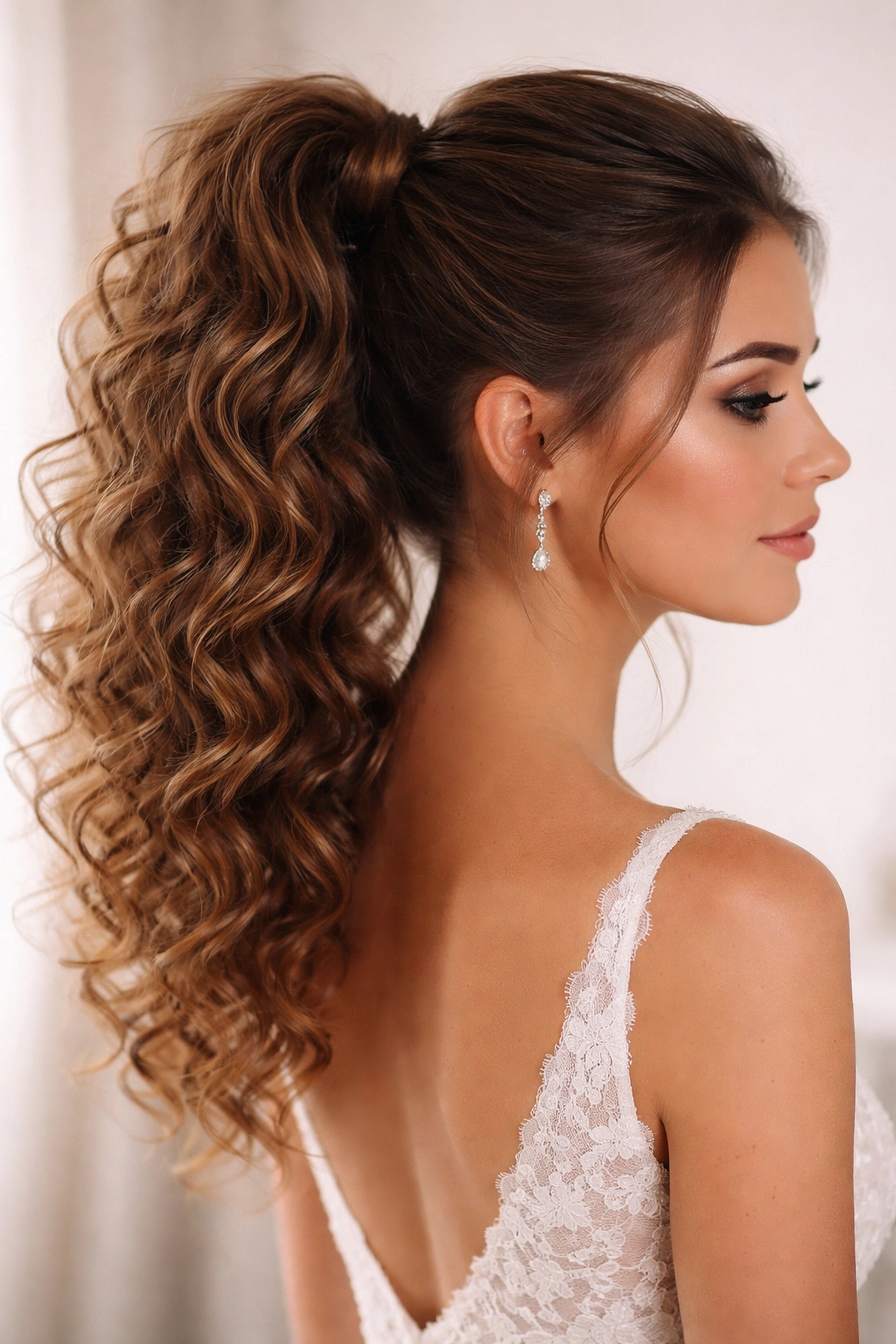
If you want the most energy in one hairstyle, start high. A high curly ponytail lifts the face, shows off the cheekbones, and gives the whole bridal look a little more movement. It also reads clearly in photos from every angle, which sounds basic until you’re scrolling through ceremony shots and realize how many hairstyles collapse from the back.
The wrapped base matters here. A thin section of hair, pinned flat over the elastic, keeps the style looking finished instead of gym-pony casual. If your curls are long, let them hang in a single fall. If they’re layered, pin the top layer a little tighter so the tail still looks full.
This style loves strapless gowns, deep V necklines, and dresses with open backs. It can handle a dramatic veil, too, as long as the base stays secure. For extra support, a stylist will often anchor the ponytail with two crossed bobby pins before wrapping the base. That tiny detail saves the whole thing.
3. Side-Swept Curly Ponytail with a Deep Part
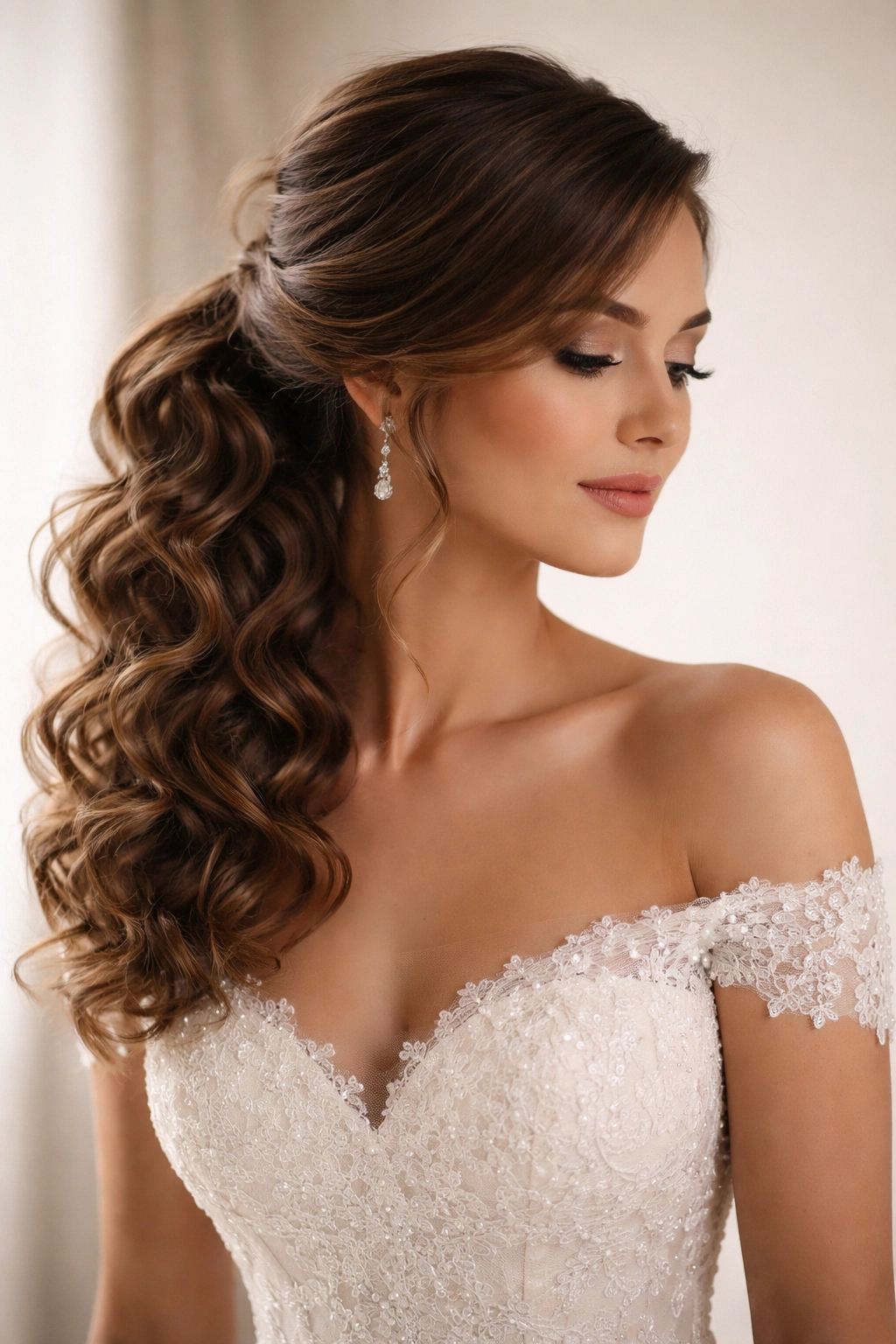
Why does a side-swept ponytail feel so flattering on curly hair? Because asymmetry softens the face without hiding it. A deep side part draws the eye across the forehead, then the ponytail drops to one side and creates a long, elegant line.
The style works especially well if your dress has one shoulder, an angled neckline, or a lot of detail on one side. You can tuck the flatter side behind the ear and leave the fuller side to frame the face. It’s a small change, but it changes the mood of the whole look.
How to Style It
- Part the hair while it is still damp, then set the part with a comb before drying.
- Gather the ponytail just behind the ear, not dead center at the back.
- Use one decorative pin near the base if you want a focal point.
- Keep the curls defined, not brushed out. The shape should feel soft, not fuzzy.
A side-swept ponytail is one of the easiest ways to make curly hair feel bridal without overworking it.
4. Bubble Ponytail with Defined Curls
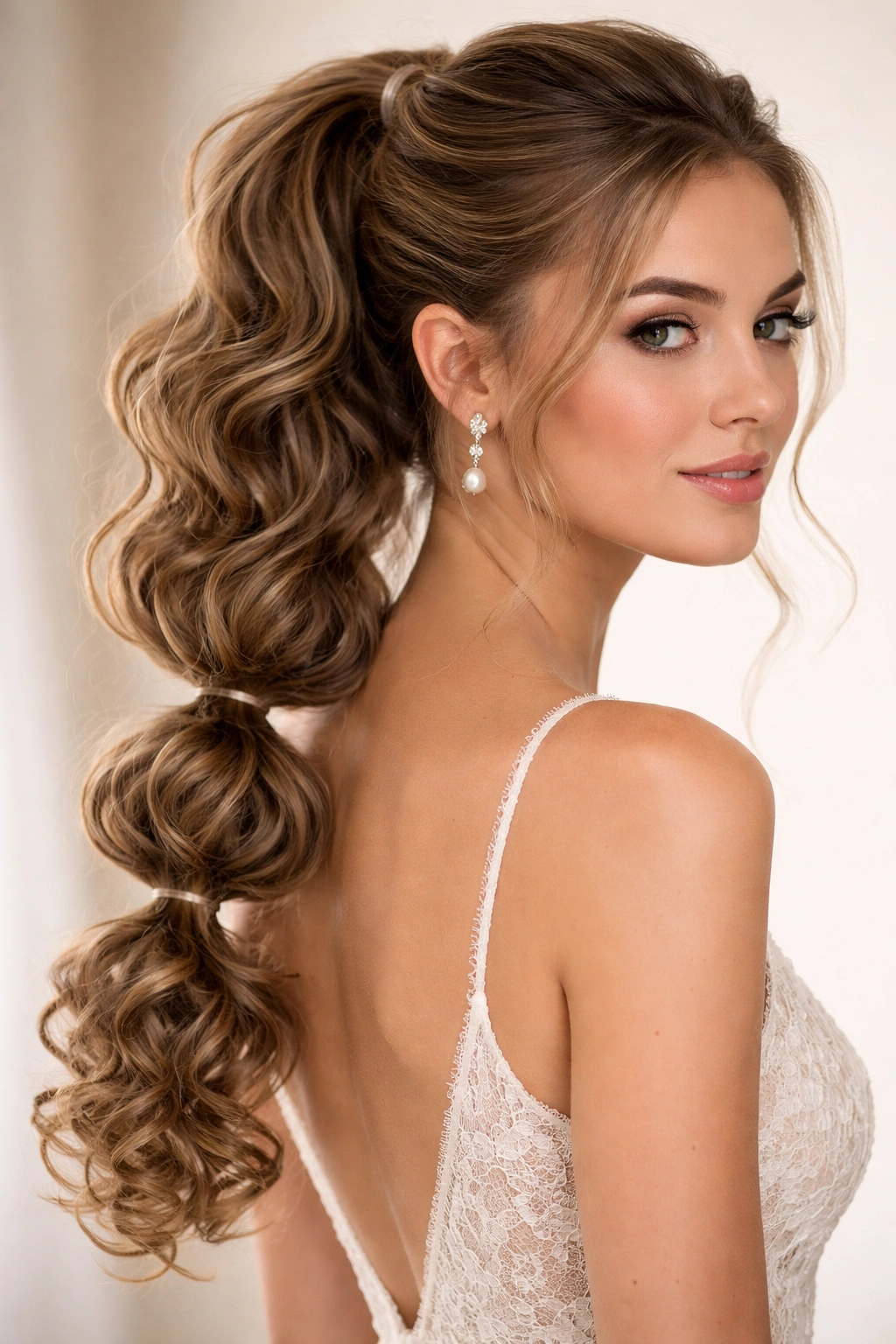
Picture a curly tail broken into three or four soft bubbles, each one puffed out just enough to show off the texture inside. That’s the charm here. A bubble ponytail gives structure to curly hair without forcing it into a rigid braid or a tight knot, and it has a playful, polished edge that still feels right for a wedding.
The spacing matters. Keep the elastics about 2 to 3 inches apart, then gently pull each section outward until the bubbles look round but not oversized. If the hair is very curly, the bubbles will look fuller with less effort than straight hair would need. That’s half the appeal.
This style works well for brides who want something memorable but not fussy. It also survives dancing better than a loose, single-length ponytail because each bubble helps support the next one. If the dress is simple, this hairstyle brings the detail. If the dress already has plenty going on, keep the bubbles smaller and cleaner.
5. Low Ponytail with a Velvet Ribbon
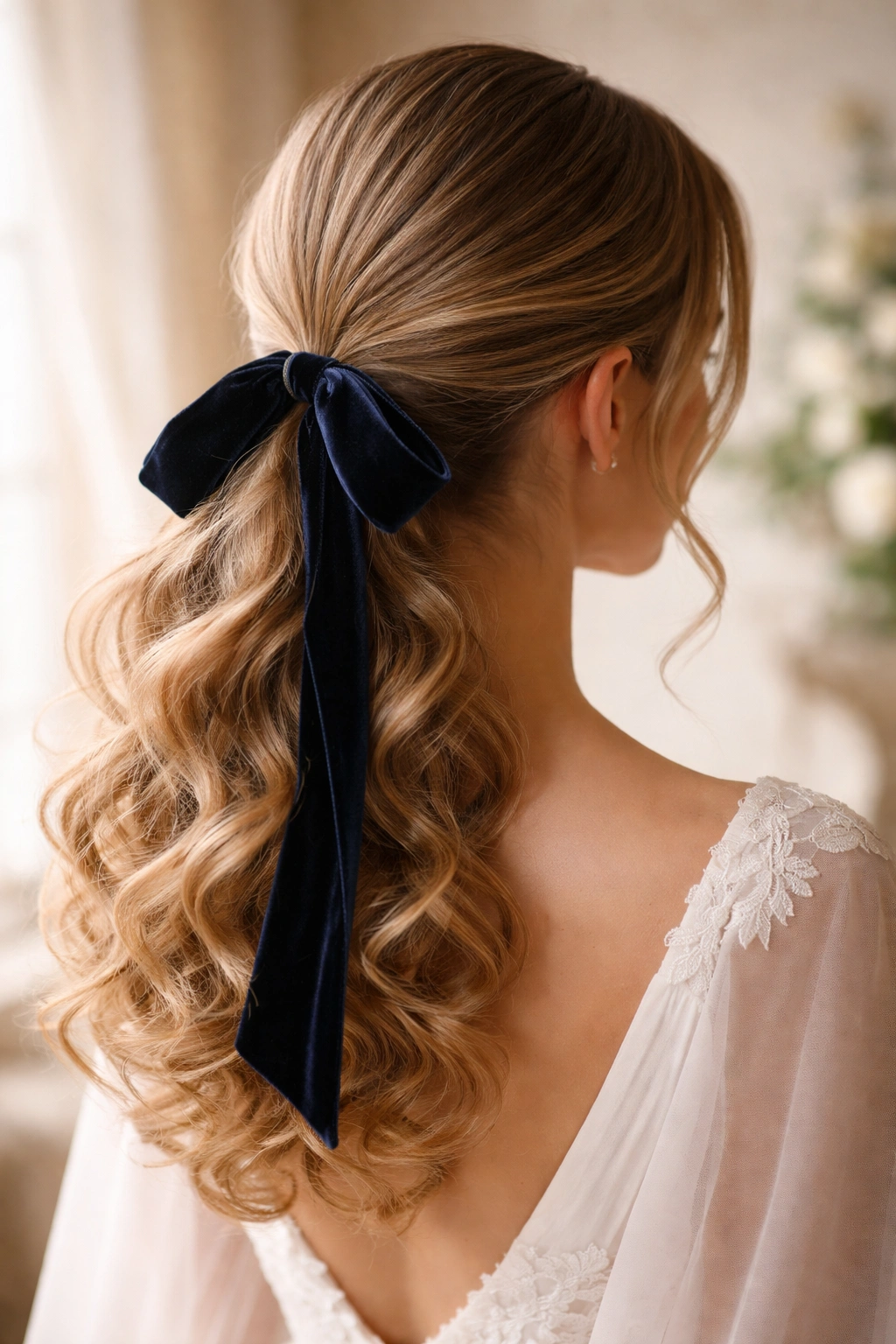
A velvet ribbon changes a low curly ponytail fast. Not in a loud way. In a better one. The ribbon gives the style a point of focus, softens the elastic, and adds a little old-world charm without making the hair itself busier.
I like this version when the rest of the look is clean: satin gown, pearl studs, minimal veil, maybe a bouquet with soft stems. The ribbon should feel like a deliberate choice, not a craft-store afterthought. A width of about 1 to 2 inches usually looks right. Too narrow and it disappears. Too wide and it starts to take over.
The bow can sit under the ponytail for a discreet finish or slightly off-center if you want a more relaxed feel. Velvet holds shape well and photographs with a rich texture, while satin reads smoother and a little brighter. Either one works, but choose one. Mixing ribbon textures with a heavily detailed gown can get noisy fast.
6. Half-Up Curly Ponytail with Crown Volume
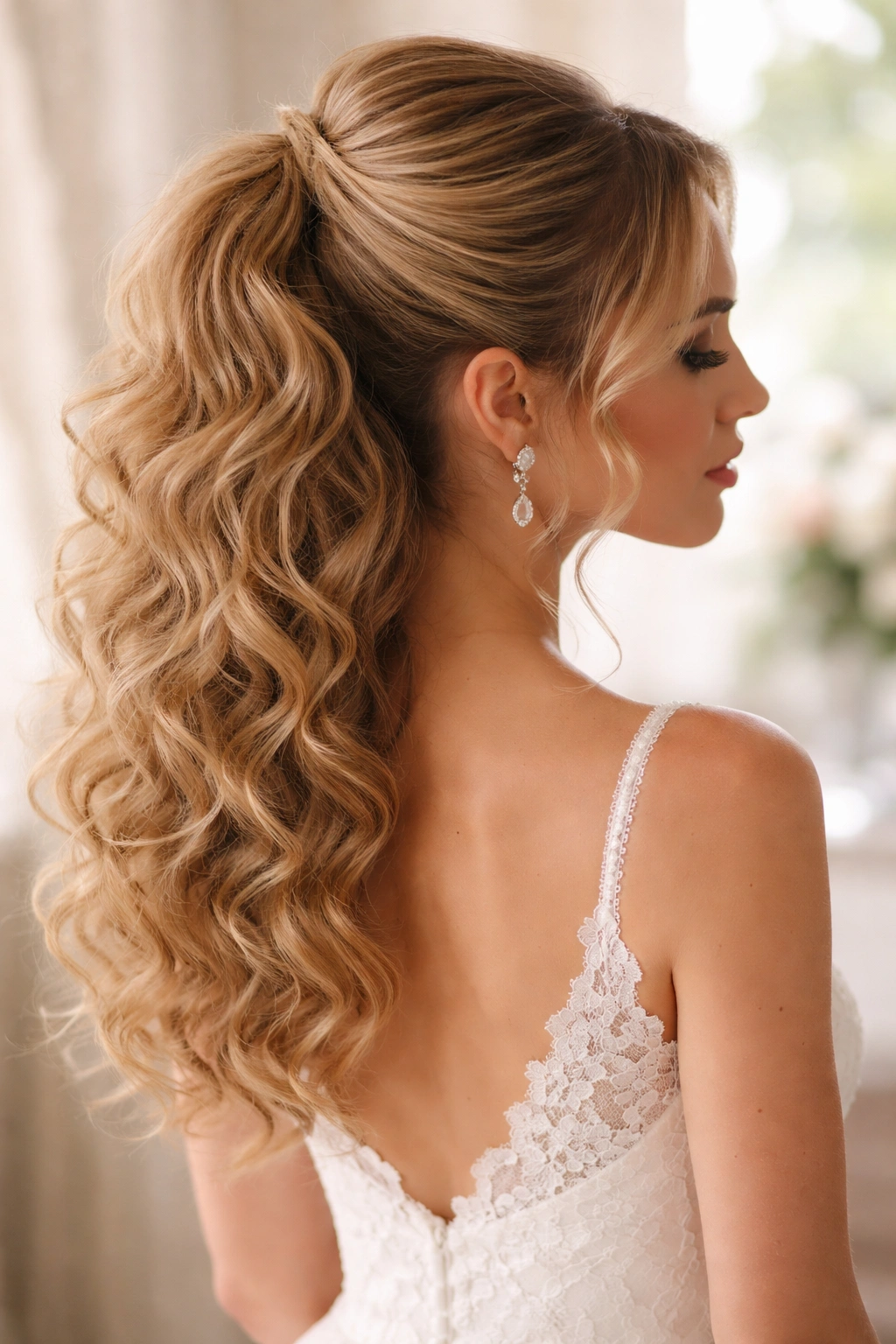
A half-up curly ponytail gives you the control of an updo without giving up the length. That’s the whole appeal, and honestly, it’s a smart choice for hair that has strong curl pattern from mid-length to ends. The crown gets lifted, the face stays open, and the back still shows off all that natural shape.
Unlike a full ponytail, this version leaves the lower half of the curls free, so it never feels too severe. It’s also kind to layered curly cuts, which can lose their shape when everything is pulled back too tightly. A little volume at the crown balances the visible length below.
This is one of the easiest styles to pair with a veil or comb because the top section gives the accessory something to anchor to. If your hair tends to flatten at the roots, a light mousse and a quick diffusing session at the crown make a huge difference. Keep the top smooth, not slick. The point is lift, not helmet hair.
7. Braided Crown Curly Ponytail
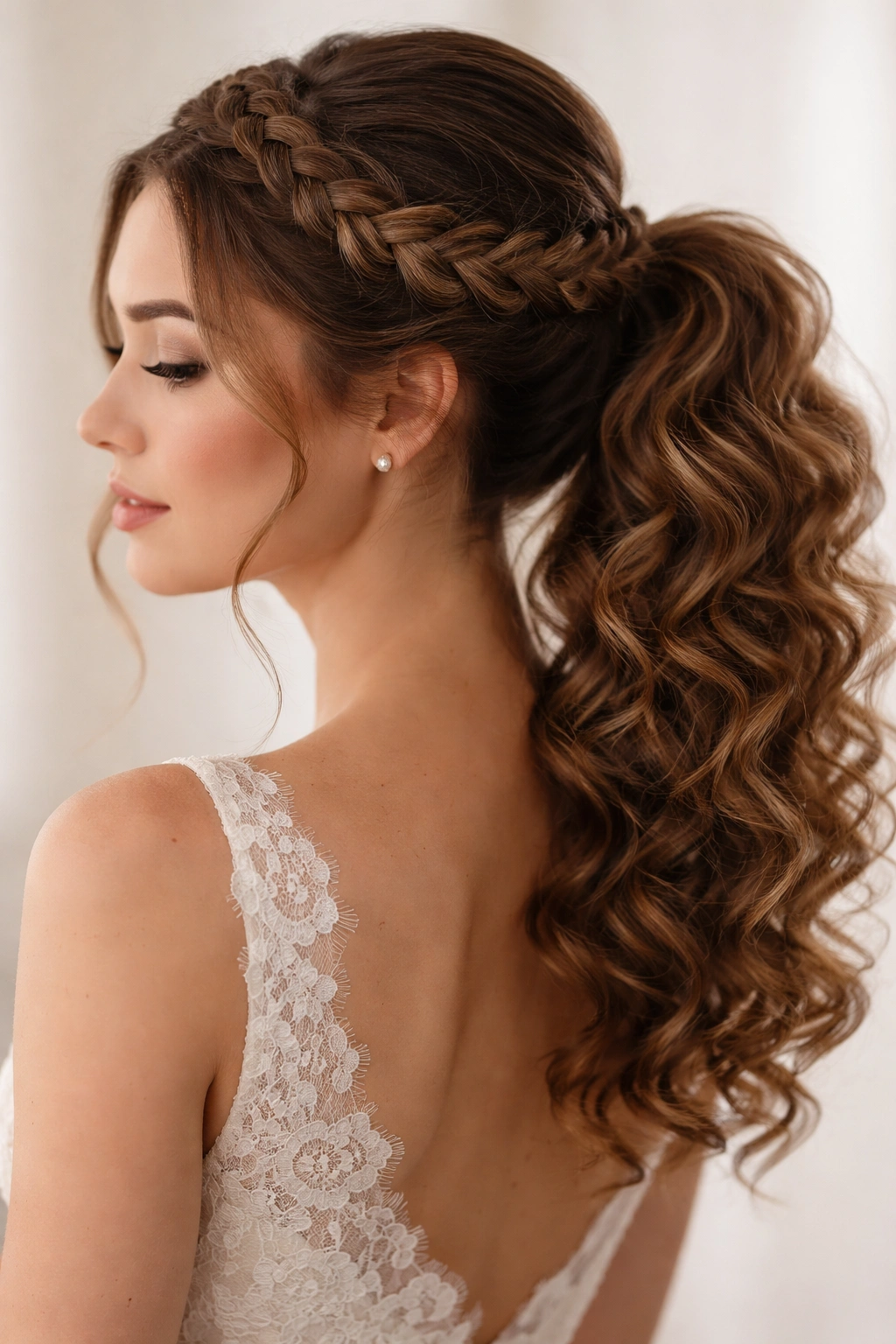
A braided crown leading into a curly ponytail gives the whole style a built-in frame. The braid can start at one temple, travel across the hairline, and disappear into the base of the ponytail. It keeps the front neat and gives the back a little story, which is exactly what a wedding hairstyle should do.
The Braids Do the Heavy Lifting
This style is useful when the hairline needs control. Curly hair that frizzes at the edges or puffs up around the temples often looks better with a braid doing some of the work for you. The braid holds the front shape while the curls stay loose and full below.
- Use a braid that matches the thickness of the hair, not a tiny detail braid that gets lost.
- Pin the braid flat so it doesn’t lift away from the head.
- Leave the ponytail itself soft and springy.
- Add one comb at the base if you want the style to read more bridal.
The result is romantic without being sugary. That’s a good line to hit.
8. Extra-High Curly Ponytail for Dramatic Length
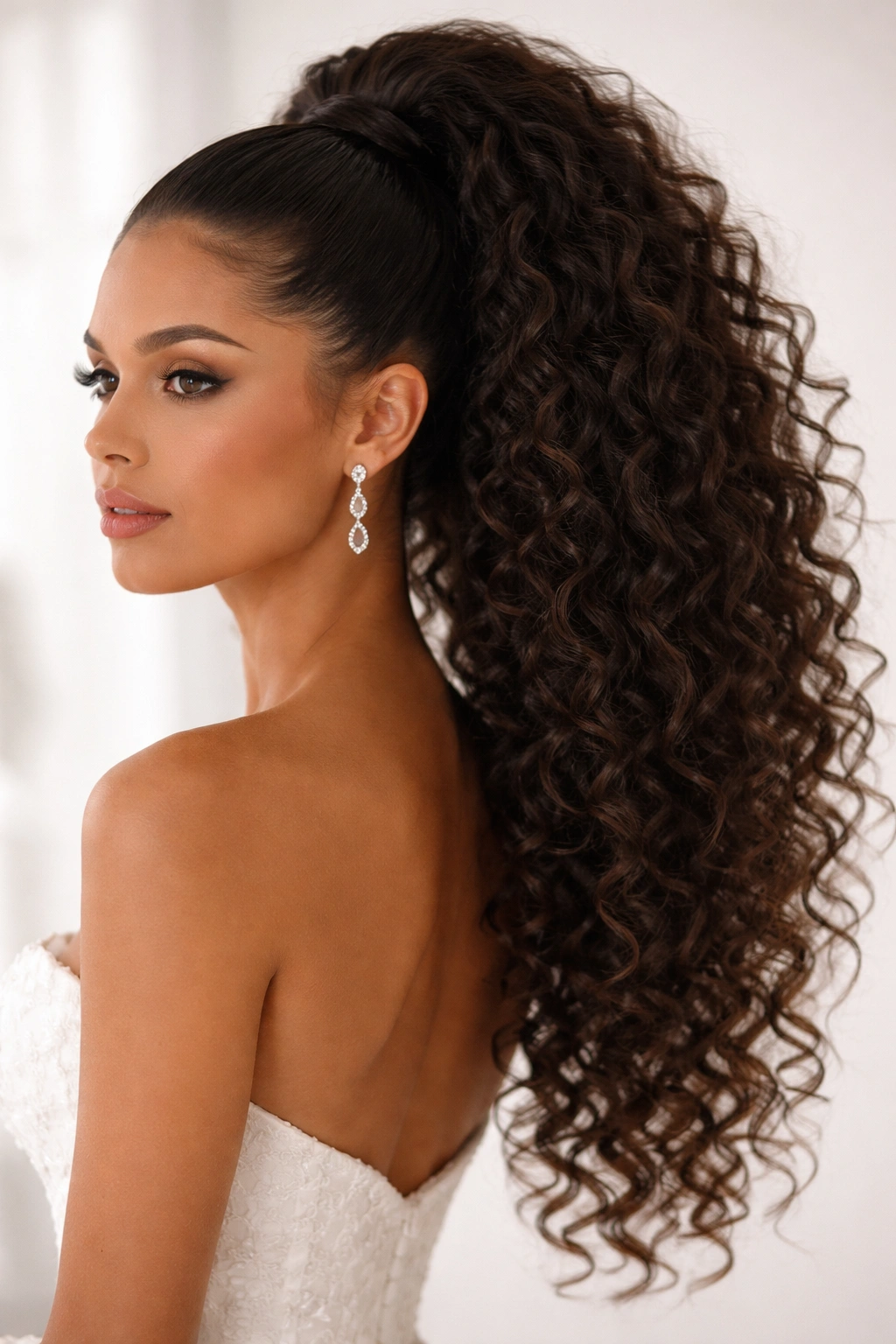
Height changes everything. An extra-high ponytail gives curly hair a lifted silhouette that feels bold, clean, and a little bit glamorous in a straight-ahead way. The ponytail sits high enough to show the jawline and neck, and the curls fall with a swing that lower styles just can’t match.
This shape works especially well if you want to make shorter curls look longer. A stylist can build height at the crown with careful teasing or a hidden insert, then let the ponytail fall over the back like a waterfall of spirals. The root area should still feel smooth, though. Too much teasing at the top can make the style frizzy by the second hour.
I’d reach for this when the dress is simple and the jewelry is minimal. The ponytail becomes the focal point. If the gown already has big sleeves, strong beading, or a high collar, this may be too much competition. But on a clean neckline? It’s hard to beat.
9. Twisted Low Ponytail with Soft Ends
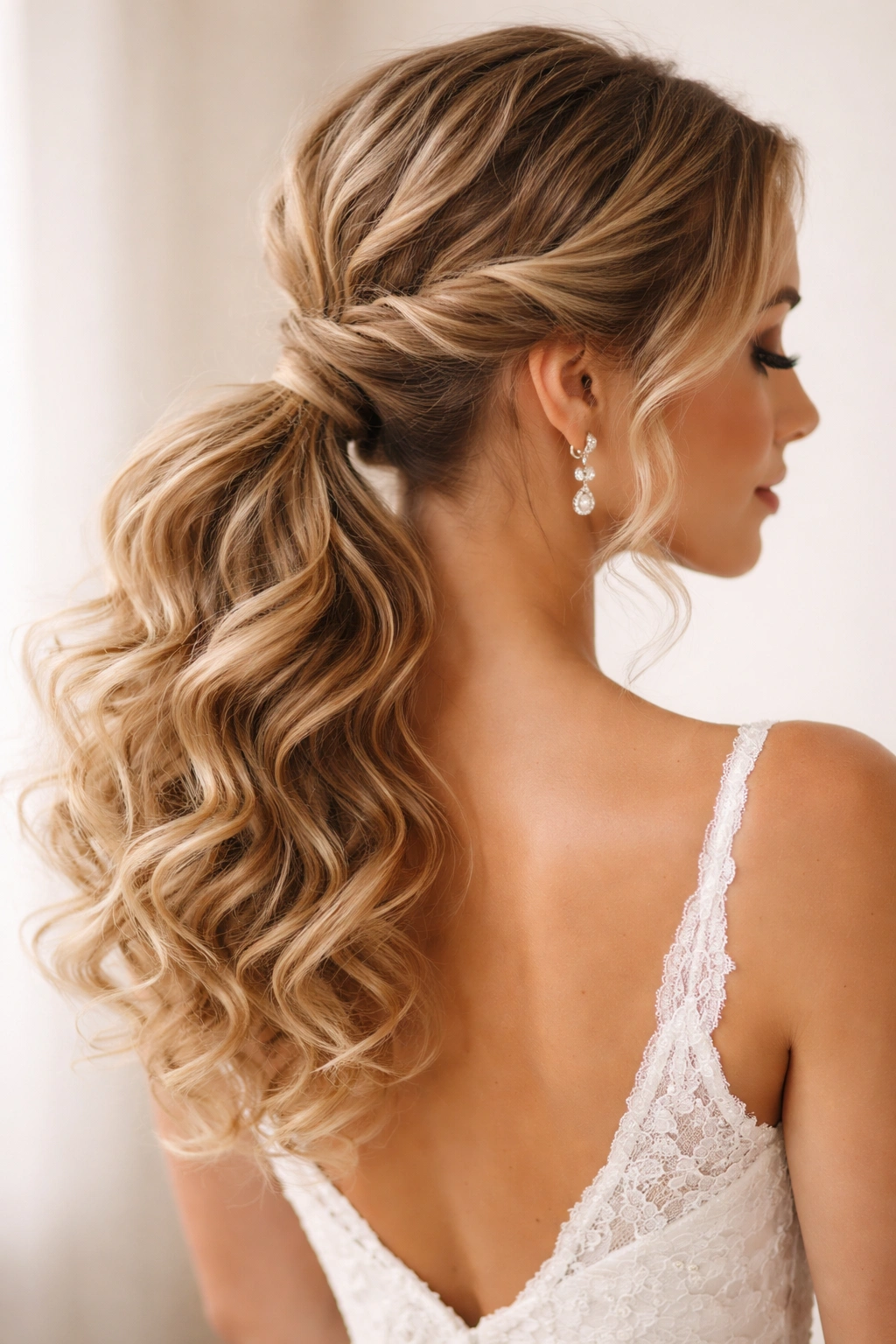
A twisted low ponytail is for someone who wants structure but doesn’t want the obvious look of a braid. Two sections twist back from the temples, meet near the nape, and disappear into a curly tail that stays loose at the ends. It’s gentle, but not boring.
The twists help tame the sides without flattening the whole head. That’s useful when the hair has a lot of volume around the crown or when the front pieces have shorter layers that refuse to stay put. The twists keep those bits in line and turn them into part of the design instead of a problem to hide.
This style works best when the curls at the tail stay defined and springy. If they’re brushed out too far, the whole look loses its shape. A small floral pin or a few pearl pins near the twist point can finish it without making the style heavy. Keep the decoration close to the base. Let the curls do the rest.
10. Pearl-Pinned Curly Ponytail
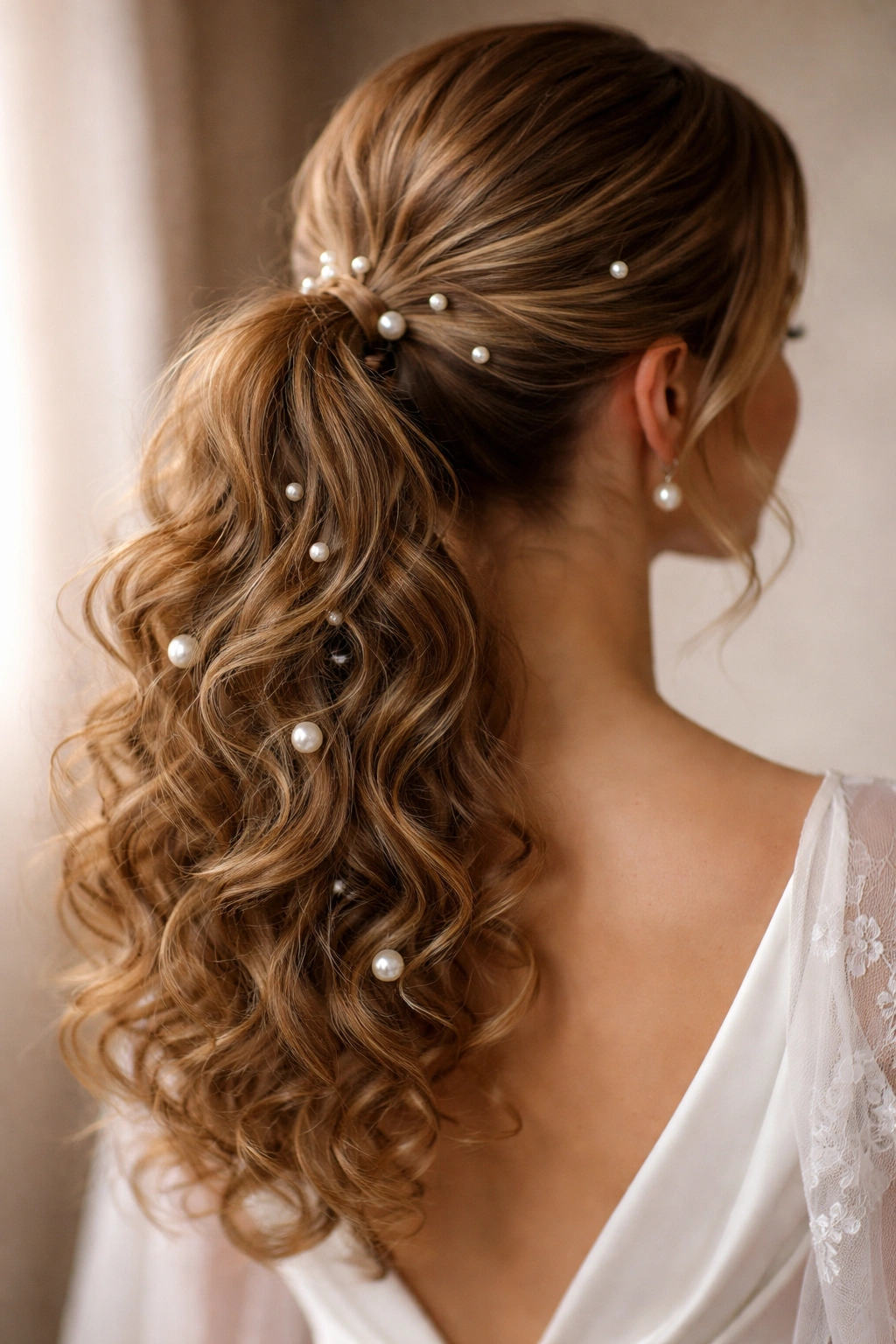
Pearl pins can turn a plain curly ponytail into something that feels quietly formal. The trick is placement. Scatter them too evenly and the hair starts to look decorated in the wrong way. Place them with intent, and they read like tiny pieces of jewelry woven into the style.
I like this best on ponytails that already have good shape. A low or mid-height tail gives the pins room to show without getting lost in the length. One pin can sit just above the elastic. Another can catch a twist on one side. That’s enough. You do not need a full constellation unless the gown is very simple.
Pearls work because they don’t fight the texture. Curly hair has movement; pearls bring stillness. That contrast is what makes the finish feel special. If the curls are very tight, use fewer pins so the style doesn’t start to feel crowded.
11. Curly Ponytail with a Deep Side Part and Polished Roots
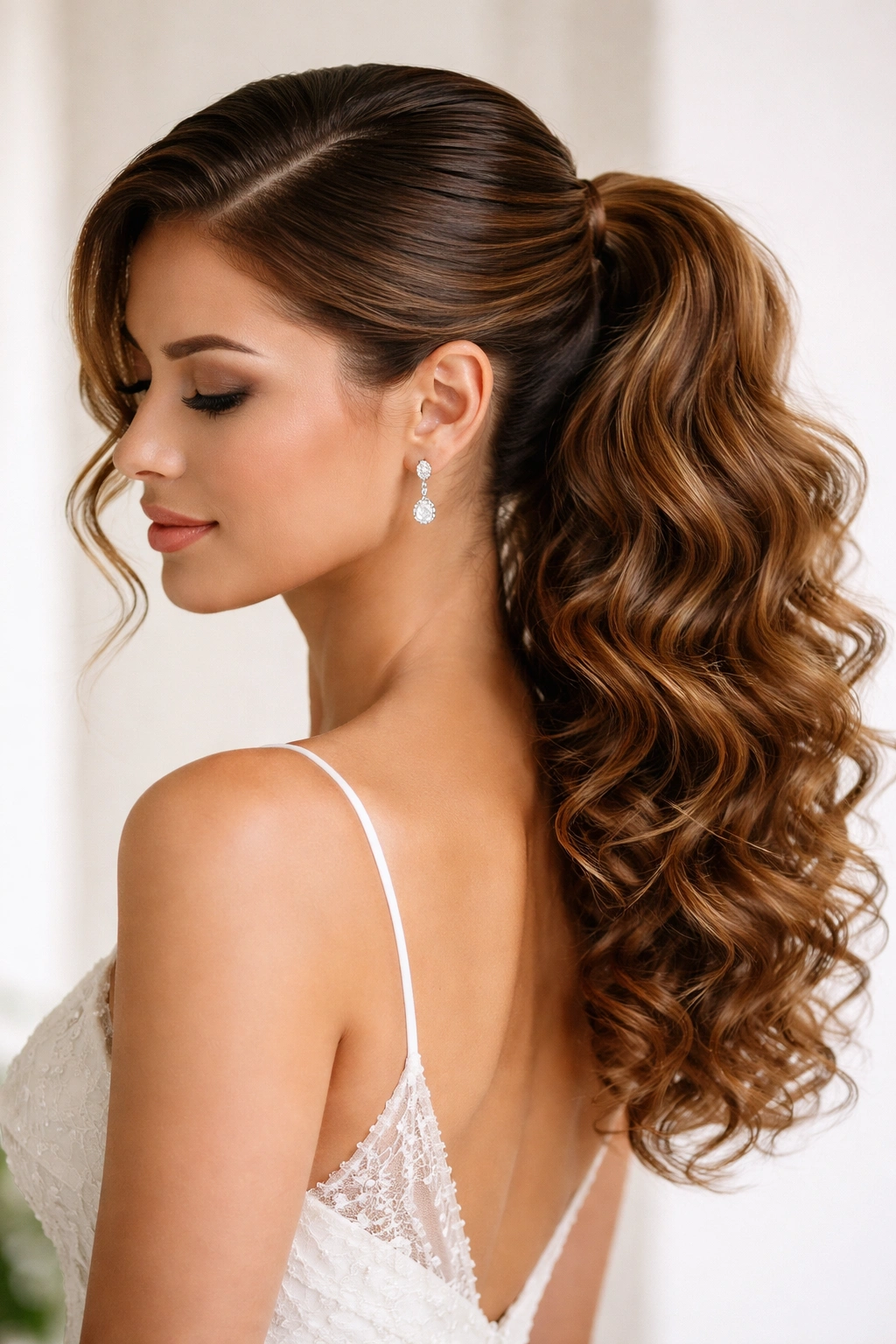
A deep side part changes the whole face frame before the ponytail even enters the picture. With curly hair, it gives the top a deliberate shape and makes the ponytail feel more styled than casual. The polished root keeps the part clean, then the length drops into soft spirals that keep the style from feeling too severe.
Compared with a looser side-swept ponytail, this one is a little more sculpted. It suits satin dresses, clean tailoring, and bridal looks that lean toward modern instead of rustic. A touch of shine spray on the roots helps the part stay visible in photos, especially if the hair has a lot of natural fluff at the crown.
The front section should be brushed smooth while damp, then set in place before the curls dry. That step matters. If the part is drawn in after the hair has already started to set, it usually looks vague and lifts at the wrong places. Small detail. Big difference.
12. Tousled Mid-Height Ponytail with Loose Tendrils
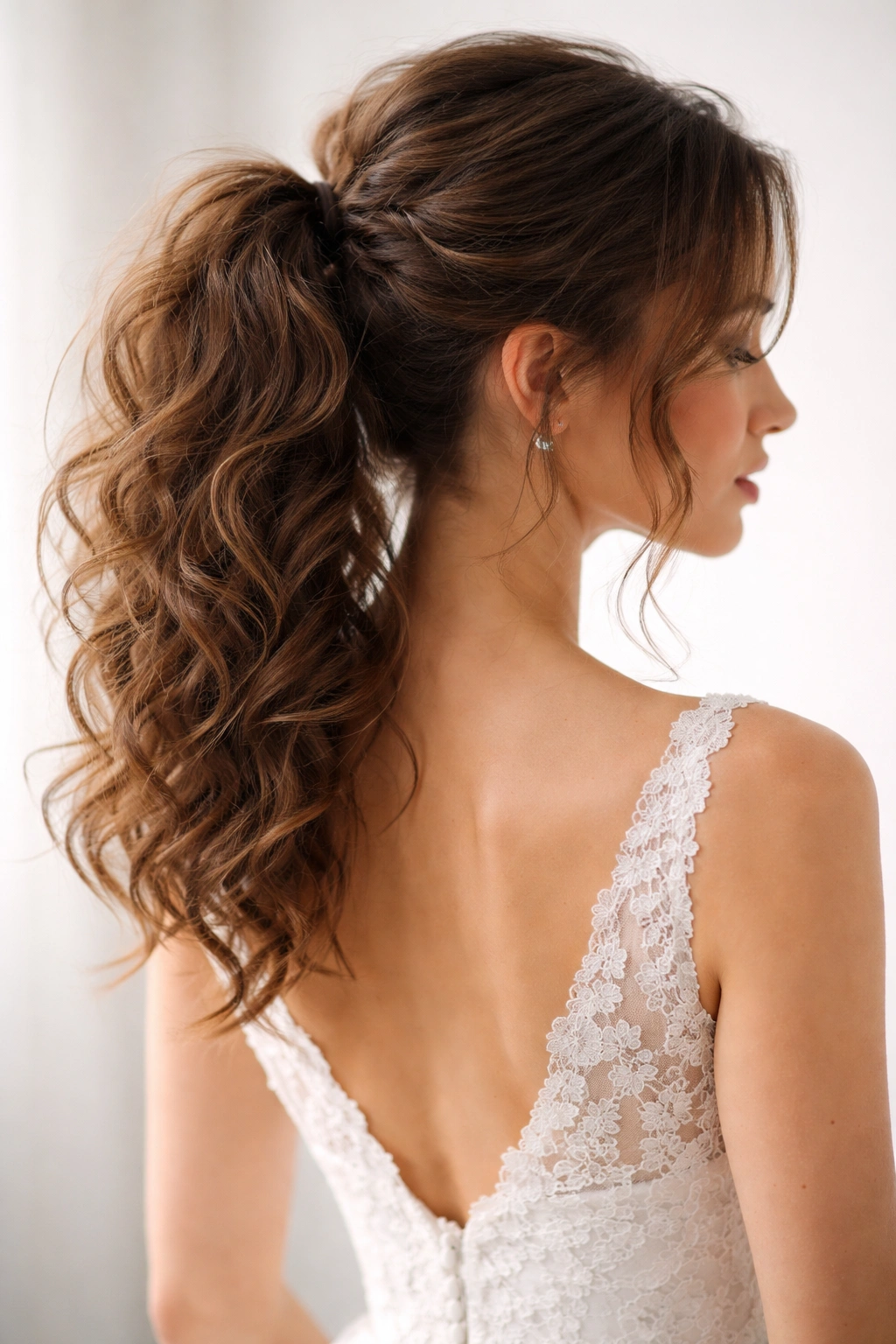
Not every wedding ponytail needs a rigid shape. A mid-height ponytail sits in that sweet spot where the style feels relaxed but still dressed up enough for a ceremony. It gives the curls room to move, and it leaves enough space around the face for soft tendrils to fall without trying too hard.
This version suits brides who want a little undone texture. The ponytail lands neither too low nor too high, so it doesn’t fight a lot of necklines. If the dress has sleeves, a lace back, or shoulder detail, the mid-height position keeps the hairstyle out of the way while still being visible.
Loose tendrils can help, but only if they are chosen carefully. Two small pieces at the temples are usually enough. More than that and the style starts drifting away from polished. A little texture at the crown and a clean elastic wrap keep the ponytail grounded. The rest is all movement.
13. Bridal Ponytail with Rope Twists at the Sides
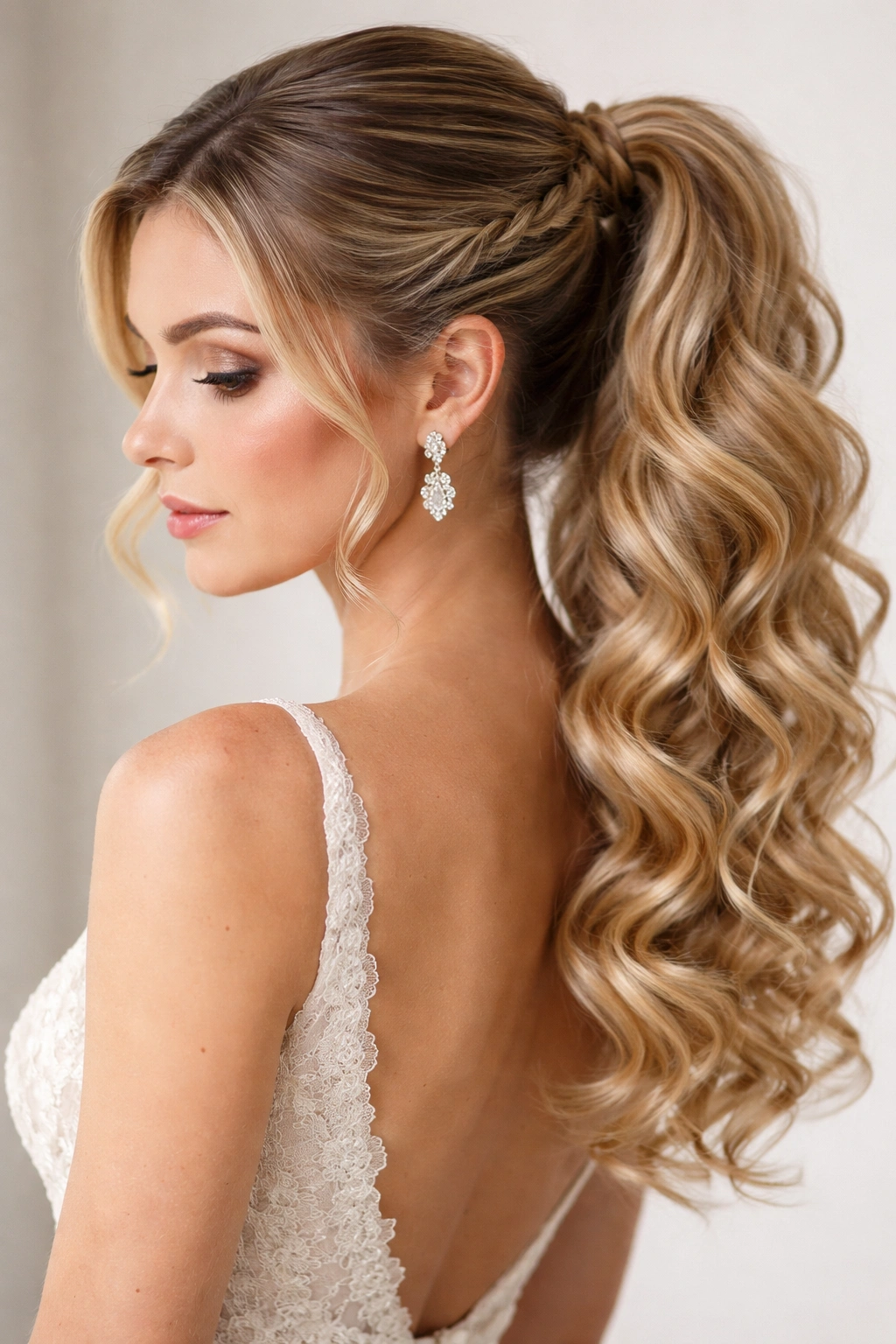
Rope twists are underrated. They look detailed, but they’re faster than braids and often sit flatter against the head, which is useful when curly hair already has plenty of body. Feeding two rope twists into a ponytail keeps the sides controlled and adds a little pattern to the silhouette.
What Makes It Different
The rope twist gives you shape without a lot of bulk. That matters if the hair is thick, because thick curly hair can swell fast once pins go in and heat meets humidity. A rope twist stays neat and helps the ponytail look intentional from the front and side.
- Best for medium to thick curls.
- Good when you want the back to feel decorative without a full braid.
- Works with pearl or crystal pins near the base.
- Keeps shorter front layers tucked away neatly.
The result has a soft bridal feel that still holds up well through a long day. No fuss. No extra heaviness.
14. Curly Ponytail and Veil Combo
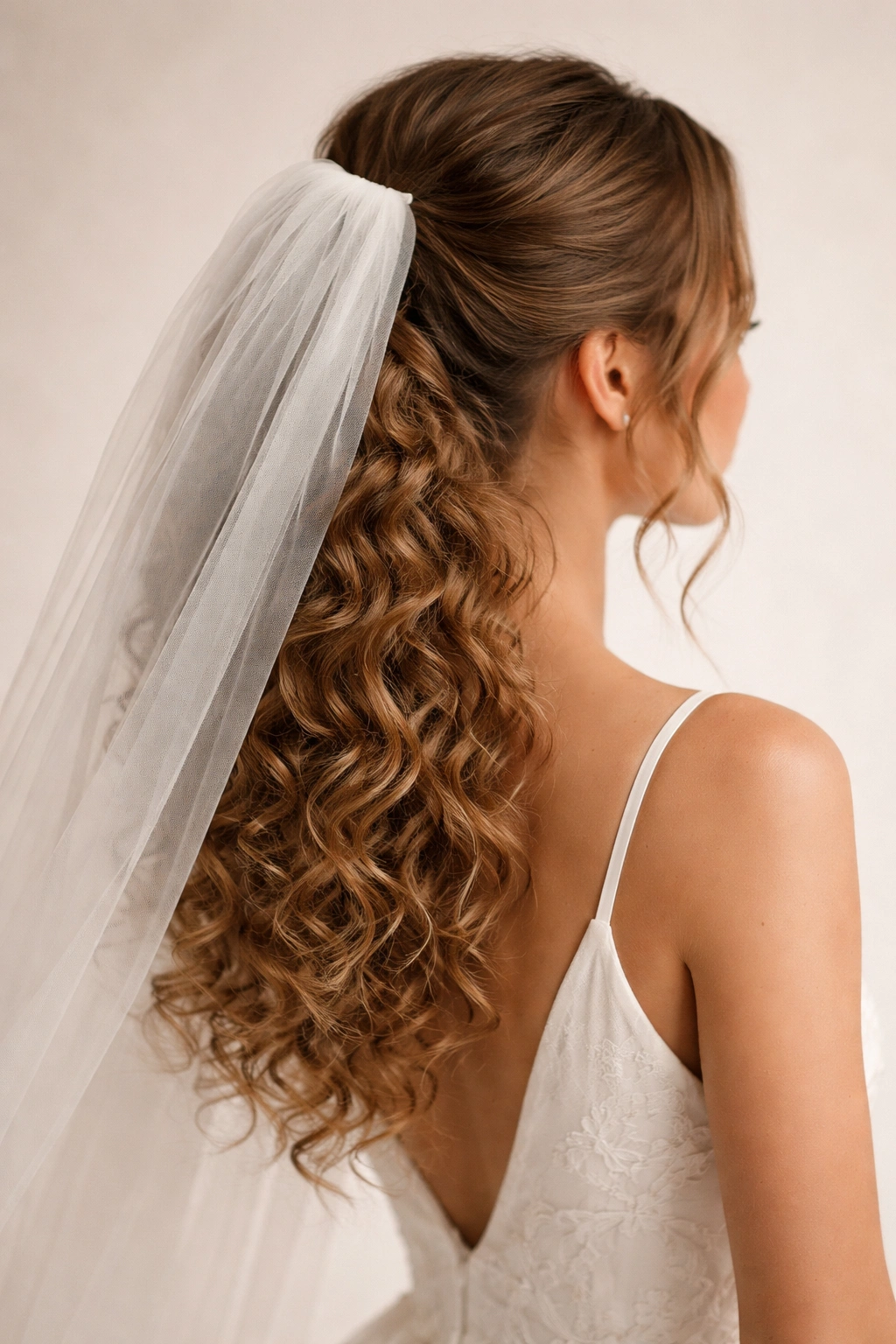
A veil and a curly ponytail can work together easily if the placement is planned from the start. The mistake most people make is deciding on the veil after the hairstyle is finished. That usually leads to awkward comb placement, flattened curls, or a base that looks cramped.
For a low ponytail, the veil comb often sits just above the elastic or slips under a little padded section at the crown. For a mid- or high ponytail, the veil may need to sit a touch higher so it doesn’t fight the tail itself. The point is not to hide the ponytail. It’s to let the two pieces share the stage without bumping into each other.
Where the Veil Sits
A lighter veil can sit closer to the crown and move more freely. A heavier one needs stronger support and a base that won’t sag under the weight. If the curls are long and full, ask for extra pinning around the comb area so the fabric doesn’t tug the style out of shape.
The best veil-and-ponytail combinations look effortless because somebody thought through the mechanics first.
15. Glossy Low Ponytail with Laid Edges
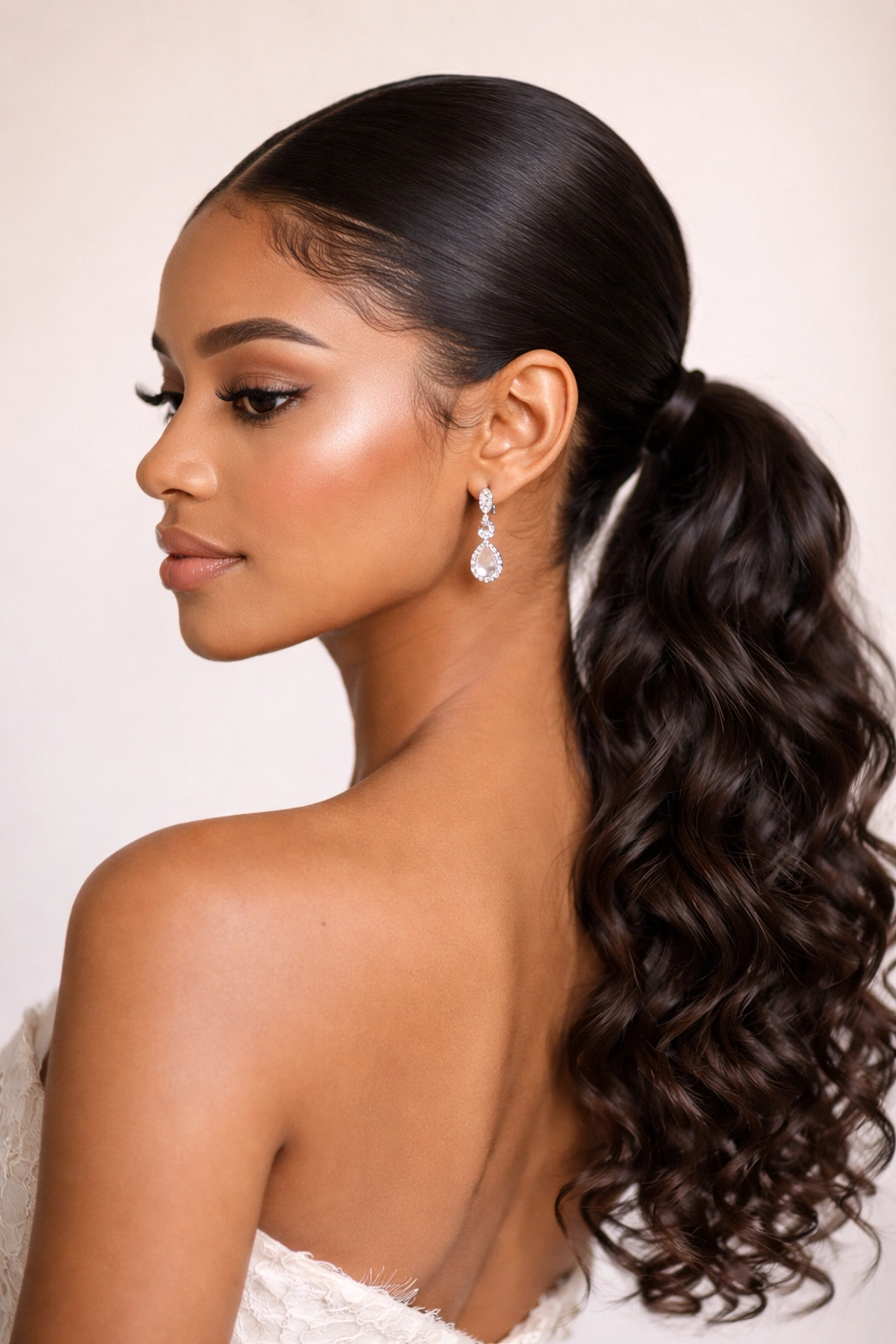
A glossy low ponytail feels clean, sharp, and quietly formal. The shine is the point here, but not in a greasy way. You want the crown to look smooth, the edges to lie flat, and the curls at the tail to stay defined enough that the style still belongs to curly hair.
Laid edges can be elegant when they’re handled with restraint. A soft brush and a small amount of edge control are enough for most hairlines. Overdoing it tends to make the style feel overworked, and that is the opposite of what a wedding hairstyle should do. Keep the edges neat, not drawn on.
The ponytail itself should stay soft and touchable. If the tail is too glossy from root to end, the texture can disappear. A better approach is shine at the crown and movement through the length. It gives the eye a clear place to rest, then lets the curls keep their shape where it counts.
16. Romantic Ponytail with Mini Braids
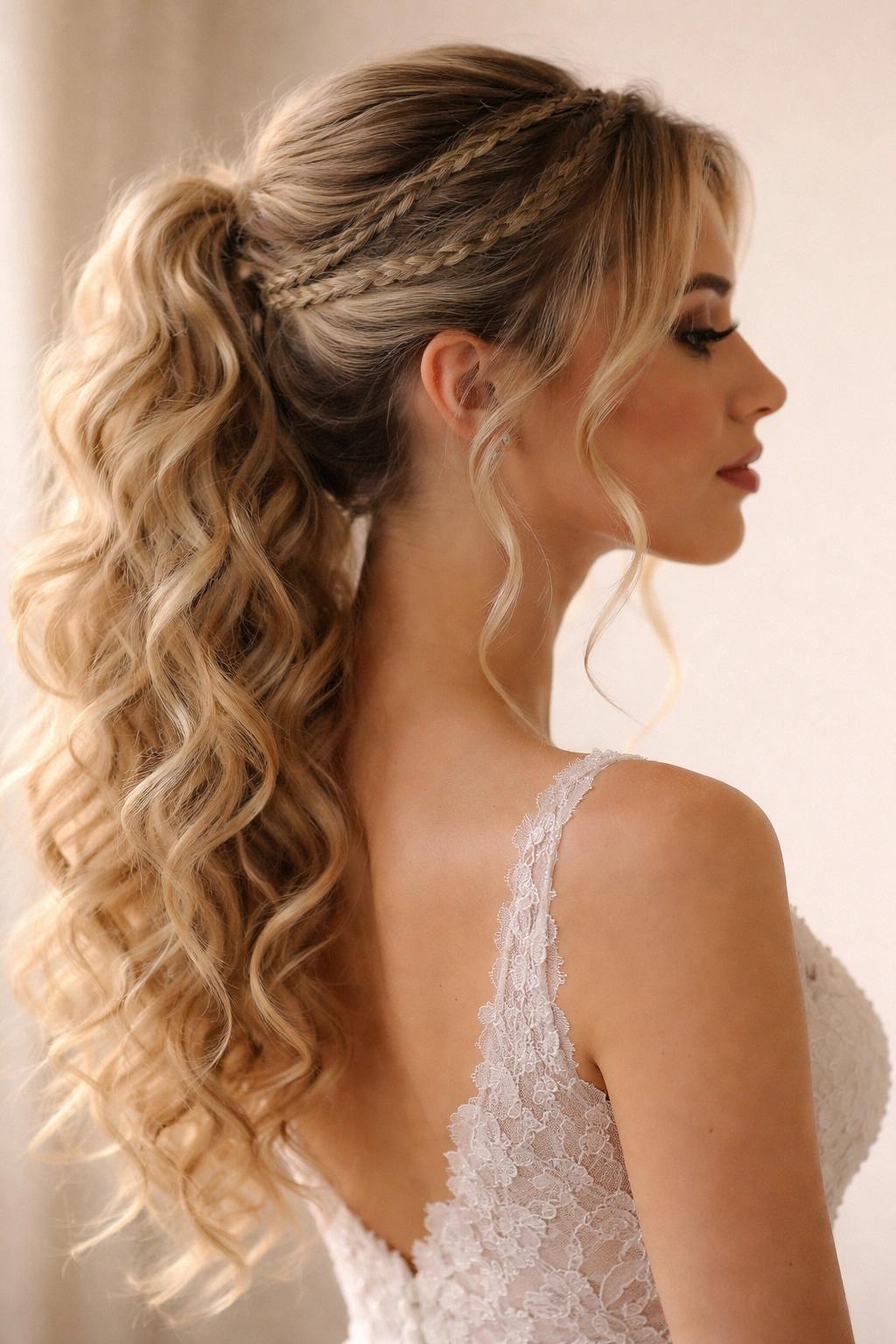
Mini braids are the kind of detail people notice only after a second look, which is exactly why they work so well. They can sit along the hairline, tuck into the crown, or disappear into the ponytail itself. The braid is small enough not to take over, but it still gives the style a handcrafted feel.
This version suits curls that already have a soft, romantic bend. The braids add just enough structure to keep the look from sliding into plain. They also help control shorter layers around the face, which can otherwise float out of place once the curls start moving.
I’d keep the number of braids limited. One on each side is often enough. More than that and the hairstyle starts to read busy instead of thoughtful. A tiny braid wrapped into the elastic or pinned just above it can be enough to make the ponytail feel custom without shouting about it.
17. Low Curly Ponytail with a Chignon-Like Wrap
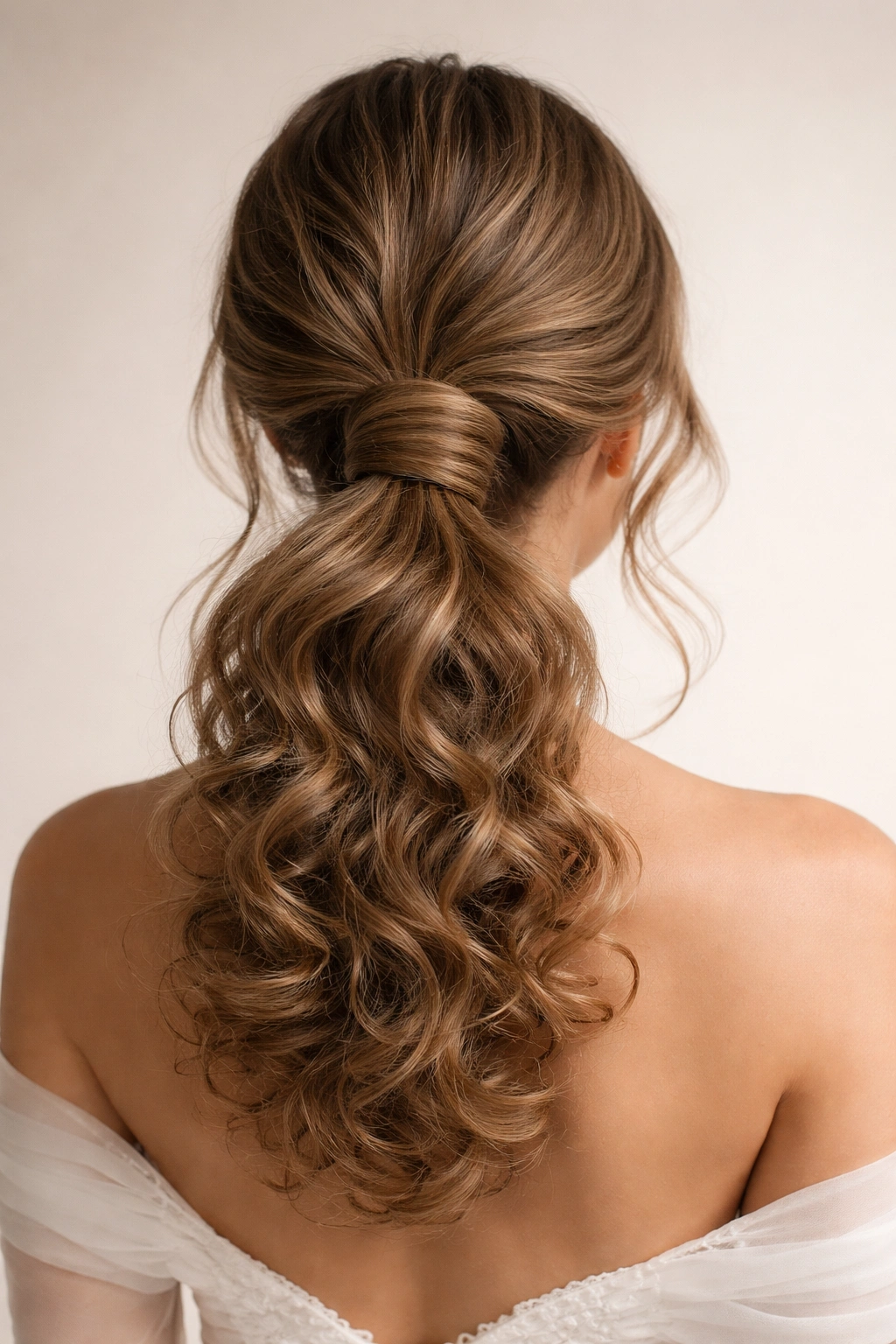
A low curly ponytail with a chignon-like wrap sits in a nice middle ground between a ponytail and a bun. The hair around the base gets wrapped and pinned so it reads as polished, but the tail still hangs free underneath. That little bit of looseness keeps the style from feeling too formal or too rigid.
This is one of my favorite shapes for brides who want the back of the head to feel tidy. It looks especially good with gowns that have lace backs or buttons, because the wrapped base frames the detail without covering it. The curls at the tail can stay defined, or they can be gently stretched for a softer fall.
When It Beats a Bun
A full bun can flatten curly hair fast. This version keeps more length visible and usually gives the face a more open look. If the hair is fine, the wrap can also fake a little extra fullness at the base, which helps the style photograph more clearly from behind.
18. Statement Bow Curly Ponytail
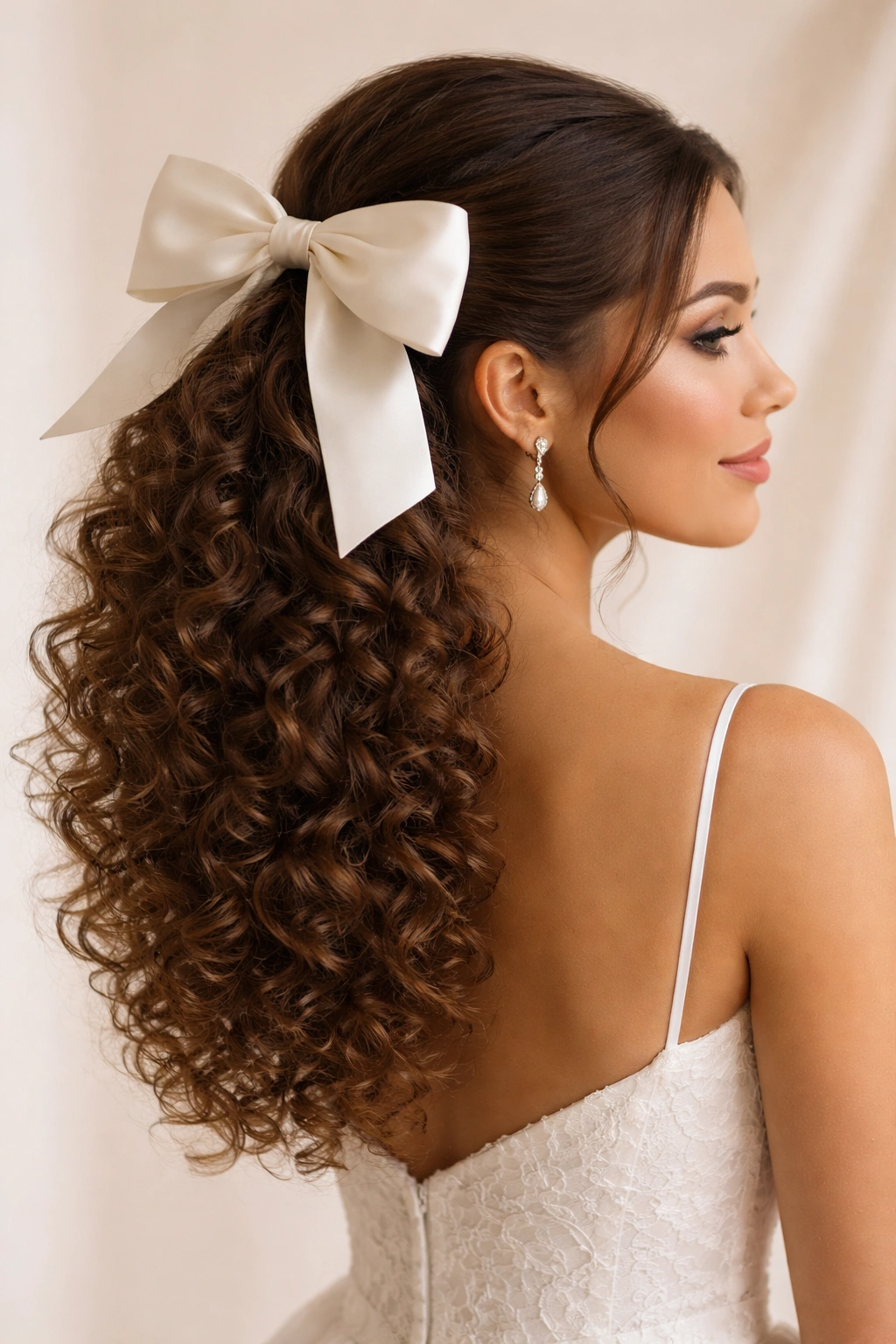
A statement bow is not shy, and that’s the point. It turns a curly ponytail into a bridal focal point fast, especially when the dress is simple and the hair needs one strong visual anchor. The bow can be silk, satin, velvet, or even sheer ribbon, but the scale has to match the rest of the look.
A bow that’s too small disappears into curly texture. One that’s too large can overwhelm the whole silhouette. Somewhere around 4 to 6 inches across usually gives a nice balance, though thick curls may handle a bigger bow better than fine hair can. The bow can sit above the ponytail for a more obvious finish or below it for something softer.
This style has a lot of personality, so the rest of the look should stay clean. Keep the curls defined and the crown smooth. If the gown already has heavy embellishment, a bow may be too much. But with a clean dress and simple earrings, it does the job elegantly.
19. Double-Texture Ponytail for Natural Curls and Blowout Ends
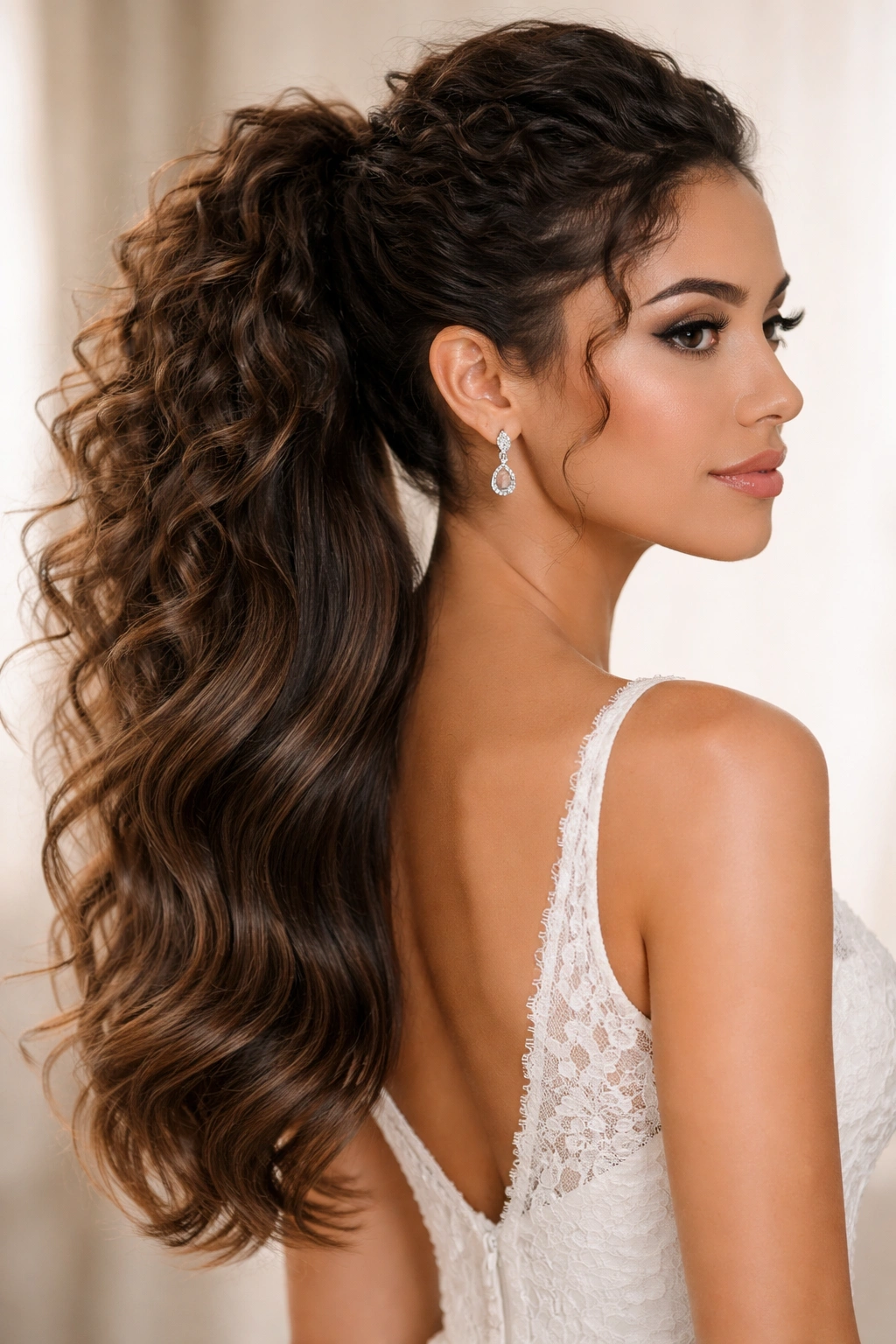
Why settle for one texture when two can do the work? A double-texture ponytail keeps the roots and crown closer to the natural curl pattern, then stretches the ends a little more for length and movement. The effect is soft, long, and less bulky than a fully diffused curly tail.
Why Stylists Reach for It
The stretched ends can make the hair look longer without losing all the curl. That helps when the ponytail needs to skim the back of a dress or show off a necklace. Meanwhile, the curl at the crown keeps the style from feeling too slick or too flat.
- Good for medium-length curly hair that needs visual length.
- Helps balance strong volume at the top with a lighter tail.
- Works well when the bride wants definition, not a tight spiral shape.
- A small amount of cream on the ends keeps them from looking dry or frayed.
It’s a useful compromise, and it photographs with a nice sense of motion.
20. Soft Fishtail-Accented Curly Ponytail
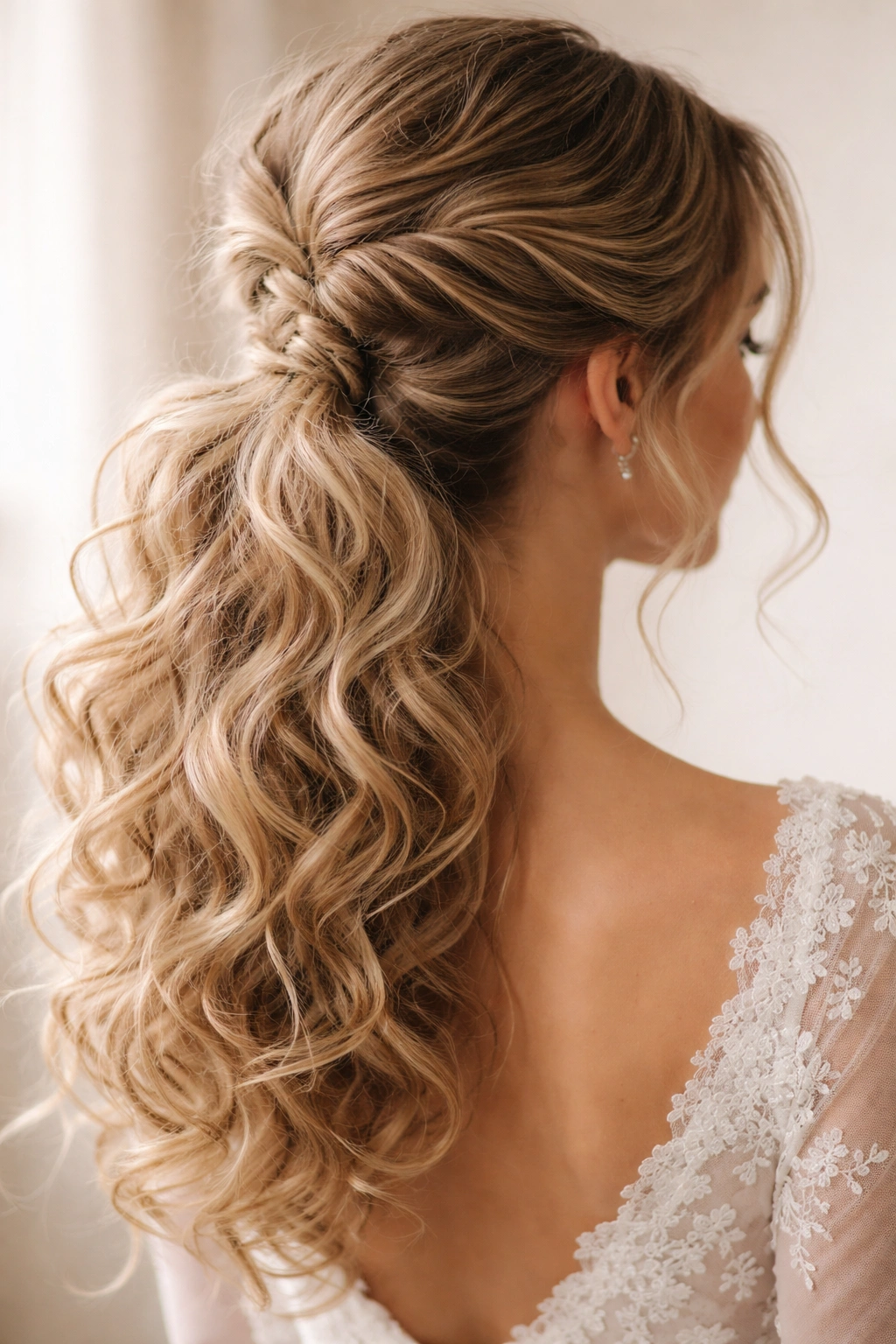
A fishtail accent can be stitched into the crown or run along one side before the ponytail begins. It adds texture in a cleaner way than a full braid, and because the rest of the hair stays curly, the braid does not have to carry the entire style.
I like this on brides who want a little pattern near the top but still want the tail to feel loose. The fishtail gives the eye a line to follow, which helps break up a lot of volume. It also keeps the hairstyle from looking like a simple pull-back, which is the one complaint some people have about ponytails in formal settings.
Keep the braid slightly looser than you would for a daytime style. Too tight and it starts to look sharp against the softness of the curls. Let a few fine pieces slip free around the braid, then pin them flat if needed. The contrast is the good part.
21. Fluffy Cloud Ponytail with Maximum Volume
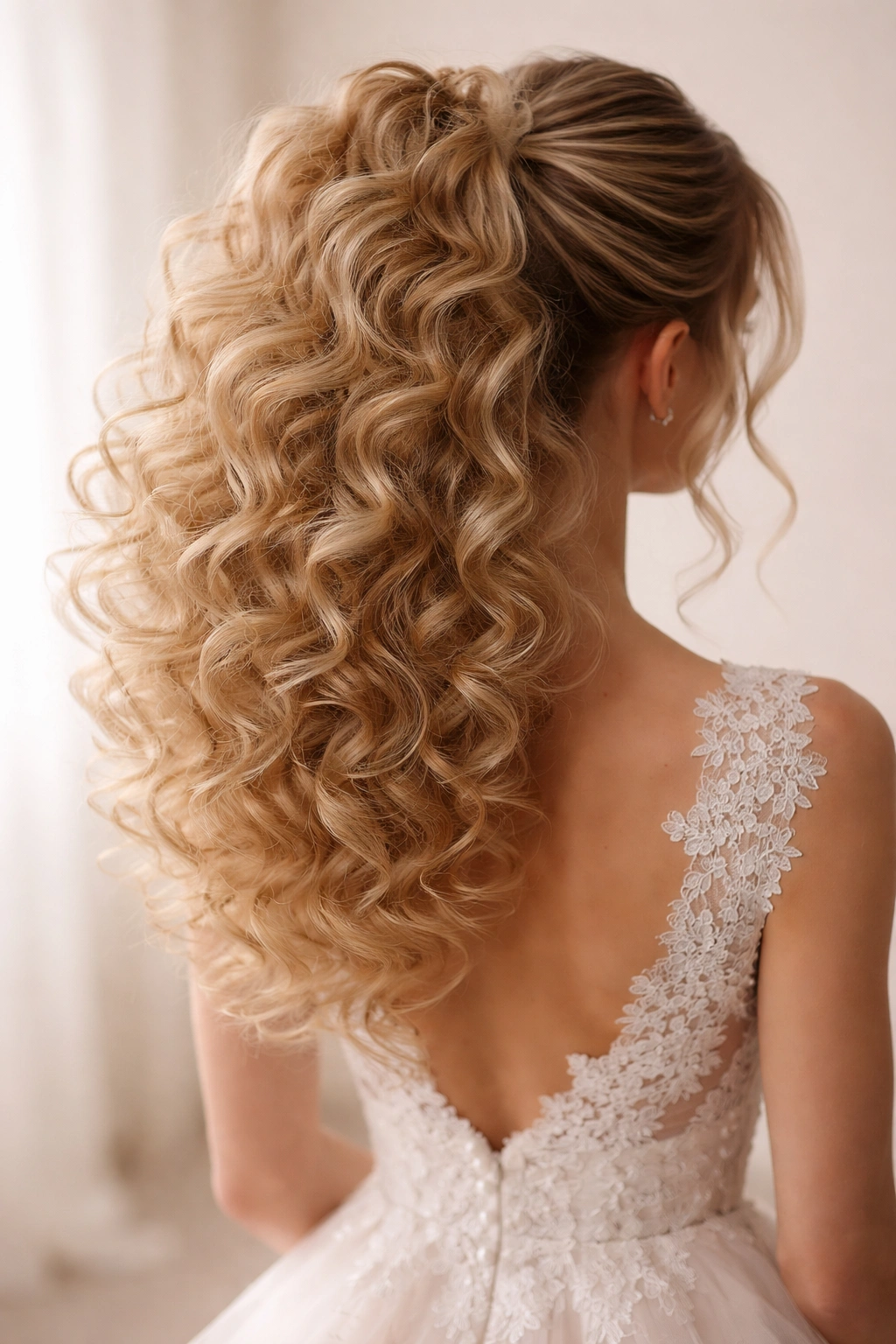
A fluffy cloud ponytail leans all the way into volume, and that’s why it works. Some curly hair looks best when it’s not smoothed into submission. This style lets the crown stay full, the curls stay airy, and the silhouette stay big enough to feel intentional.
The trick is shape, not chaos. A diffuser helps dry the hair without crushing the curl pattern, and a little root lift at the crown gives the ponytail room to sit up instead of drooping. Once the hair is gathered, the tail can be pulled apart gently to make the volume look soft rather than frizzy.
This is a strong choice for thicker curls and for brides who want a less polished, more alive finish. It can look incredible with a modern gown or a dress that has movement in the skirt. If your hair naturally leans flat, this may take more product and more pinning than a sleek ponytail would. Worth it if you like volume.
22. Polished Ponytail with Curtain Bangs
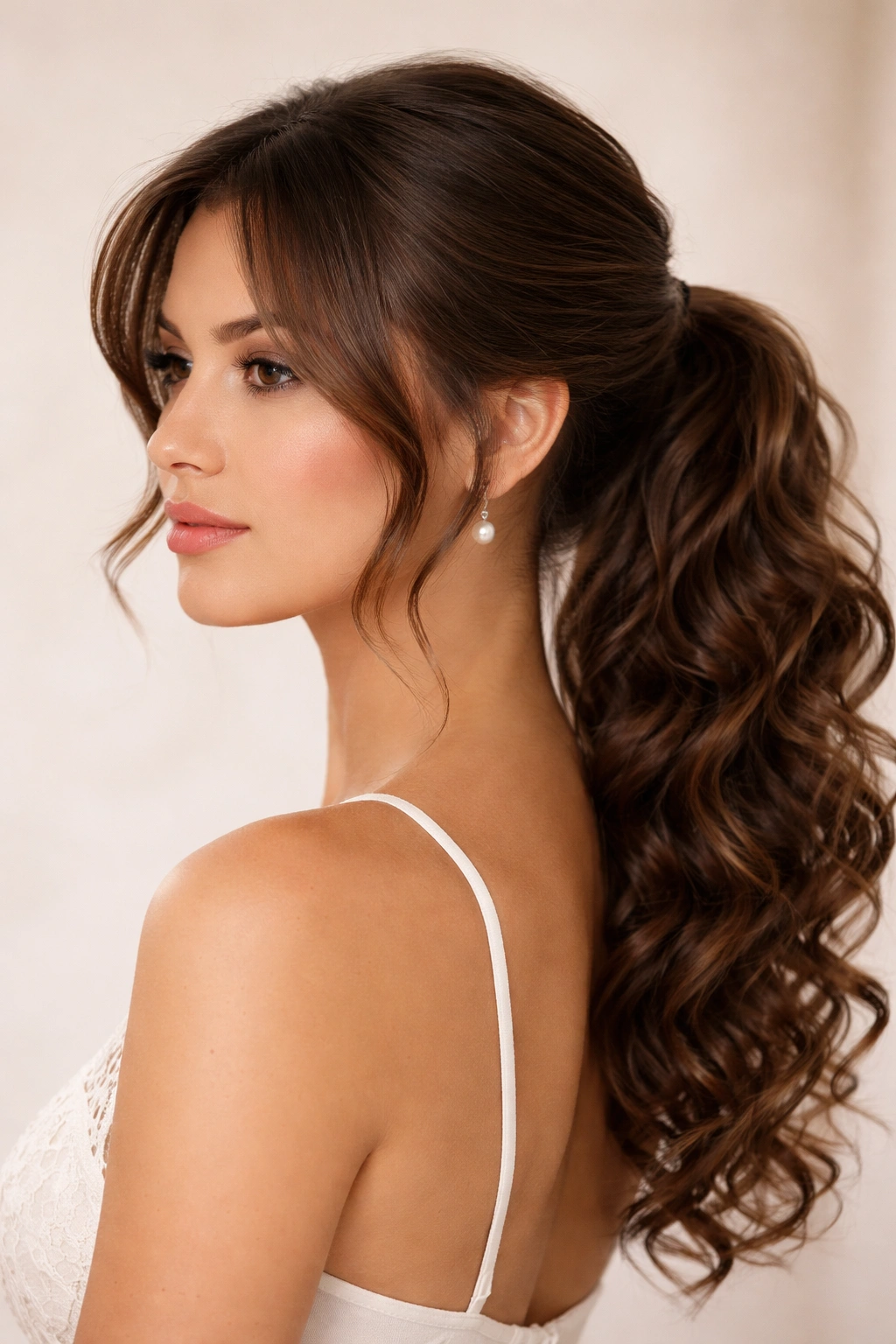
Curtain bangs change the whole balance of a bridal ponytail. They soften the forehead, frame the cheekbones, and give the style a built-in shape that doesn’t rely on loose tendrils alone. The ponytail itself can stay neat and low, while the bangs do the face-framing work.
Unlike longer face-framing pieces, curtain bangs have a more defined role. They sit higher, split softly down the middle, and sweep outward before meeting the rest of the hair. That means they can feel more intentional with structured dresses or cleaner necklines.
The lengths matter here. If the bangs are too short, they can bounce awkwardly. If they’re too long, they stop reading as bangs and start becoming face-framing layers instead. Somewhere around cheekbone to lip length usually gives the prettiest fall. A light bend at the ends helps them blend into the ponytail without disappearing.
23. Curly Ponytail with a Floral Comb
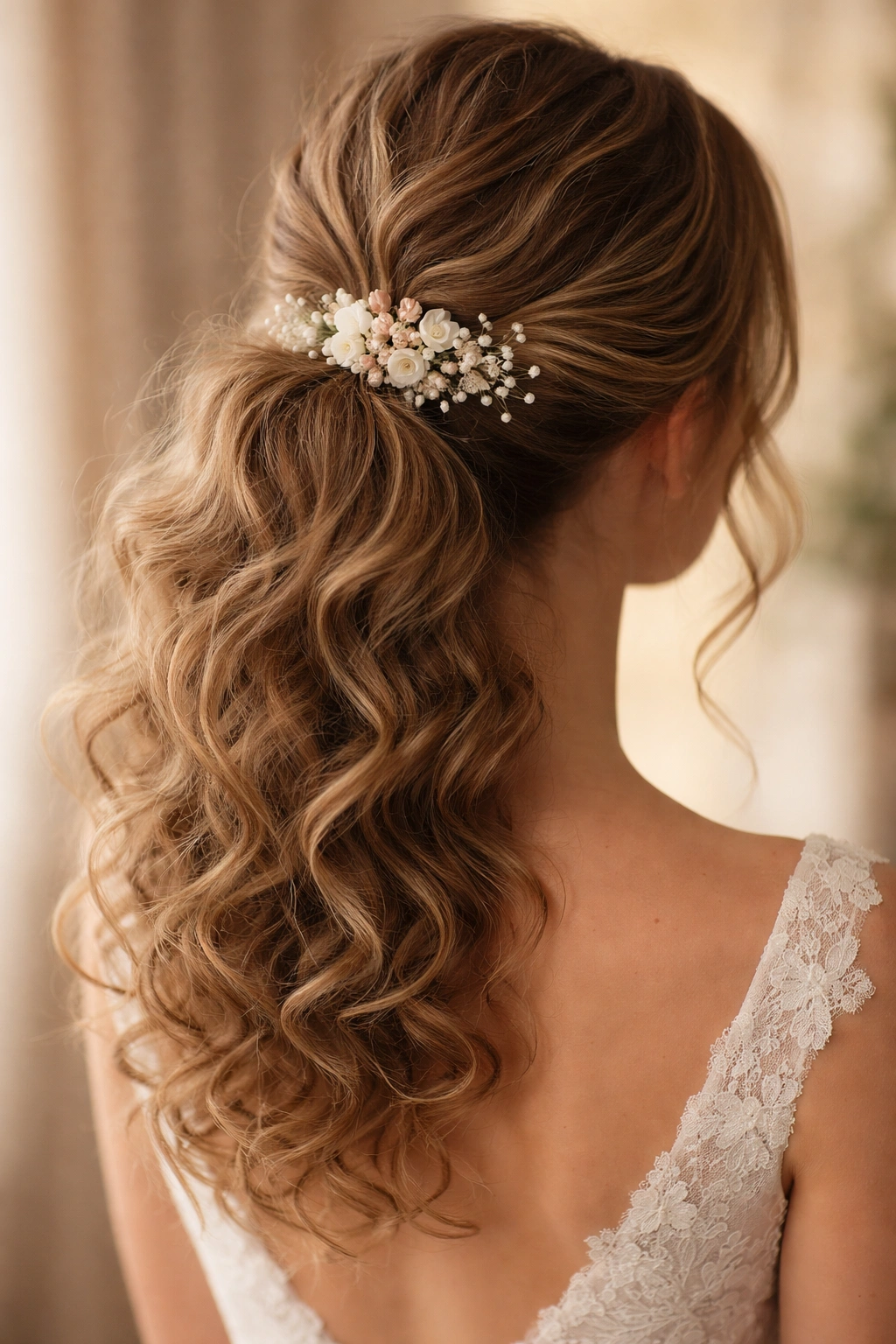
A floral comb gives a curly ponytail a softer bridal edge without asking the hair to do more work. Fresh blooms, silk flowers, or dried sprigs can all sit near the base or along one side of the style. The ponytail stays the main event, and the flowers act like a frame.
Keep the flowers small enough to stay close to the head. A heavy cluster can drag the curls down, which is a shame when the ponytail has good shape. If you’re using fresh flowers, make sure they’re wired securely and trimmed short so they do not poke into the elastic or snag the curls.
This style fits outdoor ceremonies, garden settings, and dresses that need a little softness around the shoulders. The best versions do not look like a bouquet got pinned into the hair. They look like the flowers were always meant to be there — close, controlled, and in the right place.
24. Side Ponytail with Old-Hollywood Waves
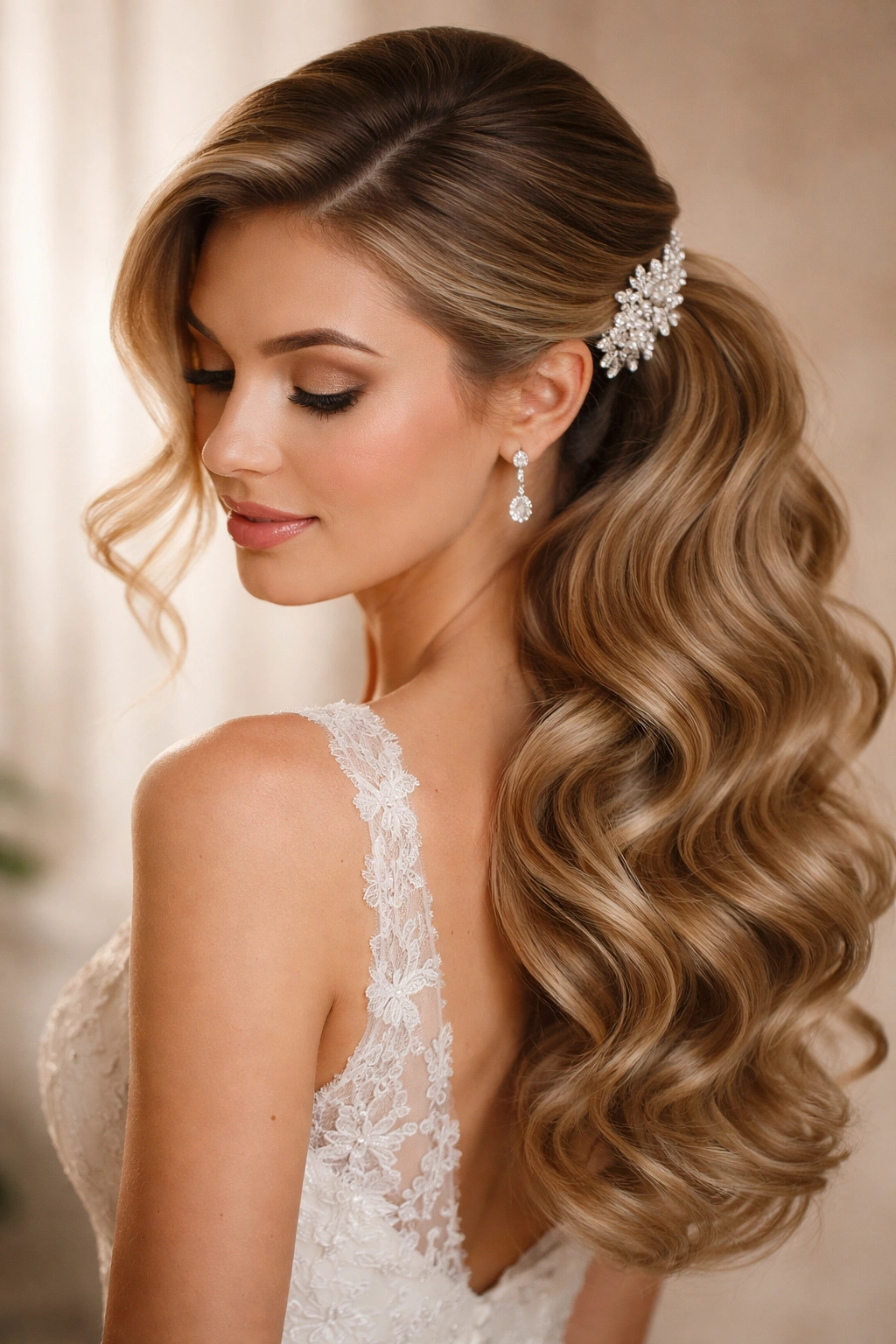
A side ponytail can borrow the glamour of old Hollywood without losing the structure of a ponytail. The curls are brushed into softer waves, gathered low over one shoulder, and shaped so the hair falls in a clean, elegant line. It feels dramatic, but not loud.
This version works well when the dress has one strong shoulder detail or a wide neckline that wants balance. The side placement lets the hair share the attention with the gown. A polished front and a smooth sweep over one ear help the style hold its shape, while the length stays loose enough to move.
I like this style for brides who want softness but not too much volume at the back. It reads a little more refined than a standard curly ponytail, especially if the curls are brushed into loose S-shapes before they’re secured. One decorative clip near the ear can finish it without clutter.
25. Two-Level Curly Ponytail with Hidden Pins
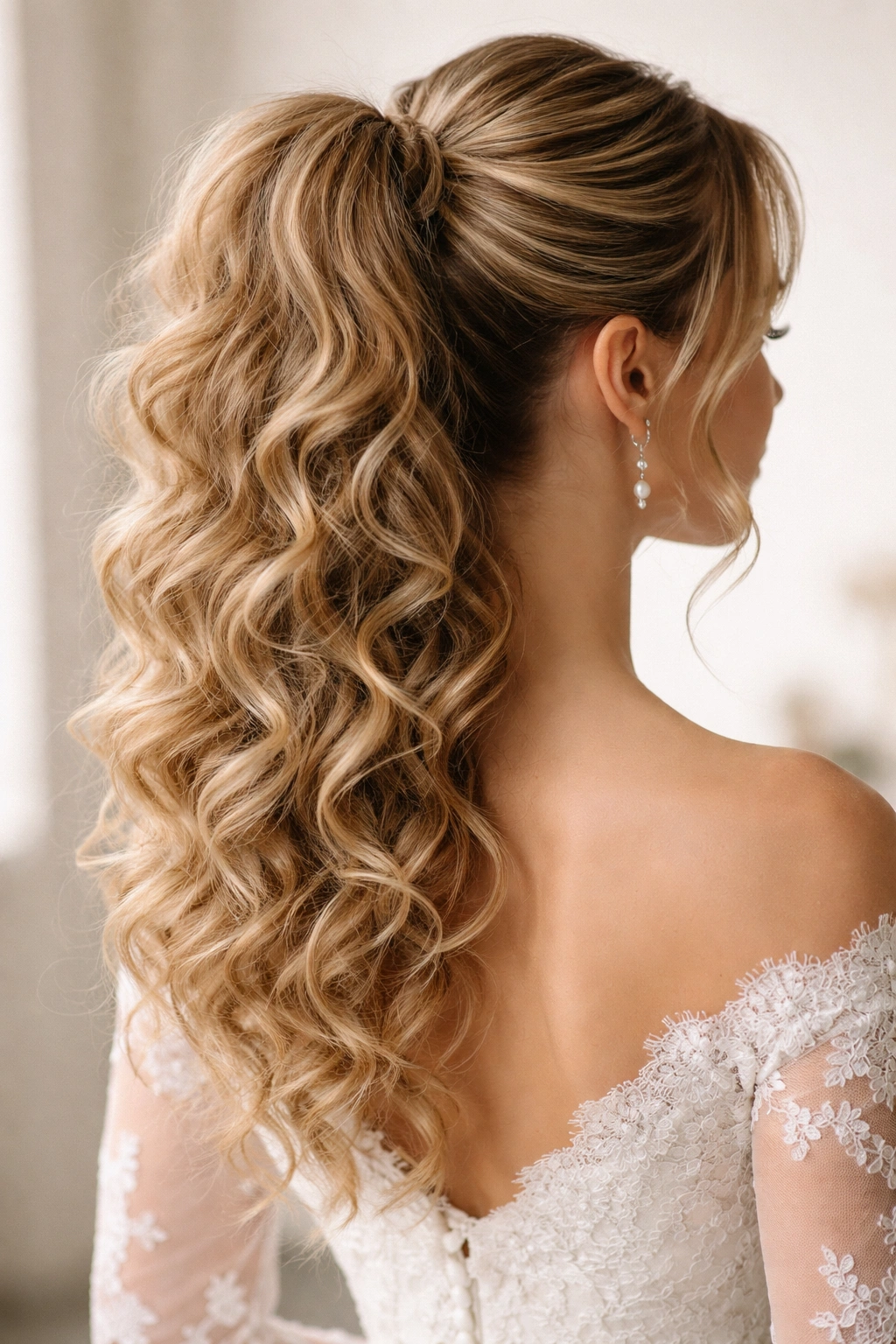
A two-level ponytail is one of the smartest ways to fake fullness without loading the hair with obvious extensions. The top section gets secured first, then the lower section gets gathered underneath it. From the outside, the hair looks like one thicker, more substantial ponytail. Sneaky. In the best way.
What Makes It Work
The upper ponytail supports the lower one, which means the style sits higher and looks denser through the back. Hidden pins between the two sections keep the shape stable and stop the layers from separating during the day.
- Helpful for fine curly hair that needs visual volume.
- Good when the hair length is uneven.
- Works with accessories because the base stays compact.
- Keeps the tail from looking thin at the nape.
The finish should still feel soft. Pull the curls apart only a little so the double structure does not show through. The goal is fullness, not obvious construction.
26. Modern Minimal Ponytail with No Visible Accessories
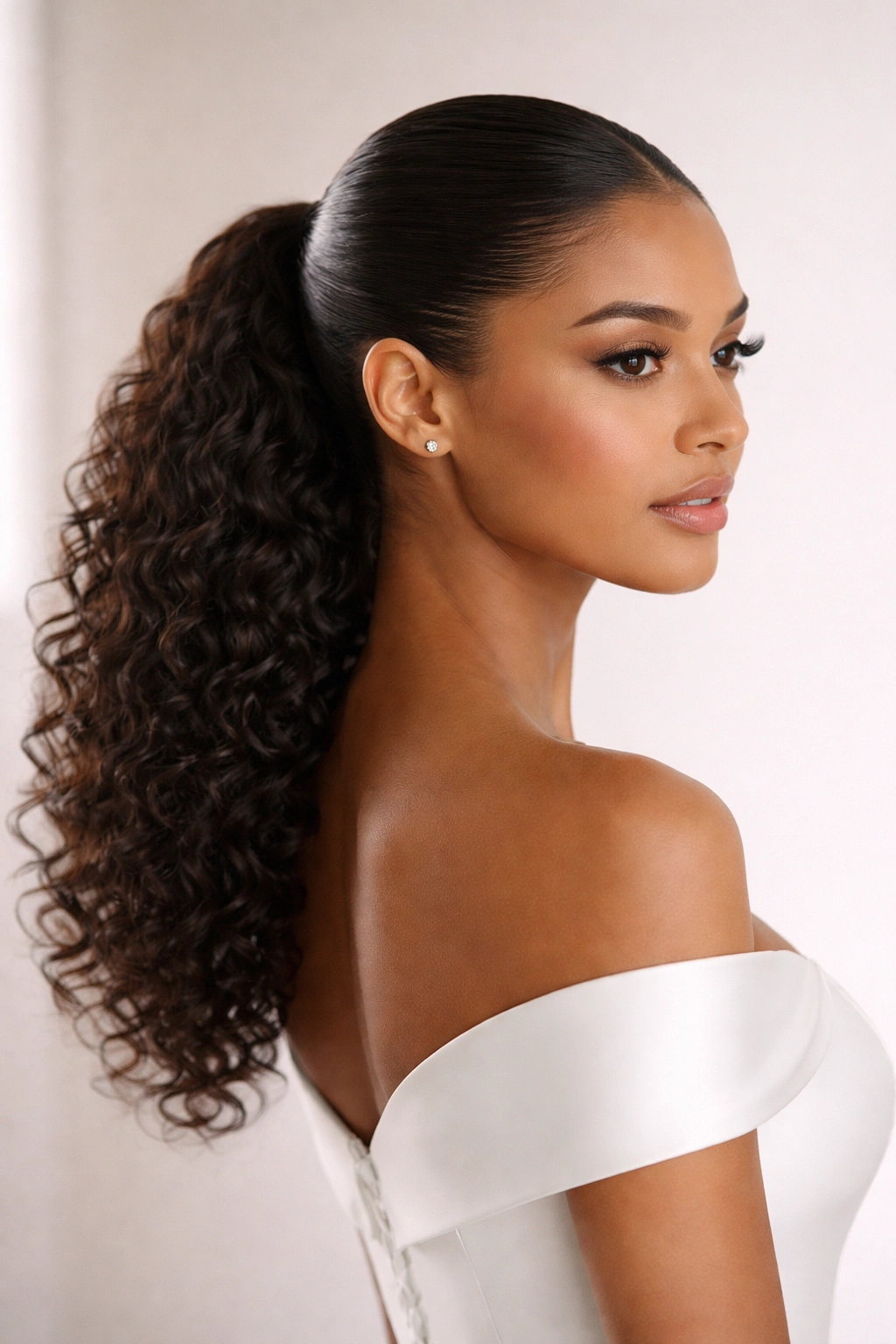
Sometimes the smartest move is to leave the hair clean and spare. A modern minimal ponytail has no ribbon, no pins on display, no flowers, no sparkle. Just a precise part, a controlled base, and curls that fall with enough confidence to carry the look alone.
This style depends on the quality of the finish. The part has to be clean, the elastic has to be hidden, and the root area needs to look deliberate from every angle. If the hair is curly and textured, that doesn’t mean it should be rough. It means the texture should be shaped with intention. The line from crown to tail matters a lot here.
A minimal ponytail works especially well with structured dresses, tailored suits, or bridal looks that already have a strong silhouette. Add too many accessories and the style loses its point. I’d rather see one clean curve of hair than five things competing for attention.
27. Bridal Ponytail with Crystal Pins
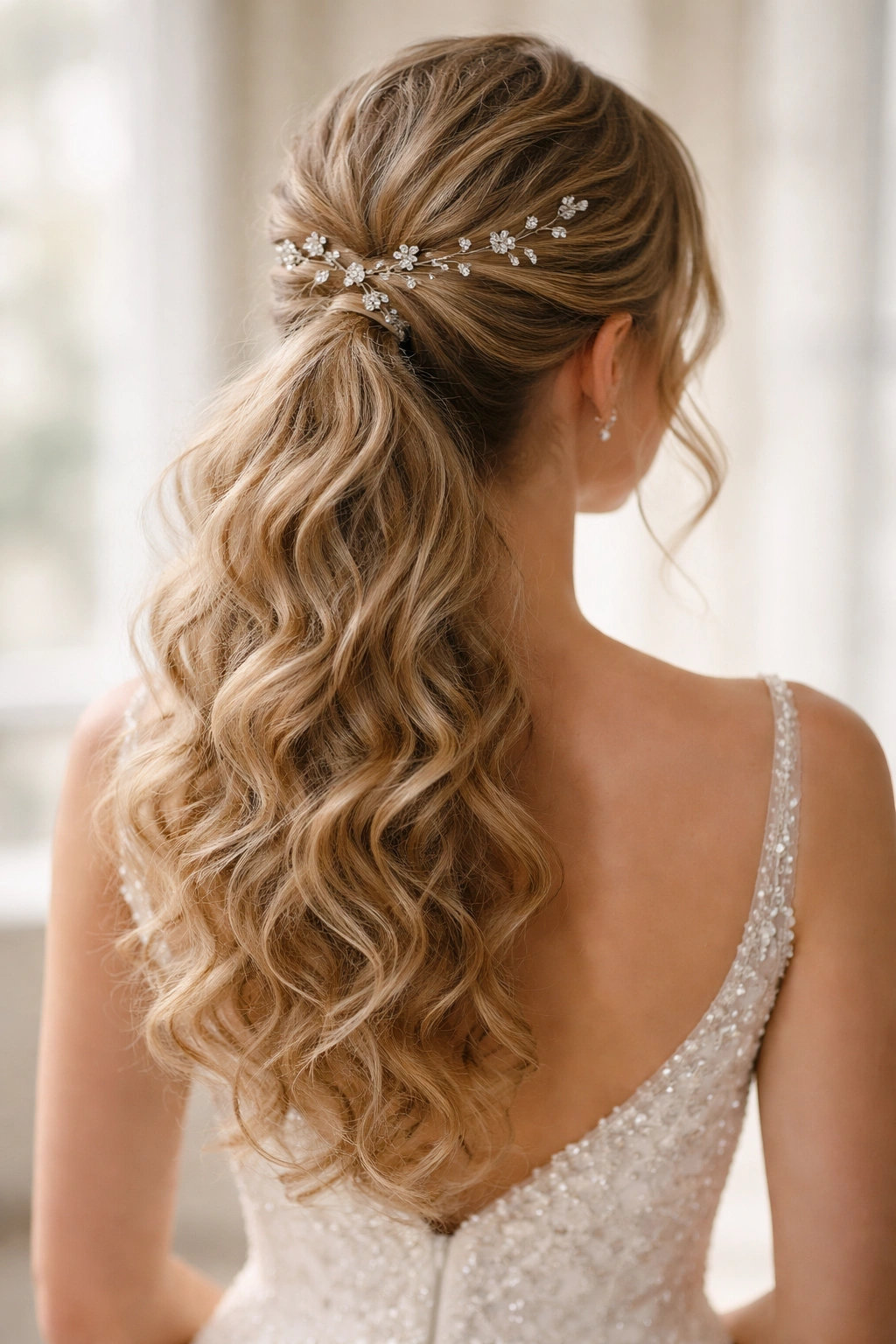
Crystal pins are the easiest way to add light without making the hair feel overloaded. The trick is to place them where they catch movement — along a twist, around the base, or on one side of the crown. Small clusters work better than random scattering.
The ponytail underneath should stay controlled. If the curls are already busy, the crystals only need to punctuate the shape. If the hair is smoother, the pins can do more of the visual work. Either way, they should look anchored, not sprinkled.
This style suits dresses with a little sparkle or simple gowns that need one polished detail. I like it most when the pins echo the rest of the jewelry instead of competing with it. Clear crystals, tiny pearls, or a mix of both can all work, but the spacing matters more than the stone shape. Keep the line clean.
28. Half-Low Hybrid Curly Ponytail
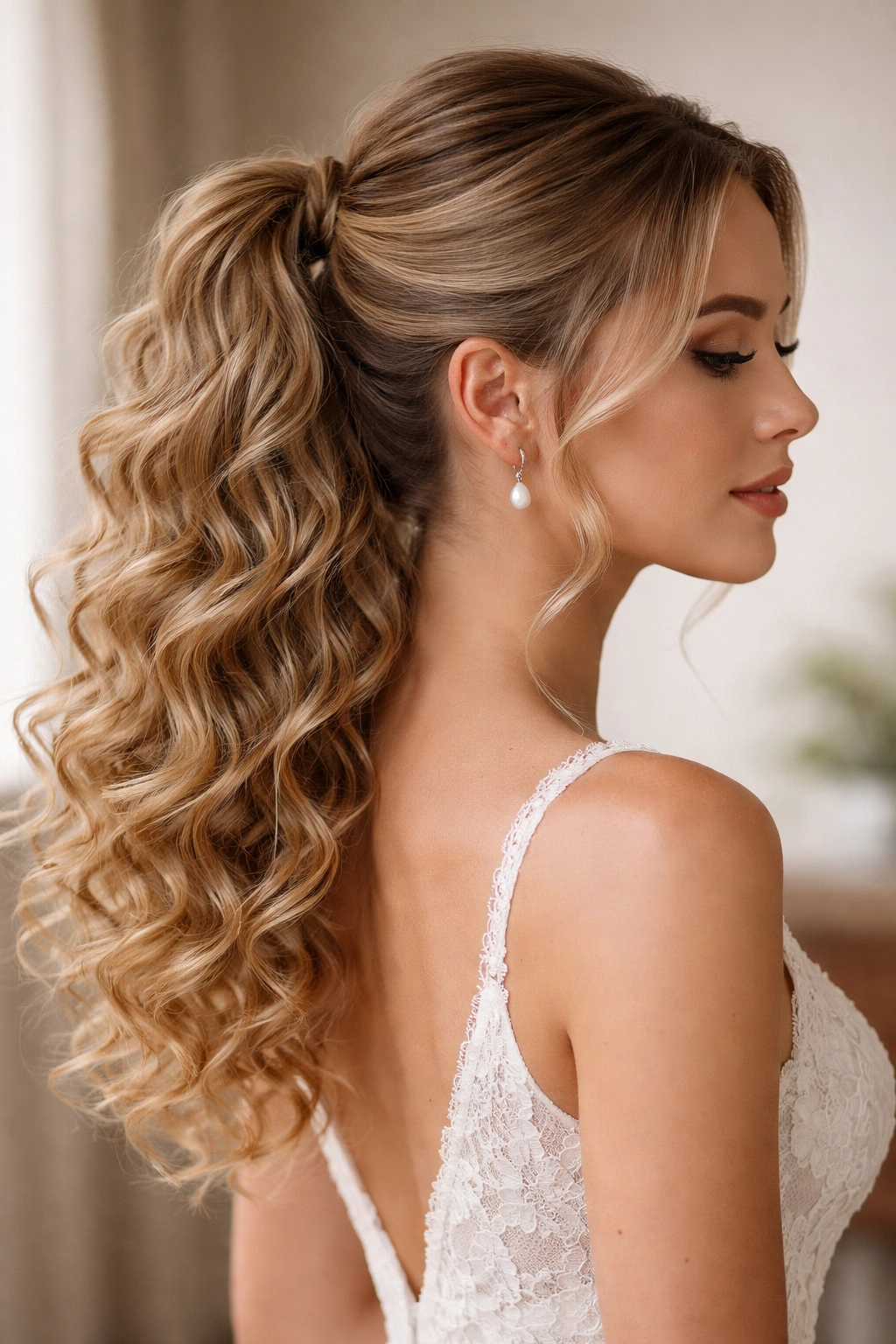
A half-low hybrid ponytail sits between a half-up style and a full low ponytail, which makes it a very good choice when you want both lift and length. The top section gets gathered and secured just enough to shape the crown, then the rest of the curly length drops lower and fuller.
This style is useful for brides who like the feel of hair away from the face but do not want everything pulled back tight. The hybrid shape gives a little volume at the top, keeps the sides under control, and still lets the curls show. It also works well when the hair has different curl patterns from root to end, because the style can hide a little unevenness.
A small comb, a ribbon tie, or even a single jeweled pin can finish it. Nothing more is required. The balance is what makes it work — enough structure to feel formal, enough softness to keep the curls alive.
29. Moisture-Resistant Curly Ponytail for Humid Weather
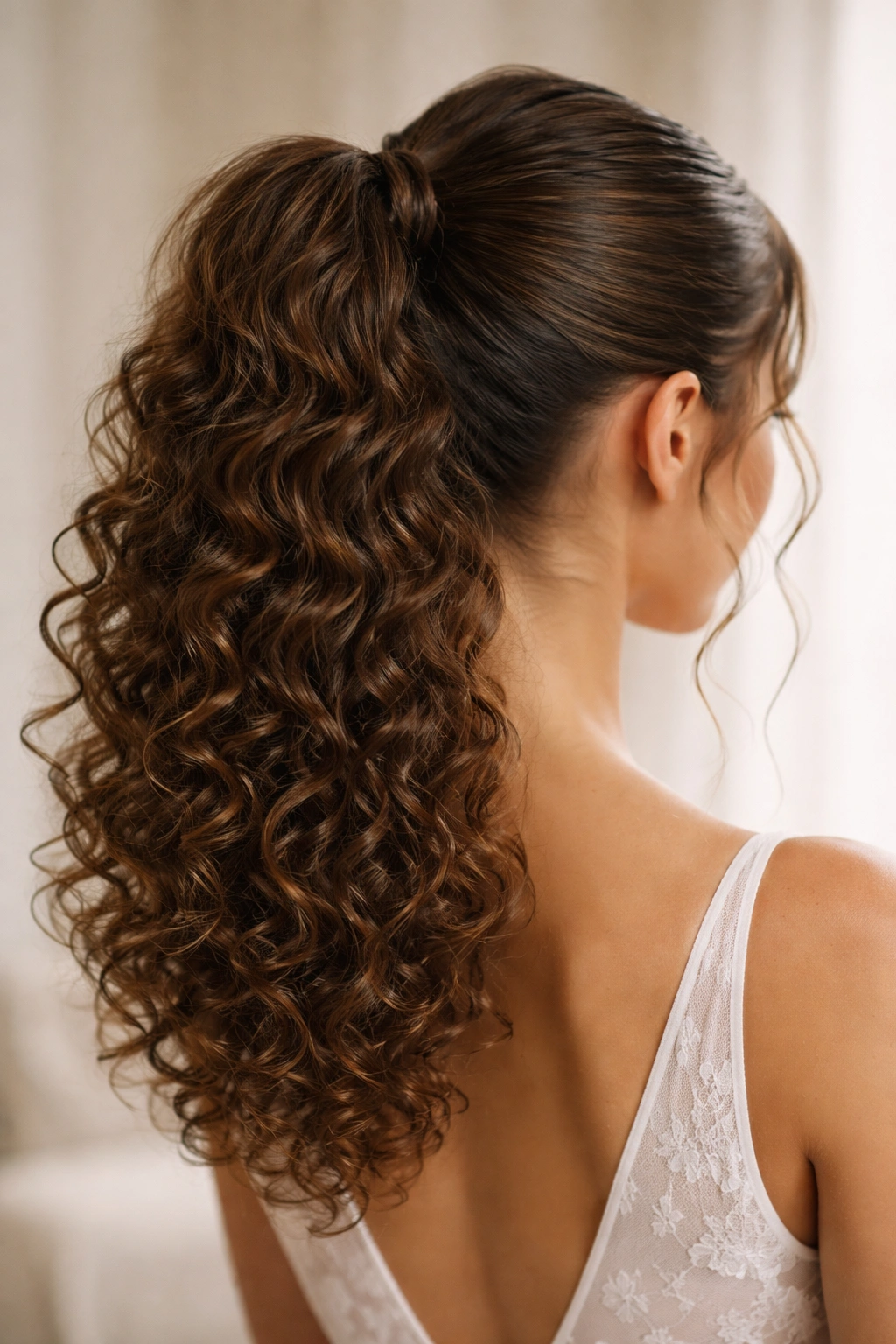
Humidity and curly hair have a complicated relationship. A moisture-resistant ponytail handles that reality instead of pretending it does not exist. The style starts with a strong base, a curl product that controls frizz without freezing the hair, and enough pinning that the shape will survive a warm room or an outdoor setup.
The crown should be sealed well, but not coated in layers of heavy oil. That usually causes collapse faster than frizz does. A light gel or cream at the roots, followed by a flexible-hold spray, tends to hold up better. Once the ponytail is in place, keep touching to a minimum. Curly hair can change shape fast once hands start going through it.
This style is less about decoration and more about staying put. If you’re getting married somewhere warm, breezy, or damp, that matters a lot. Pretty is fine. Staying intact is better. And yes, you can still leave a few soft front pieces if they’re set properly first.
30. Classic Curly Ponytail with a Veil-Safe Crown
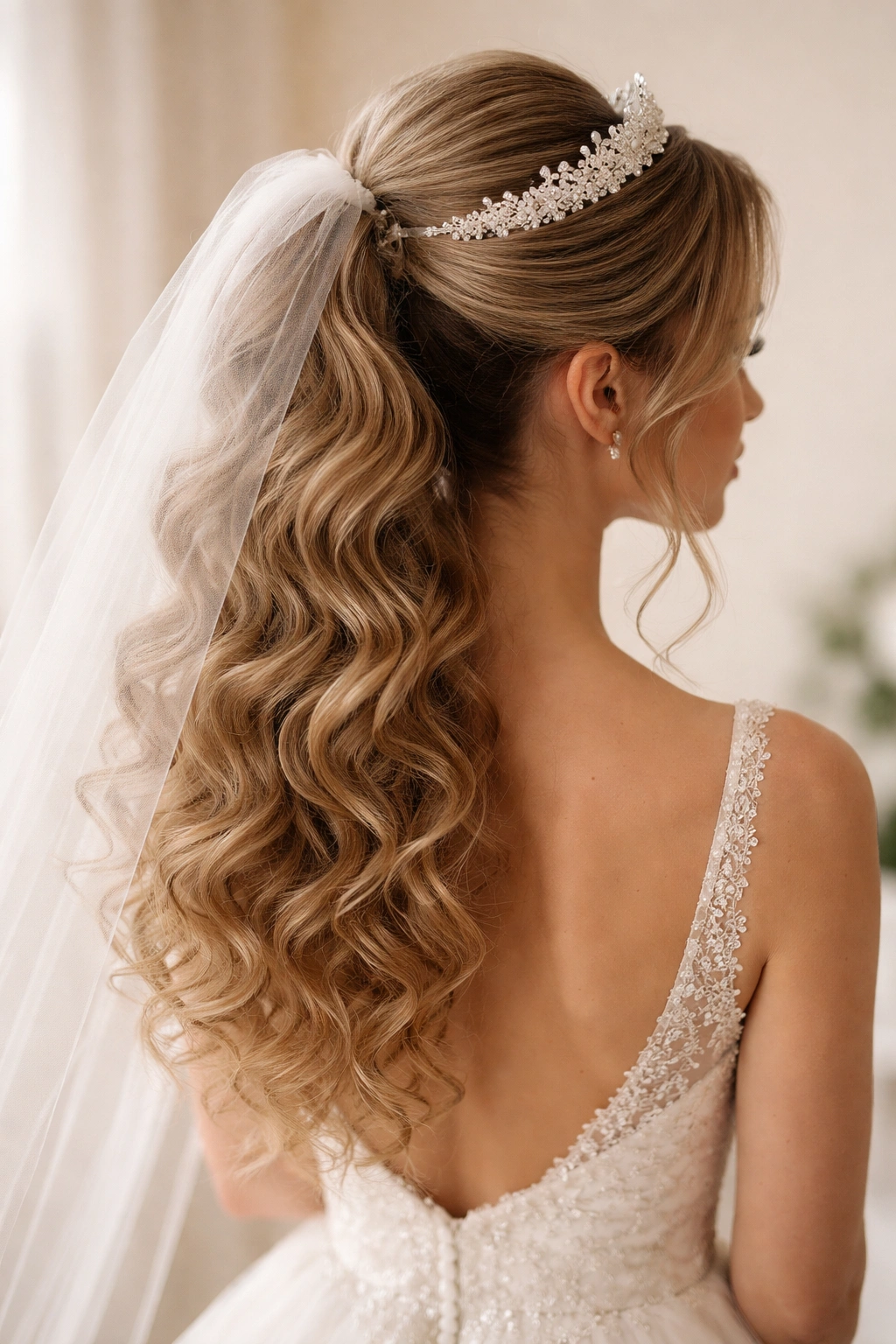
A classic curly ponytail earns its keep by doing a little bit of everything well. It has enough lift to feel bridal, enough control to support a veil, and enough curl definition to keep the style from looking flat in photos. No gimmicks. No fuss. Just a balanced shape that behaves.
The crown should be shaped with the veil in mind, even if the veil is light. That means a stable base, clean pinning, and a profile that does not tilt strangely once fabric is added. If the curls are long, let them fall naturally. If they’re shorter, encourage a little extra volume at the tail so the style still has presence from the back.
This is the ponytail I’d trust when the rest of the look is already doing a lot. It doesn’t need extra decoration to make sense. The hair itself is the feature, and that is usually enough.
The Bottom Line
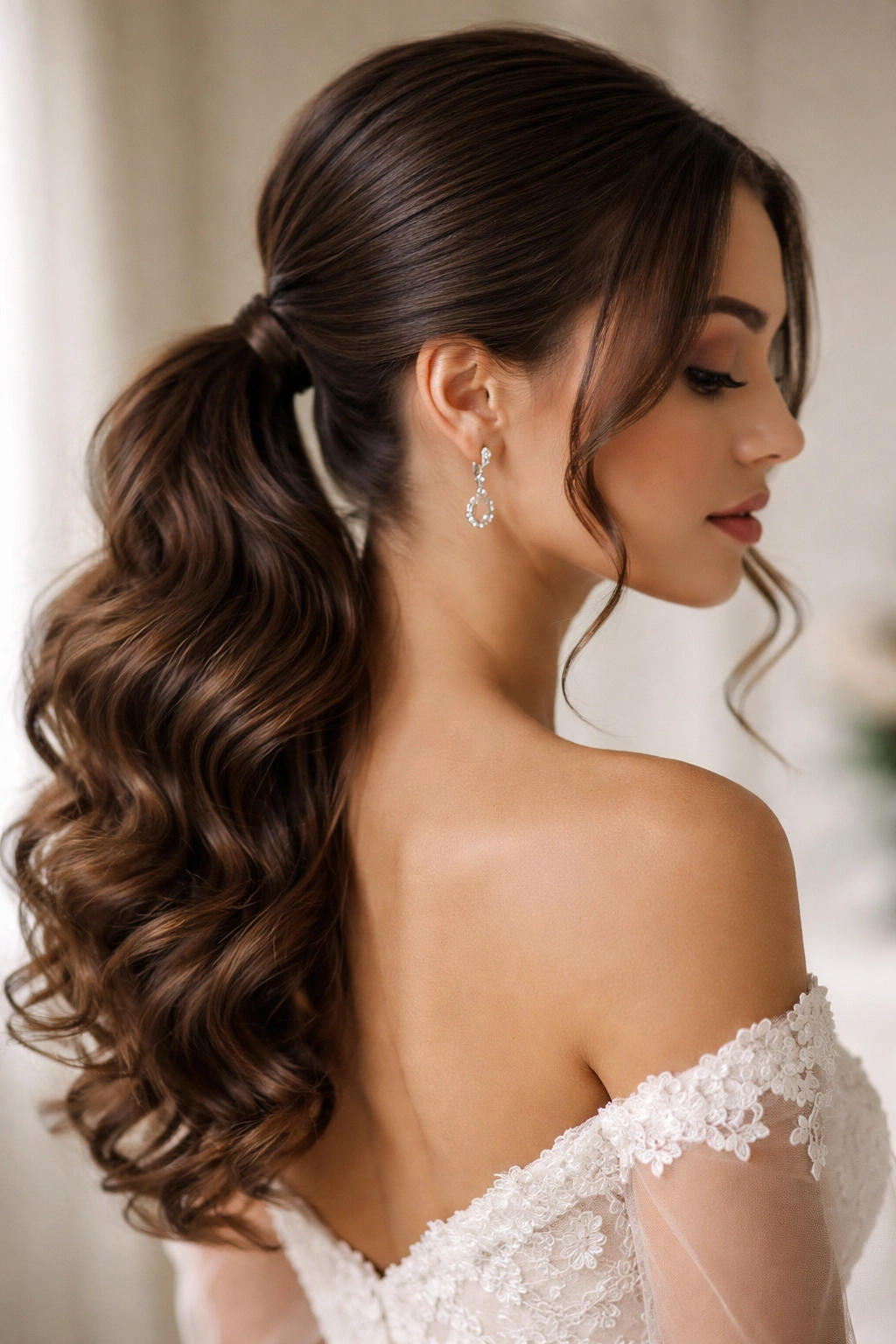
The strongest wedding ponytails for curly hair do not try to erase texture. They shape it. That can mean sleek and low, high and lively, side-swept, braided, ribboned, or kept almost bare — but the best versions always leave room for the curls to move.
If you want the safest choice, go low and polished. If you want more drama, go high. If you want romance, add one focal detail — a bow, pearls, flowers, or a braid — and stop there. Too many extras can crowd curly hair fast.
The last check matters most: turn the head, look at the profile, and see how the curls fall once the pins are in. That final shape is the one people will remember.
