



Curly hair has a funny habit of looking its best when nobody tries to bully it into acting straight. That’s why down wedding hairstyles for curly hair can feel so right: the texture stays alive, the shape feels like you, and the whole look has movement without needing a helmet of hairspray. The trick is not making the curls behave. It’s giving them enough structure so they hold through hugs, photos, humidity, and a long stretch of happy chaos.
A lot of bridal hair advice still leans hard toward pinning everything up, as if long curls can’t be polished unless they’re hidden. I don’t buy that. A well-planned down style can look far more refined than a stiff bun, especially when the curl pattern itself is doing most of the visual work. The crown needs lift. The front needs a clean shape. The ends need definition, not crunch.
That’s the part people miss. Curly wedding hair is not one hairstyle; it’s a set of decisions about parting, volume, accessories, and how much of the hair you want to secure versus let fall. A good style keeps the curls soft, but not loose in a messy way. There’s a difference, and it shows up fast in photos.
So here’s the practical part: fifteen down bridal looks that work with curls instead of against them, from glossy ringlets and side-swept volume to braid accents, twist-backs, and natural textures with a little shine. Some are quiet. Some are dramatic. All of them can look expensive if you handle the shape correctly.
1. Side-Part Ringlets with a Lifted Crown
A deep side part changes everything. It gives curly hair an instant sense of shape, and it keeps the face from disappearing into one solid wall of texture. This is one of the easiest down wedding looks to make feel polished without making the curls look stiff.
The best version starts with lift at the roots, not more product at the ends. If the crown lies flat, the whole style sinks. Ask for soft root volume on the heavier side and let the curl fall over one shoulder or just past the cheekbones. That little shift makes the style feel intentional, not accidental. It also gives you a clean spot for statement earrings, which always helps.
What makes it work
- The side part creates instant visual balance.
- Ringlets keep their bounce instead of turning into vague waves.
- A light shine spray on mid-lengths adds a neat finish without weighing the curls down.
Best for: medium to long curls, especially if your face shape looks better with a little asymmetry.
One thing to avoid: flattening the top while trying to make the ends look fuller. That trade never pays off. If you need a touch of hold, use a small amount of mousse at the roots and diffuse gently. Then leave the curls alone. Seriously. Touching them too much is how they lose that springy, wedding-day look.
2. Center-Parted Cascade with Face-Framing Curls
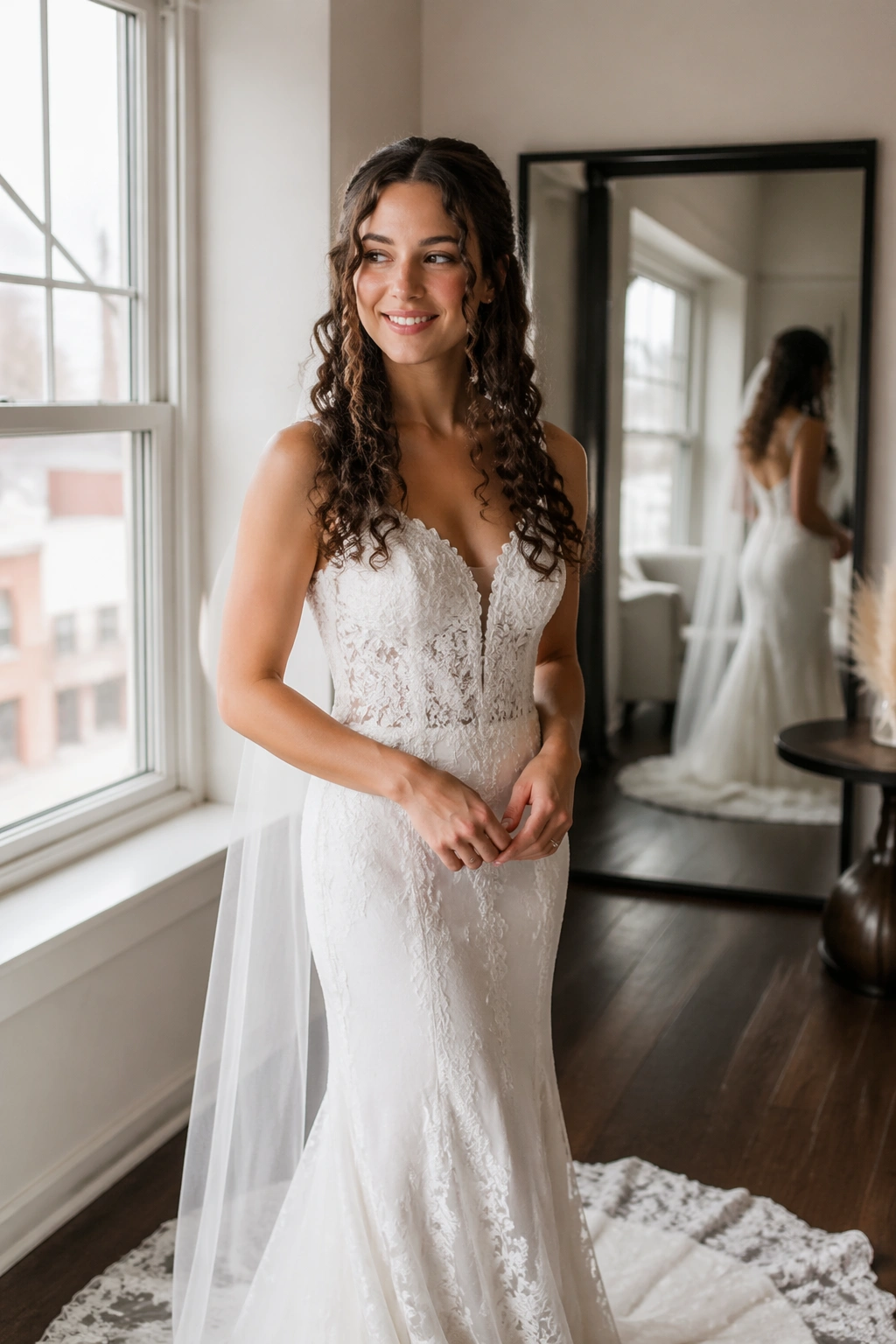
A center part can be brutal on hair that is too fine or too flat, but on curly hair it can look clean and elegant in a way that a side part never quite matches. The key is symmetry with softness. You want the part to guide the eye, not make the whole style feel severe.
The smartest version keeps the front pieces slightly shorter and more defined than the rest. Those face-framing curls matter. They soften the cheekbones, help the hairstyle sit nicely with a veil or hair comb, and stop the style from looking like two heavy curtains of hair. If the hair has layers, even better. Layers keep the shape airy.
How to keep the middle part from going limp
- Set the part while hair is damp, before drying.
- Clip the roots at the crown for 10 to 15 minutes after diffusing.
- Use only a pea-sized amount of serum on the ends.
If you want a little romance, tuck one side behind the ear and leave the other side free. It changes the whole read of the style. And no, it does not need a dozen pins. Two or three small bobby pins placed under the top layer are usually enough.
This one works best when the curls are defined but still soft enough to move when you turn your head. That motion is the point.
3. Old Hollywood Curls with Soft Brushed-Out Ends
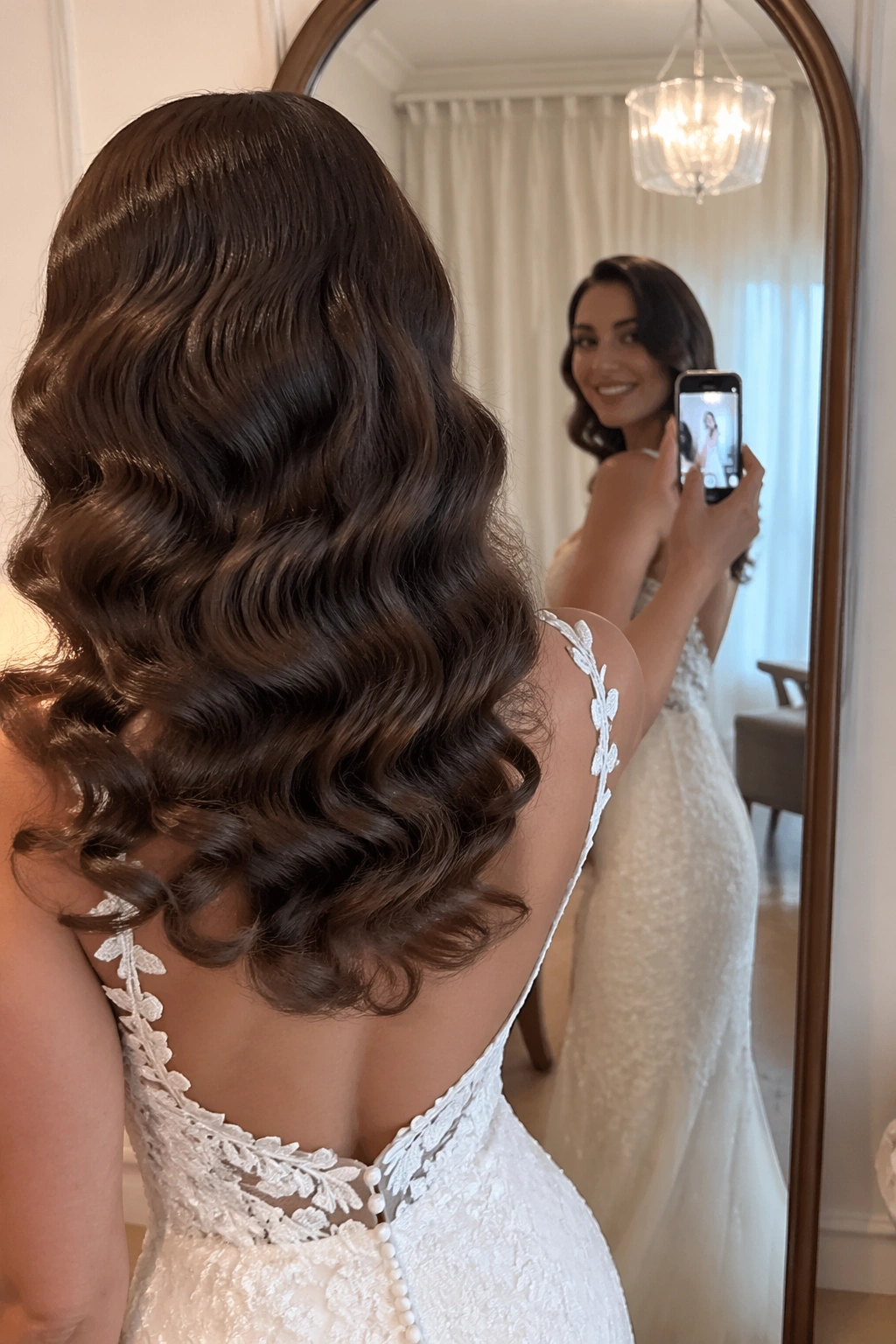
This is the curly wedding hairstyle for someone who wants glamour without a hard shellacked finish. Old Hollywood curls have that neat, glossy wave pattern, but on curly hair they work best when the curl is set first and brushed out with restraint. Not flattened. Not frizzed. Just softened.
I like this style on brides who wear satin, silk, or anything with a clean neckline. The hair becomes part of the outfit instead of fighting it. It also photographs beautifully in low light because the curves catch shine in a very even way. That said, the style only works if the curl direction is consistent. Random curl patterns can make the wave fall apart fast.
The setup
Start with hair that’s been dried in smooth sections, then wrapped loosely around a 1-inch or 1¼-inch iron if needed. Let everything cool completely. Then brush with a soft boar-bristle brush or a very wide paddle brush, using long strokes rather than rough passes.
A tiny bit of hold cream through the mid-lengths helps, but the finish should still feel touchable. If the ends look too puffy, smooth them with damp hands and a drop of serum. Not much. Too much product turns the whole look greasy.
This style is formal, yes, but not fussy. That’s why I keep coming back to it.
4. Half-Up Crown Twist with Loose Curly Lengths
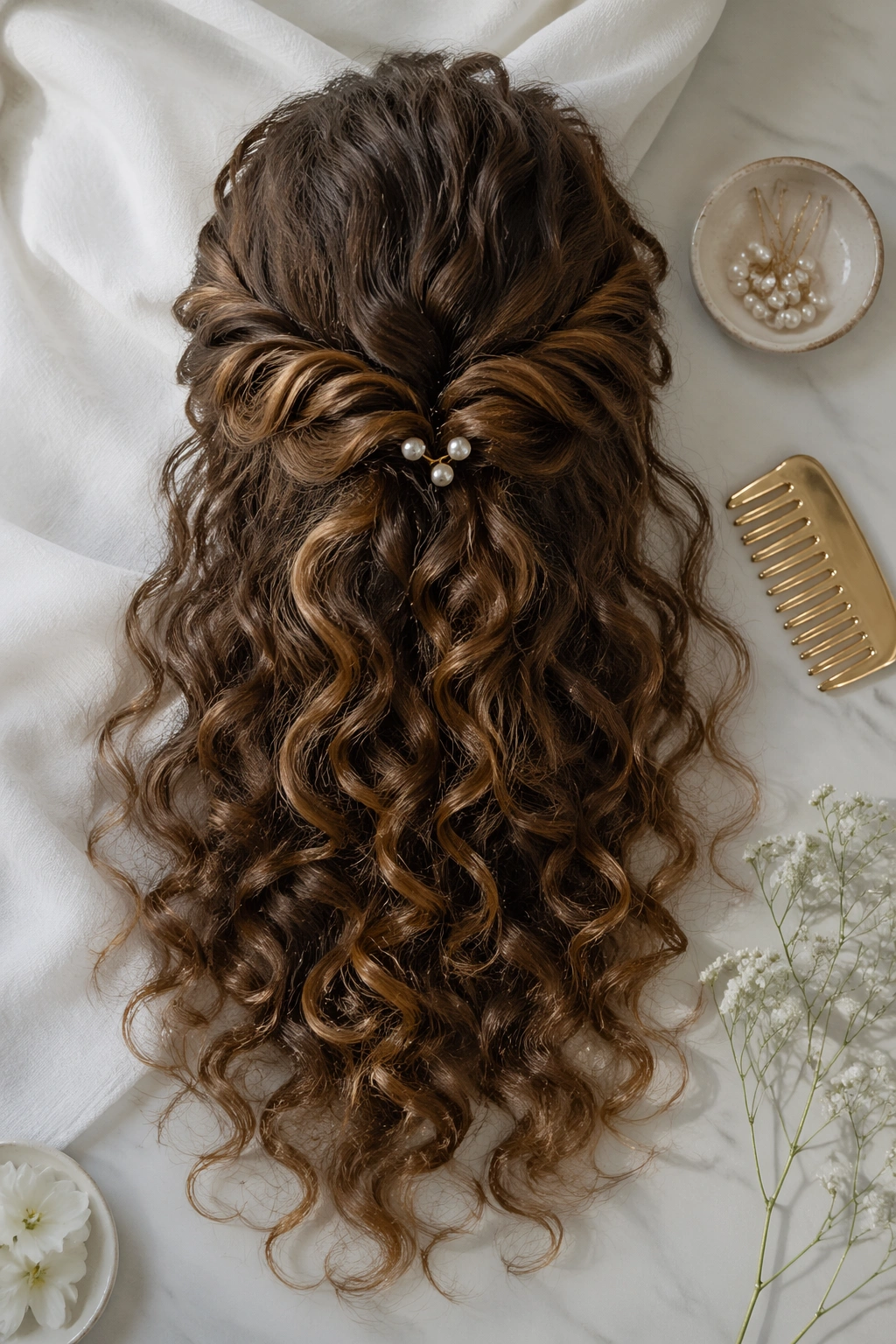
Half-up styles are popular for a reason: they solve two problems at once. You get lift at the crown, and you keep the length visible. On curly hair, a crown twist feels especially useful because it gives the top section structure while letting the rest of the curls do their thing.
The nicest version uses two soft twists pulled back from the temples and pinned just behind the crown. The pins disappear under the top layer, so all you see is a lifted frame around the face and a waterfall of curls underneath. It also works well with veils, since the top section is already controlled.
Best accessory match
- Small pearl pins for a classic look.
- One comb with a short ridge if you need support.
- Tiny floral pieces if the dress is already simple.
The only real danger here is making the twists too tight. Tight twists pull the face backward and flatten the whole style. Keep them loose enough that a little curl still spills into the front. If a few tendrils escape, leave them. Those soft pieces are the reason the style still feels bridal instead of school-dance neat.
A half-up twist is one of the few styles that can survive a full day and still look better when the hair loosens slightly. That is a rare thing.
5. Waterfall Braid into Free-Falling Curls
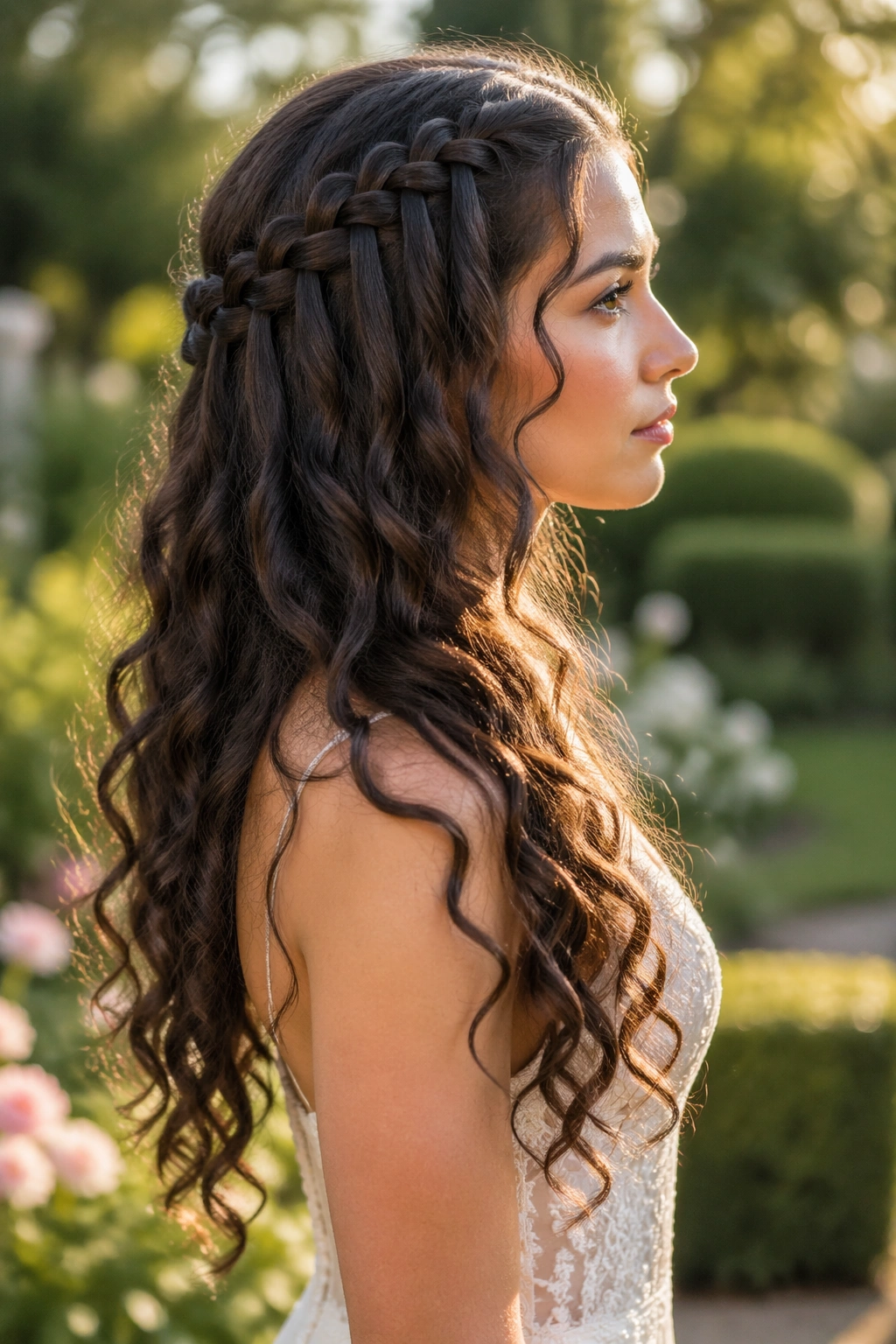
Waterfall braids look delicate, but they need a calm hand. On curly hair, they work best when the braid is light and the dropped strands stay soft. The braid becomes a frame, not the main event. That’s the right order of importance.
Picture one side with a braid running from the temple toward the back, feeding into the length as the curls fall down. You get detail near the face and a very pretty line across the head, but the real drama still comes from the hair left down. The style reads romantic without looking like it took over the whole head.
What to ask for
- A braid that sits close enough to the scalp to stay put.
- Loose tension so the braid doesn’t look carved in.
- Curl definition in the free-hanging sections, not brushed-out fluff.
This style is especially good if your dress has lace, beading, or a neckline that needs a little motion around it. It also flatters layered curls because the braid can pick up some shorter pieces and keep them from floating away.
If your hair tends to frizz at the braid line, a light styling balm on the surface only is enough. Don’t saturate the section. A greasy braid is worse than no braid at all. And yes, I’ve seen that happen.
6. Braided Halo with Curly Lengths Left Loose
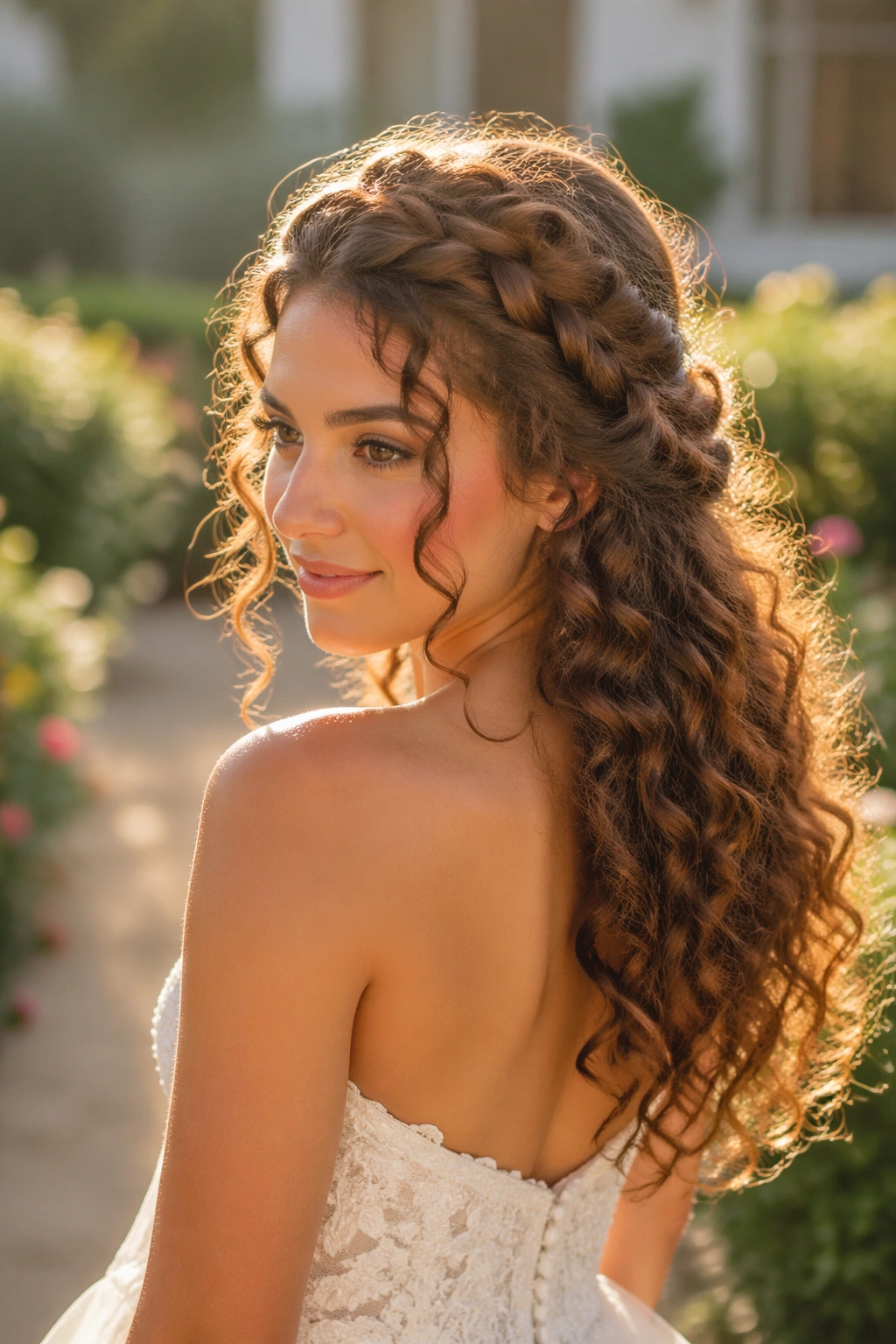
A braided halo sits a little closer to the head than a waterfall braid, and that difference matters. One gives you a trail. The other gives you a frame. This style is a good choice when you want the top and sides under control, but you still want the curls hanging free through the back and shoulders.
The halo braid usually starts near one temple and wraps around the hairline, either all the way across or stopping just behind the opposite ear. The loose hair underneath remains the focal point. That contrast—structured braid up top, soft curls below—makes the style look thoughtful without feeling heavy.
Why it’s different from a full crown braid
A full crown braid can swallow the hairline if the braid is too thick. A halo braid keeps more of the forehead open, which is kinder on most faces and usually better with delicate earrings. It also plays well with curly texture because the braid doesn’t need to be perfectly smooth to look good.
If your curls are tight, ask for a braid that stays slim and a little airy. If your curls are loose, the braid can be slightly fuller so it balances the rest of the hair. Either way, keep the back sections well separated with a touch of curl cream, or the whole style will blend into one fuzzy shape by the time the ceremony starts.
This one has a quiet kind of charm. It doesn’t shout.
7. Side-Swept Curls with One Shoulder Showing
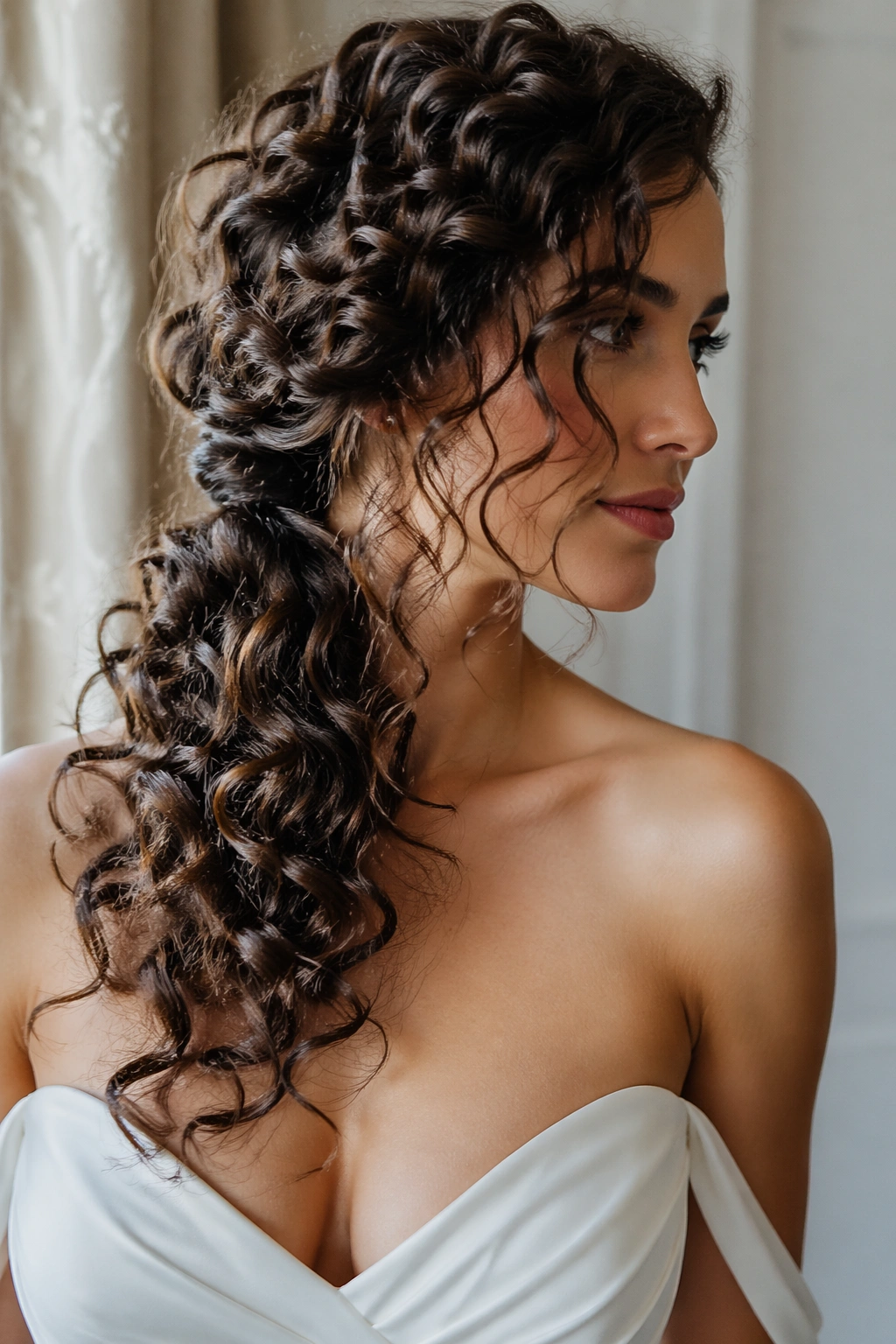
Some dresses are made for a side sweep. Off-the-shoulder necklines, one-shoulder gowns, and even simple strapless dresses tend to look sharper when the curls are gathered to one side instead of spread evenly across the back. The hairstyle opens up the neckline and gives the whole outfit a little attitude.
The trick is not dragging all the hair over like a ponytail gone soft. Keep the roots lifted, sweep the curls across the back or over one shoulder, then pin them low and hidden under the top layer. The front can stay loose and a little curved around the face. That is what keeps the style from looking overcontrolled.
A good side sweep needs three things
- Volume at the crown.
- A secure anchor point at the nape.
- A smooth transition where the hair crosses the back.
I like this look when the bride wants visible earrings, a necklace, or a neckline that needs room. It also works with curls that have a bit of length variation, because the different lengths create a soft waterfall effect once they’re all directed to one side.
If your hair is thick, use two hidden pins at the base rather than one heavy clip. If it’s finer, a small comb can give better grip. And if a few curls fall back after an hour, that’s fine. The style can handle a little looseness.
8. Natural Curly Texture with Jewel Pins at the Temples
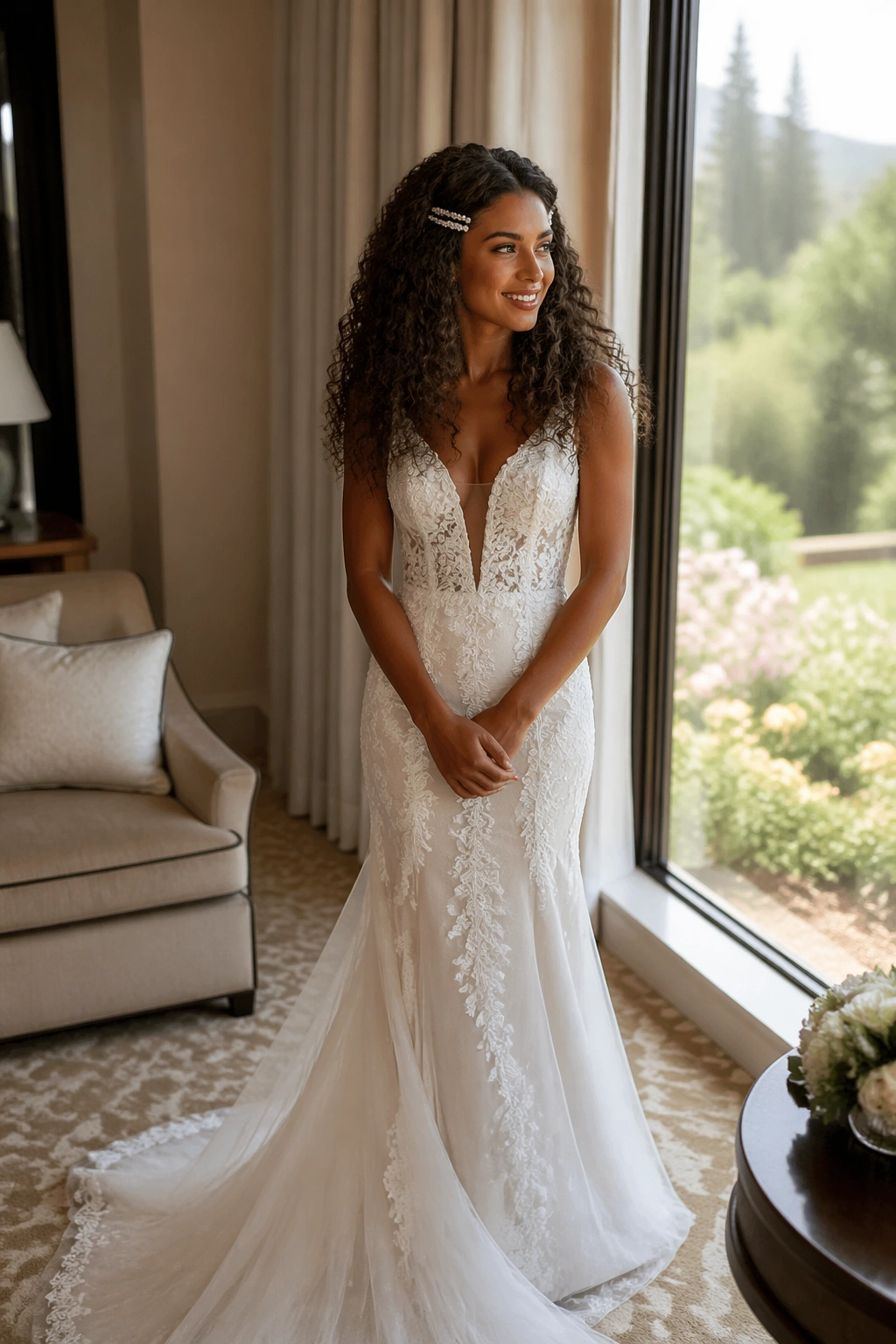
Sometimes the smartest down hairstyle is the one that does almost nothing to the curl pattern. Natural texture has presence. It has character. And on a wedding day, it can look richer than any style that tries to polish it into a shape it never wanted.
The key here is definition and placement. You want the curls shaped, moisturized, and lifted at the root, then left alone with a few well-placed pins or combs near the temples. Not scattered everywhere. Just enough sparkle to frame the face and signal that this is a bridal look, not a normal day.
How to keep it from reading unfinished
- Clean the parting line so it looks deliberate.
- Define the front sections a little more than the back.
- Add accessories in clusters, not random dots.
This look is especially strong for tighter curl patterns and coily hair. It lets the shape of the hair do the work instead of forcing it into a different category. If you’ve ever watched a great natural style in motion, you know what I mean—the hair moves, but it still holds its shape.
A tiny dab of edge control around the hairline can help if you like a neater finish. Use a light hand. A crisp hairline is nice; a stiff one is not.
9. Soft Brushed-Out Volume for a Romantic, Cloud-Like Finish
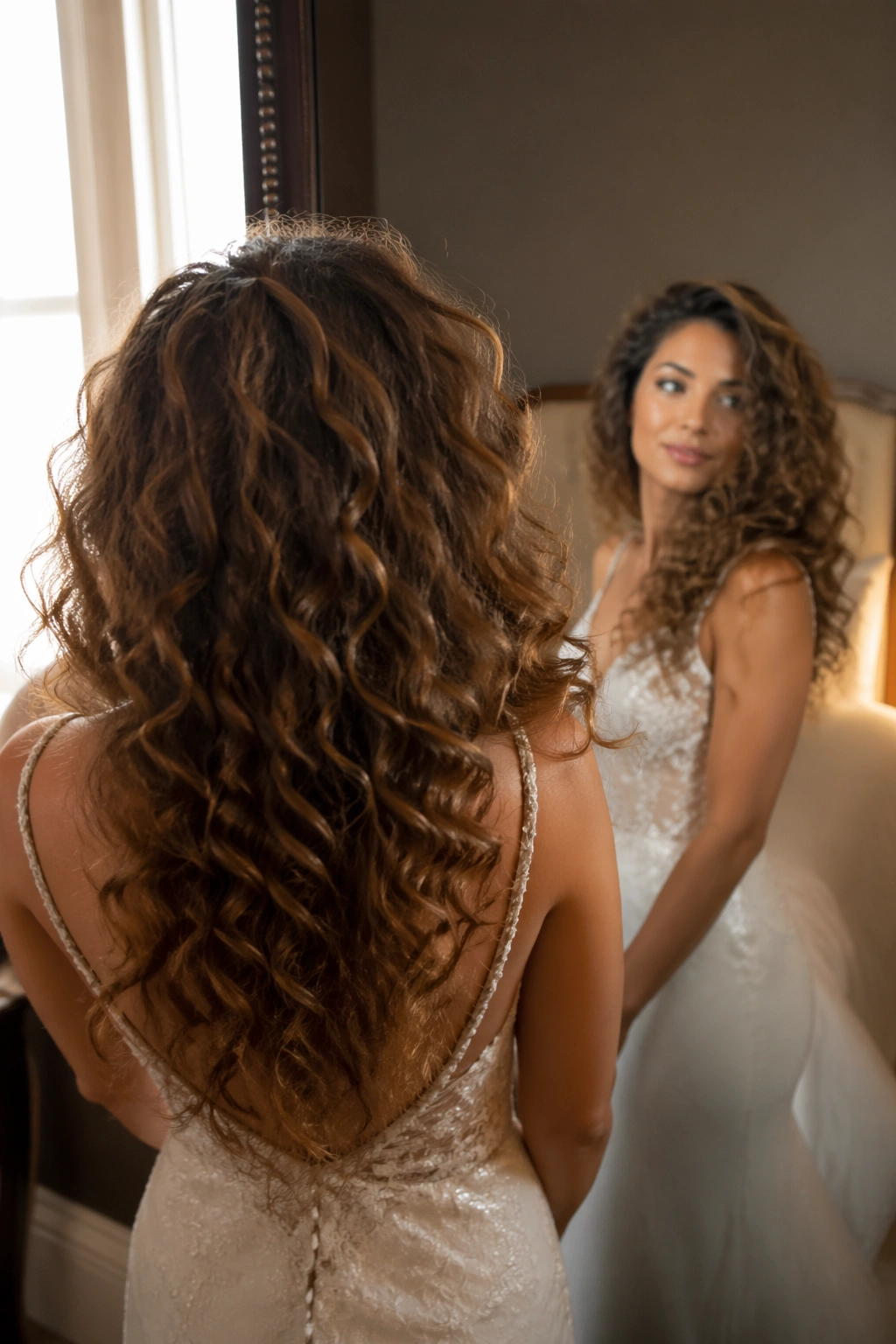
Brushed-out curls are risky if you don’t know where to stop. Brush too much and you get puff. Brush too little and the shape feels too tight for a bridal look. The sweet spot is right in the middle: volume with softness, not a solid helmet of hair.
This style works best when the curls are set first, dried completely, and then separated just enough to create a broad, airy shape. The result is less ringlet and more cloud. That sounds vague, but it’s a useful way to think about it. You’re after a softer silhouette, with the texture still visible when someone stands close.
What to watch for
- Frizz at the top means the brush was too rough.
- Flat roots mean the style needs more lift before brushing.
- Sticky ends usually mean too much product somewhere along the strand.
I like this option on long hair because it can make the whole look feel full without adding accessories. It’s also forgiving in photos. Soft volume hides small gaps, and a little irregularity doesn’t matter as much when the hair is meant to look airy.
A light mist of flexible-hold spray after brushing can help the shape stay put. Don’t drown it. You still want the curls to move when you walk.
10. Two-Strand Twist-Out with a Glossy Bridal Finish
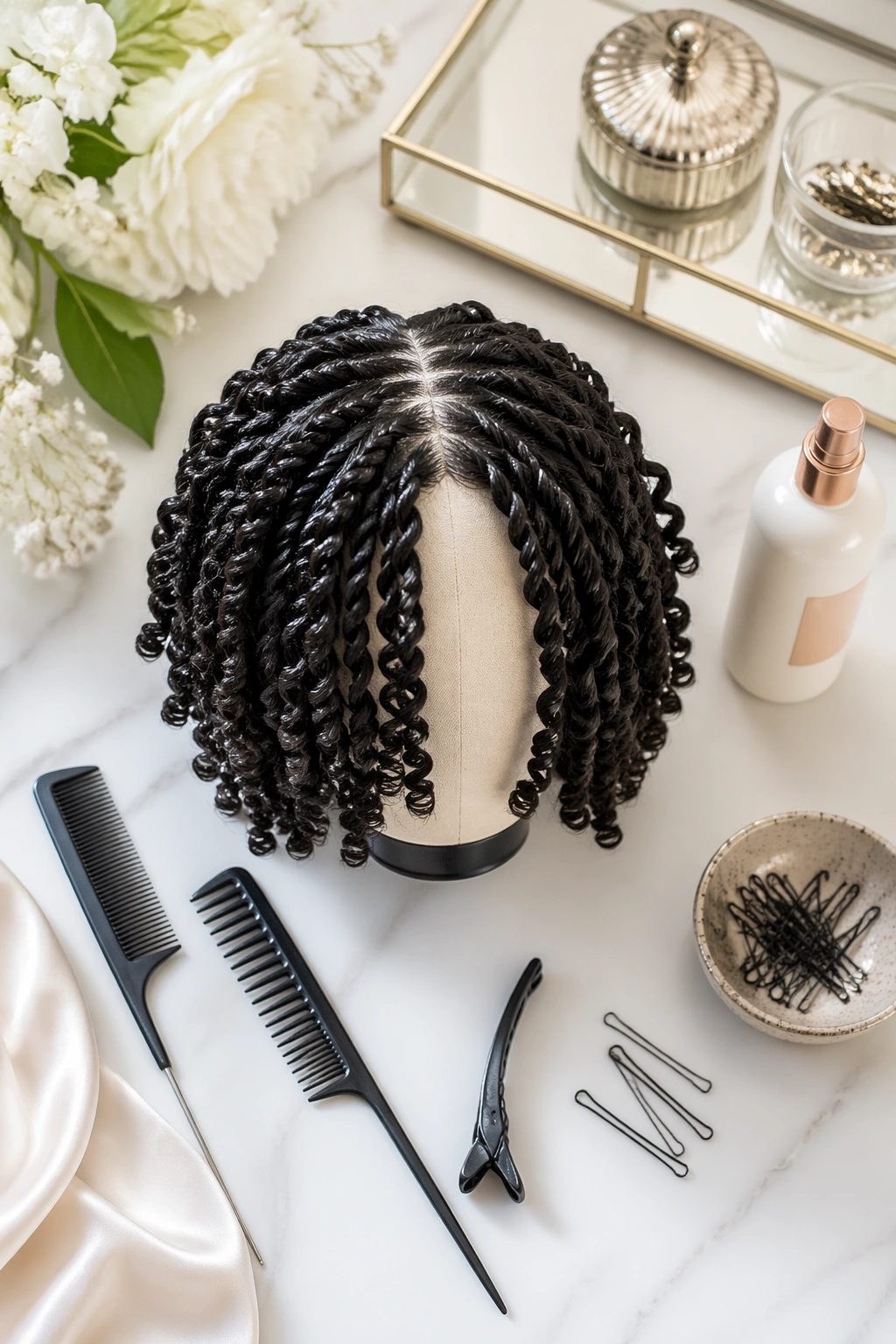
A twist-out is one of the most practical down wedding styles for textured hair because it gives shape, elongation, and control without fighting the curl pattern. Done well, it looks polished and full of texture. Done poorly, it can look separated in a bad way. The difference usually comes down to drying time and how gently you take the twists apart.
This style has a clean, layered look that works beautifully with natural hair. The twists create a defined pattern, and once they’re released, the result is soft, rounded volume with a little stretch through the lengths. It feels bridal because it has structure, but it still feels like real hair.
How to get the best finish
- Twist on damp, not soaking wet, hair.
- Let the hair dry fully before unraveling.
- Separate with oiled fingers, not a rough comb.
That last part matters more than people think. If you separate too hard, the style puffs up in the wrong places. If you don’t separate enough, the twist pattern looks chunky and unfinished. A little patience solves both problems.
This is a smart style if you want fullness without heat. It also holds up well through a long day because the shape begins with the texture itself, not a lot of styling product layered on top.
11. Curly Bob with Tucked Sides and Clean Shape
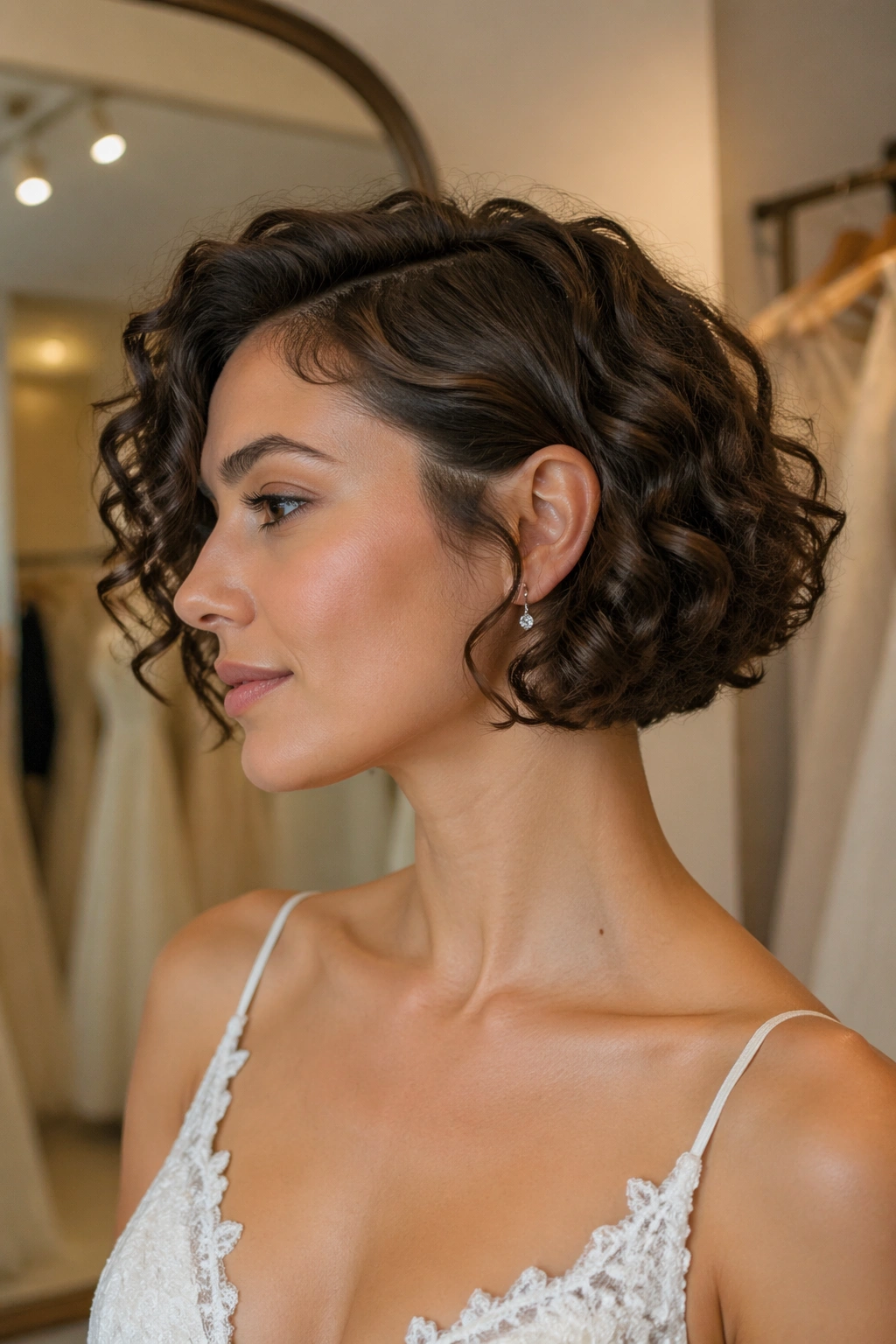
Short curly hair can look incredibly chic at a wedding. A bob does not need length to feel dressed up. It needs shape. Once the silhouette is clean, the curls bring the personality.
A wedding-ready curly bob usually sits at the jawline or a little below it, with one side tucked behind the ear or pinned back lightly so the face stays open. The front curls should still have bounce. You do not want a flat side and a fluffy side. You want balance, with a few well-defined pieces around the cheekbones and neckline.
Why this version works
Unlike long curls, a bob doesn’t need much help to feel light. The shorter length already keeps the style from getting heavy. That makes it a good fit for brides who dislike hair touching their shoulders or who want a cleaner view of the dress neckline.
A side tuck helps, too. It gives the style a little asymmetry and makes room for earrings without changing the shape too much. If you want more sparkle, a small comb at the tucked side is enough. Don’t overload it. Short curly hair gets crowded fast.
This one can feel modern, elegant, and a little playful all at once. Short hair doesn’t have to play it safe. Good curls already carry enough energy.
12. Natural Afro with Floral or Pearl Clusters
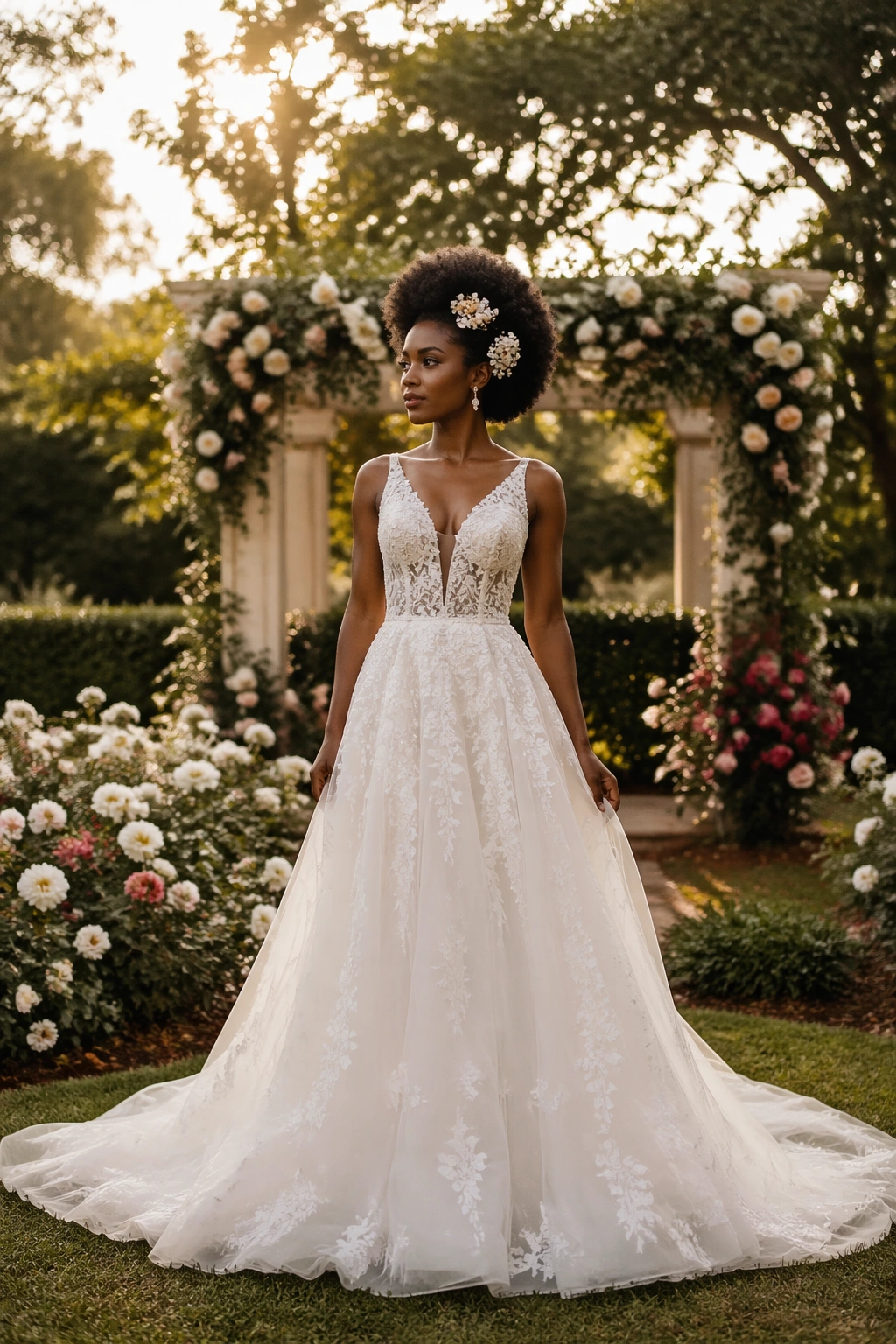
A bridal afro is one of the strongest down styles because it doesn’t apologize for taking up space. It frames the face, gives height, and can look extremely refined with the right accessory placement. The mistake people make is scattering accessories everywhere. That can cheapen the shape fast.
Instead, keep the hair itself the focus and place flowers or pearl pins in one or two clusters. Near one temple. Around the crown. Along one side if the dress is simple. The idea is to guide the eye, not decorate every inch of the head like a craft project.
What works best
- Medium-sized blooms instead of tiny bits lost in the texture.
- Pearl pins grouped in threes or fives.
- A defined shape at the edges so the silhouette stays clean.
This style has presence on its own. A good cut and a little moisture cream are enough to make it feel groomed. If the hair has a strong shape, the accessories only need to support it.
It also photographs with depth in a way straighter styles often don’t. The texture creates shadow and movement all by itself. That is the real beauty here. Nothing has to pretend to be more than it is.
13. Veil-Friendly Curls with Hidden Support at the Crown
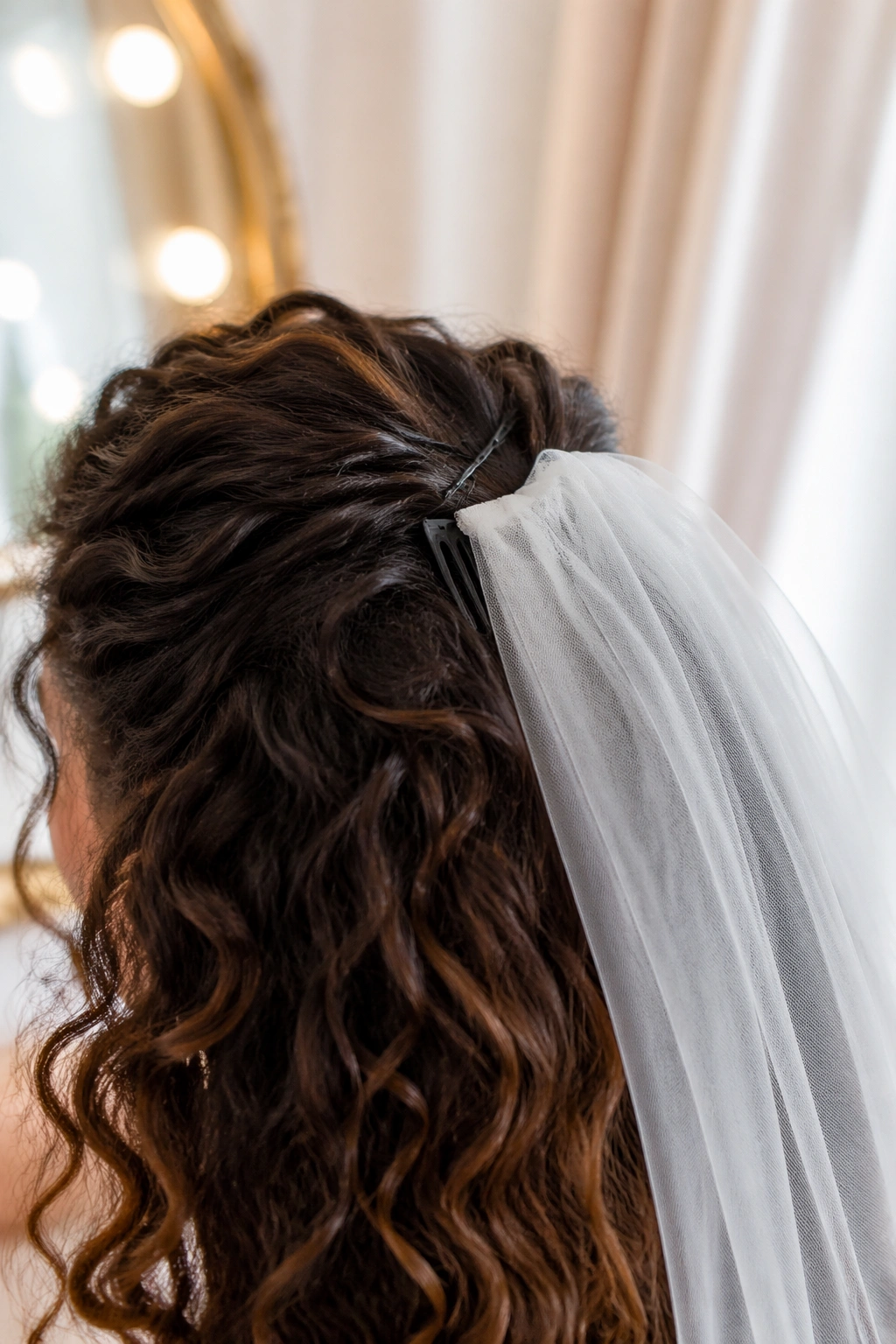
A veil changes the game. If you’re wearing one, the hairstyle has to make room for it without letting the crown collapse under the weight. That’s where a veil-friendly down style earns its keep. The hair should still fall freely, but the top section needs enough structure to hold the attachment point.
The smartest approach is a slight lift at the crown, with a secure base hidden under the top layer. That can be built with crossed bobby pins, a small comb, or a discreet anchor point depending on veil weight. Heavy veils need more support. Light veils are easier, but they still need grip.
Small details that matter
- Place the veil where the hair is strongest, not where it looks prettiest.
- Leave the curls below the attachment point untouched.
- Check the veil placement after moving your head side to side.
A lot of brides make the mistake of smoothing the crown too much before adding the veil. Then everything slips. Better to leave some root texture and use that as the base. It gives the pins something to hold.
Once the veil comes off, the style should still work on its own. That means the curls need to look finished underneath, not flattened by the accessory. A little planning here saves a lot of fuss later.
14. Deep Side Part with One Side Tucked and the Other Left Full
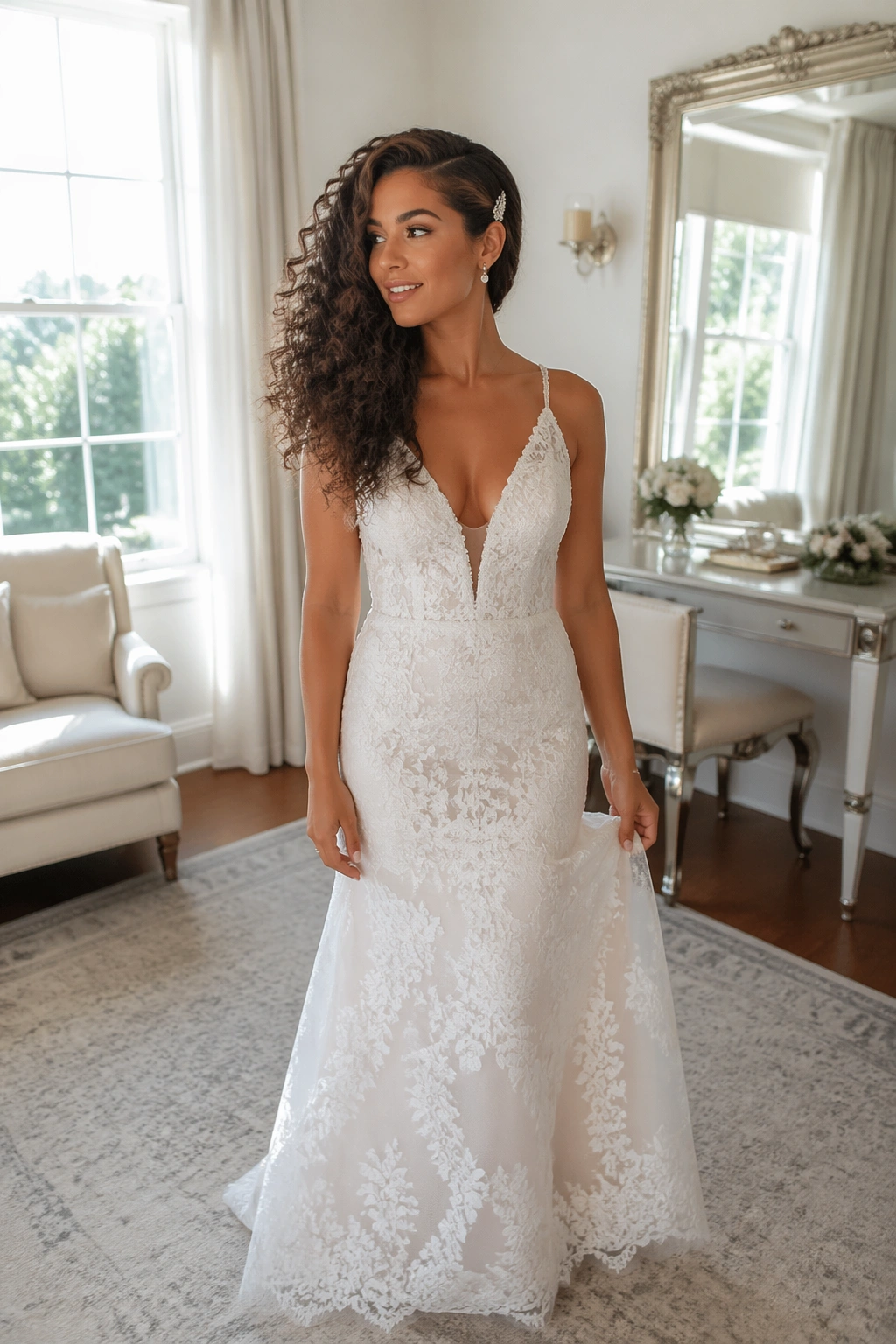
This is the neat, slightly dramatic cousin of the classic side sweep. The difference is subtle but useful. Instead of pulling all the curls over, you tuck one side behind the ear or secure it close to the head and let the other side stay full and loose. The asymmetry feels clean and grown-up.
It’s a strong choice for brides who want their face open on one side for makeup or earrings, but don’t want the entire hairstyle shifted across the body. The result is softer than a fully swept look, and a little sharper than a center-part cascade. Nice middle ground. Rare, honestly.
Why it stands out
- One side stays controlled.
- The other side keeps movement and fullness.
- The face looks framed, not buried.
Use this when the dress has detail on one shoulder or when the neckline already carries a lot of visual weight. The hairstyle doesn’t need to compete with the clothing; it should make room for it.
If your curls are dense, this style can save you from feeling overwhelmed by volume. If they’re fine, the tucked side gives enough shape so the hair still reads as styled. The balance is tidy without feeling too formal.
15. Face-Framing Layers with Tiny Clips and Loose Bridal Curls
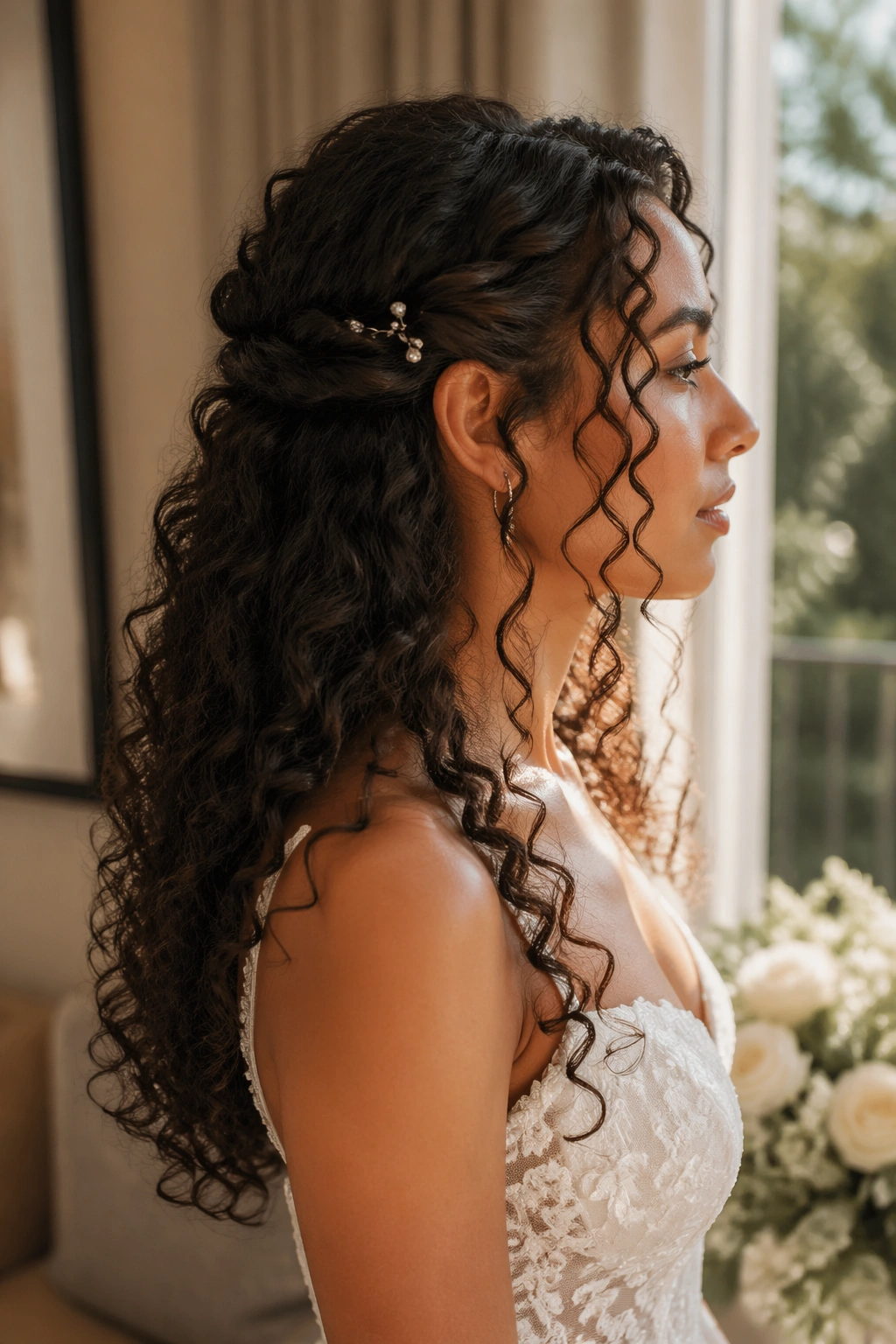
Layers are a gift on wedding day if you know how to use them. They give movement around the face, help the curls fall in a softer shape, and keep the hair from turning into one heavy block. A few tiny clips at the temples can finish the look without taking over it.
This style is especially good for brides with curtain bangs, grown-out fringe, or shorter layers that like to escape. Instead of fighting those pieces, you make them part of the design. The curls at the front can curve along the cheeks, while the rest of the hair stays loose and full through the back.
Best details to focus on
- Keep the front layers defined enough to show their shape.
- Use very small clips so they don’t overpower the texture.
- Leave the ends soft, not over-sprayed.
I like this look because it feels young without being casual. The clips can be pearl, crystal, or metal, but they should stay small. Big accessories at the temples can break up the curl pattern in an awkward way. Tiny ones disappear just enough to let the texture lead.
This style also gives you room to adjust if the weather shifts or your curls settle. A couple of layers can be restyled in minutes. That kind of flexibility is worth a lot on a long wedding day.
Final Thoughts
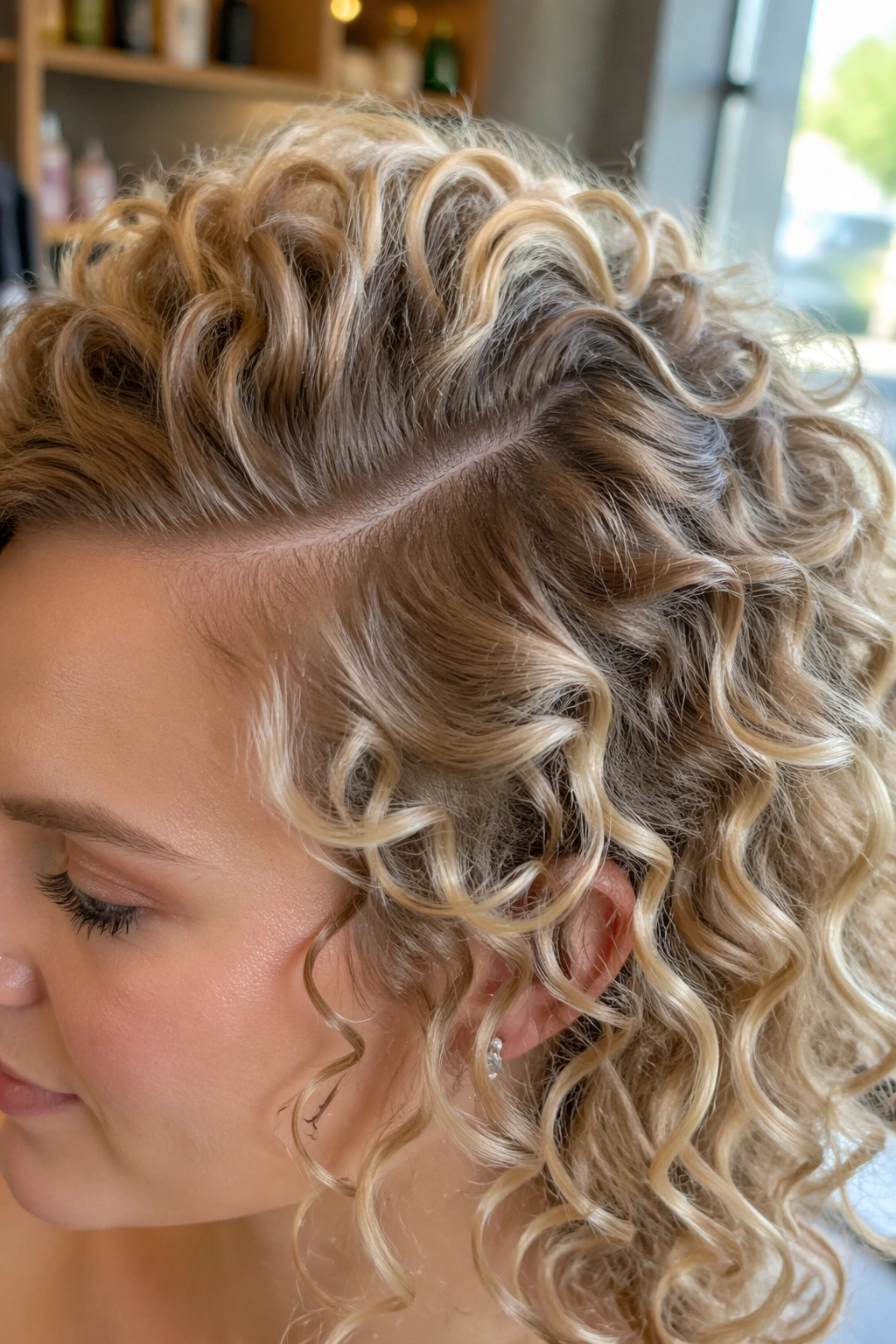
The strongest curly bridal looks usually have one thing in common: they respect the curl pattern instead of trying to tame it into something else. That might mean a side part, a braid accent, a veil-friendly crown, or just a really clean finish on the natural texture.
Pick the style that matches the neckline, the veil, and the amount of movement you want in the hair. Then test it in real light, not just in a bathroom mirror. Curls tell the truth fast. If a style looks too tight, too flat, or too product-heavy, you’ll know within minutes.
And if you’re torn between two looks, choose the one that still looks like you after the pins come out. That’s usually the right one.
