



Green curly hair is not for the faint of heart — and that’s exactly why it’s perfect for bold women who want their hair to say something the moment they walk into a room. Green is the most unexpected color in the natural hair space, which makes it instantly memorable. On natural curls and coils, green takes on an almost organic quality — like something grown rather than dyed, like your curls decided to become a garden. These 20 green curly hair ideas range from deep forest tones to vivid lime and neon mint, and every single one of them is worth the commitment.
Why Green Works Differently on Curly Hair
Walk into any room with green curly hair and watch what happens. Green is not a color people expect on human hair — it reads as unusual in a way that red or blonde simply doesn’t anymore. But on natural curls, something interesting happens: green doesn’t look wrong. It looks intentional, organic, and genuinely stunning.
The reason comes down to texture again. The coil and twist of natural curls breaks up color in a way that prevents green from looking flat or uniform. Deep forest green in tight coils looks like textured velvet from a distance and like a gallery of individual color variations up close. Vivid emerald in loose ringlets catches light and shifts from yellow-green to true green as the curls move.
There’s also the cultural aspect of green in natural hair spaces. More and more women with 4C, 4B, and 3C hair are embracing vivid colors as an extension of creative expression and self-definition — and green is one of the most striking choices in that landscape. It challenges the idea that natural hair colors should be “natural,” and it does so with style.
The Green Spectrum: Choosing Your Shade
Green is not one color. It’s a neighborhood that contains dozens of distinct hues, and picking the right one requires thinking about the vibe you’re after.
Forest and hunter green are dark, moody, and sophisticated. On dark natural hair without bleaching, a direct-dye forest green deposits visible tonal color — slightly iridescent in direct light — without requiring a significant lift. This is the easiest green to achieve on dark naturals.
Emerald is the classic jewel-tone green — vivid, rich, and deep without being dark. Requires a level 6-8 lift for full vibrancy, which is moderate by vivid color standards.
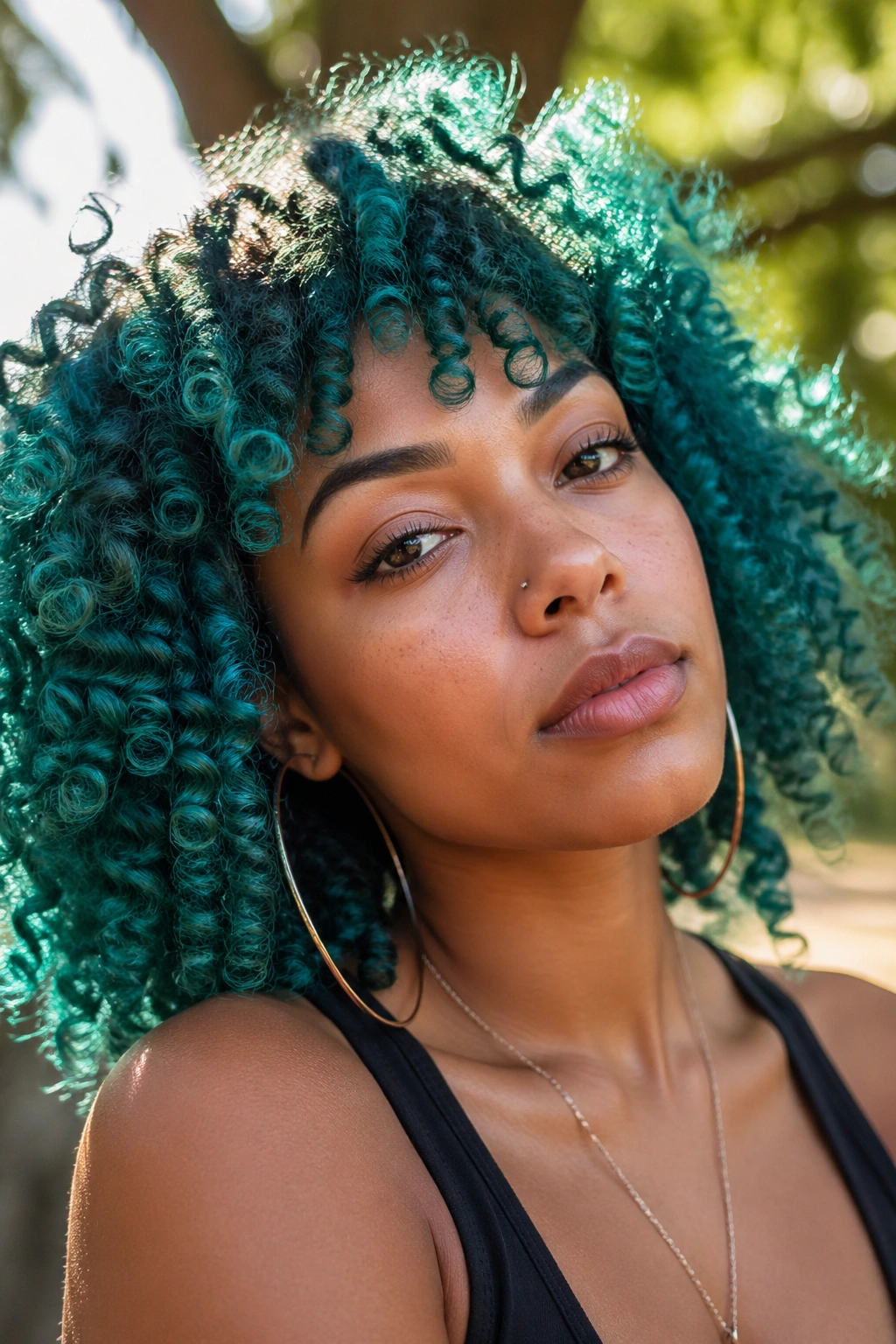
Teal sits at the blue-green intersection — it reads as green in some lights, blue in others, and creates a particularly dynamic effect on natural curls because the undertone shifts with the movement of the curl.
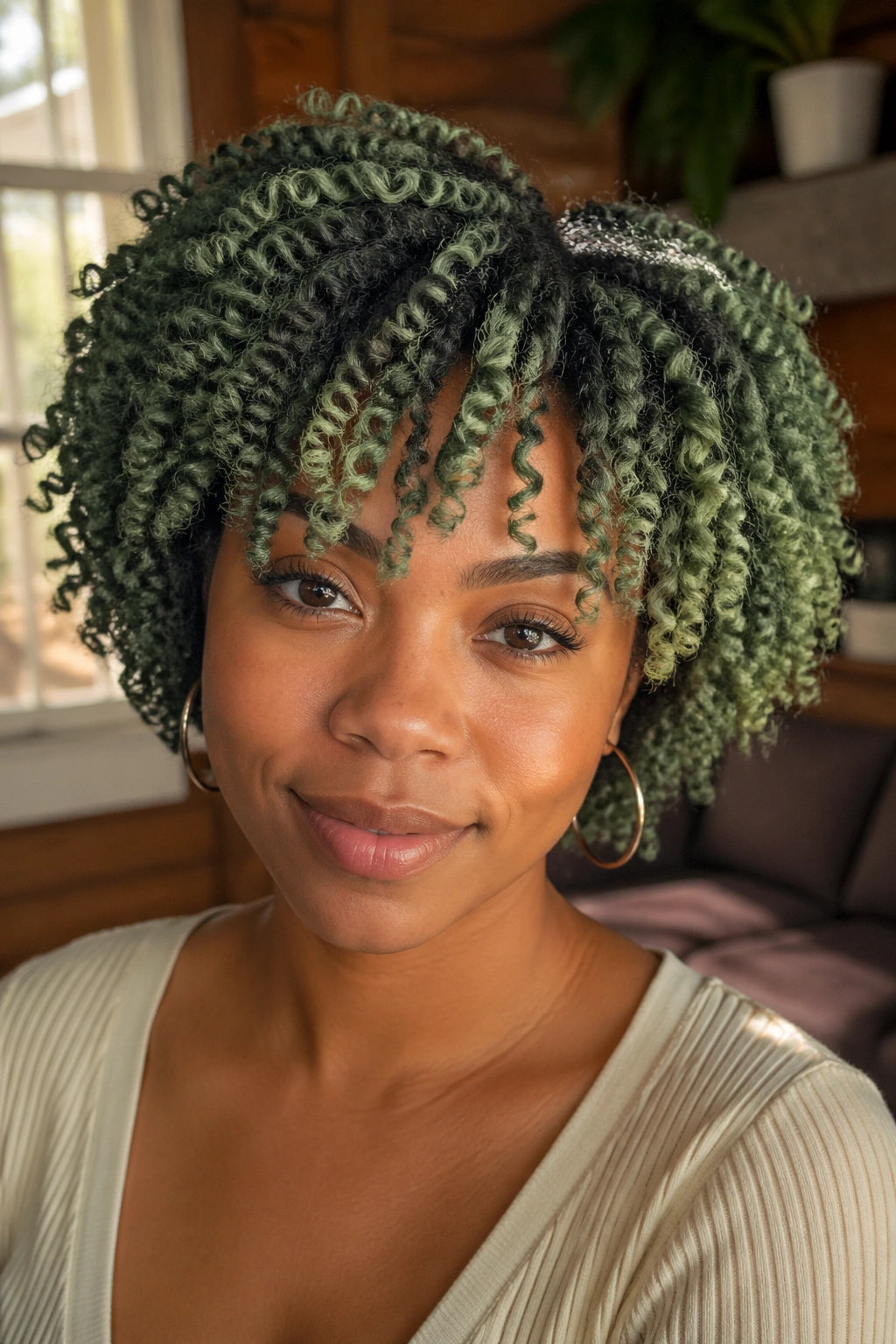
Sage and olive are muted, earthy greens with gray or yellow undertones. These are the most understated of the green family — unexpected but not loud, visible but not attention-demanding.
Mint is cool, pale, and ethereal — almost medicinal in its clarity. Requires significant lightening to pale blonde before the soft tone can show up.
Lime and neon green are the loudest end of the spectrum. Electric, fluorescent, and completely commanding. Maximum lightening required, maximum impact delivered.
Pre-Lightening Reality Check
Most vivid green shades require pre-lightening. The exceptions are dark shades applied directly over dark natural hair — forest green, dark hunter, and deep emerald can show subtle but visible tonal variation on unbleached dark hair.
For everything else: you’ll need to lift. How much depends on the shade. Deep emerald: level 7-8 (warm gold or orange-gold lift). Bright emerald and teal: level 8-9 (pale gold). Mint and sage: level 9-10 (pale yellow). Lime and neon green: level 10+ (almost white-blonde).
The more porous your hair and the tighter your curl pattern, the more carefully the bleaching process needs to be managed. Multiple sessions spaced weeks apart — rather than a single heavy bleach — preserve curl integrity and health significantly better.
Color Combinations That Amplify Green
Green doesn’t have to work alone. Some of the most stunning green curly hair looks involve combining green with complementary or contrasting colors that amplify both.
Green and blonde: The contrast between vivid green and warm blonde creates a dynamic that feels both natural (like leaves and sunlight) and dramatically intentional.
Green and black: Deep forest or emerald green next to natural black creates a graphic, luxurious look — the darkness of the black makes the green more vivid by contrast.
Green and purple: On the color wheel, these are complementary colors — meaning they intensify each other when placed side by side. Green and violet on natural curls is an editorial combination that’s breathtaking.
Green and teal: Two members of the same family placed together in different sections creates a monochromatic depth that’s more interesting than either shade alone.
Maintaining Green on Natural Curls
Green fades differently depending on which family it’s from. Cool greens (teal-greens, sage) fade toward blue or gray. Warm greens (olive, lime) fade toward yellow. Vivid bright greens fade toward a lighter, more washed-out version of themselves before going to an unpleasant yellow-green if left too long.
The rules for maintaining green are the same as other vivids: wash less frequently, use cool water, avoid sulfate shampoo, and use a color-depositing conditioner or gloss in a matching green tone. But green requires particular vigilance about sun exposure — UV light fades green pigments especially quickly.
Touch up vivid green every 4-6 weeks for maximum vibrancy. Dark forest or hunter green on unbleached hair can go 6-8 weeks before needing refreshing.
1. Forest Green on 4C Hair
Deep forest green on tightly coiled 4C hair is an extraordinary pairing. The depth and density of 4C hair makes forest green look like living foliage — dimensional, rich, and three-dimensional in a way that photography struggles to capture.
How to Achieve It
- No bleaching required for most dark natural hair — a direct-dye forest green over dark brown or black deposits visible tonal color
- Apply to clean, conditioned hair in sections
- Process for 45-60 minutes under a plastic cap
- Rinse with cool water, seal with a lightweight oil
Bold tip: In flash photography, forest green on 4C hair appears almost iridescent — it’s one of the most photogenic color-texture combinations.
2. Vivid Emerald Wash-and-Go
Emerald green on a fully defined wash-and-go is a look that belongs in a magazine. The gem-like quality of emerald — deep, saturated, with both blue and yellow undertones — looks genuinely jewel-like on defined ringlets or coils.
Requires lifting to a warm gold before applying emerald direct dye. The warm gold base enhances the yellow undertones in emerald, which keeps it from reading as teal or blue-green. Process with heat for maximum saturation.
3. Teal Curls
Teal is the most versatile member of the green family — it shifts between blue and green depending on the light, which means teal curly hair is never the same color twice. In warm light it reads greener. In cool or blue-toned light it reads bluer. In sunlight it looks almost turquoise.
This dynamism is amplified on natural curls, where different curl layers catch light at different angles simultaneously — some sections appear green, others appear teal, others appear almost blue, all at the same time.
4. Sage Green Twist-Out
Sage — a muted, gray-green with dusty undertones — on a defined twist-out is a surprisingly sophisticated look. The earthy, understated quality of sage feels more intentional and less “costume” than vivid greens, which makes it genuinely wearable in a range of settings.
The twist-out style enhances sage beautifully because the defined wave pattern creates variations in how the dusty color reflects light — some sections appear greener, others more gray, depending on the angle.
5. Neon Green Tips
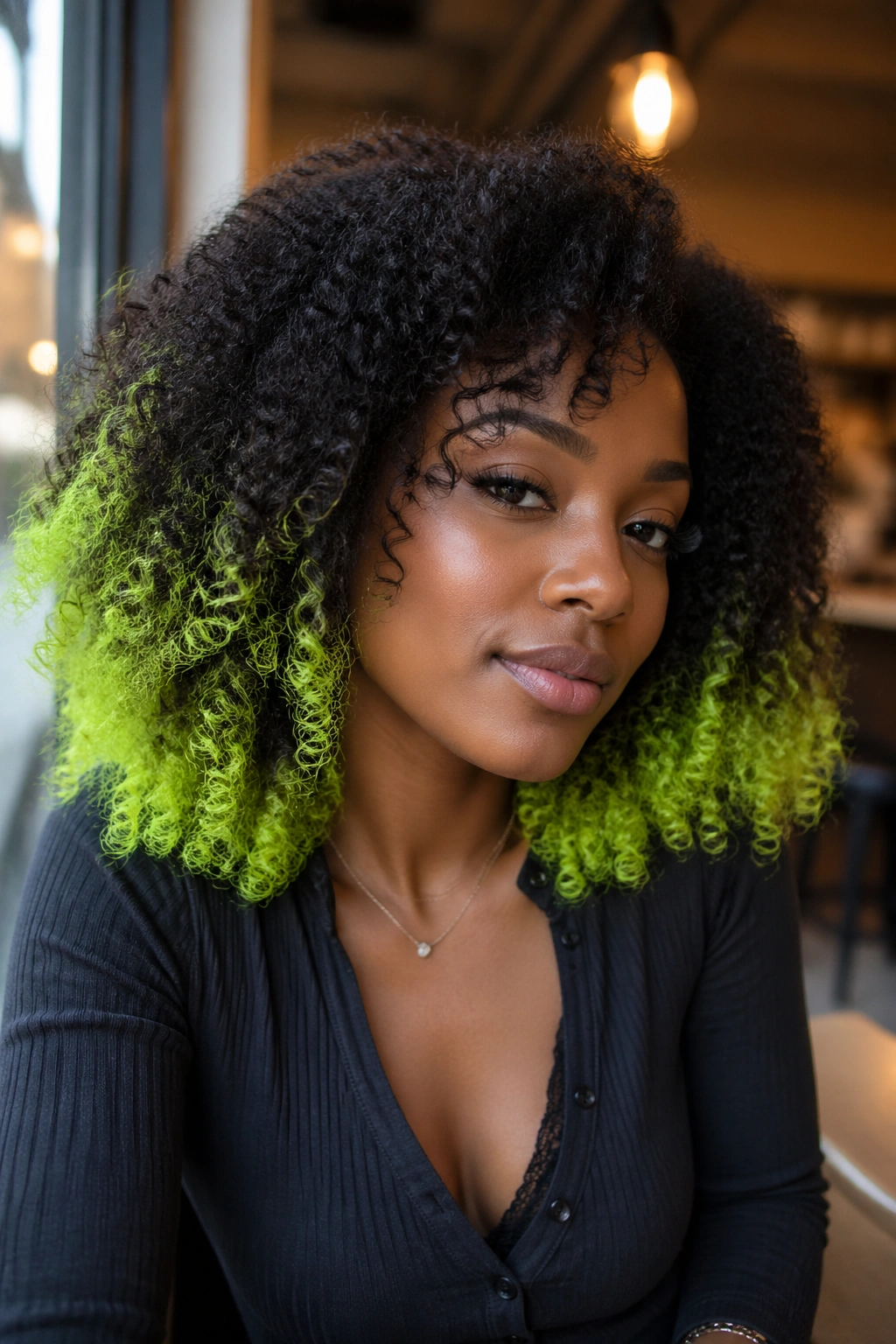
Neon or lime green at the tips of dark natural curls — the ends bleached and dyed electric green while the roots remain natural — is a look that’s part statement, part wearable art. The contrast between deep natural color and vivid neon is graphic and intentional.
On a wash-and-go, neon green tips highlight the boundary of each curl — the end point catches the eye and gives every coil definition. On a puff or updo, the neon tips ring the perimeter in electric color.
6. Dark Olive Curls
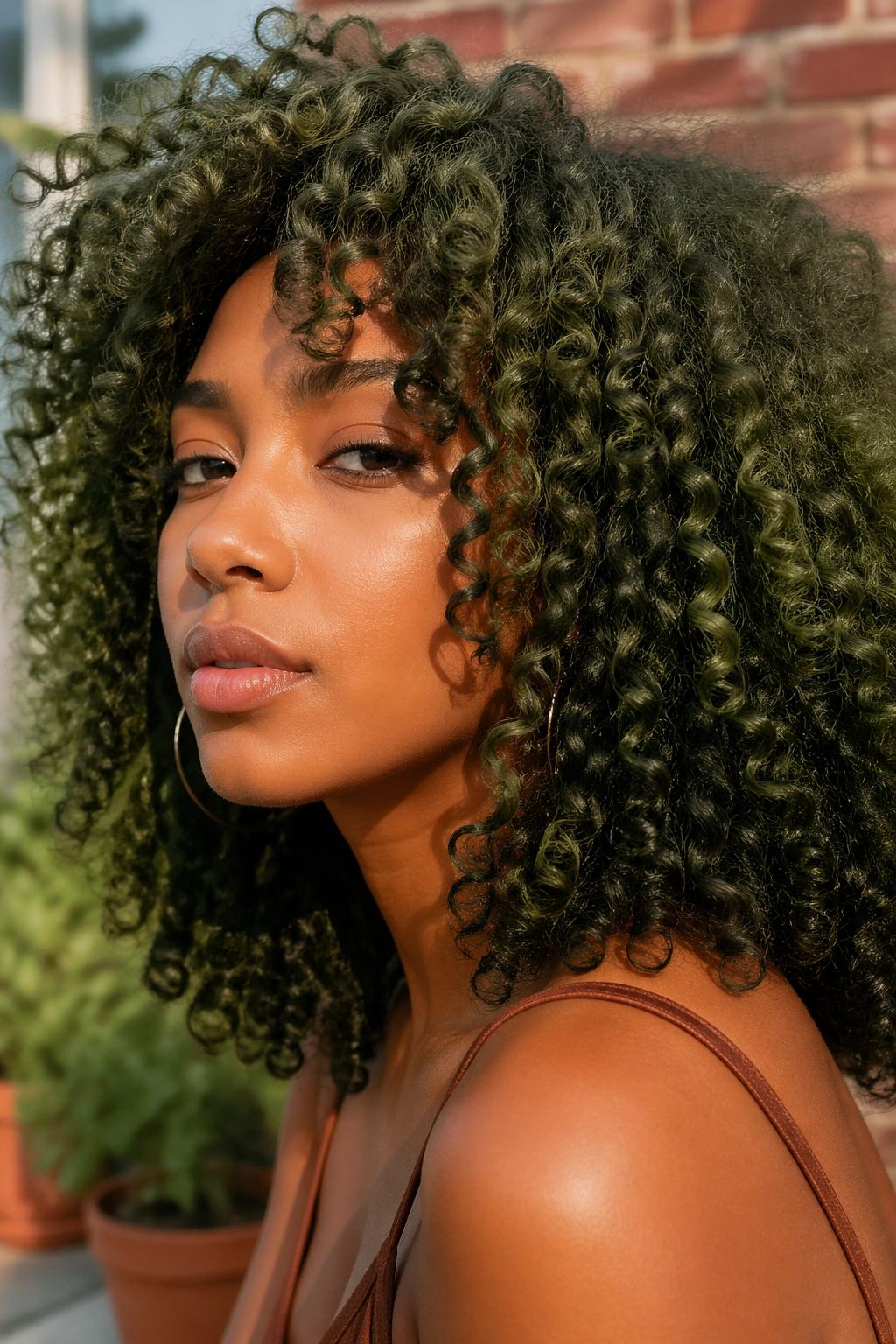
Olive green — warm, muted, golden-yellow-green — is the most unexpected member of this list. It’s not bright enough to read as vivid, not dark enough to read as forest. It exists in its own space: earthy, interesting, warm.
On natural curls with warm brown undertones, olive green creates a strikingly harmonious look — the warmth in the color complements the warmth in the skin without competing. It’s a green shade that actually functions as a complementary color, not a fashion statement alone.
Requires a level 7-8 lift, then a warm olive/yellow-green direct dye. Let the warmth of the lifted base enhance the golden undertones.
7. Emerald and Black Two-Tone
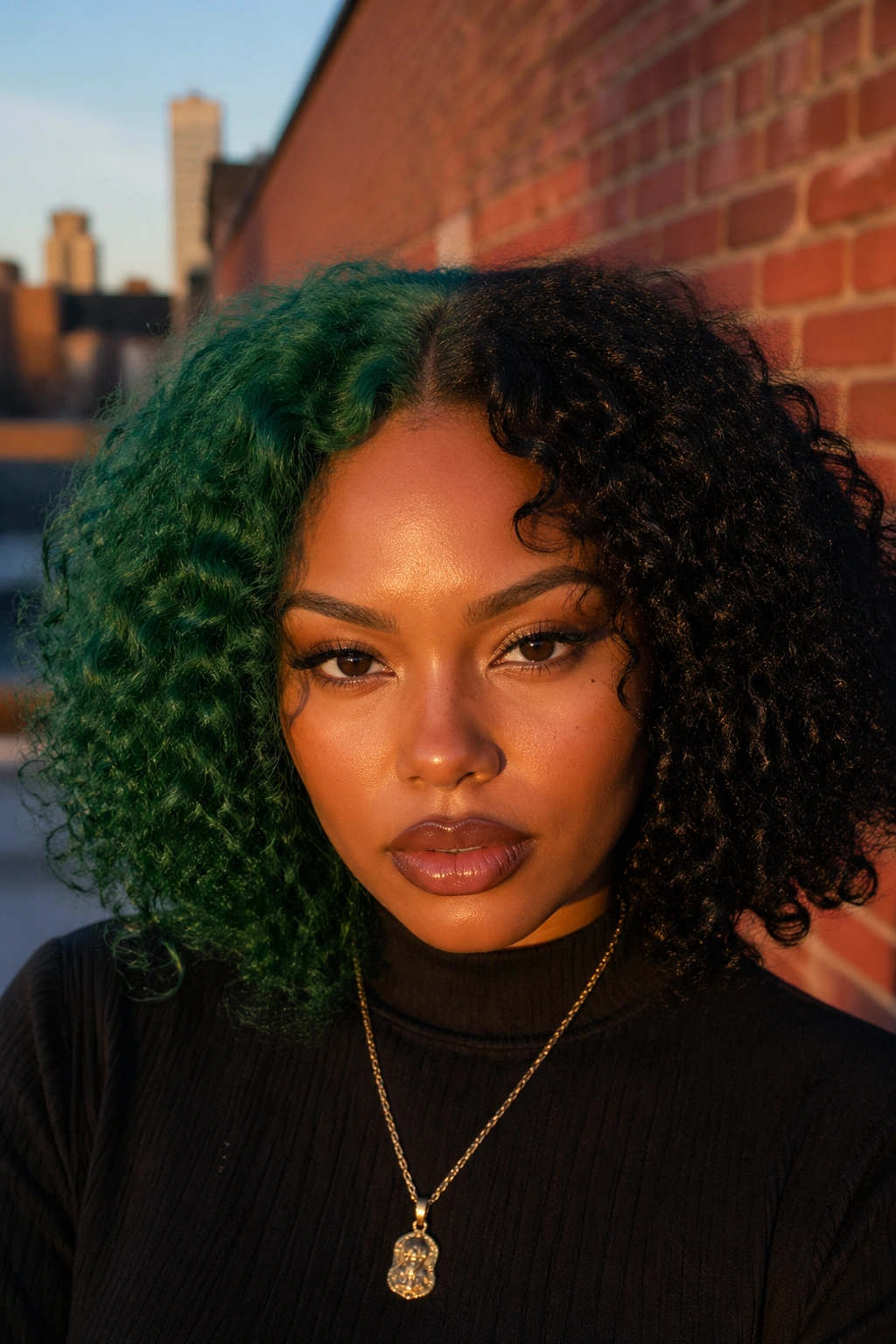
Black natural hair on one half, vivid emerald on the other — either as a true split or as an underlayer arrangement. The contrast between the two reads as both luxurious and editorial. Black makes emerald look more jewel-like; emerald makes black look richer and deeper.
On curly hair, the two tones interact at the crown and around the face, creating a natural blending effect that softens the graphic split.
8. Hunter Green Curly Bob
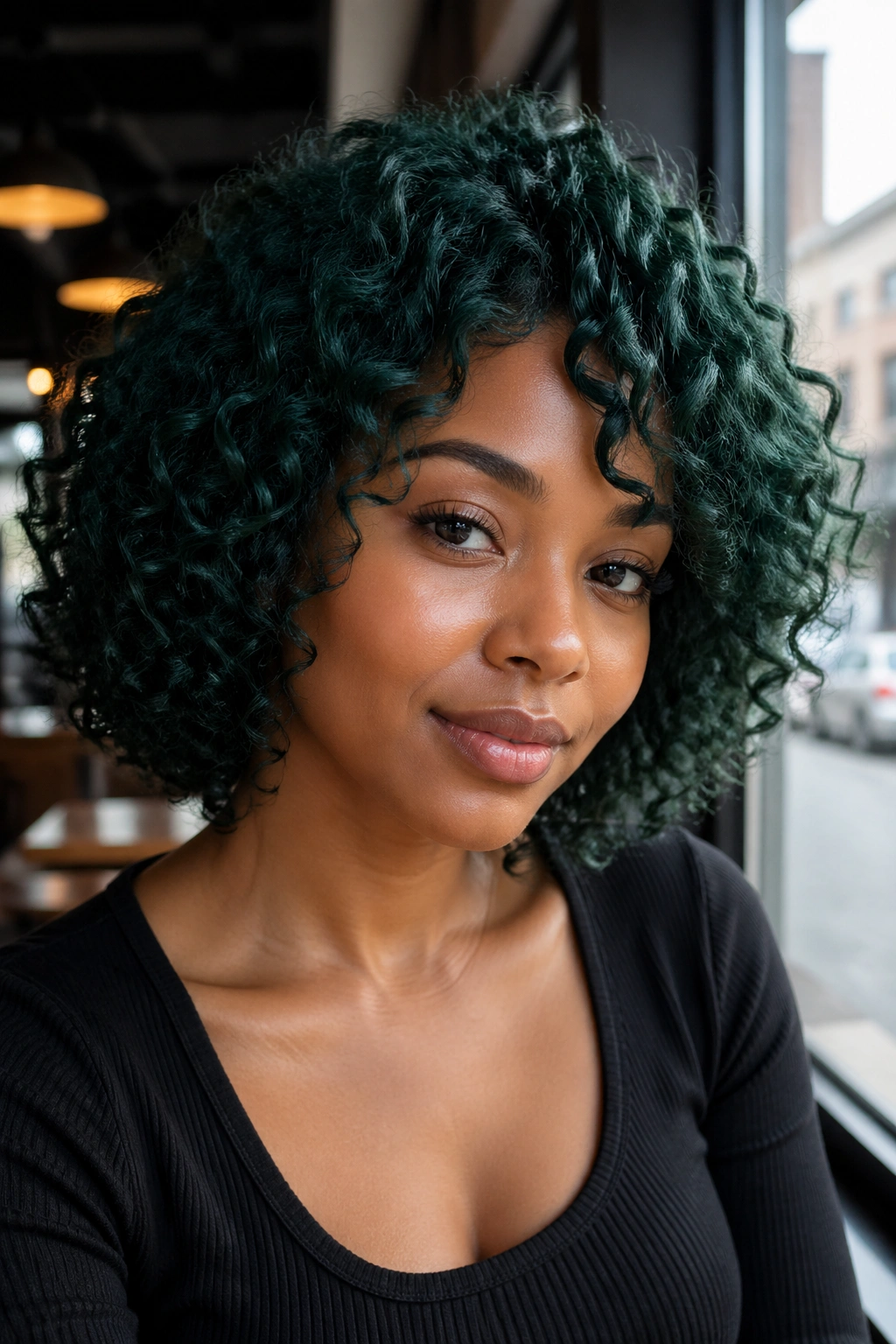
A curly bob in hunter green — deep, cool, and sophisticated — is one of the most wearable vivid color looks in natural hair. The bob’s structure and the hunter green’s depth create a finished, polished appearance that transitions from casual to professional with minimal effort.
Hunter green requires slightly less lift than brighter greens (a level 7 warm orange base works well), which means less damage and longer-lasting color.
9. Mint Green Ringlets
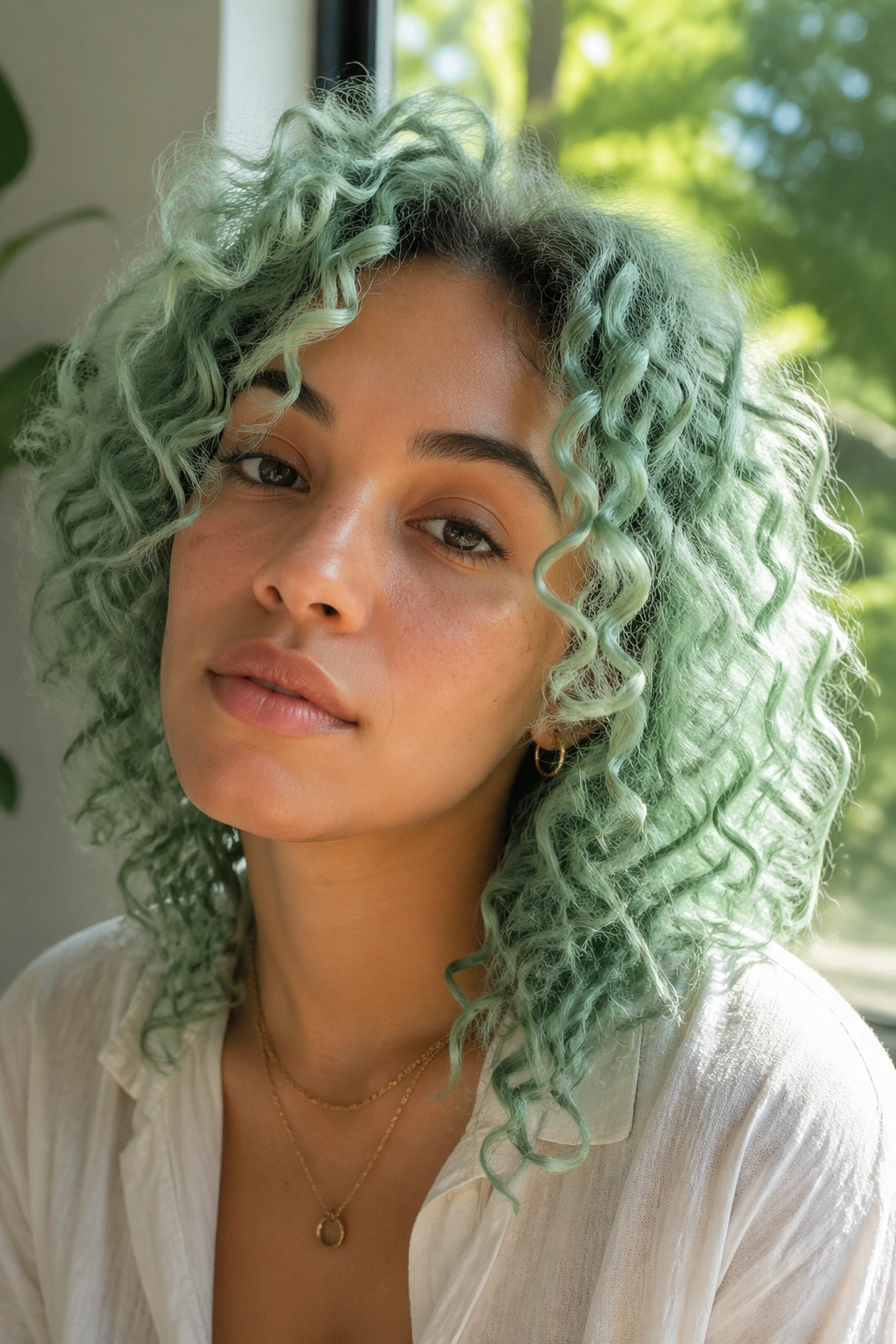
Mint on 3A or 3B loose ringlets is the most ethereal combination on this list. Pale, cool, almost icy — mint on defined ringlets looks like something between hair and art. It has a dreamlike quality that’s hard to describe and impossible to ignore.
Achieving true mint requires a very pale base — level 10+ before toning with a cool mint-green direct dye. It’s a committed process, but the result is genuinely extraordinary.
10. Green Highlights Through Natural Hair
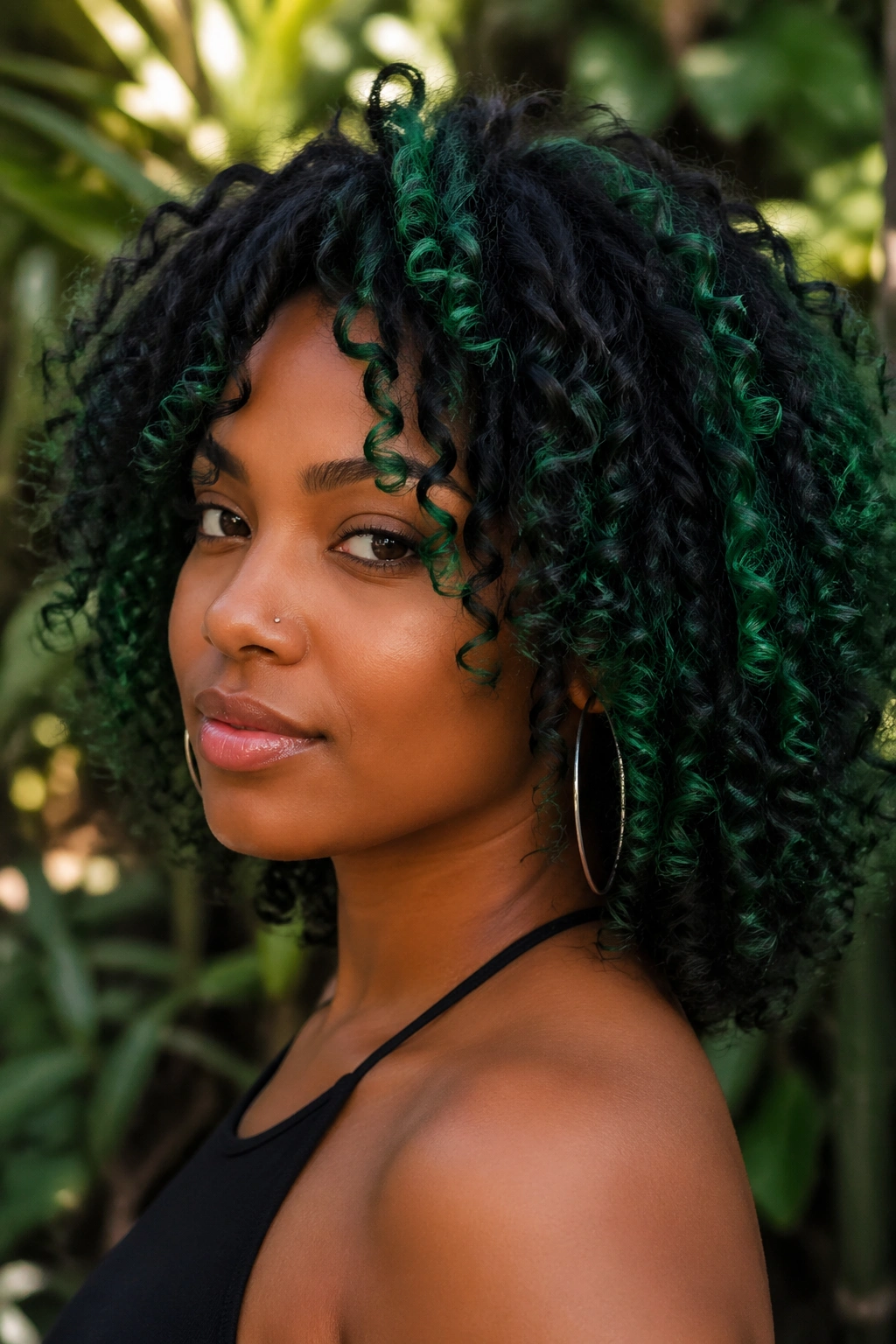
Rather than an all-over transformation, thin or chunky sections of vivid green through natural dark hair create a “peek-a-boo” effect — visible when your curls move but not overwhelming when your hair is still.
Emerald or forest green highlights through dark 4C hair read differently than traditional highlights: they’re deeper, more graphic, and have an almost jewel-inlay quality. The surrounding dark hair makes each green highlight appear more vivid by contrast.
11. Lime Green Puff
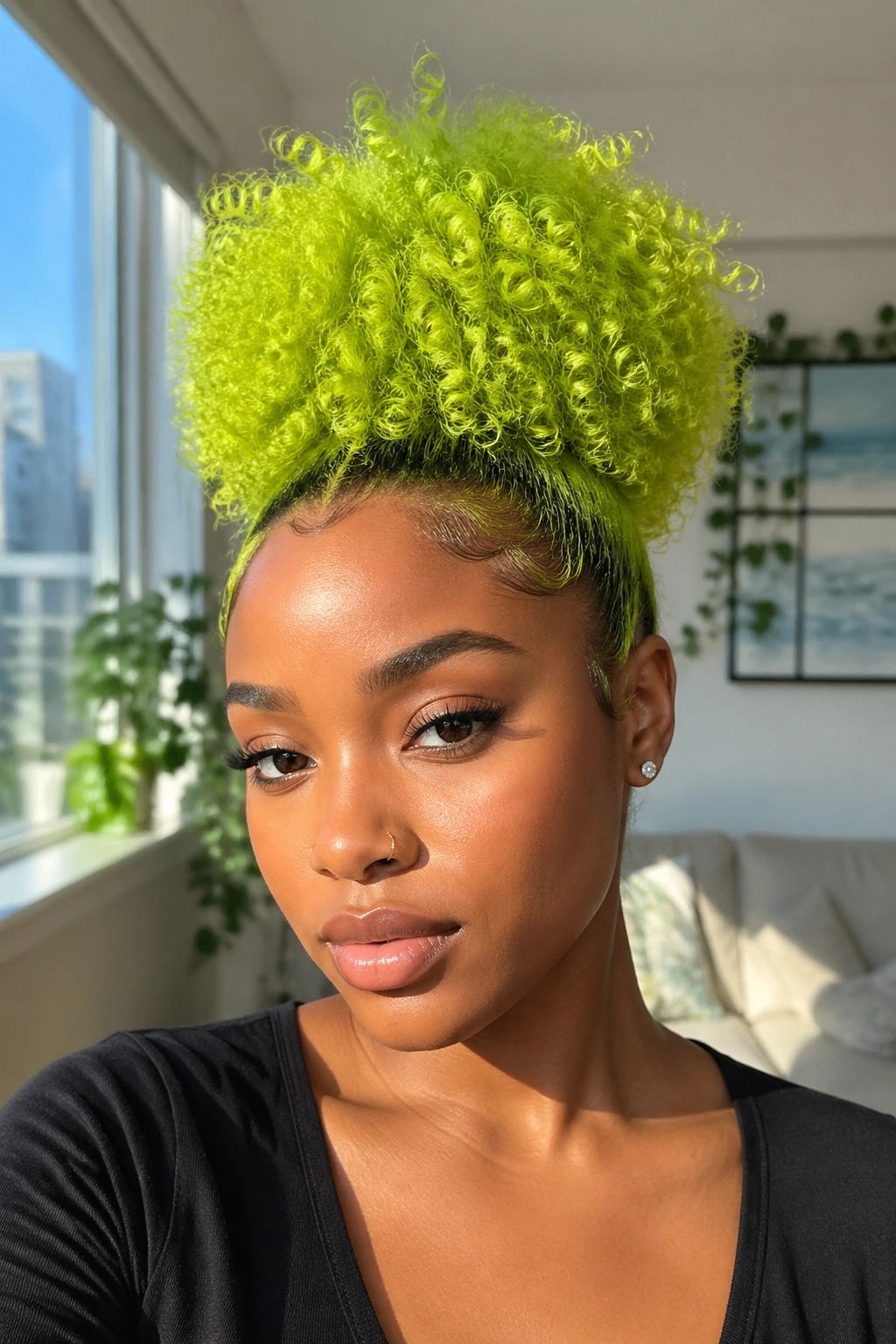
A high puff in lime or neon green is a look that announces itself across a room. The volume and density of natural hair in a puff, combined with the electric brightness of lime green, creates maximum visual impact with minimal styling required.
Lime green requires the most lifting of any shade in this guide — you need to get to near-white before the neon pigment reads correctly. This is the most process-intensive option, but for women who want to go full vivid, there’s nothing more striking.
12. Teal Balayage
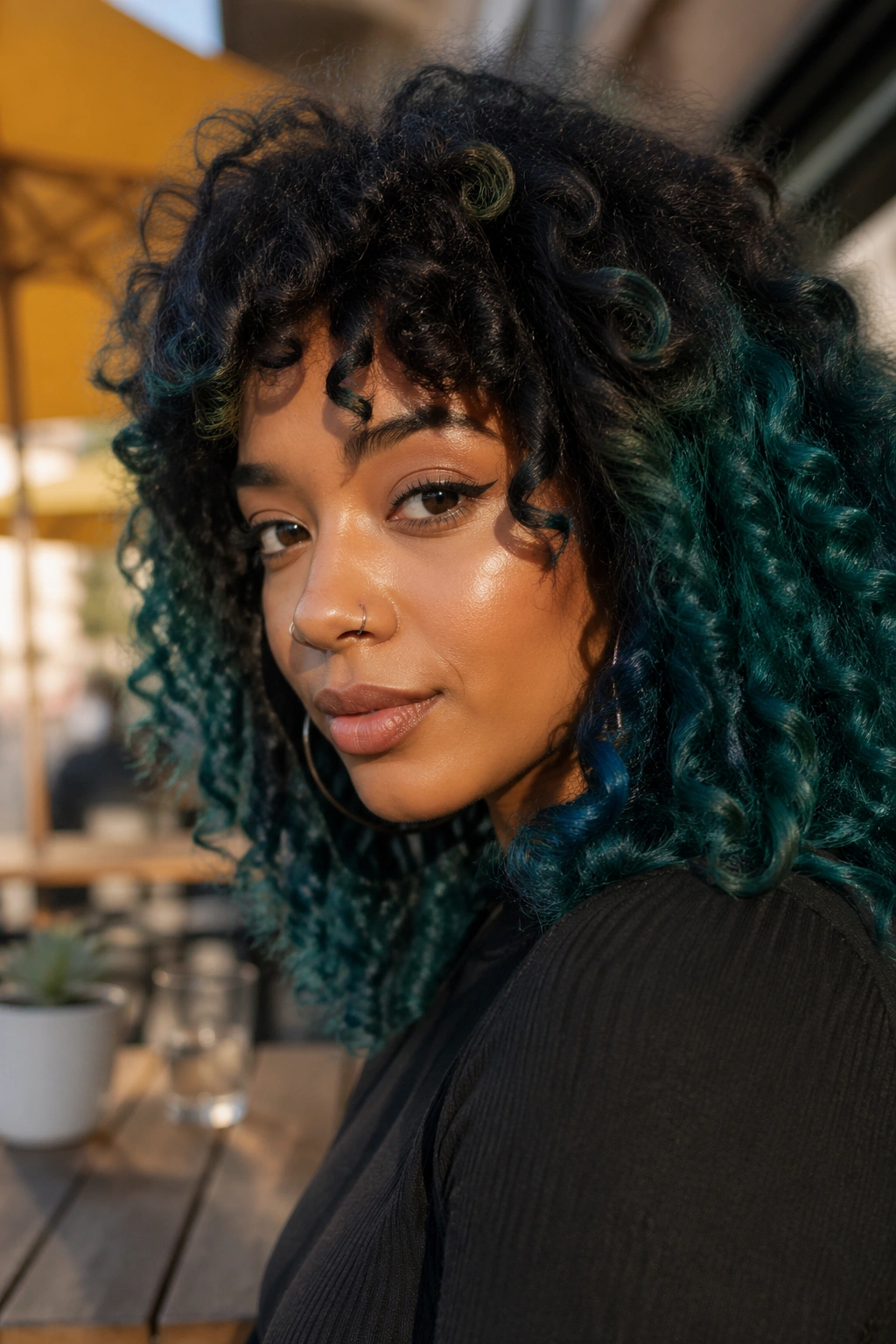
Teal painted through dark natural curls in a balayage pattern creates a look that shifts between green and blue in a way that feels almost holographic. The balayage application places the deepest teal at the ends, leaving roots dark — a combination that reads as both low-maintenance and intentional.
On 3B-4A curl types where individual curl spirals are visible, teal balayage catches each curl in a way that makes the color appear to spiral through the hair in three dimensions.
13. Forest Green Locs
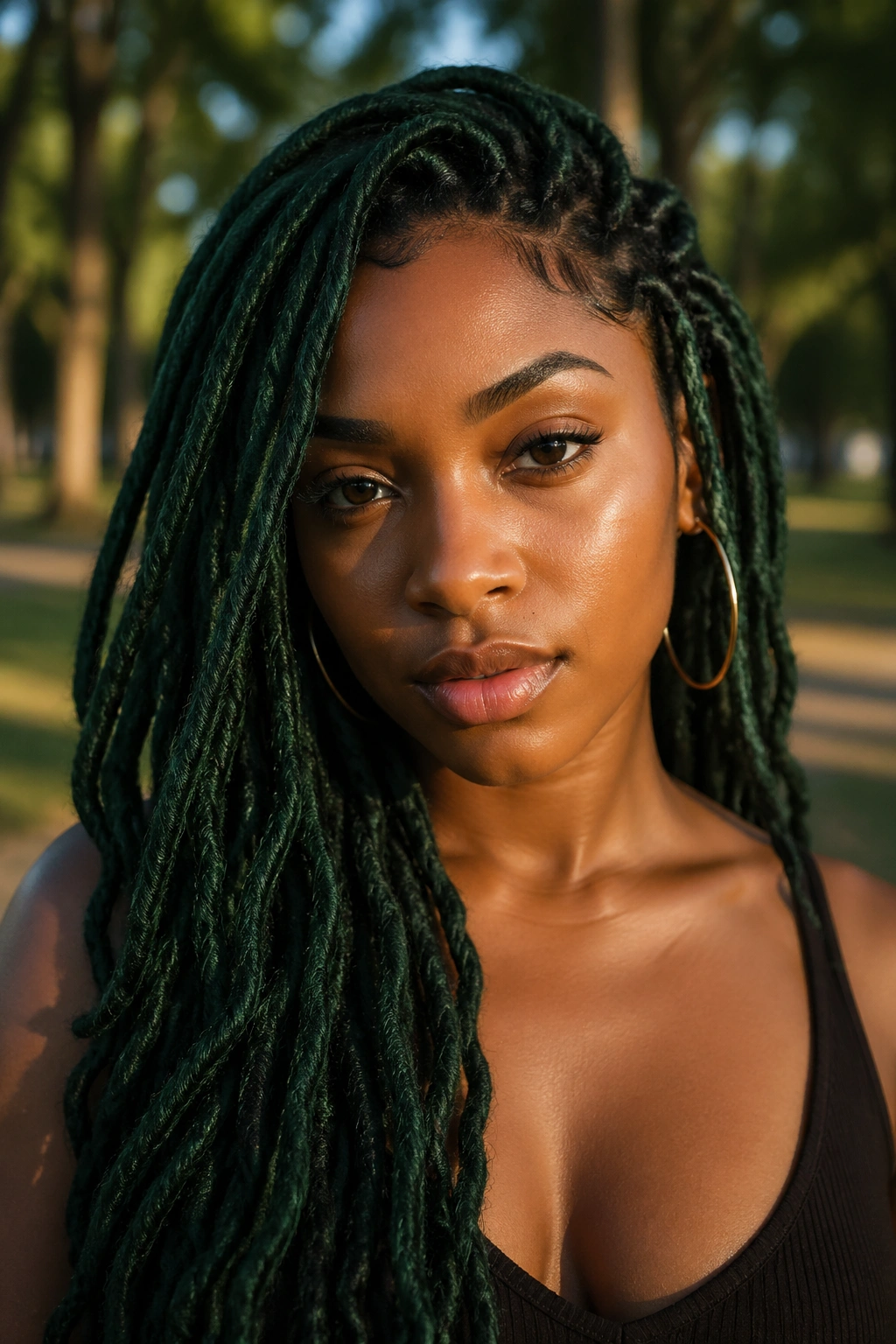
Deep forest green on locs — whether traditional locs, starter locs, or faux locs — creates one of the most visually striking looks in natural hair. The structured, rope-like texture of locs displays green in a way that loose curls can’t: in a series of parallel, cylindrical sections that read as geometric and intentional.
Direct-dye forest green can be applied to established locs by painting each loc individually or by doing a targeted section application. On mature locs, the color penetrates the entire exterior surface, creating rich, even color.
14. Sage and Lavender Color Melt
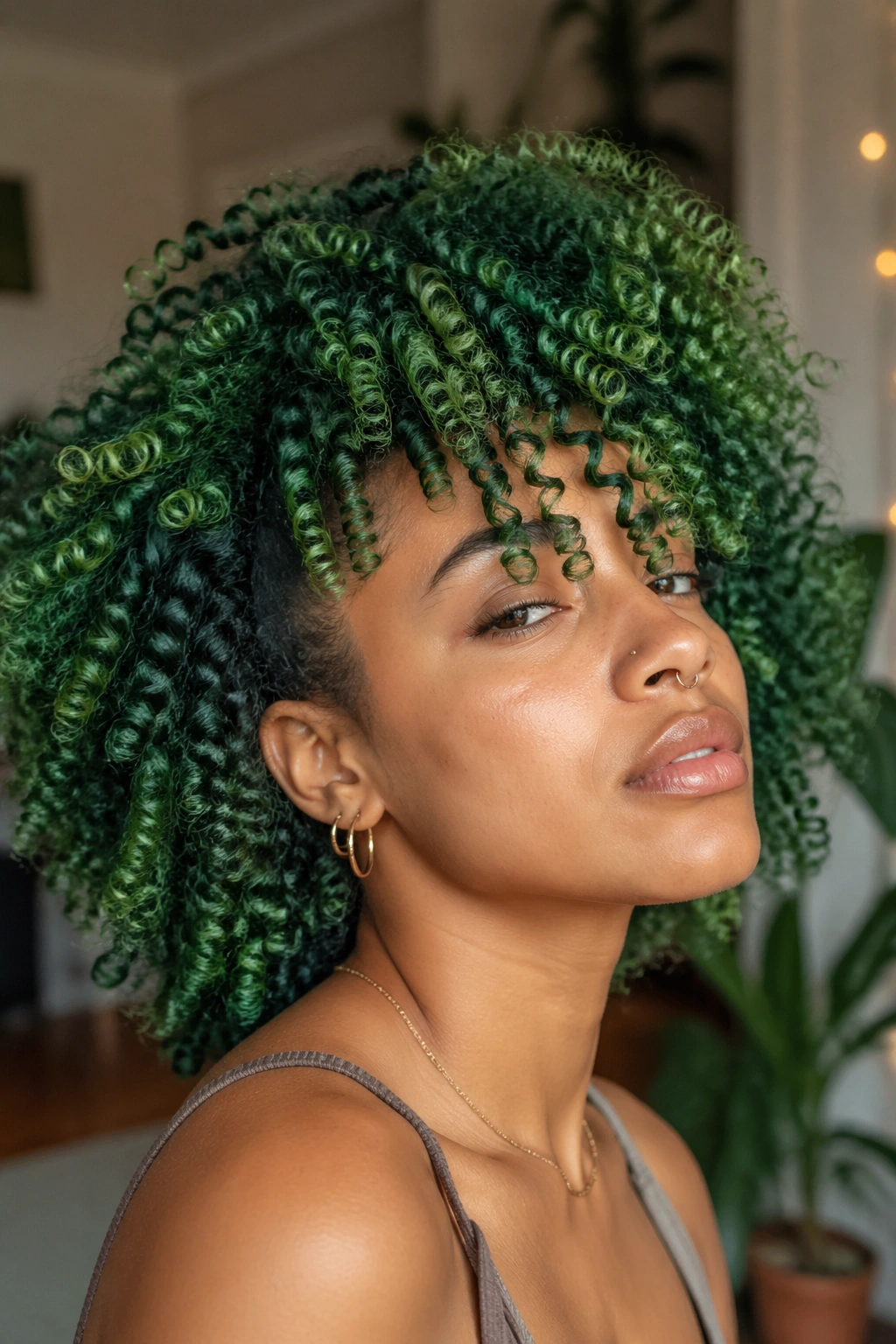
Sage green blending into soft lavender — both muted, both cool — is an unexpected combination that works because they share the same gray-cool undertone. The blend between them feels seamless rather than jarring.
On natural curls, this combination creates a cool, ethereal look that photographs with an almost otherworldly quality. Both colors require significant lightening, so this is a multi-session process — but the result is like no other.
15. Green Goddess Braids
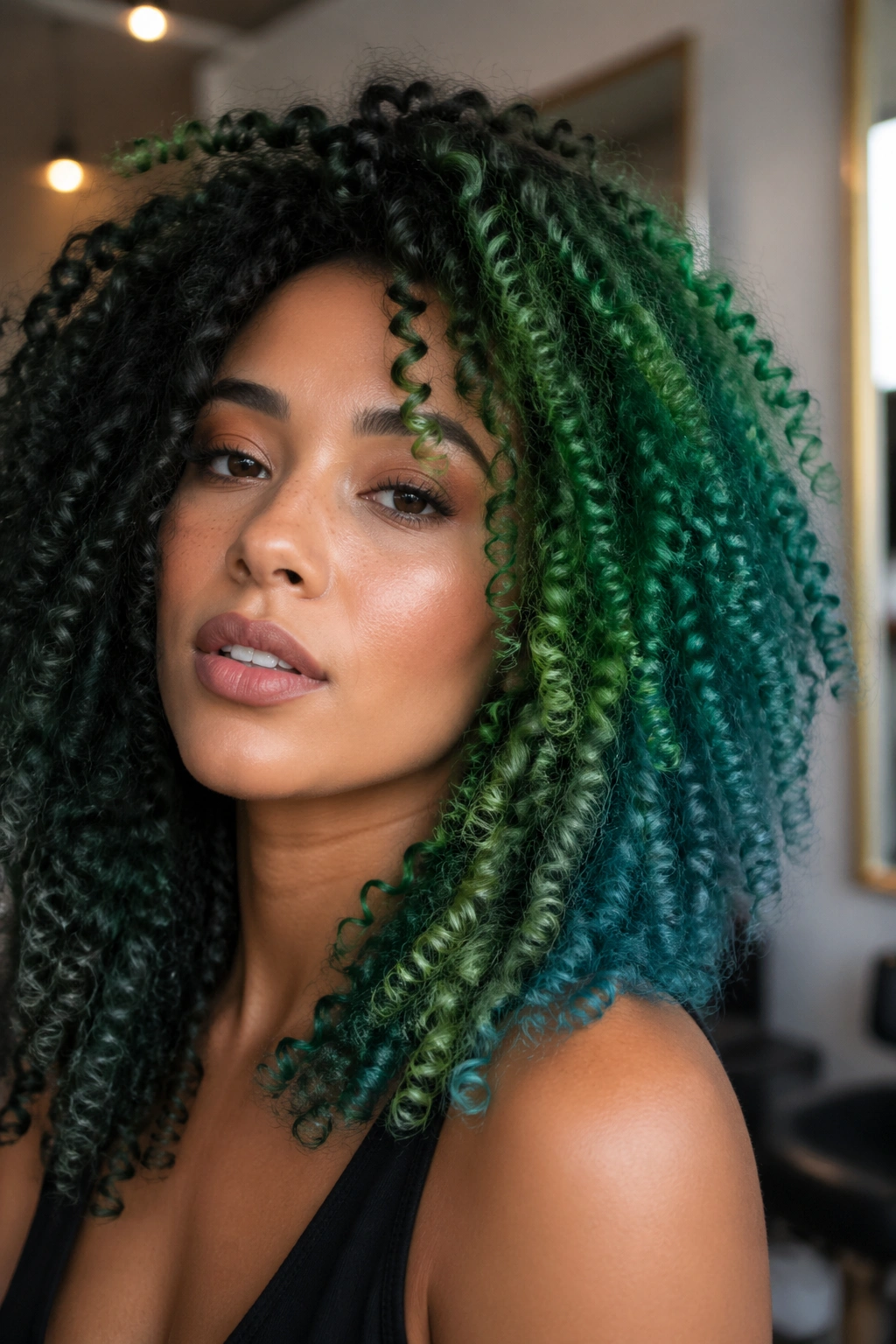
Green goddess braids — knotless box braids with green hair extensions and loose curly green ends — bring vivid green into a protective style that requires zero chemical processing on your natural hair. The loose curl ends show the color in a natural, textured way that bridges the gap between braided style and loose curly hair.
This is the most accessible entry point to green hair: try the color in a protective style before committing to a chemical process. If you love it, take the next step.
16. Dark Teal Updo
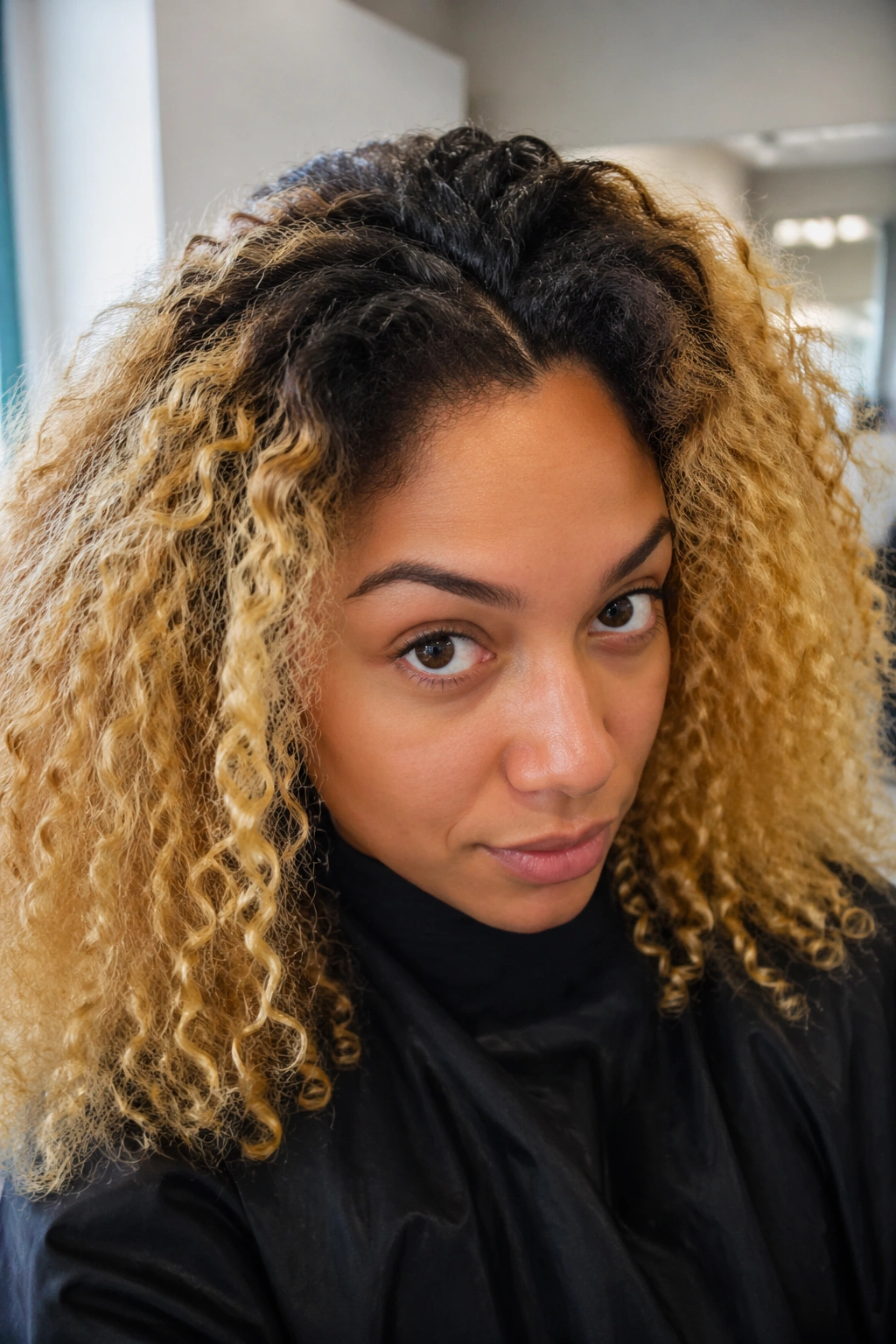
A carefully styled updo — whether a high bun, a braided crown, or a twisted upstyle — in dark teal green reads as sophisticated and fashion-forward in a way that vivid hair in loose styles sometimes doesn’t. The structure of the updo contains and organizes the color into a shape that reads as polished.
Dark teal is achievable on a level 7-8 lift and holds significantly better than brighter, lighter greens. A maintenance routine of cool rinses, color-depositing teal conditioner, and infrequent washing extends the color comfortably between appointments.
17. Olive Green Curly Bangs
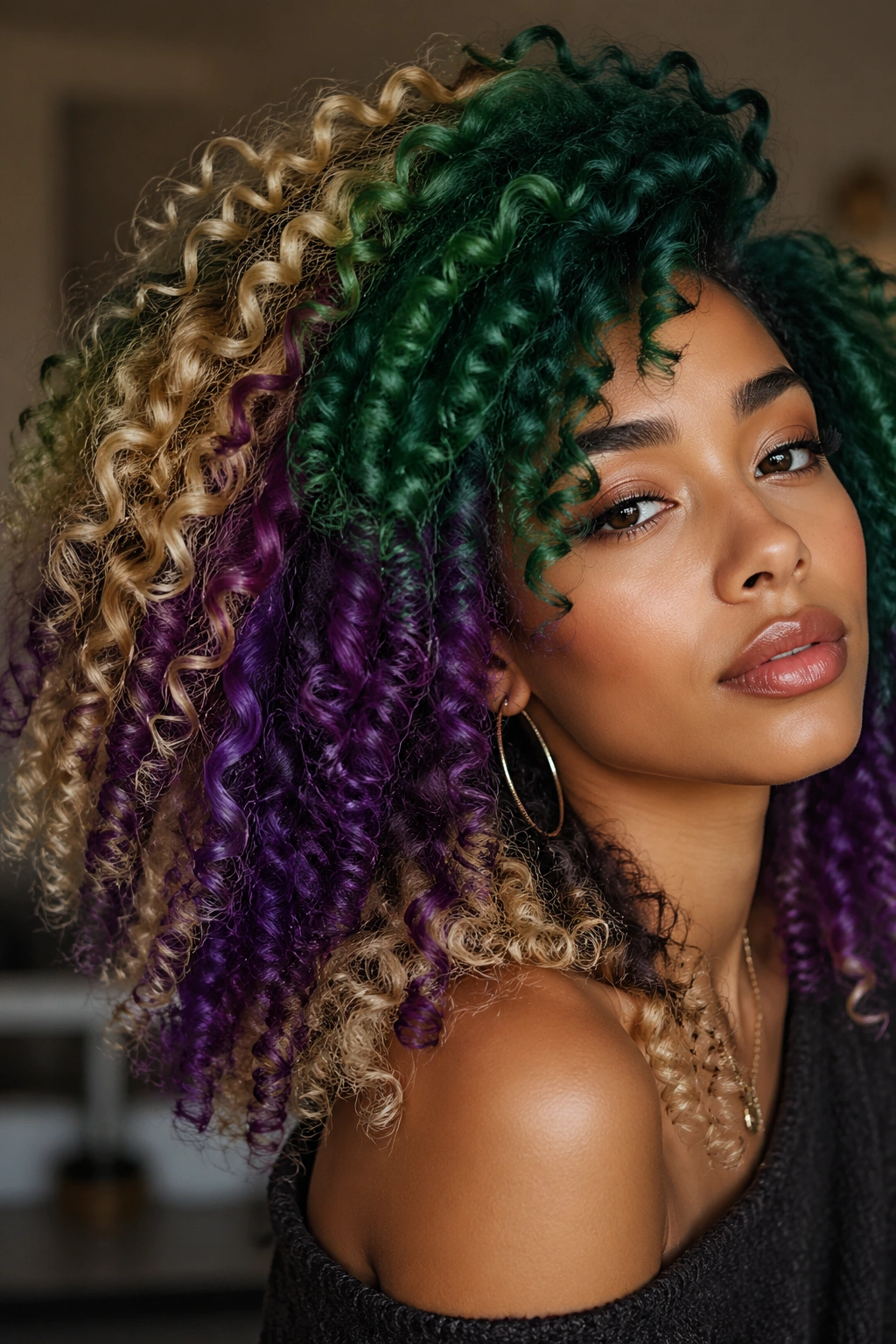
If you wear bangs — curly, spiral bangs that bounce over your forehead — coloring just the bangs in olive or forest green while leaving the rest of your hair natural is a micro-commitment with enormous impact.
Bangs are the first thing people notice because they’re the closest color element to your face. A single section of green at the forehead, framing your features, changes the entire impression of your look without requiring any commitment to the rest of your hair.
18. Emerald to Black Ombre
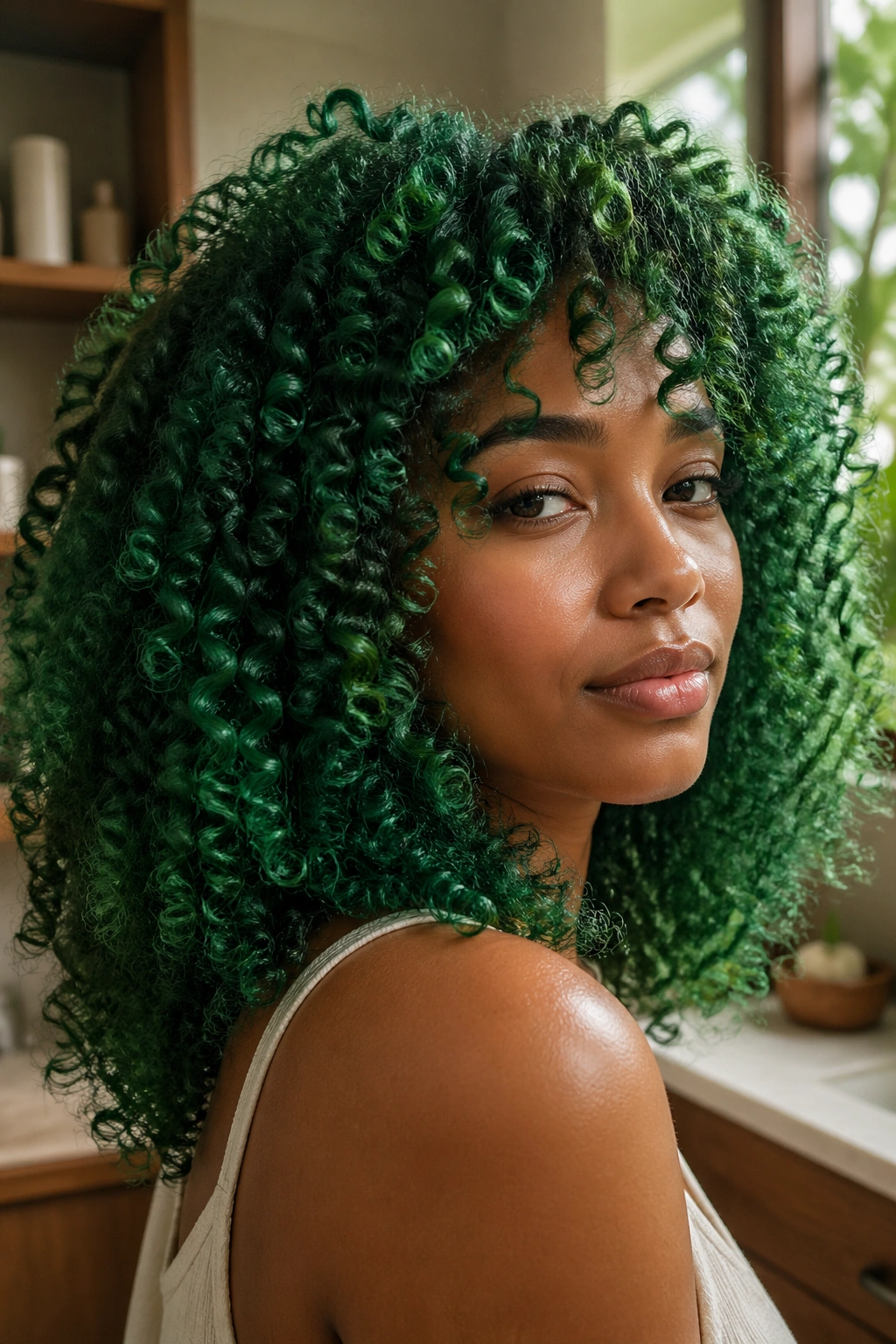
Vivid emerald at the ends, fading toward a rich dark color at the roots. The reverse of a traditional ombre — which typically goes dark at the roots and light at the ends — this placement puts the most vivid color at the tips, where it moves most freely and catches the most light.
On natural curls, emerald tips create a boundary definition at the end of each curl that enhances the curl pattern’s natural shape. The emerald highlights where each coil ends — which on tight curl patterns creates an almost mosaic effect from a distance.
19. Full Vivid Green with Purple Undertones
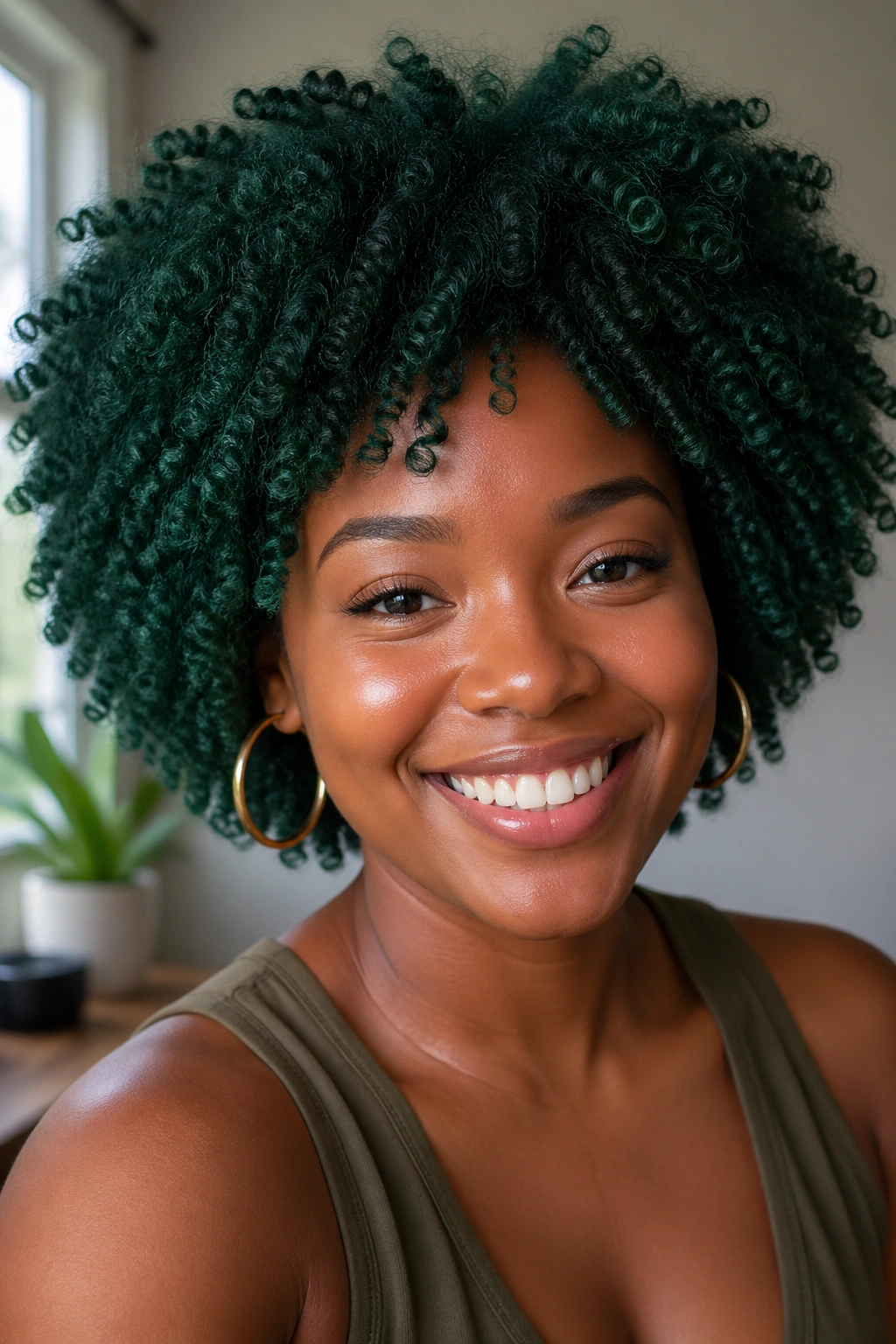
A vivid green that sits right between true green and blue-green — with enough purple undertone to catch the light in an almost iridescent way. This isn’t forest green, it’s not teal, and it’s not standard emerald. It’s a custom, chromatic green that shifts in extraordinary ways.
Achieving this requires mixing emerald and teal direct dyes — or using a specific forest-with-purple-base formula — over a level 8-9 base. The mixed pigments create a color that photographers and natural light both show differently, which means the look evolves throughout a single day.
20. Green and Gold Highlights
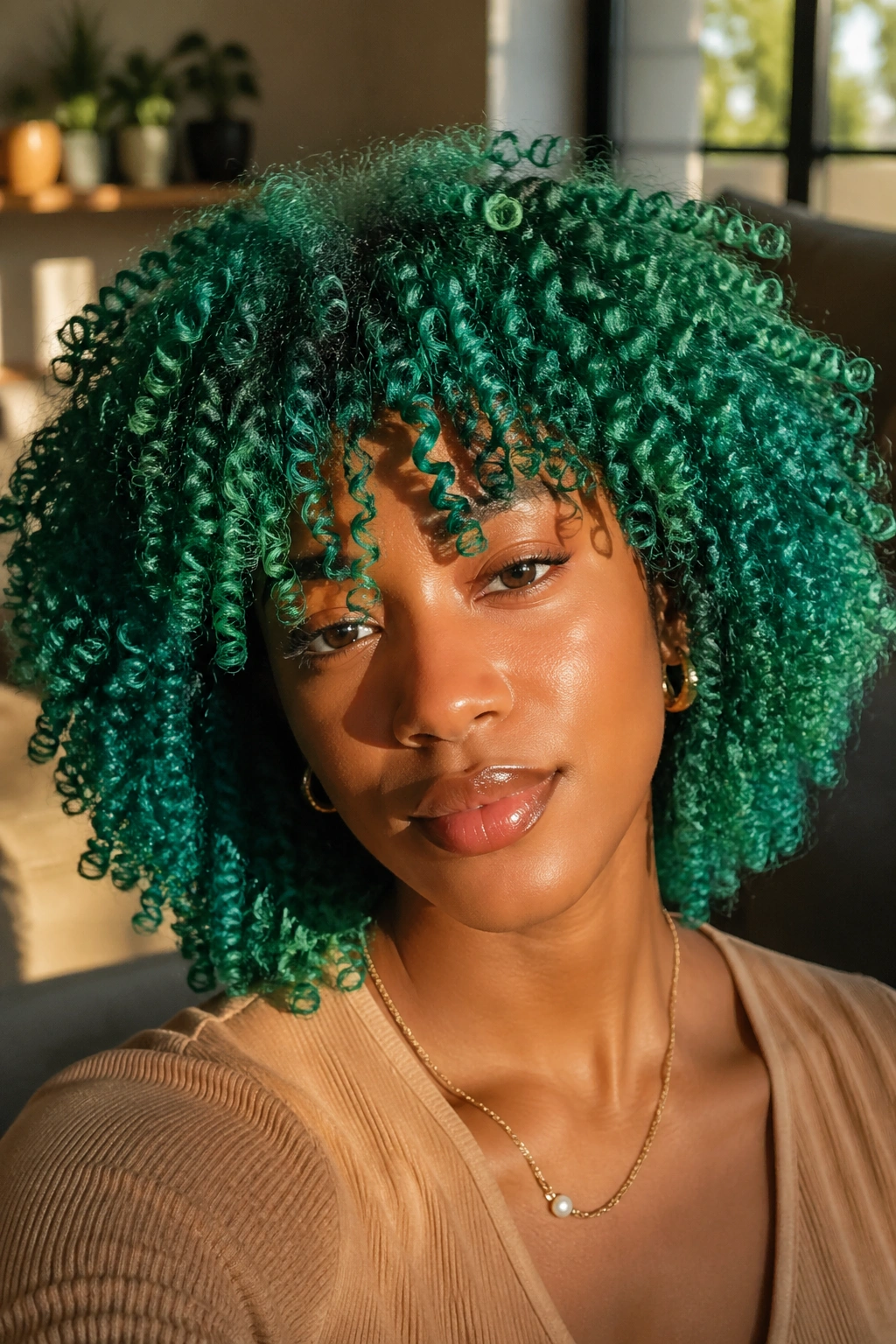
Green and gold — two warm-spectrum colors on the opposite sides of warm — create a natural harmony when placed together in natural curls. Deep emerald or forest green highlighted sections against golden-blonde or honey-blonde natural hair is an unexpected combination that works because both shades are rich and saturated.
On curly hair, green and gold sections mix together as curls overlap, creating a two-tone interplay that looks intentional and complex. The overall impression is warm, vivid, and organic — like your hair took inspiration from autumn foliage but chose the most maximalist version.
The Bold Choice: Living With Green Hair
Green hair is a commitment — not just to the process, but to the daily experience of being a person whose hair immediately communicates boldness, creativity, and intentionality.
People will comment. Strangers will ask questions. You’ll become “the person with the green hair” in every space you occupy. For some people, that’s the point. For others, it’s something to genuinely consider before making the leap.
If you’re in the first group — if the idea of your hair being your most memorable feature sounds wonderful rather than exhausting — then green curly hair is for you. And on natural curls, green hair isn’t just a color choice. It’s a statement about who you are and how you choose to show up.
Transitioning Out of Green
When you’re ready for something new, transitioning out of vivid green requires some planning. Green can be difficult to remove completely without significant lifting, and it can leave behind a teal or blue-green tint that affects how subsequent colors read.
A colorist can help assess whether your hair needs a color removal treatment before adding a new shade, or whether an overlapping color (like a warm red or a deep brown) can cover the remaining green tones without additional processing.
The bottom line: green hair is adventurous in every sense. It takes work to achieve, work to maintain, and thoughtfulness to transition away from. That commitment is part of what makes it the perfect choice for bold women — women who do nothing halfway.
