

Braids with curls at the end for women are one of the most beautiful combinations in protective styling — and it doesn’t matter what your curl pattern is, your hair length, or how long you’ve been wearing natural hair. The structure of a braid meeting the softness of a curl at the tip creates a visual rhythm that’s simultaneously polished and free-spirited. It’s a style that does a lot of the heavy lifting for you: the braids protect and elongate, the curly ends add movement and femininity, and together they produce a look that works whether you’re going to work, a celebration, or just running errands on a Saturday afternoon.
The Appeal of Curly Ends on Braids
There’s a reason this look keeps coming back. Straight extension hair at the ends of braids is clean and simple, but it has a kind of finality to it — the braid ends where the hair ends, and that’s that. Curly ends do something different. They create a transition rather than an ending. Your eye travels down the braid and then the curl adds another dimension, another moment of interest, before the style concludes.
This works on a purely visual level: curly ends add volume and movement where straight ends add none. But it also works on a textural level — the softness of curly fiber at the tips creates contrast against the tighter braid body that makes the whole style feel more dynamic and alive.
Curly ends also make braids feel less formal and more approachable. Traditional box braids with straight ends can sometimes feel stiff or very deliberately styled. The same braid finished with curls immediately feels more relaxed, more wearable, more like something you’d choose because you love how your hair looks rather than because you’re trying to achieve a specific aesthetic.
Types of Curl Textures for Braid Ends
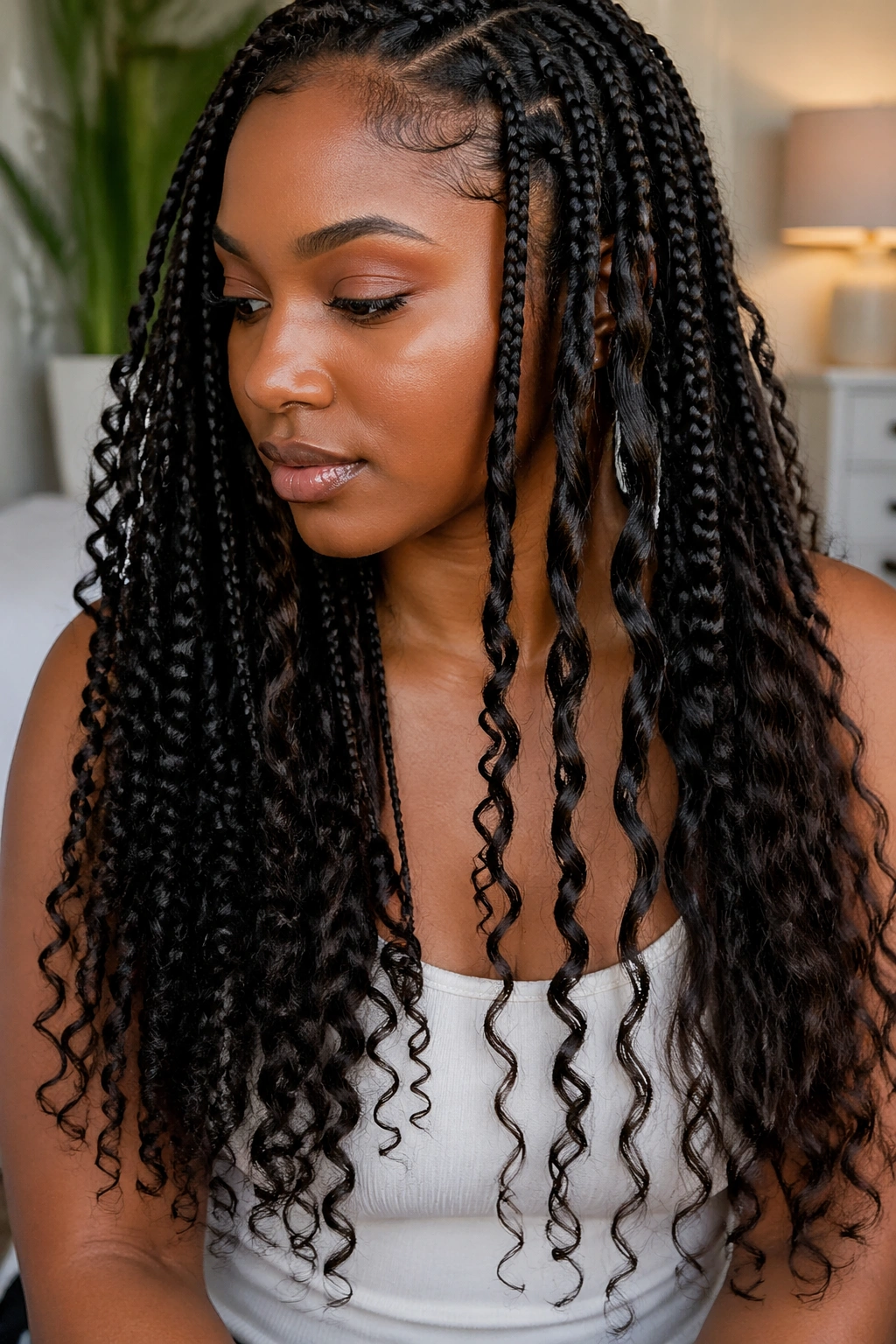
The variety of curl textures available for braid ends is genuinely overwhelming in the best way. Different textures create completely different final aesthetics, and knowing what each looks like helps you make the right choice for your specific vision.
Kinky coily texture — tight, springy coils that mimic 4a or 4b natural hair. This is the most seamless option for women with tighter natural curl patterns because the end curl looks like it could be your own hair. Very organic, very natural-looking.
Loose spiral curls — defined spirals with visible curl structure, closer to 3b or 3c. These are more dramatic and show more clearly as curly extensions. They catch more light, move more freely, and give a more explicitly curled finish to the braid.
Bohemian waves — loose, flowing waves rather than tight curls. The softest option — they move like water rather than bouncing like coils. This is the most romantic texture choice and creates the most fluid silhouette at the ends of braids.
Passion twist texture — a specific fibrous, shaggy spiral that has multiple curl directions and significant volume. Dramatic and eye-catching, not trying to look like natural hair but instead embracing its own distinctive texture.
Water wave texture — a very loose, almost beach-wave quality. Flowing, dimensional, and particularly beautiful in longer lengths where the wave has room to express itself.
Braid Size and How It Affects the Curl End
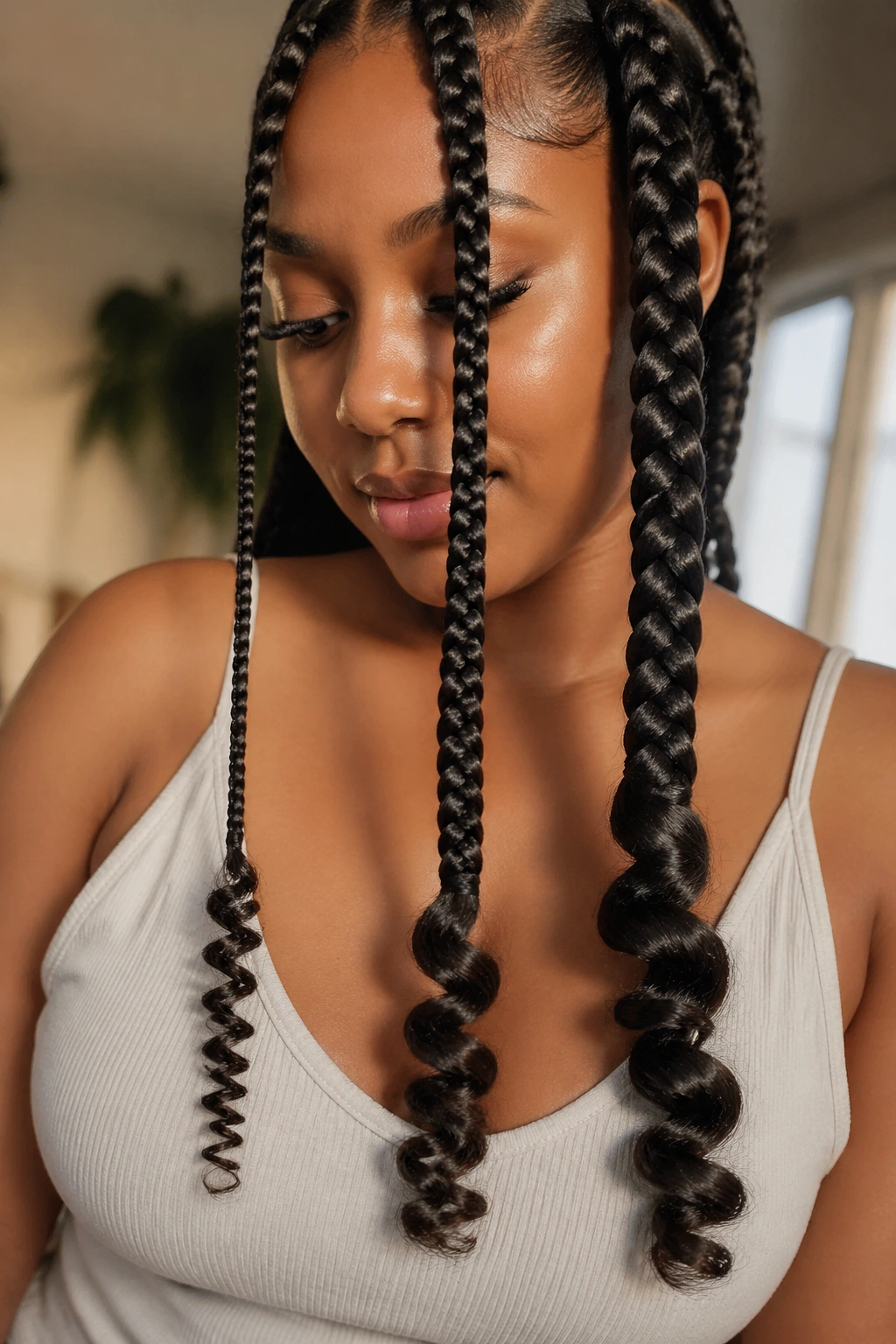
The width of the braid changes how the curly end reads. This relationship between braid size and curl size is one of the most important decisions in planning this style, and it’s worth thinking through deliberately.
Small braids with small curl ends — the braid is thin, the curl end is proportionally small. The individual braids are dense and numerous, each with its own tiny curl. The overall effect is incredibly textured and busy in the best way — lots of visual detail, very full.
Medium braids with medium curl ends — the most proportional and balanced option. The braid has enough size to be clearly visible as a braid; the curl end is large enough to have real presence. This is the “classic” version of braids with curls at the end.
Large braids with large curl ends — the braid is thick and prominent, the curl end is generous and voluminous. Fewer braids overall but each one makes a strong statement. High-impact and bold.
Mismatching on purpose — some women use thin braids with oversized curl ends for a deliberate contrast. Or thick braids with tight little coil ends. These aren’t mistakes — they’re aesthetic choices that create specific visual effects.
Preparing Hair and Extensions for the Best Result
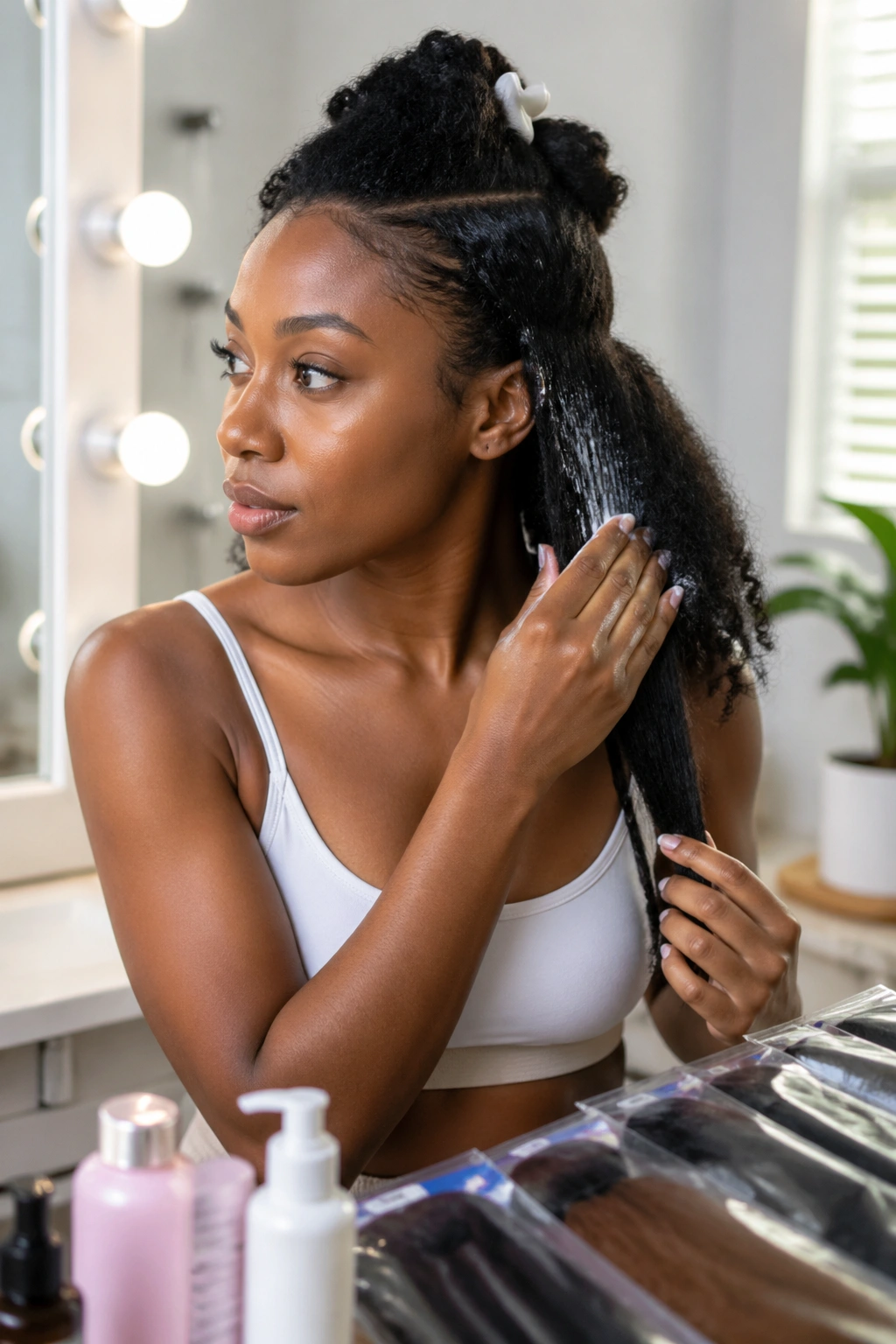
Good preparation is the difference between a style that looks fresh for six weeks and one that looks tired after two.
For your natural hair: wash, deep condition, and detangle thoroughly before installation. Apply a leave-in conditioner and allow hair to partially air dry or gently blow dry before braiding. The combination of moisture in your natural hair and the extension fiber gives the style the best foundation.
For the extension hair: pre-stretching is important. Braiding hair that comes in tight bundles often has a lot of shrinkage built into it. Stretching it by running it between your fingers or using the hot water method before braiding creates a smoother, more consistent braid body. For the curly ends specifically — whether that’s curly extension fiber you’re adding or the natural hair you’re leaving free — make sure the curl section is moisturized and defined before the style is finished.
For the transition point between braid and curl: this is where the style can look either seamless or obvious. If the curl section is going to be a separate piece of added hair, add it gradually into the braid (not all at once) in the last inch of braiding so the transition is smooth. If it’s your own natural ends, make sure those ends are moisturized and curled before you begin braiding so they’re ready to spring free at the end.
1. Box Braids With Tight Coily Ends
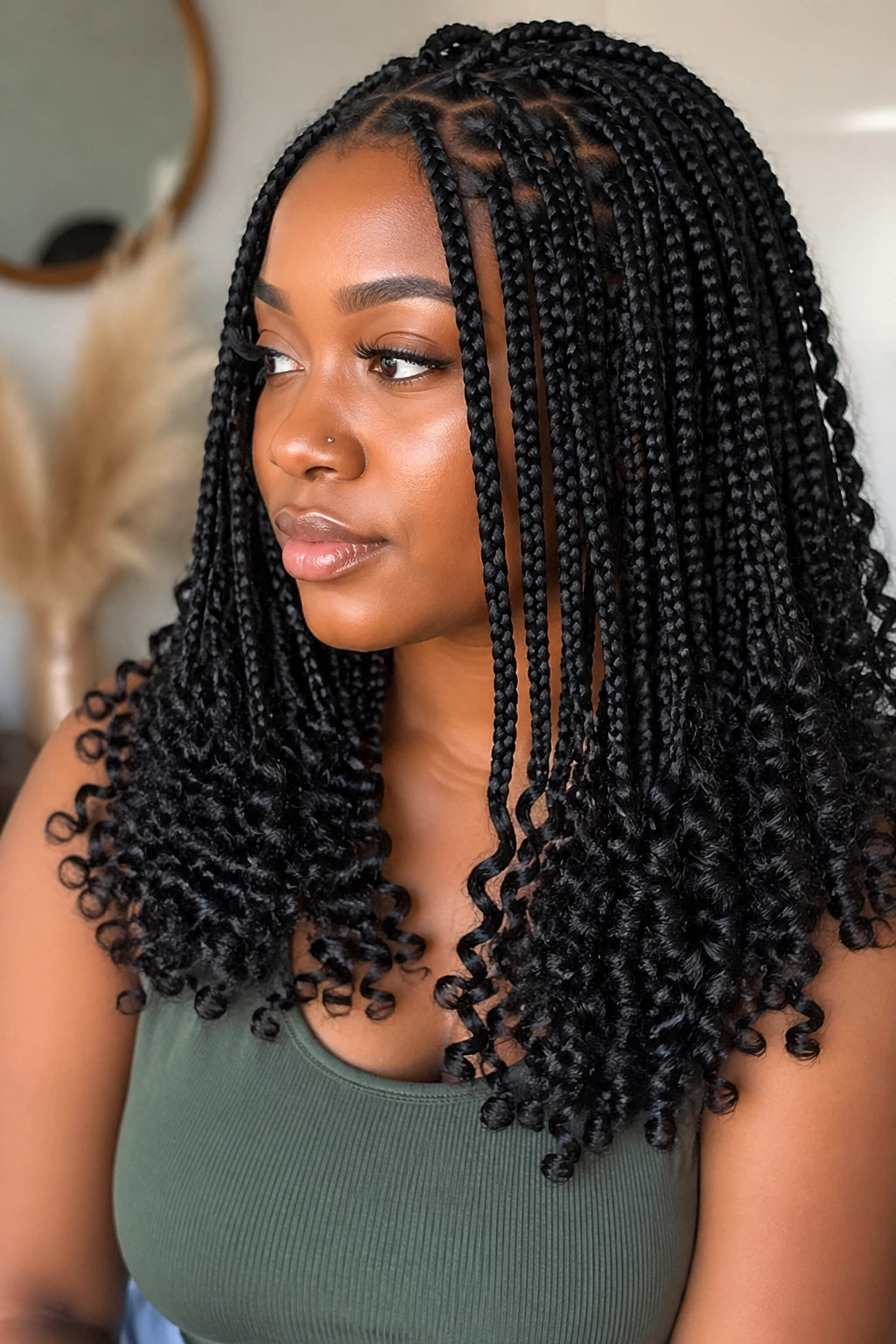
Box braids are the foundational template for this style — clean square parts, uniform braid size, consistent length. When the ends are finished with tight, kinky coil texture rather than straight fiber, the classic box braid gets a completely new personality.
The coily end transforms the box braid from structured to expressive. It signals natural hair identity — the coil at the tip is a statement that says the braids exist within a natural hair context, not outside of it. For many Black women, that distinction matters aesthetically and culturally.
The tighter the coil, the more the end will appear to shrink upward toward the braid body. This gives the braid a slightly different length profile than straight-ended braids — the effective visual length ends slightly higher because the coil pulls up. Consider going slightly longer with the overall braid if you want a specific final length.
2. Cornrows Leading Into Curly Individual Braids
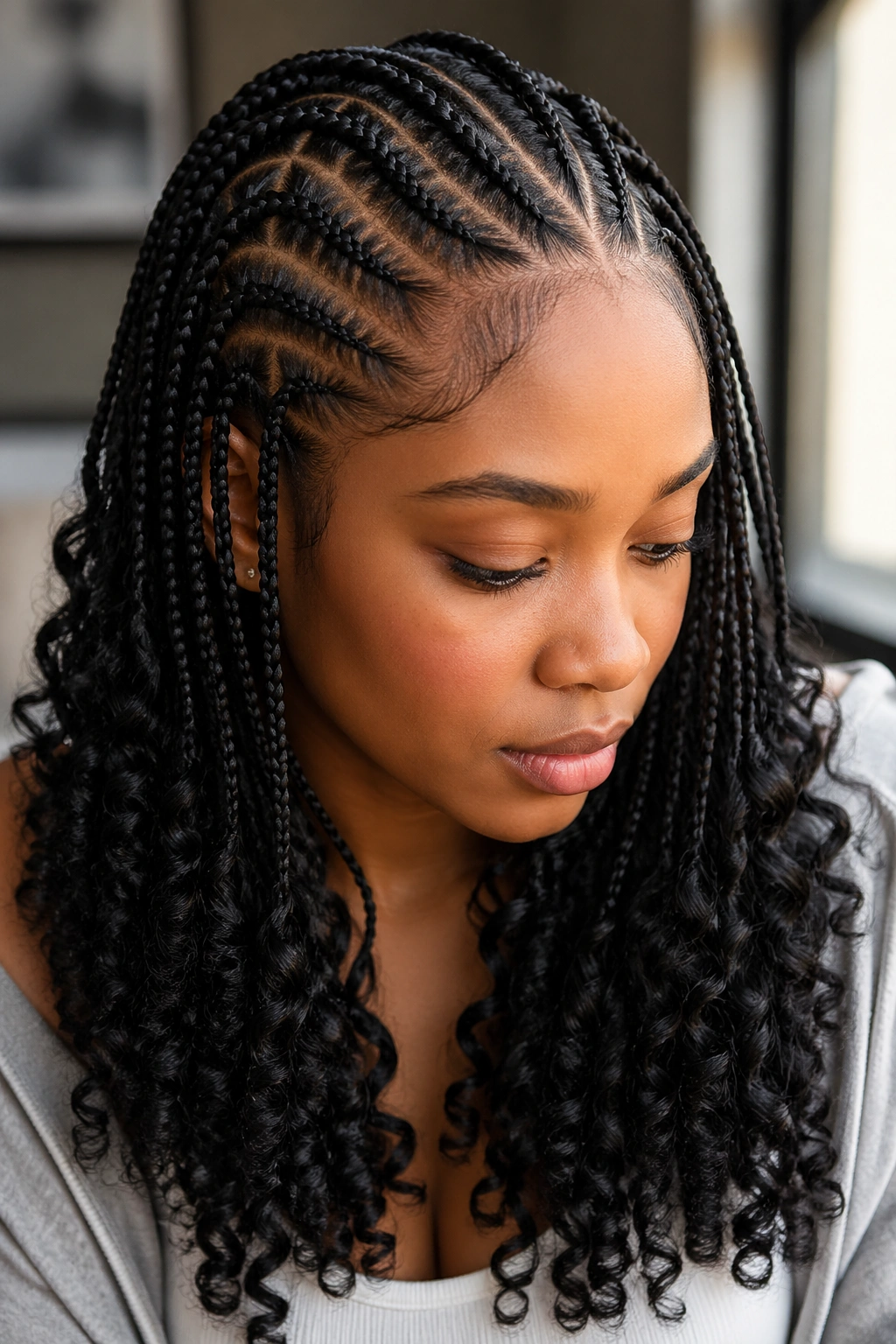
This combination — cornrow sections at the scalp transitioning into individual loose braids further down — is one of the most intricate and beautiful styles in the braids-with-curls category. The cornrows lie flat and sleek against the scalp, then at a certain point they transition into individual braids that hang freely with curly ends.
It’s a style within a style. You get the clean, geometric beauty of cornrow patterning at the top and the movement and texture of loose individual braids with curly ends below. Two completely different aesthetic energies in one installation.
How to Get This Look
- Cornrow sections from the hairline backward for as long as desired (typically 4-6 inches from the scalp)
- Where the cornrow ends, transition to an individual braid using the same hair
- Continue the individual braid downward with added extension if length is desired
- Finish with curly extension hair at the braid ends, adding it gradually for a smooth transition
3. Feed-In Braids With Curly Hanging Ends
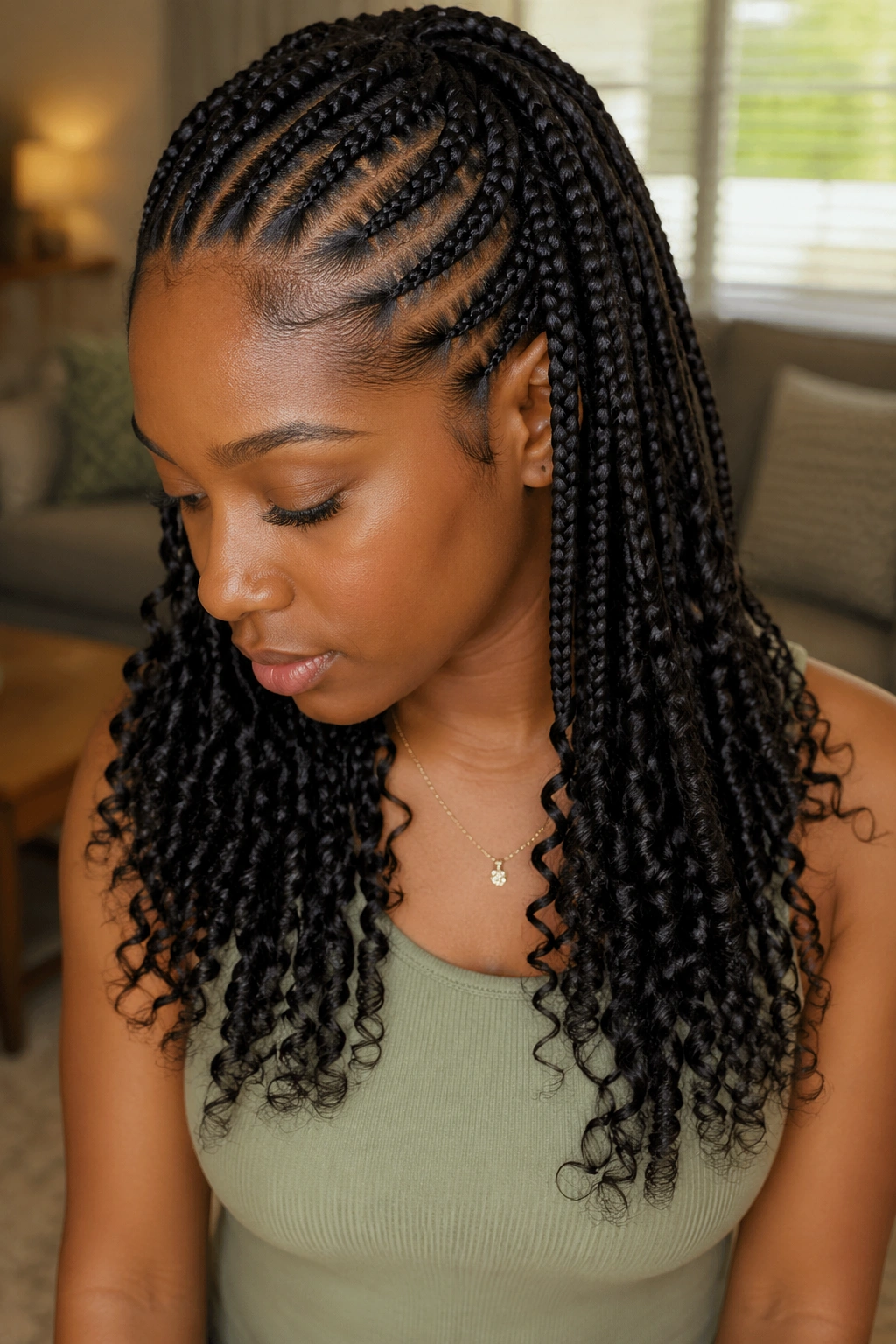
Feed-in braids start small at the hairline and gradually accumulate hair as the braid progresses — creating a tapered root that looks very natural before the braid body thickens. The result at the root is a style that reads as almost growing from the head.
When feed-in braids hang free from the crown and end in curly fiber, the combination of organic-looking root and expressive curly end creates a full-circle effect. Nothing about the style looks artificially imposed — it all flows.
Feed-in braids with curly ends are particularly flattering for women who want the protective benefits of braids but are sensitive to looking “overdone.” This is a braided style that looks like you’re wearing your hair rather than a style wearing you.
4. Triangle Parts With Loose Wave Ends
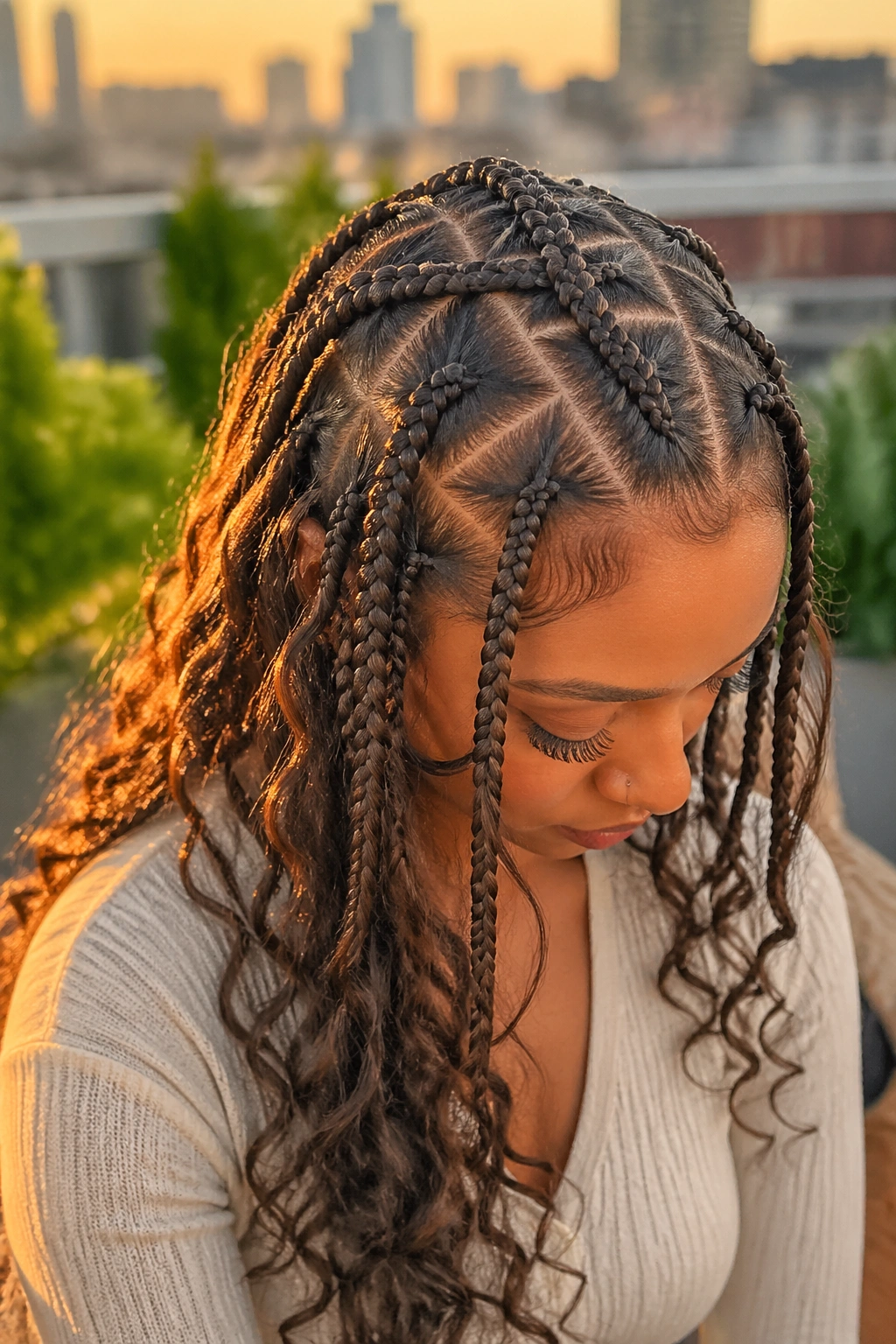
Triangle sections instead of square boxes create a distinctly different geometric pattern at the scalp. The triangular sections produce braids that fall and move differently because of the varied width at the base, and when you view the head from above, the triangle pattern creates a more dynamic visual rhythm than a uniform grid.
Loose wave fiber at the ends — bohemian or water wave braiding hair — amplifies the organic quality of the triangle parts. The whole style has a kind of deliberate imprecision that feels more artistic than machine-made.
This is a great choice for women who want their braids to feel expressive rather than uniform. The triangle parts say you thought about the design; the wave ends say you appreciate softness. Together they read as creative without being costume-like.
5. Micro Braids With Tiny Curly Ends
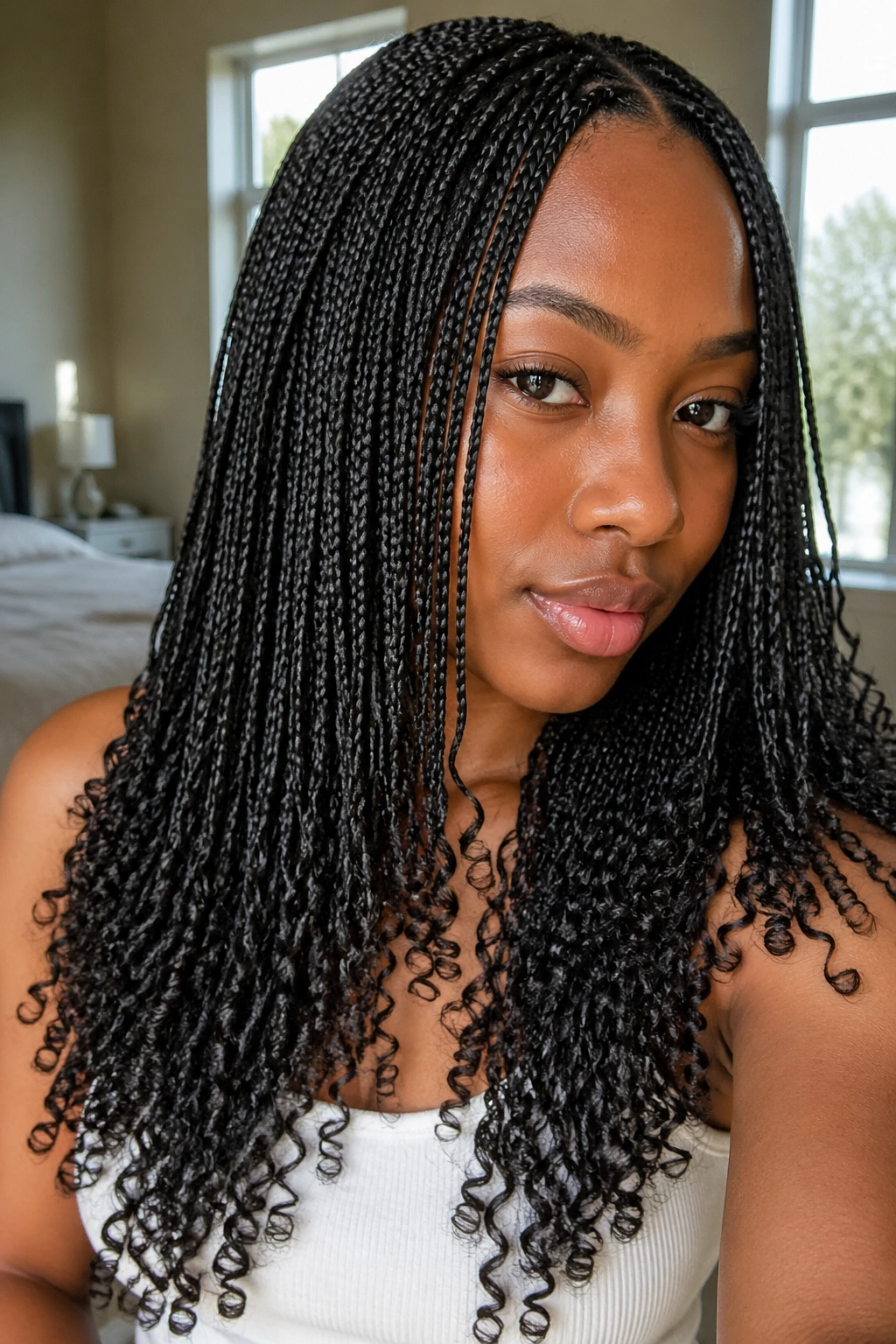
Micro braids — very thin, almost thread-like braids — create a completely different visual density than any other braid size. You might have 100-200 or more micro braids on a single head, and when each of those tiny braids ends in a small curly or coily tip, the overall effect is a head of hair that looks extraordinarily full and detailed.
The installation is lengthy — genuinely 8-12 hours or more — and the removal requires real patience. But the longevity and the visual impact make micro braids with curly ends one of the most impressive protective styles available.
The curly ends on micro braids are best kept tight and small in proportion. A large curl on a micro braid looks out of scale. A small, tight coil in the same fiber as the braid body looks intentional and proportional.
6. Jumbo Braids With Oversized Curl Ends
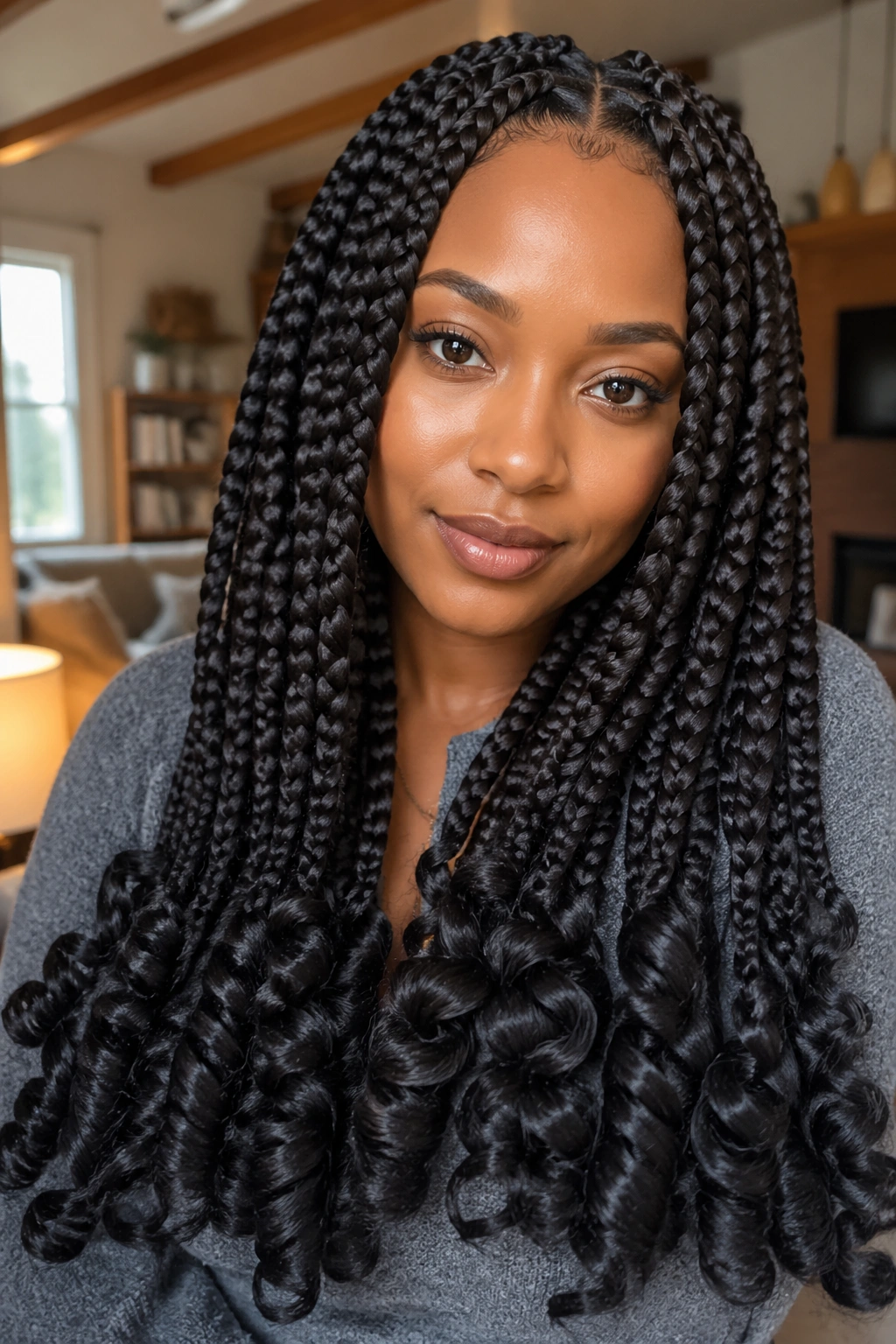
Jumbo braids are the opposite of micro — large, thick, sometimes as wide as two fingers. Where micro braids create density through multiplication, jumbo braids create impact through scale. Each braid is a presence in itself.
When jumbo braids end in large, voluminous curl fiber, the style has a lot of personality. Bold braids, bold curls. It’s not subtle, and it’s not trying to be. Women who love a statement look gravitate toward this combination because it’s genuinely hard to ignore in the best way.
The installation is much faster than smaller braids — sometimes as little as 2-3 hours for a full head of jumbo knotless braids. The trade-off is that the braids themselves are heavier and can put more stress on the scalp, particularly if tight installation methods are used.
7. Braids With Curls at the End in a High Ponytail
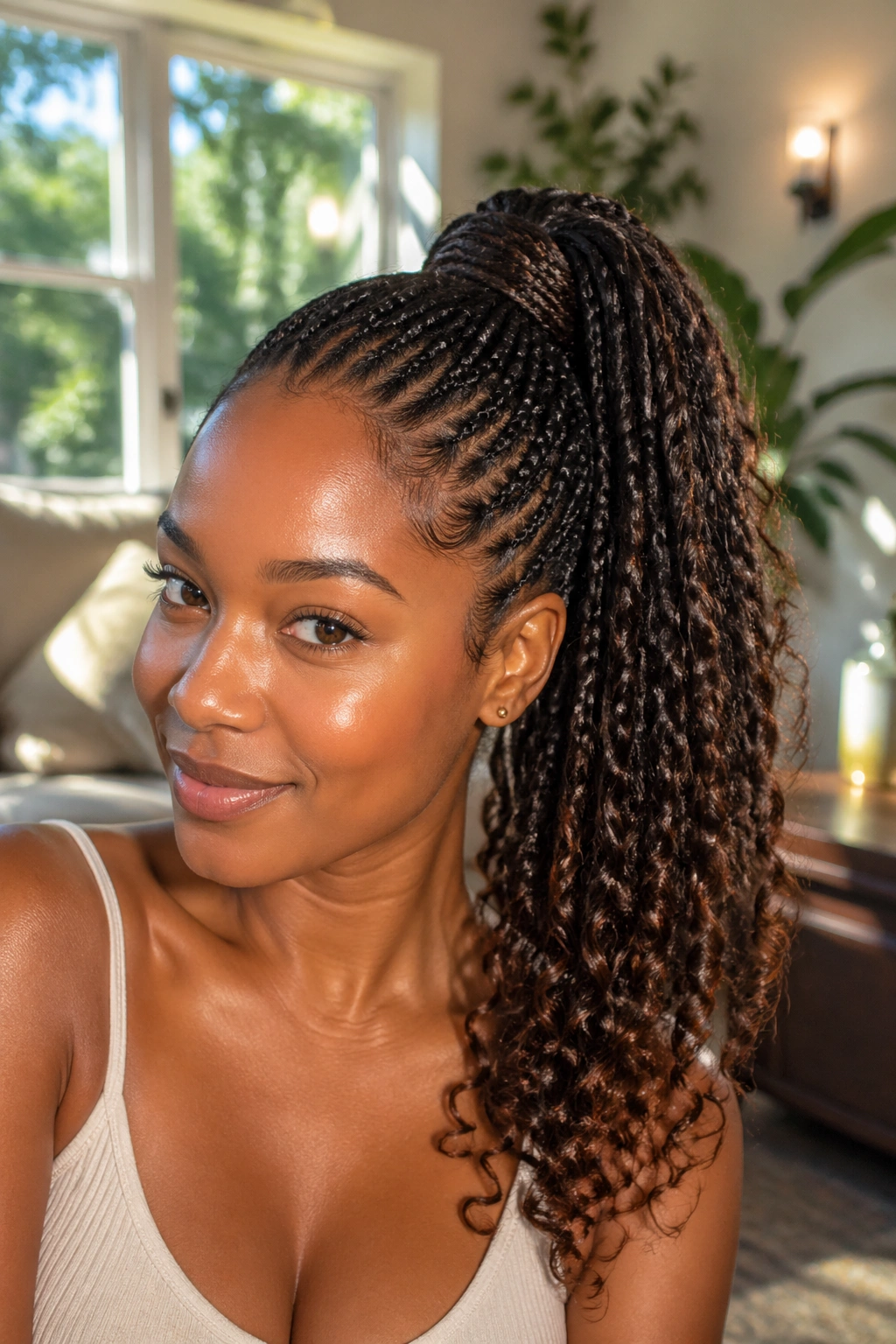
Gathering all your braids — curly ends and all — into a high ponytail is one of those simple styling choices that looks dramatically different from just wearing them down. The height of the ponytail lifts your features, exposes your neck, and the mass of curly ends cascading down from the ponytail gathering creates a full, dramatic tail.
The curly ends move differently when gathered into a ponytail than they do when hanging individually. In the ponytail, they compress slightly against each other and then spring free below the hair tie, creating a bouquet-like effect at the base that’s genuinely beautiful.
Use a satin-lined hair tie to prevent the gathering point from causing breakage. This is a spot that gets a lot of friction, and satin makes a measurable difference in the long-term condition of your hair there.
8. Braids With Curls at the End in a Half-Up Bun
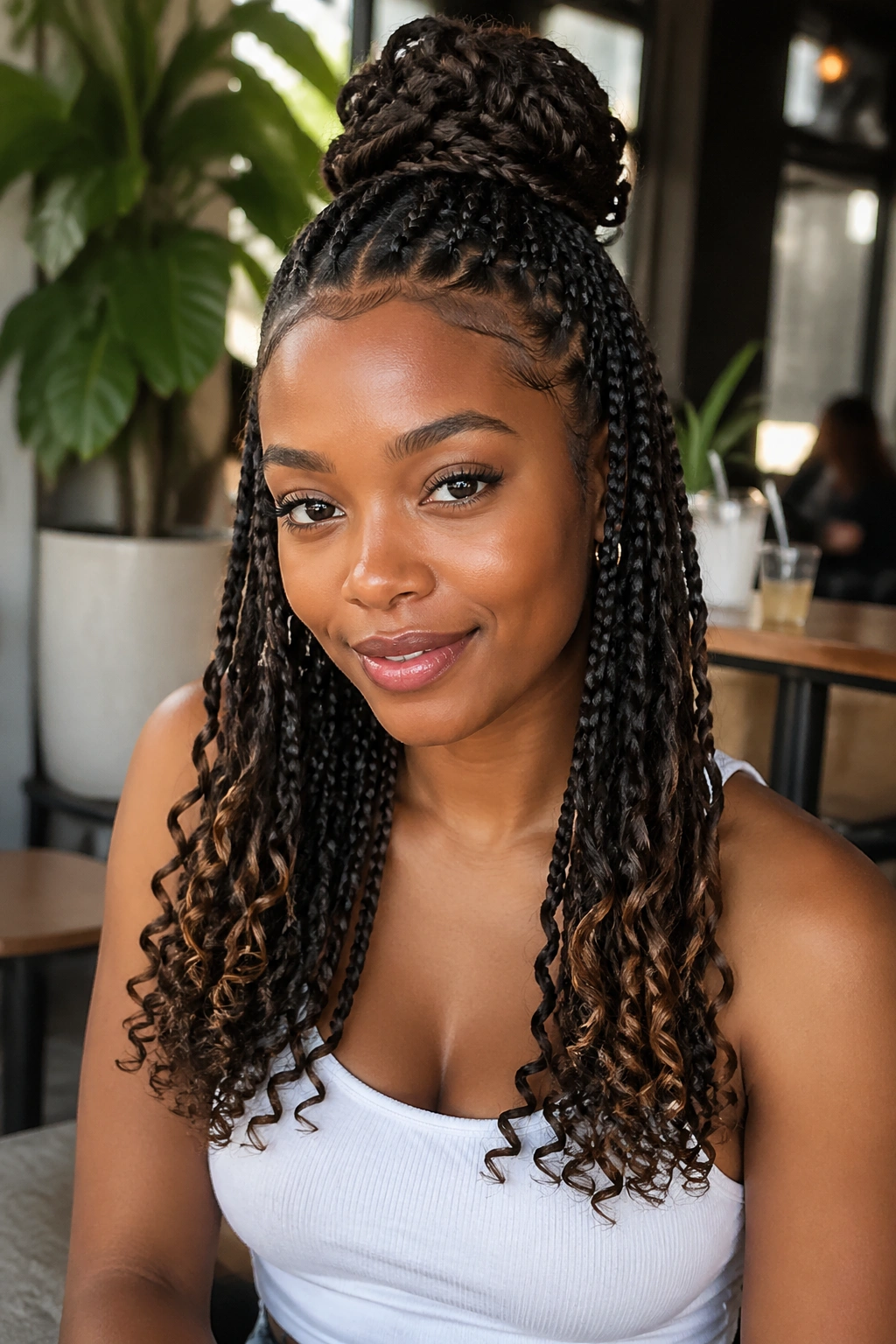
The half-up bun takes the top section of your braids — everything from the temples upward — and gathers it into a bun while leaving the lower section to hang freely with curly ends. The result is tidy at the top, expressive and textured on the bottom.
This arrangement is genuinely flattering for almost every face shape. The height of the top bun adds visual length to the face; the hanging braids with curls below soften the jawline.
The best half-up buns with braided hair let some curly ends or shorter face-framing braids escape from the bun to create a more casual, put-together quality. Perfect pinned buns with braids look nice; imperfect ones with curls escaping look stunning.
9. Braids With Curls at the End Styled to One Shoulder
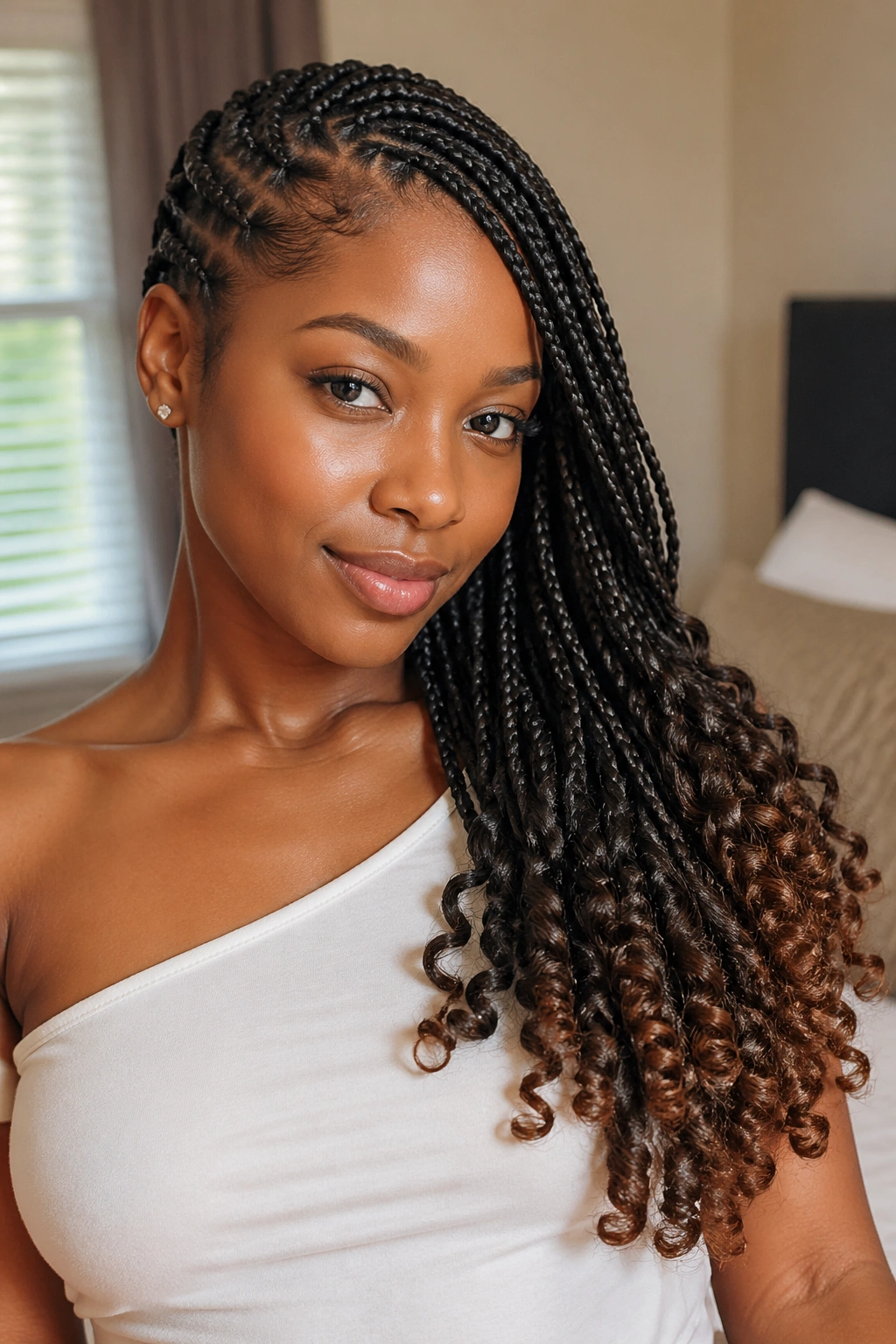
A one-shoulder sweep — gathering all your braids and their curly ends over one shoulder to hang together on one side — is one of the most photogenic ways to wear this style. The braids fall in a grouped mass, the curly ends splay out below the gathered section, and the opposite side of your neck is fully exposed.
One-shoulder sweeping with braids works especially well when some of the braids are slightly different lengths or have slightly different curl end textures, because the visual variation within the gathered mass creates depth rather than uniformity.
10. Ghana Braids With Curly Hanging Ends
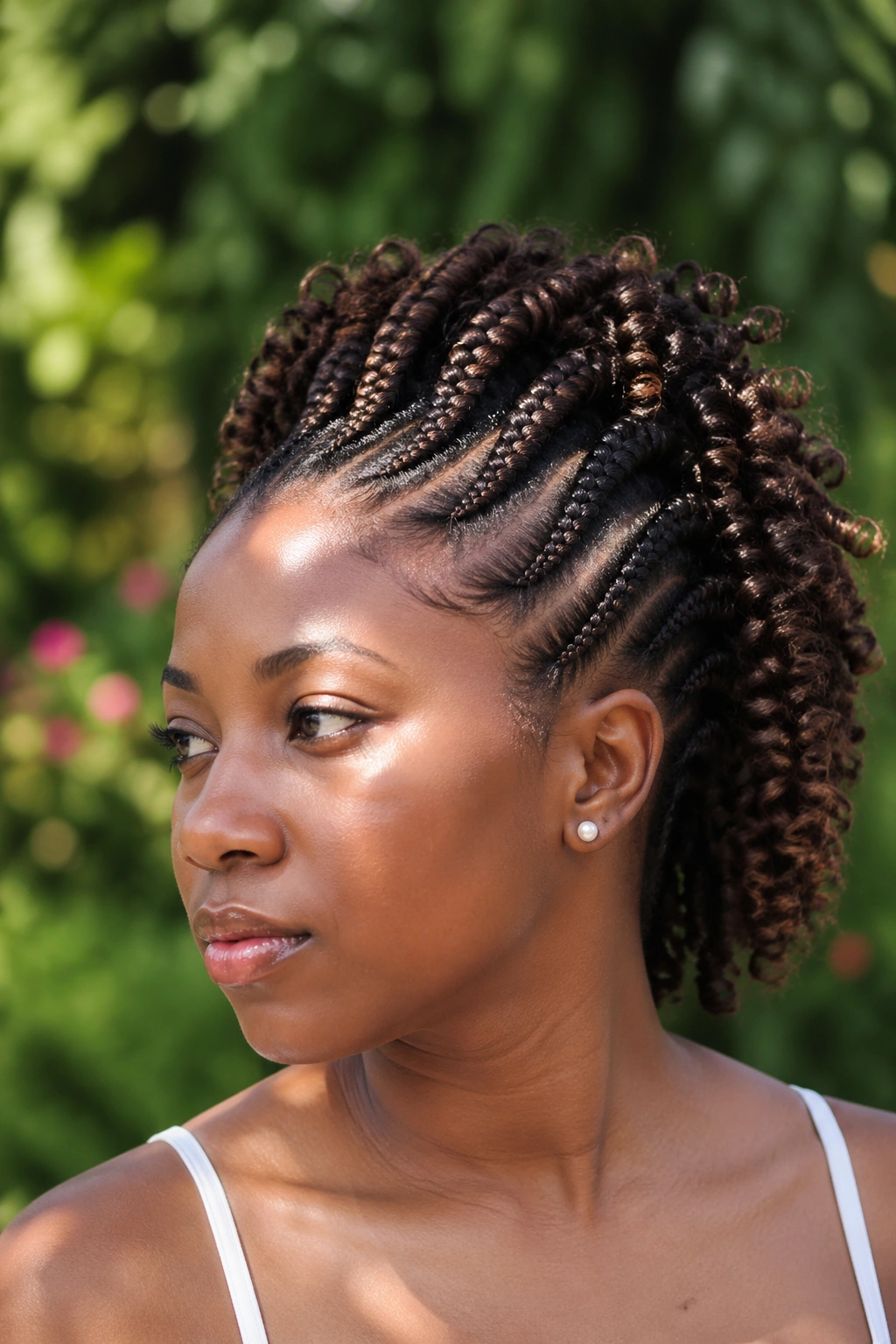
Ghana braids (also called invisible braids, pencil braids, or feed-in cornrows) are cornrow-style braids that lie flat against the scalp and then curve upward and stand free at a certain point. They have a very clean, graphic quality where they’re flat — and when they stand free with curly ends, the transition from flat to free is dramatic and beautiful.
Ghana braids with curly ends are particularly stunning in curved patterns — braids that arc around the head rather than going straight back. The curve of the braid combined with the bounce of the curly end creates a style with real artistry.
11. Boho Box Braids With Wavy Ends
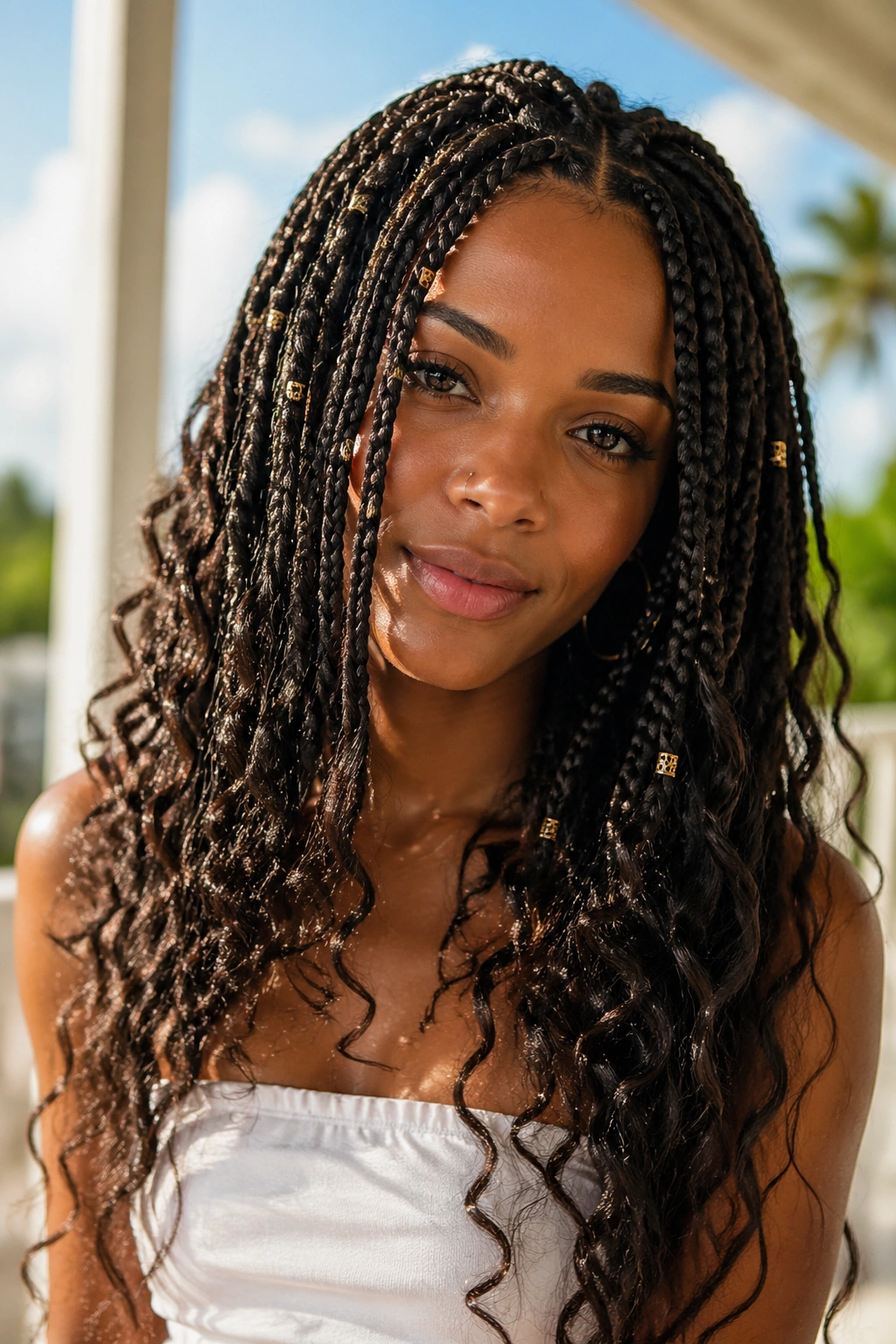
Boho box braids take the traditional box braid and make it more voluminous and free-spirited by incorporating looser, wavier fiber throughout and at the ends. Rather than the braid being tightly packed with smooth extension, the boho version lets some of the fiber escape slightly, creating a slightly textured braid body that transitions naturally into wavy ends.
This is the braided style for women who want to look like they just returned from somewhere beautiful. The slightly undone quality of boho braids combined with flowing wavy ends feels genuinely carefree.
Who This Suits
Boho box braids with wavy ends are most flattering when the braid size is medium — not so small that the texture is lost in the detail, not so large that the boho quality tips into unkempt. Length helps too: this style has more impact at shoulder length or longer.
12. Senegalese Twists With Curly Ends
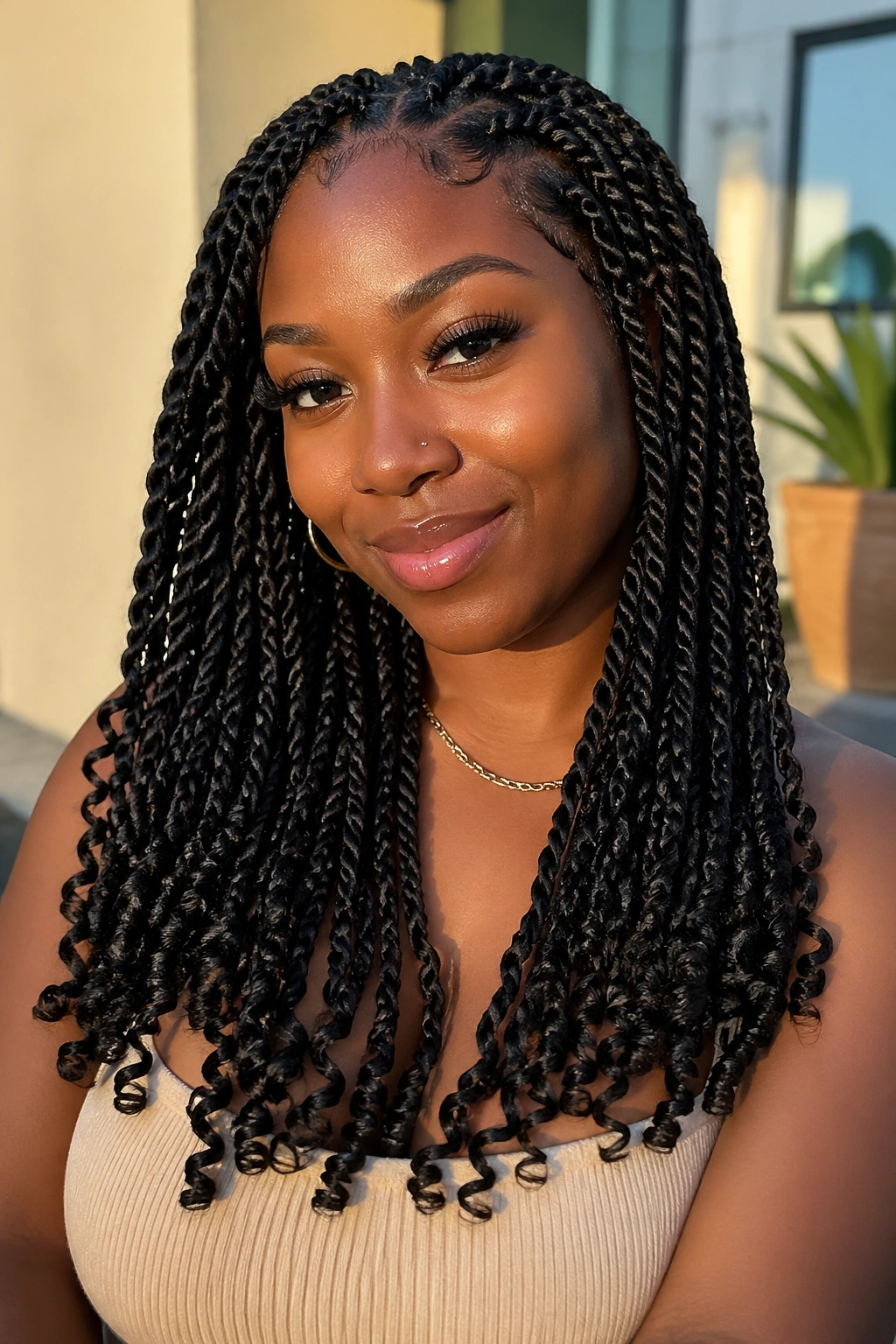
Technically a twist rather than a braid — Senegalese twists use two strands spiraled around each other rather than three strands plaited together — but the curly end logic applies here just as powerfully. The smooth, silky spiral of a Senegalese twist ending in a kinky or wavy curl creates the same beautiful contrast.
Senegalese twists are naturally sleeker and have a more uniform, polished appearance than most braids. Adding a curly end introduces texture into a style that’s otherwise quite smooth, which creates a meaningful visual contrast.
13. Passion Twists With Curly Fiber Ends
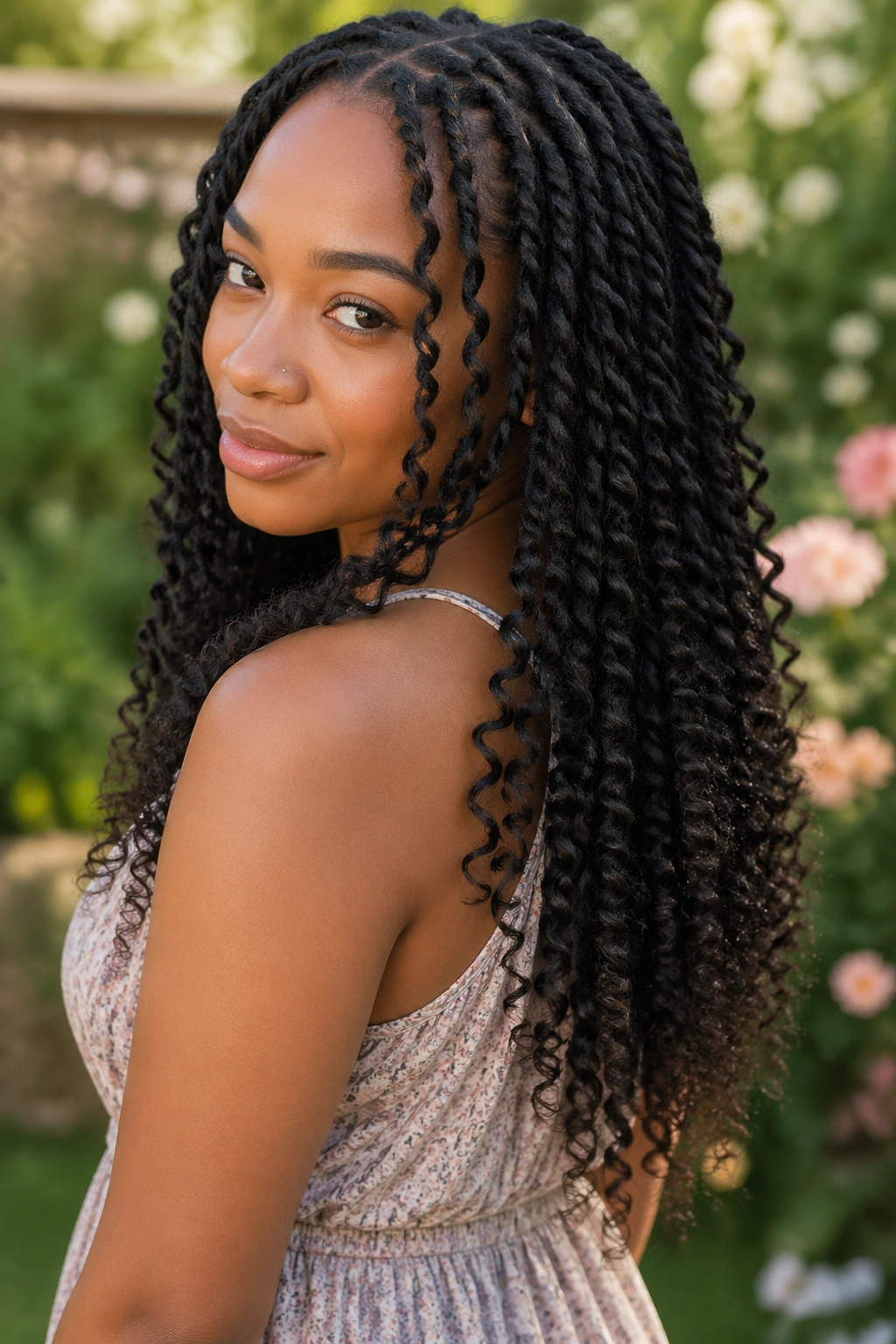
Passion twists use a specific textured fiber that’s wrapped around a loose two-strand twist base, creating a shaggy, multi-directional spiral. The texture throughout a passion twist is already curly — so passion twists “with curly ends” often means extending the passion twist fiber into an even fuller, more dramatic curly section at the bottom.
The result is a style that’s curly from root to tip in different ways — structured spiral twist mid-braid, free-hanging curly fiber at the ends. Very voluminous and very romantic.
14. Braids With Colored Curl Ends
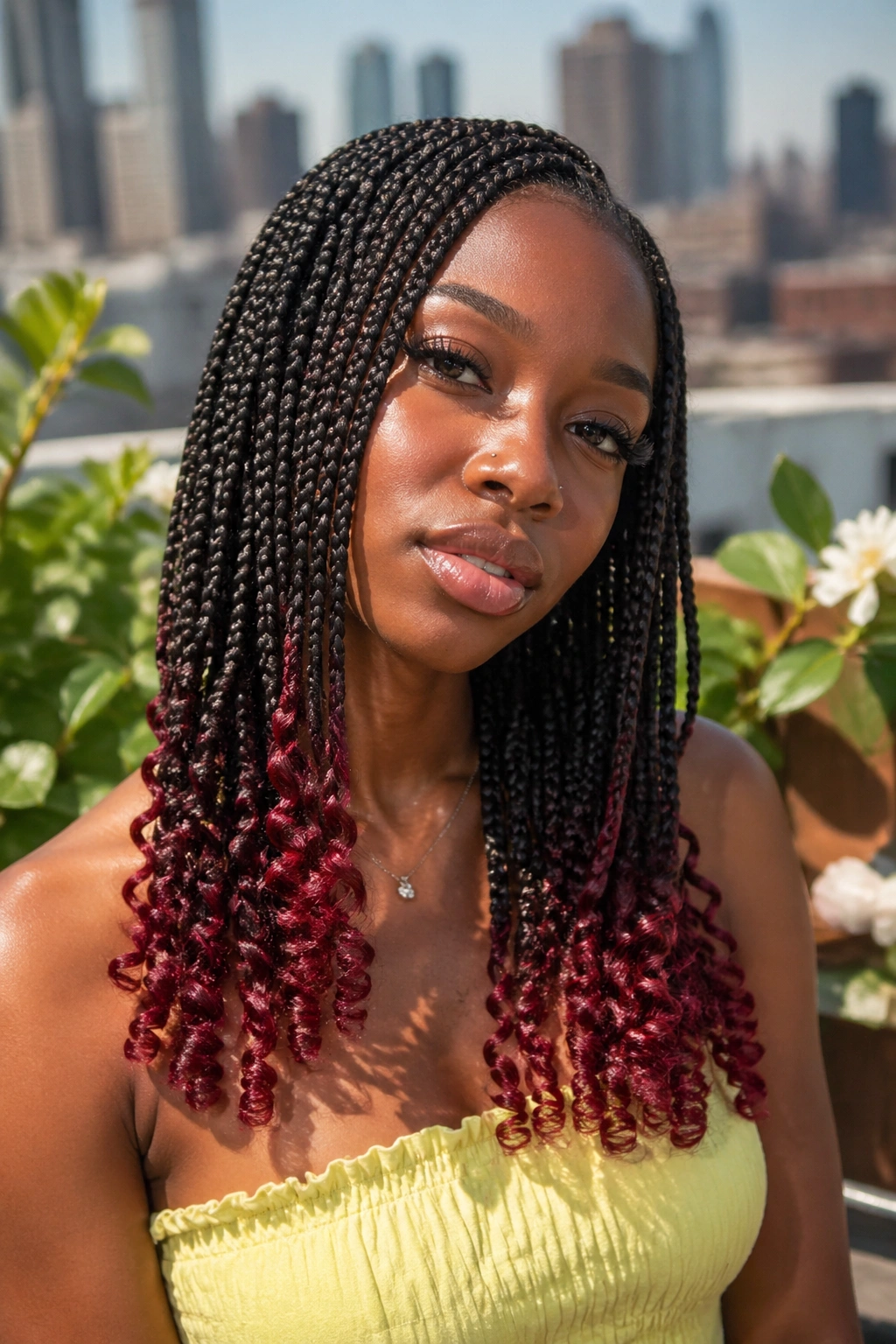
Using colored extension fiber only in the curl end section — while the braid body itself remains in your natural hair color or a matching extension — creates a color effect that’s concentrated exactly where the eye lands last: at the tip.
Burgundy curl ends on dark braids add warmth without changing the overall impression of hair color dramatically. Honey blonde curl ends create a sunkissed effect as if the ends have been lightened by sun exposure. Bold color curl ends — bright red, cobalt blue, hot pink — are a fashion statement that transforms the entire energy of the style.
The color is in the extension fiber and has no interaction with your actual natural hair, which means zero chemical damage. You can try bold colors without any commitment.
15. Braids With Curls at the End in a Space Buns Arrangement
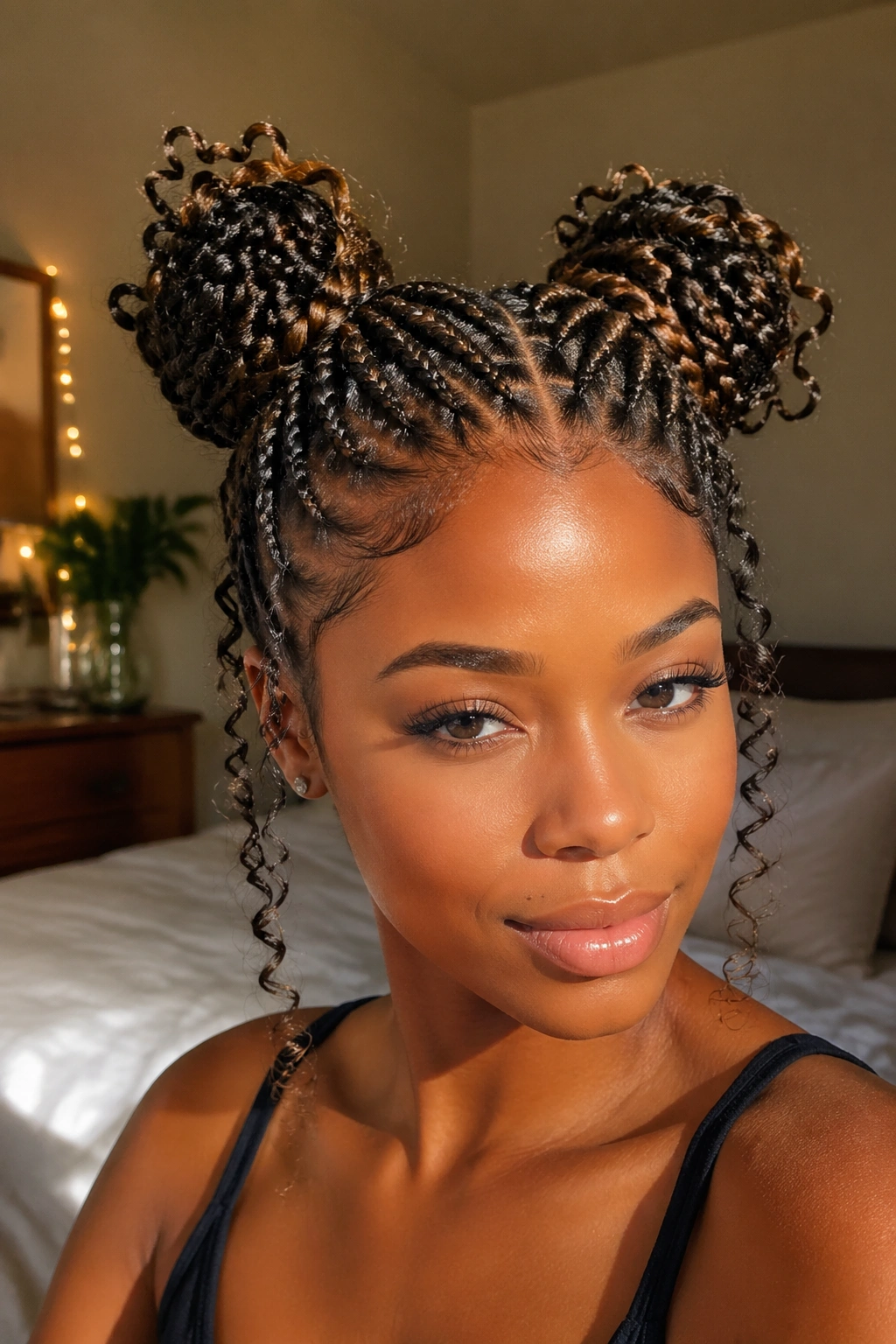
Two space buns made with braided hair that has curly ends at the tips is genuinely one of the most charming and fun natural hair styles available. The structural quality of braided hair gives the buns definition and shape; the curly ends add a playful, textured quality to what would otherwise be smooth buns.
For the most impactful space buns: center-part your braids, gather one side into a bun near the top of the head, then repeat on the other side. Make the buns slightly looser than you think — tight, too-neat buns with braids look forced, while slightly loose ones with curly ends escaping look genuinely cool.
16. Braids With Curls at the End Accessorized With Gold Cuffs
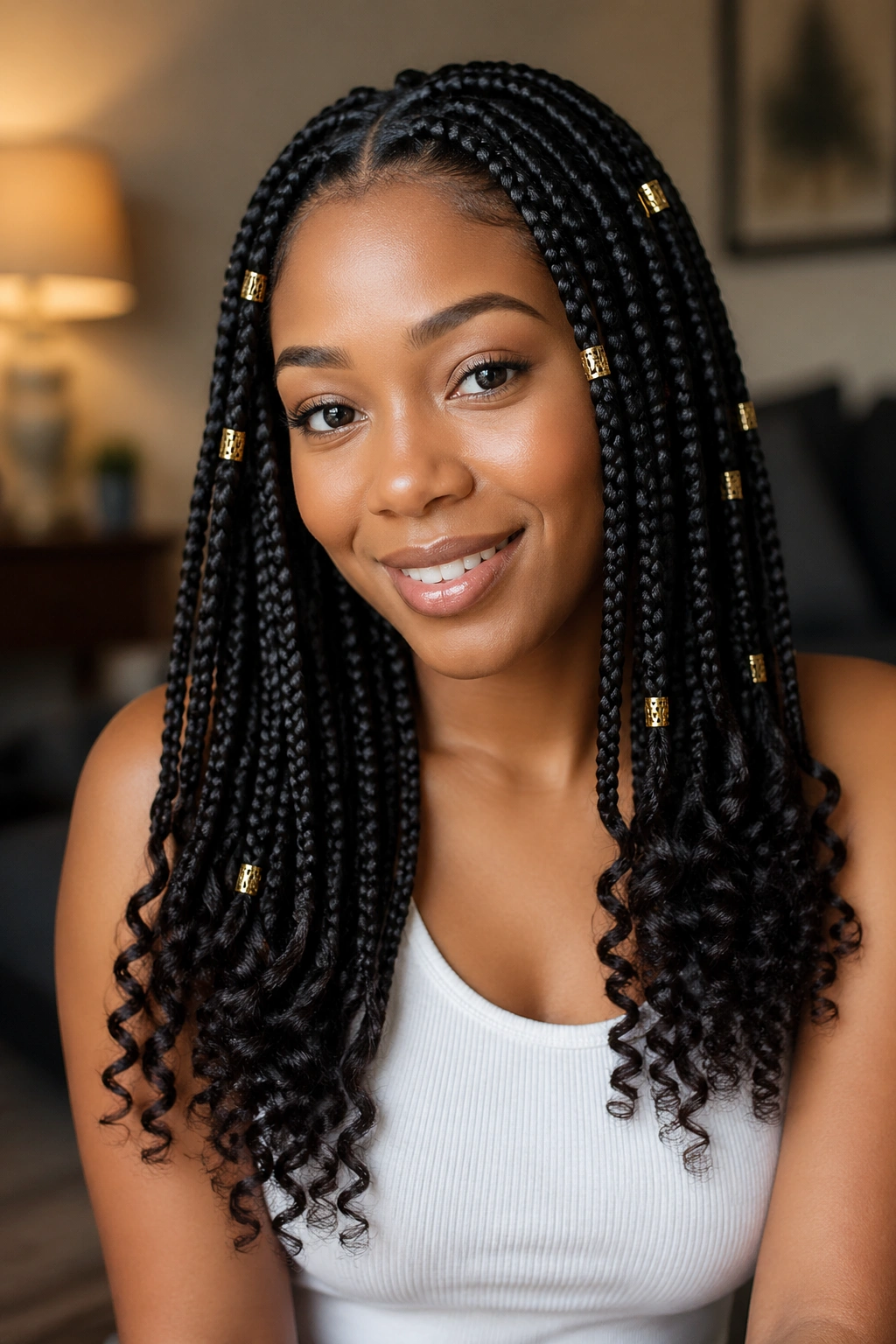
Gold loc cuffs — small metal rings slid onto braids at different points — add a richness to braids with curly ends that nothing else quite matches. The gold glints against the braid body, and the curly ends hanging below each accessorized braid create a look with multiple layers of visual interest.
Place cuffs at varying heights on different braids — some near the root, some mid-braid, some just above where the curl section begins. Avoid stacking too many cuffs on every single braid — two or three braids with multiple cuffs, surrounded by plain braids, creates more visual impact than forty braids each with one cuff.
17. Lemonade Braids With Curly Ends
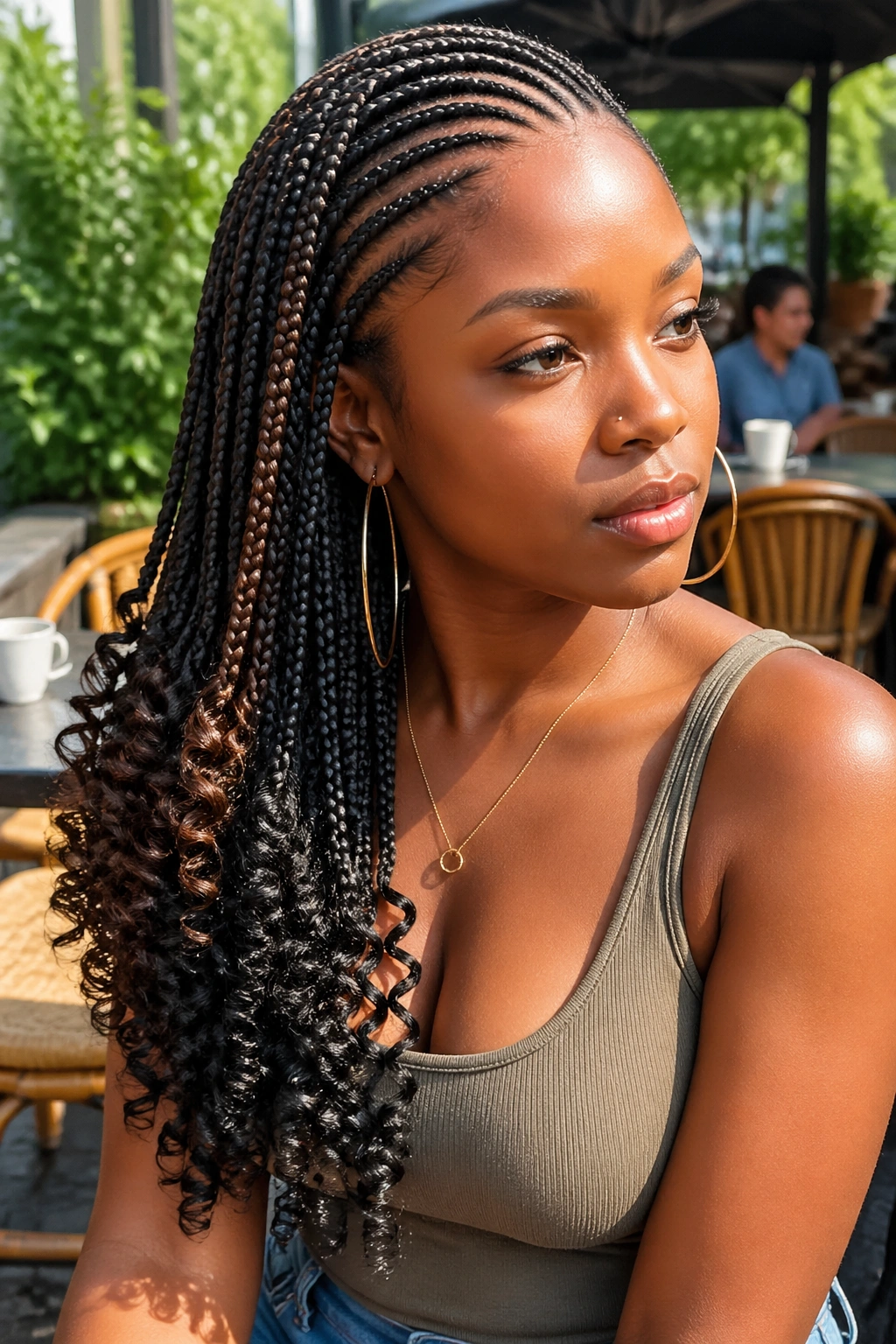
Lemonade braids — side-swept cornrows that all sweep to one side in a bold, graphic pattern — are already one of the most striking cornrow styles. When the lemonade braids stand free at a certain point and end in curly fiber, the graphic cornrow pattern at the scalp transitions into a mass of curly ends sweeping to one side.
This style requires an experienced braider. The precision of the part pattern and the evenness of the cornrow sweep is what makes lemonade braids look stunning rather than messy. The curly ends at the tips are the reward for getting the technical part right.
18. Fulani Braids With Curly Ends
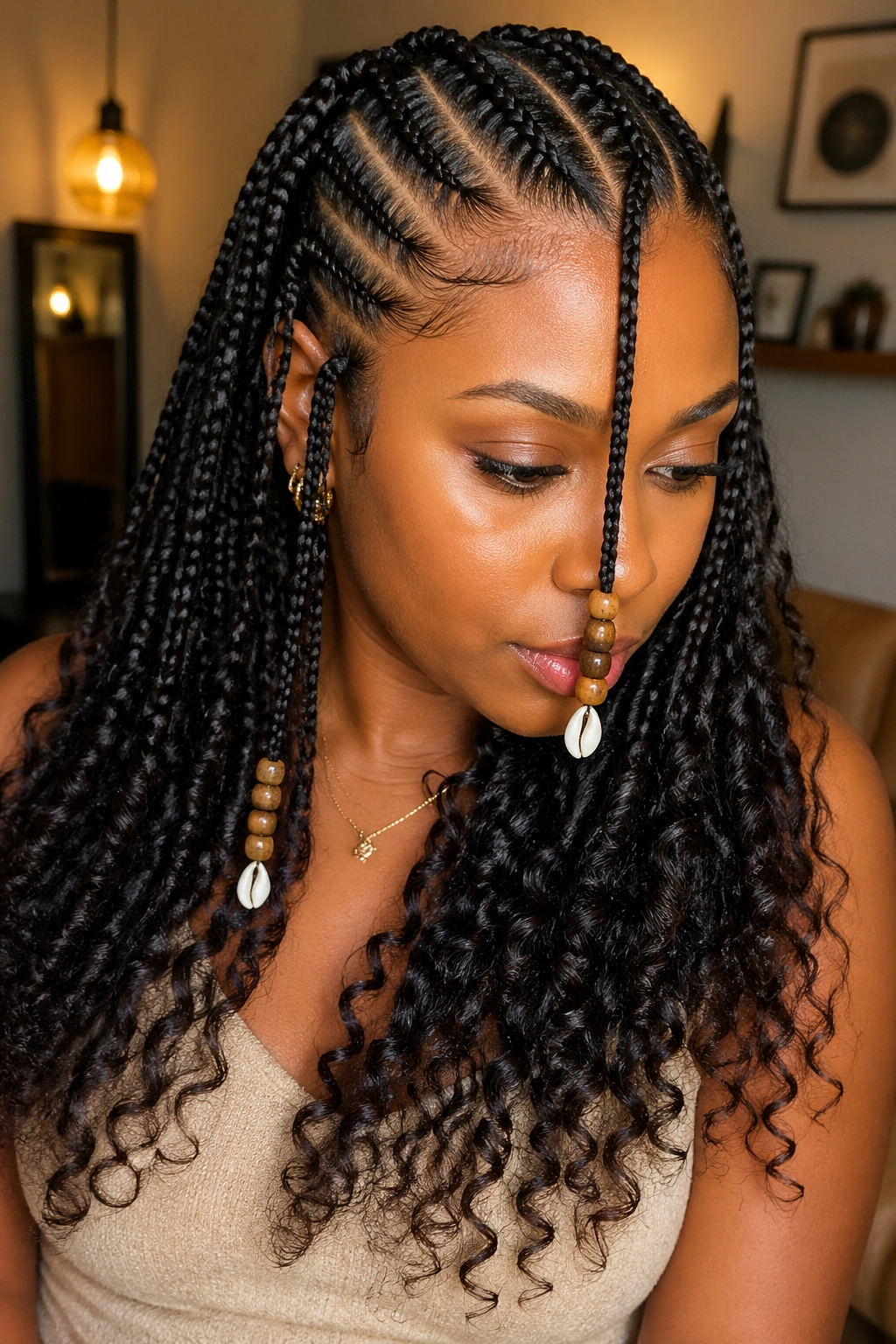
Fulani braids — inspired by the traditional braiding aesthetic of the Fulani people of West Africa — combine cornrows near the hairline with a central cornrow or braid running front to back, often accented with beads and thread. The style has a distinctly geometric, cultural quality.
Adding curly ends to the hanging sections of Fulani braids adds softness to a style that can otherwise be quite structured. The cultural aesthetic of the braid pattern plus the romantic quality of curly ends creates something that feels both rooted and expressive.
Pair Fulani braids with curly ends with gold beads and cowrie shells for the most culturally resonant interpretation.
19. Braids With Curls at the End During the Takedown Phase
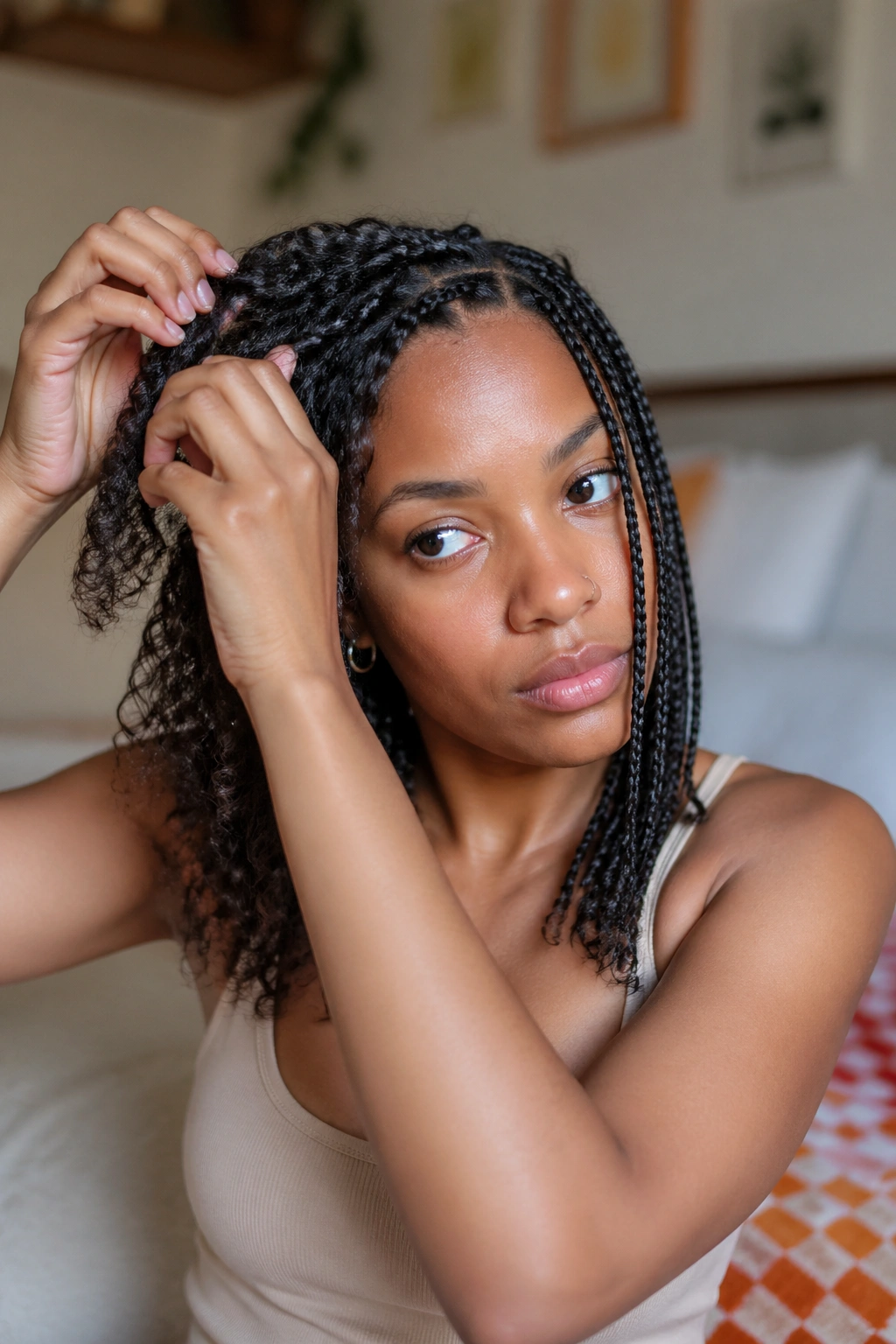
One interesting variation that many women discover accidentally: during the process of taking down braids (when you’re partway through the removal), the combination of intact braids and freshly released curly sections creates a beautiful, in-between style. The contrast between the still-braided sections and the newly-free curly sections is striking.
This isn’t a deliberate install — it’s something that happens naturally during removal. But recognizing it and maybe leaving the takedown at the halfway point for a day or two before completing it is a valid styling choice that many women have discovered.
20. Braids With Curls at the End for a Protective Period
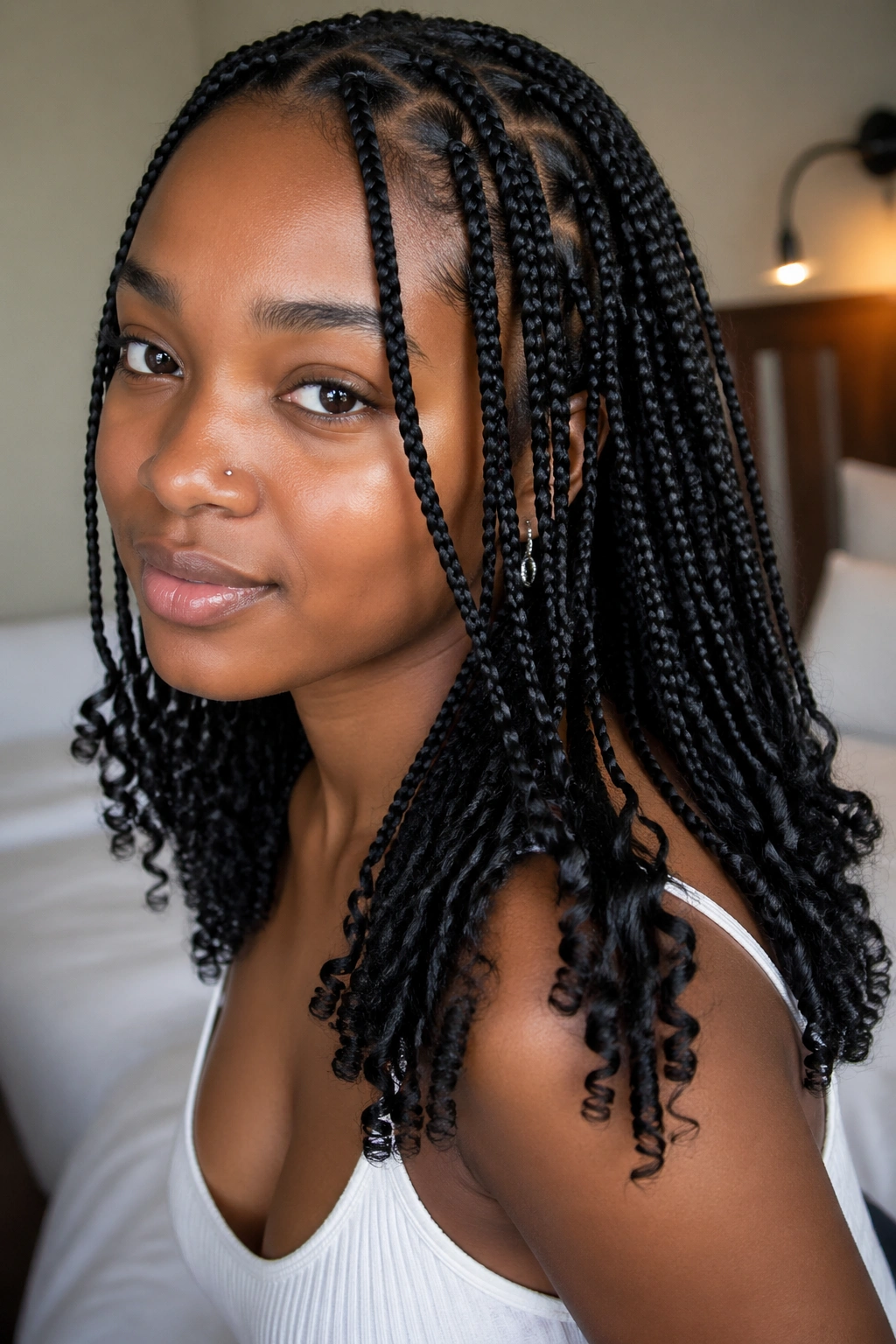
The protective styling purpose of braids with curls at the end deserves acknowledgment beyond aesthetics. When natural hair is braided with extension and the ends are either left natural (free curly ends) or protected within curl extension fiber, the hair gets a genuine rest from daily manipulation.
Every day your natural hair is in braids is a day you’re not manipulating it — no combing, no brushing, no heat styling, no wash day tension. That reduction in manipulation is directly linked to length retention. Hair breaks where it’s handled, and braids with curls at the end reduce handling to near zero for weeks at a time.
The curly ends specifically — whether natural or extension — need the most protection because they’re the oldest part of the hair shaft. Keeping them in a curled, compact state rather than stretched and exposed reduces the surface area that’s vulnerable to friction and environmental damage.
21. Braids With Curls at the End — Choosing Your Length
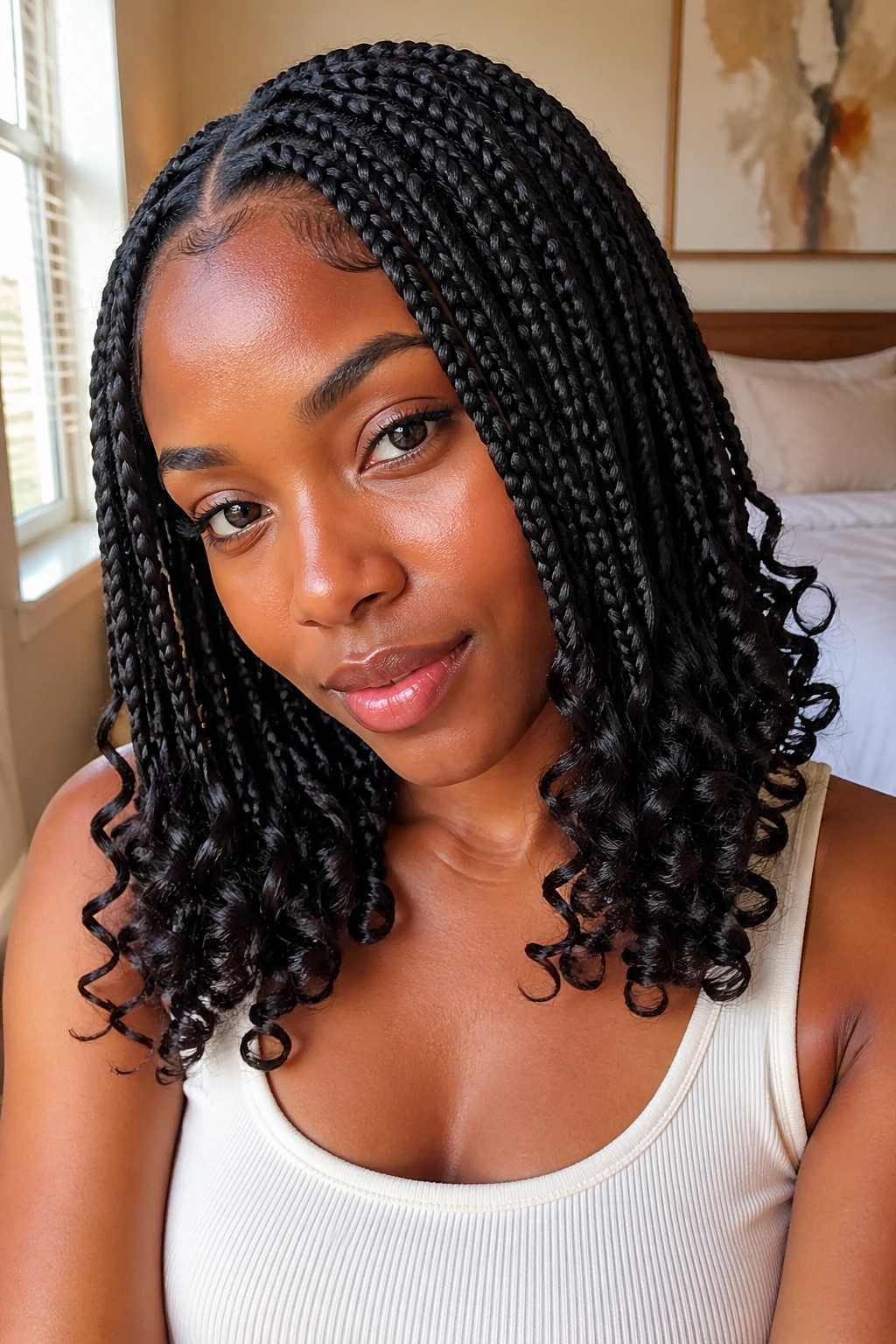
Length is one of the most consequential decisions when installing braids with curly ends, and it’s worth thinking about before you sit in the chair.
Shorter lengths (chin to shoulder) are lower maintenance, lighter weight, and put less tension on the scalp. The curly ends are proportionally more prominent at shorter lengths because they represent a larger percentage of the total braid length. This is a great choice for first-time wearers or for women who want a more manageable style.
Medium lengths (shoulder to mid-back) are the sweet spot for most women. The braids have enough length to be versatile — you can wear them up, down, in a bun, in a ponytail — and the curly ends have room to move without overwhelming the braid body.
Long lengths (mid-back and below) are dramatic and high-impact. The sheer volume of braid and curl creates a style with serious presence. The weight is real, though — very long braids with full curly ends are heavy, and wearing them for extended periods can put strain on the scalp and neck.
Maintaining Braids With Curly Ends Between Wash Days
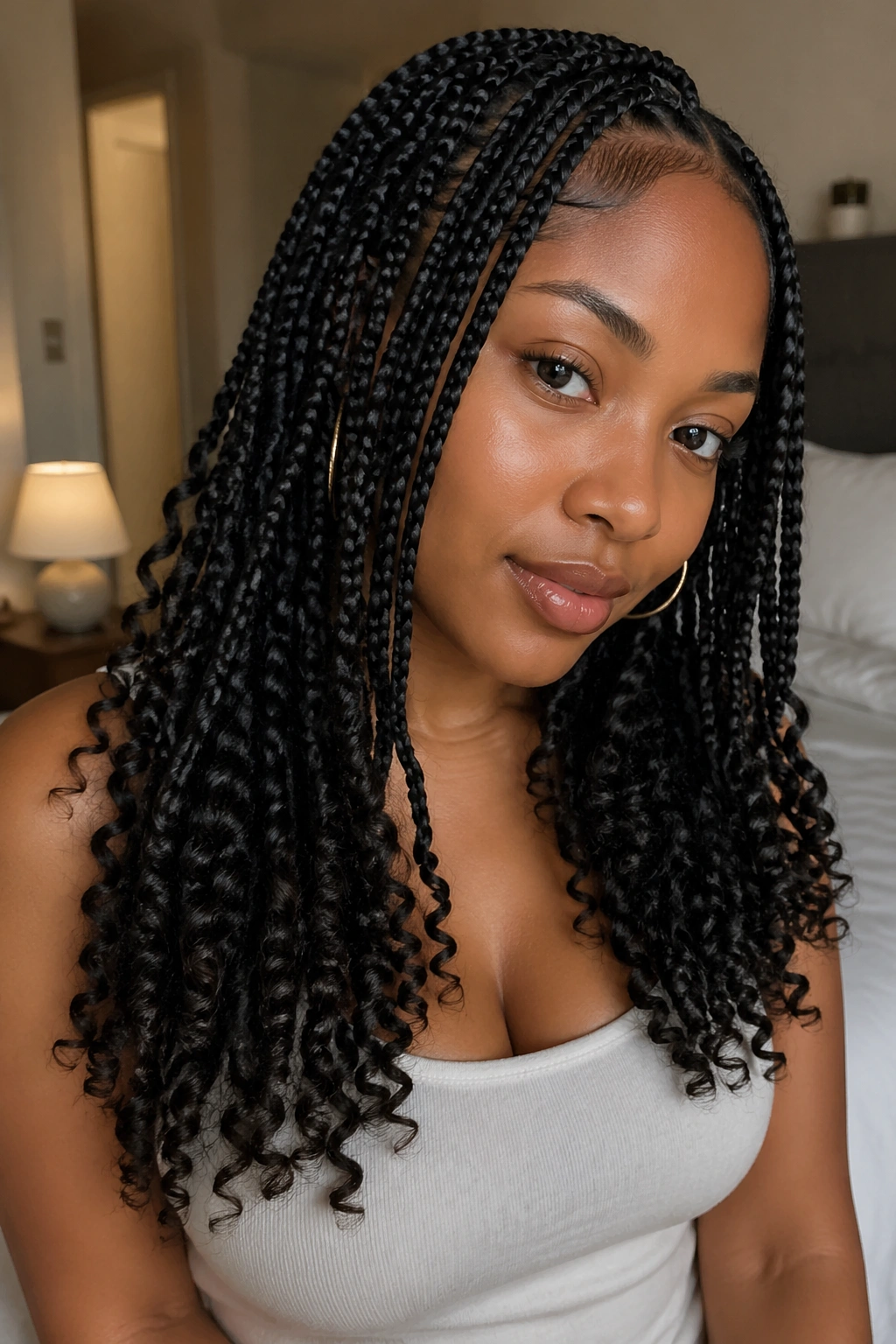
The curly ends of your braids — whether natural hair or extension fiber — need different maintenance than the braided sections. The braided body stays neat largely on its own; it’s the curly ends that require refreshing over time.
Every few days, mist the curly ends lightly with a water or aloe vera spray and scrunch them gently to revive the curl definition. If the ends are your own natural hair, follow with a small amount of curl cream applied with your fingers. If they’re extension fiber, keep the product light — too much product on extension fiber makes it look greasy and dulls the curl.
For the braids themselves and your scalp: use a diluted leave-in spray between washings to keep the scalp moisturized. Part the braids to access the scalp directly rather than just wetting the surface of the style.
Sleep in a satin bonnet or on a satin pillowcase every night. The satin reduces friction on both the braided sections and the curly ends, extending the life of the style significantly.