



Braided half up half down for bridesmaid long hair solves a problem that shows up fast on wedding mornings: how do you keep long hair controlled, soft, and pretty without turning it into a helmet? A good braid does all three. It holds the crown, gives the style shape, and still lets the length fall where it can move a little.
The best versions do not fight the hair. They work with it. Long hair has weight, swing, and a tendency to slip out of flimsy pins, so the braid has to be placed with intent — usually around the crown, temple, or sides — and anchored where the head naturally needs support. That’s why this style keeps showing up for bridesmaids. It feels polished, but not stiff. Formal, but not fussy.
There’s also a practical reason it keeps winning. Long hair in a half-up style can go flat before dinner if the structure is weak. Braids solve that. They give the top half a built-in spine, and they let the rest of the hair stay loose enough to feel romantic rather than overworked.
1. Classic Crown Braid with Loose Waves
A classic crown braid is the safest kind of pretty. It sits high enough to show off the face, but it doesn’t pull the whole look into something severe. For bridesmaid long hair, that balance matters. The braid should start near one temple, travel across the back of the head, and stop just past the other side, with the rest of the length left in soft waves.
Why it works so well
The braid gives the top section structure, which is useful when the dress has a low back or an open neckline. It also keeps the front pieces from slipping forward every time someone hugs the bride or turns for a photo. Keep the braid about 1 to 1.5 inches wide; thinner than that, and it can disappear into the hair.
Loose waves underneath keep the whole style from looking too formal. Use a 1.25-inch curling iron and let the curls cool fully before brushing them out. That cooling step matters. Warm hair collapses fast.
Small details that make a difference
- Mist the crown with texturizing spray before braiding.
- Pin the braid underneath, not on top of it.
- Leave two face-framing pieces, each about ½ inch wide, if the face is narrow or angular.
- Finish with a flexible hairspray, not a stiff one.
Best for: bridesmaids wearing satin, chiffon, or lace dresses with a soft neckline.
2. Fishtail Braids with Soft Waves
A fishtail braid looks more detailed than a regular three-strand braid, even when it’s done loosely. That’s the trick. You get the feeling of effort without making the hair look overworked. For long bridesmaid hair, a fishtail half-up style adds texture right where the eye lands first — across the crown and temple area — then lets the length stay relaxed.
The braid should be woven from a 2-inch section at the back of the head or from one side and pulled across. Keep the tension light. If you braid it too tightly, the fishtail pattern loses its charm and starts looking severe. A little puff at the edges is useful here. It gives the braid shape and keeps it from reading flat.
This style is especially good when the dresses are simple. Plain gowns can carry a more detailed hairstyle, and fishtail braids do the job without shouting. If the hair is layered, a small amount of texture spray at the mid-lengths helps keep the shorter pieces from slipping out.
No need to overthink the finish. A gentle wave through the ends is enough. The braid does the talking.
3. Waterfall Braids with Airy Face Pieces
Want something that feels soft from every angle? A waterfall braid is hard to beat. It has that floating look where sections drop through the braid as you move across the head, which makes it feel lighter than a standard braid. On bridesmaid long hair, that softness is a gift.
The style works best when the braid starts around the temple and travels just above the ear line. Each dropped section should blend into the loose hair below, not stick out like an afterthought. That means the curls or waves underneath need to be done first. Otherwise the braid has nothing nice to fall into.
How to keep it neat
A waterfall braid lives or dies on clean sectioning.
- Use a tail comb to separate each strand.
- Keep the braid anchored close to the scalp.
- Curl the loose hair in 1-inch sections so the ends match the braid’s softness.
- Pin the back discreetly with 3 to 4 bobby pins crossed in an X.
The best part is the movement. It gives bridesmaid hair a gentle rhythm that looks good in profile and from behind. That matters more than people think. A style that only works from the front is a waste of time.
4. Double Side Braids Meeting in the Back
If the wedding day is long — and it usually is — double side braids are a smart move. They hold better than a single loose braid because the weight gets split across both sides of the head. That means less slipping, less drooping, and fewer emergency pin fixes in the car.
Start with two slim braids at the temples, each about ¾ inch wide, and guide them toward the center back. They can meet over a small twist, a low knot, or even a tucked half ponytail. The loose lengths can stay curled or brushed out, depending on how soft the dress is.
This style has a slightly more structured feel, which is useful when the bridal party dresses are clean and tailored. It also frames the face in a nice way without needing a lot of extra accessory work. If the hair is very thick, braid the side sections a little looser so they don’t create bulk at the back.
Good things to check
- The two braids should sit at the same height.
- The meeting point should hide the elastics.
- Keep the curls below the braid loose, not crunchy.
It’s practical. And honestly, that’s what makes it elegant.
5. Rope-Twist Braids with a Clean Finish
Rope twists are underrated. They look polished, they’re quicker than people expect, and they suit bridesmaids who want a braided half up half down look without the extra thickness of a fishtail or Dutch braid. Two strands twisted in the same direction, then wrapped around each other in the opposite direction — that’s the whole trick.
The finish should be smooth at the roots and slightly relaxed through the midsection. That contrast keeps the style from looking too stiff. For long hair, rope twists hold especially well because the twist pattern naturally tightens as the hair length adds weight. That means fewer flyaways.
A rope-twist half-up works beautifully with long, straightened hair as well as soft curls. It’s also one of the easier ways to manage hair that refuses to lie flat. The twist creates direction without demanding perfect texture.
If the bride wants a clean look for the wedding party, this is a strong option. It reads neat, tidy, and modern, but not severe. Which is a nicer sentence to live in than it sounds.
6. Dutch Braid Crowns with a Little Height
A Dutch braid gives you more lift than a French braid because the braid sits on top of the hair instead of sinking into it. That tiny difference matters when you want bridesmaid long hair to look full at the crown. Fine hair especially benefits from this, because the braid itself creates a visible ridge.
The structure is simple: take a section from the top, braid under rather than over, and carry it around the crown in a soft arc. Stop before the braid gets too heavy, then pin the end behind the ear or under a curled section. The goal is shape, not mileage.
Compared with a plain three-strand braid, the Dutch version feels a bit stronger and more defined. That makes it a good fit for dresses with clean lines, square necks, or off-the-shoulder shapes. It gives the upper half of the hair enough body to stand up to a formal gown.
Keep it from looking too tight
- Gently pull the braid edges after pinning.
- Add volume powder at the roots if the hair is soft.
- Leave the back lengths in brushed-out curls.
- Use 4 to 6 hidden pins so the braid doesn’t sag.
It’s a sturdy style. That’s the point.
7. Ribbon-Wrapped Braided Half Pony
A narrow ribbon can change the whole mood of a braided half-up style. Satin makes it feel dressier. Grosgrain feels a little more restrained. Velvet adds weight and depth. For bridesmaid long hair, the ribbon gives the braid a finished edge, especially when the dresses are all the same color and you want one small detail to tie everything together.
The braid itself can be simple — a half pony or a small side braid feeding into the back. Wrap the ribbon around the elastic, then weave it lightly through the braid tail or let it trail as a short tail beneath the pinned section. Keep it narrow. A ½-inch ribbon is usually enough. Wider than that, and the look can tip into costume territory.
This style works well when the bridal party wants visible coordination without matching every tiny detail. The ribbon can echo the flowers, the dress lining, or even a shoe color. That’s a nice touch, though it should stay subtle.
Strong tip: pick a ribbon that lies flat. Crinkly ribbon frays fast and looks messy by hour three.
8. Boho Micro-Braids Woven into Curls
Two or three micro-braids can do more than one big braid if the goal is a loose, romantic look. They sit close to the head, add texture in small doses, and let the rest of the hair stay soft. On long bridesmaid hair, that balance keeps the style from feeling heavy.
How to wear it
A good version usually includes 2 to 4 tiny braids, each no wider than a pencil, placed near the temples or tucked just behind the ears. They can feed into a half-up twist, disappear into curls, or stay visible as delicate lines through the top section.
The style works best with slightly tousled hair. If the hair is too sleek, the braids can look like they’re floating on top instead of belonging there. A little dry texture spray fixes that fast.
This is the style for bridal parties that want softness and a bit of edge at the same time. It feels relaxed without falling apart. Tiny braids also let the length stay visible, which matters more on long hair than people admit.
You do not need a lot of accessories here. One small crystal pin or a few fresh sprigs is enough. Anything more starts crowding the braid.
9. Pull-Through Braids for Extra Volume
This is the one I suggest when someone wants the look of a thick braid but doesn’t have the hair density to support it. A pull-through braid creates serious volume by stacking small ponytails and pulling sections through each other, then pancaking the loops outward. It looks fuller than a standard braid because it is fuller.
For bridesmaid long hair, that volume is useful. The style reads dramatic from the back and holds its shape better than you’d expect, especially if the hair is fine or medium-density. You’ll need small clear elastics every 1 to 1.5 inches and a light hand when pulling the loops apart. Too much tugging makes the braid lumpy.
Best uses
- Hair that needs body at the crown
- Styles meant to survive dancing
- Bridesmaids with extensions
- Dresses with open backs that need a visible detail
The downside is time. Pull-through braids take longer than a simple twist, and they’re not the fastest emergency style. But if you want a braid that looks plush and expensive without requiring very thick hair, this is the one.
10. Twisted Halo Braids with Soft Lift
A twisted halo braid gives a softer result than a full crown braid, and that softness is useful for bridesmaid styles that need to feel airy rather than formal. The braid or twist arcs around the top half of the head, then opens into loose lengths below. It’s the kind of style that keeps the hair off the face while still letting it move.
The key is lift at the roots. Without a little height at the crown, the halo can collapse into the head and lose its shape. Tease just the top inch, lightly. Then smooth the surface before pinning so the finish stays clean. That little backcomb is enough; no need for a nest.
This version works especially well with wavy hair because the waves support the braid’s shape. Curly hair can handle it too, though the braid should be set slightly higher to account for shrinkage. Straight hair needs a bit more texture spray at the roots.
It’s graceful. It also keeps the face open for earrings, which is a detail a lot of people forget until the last minute.
11. Pearl-Pinned Braided Half-Up Styles
Pearl pins are not subtle in the bad way. They are small, but they read formal fast. Put them in the wrong place, though, and the whole thing turns into clutter. The trick is to use just enough — usually 3 to 5 pins — and place them along the curve of the braid instead of scattering them randomly.
Compared with floral pins, pearls feel cleaner and more structured. They pair well with satin, mikado, and dresses that already have a little shine. If the dress is heavily embellished, keep the pearl count lower. Too many reflective details can start fighting with one another.
The braid itself can be almost anything: a crown braid, a side braid, or a soft twisted half-up. The pins do the finishing work. They should look intentional, not decorative for decoration’s sake. That sounds picky, and it is. Wedding hair lives or dies on that line.
A good pearl pin setup also helps the braid feel anchored. The pins should disappear into the hair from the front and only show their heads at the side. Small thing. Big difference.
12. Side-Swept Fishtail Braids
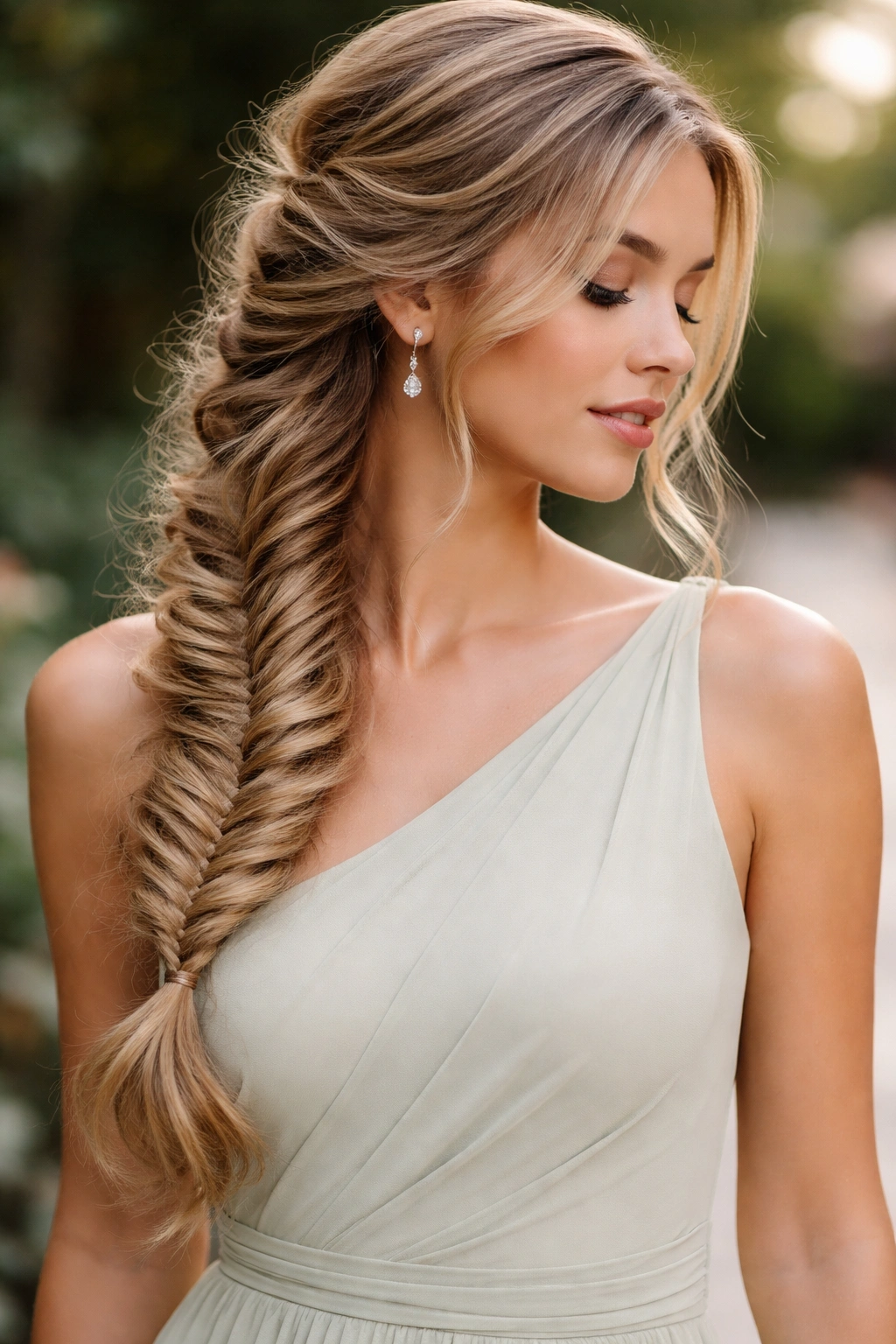
A side-swept fishtail braid is a smart answer when the dress has one shoulder or a neckline with a strong shape. Pulling the braid to one side leaves the line of the dress visible instead of crowding it. It also gives long hair room to move in a more relaxed, asymmetrical way.
Start the braid at the heavier side of the head and guide it diagonally across the back. Pin the top half firmly, then let the length fall over one shoulder. The braid doesn’t need to be tight from top to bottom. In fact, a slightly loosened fishtail looks better here because it avoids a stiff curtain effect.
This style suits bridesmaid long hair that’s dense enough to hold shape but soft enough to sweep. A little serum on the ends keeps the tail from frizzing out by the end of the evening. Only a small amount. Too much and the braid goes slippery.
The shape is elegant without trying too hard. That’s the real appeal. It leaves the dress visible, keeps the hair under control, and still feels a little romantic.
13. Half-Up Braid with a Soft Chignon Knot
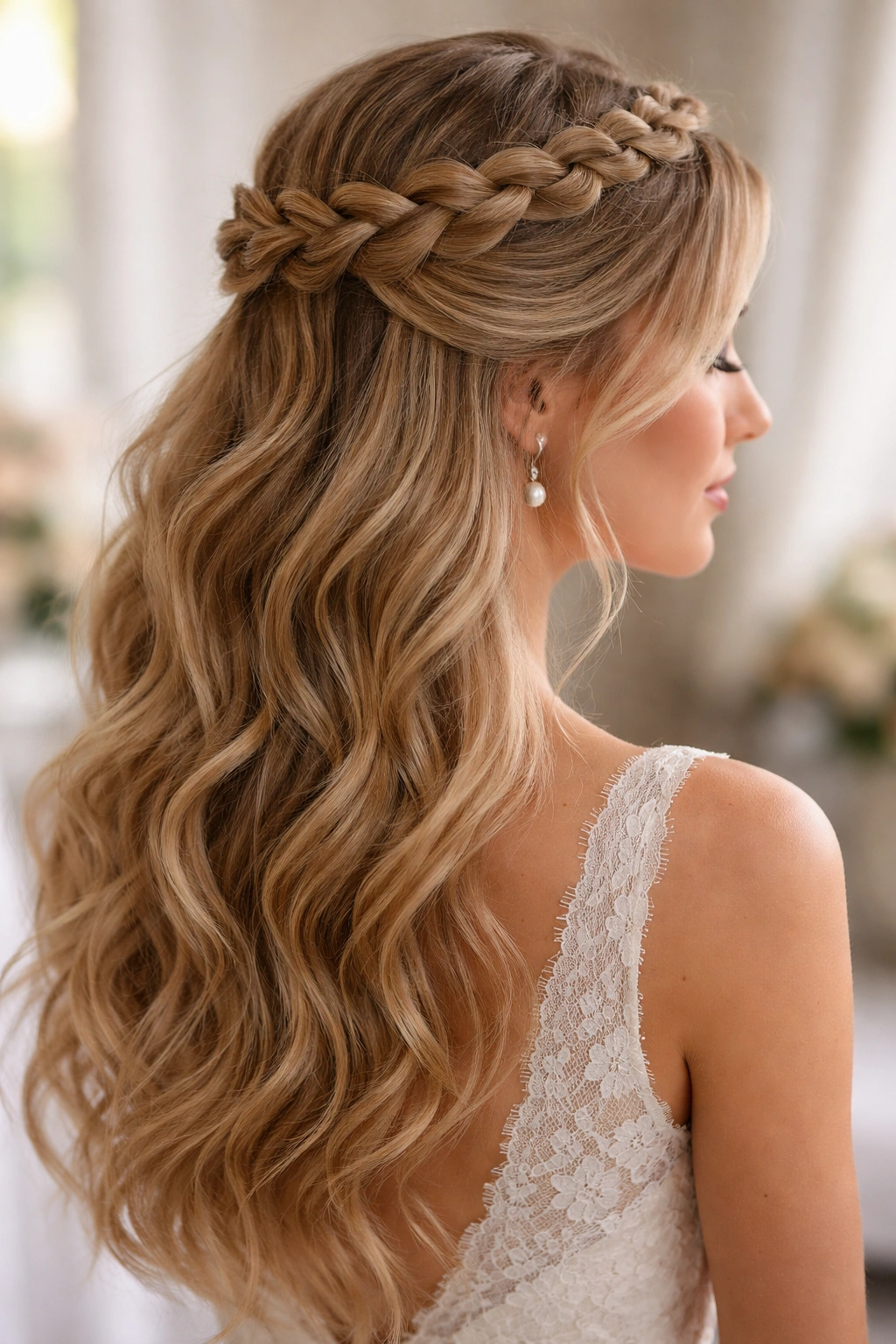
A braided half-up style that folds into a small chignon knot feels more finished than a plain braid and less formal than a full updo. The knot sits just below the crown or at the back of the head, and the loose lengths drop underneath it. It’s neat, but not severe.
This version works well when the bridesmaid dresses have more structure, because the knot echoes that shape. It also helps the top section stay stable through a long day. Use two U-pins through the knot and one hidden bobby pin underneath if the hair is especially heavy. The knot should feel secure before the rest of the styling even starts.
A small braid feeding into the knot gives the style some texture, which keeps it from looking plain. The braid can come from both temples or from one side only. Either way, the chignon should stay compact — about the size of a small apricot — so it doesn’t overpower the back of the head.
Some styles ask for a lot of fuss. This one doesn’t. It just needs clean sectioning and a careful pin job.
14. Braided Half-Up Styles for Thick Hair
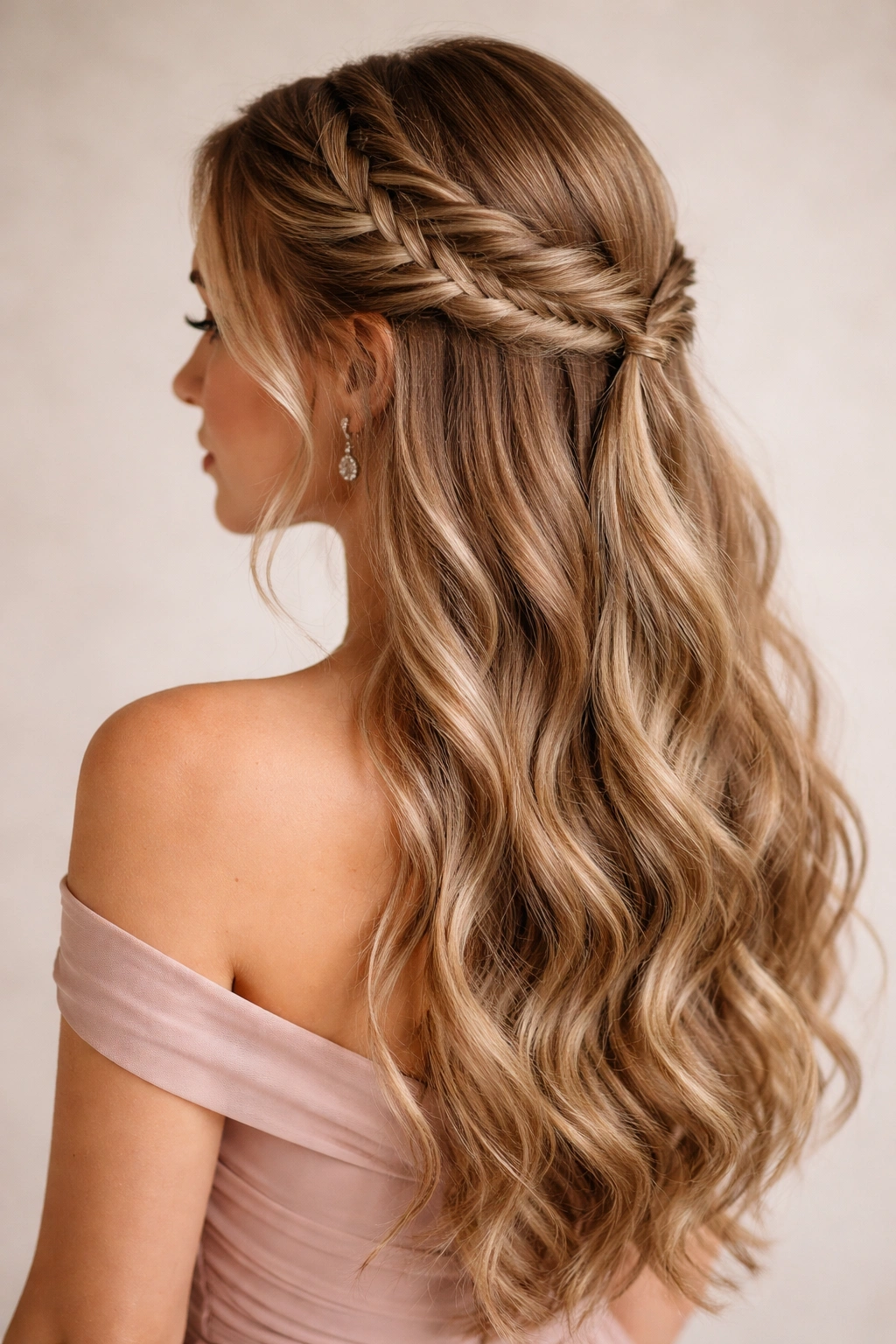
Thick hair can swallow delicate braid details. That’s the honest truth. Tiny braids disappear into heavy lengths, and half-up styles can sag if the crown isn’t anchored well. So for bridesmaid long hair with real density, the braid needs to be bigger, broader, and pinned with more muscle.
What helps
- Use 2-inch sections instead of tiny ones.
- Prep the roots with mousse or volumizing spray.
- Secure the back with 4 to 6 pins, crossed for grip.
- Keep the braid slightly loose so it doesn’t tighten under its own weight.
A thick-hair braid looks best when it has room to breathe. The sections should be visible. If the braid is too small, it can get buried in the rest of the hair by the time the ceremony starts. That’s frustrating, and it’s avoidable.
Go for braids that have shape: a Dutch braid, a pull-through braid, or a wide crown braid. Those styles create enough visual weight to stand up to thick lengths. And do not skip the cooling step if you’re curling the ends. Thick hair holds shape best when the curls cool all the way before they’re touched.
15. Braided Half-Up Styles for Fine Hair
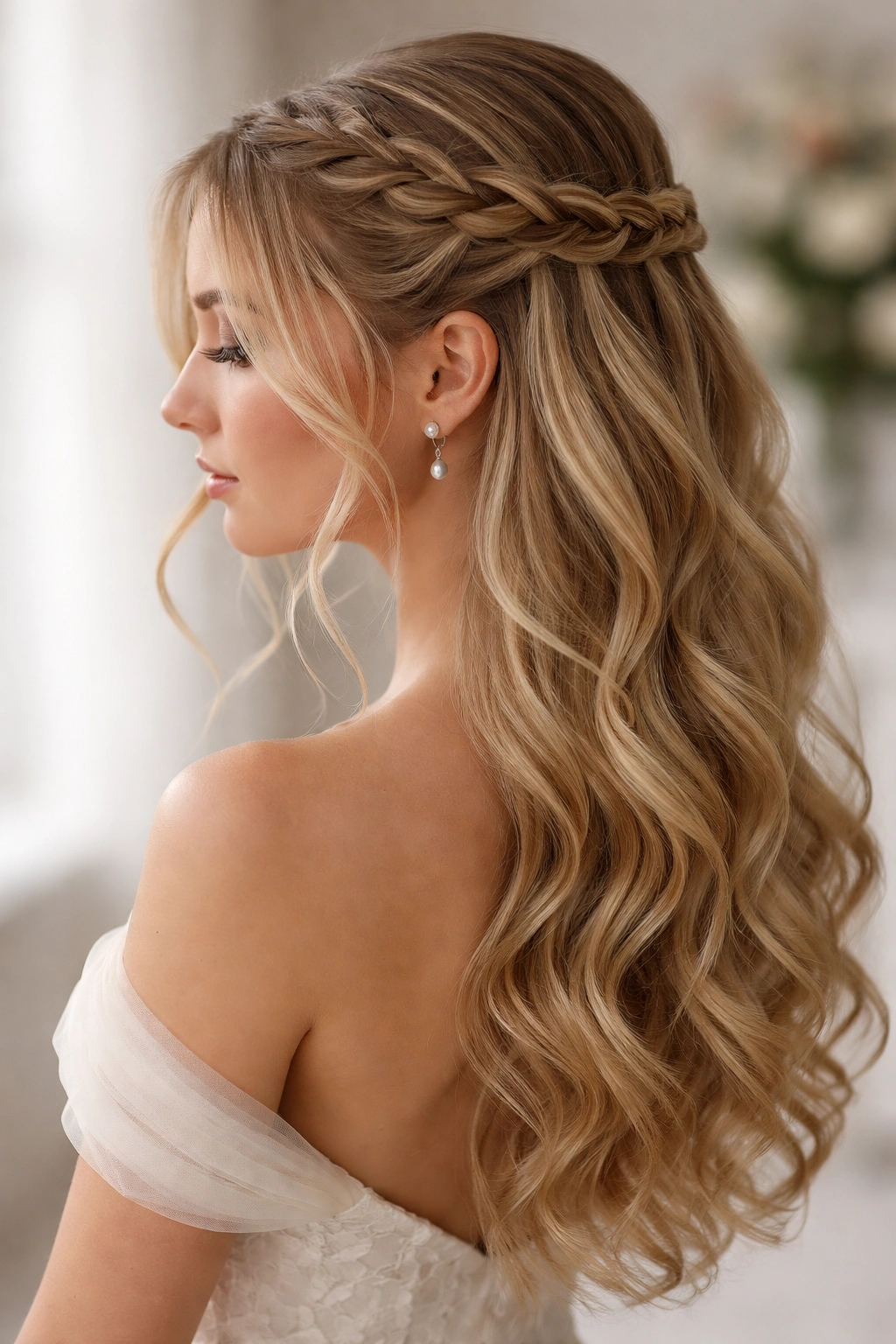
How do you make fine hair look fuller without making it look teased to death? You build the braid, then pull it apart a little. A braided half-up style is one of the easiest ways to add visible volume to long hair that lacks density, because the braid itself creates a thicker-looking crown.
Texturizing spray is the best friend here. Mist the roots, then rough-dry the hair until it has a bit of grip. If the hair is too clean and slippery, the braid will slide flat before the photos are even done. Clip-in extensions can help too, especially through the back lengths, but they should be color-matched carefully.
A few practical moves
- Braid loosely and pancake each side.
- Curl the bottom 4 to 6 inches only.
- Avoid heavy oils near the crown.
- Use small elastics that blend into the hair color.
The goal is softness with a little lift. Not volume for volume’s sake. Fine hair can look airy and elegant, but it needs enough grip to survive the day.
16. Braided Half-Up Styles for Curly Hair
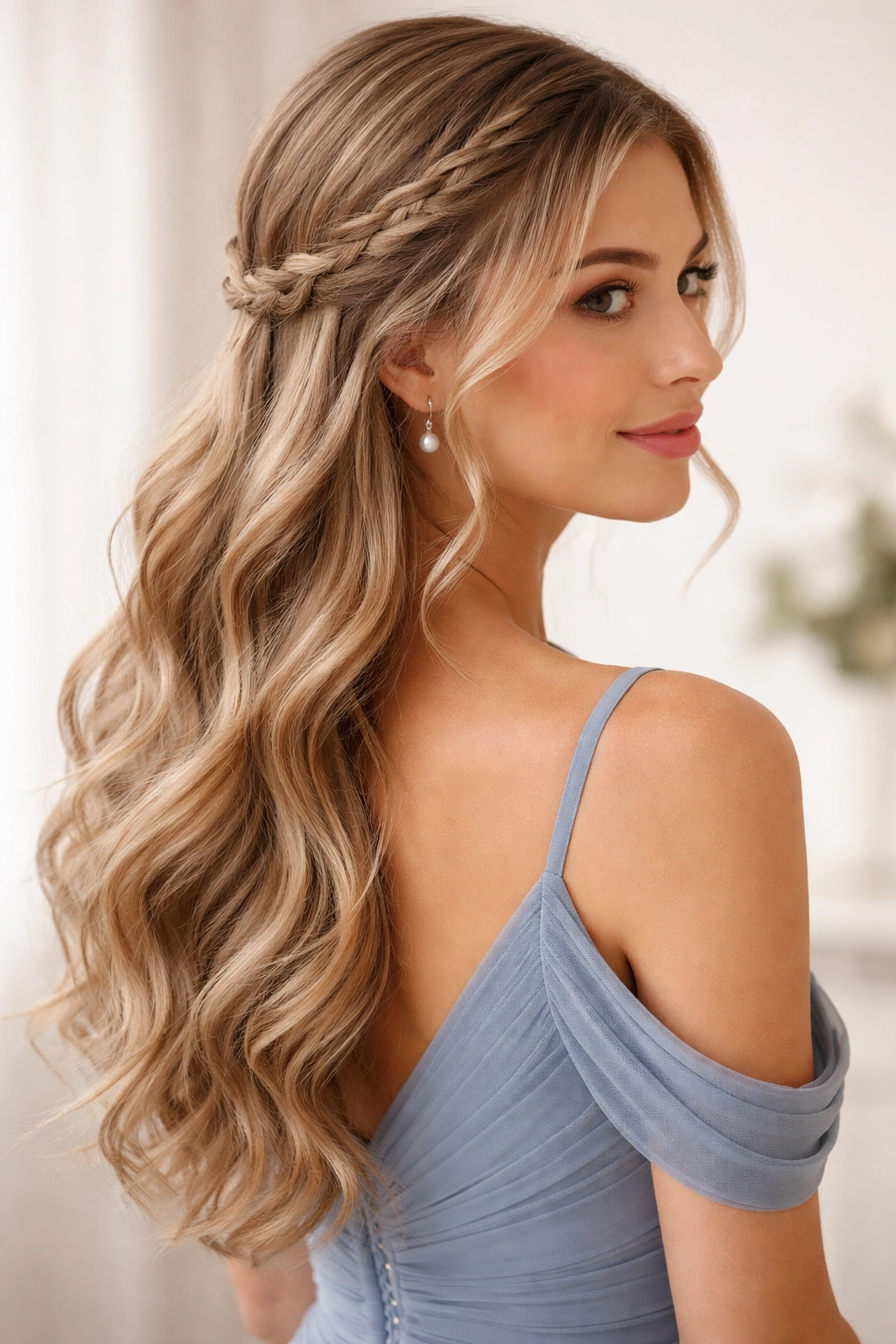
Curly hair should not be flattened just to make a braid happen. That’s a waste of texture. The better approach is to work with the curl pattern, use the braid as an anchor, and let the curls keep their shape below. On bridesmaid long hair, that creates a style that feels alive instead of forced.
A braid placed across the crown or just above the ears can hold the front sections in place while the rest of the curls stay free. Use a cream or light custard for definition, not a heavy oil that makes the hair collapse. If the curls are very springy, build the braid slightly higher than you would on straight hair so the shrinkage doesn’t make it sit too close to the scalp.
Compared with smooth hair, curly hair needs fewer decorative extras. The texture already gives the style interest. A few pins, a clean braid, and a little shine mist on the surface are enough.
The only real mistake is trying to make curly hair behave like something else. Let it be curly. That’s the whole point.
17. Braided Half-Up Styles for Straight Hair
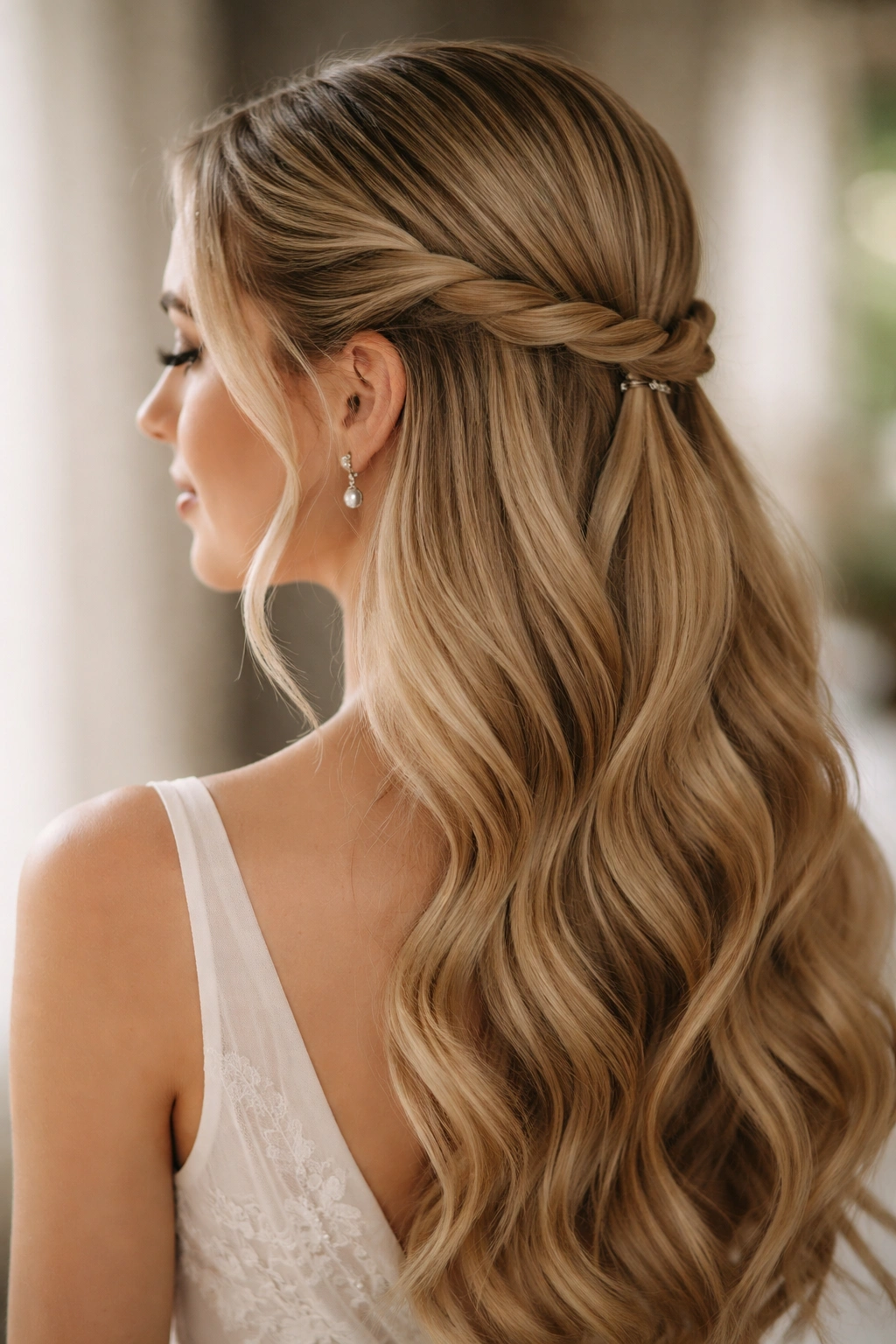
Straight hair is sleek, which sounds helpful until you start braiding it. Then it slips. Pins slide. Sections loosen. The fix is texture, and not a tiny amount of it. Dry shampoo or a matte texturizing spray gives the hair enough grip to hold the braid without turning it sticky.
This is where a slightly tighter braid actually helps. It does not need to be severe, but it should have enough tension to stay visible against smooth hair. A soft French braid or a rope twist works well because the pattern stays readable even when the rest of the hair is straight.
If the hair is pin-straight and fine, try teasing the crown with a small comb before braiding. Just ½ inch of lift can change the whole look. Then smooth the top layer over it so the finish still feels polished.
Straight hair can look sharp and elegant in a braided half-up style. It just needs a little help pretending it isn’t slippery. That’s the whole game.
18. Garden-Party Braids with Tiny Blooms
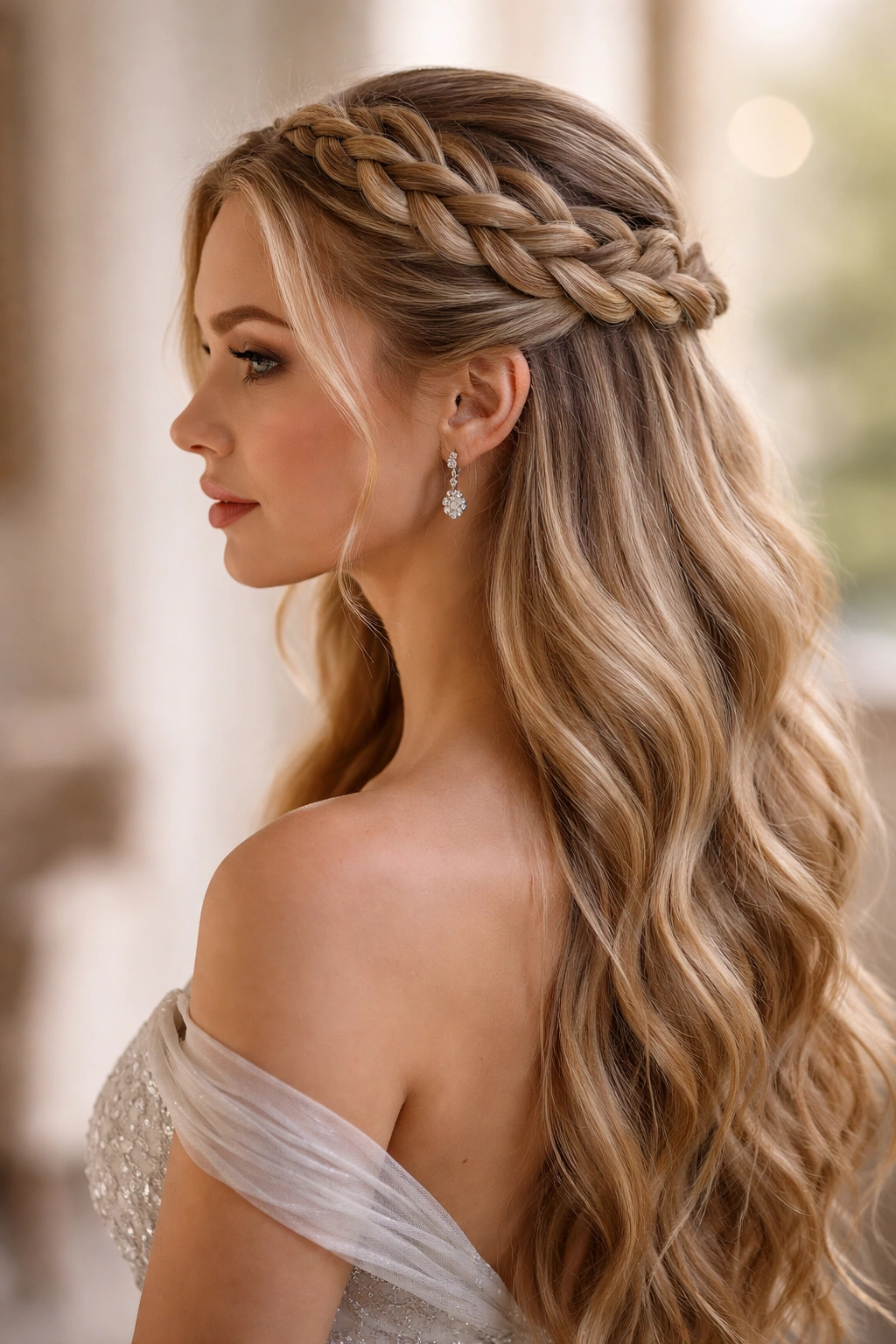
Fresh flowers can be lovely in braids, but they need restraint. Tiny blooms tucked into a braided half-up style give bridesmaid long hair a garden-party feel without turning the head into a bouquet. Waxflower, baby’s breath, spray roses, and small orchids all work when the stems are trimmed short.
Place the flowers where the braid turns or crosses itself. That’s where the eye naturally lands, and it’s the safest place for a pin or wire. Keep the number low. Usually 3 to 5 tiny blooms is plenty. More than that, and the flowers start competing with the braid instead of supporting it.
This style works best with loose waves underneath. The softness of the hair and the delicacy of the flowers should feel like they belong together. If the braid is too tight or too polished, the blooms can feel pasted on.
A small warning: fresh flowers wilt fast in hot rooms or under strong lighting. Keep them chilled until styling time, and wire the stems so they sit flush. That little bit of prep saves the whole look.
19. Sleek Minimal Braids with a Center Part
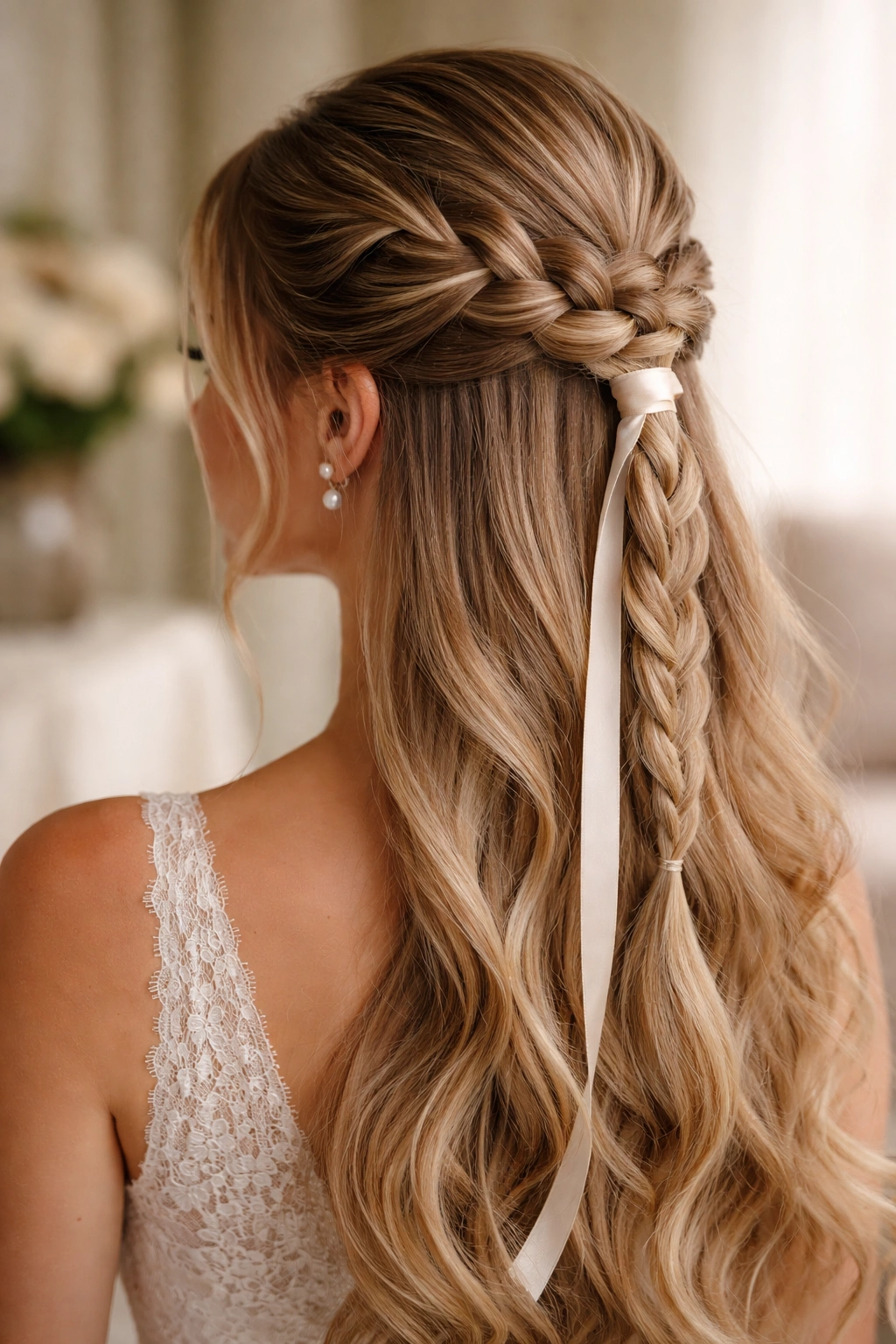
Not every bridesmaid style needs softness flying in every direction. A sleek braided half-up look with a clean center part can be sharper, calmer, and far more modern. It suits gowns with strong shapes, smooth fabrics, and simple necklines.
The braid should stay narrow and controlled. Pull back a small section from each side of the center part, braid or twist it, then secure it tightly at the back with pins hidden beneath the surface. The rest of the hair should fall straight or in very soft bends, with a polished finish from roots to ends.
This style is useful when the bridal party wants consistency. Clean lines tend to flatter different face shapes in a more even way, and they keep the focus on the dress rather than the hair. A light serum on the surface is enough to tame frizz. Avoid heavy products that flatten the shape.
The style is quiet, but not plain. There’s a difference. It says the hair was thought through, and that’s usually what you want.
20. Romantic Braids with Loose Tendrils
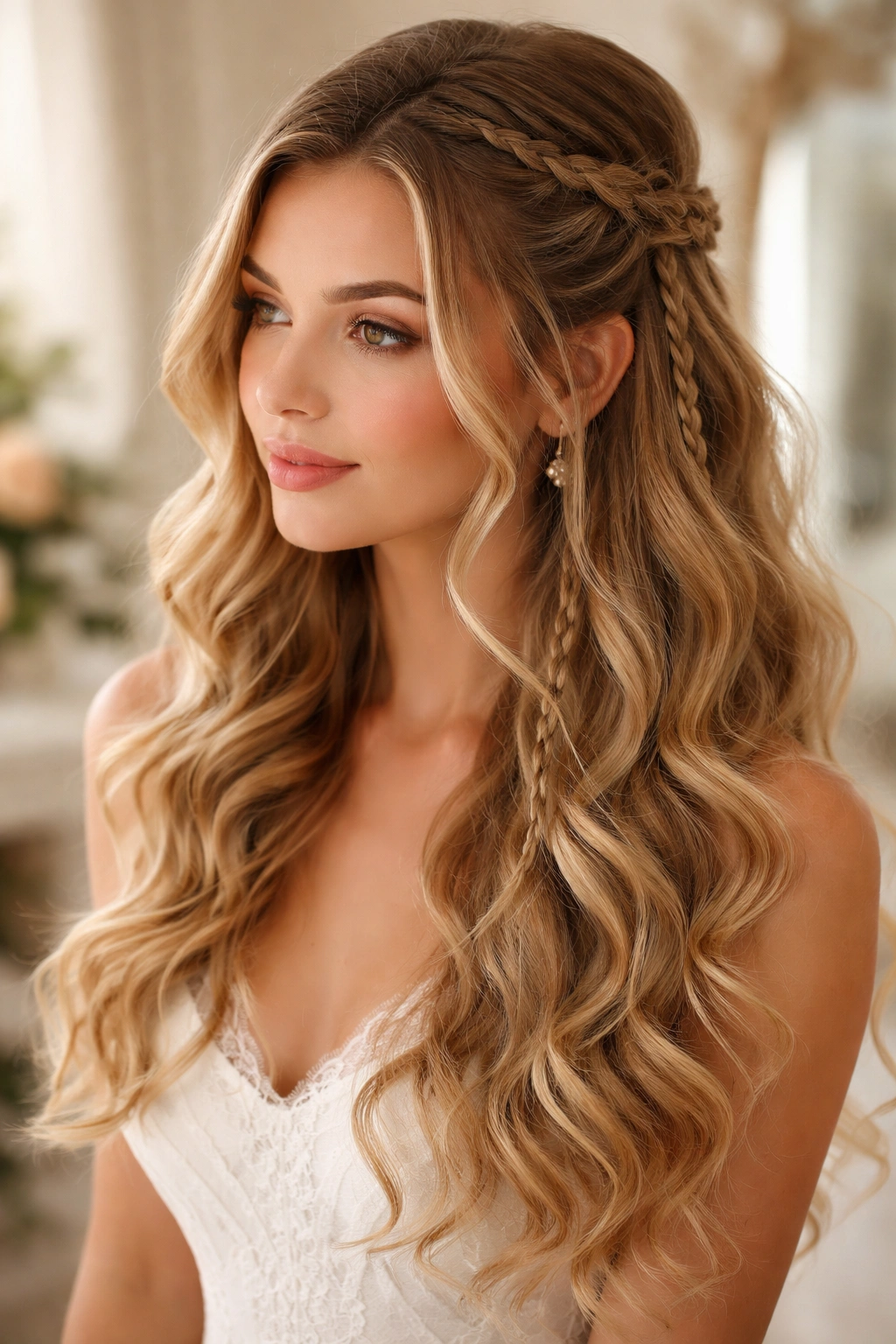
Loose tendrils can save a braided half-up style from looking too fixed. The trick is to keep them intentional. Two face-framing pieces, cut or curled to the same length, are enough. More than that can start looking messy, especially on long bridesmaid hair that already has a lot going on.
Do you want the style to feel softer? Pull out the tendrils before the hairspray goes on. That way they keep a gentle curve instead of fighting the set. Curl them away from the face with a 1-inch iron and let them cool in your hand for a few seconds before releasing them.
This approach works with almost any braid — crown, side, fishtail, or twist. The braid handles the structure. The tendrils handle the mood. Together, they keep the style from feeling too formal or too sweet.
A small caution: do not overdo the loose pieces. If every layer near the face is escaping, the whole style loses shape. One or two well-placed tendrils do more than a dozen random ones.
21. Side Braids with Cascading Lengths
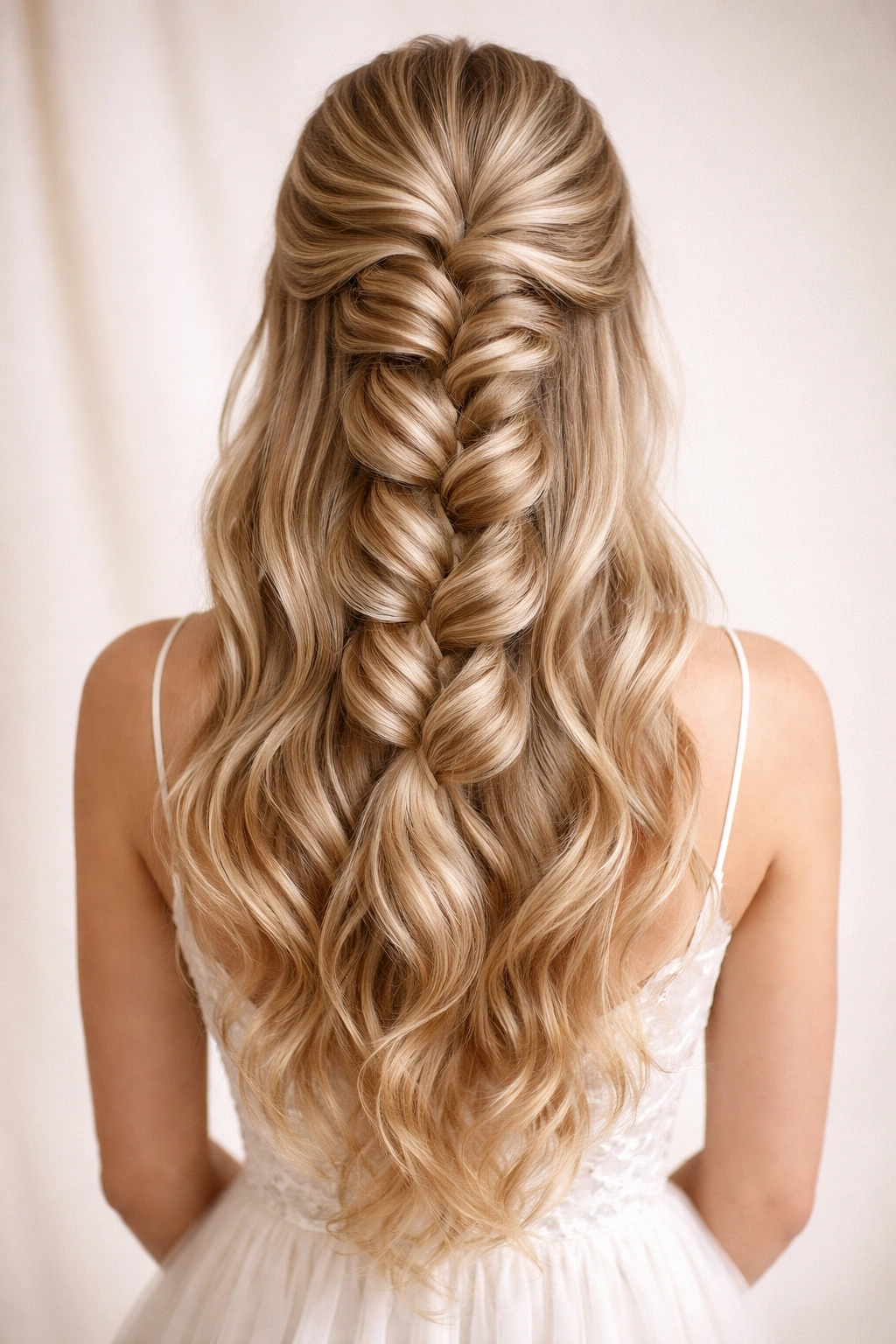
A side braid with long lengths flowing beneath it gives a strong visual line. It moves the eye diagonally across the head, which is flattering on long hair and useful when the dress needs a little frame without losing softness. For bridesmaid long hair, that diagonal shape can be a smart way to break up all the vertical length.
The braid starts at one side of the head and sweeps across the back before stopping near the opposite shoulder or mid-back. The loose hair below should stay brushed out and light. If the braid is too tight, the whole look can feel pulled. If it’s too loose, it loses direction. The middle ground is where it works.
This style pairs well with dresses that have details at the shoulder or neckline, because it doesn’t crowd them. It also holds up nicely when the wedding day involves a lot of movement. The braid stays put, and the loose hair gives enough motion that the style still feels alive.
It’s one of those looks that seems simple until you watch how nicely it behaves in real life. Then it makes sense.
22. Statement Braids with Woven Accent Pieces
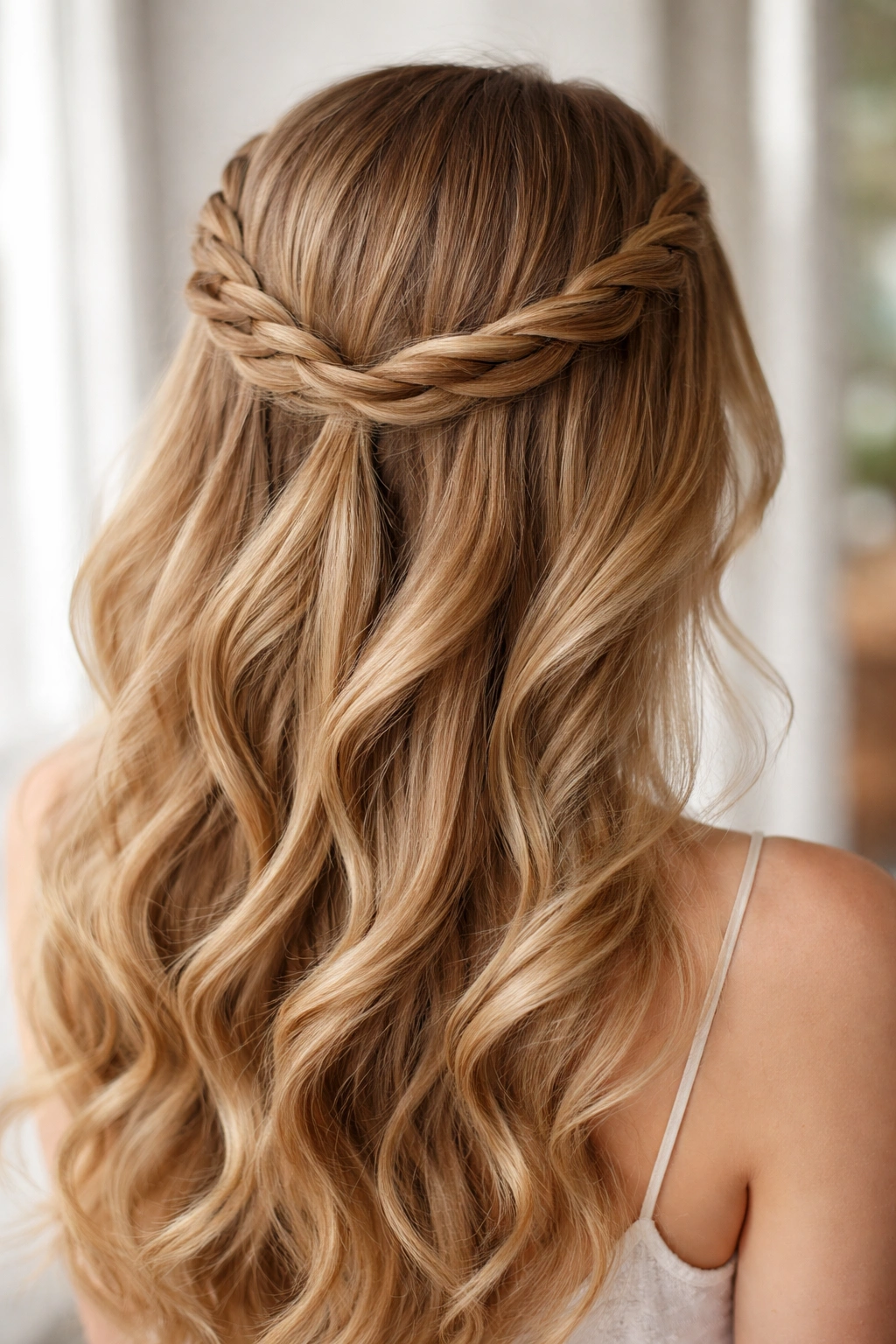
If a bridesmaid wants something with more presence, woven accent pieces can turn a basic half-up braid into something sharper. A narrow ribbon, a metallic thread, or even a slim strand of embellished cord can be tucked into the braid to add line and contrast. Keep the accent narrow — about ¼ inch — so it supports the braid instead of taking over.
Compared with plain braids, woven accents work best when the rest of the hairstyle is kept clean. Too much curl, too many pins, and too much texture all at once can make the style feel busy. Let the braid be the hero. Let the accent be the detail that people notice on a second look.
This is a good choice for evening weddings, formal gowns, or any bridal party look that needs a slightly more dressed-up finish. It also photographs cleanly from the back because the woven line gives the braid shape even when the lighting is soft.
If I had to give one rule here, it would be this: match the accent to the dress fabric. Satin with satin, metallic with metallic, nothing random. That’s what keeps the style looking considered.
Final Thoughts
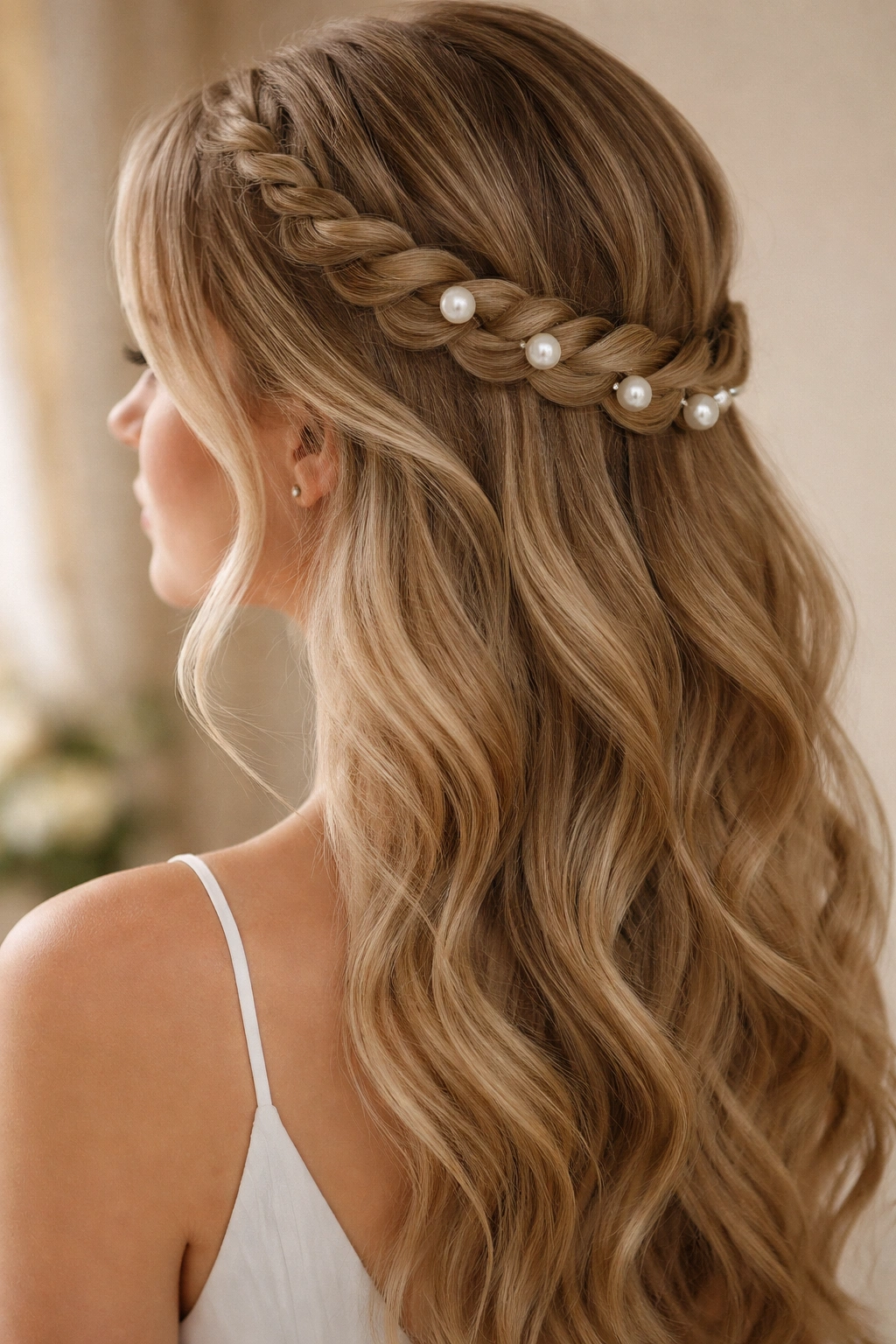
The strongest braided half up half down styles for bridesmaid long hair all do the same basic job: they hold the crown, keep the face open, and let the length stay beautiful instead of buried. The differences are in the mood. Some are softer. Some feel cleaner. Some lean romantic, and some have a little more edge.
Hair density matters more than people expect. Fine hair usually needs texture and a looser-looking braid. Thick hair needs bigger sections and firmer pinning. Curly and straight hair each ask for their own prep, too. That’s why the same braid can look graceful on one person and flat on another if the styling isn’t adjusted.
The best version is the one that still looks good after the hugs, the walking, the photos, and the dancing. That’s the real test.
