

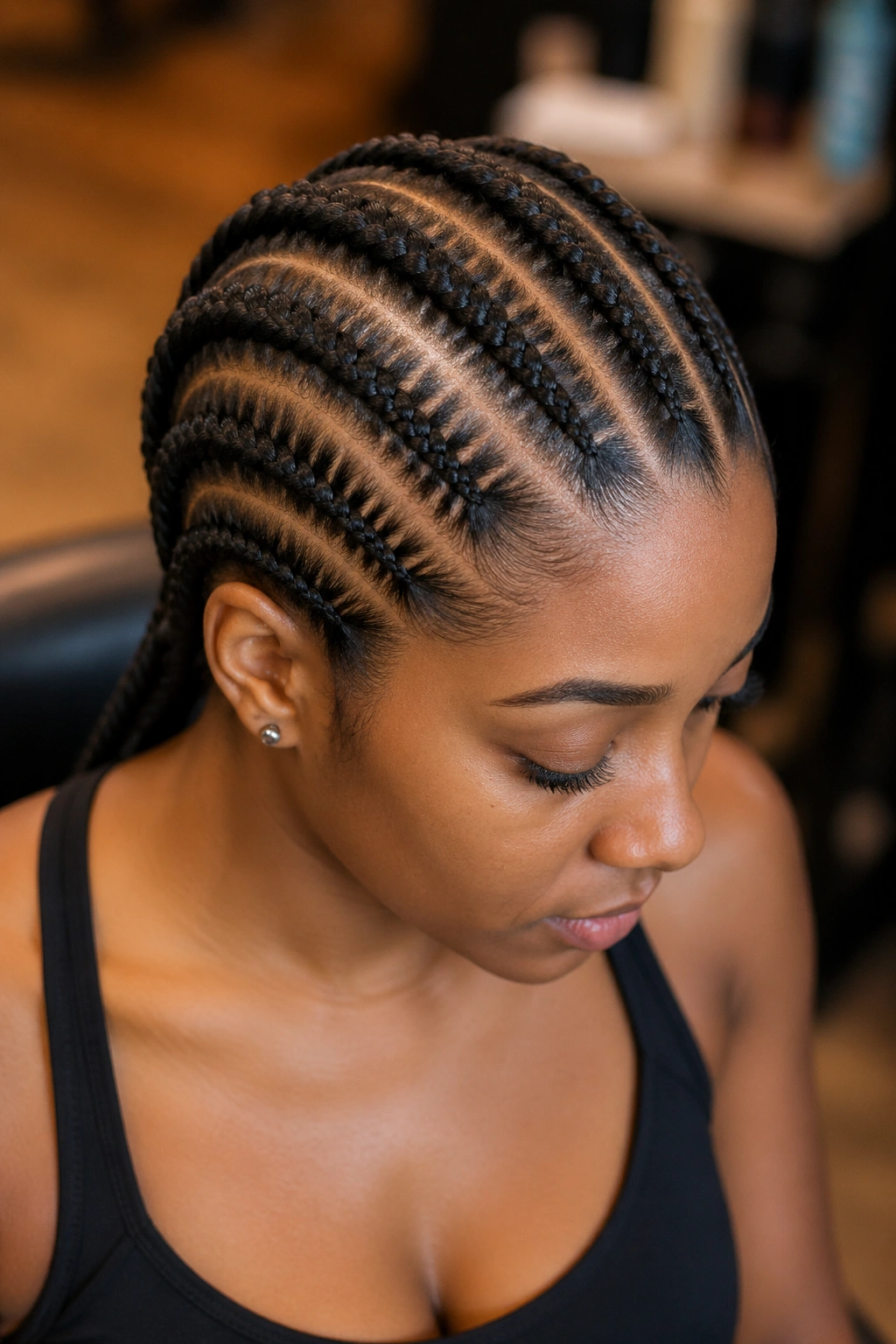
French cornrows confuse a lot of people. The name suggests something European, but the technique is closer to a hybrid — French braiding (where you add hair as you go) applied to the cornrow tradition (where the braid sits flat against the scalp). The result is a braid that runs close to the head like a regular cornrow but uses the over-hand French technique instead of the under-hand cornrow technique.
That technical distinction creates a different visual texture. French cornrows sit slightly raised. They have a softer, more dimensional appearance than traditional underhand cornrows, which lie completely flat. French cornrows are also slightly faster to install and easier to wear loose at the ends.
These 22 styles all use the French cornrow technique as the foundation. Some lean traditional. Others stretch the technique into modern shapes. All of them showcase what makes French cornrows different from the standard underhand version.
French Cornrow vs. Traditional Cornrow: The Real Difference
The mechanics: traditional cornrows use under-hand braiding, where each strand passes under the others. French cornrows use over-hand braiding, where each strand passes over the others.
The visual difference is subtle but real. Traditional cornrows look flat and inset. French cornrows look slightly raised and have more dimension. Some people call traditional “inverted” and French “upright.”
Functionally, French cornrows tend to look softer and more casual. Traditional cornrows look sharper and more polished. Neither is better — they’re different tools for different aesthetic goals.
Why Pick French Over Traditional
French cornrows take less practice to learn. The over-hand motion is closer to standard three-strand braiding most people already know how to do.
They’re more forgiving of uneven sections. Because they sit slightly above the scalp instead of flat against it, small mistakes get hidden in the dimensional texture.
The ends release easier into loose hair, which makes French cornrows the better choice for goddess styles, half-up looks, or any style where the braid transitions into loose hair at the ends.
Hair Type and French Cornrows
French cornrows work on every hair type, but they sit and behave differently on each.
- 3a-3b hair: French cornrows look loose and tousled, with curl pattern visible through the braid
- 3c hair: balance of definition and curl visibility, holds the braid shape for 2-3 weeks
- 4a-4b hair: clean French cornrow shape with visible coil texture in the braid sections
- 4c hair: tightest, most defined French cornrow finish, holds longest (3-4+ weeks)
If you’re choosing between French and traditional based purely on hair type, 4c hair gets the most longevity from either; looser textures benefit more from the dimensional softness of French.
Pre-Install Prep
Wash and deep condition 1-2 days before. Detangle thoroughly. Stretch the hair overnight to prevent shrinkage from interfering with even parting.
The morning of: apply a light leave-in. Skip heavy creams or oils — French cornrows need just enough grip to hold the over-hand technique without slipping out of the braider’s fingers.
If your hair is freshly washed and slick with oils, the braider will struggle to hold the strands firmly enough. The over-hand motion needs friction to work.
Tools and Setup
Same toolkit as traditional cornrows: rat-tail comb, sectioning clips, soft brush, edge gel, water spray bottle. The only addition is sometimes a small amount of mousse or holding spray, which gives the loose hair the texture French cornrows need.
A mirror behind you helps if you’re doing your own French cornrows. The over-hand motion is harder to see in a single front-facing mirror.
1. Classic Straight-Back French Cornrows
Six to eight French cornrows running straight back from the hairline to the nape. The dimensional French texture creates softer braid lines than traditional cornrows.
Why It Works as Your Starter Style
- Foundation for learning the French cornrow technique on yourself
- Looks polished without being formal
- Easy to maintain and easy to take down
- Suits every face shape
Tip: Run your finger along the finished braid to check for tension. French cornrows should feel even from root to tip — bumpy spots mean some sections were braided tighter than others.
2. French Cornrow Headband
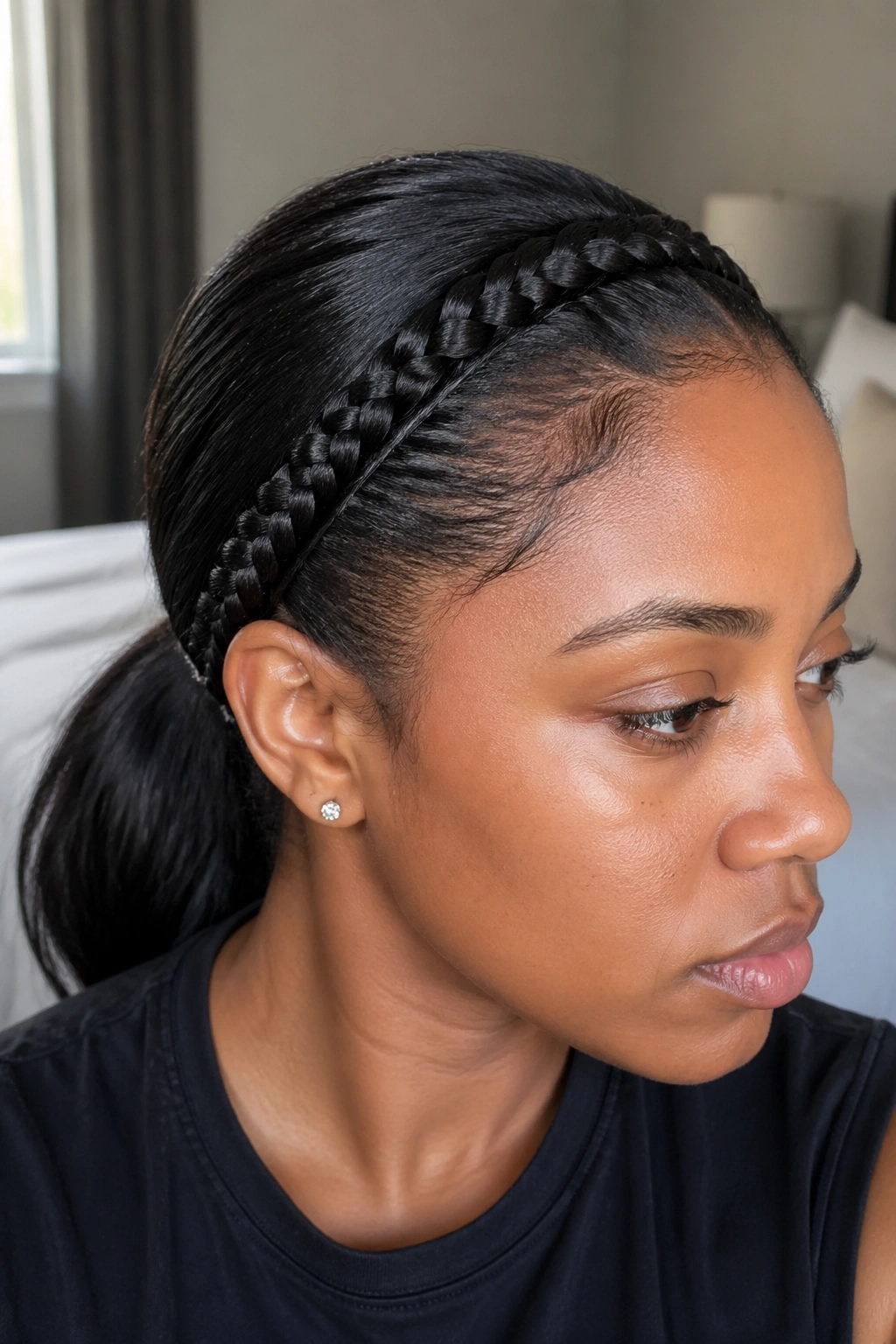
A single thick French cornrow runs across the front hairline like a headband, ear-to-ear, with the rest of the hair styled loose or pulled back into a low pony.
A clever way to keep face-framing hair out of the way without committing to a full braided style. The headband cornrow takes 10 minutes to install on yourself.
Anchor each end with a small clear elastic tucked behind the ear. Without anchoring, the braid slides up during the day.
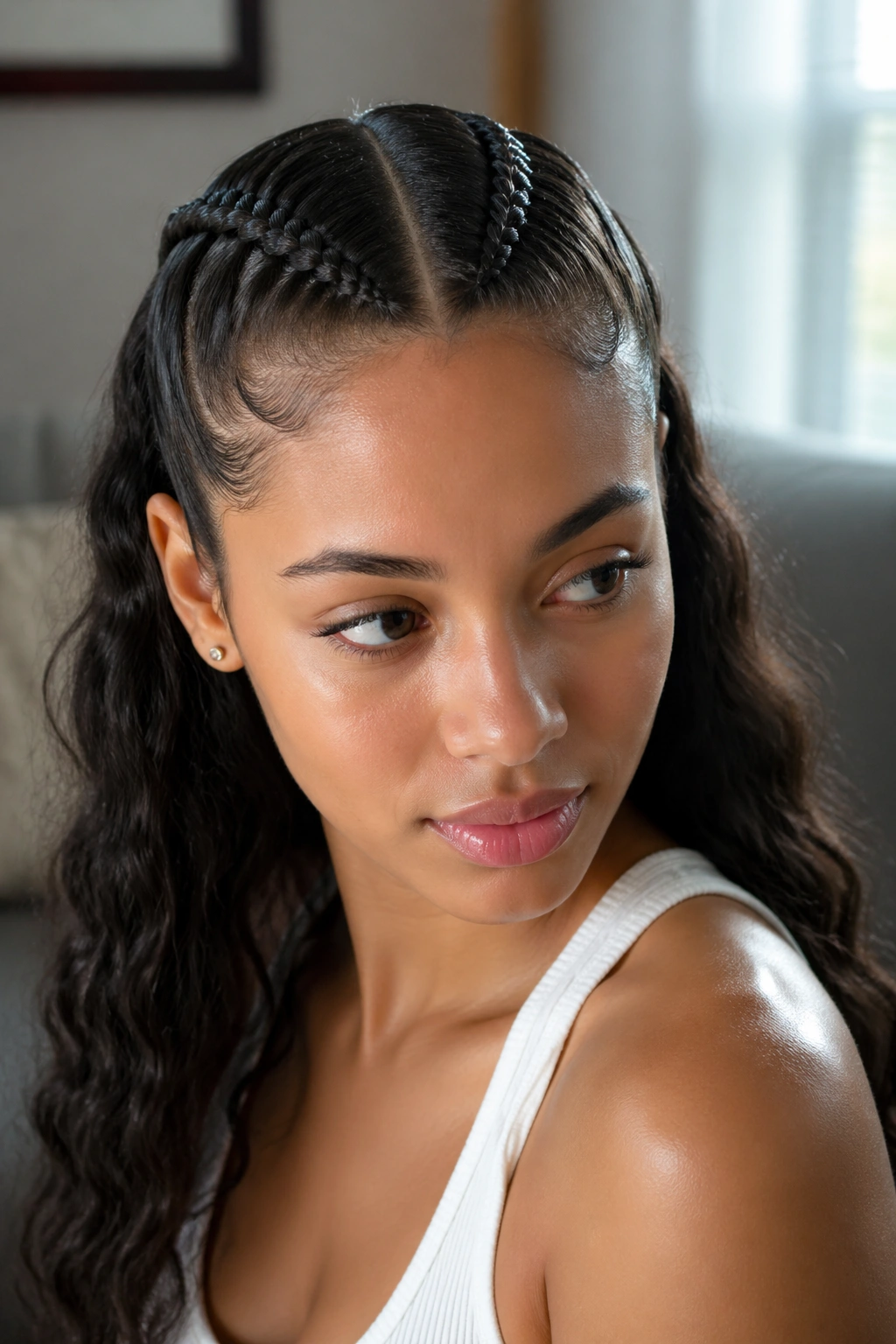
3. Two French Cornrows With Loose Back
Two French cornrows on either side of a center part, with the rest of the hair flowing loose or curled. The cornrows pull the front away from the face; the loose back keeps the look feminine and unstructured.
A weekend-cute style. Reads casual but intentional.
If your loose hair is straight, add some texture (waves or loose curls) so it harmonizes with the dimensional braid. Pin-straight hair next to French cornrows reads disconnected.
4. French Cornrow Crown Braid
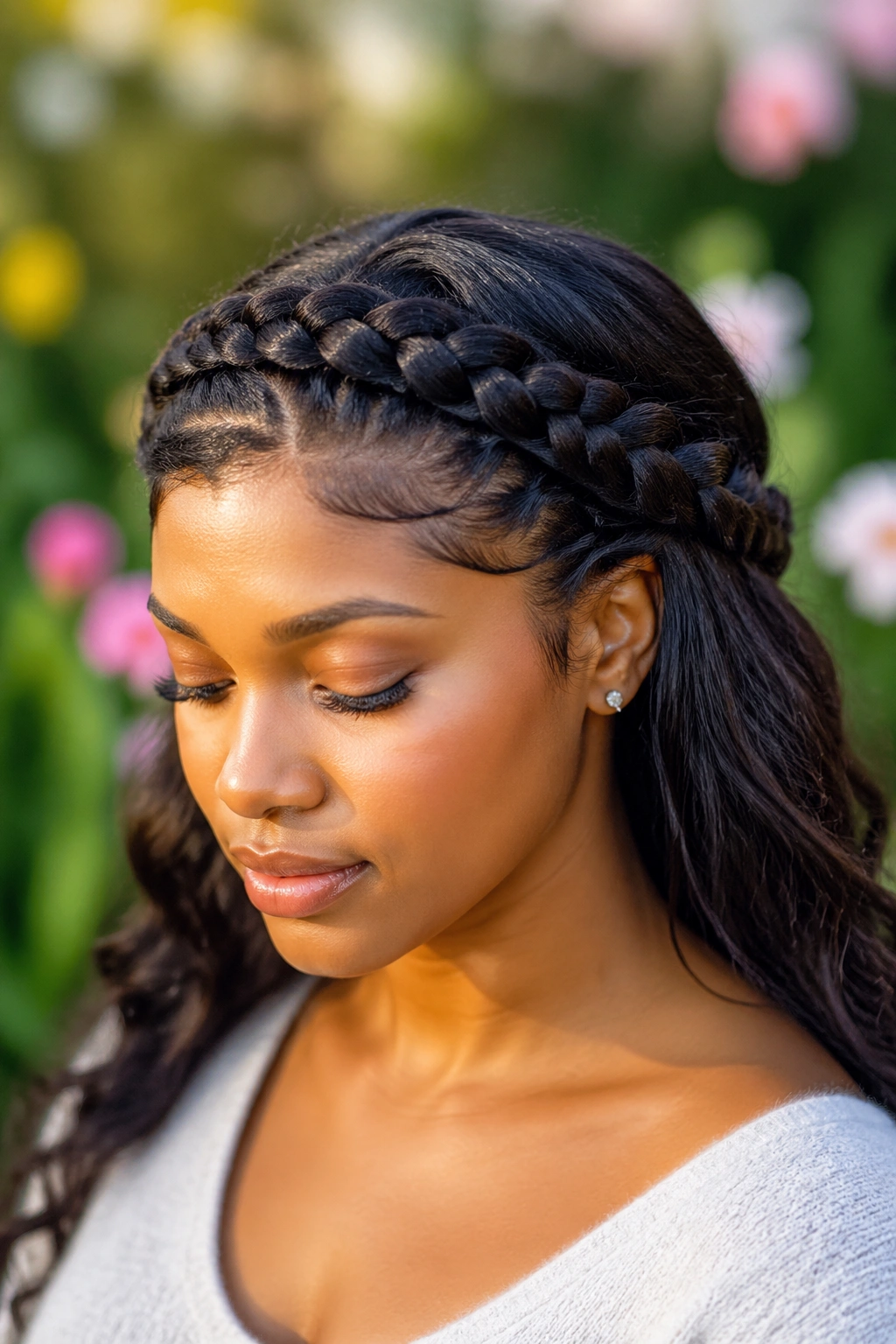
A French cornrow that wraps around the crown of the head like a halo. Hair below the crown band can be loose, pinned, or styled into a low bun.
The crown braid technique requires picking up sections from the loose hair below as you braid around the head. The braid needs to feed in from both above and below.
Pin the braid securely as you work — gravity will pull the crown braid down without anchoring.
5. Side-Swept French Cornrows
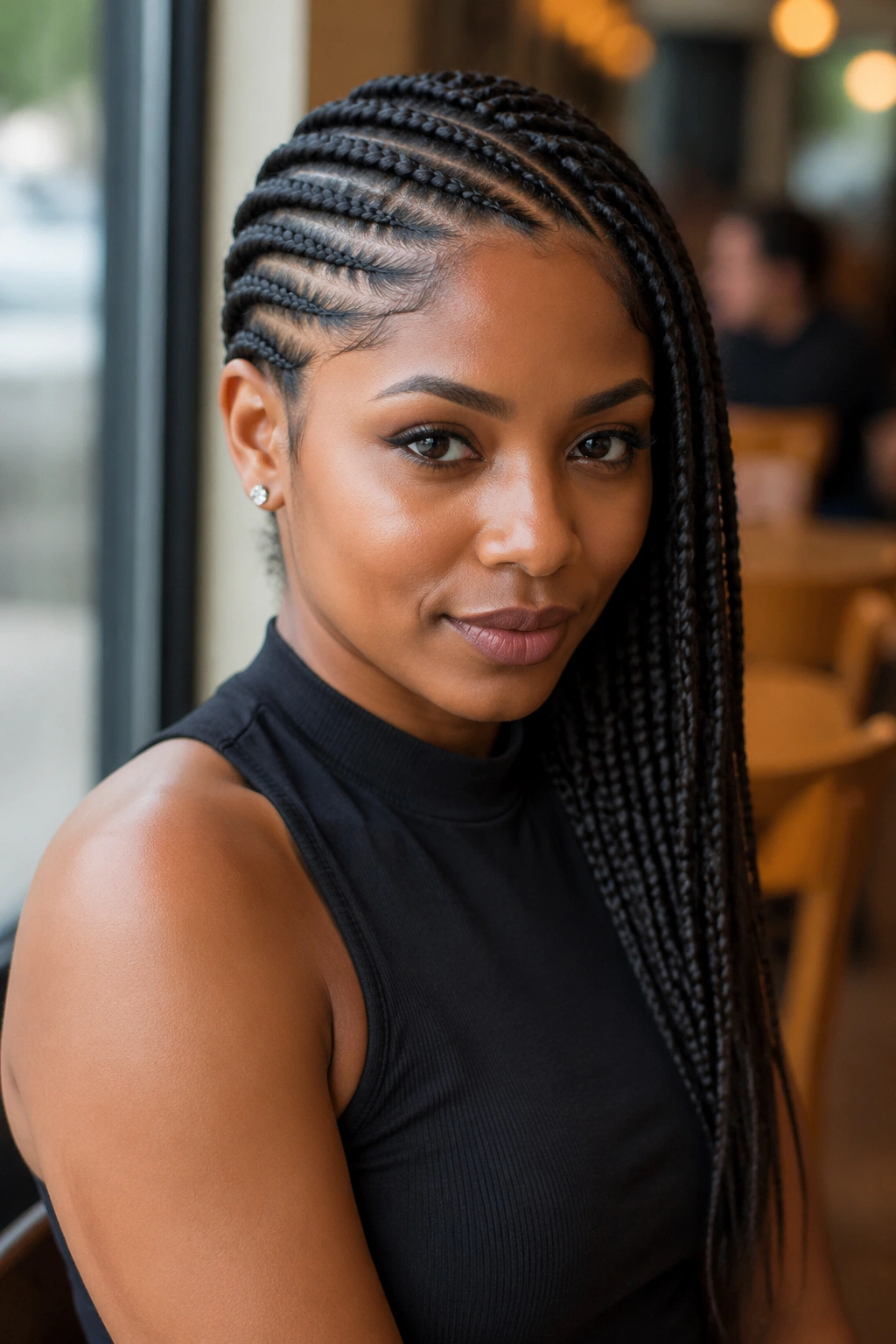
All French cornrows angle to one side, draping over a single shoulder. The asymmetry creates movement and visual interest.
The angled French cornrows hold their shape better than angled traditional cornrows because the dimensional texture grips the hair more securely.
Choose the side based on your face: braids should fall on the side of your face you want to draw attention to.
6. Half-Up French Cornrows
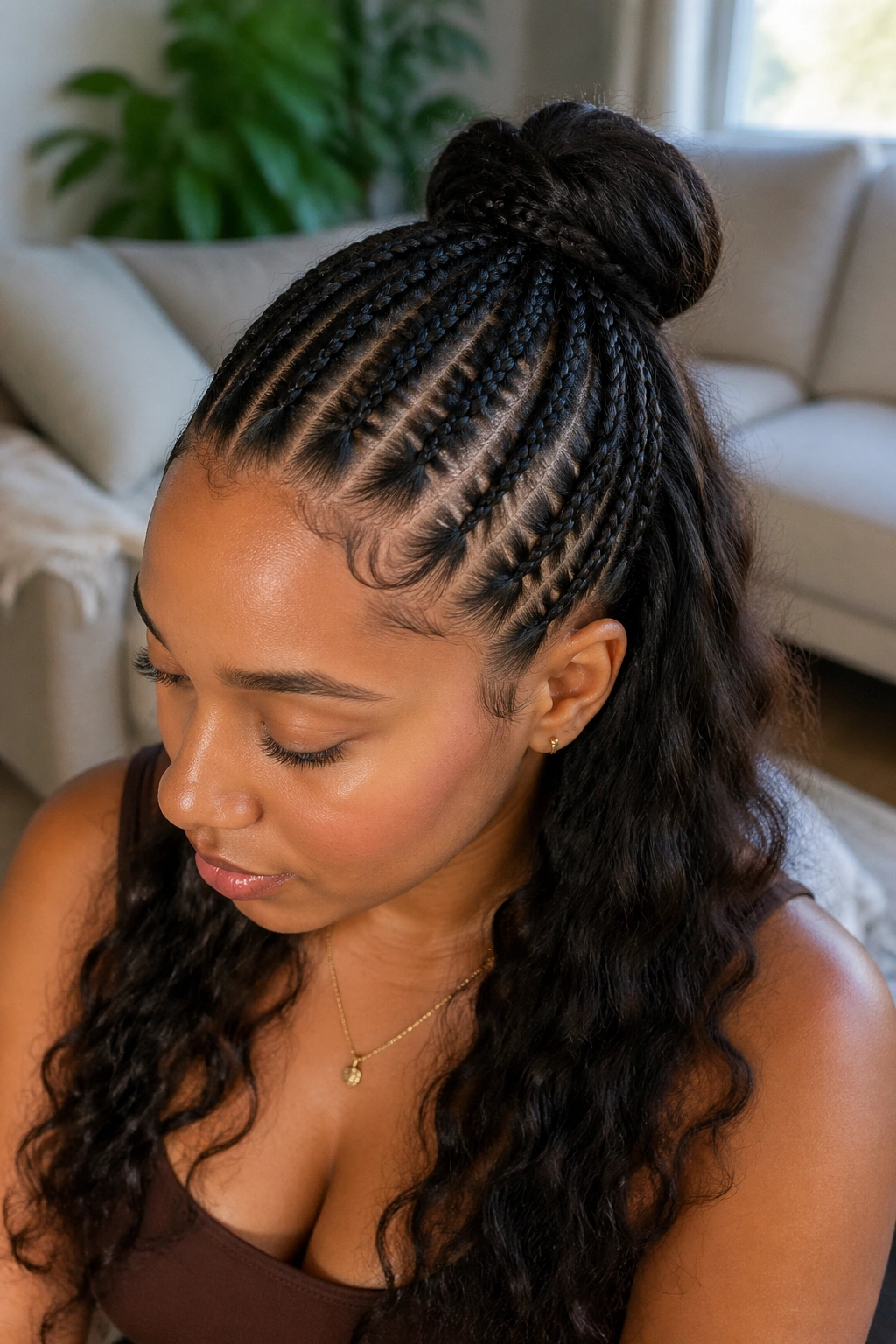
The top half of the head is French cornrowed and gathered into a half-bun or half-pony at the crown. The bottom half flows loose.
A popular hybrid for casual events. Combines the polish of braided styling with the softness of loose hair.
Works on every length and hair type. Especially flattering on hair with curl or wave pattern that shows in the loose section.
7. French Cornrow Mohawk
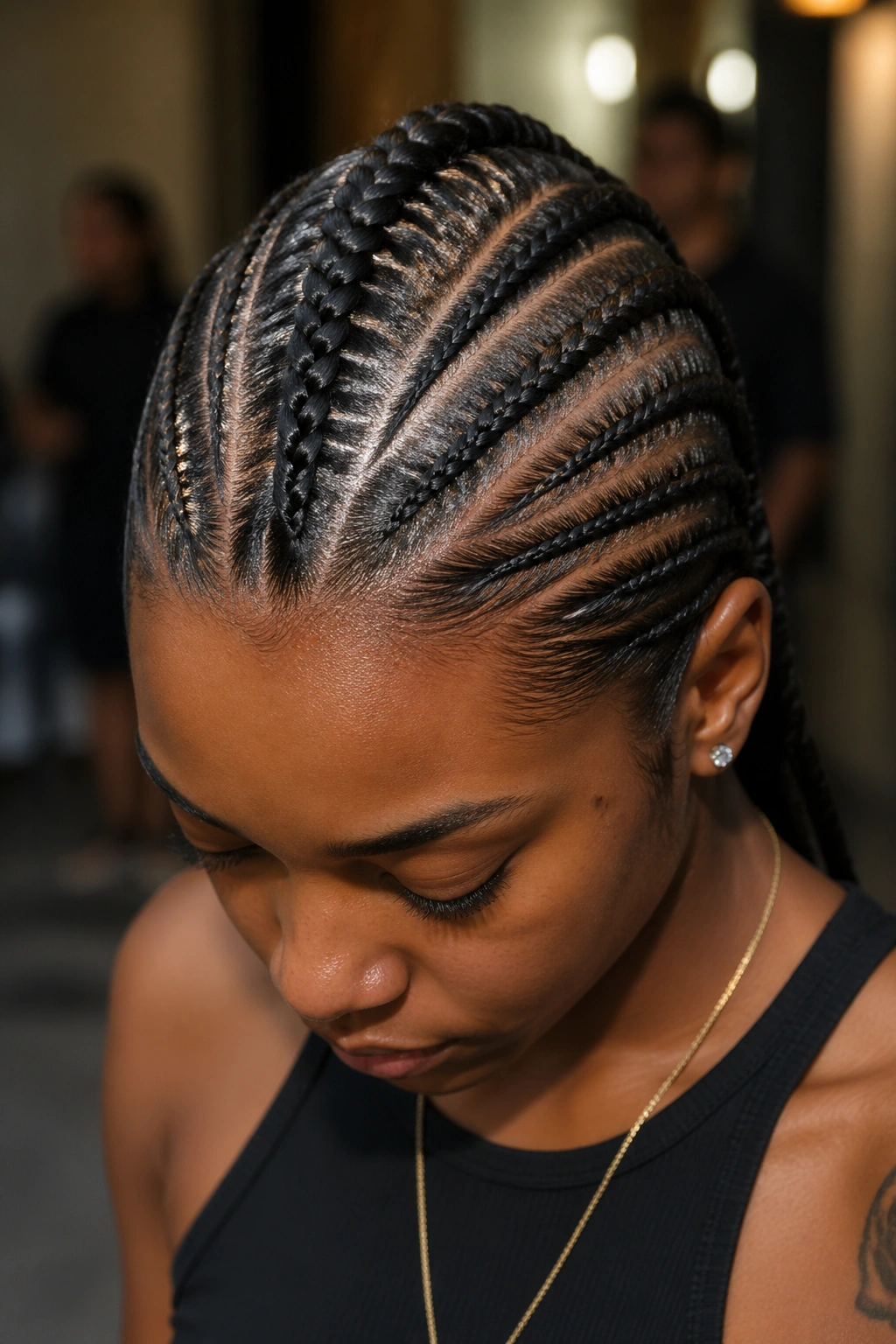
A center strip of French cornrows runs from front to back, with sides slicked flat against the scalp. The mohawk silhouette without the actual shave.
The dimensional French texture in the center strip stands out more dramatically against the slicked sides than traditional cornrows would.
Edge gel and a soft brush keep the slicked sides smooth. Reapply daily for the first week.
8. French Cornrow Braid Crown With Curls
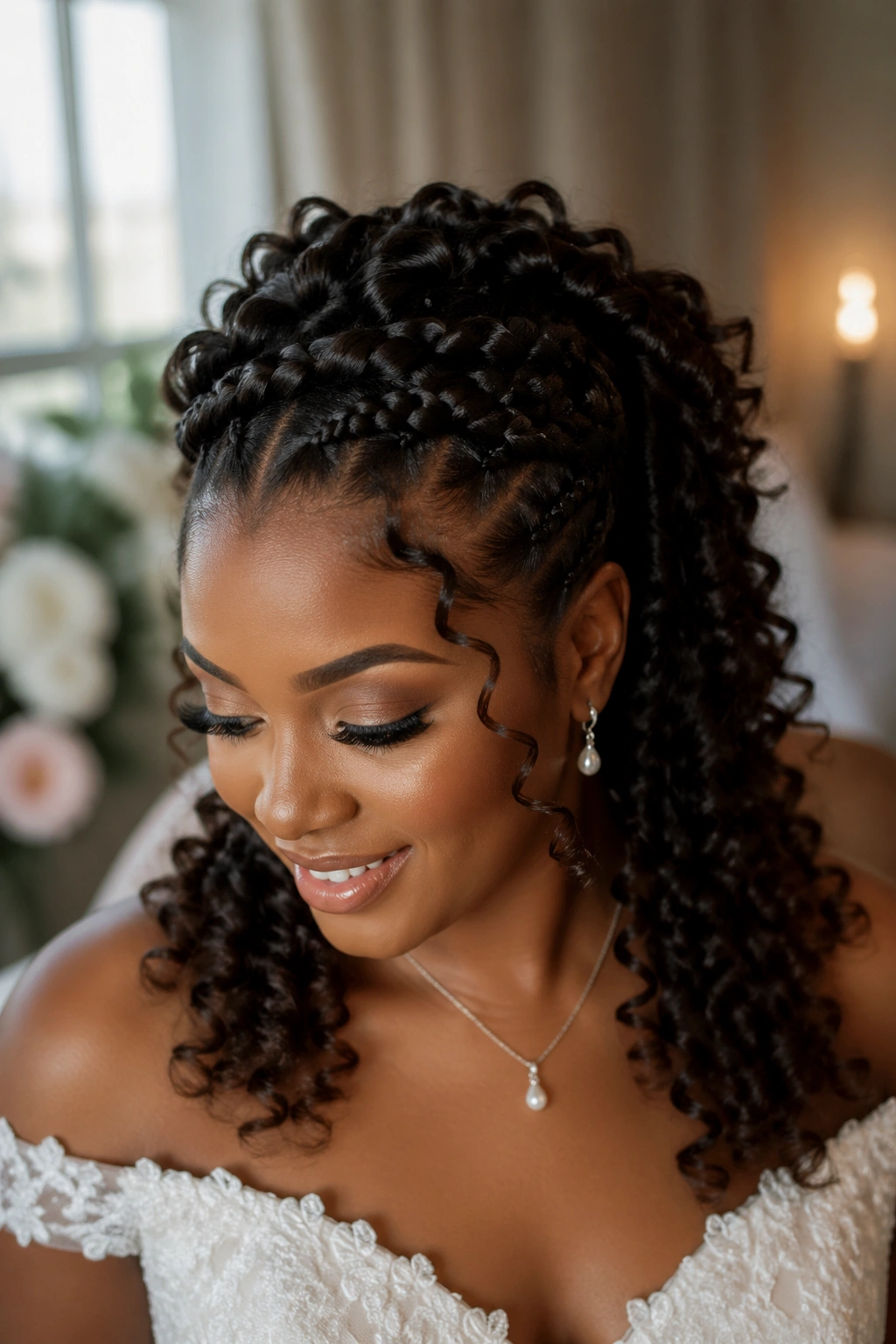
The French cornrow halo wraps around the head, with curled loose hair flowing inside the halo. The hair extending past the crown braid is set in curls that pile inside the halo’s circumference.
A bridal styling. Reads romantic and elaborate.
The curls inside the halo can be done with a curling iron, hot rollers, or wet sets the night before.
9. Two French Cornrow Pigtails
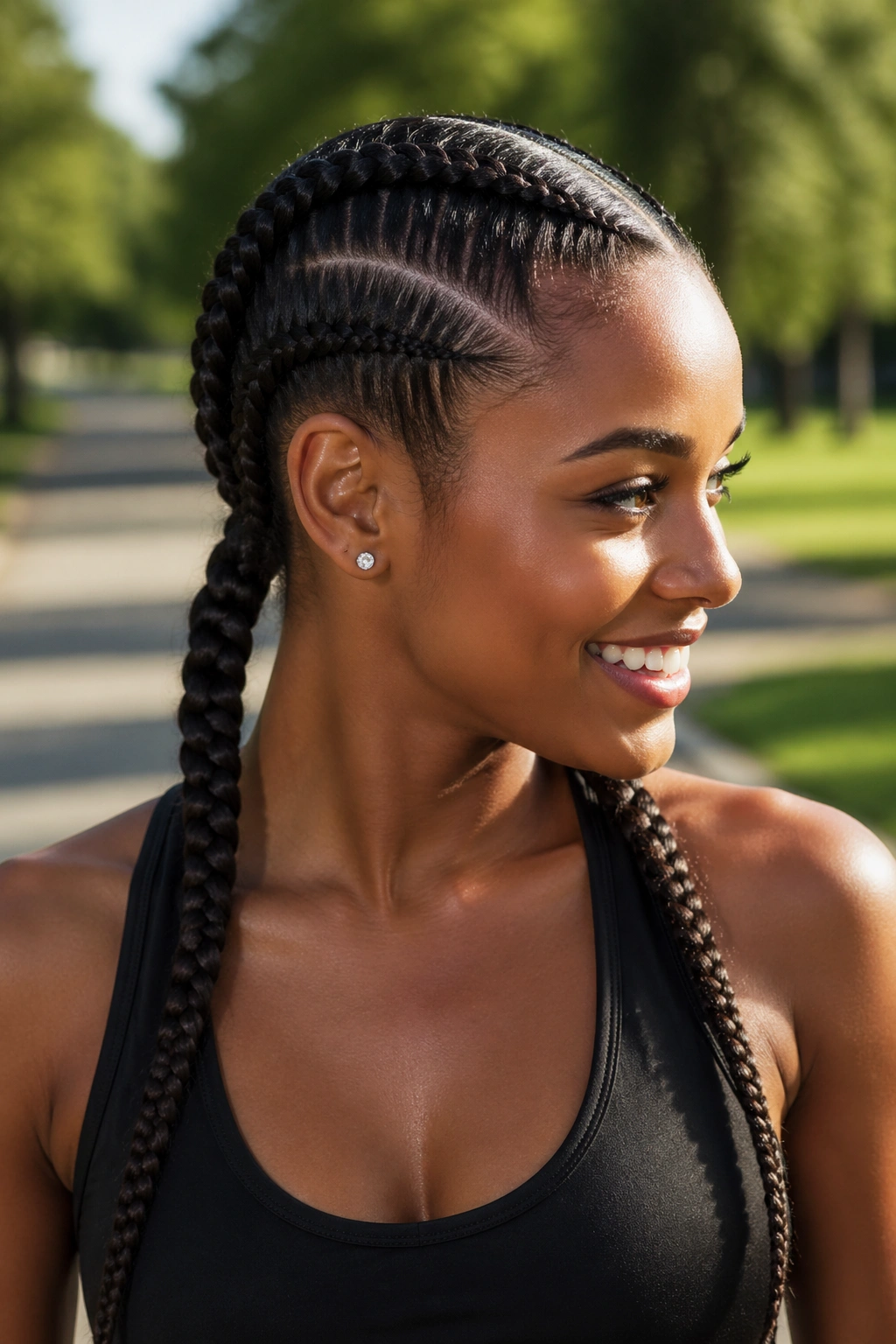
Two French cornrows running from the hairline to the nape, separated by a center part, finished into ponytails or braided pigtails at the back.
Reads sporty, athletic, or playful depending on how the ends are finished.
For workouts and active days, this is one of the best styles because everything stays in place and out of the face.
10. French Cornrow Side Pony
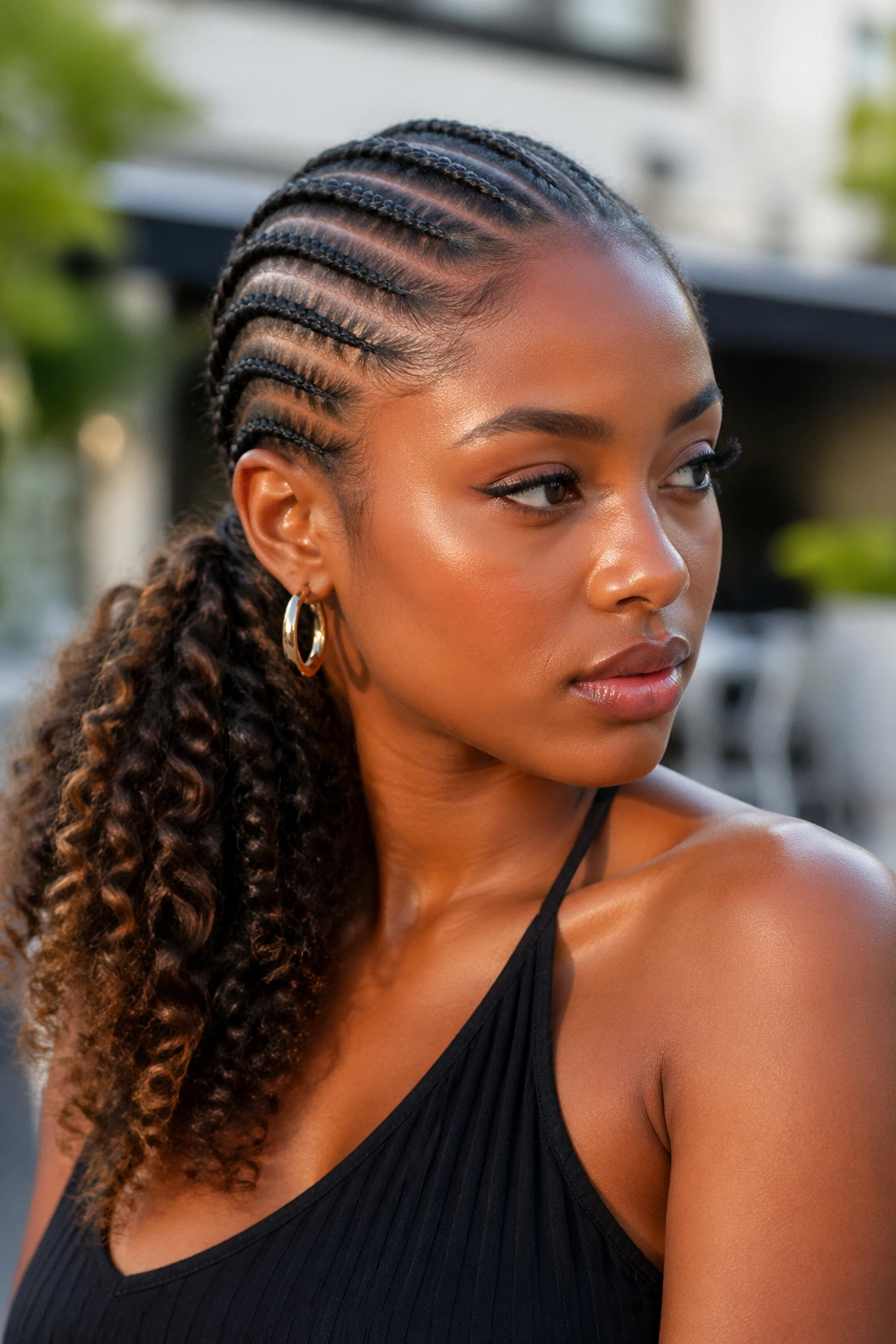
All French cornrows lead into a single side ponytail at one ear. The ponytail itself can be left loose or styled into curls.
A 1980s-meets-modern look. Reads playful and fun.
For office or formal settings, finish the ponytail with a sleek wrap of hair around the elastic to dress it up.
11. French Cornrow With a Bun
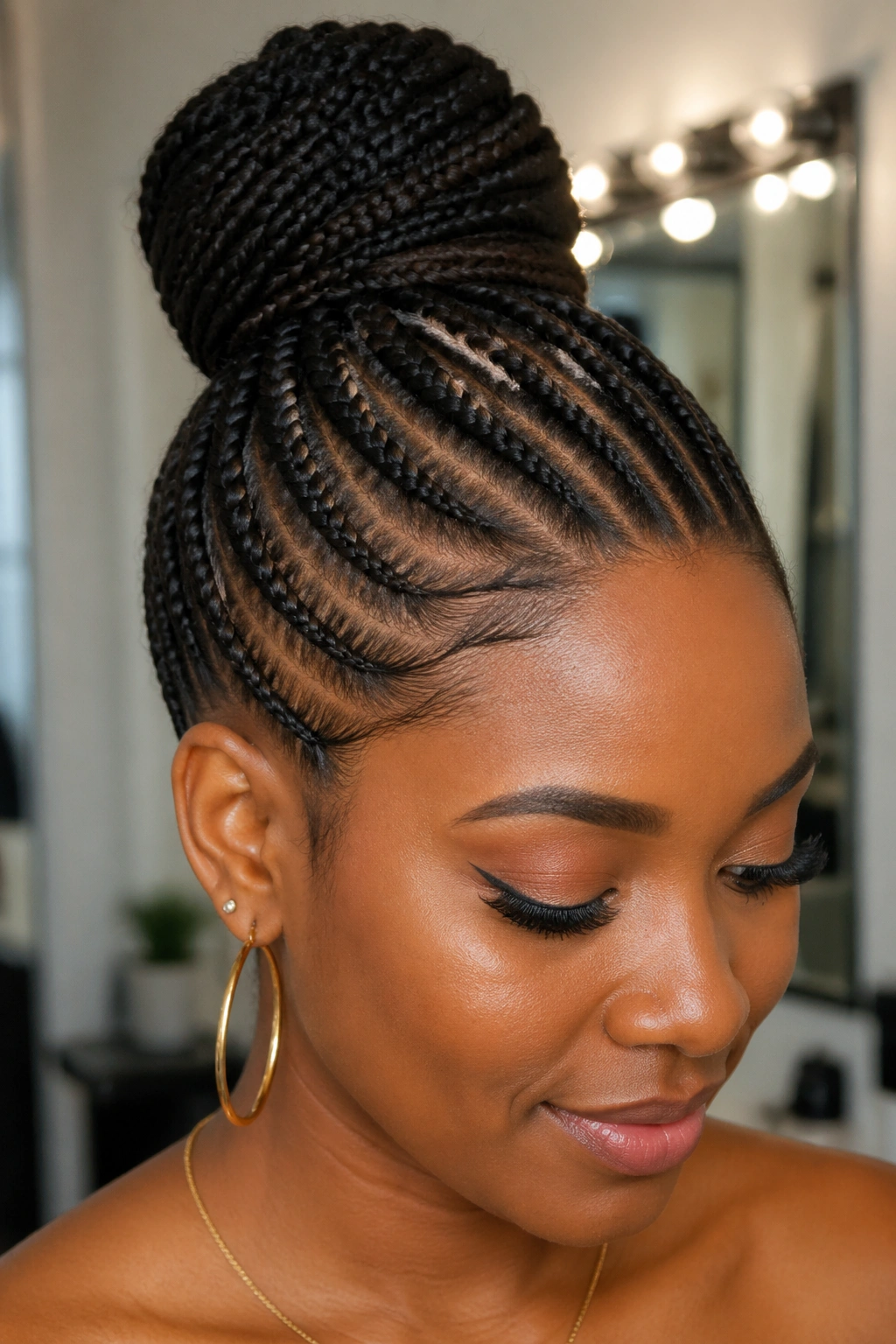
French cornrows lead up to a low or high bun at the crown. The bun is built from the natural hair released at the cornrow ends, twisted and pinned into shape.
Versatile. The bun can be polished and tight for formal events, or soft and loose for casual settings.
A hair donut underneath the bun adds shape if your natural hair is fine or you want a fuller bun appearance.
12. French Cornrows With a Front Curl Section
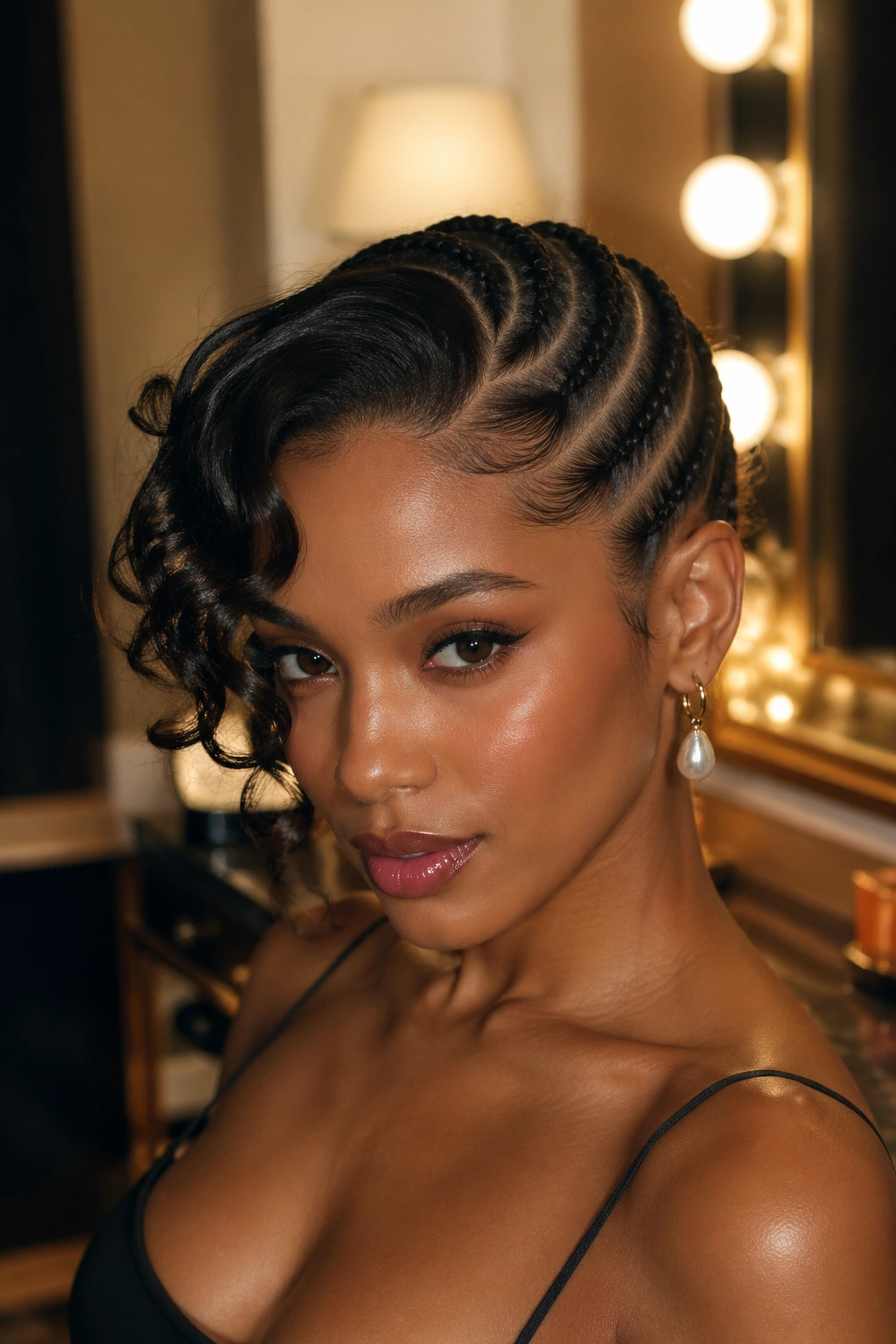
French cornrows from the crown back, with the front section — including the bangs — left loose and curled. The contrast between curled front and braided back creates a layered look.
A glam styling. Reads like vintage Hollywood meets modern braiding.
The curled front needs styling time daily. Without curl maintenance, the front goes flat and the contrast disappears.
13. French Cornrow Tracks With Decorative Beads
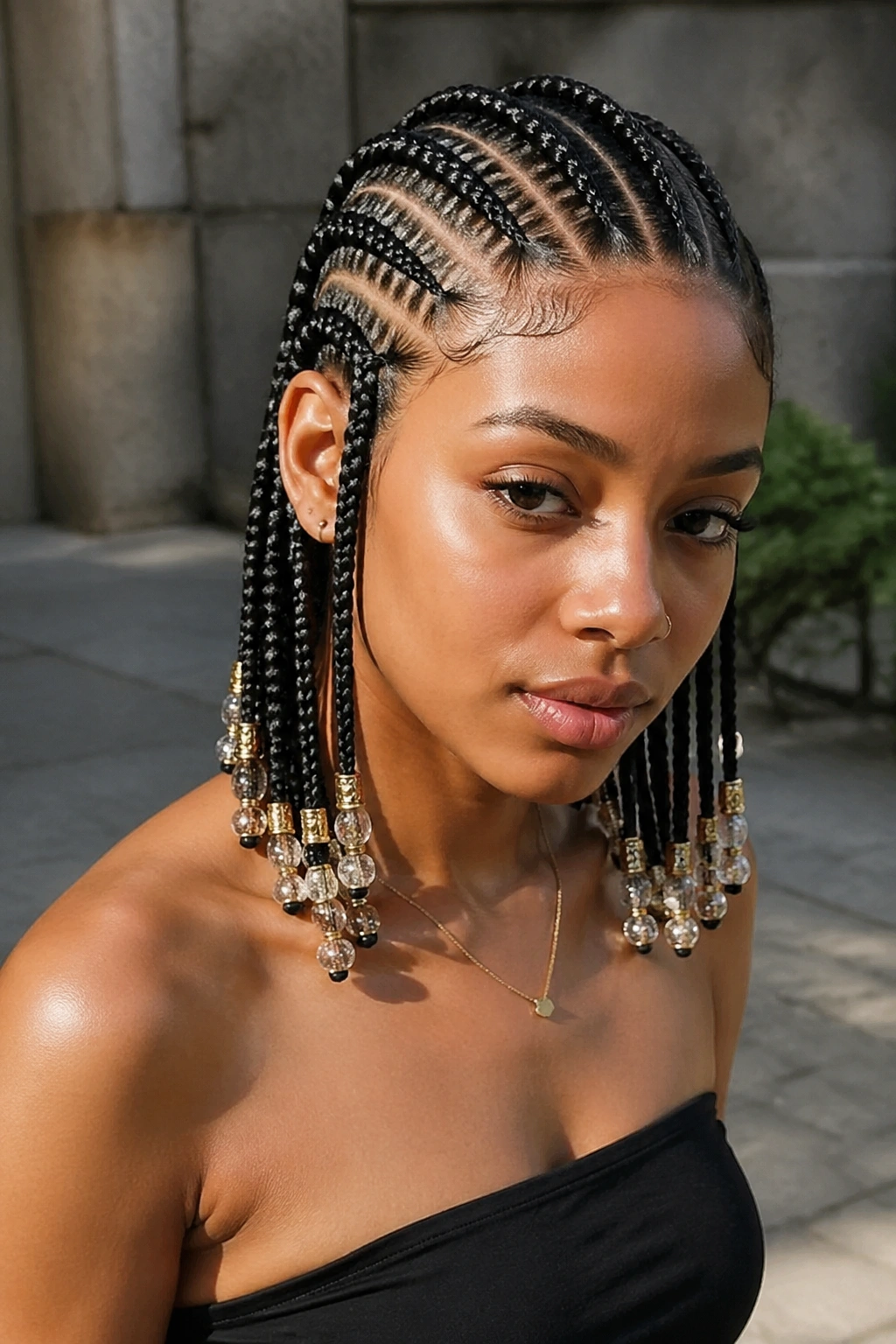
French cornrows finished with beads at the tips. Because French cornrows have a dimensional texture, the beads sit slightly forward on the braid rather than tucked under like they do on traditional cornrows.
The forward-sitting beads catch more light, which makes them more visible.
Glass or wooden beads work better than plastic. The natural materials complement the dimensional texture of French braiding.
14. French Cornrow Faux Hawk
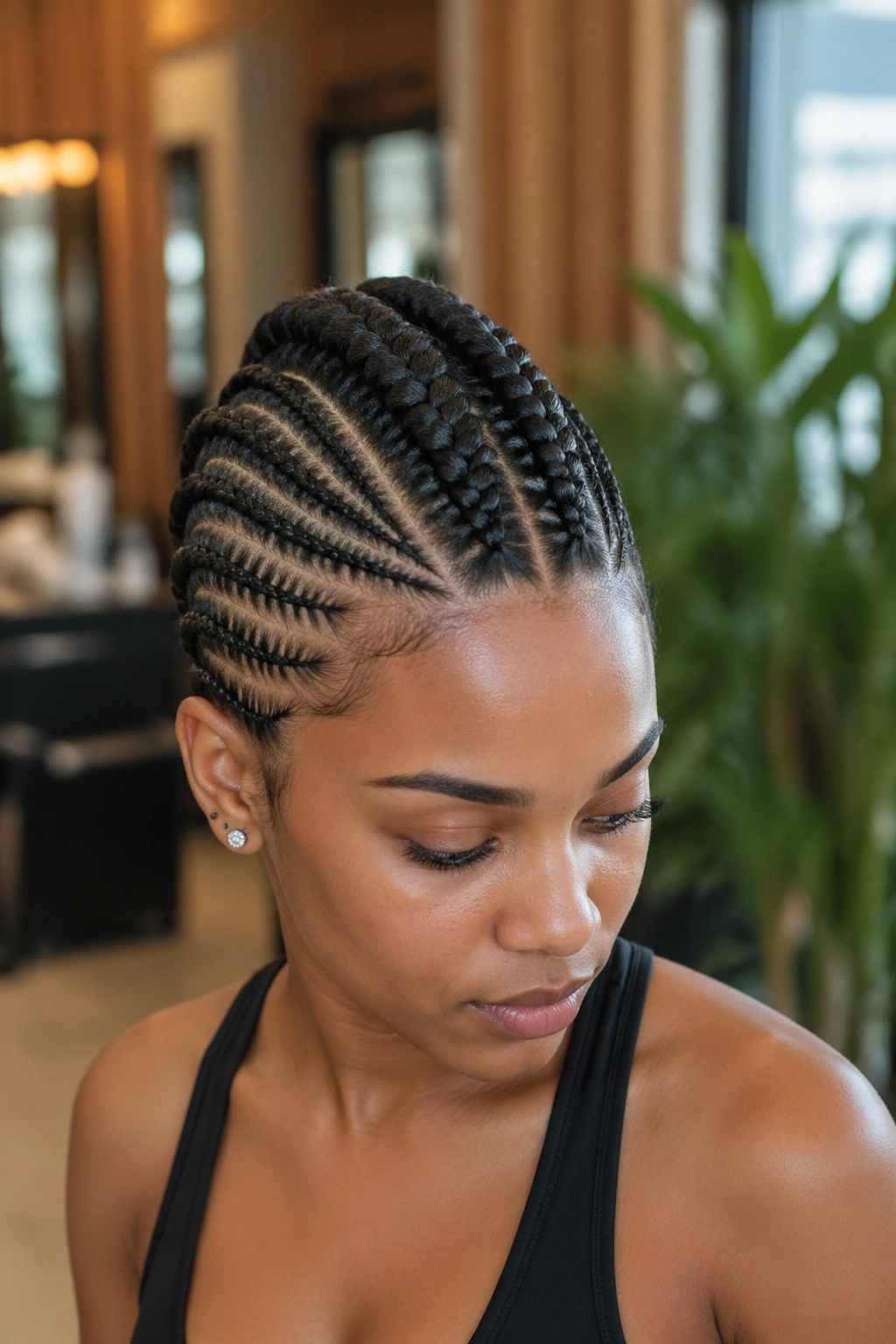
A center strip of French cornrows runs front to back, with sides braided into smaller French cornrows angling away from the center. The result is a faux hawk shape — height in the middle, flatter sides — without the strict mohawk silhouette.
Softer than a true mohawk but still bold.
Best on hair with at least medium length to support the height in the center strip.
15. French Cornrow Braid Wrap
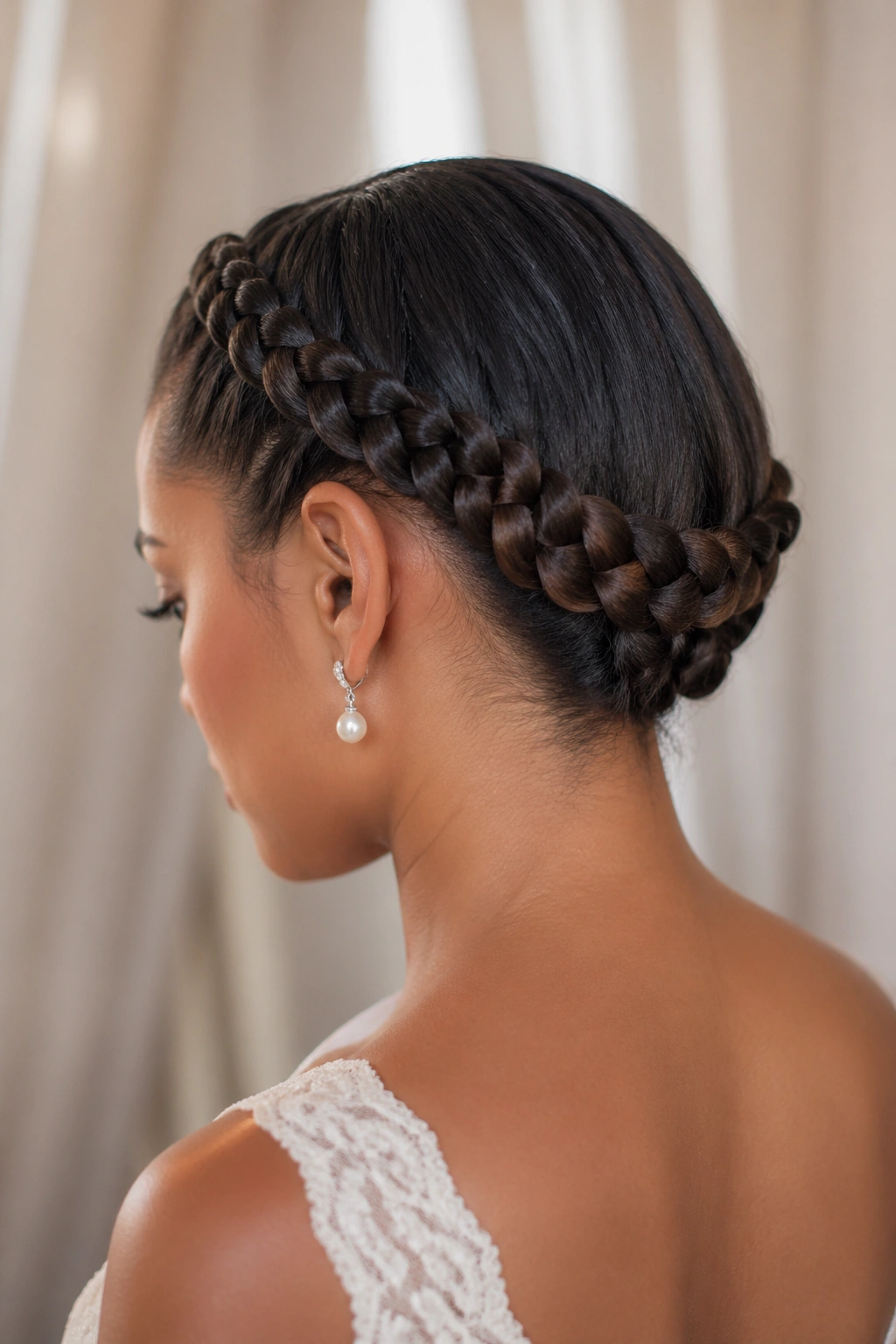
Two French cornrows start from each side of the hairline and wrap around the back of the head, meeting and overlapping at the back center. The overlap creates a woven appearance.
A photo-worthy bridal style. The wrap looks intricate from every angle.
A skilled braider can complete this in 90 minutes. Beginners attempting it on themselves should expect closer to 2 hours.
16. French Cornrows With Twisted Ends
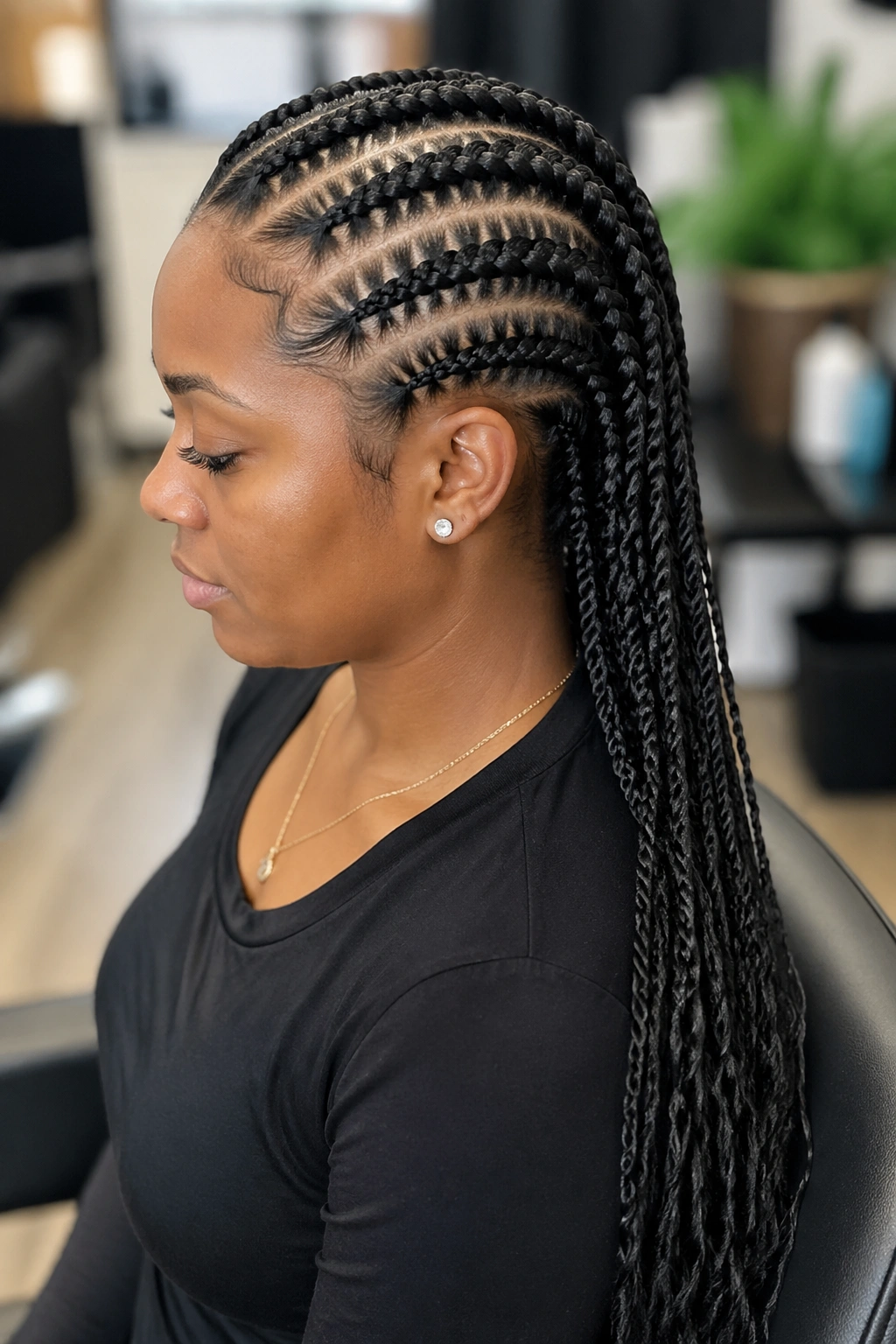
The French cornrow holds the hair against the scalp from the hairline to mid-back. Then the natural hair gets twisted into two-strand twists that hang loose.
A hybrid that gives you French cornrow structure at the scalp with twisted texture at the ends.
The transition point where the cornrow ends and the twist begins should be smooth — a small dab of edge gel keeps the cornrow from unraveling at the seam.
17. French Cornrows With Face-Framing Pieces
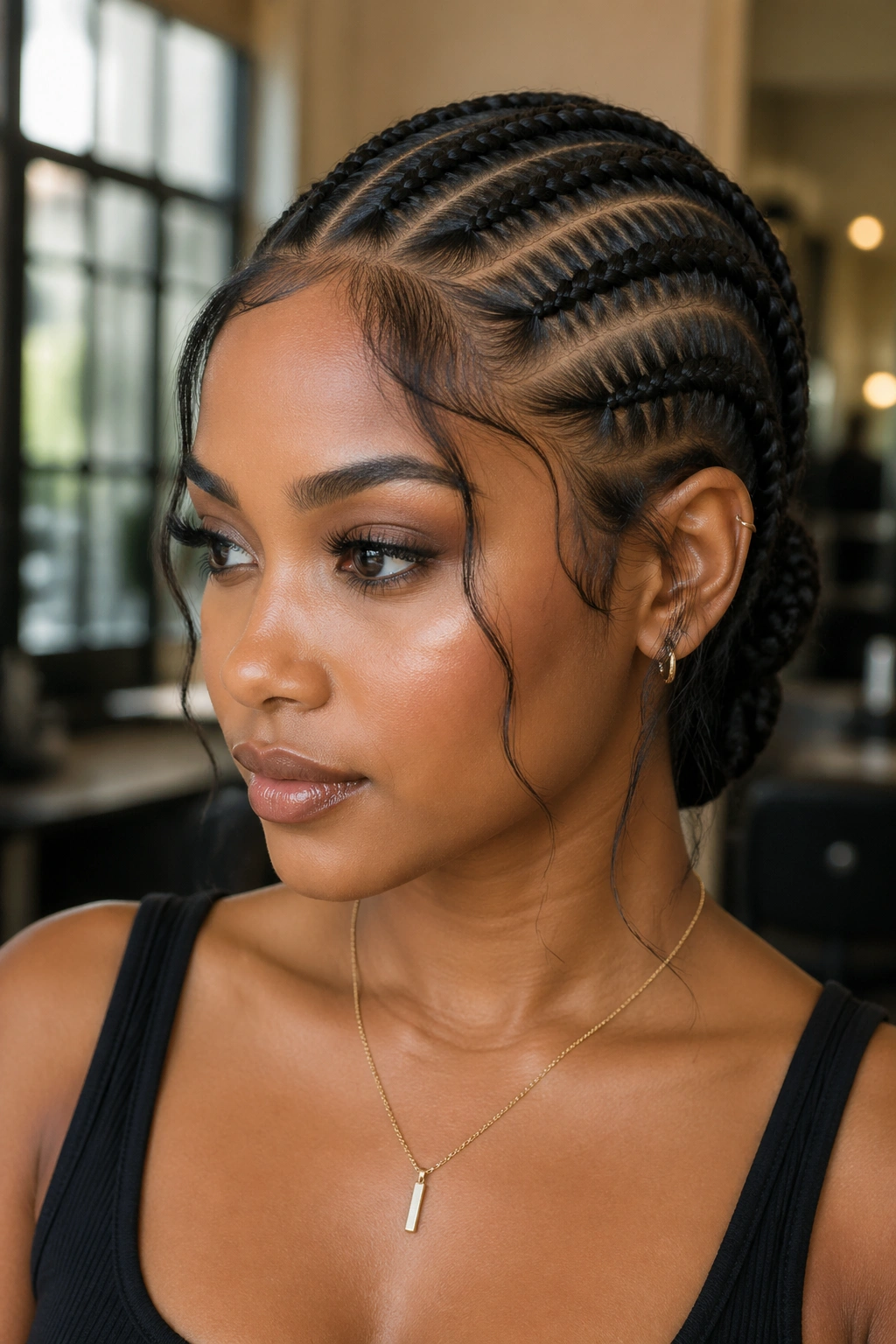
French cornrows across most of the head, with intentional pieces left out at each temple to frame the face. The pieces can be left straight, curled, or finger-waved.
The face-framing pieces soften the entire look.
Don’t pull the pieces out as an afterthought — they should be sectioned out before braiding starts so the cornrows wrap cleanly around them.
18. French Cornrow With a Twisted Bun
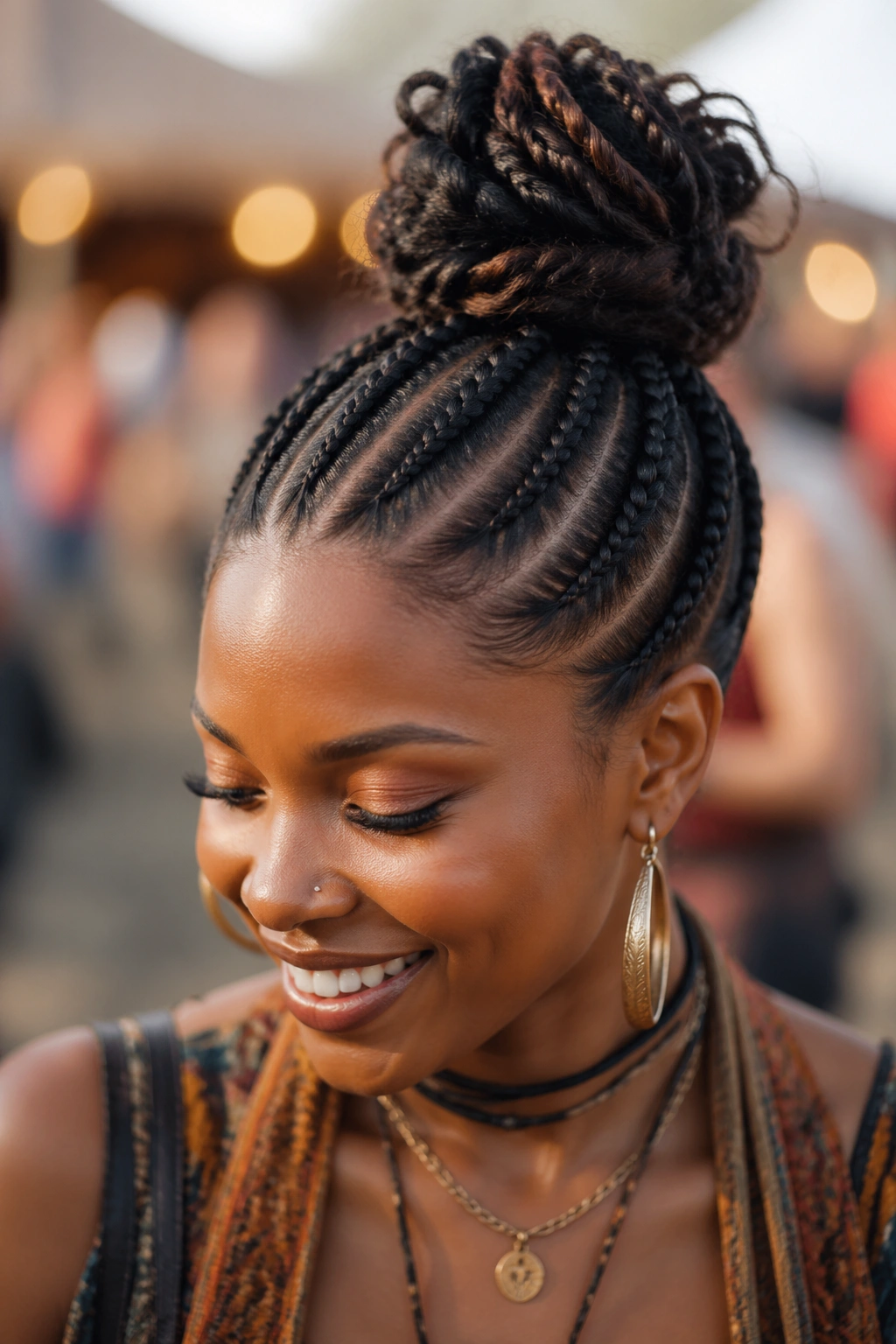
French cornrows lead up to a high crown, where the natural hair is released and twisted into a single chunky bun. The twisted bun has a thick, rope-like appearance.
A boho-glam styling. Reads festival-ready or summer-event appropriate.
The twisted bun should look slightly loose and undone — pulled too tight, it loses the soft texture that makes the style work.
19. French Cornrow With Beaded Headband Section
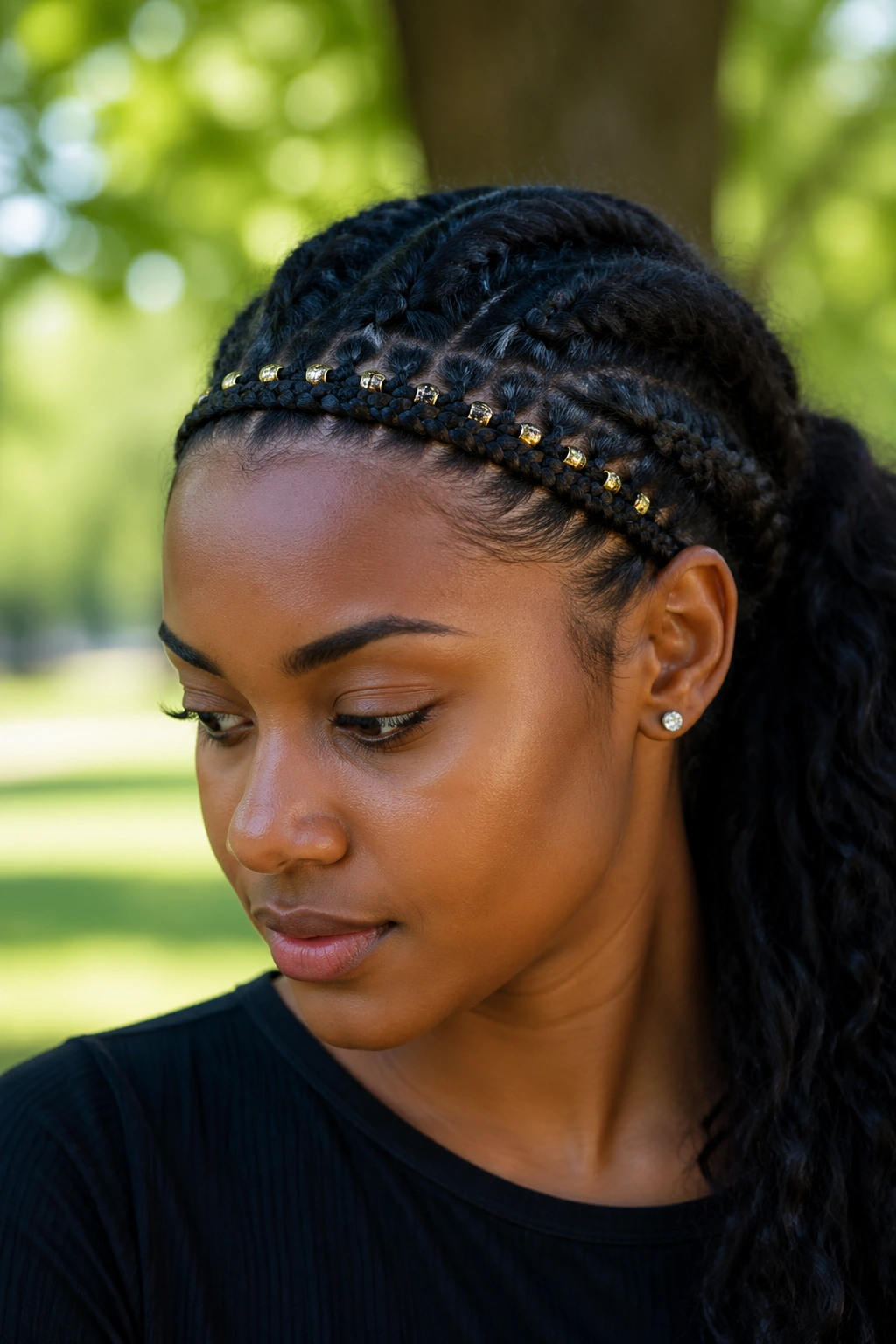
A horizontal row of French cornrows wraps around the front of the head like a headband, with beads set evenly along the braid. The rest of the head is styled loose or pulled back.
The beads turn the headband cornrow into a decorative crown.
Use small uniform beads — gold, silver, or matte black. Mismatched bead sizes look messy in this configuration.
20. French Cornrows With a Hidden Pony
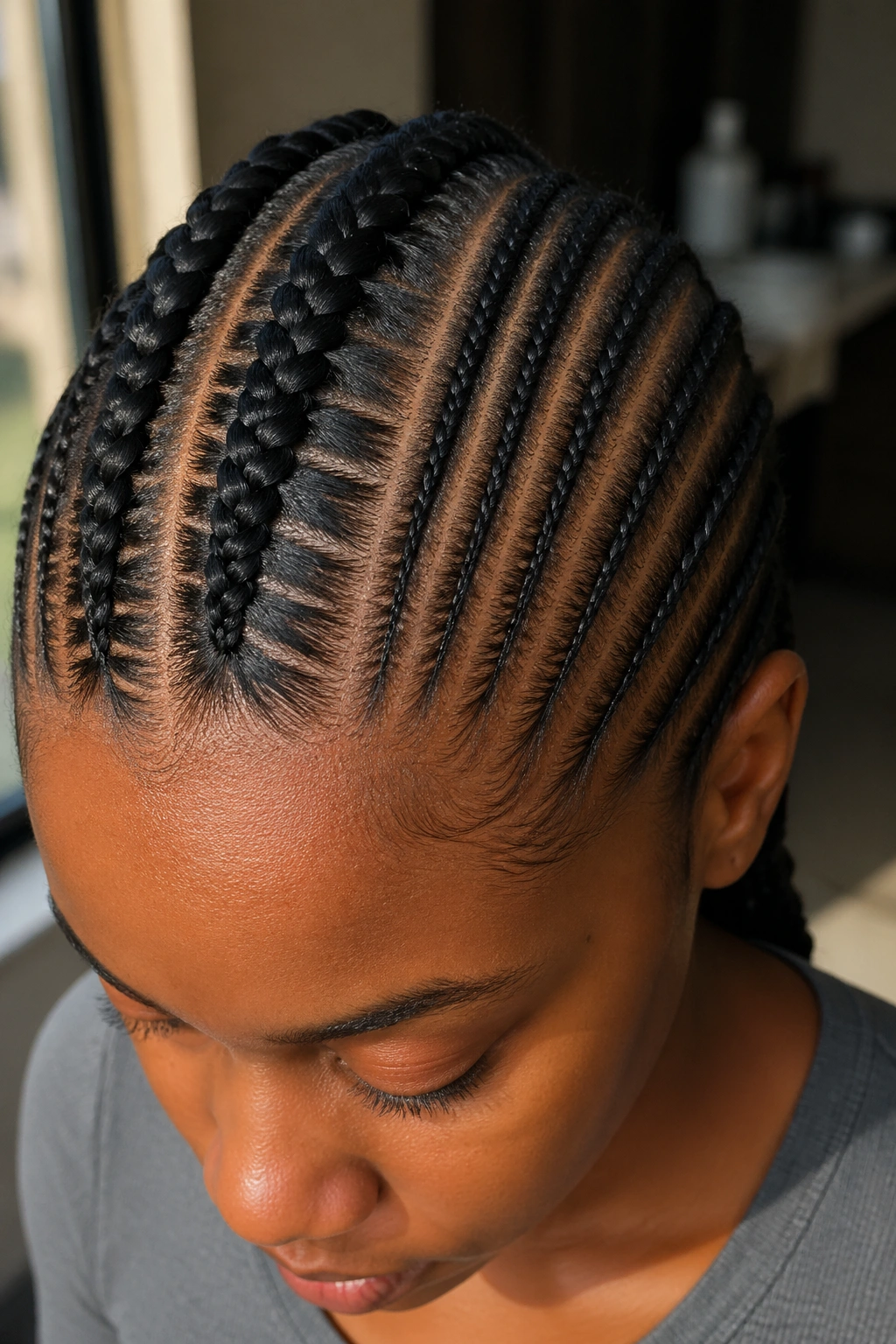
French cornrows lead the hair back into a ponytail that’s then wrapped under and pinned, hiding the pony entirely. The result reads like an updo, not a pony.
A polished, formal styling that takes about 45 minutes total.
The pinning has to be secure. A loose pin and the whole thing collapses into a regular ponytail mid-event.
21. French Cornrows With Pulled-Out Volume
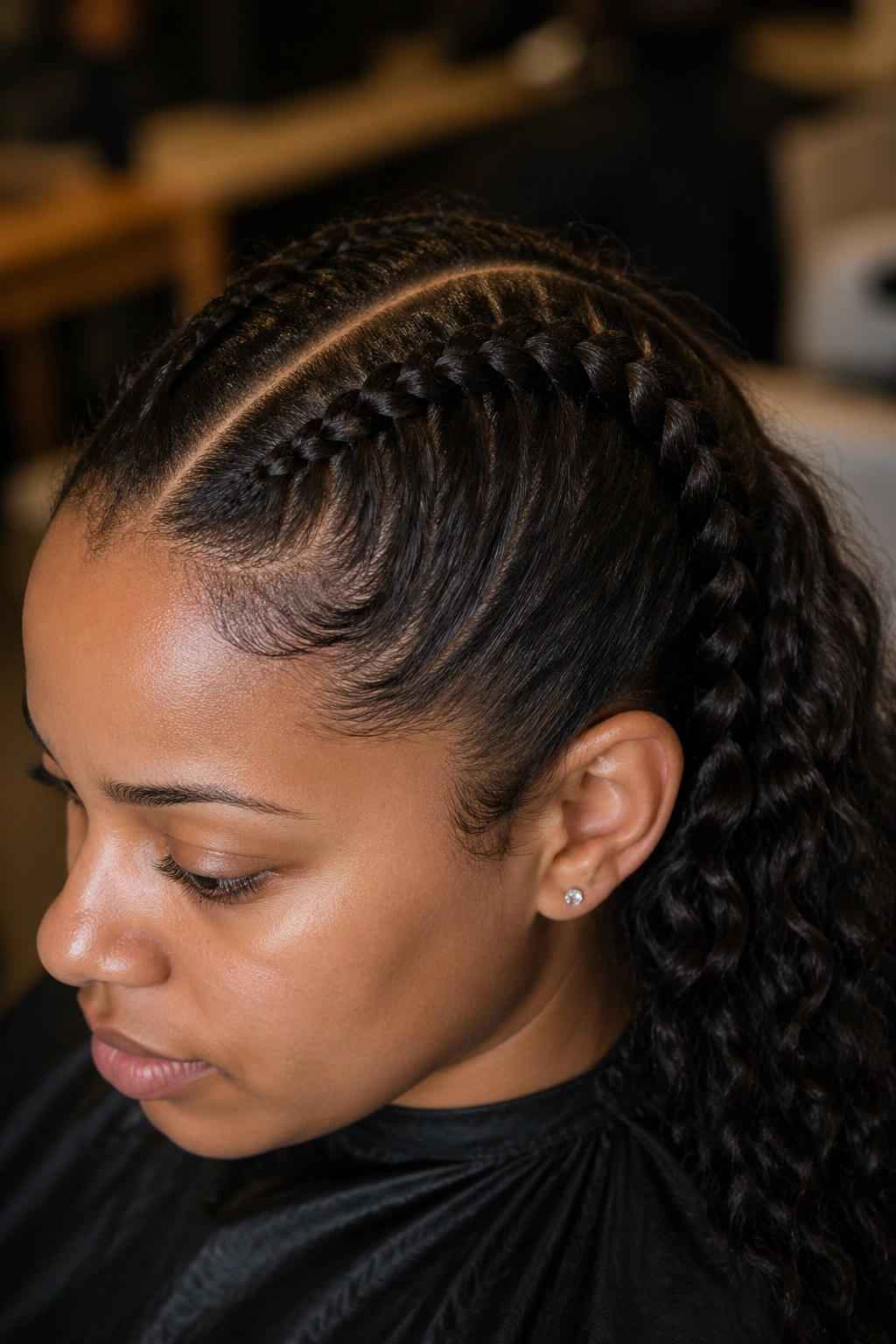
The French cornrows are intentionally loosened after braiding to create volume and texture. Not loose to the point of falling apart — just loosened enough that the braid looks soft and undone rather than tight.
The pull-out technique involves gently tugging at small loops along each braid after it’s complete. The braid loosens visibly while the structure stays intact.
A romantic, slightly disheveled finish. Reads boho or wedding-ready.
22. Single Long French Cornrow
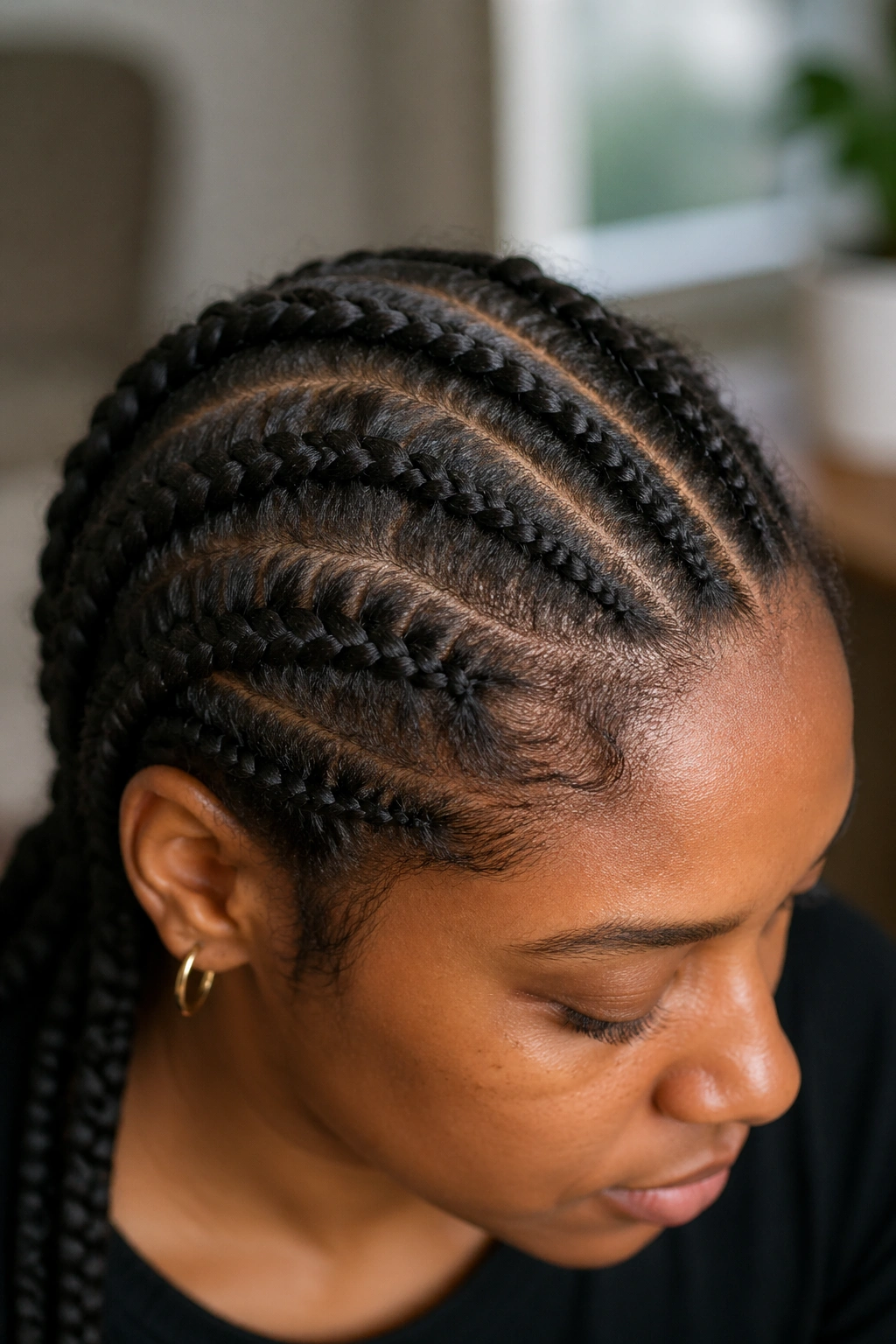
One single French cornrow that runs across the entire head — usually starting at one ear, wrapping around the crown, and ending at the other ear. Sometimes called a milkmaid braid or wraparound braid.
A simple but striking style. Takes 15-20 minutes.
Best on medium-to-long hair. Short hair won’t have enough length to complete the wraparound.
Maintaining French Cornrows
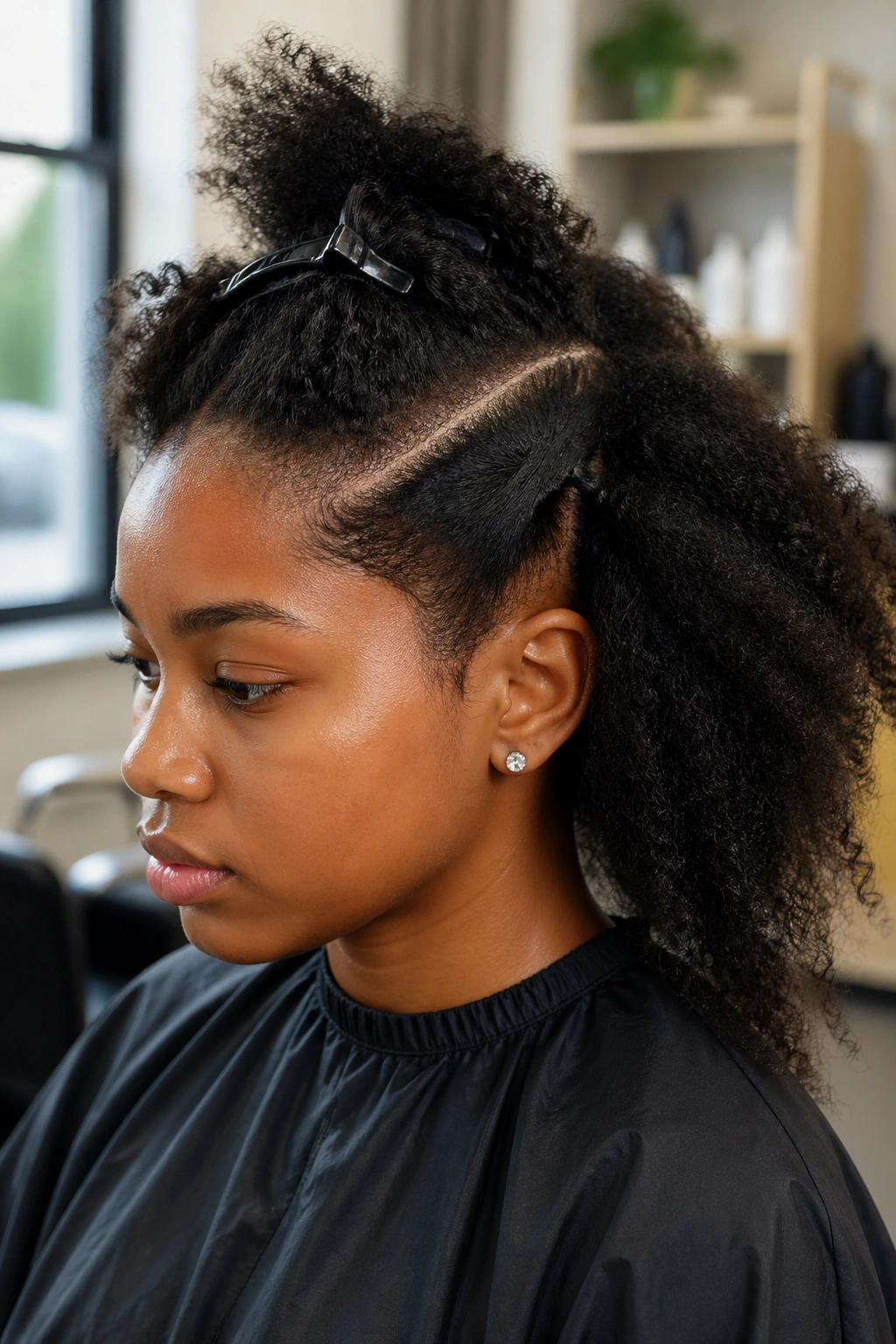
The dimensional texture of French cornrows is also its weakness — frizz shows up faster than on flat traditional cornrows. Daily edge maintenance with a tiny amount of edge gel keeps the front looking fresh.
Smooth the body of the braids with a soft boar-bristle brush each morning. Just a light pass — heavy brushing pulls the braids loose.
A satin bonnet at night is essential. The slightly raised texture of French cornrows catches against cotton pillowcases more than flat cornrows do, fluffing the braids and aging the style fast.
Refreshing the Style Mid-Wear
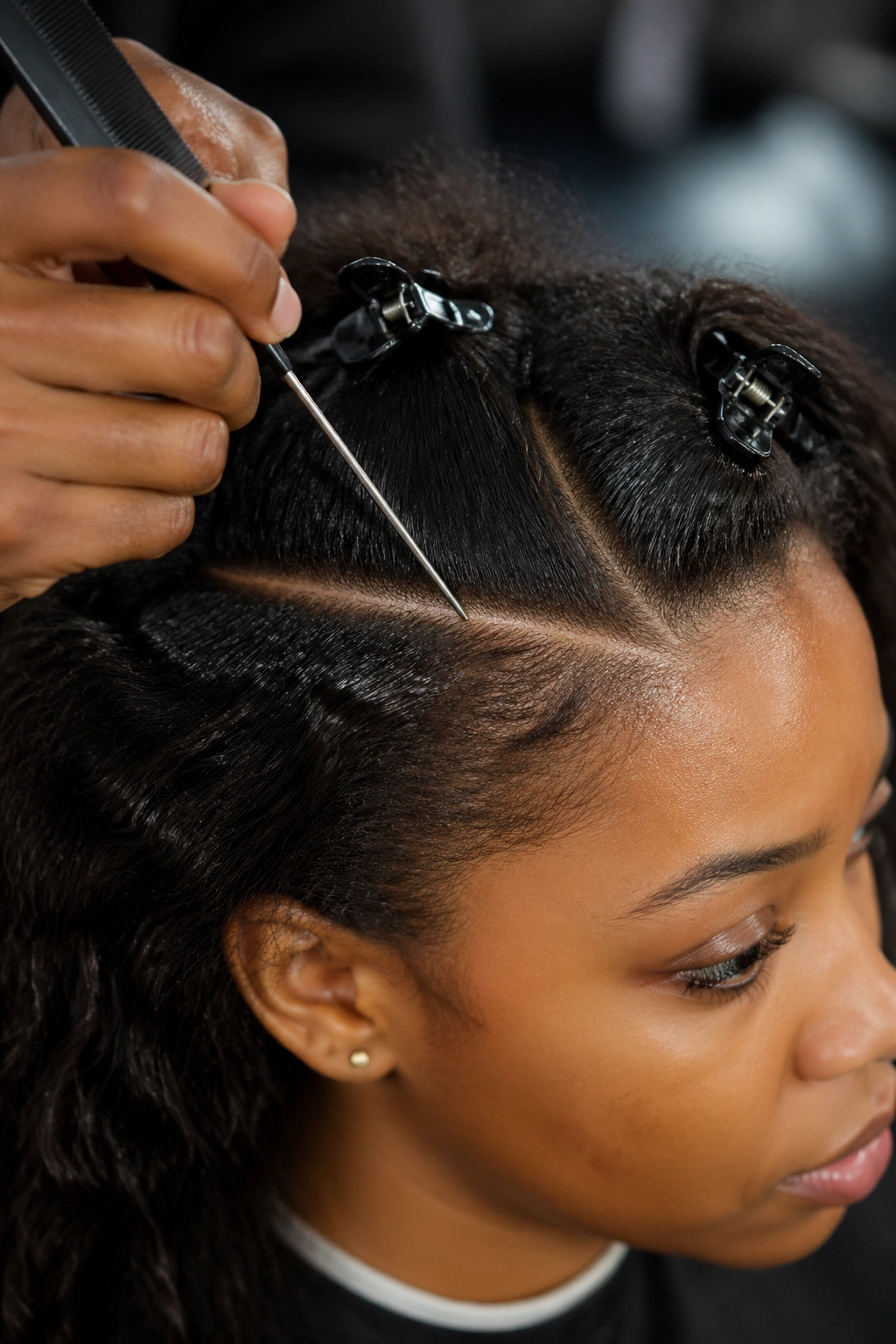
Around days 5-7, the front French cornrows often loosen first. A targeted refresh — taking down just the front 2-3 cornrows and re-braiding them — can extend the style’s life significantly.
Spritz a curl-refreshing spray on any sections that look fluffy. The spray plus a quick smooth with your fingertips usually restores the look.
If the entire style feels worn out by week 2, a full takedown and reinstall might be smarter than trying to revive what you have.
Scalp Care Under French Cornrows
Apply a lightweight scalp oil 2-3 times a week. Jojoba, argan, or grapeseed oil work well. Use a nozzle-tip bottle to apply directly to the scalp without coating the braid lengths.
Shampoo the scalp every 10-14 days. Diluted sulfate-free shampoo applied to the scalp only, rinsed thoroughly. Air-dry fully before sleeping.
Itching that won’t quit usually means buildup. A clarifying scalp wash typically resolves it within one session.
When to Take Them Down
French cornrows typically last 2-3 weeks on natural hair, sometimes up to 4 weeks with great maintenance. The style ages a touch faster than traditional cornrows because of the dimensional texture.
Take them down when the front loosens beyond what edge gel can fix, when the scalp persistently itches, or when you’re tired of the look. There’s no shame in taking down a style early if you’re done with it.
The takedown is straightforward. Spray with a conditioner-water mix, wait 10 minutes, then unravel each braid from tip to root. Detangle each section as you free it. Plan on 30-60 minutes for a full head.
Picking the Right French Cornrow Style for You
If you’re new to French cornrows, start with classic straight-backs. Master the basic technique before attempting wraparound styles or geometric parts.
For everyday wear, simple French cornrow styles win — straight-back, side-swept, or two-cornrow versions. They’re fast to install, low-maintenance, and read polished.
For events, the more elaborate styles deliver — crown braids, French cornrow updos, or bun-and-cornrow combinations. These require more time and skill but photograph beautifully.
French cornrows offer a softer, more dimensional alternative to traditional cornrows. The technique is more accessible, the styles more versatile, and the finished looks more forgiving than their underhand cousins. Worth adding to your styling rotation if you’ve only worn traditional cornrows so far.