


French cornrows for Black women occupy an interesting cultural overlap. The technique sits between the classic European French braid (started at the crown, fed with new hair as you work down) and the traditional African cornrow (braided flat against the scalp from start to finish). Combine those two and you get a French cornrow — flat against the scalp like a cornrow, but built with the over-hand feeding pattern of a French braid. The result is a braid with more visible texture than a standard under-hand cornrow, more lift along the ridge, and a different finished look entirely.
For Black women, French cornrows offer something the standard cornrow doesn’t: a raised, dimensional braid line that sits proud of the scalp instead of flush against it. That raised quality reads bolder. It catches more light. And on textured hair — 4A, 4B, 4C — French cornrows hold the kind of definition that flat cornrows can struggle to show without product layering.
The 22 styles below cover the spectrum: classic two-braid layouts, multi-braid arrangements, French cornrows mixed with other techniques, and elaborate signature looks built from French cornrow foundations. Each one is genuinely different from the others. No “the same style with smaller braids” repeats.
French Cornrow vs Standard Cornrow — The Real Difference
The technical difference is where the new hair gets added. In a standard cornrow, you braid under-hand — left strand crosses under middle, right strand crosses under middle. In a French cornrow, you braid over-hand — left crosses over middle, right crosses over middle. That single direction change creates the raised, ridged appearance.
Standard cornrows lie flat. French cornrows stand up. Both are protective. Both are foundational. But the visual output is markedly different, and the styling possibilities branch from that distinction.
If you’ve never noticed the difference in person, the French cornrow has a chunkier, ropier look. It looks more like a “regular braid” laid against the scalp. The standard cornrow looks sleeker, lower-profile, more woven-in.
When to Pick French Over Standard
Pick French cornrows when you want the braid itself to be a visible feature — bigger, bolder, more dimensional. Standard cornrows recede into the scalp pattern. French cornrows announce themselves.
Pick French when you’re styling fewer braids — two French cornrows reads dramatic, two standard cornrows reads minimal. The over-hand technique benefits from chunkier sections.
Pick standard when you want the parting to do most of the visual work — zigzag patterns, halo patterns, geometric layouts. Standard cornrows showcase the scalp design. French cornrows showcase the braid design.
Prep That Matches the Technique
French cornrows demand more friction than standard cornrows because the over-hand pattern relies on the braid catching against itself.
- Stretched, dry hair before install. Wet hair can’t hold over-hand tension.
- A small amount of styling foam or mousse worked through each section. The tackiness keeps the over-hand crosses gripping.
- Edge gel only at the hairline. Don’t gel the whole section — French cornrows need the strand to stay slightly textured to grip itself.
Skip heavy butters and oils for the actual install. They reduce friction, which is the opposite of what French cornrows need.
Tools Specific to French Cornrowing
The same toolkit as cornrows in general: rat-tail comb, mirrors, edge gel, small elastics. One addition that matters — a soft-bristle brush rather than a fine comb for laying the section before braiding. The brush keeps the texture without making the strand slick.
A finger-friction technique helps. Some braiders rub their fingertips together briefly before each over-hand cross to add tackiness. It’s a small habit. It changes how tightly the cornrow grips.
Where French Cornrows Hold Best on Black Hair
Mid-shaft to ends. The over-hand pattern grips tighter farther from the scalp than at the root. Which means French cornrows look raised and defined along the length of the braid but can sometimes appear less prominent right at the front of the hairline.
Solution: start the French cornrow about a quarter inch behind the actual hairline. Use the natural hairline section as a smooth lead-in, then begin the over-hand pattern just behind. The transition reads cleaner.
1. Two Classic French Cornrows
The signature look. One French cornrow on each side of a clean center part. Each braid runs from forehead to nape. Big, ropey, dimensional.
Why This Is the Most Recognized French Cornrow
- Two braids show off the technique without competing patterns.
- The center part is forgiving — a slightly imperfect part still looks intentional.
- Install time of 30-45 minutes makes it accessible.
Stylist note: Make each braid as thick as your wrist if you want the maximum dimensional payoff. Thinner versions read as standard cornrows from a distance.
2. Three French Cornrows Side-Swept
Three French cornrows angled diagonally across the head — starting at the forehead and traveling toward the opposite ear. The angling adds movement that two parallel braids can’t.
The middle cornrow does the heavy visual work. The two flanking cornrows curve along beside it. Together the three braids read as a sweeping diagonal statement rather than three separate lines.
Best on people whose face shape benefits from horizontal lines — round and square faces especially. The diagonal sweep elongates without going severe.
3. Four French Cornrows With Beaded Ends
Four French cornrows running straight back. Each braid finishes with two or three beads at the tail. Wooden beads work best — they don’t compete with the dimensional braid pattern.
The four-braid count keeps the install under 90 minutes while still giving more visual density than the two-braid version. The beads provide finish without adding decorative complexity.
Bead size matters. Small beads (4-6mm) read refined. Large beads (10mm+) overpower the French cornrow texture itself.
4. French Cornrow Mohawk
Tight French cornrows on both sides of the head, leaving a wider unbraided strip down the center. The center strip gets styled into a puff, twist-out, or lifted afro.
The contrast between flat-against-scalp braids on the sides and free natural texture in the middle creates the mohawk illusion. No actual cutting required.
This is one of the more forgiving French cornrow styles for self-installation. The technique only happens on the sides where you can see clearly. The center strip just needs basic styling.
5. Six French Cornrows All-Back
Six chunky French cornrows from the hairline to the nape. Equal spacing. Equal thickness. Standard all-back configuration with French technique applied.
The six-row count strikes a good balance for the over-hand technique — small enough sections to look refined, large enough to maintain dimension. Smaller than six rows tends to flatten the French cornrow into a standard cornrow appearance.
A good “I want French cornrows but not the extreme two-braid look” middle ground.
6. French Cornrow Halo
A single thick French cornrow that traces the perimeter of the head from one temple, across the back, and meets at the opposite temple — like a crown. The remaining hair tucks underneath or styles into a separate element on top.
The halo French cornrow shows the dimensional quality of the technique on a curved path, which the eye reads as more impressive than straight French cornrows.
Technically demanding. The over-hand pattern has to maintain consistent thickness all the way around the head. Small inconsistencies show up as bumps in the halo. Best done by a stylist on the first attempt.
7. Two French Cornrows Into Low Twists
The two-braid French cornrow base, but instead of leaving the ends as braided tails, the braids continue past the nape as loose two-strand twists.
The twist transition softens the look. French cornrows alone can read severe. The twist tail adds a relaxed bottom note that balances the precise top.
Mid-length to long natural hair benefits most. Shorter natural hair may need a small amount of kanekalon added at the transition for enough length to twist meaningfully.
8. French Cornrow Updo Bun
Multiple French cornrows — typically four to six — running upward from the hairline and meeting at the crown where they coil into a rounded bun.
Unlike standard cornrow updos, the French version produces a bun made of dimensional braid loops rather than flat woven sections. The bun itself looks like a coiled rope rather than a wrapped puff.
A more sculptural take on the cornrow bun category. Reads dressy. Photographs well from every angle.
9. Mixed French Cornrows and Box Braids
The crown section gets French cornrows. The lower half of the head — from mid-crown down — gets box braids that hang loose. The cornrows and box braids combine into one finished hairstyle.
The contrast is the appeal. Sculpted French cornrows on top. Free-flowing box braids at the bottom. The transition point where cornrows end and box braids begin can be hidden under a wrap or styled as a deliberate horizontal line.
Install time is significant (3-5 hours total) because both techniques are happening on one head. Worth the time for the style payoff.
10. Side-Parted Asymmetric French Cornrows
Deep side part with three larger French cornrows on the heavier side and two smaller ones on the lighter side. Five total braids in an asymmetric layout.
The asymmetry is the styling decision. Symmetric French cornrows read classic. Asymmetric French cornrows read styled. Pick based on the vibe you want.
The deep side part also gives you one side of the head to show off the dimensional braid pattern unobstructed, with the other side providing balance.
11. French Cornrow Bangs
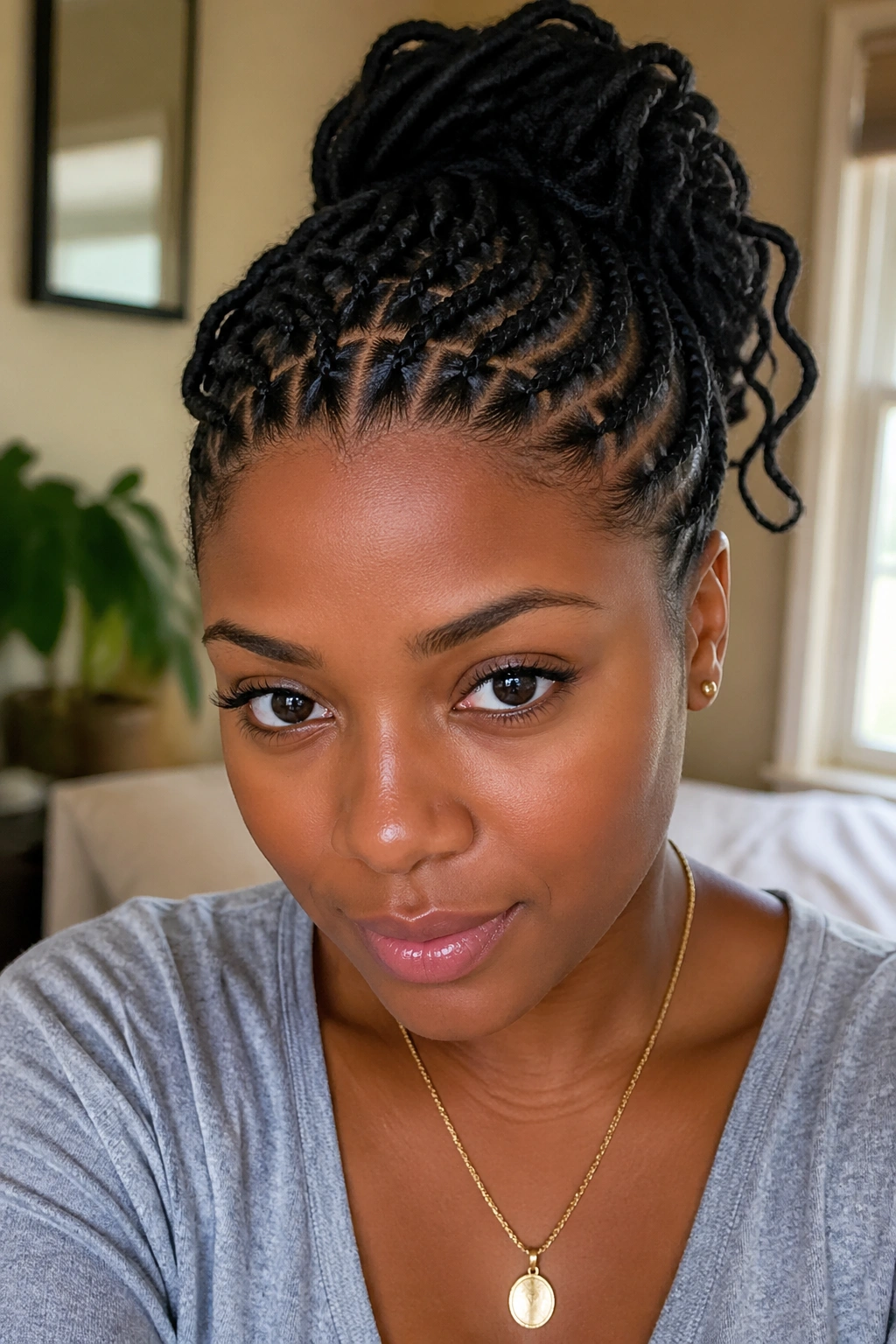
Only the front bangs section — from temple to temple across the forehead — gets French cornrowed in a few small braids. The rest of the hair styles separately.
This is the lightest entry point to French cornrow styling. Install in under 20 minutes. The dimensional French braids create a textured front piece without committing to a full head install.
Pair with a low ponytail or loose natural curls in the back for a balanced finish.
12. French Cornrows With Curly Tail Out
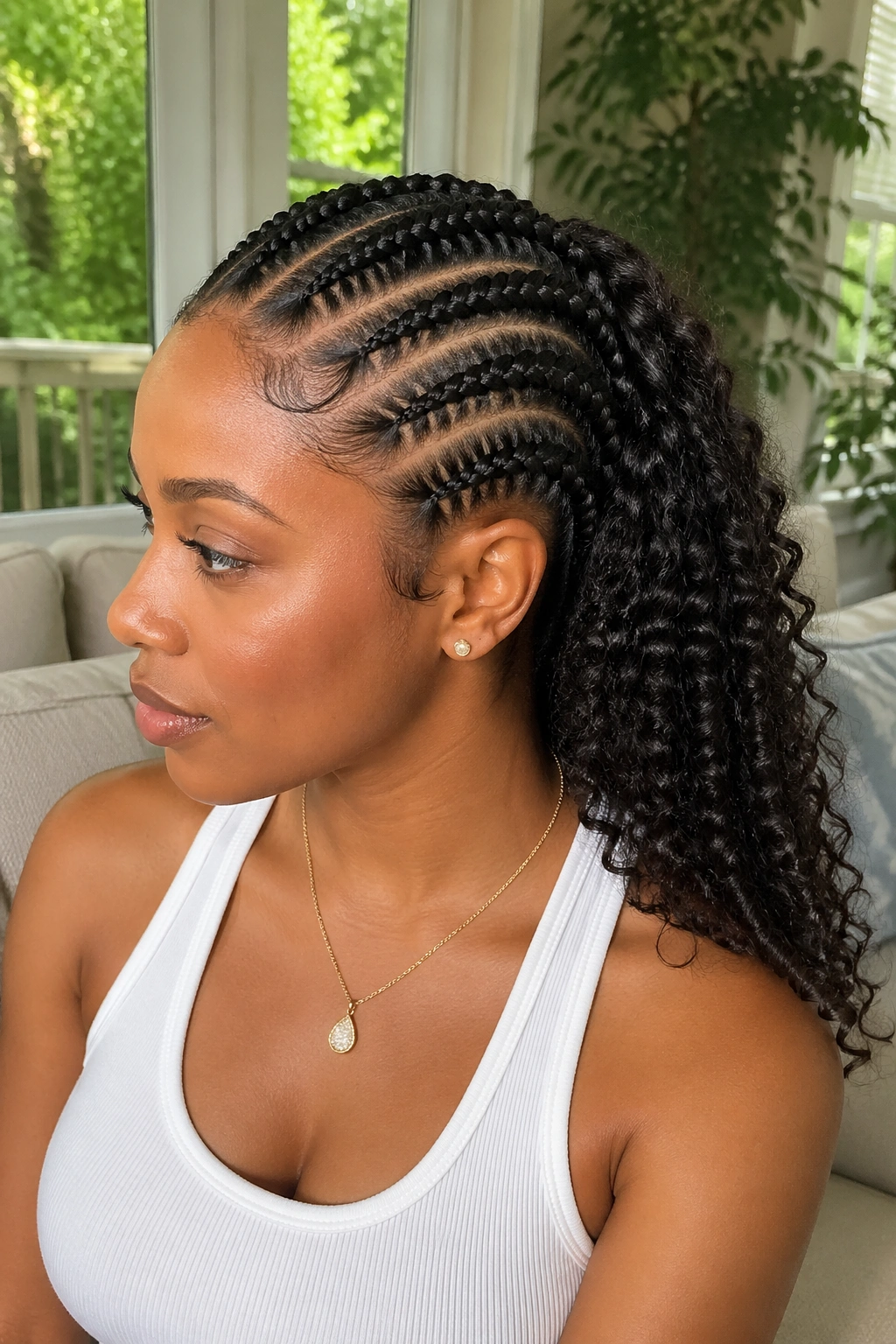
French cornrows from the hairline to mid-crown. At the point where the cornrow ends, the hair is released into defined curls — wand-curled, curl-creamed, or set with rollers.
The protective French cornrow base does scalp work. The curl tail does style work. Together they balance protection with personality.
Apply a curl-defining product to the loose ends before installation, not after, so the curl pattern is set when you take the style down.
13. French Cornrow Crown With Loose Sides
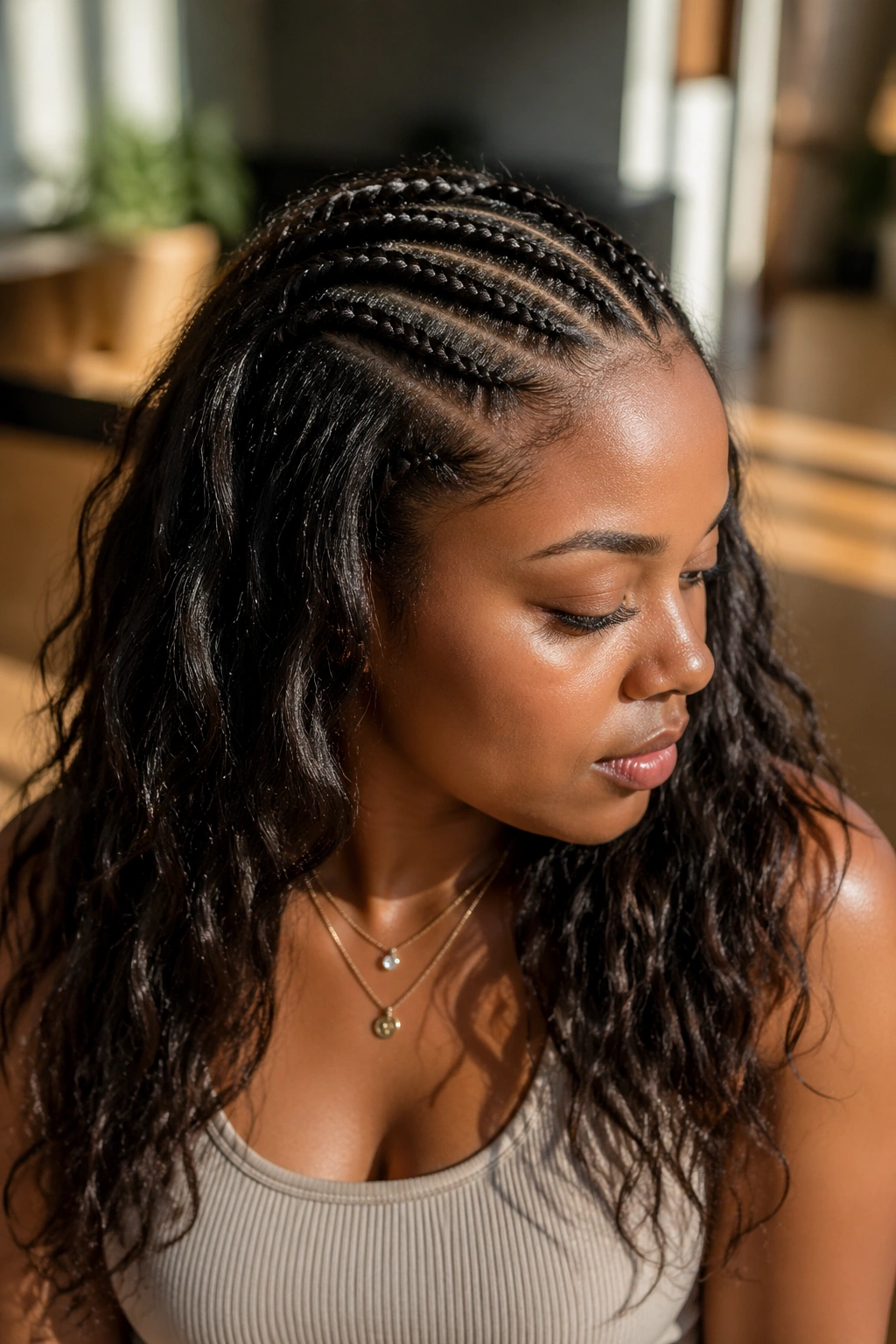
French cornrows form a horseshoe pattern on top of the head — coming from the hairline, curving around the crown, and meeting at the back of the head. The hair on either side of the cornrow horseshoe stays loose.
This is a sophisticated layout. The French cornrows define the upper silhouette. The loose side hair adds softness around the face and ears.
Best on natural hair that’s long enough to fall meaningfully when loose. Short naturals don’t get the full effect because the loose side hair doesn’t drape.
14. Beaded French Cornrows With Color
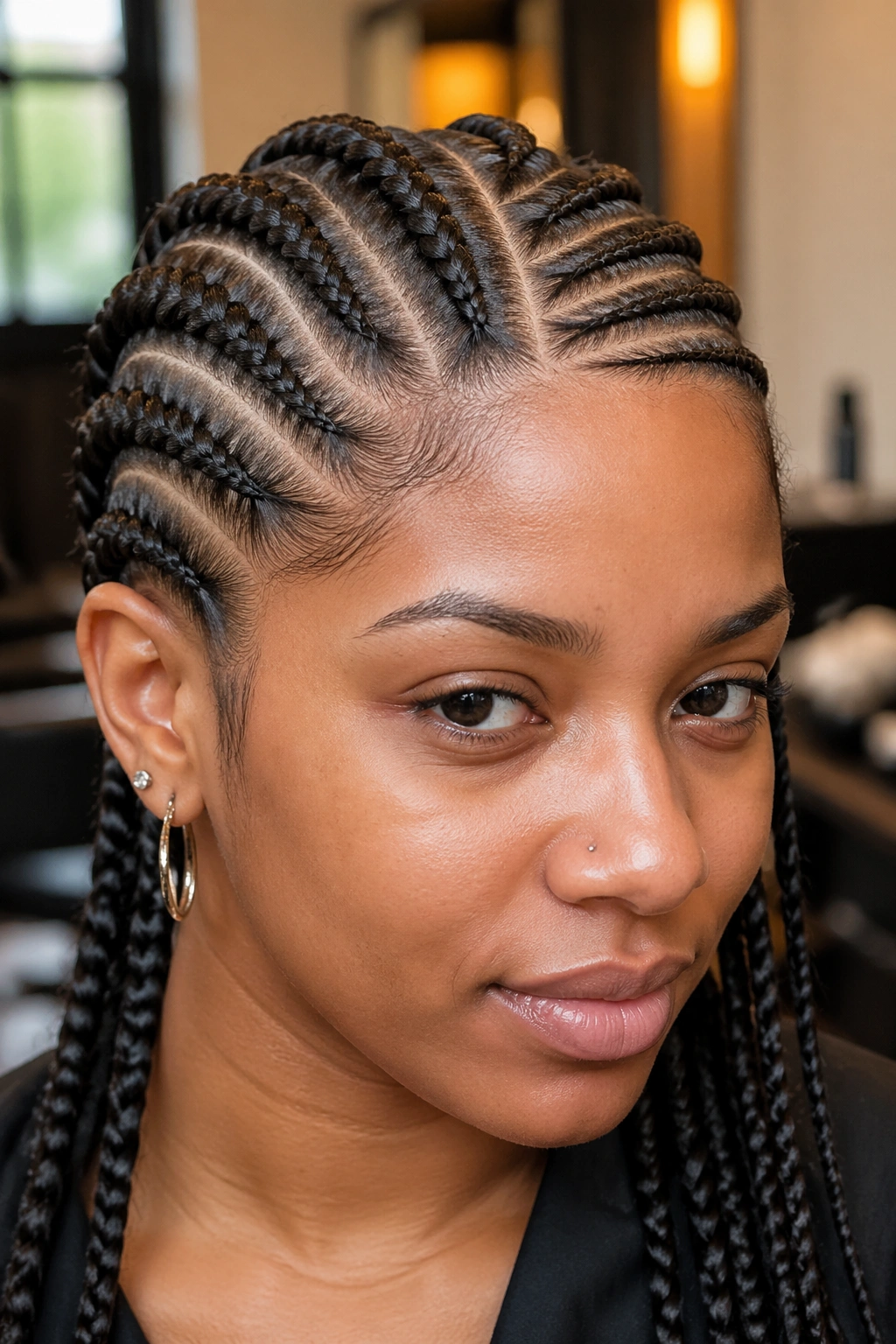
French cornrows installed with pre-colored kanekalon feed-in for tone (auburn, copper, honey blonde) and finished with matching beads at the ends.
The color emphasizes the dimensional quality of the French cornrow technique. The over-hand pattern shows tonal shifts more clearly than the under-hand standard cornrow because more of the braid surface is visible from above.
Good for events. Good for content creation. Visually rich.
15. French Cornrows With Cuffs at Peaks
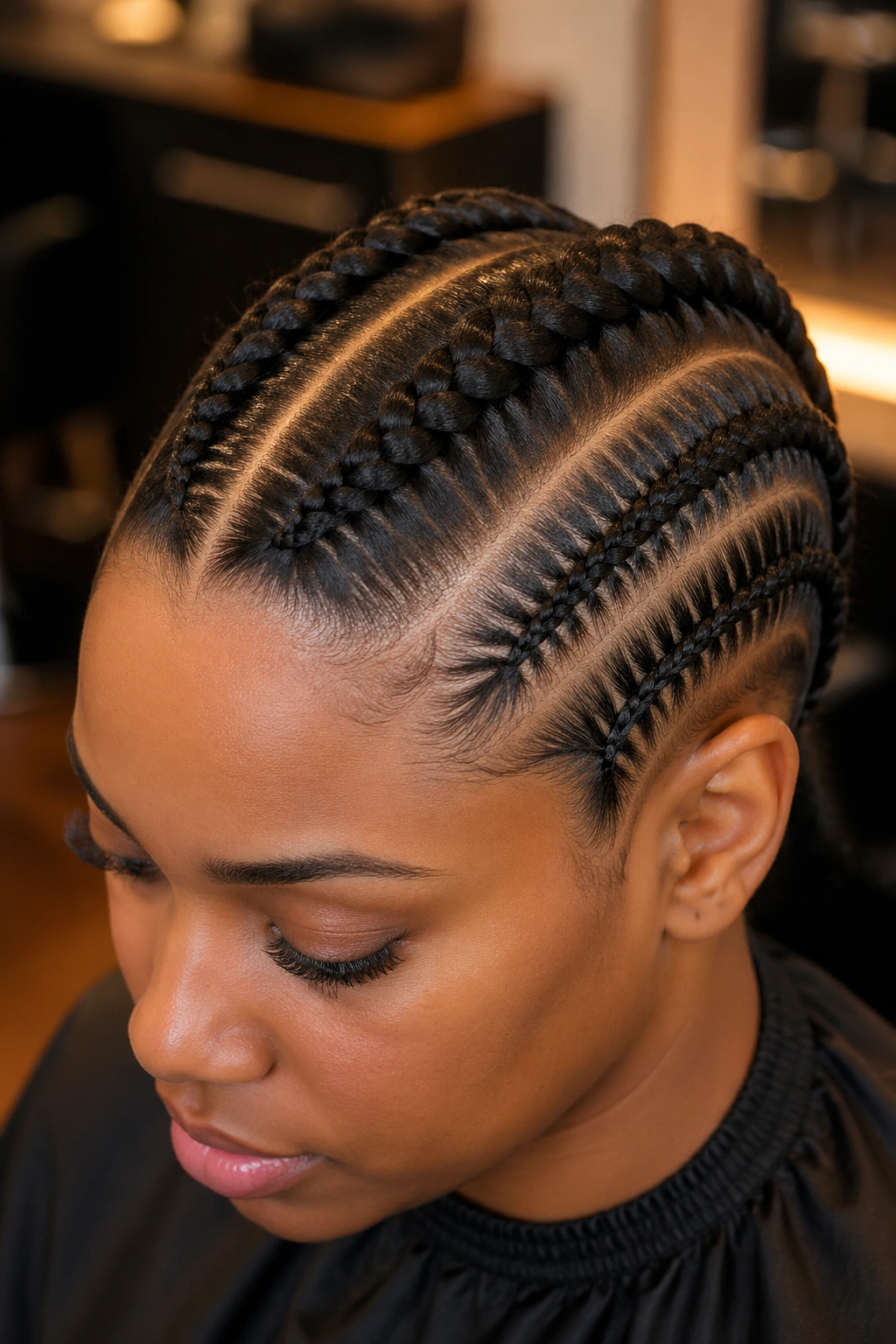
French cornrows in any layout (typically four to six rows) with metal cuffs clipped at the highest points of the braid arc — the sections where the dimensional ridge is most pronounced.
Cuff placement is the styling decision. Cuffs at the peaks emphasize the dimensional quality. Cuffs at the ends only would treat the French cornrow as if it were a standard cornrow.
Three to five cuffs across the head is the right count. More clutters the dimensional visual.
16. French Cornrow Pompadour
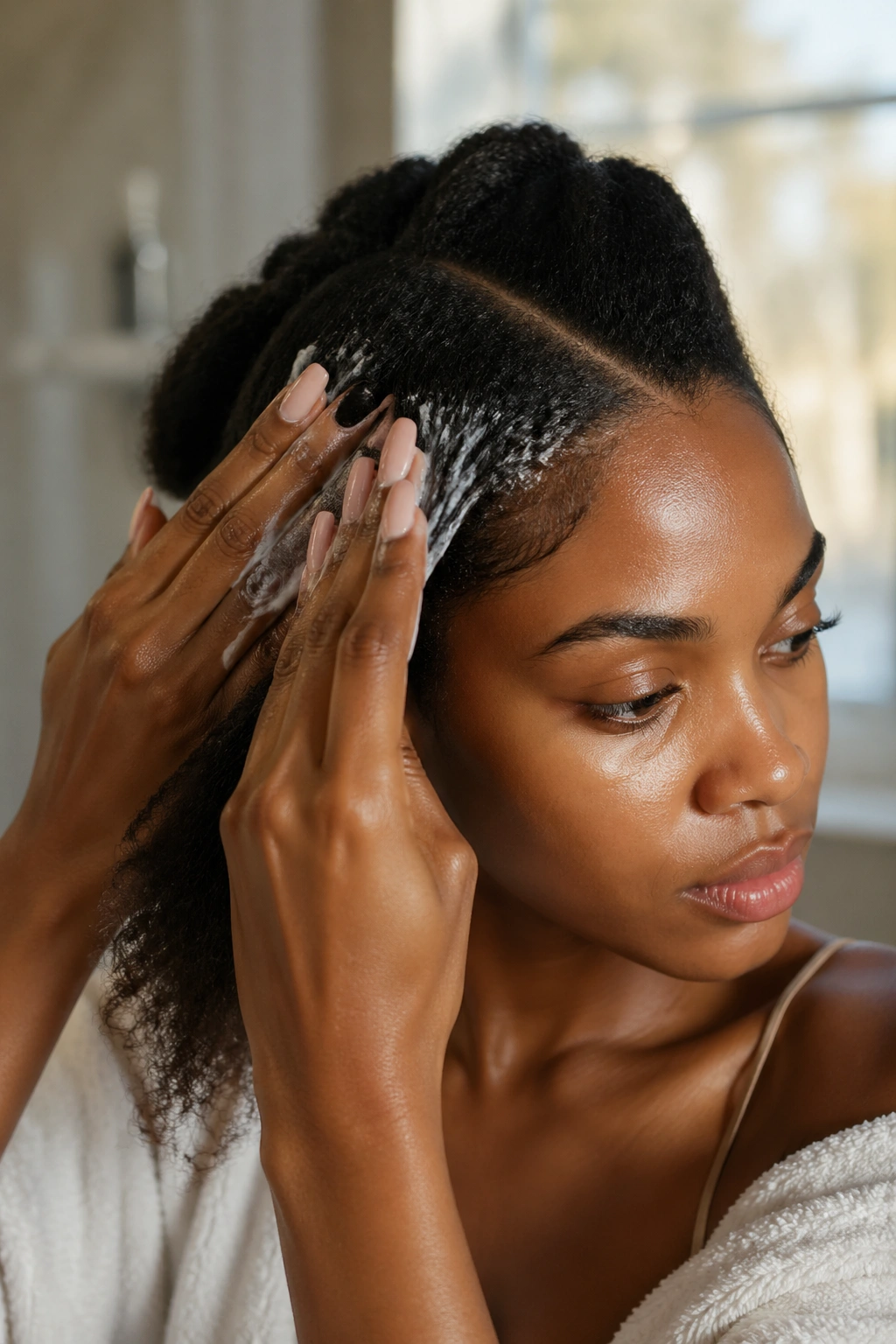
Front French cornrows lift up and over a small filler (a hair donut or a section of teased hair) to create a pompadour silhouette in front. The back of the hair styles separately into a ponytail or chignon.
The pompadour element is dramatic. It transforms a wearable French cornrow style into a statement style.
The filler is essential. Without it, the pompadour collapses. With it, the lifted French cornrows hold their shape for the duration of the install.
17. Soft Curve French Cornrows
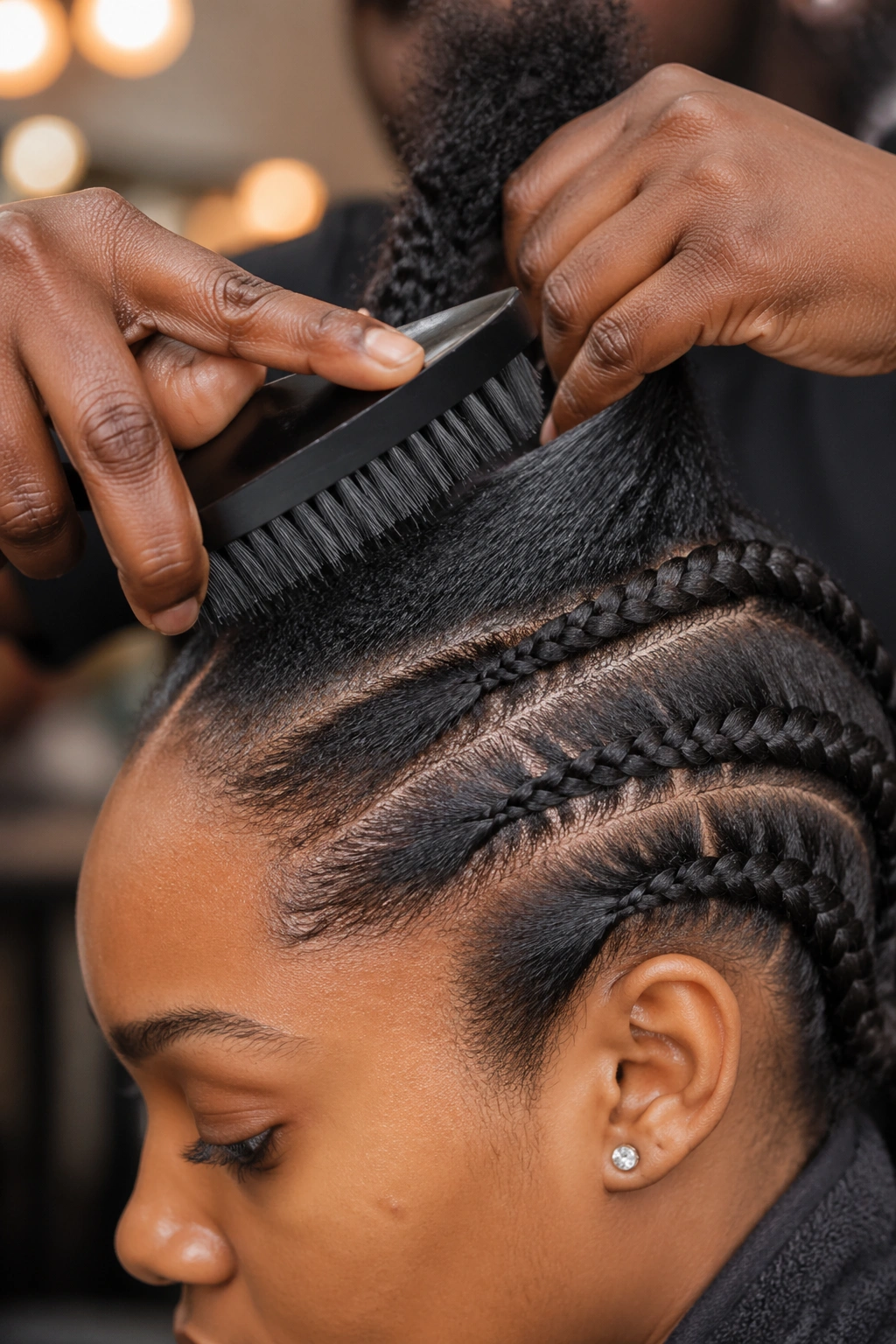
Instead of straight or sharply angled paths, the French cornrows follow gentle S-curves across the head. Three to five curving cornrows from hairline to nape.
The curves do something straight French cornrows can’t — they suggest movement. A curving French cornrow looks like wind blowing through hair frozen in place.
Hard to install precisely without practice. The over-hand pattern has to follow the curve while maintaining tension. A few inconsistencies are forgivable; the curves themselves disguise minor mistakes.
18. French Cornrow With Hidden Braids
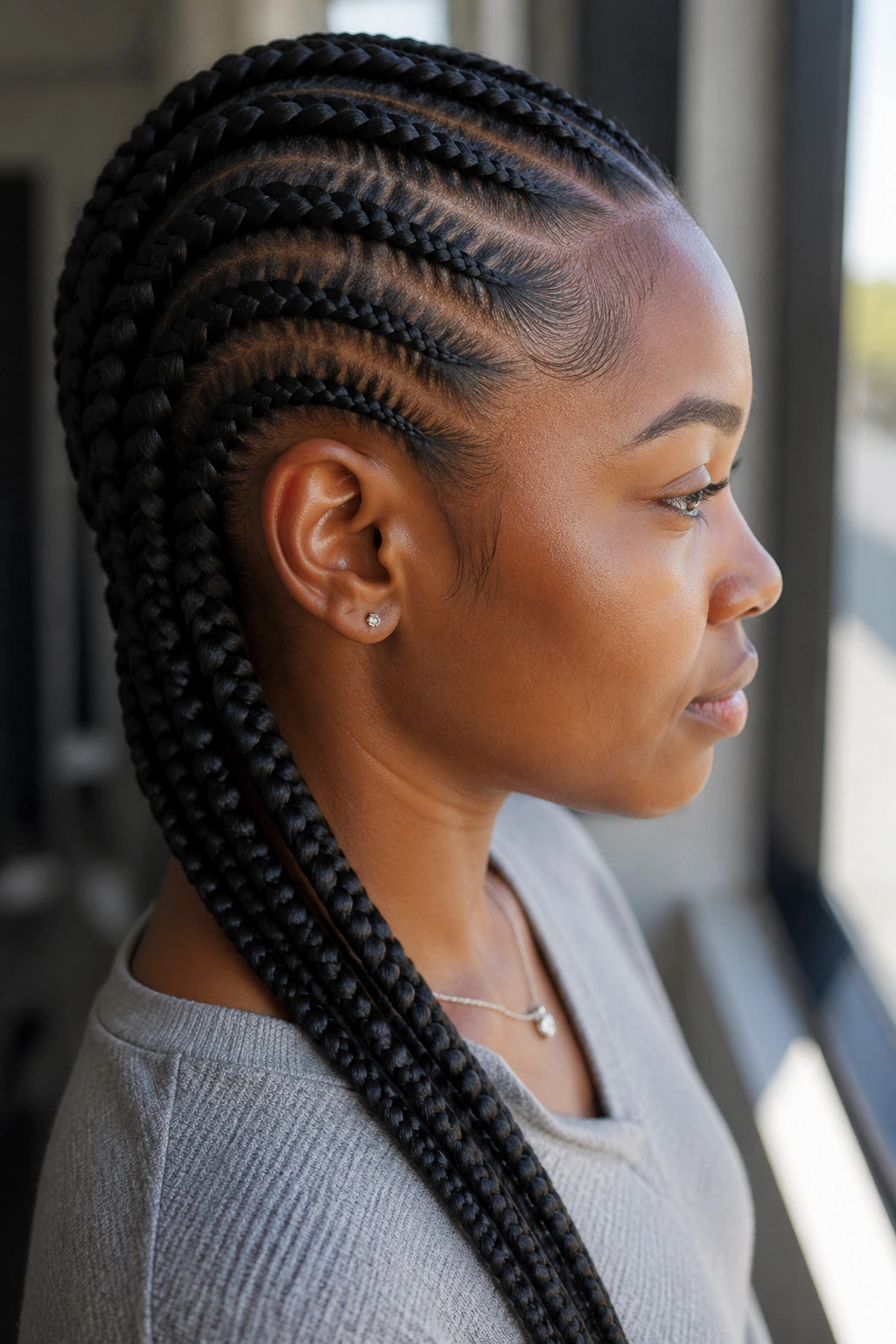
A few visible French cornrows on top combined with smaller, hidden cornrows underneath. The hidden cornrows are functional — they secure the bulk of the hair against the scalp under the visible braids.
For thick, voluminous natural hair especially, the hidden braids prevent the visible French cornrows from sitting on top of a poof of free hair. The base stays flat against the scalp.
The dual-layer approach is a stylist technique that’s rarely visible to the casual viewer. They see two French cornrows. They don’t see the foundational small braids underneath.
19. French Cornrow Faux Hawk With Ponytail Tail
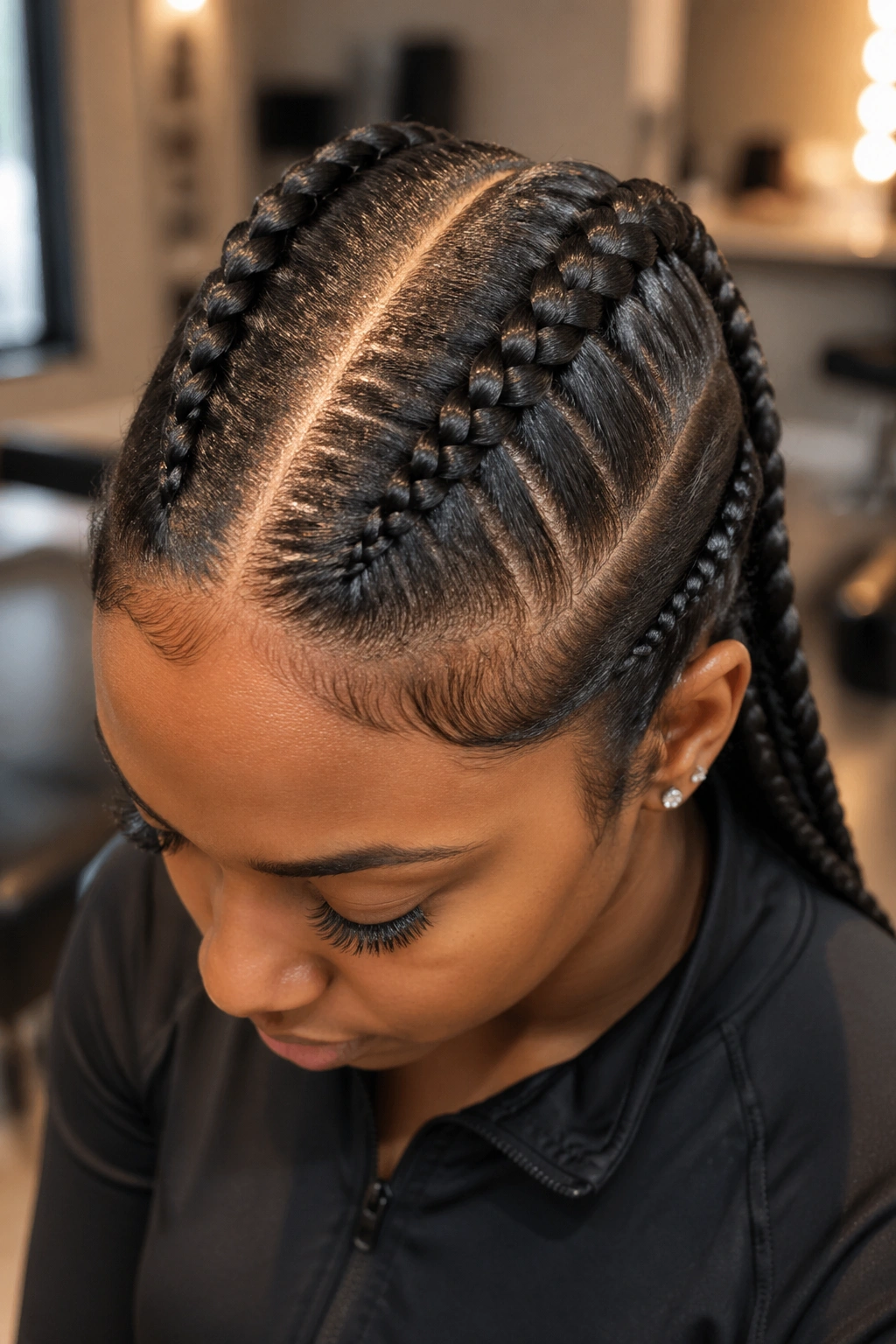
French cornrows on the sides of the head braid toward a center strip. The center strip styles into a high ponytail that falls down the back as a dramatic tail.
The faux hawk shape lifts the silhouette. The ponytail tail provides length and movement. Together the style reads bold without being shocking.
Good for events. Good for performance settings. Less appropriate for everyday work.
20. Tribal French Cornrows With Decorative Elements
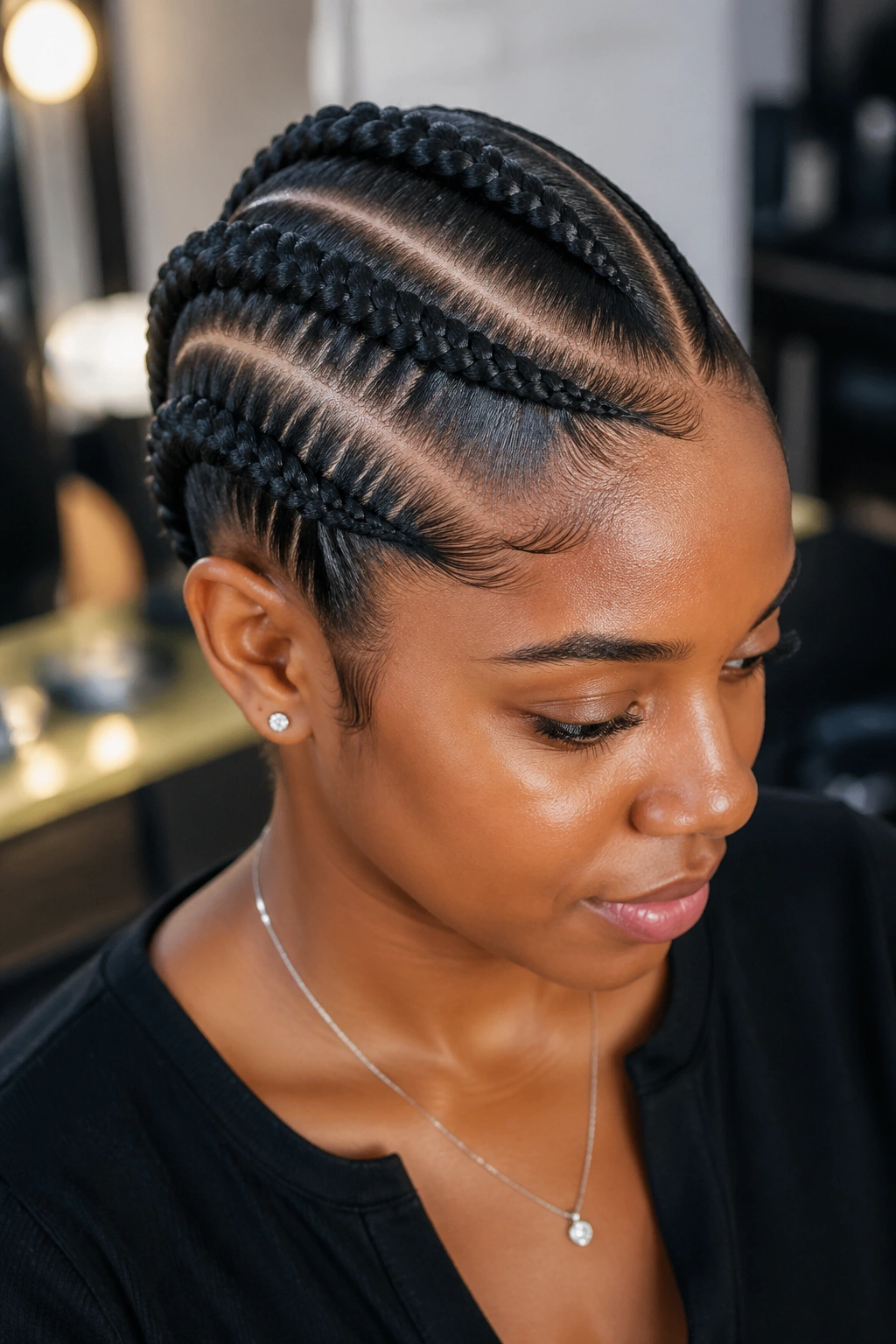
French cornrows arranged in patterns inspired by traditional African braiding: center cornrow with side cornrows curving toward it, beaded sections, cowrie shell accents, optional thread wrapping at certain braid bases.
This is the most decorative French cornrow style. Multiple elements working together — the dimensional braid, the curving paths, the bead and shell ornaments. Reads as a styled cultural look rather than a casual install.
Reserve for occasions where you want the hair to be a centerpiece.
21. Short Natural Hair French Cornrows
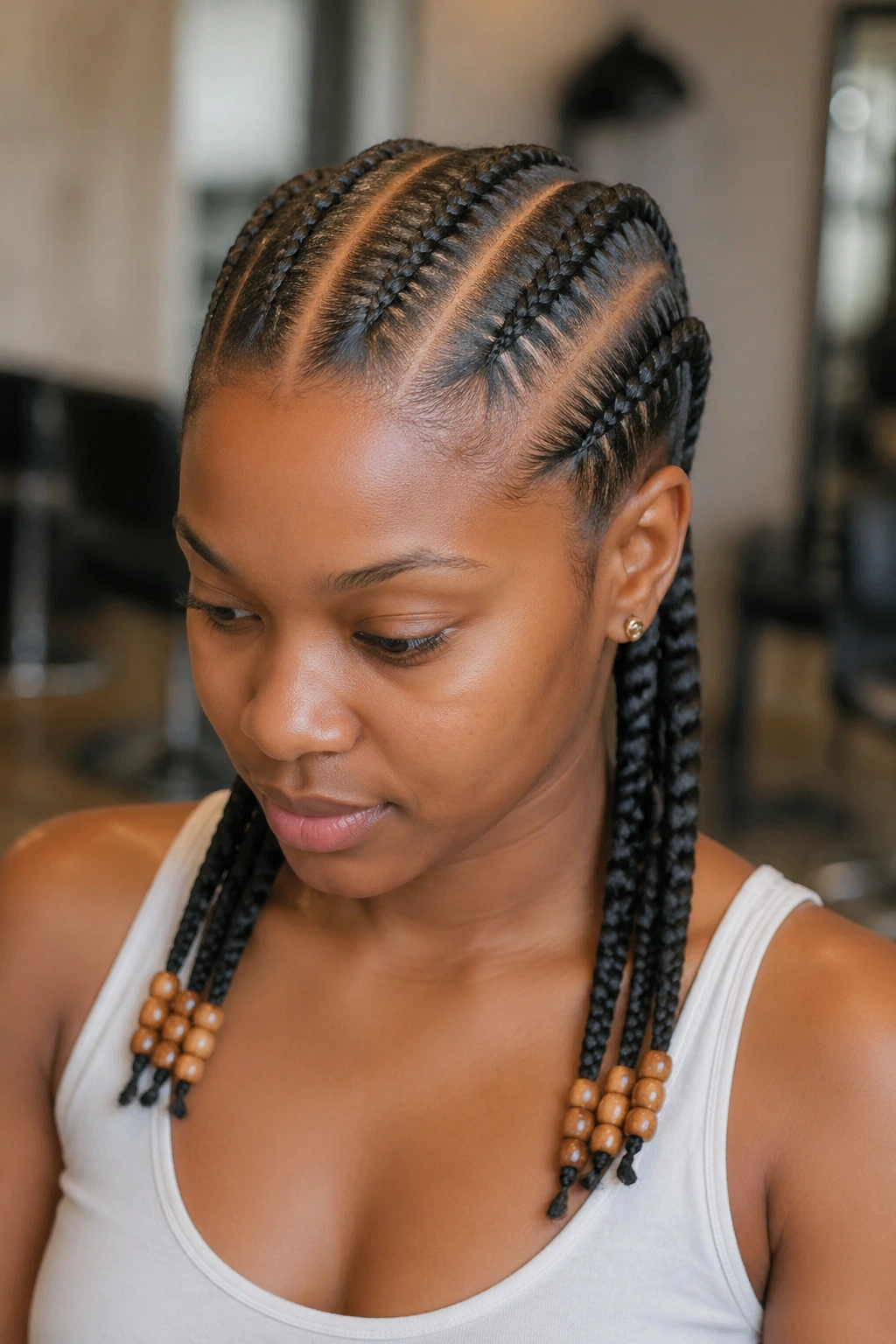
French cornrows installed on natural hair under 6 inches with kanekalon feed-in throughout. The cornrow length comes from the extension hair, while the over-hand French technique gets applied from the start.
Short natural hair can absolutely wear French cornrows. The feed-in pattern allows the dimensional braid to develop from the first inch of the install.
Use kanekalon that matches your natural color unless you’re going for an intentional color contrast.
22. Two Thin French Cornrows With Loose Hair
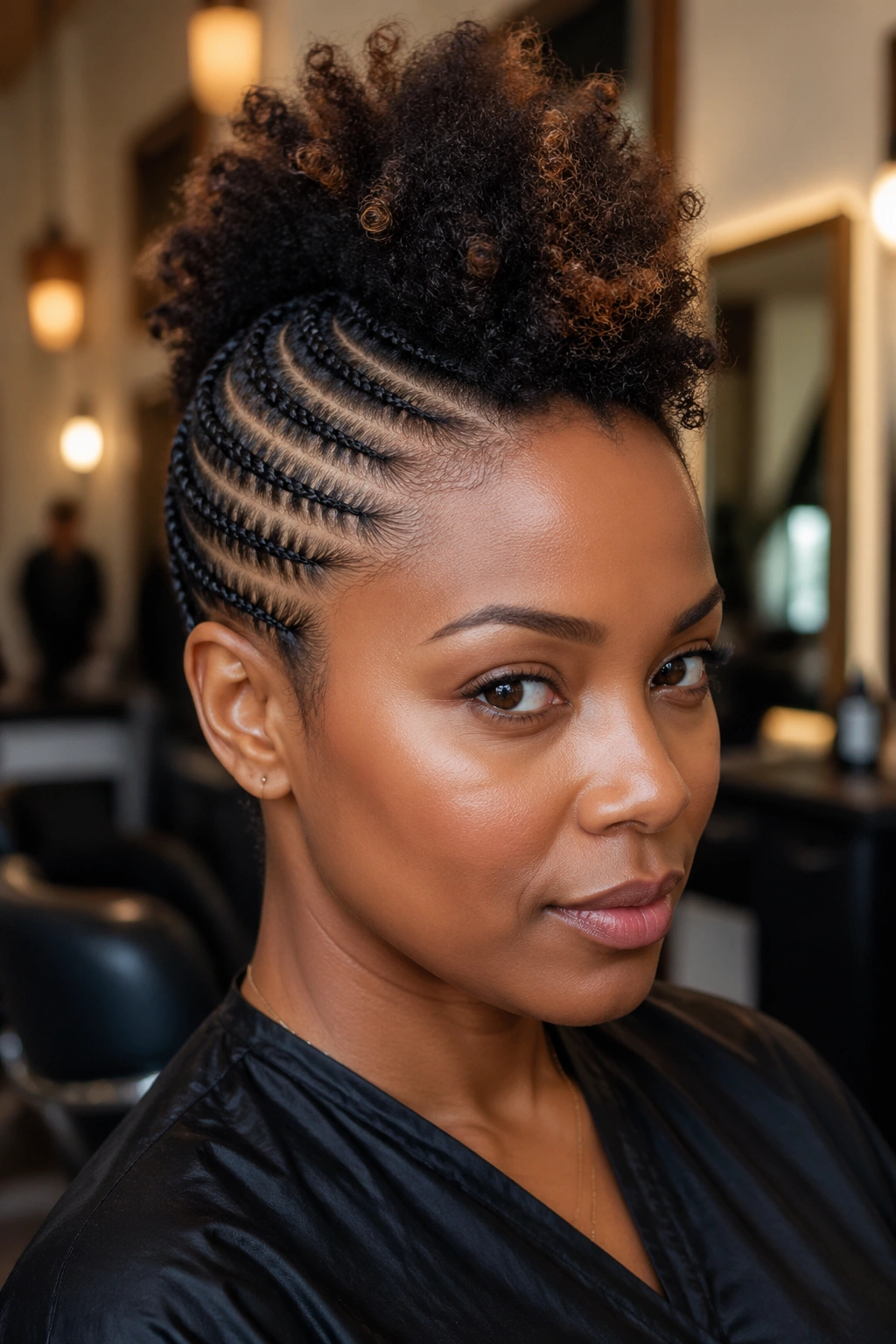
A scaled-down version of the classic two-braid look. Two thin French cornrows — about half the width of the standard chunky version — with the rest of the hair left loose around them.
The thin braids read as accent details rather than as the main hairstyle. Loose natural hair is the dominant feature; the French cornrows add structural punctuation.
Good for: photo shoots, weddings (as a guest), date nights, any setting where loose natural hair is the goal but you want some structural detail.
Maintenance to Hold the Dimensional Braid Pattern
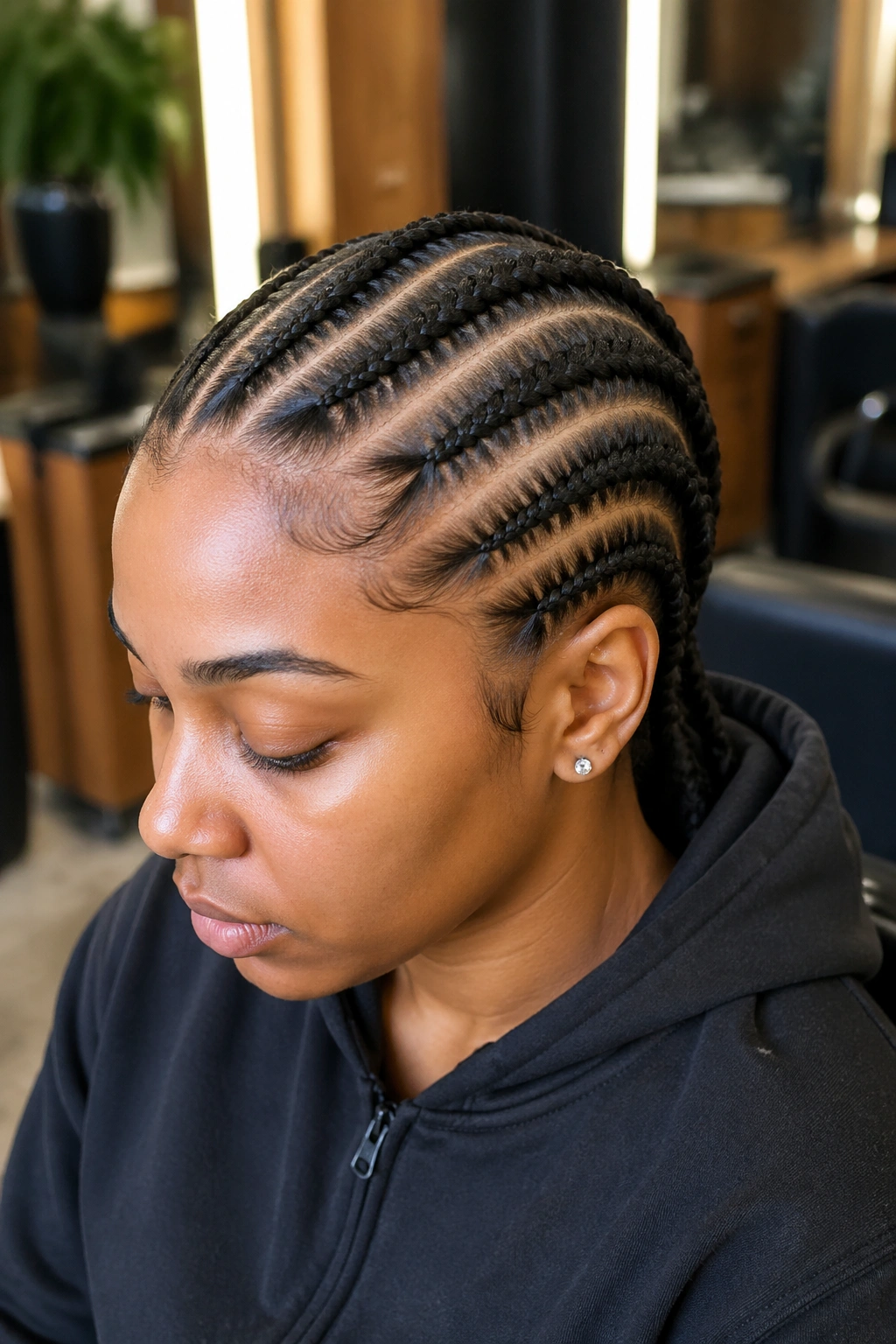
The raised quality of French cornrows is the whole point. Protecting that raised pattern overnight matters more than for standard cornrows.
A satin bonnet that fits without compression is essential. A tight bonnet flattens the dimensional ridge. Look for a bonnet sized one step larger than your usual fit.
A silk pillowcase as a backup for nights you forget the bonnet. The lower friction protects the braid pattern even without coverage.
Avoid touching the braids constantly. Frequent handling pats the dimensional ridge flat. Hands off as much as possible.
Refreshing French Cornrows Without Re-Installing
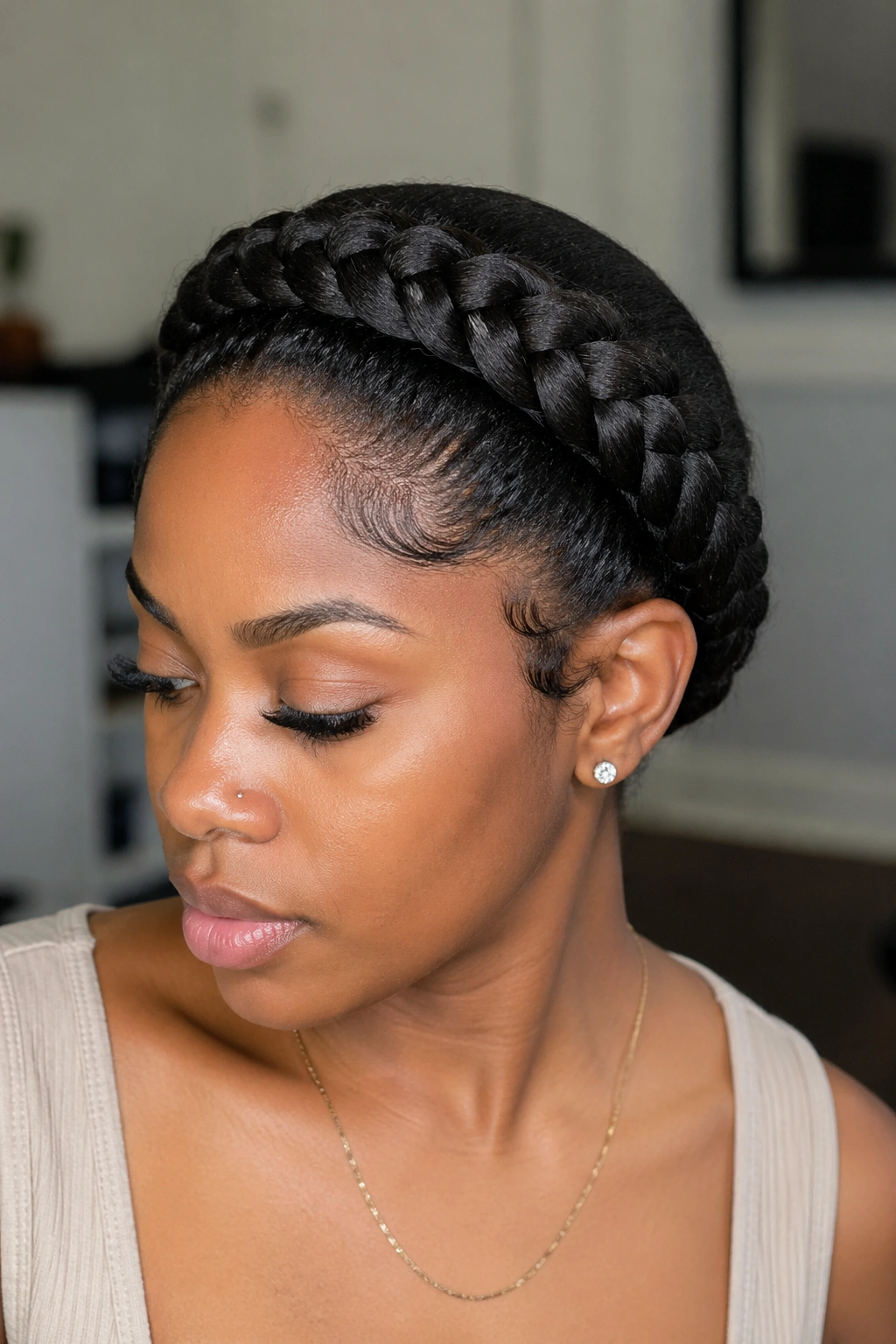
By day 7-10, the dimensional ridge starts compressing. Refresh tactics:
A small flat-iron set to low heat can re-define the ridge. Pinch the iron along the braid path to re-set the dimensional bumps. Use heat protectant first. Do this sparingly — once or twice during the install life.
A spray of light hairspray (the kind with flexible hold) along the braid line can crisp the dimensional pattern temporarily.
Re-laying edges and brushing baby hairs gives the front a freshly-installed look that translates to the whole style reading newer.
Scalp Care Under French Cornrows
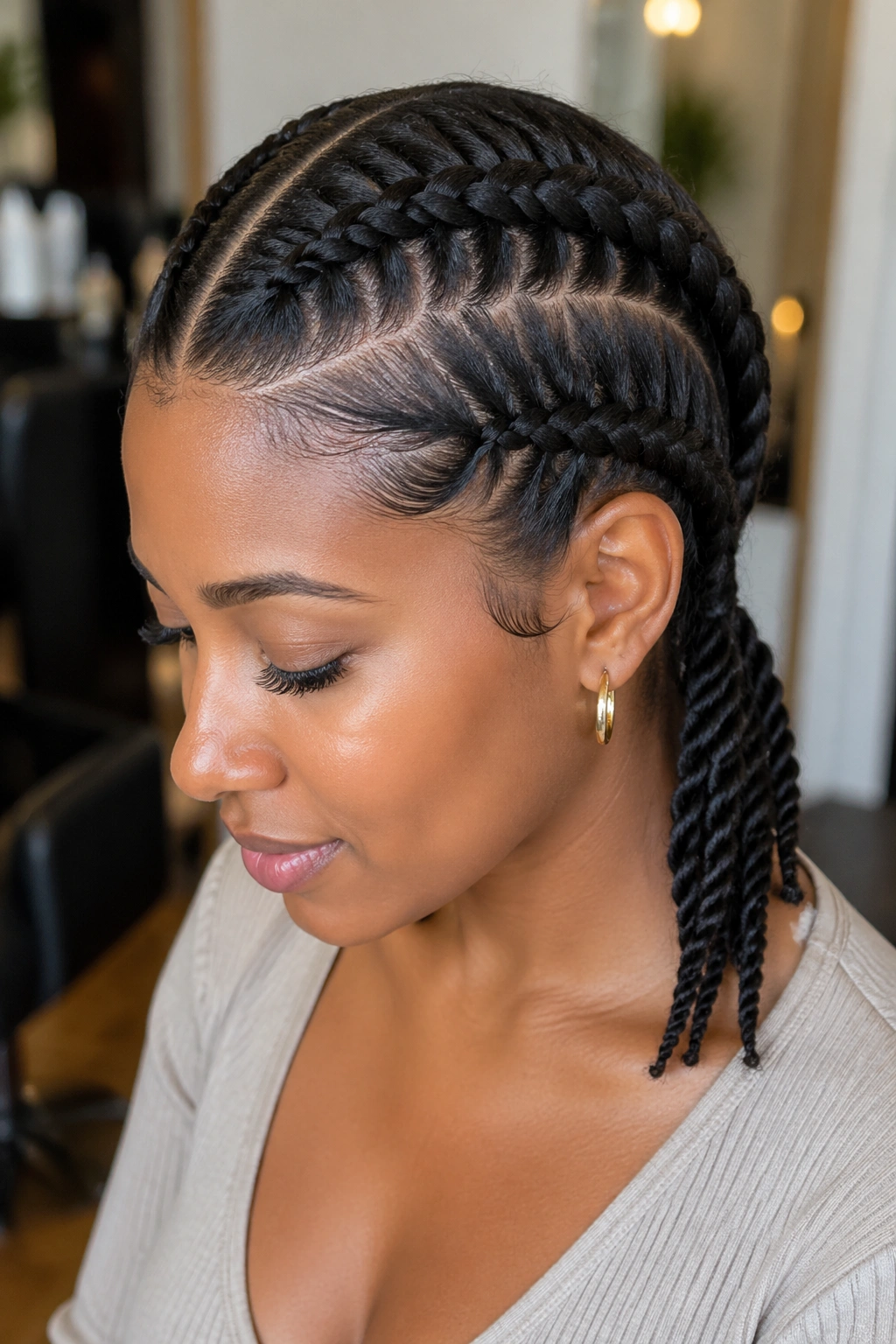
The scalp under French cornrows experiences different tension patterns than under standard cornrows. The over-hand technique pulls slightly toward the front of each braid path rather than backward.
Watch the hairline. Front edges sometimes show stress under French cornrows that they wouldn’t show under standard cornrows. If you notice tenderness or small bumps within the first 48 hours, the install may be too tight.
Lightweight scalp oil applied every 3-4 days. Diluted apple cider vinegar rinse weekly. Standard cornrow scalp care applies — don’t overdo it.
Takedown Considerations
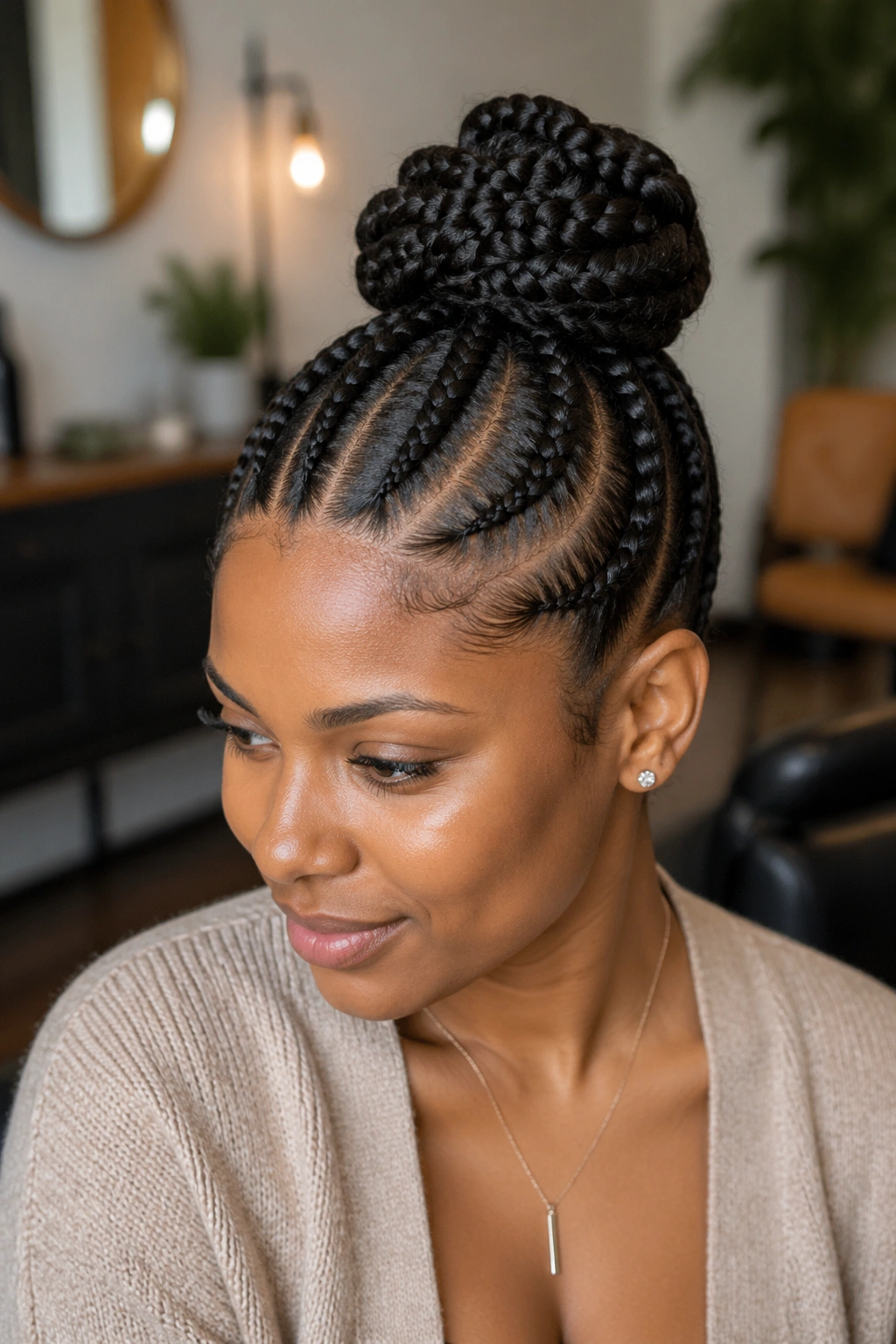
French cornrows take longer to unbraid than standard cornrows. The over-hand pattern interlocks more tightly than the under-hand pattern. Expect 1-2 hours for a full takedown.
Saturate each braid with conditioner or oil before unraveling. Work from tip to root. The over-hand crosses come undone in the reverse direction from how they were braided.
Detangle wet, not dry. The dimensional braid pattern means more crosses per inch than a flat cornrow, which means more potential breakage points if you rush.
After takedown, deep condition for 30-45 minutes. The over-hand tension fatigues the strand more than standard cornrowing. Restoration time is real.
Choosing French Cornrows for Your Goals
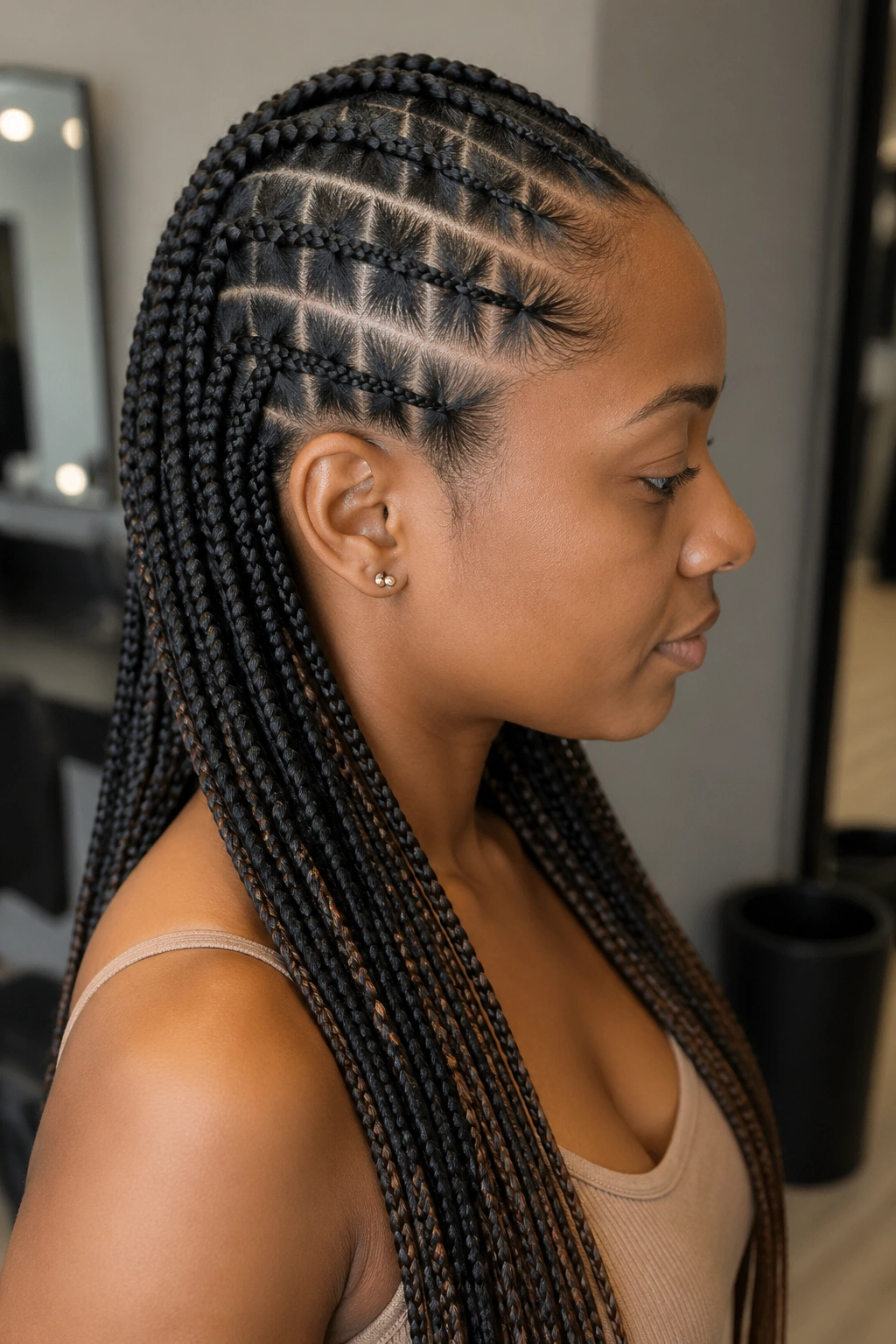
For maximum drama with minimum install time: two classic French cornrows.
For everyday wear with dimensional appeal: six French cornrows all-back.
For occasions: French cornrow updo bun, beaded French cornrows with color, or tribal French cornrows with decorative elements.
For protection with personality: French cornrows with curly tail out or French cornrows with loose sides.
For low commitment: French cornrow bangs or two thin French cornrows with loose hair.
Pick based on the result you want, not based on which style appears most photographed elsewhere. The right French cornrow is the one that fits your hair length, your install confidence, and the life you’re living during the weeks you’ll wear it.
Common French Cornrow Mistakes
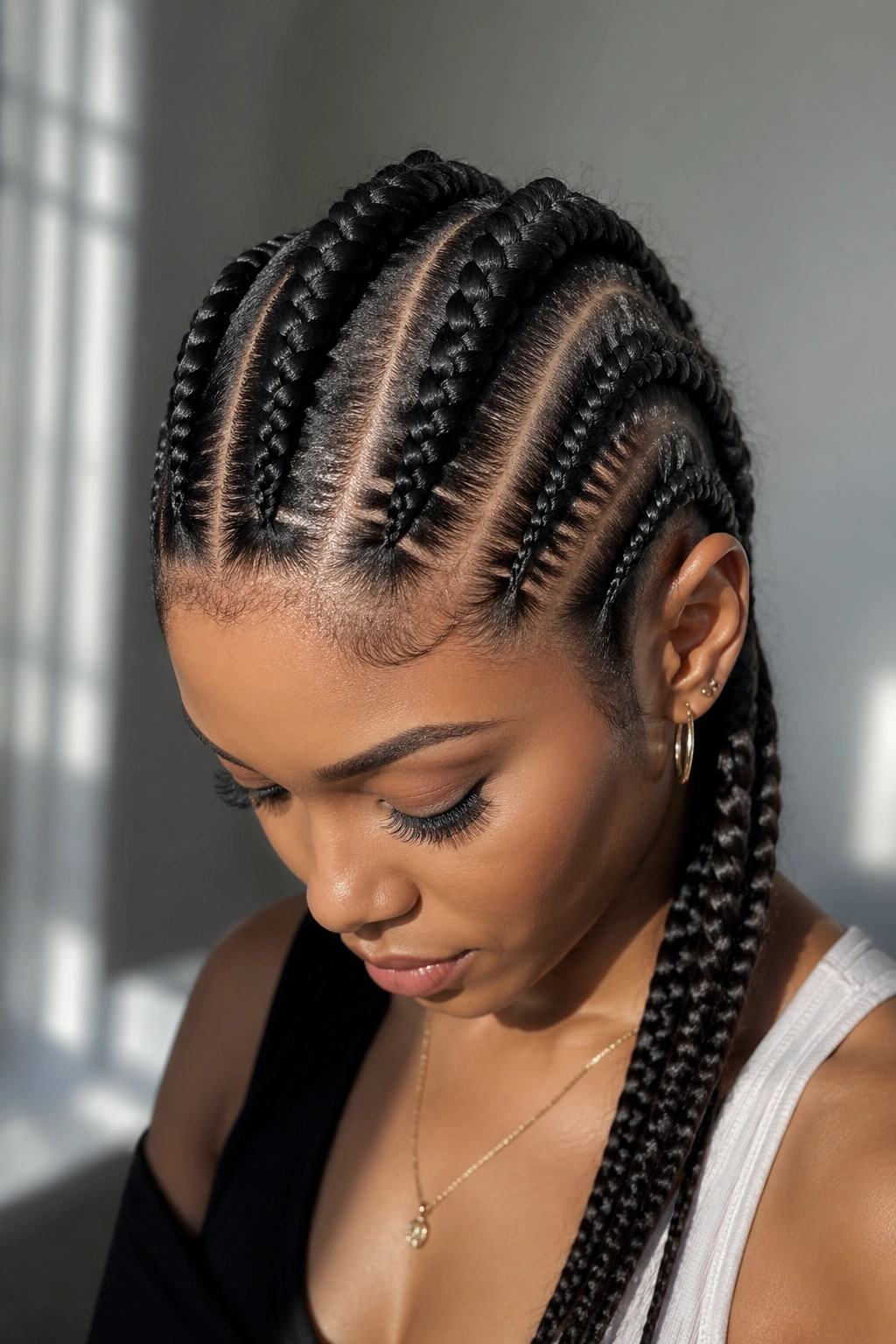
Treating French cornrows like standard cornrows. The over-hand technique is genuinely different. Watch a French cornrow tutorial — not a generic cornrow tutorial — before attempting.
Using too much product. The over-hand pattern needs friction. Heavy product reduces friction. A small amount of edge gel and styling foam is enough.
Braiding too tight. The dimensional ridge can hide tension issues. If you can’t blink your eyes comfortably, the install is too tight.
Mixing French and standard cornrows in the same head without intention. If you mean to combine the two techniques as a stylistic choice, fine. If you slip into one because you’re more comfortable with it, the inconsistency shows.
Skipping the bonnet at night. The dimensional braid pattern is the whole reason for choosing French cornrows. Flatten it overnight and you’ve lost the style’s defining feature.
Get the technique right, protect the dimensional pattern, and French cornrows will deliver weeks of standout protective styling that nothing else in the cornrow category quite matches.