


Fulani braids with curls have become one of the most recognizable and celebrated natural hair styles worn by Black women — and there’s deep meaning behind every element of the look. The style draws from the rich braiding traditions of the Fula (Fulani) people of West Africa, where hair has long served as a marker of identity, age, and community belonging. Wearing Fulani braids today, especially when combined with the natural curl texture of your own hair, is both a style choice and a cultural connection.
The Origins of Fulani Braiding Traditions
The Fulani people — one of the largest ethnic groups in West Africa, spread across Senegal, Guinea, Mali, Nigeria, and more than twenty other countries — have practiced distinctive hair braiding for generations. Traditional Fulani hairstyles typically feature a cornrow running along the center of the head from front to back, two or more cornrows angled toward the sides, and the hair gathered into a bun or knot at the nape. The braids are often decorated with beads, cowrie shells, and gold or silver cuffs — each decoration carrying its own significance within Fulani culture.
What makes Fulani braids different from other cornrow styles is this specific configuration: the center braid, the angled side braids, and the decorative elements. The combination creates a face-framing effect that’s both symmetrical and slightly asymmetric, depending on how the side braids are positioned. When natural curls are incorporated — either as the bun at the back, as free sections between the braids, or as styled sections that frame the face — the style bridges cultural tradition with the celebration of natural curl texture.
Understanding this origin doesn’t just add meaning to the style — it also helps you execute it with greater accuracy. Fulani braids aren’t just any cornrow arrangement. The specific geometry and placement matter.
Breaking Down the Fulani Braid Structure
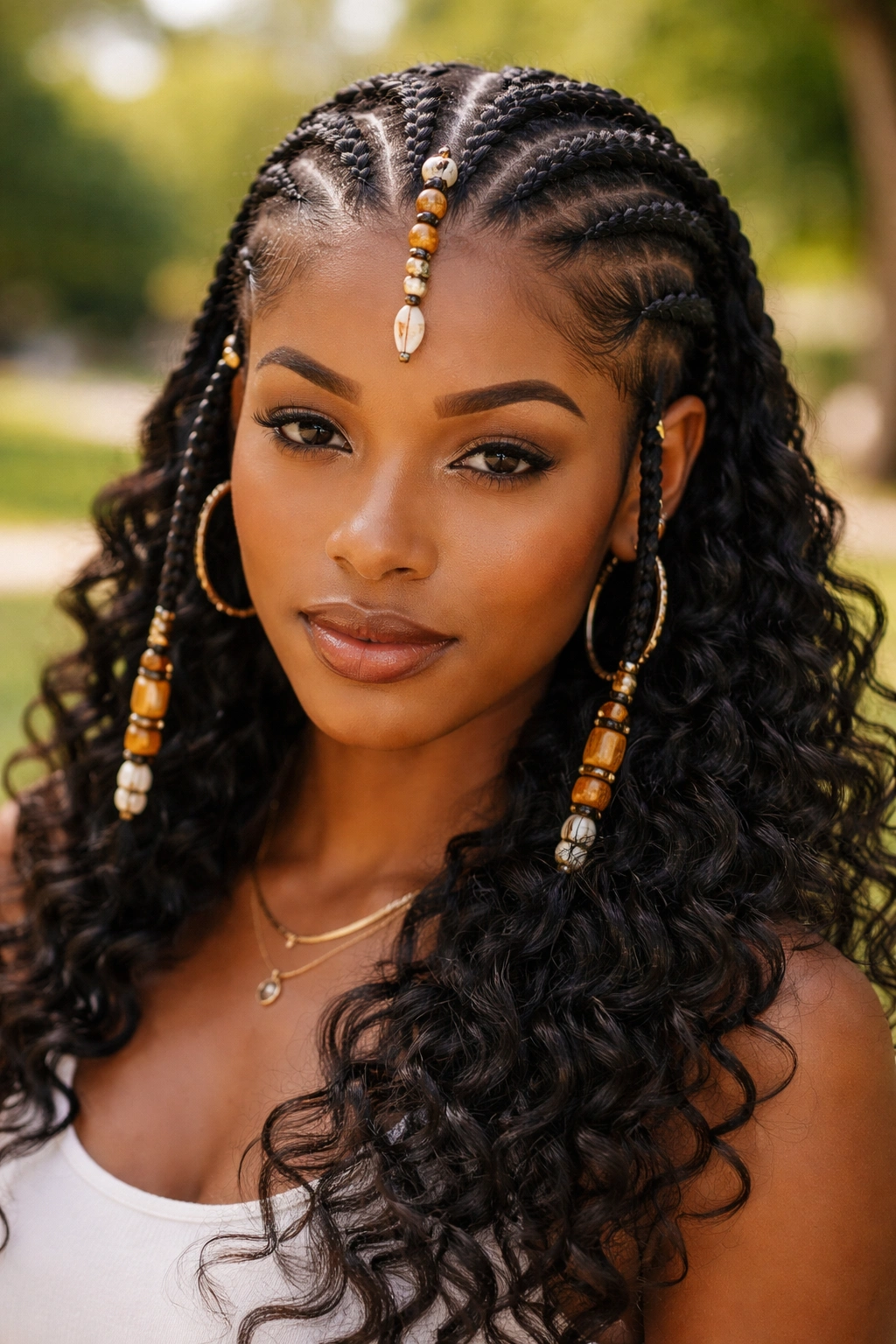
The classic Fulani braid configuration has a few defining characteristics that distinguish it from other braided styles.
The center braid runs from the very front of the hairline, directly along the center part, backward toward the nape. This braid is the spine of the style. It’s often the most decorated braid, with beads or cuffs placed along its length. When combined with curls, this center braid remains visible whether the curls are worn loosely or gathered.
The side braids angle outward from the center braid, typically starting near the temples and sweeping toward the sides or back. There can be one, two, or three side braids on each side. More braids create a denser, more intricate look; fewer braids leave more of the natural curl section visible and free.
The back section in traditional Fulani styles is often gathered into a bun or folded knot. In Fulani braids with curls, this becomes the natural curl section — free, defined, and prominently displayed. The transition from the braided crown and sides to the curly back section is the visual climax of the style.
Decorative elements are integral, not optional. Beads threaded onto the ends of the braids are the most traditional decoration. Gold or silver cuffs placed along braid lengths add shimmer. Cowrie shells carry specific cultural meaning and are a beautiful addition for anyone who wants to honor the tradition most fully.
Choosing the Right Braids for a Fulani Style With Curls
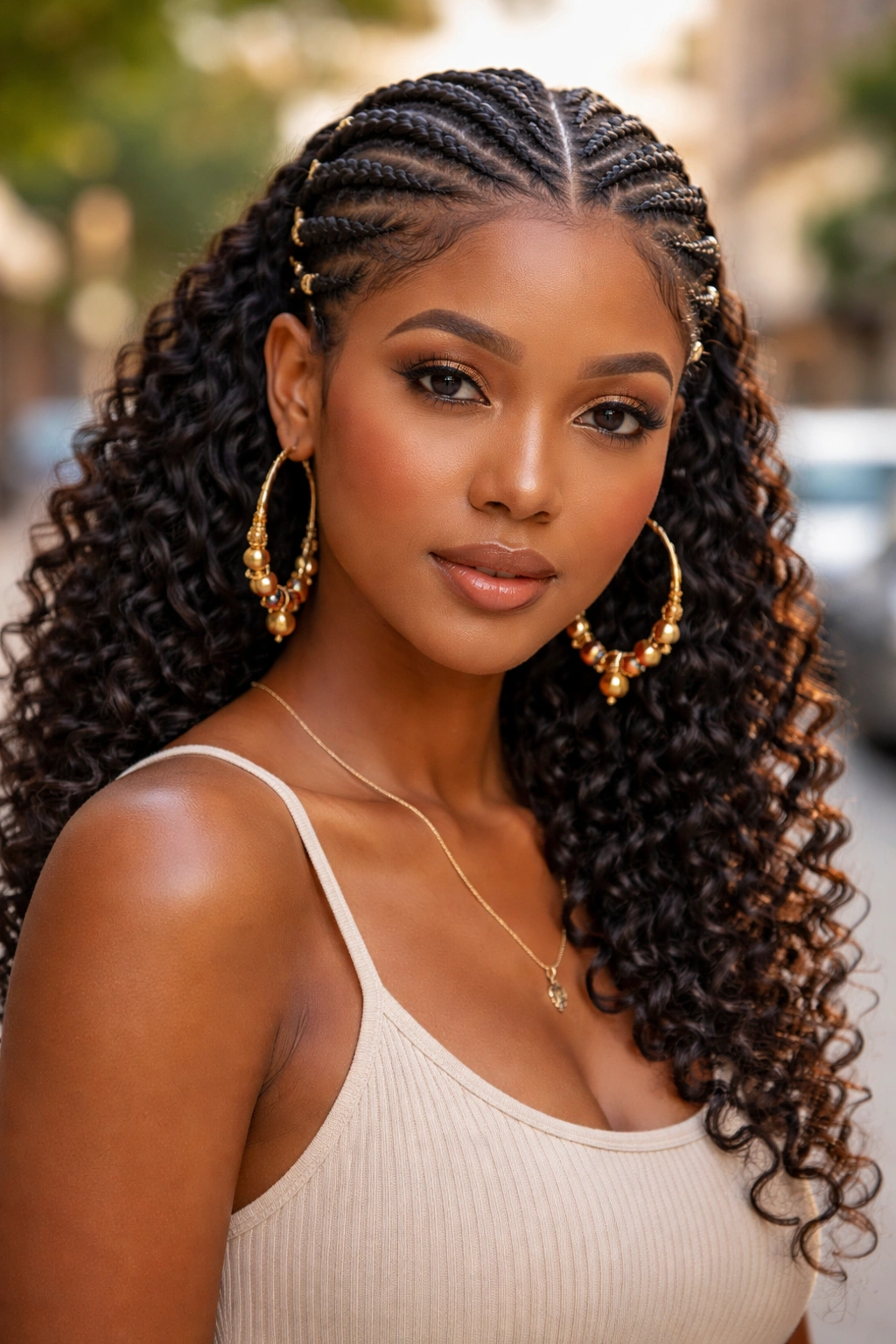
Not all braiding approaches work equally well in a Fulani configuration. The style calls for braids that lie flat against the scalp and stay neat over time — which points toward cornrows or flat twists rather than individual box braids.
Cornrows are the most traditional choice. They sit flat against the scalp, hold their shape for weeks, and take decorations beautifully. For Fulani braids with curls, cornrows in the prescribed Fulani configuration (center + angled sides) with natural curls left free in the back and sides create the most authentic version of the style.
Flat twists offer a softer alternative. They sit slightly raised compared to cornrows and have a different surface texture — more ridged, slightly looser. Flat twists in a Fulani configuration look beautiful and are easier to self-execute than cornrows, making them a good option for those who don’t have a braider available.
Feed-in braids — cornrows that start thin at the hairline and widen as extensions are added — give Fulani braids a tapered, dimensional appearance that looks polished and deliberate. Feed-in braids also allow for longer, heavier braids than natural hair alone might support, enabling more dramatic decoration with large beads or shells.
Styling the Curl Section
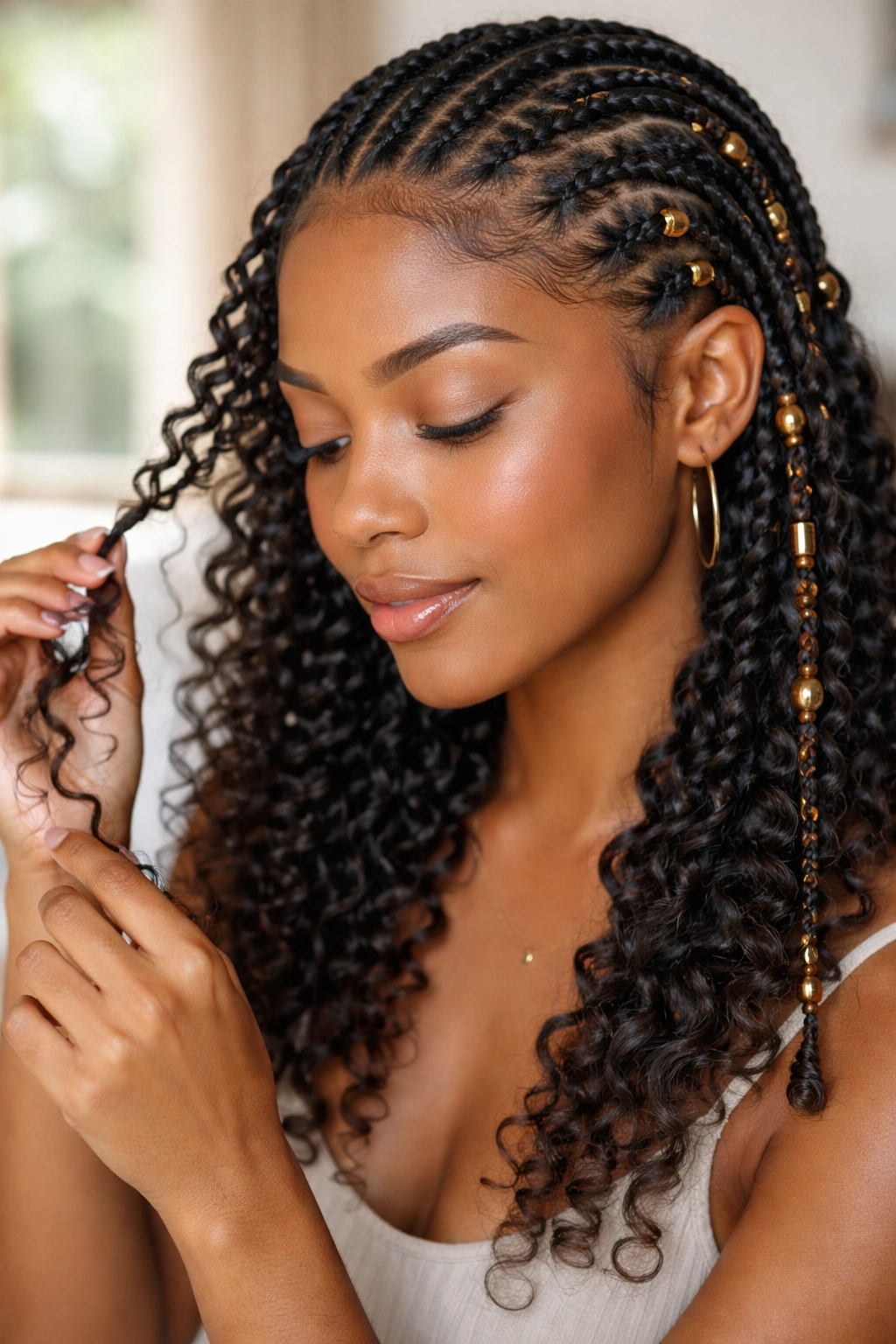
The curl section in Fulani braids with curls deserves as much attention as the braided section. These are the curls that the braids frame — the part of the style that shows off your natural texture — and they need to be at their most defined and moisturized.
Wash and condition the hair thoroughly before braiding. Apply a generous leave-in conditioner to all sections, including the ones that will be braided. Then apply your curl defining product — cream, gel, or a combination — to the sections that will remain as curls. Encourage the curl formation by scrunching upward and defining sections with your fingers or a denman brush.
Let the curl sections dry completely before considering the style finished. Wet or damp curls next to finished braids will frizz as they dry, and the disruption can’t be undone without starting over.
For the best curl definition in the sections that remain free, consider doing your wash-and-go routine the day before you braid. This way, the curls are fully set and defined before any braiding begins.
Decorating Fulani Braids
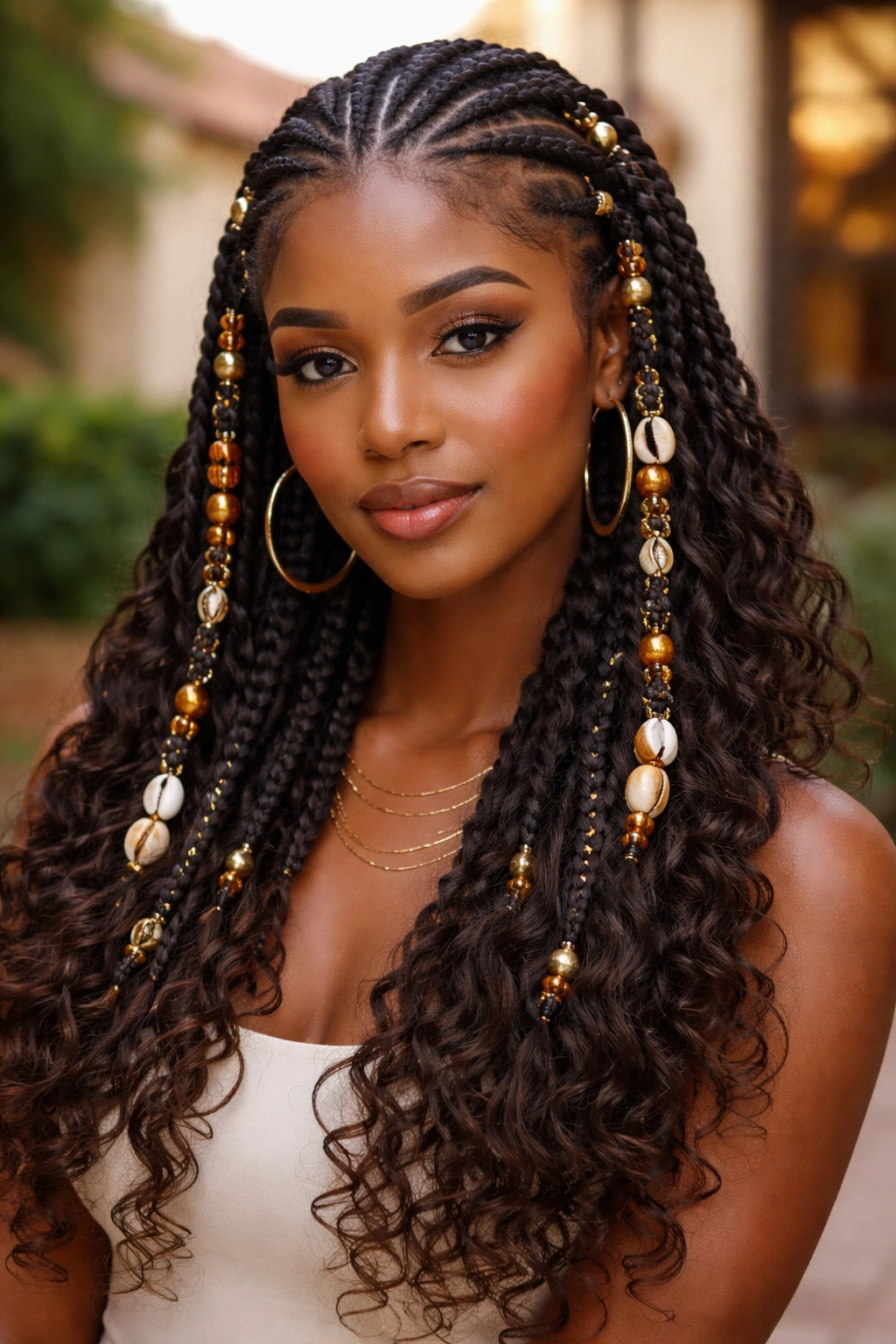
Decoration is inseparable from Fulani braids. The way you decorate the braids changes the feel and formality of the entire style.
Beads are the most common decoration. Small wooden beads in warm earth tones create a natural, bohemian look. Gold metallic beads create a formal, elevated appearance. Colored plastic or acrylic beads read as playful and youthful. Thread each bead onto the braid as you go, or add them after braiding by threading the braid end through the bead and knotting the braid tip to keep the bead in place.
Gold cuffs (also called hair rings or hair cuffs) are placed along the length of the braid, not just at the end. Slide each cuff over the braid at evenly or irregularly spaced intervals. The cuffs grip the braid when gently pressed closed. For Fulani braids with curls, gold cuffs create a metallic shimmer that contrasts beautifully with the darker natural curl section.
Cowrie shells are the most culturally significant decoration. In many West African traditions, cowrie shells represent fertility, prosperity, and connection to the ocean and the divine feminine. They can be threaded onto the braids at the tips or incorporated along the braid length by threading a small amount of braiding hair through the shell’s opening and incorporating it into the braid.
1. Classic Fulani Cornrows With Natural Curl Back Section
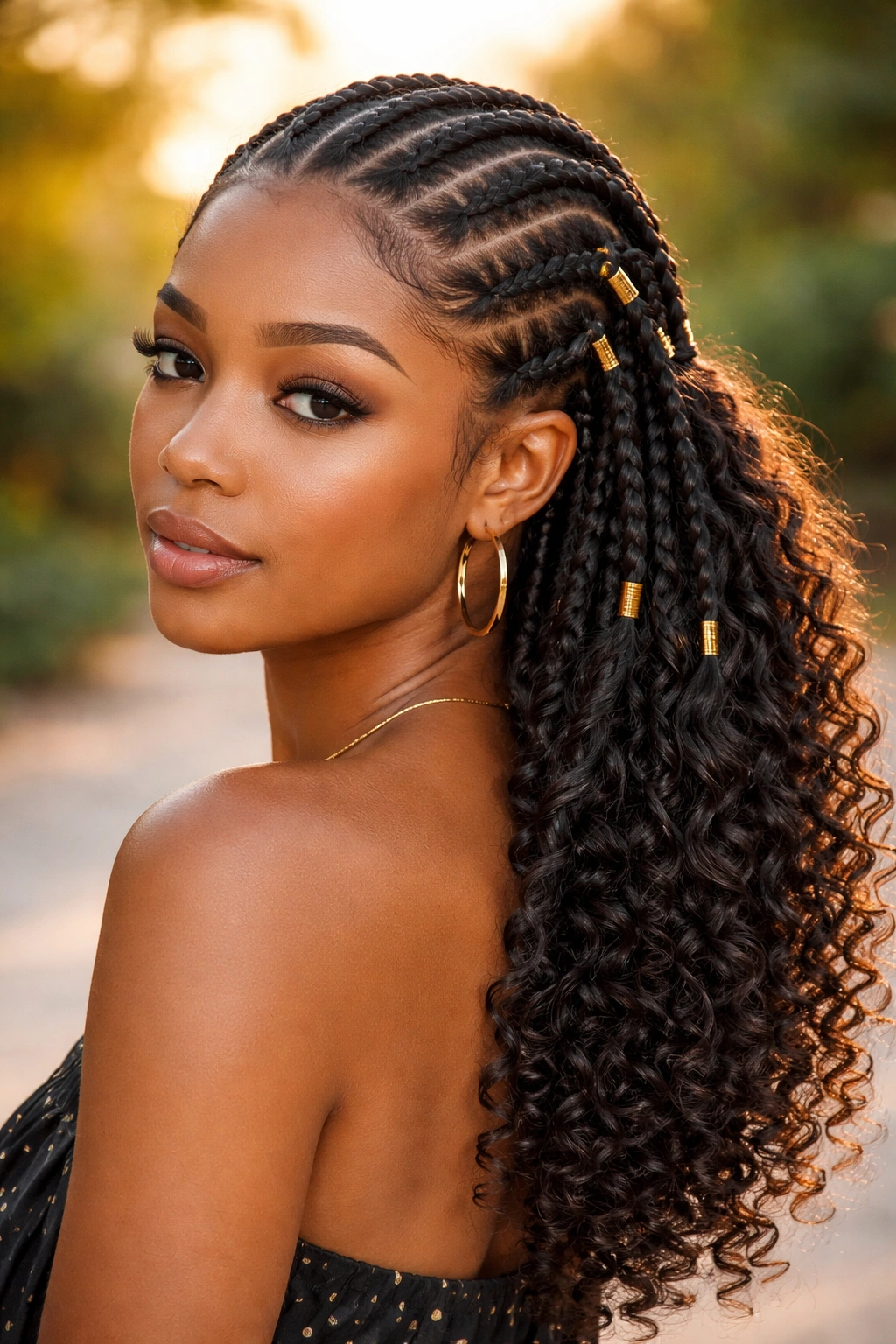
The most traditional interpretation: a center cornrow running from the front hairline to the nape, two angled side cornrows on each side sweeping toward the back, and the back section left entirely as free natural curls. The braids are decorated with small gold cuffs placed every one to two inches along each braid.
Executing the Center Braid
Start the center braid at the very front of the hairline. Create a clean part from the forehead to the nape. Begin cornrowing from the front, adding hair from each side as you move backward. Keep consistent tension and even spacing. This braid should be the straightest and most precise braid in the style.
The side braids angle outward at roughly 30-45 degrees from the center braid. They begin near the temples and sweep toward the ears or the back of the head. The natural curl section fills the space between the outermost side braids and behind the nape.
Position the gold cuffs every inch to inch and a half along each braid. They should be visible from the front — so place them starting from the temple forward, not just at the back.
2. Fulani Flat Twists With Curly Bun
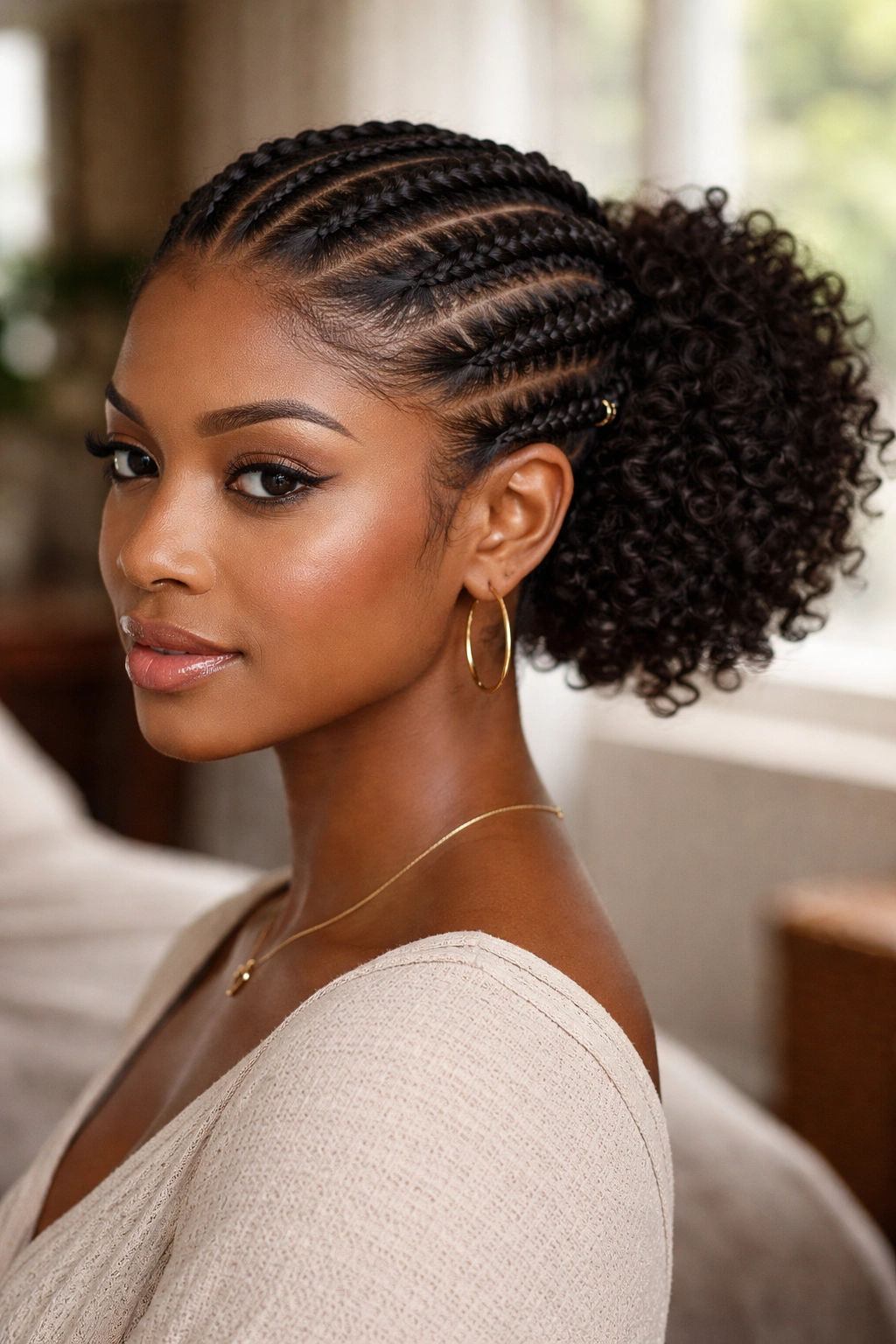
Instead of cornrows, the Fulani configuration is created using flat twists. The center flat twist runs along the center part. Side flat twists angle outward from each side. At the back, the hair is gathered into a curly bun — a full, round cluster of natural curls secured loosely at the nape.
Flat twists have a different visual character from cornrows: they’re raised and ridged rather than flat and smooth. On natural hair, this difference is beautiful — the raised ridges catch light and create shadow, making the style more dimensional.
The curly bun at the nape is the style’s focal point. Make it as full and round as possible. Don’t over-control it — a slightly imperfect, voluminous bun looks more organic and beautiful than a tightly pinned-down one.
3. Fulani Feed-In Braids With Long Curl Cascade
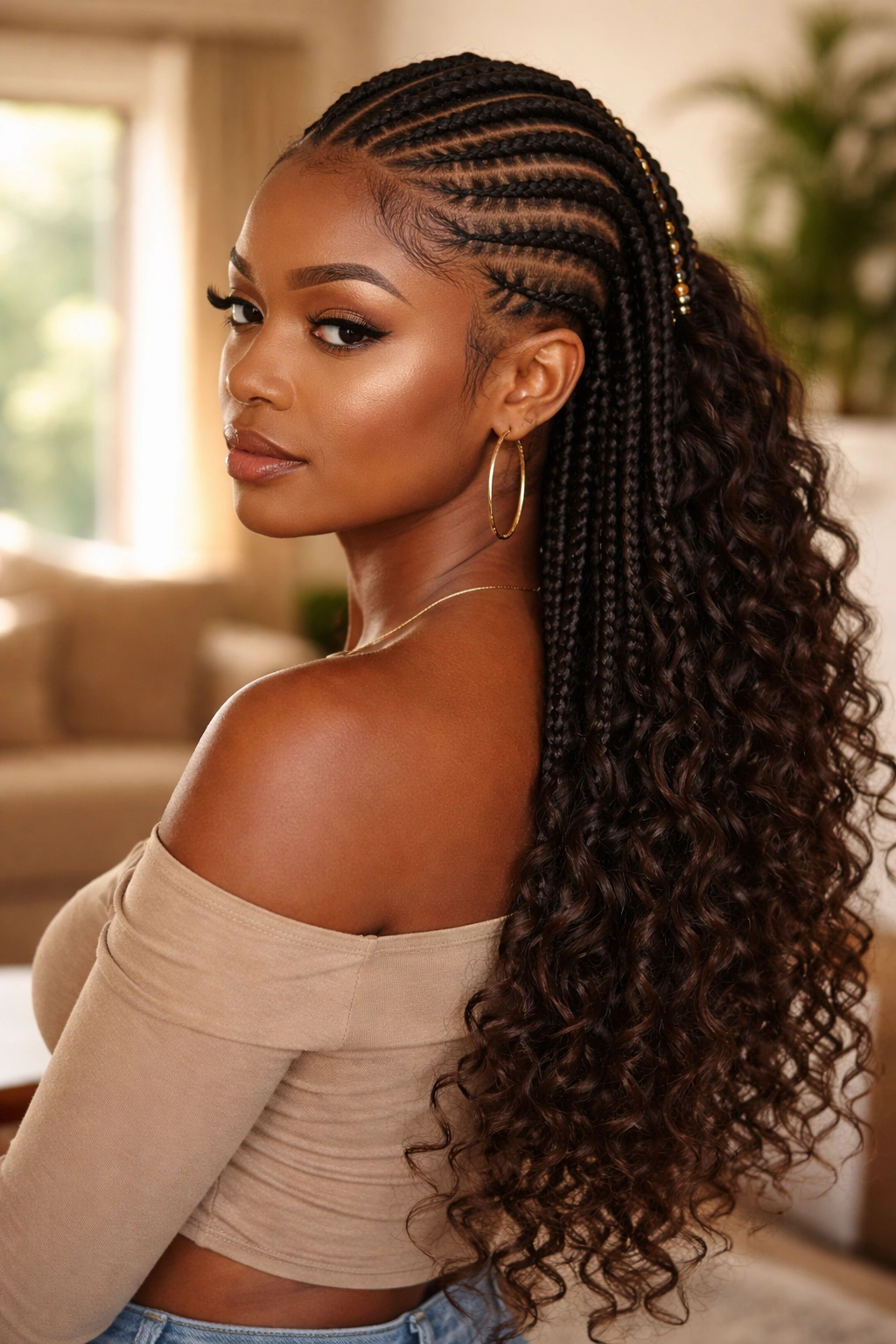
Feed-in braids in the Fulani configuration — starting thin at the hairline and thickening as extension hair is gradually added — allow for dramatic, long braid lengths. When the back section is left as free natural curls that cascade down the back, the contrast between long braids and full curls is spectacular.
The feed-in technique creates braids that look remarkably natural at the root. The gradual thickening means there’s no sudden, blocky transition from thin natural hair to thick braiding hair — everything tapers naturally.
This version works well for formal occasions because the length and precision of feed-in braids reads as deliberate and polished, while the natural curl cascade adds movement and feminine softness.
4. Fulani Braids With Curly Side Sections
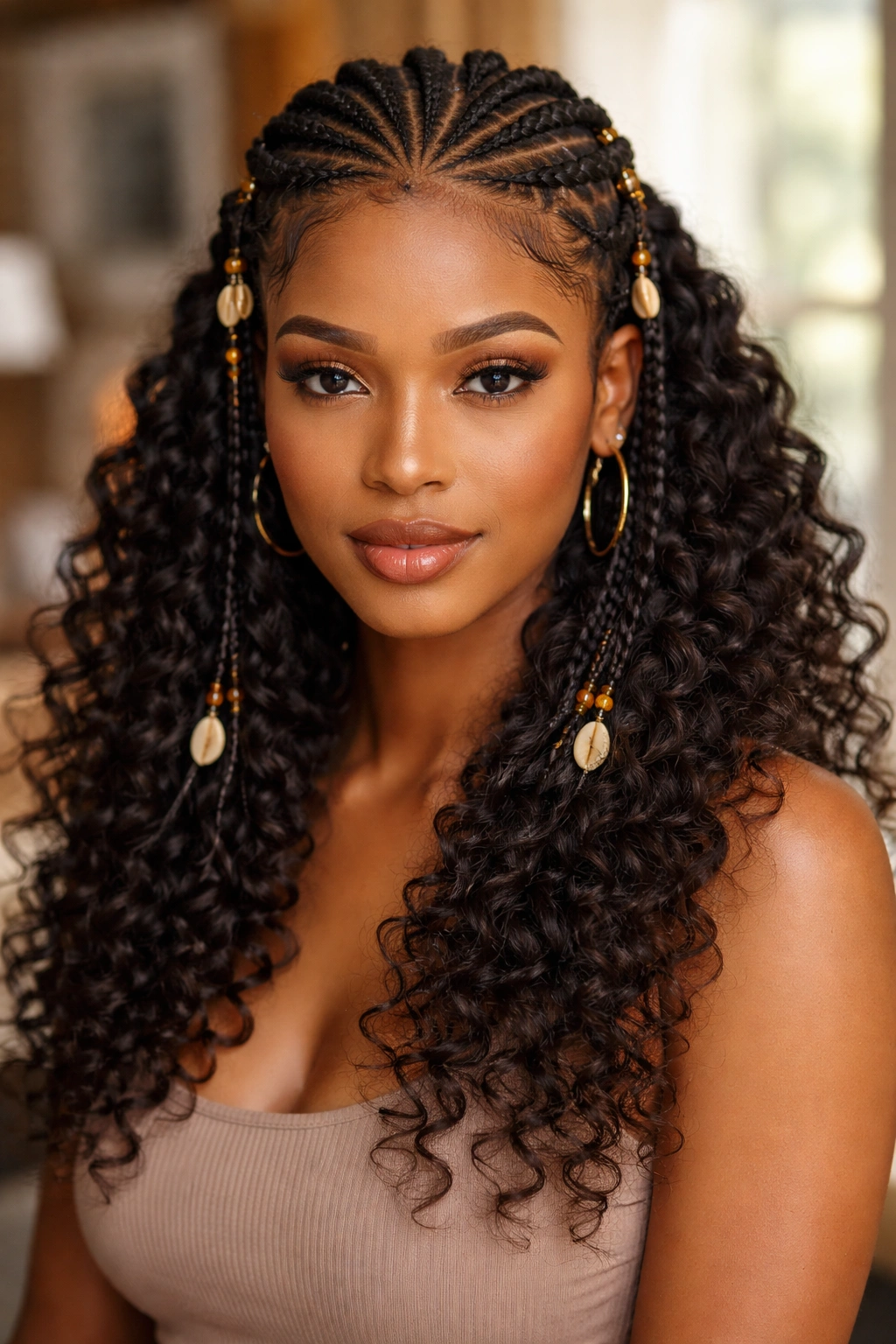
The center braid and one or two braids along the very top of each side are done in the Fulani configuration. But the sides and lower sections are left completely free as natural curls. The result is a style where the braided crown area frames the face while voluminous curls frame the sides and flow behind.
This configuration gives the natural curls more real estate in the finished look than a more extensive braided configuration would. The braids provide structure and intentionality at the crown; the curls take up the majority of the visual space.
For women who want to show off their natural curl texture while still incorporating the Fulani braiding tradition, this configuration is the best balance.
5. Fulani Braids With Beaded Ends Into Curls
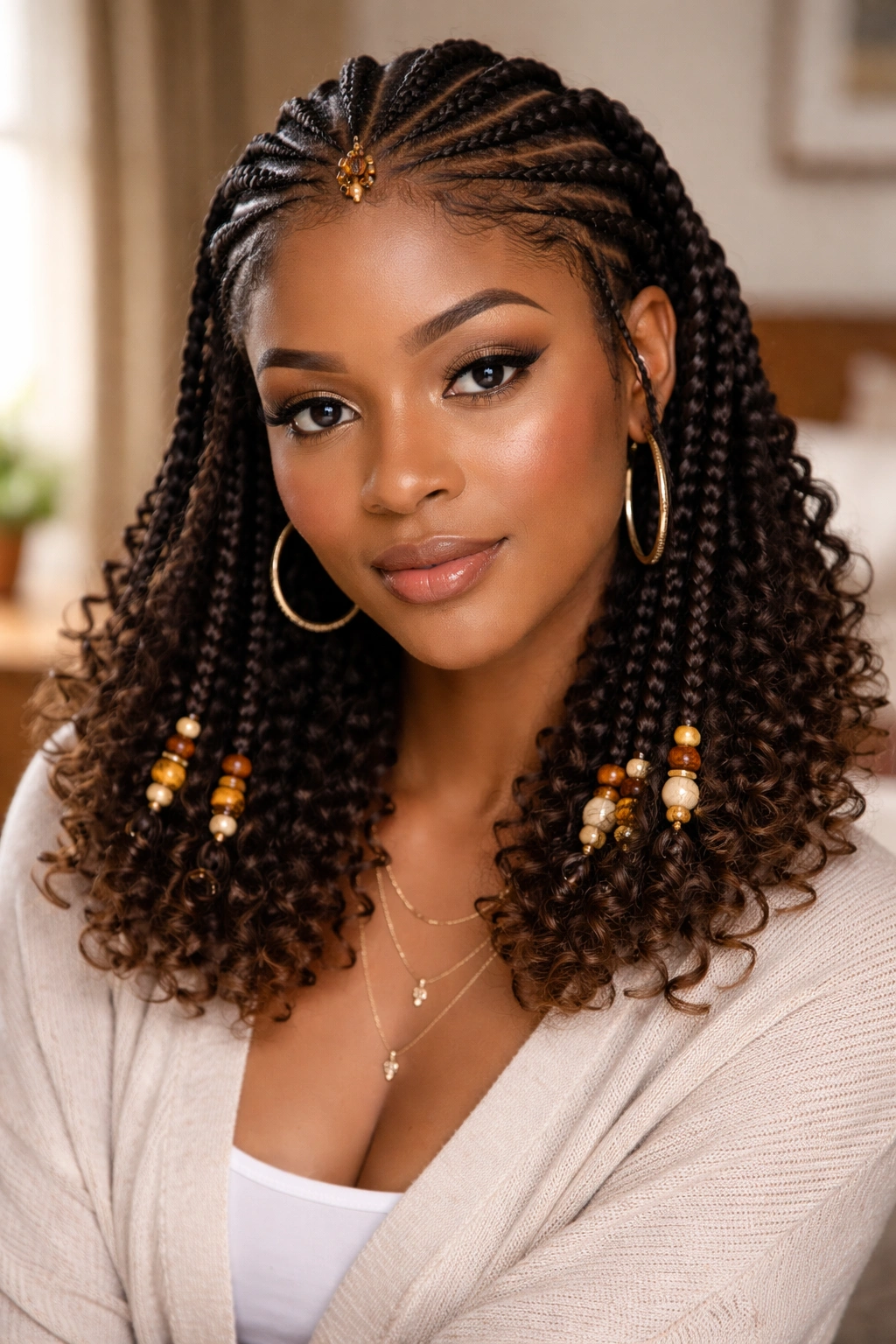
The Fulani braids extend to just above the ears or chin before transitioning into natural curl texture. Instead of the braids extending all the way to the tip, they stop at a certain length, and the remaining hair below that point is left as free natural curls.
Beads are threaded at the exact point where the braids end and the curls begin — marking the transition visually. This creates a very deliberate boundary between the braided and curly sections, and the beads at that junction become the most important decorative detail.
6. Fulani Braids With Puff at Crown
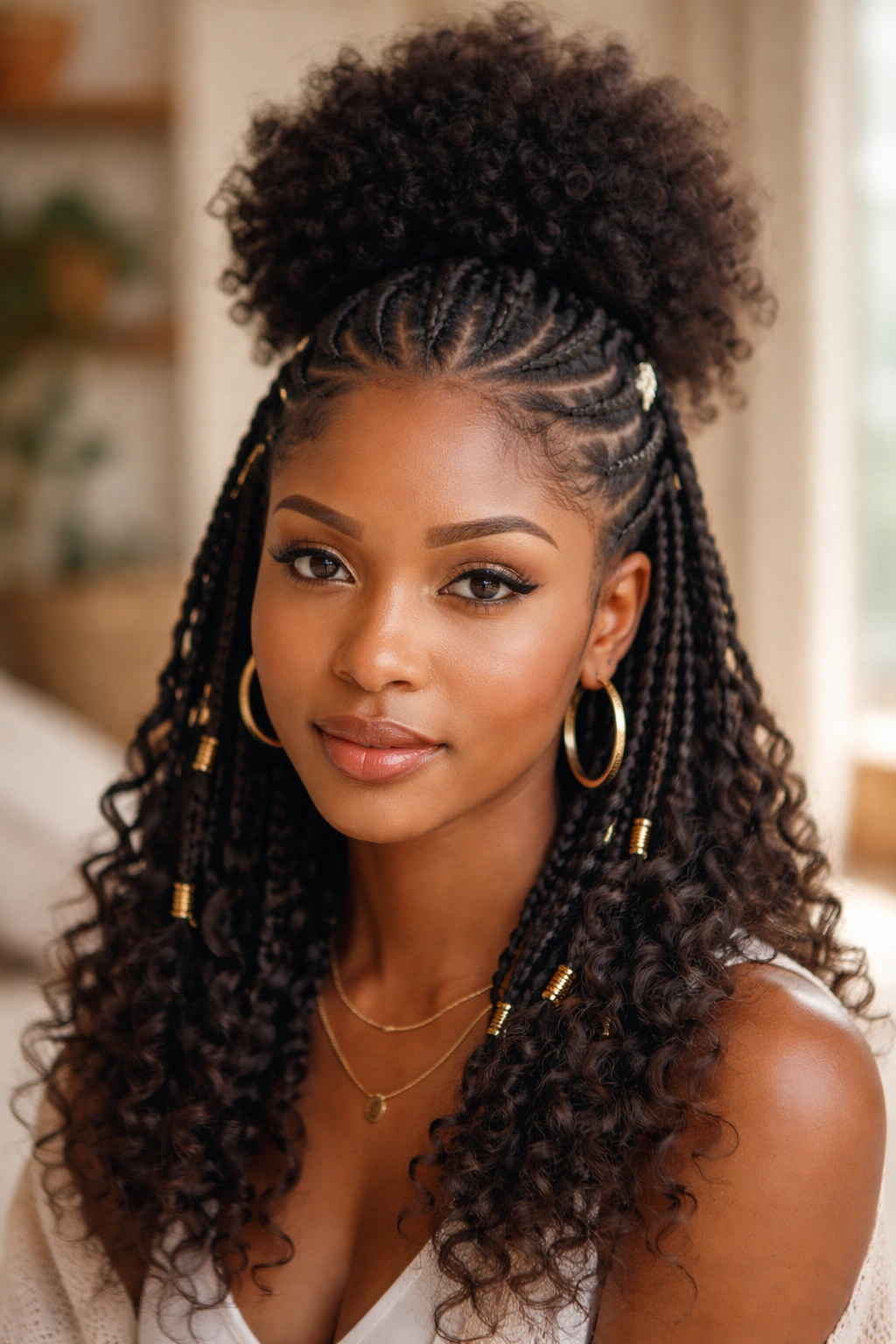
The Fulani side braids and center braid are done along the lower and middle portion of the head. The crown section — the very top — is left entirely as a natural puff. The puff sits above and between the braids, creating an unexpected, playful reversal of the typical Fulani configuration where the crown is braided and the back is free.
This configuration works especially well on hair with significant volume in the crown section. The puff becomes a bold, round statement piece sitting above the face-framing braids.
7. Fulani Braids With Twist-Out Curls
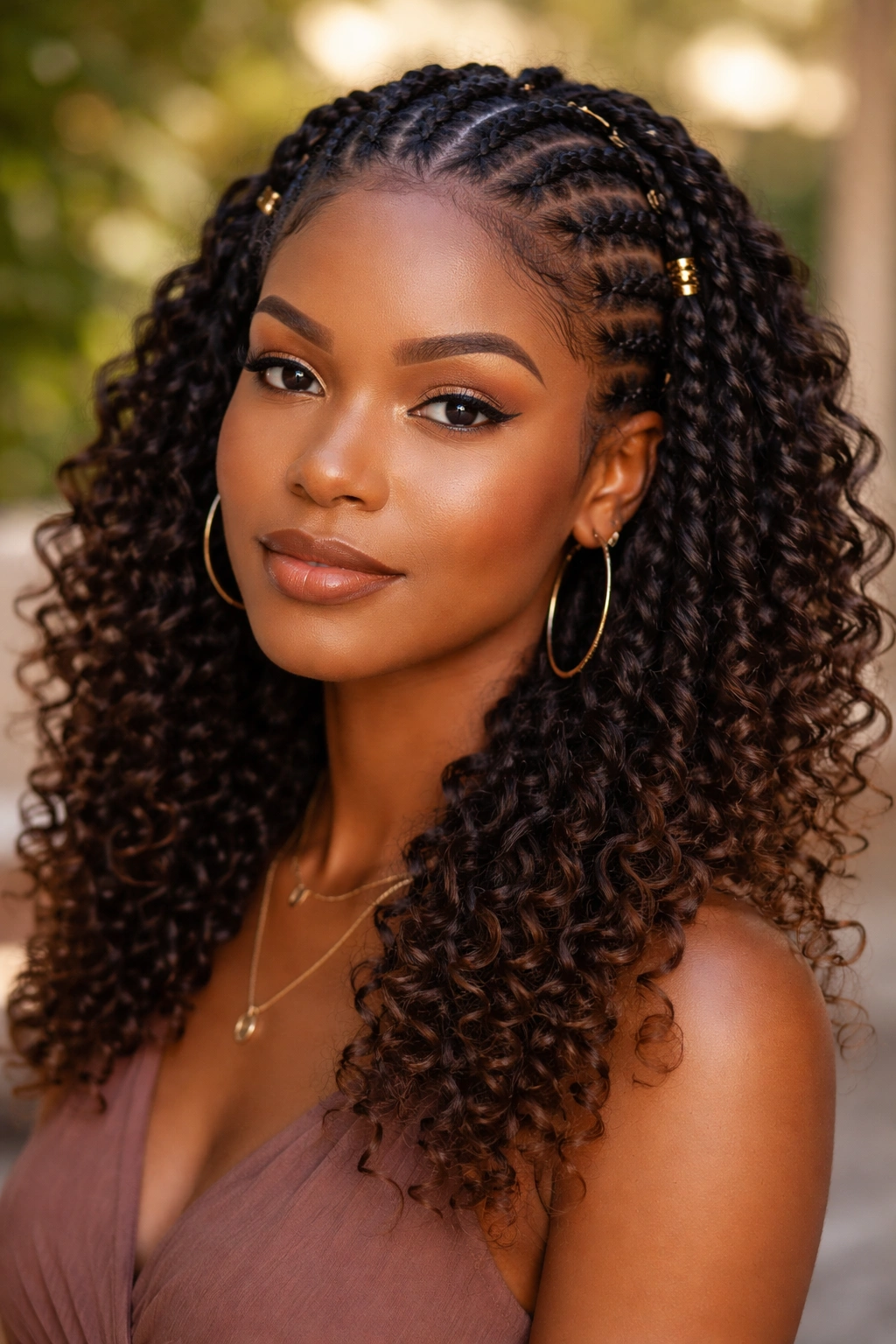
The natural curl section in this variation features a twist-out rather than wash-and-go curls. Two-strand twists are set in the curl section, allowed to dry fully, then unraveled for a more uniform, defined curl pattern. The twist-out curls have a consistent shape and separation that looks more deliberately styled than natural wash-and-go curls.
The combination of the precisely placed Fulani braids with the intentional, defined twist-out curls creates a style where every element reads as considered. This is the version to choose when you want the natural curl section to feel as intentional as the braided section.
8. Fulani Braids With Curly Bangs
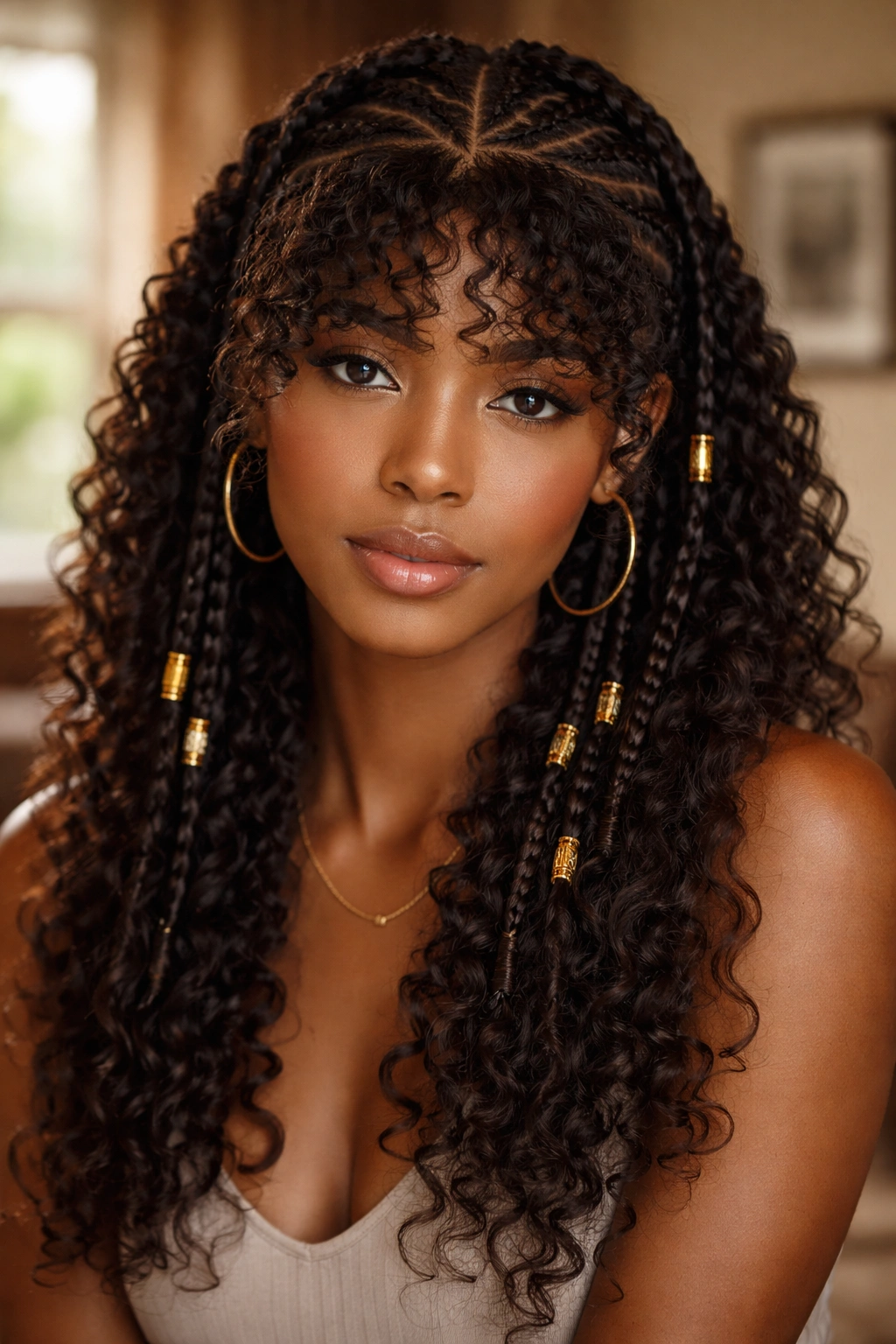
A short bang section — either natural or deliberately styled — is left free at the front of the Fulani braid configuration. The center braid begins just behind the bang section rather than at the very front of the hairline. Side braids begin behind the temple rather than at the very forehead.
The bang section creates a face-framing element at the very front of the style that adds softness. Natural curly bangs in front of Fulani braids look incredibly beautiful — the tight, controlled braids behind them emphasize the soft, springy quality of the curls.
9. Fulani Braids With Braided and Curly Mix
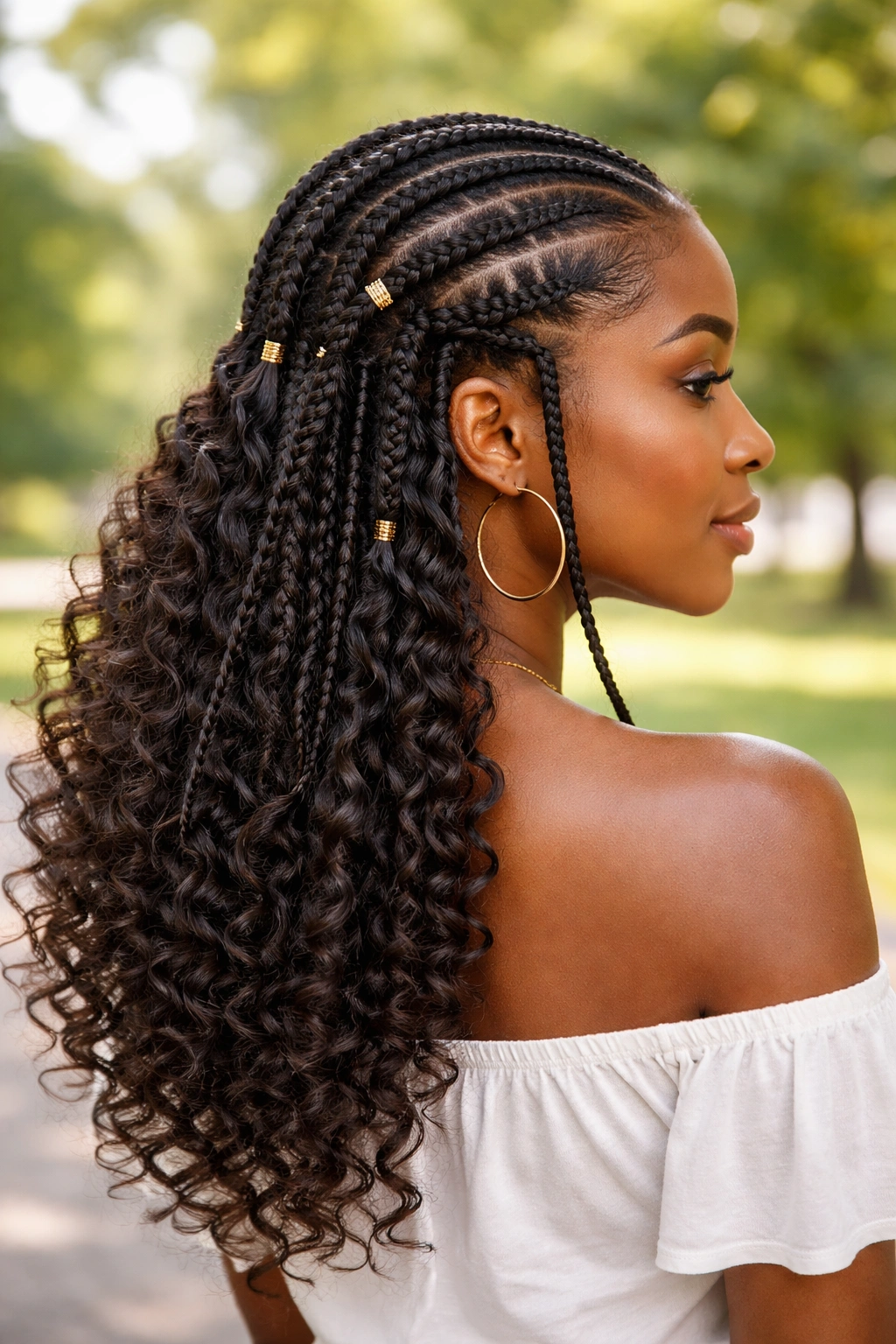
This interpretation is more complex: within the space that would typically be the “curl section” in a standard Fulani configuration, some sections are braided into thin individual braids and others are left as free curls. The mix of individual braids and free curls in the back section creates a layered, intricate look.
The overall composition still reads as Fulani because of the center and side cornrow structure. But the back section has more variety than a simple curl cascade — the individual braids mixed with free curls create depth and visual complexity.
10. Fulani Braids With Cowrie Shell Cascade
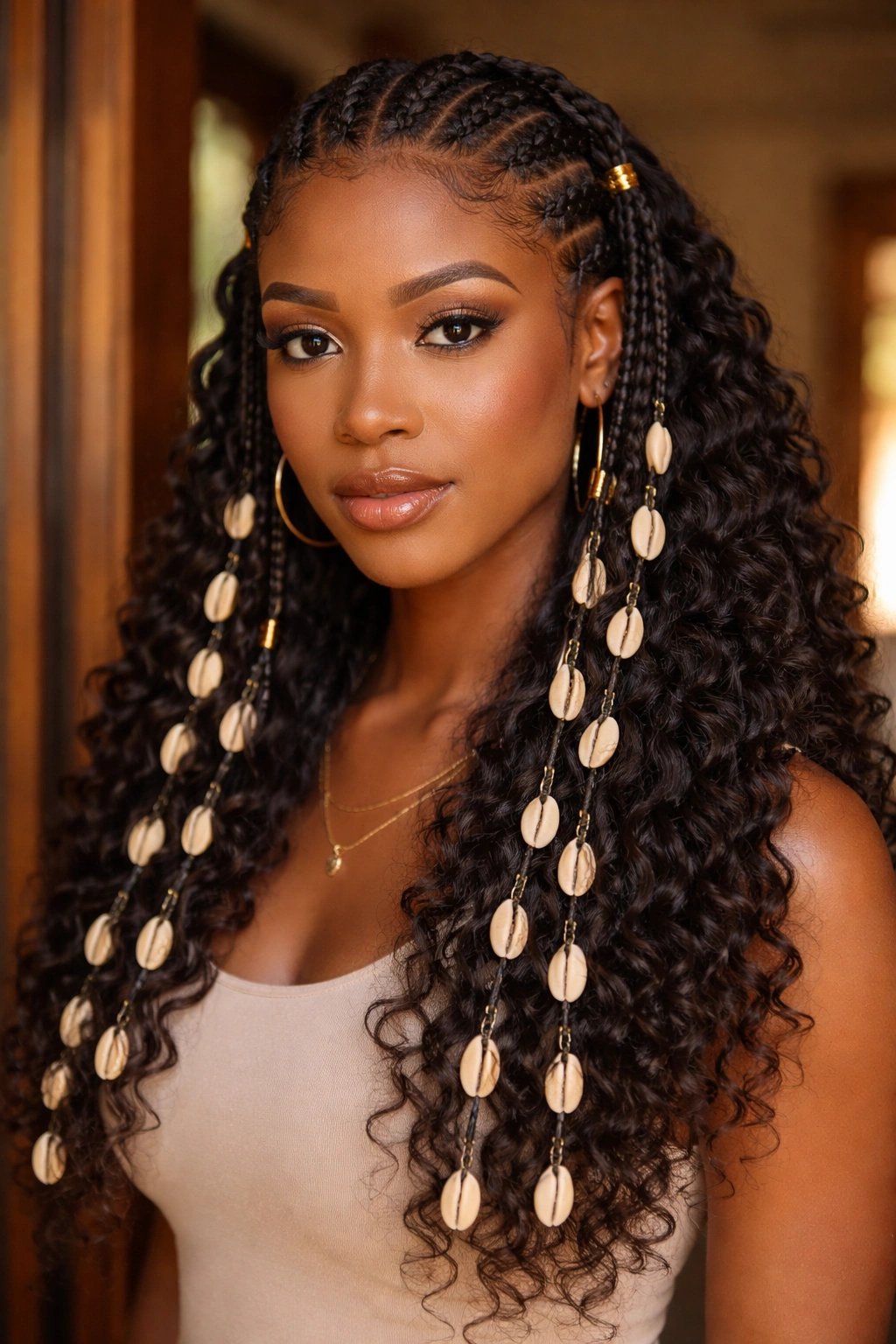
Cowrie shells are incorporated into the Fulani braids themselves, threaded every two to three inches along each braid. When the braids frame the face, the cascade of cowrie shells draws the eye from the front of the hairline backward — a flowing procession of shells that’s both culturally resonant and visually stunning.
The curl section behind the braids is styled to maximum definition. The curls should be the rich, natural backdrop against which the cowrie shell-decorated braids stand out.
11. Fulani Braids With High Top Natural Curls
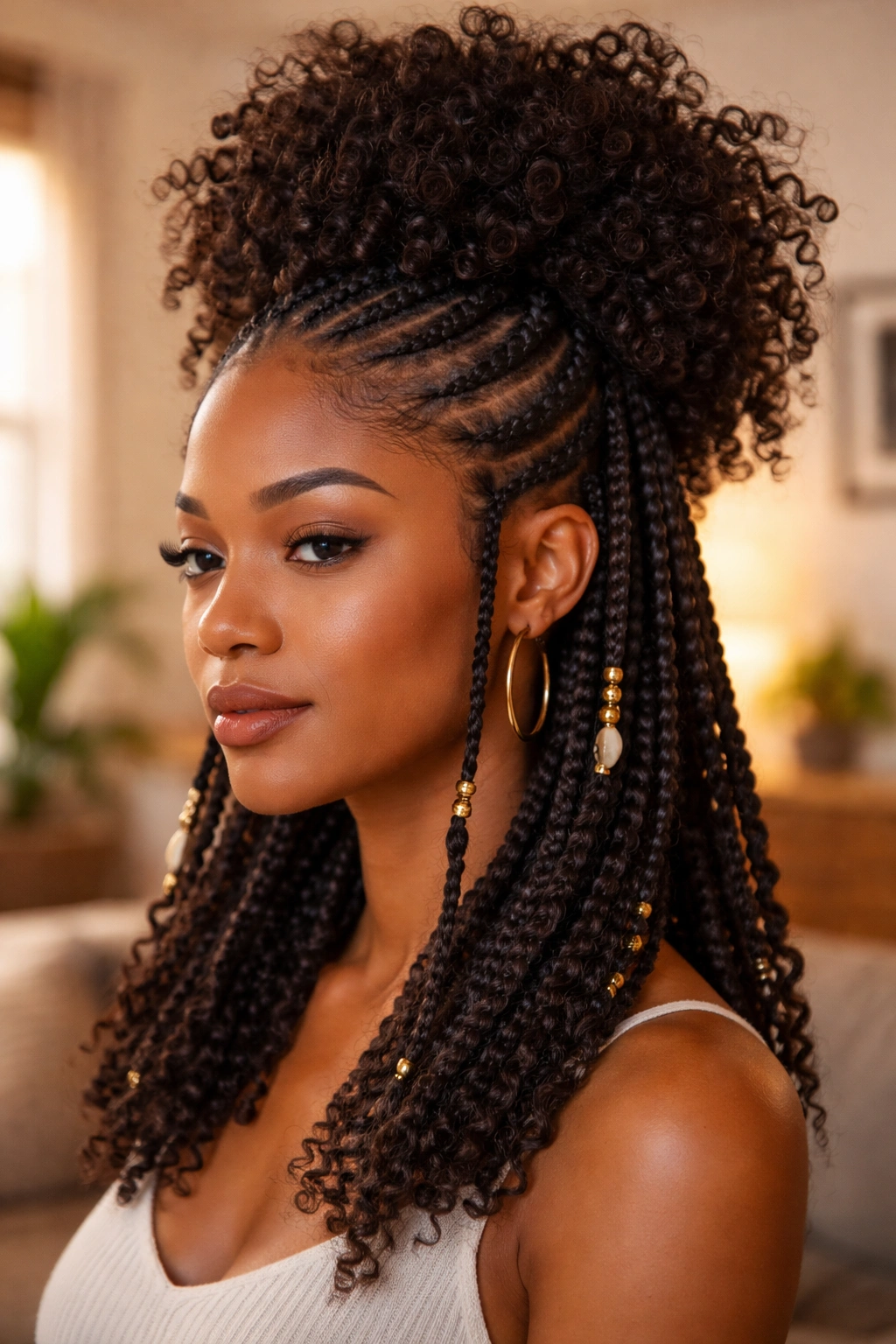
The Fulani braids are positioned along the sides and lower portion of the head. The entire top and crown section is left as free natural curls — a high, full, round collection of curls that rise above the braided sections. The high curl crown and the face-framing Fulani braids work together to create a dramatic, top-heavy silhouette.
This works best on hair with significant volume in the crown section. The braids provide framing and structure; the high curl section provides drama and height.
12. Fulani Braids With Wand Curl Back Section
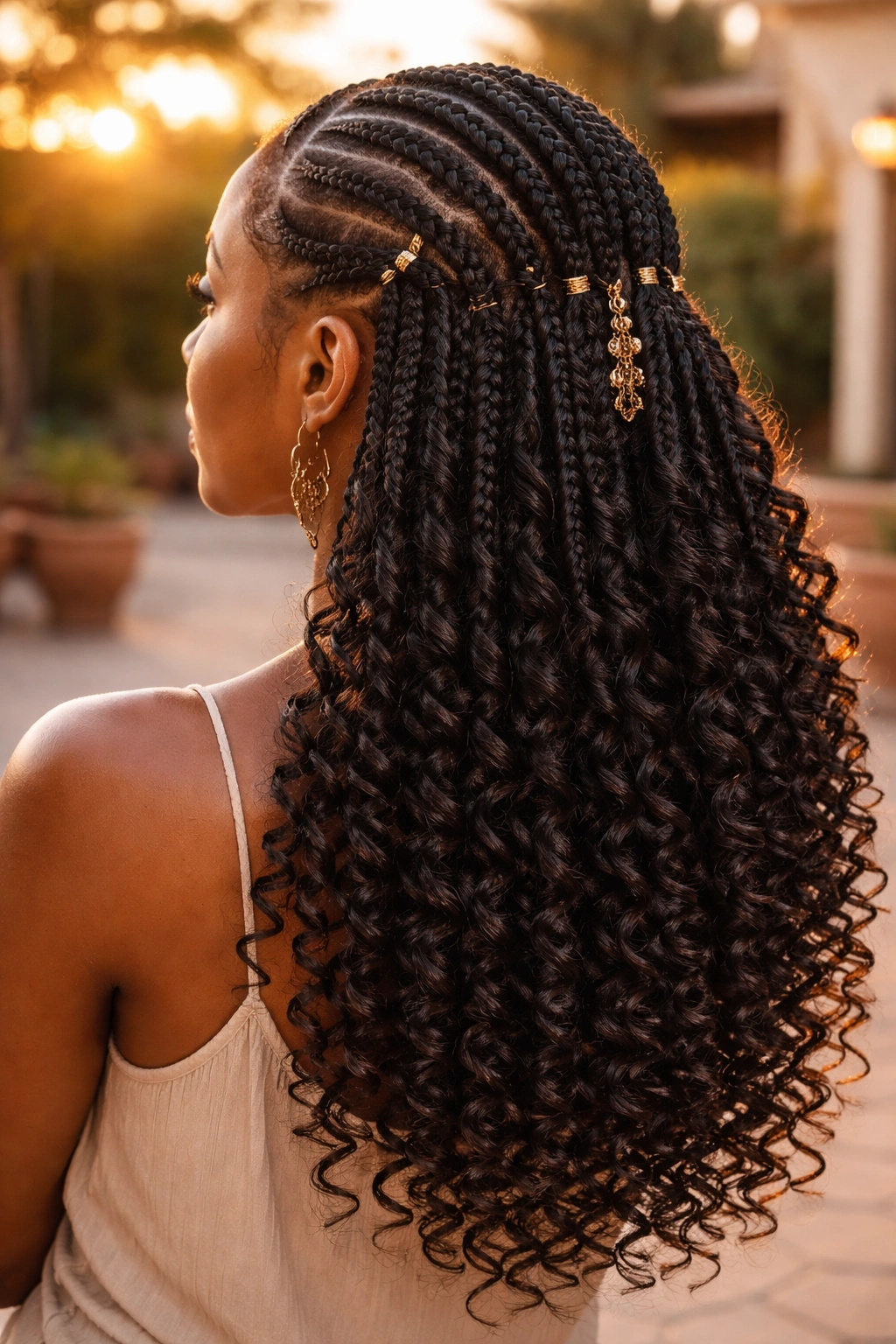
The back section — the natural curl portion — is styled with a wand curling iron rather than worn as a wash-and-go. The wand curls in the back section are longer, more defined, and more uniform than natural curls, creating a formal contrast with the braided front and crown sections.
Wand-curled back sections work especially well when the Fulani braids feature feed-in extensions and are longer than the natural hair. The wand curls in the back can be made to match the length of the braids, creating a more unified overall silhouette.
13. Stitch Braids Fulani Style With Natural Curls
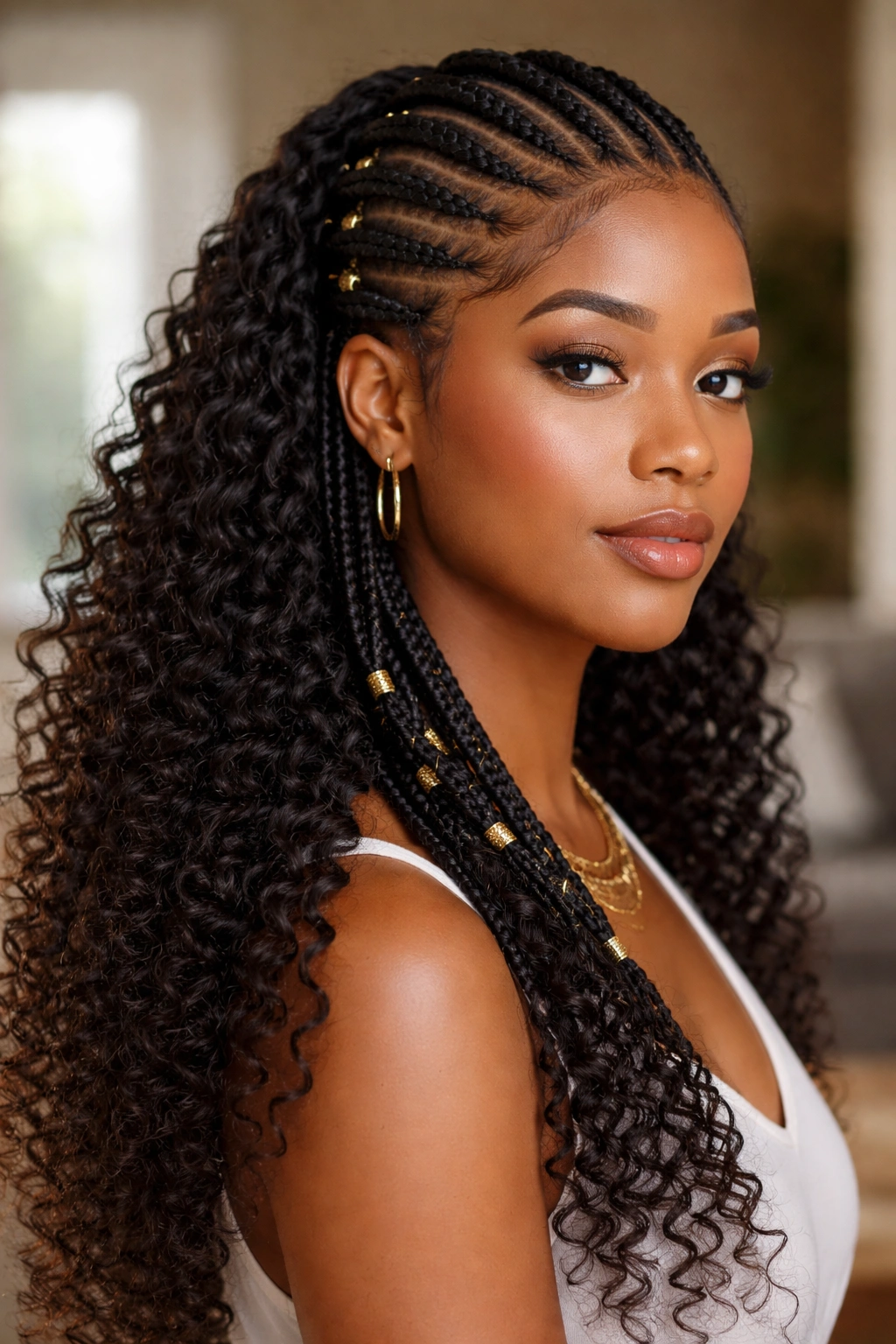
Stitch braids — also called feed-in cornrows with a unique stitching pattern where a latch hook or rat-tail comb pulls the hair through the braid at each stitch, creating a raised, graphic design — in the Fulani configuration. The stitching pattern creates geometric designs within each braid that add an extra layer of visual interest.
Stitch braids are more complex to execute than standard cornrows and typically require a skilled braider. But the finished result is unlike anything standard cornrows can achieve — intricate, deliberate, and completely striking against the free natural curl section.
14. Fulani Braids With Lemonade Braid Side
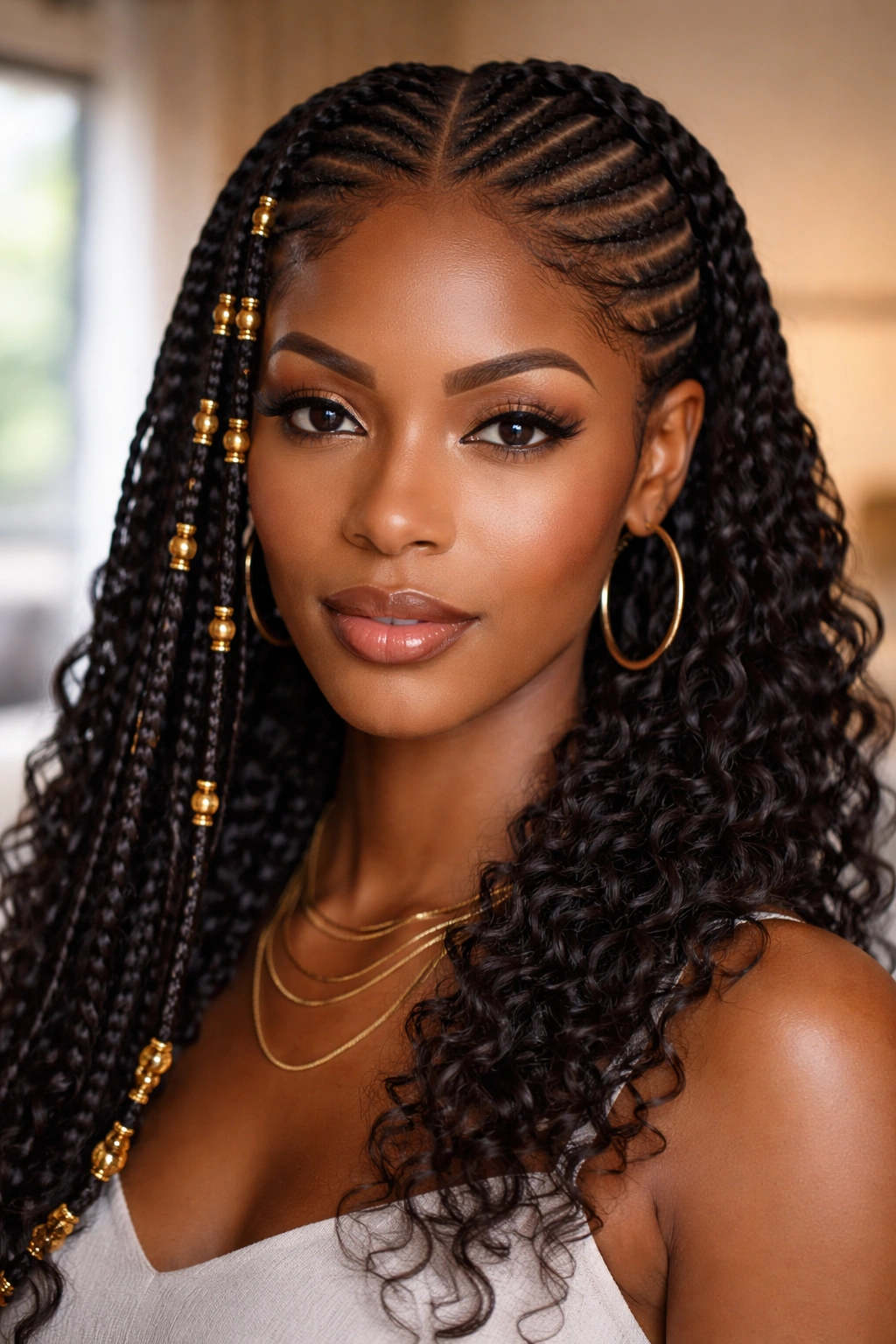
One side of the head features classic Fulani braids in the traditional configuration. The other side features lemonade braids — side-swept cornrows that all angle toward the front rather than sweeping toward the back. The two different cornrow directions on each side create an asymmetric, bold effect.
The center braid that typically divides Fulani braids down the middle serves as the demarcation line between the Fulani side and the lemonade side. The curl section in the back fills the space between the outermost braids on each side.
15. Fulani Braids With Bead Waterfall
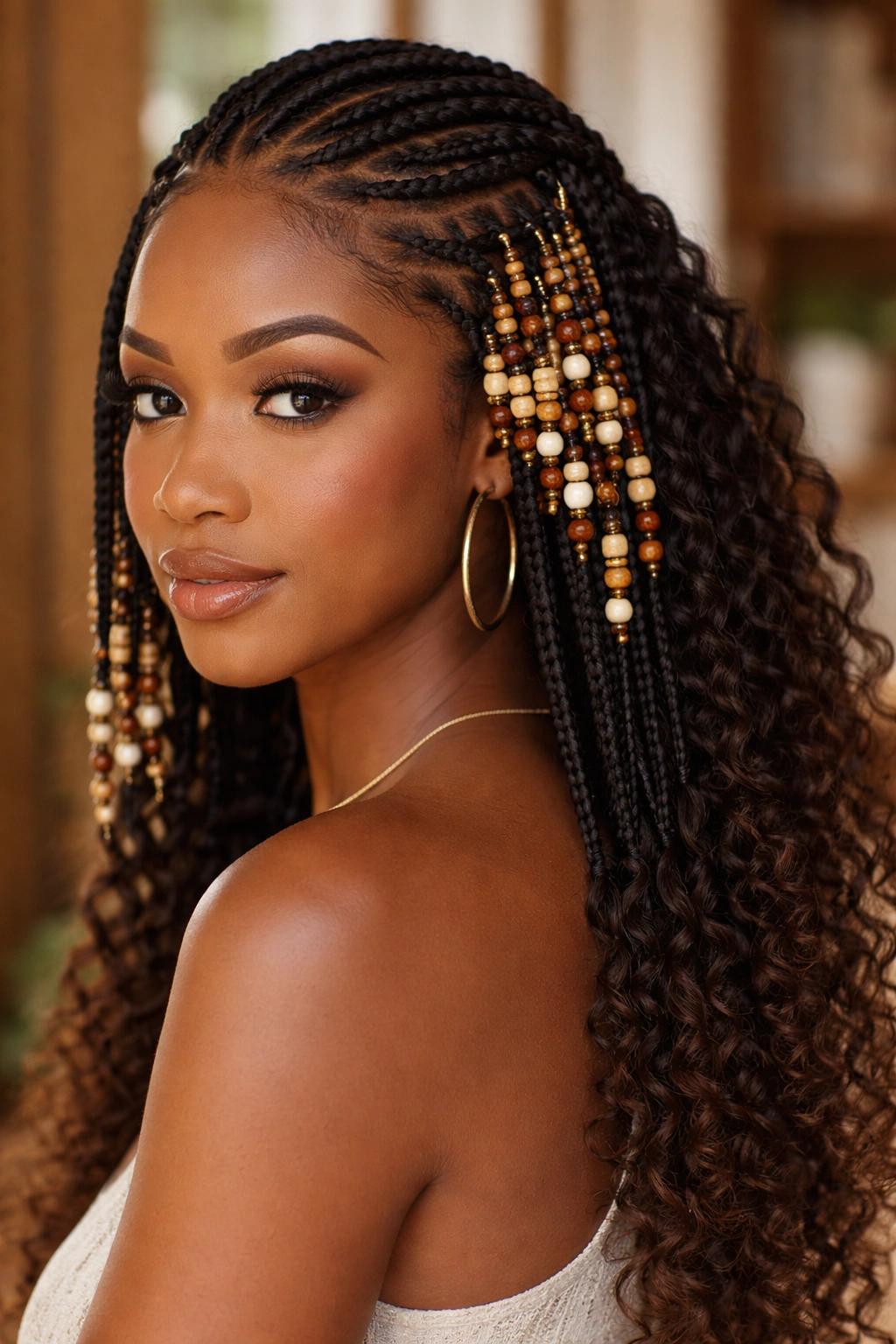
Instead of placing beads only at the ends of the braids or at evenly spaced intervals, this style creates a deliberate waterfall effect by placing more beads near the front of the style and fewer as the braids move toward the back. The densest bead concentration is at the temple — the most visible position.
As the braids move backward, the beads thin out until the back sections have only one or two beads. This graduated approach creates a sense of movement from front to back — the eye follows the beads from dense to sparse, creating a waterfall-like visual flow.
16. Fulani Braids With Knotless Individual Section in Back
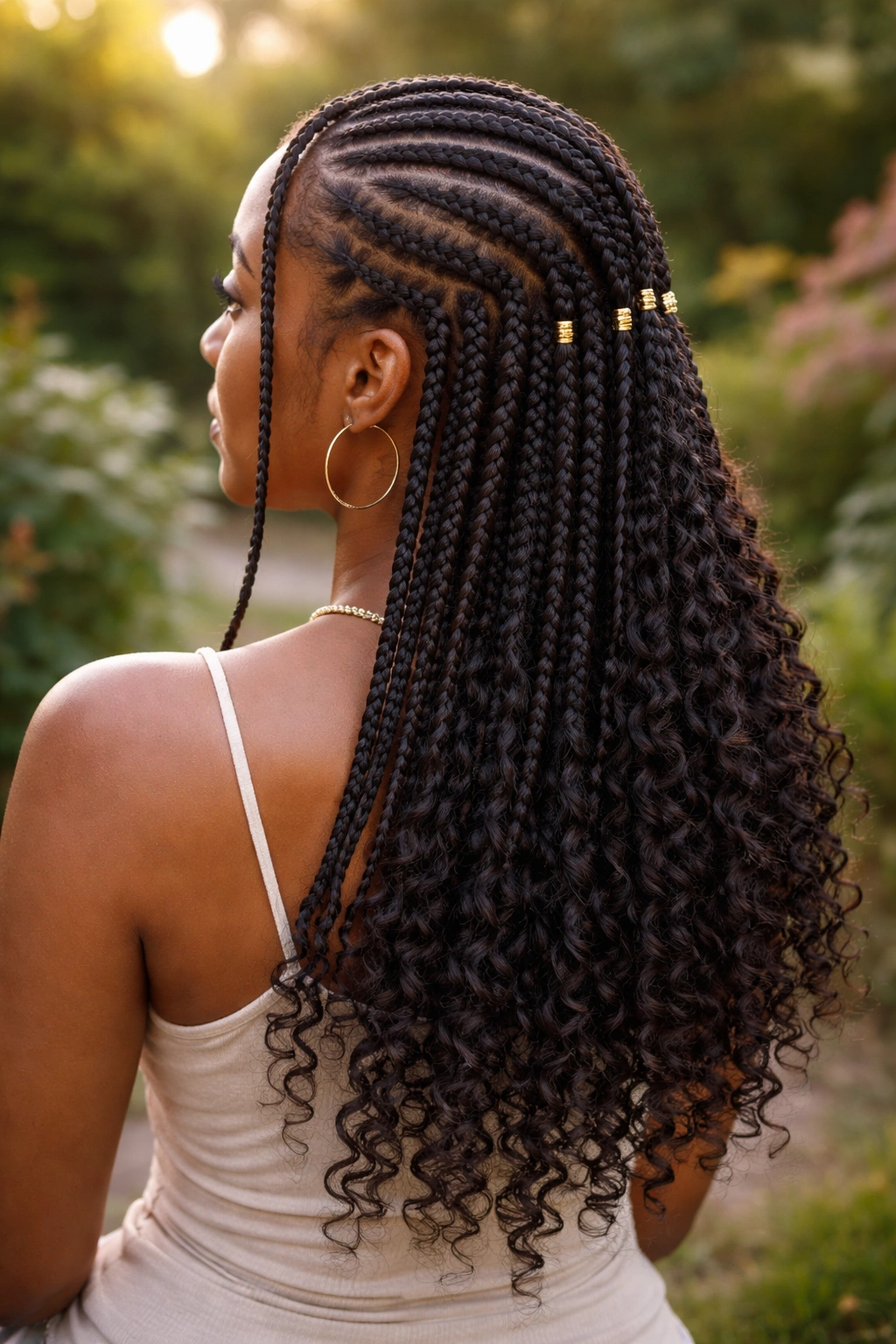
The traditional Fulani braids form the center and sides. But the back section — instead of being left as free natural curls or a simple curl bun — features knotless individual braids that hang freely. These knotless braids in the back have a very natural-looking start at the root and hang loose rather than being incorporated into any gathered section.
The combination of cornrowed Fulani braids at the top with knotless individual braids in the back creates a multi-texture braided style that still reads as a Fulani configuration because of the characteristic center and side braid placement.
17. Fulani Braids With Zigzag Parted Center
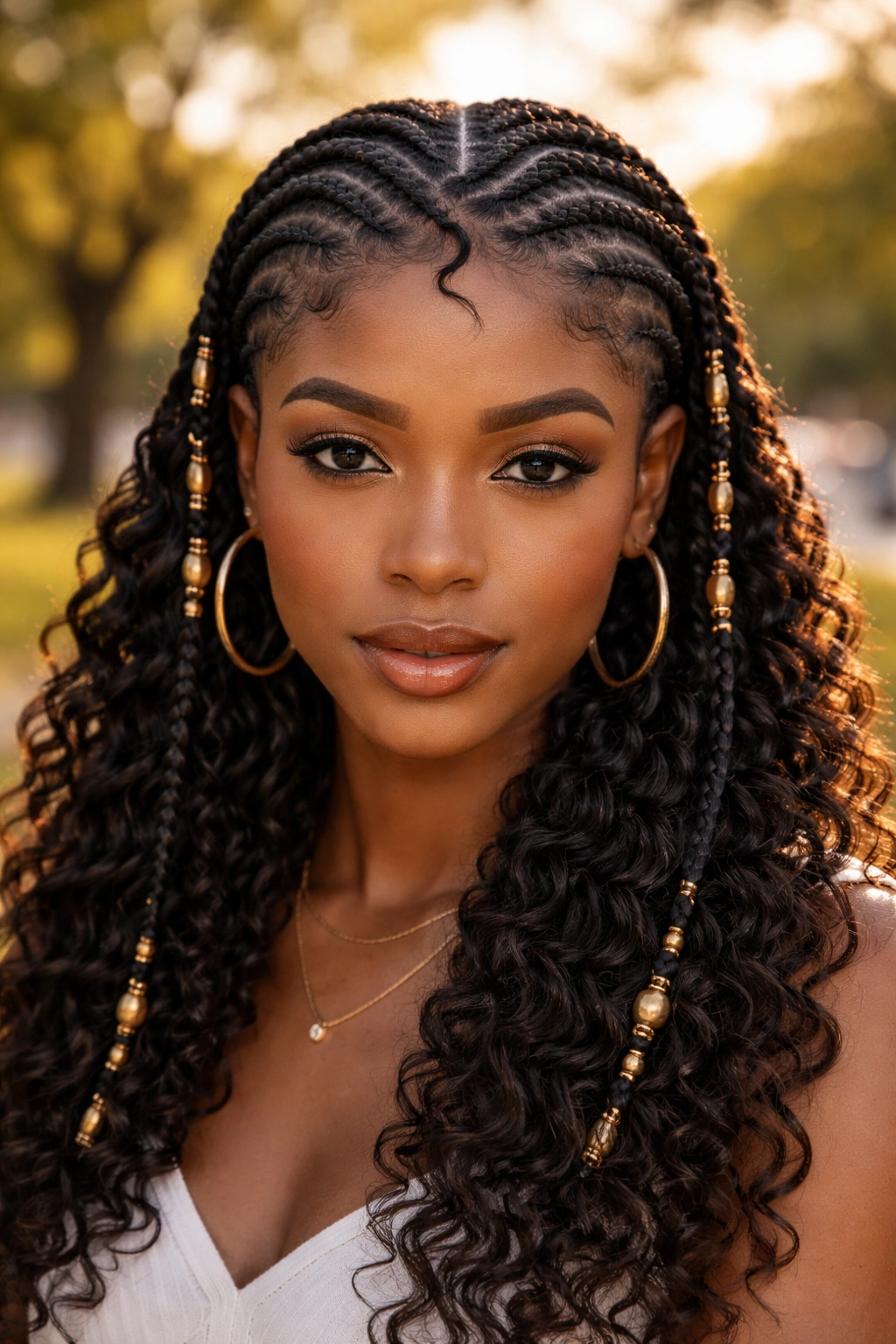
The center braid’s part isn’t straight — it zigzags from the front of the hairline to the nape, creating a distinctive graphic element at the very center of the style. When the center braid is created along this zigzag part, the braid itself follows the pattern, creating a subtly irregular center braid.
The zigzag center part is a style detail that’s visible from above and from the front, adding visual interest to what might otherwise be a straightforward part. Combined with the rest of the Fulani configuration and a natural curl section, this detail elevates the overall style significantly.
18. Fulani Braids With Natural Hair Knot at Back
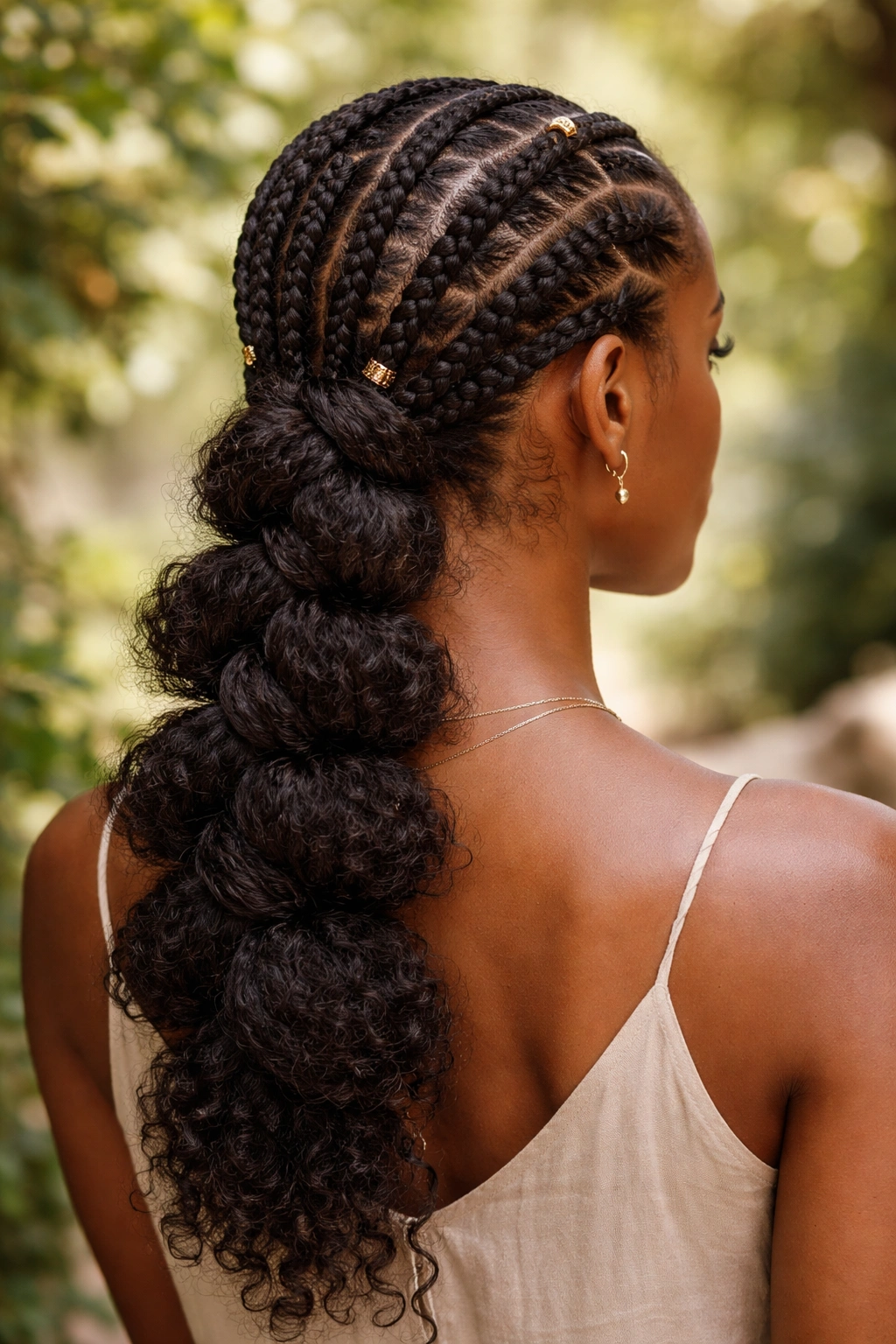
Instead of a loose curl cascade or a gathered curl bun at the back, this version features the back section of hair tied into a series of simple overhand knots — a technique borrowed from the knotted updo tradition. The natural curl texture of each knotted section makes the knots look sculptural and dimensional.
The knotted back section is an unusual and striking departure from the typical curl cascade in a Fulani style. It’s more structured than loose curls but less formal than a bun. The transition from the braided crown to the knotted back is visually compelling.
19. Fulani Braids With Goddess Braid Section
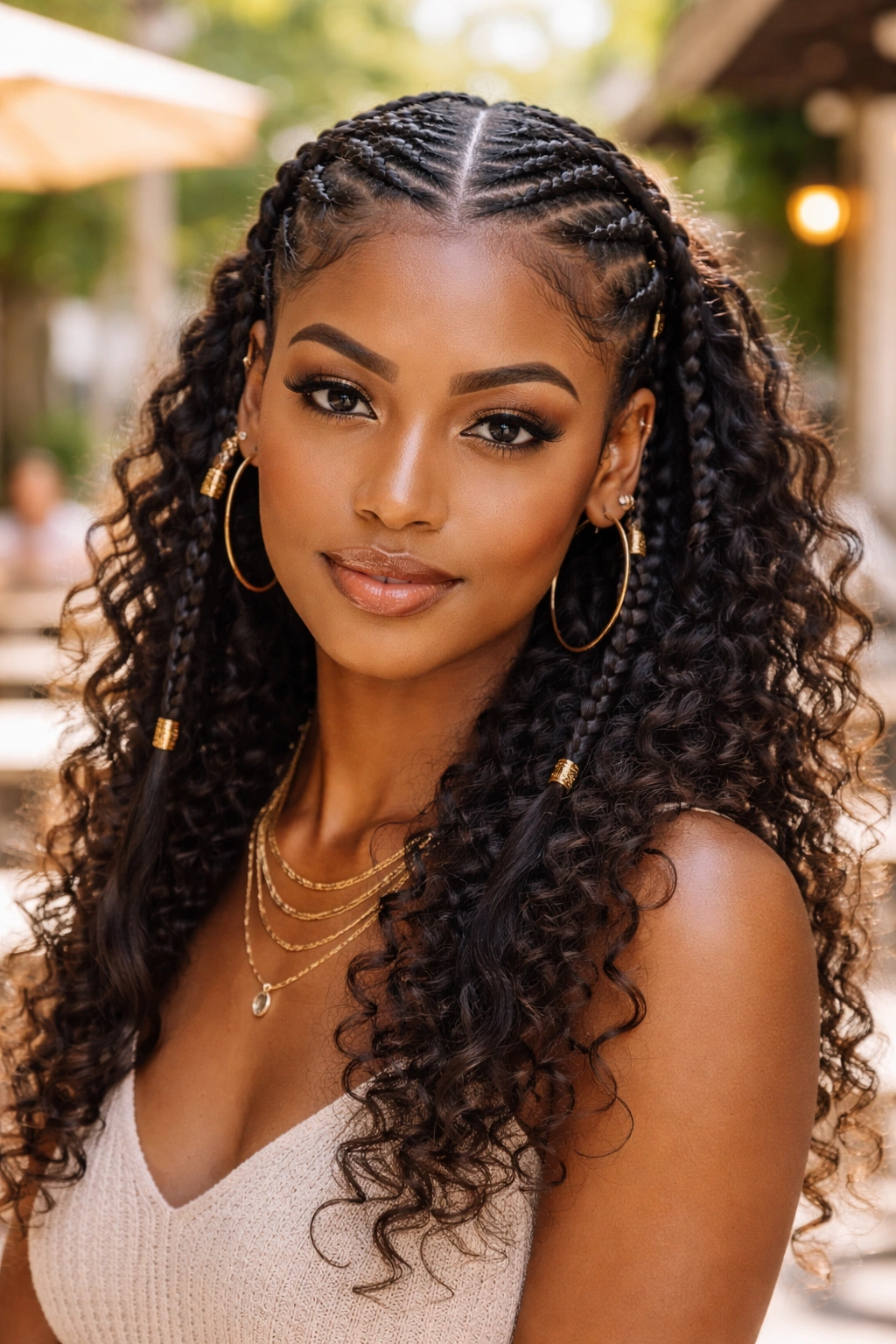
One or two of the side braids are done as goddess braids — thick, raised braids with strands deliberately pulled out along the length for a textured, wispy appearance — while the center braid remains a clean, traditional cornrow. The free, wispy texture of the goddess braid sections contrasts with the tight, precise center braid.
Combined with a natural curl section at the back, this mixed-braid approach creates a style with three distinct texture elements: the precise center cornrow, the wispy goddess braids, and the free natural curls. The complexity makes the overall look feel layered and artful.
20. Fulani Braids With Loc Twists Back Section
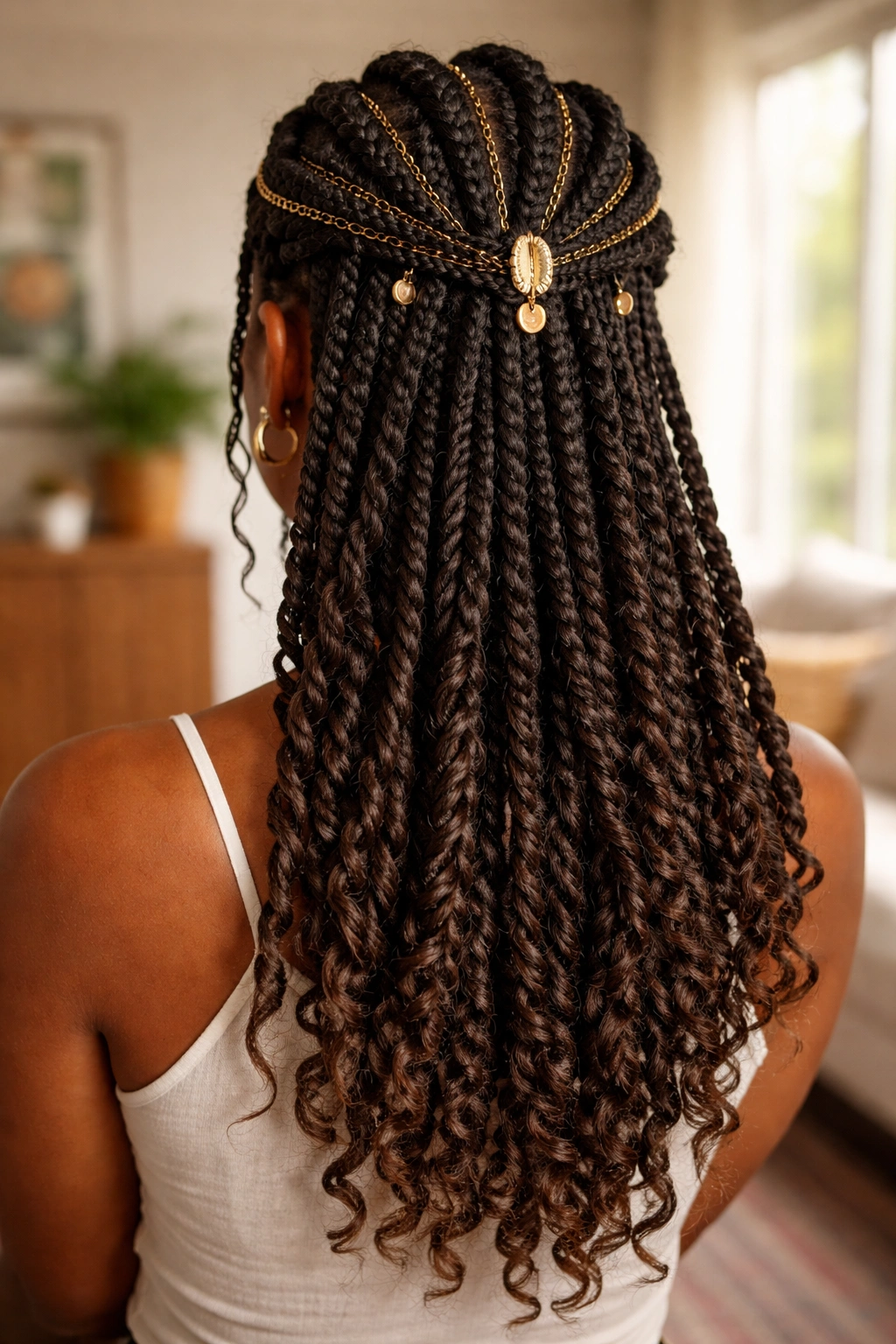
For women with locs or loc extensions: the back section of a Fulani style isn’t free natural curls or unbraided hair — it’s loc twists. Individual locs or loc extensions twist together into two-strand twists for the back section, creating a loc-twist cascade that has similar movement to natural curls but with the weight and texture of locs.
This is a style for women who love the Fulani configuration but want a fully loc-based look. The Fulani braids at the top can be done with braiding hair extensions; the loc twists at the back can use natural locs or loc extensions.
21. Fulani Braids With Double Puff in Back
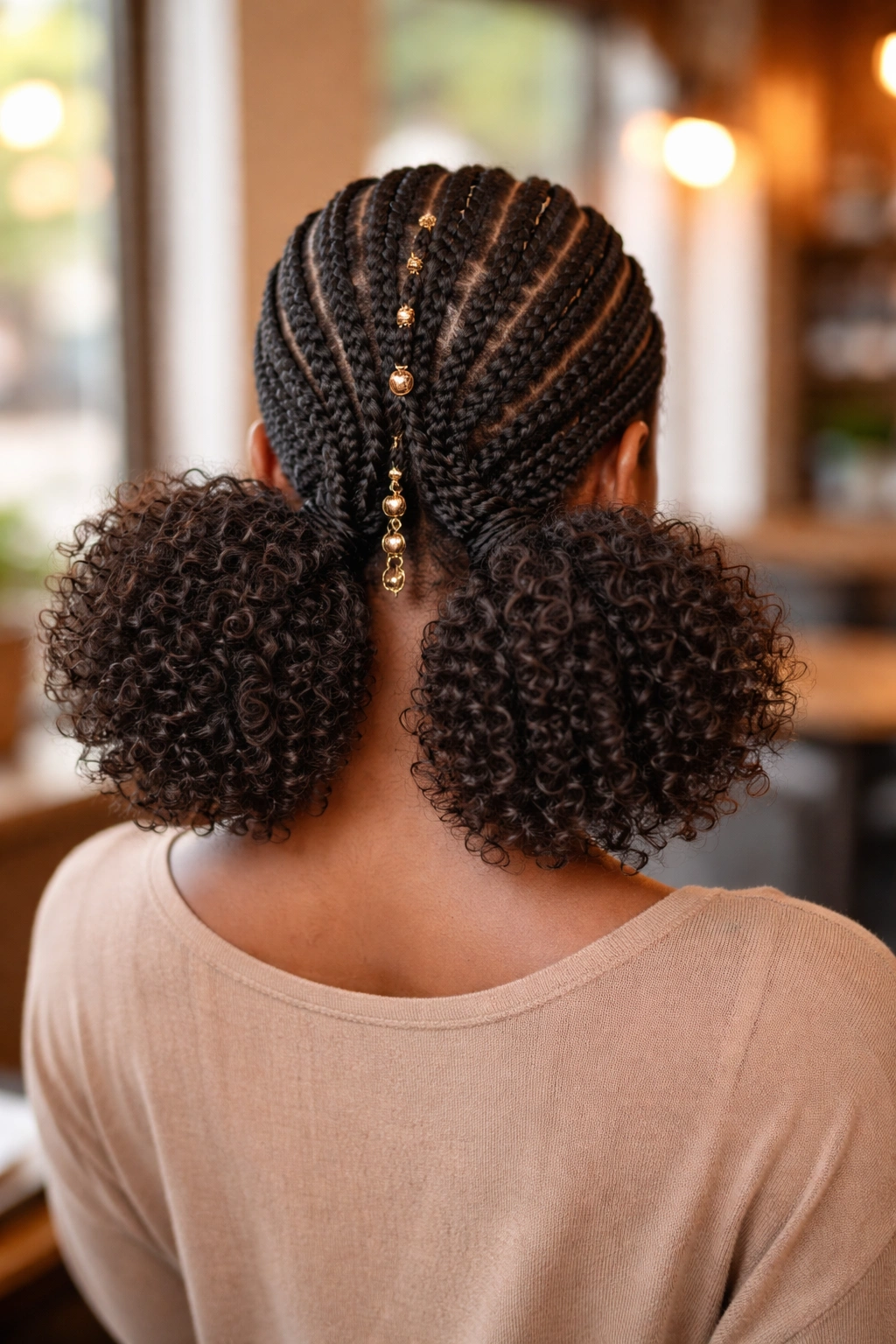
Instead of a single curl puff or a loose cascade at the back, this version features two symmetrical curl puffs — one on each side of the nape — creating a double puff effect behind the Fulani braids. Each puff is gathered, secured, and fanned out into a full, round cluster.
The symmetry of the double puffs balances the asymmetric elements typical of Fulani braids. The two puffs feel like a deliberate completion of the style — a finishing touch that gives the back of the head as much visual interest as the front.
22. Mini Fulani Braids With Volume Curls
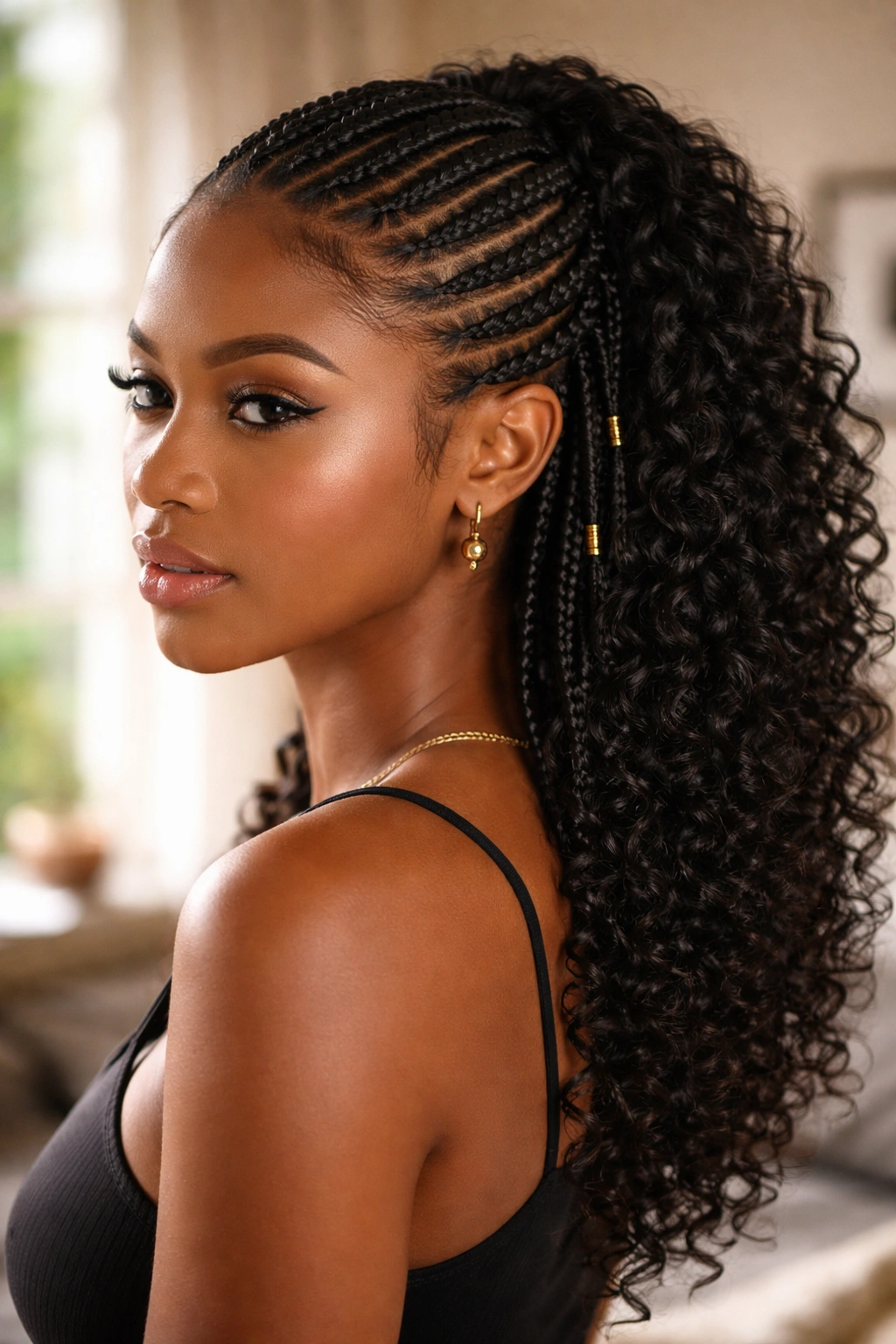
The Fulani braids in this version are much smaller than standard — thin, miniature cornrows in the characteristic Fulani configuration. The thinness of the braids creates more of them, covering more of the scalp in the braided sections. The curl section, by contrast, is as full and voluminous as possible.
Mini braids require more time and skill to execute but look incredibly detailed and precise. The fine braids against the voluminous curl section create a stark contrast that emphasizes both elements of the style.
23. Fulani Braids With Curl and Braid Ends Mix
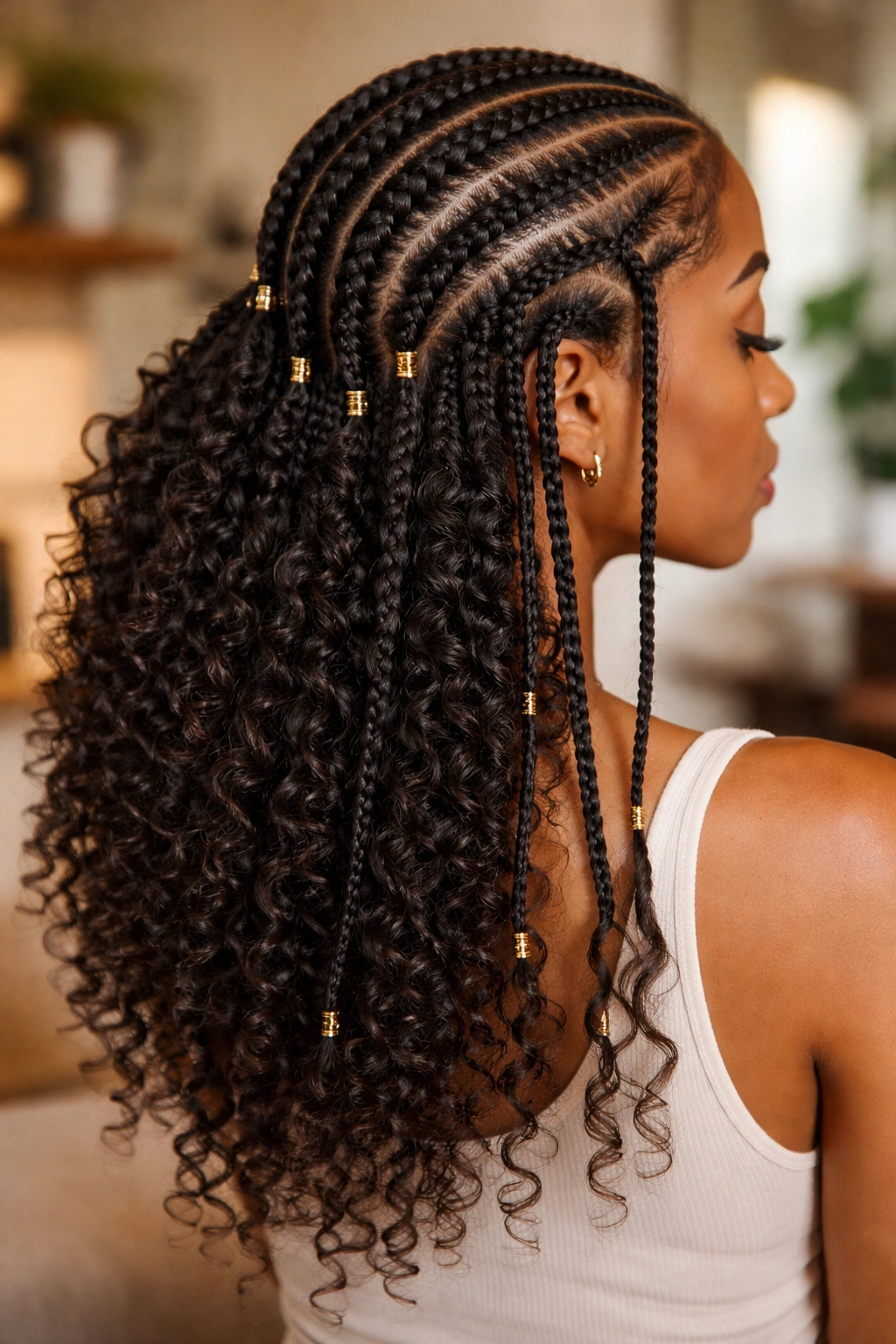
The back section features natural curls and a few thin braids scattered throughout. Some sections in the back are left as free curls; other sections are braided into thin individual braids that hang alongside the curls. The mix of curl and braid textures in the back section creates a complex, visually rich ending to the Fulani configuration.
This style asks you to make intentional decisions about which sections get braided and which stay curly. There’s no formula — the placements should feel organic and scattered rather than perfectly planned. This is one of the most uniquely personal versions of Fulani braids with curls, because every execution will look different.
Caring for Fulani Braids With Curls
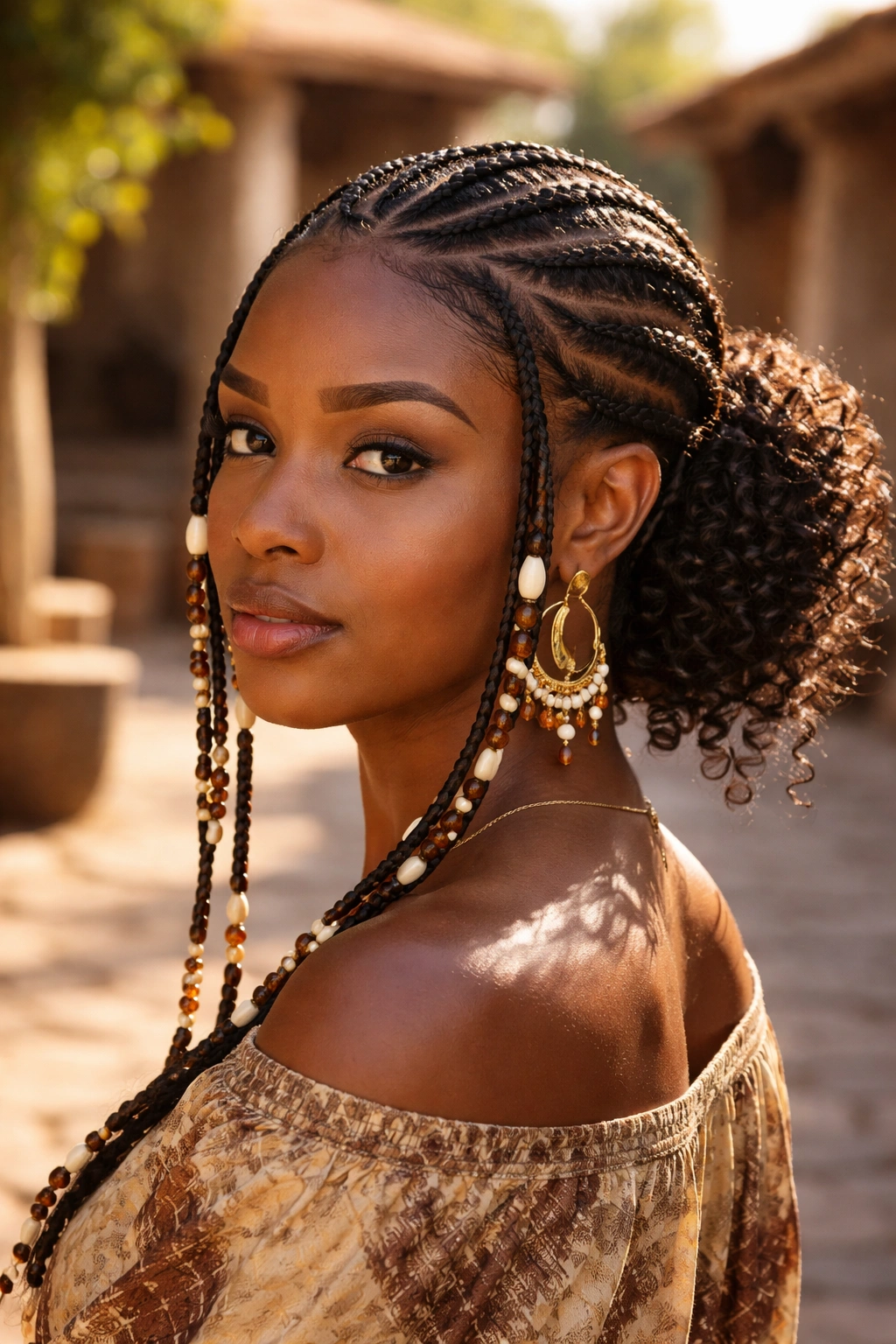
Maintaining Fulani braids with curls requires separate routines for the braided sections and the curl sections.
For the braided sections: keep the scalp clean with a diluted shampoo spray. Apply a lightweight scalp oil every three to four days. Avoid heavy products on the braided sections — they accumulate and cause buildup that makes the braids look dull and feel gritty. Re-smooth any edges that have lifted with a small amount of edge control.
For the curl sections: refresh with water and a small amount of leave-in conditioner every two to three days. Scrunch upward and allow to air dry. Avoid disturbing the curl pattern too much during refreshing — the goal is rehydration, not restyling. Protect the curl sections at night with a satin bonnet or silk scarf.
The beads and cuffs in the braided sections are low maintenance — they don’t require any special care. Just make sure they stay securely attached. Check the beads at the ends of braids periodically, as the ends can slip through beads over time.
Fulani braids with curls typically last two to four weeks. Remove sooner if the braids begin to look fuzzy or the roots show significant new growth that makes the braided sections look lifted from the scalp.