



A curly weave ponytail can look soft and full, or stiff and overdone, and the difference usually comes down to the base. Pull the roots too tight and the whole style starts to feel tense. Leave the foundation loose and the tail loses shape. The sweet spot is a clean, flat base with curls that still have room to move.
That’s why voluminous weave ponytails for curly hair work so well when they’re built with a little restraint. Curly hair already brings texture and lift, so the ponytail does not need to fight the hair’s natural shape. It needs to frame it. A good install or ponytail piece should add length, density, and swing without turning the head into one giant block of hair.
The trick is matching the mood of the style to the hair on hand. Some looks want a sleek crown and a wild tail. Others lean into fullness all the way through. And some are better when they’re a little messy, because curly hair tends to look better with movement than with perfect symmetry. That’s part of the charm.
These 23 styles cover the range from polished to playful, with enough variety to work for everyday wear, events, protective styling, and those days when you want the ponytail to do the heavy lifting.
1. High Crown Wrapped Ponytail
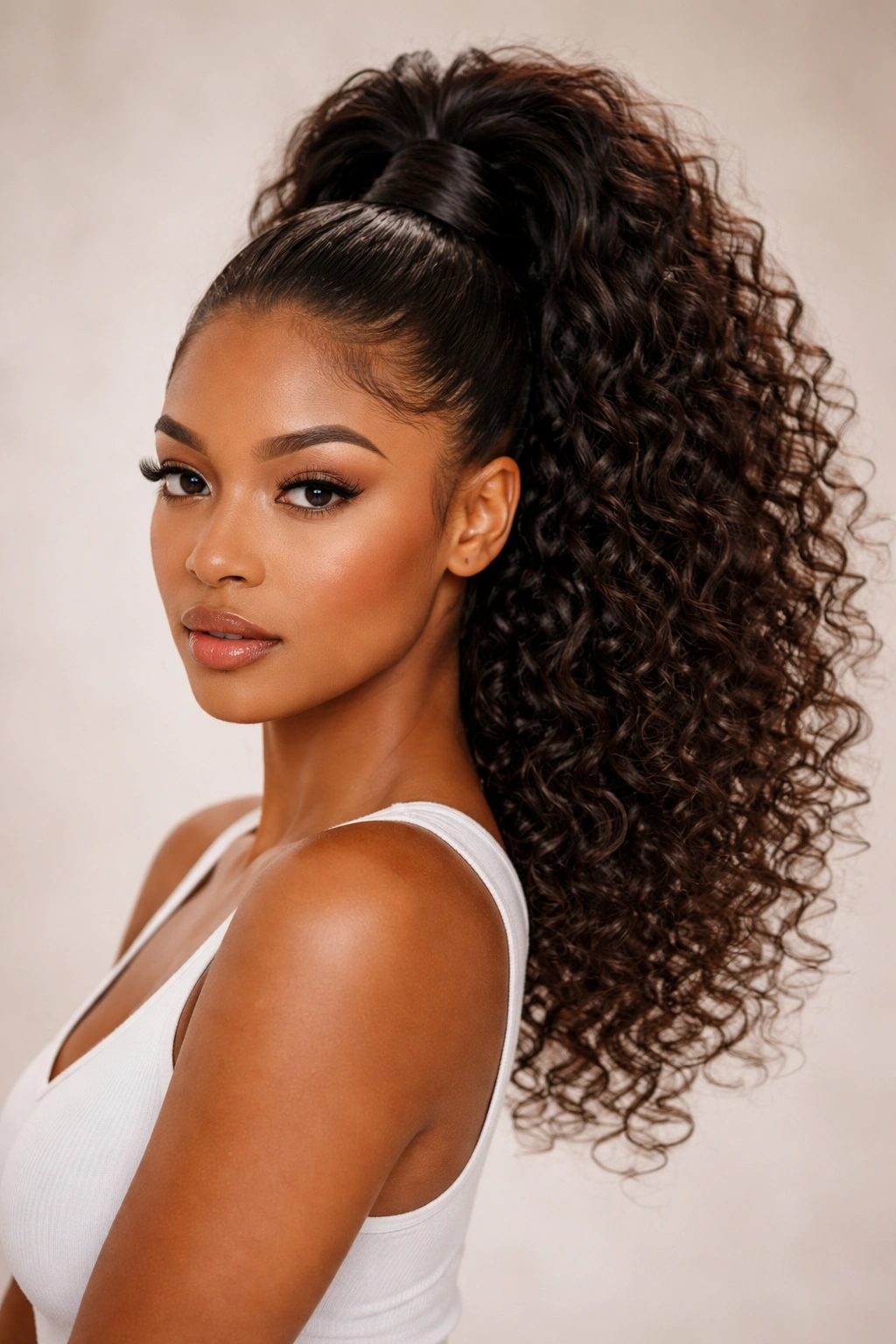
A high crown ponytail is one of the easiest ways to make curly hair look bigger without piling on extra styling fuss. The lift happens at the top, where the hair is pulled up and secured tightly enough to stay put, then wrapped with a strand of hair or a small piece of extension to hide the base.
The best version keeps the crown smooth but not flat as a board. You want height, not a scalp-stretched look. With weave, the tail can be built from curly bundles that start dense near the base and soften toward the ends, which gives the style a full, round shape instead of a stiff cone.
This style works especially well when you want the face open and the curls loud. It’s clean. It’s bold. And it reads well from every angle, which matters more than people think.
2. Sleek Low Nape Ponytail
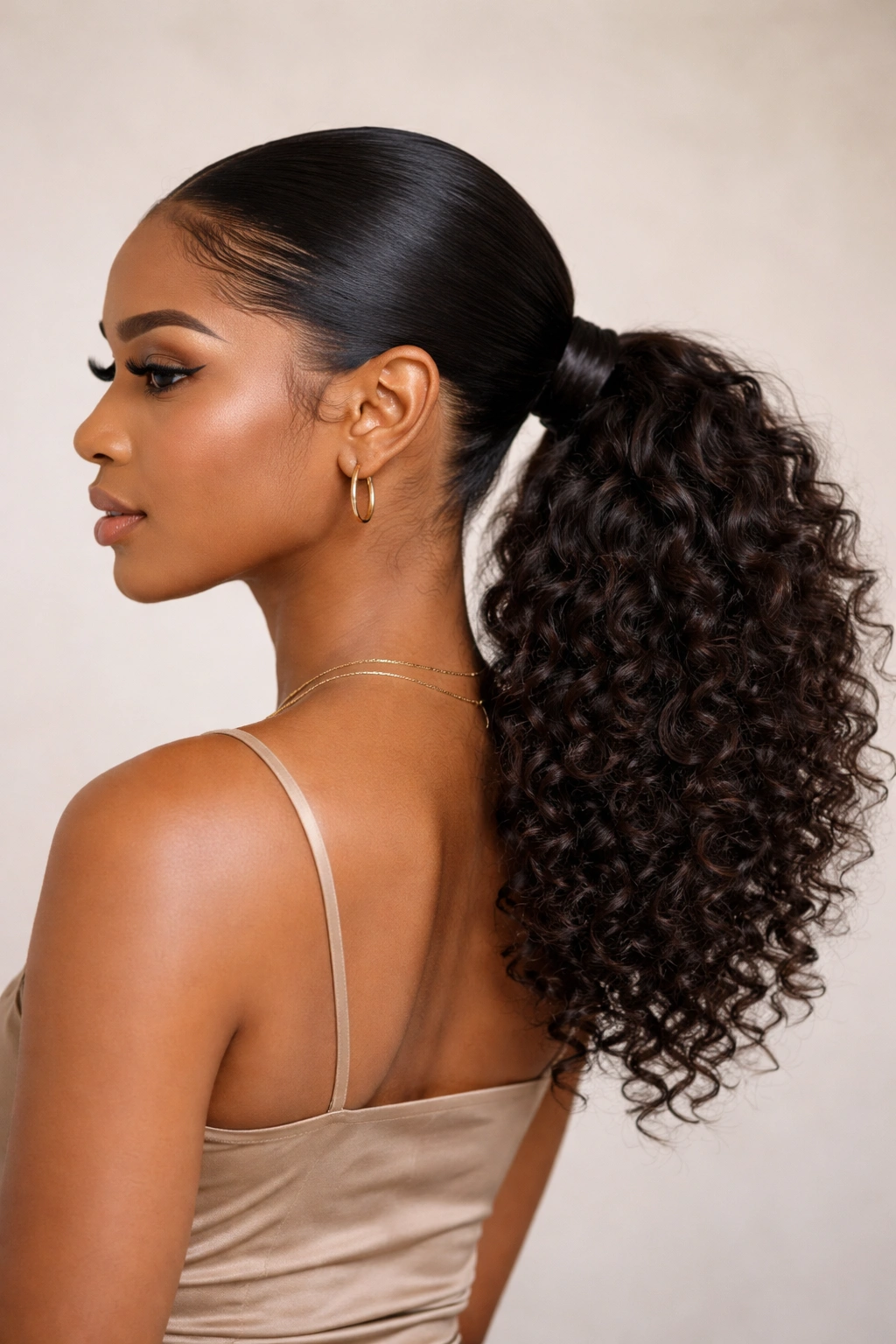
A low nape ponytail changes the whole mood. Instead of sending the volume up, it lets the curls fall in a thick, heavy line at the neck, which feels softer and a little more grounded. The base is usually smoothed back with edge control or mousse, then the ponytail extension is secured low and wrapped at the anchor point.
This is the style I’d pick for curly hair that needs to look neat without losing personality. The tail still carries texture, but the profile stays tidy. It’s also easier on the scalp than a high ponytail, which matters if your hair is tender or you wear ponytails often.
Keep the ends full and let the curls breathe. If the root is sleek and the tail is fluffy, the style feels balanced instead of severe.
3. Deep Side-Part Ponytail
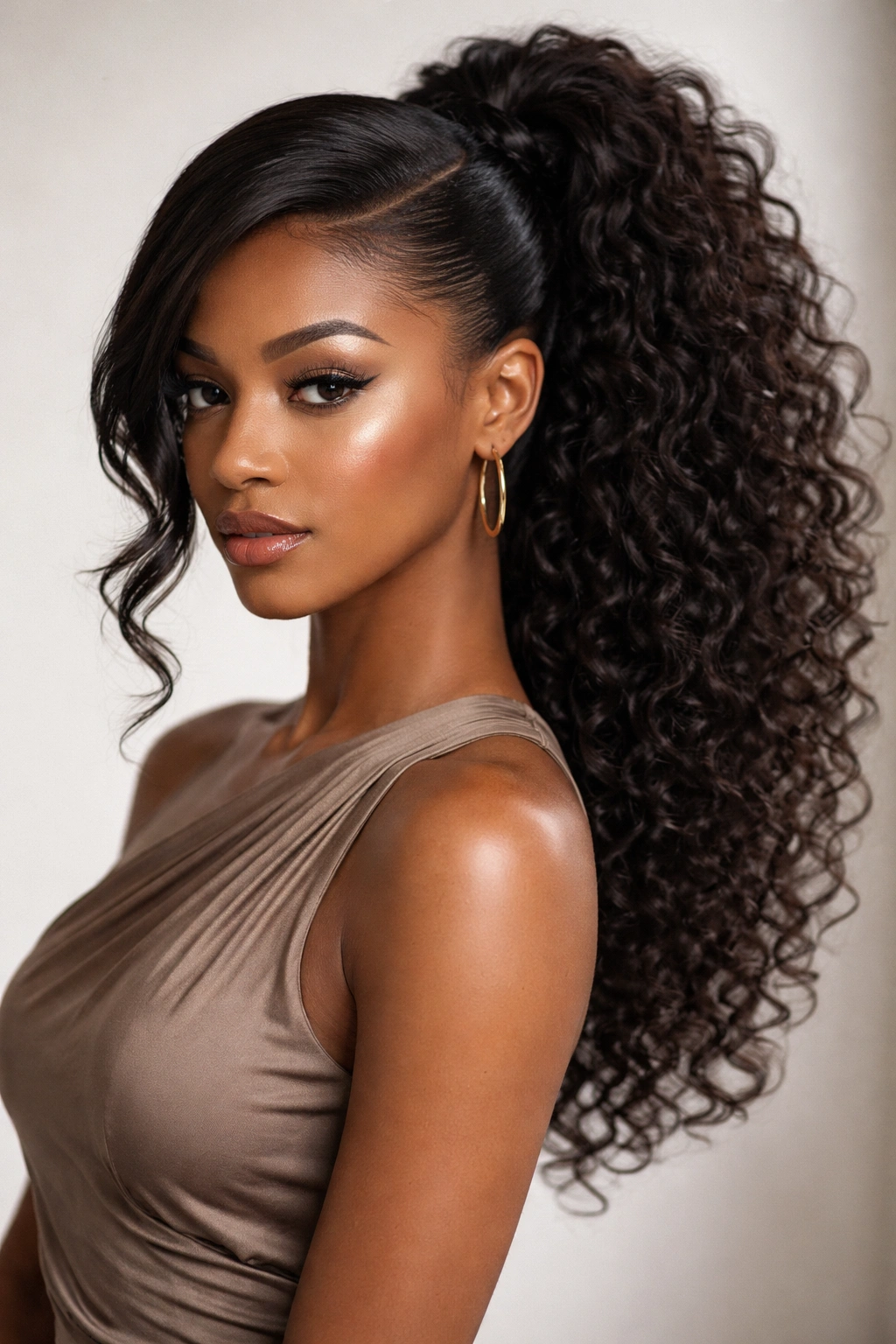
A deep side part gives a curly weave ponytail a little attitude right away. One side drops closer to the brow, the other opens up the face, and the ponytail itself sits slightly off-center so the volume feels more dramatic. That small shift makes the whole style look more intentional.
The side part is especially good when the hairline needs a softer frame. It lets the curls fall in a way that doesn’t expose both temples at once, which can be flattering if you want less focus on the center of the face. A lot of stylists like this for long bundles because the movement starts near the part and carries into the tail.
The best part? It doesn’t need a lot of decoration. The asymmetry does the work.
4. Half-Up Curly Ponytail
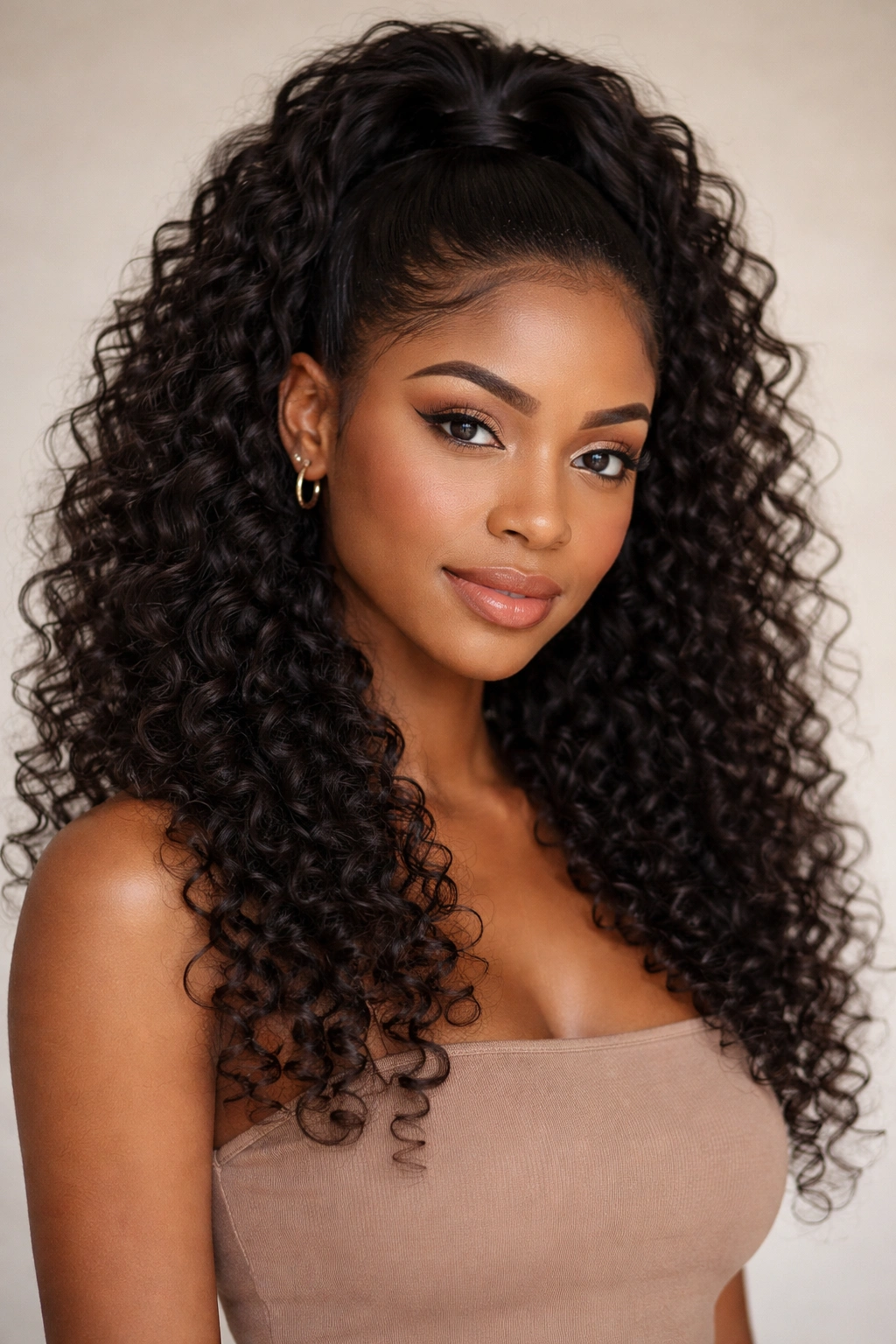
Half-up styles are underrated. They give you the lift of a ponytail without taking all the curl volume off the neck and shoulders. For weave, that means the top section can be smoothed, braided, or tied back while the rest of the curls stay loose and full underneath.
This look is useful when you want the idea of a ponytail but not the full commitment. It’s also a nice option if your natural curls and the weave texture are slightly different, because the style gives you more room to blend the two. The top section can hide track placement or a small ponytail base, while the loose hair below keeps things soft.
Why It Works
The shape gives you two textures at once. That keeps the style from looking too rigid.
A half-up ponytail is also forgiving if the crown isn’t perfectly flat. You get volume where you want it and movement where you need it.
5. Bubble Ponytail With Curly Sections
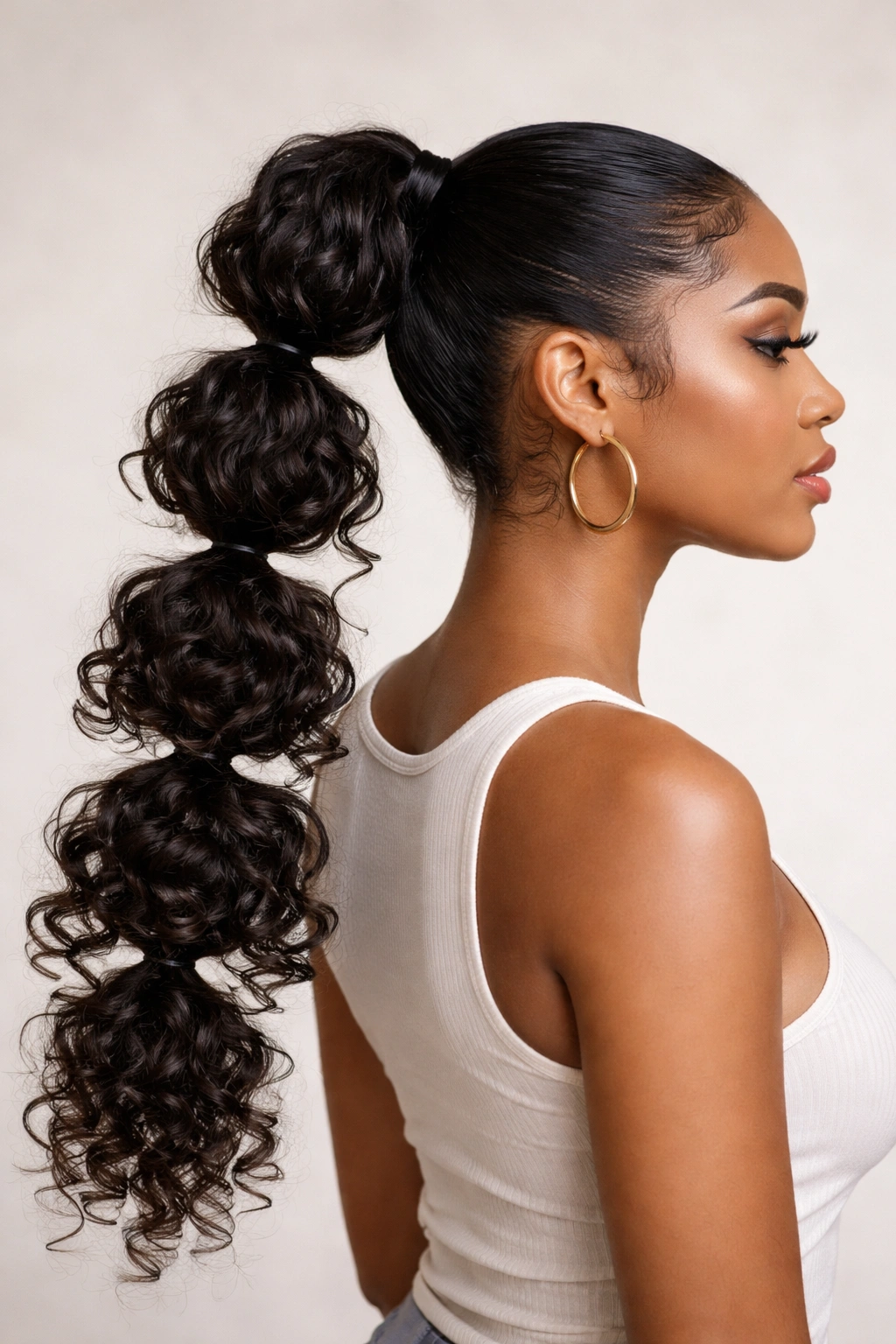
Bubble ponytails look playful, but they need density to work well on curly hair. Each section between elastics has to puff out enough to read as a bubble, not just a tied-off tube. That’s where weave helps. The extra length and fullness make each segment stand away from the next one.
For curly hair, this style works best when the curls are defined but not brushed into submission. You can stretch the ponytail slightly with your fingers, then secure 3 to 5 evenly spaced elastics down the length. Leave each bubble rounded by tugging on the sides gently until it fills out.
It’s a good choice if you want structure without losing the fun of curls. The style looks deliberate, but it doesn’t feel fussy.
6. Feed-In Braid Ponytail With Curly Tail
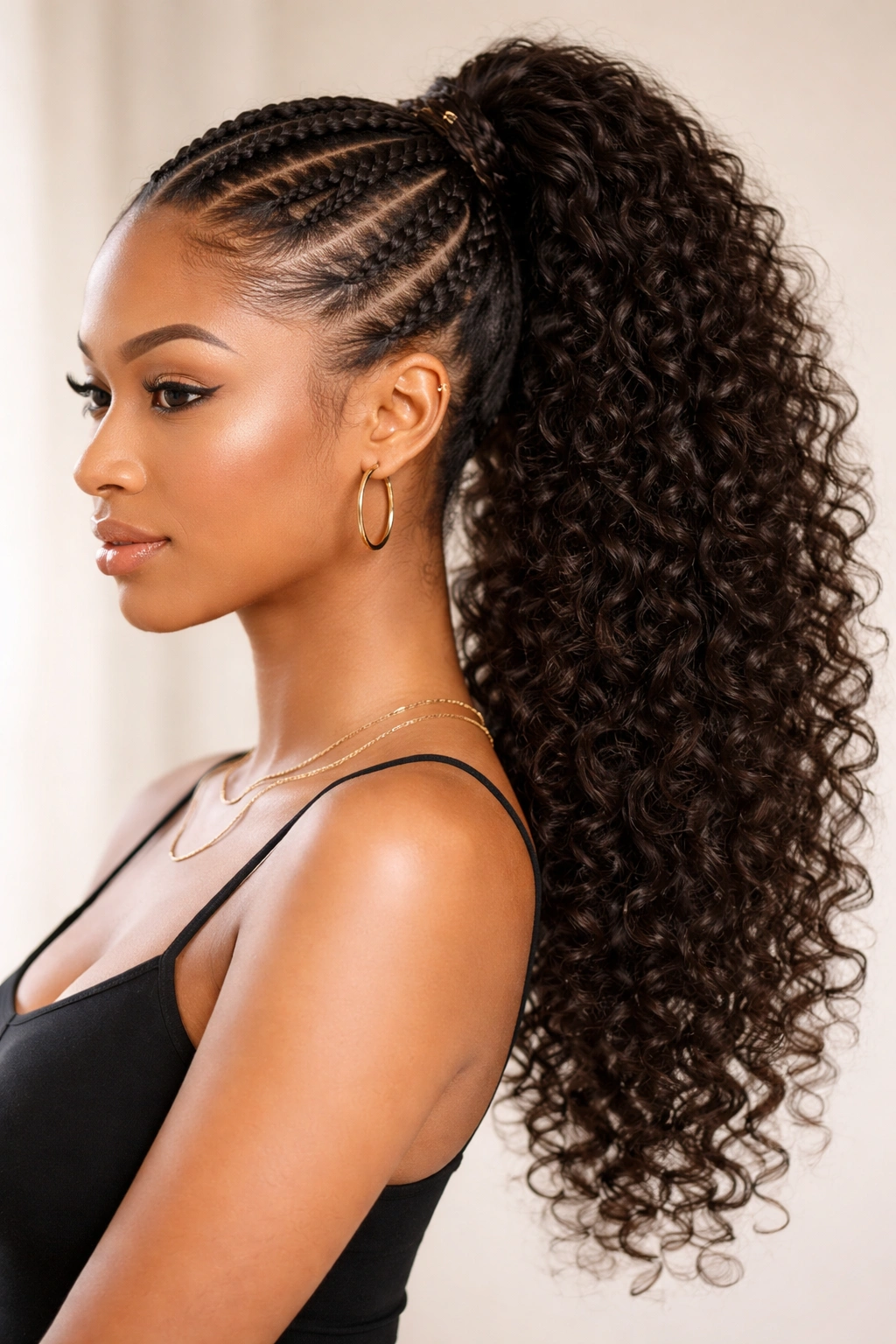
Feed-in braids leading into a curly ponytail are a smart move when you want the base to stay neat and the end result to look full. The braids lay close to the scalp, then gather into one ponytail that can be wrapped, curled, or left to spill into long spirals.
This style works because the braids do the heavy lifting at the root. They create a smooth path that keeps the ponytail from spreading out too much at the crown, which helps the tail look fuller. A good feed-in ponytail can also make a small amount of hair look much denser than it is.
What to Ask For
- 4 to 8 feed-in braids, depending on how busy you want the base to look
- A ponytail anchor that sits at the crown or just above the nape
- Curly extensions with enough bulk to cover the braid ends
If you want a protective style that still reads soft, this one lands in the right place.
7. Afro Puff Ponytail With Weave Length
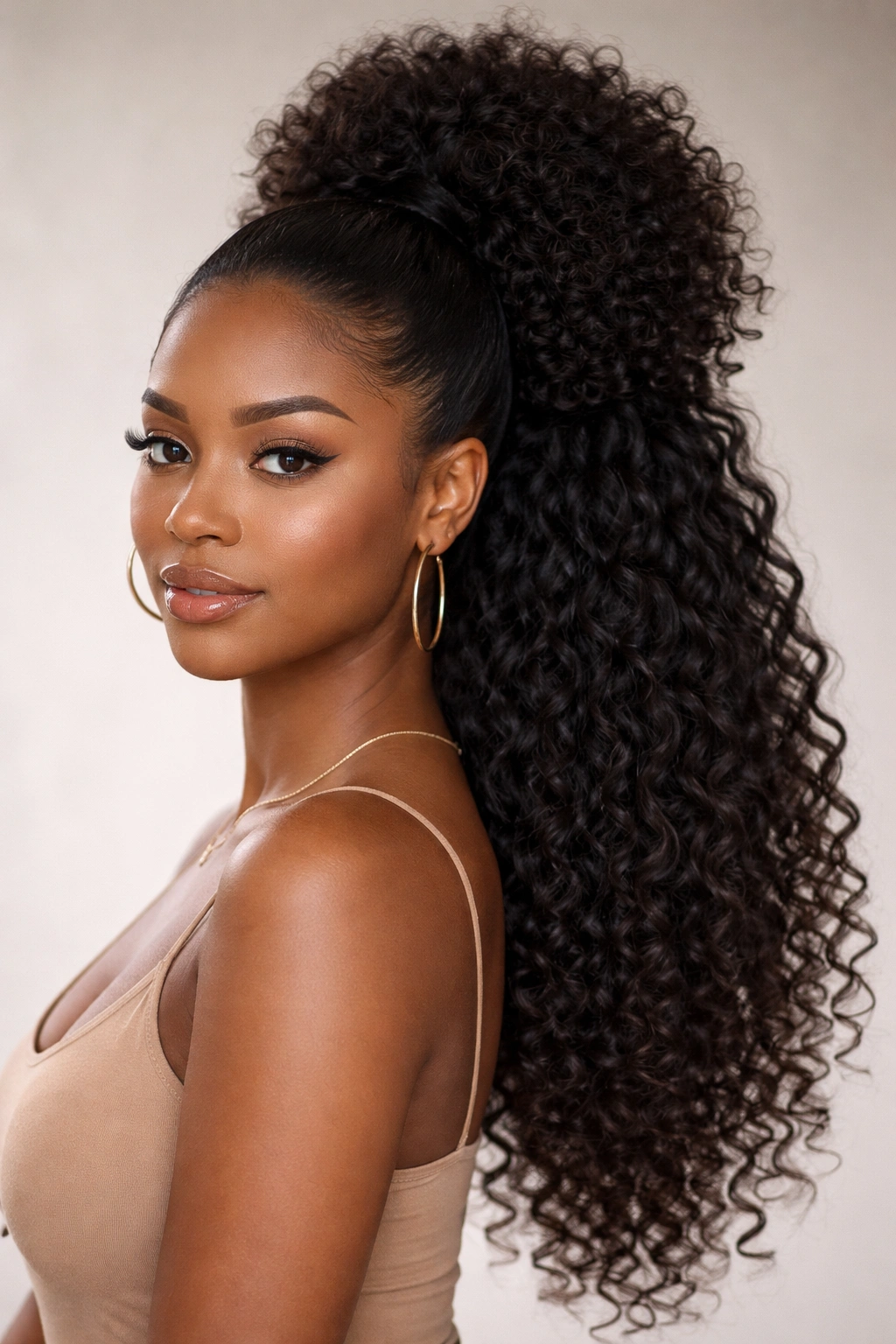
An afro puff ponytail with weave length has a little more edge than a classic curly tail. The base sits higher and fuller, almost like a puff that’s been stretched upward, while the added weave gives the style more length and bounce. The result feels big and airy.
This is one of the best styles for people who want to keep texture front and center. It doesn’t flatten the hair into a slick shell. It celebrates the puff shape, then extends it. The transition from natural root to added hair can be hidden with a matching texture, or you can leave it slightly visible if you like the contrast.
Honestly, this style looks best when it isn’t too neat. A puff with a little lift and a curly tail with lots of body feels alive.
8. Center-Part Sculpted Ponytail
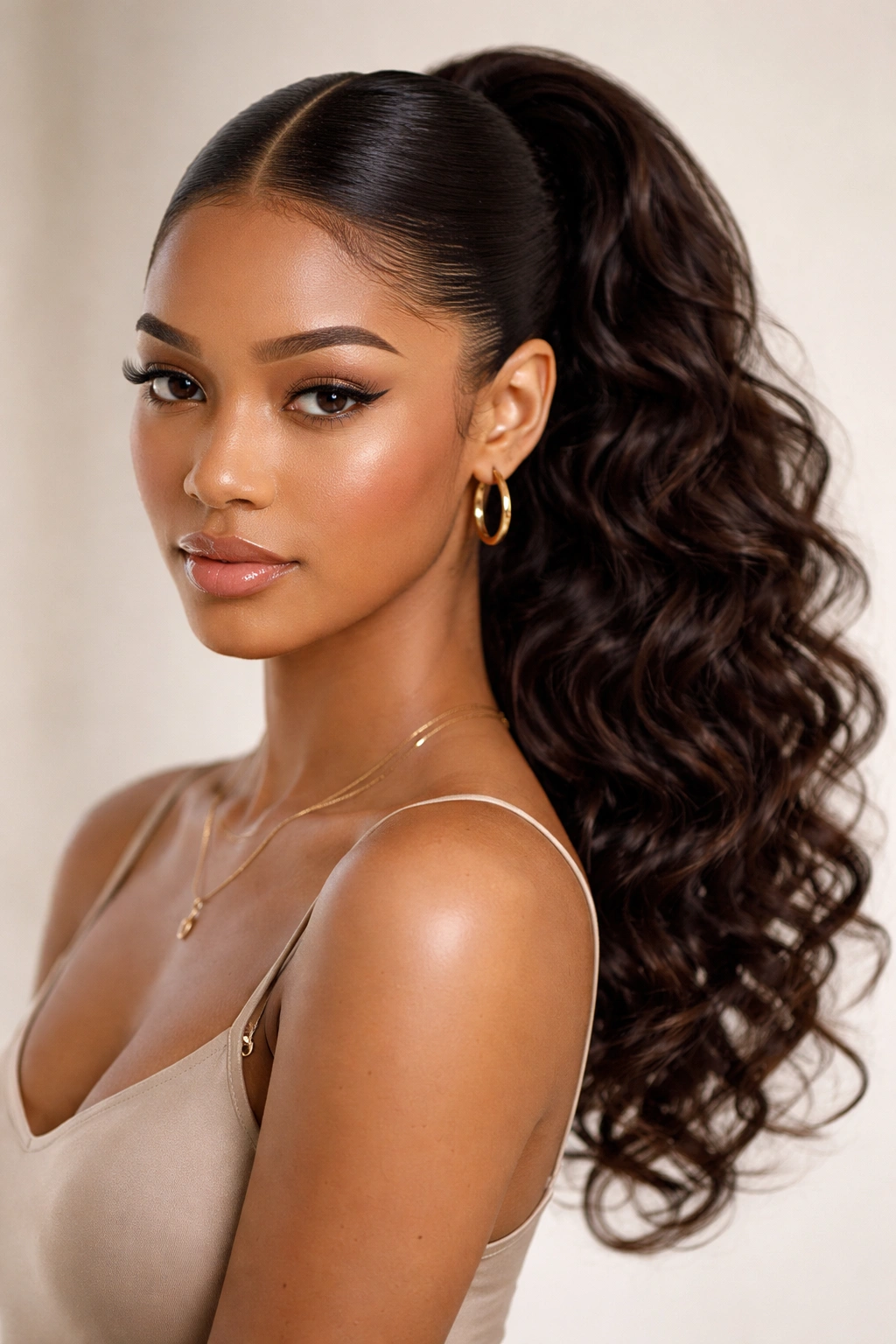
A center part can make a curly ponytail feel cleaner and more formal without killing the volume. Both sides are drawn back evenly, which creates a balanced frame around the face before the ponytail drops into a dense tail. With weave, that tail can be layered so it doesn’t hang like one heavy rope.
The key here is sculpting. The roots should be smooth, but the ponytail needs movement. I’d keep the part razor clean and the sides firmly brushed, then let the curls in the length do the softening. That contrast is what makes the style work.
If your face shape benefits from symmetry, this is a safe bet. If you want the hair to look polished in photos and still feel like curly hair, it checks both boxes.
9. Cornrow Ponytail With Lift
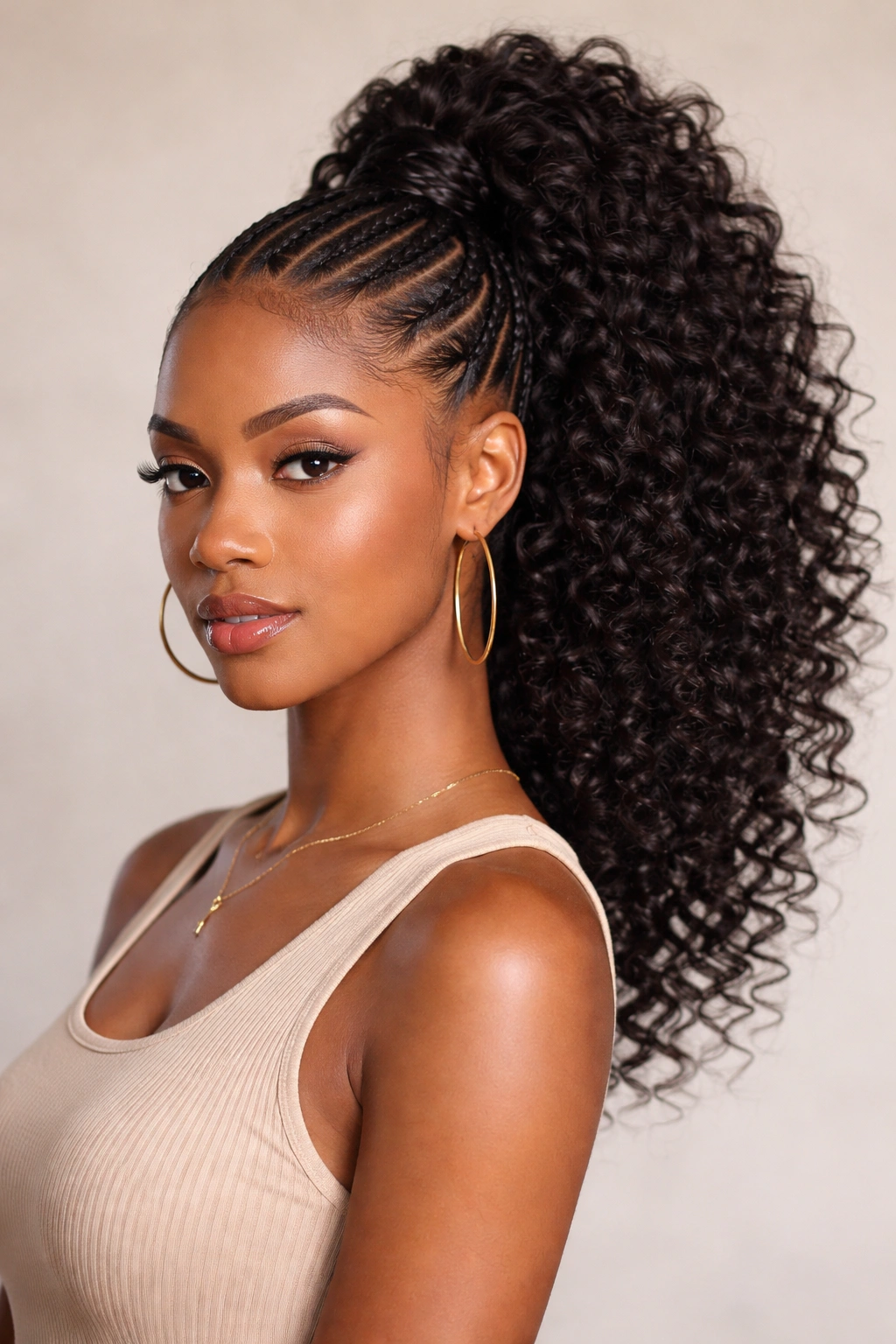
Cornrows into a ponytail give you control. The braids can be straight back, curved, or stitched in a pattern that guides the eye upward before the ponytail starts. Once the tail is attached, the whole style feels secure and lifted instead of loose at the base.
What I like about this look is the finish. It’s clean at the scalp, but the ponytail itself can be enormous. That makes it a good match for curly extensions that have a lot of body. If you use a curly ponytail piece with springy ends, the contrast against the tight cornrow foundation looks sharp.
It’s practical too. The base stays put. The tail gets all the drama. That balance is hard to beat.
10. Face-Framing Tendril Ponytail
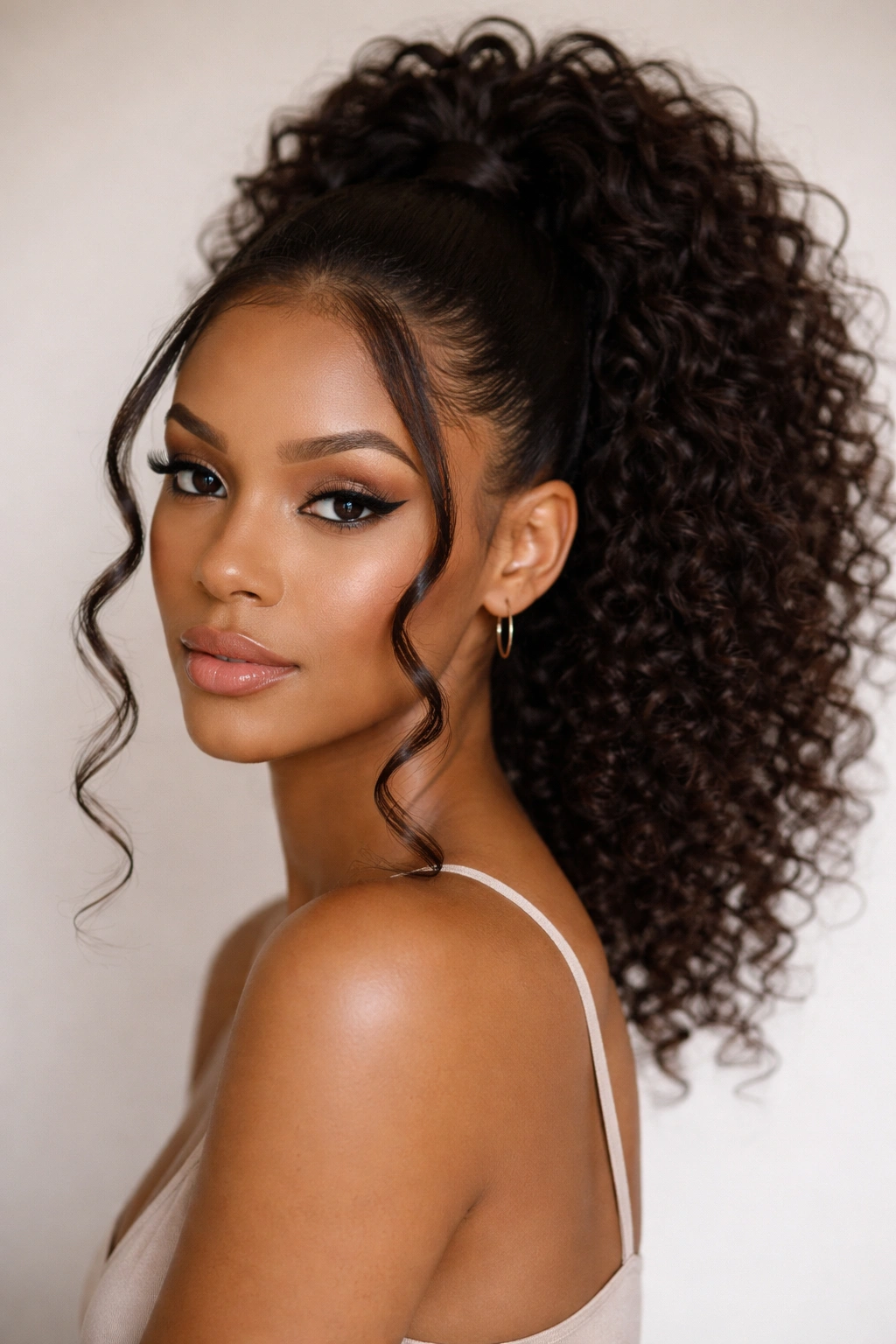
A ponytail with face-framing tendrils softens everything. Even when the base is sleek, a few loose coils around the cheeks and jaw keep the look from feeling too hard. On curly hair, those pieces can be real hair, extension pieces, or a blend of both.
This style is good when you want volume but not full exposure at the hairline. The tendrils pull the eye inward and break up the shape around the face, which is helpful if the ponytail sits very high or the crown is slicked down tightly. Two pieces are usually enough. Three can work too, but don’t overdo it.
How to Wear It
Let the front pieces curve naturally. Don’t force them into identical spirals.
A little asymmetry here looks better than perfect matching pieces.
11. Curly Mohawk Ponytail
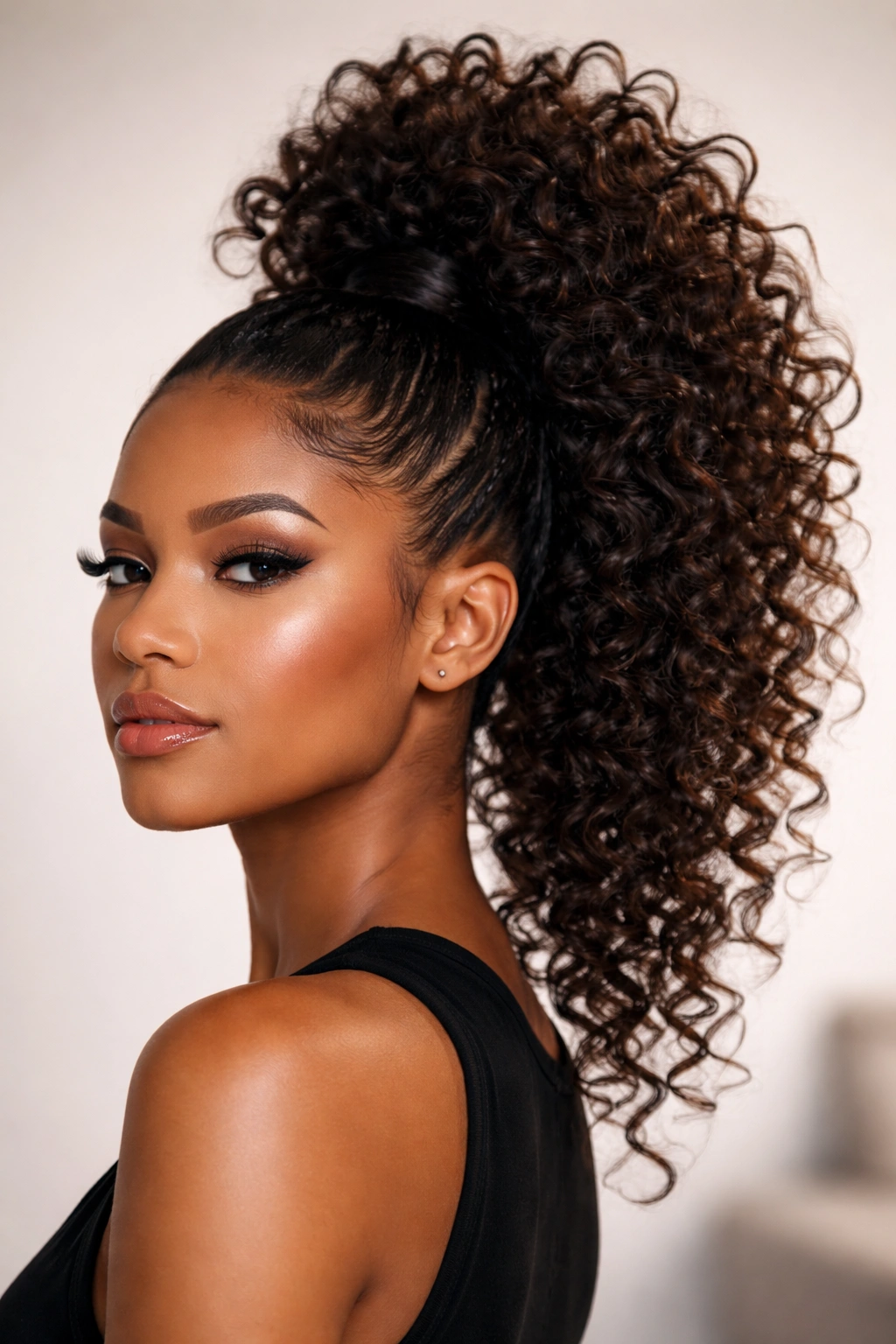
A curly mohawk ponytail brings height through the center and keeps the sides tighter. That shape gives the style a little edge right away. You can braid or slick the sides and leave the middle section to rise into a big curly tail, or you can feed several sections into one ponytail at the crown.
The look depends on contrast. Smooth sides make the curly middle seem fuller. A high ponytail at the center of the head makes the style feel more dramatic than a standard high ponytail because the silhouette narrows on the sides before opening up at the top.
If you like a sharper profile, this is one of the strongest options here. It’s not shy.
12. Jumbo Long Ponytail
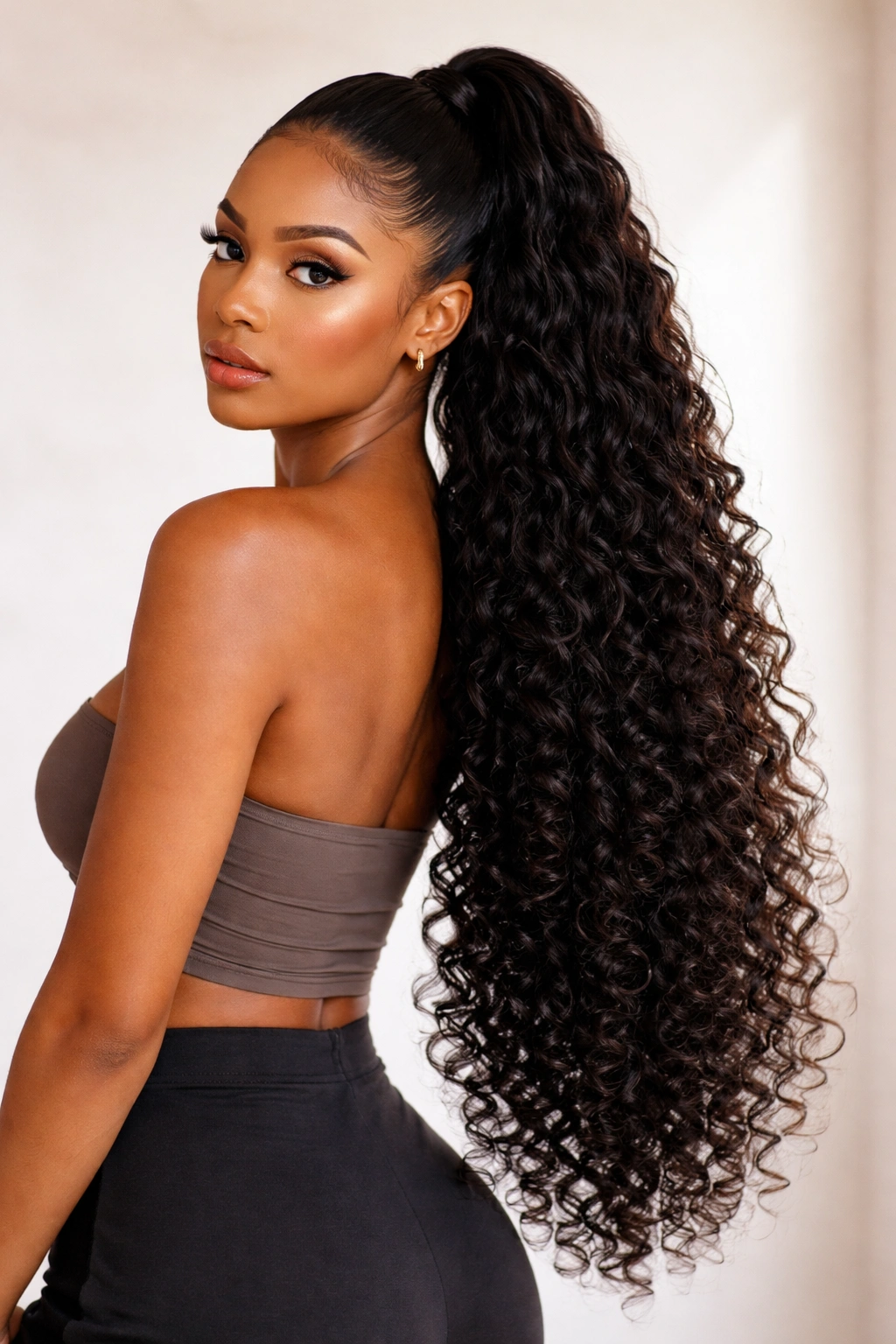
This is the showstopper. A jumbo long ponytail uses serious length, serious density, and enough curl pattern to keep the hair from looking flat at the ends. If you’re using weave, this is where two to three bundles can matter, depending on the fullness you want and how long the hair is.
A style like this needs a strong base. The anchor has to hold the weight, especially if the ponytail reaches well past the shoulders. A braided foundation or a secure drawstring base usually works better than a loose wrap because the hair has more swing and more pull.
What Makes It Stand Out
- Long lengths read best at 20 inches and up
- Layered bundles keep the tail from looking like one thick stick
- Defined curls at the ends make the length look intentional
If you want volume that announces itself before you speak, this is the one.
13. Pineapple Ponytail
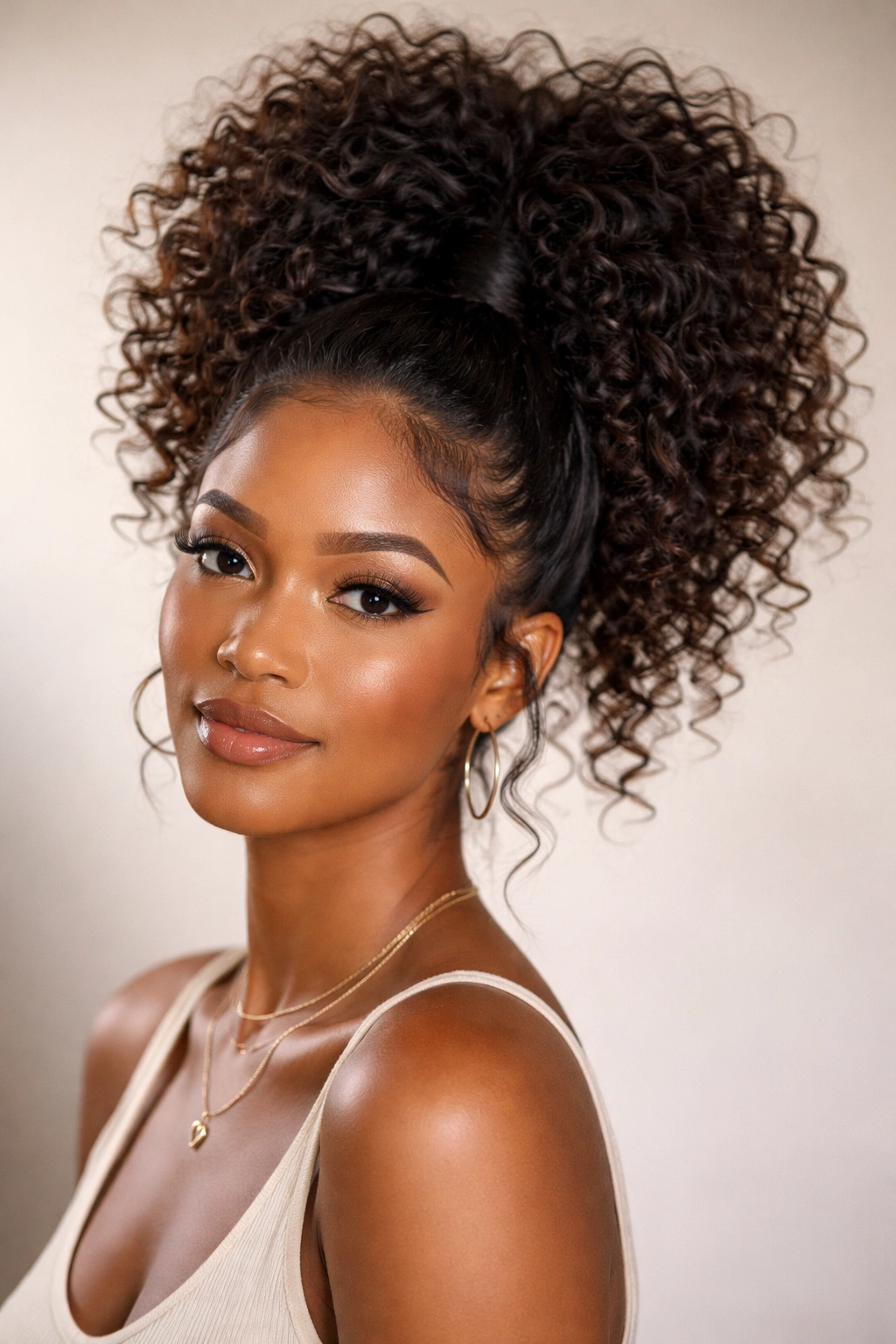
The pineapple ponytail lifts the hair high and lets the curls pile loosely on top, almost like a crown. On curly hair, that shape is flattering because it keeps the curl pattern intact instead of stretching it too far down the back. With weave, the look can be even fuller, especially if the added hair matches the spring and softness of your own texture.
It’s one of the easiest styles to wear when you want length without too much structure. The tail sits high, but the curls can stay loose and springy. That makes it a good daytime style, a sleep-friendly style, or a quick switch-up when you don’t want to redo the whole head.
A pineapple ponytail should feel light, not stuffed. If it looks like a stack of curls rather than a lump of hair, you’re doing it right.
14. Scarf-Wrapped Ponytail
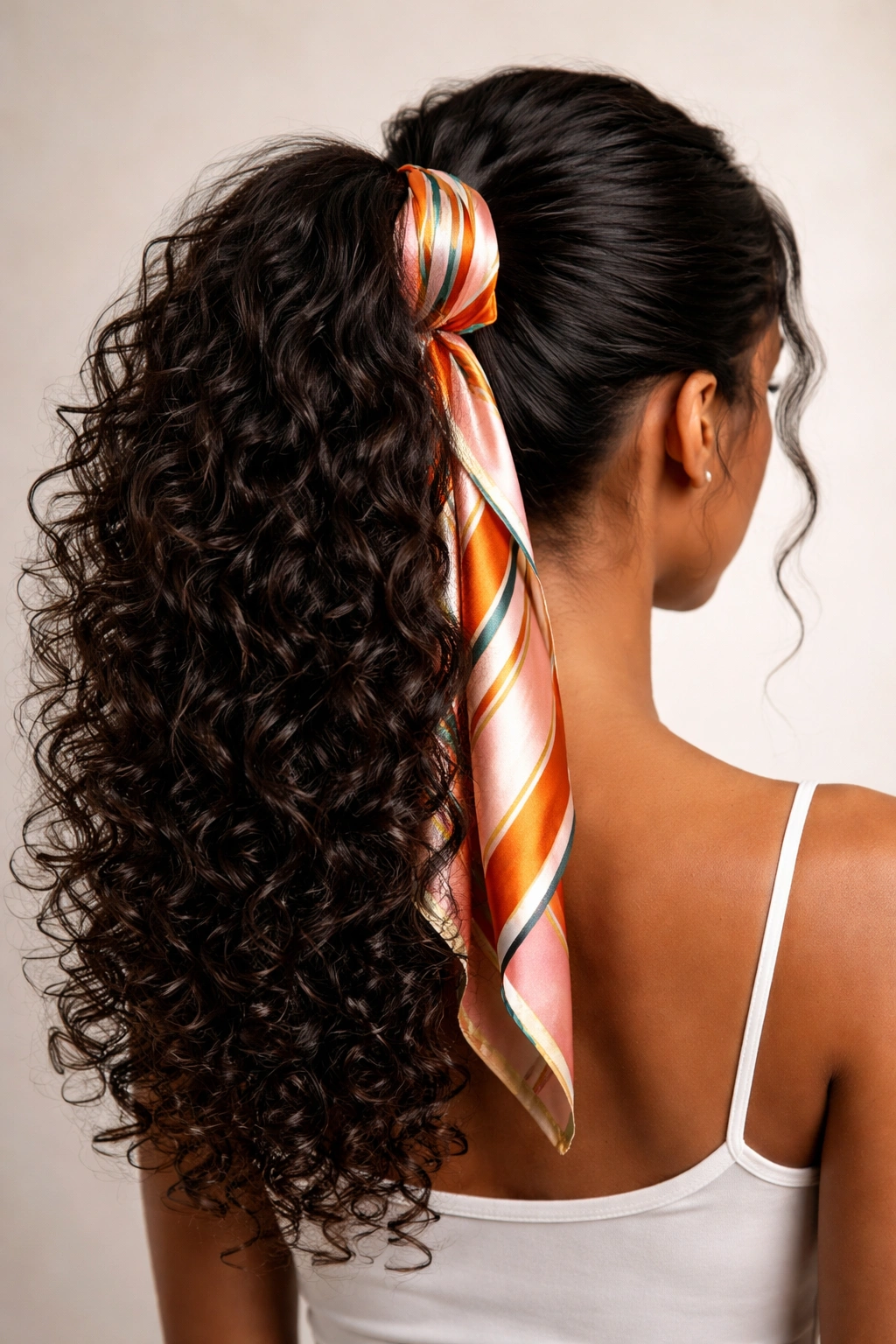
A scarf-wrapped ponytail does two jobs at once: it hides the base and gives the style some color or texture around the anchor point. On curly weave ponytails, that scarf can be satin, silk, printed cotton, or a narrow wrap that matches an outfit. The wrap takes the pressure off the base visually, which is handy when the ponytail is very full.
This style feels especially nice when the roots are smooth but the rest of the ponytail is loose. The scarf breaks up the line between the head and the tail, so the eye moves straight to the curls. That’s a small detail, but it changes the mood a lot.
If you’re tired of plain wraps, try tying the scarf slightly off-center. That little tilt makes the style feel less staged.
15. Crisscross Base Ponytail
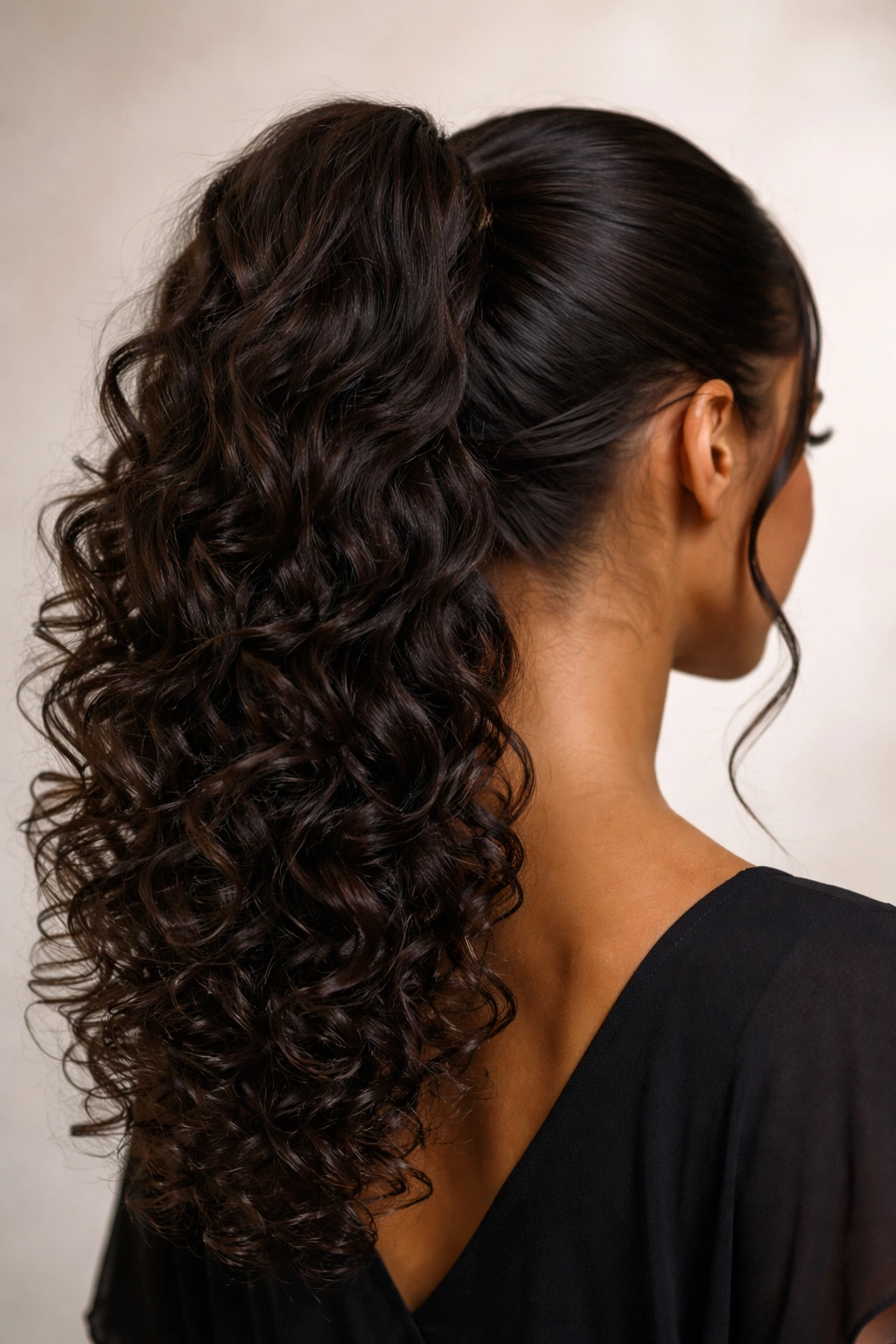
A crisscross base ponytail turns the foundation into the design. Instead of hiding the anchor completely with a plain wrap, you build X-shaped sections over the base so the ponytail starts with a little visual pattern. It’s subtle from a distance and much more interesting up close.
This look works well on curly hair because the curls carry the rest of the style once the base is in place. You do not need a lot of decoration after the crisscross, which is part of the appeal. The braid or wrap detail gives the top half some polish, and the tail gives you the volume.
It’s one of those styles that looks like extra effort, even when the technique is straightforward. People notice the finish.
16. Layered Mixed-Curl Ponytail
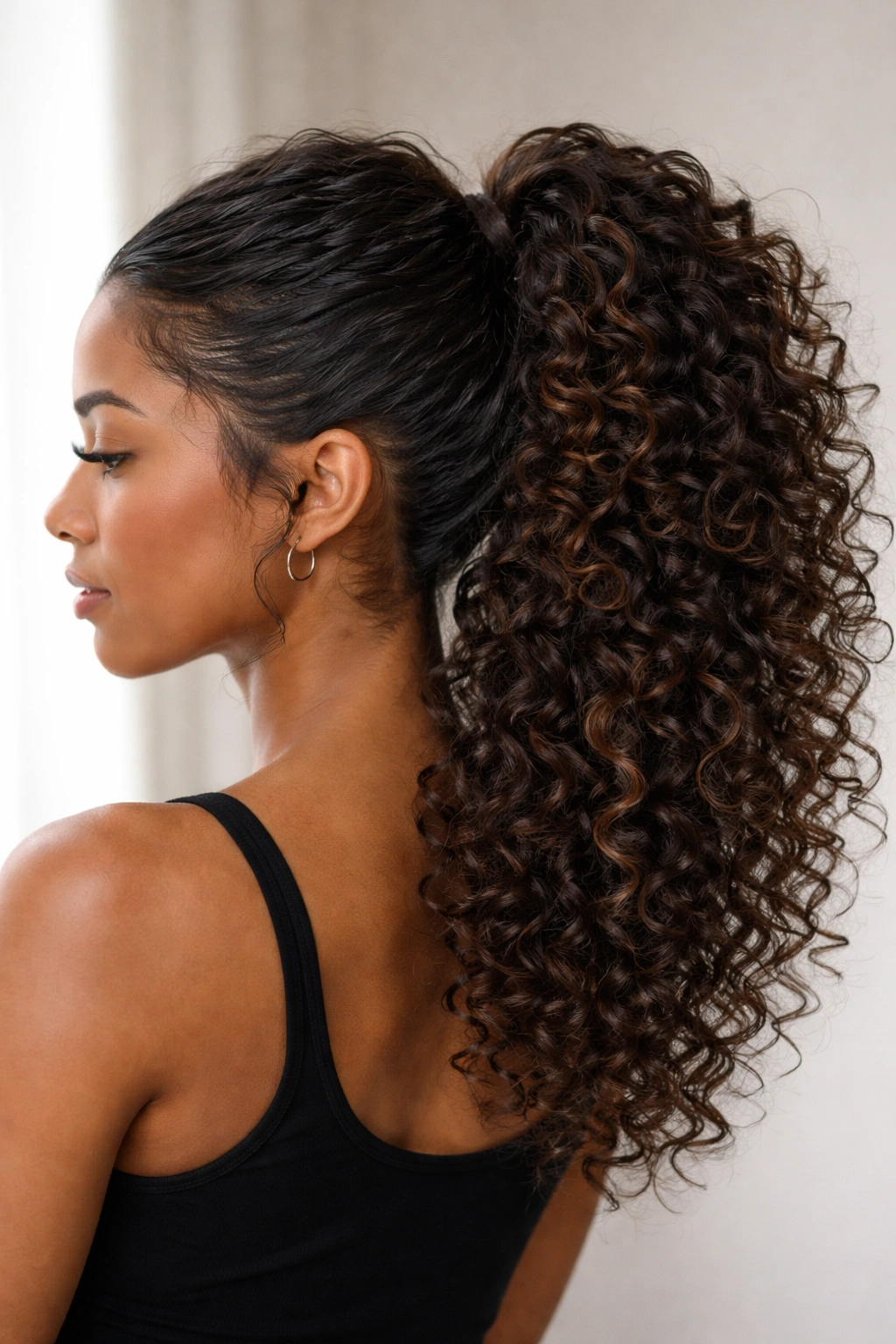
A layered mixed-curl ponytail is a smart move if your natural hair and your weave don’t match perfectly. Instead of fighting the difference, you use it. One layer might have tighter curls near the top, while the lower lengths open into looser spirals or waves. That gives the ponytail depth.
This style can look especially good when the hair has different curl densities. A uniform texture is neat, but mixed texture feels more like real hair moving in real light. The trick is to keep the layers soft enough that they blend. Harsh cut lines will show. Feathered ends tend to work better.
What Makes It Different
The mix of curl patterns creates built-in body.
You don’t need every strand to behave the same way. That’s the whole point.
17. Low Side-Swept Ponytail
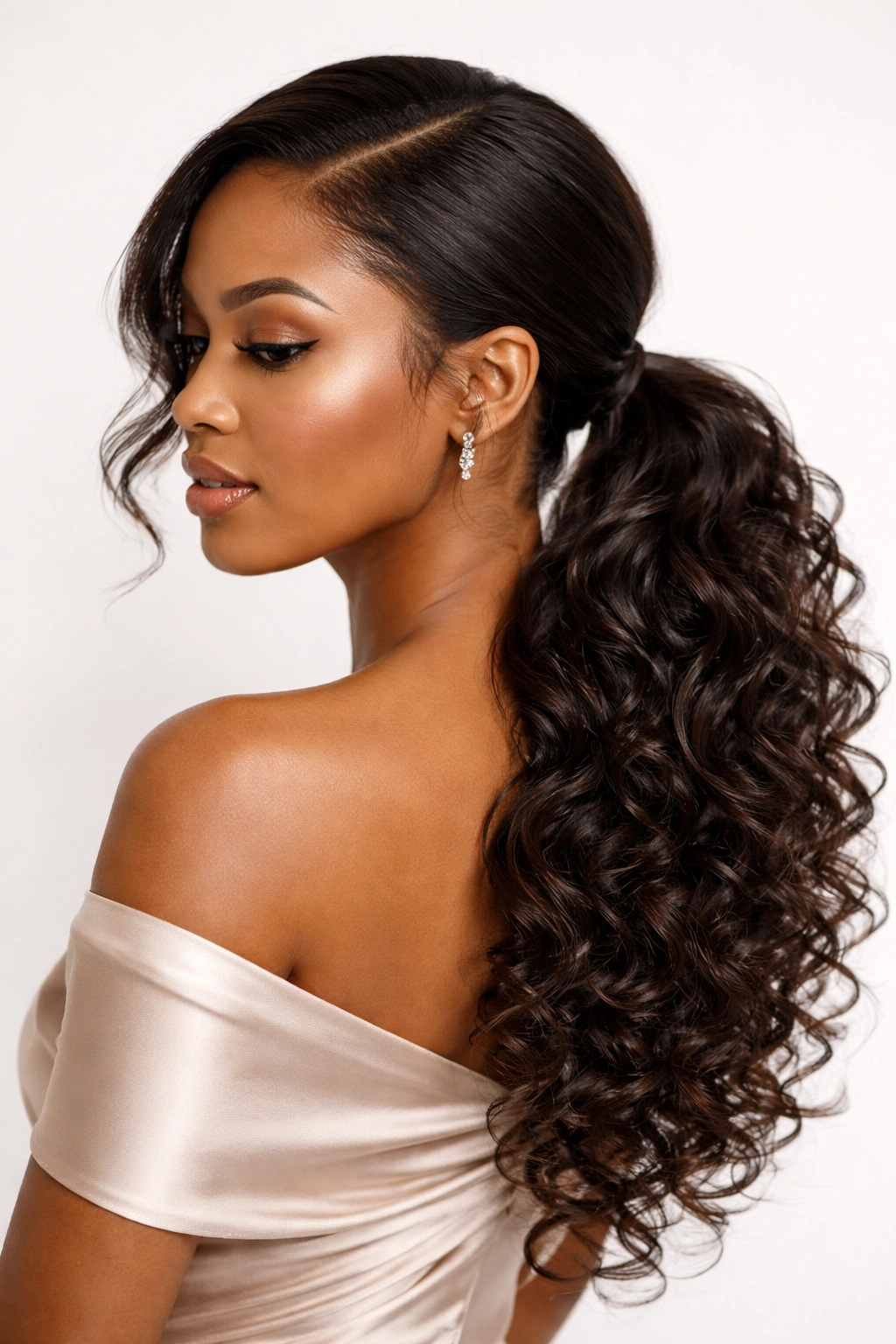
A low side-swept ponytail is softer than a strict side ponytail. The base sits near the nape, but the tail drapes across one shoulder instead of hanging straight down the back. On curly hair, that shift makes the volume feel romantic without making the style too formal.
This is a good option for anyone who wants a fuller look but doesn’t want the height of a crown ponytail. It also shows off the curl pattern better from the side, which matters when the hair has a lot of movement. A slightly off-center part can help the sweep fall more naturally.
I like this style for outfits with open necklines. It frames the collarbone instead of hiding it.
18. Tapered High Ponytail
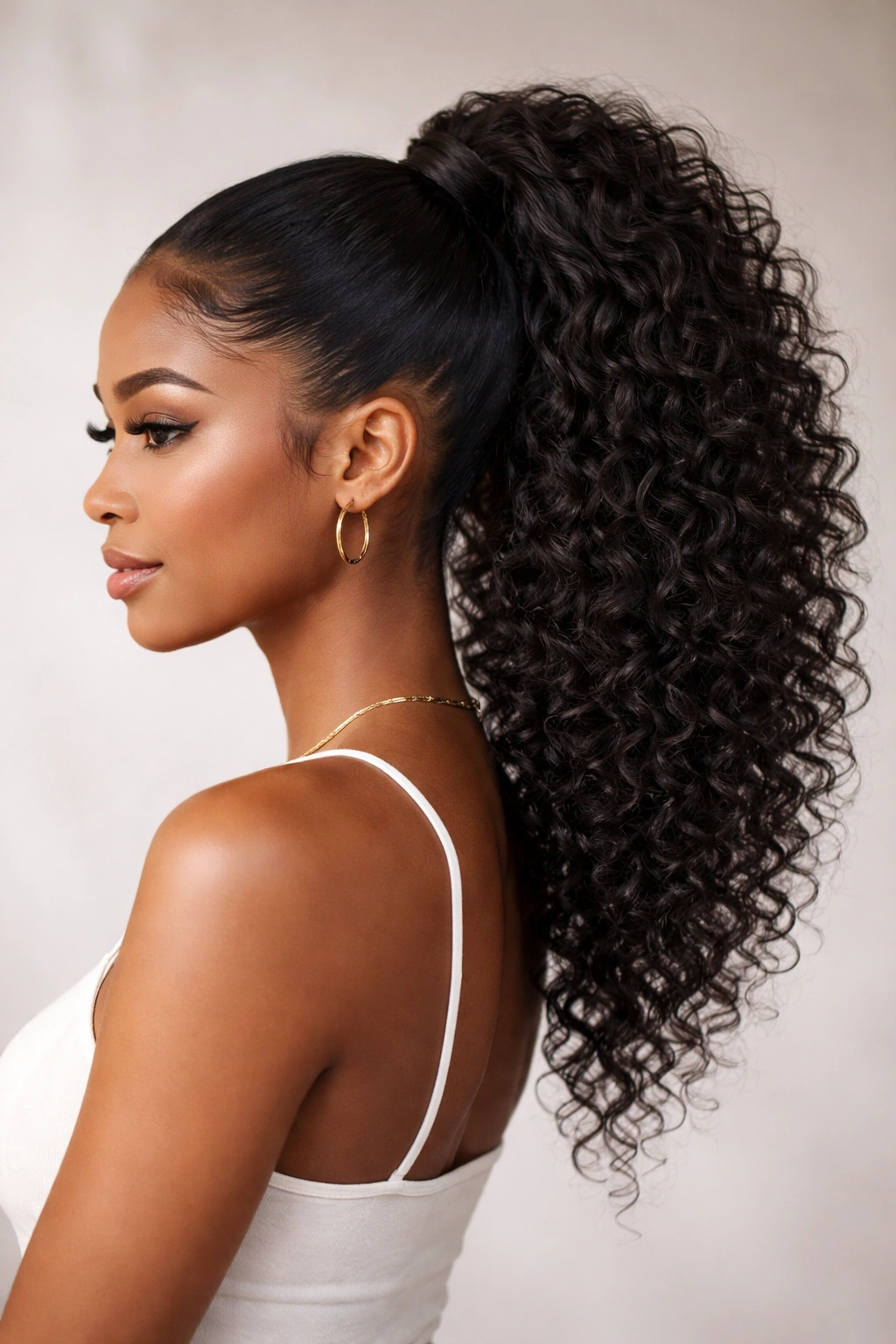
A tapered high ponytail starts big at the crown and gradually narrows toward the ends. That shape keeps the style from feeling blocky. With weave, you can build the taper by choosing bundles with layered lengths or by placing shorter pieces near the top and longer ones underneath.
The silhouette is the whole point. A tapered tail looks sleek from the top and lively at the bottom. It also helps curly extensions move more freely, because the volume is concentrated where it matters most. If the tail stays too even all the way through, the style can look heavy.
This one works best when the curls have defined ends and a little stretch. You want bounce, not puff without shape.
19. Messy Romantic Ponytail
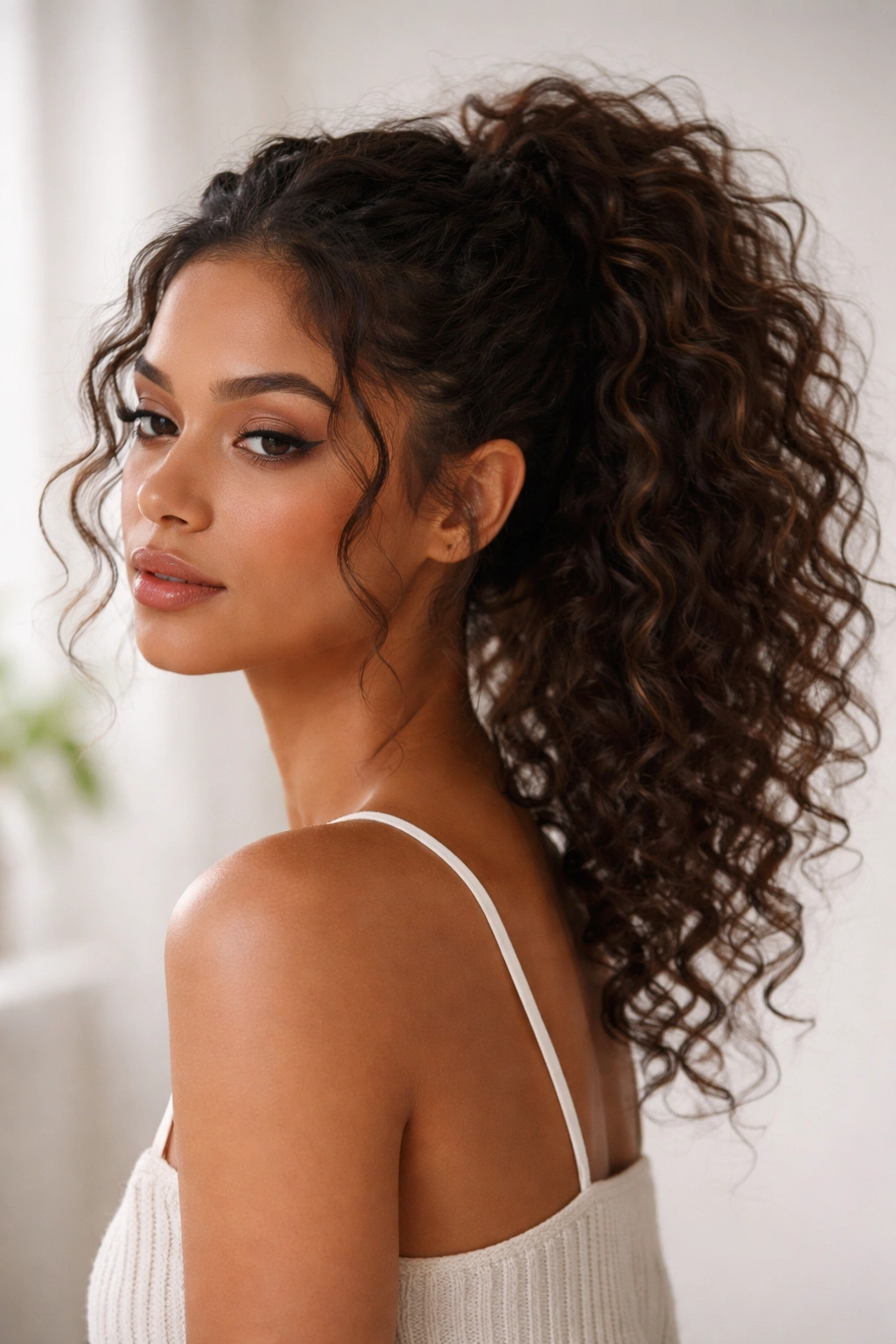
A messy romantic ponytail sounds casual, but it still needs structure. The base should be secure, the curls should be separated enough to look soft, and a few flyaways are welcome. Not every strand needs to sit in the same place. In fact, the style looks better when it doesn’t.
This is the ponytail I’d pick when a perfect finish would feel too stiff. The crown can be loosely smoothed, the ponytail can be teased by hand, and a few pieces can escape around the face and neck. That looseness gives it charm.
What to Watch For
Don’t confuse messy with unfinished. The base still needs to be anchored well.
A messy ponytail should look touched, not forgotten.
20. Braided Crown Ponytail
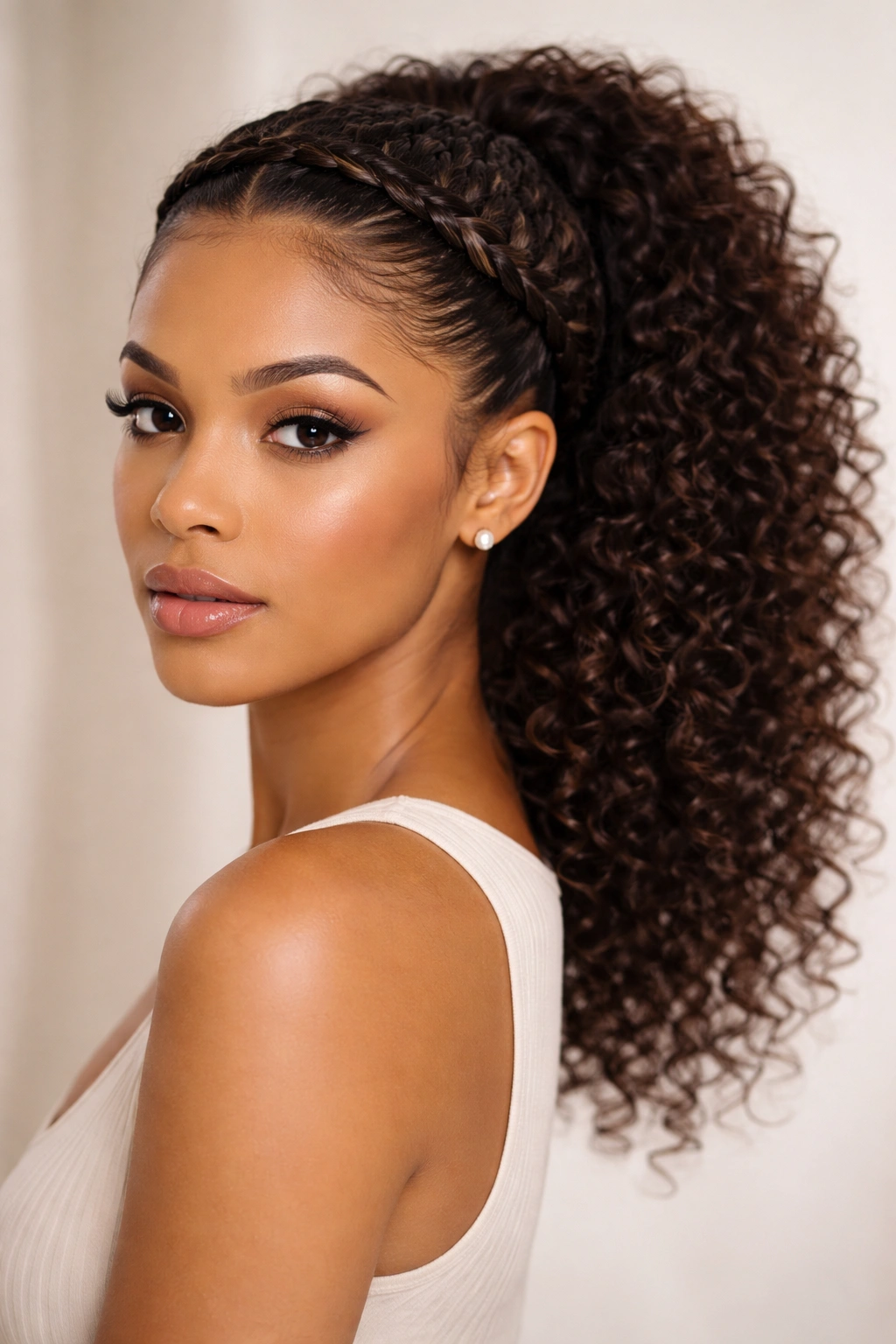
A braided crown ponytail brings braid work up front and uses it as a frame. The braid can circle the hairline like a halo, then feed into a curly tail at the back or crown. On curly hair, that combination feels rich because the braid gives structure and the tail gives softness.
This style is especially good for events or long wear. The crown braid holds the eye near the face, which makes the ponytail feel more deliberate. It also helps a weave ponytail look less like an add-on and more like a complete style. That difference matters.
If you want something ornate but not overloaded with accessories, this is a strong choice. The braid is the ornament.
21. Loop-Through Ponytail
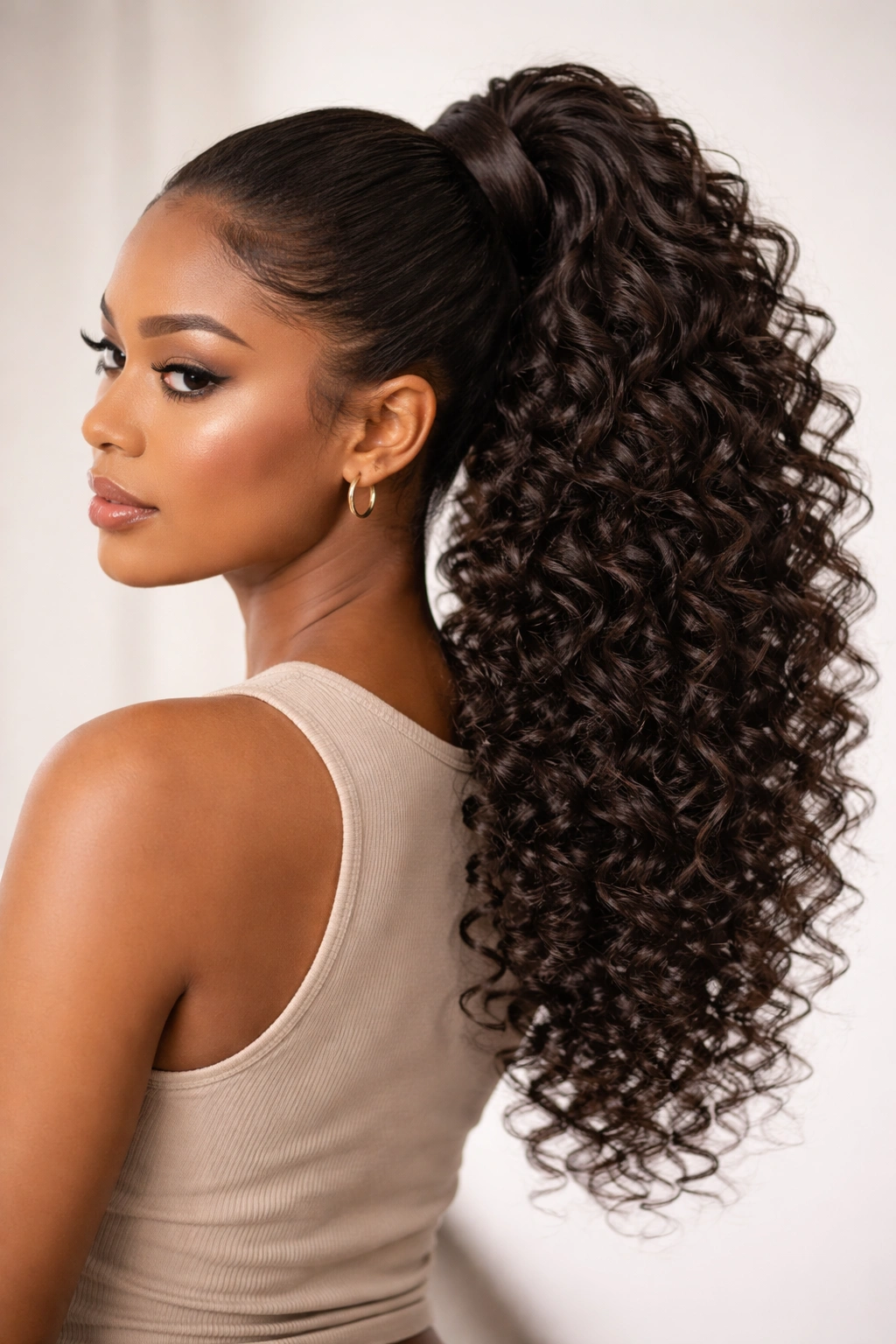
A loop-through ponytail has that satisfying, pulled-together look you get when the hair seems to tuck into itself. It’s often done with a ponytail extension piece that has a built-in base or loop, which makes the final shape look fuller without a lot of visible wrapping.
For curly hair, the loop-through method is helpful because it adds a bit of lift at the anchor without flattening the curl pattern. The tail can spill over the loop in thick sections, giving the style a fuller middle and softer ends. That middle fullness is what makes it look rich instead of skinny.
It’s a tidy option if you want a ponytail with a little more polish than a simple tie-back, but less work than a full braid-and-wrap install.
22. Glam Edge-Laid Ponytail
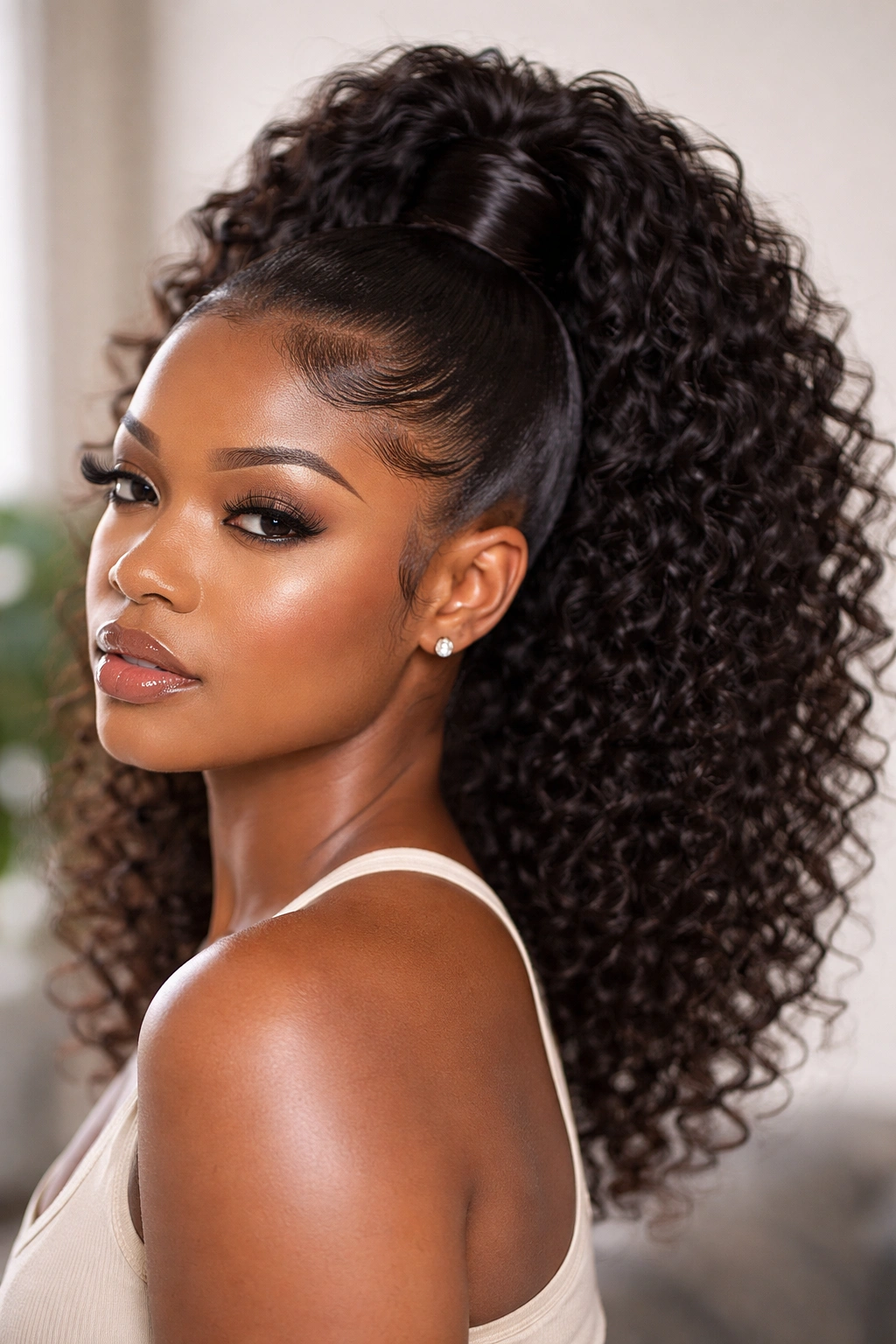
A glam ponytail often lives or dies by the hairline. The curls in the tail can be beautiful, but if the front is messy in the wrong way, the whole thing loses its edge. A laid-edge ponytail keeps the sides smooth, keeps the baby hairs controlled, and lets the rest of the hair stay full.
This style works well with a high or mid-height base. The point is to create contrast: glossy roots, dense curls, clean lines. I’d keep the edges minimal rather than drawing them into elaborate shapes. Too much swooping can distract from the ponytail itself, and curly hair already brings enough visual texture.
A little shine at the base, though, goes a long way. So does restraint.
23. Asymmetrical Long Ponytail
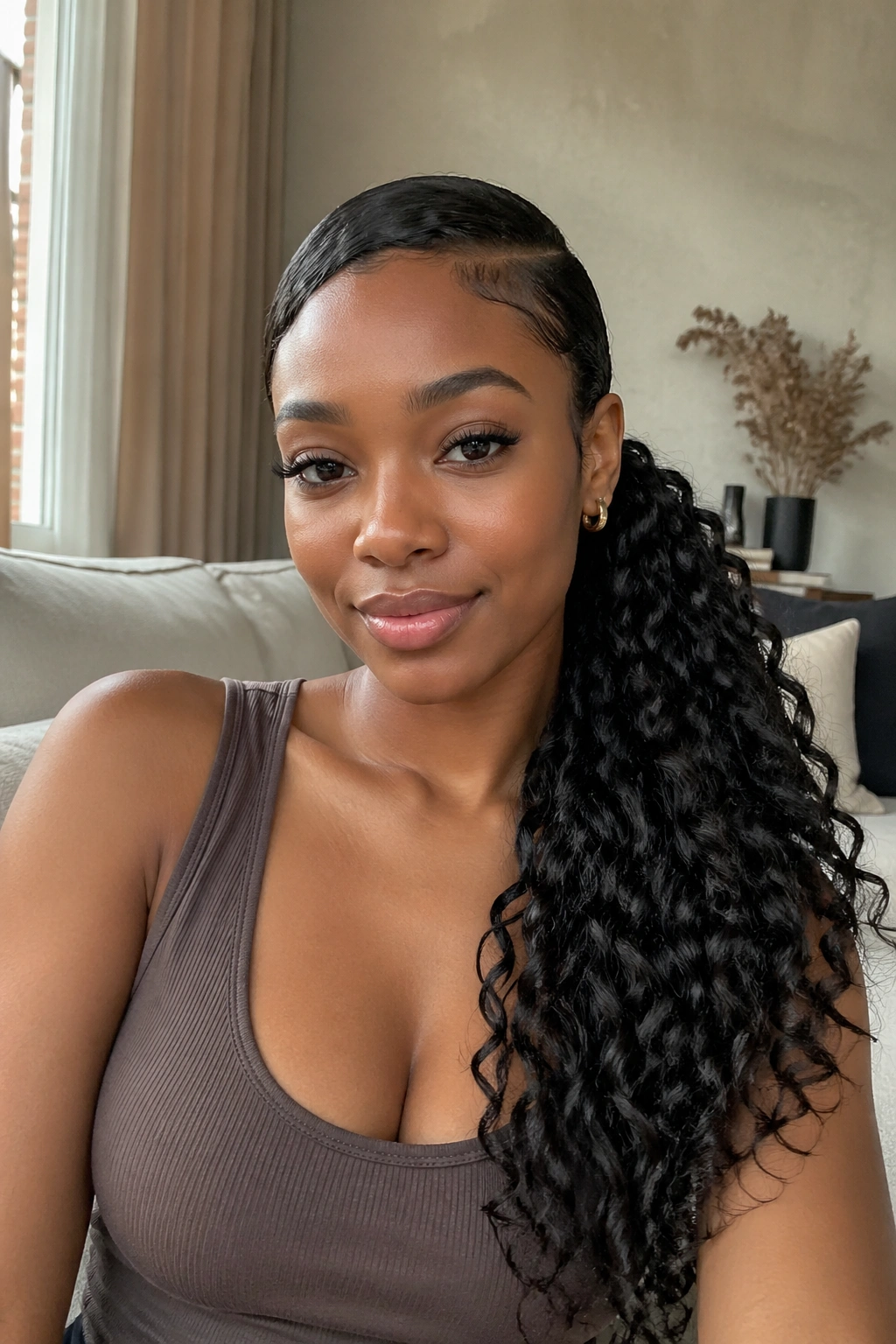
An asymmetrical long ponytail leans into unevenness on purpose. One side may be sleeker, the other fuller. The tail might fall over one shoulder instead of straight down the center, or the base may sit just off the crown so the volume travels in a diagonal line. That slant makes the style feel modern without needing extra decoration.
It’s a good final pick because it shows how flexible weave ponytails for curly hair can be. You can be polished, soft, dramatic, or slightly off-balance in a way that looks intentional. The long curls do best when they’re given room to move across the body rather than hanging stiffly in one column.
When you want the hair to carry the whole look, this is the one.
