

Cornrows on girls are different from cornrows on grown women. Not in technique — the braiding is the same. But in tension, in length, in style choice, in care routine, and in the conversation around the kitchen table while a parent or aunt or grandmother sits behind a child with a comb in hand. The styles that work for a six-year-old aren’t the styles that work for a thirteen-year-old. The cornrows that survive a school week of running and recess aren’t the same as the ones that survive a wedding photo.
I learned to braid on the back of my younger cousins’ heads. I learned what makes a child cry — too-tight roots, sharp parting, beads that knock at the back of the neck — and what keeps them still and proud — a style that makes them feel pretty, finished fast enough that they don’t lose patience, and gentle enough that the next morning’s school commute doesn’t include hairline pain.
This guide brings together twenty-five cornrow styles that work for girls of different ages, hair types, and activity levels. None of them require professional-level skills. All of them prioritize comfort and longevity. And none of them rush past the truth that a child’s scalp deserves the same care as an adult’s, with extra grace.
Why Cornrows Are a Great Pick for Girls
Cornrows protect young hair. The strands stay tucked, less exposure to friction, less manipulation through the week. For girls with active days — gym class, sports, swimming, playground time — that protection translates to less breakage and more retained length over a year.
Cornrows also free up morning routines. A style that takes two hours to install can save thirty minutes a morning for two weeks. Multiplied across a school term, that’s hours back for breakfast and reading and just being present with your child.
And cornrows can be culturally affirming. For Black girls especially, wearing braided styles is identity work. It’s continuity. It’s pride. The first time a girl sees herself in cornrows that look like the women she admires — that moment matters.
Choosing Cornrow Styles by Age
Toddlers (2-4): Simple. Quick. Few cornrows. Soft tension. Avoid heavy beads.
School age (5-9): Slightly more elaborate, beads okay, focus on durability. Avoid styles that take more than 90 minutes to install — most kids this age can’t sit still longer than that without distress.
Pre-teens (10-12): Begin introducing more complex styles, ombré, two-tone. Length and style choice can match the child’s preferences.
Teens (13+): Adult-style cornrow choices, with the same care considerations. Teens can sit through 4-hour styles if they want to.
Match the style to the child’s age, attention span, and tenderness threshold.
Tools You’ll Need
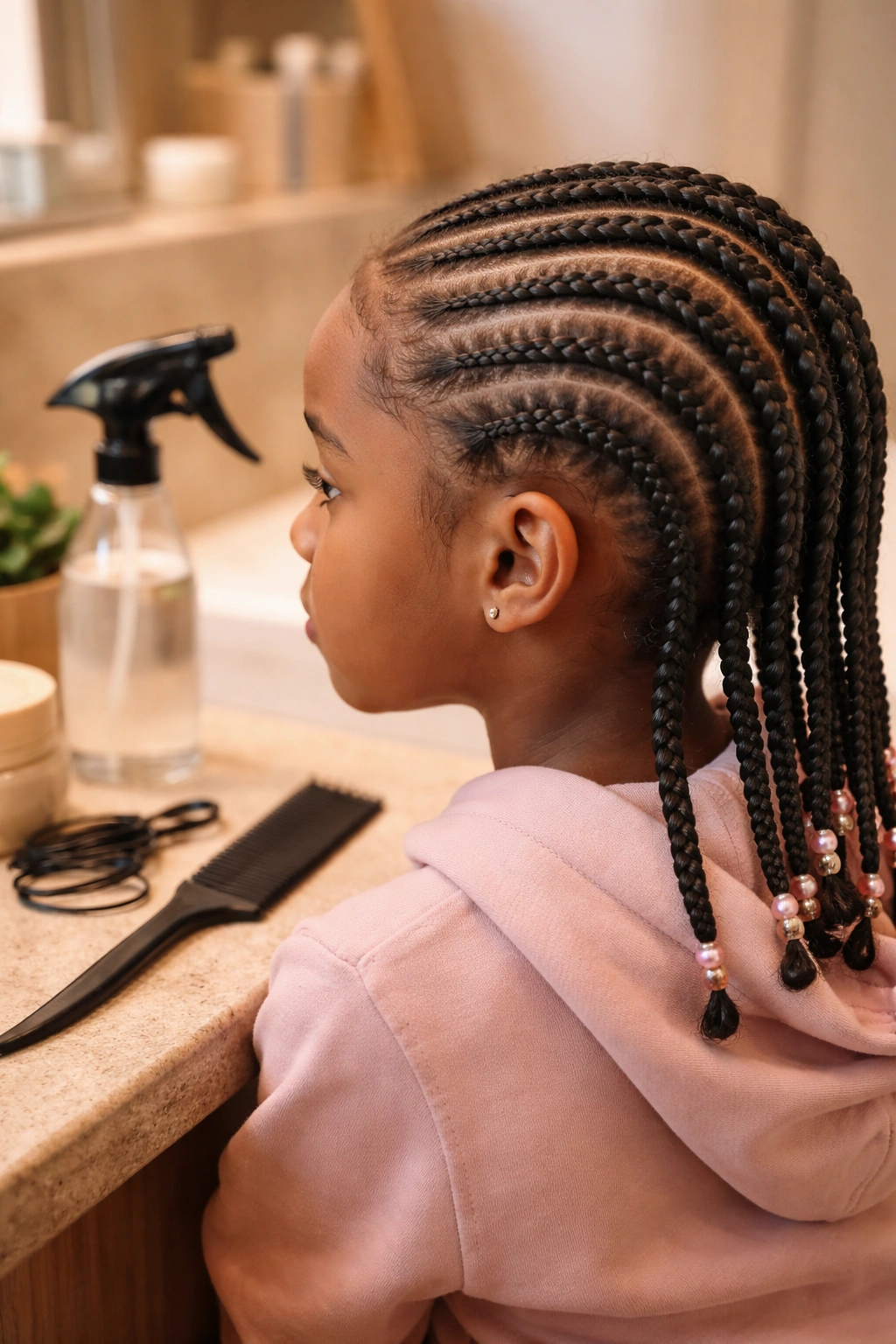
Wide-tooth comb. Rat-tail comb for parting. Spray bottle with water and a few drops of leave-in conditioner. Edge gel or pomade — children’s scalps are more sensitive, so look for ingredient lists without sulfates or artificial fragrance. Hair beads (small, light). Soft elastic bands (no metal clips on the ends). A snack and a tablet. Always a snack and a tablet.
A patient adult. An older sibling who can read a book. Music or a movie playing.
The hair tools matter. The environment matters more.
Prep That Reduces Tears
Wash the hair the day before. Day-of-wash hair is too slick. Day-before hair holds parts and tension better.
Detangle thoroughly before parting. Spray with water and conditioner. Comb from ends to roots in small sections. Knots are pain points — work them out before braiding starts.
Apply a child-friendly leave-in or oil to the scalp. Coconut oil melts at body temperature and absorbs cleanly. Avoid heavy butters that linger and feel sticky.
Let the child eat first. A hungry child is an impatient child.
Tension Talk
This is the most important rule for braiding girls’ hair: it should never hurt. Pulling tight to make a style “last longer” creates traction alopecia, headaches, and a child who hates braid time forever after.
The cornrow should feel firm but not painful. The child should be able to raise her eyebrows without strain. Her scalp shouldn’t be visibly raised between cornrows.
If she winces, loosen. Always loosen.
1. Two Simple Cornrows with Beads
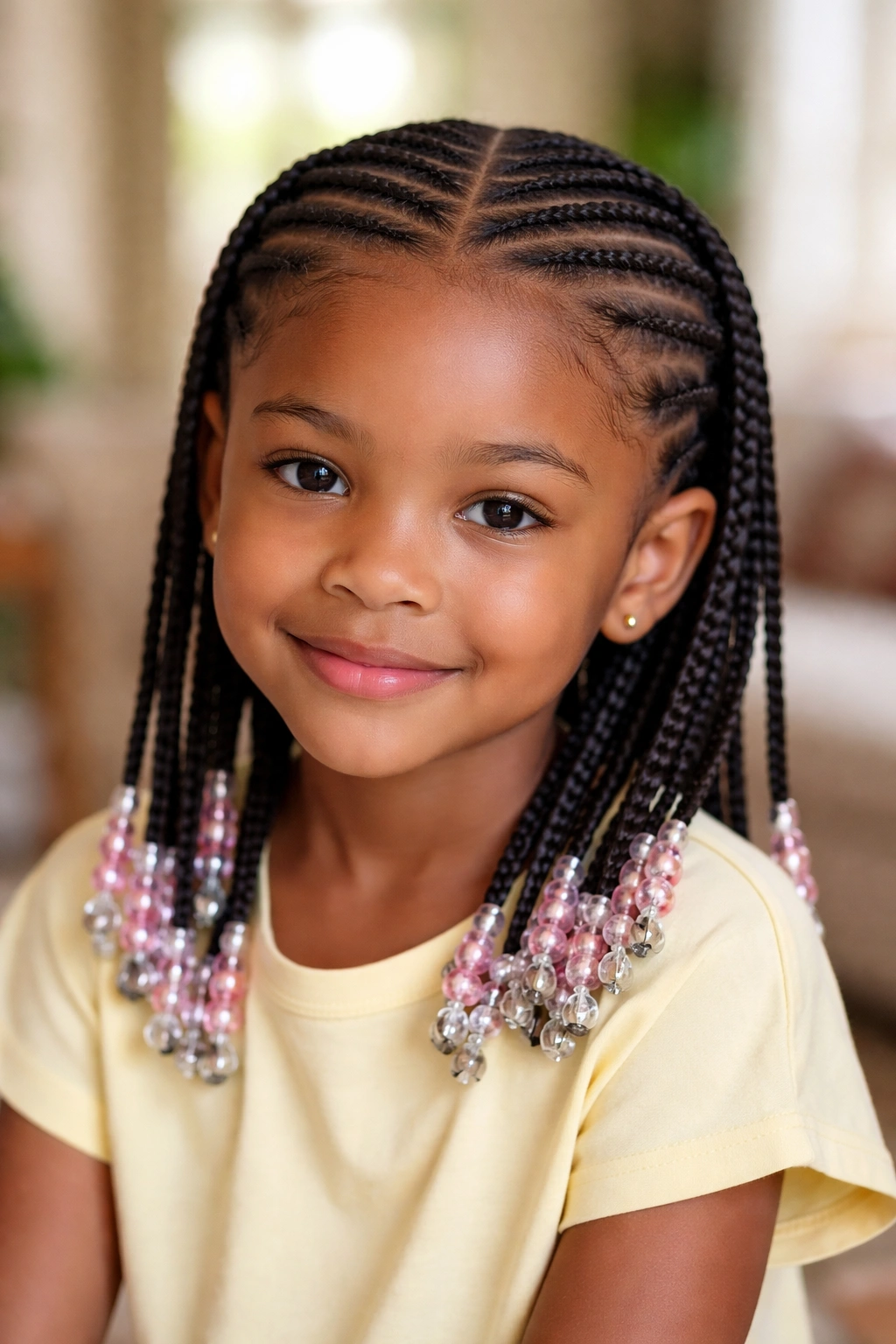
Two thick cornrows, one on each side of a center part. Three to five small beads at each end.
Why It Works
Two cornrows are the fastest, least painful style. Most toddlers tolerate this without fuss. The beads make it feel finished and special.
- Use plastic beads, not glass or metal
- Limit to 3-5 beads per cornrow
- Secure with a small soft elastic at the bottom
Tip: Let the child pick the bead colors. Choice gives ownership.
2. Side Ponytail Cornrows
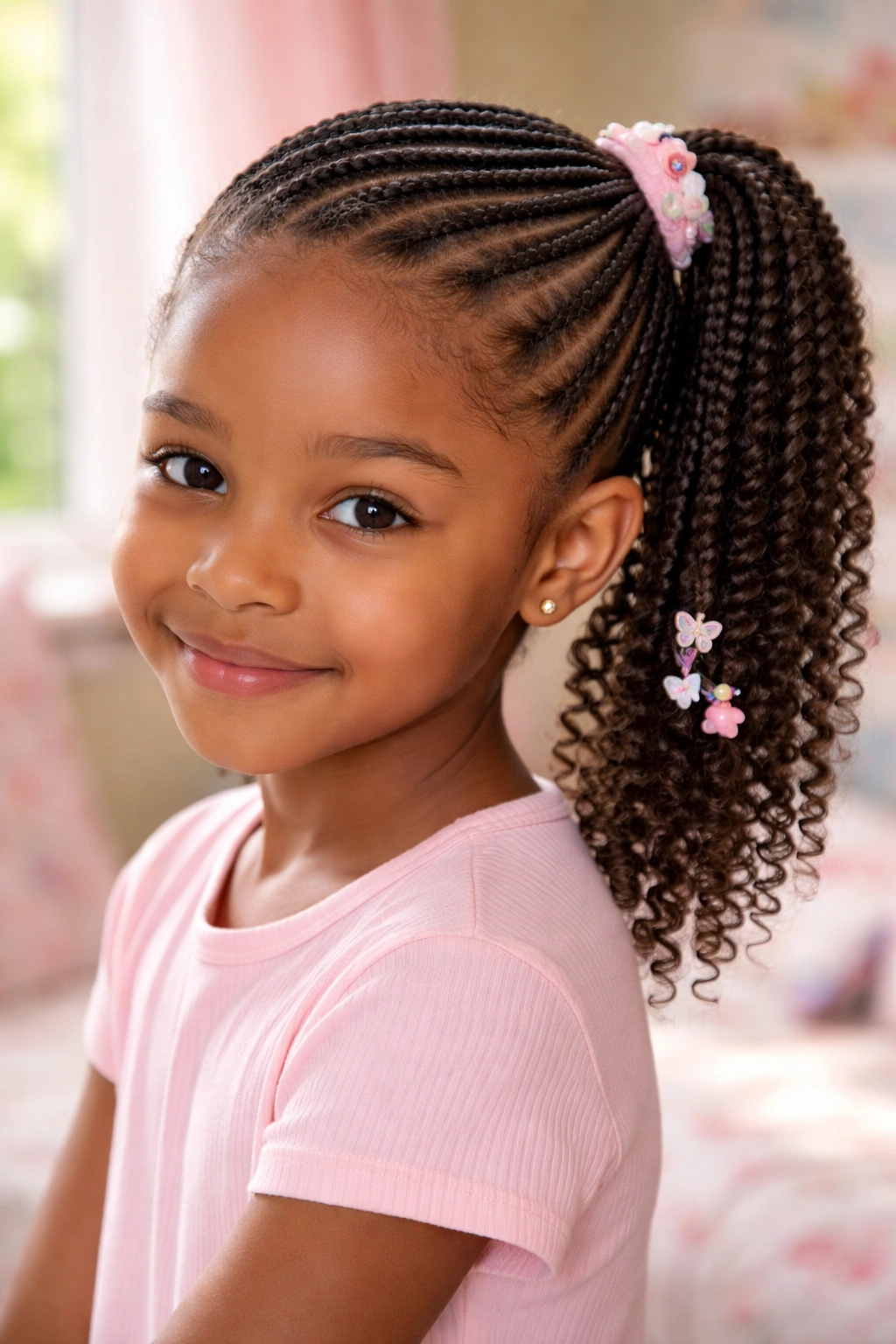
Cornrows that sweep diagonally across the head, gathering into a side ponytail finished with a hair tie and barrettes.
The diagonal sweep flatters wider faces and creates visual movement. The ponytail at the side reads playful, age-appropriate, and easy to redo if it loosens.
Allow 45 minutes for install. Use barrettes the child likes — themed barrettes (animals, hearts, flowers) make the style feel personal.
3. Heart-Shaped Cornrow Part
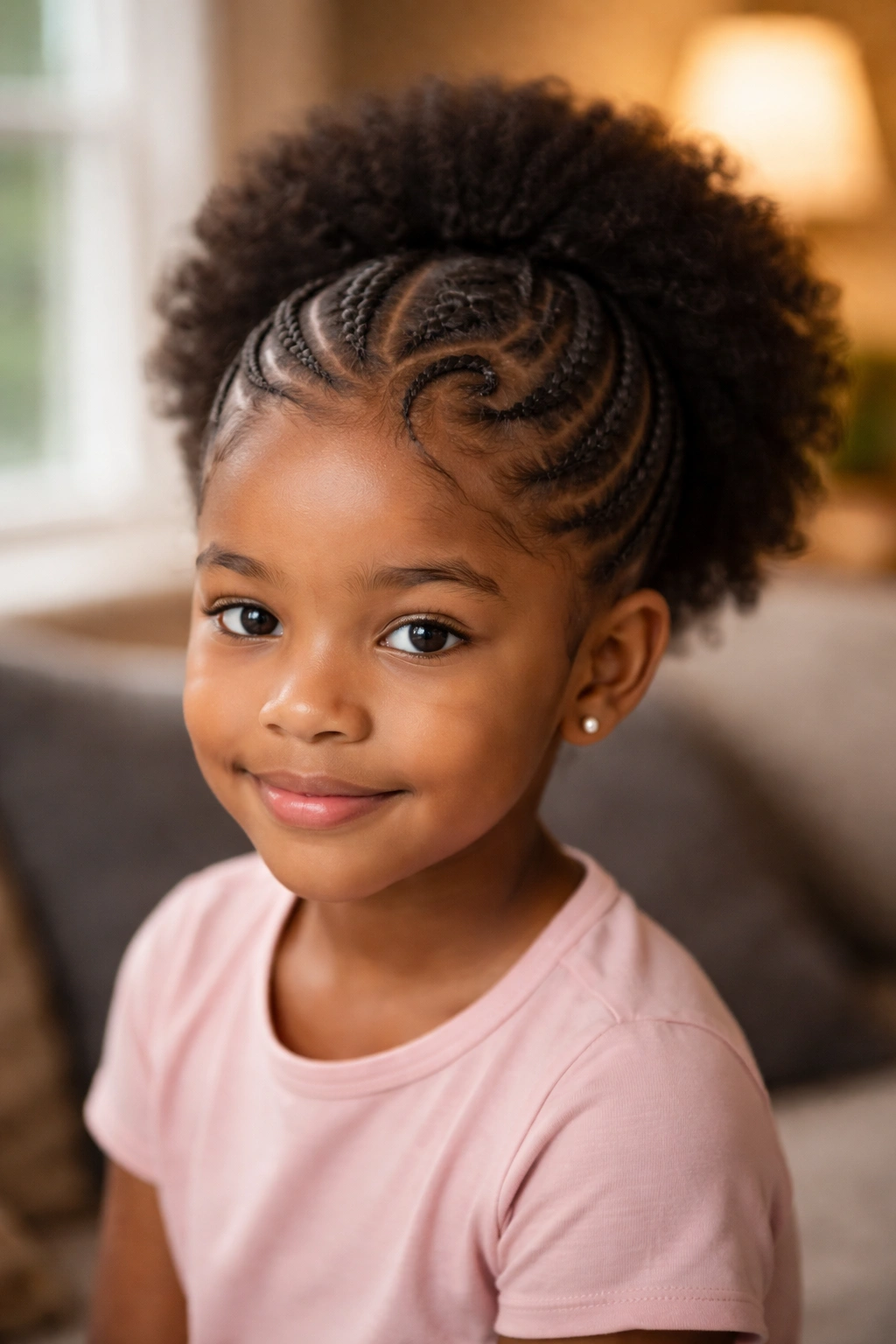
A heart shape outlined in cornrows at the front of the head. The rest of the hair is gathered into a puff or styled loose behind.
This takes practice. The heart shape is two curves meeting at a point at the bottom and a slight dip at the top. Use a thin marker (washable, water-soluble) to draw the heart on the scalp before parting if you’re new to shapes.
A heart cornrow style works for special occasions — birthday parties, photo days, family gatherings.
4. Three Cornrows with Braided Ends
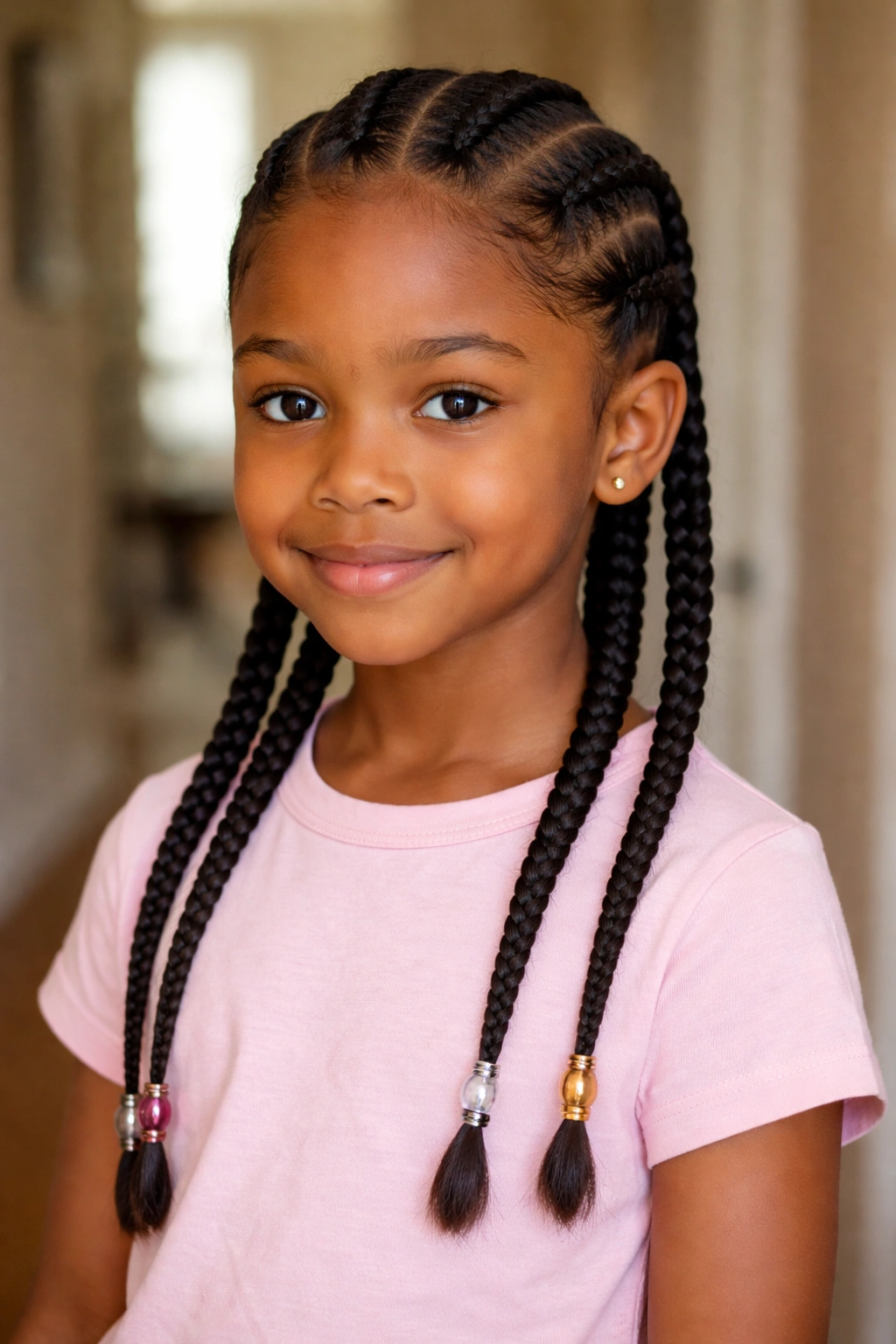
Three medium cornrows running straight back, with the cornrow ends extending into single braids that hang past the shoulders.
This is the everyday-school style. It takes about 60 minutes for school-aged children. It’s neat enough for class, durable enough for recess, and easy enough for a parent to redo on Sunday night for the week ahead.
Add a single bead at the bottom of each braid for finishing. More than one bead per braid creates extra weight that can become uncomfortable during sleep.
5. Cornrow Buns
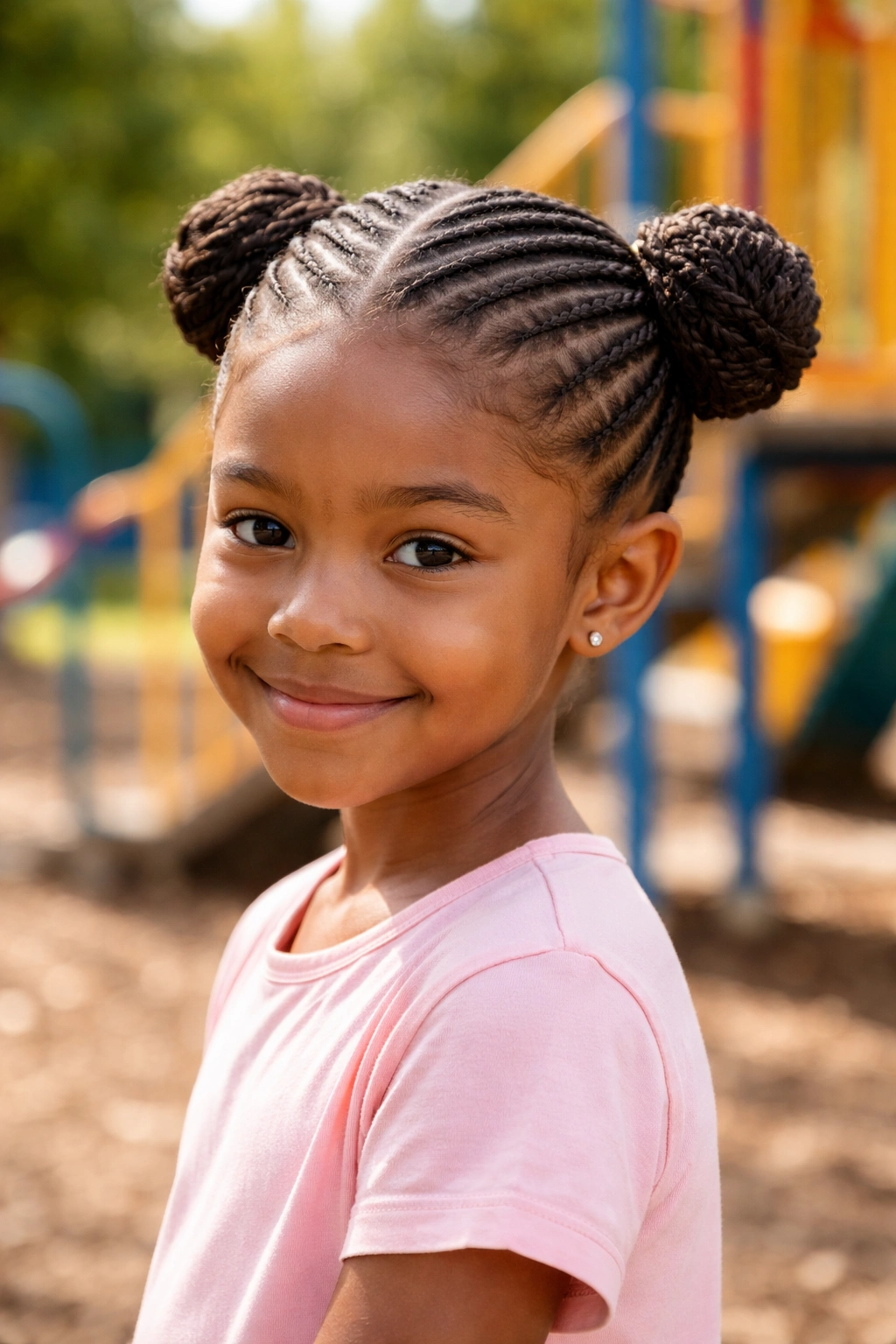
Cornrows feeding into two small buns at the back of the head, one on each side. Cute, contained, and highly durable.
Buns hold up to active play better than hanging braids. No swinging, no catching on backpacks, no tangling in jackets. For girls in sports or who play hard at recess, contained styles win.
The bun size should be modest — about the size of a small lemon. Larger buns add weight.
6. Cornrow Mohawk for Kids
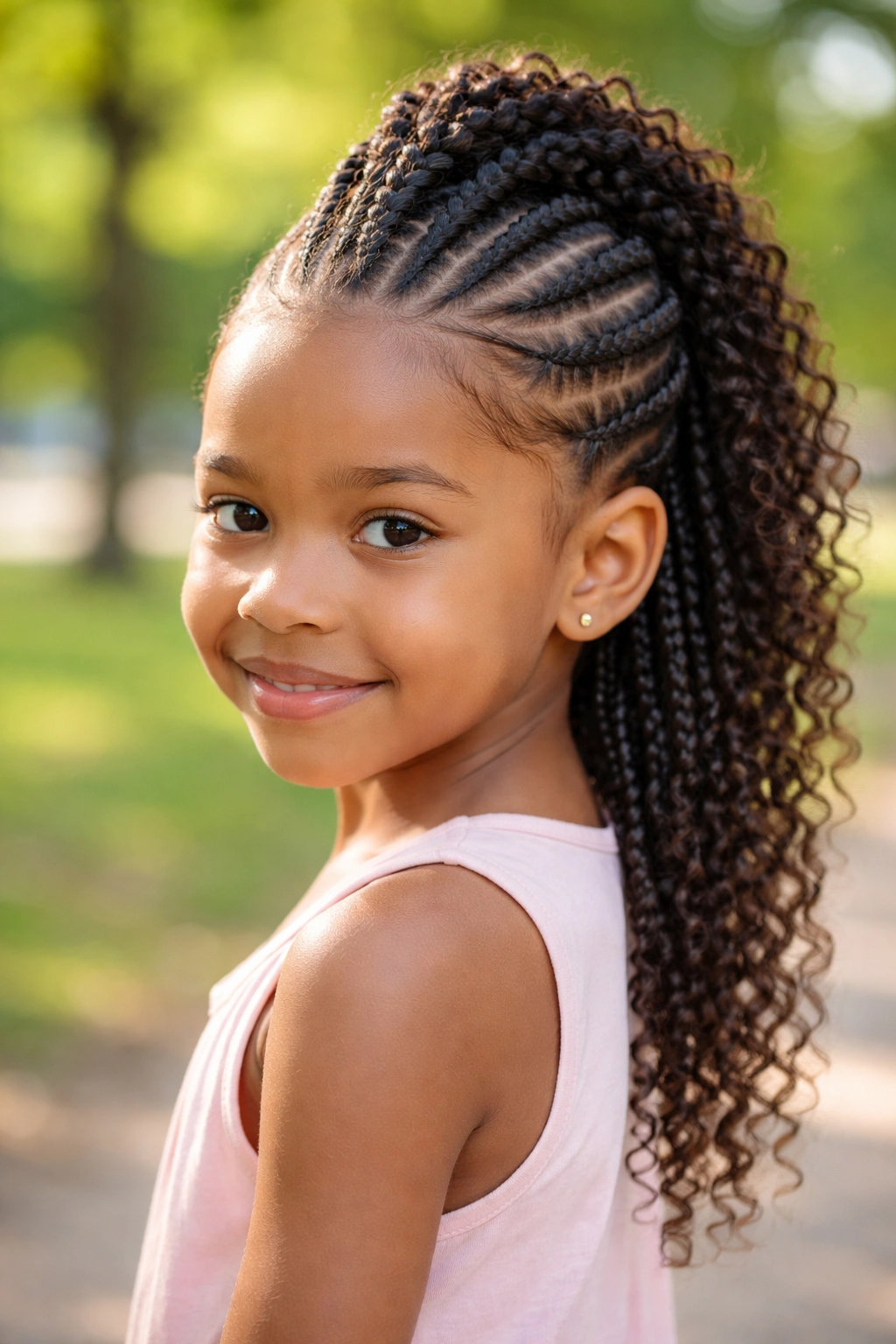
A center strip of cornrows with the sides braided down flat. Not shaved sides — just neatly braided. The center strip can have varying widths along its length for visual interest.
The mohawk pattern reads bold without being aggressive on a child. It also keeps hair off the face during active play.
For shorter natural hair, this style works particularly well because the center cornrow strip uses what length is available, and the side braids tuck flat against the head.
7. Cornrow Crown with Free Curls
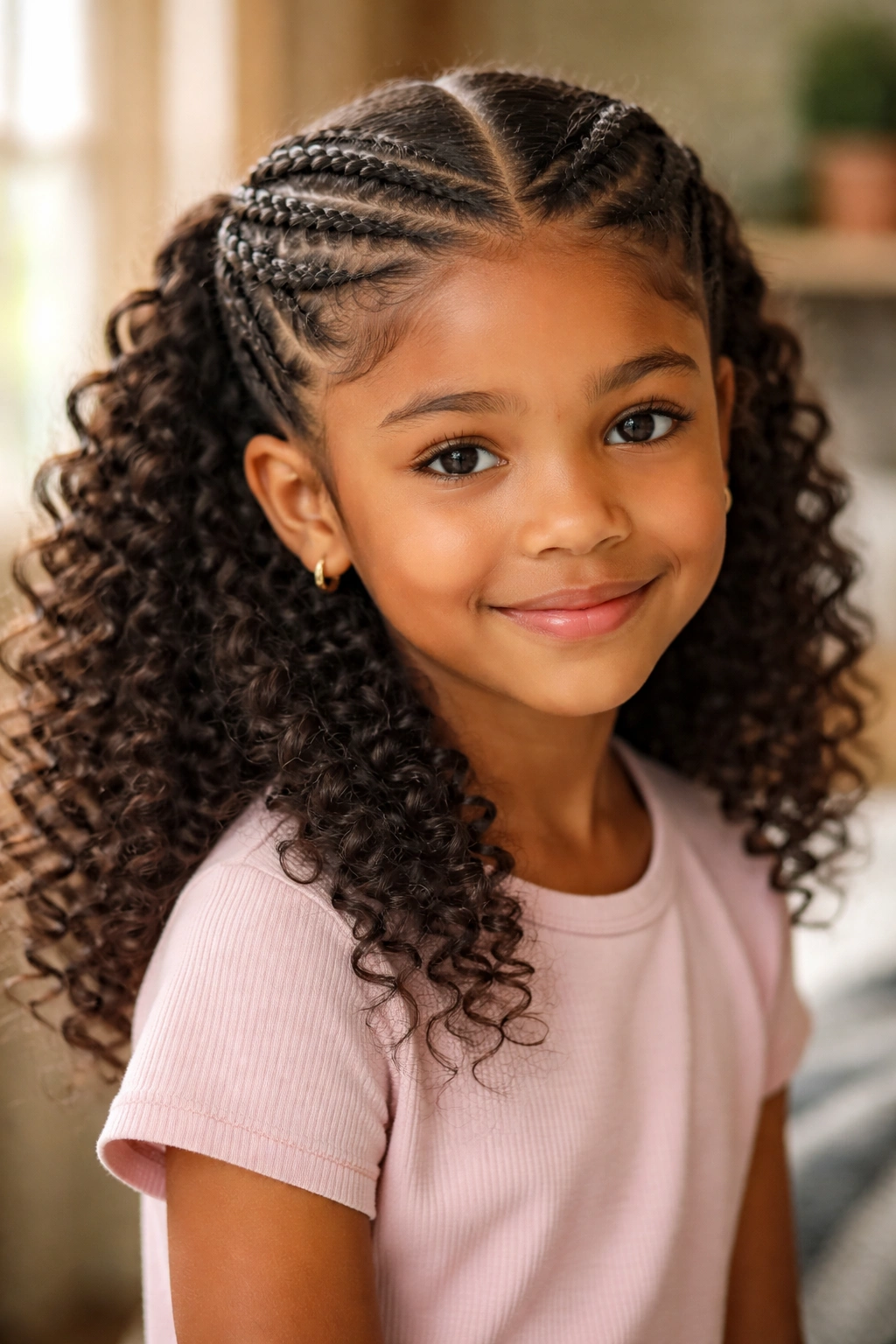
A halo-like cornrow circling the front and sides of the head. The hair behind the crown is left free in natural curls or coils.
How to Style It
The crown should sit about an inch above the natural hairline. The free curl section behind needs moisturizer — a leave-in cream or curl-defining gel keeps the puff looking neat between washes.
This style suits girls who want some braided structure but love their natural texture and don’t want to commit to a full braided head.
8. Cornrow Pigtails
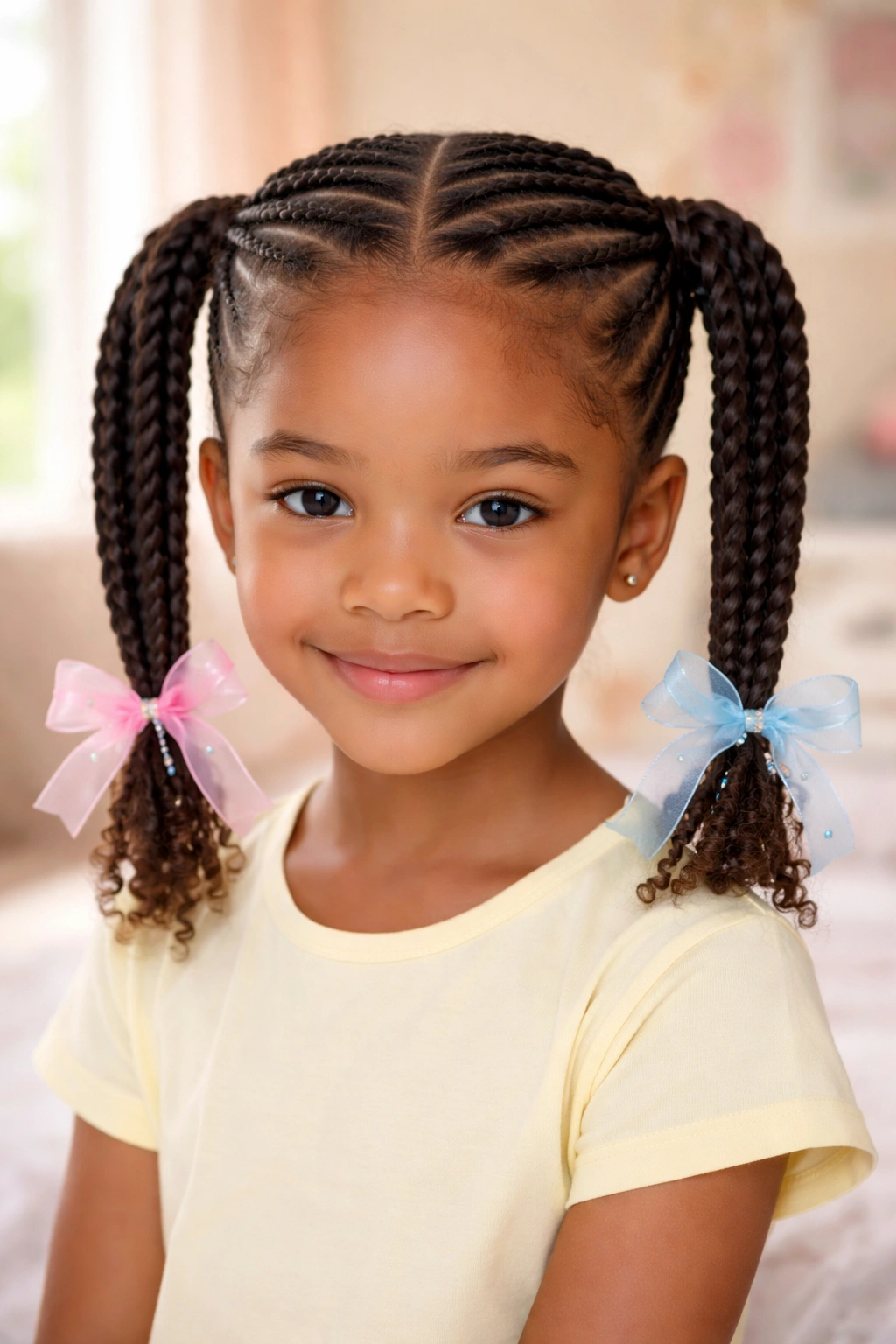
Two pigtails at the sides of the head, each formed by a cluster of cornrows gathering into a tail.
Pigtails are nostalgic and playful. For girls under 10, they often feel like a “fun” hairstyle. For pre-teens, they can read childish — match the style to the age comfortably.
Decorate with ribbons, bows, or simple hair ties. Let the child pick.
9. Cornrow Bun with Bangs
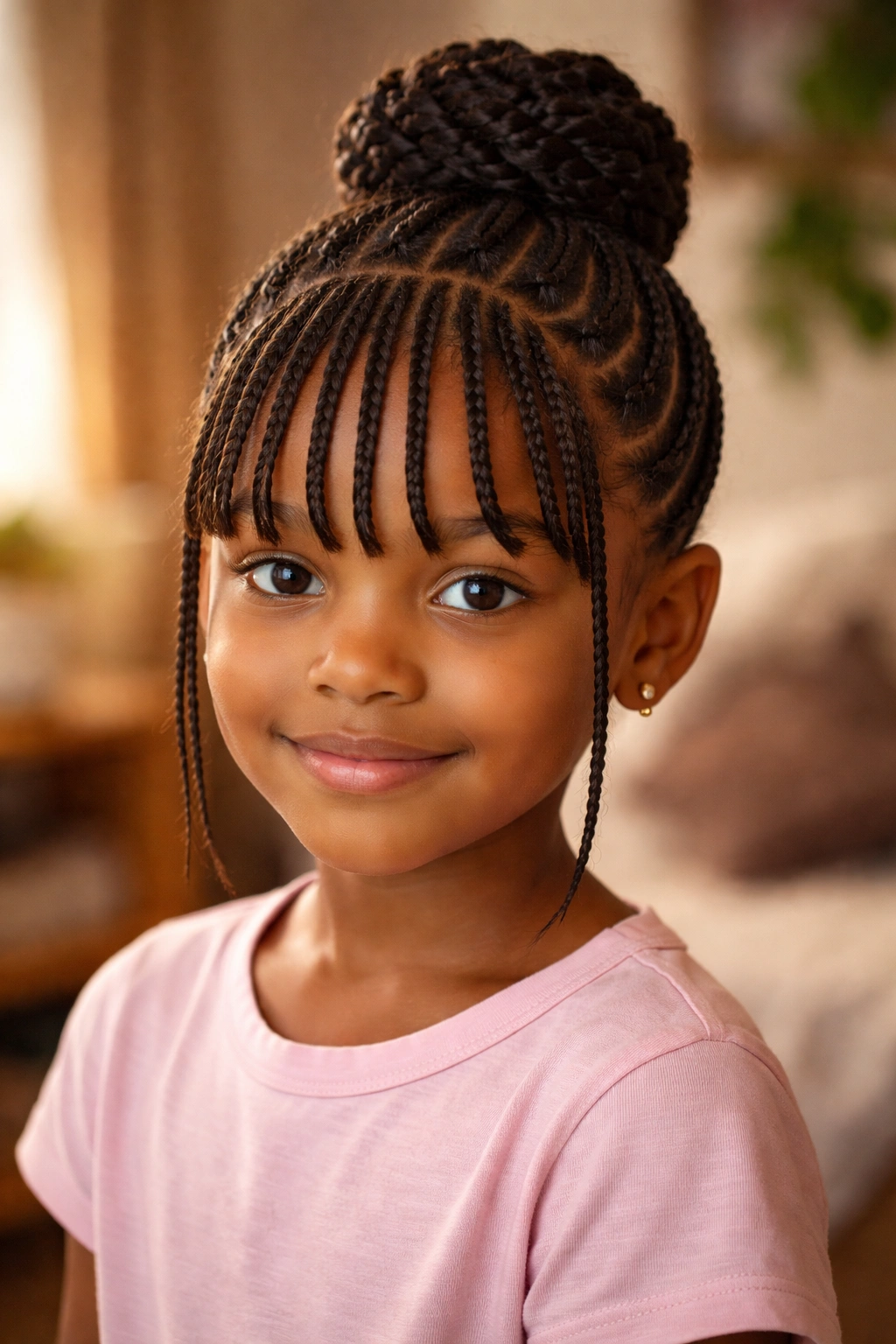
Cornrows that begin at the front, bang-style, and run back into a single crown bun.
The bang section — the front-most cornrow that crosses the forehead — gives the style face-framing definition. Many cornrow styles for girls skip the bang. Adding it changes the silhouette.
The bun behind should be small to medium. Oversized buns on small heads can look unbalanced.
10. Lemonade-Style Side Cornrows
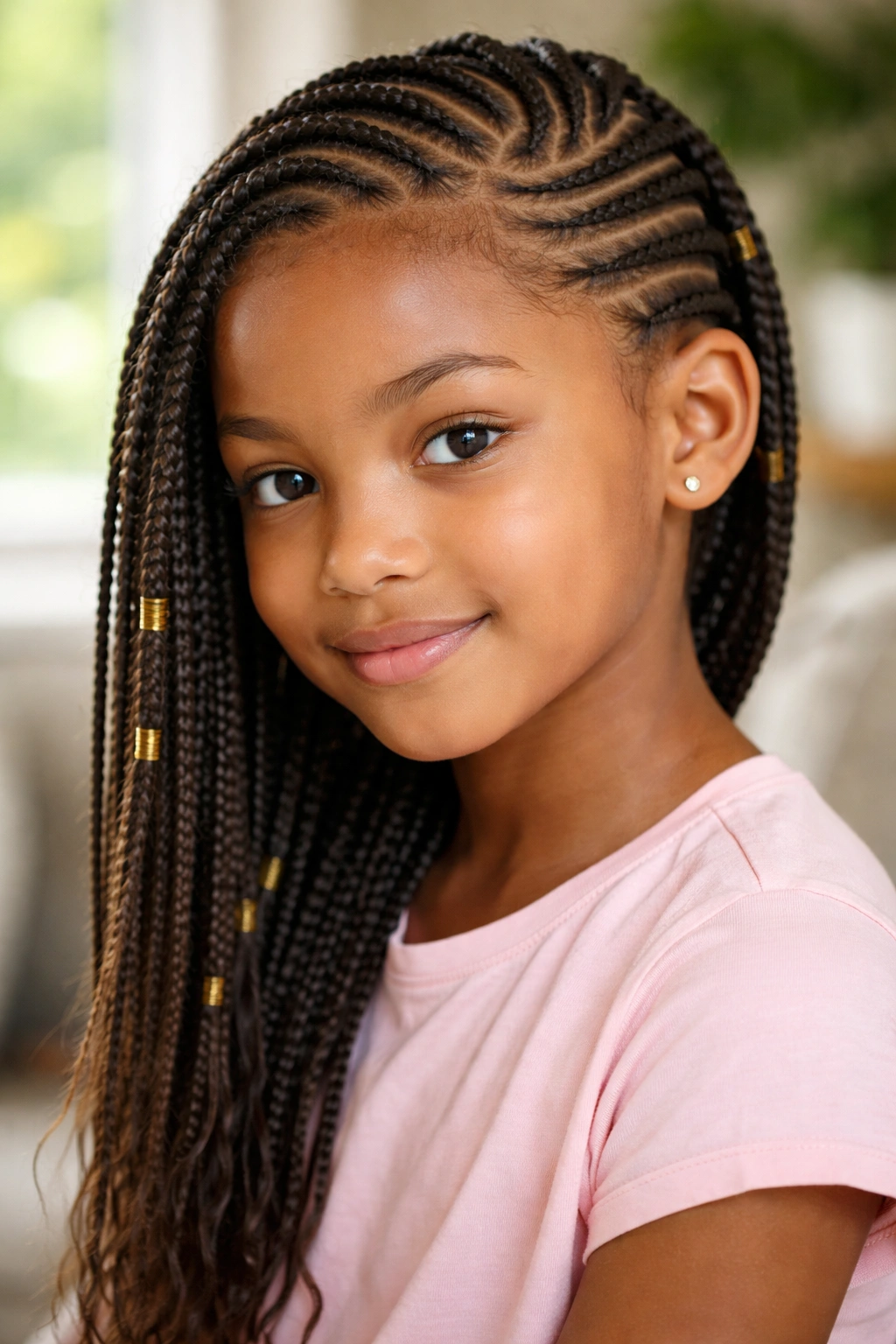
Side-swept angled cornrows like the adult lemonade pattern, scaled down for a child.
The lemonade silhouette works on girls because the angled cornrows naturally pull hair away from the face — useful for active kids who don’t want hair in their eyes.
Keep tension light. The angled pattern can pull at the hairline if installed too tight on tender skin.
11. Cornrow Half-Up Style
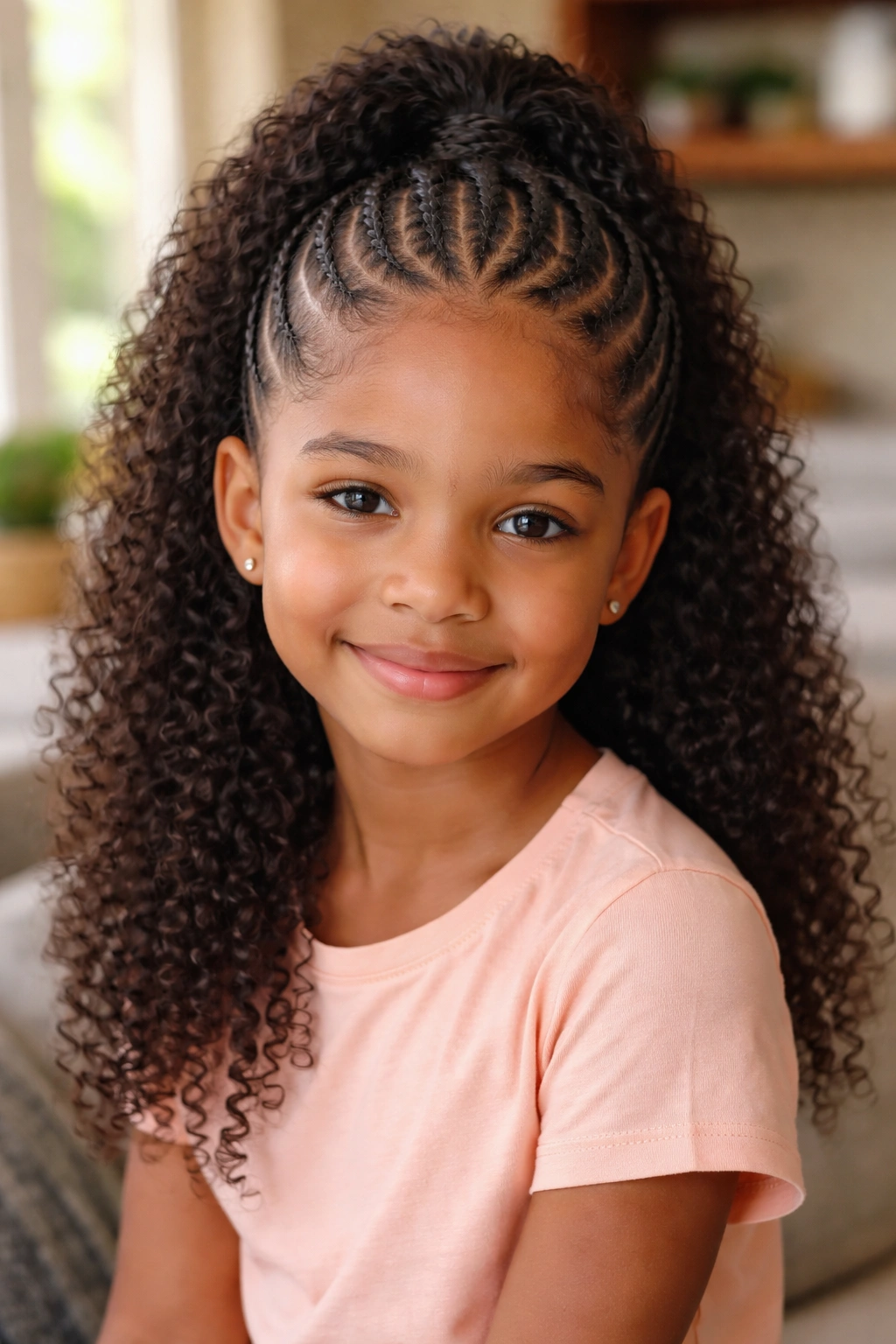
The top half of the head is cornrowed and gathered into a small ponytail or bun at the crown. The bottom half is left free in natural texture.
This is a gentle introduction to cornrow styling for girls who haven’t worn many braided styles. The cornrowed section is contained. The free section feels familiar.
Half-up styles work well for the in-between days — too dressy for plain ponytails, too casual for full braided installs.
12. Multiple Pigtail Cornrows
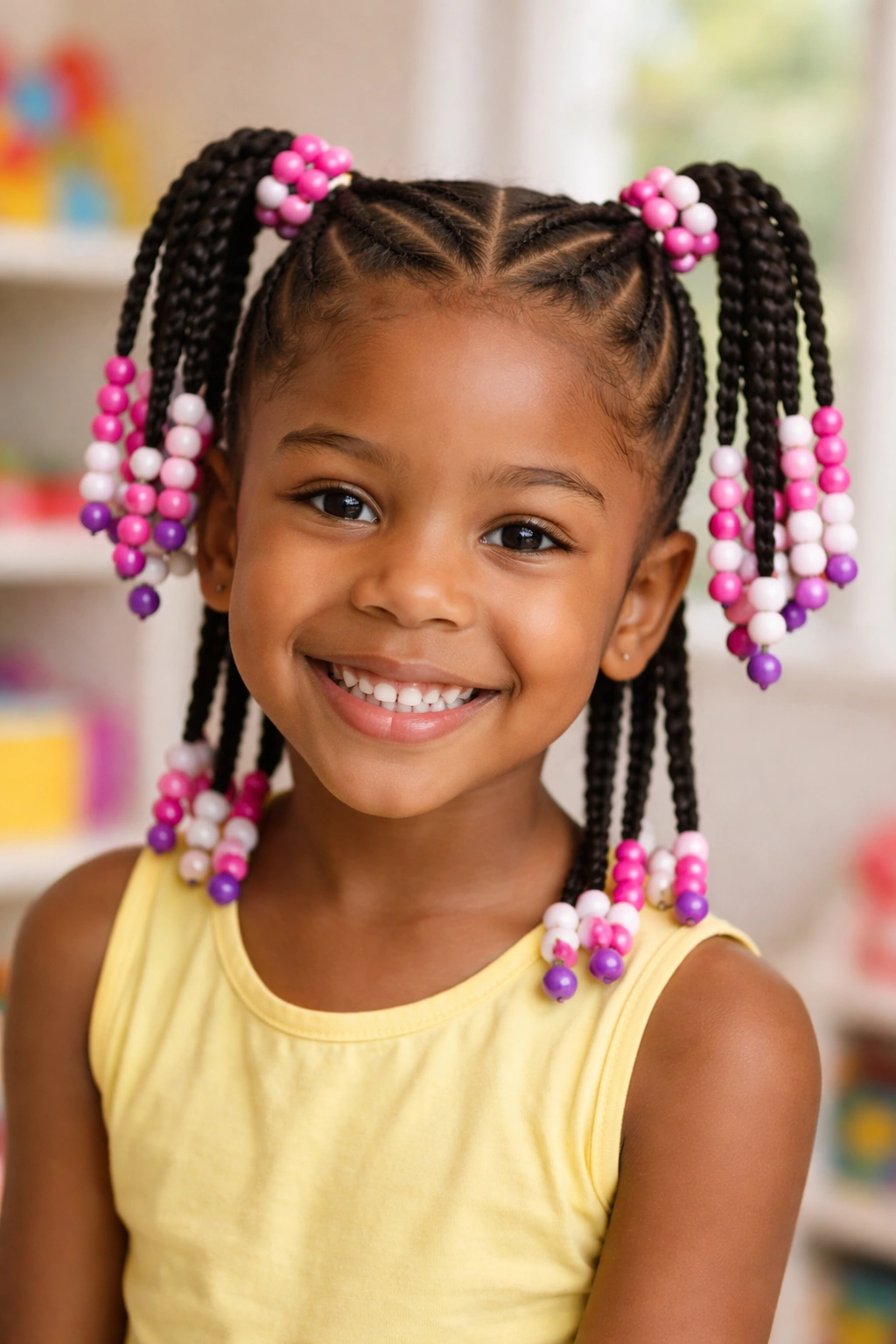
Four to six small ponytail clusters across the head, each fed by a few cornrows.
Multi-puff styles are a classic for younger Black girls. The cluster of small ponytails reads cheerful and active. It also distributes any weight across multiple gather points instead of one or two, which reduces tension on any single part of the scalp.
Use coordinated bead colors — three colors maximum — to keep the look pulled together rather than chaotic.
13. Zigzag Cornrow Part
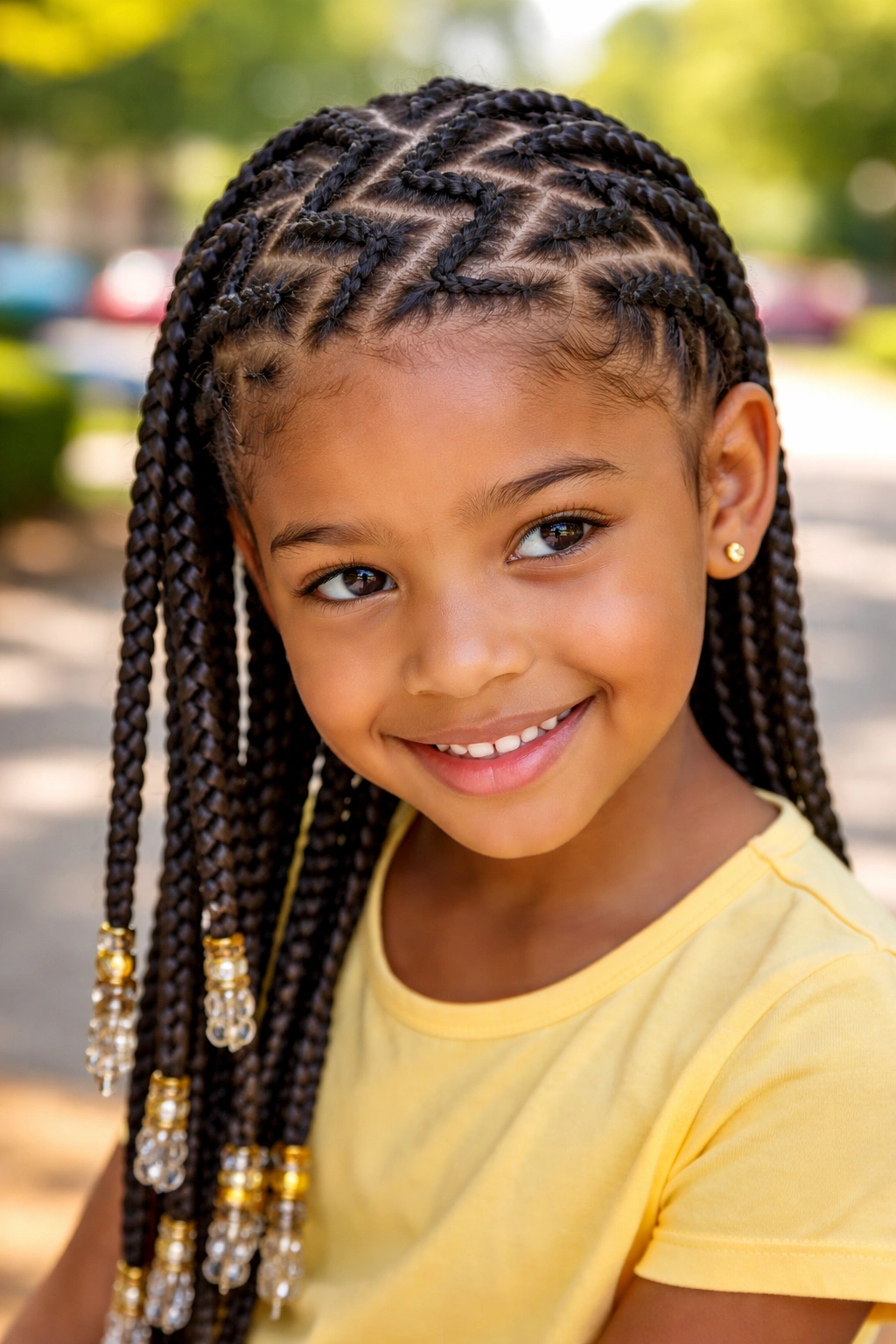
Cornrows divided by zigzag rather than straight parts. The geometric break-up of the parts adds visual interest without changing the cornrow technique itself.
Zigzag parts read playful and age-appropriate. They also forgive minor parting irregularities better than straight lines do — the zigzag itself is irregular by design.
For a child who’s wearing cornrows for the second or third time, zigzag parting is a natural next step.
14. Cornrow Princess Crown
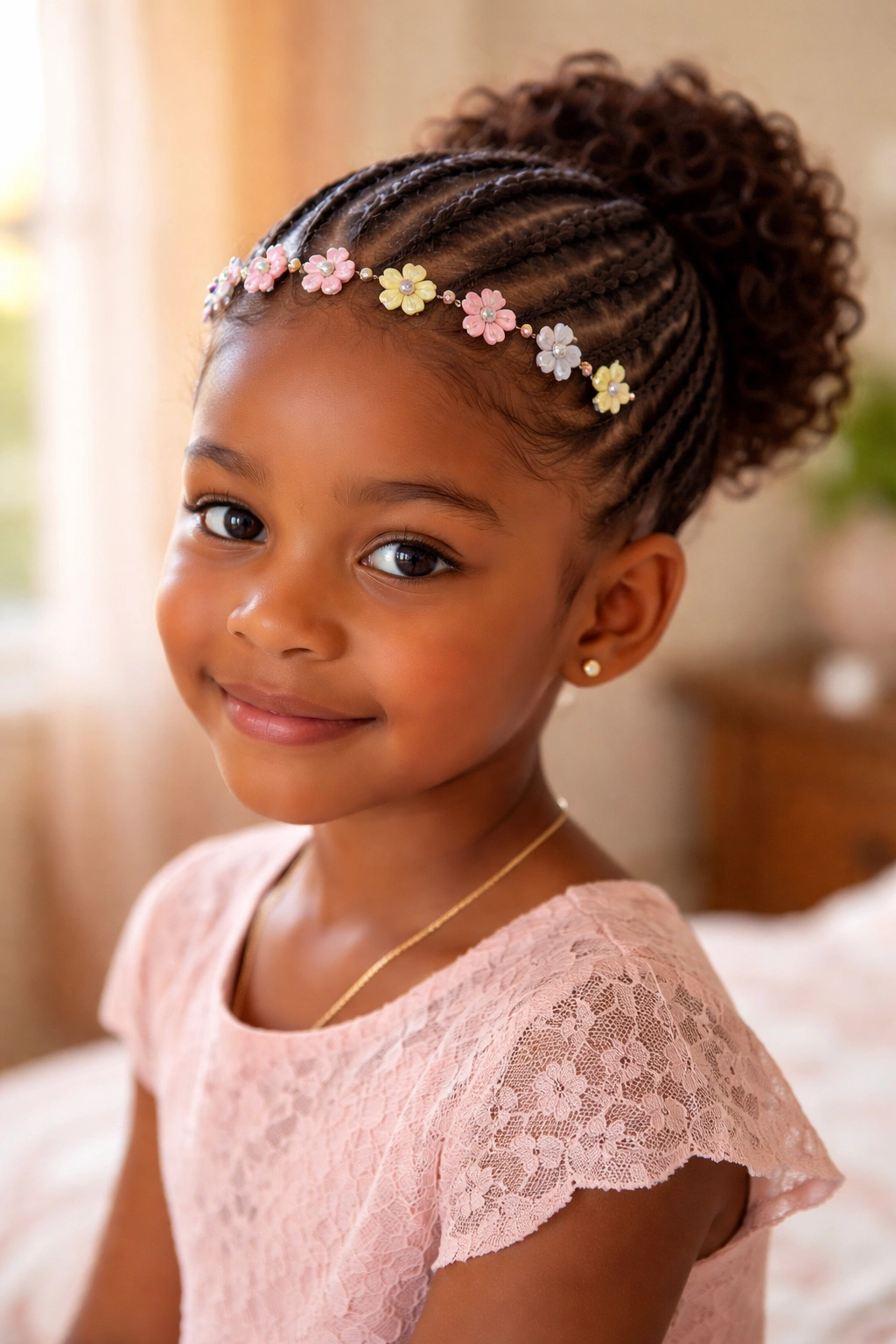
A halo cornrow at the front decorated with small flower-shaped beads or barrettes, with the rest of the hair gathered into a soft bun behind. The “princess” feeling is built by the combination of crown placement and floral accents.
This is the special-occasion style — birthday parties, recitals, picture days. Allow 90 minutes for install with the decorating.
The flower beads or barrettes should be securely attached. Flying flowers during recess turn into lost flowers by lunch.
15. Cornrow Cap with Curl Crown
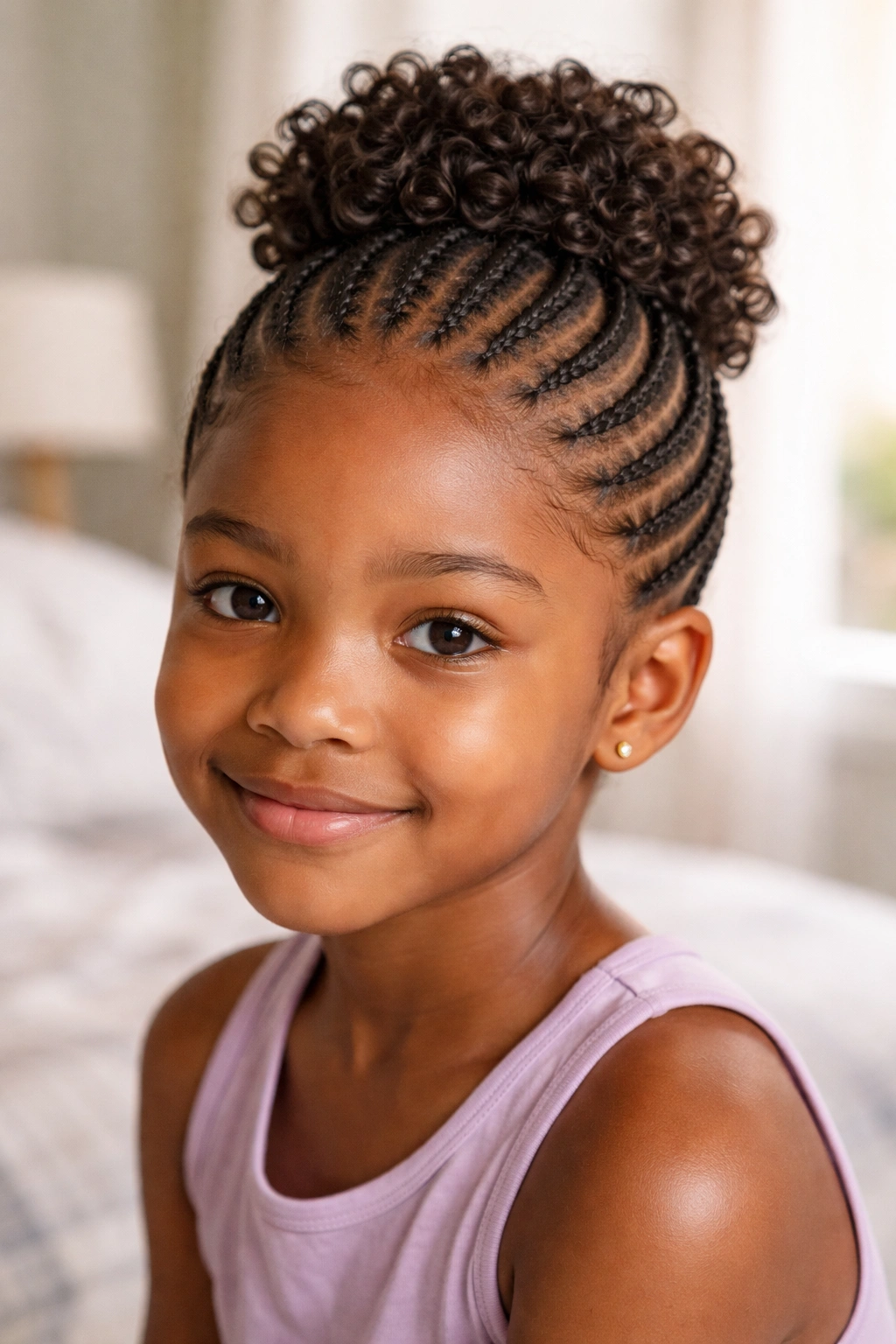
The entire head is cornrowed in a small, even pattern (the “cap”) with a section of curls left free at the top crown — like a small curl puff sitting on top of the cornrowed cap.
Who This Is For
Girls with naturally tight curl patterns who want to show off their texture while keeping the rest of the head neat.
The curl crown should be moisturized daily — a small spritz of water-and-leave-in mixture keeps the curls from drying out against the cornrow base.
16. Side-Sweep Cornrows with Bow
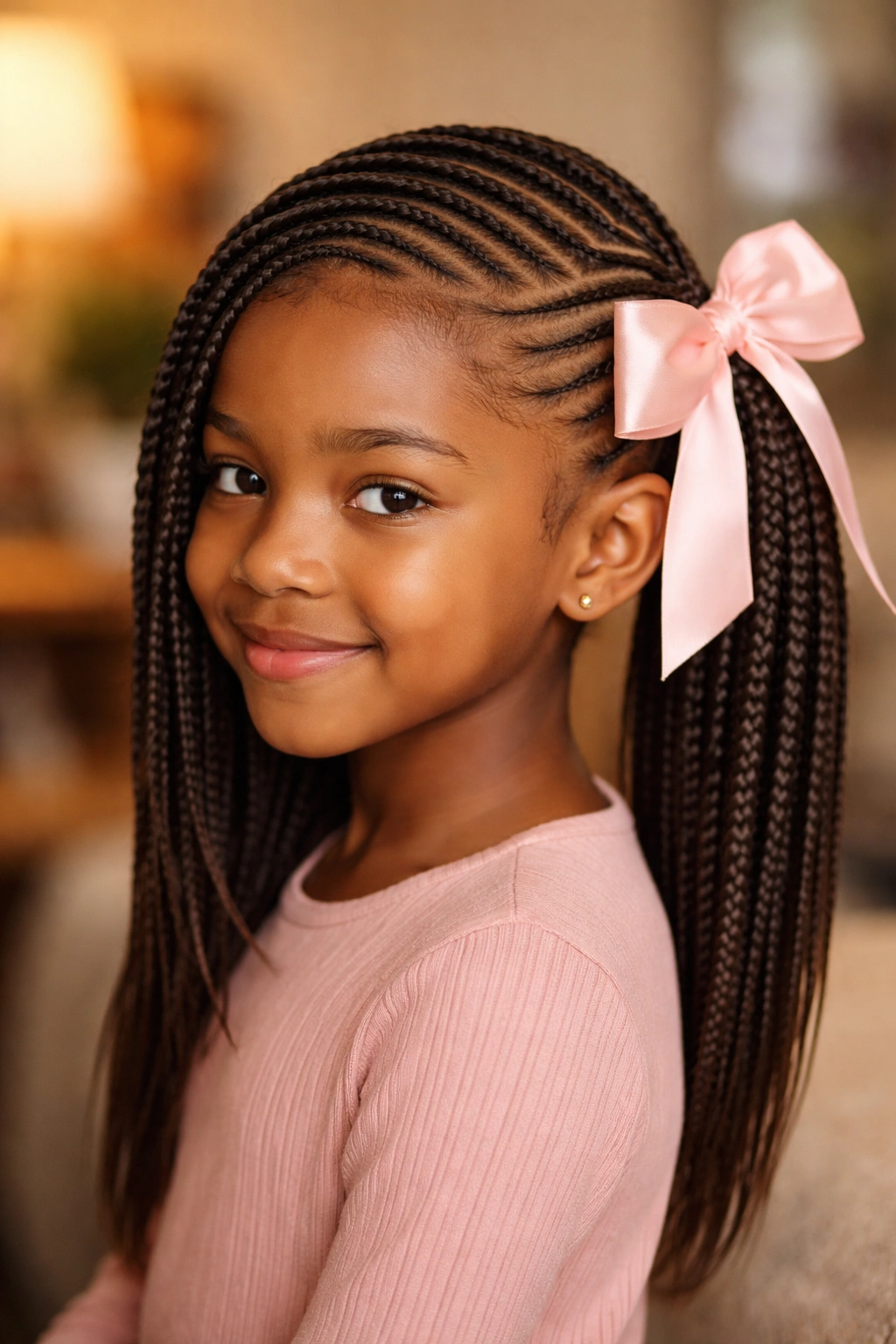
Cornrows swept dramatically to one side, ending in a single tail decorated with a large bow.
The bow does a lot of the visual work here. Pick a bow that matches the outfit or the occasion. The bow should be proportional to the head — small bow on a small head, larger bow on an older girl with more hair length.
17. Cornrow Twist-Outs for Older Girls
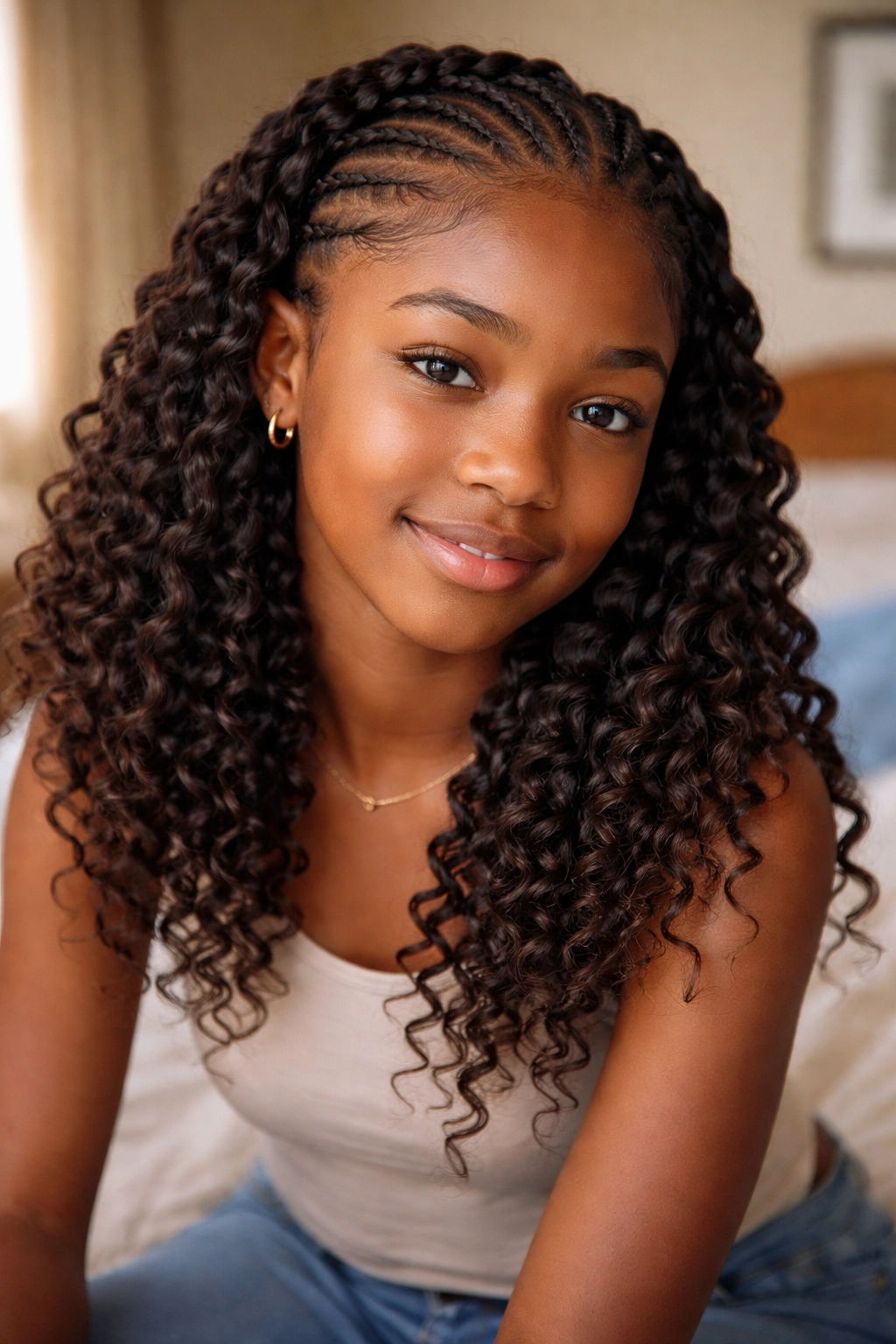
Cornrows worn for a week, then unraveled to create a twist-out wave pattern in the natural hair. Not exactly “cornrows” once unraveled, but the cornrow phase is part of the style.
For pre-teens and teens, this is a styling lesson as much as a hairstyle. The cornrows function as setting tools. The reveal happens at takedown.
Best results: install on damp hair with a setting cream, leave in for 5-7 days, unravel carefully and shape with fingers.
18. Beaded Halo with Bun
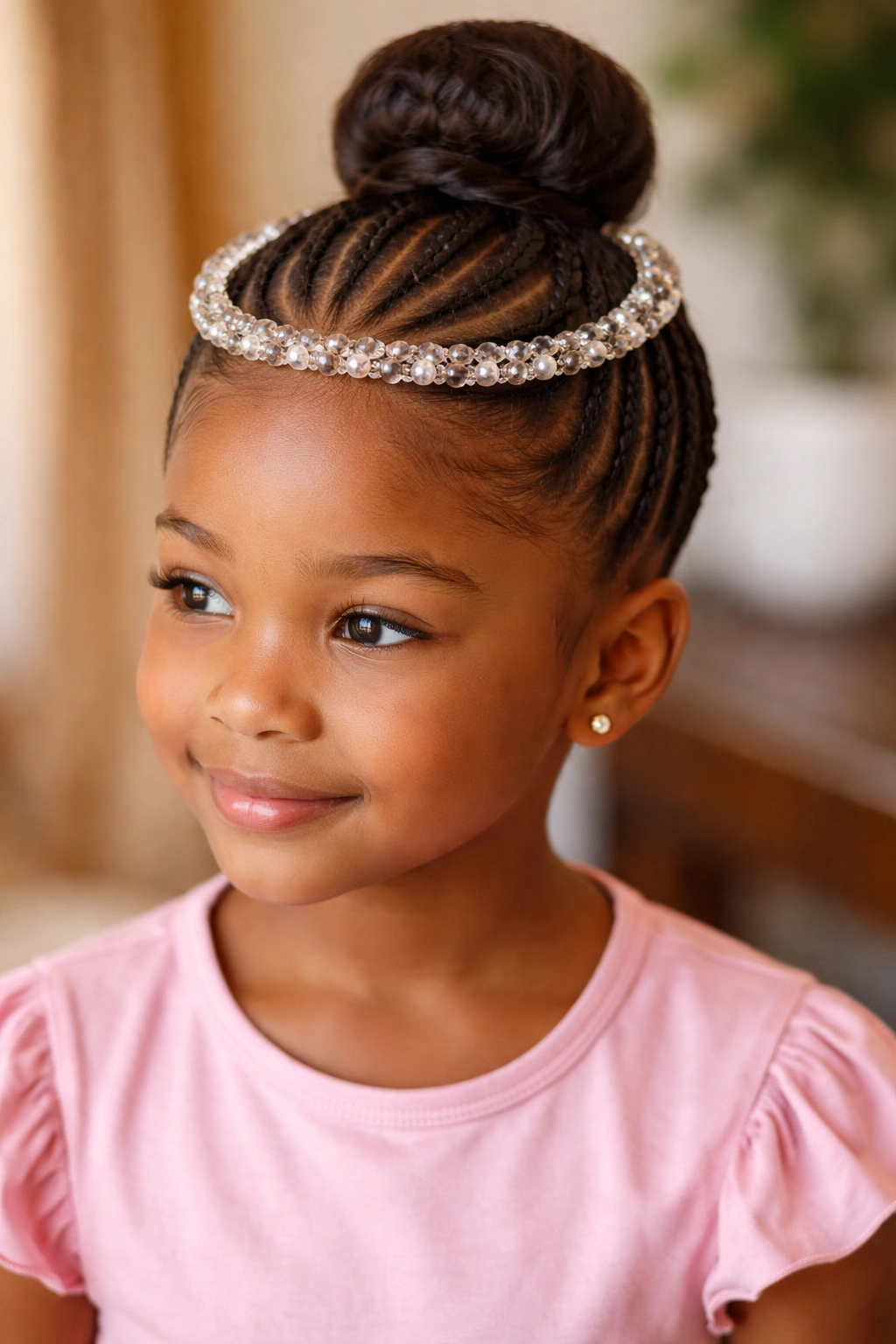
A circular cornrow halo at the top of the head, beaded along its full length, with a tidy bun nested in the center.
The beads catch light and make the halo a focal point. Choose beads in 2-3 colors that complement each other — too many bead colors look busy on a small head.
The bun should be sleek, not voluminous. Voluminous buns compete with the beaded halo.
19. French Braid into Cornrow
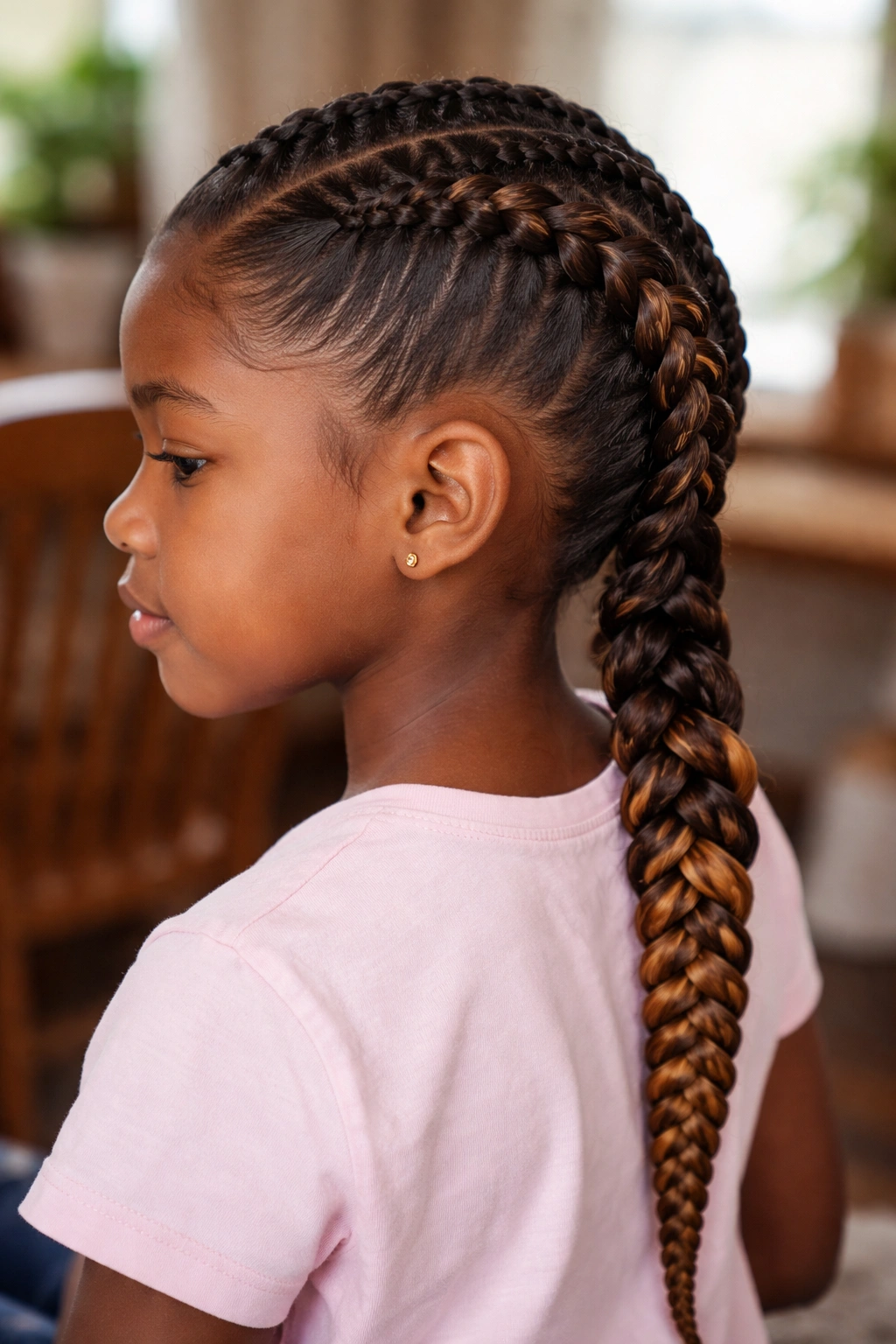
A French braid starting at the front, transitioning into a single thick cornrow that runs down the back.
The French braid is more forgiving for new braiders than starting with a tight cornrow. Transitioning into the cornrow toward the back of the head allows the practice braid to settle into a real braid pattern as the technique stabilizes.
Good for parents learning to braid for the first time. The visible French braid section forgives early errors.
20. Cornrow Mohawk with Twisted Sides
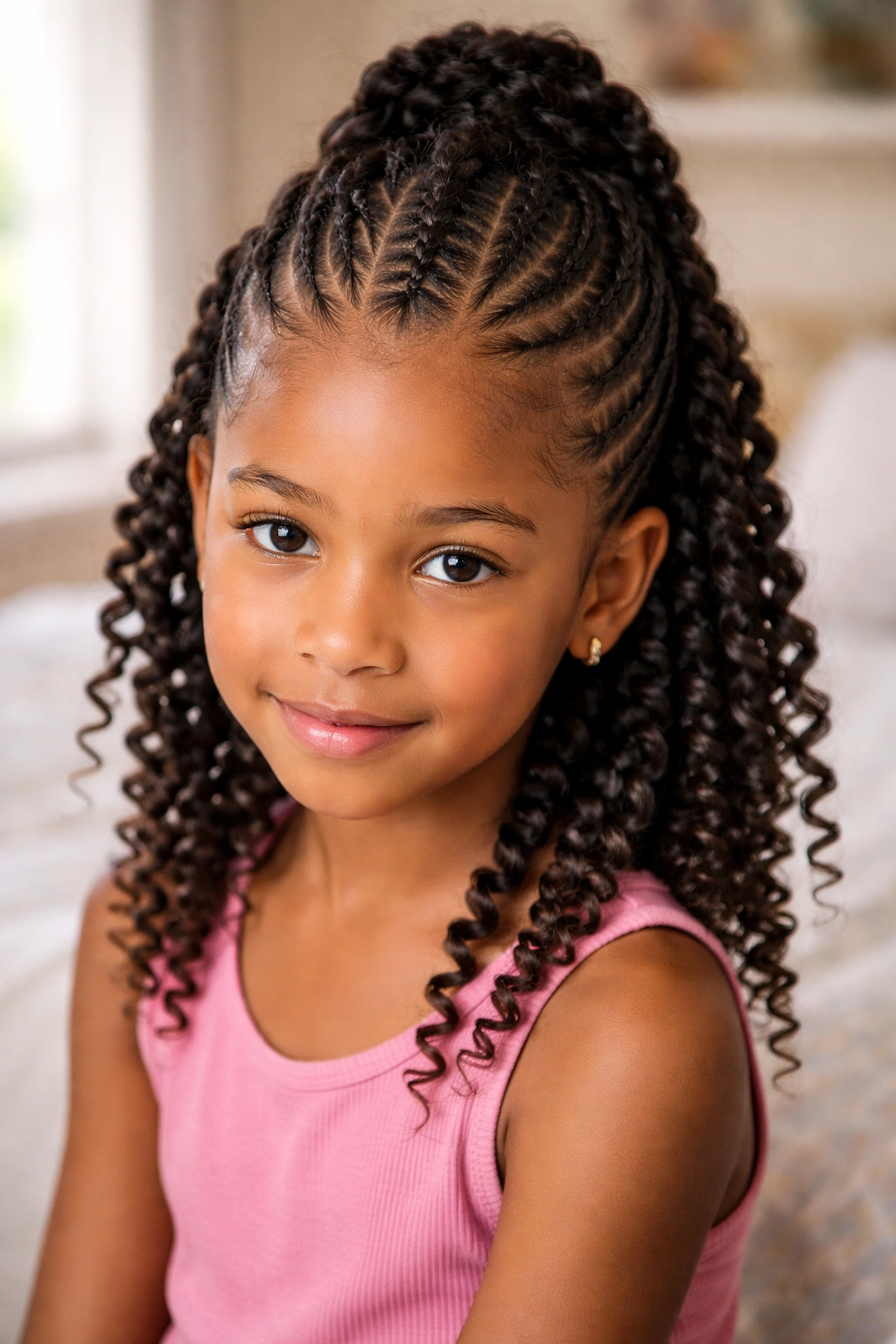
Center strip of cornrows. Twisted (not braided) sides. The texture contrast between the two methods adds interest.
This is for girls 8+. The twisting technique requires two-strand twist work, which adds time and takes practice.
The center cornrow strip should be the focal point — the twisted sides are the supporting structure.
21. Cornrow Updo with Ribbon Wraps
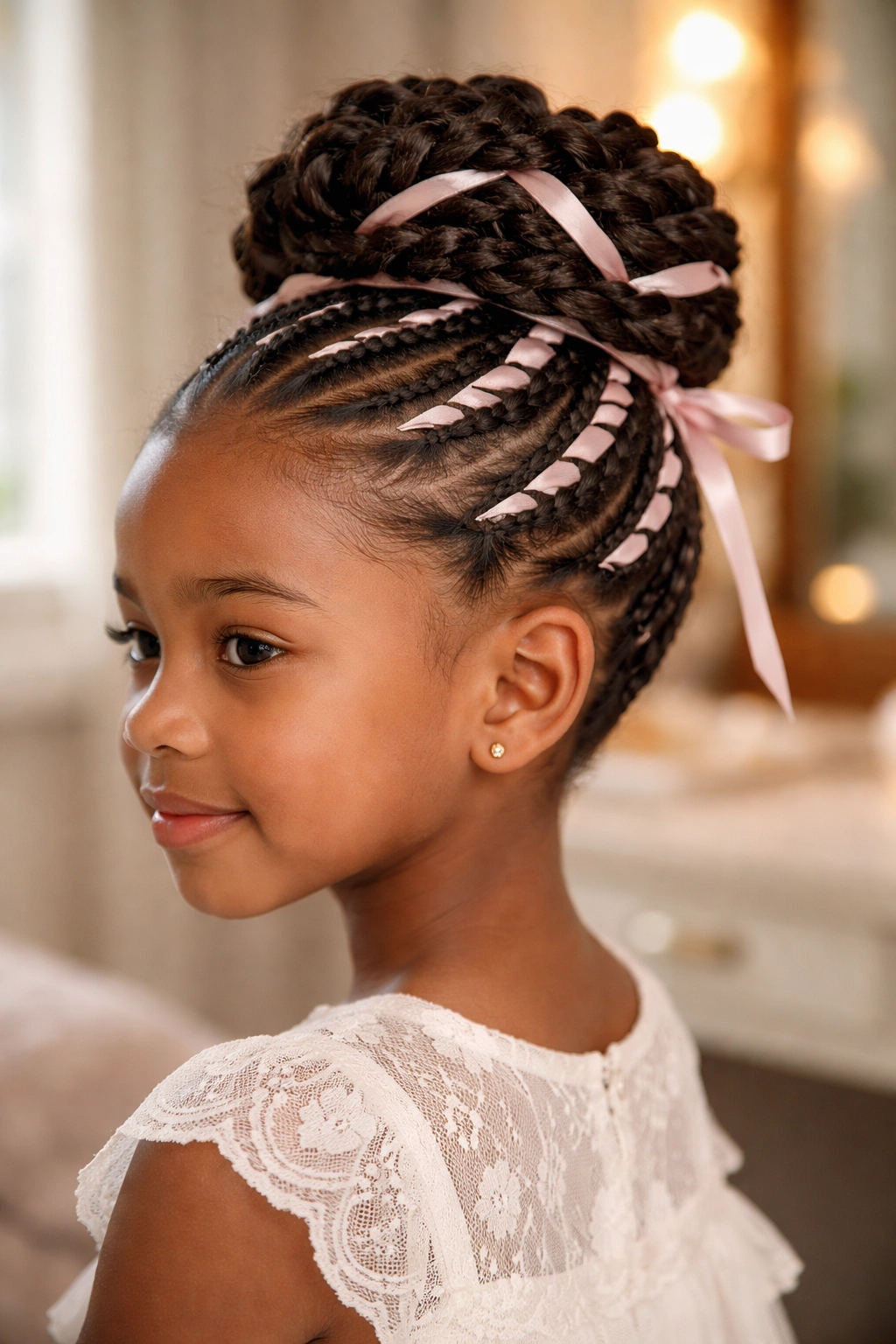
Cornrows fed into an updo at the crown. Thin ribbons threaded through the cornrows along their length, all pulled up into the updo together.
Special-occasion styling at its prettiest. Wedding flower girl, dance recital, school photo with theme.
Ribbon should be satin, not cotton. Cotton ribbons fray and don’t hold their shape. Satin holds its shine and lays smoothly along the cornrow.
22. Two Buns with Front Cornrows
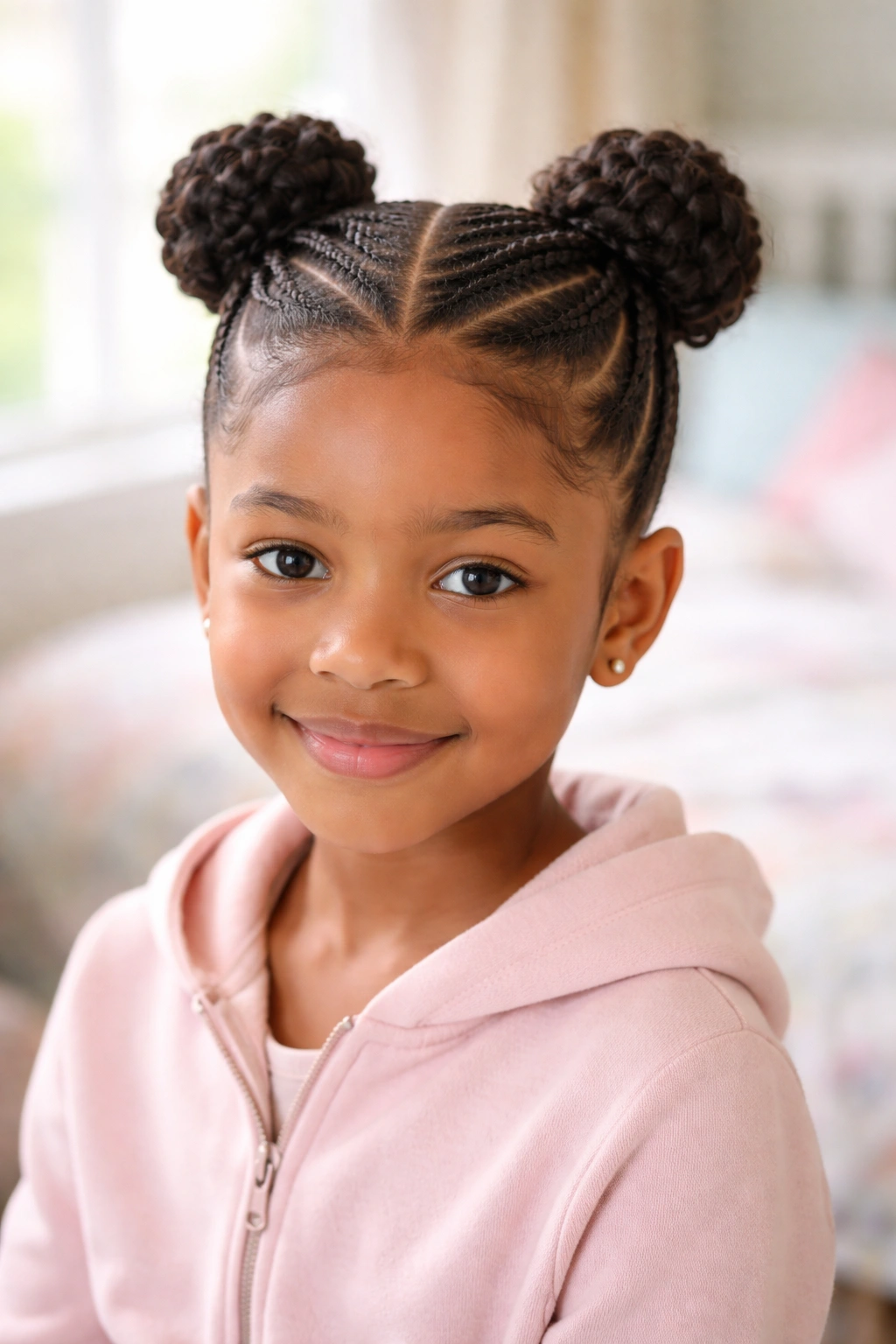
Two small buns at the back of the head, with two front cornrows leading from the temples to the buns.
The simplicity is the appeal. Two buns are cute. Two cornrows lead the eye in a clean line. The whole style takes 45 minutes and lasts a week of active wear.
23. Cornrow Spirals for Girls
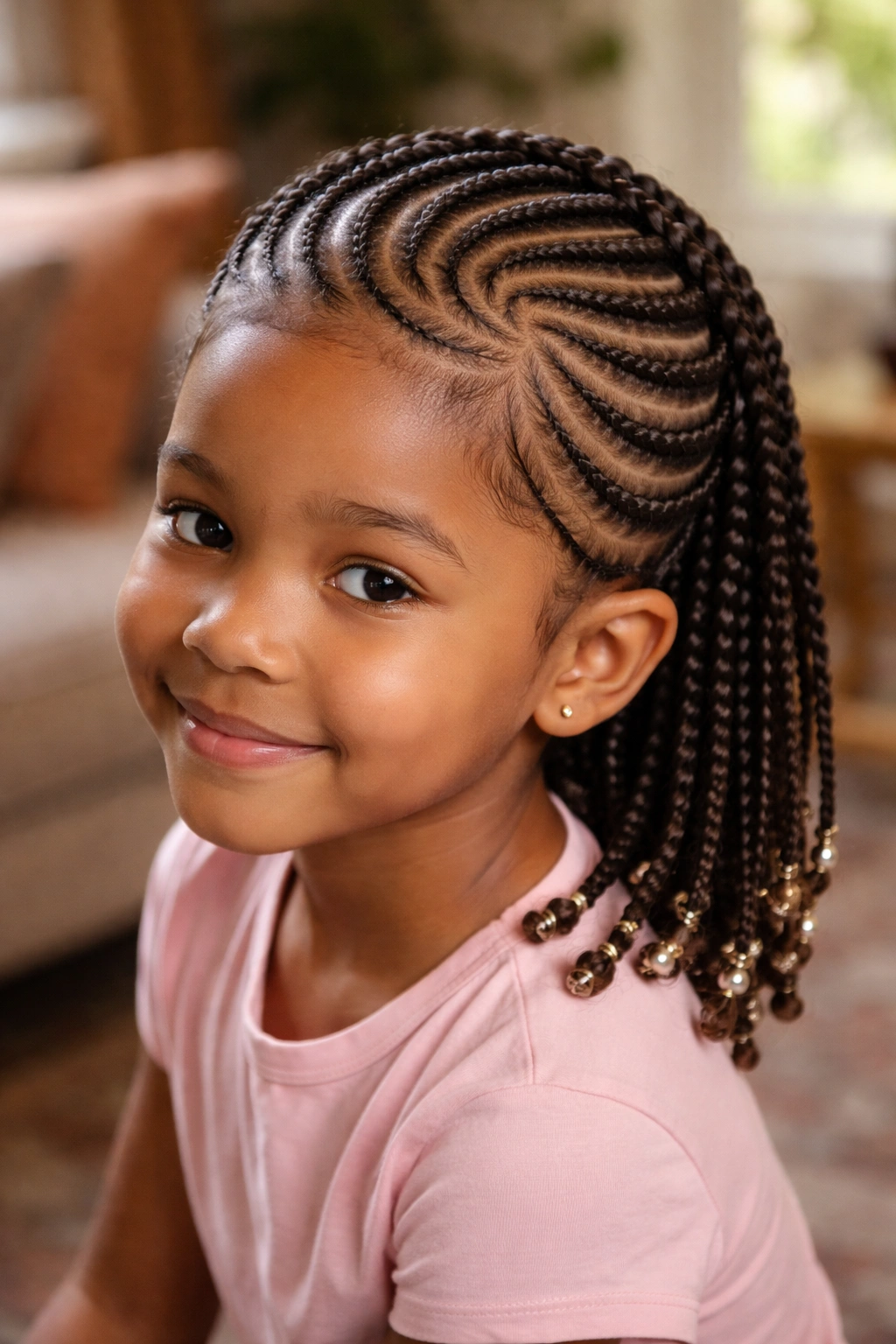
Spiral cornrow paths that wind from the crown outward in a flat spiral. Scaled to fit a child’s head — not as tight as adult spirals, with slightly larger spacing.
Maintenance Notes
Spiral cornrows require nightly satin scarf wear to maintain the spiral pattern. Without protection, the spiral edges fuzz quickly.
Touch up the front spirals every 3-4 days with a damp finger and a small dab of edge gel. A toothbrush works for cleaner application than fingers.
24. Cornrow Ponytail with Wrap
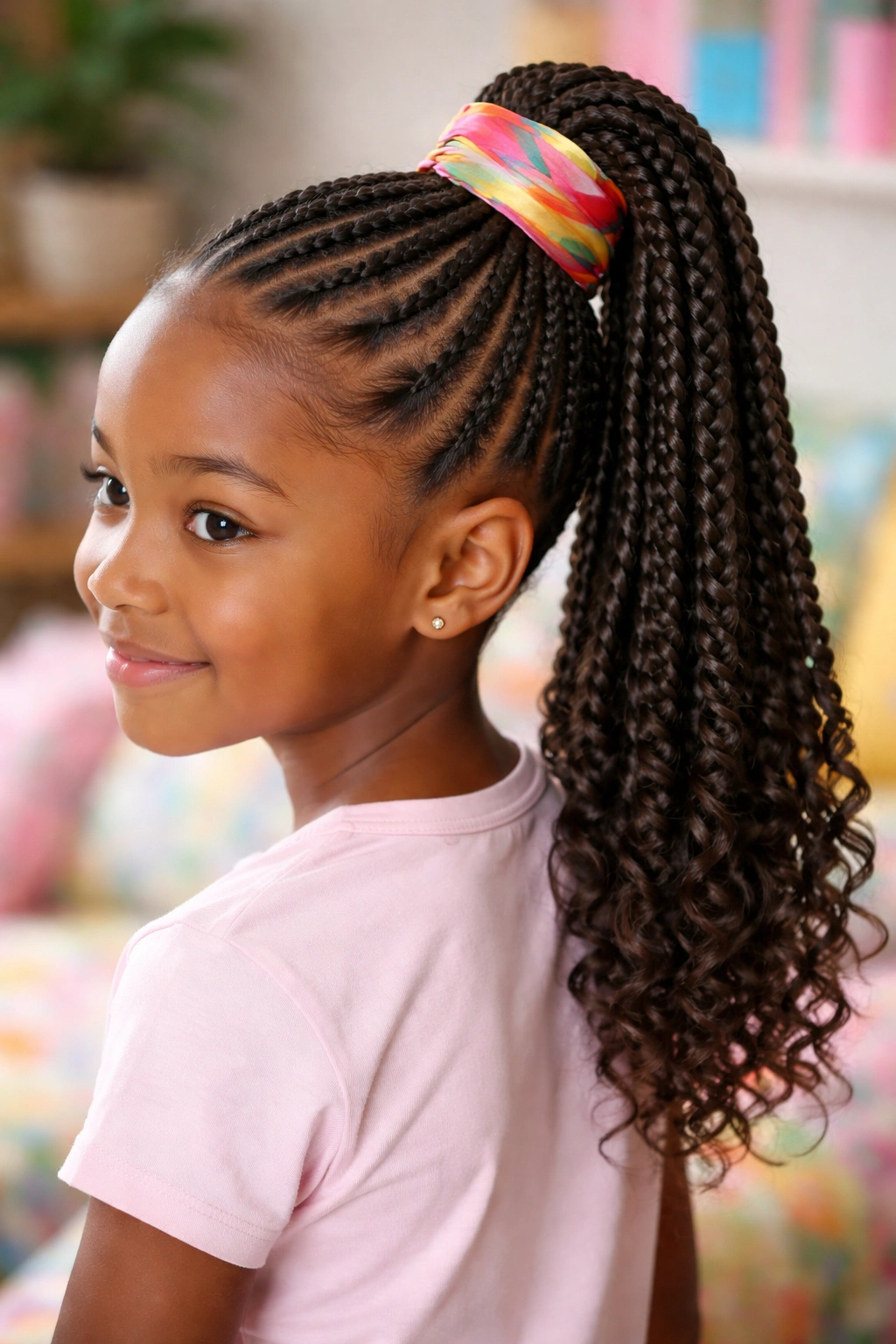
A high or mid-level cornrow ponytail with a fabric wrap covering the base.
The fabric wrap hides the elastic or hair tie at the gather point. It also adds color and pattern that can match an outfit.
Ankara prints, satin scrunchies, plain solid wraps — the choice of wrap can transform the same cornrow ponytail into different looks across different days.
25. Cornrow with Loose Curl Tendrils
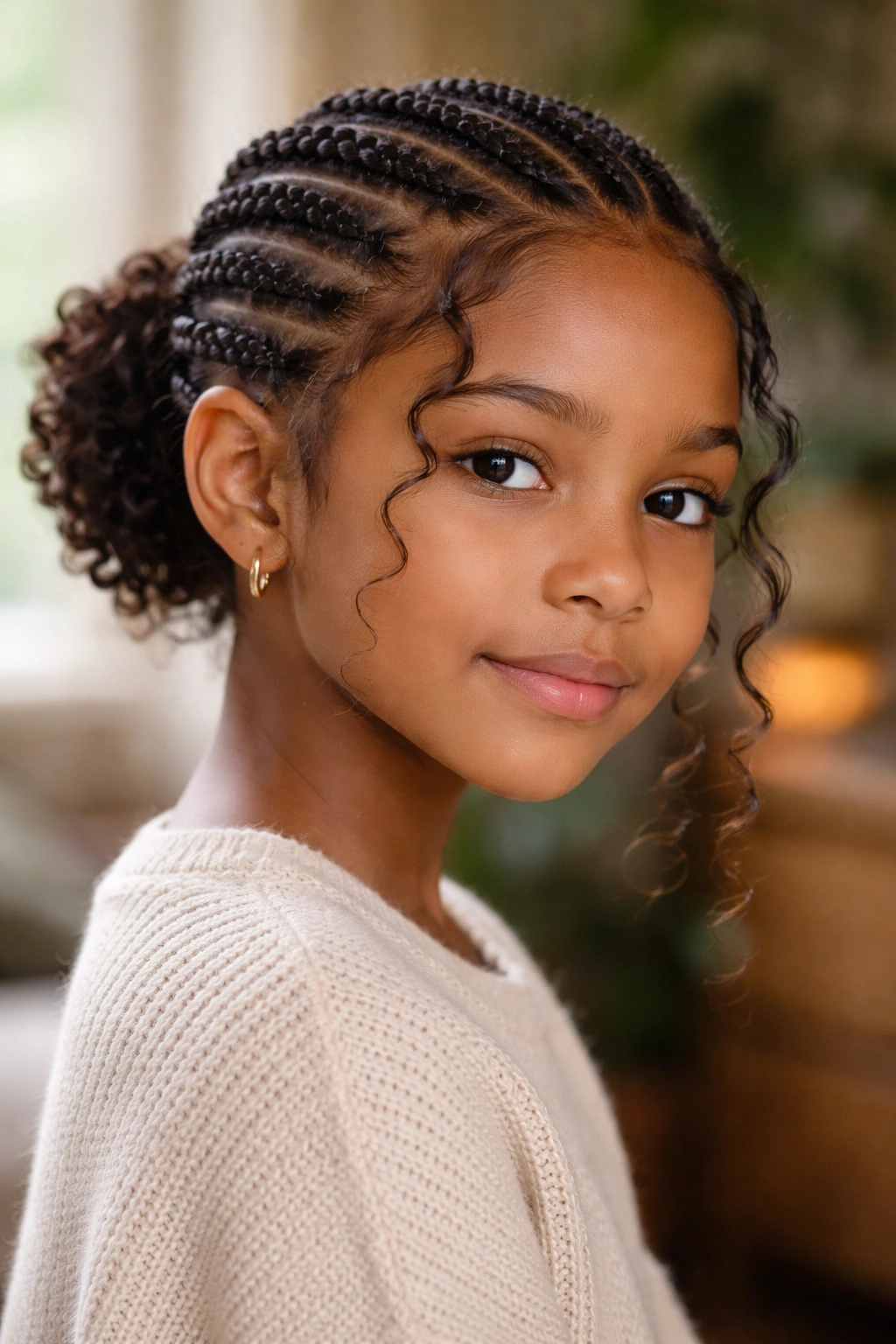
Cornrows pulled into a low bun or ponytail, with loose curl tendrils framing the face — either natural curls or pre-styled extension curls.
For older girls (10+), this is the entry into more grown-up styling. The cornrows handle structure. The tendrils add softness. The combination reads young-adult-appropriate without being too mature.
The tendrils should be face-framing — temple, behind the ear, soft fall in front of the shoulder. Not random escape pieces.
Caring for Cornrows on Active Girls
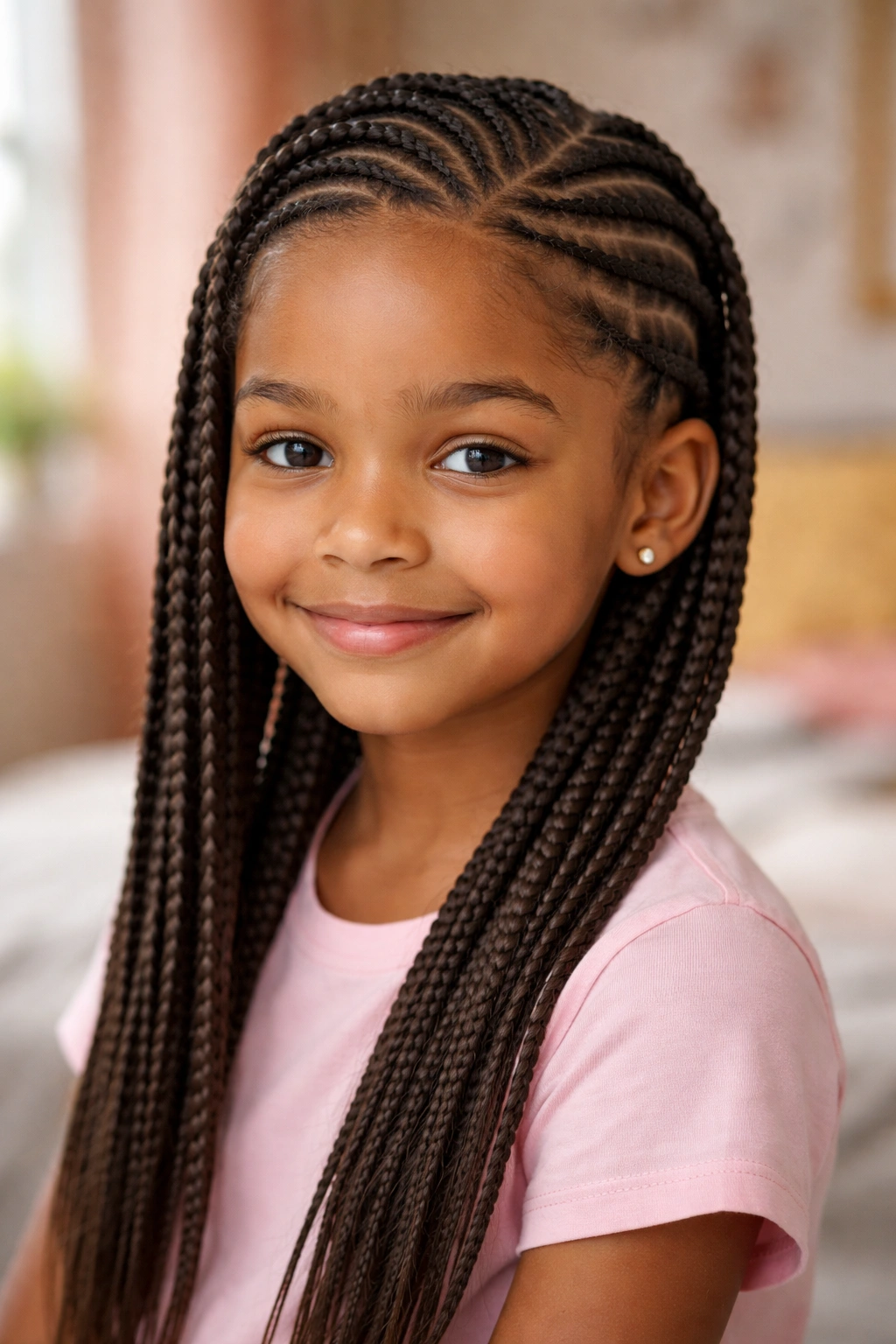
Days run hard. Recess, gym, sports, sleepovers, swimming — children move. Cornrows on active children need daily maintenance to last.
Wrap the head in a satin or silk scarf at bedtime. Every night. Make it part of the bedtime routine like brushing teeth.
In the morning, lightly mist with a water-and-leave-in spray bottle. This refreshes the cornrows without re-soaking them.
Apply a tiny drop of light oil (jojoba, sweet almond) to the scalp parting between cornrows every other day. Avoid heavy products that build up.
Touch up edges with a soft toothbrush and edge gel — only at the actual hairline, not throughout the cornrow.
Scalp Care for Children’s Hair
Children’s scalps are more sensitive than adults’. Pay attention to any persistent scratching, redness, or discomfort during the cornrow wear period.
Itch is normal in the first day or two. Persistent itch (week two onward) means something is wrong — too much product buildup, an allergic reaction to the extension fiber, or a developing scalp condition.
Keep the cornrow base clean. A weekly micellar water rinse — applied with a cotton ball along the parts — clears product without requiring a full wash.
If the child reports tenderness at any specific spot, examine it. Push the cornrows aside and look. Bumps, redness, or visible irritation needs adult attention. Don’t ignore.
When to Take Down
Cornrows for girls should come out at the 2-3 week mark. Longer than three weeks creates matting at the new growth point and difficulty during takedown.
Signs it’s time:
- Significant fuzz at the parts
- Loose cornrow ends
- Persistent itch
- The child asks (kids know when their hair is done)
The child’s comfort dictates the timeline more than any visual standard.
Takedown for Girls
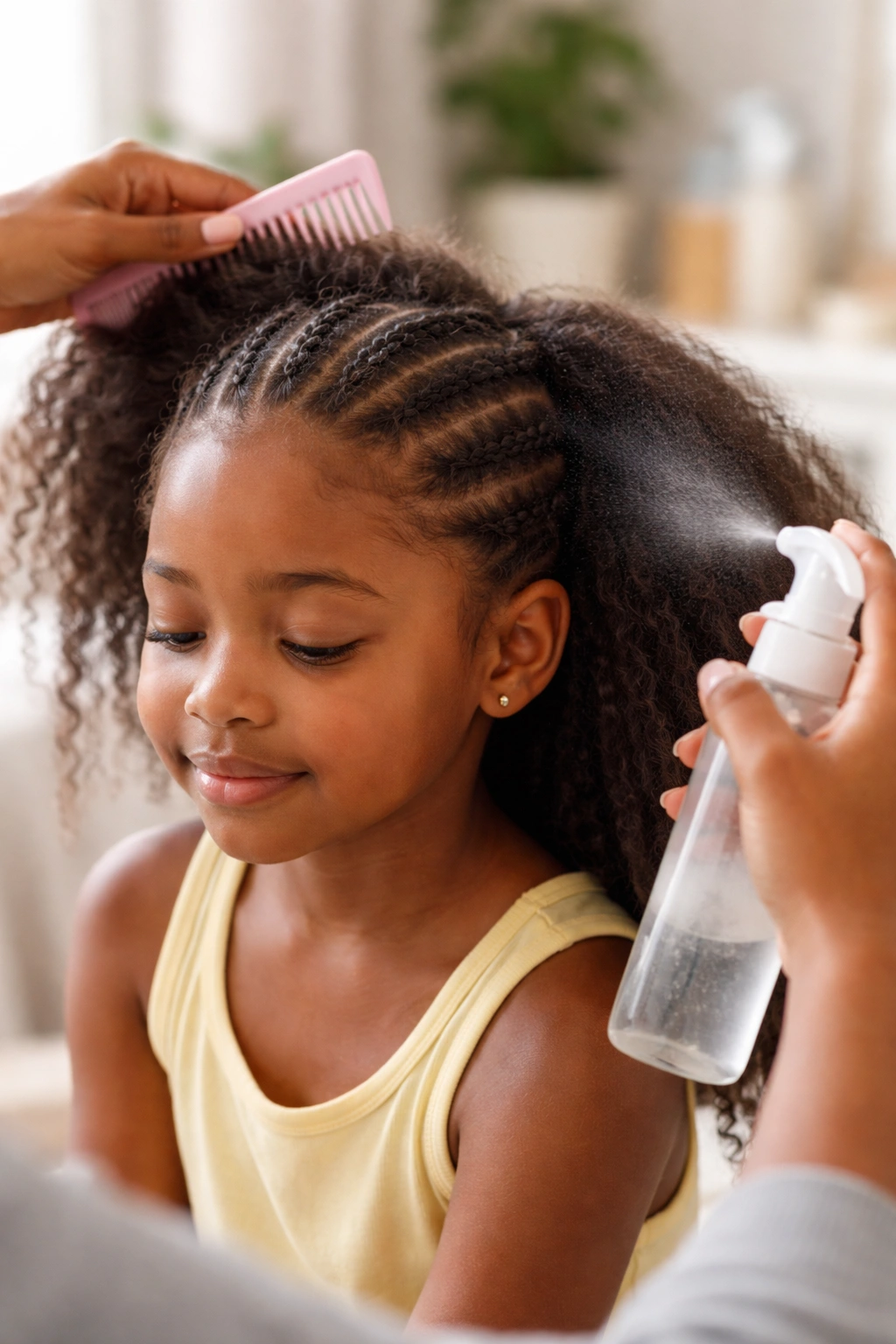
Set aside an unrushed afternoon. Takedown can take 30-60 minutes for younger girls, longer for older girls with longer hair.
Saturate the hair with a detangling spray or conditioner. Wet hair detangles easier and breaks less.
Unravel slowly, from the ends up. Don’t pull. Don’t yank. Pause if the child says ouch.
After full takedown, do a gentle wash and a deep conditioner. The post-takedown wash matters as much as the install. The hair has been through 2-3 weeks of styling and needs replenishment.
Picking the Right Style for Your Daughter
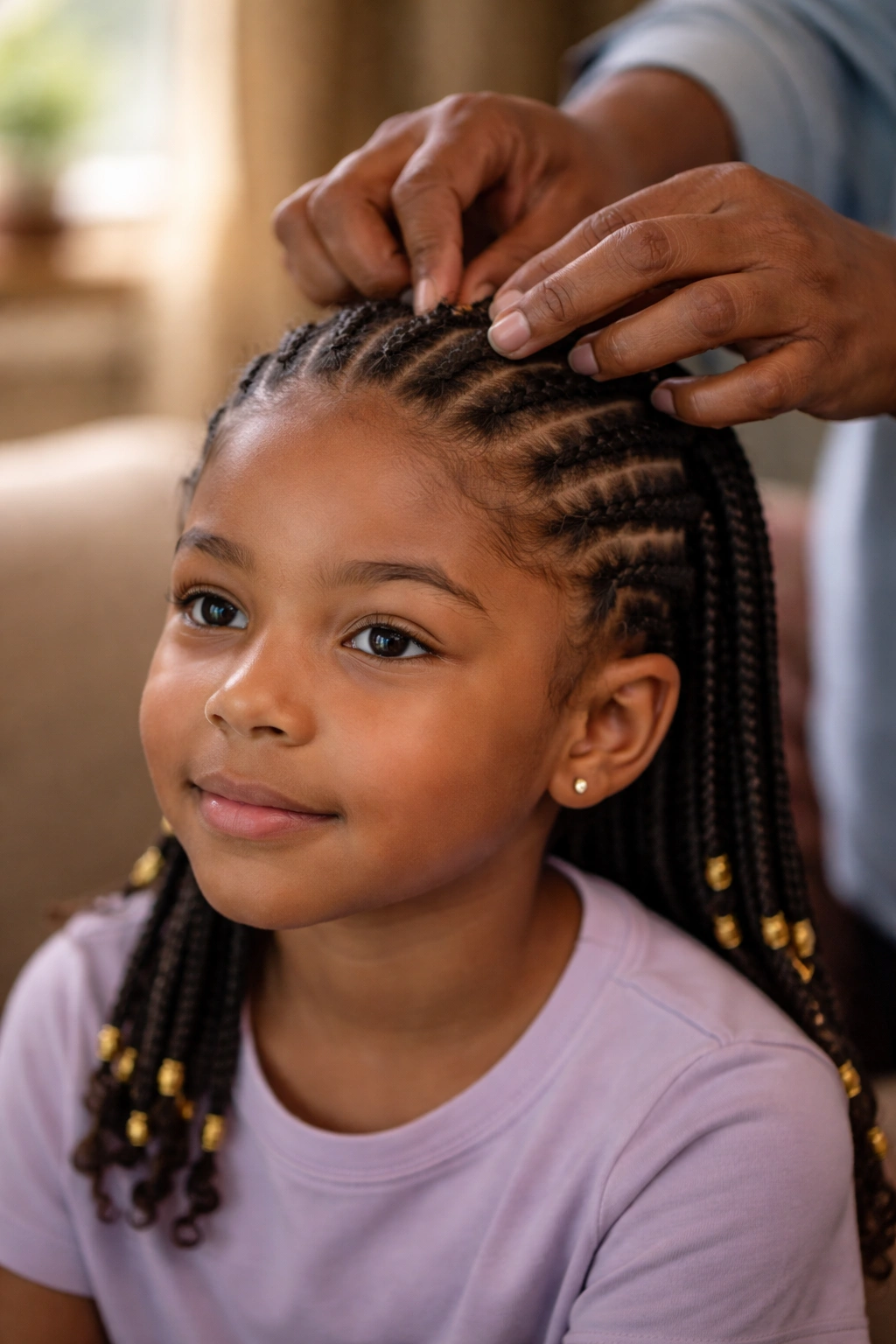
Match style to age. Toddlers need quick. School-age kids need durable. Pre-teens want choices. Teens want what their friends have.
Match style to activity. Active girls need contained styles (buns, low ponytails). Less active girls can wear hanging braids that look prettier but tangle more.
Match style to hair texture. Tightly coiled hair holds tension well but needs lighter installation. Looser curls slip out of cornrows faster and may need a small amount of edge gel at install for grip.
Match style to your skill. Beginning braiders should start simple — two cornrows, three cornrows, basic ponytail. Advanced patterns can wait.
Common Mistakes Parents Make
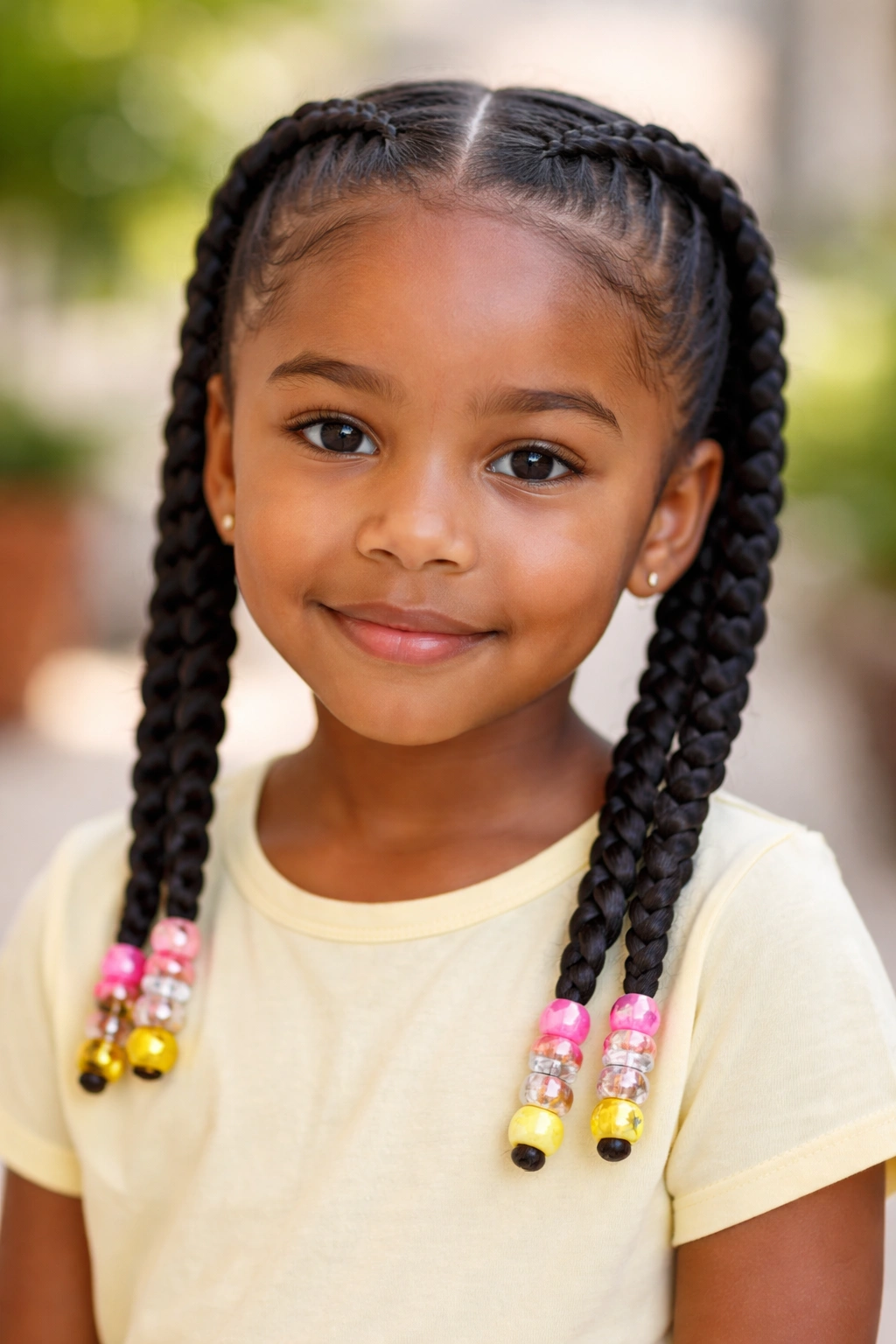
Braiding too tight. Painful for the child, damaging for the hairline, traumatic for future braid sessions.
Forcing too much sit time. A 4-year-old doesn’t have a 3-hour attention span. Pick styles that match how long the child can sit comfortably.
Skipping the bonnet. Frizz by morning. Reduced longevity. Always wrap.
Heavy products. Build up at the parts, look greasy by day two. Light products only.
Rushing the takedown. Causes breakage and pain. Set aside dedicated time.
Ignoring complaints. If the child says it hurts, it hurts. Adjust.
Cornrows for girls are an act of care. The hours spent in installation, the daily maintenance, the shared time at the kitchen table — those build memory and skill and connection. Done well, they protect young hair and grow lifelong appreciation for braided styles. Worth every minute of the work.