



Double ponytails for curly hair are one of those styles people underestimate until they see them done well. On straight hair, twin ponytails can look neat and sweet. On curls, they get a little more personality, a little more height, and a lot more shape. That’s the part I love most: the style doesn’t fight texture. It works with it.
The catch is the root area. Curly hair rarely wants to lie flat in two identical sections, and trying to bully it into submission usually makes the style look stiff, dry, or lopsided. Better to think in terms of shape control: where you part, how tightly you anchor each ponytail, and whether the ends stay defined or go soft and fluffy. Those choices matter more than people think.
There’s also range here, which is why this style keeps hanging around. You can wear double ponytails for curly hair high and playful, low and polished, half-up, braided, bubble-stacked, or dressed up with ribbons and cuffs. The same basic idea can look completely different depending on curl pattern, length, and how much root smoothing you’re willing to do.
The best versions don’t look forced. They look intentional, a little lively, and like the curls were allowed to keep their personality. Start with the styles that make that easiest.
1. High Double Ponytails with a Clean Center Part
High twin ponytails are the classic move, and they work especially well when your curls have strong shape and volume at the crown. The center part gives the style balance, while the high placement lifts the face and keeps the overall look energetic.
Why It Stands Out
The trick is making the roots smooth enough to contrast with the curls without flattening them completely. I like to part from the forehead straight back to the nape, then smooth each side with a light gel or styling cream before securing with snag-free elastics. If your curls are dense, leave a little puff at the crown on purpose. It looks better than fighting every bump.
Best for: medium to long curls, especially 3B to 4A textures
Works well with: defined wash-and-go curls or stretched curls
Watch for: ponytails that sit too close to the ears, which can make the style feel pulled down
Small tip: place each ponytail about 1 to 2 inches above the top of the ear for a lift that actually shows.
2. Low Double Ponytails at the Nape
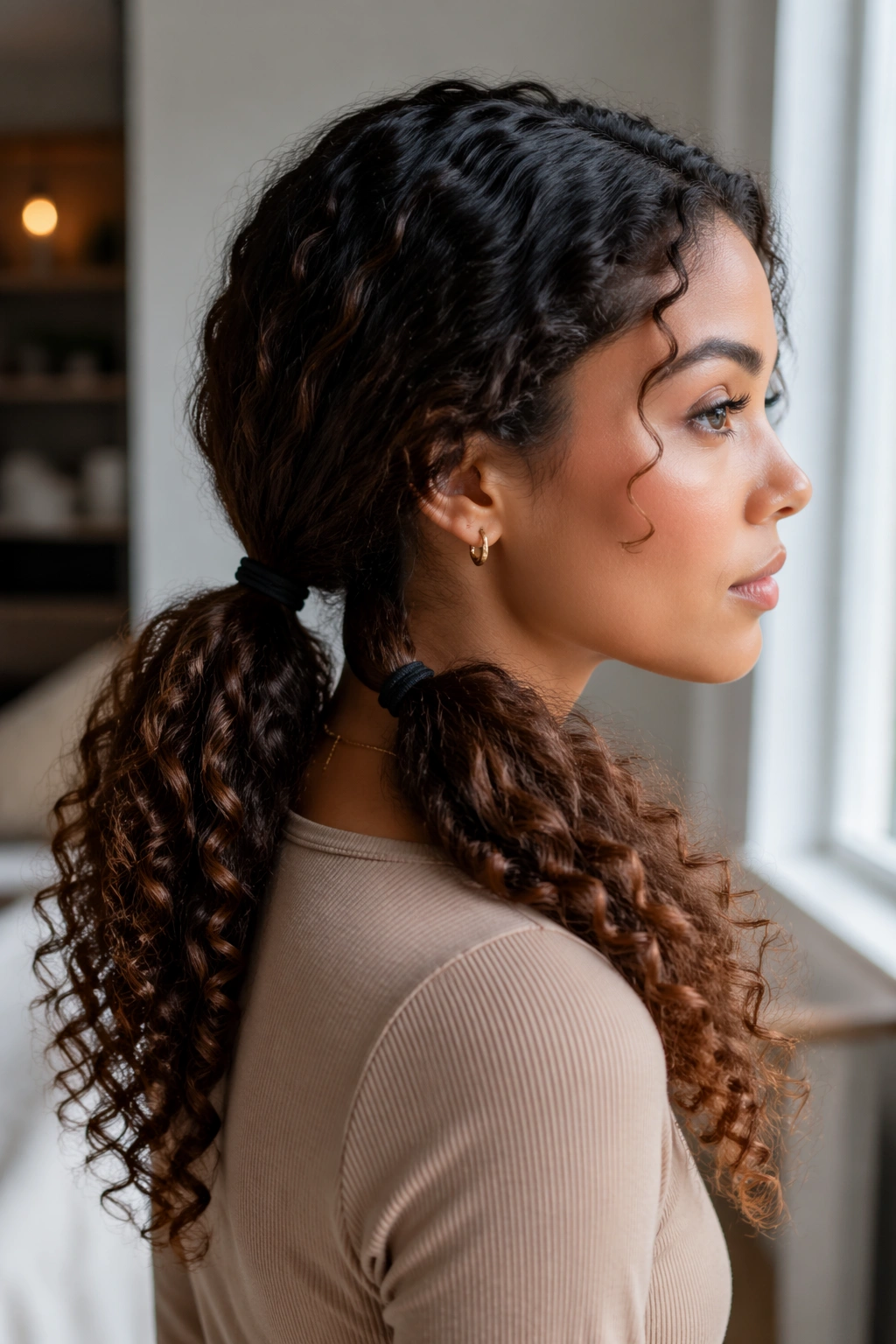
Low double ponytails are the quiet cousin of the high version, and honestly, I reach for them more often. They feel calmer, cleaner, and easier to wear for hours without your scalp complaining.
What makes them good on curly hair is the way the nape placement lets the ends do the talking. You can keep the roots sleek and let the curls spill down, or you can make the whole thing looser and softer. Either way, the shape stays polished.
The only thing I’d avoid is placing them too low and too tight. That tends to drag the face downward. Keep them tucked at the base of the neck, and let a few curls sit free near the temples.
3. Half-Up Double Ponytails with Loose Curls
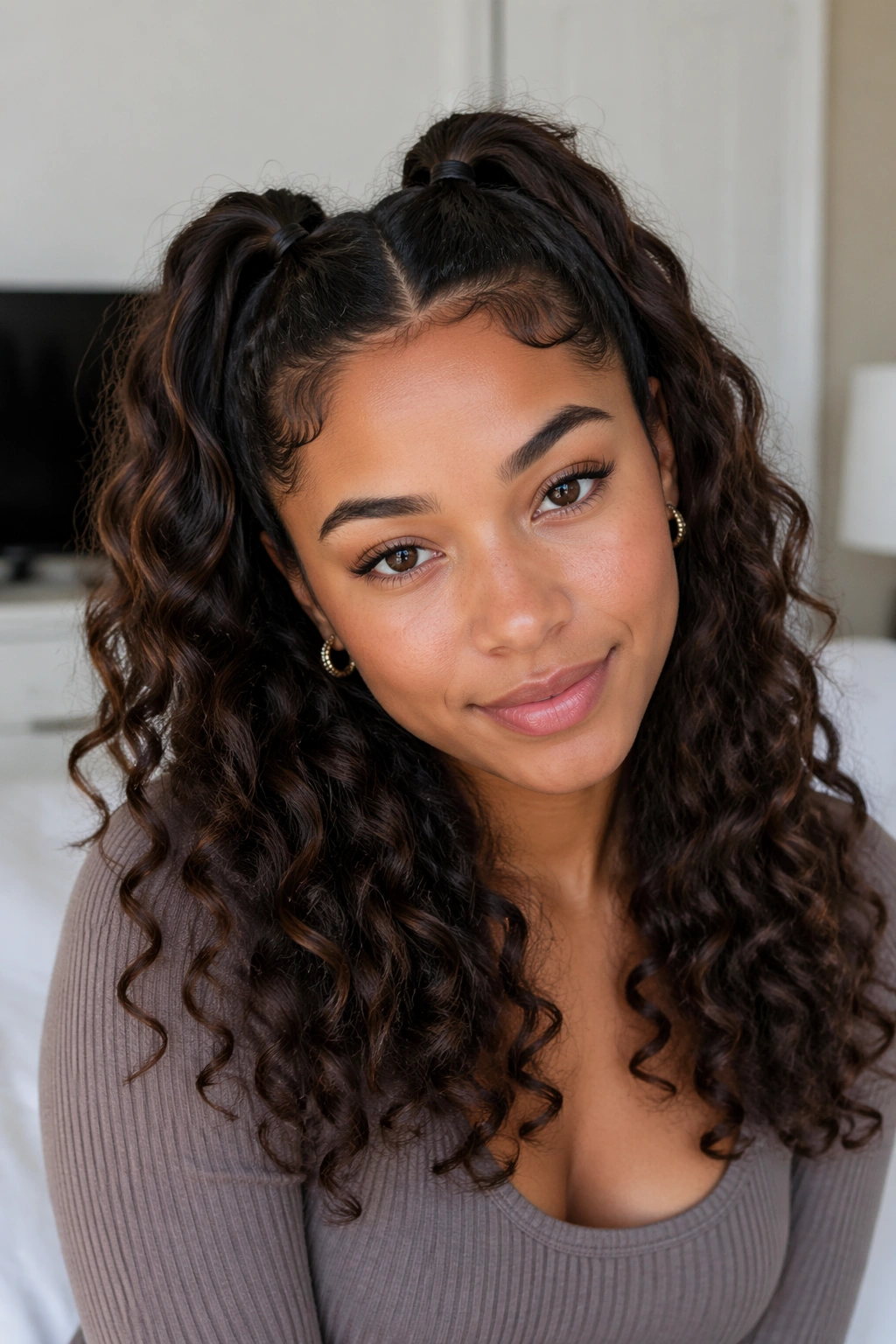
This one is the sweet spot when you want the fun of twin ponytails without committing all of your hair to the look. The top half gets gathered into two ponytails, while the bottom stays loose and curly.
It’s especially nice on hair that has a strong curl pattern underneath but gets frizzy faster at the crown. You get structure where you need it and softness everywhere else. That balance matters.
How to Get the Shape Right
- Section the top half from temple to temple, keeping the part neat and even.
- Secure the ponytails with small elastics so the bases stay tidy.
- Leave the bottom curls untouched, or refresh them with a mist of water and a little leave-in.
- Pull a few front pieces loose if you want a softer frame.
Pro tip: this style looks best when the loose curls have a little bounce, not when they’re weighed down by too much cream.
4. Braided Bases That Feed into Twin Ponytails
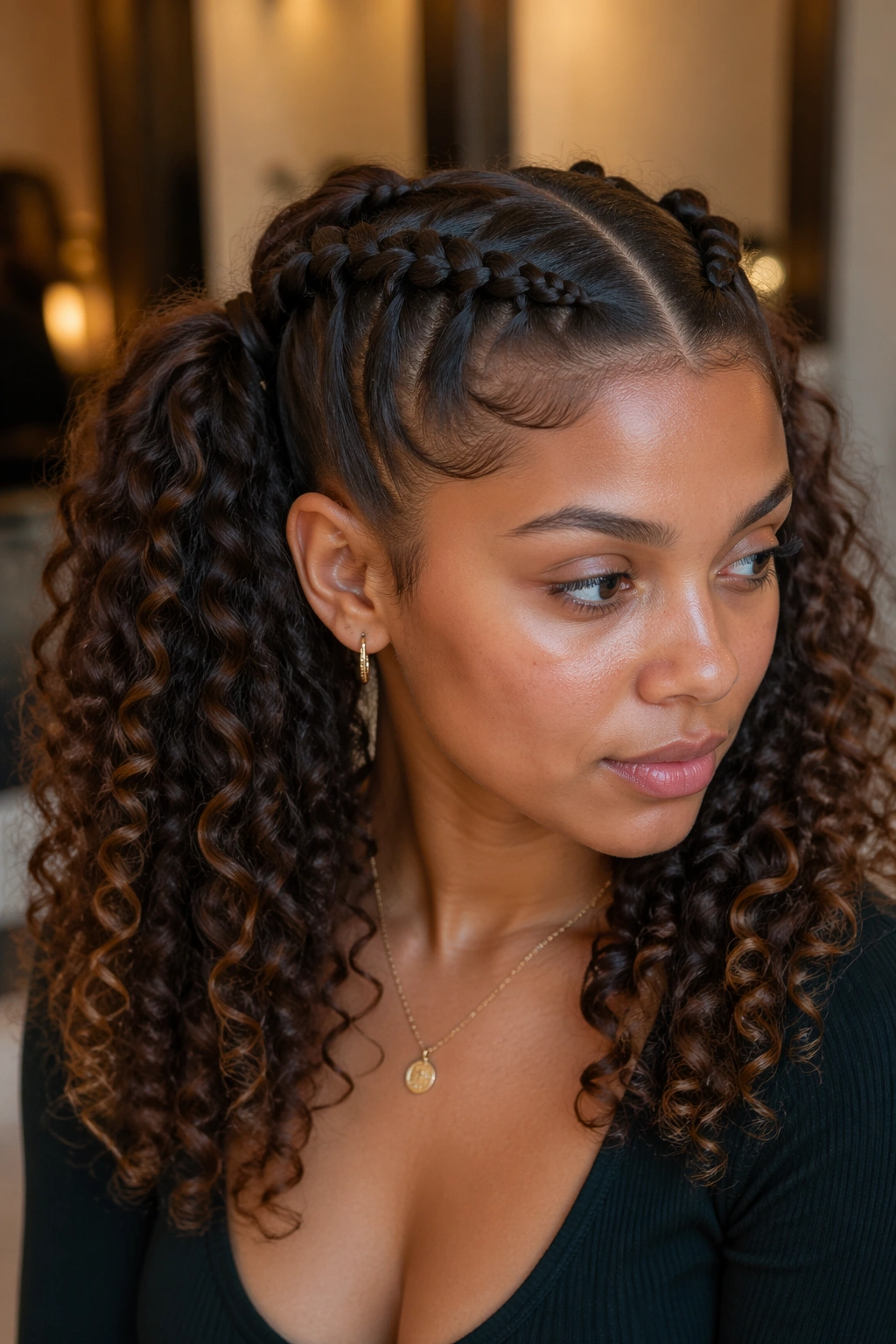
Braided bases make double ponytails feel more finished. Instead of just tying sections back, you braid each side from the front or along the part line, then gather the remaining hair into ponytails.
That extra bit of structure does two things. First, it keeps the roots neater. Second, it gives the style a built-in detail so you don’t have to add much else. I like this version for days when plain ponytails feel too simple but a full braided style sounds like a project.
The braid doesn’t need to be fancy. A three-strand braid along each side is enough. Keep the tension even, not aggressive. Curly hair holds braid patterns well, but if you pull too hard, the front can look thin fast.
5. Bubble Double Ponytails
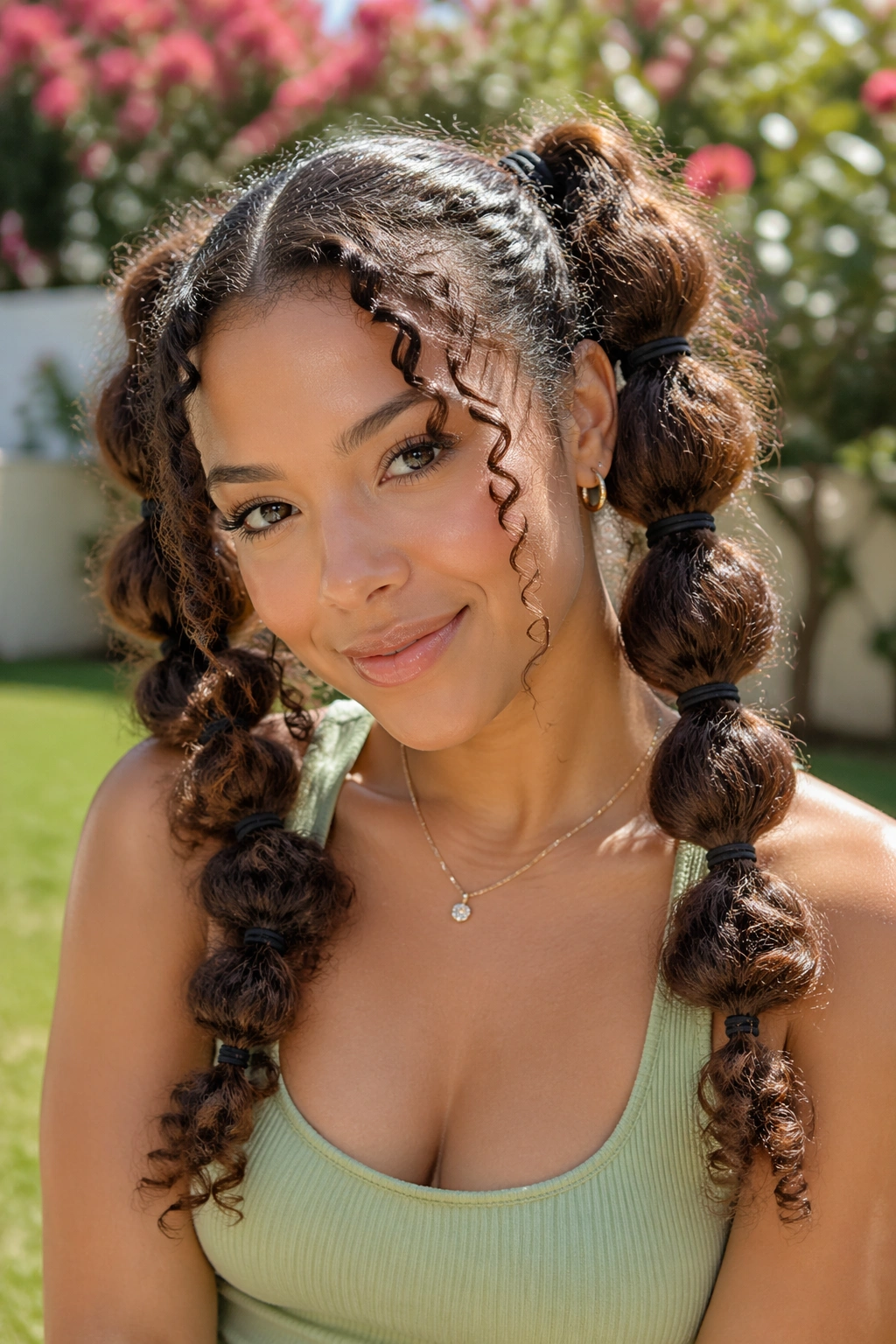
Bubble ponytails are made for curly hair. That’s the blunt truth. The natural texture already gives the style body, so each section looks fuller than it would on straight hair.
For double ponytails, I like creating two or three elastic “bubbles” down each ponytail using small clear bands spaced evenly apart. Then I gently tug each section outward so the shape rounds out. The effect is playful, but not childish if the parts are clean.
What Makes Them Different
The bubbles don’t need perfect symmetry. In fact, a little variation makes them look more natural. If one side is puffier, that can be a good thing. Curly hair rarely behaves like a ruler, and this style doesn’t need it to.
Use this when: you want a style with movement and hold
Skip it if: your ends are damaged and split, because bubble sections put the tips on display
Best tool: small snag-free elastics, preferably ones that won’t snag textured hair
6. Side-Swept Double Ponytails
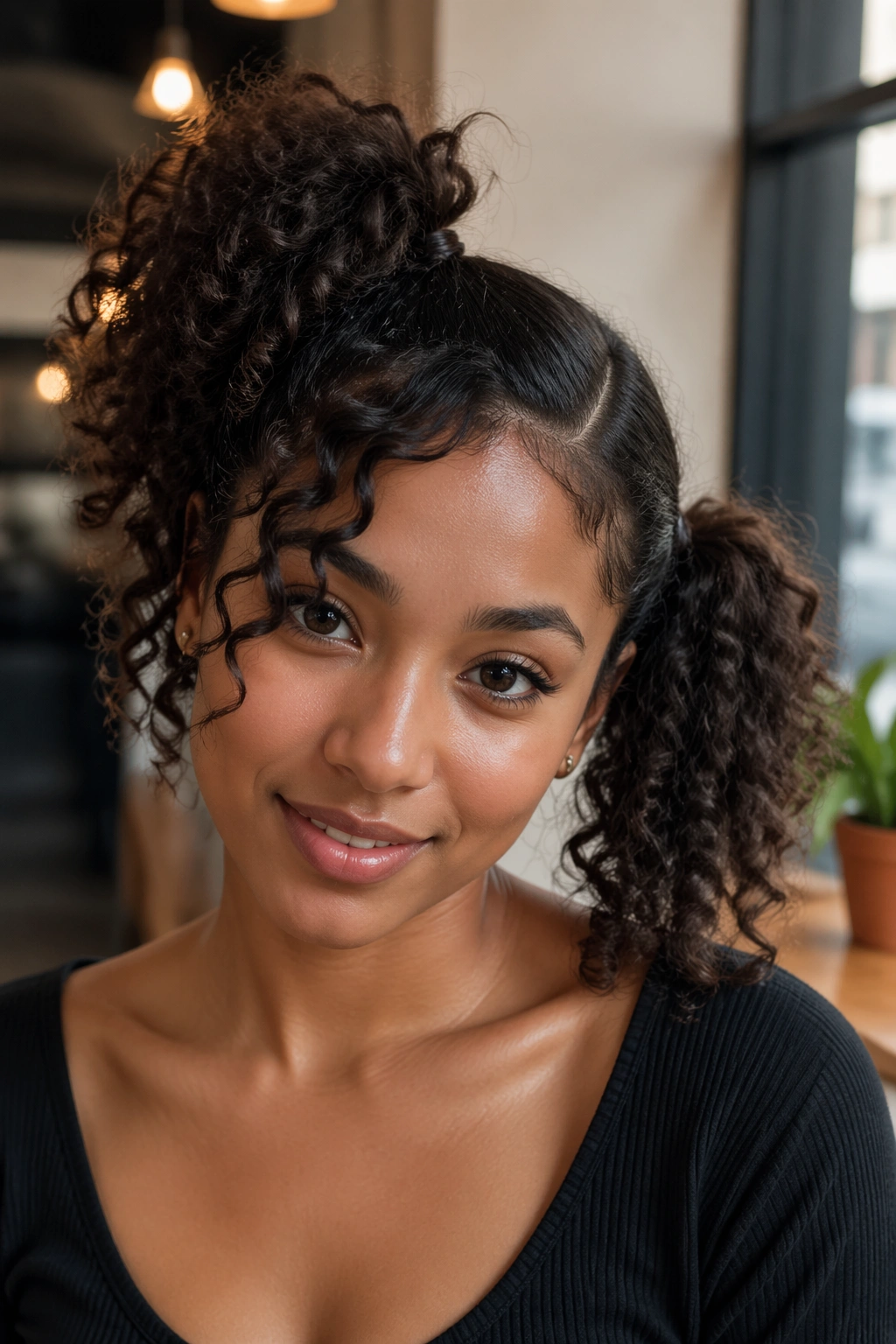
Side-swept double ponytails are for the days when centered parts feel too serious. Shift the part slightly off-center, then let one ponytail sit a bit higher or farther forward than the other. The asymmetry gives the style energy.
This version works well if one side of your curls has more volume than the other, which happens all the time. Instead of trying to make both sides identical, you’re using the difference on purpose.
A side part also helps if you wear your curls with a natural bend. The whole look feels less staged. That matters. A style can be neat and still look relaxed.
7. Face-Framing Double Ponytails with Tendrils
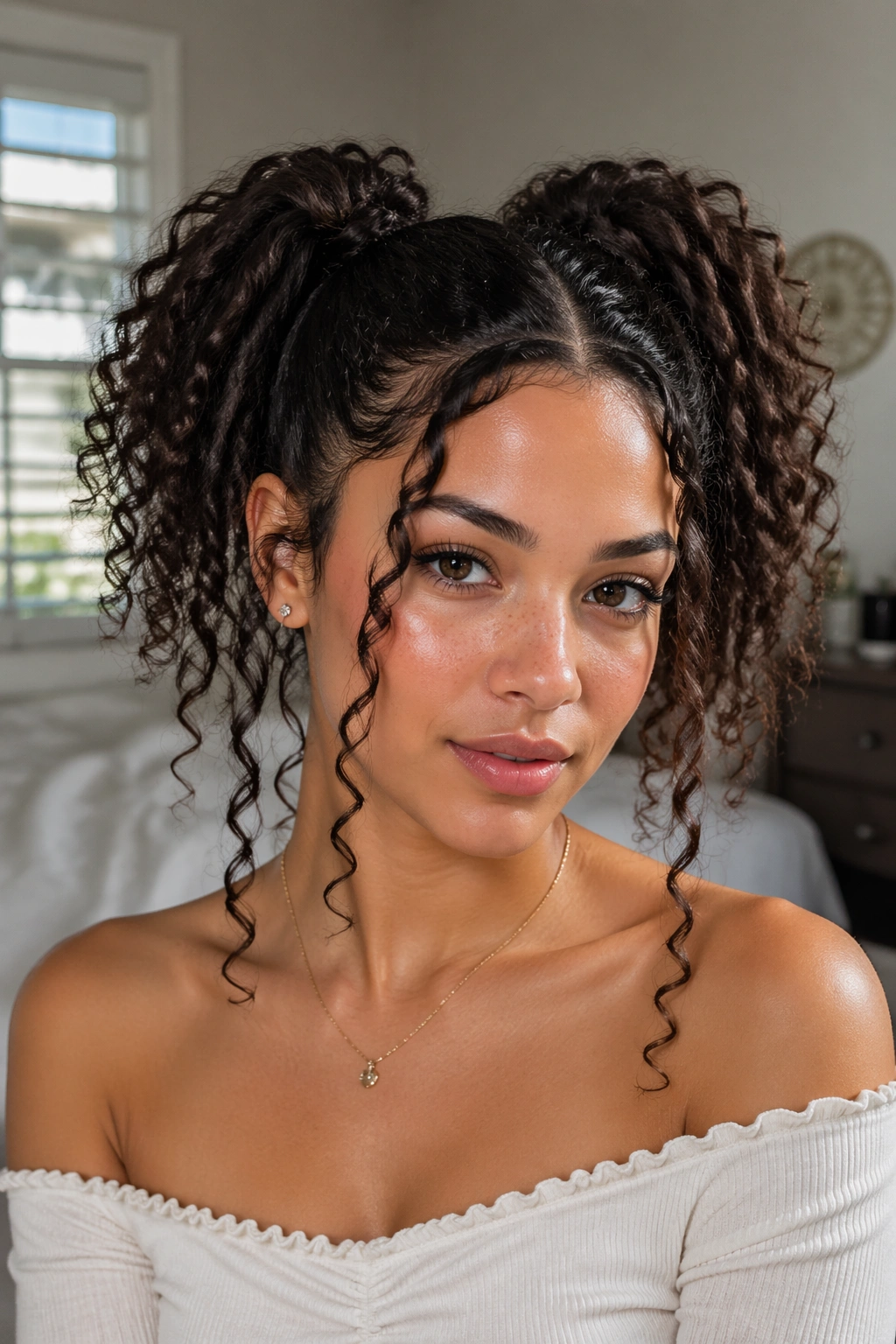
If you like a softer, more romantic look, leave a few curls out in front. Not many. Two tendrils on each side is usually enough, and they should be deliberate, not random scraps of hair hanging there.
The ponytails themselves can sit high or low. What changes the mood is the face-framing curl pattern. I prefer this on hair with springy ringlets, because the tendrils curl back into shape instead of going limp halfway through the day.
What to Watch For
- Don’t over-smooth the front pieces; they’ll lose their curl.
- Keep the tendrils about pencil-width sections so they look intentional.
- Refresh them with a tiny bit of water and leave-in if they frizz.
- Let them sit slightly curved, not perfectly symmetrical.
It’s a small change, but it softens the whole style fast.
8. Sleek Roots and Puffy Ends
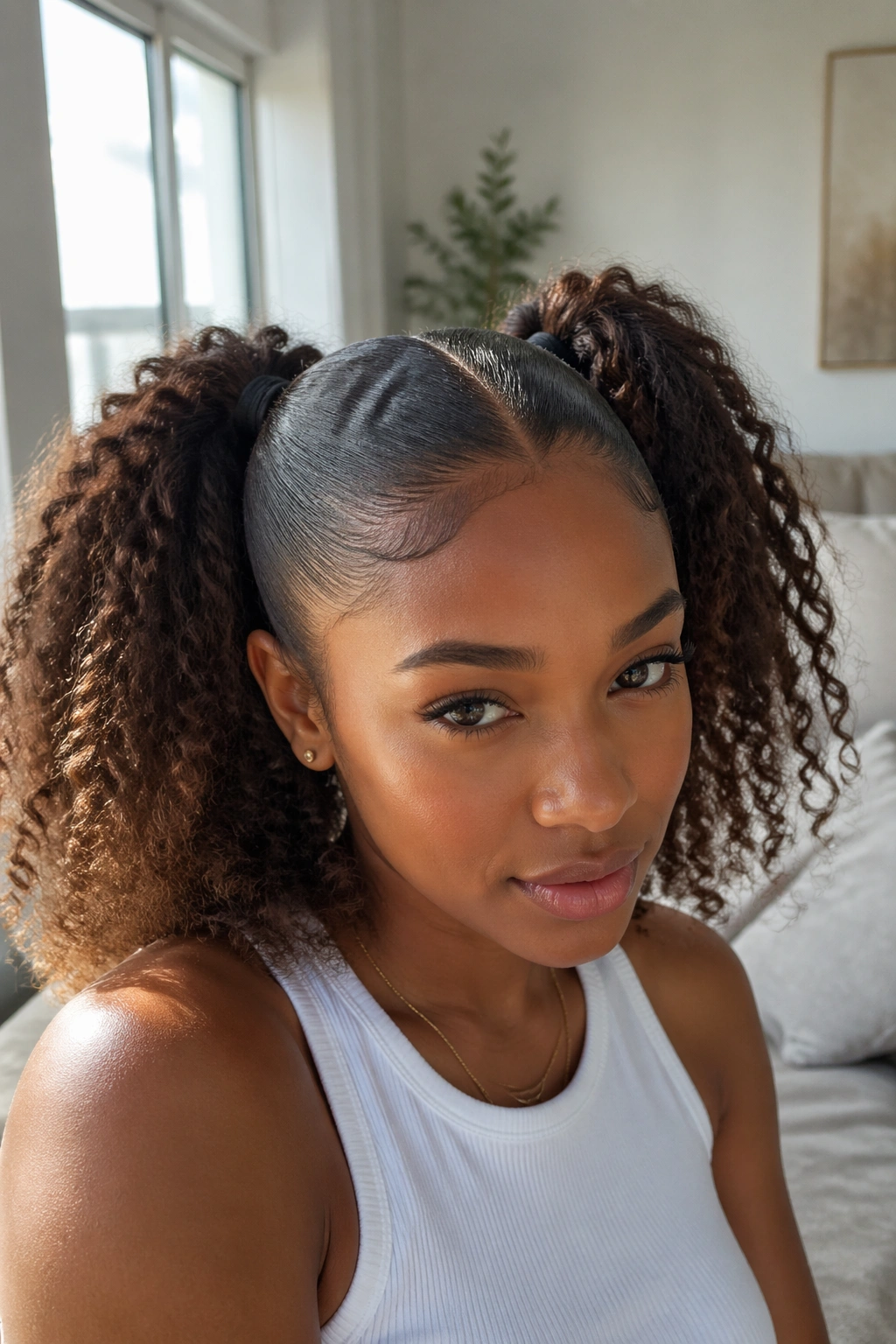
This style is all about contrast. The roots are smoothed close to the scalp, while the ponytail ends stay fluffy, full, and unapologetically curly. It’s one of the best double ponytail looks if you like a cleaner top with a bigger silhouette.
You do need a little discipline to make it work. A brush, some gel, and patience around the part line help a lot. But once the roots are set, you can stop fussing and let the curls do their thing.
The finished look has a nice shape because the eye gets pulled from the smooth base into the volume at the ends. That’s why it photographs well in real life, not just in styling videos. The contrast reads clearly.
9. Twisted-Base Double Ponytails
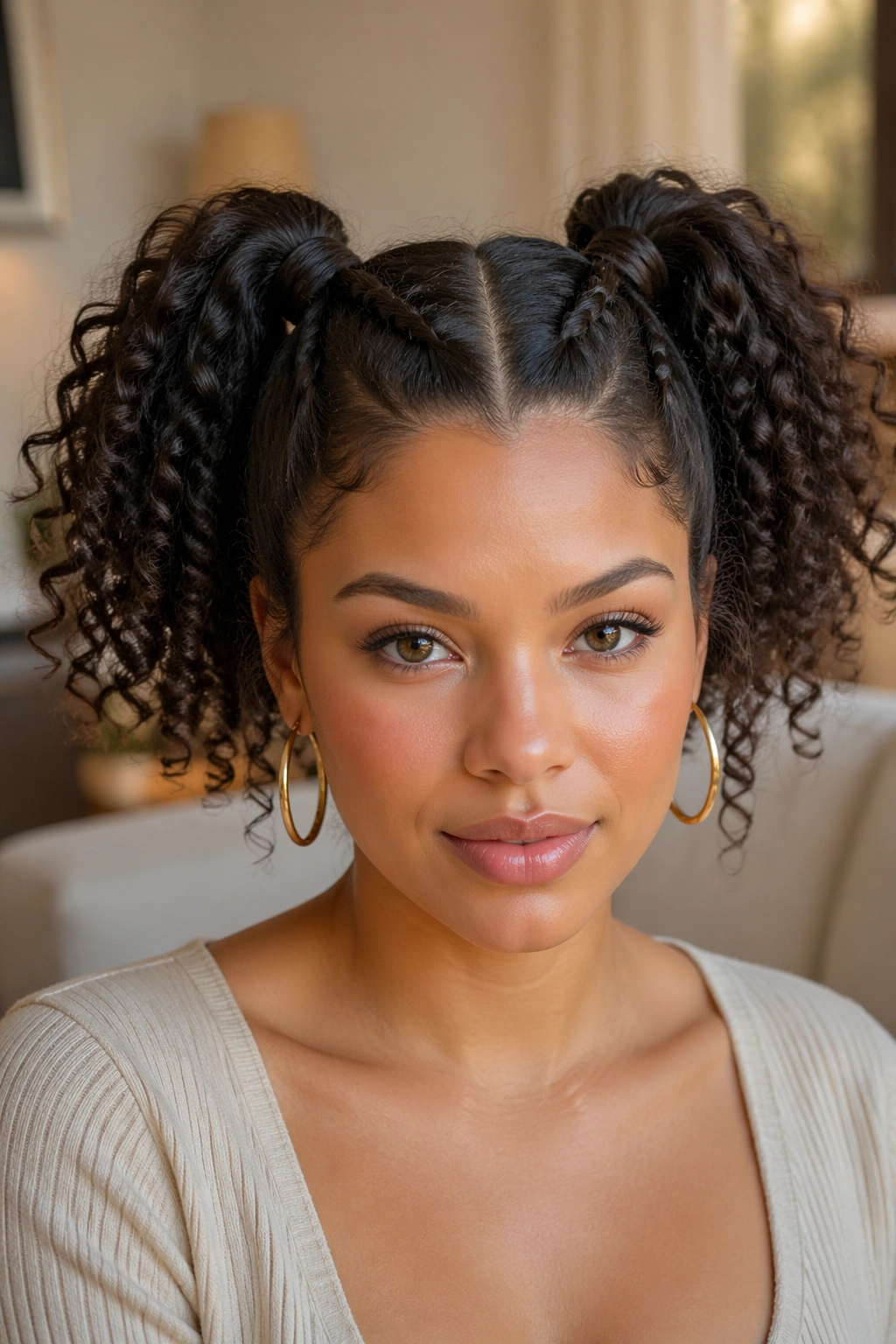
Twists are underrated here. Instead of leaving the front sections flat, twist each side back before gathering it into a ponytail. The twist adds texture at the root and gives the style a little more grip.
This is a good choice when your hair slips out of elastics or when the front layers are too short to behave. The twist helps control them without forcing every strand into place. I like that it looks more deliberate than a basic ponytail, but it still doesn’t take forever.
How to Style It
- Make your center part clean and even.
- Take a small front section on one side and twist it back toward the ponytail point.
- Secure the twist and the rest of the side together with one elastic.
- Repeat on the other side.
Important: keep the twists loose enough to preserve curl pattern near the front.
10. Double Ponytails with Ribbon Ties
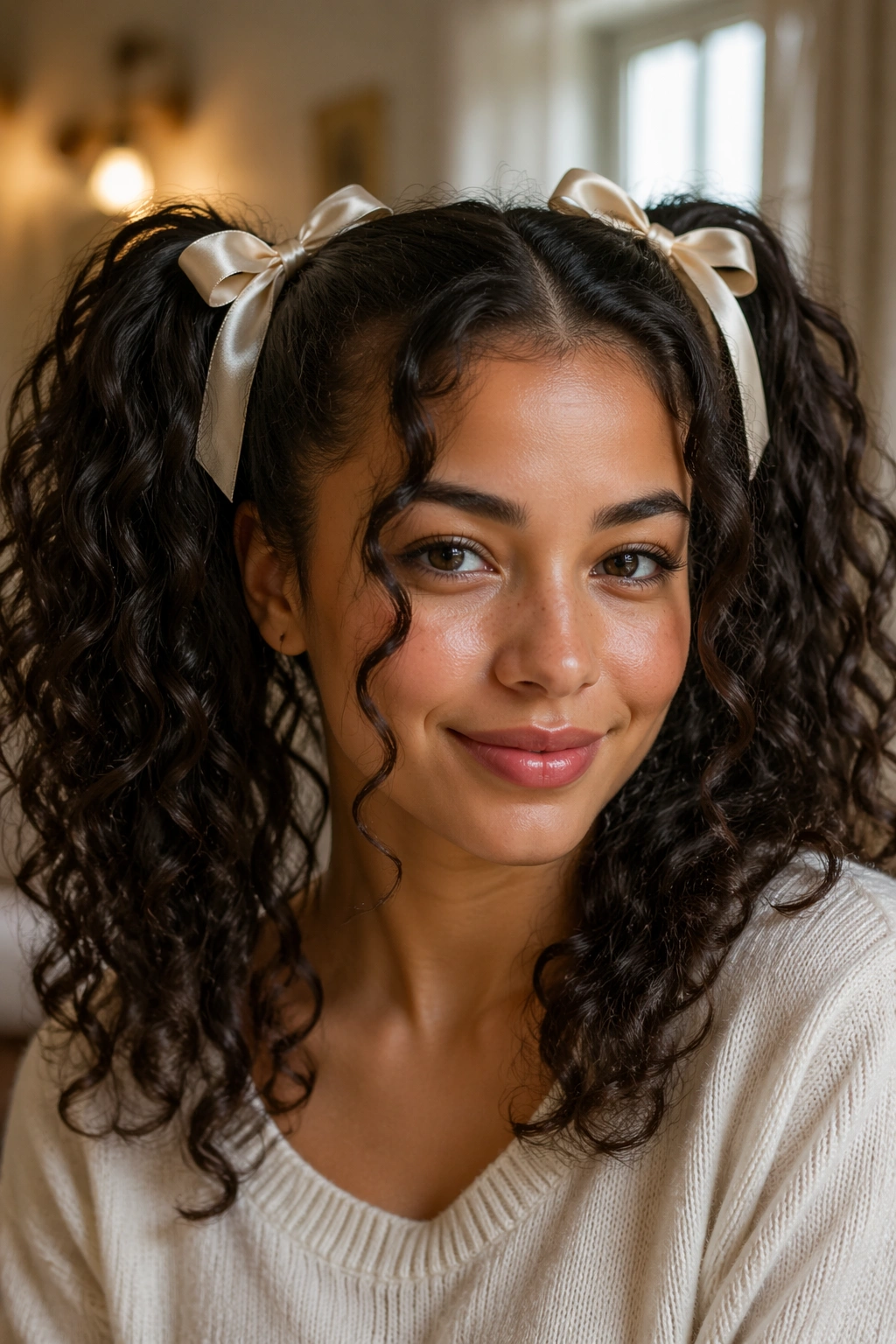
Ribbons can change the entire mood of a curly twin ponytail. A satin ribbon tied around each base adds softness and a little polish, especially when the curls themselves are big and lively.
I like this version because it doesn’t need much else. You don’t need heavy styling, and you don’t need a dozen pins. The ribbon does the work. Choose a ribbon that’s about 1/2 inch to 1 inch wide so it shows up without swallowing the hairstyle.
Dark ribbon on dark hair feels elegant. Bright ribbon on medium or light hair feels playful. Either way, tie the knot under the ponytail so the bow sits neatly on top instead of slipping sideways.
11. Mini Double Ponytails for Short Curly Hair
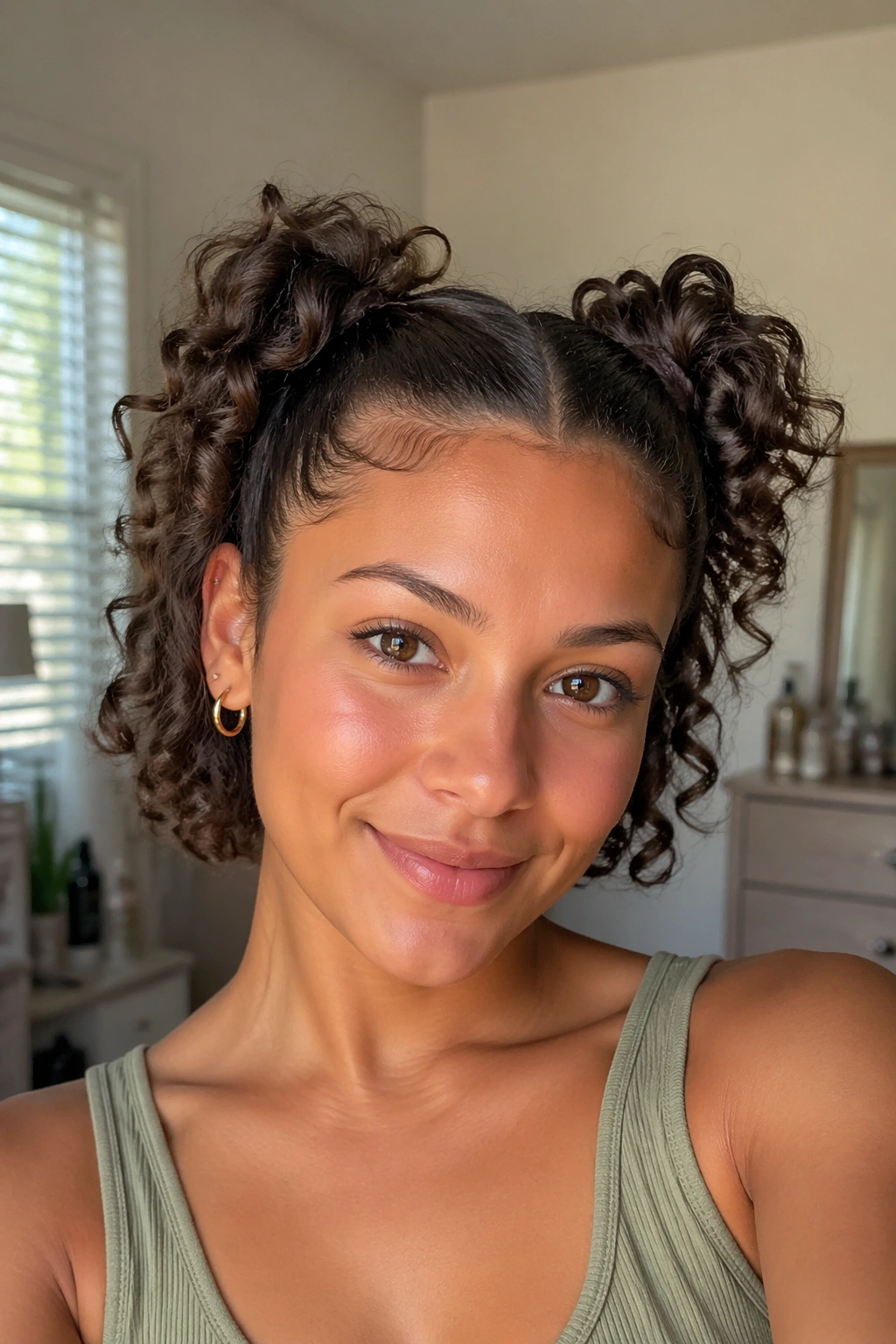
Short curls can absolutely do double ponytails. In fact, they can be more interesting than longer hair because the shape sits closer to the head and shows off the texture faster.
The key is keeping the sections small and the placement high enough to read as a style, not just a quick tie-back. Think mini pigtails with purpose. If your curls are chin-length or shoulder-length, this is one of the easiest ways to get a cute, defined shape without stretching the hair too much.
What Helps Most
- Use small elastics that can hold a shorter section without sliding.
- Keep the part sharp so the twin shape is obvious.
- Fluff the ponytails gently after tying so they don’t look tiny and stiff.
- If needed, add a tiny bit of gel at the roots only.
Short hair does not mean fewer options. It just means the proportions need more attention.
12. Staggered High-Low Double Ponytails
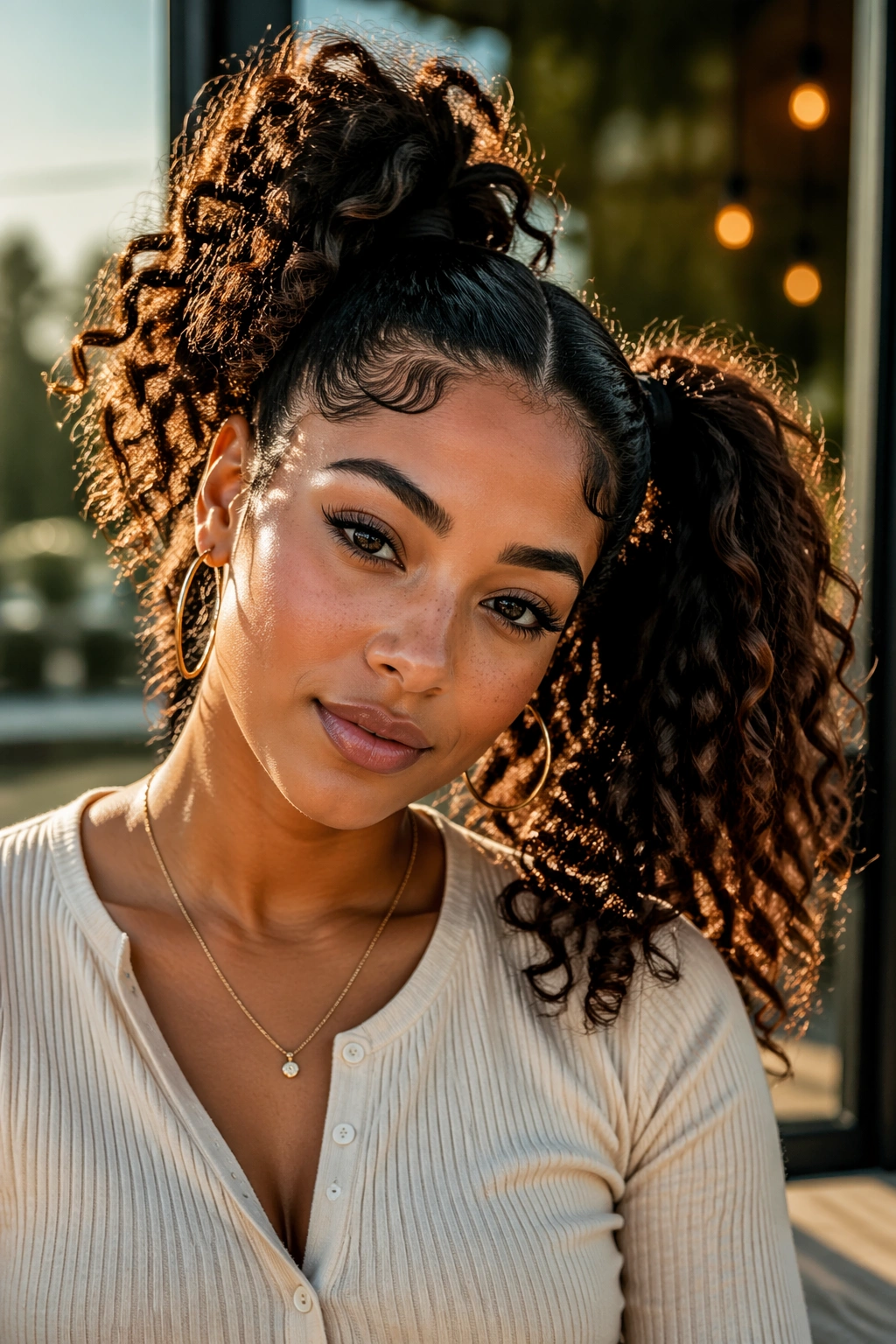
This version breaks symmetry on purpose. One ponytail sits slightly higher than the other, or one leans more toward the crown while the other drops closer to the nape. It sounds odd on paper. On curly hair, it can look surprisingly sharp.
The staggered shape gives movement without needing curls pinned in place. I like it for thicker textures, because the volume helps the style look intentional instead of accidental. If both ponytails were stacked in the exact same spot, the style would feel static. A little offset fixes that.
This is also a good option when the left and right sides of your hair have different densities. Instead of forcing balance that isn’t there, you’re using placement to even out the overall silhouette.
13. Cornrow-Feed Double Ponytails
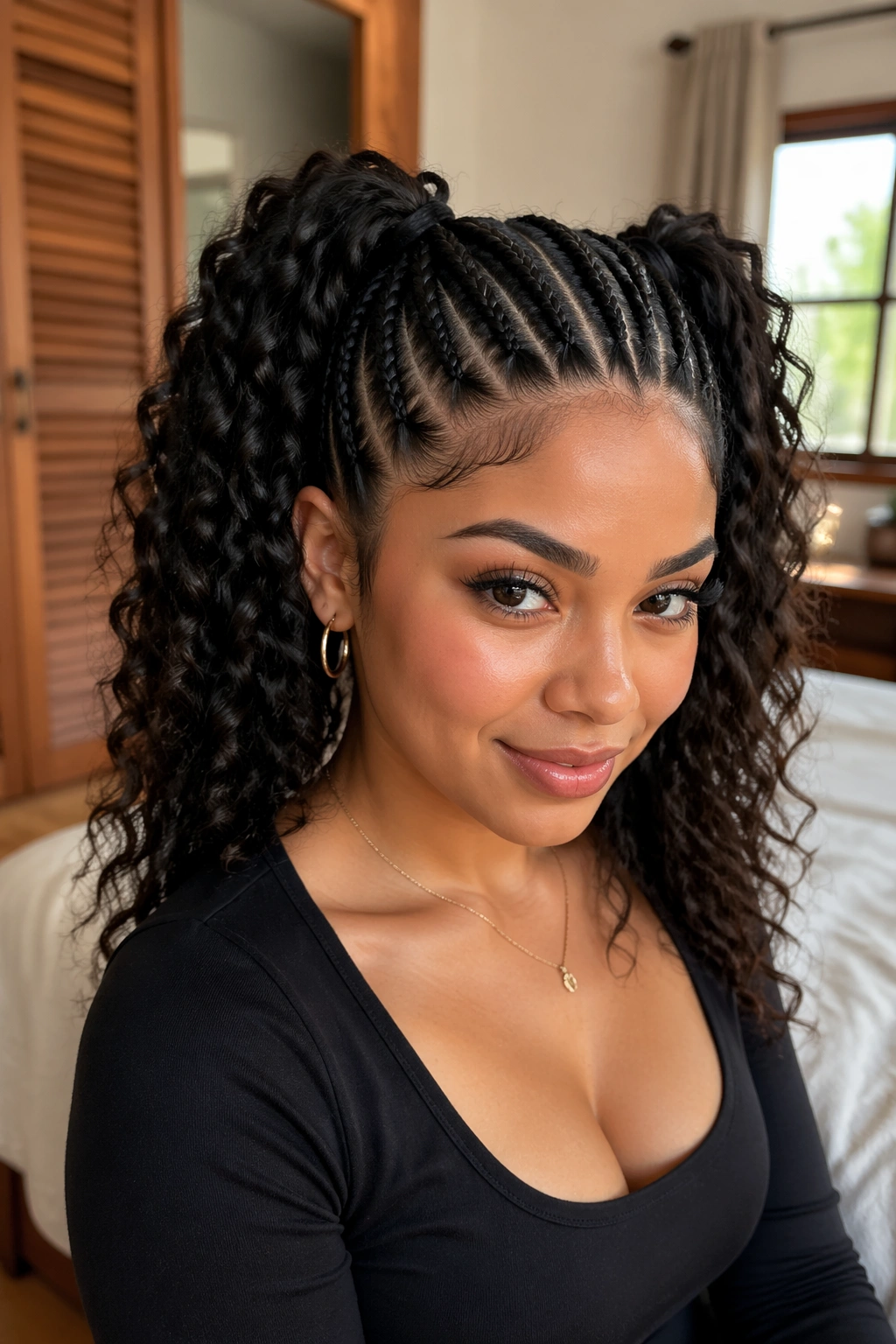
Cornrow-fed ponytails are one of the most secure versions on this list. The front or top sections are braided close to the scalp, then fed into two ponytails. The result is neat, long-lasting, and especially useful for active days.
The braids create a clean path back to the ponytails and keep the front from puffing up too soon. For curly hair, that matters because the roots often need more control than the ends. Once the base is set, the curls can stay free and full.
Why It Holds So Well
- The braid pattern locks the front hair in place.
- The ponytail anchors are less likely to slide.
- The style handles humid air better than loose sections.
- It works for thick hair that wants to expand quickly.
If you like your styles to stay put, this is one of the strongest options.
14. Middle-Braid Double Ponytails
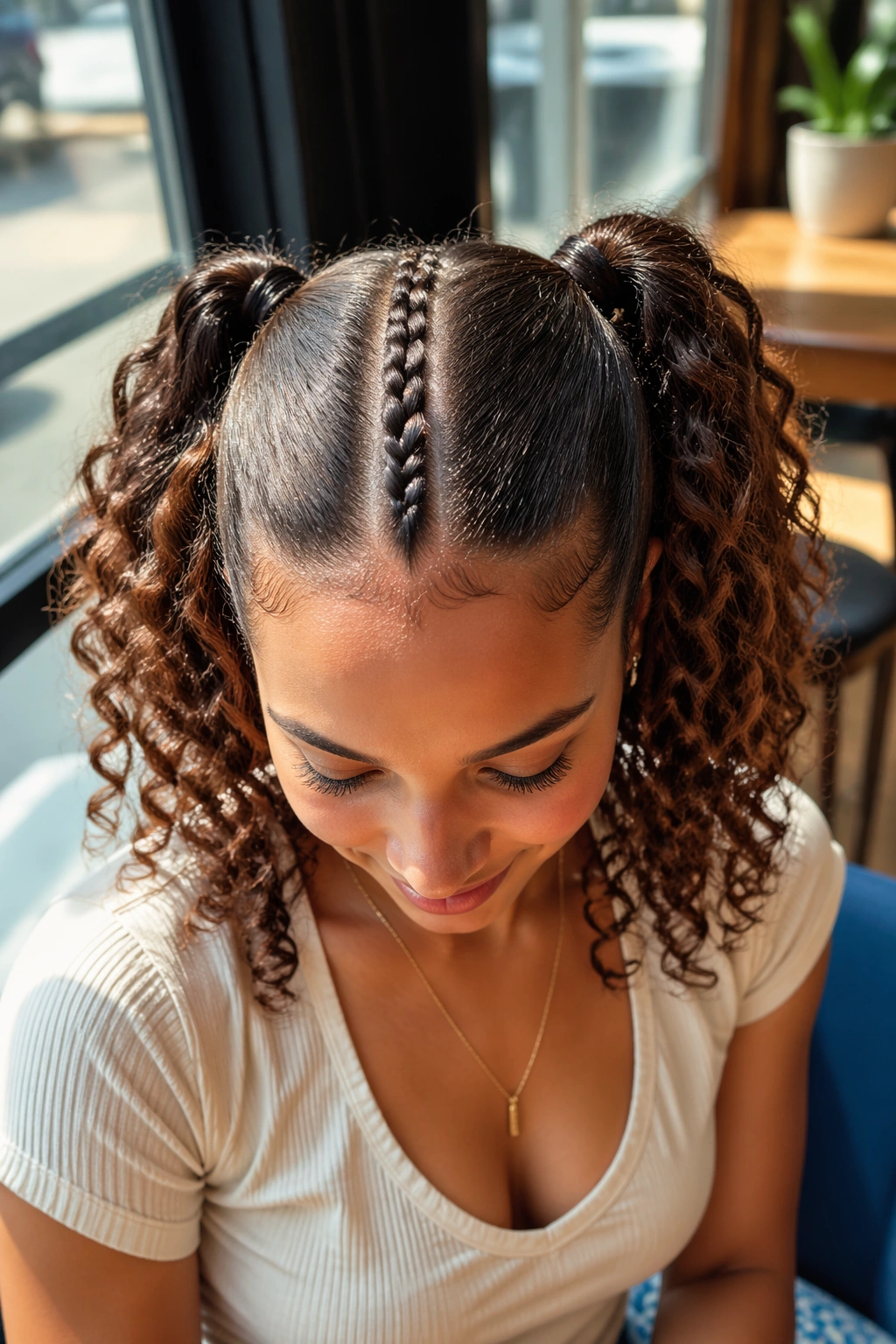
A middle braid between twin ponytails gives the whole style a spine. You part the hair, braid a narrow section down the center, then build the ponytails on either side. That single braid changes the look more than people expect.
It’s a nice trick when you want detail without covering the curls. The braid adds structure while the ponytails keep the movement. I like it best when the rest of the hair is lightly stretched, because the braid stands out against a softer curl pattern.
This is one of those styles that looks more complicated than it is. The braid can be tiny. It just has to be neat.
15. Low Bubble Twin Ponytails
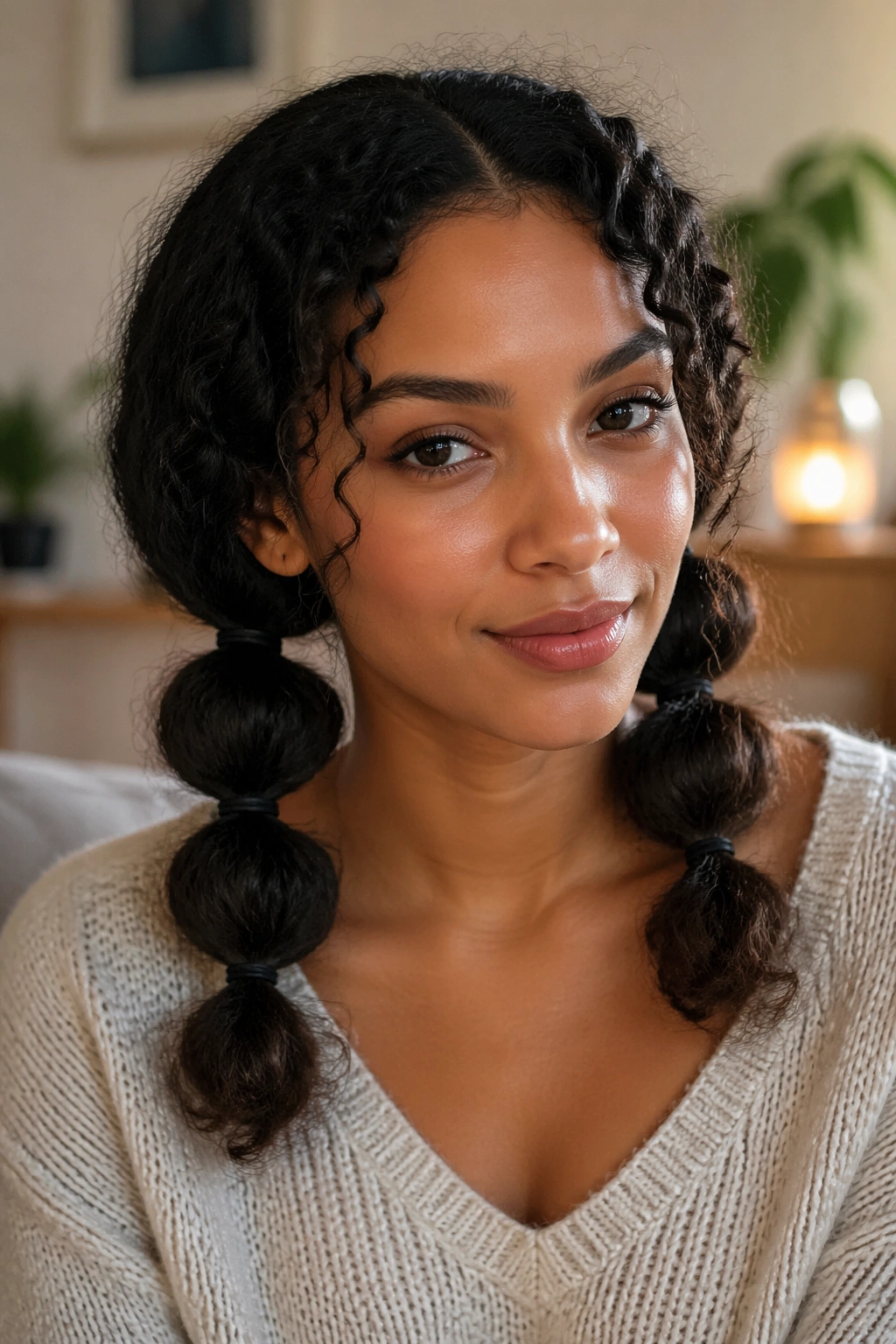
Low bubble twin ponytails have a softer, more relaxed energy than the high version. They sit near the neck, which makes the bubbles feel a little rounder and the overall shape less loud.
What I like here is the way curly ends fill out each bubble without much effort. The style gets texture from the hair itself, so you don’t need to fake volume. Use small elastics every few inches and gently tug each section outward until it looks rounded.
How to Get the Most From It
You want the bubbles to look full, not stuffed. That means spacing the elastics evenly and leaving enough hair between them to puff out naturally. If the sections are too small, the style turns fussy fast. Too large, and the shape disappears.
This one is especially good on day-two curls.
16. Pineapple-Inspired Double Ponytails
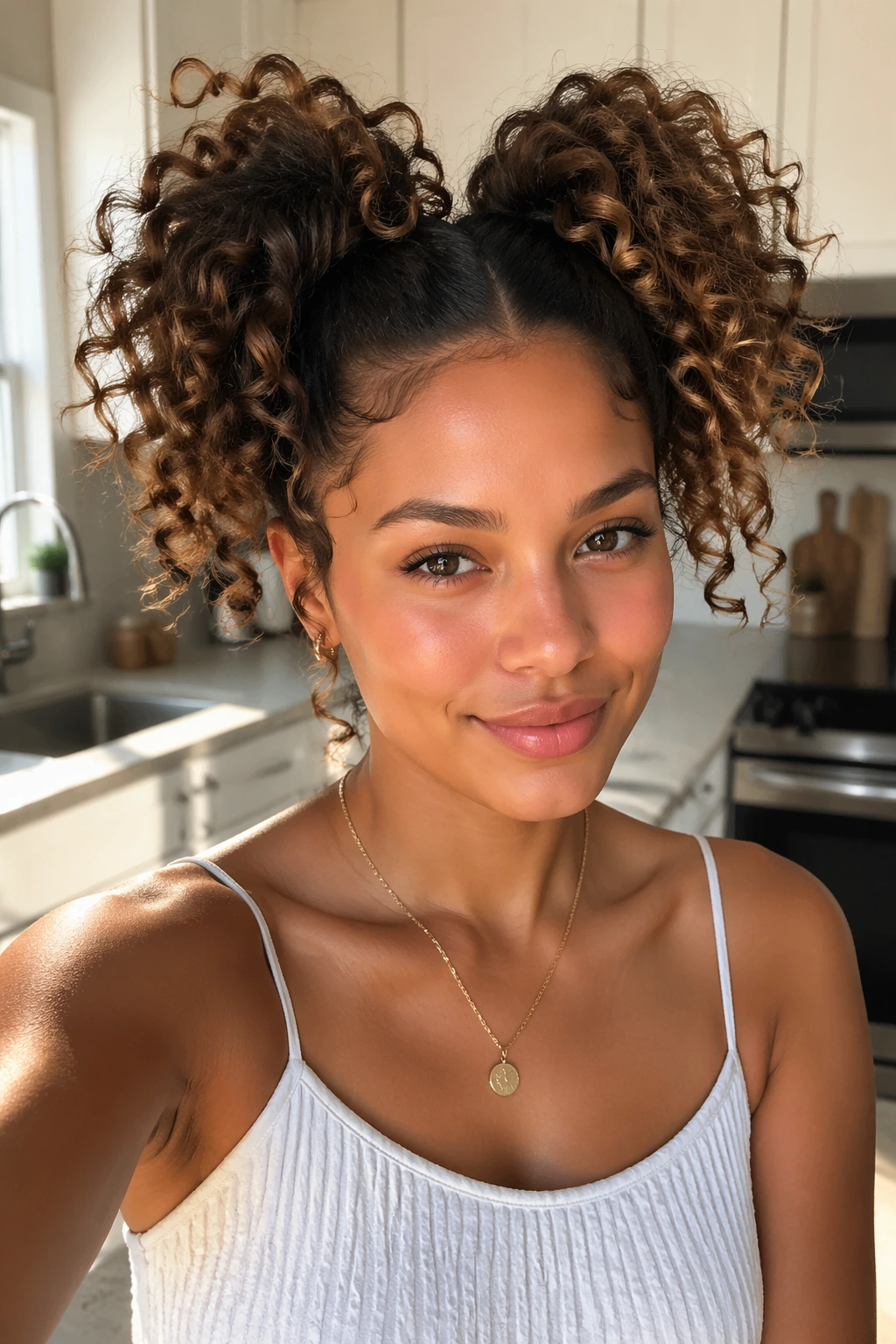
This is the playful cousin of a pineapple updo. Instead of one high pile of curls, you split the hair into two lifted ponytails that keep the ends loose and airy. The style borrows that carefree top-heavy shape, but with more symmetry.
It works beautifully on curls that already have volume at the crown. You’re not trying to compress the texture. You’re giving it a frame. That’s the whole idea.
The best part is how easy it feels. You can make it polished with neat parts, or keep it loose and soft. If the curls are fresh and springy, the style has a light, bouncy look that doesn’t need much else.
17. Scrunchie-Stack Double Ponytails
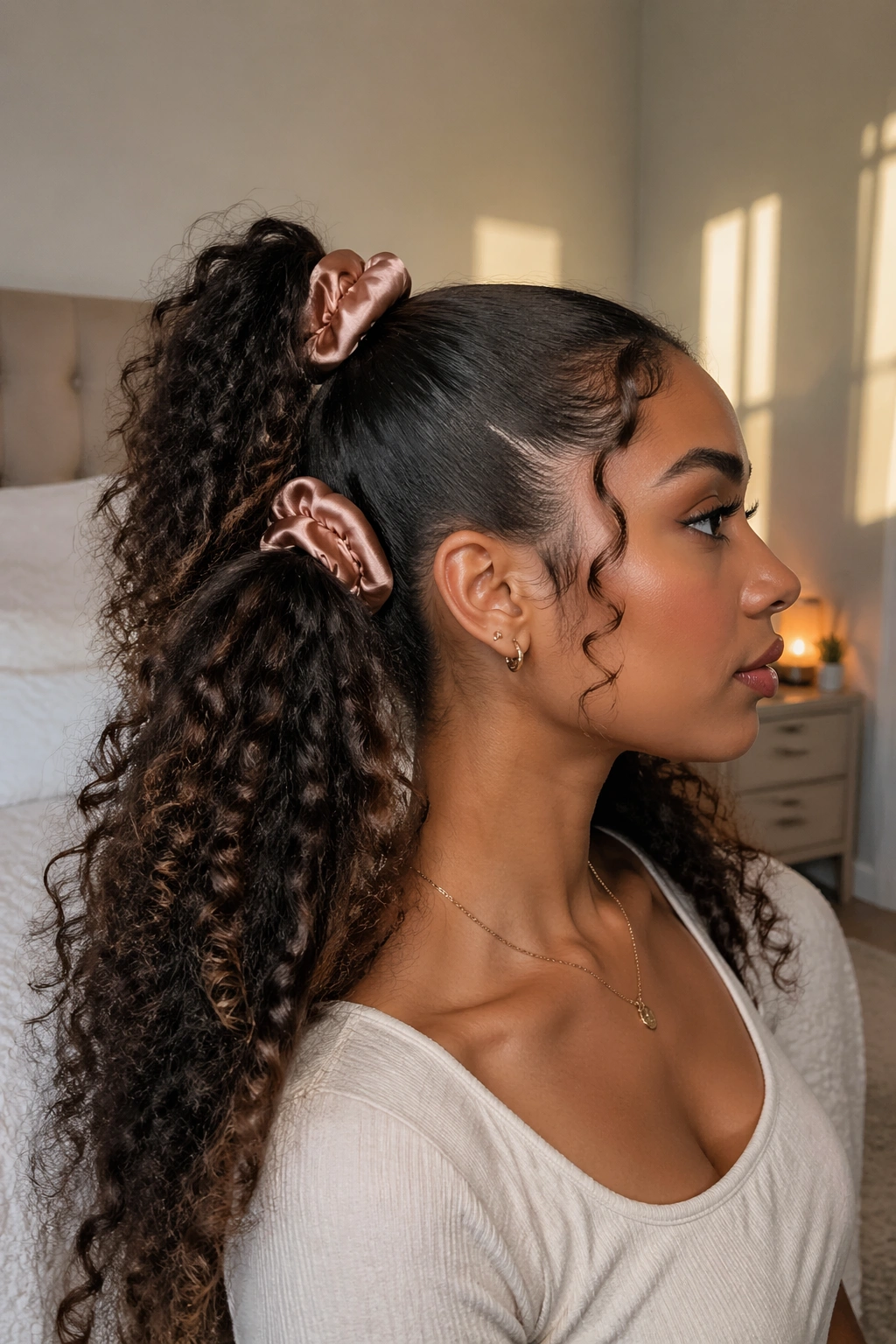
Stacked scrunchies are a quick way to make double ponytails look intentional instead of plain. You tie each ponytail with one scrunchie, then add another slightly lower down to create a layered effect.
I prefer satin or silk scrunchies here because they’re kinder to curly hair and they don’t leave the sharp line that thin elastics can. The stacked look works best when the curls are moderately stretched; if the hair is too fluffy at the base, the scrunchies can get lost.
Quick style notes
- Use two scrunchies per ponytail for the stacked effect.
- Keep the top one snug but not tight.
- Let the lower curls fan out a little.
- Choose colors that either match your hair or contrast on purpose.
The style is simple. That’s the point.
18. Knotted-Base Double Ponytails
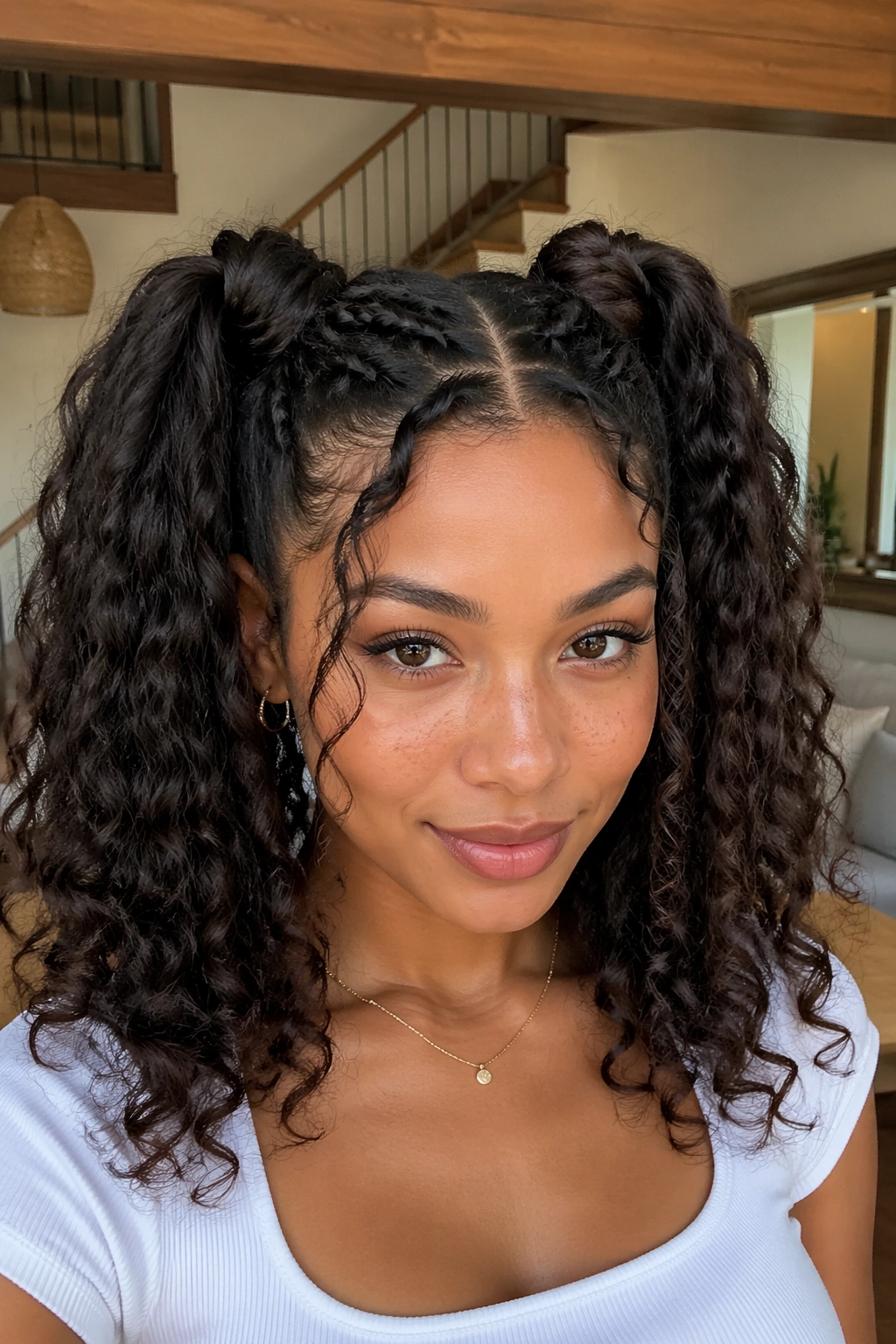
A knotted base gives the illusion of a more intricate style without requiring extra braids. You split a section, tie or twist it into a knot near the root, then anchor the remaining hair into a ponytail.
It sounds fancy. It isn’t, really. But the texture it creates is lovely on curly hair because the knot becomes a visible detail at the base while the ponytail stays soft. I like this version for medium-density curls that need something to break up the surface.
The knot should sit flat enough to be comfortable, but not so tight that it feels rigid. If the front looks too busy, keep the rest of the style simple. The knot is already doing enough.
19. Wet-Look Double Ponytails
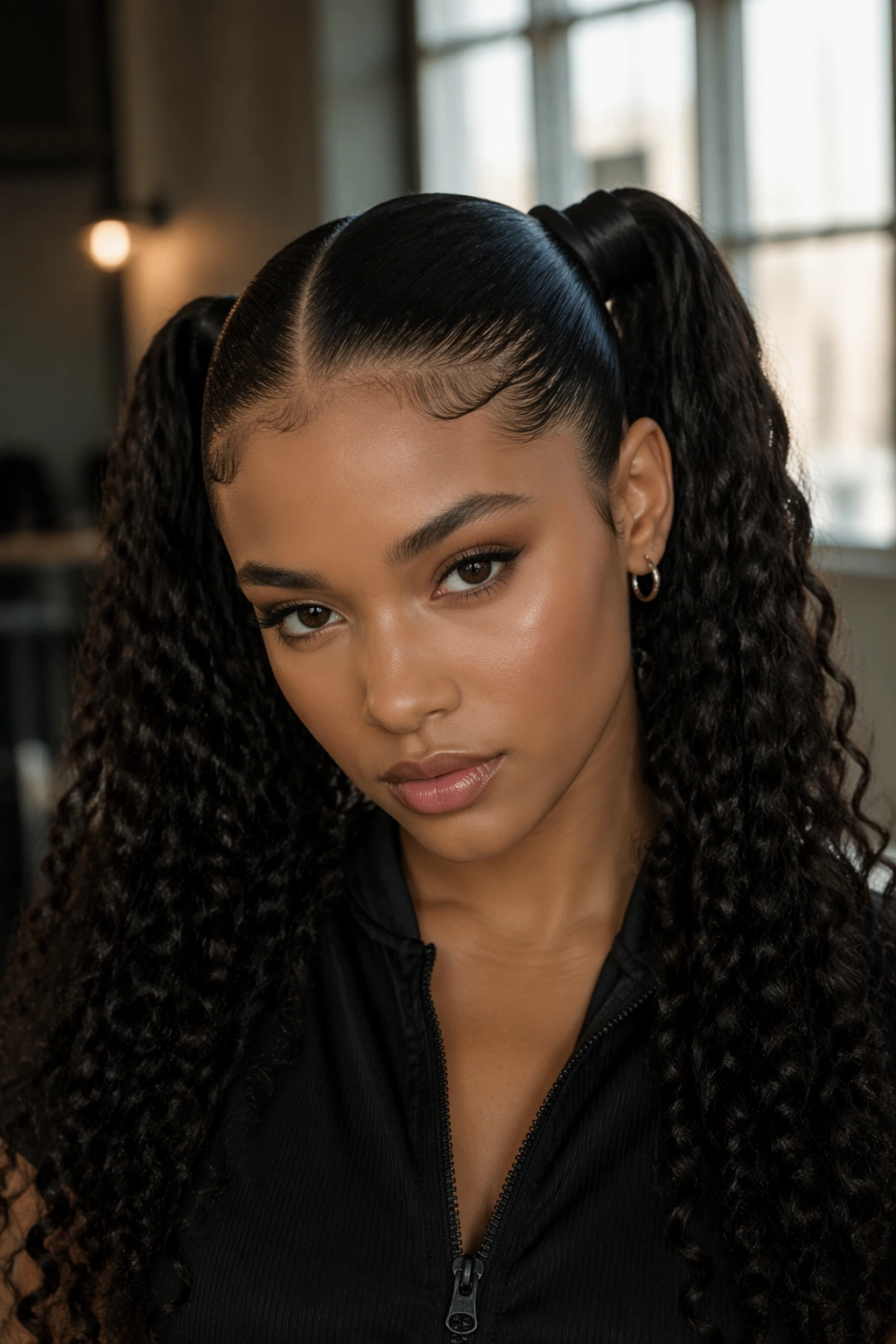
Wet-look styles are not for everyone, and I mean that kindly. They ask for confidence because the roots look sleek and glossy while the curls, depending on how you finish them, can feel sculpted rather than fluffy.
On curly hair, the wet-look version works best when the front and crown are coated with gel and brushed into place, but the lengths are left with enough curl definition to avoid looking hard. You want shine. You do not want helmet hair.
This is the version I’d pick for a sharper outfit or a night out. It feels cleaner than a loose curly style and more deliberate than a casual puff. Just be careful with product load. Too much gel can flake once it dries.
20. Twisted Crown into Double Ponytails
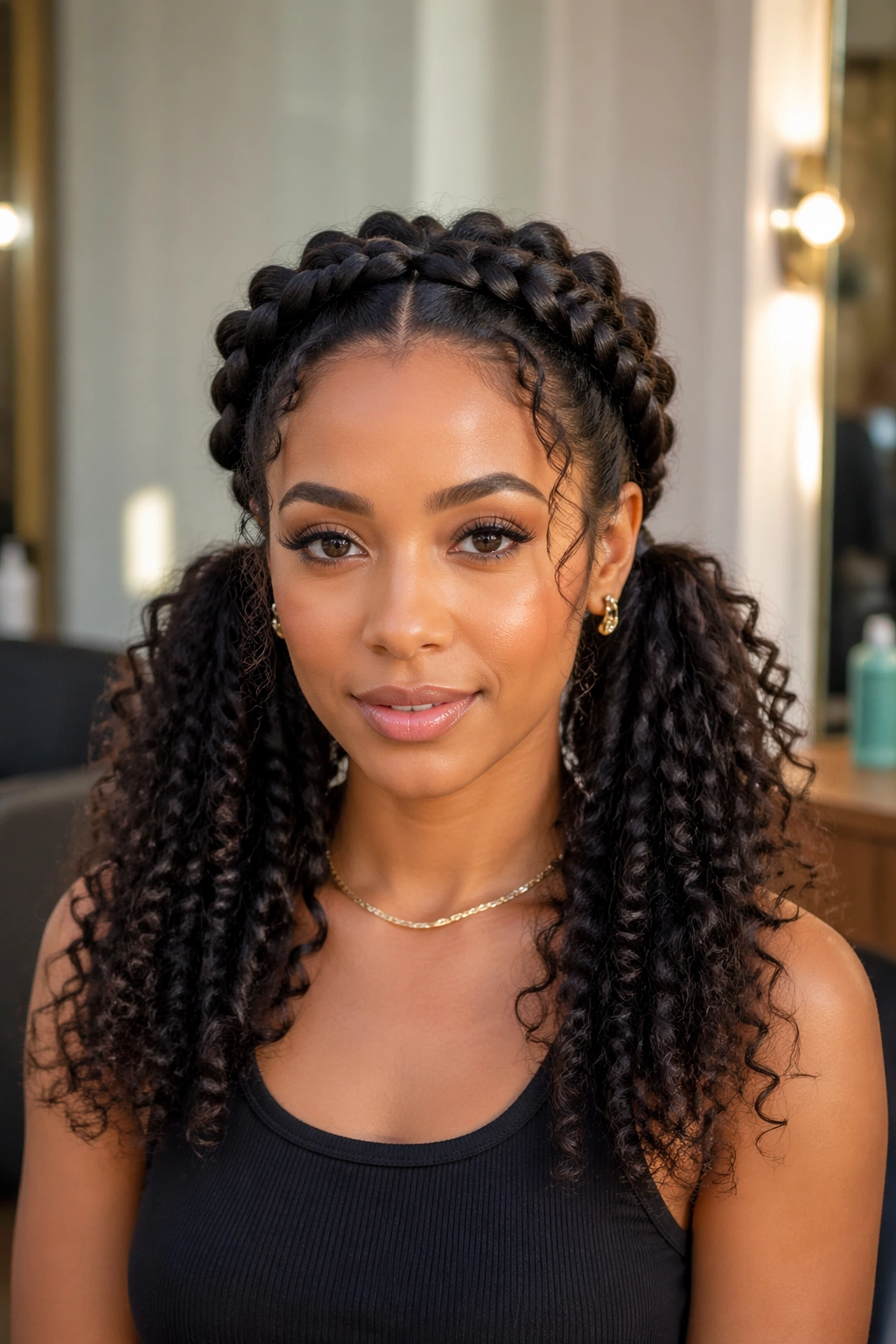
A twisted crown gives the top of the head a halo-like shape before the hair drops into two ponytails. You twist sections back from each side, meeting them near the crown or just behind it, then let the remaining hair form the tails.
The effect is elegant without trying too hard. It also helps with growth-stage curls, since the twists control shorter front pieces while the ponytails keep the ends visible. I like this one on hair with a bit of stretch, because the twist pattern shows better when the hair isn’t overly shrunken.
What Works Best Here
- Use medium-sized twists so they read clearly.
- Keep the crown neat, but don’t flatten it.
- Let the ponytails begin just below the twist line.
- Finish with a little oil on the ends if they look dry.
The shape has a softness that plain parting can’t match.
21. Double Ponytails for Thick, Dense Curls
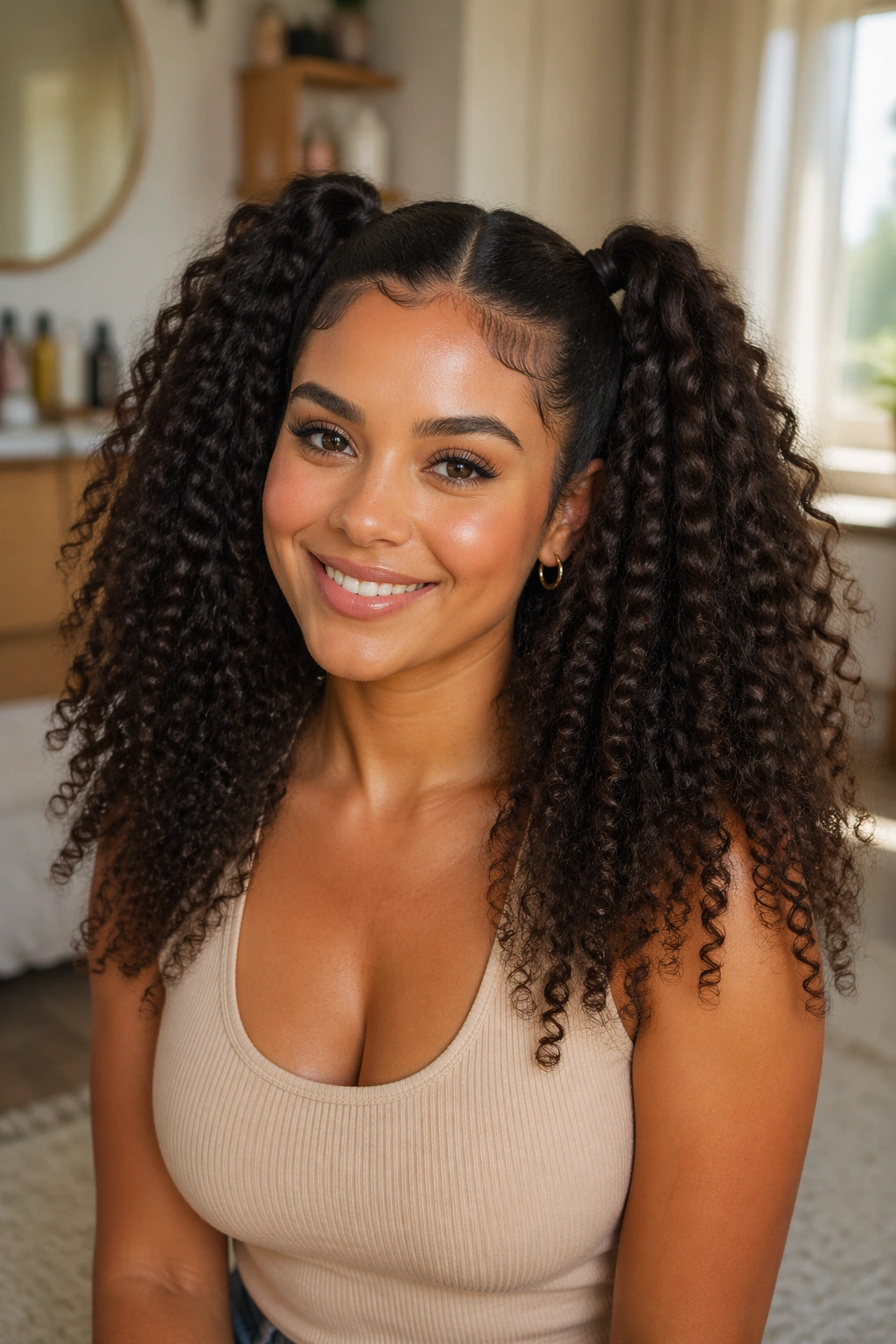
Thick curly hair needs room. If you try to force dense curls into tiny ponytails, the bases can puff out and the style starts fighting you halfway through the day. Bigger sections usually work better.
I like starting with very clear parting and using stronger elastics that actually grip. Satin covers are nice, but the elastic itself has to hold. For dense hair, the ponytails can sit slightly farther back on the head so the weight is distributed better.
The payoff is huge volume. That’s the point. Thick curls make double ponytails look full in a way that thin hair simply can’t fake, and I wouldn’t try to flatten that out too much. Let the bulk be part of the charm.
22. Double Ponytails for Fine or Loose Curls
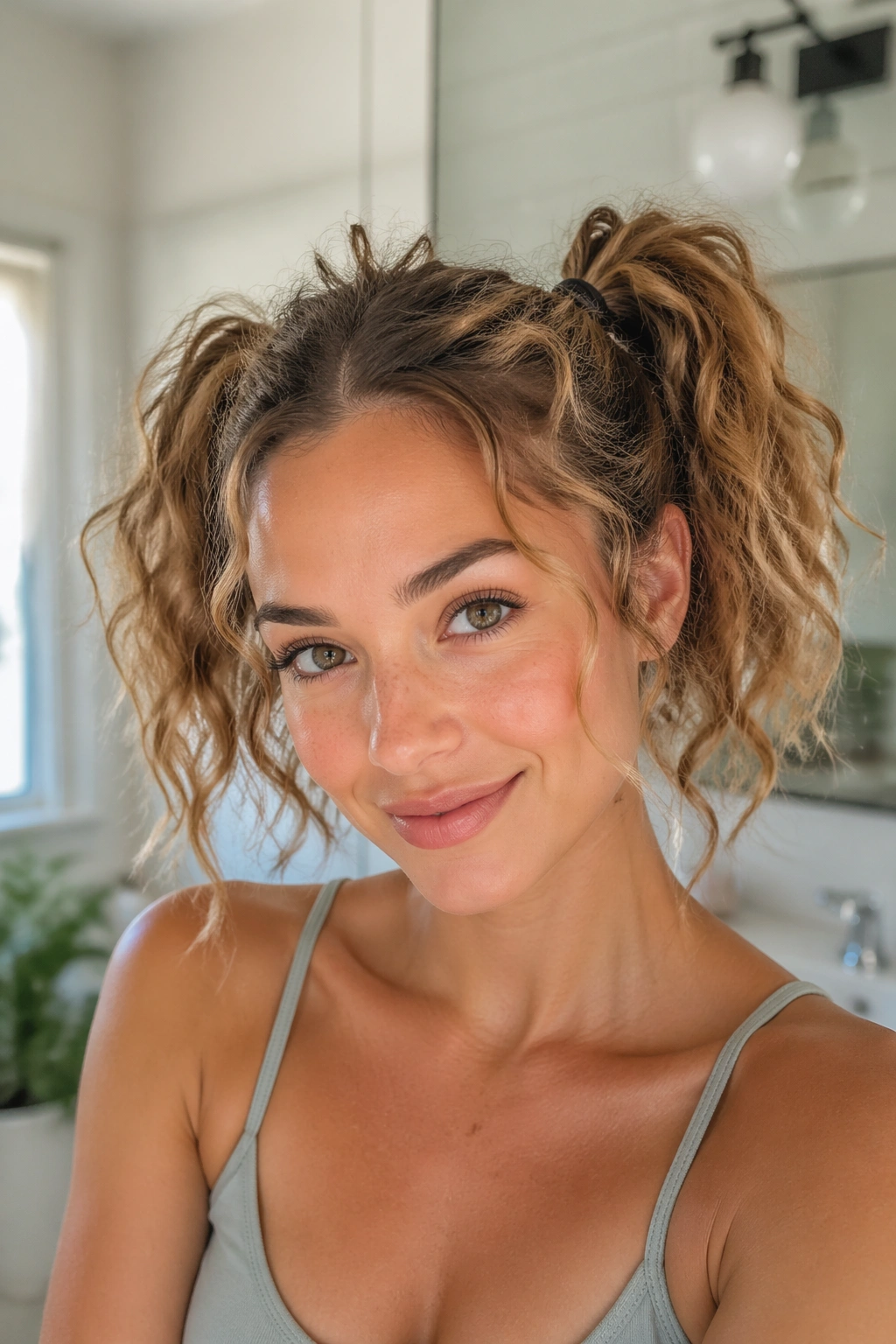
Fine curls need a different touch. Too much product can weigh them down, and too much tension can make the scalp show more than you want. The goal is body, not pressure.
This is one of the few times I’d actually recommend a bit of root lifting before tying. A light mousse or curl foam can give the base some grip without coating the strands heavily. Then use small elastics and place the ponytails a little higher than you might think. Height helps the style read fuller.
What to Do
- Keep the sections medium-sized so each ponytail has enough hair.
- Use light products only, especially near the crown.
- Gently fan the ponytails after tying to create width.
- Avoid heavy oils at the roots; they make fine curls collapse faster.
The result should feel airy, not thin.
23. Dressy Double Ponytails with Gold Cuffs
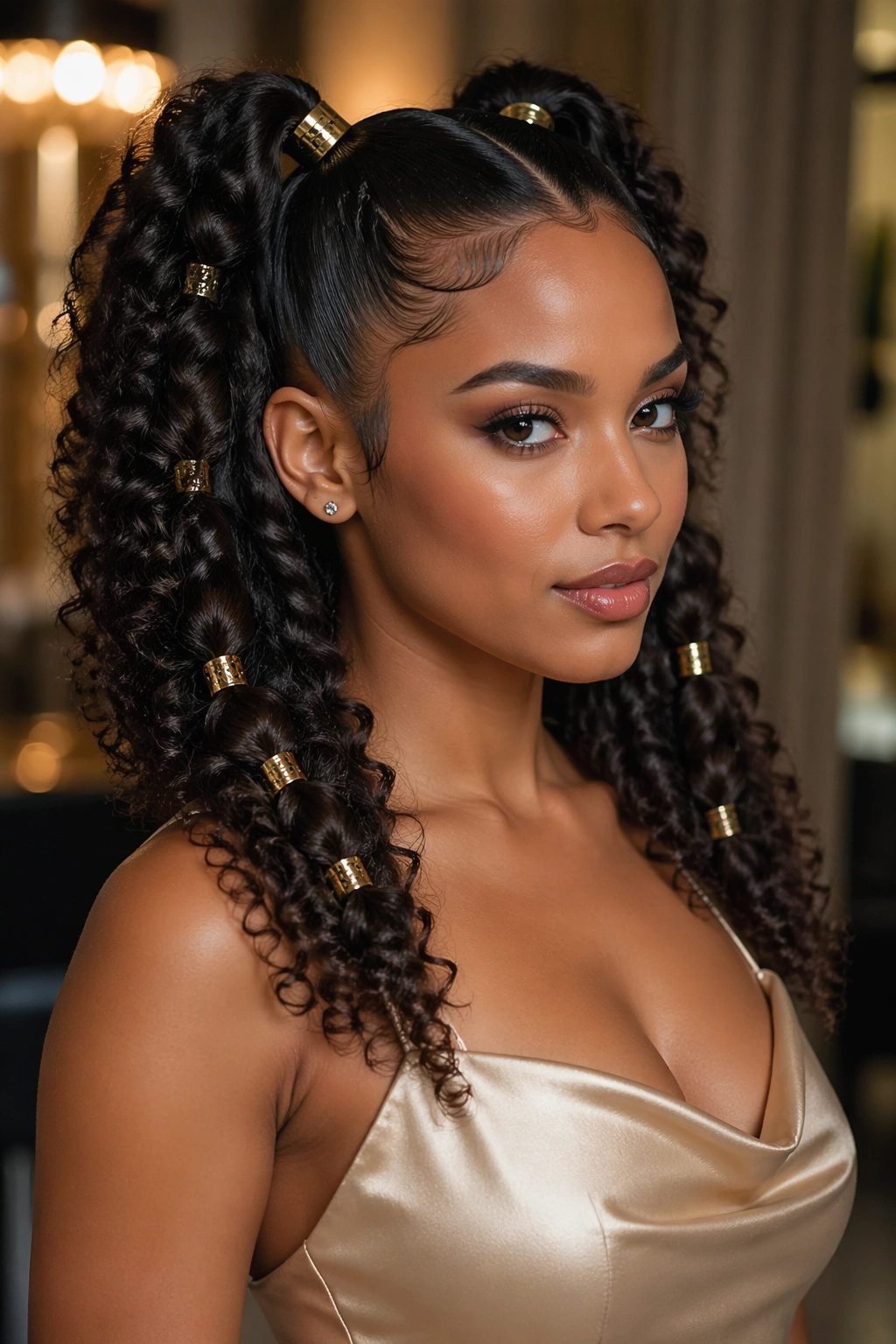
Gold cuffs turn curly twin ponytails into an occasion style fast. You can add them at the base, along the length, or both, depending on how much shine you want. I prefer one or two cuffs per side. More than that can start to feel crowded.
This works especially well when the hair is smooth at the roots and full through the ponytails. The metal catches the eye, while the curls keep the look from becoming too polished. That contrast is what makes it interesting.
If your outfit already has strong jewelry, keep the cuffs simple. If the rest of the look is plain, the cuffs can do a lot of the visual work. Either way, choose cuffs that grip securely so they don’t slide down the shaft.
24. Athletic Double Ponytails That Stay Put
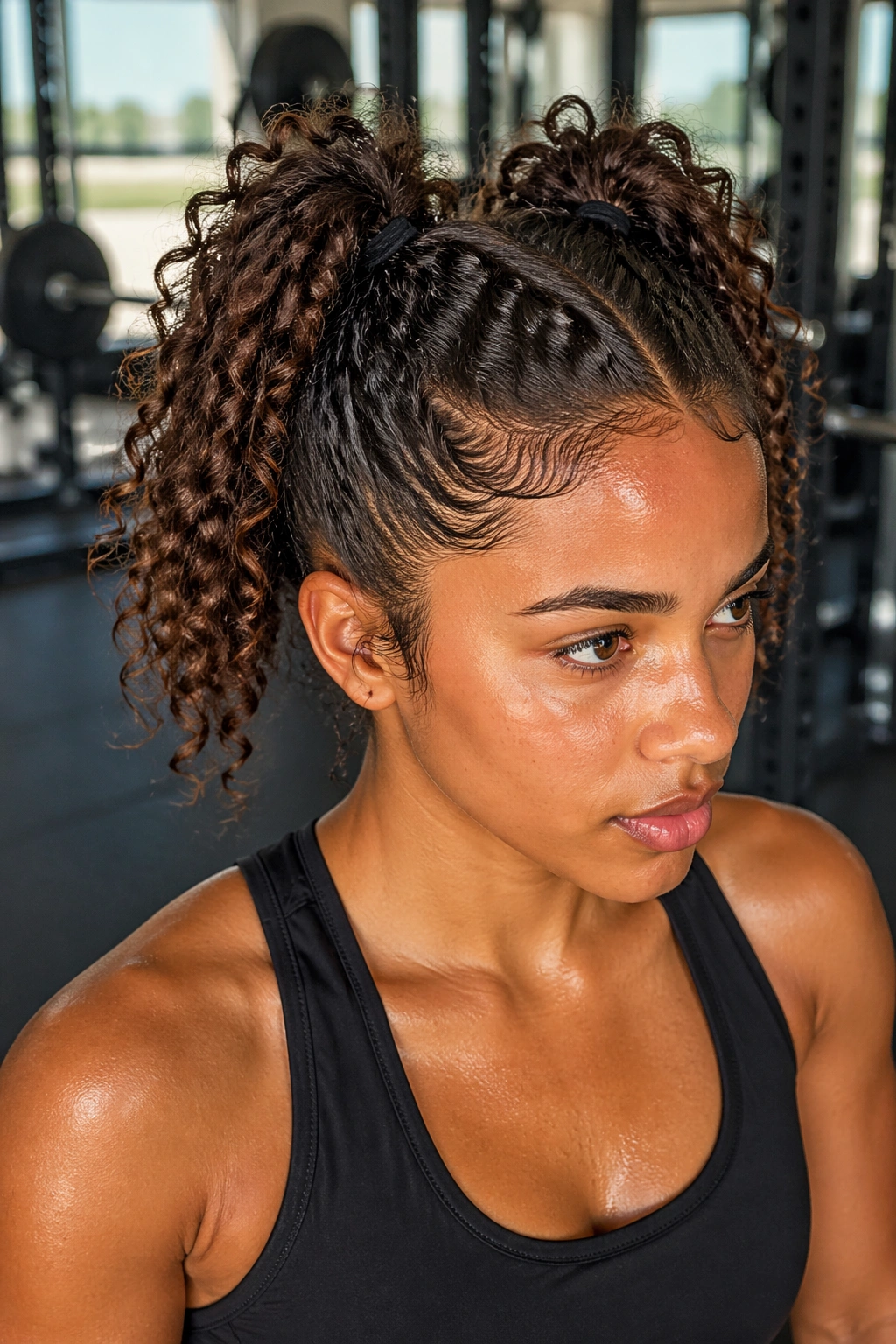
If you need a style that won’t fall apart during movement, this is the one. Athletic double ponytails for curly hair should be secure first and pretty second. That might sound blunt, but it saves a lot of frustration.
Tight isn’t the same as secure, though. Use a firm part, smooth the roots with a gel that actually holds, and anchor each ponytail with a strong elastic. If your curls are long, a second elastic halfway down the tail can help keep the shape from bouncing too much.
Quick setup
- Part the hair cleanly down the middle.
- Smooth each side back with a brush and a little styling gel.
- Secure the ponytails at a height that won’t tug the scalp.
- Add a second tie if the curls are heavy or long.
This one is about staying power. Plain and simple.
25. Soft Low Double Ponytails with Extra Volume
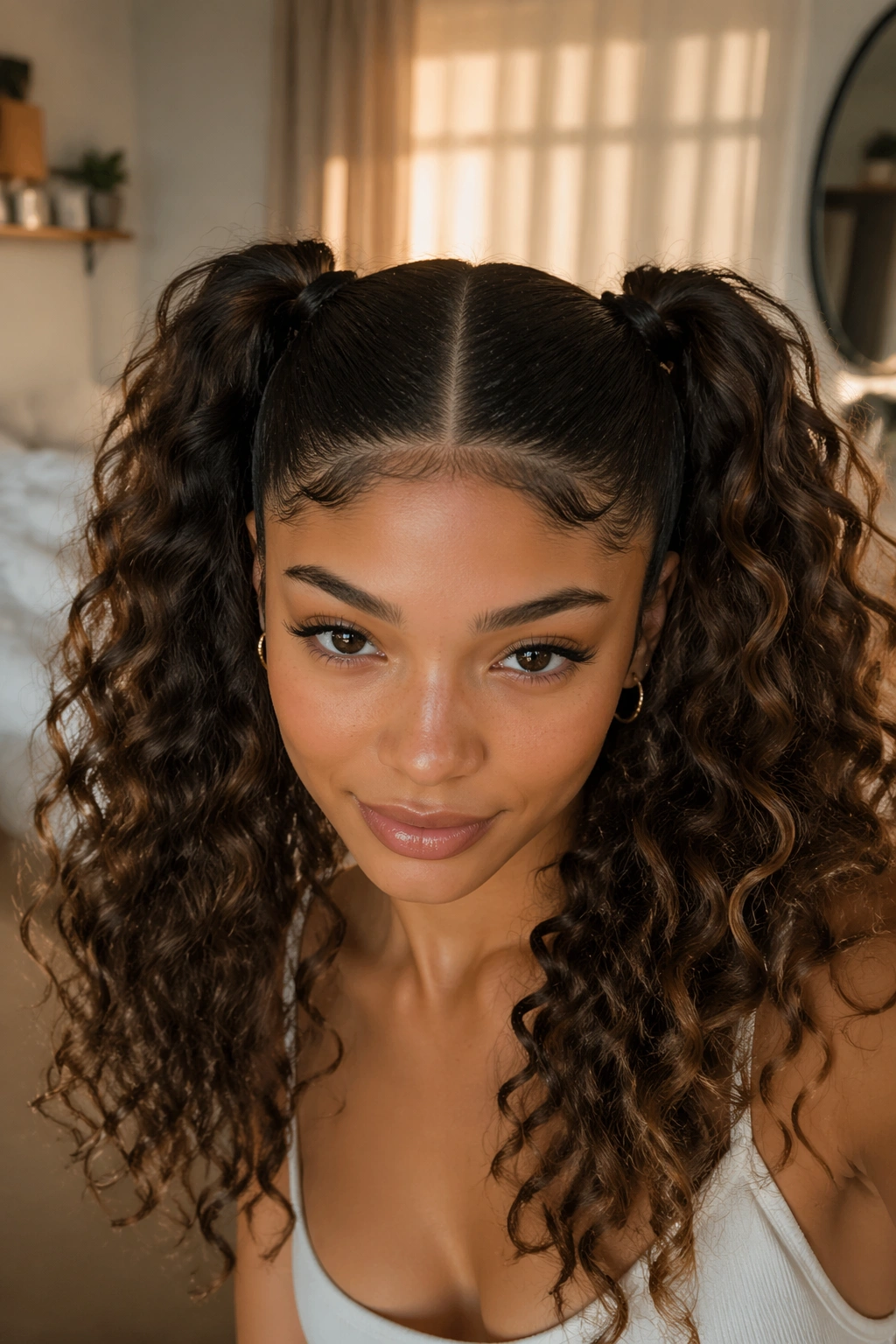
Soft low double ponytails are the style I keep coming back to when I want curls to look relaxed but still shaped. The ponytails sit low, the roots stay lightly controlled, and the ends fan out in a way that feels easy rather than stiff.
What makes this version worth keeping in your rotation is the balance. It doesn’t ask for perfect slickness. It doesn’t need a lot of accessories. It just needs decent parting, a couple of smooth ties, and curls that are allowed to do what they do best. If the front is a little imperfect, that can help. Really.
This is the style I’d choose for long days, casual plans, or any moment when you want your hair off your face without losing the curl pattern that makes the style interesting. A little fullness at the crown, a little movement at the ends, and enough shape to look finished — that’s the sweet spot. And once you get used to it, it becomes one of those looks you can do without overthinking it, which is probably why it stays useful long after the novelty wears off.
