



Messy ponytails with bangs have a useful trick: they make hair look styled even when it has already been lived in for a day or two.
That matters when your roots are flat, your ends are a little dry, and you do not want to spend half the morning fighting a brush.
Bangs help soften the face. The ponytail keeps the hair off your neck. Put them together, and the whole style gets that easy, put-together feel that a plain ponytail often misses.
A good version is never random. Placement, texture, and the kind of fringe you wear change everything — a ponytail set one inch higher can look sharper, while a few loose pieces around the temples can make the whole thing feel more relaxed. That tiny difference is where the good stuff lives.
1. High Messy Ponytail With Curtain Bangs
A high messy ponytail with curtain bangs has lift built right into it. The ponytail sits near the crown, so the hair pulls the face upward a little, while the curtain bangs split down the middle and soften the forehead at the same time.
Why the shape works
This style is especially useful if your hair tends to fall flat at the roots. A little teasing at the crown and a small mist of texture spray give the ponytail enough grip to stay airy instead of stiff. Curtain bangs also help the style feel less sporty and more finished, which is a nice trade if you like hair that looks like you meant to do something with it.
Keep the bangs loose around the cheekbones. That part matters. If they sit too close to the forehead, the whole look can feel heavy.
Quick styling notes:
- Use a 1-inch curling iron only on the front pieces if your bangs need a bend.
- Backcomb the crown twice, not six times.
- Wrap a thin strand of hair around the elastic so the base looks cleaner.
- Pull out one piece near each temple for softness.
Best for: medium to thick hair, oval faces, and anyone who likes a lifted silhouette.
2. Low Messy Ponytail With Wispy Bangs
Can a low ponytail still feel soft? Absolutely, and wispy bangs are half the reason. The pony sits near the nape, so the shape stays calm, while the fringe keeps the face from looking boxed in.
Why it feels gentler
I like this version on days when hair is cooperating only halfway. It does not demand a lot of volume, which makes it easier on fine hair and easier on mornings when you do not feel like teasing anything. Wispy bangs should move a little when you walk. If they look too crisp, they start fighting the rest of the style.
A satin scrunchie works well here because it holds the ponytail without creating a hard dent. Let a few shorter pieces escape around the ears. Not a lot. Just enough to keep the low placement from looking formal.
Some people think low ponytails are boring. They are not. They just need a little texture at the front.
Tiny things that help
- Blow-dry the bangs forward, then split them with your fingers.
- Mist the ponytail with a light texturizing spray.
- Leave the elastic slightly loose so the hair sits softly.
3. Textured Ponytail With Side-Swept Bangs
A side-swept bang changes the whole mood of a ponytail. Instead of framing the face evenly, it creates one strong diagonal line, and that makes the style feel a little more lived-in and a little less expected.
The ponytail itself should be full of texture. A few bends through the mid-lengths work better than polished curls here. Straight hair can do this easily with a flat iron bend at the ends, but waves help too. If your hair is one length, this is one of the easiest ways to fake a little movement without cutting anything.
How to use the angle
Sweep the bangs over from a deep side part and pin nothing unless the fringe keeps slipping. The point is to let the shape fall naturally, not to nail it into place. The ponytail can sit mid-height or low, but I prefer it just below the crown because the side bang and the lifted pony balance each other.
Good when you want:
- A softer face frame
- Less forehead coverage than blunt bangs
- A style that works with second-day hair
- A ponytail that does not look too strict
This one is a sneaky favorite. It looks like a simple ponytail, then the side bang does all the work.
4. Bubble Messy Ponytail With a Full Fringe
A bubble ponytail is playful on its own. Add a full fringe, and the whole style gets this slightly editorial edge that feels a bit bolder than a standard messy pony.
The trick is to keep the bubbles loose enough that they do not look like rigid little sacks. Use small elastics every 2 to 3 inches, then gently tug each section until the shapes round out. The bangs should stay piecey, not helmet-like. A tiny bit of styling cream on the ends is enough.
This style suits long hair especially well because the bubbles need length to show up. Thick hair behaves nicely here too, since the ponytail has enough body to fill out each section. If your fringe is heavy, keep the roots airy so the front does not look weighed down.
I would wear this one for a concert, a casual dinner, or any day when plain hair feels too plain. It has attitude, but not in a try-hard way.
5. Sleek-Root Messy Ponytail With Piecey Bangs
The contrast is what makes this one work. The roots stay smooth and controlled, while the ponytail lengths look rumpled and soft. That tension keeps the style from sliding into “I forgot to brush my hair.”
What makes it different
Piecey bangs help a lot because they break up the front in small, irregular sections. You can get that effect with a light pomade, but use barely any — a grain-of-rice amount between your fingertips is usually enough. Too much and the bangs go shiny in a bad way.
I like this look for more formal settings because the clean root line feels intentional. The messy ends keep it from getting too serious. It is also kind to humid weather, since the polished top controls frizz where people notice it most.
Styling order that actually works
- Smooth the crown with a soft brush and a touch of gel.
- Tie the ponytail first.
- Add texture spray to the lengths after it is secured.
- Separate the bangs into 3 to 4 soft chunks with your fingers.
The result is neat where it counts and relaxed everywhere else. That is the sweet spot.
6. Curly Messy Ponytail With Soft Bangs
Curly hair makes a messy ponytail look better than straight hair ever could. The curl pattern brings its own shape, and the bangs add a soft frame that keeps the style from ballooning into one big cloud.
Leave the curls mostly alone. Seriously. Over-brushing makes the whole thing frizz out in a way that is harder to fix later. Gather the ponytail with your hands, not a brush, and let a few curls sit higher at the crown for volume. Soft bangs should be shaped, not flattened.
How to keep the shape
A diffuser helps if you are starting from damp hair, but air-drying works too. Once the ponytail is tied, twist two or three front curls around your fingers with a little curl cream. That gives them a more defined bend without turning them into stiff spirals.
A curly messy ponytail with bangs is one of those styles that gets better the less you fuss with it. The texture does the talking.
Best move: use a silk scrunchie or a coil tie so you do not crush the curl pattern at the base.
7. Braided-Base Ponytail With Bangs
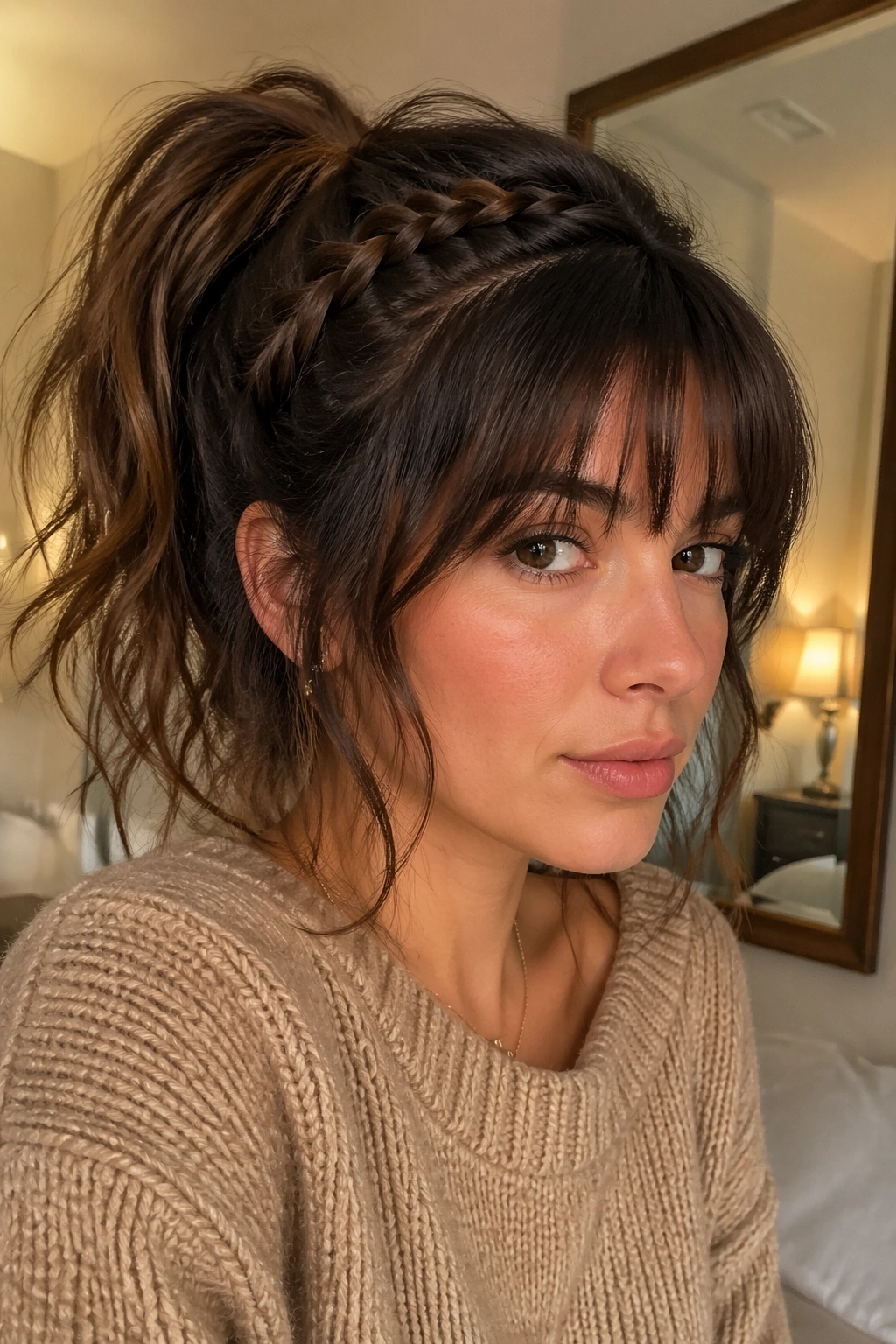
A braided base gives a messy ponytail just enough structure to feel deliberate. The braid sits near the scalp, usually along one side or right down the center, and then it feeds into the ponytail so the whole style looks a little more built in.
Why it holds up well
This is a solid option when your hair has layers that like to escape. The braid catches some of those shorter pieces, which means fewer flyaways around the top. Bangs can stay loose in front, or you can let them fall into the braid line if you want a softer edge.
A small braid looks better than a tight one. Keep the plait loose and stop braiding once you reach the crown or nape, depending on where your pony sits. A neat braid against a messy ponytail can look a bit stiff, and that contrast is only helpful when the braid is tiny.
Try this version if you want:
- A ponytail that stays in place longer
- A little extra detail at the scalp
- A way to work with grown-out bangs
- Something that looks more complex than it is
It is one of those styles that gets more compliments than effort.
8. Claw-Clip Messy Ponytail With Face-Framing Fringe
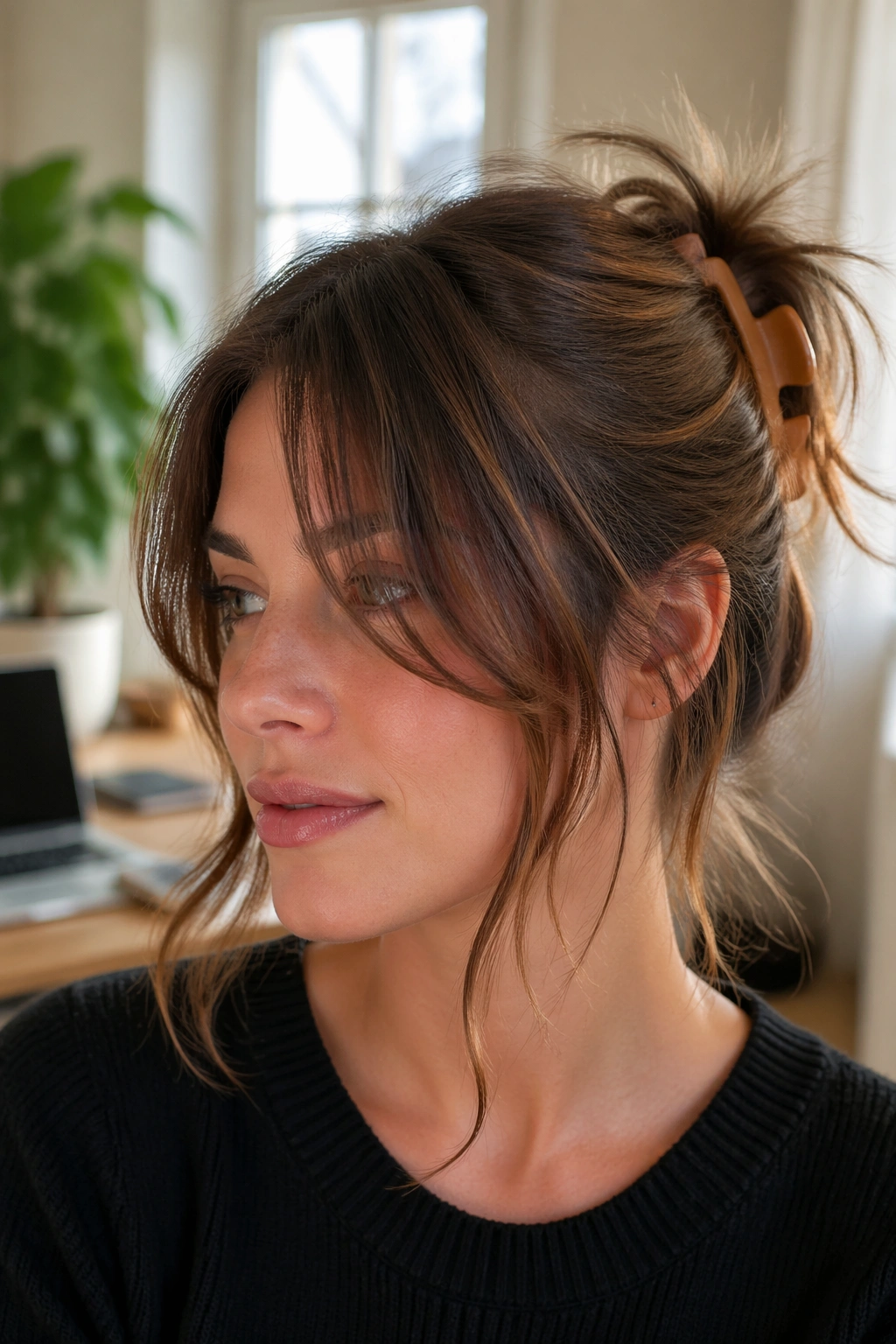
A claw clip changes the feel of a ponytail instantly. Instead of the hard pull of an elastic, you get a looser hold and a shape that sits softer at the back of the head.
What the clip does differently
This style works especially well with face-framing fringe because the front pieces stay free and light. The bangs can be curtain-style, side-swept, or just soft ends that skim the cheekbones. I prefer this on medium-length hair, where the clip can grab enough volume without looking strained.
The trick is to twist the hair once before clipping it. If you skip that, the style can slip around by lunchtime. A medium-sized claw clip usually holds better than a giant one, which sounds backwards until you try both.
A few loose pieces at the nape help too. They keep the back from looking too polished.
Best for: casual days, work-from-home mornings, and hair that hates tight elastics.
9. Teased Crown Ponytail With Curtain Bangs
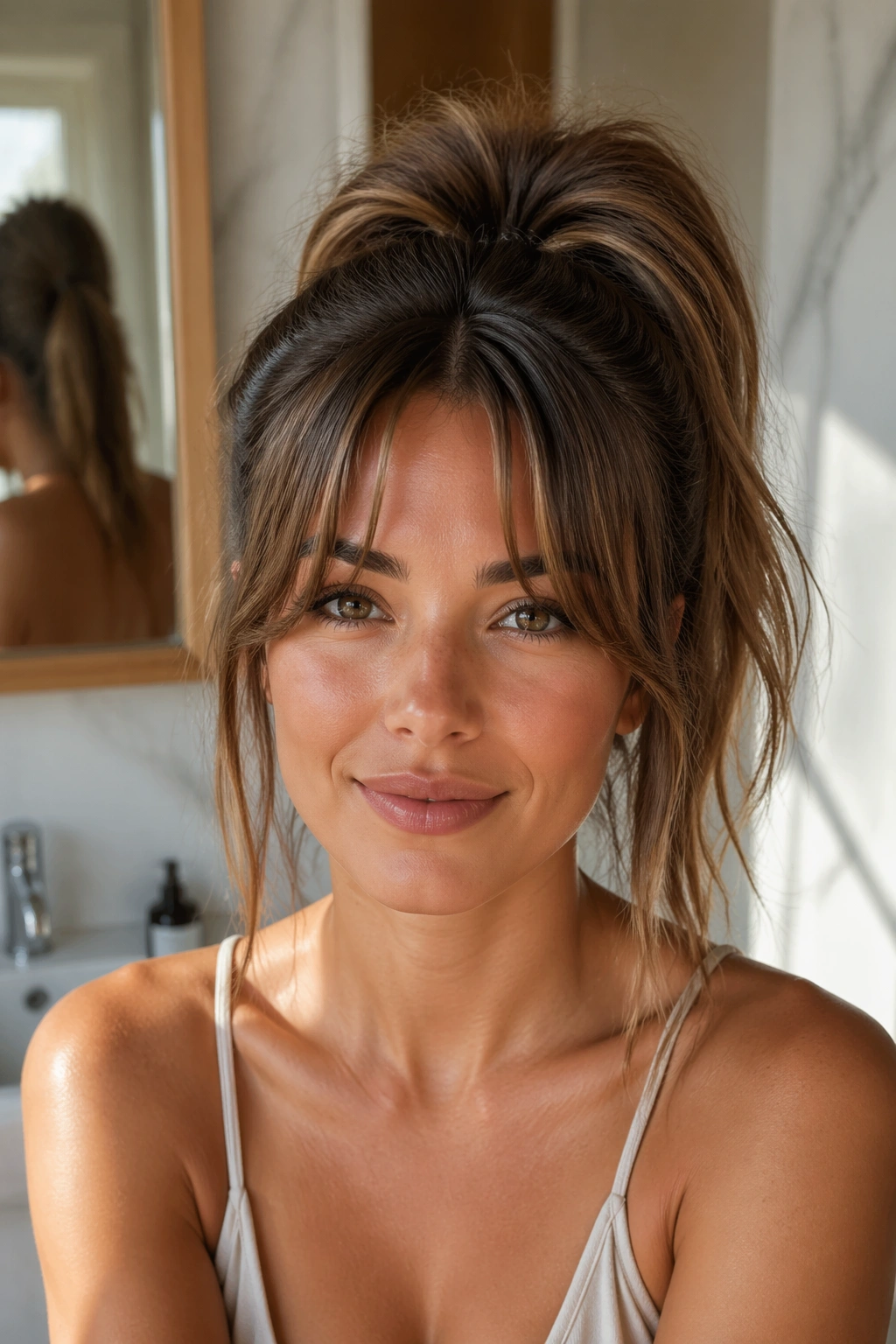
Teasing the crown is old-school for a reason. It gives the ponytail lift where you want it, and curtain bangs make the front feel open instead of heavy.
This version is especially flattering when your hair falls flat a few hours after styling. Use a fine-tooth comb to backcomb the crown in 2 small sections, then smooth the surface lightly so it does not look ratty. You want lift, not a nest.
Curtain bangs help the style feel balanced because they draw attention outward instead of straight down. That matters with teased hair, which can look a little top-heavy if the fringe is blunt or too dense.
A few things to watch
- Tease only the top layer.
- Keep the ponytail base mid-height.
- Use a flexible-hold spray, not a crunchy one.
- Leave the bangs mobile so they do not sit like a curtain rod.
This is a good choice when you want volume that lasts past the first hour.
10. Twisted Low Ponytail With Side Bangs
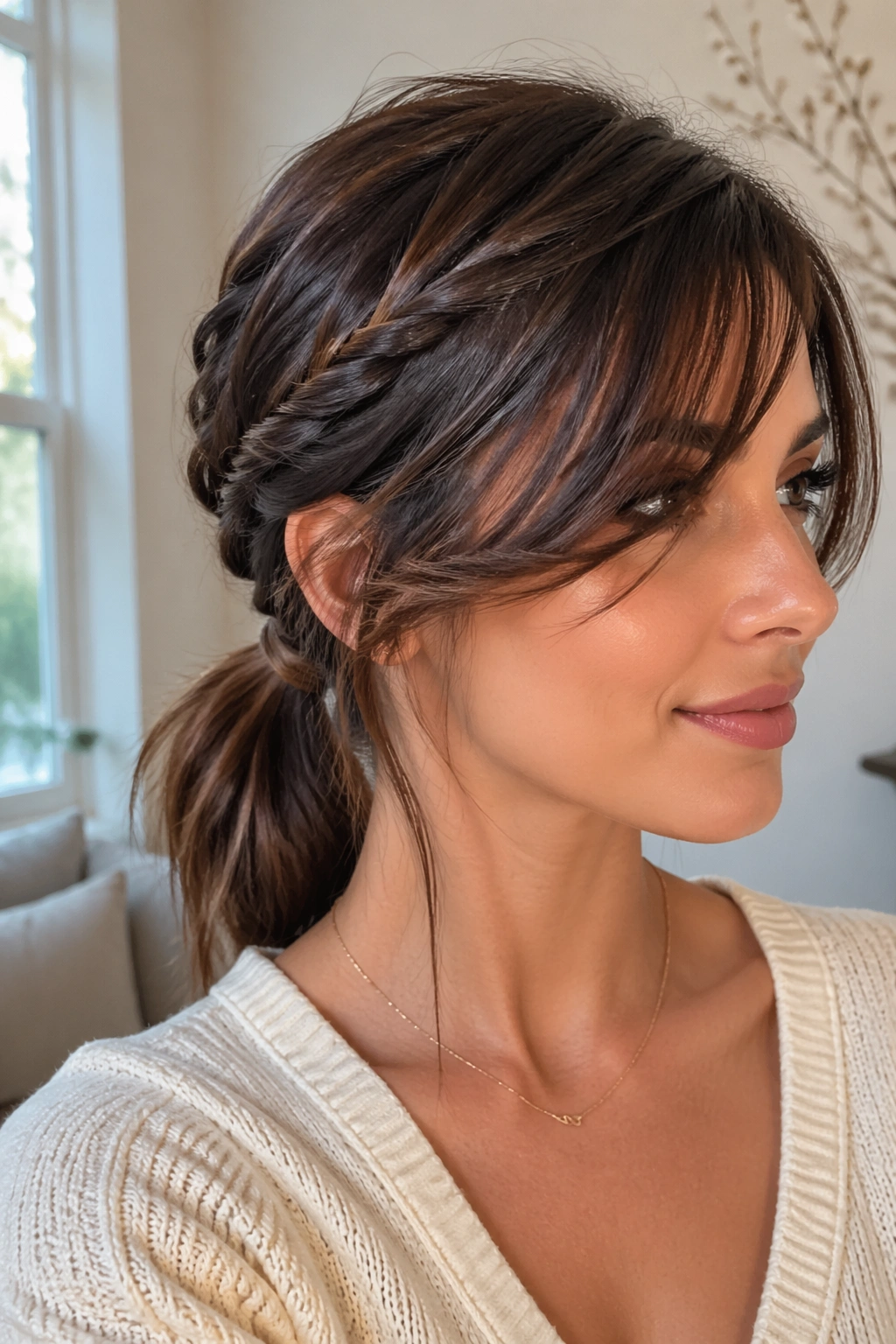
A twisted low ponytail has a softer backbone than a plain tie-back style. Two small sections from either side are twisted back, pinned, and gathered into a low pony, and the side bangs tie the whole thing together.
Why this works on shorter layers
If your hair has grown-out layers near the chin, this is a useful style because the twists help corral them. Side bangs also give you a natural direction, so the front does not flop forward and disappear into the ponytail.
I like this because it feels a little more dressed up without asking for a lot. The twists do most of the visual work. If you keep them loose, the effect stays soft. If you twist them tightly, the style starts feeling formal in a hurry.
How to keep the twists loose
- Start with dry hair that has a little texture.
- Pin each twist flat against the head.
- Pull the twist gently after pinning so it widens a bit.
- Finish with a light spray at the nape.
It is a nice middle ground between polished and undone.
11. Voluminous High Ponytail With Bardot Bangs
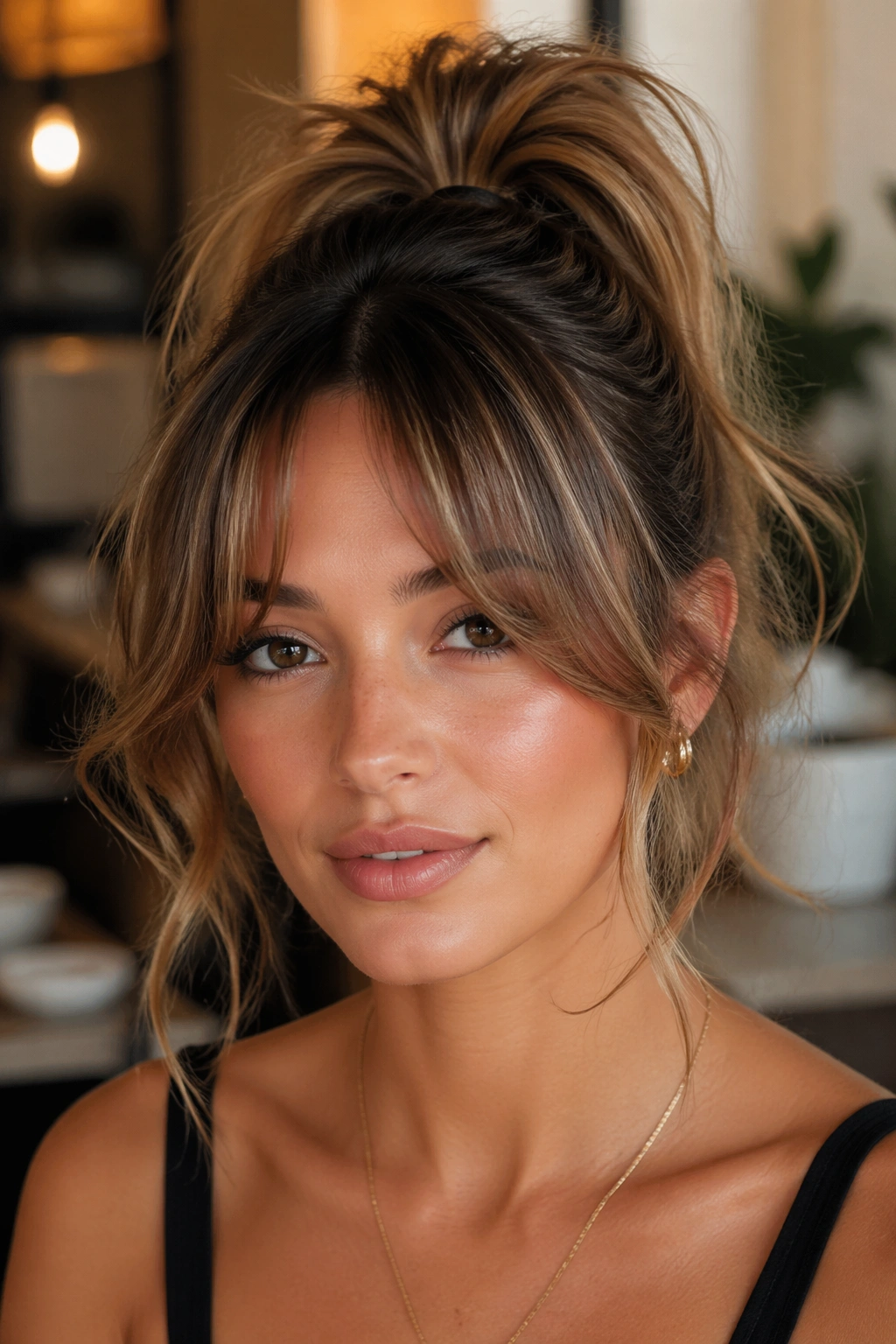
This one has a bit of drama, and I mean that in a good way. A voluminous high ponytail with Bardot bangs gives you height at the crown and those airy, split fringe pieces that make the face look open and soft.
Bardot bangs work because they do not sit in one solid line. They break apart at the center and curve around the cheekbones, which keeps the high ponytail from looking severe. If your hair is thick, this style is easy to build. If it is fine, a few Velcro rollers at the crown can make a real difference.
A high ponytail on its own can feel sporty. With Bardot bangs, it gets a little more shape and a little more polish.
You do not need the ponytail to be perfect. Pull at the crown, leave a bend in the lengths, and let the bangs move. That is enough. More than enough, honestly.
12. Wrapped-Elastic Ponytail With Feathered Bangs
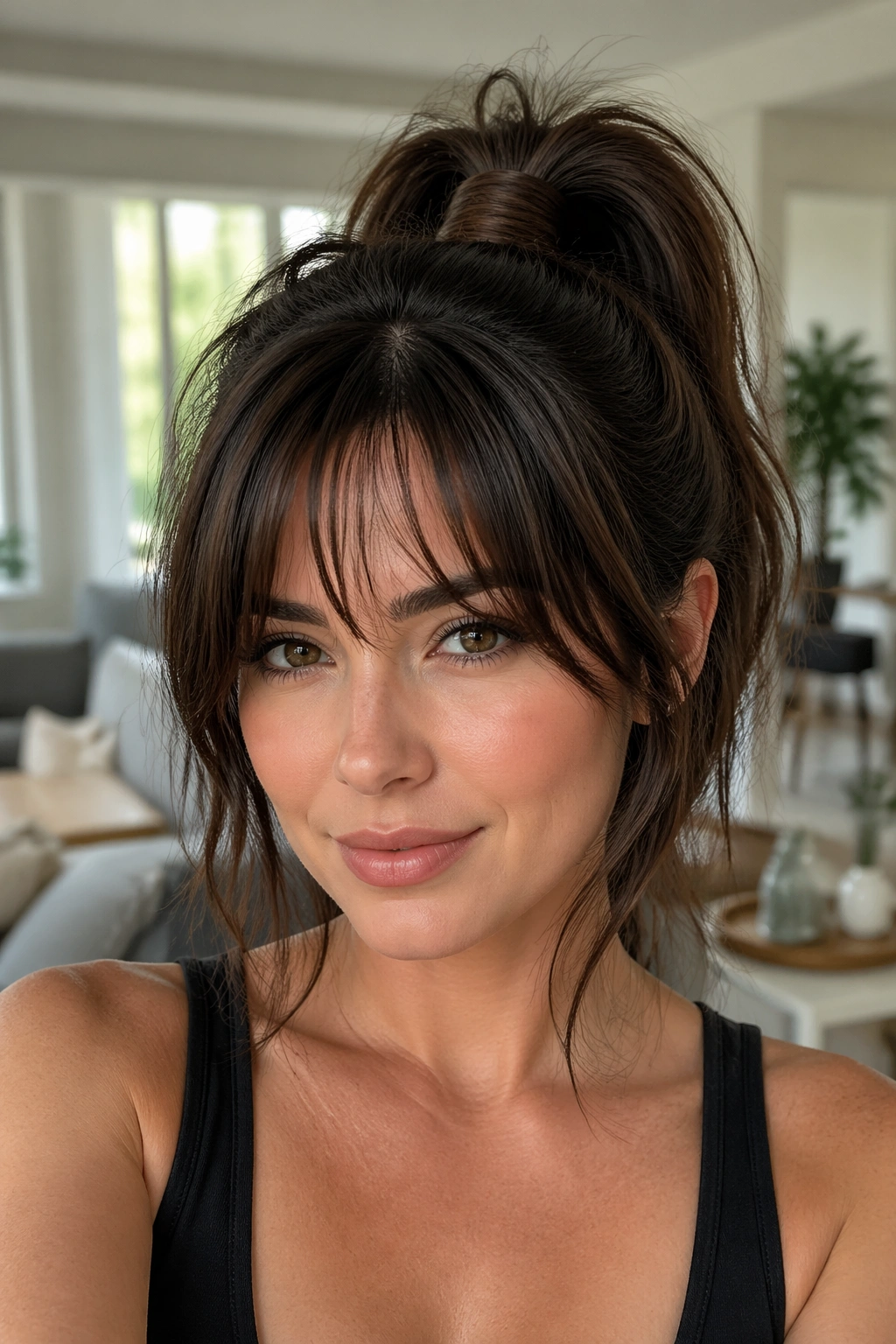
A wrapped elastic changes a ponytail from “done” to “finished.” It hides the hair tie, cleans up the base, and gives the style a smoother line, which pairs well with feathered bangs that already have a soft, airy feel.
Why the finish matters
Feathered bangs work best when they move in separate strands. They should skim the brows and taper at the sides, not sit as one heavy block. The ponytail can still be messy, but the wrapped base gives it a tidy spine underneath.
I reach for this when I want the ponytail to look intentional from every angle. The wrap does not need to be thick. A strip of hair about half an inch wide is enough, and you can pin the end underneath with a bobby pin.
This style is a good one for older bangs too. As they grow out, the feathered shape helps them blend instead of looking like an awkward in-between.
A tiny detail, but it changes the whole read of the style.
13. Half-Messy Ponytail With Long Bangs
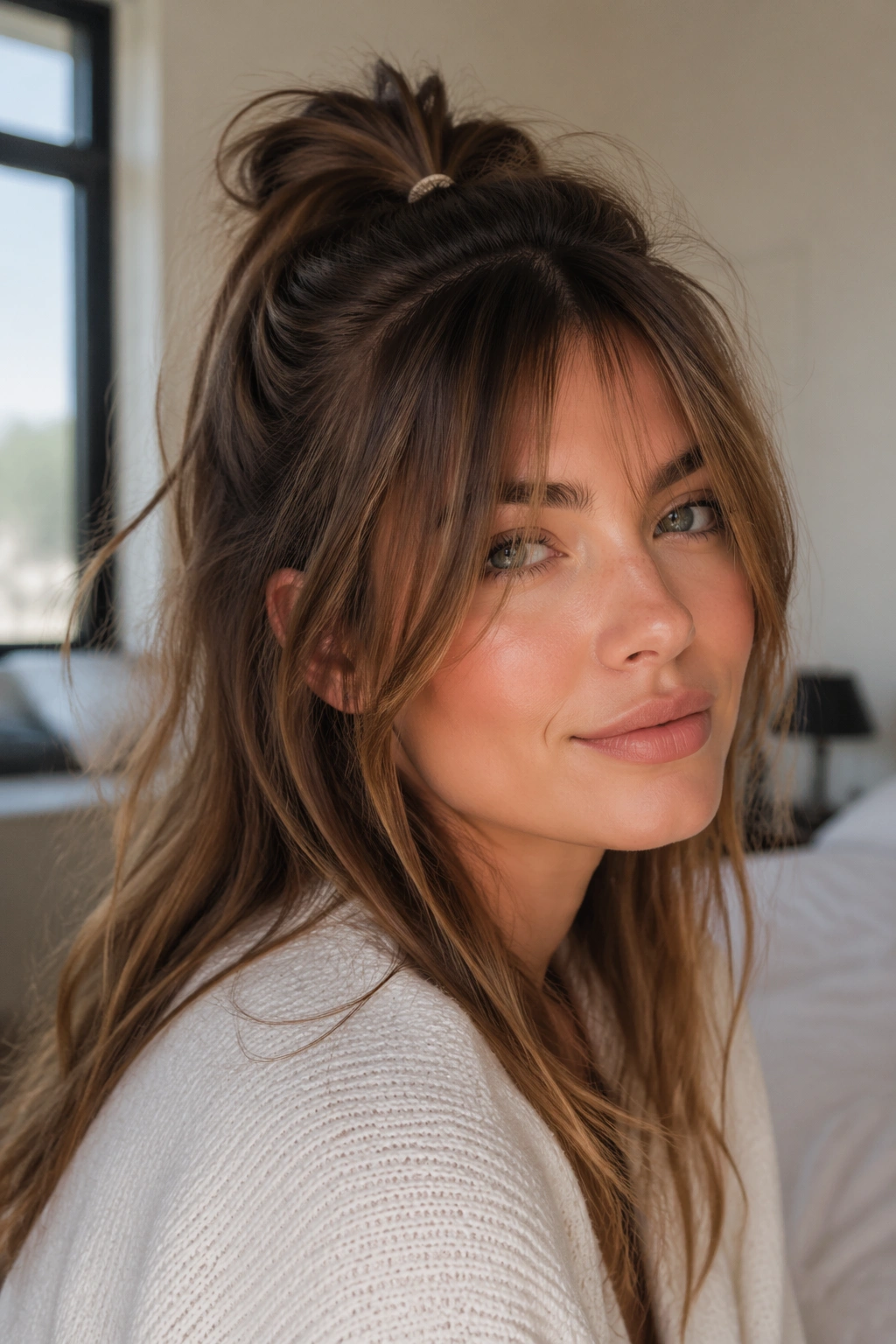
A half ponytail is not quite a full updo and not quite loose hair, which is exactly why it works so well with long bangs. The front stays soft, the top gets a little lift, and the lengths still move around your shoulders.
Why it flatters growing-out fringe
Long bangs are tricky when they hit that middle length between a real fringe and face-framing layers. A half-up pony gives them somewhere to belong. They can fall into the cheekbone area, sweep to one side, or blend into the top section without feeling abandoned.
This is a good style for anyone whose hair feels better with only part of it tied back. It keeps the face open while leaving enough hair down to avoid that “all business” look. A small claw clip can work here too if you want it looser than an elastic.
Useful details:
- Gather the top half from temple to temple.
- Tie it loosely at the back of the crown.
- Pull the top section up slightly for height.
- Leave the long bangs free around the face.
It is easy, but not boring. Which is a nice combination.
14. Wavy Ponytail With Choppy Micro Bangs
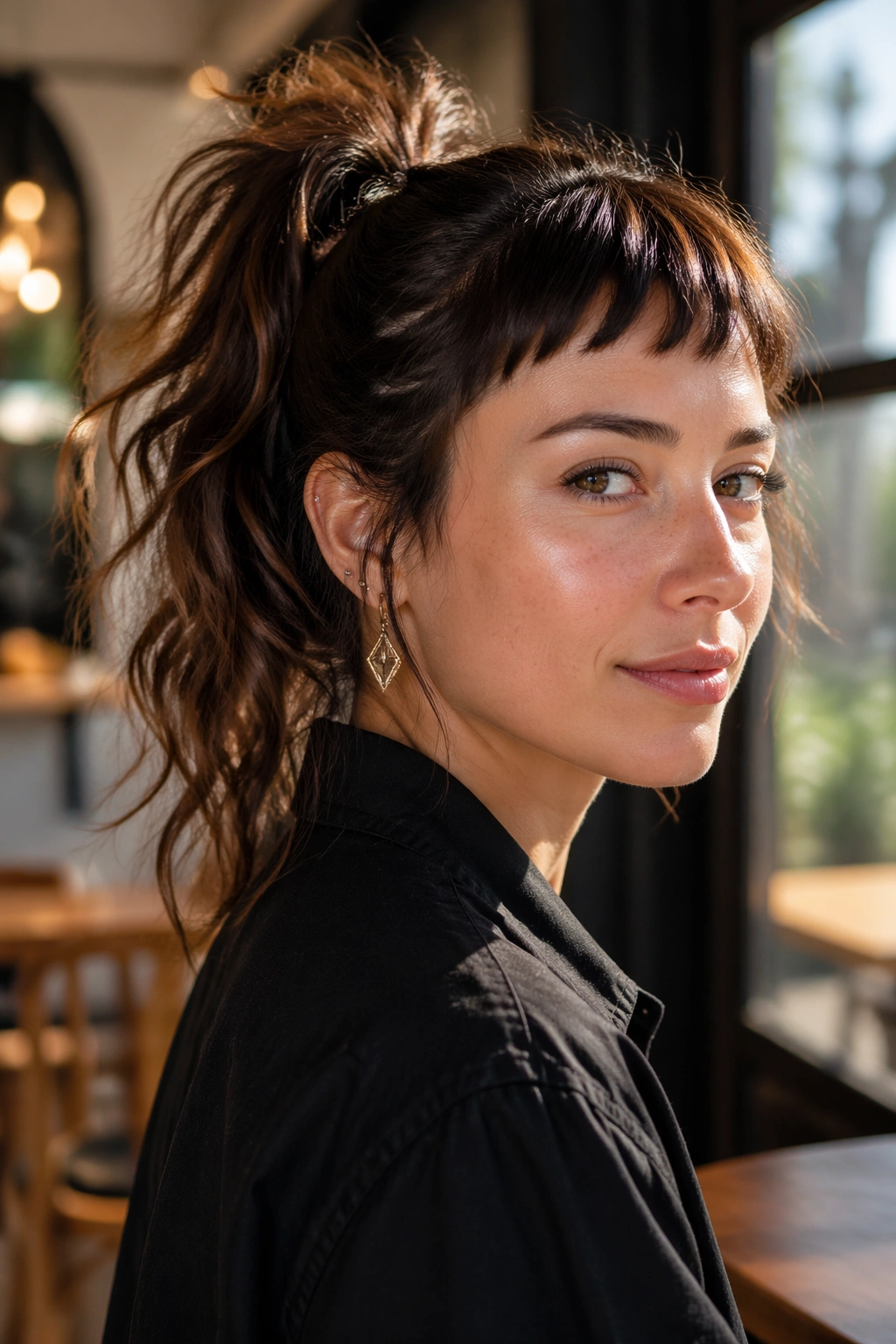
This one has edge. Choppy micro bangs already make a statement, and pairing them with a wavy messy ponytail keeps the front sharp while the back stays relaxed.
The contrast matters. If the ponytail were sleek too, the look could feel overly severe. The waves soften that a bit and keep the whole thing wearable. Micro bangs need a light hand — a tiny round brush, a quick blast from the dryer, and maybe a touch of matte paste if the ends want to separate too much.
This style suits people who like a little structure in their fringe and a little chaos everywhere else. It is not the most low-key option on the list, and that is part of the appeal.
I would wear it with simple clothes and let the hair do the talking. A plain tee, a sharp jacket, done. The hair already has enough personality.
15. Messy Ponytail With a Deep Side Part and Bangs
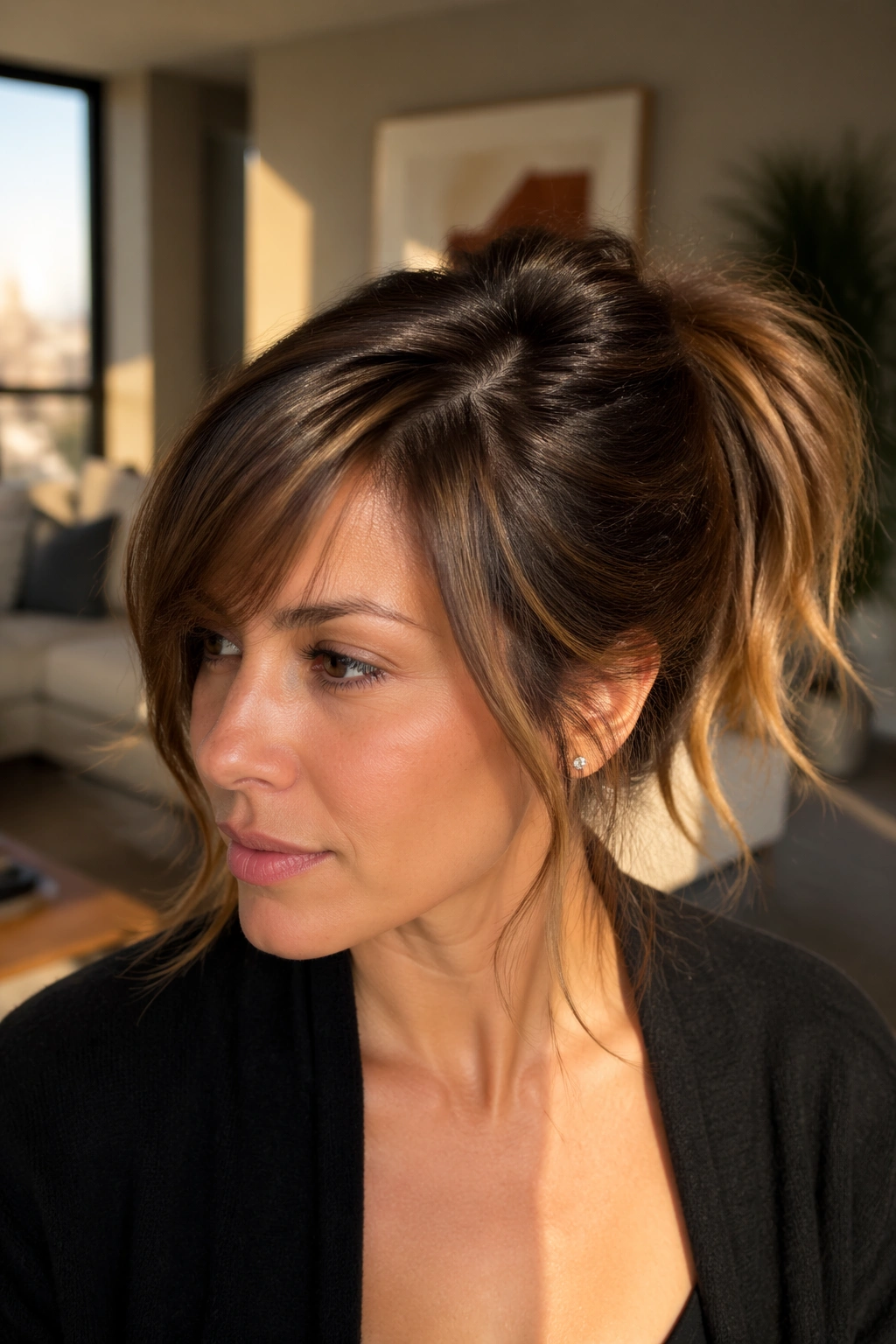
A deep side part changes the balance of the whole head. Suddenly the ponytail feels richer, the bangs swing farther to one side, and the style gets that slightly dramatic line that makes it interesting from the first glance.
The part does the heavy lifting
This is one of the easiest ways to make a ponytail feel less flat. Move the part an inch or two farther over than usual, then let the bangs fall with it. The ponytail can be mid-height or low, but I think this looks strongest when the crown has a little lift on the heavier side.
It is also useful when you want to disguise greasy roots. A side part naturally breaks up the top section, so the scalp does not show as much. Not magic. Just smart placement.
A light bend through the bangs keeps them from looking pasted to the head. If the front pieces feel too stiff, run your fingers through them after they cool. That loosens the line fast.
The whole style lives or dies by the part. Get that right, and the rest falls into place.
16. Double-Texture Ponytail With Airy Bangs
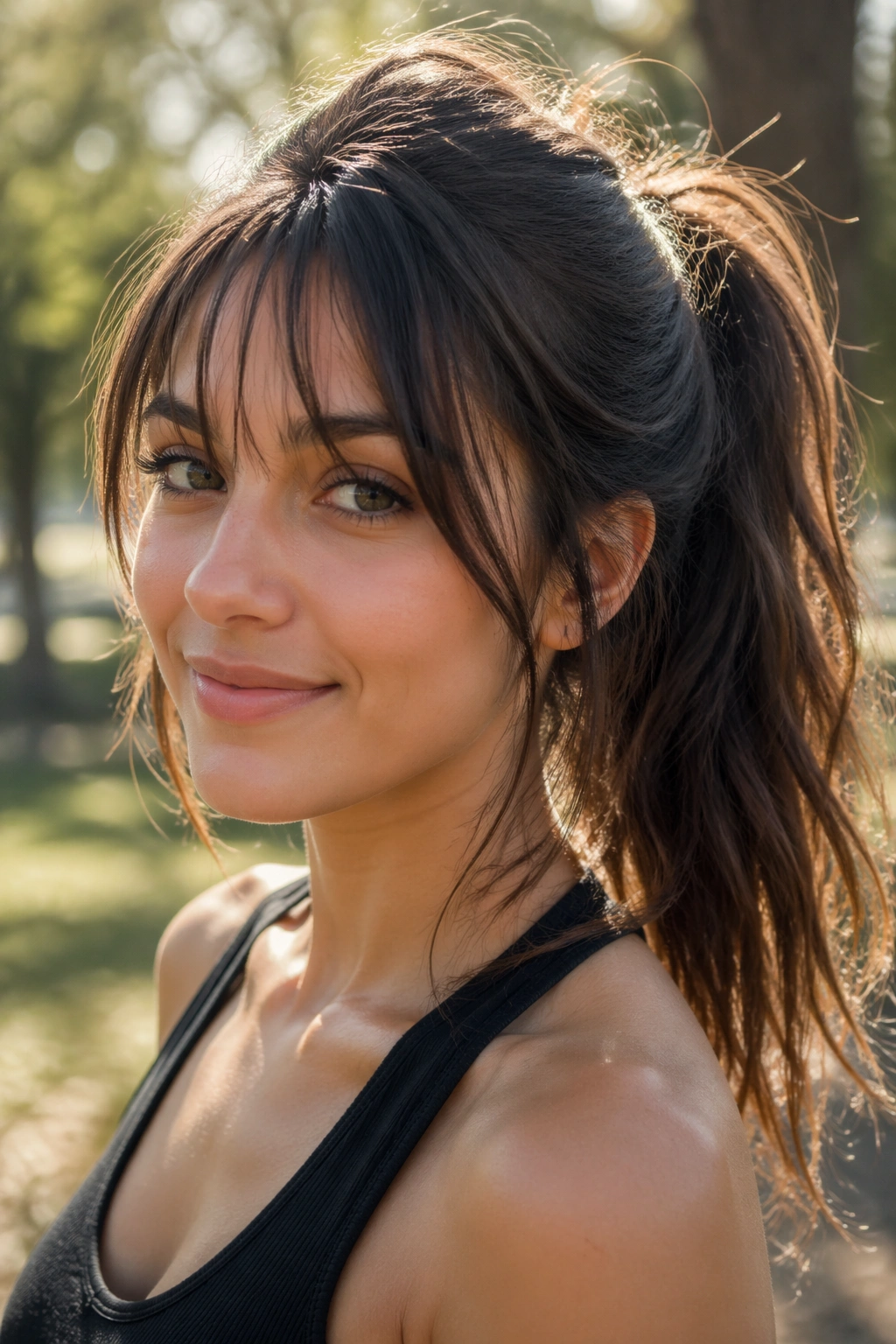
A double-texture ponytail is exactly what it sounds like: one texture in the bangs, another in the ponytail. Usually that means smoother, lighter fringe with a tousled tail, or the other way around if your hair behaves better that way.
This contrast gives the style a little depth. A ponytail that is textured from root to tip can sometimes look fuzzy. Breaking that up with airy bangs keeps the front cleaner and easier to read. Airy bangs should move a bit and never sit too heavy across the forehead.
I like this for layered cuts because the variety in texture helps the different lengths make sense together. If your hair is blunt-cut, the style can still work, but you may want to curl just the ends of the ponytail so the contrast feels intentional.
No need to overthink the symmetry. A messy ponytail looks better when one side sits slightly looser anyway.
17. Athletic Messy Ponytail With Sweat-Friendly Bangs
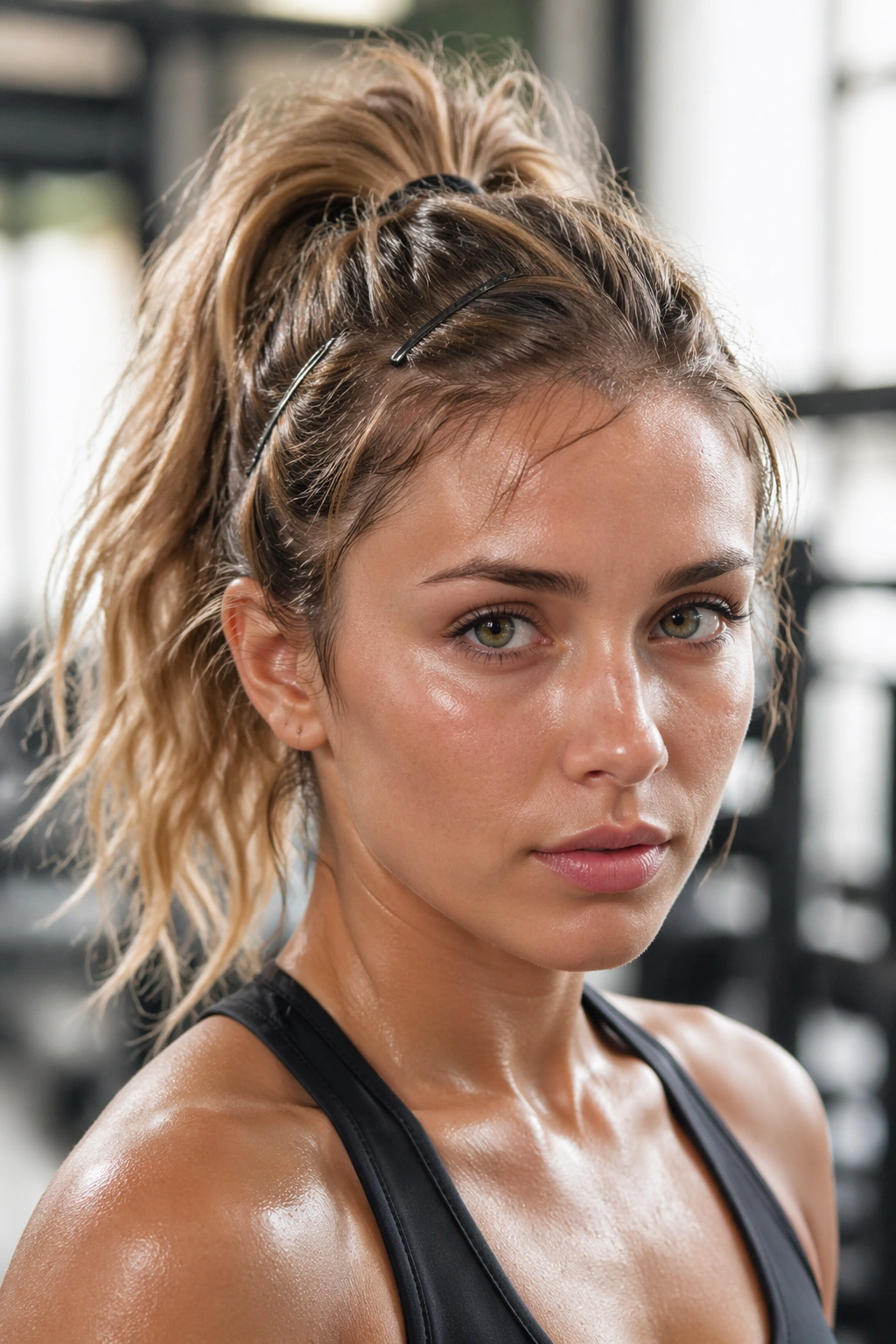
An athletic ponytail can still look good with bangs. The secret is keeping the front piece light enough that it does not stick to the skin the second you move.
What makes it practical
Sweat-friendly bangs are usually softer, thinner, or pinned back just at the roots before being released. That sounds fussy, but it is not. A couple of tiny clips at the hairline while you get dressed can keep the fringe away from your forehead long enough for the shape to set.
The ponytail itself should sit high or mid-high so it stays out of the way. A firm elastic matters here. If the hair is slippery, use a little dry shampoo at the root before tying it up. That gives the base more grip and cuts down on the slide.
This version is great for gym days, errands, or any time you want your hair controlled but not stiff.
Practical checklist
- Use a no-slip elastic.
- Keep bangs light.
- Add dry shampoo before tying.
- Let a few front pieces escape after the workout.
It is not precious. That is exactly the point.
18. Low Nape Ponytail With Blunt Bangs
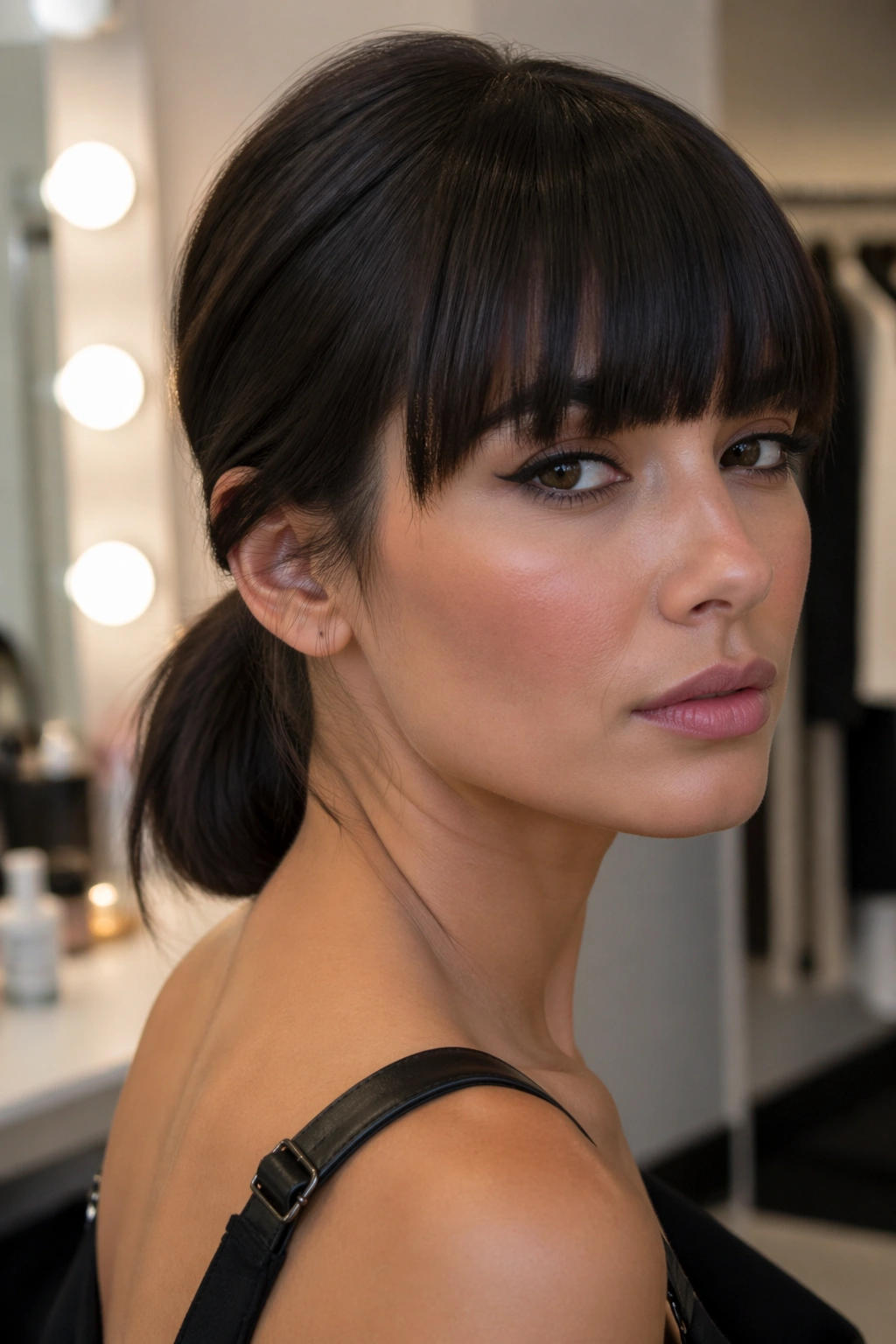
A low nape ponytail with blunt bangs has a clean, graphic look that feels a little sharper than the softer styles on this list. The contrast between the straight fringe and the low placement is what makes it stand out.
Blunt bangs need a bit of discipline. If they split too much or flip at the ends, the style loses its punch. A quick pass with a flat brush and a blow-dryer can fix that. The ponytail can be messy in the back, but the front should stay more controlled so the shape reads clearly.
This is one of the few messy ponytail styles that works beautifully with straight hair because the blunt line gives the eye a place to land. A tiny bend in the ponytail ends keeps it from looking too rigid.
I would use this when you want a strong frame around the face but do not want a high ponytail’s extra lift. It feels grounded. A little cool, too.
19. Lofty Ponytail With Layered Fringe
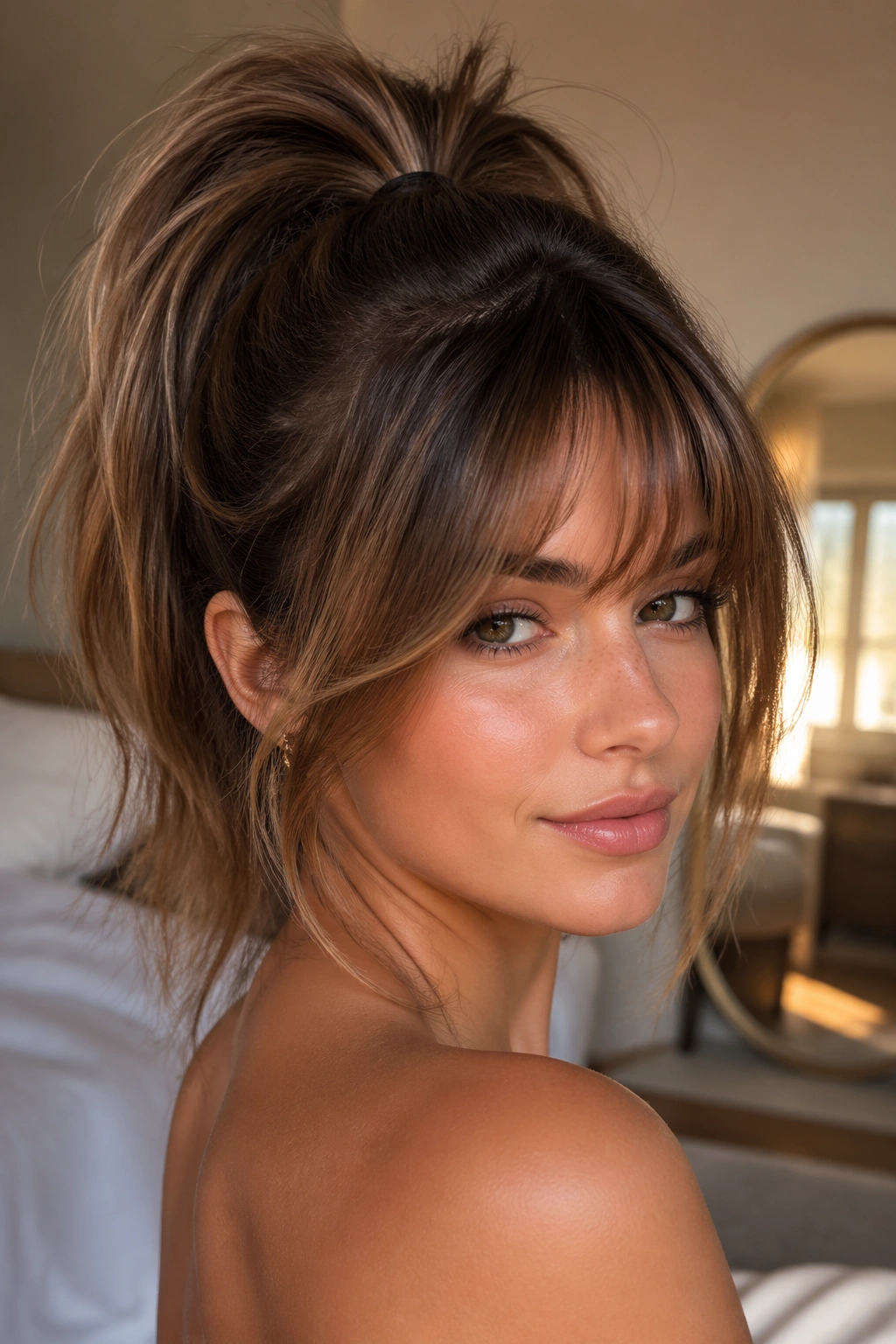
A lofty ponytail starts with volume at the crown and keeps that height all the way into the fringe. Layered bangs help because they blend into the rest of the cut instead of sitting there like a separate piece.
Why layered fringe makes sense here
Layered bangs are useful when your hair has a lot of moving parts already. They sit lightly, split easily, and let the ponytail feel full without getting bulky at the front. If the hair near your face is too short, the style can get jumpy. Layers smooth that out.
Use a round brush at the bangs and a light tease at the crown. That combo gives the style shape without making it hard or crunchy. The ponytail lengths can stay rough, even slightly frizzed out at the ends, as long as the top has enough lift.
Good details to keep in mind:
- Crown volume should start about 1 inch behind the hairline.
- The fringe should taper into the cheek area.
- A little shine spray on the ponytail ends helps keep the finish from looking dry.
This one feels youthful without trying too hard. That matters.
20. Rope-Twist Ponytail With Curtain Fringe
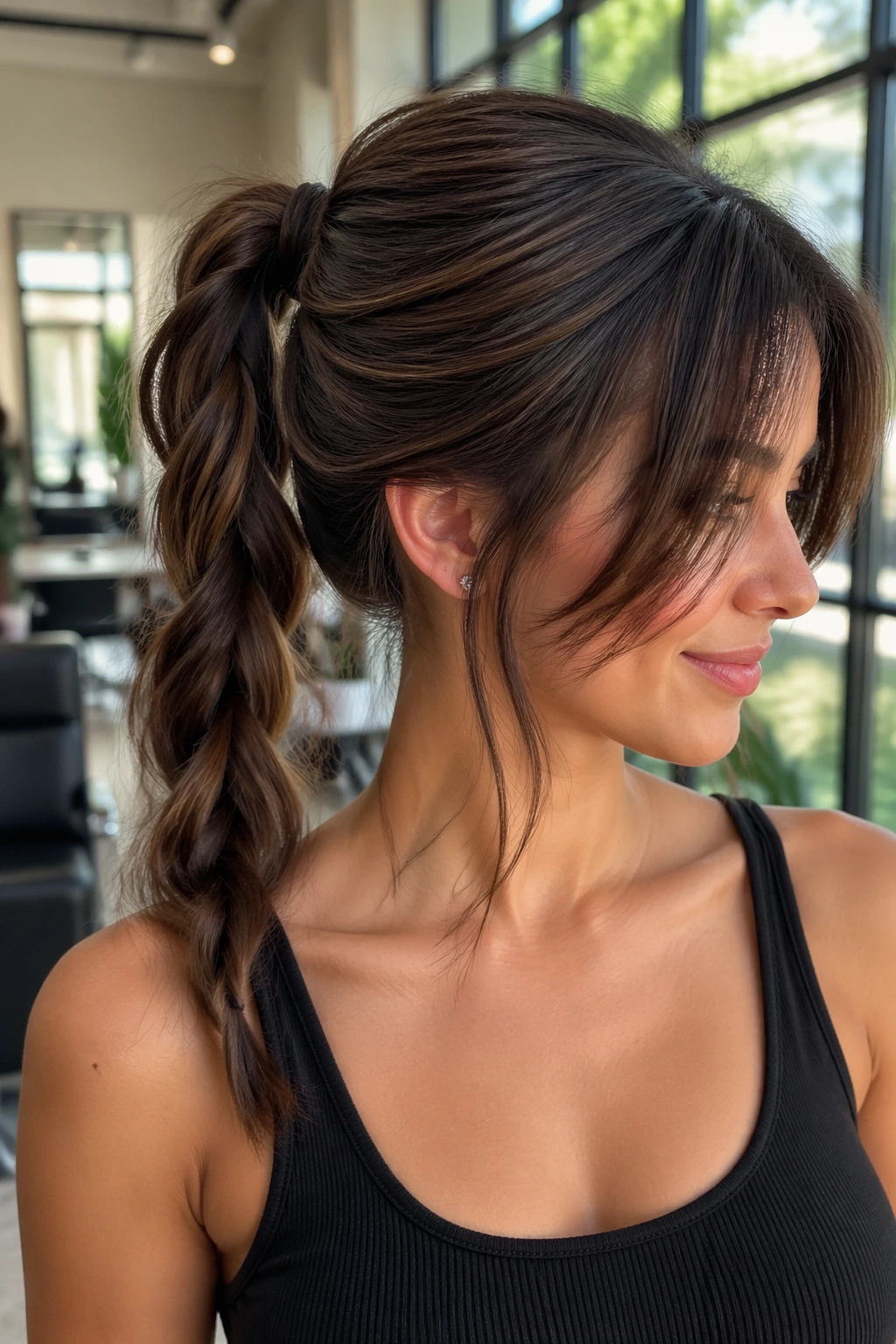
A rope twist looks a lot more complicated than it is. Two sections twist around each other, and the result is a textured line that feeds into the ponytail with a little more movement than a braid.
Why the rope twist works
Curtain fringe pairs well with this because the bangs already soften the front, while the twist gives the back some visual rhythm. I prefer this version when the hair is medium length and a normal ponytail feels too plain. The rope twist keeps the style from collapsing into one flat shape.
Start with hair that has a bit of grit. Freshly washed strands can slip apart fast. Twist each side away from the face, then cross the sections over until they naturally coil together. Do not pull them so tight that the twist loses its roundness.
This is one of those styles that looks fancy from a distance and casual up close. That is a nice sweet spot.
A ponytail with a rope twist also works well if you need the style to survive a long day. It grips more than loose sections do.
21. Loose Knot Ponytail With Bottleneck Bangs
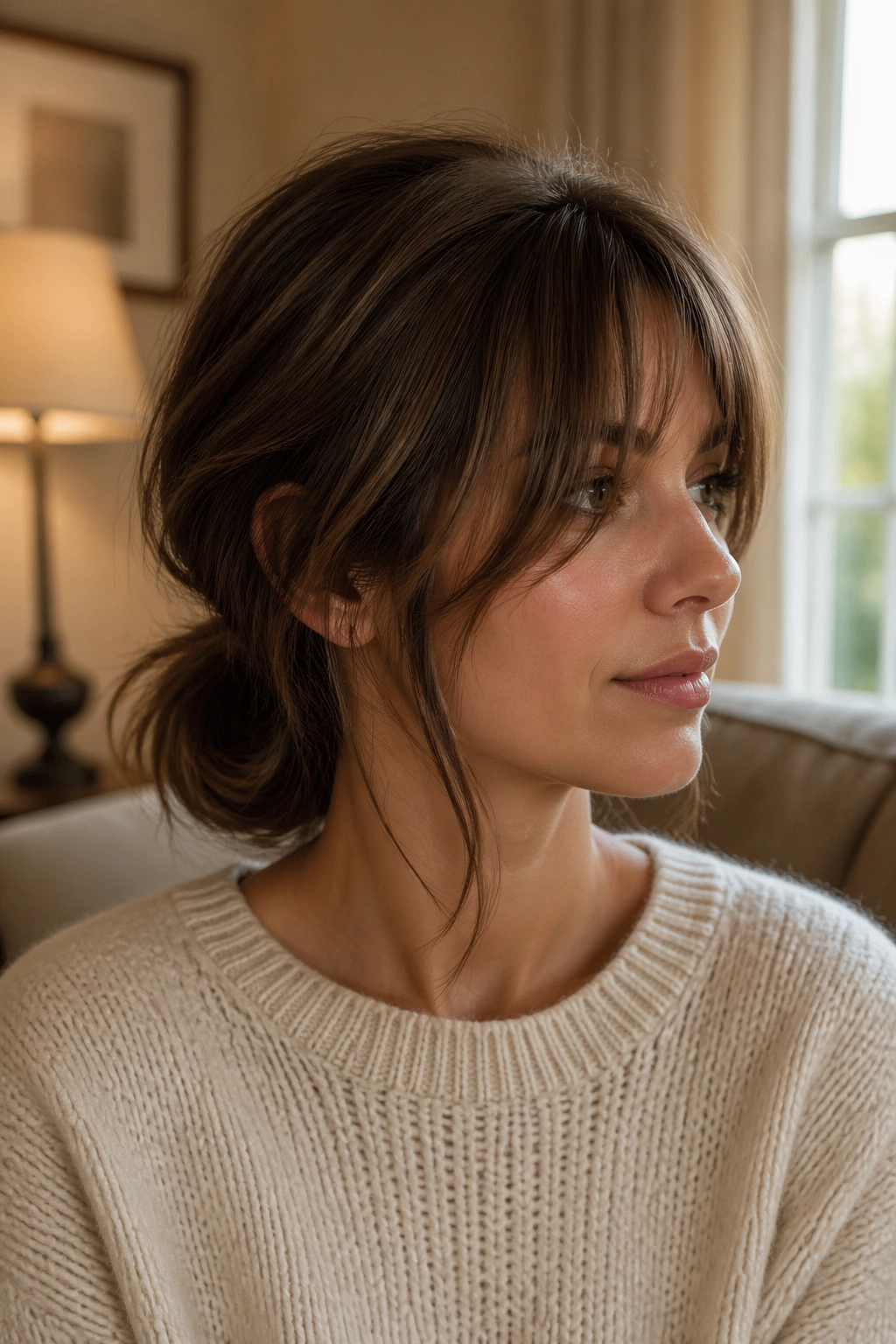
A loose knot ponytail has a slightly undone shape that sits between a ponytail and a low wrap. Pair it with bottleneck bangs — narrow at the center, wider at the sides — and you get a face frame that feels soft but not vague.
The knot is the interesting part. Instead of yanking the hair tight, loop the ponytail through once and leave the ends partially tucked. That creates a soft bend near the nape and keeps the style from looking too neat. The bangs should taper away from the center of the face, which helps the eyes and cheekbones stand out without a heavy curtain.
This is a strong choice for medium-length hair. It also works when your layers have started growing out and do not sit cleanly in a standard ponytail anymore.
I like it because it looks like you spent time on it, even if you did not. That is not cheating. That is hair strategy.
22. Messy Ponytail for Thick Hair With Long Bangs
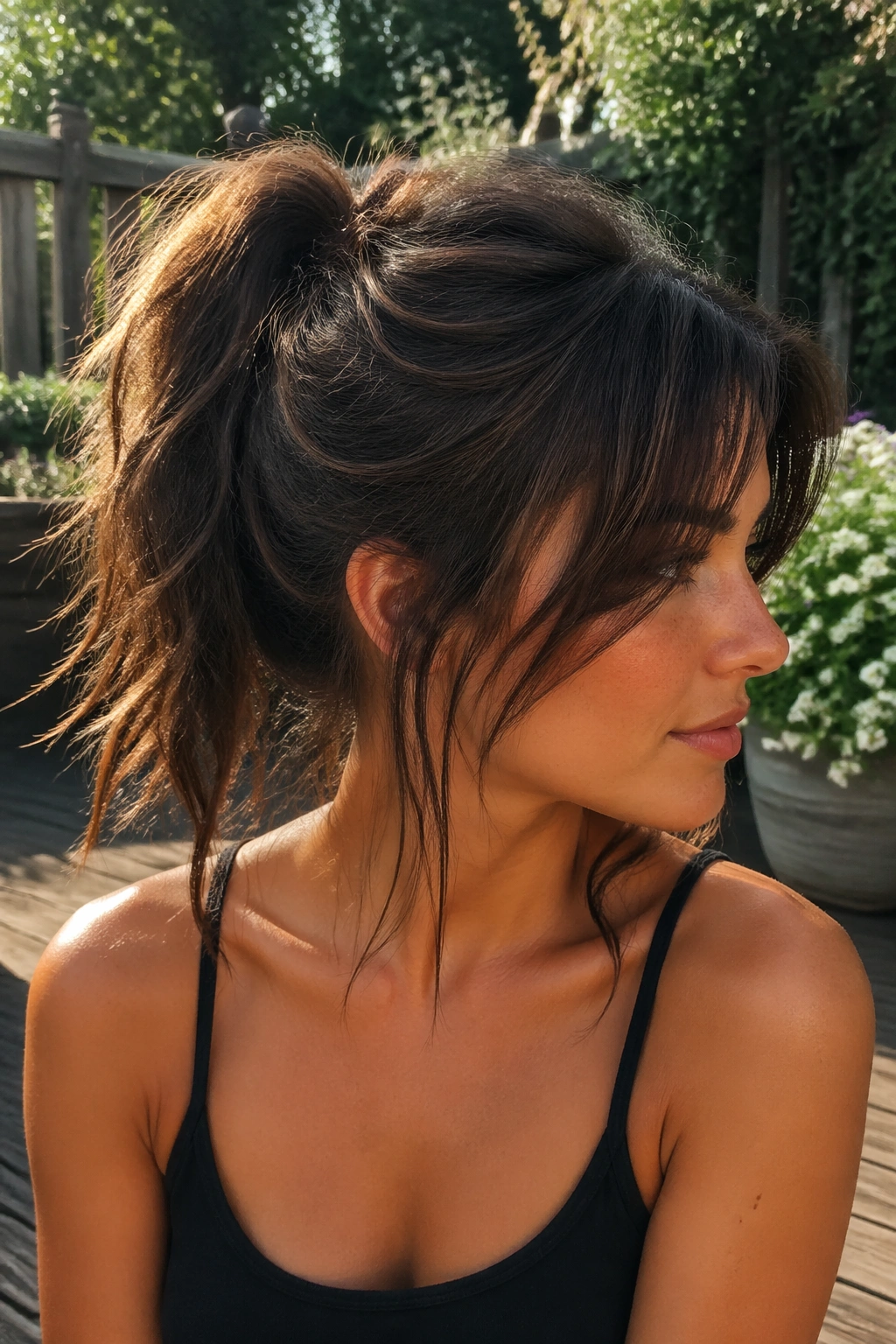
Thick hair can make a messy ponytail look incredible, but it can also turn the back of the head into a heavy lump if you do not manage the weight. Long bangs help balance that out by bringing the front down a little and spreading the visual volume more evenly.
How to keep thick hair from fighting you
Use two elastics if one does not hold. A single tie often slips or feels too tight on thick hair, and neither option is fun. Section the ponytail into a top and bottom half when you gather it, then smooth the top before tying the whole thing. That keeps the base from puffing out in a weird way.
Long bangs are useful because they blend into the cheek area and can take some of the visual weight off the top. If they are too blunt, they can make the style feel boxy. A slight bend at the ends softens that.
Practical fixes
- Use a strong elastic with good grip.
- Keep the crown slightly loose.
- Avoid overloading the pony with too much product.
- Let the bangs stay mobile around the face.
Thick hair does not need to be tamed. It needs room.
23. Messy Ponytail for Fine Hair With Soft Bangs
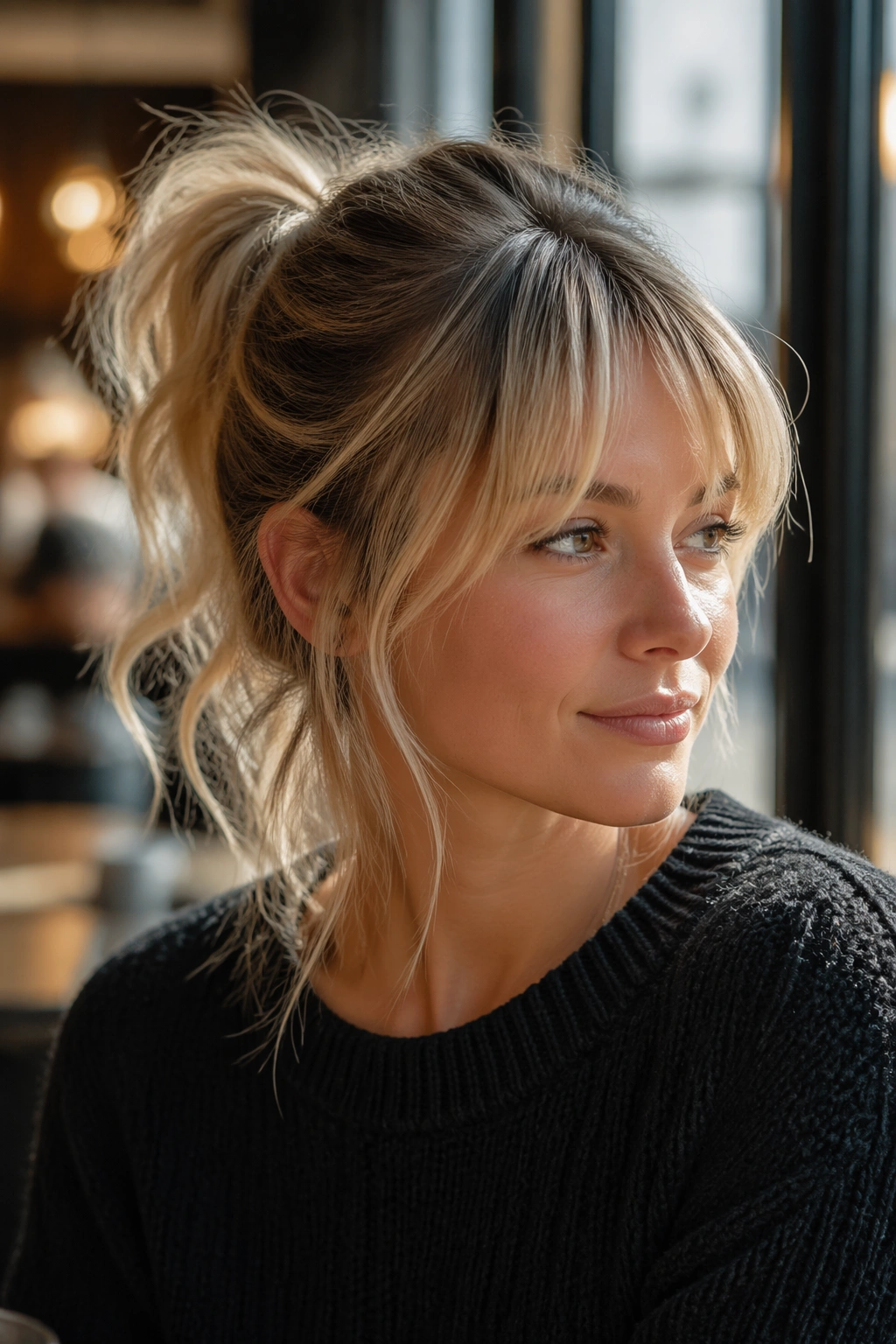
Fine hair wants lift more than it wants hold. That is why soft bangs are such a good match here — they frame the face without demanding a ton of density, and the ponytail can stay airy instead of heavy.
What helps fine hair most
A root powder or dry shampoo gives the crown some grit. Use a small amount, work it in with your fingers, then wait a minute before you gather the ponytail. That little pause helps the product absorb and makes the hair easier to shape. If you skip that, the pony can slip by mid-morning.
Soft bangs should be feathered and lightly bent, not flattened into one line. A small round brush and low heat are usually enough. The ponytail itself can be teased slightly at the base so it does not collapse.
I would skip anything too slick here. Fine hair often looks thinner when it is smoothed down too much, and that is the one thing you do not want.
A loose, airy finish is the whole point.
24. Messy Ponytail for Short Hair With Piecey Bangs
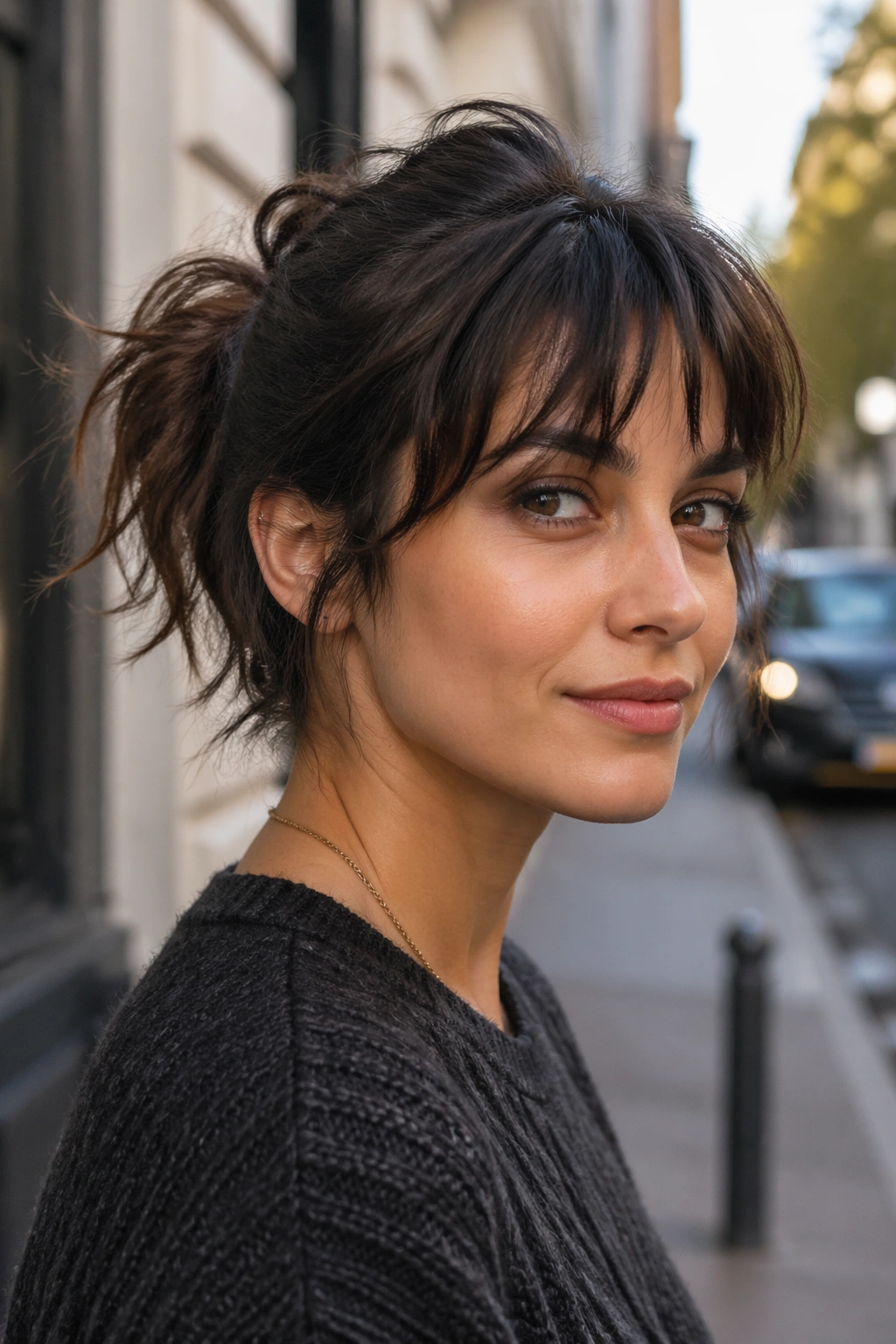
Short hair needs a different kind of mess. You are not getting a giant swinging ponytail, and that is fine. The charm comes from the little bits that escape and the way piecey bangs make the style feel intentional.
If your hair barely reaches the nape, use a smaller elastic and keep the ponytail low. Bobby pins can help anchor the shorter layers that refuse to stay in the tie. Piecey bangs also earn their keep here because they give the front enough structure to balance the shorter length in back.
A few useful tricks
- Use a matte paste on the ends for separation.
- Leave the ponytail a little loose so it does not look stretched.
- Pull out two tiny face-framing strands.
- Tuck the shortest layers under with pins if they stick out awkwardly.
This is a good style for shoulder-length cuts that are growing out between shapes. It is relaxed, but not sloppy. There is a difference, and people can usually tell.
25. Messy Ponytail for Curly Hair With Curly Bangs
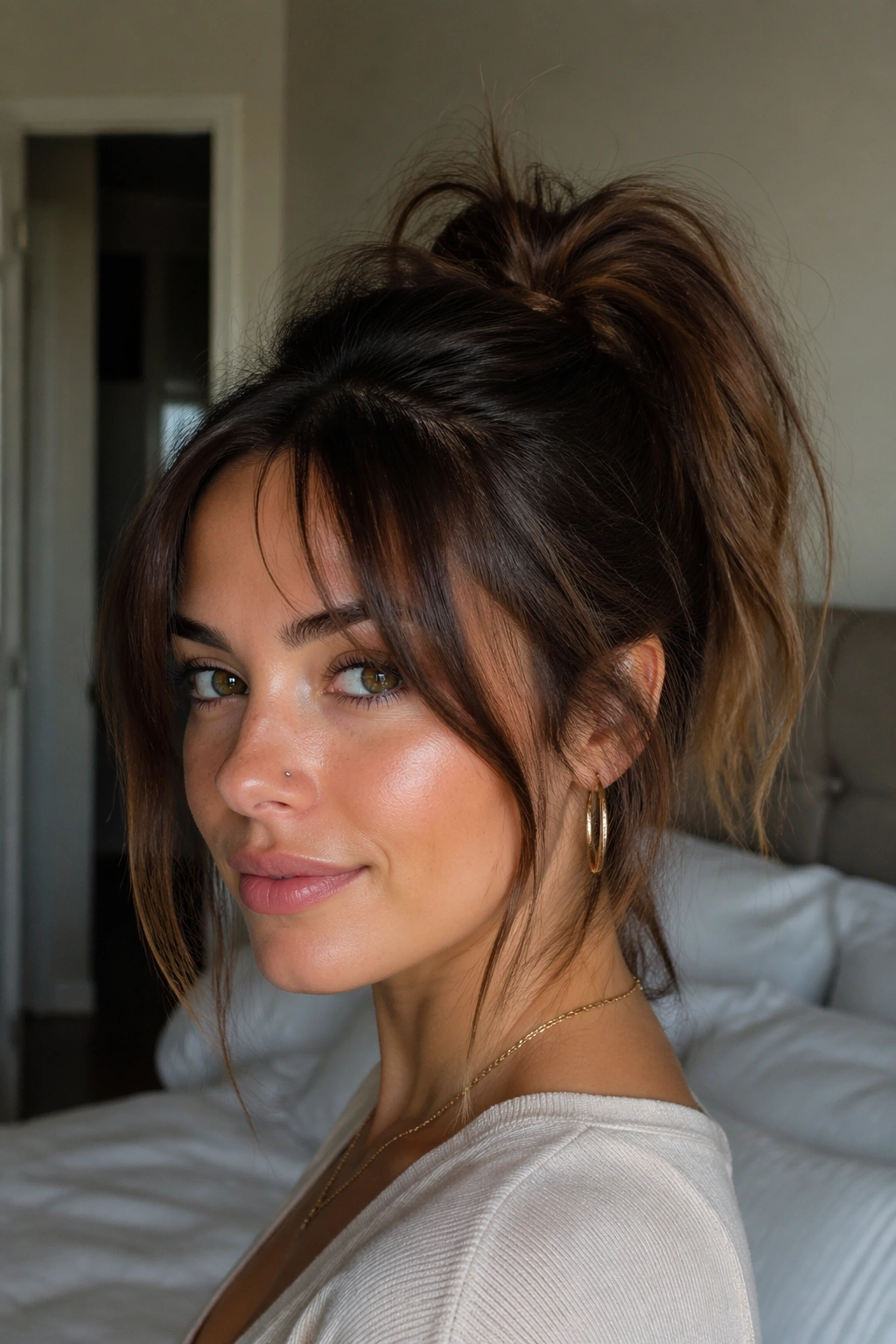
Curly bangs can look fantastic with a messy ponytail because the texture stays consistent from front to back. The whole style feels like one idea instead of two separate ones.
How to keep the curls aligned
Do not brush the curls dry. That is the quickest way to lose the shape. Instead, refresh the bangs with water or leave-in conditioner, then scrunch them back into place with your hands. Gather the ponytail loosely so the curls at the crown do not flatten. A pineapple-like placement can work if your curls are springy, but lower placements are better when you want the bangs to stay visible.
The best part is that you do not need every curl to match. A few tighter pieces in the fringe and a looser ponytail at the back can look rich and natural. Curl cream helps, but only use enough to control frizz around the edges.
This style is strongest when it looks touched, not transformed. The curl pattern already gives it shape.
26. Messy Ponytail With a Hair Scarf and Bangs
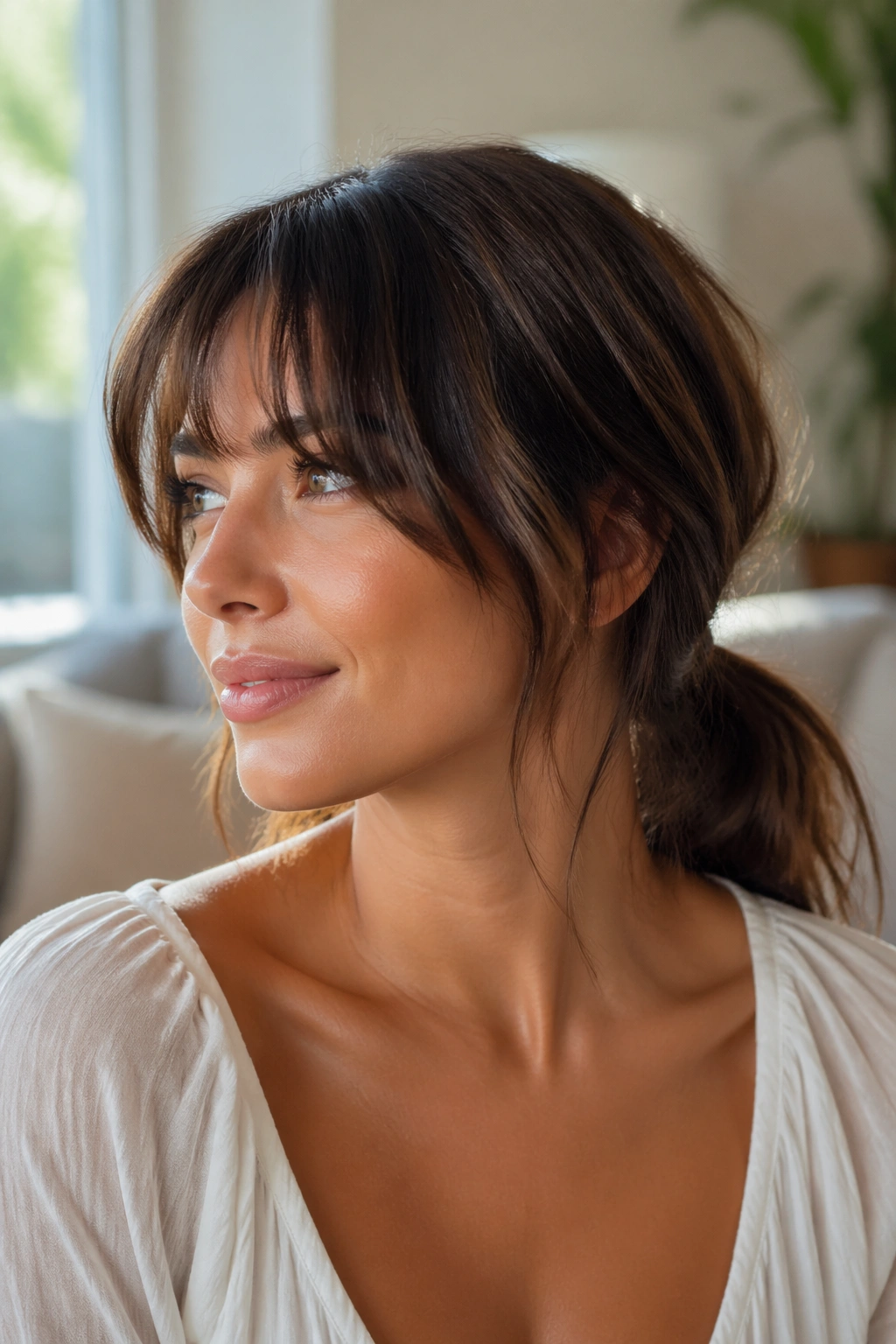
A hair scarf can rescue a ponytail that feels too plain. Tied around the base, it gives the style color and movement, while the bangs keep the front soft enough that the scarf does not take over.
The trick is to keep the scarf narrow or folded thin if your hair is already full. A huge scarf can compete with the ponytail instead of helping it. I like a silk or cotton scarf tied just above the elastic, with the ends left long enough to move a little when you walk.
Bangs make this work because they frame the face and stop the scarf from looking like the only interesting thing happening. The whole effect is more relaxed than polished. That is the lane here.
A scarf also helps on days when the ponytail needs hiding because the elastic is doing too much. We have all been there.
Use a pattern that does not fight your outfit. Simple usually wins.
27. Messy Ponytail With a Braided Bang Sweep
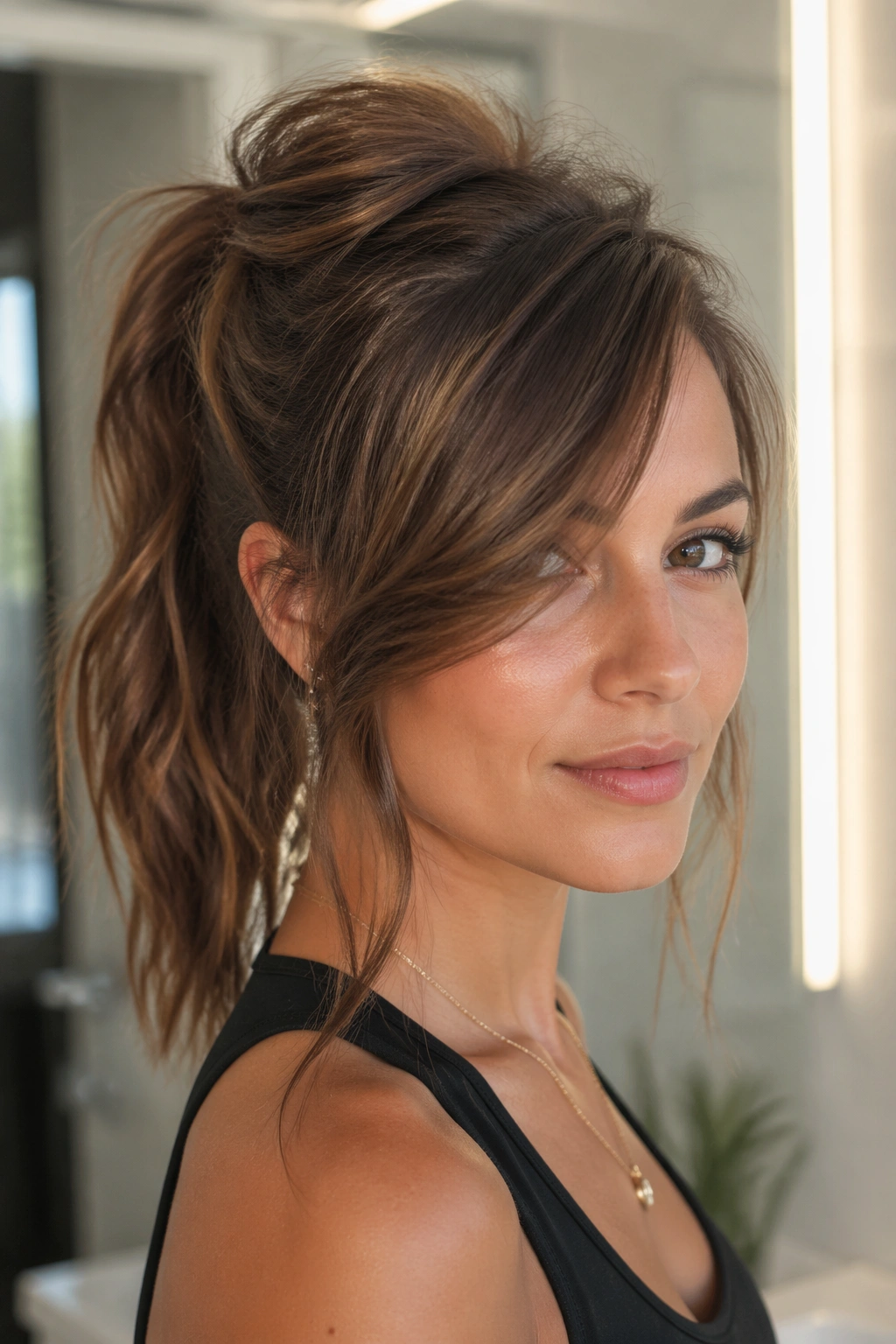
A braided bang sweep is a smart fix for growing-out fringe. Instead of fighting the bangs to stay down, you braid them off to one side and let the rest of the ponytail stay soft and loose.
Why this is so practical
This style keeps hair out of your face without losing the fringe entirely. It is especially useful when bangs are at that annoying length where they keep splitting and falling into your eyes. A small braid from the temple to the ear solves that problem and adds a detail that feels more interesting than a plain pin.
The braid should stay loose. If it is too tight, the scalp line gets harsh and the rest of the style starts looking overworked. Gather the ponytail at the back once the braid is secured, and let the lengths stay a little wild.
Useful details:
- Braid only the front section, not the whole front half.
- Pin the end under the ponytail base.
- Leave the rest of the bang area softly swept.
- Use texture spray if the braid slips.
This is a clever style, and it does not pretend to be anything else.
28. Messy Ponytail With Tucked Ends and Wispy Fringe
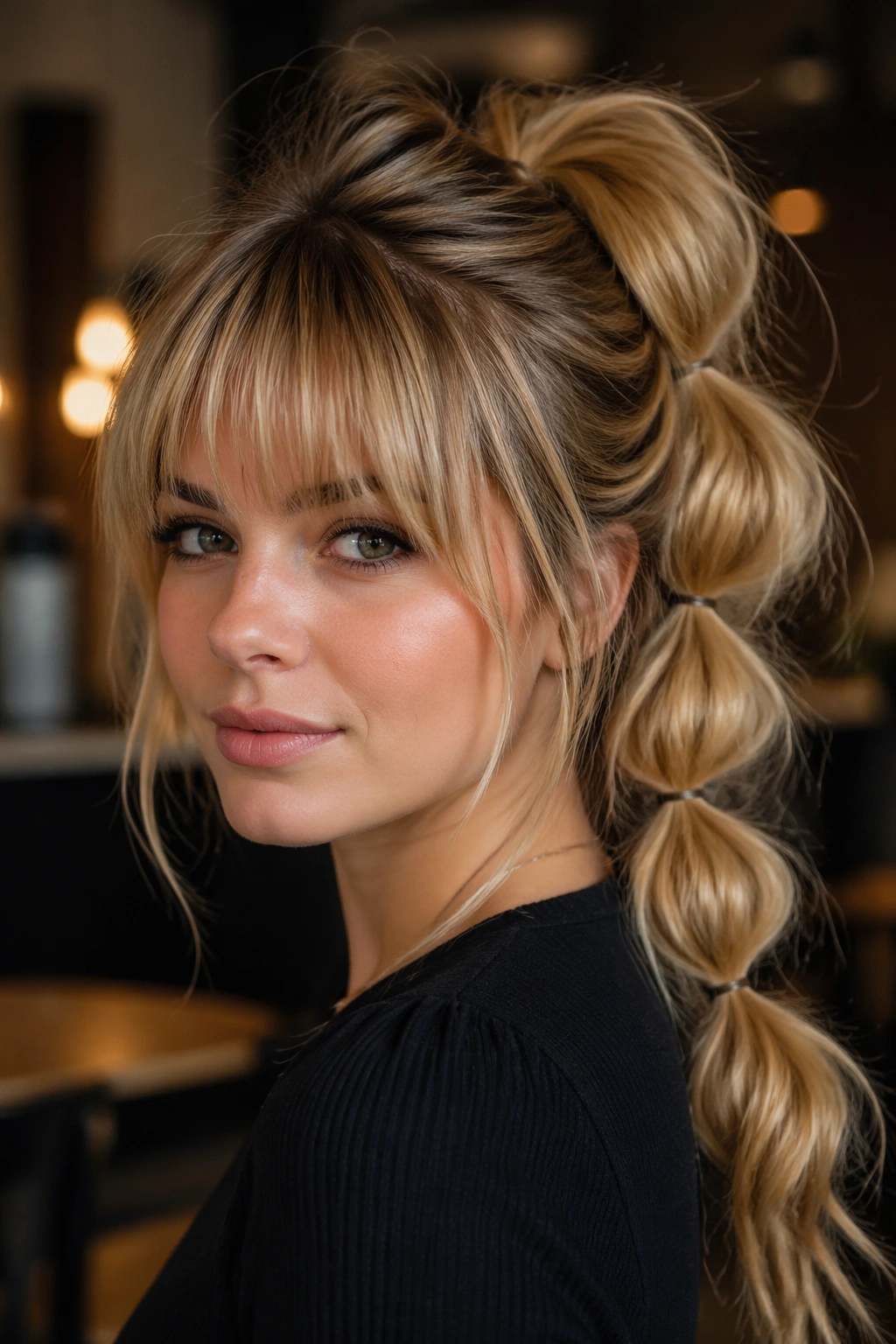
Tucked ends give a ponytail a softer outline. Instead of hanging straight down, the ends fold under or curve inward a little, which makes the whole shape feel rounder and less severe.
Wispy fringe pairs nicely with that because it keeps the front light. The bangs should move easily and stay separated enough that the face does not disappear behind them. If your hair is shoulder length or just past it, this style can also make the ponytail look fuller than it really is.
How to do the tuck
Tie the ponytail low, then loop the lengths back through the elastic only halfway so the ends fold in. You can pin them if needed. It sounds fiddly, but it takes less time than a braid and looks softer than a normal tie.
I like this one for days when I want a finished look that still feels relaxed. The tucked shape keeps it neat enough for work, and the wispy bangs keep it from feeling too fixed.
It is understated in the good sense. Nothing about it is shouting.
29. Retro-Messy Ponytail With Face-Framing Bangs
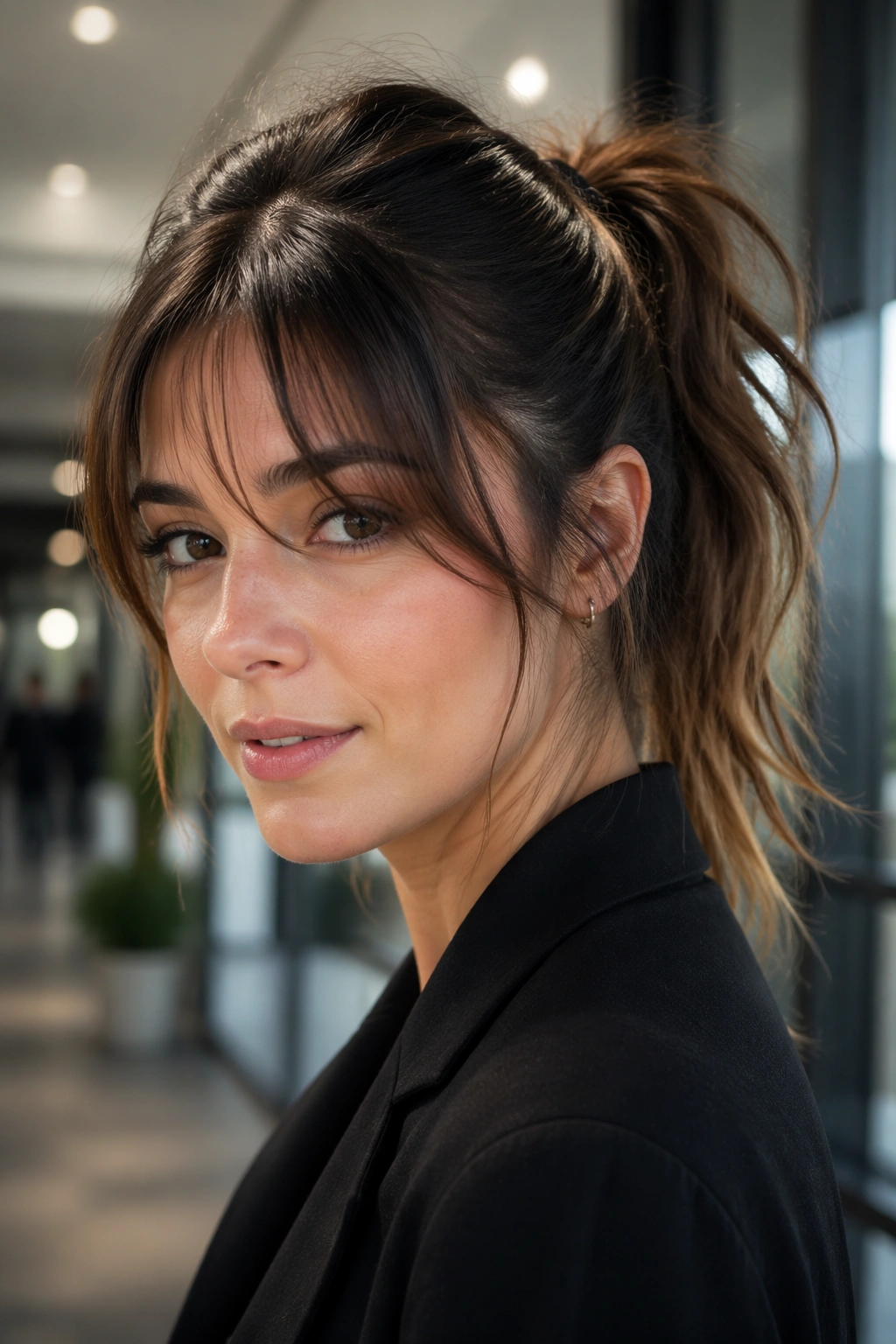
A retro-messy ponytail borrows from old-school glamour without getting precious about it. Think a little height at the crown, a soft bend in the ponytail, and face-framing bangs that sit around the cheekbones instead of locking into one shape.
The retro part comes from the lift and the curve. You do not need a full set of curls. A loose flip at the ends and a bit of volume near the hairline are enough. Face-framing bangs are the anchor, because they keep the style from looking like a costume.
This is the kind of ponytail that works when you want to dress up a simple outfit. A ribbed tank, a button-down, a satin top — all of them hold up well with this shape. The hair carries just enough attitude.
A fine mist of shine spray on the ponytail ends helps, but keep the roots matte enough that the crown still has body. That contrast is what makes it feel lived in.
30. Soft, Undone Ponytail With Bangs That Fall Naturally
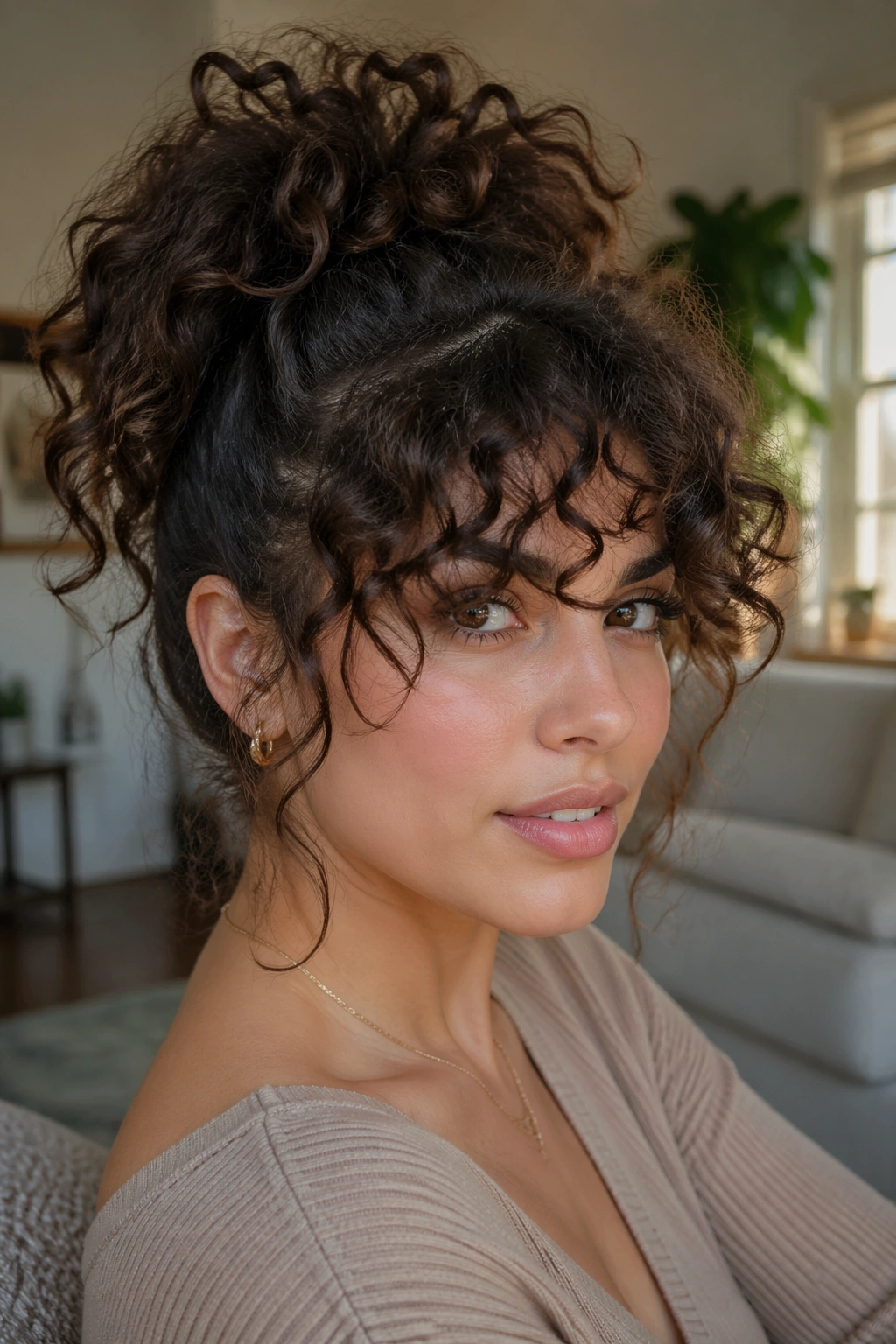
This is the ponytail I keep coming back to. Nothing is too tight, nothing is too perfect, and the bangs fall where they want to fall — which, honestly, is often the prettiest choice anyway.
The ponytail sits somewhere in the middle of the head, not so high that it feels sporty and not so low that it disappears. The bangs can be curtain, wispy, or a grown-out fringe that has stopped behaving like a bang and started acting like a face frame. That looseness is the point. You are not trying to force a shape that the hair does not want.
A little dry shampoo at the roots, a finger twist through the front pieces, and a soft tie at the base are enough. If one side sits lower than the other, leave it. If a few ends stick out, leave those too. The look gets its charm from the parts that are not perfectly lined up.
That is probably why messy ponytails with bangs stay useful for so many hair types. They forgive a lot. And on most mornings, that is the part I appreciate most.
