



A wedding ponytail on long hair can look sharper than a lot of formal updos, and that surprises people the first time they see it done well. Long hair gives you length, yes, but it also gives you weight, swing, and a little drama at the ends. A ponytail uses all of that instead of fighting it.
The trick is balance. Pull too tight, and the face starts to look stern. Leave too much loose, and the whole style slides into “just gathered it back” territory. The sweet spot sits somewhere between sculpted and soft, with a base that’s secure and an end that still moves when you turn your head.
That’s where wedding ponytails for long hair get interesting. They can be clean and polished, braided and romantic, glossy and modern, or full of curls that spill down the back of the dress. The neckline matters. So does the veil. So does whether you want your earrings to do the talking or your hair to carry the look.
What follows leans into that range. Some of these styles are quiet and minimal. Others ask for pins, ribbons, pearls, or a little extra time in the chair. All of them work because they use long hair on purpose instead of treating it like something to hide.
1. Sleek Low Ponytail with Center Part
A sleek low ponytail is the style that makes long hair look sharp without trying too hard. The center part gives it symmetry, and the low placement keeps the shape calm enough for a ceremony, not a red carpet stunt. It’s the kind of bridal ponytail that looks especially good with satin, crepe, or anything with a clean neckline.
Why It Works With a Wedding Dress
The base sits right at the nape, which keeps the profile tidy from the side and back. That matters more than people think. A low ponytail leaves room for a veil comb, big earrings, or a dramatic collarbone line on the dress, and it won’t compete with any of them.
Small Details That Make It Look Intentional
- Smooth the top with a light cream or gel, then brush it flat with a boar bristle brush.
- Wrap a thin strand of hair around the elastic so the tie disappears.
- Keep the ponytail straight or barely curved at the ends for the cleanest line.
- Use a shine spray only on the surface, not at the roots.
Pro tip: If your hair has a lot of volume, blow-dry it in the direction you want it to sit before you ever reach for the elastic. That saves you from fighting puff later.
2. Soft Wave Ponytail with Face-Framing Strands
Can a ponytail feel soft enough for a wedding? Absolutely, if the movement starts below the cheekbone and the front pieces are left with a little bend. This version works best when the waves are loose, not curled into perfect ringlets. You want motion, not a pageant finish.
The face-framing strands do a lot of work here. They break up the shape around the jaw, which is useful if the dress has bare shoulders or a very open neckline. I like this style on long hair because the length in the tail gives the waves somewhere to go. They don’t get stuck in a short puff at the back.
A 1 to 1¼-inch curling iron is enough. Curl away from the face, brush the waves apart with fingers, and keep the ponytail low or mid-low so the style still reads bridal instead of casual. The result is relaxed, but not messy. That distinction matters.
3. Braided Crown into a Low Ponytail
A braided crown into a ponytail is the one I’d pick for a bride who wants structure but doesn’t want the back of her head to feel heavy. A thin braid running along the hairline gives the style shape at the front, then the long tail keeps it from feeling too precious.
Where the Braid Should Sit
The braid should live close to the temple and hairline, not high on the crown unless you want a more boho look. When it sits lower and wraps back into the ponytail, the effect is neater. It also keeps flyaways under control, which is a gift on a long day.
A few details make this one hold up:
- Braid each side loosely, then pin them back with crossed bobby pins.
- Use a low ponytail base at the nape so the braid feeds into it naturally.
- Curl the tail in large sections if you want a softer finish.
- Leave the braid slightly imperfect. Too tight and it can look stiff.
This style is strongest with lace, chiffon, and garden-leaning dresses. It has a little texture, but not so much that the eye gets lost in it.
4. Bubble Ponytail with Satin Ribbon
Unlike loose curls that can slump if the air is heavy or the night runs long, a bubble ponytail keeps its shape by design. That’s the whole appeal. Each section is tied off into rounded puffs, so the style looks deliberate from every angle.
The satin ribbon softens the structure. Tie it at the base, or let it trail down one side if the dress has simple lines and you want the hair to carry a bit of visual interest. Long hair is a gift here because the bubbles need length to read clearly. If the tail is too short, the shape gets lost.
Keep the bubbles about 2½ to 3 inches apart. That spacing looks balanced on most long lengths. Clear elastics work best if you want the focus on the shape, not the bands. A ribbon in ivory, blush, or deep champagne can pull the whole look together without making it fussy.
5. Wrapped High Ponytail with Polished Base
Can a high ponytail feel formal enough for a wedding? Yes — if the crown is smooth, the lift is controlled, and the base looks like it was planned, not rushed. This is not the place for a loose elastic and a quick flip of hair.
The height does the flattering work. It lifts the face, gives long hair a cleaner line, and keeps the profile lively when you turn your head. That makes it especially good for strapless gowns, sharp necklines, and dresses with a lot of detail at the shoulders.
How to Keep It Bridal, Not Casual
Use a fine comb to smooth the sides toward the crown. Add a touch of backcombing only at the top, not through the whole head. Then wrap a thick strand of hair around the elastic so the base looks clean from every angle.
A high ponytail like this can handle a veil, but the placement has to be planned. The comb usually sits lower than people expect. If you place it too high, the veil starts to fight the tail.
6. Textured Low Ponytail with Soft Tendrils
This is the ponytail for a bride who wants her hair to look touched, not stiff. The texture lives through the mid-lengths and ends, where a few bends and bends-back sections keep the style from flattening out. Around the face, a couple of soft tendrils stop the whole thing from feeling severe.
The best part is the ease of it. You can rough-dry the roots with a little mousse, then add shape with a curling wand in random sections. Don’t make every wave the same size. That sameness is what makes some ponytails look overworked.
This style works beautifully with lace, tulle, and dresses that already have a lot going on up top. It also works when the earrings are small and the neckline needs a quieter partner. The ponytail doesn’t have to be dramatic to feel bridal. Sometimes it just needs to move well when the bride walks.
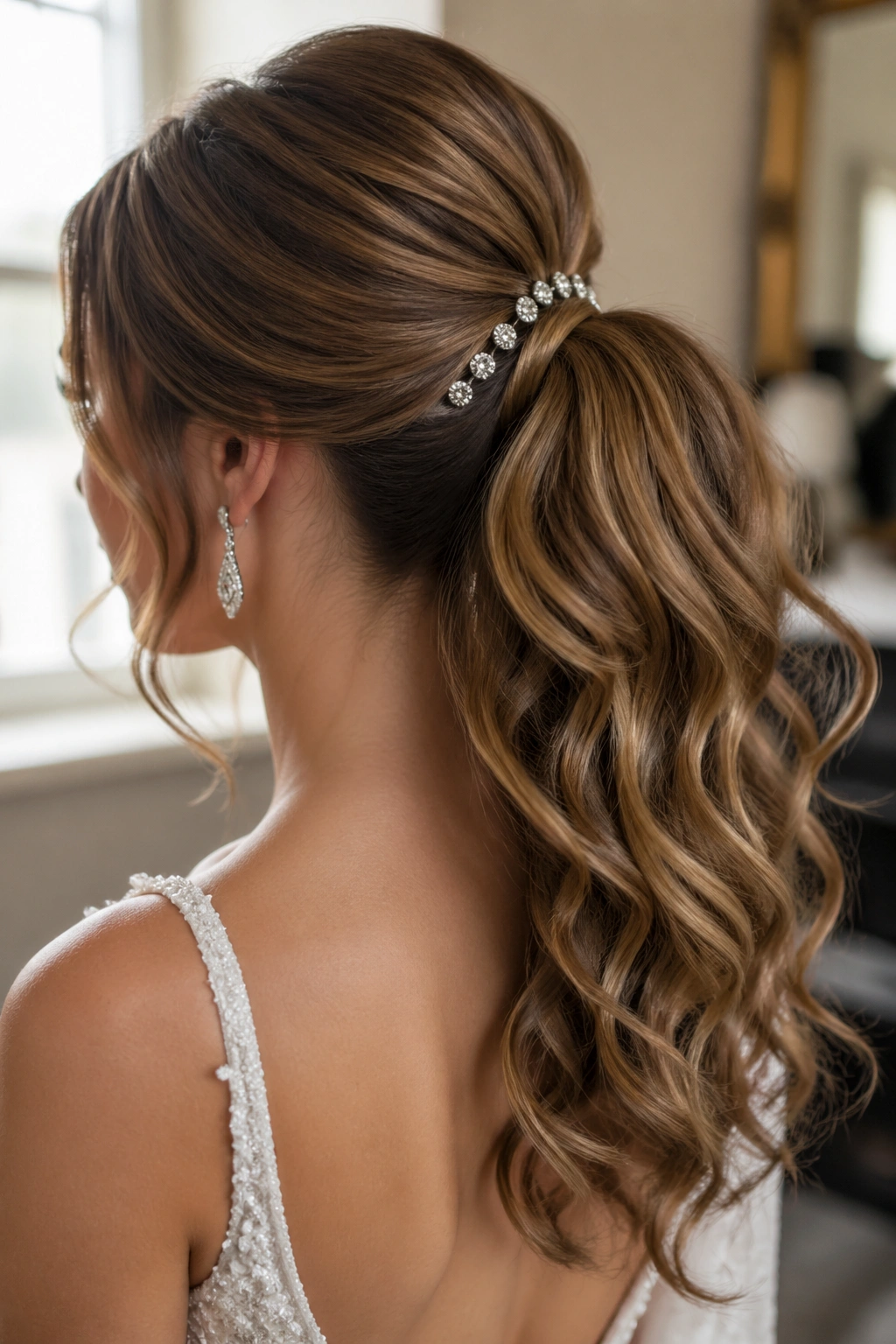
7. Curled Ponytail with Crystal Pins
A row of crystal pins near the base does more than sparkle. It gives the ponytail a focal point, which keeps the whole style from reading plain, especially in photos taken from the back. On long hair, the curls can carry the rest.
Where to Place the Pins
Put the pins just above the elastic and angle them slightly upward so they catch the curve of the head. One tight cluster looks better than scattering them everywhere. Too many tiny sparkles can turn into visual clutter fast.
- Use 5 to 7 pins if the hair is thick and the base is broad.
- Keep the curls large and soft so the crystal details stand out.
- Place pins on one side if you want a slight asymmetry.
- Choose pins with small stones, not oversized shapes that snag the hair.
I like this look for brides who want a little shine without wearing a full jeweled comb. It feels festive, but the tail still gets to stay long and loose.
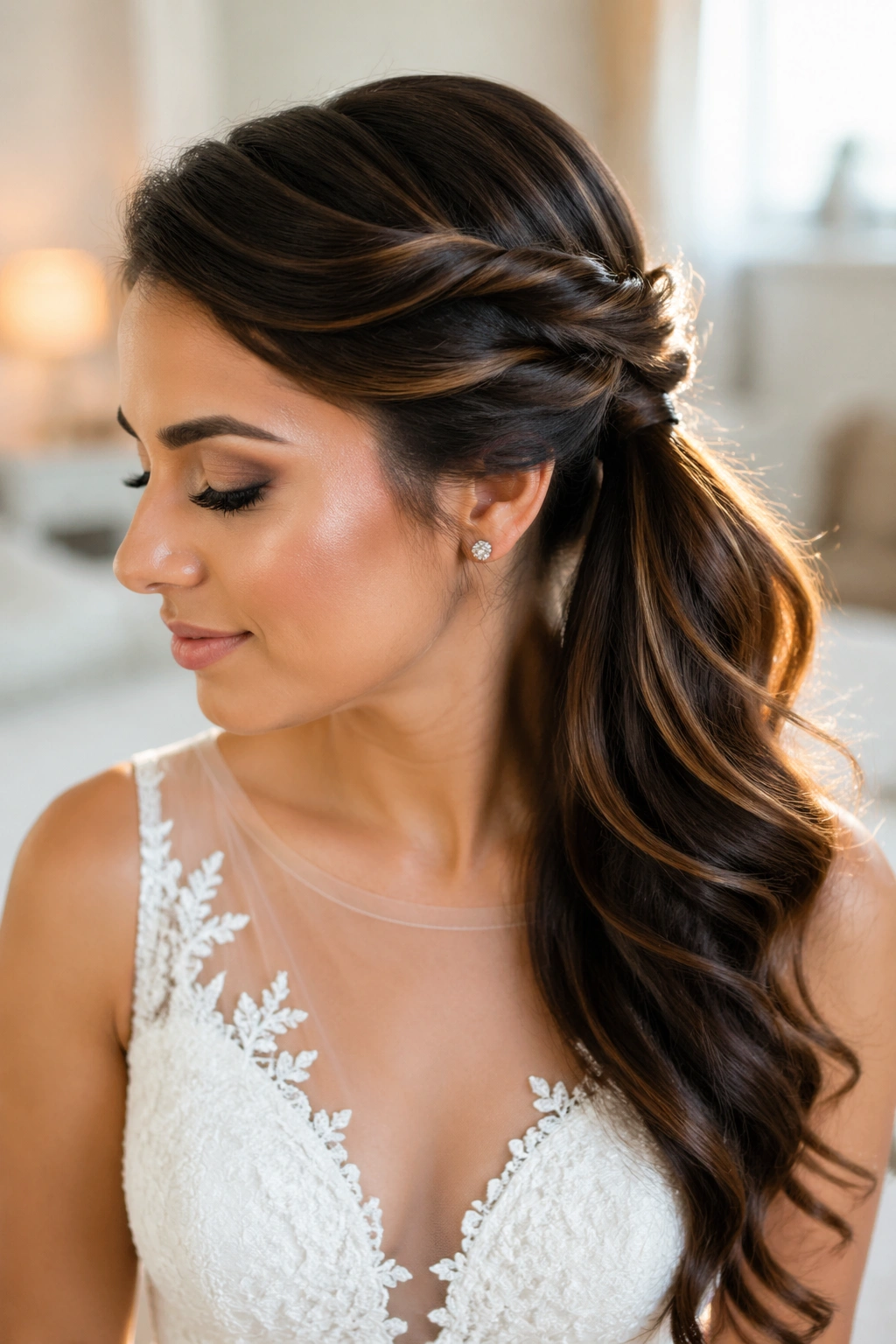
8. Twisted Side Ponytail
A side ponytail quietly changes the whole mood. It moves the hair off-center, which is useful when the dress has one shoulder, a diagonal neckline, or long earrings that deserve space. The asymmetry softens a square jaw and makes long hair feel more styled without much extra weight.
The best version starts with two twisted sections pulled from the temple area and tucked toward one side. That keeps the front controlled while still leaving enough softness around the face. If the ponytail sits low and slightly behind one ear, the shape feels romantic rather than playful.
This is also a smart choice for brides who don’t want a braid but still want detail. The twist gives the style texture without turning the back into a busy pattern. Keep the tail brushed out or lightly waved. Either works. What matters is the side sweep.
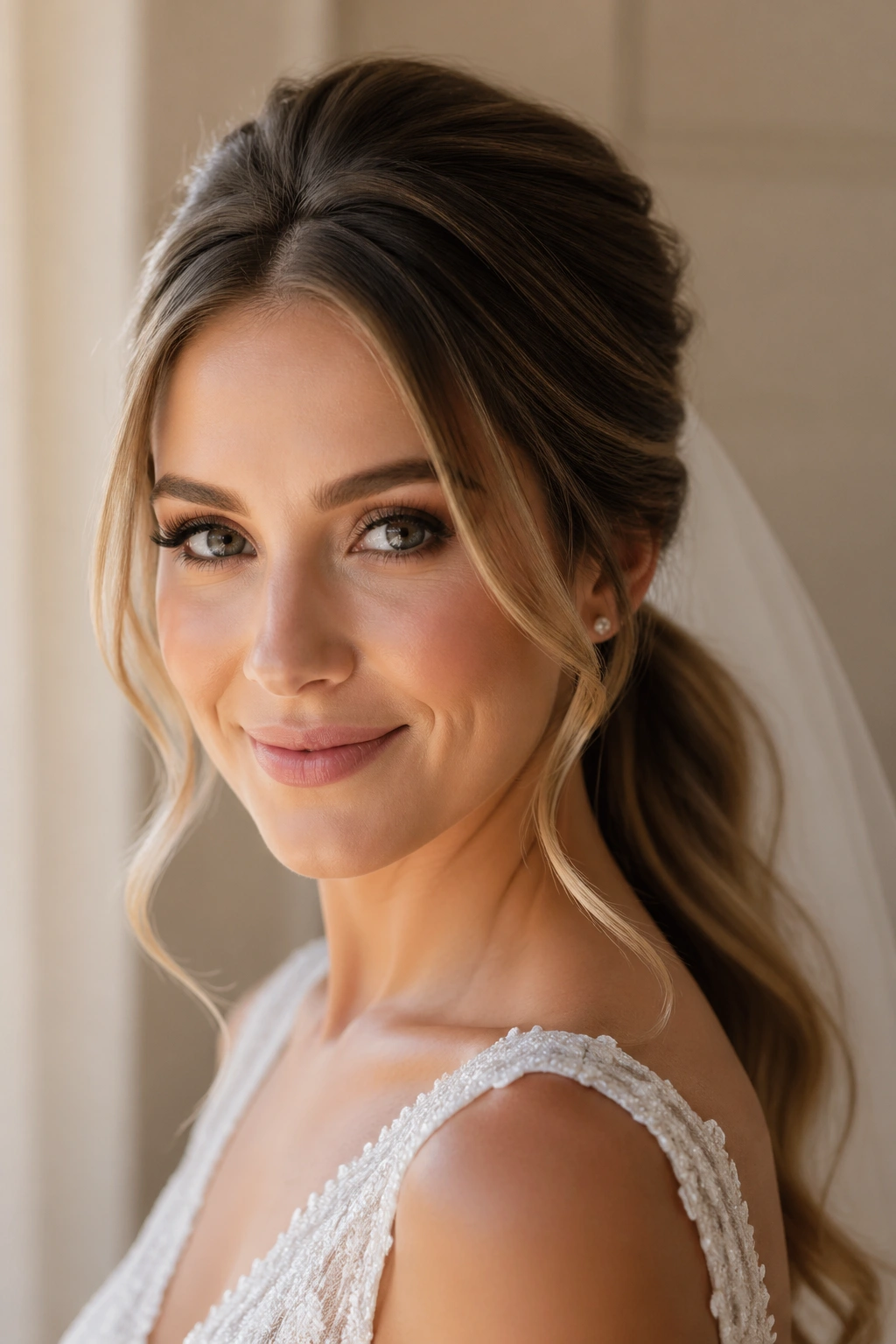
9. Low Ponytail with Voluminous Crown
Want height without a full updo? This is the one. A low ponytail with a lifted crown gives you the softness of a ponytail and the presence of a style that photographs from the front with a little more shape.
The Crown Is the Point
The crown only needs a narrow band of lift, about an inch or so deep. You’re not building a big tease job here. Just enough root volume to keep the top from lying flat against the head. Smooth the outer layer over it, and the style stays polished.
This version works well with veils because the low base leaves room for the comb, while the crown gives the head shape even after the veil comes off. Brides with longer faces often like this one because the added height balances the length without making the hair look piled up.
A soft wave through the tail helps connect the top and bottom. If the tail is dead straight, the crown can feel detached. A little bend makes the whole thing read as one style.
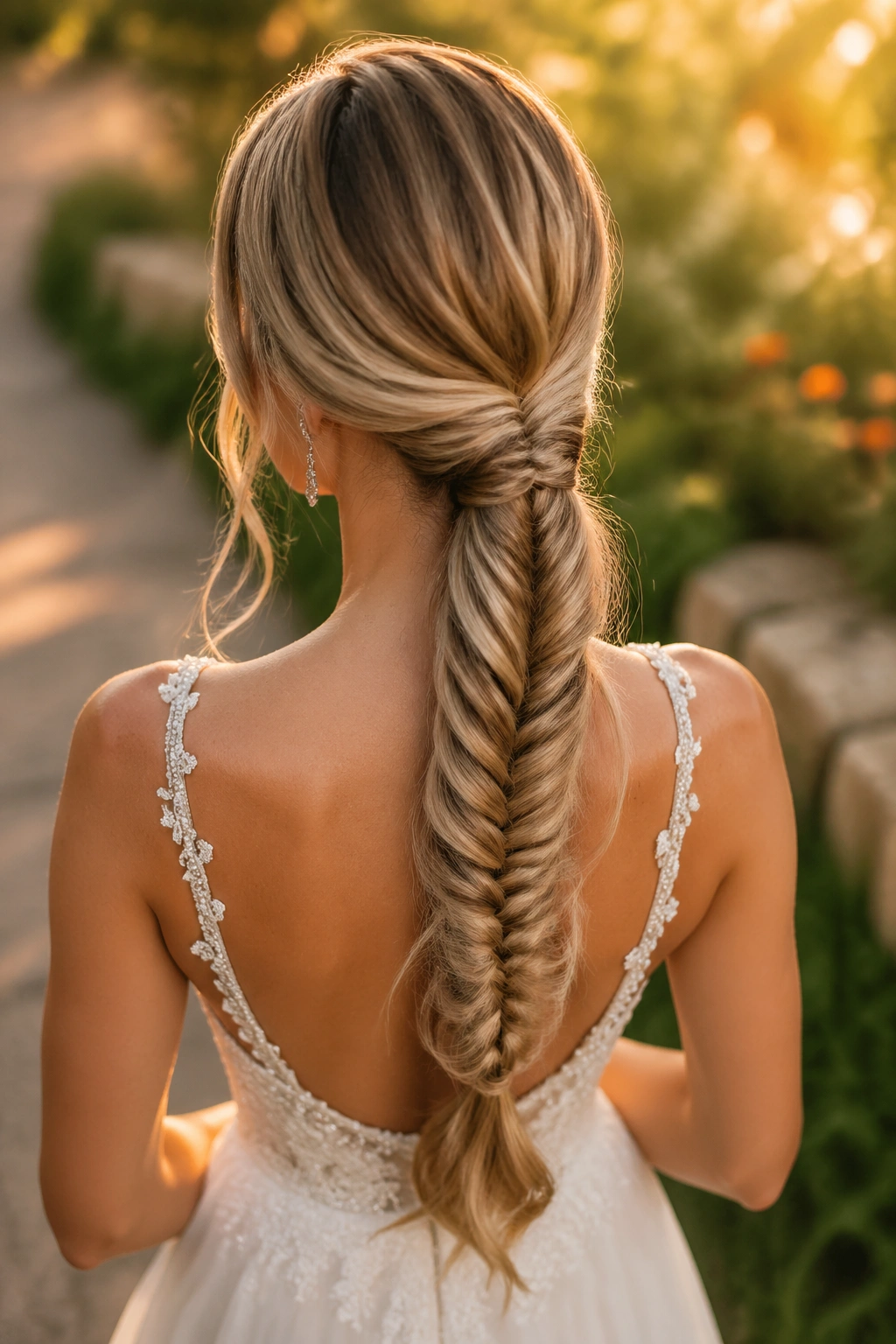
10. Fishtail-Braided Ponytail
A fishtail-braided ponytail has a tighter, woven look that suits long hair better than most braids do. The braid shows off the length by breaking it into tiny sections, and that texture looks especially good when the hair is very full.
Picture the tail from the back: neat at the top, then more intricate as it drops. That’s why it works. The eye follows the pattern all the way down, which keeps the long length from feeling heavy.
Quick Things to Watch For
- Start the fishtail below the elastic if you want a cleaner bridal base.
- Keep the braid slightly loosened after finishing so it doesn’t look ropey.
- Use a styling balm on the ends if the hair gets fuzzy after braiding.
- Finish with a clear elastic and hide it under a wrapped strand.
This style is lovely with bohemian dresses, but it can also work with something very simple. In that case, the braid becomes the detail. Nothing else needs to compete with it.
11. Sleek Ponytail with Dramatic Bow
A large bow can do more work than extra curls ever will. It changes the silhouette fast, and on long hair it gives the ponytail a clear finish point instead of letting the style trail off without purpose.
The cleanest version starts with a tight, glossy base and one strong bow placed right over the elastic. Satin feels formal. Velvet feels richer and a bit heavier. Either one works if the dress itself is simple enough to let the accessory speak.
The key is restraint everywhere else. Keep the tail smooth, or very lightly waved, and avoid piling on pins near the bow. The point is one strong gesture. If the bow is wide — say 8 to 12 inches — it should be the star. Anything else starts to look crowded.
This is a good pick for brides who like a fashion-forward shape but still want the hair pulled back. It feels clean from the front and memorable from the back, which is a nice balance.
12. Wavy Ponytail with Pearl Details
Pearls work best when they’re used like punctuation, not decoration sprayed everywhere. A few pearl pins near the base or along one side of a wavy ponytail can change the mood of the style without making it heavy.
Long hair gives the waves somewhere to fall, which keeps the pearls from disappearing into the shape. I like this look with soft, brushed-out waves rather than tighter curls. The curve of each wave gives the pearls a little frame.
Keep the placement simple. Three pins on one side can be enough. If you use a pearl strand, let it sit just above the elastic or drape lightly over the top layer of the tail. The goal is balance, not shine for its own sake. This ponytail feels especially right with satin dresses, square necklines, and gowns that already have a gentle, polished mood.
13. Messy Textured Ponytail with Soft Volume
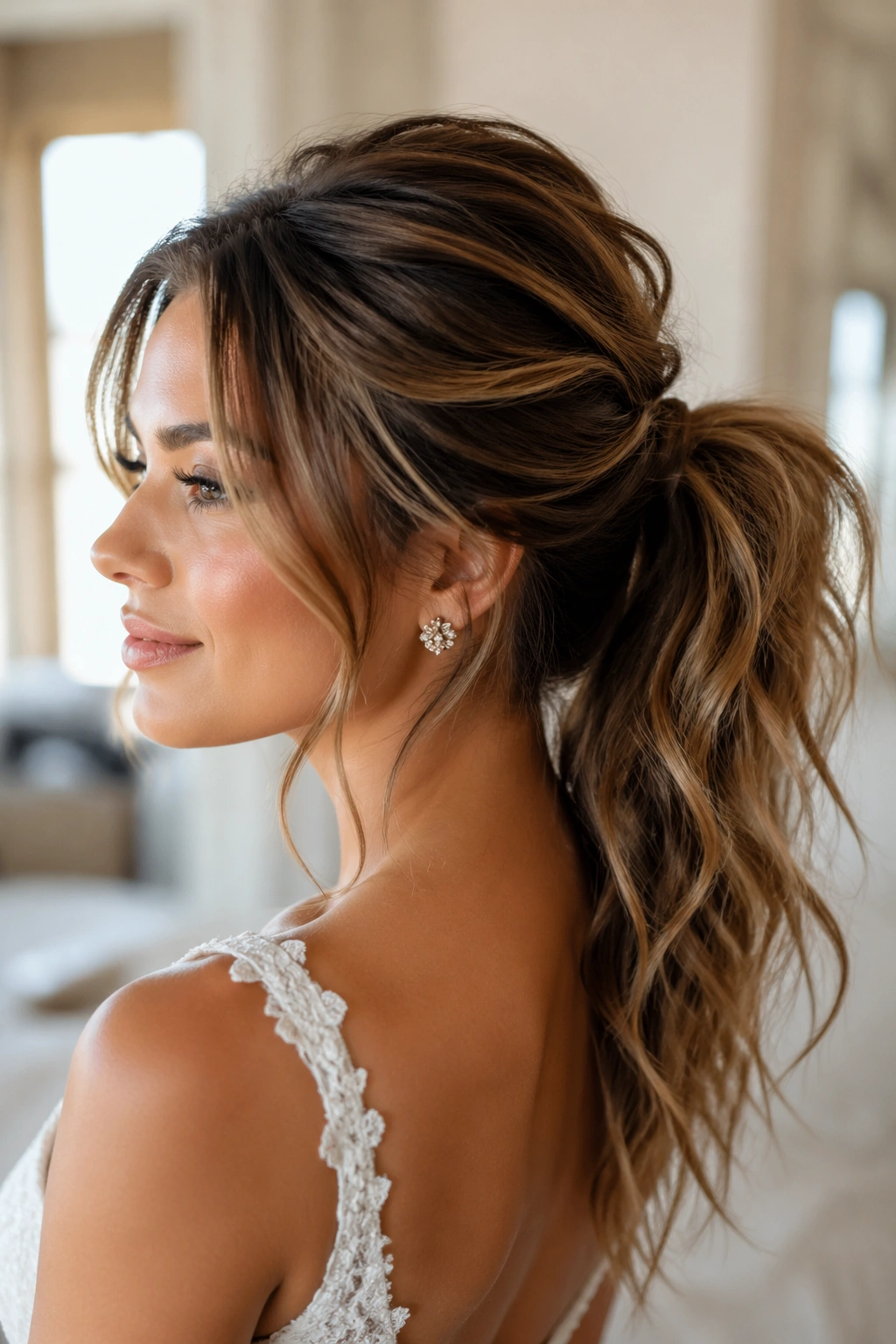
How messy is messy enough? Enough to show movement, not so much that the style looks forgotten. That’s the line with this ponytail. The shape should feel loose around the crown, airy through the tail, and intentional all the way through.
Start by rough-drying the roots, then add bends with a 1-inch iron in random sections. Don’t curl every piece in the same direction. That sameness flattens the style fast. A little root lift keeps the head shape from collapsing once the ponytail is tied.
This one suits dresses with lace, soft tulle, or a very relaxed silhouette. It also holds up well when the bride wants a less polished finish that still looks clean in person. The trick is to stop before it becomes frizz. If you can see texture, great. If you can see a halo of flyaways, keep going with a light smoothing cream.
14. Rope-Braid Ponytail
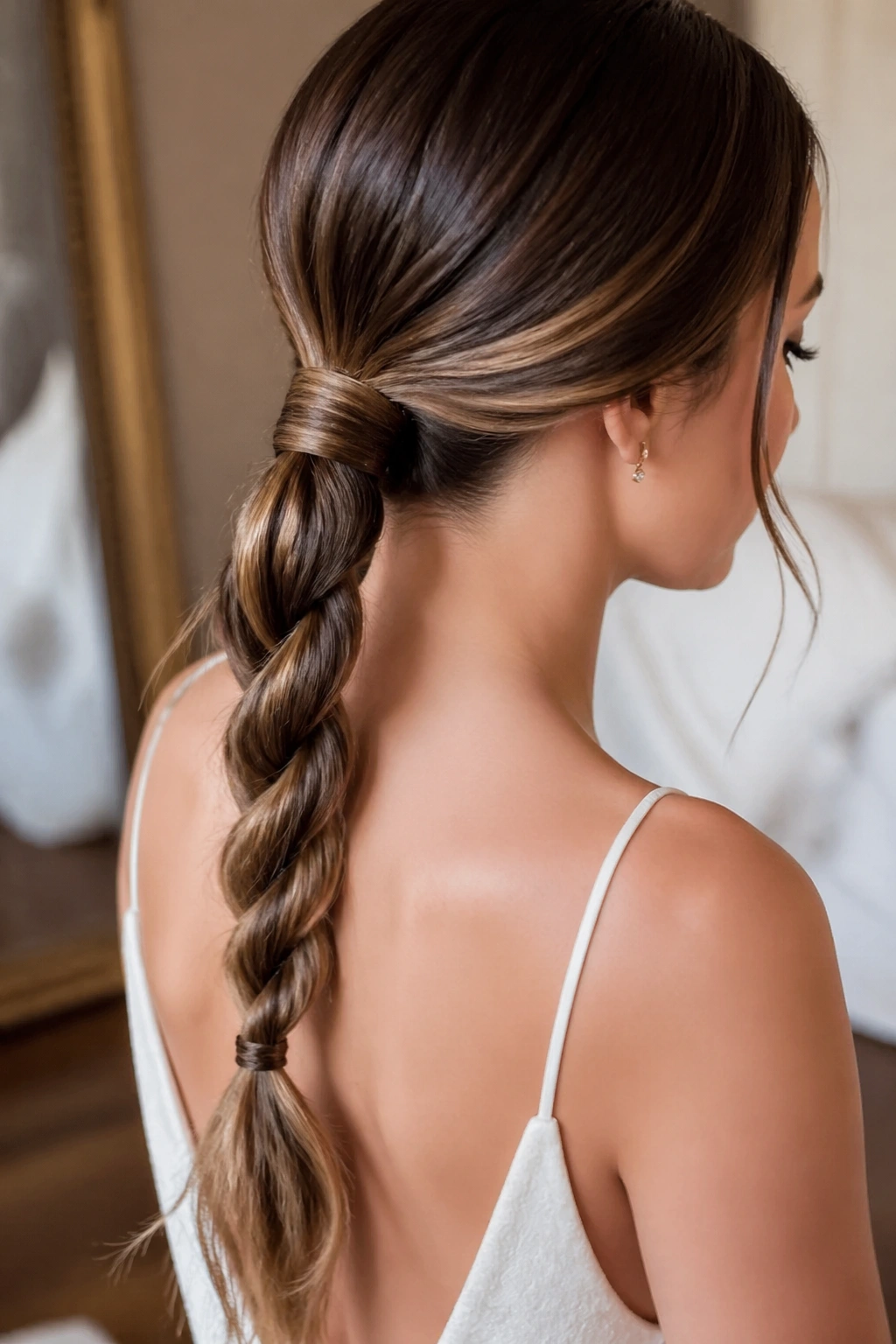
A rope-braid ponytail feels cleaner than a full braid and faster to build on long hair. You divide the tail into two sections, twist them in the same direction, then wrap them around each other in the opposite direction. That creates a rope-like finish that holds neatly and looks sharper than it sounds.
Unlike a fishtail braid, which can take a while on very long hair, the rope braid moves quickly. It also gives a smoother line, which is useful when the dress already has lace, beading, or a lot of surface detail. You don’t want the hair fighting the dress.
This style works best when the twist is a little loose. If you pull it too tight, it loses the softness that makes it suitable for a wedding. A wrapped elastic at the base keeps the start clean, and a small shine cream on the ends helps the braid look finished rather than dry.
15. Glam Ponytail with Deep Side Part
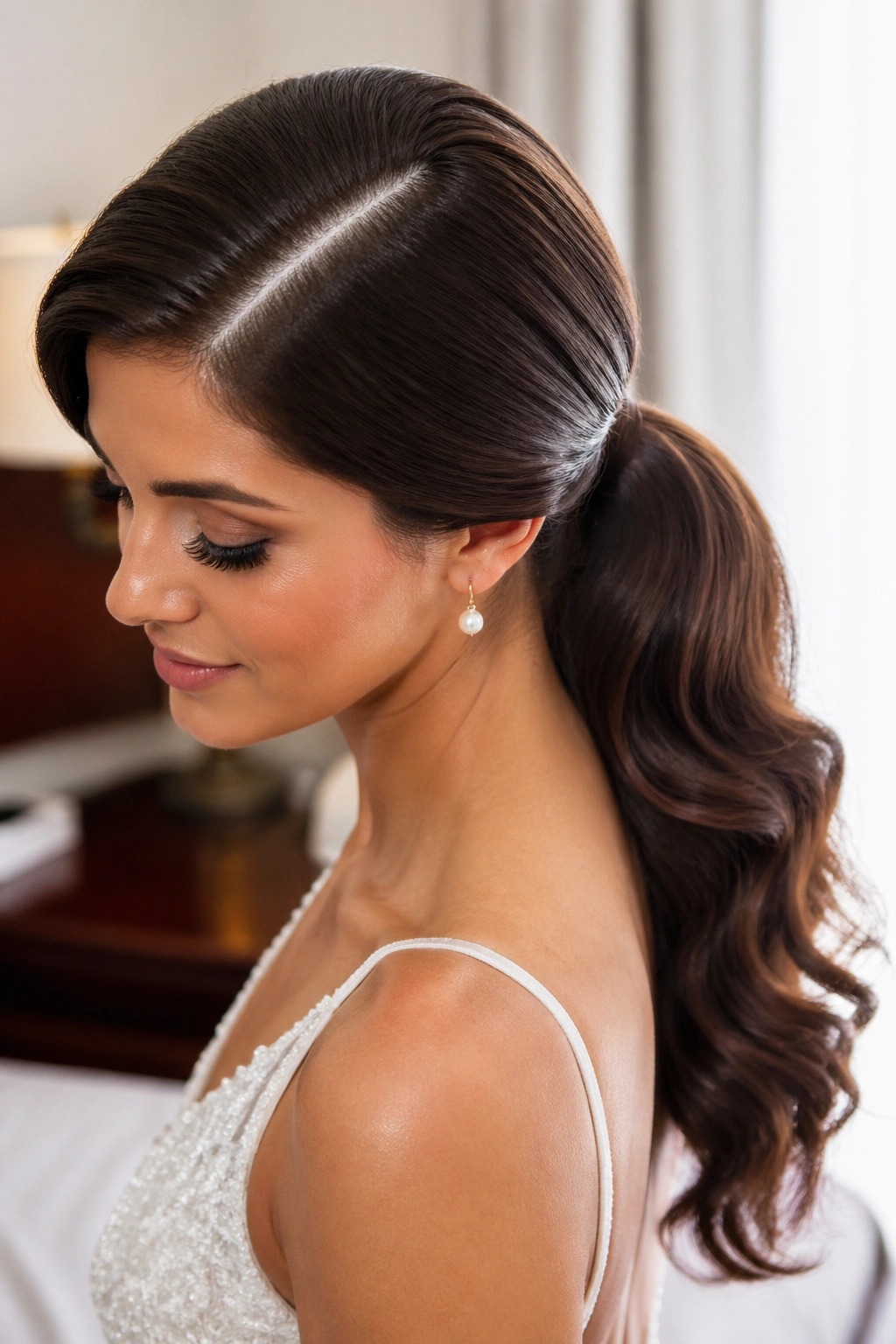
A deep side part changes the whole mood of long hair. It adds drama before the ponytail even starts, which is why this style feels so strong with formal gowns and strong makeup. The sweep across the forehead gives the face a more sculpted shape.
The ponytail itself can be low or mid-low, but the front should stay glossy and controlled. A deep part also creates a natural place for one ear to show, which is handy if the earrings are part of the look. Chandelier styles, long drops, or slim metallic pieces all sit nicely here.
Keep the tail soft but smooth. A few large waves in the lengths are enough. If you make the tail too curly, the head shape and the end shape start competing. This style works best when the top is sleek and the length has a little movement. The contrast is what gives it its punch.
16. Bridal Ponytail with Veil-Friendly Base
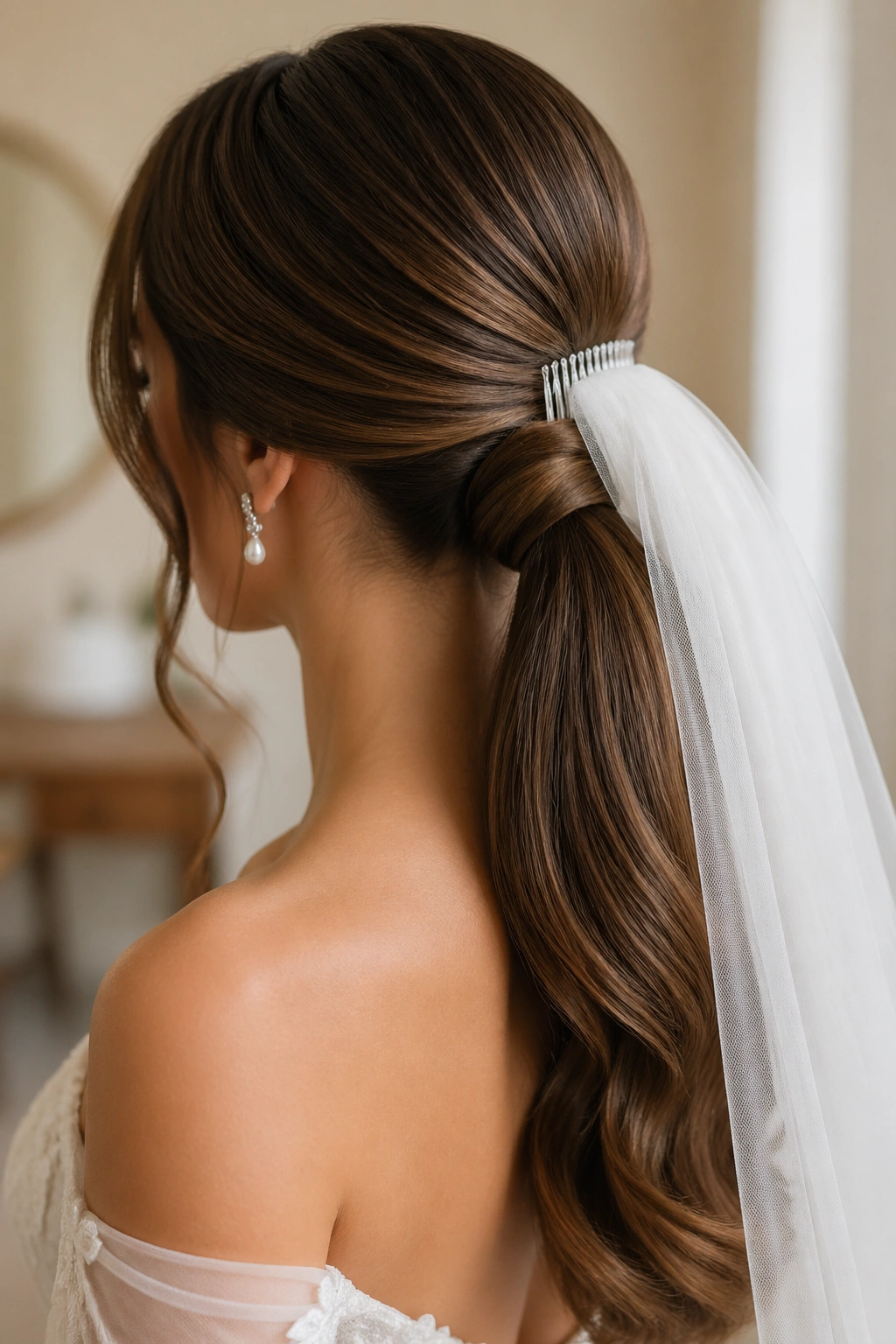
The smartest thing about this ponytail is where it leaves room for the veil. A low, well-anchored base means the comb can sit securely without fighting the hair, and the veil can be removed later without wrecking the style.
Where the Veil Comb Should Go
If the veil is heavy, the comb usually sits just above the elastic so the weight spreads across a stable area. If the veil is light, it can tuck a little lower, as long as the ponytail isn’t dragging on it. The exact placement matters more than people think. Bad placement is what makes veil removal turn into a small disaster.
The rest of the style should stay calm. Smooth sides, a neat wrap around the elastic, and a tail that’s long enough to feel elegant from behind. This is a good choice for brides who want to wear the veil for the ceremony and still have a ponytail that looks good after it comes off. That’s the whole point, really.
17. Low Knot-Tail Ponytail
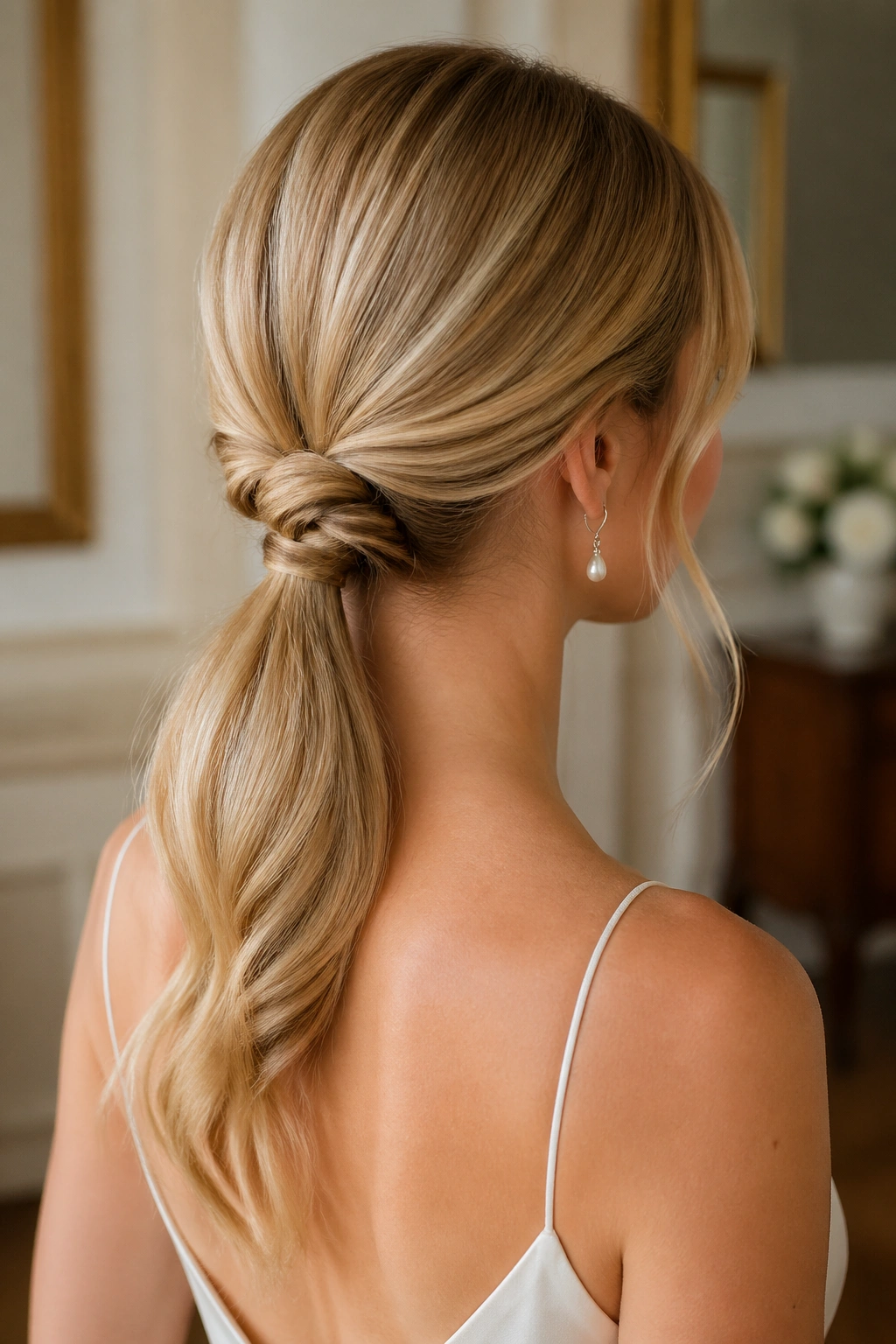
A knot-tail is a ponytail dressed up as a knot. That sounds simple because it is, but the effect is cleaner than a lot of more complicated shapes. The hair gathers low, gets looped or tied in a knot-like wrap, and then the ends fall through with a polished finish.
The style sits nicely with minimalist dresses and strong fabrics like mikado or silk. It has enough structure to feel formal, but it doesn’t crowd the neckline. Long hair helps here because the extra length makes the knot shape more convincing. Shorter tails can look like they ran out of material halfway through.
I like this one when the bride wants something slightly different from a standard ponytail without drifting into full chignon territory. It reads neat from the back, and from the side it has a tidy, tucked shape that feels calm. The look is subtle. That’s the charm.
18. Bubble Ponytail with Metallic Cuffs
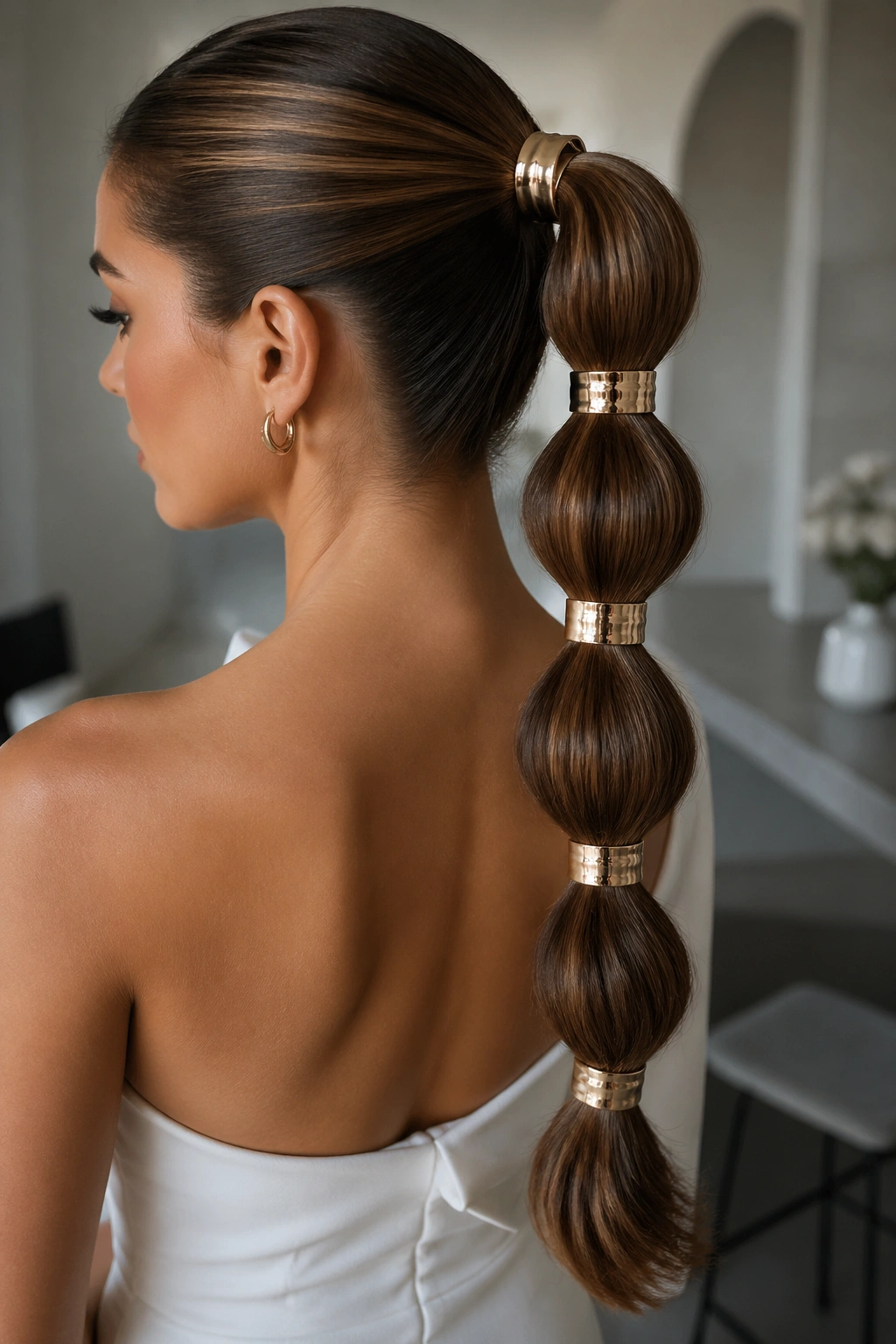
If a ribbon feels too soft, metal cuffs bring structure. A bubble ponytail with metallic cuffs has a cleaner, more modern edge, and the cuffs make each section look deliberate instead of playful. That shift changes the whole tone.
Use 3 to 5 cuffs depending on the length of the tail. Long hair can handle more spacing, while medium-long hair often looks best with fewer, slightly larger bubbles. Keep the elastics hidden under the cuffs if possible. The less you see of the mechanics, the better the finish.
This style works well with dresses that are simple, geometric, or a little architectural. It also looks good with straight hair, because the crisp line makes the cuffs stand out. If you want the ponytail to feel tailored instead of sweet, this is one of the sharper options on the list.
19. Braided Ponytail with Flower Accents
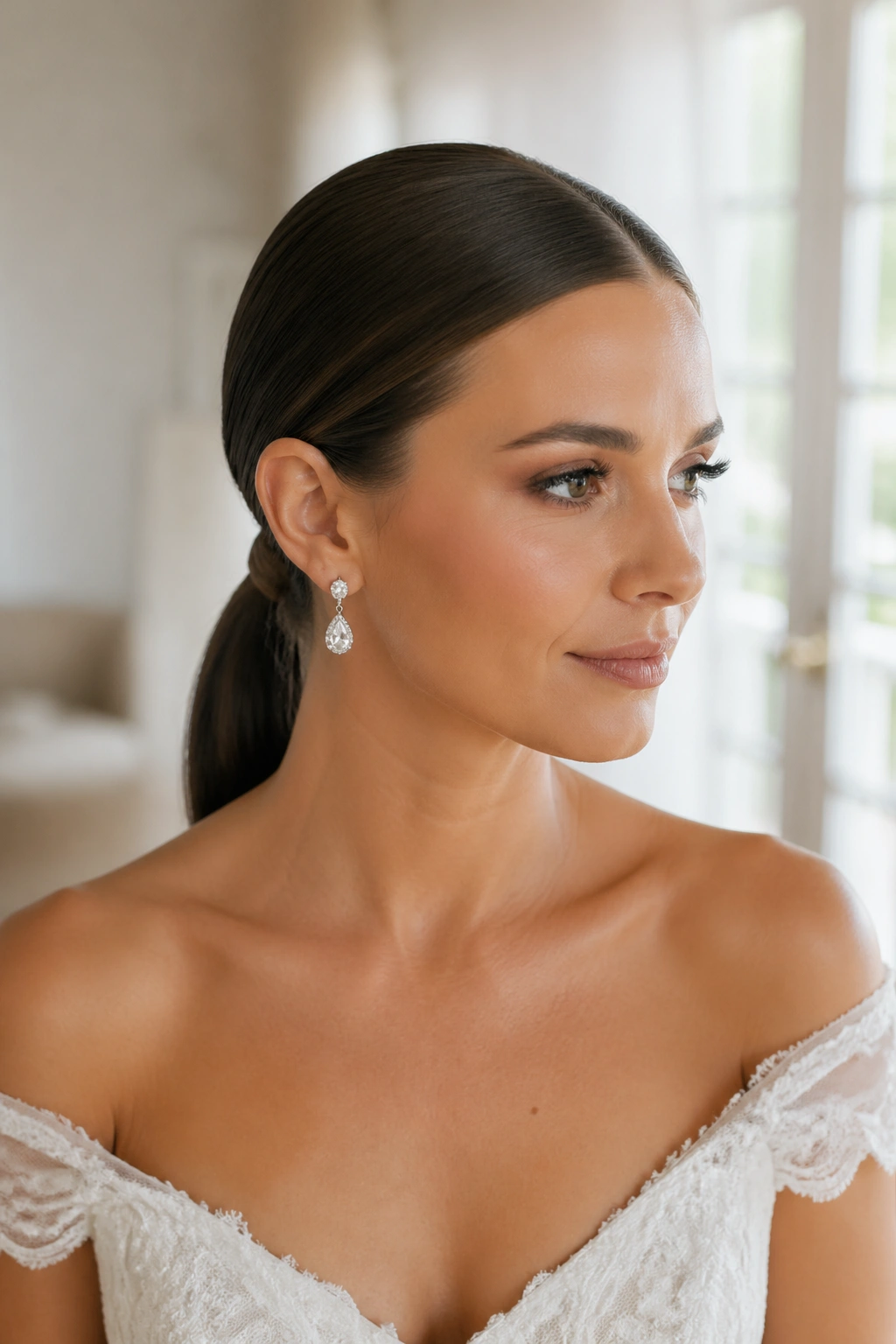
Flowers can make a braided ponytail look like it belongs at a ceremony instead of a brunch. The trick is to use them in a way that follows the braid instead of sitting on top of it like afterthoughts.
Fresh flowers need support, so tiny water tubes or careful pinning matter if you’re using real blooms. Silk flowers are easier and usually lighter, which makes them friendlier for long hair. Place the flowers close to the braid or near the base so they look attached to the shape, not floating near it.
This is a lovely choice for garden settings, outdoor vows, and dresses with softer fabric. A braid already gives the ponytail a little rhythm. The flowers just finish the sentence. Too many blooms, though, and the hair starts to disappear. Three to five small accents are usually enough.
20. Soft Side-Swept Ponytail
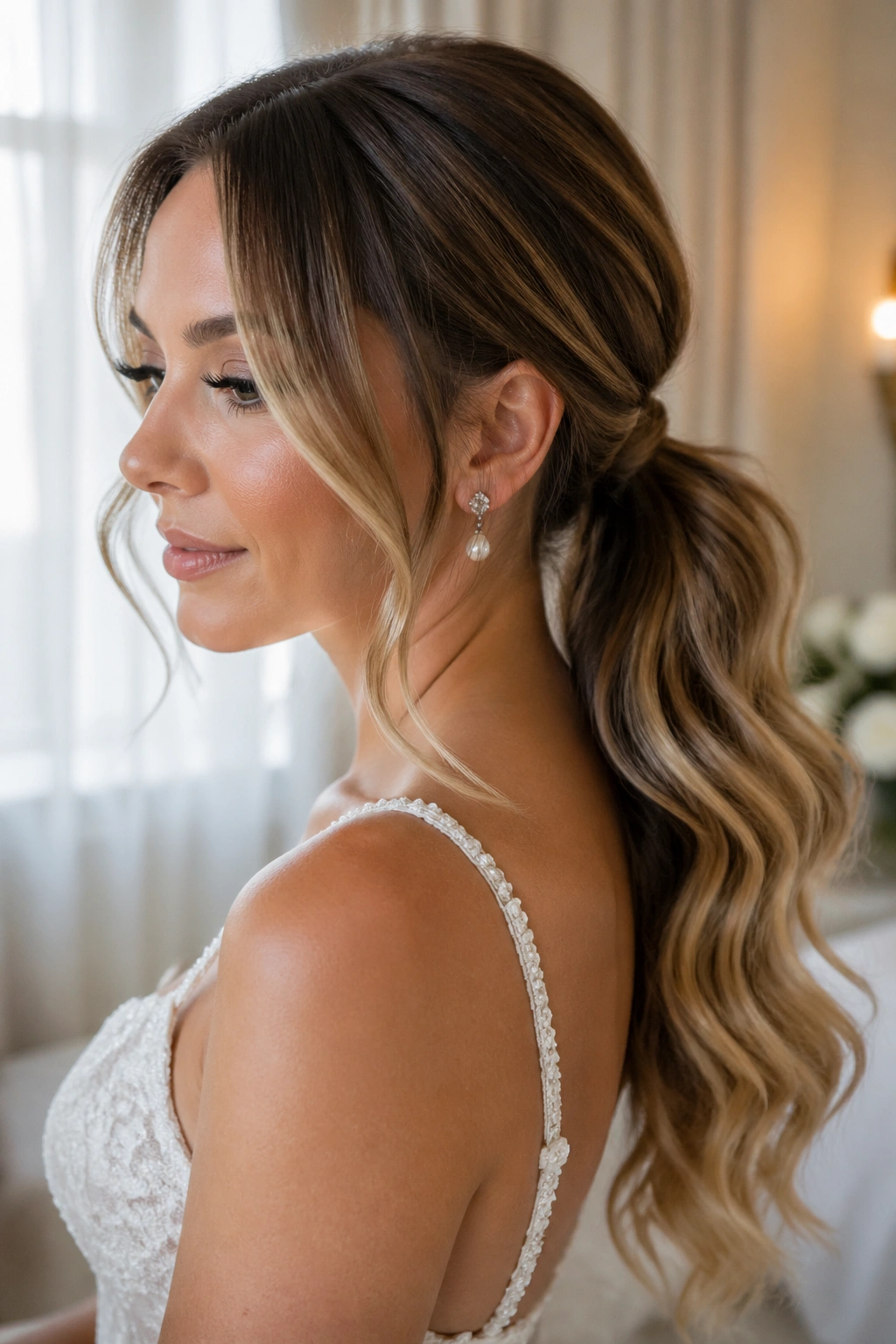
A side-swept ponytail is one of the easiest ways to flatter a jawline. Moving the hair off-center softens the face, and the side placement gives the style a little movement even before the tail starts to wave.
This version works especially well with one-shoulder gowns, asymmetrical necklines, and earrings that need room. The ponytail doesn’t have to sit far to the side. Even a small shift changes the line of the face and the back of the dress. That little shift matters.
Keep the sweep soft around the temples and slightly fuller at the crown. Then let the tail fall in brushed waves or straight with a bend at the ends. I’d choose this for a bride who wants something pretty but not precious. It has shape, but it doesn’t feel fussy. That’s a useful thing on a long day.
21. High Ponytail with Hollywood Waves
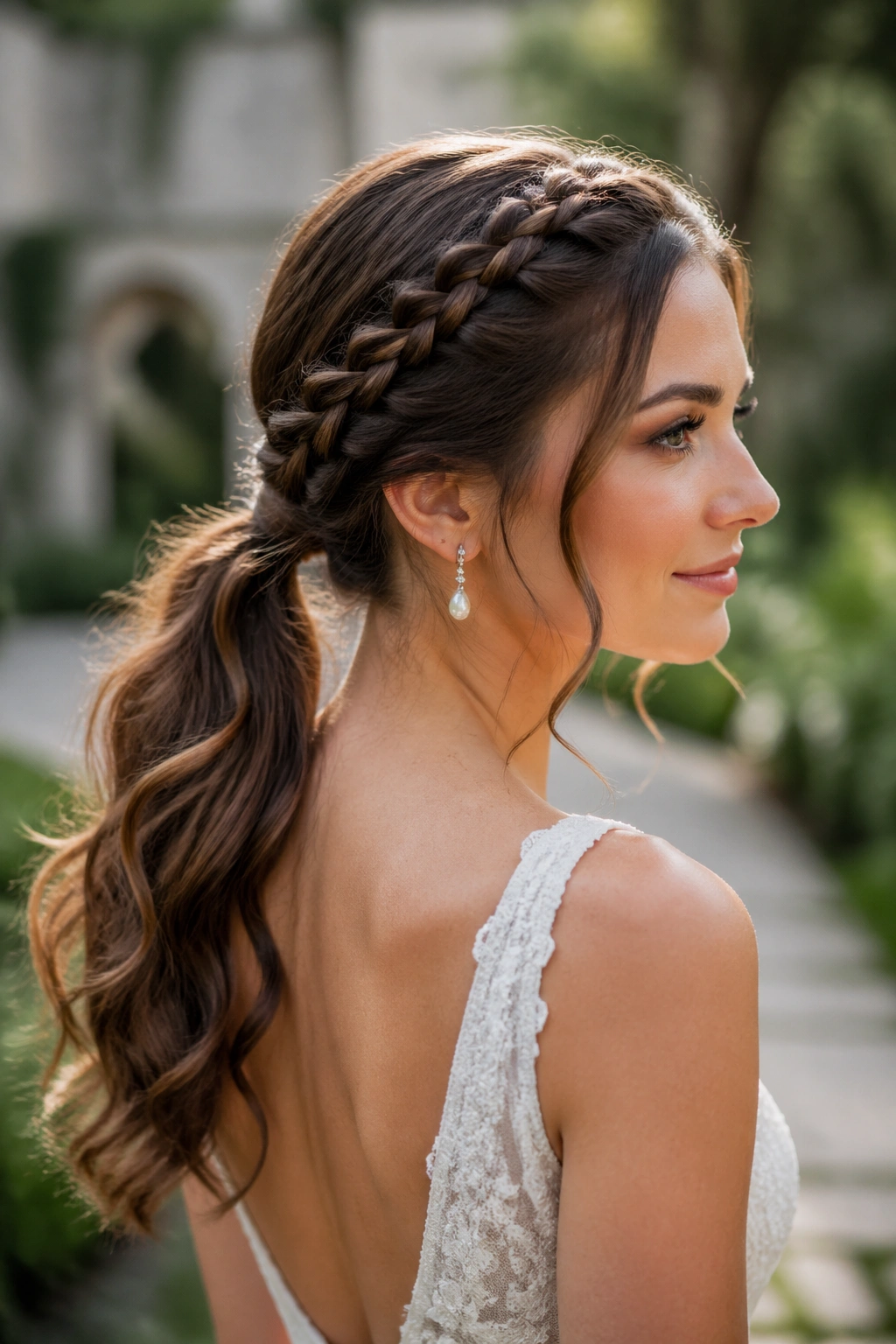
A high ponytail with Hollywood waves is all about contrast. The crown is lifted, the base is clean, and the tail falls in wide, glossy bends that feel more formal than a standard curled ponytail. It has drama without a lot of visual clutter.
Unlike the wrapped high ponytail above, this version leans into movement. The waves should be large, brushed into one direction, and smooth enough that they reflect light in a soft line. That makes it good for strapless dresses, clean necklines, and brides who want the hair to carry some of the glamour.
A little extension support can help if the natural hair is dense but not long enough to reach the same drop. On very long hair, the tail itself can do the heavy lifting. Either way, the silhouette is the point: lifted at the top, flowing through the ends, and balanced enough to hold up in photos from the front and back.
22. Low Ponytail with Twisted Sides
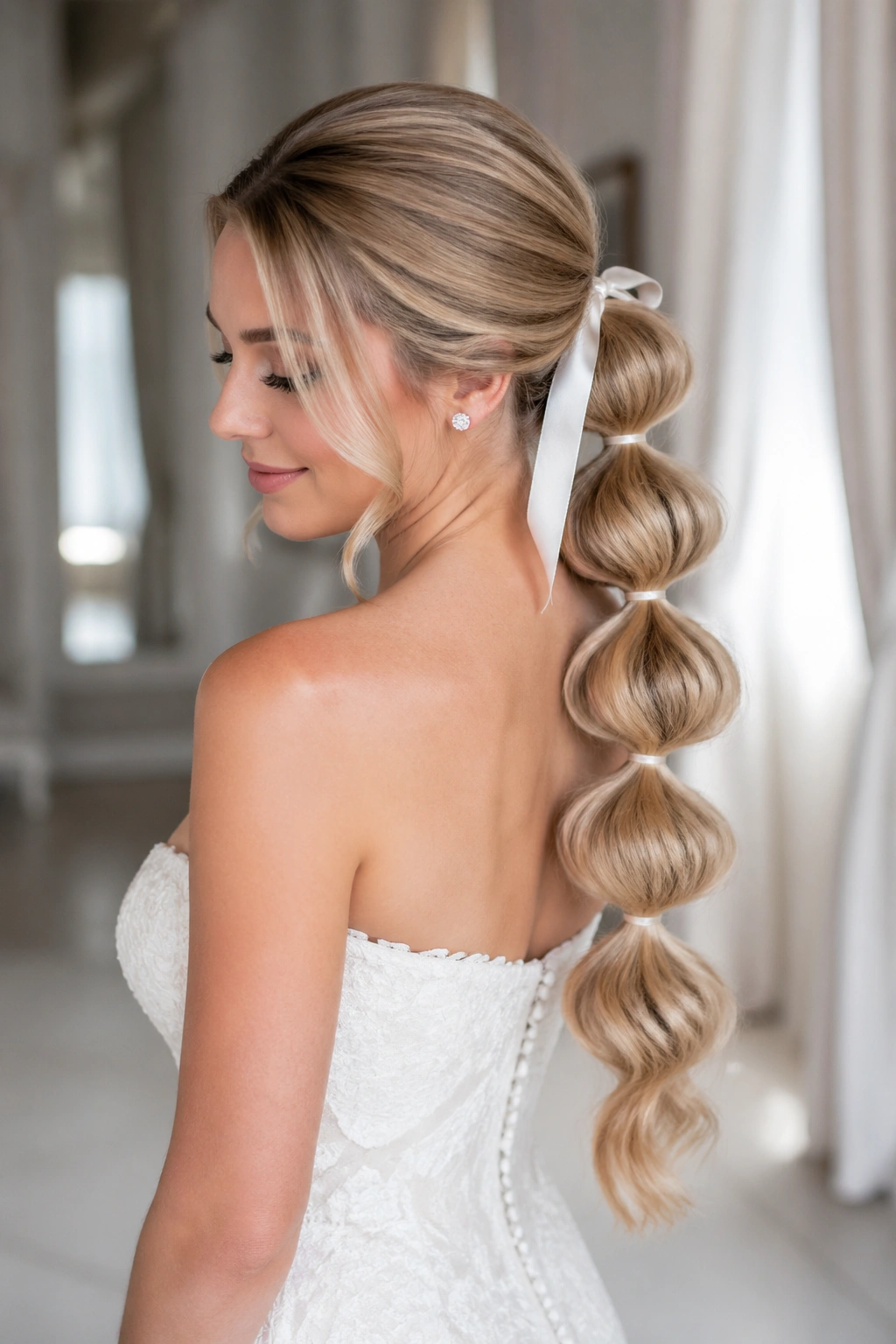
This style uses two side sections twisted back toward the nape, which gives the ponytail a smoother frame than loose hair would. It feels polished, but not severe, and it’s a good answer for brides who don’t love braids.
The twists should stay slim. If they get thick, the style can start to look bulky around the temples. That’s the mistake people make when they’re trying to force detail into the front. A slim twist gives the face space while still adding structure.
The tail itself can be straight, waved, or softly curled. I like it best with a slight bend so the movement in the back echoes the turns in the front. It’s a neat choice for long hair because the length keeps the ponytail grounded. Nothing feels overworked. Everything sits where it should.
23. Ponytail with Silk Scarf Accent
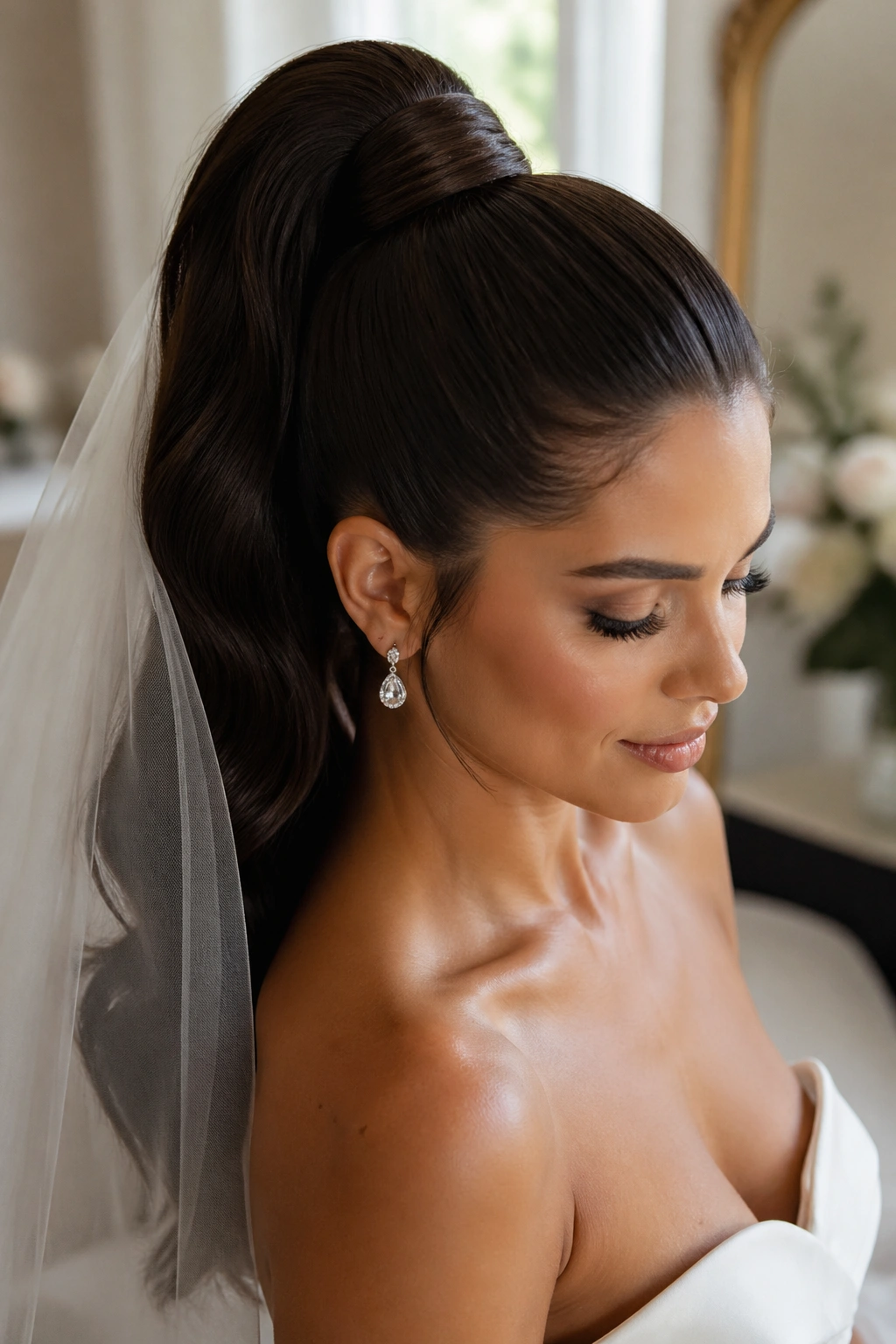
A silk scarf changes a ponytail fast. It adds color, texture, and a little fashion-editor energy without requiring a complicated base. For wedding hair, that can be a very good thing.
How to Place the Scarf
Tie the scarf just below the elastic if you want the knot to show, or weave it through the base and let the ends trail down the tail. A 1-inch or 2-inch wide scarf usually gives enough presence without swallowing the ponytail. If the dress is already busy, choose a solid color or a quiet print. If the dress is simple, the scarf can carry a little pattern.
This works especially well on long hair because the tail gives the scarf room to move. Shorter hair can make the fabric look stiff. On long hair, it drapes. That’s the difference. It’s also a smart choice for brides who want something a little less expected while still keeping the hair pulled back and practical.
24. Curly Ponytail for Naturally Curly Hair
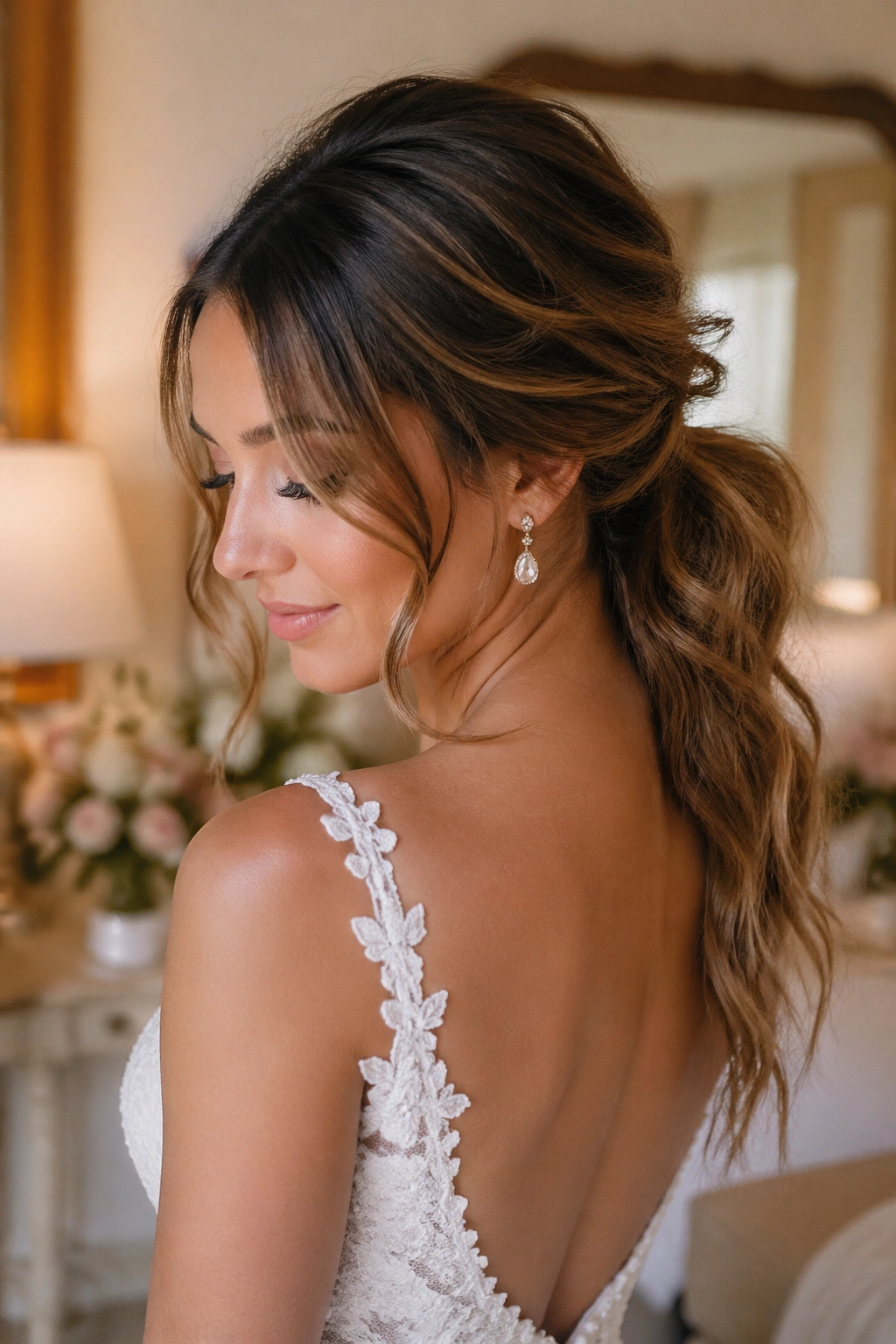
Natural curls should not be brushed into submission for a wedding ponytail. That’s the fastest way to lose the shape that makes the hair interesting in the first place. A good curly ponytail keeps the pattern intact and lets the texture do the work.
Start with curl cream or gel while the hair is damp, then diffuse or air-dry until the curls are set. Gather the hair loosely at the back so the crown stays smooth but the curls keep their shape. A very tight tie can crush the pattern near the base, so give the hair a little room.
This style is especially strong when some curls are pinned around the face or left to fall over one shoulder. It feels alive, not stiff. Long curly hair brings its own drama, and the ponytail just gives it direction. That’s the right balance for this texture. Let the curls stay curls.
25. Straight Glossy Ponytail
A straight glossy ponytail is brutally clean in the best way. It works because every line is deliberate: the center or side part, the smooth top, the long tail, and the shine that runs from root to end. No fluff. No guessing.
Prep Makes This One
- Blow-dry with a nozzle so the hair lies flat.
- Run a flat iron through 1-inch sections, keeping the motion slow and even.
- Use a light serum on the mid-lengths and ends only.
- Finish with shine spray on the outer layer, not the scalp.
That’s enough. Don’t drown it in products. Too much oil makes long hair separate at the ends and turn greasy under indoor lights. A glossy ponytail looks best when the surface is smooth and the tail still moves as one piece.
This style pairs well with column dresses, square necklines, and strong makeup. It’s the cleanest look on the list, and sometimes clean is exactly what a wedding hairstyle needs.
26. Braided Ponytail with Hidden Elastic Wraps
This ponytail is about hiding the mechanics. Every elastic gets covered, every join gets smoothed, and the braid or wrap stays neat all the way down the tail. On long hair, that neatness pays off because the length can otherwise make the style look unfinished.
The simplest version uses a strand of hair to wrap each elastic after a section is secured. A slightly more detailed version braids part of the tail and hides each transition point under a small twist. Either way, the idea is the same: keep the eye on the line, not the bands.
It’s a good fit for brides who like polished hair but still want the back to have some pattern. The hidden details make the style feel expensive in the old-fashioned sense of the word — carefully made, not loud. That sounds fussy, and maybe it is a little. But in wedding hair, that kind of fussy often looks best.
27. Romantic Ponytail with Cascading Curls
This is the ponytail for brides who want hair that looks like it was meant to fall that way all along. The curls are looser at the top, richer through the mid-lengths, and full at the ends, so the tail feels soft instead of structured.
The crown should still be controlled. If the top gets too airy, the style loses its shape and starts to read as undone. The romance comes from the length and the curl pattern, not from disorder. That difference matters.
A few pinned-back pieces near the face help keep the front open, especially with lace or tulle. Then the tail can spill down the back in layered curls that move when the bride walks. This is a strong choice for long hair because the length gives the curls room to cascade. Shorter hair can’t quite do the same thing.
28. Double-Twist Ponytail
If braids feel too expected, two mirrored twists create a similar amount of detail with less visual weight. The front sections are twisted back from each side, then joined into a ponytail at the nape or just below it. The result is tidy, but not rigid.
Why It Reads Cleaner Than a Braid
A braid has a pattern you can see from across the room. A twist is smoother. That makes this style useful when the dress already has texture and you don’t want the hair to compete with it. It also works well on very long hair because the tail keeps the style from feeling too small.
Keep the twists narrow and even. If one side gets much thicker than the other, the whole thing looks off-balance. The rest can stay simple: a wrapped elastic, a slight wave through the tail, and maybe a small pin at the join. That’s enough. The shape carries itself.
29. Minimalist Low Ponytail with Hair Jewelry
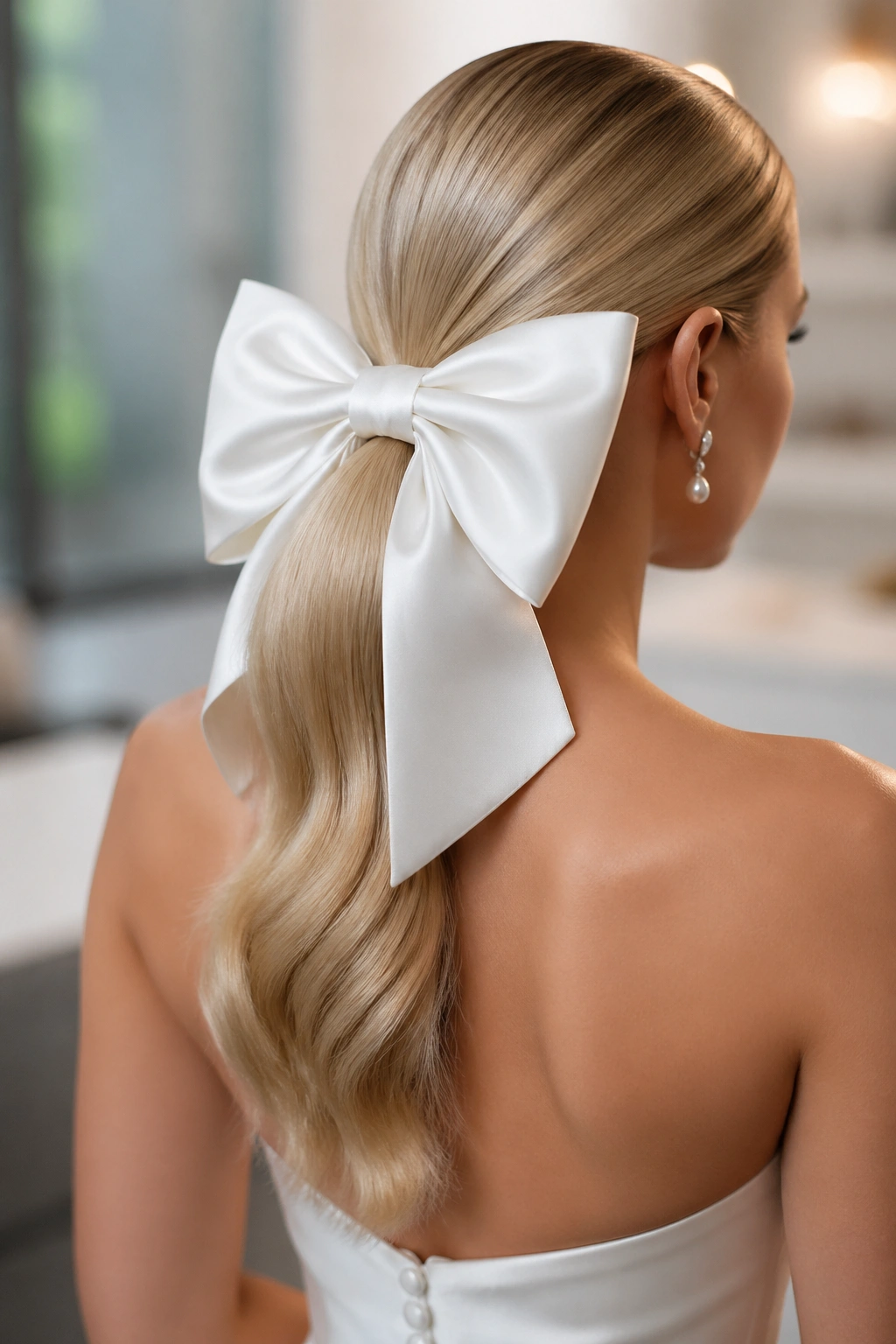
Less is not a compromise here. It’s the whole point. A minimalist low ponytail with one piece of hair jewelry — a slim comb, a narrow bar, or a single decorative pin — can look sharper than a style packed with extras.
The accessory should sit where the eye naturally lands, usually just above the elastic or slightly off to one side. If the piece is delicate, the ponytail can stay extremely clean. If the jewelry has a little sparkle or structure, keep the hair smooth so the detail has room to breathe.
This is a strong option for brides who like modern clothes, sharp tailoring, or a dress with a strong neckline. It doesn’t ask for much, and that’s part of the charm. Long hair gives it enough length to feel formal without needing a lot of decoration. One good piece is enough.
30. Low Ponytail with Tucked Ends
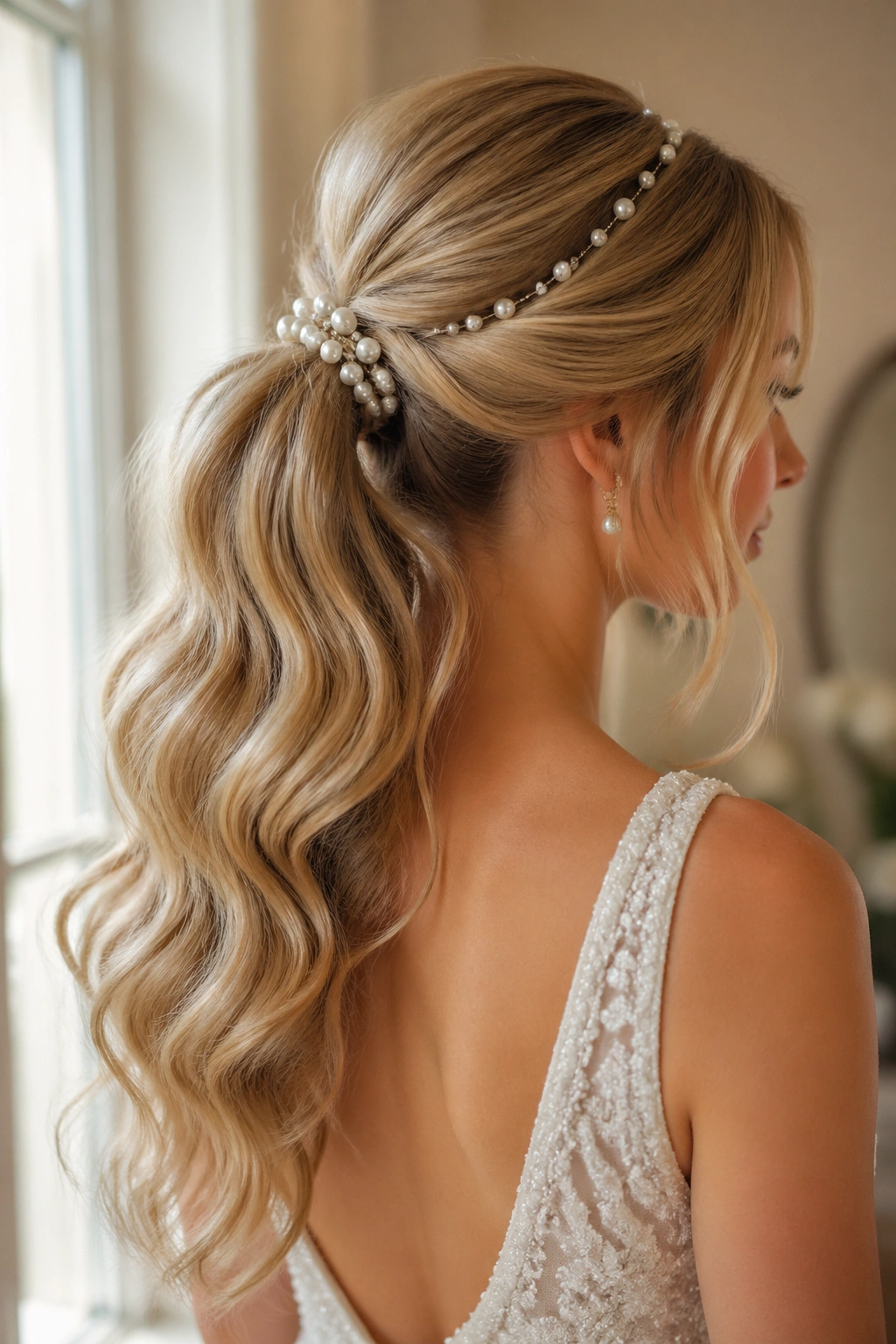
A tucked low ponytail is one of the neatest ways to finish long hair for a wedding. The hair is gathered low, wrapped cleanly, and then folded or tucked inward so the ends don’t just hang there and disappear. The shape feels calm from every angle.
This is the style I’d choose for a dress with lace, beading, or a neckline that already has a strong voice. The ponytail stays in the background and lets the clothes lead. That sounds modest, but it’s often the smartest move. Hair doesn’t need to fight the rest of the look.
The tuck also helps the style sit flat under a veil or stay tidy through a long reception. Long hair can be a little unruly at the ends; hiding them gives the back of the style a cleaner finish. It’s a quiet ending, which is often what makes it work.
