



Long hair can be a gift on a wedding day, and a nuisance in the same breath. Wedding updo ponytails for long hair keep the length visible while pulling the face open, which is why stylists reach for them so often when a bride wants movement, neck exposure, or a style that can survive hugging, dancing, and a stubborn veil.
The trick is in the base. A bridal ponytail that falls flat usually starts with soft prep, not more hairspray. Clean sectioning, hidden elastics, and a little root support near the crown do more than a heavy mist ever will. Long hair also changes the game because the weight pulls downward; if the anchor point is weak, the style sags by the time you reach the reception.
Some versions are sleek and architectural. Others feel loose, airy, and almost undone on purpose. A few lean hard into braids, pearls, ribbon, or curls that spill past the shoulders. The good ones do one thing very well: they keep the ponytail from reading like an afterthought.
The styles below move from clean and simple to more decorated and dressy, so you can match the dress, neckline, veil, and hair texture instead of fighting them. Start with the low wrapped ponytail if you want the safest place to begin. It is the classic for a reason.
1. Sleek Low Wrapped Ponytail
A sleek low wrapped ponytail is the easiest way to make long hair look intentional at a wedding. The hair sits at the nape, smooth through the crown, with one section wrapped around the elastic so the base disappears. Clean. Sharp. Calm.
Why It Flatters Long Hair
Long hair can get heavy fast, and a low placement gives that weight somewhere to go. The style also draws attention to the collarbone and back of the dress, which is handy if the gown has lace, buttons, or an open back.
- Keep the part exact, either center or deep side.
- Use a flat iron only where needed; the goal is smooth, not stiff.
- Wrap a 1-inch section of hair around the elastic and pin it underneath.
- Finish with a shine spray on the surface, not the roots.
Best with: satin gowns, minimalist dresses, and earrings that deserve a little room to breathe.
2. Soft Low Ponytail with Face-Framing Pieces
This one has the easiest romantic feel of the group. Soft low ponytails work especially well when the front hair is left slightly loose around the cheeks and jaw, because the shape keeps long hair from looking too severe.
The trick is restraint. You want pieces that skim the face, not thick curtains that swallow it. A few curled tendrils, placed just in front of the ear, can soften a strong middle part or balance a high neckline.
Keep the ponytail itself low and full, then pinch the sides gently with your fingers before setting them with spray. That tiny bit of looseness stops the style from looking overworked. It also helps if the hair has a natural bend instead of a pin-straight finish. A 1.25-inch curling iron usually gives the right amount of movement without turning the whole style into a pageant wave.
3. Crown-Volume High Ponytail
Why does a high ponytail work so well on a wedding day? Because it changes the whole mood of the look. Lift the base to the crown, build a little height at the roots, and long hair suddenly feels lighter, brighter, and more sculpted.
That height matters if the dress has a closed neckline or if the bride wants the face to read clearly in photos. The style pulls the eye upward, which can be flattering with statement earrings or a detailed bodice. It also gives curls room to fall in a more dramatic line down the back.
How to Keep the Crown Lifted
Backcomb the crown lightly at the roots, then smooth the top layer over it with a soft brush. Use one hidden elastic at the base and a second one a half inch below it if the hair is thick or heavy. That second anchor keeps the ponytail from sliding down during the ceremony. A little root powder helps too, but do not pile it on. Too much turns the crown chalky.
4. Bubble Ponytail with Pearls
Picture a long ponytail divided into rounded sections, each one tied off with a tiny elastic and fluffed into a soft bubble. Add pearl pins or pearl ties, and the style shifts from playful to formal without losing its shape.
The charm here is movement. A bubble ponytail keeps the length visible, but the breaks in the hair make it feel deliberate instead of heavy. That makes it a smart choice for very long hair, which can otherwise hang in a single unbroken line and look a little flat from the back.
A bride with a modern dress can wear this well, but it also works with a gown that has soft tulle or beading. Keep the bubbles equal in size if the dress is structured. If the dress is airy, let the bubbles vary slightly so the look feels softer. Tiny pearl accents are enough; you do not need to cover every section. That would be too much. One pearl every few inches is plenty.
5. Braided Halo Into a Ponytail
Braided halo ponytails have a lovely old-world feel, and they solve a real problem for long hair: how to keep the front secure without making the whole style look tight. A braid along the hairline gives structure, then feeds cleanly into the ponytail at the back.
The best part is that the braid can be skinny or wide. A narrow braid feels quieter and suits a lace gown. A fuller Dutch braid reads bolder and works well if the dress is simple. Either way, the braid acts like a visual frame, so the ponytail can stay loose and full without losing shape.
Keep the braid close to the hairline and pin it flat as you go. If it lifts off the scalp too much, the style starts to look like a festival look, which is not the goal here. A low ponytail hanging from the back of the braid keeps the silhouette elegant. Leave the ends softly curled so the transition from braid to ponytail feels smooth instead of abrupt.
6. Side-Swept Twisted Ponytail
Unlike a center-part ponytail, a side-swept twisted version builds asymmetry into the shape from the start. That makes it a strong choice for brides who want something a little softer on one side and a little more dressed up than a plain low ponytail.
The twist begins near the temple and rolls back toward one ear before joining the ponytail. It draws attention to the cheekbone and gives the style a gentle diagonal line, which is useful if the dress has one-shoulder detailing or a draped neckline. Long hair carries the twist well because there is enough length to keep the ponytail full after the front section is secured.
Keep the twist smooth, but not tight. If you pull it too hard, the face looks drawn and the style loses its softness. A light mist of flexible spray before twisting helps the hair hold without turning brittle. This one is especially good for thick hair that tends to puff out around the temples.
7. Loose Curl Ponytail with a Hidden Base
A hidden base makes this style look effortless from the outside, even though the construction underneath is doing real work. The top layers are smoothed back, the ponytail is secured low or mid-height, and then the curls are arranged so they spill over the base and cover every sign of the elastic.
Where It Shines
Loose curls give long hair that soft, full movement photographers like. They also keep the ponytail from falling into a stiff line, which can happen when long lengths are straight and heavy. A 1-inch curling iron usually creates enough bend to hold shape without making the ends feel too tight.
- Curl each section away from the face for a more open line.
- Let the curls cool in your hand before brushing them out.
- Pin the top at the nape with two crossed bobby pins before adding the elastic.
- Leave the ends slightly piecey so the ponytail has texture, not fluff.
A little shine serum on the mid-lengths helps the curls read clean in low light.
8. Rope-Braid Wedding Ponytail
A rope-braid ponytail has a neat, twisted look that feels polished without being fussy. The braid is made by dividing the ponytail into two sections, twisting each one, then twisting them around each other in the opposite direction. It sounds more technical than it looks. The finish is tidy and strong.
This style works best when the hair is long enough to show the rope pattern clearly. On shorter lengths, the twist can blur. On long hair, though, the braid becomes part of the design and adds a clean vertical line down the back. It pairs nicely with sleek gowns and modern jewelry.
The biggest mistake is skipping the tension check. If one side is tighter than the other, the braid will lean and open unevenly. Twist both sections with the same amount of pressure, then secure the end with a clear elastic. Pull apart each segment a little after you finish to make the braid fuller. Not too much. Just enough to let the shape breathe.
9. Satin Ribbon Ponytail
Could a strip of ribbon change the whole mood of a ponytail? Yes. A satin ribbon tied around the base softens the structure and gives the style a quiet finish that feels more personal than a plain elastic.
This look works especially well when the dress has soft fabric or a romantic neckline. The ribbon can match the gown, echo the bouquet, or simply add a tonal detail that ties the whole look together. A narrow ribbon feels refined. A wider ribbon gives a more noticeable bow, which can be lovely if the hair itself is simple.
How to Use the Ribbon
Choose a ribbon with a bit of body so it holds its shape. Thin, slippery ribbon tends to slide. Tie it over the elastic, then let the tails fall alongside the ponytail or tuck them under the curl pattern if you want a cleaner profile. Avoid tying it so tight that it dents the hair at the base. That line shows in photos.
10. Hidden Braid Base Ponytail
A hidden braid base is one of those details most people do not notice right away, but they feel the difference. The braid sits under the outer hair, almost like a built-in anchor, and gives the ponytail a more secure grip than a single elastic alone.
The style is useful for long hair because weight can make a standard ponytail slip. By braiding the first inch or two near the nape, you create friction. The outer layer then smooths over the braid, so the whole thing still looks soft and bridal.
I like this technique when the bride wants movement without constant fixing. It is not as fancy-looking as pearls or ribbon, but it lasts. That matters. A lot. If the hair is very silky, a tiny bit of texture spray before braiding helps the sections stay put. If the hair is thick, keep the braid flat and close to the head so it does not create a bump under the finished ponytail.
11. Hollywood Wave Ponytail
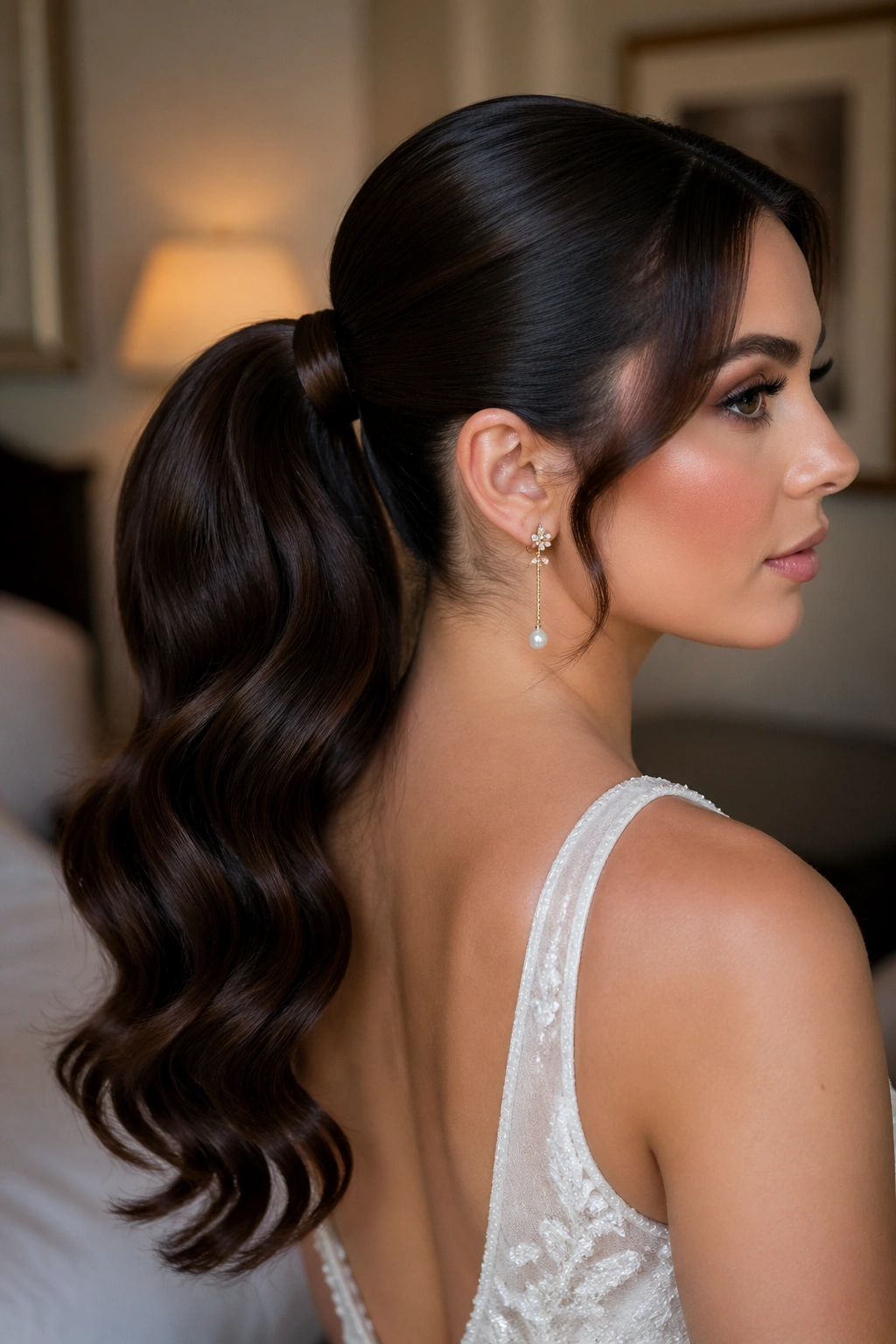
Hollywood waves usually belong to loose hair, but they work beautifully inside a ponytail too. The difference is where the wave starts. Instead of falling from the root, the waves begin around the mid-lengths and cascade through the tail in glossy, even bends.
That gives the style a more dressed-up feel than loose curls. It looks deliberate, almost tailored, and it shows off the length without the chaos of a full curl pattern. The key is uniformity. If the waves are too mixed, the ponytail loses that smooth, polished line.
The front should be sleek. The back should be brushed into one soft ribbon of hair. Then the waves begin. A deep side part can make the style feel more evening-ready, while a center part keeps it clean and symmetrical. If the dress has a dramatic back, this is one of the better choices because the hair moves in one controlled sweep rather than exploding in volume.
12. Fishtail Braid Ponytail
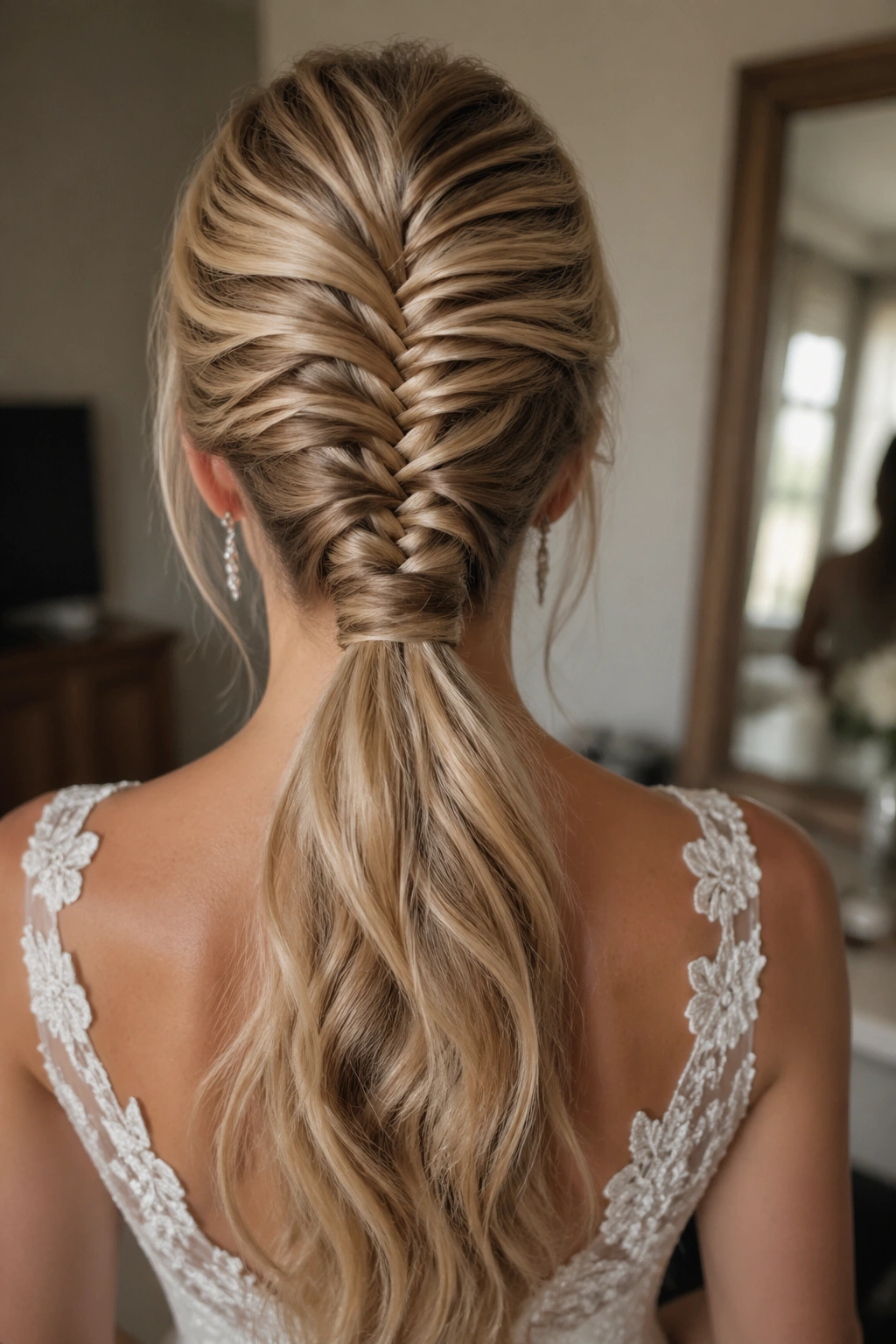
Unlike a plain braid, a fishtail ponytail has a tighter, more detailed weave that feels ornamental even before you add accessories. It is a smart choice when the bride wants texture without curls or heavy decoration.
The fishtail pattern works especially well on long hair because there is enough length for the braid to stay visible all the way down. The strands interlock in fine little pieces, and that creates a sense of detail from the back. If the dress is simple, the braid can carry the whole look. If the dress is already ornate, keep the braid slightly looser so it does not compete.
A fishtail looks best when the hair is pre-smoothed at the crown and then slightly pulled apart after braiding. That softens the edges and keeps it from reading too severe. Use a small clear elastic at the end, then wrap a thin hair section around it. It is a small thing, but it makes the braid feel finished.
13. Bow-Detail Ponytail
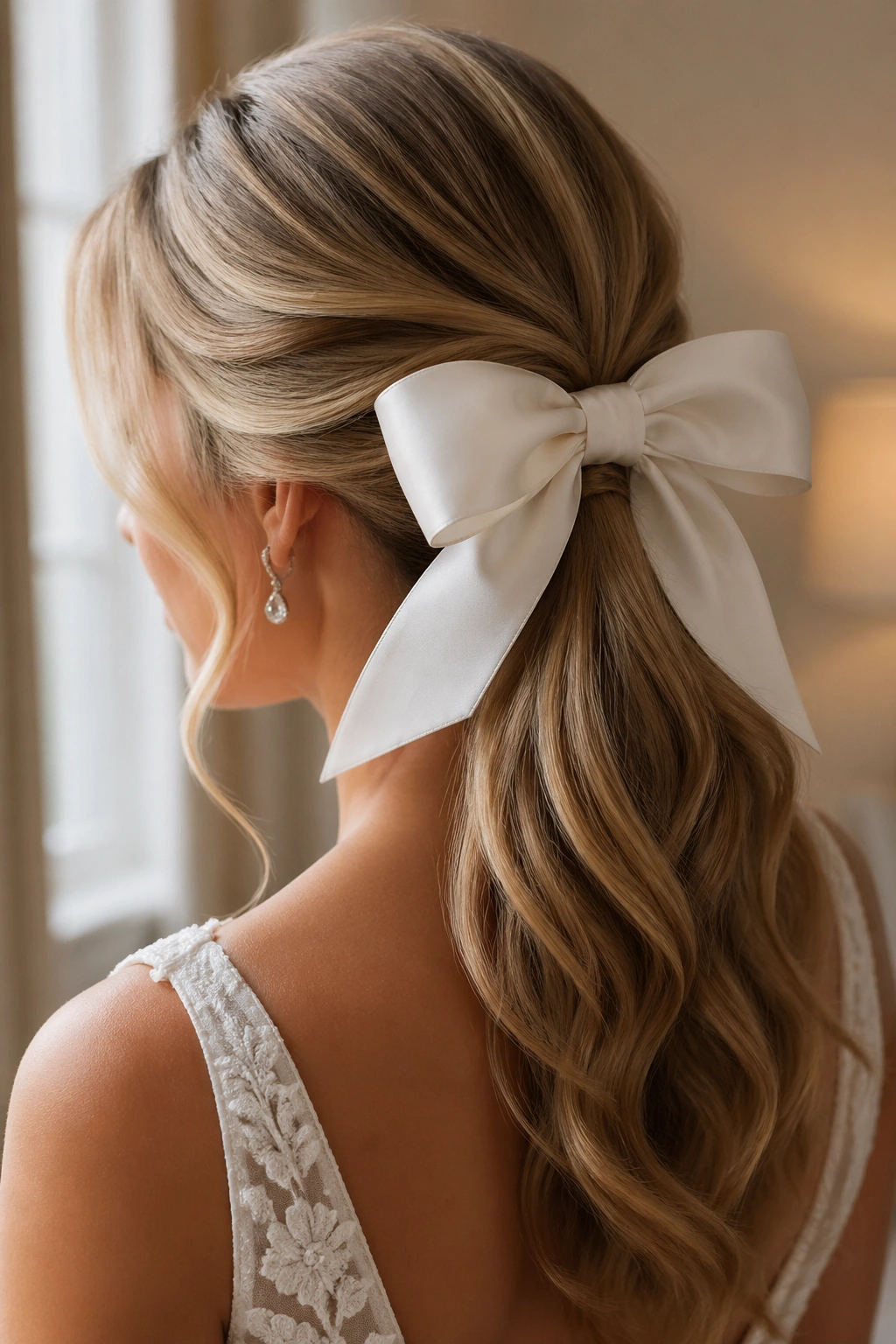
A bow at the base of a wedding ponytail sounds sweet, but it can also feel sharp and modern if the material and scale are chosen well. A wide silk bow looks soft and dressy. A narrow velvet or satin bow feels more graphic. The trick is matching the bow to the rest of the look instead of treating it like a last-minute add-on.
What Makes It Work
The ponytail itself should stay simple. Too many tricks at once make the bow lose its impact. Keep the top smooth, place the ponytail low or mid-height, and let the bow sit right where the elastic is hidden. If the hair is very long, leave enough tail below the bow so the style still reads as a ponytail and not just a ribbon accessory.
- Choose a bow with wired edges if you want a crisp shape.
- Tie it slightly off-center for a softer effect.
- Keep jewelry minimal if the bow is large.
- Curl the ends of the ponytail so the finish feels deliberate.
One good bow is enough. More than that can start to feel crowded.
14. Textured Ponytail with a Mini Chignon Base
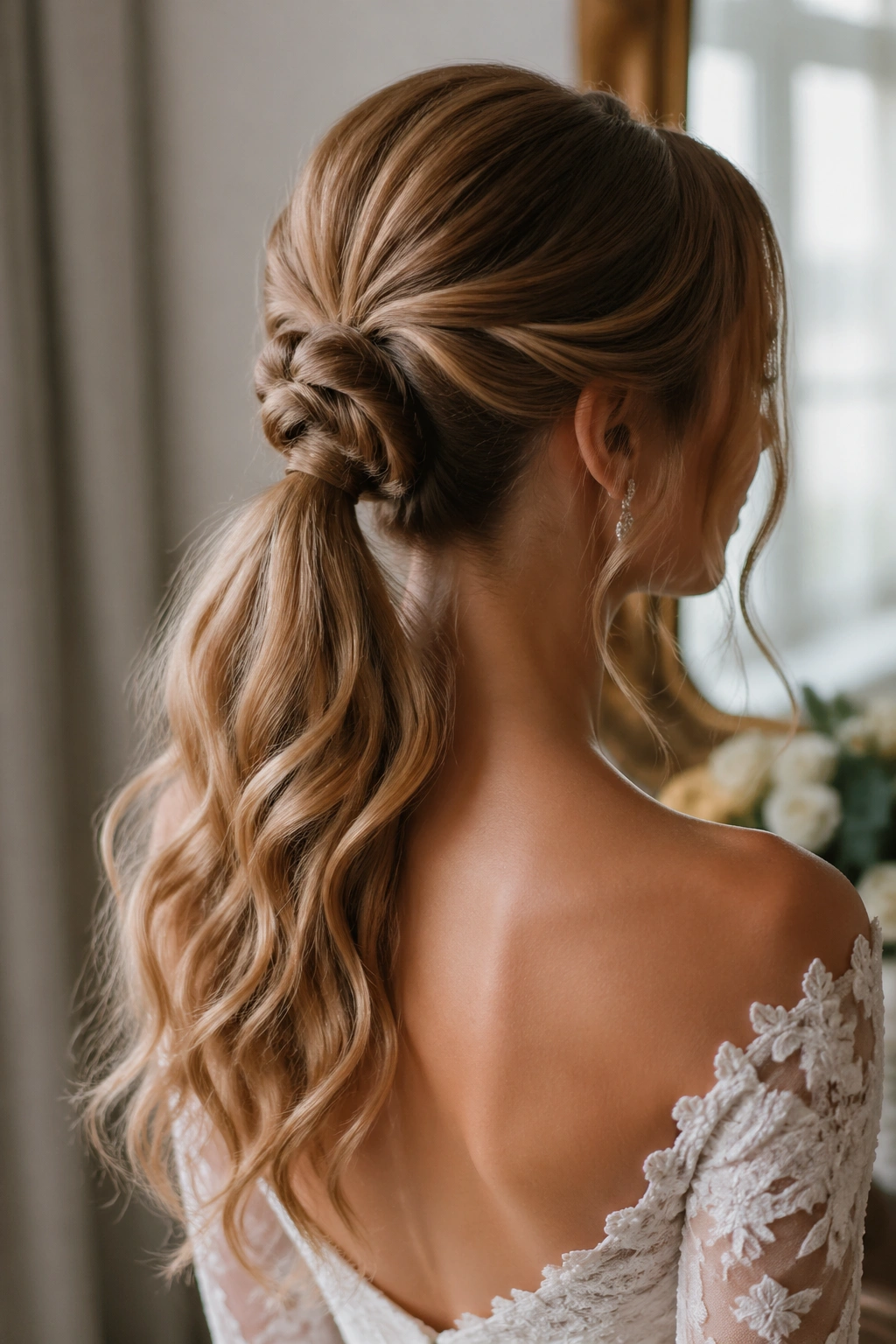
This style has a little trick up its sleeve. Before the ponytail is fully finished, a tiny twisted bun or chignon is built at the base, then pinned and covered so it becomes part of the silhouette. The result is a ponytail that looks fuller and more dimensional near the nape.
That extra shape helps long hair sit better. Very long lengths can drag the ponytail downward, especially if the hair is fine. A mini chignon gives the style a lifted starting point and a cushion for the rest of the tail to fall from. It also makes the base more interesting from the side, which matters more than people think.
Keep the texture controlled, not shaggy. Loose waves through the tail work, but the base itself should be smooth enough to hide the structure. If the hair is layered, pin the shorter pieces first so they do not slip out. A few well-placed U-pins are better than stuffing the area with too many bobby pins. Too many pins make the base look lumpy.
15. Low Knotted Ponytail
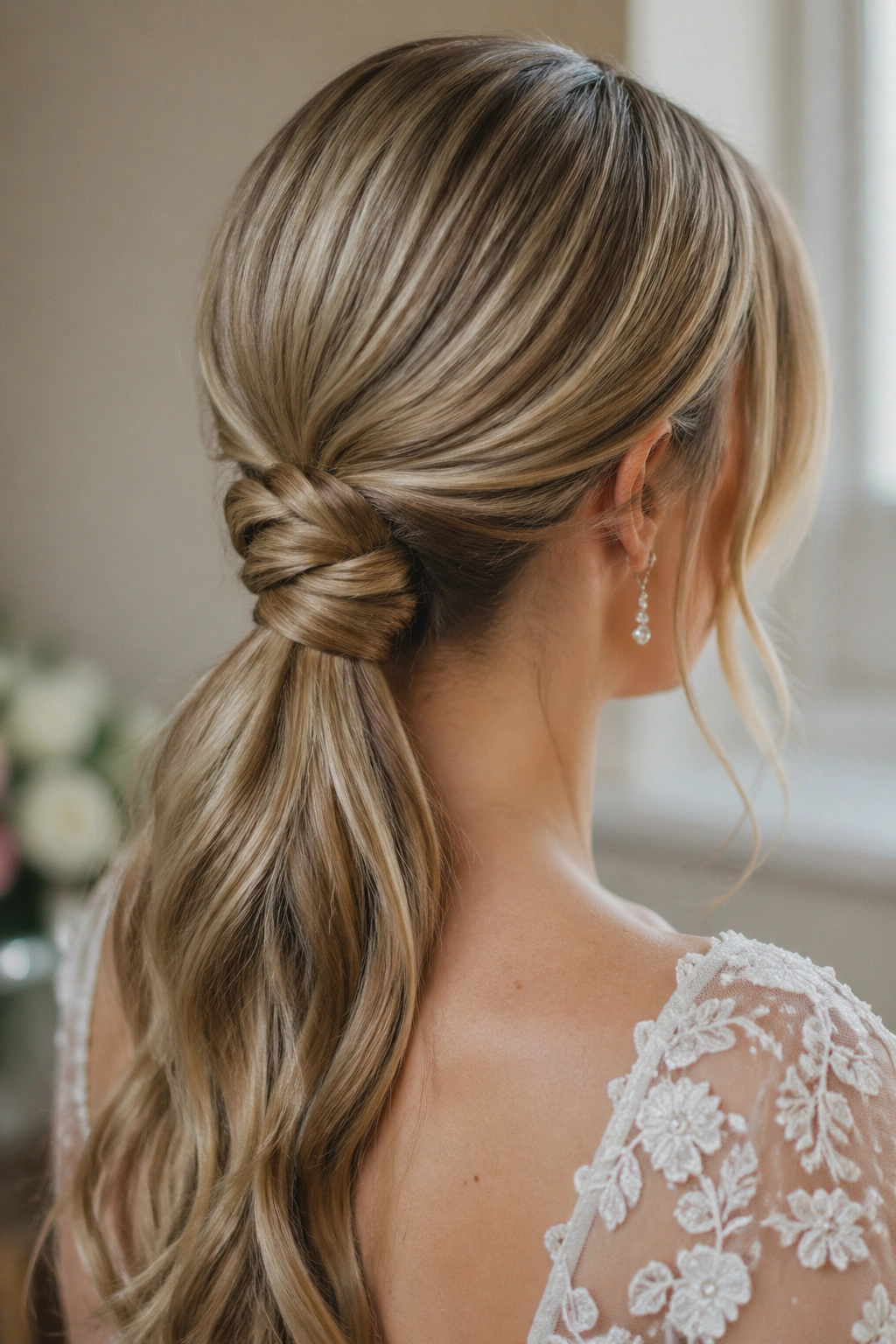
Can a knot look formal? Absolutely, if it is done cleanly. A low knotted ponytail folds the hair into overlapping loops or a single tied section near the nape, then lets the remaining length fall below it. It feels architectural without losing softness.
This style is especially nice for brides who want something a little different from the usual twist. The knot gives a sense of shape and intention, and it works well with dresses that have clean lines. If the gown is heavily embellished, keep the knot neat and compact. If the dress is simpler, the knot can be looser and more visible.
How to Shape the Knot
Start with hair that has some grip. Freshly washed hair can slip. A small amount of texture spray or dry shampoo at the roots helps. Then form the knot close to the head and secure it with pins that cross inside the structure. The ponytail below it can stay straight, curled, or softly waved. I prefer a gentle bend at the ends; it keeps the style from looking too severe.
16. Double-Twist Ponytail
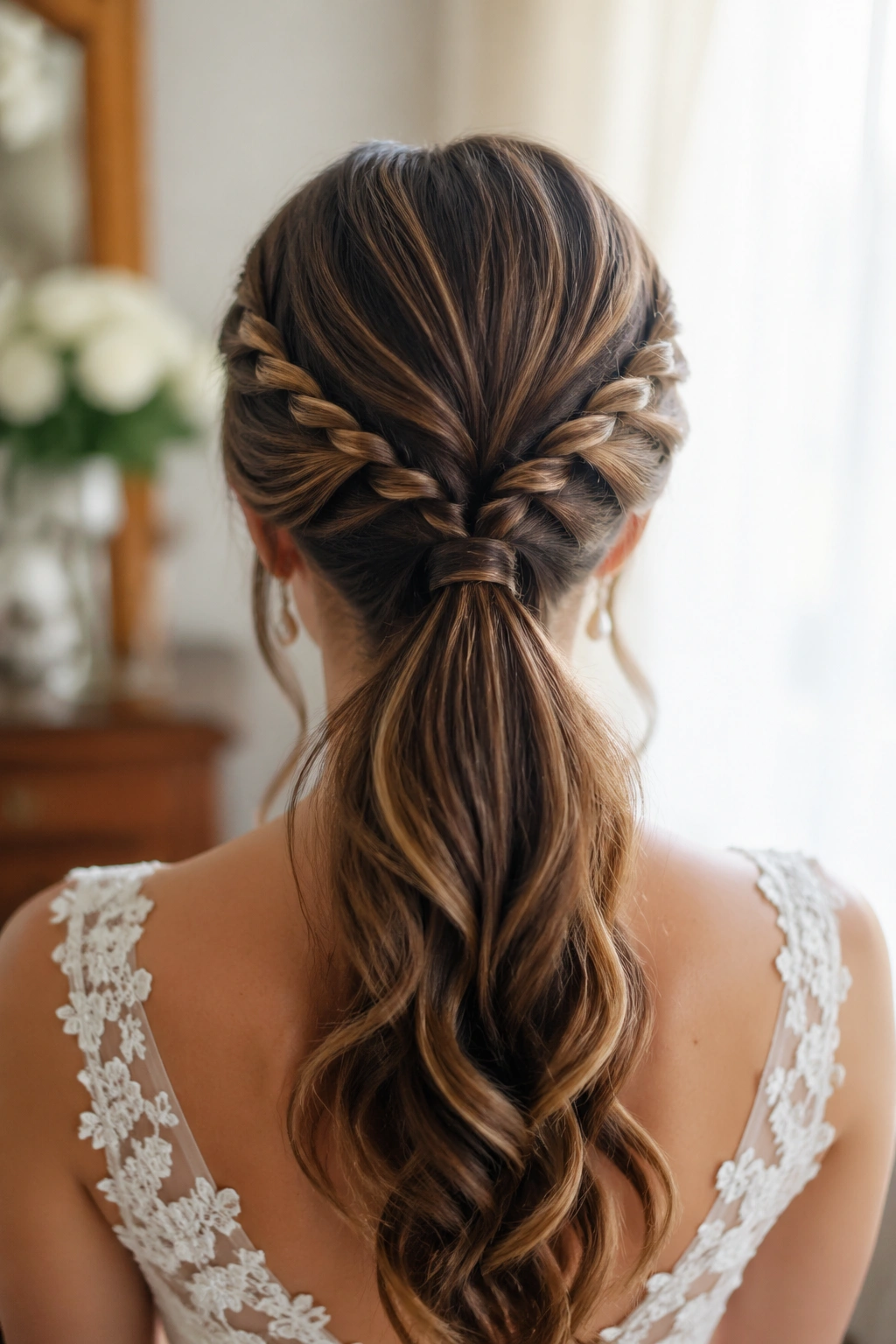
A double-twist ponytail is the kind of style that looks more complex than it is, which is always a nice trade on a busy morning. Two twisted sections—one from each side—move back toward the center and meet at the ponytail base.
The shape has a nice symmetry, but it is not stiff. That makes it a good choice for medium-to-thick long hair, especially if the goal is to control bulk around the sides without flattening the whole head. The twists can be sleek or slightly tousled depending on the dress.
Anecdotally, this style tends to hold up better than a loose side sweep when the hair is heavy. The reason is simple: the twists distribute the tension before everything gets gathered. Use a small elastic underneath the twist point, then hide it with a wrapped section. If you want extra softness, tug the outer edges of each twist with your fingers after pinning. Just a little. Enough to relax the line.
17. Veil-Friendly Anchor Ponytail
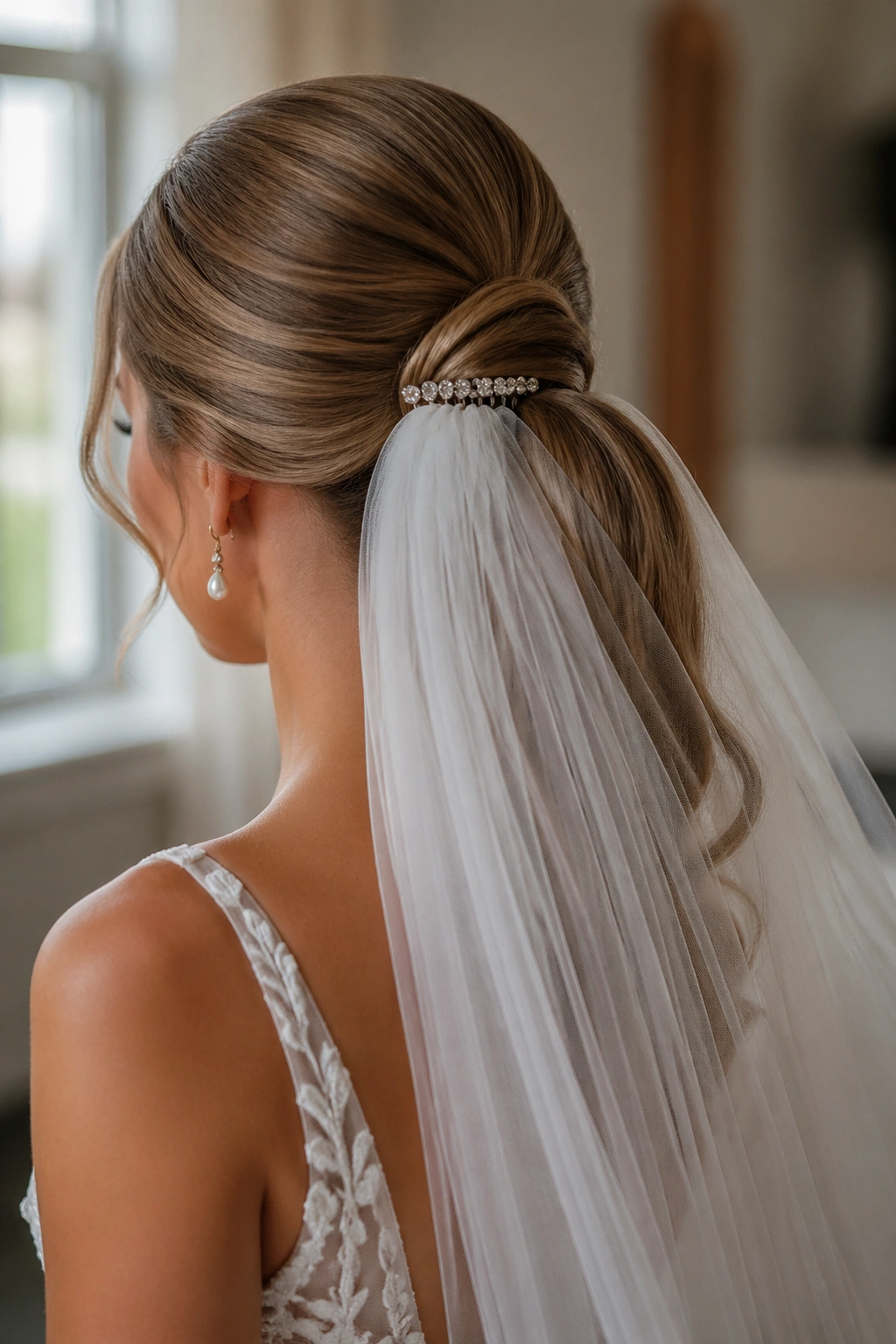
A veil can change the whole construction of a hairstyle, and this is the ponytail that respects that fact. The base is built with a strong anchor point, usually slightly lower than center, so the comb of the veil can sit above or beneath it without fighting for space.
The important part is planning the layers. The veil comb should not crush the ponytail base, and the ponytail should not block the veil from falling cleanly. A good stylist will place the anchor first, then test the veil position before finishing the tail. That small pause saves a lot of trouble later.
Keep the surface smooth where the veil touches, since rough texture can snag the comb. If the hair is curled, the veil should sit just above the bend, not in the thickest part of the style. That helps it fall naturally once the veil comes off. This is one of those styles that rewards boring precision. Not glamorous, but practical, and practical is underrated on a wedding day.
18. Half-Up to Ponytail Hybrid
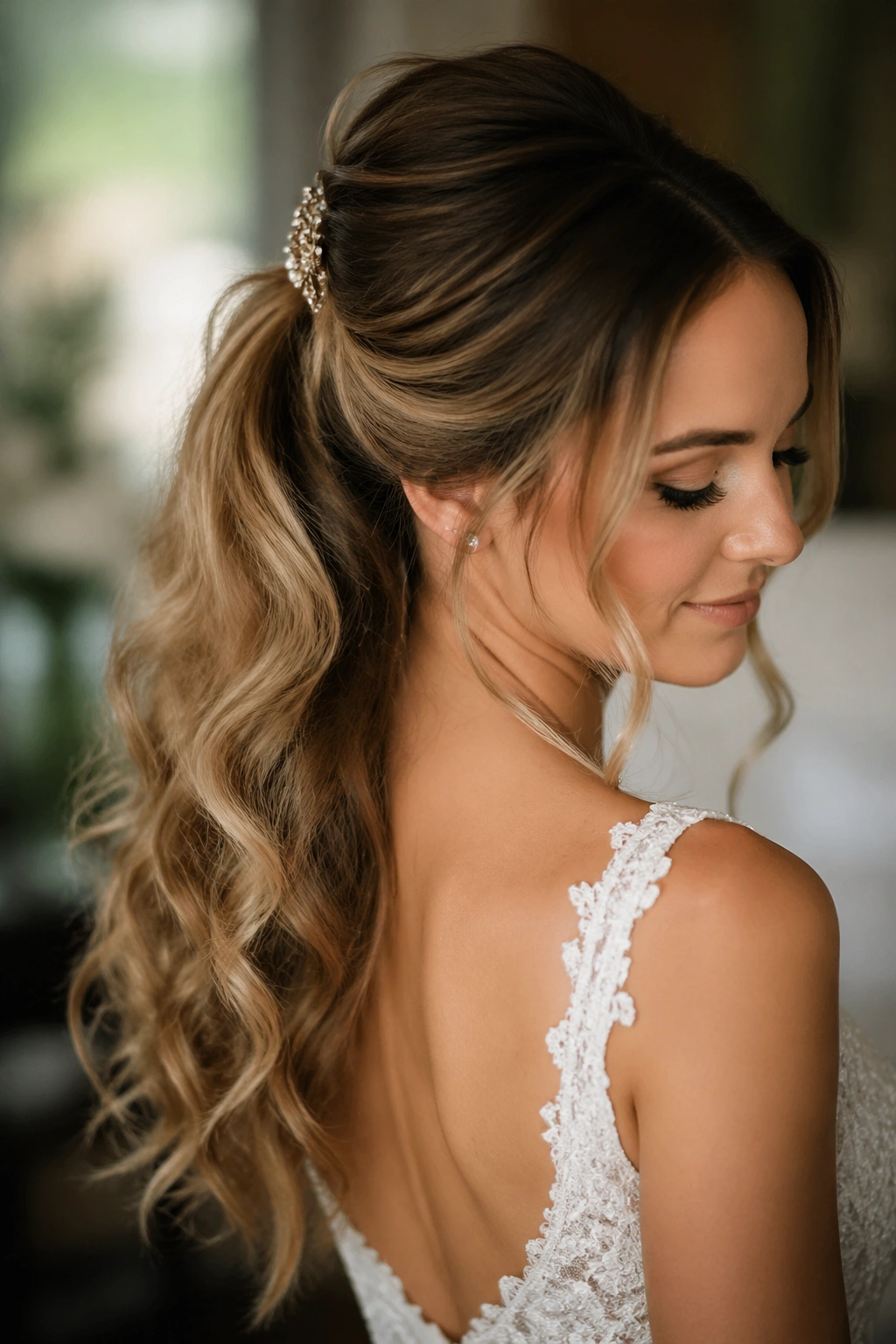
A half-up ponytail is a smart middle ground when long hair feels like too much to pin up completely. The top sections are gathered and secured, while the lower lengths stay free enough to move. It gives the feel of an updo without taking away all the length.
Compared with a full ponytail, this version keeps more softness around the back and shoulders. Compared with wearing the hair down, it gives better control at the crown and sides. That makes it useful for brides who want some volume but do not want their hair sitting flat against the head.
It is especially nice with flowing dresses or outdoor ceremonies where a fully sleek style might feel too severe. The upper section can be twisted, braided, or smoothed back, then the lower section can be curled into a relaxed cascade. Keep the transition point hidden with a small accessory or a wrapped strand. If the divide is too obvious, the style can look split instead of balanced.
19. Sculpted Wrap-and-Pin Ponytail
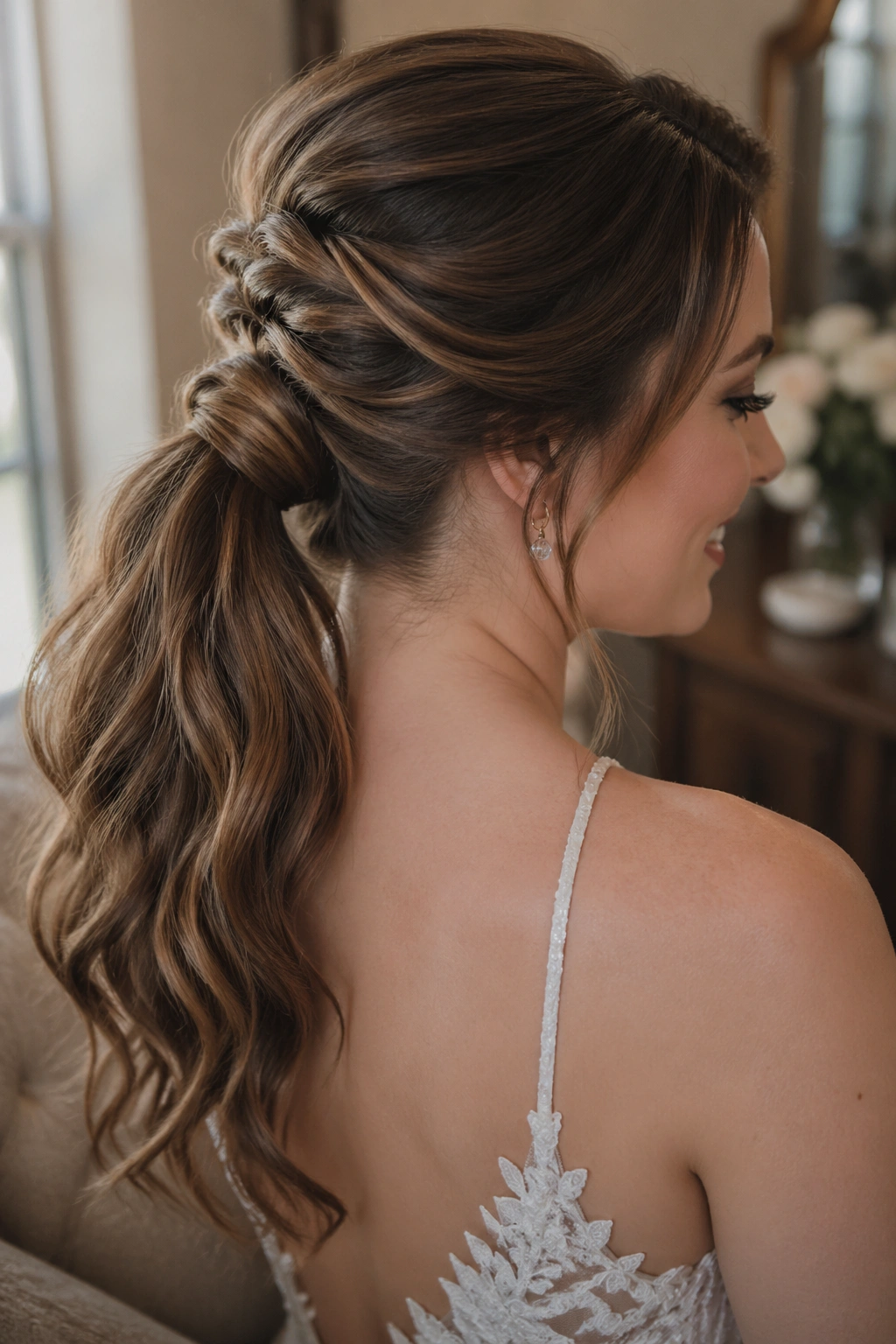
A sculpted wrap-and-pin ponytail is for the bride who likes a little structure. The hair is shaped into soft folds, each one pinned into place so the final style has visible movement at the base rather than a flat gathered look.
Why It Feels Different
The sculpting creates depth at the back of the head, which is useful when the dress needs a stronger hairstyle to match it. Think satin, mikado, or anything with a crisp shape. Long hair gives you enough material to build those folds without making the style feel crowded.
- Work in narrow sections so the folds stay neat.
- Pin each fold before moving to the next one.
- Keep the outer surface smooth with a fine-tooth comb.
- Finish with a light spray only after the shape is set.
A sculpted ponytail is not the quickest option, but it has real presence. It also holds up well in profile, which matters more than most people realize.
20. Side Ponytail with a Jeweled Comb
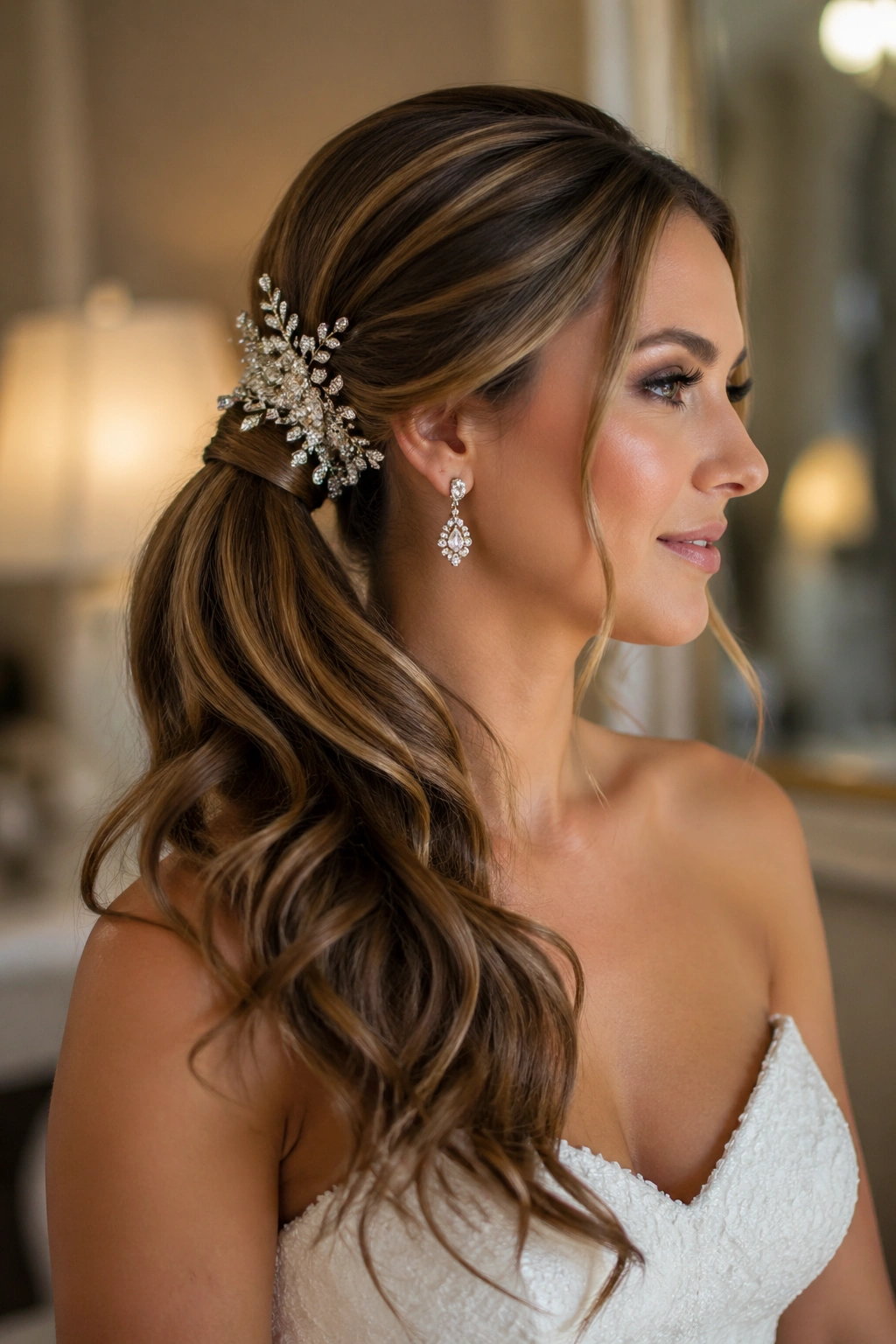
A side ponytail with a jeweled comb has a bit of red-carpet energy, but it still feels bridal when the placement is low and the accessory is restrained. One comb near the crown or just above the ear is enough to turn the ponytail into the focal point.
The side placement gives long hair a softer drape than a center ponytail. It also creates a flattering line across the shoulder, especially if the dress has an off-the-shoulder or one-shoulder shape. The hair can be wavy, brushed out, or even sleek if the comb is doing the decorative work.
Keep the accessory anchored into a firm section, not the very soft ends. Otherwise it shifts. A comb with a little weight feels more secure than a flimsy decorative clip. And please, do not crowd the area with extra pins once the comb is in place. One strong accessory looks intentional. Three competing ones look like a dressing table spill.
21. Natural-Curl Ponytail
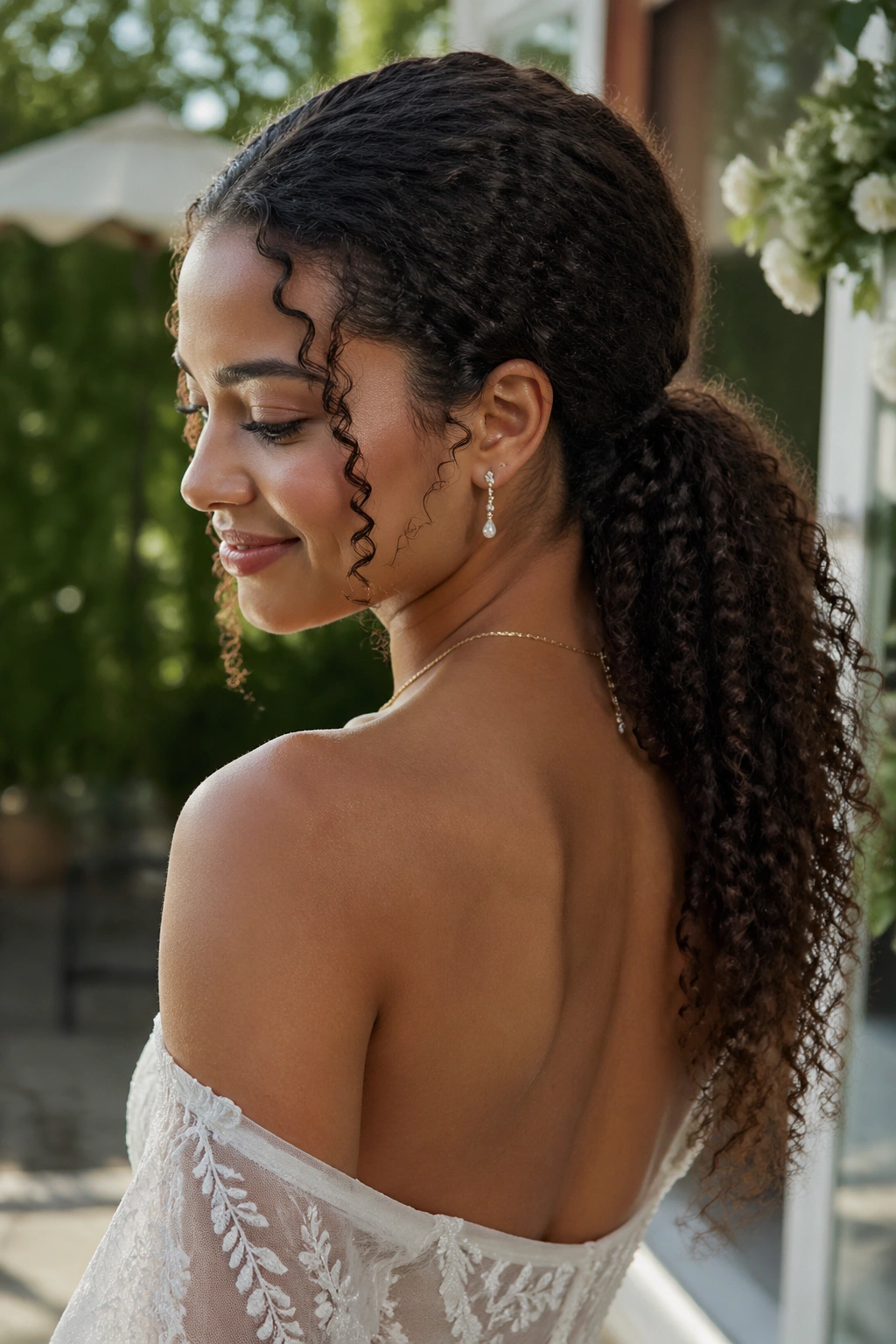
How do you make curls look bridal without forcing them into a shape they do not want? You let the texture do most of the work. A natural-curl ponytail keeps the curl pattern intact and gathers it into a secure base, usually low or mid-height, so the result feels soft and honest.
The key is to prep the curls before gathering them. A curl cream or light gel applied earlier in the routine helps the strands stay clumped and defined. Once the hair is dry, gather it gently with your hands rather than brushing it flat. Brushing breaks the pattern and creates frizz that no amount of spray can fully calm.
What to Watch For
- Keep the part clean so the front looks intentional.
- Pin any loose crown pieces with small, hidden grips.
- Use a satin ribbon or wrapped strand if the elastic feels too plain.
- Shape the ponytail by hand; do not overcomb it.
This style is especially pretty when the wedding has an easy, relaxed feel. It should look like the hair is behaving, not obeying orders.
22. Center-Part Ponytail with Crystal Pins
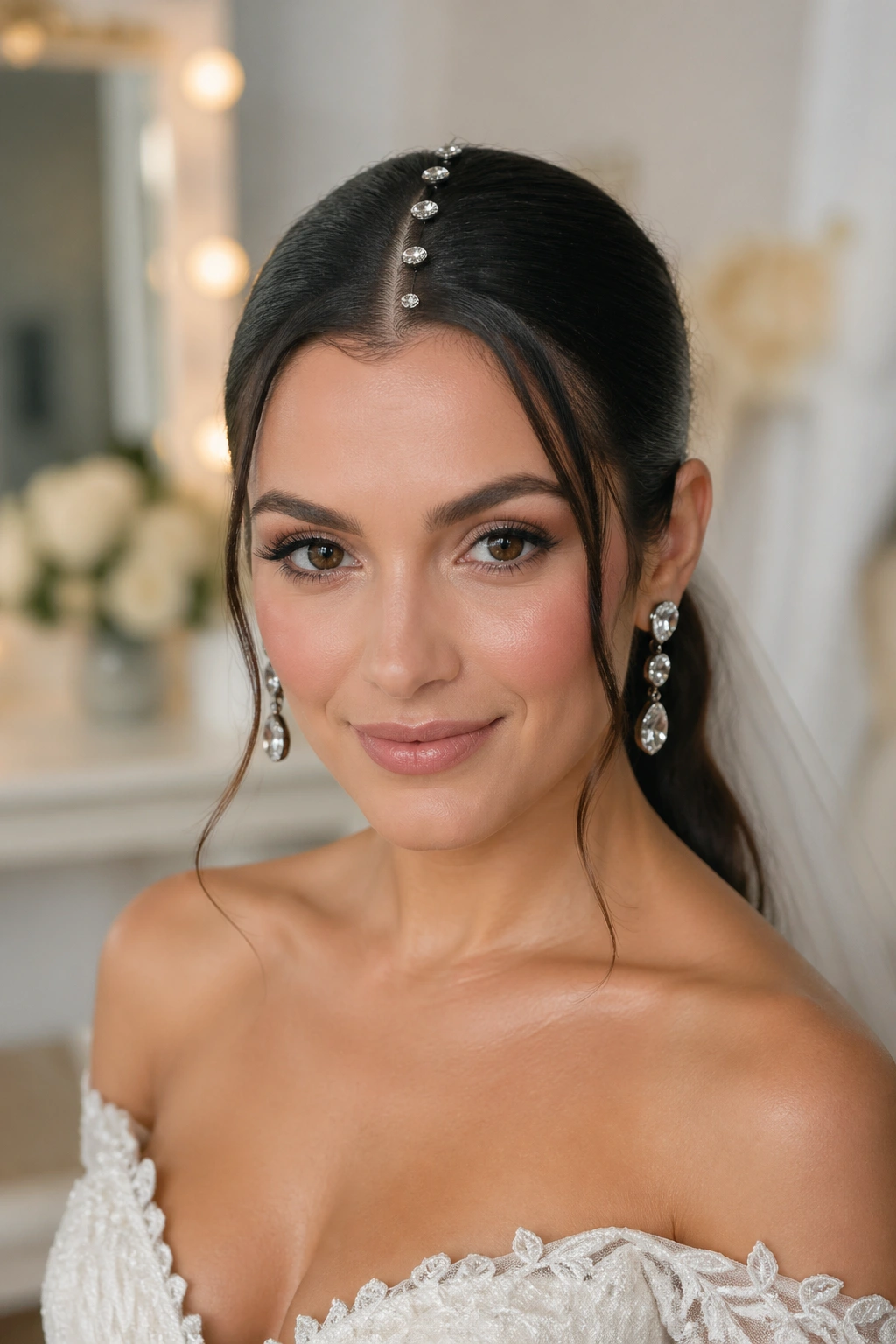
A center part gives a ponytail an immediate sense of balance, and crystal pins add just enough brightness to make the style feel finished. The pins can sit in a row along each side of the part or cluster near the base if you want the sparkle lower and softer.
The center part works well with long hair because it keeps the face open and lets the tail carry the rest of the story. If the gown has a symmetrical neckline, the balance feels especially clean. If the dress is heavily beaded, use fewer pins so the hairstyle does not start competing with the fabric.
This is a good style for brides who want sparkle without a full accessory piece. The pins can be tiny and still do the job. In bright daylight, a few crystals are enough. Under evening light, they pick up just enough shine to stand out. Keep the rest of the ponytail smooth so the pins have room to do their work.
23. Teased Crown Ponytail
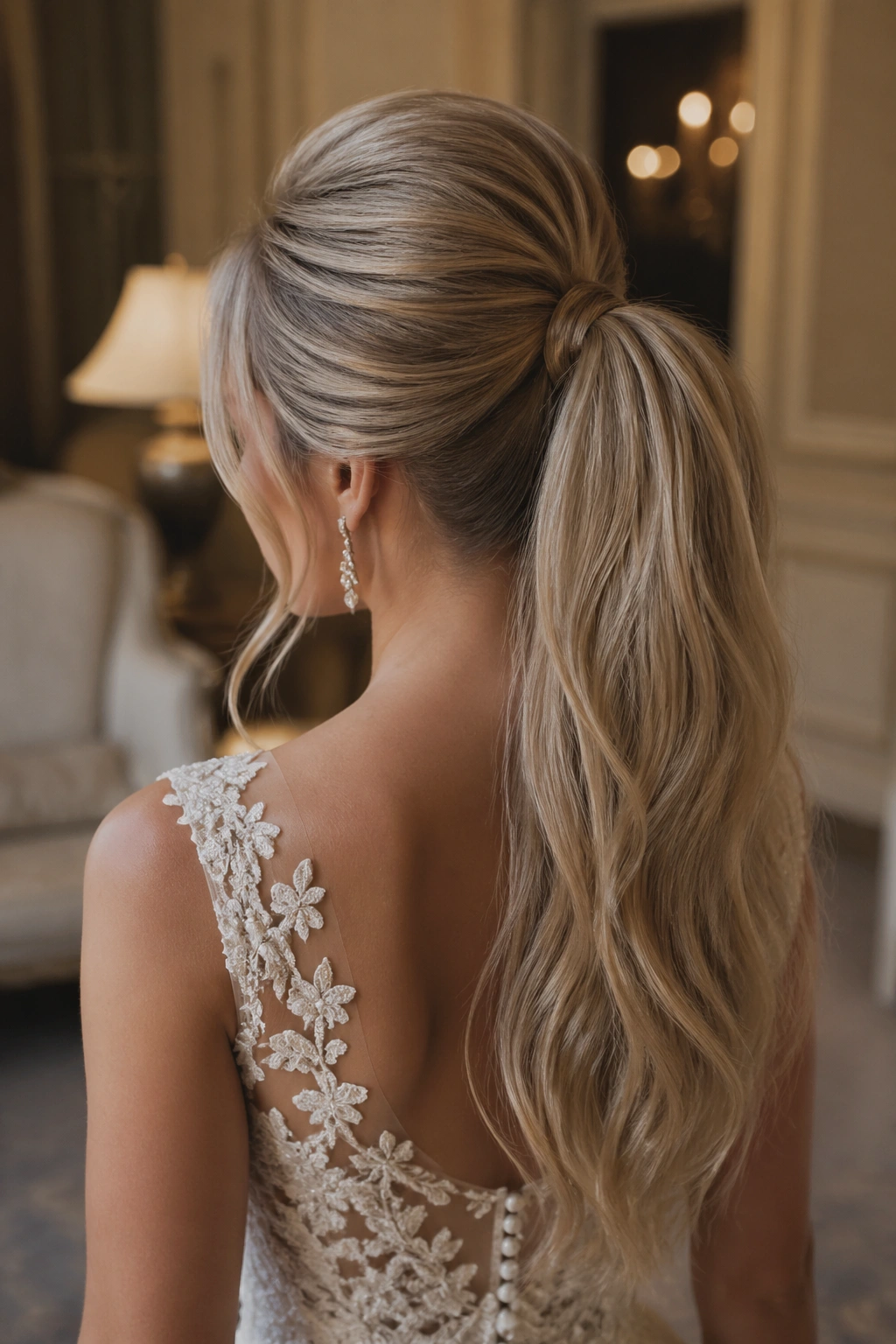
A teased crown ponytail has old-school volume, but when it is done neatly, it still reads as elegant. The crown is lifted with backcombing, then smoothed on top so the height looks deliberate instead of fluffy.
The style works well for long hair because the extra volume at the top balances the length at the bottom. Without that lift, very long ponytails can drag the whole profile downward. With it, the head shape looks more even. That matters in photos from the side, where a flat crown can make the face seem longer than it is.
This one can go sleek through the tail or soft and waved. I prefer a smooth top with a textured tail, because the contrast keeps it from feeling heavy. Do not over-tease the crown. A small cushion at the roots is enough. If the front starts to bulge too much, the style loses the sharp line that makes it work.
24. Braided Bubble Ponytail
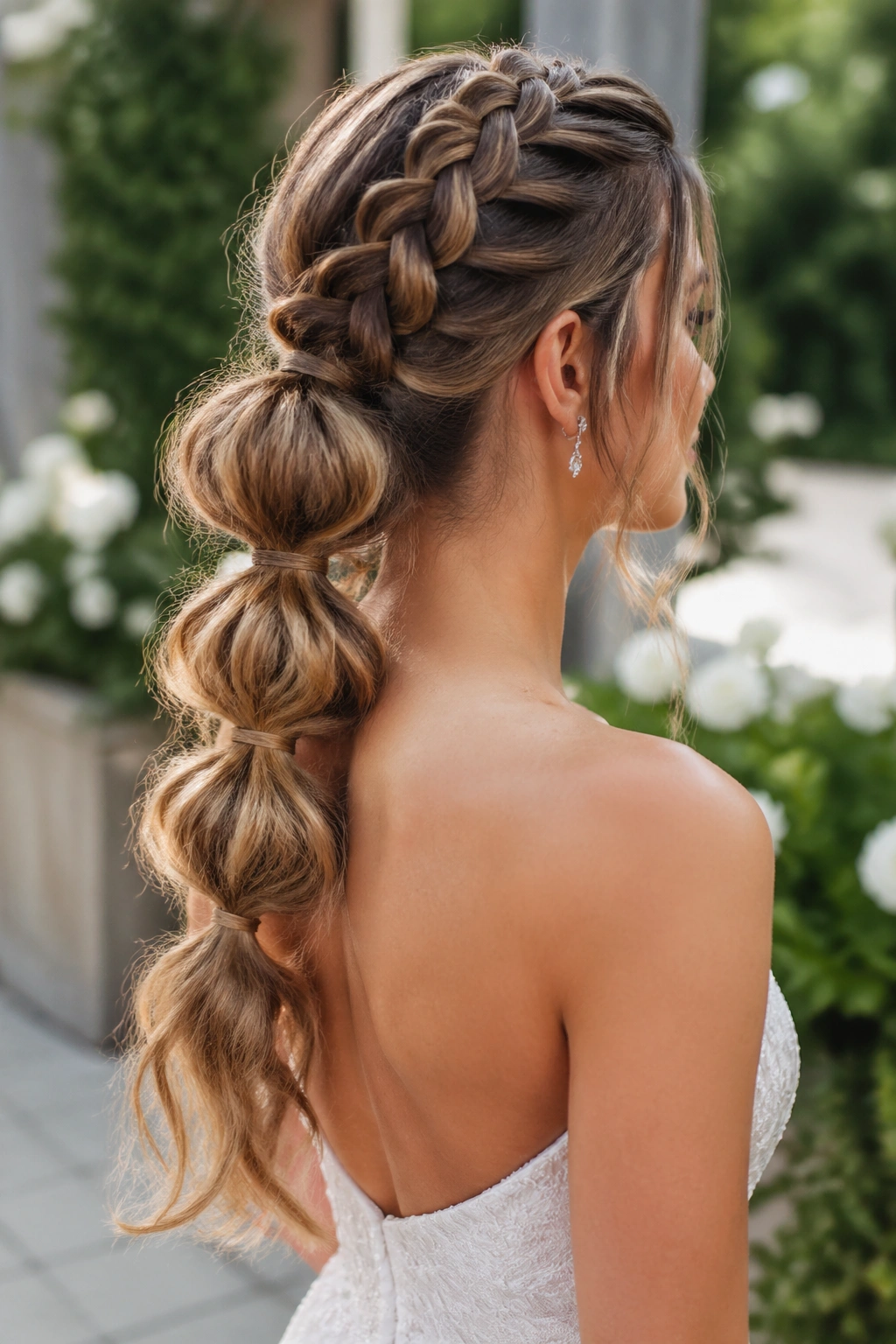
A braided bubble ponytail is what happens when you combine two strong ideas without letting either one take over. A braid secures part of the structure, then the tail is split into bubble sections below it. The result has rhythm and texture all the way down.
This style is useful for long hair because it keeps the length from looking like one endless rope. Each bubble gives the eye a place to stop. The braid at the top adds a bit of grip and helps the ponytail stay secure, especially when the hair is thick or layered.
The bubbles should be puffed evenly, but not perfectly. A slight difference in size gives the style life. If every section is identical, the finish can feel mechanical. If you want to soften it further, tuck a few tiny curls around the elastic points. That tiny detail helps the transitions blend instead of looking chopped up.
25. French Twist Ponytail
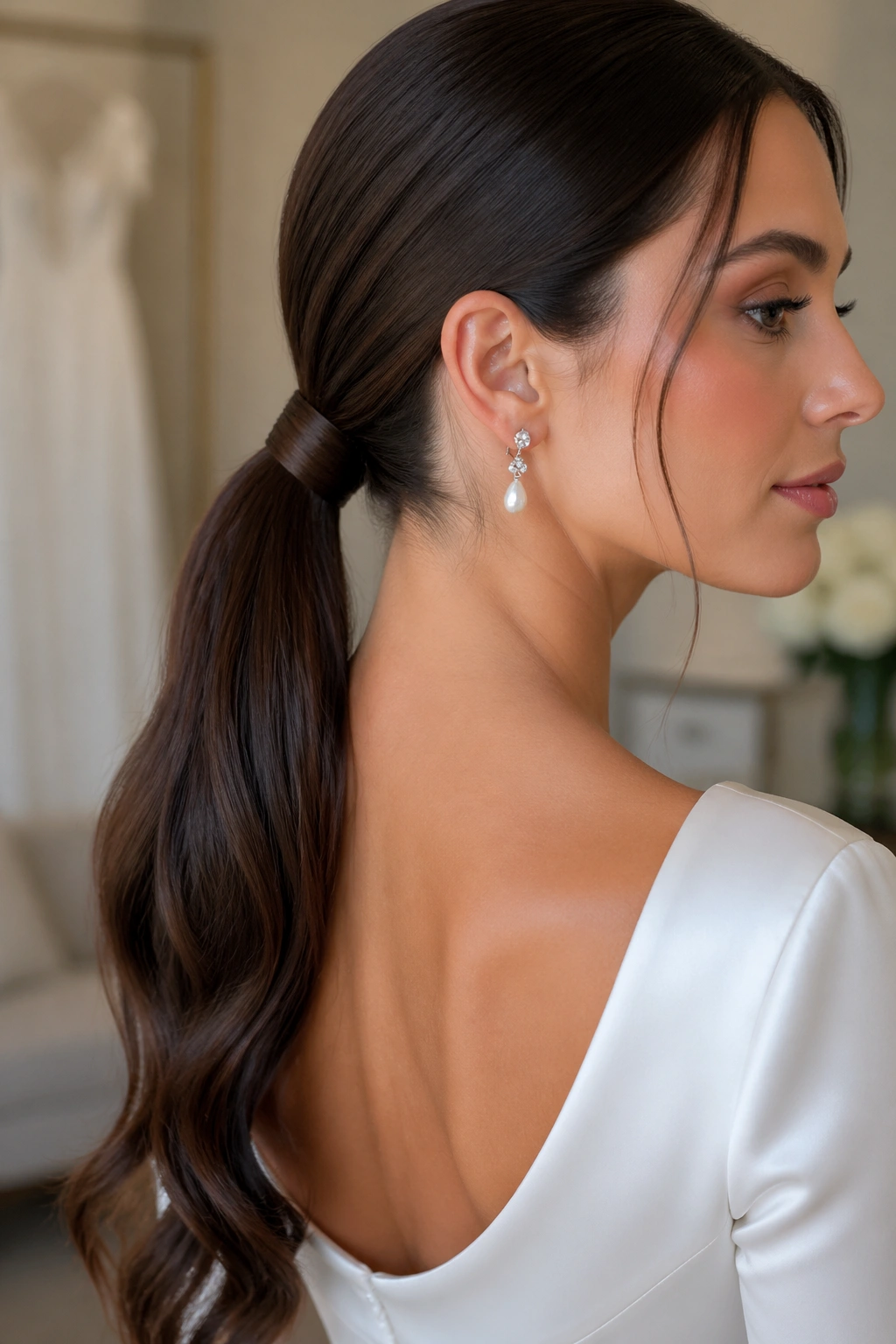
A French twist ponytail is one of the more elegant options here, and it has a strong vertical line that suits a dress with a clean back. The top is rolled upward and inward before dropping into a low ponytail, so the style has the polish of a twist with the movement of a tail.
Why It Feels So Refined
The twist lifts the hair away from the neck, which is useful when the neckline is high or the earrings are substantial. It also keeps the silhouette slim, even with long hair, because the length is gathered into a controlled fall rather than spread around the head.
- Smooth the sides first so the twist stays crisp.
- Pin the seam of the twist in a hidden vertical line.
- Leave the ponytail softly curled at the ends.
- Use a light mist of spray only after the structure is secure.
The style can lean formal quickly, so the finish should stay clean. If a few soft pieces escape near the ears, that is enough. More than that and the twist starts to lose shape.
26. Wrapped-Braid Low Ponytail
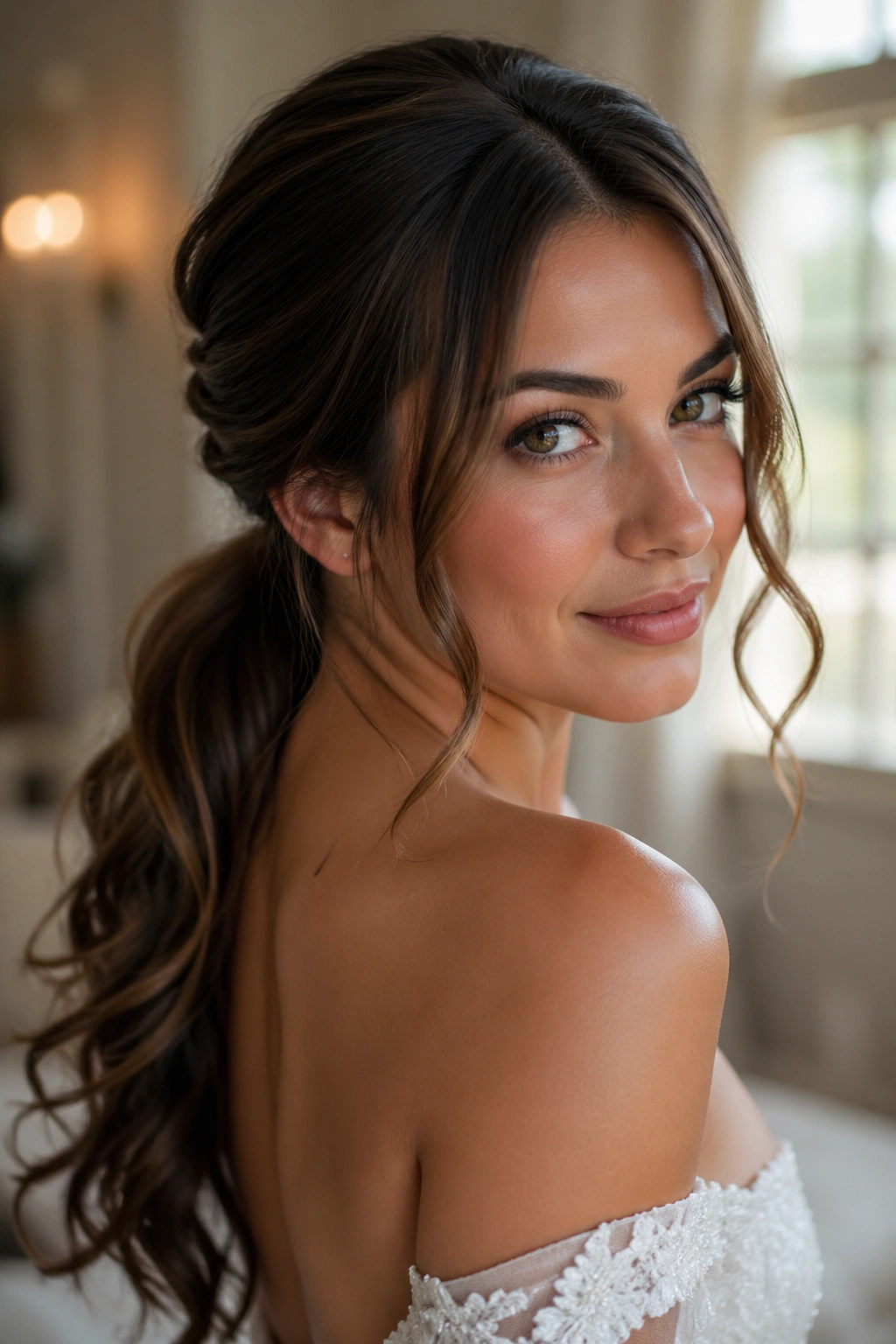
A wrapped braid at the base gives a low ponytail a layered look without making it busy. The braid wraps around the elastic or crosses over the base like a band, then the tail drops from underneath. It is a subtle way to make long hair feel more detailed.
Unlike a full braid ponytail, this version keeps the length open. That makes it useful when the bride wants to show off the hair itself, not just the braid pattern. The wrapped section becomes the accent, and the rest can stay smooth or softly curled.
This is a strong choice for dresses that have texture but not a lot of sparkle. The braid gives enough interest on its own. If you want to increase contrast, keep the braid tight and the tail loose. If the whole look should feel softer, pull the braid apart a little and let the edges blur. Both work. The difference is mood.
27. Glossy Minimal Ponytail
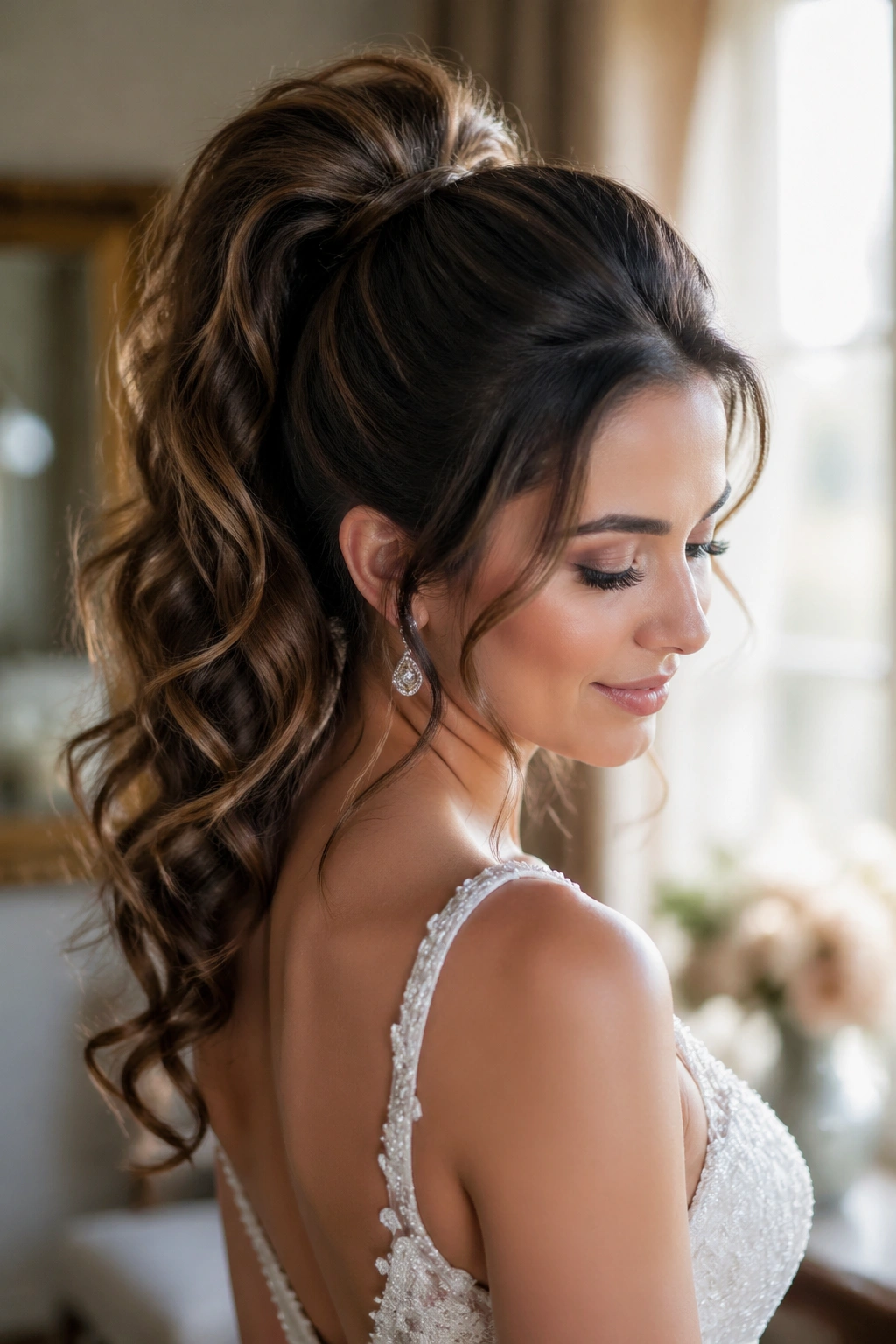
What if the dress already says enough? Then a glossy minimal ponytail might be all you need. No braid. No bow. No pearl pin. Just a clean shape, a straight part, and hair that looks polished from root to end.
The appeal is in the finish. Long hair reflects light well when it is smoothed and lightly coated, so the style ends up looking expensive without any extra decoration. That is a word I almost never use, but here it fits. The whole point is restraint.
How to Keep It from Looking Flat
Use a smoothing cream at the top and a tiny amount of shine serum through the mids. Keep the product away from the roots so the style does not collapse. Then secure the ponytail firmly and take a clean strand to wrap the base. The ends can stay straight, or you can add a soft bend just at the bottom for shape.
This is the one for brides who hate fuss. It has backbone.
28. Romantic Tendril Ponytail
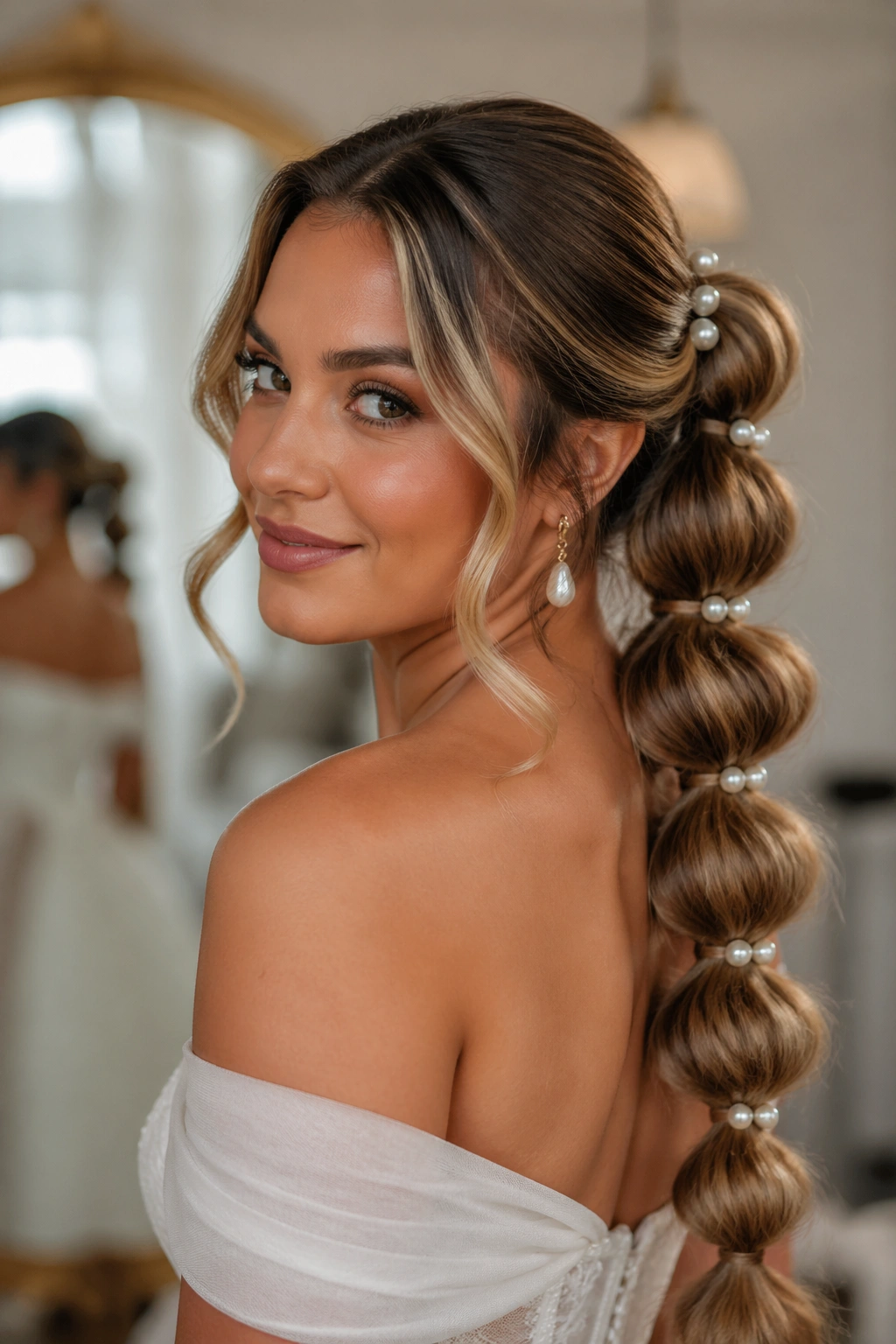
A few loose tendrils can change the entire tone of a ponytail. This style leaves slim pieces near the temples, cheekbones, and sometimes the nape, so the finished look feels softer and less anchored to the head.
The tendrils should be intentional. Too many loose pieces make the style look unfinished. Too few and the effect disappears. I like one or two fine pieces on each side, curled away from the face, with the rest of the ponytail kept full and secure. That balance matters.
This style is especially nice if the wedding dress has soft tulle, flutter sleeves, or a V-neck. The looseness at the front keeps the hair from competing with those details. Use a curling iron no wider than 1 inch for the tendrils so they hold their shape without turning into ringlets. If the ends are too tight, the front can look overdone. Soft bend. Clean edges. That is the sweet spot.
29. Floral Sprig Ponytail
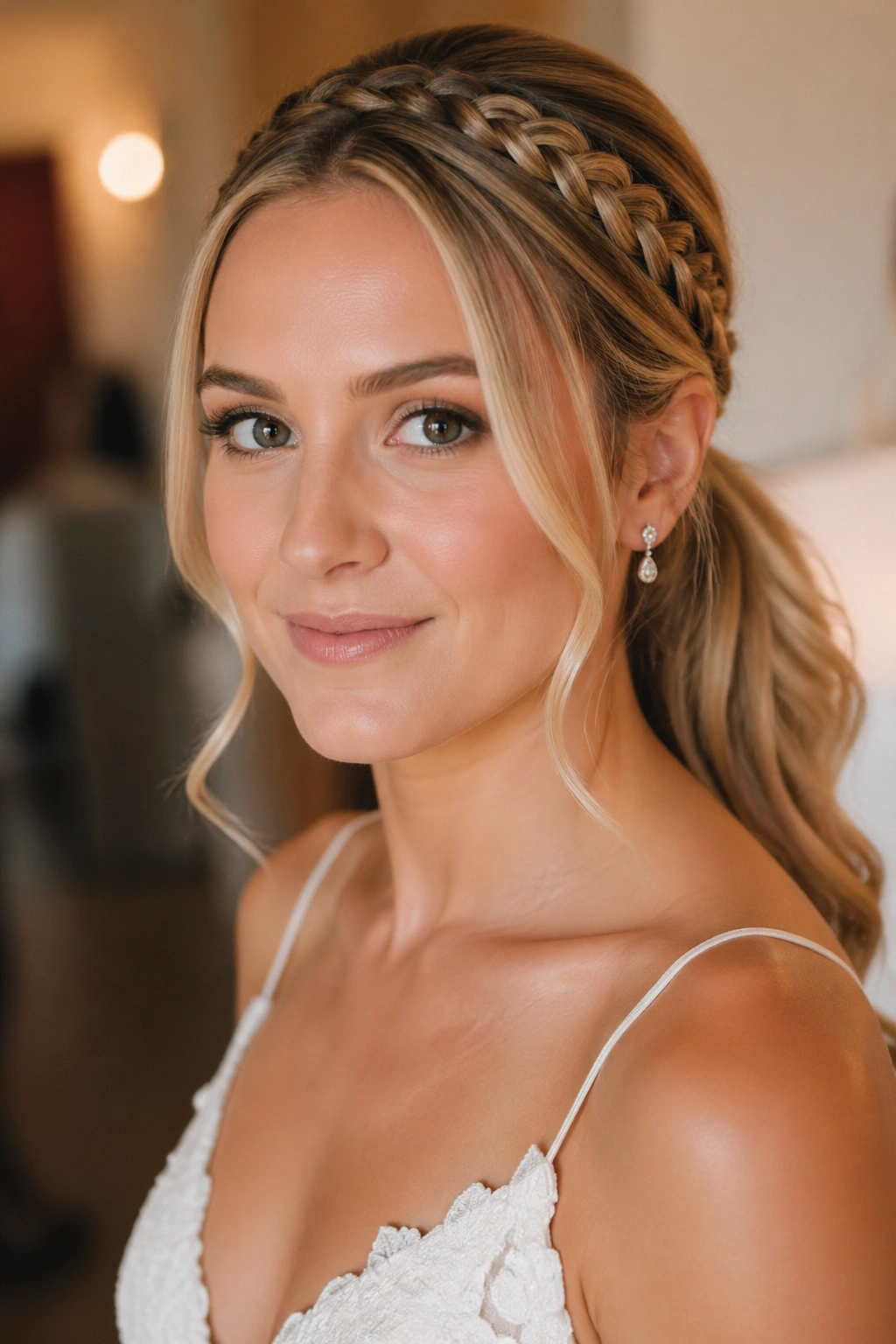
Fresh flowers in a ponytail can go wrong fast if they are too large or too many. A floral sprig version keeps the idea small and controlled, with one or two stems tucked near the base or woven lightly into a braid.
The best flowers for this are small-headed blooms, thin stems, or clipped greenery that can be pinned without dragging. Delicate roses, baby’s breath, wax flower, and fine eucalyptus all work if they are secured properly. Heavy blooms tend to slump once the room warms up, which is not what you want halfway through photos.
Keep the ponytail simple so the flowers stay the focus. A low or mid ponytail usually gives the flowers the most support. If the dress already has a floral pattern, use greenery only. If the gown is plain, one small bloom can be enough. The goal is not to build a bouquet in the hair. It is to echo the bouquet just enough.
30. Asymmetrical Side Ponytail
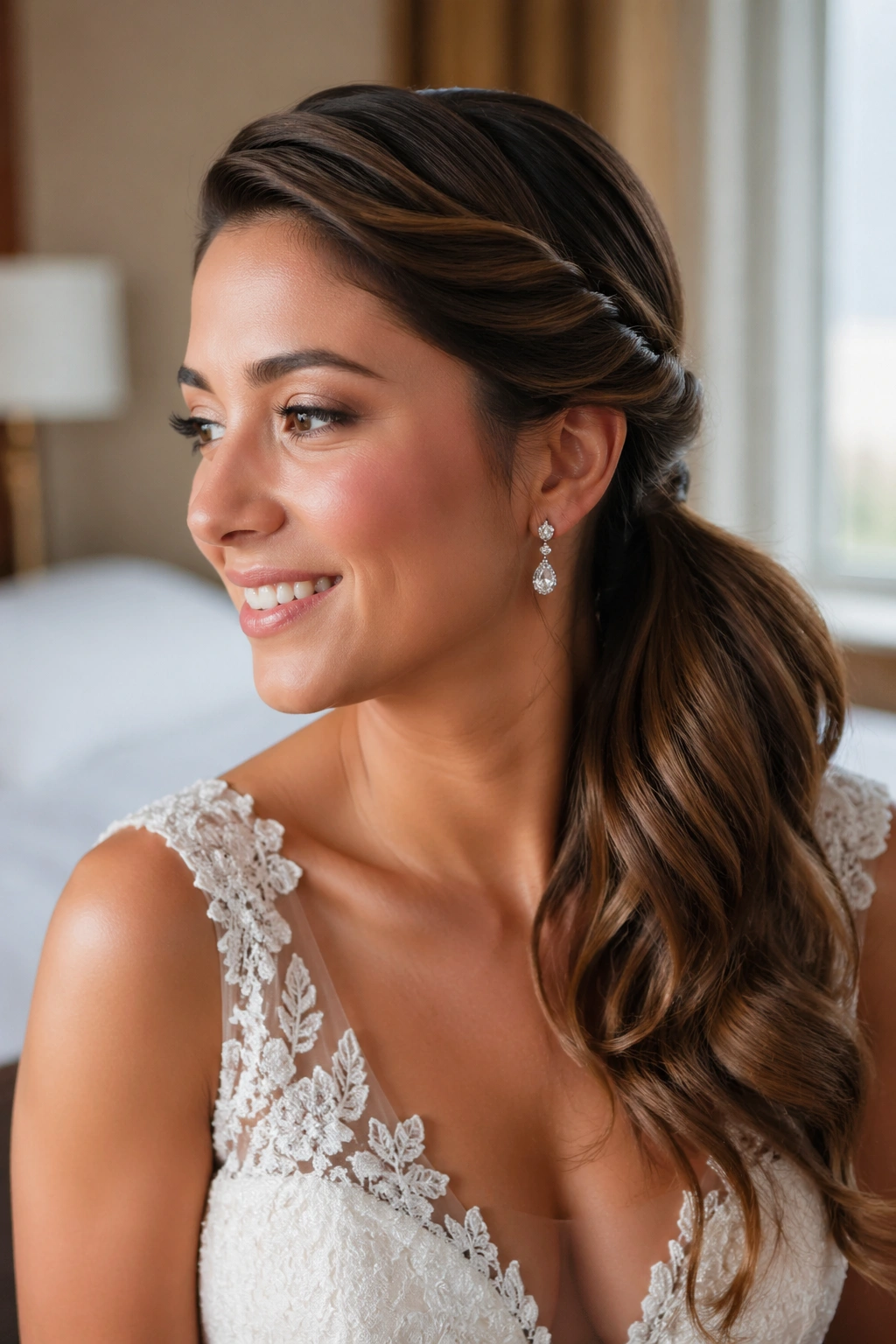
A side ponytail can feel very grown-up when the weight is shifted off-center. The base sits low and slightly to one side, the hair sweeps across the back, and the shape opens the neck on the opposite side. It is elegant without being stiff.
This works well when the dress has one dramatic element—an embellished shoulder, a deep side neckline, or a bold earring. The asymmetry gives that detail room to breathe. Long hair falls more naturally to one side anyway, so this style often feels less forced than a very centered arrangement.
The trick is keeping the low side secure. If the base is too loose, the ponytail droops and starts to look accidental. If it is too tight, it can pull the whole style down toward the ear. Aim for a base that sits just behind the jawline. That gives the style shape while keeping the profile clean.
31. Knotted Satin Base Ponytail
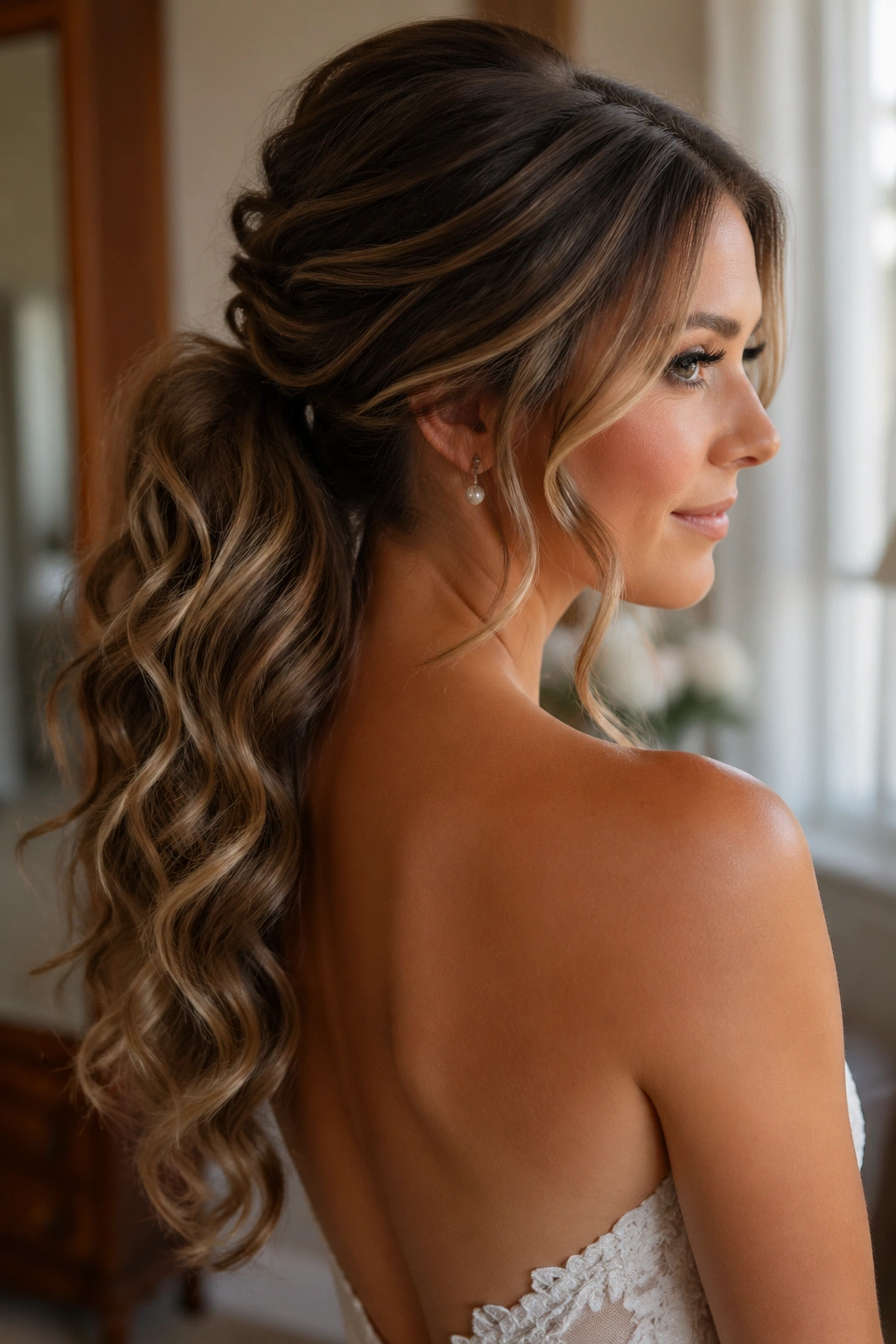
A satin base knot takes a plain ponytail and gives it a dressier center. The knot sits right where the elastic would be, but instead of hiding the base completely, it becomes the decorative element. The hair is gathered into one or two neat loops, then pinned so the finish looks smooth and tailored.
What Makes It Stand Out
The satin finish matters because it softens the edges of the knot. A glossy surface reflects light in a way that makes the base look polished, not bulky. This is useful for long hair, which can otherwise make a knot look thick and fussy.
- Keep the knot compact if the gown is ornate.
- Leave a little volume in the tail so the style does not feel too tight.
- Match the knot placement to the dress back.
- Use hidden pins that cross under the fold.
This style is a nice middle ground between simple and decorated. It does not need extra accessories to feel finished.
32. Tailored Low Ponytail
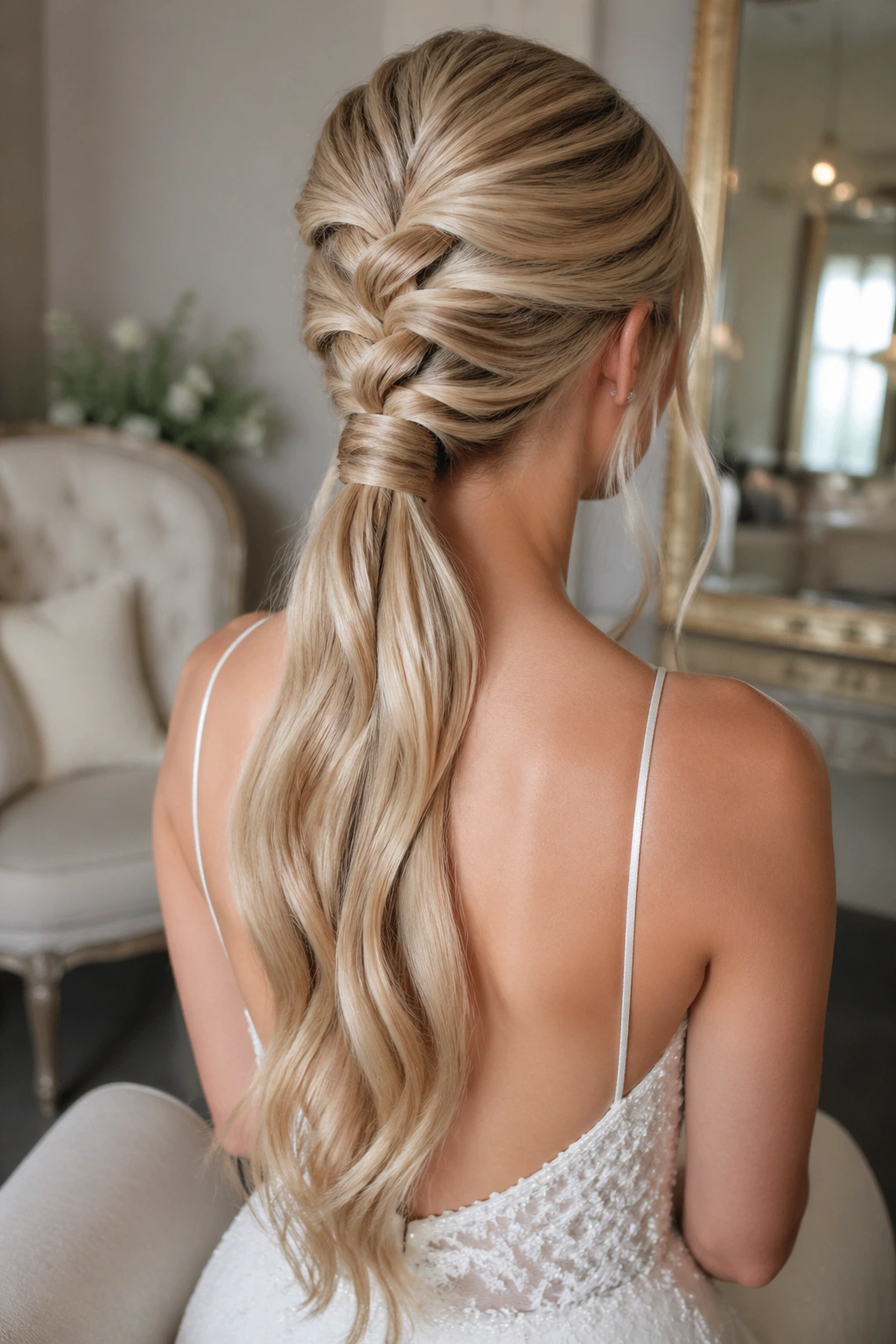
A tailored low ponytail has a crisp, deliberate shape that suits brides who like structure more than softness. The crown is smooth, the nape is tight enough to stay neat, and the tail falls in a controlled line. No extra fluff. No wandering pieces.
The appeal is in the precision. This style looks especially strong with a square neckline, a high collar, or a dress that has sharp seams and clean fabric. Long hair can sometimes fight that kind of gown, but a tailored ponytail meets it halfway. The result feels coherent.
This is not the place for too many loose curls or decorative extras. If you want interest, make it come from the texture of the tail itself. A smooth finish with a slight bend at the bottom is enough. If the hair is very thick, thin out the tail visually by curling the ends inward a little. That keeps the silhouette tidy without making it severe.
33. Veil-Ready Storybook Ponytail
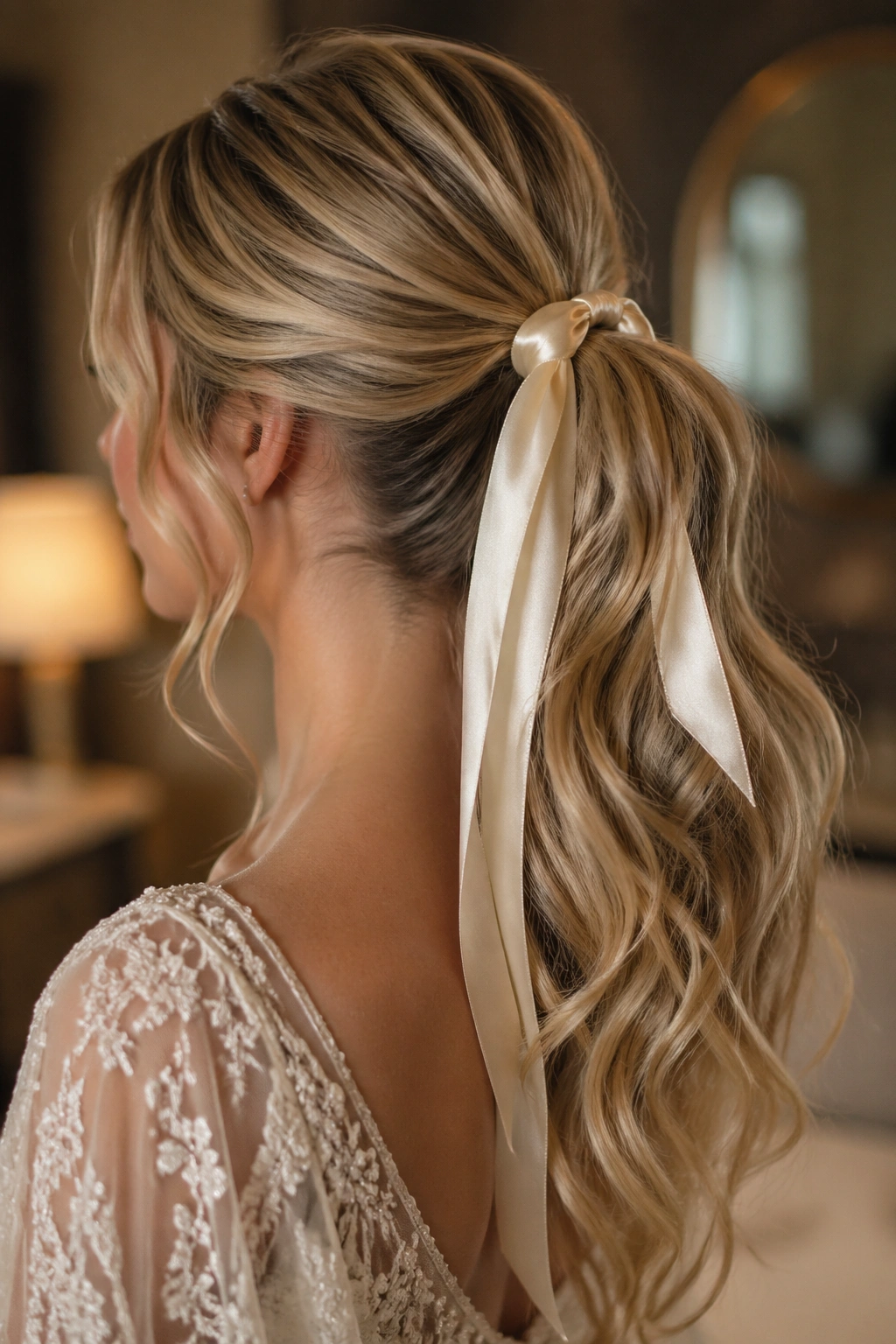
A veil-ready storybook ponytail is the one that feels most complete when you see it from behind. The ponytail is built to leave space for the veil comb, enough softness at the nape to keep the head shape pretty, and enough length below to keep the tail visible after the veil comes off.
What makes it different is the balance of function and atmosphere. The hair has to support the veil, stay comfortable through the ceremony, and still look lovely once the veil is removed for the reception. That usually means a low-to-mid base, a smooth crown, and curls or waves through the tail so the shape holds without depending on the veil for its impact.
How to Finish It Well
Test the veil placement before locking in the last pins. Let the ponytail fall naturally, then adjust the accessory around it. If the veil sits too high, it can crush the shape. If it sits too low, it loses its connection to the hairstyle. That tiny adjustment is the whole difference.
A style like this does not ask for much else. It already knows its job.
Final Notes
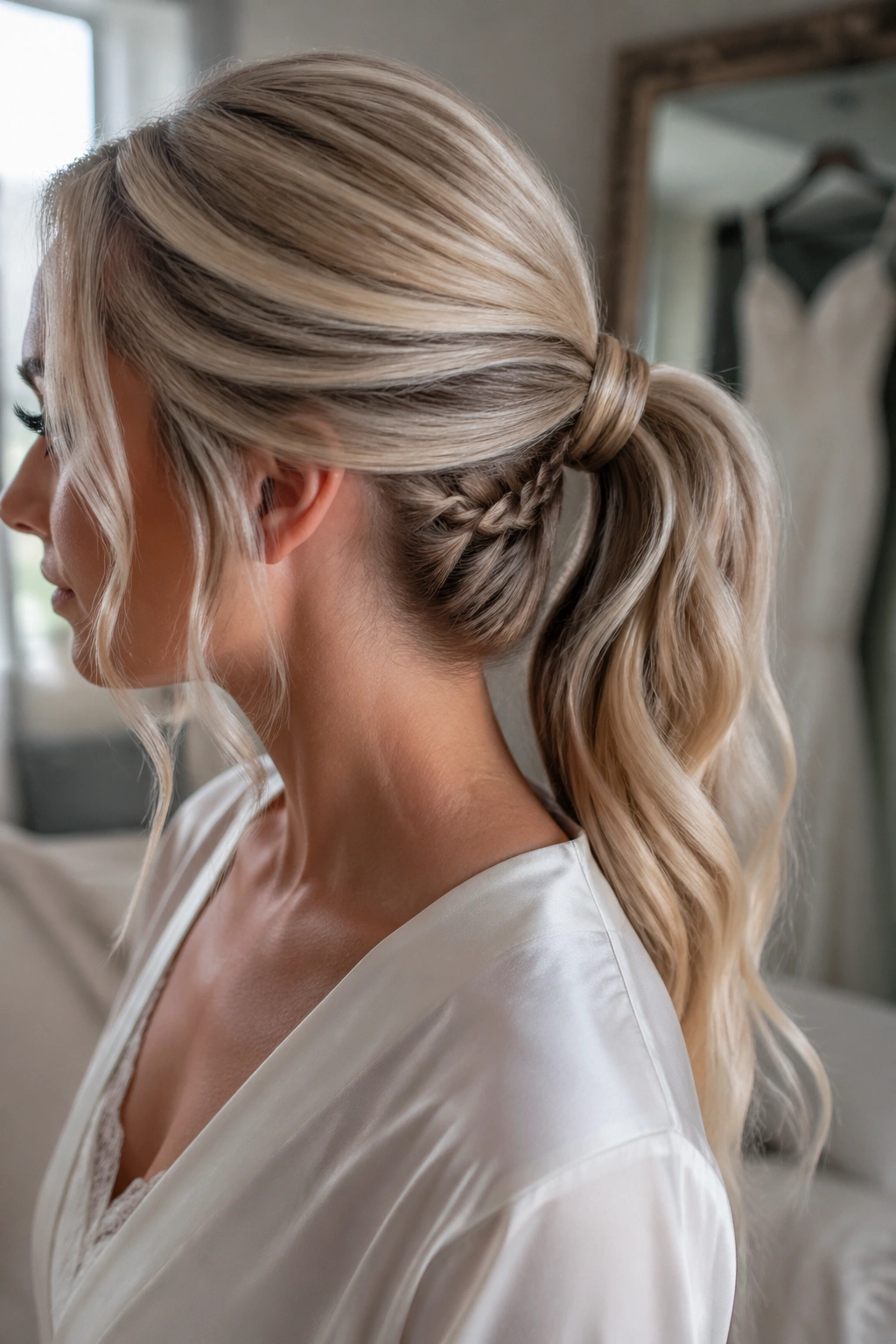
The best wedding updo ponytails for long hair do not fight the length. They shape it. That is the whole advantage, really: you keep the drama of long hair while avoiding the usual problems of weight, frizz, and sagging.
If you are choosing between styles, look at the dress first, then the veil, then the texture of the hair. Those three things usually point to the right answer faster than a hundred inspiration photos do. And if you are still torn, a low wrapped ponytail or a soft curled version is the safest place to start. They hold up, they photograph cleanly from every angle, and they leave room for earrings, pins, or a veil to do their part.
