



Green braids are not shy. That is the whole point.
A good set of green and ombré box braids can look sharp, moody, polished, playful, or a little punk, depending on where the color starts and how hard the fade hits. The mistake people make is treating green like one single mood. It isn’t. Forest, olive, emerald, sage, teal-tinged green, and lime all read differently once they’re braided into neat parts and stretched down the back.
The easiest way to keep the style wearable is to anchor it with a darker root or a deeper green base. A hard jump from black to neon can feel costume-like if the braids are long and the parts are wide; a softer fade usually gives the color room to breathe. On box braids, that transition matters more than most people think, because each braid becomes its own little color stripe.
Some of the best versions are not the loudest ones. A deep forest base with emerald tips can look richer than a full head of bright green, and a sage ombré can hold up better when the braids start to loosen a little. The styles below are the ones I keep coming back to because they actually work in real life, not just in a perfect photo. Start with the shade that matches your nerve, then decide how much contrast you want.
1. Forest Green Waist-Length Box Braids
Forest green is the grown-up version. It has enough depth to feel grounded, but it still gives you that unmistakable color hit the second you turn your head.
This is the style I’d hand to someone who wants green box braids without looking like they tried too hard. Waist-length gives the shade room to move, and the extra length lets the color breathe instead of sitting in one dense block around the face. In indoor light, forest green can read almost black. Outside, it opens up and shows that mossy, rich finish people love when they want color with a little restraint.
The braid size matters here. Medium parts usually look the cleanest because the color shows up without turning busy. If the sections are too tiny, the shade can get lost; if they’re too chunky, the effect becomes heavier than it needs to be. I also like a crisp middle part or a soft side part with this look. It keeps the style tidy and lets the green do the talking.
One practical note: forest green shows lint faster than people expect. Satin at night helps, of course, but even during the day, it pays to avoid heavy oils that make dust stick to the hair. A light mousse and a clean scarf do more than a whole shelf of shine products.
2. Black-to-Emerald Ombré Box Braids
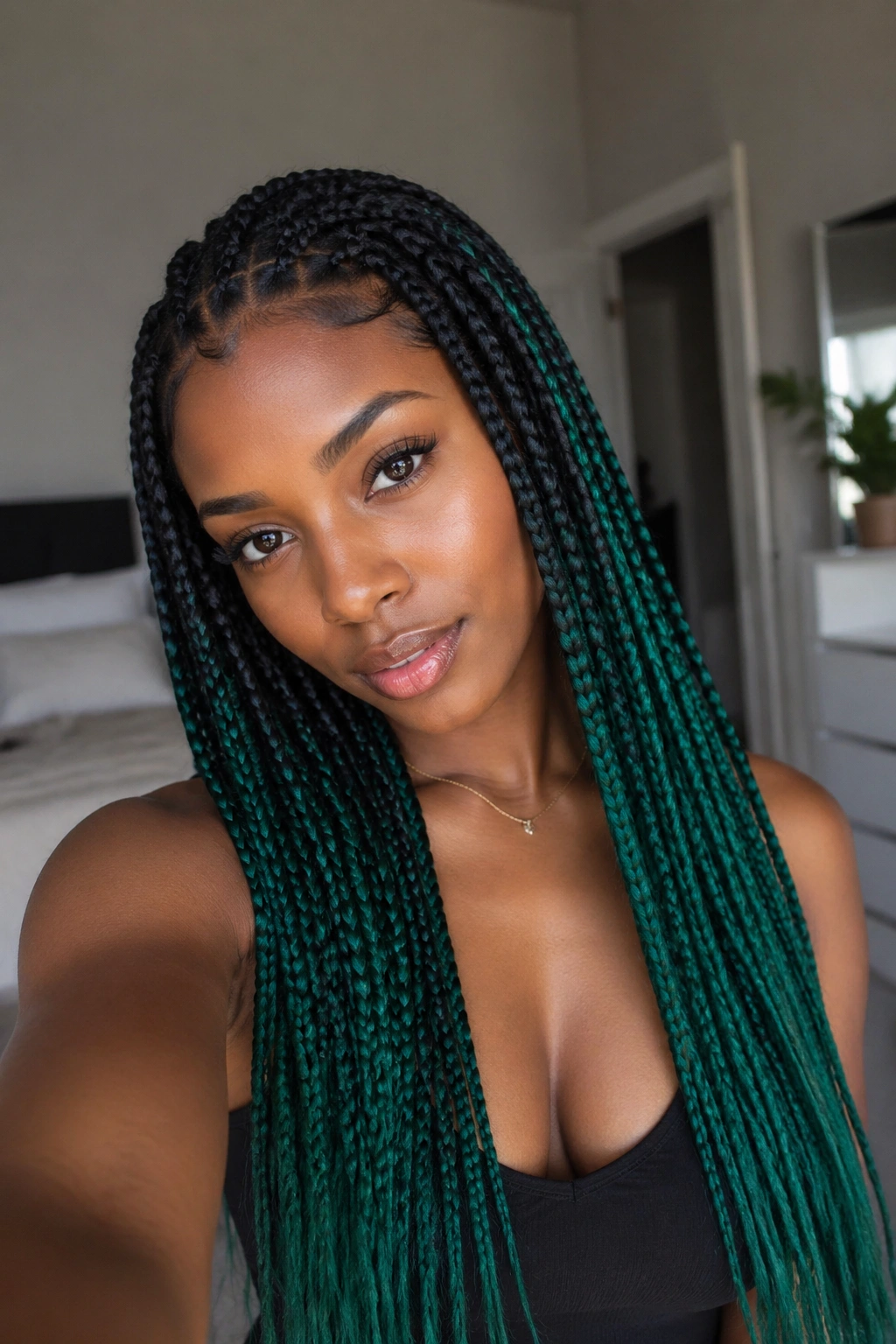
Black roots into emerald ends is the cleanest ombré move in the whole green family. It looks deliberate from the first day and usually stays that way even after the braids soften a little.
Why the fade works
The black base acts like a frame. It keeps the roots quiet and lets the emerald show up as the braid gets longer, which is exactly why this style feels so polished. If the green starts too high on the head, the whole look can turn loud fast. If it starts around the mid-shaft or just below the ear line, the fade has space to unfold.
Longer braids are the sweet spot here. With waist-length or mid-back braids, the color shift reads like a real design choice instead of a quick dye idea. A deeper emerald with a slight blue cast usually feels richer than a flat grass-green tone, especially if your wardrobe leans simple and you want the hair to carry the drama.
- Works best with medium or small box braids.
- Ask for the fade to begin around the mid-length or lower third.
- Keep the emerald tone deep if you want a cleaner finish.
- Pair it with simple parting so the color stays the focus.
The style is crisp, not fussy. And that matters.
3. Lime Green Dip-Dyed Box Braids
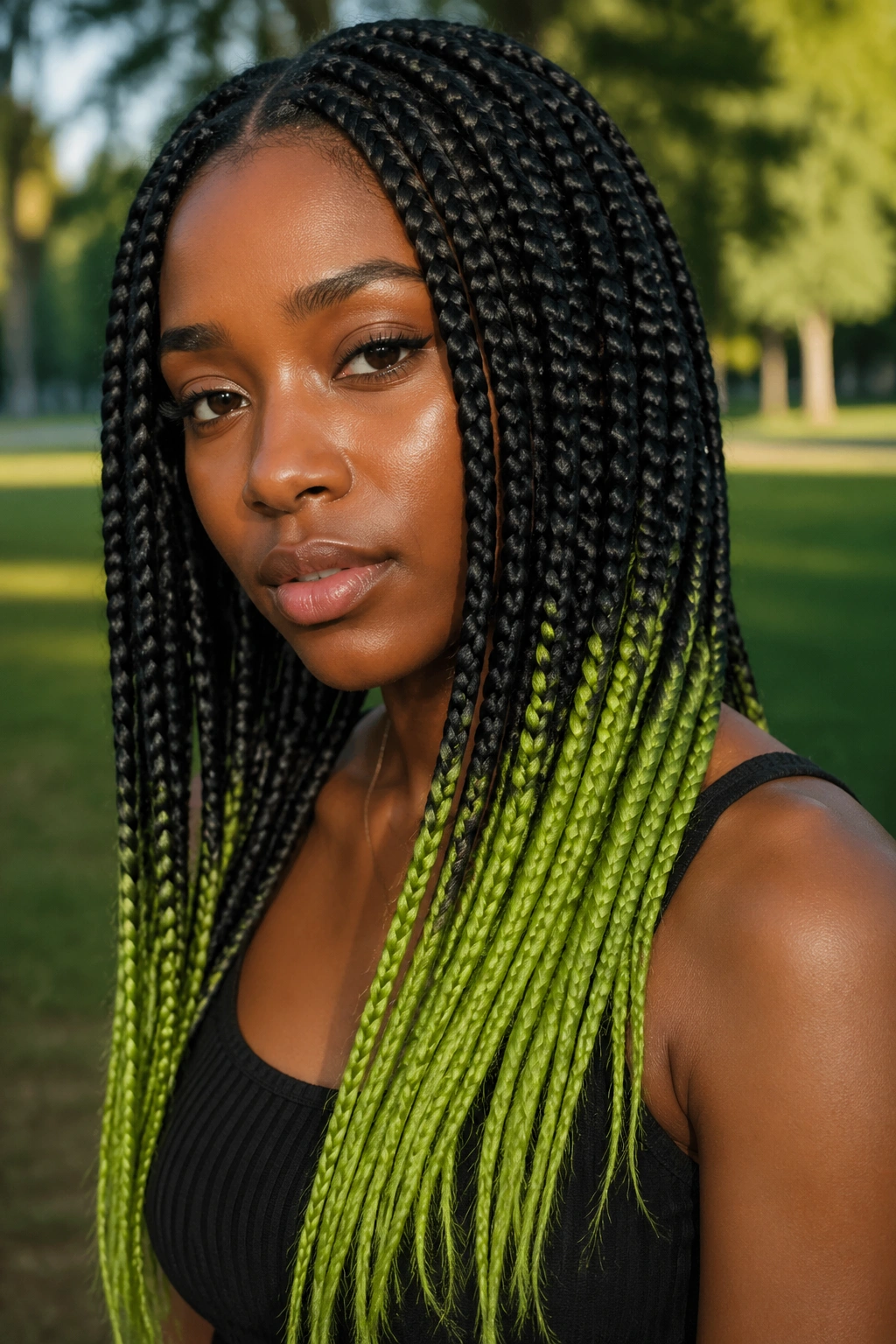
Why does lime green work on some heads and fall flat on others? Because it needs a dark braid body underneath it. Lime by itself is loud; lime at the ends of black or dark brown braids looks intentional.
How to wear it
Keep the lime to the last few inches if you want the style to stay wearable. Three to five inches is usually enough for the color to read without taking over the whole head. That short dip-dyed finish also makes the ends look brighter, which is where lime does its best work anyway.
This style gets stronger on medium-to-long braids. On short braids, lime can feel abrupt. On longer lengths, it has room to shine and move. Blunt ends keep it modern, but softly curled ends can make it feel a little less sharp if you don’t want the whole look to read as neon.
I like this version for people who want their hair to be the outfit. You don’t need much else. A white tee, dark denim, a clean lip, done. If you’re already wearing bright makeup or bold prints, the braids can start arguing with the rest of the look. That’s the catch. Lime is fun, but it likes a quiet supporting cast.
4. Olive Green Box Braids with Earthy Brown Undertones
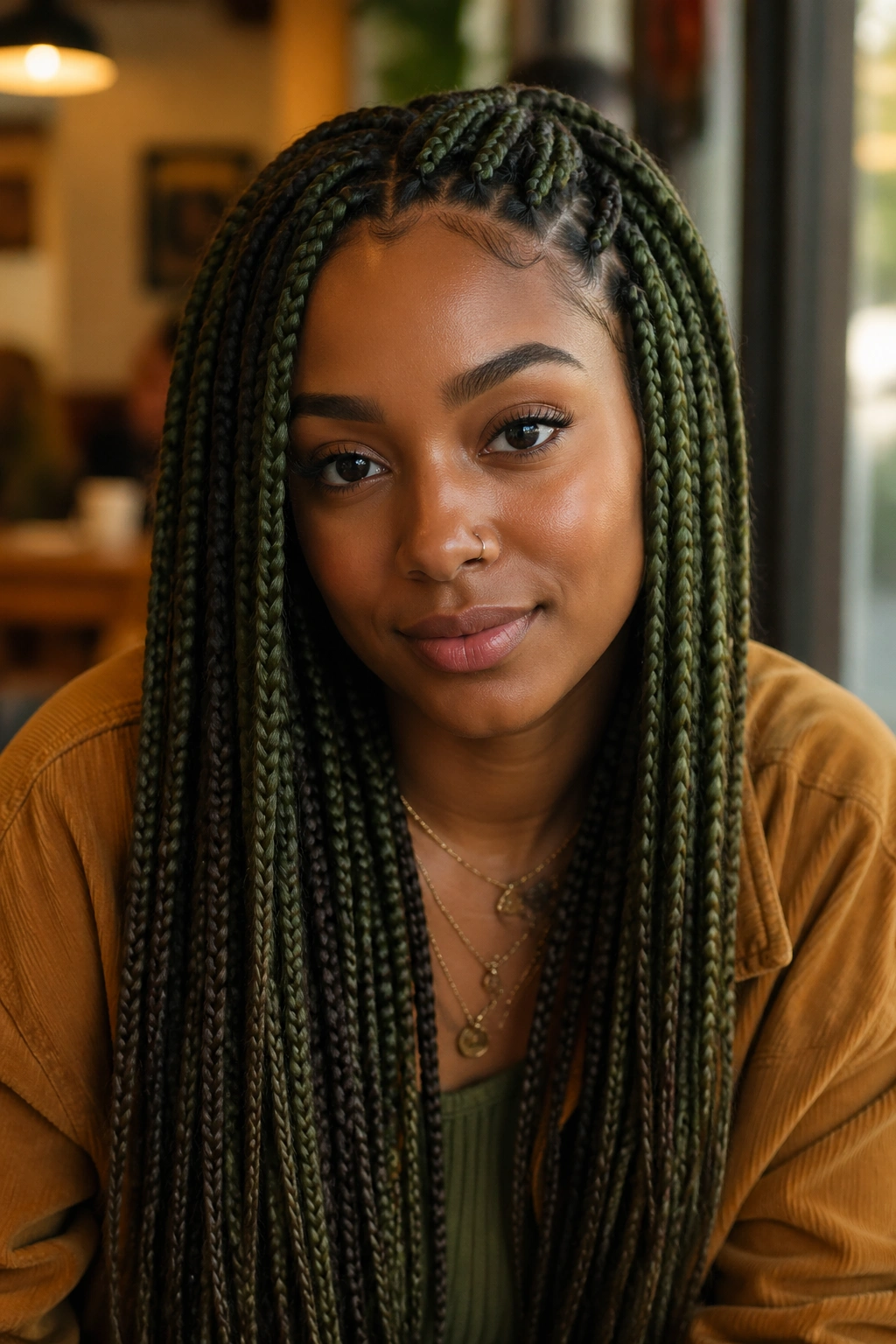
If neon greens scare you, olive is the one that tends to win people over after one wear. It’s softer, drier-looking, and a little more grounded than brighter shades.
Olive works because it doesn’t fight the warm parts of your wardrobe. Tan, cream, rust, chocolate brown, gold jewelry—this shade sits next to all of them without trying to outshine anything. The brown undertone is what makes it feel wearable. It has enough green in it to read as a color choice, but enough earth in it to feel calm.
A mix of olive and espresso braiding hair usually looks better than a single flat olive shade. The slight variation gives the braids depth, especially when the light hits them at an angle. Medium-width braids are a safe choice here. Too fine, and the color can blur. Too thick, and the olive can look dense in a way that hides the tone.
- Ask for mixed strands instead of one solid block of color.
- Keep the root area dark if you want the style to settle fast.
- Choose gold cuffs or simple hoops rather than too many shiny extras.
- Use a light mousse to keep the finish soft, not greasy.
Olive is the one you wear when you want color that still lets your face breathe.
5. Teal-Green Ombré Box Braids
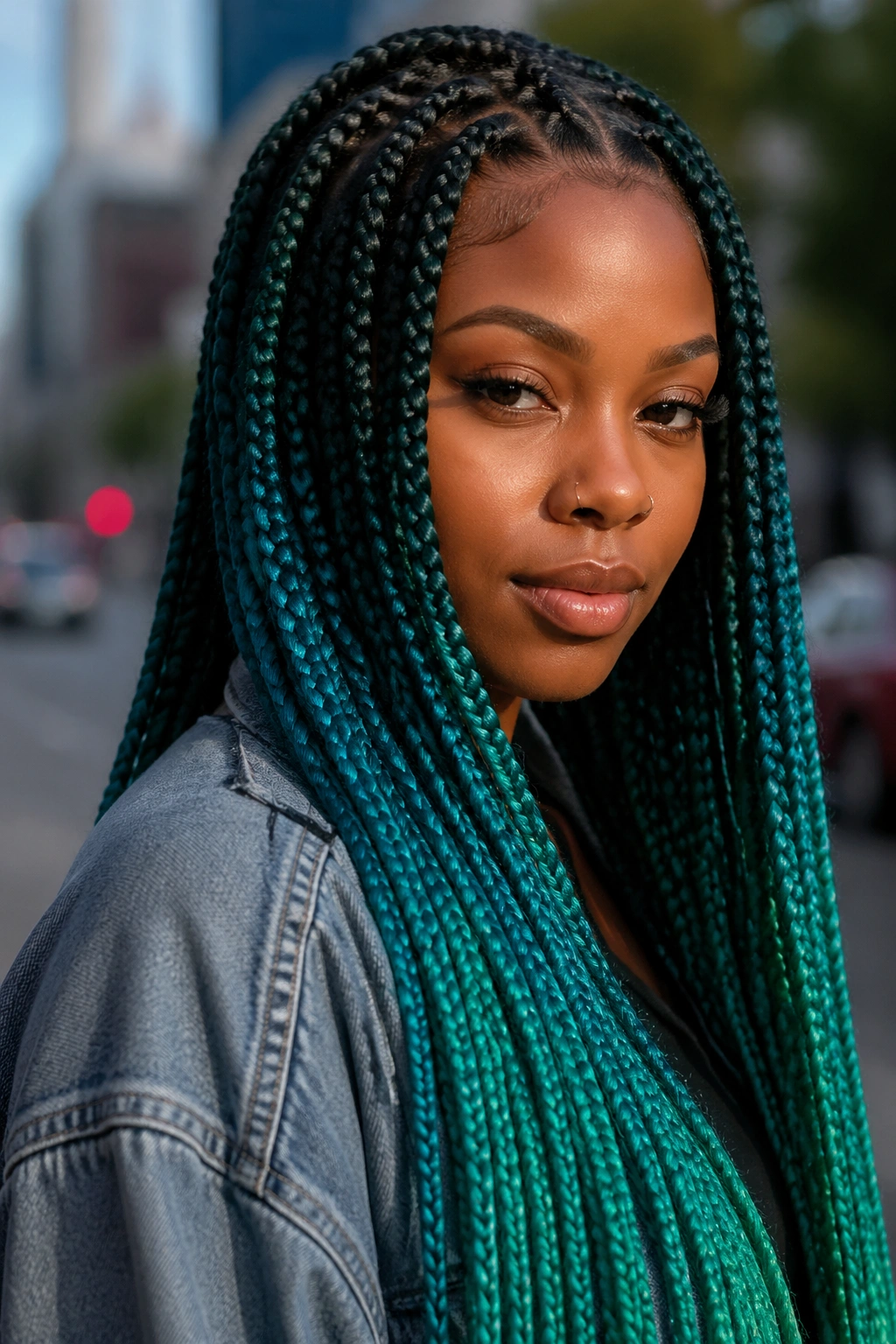
Teal is what happens when green gets a little blue in its blood. That tiny shift changes everything.
What I like about teal-green ombré box braids is the coolness. The color feels sharper than olive and softer than lime, which lands it in a nice middle ground. It works especially well if you wear silver jewelry, denim, black clothing, or anything with a cool undertone. The green never looks flat because the blue edge keeps it moving.
Long braids show this shade best. The ombré has more room to fade from dark roots into that teal depth, and the braid pattern makes the color look layered instead of painted on. If you want the style to feel cleaner, keep the top half of the braid darker and let the teal open up lower down. If you want more color on top, move the fade upward a bit—but not all the way to the scalp. That almost always looks too eager.
A small trick: mix in a few straight green strands with the teal if you’re worried the finish will look one-note. That little break in color keeps the braids from reading as one giant block when they’re gathered in a ponytail or bun. Tiny detail. Big payoff.
6. Green-to-Blonde Gradient Box Braids
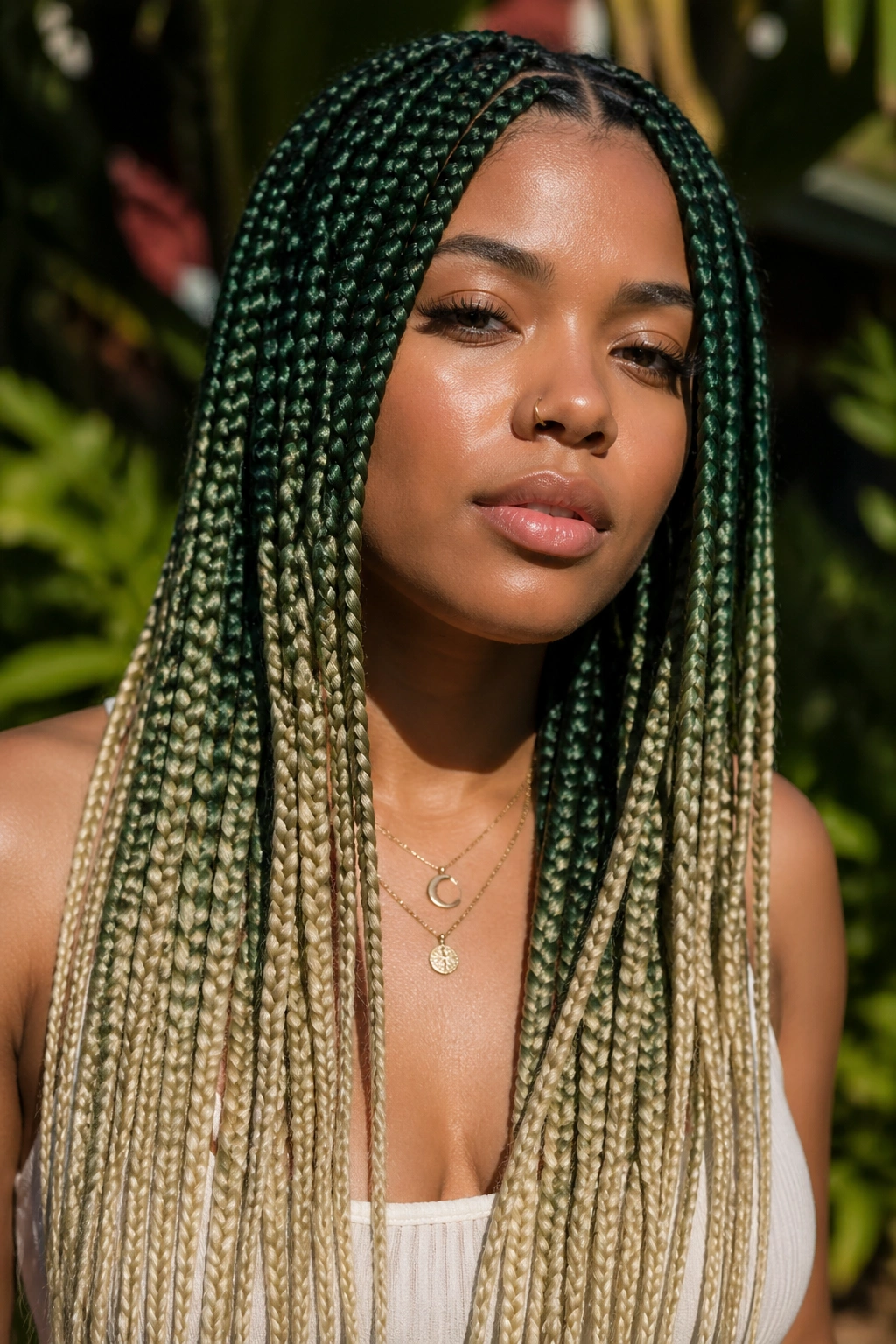
Compared with black-to-green ombré, green-to-blonde is louder and sunnier. The blonde ends lighten the whole head, which makes the green feel more playful and less heavy.
This is the version I’d point to if you want contrast and movement. The blonde catches the eye first, then the green grounds it. That balance works especially well when the green is deep rather than neon. A forest or emerald base with honey or ash blonde tips can look expensive in a way that bright lime rarely does. Yes, I know “expensive” gets thrown around too easily in hair talk. Here it means the color path makes sense. You can see the logic of it.
Ash blonde gives the style a cooler finish. Honey blonde warms it up. Pick the one that matches the rest of your wardrobe and the metal you wear most often. If you usually reach for gold jewelry and warm makeup, honey tends to feel easier. If your closet is full of black, white, gray, and denim, ash blonde keeps the whole look cleaner.
The fade should usually start lower on the braid so the green stays dominant near the head. If the blonde begins too high, the style loses its shape and starts to look washed out. That’s the line to watch.
7. Chunky Jumbo Green Box Braids
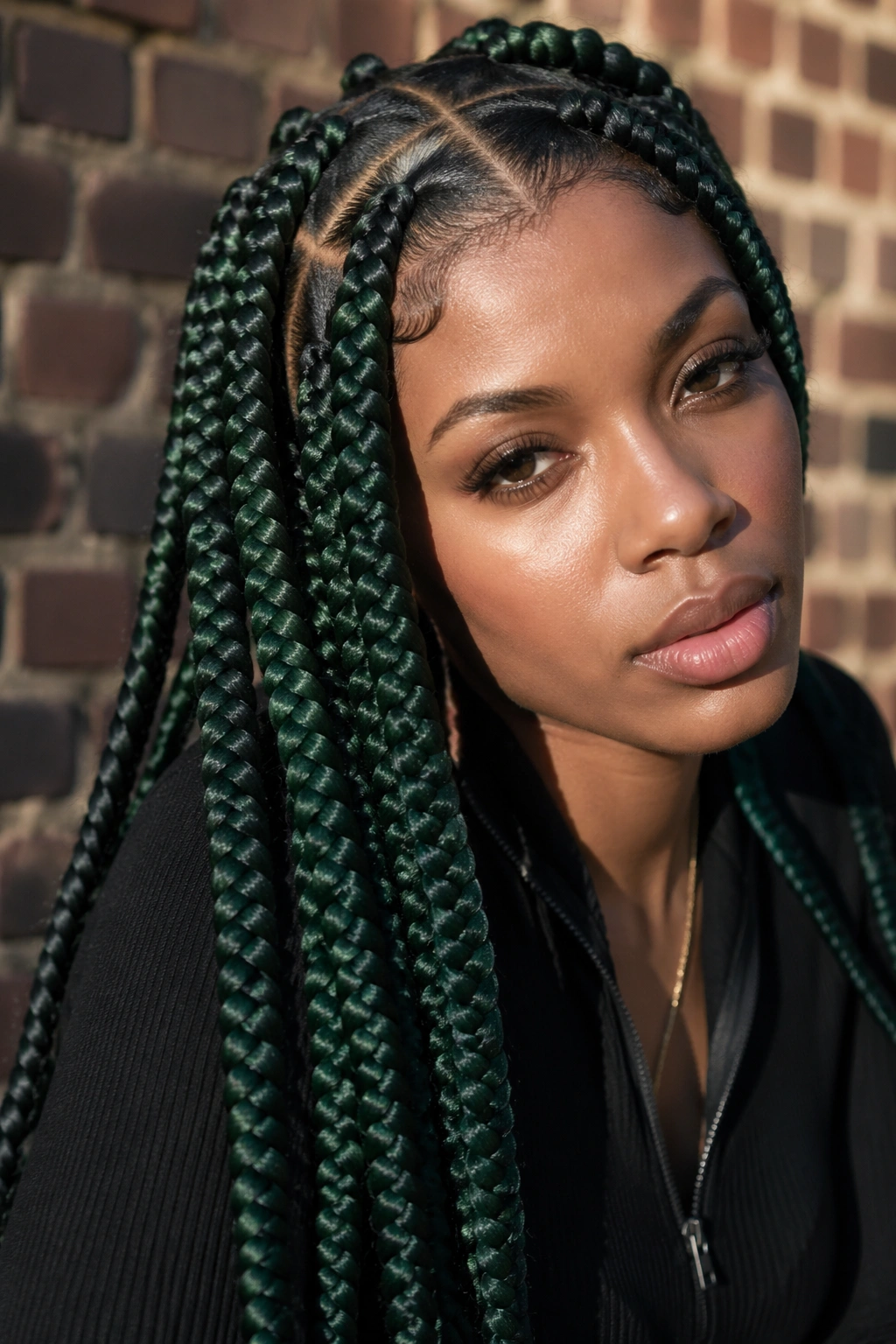
Jumbo braids make green louder in the best way. Fewer braids means bigger color blocks, and bigger color blocks mean the shade reads from across the room.
This size works especially well with one strong green tone—forest, emerald, or even a deep jade. Once you go jumbo, you don’t need much extra color mixing. In fact, too many shades can make the whole style feel busy because each braid already carries so much visual weight. Clean parts are non-negotiable here. Big braids expose every line, every section, every small wobble in the parting.
- Best when you want a faster install than a full head of small braids.
- Looks strongest with square parts or a sharp middle part.
- Can be worn in a half-up style without disappearing.
- Needs a little more attention at the roots if the braids are long and heavy.
I’m a fan of jumbo green braids for people who like their hair to have presence. They hold shape well in buns, ponytails, and side sweeps, and they tend to feel bolder without requiring tiny braid-by-braid detail. The tradeoff is weight. Don’t ignore it. If the length goes too far past what your scalp likes, the style stops being fun.
8. Small Neat Green Box Braids
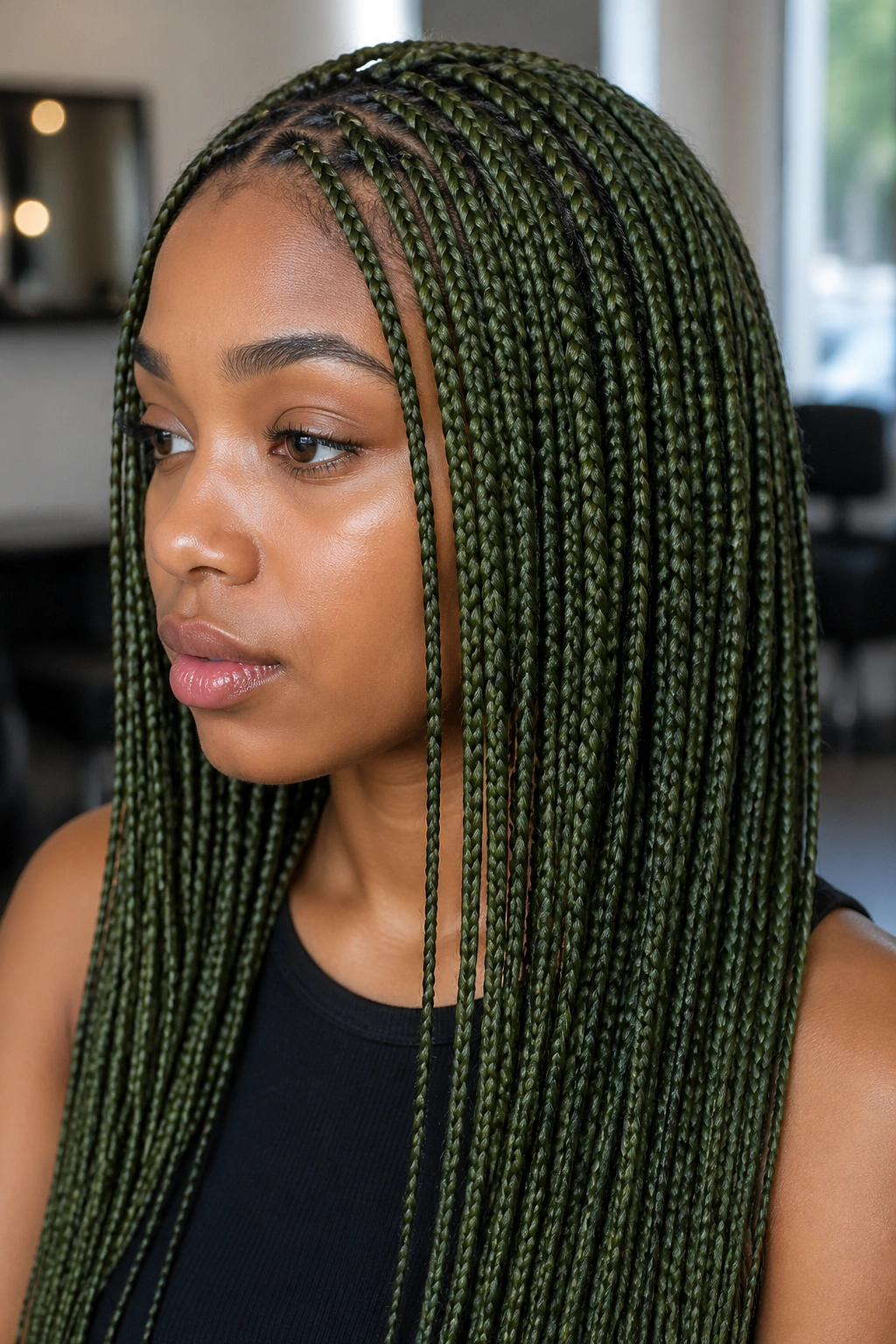
Can tiny braids carry a bold green color? Absolutely. They can even make it look more refined because the texture is denser and the color breaks up into finer lines.
What to ask for
The main thing is part size. If you want small green box braids to look clean, the sections need to be genuinely even, not just “small enough.” That means consistent parts from front to back and a shade that doesn’t turn the whole head into static. Deep green, sage, or muted teal usually works better than neon when the braids are this fine.
Small braids take longer to install. No getting around that. But they reward patience, especially if you want a style that hangs neatly and doesn’t feel too heavy at the scalp. Because each braid carries less bulk, the color also looks more controlled. I like this size for people who wear braids pulled back often. A low ponytail or half-up knot still shows the green, but the whole look stays tidy.
There’s one more upside that gets overlooked: smaller braids age better. They frizz more slowly, and the color tends to hold its shape longer because there’s less single-braid movement. If you want a style that still looks composed when it softens, this is a smart pick.
9. Face-Framing Green Accent Braids
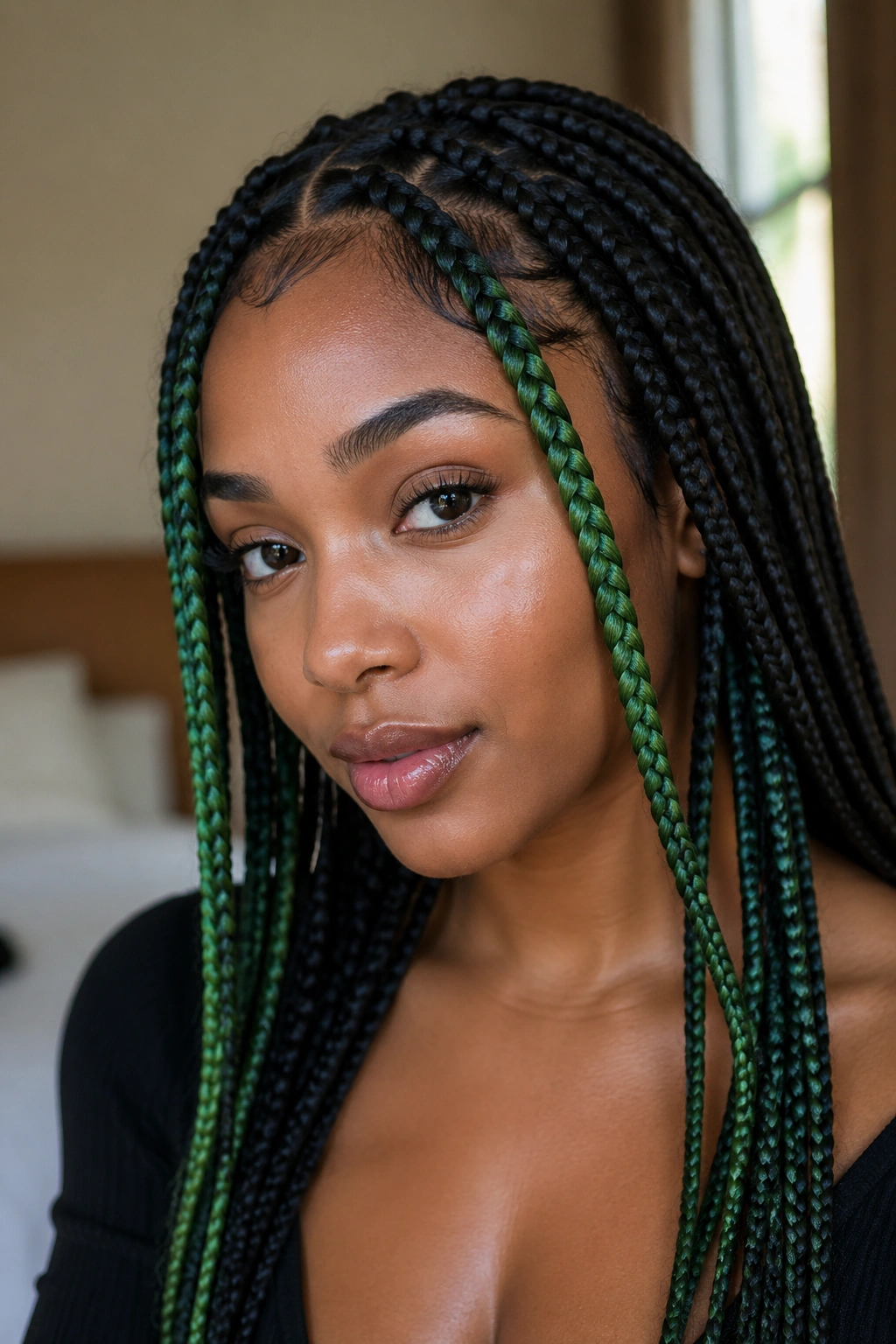
Sometimes the smartest way to wear green is not all over the head. A few accent braids near the face can do more than a full set if you want color without the commitment.
Think of this as the “small change, big payoff” option. You might keep most of the hair black or dark brown, then place four to eight green braids around the front hairline, the part, or both temples. That gives you a flash of color right where people look first. It also means the style shifts depending on how you wear it down, tucked behind one ear, or pulled back into a half-up look.
The placement matters more than the shade here. If the green is hidden underneath the top layer, the whole point gets lost. Put the accents where they can actually be seen. That sounds obvious, but you’d be surprised how often people bury the best part of the style.
This is also the easiest entry point if you’re not sure how green you want to go. You get the color hit, but you’re not married to a full head of it. And if you fall in love with the look, you can always go bigger next time.
10. Curly-End Green Box Braids
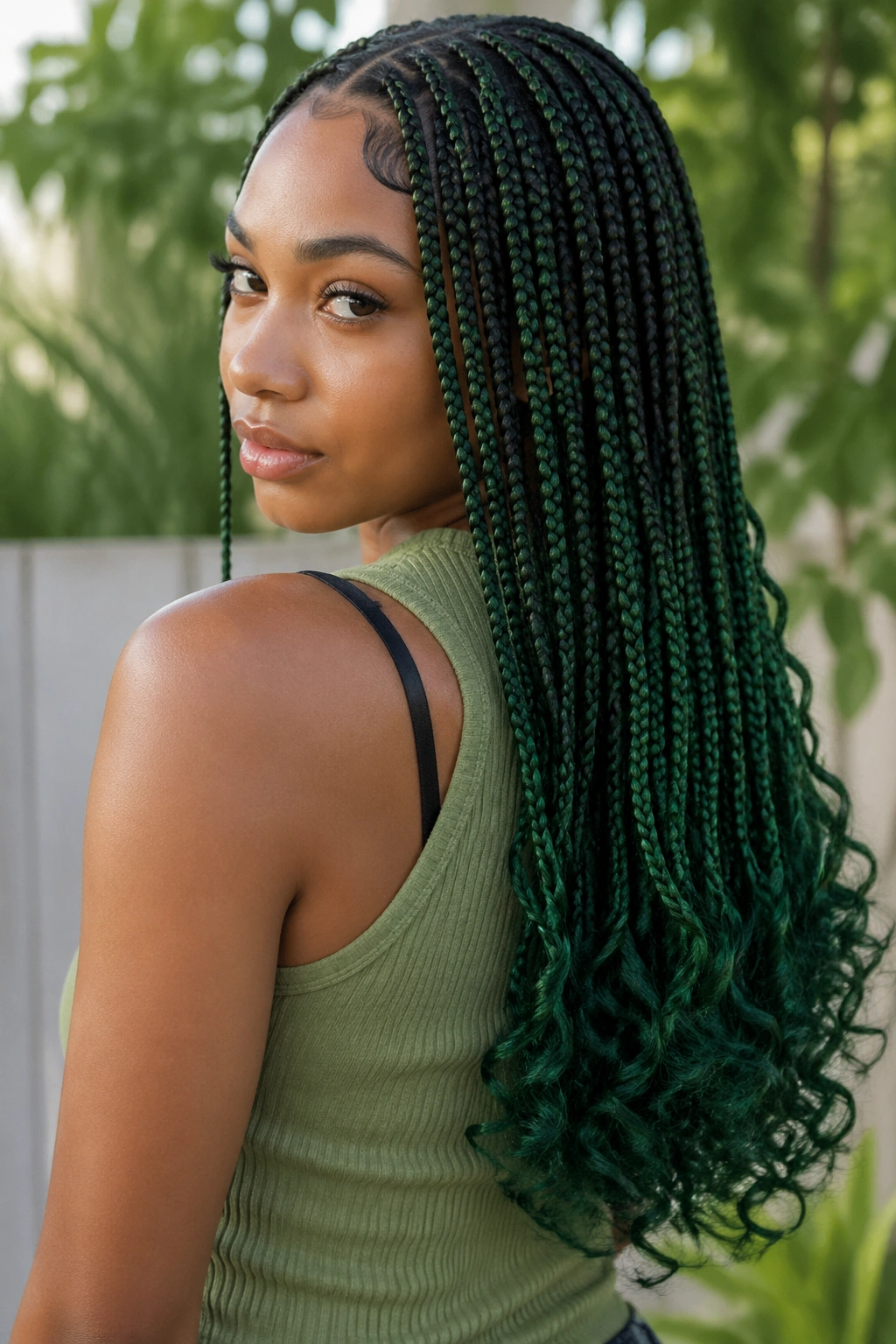
Why do curly ends soften green so well? Because the texture breaks the hard line. Straight braids can make bold color feel strict; curly ends loosen everything up.
This style works especially well on medium-to-long braids. Leave the last couple of inches free, then set them on flexi rods or perm rods if your braiding hair can take that treatment. Some synthetic hair handles hot water setting better than others, so check before you try to curl the ends aggressively. A soft bend at the bottom is enough. You do not need a perfect ringlet on every braid.
- Best on mid-back or waist-length braids.
- Use green shades with depth; curls already create movement.
- Keep the ends light with mousse, not heavy cream.
- Ask for a little extra length at the bottom so the curls have room to form.
Curly ends are good when you want the style to feel less rigid around the shoulders. They also make the color seem a bit more natural, even when the green itself is bright. There’s something about that loose finish that keeps the braids from reading too stiff after a few days. I’d choose this version for someone who likes a softer silhouette but still wants the color to stay front and center.
11. Half-Head Green Ombré Box Braids
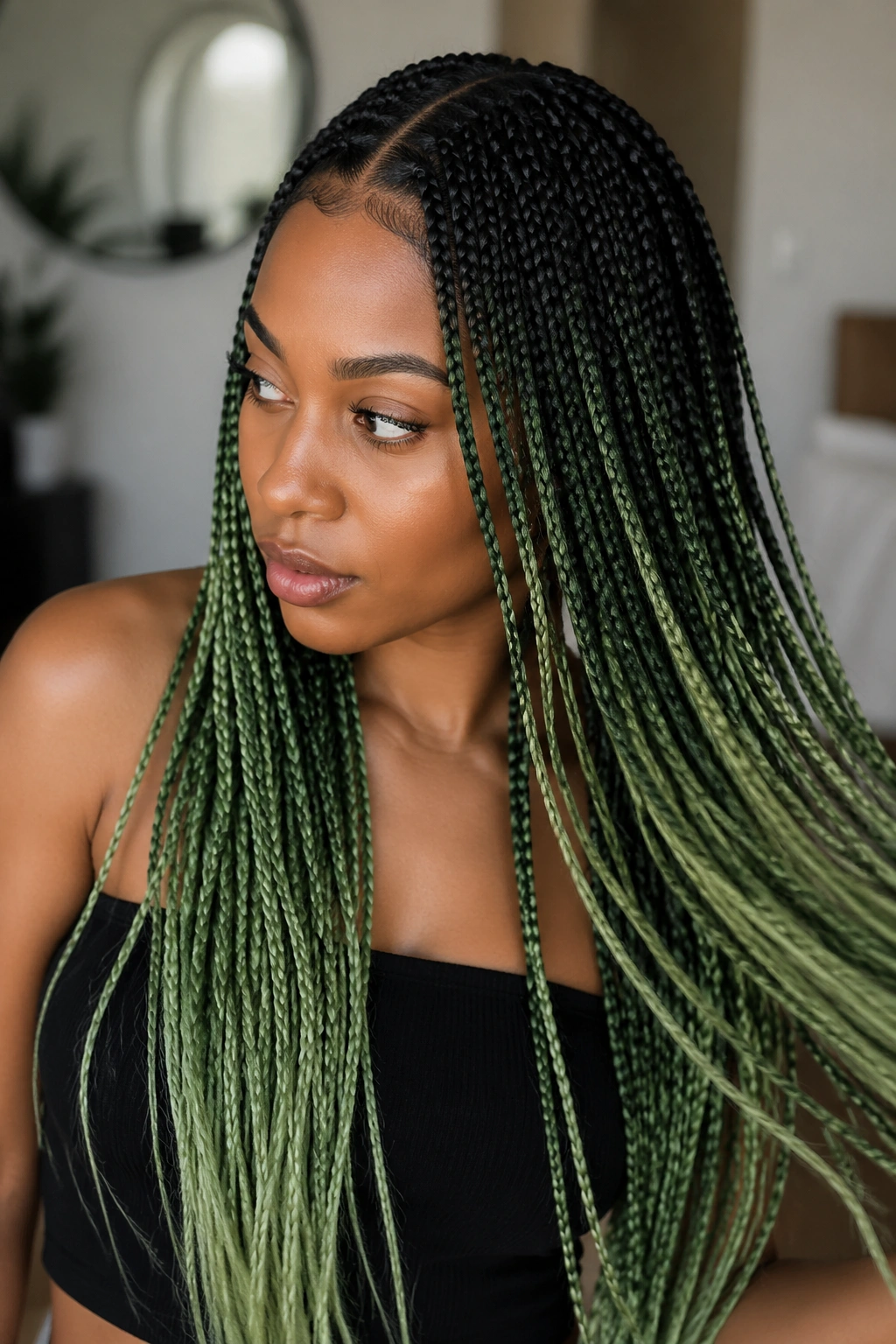
Unlike all-over color, half-head green ombré gives you a little surprise. It’s a partial reveal, which makes it feel more personal and less predictable.
You can build this two ways. One approach keeps the top layer dark and pushes green into the lower sections, so the color shows when the hair moves. The other does the opposite: green on top, darker underlayers beneath. Both work. The second one makes more of a statement, while the first feels quieter and gives you that “wait until I turn around” effect.
This style is excellent if you like braids you can dress up or tone down. Worn loose, the color shift shows in motion. Pulled into a ponytail or bun, the green becomes the focal point and the darker underside gives the whole style a little structure. That hidden contrast is the part I like most.
A clean center part or straight side part helps the split look deliberate. If the sectioning is messy, the whole effect starts to blur. And this is one of those styles that loses power fast if the roots are too chaotic. Sharp lines matter. They make the color arrangement feel like a design, not an accident.
12. Green Box Braids with Beads and Cuffs
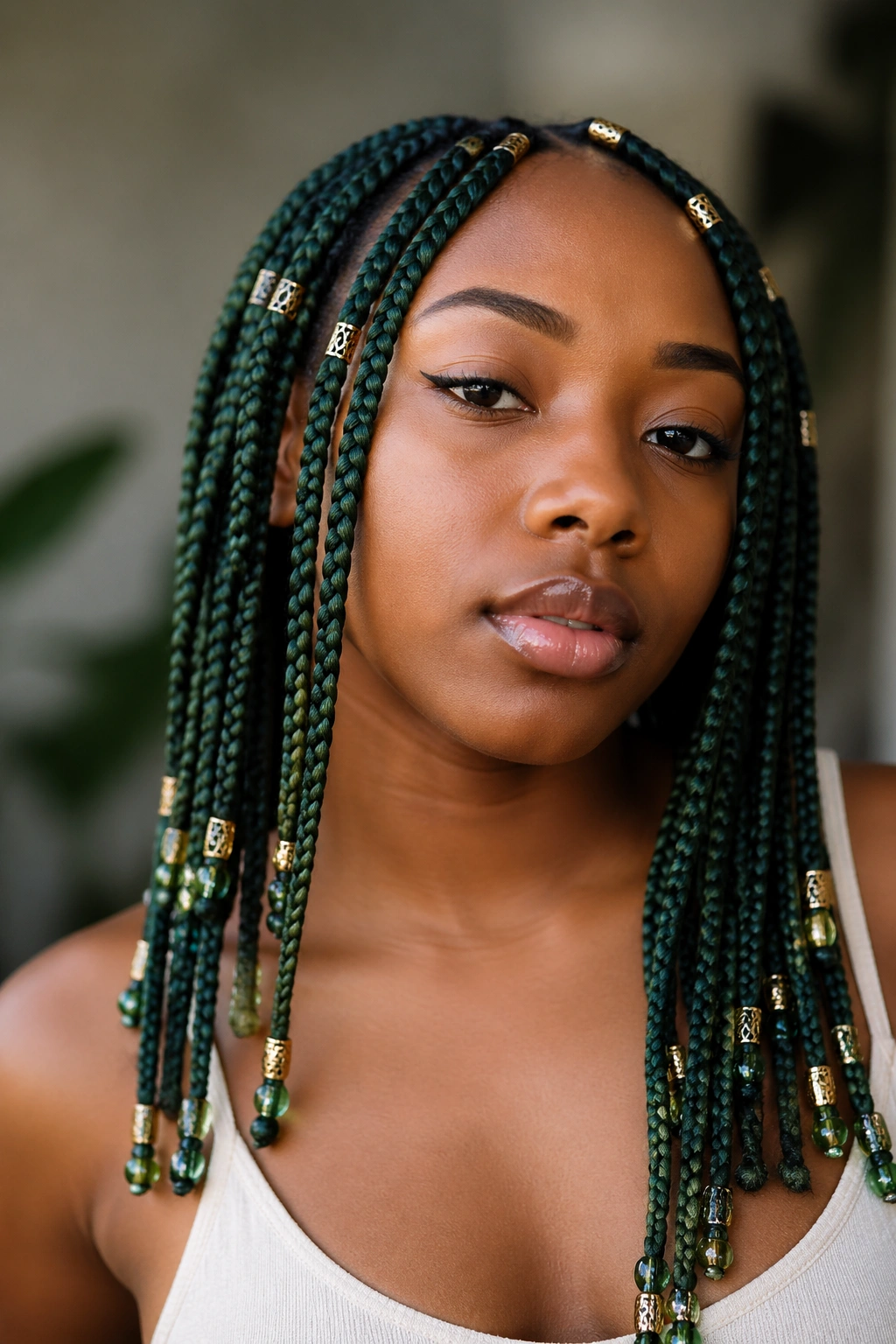
Accessories can save a braid style when the color is doing a lot. They can also wreck it if you go overboard. The difference is restraint.
Green braids look especially good with a few well-placed cuffs or beads because the metal gives the color something to bounce off. Gold tends to warm forest and emerald shades. Silver sits better with teal, sage, or cooler green tones. Mixing both metals can work, but only if you keep the rest of the styling simple. A dozen different textures on one head is how a look starts to feel crowded.
I like cuffs on the lower third of the braids and beads near the front pieces, not everywhere. That keeps the sound and movement from becoming too much. It also means the accessories actually stand out. Put one small metal detail in the right spot, and it reads. Scatter thirty of them around the head, and nobody sees any of them.
Use this style if you want the braids to feel dressed up without needing a full updo. It plays well at events, but it still works for everyday wear if you keep the hardware light. One strong cuff usually beats six tiny ones. Every time.
13. Smoke-Rooted Sage Ombré Box Braids
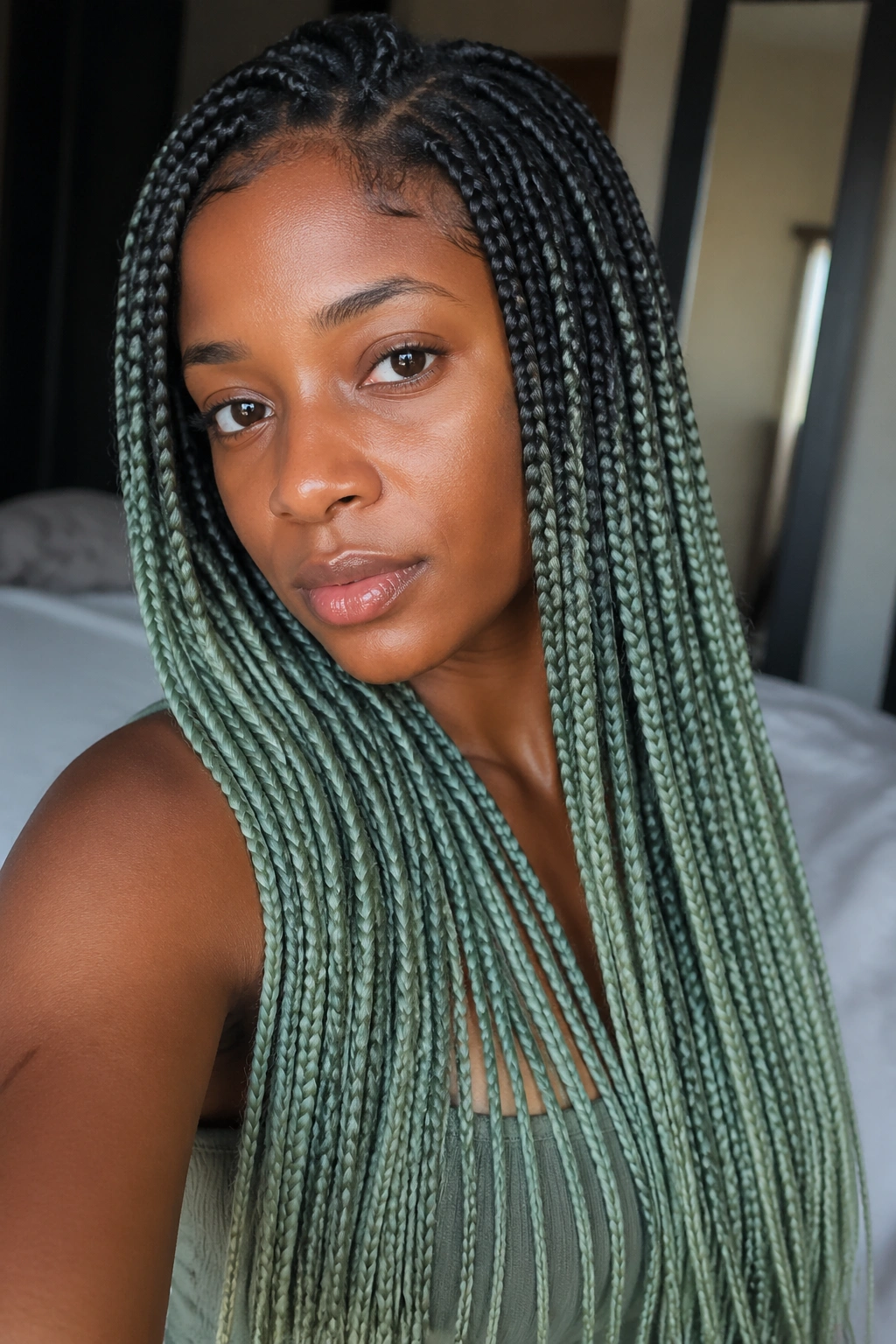
What happens when green gets quieter? It becomes sage, smoke, and all those soft muted shades that make a braid style feel calm instead of loud.
Placement matters
The root color should stay dark—charcoal, black, or deep brown—so the sage can settle in lower down. If the green starts too high, the softness gets lost. A fade that begins a couple of inches away from the scalp usually gives the braid room to transition. From there, the color can drift into sage without turning chalky or washed out.
This is one of the best options for long wear because muted shades hide fuzz better than bright ones. A little frizz around the edges doesn’t ruin sage the way it can ruin lime. That alone makes the style easier to live with. You don’t have to babysit every strand.
Sage also works with fewer accessories. A clean part, a low bun, a simple scarf at night—that’s enough. The color already does the job. If you like box braids that feel soft in daylight and still look neat at the end of a long day, this is a strong pick. It doesn’t beg for attention. It earns it.
14. Split-Panel Two-Tone Green Box Braids
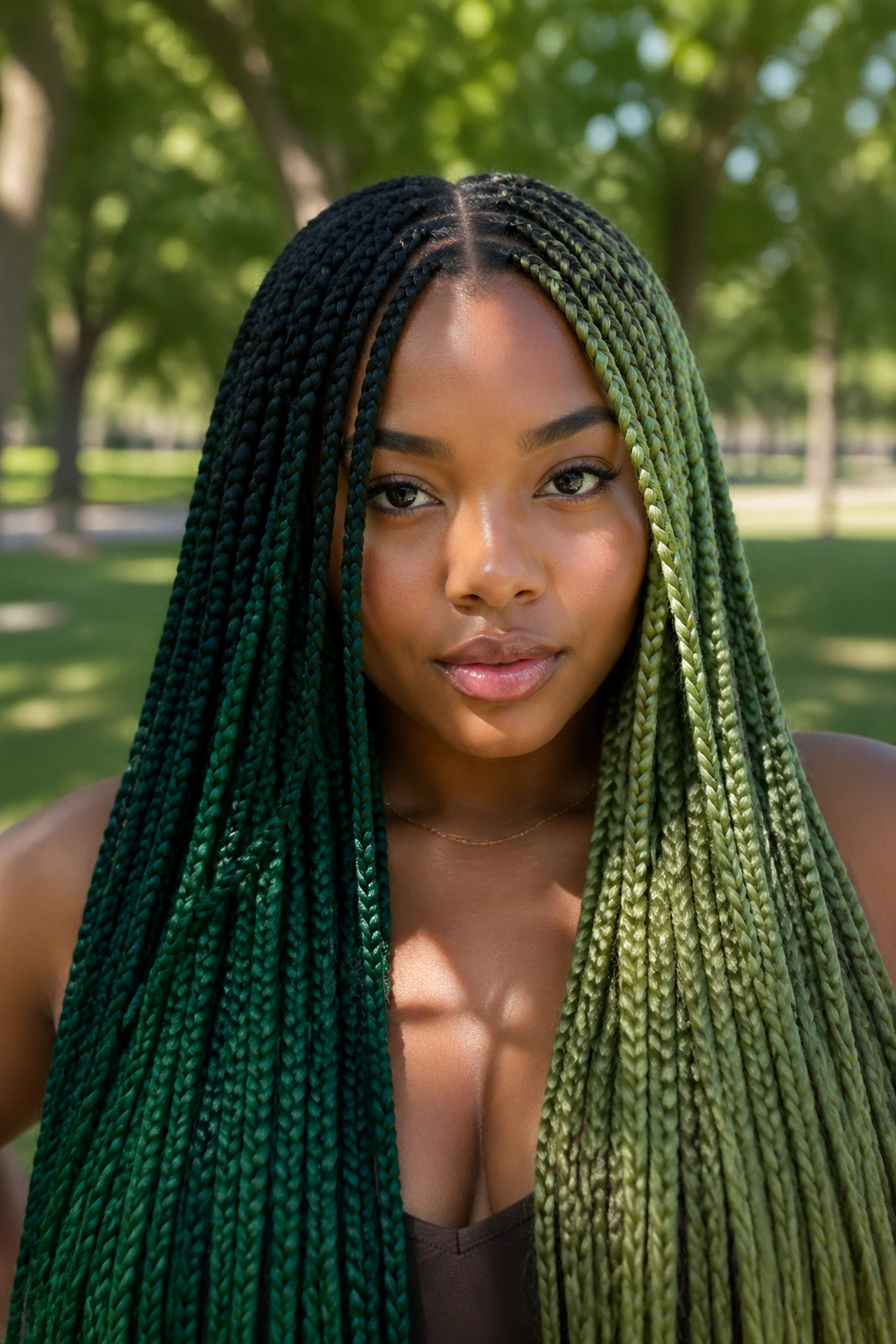
A split-panel braid set is the boldest move in this whole group. It is not subtle, and that’s exactly why it works.
The idea is simple: divide the head into two visible color moods. One side might lean black-to-emerald, while the other shifts from emerald to sage or lime. The effect is graphic. You can see the contrast the second the hair parts in the middle. If you’ve ever wanted your braids to look like a deliberate fashion choice instead of just “fun color,” this is the one.
- Keep both sides in the same general saturation range.
- Use a clean center part so the split stays obvious.
- Best on medium to long braids where the color can travel.
- Half-up styles make the contrast even clearer.
The key is not to mix shades that fight each other. Bright lime on one side and dusty sage on the other can look disconnected unless you really know what you’re doing. Keep the family close. The style reads strongest when the colors feel related, not random.
I like this option for people who don’t mind being noticed. It has a little edge, a little drama, and enough structure to stay polished if the braids are installed neatly.
15. Soft Sage Ombré Box Braids
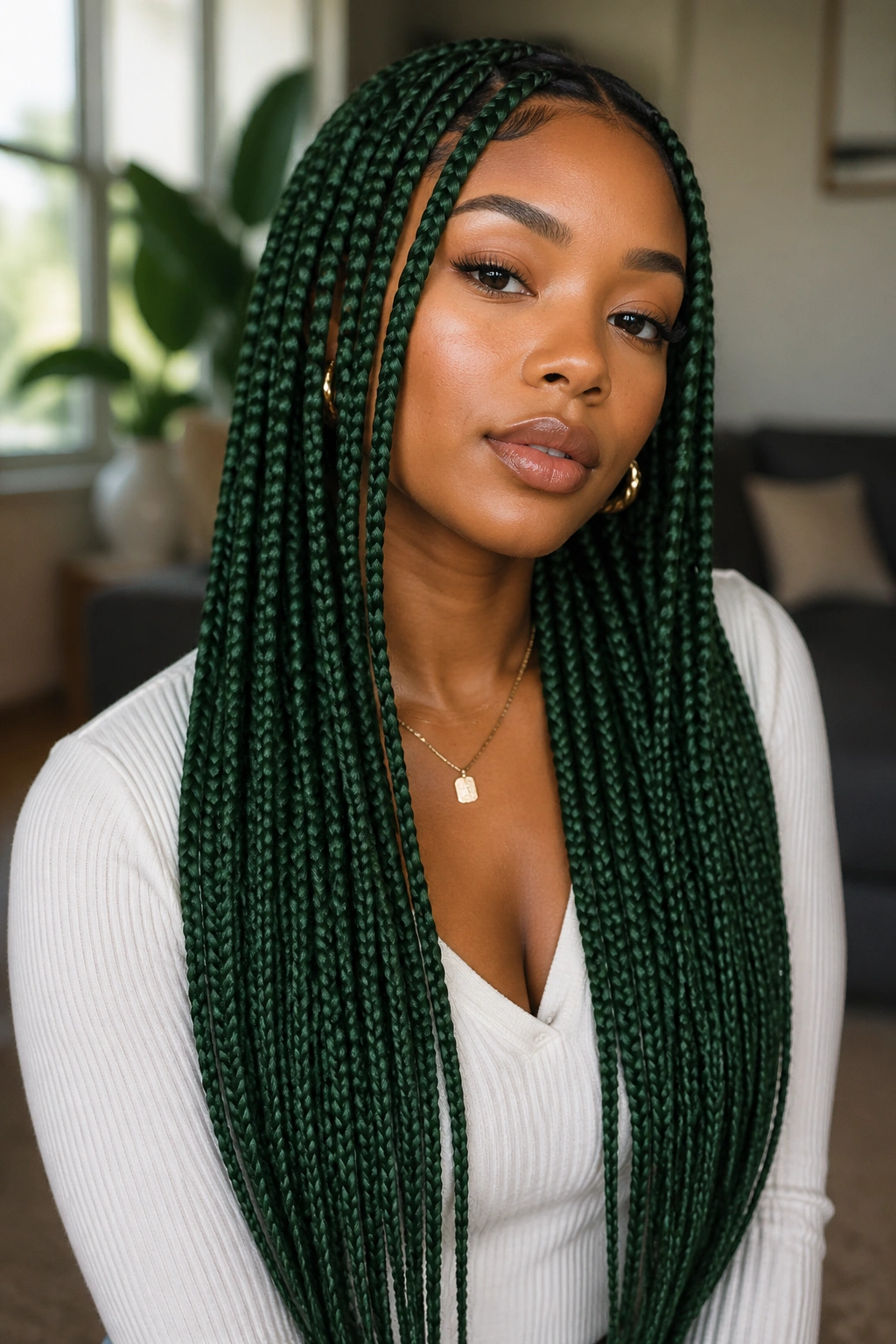
Soft sage is the one people underestimate. It doesn’t shout, so it gets overlooked next to the louder greens, but it has a kind of staying power that brighter shades rarely manage.
This shade works because it sits between color and neutral. The green is there, but it’s diluted enough to feel calm. On long box braids, that matters. You get a smooth color path from dark roots into a dusty green finish that still looks composed when the braids loosen a bit. That’s the real test, honestly. A braid style should still look good once it has lived on your head for a while.
Sage also plays nicely with matte clothes, gold hoops, black tops, and clean makeup. It doesn’t demand a whole new wardrobe, which is one reason I keep coming back to it. The style feels intentional without asking you to dress around it. That’s a rare thing. A lot of hair color choices are louder than the person wearing them.
If you want one green ombré set that can move from casual to dressed-up without much effort, this is the shade I’d point to. Pick the tone that still looks good when the braids are a little fuzzy and the roots have settled. That’s usually the one worth keeping.
