



The fastest way to make box braids feel fresh is color placement. Blonde and pink box braids can read sweet, sharp, or flat-out bold, and the difference usually comes down to whether the blonde is honey, platinum, or ash and where the pink sits—at the ends, near the face, or tucked underneath. Color does the heavy lifting here.
A lot of people pick the shades first and think about the braid pattern later. That’s backwards. The parting grid, braid size, and length decide how much of each shade you actually see, and a neat set of braids can make loud color look deliberate while sloppy parting makes expensive hair look rushed.
I like this pairing because blonde keeps pink from drifting into childish territory, and pink keeps blonde from slipping into plain. Put a warm blonde next to dusty rose and the whole style softens; push it against neon pink and the look gets sharper fast. Placement decides which mood wins.
That is the fun part.
1. Honey Blonde Box Braids with Bubblegum Pink Ends
This is the easiest blonde-and-pink mix to wear every day. Honey blonde brings warmth close to the scalp, then bubblegum pink takes over at the last 4 to 6 inches. The result feels bright but not chaotic, which is exactly why this version works so well on medium box braids.
Why it works
The warm tone in honey blonde takes some of the candy sweetness out of bubblegum pink. That matters more than people think. Pink can look very different when it sits next to a cool blonde versus a golden one, and this combo keeps the color story soft enough for work, school, or a weekend out.
- Ask for 1/2- to 3/4-inch parts if you want the color shift to show clearly.
- Keep the pink concentrated on the last third of each braid.
- Use pre-stretched braiding hair so the transition stays neat.
- Seal synthetic ends cleanly if the hair is heat-safe.
My favorite detail: leave the roots a shade deeper than the rest. It makes the pink read cleaner when the braids move.
2. Platinum Blonde Box Braids with Rose Pink Face-Framers
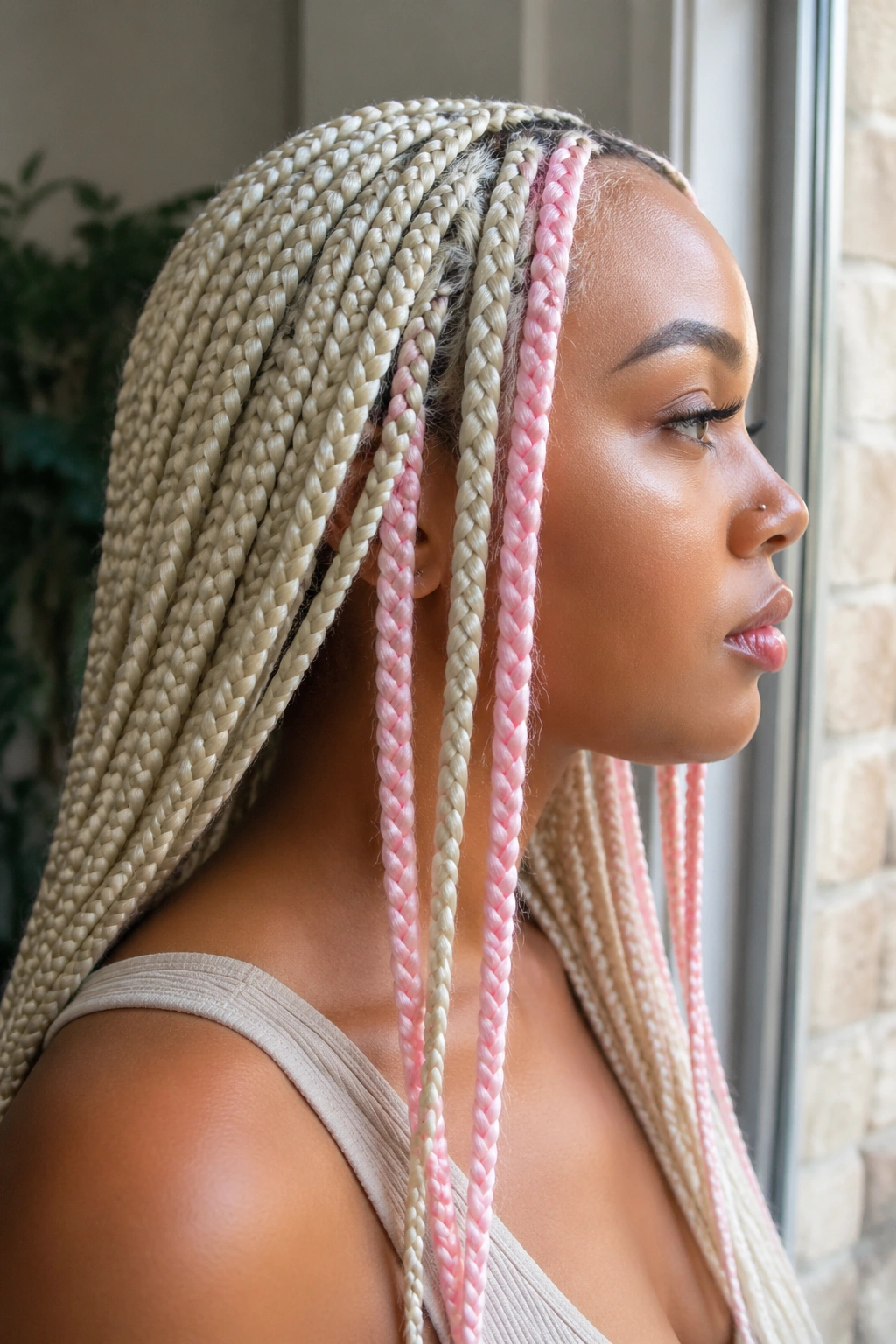
Want pink without letting it take over the whole head? This is the cleanest way to do it. Platinum blonde gives the set a crisp base, and then just a few rose pink braids at the front soften the whole thing without turning it into a full candy-color moment. It feels sharp from the side and softer from the front. Nice balance. Rare, too.
The reason it works is simple: platinum is bright enough to handle pink without muddying it, while rose pink has enough depth to stay pretty instead of neon. Keep the pink to the two or three front braids on each side, and leave the rest platinum. That small choice makes the style read intentional instead of random.
I also like this on medium-length braids because the face-framing pieces sit near the cheekbones and jawline, where color gets noticed first. If you want the look to feel polished, keep the middle part clean and the braids the same thickness all the way through. Messy parting will fight the whole point.
3. Blush Pink Underlayer with Golden Blonde Top Braids
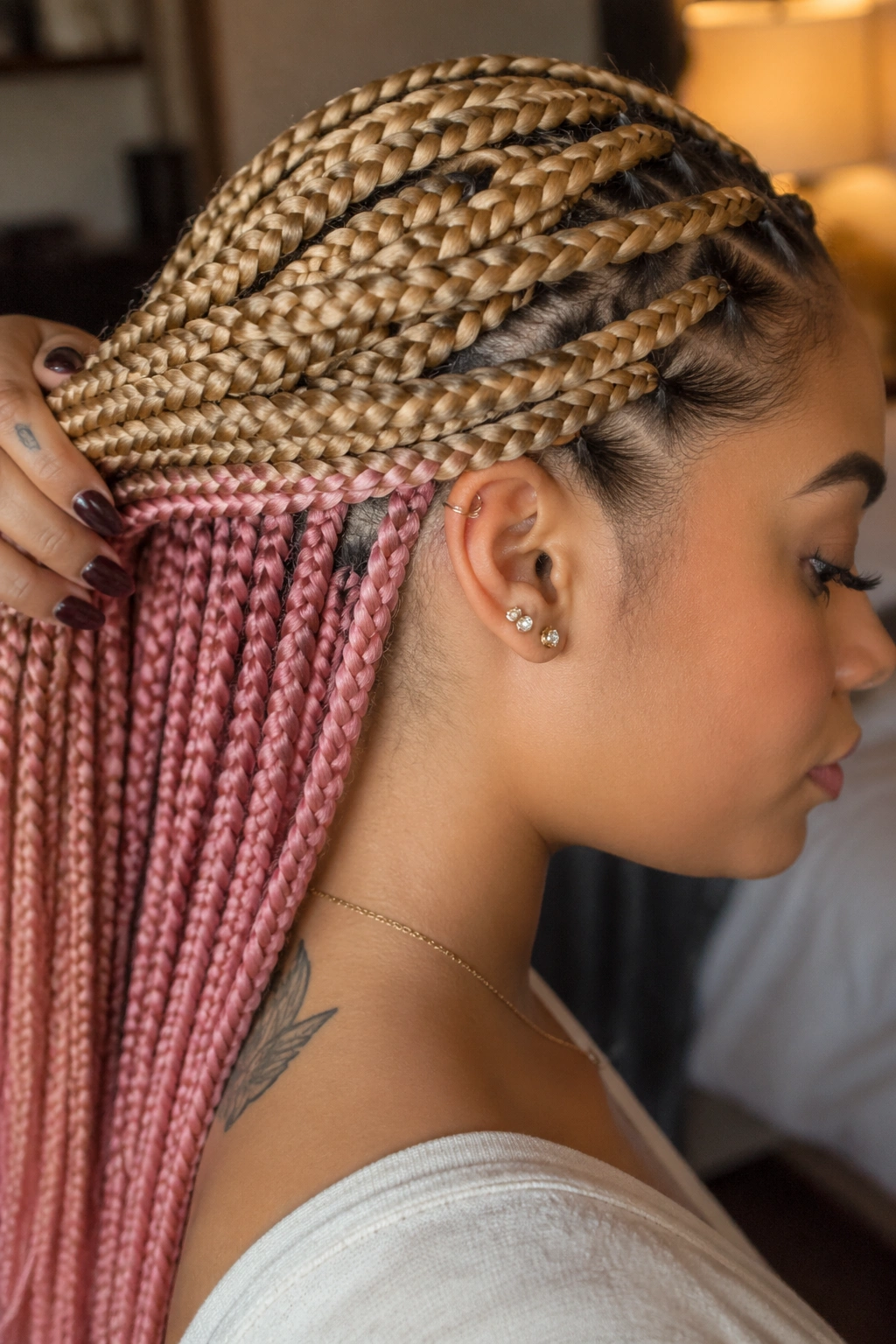
Pull one braid forward and the pink flashes. Keep the hair down and the blonde does most of the talking. That hidden-color effect is the whole reason this style works so well for people who want something playful but not loud. You get a surprise every time the hair shifts.
What to ask for
Ask your braider to keep the top layer mostly golden blonde and hide the blush pink in the lower rows and back sections. If the braids are medium size, the color separation stays clear without looking chunky. Small braids can do it too, but the reveal is subtler.
- Put the pink in the nape area and lower back rows.
- Keep the blonde on the outer crown and front perimeter.
- Use a clean side part if you want the contrast to show when the hair is tucked.
- Pick blush pink, not hot pink, if you want the underlayer to stay soft.
This one is smart for anyone who likes color but needs the option to dial it down. The blonde gives you that cover, and the blush pink shows up when you choose to show it. That little bit of control changes everything.
4. Blonde-and-Pink Ombré Box Braids
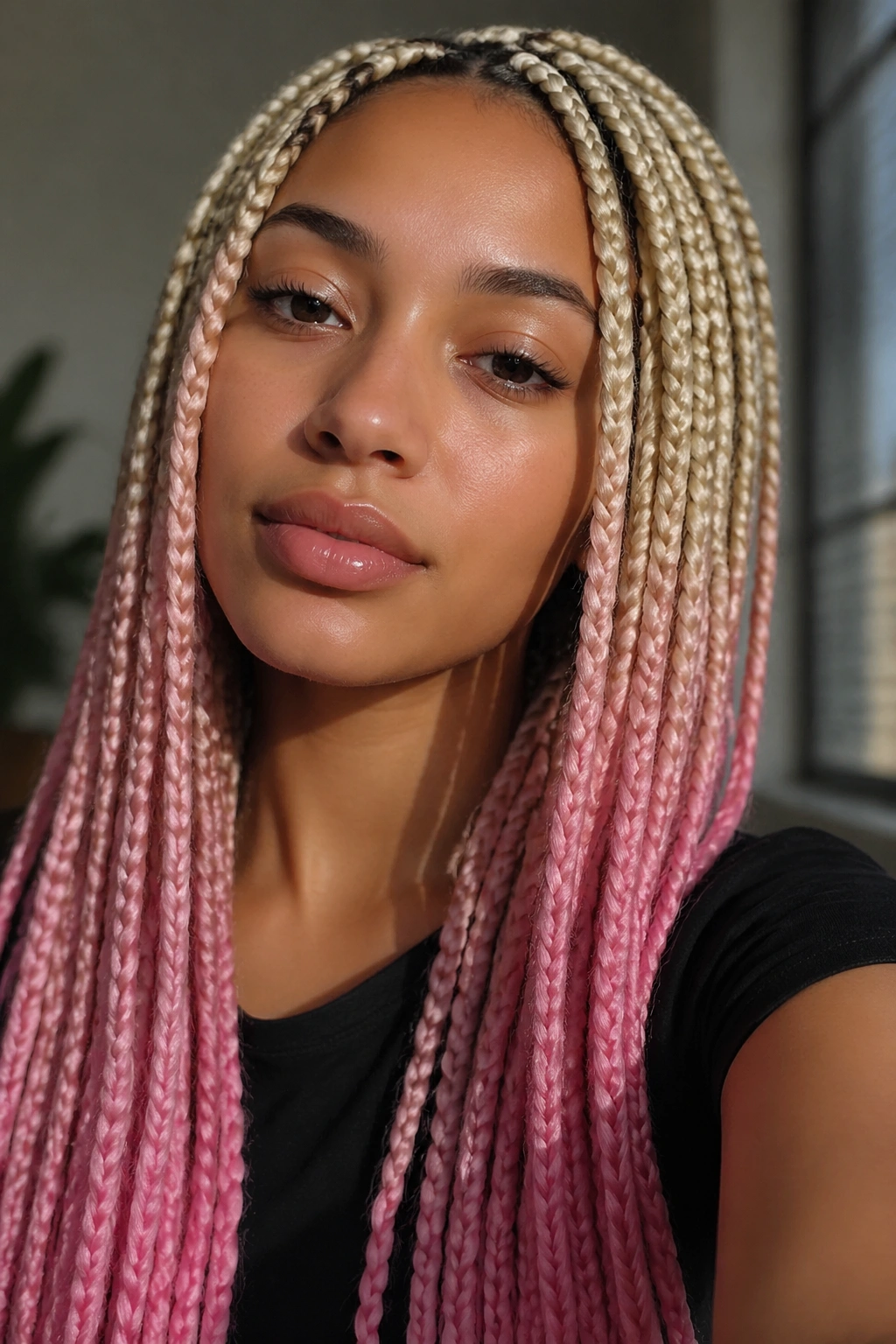
Ombré is the smoothest way to combine these two colors. Instead of hard blocks, the blonde melts into pink along each braid, usually somewhere around the middle. That makes the style feel more fluid and less striped, which is why it works especially well on long braids.
The best versions use three tones, not two. A light blonde, a creamier blonde, and then a pink on the lower half give the braid some depth instead of a blunt switch. If you only use one blonde and one pink, the color line can look abrupt unless the braids are very long.
I’d ask for the transition to start at the same spot on each braid if you want a tidy look. Let the fade begin at the midpoint for a clean ombré, or slightly lower if you want more blonde near the face. The style reads strongest when the color shift matches the braid length. Short braids can handle it, but long braids really let the fade breathe.
5. Jumbo Blonde and Pink Color-Block Braids
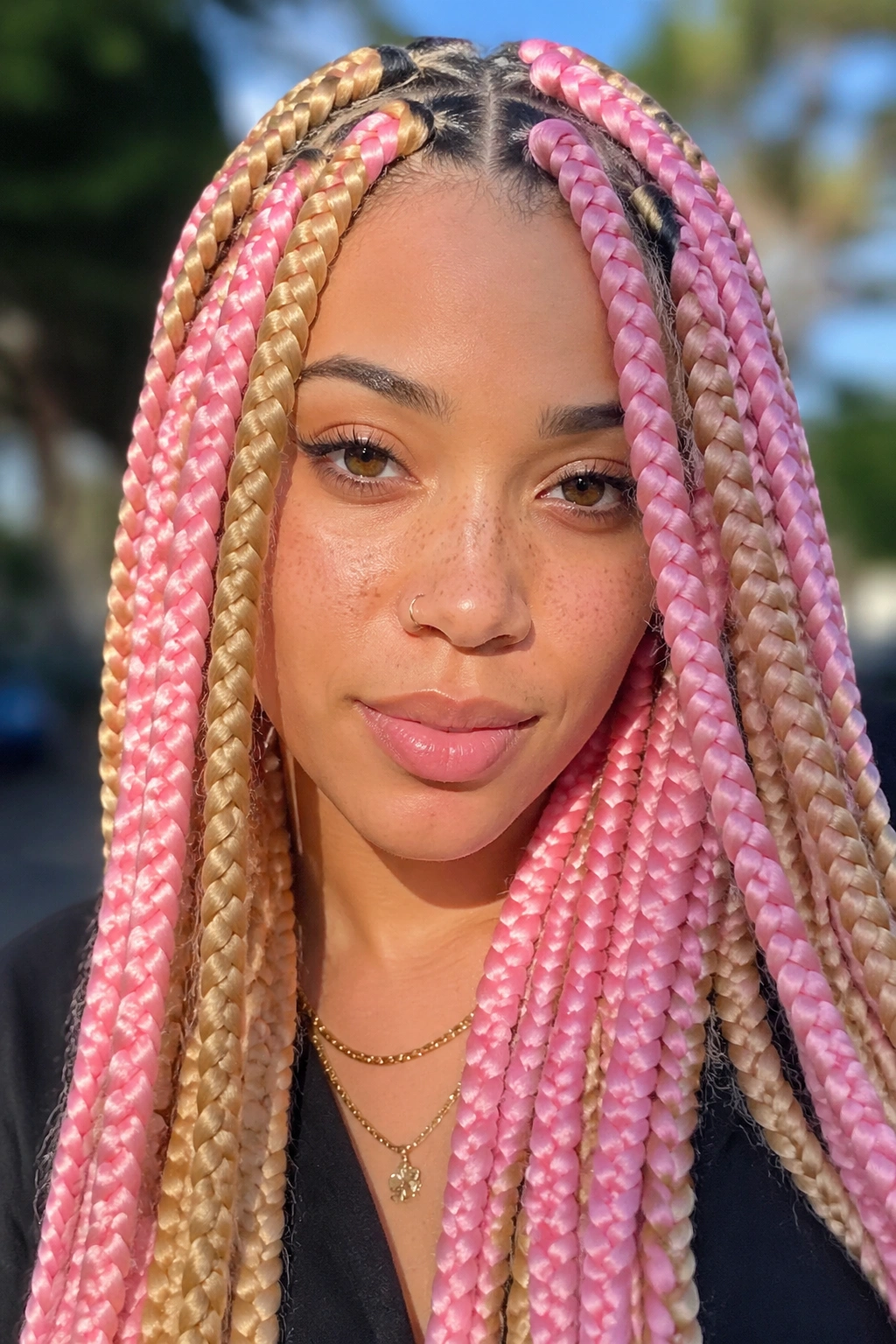
If you want people to notice the color before they notice the braid pattern, go bigger. Jumbo box braids give each shade room to show off, and the blonde-pink split becomes bold in a way that small braids can’t quite match. The thicker sections create clean blocks of color. No fuss. No blur.
This is the set I’d choose for someone who loves a graphic look. Square parts around 1 to 1.25 inches keep the base tidy, while alternating blonde and pink sections make the style feel deliberate. It’s also one of the few color mixes where you can afford to be playful with spacing. You do not need perfect symmetry here. In fact, a little irregularity keeps the braids from looking stiff.
The catch is weight. Jumbo braids pull more, especially if they’re long, so the scalp work has to be gentle and even. If the first hour at the chair feels too tight, say something. You should not have to earn headache lines for a color look. That is bad styling, full stop.
6. Knotless Box Braids with Pink Peekaboo Sections
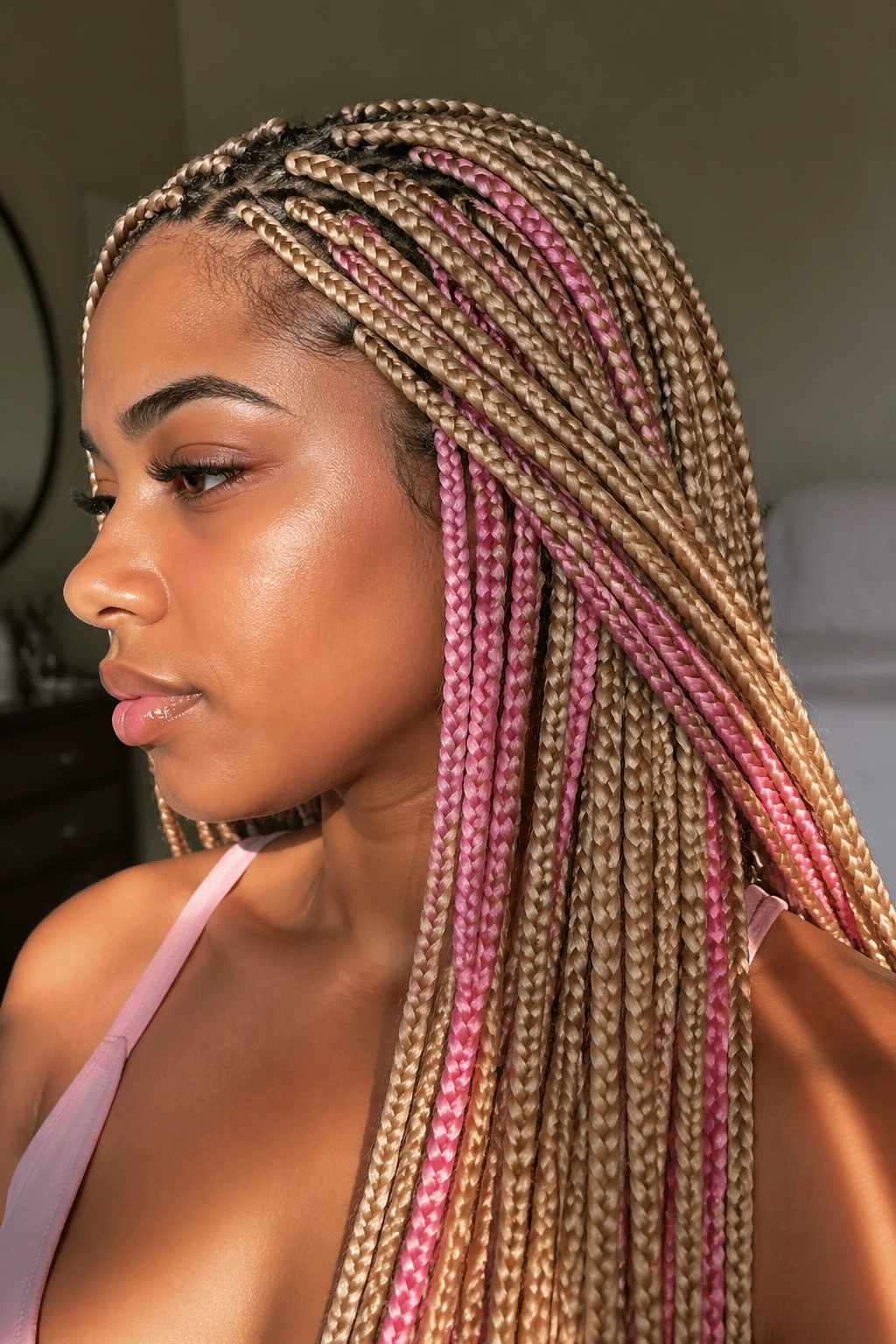
Unlike a blunt box braid, knotless starts flatter at the root. That alone makes the style look lighter, and it also gives you a cleaner place to hide pink sections underneath the blonde. The result feels smoother at the scalp and less crowded visually.
Best if your scalp gets sore fast
Knotless braids sit nicer for people who don’t like heavy tension near the edges. The pink peekaboo sections live under the outer layer, so the color shows when the braids shift, swing, or get tucked behind an ear. It’s a low-drama way to wear both shades.
- Keep the outer layer mostly blonde.
- Place pink in the middle rows and back rows.
- Ask for gradual feed-in so the base doesn’t feel bulky.
- Use a satin bonnet at night so the underlayer stays smooth.
This style is especially good if you want color with some restraint. It never looks unfinished. It just reveals itself in pieces, which is honestly more interesting than giving everything away at once.
7. Small Alternating Blonde and Pink Feed-In Braids
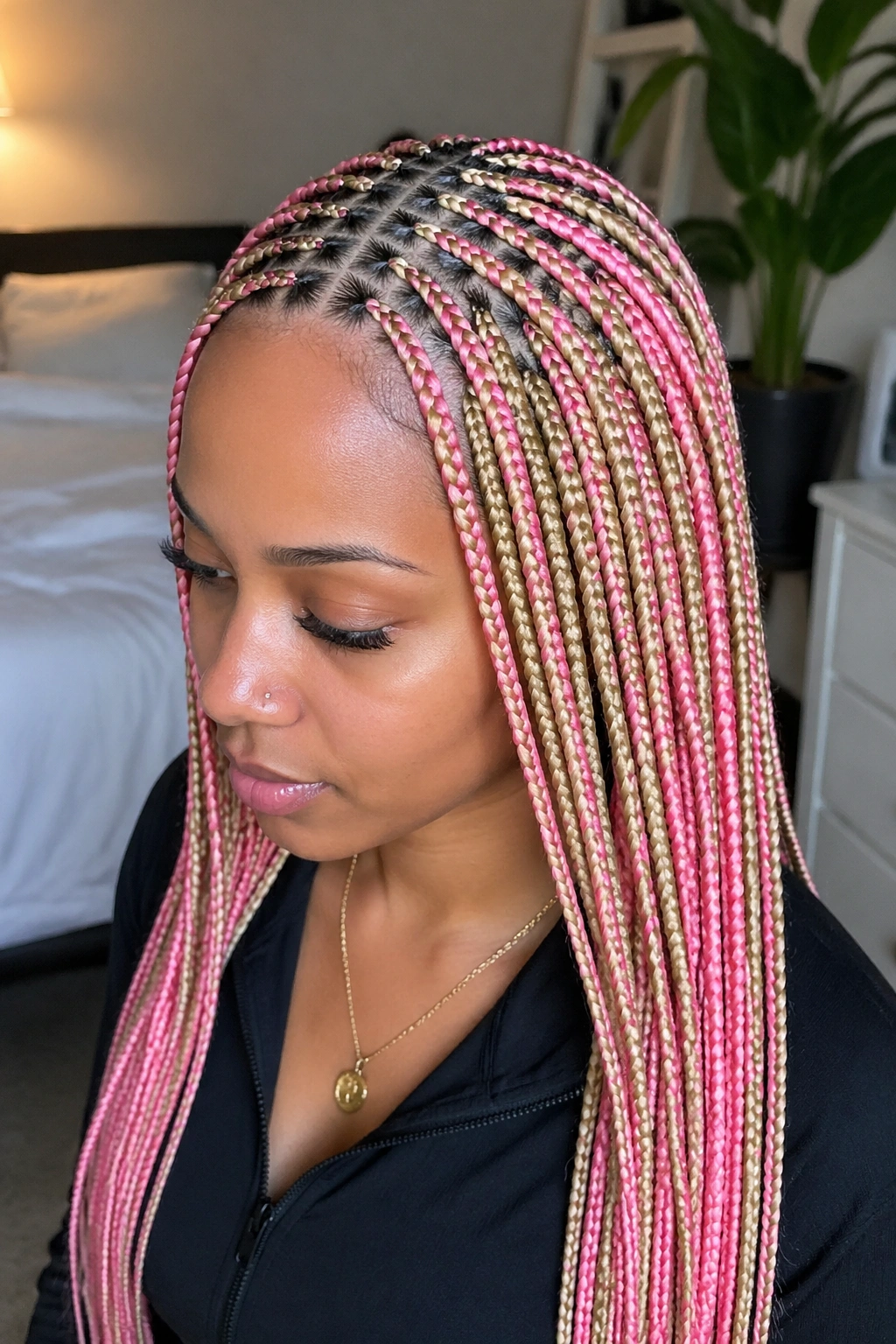
Thin braids take patience. Worth it. The payoff is a clean striped pattern that feels sharp and organized, especially when the braids are packed close together and alternated one blonde, one pink, one blonde, one pink. The repetition gives the set a rhythm you can spot from across a room.
A quarter-inch or slightly smaller part grid keeps the pattern crisp. Feed-in braids help here because the root lays flatter and the color can be layered in without that thick knot at the base. If you like precision, this is your style. If you prefer a softer, blurrier look, skip it.
How to keep the pattern readable
Do not mix too many shades in each braid. That is where this style gets muddy fast. Keep each plait close to one tone, then let the alternating order do the work.
- Use small-to-medium parts for cleaner striping.
- Keep braid lengths consistent so the pattern doesn’t wobble.
- Place pink and blonde in a strict alternation if you want a neat finish.
- Ask for a center part if you want the colors mirrored on both sides.
This is one of those styles that looks even better after it settles a day or two.
8. Triangle-Part Blonde and Pink Box Braids
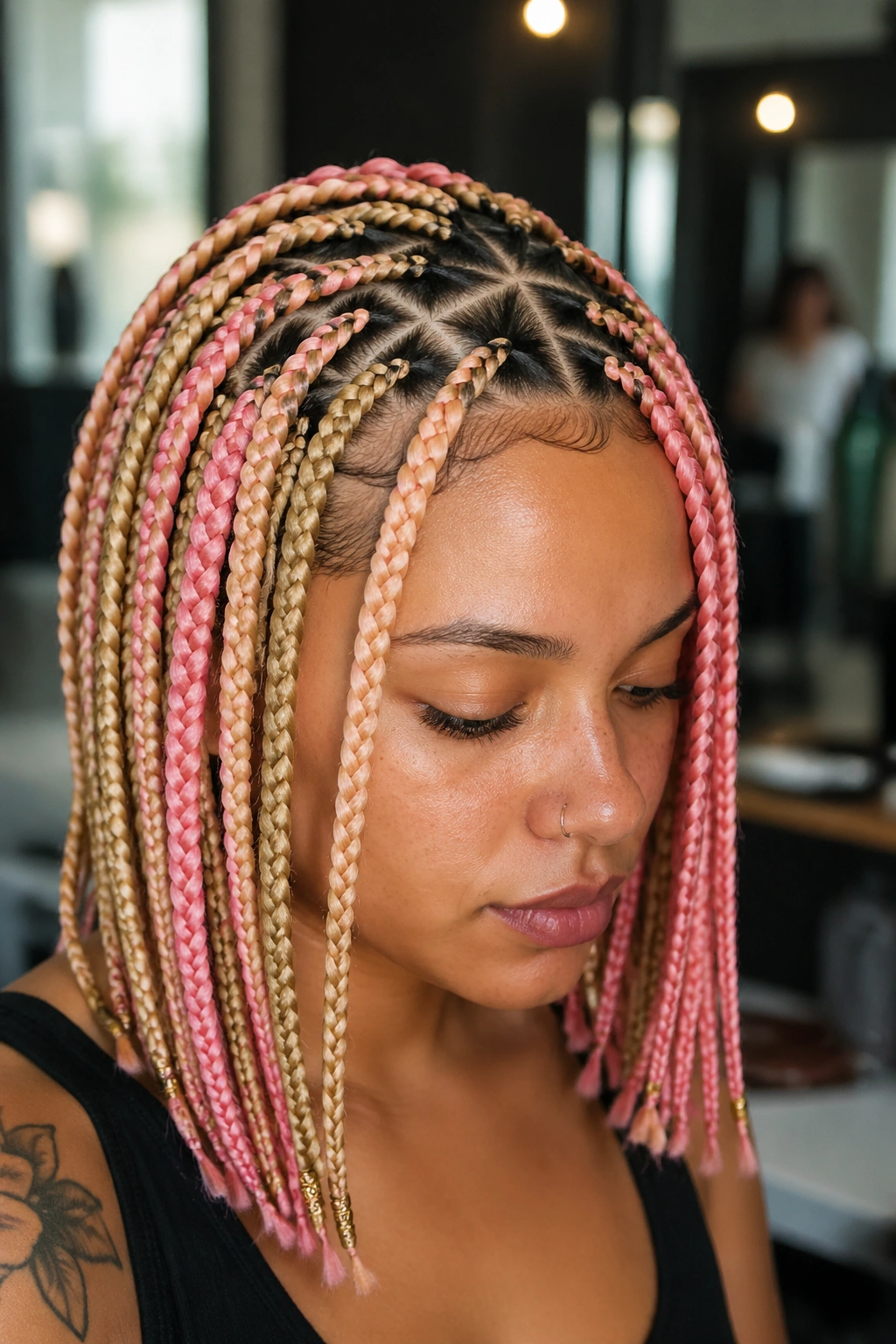
Parts matter almost as much as color. Triangle sections turn a familiar blonde-and-pink mix into something sharper and a little more graphic. The braid itself may be plain, but the parting pattern keeps the eye moving. That is the whole point.
Square parts can feel expected on box braids. Triangle parts break that habit fast. They work especially well when the braid colors are simple—maybe blonde on the front rows and pink scattered through the back—because the parting does the visual work. You do not need a loud color ratio to make the style read differently.
I like triangle parts best on medium braids, where the geometry has enough space to show. On tiny braids, the shapes can disappear. On jumbo braids, the angles can look heavy. Medium is the sweet spot. Add a side part or curved front rows if you want the look to feel a little softer around the hairline. The braid pattern itself will still keep things interesting.
9. Waist-Length Boho Blonde and Pink Box Braids
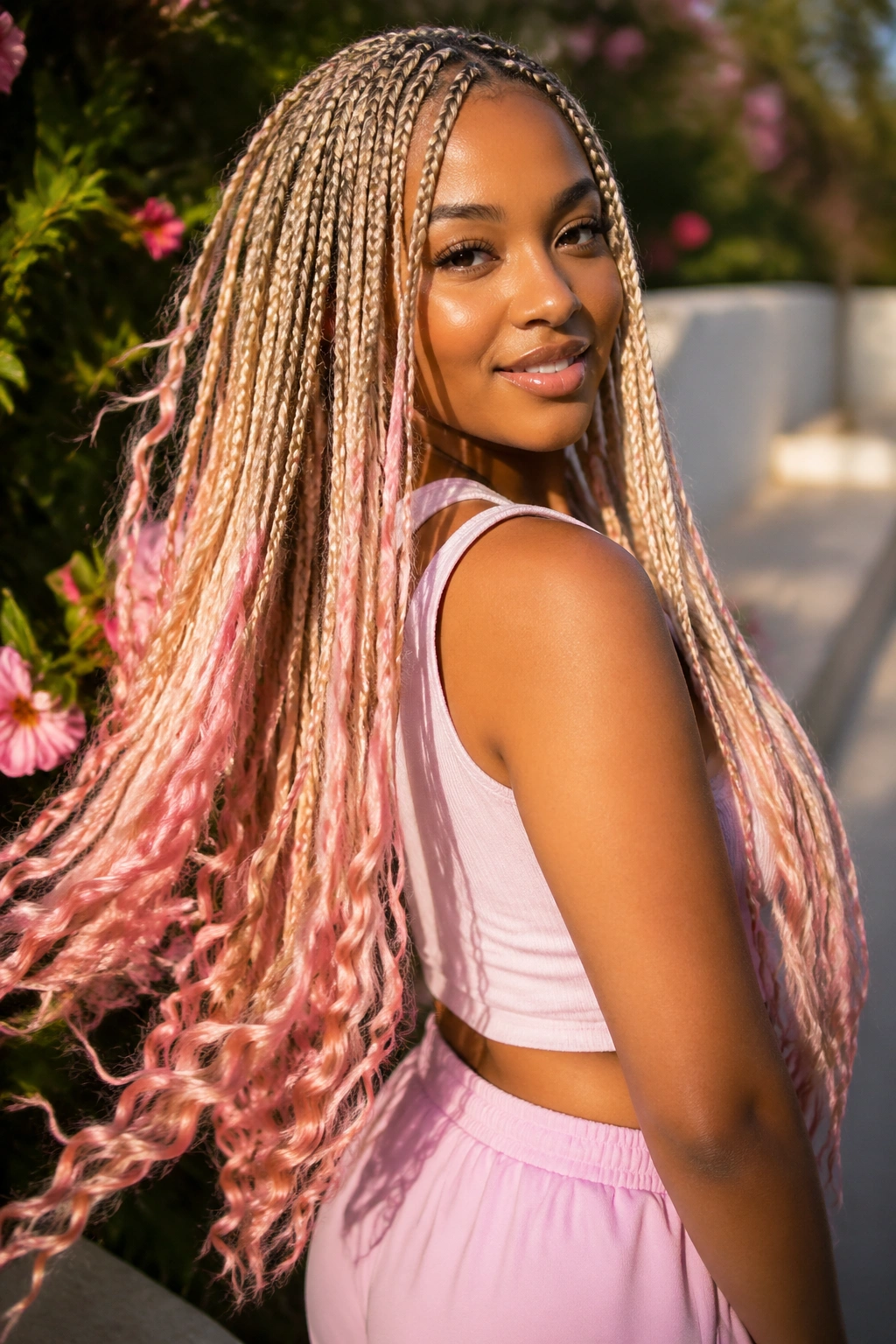
There’s a reason boho braids keep showing up everywhere: movement makes color better. Add loose curls to waist-length blonde and pink box braids, and the whole style starts to feel softer, looser, and more expensive-looking without trying too hard. The pink catches in the curls, the blonde takes the light, and the mix stops feeling flat.
The trick is not overloading the hair with too much curl. A few loose tendrils here and there are enough. If every braid is stuffed with curls, the style can turn fuzzy fast, especially after sleeping on it. Leave some braids smooth and let only part of the set get that airy texture.
What makes boho work here
The color contrast matters more when the braids move. That is why waist-length hair is useful. The longer length gives pink and blonde room to repeat, and the curls break up the color in a softer way.
- Use blonde as the main color and pink as the accent.
- Add curls mostly through the mid-lengths and ends.
- Keep the braids medium or small so the style does not feel too bulky.
- Refresh the curls with mousse, not heavy cream.
This one is a little more upkeep than the straighter versions. Still worth it.
10. Shoulder-Length Blonde and Pink Bob Braids
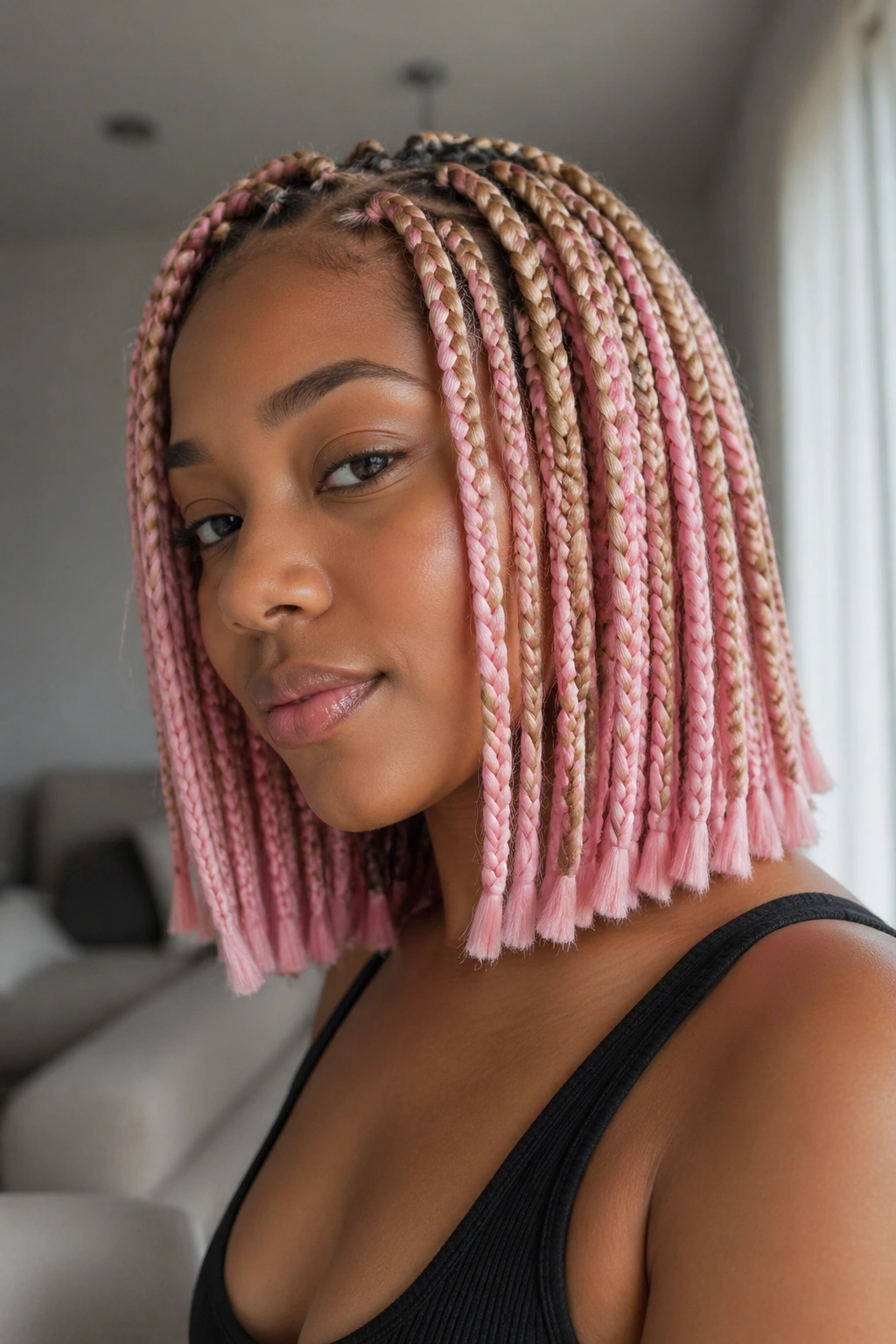
Short braids are underestimated. People think they are a compromise, then they feel how light they are and stop talking. A shoulder-length bob in blonde and pink keeps the color visible right near the face, which means the shades don’t have to travel far to make an impact.
This length works especially well with strawberry blonde and cotton candy pink because the colors sit close together in the same soft range. You get enough contrast to notice the pink, but not so much that the style looks harsh. Blunt ends make the bob feel modern. Curled ends make it look a little sweeter.
It’s also practical. Wash day is easier, sleep is easier, and the whole set dries faster after a rinse. That matters. A lot. If you’re trying color for the first time, this is one of the least intimidating ways to do it because you get the payoff without dragging six extra inches of braid weight around all day.
11. Half-and-Half Blonde and Pink Box Braids
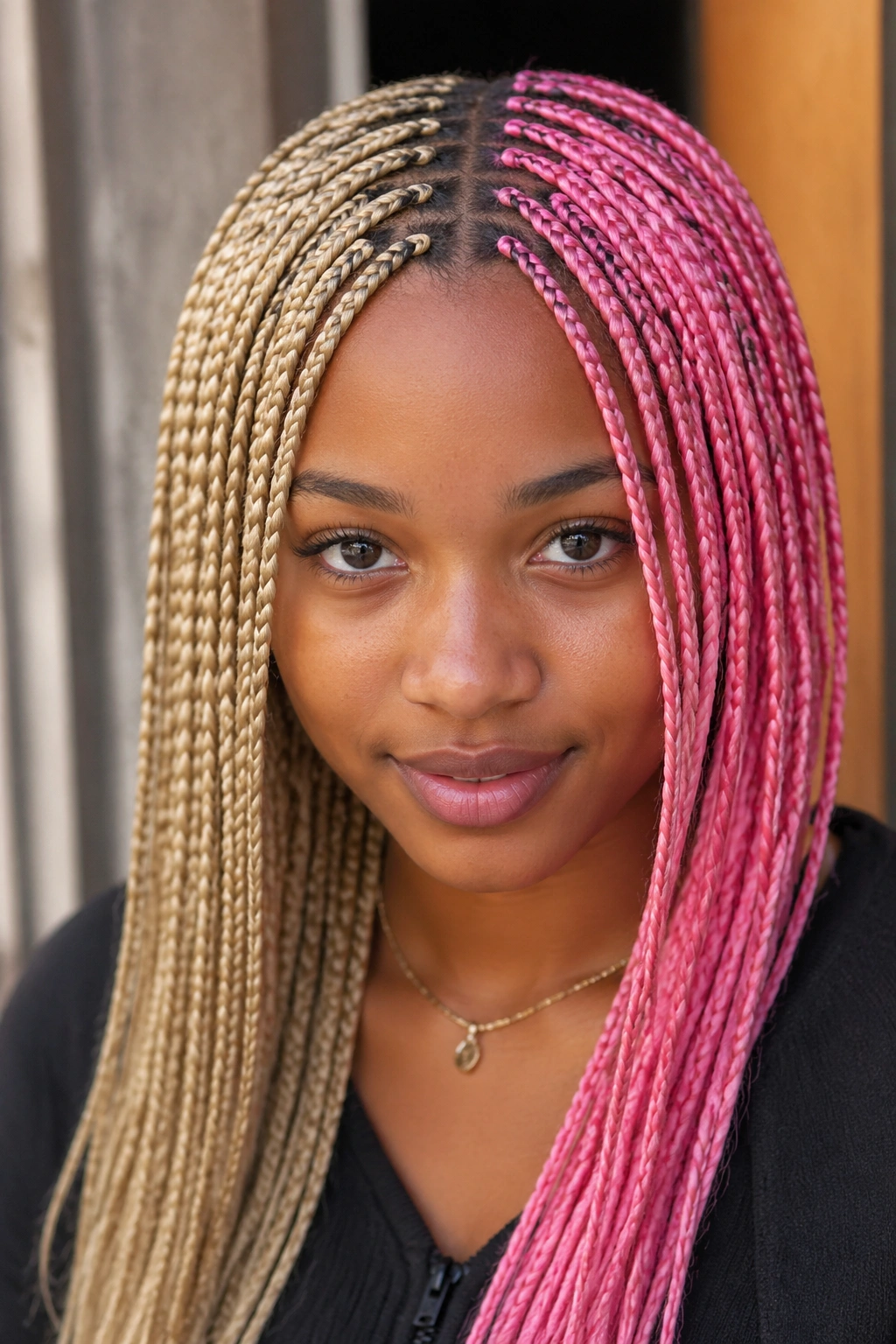
This is the most obvious color split on the list, and I mean that as a compliment. One side blonde, one side pink. Clean line down the middle. No mystery. The style works because the contrast is unapologetic, and box braids give the color block enough structure to hold together.
The center part has to be sharp. If it wanders, the whole concept loses force. Medium braids work best here because they give each side enough visual mass to read as its own color field. Tiny braids can blur the split. Jumbo braids can feel too heavy unless the hair is kept shorter.
I like this look for people who already wear strong makeup, sharp nails, or bold clothes. It makes sense with a high ponytail too, where the pink and blonde keep their own sides even when the hair is pulled back. If symmetry makes you happy, this is the one. If symmetry stresses you out, skip it and pick something looser.
12. Blonde Box Braids with Magenta Accent Strands
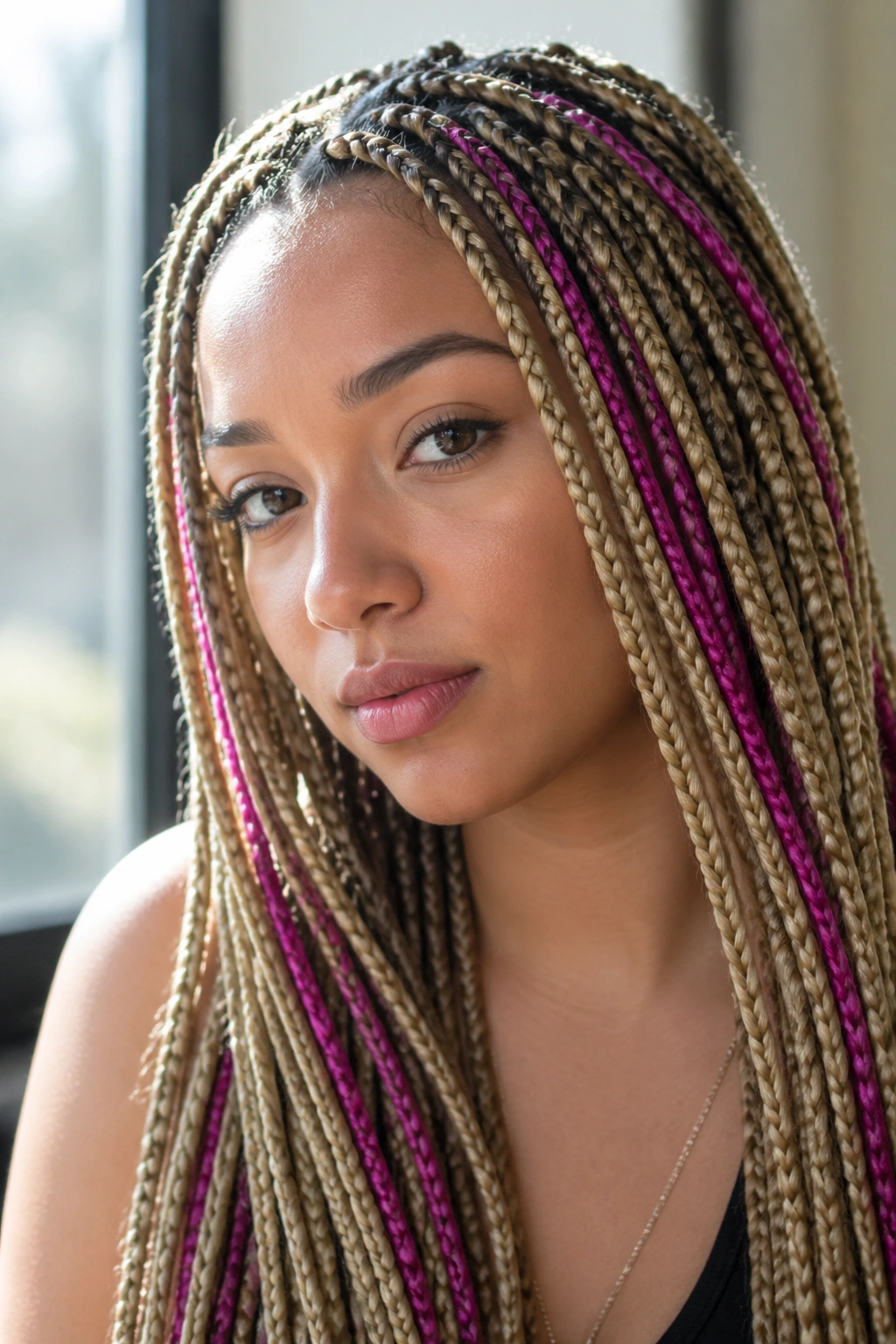
Full pink can be a lot. A few magenta accent strands solve that problem without watering down the style. The base stays blonde, which keeps things bright and wearable, while the magenta braids work like punctuation marks through the set. Small amount. Strong effect.
The smart way to place the accents
Put the accent strands around the temples, near the nape, or scattered through the outer layer. That gives the color enough visibility without making the whole head compete with itself. Four to eight magenta braids is usually enough for a medium set.
- Keep the base mostly honey or golden blonde.
- Use magenta instead of softer pink if you want contrast.
- Place the accent strands where the hair parts naturally.
- Repeat the accents on both sides so the look stays balanced.
This is the best option for anyone who wants a little edge but still needs the style to feel easy to wear. It reads like a choice, not an accident. That matters.
13. Ash Blonde Box Braids with Dusty Rose Tones
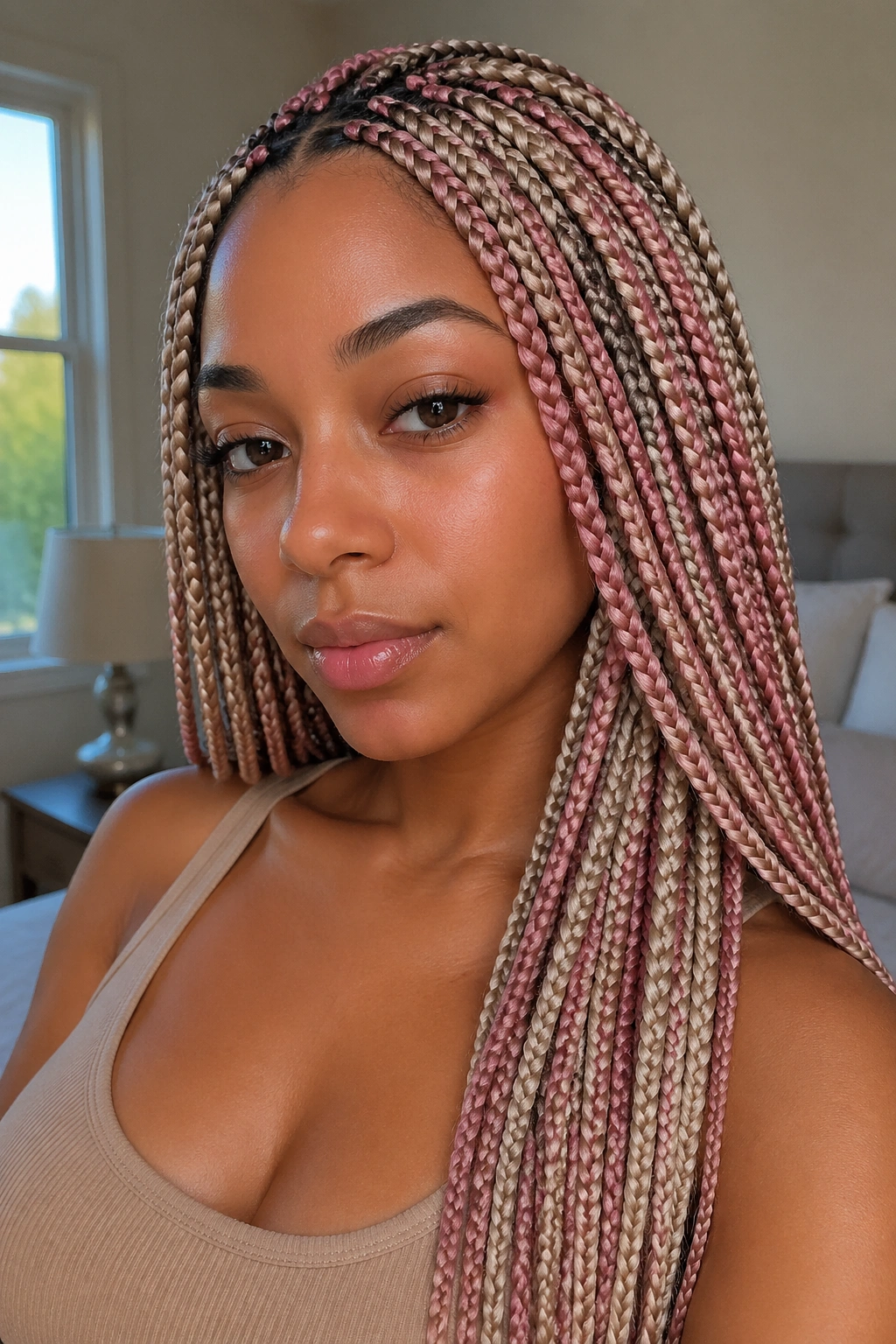
Muted pink has a different energy. It does not shout. It lingers. Ash blonde and dusty rose sit in the same cooler family, which makes the whole style feel calmer and more deliberate than a honey-and-neon mix ever could. If you want the color to look soft in daylight and even softer in indoor light, this is the pair to try.
The cooler blonde keeps the dusty rose from turning sugary. The rose keeps the ash blonde from going flat or gray. Together, they sit in a nice middle ground that works well with neutral makeup, silver jewelry, and pared-back clothes. Nothing fights. That’s the appeal.
I’d use this on small or medium braids because the muted tones need some density to show up clearly. A few giant braids can make the pink vanish into the blonde. With more braids, the colors repeat enough for the eye to catch them. This is one of the few pink styles that can look almost grown-up without losing its personality.
14. Honey Blonde Box Braids with Neon Pink Money Pieces
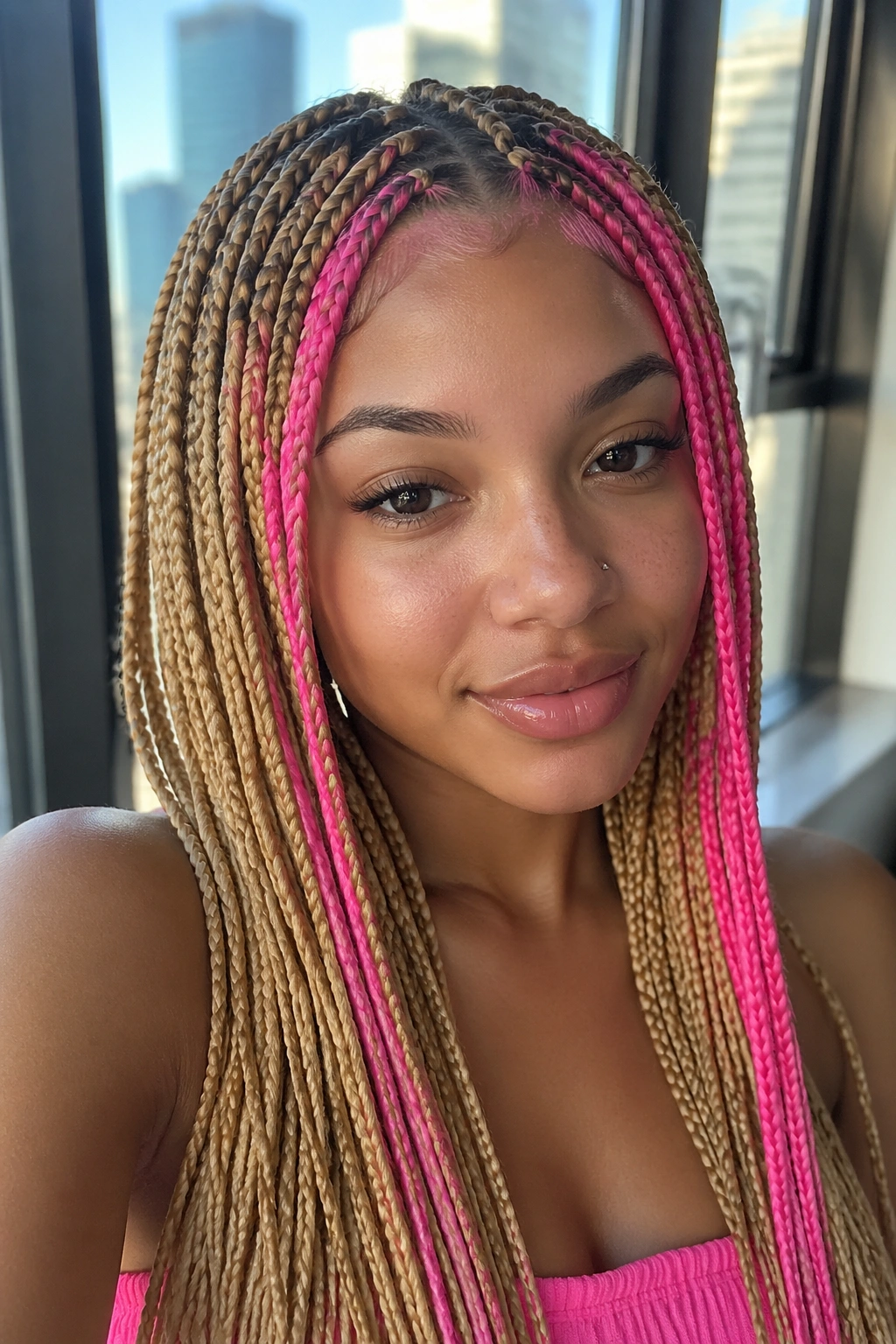
If you want color near the face, make it count. Neon pink money pieces on a honey blonde base give the braid set a sharp frame without covering the whole head in bright pink. The front braids become the headline, and everything else supports them.
This style looks strongest when the money pieces are wider than you think they should be. Too narrow, and the pink disappears the moment you turn your head. Give each front section enough width to read as a deliberate stripe. Then keep the rest of the braids mostly honey blonde so the contrast stays focused.
It’s a good fit for high ponytails and half-up styles because the front pieces remain visible even when the rest of the hair is pulled back. That is one of those practical details people ignore until they try a style and lose half the color once it’s tied up. Front color should still show when you’re living your life. Not just when you’re standing still.
15. Medium Blonde and Pink Braids with a Braided Crown
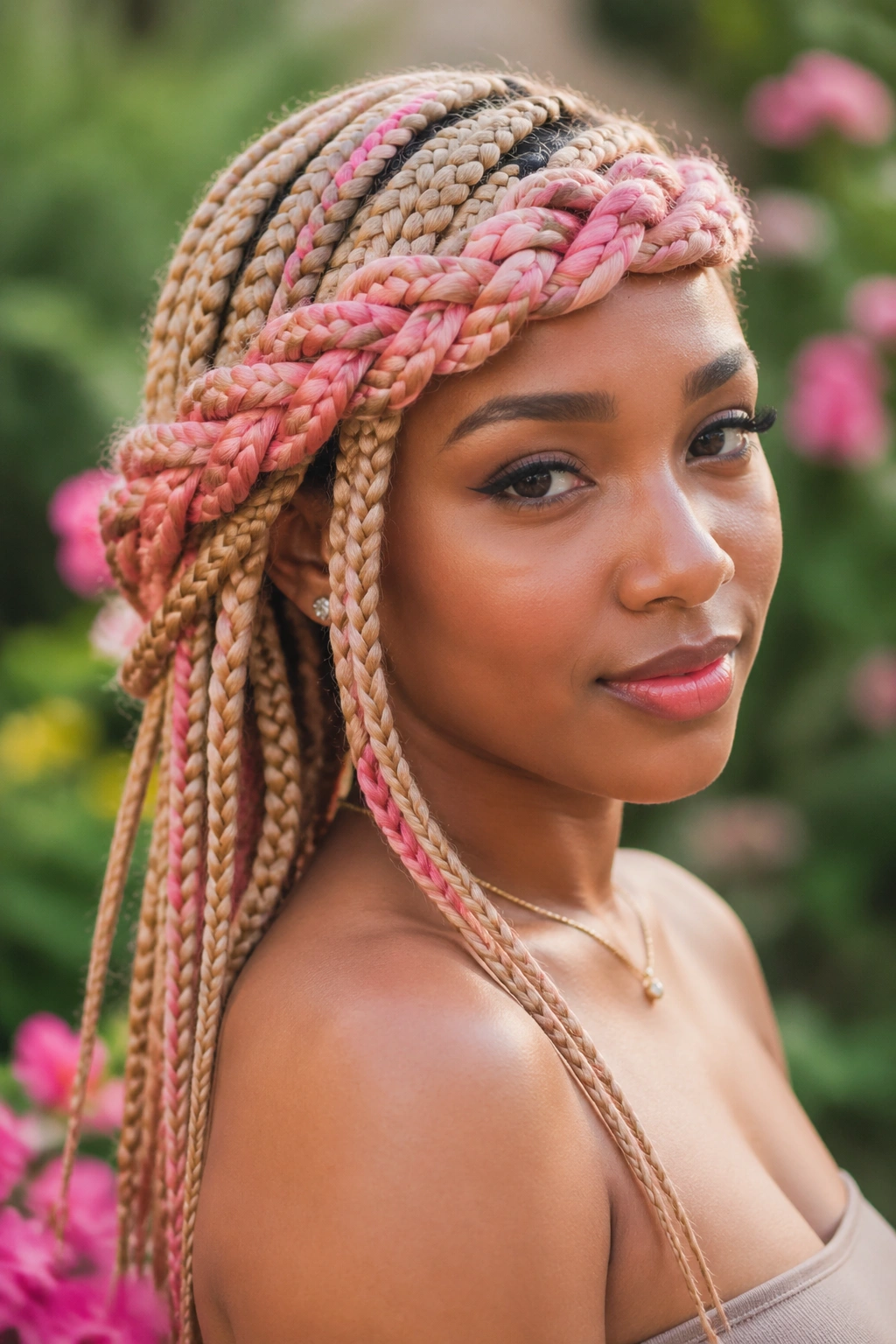
A braided crown sits where the eye goes first, so it deserves better color than a random accent braid. In this version, the crown itself uses pink braids laid across a mostly blonde base, which gives the front of the style a soft halo effect. It sounds delicate. It is not flimsy.
How to make the crown sit flat
The crown works best when the front braids are not too thick. Medium braids lay closer to the head and stay comfortable longer, especially if the crown has to wrap from one side to the other. A too-large braid here feels bulky and fights the shape.
- Start the crown at the outer edge of one temple.
- Cross the pink braids over the front hairline.
- Pin or tuck the ends neatly so the line stays clean.
- Keep the rest of the braids blonde to protect the contrast.
I like this on medium-length sets because the crown can actually be seen. On very long hair, the front braid can get lost in the length unless the crown is repeated or layered. On shorter hair, it can dominate in a good way.
16. Curled-End Blonde and Pink Box Braids
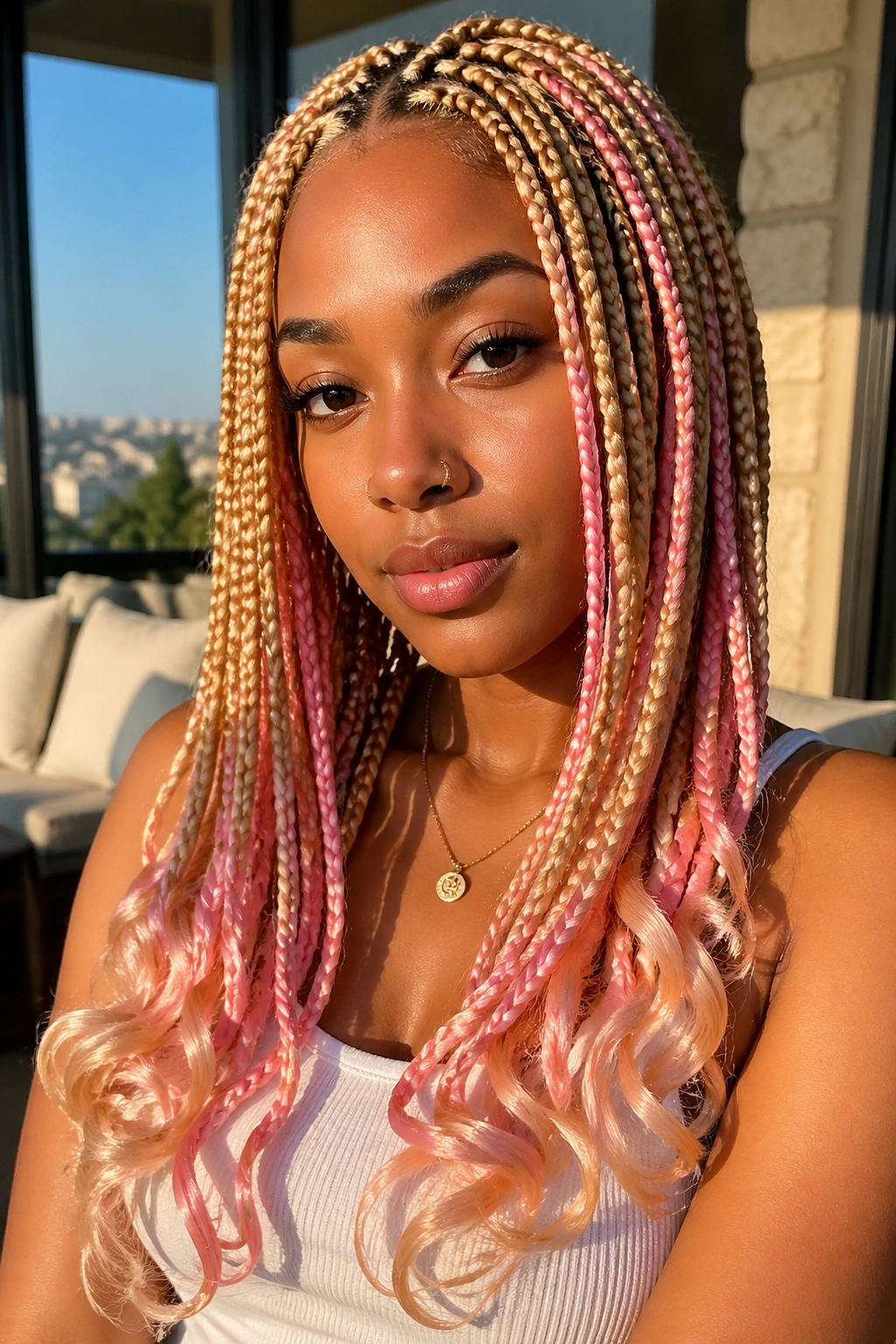
Straight ends make braids look tidy. Curled ends make them feel softer. That tiny change shifts the whole mood, especially when the colors are blonde and pink. The ends bounce instead of hanging straight, and the pink gets a little more movement at the bottom of the braid.
Synthetic hair can be dipped briefly in hot water to seal and shape the ends, while some curlier finishes use rollers or rod sets after the braids are finished. If the hair is heat-safe, a careful hot-water dip can help the curl hold. If it is not, do not force it. That is how ends get ruined.
This style looks best when the curl starts only at the bottom third. If the curl starts too high, the braid shape can lose its clean line. A soft bend near the ends is enough. You do not need a dramatic spiral unless you want the whole set to feel more playful. I usually prefer a little curve over a lot of curl. It looks cleaner for longer.
17. Sleek Feed-In Blonde Box Braids with Pink Framing
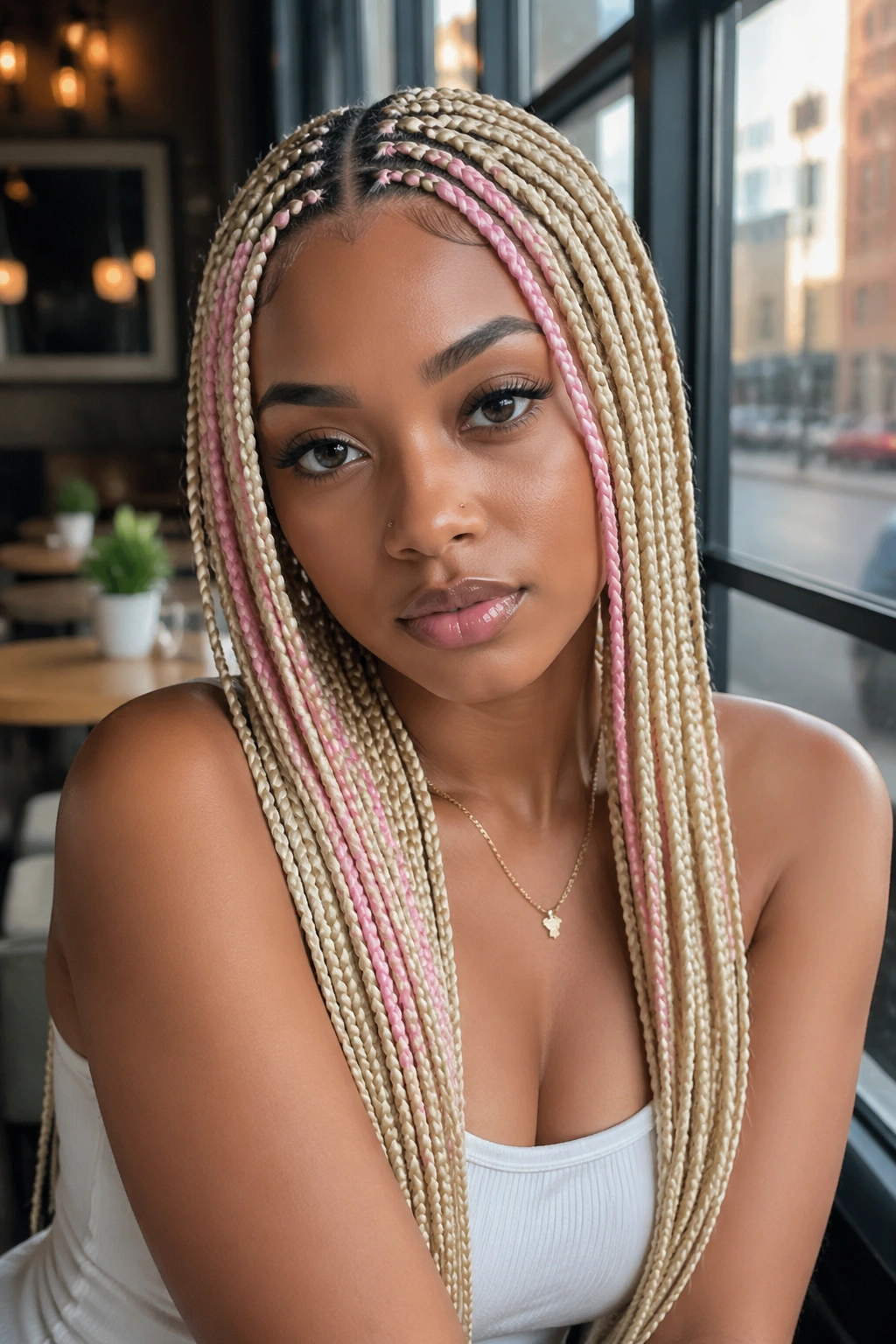
Sleek feed-in braids change the whole mood at the scalp. The sections lay flatter, the rows look cleaner, and the pink framing around the face feels sharper because there’s less bulk competing with it. This is the neatest version on the list, and I mean neat in the best way.
What makes feed-in different
Feed-in braiding lets the stylist add hair gradually instead of starting with a heavy knot. That helps the root look smoother and gives the front braids a nicer slope. It also makes the pink face-framing pieces look more refined, because the color starts in a cleaner place.
- Ask for narrow pink braids around the face only.
- Keep the rest of the set blonde and smooth.
- Use precise parting so the rows run evenly.
- Avoid overloading the front with too much pink or the frame gets busy.
This style is one of my favorites for people who want a polished color look without a lot of extra drama. It has structure. It has shine. It does not need much else.
18. Chunky Blonde and Pink Braids with Gold Cuffs
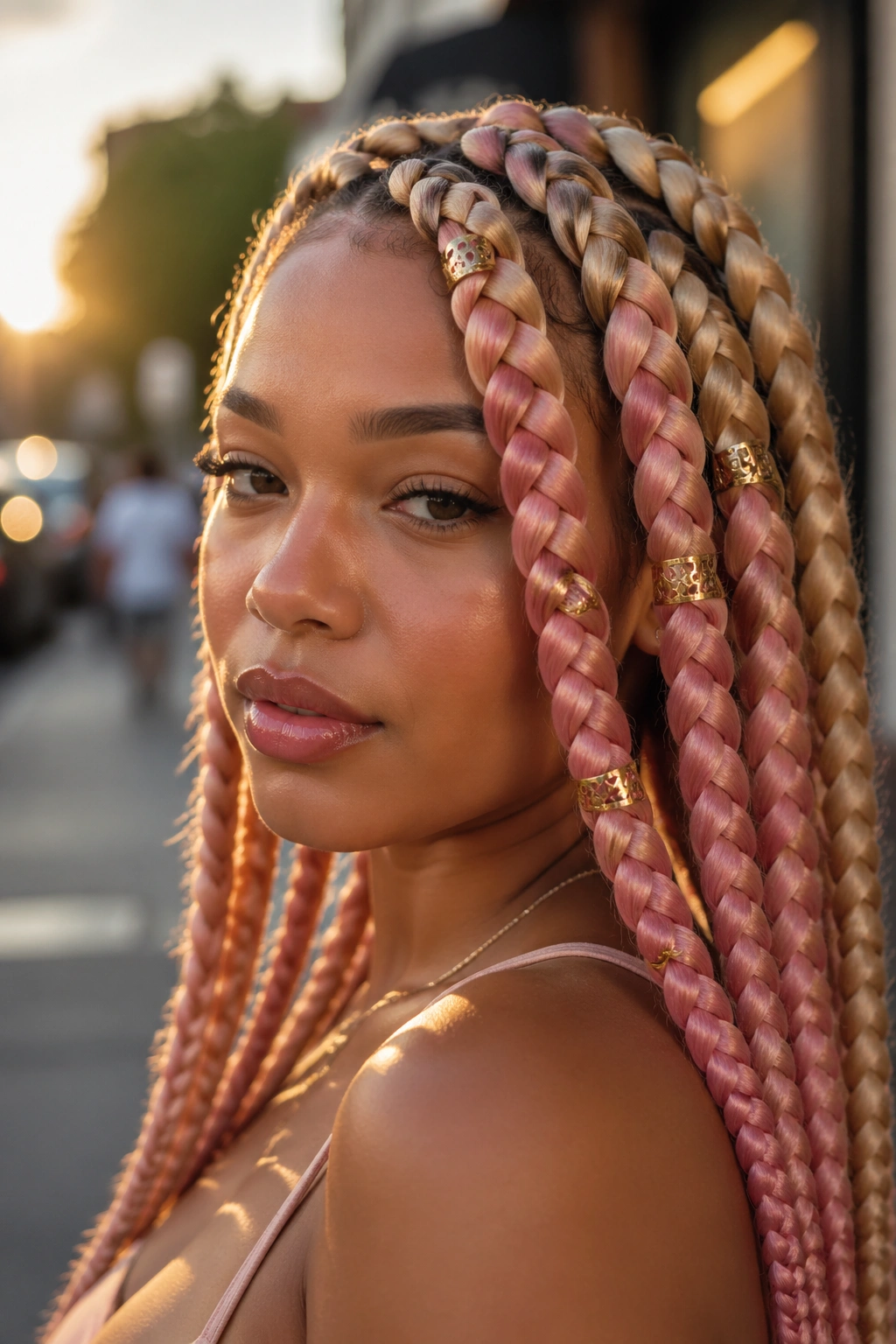
Chunky braids and gold cuffs have a strong opinion about themselves. They don’t apologize. The thicker braid size makes the blonde and pink mix easier to read, and the cuffs give each section a little metallic break that keeps the colors from blurring together.
The best placement is not cuffing every single braid. That gets noisy fast. Put the cuffs near the ends of a few front braids, then maybe one or two more through the mid-lengths. Four to five inches between cuffs keeps the look balanced. Too many pieces and the hair starts to feel crowded.
I like this style when the braids are long enough to swing a little. The cuffs move with the hair, which helps the blonde and pink flash differently every time you turn your head. If you want a version that feels dressed up without needing extra styling every morning, this is a strong pick. The metal does some of the work for you.
19. Blonde Box Braids with Pink Ribbon Streaks
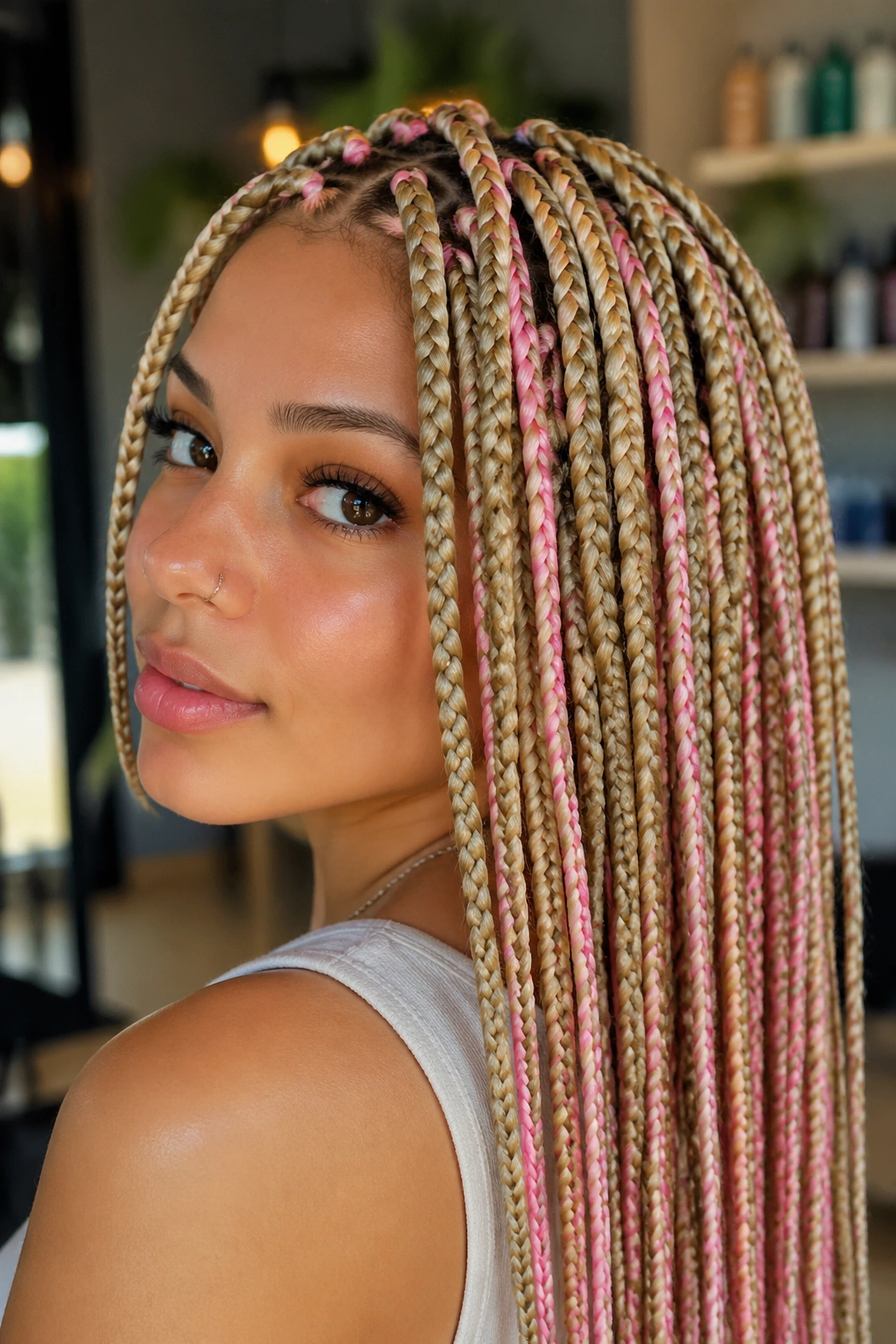
From the front, this looks mostly blonde. Turn your head and the pink shows up in thin, ribbon-like lines through the set. That subtle motion is the point. It feels softer than half-and-half, cleaner than ombré, and less obvious than full accent braids.
This works best when the pink strands are distributed through the inner and outer layers instead of sitting all in one place. Think of them like narrow streaks woven through a blonde base, almost as if color had been threaded through fabric. That’s the visual. The effect is better when the pink is repeated enough to show up, but not so much that it turns into a block.
I’d choose this for medium or long braids. Short braids do not give the streaks enough room to repeat, and then the idea gets lost. Keep the blonde dominant and let the pink arrive in flashes. That tension between visible and hidden is what makes the style feel interesting instead of busy.
20. Layered Blonde and Pink Box Braids for Maximum Movement
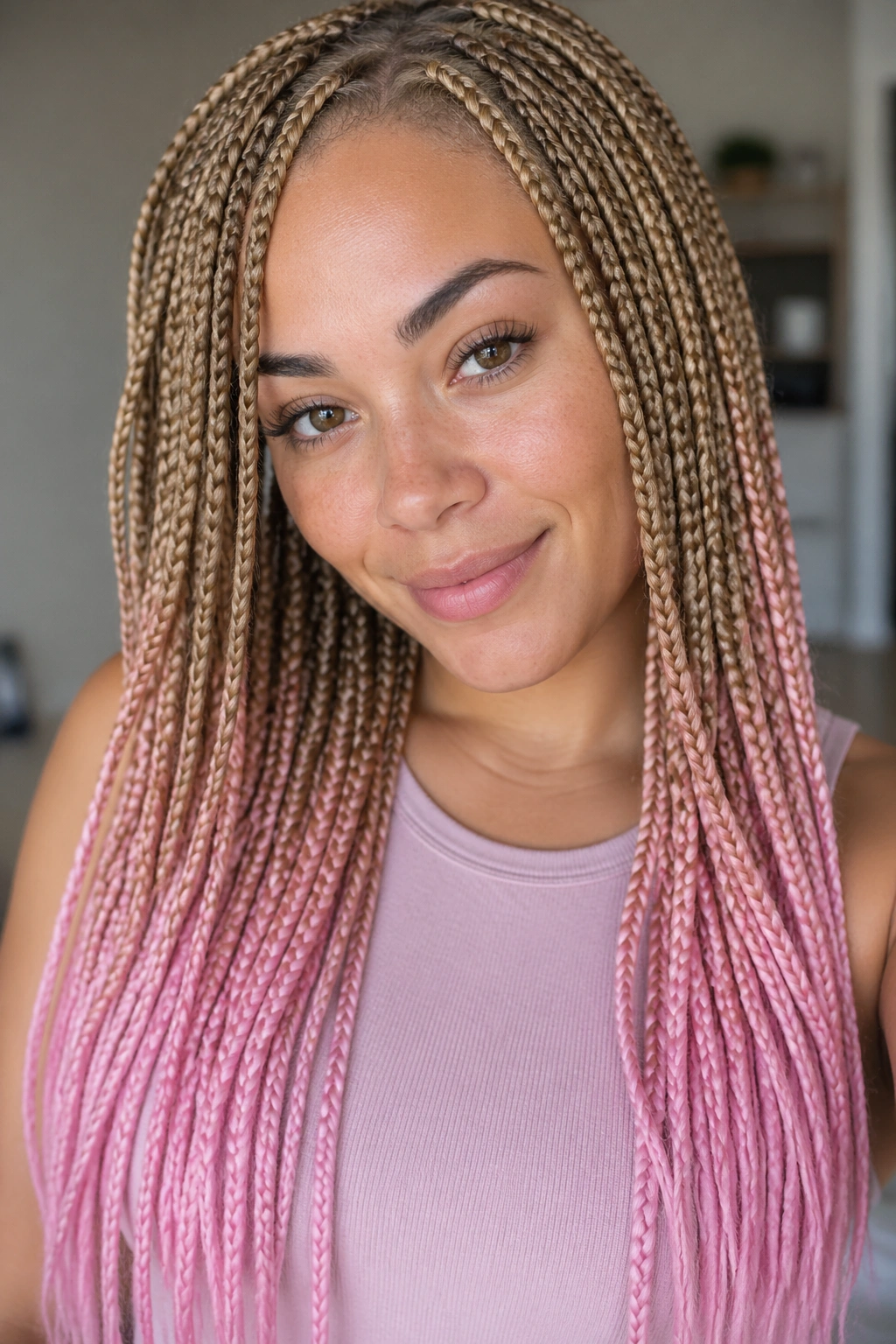
Layering changes everything. When the braids fall at different lengths—some near the shoulders, some brushing the chest, some landing lower—the blonde and pink colors stop sitting in a flat sheet and start moving in separate lines. That movement makes the whole style feel fuller, even when the braids themselves are not especially thick.
This is the most editorial version on the list, mostly because it mixes lengths and colors instead of trying to make everything match too neatly. Use a few shorter braids around the face, medium ones through the crown, and longer pieces underneath. The color can shift with the lengths too: more blonde near the top, more pink lower down, or vice versa. Small changes. Big difference.
I like this look when someone wants the braids to feel styled, not just installed. The layers give the hair shape on purpose. They also make the style easier to wear with jackets, earrings, and high collars, because the shorter pieces move out of the way while the longer ones keep the color story going. It’s the kind of set that looks better the more it moves.
If you want the safest place to start, honey blonde with pink ends is the least fussy. If you want the loudest payoff, half-and-half or jumbo color blocks will do it. Everything in between is a matter of how much of the pink you want to let speak first, and how much blonde you want to keep in the room while it does.
