



Cozy is a design problem that most people solve with volume. More pillows. More blankets. More stuff layered on surfaces until the room looks like it has warmth even if it doesn’t feel it. The approach works on a surface level, but it doesn’t hold — you end up with a cluttered room that photographs well and feels exhausting to actually inhabit.
Afro chic bedroom design approaches cozy differently. The warmth comes from the quality and combination of materials: the weight of a mudcloth blanket, the depth of a terracotta accent wall, the visual richness of layered African-inspired textiles, the glow of warm light on natural wood surfaces. It’s warmth built from real material choices rather than visual accumulation. And it works whether your bedroom is 150 square feet or 500 — the principles scale.
“Chic” is doing real work in this concept too. Afro chic isn’t about bold-statement-maximalist decor. It’s about a particular kind of sophistication — refined, culturally grounded, elegant in its own register. Pattern is present but not chaotic. Color is warm but not shouted. Cultural objects are chosen carefully, placed intentionally. The result is a bedroom that feels gathered and grown-up: a space that expresses something specific rather than simply accumulating objects.
These 22 ideas cover the full range from structural decisions — layout, wall color, lighting — to individual styling moves. They work in small rooms and large ones. They work at every budget. And they’re all oriented toward the same goal: a bedroom that feels genuinely cozy and genuinely yourself.
What Makes a Space Feel Cozy vs. Just Full
Genuine coziness in a bedroom has a few reliable indicators, and none of them are about volume of objects. A bedroom feels cozy when the lighting is warm and at eye level rather than overhead and bright. When the textiles you touch are genuinely tactile — rough or soft or dense in a way that registers in your hands. When the color palette creates warmth rather than visual coolness. When the scale of furniture feels right for the room — not too sparse, not so full that there’s no breathing room. When there’s a sense that the room was assembled by someone with a point of view rather than furnished according to a generic template.
Scale is particularly important in small spaces. A common mistake is thinking that small rooms need small furniture — that you should scale everything down to avoid the room feeling cramped. In practice, a few well-sized pieces read as more intentional and less cluttered than many small ones. A single queen bed that fills 60 percent of the room, with carefully chosen bedside tables and a good rug, reads as designed. Five small pieces scattered around the same room read as undecided.
How African Textiles Create Visual Warmth
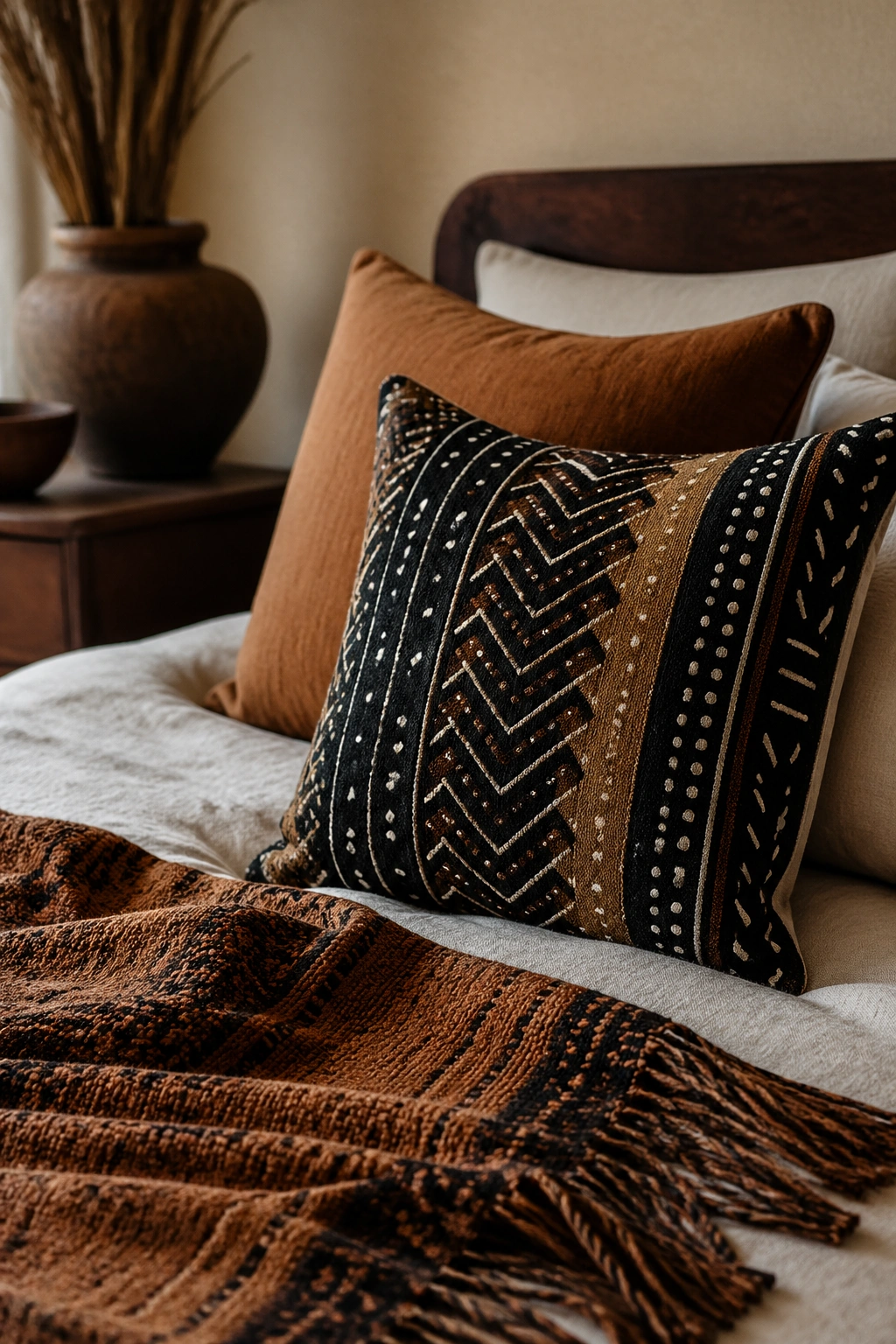
African textiles do something specific in a bedroom that most mass-produced fabric cannot: they carry evidence of making. A mudcloth’s matte surface from the fermented mud painting process. Kente’s complex weave visible in each strip’s geometry. Adire’s irregular blue patterns from the resist-dyeing process. Kuba cloth’s dense geometric embroidery worked in raffia. These textiles have physical history — they were made by hand using processes that leave their marks in the fabric itself.
That evidence of making is what the eye reads as warmth. It’s the same quality that makes a handmade ceramic feel warmer than a factory-made one, or a wooden table with visible grain feel more inviting than a laminate one. The material speaks of a person and a process. In a bedroom — a private, personal space — that quality is precisely what you want.
You don’t need a room full of African textiles to access this quality. Two or three well-chosen pieces — a mudcloth pillow, a woven throw, a framed batik — are enough if they’re in the right positions at the right scale.
Building a Color Palette That Feels Warm Without Being Overwhelming
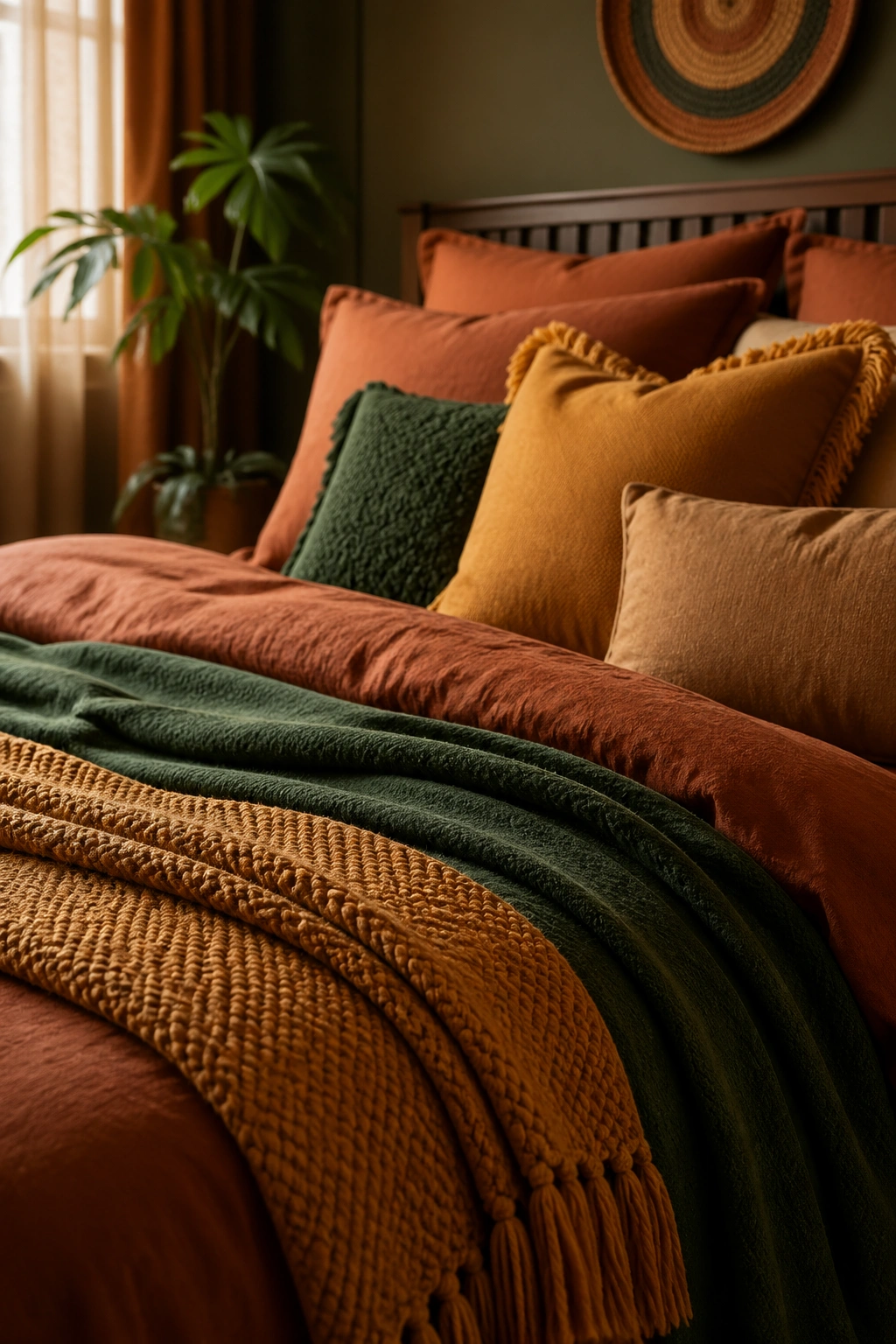
The afro chic bedroom palette operates in warm tones — terracotta, rust, deep amber, burnt sienna, warm tan, forest green, camel, cream — with blacks and very deep browns as anchors. This is distinct from the bright primary colors associated with some African textile traditions, and distinct from the cool grays and whites of mainstream bedroom design.
Start with your wall color as the warmest neutral in the room, not as a statement. Terracotta, warm clay, dusty amber, or a deep warm taupe provides the background warmth that makes all the textiles and objects read properly. If you can’t change your wall color — rental constraints or other practical reasons — a large area rug and the bedding together can establish the warm palette even against neutral walls.
Layer in darker tones through objects rather than large surfaces. A deep charcoal throw pillow, a very dark wood side table, a black ceramic lamp base — these anchor the warm palette without going dark-and-heavy overall.
Statement Headboards as the Focal Point
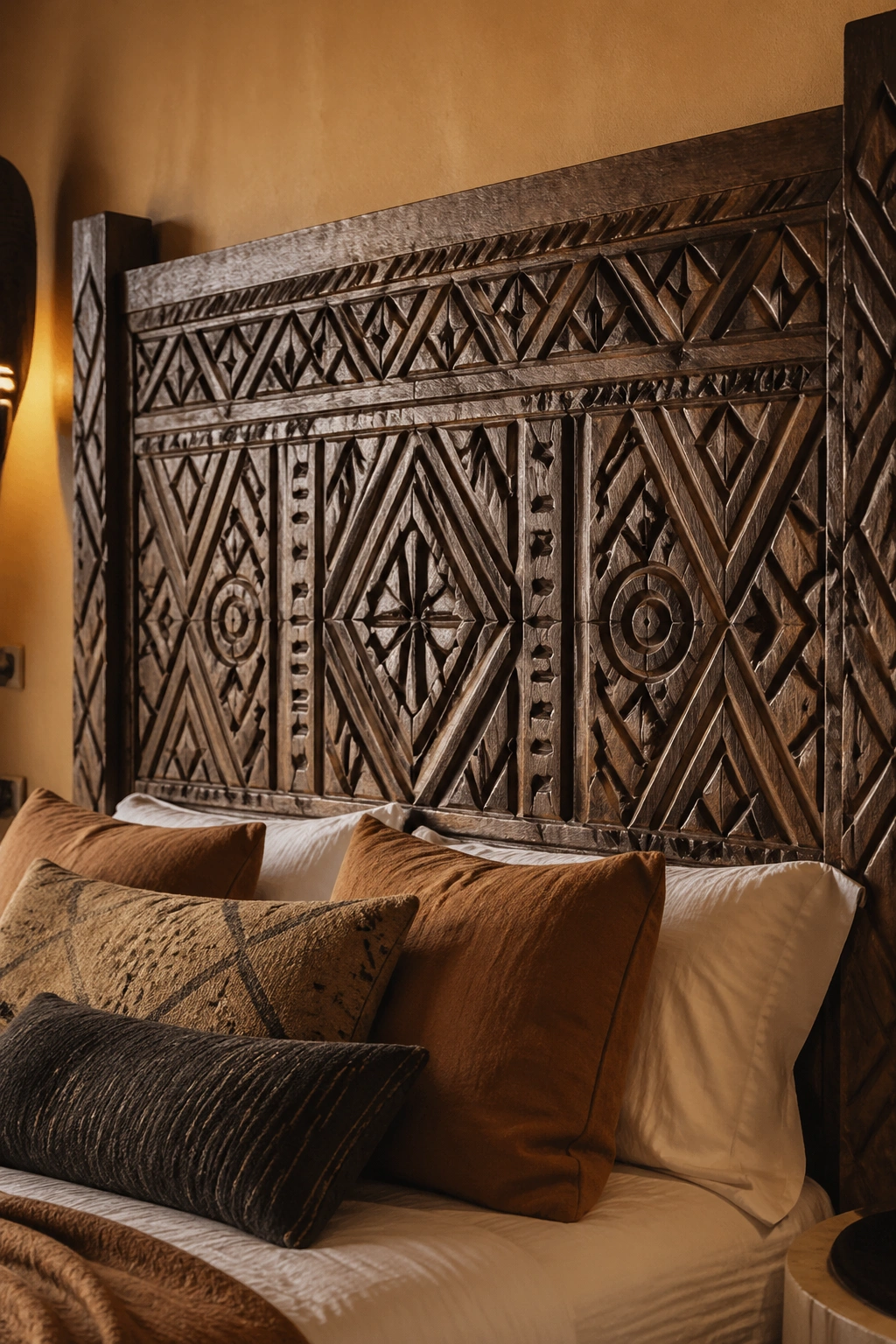
The headboard is the primary visual anchor of any bedroom. Whatever goes on the headboard wall defines the tone of the entire room. For an afro chic bedroom, the headboard is an opportunity for a design choice that’s both bold and culturally specific.
Upholstered headboards in warm brocade or textured velvet read as chic and sophisticated. A carved wooden headboard panel with African-inspired geometric motifs is a statement piece with cultural depth. A fabric headboard covered in mudcloth or African wax print is both practical and distinctive. Even a simple headboard painted in terracotta or deep ochre against a contrasting wall becomes a focal point.
The option of no traditional headboard at all — replaced by a fabric panel, a basket wall installation, or a large textile piece — is equally valid and often more interesting than a conventional upholstered frame.
1. Velvet Headboard in Deep Ochre or Rust
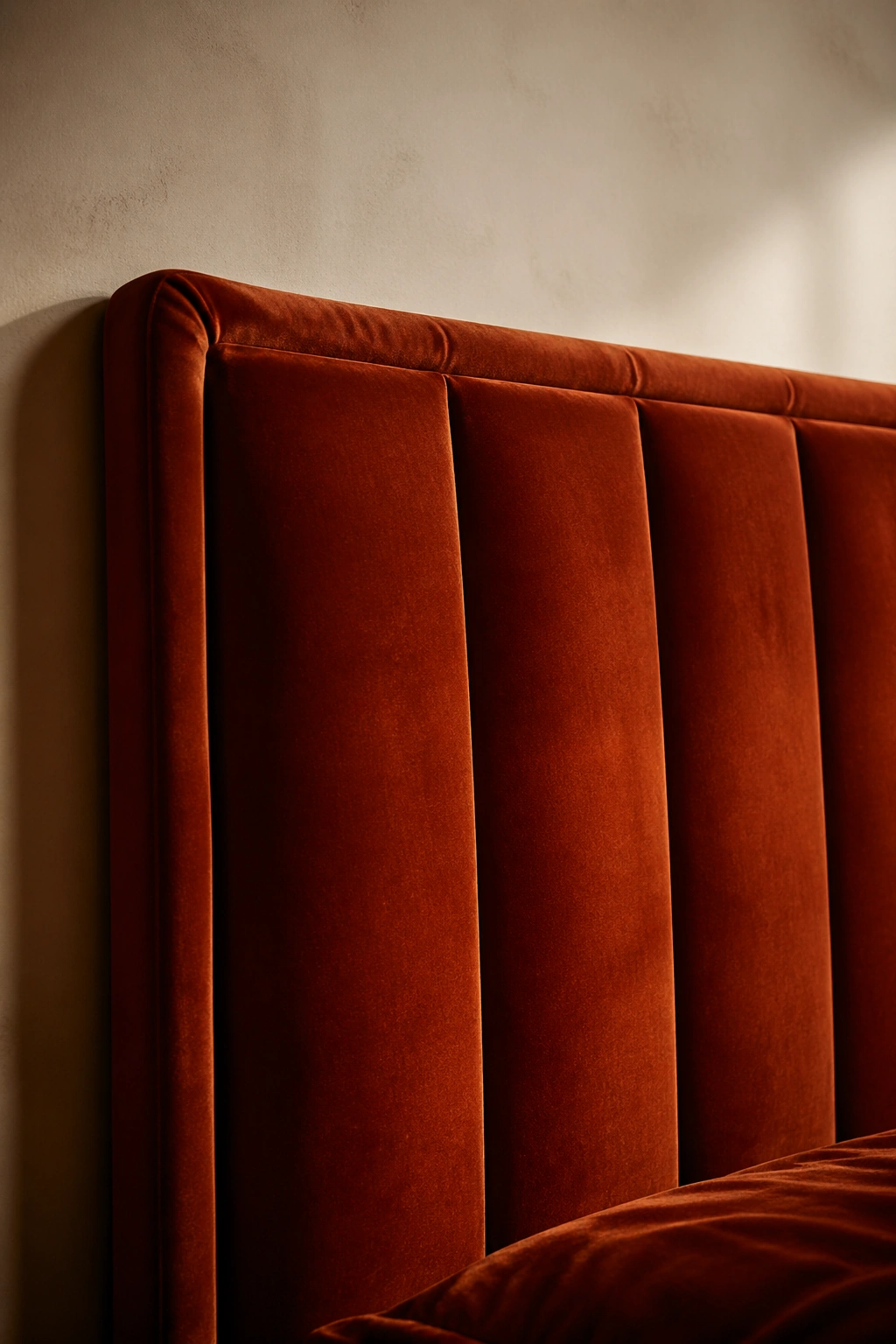
Velvet is the most reliably chic upholstery choice in a bedroom. It reflects light differently depending on the angle — the pile catches and releases light as you move — which gives a velvet surface a dynamic, living quality that flat-woven fabrics don’t have. In deep ochre, burnt orange, or rust red, a velvet headboard establishes both color temperature and material sophistication in a single piece.
The size of the headboard should be generous for the bed — for a queen, the headboard should be at minimum 60 inches wide and ideally 48 to 56 inches tall. A headboard that’s too narrow or too short looks apologetic. One with presence fills the wall and anchors the entire room.
Styling it: Against a warm cream or warm white wall, a rust velvet headboard is a complete focal point without needing much else on that wall. A single small wall sconce on either side. That’s enough.
2. Layered Bedding in Warm Earth Tones
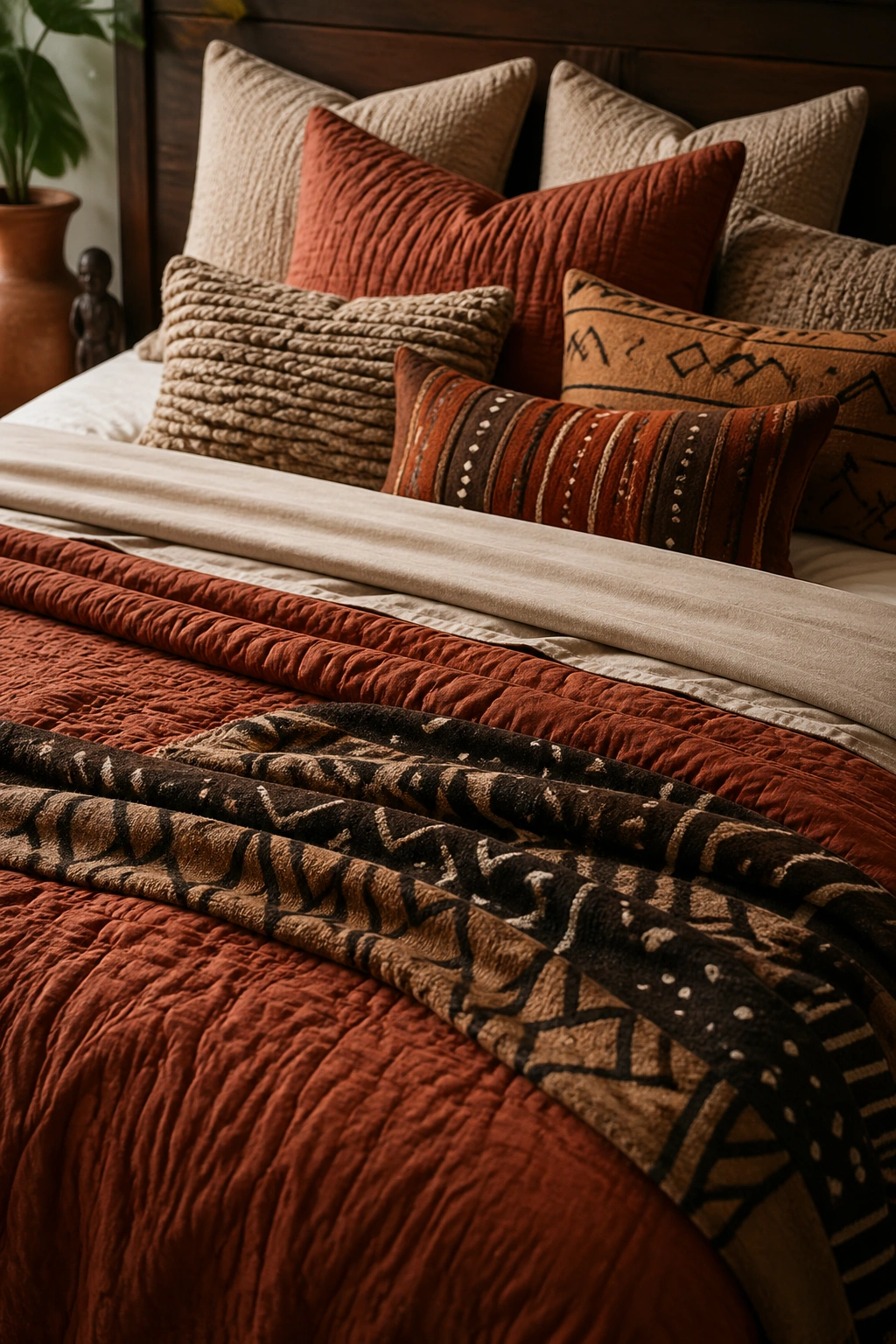
No single element has more impact on bedroom coziness than the bed itself — specifically, how it’s made and what’s on it. Afro chic layered bedding is built from the mattress up: fitted sheet in warm white or cream, flat sheet in the same tone or a slightly deeper sandy beige, then a quilt or duvet in a warm terracotta or deep amber, then a throw in mudcloth or woven cotton folded across the lower third, then four to six pillows in varying sizes and textures.
The layering creates depth and visual weight that makes the bed look inviting rather than flat. The textures should vary: something smooth (the flat sheet), something slightly rougher (the quilt), something bold-textured (the mudcloth throw), something soft (a faux fur or chunky knit accent pillow).
The pattern rule for layered bedding: one piece with pattern (the mudcloth throw), the rest in solid or subtle texture. More than one patterned piece competes and the bed looks busy rather than layered.
3. Terracotta Accent Wall Behind the Bed

A terracotta accent wall — the wall behind the headboard painted in a warm, earthy orange-red — is one of the highest-return design moves in an afro chic bedroom. It costs the price of paint and an afternoon’s work, and it transforms the room completely. Terracotta is warm enough to read as dramatic without being heavy; it works with natural wood, with white and cream bedding, with dark bronze or black metal accents, with green plants, with mudcloth textiles.
The right shade is critical. Too orange and it reads as a nursery accent wall. Too pink-red and it fights with everything. Aim for the specific quality of genuine fired terracotta clay — warm, slightly muted, with a dusty quality rather than a saturated one. Benjamin Moore’s “Terracotta” or Sherwin-Williams’ “Cavern Clay” are commonly referenced examples.
How to Get the Most From It
Paint just the headboard wall, not all four walls. One wall is enough. All four in terracotta will make the room feel smaller and heavier than intended. The single accent wall creates the warmth and drama while leaving the room enough breathing room to feel open.
4. Kuba Cloth Pillow or Throw as a Tactile Centerpiece
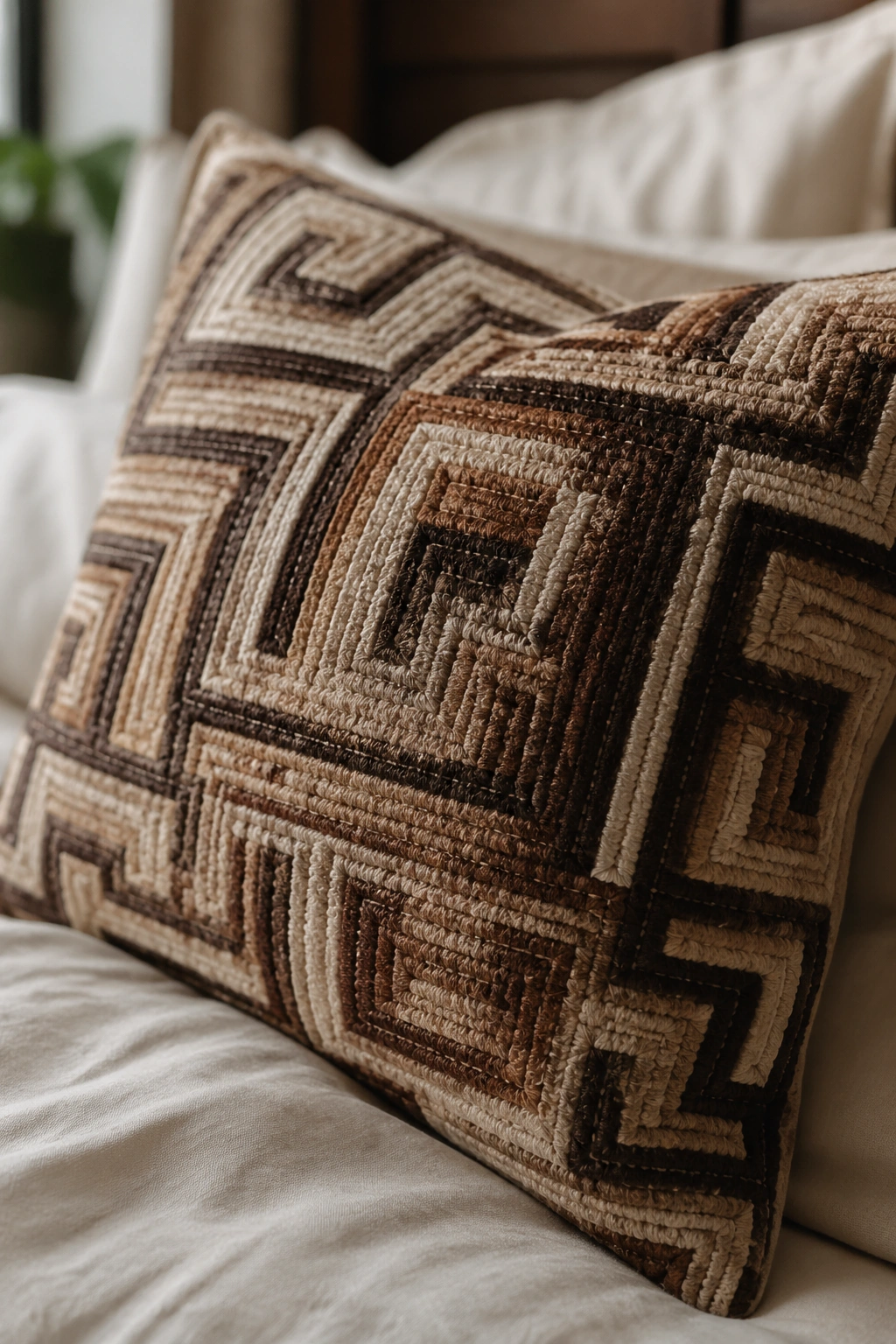
Kuba cloth comes from the Kuba Kingdom of the Democratic Republic of Congo — a velvet-like fabric made from raffia palm fiber, decorated with geometric embroidery and cut pile work that creates a surface of extraordinary textural complexity. Up close, Kuba cloth has a depth that photographs can barely capture. The cut pile sections feel like velvet; the flat woven sections feel like dense canvas. The geometric patterns — interlocking meanders, checkerboards, zigzags — have a mathematics to them that is both ancient and completely contemporary.
A single Kuba cloth pillow on a bed of smooth linen and cream cotton is a statement of material knowledge. It announces that the room was curated by someone who knows what they’re looking at and why it matters.
Authentic Kuba cloth pieces are significant purchases and worth researching before buying. Reproduction or Kuba-inspired fabric is widely available and still captures the geometric visual language, if not the full depth of an original.
5. Brass and Gold Accent Hardware
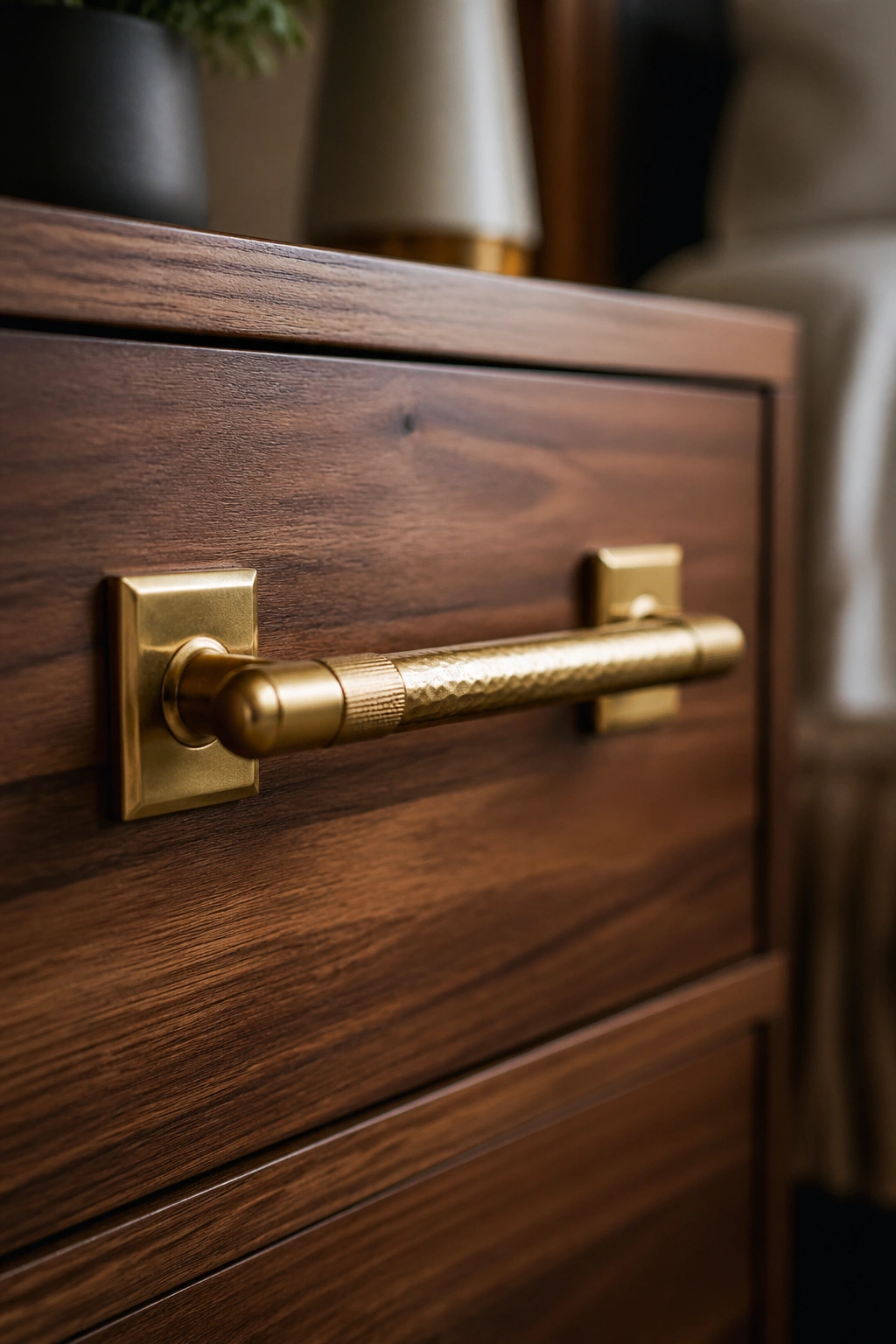
In an afro chic bedroom, metal accents — the frame of a mirror, a lamp base, decorative tray, picture frame, curtain rod hardware — make a significant contribution to the overall feeling of warmth and refinement. Brass and warm gold read as richer and more cultivated than chrome or cool silver in a warm-palette bedroom. They complement earthy tones rather than fighting them.
This doesn’t require new furniture. Swapping out switch plate covers, drawer pulls, and cabinet knobs to brushed brass or aged gold versions of the same items transforms existing furniture at minimal cost. A $3 brass drawer pull on a $50 dresser makes the dresser look significantly more considered.
The finish matters: brushed or antique brass ages beautifully and has a warmth that polished gold doesn’t. Polished gold in a bedroom context can tip into ostentation. Brushed brass tips into warmth and craft.
6. Carved Wood Canopy or Four-Poster Frame
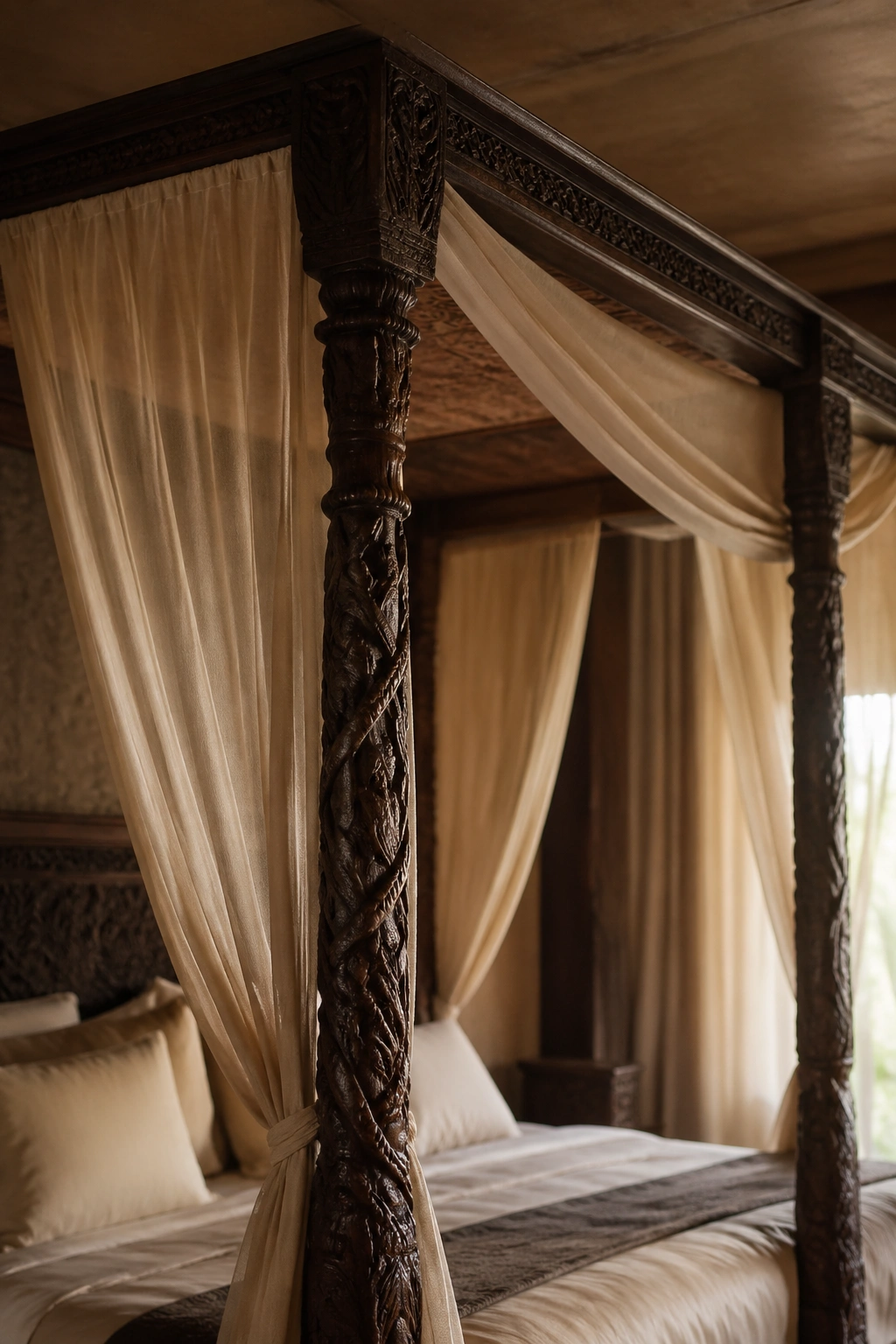
A four-poster bed frame with posts in carved or turned dark wood changes a bedroom’s architectural feeling more than any other piece of furniture. The posts create vertical lines that draw the eye upward and establish a sense of enclosure — that cocooning quality that’s central to a genuinely cozy bedroom.
Carved wooden bed frames are available at a range of price points — from significant antique or import pieces to more affordable contemporary versions with simple turned posts rather than elaborate carving. Even a simple turned-post four-poster in dark walnut or espresso reads as intentional and grounded.
With a canopy of sheer, gauze, or linen fabric draped over the frame, the bed becomes a room within the room. That enclosed quality — waking up inside a draped bed, light filtered through fabric — is a specific and memorable kind of luxury that costs very little once the frame is there.
7. Warm Wood Dresser With Patterned Mirror Above
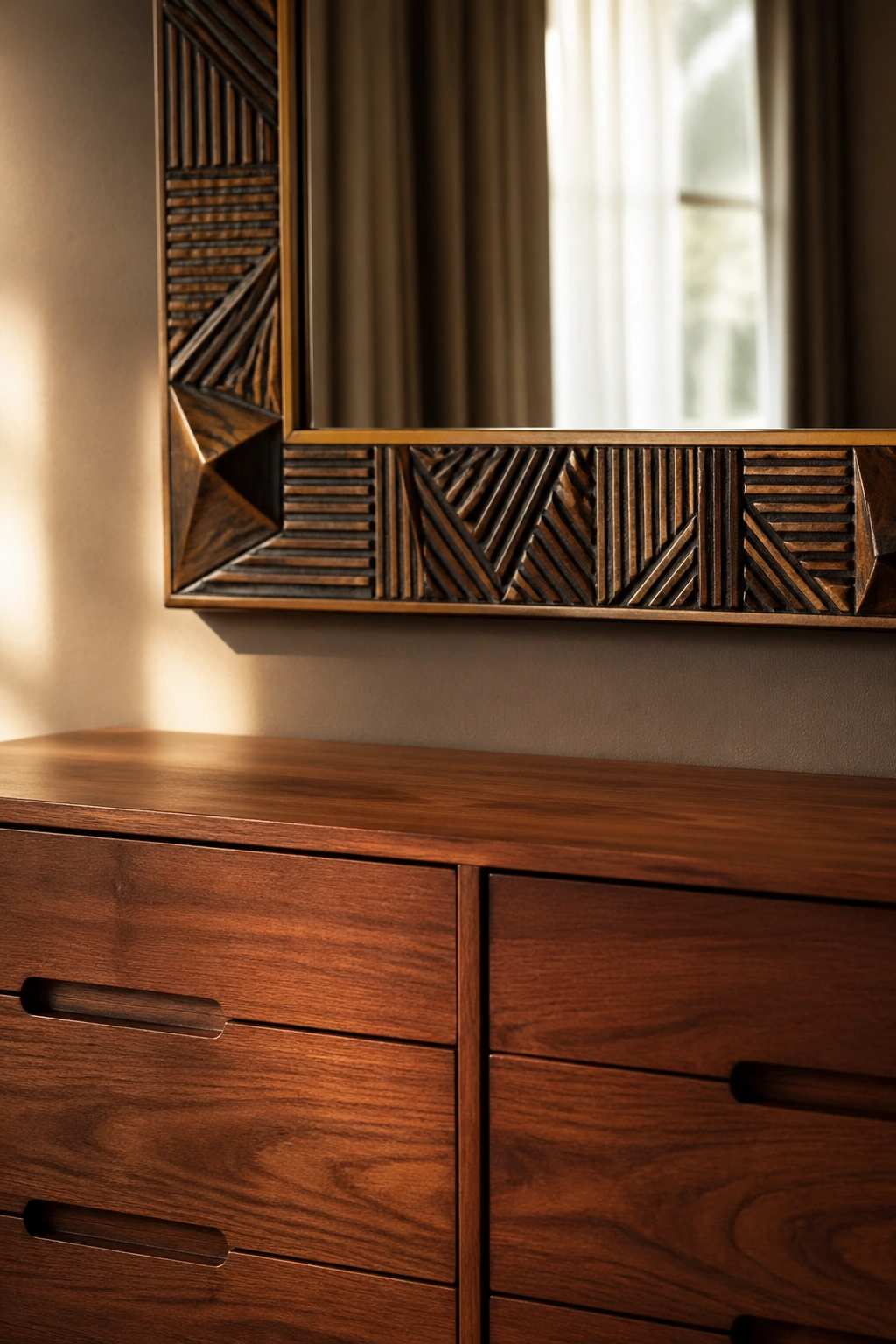
The dresser is a utilitarian piece that most bedrooms need, and it’s often where design intention falls apart — the dresser is chosen for storage capacity and then styled as an afterthought. In an afro chic bedroom, the dresser is a deliberate surface.
A warm wood dresser — natural oak, teak, or walnut, or a dark-finished piece in mahogany tones — with a large mirror above it creates both function and visual depth. The mirror reflects light and makes the room feel larger. The wood surface establishes the natural material language.
Above the mirror: nothing. The mirror is the vertical statement. Don’t add art above it and create competition. Below it on the dresser surface: a simple tray to corral jewelry and small items, a ceramic dish, a small plant. The dresser surface should be intentional and clear — not a catch-all.
8. African Wax Print Lampshade
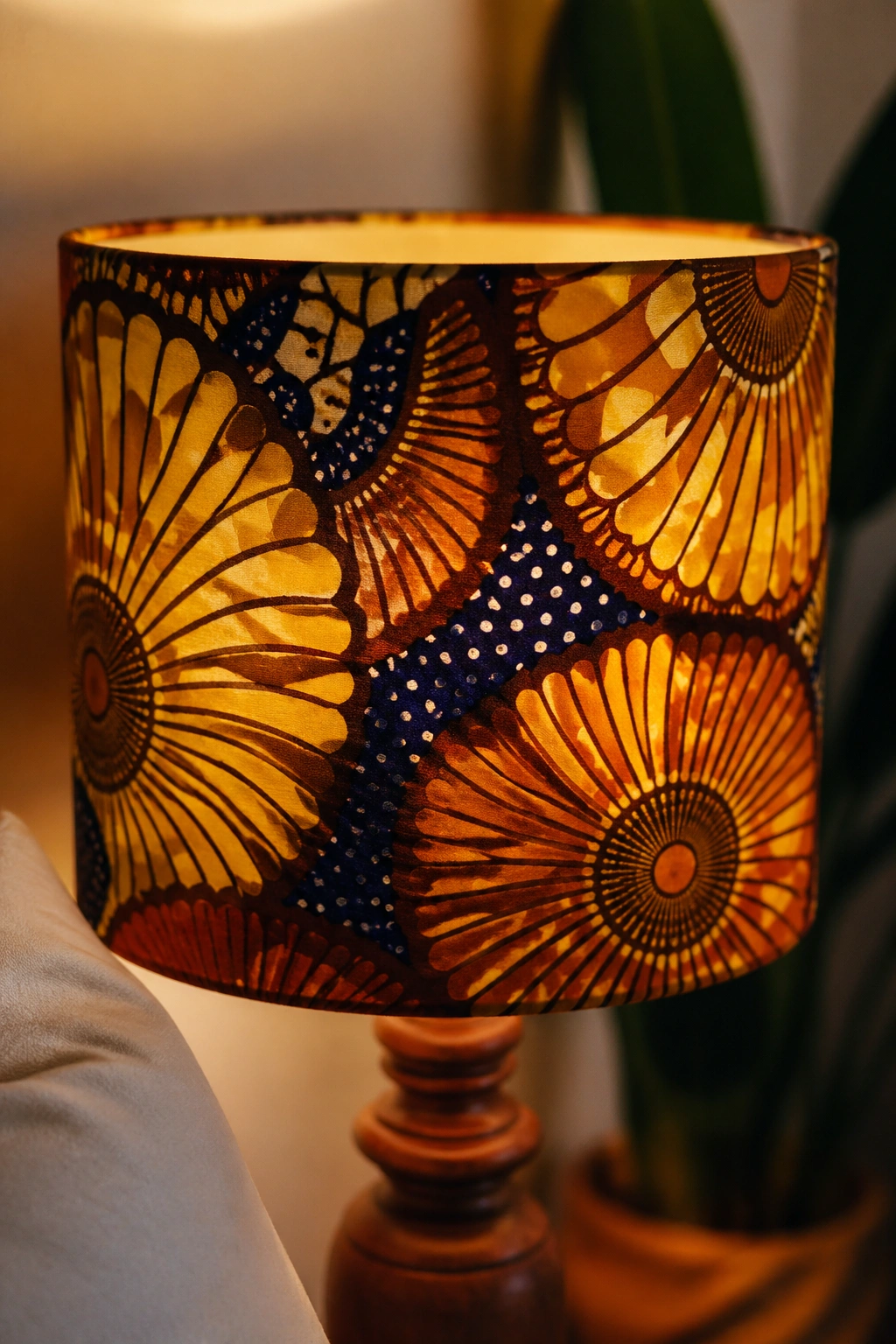
A plain bedroom lamp — a simple ceramic or wood base with a solid shade — can be transformed with a piece of African wax print fabric wrapped around or used to replace the lampshade. The pattern is visible in silhouette when the lamp is off and comes alive when lit — the light shining through the fabric makes the pattern glow.
This is a DIY project that requires a shade base, fabric adhesive, and a piece of African wax print. The process: measure the shade, cut the fabric to fit, use fabric adhesive to attach it smooth and taut. Done well, it looks custom. Done imperfectly, it looks intentional anyway because the fabric pattern carries the visual interest.
Choose a wax print with enough yellow or gold in its palette to work with warm-temperature bulb light. Blue-heavy or green-heavy prints look different when lit from within.
9. Sisal Runner Down the Bedside Aisles
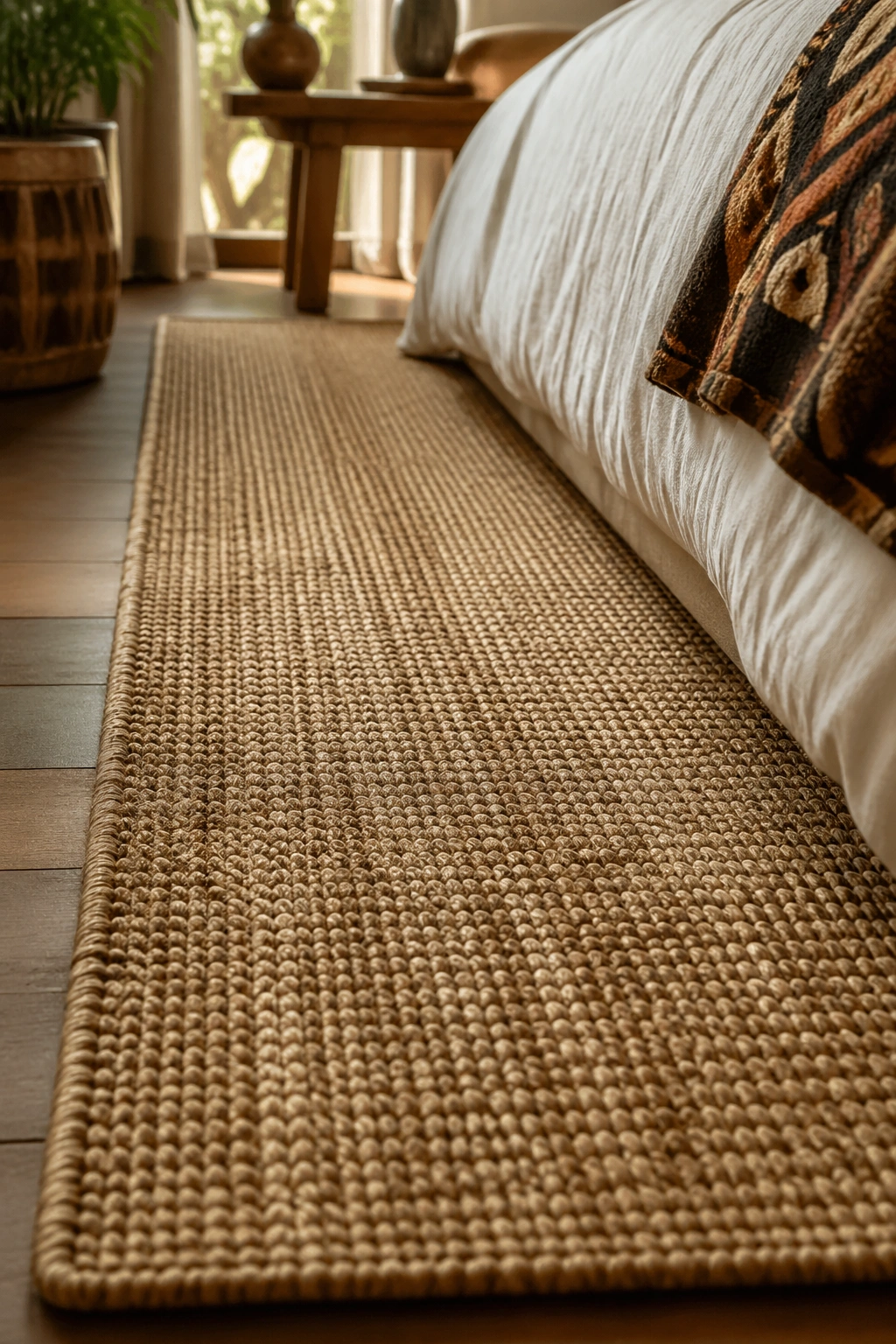
Rather than a full-room area rug — which can be expensive in larger sizes — a sisal or jute runner placed down the length of each side of the bed serves the bedroom rug function at a fraction of the cost. Two runners, each roughly 2 by 6 feet, cover the floor area where you step out of bed without requiring you to fill the entire room with natural fiber.
The textural landing — rough sisal underfoot when you get up — is satisfying in a way that wall-to-wall carpet or cold bare floors isn’t. And the natural material continues the organic, earthy quality of the afro chic palette.
Runners also give you flexibility. You can replace one runner without replacing both. You can shift the position as the room’s layout evolves. And at $20 to $40 each from discount home stores, the investment is minimal.
10. Indigo Blue as a Bold Accent Against Earth Tones
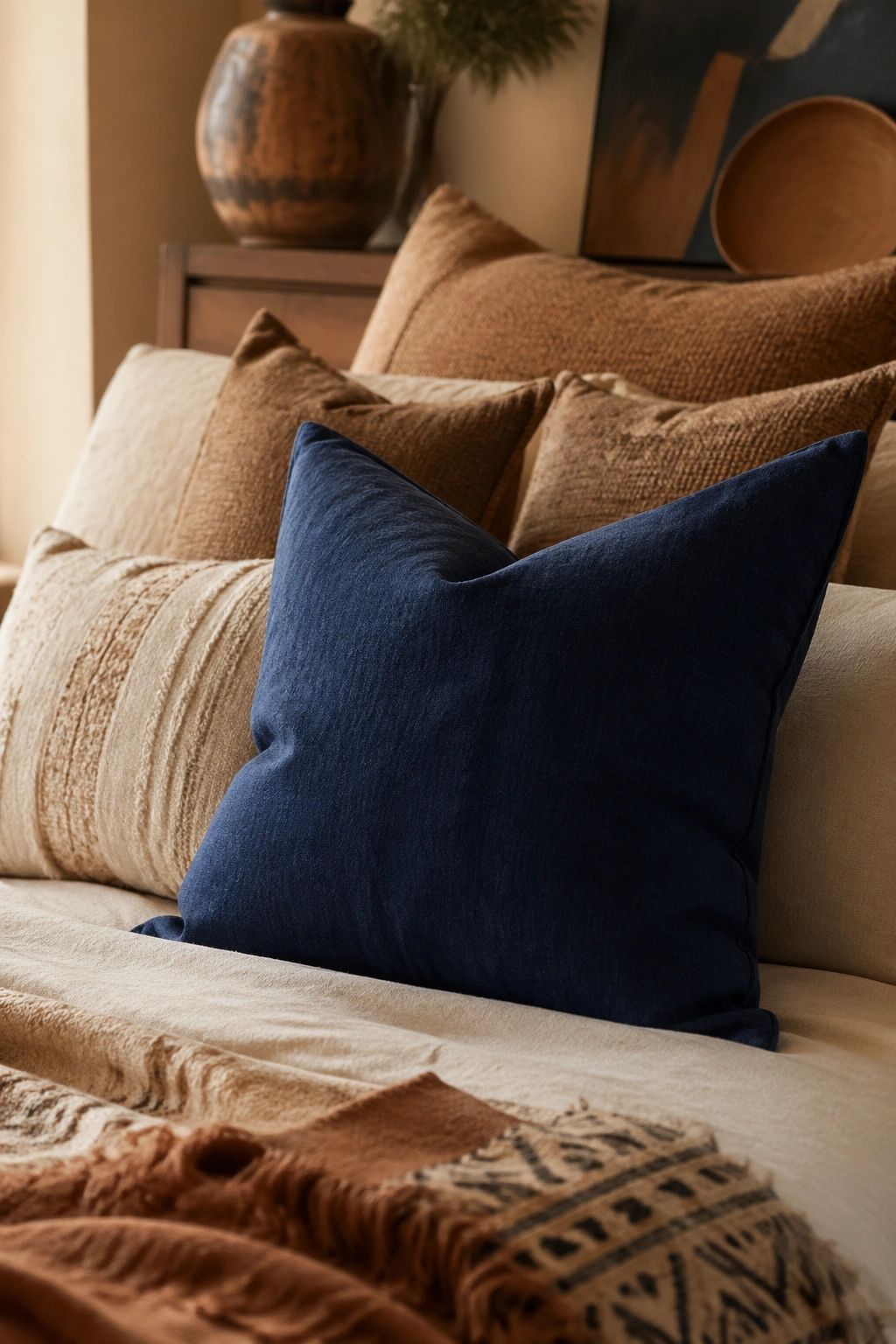
The afro chic bedroom palette is dominated by warm earth tones, but an indigo blue accent — deep, rich, slightly muted — provides the color contrast that prevents the room from feeling monotone. Indigo appears throughout African textile traditions: adire fabric from Nigeria, Malian bogolanfini with blue-black painted designs, indigo-dyed resist fabrics from across West Africa.
One indigo element in an earth-toned bedroom stops the eye and creates a focal point within the palette. An indigo linen pillow on a cream bed. A stack of books with indigo or deep blue spines on the nightstand. An adire-dyed cloth framed and hung. A single indigo-glazed ceramic on the dresser.
This is a restrained use of color — not a blue wall, not blue curtains, not multiple blue accents. One. Let it register.
11. Woven Bedside Table or Nightstand
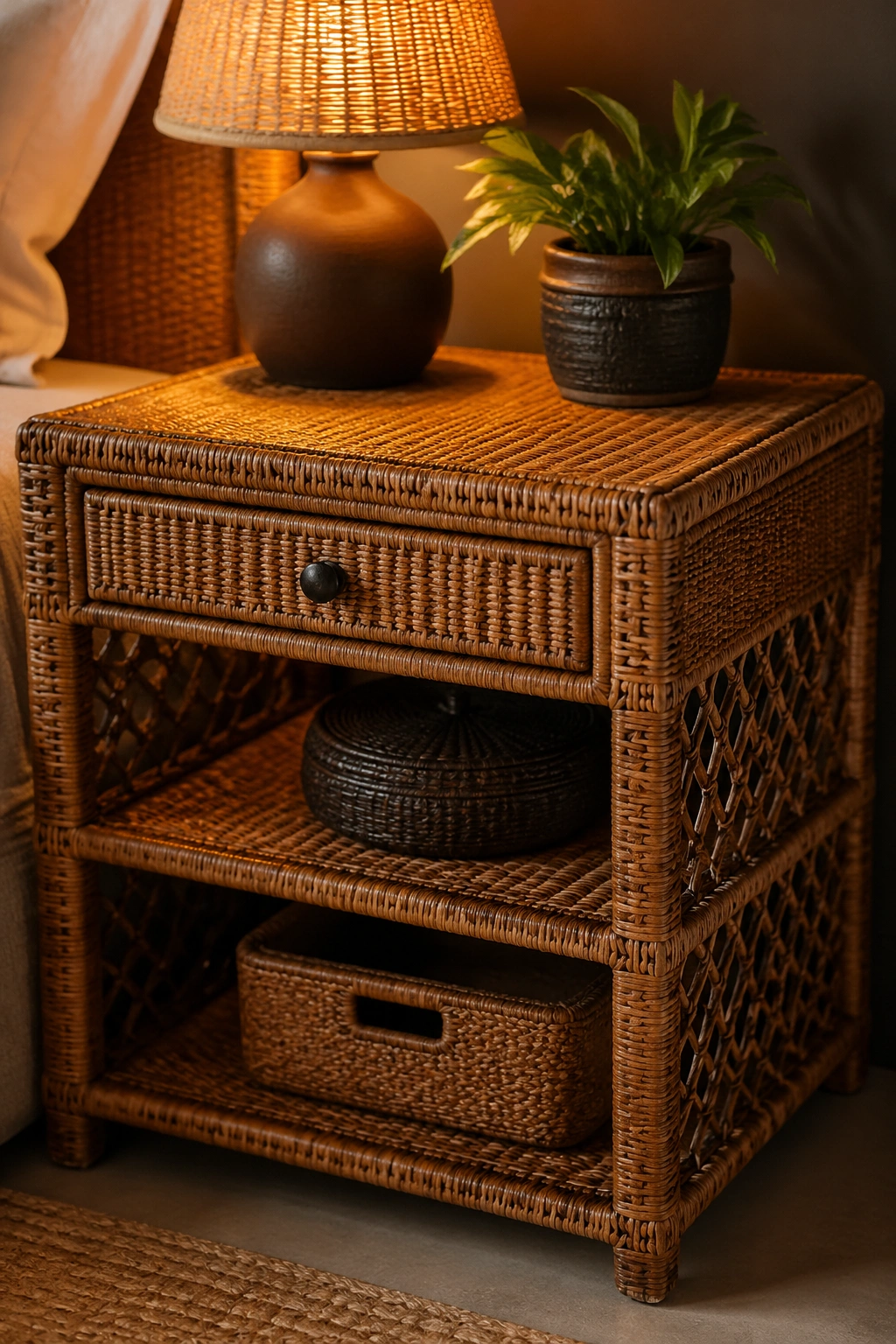
A woven rattan or water hyacinth nightstand beside the bed replaces conventional wood furniture with an open, textured surface that has a completely different visual quality. The open weave reads as light and organic where solid wood reads as substantial. This lightness is useful in smaller bedrooms where a solid wood nightstand beside a large bed can feel like too much visual weight.
Rattan furniture is widely available at moderate prices — particularly at discount home goods stores where it cycles through regularly. A pair of matching rattan nightstands costs significantly less than solid wood alternatives and makes the bedroom feel collected and warm rather than conventionally furnished.
The Styling Opportunity
On an open-weave rattan nightstand, what’s placed on it is fully visible from all angles — including any lower tray or shelf. This means the styling needs to be intentional at every level. On the top: a lamp, a small plant, a book. On the lower shelf: a basket for your phone charger and bedtime items. Nothing scattered.
12. A Full-Length Mirror in a Dark Carved Frame
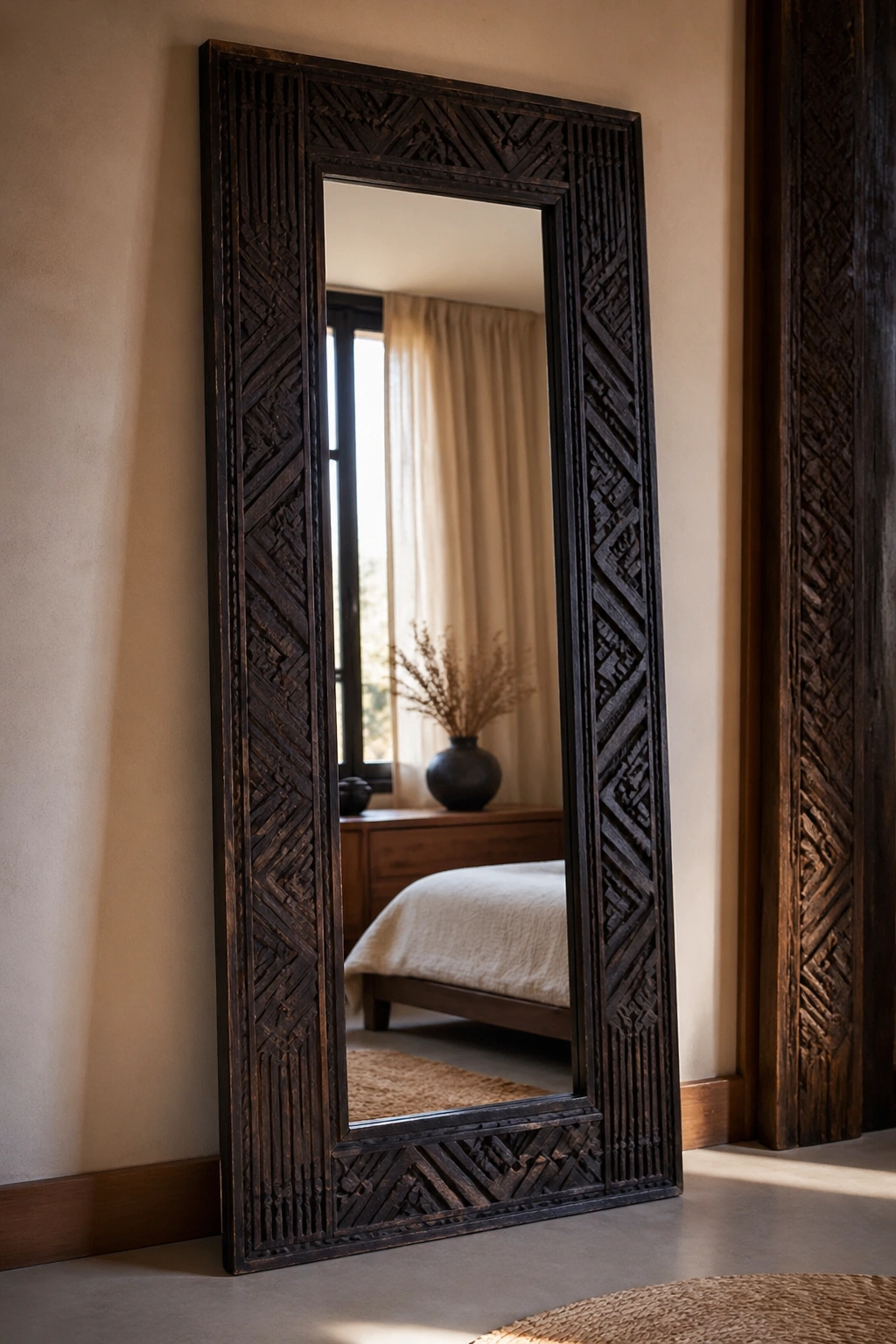
A full-length mirror is functionally essential in a bedroom. In an afro chic space, it’s also a design element. A dark carved wood frame — especially one with geometric or organic carved detail — turns a utility object into a sculptural piece. Leaned against the wall or hung vertically, it adds depth to the room (reflections create the illusion of more space) while the frame itself carries visual weight.
Afrocentric carved wooden frames are produced by woodworkers across the continent and the diaspora. An authentic piece from an African craft market or fair-trade import retailer carries more meaning and distinctiveness than a similar frame from a mass retailer.
Positioning: in a small bedroom, place the mirror opposite a window so it reflects natural light deeper into the room. In a larger bedroom, place it where it reflects the most visually interesting part of the room — the bed wall, the gallery installation, the window with plants.
13. Raffia or Natural Fiber Woven Lampshade
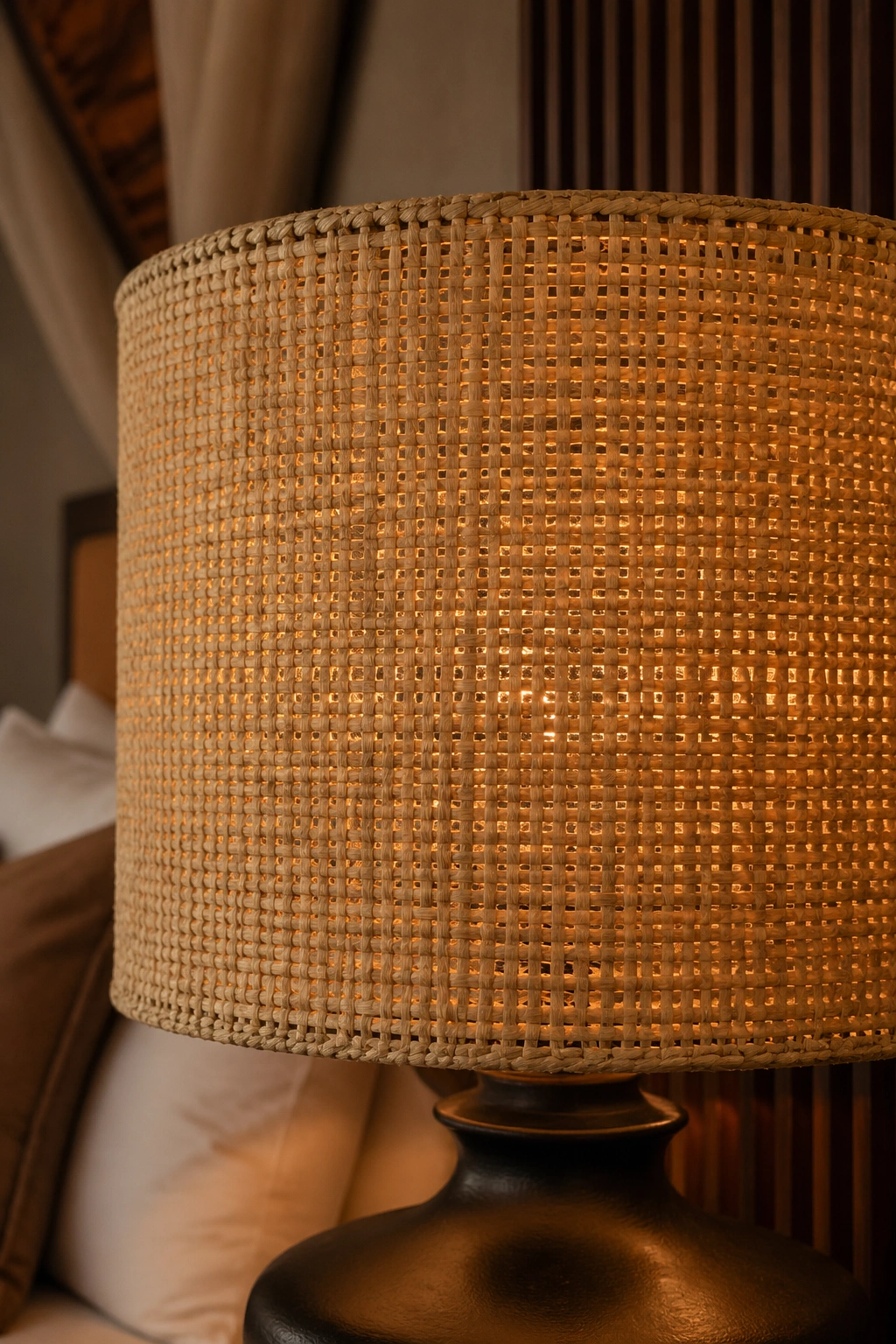
A drum-shaped lampshade woven from raffia, natural jute, or seagrass — rather than fabric or metal — gives table or floor lamps a completely different visual character. The open weave casts a patterned light on the surrounding walls in a way that fabric shades don’t, projecting a texture onto the wall that changes with the weave density.
For floor lamps especially, a large natural fiber drum shade is a distinctive choice. The scale and the natural material make a floor lamp read as a designed element rather than a necessary utility.
These shades are available in various sizes from specialty lamp shops and online. They’re compatible with any standard harp-mounted shade fitting. The only practical consideration: woven natural fiber is not washable. Dust with a soft brush rather than wiping.
14. Hand-Quilted Throw in Geometric Pattern
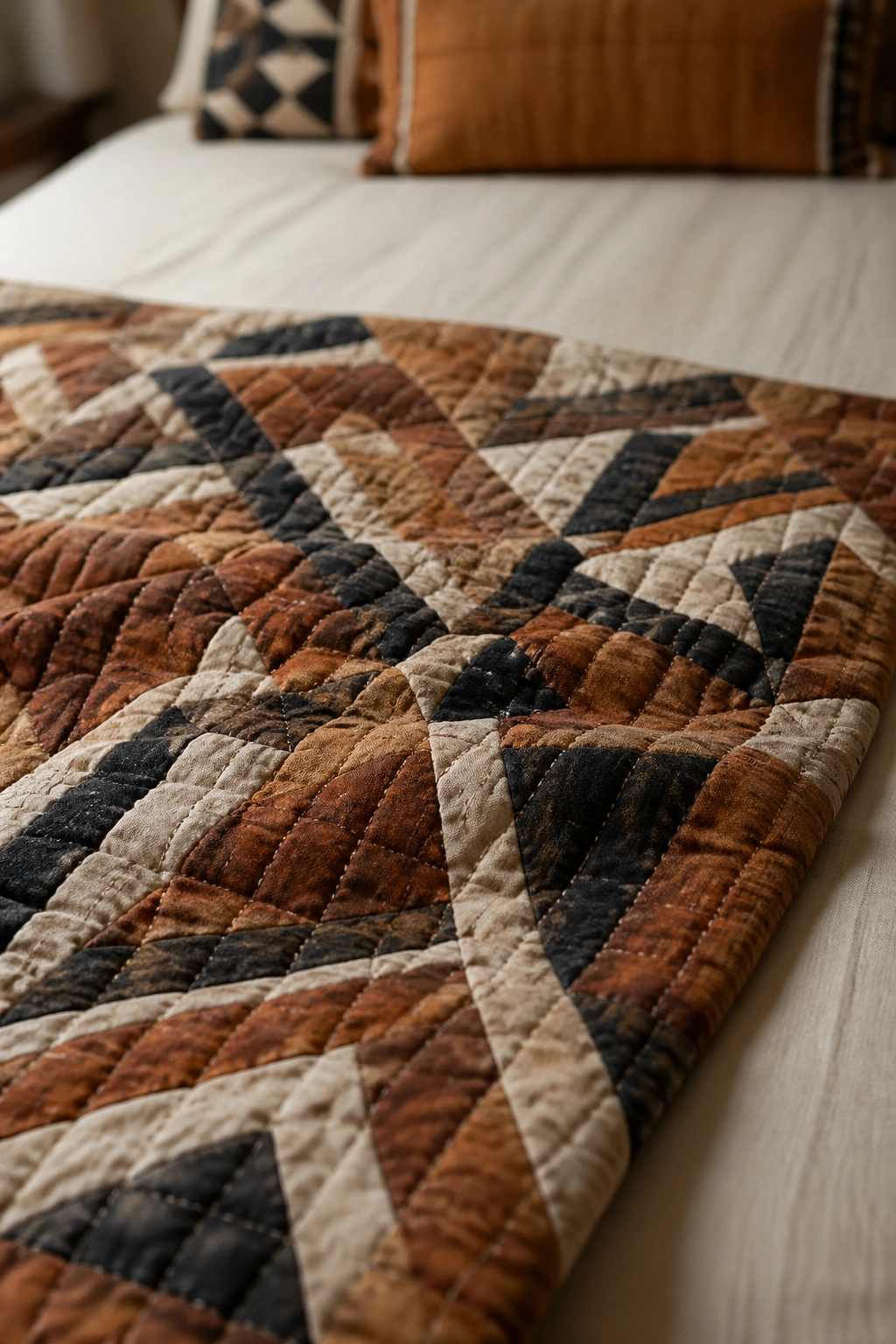
A hand-quilted throw — not mass-produced, but genuinely quilted by hand or in small batch — in a geometric pattern with earth-tone colors brings the cozy weight of a quilt with the visual interest of pattern. West African strip-quilt techniques — fabric strips sewn together in asymmetric patterns — produce quilts with an aesthetic that’s distinct from both American patchwork and European quilting traditions.
The geometric patterning on a hand-quilted throw does specific design work in a bedroom: it introduces pattern without the slickness of a printed fabric, and it introduces texture — the raised quilted lines catch light and shadow — without the heaviness of a thick blanket.
Fold the throw across the lower third of the bed, over the duvet, pulled slightly to one side rather than centered. This asymmetric placement looks more natural than a perfectly centered blanket.
15. A Statement Wooden Wardrobe in Dark Finish
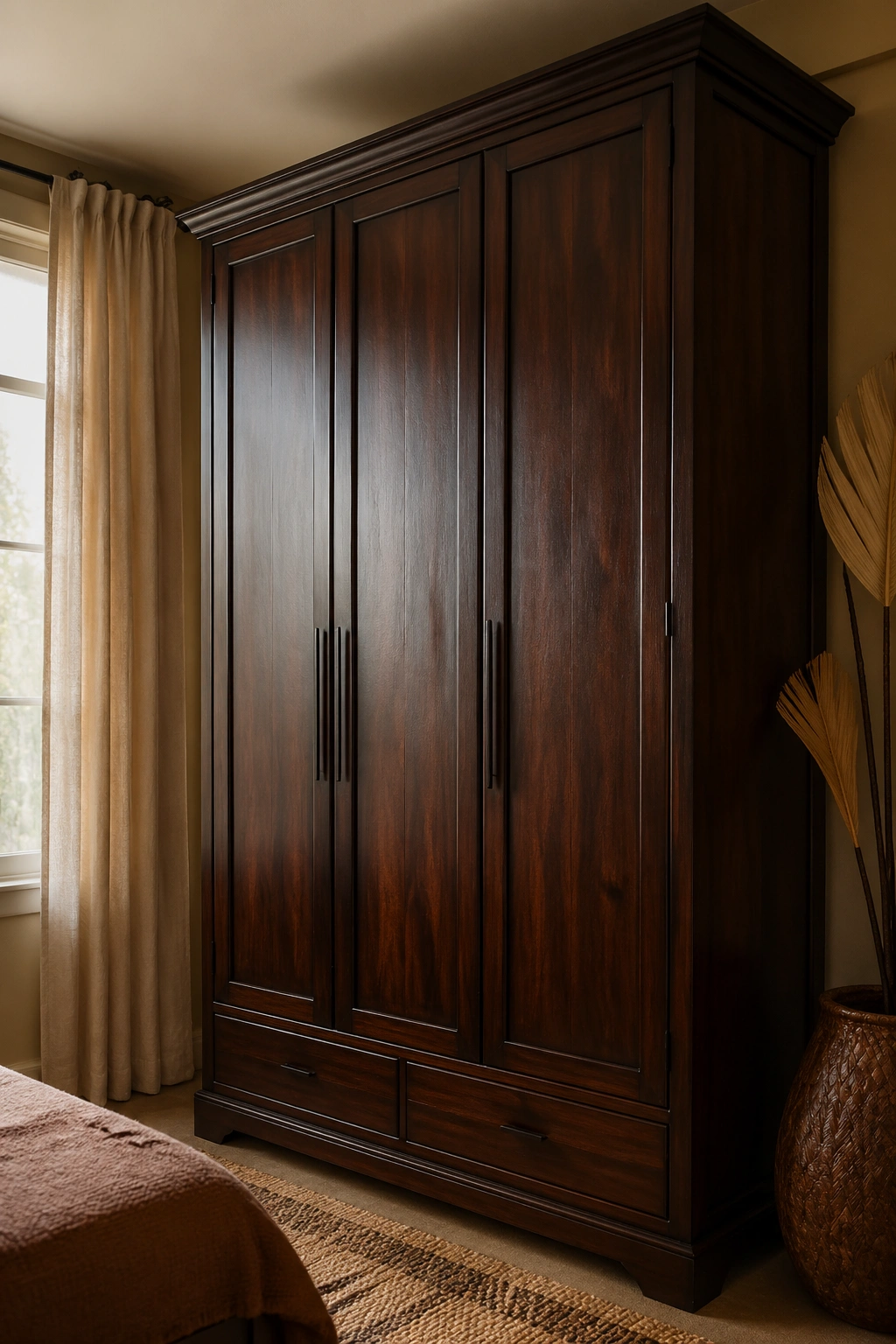
Free-standing wardrobes — not built-in closets, but standalone furniture — have a different relationship to the room than a closet does. They’re furniture that the room has to accommodate and design around, which gives them a defining presence. A large wardrobe in a very dark wood — deep mahogany, ebony-toned, or matte black — is bold in a bedroom otherwise full of warm mid-tones.
The darkness of the wardrobe reads as anchor and drama simultaneously. It absorbs light rather than reflecting it, which gives the piece visual weight. And its vertical height — typically touching or near the ceiling — draws the eye upward and emphasizes the room’s vertical dimension.
The practical note: If the room is small, this piece can genuinely overwhelm. Under about 200 square feet, consider a two-door wardrobe rather than a three- or four-door version, and position it on the wall with the most available floor space in front of it.
16. Afrocentric Gallery Wall Above the Dresser
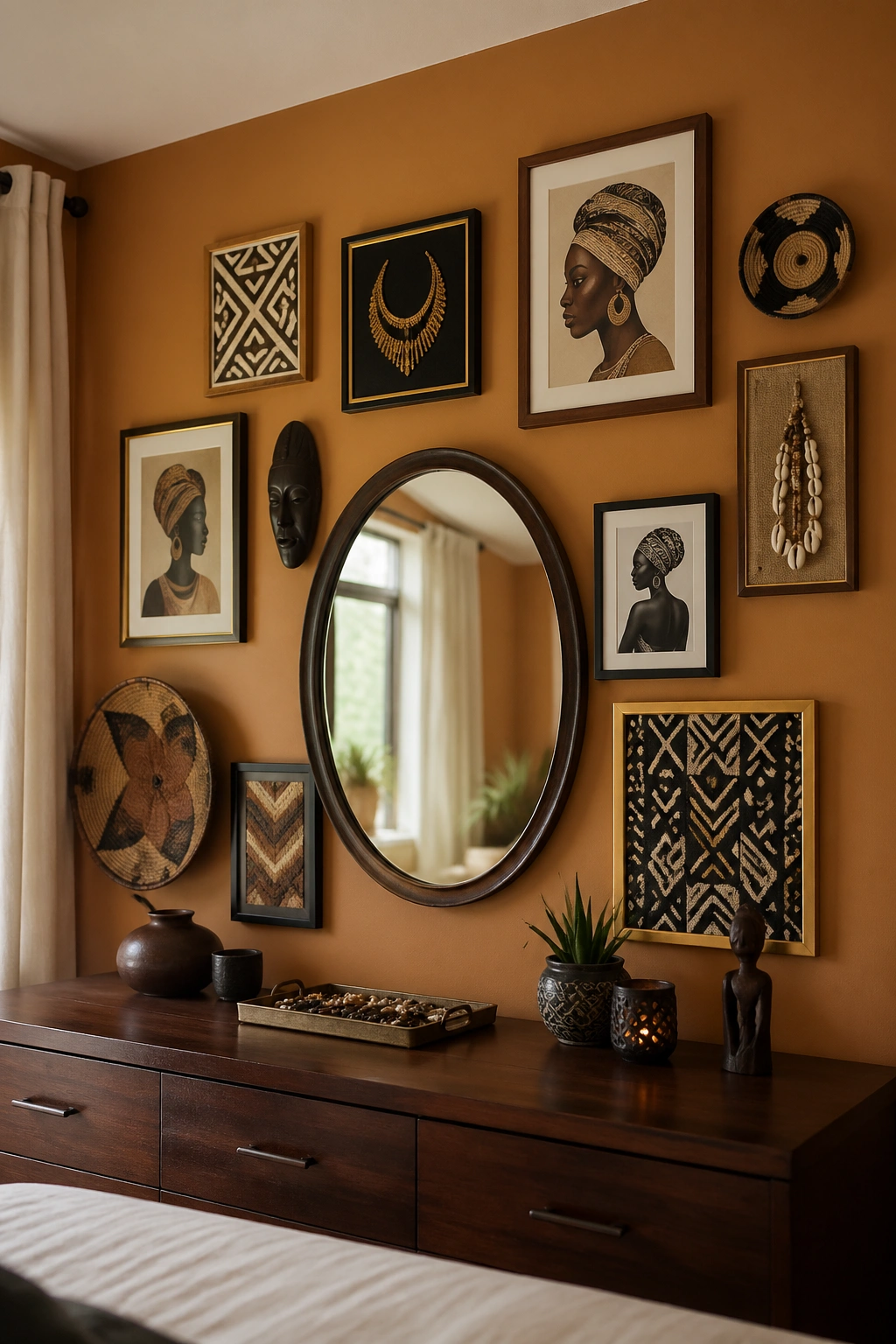
A dresser top with a mirror above it is a conventional arrangement. What makes it afro chic is the gallery installation around the mirror: a curated selection of Afrocentric artwork, photography by Black photographers, African textile prints, and cultural objects hung in a deliberate pattern.
The arrangement should be asymmetric — not a perfect grid. Taller pieces on one side, wider ones on another, small pieces filling gaps organically. The frames can mix: some matching wood, some black metal, some ornate brass, some simple narrow frames.
The rule is that the gallery should feel collected rather than purchased all at once. If everything is from the same source or in the same frame, it will look like a single installation from a store rather than a personal accumulation.
17. Dark-Painted Built-In or Floating Shelves
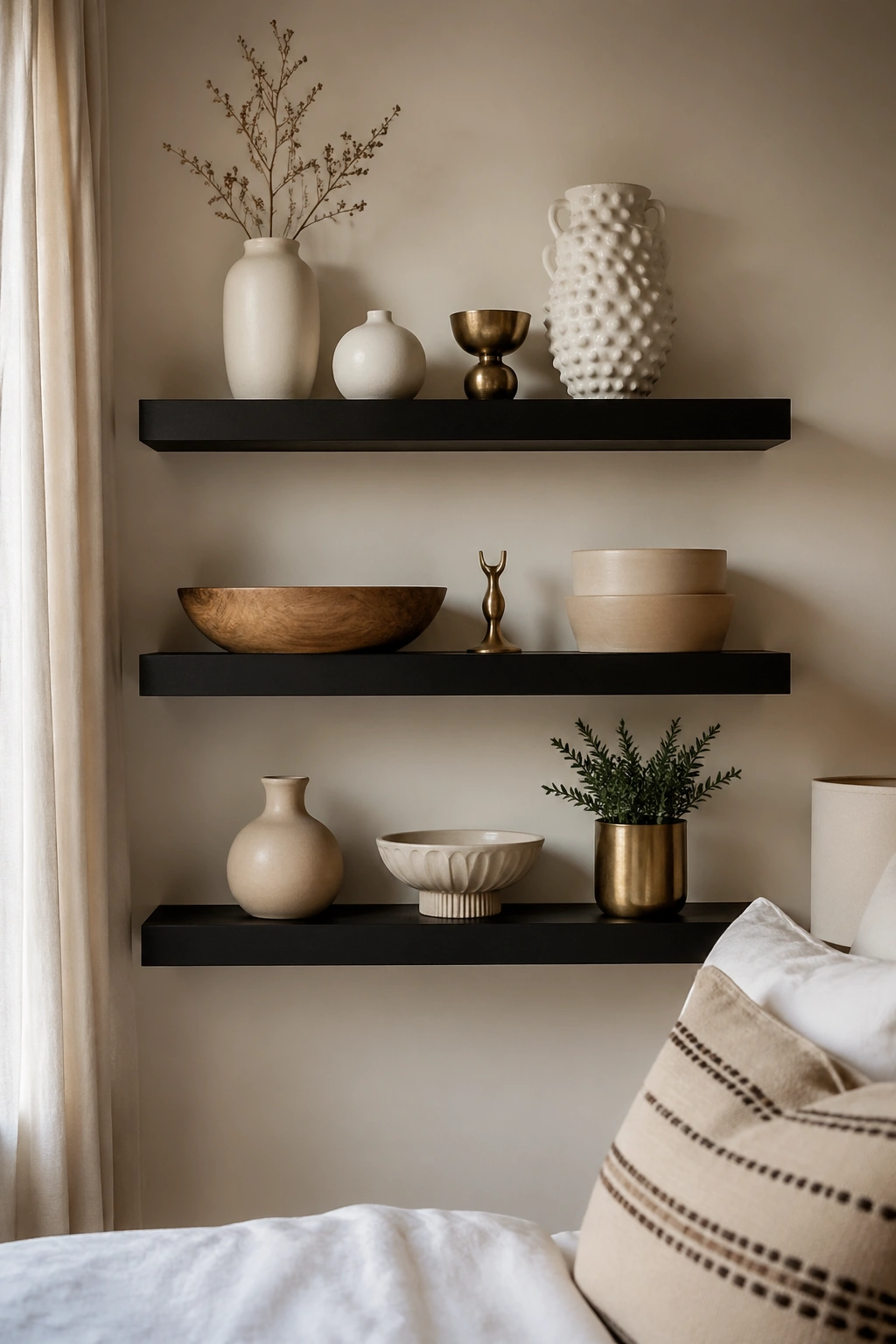
Floating shelves painted in a very dark color — matte black, deep charcoal, navy that reads almost black — against a warm cream or terracotta wall creates a striking contrast that doesn’t require any additional decorative elements to read as designed. The dark shelf surface against the light wall is itself a visual move.
The styling on these dark shelves should use light-colored or warm-metal objects to maintain contrast: cream and terracotta ceramics, natural wood objects, brass-framed small artworks, light-colored plants. Dark objects on dark shelves disappear; warm or light objects pop.
Three shelves at varying heights are more interesting than three at evenly spaced intervals. The gap between shelves — 14 inches in one place, 20 in another — creates a rhythm rather than a grid.
18. Layered Rug Treatment — Natural Fiber Under Printed
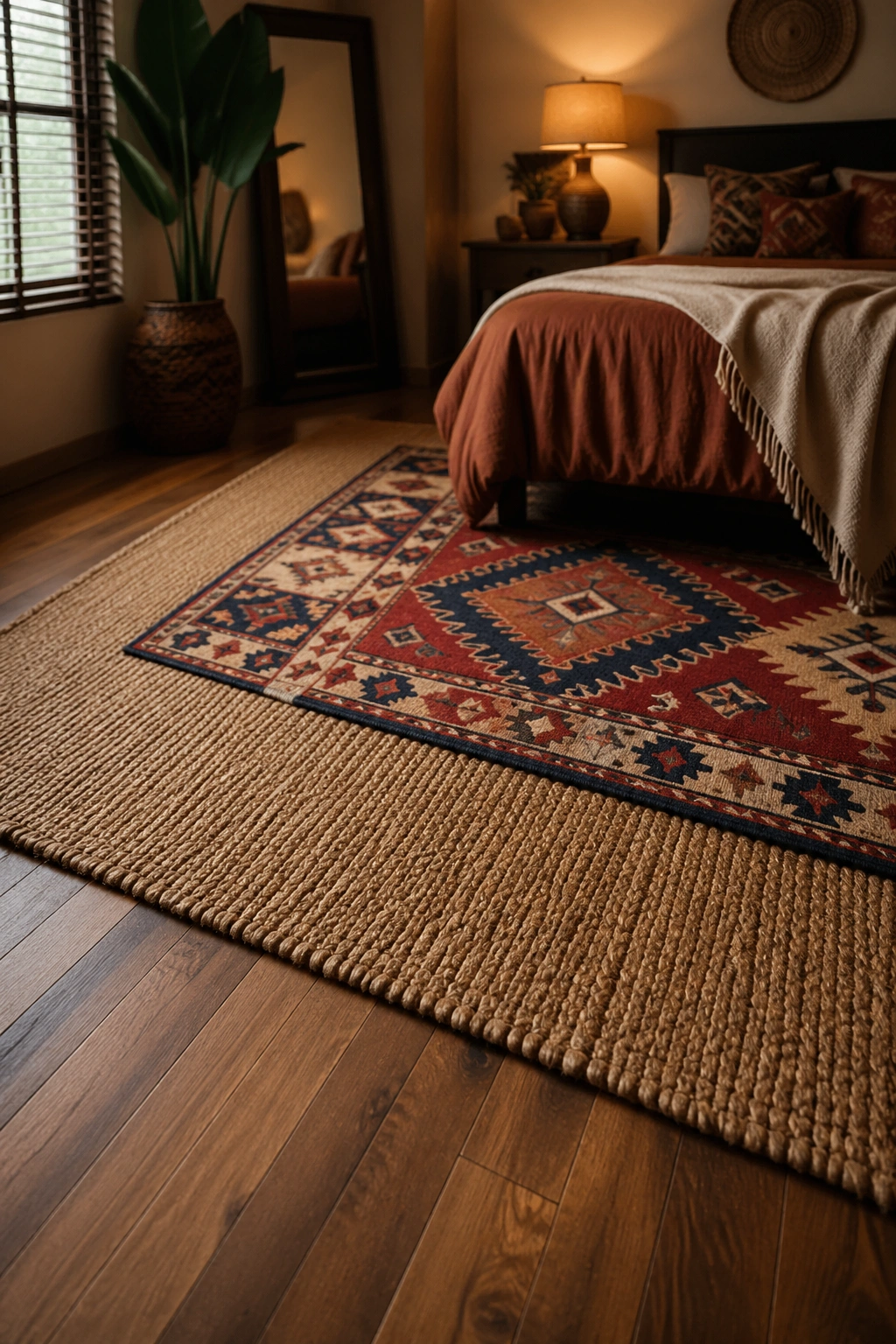
The layered rug technique places a flat, natural-fiber base rug (sisal, jute, seagrass) underneath a smaller, printed or pattern rug on top. The natural fiber provides the room’s ground texture; the printed rug introduces pattern and color within that larger neutral field.
For an afro chic bedroom, the layered rug approach works beautifully because the smaller top rug can carry significant pattern — a bold African wax print rug, a geometric hand-tufted piece — while the natural fiber beneath grounds it and prevents the pattern from taking over the whole floor.
The base rug should extend at least 18 inches on all sides beyond the top rug. The top rug can be centered or placed off-center — off-center often looks more intentional in a deliberately casual space.
19. Printed Wallpaper on a Single Accent Wall
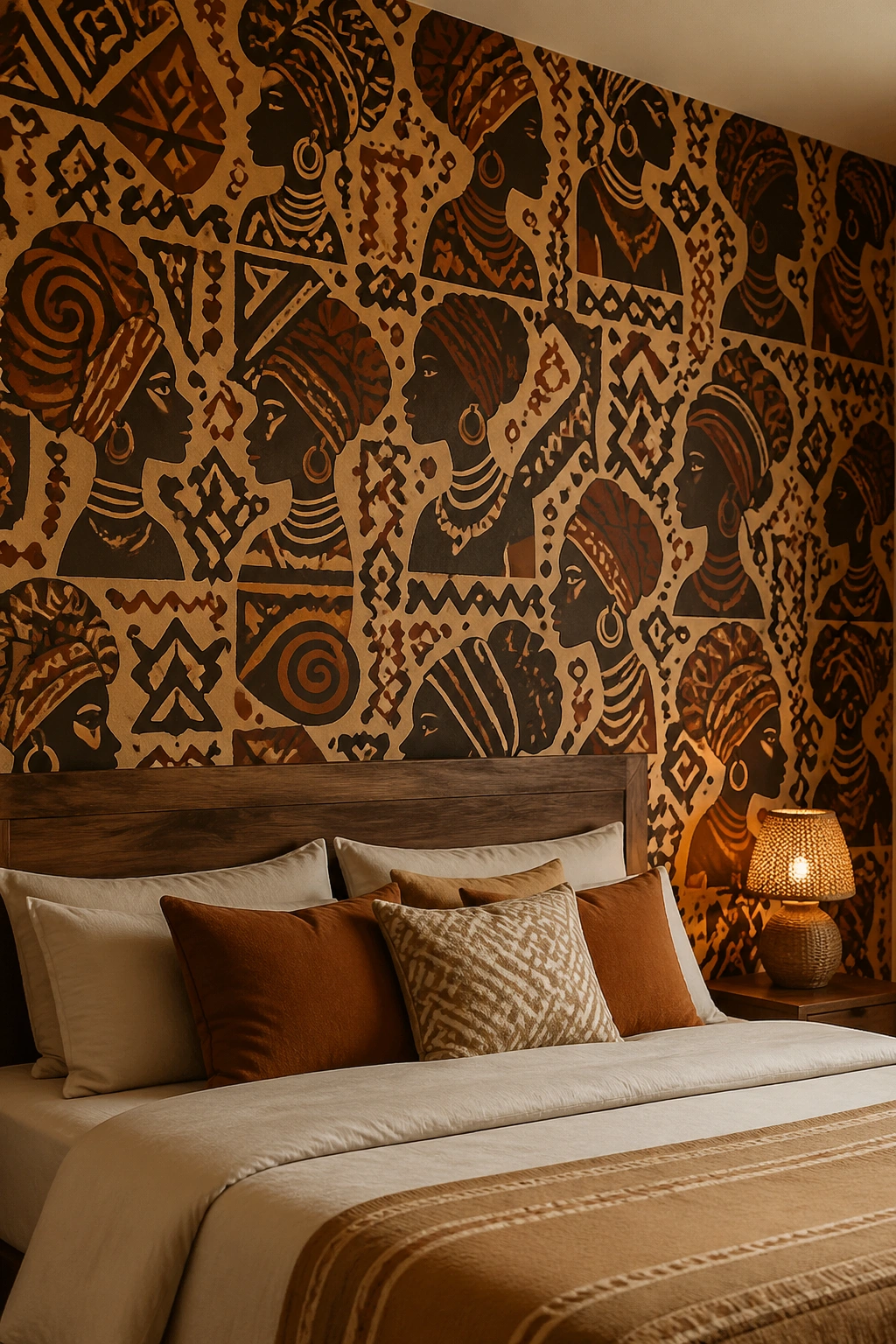
A botanical, geometric, or African-pattern wallpaper on the headboard wall — just one wall, not all four — is a higher-commitment version of the terracotta accent wall. The pattern is more expressive than solid color and carries more cultural information, but it requires more confidence to execute and more care in balancing with the rest of the room’s elements.
Choose patterns that are larger in scale than they feel at arm’s length — small-scale patterns at full-wall scale can read as texture from a distance, which defeats the purpose of the pattern. A large-scale botanical pattern, an oversized geometric, or a bold abstract print in earth tones works well at full wall.
The wallpaper wall should be otherwise bare — no art hung over it, no mirror. The pattern is the art.
20. Ceramic or Clay Lamp on the Nightstand
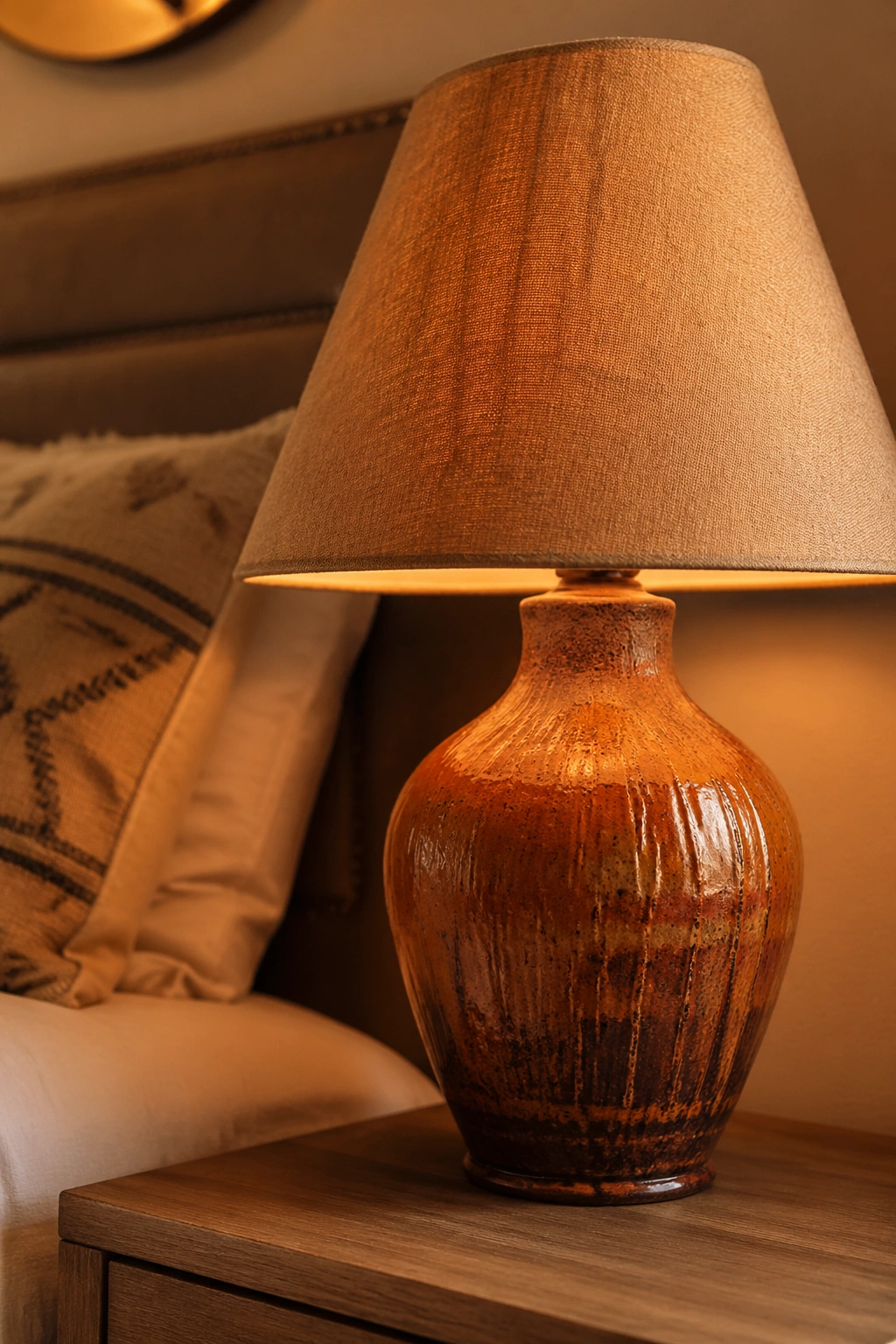
The nightstand lamp is often the last thing considered and the first thing seen at eye level when lying in bed. A ceramic or hand-thrown clay lamp — in terracotta, warm cream, or a speckled neutral glaze — is both more beautiful and more textured than a standard metal or plastic lamp. In a warm-light bedroom, the clay surface takes on a golden quality that’s difficult to achieve with any other material.
The lamp doesn’t need to be large. A bedside lamp at nightstand height of 18 to 22 inches is typically appropriate — tall enough to cast useful reading light, low enough to not overwhelm the nightstand surface.
Pair it with a small, natural linen shade for the warmest possible diffusion of light.
21. Kente-Trimmed Pillow Cases
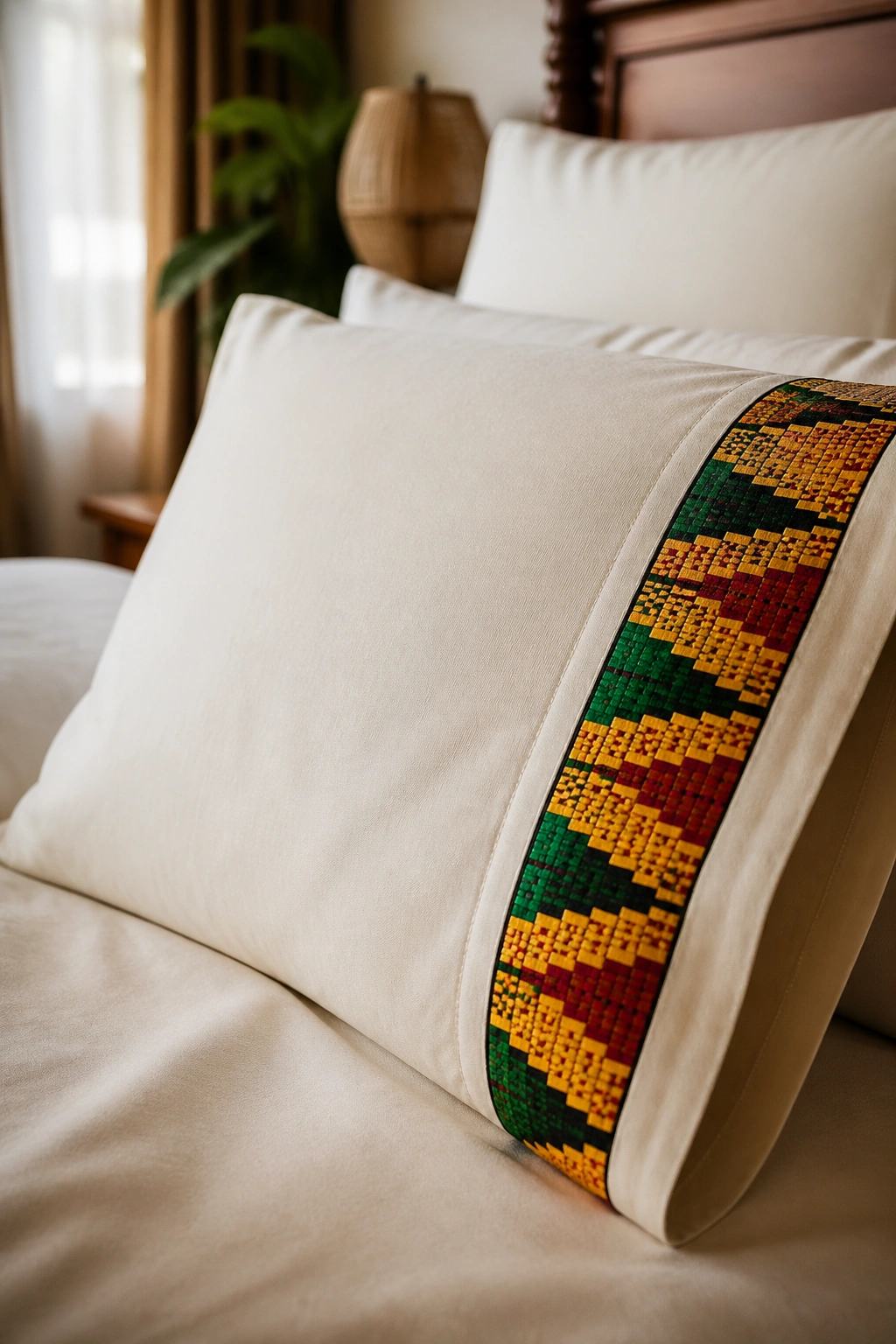
A simple upgrade to standard pillowcases: buy white or cream cases and sew a 2-inch strip of kente fabric along one end as a trim. The result is a pillowcase that’s visually specific and culturally referenced without being a bold statement piece — the kente strip is a detail, not the whole design.
This DIY is achievable with a basic sewing machine and 20 minutes per case. One yard of kente strip fabric is enough for four pillowcases. The color in kente — gold, green, red — reads as warm and celebratory against cream, and the strip’s geometric pattern adds visual interest at the edge of the pillow where it frames the sleeping surface.
22. Nature-Inspired Scent and Sensory Detail
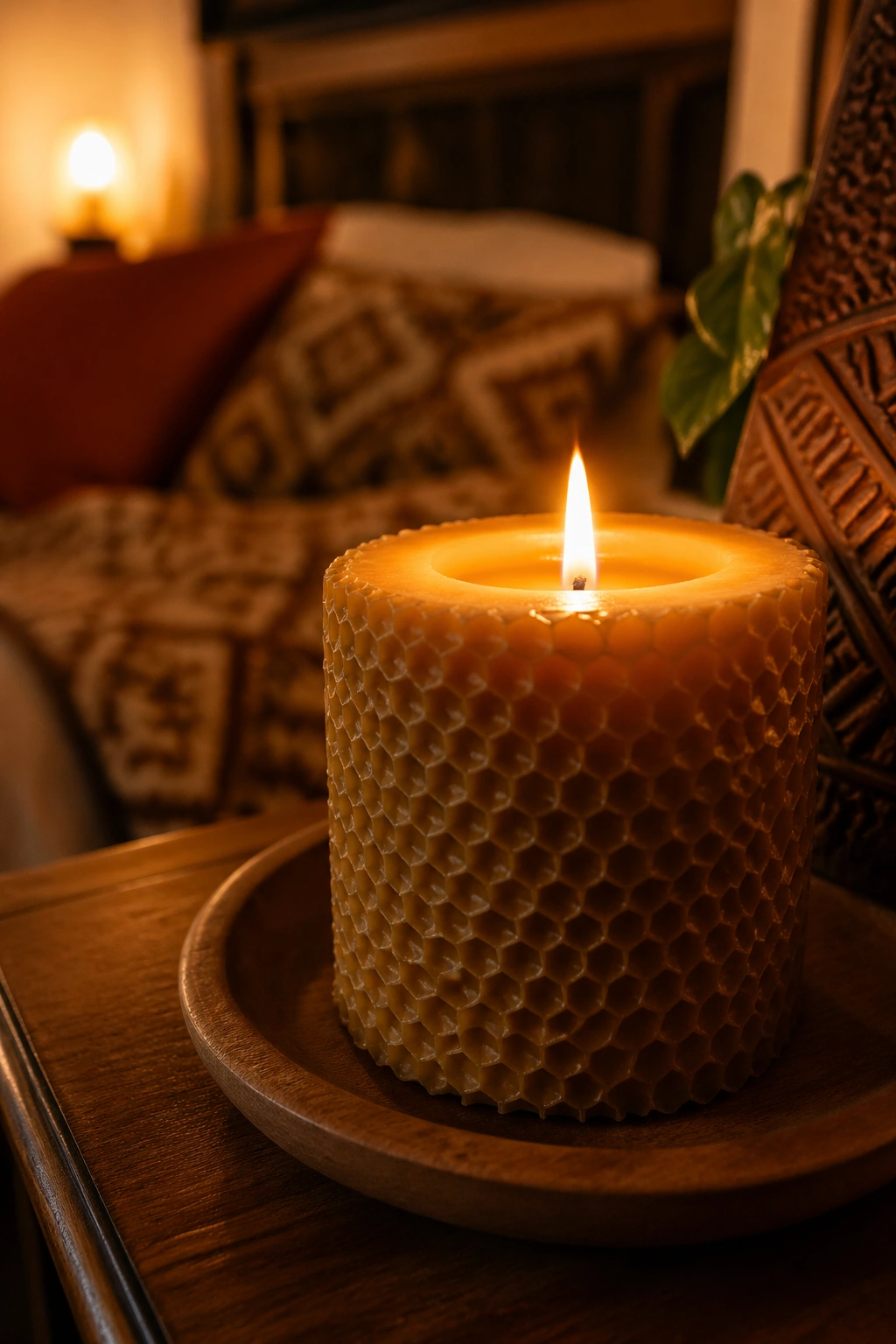
A bedroom that feels genuinely cozy engages more than sight. The scent of the room, the temperature, the quality of what you touch — all of these contribute to the feeling of the space beyond what any decorating choice can achieve.
In the tradition of African aromatics — frankincense, myrrh, shea, sandalwood, cedarwood — a diffuser or candle in a warm, grounding scent contributes to the immersive quality of an afro chic bedroom in a way that no visual element can replace. The scent becomes associated with the room, with rest, with comfort. It’s subtle design that works entirely below the surface.
This isn’t about expensive essential oils. A simple beeswax candle with natural fragrance, or a ceramic diffuser with sandalwood or cedarwood oil, costs very little and contributes something irreplaceable. Real sensory comfort is the foundation everything else is built on.
Putting It All Together Without Overdoing It
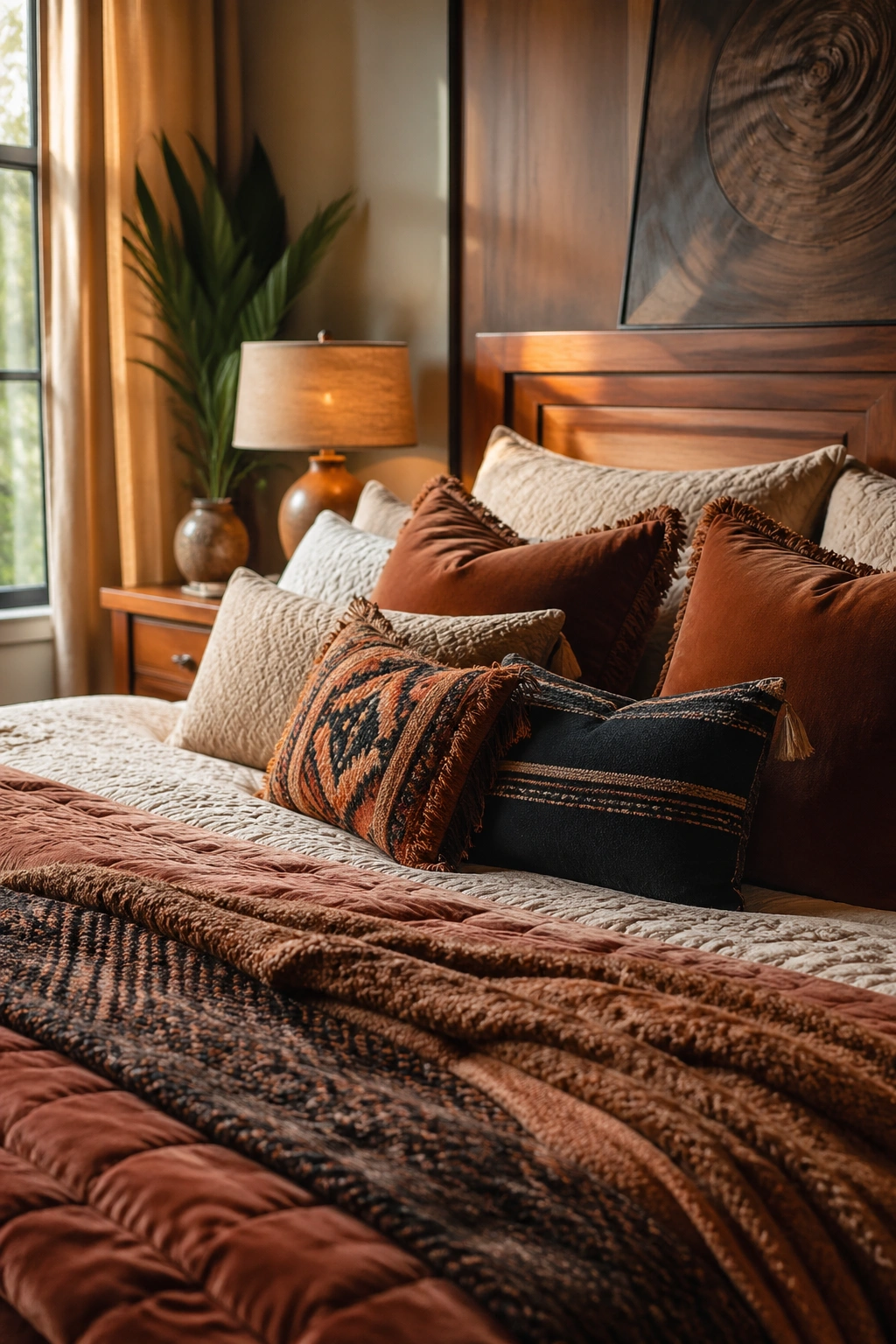
Afro chic style in a cozy bedroom is most effective when it’s built from genuine decisions rather than comprehensive coverage. Not every idea from this list belongs in your bedroom simultaneously. Pick the ones that respond to your actual space — its size, its natural light, its existing elements — and that connect to your own taste within the afro chic vocabulary.
Five strong choices, executed well, are worth more than twenty mediocre ones competing for attention. The richness of afro chic isn’t in quantity — it’s in the quality of each material, each cultural reference, each textural choice. Trust the materials, trust the palette, and give each element enough space to be seen.
