


Short 4C hair gets talked about like it’s a consolation prize — something you wear while you’re “growing out” toward what’s supposedly the real destination. I’m here to push back on that. Very short 4C afro styles are a destination in their own right, and once you commit to them, you realize the TWA life has more range than anyone gives it credit for.
I cut down to a TWA three times in my hair journey, and the last time was the one that stuck. Not because I couldn’t grow it out — I could, and have — but because I fell in love with how short 4C styling actually works. The speed. The shape play. The way a well-executed faded TWA catches light differently than any long afro ever could.
These 20 very short 4C afro styles for women are the ones I either wear myself, have worn, or have watched work on friends with similar textures. Every single one is doable on hair between one and four inches long. Some are five-minute morning looks. Others are thirty-minute sculpted statements. All of them respect the actual nature of 4C hair instead of fighting it.
Let’s be clear about one thing before we start. 4C hair isn’t a curl pattern so much as a density and coil pattern. The Z-shaped strands create shrinkage that can hide 50% or more of your actual length, which means a four-inch TWA sits at maybe an inch and a half when it’s dry and unstretched. That’s the starting point. Work with it, not against it.
Understanding Very Short 4C Hair
Very short here means anywhere from freshly shaved to about three inches of unstretched length. The styling approach changes depending on where you are in that spectrum, and it matters more than most people realize.
Under one inch: styling is mostly about shape, contour, and edges. You’re not really “doing” anything to the strands themselves. The cut does the work.
One to two inches: you can start twisting, coiling, and sculpting. This is the sweet spot where the hair is long enough to manipulate but short enough to still feel truly low-maintenance.
Two to three inches: you’ve got options. Twist-outs start working, defined curl sets become possible, and you can even do modest updos.
Shrinkage affects all three zones, and the single most important thing to internalize is that your hair length on wash day is not your styling length. You’ll see the hair stretch up to twice its dry shrunken length when it’s wet, and then it bounces back as it dries. Plan your styles around the shrunken state, not the stretched state.
Moisture is the entire ball game for 4C. Your cuticle is tightly packed, which means water has to work harder to get in, and once it’s in, your product game has to keep it there. A standard spray bottle with water and a spritz of glycerin is the single best tool I own. It’s how I refresh, pre-style, and de-frizz.
Products That Actually Work on Short 4C
You don’t need twelve products. You need four, maybe five.
A sulfate-free cleanser for weekly washing. A rich leave-in conditioner — I like the ones with shea butter or mango butter as the second ingredient. A defining curl cream or custard for styling. A butter or heavy sealant for locking in moisture at the ends. And an edge control if you’re going to be smoothing edges regularly.
Skip the product lists with fifteen items. Most of those are repeats of each other in different packaging. The basic four will cover 90% of what you need for everything in this article.
One honest warning about butters: they can build up fast on low-porosity 4C hair. If your hair starts feeling waxy or products stop absorbing, that’s your signal to clarify with a sulfate shampoo or a baking soda rinse. Don’t push through with more product. Reset.
Tools That Make Short 4C Styling Faster
A soft boar bristle brush, a wide-tooth comb, a rat-tail comb for parting, an edge brush, and a spray bottle. That’s the kit.
You’ll also want hair clips for sectioning during styling, a satin bonnet for overnight, and a microfiber towel or old cotton t-shirt for squeezing out excess water after washing.
Heat tools are almost entirely unnecessary on very short 4C hair. You’re not flat-ironing a two-inch TWA. A diffuser attachment on your blow dryer is occasionally useful for speed drying, but even that’s optional.
The Weekly Routine Short 4C Actually Needs
Short hair doesn’t mean low effort. It means different effort. Your wash day is fast — maybe 30 minutes start to finish — but your daily refresh is non-negotiable.
Wash weekly or every ten days. Deep condition every other wash. Moisturize daily with water and cream. Trim every eight to twelve weeks because split ends on a TWA show up fast and can ruin your shape.
Sleep on satin or tie a satin scarf. Cotton pillowcases pull moisture out of short 4C hair at an alarming rate, and you’ll wake up to shrinkage, tangles, and dryness that takes half an hour to fix before work. Satin solves it.
1. The Classic TWA Wash-and-Go
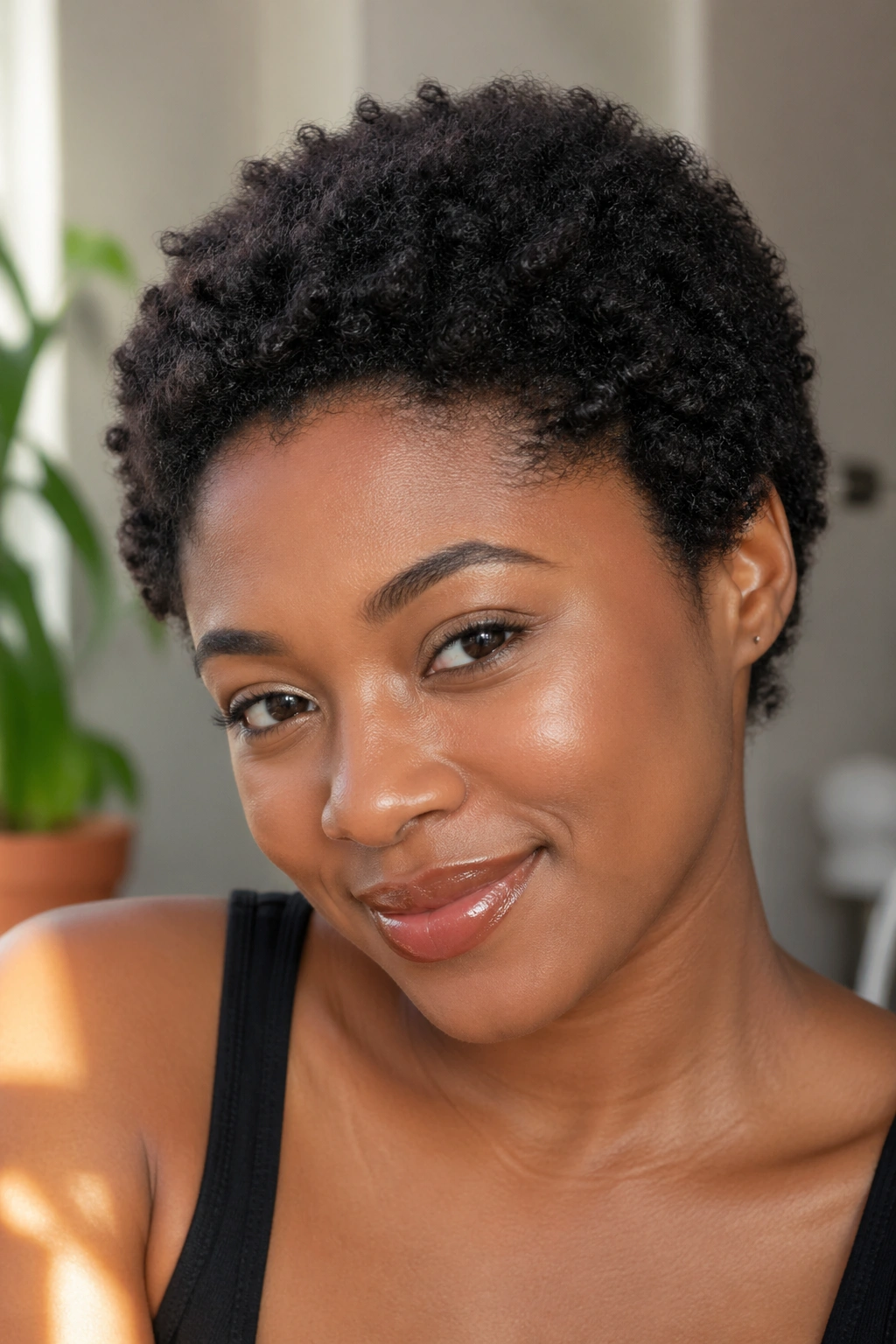
The teeny-weeny-afro wash-and-go is the foundation style of very short 4C hair, and it’s the style I keep coming back to no matter how many other looks I try. You wash, apply product, let air dry, and go. The whole thing takes maybe eight minutes of active work.
What Makes It Work
- Define curls in sections while hair is soaking wet
- Apply leave-in first, then curl cream, then seal with oil
- Do not comb through after applying — use fingers only
- Let dry undisturbed for at least 90% before any touching
The trick: flip your head upside down while applying products. Gravity helps lift the roots and gives you more volume at the crown, which balances out the shrinkage that pulls everything flat.
2. The Faded Edge TWA
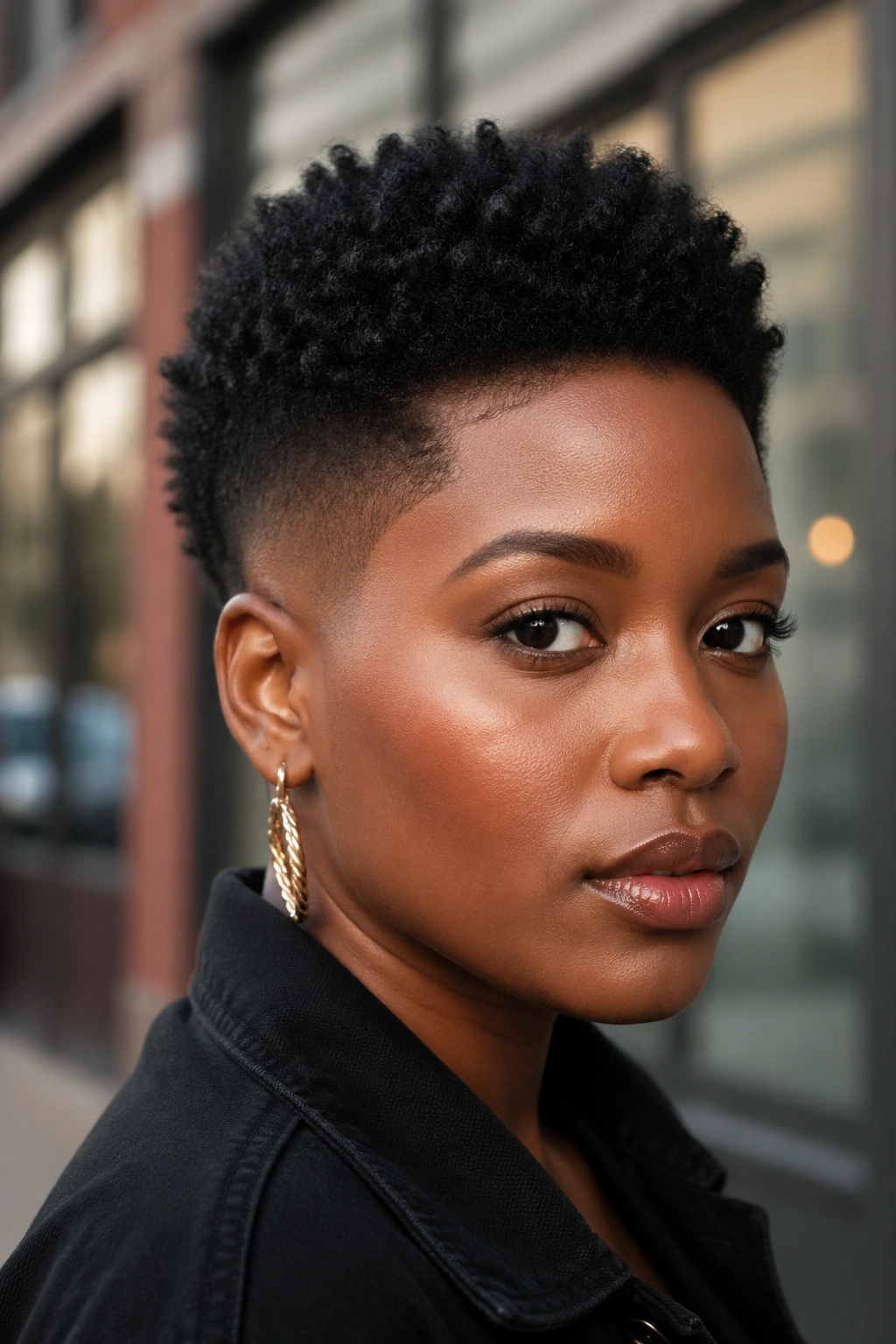
A fade cut on the sides and back with a slightly longer top is one of the cleanest looks very short 4C hair can pull off. What’s different about this style is the contrast — the faded sides give sharpness, the slightly longer top softens with coils and natural texture, and the combination reads as polished and intentional.
Who it’s best for: anyone willing to visit a barber or stylist every two to three weeks to maintain the fade. The cut is what carries the style, and overgrown fades lose their edge within about 14 days.
Pair this with a light coat of curl cream on the top section, leave the faded sides bare, and add a spritz of oil sheen for finish. It’s a five-minute daily routine once the cut is set up correctly.
3. Defined Finger Coils
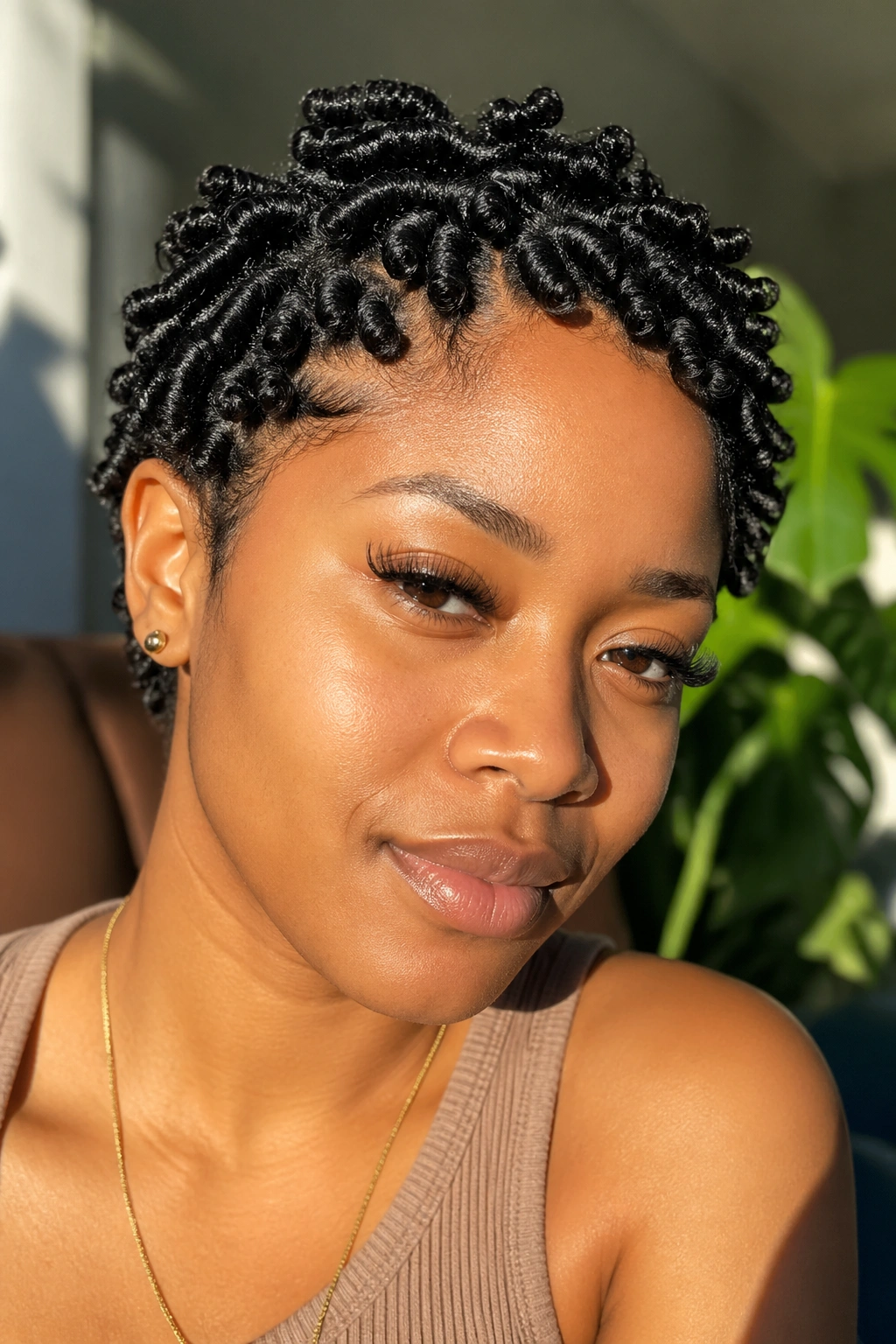
Finger coils on very short 4C hair create the most sharply defined curl pattern your texture can produce without chemicals. Each coil is wound individually around your fingertip while the hair is saturated with product, and the final result is a head full of uniform spirals that catch light from every angle.
Install time is 45 to 75 minutes for a full head. It’s a commitment — but once installed, the coils last about a week before they start to merge and fuzz into a softer look. That week-long lifespan makes the time investment pay off.
Use a thick curl custard or a high-hold gel for the best definition. Water-based products with glycerin help the coils form without crunch.
4. Sculpted Side Part TWA
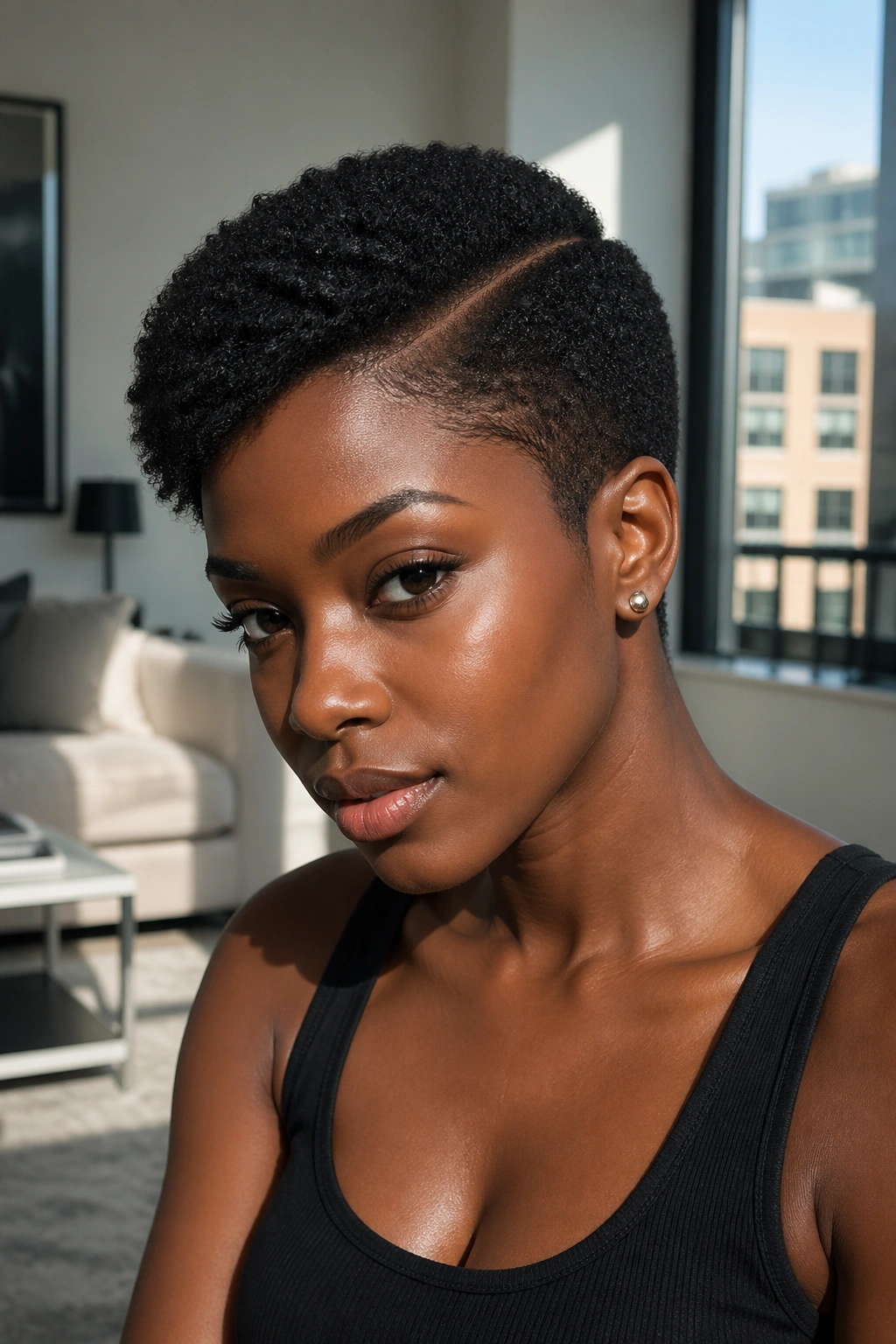
Here’s where your rat-tail comb earns its keep. A deep side part on a very short 4C afro creates instant structure and asymmetry that reshapes your whole face. The part itself becomes a design element, drawing a clean line across the top of your head.
The technique is simple. While your hair is damp, use the pointed end of your rat-tail comb to draw a clean part starting from just above the arch of one eyebrow, extending backward at a slight angle. Smooth the hair on each side with a soft brush, letting the longer side fall slightly over the forehead.
Apply a light styling cream for hold and sheen. Clean the part line with an edge control cotton swab trick — dip a cotton swab in edge control and trace the parting line to keep it crisp throughout the day.
5. Flat Twist Mini Mohawk
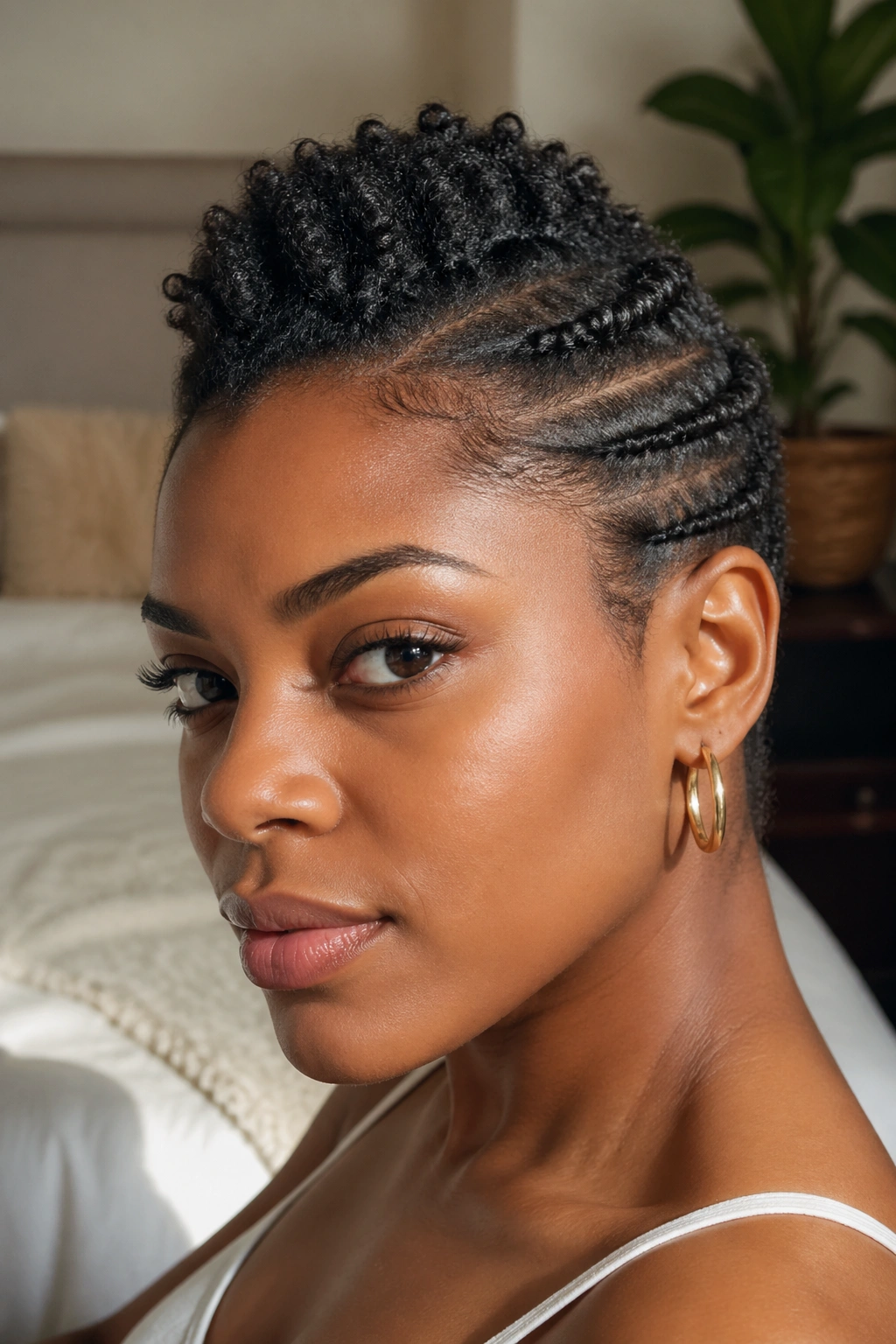
Unlike a traditional mohawk, the flat twist mini version creates the mohawk silhouette entirely through twists rather than a shaved design. You install two or three flat twists running down each side, leaving a strip of looser hair in the middle that forms the central ridge.
What’s different here is that the style is fully reversible. No cutting. No commitment. You can wear it for a week, take it down, and go back to a wash-and-go the next morning without consequence. That reversibility makes it perfect for anyone who wants to try bold looks without permanent changes.
This is for women who want a statement look with structural appeal. The twists take about 30 minutes to install on a very short TWA, and the whole style lasts four to six days with a satin bonnet at night.
6. Curl Sponge Texture
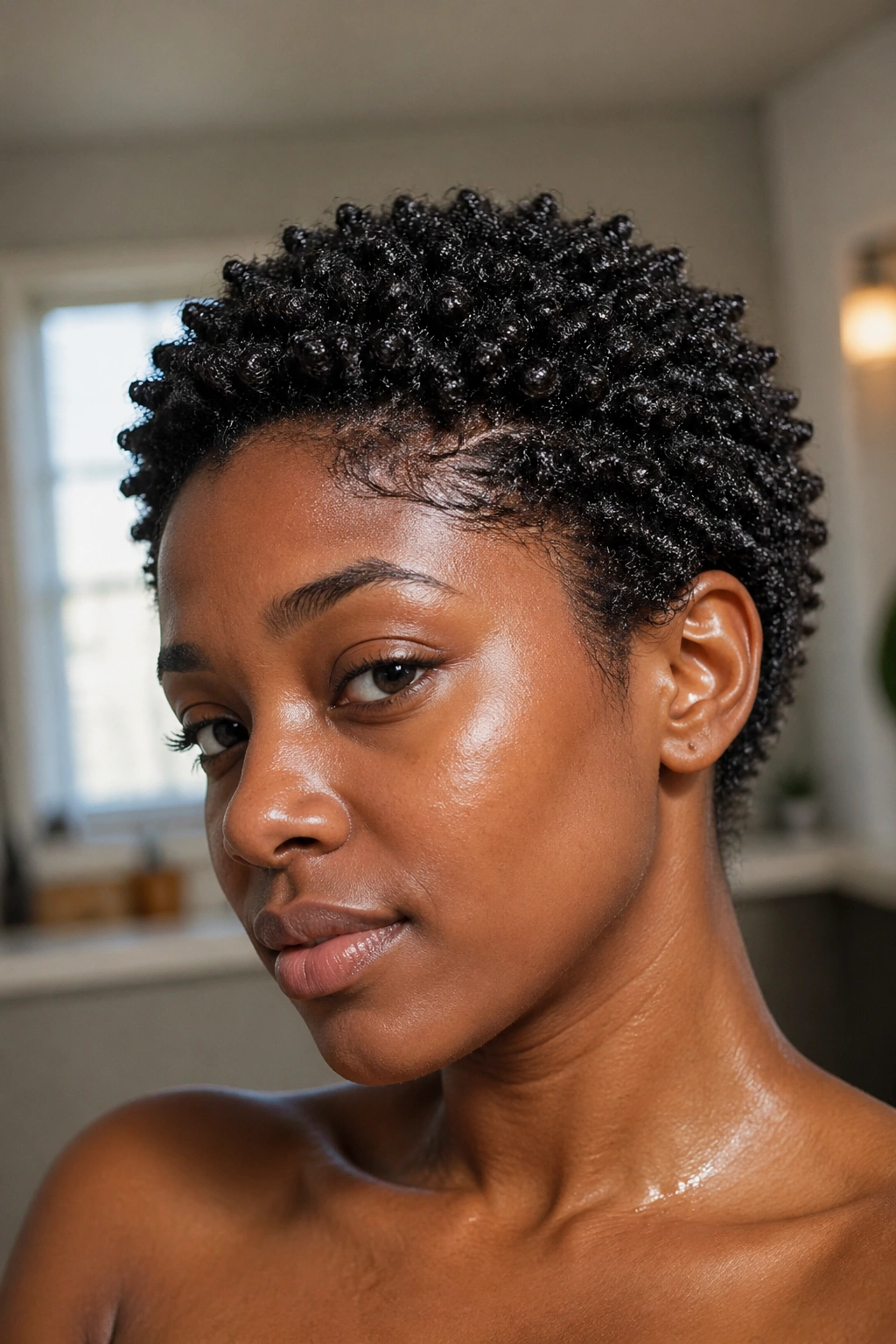
The curl sponge is one of the most underrated tools in the short 4C styling world. It’s a foam sponge with cut-out holes that, when rubbed in circles on damp hair, creates small uniform coils across your whole head in about three minutes.
Yes, three minutes. The whole styling session is that fast once you get the motion down.
How to Use It Right
- Hair should be damp, not soaking wet
- Apply a small amount of curl cream first
- Rub the sponge in small circular motions across your whole head
- Don’t press hard — let the sponge do the work with light pressure
The finished look gives you small, uniform coils that look like mini springs all over your head. It’s a different aesthetic than a wash-and-go, and it works beautifully for workdays when you need speed without sacrificing definition.
7. Simple Twist-Out
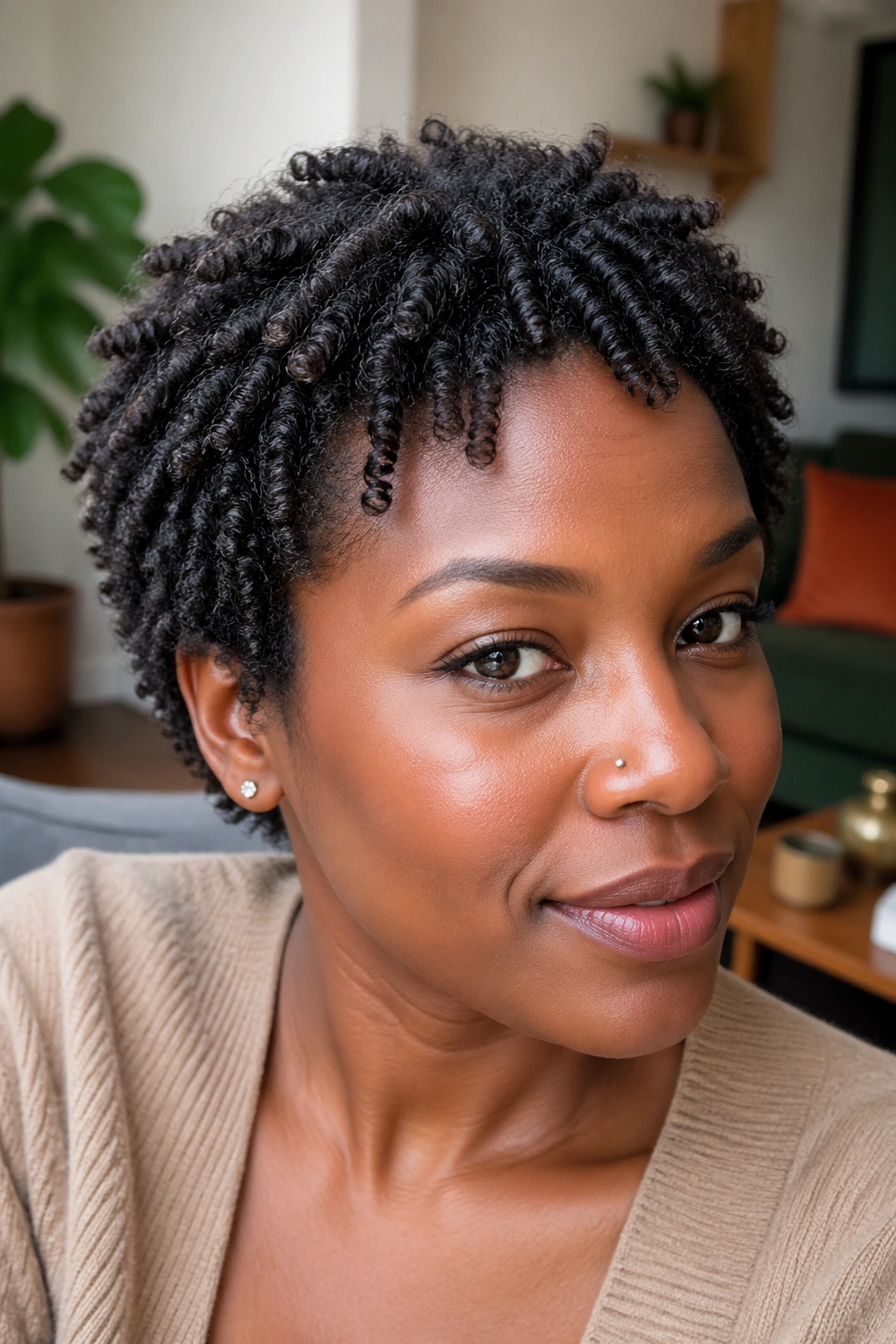
A twist-out on very short 4C hair uses small two-strand twists installed across the entire head. The twists set overnight, and in the morning, you unravel them to reveal defined waves and coils with noticeably more stretch than your shrunken wash-and-go state.
Twelve to sixteen twists is the standard count for a TWA. Smaller twists give you tighter definition but take longer to install and dry. Larger twists give you looser waves and finish in half the time. Pick based on how much time you have.
The takedown matters more than the install. Coat your fingers with a drop of oil, gently unravel each twist from the tip upward, and resist the urge to separate into tiny pieces. Over-separation creates frizz that you cannot fix.
8. Rounded Halo Shape
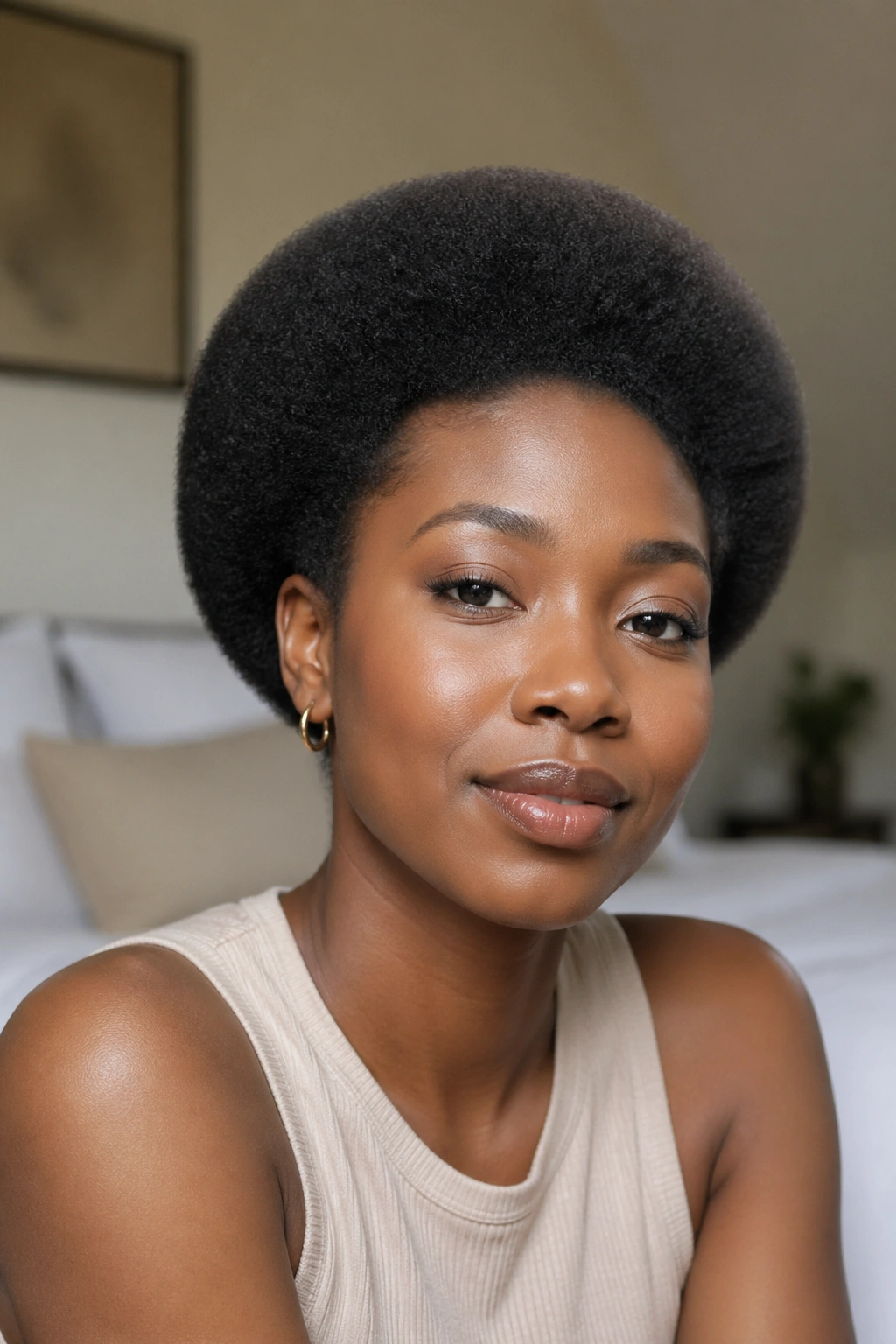
Have you ever wanted your TWA to sit like a perfectly rounded halo instead of following the natural shape of your head? The rounded halo style achieves exactly that. You shape the hair while it’s wet to create a uniform dome, then let it dry without disturbance.
The reason this works is that 4C hair holds whatever shape you set it into as it dries. If you use your fingers to gently rotate and lift sections while the hair is saturated with product, those sections dry in the lifted, rounded position. The result is a head of hair that looks intentionally architectural rather than organically shrunken.
How to Use It
Apply product generously while wet, then use a wide-tooth comb to pat and shape the outline of the halo. Think sculpting, not combing. Let dry fully before touching.
9. Tapered TWA
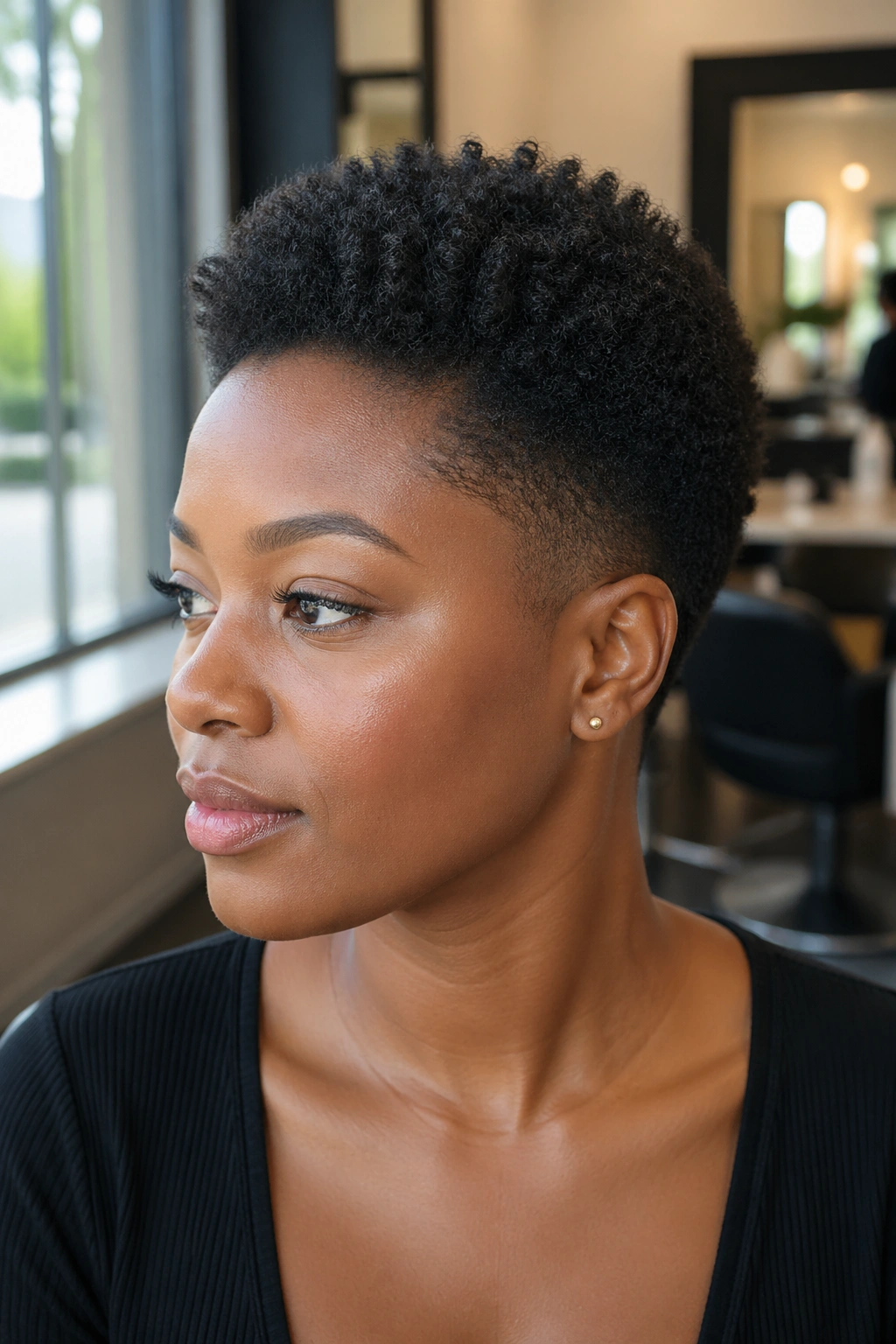
The tapered TWA keeps the top fuller while narrowing the sides and back into a cleaner, shorter length. It’s not a fade — the transition is softer — but the silhouette effect is similar. More volume on top, cleaner lines at the ears and nape.
This cut shape is flattering on almost every face because the top volume adds perceived height while the narrower sides slim the profile. It photographs beautifully and translates from professional environments to nights out without any change in styling.
Maintenance is every three to four weeks at the barber. Between trims, the hair stays clean enough that you can get away with a simple daily moisturize-and-go routine.
10. Bantu Knot Set
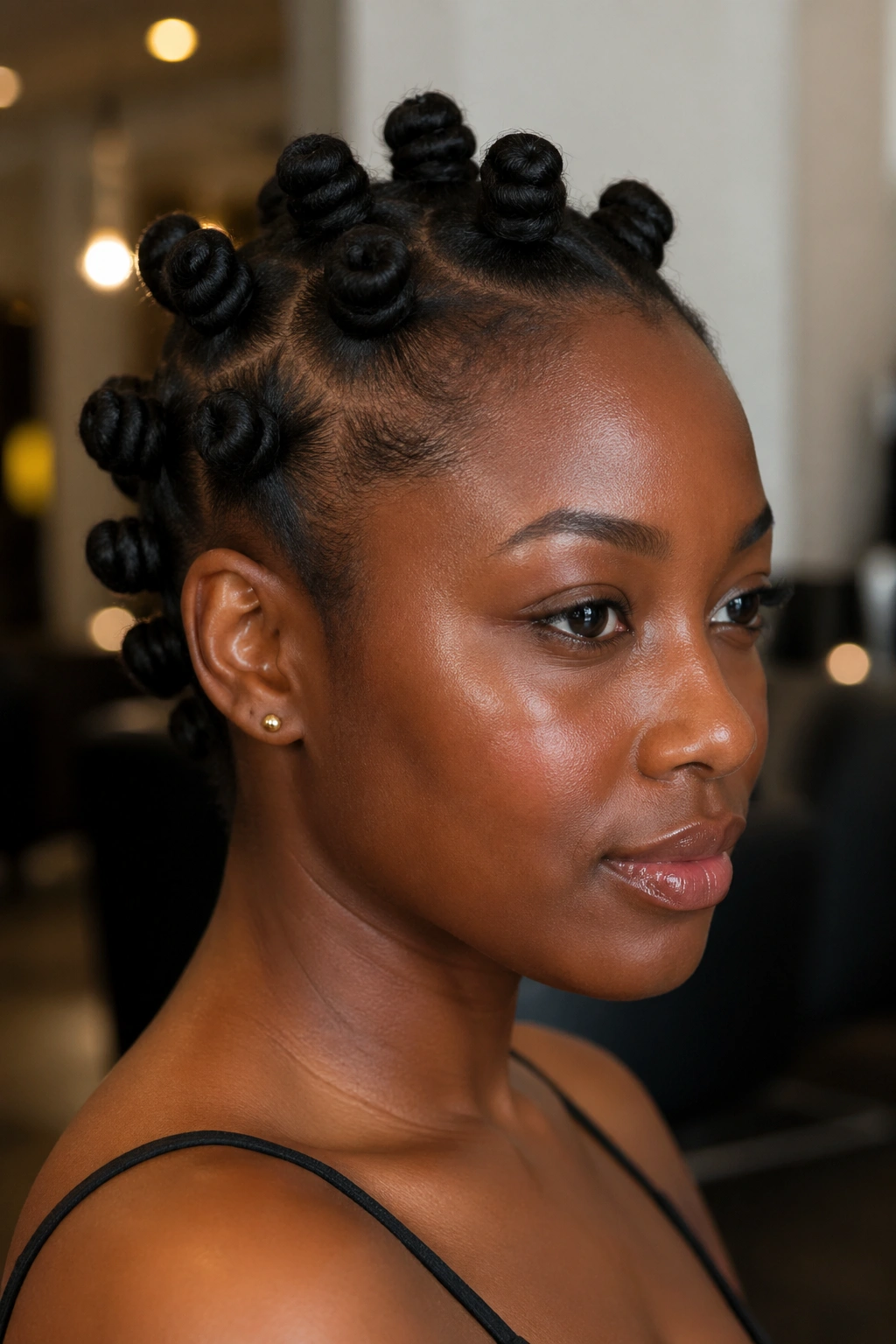
Bantu knots on very short 4C hair walk a line between a wearable style and a curl-setting technique. You can either wear the knots themselves as a finished look or take them down after drying to reveal tight coil definition across the whole head.
Nine to twelve knots total is the right count for a TWA. Bigger sections create looser spirals on takedown. Smaller sections create tighter, more uniform coils but take longer to install and dry.
The takedown look is what most people install bantu knots for. You get tight, defined spirals with more length than your wash-and-go state — the twisting process stretches the hair slightly before drying, which counteracts some of the shrinkage.
11. Curly Pomp
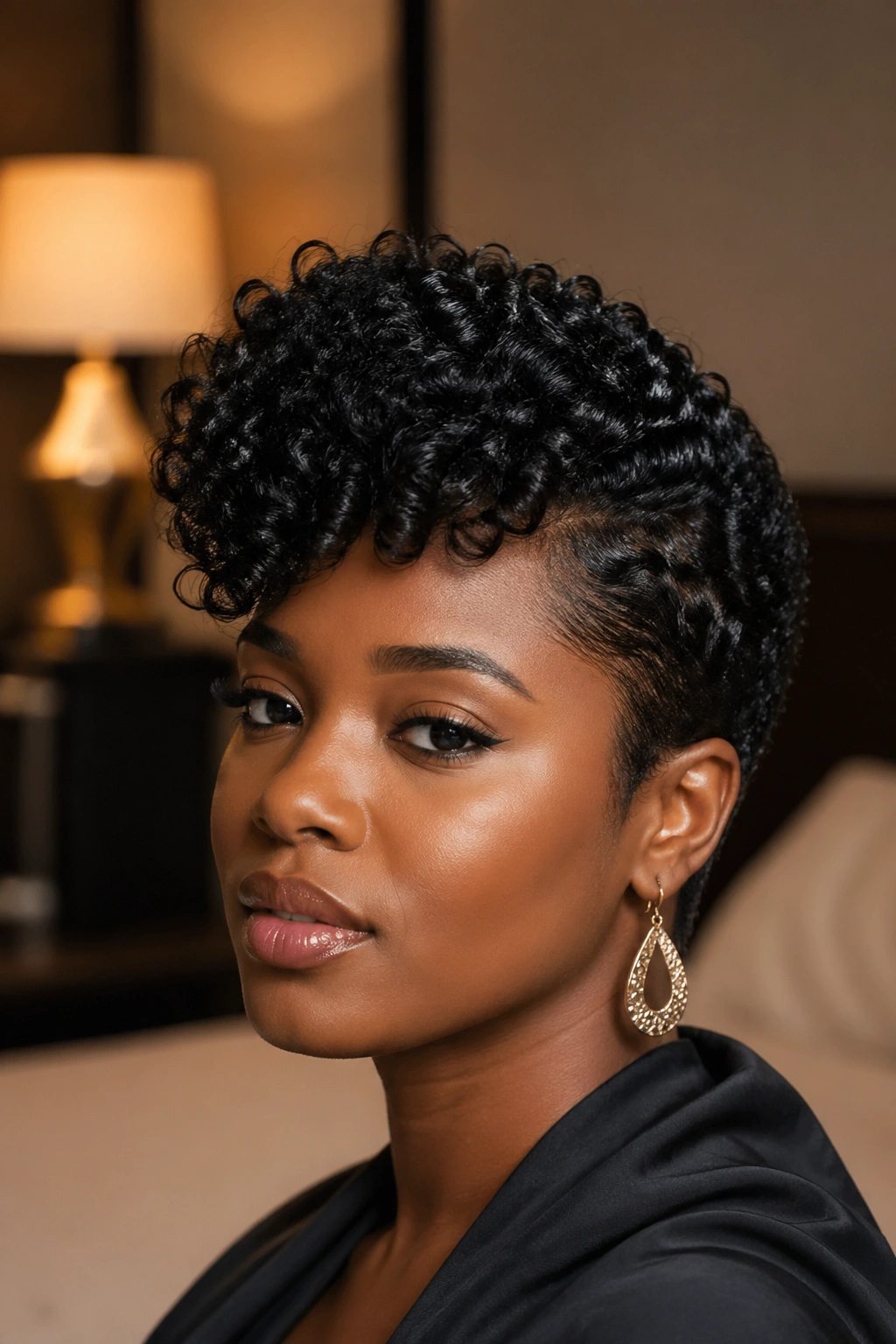
Think of the pomp as the 4C cousin to a traditional male pompadour. You create volume and lift in the front section, while keeping the back and sides relatively flat. The result is a high-volume front that reads dramatic and stylized.
To get the shape, apply a strong-hold product to the front third of your hair while it’s damp. Use your fingers to push the hair upward and slightly backward, creating a rounded peak at the front. Let dry fully, then pick at the base of the lifted section from underneath to add volume without disturbing the shape.
Curly pomps on very short 4C hair don’t last more than a day, unfortunately. It’s a special occasion look, not an everyday style. But for the right evening, the impact is unmatched.
12. Frohawk on a TWA

A frohawk on a TWA is achieved by flattening the sides — either with gel, flat twists, or bobby pins — while leaving the central strip of hair up in its natural afro state. The silhouette mimics a mohawk without cutting or shaving anything.
For very short 4C hair, the flattened sides work best with a combination of water, gel, and a soft brush. Slick the sides back toward the back of your head, then allow the middle strip to stand up naturally. The contrast between the sleek sides and the textured middle is the whole effect.
Why It Works on Very Short Hair
- Maximum drama with minimum length requirements
- No cutting commitment
- Five-to-seven-day wear with minimal maintenance
- Photographs incredibly well in side profile
13. Color-Accented TWA
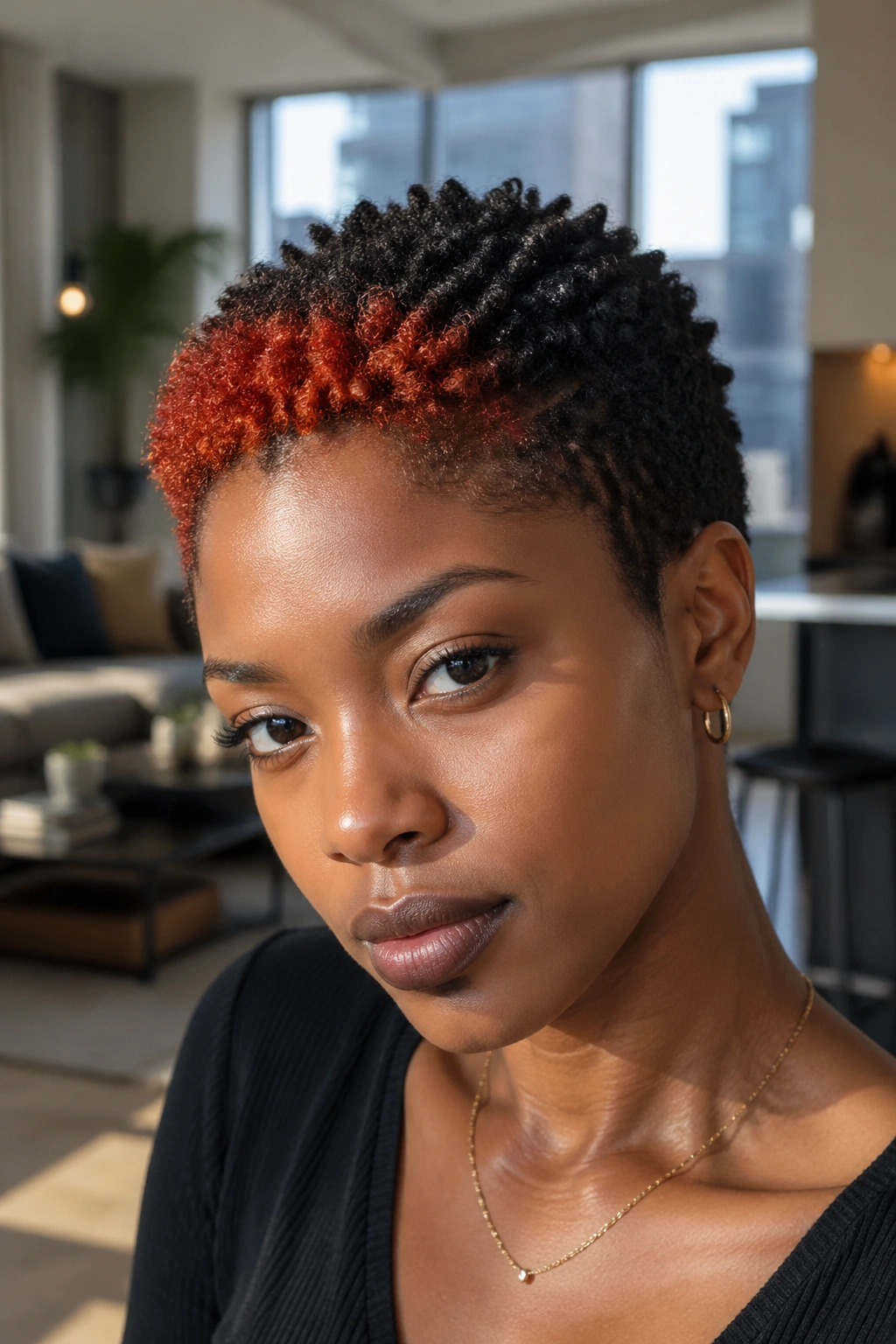
Color is one of the fastest ways to transform a very short 4C afro. A single accent color along the front hairline, a full bleach-and-dye job across the top, or subtle highlights throughout — each option creates completely different visual impact.
The honest caveat is that 4C hair is more prone to breakage during color processing than other hair types. Deep condition before you color, deep condition after, and work with a stylist who specializes in textured hair if you’re going lighter than your natural shade.
Semi-permanent colors are friendlier on 4C strands than permanent dyes. They fade over four to six weeks, which is actually a feature — you can try a bold color without committing to the long-term damage risk.
14. Headband TWA Accent

A thick fabric or metal headband instantly transforms a very short 4C afro into something dressed up. The band itself becomes the focal point, while your natural texture provides the frame around it.
Thick satin-covered headbands work well because they don’t slip on the smoother front of a TWA. Velvet bands are warm and luxurious for cooler months. Thin plastic headbands tend to slip and pinch — skip those.
Place the band about an inch behind your front hairline. Let the front edge of your hair peek out over the top of the band as a soft fringe, which adds dimension and prevents the “flat-topped” look that can happen when the band sits too far forward.
15. Defined Mini Twists
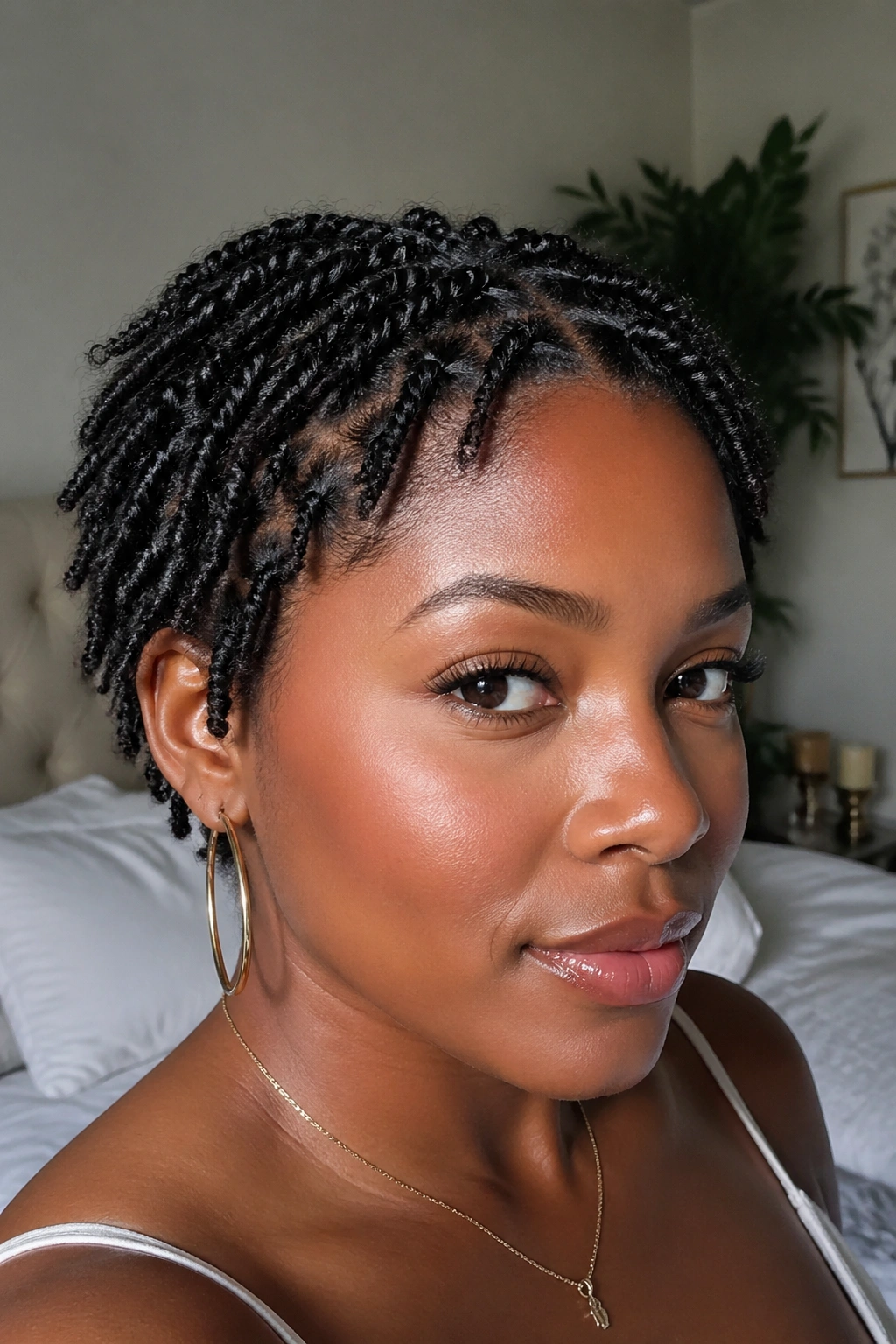
Mini twists are two-strand twists installed in very small sections across the whole head. On a TWA, the twists themselves become the style — you wear them as-is rather than taking them down.
The install is slow. Expect one to two hours for a full head on very short 4C hair. But once they’re in, the twists last one to two weeks as a protective style, which means you get a full week plus of low-maintenance wear in exchange for your upfront time investment.
Mini twists work particularly well during travel weeks, high-stress work periods, or any time you need your hair to genuinely take care of itself for a while. Just moisturize daily, tie a satin scarf at night, and they’ll hold their shape through almost anything.
16. Wet Look TWA
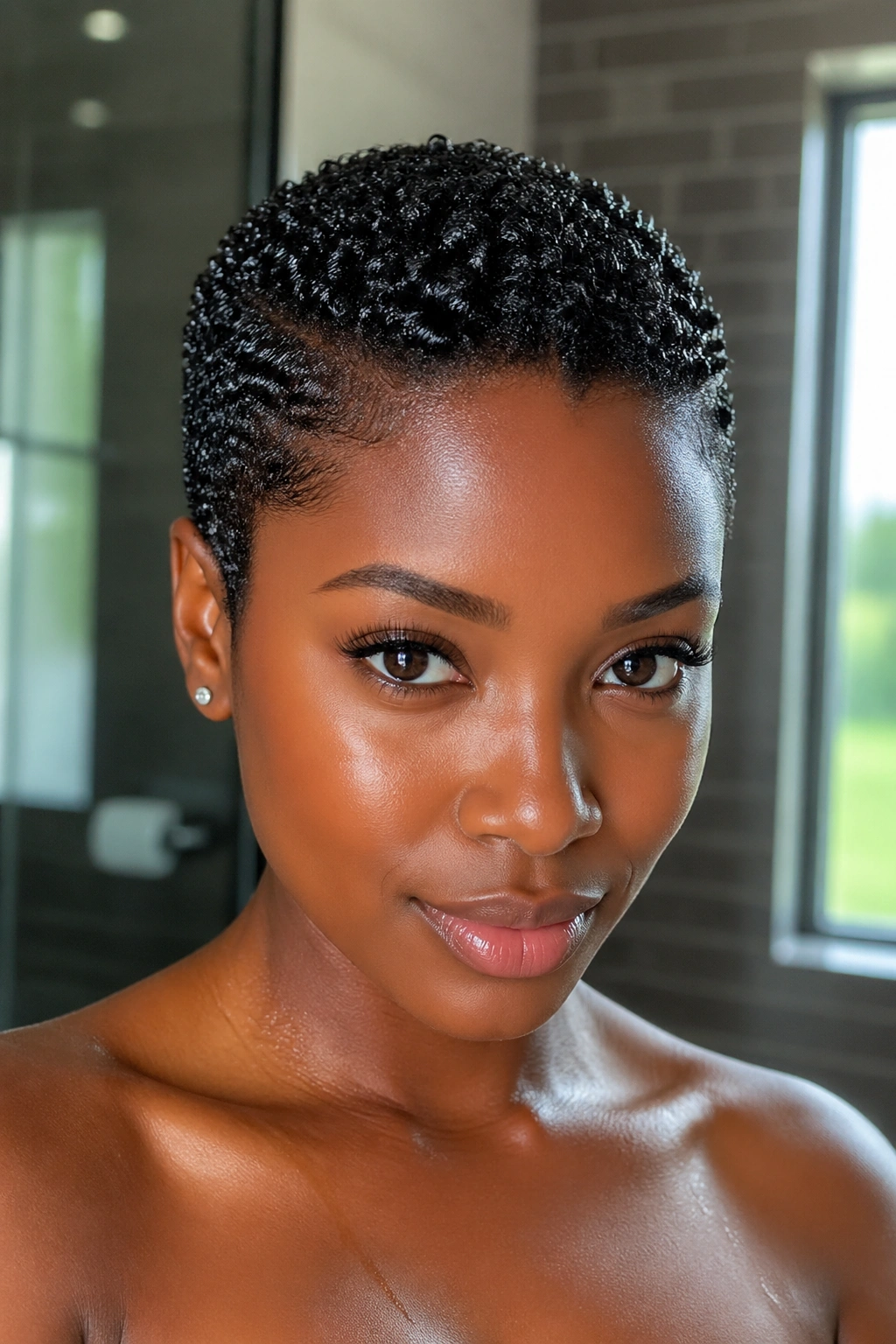
The wet look uses a high-shine gel to make your TWA appear freshly washed and saturated all day. It’s a glossy, sculpted aesthetic — dramatic, sleek, and very different from the matte soft look of a standard wash-and-go.
You want a jelly-textured gel with a high glycerin content. Apply generously while your hair is soaking wet. Smooth and shape without brushing — brushing breaks the gel coating and reduces the shine. Let air dry fully without touching.
The result lasts about a day, sometimes two if you sleep in a satin bonnet and avoid wetting your hair in the shower. It’s a statement look, not a daily routine, but for events and photoshoots, nothing else matches the dramatic sheen.
17. Double Part Afro
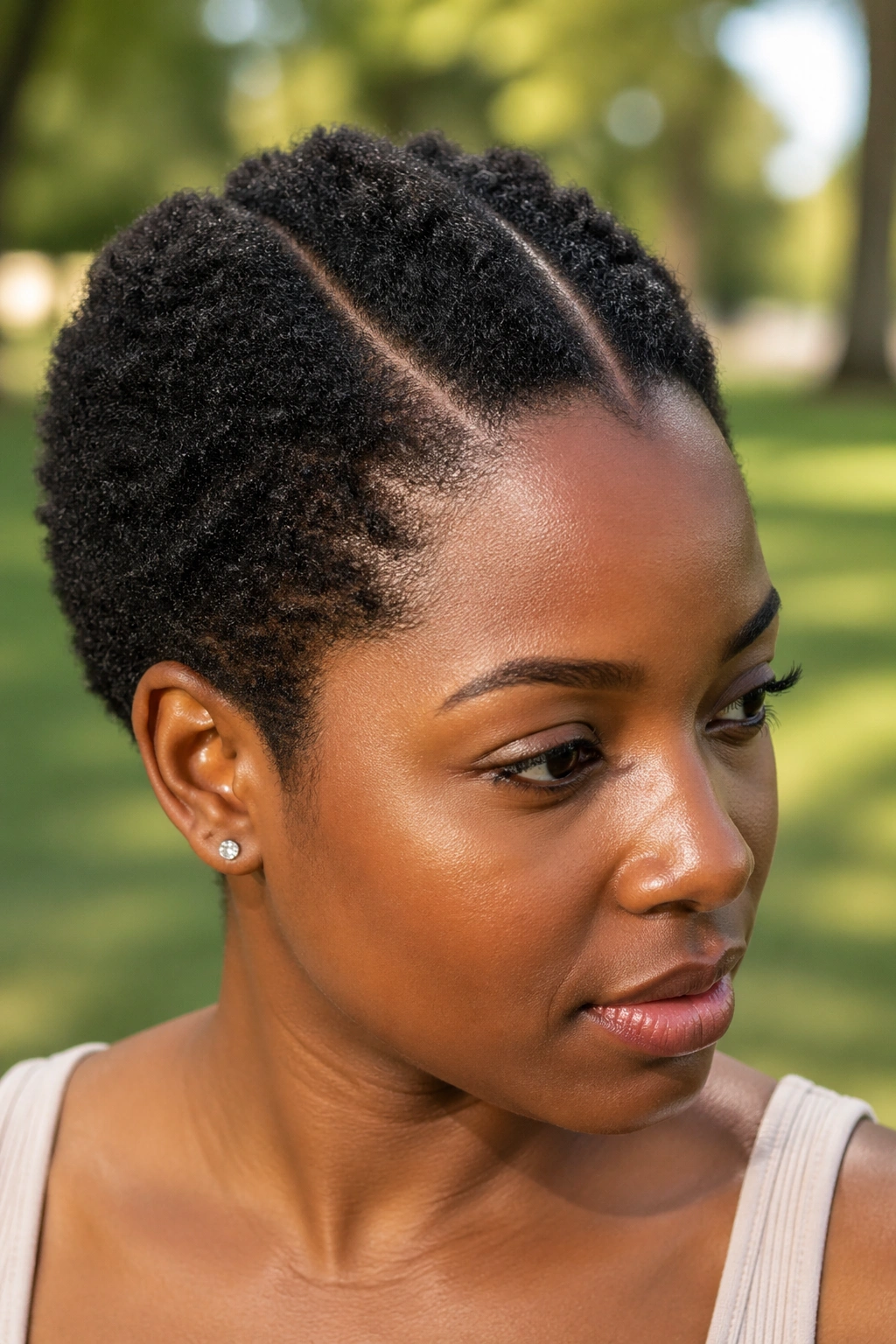
Two parallel parts running from front to back, with the middle section slightly raised above the side sections. The result is a tiered afro silhouette that looks sculptural and unique — you rarely see this style on anyone, which is part of what makes it interesting.
Draw the parts with a rat-tail comb while your hair is damp. Smooth the outer sections with gel to keep them flat. Let the middle strip rise naturally or pick it slightly for extra height. The parting lines themselves become the design element, similar to how negative space works in a painting.
What to Watch For
The parts need to be crisp to work. If they’re wavy or uneven, the whole effect falls apart. Practice the parting motion on damp hair a few times before committing to the style for the day.
18. Tight Coil Brushout
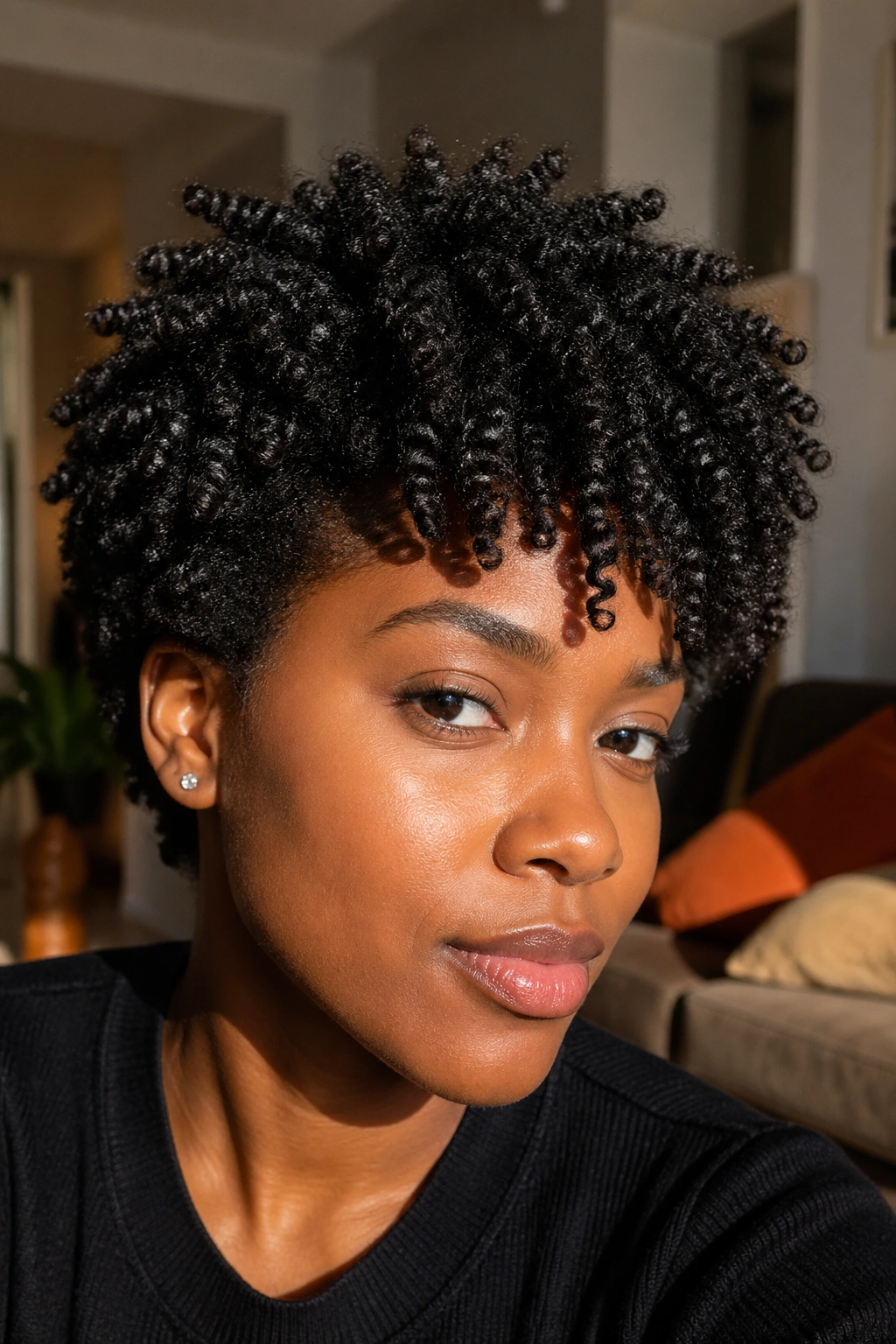
A tight coil brushout is the technique of using a small denman-style brush on your wash-and-go as the final step to pull the curls into cleaner, more uniform spirals. It’s a hybrid between finger coils and a traditional wash-and-go, and the final texture sits right between the two.
Apply your products, then brush in small sections from root to tip using the denman brush. The brush teeth catch each strand and pull it into a curl shape as you go. Don’t over-brush — two passes per section is enough. More passes break the curl formation.
Who this is for: anyone who wants more definition than a wash-and-go but doesn’t want to commit to the time of full finger coils. It splits the difference nicely.
19. Sleek All-Back TWA

A sleek all-back style slicks your entire TWA backward against your scalp with strong-hold gel. The result looks more like a painted-on cap than a styled afro, and the effect is dramatic, minimalist, and striking.
You need serious gel commitment for this. Apply generously from the front hairline all the way to the back, brushing backward as you go. Tie a silk scarf around your head for 20 minutes to set the shape before removing. The scarf is what gives you the glossy smooth finish — air drying alone won’t match the effect.
Once set, the style lasts a full day, sometimes longer. It’s formal, editorial, and works beautifully for events where you want your earrings and makeup to be the focal points without your hair competing for attention.
20. Finger Waves on TWA
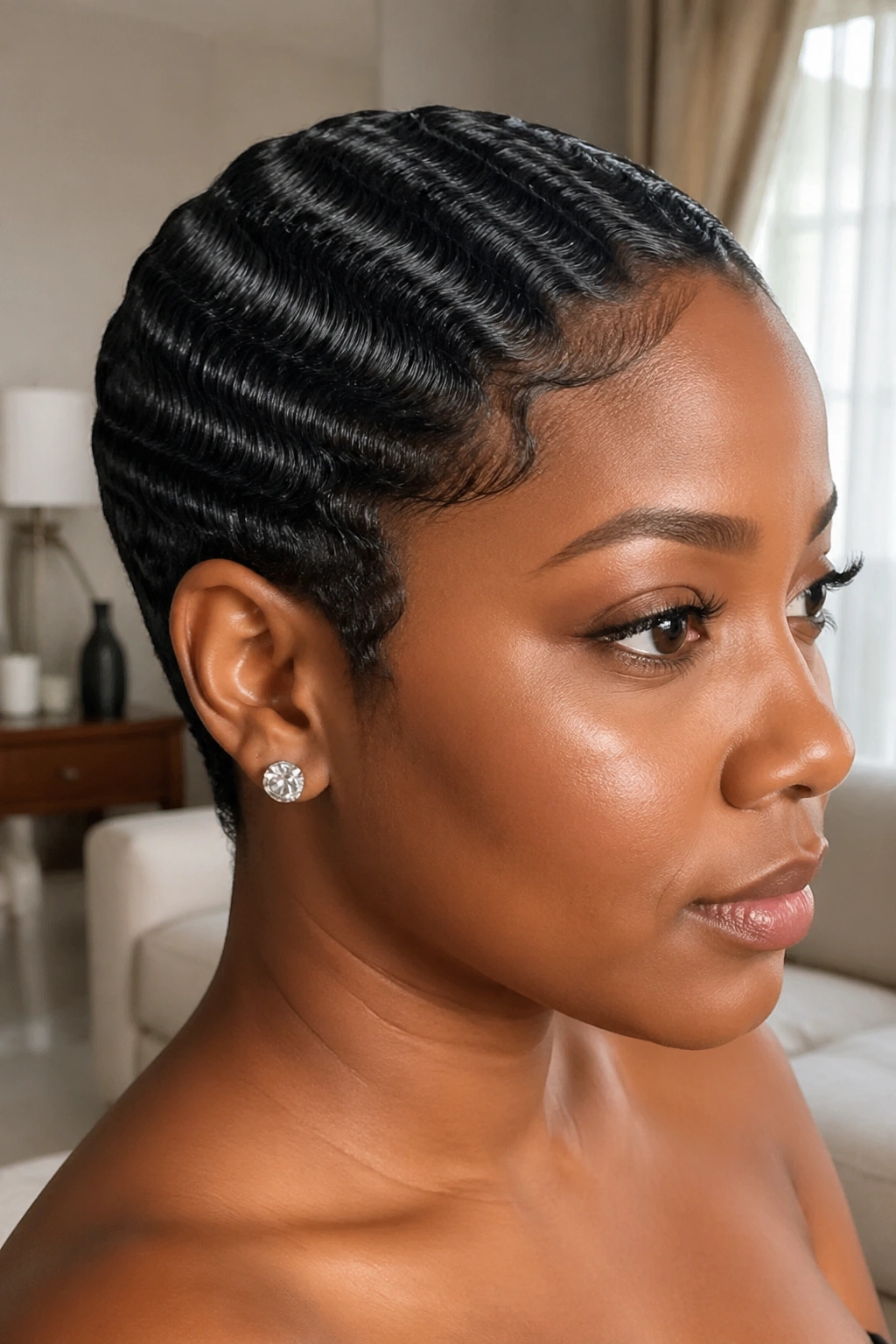
Finger waves are an old-school Harlem Renaissance technique making a permanent home in the natural hair world because they look incredible on very short 4C hair. Deep ridges of hair form horizontal S-shaped waves across the head, sculpted entirely with fingers and gel while the hair is damp.
The technique takes practice. You apply strong-hold gel, then use the backs of your fingers to press ridges into the hair along its length, creating the wave pattern. Let the sections dry undisturbed — even a slight touch while drying destroys the ridge.
On very short 4C hair, finger waves last a single day but photograph like nothing else. The contrast between the smooth sculpted waves and the natural texture elsewhere creates visual drama that’s hard to achieve any other way. Save this style for events and photoshoots where the investment of time pays off in the final image.
Maintenance Between Styles
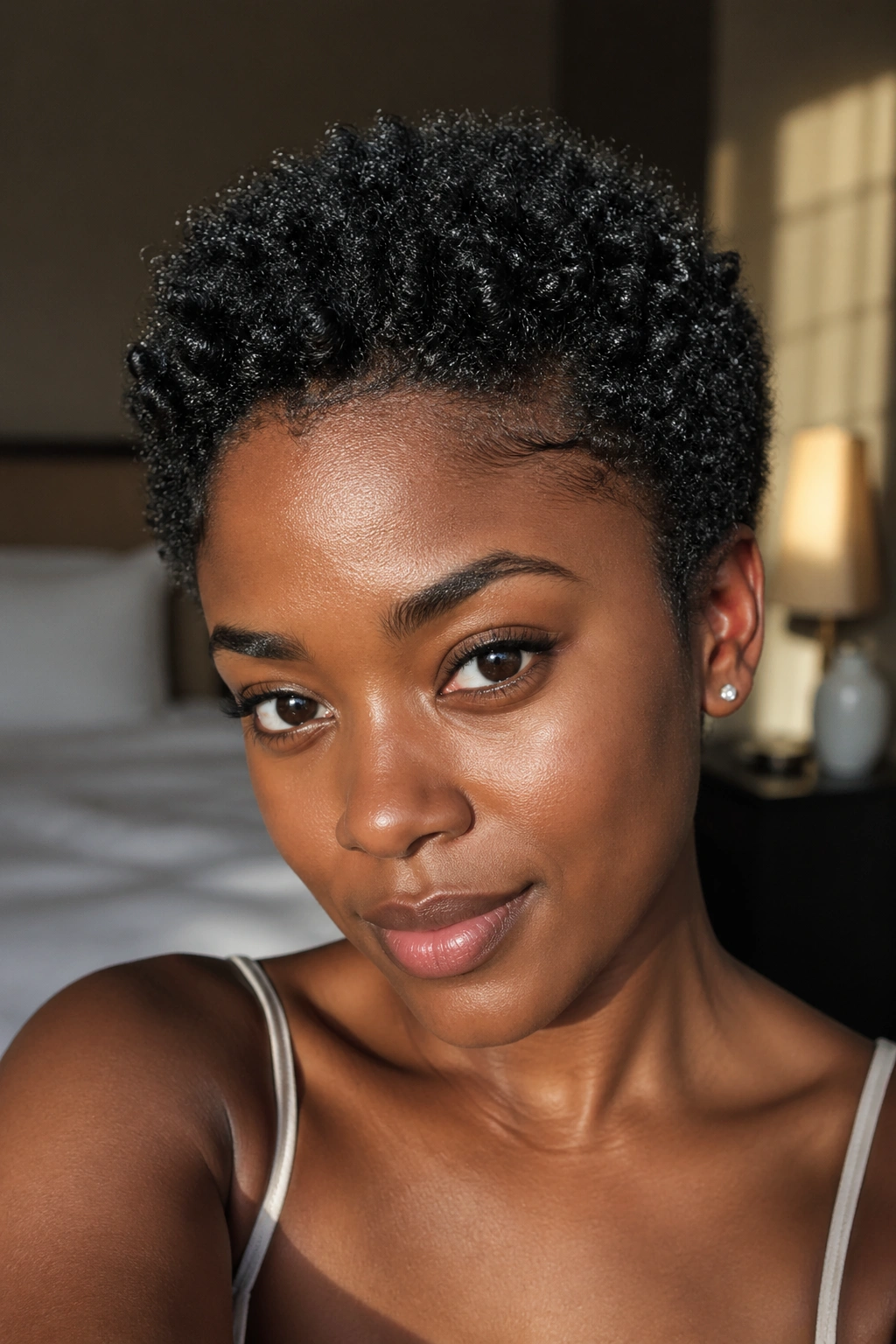
Daily moisturizing is the single most important habit for keeping any very short 4C style looking good. A water-based refresh spray, applied to damp your hair lightly each morning, keeps your curl pattern active and prevents the dry, dusty look that short 4C can fall into without care.
Don’t over-wash. Weekly is enough for most short 4C hair. Over-washing strips your natural oils and leaves the hair brittle.
Satin bonnets at night are non-negotiable. I know — I said this already, but it bears repeating because I’ve seen more TWA styles ruined by a single cotton pillowcase night than by any other single factor.
Common Mistakes to Avoid
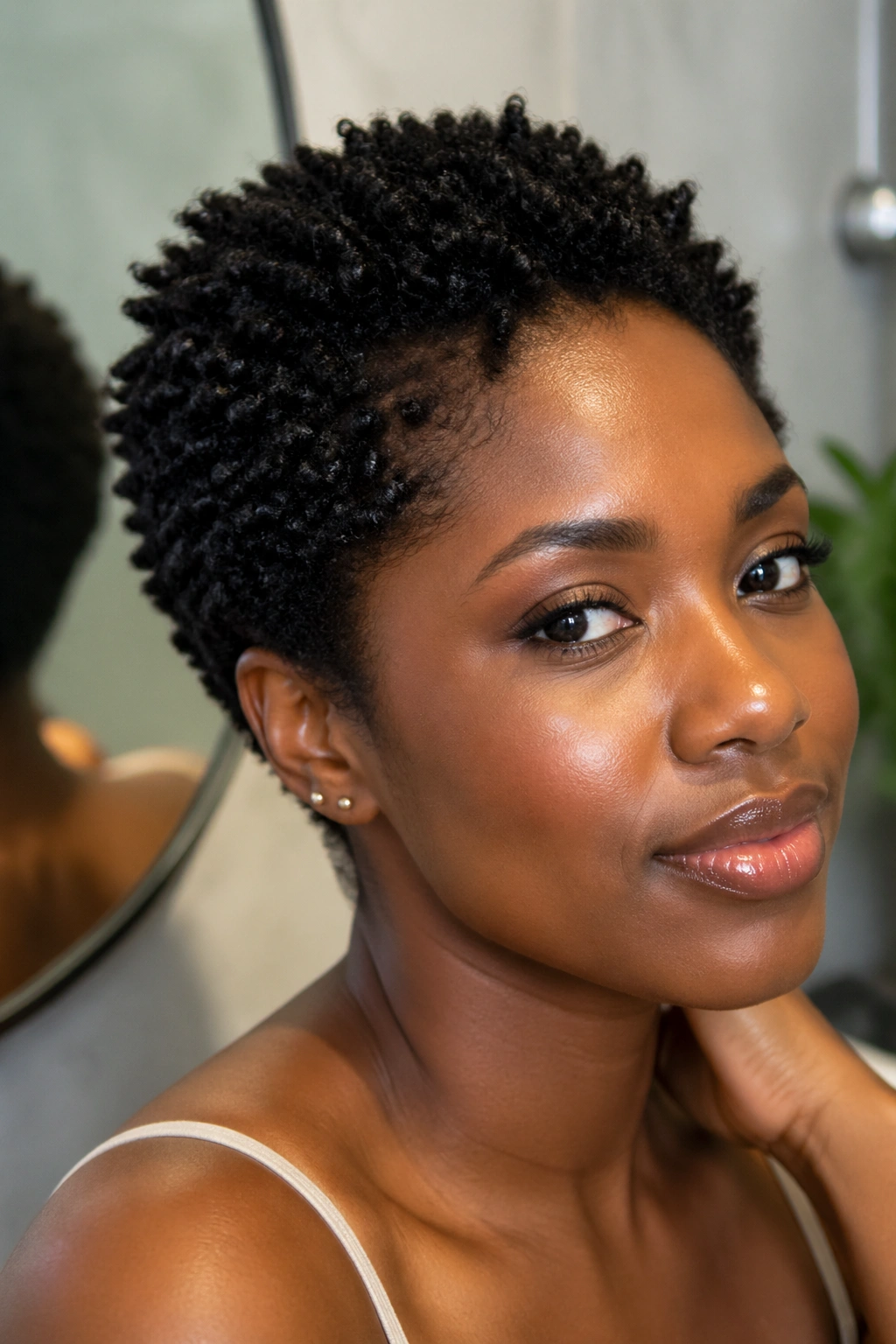
Using too much product is the most common error I see. On a TWA, you need maybe a quarter-size dollop of leave-in and an equal amount of styling cream. That’s it. More creates buildup and weighs down the curl pattern.
Second mistake: skipping the cleanse. People assume short hair doesn’t need to be washed often, but actually the opposite is true. Short hair shows product buildup faster than long hair because there’s less strand surface to absorb it. Wash weekly, no exceptions.
Third: styling on bone-dry hair. You need moisture in the strand for any of these styles to work. Mist with water before you start every time.
Picking the Right Very Short 4C Style
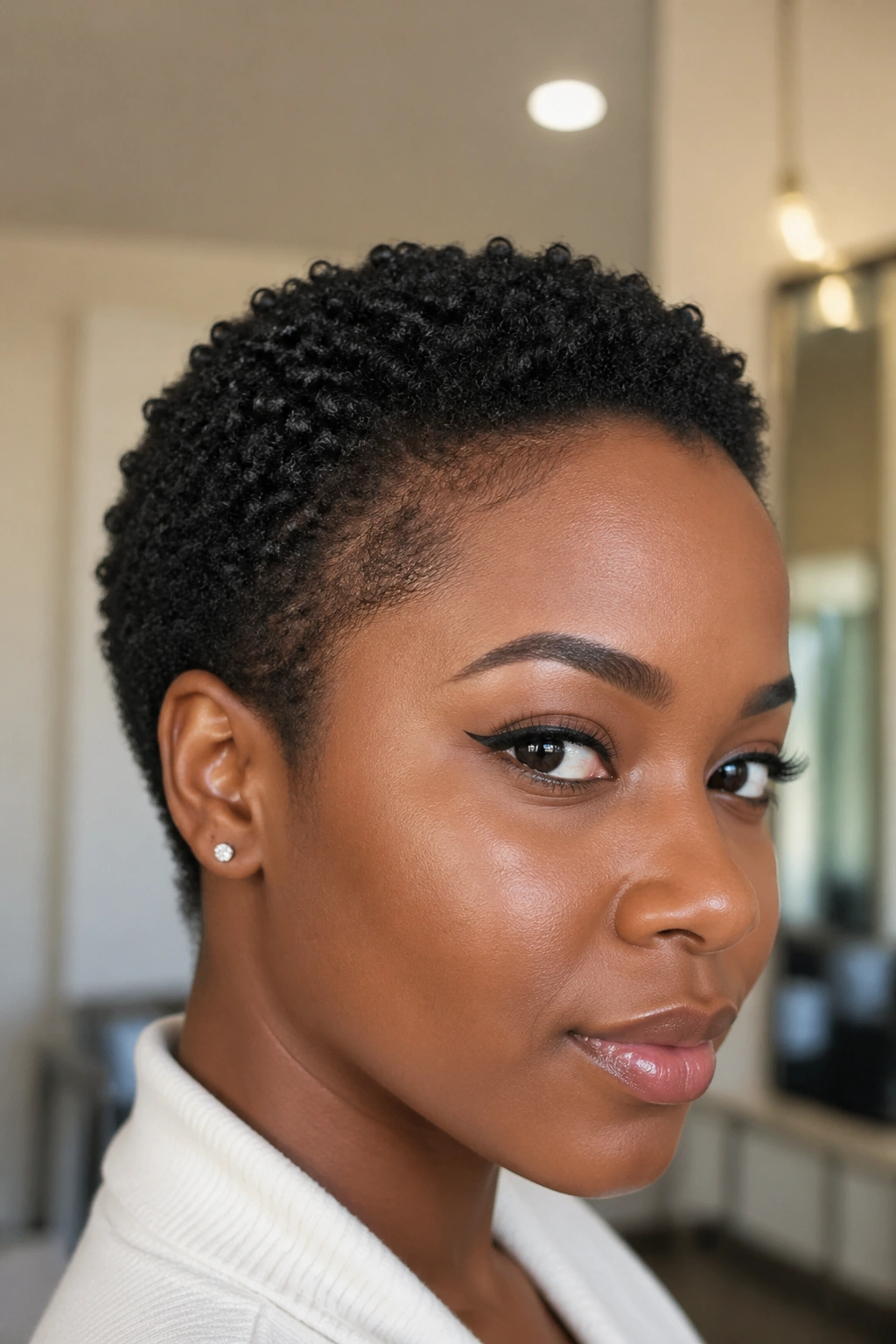
Face shape matters more than you’d think on a TWA because the cut and style affect the silhouette of your whole head. Round faces do well with styles that add vertical volume — frohawks, curly pomps, rounded halos. Square faces soften with styles that have curve and organic shape, like wash-and-gos and rounded halos. Oval faces can pull off almost anything.
Lifestyle matters more than face shape, honestly. A two-hour finger coil install is not realistic for someone working 60-hour weeks. Match the style to your actual schedule, not your aspirational schedule.
Comfort with being seen matters too. Very short 4C hair is often more visible than longer styles because it highlights your features instead of framing them. That visibility can feel like freedom or like exposure depending on your comfort level. Start with styles that feel safe and build from there.
Final Thoughts

Short 4C hair isn’t a waiting room for long hair. It’s a destination with its own range, its own beauty, and its own set of techniques that reward mastery. The 20 styles in this list are a starting point, not a checklist — pick three or four that fit your life and let them become your rotation.
Your TWA is not less than anything. It’s a clean slate. And the things you can build on that slate are only limited by how willing you are to try.
Try one of these this week. See how it feels. Keep the ones that make you feel like yourself, and skip the rest without apology.