



Blonde highlights on curly natural hair are one of the most striking color combinations in the natural hair world — and they’ve become a genuine staple for Black women who want to add dimension, warmth, and visual interest to their curl patterns without committing to an all-over color change. When a skilled colorist places blonde highlights thoughtfully within a natural curl formation, the result looks almost like the hair is lit from within — warm, dimensional, and completely alive. But getting there requires understanding the technique, the tones, and the care involved.
Why Blonde Highlights Work So Well on Natural Curls
The combination of blonde highlights and natural curls creates a visual dynamic that’s genuinely different from what you see on straight hair — and in many ways, better. Straight hair shows highlights as defined stripes running parallel to each other, creating a pattern that reads as clearly and deliberately colored. Natural curls show blonde highlights as scattered warm flashes and concentrated pops of light that appear throughout the curl formation in an organic, almost random-looking way.
That organic quality is what makes blonde highlights on natural curls look so good. The coil pattern interrupts the highlights at every bend, creating a constantly shifting display of darker and lighter tones as the curls catch and release the light. On a full head of natural curls with blonde highlights, the effect is dynamic — the color looks different from every angle, in every light.
The contrast between a dark natural base and blonde highlights is also one of the most effective ways to create the illusion of volume and dimension in natural curly hair. The lighter sections catch light while the darker base sections recede visually, and this interplay of lighter and darker creates depth within the curl formation that makes the hair look fuller, richer, and more complex than a single flat color ever could.
The Spectrum of Blonde: Choosing Your Shade
“Blonde” covers a wide tonal range, and the specific shade of blonde you choose for your highlights determines the overall character and impact of the result. Not all blondes work equally well on natural hair, particularly on deeper skin tones, and understanding the spectrum helps you make a choice that genuinely flatters you.
Warm blonde shades — honey blonde, golden blonde, champagne blonde, butterscotch — have yellow or orange undertones that complement warm, medium, and deep skin tones beautifully. These are the most flattering blonde highlight choices for the majority of Black women because the warmth creates harmony rather than harsh contrast.
Neutral blonde shades sit between warm and cool and work across a wide range of skin tones because they don’t pull strongly in either direction. Sandy blonde and natural golden-neutral blonde shades are particularly versatile choices.
Cool blonde shades — ash blonde, platinum, ice blonde — create the most dramatic contrast against dark natural bases and require careful consideration for deeper skin tones. Ash blonde can look beautiful on women with cool undertones but may look ashy or flat against warmer complexions. Platinum, done well and paired thoughtfully, can look extraordinary — but it’s the highest-maintenance option by a significant margin.
Strawberry blonde has warm, red-infused blonde tones that look genuinely beautiful on natural curls, creating a warm, dimensional look that’s slightly less expected than standard caramel or honey highlights and equally flattering on warm skin tones.
The Technical Process: What Getting Blonde Highlights Really Involves
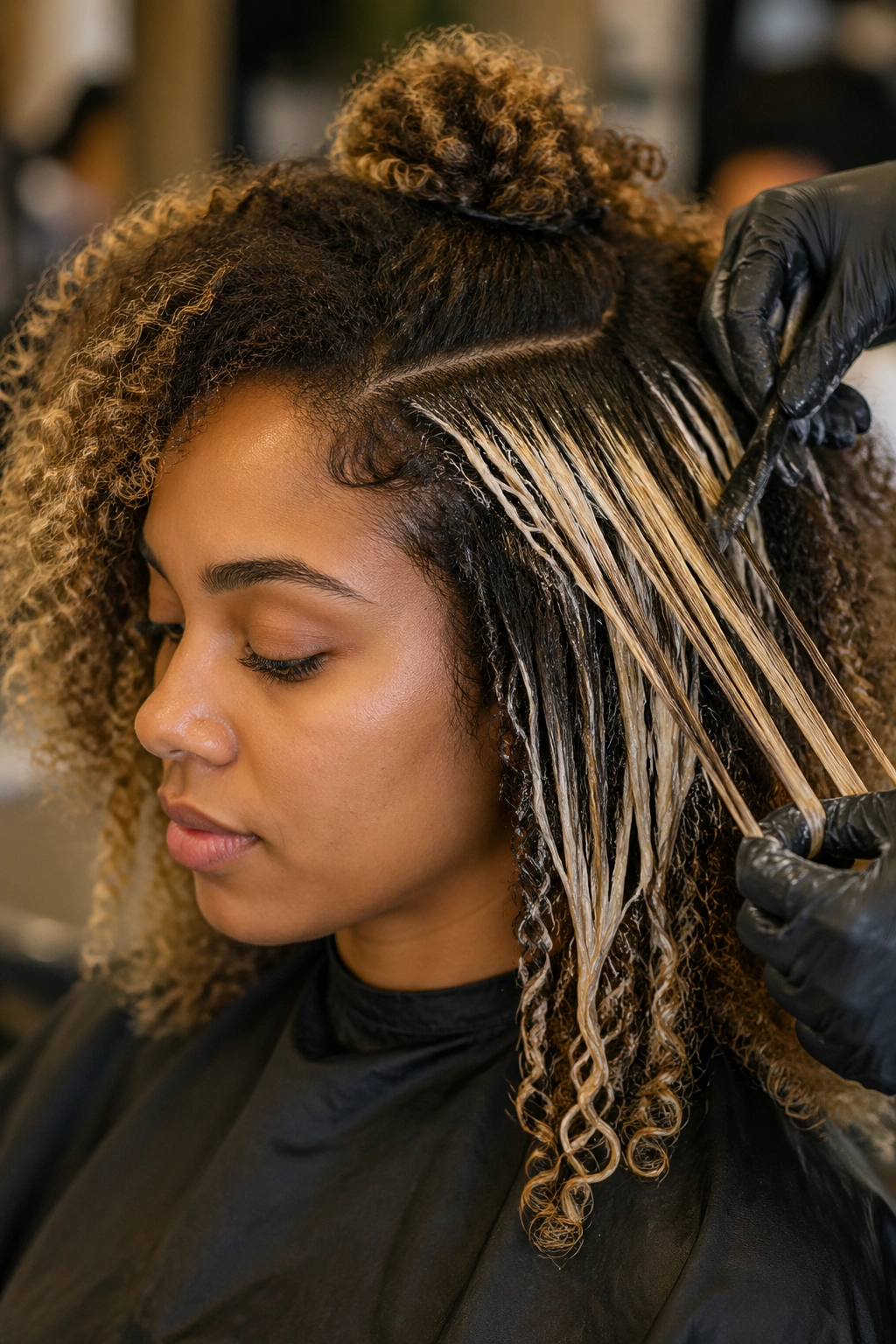
Blonde highlights on natural hair require lightening specific sections of hair — removing existing pigment to create the lighter base that blonde tones require. This is a chemical process, and understanding what it involves helps you make informed decisions and have realistic expectations.
The starting point matters enormously. If your natural hair is a medium warm brown, achieving a honey or caramel blonde highlight may require only one session and a relatively gentle lift. If your hair is deep black, achieving true blonde highlights — particularly lighter, more visible blondes — will require more significant lightening and may need multiple sessions to achieve safely.
Processing order and technique matter for natural hair in ways they don’t for straight or relaxed hair. The coil structure of natural hair can create uneven porosity across different parts of the head, with the ends often more porous (and therefore faster to lift) than the roots. An experienced colorist accounts for this when timing the lightener — they may apply product to the roots after the ends are already developing, or use different developer strengths in different sections.
Bond-building treatments are particularly valuable during the blonde highlighting process because lightening chemically disrupts the disulfide bonds that give hair its strength. Products like Olaplex or similar bond-building treatments added to the lightener during processing reduce the structural damage to the hair shaft, and continuing to use bond-building treatments at home between appointments helps maintain curl resilience and definition.
Protecting Your Curl Pattern Through the Blonde Highlighting Process
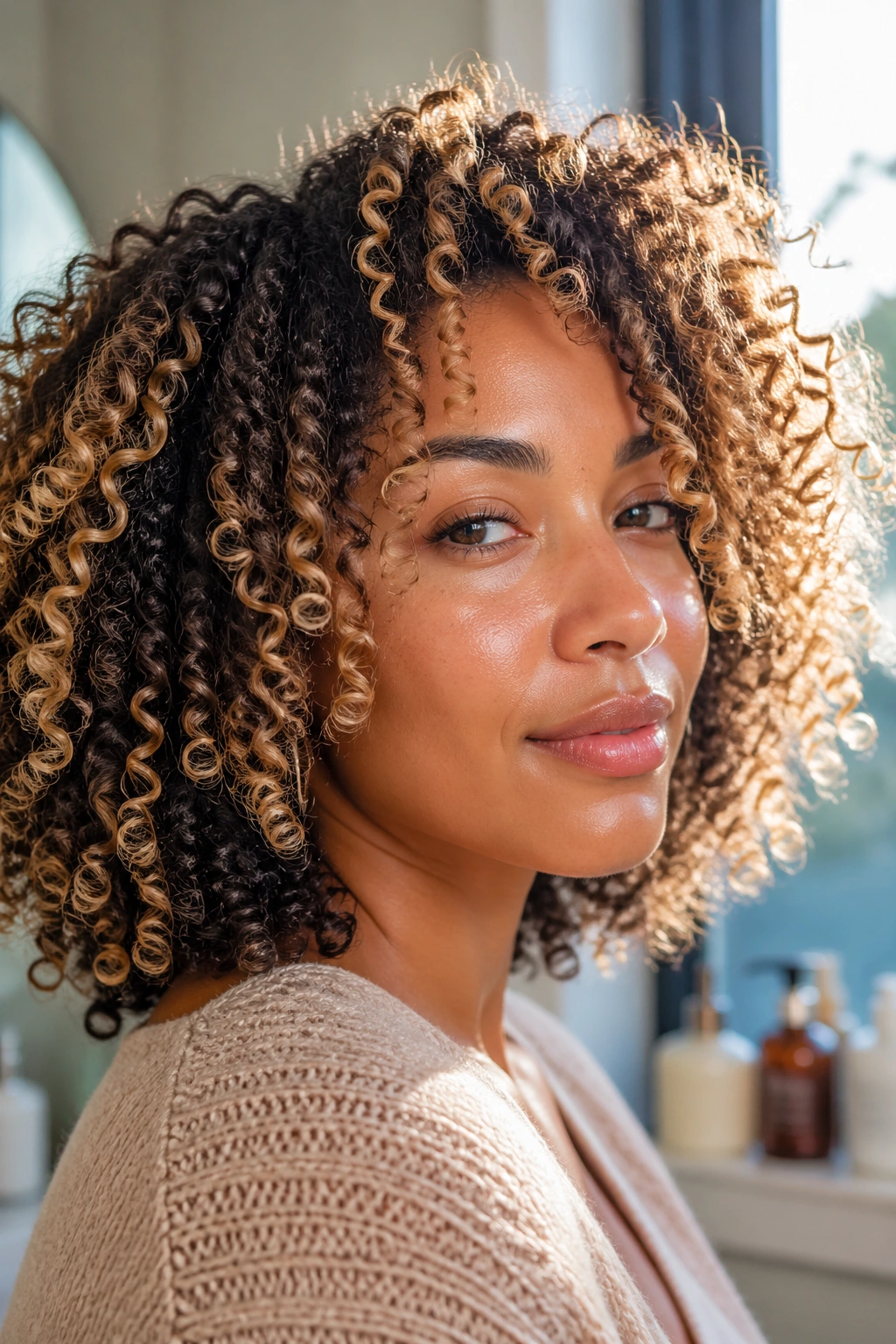
Maintaining curl pattern through chemical processes is one of the central concerns of natural hair coloring, and it requires proactive effort rather than hoping for the best.
Deep conditioning before a highlight appointment — ideally in the week leading up to the service — sets the hair up with maximum moisture and health before the chemical process begins. Well-conditioned hair handles lightening better than dry, depleted hair, with less structural compromise and better recovery.
During the appointment, ask your colorist to avoid applying lightener directly to the scalp on tight coils unless that’s specifically necessary for the look you’re achieving. Close-to-scalp application on type 4 hair in particular can cause scalp irritation and can affect the curl pattern at the root if the section is pulled too tightly during processing.
After the appointment, the two weeks immediately following a highlight service are critical for curl health. Avoid heat styling, limit manipulation, deep condition every wash day, and give the hair time to recover and stabilize before any further chemical processing.
1. Honey Blonde Highlights on Dark Natural Curls
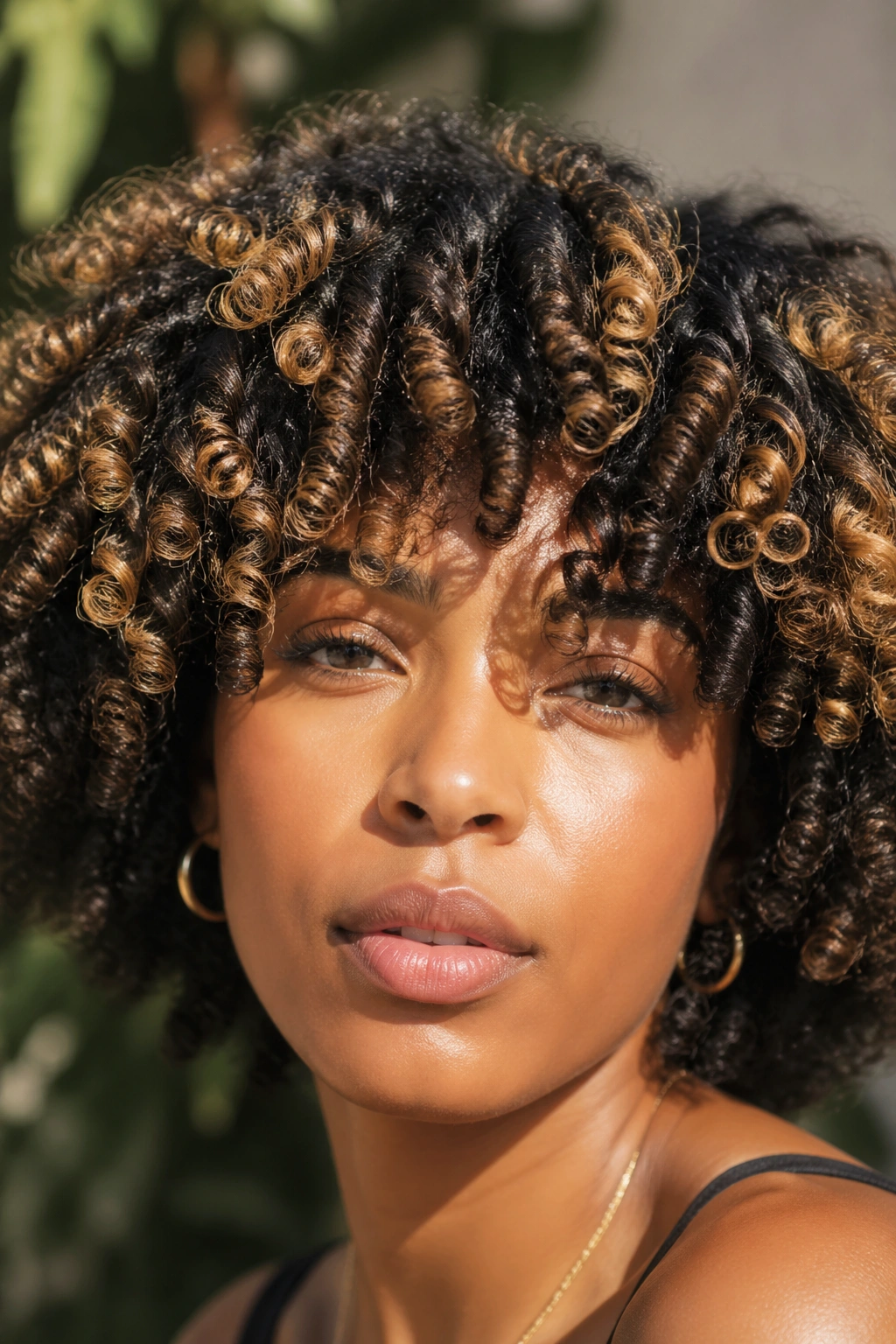
Honey blonde highlights on a dark natural base are perhaps the most requested blonde highlight option for Black women with natural curls — and the results consistently justify the popularity. The warm golden tone of honey blonde creates a sun-kissed warmth that looks completely organic on dark natural curl textures.
On tight type 4 coils, honey blonde highlights show up as concentrated warm pops throughout the curl formation — visible from every angle, especially in direct light. On looser type 3 curls, they create longer, more continuous warm ribbons that flow along each curl section.
How to Achieve This Look
Your colorist will section your hair and apply a lightener to select sections — using foils, balayage freehand technique, or a combination. The target lift is a warm orange-gold, which is then toned with a honey blonde toner to achieve the specific warm golden blonde rather than a brighter or cooler result.
- Request face-framing sections get the most concentrated highlighting for maximum impact
- Ask your colorist to apply color to curls in their natural state rather than stretched out
- Maintain with a honey-toned color-depositing conditioner weekly
Tip: For the most natural-looking result, request that the highlighting be heaviest toward the ends and more subtle at the mid-lengths, with the roots left natural.
2. Caramel Blonde Highlights
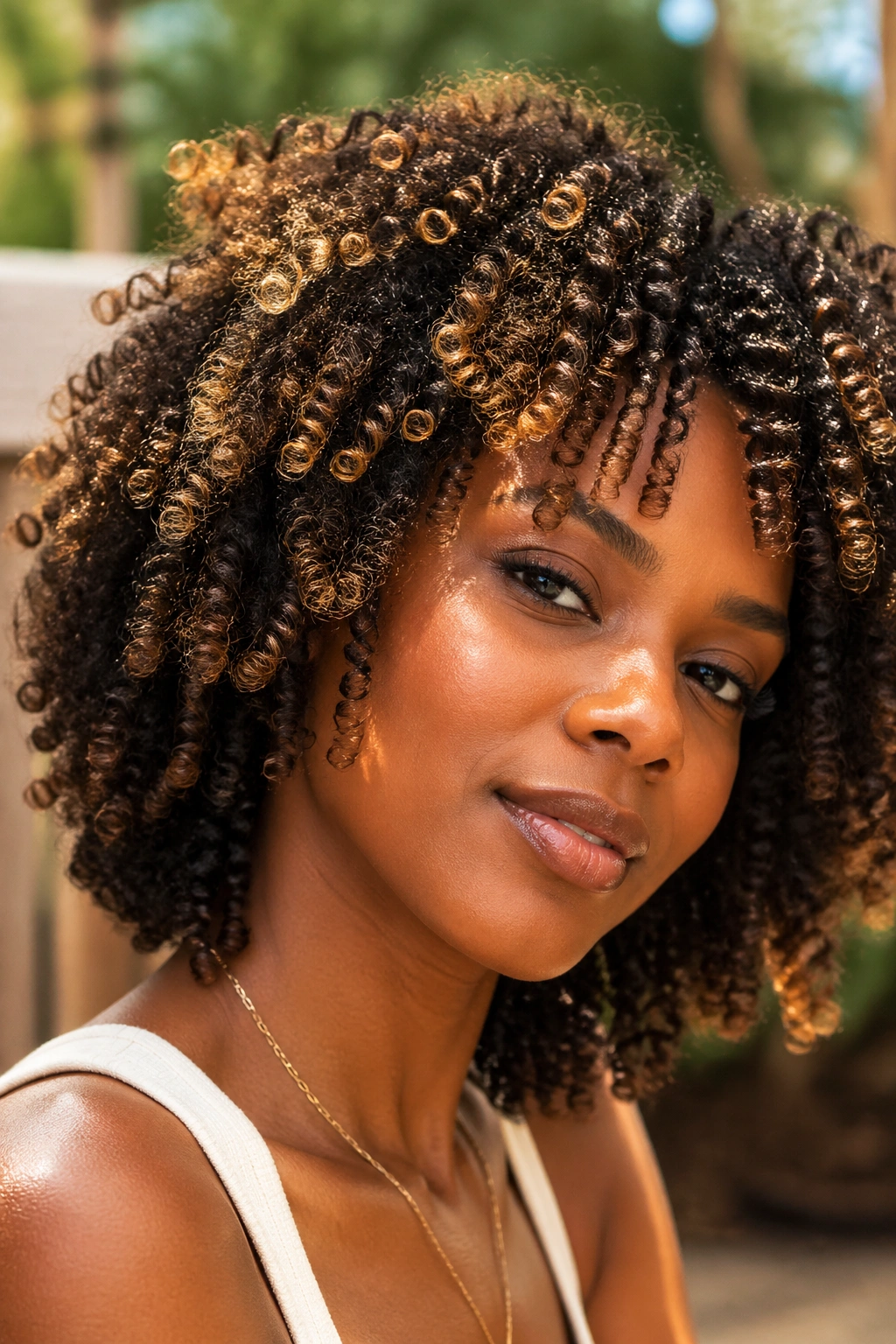
Caramel blonde sits in the warm overlap between caramel and blonde — it’s lighter than a pure caramel but warmer and richer than most blonde shades. On natural curls with a dark base, it creates a beautiful dimensional warmth that reads as completely natural.
Bold fact: Caramel blonde highlights are the most gracefully aging blonde option for natural hair — as they fade, they don’t go brassy or yellow, but rather shift into a warm, slightly more muted version of the original tone that looks equally beautiful through the color cycle.
This is a particularly good choice for women who are highlighting for the first time because the warm tones are forgiving of minor variations in lift, don’t require the most extreme lightening, and create a result that looks beautiful across all curl textures and patterns.
3. Golden Blonde Highlights
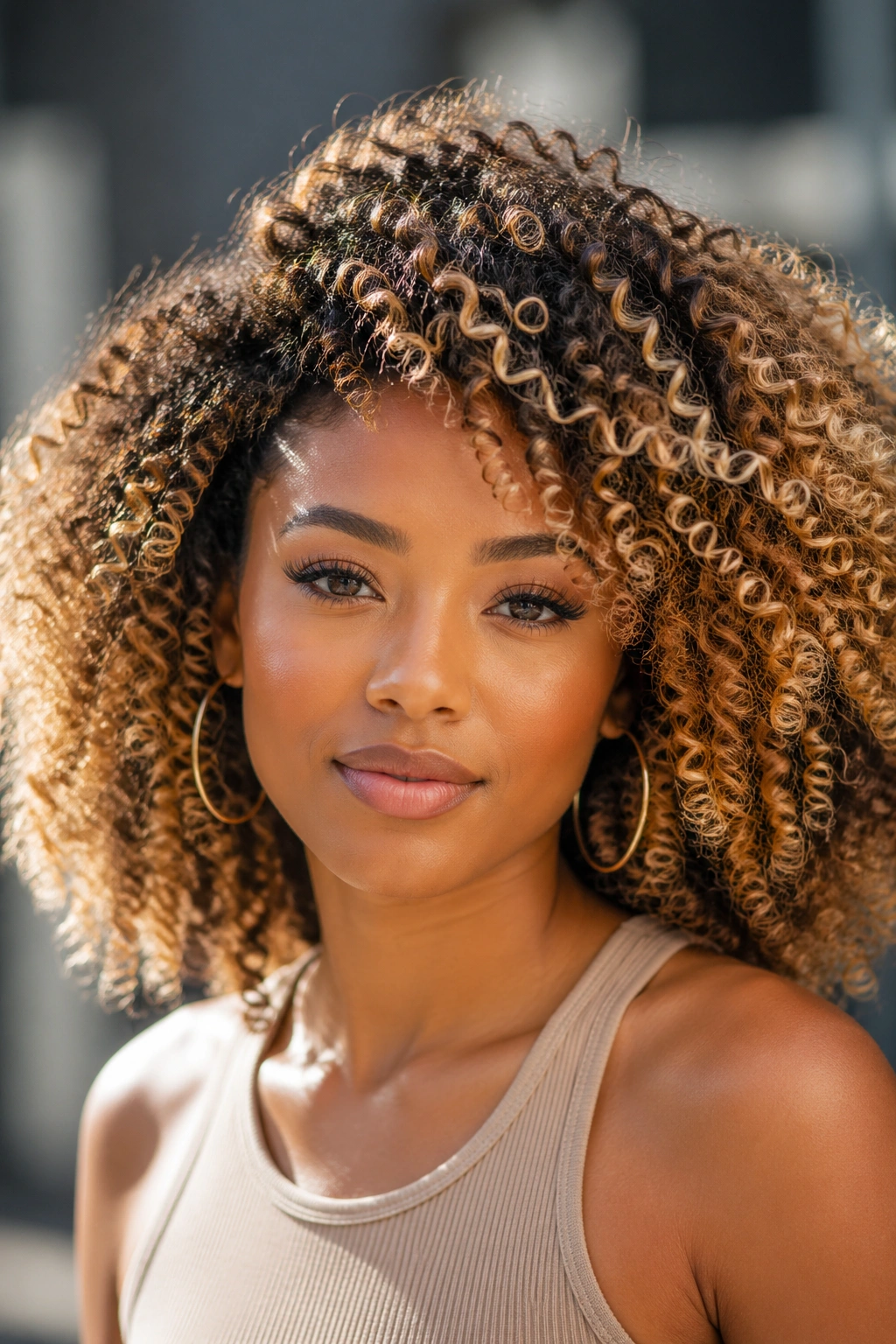
Golden blonde — bright, warm, and unmistakably blonde — is more vivid and visible than caramel or honey but still warm enough to work beautifully on natural hair and darker skin tones. On natural curls, golden blonde highlights create a look that’s clearly and deliberately colored in the best possible way.
The warmth of golden blonde is what keeps it from looking harsh against deeper complexions. While cool or ash blondes can read as stark contrast against warm skin, golden blonde creates a warm luminosity that flatters rather than contrasts.
On wash-and-go natural curls in sunlight, golden blonde highlights create an almost magical effect — the golden tones catch the light and seem to amplify it, creating a warm, glowing crown that’s breathtaking in outdoor photography.
4. Platinum Highlights on Natural Curls
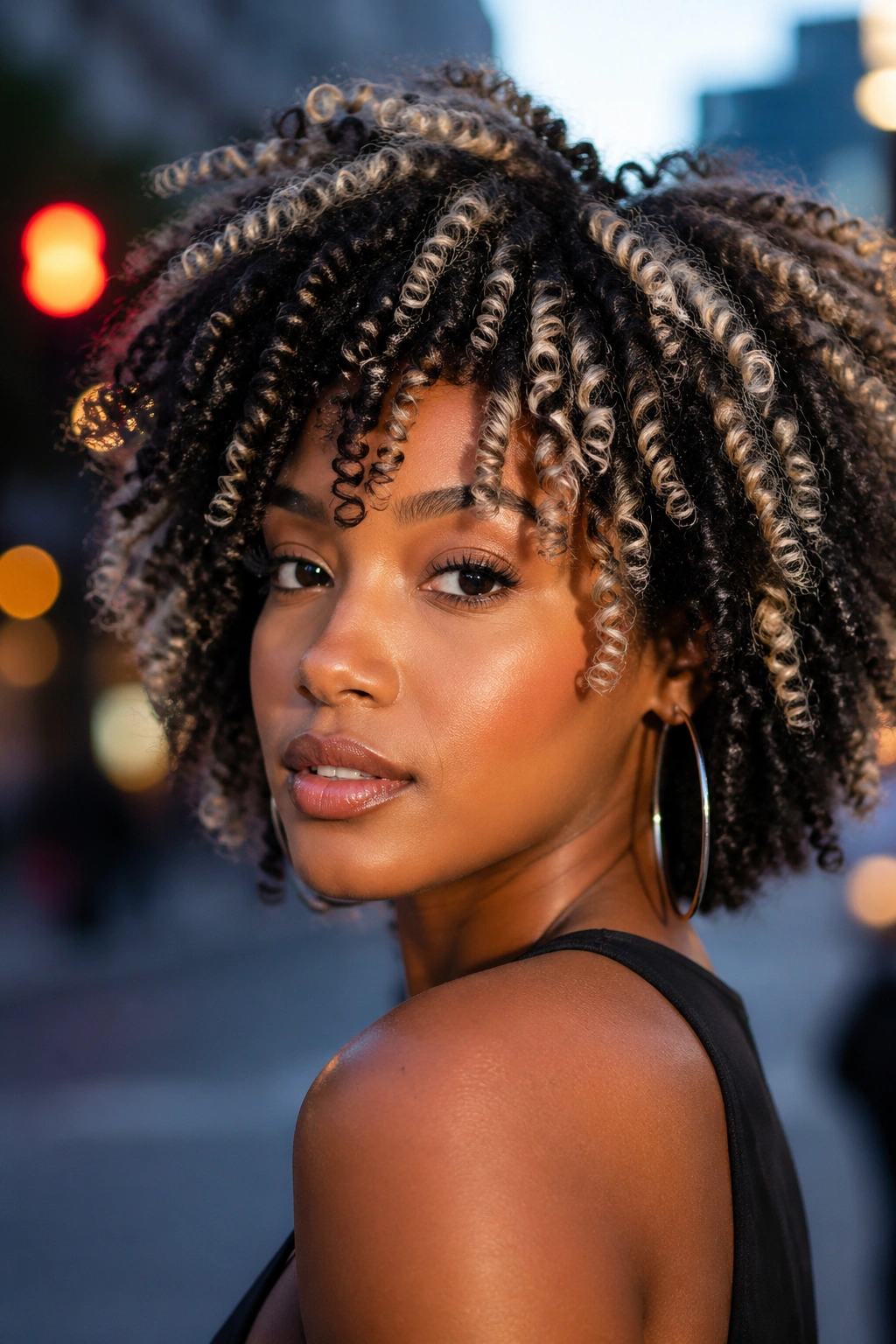
Platinum highlights are the boldest, most dramatic blonde option — and the most technically demanding on natural hair. The nearly white-blonde tone against a dark natural base creates a graphic, high-fashion contrast that’s unmistakably intentional and undeniably striking.
Be honest with yourself about the commitment before pursuing platinum. This is not a low-maintenance choice. Platinum highlights require multiple lightening sessions on dark natural hair, regular purple toning treatments to prevent yellowing, intensive ongoing conditioning, and careful attention to the health of the highlighted sections throughout the color journey.
How to Achieve This Look
Platinum on dark natural hair requires a series of lightening sessions, each one bringing the highlighted sections progressively closer to the platinum level without damaging the hair structure. Bond-building treatments should be used at every stage.
- Never attempt platinum highlights on natural hair in a single session from a dark base
- Use a purple shampoo weekly to prevent the platinum from going yellow
- A monthly bond-building treatment at home maintains strength between appointments
- Deep condition every single wash day without exception
5. Strawberry Blonde Highlights
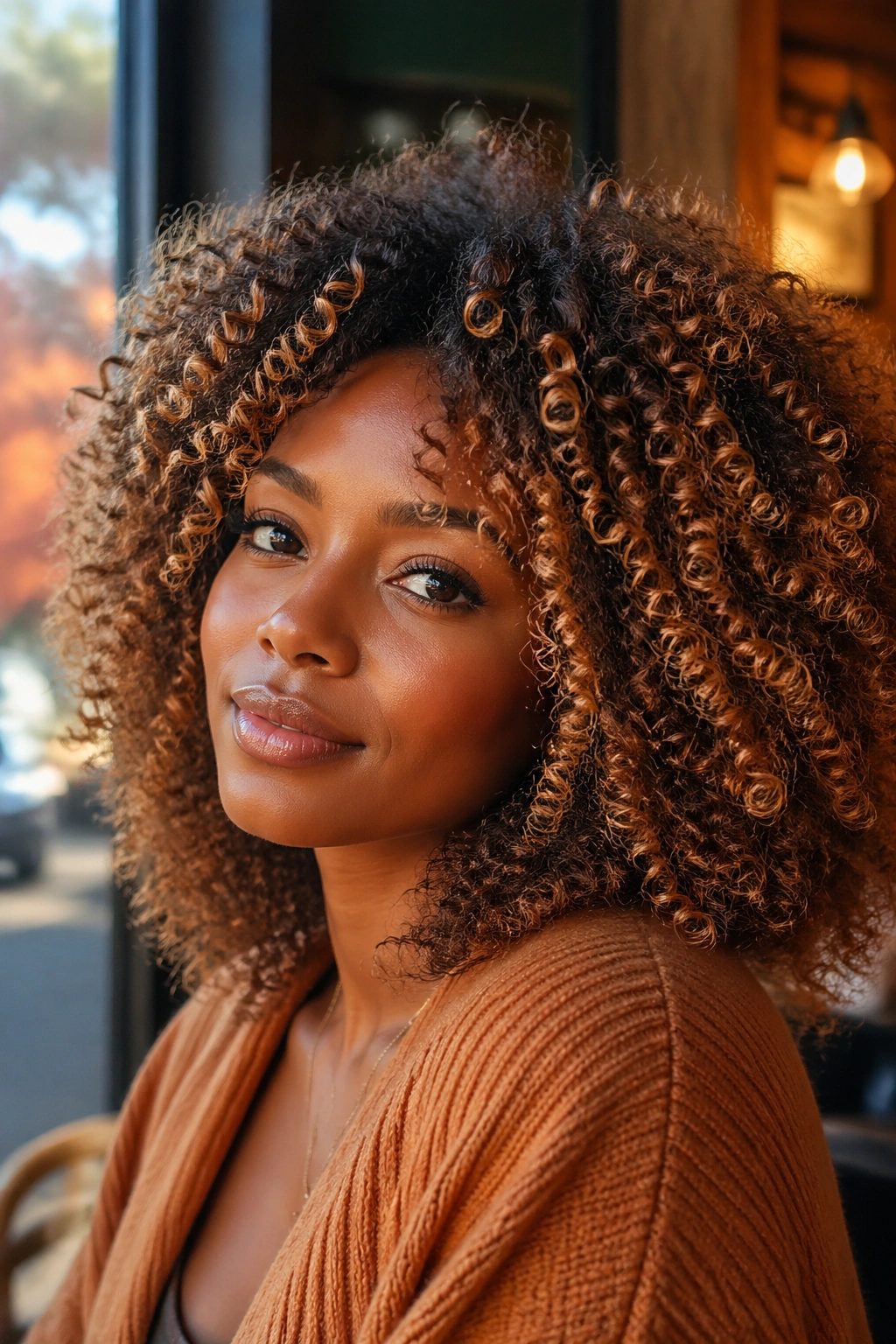
Strawberry blonde highlights on natural curls are a gorgeous, slightly unexpected choice — the warm, reddish-blonde tone adds dimension to dark curls in a way that feels simultaneously warm and fresh. The slight red element in strawberry blonde gives it a vibrancy that pure yellow-blonde lacks.
On natural curl textures, the reddish element in strawberry blonde reads as a warm, almost copper-adjacent warmth within a blonde framework. The result is a highlight tone that has more personality than straight blonde while still being clearly in the blonde family.
This is a particularly beautiful choice for autumn and winter, when the warm reddish tones feel seasonally appropriate and look especially stunning in lower, warmer indoor lighting.
6. Chunky Blonde Highlights on Natural Curls
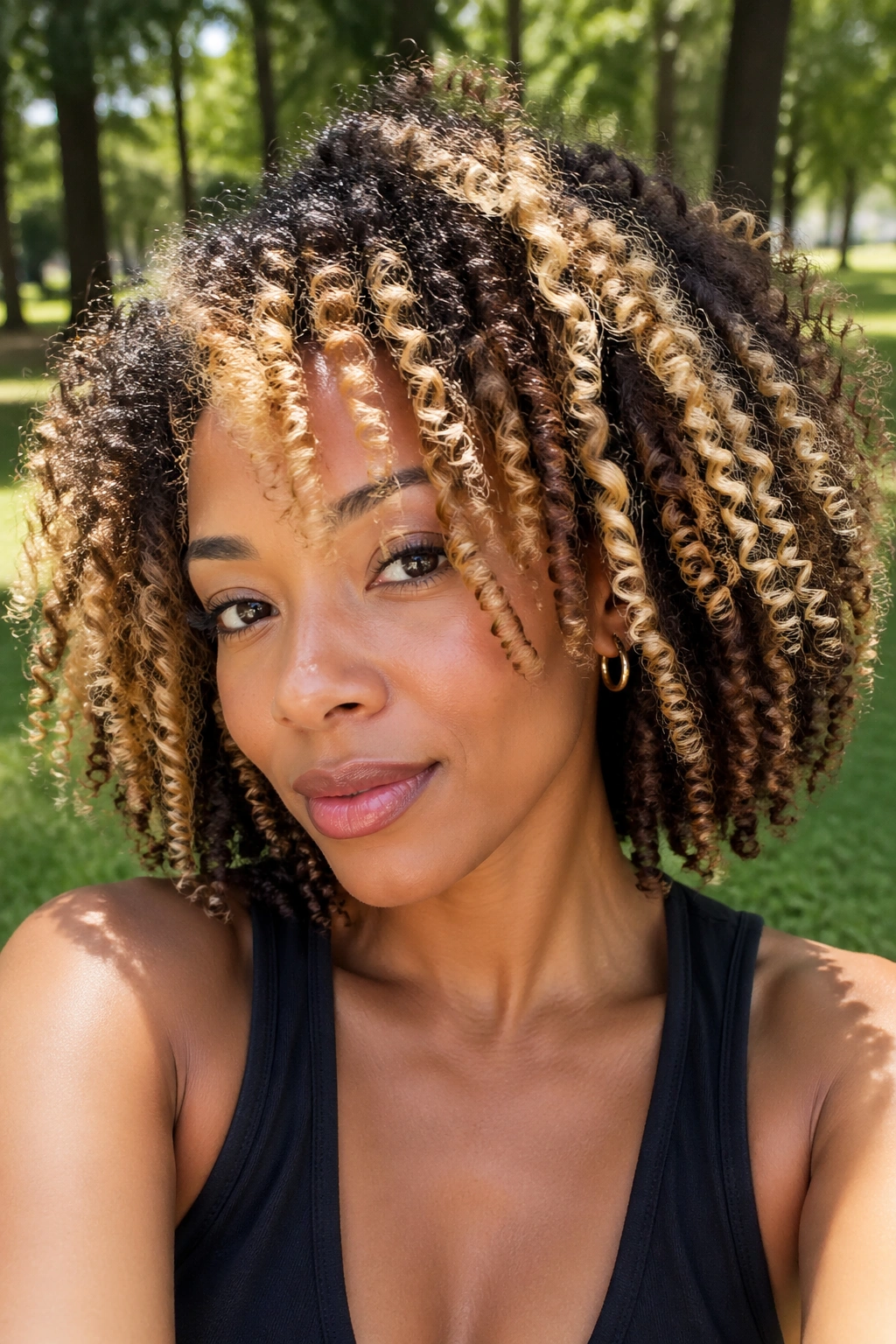
Chunky highlights use larger sections than traditional fine highlights, creating bold, visible pops of blonde throughout the curl formation rather than subtle diffused dimension. On natural curls, chunky blonde highlights create a dramatically graphic look that reads as clearly colored and intentional.
Bold fact: On type 4 coils specifically, chunky blonde highlights are often more effective than fine highlights** for achieving visible, clearly defined color sections — because the tight coil pattern can obscure the individual strands in very fine highlights, while larger, chunkier sections remain visible even within a dense coil formation.
The contrast between thick blonde sections and the dark natural base is bold and unapologetic — it’s the highlight choice for women who want their color to be seen and celebrated rather than subtly suggested.
7. Subtle Scattered Blonde Highlights
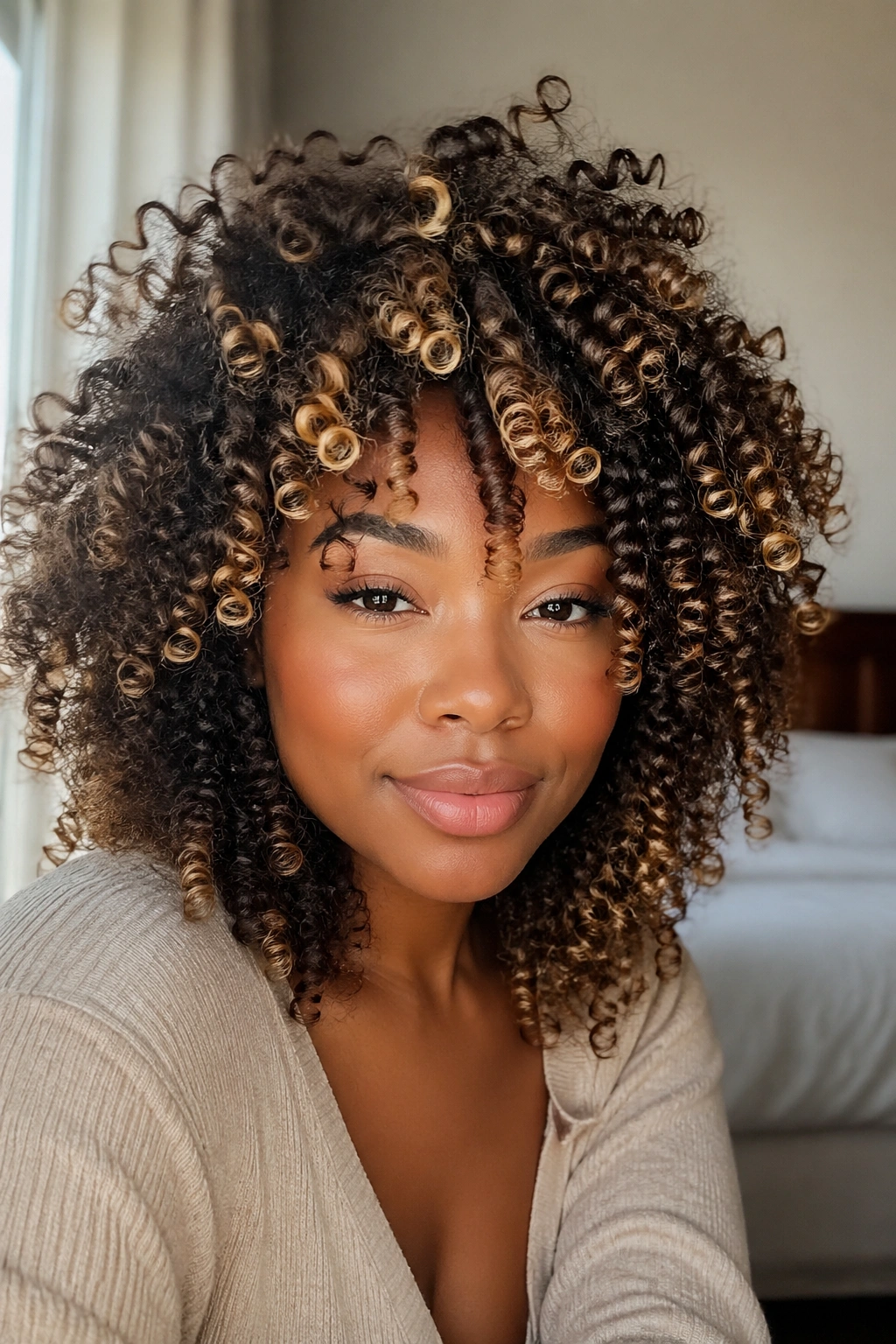
Scattered highlights placed throughout the curl formation without systematic sectioning create the most naturalistic blonde highlight effect possible. The random placement mimics how actual sun exposure selectively lightens hair — not in uniform rows or patterns, but wherever the sun hits most consistently and directly.
This is balayage logic applied to highlighting: your colorist identifies the sections of each curl cluster that naturally catch the most light — typically the outer curves and any sections that fall at the top of the head in natural light — and concentrates the blonde highlight placement there.
The result looks like the most beautiful version of natural sun-lightened hair. People will wonder if you spent a summer at the beach rather than a morning in the salon.
8. Blonde Highlights Concentrated at Ends
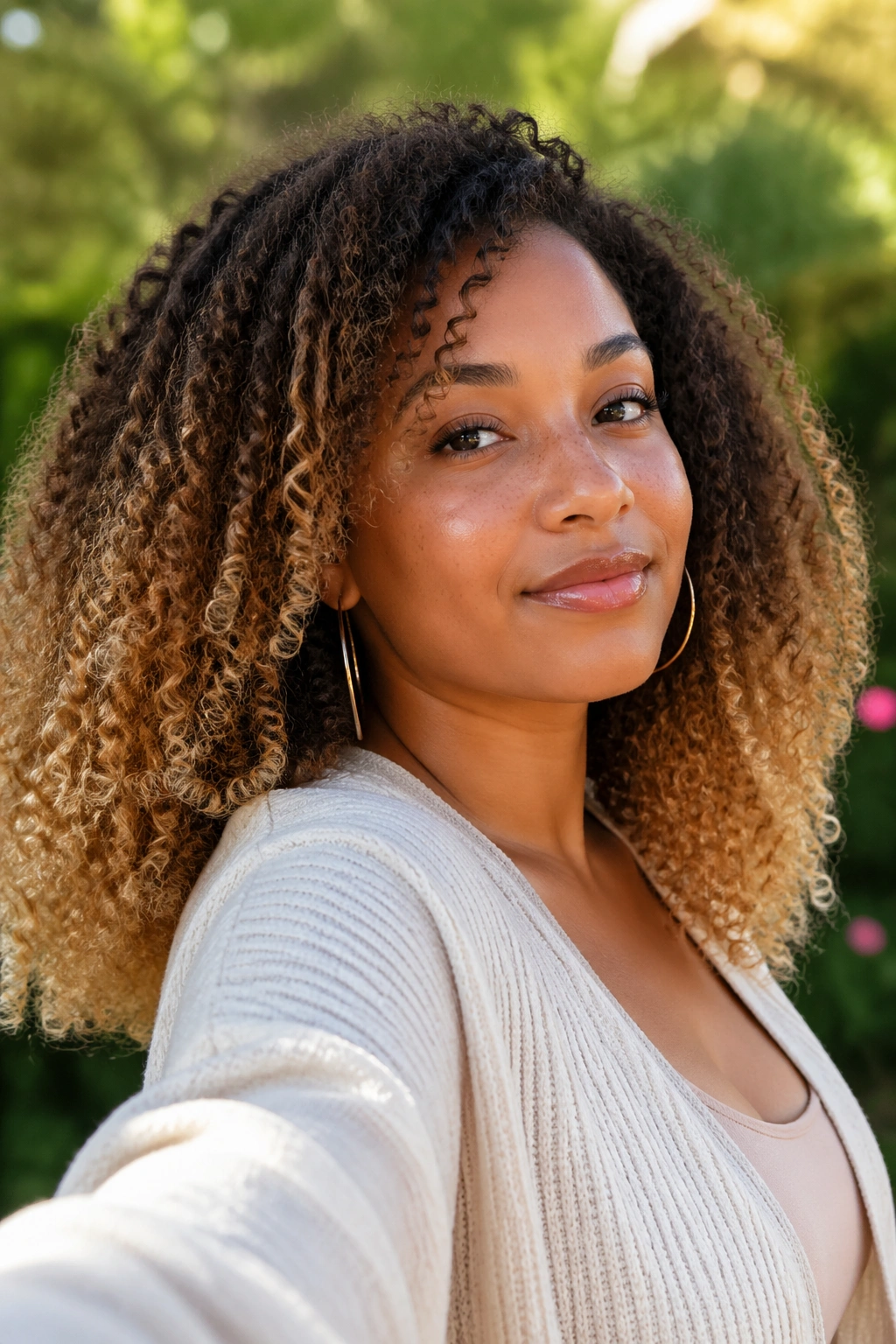
Highlights that are concentrated toward the ends of natural curls — with the roots and much of the mid-length left dark — create a graduated, ombre-adjacent look that’s achieved through traditional highlighting rather than a full ombre application.
This approach creates a beautiful, directional color story — the dark root tells the story of natural hair, the mid-length begins to reveal warmth, and the lighter ends are where the blonde fully expresses itself. On natural curls, this root-to-tip narrative is most visible in stretched styles like twist-outs.
On tightly coiled hair, end-concentrated highlights create a warm, almost glowing outer halo when the hair is worn in its natural state — because the lighter ends sit at the perimeter of the curl formation where they catch the most light.
9. Blonde Highlights with Warm Toner
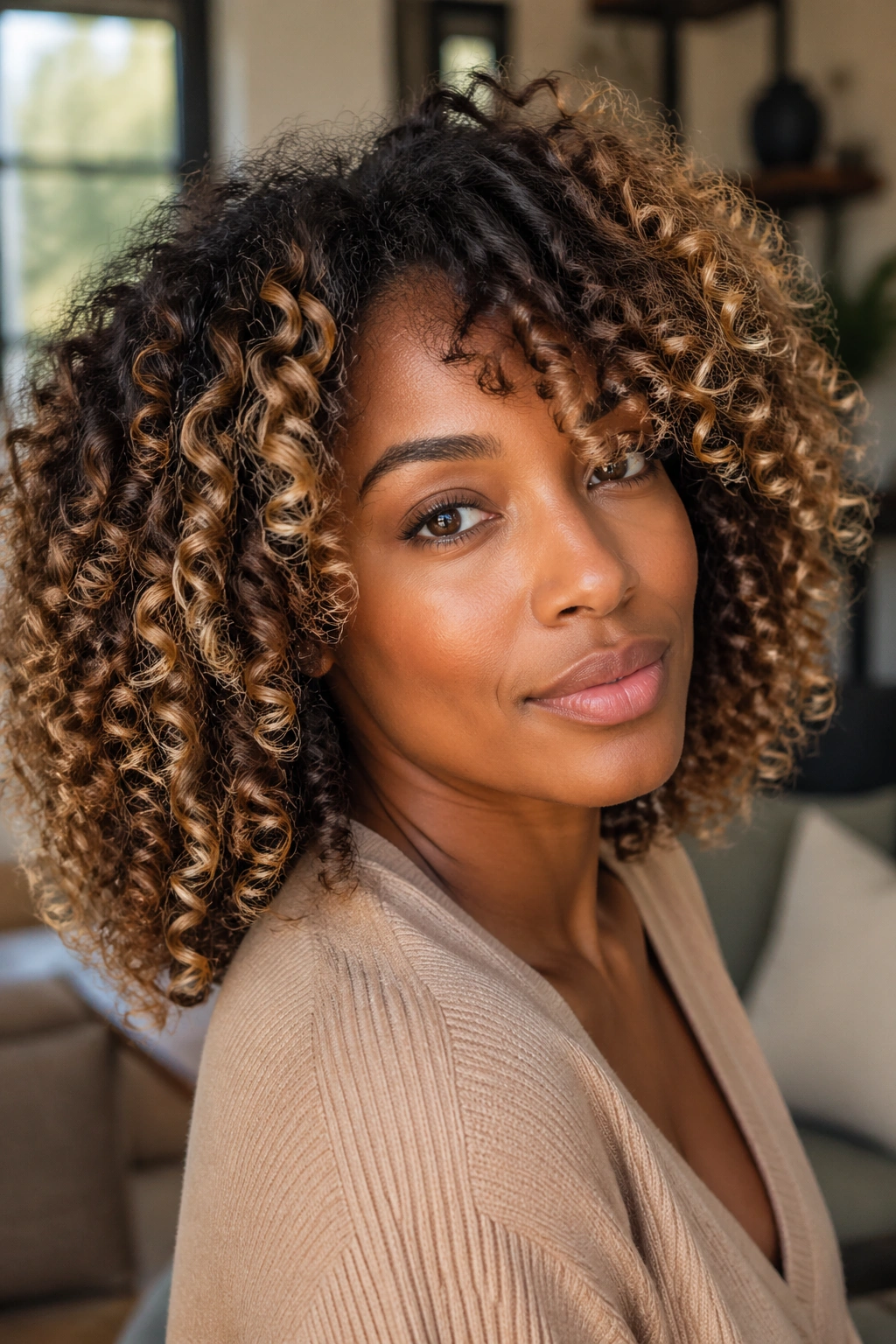
A blonde highlight result is only as good as the toner applied after the lifting step, and choosing a warm toner — rather than the cool or neutral toners common in standard salon practice — is what gives natural hair blonde highlights their characteristic warmth and flattering quality.
Cool toners neutralize warm tones, which is what you want for ash or cool blonde. But on natural curls, particularly on darker skin tones, a warm toner — honey, golden, champagne — creates highlights that feel organic and flattering rather than clinical and cool.
How to Achieve This Look
After your colorist completes the lightening step, they will apply a toner — a conditioning color treatment — to the highlighted sections. Request specifically that the toner be in the warm blonde family rather than a neutral or cool shade. Look at toner swatches with your colorist before application to ensure alignment.
10. Blonde Highlights for Type 4 Curls
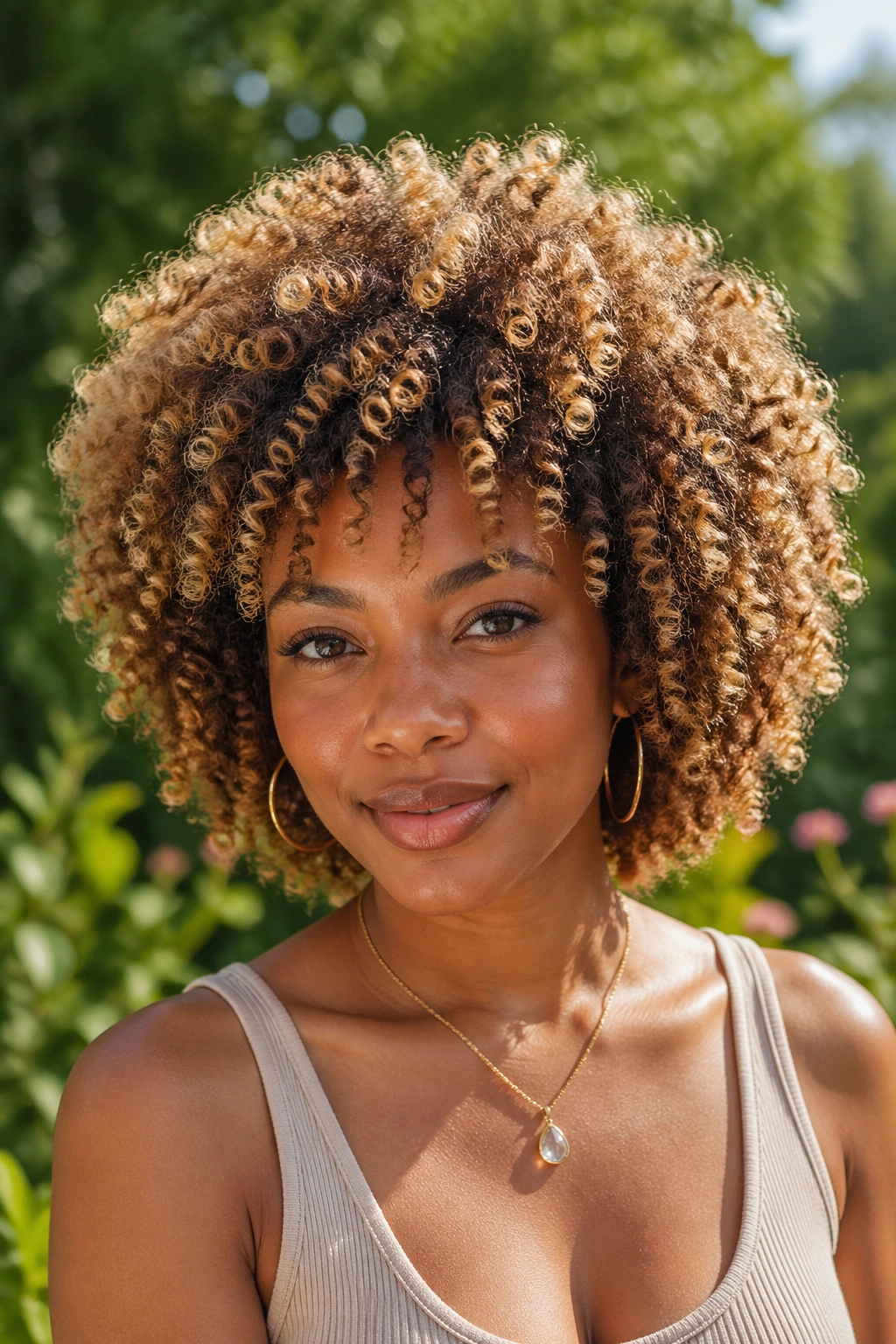
Type 4 natural hair has particular considerations for blonde highlighting that are worth understanding clearly. The tight coil pattern, the typically higher porosity of afro-textured hair, and the unique way type 4 hair displays color all affect the highlight approach and expected result.
Type 4 hair often displays blonde highlights as a warm overall tonal shift rather than as distinct, individual highlighted pieces — because the tight coil compresses each section into such a small space that individual highlighted strands are not always distinguishable from the surrounding non-highlighted strands.
This is not a bad result — it’s just different from what you see on straight or loosely curly hair. A full head of type 4 curls with well-placed blonde highlights has an overall warmth and luminosity that’s genuinely beautiful, even if you can’t necessarily trace each highlighted strand from root to end.
11. Blonde Highlights on Short Natural Hair
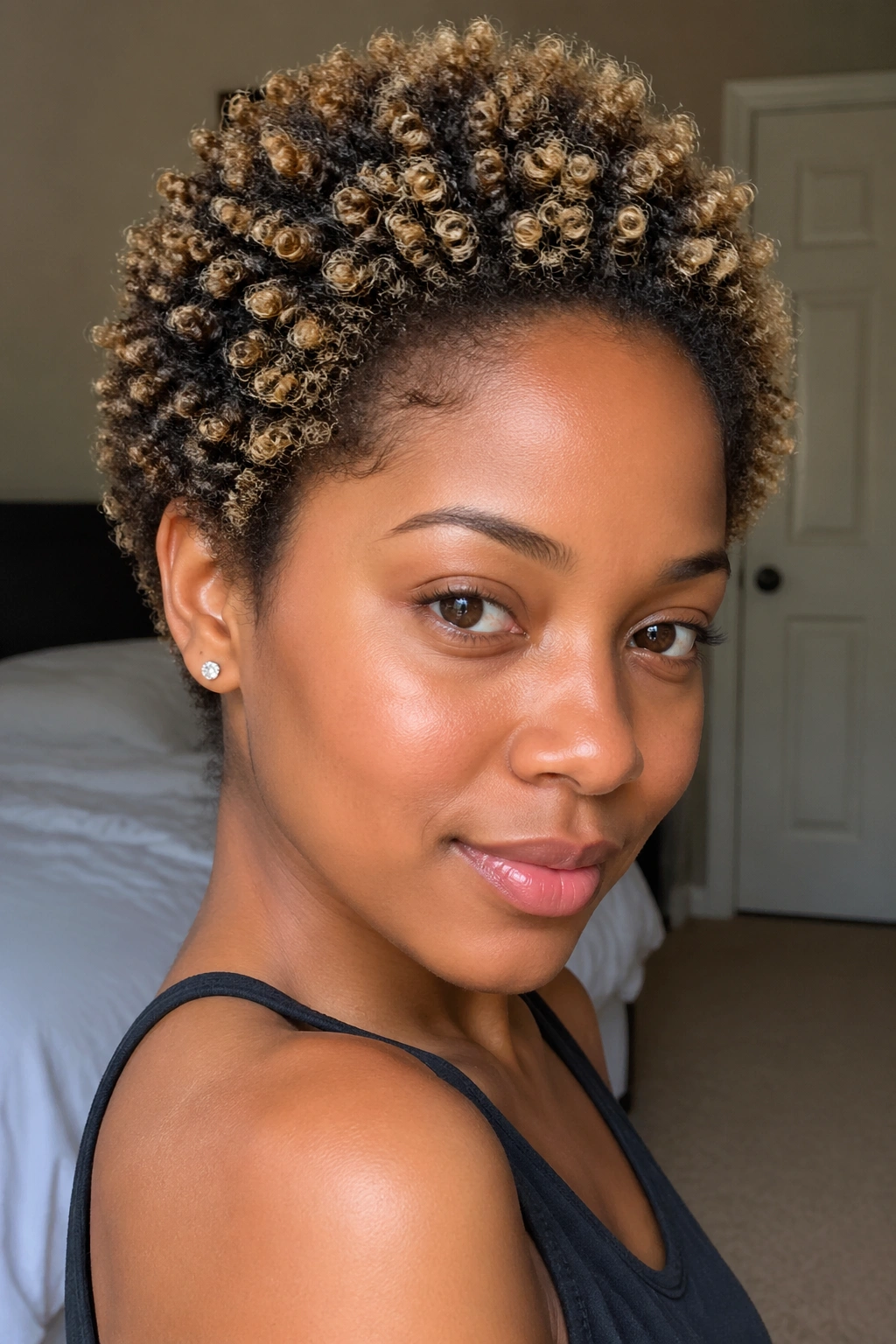
Short natural hair — TWAs, tapered cuts, cropped coil styles — gets blonde highlights, and the result is a distinct, all-over warm glow that creates dimension across the entire head simultaneously. On short hair, there isn’t enough length for a root-to-end gradient to develop, so the blonde highlights show up as concentrated warmth at the tips of each coil throughout the entire style.
This tip-of-the-coil warmth creates a beautiful visual texture — the dark base coil with a warm blonde tip creates a dimensional, almost ombre effect at the individual coil level. It’s one of the most charming and distinctive applications of blonde highlighting on natural hair.
Short highlighted natural hair also tends to be easier to maintain than longer highlighted styles because the proximity of the highlighted ends to the scalp means moisture travels more easily through the entire highlighted section.
12. Blonde Highlights on Locs
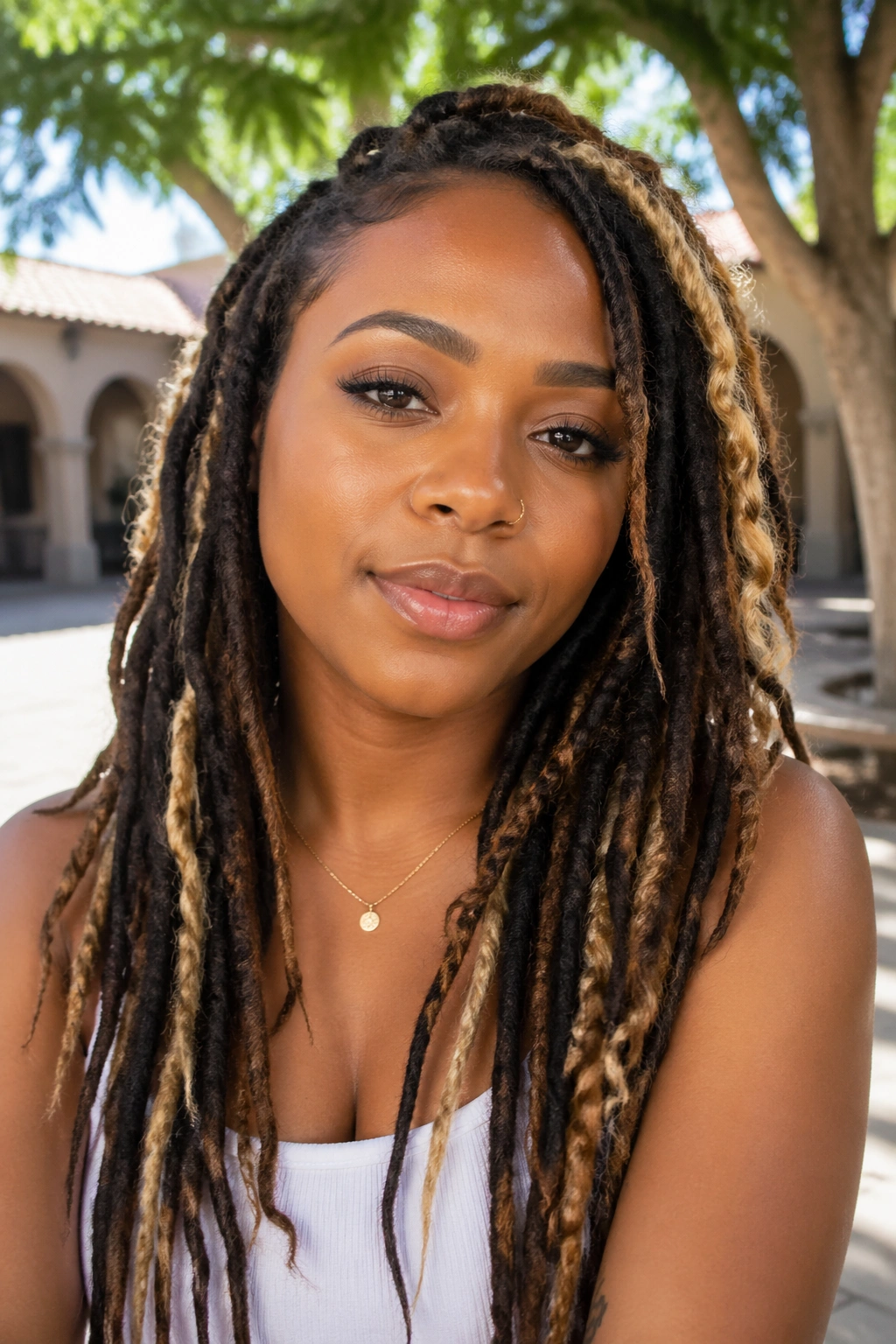
Locs and blonde highlights are a more complex technical combination, but when done right the results are genuinely beautiful. Established locs take color differently than loose natural hair — the compacted structure means lightener penetrates the outer loc surface more readily than the interior strands.
The most effective blonde highlighting on locs treats the outer surface of each loc with a lightener that creates visible tonal lightening without requiring full penetration of the loc body. The result is surface-level blonde warmth that reads as natural and beautiful — as if the locs have been naturally lightened over time.
Work with a colorist experienced specifically in coloring locs — the approach differs significantly from highlighting loose natural hair and requires a different skill set and product knowledge.
13. Blonde Highlights on Protective Styles
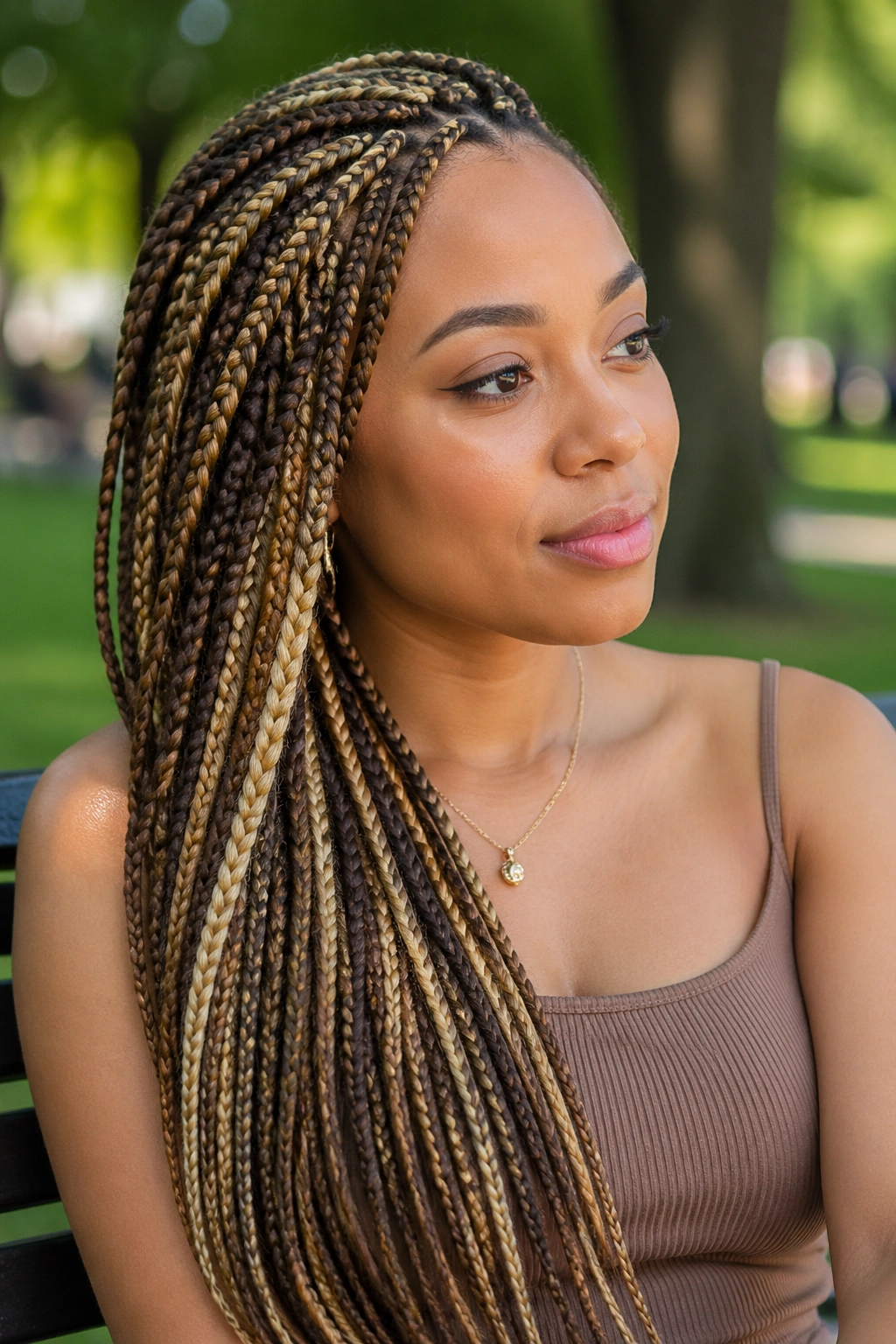
Wearing extension braids, twists, or crochets with blonde highlights — using extension hair that incorporates lighter blonde sections — creates the aesthetic of highlighted natural hair within a protective style framework. Your actual hair stays completely untouched underneath.
Choose extension hair in two to three shades — your natural color as the base, a mid-tone warm brown for the middle range, and a blonde end-shade for the lightened tips — and blend them throughout the installation to create a natural-looking highlight effect throughout the protective style.
This is a completely non-damaging way to experience blonde highlights and is particularly useful for women who want to experiment with the look before committing to chemical processing on their natural hair.
14. Babylights on Natural Curls
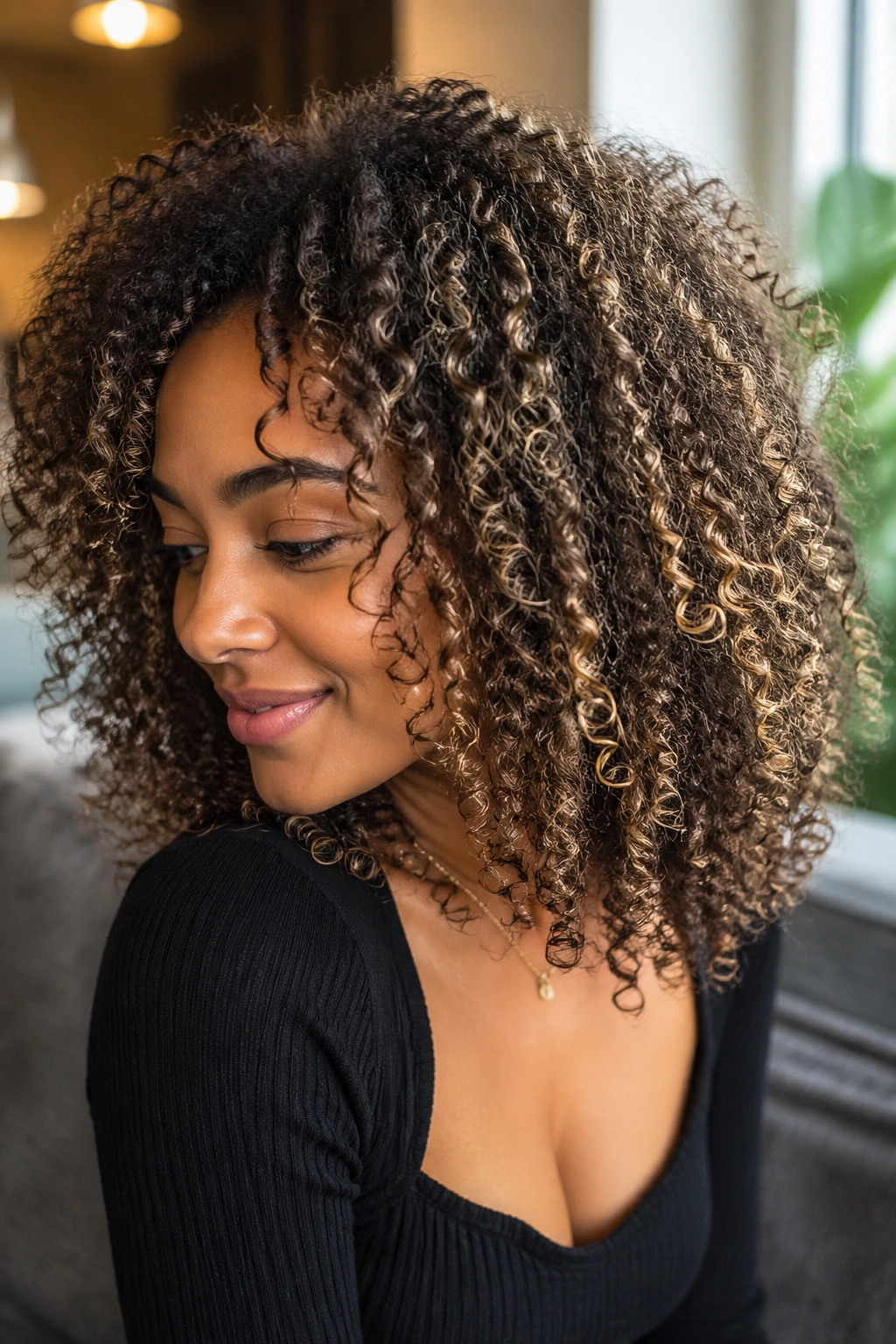
Babylights are extremely fine, delicate highlights that create subtle, all-over luminosity rather than defined, visible highlighted sections. They’re called babylights because they mimic the very fine, scattered light-catching quality of a young child’s naturally sun-kissed hair.
On natural curls, babylights create a warm, overall brightness that’s more diffuse than traditional highlights — the individual sections are so fine that they blend almost completely into the natural base color, creating a subtle tonal lift rather than obvious highlighted pieces.
This is the ideal choice for women who want the dimensional brightness of highlights without the obvious color change — people will notice that your hair looks beautiful and healthy without necessarily identifying color as the reason.
15. Bold Two-Tone Blonde and Black
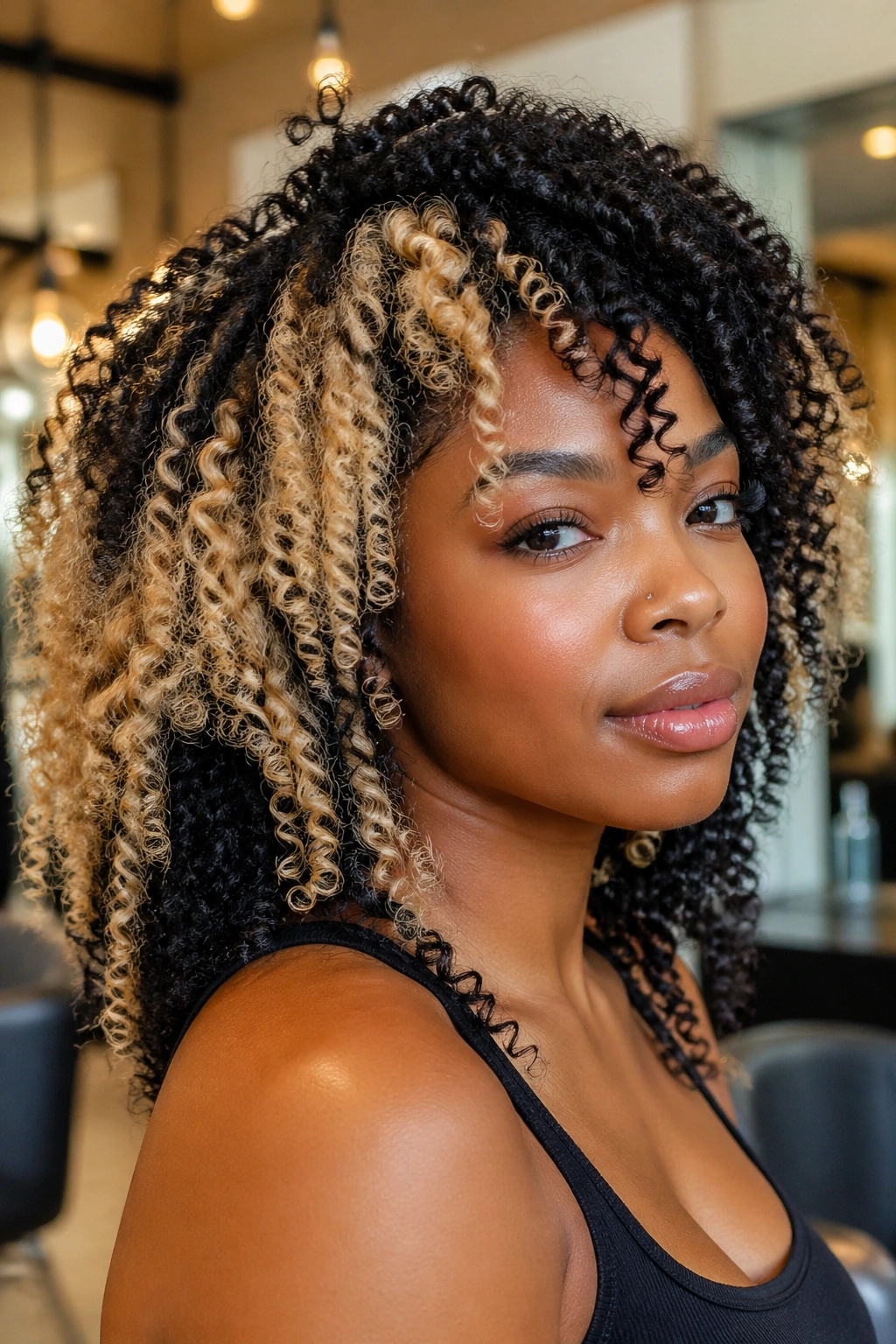
A deliberate two-tone look — bold sections of blonde against sections of natural black natural hair — is a fashion-forward, intentional color choice that requires skilled colorist placement. Unlike subtle scattered highlights, the goal here is clear, defined contrast between dark and light sections.
This look works best with larger, more visible sections — chunky highlights in blonde against natural black create a graphic, high-contrast effect that reads as editorial and intentional. It’s not trying to look natural; it’s trying to look striking.
On natural curls, this bold contrast is particularly effective because the movement of the curls constantly shifts the blonde and black sections in relation to each other, creating a dynamic, constantly changing visual pattern.
16. Highlighted Wash-and-Go
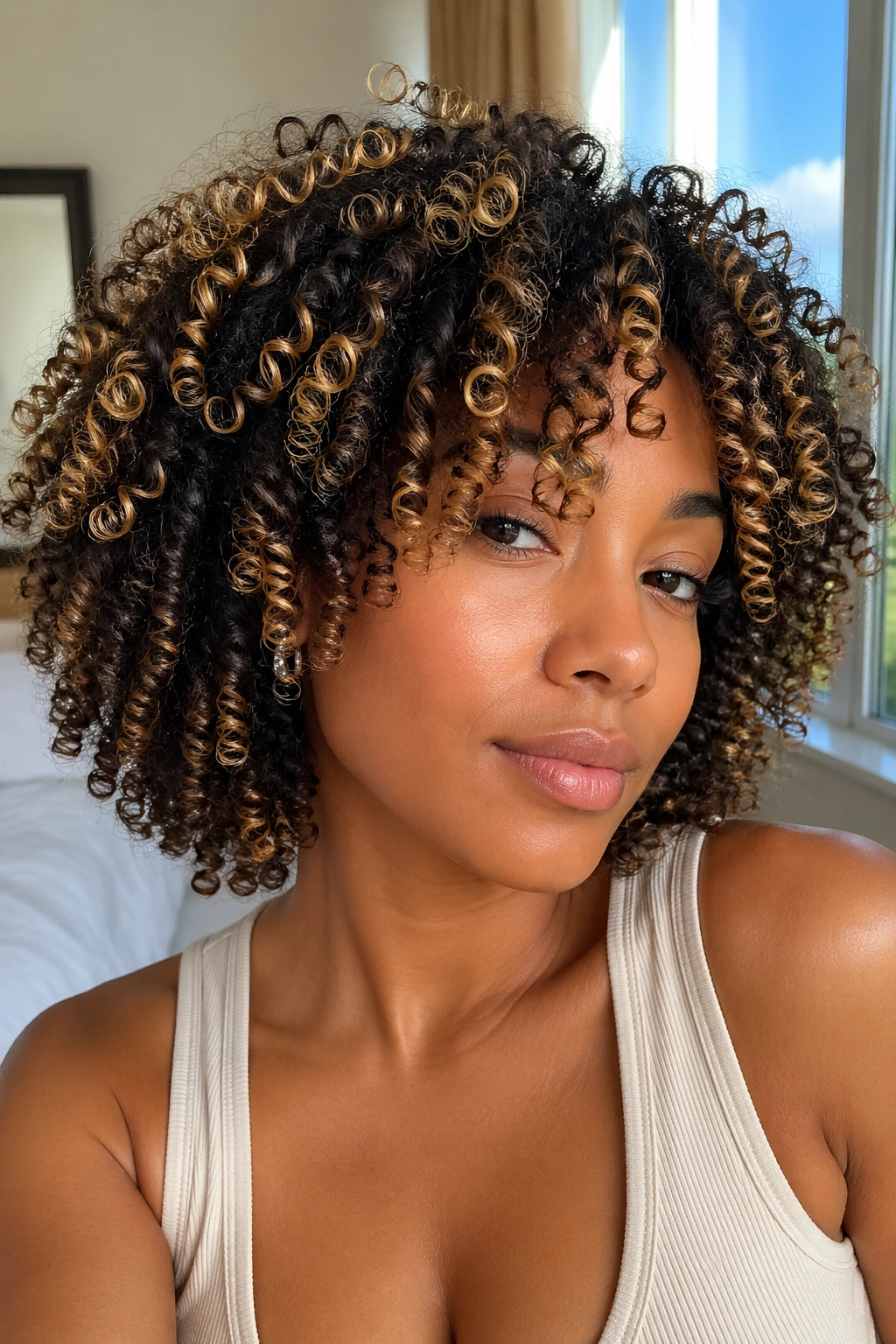
A wash-and-go on blonde-highlighted natural hair is where the highlights show up at their most spectacular — fully defined curls displaying the scattered, dimensional blonde throughout the entire curl formation, catching light from every angle.
The wash-and-go is the true reveal for blonde highlighted natural hair. What sometimes looks slightly uneven or scattered when the hair is wet or still damp resolves into a beautiful, luminous display of warm blonde dimension once the curls are fully formed and dry.
Style as you would any wash-and-go — generous curl-defining product on soaking wet hair, section-by-section application, diffuse or air-dry completely — and then step outside in natural light for the full effect.
17. Highlighted Twist-Out
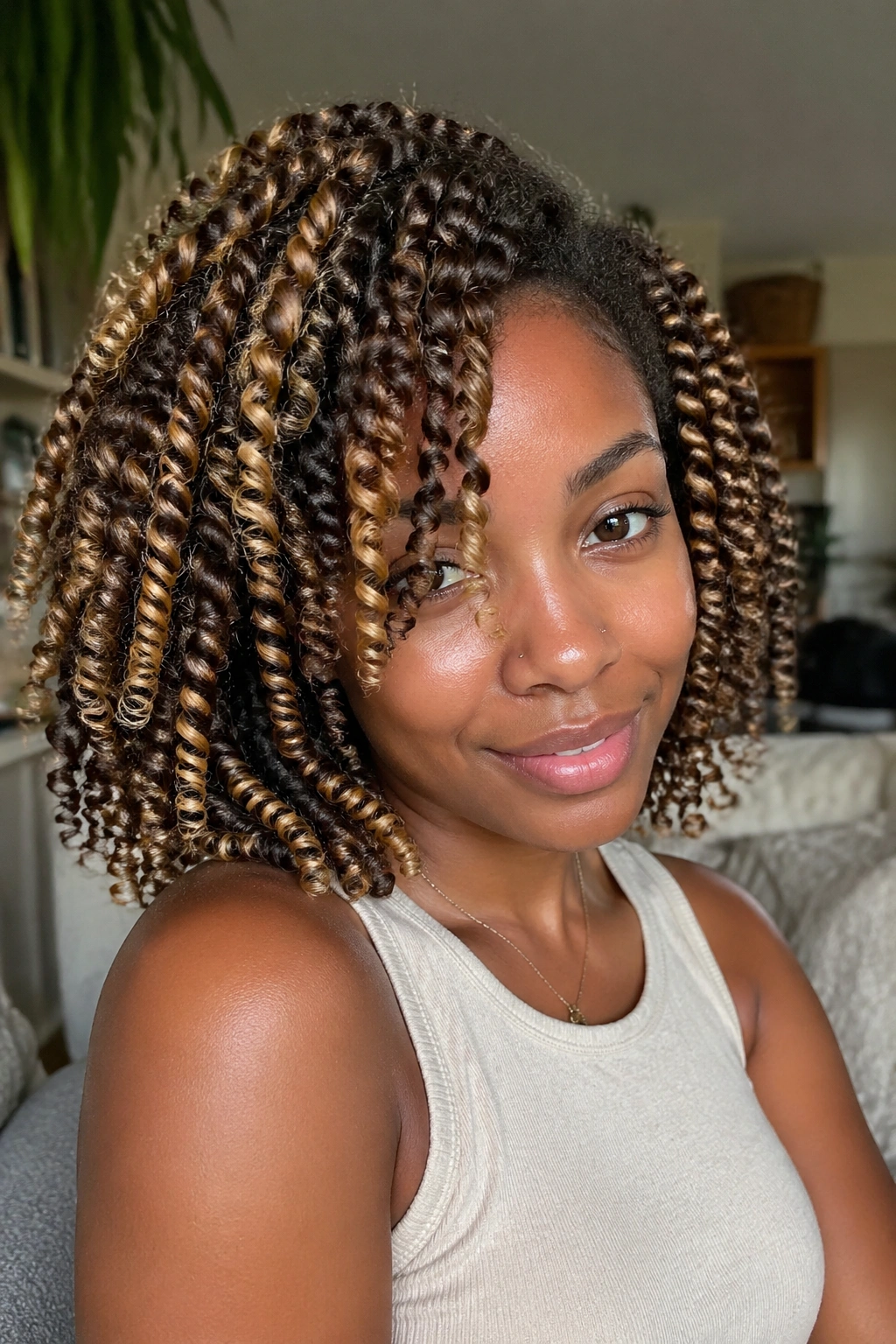
A twist-out on blonde-highlighted natural curls is one of the best ways to actually see the individual highlighted sections — the elongated, defined twist-out spiral stretches each curl enough to display the blonde section as a visible, continuous element along the coil rather than as a tiny compressed flash within a tight natural curl.
This is why many highlighted natural hair enthusiasts prefer twist-outs to wash-and-gos for showcasing their color — you simply see more of it in a defined, stretched style.
The blonde highlights on a twist-out look particularly striking on day one and day two when the twists are freshly unraveled and the definition is tightest. Maintain at night with a pineapple and satin bonnet to extend definition for several more days.
18. Highlighted Curls in a Puff
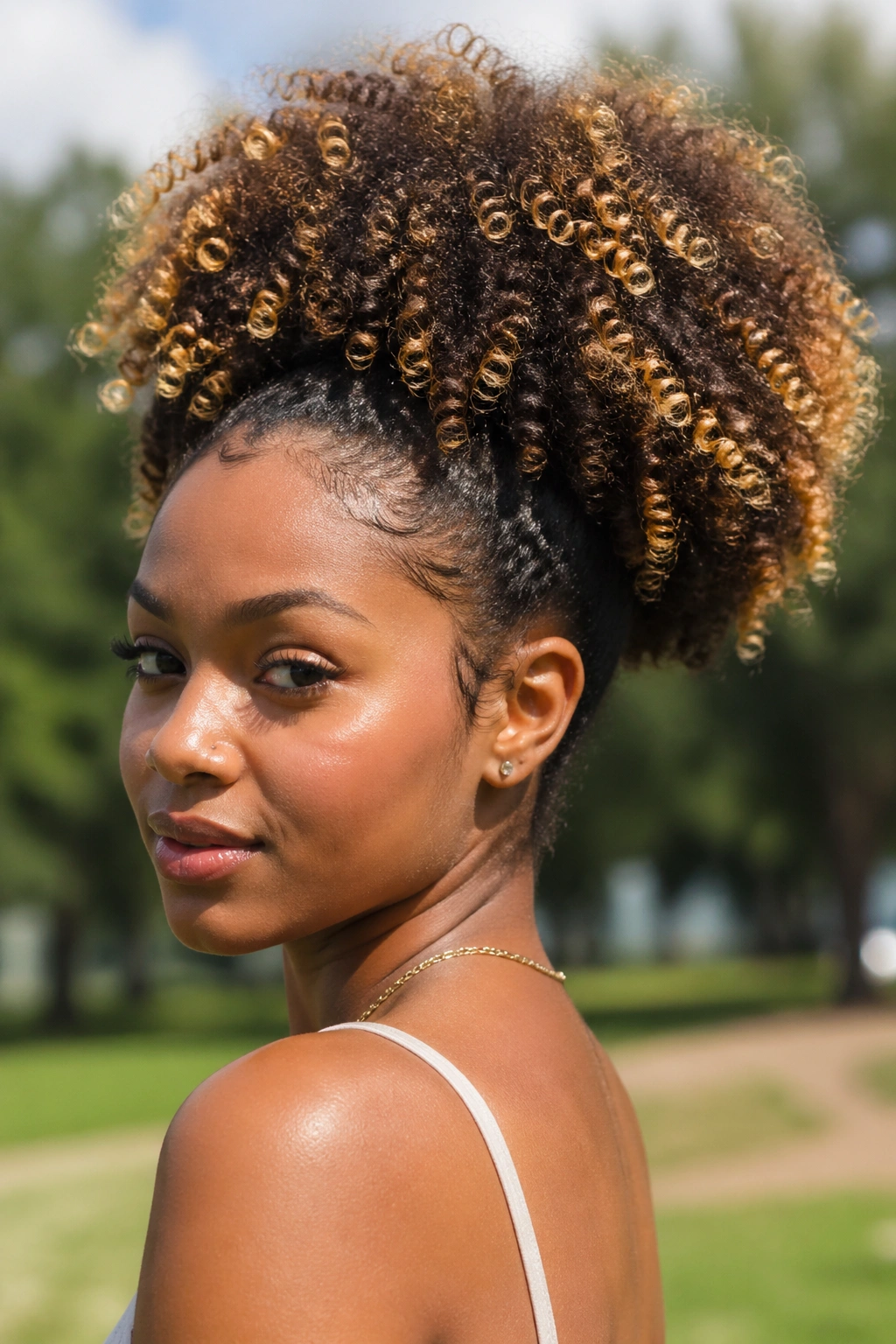
A high puff with blonde-highlighted natural curls showcases the color at maximum volume — the gathered curl mass displays the warm blonde throughout the puff shape, with the lighter ends naturally gravitating toward the perimeter where they catch the most light.
The perimeter of a puff is where blonde highlights show up most vividly because the hair that sits on the outside of the gathered puff shape is where the ends — which carry the most concentrated highlighting — are most visible. The result is a warm, glowing rim of lighter color around the outer edge of the puff.
A puff with blonde highlights doesn’t need any extra styling to look intentional and beautiful — the color provides all the visual interest needed.
19. Blonde Highlights and Color-Depositing Maintenance
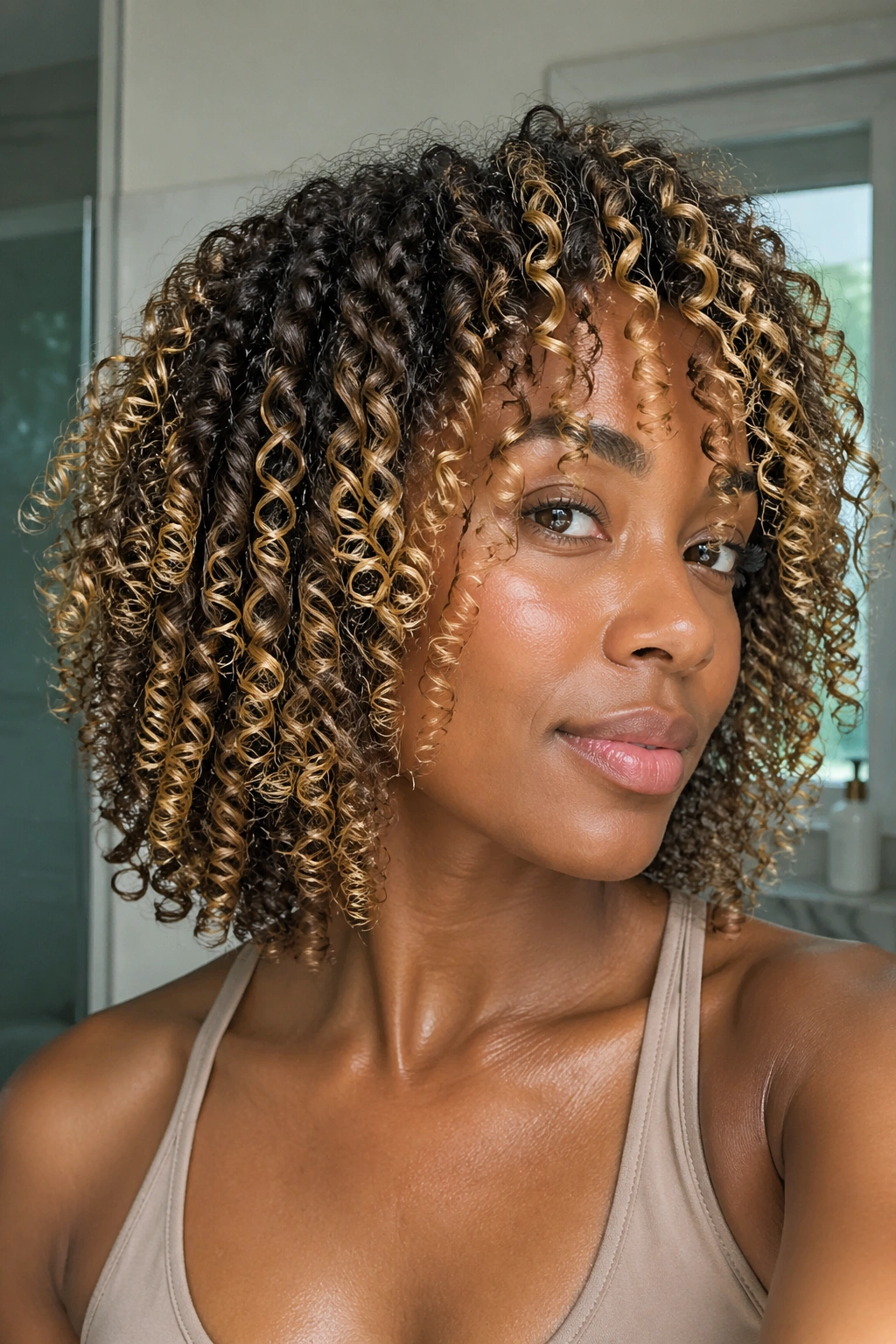
The wash-day maintenance routine for blonde-highlighted natural curls should incorporate color-depositing products to keep the blonde tones from fading between appointments. Understanding which products to use and how often is essential for keeping your highlights looking their best.
Warm blonde color-depositing shampoos and conditioners — specifically formulated for golden, honey, or caramel blonde tones — add a small deposit of warm blonde pigment with each use. This doesn’t re-create the original highlight but meaningfully slows the fade and keeps the warm blonde quality in the highlights through the color cycle.
For platinum or cooler blonde highlights, a purple shampoo used once a week neutralizes yellow and brassy tones, maintaining the cool, bright quality of the platinum. Use it once weekly and alternate with a regular shampoo — daily use of purple shampoo can create an unwanted violet tint.
20. The Grow-Out Journey for Blonde Highlighted Curls
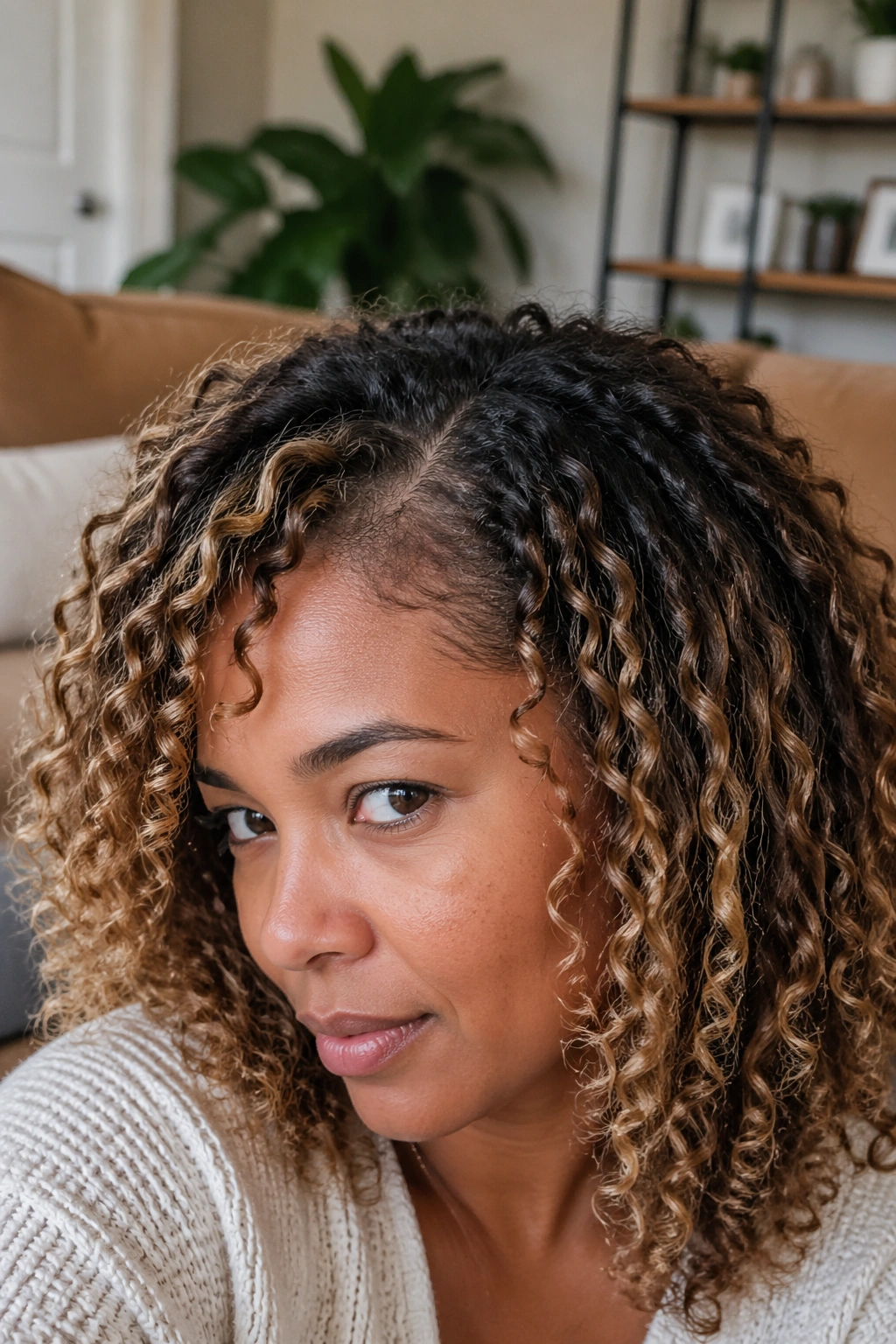
One of the practical considerations of blonde highlights on natural hair is how to manage the grow-out — the period between color appointments when new natural growth becomes visible at the root.
Blonde highlights have one of the more forgiving grow-outs of any color technique because the dark natural root is expected — you started with dark hair, and the natural root growth simply reinforces the original framework of the look. There’s no harsh line of demarcation between a natural root and a highlighted mid-length or end the way there would be with all-over blonde color.
That said, at a certain point — usually four to six months depending on your hair’s growth rate — the highlighted sections have grown far enough from the scalp that the original placement starts to look disconnected from the current root zone. That’s the signal that it’s time for a touch-up appointment.
21. Protecting Blonde Highlights in the Sun
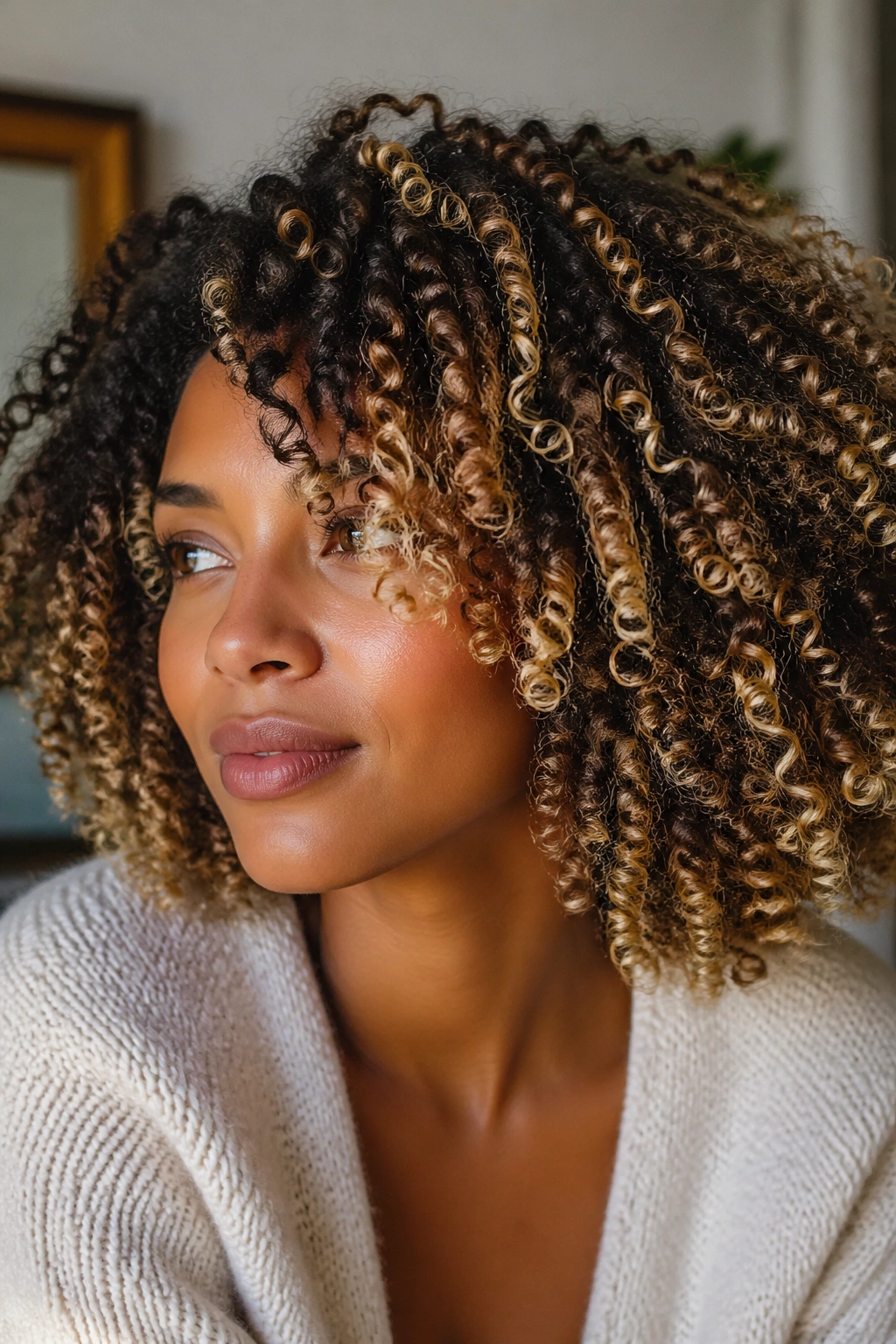
UV exposure is particularly damaging to blonde highlights because the lightening process that creates the blonde removes the protective melanin that helps hair resist UV degradation. Highlighted sections are genuinely more vulnerable to sun damage than natural, non-highlighted hair.
Wearing a hat during extended outdoor sun exposure is the most effective protection — complete physical coverage keeps UV rays off the hair entirely. But for days when a hat isn’t practical, a UV-protective finishing spray or leave-in conditioner with UV filters provides meaningful protection against color fade and photochemical damage.
Rinse your hair after swimming in chlorinated or salt water — both chlorine and salt accelerate color fade and can cause significant damage to the highlighted sections if left in the hair for extended periods. A quick fresh water rinse immediately after swimming makes a significant difference in how long your blonde highlights stay vibrant.
22. Finding a Colorist Skilled in Blonde Highlighting on Natural Hair
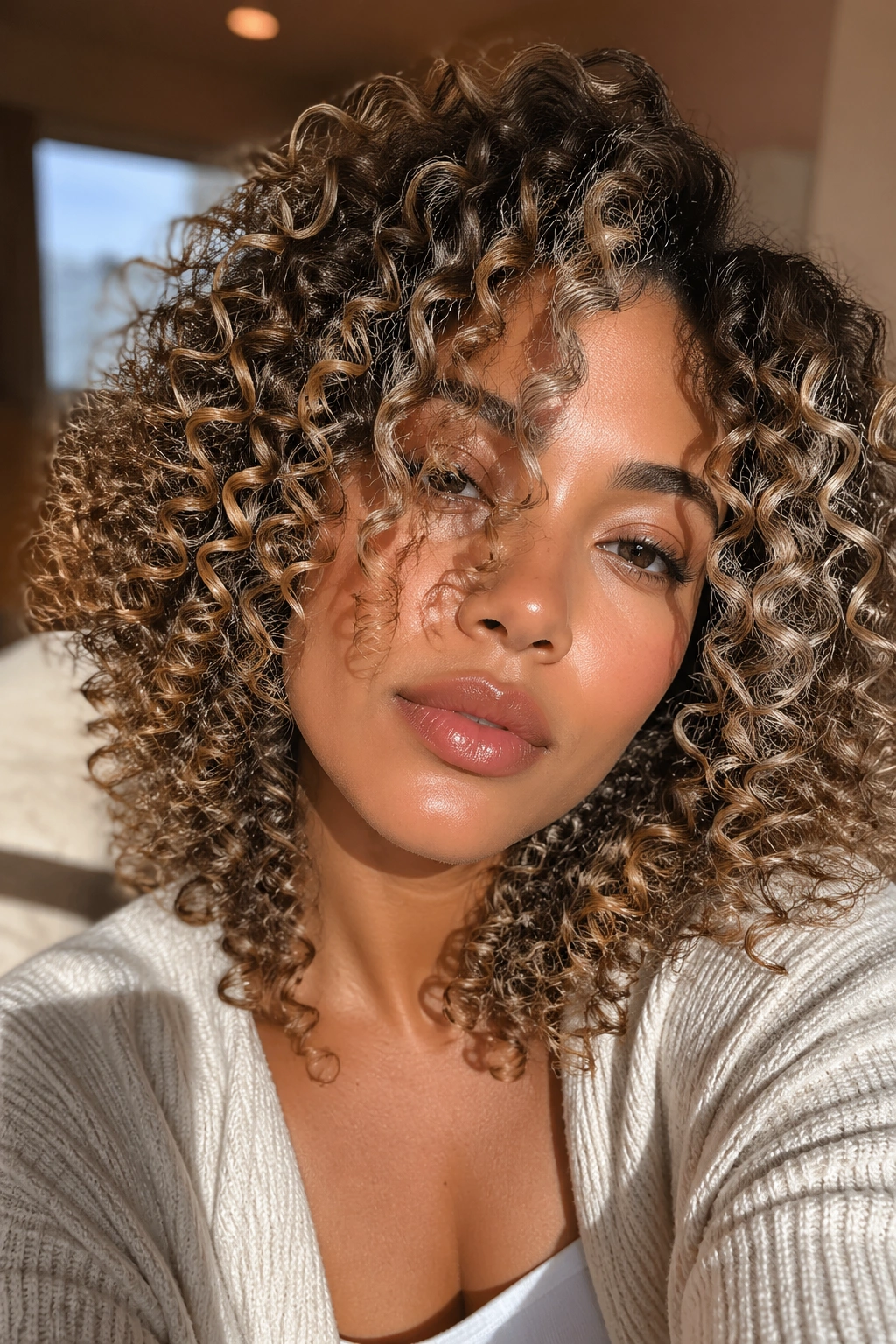
This is genuinely the most important decision in the entire blonde highlighting process. Not all colorists have experience working with natural hair specifically, and a colorist who primarily works on straight or relaxed hair may not have the technical understanding needed to highlight natural curls beautifully and safely.
What to look for: A portfolio of actual work on natural curly and coily hair in the specific color range you want. Client reviews that specifically mention natural hair expertise. A willingness to have a detailed consultation before the appointment. Comfort discussing curl pattern, porosity, and the specific technique they’ll use for your texture.
What to avoid: Any colorist who wants to blow-dry or straighten your hair before applying highlights without a clear explanation of why this serves your specific goal. Any colorist who can’t show you photos of blonde highlights on natural curls similar to your texture. Any colorist who minimizes concerns about curl pattern preservation.
The right colorist is out there — and investing the time to find them is one of the most important things you can do for your blonde highlighting journey. A great colorist makes the entire experience safer, more predictable, and significantly more beautiful.
