


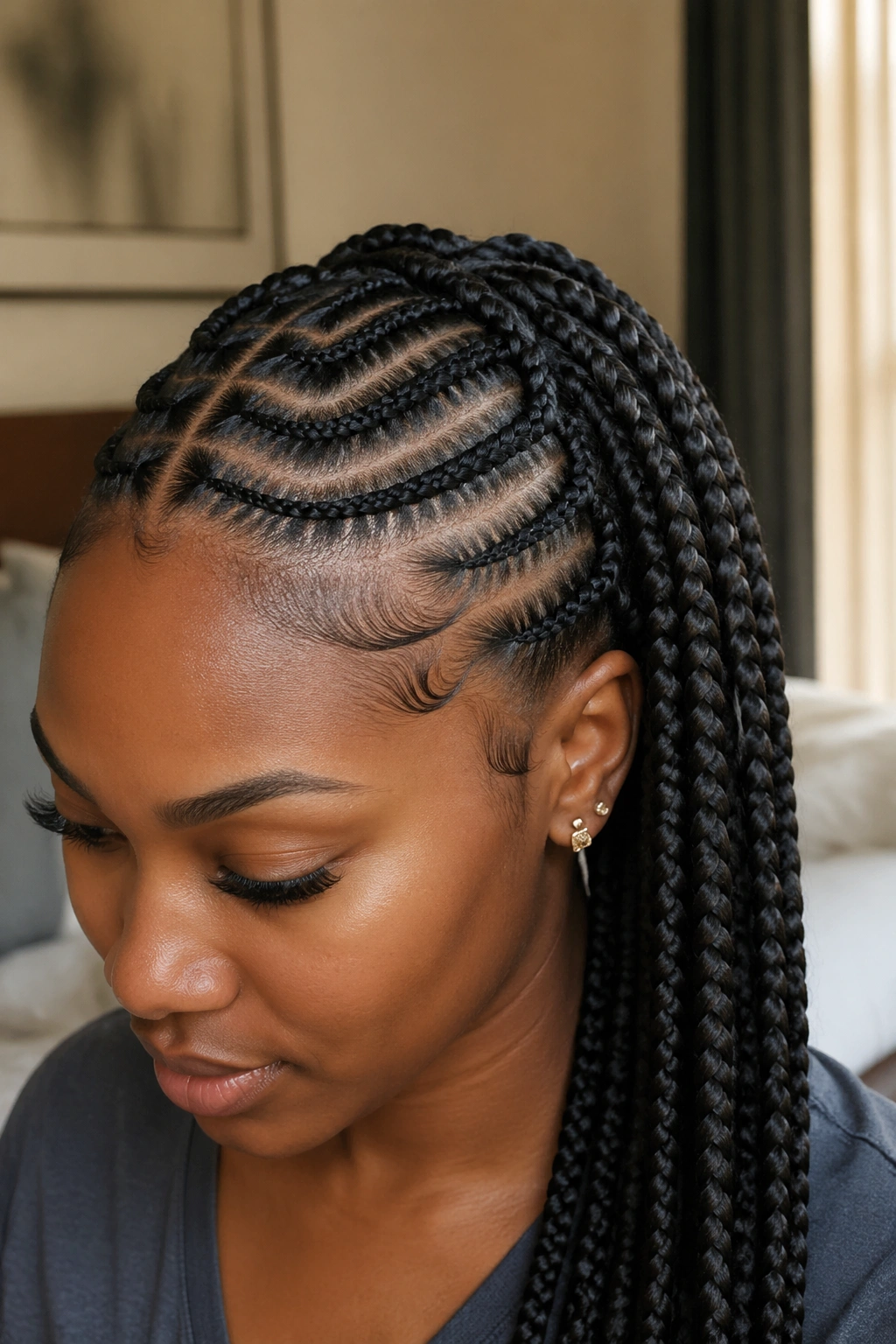
Mixing cornrows with box braids gives you the best structural combo in the protective styling playbook. The cornrows handle the crown — flat, close to the scalp, engineered for a polished front view. The box braids handle the length — free-hanging, swinging, collecting stares when you walk. Cornrow styles with box braids are what you ask for when you want both worlds without committing to either one alone.
The genius is in the transition. Where the cornrow ends, the box braid begins. Get that junction right and the style looks seamless. Get it wrong and you’re staring at a weird bulge where the braid direction changes.
I’ll walk through 22 combinations that actually work — from subtle pairings where the cornrows are barely visible to bold layouts where the cornrow pattern is the focal point and the box braids are supporting cast. Some take three hours. Some take eight. You’ll know which tier you’re committing to by the fifth entry.
The Structural Logic
Cornrows work horizontally. Box braids work vertically. When you combine them, you’re creating a two-zone style — one zone where the braiding is tight against the scalp, another where it hangs free. The point where these zones meet is the visual anchor.
Most cornrow-plus-box-braid styles put the cornrows on the front and top, with box braids taking over from the crown back. But you can flip it. Box braids up top and cornrows at the nape reads as edgy and off-pattern.
Tension rules matter more here than in a pure cornrow or pure box braid install. Cornrows pull on the scalp. Box braids pull on whatever they’re anchored to. If you’ve got cornrows anchoring the front and then box braids hanging from them, the weight of the box braids compounds the cornrow tension.
The braider’s skill shows at the junction. A clean cornrow-to-box transition is something you pay for. It’s not something every braider can pull off cleanly.
What You’ll Need Before the Install
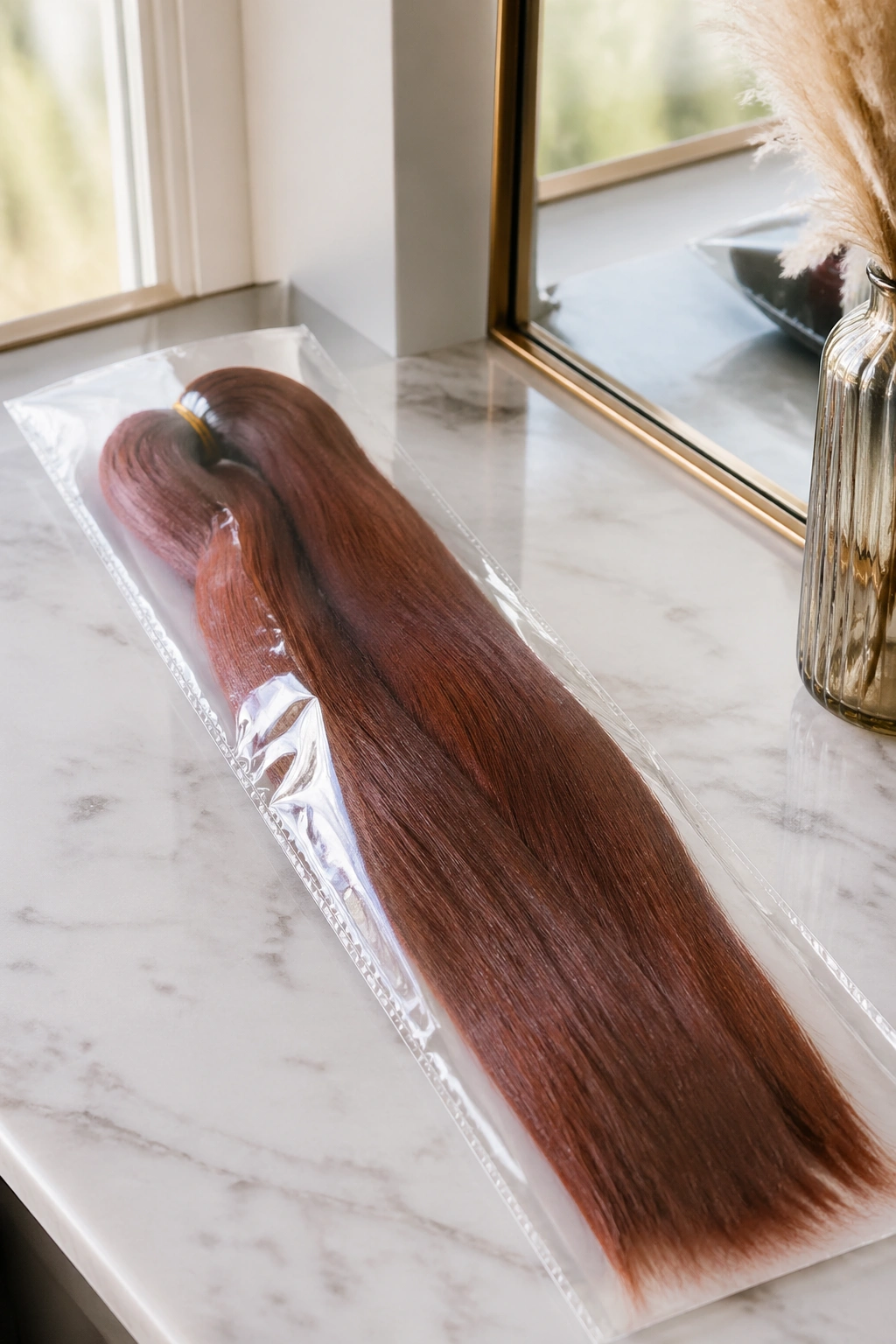
Kanekalon hair — typically 4-6 packs for a full head of medium-sized box braids, plus extra for cornrow feed-ins. Pre-stretched kanekalon is easier to work with than unstretched because you skip the prep time, but it costs more per pack.
Edge gel with a firm hold. A rat-tail comb with a sharp metal tip for parting (plastic tips wobble and give you wavy parts). Hair clips in quantities of 10+ because you’ll be sectioning constantly.
A spray bottle with water and a bit of leave-in conditioner for keeping hair damp while braiding.
For the install itself, block off at least a 5-hour window. Small box braids with cornrow fronts can push past 8 hours. Eat before you sit, because you’re not getting up easily once the parts are set.
Preparing Hair for a Combo Install
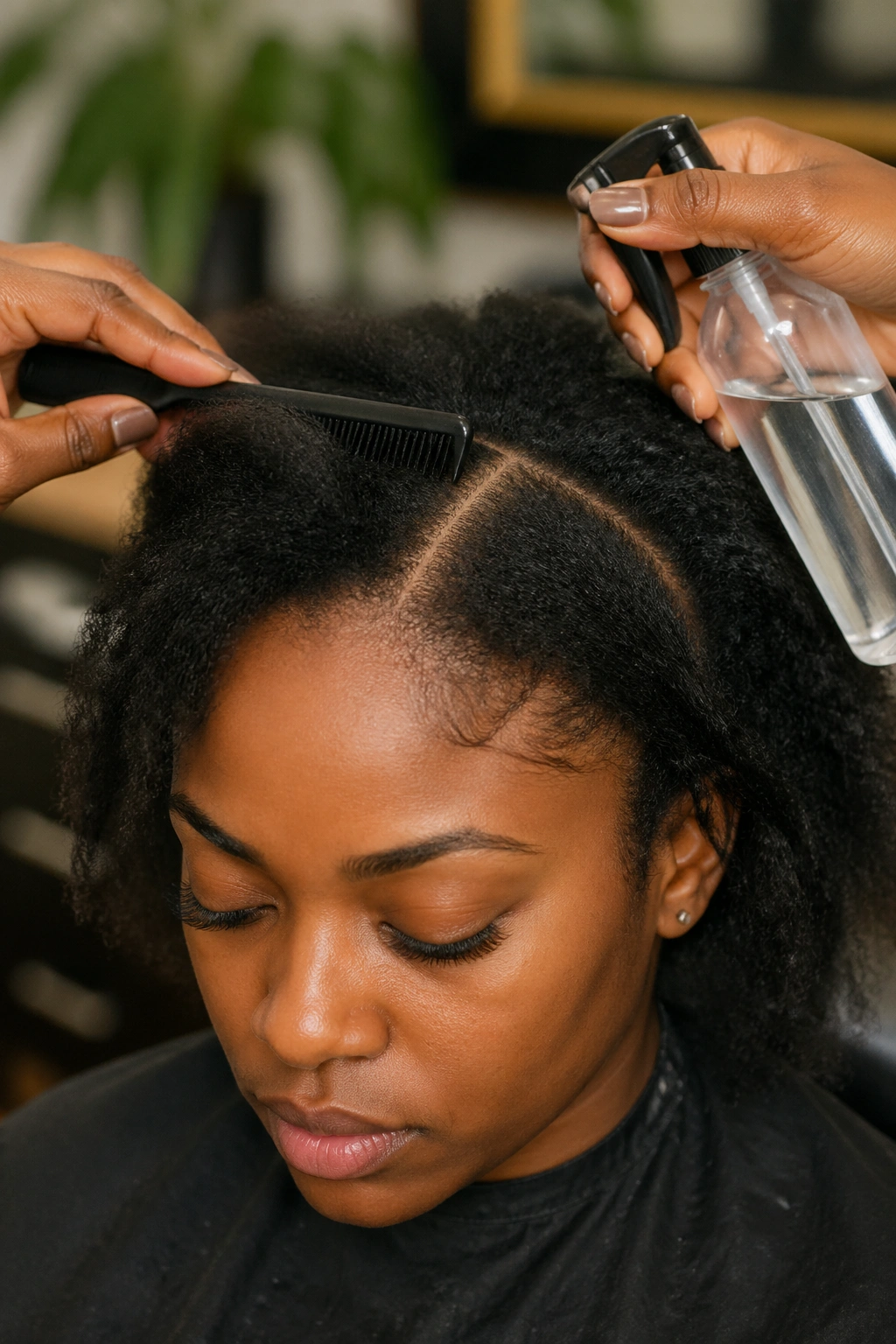
Cleanse 2-3 days before — never same-day. Clean hair + kanekalon = slippery install that loosens within a week. You want your natural scalp oils grippy, not stripped.
Deep condition and trim any split ends. Split ends don’t matter much for aesthetic but they cause the braid to fray near the root, which loosens the cornrow anchoring over time.
Blow dry on low heat or stretch with a twist-out overnight. Shrunken coils are harder to cornrow cleanly, and cornrow cleanliness is half the battle in this style.
Moisturize lightly. Heavy creams and butters under braids trap moisture and can cause scalp issues over a 4-6 week install.
Choosing Box Braid Size
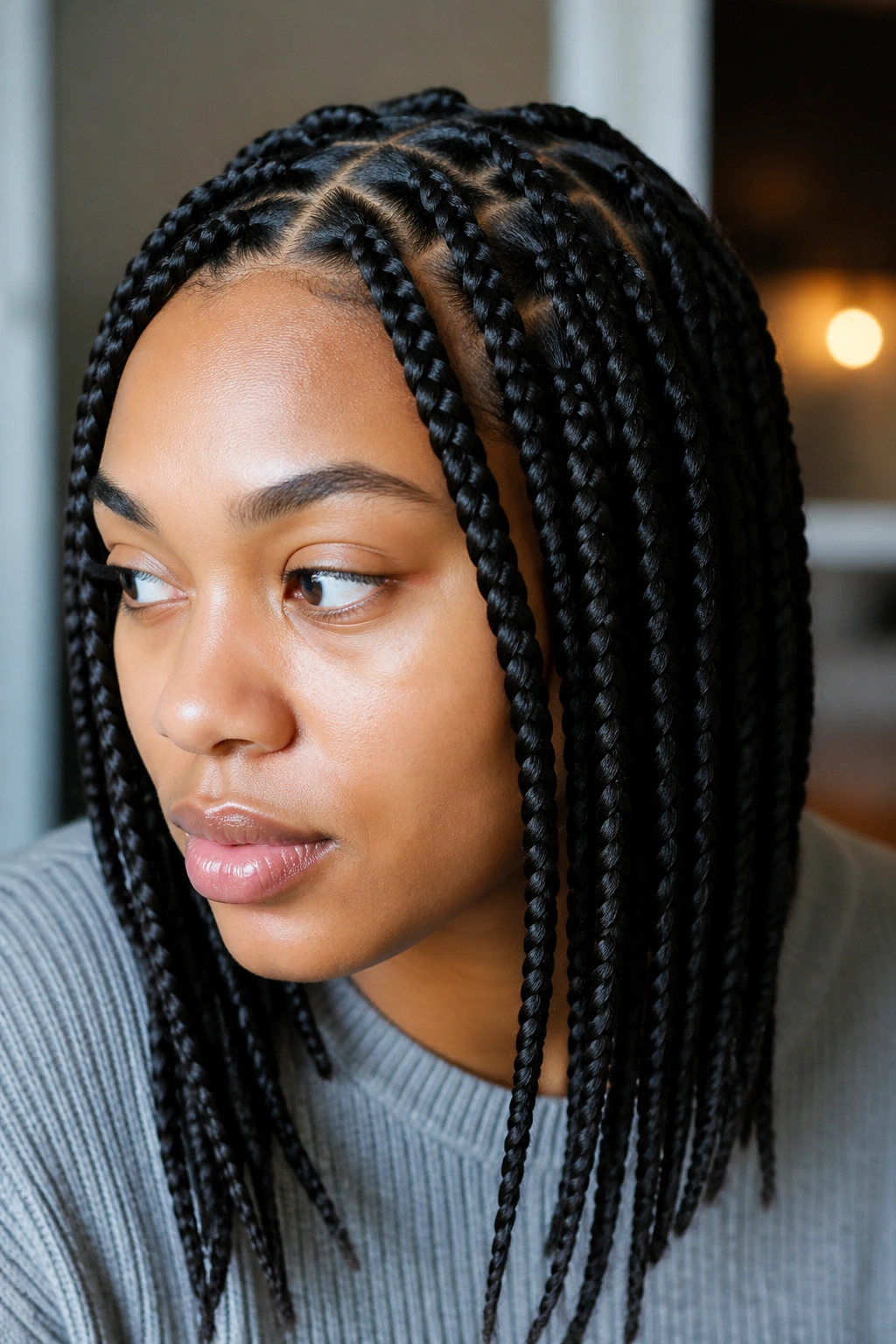
Box braid size changes the entire feel of the style. Jumbo box braids (finger-thick or larger) take 4-5 hours total including cornrow fronts. Medium box braids (pencil-thick) take 6-7 hours. Small or micro box braids (smaller than a pencil) take 10+ hours and can stretch to two braiding sessions across two days.
For most first-time combo installs, medium box braids with medium cornrows hit the best balance. You get definition without a brutal install time.
The size ratio matters too. Cornrows and box braids should be proportional. Thin cornrows with jumbo box braids looks off. Thick cornrows with micro box braids looks heavy on top.
Match the scale. Medium with medium. Small with small. Jumbo with jumbo.
How Long This Style Actually Lasts
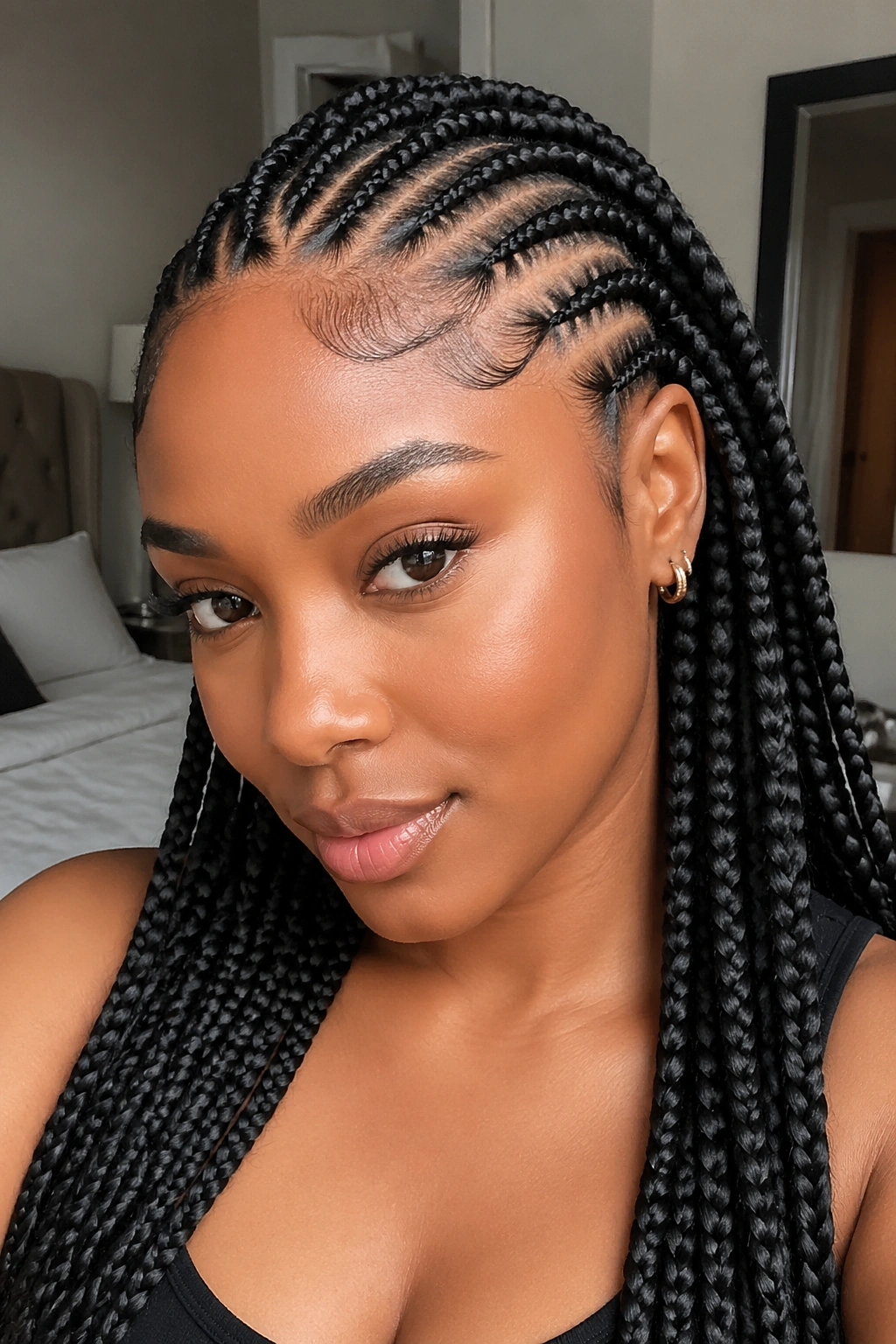
A cornrow-plus-box-braid install holds up for 4-8 weeks depending on hair type, maintenance, and where you sleep. 4C hair with consistent satin bonnet care on a silk pillowcase stretches closer to 8 weeks. Looser curl patterns with less consistent care loosen faster — around 5-6 weeks.
The cornrows loosen first. That’s just physics. They’re anchored to your scalp and subject to every head movement, every ponytail adjustment, every hair tie that sits across the crown. The box braids stay intact longer because they’re hanging free.
When the cornrow section starts looking fuzzy, you have options. Re-braid the cornrows while keeping the box braids intact. Or rock the fuzzy cornrow look intentionally for another week, then take the whole install down.
1. Half-Head Cornrows, Half-Head Box Braids
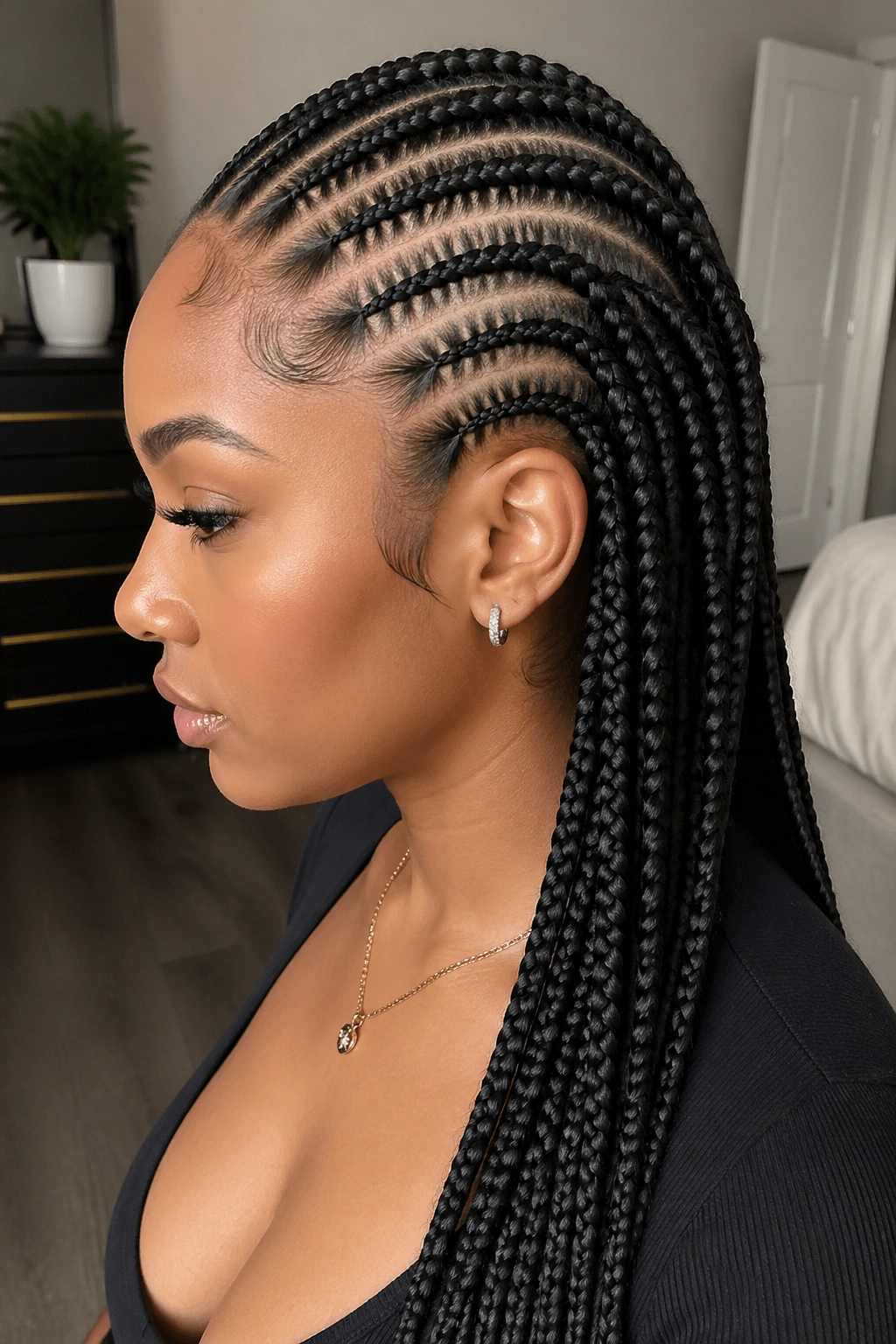
The foundation combo. Top half of the head cornrowed — about 8 to 12 flat braids running from forehead to crown. From the crown back, transition to box braids of a matching size. The braids hang from the crown down to wherever your chosen length ends.
Why It Works
Simple geometry. The cornrows handle everything visible from the front and top. The box braids handle everything visible from the back and sides. The transition at the crown hides under the natural topography of the head.
- Cornrow count: 8-12 depending on desired part visibility
- Box braid count: matches cornrow count × 3 typically
- Box braid length: shoulder to waist, personal choice
- Install time: 5-6 hours for medium sizes
Each cornrow should feed directly into one to three box braids. Not more than three — and if a single cornrow feeds into more, the junction bulges.
2. Stitched Cornrows With Waist-Length Box Braids
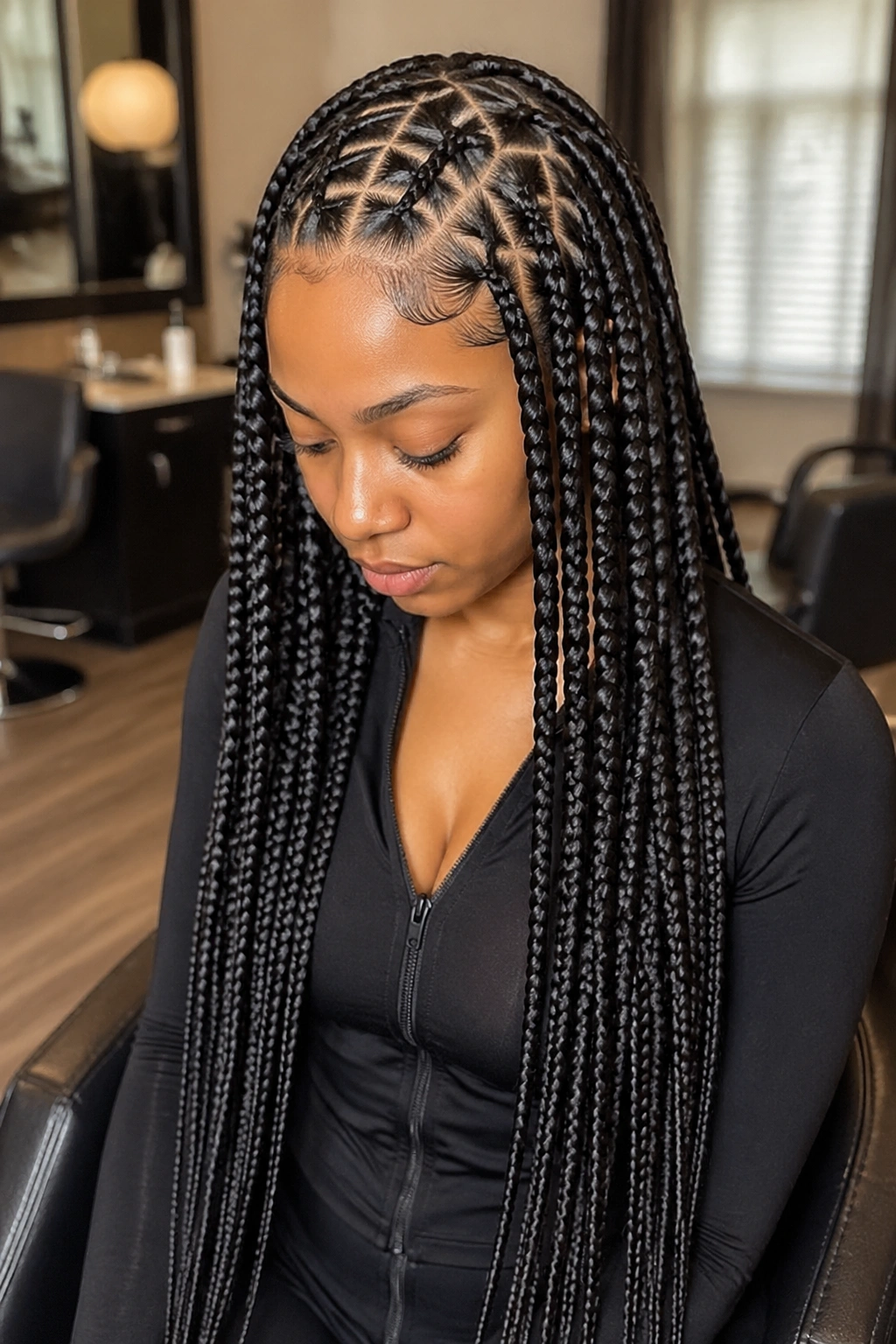
Stitched cornrows use small horizontal dividers across each braid — tiny perpendicular stitches that create a ladder effect along the length of the cornrow. Six to eight of them on a medium-length cornrow. Then the braid continues into a waist-length box braid.
The stitching is done with small pieces of extension hair wrapped around the braid at intervals. It adds texture and visual interest to a section that would otherwise look plain.
Waist-length box braids with stitched cornrow fronts is a go-to for anyone wanting length without sacrificing pattern detail. The long braids move and swing; the stitched tops stay crisp.
Who this is best for: anyone with 4-6 weeks blocked for the install to live on their head and patience for longer takedown.
3. Center-Part Cornrows Into Box Braids
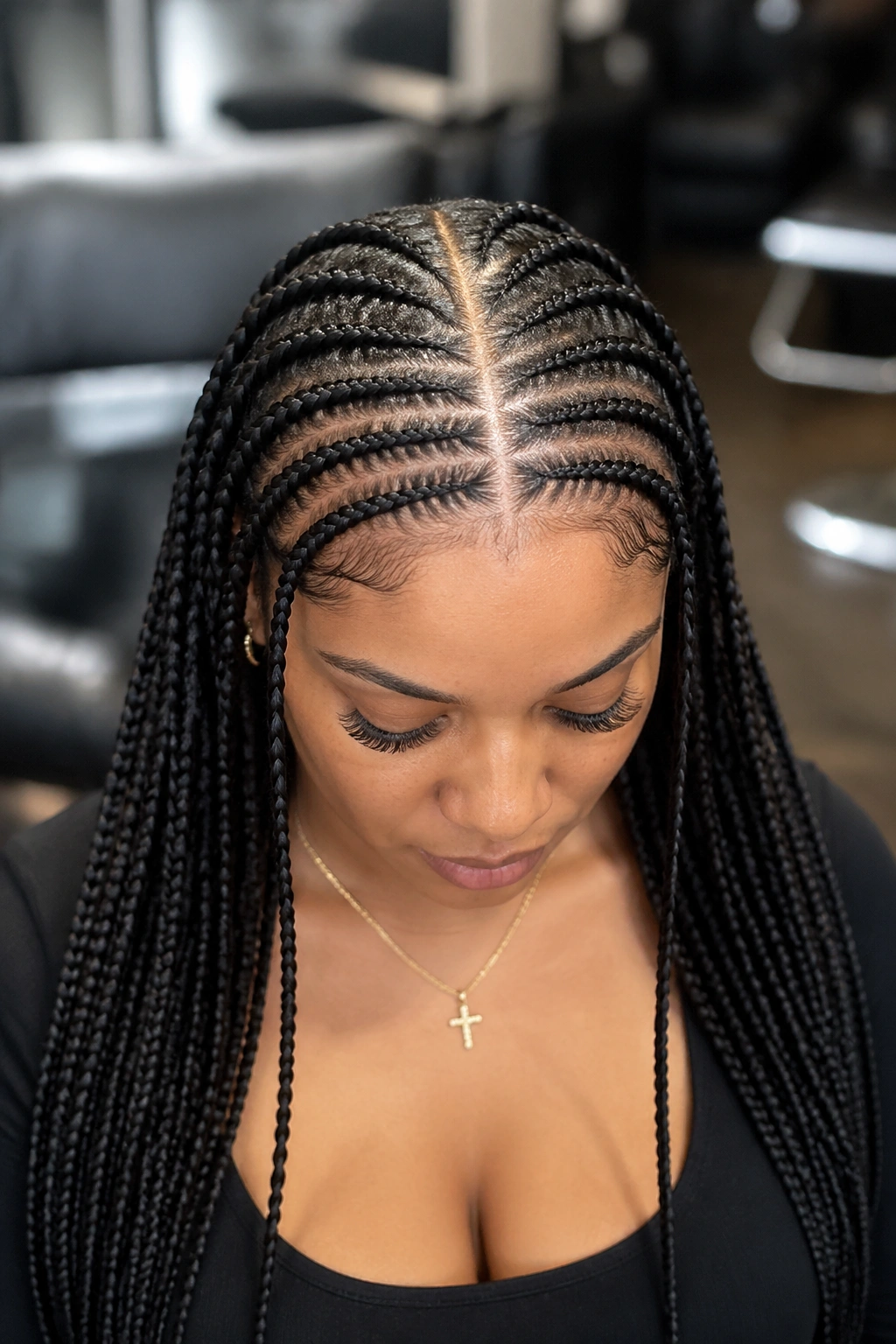
A deep center part runs from forehead to crown, with 4-6 cornrows on each side flowing toward the temples and then down into box braids. The part is the focal point — it’s clean, straight, and visible from every angle.
How to Style It
Part first with a rat-tail comb, then use a thin line of edge control along each side of the part to set it sharply. The part should stay defined for the entire install if you sleep with a scarf.
- Cornrows angle away from the part at about 30 degrees
- Box braids hang from the ends of each cornrow
- Keep cornrow widths consistent (1 inch each is a good default)
- Front two cornrows should be slightly thinner than the rest for face-framing
The ends of the box braids can be left loose, dipped in hot water for curls, or clipped with beads. Beads on a center-part style look regal; curls look softer; straight ends look clean.
4. Side-Part Cornrows Into Box Braids
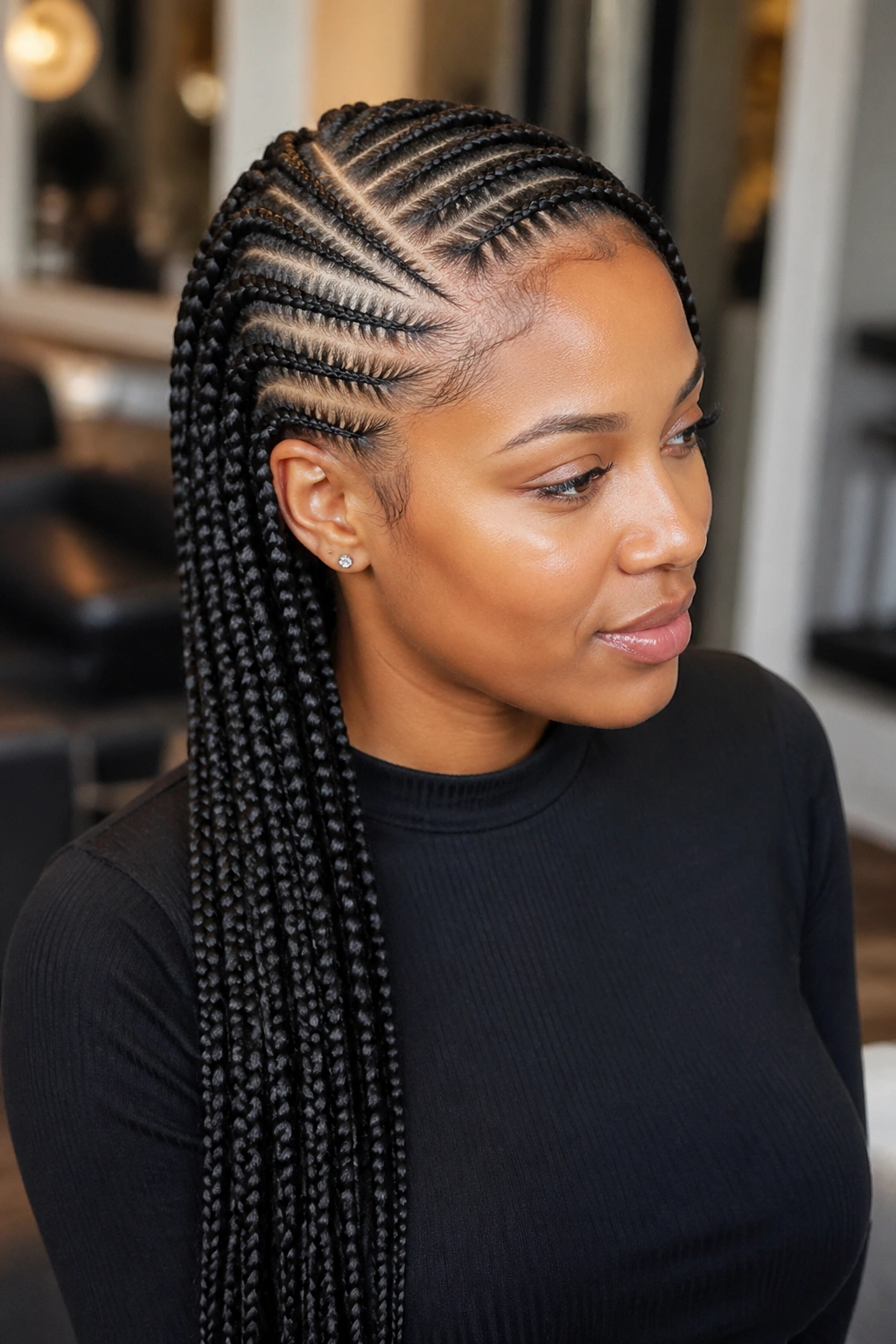
Unlike the center part, this version uses a deep side part — about 3 inches off-center. Three or four cornrows run from the part down the deep side, and a matching set of cornrows runs from the part down the shallow side. All cornrows transition into box braids behind the ears.
The asymmetry is the style. It reads as less formal than a center part and photographs well from the deep side.
Best for oval, heart-shaped, and long face shapes. Round faces can pull it off if the part is deeper (4+ inches off-center) to create more visual length.
5. Stitched Cornrows Forming a Heart Shape
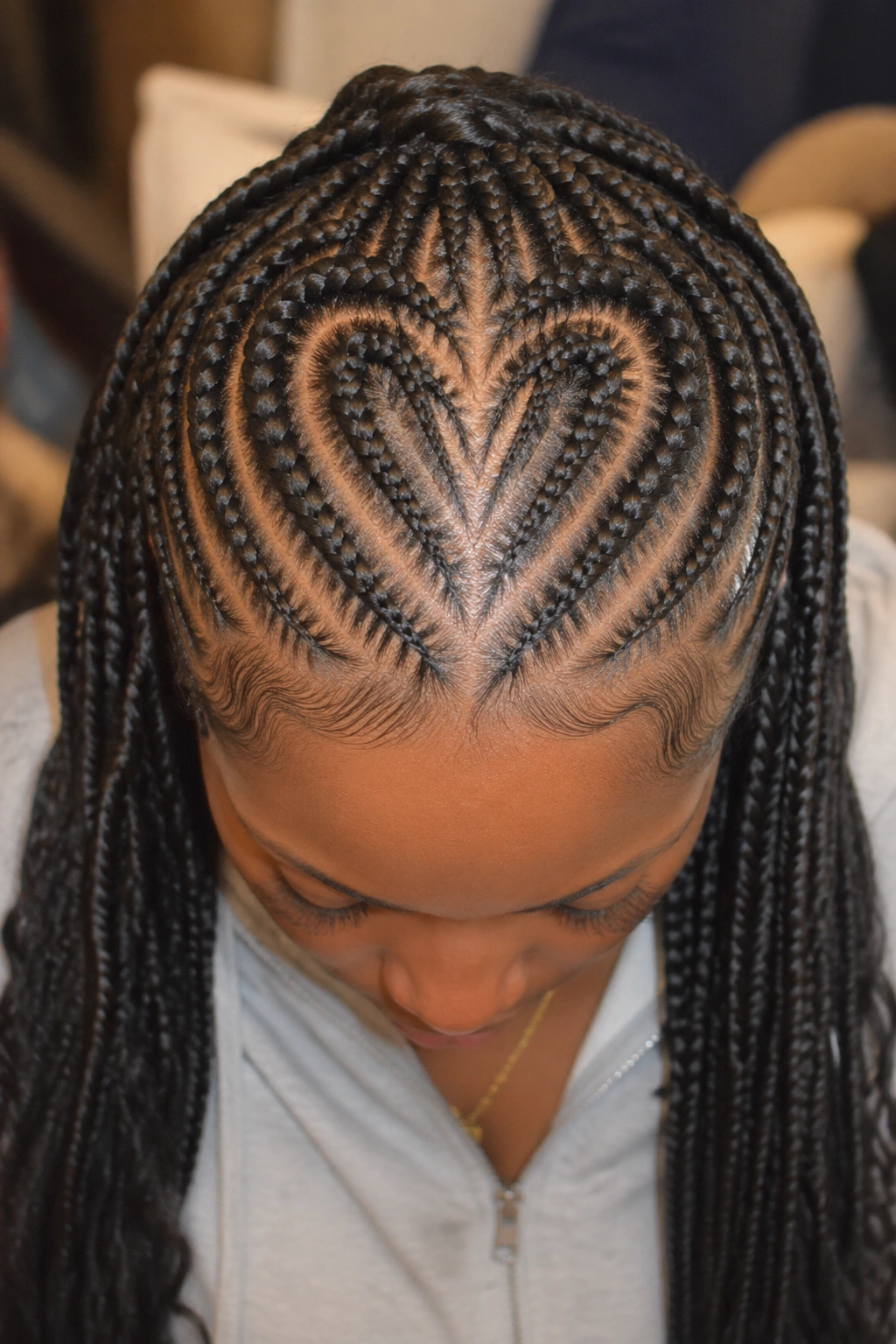
Three cornrows on each side that curve to form the outline of a heart at the top of the head. The heart points forward, toward the forehead. Inside the heart outline, smaller cornrows fill the space. Everything transitions into box braids at the crown.
This is a detail-heavy install. Plan 7+ hours. Not for casual braider appointments.
What makes it work: the heart is visible from the top but subtle from the front and sides. You see a clean cornrow layout from eye level, and the heart reveals itself when you look up at the mirror or in a selfie.
Pair with small beads at the front of the heart for emphasis. Or skip beads and let the shape speak for itself.
6. Zigzag Cornrows Into Jumbo Box Braids
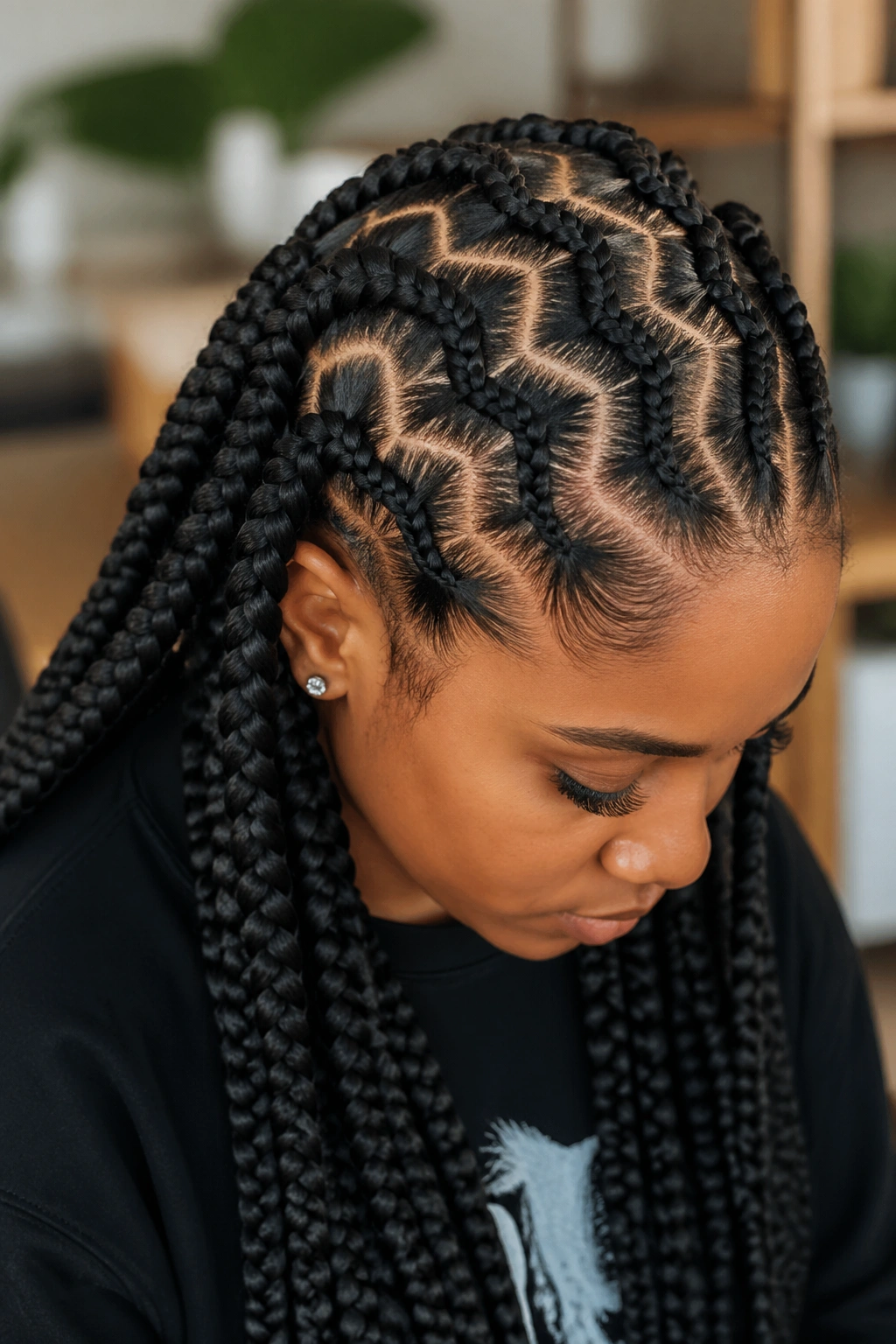
Zigzag parts between 5-6 cornrows on the top of the head, then jumbo box braids hanging from them. The zigzag adds drama to the cornrow section; the jumbo braids add weight and movement below.
The Catch
Zigzag parts are harder to maintain than straight parts. Frizz catches in the zigzag peaks and troughs more visibly than along a straight line. You’re looking at re-styling the top every week or two to keep the zigzag crisp.
- Zigzag amplitude: half an inch max
- Jumbo box braid count: 15-20 for a balanced look
- Install time: 6+ hours with feed-in technique
- Maintenance: satin bonnet every night, edge control refresh weekly
Worth it for a 3-4 week install on a big occasion. Less practical for a 6-week everyday style.
7. Small Cornrows Into Knotless Box Braids
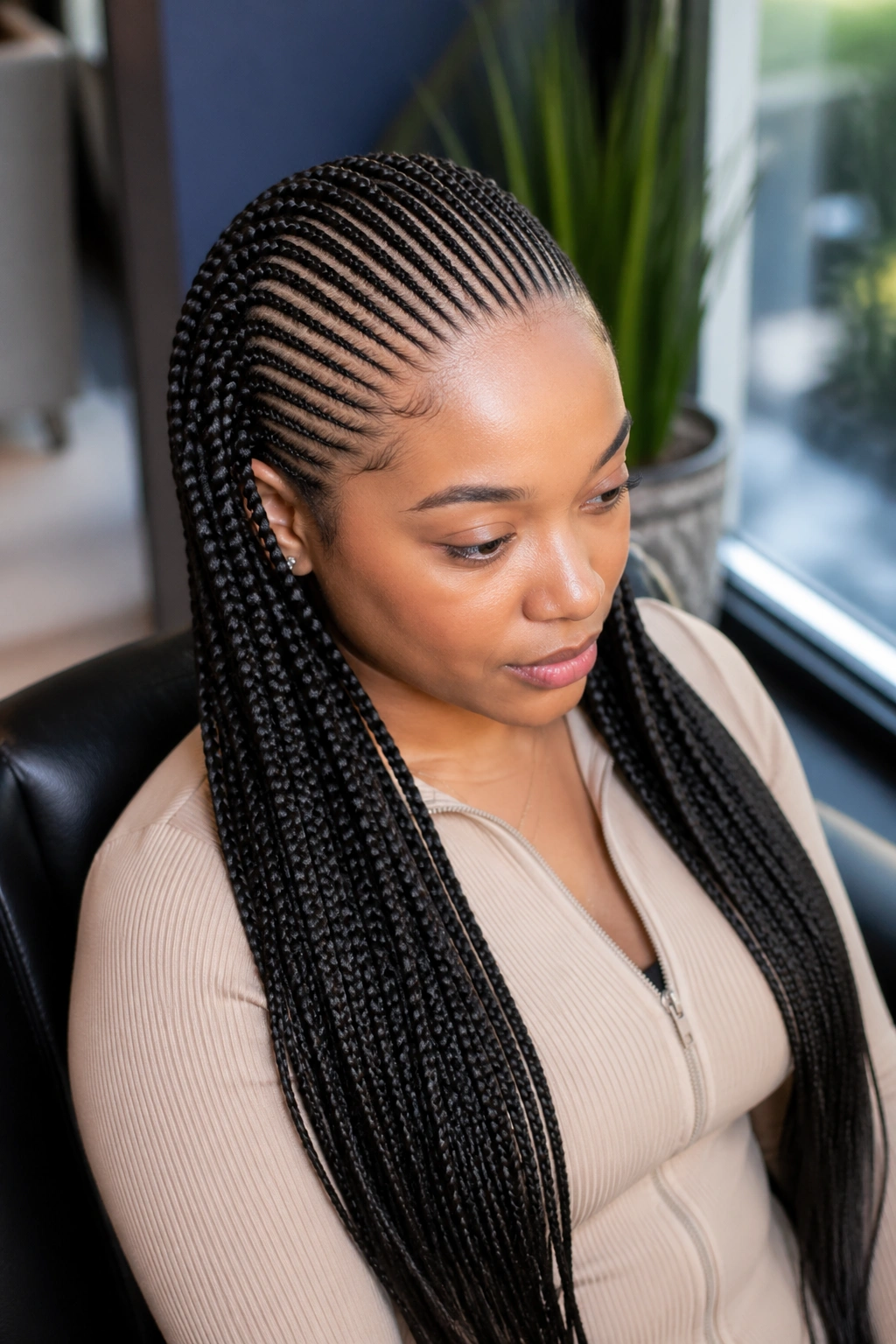
The micro version of this combo. Very small cornrows on the front and crown — maybe 12-15 of them — transitioning into knotless box braids for the length. Knotless means no visible bump at the braid start, which keeps the transition point invisible.
This is the longest install on the list. 10-12 hours minimum for a full head. Some braiders do this across two days because it’s physically exhausting for both parties.
The result is worth it for anyone who wants the look of micro braids with the styling options of cornrows at the top. You can do any updo, ponytail, half-up, bun — all without the bulk of larger braids fighting the style.
8. Cornrow Crown With Free-Hanging Box Braids
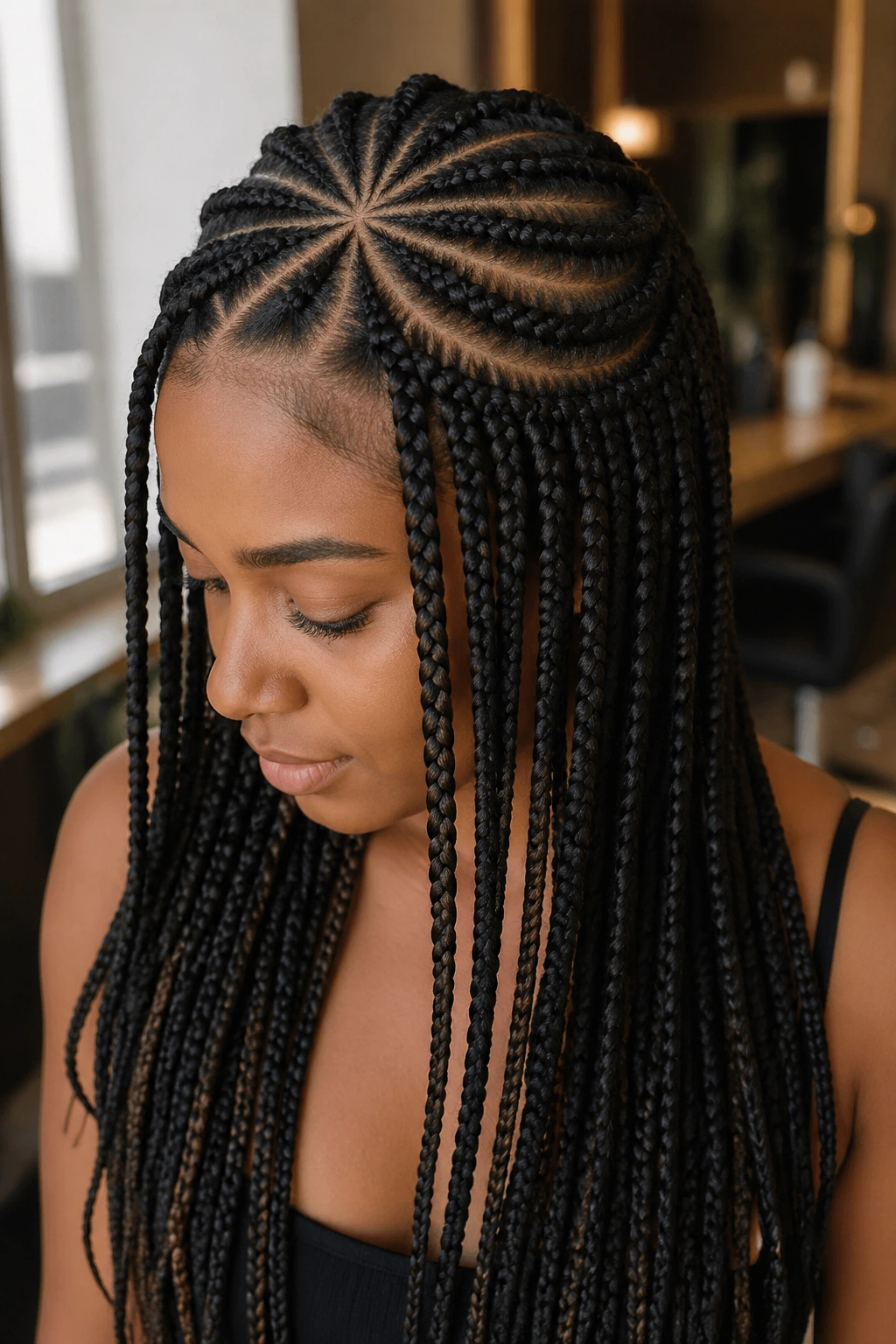
A crown of cornrows encircling the top of the head — roughly 8 cornrows forming a halo — with box braids hanging below the crown line. The cornrows themselves don’t transition into braids; they form a circle of pattern at the top, and separate box braids are installed from the remaining hair below.
This is a two-technique install. Your braider will do the crown cornrows first, then install box braids below the crown line using the hair that wasn’t pulled into the cornrows.
The effect is architectural. A defined halo of cornrows sitting above a curtain of box braids. It photographs exceptionally well and reads as intentional styling, not just a protective style.
9. Mohawk Cornrows With Box Braid Sides
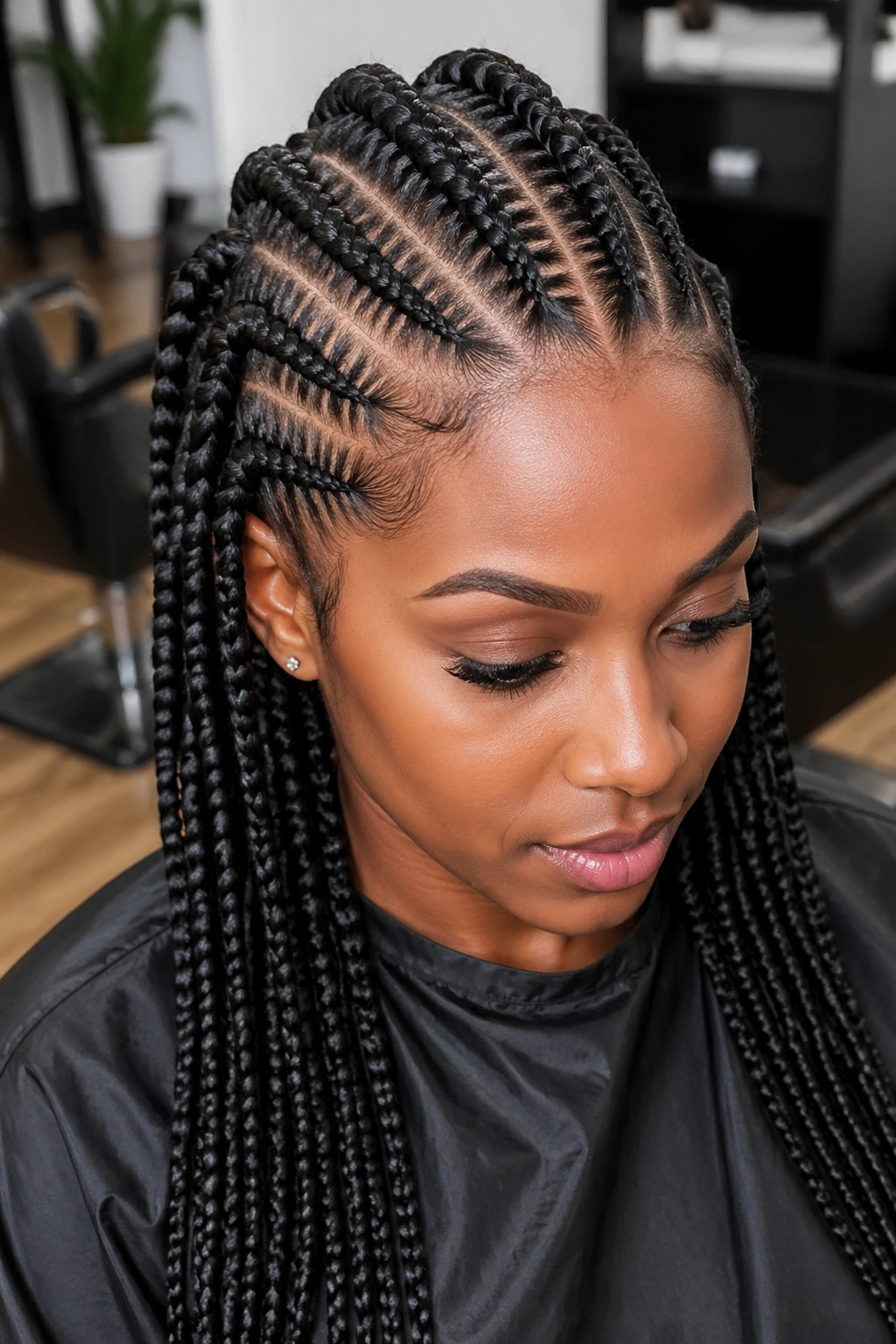
The cornrow section runs down the center of the head in a mohawk strip — 3 to 5 cornrows from forehead to nape, centered. On each side of the mohawk, box braids of matching size.
The width of the mohawk strip depends on how bold you want the style to read. 2 inches wide is subtle. 4 inches wide is a statement.
Who This Is For
Anyone who likes edgy protective styling. The mohawk pattern references classic punk styling while the box braids keep it rooted in traditional braid aesthetics. It’s one of the more identifiable combo styles — people will notice.
- Mohawk width: 2-4 inches
- Side box braid direction: slight angle backward, not straight down
- Nape transition: cornrows curve outward into the side box braid zone
- Works with or without beads; mohawk styles photograph well with gold cuffs at the cornrow ends
10. Feed-In Cornrows With Burgundy Box Braids
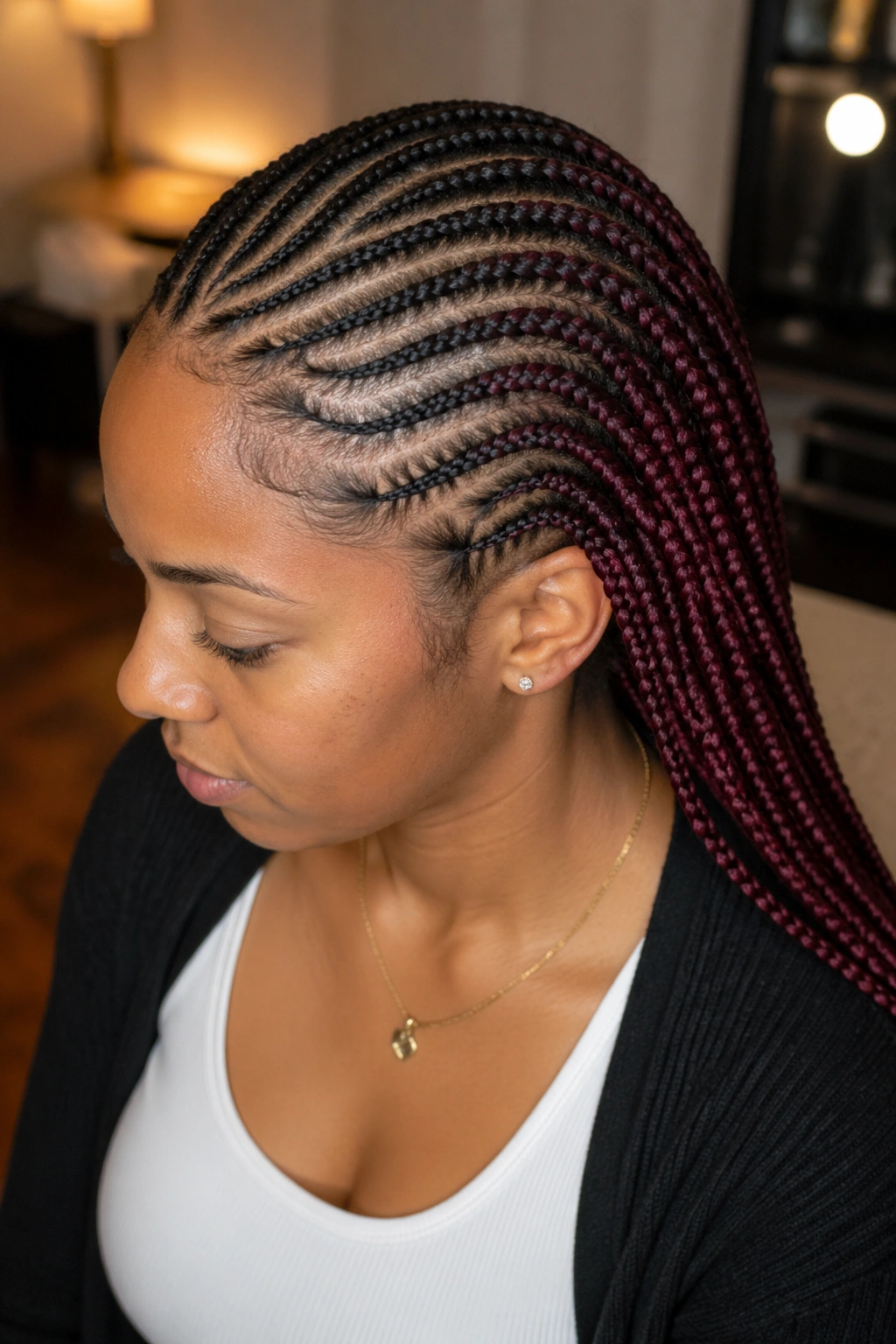
The cornrow section uses your natural hair color only. The box braid section uses burgundy kanekalon — a deep red-purple that hits between maroon and wine. The color contrast at the transition point is the focal detail.
This works because the cornrows stay subtle (natural color) while the length makes a statement (burgundy). Anyone not wanting to commit to a bold color throughout gets a compromise — bold where it shows most, muted where it matters.
Burgundy reads especially well against deep skin tones and warm undertones. Cooler undertones can go for a truer red or a dark plum variant.
11. Cornrow Bun With Box Braid Ponytail
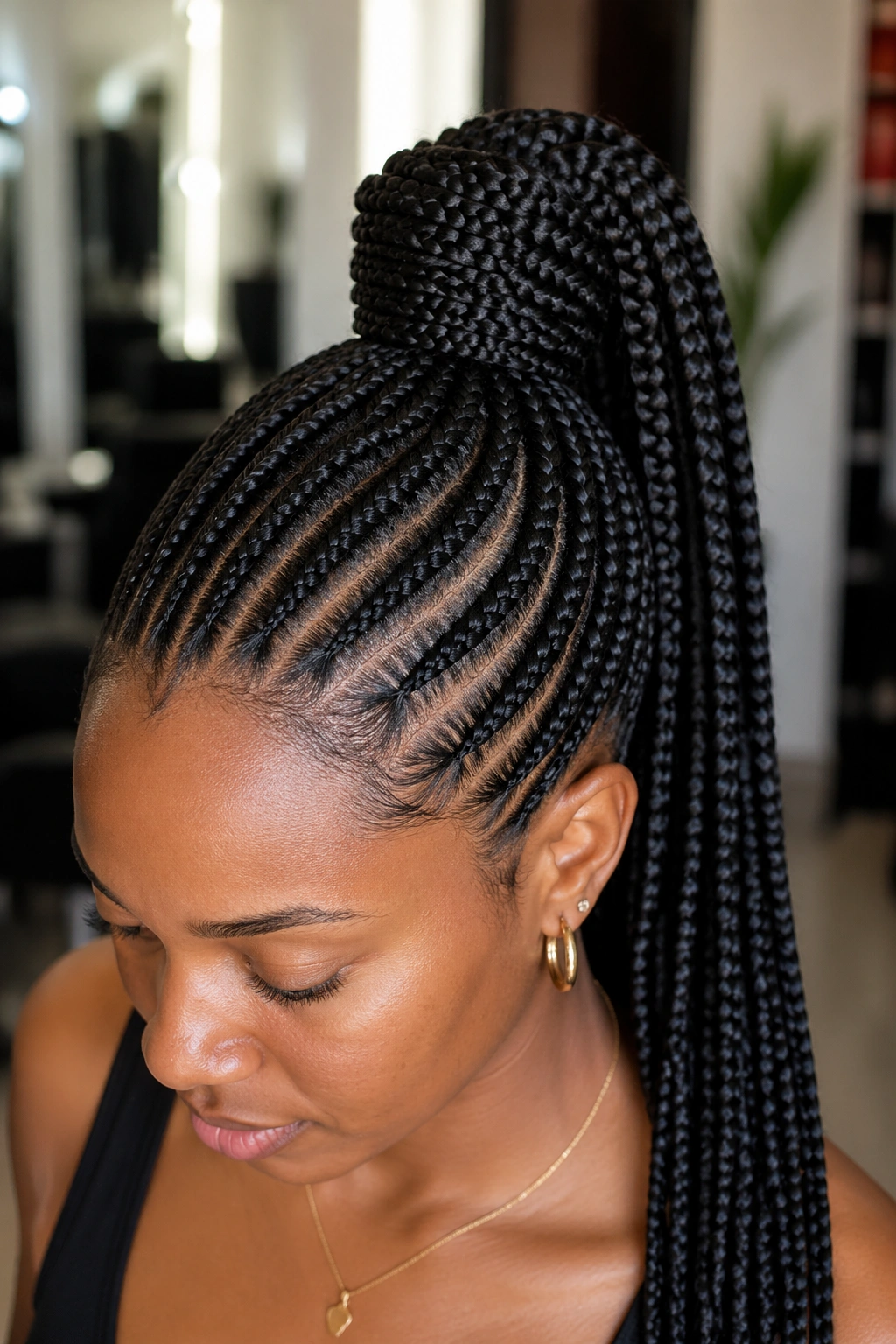
Scenario: you want an updo that uses both techniques. Start with 6-8 cornrows that gather at the crown. The cornrow ends tie into a knot at the crown that forms the base of a bun. Box braids are then installed from the bun downward, creating a long flowing ponytail from the center of the updo.
The mechanism is the bun acting as a structural anchor. Everything above it is flat cornrow. Everything below it is free box braid.
- Cornrows converge at the highest point of the crown
- Bun is formed by tightly twisting cornrow ends into a ball shape
- Box braids install from the bun using fresh kanekalon
- Ponytail length: usually 20-30 inches for dramatic effect
12. Cornrows With Copper-Highlighted Box Braids
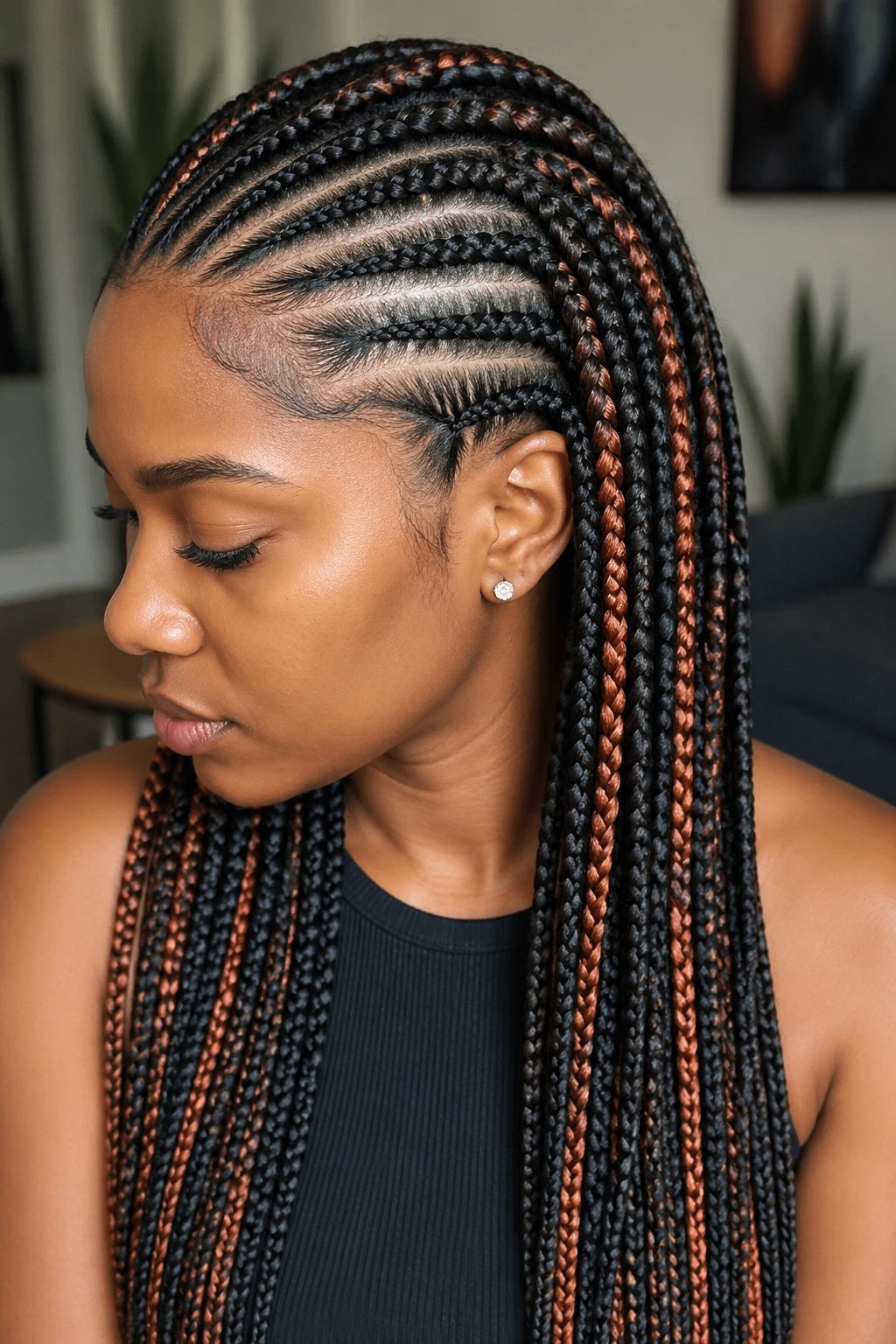
A base color (dark brown or black) with copper highlights woven through the box braids only. The cornrows stay solid; the box braids carry the color. When the hair is pulled back or updone, the copper flashes through.
Copper works well with warm skin tones — anyone with golden, olive, or deep warm undertones. Cooler undertones often prefer ash blondes or silver highlights over copper.
The highlighting is done during the box braid install. Small sections of copper kanekalon are added into certain box braids — usually every third or fourth one — so the color shows when the hair moves without overwhelming the natural base tone.
13. Thick Cornrows Into Chunky Box Braids
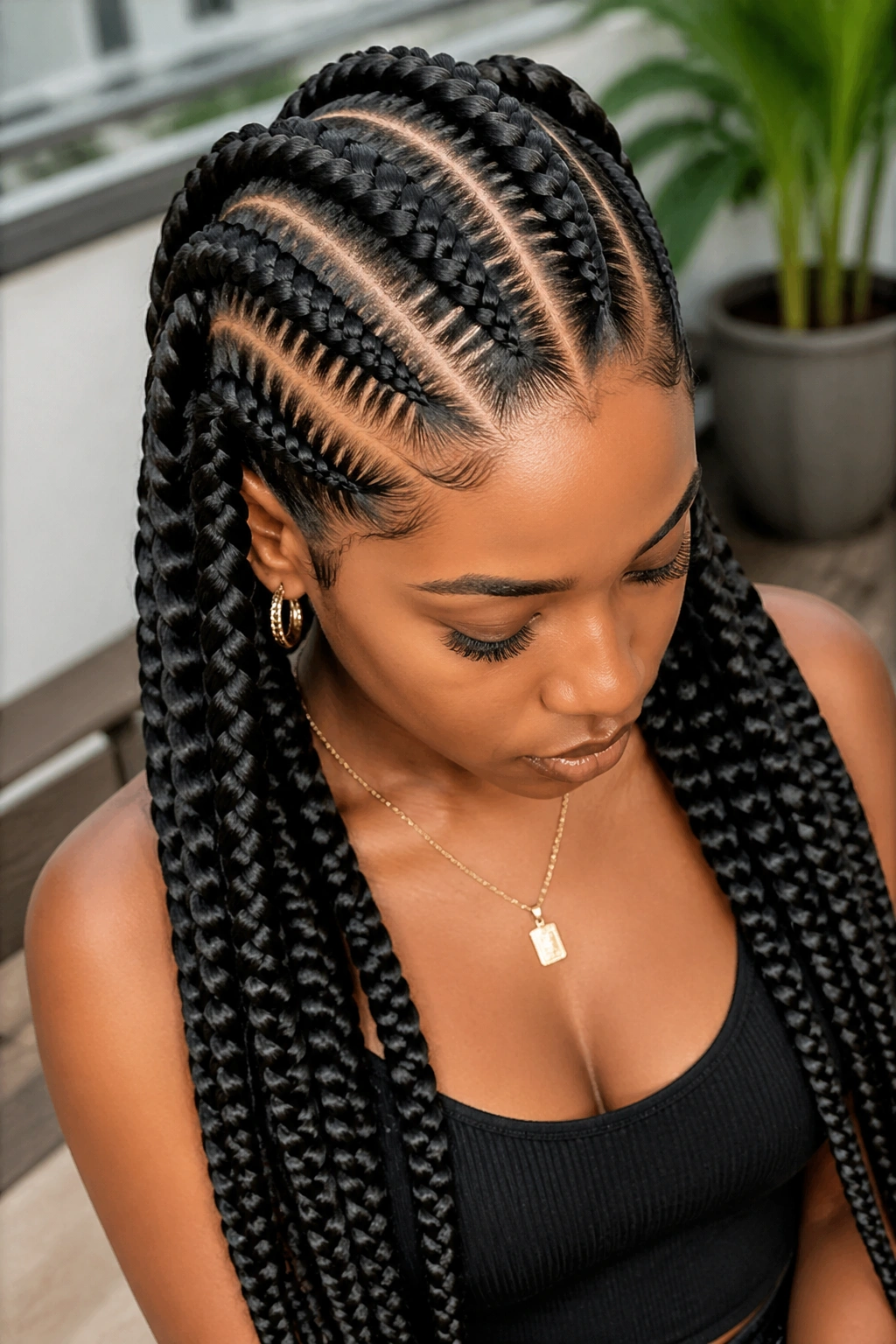
Everything scaled up. Thick cornrows (each about 2 inches wide at the widest point) feeding into chunky box braids (pencil-thick or larger). This is a fast install compared to small-braid versions — maybe 3-4 hours — and reads as bold without being extreme.
Downside: thicker braids loosen faster than thinner ones because more hair per braid means more weight and more tension at the anchor point.
Good for: short installs (2-3 weeks), warm weather when you don’t want micro braids trapping heat, anyone new to combo styles who wants a taste before committing to a small-braid install.
14. Cornrows With Beaded Box Braid Ends
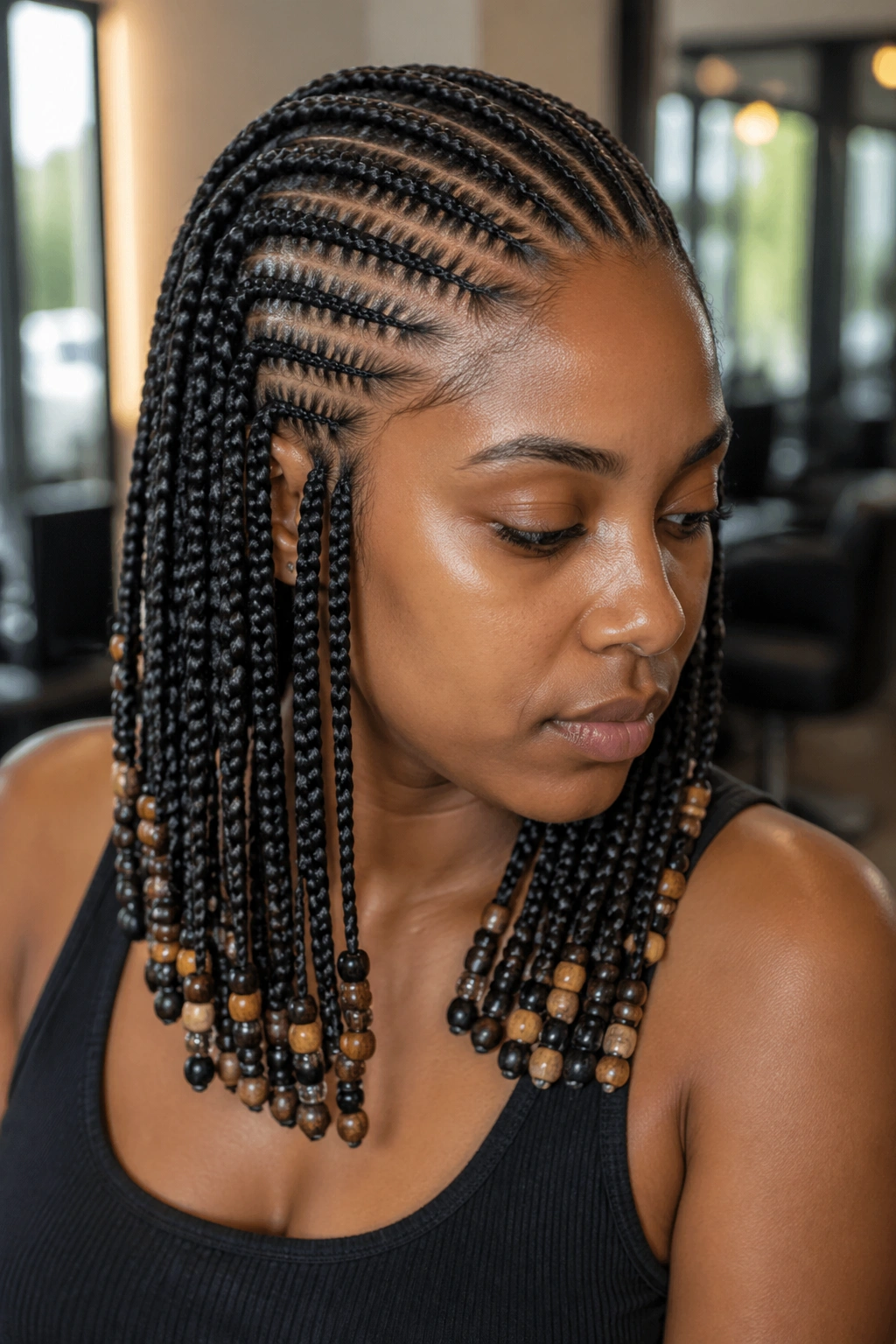
Plain cornrow tops, box braids below, beads clustered at the ends of the box braids. The beads can be wooden, acrylic, metal cuffs, or colored glass. Anywhere from 3 beads per braid to 10 beads per braid depending on how loaded you want the look.
Styling Tips
- Thread beads before finishing the braid ends — slide them up to position
- Use a small rubber band to hold beads in place, or tie a knot below the last bead
- Match bead tones to any jewelry you wear regularly
- Start with fewer beads on the first install to test how you like the weight
Beaded ends with plain cornrows create a balanced visual — simple at the top, detailed at the bottom. It’s a forgiving style for anyone whose cornrow work isn’t perfect because attention gets drawn to the bead cluster instead.
15. Cornrow-to-Box Braid With Thread Wraps
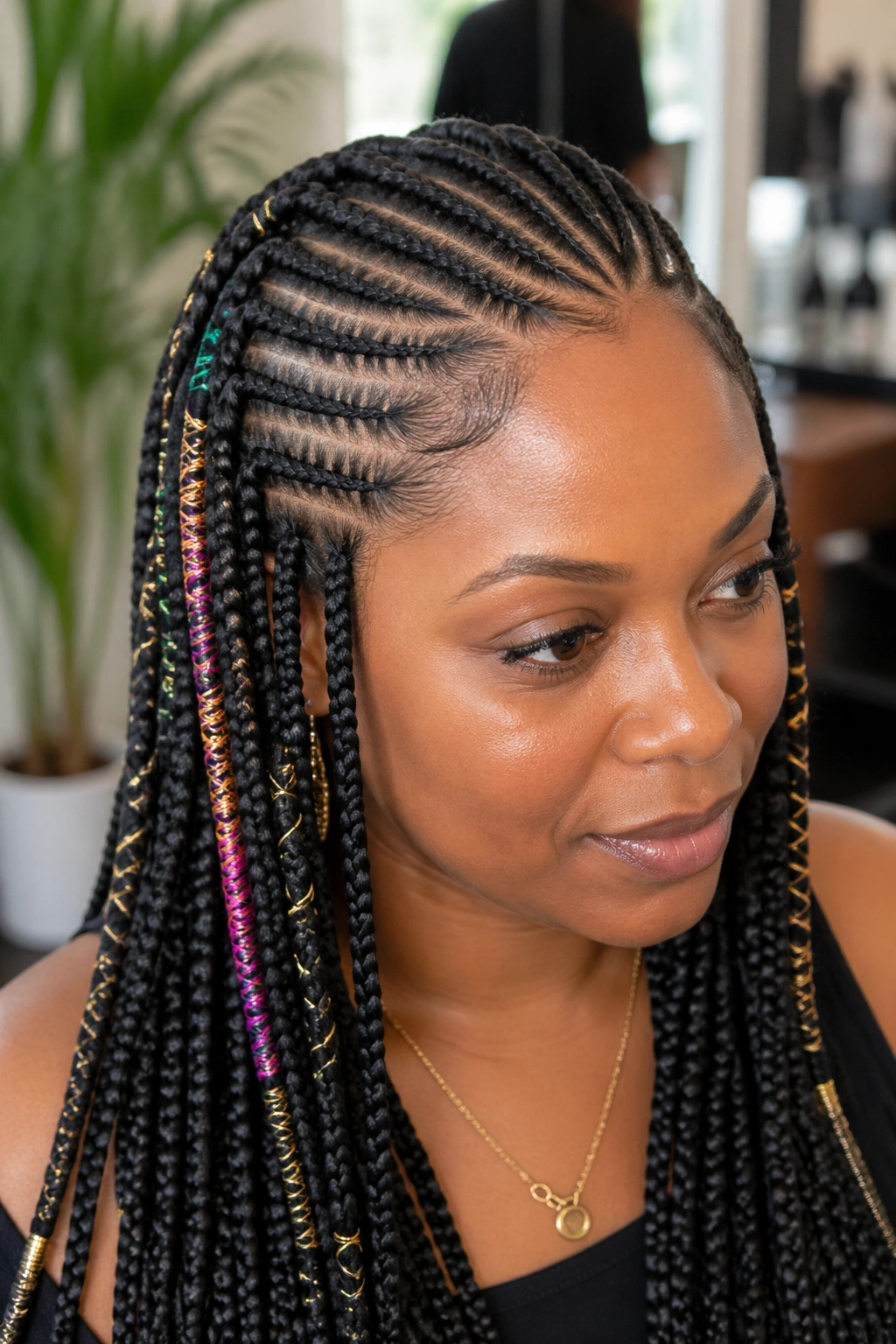
Thread-wrapped sections along the box braids, not the cornrows. Colored embroidery thread or yarn wrapped around 3-4 inches of selected box braids.
The wraps can be uniform (all the same color) or mixed (different colors on different braids). Gold thread against dark kanekalon creates a subtle shimmer. Bright reds or blues on select braids create pop accents.
Thread wrapping takes about 5 minutes per wrapped braid. If you wrap 10 braids out of 40 total, that’s an extra hour on top of your install time.
16. Cornrows With Box Braids in Ombré
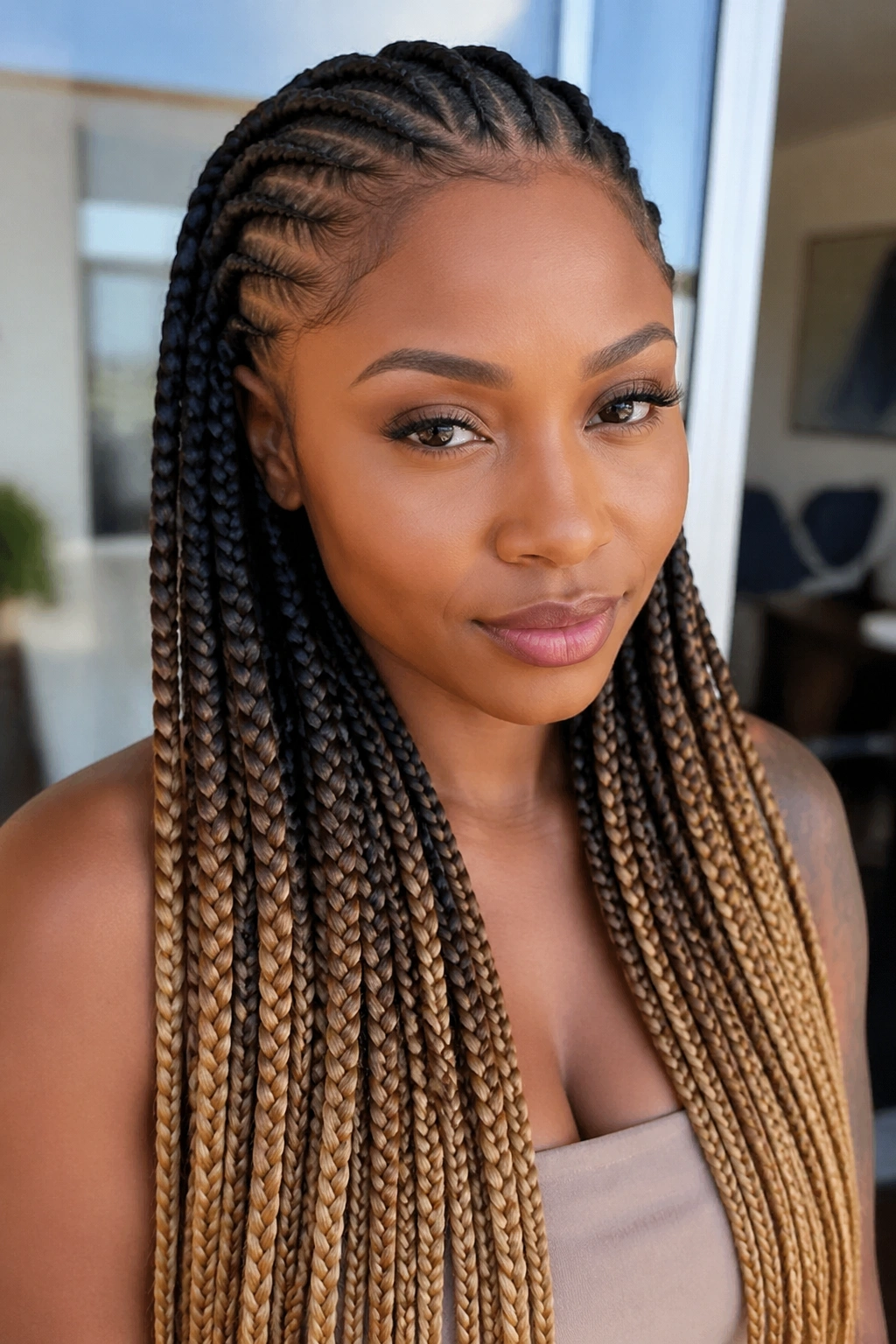
The box braids start in one color at the root and fade into another color by the ends. Dark brown fading into caramel. Black fading into honey. Deep burgundy fading into soft copper.
The cornrow section stays solid — the base color only. The ombré happens within the box braids, gradually transitioning from top to bottom.
Ombré kanekalon comes pre-colored, which saves the braider from doing custom color blending. Brands like X-Pression and RastAfri sell pre-ombré packs in common color combinations.
17. Low-Tension Cornrows Into Loose Box Braids
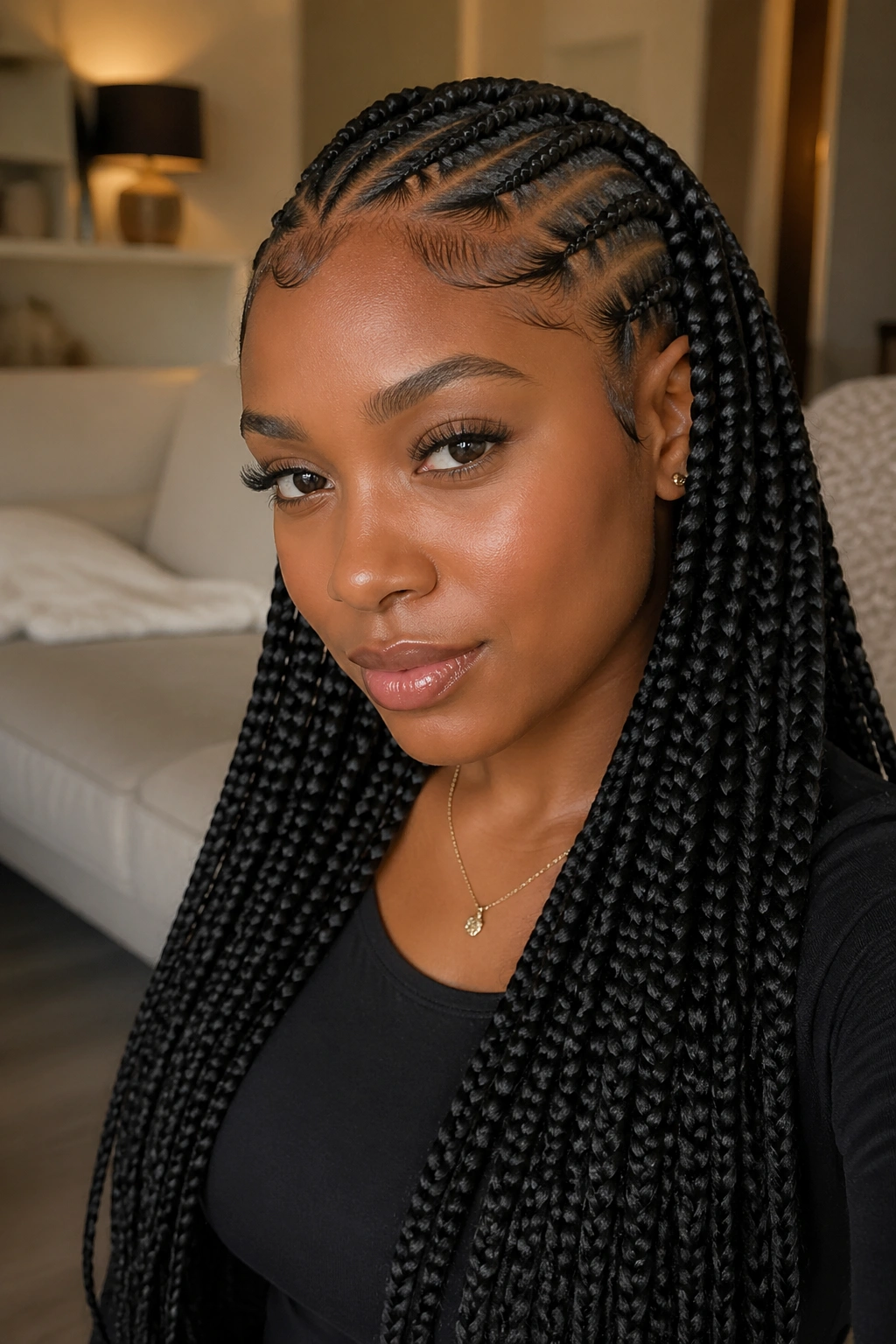
Bold claim: tight braids aren’t a sign of a good install — they’re a sign of one that’ll damage your edges. Low-tension installs are more comfortable, preserve hair health, and can still look sharp when done by a skilled braider.
Low-tension means the cornrows sit firm against the scalp without pulling. The box braids hang with just enough grip to stay in place, not so tight they feel stressed at the root.
Why this matters: high tension is the primary cause of traction alopecia. Hairline thinning, small bald spots at the temples, edges that never grow back — these come from repeated tight installs. Low-tension combo styles let you wear protective styles regularly without the long-term cost.
A good braider adjusts pressure based on your scalp sensitivity. If you find yourself flinching during the install, speak up. Experienced braiders would rather loosen up than continue and lose you as a client.
18. Cornrows With Box Braid Fulani Accents
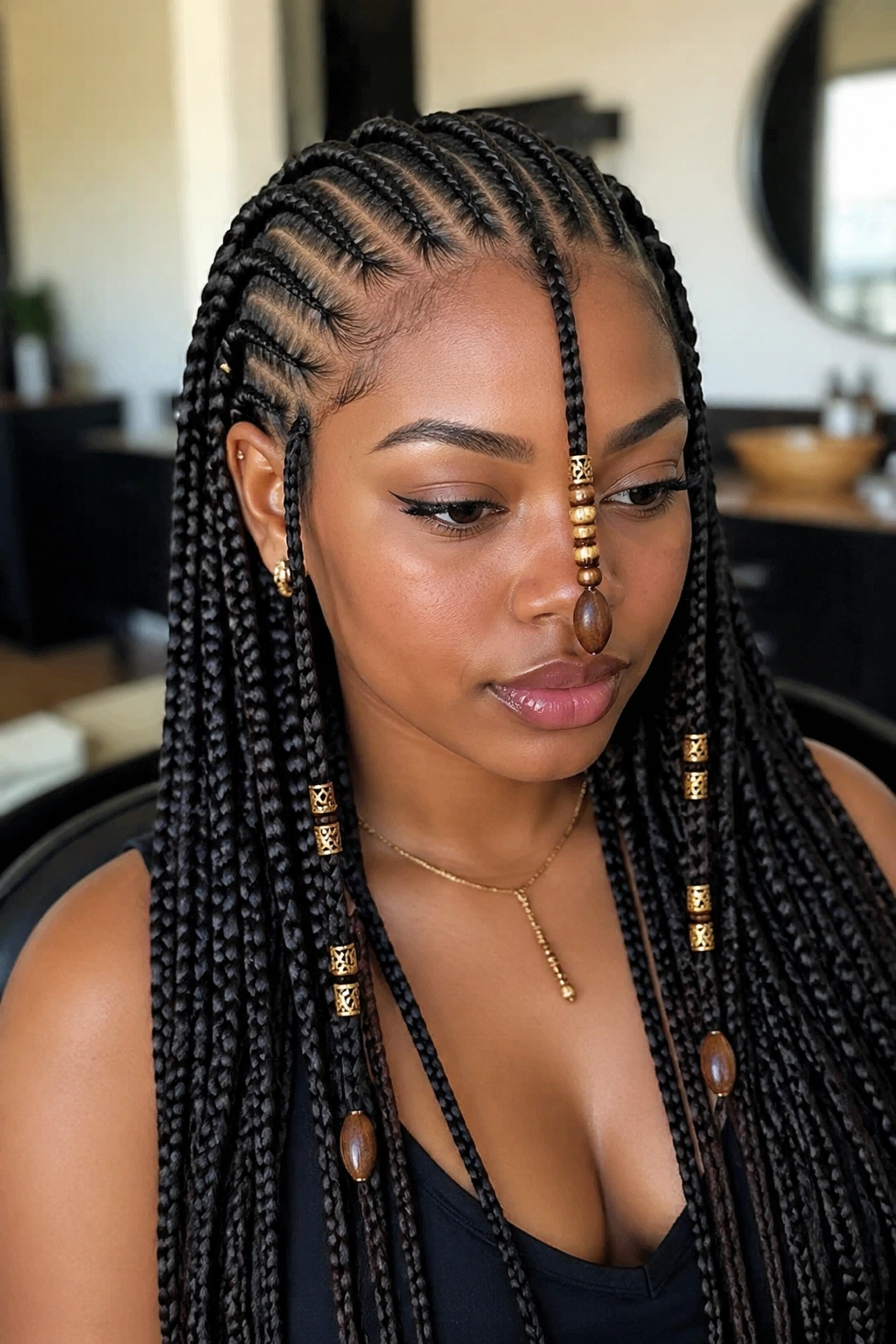
Fulani-inspired details on select box braids — a central long braid with beads, symmetrical side braids with cuffs, accent braids positioned to mimic classic Fulani styling.
The cornrow section runs across the top as the foundation layer. On top of or beside the cornrows, specific box braids are styled with Fulani details — beads, cuffs, wraps, or specific placement patterns.
This is a referential style. It borrows from Fulani traditions without fully committing to a Fulani install. Respect the reference by treating accents with care, not as costume.
19. Cornrows With Box Braid Updo Bun
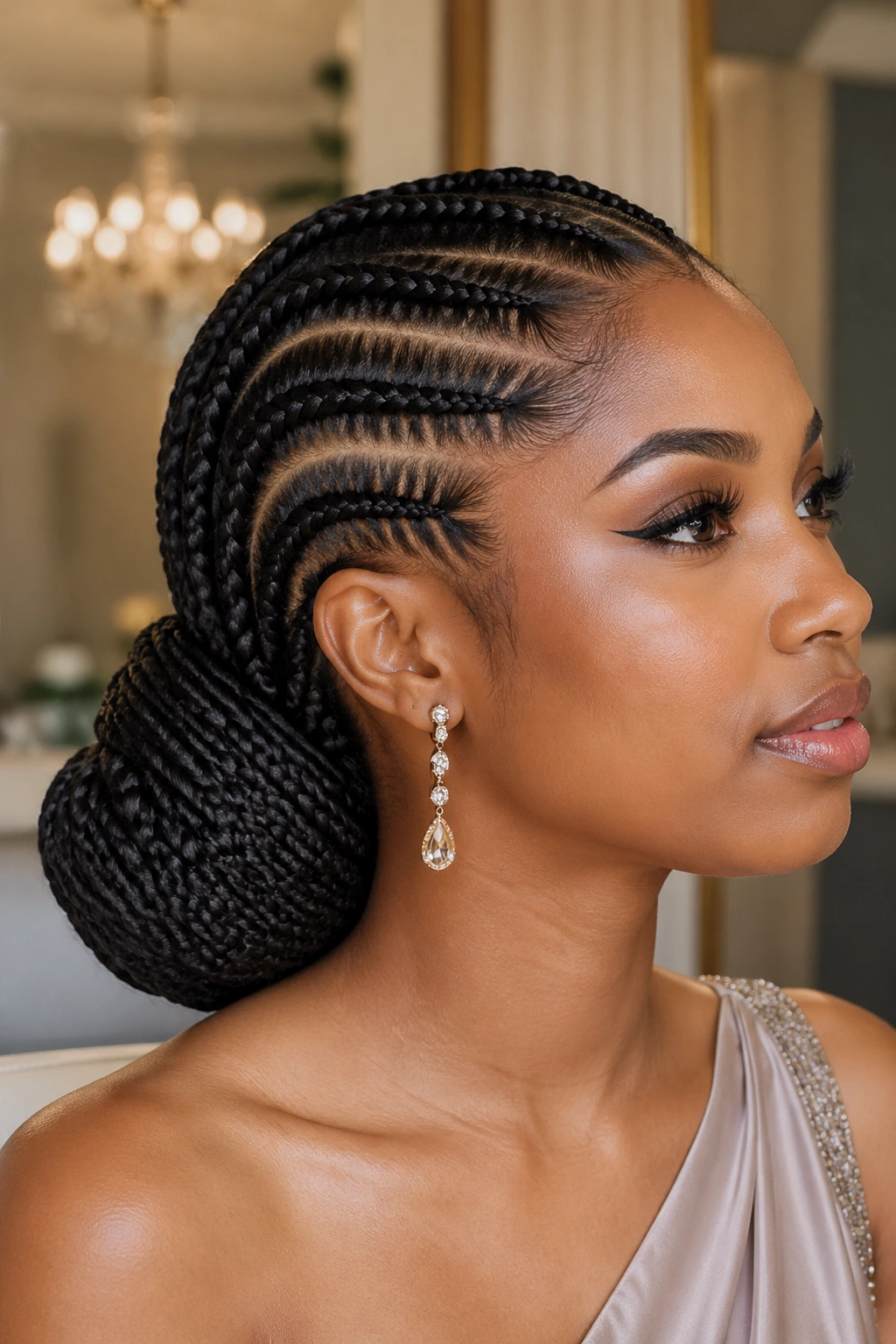
The full install is cornrows transitioning into box braids, and then on styling day, the entire back length gets gathered into a large low bun at the nape.
The bun is formed by gathering all box braids into a ponytail at the nape, twisting the ponytail into a rope, and wrapping the rope into a coil that gets pinned flat.
Works best with medium or long box braids — shorter than shoulder-length and the bun won’t have enough material.
Maintenance Notes
- Use large U-pins (not bobby pins) for holding the bun
- Secure with hairspray for event wear, skip spray for daily wear
- Release the bun each night to prevent tension spots
- Re-tie in the morning; it only takes 5 minutes with practice
20. Cornrows Into Curly Box Braid Ends
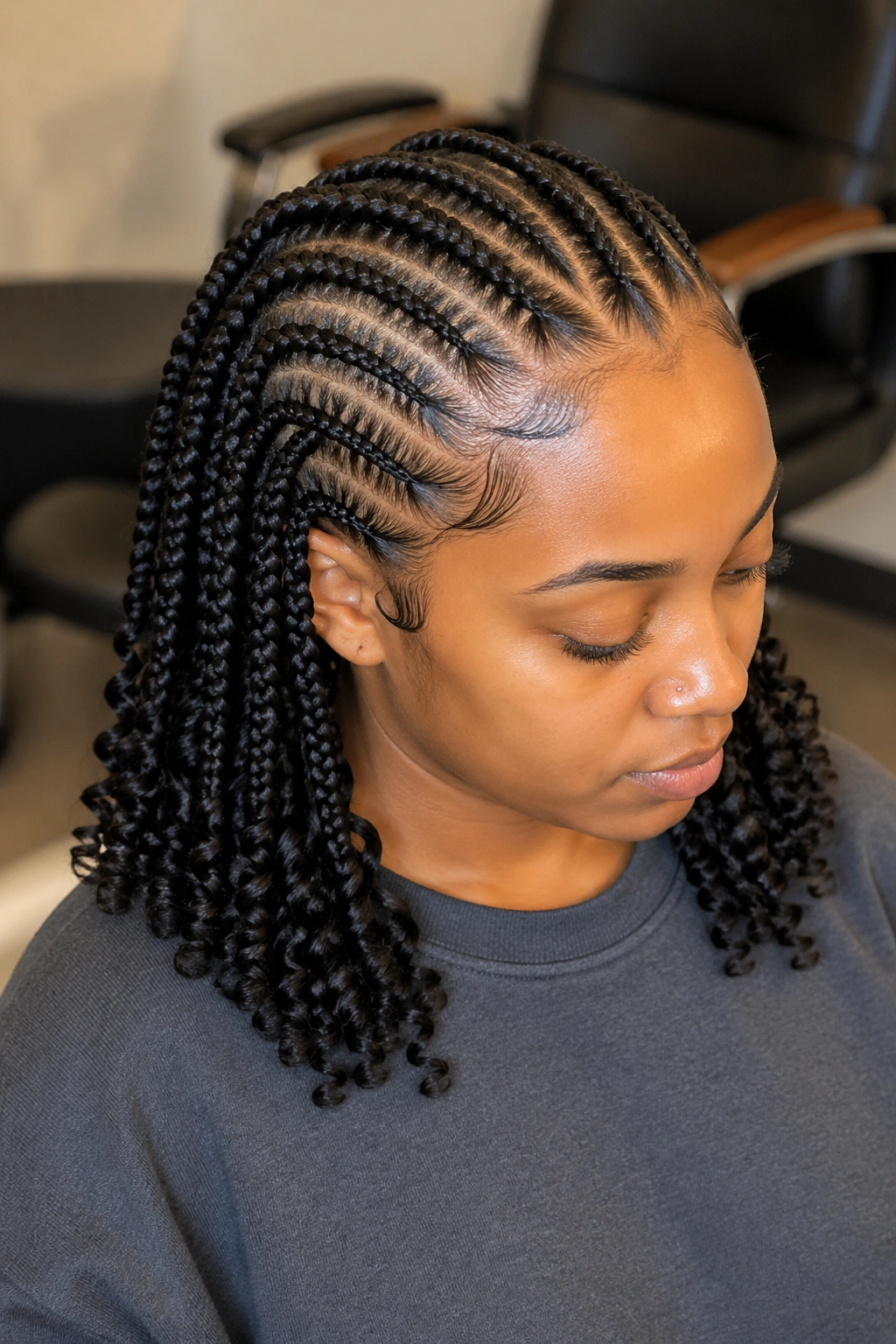
The box braid length is straight kanekalon until the last 4-6 inches, which are curled. The curls happen during the install — either by setting the ends on perm rods and dipping in hot water, or by using pre-curled kanekalon.
The cornrow section stays sleek while the box braid ends flare into ringlets. This softens the overall look and is a good option for anyone who finds fully straight box braids too sharp.
Hot water setting: dip the curled ends in water around 180°F for 15 seconds, then let cool. The curls hold for 2-3 weeks if treated gently.
21. Cornrows With Boho Curly Box Braids
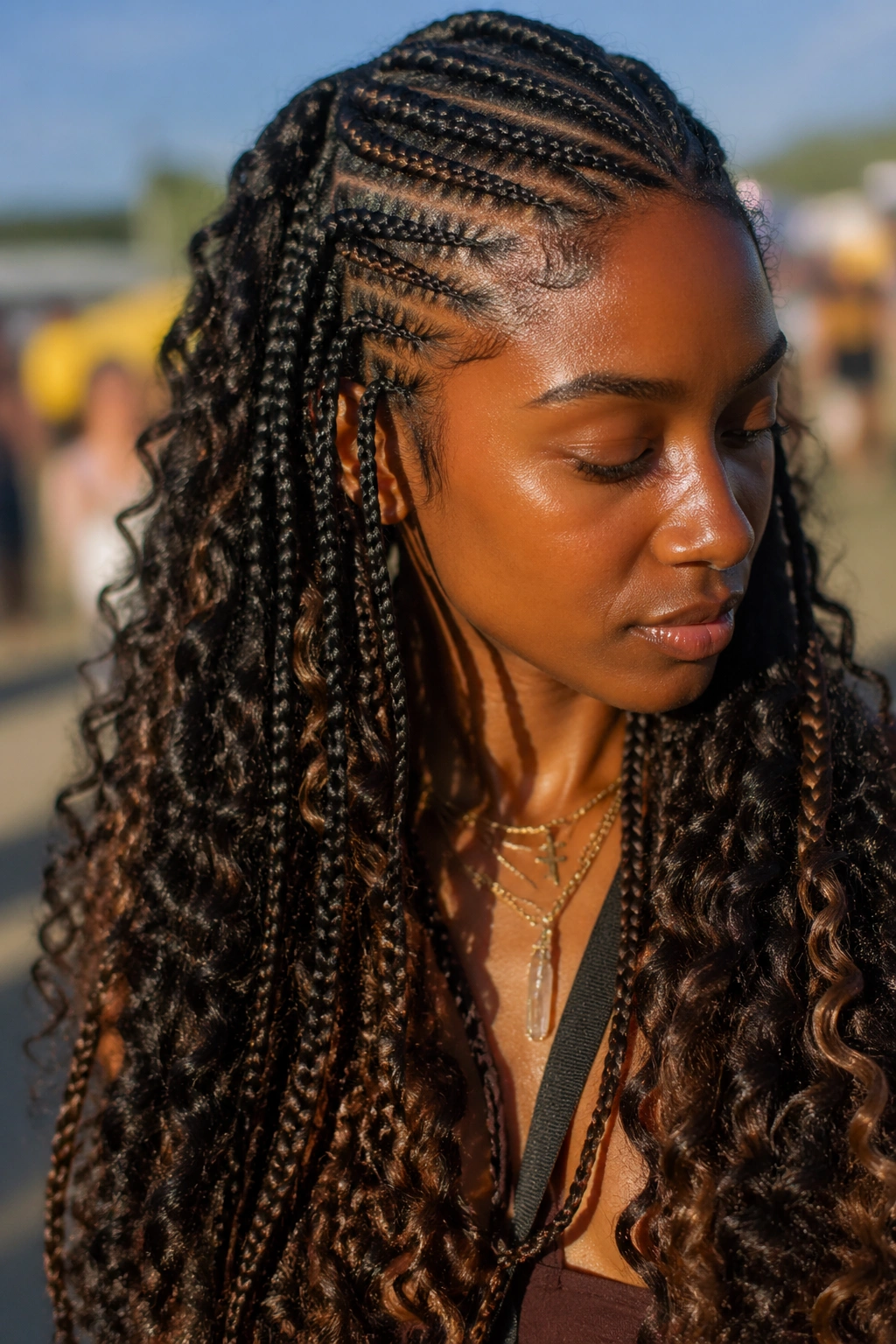
Unlike the sleek ends of entry 20, boho box braids have intentionally messy, human-hair-textured curls woven throughout the braid length. The cornrow tops stay clean; the box braids have a deliberately unfinished, flowing texture.
The bohemian effect comes from using loose-wave human hair bundles woven into the box braid along with the kanekalon base. You braid in small sections of curly human hair at intervals, leaving them loose instead of braiding them in.
This style reads as beachy and relaxed. Less polished than traditional cornrow-plus-box-braid looks, more approachable, pairs well with casual outfits and festival wear.
22. Cornrows With Crochet Box Braid Finish
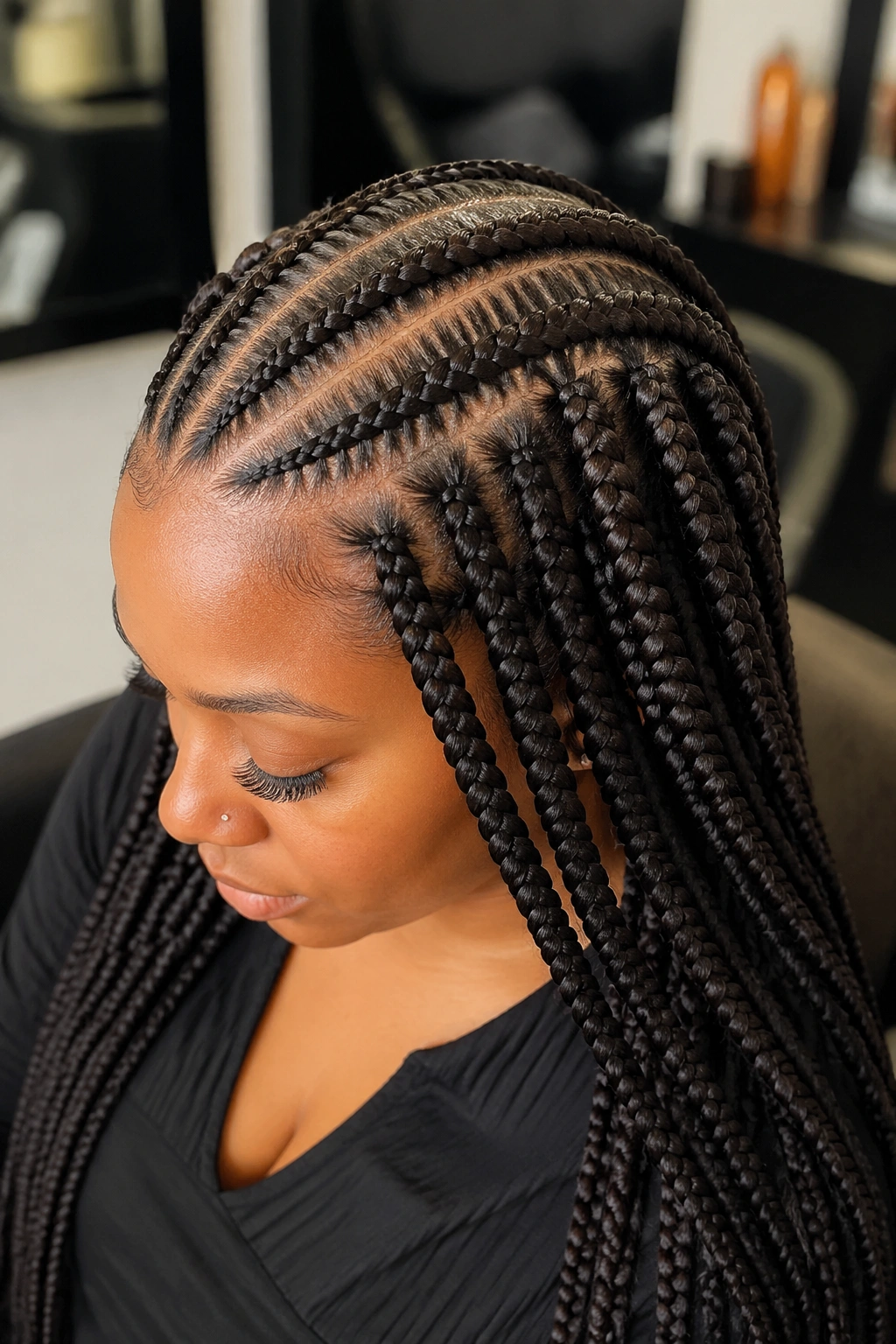
The cornrows are real — installed using your hair. The box braid section is crochet — pre-made box braid pieces crocheted onto the cornrow base.
This is the fastest install on the list. Cornrows take 1-2 hours. Crocheting the box braid pieces onto the cornrows takes another 1-2 hours. Total install: 3-4 hours, compared to 8+ for a fully individual-install combo.
The finish isn’t quite as polished as a full-install combo — the crochet pieces can look bulkier at the base — but it’s a good choice when time or budget is the constraint. Crochet pieces also allow easy color swapping; you can change the box braid color without redoing the cornrow foundation.
Scalp Care Under a Combo Install
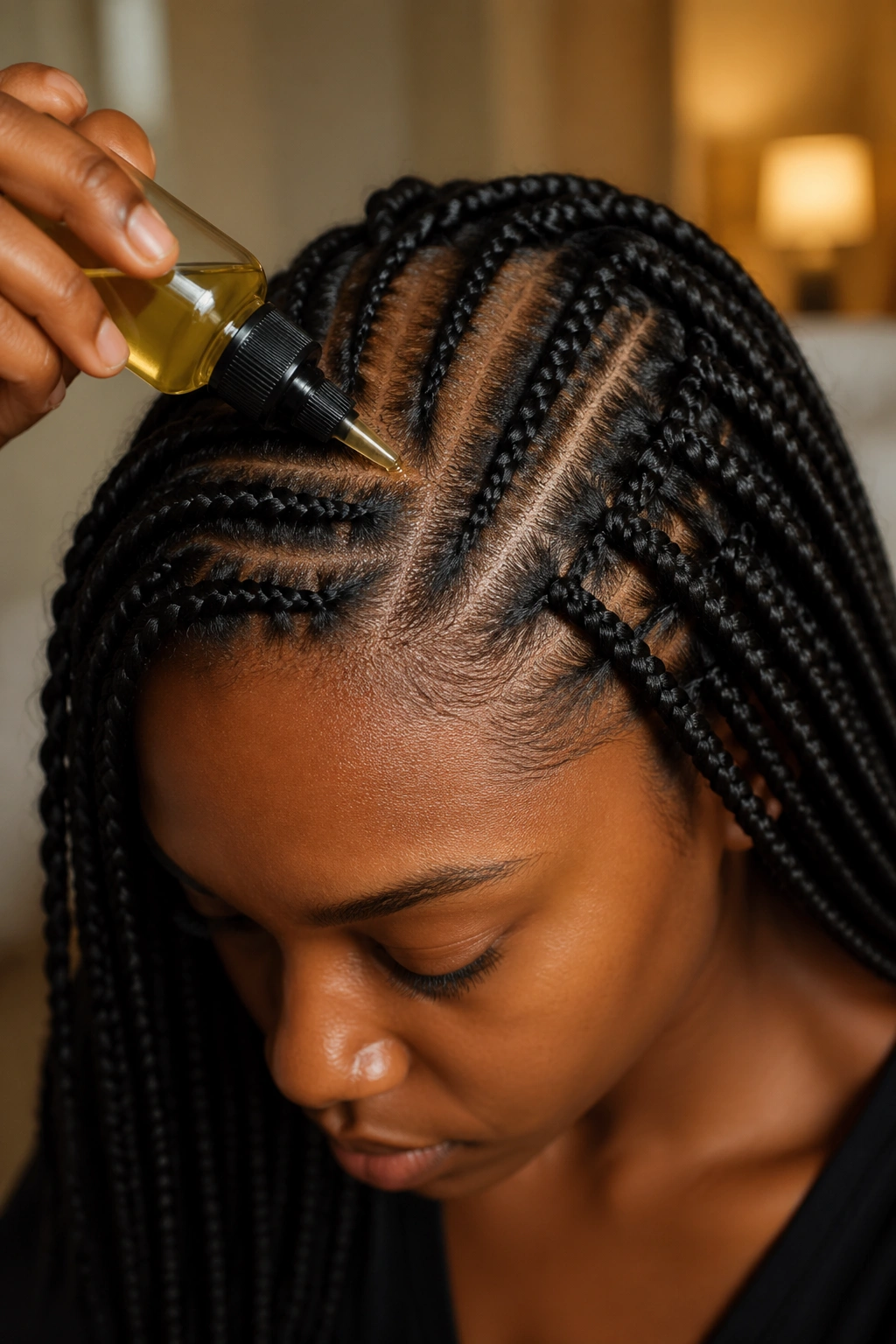
Combo installs live on your head for weeks. Scalp care isn’t optional.
Use a scalp oil twice a week. Something with peppermint, tea tree, or rosemary — these keep the scalp calm without being heavy. Apply with a pointed applicator bottle so you can get between cornrows and box braids without dripping oil onto the lengths.
Rinse the scalp once a week with a diluted apple cider vinegar solution (1 tablespoon ACV per cup of water). Apply to the scalp only, let sit 5 minutes, rinse with warm water. This controls itch, keeps the scalp pH balanced, and doesn’t disturb the braids.
Don’t co-wash under cornrows. The cornrow anchoring gets loosened by water weight more than box braids do. If you need to refresh the style, use a dry shampoo spray on the scalp between cornrows.
Sleep on satin or silk. Every night. No exceptions. Cotton pillowcases dry out the kanekalon and roughen up the cornrow pattern faster than anything else.
When It’s Time to Take It Down
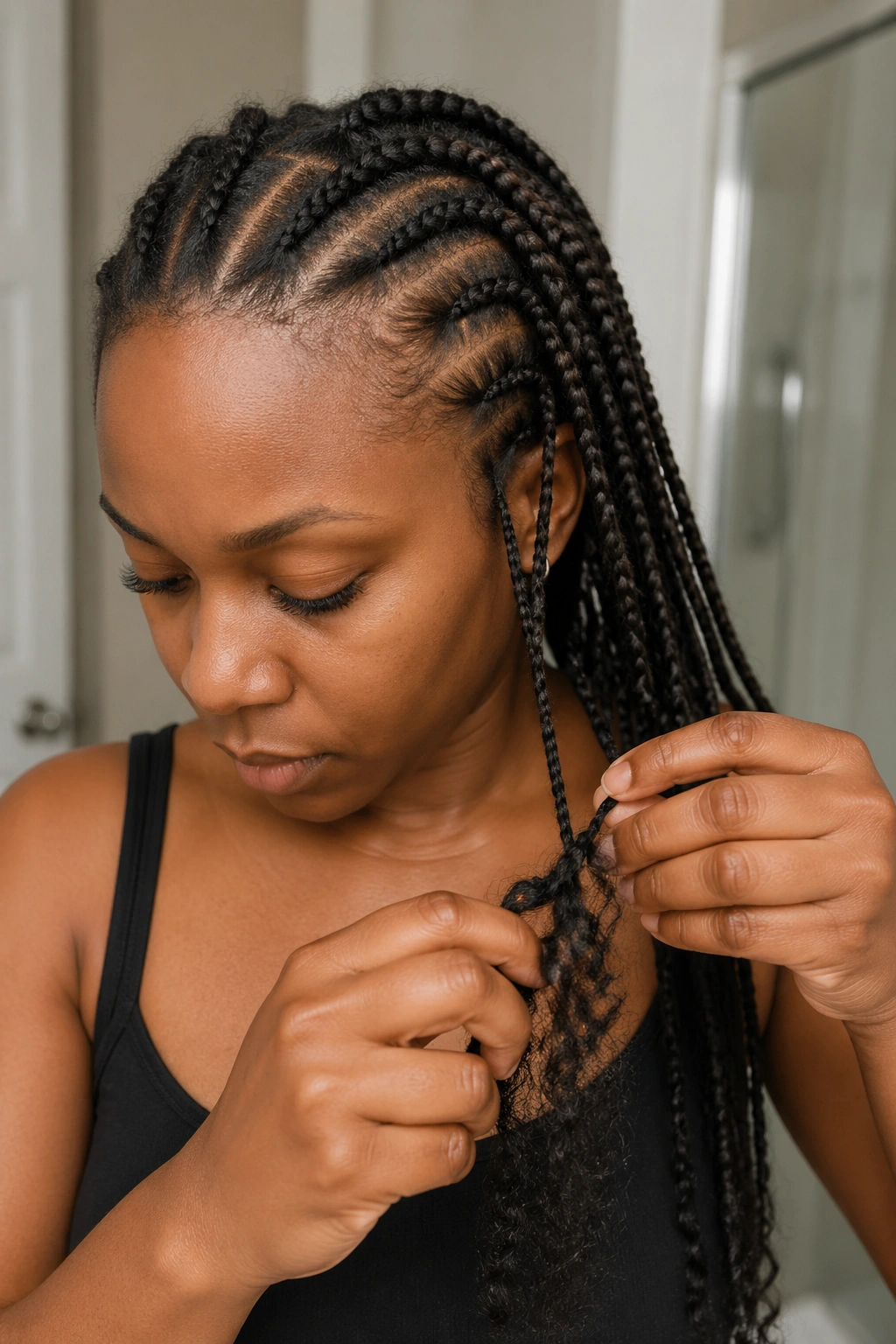
The classic mistake is wearing a combo install too long. Past 8 weeks, the risks outweigh the convenience. Hair matting starts. Tension points shift as the install loosens. Scalp health declines.
Signs it’s takedown time: cornrow fronts are significantly frizzy despite maintenance, box braids smell even after washing, you notice hair shedding when you touch the scalp, edges feel sore.
Don’t push past. Book a takedown appointment or set aside 3-4 hours to do it yourself.
Takedown tools: spray bottle with diluted conditioner, wide-tooth comb, small scissors for cutting knots you can’t untangle, deep conditioner for after.
Start with the box braids. Unravel from the ends. Once all the length is out, move to the cornrows. Cornrows unravel from the nape up — opposite of box braids, where you work top down.
Mistakes People Make With Cornrow-Plus-Box-Braid Styles
Going too small too fast. Your first combo install shouldn’t be micro braids. Start with medium sizes so you learn how the style wears without committing to a 10-hour install.
Skipping the sleep protection. One night of rubbing against cotton undoes a week of careful styling. Bonnet or scarf, every night.
Washing too aggressively mid-install. Diluted shampoo at the scalp only, rinse gently, never scrub the braids themselves. Hair dryers on low heat from 12 inches away — closer than that and the kanekalon frizzes.
Ignoring scalp pain. If your scalp burns or throbs after the install, the braids are too tight. Sit with it for 24 hours — if the pain doesn’t fade, return to the braider and ask for loosening.
Overloading with products. Edge gel, moisturizers, oils, sprays — more product doesn’t mean longer-lasting style. Less is almost always more. A light leave-in once a week and a bit of scalp oil is plenty.
Matching the cornrow-box-braid combo to your lifestyle makes the difference between a style you love and a style you regret by week three. Someone who works out daily needs thicker, shorter, lower-tension braids. Someone who works from home and wants the style for photos can handle micro braids and long box braid lengths. Know yourself. Choose accordingly.