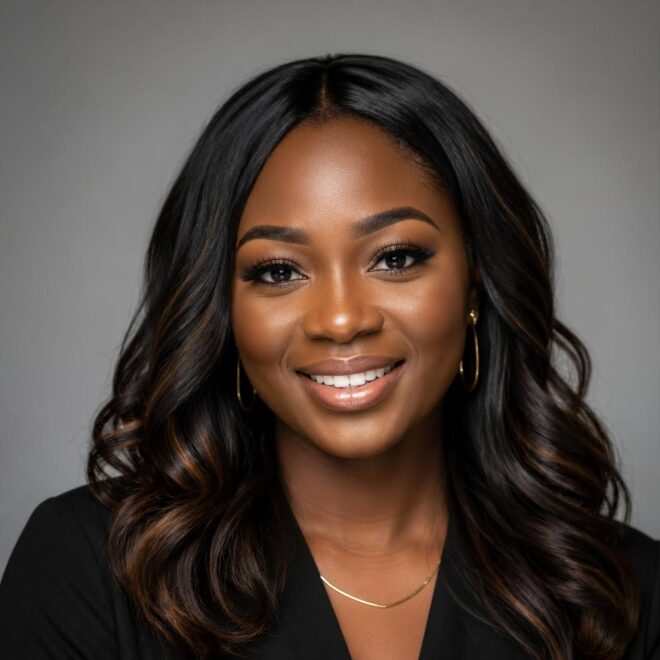


Cornrow styles with curly ends sit in a sweet spot between strict structure and soft drama. The braids stay flat and sharp at the scalp. The ends spring out in coils, ringlets, or waves that move when you walk. I’ve built whole rotations of summer styles around this combination because it works for everything from beach days to weddings without changing the base install.
What follows is a deep look at twenty-two different cornrow-with-curly-ends versions. Each one approaches the curl differently — some tight, some loose, some only at the very tip, some halfway up the braid. The point is to show you the range, not to push one version as the right answer.
Why Curly Ends Pair So Well with Cornrows
Cornrows alone read structured and pulled-back. Curly ends introduce volume right where the eye lands — at the shoulders, the chest, or wherever your braids fall. That visual softness balances the geometry of the cornrow base.
The curl also adds longevity to the wear. Frizz at the parting becomes less noticeable when the eye is drawn to defined curls below. A two-week-old cornrow install with fresh-set curls can look almost as polished as it did on day one.
There’s a practical advantage too. Curls hide hair connections cleanly. If you’ve added extensions, the seam between your hair and the added hair disappears in the curl pattern. No tell-tale flat transition.
Curl Types You Can Choose From
The curl shape changes the whole vibe. A tight ringlet reads vintage. A soft beach wave reads casual. A jumbo curl reads glamorous.
Tight ringlets are made on small rods, usually a third of an inch wide. They hold for 2 to 3 weeks with care. They photograph sharp. They tangle faster than other shapes.
Loose curls sit on rods between half an inch and an inch wide. They look natural and need less daily care. They drop into waves over time.
Beach waves are large, soft S-shapes. Made on inch-plus rods or with a braid-out method. They last a week before relaxing into a near-straight texture.
Spirals are long, drawn-out curls that hang in vertical loops. They’re cinematic. They take the longest to set.
Choosing Hair for the Best Curl
Synthetic braiding hair takes curl differently depending on the brand. Kanekalon holds curls well after a hot water dip. Some cheaper synthetic blends melt under hot water. Read the package — it should say if the fiber is heat-resistant.
For human hair extensions, almost any curl method works. Rods, irons, rag rolls. The downside is cost — human hair runs 4 to 6 times more than synthetic.
Pre-curled hair packs are an option for those who want to skip the setting step. The curls come ready. The trade-off is less control over curl size and tightness.
Prep Notes Before You Sit Down
Wash the day before, not the day of. Hair needs a few hours to settle into its natural texture without being either freshly conditioned or oily.
Detangle thoroughly with a wide-tooth comb. Section into 4 to 6 stretchy braids overnight to keep the strands aligned. Apply a leave-in spray and a small amount of light oil — nothing heavy.
Plan to be in the chair for 4 to 7 hours depending on the cornrow pattern and curl method. Bring water. Bring snacks. Bring a charger.
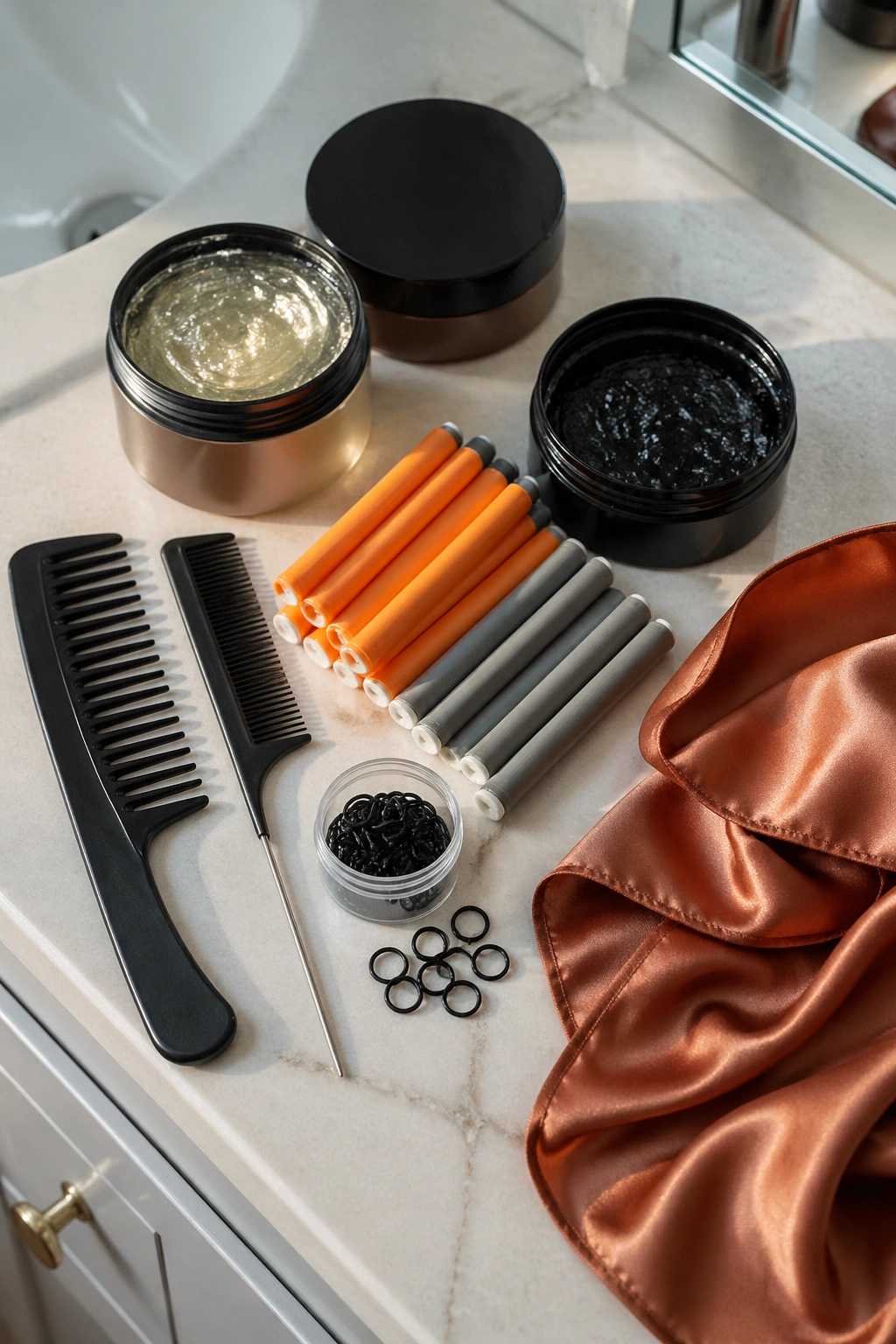
Tools and Products to Have Ready
- Edge gel with light hold
- Perm rods or flexi rods in your chosen sizes
- A pot of hot water (kept off heat once boiled, to prevent steam burns)
- Small silicone hair bands
- Wide-tooth comb and rat-tail comb
- Satin scarf for setting overnight if needed
Skip thick gels at the scalp. They flake by day three and dull the curl.
1. Tight Ringlet Ends on Straight Back Cornrows
Why It Works
Six straight-back cornrows ending in tight ringlets is the classic version of this style. The base is simple. The curl does all the talking.
- Use third-inch perm rods for ringlets at this scale
- Dip ends in hot water for 15 seconds, set for 3 hours minimum
- Spray with a sealing mist before removing rods to lock the shape
Tip: Leave 4 inches of straight braid before the curl starts. The unbraided neck section reads cleaner that way.
2. Cornrows with Loose Spiral Curls
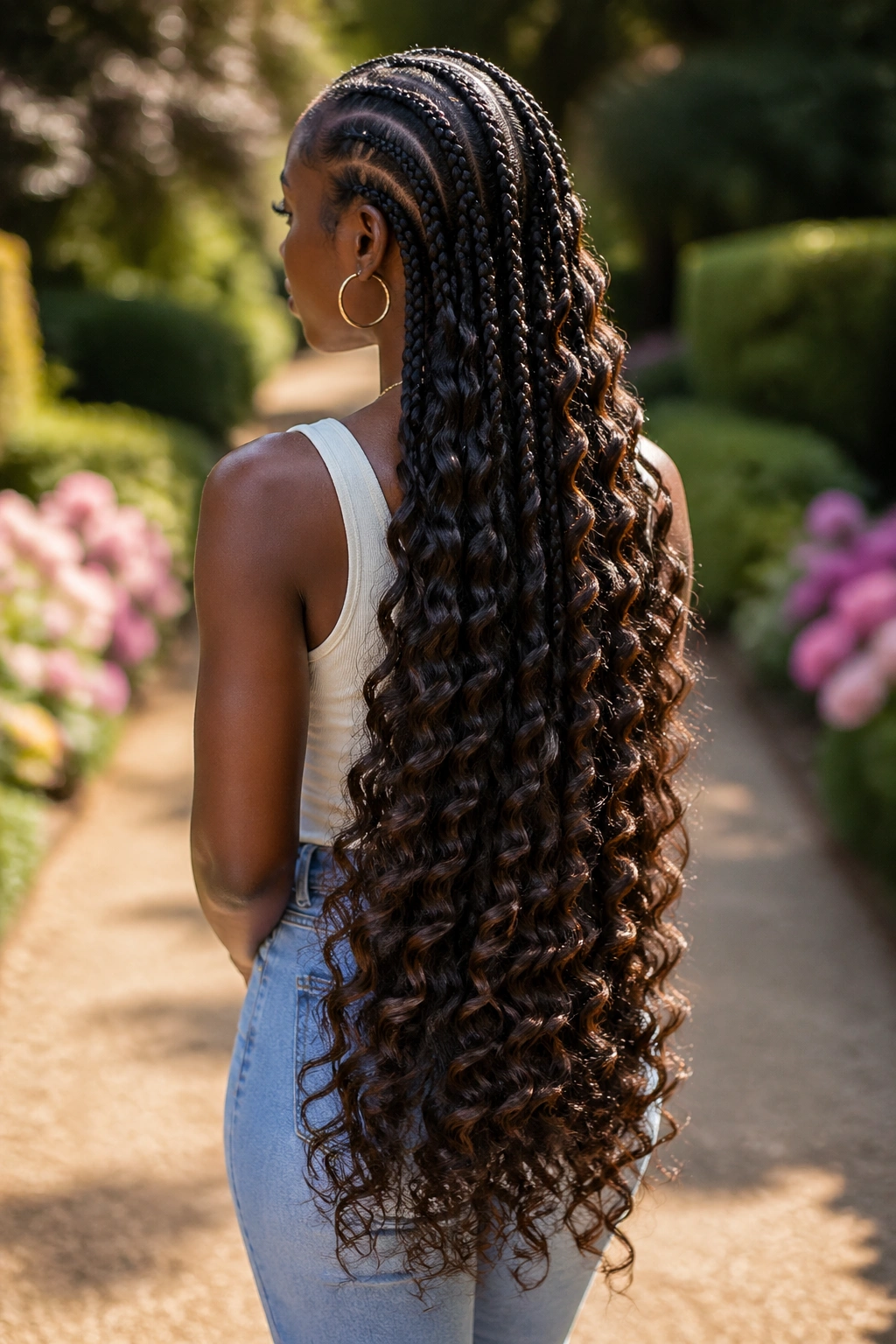
Loose spirals are the most wearable curl pattern because they look intentional without being fussy. Each spiral is about 1.5 inches wide. They cascade rather than bunch.
The spirals work best on shoulder-length to mid-back braids. Too short and they compress into a frizz-prone cluster. Too long and they straighten out under their own weight.
Use a curl cream with light hold to set them. Skip mousse — it makes synthetic hair stiff.
3. Side-Swept Cornrows with Curl Cascade
The cornrows angle from one side of the head to the other, ending in a cascade of curls over one shoulder. The asymmetry adds drama.
Five to six cornrows running diagonally is typical. The curls collect on the opposite shoulder from where the cornrows start, which lengthens the visual line of the head.
Pin the curls in place if they keep slipping back. A small clip at the base of the cascade holds the sweep without showing.
4. Cornrows with Coiled Tips
Coils are tighter than ringlets — almost spring-like. Each coil is about half an inch wide and bounces when you move.
Set coils with a finger-coil method or with the smallest perm rods you have. A gel with strong hold works better than a cream because coils need definition.
Coils suit shorter braid lengths. Past the shoulder they can look heavy.
5. Long Cornrows with Wand Curls
What Makes It Different
Wand curls fall in different directions because the wand can be wrapped clockwise or counterclockwise on each section. The variety makes the curls look natural, not uniform.
Use a curling wand on synthetic hair only if the package says heat-resistant. Set the temperature to medium. Hold each section 8 to 10 seconds.
Who This Is For
People who want polished curls without the rod-set time investment. Wand curls take an hour or two to set. Rod sets take overnight.
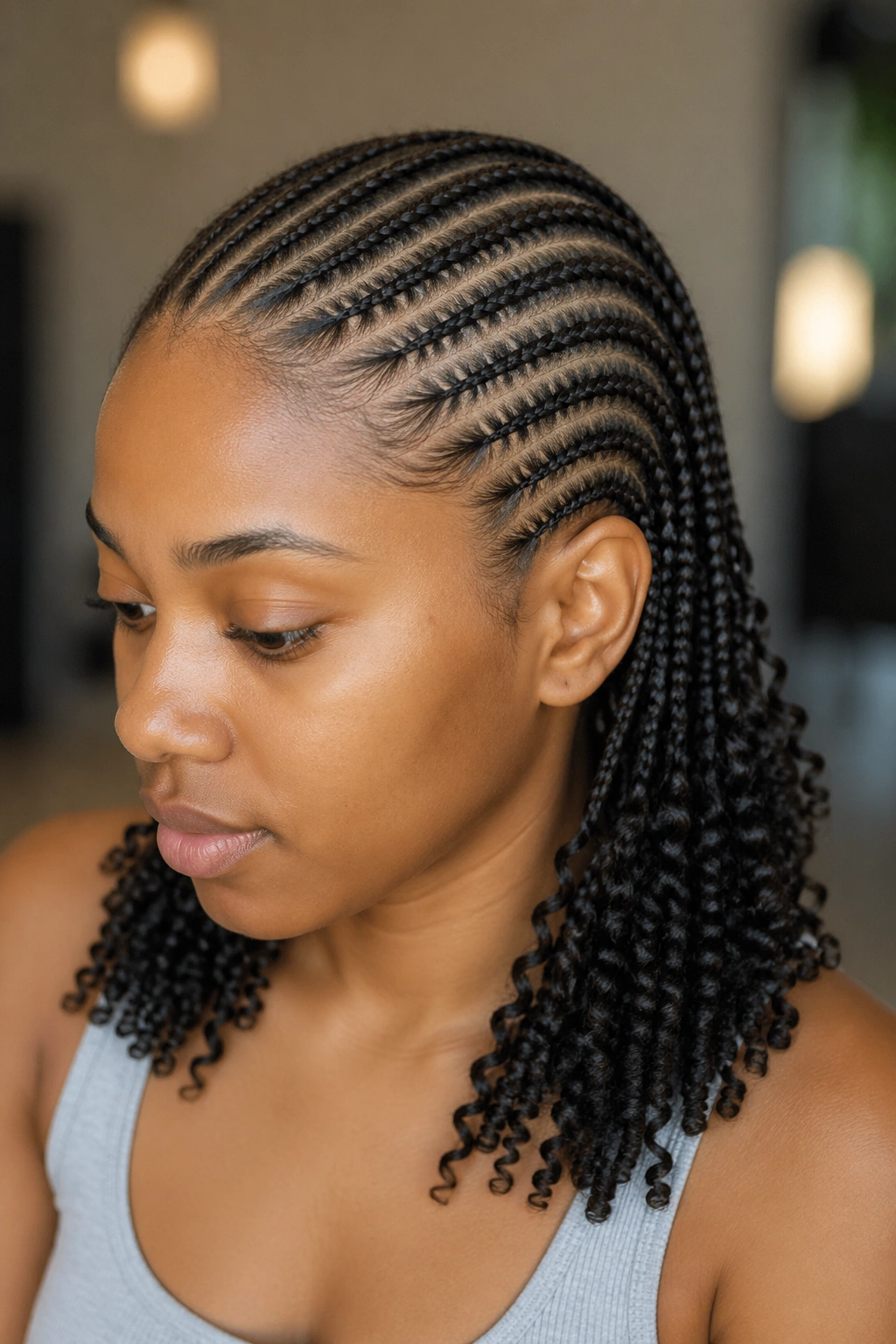
6. Halo Cornrows with Curl Crown
The cornrows ring the perimeter of the head like a halo. The crown section gathers into a curled puff or curl cluster.
This is a more sculptural style. The curls become the crown jewel of the look. The cornrows below frame and support them.
The puff at the crown can be made from your natural hair or from extensions tied in. Both options have their fans.
7. Lemonade Braids with Curled Ends
Lemonade braids angle from one side of the part to the opposite shoulder. With curls at the ends, the angled flow turns into a curled wave that drapes elegantly.
The curls should be loose to medium — tight curls fight the angled drape. Body wave or beach wave shapes work best.
Pair with a single statement earring on the swept-away side. The asymmetric face reveal is part of the charm.
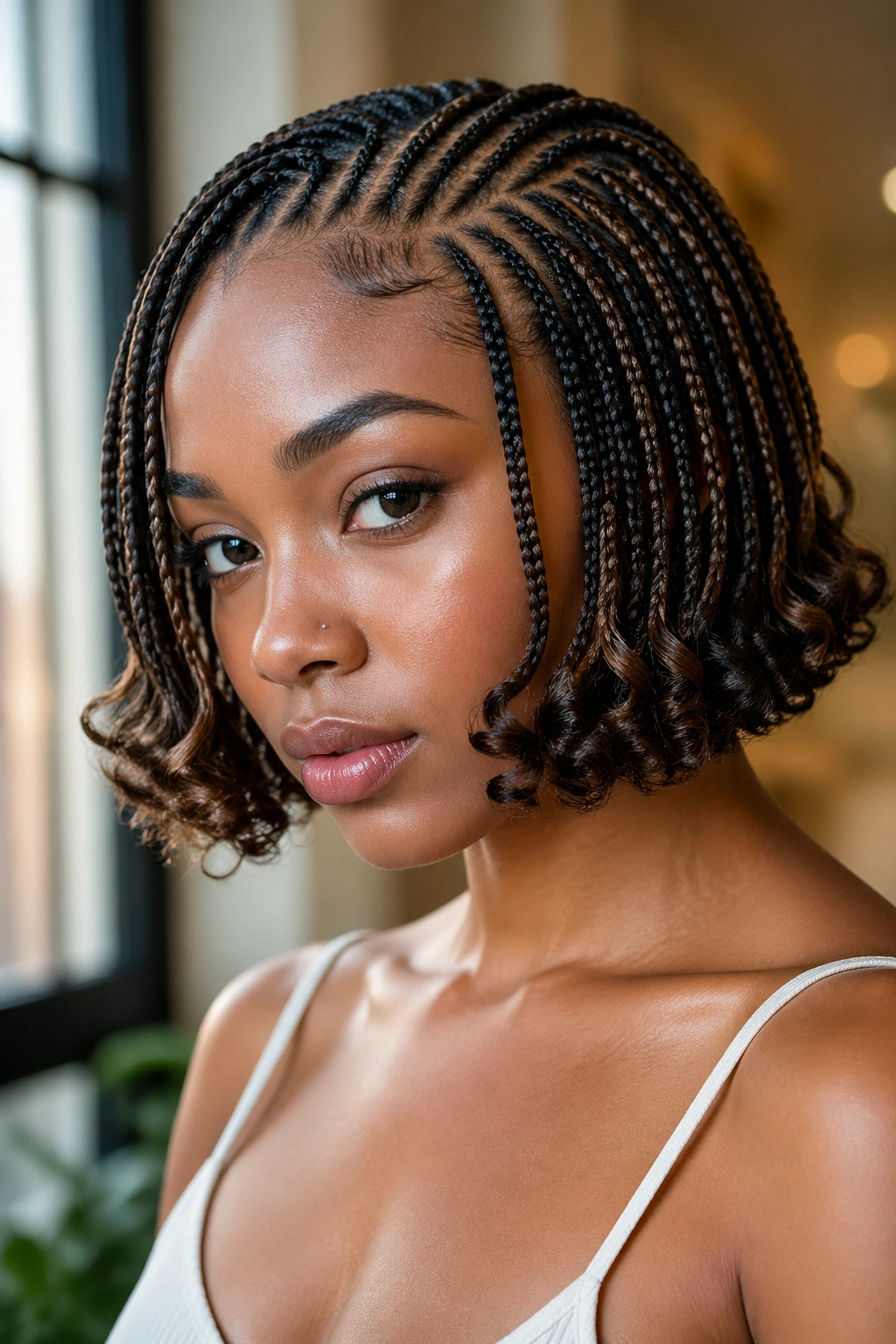
8. Short Bob with Curled Ends
A bob-length cornrow install ending at the chin or jawline can have curls at the very ends. The curls flip outward, creating a shape that frames the face.
Curl size matters here. Tight curls on short braids look juvenile. Loose, brushed-out curls or soft S-waves keep the bob looking grown.
Short bob styles photograph sharp. Good for events where you want a clean silhouette.
9. Cornrows with Mermaid Waves
Mermaid waves are long, undulating S-shapes that flow continuously down the length of the braid. They’re cinematic. They suit waist-length installs especially well.
Set with the largest flexi rods or with a rag-curl method. The bigger the rod, the bigger the wave.
The waves drop quickly without daily care. A nightly bonnet wrap and a morning mist refresh keep them through a week.
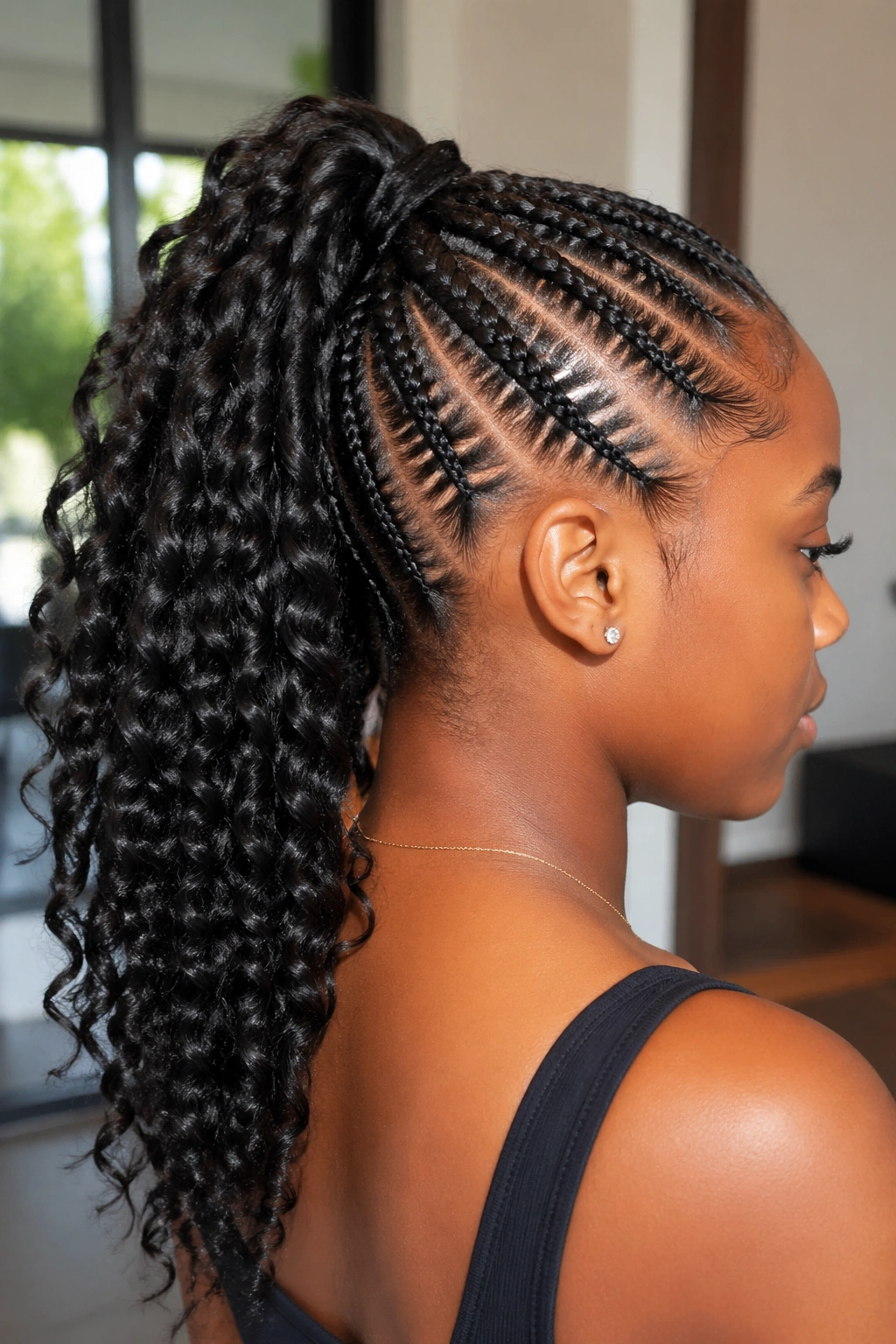
10. Cornrows with Curled Pony Drop
The cornrows pull back into a high ponytail. The ponytail itself is curled — usually loose spirals or beach waves cascading from the gather point.
The cornrow base shows clean and structured. The curled pony adds movement and softness. It’s one of the most photogenic combinations.
Wrap a section of the ponytail hair around the elastic to hide it. That small detail elevates the whole look.
11. Cornrows with Curled Half-Up
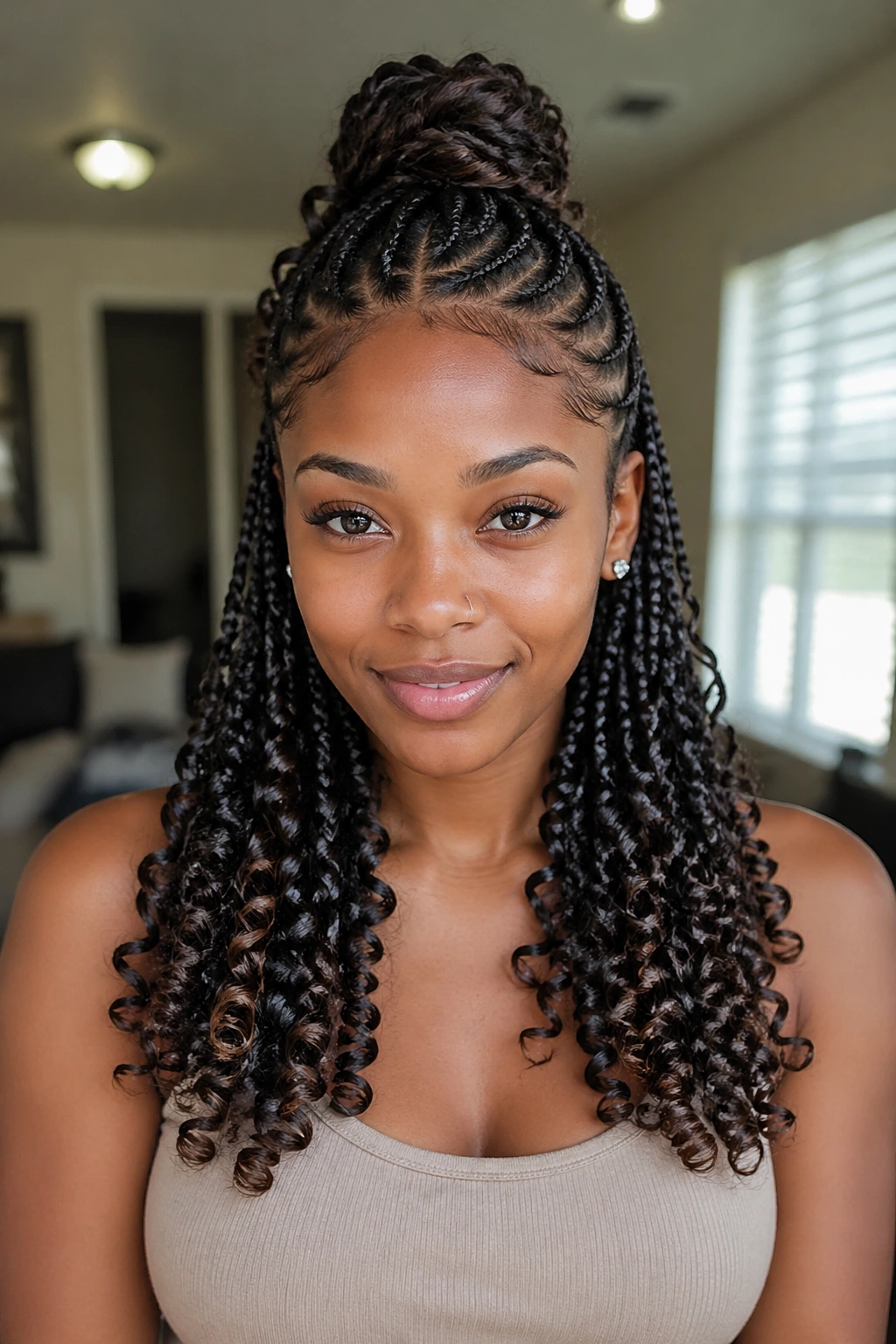
Half the braids gather into a knot or ponytail at the crown. The other half hangs down, curled at the ends. The split creates a layered effect — structure on top, flow at the bottom.
The gather point should sit at the back of the crown rather than the very top. A higher placement looks like a pineapple. A lower placement looks more elegant.
Curls in the down section should be visible from the front. If they’re hidden behind the up section, the style loses balance.
12. Cornrows with Curls Starting Mid-Braid
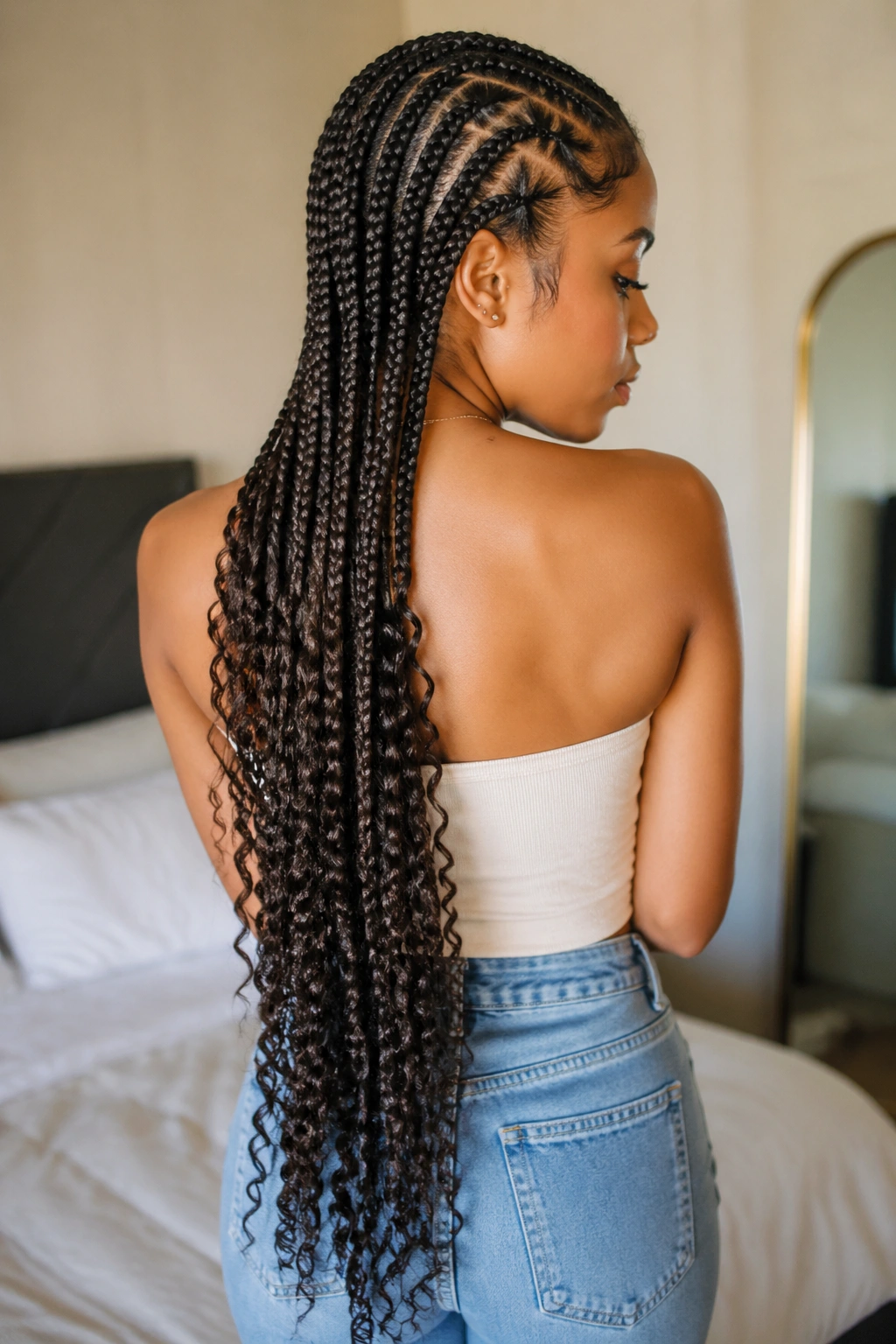
What happens when curls start halfway down the braid instead of just at the tips? The transition creates a long, dramatic curl section. The straight cornrow above provides structure.
Mark the transition point clearly. The braider should switch from braiding to curling at the same length on every braid. Uneven transitions read as mistakes.
How to Wear It
Long enough installs only — at least mid-back length. Short braids don’t have room for the curl section to develop.
13. Cornrows with Curled Crown and Straight Length
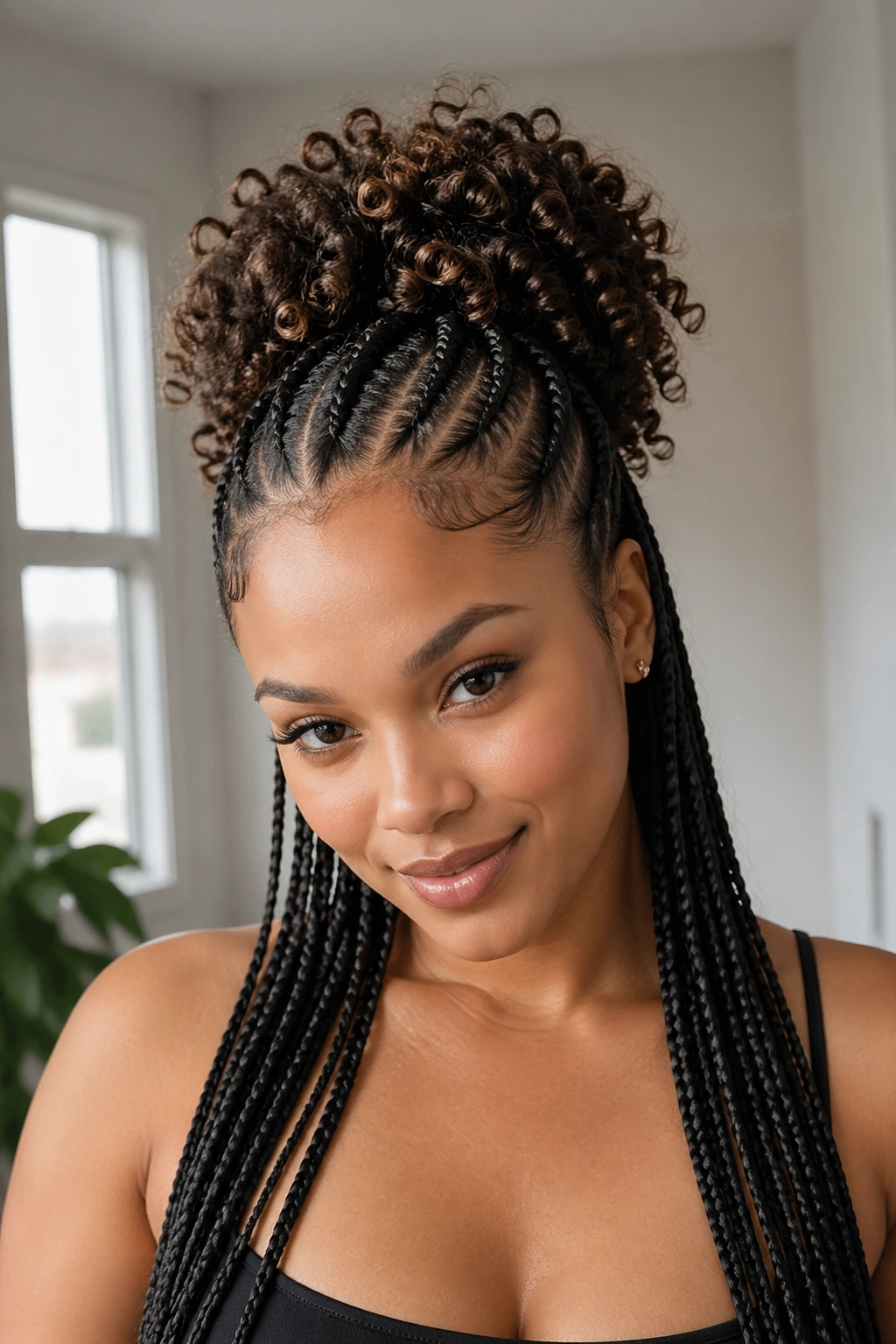
The opposite arrangement — curls at the crown, straight braids hanging down. The crown gathers into a curled puff while the rest of the braids stay straight.
This is unusual. Most curl-end styles have the curls at the bottom. The crown variation works for people with tall foreheads who want visual weight at the top.
Set the crown puff with a small amount of mousse and let it air-dry. Hot water dipping isn’t needed for this section.
14. Cornrow Crown with Curled Cascade
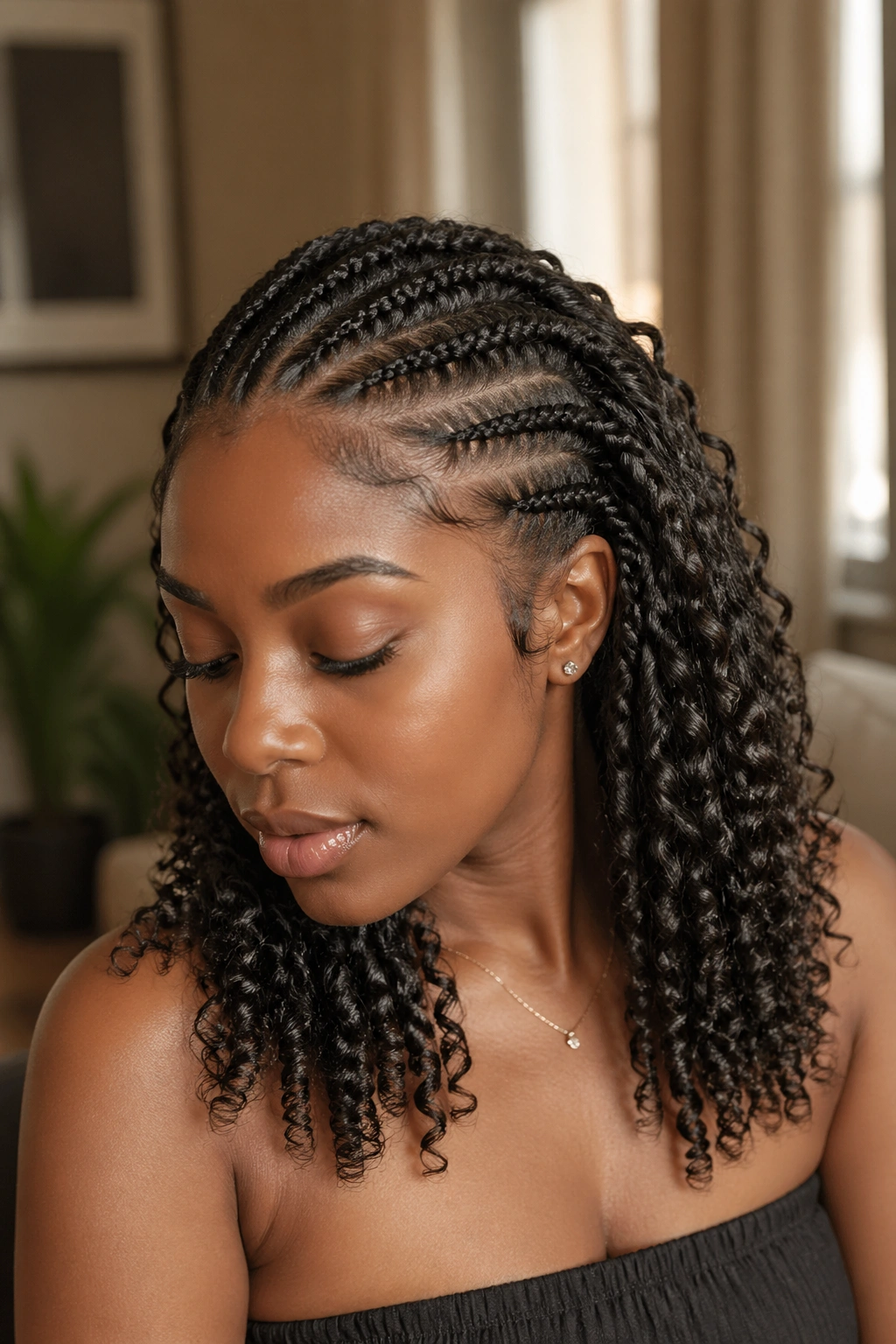
A more elaborate version of the half-up. The cornrows form an intricate crown pattern at the top of the head — geometric or curving — and the curls flow loose from the back.
The crown can be a heart shape, a star burst, or a curved spiral. Whatever pattern you choose becomes the focal point.
The curls below should be relatively simple. Loose waves or soft spirals. Anything too elaborate competes with the crown for attention.
15. Cornrows with Curled Side Drape
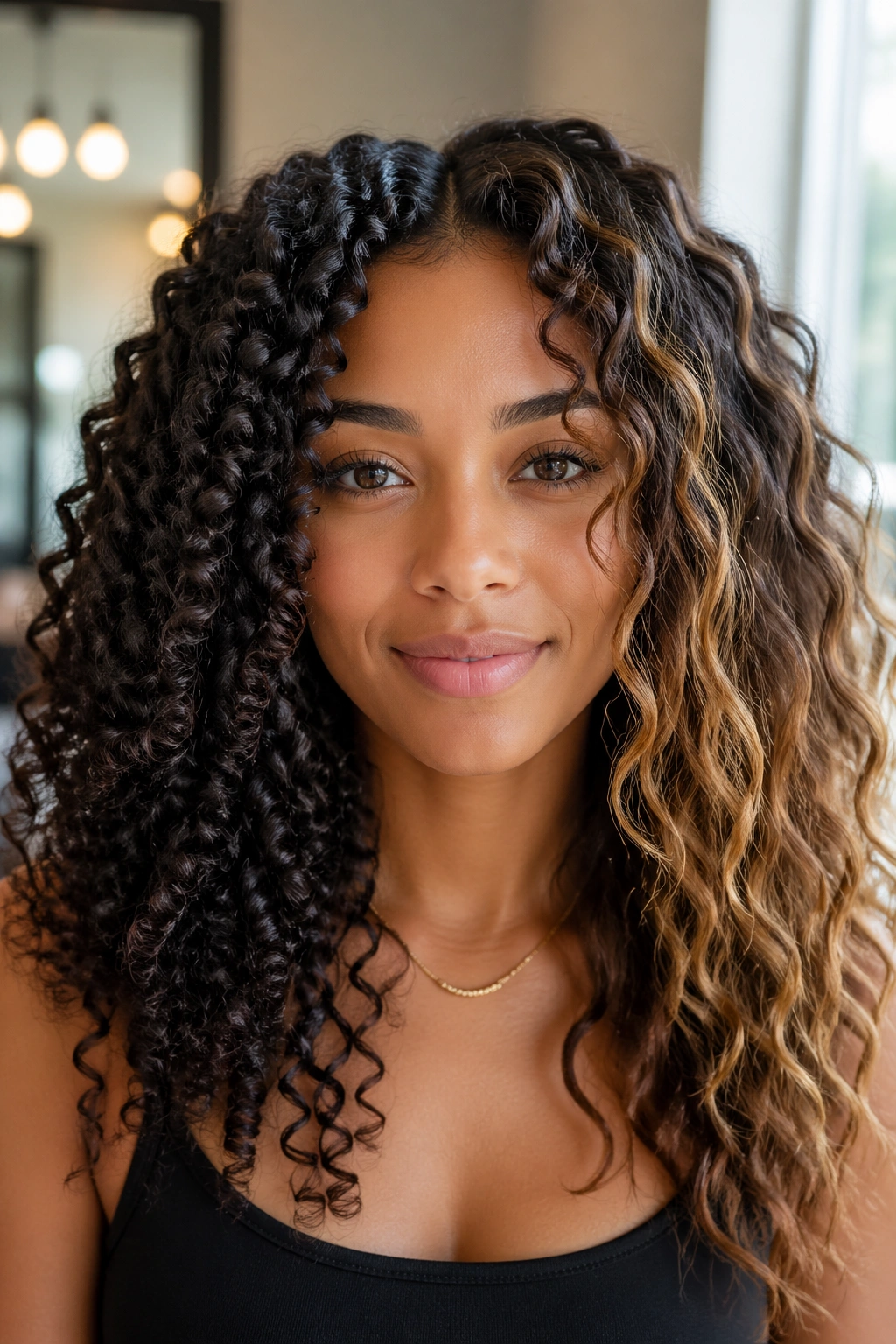
The braids sweep to one side at the shoulder. The curls hang in a single drape over that shoulder. The unswept side stays clean.
The asymmetric reveal of the neck on one side creates an elegant line. Best for outfits with collars or necklines that show one side of the neck more than the other.
Pin the cornrows behind the unswept ear with a small bobby pin. The pin keeps the sweep from drifting back to center.
16. Cornrows with Beaded Curls
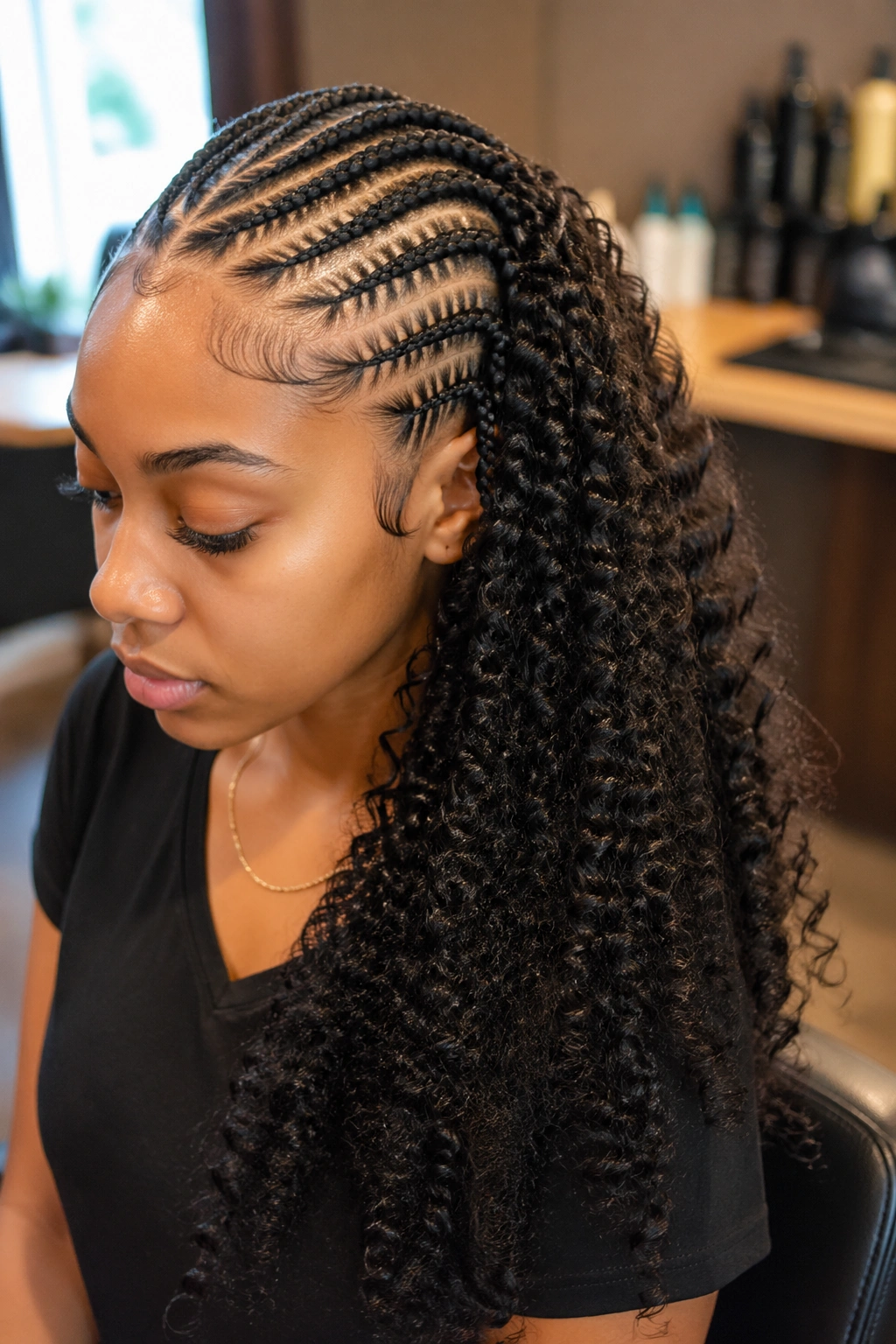
Beads on the curled section add weight and sound. The beads pull the curls into more defined shapes. The clicks when you move become a small sensory accent.
- Place beads at the curl-start point and at the curl-end point
- Use small wooden or glass beads, 6 to 8 mm
- Mix two or three colors for visual interest
Tip: Beads slide on synthetic curl hair. Secure each one with a small silicone band below.
17. Cornrows with Curled Bangs
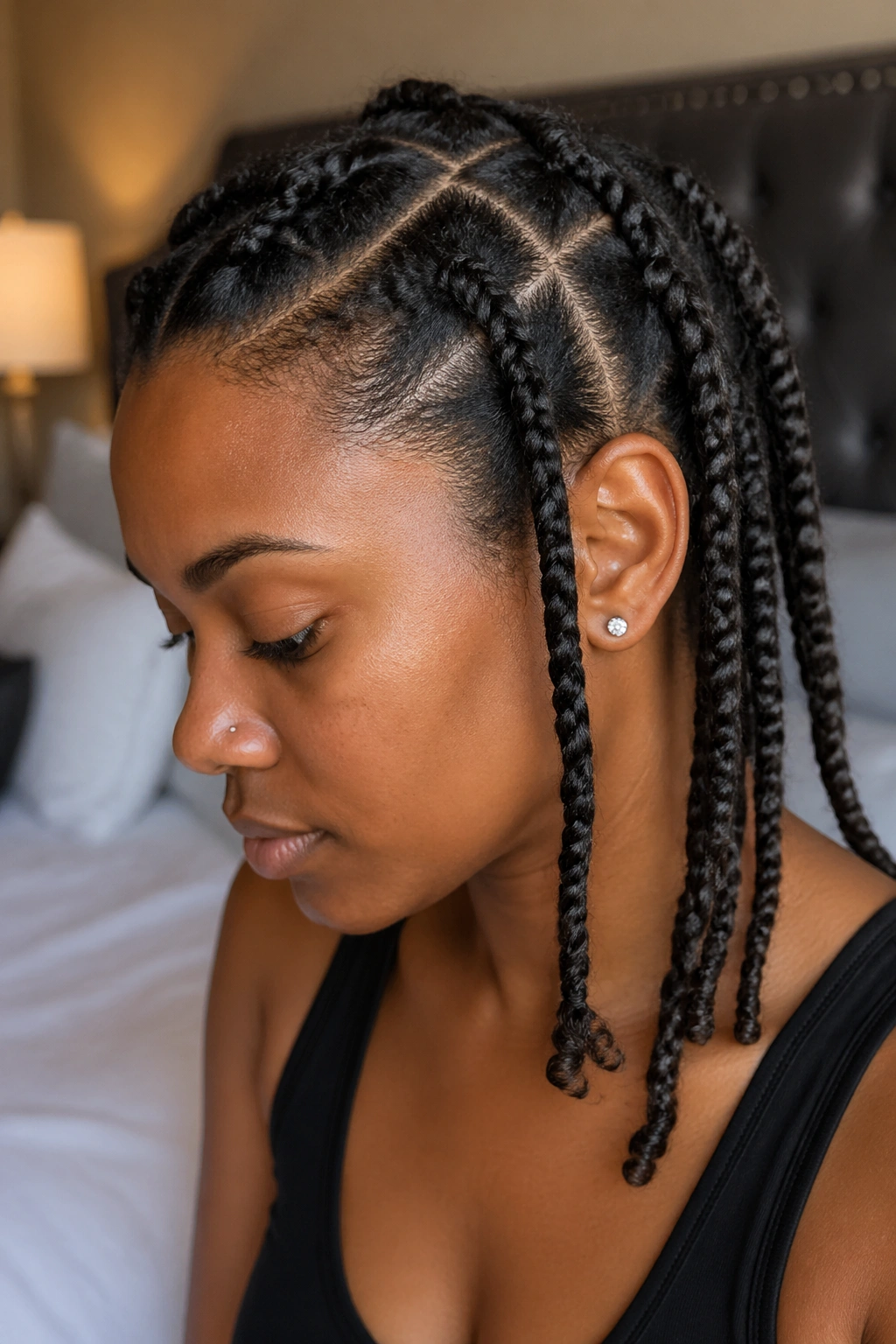
A curled fringe over the forehead, with cornrows running back from there. The fringe is loose hair, not braided. It bounces and curls while the braids stay flat behind.
Fringe length should sit just above the eyebrows. Longer fringes get into the eyes. Shorter fringes look severe.
The curl pattern in the bangs should match the curl pattern at the braid ends. Coordination ties the look together.
18. Cornrows with Curl-Ringed Bun
A bun at the crown surrounded by a ring of curls. The bun is built from cornrow extensions wrapped tightly. The curl ring is created by leaving small sections of curled hair around the bun’s base.
The contrast between the smooth bun and the textured ring is the appeal. Like a halo of curls around a polished center.
This style needs steady hands at install. The bun should sit precisely centered on the crown.
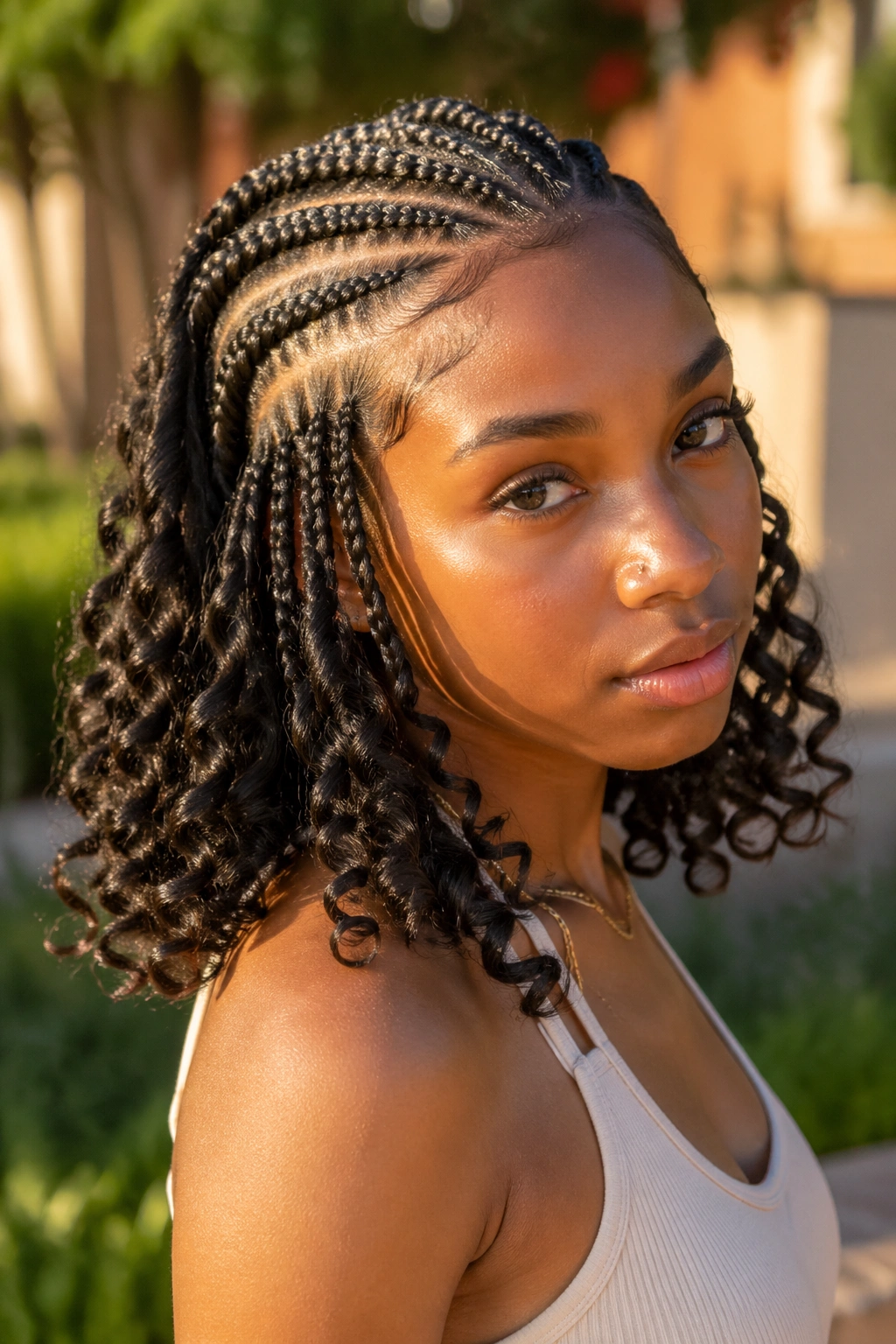
19. Cornrows with Curls and Color Pop
Color in the curled section adds another layer of interest. The cornrows stay your natural color. The curls show a contrasting tone — copper, burgundy, blonde, even a soft pink.
The color can be in the entire curl section or just streaked through. Streaks look more subtle. Full color makes the curls the centerpiece.
The right color depends on your skin tone. Warmer tones suit copper and honey. Cooler tones pair with ash blonde or burgundy.
20. Cornrows with Curls and Hair Cuffs
Metal cuffs snapped onto the cornrow before the curl starts. The cuff sits where the braid meets the curl, marking the transition.
Three to five cuffs across the head is the right count. Use the same metal — gold or silver — for cohesion. Mixed metals tend to look accidental.
Cuffs are subtle but effective. They add texture without dominating.
21. Cornrows with Curls in Two Lengths
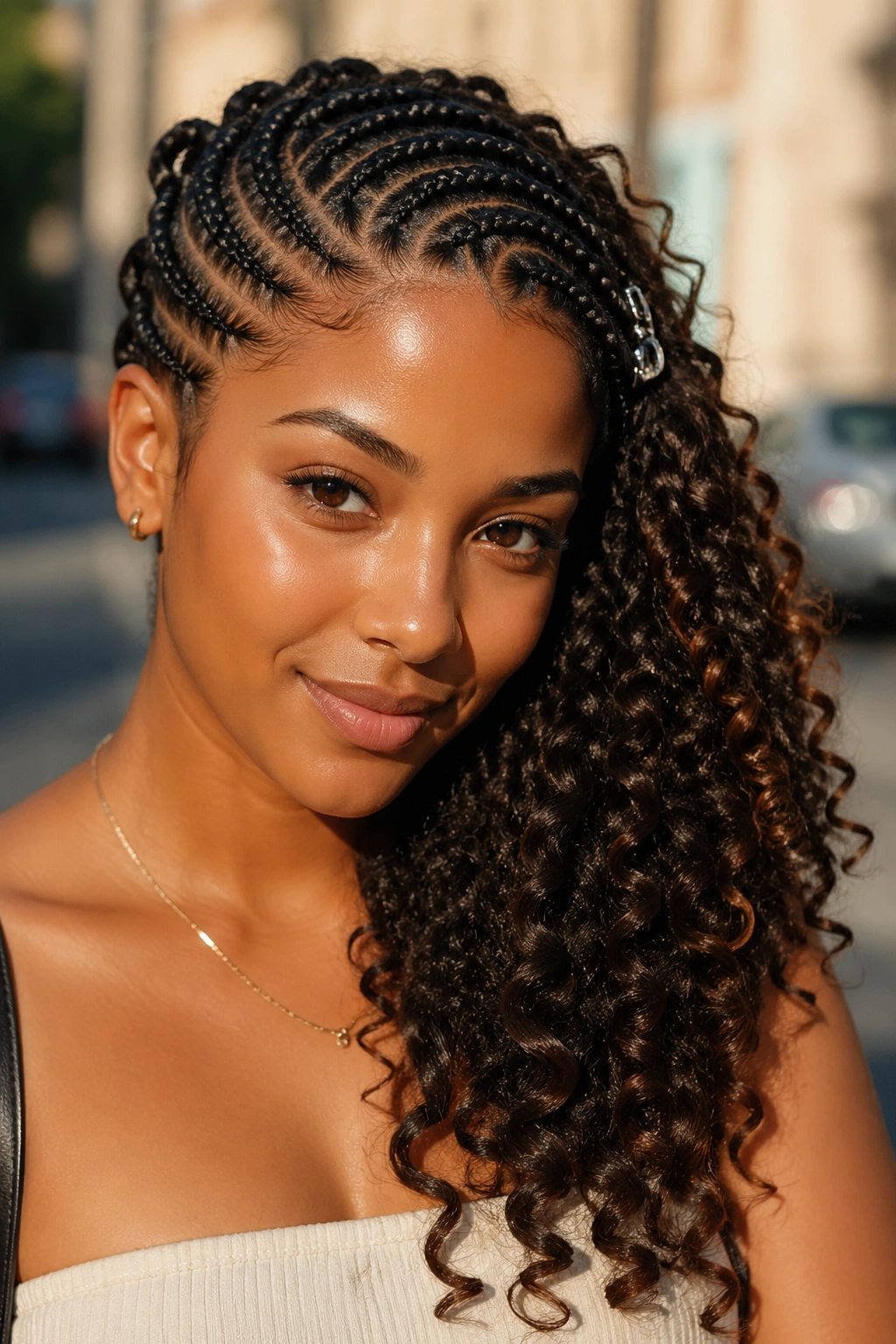
Some braids end at the shoulder. Others end at the waist. All the ends curl. The two lengths create a layered shape that frames the body more dynamically than a uniform length.
The shorter braids should sit in front, framing the face. The longer braids run behind, creating the cascade.
This is a sophisticated cut illusion. It looks like the hair has been layered without any actual cutting.
22. Cornrows with Asymmetric Curls
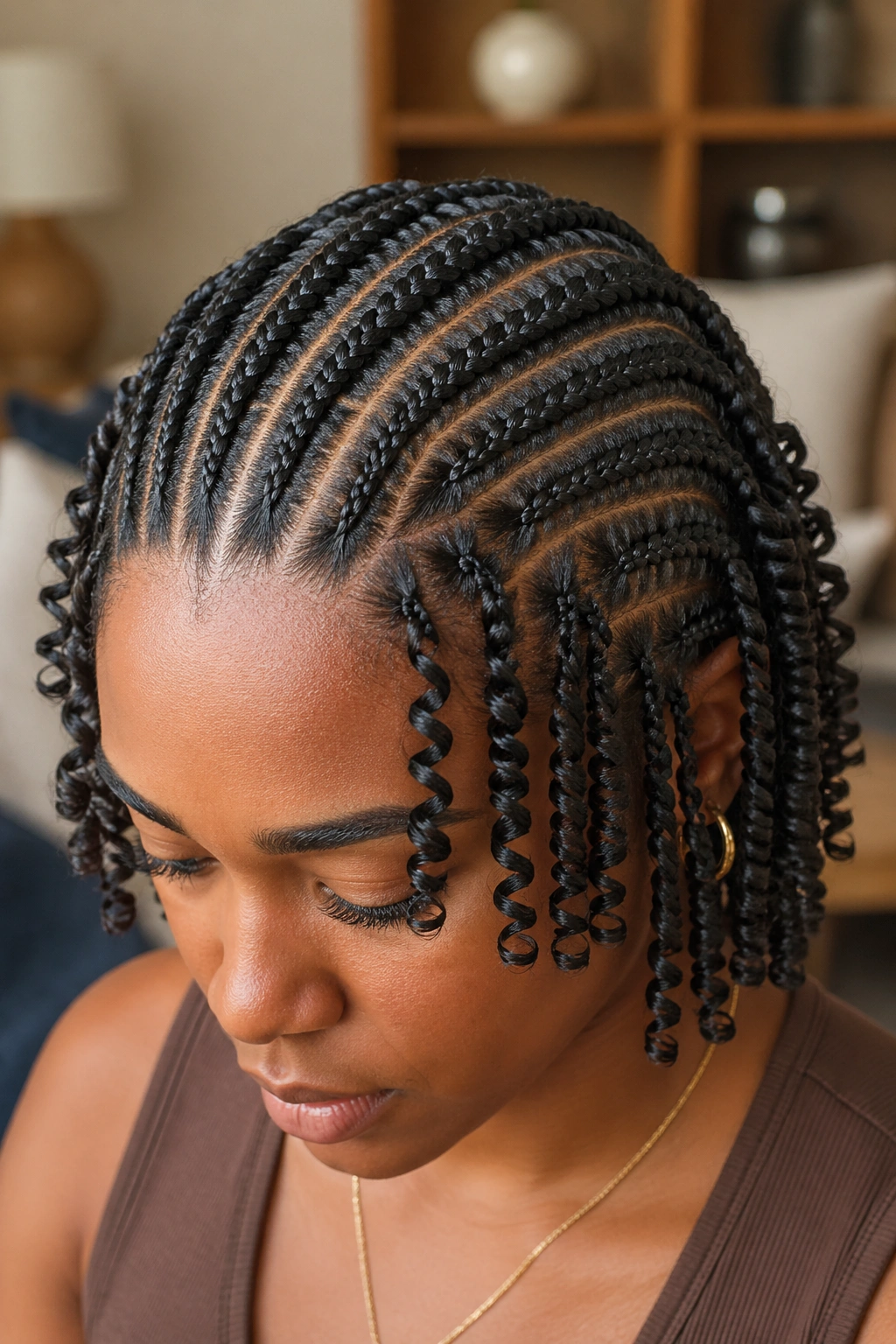
The curls are styled differently on each side. Tight ringlets on one side, loose waves on the other. The asymmetry is deliberate and visible.
It only works when the braider plans the imbalance. Show reference photos. Communicate clearly that the two sides should not match.
This reads as art direction. People notice and ask about it.
Caring for Curled Cornrow Ends
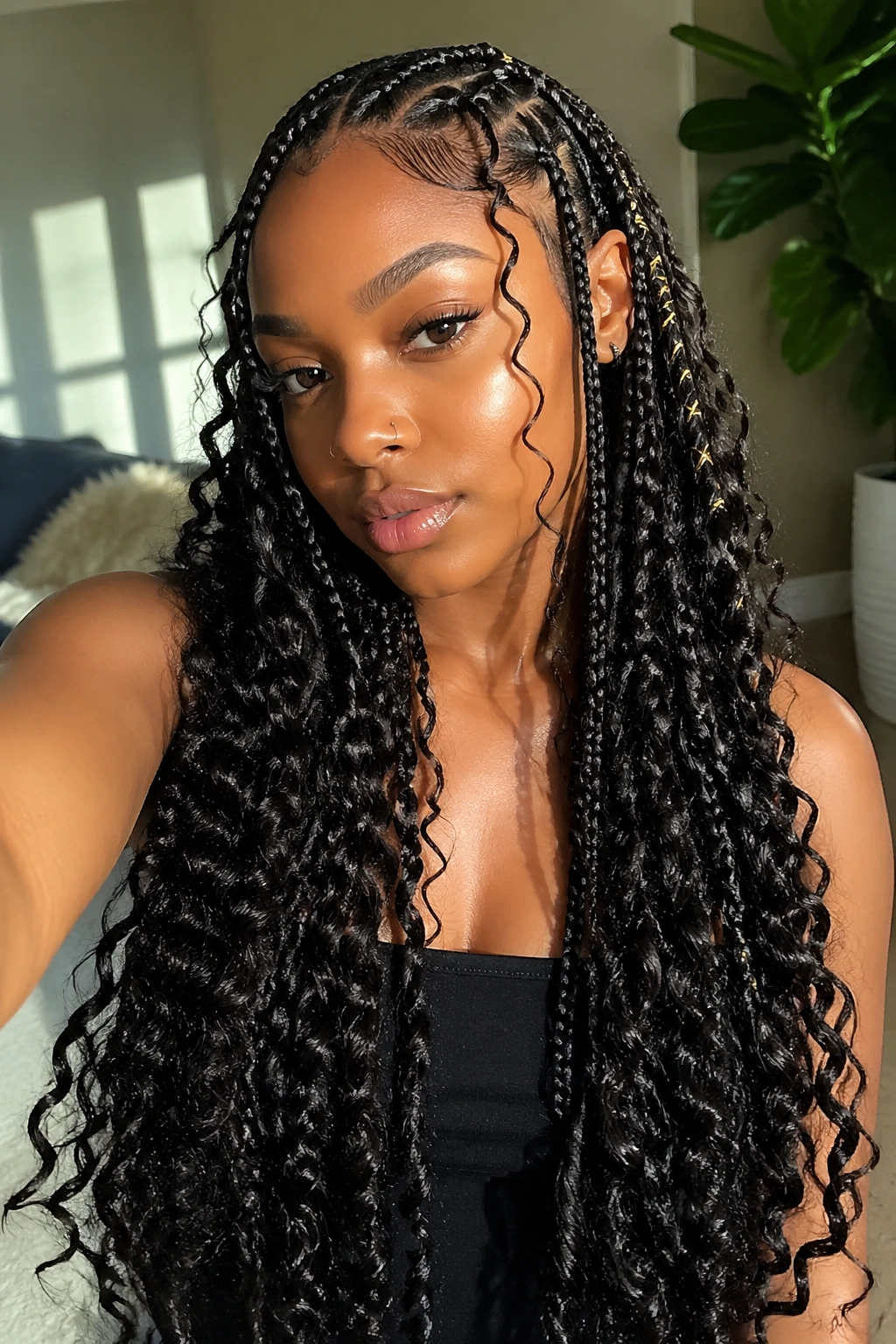
The curls are the most fragile part of the install. They want consistent moisture and protection.
- Mist with water and leave-in every 2 to 3 days
- Apply curl cream once a week to maintain definition
- Sleep with a satin bonnet, never an exposed pillow
- Finger-detangle if curls start to clump
The cornrow base wants different care. A scalp tonic with witch hazel or tea tree applied weekly. A small amount of oil massaged into the parts. No heavy products.
Refreshing Curls Mid-Wear
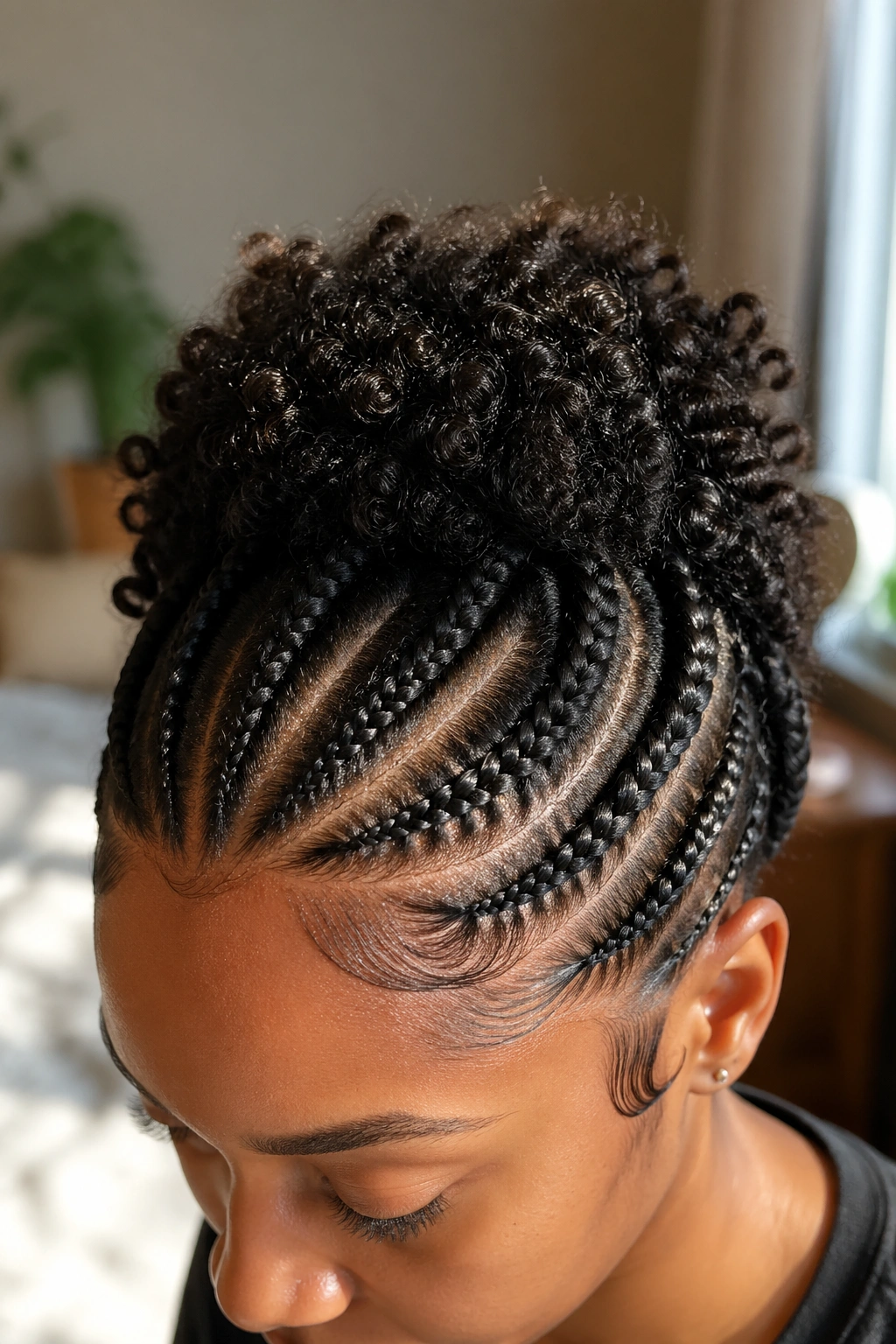
Curls loosen over time. A week-old curl might be half the tightness it started at. That’s normal, not a failure.
Refresh with hot water dipping. Heat half a pot of water, take it off the burner, let it cool slightly, then dip the ends for 10 seconds. Pat dry and let the curl re-set on a rod for 30 minutes. The shape comes back.
Or use a curl-refresh spray — water, leave-in, and a few drops of light oil — and finger-twist the curls back into shape. Less effective than hot water but easier for daily touch-ups.
Sleep Routine for Curled Ends
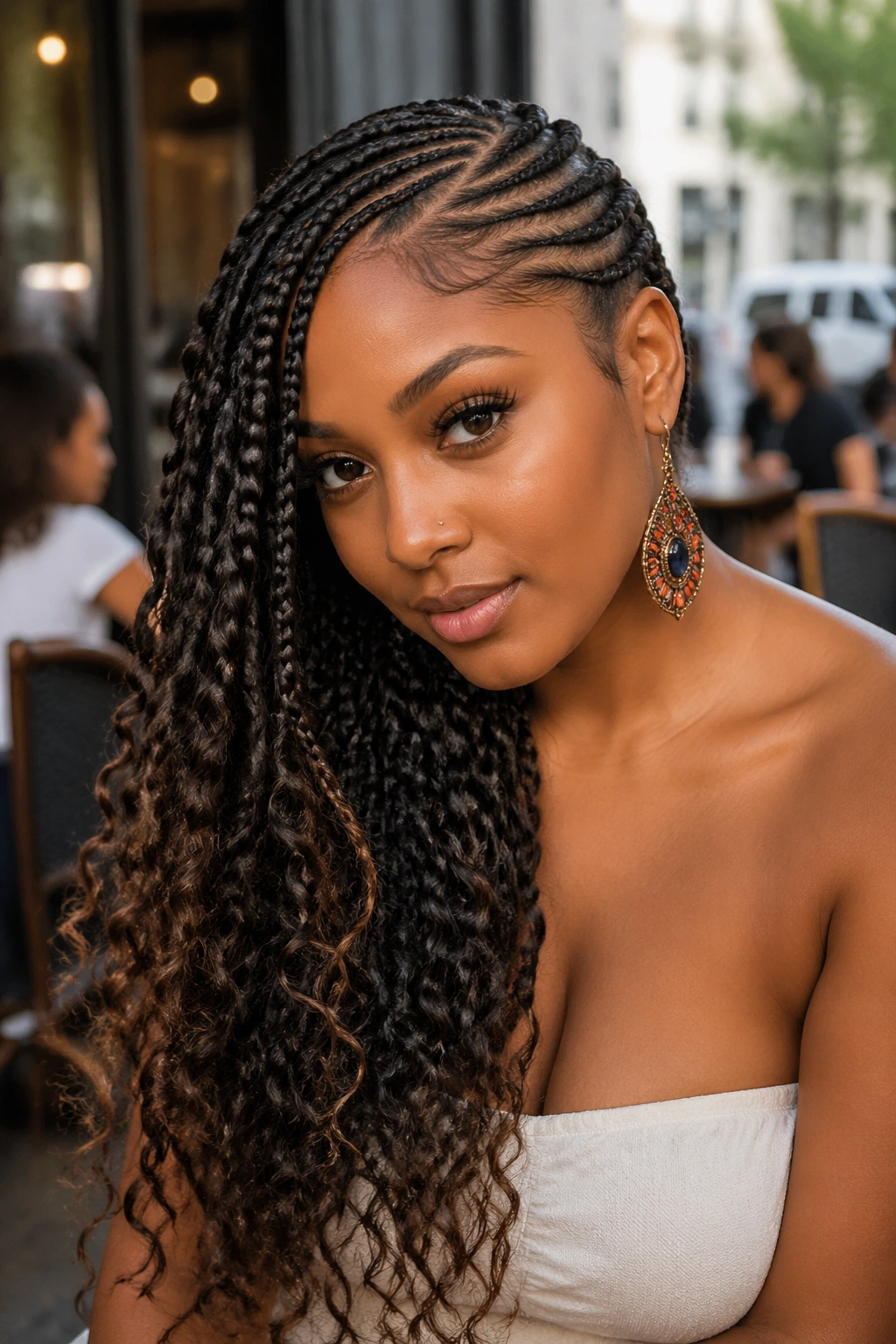
Compression is the enemy. Curls press against pillows and lose their shape overnight.
Gather the curls into a high, loose ponytail with a silk scrunchie. This lifts them off the pillow. Then wrap a satin bonnet over everything, including the cornrow base.
Side sleepers should switch sides every few nights to avoid one-sided flattening.
Taking Down Cornrows with Curls
Takedown is straightforward but slow. The curls tangle if neglected, so daily care during the wear period makes a big difference at takedown.
Start by spraying the install with a water and conditioner mix. Wait 10 minutes. Begin unraveling each cornrow from the bottom up. The curl section needs gentle finger detangling before any combing.
Plan 2 to 3 hours for full takedown.
Picking the Right Style for You
Face shape, hair length, lifestyle — all factor in.
- Round faces suit long curls below the shoulder, which lengthen visually
- Long faces pair with shorter curl drops at the shoulder, adding horizontal volume
- Square jaws soften with looser, flowing curl shapes rather than tight ringlets
- Heart-shaped faces balance with curls that gather at the chest, creating width below the chin
Hair length affects what’s possible. Short natural hair limits the cornrow length without extensions. Medium and long hair give the most options.
Lifestyle filters too. If you swim regularly, choose synthetic hair that handles chlorine. If you live in humid climates, avoid tight curl patterns that frizz fast — opt for waves.
Mistakes to Avoid
Skipping the hot water dip is the most common mistake with synthetic hair. Without the dip, curls fall out within days. The heat sets the shape into the fiber.
Over-brushing destroys curl definition. Use fingers to separate. A wide-tooth comb only at takedown.
Heavy products kill the curl. Thick butters and oils weigh the curl down. Use lightweight curl creams or sprays.
Ignoring sleep protection. A pillow without a bonnet is a curl killer. The friction flattens curls in one night.
Cornrow styles with curly ends remain one of the most flexible categories in protective styling. The combination wears well, photographs sharp, and adapts to almost any setting. Pick the curl shape that matches your mood, prep your hair properly, and you’ll have a style that turns heads for weeks.