
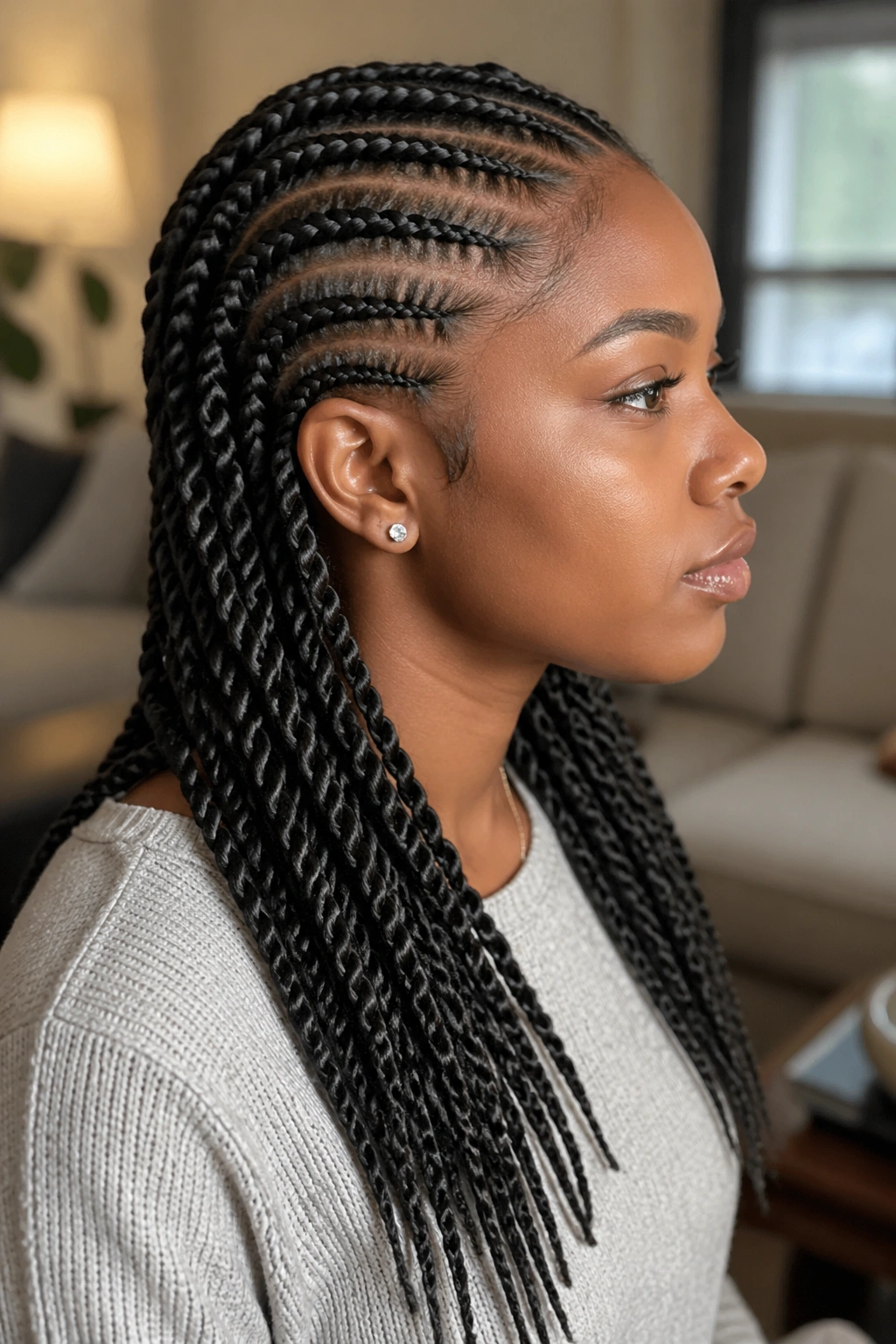
Cute cornrows on natural hair walk a specific line. They’re playful without being childish, polished without being stiff, and styled without taking three hours to do. The “cute” tag is doing real work here — it points to small design touches, soft finishes, color accents, and the kind of details that read as personal rather than corporate. Twenty-two cute cornrow styles follow, each one workable on natural hair from 3C through 4C, and each one different enough that nobody could mistake one for another.
Natural hair was made for cute cornrows. The texture grips parts cleanly, holds beads and accessories without slipping, and frames the face in ways that straighter hair just can’t. The styles below lean into that texture rather than fighting it. A few use extensions, most don’t. All of them prioritize comfort and edge health alongside the look.
What Cute Cornrows Actually Mean
Cute is a vibe, not a technical category. It usually means smaller-scale braids, decorative parts or accessories, soft finishes, and styling that reads young, fresh, or playful rather than severe. Cute cornrows usually avoid the heavy, dramatic silhouettes of long-braid styles in favor of something that feels closer to everyday wear.
This doesn’t mean kids’ styles. Adult cute cornrows are a real category — they just borrow some of the visual language (smaller scale, more accessories, soft accents) that show up in younger styles.
The line between cute and overly juvenile is mostly drawn by the accessories. Plastic ball ties read childish. Wooden beads, gold cuffs, ribbons, or geometric metal accents read grown-up cute.
Why Natural Hair Holds Cute Styles So Well
Natural texture grips itself. A cornrow on 4C hair stays put for two weeks because the hair locks into the braid. A cornrow on bone-straight hair starts slipping by day three. Natural hair gives cute styles the longevity they need to actually be worth the effort.
The texture also holds parts visibly. A clean center part on natural hair stays sharp. The little geometric parts that make cute styles cute — triangles, hearts, zigzags, crisscrosses — show up clearly against the dark, dense texture of natural hair.
Color shows beautifully on natural hair too. Bold reds, honey blondes, copper highlights, and pastel accents all sit cleanly on dark natural hair without looking washed out.
Prep Work for a Long-Lasting Cute Set
Wash with a sulfate-free shampoo. Deep condition for 30 minutes. Apply leave-in. Stretch the hair with overnight twists or a low-heat blow-dry. Cute styles often have small details at the hairline, and a stretched hairline gives the braider a clean canvas to work on.
Don’t load up on edge gel before braiding starts. Heavy product makes the hair slippery and the cornrow won’t grip. Apply edge gel only at the end, after the braids are in place, when you’re smoothing the hairline.
Key prep tip: trim split ends before installing cute cornrows. The ends often hang loose or get tied with small accessories — clean ends look better and hold accessory rubber bands more securely.
Tools for Cute Cornrow Styling
- A rat-tail comb with a sharp metal tip (for fine geometric parts)
- Edge gel with strong hold and minimal flake
- Small rubber bands in clear or hair-matched colors
- Decorative beads, cuffs, or ribbons depending on the style
- A beader tool for sliding beads onto thin braids
- Hair clips for sectioning
- A spray bottle with water and a little leave-in mixed
- A satin scarf or bonnet sized for the finished style
The beader tool is the one piece many people skip. It costs almost nothing and makes the difference between getting beads on cleanly versus fighting with them for an hour.
Technique Notes for Small-Scale Cornrows
Cute styles often involve thinner cornrows than standard. Thinner cornrows demand cleaner parting and more even tension. A wobble in the part shows more on a thin cornrow because there’s less braid to hide it.
Smaller sections also mean tighter starting tension by accident. Pay attention to how the first inch of each thin cornrow feels. If it feels tight, redo it looser. Tight thin cornrows pull on edges harder than tight thick ones.
Use under-hand strokes for raised, three-dimensional cornrows. Over-hand strokes give you flat, scalp-hugging French-braid style. Cute styles can go either way depending on the look.
A Note on Accessory Etiquette
Accessories add personality but they also add weight and friction. Heavy beads pull at the braid base. Tight cuffs pinch the braid. Plastic accessories can rub against the scalp during sleep and irritate.
Stick to lightweight materials — wooden beads, thin metal cuffs, fabric ribbons. Avoid heavy stone or oversized glass beads on thin cornrows. Test-fit cuffs before committing to make sure they slide on without forcing.
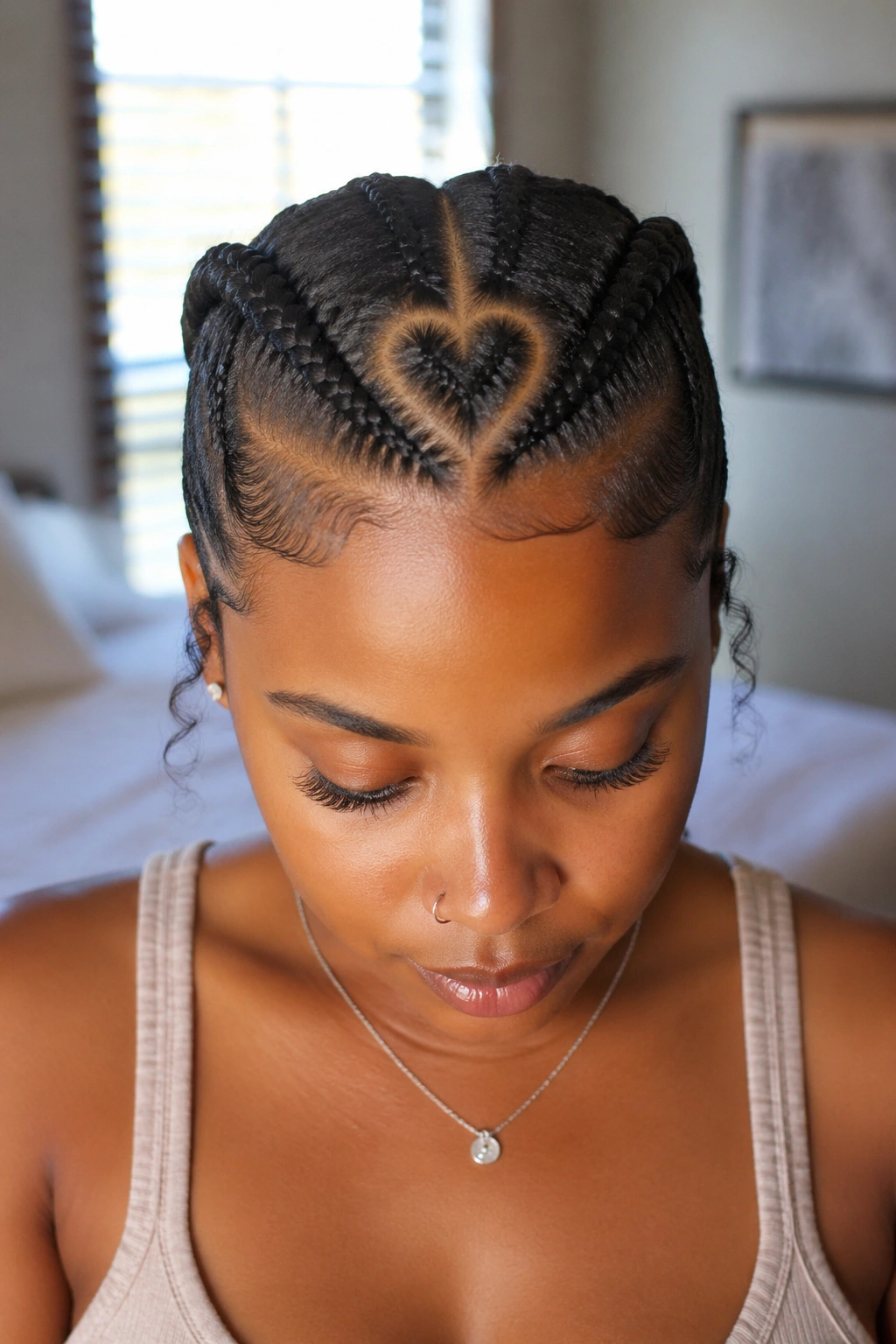
1. Heart-Shaped Part With Two Cornrows
A small heart-shaped part at the front center of the head. Two cornrows lead away from the heart’s bottom point, sweeping back across the head. The heart is the focal point; the cornrows are the supporting structure.
Why It Works
- One small detail transforms the whole style
- Quick to install — about an hour total
- Reads playful but adult on the right wearer
- Easy to refresh: re-draw the heart with edge gel as needed
The heart should be small — about 2-3 inches at its widest. Use the rat-tail comb tip to draw the outline, then carve out the inside with the same comb.
Best tip: practice the heart shape on paper first. Free-hand parting takes a few attempts to get right.
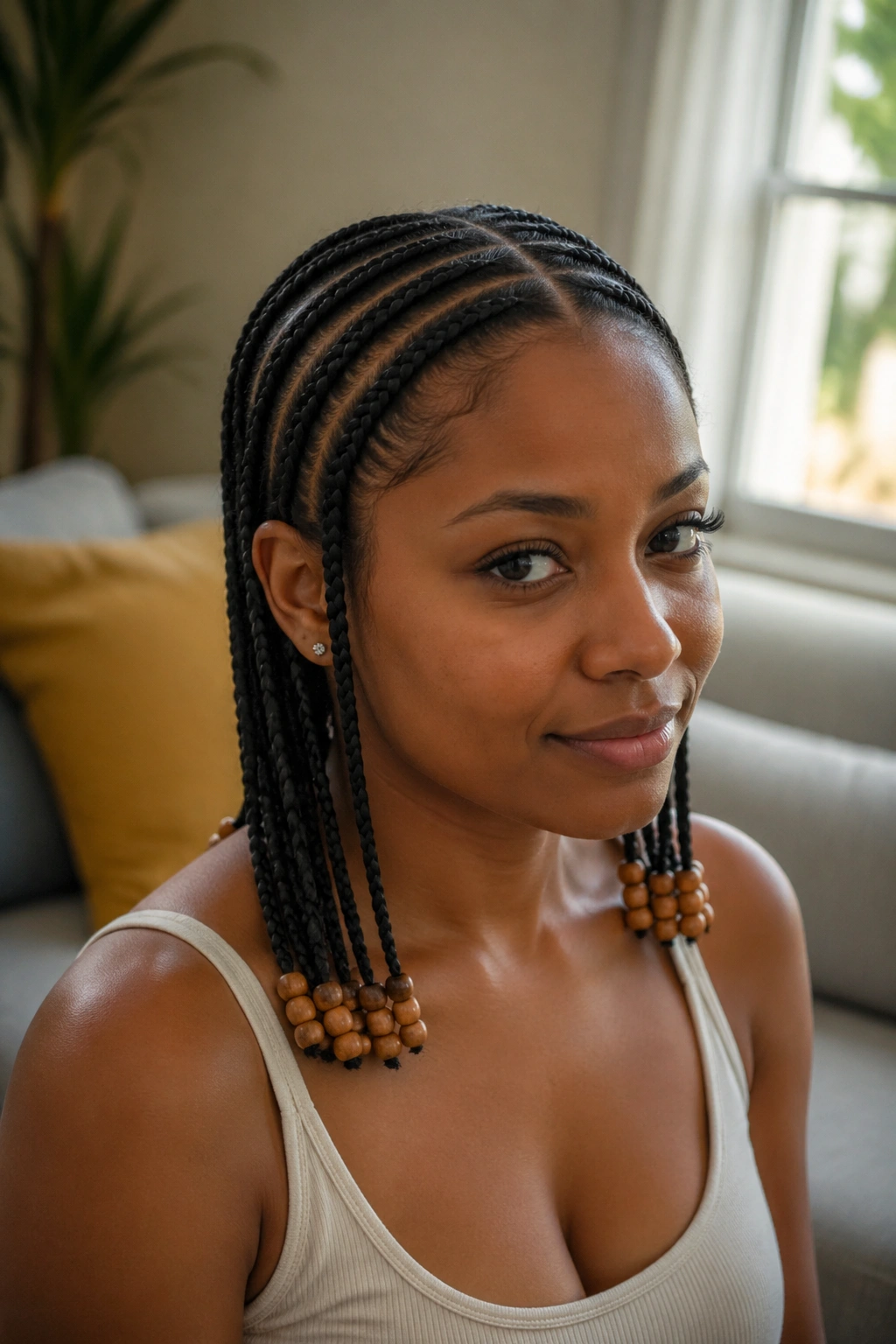
2. Eight Skinny Cornrows With Beads at the Ends
Eight thin cornrows running straight back from a clean center part, each ending with three to five wooden beads. The thinness of the cornrows and the cluster of beads at each tip is the look.
Unlike chunky cornrow sets, eight thin cornrows take longer to install — usually 90 minutes to 2 hours. The payoff is detail. Each thin cornrow reads as its own design line.
The beads should be the same wood color across all braids — natural light wood, dark walnut, or stained brown. Mixed bead colors on every braid reads chaotic instead of cute.
Who this suits: anyone with medium to long natural hair who wants cornrows that take longer than they look like they took.
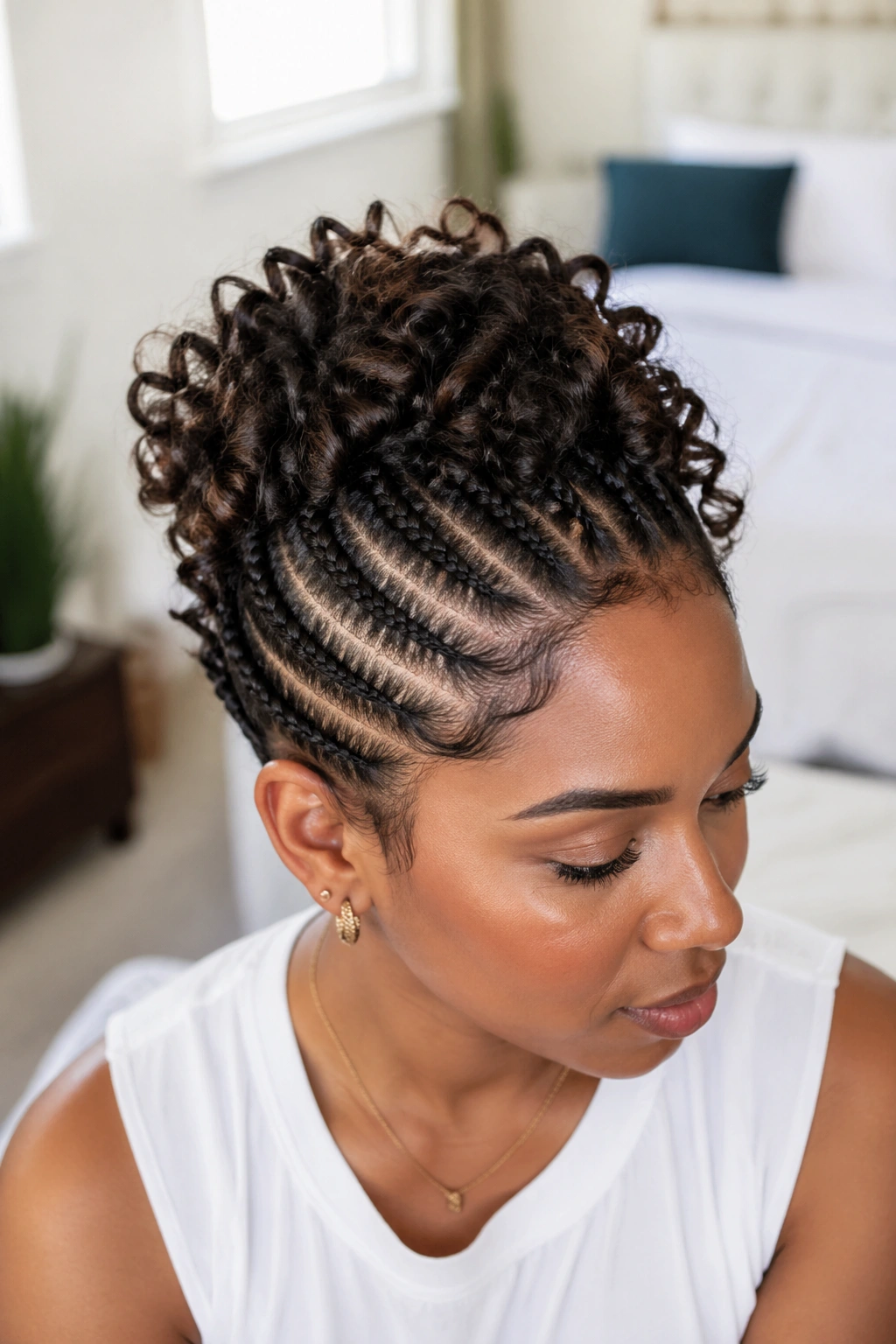
3. Cornrow Crown With Loose Curls on Top
Cornrows along the perimeter of the head — five cornrows curving from the temples to the back — with the top of the head left out and styled in loose natural curls. Cornrow halo, curly crown.
The curly top section needs definition. Apply curl cream or gel to the unbraided crown before doing the cornrows around it. Twist small sections of the loose hair to set the curl pattern.
Picture the silhouette: tight braided perimeter, soft curly puff on top, all the visual detail concentrated where the eye lands.
This is a clever style for anyone growing out a haircut — the cornrows hide shorter sections at the perimeter while the longer top stays free and visible.
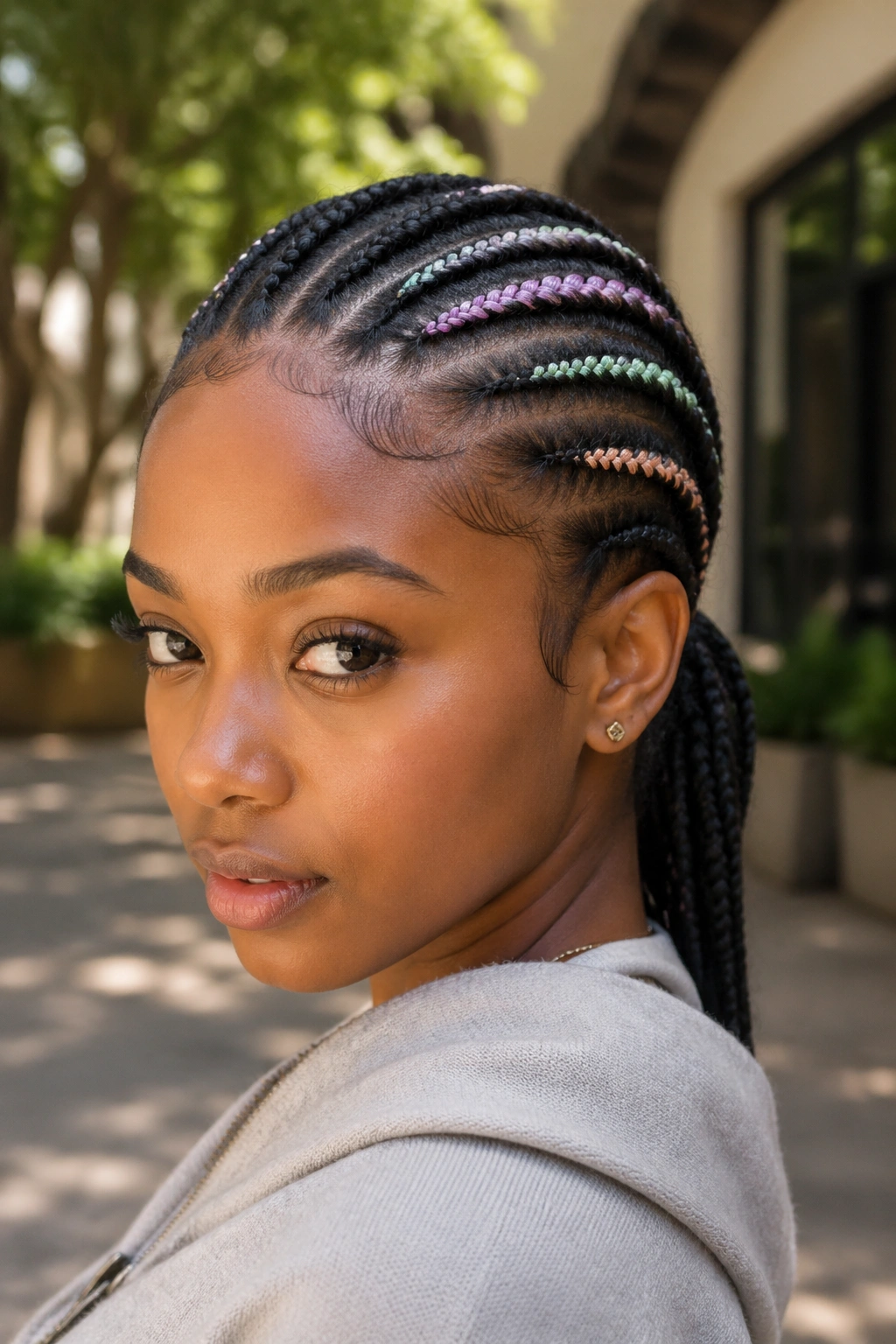
4. Cornrows With Pastel Color Streaks
Three pastel color streaks woven into the cornrows at random points — maybe lavender at row one, mint at row three, peach at row five. The cornrows are otherwise natural color. The pastel streaks are the cute factor.
Bold fact: temporary color spray on natural hair lasts 1-2 washes. For longer-lasting pastels, use clip-in colored extensions braided into the cornrows or apply a semi-permanent dye to small sections before braiding.
Pastels read softer and younger than primary colors. They also photograph beautifully in soft light — golden hour, overcast daylight, indoor warm bulbs.
Test the dye on a small section first. Some pastels grab harder on certain hair textures and can be hard to remove if you change your mind.
5. Star-Shaped Part Cornrows
A five-pointed star part at the crown, with cornrows leading away from each point of the star. The geometric part is the showpiece and the cornrows are the lines that radiate outward.
Picture a small star — about 4 inches across — sitting at the back crown. Five cornrows leave from the star, each one running toward the perimeter of the head.
Star parts are intricate. They demand a steady hand and patience. Most stylists draw the star outline first with edge gel, then carve out the part lines once the shape is correct. Self-styling is possible but tough — most star parts get done by a braider.
6. Cornrows With Ribbon Weave
Thin satin ribbons woven through the cornrows along their length. The ribbon color contrasts with the hair — a black hair with cream ribbons, or natural brown hair with deep red ribbons.
Ribbons are folded around the strand at the start of the braid and woven into each stitch. The ribbon becomes part of the braid structure rather than just an accessory tied at the end.
The ribbon reads romantic. It softens the structural look of the cornrow and adds a fabric texture that other accessories can’t replicate.
- Use silk or satin ribbons — cotton bunches up and looks bulky
- Ribbon width should be 1/4 inch or less for thin cornrows, 1/2 inch for thicker ones
- Tie a small knot at the end of each ribbon to prevent unraveling
- Choose two contrasting colors for a more layered look
7. Side Bun With Cornrowed Sides
The two sides of the head are cornrowed flat — three cornrows on each side curving toward the back — and the top hair is gathered into a small side bun. The bun sits high and to one side, not centered.
Unlike a centered bun, a side bun reads playful and asymmetric. The cornrowed sides keep the silhouette tight while the bun adds height.
The bun should be small. A large side bun starts to look top-heavy. Two-strand twist the loose hair before pinning it into the bun for added texture.
Who this is best for: shorter to medium natural hair where a small bun is achievable without extensions.
8. Triangle Part Cornrows With Beaded Tips
Cornrows installed with triangle parts — each section of the head is a triangle rather than a rectangle — and each cornrow ends with a single large bead. The geometric parts plus single-bead finish reads modern and cute.
The triangle parts are precise. Each triangle is the same size and orientation. Sloppy triangles look accidental; clean triangles look designed.
A single large bead per braid reads cleaner than multiple small beads. Pick wooden beads in a color that complements your hair tone — light wood on dark hair for contrast, dark wood on dark hair for subtlety.
How to Style It
- Pre-section the head into uniform triangles before braiding starts
- Braid each triangle into a single cornrow leading toward the nape or crown
- Slide one bead per cornrow at the end and lock with a small clear rubber band
- Smooth the hairline last with edge gel
9. Cornrows Ending in Two-Strand Twists
Cornrows for the first half of the length, then transitioning into two-strand twists for the rest. The twists create a different texture below the cornrow — softer and rope-like instead of flat.
Picture a cornrow that ends right at the ear, with the loose tail twisted into a two-strand twist that hangs down past the shoulders. Same hair, two textures.
Mechanism-wise, the cornrow stops adding hair to the braid at the transition point. The remaining tail is split into two sections and twisted to the ends.
Two-strand twists at the end are softer to sleep on than three-strand braids. They’re also faster to take down later — fingers easily separate the twists in seconds.
10. Half-Up Cornrow With Curly Puff
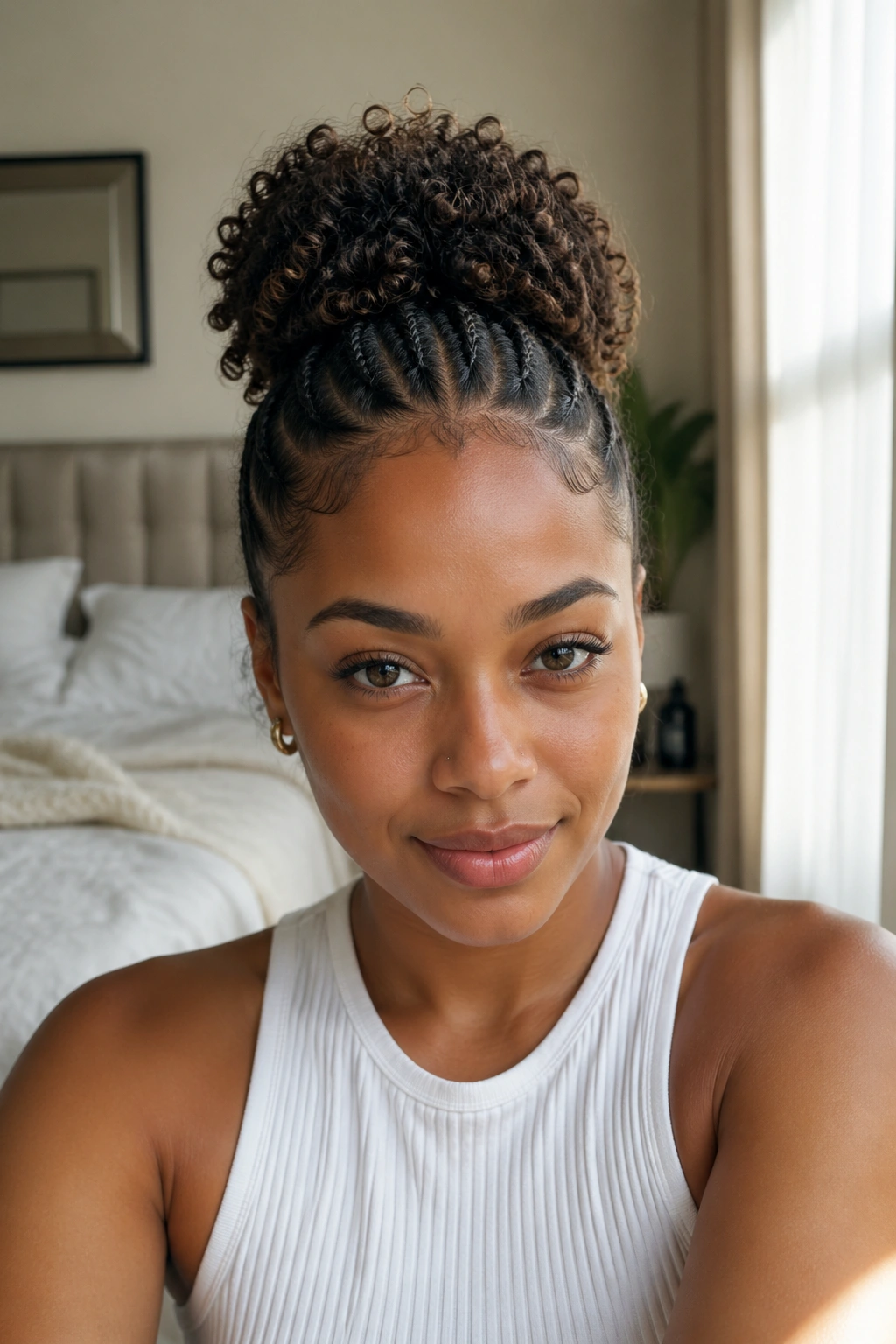
The top half of the head is cornrowed — three or four cornrows running from the hairline to the crown — and gathered at the crown into a curly puff made from the unbraided back hair. The cornrowed front holds the hair off the face; the puff adds volume.
The puff should sit at the crown, not lower. Higher puffs read youthful; lower puffs read more grown-up but lose some of the cute factor.
Use a curl cream or definer to set the puff. Apply to damp hair, scrunch upward, and let air-dry under a hood dryer if you have time. The defined curl pattern reads cute; an undefined frizz cloud reads unfinished.
11. Cornrows With Gold Cuffs Spaced Down the Length
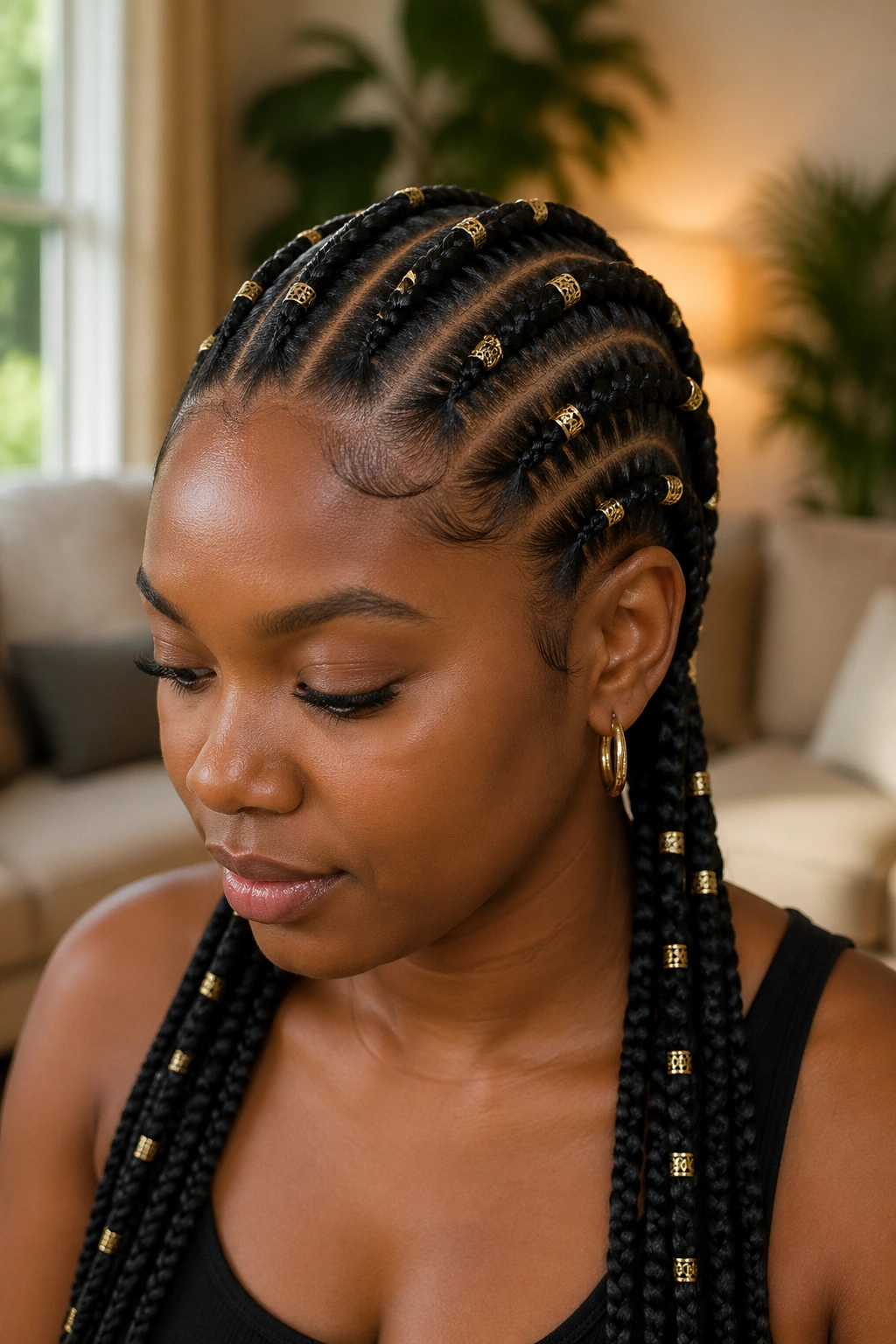
Gold-tone metal cuffs spaced evenly down each cornrow — one at the start, one at the middle, one at the end. The repeated cuff placement creates a visual rhythm down each braid.
Bold fact: spaced cuffs read more designed than clustered cuffs. The repetition of placement is what creates the rhythm.
The cuffs need to fit the braid thickness. Test-fit each cuff before committing — too tight pinches, too loose slides. Most cuff packs include a range of sizes for different braid thicknesses.
Gold tones complement most natural hair colors. Silver works too but reads cooler; rose gold is a softer alternative for anyone wanting the gold look without the brightness.
12. Cornrows Into Bantu Knots at the Ends
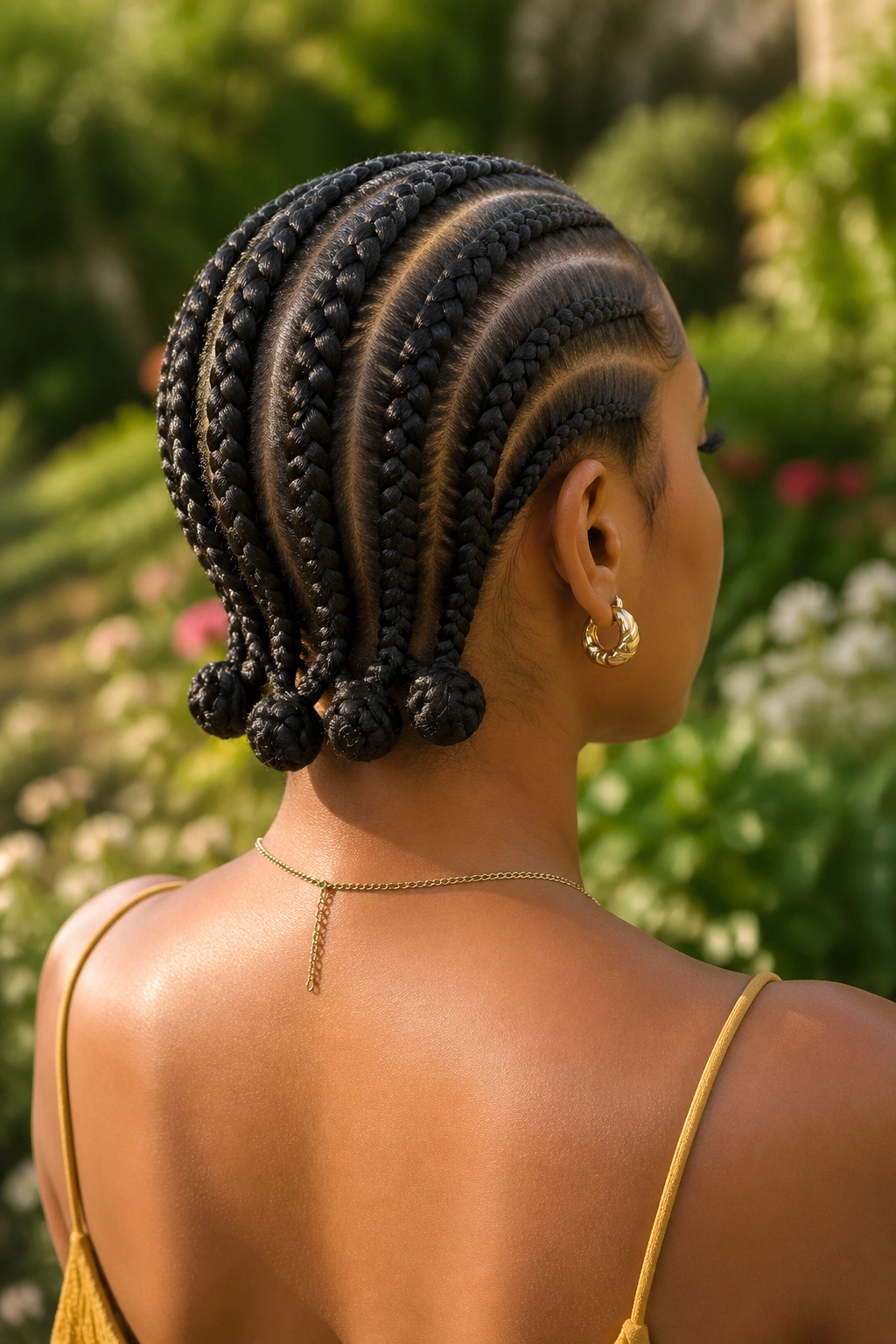
Cornrows that end in small Bantu knots at the nape or crown. Each cornrow tail is wrapped tightly around its base into a coiled knot, secured with a small rubber band.
Picture eight cornrows running back, each ending in a tight little coiled knot at the base. The knots add sculptural detail and lock the ends out of the way.
When you take down the knots after a week, you have defined curly ends — a built-in second style without rebraiding.
Wrap each Bantu knot tight enough to hold but not so tight it pulls at the cornrow base. The knots should sit firm without straining the braid.
13. Cornrows With Glitter at the Parts
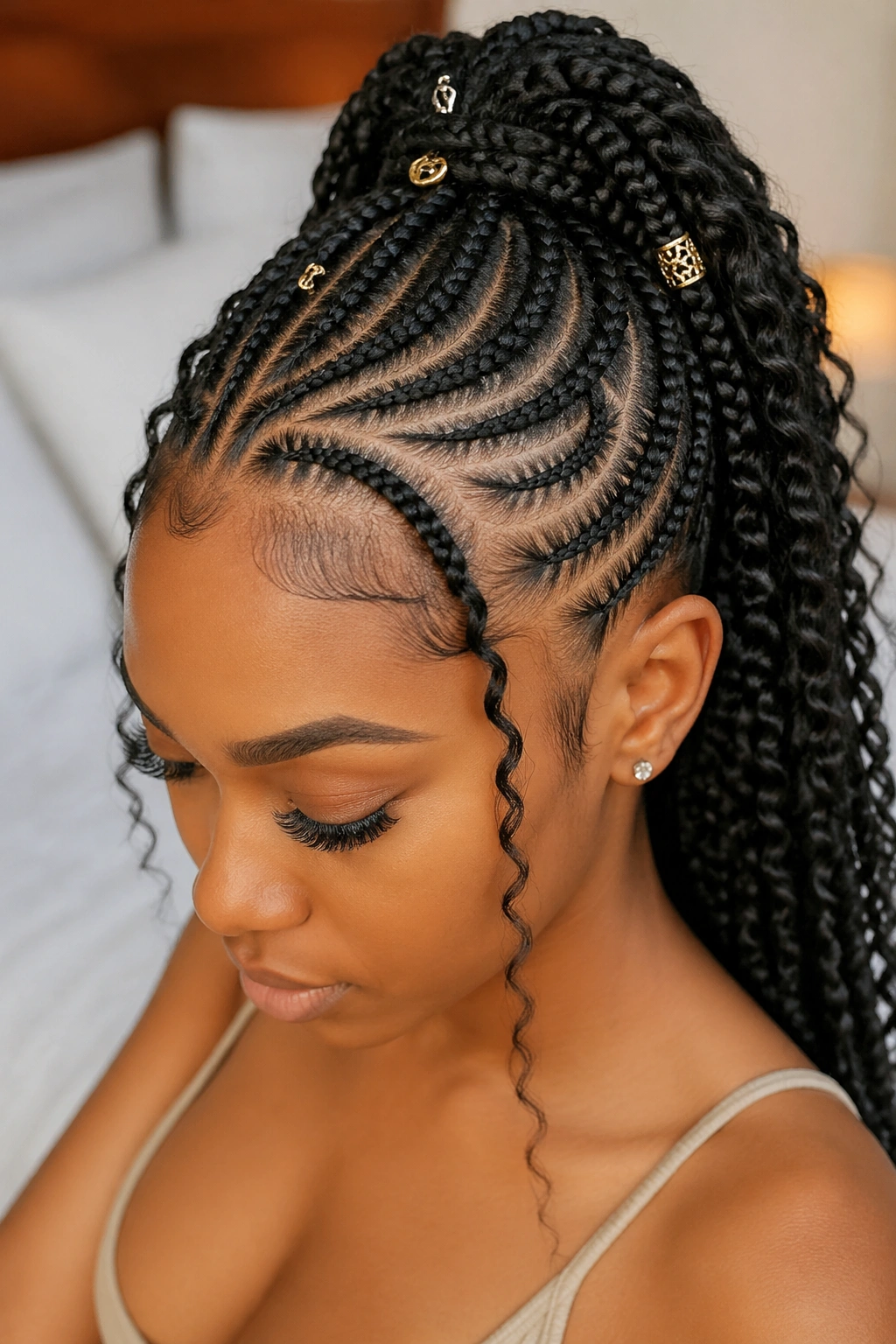
Cosmetic-grade glitter applied directly to the part lines between cornrows. The glitter sticks to the scalp along the part and adds shimmer that catches light when you move.
This is a special-occasion style. The glitter washes off in one shower, which makes it strictly for events — birthdays, photoshoots, parties.
Use cosmetic glitter only. Craft glitter has sharp edges and isn’t safe for the scalp. A small glitter pot from a beauty supply store works for this.
Apply with a small brush after the cornrows are in place. Press the glitter into the part with the brush bristles so it adheres to the scalp. A light spray of hairspray helps it stick longer.
Best tip: pair glitter parts with a simple bead-free cornrow set so the glitter is the only design element.
14. Cornrows With a Single Color Streak
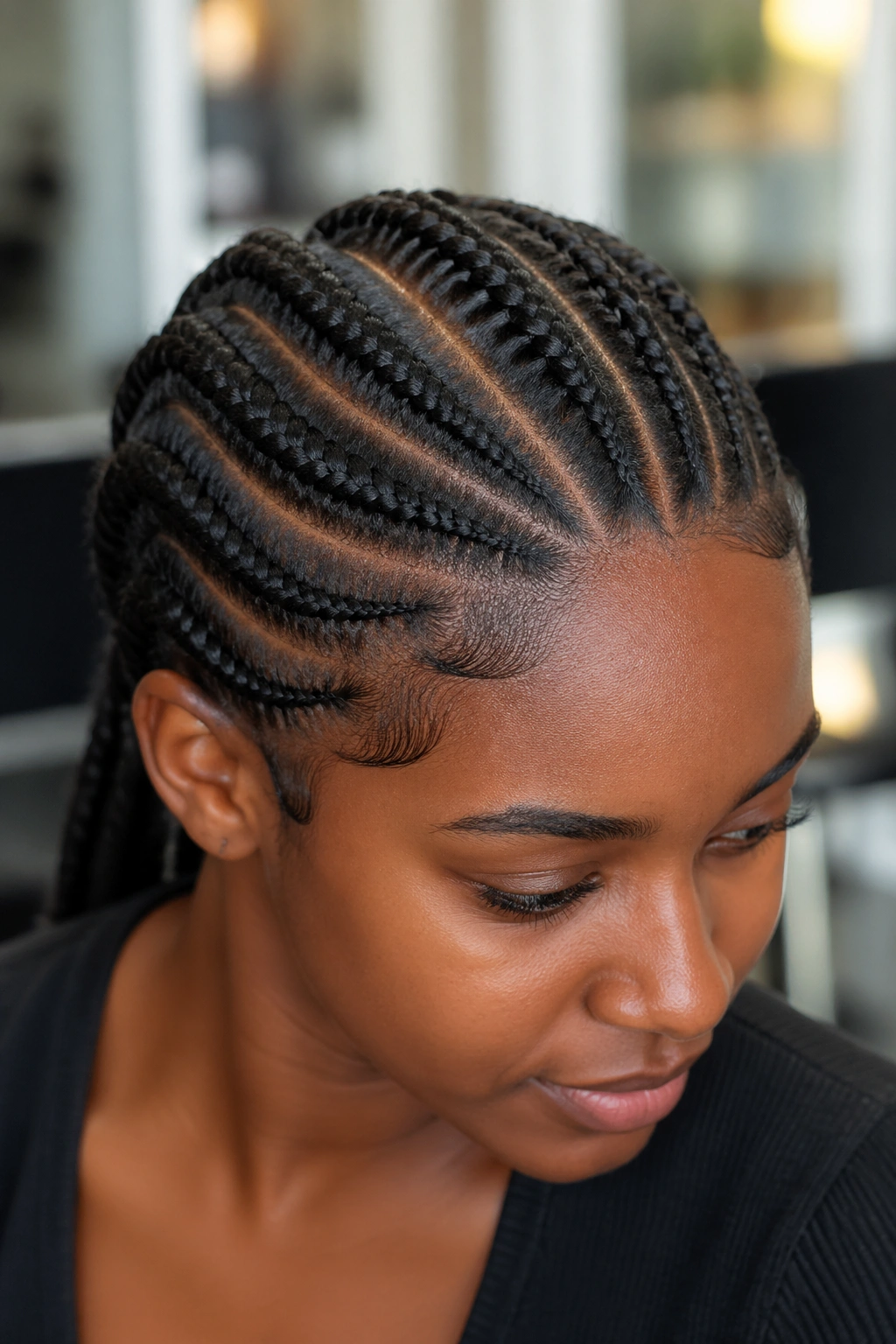
A single bold color streak — bright red, electric blue, neon pink — in just one cornrow row. The other cornrows are natural color. The single colored row is the entire focal point.
Unlike full color sets, a single streak reads punctuating. It’s the visual equivalent of a single bold sentence in a long paragraph.
Use a temporary spray-in color for one-time wear, or a clip-in colored extension braided into the cornrow for a longer-lasting effect. Semi-permanent dye on a single section also works if you want the color to last weeks.
The streak reads best when it’s slightly off-center. A streak at the dead center looks accidental; a streak one or two rows in from the center reads designed.
15. Mini Cornrows All Over
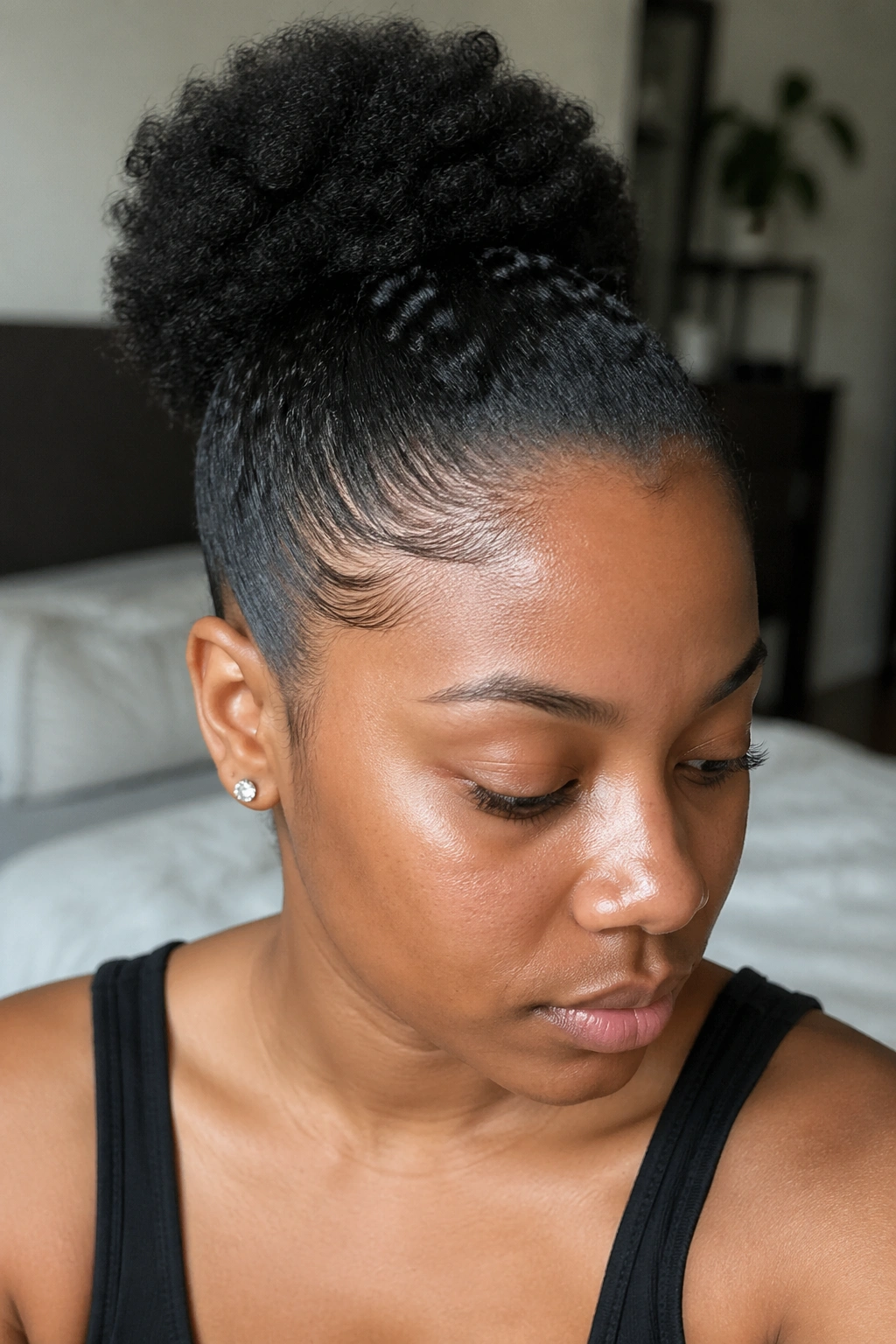
A full head of mini cornrows — 15 to 20 thin rows — each one finished with a single small bead. The whole look is delicate and detailed.
Mini cornrow installs are the longest of the cute styles. A full head of 20 mini cornrows takes 3-4 hours easily. The detail is the payoff.
The thinner the cornrow, the longer it lasts visually. Mini cornrows often look fresh for 2-3 weeks because each braid has so little bulk that it doesn’t shift much over time.
Who this is best for: anyone with patience for a long install and a desire for a delicate, detailed style that demands close inspection.
16. Cornrows With Beads in Hair Color
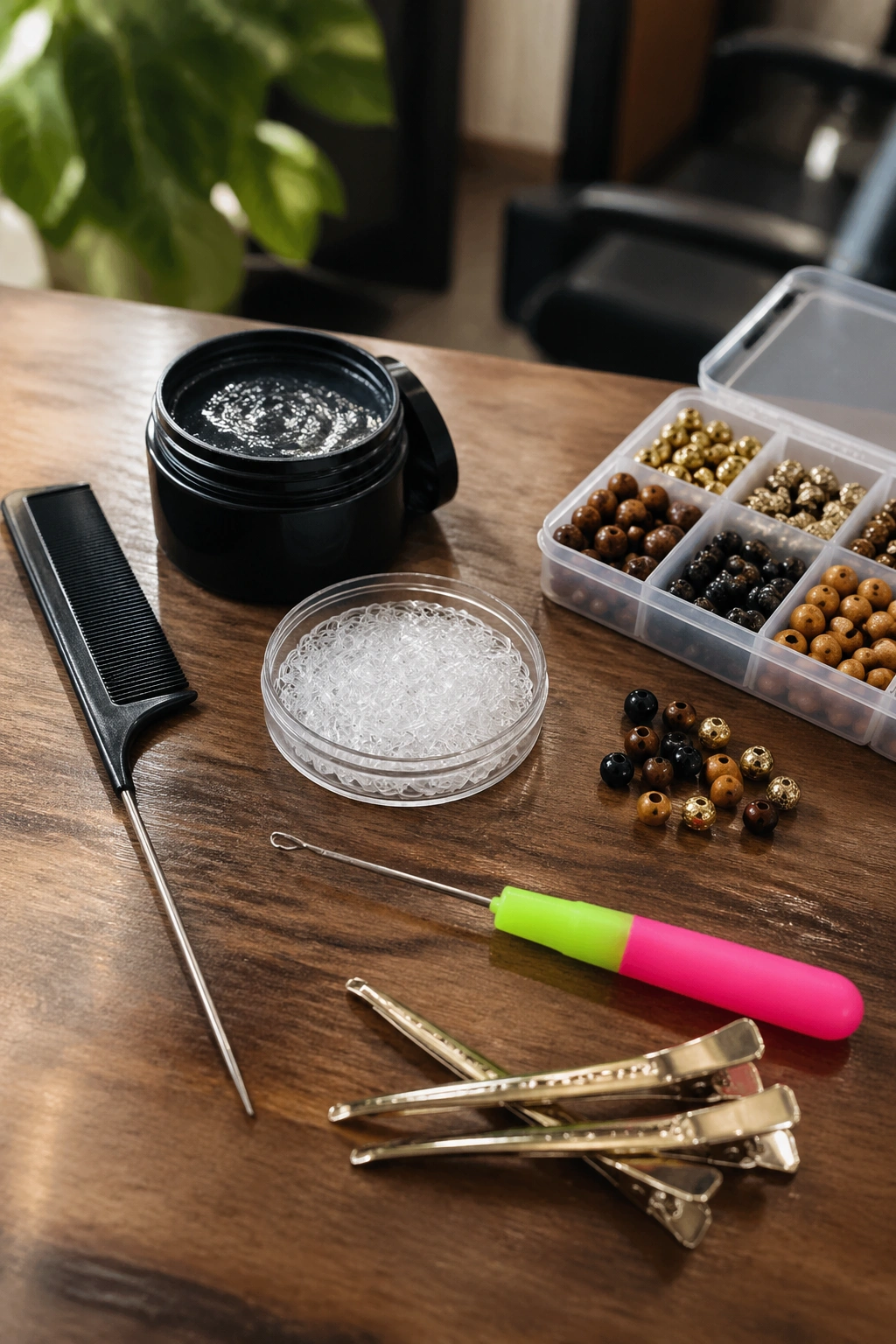
Beads in a color that matches the natural hair shade — black beads on black hair, dark brown beads on dark brown hair. The beads add texture and weight without adding visible color contrast.
This is the subtlest bead approach. The beads register as little bumps of texture rather than as accessories. From a distance, you can barely see them; up close, the detail comes through.
Wooden beads in dyed-to-match colors work for this. Plastic beads have a slight sheen that reads “accessory” no matter what color they are. Wood reads natural and integrated.
The Catch
The visual payoff is subtle. If you want beads as a clear style statement, contrast colors do that better. Hair-matched beads are for anyone who wants the texture without the announcement.
17. Cornrows With a Bow at the Crown
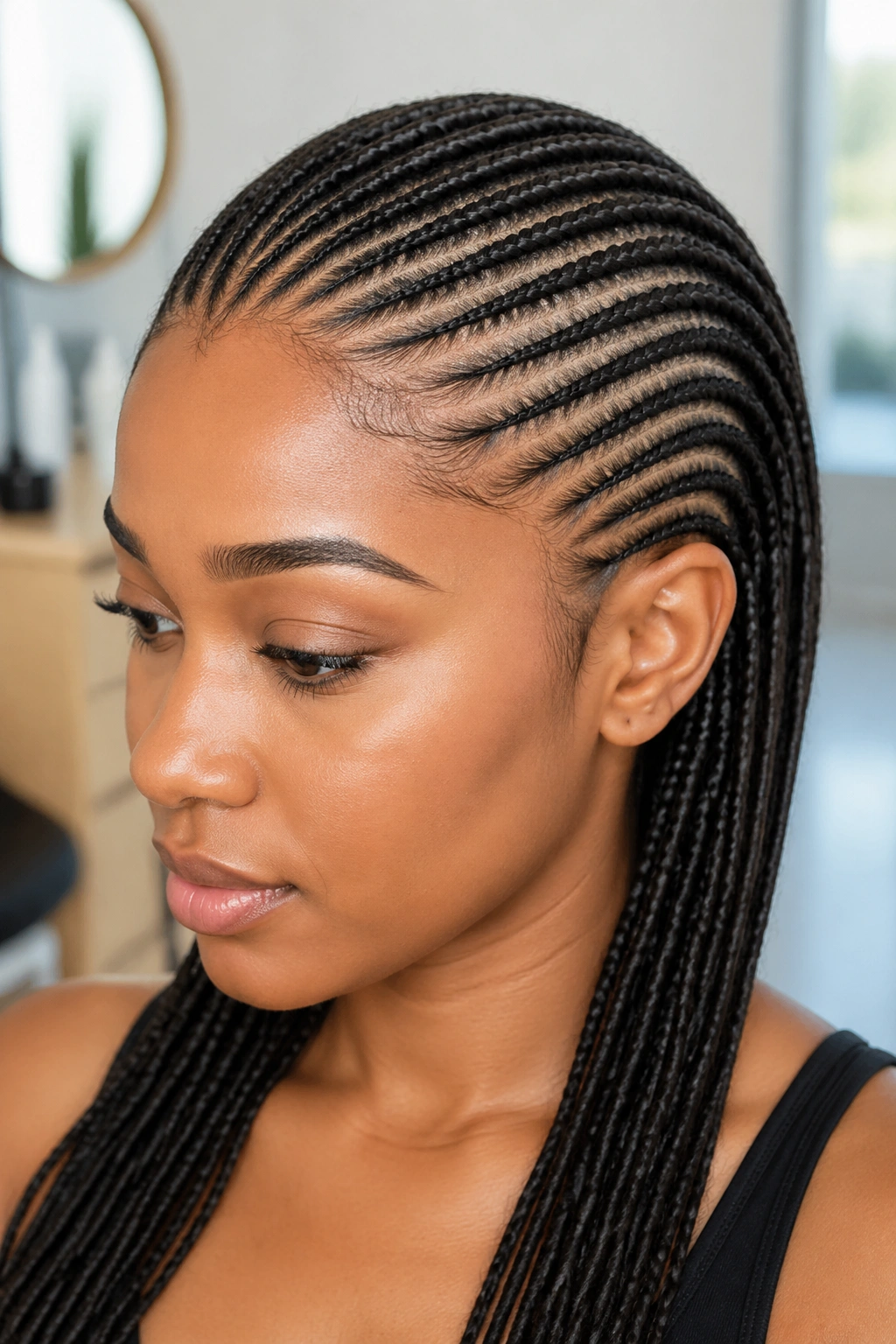
Cornrows leading to a single tied bow at the crown. The bow can be silk ribbon, fabric, or a sculpted hair bow made from the cornrow ends themselves.
A hair bow made from the actual hair is more advanced. The cornrow ends are gathered and shaped into a bow form, secured underneath. It takes practice to shape cleanly.
A ribbon bow is faster. Tie a wide ribbon over the gather point at the crown, fluff the loops to bow shape, and trim the ribbon ends at an angle.
Bow placement matters. Top-of-the-head bows read more youthful; back-of-the-crown bows read more mature.
18. Side-Swept Cornrows With a Twisted Front Piece
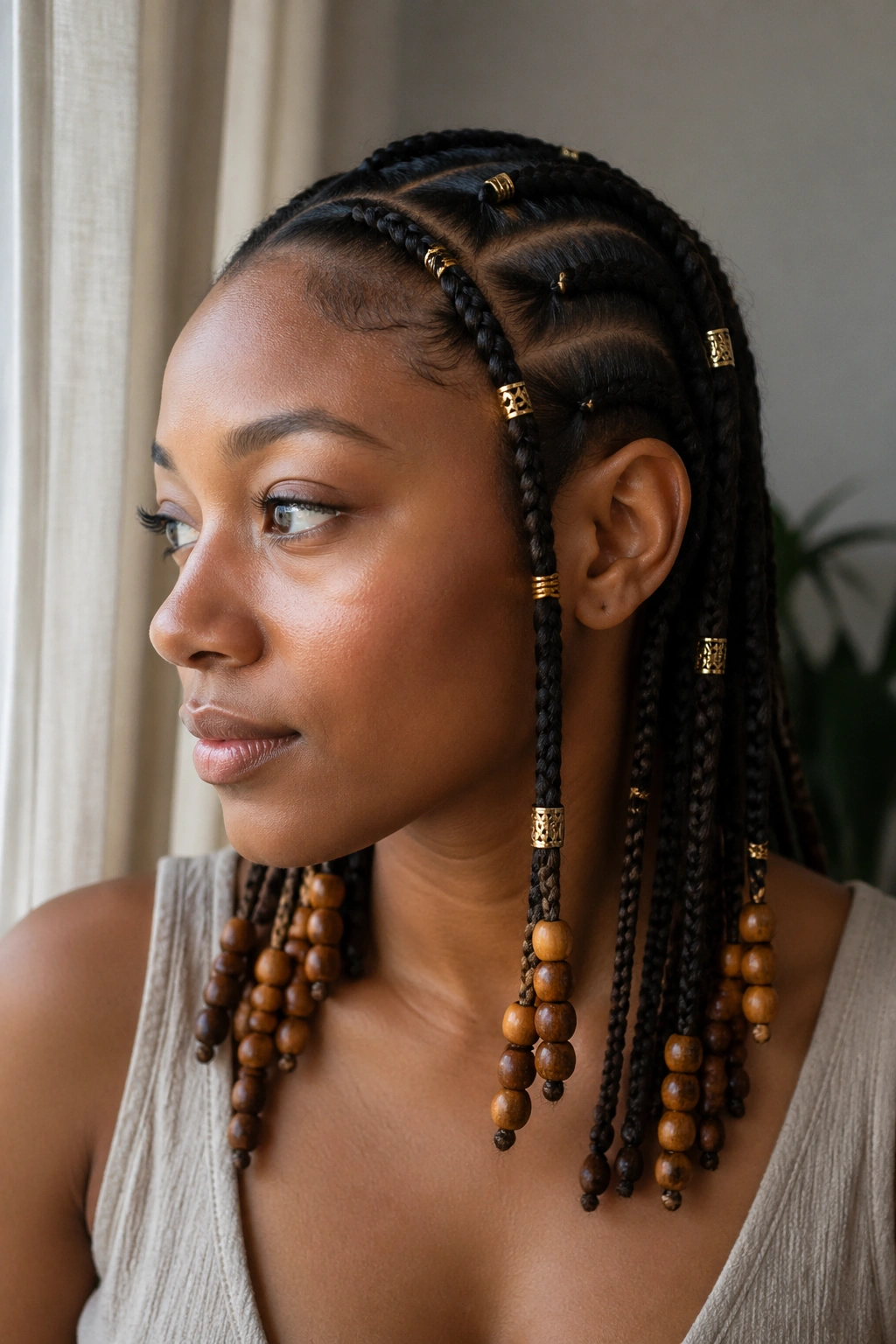
Cornrows sweeping diagonally toward one side, with a single twisted hair piece across the forehead. The twisted front piece sits like a thin headband above the cornrows.
The twisted piece is made from a small section of front hair, rope-twisted into a thin cord and pinned in place across the forehead. It’s almost like a headband but made from your own hair.
Picture a side-swept cornrow set with a clean twisted hairline accent. The two elements work together — one sweeping across the head, one running across the forehead.
This style flatters faces with high foreheads especially well because the twisted piece visually lowers the hairline.
19. Cornrows With Stars Drawn at the Hairline
Small star-shaped designs drawn at the hairline using edge gel and an angled brush. The cornrows are otherwise simple — three or four straight-back rows — and the star designs at the hairline add the cute factor.
The stars are tiny. About a quarter-inch each. Three or four stars across the hairline at the temples and forehead. Use a fine angled brush and strong-hold edge gel for clean shapes.
This style depends entirely on the hairline work. If the stars are sloppy, the whole look falls apart. Practice the star shape on the back of your hand before applying to the hairline.
- Apply edge gel to the brush, then to the hairline
- Draw each star with deliberate, controlled strokes
- Set with a quick mist of hairspray once the design is complete
- Re-apply touch-ups to the design every other day
20. Cornrows Into a Side Pony With Curly End
Cornrows sweeping toward one side and gathered into a low side ponytail at the shoulder. The end of the ponytail is curly extension — water wave or kinky curly — that hangs over the shoulder.
The cornrowed sides keep the head sleek. The curly ponytail adds the soft, playful element. Together they hit the cute-but-grown-up balance perfectly.
Curly extension at the end of a ponytail is added by wrapping a curly weft around the gather point and pinning underneath. The cornrow ends are folded under and hidden by the curly extension.
21. Cornrows With Heart-Shaped Bead Accents
Small heart-shaped beads or charms used as accent pieces on the cornrows. Two or three heart beads on a few of the cornrows — not all of them.
Heart charms read overtly cute. They work for younger wearers, festival looks, and anyone who likes small playful details.
The hearts should be small — about a quarter-inch — and made of metal or wood. Plastic heart beads read childish. Brass or wooden heart beads read elevated.
Place hearts on three to four braids only, scattered across the head, not in a line. The scattered placement reads designed; clustered or lined-up placement reads decorative.
22. Cornrows With Gradient Color Hairline
The hairline section of the cornrows is dyed in a gradient — pastel pink at the very front, fading to natural color two inches back. Only the front portion has color; the rest of the head is natural.
Gradient hairline color is a recent style direction that pairs beautifully with cornrows because the cornrow structure shows off the gradient cleanly. The color transition runs from the start of each braid back into the hair.
Achieve the gradient with a temporary color spray applied to the front sections before braiding, or with a semi-permanent dye applied to just the hairline area. Some braiders use color extensions blended in at the front for the same effect.
The gradient reads playful, fashion-forward, and cute without committing to a full-color install. The color washes out (if temporary) or grows out (if semi-permanent) and the cornrows behind remain neutral.
Daily Care for Cute Styles
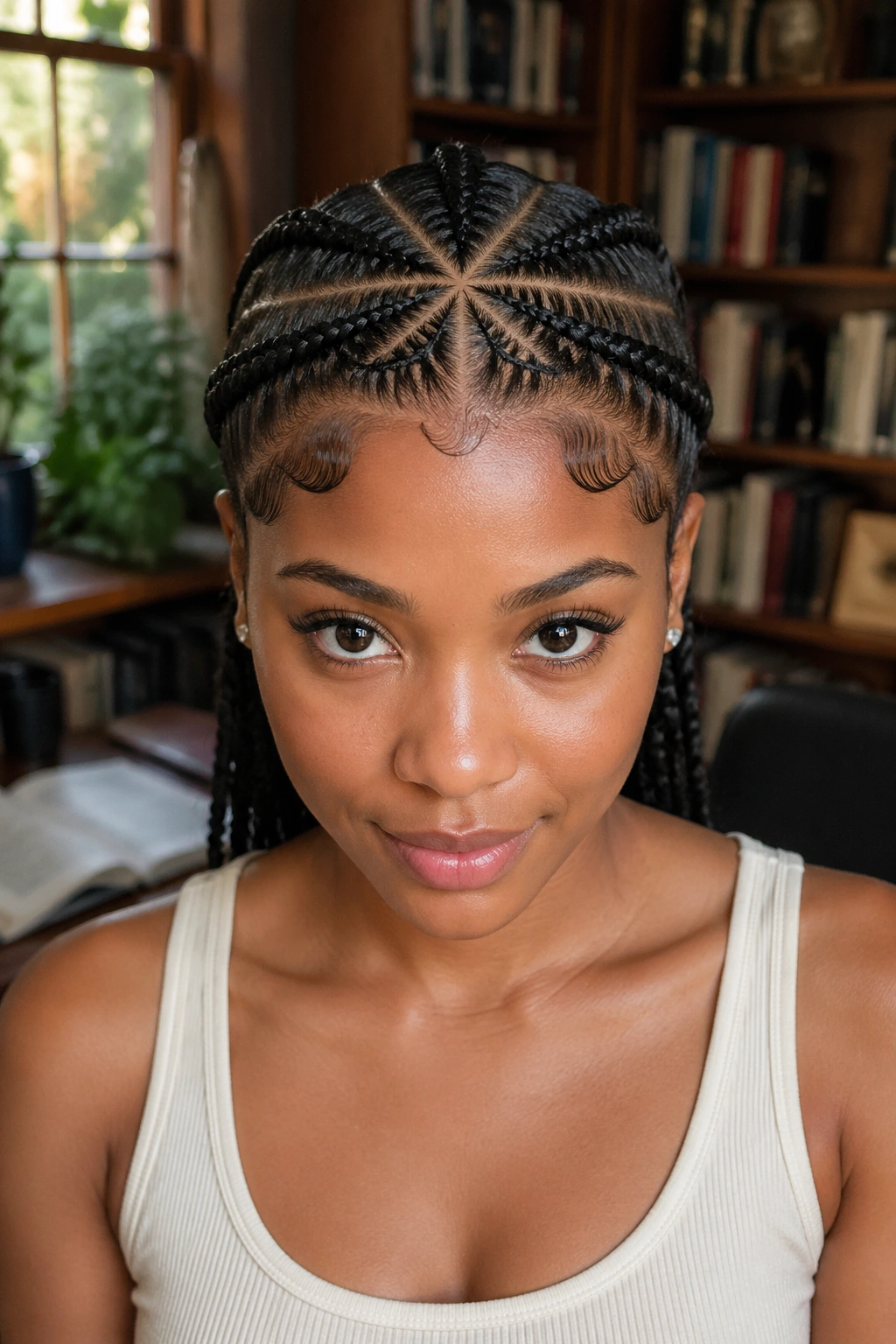
Cute cornrows often have accessories that demand specific care. Beads need protection from getting tangled in clothing. Cuffs need to be checked daily for slippage. Designs at the hairline need touch-ups every other day.
Use a satin bonnet sized to accommodate the accessories. A regular bonnet might not fit comfortably over heavily-beaded styles. Larger bonnets or silk scarves wrapped looser work better for accessory-heavy looks.
Mist the cornrows lightly with a water-and-leave-in spray every two to three days. Avoid over-spraying around accessories — water can dull metal cuffs and stain ribbon.
Edge Care for Decorated Styles
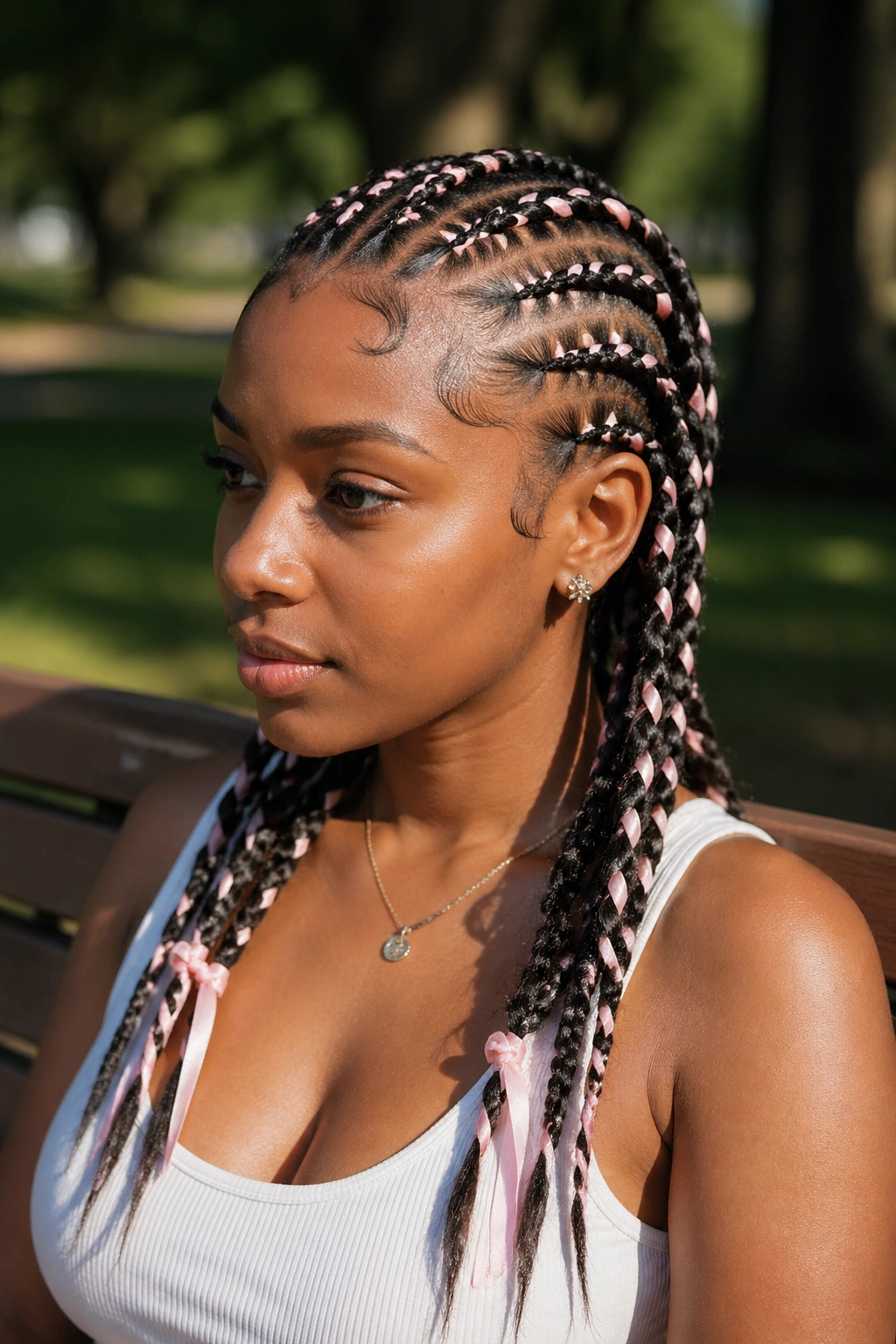
Heavy accessories pull on the cornrow base over time, which can stress the edges. Check the hairline weekly for any tightness, soreness, or small bumps.
Apply a lightweight oil to the hairline every other day. Coconut oil, jojoba, or a growth serum work well. Massage gently with fingertip pads into the part lines.
If a cornrow is pulling too hard from accessory weight, remove the accessory or redo that braid looser. Saving the style isn’t worth losing edges over.
Sleep Care With Accessories
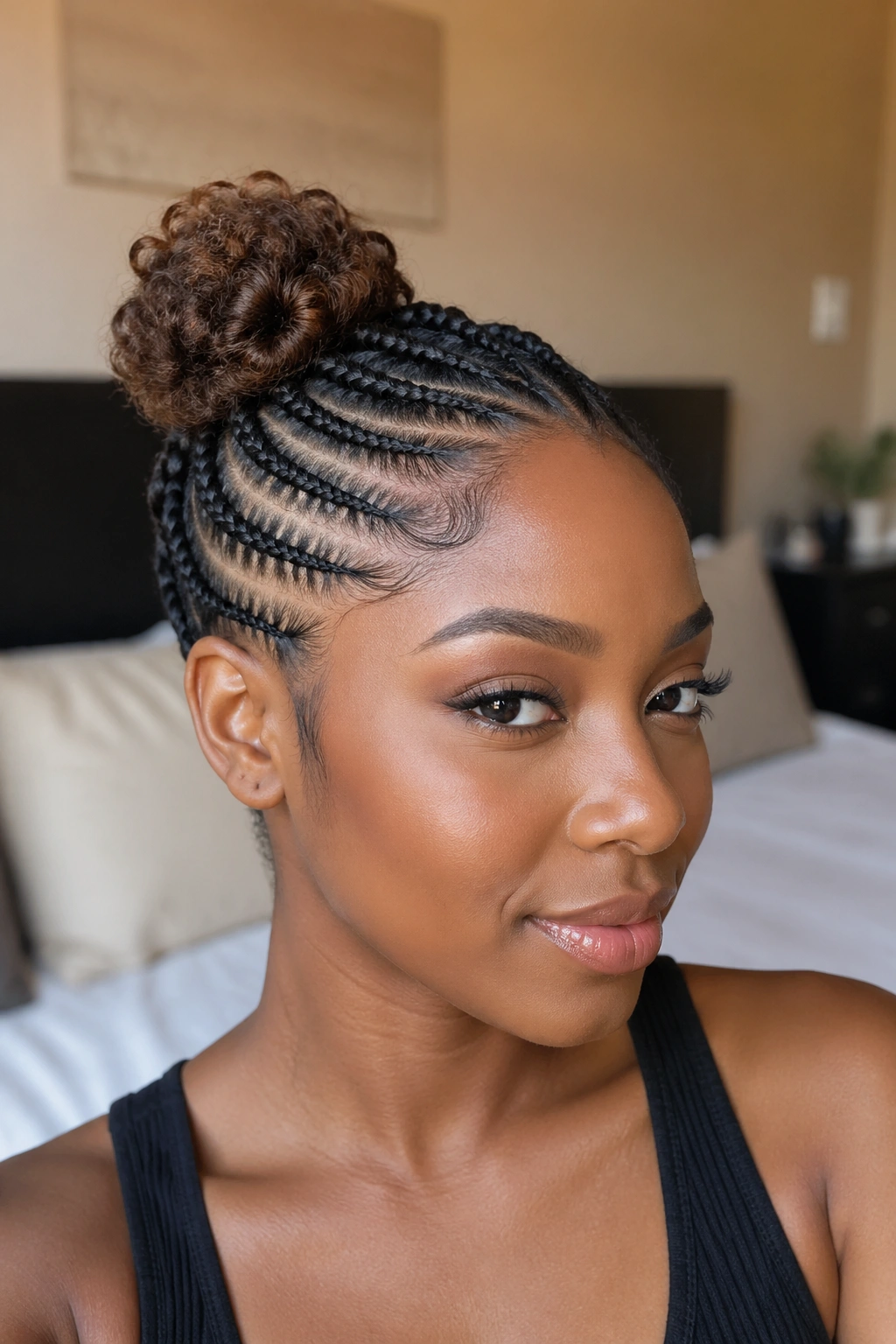
Beaded styles need extra sleep care. The beads can rub against the pillow and shift the cornrows during the night.
Use a silk pillowcase plus a satin bonnet for double protection. The bonnet contains the beads; the pillowcase reduces friction in case beads slip out of the bonnet.
For especially heavy beaded styles, gather all the cornrows loosely at the crown with a silk scrunchie before bed. The gathered position keeps the beads off the pillow entirely.
Refreshing Hairline Designs
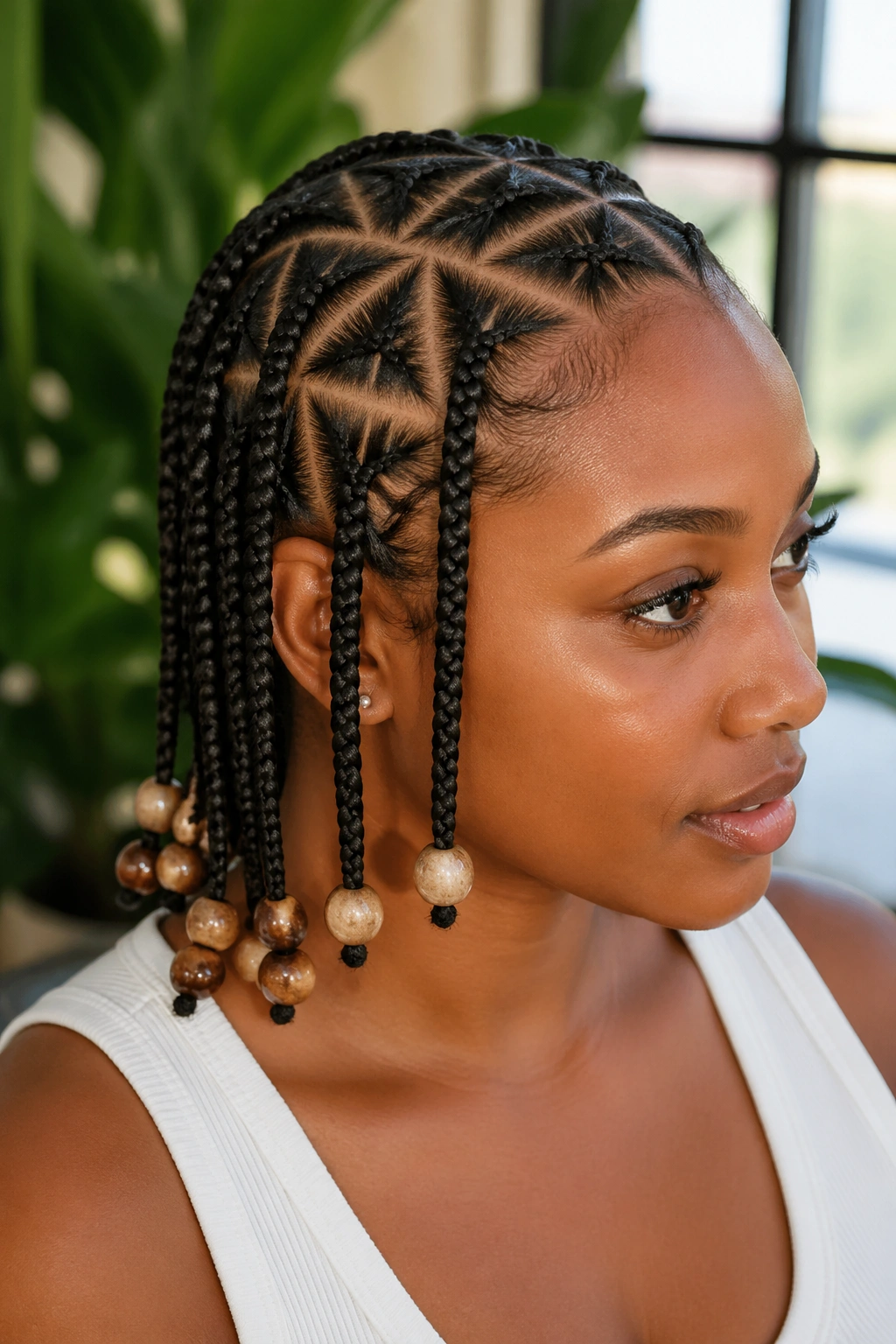
Edge designs and hairline accents fade with sweat, washing, and oil. Refresh them every other day to keep the cute factor strong.
Re-apply edge gel with a small brush to the existing design. Build up the shape gradually — a thick coat all at once flakes by lunchtime. Set with a light hairspray mist.
If a design has worn off completely, redraw it from scratch. Don’t try to revive a half-faded design. A fresh outline reads cleaner than a half-restored one.
Common Mistakes With Cute Styles
- Over-accessorizing — every cornrow with beads, cuffs, ribbons reads cluttered instead of cute
- Choosing accessories too heavy for the cornrow thickness
- Skipping edge gel touch-ups on hairline designs
- Wearing the style past three weeks once accessories start showing wear
- Sleeping without a bonnet — accessory styles destabilize fast without overnight protection
- Applying heavy oil that dulls metal accessories
- Choosing colored accessories that clash with skin tone or outfit palette
- Pulling Bantu knot ends too tight at the cornrow base
Cute cornrows are about details done well. The right accessories in the right spots, edge work that holds, and care that respects the small touches. Get those right and any of the 22 styles above stays fresh for two to three weeks of daily wear.