



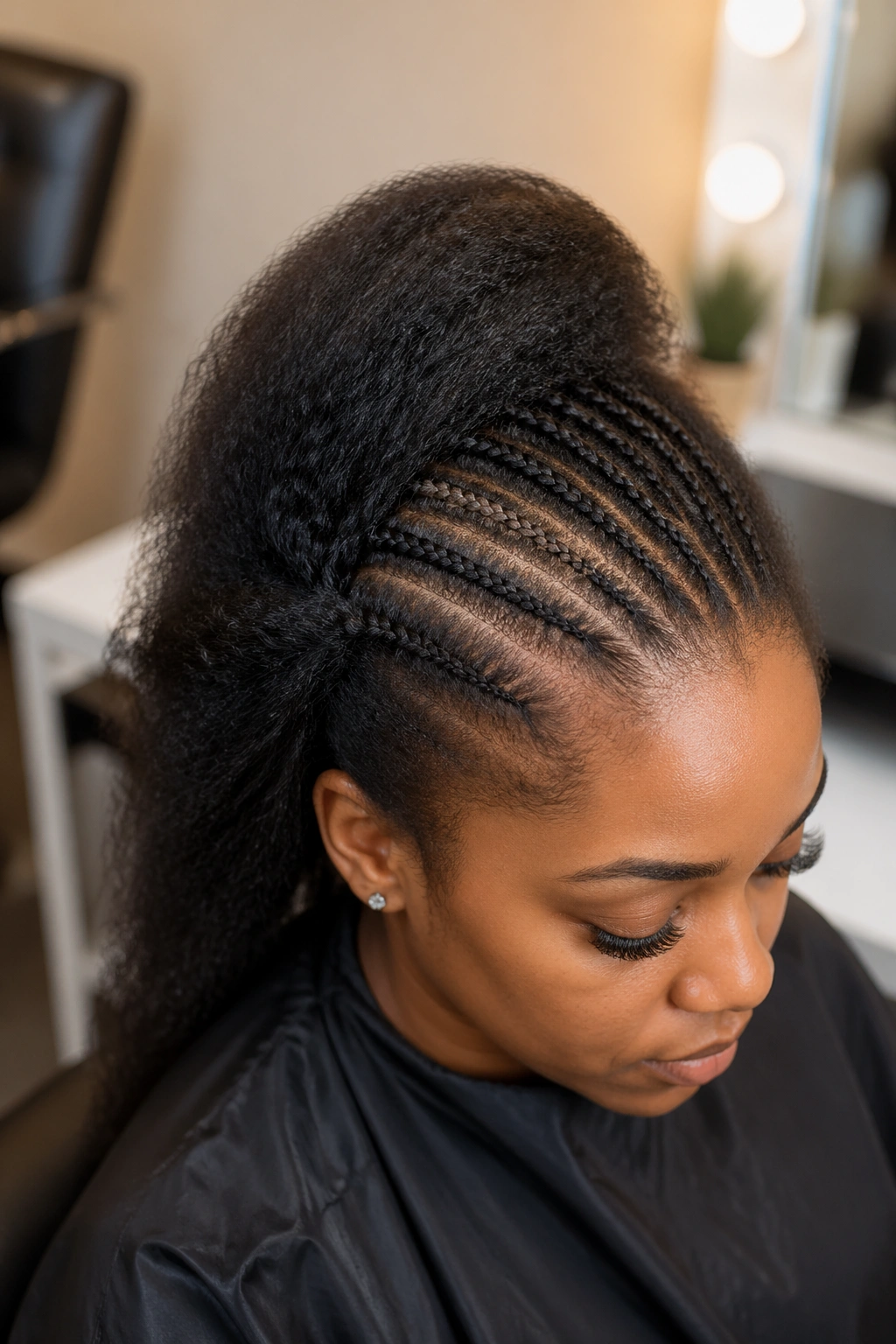
Half cornrows with curly weave is a specific style category — the front half of the head is cornrowed flat against the scalp, and the back half (or sometimes the top crown) is a curly weave attached to a sewn-down cornrow track. The two halves work together: the cornrow front gives you structure, design, and edge polish, while the curly weave back gives you length, movement, and the kind of soft texture that pure cornrows can’t deliver. Twenty-two half cornrow with curly weave styles follow, each one approached differently in terms of weave placement, curl pattern, parting, and finish.
This style category has exploded in popularity because it solves a specific problem: cornrows alone can feel too structured for some occasions, and full curly sew-ins can feel like too much hair to manage. Half-and-half splits the difference. You get the polished foundation and the flowing finish in one install.
What Half Cornrows With Curly Weave Actually Means
The “half” refers to the head, not the cornrow length. Typically the front of the head — from the hairline to the crown or just past — is cornrowed in a series of rows. Behind that, the rest of the head has a curly weave sewn onto a horizontal cornrow track. The transition between the two halves is usually hidden by the falling curls.
Some styles do it differently: the top half is cornrowed and the bottom (back nape) section is curly weave. Others reverse it entirely with curly weave at the front and cornrows at the back. The principle is the same — two textures, one head, deliberately combined.
The cornrow portion isn’t just decorative. It’s also functional. It serves as the base structure that the weave attaches to. Without the cornrow track, there’s nowhere for the weave wefts to be sewn down.
Why This Style Works So Well
Two textures read more interesting than one. A full curly sew-in is beautiful but can read uniform. A full cornrow set is structured but can lack movement. The combination delivers both.
The cornrow front also handles the everyday styling flexibility. You can change how the curly back hangs — over one shoulder, gathered, half-up — without disturbing the cornrowed front. The front stays sleek; the back styles however you want it.
Practical bonus: half cornrow installs cost less than full curly sew-ins because they use less weave hair. Two to three bundles instead of four to five. The savings add up.
Choosing the Right Curly Weave Texture
Curl patterns vary significantly across commercial weave brands. Water wave gives you defined S-shaped curves. Deep wave is tighter and more uniform. Body wave is softer with looser S-waves. Kinky curly mimics 4A-4B natural texture. Loose curly is somewhere between body wave and kinky curly.
Match the curl pattern to your face shape and personal preference. Tighter curls add visual volume around the face. Looser waves drape and hang more, which elongates the silhouette.
Key decision: Brazilian, Peruvian, Indian, or Malaysian hair? Each origin has slightly different texture and luster. Brazilian is medium-density and softens with washing. Peruvian is thicker and coarser. Indian is finer and silkier. Malaysian is dense and holds curls well. Try samples if you’re new to commercial weave hair.
Hair Prep for Half Cornrow Installs
Wash with a clarifying shampoo, deep condition for 30 minutes, apply a leave-in. Stretch the natural hair before installing — the cornrow track at the front needs a smooth foundation.
Trim split ends. The natural hair under the weave doesn’t need to be perfect, but the front cornrow section will be visible and benefits from clean ends.
Detangle the curly weave bundles before installation. Even premium curly hair can have small knots from packaging. Finger-comb each bundle with a leave-in spray and lay them out.
Tools for the Install
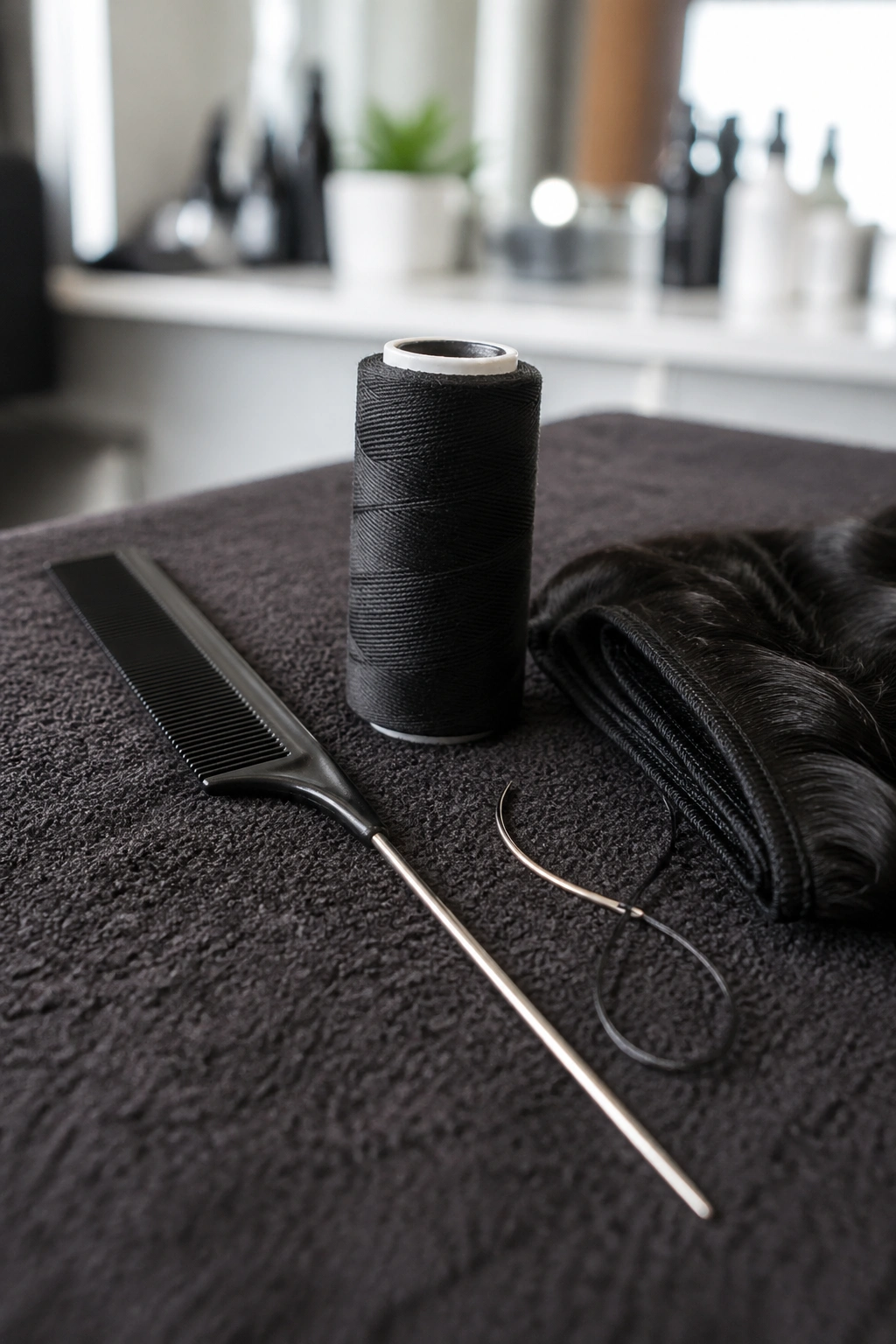
- A rat-tail comb with a metal tip
- A weaving needle (curved C-needle works best for tracks)
- Weaving thread in a color matching your hair
- Scissors for trimming the wefts
- Hair clips for sectioning
- Edge gel with strong hold
- A spray bottle with water and leave-in mix
- A wide-tooth comb for the curly section
- A silk or satin bonnet sized for long curly hair
The weaving needle and thread are non-negotiable. Glue-in or clip-in weaves don’t work for this style — you need stitched-down wefts for the half-and-half look to read clean.
Technique Notes for Cornrow-to-Weave Transitions
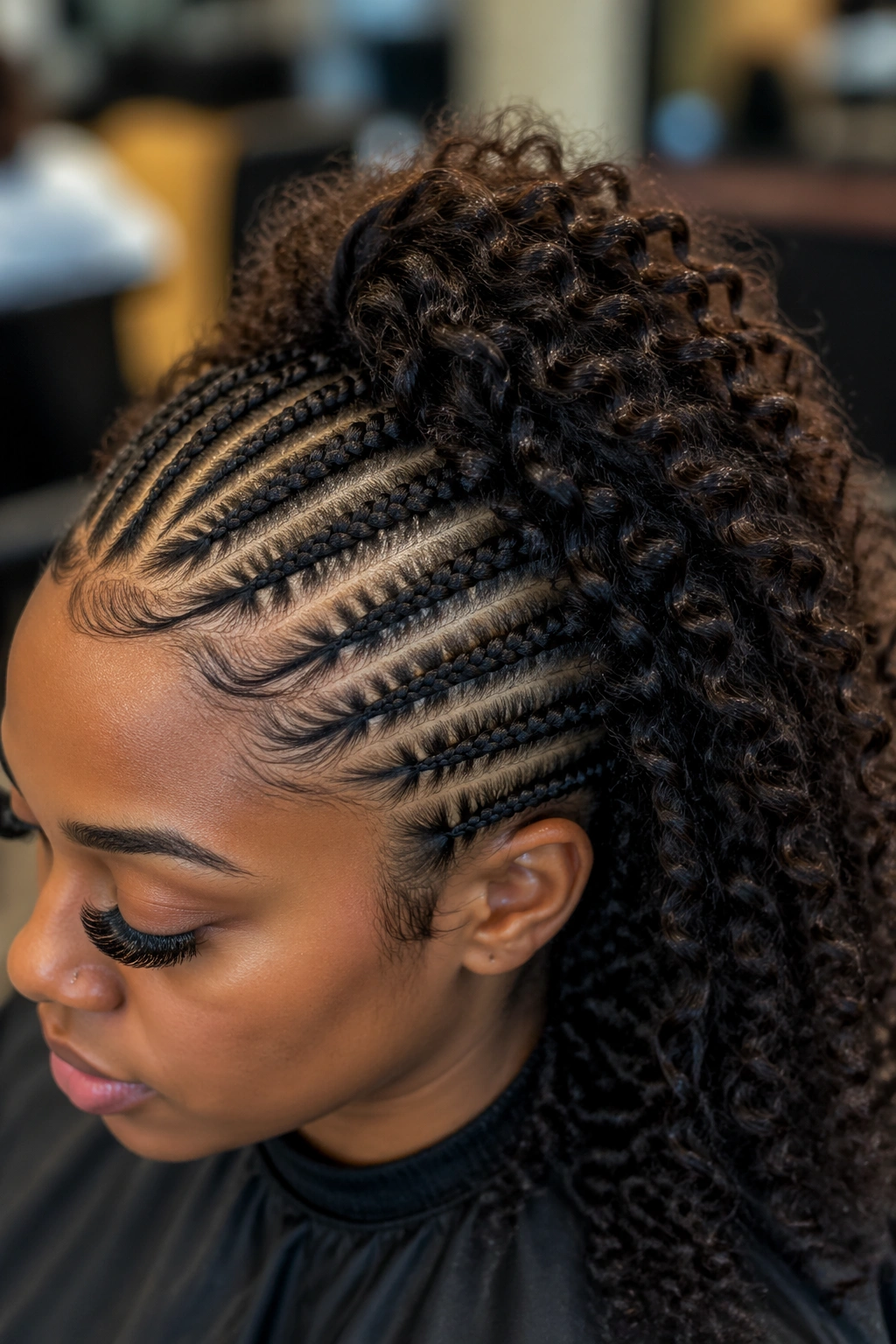
The transition from cornrow to weave needs to be invisible. The cornrow track that the weave attaches to should sit right behind the natural cornrow front, hidden under the first weft of curly hair.
Sew the weft tight against the cornrow track. Loose stitching causes the weft to lift over time. Tight, even stitching keeps the weft flat against the head and the curly hair flowing naturally above it.
Layer the wefts from bottom to top. The first weft sits on the lowest cornrow track at the back of the head. Each subsequent weft sits on a track slightly above the last, building toward the crown. Layered placement gives the weave fullness and prevents the wefts from showing through.
A Word on Maintenance Realism
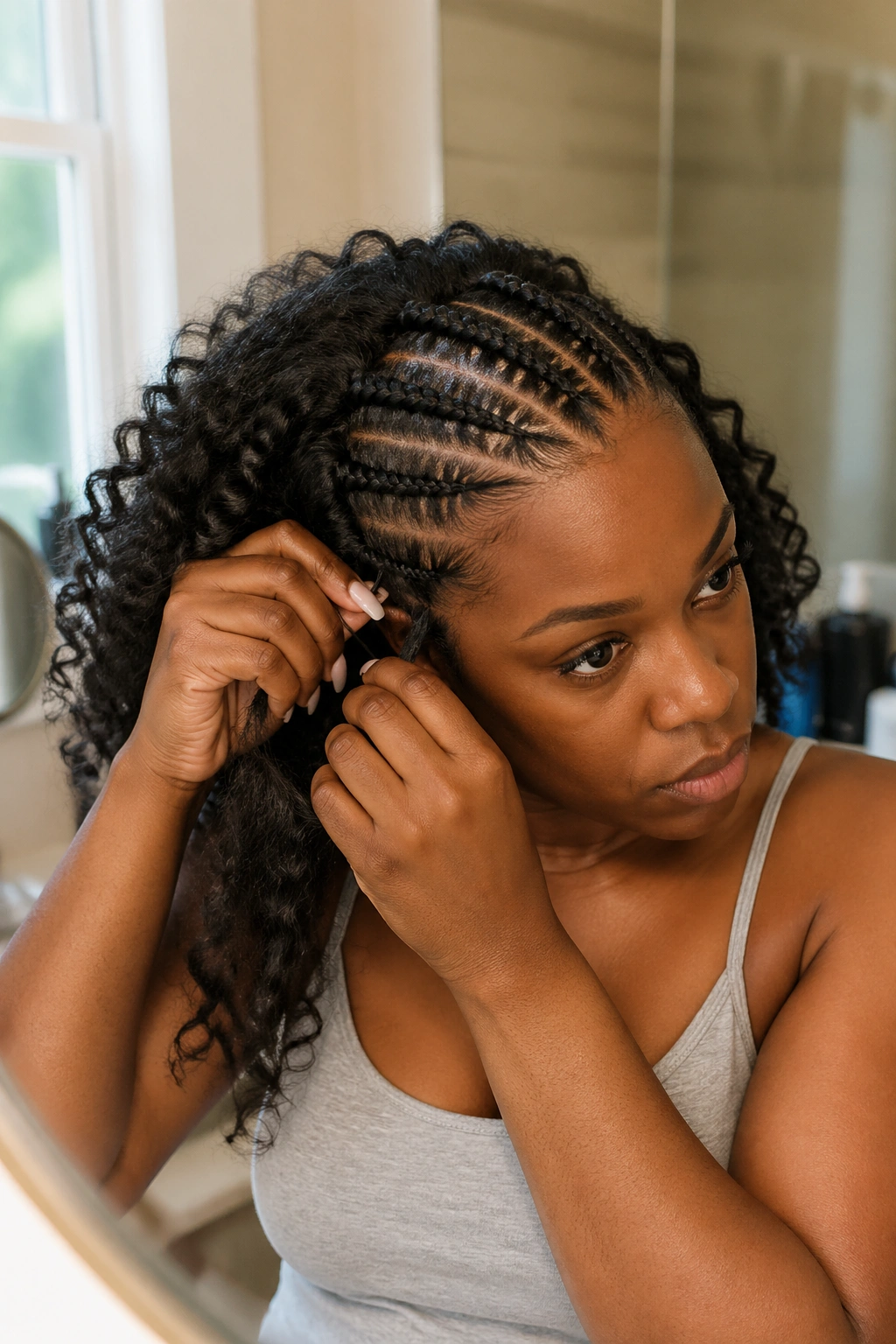
Half cornrow with curly weave installs typically last 4-6 weeks. The cornrow front holds longer than the curly back — the curly weave starts looking tired faster because of curl pattern flattening and tangling.
Plan for a touch-up around the three-week mark. Re-stitch loose wefts, refresh the curly pattern with a misting and scrunching, and tidy the cornrow front edges.
A Brief History of Combined Style Approaches
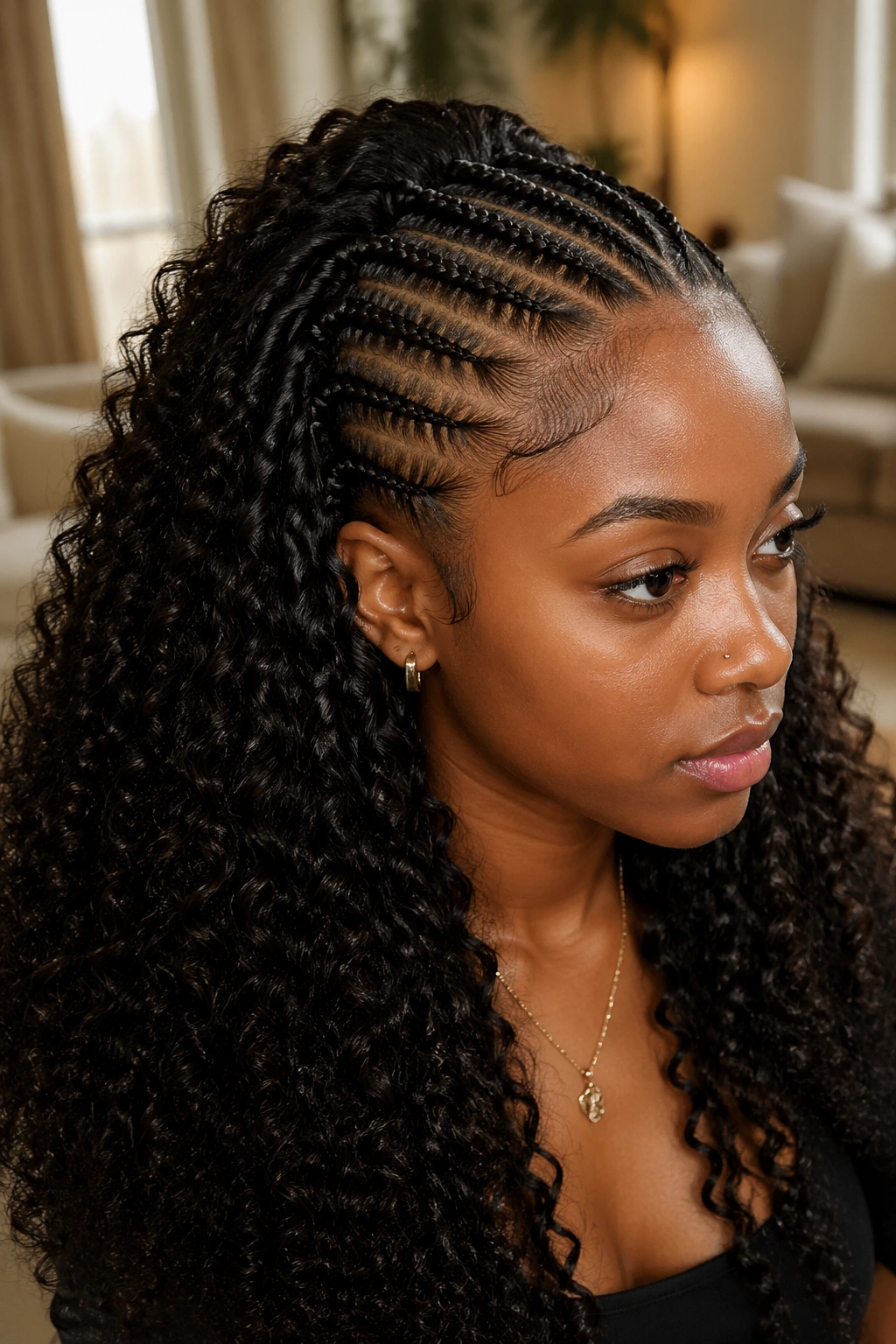
Combining two hair textures in a single style is an old practice. Indigenous African hair traditions often included braided sections paired with loose, decorated, or accessorized sections. The half-cornrow-with-weave concept is a contemporary expression of that older principle — using technology (commercial weave hair) to extend what can be done with the traditional combination idea.
The aesthetic crosses cultures and decades. The specific commercial weave version became popular as quality curly extensions became widely available and affordable.
1. Half Cornrows With Loose Water Wave Back
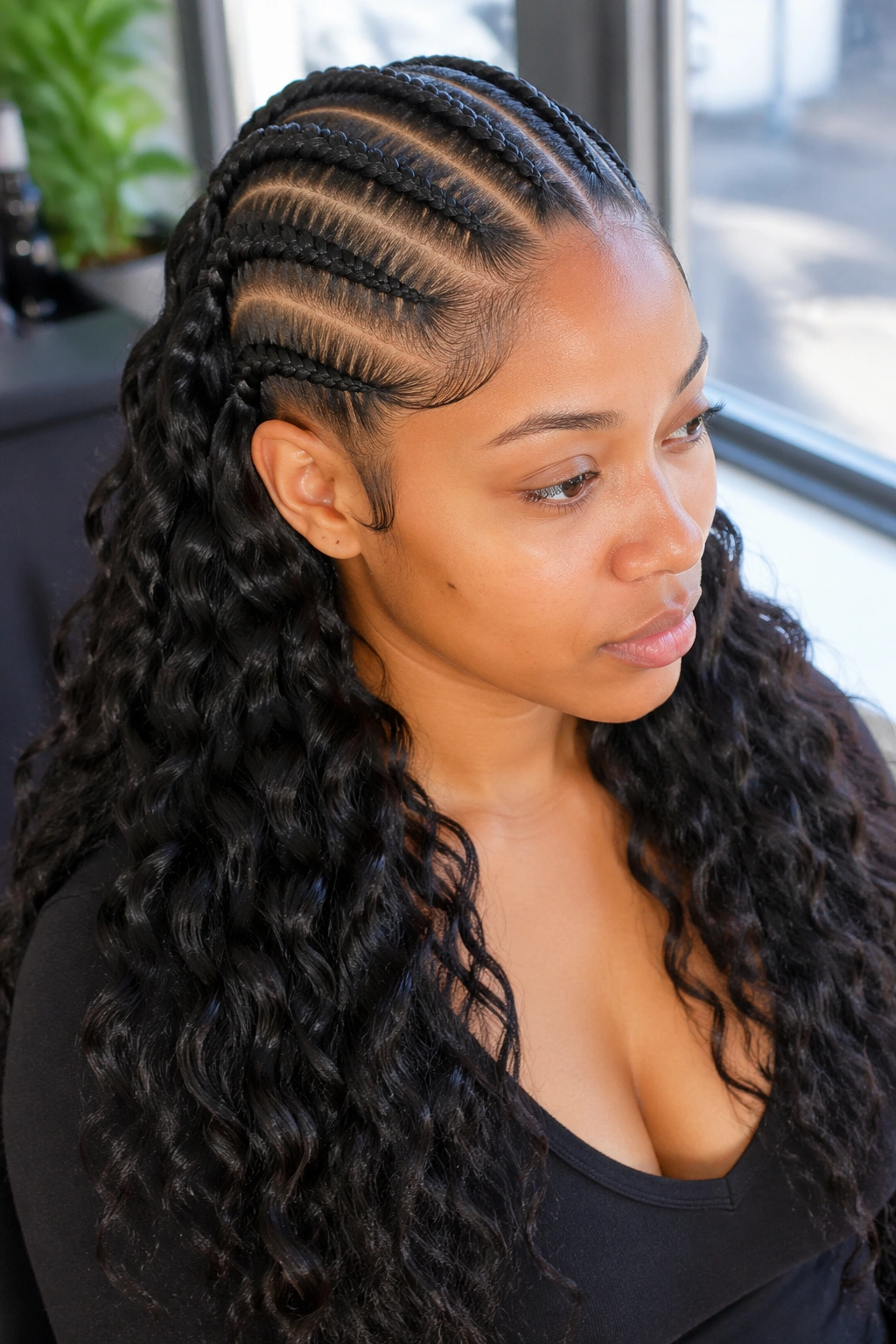
Five cornrows running from the hairline to the crown, with a loose water wave weave covering the back of the head. The cornrows are simple straight-backs; the water wave provides the soft, photogenic finish.
Why It Works
- Easiest half cornrow style to install — about 2-3 hours total
- Water wave is the most flattering curl pattern for most face shapes
- Length is adjustable based on weave bundle length
- Comfortable to wear for 4-6 weeks with good care
Best tip: position the first weft right behind the cornrow termination so the transition is invisible.
2. Half Cornrows With Deep Wave Back
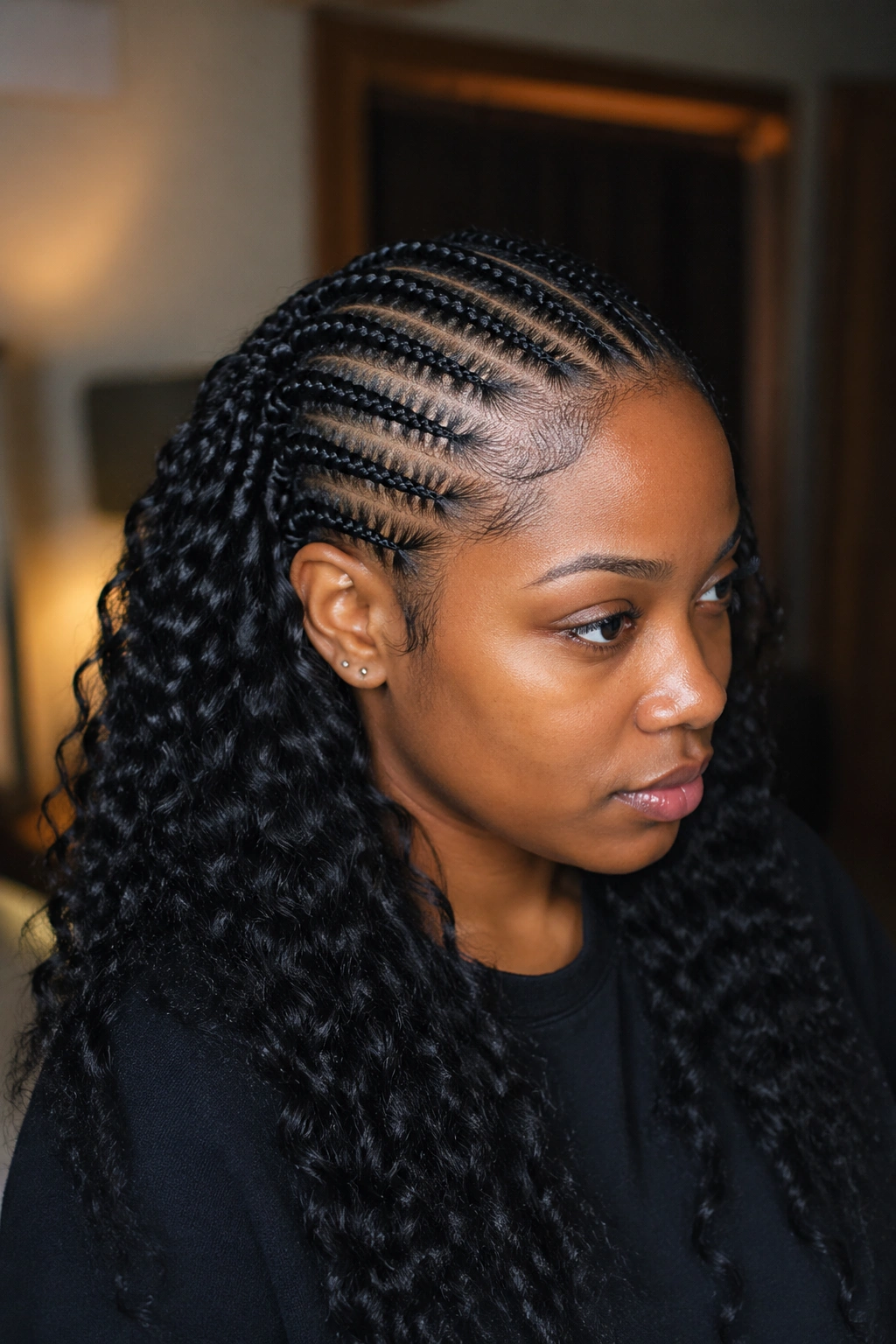
Same structure as the loose water wave version, but with deep wave curls instead. Deep wave is tighter, more defined, and more dramatic than water wave.
Unlike looser patterns, deep wave reads more sculpted. Each curl is distinct and visible. The pattern photographs especially well in indoor lighting.
Deep wave needs more daily maintenance than looser patterns. Mist with a curl-refresh spray daily, scrunch upward to revive curl shape, and avoid brushing.
3. Half Cornrows With Kinky Curly Back
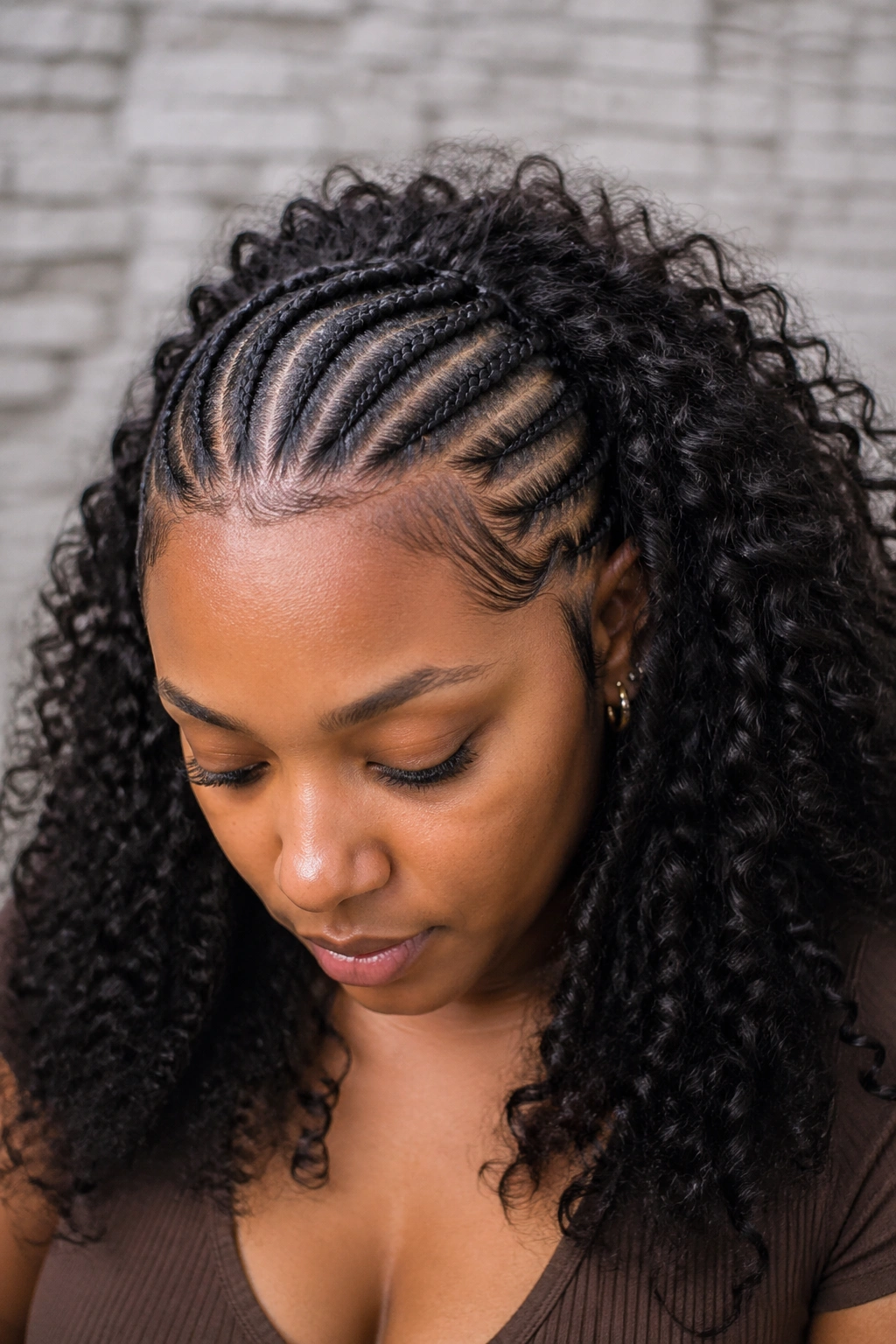
The cornrow front pairs with a kinky curly back that mimics 4A-4B natural texture. The blend feels organic — almost like the cornrow is your natural hair leading into your natural curls.
Kinky curly weave reads natural in a way commercial curly extensions sometimes don’t. The texture matches the look of healthy 4A-4B hair without screaming “weave.”
Who this is best for: anyone who wants to look like they have a defined natural curl pattern with no obvious extension. Anyone who wants a curl pattern that blends with their own hair texture.
4. Half Cornrows With Side Part and Curly Back
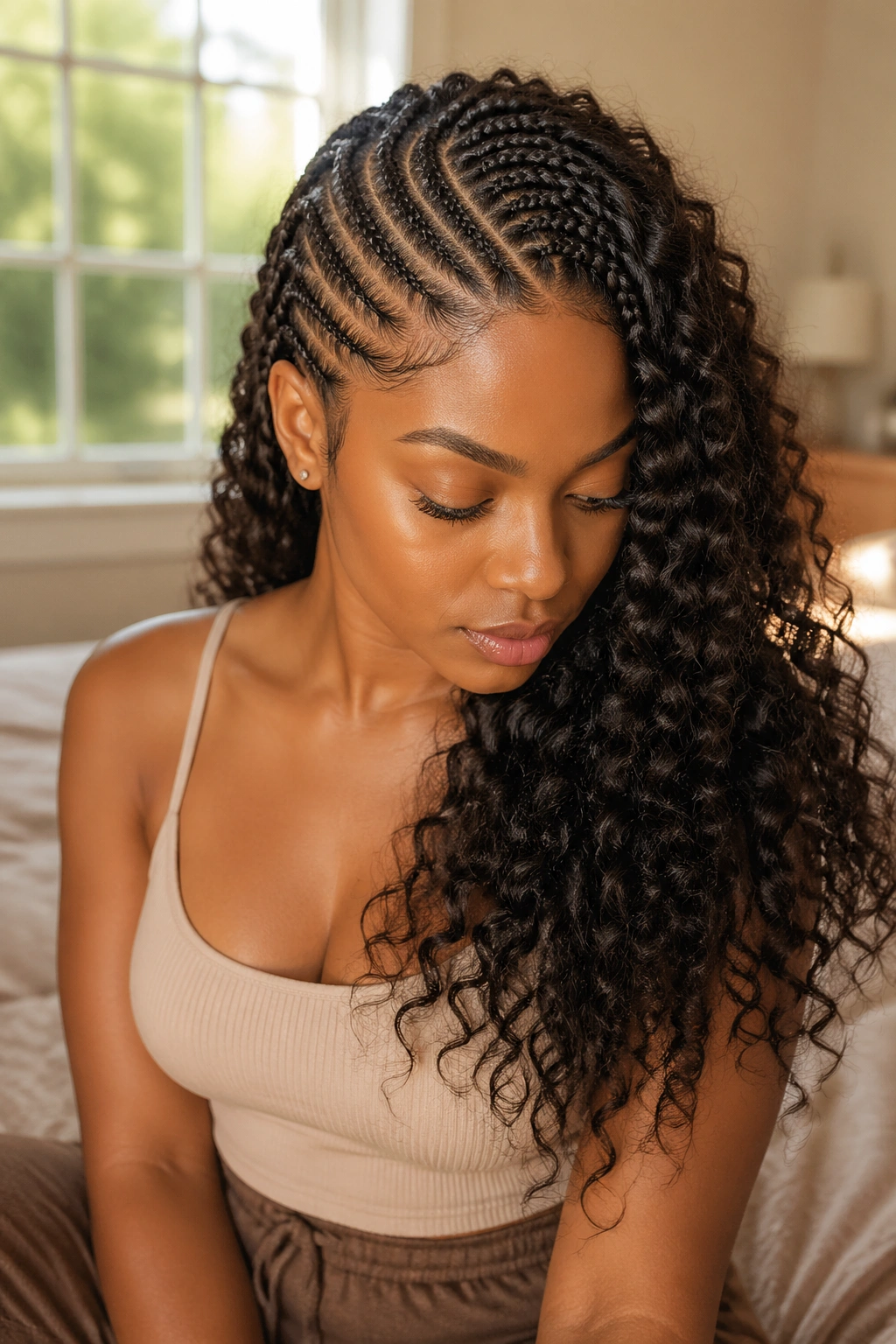
A deep side part runs through the cornrow front, with the curly weave back falling more heavily to one side. The asymmetry of the part matches the asymmetry of the falling weave.
A side part reads softer and more sultry than a center part. It changes the whole personality of the style without changing the install structure.
The cornrow rows on the heavier side of the part are usually thicker (about three rows) and the lighter side has fewer rows (about two rows). This visual weight balance keeps the style from looking lopsided.
5. Half Cornrows With High Curly Ponytail
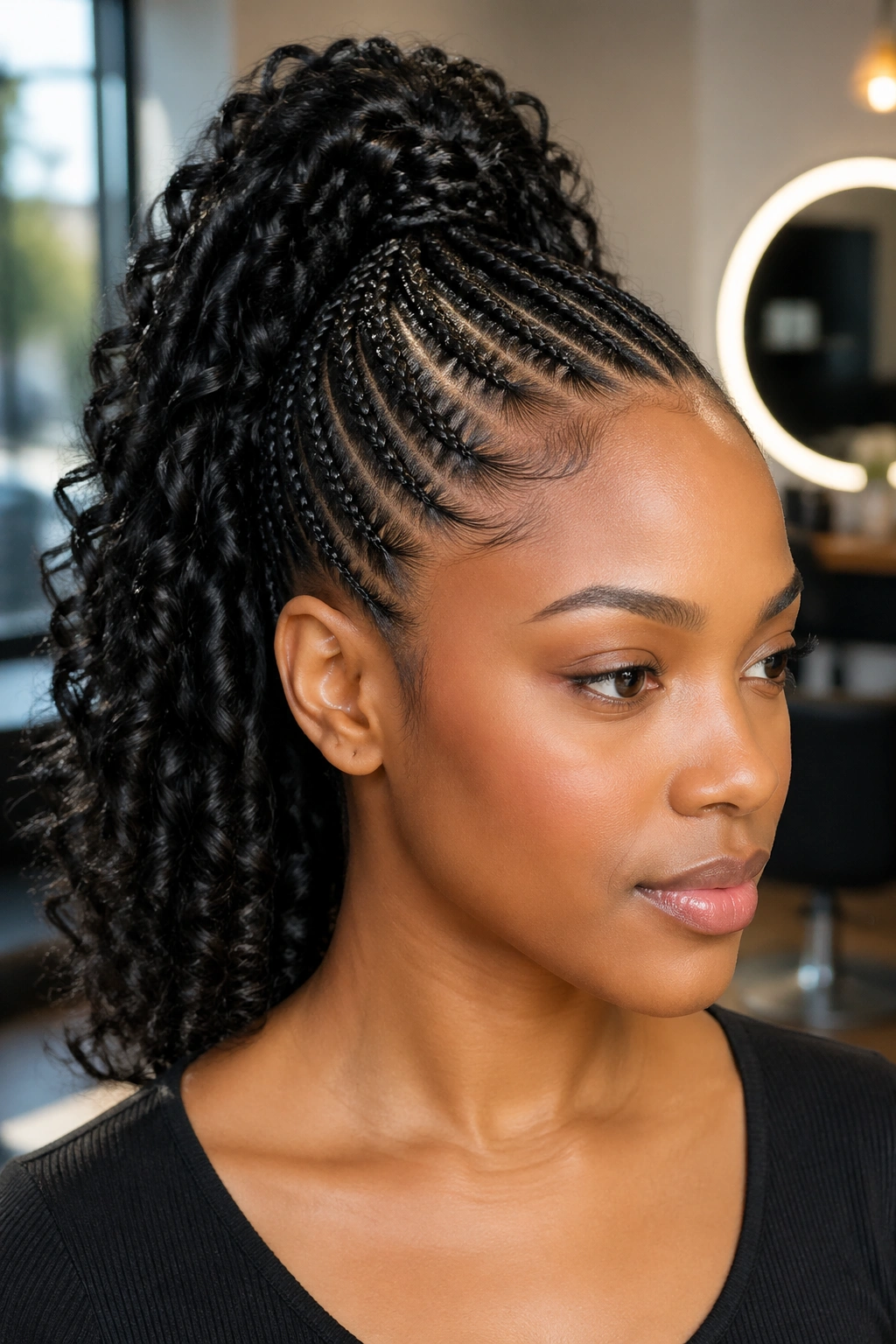
The cornrow front is straight-back, and the curly weave at the back is gathered into a high ponytail at the crown. The ponytail flows curly down the back.
Picture a sleek cornrowed front that gathers smoothly into a high curly ponytail. The contrast between the polished front and the loose curly tail is the style’s signature.
Mechanism: the curly weave is attached at a track high on the crown, and the natural hair behind the cornrow front is gathered into the ponytail along with the curly weave. The weave provides the length and curl; the natural hair anchors the gather.
The high gather pulls more on the natural hair under the weave. Apply scalp oil before the gather to reduce tension and friction.
6. Half Cornrows With Side-Swept Curly Back
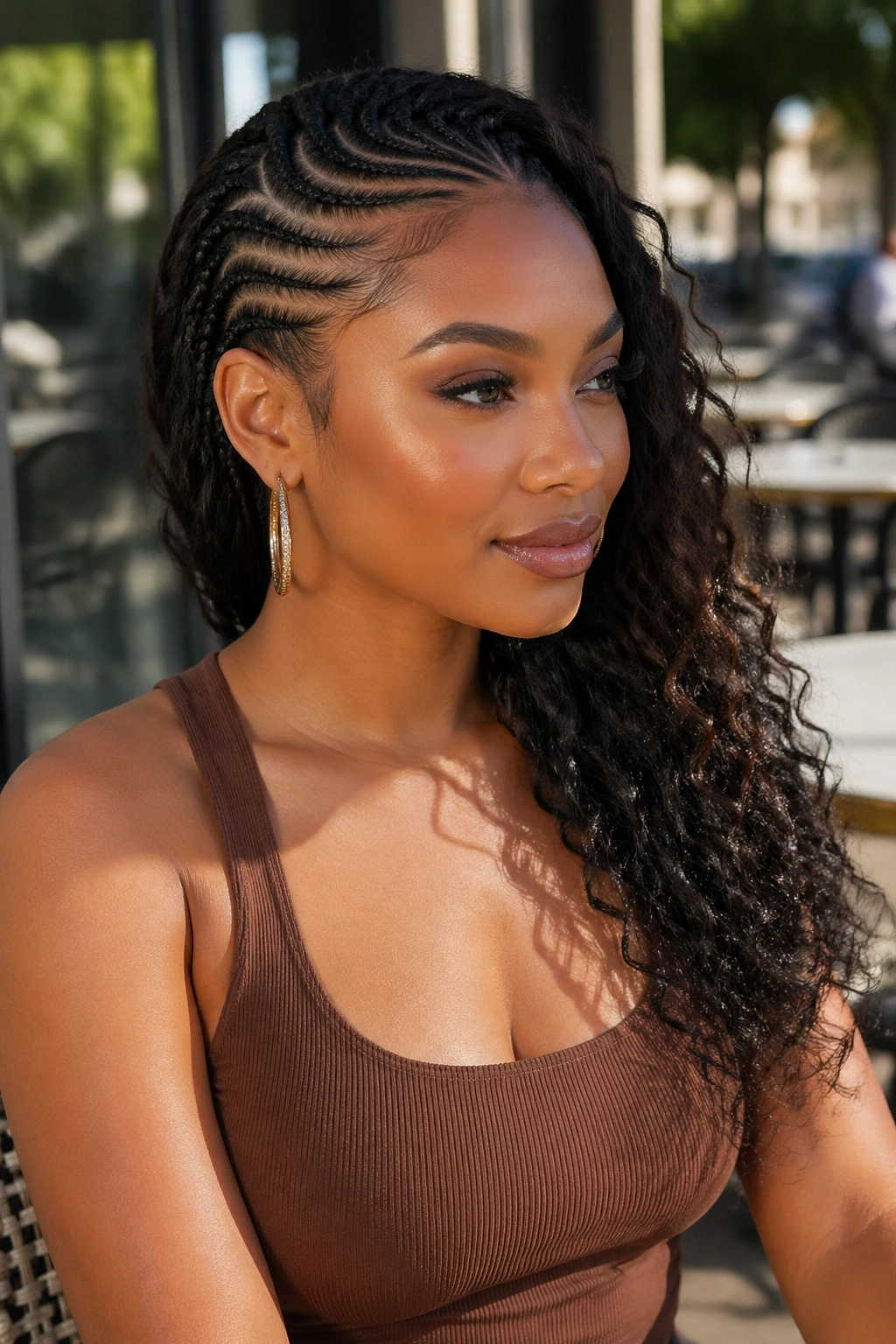
The cornrow front is sleek and back-swept, and the curly weave back is styled to fall over one shoulder rather than evenly down the back. The swept finish reads romantic and intentional.
Bold fact: side-sweeping curly weave can add 30-40 percent more visual movement than letting it fall straight down.
Pin the weave at the back to encourage the side sweep. A few invisible pins at the crown anchor the curls in the sweep direction so they don’t migrate back to center throughout the day.
7. Half Cornrows With Body Wave Length
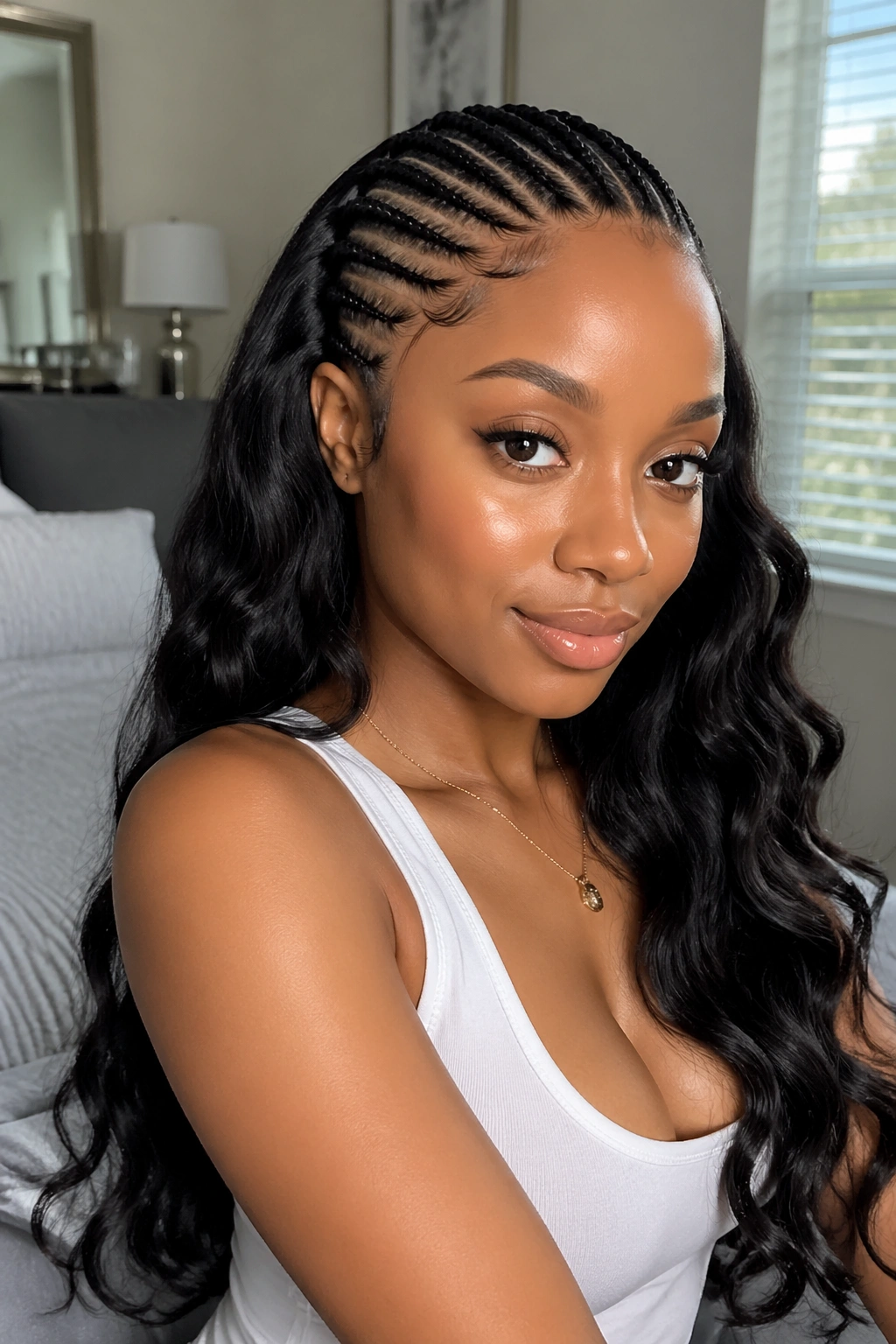
A softer alternative — body wave weave at the back instead of tighter curl patterns. Body wave gives you S-shaped waves with looser definition. The result reads more relaxed and less defined.
Body wave is the easiest curl pattern to maintain. It tangles less than tighter curls, holds its pattern with minimal effort, and reads polished without daily styling.
Who this suits: anyone wanting a half cornrow style for a less curl-focused look. Anyone new to half cornrow installs who wants a low-maintenance starting point.
8. Half Cornrows With Tribal Front Design
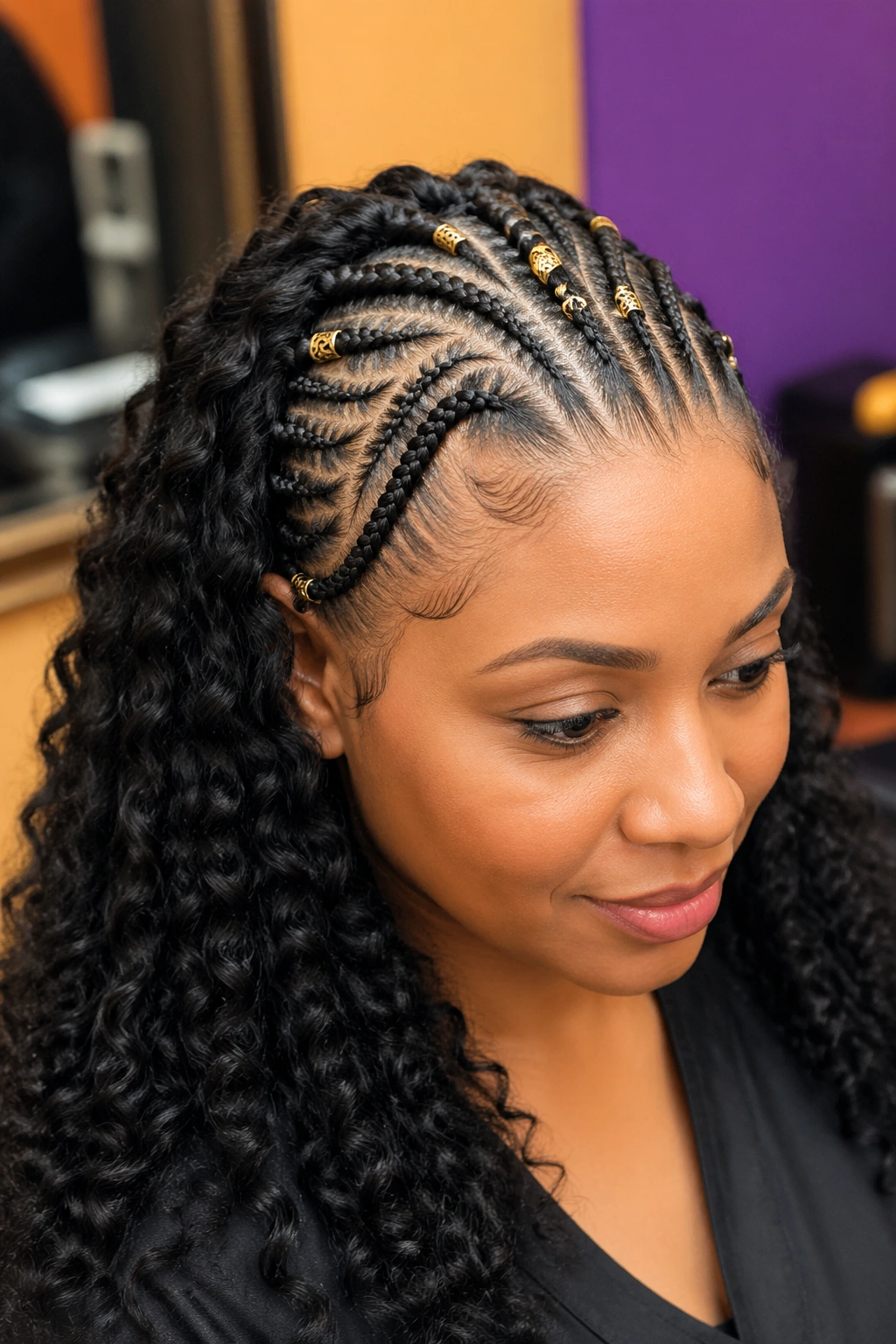
The cornrow front uses tribal-style design elements — mixed row thicknesses, geometric parts, scattered metal cuffs — and the back is a standard curly weave. The front is the design statement; the back is the soft finish.
Tribal cornrows in the front mean longer install time. The intricate front sections take 2-3 hours alone before the back weave install begins.
The accessories live on the cornrow front only. Don’t accessorize the curly weave back — the curl pattern is busy enough on its own without competing decorative elements.
How to Style It
- Plan the tribal cornrow design before starting the install
- Mix at least three different cornrow thicknesses across the front
- Use 4-6 metal cuffs scattered across the front cornrows
- Keep the back weave simple and curly to balance the busy front
9. Half Cornrows With Heart-Shaped Front Detail
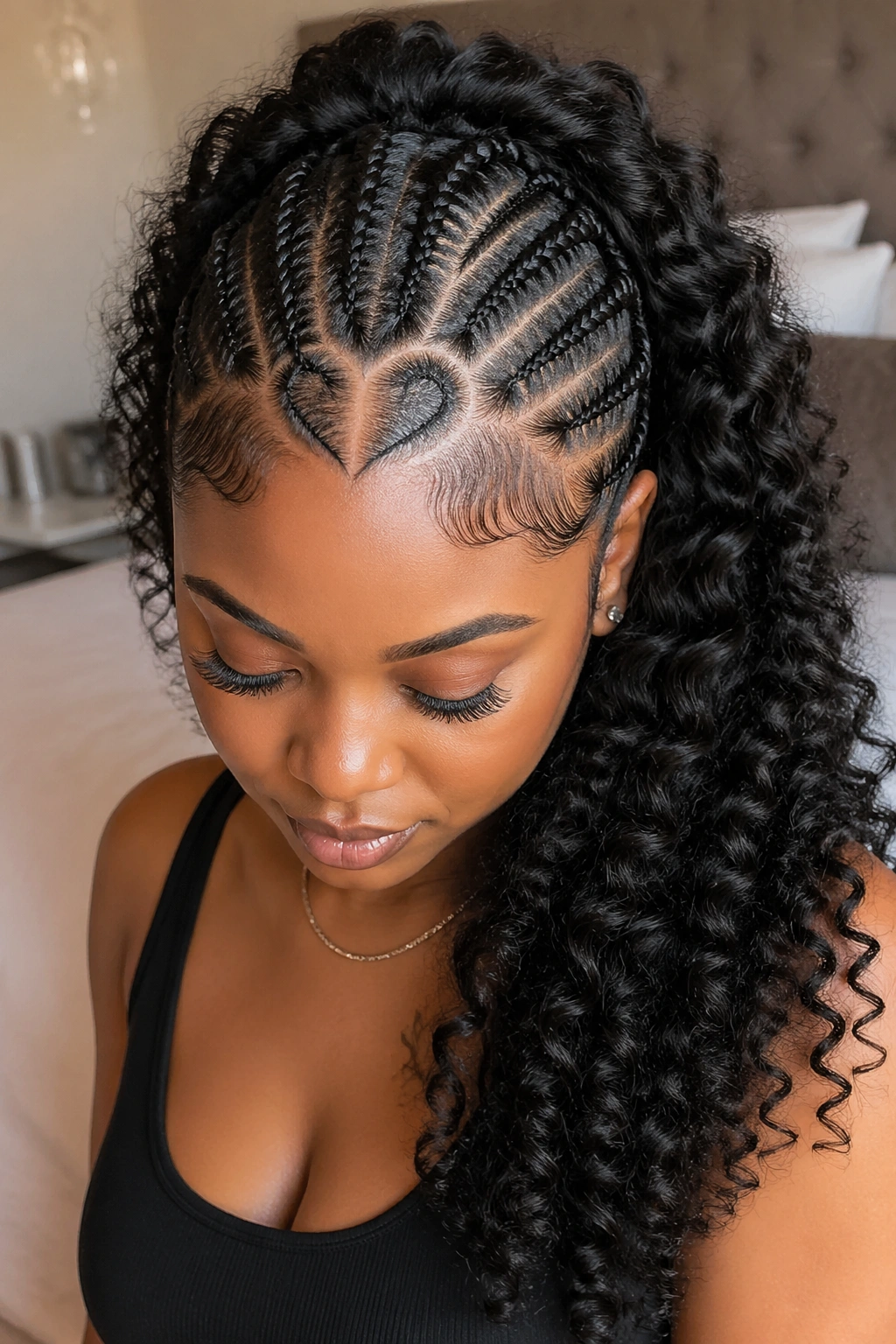
A small heart-shaped part at the very front of the cornrow section, with the cornrows leading away from the heart’s bottom point. The curly weave at the back is standard.
The heart is the focal point. The cornrows lead the eye to the heart; the curly weave provides the soft background.
Heart parts read playful and cute. They work for younger wearers, special occasions, and anyone who likes specific design details at the hairline.
Practice the heart shape on paper first — free-hand parting takes a few attempts to get right.
10. Half Cornrows With Curly Top and Cornrow Bottom
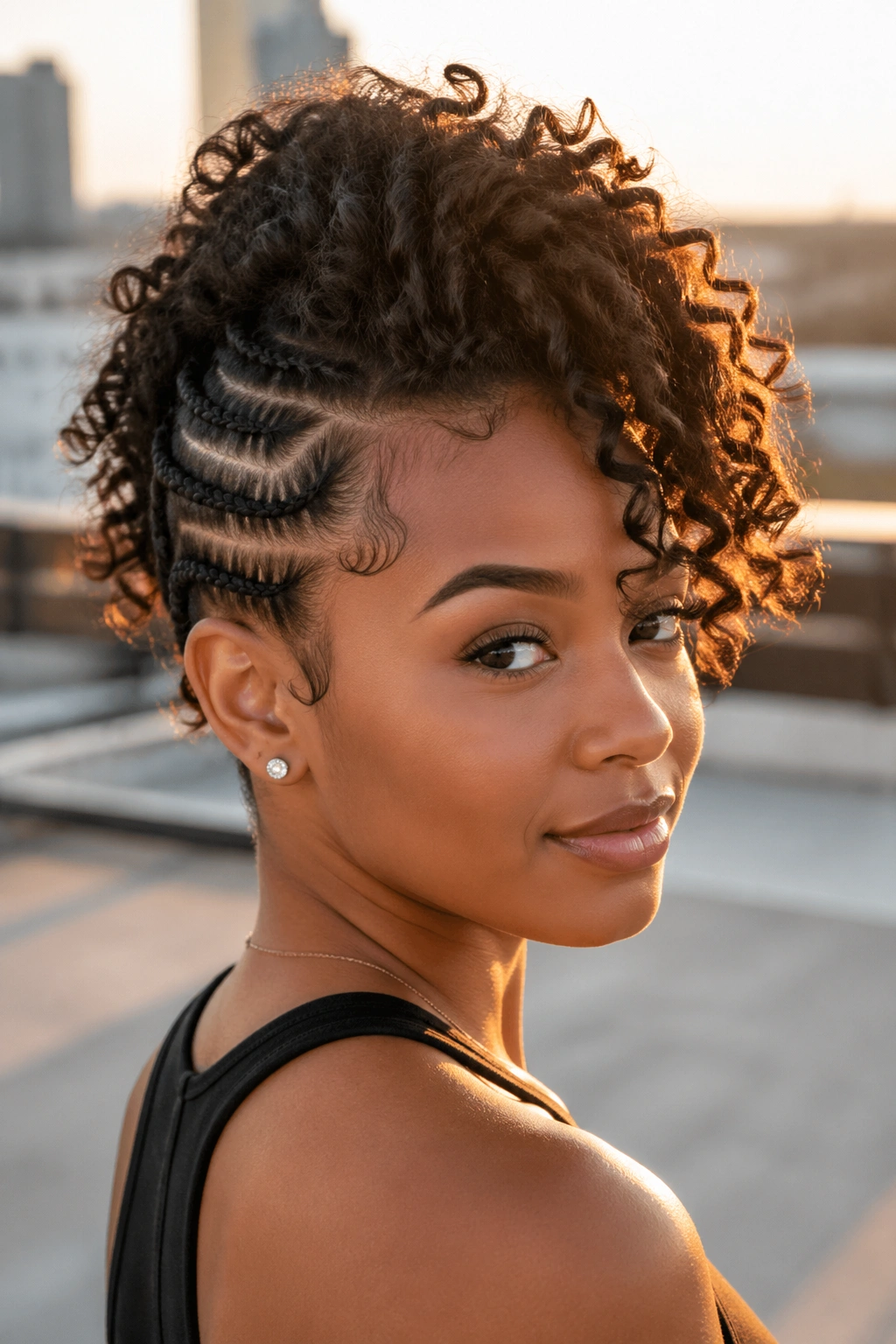
The reverse layout — the top of the head is curly weave, and the bottom (the nape and lower back of the head) is cornrowed flat. Less common but distinctive.
Picture the visual: curly volume up top, sleek braided lines below. The opposite of the standard half-cornrow direction.
This works well for anyone with a long head shape that benefits from volume up top and structure below. It also reads more “hair-forward” because the curly portion is the most visible from the front.
The cornrow bottom uses about half the head’s hair, so the curly top has full volume to work with.
11. Half Cornrows With Long Length and Side Part
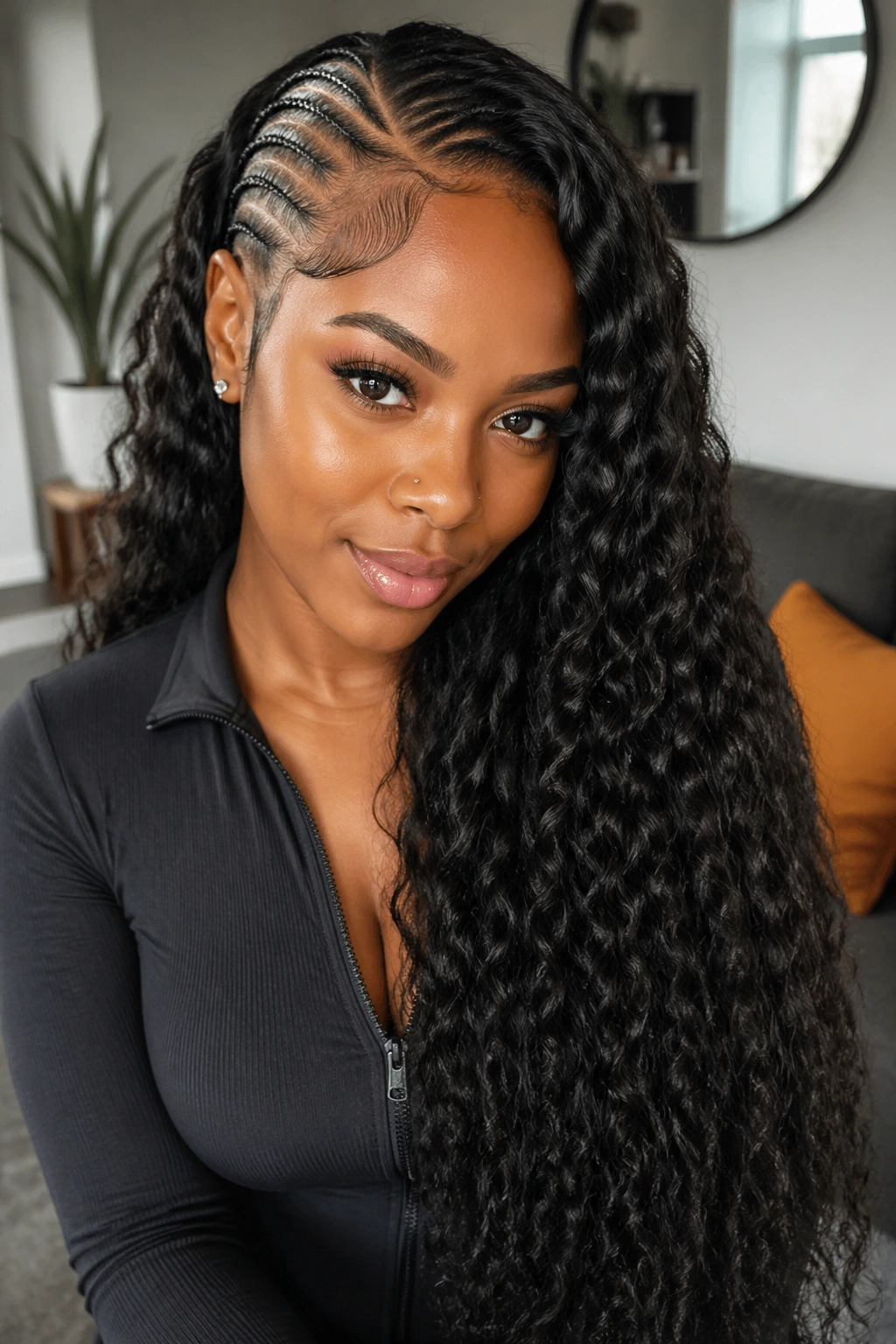
Standard half cornrow structure but with extra-long curly weave — waist-length or below — and a deep side part on the cornrow front. The combination reads dramatic.
Long curly weave tangles more than shorter lengths. Plan for daily detangling sessions with fingers and a curl spray. A wide-tooth comb works in emergencies but isn’t ideal for curl preservation.
The side part frames the long curly weave by directing the weight to one side. Without a side part, long weave can hang straight down the back and look heavier than the cornrow front.
Best for: events, photoshoots, and anyone who wants serious length impact for a few weeks.
12. Half Cornrows With Color-Blocked Cornrows
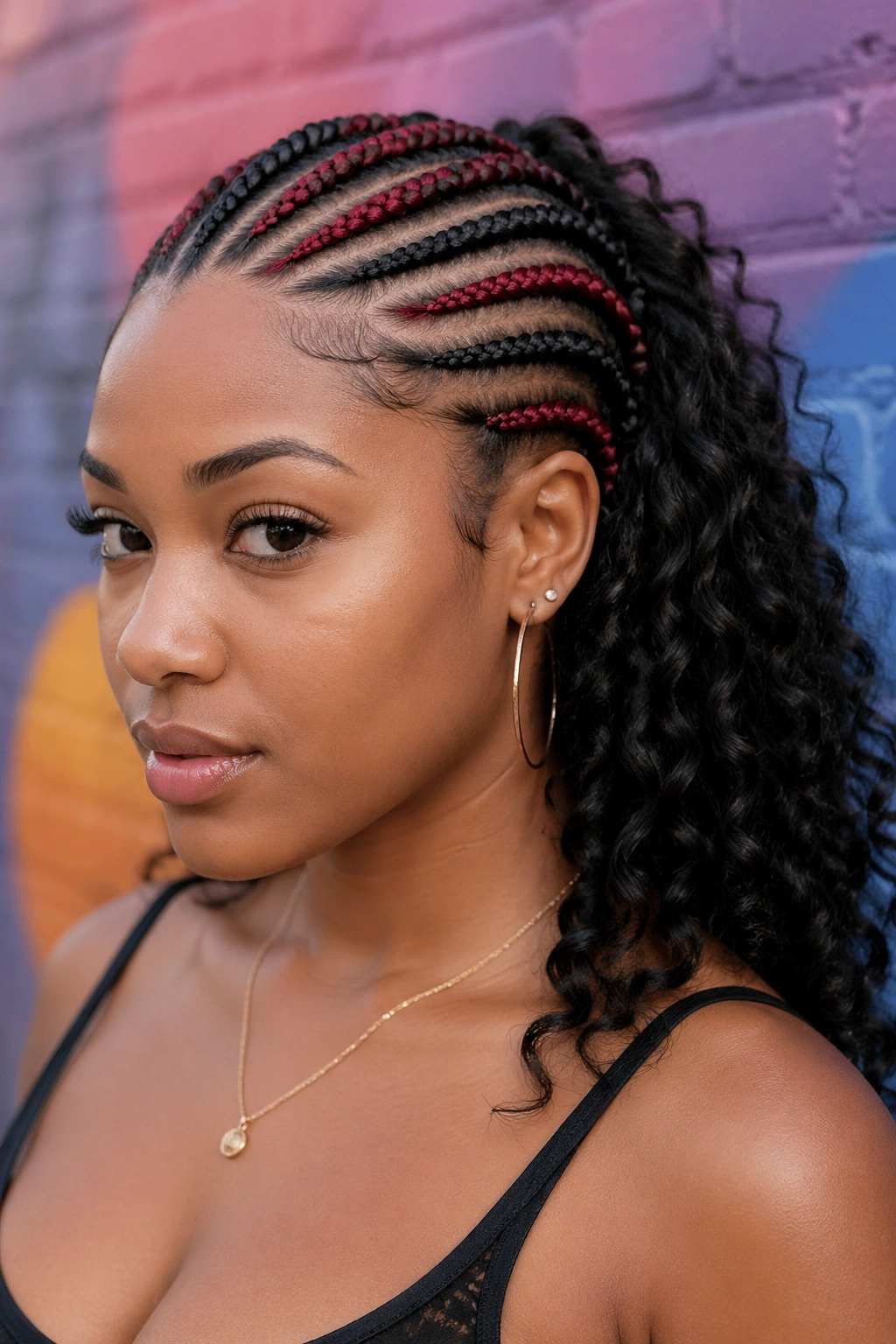
The cornrow front uses two contrasting colors — alternating rows of natural color and a bold color (red, blonde, copper). The curly back is a standard color matching the natural cornrow rows.
The color-block cornrows draw the eye to the front. The curly weave back provides a calmer backdrop that doesn’t compete with the color statement.
Use temporary color spray for one-time use, semi-permanent dye for longer wear, or color-blended kanekalon woven into the cornrow rows for a longer-lasting effect.
13. Half Cornrows With Crown Bun and Curly Back
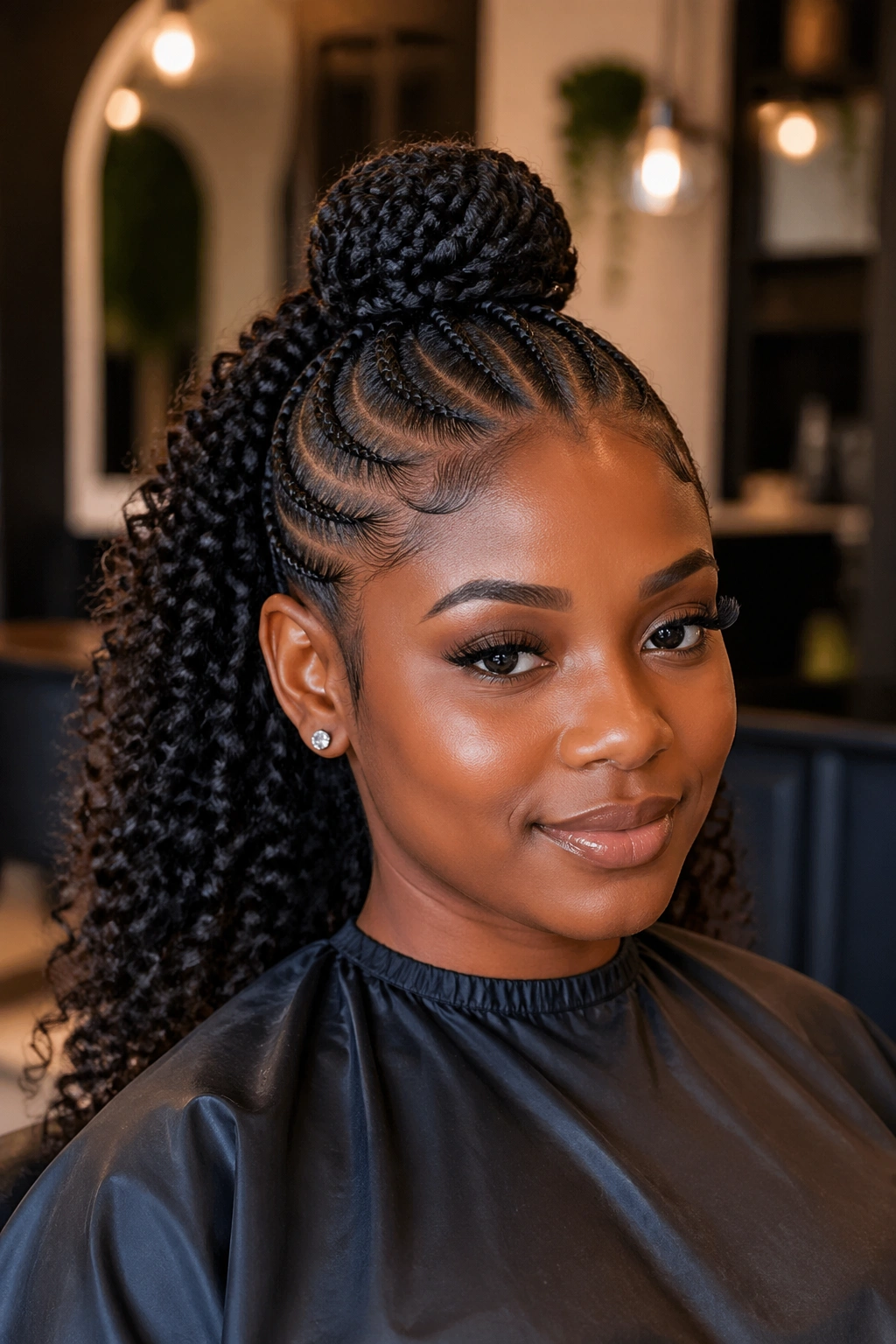
The cornrow front gathers into a small bun at the crown, and the curly weave at the back falls below the bun. The bun acts as a focal point at the crown level.
Picture a small bun sitting at the top of the head, with curly weave flowing below. The bun gives the style a defined gather point that pure curly styles lack.
The bun is small — about the size of a tennis ball or smaller. A larger bun starts to compete with the curly weave for attention.
14. Half Cornrows With Curly Bangs Detail
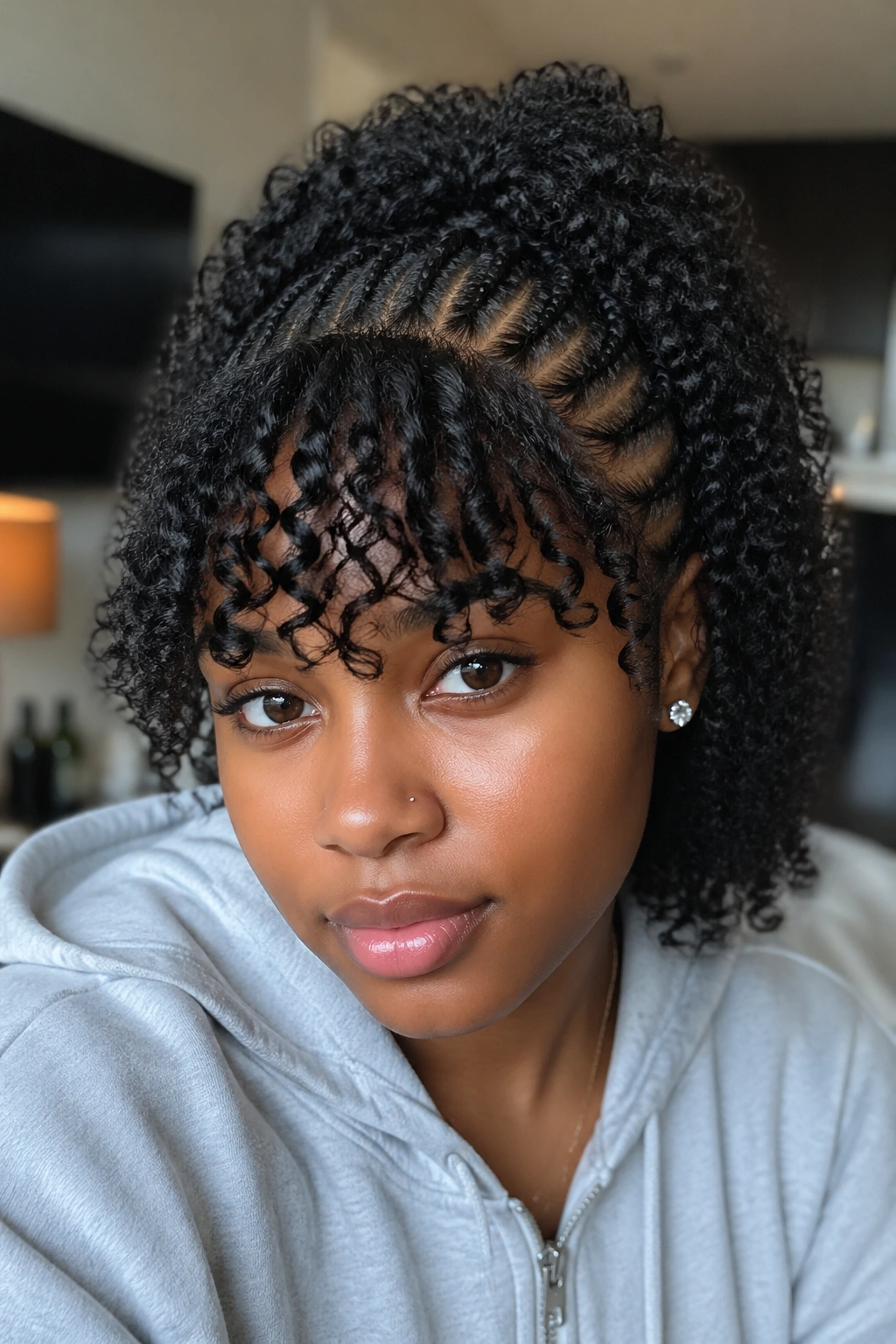
The cornrow front extends to about the eyebrows, and the curly weave at the back has a section pulled forward over the cornrow line to create curly bangs. The bangs sit on top of the cornrow front, framing the face.
The curly bangs are part of the weave, not separately added. A section of the front-most weft is sewn or pulled forward to fall over the forehead.
This style is for anyone wanting bangs without committing to cutting their natural hair. The weave bangs can be removed with the weave at takedown.
The bangs should be slightly above the eyebrow line — not so long they cover the eyes, not so short they look choppy.
15. Half Cornrows With Layered Curly Back
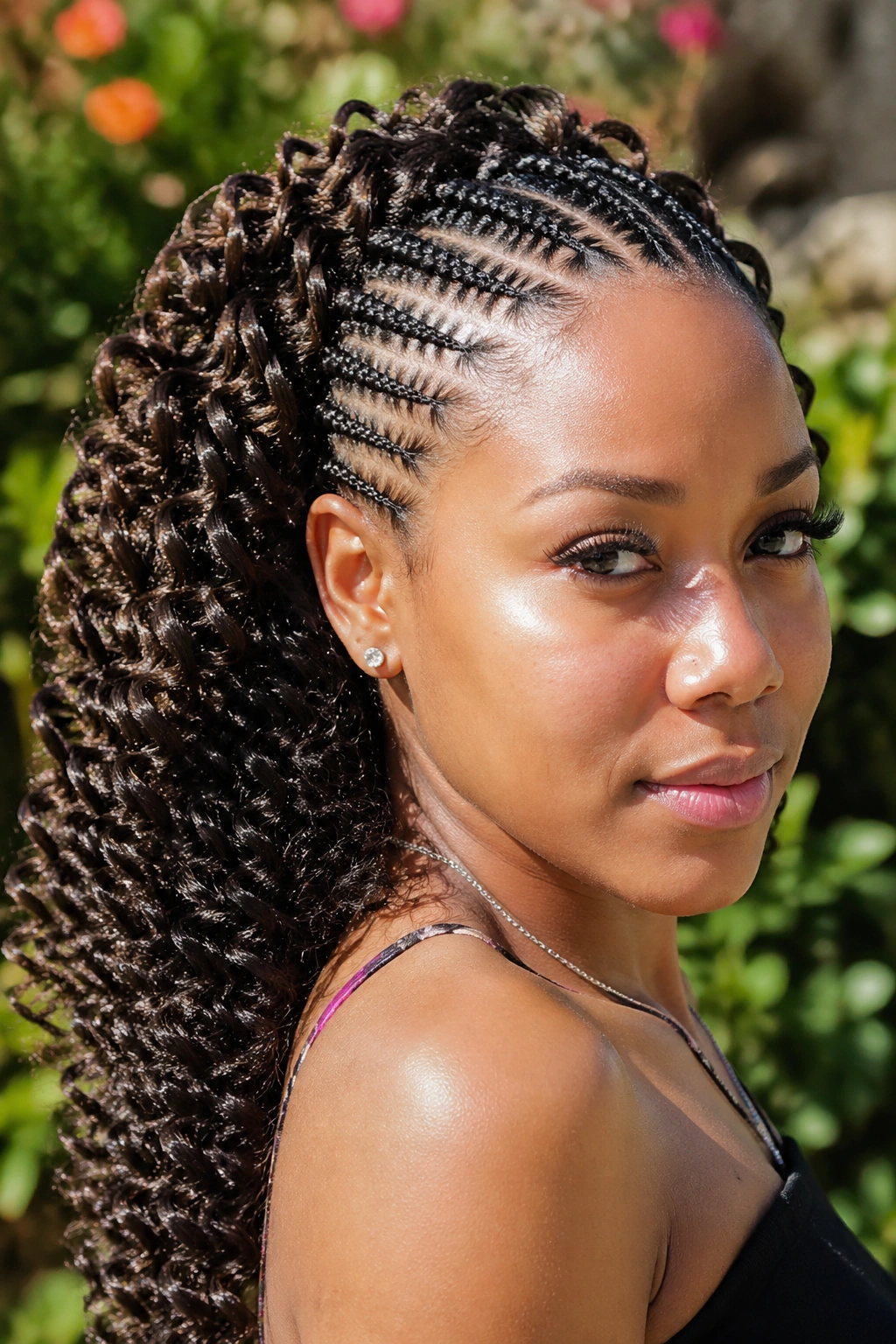
The curly weave at the back is installed in layers — different lengths in different sections — to create a layered, textured back instead of a uniform length. The cornrow front is standard.
Layered curly weave reads more dimensional than single-length weave. Different lengths catch light differently and create movement.
Achieve layers by trimming the weave wefts to different lengths before installation. The shortest wefts go at the top of the head; the longest at the back nape.
16. Half Cornrows With Beaded Cornrow Tips
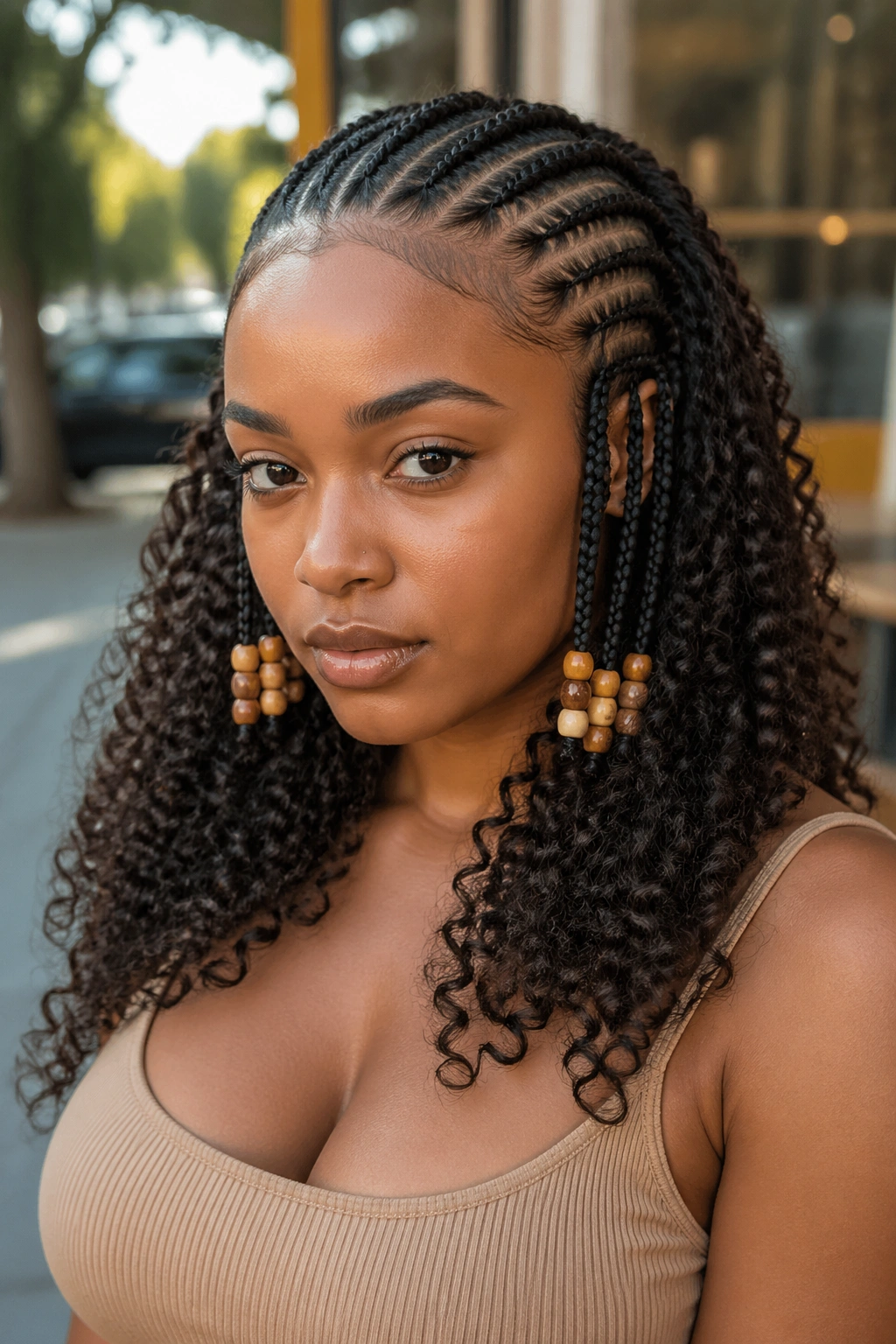
The cornrow front is straight-back with three to five beads on each cornrow tip — except the tips fall right at the curly weave transition point. The beads sit at the boundary between the two textures.
Bold fact: beaded cornrow tips at the cornrow-to-weave transition is one of the cleanest design solutions for hiding the weave attachment line.
The beads provide visual interest where the cornrow ends and the curly weave begins. Without the beads, the transition can look abrupt; with them, it reads as a deliberate design element.
Use lightweight wooden beads for this — heavy beads pull at the cornrow base.
17. Half Cornrows With Asymmetric Curly Back
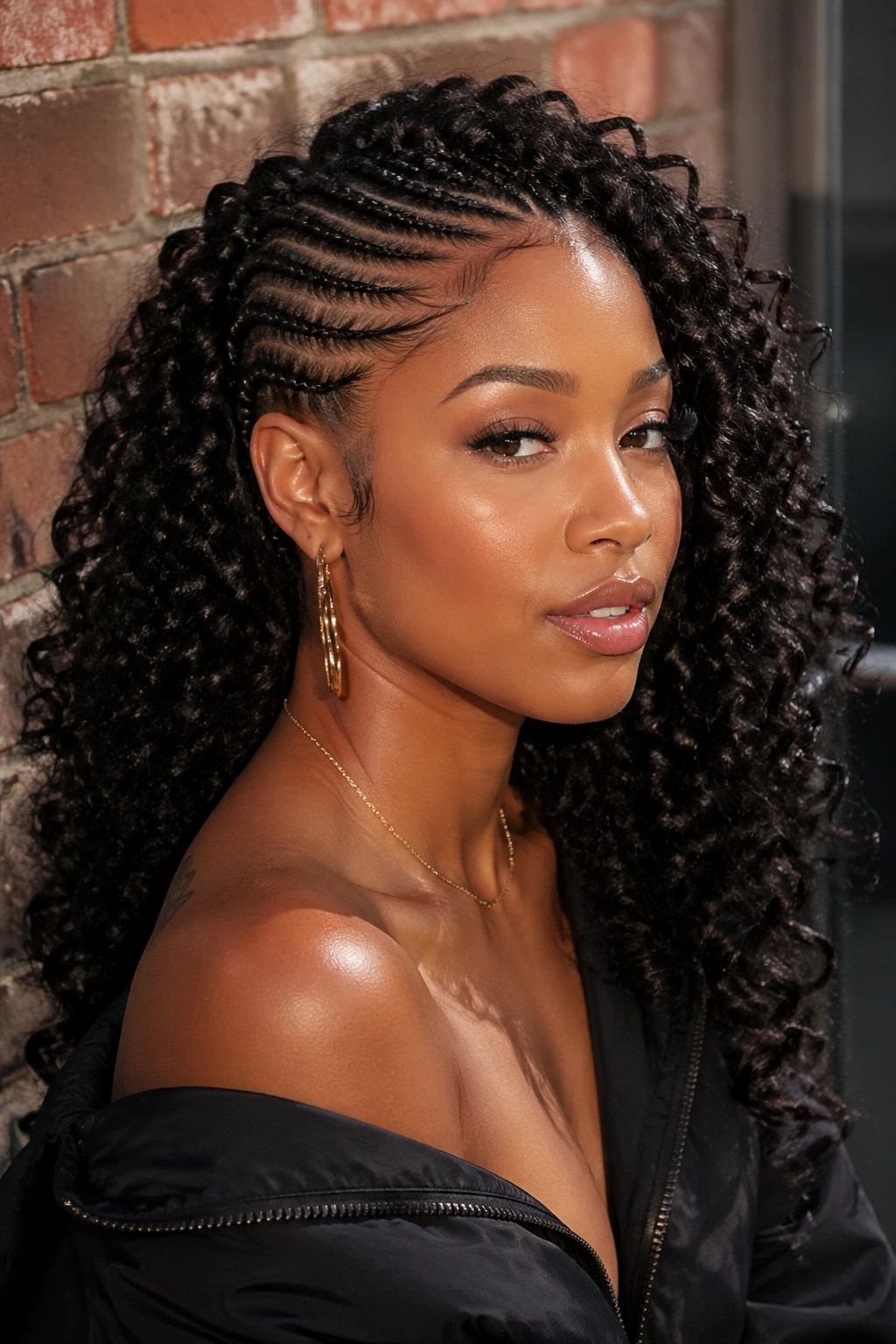
The curly weave back is deliberately asymmetric — fuller on one side, thinner on the other. The cornrow front matches the asymmetry with more rows on the thinner-weave side.
This is a fashion-forward layout. It reads editorial and intentional rather than balanced and traditional.
The asymmetry has to be designed, not random. The two sides should feel like a deliberate choice rather than a mistake.
The Catch
Asymmetric styles read polarizing. Some people love them; some find them off-putting. They photograph beautifully but might feel too bold for everyday office wear.
18. Half Cornrows With Headband Accessory
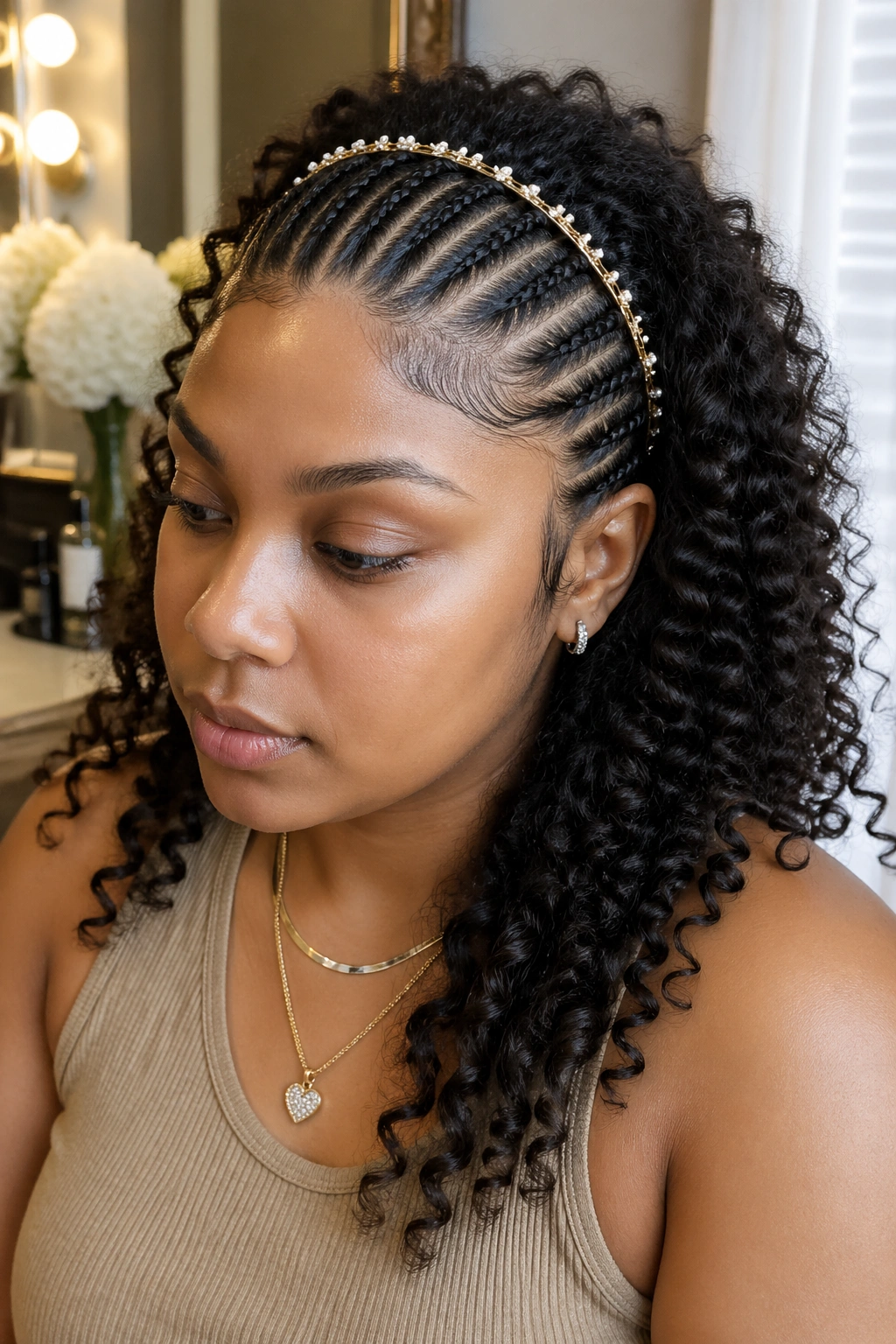
The cornrow front is simple and neat, paired with a thin decorative headband sitting just behind the hairline. The curly weave back falls beneath the headband line.
The headband is the accessory. It shouldn’t overpower the cornrow front or hide the curly back — it should sit at the boundary between them.
Choose a headband proportional to the install. Wide ornate headbands suit dressy styles; thin metallic headbands suit minimalist styles.
19. Half Cornrows With Curly Side Pony
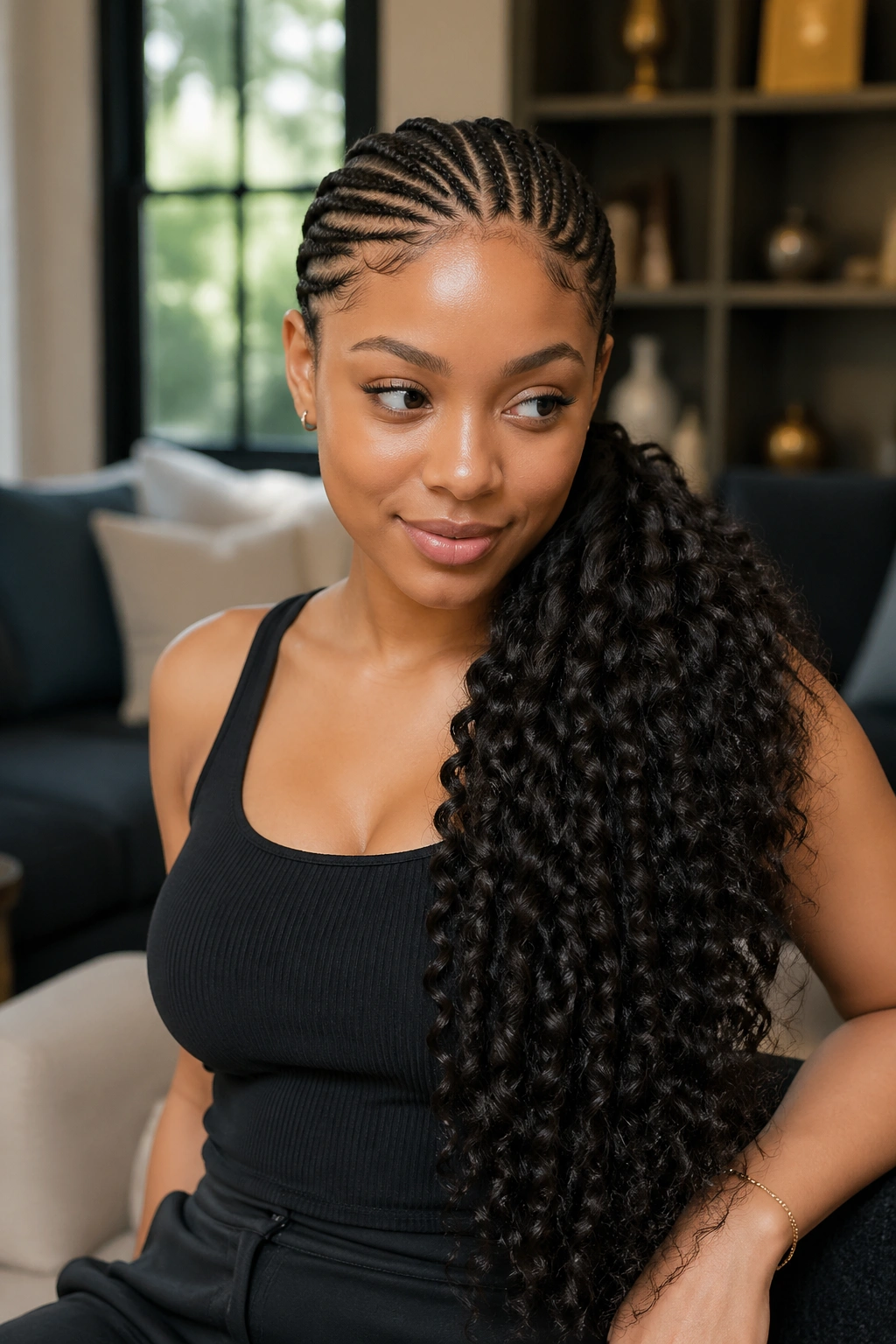
The cornrow front leads to a low side pony made entirely from the curly weave back. The pony sits over one shoulder rather than centered.
A side pony reads softer than a centered pony. It frames one side of the face and leaves the other side open.
The cornrow front sweeps slightly toward the pony side to feed cleanly into the gather. Straight-back cornrows can be made to gather sideways but the angle works against the structure.
20. Half Cornrows With Dramatic Center Part
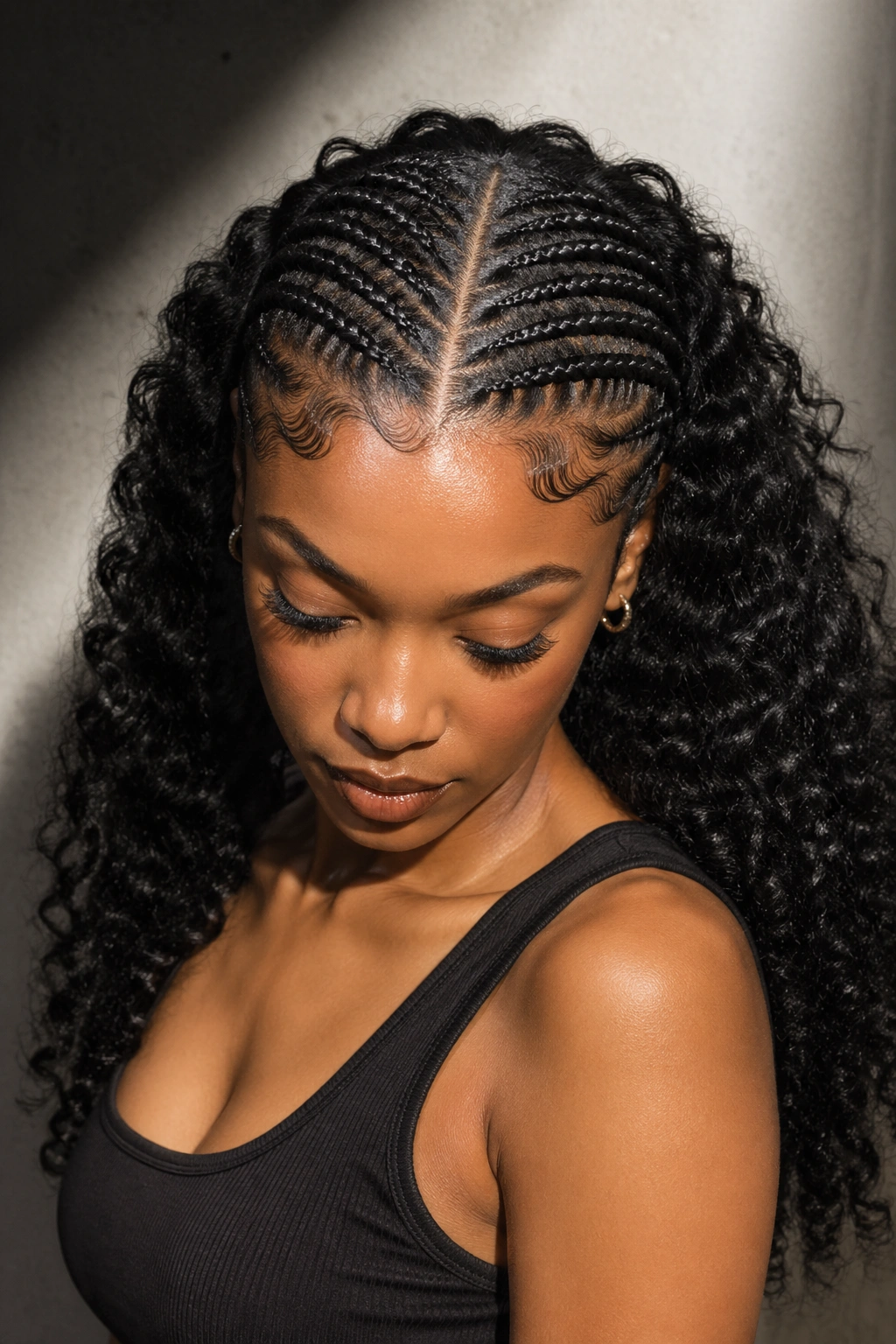
The cornrow front uses a sharp, center-parted layout with cornrows on each side of the part. The curly weave back is full and balanced.
A clean center part on a cornrow front reads classical. It’s the most traditional layout for this style category.
The part itself needs to be pin-straight and visible. Use the rat-tail comb to draw the part slowly and confirm it from front and back angles before braiding.
21. Half Cornrows With Single Accent Braid
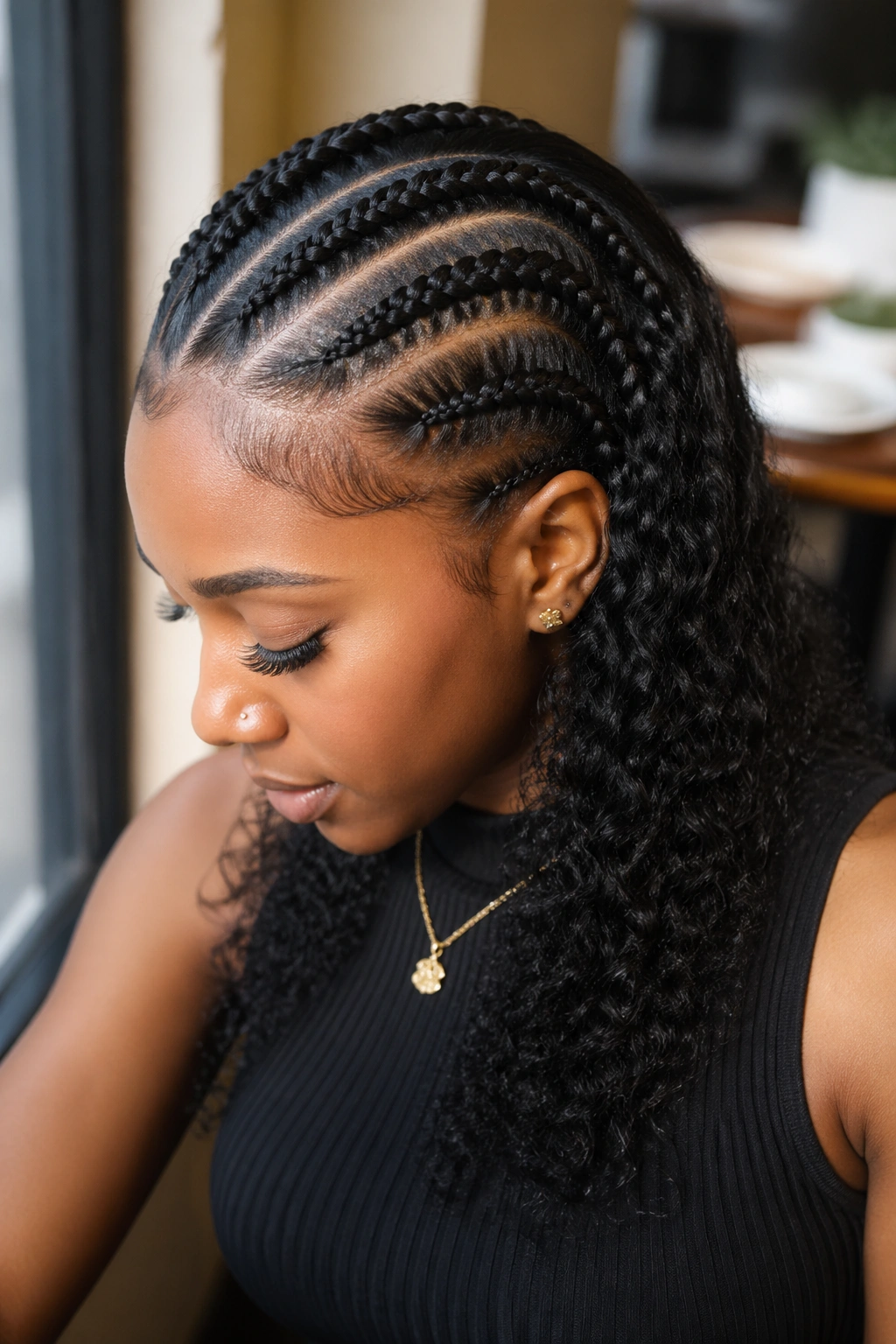
The cornrow front is mostly simple — three or four straight-back rows — with one decorative accent braid on the side. The accent braid is a thin fishtail or rope braid pulled from the natural hair behind the front cornrow line.
The accent braid reads as a small flourish against the otherwise simple front. It’s the visual equivalent of one small piece of jewelry.
Place the accent braid at the temple area, running from the front hairline back into the curly weave. It should disappear into the curly section rather than ending awkwardly mid-weave.
- Pull a small section of natural hair from above the ear
- Three-strand braid (or fishtail) the section
- Lead the braid back into the curly weave at about ear level
- Pin or tuck the braid into the weave to hide its endpoint
22. Half Cornrows With Curly Crown and Cornrow Sides
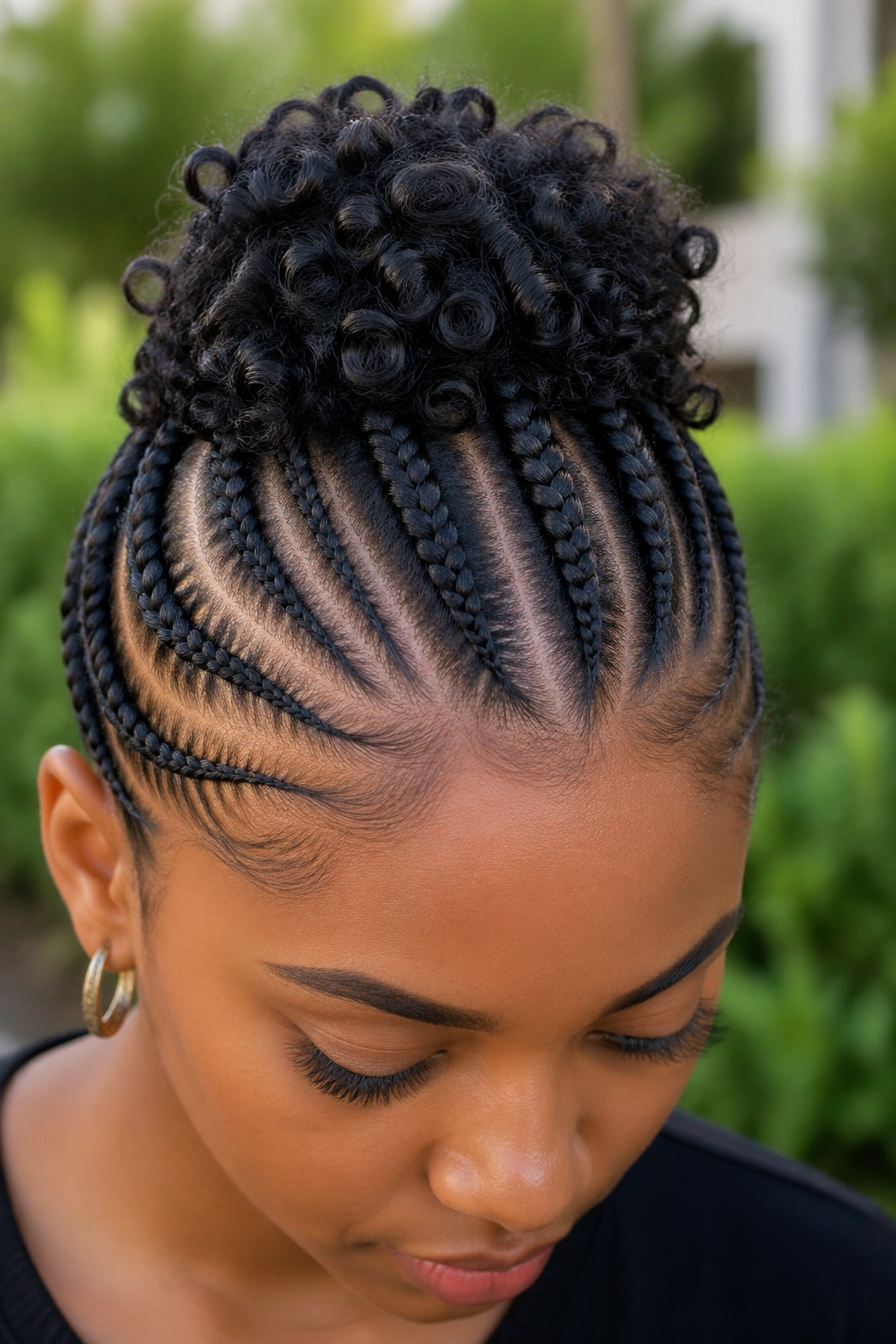
A more architectural variation — the very top crown of the head has a small curly weave section, the front and sides are cornrowed flat, and the back is also cornrowed. The curly weave is just at the crown like a small curly puff.
Picture a mostly-cornrowed style with a curly accent at the crown. The curly section is small (about the size of a fist) and reads as a deliberate texture detail.
This style works for anyone wanting mostly cornrows but with a touch of curly visual interest at the crown. Less curly hair to maintain, more cornrow structure to work with.
Daily Care for Half Cornrow Installs
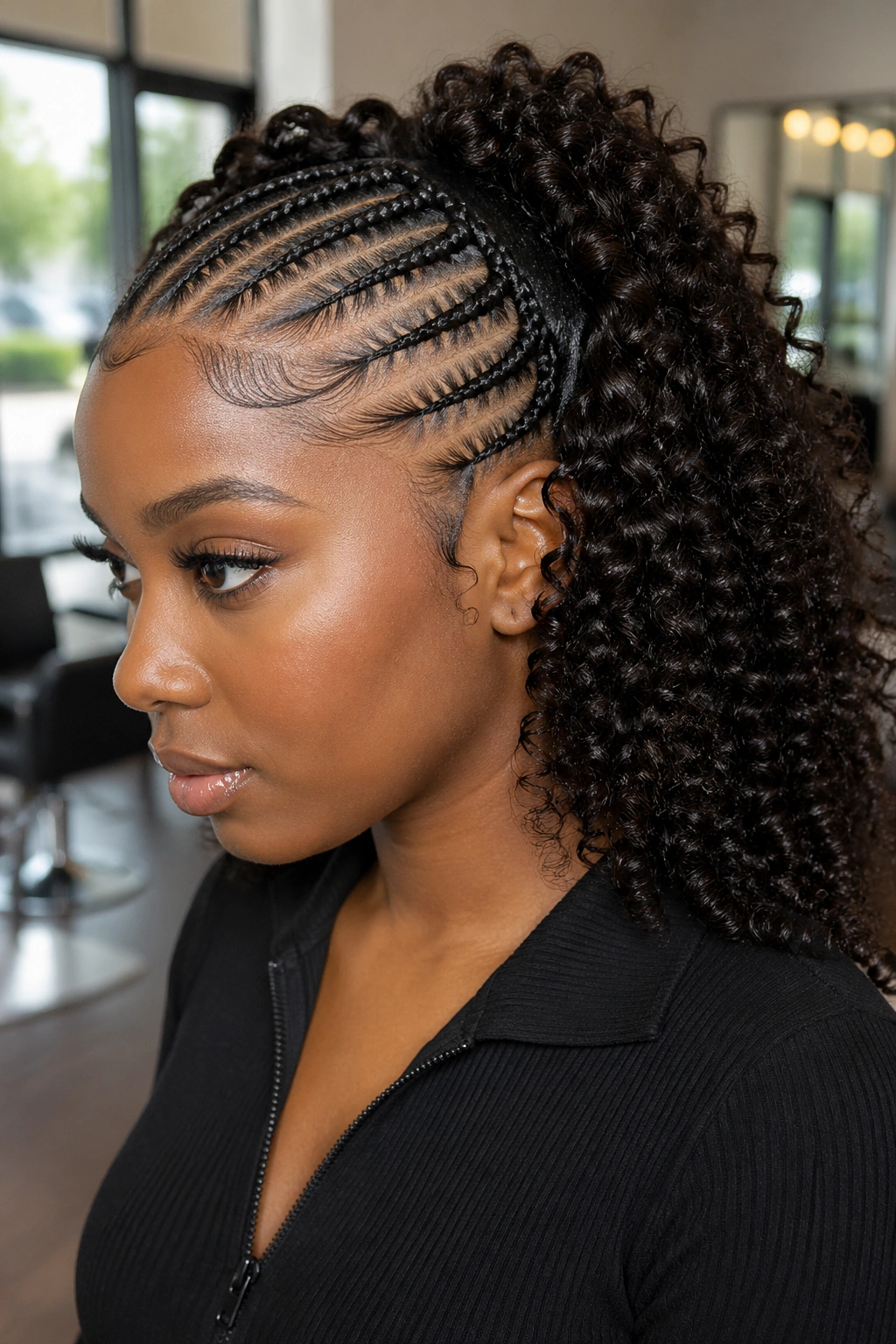
The curly weave portion needs the most frequent attention. Mist daily with a water-and-leave-in spray, scrunch upward to revive curls, and let air-dry. Avoid brushing.
The cornrow front needs less frequent care. Smooth flyaways with a small amount of edge gel, refresh the hairline every other day, and protect with a satin scarf at night.
Use a wide-tooth comb only on the curly section — and only when the hair is damp with leave-in spray. Dry combing destroys curl pattern and creates frizz.
Sleep Care That Preserves Both Textures
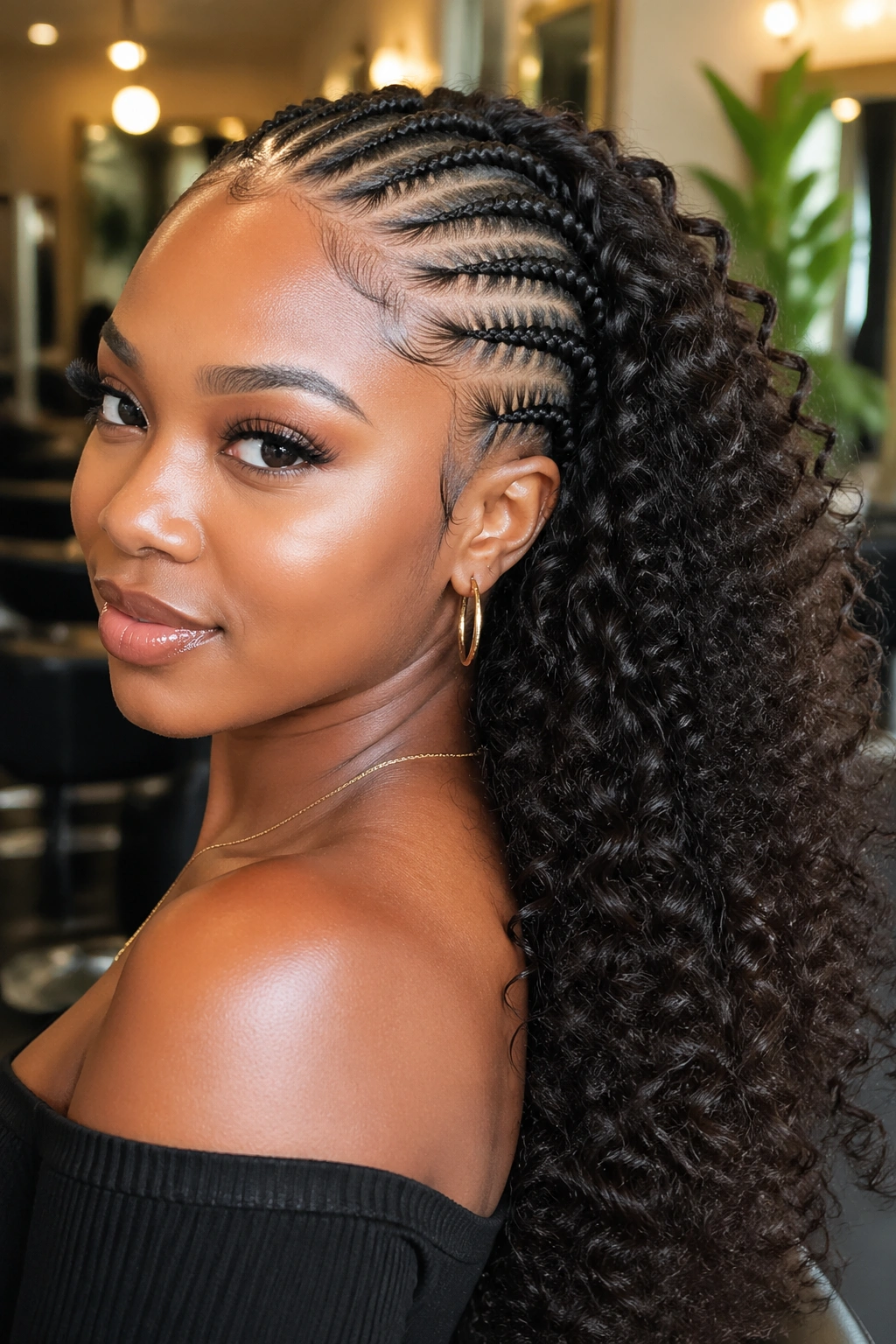
A satin or silk bonnet sized for long curly hair is essential. The bonnet contains the curly weave and prevents friction damage overnight.
Pineapple the curly weave before bed — gather it loosely at the top of the head with a silk scrunchie so the curls face upward and don’t get crushed. Then put on the bonnet.
A silk pillowcase under the bonnet adds extra protection. Together they prevent the curl pattern from flattening and the cornrow front from frizzing.
Washing Half Cornrow Installs
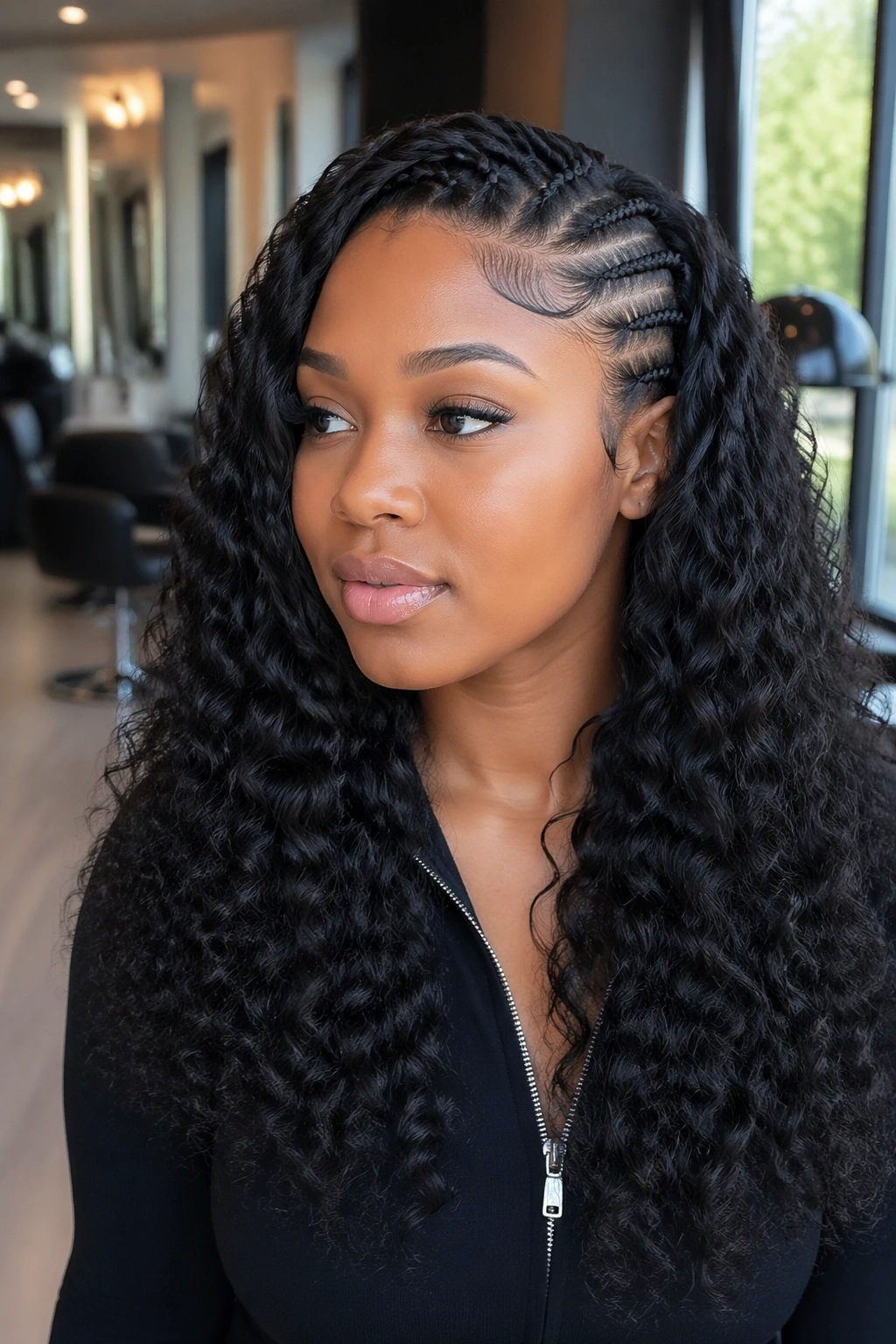
Wash every 2-3 weeks with a diluted sulfate-free shampoo. Apply with a squeeze bottle to the cornrow base, rinse thoroughly, then condition the curly weave separately by working conditioner through with fingers.
Air-dry completely before bed. Damp curly weave plus damp cornrow base develops mildew smell within 24 hours. A hood dryer speeds drying without damaging the curl pattern.
Avoid heavy products at the cornrow base. Build-up at the cornrow track causes the weave wefts to lift over time.
Refreshing Curls Mid-Install
The curl pattern flattens after the first wash. Re-define by misting the curly section with a 70/30 water-to-leave-in mix, scrunching from ends to roots, and letting air dry.
For tighter curl revival, twist small sections of damp curly hair around your finger and let dry. The twist sets a defined curl shape.
A curl-defining cream can be applied sparingly to refresh definition. Use too much and the hair gets crunchy and weighed down.
When to Take Down a Half Cornrow Install
Most half cornrow installs last 4-6 weeks. The cornrow front holds longer than the curly weave — by week 5-6, the curls usually look tired even with daily care.
Signs to take down:
- Curl pattern flattened beyond what misting can revive
- Visible matting at the nape of the curly weave
- Cornrow lift visible at the front rows
- Itching or tightness at the cornrow base that won’t quit
- Tracks lifting where the weave wefts are sewn down
- Edge tenderness or small bumps at the hairline
Takedown starts with cutting the weave thread carefully, removing the wefts, and unbraiding the cornrow tracks underneath. Then unbraid the front cornrows from the tip up. Spray with water-and-conditioner mix throughout to ease detangling.
A clean wash and deep condition after takedown restores moisture and gives the natural hair a reset before the next install.
Half cornrow with curly weave is one of the most flexible style categories — it pairs structure and softness, polish and movement, in a single install. Choose the curl pattern and front design that suit your face and lifestyle, and any of the 22 styles above delivers four to six weeks of low-effort everyday wear.
