



Feed in cornrows for medium hair sit in the friendliest spot on the entire braid spectrum. Long enough to give you real styling choices. Short enough to keep your scalp comfortable and your wash routine sane. Medium hair — roughly shoulder-grazing to mid-back when stretched — has just the right amount of natural length to anchor a clean braid base, while feed-ins extend that base into something dramatic, polished, or playful depending on how the kanekalon is added.
I’ve had medium hair for most of my adult life, and feed-ins have been my workhorse style across that whole stretch. They take less time to install than full-head box braids, last longer than no-feed cornrows, and let me change up my length without committing to a wig or a full weave. The trick is matching the feed-in technique to the cut, the texture, and the look you actually want. A 22-inch feed-in on shoulder-length 4C hair behaves nothing like a 14-inch feed-in on a stretched bob. This roundup pulls together 22 feed-in cornrow styles that work specifically on medium-length hair — each with a different parting pattern, length, finish, or technique that makes it stand on its own.
What “Medium Hair” Actually Means for Cornrows
For cornrow purposes, medium hair stretches from roughly 4 inches to 12 inches. That’s enough length to grip the kanekalon firmly at the root and enough body to hold the braid path without slipping. Anything shorter forces the braider to rely heavily on extensions from the very first stitch. Anything longer changes the install pattern and the maintenance schedule.
Medium-length 4C hair, when stretched, often sits at the shoulders. Same length unstretched might only reach the chin. Both numbers matter — the stretched length tells you what the braider can work with, and the unstretched tells you how much shrinkage you’re managing during install.
Knowing your real number lets you pick a feed-in style that works with your actual hair, not the inspiration photo’s hair.
Why Feed-Ins Suit Medium Hair So Well
Feed-ins solve the awkward middle problem. Medium hair often feels too short for box braids and too long for clean cornrows that don’t need extensions. Feed-ins split the difference — your real hair anchors the first 3-4 inches, then the kanekalon takes over.
Bold claim: medium hair is the easiest length for clean feed-in installs. Short hair fights the gel. Long hair tangles with the extension. Medium hair holds the braid path while accepting the feed-in seamlessly.
The seam where your hair meets the kanekalon is also less visible on medium hair. There’s enough natural length to disguise the transition, unlike very short hair where the join sits right at the scalp.
How to Stretch Medium Hair Properly Before Braiding
Wash and deep condition the day before. Apply leave-in throughout, then choose your stretching method.
Blow-dry on medium heat with a tension brush — this gives you the most stretched result and the cleanest part lines. Or use the banding method overnight if you’re heat-averse: mist the hair, divide into 6-8 sections, and band each section from root to tip with elastic bands. By morning, the hair will be stretched without heat.
Skip the African threading method for braid prep specifically — it stretches well but creates a slick texture that fights gel adhesion.
Important detail: trim before braiding. Frayed ends inside the cornrow cause early frizzing and reduce the overall lifespan by days.
Picking the Right Kanekalon for Medium Hair
Pre-stretched kanekalon saves at least an hour over standard. The ends are tapered and ready to feed in.
For medium-hair installs, two to three packs of pre-stretched is usually enough for a full head of feed-in cornrows. Knotless box braid hair (which is similar to pre-stretched) also works.
Match the color to your roots, not your goal length. A blonde extension over dark roots looks like a clear seam. Even matching slightly darker than your real color reads as natural.
For curly or wavy ends, pick water-wave or deep-wave bundles. These feed in flat at the root but bloom into curls toward the bottom — perfect for medium-hair installs that want soft ends without the bulk of a curly pony.
The Feed-In Technique That Works
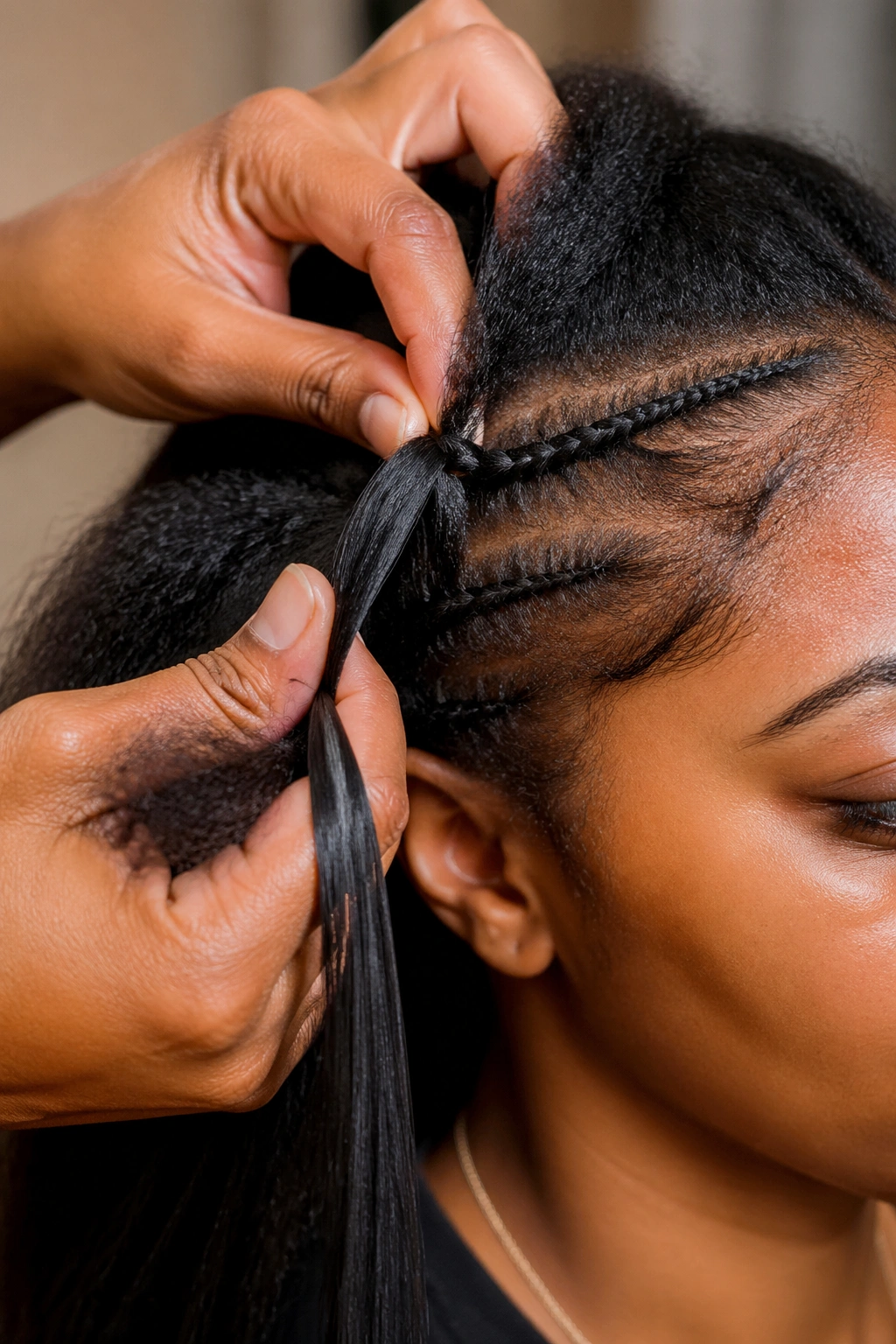
Start the cornrow with only your real hair for the first inch or two. Once the braid is anchored, separate a small piece of kanekalon and join it to one of the three strands.
Continue braiding for another inch, then add a second piece of kanekalon. Then a third. Each addition increases the visible thickness of the braid, so it tapers from thin at the root to fuller along the length — which is what makes feed-ins look natural.
Adding all the hair at once creates a thick root that looks unnaturally bulky. Stagger the feed-ins for a clean finish.
1. Classic Six-Braid Feed-In
Six straight-back cornrows, evenly spaced from forehead to nape. The simplest feed-in look and the most flattering on medium hair because the spacing keeps tension low.
Why It Works
Six braids is the count where each cornrow is wide enough to hold weight without sagging, but narrow enough to read as deliberate rather than chunky.
- Best on stretched length 6+ inches
- Holds 3-4 weeks with proper aftercare
- Pairs with any face shape
A note: feed in slowly, especially in the front three braids. The hairline takes the most weight, and a bulky root at the temple is unflattering.
2. Feed-In Cornrows With Curly Ends
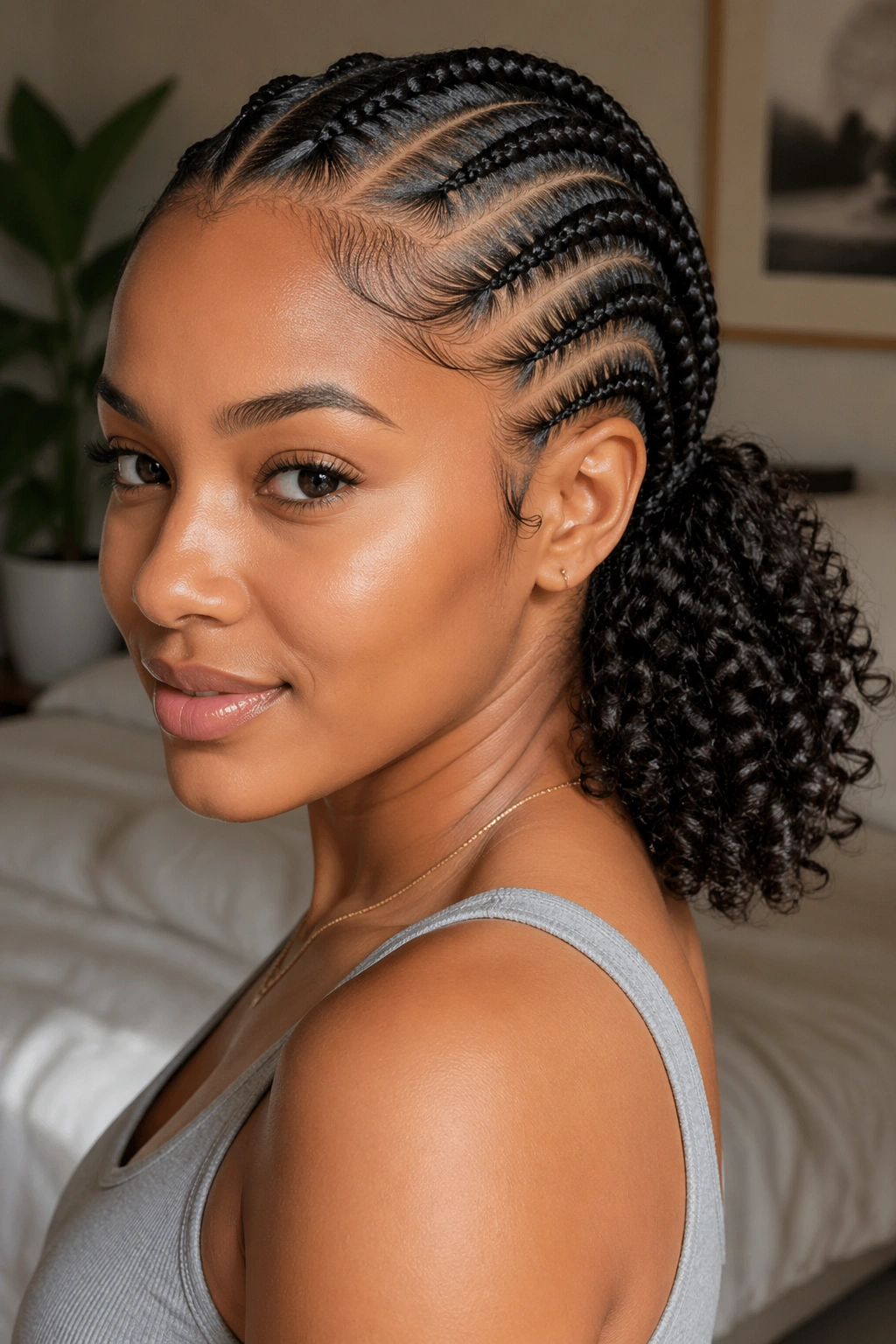
The cornrows themselves are sleek, but the last 6-8 inches of kanekalon is curly — water-wave or body-wave texture. The curls bounce against the upper back.
The contrast is the whole appeal. Sleek braids on top, soft curls below. The curls also help disguise the ends of the braids, so the finish reads polished rather than abrupt.
Refresh the curls every 2-3 days with a small amount of mousse and a scrunch. Sleep with the curls pineapple-wrapped under a satin bonnet to preserve the pattern.
3. Side-Swept Feed-Ins
All cornrows sweep diagonally from one side of the head to the opposite ear, then continue down past the shoulder. The dramatic angle reshapes the face.
Unlike straight-back feed-ins, side-swept variations put more tension on one side of the scalp than the other. If your hairline is fragile on one side, sweep toward that side so the stronger side does the pulling.
This is one of the most flattering feed-in styles for round faces because the diagonal lines lengthen the silhouette.
4. Feed-Ins With Stitch Detail
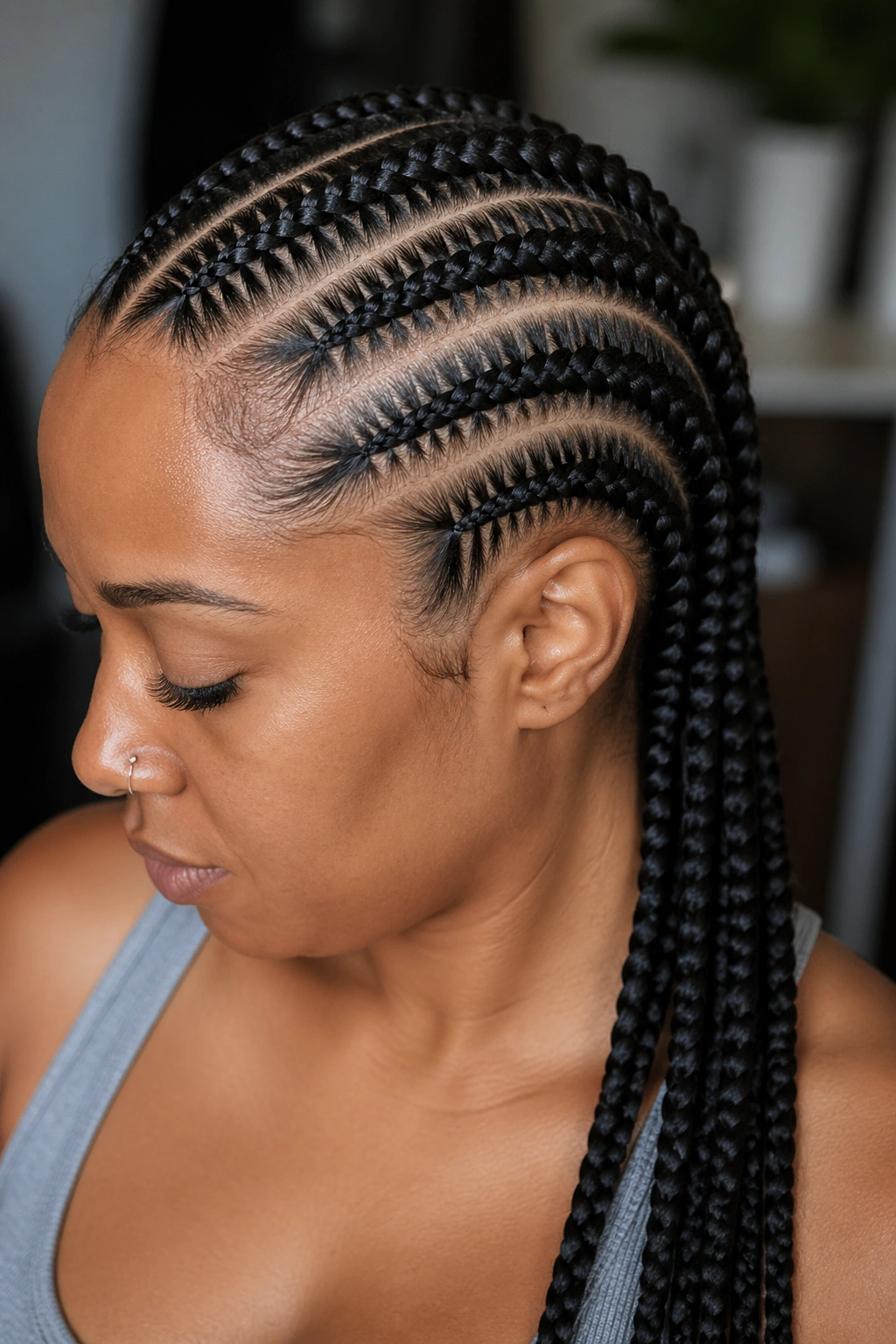
Standard feed-in cornrows but with the stitch braid technique applied. Between each pass of the braid, the braider keeps the feed-ins tighter and creates visible horizontal stitch lines.
Stitch braids on medium hair lay especially flat because there’s enough natural length to hold each stitch in place. On shorter hair, stitches can blur faster.
The combination of feed-in length and stitch precision is one of the cleanest, most photogenic styles in the cornrow family.
5. Lemonade-Style Feed-Ins
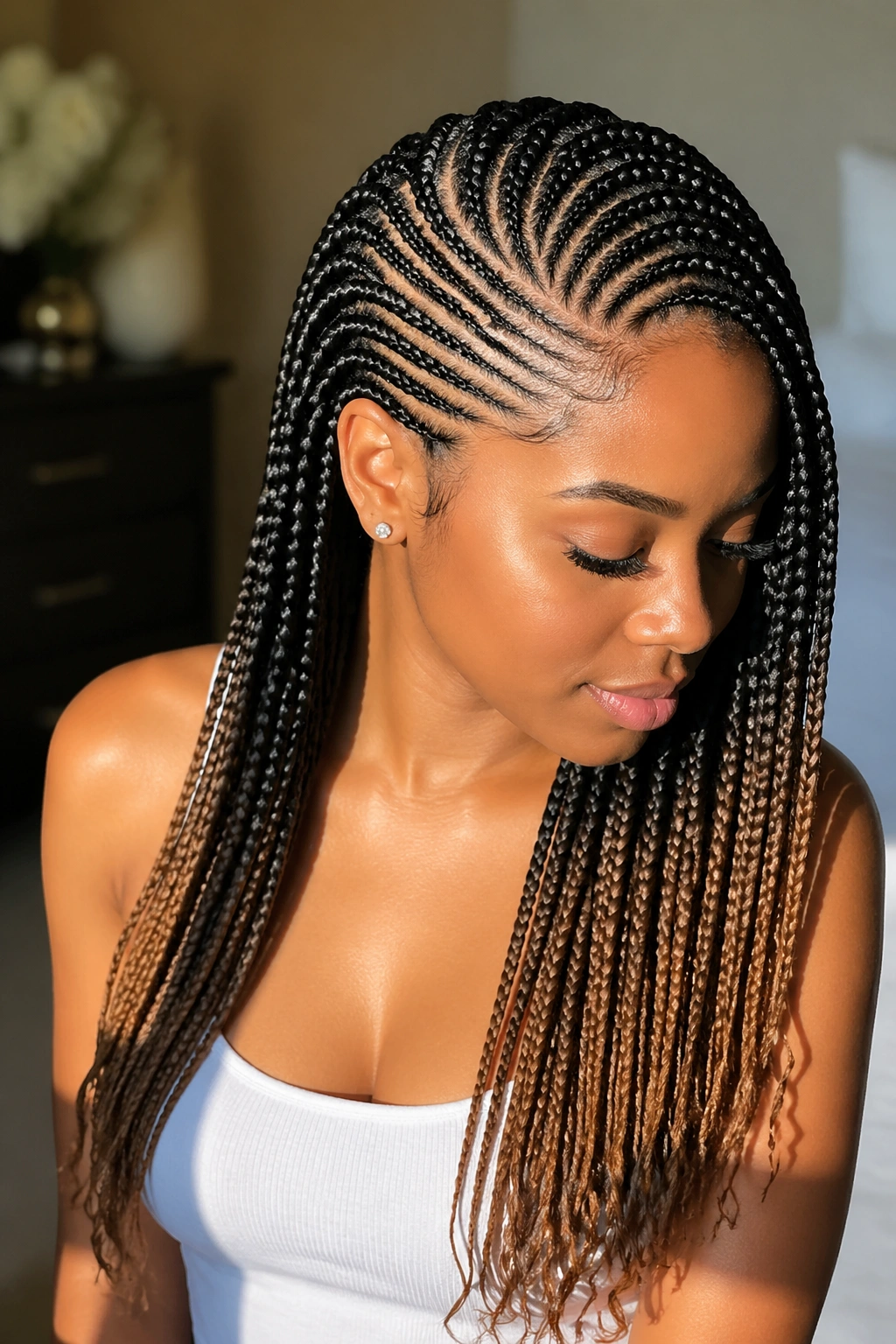
Side part deep into the crown, feed-ins all sweeping in one direction. Named after the iconic album look. Works exceptionally well on medium-length hair because there’s enough base to anchor the deep part.
The kanekalon usually goes mid-back to lower-back length. A slight ombré — natural at the root, blending to honey or copper toward the ends — is the classic finish.
Bold claim: lemonade braids are the most universally flattering feed-in style. The deep side part softens almost every face shape, and the unilateral sweep elongates the neck.
6. Halo Feed-Ins Around the Crown
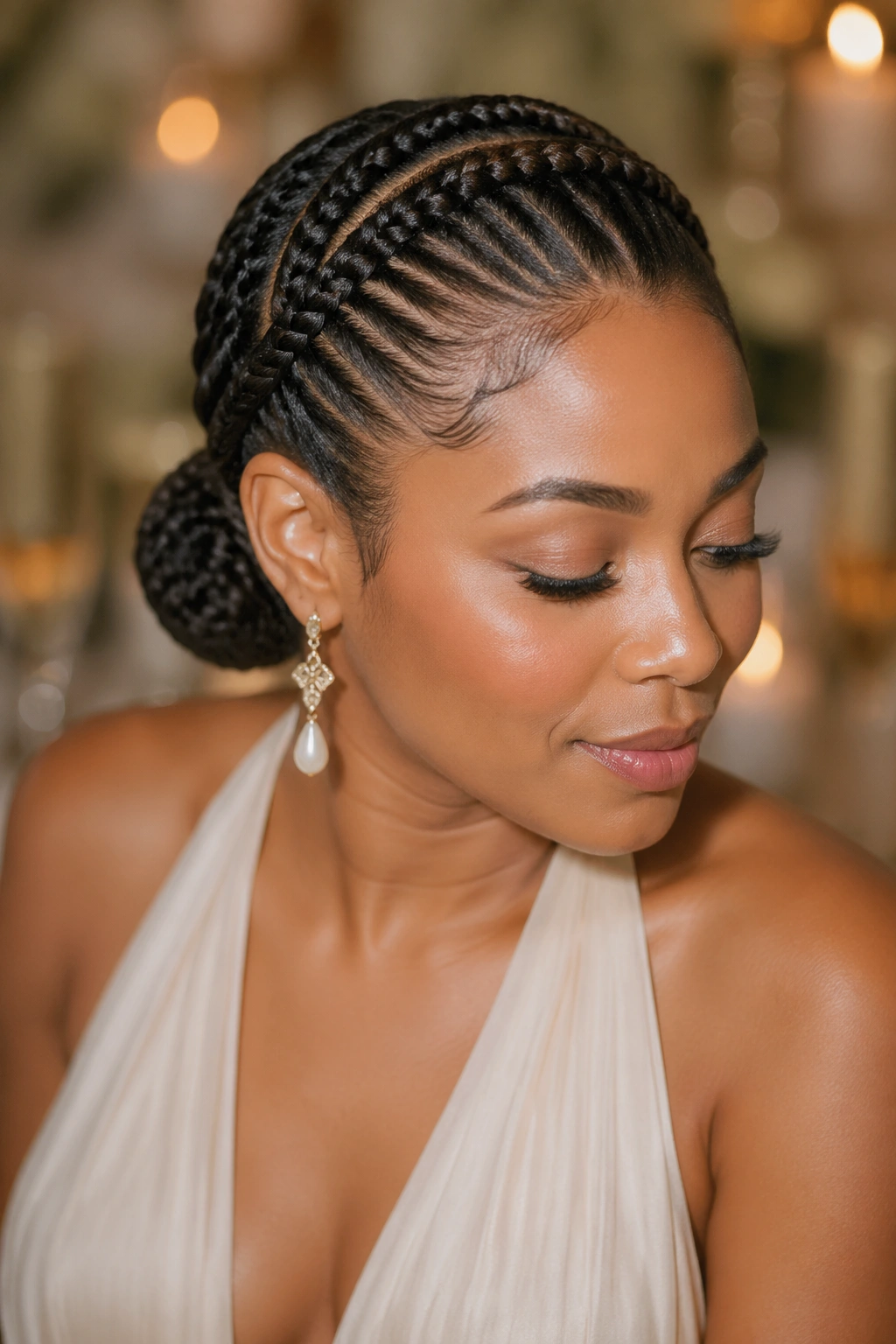
Feed-in cornrows that travel in a circle around the crown instead of straight back. The braids start at the perimeter and end at the crown, where they’re tucked or wrapped into a small bun.
The halo effect is romantic and soft. It works especially well for wedding guests, baby showers, and events where you want polished without formal.
Medium hair anchors the halo well — you have enough length to keep the braids in place as they wrap, but not so much that the bun at the crown gets bulky.
7. Fulani-Inspired Feed-Ins With Center Braid
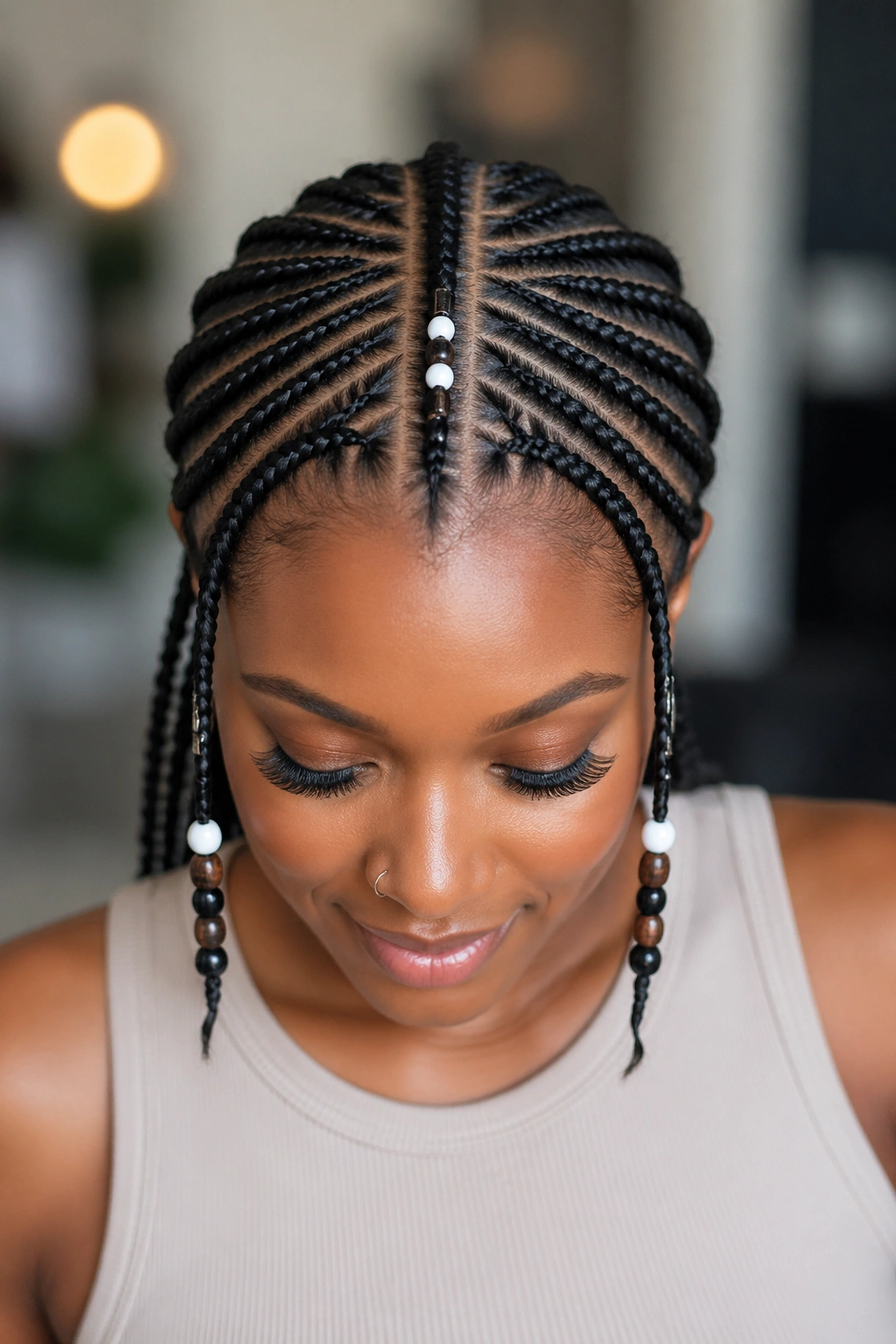
A central feed-in cornrow runs from forehead to nape, flanked by side-swept feed-ins on either side. Beads decorate the center braid and the front-most side braids only.
Restraint is the key. Beading every braid turns this into something heavier than a Fulani-inspired look. Keep the bead count concentrated and let the negative space speak.
The center braid sits on the natural part line, which has the lowest tension on the scalp. That’s why this style holds well even with the visual weight of beads.
8. Jumbo Feed-In Cornrows
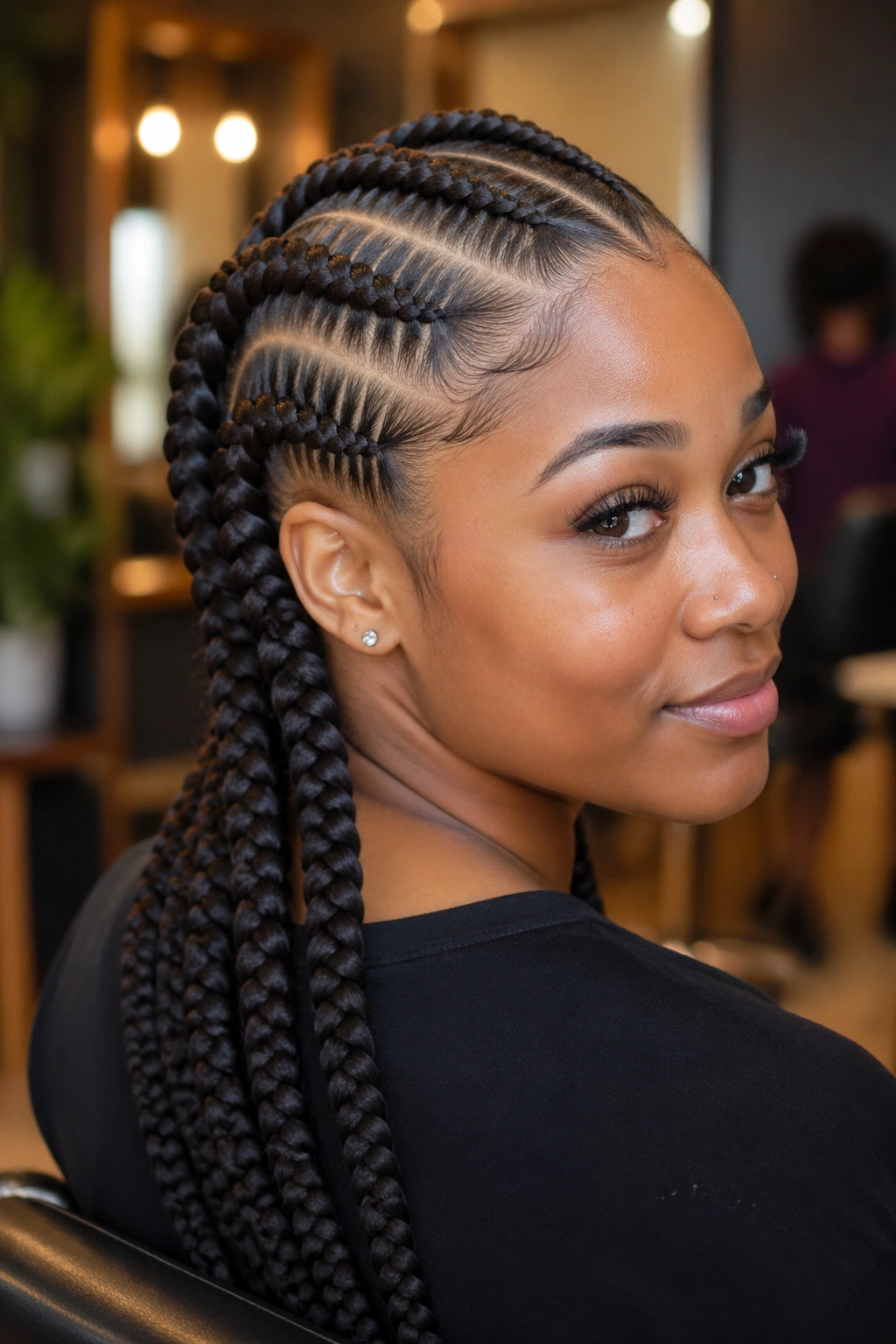
Four to five thick cornrows running straight back, each one fed with extra kanekalon for fullness. The result is sculptural and bold without being overwhelming.
Jumbo feed-ins on medium hair work because the natural base is long enough to support the weight of the chunky braid. On very short hair, the same style would slip and need to be redone often.
Maintenance Notes
Jumbo styles last shorter at the hairline because the weight pulls roots loose faster. Plan for 2-3 weeks instead of 4.
9. Feed-Ins Into a High Ponytail
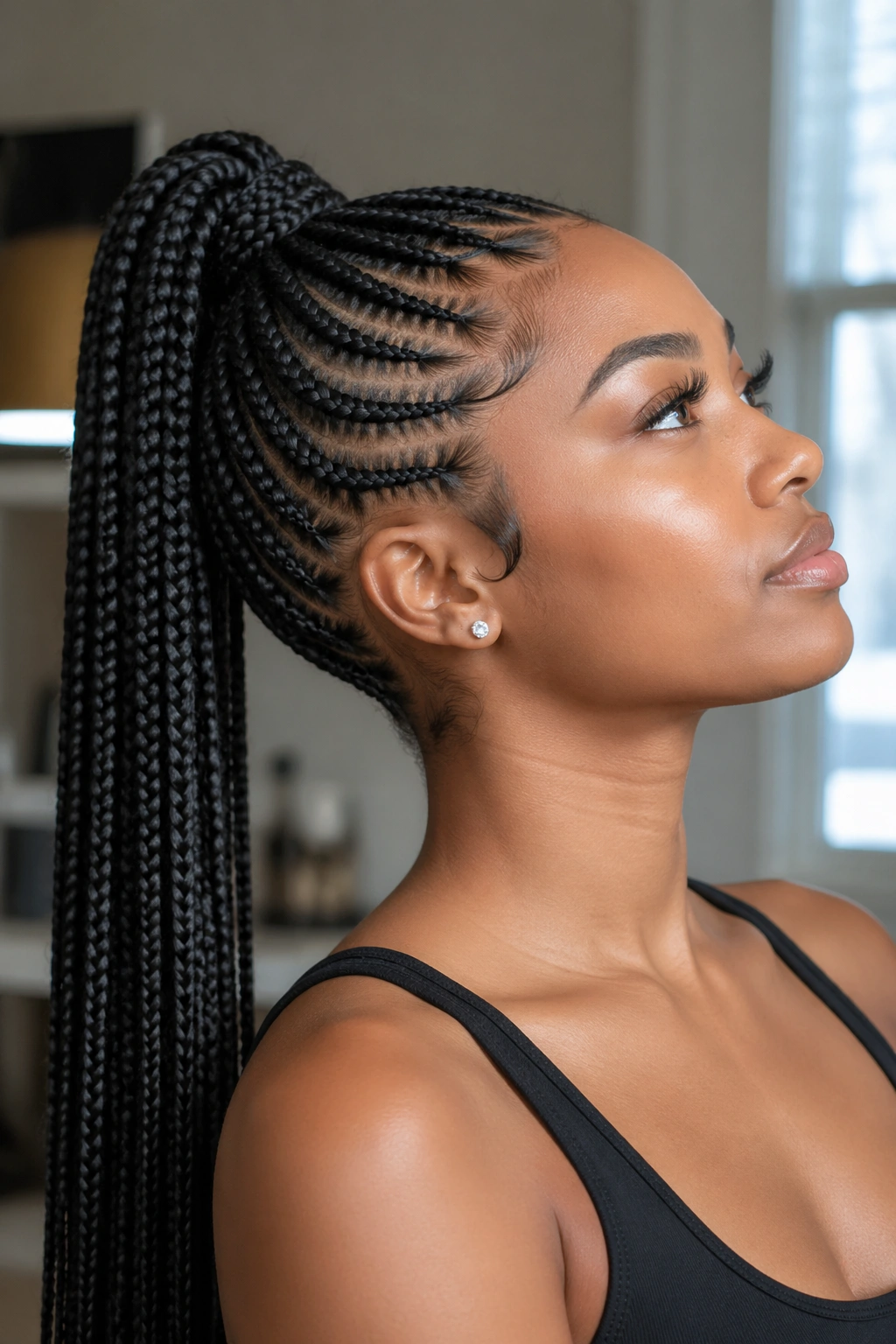
All feed-ins sweep up into a high ponytail at the crown of the head. The kanekalon ends form the ponytail, which can be left loose, twisted, or wrapped.
This is a workout-friendly feed-in style. The ponytail keeps everything off the neck, the cornrows handle the rest of the head, and you can sweat without disturbing the install.
The high pony also lifts the face and elongates the neck — flattering in photos and good for occasions where you want to show off your collarbones.
10. Feed-Ins With Color Contrast
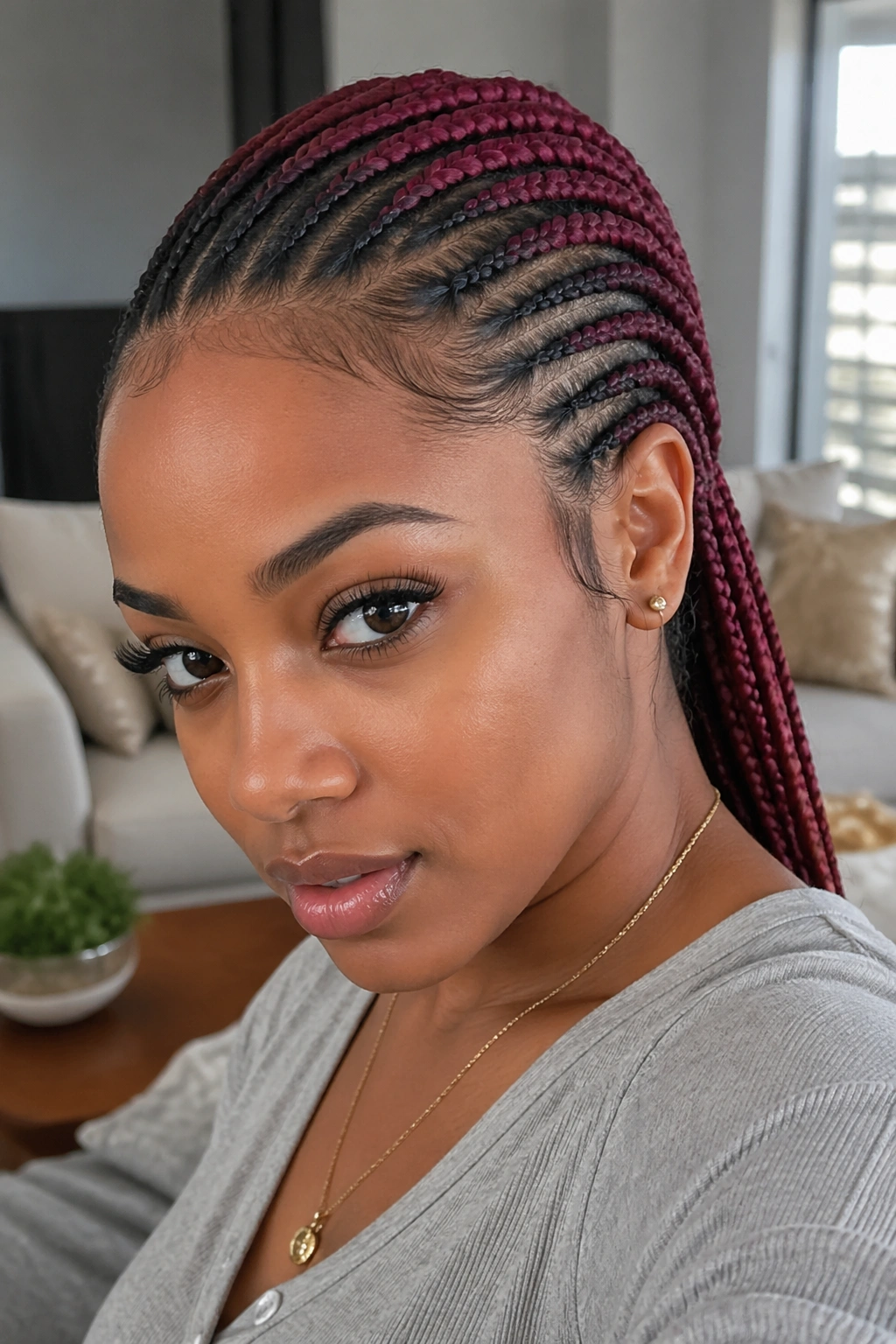
The front section in your natural color, the back fed in with a contrasting color — burgundy, copper, or honey. The split runs ear to ear across the crown.
Color contrast works better with feed-ins than no-feed cornrows because the kanekalon gives you a clean place to introduce the new color. Your natural hair stays the same color — no dye needed.
Pick a single contrast color. Mixing two contrast tones turns a clean style into a busy one.
11. Diagonal Feed-Ins
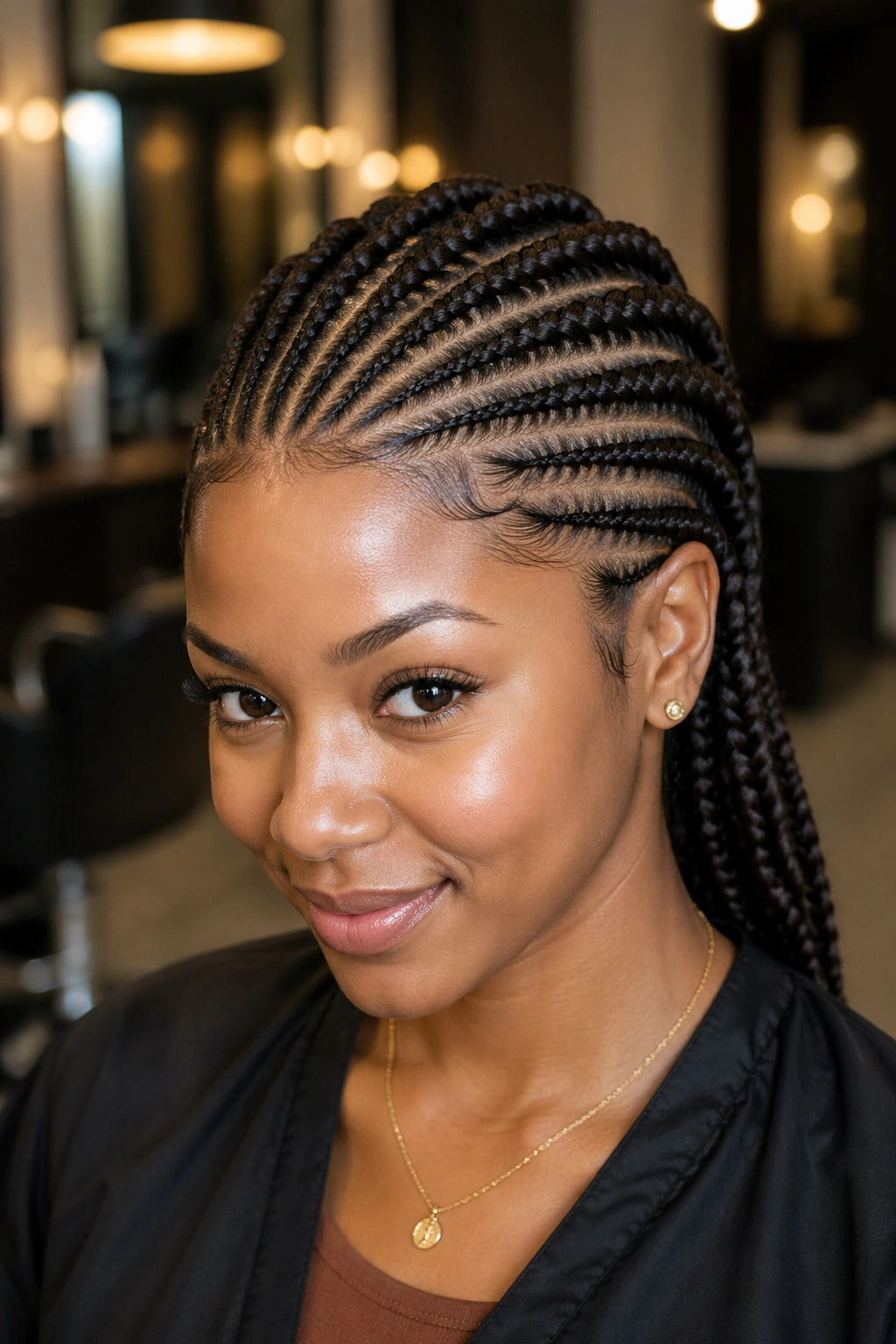
The braids travel diagonally from one temple across the head to the opposite nape. Each braid runs parallel to the next, so the whole pattern reads as a single dramatic sweep.
Bold claim: diagonal feed-ins are the most underrated style in the entire cornrow family. They flatter almost every face shape because the angle adds movement that straight-back styles can’t match.
The diagonal also distributes scalp tension across a wider arc, which is why this style holds longer than purely straight-back versions on medium hair.
12. Feed-Ins With Beaded Ends
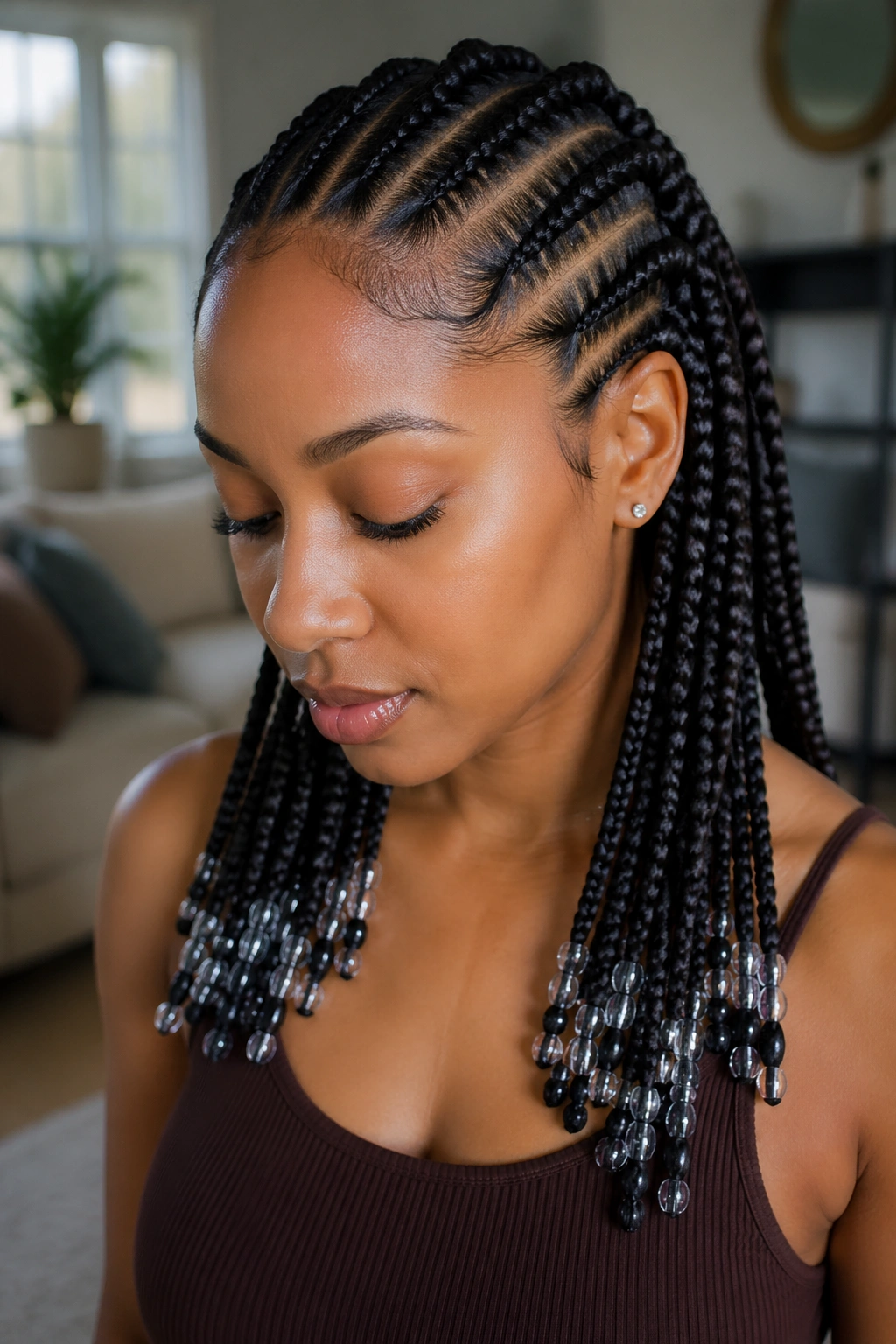
Ends gathered, sealed with a small clear elastic, and threaded with 5-7 beads. The beads click softly against your shoulders as you move.
For medium-hair feed-ins, the bead weight has to be balanced against the kanekalon weight. Heavy beads on already-weighted braids will pull at the roots.
Use lightweight wooden or hollow plastic beads. Skip metal cuffs as bead substitutes — they’re heavier than they look.
13. Feed-Ins With Ghana Braid Taper
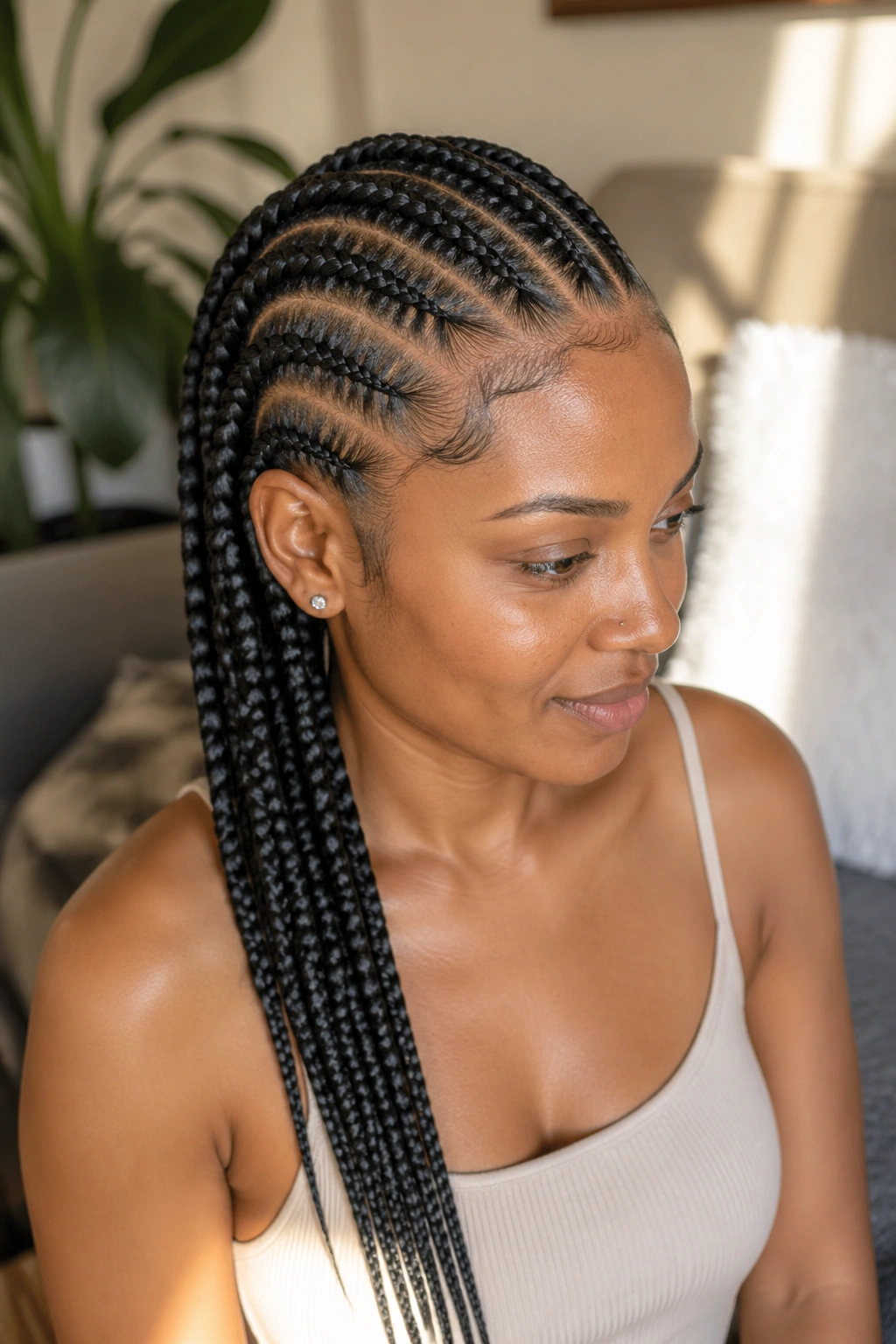
Ghana braids taper from thicker at the base to thinner at the ends. Apply that technique to feed-ins and you get a braid that starts substantial and tapers gracefully.
The tapering effect is achieved by feeding in less kanekalon as the braid progresses down. Most feed-ins maintain thickness all the way down — Ghana taper deliberately reverses that.
This style suits medium hair particularly well because the natural length at the root supports the substantial start, while the taper toward the ends keeps the overall weight manageable.
14. Feed-Ins With Burgundy Ombre
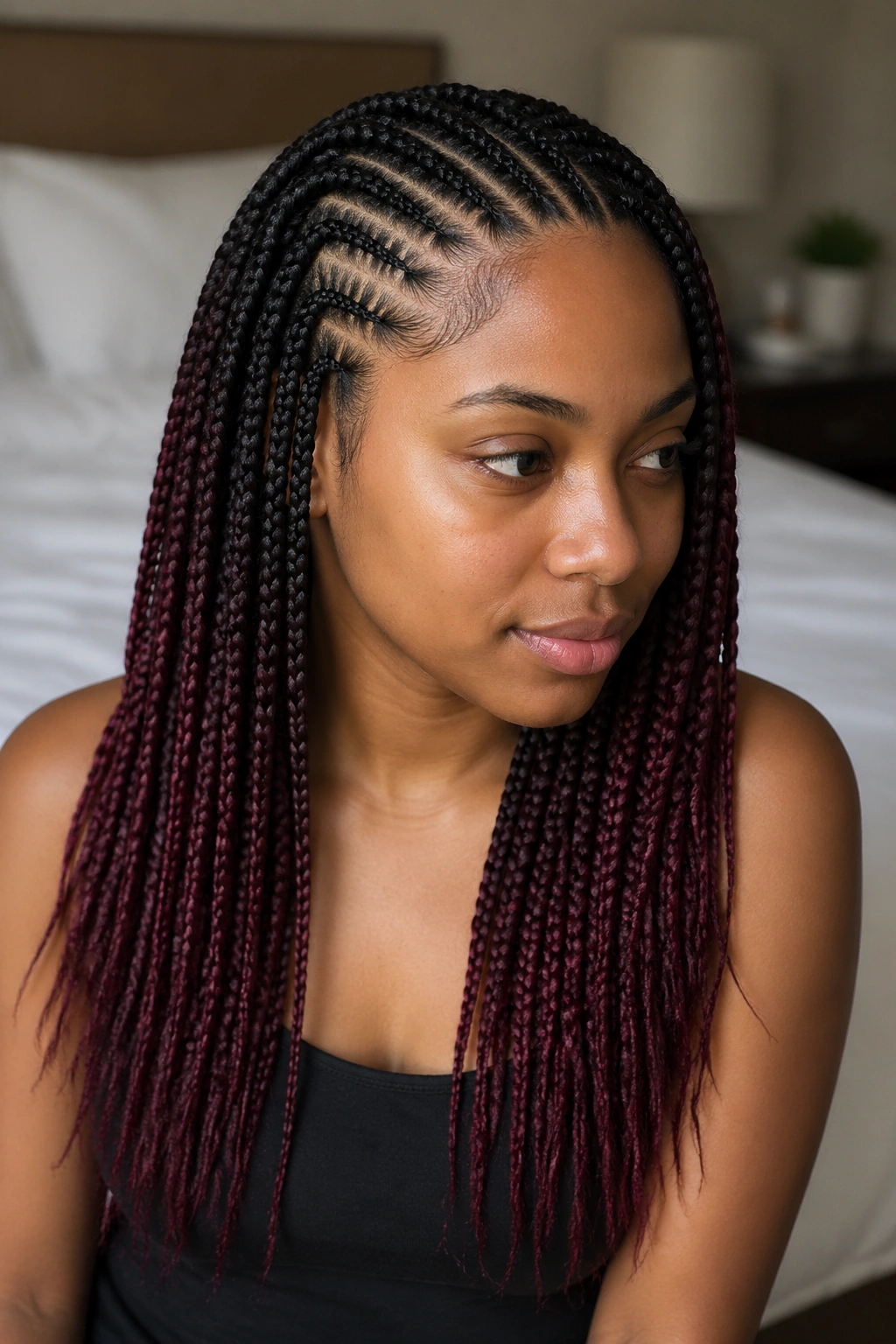
Natural color at the roots, blending to a deep burgundy at the ends. The transition happens around the crown line, so the burgundy is visible only when you wear your hair down.
Burgundy is the friendliest color contrast for warm undertones. Cool undertones can lean toward wine or oxblood instead.
The ombre needs pre-blended kanekalon — feeding two separate colors and trying to blend manually creates a harsh seam.
15. Feed-Ins in a Low Bun
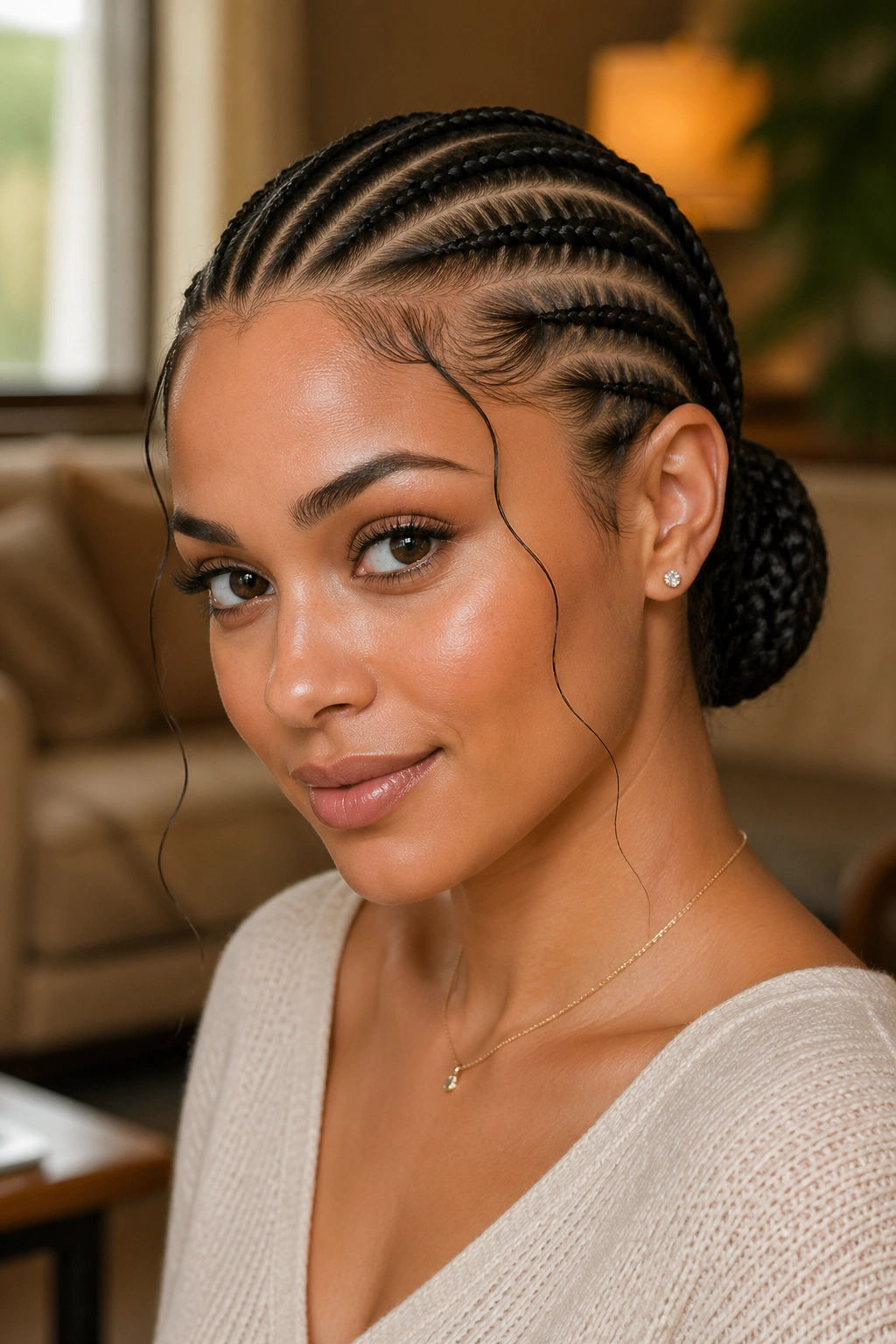
All cornrows sweep back and gather at the nape into a low bun. The bun can be sleek and tight or softer with a few flyaways.
A low bun reads professional and elegant. A high bun reads playful. The same base feed-in cornrows work for both — only the gather point changes.
Low buns also put less tension on the scalp than high ones. If you’ve been wearing a high pony for a while and your edges feel sore, switch to a low bun for a recovery week.
16. Knotless-Style Feed-Ins
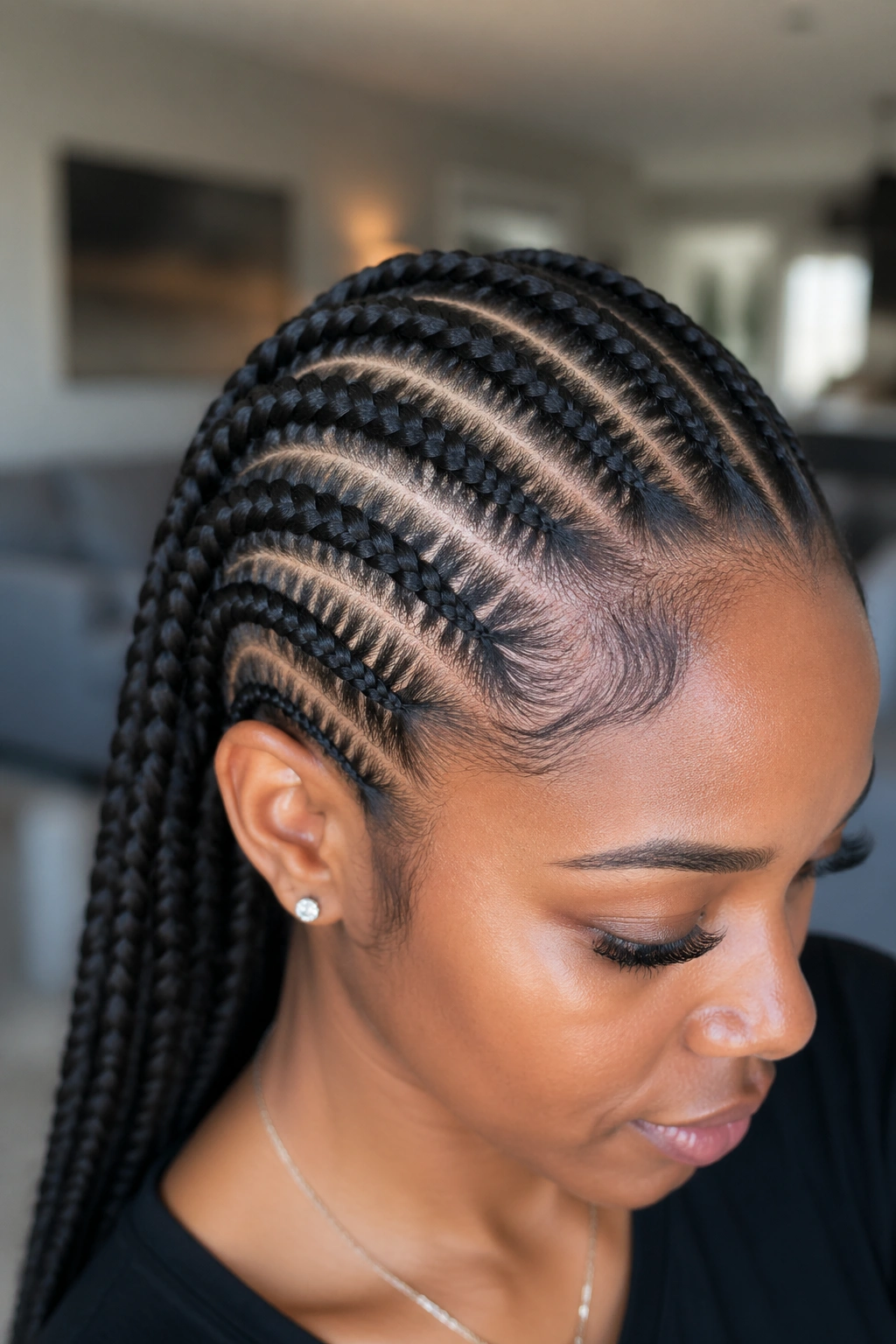
Knotless feed-ins use the same staggered-feed-in technique but start with even less kanekalon — sometimes none at all for the first 1-2 inches. The result is a totally invisible root with no bulk.
Knotless is the gentlest version of feed-ins for fragile hairlines. The braid is anchored almost entirely by your real hair, with the kanekalon doing only the length work.
Cost note: knotless takes longer than standard feed-ins, so it usually costs more. Worth it if your edges have been complaining.
17. Feed-Ins With Side Bangs
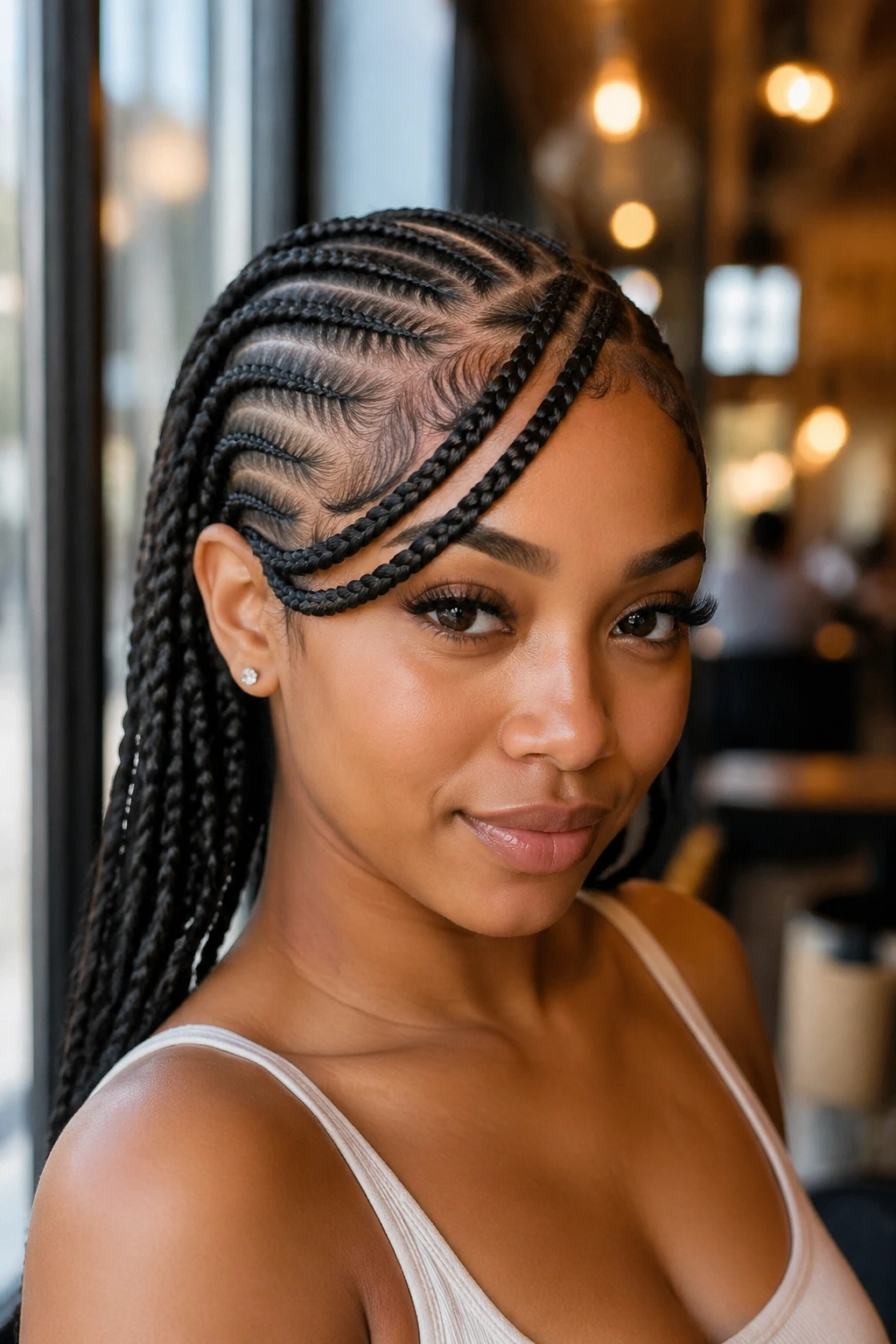
The main feed-ins run straight back, but two cornrows at the front sweep across the forehead as a braided bang. The bang frames the face and softens the silhouette.
For medium hair, the bang braids need to be slightly longer than the front hair so they can curve across the forehead. Plan with a small feed-in on the bang section to ensure enough length.
Side bangs flatter most face shapes by breaking up the forehead and adding asymmetry. Best for women who feel naked without something on the forehead.
18. Feed-Ins With a Crown Wrap
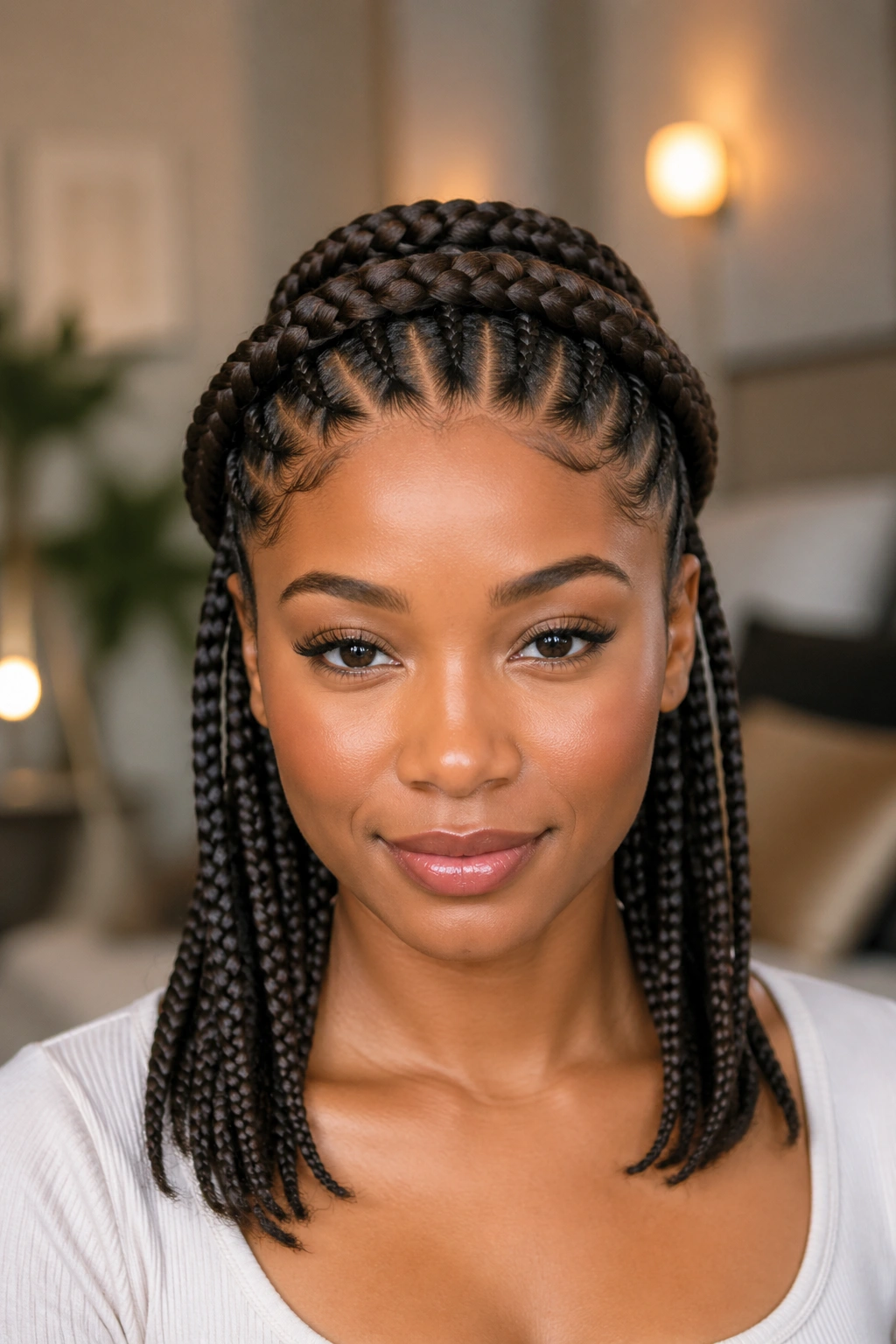
Two of the longest feed-in braids wrap over the crown of the head, creating a crown effect across the top. The other braids run beneath the wrap.
The wrap braids need to be the longest in the install — aim for 18-22 inches of finished length so they reach across the head with room to tuck and pin.
This style is romantic and elevated. It suits dressy occasions, photoshoots, and any event where you want a polished but undone finish.
19. Feed-Ins With Chunky and Thin Mix
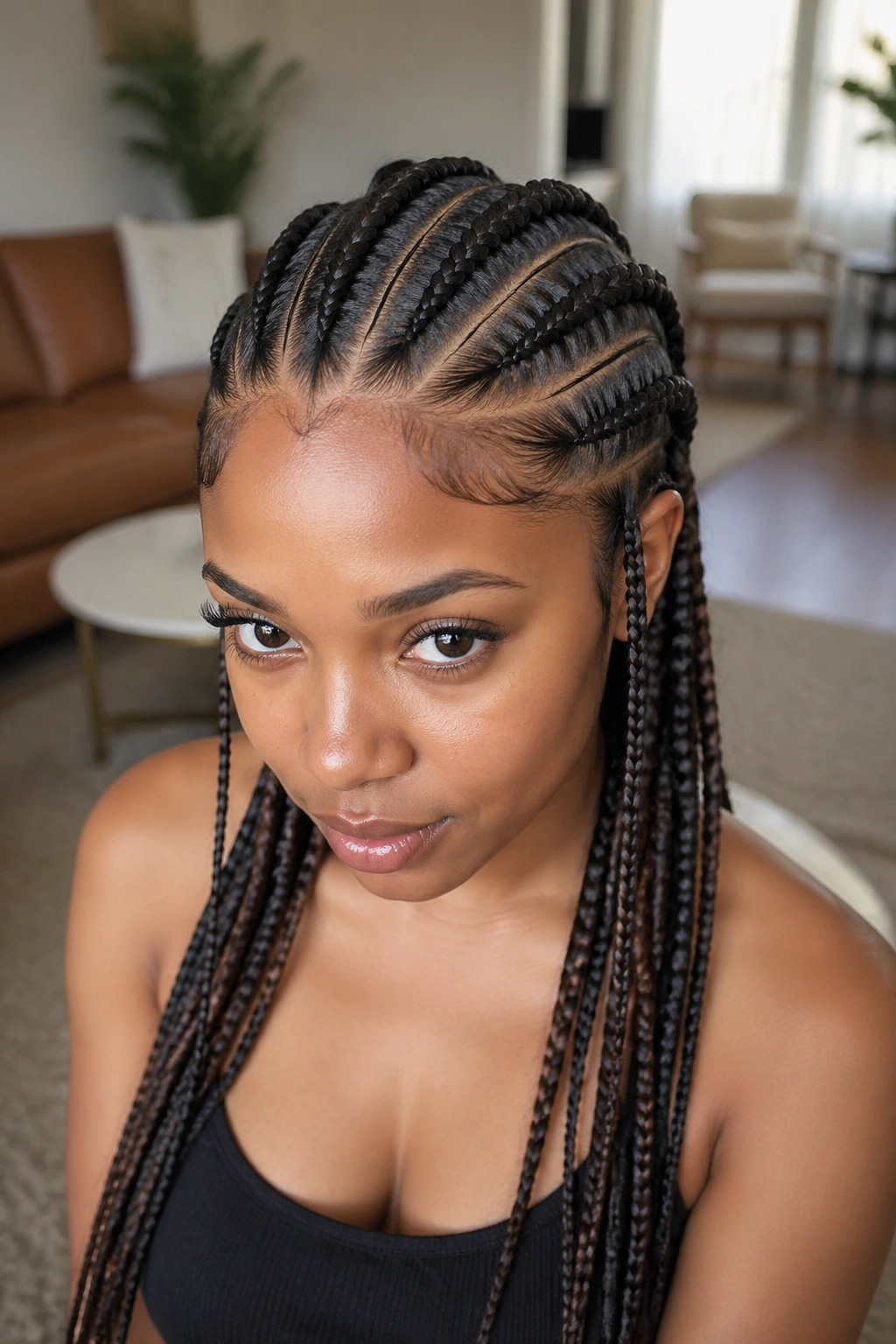
Alternating chunky and thin feed-in cornrows across the head. The visual rhythm gives the style movement that uniform sizing doesn’t.
Place the chunky braids strategically — usually at the crown and back — and the thin ones at the perimeter. This concentrates weight where the scalp can handle it best.
The mixed sizing reads as artistic and intentional rather than uneven. It’s a style for women who want something a bit different from standard feed-ins.
20. Feed-Ins With Wavy Parts
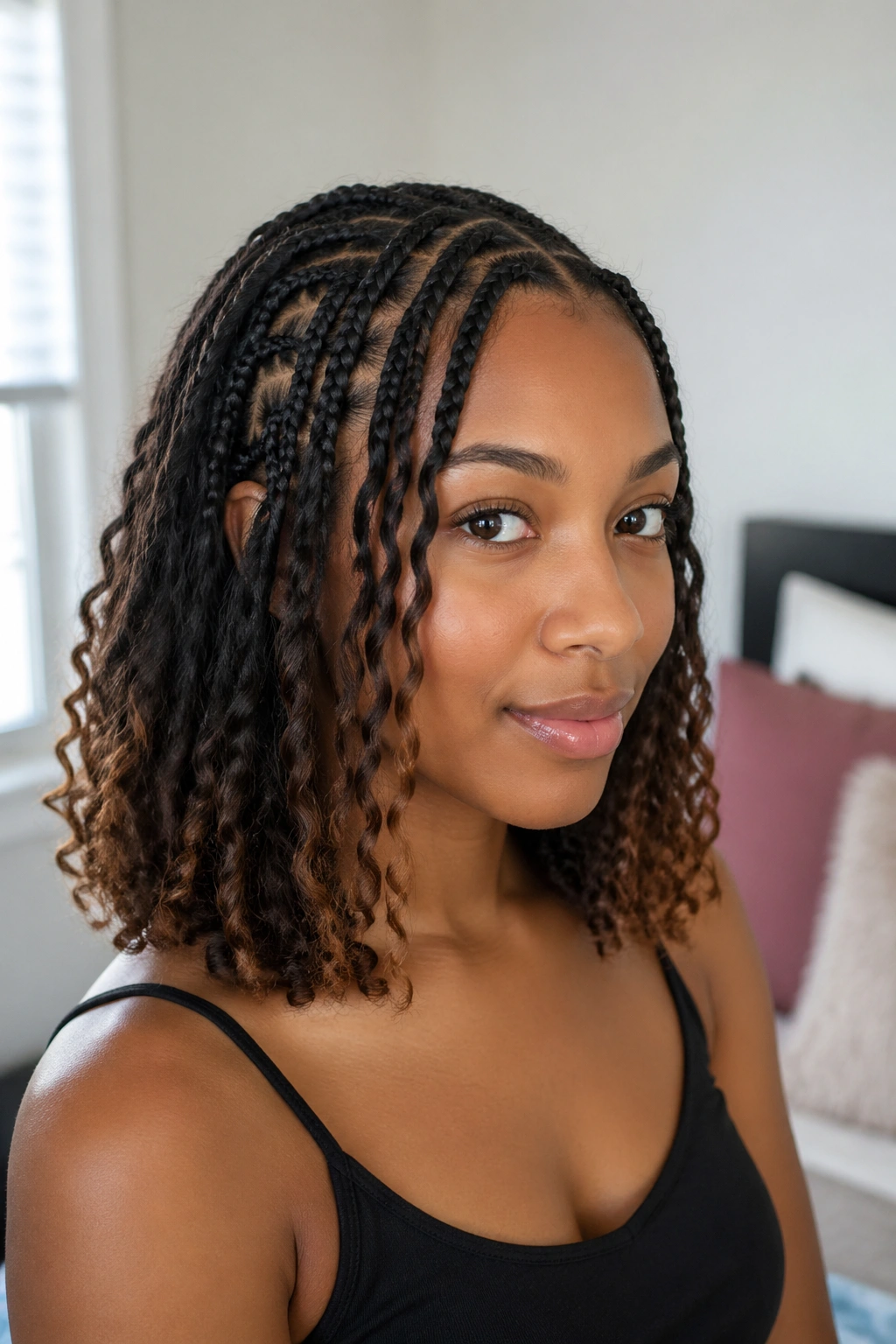
The braids themselves run straight back, but the parts between them curve like ocean waves. The waves are subtle — about 2-3 curves per braid line.
Wavy parts soften the otherwise straight visual of all-back feed-ins. The waves catch light differently than straight parts and add a feminine touch.
The wave amplitude has to be consistent across all parts. Drifting wave sizes ruin the effect.
21. Feed-Ins With a Single Long Front Braid
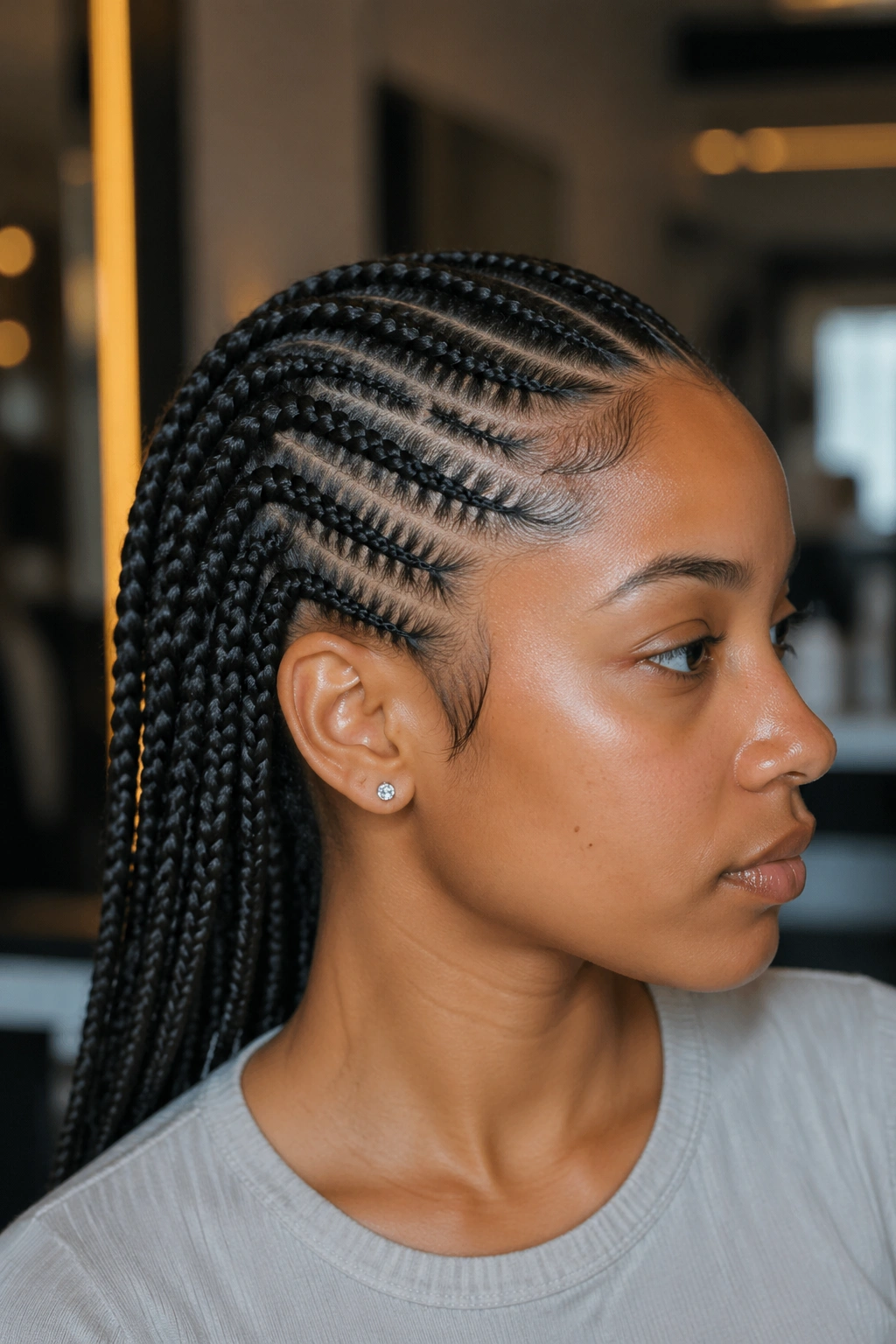
The bulk of the head is in standard feed-in cornrows, but one long, decorative braid sits at the front — usually a very thin, very long feed-in that sweeps across the forehead and down to one shoulder.
The long front braid is a focal point. It’s where you’d add a small charm, a bead cluster, or a wrap of decorative thread.
This is a style that suits women who want one statement detail rather than overall busy-ness. Single focal points read more sophisticated than scattered ones.
22. Feed-Ins With Boho Loose Strands
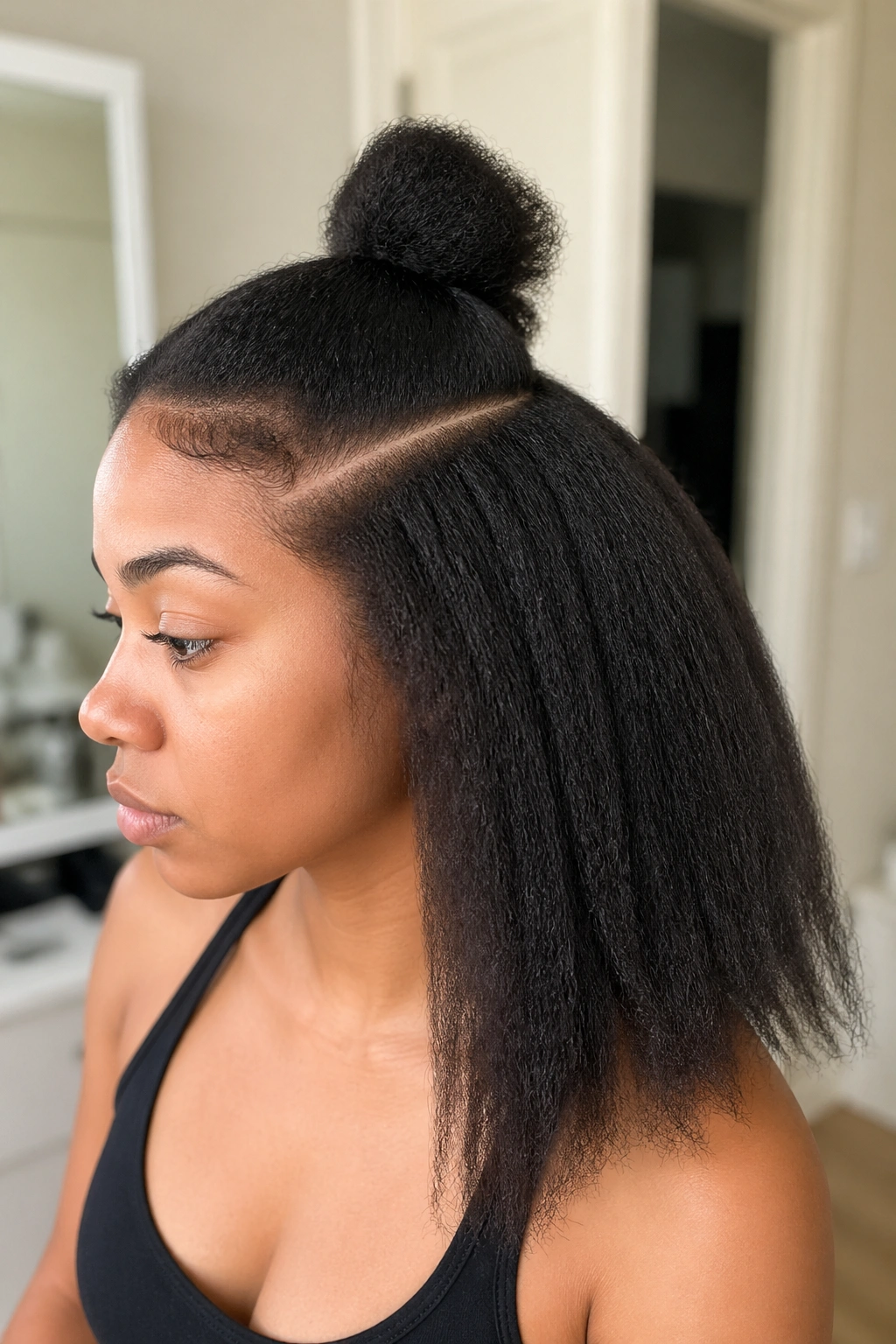
Standard feed-in cornrows but with a few loose curly strands left out at strategic points along the braid — usually 2-3 small curls per braid, peeking out at random intervals.
The loose strands soften the otherwise structured look. They catch the light and move when you walk, adding a boho mood to the install.
Use water-wave or deep-wave kanekalon as the loose strand material. Pull a small piece out before sealing each section, then leave it untucked.
How Long Feed-Ins Last on Medium Hair
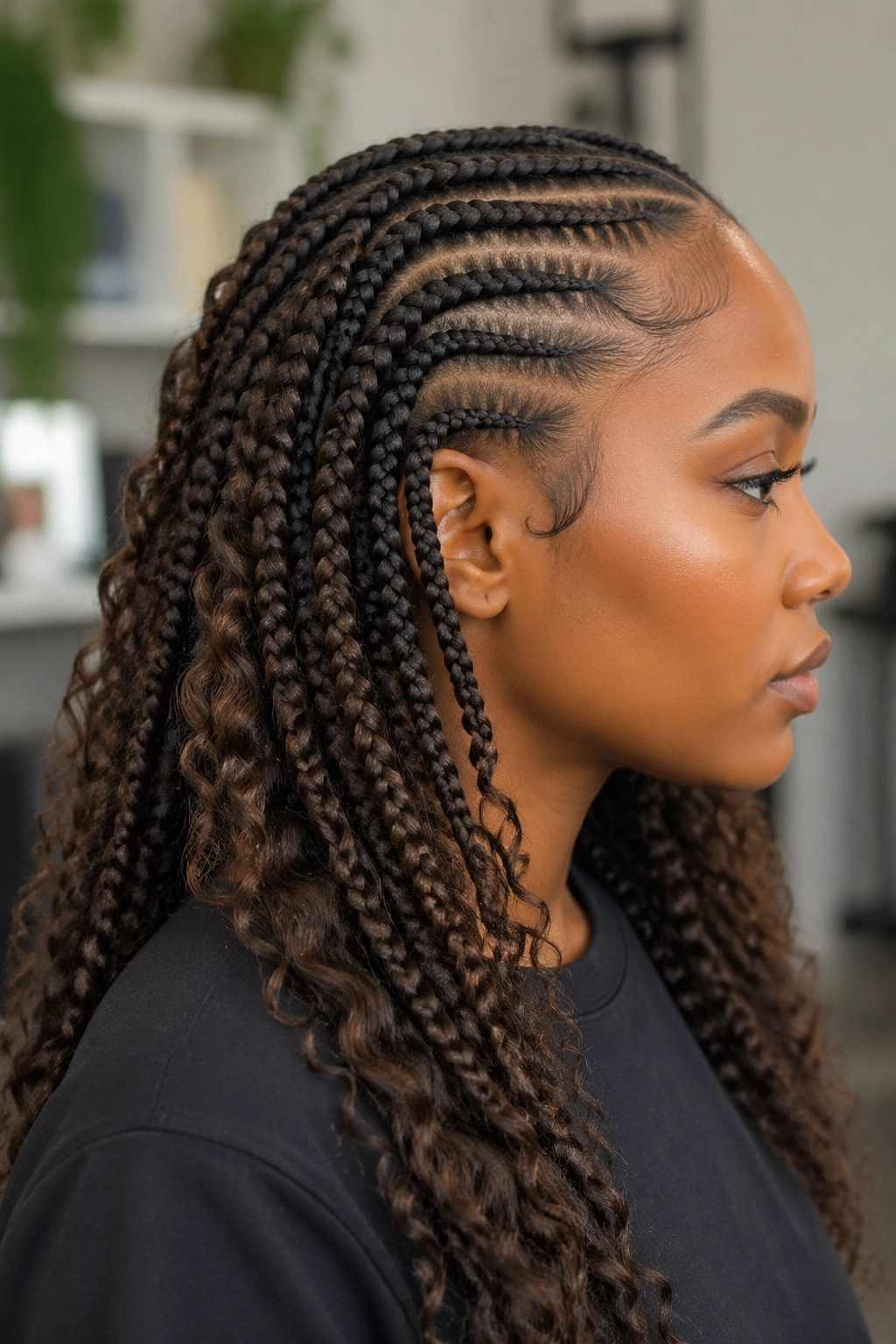
Standard feed-ins on medium hair last 4-6 weeks with proper aftercare. The natural-hair base is long enough to grip the extensions firmly, so slippage is minimal.
Knotless variations last slightly less — 3-5 weeks — because the lower-tension install is gentler but also less locked-in.
Beaded ends shorten lifespan by about a week because the bead weight pulls roots loose faster. Curly-end feed-ins last roughly the same as straight feed-ins because the curl is at the bottom, not the root.
When fuzzing at the hairline bothers you more than the rest of the head looks good, it’s time for takedown.
Wash Day for Feed-In Cornrows
Wash every 14 days. More often and you’ll loosen the install. Less often and buildup creates itching.
Dilute sulfate-free shampoo 50/50 with water. Apply with a squeeze bottle directly to the scalp. Massage gently along the parts with fingertip pressure. Don’t scrub the braids.
Rinse longer than you think — at least two minutes under warm water. Residue causes the itching that makes people overwash.
Skip conditioner on the braids. It loosens them. If you must condition, focus only on the kanekalon ends.
Dry completely. A hooded dryer on low for 30 minutes, or a blow-dryer on cool with a diffuser for 25 minutes. Pay extra attention to the nape.
Scalp Care That Keeps Feed-Ins Comfortable
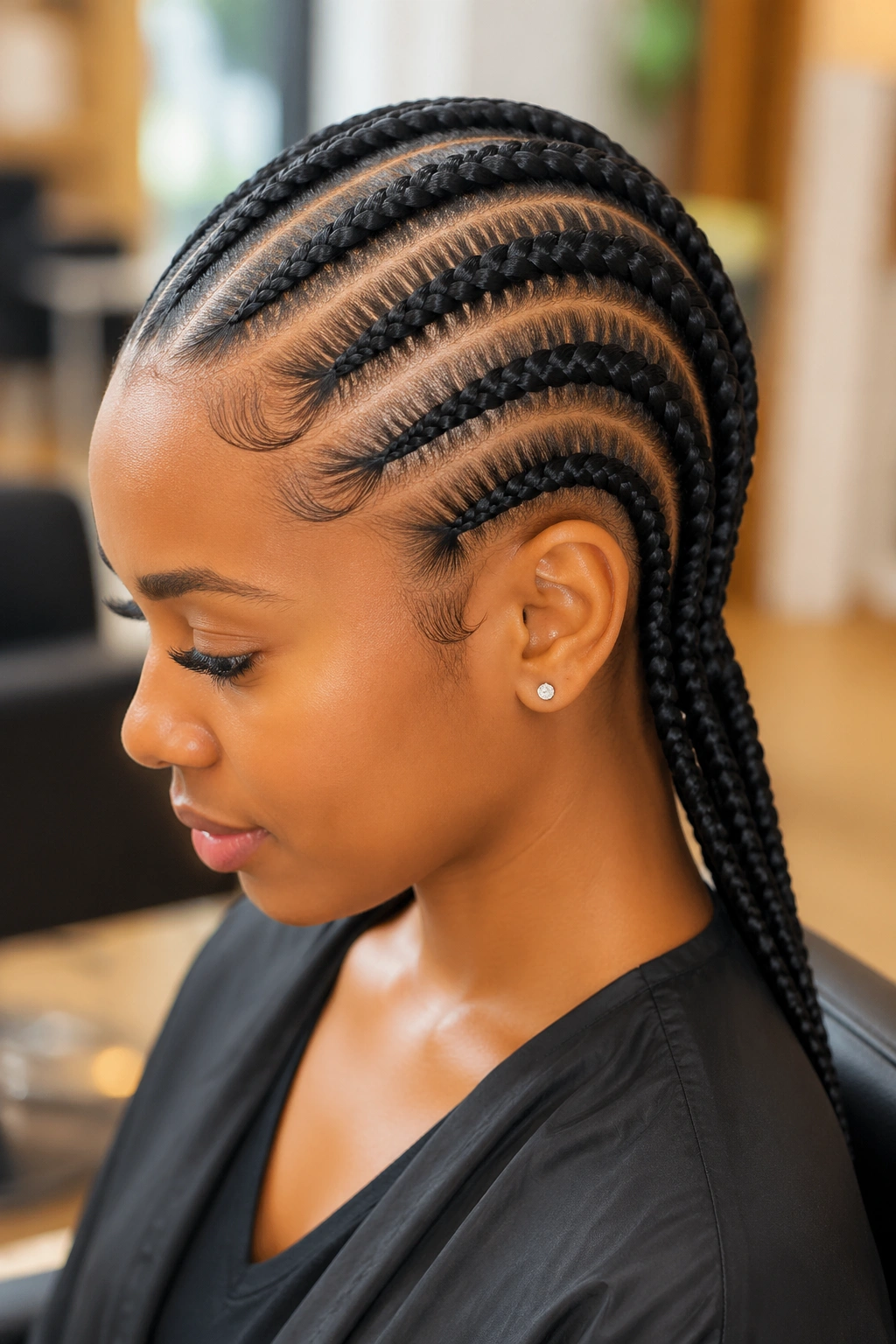
The scalp under feed-ins gets hot under the weight of extensions. Mist daily with a 50/50 mix of water and leave-in for cooling and moisture.
Apply a light oil — jojoba, grapeseed, or a dedicated braid oil — to the parting lines twice a week. Avoid heavy butters and creams that trap lint.
Massage the scalp gently with your fingertips for 60 seconds at a time. This stimulates blood flow and helps prevent the soreness that builds up under feed-ins.
For itchy scalp, an apple cider vinegar rinse (1:4 with water) every 2 weeks clears buildup without needing to redo the wash.
Taking Down Feed-Ins Without Breakage
Never take feed-ins down dry. Saturate each braid with a detangling spray before unraveling.
Work from the ends up. Unravel the braid completely, then finger-detangle the natural hair before introducing a comb.
The kanekalon and your shed natural hair will tangle together inside the braid. Patience is essential here — pulling fast is how you lose length you’ve been protecting.
After takedown, wash with clarifying shampoo, deep condition for 30+ minutes, and trim any rough ends before the next style.
Picking the Right Feed-In Style for Your Medium Hair
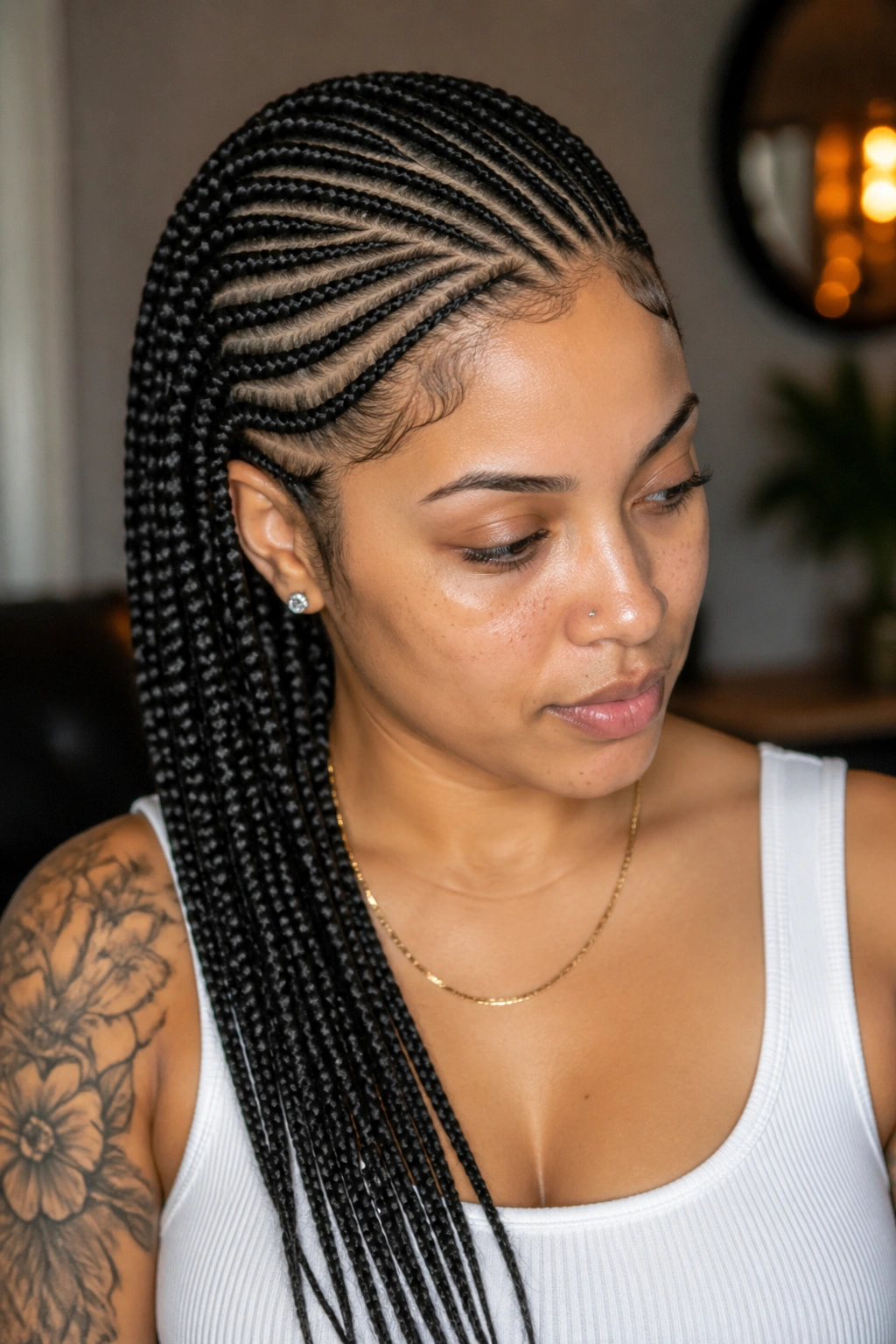
Start with your real-hair length. If you’re at 4-5 inches, lean toward styles with shorter feed-in totals (12-16 inches finished length) to keep the proportion balanced.
If you’re at 8-12 inches, you can support longer feed-ins (18-24 inches finished length) without the braid looking top-heavy.
For fragile hairlines, choose knotless variations or styles with side parts that distribute tension unevenly. The stronger side carries the load.
For active lifestyles, stick with shorter feed-ins (12-16 inches) and avoid heavy beads. Long, weighted braids during workouts cause headaches and root soreness.
For statement looks, lean into color, jumbo sizing, or wrap-crown styles. These read as deliberate styling rather than basic protection.
The best feed-in cornrow style for medium hair is the one that matches your length, your scalp tolerance, and your weekly schedule. Pick the variation that fits — then commit to the aftercare. Feed-ins on medium hair give you flexibility no other braid type can match, and the right one will give you a clean, comfortable, photo-ready style for weeks at a time.
