



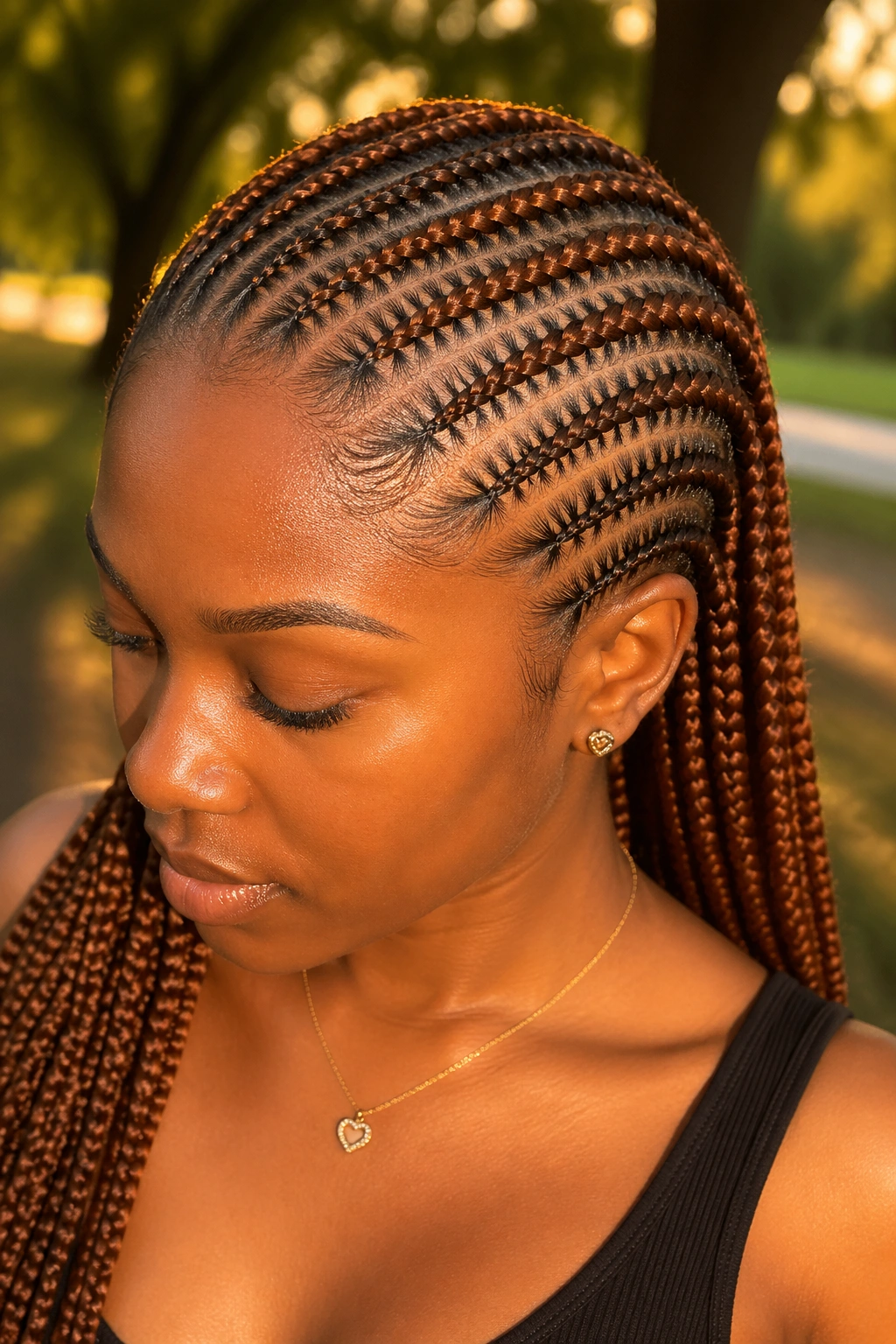
Stitch cornrows in brown bring together two trending elements in protective styling — the precision of stitch braiding and the warmth of brown-toned extensions. Stitch cornrows feature distinct horizontal lines along each braid that create a ladder-like or stitched-fabric appearance. When done in brown rather than the standard black, the stitches read more visibly because the lighter base catches light differently than dark hair does.
Brown cornrow extensions span a wide tonal range. Dark chocolate browns blend almost seamlessly with natural Black hair. Honey browns add warmth without dramatic contrast. Caramel and chestnut tones brighten the face and complement medium to deep skin tones beautifully. Each shade pairs differently with stitch detailing, and choosing the right brown matters as much as choosing the right stitch pattern.
The combined style appeals to women who want polished, photo-ready cornrows without the harshness of jet black or the boldness of platinum 613 blonde. Brown sits in the middle — mature, warm, sophisticated, versatile.
Why Stitch Detail Matters in Brown
Stitch detail loses some of its visual impact on jet black hair because the dark color absorbs light evenly across the braid. The stitches still exist, but they don’t create the strong shadow lines that define the technique.
On brown hair, the stitches create real depth. Lighter brown shows shadow along the stitch lines while reflecting light off the smooth braid sections between stitches. The result is a 3D-looking braid that reads as crafted rather than merely braided.
This is why I recommend stitch detail specifically for anyone considering brown cornrows. The two techniques amplify each other. Skipping the stitching on brown braids wastes the visual potential of the lighter color.
Picking the Right Brown for Your Skin Tone
Brown isn’t one color — it’s a family of shades that read very differently in person. Choosing the right brown is the difference between flattering warmth and washed-out flatness.
Dark cool browns (think dark espresso with ash undertones) suit cool-toned skin. Look for kanekalon labeled #2, #4, or “off black” with cool descriptors.
Warm chestnut browns suit medium to deep skin tones with golden, copper, or red undertones. Look for kanekalon labeled #6, #8, or descriptions like “chestnut” and “amber brown.”
Honey browns and caramel tones brighten faces and add warmth without going full blonde. These work especially well on women with golden brown to dark brown skin. Look for kanekalon labeled #27, #30, or “honey blonde” mixed with browns.
Mocha and chocolate browns sit between dark and medium ranges. They work for almost everyone, which is why these shades sell out fastest in beauty supply stores.
Brand Recommendations for Brown Stitch Cornrows
Outre X-Pression Pre-Stretched Braiding Hair in their brown shades is the standard for stitch work. The pre-stretched fiber stays smoother through stitching pressure than non-stretched alternatives.
Sensationnel Ruwa Pre-Stretched in browns also performs well — slightly silkier than Outre, which some braiders prefer for stitch precision.
Kanekalon Toyokalon blends in brown shades work for budget-conscious wearers but tend to frizz earlier than premium brands. Acceptable for short-term wear, less ideal for 6-week installs.
Avoid bargain-bin brown extensions. The dye on cheap brown extensions sometimes runs when wet, staining the natural hair underneath. Pay 8 to 15 dollars per pack for quality brown kanekalon.
Prep Specifically for Brown Stitch Cornrows
Wash with a clarifying shampoo to remove all buildup. Stitch detail requires absolute scalp cleanliness because flaking or product residue becomes visible against brown extensions in a way it wouldn’t against black hair.
Deep condition with a moisture-rich product. Stitch braiding creates more friction at the scalp than standard cornrows, which can dry out the hair under the braids if it’s not properly moisturized going in.
Stretch the hair through African threading or chunky overnight twists. Stretched hair takes the stitch braid pattern more cleanly than fresh shrinkage.
For brown stitch cornrows specifically, do a strand test with the chosen brown extension before install. Hold a small section of the brown extension against your natural hair color in different lighting. The brown should complement your natural color or create deliberate contrast — not look mismatched.
What “Stitch Cornrow” Actually Means
A stitch cornrow uses a specific braiding technique to create visible horizontal “stitch” lines along each braid. The braider lifts a thin section of hair perpendicular to the braid direction, twists it around the cornrow, and continues braiding. This creates a small horizontal bar across the braid at regular intervals.
Spacing between stitches varies. Tight stitching (every 1/4 inch) creates a heavy textured look. Medium stitching (every 1/2 inch) is the most common and most balanced. Wide stitching (every 1 inch) creates accent stitches with smooth braid sections in between.
The technique is more time-consuming than standard cornrow braiding. Expect 2 to 4 additional hours for a full head of stitch cornrows compared to plain ones.
1. All-Over Medium Stitch in Honey Brown
The classic. Eight to ten cornrows running straight back from the hairline to the nape, each featuring medium-spaced stitches throughout. The brown shade is honey or warm caramel — bright enough to show stitches clearly without being aggressive.
The honey brown reads warm against most skin tones. Combined with medium stitch spacing, the style hits the sweet spot between visual interest and everyday wearability.
- Install time: 4 to 6 hours
- Lasts: 4 to 6 weeks
- Packs needed: 3 to 4 of pre-stretched honey brown kanekalon
Tip: Ask your braider to stop the stitching about 2 inches from the braid ends. The unstitched tip section creates a cleaner finish and reduces the visual heaviness of fully stitched braids.
2. Wide-Stitch Brown Cornrows with Side Part
Six cornrows total, three on each side of a deep side part. Each braid features wide-spaced stitches — about 1 inch apart — creating distinct accent bars rather than continuous texture.
The wide stitching reads modern. It’s the version I recommend for women who like the stitch concept but find tightly-stitched braids too busy. The clean braid sections between stitches give the eye places to rest.
The side part adds asymmetry that complements the wide stitching pattern.
3. Tight Stitch Chocolate Brown
Eight to twelve cornrows in chocolate brown extensions. Stitching is densely packed — every quarter inch or so — creating an almost continuous textured surface along each braid.
Tight stitching looks particularly good on darker browns because the texture creates micro-shadows that catch light dynamically. Honey browns can look busy with tight stitching; chocolate browns handle it well.
This is the most labor-intensive version of stitch cornrows. Budget 6 to 8 hours for full install.
4. Stitch Cornrows with Center Part
Two main cornrows on each side of an exact center part — four cornrows total. Each braid carries medium stitch detail and significant brown extension volume.
Why It Works
The center part creates symmetry that anchors the four-braid format. The brown stitched braids on either side mirror each other, which photographs particularly well from the front. The center part also makes face shape stand out — perfect for women confident in their facial features.
Best for: Anyone with strong facial symmetry who wants their hair to highlight rather than distract from their features.
5. Asymmetric Stitch Pattern in Mocha Brown
Cornrows angle dramatically across the head — most flowing toward one shoulder. The stitching follows the angle of each braid, creating diagonal stitch lines rather than horizontal ones.
The asymmetry combined with stitch detail creates a strong directional flow. Eye is drawn from one corner of the head toward the opposite shoulder. It’s editorial and bold.
Mocha brown is the right shade for this — dark enough to feel sophisticated, light enough to show stitch detail.
6. Stitch Cornrows with High Ponytail
The cornrows angle up toward the crown, where they gather into a high ponytail. The brown extensions extend through the pony, creating a stitched braid foundation with a flowing tail above.
The ponytail can be styled with the extensions left straight, curled with hot rollers (synthetic-safe heat only), or wrapped into a braided bun.
I love this version for women with longer faces because the height of the pony adds vertical balance. For round faces, the height can read too pulled-up — soften with face-framing pieces if you’re committed to the style.
7. Brown Stitch with Beaded Tips
Standard stitch cornrows in brown extensions, finished with wooden or copper-tone beads at the braid tips. Three to five beads per braid, spaced along the last 4 inches.
Wooden beads complement brown hair beautifully — wood and warm brown tones share an organic palette. Copper beads add metallic warmth without competing with the hair color.
The beads add weight at the tips, which helps the braids hang straighter and reduces the curl-up that long synthetic extensions can develop over time.
8. Stitch Cornrows into Low Bun
The cornrows flow down toward a low bun at the nape. The bun is built either from the braid ends themselves or from a separate brown extension piece pinned in.
This is the formal version of stitch cornrows in brown. Wedding guest, work events, dinner parties — the low bun handles dressy occasions while the stitch detail provides the artistic anchor.
The bun should match the brown extension shade as closely as possible. Off-tone bun pieces look like obvious add-ons; matched bun pieces look integrated.
9. Diagonal Stitch Cornrows in Cinnamon Brown
The cornrow pattern runs diagonally across the head rather than straight back. Cinnamon-toned brown extensions give the style a warm, autumn-spice quality that complements golden and warm-toned skin.
How to Style It
Diagonal cornrows photograph differently than straight-back patterns. They create movement across the head that suggests motion even in still photos. Combined with stitch detail, the diagonal lines become rhythmic — like sheet music written across the scalp.
The cinnamon shade reads particularly well in golden hour lighting. If you’re booking a photoshoot or a wedding with outdoor elements, this brown shade works beautifully.
Tip: Pair with warm-toned makeup — bronze eyeshadow, peach blush, terracotta lip — to extend the warm color story.
10. Stitch Cornrows with Curly Brown Ends
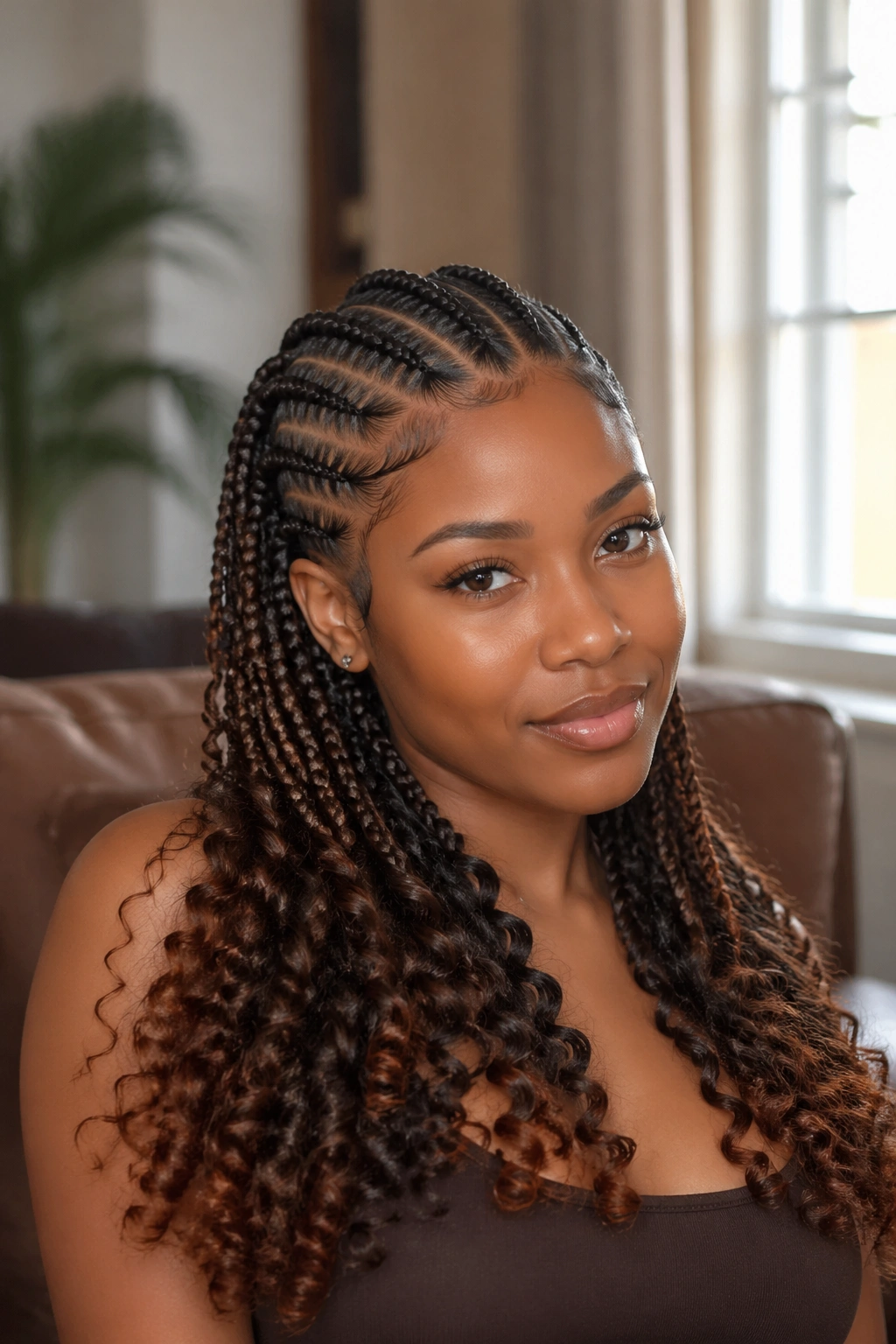
The cornrows feature stitch detail throughout. The last few inches of each braid transition into loose brown curls — using pre-curled brown extensions or by braiding to a point and pulling the synthetic fiber out into a curl.
The contrast between sharp stitched braids and soft curled tips creates the goddess effect within a stitch cornrow framework. It’s the style for women who want stitch precision but find pure stitch cornrows too severe.
The curl portion needs daily refresh with a leave-in spray. Synthetic curls flatten under sleep pressure and need re-shaping each morning.
11. Stitch Cornrows with Cuffed Detail
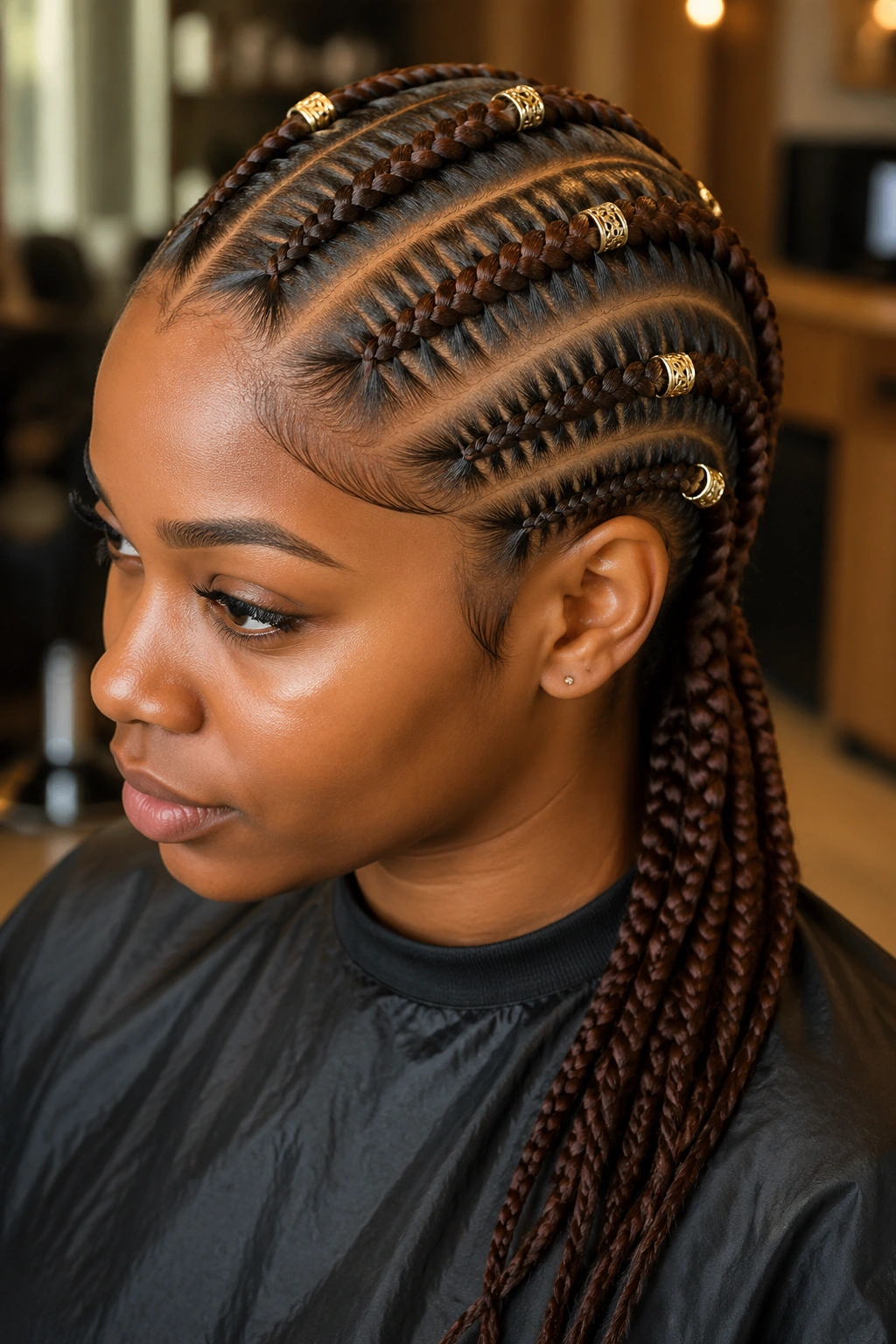
Standard brown stitch cornrows with gold or copper cuffs added strategically. The cuffs slide onto the braid at specific points — sometimes mid-braid, sometimes at the tips, sometimes at the transition between stitched and smooth braid sections.
Cuffs add metallic highlights that complement both the brown extension color and the stitch detail. Three to five cuffs per braid is the right balance — more starts to feel cluttered.
Choose cuffs that fit snugly without compressing the braid. Loose cuffs slide off; over-tight cuffs create dents in the braid pattern.
12. Half-Up Stitch Style in Caramel Brown
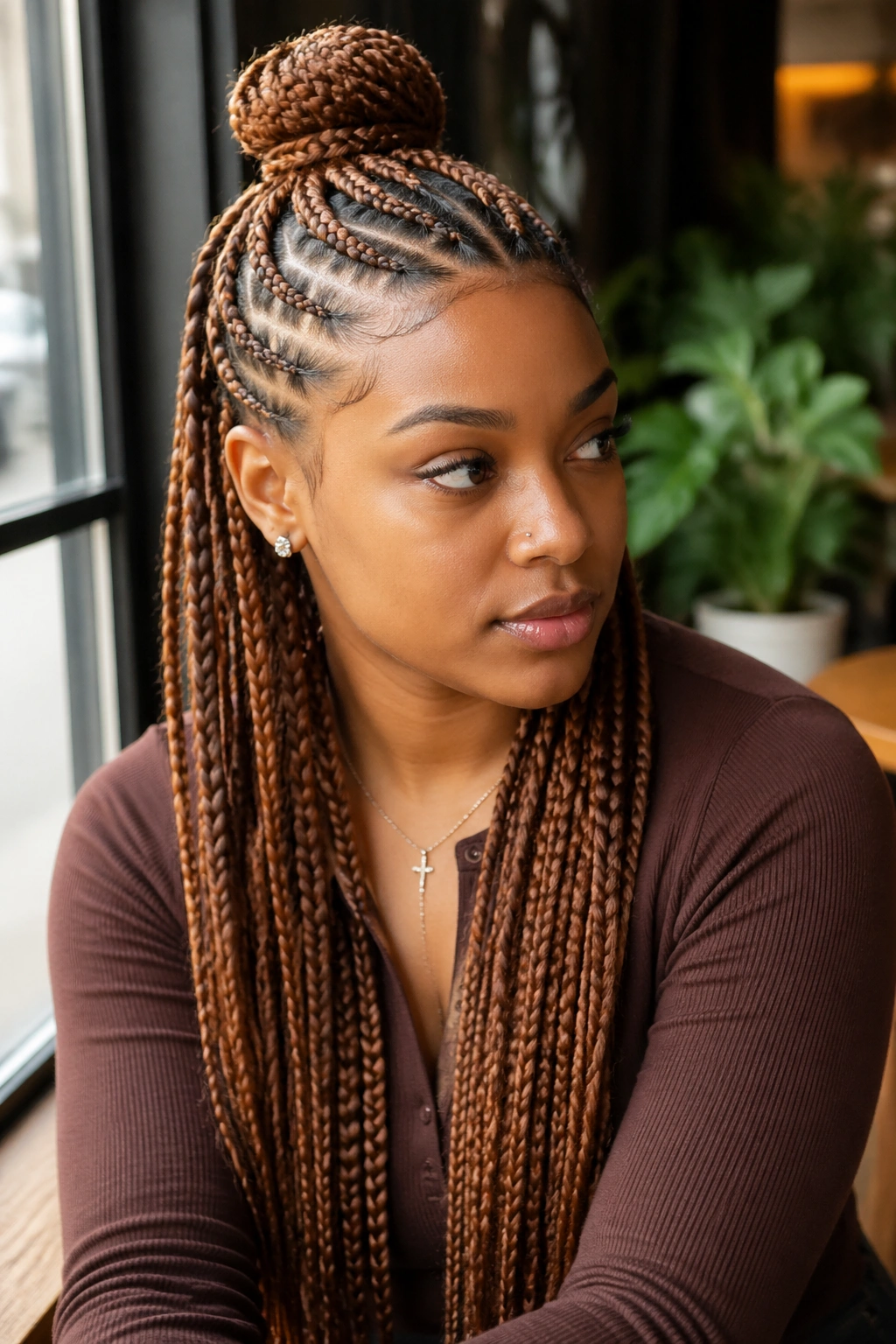
The top half of the cornrows pulls up into a small bun or twist. The bottom half hangs free, swinging at the back. All braids feature stitch detail in caramel brown extensions.
Half-up styles offer visual variety — pulled-up structure on top, flowing braid length below. The caramel shade brightens the face by drawing light to the upper half of the silhouette.
This is a versatile everyday style. The half-up format can be released into full-down at the end of the workday for a different evening look.
13. Stitch Cornrows with Highlighted Sections
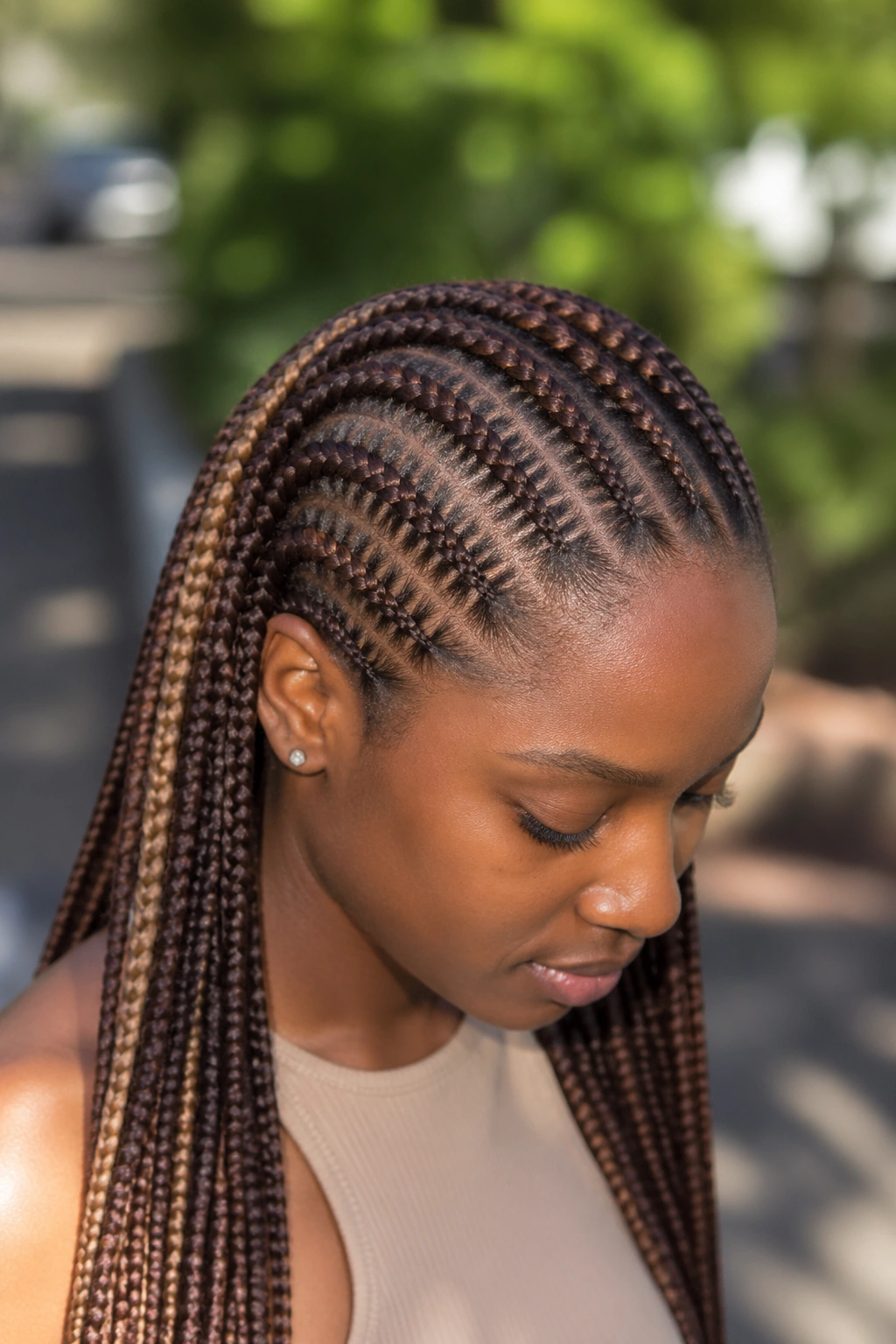
Most braids in standard chocolate brown. Two to three braids built with caramel or honey brown highlights — a slightly lighter brown that catches light differently.
The mixed brown tones create dimension that single-color cornrows can’t achieve. The highlights position strategically — usually framing the face or following the part — to maximize their visual impact.
Subtlety is key. Highlights should read as variation, not as dramatic color blocks. Choose a highlight shade only 2 to 3 tones lighter than the base brown.
14. Stitch Cornrows with Front Bangs
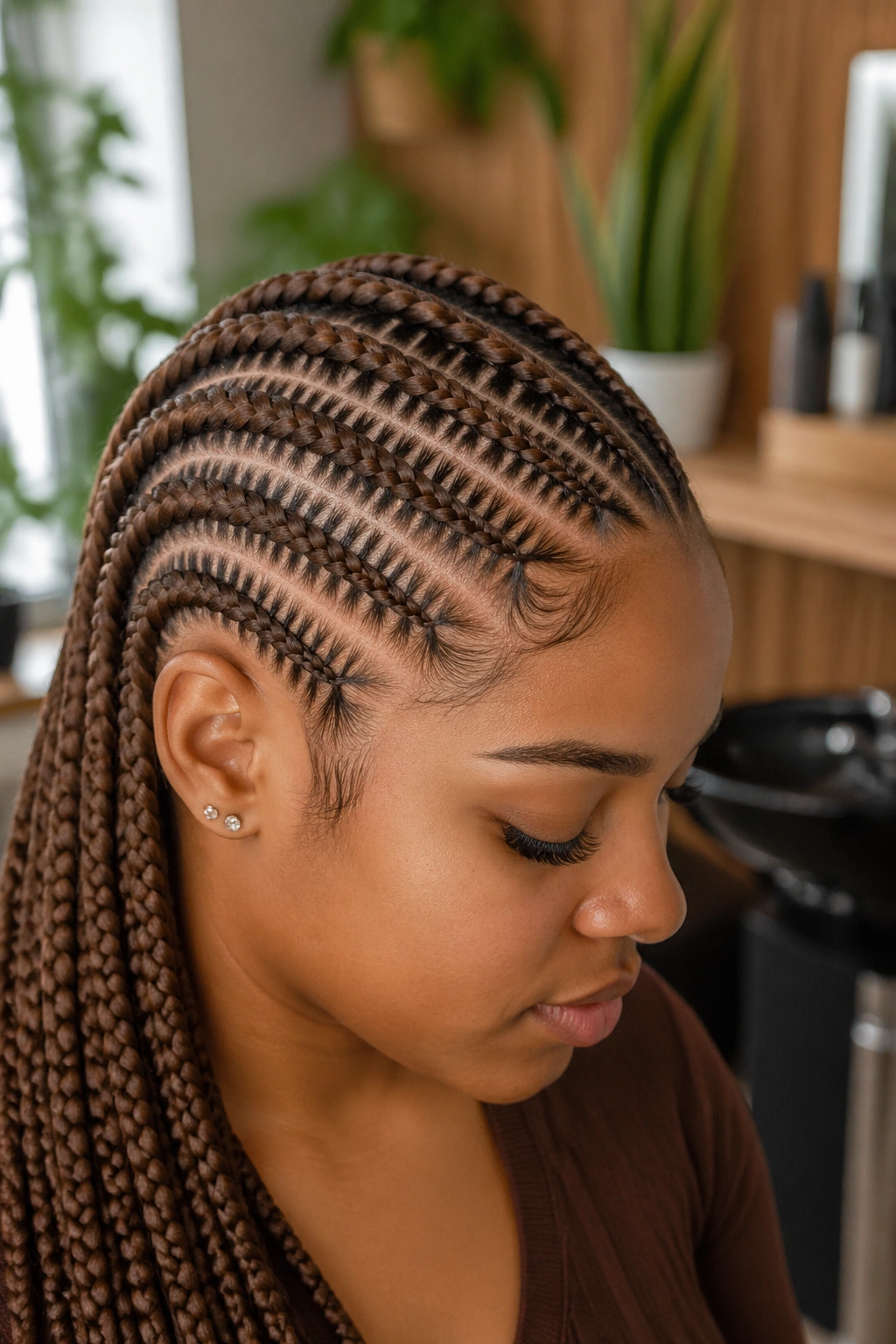
The front section forms cornrow bangs that sweep across the forehead. The bangs feature lighter stitch detail than the back. The remaining hair forms standard stitch cornrows in matching brown.
What Makes It Different
Combining bangs with stitch cornrows requires careful planning. The bangs need to lay flat against the forehead without pulling at the hairline. The stitch detail in the bangs needs to be subtle enough that the bangs don’t look overworked.
This is the version for women with high foreheads who want to incorporate stitch detail without the full forehead reveal.
15. Stitch Cornrows with Crown Detail
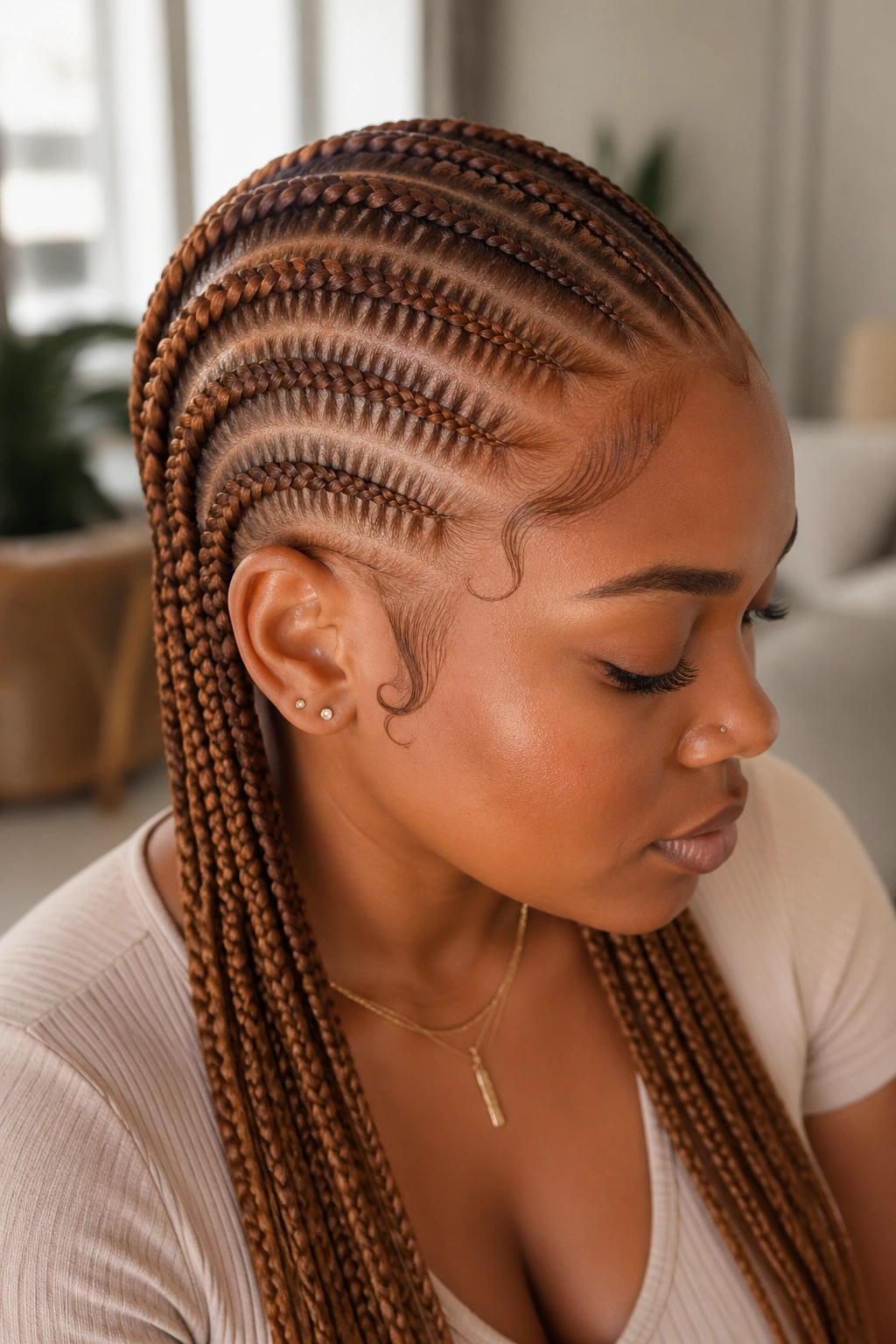
A small decorative pattern at the crown — a star, heart, or flower shape created with smaller cornrows or scalp parting. The main stitch cornrows in brown radiate out from the crown detail.
The crown detail becomes the focal point. The stitch cornrows provide the structural framework that supports the design.
This version requires a braider with strong design instincts. Standard cornrow technicians don’t always have the artistry for decorative crown work.
16. Long Stitch Cornrows in Dark Brown
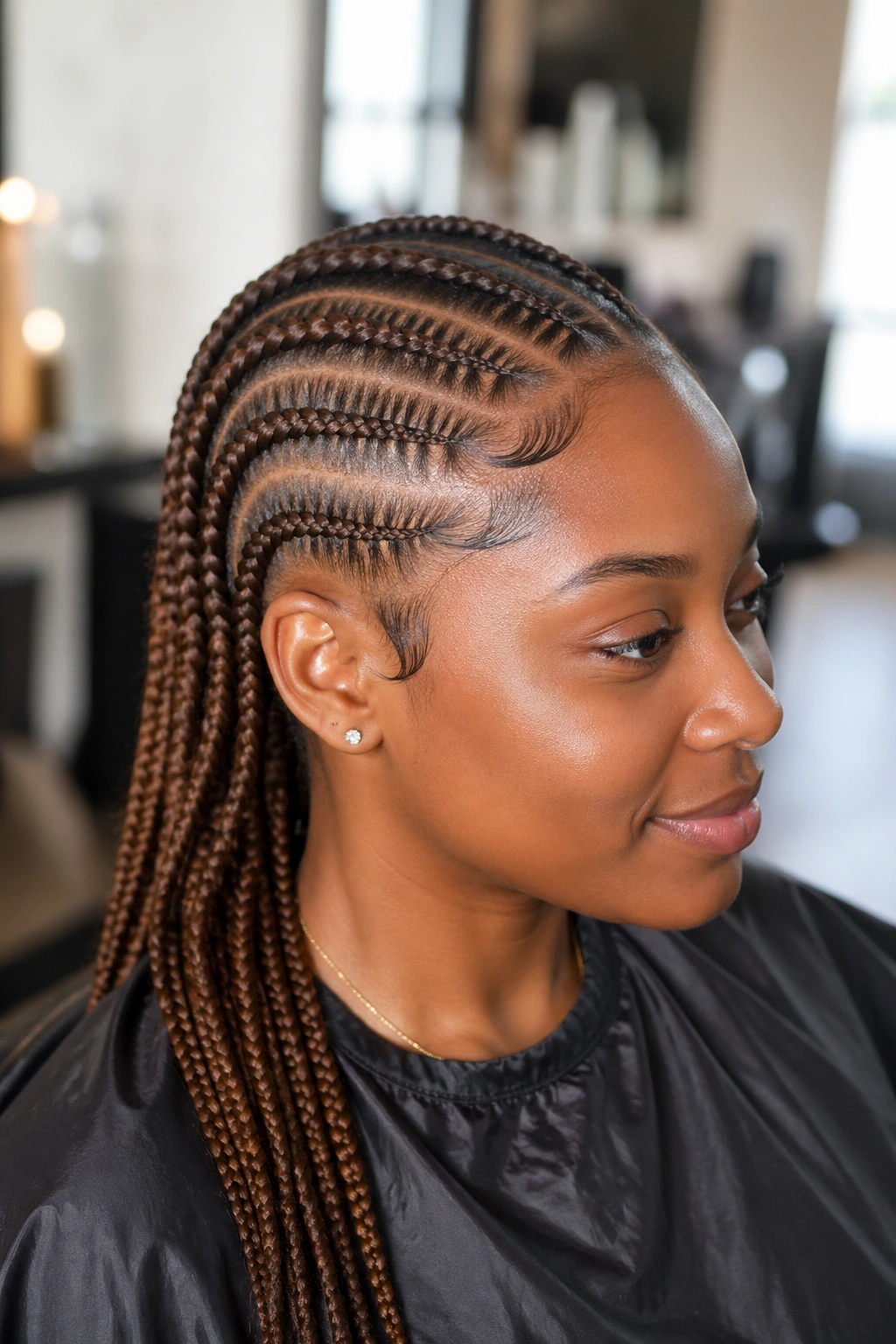
Stitch cornrows extending to mid-back or longer. The dark brown shade reads sophisticated without the intensity of jet black.
The length is impractical for some lifestyles but stunning for everyday wear and styled events. The stitch detail remains visible throughout the braid length, creating consistency across the full silhouette.
For sleeping with long stitch braids, an oversized satin bonnet is essential. The braids need to be gathered loosely under the bonnet to prevent friction tangles.
17. Bob-Length Stitch Cornrows in Mahogany
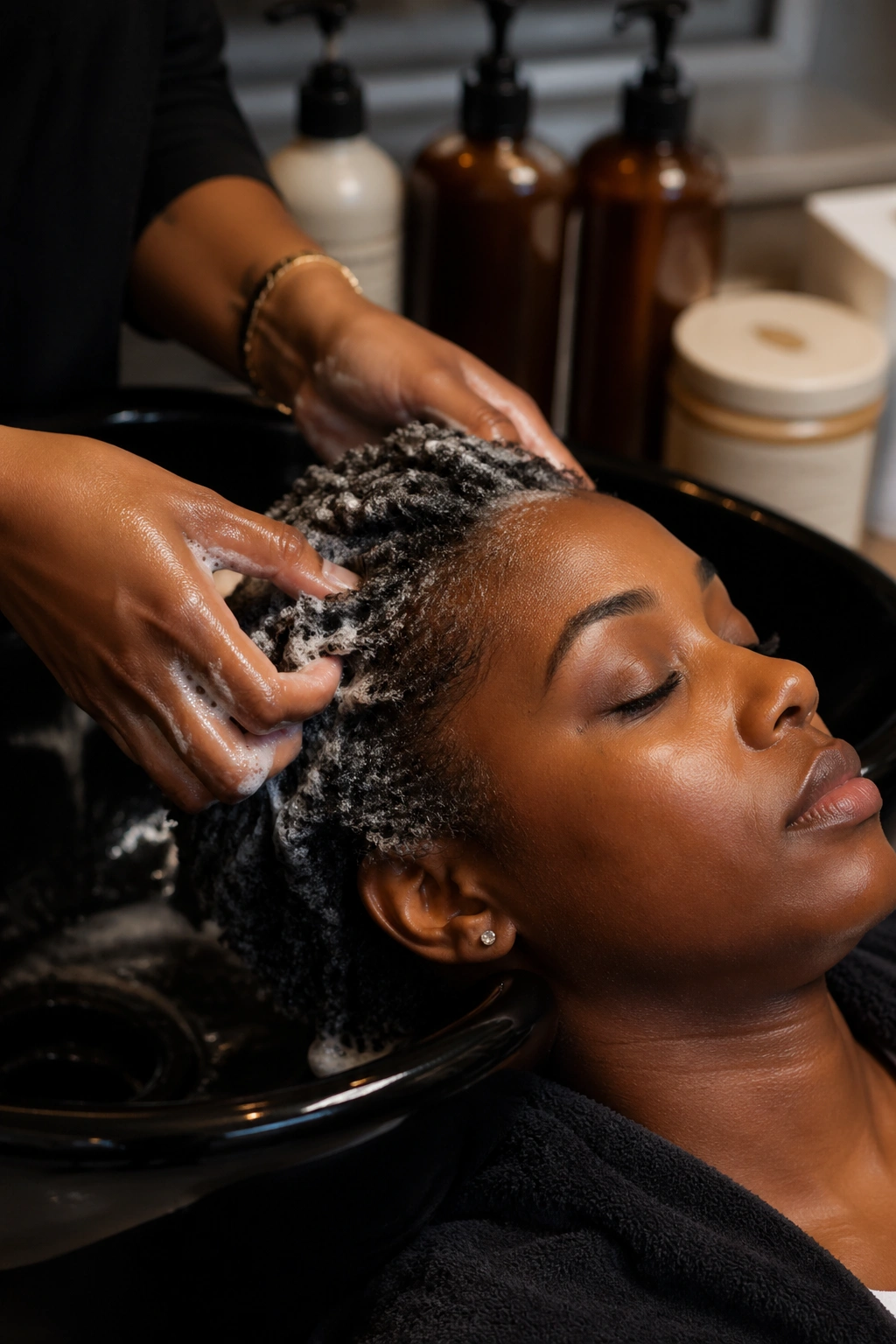
The stitch cornrows stop at chin to collarbone level in mahogany brown — a deep brown with red undertones. The shorter length and warm brown tone read mature and sophisticated.
Mahogany works particularly well on women with cool to neutral undertones. The red base adds warmth without going full red, which can be polarizing.
Bob-length cornrows are easier to wear daily. Less weight, less night maintenance, faster wash and dry times.
18. Stitch Cornrows with Side Sweep
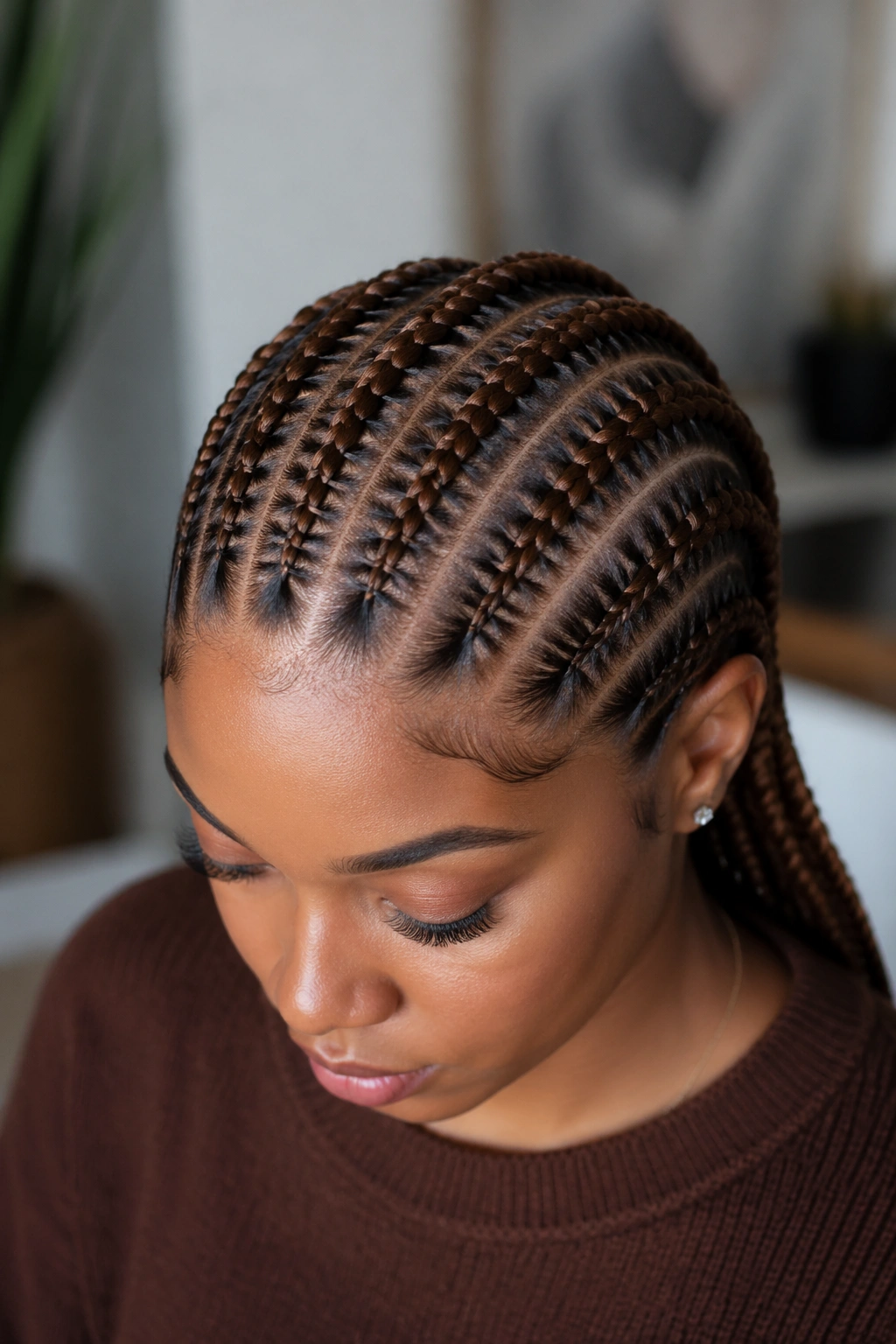
All cornrows angle toward one side of the head. The stitch detail follows the angle, creating diagonal stitch lines that flow toward the swept side.
The side sweep emphasizes one side of the face — usually the side with stronger features. It’s a flattering choice for women who want their hair to highlight specific facial elements.
Pair with statement earrings on the exposed side of the face. The bare side carries the styling weight when the hair is swept opposite.
19. Stitch Cornrows with Mohawk Top
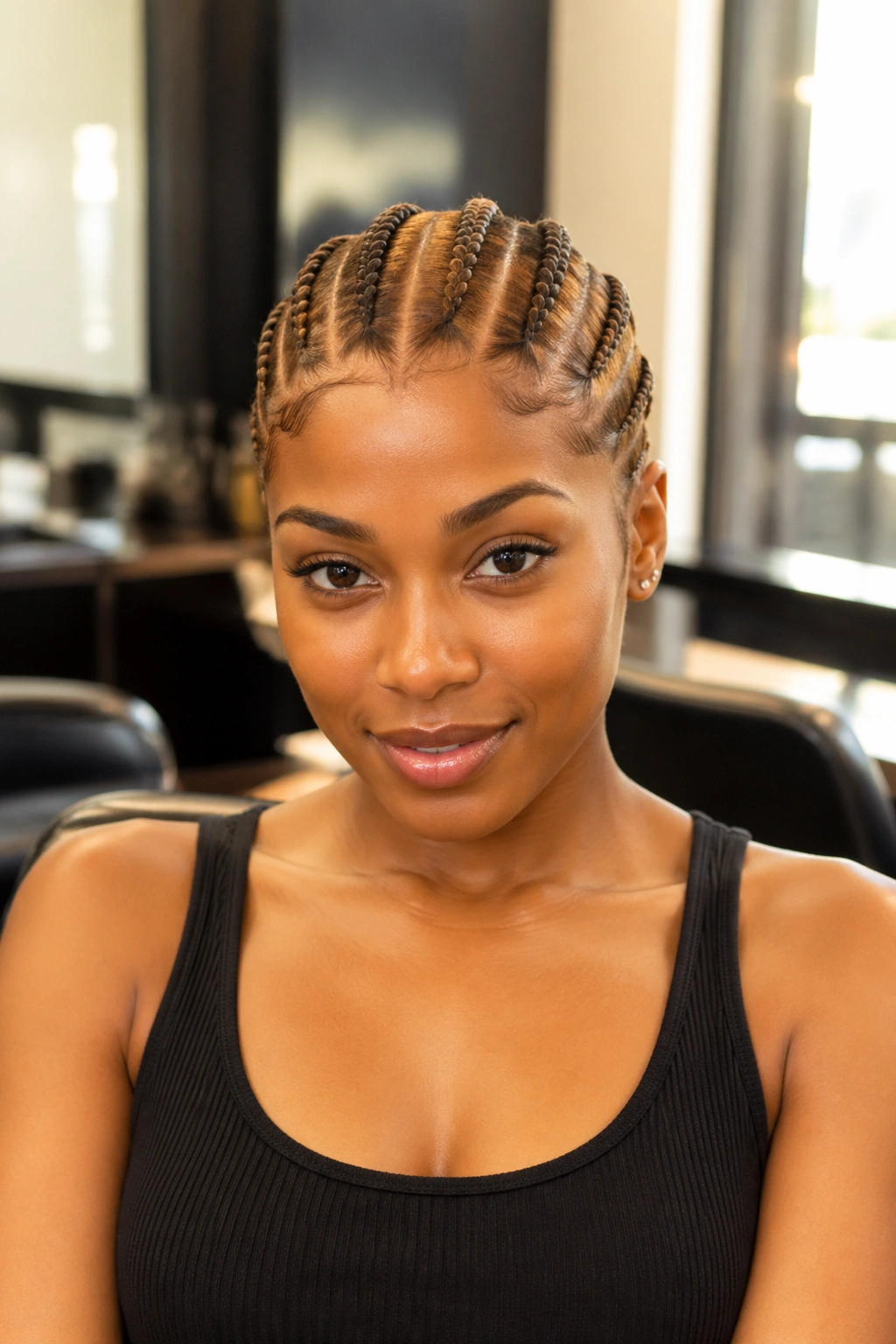
The cornrows sit tight on the sides and back. The center strip from forehead to crown is built with stitch detail in brown extensions, raised slightly into a faux mohawk shape.
The mohawk concept reads bold, but the brown shade and stitch detail temper it into something polished rather than aggressive.
Works for women who want statement hair without going to extremes. The brown stitched mohawk reads creative without alienating professional environments (depending on workplace).
20. Stitch Cornrows with Wraparound Braid
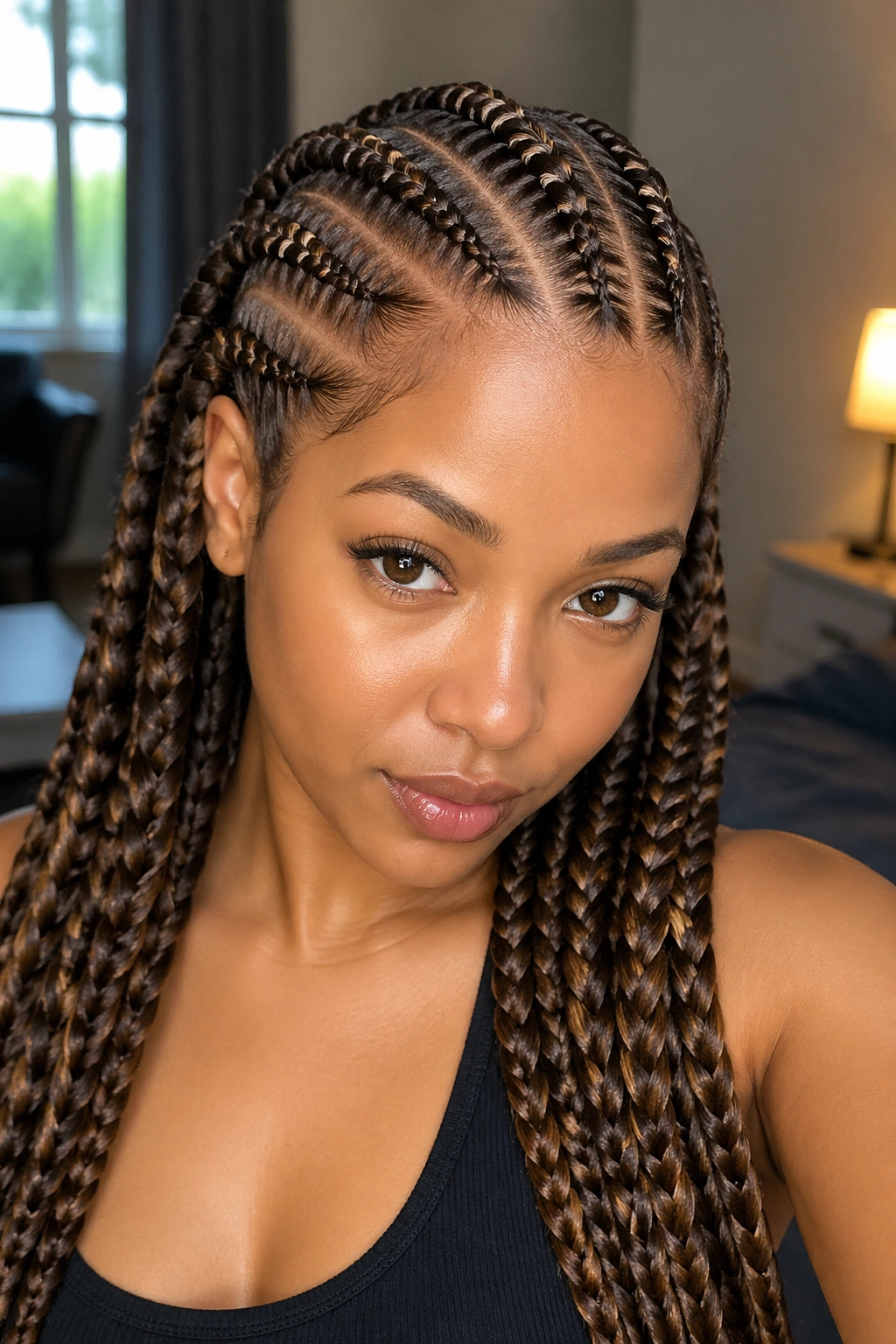
A single thicker braid wraps horizontally around the crown of the head, encircling the standard stitch cornrows below. Both sections feature the same brown extension shade.
The wraparound braid creates a “halo” or “headband” effect that frames the upper face. Combined with stitch detail throughout, the style reads decorated without being over-decorated.
For added drama, embellish the wraparound braid with thin gold wire or a single strand of small beads.
21. Stitch Cornrows with Free-Fall Front
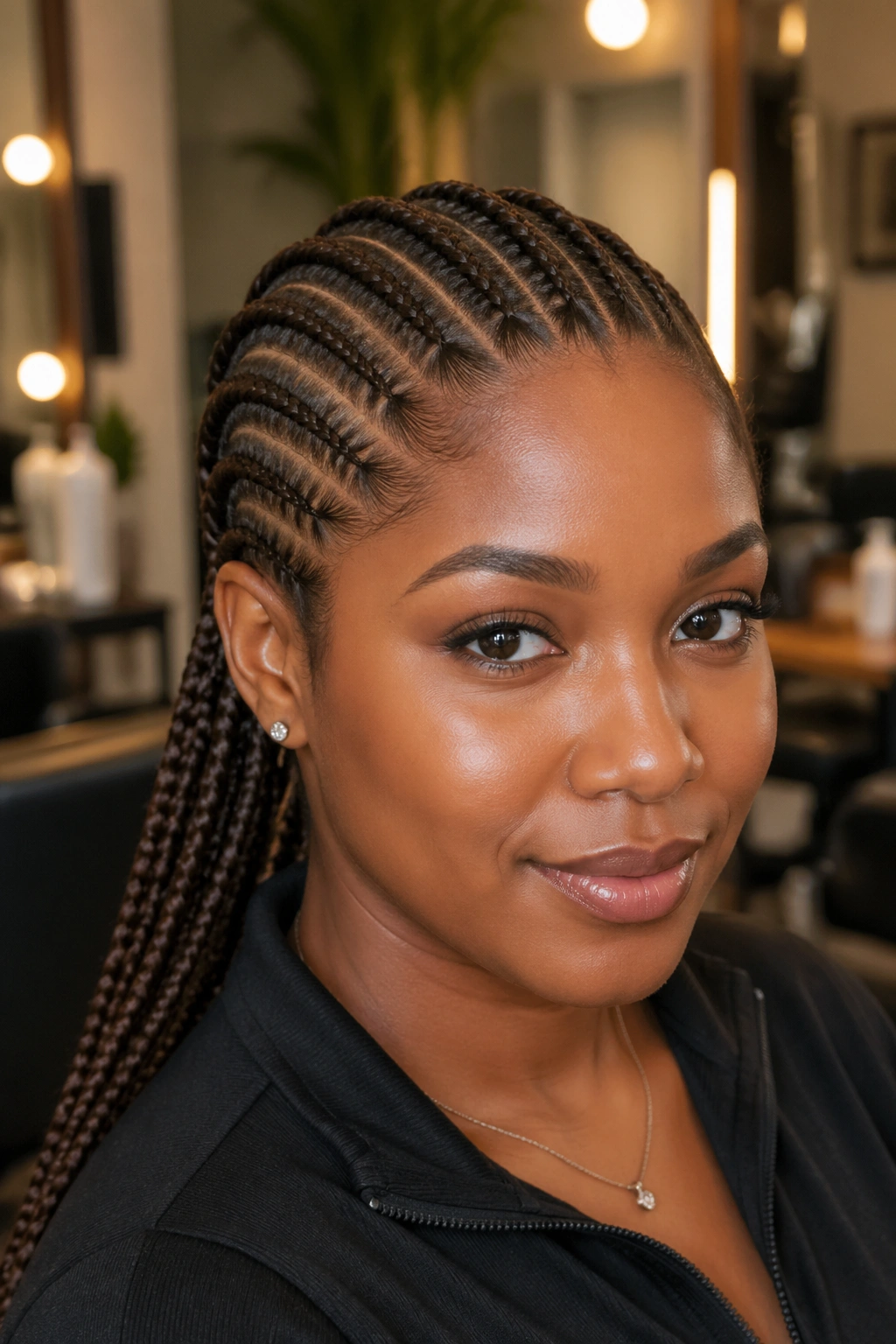
The front 4 inches of hair stays unbraided, falling loose around the face. The rest of the head features stitch cornrows in brown.
What to Watch For
The loose front section softens the architectural look of stitch cornrows. It’s particularly flattering for women with high cheekbones who want softness around the face.
The loose section needs daily styling. Curl it with hot rollers, smooth it with a leave-in cream, or pin it back during the day. The cornrowed back stays put while the front becomes a styling element.
22. Stitch Cornrows with Kente Cloth Wrap
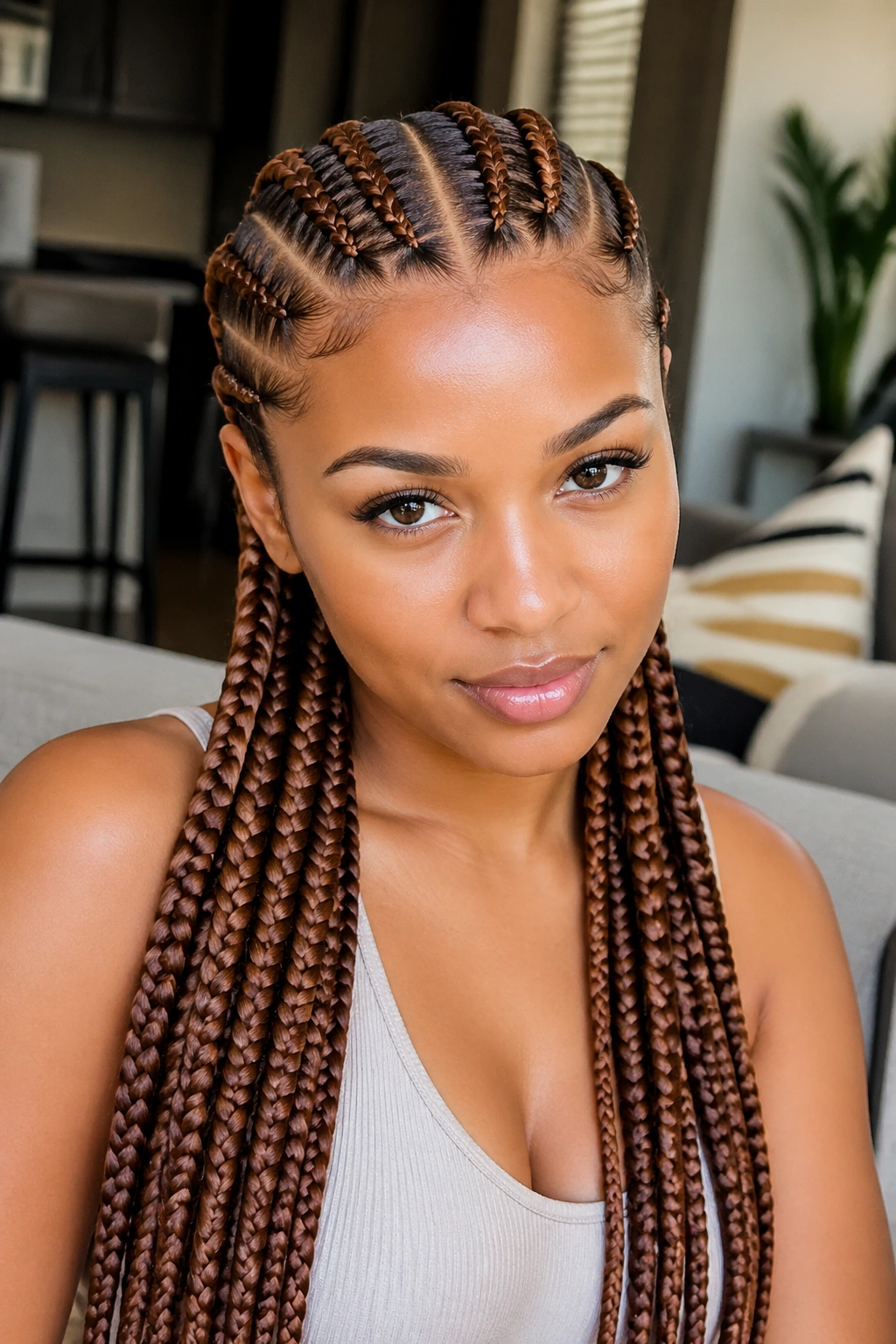
The stitch cornrows form the foundation. A small kente cloth strip — woven Ghanaian fabric in traditional patterns — wraps through several of the braids or ties around the gathering point if the style ends in a bun or pony.
Kente cloth incorporation should be done with cultural awareness. The fabric carries specific meanings in Akan tradition; wearing it as hair adornment connects you to that heritage. Research the meaning of the specific kente pattern before wearing it.
The cloth adds color and texture beyond what hair alone can provide. It also creates an intentional cultural statement that elevates the styling beyond aesthetic choice.
Maintaining Brown Stitch Cornrows Through Wear
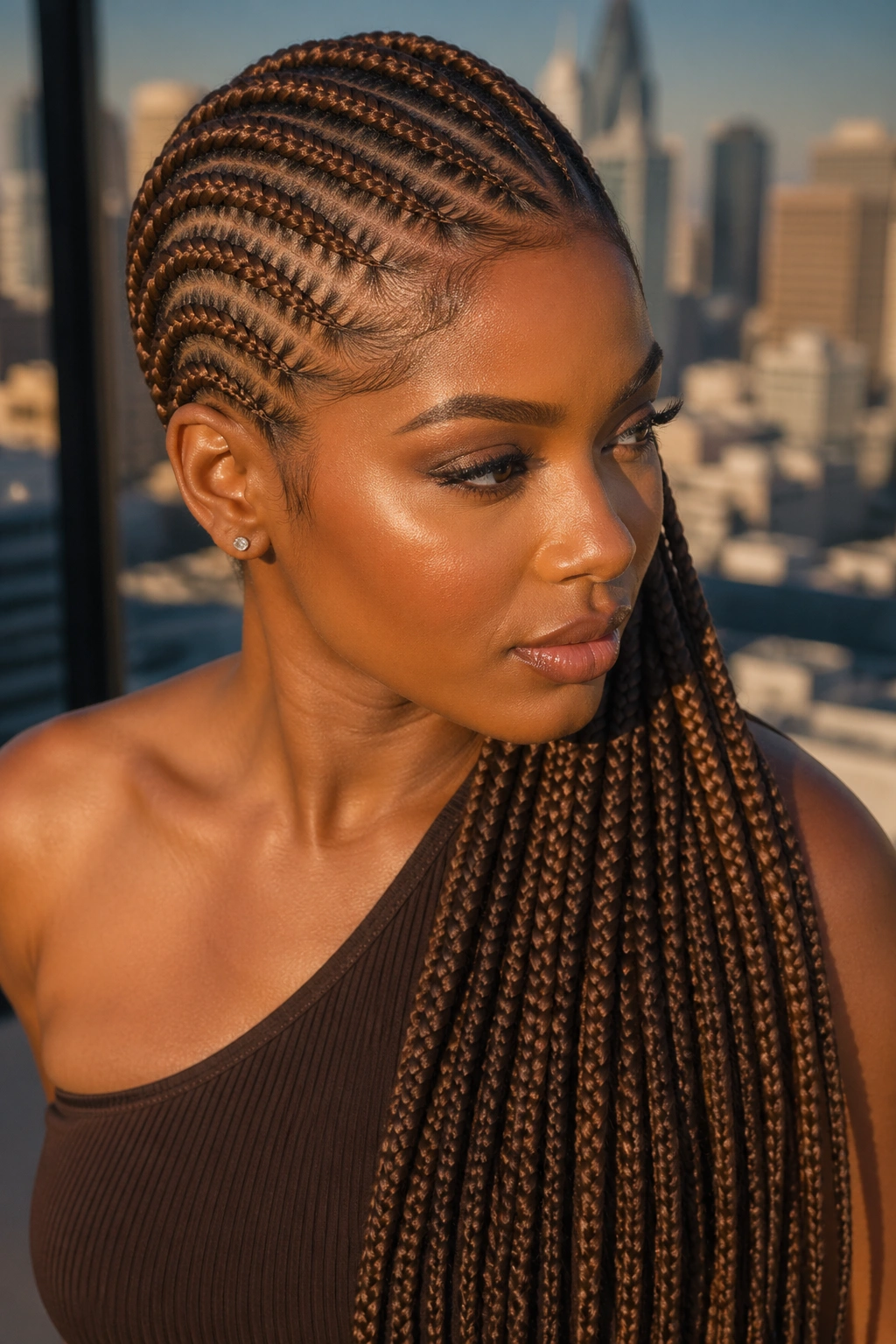
Brown extensions need different maintenance than black extensions. Brown shades can fade or take on green tones if exposed to chlorine, salt water, or repeated UV exposure. Protect your investment.
Use a UV-protectant spray for braids if you spend significant time outdoors. Sun fade is real on brown extensions, especially honey and caramel shades.
For chlorine exposure, wet the braids thoroughly with fresh water before swimming. Saturated braids absorb less chlorine. Rinse thoroughly after swimming to prevent chlorine-induced color shift.
Lighter scalp oils — jojoba, grapeseed, argon — work better than heavy butters on brown extensions. Heavy products can darken brown shades over time.
Sleeping with Brown Stitch Braids
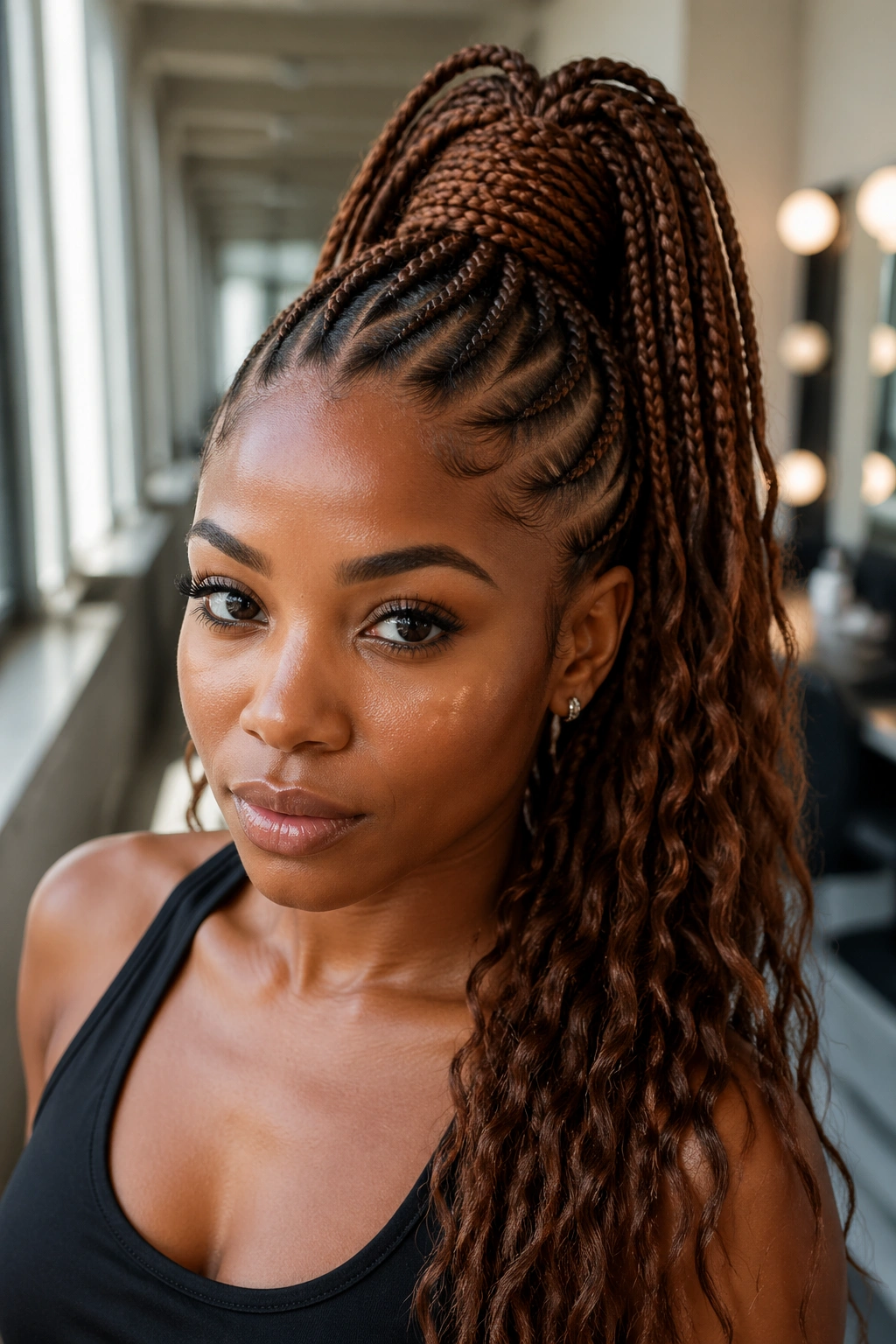
Satin bonnet every night. Without exception. Cotton pillowcases can stain the brown extensions over time, particularly if your pillowcase has any color treatment that bleeds.
Don’t tie the bonnet too tight. The compression flattens the stitch detail and can create visible creases in the braids by morning.
For long brown stitch cornrows, gather them loosely inside the bonnet rather than letting them hang free. Free-hanging long braids tangle against bonnet fabric.
Washing Without Color Loss
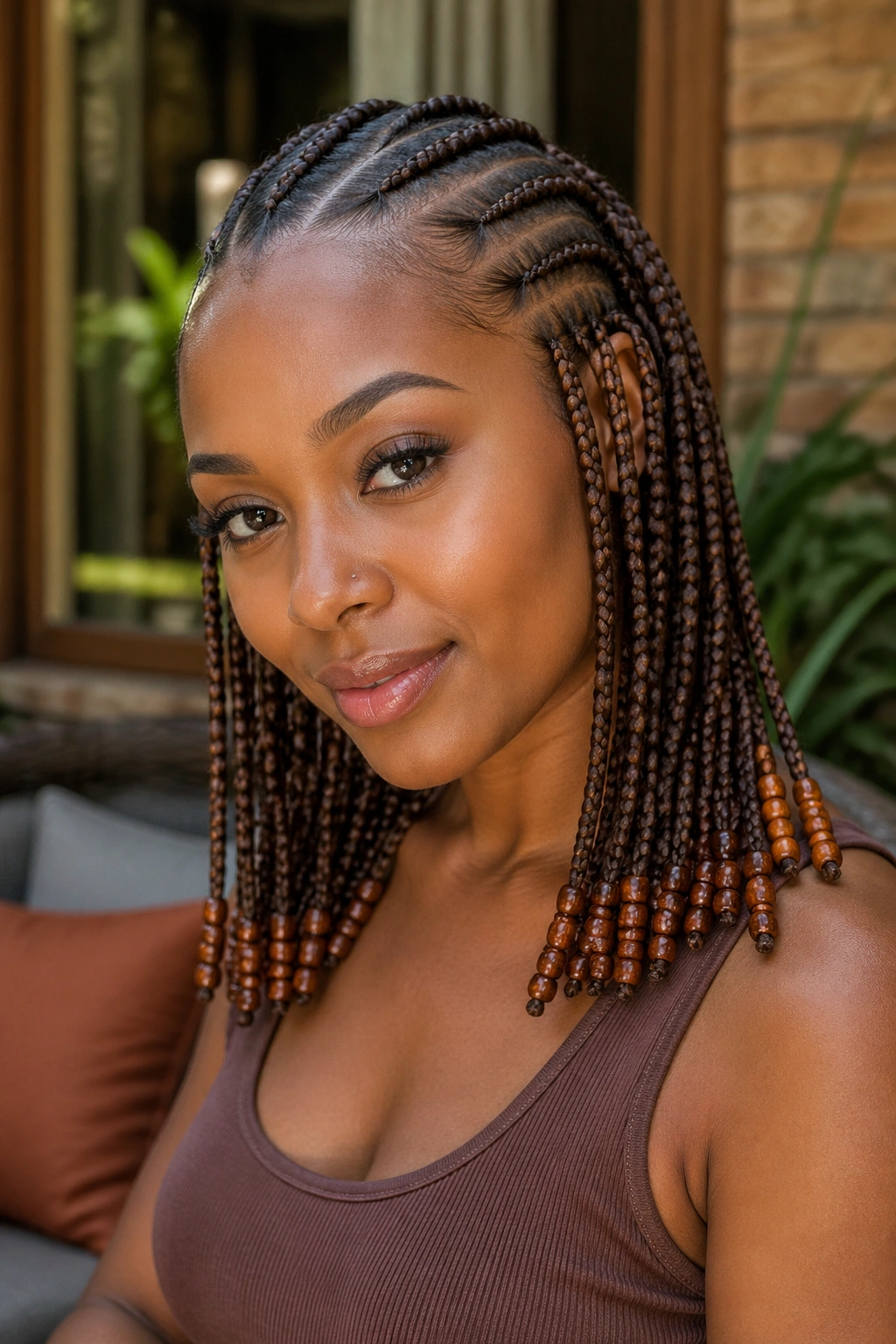
Wait at least 7 to 10 days after install before the first wash. Earlier washing can disrupt the gel hold at the base and shift the stitch pattern.
Use a sulfate-free shampoo specifically labeled color-safe. Sulfates strip color from brown extensions faster than from black ones. Diluted shampoo squeezed through the braids; gentle scalp massage in circular motions.
Use cool water for rinsing. Hot water opens the synthetic fiber cuticle and accelerates color fade.
Apply a leave-in conditioner formulated for color-treated hair after washing. The conditioner seals the synthetic fiber and helps preserve the brown tone.
Dry thoroughly. Wet brown extensions can develop musty smells faster than wet black extensions because the dye creates micro-pockets where moisture lingers.
Taking Down Brown Stitch Cornrows
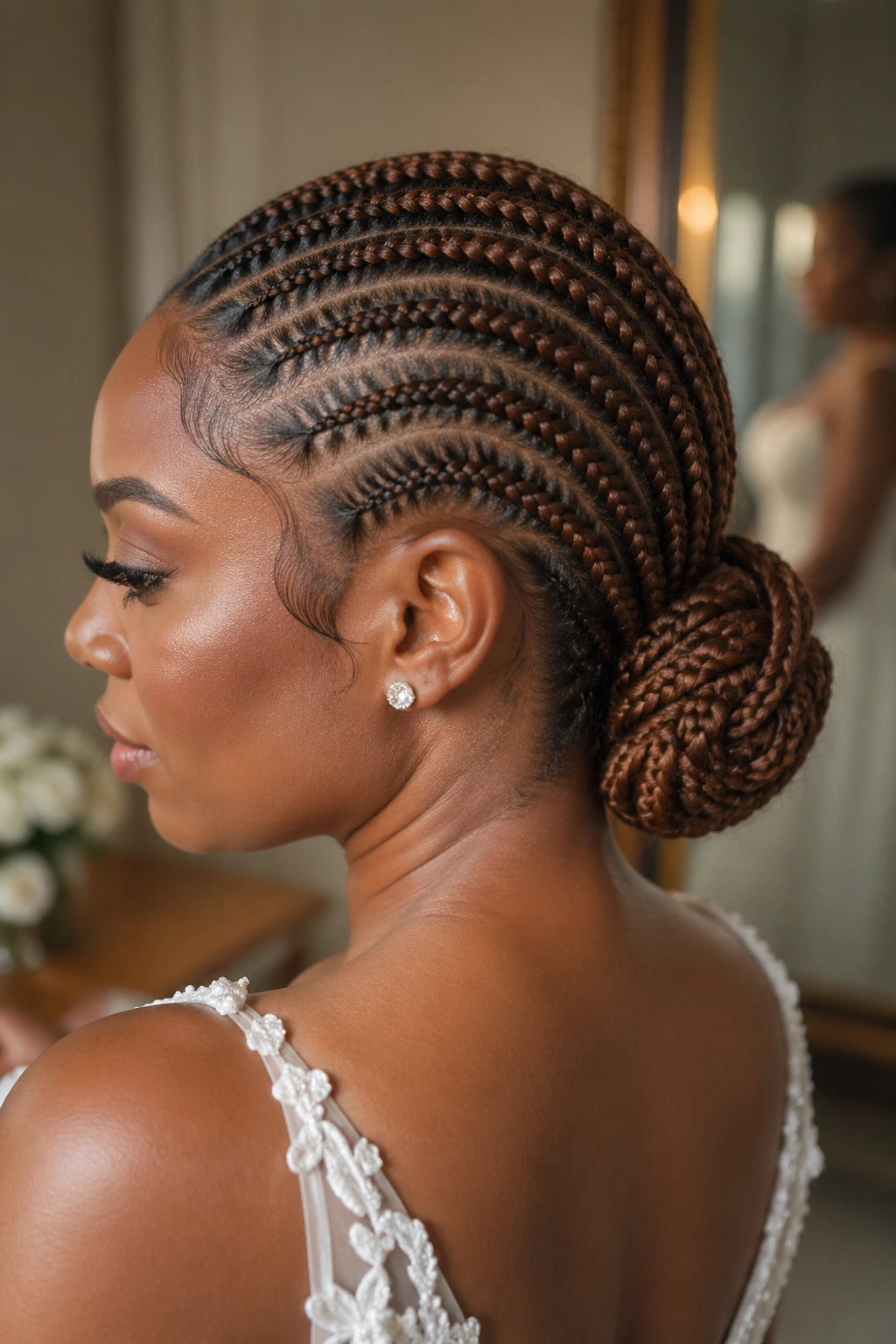
Stitch detail makes takedown more involved than standard cornrow takedown. The stitches add interlocking points along the braid that need careful handling.
Saturate each braid with conditioner mixed with warm water. Let the conditioner sit for 10 minutes before unbraiding to soften the stitches.
Unbraid from the tip up, working slowly. The stitched sections require gentle finger separation rather than forceful pulling. Forced takedown of stitched braids causes significant breakage.
Deep condition immediately after takedown. Stitch braiding creates more scalp tension over time than standard cornrowing, so your hair needs extra recovery moisture.
Picking the Right Brown Stitch Style for You
Skin tone matters more for brown extensions than for black ones. Cool skin tones suit ash and dark browns; warm skin tones suit honey, caramel, and chestnut shades. Get advice at the beauty supply store from someone with a good eye.
Lifestyle determines length. Long brown stitch cornrows look gorgeous but require committed maintenance. Bob-length versions handle active lifestyles better.
Event calendar guides the styling choices. Wedding, photoshoot, formal event coming up? Pick a style with bun finish or beaded detail. Casual everyday wear? Standard cornrows with stitch detail handle daily life.
Budget consideration. Premium brown kanekalon costs more than basic. Quality matters with brown — cheap browns fade fast, run when wet, and can stain your real hair.
Common Mistakes to Avoid
Choosing the wrong brown shade. Honey brown on cool-toned skin reads sallow; ash brown on warm-toned skin reads dull. Test before committing.
Skipping the strand test. Hold the extension against your real hair before purchase. Lighting in beauty supply stores is notoriously bad — the brown that looks one shade in store often reads differently in natural light.
Over-aggressive stitch detail on the wrong shade. Honey browns can look busy with tight stitching. Match stitch density to brown shade.
Using black hair products on brown extensions. Some styling products contain pigments that can darken brown over time. Look for clear or color-safe formulations.
Sun and chlorine exposure without protection. Brown fades faster than black. Protect with UV spray and pre-wet for chlorine exposure.
Sleeping without protection. Cotton friction destroys stitch detail and can stain brown extensions.
Stitch cornrows in brown bring polish and warmth to protective styling in a way few other combinations achieve. The stitch detail creates the architectural element that makes cornrows feel finished. The brown extensions add warmth that flatters most skin tones better than the harshness of jet black.
Pick the brown shade that complements your undertones. Pick the stitch density that matches your style preference. Find a braider experienced specifically with stitch work — not all cornrow stylists do stitching well. And maintain the style with the care it deserves.
Brown stitch cornrows reward attention. Give them what they need.
