



Small cornrows hit a specific sweet spot. They’re detailed enough to photograph sharp, light enough to live in for a month, and flexible enough to adapt to any occasion. You get the craft of intricate braid work without the bulk of jumbo styles or the brittleness of micros.
Finding a good small cornrow style isn’t about picking the prettiest photo. It’s about matching the density of the braids to your scalp, your face, your lifestyle, and your patience. Small cornrows take time. A full head can run 4-6 hours even with a skilled braider.
What follows are 30 small cornrow styles that each do something different with the same basic ingredient. Some are classic. Some are bold. A few are unexpected. Whatever your hair texture or look, one of these will fit.
What Counts as a Small Cornrow
Sizing for cornrows isn’t standardized across braiders, but most agree that a small cornrow measures roughly 1/4 to 3/8 inch wide at the base. That’s thinner than a pencil but wider than a pipe cleaner. Thinner than that moves into medium-small or micro territory.
Small cornrows give you more braids per head — usually 30 to 60 braids for a full head, compared to 10-20 for standard medium cornrows. More braids means more design flexibility and a denser overall look.
They also mean more installation time. Expect 4-6 hours for a full head, depending on style complexity and braider speed.
Small cornrows sit in a particularly useful middle ground. They’re protective enough to last 4-5 weeks. They’re detailed enough to show off intricate designs. They’re light enough to avoid the tension issues of micros. And they take down more easily than smaller braid sizes because each braid is still thick enough to grip with your fingers.
Who Small Cornrows Work Best For
Natural hair in the 4A-4C range — because small cornrows protect tightly coiled hair from the daily friction of styling while still allowing scalp access.
Transitioning hair — the small braid size adapts well to the texture mismatch between relaxed ends and natural new growth.
Thin or fine hair — small braids distribute weight across more sections, reducing tension on individual follicles.
Anyone who’s had thinning edges before — small cornrows done with feed-in technique are gentler on the hairline than larger braids.
Small cornrows are not ideal for someone who wants a quick install, a style that’s low-maintenance in terms of edge retouching, or a protective style that can go six weeks without attention.
Prep Work That Makes Small Cornrows Last
Start with clean, detangled hair. Wash with a clarifying shampoo to strip product buildup, then deep condition for at least 45 minutes. Product buildup at the root shortens a style’s lifespan by as much as a week.
Stretch the hair before braiding. Blow-dry on low heat, threading stretch, or banding works. Stretched hair braids faster and the parts hold cleaner.
Skip leave-in conditioners the day of your appointment. Slippery hair is hard to grip, and small cornrows need grip. Clean, lightly oiled hair is the right prep.
Moisturize the scalp the night before, not the morning of. A nighttime application of a light oil like jojoba penetrates during sleep. Morning applications leave a film that braiders work around.
Eat before your appointment. Four to six hours in a chair requires actual calories. Bring water. Bring snacks.
Tools Your Braider Should Have
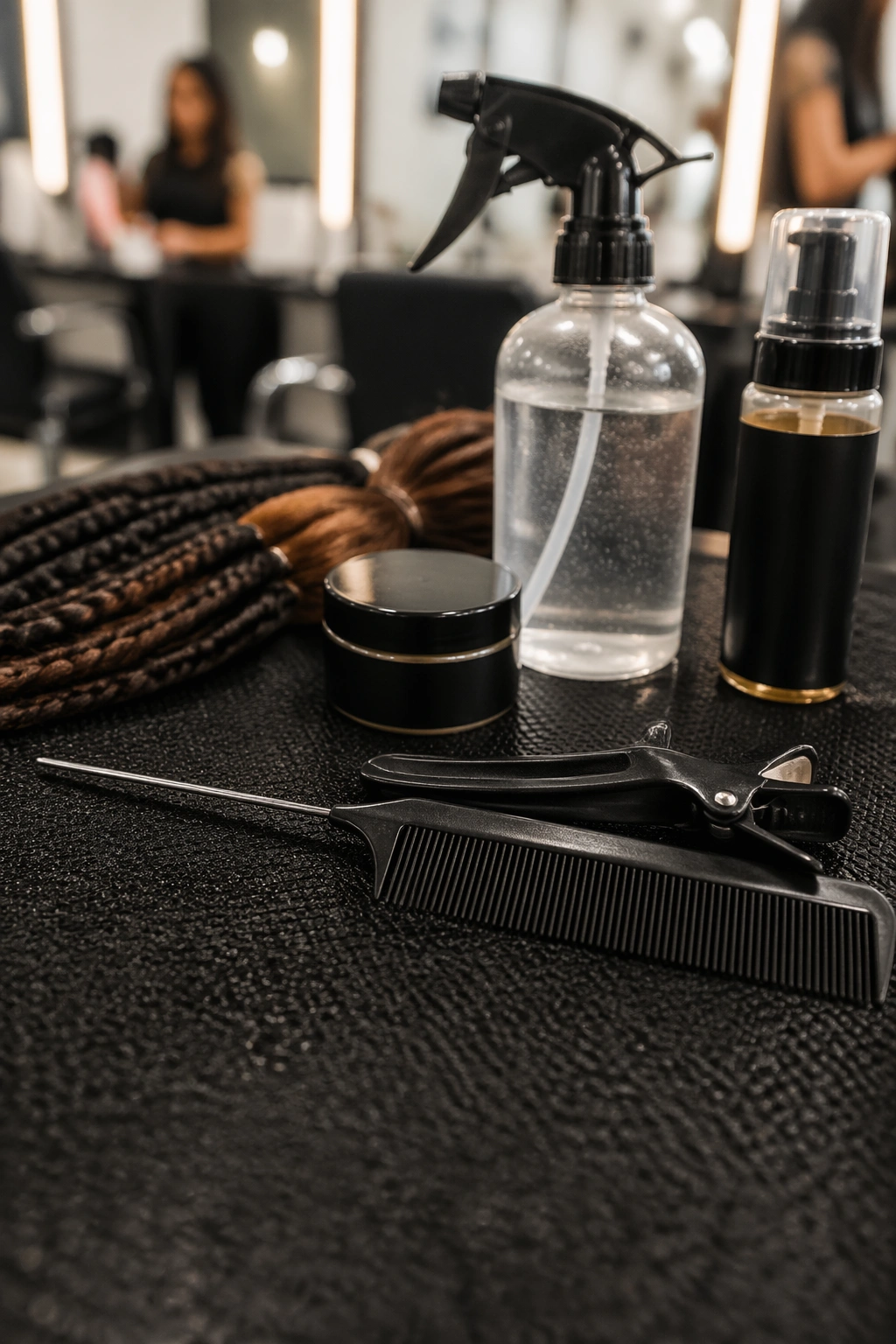
A metal-tip rat-tail comb for parts. Plastic tips bend on dense hair and leave wavy parting lines.
Duckbill clips, not jaw clips. Duckbills grip small sections without creating creases.
A small spray bottle with water and a splash of aloe vera juice for managing frizz and gaining grip during the install.
Edge control gel — the kind that dries hard enough to hold but flakes less than stiffer formulas.
Hair extensions if you want length. Kanekalon is standard; pre-stretched kanekalon saves time by reducing the tangle factor.
Tip: If your braider doesn’t have pre-stretched kanekalon, bring your own. It cuts install time by 30-60 minutes.
Technique Differences: Feed-In vs. Traditional
Feed-in cornrows add small amounts of extension hair at the start of the braid and gradually incorporate more as the braid progresses. The base of the braid looks natural — you can’t see where your hair ends and extension begins.
Traditional cornrows start with all the extension hair attached at the root. This creates a fuller-looking base but can be bulkier and more visible at the hairline.
For small cornrows, feed-in is almost always preferable. The smaller braid size makes the feed-in transition nearly invisible, and the gentler start at the root reduces tension on thin front hairlines.
If your braider defaults to traditional cornrow technique, specifically ask for feed-in. It’s a more refined technique that’s worth learning (for the braider) and worth specifying (for you).
1. Small Straight-Back Cornrows
The classic. Maybe 40-50 small cornrows running from hairline to nape in parallel lines. No design work, no curves, no accents — just clean lines and precise parts.
Why It Works
- Works for every occasion from work to weddings
- Takes 4 hours for a skilled braider
- Lasts a full 5 weeks with proper care
- Lays flat against the head without bulk
Tip: Ask for parts that are slightly thicker at the temples than at the back for a subtle contouring effect.
2. Small Cornrows With Box Braid Ends
Cornrows from the hairline to the crown, then the braids release into loose box braids down the back. The transition happens at the crown — a single smooth release point.
This combines the tight scalp look of cornrows with the swing of box braids. It gives you something to run your fingers through, which most all-cornrow styles don’t.
The transition point matters. A skilled braider makes it invisible; a less skilled braider creates a bumpy ridge where the cornrow ends and the loose braid begins. Ask to see photos of the braider’s transition work before committing.
This style reads elegant. It photographs well, it moves naturally, and it’s comfortable for sleep because the loose braids drape rather than poke.
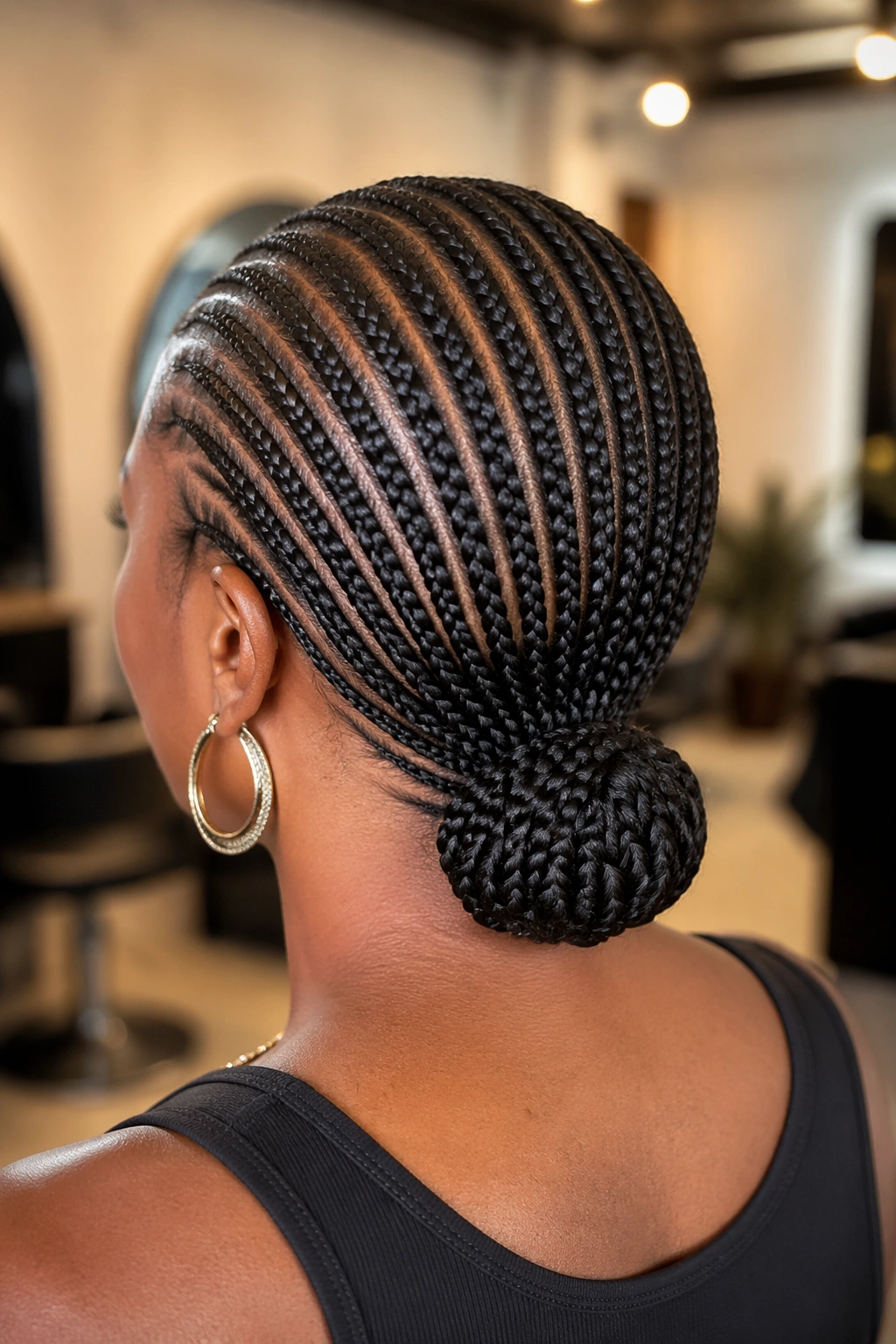
3. Small Cornrows Into a Low Bun
Every cornrow feeds into a low bun at the nape. The bun can be neat (braids wrapped tightly) or textured (braids loosely gathered and pinned).
Low buns work for offices, formal events, and everyday wear alike. They’re the single most versatile cornrow finishing option.
Size the bun to your face. Smaller buns for delicate features, larger buns for stronger features. A mismatched bun throws off facial proportions.
This is one of the lower-maintenance small cornrow styles because the bun protects the ends and reduces friction with clothing.
4. Small Cornrows With Front Design Detail
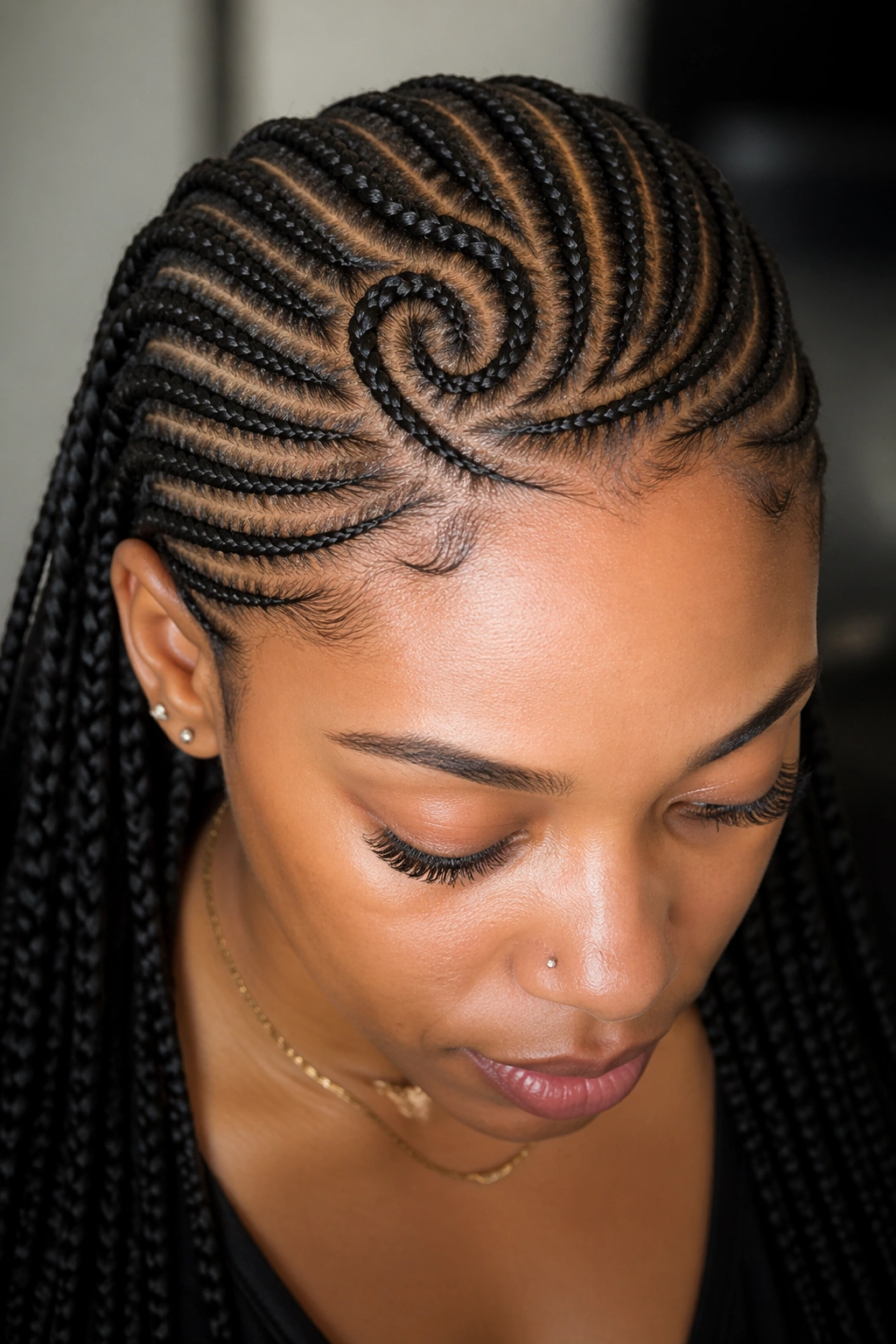
Simple small cornrows running back, but the front section — covering roughly 3 inches behind the hairline — features a freehand design. The design could be a small spiral, geometric shape, or flowing curves.
The design is the focal point. The rest of the braids support it.
Placement matters. A design too close to the hairline competes with the face. A design too far back disappears under bangs or hats. The sweet spot is about 2 inches behind the hairline.
Tip: Ask for a design with an odd number of elements (3 swirls, 5 points of a star) rather than even. Odd numbers look more organic and less engineered.
5. Small Cornrow Mohawk
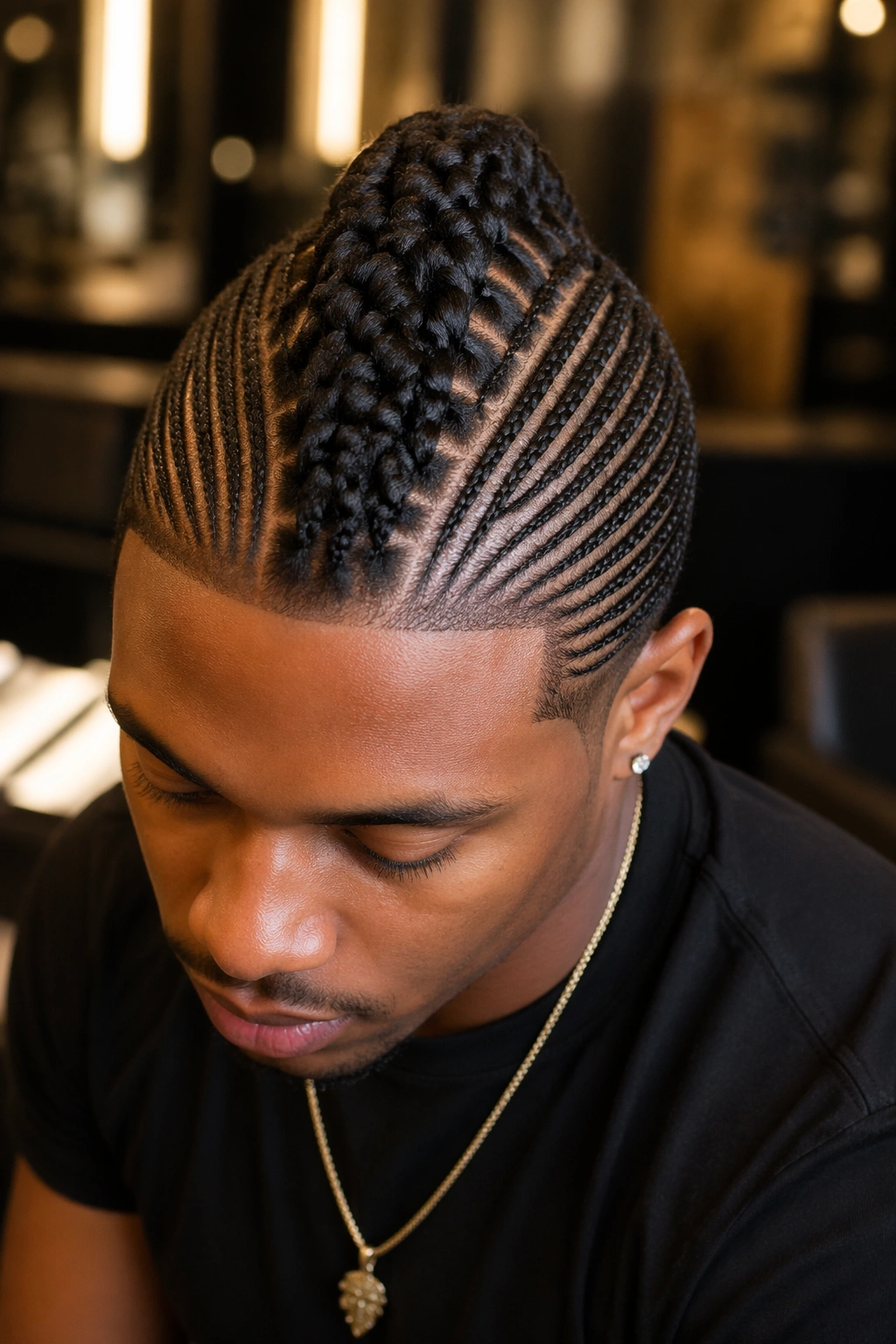
Two dense panels of small cornrows on the sides, with a raised mohawk of longer or thicker cornrows running down the center. The mohawk can be all cornrows or can transition to box braids at the back.
This is a bolder small cornrow option. It’s not for a boardroom. It’s for women who want edge without going fully shaved.
Scale matters. A mohawk that’s too narrow looks accidental. Too wide and it loses the mohawk identity. About 2-3 inches wide at the crown is the right proportion for most heads.
The side panels look cleanest when the braids go slightly diagonal rather than straight down. Diagonal side braids frame the mohawk better.
6. Side-Swept Small Cornrows
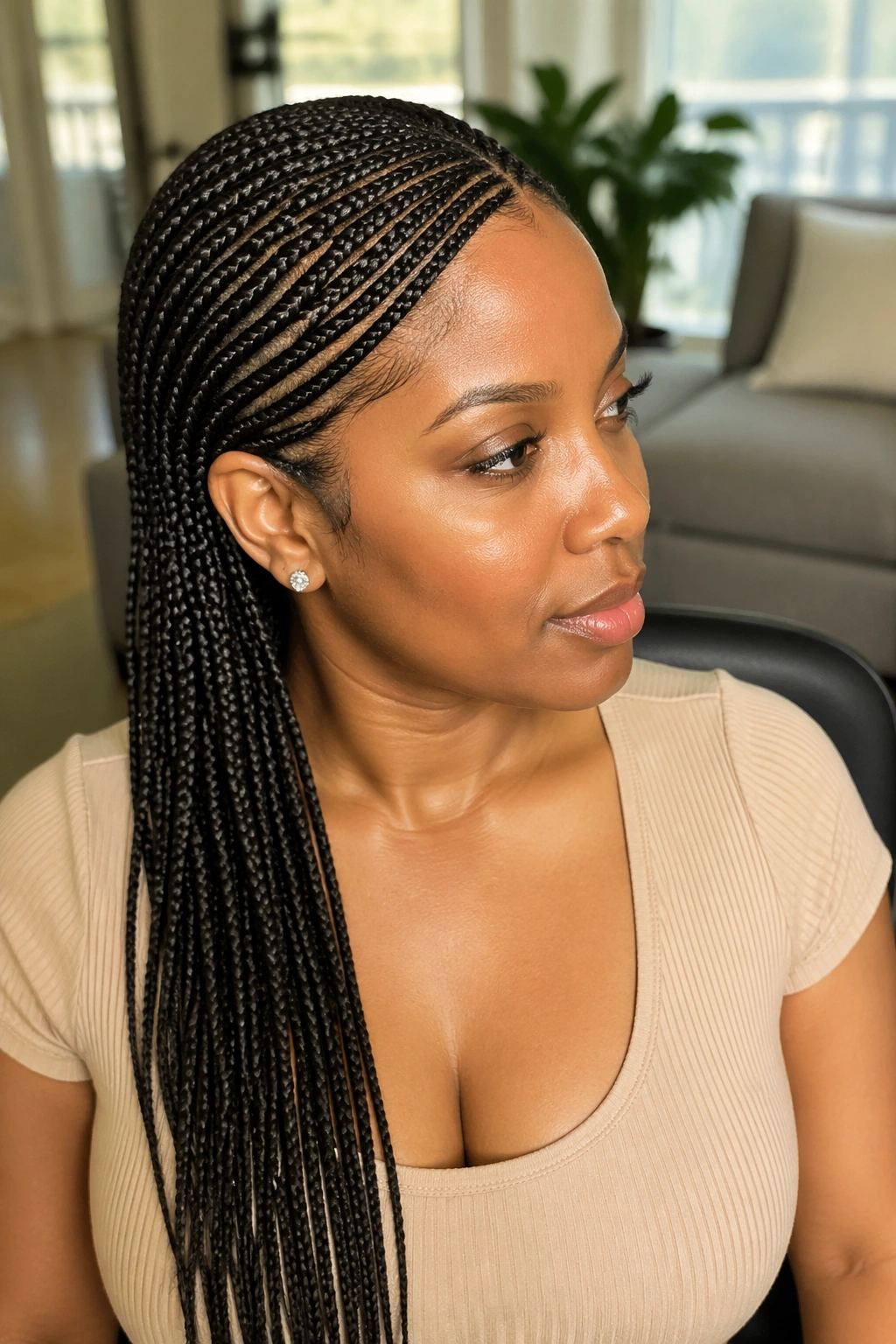
All cornrows sweep diagonally from one side of the hairline to the opposite shoulder. No straight-backs. Everything is on an angle.
Diagonal braids flatter faces by creating implied length and movement. They’re especially good for round or square face shapes.
How to Style It
- Pick the direction based on your natural part preference
- Ask for tighter tension at the starting side (more lift) and looser tension at the gather side (more drape)
- Finish with 2-3 beads on select ends for emphasis
- Install takes 4-5 hours
Tip: Side-swept styles highlight the ears on the gathering side. Consider statement earrings on that side only.
7. Small Cornrows With Zig-Zag Partings
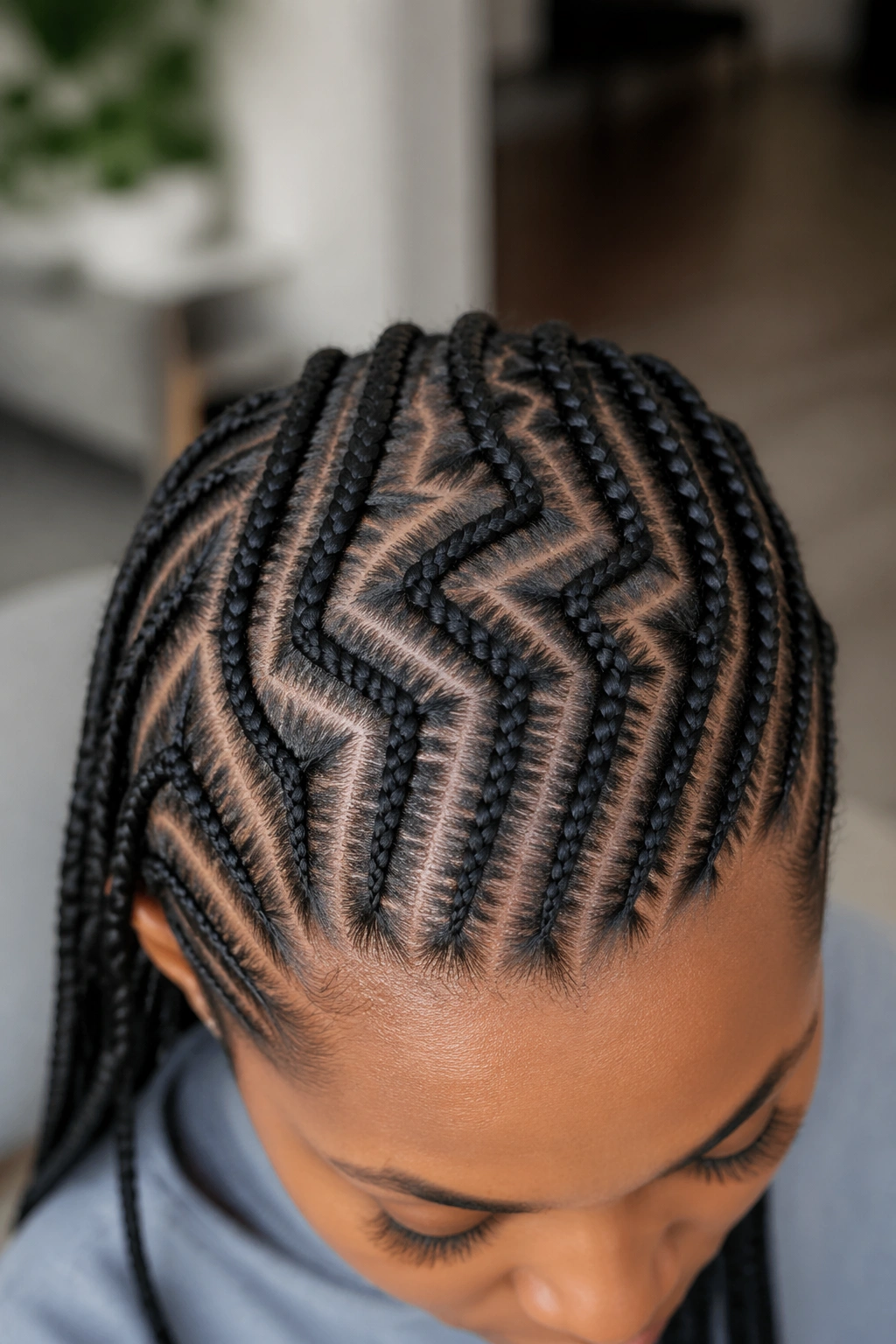
Standard small cornrows, but the parts between them zig-zag rather than running straight. The zig-zag effect creates a jagged visual rhythm across the scalp.
This is a subtle way to upgrade basic straight-back cornrows without committing to intricate freehand design work. The zig-zag takes minimal extra time — maybe 20 minutes — and transforms the overall look.
Best on hair that’s been blow-dried straight before braiding. Shrunken natural hair makes the zig-zag parts harder to see clearly.
Tip: Match the zig-zag frequency to the braid thickness. Small braids handle tighter zig-zags (shorter peaks); thicker braids need longer zig-zag peaks.
8. Small Cornrows With Color-Pop Extensions
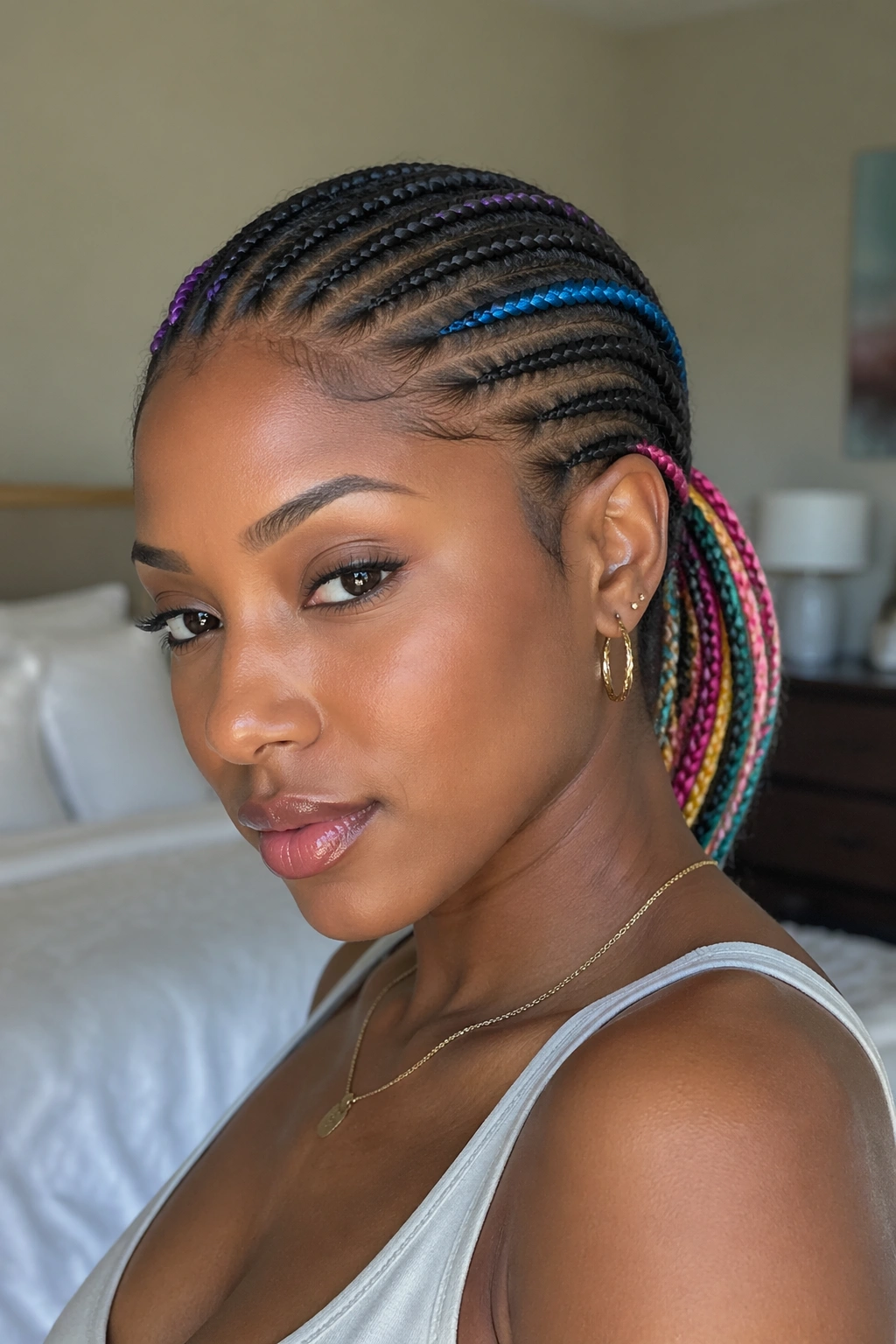
Mostly natural-color small cornrows, but 5-8 scattered braids use a pop of color — maybe deep red, blue, or violet. The color braids break up the solid field without overwhelming it.
This is the grown-up version of colored hair. Instead of full-head dye, you get selective color that reads as intentional accent rather than bold statement.
Placement: distribute the color braids asymmetrically. Two on the left temple, three on the right back, one at the nape. Symmetric placement reads costume-y; asymmetric placement reads styled.
Best color choices complement your skin undertone. Cool undertones: burgundy, blue, cool pink. Warm undertones: copper, gold, warm red.
9. Small Cornrows With Cowrie Shell Accents
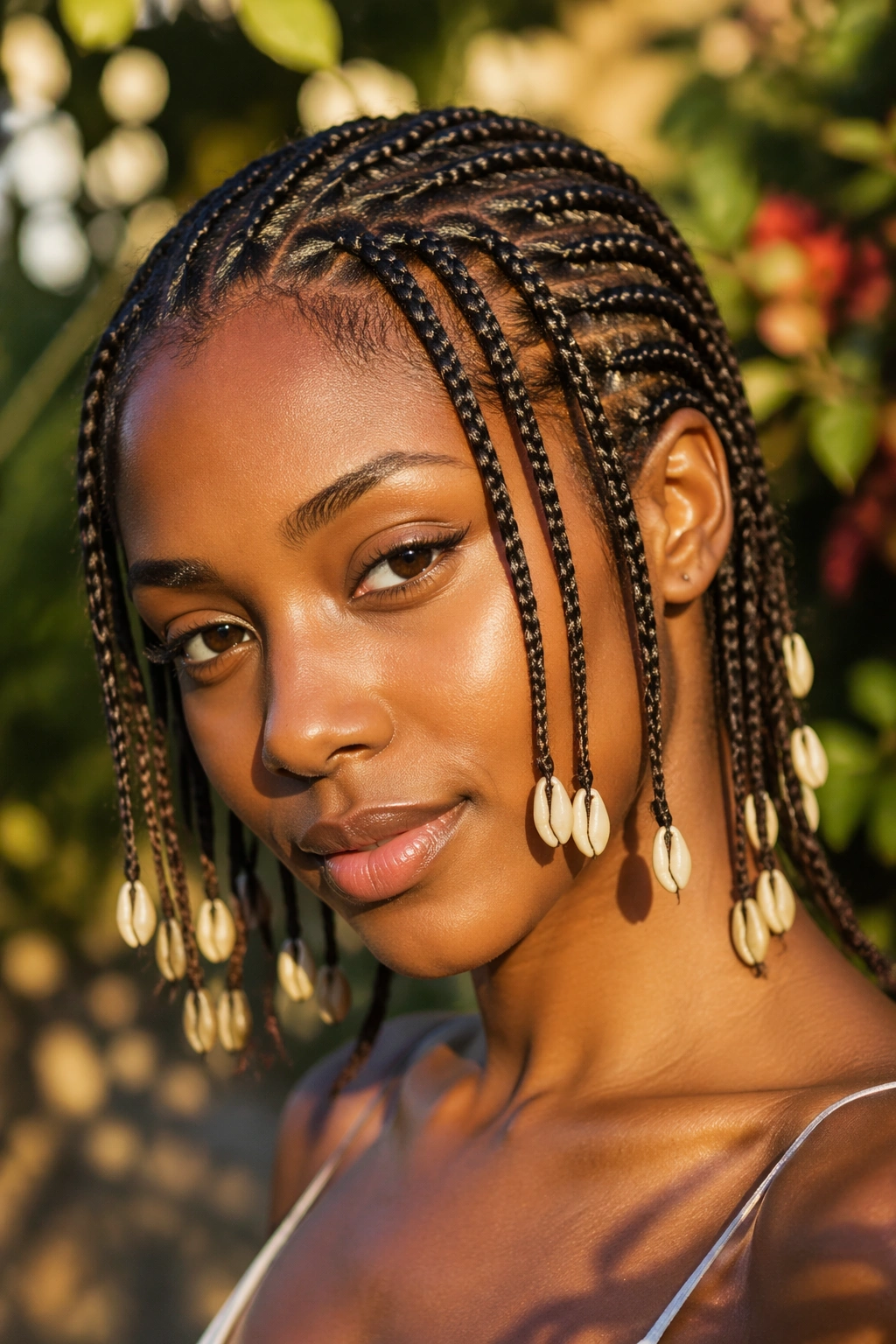
Small cornrows, clean and simple, with cowrie shells at 8-12 braid tips. The shells are the entire ornament.
Cowrie shells carry significant cultural weight in West African adornment, so wear them with awareness of that tradition. They’re not jewelry in the decorative sense — they’re symbols.
Real cowrie shells run $2-4 each; resin replicas are a tenth of that and look similar at a distance.
Spacing the shells matters. Every third or fourth braid gets a shell. Every braid reads overcrowded.
10. Small Cornrows With Pearl Accents
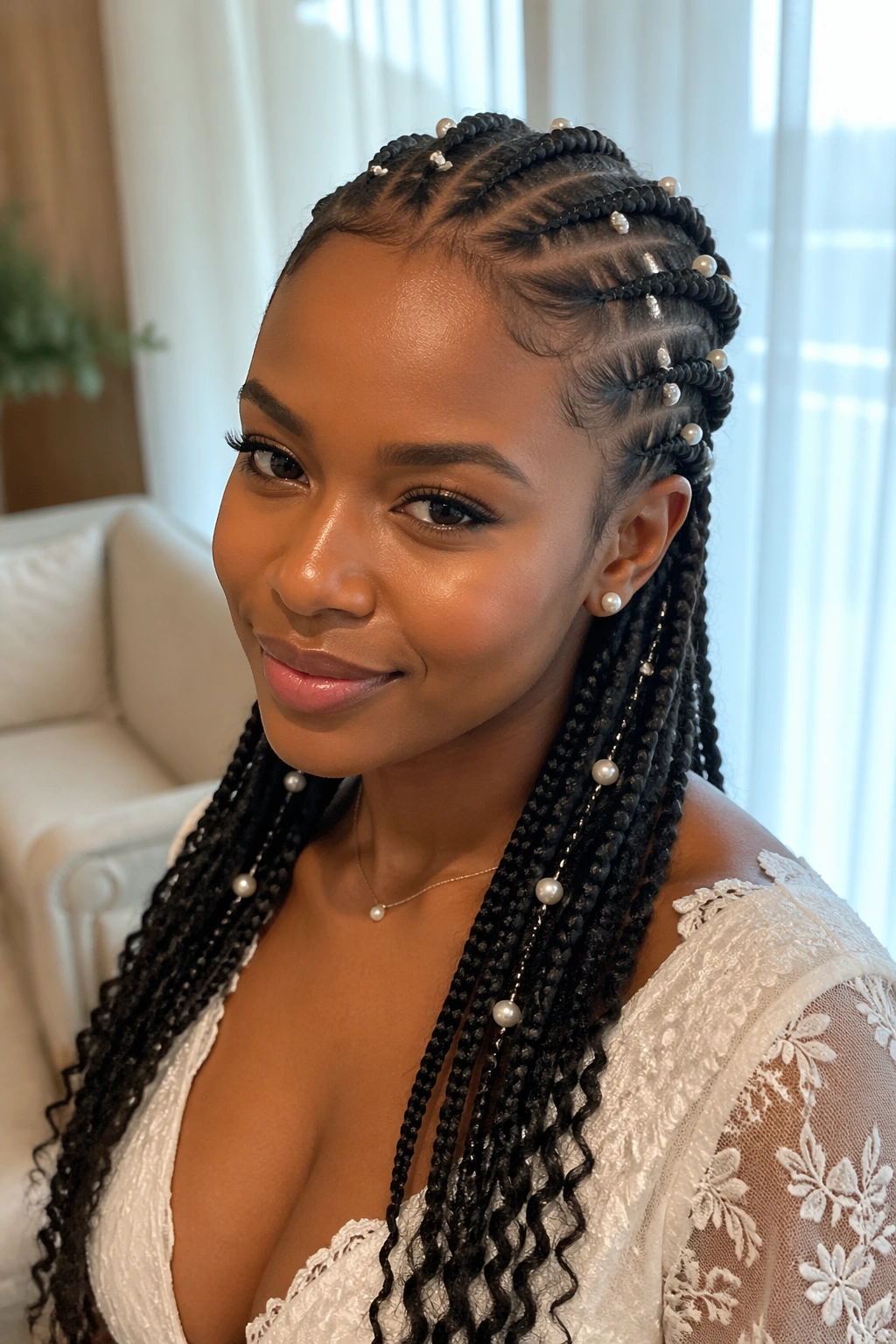
Small cornrows with 3-5 freshwater pearls scattered on select braids. Not at the tips — along the length of the braids, at varying heights.
The effect is soft and bridal. It reads feminine, elegant, and deliberate.
Pearl attachment: small thread loops around the braid, threaded through the pearl, secured with a cuff behind the pearl. A good braider can install 30 pearls in about 15 minutes.
This pairs with a wedding dress, bridesmaid dress, or any event where “polished” is the mood. Not for gym days.
11. Small Cornrows With High Ponytail
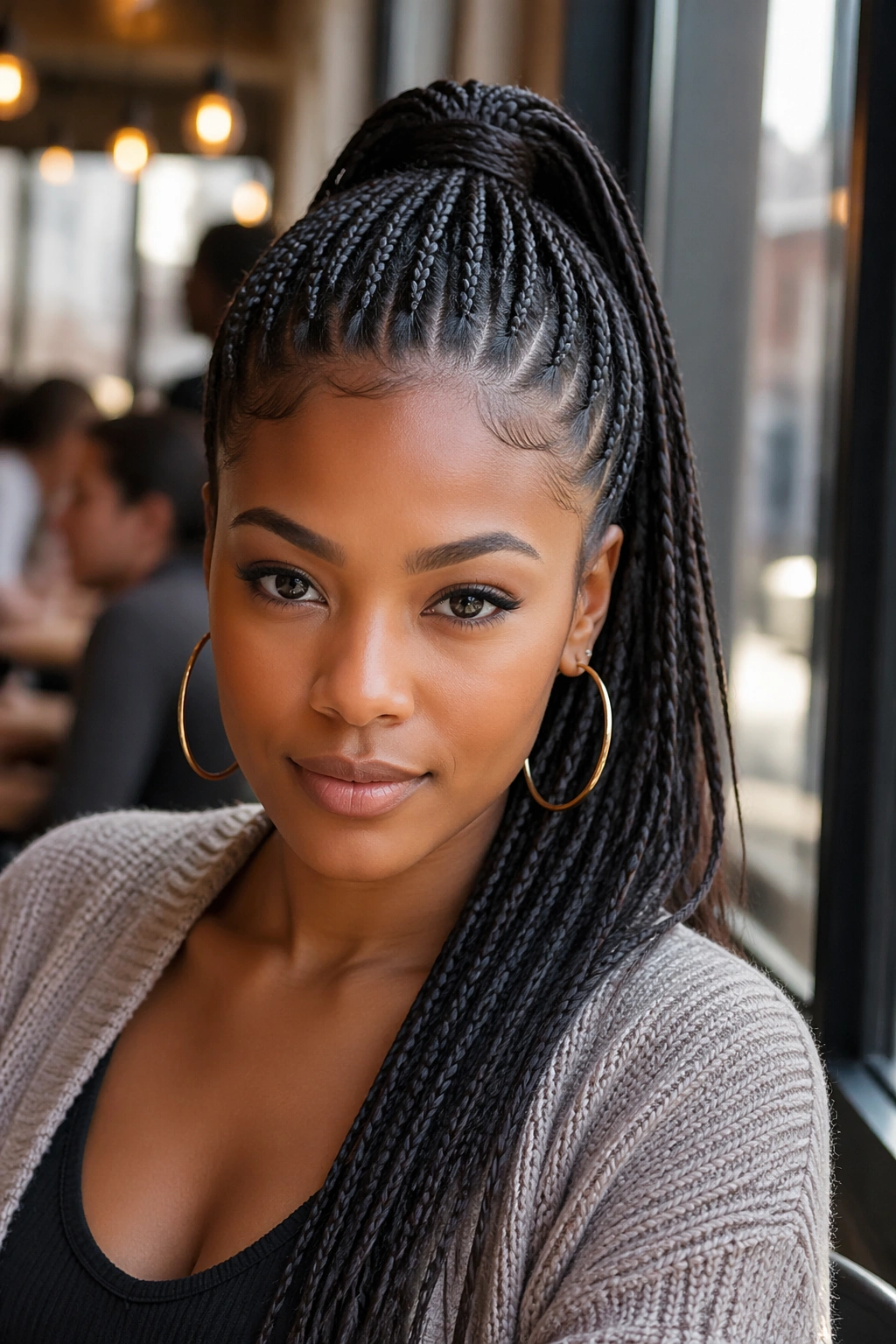
All cornrows gather into a high ponytail at the crown — sometimes sleek, sometimes piled into a big braid cluster at the top.
High ponytails lift the face. They pull cheekbones up, elongate the neck, and make the whole face read more angular.
The ponytail base needs protection. A small amount of hair gel around the gather point keeps stray ends from fuzzing.
Maintenance Notes
- The scalp at the base of a high ponytail takes maximum tension
- Don’t sleep with the ponytail up — let it down or redo as a low ponytail overnight
- Loosen the gather point every 3-4 days to relieve tension
Tip: Add a satin ribbon around the ponytail base for an elevated finish at minimal effort.
12. Small Cornrows Into Box Braids With Curls at the Ends
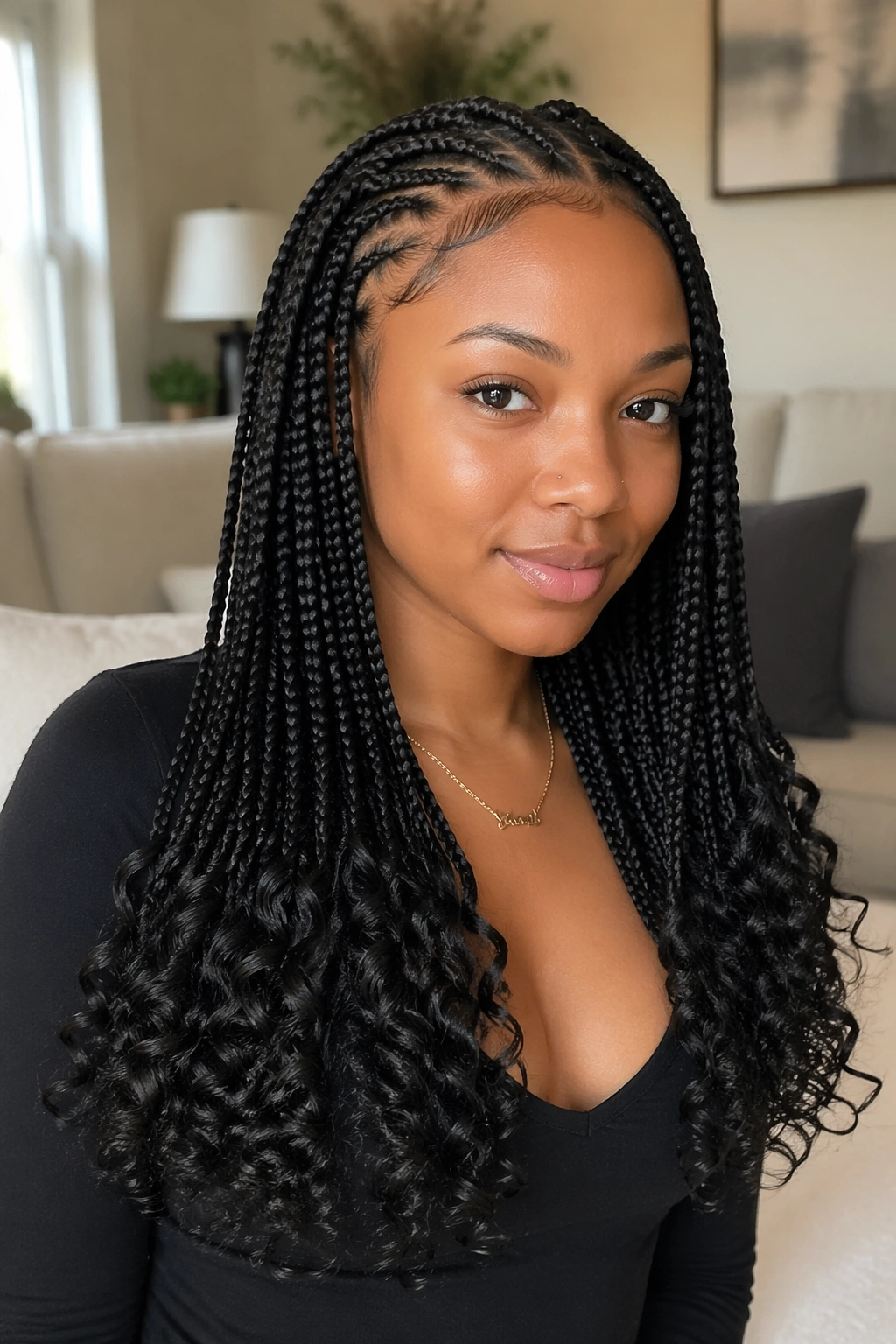
Cornrows transition to box braids, and the box braid tips are curled with hot water or flexi-rods for defined waves or curls.
The curl gives you a playful, soft finish to what could otherwise be a very structured style. The cornrow-to-box-braid-to-curl progression moves from graphic to textured.
Curl definition holds better on pre-stretched kanekalon than on regular kanekalon. The pre-stretched version retains shape through hot water dipping.
Curls will loosen over 2-3 weeks. Refresh with a quick hot water dip and flexi-rod set overnight.
13. Small Cornrows With a Chunky Braid Down the Middle
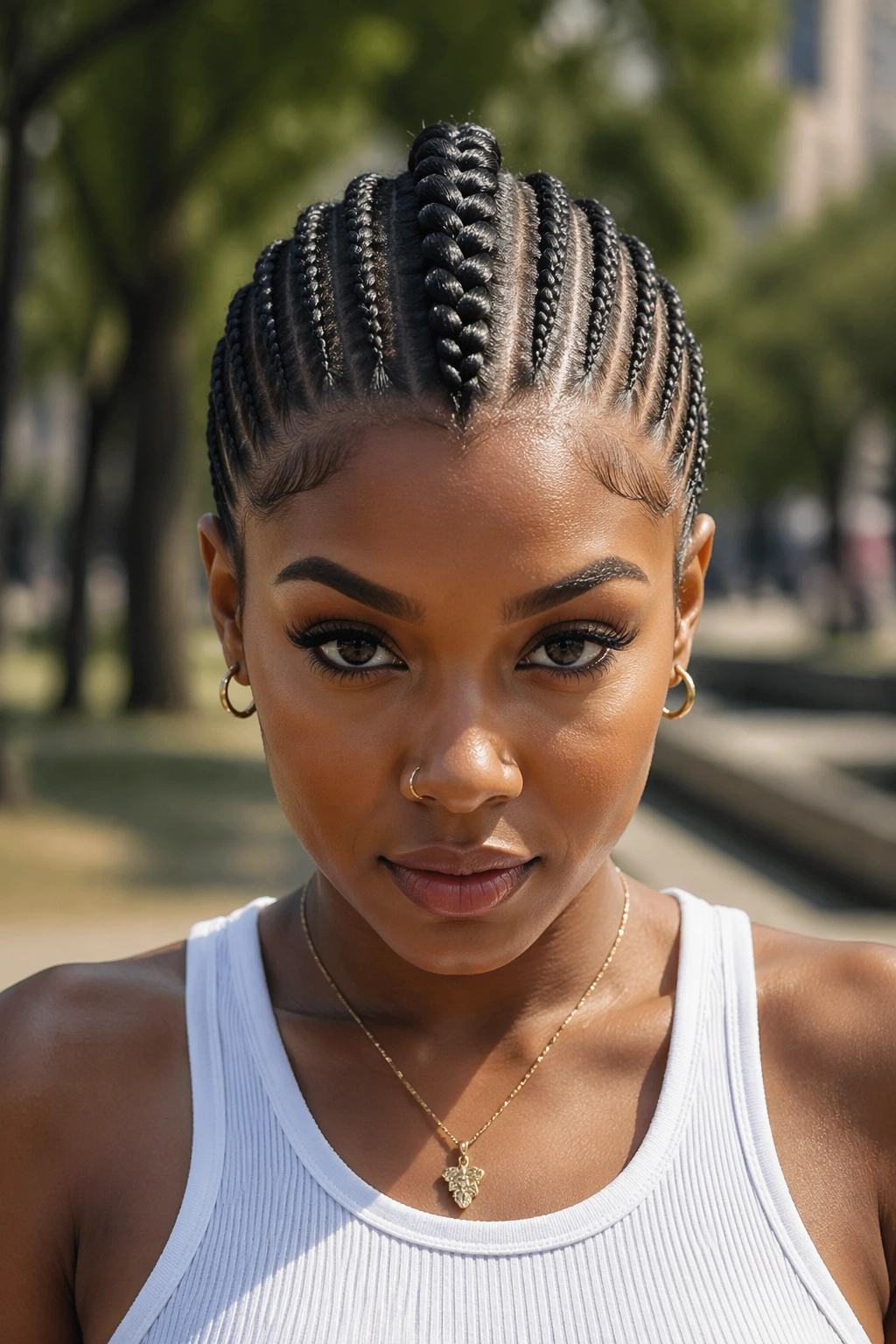
Small cornrows across the whole head, except for a single thick “spine” braid running down the center from crown to nape. The thick braid is 2-3 times the width of the surrounding small braids.
This is about contrast. The small braids provide density; the chunky braid provides focus.
The spine braid can be kept simple or accented with beads, jewelry, or wraps.
Works well on longer hair — at least shoulder length — because the chunky braid needs room to visually stretch down.
14. Small Cornrows With Beaded Ends on Front Braids Only
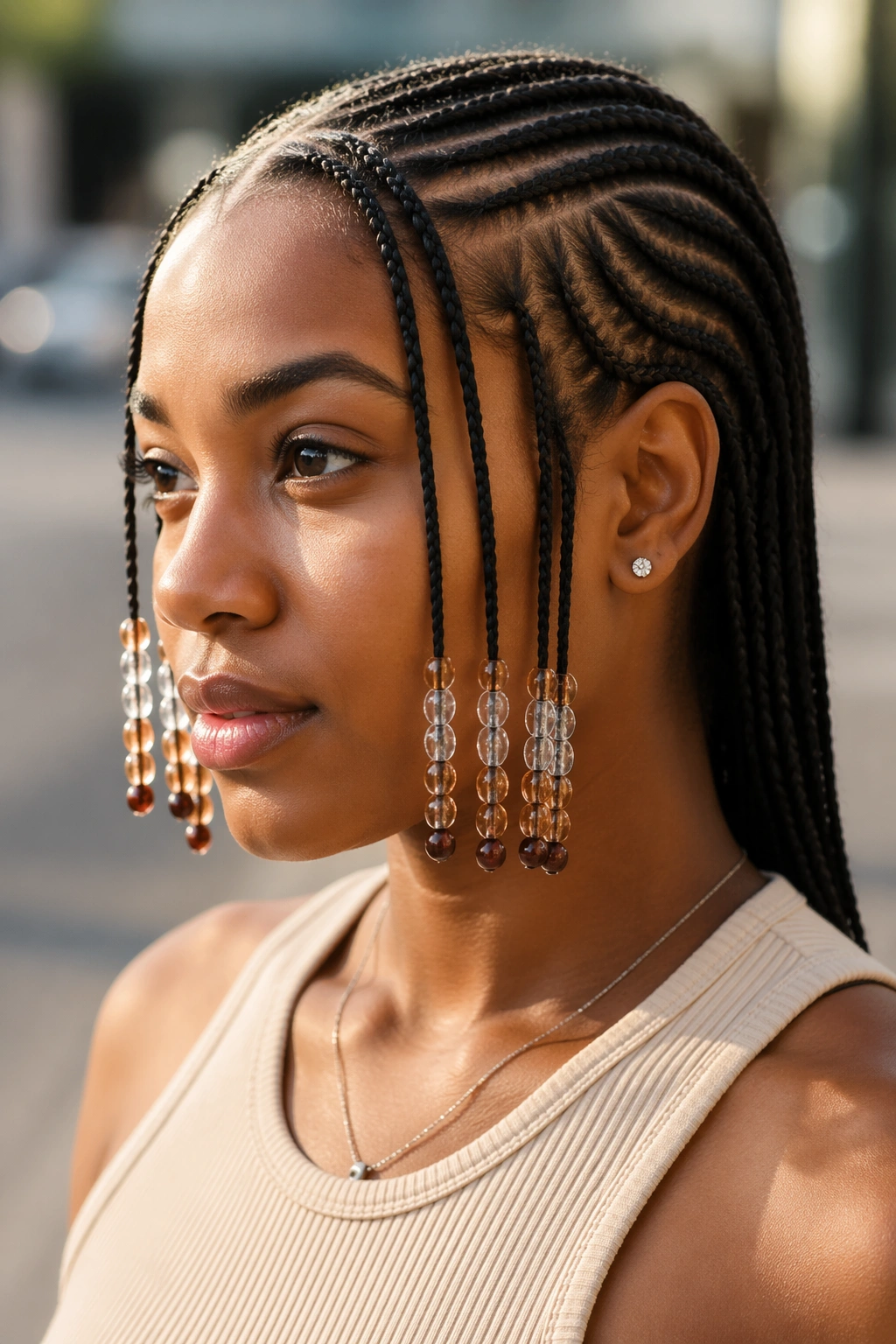
Every braid is small and clean, but only the front 8-12 braids (the ones that frame the face) have beaded ends. The back braids hang unadorned.
Concentrating the beads at the front puts the embellishment where you’ll see it and where others will see it — around your face, not behind your head.
This is a thrifty, smart approach to beaded cornrows. You spend less on beads, you install faster, and the visual impact stays high.
Who This Is For
Women who want beaded cornrow style without the weight or commitment of a fully beaded head.
Tip: Keep the beaded front braids slightly shorter than the back braids. The height contrast emphasizes the bead accent.
15. Small Cornrows With Side Part
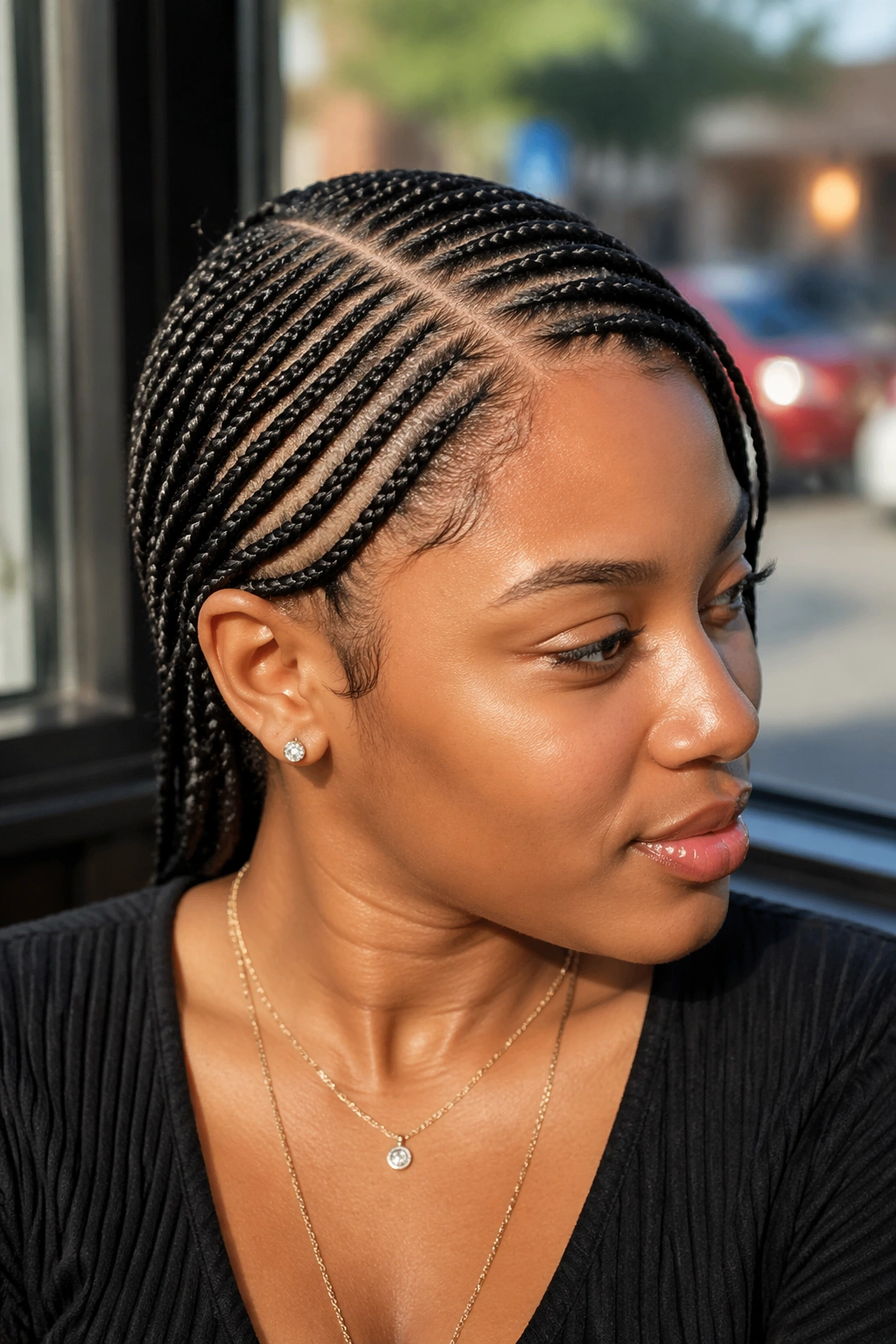
A clean, deep side part — maybe 3 inches off the midline — with small cornrows running back from the part. No design work. No zig-zags. Just a strong part and clean braids.
Side parts slim the face. They create implied movement and asymmetry that pure center-parts don’t.
Choose the side based on how your hair naturally falls. Most people have one side that parts more cleanly. Work with your hair, not against it.
16. Small Cornrows With Curly Tips
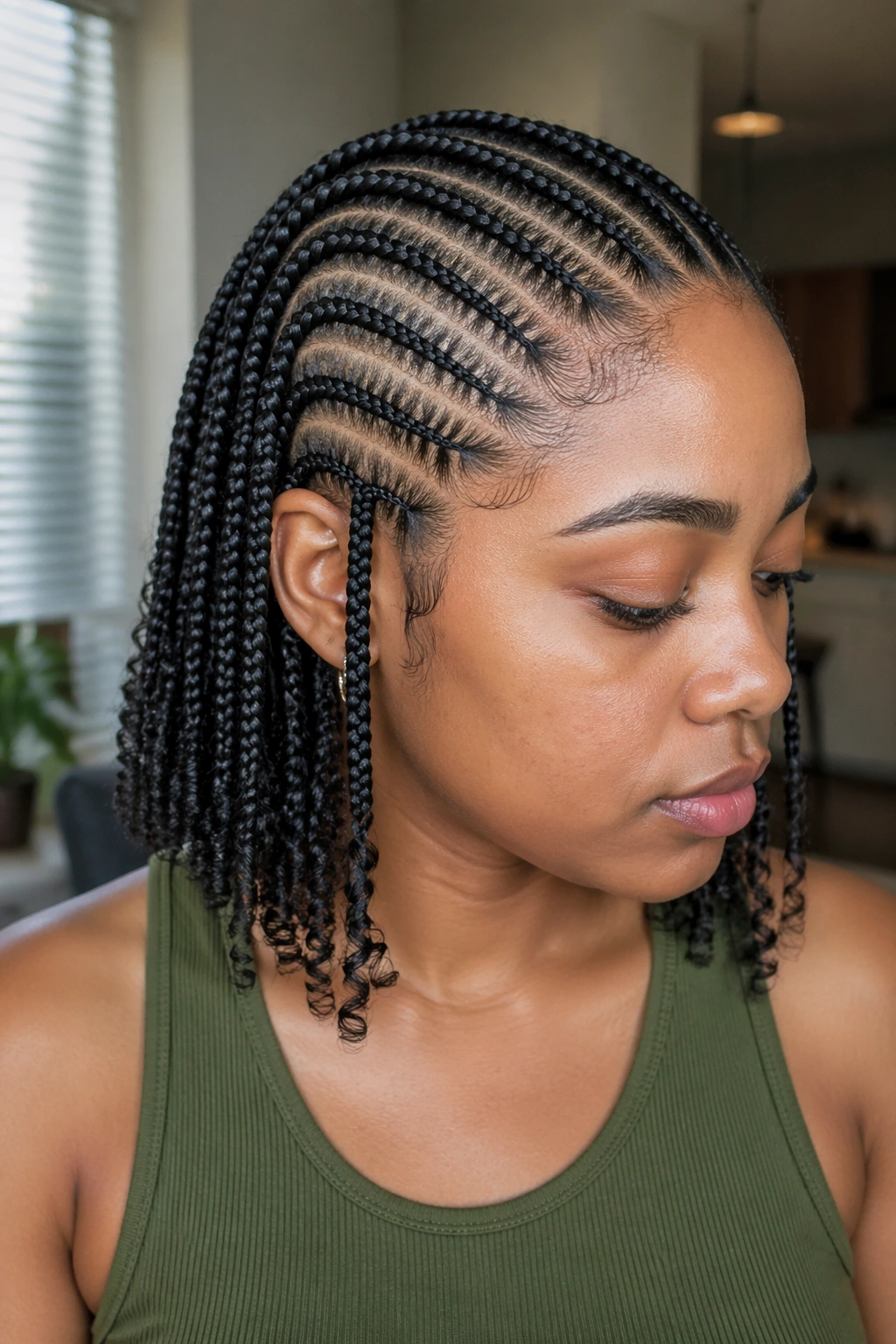
Cornrows stop about two inches before the ends of the braid, and the last two inches are left unbraided and styled into curls or waves with hot water.
The curl tips peek out below the cornrow body, creating a textural finish that reads soft rather than rigid.
This works best on natural hair without extensions — the curl pattern of your natural hair comes through authentically. With extensions, the curl tips can look obviously synthetic.
17. Small Cornrows With Scalp-Visible Design Cuts
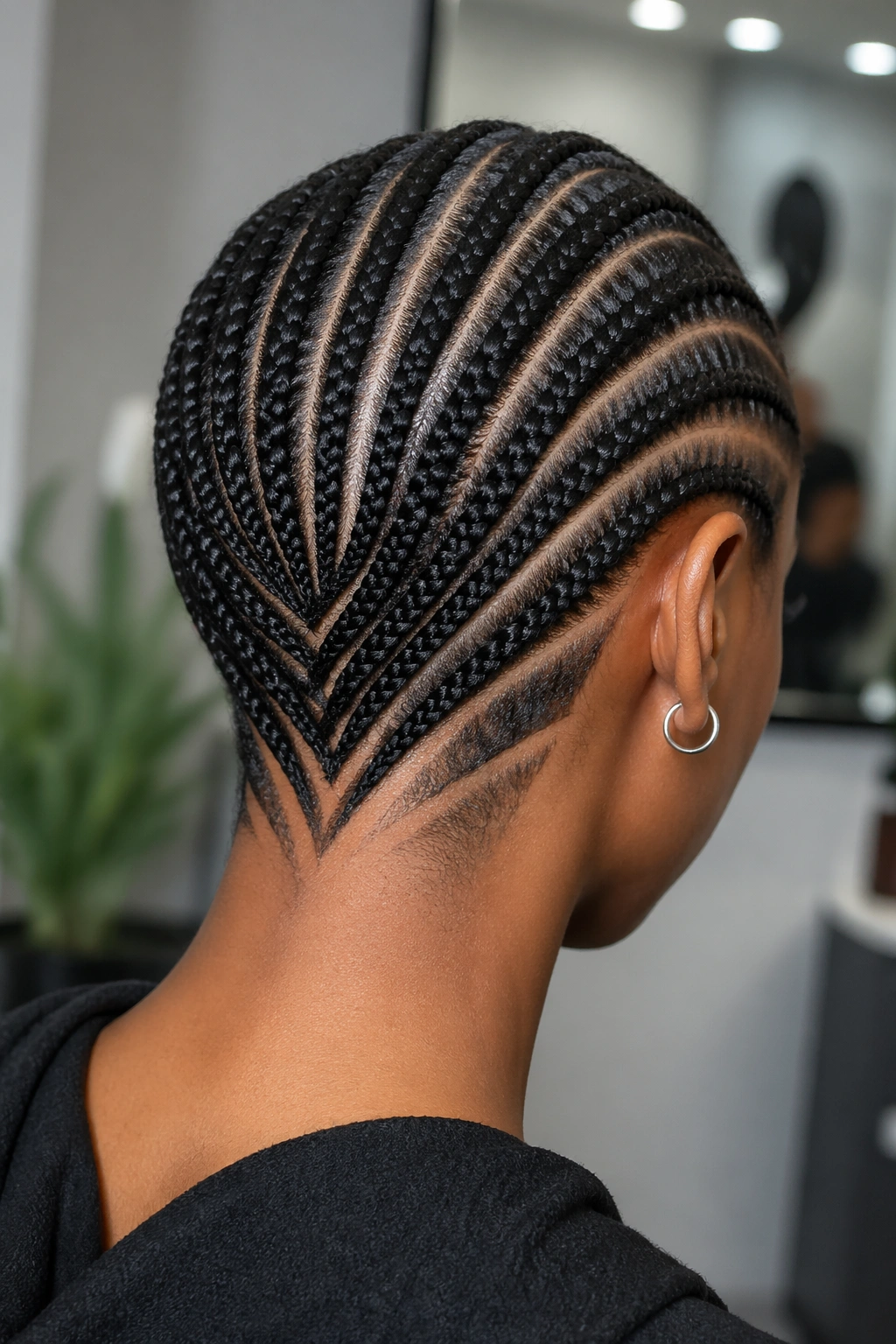
Instead of a full-coverage braided head, selected sections of scalp are intentionally left un-braided to form design cuts. A V-shape cut at the nape, or diagonal gaps running along the sides.
The exposed scalp becomes part of the design. This is bold, modern, and architectural.
Edge maintenance matters doubly here. Every exposed scalp area needs clean, sharp edges — no fly-aways, no fuzzy perimeter. Plan for weekly edge retouches.
18. Small Cornrows With Two-Tone Color Blocking
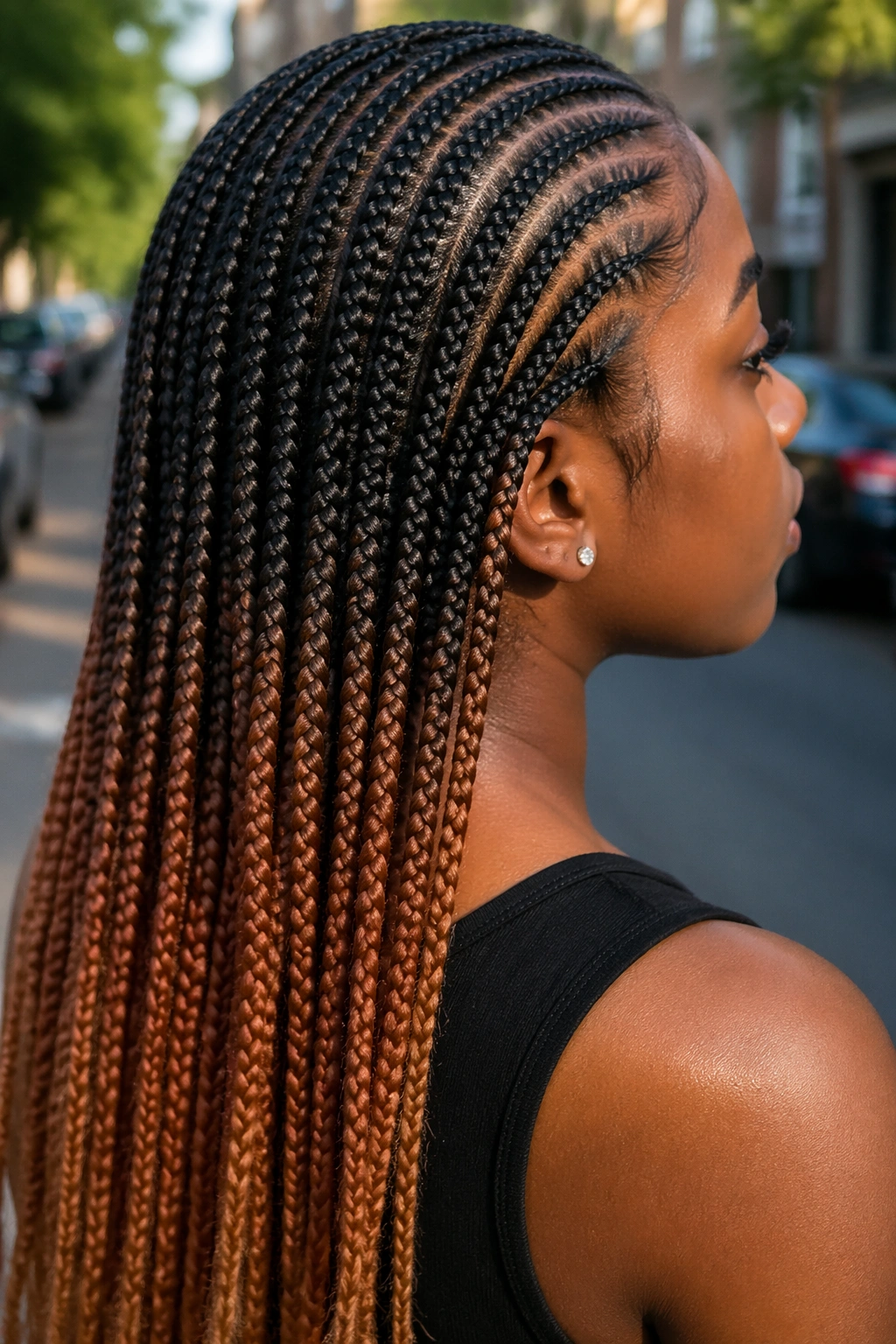
Small cornrows in natural dark hair on top, transitioning to a contrasting color — like honey blonde or burgundy — about halfway down the braid.
The color transition creates a gradient effect across the whole head. From a distance, the style reads like hair tips are caught in light.
The transition point matters. Too high (near the crown) looks aggressive. Too low (near the ends) barely shows. The sweet spot is about mid-length.
Tip: Warm colors (honey, copper, auburn) flatter warmer skin undertones. Cool colors (platinum, ash brown, silver) suit cooler undertones. The color near your face reflects onto your skin.
19. Small Cornrows With Bangs
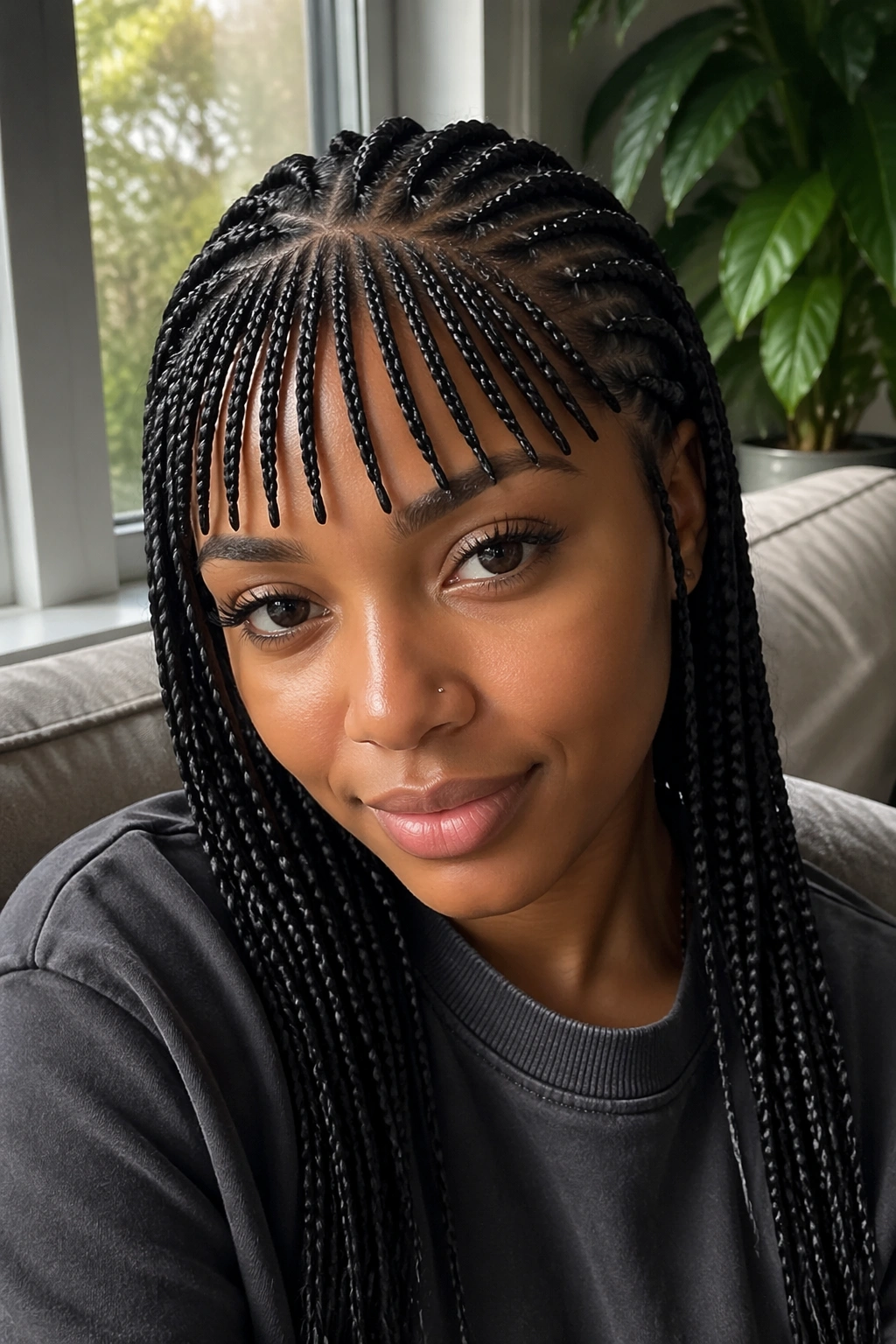
Short cornrows or hair left unbraided at the front hairline create fringe-style bangs, with longer small cornrows running back.
Bangs frame the face and can soften strong foreheads or angular features. But they commit you to maintaining that fringe — frizz at the bangs happens fast.
Bang length: brow-length or slightly below. Cheek-length bangs get caught in everything.
Wear bangs with cornrows only if you’re willing to mist and re-shape the fringe daily. Otherwise, skip them and pick a style with a clean hairline.
20. Small Cornrows With Pipe Cleaner Curls at Ends
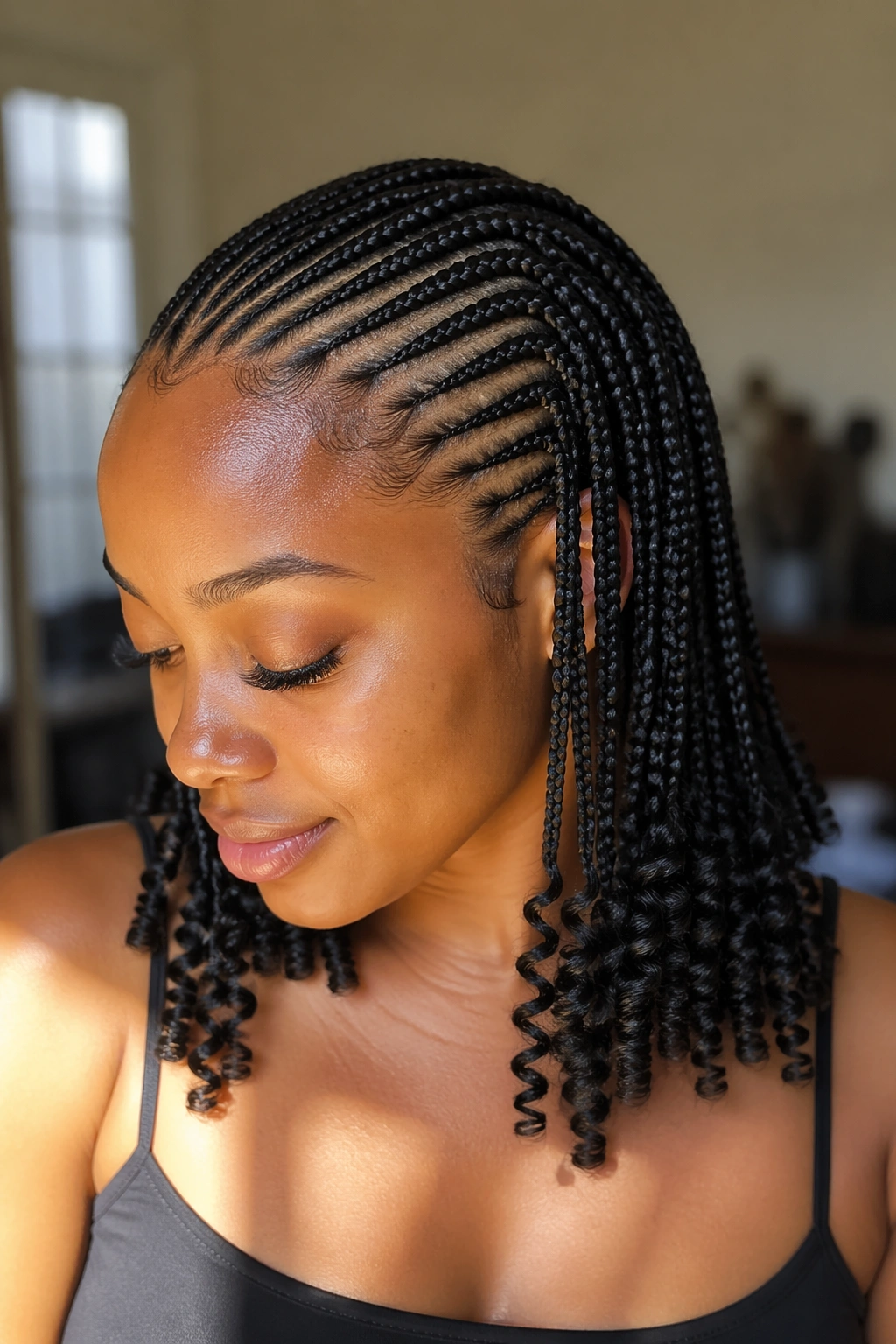
After cornrows are installed, the ends are wrapped around pipe cleaners and dipped in hot water to set tight curls. The pipe cleaner size determines curl size — thinner pipe cleaners for smaller curls.
This creates the most defined curl finish of any cornrow style. The curls look almost like small springs.
Best on kanekalon extensions. Natural hair without extensions doesn’t curl this tightly with the pipe cleaner method.
Curls last about 4 weeks with overnight pineapple wrapping and satin-bonnet sleeping.
21. Small Cornrows Pulled Into a Pineapple
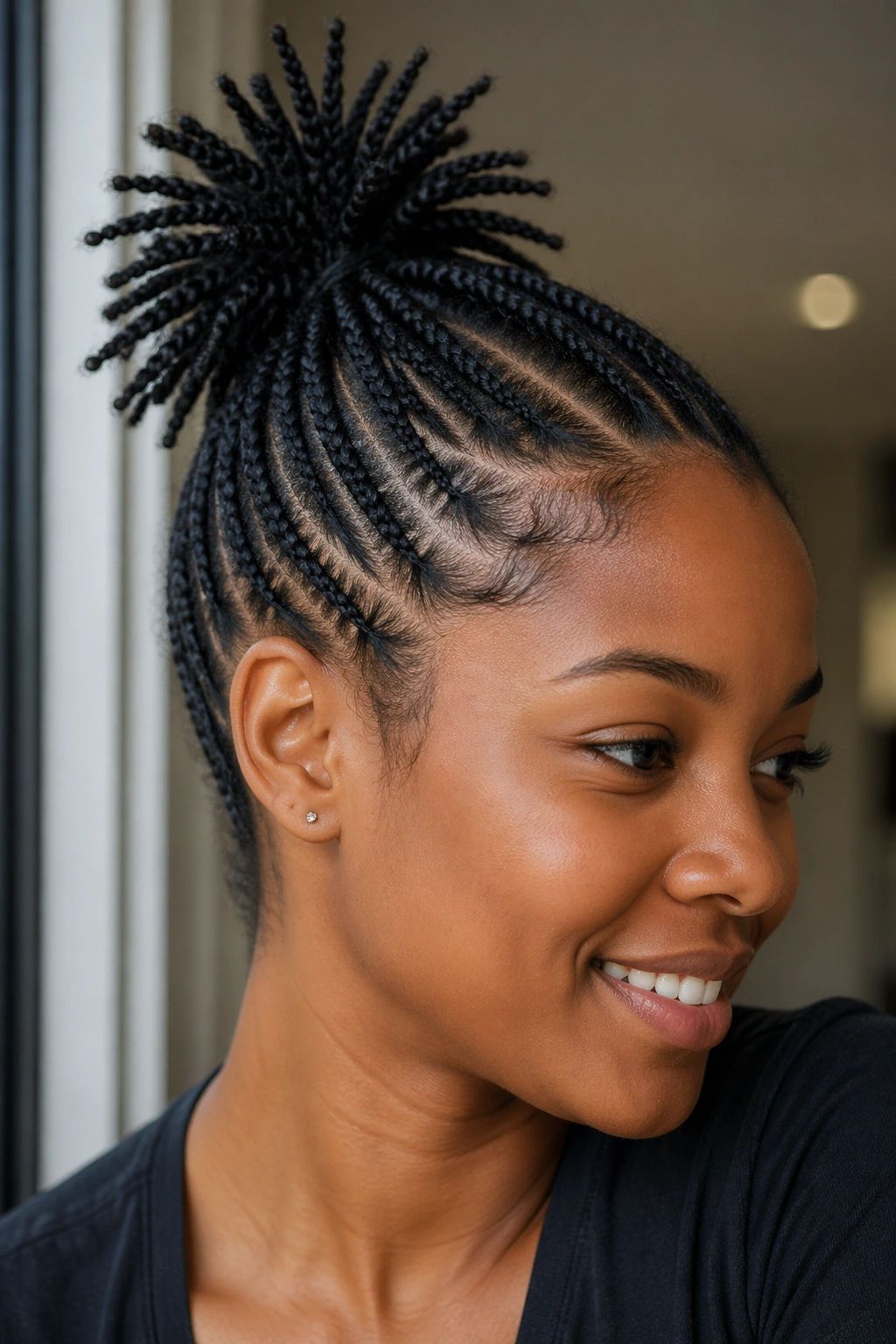
A casual, lived-in finish: all cornrows gathered loosely at the top of the head and secured with a scrunchie or ribbon, letting the braid ends fall forward and to the sides like pineapple leaves.
This is for weekends, lazy days, and styles between more formal looks.
Pineapples work best when the cornrows have had time to loosen slightly — around week 2 of wear. Fresh tight cornrows don’t pineapple well because they don’t have enough give.
Tip: A silk scrunchie beats a hair tie. Elastic hair ties grip the braids and can cause breakage over time.
22. Small Cornrows With a Twist-Out Back
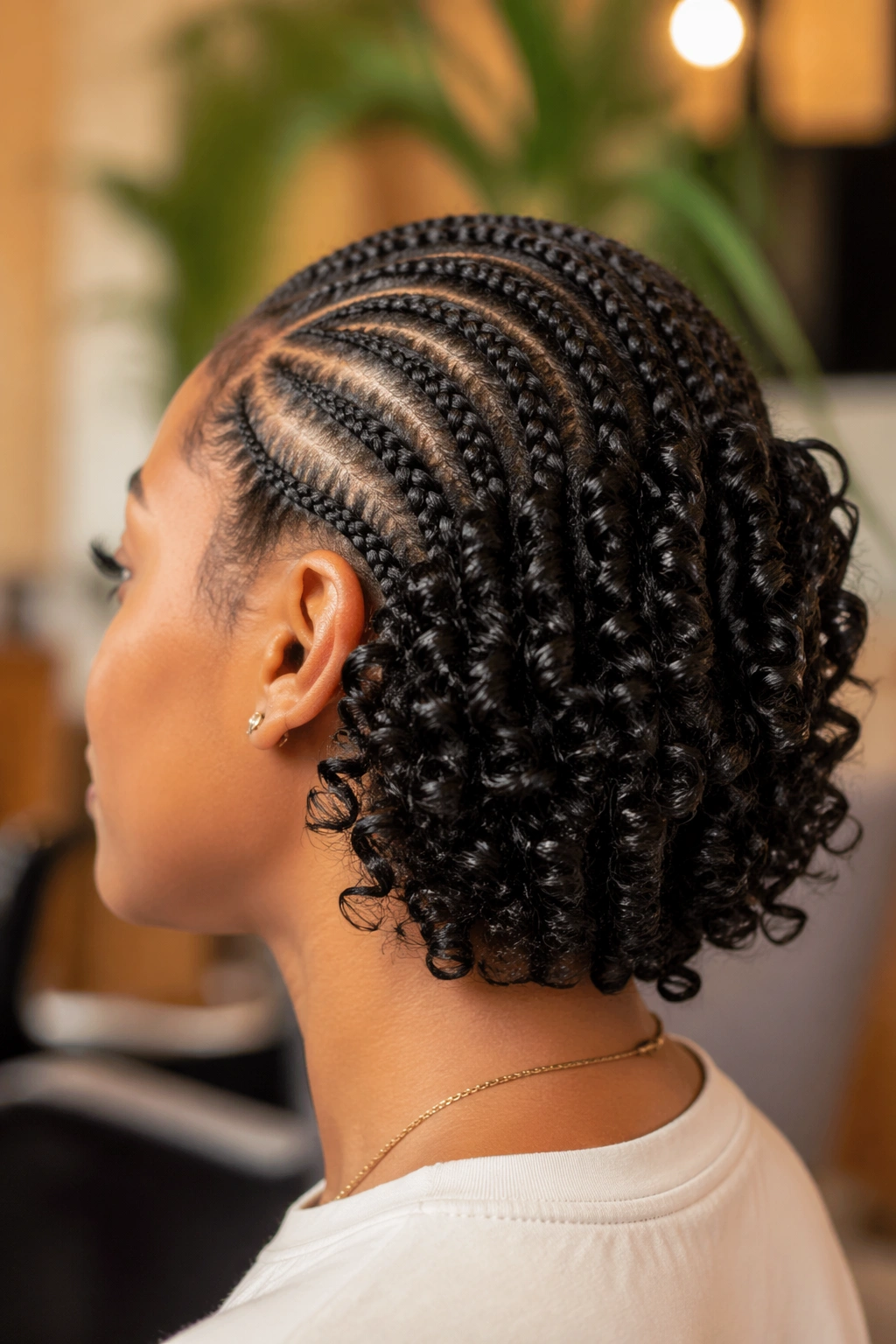
Cornrows cover the crown and top of the head, and the back is left in a twist-out — meaning natural hair twisted and then unraveled for a defined wavy pattern.
Two textures on one head. Structured braids meet soft waves.
This is for women who want to show off their natural curl pattern while keeping the top of the head neat. It’s also gentler on hair because half the head isn’t under braid tension.
The twist-out portion needs to be refreshed every 2-3 days. The cornrow portion lasts 3-4 weeks.
23. Small Cornrows With Decorative Gold Thread
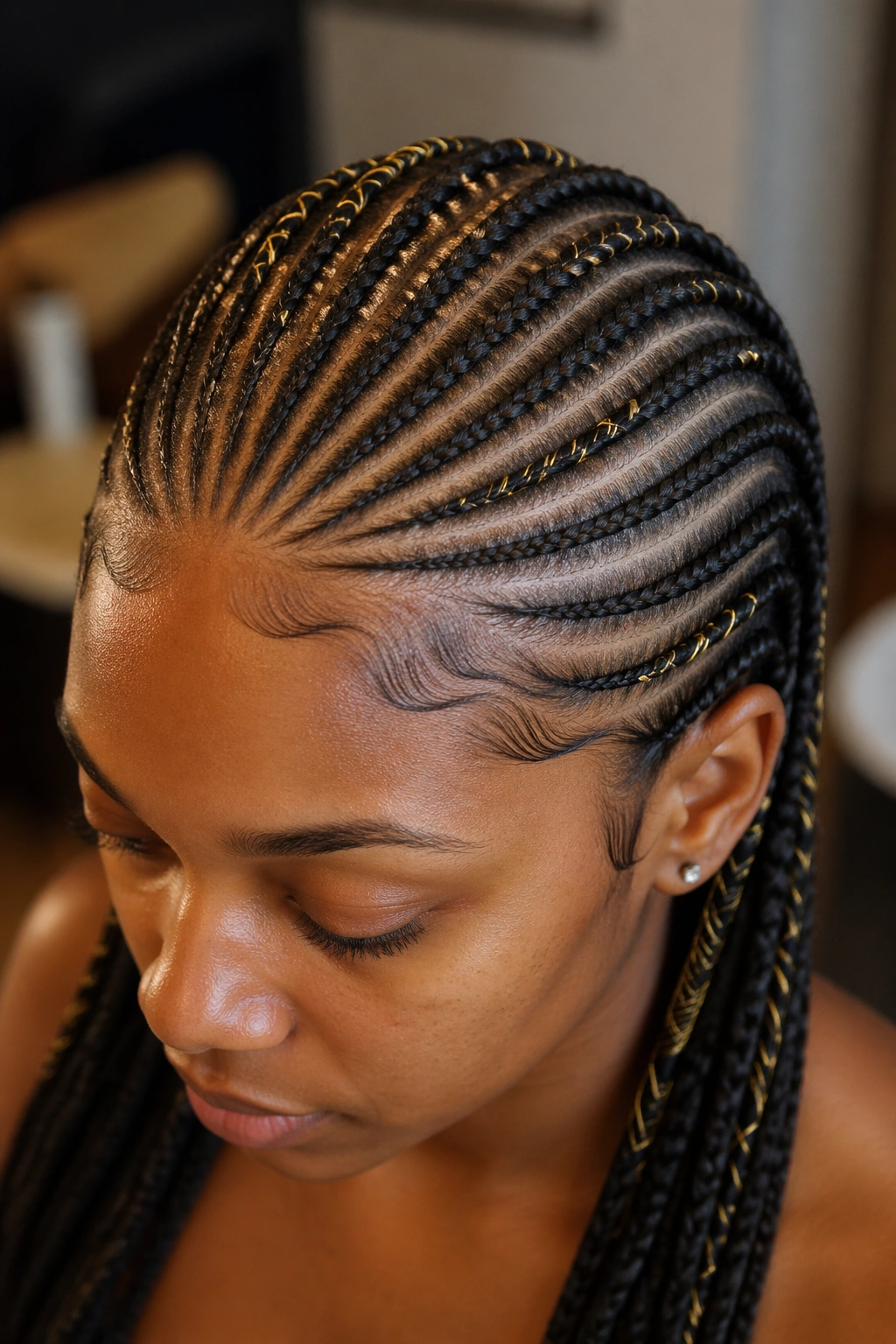
Thin gold thread is braided into select cornrows — not all of them, maybe every fourth or fifth braid. The gold catches light in a way that reads as subtle glitter rather than bold accent.
Gold thread comes on spools from craft supply stores. It’s thin enough to incorporate into a small braid without bulking it up.
The thread lasts the life of the style. It doesn’t need to be removed before washing.
24. Small Cornrows With Crown Accents
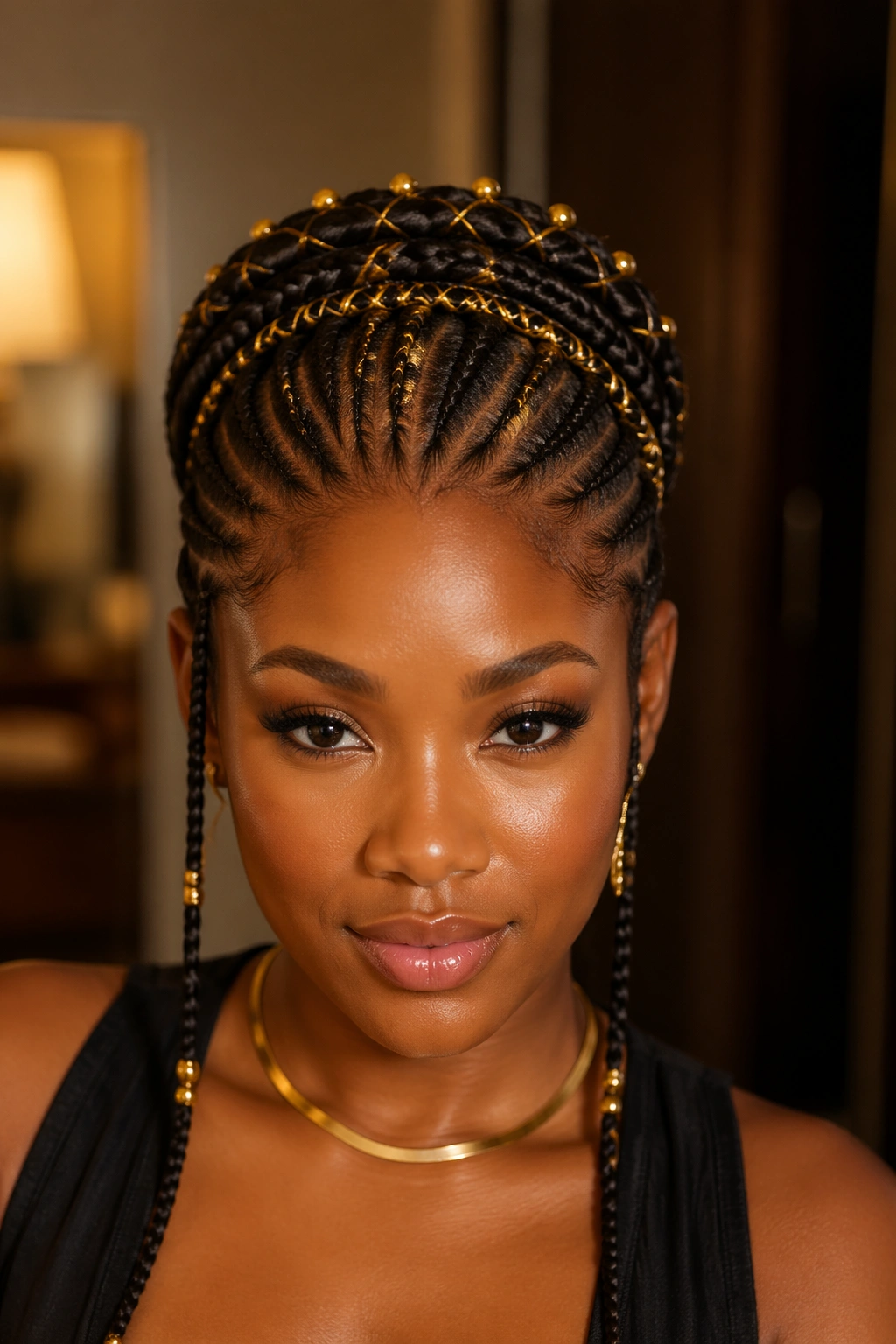
Main body of small cornrows running straight back, but the crown section has raised, thicker cornrows braided over the top to create a visual crown effect.
From the front, this reads regal — the crown braids sit slightly elevated above the smaller cornrows around them.
What Makes It Different
- Unlike a standard cornrow set, the crown braids add vertical dimension
- The look flatters round faces by adding implied height
- The crown section can be accented with beads or gold thread
- Install takes 5 hours due to the layered braiding technique
Tip: Ask for 5-7 raised crown braids rather than more. Too many crown braids defeat the crown illusion.
25. Small Cornrows With Asymmetric Gather
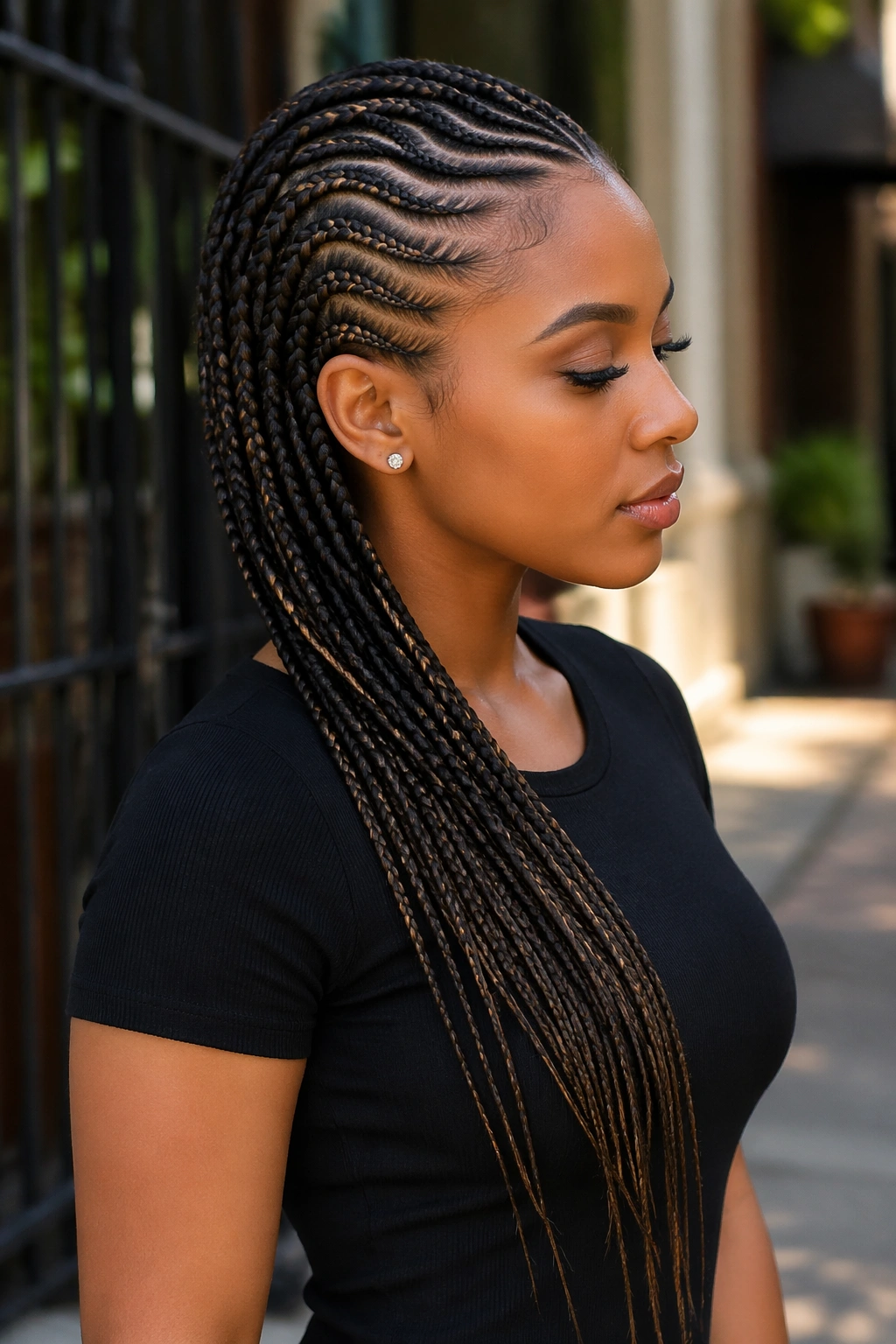
Cornrows all pull to one side, but instead of a clean gather at the ear, they bundle at the opposite shoulder — creating a diagonal cascade across the back.
This is dramatic without being costume-y. The cascade falls in a way that moves as you walk.
Asymmetric gathers work best with longer extensions because the cascade needs length to visually drop across the body.
26. Small Cornrows Into Fulani Braids
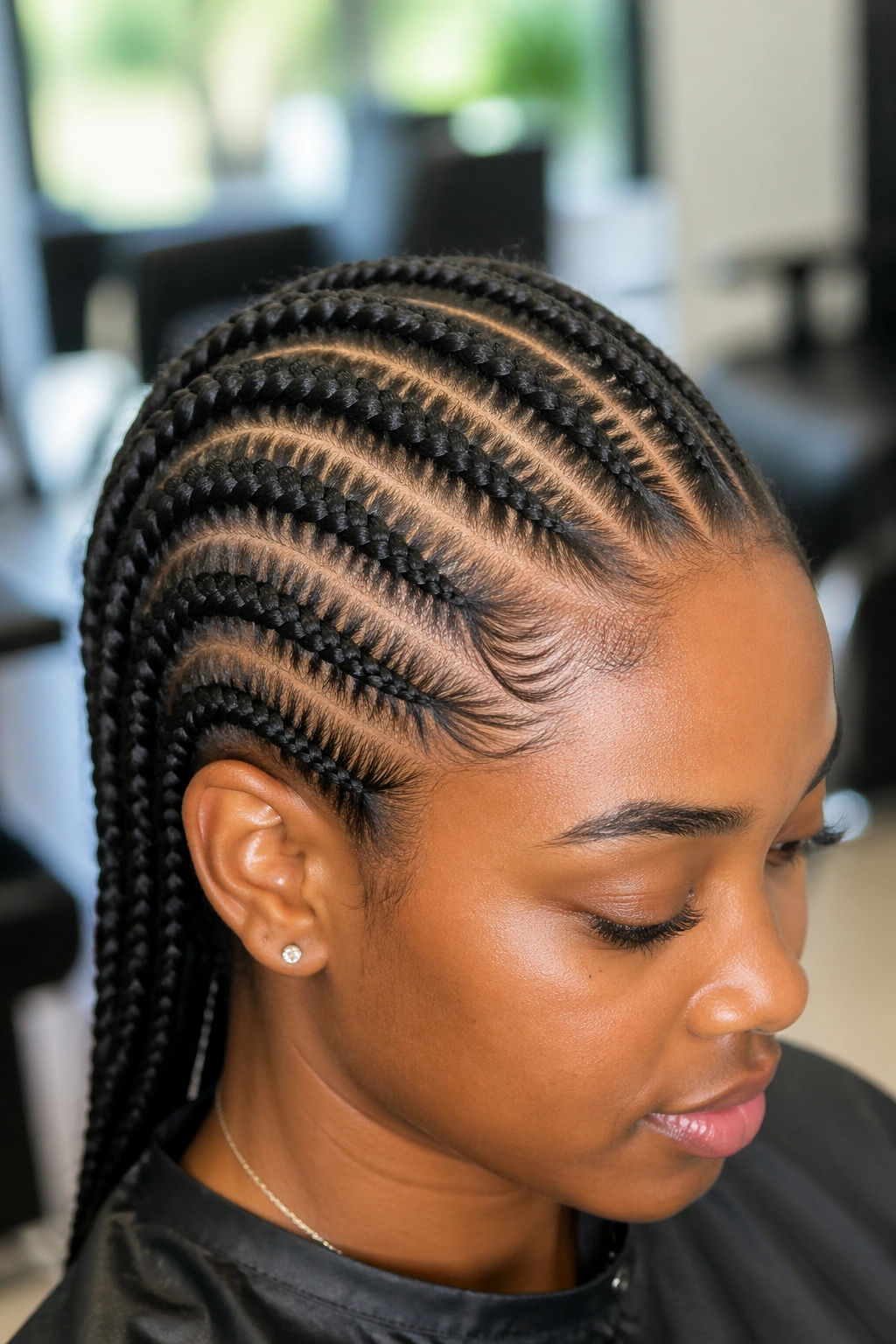
A hybrid: small cornrows across the crown transition into longer Fulani-style braids with traditional gold accents. A single braid runs down the center of the forehead.
Respecting the Fulani tradition means using traditional gold-tone accents and keeping the center forehead braid — the signature element. Without these, it’s not Fulani; it’s just cornrows.
Fulani styles are cultural heritage. Wear them with awareness of their origin in West African Fulani communities, where they’ve been part of traditional dress for generations.
27. Small Cornrows With Short Blunt Cut Ends
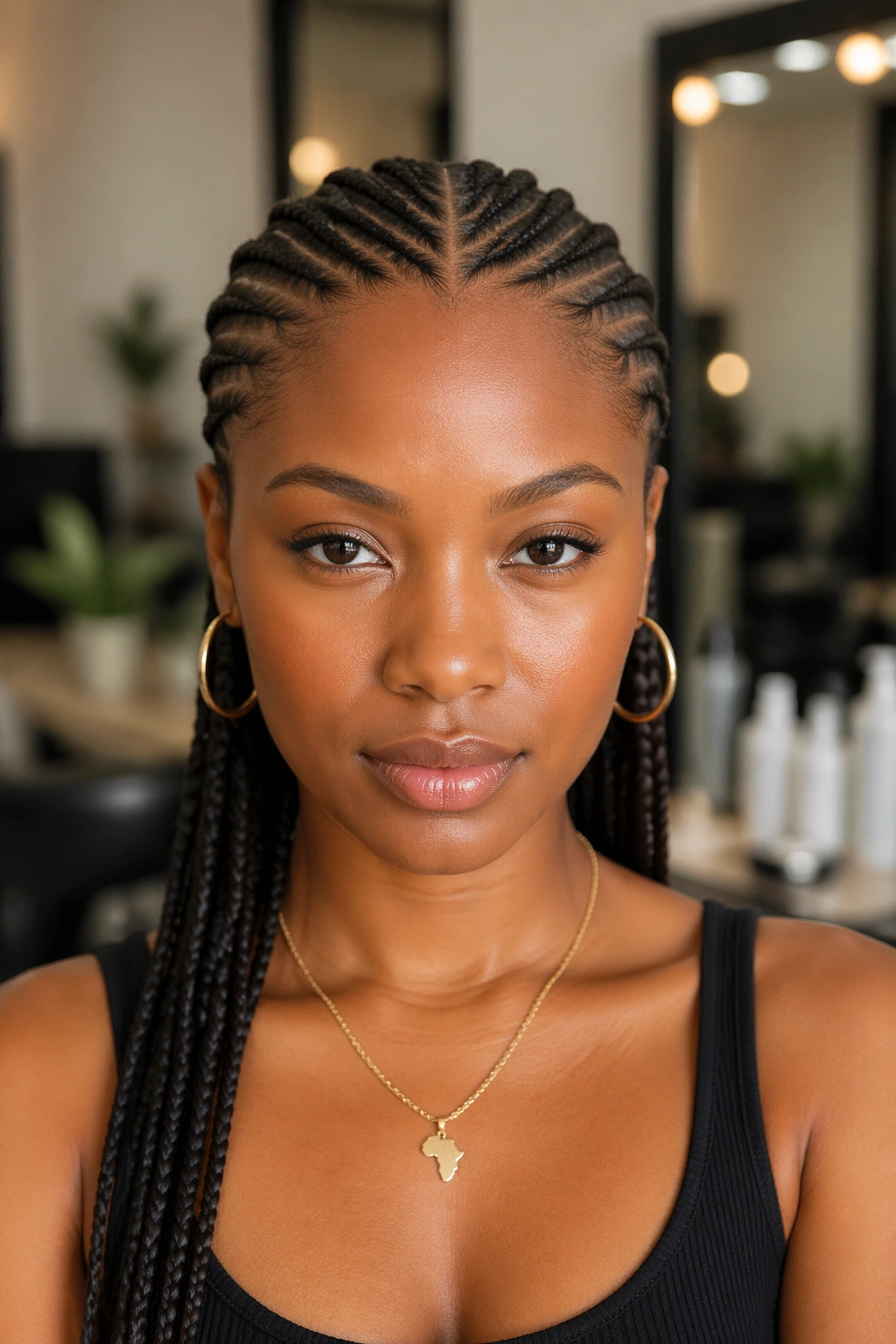
The ends of the cornrows are cut blunt and short — maybe 6-8 inches — rather than left long or trimmed to a point. The blunt cut creates a graphic, architectural silhouette.
Short blunt ends photograph sharp. They read modern and intentional.
Not for everyone. Short cornrow cuts commit you to that length for the style’s duration. If you want length flexibility, skip this one.
28. Small Cornrows With Beaded Headband
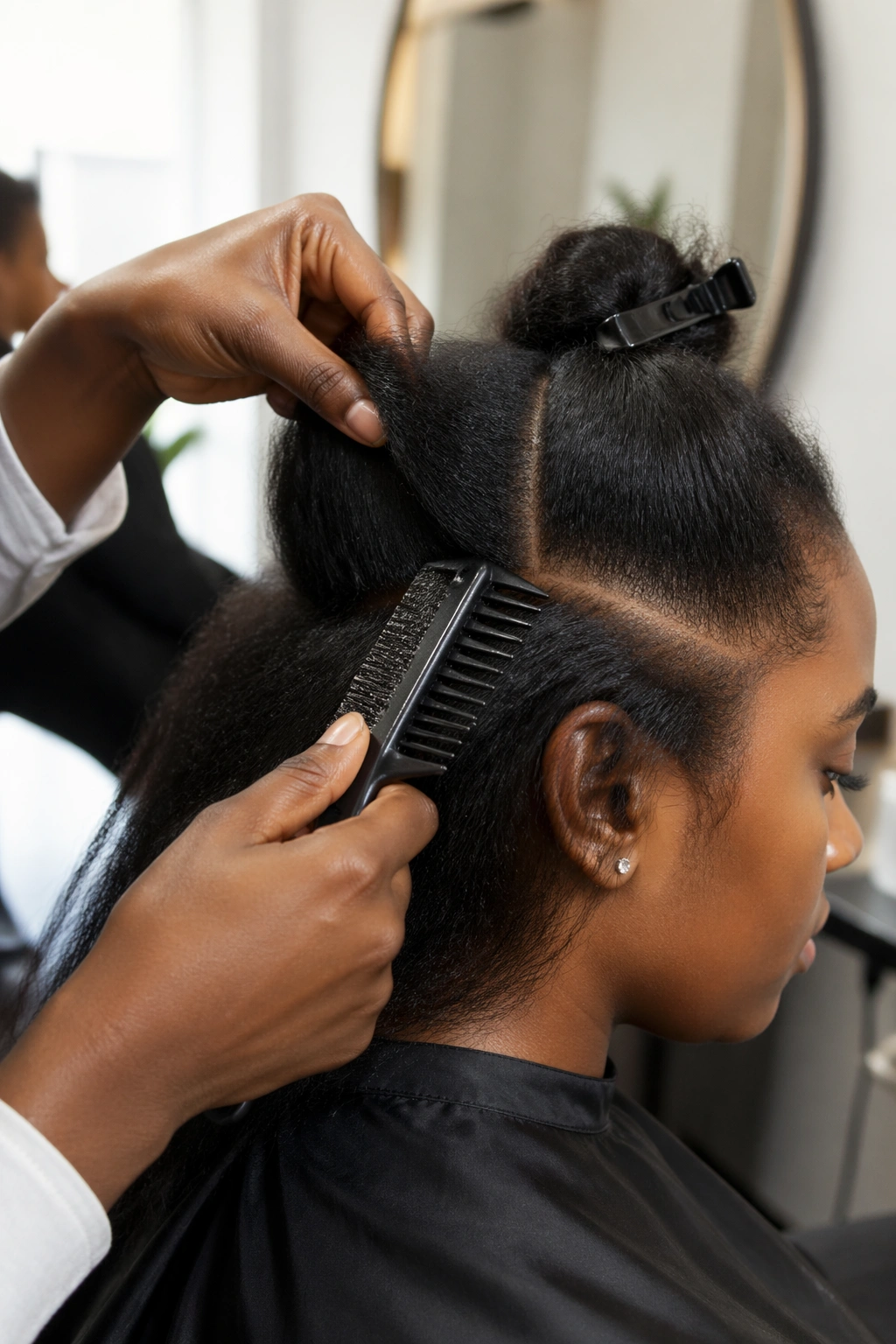
A thin band of beads — strung on wire or thick thread — is woven into the front two cornrows so the beads form a visible band across the forehead.
The beaded headband effect is optical illusion work. Because the beads are braided in, they stay in place without sliding.
Pick bead sizes under 5mm for this technique. Larger beads look bulky in the band.
29. Small Cornrows With Scattered Gemstone Beads
Small cornrows with occasional gemstone beads — amethyst, turquoise, carnelian, tigers-eye — scattered on select braids. Not synthetic acrylic gemstone-imitators; actual semi-precious stone beads.
Real gemstone beads cost more ($5-20 each for quality stones) but the weight, luster, and color depth are unmistakable in person.
Use 5-8 stones across the whole head. These are feature accents, not decoration.
Tip: Stick with one gemstone type per head. Mixing gemstones dilutes the effect. One color story reads more refined.
30. Small Cornrows With an All-Over Swirl Pattern
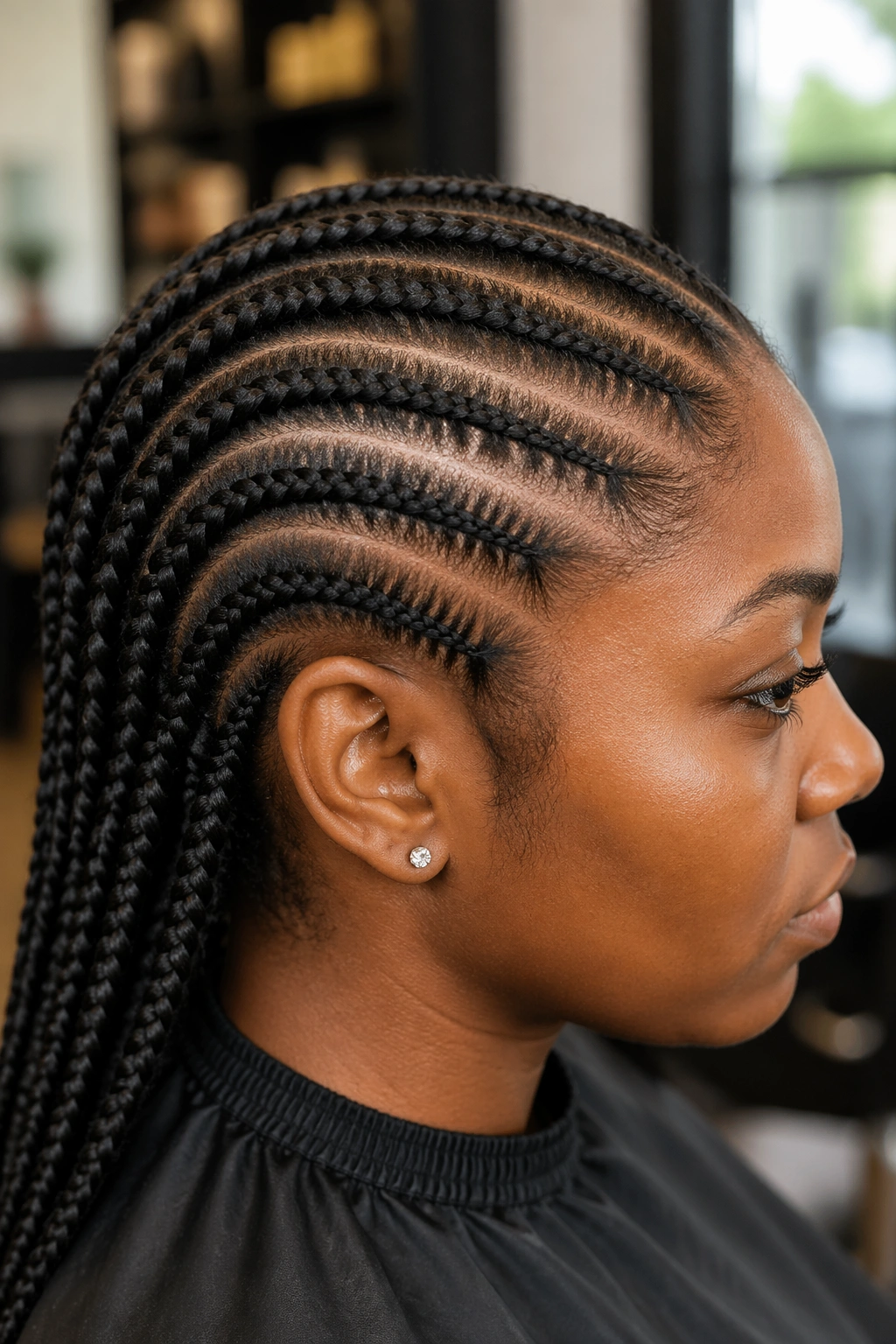
Instead of straight lines, all small cornrows flow in gentle swirling patterns that cover the entire head. There’s no single “direction” — every braid curves.
This is the most complex small cornrow style on this list in terms of braider skill required. The swirls must interlock without colliding, and the overall pattern has to read as intentional from every angle.
Install time: 6+ hours. Braider cost: top-tier.
The payoff is hair that genuinely looks like it’s moving when you’re standing still. The swirls create an optical effect that’s hard to describe but unmistakable in person.
Washing Small Cornrows Without Destroying Them
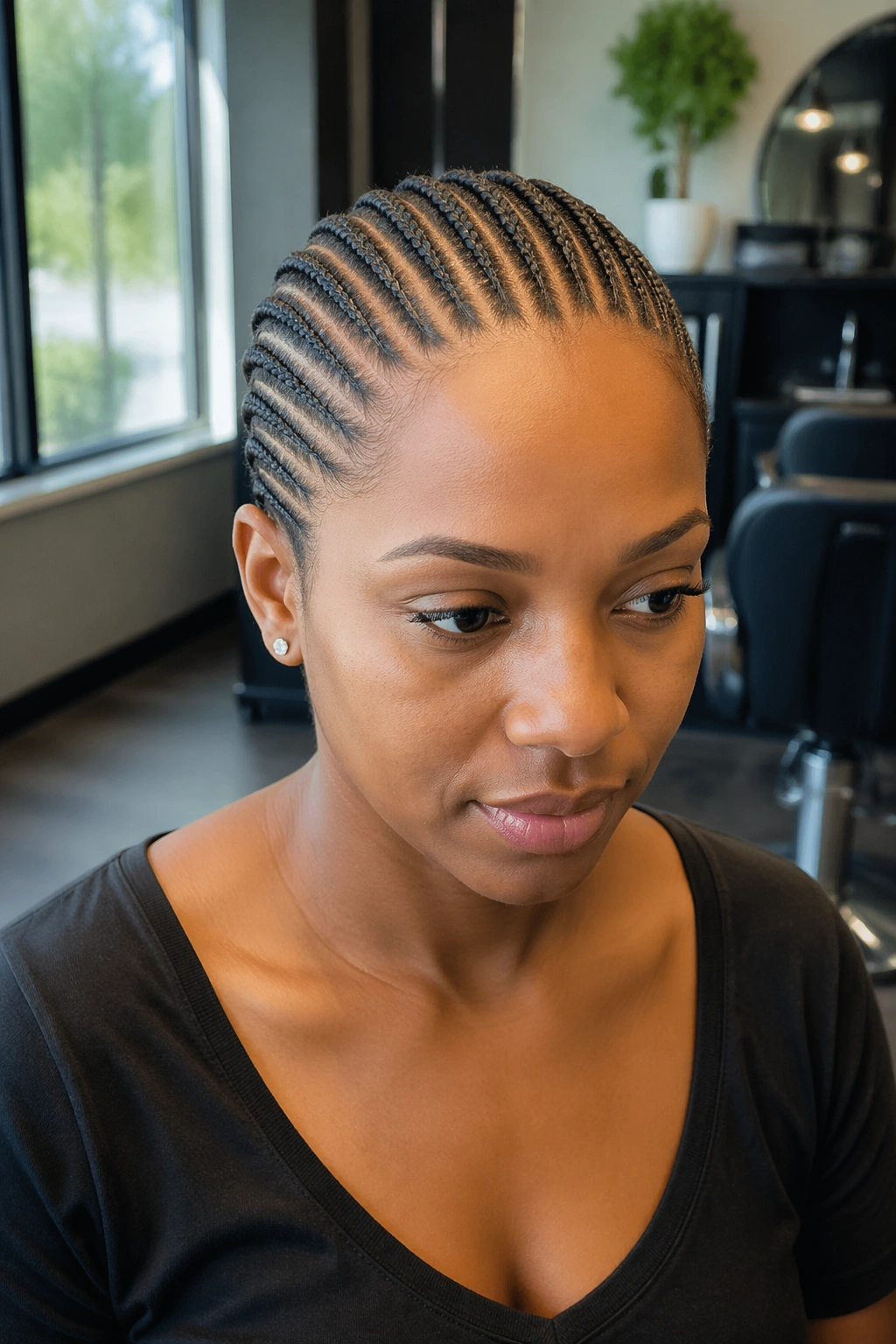
Small cornrows can handle gentle washing, but technique matters. Aggressive scrubbing unravels the braid bases and frizzes the individual strands.
Dilute sulfate-free shampoo 50/50 with water in a squeeze bottle. Apply directly to the scalp along the parts, not to the braids themselves. Use your fingertips to massage the scalp.
Rinse with warm water, letting it run from scalp to ends. Don’t scrub. Don’t flip your head upside down aggressively.
Skip conditioner on the braids. Conditioner builds up in synthetic hair and leaves residue. Apply conditioner only to your natural hairline under the braid bases if needed.
Pat dry with a microfiber towel — never terrycloth. Terrycloth grabs synthetic braiding hair and causes frizz.
Air dry fully before applying any products. Damp braids take hair oils differently and can end up greasy.
Tip: Wash small cornrows every 10-14 days, not more frequently. Each wash stresses the style slightly.
Preventing Frizz in Small Cornrows
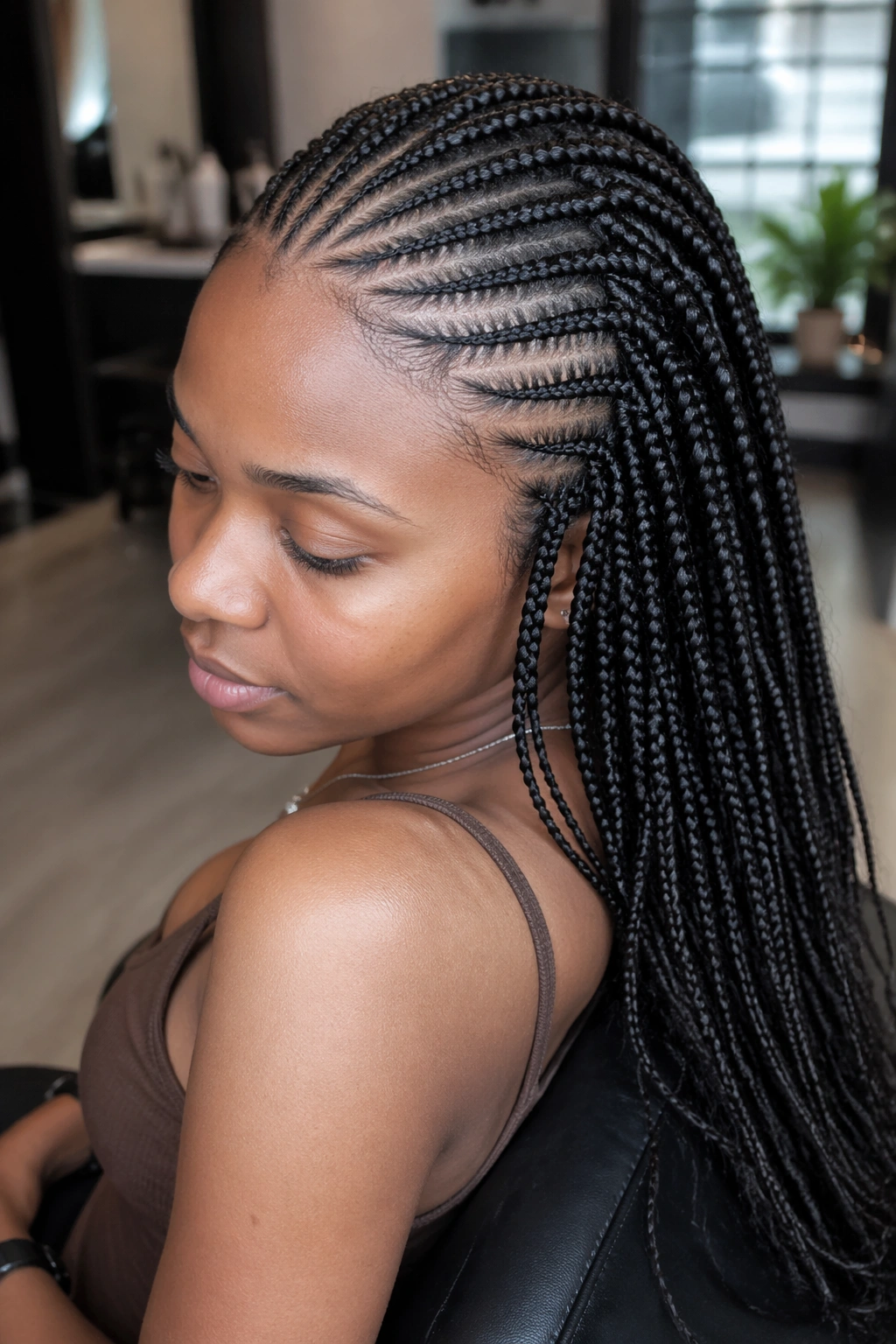
Small cornrows frizz faster than larger styles because there’s more surface area per square inch of scalp. More braids means more edges to fray.
Foam wrap spray. A light mousse applied weekly and smoothed down the length of the braids locks down fly-aways.
Silk scarves overnight. Cotton pillowcases are frizz factories. A silk scarf or satin bonnet adds maybe 2 weeks to a small cornrow style’s lifespan.
Don’t re-braid loose ends. Tempting as it is, twisting frizzed ends back into the braid body almost always makes it worse. Accept some frizz or trim with small scissors.
Keep humidity-fighting spray on hand. For high-humidity days, a light anti-humidity spray on the length of the braids prevents the swelling that causes frizz.
Timing the Takedown
Small cornrows can last 4-6 weeks, but the sweet spot is usually week 4. By week 5, new growth at the scalp starts to be visible, and by week 6, the braids start to lift and look unkempt.
Signs it’s time to take down: more than an inch of new growth at the part lines, itchy scalp that moisturizer doesn’t resolve, braids lifting at the roots, knots forming where loose ends have tangled.
Don’t push past 6 weeks. The stress on your natural hair at the roots — from braids pulling against new growth — becomes damaging.
Budget 3-4 hours for takedown. Small cornrows have many more braids than standard cornrows, so takedown is longer.
Use detangling spray liberally. Work braid by braid. Finger-detangle each section before combing.
Scalp Rest Between Styles
After taking down small cornrows, give your scalp at least 5-7 days before the next protective style. This lets follicles recover from 4-6 weeks of tension.
During the rest period, focus on:
- Deep conditioning treatments every 2-3 days
- Scalp massage with light oils (jojoba, argan)
- Loose styles that don’t tension the scalp (twist-outs, wash-and-gos)
- Trimming any damaged ends before the next install
Rushing back into braids without a rest period compounds tension stress and leads to thinning over time.
Tip: Take photos of your hairline before installing any small cornrow style. Compare after takedown. If you see new thinning, extend rest periods between styles and loosen your next install’s tension.
Common Small Cornrow Mistakes
Installing too many braids. More braids isn’t automatically better. A 40-braid small cornrow style usually looks and wears better than a 60-braid one. Density past a certain point just adds weight and frizz risk.
Choosing extensions that are too heavy. Thick kanekalon bundles weigh small cornrows down and lift the braids from the scalp. Pre-stretched, lightweight kanekalon works better.
Skipping the scalp oil routine. Dry scalp is the enemy of any long-wear protective style. Three minutes every other day prevents weeks of itching.
Waiting too long to retouch edges. Edges blur fast with small cornrow styles because the braids start right at the hairline. Re-lay edges weekly, not monthly.
Picking a style beyond your braider’s skill level. Ask to see photos of your chosen style on the braider’s portfolio before booking. If they haven’t done it before, your head shouldn’t be the test head. Find someone with experience in that specific style, or pick something your braider has mastered.
And one last thing — small cornrows are an investment. Of time, of money, of scalp stamina. Treat them that way. A rushed appointment with a cheap braider usually turns into a redo within two weeks. A careful appointment with a skilled braider lasts the full 5 weeks and sets up your hair for the next style after.
